EP3244191B1 - Verfahren und system zur charakterisierung von partikeln mithilfe eines durchflusszytometers - Google Patents
Verfahren und system zur charakterisierung von partikeln mithilfe eines durchflusszytometers Download PDFInfo
- Publication number
- EP3244191B1 EP3244191B1 EP17169753.5A EP17169753A EP3244191B1 EP 3244191 B1 EP3244191 B1 EP 3244191B1 EP 17169753 A EP17169753 A EP 17169753A EP 3244191 B1 EP3244191 B1 EP 3244191B1
- Authority
- EP
- European Patent Office
- Prior art keywords
- waveform
- particles
- coefficients
- cell
- cells
- Prior art date
- Legal status (The legal status is an assumption and is not a legal conclusion. Google has not performed a legal analysis and makes no representation as to the accuracy of the status listed.)
- Active
Links
Images









Classifications
-
- G—PHYSICS
- G01—MEASURING; TESTING
- G01N—INVESTIGATING OR ANALYSING MATERIALS BY DETERMINING THEIR CHEMICAL OR PHYSICAL PROPERTIES
- G01N15/00—Investigating characteristics of particles; Investigating permeability, pore-volume or surface-area of porous materials
- G01N15/10—Investigating individual particles
- G01N15/14—Optical investigation techniques, e.g. flow cytometry
- G01N15/1429—Signal processing
-
- G—PHYSICS
- G01—MEASURING; TESTING
- G01N—INVESTIGATING OR ANALYSING MATERIALS BY DETERMINING THEIR CHEMICAL OR PHYSICAL PROPERTIES
- G01N15/00—Investigating characteristics of particles; Investigating permeability, pore-volume or surface-area of porous materials
- G01N15/10—Investigating individual particles
- G01N15/14—Optical investigation techniques, e.g. flow cytometry
- G01N15/1456—Optical investigation techniques, e.g. flow cytometry without spatial resolution of the texture or inner structure of the particle, e.g. processing of pulse signals
- G01N15/1459—Optical investigation techniques, e.g. flow cytometry without spatial resolution of the texture or inner structure of the particle, e.g. processing of pulse signals the analysis being performed on a sample stream
-
- G—PHYSICS
- G01—MEASURING; TESTING
- G01N—INVESTIGATING OR ANALYSING MATERIALS BY DETERMINING THEIR CHEMICAL OR PHYSICAL PROPERTIES
- G01N15/00—Investigating characteristics of particles; Investigating permeability, pore-volume or surface-area of porous materials
- G01N15/10—Investigating individual particles
- G01N2015/1006—Investigating individual particles for cytology
-
- G—PHYSICS
- G01—MEASURING; TESTING
- G01N—INVESTIGATING OR ANALYSING MATERIALS BY DETERMINING THEIR CHEMICAL OR PHYSICAL PROPERTIES
- G01N15/00—Investigating characteristics of particles; Investigating permeability, pore-volume or surface-area of porous materials
- G01N15/10—Investigating individual particles
- G01N15/14—Optical investigation techniques, e.g. flow cytometry
- G01N15/1456—Optical investigation techniques, e.g. flow cytometry without spatial resolution of the texture or inner structure of the particle, e.g. processing of pulse signals
- G01N2015/1461—Coincidence detecting; Circuits therefor
Definitions
- the invention relates to a method and system for characterizing particles using a flow cytometer comprising generating a waveform, as a digital representation of detected radiated light, and transforming said waveform using one or more basis functions and obtaining one or more coefficients characterizing the waveform.
- the one or more coefficients characterizing the waveform correspond to particular properties of the particle(s), thereby enabling analysis of physical properties of the particles (such as size or shape) or biological properties of the particles, such as cell type, localization and/or distribution of molecules within the cell and/or on the cell surface, structural elements of the cell such as the nucleus or the cytoskeleton, antibody or antibody-fragment binding to the cell or cell morphology.
- the invention relates to methods and systems in which the waveform is transformed by a wavelet transformation.
- Flow cytometry involves the analysis of optical signals produced by suspensions of particles or biological cells passing in a fluid stream through a focused beam of light.
- the optical signals derived from radiated light, for example from emission of fluorescence or from light scatter, are converted into voltage-versus-time pulse waveforms through the operation of a detector, such as photodiode or photomultiplier detectors.
- Flow cytometry allows simultaneous multi-parametric analysis of the physical and biological characteristics of up to thousands of particles per second.
- Flow cytometry is routinely used in basic research, to interrogate populations of biological cells that may show cell type or gene/protein expression heterogeneity, in the diagnosis of medical conditions and has many other applications in research and clinical practice.
- a common application is to physically sort particles based on their properties, so as to purify populations of interest, such as in fluorescence-activated cell sorting (FACS).
- FACS fluorescence-activated cell sorting
- typical flow cytometry techniques employ thresholds in order to reduce background noise from the analysis. This is commonly done by designating a parameter as the trigger and setting a level in that parameter as the threshold. Any pulse that fails to exceed the threshold level is ignored in all detectors; any pulse that surpasses the threshold level is processed by the electronics. Typically the pulse height and in some cases pulse width across a trigger window (pulse time) are recorded.
- Analyses of this kind however fail to interrogate more complex aspects of the data obtained by the detector, for example the exact shape of the waveform is not interrogated in detail, thereby potential cell doublets, where two cells are fused together, may not be identified. Cells associated with debris are not differentiated, and potentially valuable information on cell shape is lost.
- Murthi et al discloses a flow cytometry system and method for characterizing particles using a flow cytometry system, wherein individual pulse forms are digitized using fast ADCs and wherein the data stream is subsequently analyzed in the digital domain to allow the extraction of additional features other than the typically provided pulse height, width and integral ( Shiva Murti et al. Performance Analysis of a Dual-Buffer Architecture for Digital Flow Cytometry, Cytometry Part A 66A:109-118 (2005 )).
- Murthi et al suggests performing a Fourier transformation of the pulse forms and computing an FFT-integral, FFT-standard deviation, and FFT-kurtosis in order to improve upon the classification of particles.
- Murthi et al discloses the features of a flow cytometry system and method for characterizing particles using a flow cytometry system according to the independent claims.
- the technical problem underlying the present invention is to provide alternative and/or improved means for characterizing particles in a flow cytometer.
- the invention relates to a method and system for characterizing particles using a flow cytometer comprising generating a waveform, as a digital representation of detected radiated light, and transforming said waveform using one or more basis functions and obtaining one or more coefficients characterizing the waveform.
- the method is preferably characterized in that the one or more coefficients characterizing the waveform correspond to particular properties of the particle(s), thereby enabling analysis of physical properties of the particles (such as size or shape) or biological properties, in particular when the particles are biological cells, or other properties of the particles.
- a coefficient that characterizes a waveform corresponding to particular properties of the particle(s) employs using control and/or calibration samples for particular particle populations to be detected, for example for doublets, debris, cell types, or desired cell populations.
- the method is characterized in that the one or more coefficients characterizing the waveform are used for assigning a physical and/or biological property (such as but not limited to size, shape, cell type, morphology, granularity, internal structure) to the one or more particles.
- a physical and/or biological property such as but not limited to size, shape, cell type, morphology, granularity, internal structure
- the detected radiated light of the one or more particles is a forward scatter signal (FSC) and the one or more coefficients characterizing the waveform correspond to the shape or morphology of the particles, in particular when the particles are biological cells.
- the detected radiated light of the one or more particles is a side scatter signal and the one or more coefficients characterizing the waveform correspond to the internal structure or granularity of the particles, in particular when the particles are biological cells.
- the methods reported in the prior art that are suitable for application in flow cytometer systems employ analyzing a waveform of the output scattered light measured in a flow cytometer, wherein characteristic parameters are calculated, wherein such parameters are typically selected from the width or height of the peak, or various relationships between width and peak value, such as width/peak value.
- the methods of the prior art encompass determination of multi-peak signals, whereby a waveform is analyzed to determine whether a potential doublet has been detected. From these measurements conclusions may be drawn regarding particular properties of the cells analyzed in the cytometer.
- s wavelet transformation For a method of transformation, which uses one or more basis functions and allows the provision of one or more coefficients characterizing a waveform, s wavelet transformation is employed.
- signal processing in any given application transforms a time-domain signal into another domain, with the purpose of extracting the characteristic information embedded within the time series that is otherwise not readily available in its original form.
- this can be achieved by representing the time-domain signal as a series of coefficients, based on a comparison between the signal and a set of known template or basis functions ( Wavelets, Theory and Applications for Manufacturing; Gao and Yan, 2011, XIV, p224; Springer ).
- the present invention enables interrogation of more detailed characteristics of the particles due to the analysis of a very close approximation of the actual waveform, as represented by the coefficients of the basis function (wavelets).
- the present invention enables characterization of every analyzed waveform with a high degree of accuracy.
- the coefficients of the present invention when combined with the basis function, provide a very accurate description of the true wave form, without needing to record and store all data points obtained from the detector.
- the present invention therefore enables a fast and efficient computer processing of the data derived by the detector.
- the invention enables the processing and assessment of coefficients of basis functions in order to obtain detailed representation of waveform, without having to deal with unmanageable amounts of raw data, as would be required if the shape of the waveform itself was directly analyzed, as obtained from the detector.
- the properties of the corresponding particles may be deduced without the need for an input of prior knowledge.
- the method thus allows to generate a novel set of parameters, i.e. a full set of wavelet coefficients or a reduced set of PCA coefficients, which can be used for the discovery of novel particle characteristics.
- a classically defined cell subset differs between two conditions with respect to a subtle shift in a wavelet-derived parameter for which there is no prior biological explanation.
- By determining the wavelet coefficients even such subtle shifts within a single classically defined population can be detected with respect to the experimental conditions.
- the method may therefore aid biological discovery. It is particular advantageous that to this end there is no need for prior knowledge as e.g. in form of a library for waveforms of previously known cell types. Instead properties defining subtle differences in cells types can be revealed without additional input.
- the method of the present invention is therefore characterized in that the waveform is transformed by a wavelet transformation.
- the wavelet transformation is a discrete wavelet transformation, a continuous wavelet transformation, a single level wavelet transformation, a multilevel wavelet transform or combinations thereof.
- a wavelet is a wave-like oscillation with an amplitude, such that the area under the curve (equivalently the definite integral) is zero and must decay rapidly (i.e. it is localized).
- wavelets are created to have specific properties that make them useful for signal processing.
- wavelets can be used to extract information from many different kinds of data, such as audio or light signals and images.
- Wavelet transforms can be considered as rotations of data in function space to a different domain.
- the information content of the data can often be extracted with fewer and/or simpler mathematical treatments.
- the new domain can be reached by projecting onto an infinite number of possible basis function sets called wavelets.
- These wavelet basis functions meet certain mathematical criteria. They can be chosen from known sets or designed by the user to suit the particular application. Given that the pulse is measured in a specific trigger window, and the cell-related high frequency component is not periodic within the trigger window, the information can be considered as localized and thus particularly suited to wavelet analysis.
- wavelet transformations may be selected appropriately by a skilled person (see Wavelets, Theory and Applications for Manufacturing; Gao and Yan, 2011, XIV, p224; Springer ; Gilbert Strang and Truong Nguyen, Wavelets and Filter Banks, Wellesley-Cambridge Press, 1996 ; Amara Graps, "An Introduction to Wavelets,” IEEE Computational Science and Engineering, Summer 1995, Vol. 2, No, 2 ; Wavelet Methods in Statistics with R' by Guy Nason, Springer, Use R! Series ).
- the transform is evaluated at different locations (translation) and different scales (dilation).
- This is the continuous form that could be evaluated at an infinite number of locations and scales.
- this form could also be used (by evaluating at every discrete location and an infinite choice of scales).
- it is more computationally efficient as well as parsimonious to use the decimated discrete wavelet transformation which is evaluated at select scales (without loss of information) in near linear time.
- the low computational complexity makes it ideal for implementation in hardware.
- the undecimated discrete wavelet transformation as well as wavelet packet transformations could also be used.
- the method described herein is characterized in that the basis function of the discrete wavelet transformation is selected from Haar wavelets or Daubechies wavelets.
- wavelet transform are the dwt and wavedec commands of Matlab, a mathematics and computing platform provided by Mathworks.
- the dwt command performs a single-level one-dimensional wavelet decomposition.
- the decomposition is done with respect to either a particular wavelet ('wname') or particular wavelet decomposition filters that can be specified accordingly.
- [cA,cD] dwt(X,'wname') computes the approximation coefficients vector cA and detail coefficients vector cD, obtained by a wavelet decomposition of the vector X.
- the string 'wname' contains the wavelet name.
- the wavedec command performs a multilevel one-dimensional wavelet analysis using either a specific wavelet ('wname') or a specific wavelet decomposition filters.
- [C,L] wavedec(X,N,'wname') returns the wavelet decomposition of the signal X at level N, using 'wname'.
- N must be a positive integer.
- the output decomposition structure contains the wavelet decomposition vector C and the bookkeeping vector L.
- the method described herein is characterized in that waveform is corrected for the background level prior to the transformation.
- the correction for the background level is conducted by obtaining the average value for the background detected radiated light, when no particle is present in the light beam, and subtracting said average value from the waveform.
- This method of correction from background signals is enabled by the mathematical transformations described herein and represents a significant improvement over those methods typically employed in the art.
- an arbitrary threshold is not required. Typically, prior art systems had employed an arbitrary threshold by designating a parameter as the trigger and setting a level in that parameter as the threshold. Any pulse that fails to exceed the threshold level is ignored in all detectors; any pulse that surpasses the threshold level is processed by the electronics.
- the waveform can be assessed in its entirety using the mathematical transformation with a basis function and corresponding coefficients. Any background signal can be subtracted in order to more exactly determine which background signal is to be excluded from the analysis.
- the method described herein is characterized in that the waveform is normalized, preferably to its maximum value, prior to the wavelet transformation.
- the values at each time point of the waveform are preferably divided by the maximum value of said waveform yielding normalized waveforms with a maximal value of 1.
- the wavelet transformation may in this preferred embodiment capture shape specific features of the waveforms independent of the height of the waveforms and the total intensity, which allows for a more reliable detection and assignment of particle properties.
- the method described herein is characterized in that the waveform is transformed and a set of one or more coefficients characterizing the waveform are obtained, such that based upon the one or more coefficients and the basis function an approximated waveform can be generated.
- the approximation error in such a reconstruction of the waveform is less than 10% of the total sum of squares, more preferably less than 5%.
- the method described herein is characterized in that the comparison metric relates to the sum of squared residuals, where 'residual' is the difference between the approximated waveform and the true waveform, evaluated at each measurement.
- approximation error refers to the ratio of the area under a curve corresponding to the absolute values of the difference between the waveform and the approximated waveform to the area under the waveform.
- the method described herein is characterized in that the waveform is generated from the detected radiated light using a processing unit that comprises an analog-to-digital converter (ADC).
- ADC analog-to-digital converter
- the method described herein is characterized in that the waveform is transformed using a processing unit comprising a field programmable gate array (FPGA).
- FPGAs Field Programmable Gate Arrays
- FPGAs are semiconductor devices that are based around a matrix of configurable logic blocks connected via programmable interconnects. FPGAs can be reprogrammed to desired application or functionality requirements after manufacturing.
- a skilled person is capable of selecting an ADC and/or FPGA as is necessary for implementing the present invention.
- the preferred embodiment is particularly useful for real time processing of the waveforms of the particles, since the processing unit may provide coefficients that represent the waveform in an abstracted, but characteristic form without the need of saving the raw PMT data.
- the coefficients computed may be used directly for a real time processing of the signals, which allow for downstream sorting applications. To this end it may be particularly preferred to implement on the FPGA in addition the computational steps for a subsequent PCA on the wavelet coefficients, in order to perform a gating based upon the results of the PCA.
- the method described herein is characterized in that the method comprises the step of determining at least one property of the particles based upon the one or more coefficients characterizing the waveform.
- the present invention enables characterization of, without limitation thereto, physical properties of the particles (such as size or shape) or biological properties of the particles, such as cell type, localization and/or distribution of molecules within the cell and/or on the cell surface, structural elements of the cell such as the nucleus or the cytoskeleton, antibody or antibody-fragment binding to the cell or cell morphology.
- the method described herein is characterized in that the particles are calibration samples with at least one known property and the correlation of the one or more coefficients of the waveform of said calibration samples is calculated to generate a calibration matrix.
- the calibration matrix may can refer to the assignment that for any given coefficient X with a value between A and B, the particles are then assigned as doublets. Therefore, a coefficient that characterizes a waveform corresponding to particular properties of the particle(s) preferably employs using control and/or calibration samples for particular particle populations to be detected, for example for doublets, debris, cell types, or desired cell populations.
- the method described herein is characterized in that the coefficients characterizing the waveform are analyzed using a principal component analysis (PCA).
- PCA principal component analysis
- clusters of coefficients are identified in the space of the principal components that indicate a common property of the corresponding particles.
- PCA on the coefficients of the waveforms allows for a fast and reliable characterization of the particles.
- PCA enables the identification of populations of particles that share a common property. For instance forward scatter signals correlate with the overall morphology of the particles.
- forward scatter signals correlate with the overall morphology of the particles.
- PCA may reveal distinct populations.
- side scatter data may be used in order to identify particles or cells with similar internal structures or granularity.
- PCA is a particular preferred multivariate statistical model to reduce the dimension of the coefficients characterizing the waveform
- other multivariate statistical models may also be advantageously applied.
- the method described herein is characterized in that the particles are selected from a group comprising cells, vesicles, nuclei, microorganisms, preferably bacteria or algae, beads, proteins, nucleic acids, pollen, extracellular vesicles, or any combination thereof.
- the method described herein is characterized in that the particles are cells and the determined property of the cells is or is associated with cell type, localization or distribution of molecules within the cell and/or on the cell surface, the amount of debris on the cell, structural elements of the cell such as the nucleus or the cytoskeleton, antibody or antibody-fragment binding to the cell, cell morphology and/or allows for the distinction between single cells or aggregates of multiple cells.
- various cell types can be determined from one another in a cytometer based on the method described herein.
- bacteria may be easily characterised by there their morphological features, being typically categorized into spheres (cocci (plural) or coccus (singular)), rods (bacilli (plural) or bacillus (singular), and helical (spirilla (plural) or spirillum (singular).
- the main arrangements are single cells, diplo- (pairs), staphylo- (clusters), and strepto- (chains).
- the present invention enables differentiation of various cell shapes based on the transformation mathematics disclosed herein.
- Mammalian cells also exhibit different morphological features, and may be accurately characterized using the methods described herein. For example, as described below, erythrocytes were distinguished from other cells. The cells were obtained from mice blood cells, which is a mix of erythrocytes and leukocytes.
- Erythrocytes or red blood cells (RBCs) are the most common type of blood cell and the vertebrate organism's principal means of delivering oxygen (O2) to the body tissues via blood flow through the circulatory system.
- O2 oxygen
- mature red blood cells are flexible and oval biconcave disks. They lack a cell nucleus and most organelles, in order to accommodate maximum space for hemoglobin.
- the present invention has enabled successfully the detection and differentiation of erythrocytes from other cells, without using specific biological markers, based solely on the analysis of pulse waveform from scattered light and subsequent transformation, as described herein.
- the radiated light corresponds to, but without limitation thereto, forward-scattered light, side scattered light, back scattered light and/or fluorescent light.
- a further aspect of the invention relates to a flow cytometry system comprising:
- a skilled person is capable of implementing the methods as described herein in the form of software and/or hardware into a cytometry device.
- the processing unit of a cytometry device or system may comprise multiple computer processors, each configured, by using specific software, for the analysis as described herein.
- the flow cytometry system described herein is characterized in that the processing unit comprises an ADC and an FPGA.
- the flow cytometry system described herein is characterized in that the processing unit is configured to transform the waveform according to a wavelet transformation, such as a discrete wavelet transformation, a continuous wavelet transformation, a single level wavelet transformation, a multilevel wavelet transform or combinations thereof, or wherein the basis function of the discrete wavelet transformation is selected from Haar wavelets or Daubechies wavelets .
- the transforms can be embodied and integrated into a device in the form of an appropriate software, such as using the functions encompassed by the Matlab platform.
- the flow cytometry system described herein is characterized in that the flow cytometry system comprises a sorter for the particles configured to sort the particles based upon the one or more coefficients characterizing the waveform.
- a sorter for the particles configured to sort the particles based upon the one or more coefficients characterizing the waveform.
- This application represents an additional function of the invention, for example by combining the methods and systems disclosed herein with a particle/cell sorting device, such as a FACS.
- the determination of particular coefficients for particular particles may subsequently be coupled with appropriate sorting technology.
- the system may be configured so that there is a low probability of more than one particle/cell per droplet. Just before the stream breaks into droplets, the flow passes through a measuring station where the property or characteristic of interest of each particle/cell is measured using the methods described herein.
- An electrical charging ring is positioned at the point where the stream breaks into droplets.
- a charge is placed on the ring based on the immediately prior measurement, and the opposite charge is trapped on the droplet as it breaks from the stream.
- the charged droplets then fall through an electrostatic deflection system that diverts droplets into containers based upon their charge.
- the charge is applied directly to the stream, and the droplet breaking off retains charge of the same sign as the stream. The stream is then returned to neutral after the droplet breaks off.
- a particular advantage of the method described herein is that it allows for a label-free sorting of particles, e.g. cells.
- Known cell sorting devices such as FACS rely on fluorescent markers.
- a fluorescent labelling of cells is not essential to sort different cell types.
- forward or side scatter signals of unlabelled cells may be used, wherein a pattern of common coefficients of the waveform indicate a certain cell type. For instance forward scatter predominantly relates to the shape or morphology of cells, while side scatter signals are predominantly influenced by internal structures indicating a degree of granularity.
- Cell types can be distinguished based upon these properties, however previous methods have not been sufficiently fast to allow for a real time sorting, while being sufficiently precise for a label-free distinction of cell types. For instance, imaging techniques with a subsequent image analysis can precisely identify cell types based on their morphology, but lack speed in order to allow for efficient real time cell sorting applications. On the other hand standard flow cell cytometer parameters such as the width or height of the cells cannot reliable discriminate cells types with more subtle morphological differences.
- the transformation of the waveforms of the scatter signals of the cells allow for a fast and surprisingly reliable identification of cell types.
- the PCA allows for an identification of cells of a common type, since corresponding waveform coefficients cluster in a plot of the principal components.
- Known cell types may be used to establish a gate, wherein this gate is subsequently used for real time cell sorting.
- either fluorescent/stained or unstained cells pass through a laser beam and the respective emitted or scattered light is captured by a light detector (e.g. photo multiplier tube).
- a current pulse is generated for each event, and the pulse is summarized by its height, area, and width in a standard flow cytometer, with no access to the raw readout of the detectors.
- the present invention utilizes the shape of the pulse, as it is correlated to the shape of the cell (scattered light) or the surface localization of a biomarker (emitted light).
- the present invention therefore relates to a method and system that are able to measure the cell specific pulse shape (waveform) based on the detector readout.
- the shape of the pulse is summarized by coefficients of, preferably, a discrete wavelet transform (or continuous wavelet transform).
- a discrete wavelet transform or continuous wavelet transform.
- This more comprehensive representation of the waveform compared to previous methods can be used for improved data quality (singlet/doublet discrimination, dead cells, debris) as well as a biological parameter (erythrocytes, discrimination between lymphocytes/granulocytes).
- the source of the system is typically the source of the sample that is provided to the flow cytometer for analysis.
- the sample includes the individual particles that are illuminated by the light beam (from the light source) and analyzed by the detector.
- samples can be analyzed by the flow cytometer.
- types of samples include blood, semen, sputum, interstitial fluid, cerebrospinal fluid, cell culture, seawater, and drinking water.
- the sample may be in the form of a prepared sample, such as lysed blood, labeled particles in suspension, immunoglobulin-labeled cells, or DNA-stained cells, achieved commonly by adding reagents and performing protocols as commonly known in the art.
- Examples of types of particles include beads, blood cells, sperm cells, epithelial cells, cancer cells, immune cells, viruses, bacteria, yeast, plankton, microparticles (e.g., from plasma membrane of cells), and mitochondria.
- the sample source can include one or more containers, such as test tubes, that hold the sample to be analyzed.
- a fluid transfer system is provided in some embodiments, such as to aspirate the sample from the container and deliver the sample to the fluid nozzle.
- the sample is typically injected into a sheath fluid within the flow cytometer, which is provided by a sheath fluid source.
- a sheath fluid is saline.
- An example of the fluid source is a container storing saline therein, and a fluid transfer system operable to deliver the sheath fluid from the fluid source to the fluid nozzle.
- a fluid nozzle is provided to generate the fluid stream and to inject the particles of the sample into the fluid stream.
- An example of a fluid nozzle is a flow cell.
- the fluid nozzle typically includes an aperture having a size selected to at least be larger than the sizes of particles of interest in the sample, but small enough to arrange the particles into a narrow stream.
- the particles are arranged in a single file or near single file arrangement so that a single particle, or a small number of particles (e.g., 1-3), can be passed through the light beam at a time.
- the particles are focused using hydrodynamic, acoustic, or magnetic forces.
- a light source (which can include one or more light sources) generates at least one light beam that is directed toward the fluid stream.
- light sources include a laser and an arc lamp.
- the light beam passes through an optics assembly, such as to focus the light beam onto the fluid stream.
- the light beam is a laser beam.
- the light beam from the light source intersects the fluid stream.
- the particles contained in the light beam disturb the light beam and generate radiated light.
- the type and pattern of radiated light depends upon the type and size of the particles, but the radiated light can include forward scattered light, side scattered light, back scattered light, as well as fluorescent light (which occurs when light rays are absorbed and reemitted by the particle, which is detectable by the corresponding change in wavelength (i.e., colour) of the light rays).
- One or more detectors are provided to detect radiated light.
- the detectors may include a detector arranged to detect forward scatter and florescence, a detector arranged to detect side scatter and florescence, and detector arranged to detect back scatter and florescence.
- a detector is a photomultiplier.
- the system of the invention also comprises a processing unit (or particle analyzer) that operates to receive signals from the one or more detectors to perform various operations to characterize the particles.
- the processing unit or particle analyzer includes one or more processing devices and a computer-readable storage device that stores data instructions, which when executed by the processing device cause the processing device to perform one or more operations, such as those discussed herein.
- the system preferably a particle analyzer
- ADC analog to digital converter
- FPGA field programmable gate array
- a pulse is generated in every PMT detector. These pulses reflect the passage of the cell through the laser beam and the signal generated at each point in the cell's path. These pulses can be mapped by plotting signal as a function of time, thereby generating a waveform. As the particle enters the laser beam spot, it will generate scattered light and fluorescence signals, which will ultimately manifest in a stream of electrons (current) from the anode of the PMT. The magnitude of the current is proportional to the number of photons that hit the photocathode and thus is also proportional to the intensity of the scatter or fluorescence signal generated by the particle.
- the output of the PMT will begin to rise, reaching peak output when the particle is located in the center of the laser beam. At this point, the particle is fully illuminated (the laser beam's photons are at highest density in the center of the laser beam) and will produce a maximum amount of optical signal. As the particle flows out of the laser beam, the current output of the PMT will drop back to baseline. This generation of a pulse is termed an "event.”
- ADC analog to digital converter
- the electronics of systems of the prior art typically quantify the pulse by calculating its height, area, and width.
- the height and area, or maximum and integral, respectively, are used to measure signal intensity because their magnitudes are proportional to the number of photons that interacted with the PMT.
- the width is proportional to the time that the particle spent in the laser and can be used to distinguish doublets (that is, two particles that pass through the laser so closely that the system assigned both of them to a single pulse and event) from singlets.
- the measurement from each detector is referred to as a parameter.
- Each parameter can be displayed in height, area, and width values on the histograms and dot plots in flow cytometry software. These are used to measure fluorescence intensity, compare populations, and designate sorting decisions.
- radiated light is detected as one of the one or more particles pass through the light beam, and subsequently a waveform, which is a digital representation of the detected radiated light, is generated, and said waveform is transformed using one or more basis functions and obtaining one or more coefficients characterizing the waveform.
- the digital signal therefore is a waveform for each event, which is transformed by a particle analyzer or processing unit, preferably comprising a field programmable gate array (FPGA), according to the mathematical transformations described herein.
- the electronics of the system therefore provide coefficients that represent the waveform in abstracted form, from which a very accurate representation of the waveform can be constructed, if so desired.
- reconstruction of the actual waveform is however unnecessary for analysis.
- the coefficients of an analyzed particle from any given event is compared to a set of control or calibration coefficients, for example in a calibration matrix, in order to characterize the measured particle.
- the method can be conducted in an automated manner based on categorizing the coefficients of each event/pulse.
- the coefficients characterizing the waveforms can then be assessed using a multivariate statistical model, such as a principal component analysis.
- the multivariate statistic model comprises multivariate analysis of variance, multivariate regression analysis, factor analysis, canonical correlation analysis, redundancy analysis, correspondence analysis, multidimensional scaling, discriminant function, linear discriminant analysis, clustering systems, recursive partitioning, principal component analysis, non-linear principal component analysis, information preserving component analysis (IPCA), independent component analysis, multidimensional scaling, support vector machines, random forests, neural networks, partial least squares regression, projection pursuit, boosting and/or artificial neural networks.
- IPCA information preserving component analysis
- the principal component analysis can also be termed PCA.
- PCA is a model of multivariate statistics, which describes a form of statistics encompassing the simultaneous observation and analysis of more than one statistical variable. This analysis enables grouping of the analyzed particles (or their coefficients, as determined by the relevant transform) into sub-populations, such as those associated with particular particle characteristics as described herein.
- machine learning algorithms are used in order to discriminate between at least two populations of particles with a different property based upon the corresponding coefficients characterizing the waveforms.
- the coefficients characterizing the waveforms are determined for a training set of particles e.g. differing cell types.
- SVM Support Vector Machine
- the invention also comprises the analysis of stored flow cytometry data.
- the "real-time" analysis of waveforms is preferred, but not essential. Data may also be stored and analyzed subsequently.
- cells are characterised by an estimate of scatter and fluorescence intensities. These estimates are derived from an electronic pulse corresponding to the physical response of a detector (PMT or Photo diode), which in turn corresponds to the characteristics of emitted and scattered light from a cell. Usually, the pulse height and width were used to distinguish between single cells and doublets. In the present examples, these pulses are captured and their shapes analyzed using a discrete wavelet transform. The stability of this method is confirmed with the QuantiFlash device (Example 1) as well as with microspheres (Example 2). We are able to efficiently filter out cell doublets and non-specific pulses to increase data quality.
- Quantiflash calibration device (A.P.E. Angewandte Physik & ELektronik GmbH, Berlin) was used as a model system to assess wavelet transformation of waveform. Quantiflash is a precise LED based light source typically applied in independent quality control and calibration of flow cytometry applications. The Quantiflash generates simulated high-precision pulsed light signals that are collected in a similar manner to the light emitted from a fluorescent cell. Each event creates a pulse. When the pulse rises above a threshold, the device is 'triggered' and a fixed number of digital samples is collected and saved.
- pulses are generated with the quantiFlash calibration device, and the vertical lines indicate the 'trigger window'.
- a discrete wavelet transform was run on each on each trigger window.
- a DWT function was applied, as used in R, Matlab etc. For reference refer to ' Wavelet Methods in Statistics with R' by Guy Nason (Springer, Use R! Series ).
- the input for DWT is a vector of length 2 k , where k is an integer.
- the trigger window is padded with zeroes on each end, to become length 2 7 .
- the output is two sets of coefficients: smoothed coefficients and detail coefficients.
- Each set of coefficients has k levels.
- the first level has 2 k-1 coefficients, the second 2 k-2 coefficients etc.
- the k th level has 1 coefficient.
- the smooth coefficient of the k th level corresponds to Area, the commonly used parameter.
- the shape of the input quanti Flash pulse is programmable, so this could be used to discover the correspondence between pulse shape and coefficients in a robust manner.
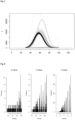
- Fig. 2 the most extremely different waveforms for each level of the smooth coefficients (plotted in grey and black respectively) are demonstrated. The difference is barely perceptible.
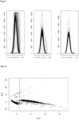
- Fig. 3 shows a plot of raw data from eight-peak beads (beads with 8 fluorescence intensities), from both the side scatter and fluorescence channel.
- the vertical lines have been omitted.
- the two streams of data are sychronised, so the peaks are aligned.
- the intensity is shown on a linear scale, so some fluorescence peaks are very small and not visible.
- Fig. 4 demonstrates analysis of the waveform of the scatter channel, and finding the effect on the fluorescence channel, where the signal is. Low quality pulses were first filtered out, then doublets were identified. A principal component analysis (PCA) of the smooth coefficient is displayed.
- PCA principal component analysis
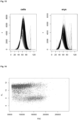
- Fig. 5 demonstrates a histogram of the fluorescent channel, unfiltered (above) and filtered (below). The lowest intensity is mixed with noise, and this has been reduced. Notice that the peaks have a small 'shadow' next to them.
- Fig. 7 the filtered waveforms that have low fluorescence intensity are plotted. Note that these waveforms and the waveforms of Fig. 6 have roughly the same energy, but different shapes. Of course, they could also be distinguished by their height differences, but using the DWT eliminates the need for any extra calculations.
- Fig. 8 shows 3 separate components of the filtered events. By assessing the histograms of the fluorescence intensities, it's possible to separate the main peaks from the 'shadow'.
- Fig. 9 shows the corresponding waveforms to the components of Fig. 8 . This is not necessary for the method or this example, but it's helpful when analyzing cells when there is high overlap in FSC/SSC.
- the analysis of erythrocytes was carried out as follows. First the doublets were identified. The coefficient of the forward scatter was found, and the PCA of the smooth and detail coefficients combined was plotted. Either the smooth coefficients and/or the detail coefficients may be employed. The events on the right of Fig. 10 are the doublets.
- the filter shown in Fig. 10 is shown as a standard forward/side scatter dotplot in Fig. 11 .
- the doublets (red) found by the DWT method are in the location that doublets are known to be found in, but they are mixed with singlets, making it impossible to make one single neat gate.
- the waveforms corresponding to singlets/doublets are shown in Fig. 12 .
- Fig. 13 shows erythrocytes plotted in a standard FSC/SSC plot. They are highly overlapping, which makes it hard/impossible to gate out. However, according to their wavelet forms they are quite distinct ( Fig. 14 ).
- FITC ter119 shows a plot of Fluorescence (FITC ter119) vs. FSC to see how this corresponds to the marker.
- the events (in red are the wavelet coefficients) discovered by the DWT method correspond to the marker.
- the fluorescent marker also non-specifically stains other lymphocytes meaning erythrocytes cannot be accurately determined in standard methods.
- other small particles e.g. stroma cells
- the erythrocytes cannot be removed from the sample as such procedures also remove these small particles.
- lymphocytes and erythrocytes are stained with the same marker at the same intensity.
- fluorescent pulse shapes of the lymphocytes and erythrocytes are different, making a separation possible.
- PBMCs peripheral blood mononuclear cells
- the left side plot of Fig. 17 shows a plot of the wavelet coefficients derived from forward scatter. As can be seen the events are well separated into different groups. These groups are overlapping in a standard forward scatter/side scatter plot, which is shown in the right of Fig. 17 . In the standard forward scatter/side scatter plot it is thus difficult to accurately identify the different groups.
- the events are framed in the right figure, with a range of 800000 - 1100000 in forward scatter (fsc) and 100000 - 700000 in side scatter (ssc). These framed lymphocytes were analyzed in more detail.
- Fig. 18 shows a plot of the framed lymphocytes of Fig. 17 in the channels corresponding to CD3 and CD8. As can be seen the two groups indicated by the colours black and blue do not correspond to distinct populations as defined by the biomarkers CD3 and CD8. Instead they appear to represent a more general, independent property of certain lymphocytes.
- Fig. 19 shows on the left a plot of the side scatter wavelet coefficients. On the right of Fig. 19 the events are plotted in CD3 and CD8 with the colour code that corresponds to the two groups found in the side scatter wavelet coefficient ( Fig. 19 left). Also for this analysis the distinct populations found in the side scatter wavelet coefficients do not correspond to populations as defined by the biomarkers CD3 and CD8.
- Fig. 20 shows a plot of the forward scatter wavelet coefficients of the framed lymphocytes, wherein the colouring is defined by the two groups identified by the plot of the side scatter wavelet coefficients of Fig. 19 .
- the populations defined by forward scatter and side scatter coefficients are distinct from each other, and appear therefore to represent different properties of the human PBMCs.
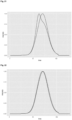
- Fig. 21 the average pulse shapes from each of the two groups in the side scatter wavelet coefficients of the framed lymphocytes (see Fig. 19 ) are plotted.
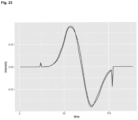
- Fig. 22 plots the average pulse shapes from each of the two groups in the forward scatter wavelet coefficients of the framed lymphocytes (see Fig. 20 ). Since the average pulse shapes are very similar, the first derivative of each of the average pulse shapes is plotted in Fig. 23 . The inflection points of the pulse shapes are subtly different, which is difficult to pick by eye. It demonstrates however the potential of using wavelet coefficients for a detecting of such slight differences.
- HCT 116 cell lines arrested in G1 and G2/M phase was carried out in order to compare the ability to discriminate between single cells and doublets using a standard analysis and wavelet transformation.
- Fig. 24 shows a plot for the forward scatter signal of HCT 116 cells arrested in G1 (top) and G2/M phases (bottom) using standard list mode parameters height (FSC-H) and width (FSC-W). These list mode parameters correspond to the Data File Standard for Flow Cell Cytometry (FCS) (see Spidlen et al. Data File Standard for Flow Cell Cytometry, Version FCS 3.1, Cytometry A. 77(1) (2010 ))
- top figure (G1) two populations are visible.
- the top population exhibits a greater width (FSC-W) than height (FSC-H).
- FSC-W width
- FSC-H height
- a standard doublet gate black solid line
- no clear-cut populations can be established. Therefore the standard doublet gate from the top figure is reused.
- the results are compared with results obtainable by a wavelet transformation.
- the waveforms i.e. the PMT raw data on the pulse shapes are collected at the FCS channel.
- Example 1 As described for Example 1 for each waveform, which corresponds to a triggered event, a discrete wavelet transform (DWT) was run. A DWT function was applied, as used in R, Matlab etc. For reference refer to ⁇ Wavelet Methods in Statistics with R' by Guy Nason (Springer, Use R! Series ).
- the input for the DWT is a vector of length 2 k , where k is an integer.
- the trigger window is preferably padded with zeroes on each end, to become length 2 7 .
- the output for each cell is a vector of length 2 7 of wavelet coefficients.
- the DWT coefficients are transformed using a principal component analysis (PCA) and thus the 2 7 wavelet coefficients are reduced to two coefficients.
- PCA principal component analysis
- the axis fsc1 and fsc2 denote two PCA components.
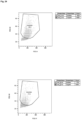
- Fig. 25 the results from the 'standard doublet gate' are displayed in the PCA plot via colour coding, in which blue corresponds to doublets and red to non-doublets. In this view there are more distinct populations, and the 'standard doublet gate' appears too large.
- a new doublet gate was defined (black outline), which will be referred to as the 'shape doublet gate'.
- the new 'shape doublet gate' by gating on the very distinct and obvious population in the wavelet PCA, and checked where these cells occurred in the standard FSC-H FSC-W plot. According to the shape doublet gate 14.5 % of the HCT 116 cells arrested in G1 exhibit a doublet shape, while 2.16 % of the cells arrested in G2/M exhibit a doublet shape.
- Fig. 26 the 'shape doublet gate' is displayed via colour coding in the original FSC-H, FSC-W plot (blue indicating doublets according to the 'shape doublet gate' and red indicating ungated events). This is accompanied by a black outline representing the 'standard doublet gate'.
- the standard doublet gate is too large. Also the populations of the doublets versus non-doublets as identified by the wavelet transformation do not separate nicely in the standard FSC-H and FCS-W plot, emphasizing that a pure width and height analysis in not sufficient for an accurate separation.
- Fig. 27 shows the cells that have been gated out using the shape doublet gate as established from in Fig. 25 .
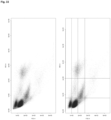
- a PCA has been performed. Populations were defined by manually drawing clusters in the PCA of the FSC wavelet coefficients, and these results were transferred to the plot of standard fluorescence parameters. Thereby four distinct populations are revealed which reflect differing autofluorescence signals. These four populations are marked by a colour coding. In this case, information about auto fluorescence can be directly derived from the scattered light only, i.e. cell morphology is correlated with autofluorescence. This is another example of unbiased biological discovery.
- Fig. 28 re-plots the cells gated out by the shape doublet gate using the list mode parameters FSC-H and FL2-H.
- the colour coding of the populations identified in Fig. 27 is used. These populations have clearly increasing autofluorescence, but in the standard list parameter plots there are no clearly defined populations.
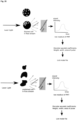
- Fig. 29 represents an alternative visualization in order to illustrate the connection between the PCA of the wavelet coefficients and the shape of the waveforms.
- the top figure is identical to the top figure 25 , except that the principal component axis have been switched.
- the shape of the waveform is displayed as it can be approximated from the wavelet coefficients.
- cells designated as doublets in the 'standard doublet gate' are not doublets, according to what is commonly accepted as doublets, but this is invisible in a standard analysis. They appear to be specific cell types of which there is no prior biological knowledge. This further demonstrates the potential of the method for unbiased biological discovery
- Fig. 30 displays the pulse continuum of a fluorescence channel for the Human cells stained with CD3 and CXCR5.
- a DWT was performed on the waveforms to obtain wavelet coefficients as described about.
- a PCA allows for a visualization of the wavelet coefficients in a reduced dimensional space of the two principal components. Instead to plot a dot at the position of a set wavelet coefficients representing an event in the PCA, the waveform (pulse) is plotted to visualize the shape.
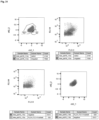
- This information can be used to gate out the positive cells ( Fig. 31 , top left) which is then transferred into a plot using standard list mode parameters ( Fig. 31 , top right).
- Fig. 31 , bottom left it can be seen that there are leftover events that would be typically be labelled as positive in a standard analysis.
- These cells are backgated into the DWT PCA ( Fig. 31 , bottom right) and appear in the middle.
- the procedure can be enhanced by simultaneously measuring a blank sample and performing a DWT.
- FSC will trigger when there is no event.
- FSC-H, FSC-W or FSC-A Prior to summarizing an event in a standard list mode by the parameters FSC-H, FSC-W or FSC-A, in standard protocols there is no reliable decision, whether the event actually represents a pulse/waveform of a desired particle.
- the scatter parameters FSC and SSC are associated with particle size and morphology, but in the process of measuring cells, beads or other desired particles, many undesired events are measured stemming from e.g. cell debris, free fluorochromes etc.
- a blank sample is measured by connecting the quantiFlash(TM) device to the FSC channel in order to provide an artificial trigger.
- the pulse shapes in the SSC and fluorescent channels can be captured.
- the blank sample wavelet coefficients from the fluorescent channels (here six channels) can be combined into one file, as can the coefficients from the real sample.
- a PCA can be performed on both new datasets together.
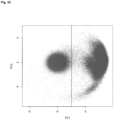
- Fig. 32 displays the results, where blank sample events are blue and real sample events are red.
- the pulse shapes should be essentially random in all channels, and hence well separated from any real events.
- the potential of a combination of machine learning algorithms to discriminate cells types is demonstrated.
- a sample of human PBMCs is first gated on FSC/SSC to obtain lymphocytes and then gated into B-cells and other lymphocytes using standard compensated fluorescent parameters. This gating is used to label each cell with one of two labels A or B (B cell or not B cell).
- a or B B cell or not B cell.
- One thousand each of events labelled A and B are randomly selected to obtain balanced classes. These events are then randomly split into two groups, labelled training and test.
- an appropriate Support Vector Machine (SVM) with radial kernel is tuned with respect to cost and kernel width parameters.
- the SVM is constructed using the wavelet coefficients of both FSC and SSC (combined into one single dataset). The parameter combination with the highest classification is chosen.
- the classification rates for A and B are 75.8% and 78.4% respectively.
- the SVM is then applied to the test set.
- the classification rates for A and B are 63.8% and
- the standard height/width/area FSC and SSC parameters are not able to separate B cells from other lymphocytes, and fluorescent parameters are necessary.
- the wavelet coefficients demonstrate the possibility of separating B cells from other lymphocytes on the basis of scattered light alone. It is anticipated that further hardware tuning leads to a further improvement in classification rates.
Landscapes
- Chemical & Material Sciences (AREA)
- Dispersion Chemistry (AREA)
- Physics & Mathematics (AREA)
- Health & Medical Sciences (AREA)
- Life Sciences & Earth Sciences (AREA)
- Analytical Chemistry (AREA)
- Biochemistry (AREA)
- General Health & Medical Sciences (AREA)
- General Physics & Mathematics (AREA)
- Immunology (AREA)
- Pathology (AREA)
- Engineering & Computer Science (AREA)
- Signal Processing (AREA)
- Investigating Or Analysing Biological Materials (AREA)
- Investigating, Analyzing Materials By Fluorescence Or Luminescence (AREA)
Claims (14)
- Verfahren zur Charakterisierung von Partikeln mithilfe eines Durchflusszytometers, umfassend:a. Durchleiten eines oder mehrerer Partikel in einem Fluidstrom durch einen Lichtstrahl des Durchflusszytometers,b. Erfassen von abgestrahltem Licht, wenn ein oder mehrere Partikel den Lichtstrahl durchlaufen,c. Erzeugen einer Wellenform, die eine digitale Darstellung des erfassten abgestrahlten Lichts ist, undd. Transformieren der Wellenform mithilfe einer oder mehrerer Basisfunktionen und Erhalten eines oder mehrerer die Wellenform charakterisierender Koeffizienten,dadurch gekennzeichnet, dassdie Wellenform durch eine Wavelet-Transformation transformiert wird, die eine oder mehreren Basisfunktionen Wavelets sind und der eine oder die mehreren Koeffizienten, die die Wellenform charakterisieren, Wavelet-Koeffizienten sind,wobei das Verfahren den Schritt des Bestimmens mindestens einer biologischen und/oder physikalischen Eigenschaft der Partikel basierend auf dem einen oder den mehreren Koeffizienten, die die Wellenform charakterisieren, durch Vergleichen des einen oder der mehreren Koeffizienten von analysierten Partikeln mit einem Satz von Kalibrierungskoeffizienten umfasst, der zuvor aus Kalibrierungspartikeln erhalten wurde, für die die mindestens eine biologische und/oder physikalische Eigenschaft bekannt war.
- Verfahren nach dem vorhergehenden Anspruch,
dadurch gekennzeichnet, dass die Wavelet-Transformation ausgewählt ist aus einer Gruppe bestehend aus einer diskreten Wavelet-Transformation, einer kontinuierlichen Wavelet-Transformation, einer einstufigen Wavelet-Transformation, einer mehrstufigen Wavelet-Transformation oder Kombinationen davon, wobei die Basisfunktion der diskreten Wavelet-Transformation vorzugsweise aus Haar-Wavelets oder Daubechies-Wavelets ausgewählt ist. - Verfahren nach einem der vorhergehenden Ansprüche,
dadurch gekennzeichnet, dass die Wellenform vor der Transformation um den Hintergrundpegel korrigiert wird. - Verfahren nach einem der vorhergehenden Ansprüche,
dadurch gekennzeichnet, dass die Wellenform transformiert wird und ein Satz von einem oder mehreren Koeffizienten, die die Wellenform charakterisieren, erhalten wird, sodass basierend auf dem einen oder den mehreren Koeffizienten und der Basisfunktion eine approximierte Wellenform erzeugt werden kann, wobei vorzugsweise der Approximationsfehler basierend auf einer Vergleichsmetrik, wie der Summe der quadrierten Residuen, wobei 'Residuum' die Differenz zwischen der approximierten Wellenform und der wahren Wellenform ist, ausgewertet bei jeder Messung, weniger als 10 %, besonders bevorzugt weniger als 5 % beträgt. - Verfahren nach einem der vorhergehenden Ansprüche,
dadurch gekennzeichnet, dass die Wellenform aus dem erfassten abgestrahlten Licht mithilfe einer Verarbeitungseinheit erzeugt wird, die einen Analog-Digital-Wandler (ADC) umfasst. - Verfahren nach einem der vorhergehenden Ansprüche,
dadurch gekennzeichnet, dass die Wellenform mithilfe einer Verarbeitungseinheit transformiert wird, die ein feldprogrammierbares Gate-Array (FPGA) umfasst. - Verfahren nach einem der vorhergehenden Ansprüche,
dadurch gekennzeichnet, dass die die Wellenform charakterisierenden Koeffizienten mithilfe einer Hauptkomponentenanalyse analysiert werden, wobei vorzugsweise im Raum der Hauptkomponenten Cluster von Koeffizienten identifiziert werden, die eine gemeinsame Eigenschaft der entsprechenden Partikel anzeigen. - Verfahren nach einem der vorhergehenden Ansprüche,
dadurch gekennzeichnet, dass die Partikel ausgewählt sind aus einer Gruppe umfassend Zellen, Vesikel, Kerne, Mikroorganismen, vorzugsweise Algen oder Bakterien, Perlen, Proteine, Nukleinsäuren, Pollen, extrazelluläre Vesikel oder eine beliebige Kombination davon. - Verfahren nach einem der vorhergehenden Ansprüche,
dadurch gekennzeichnet, dass die Partikel Zellen sind und die bestimmte Eigenschaft der Zellen mit Zelltyp, Lokalisation oder Verteilung von Molekülen innerhalb der Zelle und/oder auf der Zelloberfläche, der Menge an Ablagerungen auf der Zelle, Strukturelementen der Zelle wie dem Kern oder dem Zytoskelett, Antikörper oder Antikörper-Fragment-Bindung an die Zelle, Zellmorphologie assoziiert ist oder ist und/oder die Unterscheidung zwischen einzelnen Zellen oder Aggregaten mehrerer Zellen ermöglicht. - Verfahren nach einem der vorhergehenden Ansprüche,wobei das erfasste abgestrahlte Licht ein Vorwärtsstreusignal (FSC) ist und der eine oder die mehreren Koeffizienten, die die Wellenform charakterisieren, der Form oder Morphologie der Partikel entsprechen
und/oderdas erfasste abgestrahlte Licht ein Seitenstreusignal ist und der eine oder die mehreren Koeffizienten, die die Wellenform charakterisieren, der inneren Struktur oder Granularität der Partikel entsprechen. - Durchflusszytometriesystem, umfassend:- eine Quelle für ein Fluid und Partikel,- eine Fluiddüse, die dazu konfiguriert ist, einen Fluidstrom zu erzeugen, der die Partikel umfasst,- eine Lichtquelle, die dazu konfiguriert ist, einen Lichtstrahl zu erzeugen, der den Fluidstrom, der die Partikel umfasst, beleuchtet,- einen Detektor, der dazu konfiguriert ist, das abgestrahlte Licht der Partikel zu erfassen, und- eine Verarbeitungseinheit, die dazu konfiguriert ist, eine Wellenform basierend auf dem erfassten abgestrahlten Licht zu erzeugen,dadurch gekennzeichnet, dass die Verarbeitungseinheit dazu konfiguriert ist, die Wellenform mithilfe einer oder mehrerer Basisfunktionen zu transformieren und einen oder mehrere die Wellenform charakterisierende Koeffizienten zu erhalten, die es erlauben, mindestens eine biologische und/oder physikalische Eigenschaft der Partikel basierend auf dem einen oder den mehreren Koeffizienten, die die Wellenform charakterisieren, zu bestimmen, wobei die Wellenform durch eine Wavelet-Transformation transformiert wird, die eine oder die mehreren Basisfunktionen Wavelets sind und der eine oder die mehreren Koeffizienten, die die Wellenform charakterisieren, Wavelet-Koeffizienten sind, und wobei die Verarbeitungseinheit ferner dazu konfiguriert ist, den einen oder die mehreren Koeffizienten analysierter Partikel mit einem Satz von Kalibrierungskoeffizienten zu vergleichen, die zuvor aus Kalibrierungspartikeln erhalten wurden, für die die mindestens eine biologische und/oder physikalische Eigenschaft bekannt war.
- Durchflusszytometriesystem nach dem vorhergehenden Anspruch,
dadurch gekennzeichnet, dass die Verarbeitungseinheit einen ADC und ein FPGA umfasst. - Durchflusszytometriesystem nach Anspruch 11 oder 12,
dadurch gekennzeichnet, dass die Verarbeitungseinheit dazu konfiguriert ist, die Wellenform gemäß einem Verfahren nach Anspruch 2 zu transformieren. - Durchflusszytometriesystem nach einem der Ansprüche 11-13,
dadurch gekennzeichnet, dass das Durchflusszytometriesystem einen Sortierer für die Partikel umfasst, der dazu konfiguriert ist, die Partikel basierend auf dem einen oder den mehreren Koeffizienten, die die Wellenform charakterisieren, zu sortieren.
Applications Claiming Priority (2)
| Application Number | Priority Date | Filing Date | Title |
|---|---|---|---|
| EP16168576 | 2016-05-06 | ||
| EP16184174 | 2016-08-15 |
Related Child Applications (1)
| Application Number | Title | Priority Date | Filing Date |
|---|---|---|---|
| EP23198280.2 Division-Into | 2023-09-19 |
Publications (3)
| Publication Number | Publication Date |
|---|---|
| EP3244191A1 EP3244191A1 (de) | 2017-11-15 |
| EP3244191B1 true EP3244191B1 (de) | 2024-10-30 |
| EP3244191B8 EP3244191B8 (de) | 2025-03-19 |
Family
ID=55953018
Family Applications (1)
| Application Number | Title | Priority Date | Filing Date |
|---|---|---|---|
| EP17169753.5A Active EP3244191B8 (de) | 2016-05-06 | 2017-05-05 | Verfahren und system zur charakterisierung von partikeln mithilfe eines durchflusszytometers |
Country Status (1)
| Country | Link |
|---|---|
| EP (1) | EP3244191B8 (de) |
Families Citing this family (3)
| Publication number | Priority date | Publication date | Assignee | Title |
|---|---|---|---|---|
| JP7586711B2 (ja) * | 2018-06-05 | 2024-11-19 | クロノス ヘルス, インク. | 液体移動を制御し、生体試料を分析するためのデバイス、カートリッジ、およびセンサ |
| RU2690976C1 (ru) * | 2018-11-09 | 2019-06-07 | Федеральное государственное автономное образовательное учреждение высшего образования "Национальный исследовательский Томский государственный университет" (ТГУ, НИ ТГУ) | Способ регистрации интегральных размерно-количественных характеристик планктона |
| EP3933376A1 (de) | 2020-07-02 | 2022-01-05 | Deutsches Rheuma-Forschungszentrum Berlin | Verfahren und system zur charakterisierung von teilchen mittels winkeldetektion in einem durchflusszytometer |
Citations (1)
| Publication number | Priority date | Publication date | Assignee | Title |
|---|---|---|---|---|
| US20070105184A1 (en) * | 2005-08-31 | 2007-05-10 | Elias Greenbaum | Biosensor method and system based on feature vector extraction |
Family Cites Families (2)
| Publication number | Priority date | Publication date | Assignee | Title |
|---|---|---|---|---|
| CN101151517A (zh) | 2005-03-29 | 2008-03-26 | 希森美康株式会社 | 鉴别癌症/异型细胞和粒子团的方法及细胞分析仪 |
| JP2017526914A (ja) | 2014-08-06 | 2017-09-14 | ベックマン コールター, インコーポレイテッド | フローサイトメーターを用いた多重ピークイベントの評価 |
-
2017
- 2017-05-05 EP EP17169753.5A patent/EP3244191B8/de active Active
Patent Citations (1)
| Publication number | Priority date | Publication date | Assignee | Title |
|---|---|---|---|---|
| US20070105184A1 (en) * | 2005-08-31 | 2007-05-10 | Elias Greenbaum | Biosensor method and system based on feature vector extraction |
Non-Patent Citations (5)
| Title |
|---|
| ANONYMOUS: "NSF Award Search: Award#9604929 - Flow Cytometry: Digital Processing of Cellular Information", 3 September 2020 (2020-09-03), XP055727306, Retrieved from the Internet <URL:https://www.nsf.gov/awardsearch/showAward?AWD_ID=9604929&HistoricalAwards=false> [retrieved on 20200903] * |
| G.B.J. DUBELAAR ET AL: "CytoBuoy: a step forward towards using flow cytometry in operational oceanography", SCIENTIA MARINA, vol. 64, no. 2, 13 March 2000 (2000-03-13), pages 255 - 265, XP055523828 * |
| MOHAMMED BAHOURA ET AL: "Real-time implementation of discrete wavelet transform on FPGA", SIGNAL PROCESSING (ICSP), 2010 IEEE 10TH INTERNATIONAL CONFERENCE ON, IEEE, PISCATAWAY, NJ, USA, 24 October 2010 (2010-10-24), pages 191 - 194, XP031816031, ISBN: 978-1-4244-5897-4 * |
| MURTHI SHIVA ET AL: "Performance analysis of a dual-buffer architecture for digital flow cytometry", NIH PUBLIC ACCESS AUTHOR MANUSCRIPT, WILEY-LISS, vol. 66A, no. 2, 1 August 2005 (2005-08-01), pages 109 - 118, XP002519271, ISSN: 1552-4922, [retrieved on 20050622], DOI: 10.1002/CYTO.A.20156 * |
| WILKINS M F ED - FRIEDRICH RECKNAGEL: "Chapter 21: Identification of Marine Microalgae by Neural Network Analysis", 1 January 2006 (2006-01-01), XP009534626, ISBN: 978-3-540-28383-6, Retrieved from the Internet <URL:https://www.sciencegate.app/app/document/download/10.1007/3-540-28426-5_21> * |
Also Published As
| Publication number | Publication date |
|---|---|
| EP3244191B8 (de) | 2025-03-19 |
| EP3244191A1 (de) | 2017-11-15 |
Similar Documents
| Publication | Publication Date | Title |
|---|---|---|
| US10337975B2 (en) | Method and system for characterizing particles using a flow cytometer | |
| JP5425814B2 (ja) | サポートベクタマシンを用いてフローサイトメトリーデータを分析するための方法及びシステム | |
| Labati et al. | All-IDB: The acute lymphoblastic leukemia image database for image processing | |
| US10222320B2 (en) | Identifying and enumerating early granulated cells (EGCs) | |
| US11841314B2 (en) | Method and system for characterizing particles using an angular detection in a flow cytometer | |
| US20170102310A1 (en) | Flow cytometer and a multi-dimensional data classification method and an apparatus thereof | |
| EP3258263B1 (de) | Zellanalysator und teilchensortierungsverfahren und vorrichtung | |
| CN102507417B (zh) | 一种粒子自动分类方法 | |
| CN102279146A (zh) | 基于激光鞘流技术的血液细胞五分类方法 | |
| EP3244191B1 (de) | Verfahren und system zur charakterisierung von partikeln mithilfe eines durchflusszytometers | |
| WO2024072782A1 (en) | Flow cytometry waveform processing | |
| US8512977B2 (en) | Analyzing reticulocytes | |
| WO2025096308A1 (en) | Classification of events in flow cytometry data | |
| EP4655576A1 (de) | Dublettenanalyse in der durchflusszytometrie | |
| WO2025072504A1 (en) | Analysis of whole blood using flow cytometry | |
| WO2025128436A1 (en) | Particle type identification using flow cytometry | |
| EP4689603A1 (de) | Fluoreszenzempfindlichkeitsmonitor für ein durchflusszytometer | |
| HK40129716A (zh) | 流式细胞术中的双联体分析 | |
| BG113931A (bg) | Система и метод за измерване и анализ на минимална резидуална болест при детска в-прекурсорна остра лимфобластна левкемия чрез многопараметърна флоуцитометрия | |
| WO2025085298A1 (en) | Flow cytometer bead detection and spillover matrix | |
| BG4963U1 (bg) | Система за измерване и анализ на минимална резидуална болест при детска в-прекурсорна остра лимфобластна левкемия чрез многопараметърна флоуцитометрия | |
| Balestrieri et al. | Expanding the metrological and operating characteristics of cytofluorimeters |
Legal Events
| Date | Code | Title | Description |
|---|---|---|---|
| PUAI | Public reference made under article 153(3) epc to a published international application that has entered the european phase |
Free format text: ORIGINAL CODE: 0009012 |
|
| STAA | Information on the status of an ep patent application or granted ep patent |
Free format text: STATUS: THE APPLICATION HAS BEEN PUBLISHED |
|
| AK | Designated contracting states |
Kind code of ref document: A1 Designated state(s): AL AT BE BG CH CY CZ DE DK EE ES FI FR GB GR HR HU IE IS IT LI LT LU LV MC MK MT NL NO PL PT RO RS SE SI SK SM TR |
|
| AX | Request for extension of the european patent |
Extension state: BA ME |
|
| STAA | Information on the status of an ep patent application or granted ep patent |
Free format text: STATUS: REQUEST FOR EXAMINATION WAS MADE |
|
| 17P | Request for examination filed |
Effective date: 20180515 |
|
| RBV | Designated contracting states (corrected) |
Designated state(s): AL AT BE BG CH CY CZ DE DK EE ES FI FR GB GR HR HU IE IS IT LI LT LU LV MC MK MT NL NO PL PT RO RS SE SI SK SM TR |
|
| STAA | Information on the status of an ep patent application or granted ep patent |
Free format text: STATUS: EXAMINATION IS IN PROGRESS |
|
| 17Q | First examination report despatched |
Effective date: 20190103 |
|
| GRAP | Despatch of communication of intention to grant a patent |
Free format text: ORIGINAL CODE: EPIDOSNIGR1 |
|
| STAA | Information on the status of an ep patent application or granted ep patent |
Free format text: STATUS: GRANT OF PATENT IS INTENDED |
|
| RIC1 | Information provided on ipc code assigned before grant |
Ipc: G06F 17/14 20060101ALI20200917BHEP Ipc: G01N 15/10 20060101ALN20200917BHEP Ipc: G01N 15/14 20060101AFI20200917BHEP |
|
| INTG | Intention to grant announced |
Effective date: 20201015 |
|
| GRAJ | Information related to disapproval of communication of intention to grant by the applicant or resumption of examination proceedings by the epo deleted |
Free format text: ORIGINAL CODE: EPIDOSDIGR1 |
|
| STAA | Information on the status of an ep patent application or granted ep patent |
Free format text: STATUS: EXAMINATION IS IN PROGRESS |
|
| INTC | Intention to grant announced (deleted) | ||
| APBK | Appeal reference recorded |
Free format text: ORIGINAL CODE: EPIDOSNREFNE |
|
| APBN | Date of receipt of notice of appeal recorded |
Free format text: ORIGINAL CODE: EPIDOSNNOA2E |
|
| APBR | Date of receipt of statement of grounds of appeal recorded |
Free format text: ORIGINAL CODE: EPIDOSNNOA3E |
|
| APAV | Appeal reference deleted |
Free format text: ORIGINAL CODE: EPIDOSDREFNE |
|
| APBT | Appeal procedure closed |
Free format text: ORIGINAL CODE: EPIDOSNNOA9E |
|
| GRAP | Despatch of communication of intention to grant a patent |
Free format text: ORIGINAL CODE: EPIDOSNIGR1 |
|
| STAA | Information on the status of an ep patent application or granted ep patent |
Free format text: STATUS: GRANT OF PATENT IS INTENDED |
|
| INTG | Intention to grant announced |
Effective date: 20240522 |
|
| GRAS | Grant fee paid |
Free format text: ORIGINAL CODE: EPIDOSNIGR3 |
|
| GRAA | (expected) grant |
Free format text: ORIGINAL CODE: 0009210 |
|
| STAA | Information on the status of an ep patent application or granted ep patent |
Free format text: STATUS: THE PATENT HAS BEEN GRANTED |
|
| AK | Designated contracting states |
Kind code of ref document: B1 Designated state(s): AL AT BE BG CH CY CZ DE DK EE ES FI FR GB GR HR HU IE IS IT LI LT LU LV MC MK MT NL NO PL PT RO RS SE SI SK SM TR |
|
| REG | Reference to a national code |
Ref country code: GB Ref legal event code: FG4D |
|
| REG | Reference to a national code |
Ref country code: CH Ref legal event code: EP |
|
| REG | Reference to a national code |
Ref country code: IE Ref legal event code: FG4D |
|
| REG | Reference to a national code |
Ref country code: DE Ref legal event code: R096 Ref document number: 602017085747 Country of ref document: DE |
|
| REG | Reference to a national code |
Ref country code: DE Ref legal event code: R081 Ref document number: 602017085747 Country of ref document: DE Owner name: DEUTSCHES RHEUMA-FORSCHUNGSZENTRUM BERLIN, REC, DE Free format text: FORMER OWNER: ANMELDERANGABEN UNKLAR / UNVOLLSTAENDIG, 80297 MUENCHEN, DE Ref country code: DE Ref legal event code: R081 Ref document number: 602017085747 Country of ref document: DE Owner name: APE ANGEWANDTE PHYSIK UND ELEKTRONIK GMBH, DE Free format text: FORMER OWNER: ANMELDERANGABEN UNKLAR / UNVOLLSTAENDIG, 80297 MUENCHEN, DE |
|
| REG | Reference to a national code |
Ref country code: LT Ref legal event code: MG9D |
|
| REG | Reference to a national code |
Ref country code: CH Ref legal event code: PK Free format text: BERICHTIGUNG B8 |
|
| REG | Reference to a national code |
Ref country code: NL Ref legal event code: MP Effective date: 20241030 |
|
| RAP4 | Party data changed (patent owner data changed or rights of a patent transferred) |
Owner name: APE ANGEWANDTE PHYSIK UND ELEKTRONIK GMBH Owner name: DEUTSCHES RHEUMA-FORSCHUNGSZENTRUM BERLIN |
|
| PG25 | Lapsed in a contracting state [announced via postgrant information from national office to epo] |
Ref country code: PT Free format text: LAPSE BECAUSE OF FAILURE TO SUBMIT A TRANSLATION OF THE DESCRIPTION OR TO PAY THE FEE WITHIN THE PRESCRIBED TIME-LIMIT Effective date: 20250228 Ref country code: HR Free format text: LAPSE BECAUSE OF FAILURE TO SUBMIT A TRANSLATION OF THE DESCRIPTION OR TO PAY THE FEE WITHIN THE PRESCRIBED TIME-LIMIT Effective date: 20241030 Ref country code: IS Free format text: LAPSE BECAUSE OF FAILURE TO SUBMIT A TRANSLATION OF THE DESCRIPTION OR TO PAY THE FEE WITHIN THE PRESCRIBED TIME-LIMIT Effective date: 20250228 |
|
| PG25 | Lapsed in a contracting state [announced via postgrant information from national office to epo] |
Ref country code: FI Free format text: LAPSE BECAUSE OF FAILURE TO SUBMIT A TRANSLATION OF THE DESCRIPTION OR TO PAY THE FEE WITHIN THE PRESCRIBED TIME-LIMIT Effective date: 20241030 Ref country code: NL Free format text: LAPSE BECAUSE OF FAILURE TO SUBMIT A TRANSLATION OF THE DESCRIPTION OR TO PAY THE FEE WITHIN THE PRESCRIBED TIME-LIMIT Effective date: 20241030 |
|
| REG | Reference to a national code |
Ref country code: AT Ref legal event code: MK05 Ref document number: 1737312 Country of ref document: AT Kind code of ref document: T Effective date: 20241030 |
|
| PG25 | Lapsed in a contracting state [announced via postgrant information from national office to epo] |
Ref country code: BG Free format text: LAPSE BECAUSE OF FAILURE TO SUBMIT A TRANSLATION OF THE DESCRIPTION OR TO PAY THE FEE WITHIN THE PRESCRIBED TIME-LIMIT Effective date: 20241030 |
|
| PG25 | Lapsed in a contracting state [announced via postgrant information from national office to epo] |
Ref country code: ES Free format text: LAPSE BECAUSE OF FAILURE TO SUBMIT A TRANSLATION OF THE DESCRIPTION OR TO PAY THE FEE WITHIN THE PRESCRIBED TIME-LIMIT Effective date: 20241030 |
|
| PG25 | Lapsed in a contracting state [announced via postgrant information from national office to epo] |
Ref country code: NO Free format text: LAPSE BECAUSE OF FAILURE TO SUBMIT A TRANSLATION OF THE DESCRIPTION OR TO PAY THE FEE WITHIN THE PRESCRIBED TIME-LIMIT Effective date: 20250130 |
|
| PG25 | Lapsed in a contracting state [announced via postgrant information from national office to epo] |
Ref country code: LV Free format text: LAPSE BECAUSE OF FAILURE TO SUBMIT A TRANSLATION OF THE DESCRIPTION OR TO PAY THE FEE WITHIN THE PRESCRIBED TIME-LIMIT Effective date: 20241030 Ref country code: AT Free format text: LAPSE BECAUSE OF FAILURE TO SUBMIT A TRANSLATION OF THE DESCRIPTION OR TO PAY THE FEE WITHIN THE PRESCRIBED TIME-LIMIT Effective date: 20241030 |
|
| PG25 | Lapsed in a contracting state [announced via postgrant information from national office to epo] |
Ref country code: PL Free format text: LAPSE BECAUSE OF FAILURE TO SUBMIT A TRANSLATION OF THE DESCRIPTION OR TO PAY THE FEE WITHIN THE PRESCRIBED TIME-LIMIT Effective date: 20241030 |
|
| PG25 | Lapsed in a contracting state [announced via postgrant information from national office to epo] |
Ref country code: RS Free format text: LAPSE BECAUSE OF FAILURE TO SUBMIT A TRANSLATION OF THE DESCRIPTION OR TO PAY THE FEE WITHIN THE PRESCRIBED TIME-LIMIT Effective date: 20250130 |
|
| PG25 | Lapsed in a contracting state [announced via postgrant information from national office to epo] |
Ref country code: SM Free format text: LAPSE BECAUSE OF FAILURE TO SUBMIT A TRANSLATION OF THE DESCRIPTION OR TO PAY THE FEE WITHIN THE PRESCRIBED TIME-LIMIT Effective date: 20241030 |
|
| PGFP | Annual fee paid to national office [announced via postgrant information from national office to epo] |
Ref country code: DE Payment date: 20250424 Year of fee payment: 9 |
|
| PG25 | Lapsed in a contracting state [announced via postgrant information from national office to epo] |
Ref country code: DK Free format text: LAPSE BECAUSE OF FAILURE TO SUBMIT A TRANSLATION OF THE DESCRIPTION OR TO PAY THE FEE WITHIN THE PRESCRIBED TIME-LIMIT Effective date: 20241030 |
|
| PGFP | Annual fee paid to national office [announced via postgrant information from national office to epo] |
Ref country code: GB Payment date: 20250522 Year of fee payment: 9 |
|
| PGFP | Annual fee paid to national office [announced via postgrant information from national office to epo] |
Ref country code: FR Payment date: 20250521 Year of fee payment: 9 |
|
| PGFP | Annual fee paid to national office [announced via postgrant information from national office to epo] |
Ref country code: CH Payment date: 20250601 Year of fee payment: 9 |
|
| PG25 | Lapsed in a contracting state [announced via postgrant information from national office to epo] |
Ref country code: RO Free format text: LAPSE BECAUSE OF FAILURE TO SUBMIT A TRANSLATION OF THE DESCRIPTION OR TO PAY THE FEE WITHIN THE PRESCRIBED TIME-LIMIT Effective date: 20241030 |
|
| PG25 | Lapsed in a contracting state [announced via postgrant information from national office to epo] |
Ref country code: SK Free format text: LAPSE BECAUSE OF FAILURE TO SUBMIT A TRANSLATION OF THE DESCRIPTION OR TO PAY THE FEE WITHIN THE PRESCRIBED TIME-LIMIT Effective date: 20241030 |
|
| PG25 | Lapsed in a contracting state [announced via postgrant information from national office to epo] |
Ref country code: CZ Free format text: LAPSE BECAUSE OF FAILURE TO SUBMIT A TRANSLATION OF THE DESCRIPTION OR TO PAY THE FEE WITHIN THE PRESCRIBED TIME-LIMIT Effective date: 20241030 |
|
| PG25 | Lapsed in a contracting state [announced via postgrant information from national office to epo] |
Ref country code: IT Free format text: LAPSE BECAUSE OF FAILURE TO SUBMIT A TRANSLATION OF THE DESCRIPTION OR TO PAY THE FEE WITHIN THE PRESCRIBED TIME-LIMIT Effective date: 20241030 |
|
| REG | Reference to a national code |
Ref country code: DE Ref legal event code: R097 Ref document number: 602017085747 Country of ref document: DE |
|
| PLBE | No opposition filed within time limit |
Free format text: ORIGINAL CODE: 0009261 |
|
| STAA | Information on the status of an ep patent application or granted ep patent |
Free format text: STATUS: NO OPPOSITION FILED WITHIN TIME LIMIT |
|
| PG25 | Lapsed in a contracting state [announced via postgrant information from national office to epo] |
Ref country code: SE Free format text: LAPSE BECAUSE OF FAILURE TO SUBMIT A TRANSLATION OF THE DESCRIPTION OR TO PAY THE FEE WITHIN THE PRESCRIBED TIME-LIMIT Effective date: 20241030 |
|
| 26N | No opposition filed |
Effective date: 20250731 |
|
| PG25 | Lapsed in a contracting state [announced via postgrant information from national office to epo] |
Ref country code: LU Free format text: LAPSE BECAUSE OF NON-PAYMENT OF DUE FEES Effective date: 20250505 |
|
| REG | Reference to a national code |
Ref country code: BE Ref legal event code: MM Effective date: 20250531 |
|
| PG25 | Lapsed in a contracting state [announced via postgrant information from national office to epo] |
Ref country code: MC Free format text: LAPSE BECAUSE OF FAILURE TO SUBMIT A TRANSLATION OF THE DESCRIPTION OR TO PAY THE FEE WITHIN THE PRESCRIBED TIME-LIMIT Effective date: 20241030 |
|
| PG25 | Lapsed in a contracting state [announced via postgrant information from national office to epo] |
Ref country code: IE Free format text: LAPSE BECAUSE OF NON-PAYMENT OF DUE FEES Effective date: 20250505 |
|
| PG25 | Lapsed in a contracting state [announced via postgrant information from national office to epo] |
Ref country code: BE Free format text: LAPSE BECAUSE OF NON-PAYMENT OF DUE FEES Effective date: 20250531 |