EP3243940A1 - Arc resistant acrylic fiber, fabric for arc-protective clothing, and arc protective clothing - Google Patents
Arc resistant acrylic fiber, fabric for arc-protective clothing, and arc protective clothing Download PDFInfo
- Publication number
- EP3243940A1 EP3243940A1 EP15876989.3A EP15876989A EP3243940A1 EP 3243940 A1 EP3243940 A1 EP 3243940A1 EP 15876989 A EP15876989 A EP 15876989A EP 3243940 A1 EP3243940 A1 EP 3243940A1
- Authority
- EP
- European Patent Office
- Prior art keywords
- fabric
- arc
- protective clothing
- fiber
- amount
- Prior art date
- Legal status (The legal status is an assumption and is not a legal conclusion. Google has not performed a legal analysis and makes no representation as to the accuracy of the status listed.)
- Granted
Links
Images




Classifications
-
- D—TEXTILES; PAPER
- D03—WEAVING
- D03D—WOVEN FABRICS; METHODS OF WEAVING; LOOMS
- D03D15/00—Woven fabrics characterised by the material, structure or properties of the fibres, filaments, yarns, threads or other warp or weft elements used
- D03D15/50—Woven fabrics characterised by the material, structure or properties of the fibres, filaments, yarns, threads or other warp or weft elements used characterised by the properties of the yarns or threads
- D03D15/513—Woven fabrics characterised by the material, structure or properties of the fibres, filaments, yarns, threads or other warp or weft elements used characterised by the properties of the yarns or threads heat-resistant or fireproof
-
- D—TEXTILES; PAPER
- D01—NATURAL OR MAN-MADE THREADS OR FIBRES; SPINNING
- D01F—CHEMICAL FEATURES IN THE MANUFACTURE OF ARTIFICIAL FILAMENTS, THREADS, FIBRES, BRISTLES OR RIBBONS; APPARATUS SPECIALLY ADAPTED FOR THE MANUFACTURE OF CARBON FILAMENTS
- D01F6/00—Monocomponent artificial filaments or the like of synthetic polymers; Manufacture thereof
- D01F6/28—Monocomponent artificial filaments or the like of synthetic polymers; Manufacture thereof from copolymers obtained by reactions only involving carbon-to-carbon unsaturated bonds
- D01F6/40—Modacrylic fibres, i.e. containing 35 to 85% acrylonitrile
-
- A—HUMAN NECESSITIES
- A41—WEARING APPAREL
- A41D—OUTERWEAR; PROTECTIVE GARMENTS; ACCESSORIES
- A41D13/00—Professional, industrial or sporting protective garments, e.g. surgeons' gowns or garments protecting against blows or punches
- A41D13/008—Professional, industrial or sporting protective garments, e.g. surgeons' gowns or garments protecting against blows or punches protecting against electric shocks or static electricity
-
- A—HUMAN NECESSITIES
- A41—WEARING APPAREL
- A41D—OUTERWEAR; PROTECTIVE GARMENTS; ACCESSORIES
- A41D31/00—Materials specially adapted for outerwear
-
- A—HUMAN NECESSITIES
- A41—WEARING APPAREL
- A41D—OUTERWEAR; PROTECTIVE GARMENTS; ACCESSORIES
- A41D31/00—Materials specially adapted for outerwear
- A41D31/04—Materials specially adapted for outerwear characterised by special function or use
- A41D31/26—Electrically protective, e.g. preventing static electricity or electric shock
- A41D31/265—Electrically protective, e.g. preventing static electricity or electric shock using layered materials
-
- D—TEXTILES; PAPER
- D01—NATURAL OR MAN-MADE THREADS OR FIBRES; SPINNING
- D01F—CHEMICAL FEATURES IN THE MANUFACTURE OF ARTIFICIAL FILAMENTS, THREADS, FIBRES, BRISTLES OR RIBBONS; APPARATUS SPECIALLY ADAPTED FOR THE MANUFACTURE OF CARBON FILAMENTS
- D01F1/00—General methods for the manufacture of artificial filaments or the like
- D01F1/02—Addition of substances to the spinning solution or to the melt
- D01F1/10—Other agents for modifying properties
-
- D—TEXTILES; PAPER
- D01—NATURAL OR MAN-MADE THREADS OR FIBRES; SPINNING
- D01F—CHEMICAL FEATURES IN THE MANUFACTURE OF ARTIFICIAL FILAMENTS, THREADS, FIBRES, BRISTLES OR RIBBONS; APPARATUS SPECIALLY ADAPTED FOR THE MANUFACTURE OF CARBON FILAMENTS
- D01F1/00—General methods for the manufacture of artificial filaments or the like
- D01F1/02—Addition of substances to the spinning solution or to the melt
- D01F1/10—Other agents for modifying properties
- D01F1/106—Radiation shielding agents, e.g. absorbing, reflecting agents
-
- D—TEXTILES; PAPER
- D01—NATURAL OR MAN-MADE THREADS OR FIBRES; SPINNING
- D01F—CHEMICAL FEATURES IN THE MANUFACTURE OF ARTIFICIAL FILAMENTS, THREADS, FIBRES, BRISTLES OR RIBBONS; APPARATUS SPECIALLY ADAPTED FOR THE MANUFACTURE OF CARBON FILAMENTS
- D01F6/00—Monocomponent artificial filaments or the like of synthetic polymers; Manufacture thereof
- D01F6/44—Monocomponent artificial filaments or the like of synthetic polymers; Manufacture thereof from mixtures of polymers obtained by reactions only involving carbon-to-carbon unsaturated bonds as major constituent with other polymers or low-molecular-weight compounds
- D01F6/54—Monocomponent artificial filaments or the like of synthetic polymers; Manufacture thereof from mixtures of polymers obtained by reactions only involving carbon-to-carbon unsaturated bonds as major constituent with other polymers or low-molecular-weight compounds of polymers of unsaturated nitriles
-
- D—TEXTILES; PAPER
- D03—WEAVING
- D03D—WOVEN FABRICS; METHODS OF WEAVING; LOOMS
- D03D1/00—Woven fabrics designed to make specified articles
-
- D—TEXTILES; PAPER
- D06—TREATMENT OF TEXTILES OR THE LIKE; LAUNDERING; FLEXIBLE MATERIALS NOT OTHERWISE PROVIDED FOR
- D06M—TREATMENT, NOT PROVIDED FOR ELSEWHERE IN CLASS D06, OF FIBRES, THREADS, YARNS, FABRICS, FEATHERS OR FIBROUS GOODS MADE FROM SUCH MATERIALS
- D06M11/00—Treating fibres, threads, yarns, fabrics or fibrous goods made from such materials, with inorganic substances or complexes thereof; Such treatment combined with mechanical treatment, e.g. mercerising
- D06M11/32—Treating fibres, threads, yarns, fabrics or fibrous goods made from such materials, with inorganic substances or complexes thereof; Such treatment combined with mechanical treatment, e.g. mercerising with oxygen, ozone, ozonides, oxides, hydroxides or percompounds; Salts derived from anions with an amphoteric element-oxygen bond
- D06M11/36—Treating fibres, threads, yarns, fabrics or fibrous goods made from such materials, with inorganic substances or complexes thereof; Such treatment combined with mechanical treatment, e.g. mercerising with oxygen, ozone, ozonides, oxides, hydroxides or percompounds; Salts derived from anions with an amphoteric element-oxygen bond with oxides, hydroxides or mixed oxides; with salts derived from anions with an amphoteric element-oxygen bond
- D06M11/44—Oxides or hydroxides of elements of Groups 2 or 12 of the Periodic Table; Zincates; Cadmates
-
- D—TEXTILES; PAPER
- D06—TREATMENT OF TEXTILES OR THE LIKE; LAUNDERING; FLEXIBLE MATERIALS NOT OTHERWISE PROVIDED FOR
- D06M—TREATMENT, NOT PROVIDED FOR ELSEWHERE IN CLASS D06, OF FIBRES, THREADS, YARNS, FABRICS, FEATHERS OR FIBROUS GOODS MADE FROM SUCH MATERIALS
- D06M11/00—Treating fibres, threads, yarns, fabrics or fibrous goods made from such materials, with inorganic substances or complexes thereof; Such treatment combined with mechanical treatment, e.g. mercerising
- D06M11/32—Treating fibres, threads, yarns, fabrics or fibrous goods made from such materials, with inorganic substances or complexes thereof; Such treatment combined with mechanical treatment, e.g. mercerising with oxygen, ozone, ozonides, oxides, hydroxides or percompounds; Salts derived from anions with an amphoteric element-oxygen bond
- D06M11/36—Treating fibres, threads, yarns, fabrics or fibrous goods made from such materials, with inorganic substances or complexes thereof; Such treatment combined with mechanical treatment, e.g. mercerising with oxygen, ozone, ozonides, oxides, hydroxides or percompounds; Salts derived from anions with an amphoteric element-oxygen bond with oxides, hydroxides or mixed oxides; with salts derived from anions with an amphoteric element-oxygen bond
- D06M11/46—Oxides or hydroxides of elements of Groups 4 or 14 of the Periodic Table; Titanates; Zirconates; Stannates; Plumbates
-
- D—TEXTILES; PAPER
- D06—TREATMENT OF TEXTILES OR THE LIKE; LAUNDERING; FLEXIBLE MATERIALS NOT OTHERWISE PROVIDED FOR
- D06M—TREATMENT, NOT PROVIDED FOR ELSEWHERE IN CLASS D06, OF FIBRES, THREADS, YARNS, FABRICS, FEATHERS OR FIBROUS GOODS MADE FROM SUCH MATERIALS
- D06M11/00—Treating fibres, threads, yarns, fabrics or fibrous goods made from such materials, with inorganic substances or complexes thereof; Such treatment combined with mechanical treatment, e.g. mercerising
- D06M11/32—Treating fibres, threads, yarns, fabrics or fibrous goods made from such materials, with inorganic substances or complexes thereof; Such treatment combined with mechanical treatment, e.g. mercerising with oxygen, ozone, ozonides, oxides, hydroxides or percompounds; Salts derived from anions with an amphoteric element-oxygen bond
- D06M11/50—Treating fibres, threads, yarns, fabrics or fibrous goods made from such materials, with inorganic substances or complexes thereof; Such treatment combined with mechanical treatment, e.g. mercerising with oxygen, ozone, ozonides, oxides, hydroxides or percompounds; Salts derived from anions with an amphoteric element-oxygen bond with hydrogen peroxide or peroxides of metals; with persulfuric, permanganic, pernitric, percarbonic acids or their salts
-
- D—TEXTILES; PAPER
- D06—TREATMENT OF TEXTILES OR THE LIKE; LAUNDERING; FLEXIBLE MATERIALS NOT OTHERWISE PROVIDED FOR
- D06M—TREATMENT, NOT PROVIDED FOR ELSEWHERE IN CLASS D06, OF FIBRES, THREADS, YARNS, FABRICS, FEATHERS OR FIBROUS GOODS MADE FROM SUCH MATERIALS
- D06M15/00—Treating fibres, threads, yarns, fabrics, or fibrous goods made from such materials, with macromolecular compounds; Such treatment combined with mechanical treatment
- D06M15/19—Treating fibres, threads, yarns, fabrics, or fibrous goods made from such materials, with macromolecular compounds; Such treatment combined with mechanical treatment with synthetic macromolecular compounds
- D06M15/37—Macromolecular compounds obtained otherwise than by reactions only involving carbon-to-carbon unsaturated bonds
- D06M15/643—Macromolecular compounds obtained otherwise than by reactions only involving carbon-to-carbon unsaturated bonds containing silicon in the main chain
-
- D—TEXTILES; PAPER
- D06—TREATMENT OF TEXTILES OR THE LIKE; LAUNDERING; FLEXIBLE MATERIALS NOT OTHERWISE PROVIDED FOR
- D06M—TREATMENT, NOT PROVIDED FOR ELSEWHERE IN CLASS D06, OF FIBRES, THREADS, YARNS, FABRICS, FEATHERS OR FIBROUS GOODS MADE FROM SUCH MATERIALS
- D06M15/00—Treating fibres, threads, yarns, fabrics, or fibrous goods made from such materials, with macromolecular compounds; Such treatment combined with mechanical treatment
- D06M15/19—Treating fibres, threads, yarns, fabrics, or fibrous goods made from such materials, with macromolecular compounds; Such treatment combined with mechanical treatment with synthetic macromolecular compounds
- D06M15/37—Macromolecular compounds obtained otherwise than by reactions only involving carbon-to-carbon unsaturated bonds
- D06M15/667—Macromolecular compounds obtained otherwise than by reactions only involving carbon-to-carbon unsaturated bonds containing phosphorus in the main chain
- D06M15/673—Macromolecular compounds obtained otherwise than by reactions only involving carbon-to-carbon unsaturated bonds containing phosphorus in the main chain containing phosphorus and nitrogen in the main chain
-
- D—TEXTILES; PAPER
- D06—TREATMENT OF TEXTILES OR THE LIKE; LAUNDERING; FLEXIBLE MATERIALS NOT OTHERWISE PROVIDED FOR
- D06M—TREATMENT, NOT PROVIDED FOR ELSEWHERE IN CLASS D06, OF FIBRES, THREADS, YARNS, FABRICS, FEATHERS OR FIBROUS GOODS MADE FROM SUCH MATERIALS
- D06M2101/00—Chemical constitution of the fibres, threads, yarns, fabrics or fibrous goods made from such materials, to be treated
- D06M2101/02—Natural fibres, other than mineral fibres
- D06M2101/04—Vegetal fibres
- D06M2101/06—Vegetal fibres cellulosic
-
- D—TEXTILES; PAPER
- D06—TREATMENT OF TEXTILES OR THE LIKE; LAUNDERING; FLEXIBLE MATERIALS NOT OTHERWISE PROVIDED FOR
- D06M—TREATMENT, NOT PROVIDED FOR ELSEWHERE IN CLASS D06, OF FIBRES, THREADS, YARNS, FABRICS, FEATHERS OR FIBROUS GOODS MADE FROM SUCH MATERIALS
- D06M2101/00—Chemical constitution of the fibres, threads, yarns, fabrics or fibrous goods made from such materials, to be treated
- D06M2101/16—Synthetic fibres, other than mineral fibres
- D06M2101/18—Synthetic fibres consisting of macromolecular compounds obtained by reactions only involving carbon-to-carbon unsaturated bonds
- D06M2101/26—Polymers or copolymers of unsaturated carboxylic acids or derivatives thereof
- D06M2101/28—Acrylonitrile; Methacrylonitrile
-
- D—TEXTILES; PAPER
- D06—TREATMENT OF TEXTILES OR THE LIKE; LAUNDERING; FLEXIBLE MATERIALS NOT OTHERWISE PROVIDED FOR
- D06M—TREATMENT, NOT PROVIDED FOR ELSEWHERE IN CLASS D06, OF FIBRES, THREADS, YARNS, FABRICS, FEATHERS OR FIBROUS GOODS MADE FROM SUCH MATERIALS
- D06M2200/00—Functionality of the treatment composition and/or properties imparted to the textile material
- D06M2200/30—Flame or heat resistance, fire retardancy properties
Definitions
- the present invention relates to an arc resistant acrylic fiber having arc resistance, a fabric for arc-protective clothing, and arc-protective clothing.
- Patent Documents 1 and 2 disclose protective clothing made of arc-protective yarns or fabrics including a modacrylic fiber and an aramid fiber.
- Patent Document 3 discloses the use of yarns or fabrics including an antimony-containing modacrylic fiber or a flame-retardant acrylic fiber, and an aramid fiber in arc-protective clothing.
- Patent Documents 1 and 3 arc resistance is imparted to yarns and fabrics by adjusting the blend amounts of the modacrylic fiber and the aramid fiber, and an improvement in arc resistance of the modacrylic fiber was not studied.
- the modacrylic fiber containing a reduced amount of antimony and the aramid fiber are blended to produce a blended product to which arc resistance is imparted, and an improvement in arc resistance of the modacrylic fiber was not studied.
- the present invention provides an arc resistant acrylic fiber having arc resistance, a fabric for arc-protective clothing, and arc-protective clothing.
- the present invention relates to an arc resistant acrylic fiber comprising an acrylic polymer that comprises an infrared absorber in an amount of 1 wt% or more and 30 wt% or less with respect to a total weight of the acrylic polymer.
- the present invention also relates to_a fabric for arc-protective clothing that comprises the arc resistant acrylic fiber, wherein a content of the infrared absorber with respect to a total weight of the fabric is 0.5 wt% or more.
- the infrared absorber is preferably a tin oxide-based compound, and more preferably one or more selected from the group consisting of antimony-doped tin oxide, indium-tin oxide, niobium-doped tin oxide, phosphorus-doped tin oxide, fluorine-doped tin oxide, and antimony-doped tin oxide coating on titanium dioxide.
- the arc resistant acrylic fiber further comprises an ultraviolet absorber. It is more preferable that the ultraviolet absorber is titanium oxide.
- the acrylic polymer comprises acrylonitrile in an amount of 40 to 70 wt% and another component in an amount of 30 to 60 wt%, with respect to a total weight of the acrylic polymer.
- the fabric for arc-protective clothing further comprises an aramid fiber. It is preferable that the fabric for arc-protective clothing further comprises a cellulosic fiber.
- an ATPV value measured based on ASTM F1959/F1959M-12 is 8 cal/cm 2 or more.
- the average total reflectivity of the fabric for arc-protective clothing with respect to incident light with a wavelength of 750 to 2500 nm is 50% or less.
- the present invention also relates to a fabric for arc-protective clothing comprisings a cellulosic fiber, the fabric further comprises an infrared absorber and a flame retardant, wherein an average total reflectivity with respect to incident light with a wavelength of 750 to 2500 nm is 60% or less.
- the present invention also relates to an arc-protective clothing including the fabric for arc-protective clothing.
- the present invention can provide an arc resistant acrylic fiber having arc resistance, obtained by using an acrylic fiber comprising an infrared absorber. Also, a fabric for arc-protective clothing having arc resistance, obtained by using a fabric comprising acrylic fibers and an infrared absorber, and arc-protective clothing comprising the fabric for arc-protective clothing can be provided.
- the present invention can provide a fabric for arc-protective clothing having arc resistance, obtained by using a fabric comprising cellulosic fibers as well as an infrared absorber and a flame retardant, and setting the average total reflectivity with respect to incident light with a wavelength of 750 to 2500 nm to 60% or less, and arc-protective clothing comprising the fabric for arc-protective clothing.
- the inventors of the present invention found that when an acrylic fiber comprised an infrared absorber and light reflection and/or light absorption thereof was adjusted, an arc property could be imparted to the acrylic fiber, thus making it possible to use the acrylic fiber as an arc resistant fiber, and thus the present invention was achieved.
- a fiber comprises an infrared absorber
- a heat retaining property is imparted to the fiber due to infrared rays, which are heat rays, being absorbed.
- the acrylic fiber or the fabric comprising an acrylic fiber exhibited high arc resistance due to light in the infrared region being absorbed.
- a fabric comprising a cellulosic fiber comprised an infrared absorber and a flame retardant and the average total reflectivity of the fabric with respect to incident light with a wavelength of 750 to 2500 nm was set to 60% or less, an arc property could be imparted to the fabric, thus making it possible to use the fabric as an arc resistant fabric, and thus the present invention was achieved.
- the arc resistant acrylic fiber comprises an infrared absorber.
- the infrared absorber may exist inside the fiber or may adhere to the surface of the fiber. It is preferable that the infrared absorber exists inside the fiber in terms of texture and washing resistance.
- the arc resistant acrylic fiber comprises the infrared absorber in an amount of 1 to 30 wt% with respect to the total weight of an acrylic polymer. When the content of the infrared absorber is 1 wt% or more, the acrylic fiber has high arc resistance. When the content of the infrared absorber is 30 wt% or less, favorable texture is achieved.
- the arc resistant acrylic fiber comprises the infrared absorber preferably in an amount of 2 wt% or more, more preferably in an amount of 3 wt% or more, and even more preferably in an amount of 5 wt% or more, with respect to the total weight of the acrylic polymer in terms of an improvement in arc resistance.
- the arc resistant acrylic fiber comprises the infrared absorber preferably in an amount of 28 wt% or less, more preferably in an amount of 26 wt% or less, and even more preferably in an amount of 25 wt% or less, with respect to the total weight of the acrylic polymer in terms of texture.
- the infrared absorber there is no particular limitation on the infrared absorber as long as it has the effect of absorbing infrared rays.
- the infrared absorber include antimony-doped tin oxide, indium-tin oxide, niobium-doped tin oxide, phosphorus-doped tin oxide, fluorine-doped tin oxide, antimony-doped tin oxide coating on titanium dioxide, iron-doped titanium oxide, carbon-doped titanium oxide, fluorine-doped titanium oxide, nitrogen-doped titanium oxide, aluminum-doped zinc oxide, and antimony-doped zinc oxide.
- the indium-tin oxide includes an indium-doped tin oxide and tin-doped indium oxide.
- the infrared absorber is preferably a tin oxide-based compound, more preferably one or more selected from the group consisting of antimony-doped tin oxide, indium-tin oxide, niobium-doped tin oxide, phosphorus-doped tin oxide, fluorine-doped tin oxide, and antimony-doped tin oxide coating on titanium dioxide, even more preferably one or more selected from the group consisting of antimony-doped tin oxide and antimony-doped tin oxide coating on titanium dioxide, and even more preferably antimony-doped tin oxide coating on titanium dioxide.
- the infrared absorbers may be used alone or in combination of two or more.
- the particle diameter of the infrared absorber is preferably 2 ⁇ m or less, more preferably 1 ⁇ m or less, and even more preferably 0.5 ⁇ m or less, in terms of dispersibility in the acrylic polymer constituting the acrylic fiber.
- the particle diameter of the infrared absorber is within the above-described range, favorable dispersibility is achieved even when the infrared absorber adheres to the fiber surface of the acrylic fiber.
- the particle diameter of the infrared absorber in powder form can be measured using a laser diffraction method, and the particle diameter of the infrared absorber in dispersion form (dispersion liquid form) formed by dispersing the infrared absorber in water or an organic solvent can be measured using a laser diffraction method or a dynamic light scattering method.
- the arc resistant acrylic fiber further comprises an ultraviolet absorber.
- an ultraviolet absorber When light in an ultraviolet region in addition to light in an infrared region is absorbed, the arc resistance is further improved.
- the ultraviolet absorber includes inorganic compounds such as titanium oxide and zinc oxide, and organic compounds such as triazine-based compounds, benzophenone-based compounds, and benzotriazole-based compounds. Out of these compounds, titanium oxide is preferable in terms of coloration degree.
- the arc resistant acrylic fiber comprises the ultraviolet absorber preferably in an amount of 0.3 to 10 wt%, more preferably in an amount of 0.5 to 7 wt%, and even more preferably in an amount of 1 to 5 wt%, with respect to the total weight of the acrylic polymer. This makes it possible to improve the arc resistance and achieve a favorable texture.
- the particle diameter of the ultraviolet absorber is preferably 2 ⁇ m or less, more preferably 1.5 ⁇ m or less, and even more preferably 1 ⁇ m or less, in terms of dispersibility in the acrylic polymer constituting the acrylic fiber.
- the particle diameter of the ultraviolet absorber is within the above-described range, favorable dispersibility is achieved, even when the ultraviolet absorber adheres to the fiber surface of the acrylic fiber.
- titanium oxide is used, the particle diameter is preferably 0.4 ⁇ m or less, and more preferably 0.2 ⁇ m or less.
- the particle diameter of compounds to be used as the organic ultraviolet absorber can dissolve in an organic solvent to be used in the production of a spinning dope.
- the particle diameter of the ultraviolet absorber in powder form can be measured using a laser diffraction method
- the particle diameter of the ultraviolet absorber in dispersion form formed by dispersing the ultraviolet absorber in water or an organic solvent can be measured using a laser diffraction method or a dynamic light scattering method.
- the arc resistant acrylic fiber is constituted by an acrylic polymer comprising acrylonitrile in an amount of 40 to 70 wt% and another component in an amount of 30 to 60 wt% with respect to the total weight of the acrylic polymer.
- the acrylic fiber has favorable thermal resistance and flame retardance.
- the other component there is no particular limitation on the other component as long as it is copolymerizable with acrylonitrile.
- examples thereof include halogen-containing vinyl-based monomers and sulfonic group-containing monomers.
- halogen-containing vinyl-based monomers examples include halogen-containing vinyl and halogen-containing vinylidene.
- examples of the halogen-containing vinyl include vinyl chloride and vinyl bromide, and examples of the halogen-containing vinylidene include vinylidene chloride and vinylidene bromide.
- These halogen-containing vinyl-based monomers may be used alone or in combination of two or more. It is preferable that the arc resistant acrylic fiber comprises the halogen-containing vinyl-based monomer as the other component in an amount of 30 to 60 wt% with respect to the total weight of the acrylic polymer in terms of thermal resistance and flame retardance.
- Examples of the sulfonic group-containing monomers include methacrylicsulfonic acid, allylsulfonic acid, styrenesulfonic acid, 2-acrylamide-2-methylpropanesulfonic acid, and salts thereof.
- Examples of the salts include sodium salts such as sodium p-styrenesulfonate, potassium salts, and ammonium salts, but there is no limitation thereto.
- These sulfonic group-containing monomers may be used alone or in combination of two or more. The sulfonic group-containing monomer is used as needed. When the content of the sulfonic group-containing monomer in the acrylic polymer is 3 wt% or less, the production stability of a spinning process is excellent.
- the acrylic polymer is a copolymer obtained by copolymerizing acrylonitrile in an amount of 40 to 70 wt%, the halogen-containing vinyl-based monomer in an amount of 30 to 57 wt%, and the sulfonic group-containing monomer in an amount of 0 to 3 wt%. It is more preferable that the acrylic polymer is a copolymer obtained by copolymerizing acrylonitrile in an amount of 45 to 65 wt%, the halogen-containing vinyl-based monomer in an amount of 35 to 52 wt%, and the sulfonic group-containing monomer in an amount of 0 to 3 wt%.
- the arc resistant acrylic fiber may comprise an antimony compound.
- the content of the antimony compound in the acrylic fiber is preferably 1.6 to 33 wt%, and more preferably 3.8 to 21 wt%, with respect to the total weight of the fiber.
- the content of the antimony compound in the acrylic fiber is within the above range, the production stability of a spinning process is excellent, and favorable flame resistance is achieved.
- antimony compound examples include antimony trioxide, antimony tetroxide, antimony pentoxide, antimonic acid, antimonic acid salts such as sodium antimonate, and antimony oxychloride. These compounds can be used alone or in combination of two or more. It is preferable that the antimony compound is one or more compounds selected from the group consisting of antimony trioxide, antimony tetroxide, and antimony pentoxide in terms of the production stability of a spinning process.
- the fineness of the arc resistant acrylic fiber is preferably 1 to 20 dtex, and more preferably 1.5 to 15 dtex, in terms of the texture and strength of a fabric made of the fibers.
- the fiber length of the acrylic fiber is preferably 38 to 127 mm, and more preferably 38 to 76 mm, in terms of strength.
- the fineness of the fiber is measured based on JIS L 1015.
- the strength of the arc resistant acrylic fiber is preferably 1.0 to 4.0 cN/dtex, and more preferably 1.5 to 3.0 cN/dtex, in terms of spinnability and processability.
- the elongation of the arc resistant acrylic fiber is preferably 20 to 35%, and more preferably 20 to 25%, in terms of spinnability and processability.
- the strength and elongation of the fiber is measured based on JIS L 1015.
- the arc resistant acrylic fiber can be manufactured through wet spinning in the same manner as in a normal acrylic fiber, except that the infrared absorber, the ultraviolet absorber, and the like are added to the spinning dope.
- the arc resistant acrylic fiber may be manufactured by immersing the acrylic fiber in an aqueous dispersion of the infrared absorber and the ultraviolet absorber to attach the infrared absorber and the ultraviolet absorber to the acrylic fiber.
- a binder to be used in fiber processing may be used.
- the arc resistance of the arc resistant acrylic fiber can be evaluated using a relative value thereof against the arc resistance of the aramid fiber. Specifically, the arc resistance of the arc resistant acrylic fiber can be evaluated using a relative value of the specific ATPV of a fabric made of the arc resistant acrylic fibers in an amount of 100 wt% against the specific ATPV of a fabric made of aramid fibers in an amount of 100 wt%.
- the "specific ATPV ((cal/cm 2 )/(oz/yd 2 ))" refers to an ATPV (cal/cm 2 ) per unit basis weight (oz/yd 2 ) and is calculated by dividing the ATPV by the basis weight.
- the ATPV (arc thermal performance value) is measured through arc testing based on ASTM F1959/F1959M-12 (Standard Test Method for Determining the Arc Rating of Materials for Clothing).
- the type of fabric has an influence on the ATPV, and therefore, it is necessary to use the same type of fabrics to evaluate the ATPV.
- the arc resistance of the arc resistant acrylic fiber can be evaluated using a method described later.
- a fabric for arc-protective clothing of Embodiment 1 of the present invention comprises the arc resistant acrylic fiber, and the content of the infrared absorber is 0.5 wt% or more with respect to the total weight of the fabric.
- the content of the infrared absorber is preferably 1 wt% or more, and more preferably 5 wt% or more, with respect to the total weight of the fabric, in terms of arc resistance.
- the fabric for arc-protective clothing comprises the infrared absorber in an amount of 10 wt% or less with respect to the total weight of the fabric in terms of texture.
- the same type of infrared absorber as that used in the arc resistant acrylic fiber can be used as the infrared absorber.
- the fabric for arc-protective clothing further comprises an ultraviolet absorber preferably in an amount of 0.15 to 5 wt%, more preferably in an amount of 0.75 to 3.5 wt%, and even more preferably 0.5 to 2.5 wt%, with respect to the total weight of the fabric.
- an ultraviolet absorber preferably in an amount of 0.15 to 5 wt%, more preferably in an amount of 0.75 to 3.5 wt%, and even more preferably 0.5 to 2.5 wt%, with respect to the total weight of the fabric.
- the same type of ultraviolet absorber as that used in the arc resistant acrylic fiber can be used as the ultraviolet absorber.
- the fabric for arc-protective clothing comprises an aramid fiber in terms of durability.
- the aramid fiber may be a para-aramid fiber or a meta-aramid fiber.
- the fineness of the aramid fiber is preferably 1 to 20 dtex, and more preferably 1.5 to 15 dtex, in terms of strength.
- the fiber length of the aramid fiber is preferably 38 to 127 mm, and more preferably 38 to 76 mm, in terms of strength.
- the fabric for arc-protective clothing comprises the aramid fiber preferably in an amount of 5 to 30 wt%, and more preferably 10 to 20 wt%, with respect to the total weight of the fabric.
- the content of the aramid fibers in the fabric for arc-protective clothing is within the above range, the durability of the fabric can be improved.
- the fabric for arc-protective clothing may further comprise a cellulosic fiber in terms of texture.
- a cellulosic fiber in terms of texture.
- the type of the cellulosic fiber but it is preferable to use a natural cellulosic fiber in terms of durability.
- the natural cellulosic fiber include cotton, kabok, linen, ramie, and jute.
- the natural cellulosic fiber may be a flame-retarded cellulosic fiber obtained by performing flame-retardant treatment using a flame retardant such as phosphorus-based compounds containing N-methylol phosphonate compounds, tetrakishydroxyalkylphosphonium salts and the like on the natural cellulose fiber such as cotton, kapok, linen, ramie, or jute.
- a flame retardant such as phosphorus-based compounds containing N-methylol phosphonate compounds, tetrakishydroxyalkylphosphonium salts and the like on the natural cellulose fiber such as cotton, kapok, linen, ramie, or jute.
- the fiber length of the natural cellulosic fiber is preferably 15 to 38 mm, and more preferably 20 to 38 mm, in terms of strength.
- the fabric for arc-protective clothing comprises the natural cellulosic fiber preferably in an amount of 30 to 60 wt%, more preferably in an amount of 30 to 50 wt%, and even more preferably in an amount of 35 to 40 wt%, with respect to the total weight of the fabric.
- the content of the natural cellulosic fiber in the fabric for arc-protective clothing is within the above range, excellent texture and hygroscopicity can be imparted to the fabric, and the durability of the fabric can be improved.
- the fabric for arc-protective clothing may comprise an acrylic fiber ("also referred to as other acrylic fiber” hereinafter) other than the arc resistant acrylic fiber.
- acrylic fiber also referred to as other acrylic fiber
- An acrylic fiber containing an antimony compound such as antimony oxide may be used, or an acrylic fiber not containing an antimony compound may be used, as the other acrylic fiber.
- the fabric for arc-protective clothing comprises the acrylic fibers preferably in a total amount of 30 wt% or more, more preferably in a total amount of 35 wt% or more, and even more preferably in a total amount of 40 wt% or more, with respect to the total weight of the fabric, in terms of thermal resistance.
- the basis weight (the weight (ounce) of the fabric per unit area (1 square yard)) of the fabric for arc-protective clothing is preferably 3 to 10 oz/yd 2 , more preferably 4 to 9 oz/yd 2 , and even more preferably 4 to 8 oz/yd 2 .
- protective clothing that is lightweight and has excellent workability can be provided.
- the ATPV value thereof measured based on ASTM F1959/F1959M-12 is preferably 8 cal/cm 2 or more. This makes it possible to provide protective clothing that is lightweight and has favorable arc resistance.
- the ATPV per unit basis weight, namely the specific ATPV (cal/cm 2 )/(oz/yd 2 ), is preferably 1.1 or more, more preferably 1.2 or more, and even more preferably 1.3 or more.
- the average total reflectivity of the fabric for arc-protective clothing with respect to incident light with a wavelength of 750 to 2500 nm is preferably 50% or less, more preferably 40% or less, even more preferably 30% or less, and even more preferably 20% or less.
- the total reflectivity of the fabric for arc-protective clothing in the wavelength range of 2000 nm or longer is preferably 30% or less, more preferably 25% or less, and even more preferably 20% or less, in terms of high infrared ray absorbability and excellent arc resistance.
- a surface that is directly irradiated with arc during arc irradiation is carbonized by absorbing rather than reflecting incident light with a wavelength of 750 to 2500 nm (light in the infrared region), thus making it possible to further reduce transmitted light.
- the total reflectivity of the fabric may be measured on the front surface or the back surface.
- the difference in the average total reflectivity with respect to incident light with a wavelength of 750 to 2500 nm between a case where the front surface is used as a measurement surface in the total reflectivity measurement and a case where the back surface is used as a measurement surface in the total reflectivity measurement is preferably 10% or less, more preferably 5% or less, and even more preferably 0%.
- Examples of the form of the fabric for arc-protective clothing include a woven fabric, a knitted fabric, and an unwoven fabric, but there is no limitation thereto.
- the woven fabric may be a union fabric, and the knitted fabric may be an interknitted fabric.
- the thickness of the fabric for arc-protective clothing is preferably 0.3 to 1.5 mm, more preferably 0.4 to 1.3 mm, and even more preferably 0.5 to 1.1 mm, in terms of strength and comfort of a textile to be used in a piece of workwear.
- the thickness is measured in conformity with JIS L 1096 (2010).
- the weave of the woven fabric There is no particular limitation on the weave of the woven fabric. Three foundation weave such as a plain weave, a twill weave, and a sateen weave may be applied, and a patterned woven fabric obtained by using a special loom such as a dobby loom or a Jacquard loom may be used. Also, there is no particular limitation on the knitting of the knitted fabric, and any of circular knitting, flat knitting, and warp knitting may be applied.
- the fabric is preferably a woven fabric, and more preferably a twill woven fabric, in terms of high tear strength and excellent durability.
- the fabric for arc-protective clothing may be a fabric made of a fiber mixture that comprises the arc resistant acrylic fiber including the infrared absorber, or a fabric including the acrylic fiber to which the infrared absorber adheres.
- the infrared absorber adheres to the fabric including acrylic fiber
- the infrared absorber also adheres to the acrylic fiber.
- the fabric including the acrylic fiber is impregnated with an aqueous dispersion in which the infrared absorber has been dispersed, thus making it possible to attach the infrared absorber to the fabric as well as the acrylic fiber.
- a binder to be used in fiber processing may be used.
- a fabric for arc-protective clothing of Embodiment 2 of the present invention comprises a cellulosic fiber, an infrared absorber, and a flame retardant, and the average total reflectivity thereof with respect to incident light with a wavelength of 750 to 2500 nm is 60% or less.
- the type of the cellulosic fiber there is no particular limitation on the type of the cellulosic fiber, but it is preferable to use a natural cellulosic fiber in terms of durability.
- the natural cellulosic fiber include cotton, kapok, linen, ramie, and jute. Out of these natural cellulosic fibers, cotton is preferable in terms of excellent durability.
- These natural cellulosic fibers may be used alone or in combination or two or more.
- the fiber length of the natural cellulose fiber is preferably 15 to 38 mm, and more preferably 20 to 38 mm, in terms of strength.
- the infrared absorber there is no particular limitation on the infrared absorber as long as it has the effect of absorbing infrared rays.
- the infrared absorber include antimony-doped tin oxide, indium-tin oxide, niobium-doped tin oxide, phosphorus-doped tin oxide, fluorine-doped tin oxide, antimony-doped tin oxide coating on titanium dioxide, iron-doped titanium oxide, carbon-doped titanium oxide, fluorine-doped titanium oxide, nitrogen-doped titanium oxide, aluminum-doped zinc oxide, and antimony-doped zinc oxide.
- the indium-tin oxide includes an indium-doped tin oxide and tin-doped indium oxide.
- the infrared absorber is preferably a tin oxide-based compound, more preferably one or more selected from the group consisting of antimony-doped tin oxide, indium-tin oxide, niobium-doped tin oxide, phosphorus-doped tin oxide, fluorine-doped tin oxide, and antimony-doped tin oxide coating on titanium dioxide, even more preferably one or more selected from the group consisting of antimony-doped tin oxide and antimony-doped tin oxide coating on titanium dioxide, and even more preferably antimony-doped tin oxide coating on titanium dioxide.
- the infrared absorbers may be used alone or in combination of two or more.
- the fabric for arc-protective clothing comprises an ultraviolet absorber preferably in an amount of 0.15 to 5 wt%, more preferably in an amount of 0.3 to 3.5 wt%, and even more preferably in an amount of 0.4 to 2.5 wt%, with respect to the total weight of the fabric, in terms of excellent arc resistance.
- the same type of ultraviolet absorber as that used in the above-described arc resistant acrylic fiber can be used as the ultraviolet absorber.
- the flame retardant is preferably a phosphorus-based flame retardant, and more preferably a phosphorus-based compound such as an N-methylol phosphonate compound or a tetrakishydroxyalkylphosphonium salt, in terms of an improvement in arc resistance.
- the N-methylol phosphonate compound is likely to react with a cellulose molecule and bind thereto.
- Examples of the N-methylol phosphonate compound include N-methyloldimethyphosphonocarboxylic acid amides such as N-methyloldimethylphosphonopropionic acid amide.
- the tetrakishydroxyalkylphosphonium salt is likely to form an insoluble polymer in the cellulosic fiber.
- examples of the tetrakishydroxyalkylphosphonium salt include tetrakishydroxymethylphosphonium chloride (THPC) and tetrakishydroxymethylphosphonium sulfate (THPS).
- the fabric for arc-protective clothing comprises the flame retardant preferably in an amount of 5 to 30 wt%, more preferably in an amount of 10 to 28 wt%, and even more preferably in an amount of 12 to 24 wt%, in terms of excellent arc resistance.
- the average total reflectivity of the fabric for arc-protective clothing with respect to incident light with a wavelength of 750 to 2500 nm is preferably 55% or less, more preferably 50% or less, even more preferably 45% or less, and even more preferably 40% or less.
- the total reflectivity of the fabric for arc-protective clothing in the wavelength range of 2000 nm or longer is preferably 45% or less, more preferably 40% or less, and even more preferably 35% or less, in terms of high infrared ray absorbability and excellent arc resistance.
- the total reflectivity of the fabric may be measured on the front surface or the back surface.
- the difference in the average total reflectivity with respect to incident light with a wavelength of 750 to 2500 nm between a case where the front surface is used as a measurement surface in the total reflectivity measurement and a case where the back surface is used as a measurement surface in the total reflectivity measurement is preferably 10% or less, more preferably 5% or less, and even more preferably 0%.
- the fabric for arc-protective clothing may comprise an aramid fiber in terms of durability.
- the aramid fiber may be a para-aramid fiber or a meta-aramid fiber.
- the fineness of the aramid fiber is preferably 1 to 20 dtex, and more preferably 1.5 to 15 dtex, in terms of strength.
- the fiber length of the aramid fiber is preferably 38 to 127 mm, and more preferably 38 to 76 mm, in terms of strength.
- the fabric for arc-protective clothing comprises the aramid fiber preferably in an amount of 5 to 30 wt%, and more preferably 10 to 20 wt%, with respect to the total weight of the fabric.
- the content of the aramid fibers in the fabric for arc-protective clothing is within the above range, the durability of the fabric can be improved.
- the fabric for arc-protective clothing may comprise another fiber such as a plant fiber including cotton, hemp and the like, an animal fiber including wool, camel hair, goat hair, silk and the like, a regenerated fiber including a viscose rayon fiber, a cupra fiber and the like, a semisynthetic fiber such as an acetate fiber and the like, or a synthetic fiber including a nylon fiber, a polyester fiber, an acrylic fiber and the like as long as the effects of the present invention are not inhibited. It is preferable that the fabric for arc-protective clothing comprises another fiber in an amount of 40 wt% or less with respect to the total weight of the fabric. Out of these fibers, the plant fiber and the regenerated fiber are preferable because these fibers are easily carbonized.
- the basis weight (the weight (ounce) of the fabric per unit area (1 square yard)) of the fabric for arc-protective clothing is preferably 3 to 10 oz/yd 2 , more preferably 4 to 9 oz/yd 2 , and even more preferably 4 to 8 oz/yd 2 .
- protective clothing that is lightweight and has excellent workability can be provided.
- the ATPV value thereof measured based on ASTM F1959/F1959M-12 is preferably 8 cal/cm 2 or more. This makes it possible to provide protective clothing that is lightweight and has favorable arc resistance.
- the ATPV per unit basis weight, namely the specific ATPV (cal/cm 2 )/(oz/yd 2 ), is preferably 1.1 or more, more preferably 1.2 or more, and even more preferably 1.3 or more.
- Examples of the form of the fabric for arc-protective clothing include a woven fabric, a knitted fabric, and an unwoven fabric, but there is no limitation thereto.
- the woven fabric may be a union fabric, and the knitted fabric may be an interknitted fabric.
- the weave of the woven fabric There is no particular limitation on the weave of the woven fabric.
- the three foundation weave such as a plain weave, a twill weave, and a sateen weave may be applied, and a patterned woven fabric obtained by using a special loom such as a dobby loom or a Jacquard loom may be used.
- a special loom such as a dobby loom or a Jacquard loom
- the knitting of the knitted fabric and any of circular knitting, flat knitting, and warp knitting may be applied.
- the fabric is preferably a woven fabric, and more preferably a twill woven fabric, in terms of high tear strength and excellent durability.
- the thickness of the fabric for arc-protective clothing is preferably 0.3 to 1.5 mm, more preferably 0.4 to 1.3 mm, and even more preferably 0.5 to 1.1 mm, in terms of strength and comfort of a textile to be used in a piece of workwear.
- the thickness is measured in conformity with JIS L 1096 (2010).
- the fabric for arc-protective clothing can be manufactured by performing flame-retardant treatment using a flame retardant on a fabric including a cellulosic fiber, and then attaching an infrared absorber to the fabric.
- a phosphorus-based compound such as an N-methylol phosphonate compound or a tetrakishydroxyalkylphosphonium salt
- the flame-retardant treatment using the phosphorus-based compound there is no particular limitation on the flame-retardant treatment using the phosphorus-based compound, but it is preferable to use a Pyrovatex finish in terms of binding of the phosphorus-based compound to a cellulose molecule of the natural cellulose fiber, for example. It is sufficient that the Pyrovatex finish is performed in accordance with known general procedures as described in the technical data of Pyrovatex CP manufactured by Huntsman, for example.
- the flame-retardant treatment using the phosphorus-based compound there is no particular limitation on the flame-retardant treatment using the phosphorus-based compound, but it is preferable to use an ammonia curing method using a tetrakishydroxymethylphosphonium salt (also referred to as "THP-ammonia cure method" hereinafter) in terms of the fact that the phosphorus-based compound is likely to form an insoluble polymer in the cellulose fiber, for example. It is sufficient that the THP-ammonia cure method is performed in accordance with known general procedures as described in JP S59-39549B and the like, for example.
- THP-ammonia cure method is performed in accordance with known general procedures as described in JP S59-39549B and the like, for example.
- the flame-retarded fabric including a natural cellulose fiber is impregnated with an aqueous dispersion in which an infrared absorber has been dispersed, thus making it possible to attach the infrared absorber to the fabric.
- a binder to be used in fiber processing may be used.
- Arc-protective clothing of the present invention can be manufactured using a known method using the fabric for arc-protective clothing of the present invention.
- the arc-protective clothing may be single-layer protective clothing in which the fabric for arc-protective clothing is used in a single layer, or multi-layer protective clothing in which the fabric for arc-protective clothing is used in two or more layers.
- the fabric for arc-protective clothing may be used in all layers or at least one layer.
- the arc-protective clothing of the present invention has excellent arc resistance as well as favorable flame retardance and workability. Furthermore, even if the arc-protective clothing of the present invention is washed repeatedly, the arc resistance and flame retardance thereof are maintained.
- the present invention provides a method of using the above-described acrylic fiber as an arc resistant acrylic fiber. Specifically, use of such an arc resistant acrylic fiber is provided, wherein the arc resistant acrylic fiber comprising an acrylic polymer, and comprises an infrared absorber in an amount of 1 wt% or more and 30 wt% or less with respect to the total weight of the acrylic polymer. Also, a method of using the above-described fabric as a fabric for arc-protective clothing. Specifically, use of such a fabric for arc-protective clothing is provided, wherein the fabric for arc-protective clothing comprises the arc resistant acrylic fiber, and the content of the infrared absorber is 0.5 wt% or more with respect to the total weight of the fabric.
- the fabric for arc-protective clothing comprises a cellulosic fiber, an infrared absorber, and a flame retardant, and the average total reflectivity with respect to incident light with a wavelength of 750 to 2500 nm is 50% or less.
- An acrylic copolymer consisting of acrylonitrile in an amount of 51 wt%, vinylidene chloride in an amount of 48 wt%, and sodium p-styrenesulfonate in an amount of 1 wt% was dissolved in dimethylformamide such that the resin concentration was 30 wt%.
- Antimony trioxide Sb 2 O 3 ; "Patx-M” manufactured by Nihon Seiko Co., Ltd.
- ATO antimony-doped tin oxide
- a dispersion liquid was used that was prepared in advance by adding the antimony trioxide in an amount of 30 wt% to dimethylformamide and dispersing it uniformly.
- the particle diameter of the antimony trioxide measured using a laser diffraction method was 2 ⁇ m or smaller.
- a dispersion liquid was used that was prepared in advance by adding the antimony-doped tin oxide in an amount of 30 wt% to dimethylformamide and dispersing it uniformly.
- the particle diameter of the antimony-doped tin oxide measured using a laser diffraction method was 0.01 to 0.03 ⁇ m.
- the obtained spinning dope was extruded into a 50 wt% aqueous solution of dimethylformamide using a nozzle with 300 holes having a nozzle hole diameter of 0.08 mm and thus solidified. Thereafter, the solidified product was washed with water and then dried at 120°C. After drying, the product was drawn so as to be longer by a factor of three and then further subjected to heat treatment at 145°C for 5 minutes. An acrylic fiber was thus obtained.
- the obtained acrylic fiber of Example 1 (also referred to as "Arc1" hereinafter) had a fineness of 1.7 dtex, a strength of 2.5 cN/dtex, an elongation of 26%, and a cut length of 51 mm. The fineness, strength, and elongation of acrylic fibers of the examples and comparative examples were measured based on JIS L 1015.
- An acrylic fiber was obtained in the same manner as in Example 1, except that antimony-doped tin oxide (ATO; "SN-100P” manufactured by Ishihara Sangyo Kaisha, Ltd.) in an amount of 20 parts by weight with respect to the weight of the resin that was 100 parts by weight was added to the obtained resin solution to form a spinning dope.
- the obtained acrylic fiber of Example 2 (also referred to as "Arc2" hereinafter) had a fineness of 2.71 dtex, a strength of 1.77 cN/dtex, an elongation of 23.0%, and a cut length of 51 mm.
- An acrylic fiber was obtained in the same manner as in Example 1, except that antimony-doped tin oxide (ATO; "SN-100P” manufactured by Ishihara Sangyo Kaisha, Ltd.) in an amount of 5 parts by weight with respect to the weight of the resin that was 100 parts by weight was added to the obtained resin solution to form a spinning dope.
- the obtained acrylic fiber of Example 3 (also referred to as "Arc3" hereinafter) had a fineness of 1.80 dtex, a strength of 2.60 cN/dtex, an elongation of 28.5%, and a cut length of 51 mm.
- An acrylic fiber was obtained in the same manner as in Example 1, except that antimony-doped tin oxide coating on titanium dioxide("ET521W” manufactured by Ishihara Sangyo Kaisha, Ltd.) in an amount of 5 parts by weight with respect to the weight of the resin that was 100 parts by weight was added to the obtained resin solution to form a spinning dope.
- a dispersion liquid was used that was prepared by adding the antimony-doped tin oxide coating on titanium dioxide in an amount of 30 wt% to dimethylformamide and dispersing it uniformly.
- the particle diameter of the antimony-doped tin oxide measured using a laser diffraction method was 0.2 to 0.3 ⁇ m.
- the obtained acrylic fiber of Example 4 (also referred to as "Arc4" hereinafter) had a fineness of 1.85 dtex, a strength of 2.63 cN/dtex, an elongation of 27.2%, and a cut length of 51 mm.
- An acrylic fiber was obtained in the same manner as in Example 1, except that antimony-doped tin oxide (ATO; "SN-100D” manufactured by Ishihara Sangyo Kaisha, Ltd.) in an amount of 10 parts by weight with respect to the weight of the resin that was 100 parts by weight was added to the obtained resin solution to form a spinning dope.
- ATO antimony-doped tin oxide
- an aqueous dispersion was used that was prepared by adding the antimony-doped tin oxide in an amount of 30 wt% to water and dispersing it, and the particle diameter measured using a laser diffraction method was 0.085 to 0.120 ⁇ m.
- the obtained acrylic fiber of Example 5 (also referred to as "Arc5" hereinafter) had a fineness of 1.76 dtex, a strength of 2.80 cN/dtex, an elongation of 29.2%, and a cut length of 51 mm.
- An acrylic fiber was obtained in the same manner as in Example 1, except that antimony-doped tin oxide (ATO; "SN-100P” manufactured by Ishihara Sangyo Kaisha, Ltd.) in an amount of 10 parts by weight with respect to the weight of the resin that was 100 parts by weight was added to the obtained resin solution to form a spinning dope.
- the obtained acrylic fiber of Example 6 (also referred to as "Arc6" hereinafter) had a fineness of 1.53 dtex, a strength of 2.80 cN/dtex, an elongation of 26.5%, and a cut length of 51 mm.
- An acrylic fiber was obtained in the same manner as in Example 1, except that antimony-doped tin oxide (ATO; "SN-100P” manufactured by Ishihara Sangyo Kaisha, Ltd.) in an amount of 5 parts by weight and titanium oxide ("R-22L” manufactured by Sakai Chemical Industry Co., Ltd.) in an amount of 10 parts by weight, with respect to the weight of the resin that was 100 parts by weight, were added to the obtained resin solution to form a spinning dope.
- ATO antimony-doped tin oxide
- titanium oxide R-22L manufactured by Sakai Chemical Industry Co., Ltd.
- a dispersion liquid was used that was prepared in advance by adding the titanium oxide in an amount of 30 wt% to dimethylformamide and dispersing it uniformly.
- the particle diameter of the titanium oxide measured using a laser diffraction method was 0.4 ⁇ m.
- the obtained acrylic fiber of Example 7 (also referred to as "Arc7" hereinafter) had a fineness of 1.75 dtex, a strength of 1.66 cN/dtex, an elongation of 22.9%, and a cut length of 51 mm.
- An acrylic fiber was obtained in the same manner as in Example 1, except that antimony-doped tin oxide coating on titanium dioxide ("ET521W” manufactured by Ishihara Sangyo Kaisha, Ltd.) in an amount of 20 parts by weight and antimony trioxide (Sb 2 O 3 ; "Patx-M” manufactured by Nihon Seiko Co., Ltd.) in an amount of 10 parts by weight, with respect to the weight of the resin that was 100 parts by weight, were added to the obtained resin solution to form a spinning dope.
- titanium dioxide (“ET521W” manufactured by Ishihara Sangyo Kaisha, Ltd.) in an amount of 20 parts by weight
- antimony trioxide Sb 2 O 3 ; "Patx-M” manufactured by Nihon Seiko Co., Ltd.
- a dispersion liquid was used that was prepared by adding the antimony-doped tin oxide coating on titanium dioxide in an amount of 30 wt% to dimethylformamide and dispersing it uniformly.
- the particle diameter of the antimony-doped tin oxide measured using a laser diffraction method was 0.2 to 0.3 ⁇ m.
- the obtained acrylic fiber of Example 8 (also referred to as "Arc8" hereinafter) had a fineness of 1.81 dtex, a strength of 2.54 cN/dtex, an elongation of 27.5%, and a cut length of 51 mm.
- An acrylic fiber was obtained in the same manner as in Example 8, except that an acrylic copolymer consisting of acrylonitrile in an amount of 51 wt%, vinyl chloride in an amount of 48 wt%, and sodium p-styrenesulfonate in an amount of 1 wt% was used instead of the acrylic copolymer consisting of acrylonitrile in an amount of 51 wt%, vinylidene chloride in an amount of 48 wt%, and sodium p-styrenesulfonate in an amount of 1 wt%.
- the obtained acrylic fiber of Example 9 (also referred to as "Arc9" hereinafter) had a fineness of 1.78 dtex, a strength of 1.97 cN/dtex, an elongation of 33.3%, and a cut length of 51 mm.
- An acrylic fiber was obtained in the same manner as in Example 1, except that antimony trioxide (Sb 2 O 3 ; "Patx-M” manufactured by Nihon Seiko Co., Ltd.) in an amount of 10 parts by weight with respect to the weight of the resin that was 100 parts by weight was added to the obtained resin solution to form a spinning dope.
- the obtained acrylic fiber of Comparative Example 1 (also referred to as "Arc101" hereinafter) had a fineness of 1.71 dtex, a strength of 2.58 cN/dtex, an elongation of 27.4%, and a cut length of 51 mm.
- An acrylic fiber was obtained in the same manner as in Example 1, except that antimony trioxide (Sb 2 O 3 ; "Patx-M” manufactured by Nihon Seiko Co., Ltd.) in an amount of 10 parts by weight and titanium oxide ("R-22L” manufactured by Sakai Chemical Industry Co., Ltd.) in an amount of 10 parts by weight, with respect to the weight of the resin that was 100 parts by weight, were added to the obtained resin solution to form a spinning dope.
- a dispersion liquid was used that was prepared in advance by adding the titanium oxide in an amount of 30 wt% to dimethylformamide and dispersing it uniformly.
- the particle diameter of the titanium oxide measured using a laser diffraction method was 0.4 ⁇ m.
- the obtained acrylic fiber of Comparative Example 2 (also referred to as "Arc102" hereinafter) had a fineness of 1.74 dtex, a strength of 2.37 cN/dtex, an elongation of 28.6%, and a cut length of 51 mm.
- An acrylic fiber was obtained in the same manner as in Example 1, except that antimony trioxide (Sb 2 O 3 ; "Patx-M” manufactured by Nihon Seiko Co., Ltd.) in an amount of 10 parts by weight and titanium oxide ("STR-60A-LP” manufactured by Sakai Chemical Industry Co., Ltd.) in an amount of 10 parts by weight, with respect to the weight of the resin that was 100 parts by weight, were added to the obtained resin solution to form a spinning dope.
- a dispersion liquid was used that was prepared in advance by adding the titanium oxide in an amount of 30 wt% to dimethylformamide and dispersing it uniformly.
- the particle diameter of the titanium oxide measured using a laser diffraction method was 0.05 ⁇ m.
- the obtained acrylic fiber of Comparative Example 3 (also referred to as "Arc103" hereinafter) had a fineness of 1.70 dtex, a strength of 2.59 cN/dtex, an elongation of 27.1%, and a cut length of 51 mm.
- An acrylic fiber was obtained in the same manner as in Example 1, except that antimony trioxide (Sb 2 O 3 ; "Patx-M” manufactured by Nihon Seiko Co., Ltd.) in an amount of 10 parts by weight and zinc oxide ("FINEX-25-LPT” manufactured by Sakai Chemical Industry Co., Ltd.) in an amount of 10 parts by weight, with respect to the weight of the resin that was 100 parts by weight, were added to the obtained resin solution to form a spinning dope.
- a dispersion liquid was used that was prepared in advance by adding the zinc oxide in an amount of 30 wt% to dimethylformamide and dispersing it uniformly.
- the particle diameter of the zinc oxide measured using a laser diffraction method was 0.06 ⁇ m.
- the obtained acrylic fiber of Comparative Example 4 (also referred to as "Arc104" hereinafter) had a fineness of 1.83 dtex, a strength of 2.13 cN/dtex, an elongation of 26.2%, and a cut length of 51 mm.
- An acrylic fiber was obtained in the same manner as in Example 1, except that antimony trioxide (Sb 2 O 3 ; "Patx-M” manufactured by Nihon Seiko Co., Ltd.) in an amount of 10 parts by weight and SB-UVA6164 (triazine-based ultraviolet absorber; manufactured by SHUANG-BANG INDUSTRIAL CORP.) in an amount of 10 parts by weight, with respect to the weight of the resin that was 100 parts by weight, were added to the obtained resin solution to form a spinning dope.
- SB-UVA6164 a solution was used that was prepared in advance by adding the SB-UVA6164 in an amount of 5 wt% to dimethylformamide and dissolving it.
- the obtained acrylic fiber of Comparative Example 5 (also referred to as "Arc105" hereinafter) had a fineness of 1.71 dtex, a strength of 2.26 cN/dtex, an elongation of 26.9%, and a cut length of 51 mm.
- An acrylic fiber was obtained in the same manner as in Example 1, except that antimony trioxide (Sb 2 O 3 ; "Patx-M” manufactured by Nihon Seiko Co., Ltd.) in an amount of 10 parts by weight and SB-UVA6577 (triazine-based ultraviolet absorber; manufactured by SHUANG-BANG INDUSTRIAL CORP.) in an amount of 10 parts by weight, with respect to the weight of the resin that was 100 parts by weight, were added to the obtained resin solution to form a spinning dope.
- SB-UVA6577 a solution was used that was prepared in advance by adding the SB-UVA6577 in an amount of 5 wt% to dimethylformamide and dissolving it.
- the obtained acrylic fiber of Comparative Example 6 (also referred to as "Arc106" hereinafter) had a fineness of 1.77 dtex, a strength of 2.46 cN/dtex, an elongation of 31.2%, and a cut length of 51 mm.
- the acrylic fibers of Examples 1 to 9 and Comparative Examples 1 to 6 each were mixed, in blending ratios shown in Table 1 below, with a para-aramid fiber ("Taparan” (registered trademark) manufactured by Yantai Tayho Advanced Materials Co., Ltd.; having a fineness of 1.67 dtex and a fiber length of 51 mm; also referred to as "PA” hereinafter), a meta-aramid fiber (“Tametar” (registered trademark) manufactured by Yantai Tayho Advanced Materials Co., Ltd.; having a fineness of 1.5 dtex and a fiber length of 51 mm; also referred to as "MA” hereinafter), an acrylic fiber (“Protex-C” manufactured by Keneka Corporation, which is made of an acrylic copolymer consisting of acrylonitrile in an amount of 51 wt%, vinylidene chloride in an amount of 48 wt% and sodium p-styrenesulfonate in an amount of 1 wt% and
- the acrylic fiber (ProC) in an amount of 50 wt% and the para-aramid fiber (PA) in an amount of 50 wt% were mixed, and then were spun through ring spinning.
- the obtained spun yarn was a mixed yarn of English cotton count No. 20.
- the spun yarn was used to manufacture a plain-knitted fabric having a basis weight shown in Table 1 below using an ordinary manufacturing method with a flat-knitting machine.
- the obtained fabric was impregnated with an antimony-doped tin oxide dispersion ("SN-100D” manufactured by Ishihara Sangyo Kaisha, Ltd., which is an aqueous dispersion obtained by adding antimony-doped tin oxide in an amount of 30 wt% to water and dispersing it; having a particle diameter distribution of 0.085 to 0.120 ⁇ m, which was measured using a laser diffraction method) and then dried, and thus the antimony-doped tin oxide in an amount of 2 wt% with respect to the total weight of the fabric was attached to the fabric.
- SN-100D an antimony-doped tin oxide dispersion obtained by adding antimony-doped tin oxide in an amount of 30 wt% to water and dispersing it; having a particle diameter distribution of 0.085 to 0.120 ⁇ m, which was measured using a laser diffraction method
- an acrylic copolymer comprising acrylonitrile in an amount of 51 wt%, vinylidene chloride in an amount of 48 wt%, and sodium p-styrenesulfonate in an amount of 1 wt% was dissolved in dimethylformamide such that the resin concentration was 30 wt%.
- Antimony trioxide Sb 2 O 3 ; "Patx-M” manufactured by Nihon Seiko Co., Ltd.
- the obtained spinning dope was extruded into a 50 wt% aqueous solution of dimethylformamide using a nozzle with 300 holes having a nozzle hole diameter of 0.08 mm and thus solidified. Thereafter, the solidified product was washed with water and then dried at 120°C. After drying, the product was drawn so as to be longer by a factor of three and then further subjected to heat treatment at 145°C for 5 minutes. An acrylic fiber was thus obtained.
- the obtained acrylic fiber had a fineness of 2.2 dtex, a strength of 2.33 cN/dtex, an elongation of 22.3%, and a cut length of 51 mm.
- the obtained acrylic fiber also referred to as "ProM” hereinafter
- commercially available cotton also referred to as “Cot” hereinafter
- the obtained spun yarn was a mixed yarn of English cotton count No. 20.
- the spun yarn was used to manufacture a twill woven fabric (fabric) having a basis weight shown in Table 1 below using an ordinary weaving method.
- the obtained fabric was impregnated with a dispersion of antimony-doped tin oxide coating on titanium dioxide ("ET521W” manufactured by Ishihara Sangyo Kaisha, Ltd.) (a dispersion obtained by adding antimony-doped tin oxide coating on titanium dioxide in an amount of 30 wt% to dimethylformamide and dispersing it; having a particle diameter of 0.2 to 0.3 ⁇ m, which was measured using a laser diffraction method) and then dried, and thus the antimony-doped tin oxide coating on titanium dioxide in an amount of 1.3 wt% with respect to the total weight of the fabric was attached to the fabric.
- titanium dioxide (“ET521W” manufactured by Ishihara Sangyo Kaisha, Ltd.) (a dispersion obtained by adding antimony-doped tin oxide coating on titanium dioxide in an amount of 30 wt% to dimethylformamide and dispersing it; having a particle diameter of 0.2 to 0.3 ⁇ m, which was measured using
- a twill woven fabric (fabric) having a basis weight shown in Table 1 below was manufactured in the same manner as in Example A14.
- the obtained fabric was impregnated with a methanol dispersion of antimony-doped zinc oxide ("CELNAX CX-Z610M-F2" manufactured by Nissan Chemical Industries, Ltd., which is a methanol dispersion obtained by adding antimony-doped zinc oxide in an amount of 60 wt% to methanol and dispersing it; having an average particle diameter (D50) of 15 nm, which was measured using a laser diffraction method) and then dried, and thus the antimony-doped zinc oxide in an amount of 0.66 wt% with respect to the total weight of the fabric was attached to the fabric.
- CELNAX CX-Z610M-F2 a methanol dispersion obtained by adding antimony-doped zinc oxide in an amount of 60 wt% to methanol and dispersing it; having an average particle diameter (D50
- a fabric was manufactured in the same manner as in Example A15, except that antimony-doped zinc oxide in an amount of 1.4 wt% with respect to the total weight of the fabric was attached to the fabric.
- a fabric was manufactured in the same manner as in Example A15, except that antimony-doped zinc oxide in an amount of 2.1 wt% with respect to the total weight of the fabric was attached to the fabric.
- the para-aramid fiber (PA) in an amount of 50 wt% and the meta-aramid fiber (MA) in an amount of 50 wt% were mixed, and then were spun through ring spinning.
- the obtained spun yarn was a mixed yarn of English cotton count No. 20.
- the spun yarn was used to manufacture a twill woven fabric (fabric) having a basis weight shown in Table 1 below using an ordinary weaving method.
- the acrylic fiber (ProC) in an amount of 50 wt%, the para-aramid fiber (PA) in an amount of 25 wt%, and the meta-aramid fiber (MA) in an amount of 25 wt% were mixed, and then were spun through ring spinning.
- the obtained spun yarn was a mixed yarn of English cotton count No. 20.
- the spun yarn was used to manufacture a twill woven fabric (fabric) having a basis weight shown in Table 1 below using an ordinary weaving method.
- the acrylic fiber (ProC) in an amount of 50 wt%, the para-aramid fiber (PA) in an amount of 25 wt%, and the meta-aramid fiber (MA) in an amount of 25 wt% were mixed, and then were spun through ring spinning.
- the obtained spun yarn was a mixed yarn of English cotton count No. 20.
- the spun yarn was used to manufacture a plain-knitted fabric having a basis weight shown in Table 1 below using an ordinary manufacturing method with a flat-knitting machine.
- the arc resistance of each of the acrylic fibers of Examples 1 to 9 and Comparative Examples 1 to 6 was evaluated based on the standards below through arc testing performed on the fabrics including the acrylic fibers of Examples A1 to A17 and Comparative Examples A1 to A7. Table 1 below shows the results. The arc resistance of each of the fabrics obtained in Examples A1 to A17 and Comparative Examples A1 to A7 was evaluated through arc testing. Table 1 below shows the results. The thickness of each of the fabrics obtained in Examples A1 to A10 and A14 to 17 and Comparative Examples A1 to A7 was measured as described below. Table 1 below shows the results. It should be noted that the content of an infrared absorber is represented in terms of a weight ratio with respect to the total weight of the fabric in Table 1 below.
- the total reflectivity of each of the fabrics obtained in Examples A1 to A17 and Comparative Examples A1 to A7 was measured as described below.
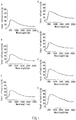
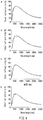
- FIGS. 1 , 2 , 3 , and 4 and Tables 2 and 3 below show the results.
- the average total reflectivity refers to an average total reflectivity with respect to incident light with a wavelength of 750 to 2500 nm.
- the transmittance of each of the fabrics of Examples A4 and A8 and Comparative Example A7 was measured as described below.
- FIG. 5 and Table 4 show data regarding absorptivity (light absorptivity) calculated based on the total reflectivity and transmittance of each of the fabrics of Examples A4 and A8 and Comparative Example A7.
- the average absorptivity refers to an average absorptivity with respect to incident light with a wavelength of 750 to 2500 nm.
- the arc testing was performed based on ASTM F1959/F1959M-12 (Standard Test Method for Determining the Arc Rating of Materials for Clothing), and thus an ATPV (cal/cm 2 ) was determined.
- Equation (III) is used instead of Equation (I) in the item (2) above.
- Specific ATPV of acrylic fiber cal / cm 2 / oz / yd 2 X ⁇ Y ⁇ Wa / 100 ⁇ Z ⁇ Wz / 100 / Wb / 100
- Equation (III) X is the specific ATPV of the target fabric, Y is the specific ATPV of the aramid fiber, Z is the specific ATPV of another fiber, Wa is the content (wt%) of the aramid fiber with respect to the total weight of the target fabric, Wb is the content (wt%) of the acrylic fiber with respect to the total weight of the target fabric, and Wz is the content (wt%) of another fiber with respect to the total weight of the target fabric.
- the thickness was measured in conformity with JIS L 1096 (2010).
- the acrylic fibers of the examples including the infrared absorber had an ATPC of 2.1 or more, which was higher than the ATPCs of the acrylic fibers of the comparative examples including no infrared absorber, and had a favorable arc resistance.
- the infrared absorber was the antimony-doped tin oxide coating on titanium dioxide, the arc resistance was more favorable compared with the case where the infrared absorber was the antimony-doped tin oxide.
- the arc resistance was more favorable compared with the case where only the antimony-doped tin oxide serving as the infrared absorber was used.
- the fabrics of the examples had a specific ATPV of 1 (cal/cm 2 )/(oz/yd 2 ) or more, and had a favorable arc resistance.
- Example A1 ( FIG. 1A ), the fabric of Example A4 ( FIG. 1B ), the fabric of Example A5 ( FIG. 1C ), the fabric of Example A7 ( FIG. 1D ), the fabric of Example A8 ( FIG. 1E ), the fabric of Example A10 ( FIG. 1F ), the fabric of Example A12 ( FIG. 1G ), the fabric of Example A2 ( FIG. 3A ), the fabric of Example A3 ( FIG. 3B ), the fabric of Example A6 ( FIG. 3C ), the fabric of Example A9 ( FIG. 3D ), the fabric of Example A11 ( FIG. 3E ), the fabric of Example A13 ( FIG.
- Example A14 the fabric of Example A14 ( FIG. 4A ), the fabric of Example A15 ( FIG. 4B ), the fabric of Example A16 ( FIG. 4C ), and the fabric of Example A17 ( FIG. 4D )
- the average total reflectivity with respect to incident light with a wavelength of 750 to 2500 nm was 50% or less, and the infrared ray absorbability was high.
- the fabric of Example A1 FIG. 1A
- the fabric of Example A4 FIG. 1B
- the fabric of Example A5 FIG. 1C
- the fabric of Example A8 FIG. 1E
- the fabric of Example A10 the total reflectivity in the wavelength range of 2000 nm or longer was 20% or less.
- Example A7 Example A4
- FIG. 5B Example A8
- FIG. 5C Comparative Example A7
- Tables 4 and 1 that as the content of the infrared absorber was increased, the absorptivity was improved (the infrared ray absorbability was improved), and the arc resistance of the fabric was improved.
- High absorptivity means the high infrared ray absorbability.
- Example A4 Example A8, and Comparative Example A7
- the average total reflectivity and the average absorptivity with respect to incident light with a wavelength of 750 to 2500 nm indicated the inverse correlation, namely a relationship in which the lower the average total reflectivity was, the higher the average absorptivity was, and thus the infrared ray absorbability can be evaluated using the average total reflectivity.
- spun yarn was a spun yarn of English cotton count No. 20.
- the spun yarn was used to manufacture a plain-knitted fabric that included cotton in an amount of 100 wt% and had a basis weight shown in Table 5 below using an ordinary manufacturing method with a flat-knitting machine.
- the obtained fabric was flame-retarded through Pyrovatex finish using a phosphorus-based compound.
- a flame-retardant treatment solution including a phosphorus-based compound ("Pyrovatex CP NEW” manufactured by Huntsman; N-methyloldimethylphosphonopropionic acid amide) in an amount of 400 g/L, a cross-linking agent ("BECKAMINE J-101" manufactured by DIC Corporation; hexamethoxymethylol-type melamine) in an amount of 60 g/L, a softening agent (“ULTRATEX FSA NEW' manufactured by Huntsman; silicone-based softening agent) in an amount of 30 g/L, 85% phosphoric acid in an amount of 20.7 g/L, and a penetrating agent (“INVADINE PBN” manufactured by Huntsman) in an amount of 5 ml/L was prepared.
- a phosphorus-based compound (“Pyrovatex CP NEW” manufactured by Huntsman;
- the flame-retardant treatment solution was squeezed out of the fabric using a hydroextractor such that the squeeze ratio was 80 ⁇ 2%, and then the fabric was dried at 110°C for 5 minutes and subjected to heat treatment at 150°C for 5 minutes. Thereafter, the fabric was washed with an aqueous solution of sodium carbonate and water, and neutralized with an aqueous solution of hydrogen peroxide. The fabric was washed with water and dewatered, and then dried at 60°C for 30 minutes using a tumbler dryer. Thus, a flame-retardant fabric was obtained.
- the obtained flame-retardant fabric included Pyrovatex as a solid in an amount of 20 parts by weight with respect to 100 parts by weight of the fabric.
- the obtained flame-retardant fabric was impregnated with an antimony-doped tin oxide dispersion ("SN-100D” manufactured by Ishihara Sangyo Kaisha, Ltd., which is an aqueous dispersion obtained by adding antimony-doped tin oxide in an amount of 30 wt% to water and dispersing it; having a particle diameter of 0.085 to 0.120 ⁇ m, which was measured using a laser diffraction method) and then dried, and thus the antimony-doped tin oxide in an amount of 0.42 parts by weight with respect to 100 parts by weight of the flame-retardant fabric was attached to the flame-retardant fabric.
- SN-100D an antimony-doped tin oxide dispersion obtained by adding antimony-doped tin oxide in an amount of 30 wt% to water and dispersing it; having a particle diameter of 0.085 to 0.120 ⁇ m, which was measured using a laser diffraction method
- a flame-retardant fabric was obtained in the same manner as in Example B1.
- the obtained flame-retardant fabric was impregnated with an antimony-doped tin oxide dispersion ("SN-100D" manufactured by Ishihara Sangyo Kaisha, Ltd., which is an aqueous dispersion obtained by adding antimony-doped tin oxide in an amount of 30 wt% to water and dispersing it; having a particle diameter of 0.085 to 0.120 ⁇ m, which was measured using a laser diffraction method) and then dried, and thus the antimony-doped tin oxide in an amount of 0.89 parts by weight with respect to 100 parts by weight of the flame-retardant fabric was attached to the flame-retardant fabric.
- SN-100D manufactured by Ishihara Sangyo Kaisha, Ltd.
- Example B1 Commercially available cotton (middle-fiber cotton) was used as a natural cellulose fiber and was spun through ring spinning.
- the obtained spun yarn was a spun yarn of English cotton count No. 20.
- the spun yarn was used to manufacture a twill woven fabric having a basis weight of 7.4 oz/yd 2 using an ordinary weaving method.
- a flame-retardant fabric was obtained through the same flame-retardant treatment as that performed in Example B1.
- the obtained flame-retardant fabric was impregnated with an antimony-doped tin oxide dispersion ("SN-100D” manufactured by Ishihara Sangyo Kaisha, Ltd., which is an aqueous dispersion obtained by adding antimony-doped tin oxide in an amount of 30 wt% to water and dispersing it; having a particle diameter of 0.085 to 0.120 ⁇ m, which was measured using a laser diffraction method) and then dried, and thus the antimony-doped tin oxide in an amount of 1.4 parts by weight with respect to 100 parts by weight of the flame-retardant fabric was attached to the flame-retardant fabric.
- SN-100D an antimony-doped tin oxide dispersion obtained by adding antimony-doped tin oxide in an amount of 30 wt% to water and dispersing it; having a particle diameter of 0.085 to 0.120 ⁇ m, which was measured using a laser diffraction method
- a flame-retardant fabric was obtained in the same manner as in Example B3.
- the obtained fabric was impregnated with a methanol dispersion of antimony-doped zinc oxide ("CELNAX CX-Z610M-F2" manufactured by Nissan Chemical Industries, Ltd., which is a methanol dispersion obtained by adding antimony-doped zinc oxide in an amount of 60 wt% to methanol and dispersing it; having an average particle diameter (D50) of 15 nm, which was measured using a laser diffraction method) and then dried, and thus the antimony-doped zinc oxide in an amount of 0.62 parts by weight with respect to 100 parts by weight of the flame-retardant fabric was attached to the flame-retardant fabric.
- CELNAX CX-Z610M-F2 a methanol dispersion obtained by adding antimony-doped zinc oxide in an amount of 60 wt% to methanol and dispersing it; having an average particle diameter (D50) of
- a fabric was manufactured in the same manner as in Example B4, except that antimony-doped zinc oxide in an amount of 1.21 parts by weight with respect to 100 parts by weight of the flame-retardant fabric was attached to the flame-retardant fabric.
- a fabric was manufactured in the same manner as in Example B4, except that antimony-doped zinc oxide in an amount of 1.86 parts by weight with respect to 100 parts by weight of the flame-retardant fabric was attached to the flame-retardant, fabric.
- spun yarn was a spun yarn of English cotton count No. 20.
- the spun yarn was used to manufacture a plain-knitted fabric that included cotton in an amount of 100 wt% and had a basis weight shown in Table 5 below using an ordinary manufacturing method with a flat-knitting machine.
- the obtained fabric was impregnated with an antimony-doped tin oxide dispersion ("SN-100D” manufactured by Ishihara Sangyo Kaisha, Ltd., which is an aqueous dispersion obtained by adding antimony-doped tin oxide in an amount of 30 wt% to water and dispersing it; having a particle diameter of 0.085 to 0.120 ⁇ m, which was measured using a laser diffraction method) and then dried, and thus the antimony-doped tin oxide in an amount of 2.3 parts by weight with respect to 100 parts by weight of the fabric was attached to the fabric.
- SN-100D an antimony-doped tin oxide dispersion obtained by adding antimony-doped tin oxide in an amount of 30 wt% to water and dispersing it; having a particle diameter of 0.085 to 0.120 ⁇ m, which was measured using a laser diffraction method
- the arc resistance of each of the fabrics obtained in Examples B1 to B6 and Comparative Examples B1 was evaluated through the above-described arc testing. Table 5 below shows the results.
- the total reflectivity of each of the fabrics obtained in Examples B1 to B6 and Comparative Examples B1 was measured as described above.
- FIG. 6 and Table 5 below show the results.
- the average total reflectivity refers to an average total reflectivity with respect to incident light with a wavelength of 750 to 2500 nm.
- FIGS. 6A to 6G show the graphs of total reflectivity of the fabrics of Examples B1 to B6 and Comparative Example B1, respectively.
- the thickness of each of the fabrics obtained in Examples B1 to B6 and Comparative Examples B1 were measured as described above. Table 5 below shows the results. Table 5 Ex.
- B1 Ex. B2 Ex. B3 Ex. B4 Ex. B5 Ex. B6 Comp. Ex. B1 Basis weight (oz/yd 2 ) 7.0 7.0 7.4 7.4 7.5 7.5 6.1 ATPV (cal/cm 2 ) 9.0 10.0 8.8 8 8.8 8 less than 6.0 (with hole) Specific ATPV (cal/cm 2 )/(oz/yd 2 ) 1.29 1.43 1.19 1.08 1.17 1.07 less than 0.98 Thickness (mm) 0.54 0.54 0.56 0.53 0.50 0.51 0.62 Average total reflectivity (%) 56.8 52.5 37.9 42.4 35.3 30.2 40.9
- the fabrics of Examples B1 to B6 which included the natural cellulose fiber (cotton), the flame retardant, and the infrared absorber and in which the average total reflectivity with respect to incident light with a wavelength of 750 to 2500 nm was 60% or less, had a specific ATPV of 1 (cal/cm 2 )/(oz/yd 2 ) or more, and had a favorable arc resistance.
- the fabric of Comparative Example B1 which included the natural cellulose fiber and the infrared absorber but no flame retardant, had a specific ATPV of less than 0.98 (cal/cm 2 )/(oz/yd 2 ) and was provided with a hole, and thus had poor arc resistance.
Landscapes
- Engineering & Computer Science (AREA)
- Textile Engineering (AREA)
- Chemical & Material Sciences (AREA)
- Chemical Kinetics & Catalysis (AREA)
- General Chemical & Material Sciences (AREA)
- Manufacturing & Machinery (AREA)
- Mechanical Engineering (AREA)
- General Health & Medical Sciences (AREA)
- Health & Medical Sciences (AREA)
- Physical Education & Sports Medicine (AREA)
- Woven Fabrics (AREA)
- Professional, Industrial, Or Sporting Protective Garments (AREA)
- Artificial Filaments (AREA)
- Fireproofing Substances (AREA)
- Chemical Or Physical Treatment Of Fibers (AREA)
- Treatments For Attaching Organic Compounds To Fibrous Goods (AREA)
Abstract
Description
- The present invention relates to an arc resistant acrylic fiber having arc resistance, a fabric for arc-protective clothing, and arc-protective clothing.
- In recent years, a large number of arc flash accidents have been reported, and therefore, in order to reduce the risk of arc flash, the impartment of arc resistance to protective clothing to be worn by workers such as electric mechanics and factory workers who work in an environment that involves the risk of actually being exposed to an electric arc has been studied.
- For example,
Patent Documents 1 and 2 disclose protective clothing made of arc-protective yarns or fabrics including a modacrylic fiber and an aramid fiber. Patent Document 3 discloses the use of yarns or fabrics including an antimony-containing modacrylic fiber or a flame-retardant acrylic fiber, and an aramid fiber in arc-protective clothing. -
- Patent Document 1:
JP 2007-529649A - Patent Document 2:
JP 2012-528954A - Patent Document 3:
U.S. Patent Application Publication No. 2006/0292953 - However, in Patent Documents 1 and 3, arc resistance is imparted to yarns and fabrics by adjusting the blend amounts of the modacrylic fiber and the aramid fiber, and an improvement in arc resistance of the modacrylic fiber was not studied. In
Patent Document 2, the modacrylic fiber containing a reduced amount of antimony and the aramid fiber are blended to produce a blended product to which arc resistance is imparted, and an improvement in arc resistance of the modacrylic fiber was not studied. - The present invention provides an arc resistant acrylic fiber having arc resistance, a fabric for arc-protective clothing, and arc-protective clothing.
- The present invention relates to an arc resistant acrylic fiber comprising an acrylic polymer that comprises an infrared absorber in an amount of 1 wt% or more and 30 wt% or less with respect to a total weight of the acrylic polymer.
- The present invention also relates to_a fabric for arc-protective clothing that comprises the arc resistant acrylic fiber, wherein a content of the infrared absorber with respect to a total weight of the fabric is 0.5 wt% or more.
- The infrared absorber is preferably a tin oxide-based compound, and more preferably one or more selected from the group consisting of antimony-doped tin oxide, indium-tin oxide, niobium-doped tin oxide, phosphorus-doped tin oxide, fluorine-doped tin oxide, and antimony-doped tin oxide coating on titanium dioxide.
- It is preferable that the arc resistant acrylic fiber further comprises an ultraviolet absorber. It is more preferable that the ultraviolet absorber is titanium oxide.
- It is preferable that the acrylic polymer comprises acrylonitrile in an amount of 40 to 70 wt% and another component in an amount of 30 to 60 wt%, with respect to a total weight of the acrylic polymer.
- It is preferable that the fabric for arc-protective clothing further comprises an aramid fiber. It is preferable that the fabric for arc-protective clothing further comprises a cellulosic fiber.
- It is preferable that, when the fabric for arc-protective clothing has a basis weight of 8 oz/yd2 or less, an ATPV value measured based on ASTM F1959/F1959M-12 (Standard Test Method for Determining the Arc Rating of Materials for Clothing) is 8 cal/cm2 or more.
- It is preferable that the average total reflectivity of the fabric for arc-protective clothing with respect to incident light with a wavelength of 750 to 2500 nm is 50% or less.
- The present invention also relates to a fabric for arc-protective clothing comprisings a cellulosic fiber, the fabric further comprises an infrared absorber and a flame retardant, wherein an average total reflectivity with respect to incident light with a wavelength of 750 to 2500 nm is 60% or less.
- The present invention also relates to an arc-protective clothing including the fabric for arc-protective clothing.
- The present invention can provide an arc resistant acrylic fiber having arc resistance, obtained by using an acrylic fiber comprising an infrared absorber. Also, a fabric for arc-protective clothing having arc resistance, obtained by using a fabric comprising acrylic fibers and an infrared absorber, and arc-protective clothing comprising the fabric for arc-protective clothing can be provided. Also, the present invention can provide a fabric for arc-protective clothing having arc resistance, obtained by using a fabric comprising cellulosic fibers as well as an infrared absorber and a flame retardant, and setting the average total reflectivity with respect to incident light with a wavelength of 750 to 2500 nm to 60% or less, and arc-protective clothing comprising the fabric for arc-protective clothing.
-
- [
FIG.1] FIG. 1 shows graphs of total reflectivity of fabrics of examples in a wavelength range of 250 to 2500 nm. - [
FIG. 2] FIG. 2 shows graphs of total reflectivity of fabrics of comparative examples in a wavelength range of 250 to 2500 nm. - [
FIG. 3] FIG. 3 shows graphs of total reflectivity of fabrics of examples in a wavelength range of 250 to 2500 nm. - [
FIG. 4] FIG. 4 shows graphs of total reflectivity of fabrics of examples in a wavelength range of 250 to 2500 nm. - [
FIG. 5] FIG. 5 shows graphs of absorptivity of fabrics of examples in a wavelength range of 250 to 2500 nm. - [
FIG. 6] FIG. 6 shows graphs of total reflectivity of fabrics of examples and a comparative example in a wavelength range of 250 to 2500 nm. - [
FIG. 7] FIG. 7 is a schematic explanatory diagram illustrating a measurement method of measuring a total reflectivity of a fabric with respect to incident light. - [
FIG. 8] FIG. 8 is a schematic explanatory diagram illustrating a measurement method of measuring a transmittance of a fabric with respect to incident light. - As a result of intensive research on the impartment of arc resistance to a fiber or a fabric, the inventors of the present invention found that when an acrylic fiber comprised an infrared absorber and light reflection and/or light absorption thereof was adjusted, an arc property could be imparted to the acrylic fiber, thus making it possible to use the acrylic fiber as an arc resistant fiber, and thus the present invention was achieved. In general, when a fiber comprises an infrared absorber, a heat retaining property is imparted to the fiber due to infrared rays, which are heat rays, being absorbed. However, surprisingly, in the present invention, it was found that when an acrylic fiber or a fabric comprising an acrylic fiber comprised an infrared absorber, the acrylic fiber or the fabric comprising an acrylic fiber exhibited high arc resistance due to light in the infrared region being absorbed. Moreover, it was found that when a fabric comprising a cellulosic fiber comprised an infrared absorber and a flame retardant, and the average total reflectivity of the fabric with respect to incident light with a wavelength of 750 to 2500 nm was set to 60% or less, an arc property could be imparted to the fabric, thus making it possible to use the fabric as an arc resistant fabric, and thus the present invention was achieved.
- The arc resistant acrylic fiber comprises an infrared absorber. The infrared absorber may exist inside the fiber or may adhere to the surface of the fiber. It is preferable that the infrared absorber exists inside the fiber in terms of texture and washing resistance. The arc resistant acrylic fiber comprises the infrared absorber in an amount of 1 to 30 wt% with respect to the total weight of an acrylic polymer. When the content of the infrared absorber is 1 wt% or more, the acrylic fiber has high arc resistance. When the content of the infrared absorber is 30 wt% or less, favorable texture is achieved. The arc resistant acrylic fiber comprises the infrared absorber preferably in an amount of 2 wt% or more, more preferably in an amount of 3 wt% or more, and even more preferably in an amount of 5 wt% or more, with respect to the total weight of the acrylic polymer in terms of an improvement in arc resistance. The arc resistant acrylic fiber comprises the infrared absorber preferably in an amount of 28 wt% or less, more preferably in an amount of 26 wt% or less, and even more preferably in an amount of 25 wt% or less, with respect to the total weight of the acrylic polymer in terms of texture.
- There is no particular limitation on the infrared absorber as long as it has the effect of absorbing infrared rays. Examples of the infrared absorber include antimony-doped tin oxide, indium-tin oxide, niobium-doped tin oxide, phosphorus-doped tin oxide, fluorine-doped tin oxide, antimony-doped tin oxide coating on titanium dioxide, iron-doped titanium oxide, carbon-doped titanium oxide, fluorine-doped titanium oxide, nitrogen-doped titanium oxide, aluminum-doped zinc oxide, and antimony-doped zinc oxide. The indium-tin oxide includes an indium-doped tin oxide and tin-doped indium oxide. In terms of an improvement in arc resistance, the infrared absorber is preferably a tin oxide-based compound, more preferably one or more selected from the group consisting of antimony-doped tin oxide, indium-tin oxide, niobium-doped tin oxide, phosphorus-doped tin oxide, fluorine-doped tin oxide, and antimony-doped tin oxide coating on titanium dioxide, even more preferably one or more selected from the group consisting of antimony-doped tin oxide and antimony-doped tin oxide coating on titanium dioxide, and even more preferably antimony-doped tin oxide coating on titanium dioxide. The infrared absorbers may be used alone or in combination of two or more.
- The particle diameter of the infrared absorber is preferably 2 µm or less, more preferably 1 µm or less, and even more preferably 0.5 µm or less, in terms of dispersibility in the acrylic polymer constituting the acrylic fiber. When the particle diameter of the infrared absorber is within the above-described range, favorable dispersibility is achieved even when the infrared absorber adheres to the fiber surface of the acrylic fiber. In the present invention, the particle diameter of the infrared absorber in powder form can be measured using a laser diffraction method, and the particle diameter of the infrared absorber in dispersion form (dispersion liquid form) formed by dispersing the infrared absorber in water or an organic solvent can be measured using a laser diffraction method or a dynamic light scattering method.
- It is preferable that the arc resistant acrylic fiber further comprises an ultraviolet absorber. When light in an ultraviolet region in addition to light in an infrared region is absorbed, the arc resistance is further improved. There is no particular limitation on the ultraviolet absorber, and examples thereof include inorganic compounds such as titanium oxide and zinc oxide, and organic compounds such as triazine-based compounds, benzophenone-based compounds, and benzotriazole-based compounds. Out of these compounds, titanium oxide is preferable in terms of coloration degree. The arc resistant acrylic fiber comprises the ultraviolet absorber preferably in an amount of 0.3 to 10 wt%, more preferably in an amount of 0.5 to 7 wt%, and even more preferably in an amount of 1 to 5 wt%, with respect to the total weight of the acrylic polymer. This makes it possible to improve the arc resistance and achieve a favorable texture.
- The particle diameter of the ultraviolet absorber is preferably 2 µm or less, more preferably 1.5 µm or less, and even more preferably 1 µm or less, in terms of dispersibility in the acrylic polymer constituting the acrylic fiber. When the particle diameter of the ultraviolet absorber is within the above-described range, favorable dispersibility is achieved, even when the ultraviolet absorber adheres to the fiber surface of the acrylic fiber. When titanium oxide is used, the particle diameter is preferably 0.4 µm or less, and more preferably 0.2 µm or less. There is no limitation on the particle diameter of compounds to be used as the organic ultraviolet absorber and can dissolve in an organic solvent to be used in the production of a spinning dope. In the present invention, the particle diameter of the ultraviolet absorber in powder form can be measured using a laser diffraction method, and the particle diameter of the ultraviolet absorber in dispersion form formed by dispersing the ultraviolet absorber in water or an organic solvent can be measured using a laser diffraction method or a dynamic light scattering method.
- It is preferable that the arc resistant acrylic fiber is constituted by an acrylic polymer comprising acrylonitrile in an amount of 40 to 70 wt% and another component in an amount of 30 to 60 wt% with respect to the total weight of the acrylic polymer. When the content of acrylonitrile in the acrylic polymer is 40 to 70 wt%, the acrylic fiber has favorable thermal resistance and flame retardance.
- There is no particular limitation on the other component as long as it is copolymerizable with acrylonitrile. Examples thereof include halogen-containing vinyl-based monomers and sulfonic group-containing monomers.
- Examples of the halogen-containing vinyl-based monomers include halogen-containing vinyl and halogen-containing vinylidene. Examples of the halogen-containing vinyl include vinyl chloride and vinyl bromide, and examples of the halogen-containing vinylidene include vinylidene chloride and vinylidene bromide. These halogen-containing vinyl-based monomers may be used alone or in combination of two or more. It is preferable that the arc resistant acrylic fiber comprises the halogen-containing vinyl-based monomer as the other component in an amount of 30 to 60 wt% with respect to the total weight of the acrylic polymer in terms of thermal resistance and flame retardance.
- Examples of the sulfonic group-containing monomers include methacrylicsulfonic acid, allylsulfonic acid, styrenesulfonic acid, 2-acrylamide-2-methylpropanesulfonic acid, and salts thereof. Examples of the salts include sodium salts such as sodium p-styrenesulfonate, potassium salts, and ammonium salts, but there is no limitation thereto. These sulfonic group-containing monomers may be used alone or in combination of two or more. The sulfonic group-containing monomer is used as needed. When the content of the sulfonic group-containing monomer in the acrylic polymer is 3 wt% or less, the production stability of a spinning process is excellent.
- It is preferable that the acrylic polymer is a copolymer obtained by copolymerizing acrylonitrile in an amount of 40 to 70 wt%, the halogen-containing vinyl-based monomer in an amount of 30 to 57 wt%, and the sulfonic group-containing monomer in an amount of 0 to 3 wt%. It is more preferable that the acrylic polymer is a copolymer obtained by copolymerizing acrylonitrile in an amount of 45 to 65 wt%, the halogen-containing vinyl-based monomer in an amount of 35 to 52 wt%, and the sulfonic group-containing monomer in an amount of 0 to 3 wt%.
- The arc resistant acrylic fiber may comprise an antimony compound. The content of the antimony compound in the acrylic fiber is preferably 1.6 to 33 wt%, and more preferably 3.8 to 21 wt%, with respect to the total weight of the fiber. When the content of the antimony compound in the acrylic fiber is within the above range, the production stability of a spinning process is excellent, and favorable flame resistance is achieved.
- Examples of the antimony compound include antimony trioxide, antimony tetroxide, antimony pentoxide, antimonic acid, antimonic acid salts such as sodium antimonate, and antimony oxychloride. These compounds can be used alone or in combination of two or more. It is preferable that the antimony compound is one or more compounds selected from the group consisting of antimony trioxide, antimony tetroxide, and antimony pentoxide in terms of the production stability of a spinning process.
- There is no particular limitation on the fineness of the arc resistant acrylic fiber, but the fineness thereof is preferably 1 to 20 dtex, and more preferably 1.5 to 15 dtex, in terms of the texture and strength of a fabric made of the fibers. Also, there is no particular limitation on the fiber length of the acrylic fiber, but the fiber length thereof is preferably 38 to 127 mm, and more preferably 38 to 76 mm, in terms of strength. In the present invention, the fineness of the fiber is measured based on JIS L 1015.
- There is no particular limitation on the strength of the arc resistant acrylic fiber, but the strength thereof is preferably 1.0 to 4.0 cN/dtex, and more preferably 1.5 to 3.0 cN/dtex, in terms of spinnability and processability. Also, there is no particular limitation on the elongation of the arc resistant acrylic fiber, but the elongation thereof is preferably 20 to 35%, and more preferably 20 to 25%, in terms of spinnability and processability. In the present invention, the strength and elongation of the fiber is measured based on JIS L 1015.
- The arc resistant acrylic fiber can be manufactured through wet spinning in the same manner as in a normal acrylic fiber, except that the infrared absorber, the ultraviolet absorber, and the like are added to the spinning dope. Alternatively, the arc resistant acrylic fiber may be manufactured by immersing the acrylic fiber in an aqueous dispersion of the infrared absorber and the ultraviolet absorber to attach the infrared absorber and the ultraviolet absorber to the acrylic fiber. At this time, a binder to be used in fiber processing may be used.
- The arc resistance of the arc resistant acrylic fiber can be evaluated using a relative value thereof against the arc resistance of the aramid fiber. Specifically, the arc resistance of the arc resistant acrylic fiber can be evaluated using a relative value of the specific ATPV of a fabric made of the arc resistant acrylic fibers in an amount of 100 wt% against the specific ATPV of a fabric made of aramid fibers in an amount of 100 wt%. The "specific ATPV ((cal/cm2)/(oz/yd2))" refers to an ATPV (cal/cm2) per unit basis weight (oz/yd2) and is calculated by dividing the ATPV by the basis weight. The ATPV (arc thermal performance value) is measured through arc testing based on ASTM F1959/F1959M-12 (Standard Test Method for Determining the Arc Rating of Materials for Clothing). The type of fabric has an influence on the ATPV, and therefore, it is necessary to use the same type of fabrics to evaluate the ATPV. When the same type of fabrics are not prepared, or a fabric made of the arc resistant acrylic fiber in an amount of 100 wt% is not prepared, the arc resistance of the arc resistant acrylic fiber can be evaluated using a method described later.
- Hereinafter, a fabric for arc-protective clothing of the present invention will be described. First, a fabric for arc-protective clothing of Embodiment 1 will be described.
- A fabric for arc-protective clothing of Embodiment 1 of the present invention comprises the arc resistant acrylic fiber, and the content of the infrared absorber is 0.5 wt% or more with respect to the total weight of the fabric. The content of the infrared absorber is preferably 1 wt% or more, and more preferably 5 wt% or more, with respect to the total weight of the fabric, in terms of arc resistance. It is preferable that the fabric for arc-protective clothing comprises the infrared absorber in an amount of 10 wt% or less with respect to the total weight of the fabric in terms of texture. The same type of infrared absorber as that used in the arc resistant acrylic fiber can be used as the infrared absorber.
- The fabric for arc-protective clothing further comprises an ultraviolet absorber preferably in an amount of 0.15 to 5 wt%, more preferably in an amount of 0.75 to 3.5 wt%, and even more preferably 0.5 to 2.5 wt%, with respect to the total weight of the fabric. The same type of ultraviolet absorber as that used in the arc resistant acrylic fiber can be used as the ultraviolet absorber.
- It is more preferable that the fabric for arc-protective clothing comprises an aramid fiber in terms of durability. The aramid fiber may be a para-aramid fiber or a meta-aramid fiber. There is no particular limitation on the fineness of the aramid fiber, but the fineness thereof is preferably 1 to 20 dtex, and more preferably 1.5 to 15 dtex, in terms of strength. Also, there is no particular limitation on the fiber length of the aramid fiber, but the fiber length thereof is preferably 38 to 127 mm, and more preferably 38 to 76 mm, in terms of strength.
- The fabric for arc-protective clothing comprises the aramid fiber preferably in an amount of 5 to 30 wt%, and more preferably 10 to 20 wt%, with respect to the total weight of the fabric. When the content of the aramid fibers in the fabric for arc-protective clothing is within the above range, the durability of the fabric can be improved.
- The fabric for arc-protective clothing may further comprise a cellulosic fiber in terms of texture. There is no particular limitation on the type of the cellulosic fiber, but it is preferable to use a natural cellulosic fiber in terms of durability. Examples of the natural cellulosic fiber include cotton, kabok, linen, ramie, and jute. Also, the natural cellulosic fiber may be a flame-retarded cellulosic fiber obtained by performing flame-retardant treatment using a flame retardant such as phosphorus-based compounds containing N-methylol phosphonate compounds, tetrakishydroxyalkylphosphonium salts and the like on the natural cellulose fiber such as cotton, kapok, linen, ramie, or jute. These natural cellulosic fibers may be used alone or in combination of two or more. The fiber length of the natural cellulosic fiber is preferably 15 to 38 mm, and more preferably 20 to 38 mm, in terms of strength.
- The fabric for arc-protective clothing comprises the natural cellulosic fiber preferably in an amount of 30 to 60 wt%, more preferably in an amount of 30 to 50 wt%, and even more preferably in an amount of 35 to 40 wt%, with respect to the total weight of the fabric. When the content of the natural cellulosic fiber in the fabric for arc-protective clothing is within the above range, excellent texture and hygroscopicity can be imparted to the fabric, and the durability of the fabric can be improved.
- The fabric for arc-protective clothing may comprise an acrylic fiber ("also referred to as other acrylic fiber" hereinafter) other than the arc resistant acrylic fiber. There is no particular limitation on the type of other acrylic fiber, and all kinds of acrylic fibers not containing an infrared absorber can be used. An acrylic fiber containing an antimony compound such as antimony oxide may be used, or an acrylic fiber not containing an antimony compound may be used, as the other acrylic fiber.
- The fabric for arc-protective clothing comprises the acrylic fibers preferably in a total amount of 30 wt% or more, more preferably in a total amount of 35 wt% or more, and even more preferably in a total amount of 40 wt% or more, with respect to the total weight of the fabric, in terms of thermal resistance.
- The basis weight (the weight (ounce) of the fabric per unit area (1 square yard)) of the fabric for arc-protective clothing is preferably 3 to 10 oz/yd2, more preferably 4 to 9 oz/yd2, and even more preferably 4 to 8 oz/yd2. When the basis weight is within the above range, protective clothing that is lightweight and has excellent workability can be provided.
- When the fabric for arc-protective clothing has a basis weight of 8 oz/yd2 or less, the ATPV value thereof measured based on ASTM F1959/F1959M-12 (Standard Test Method for Determining the Arc Rating of Materials for Clothing) is preferably 8 cal/cm2 or more. This makes it possible to provide protective clothing that is lightweight and has favorable arc resistance. The ATPV per unit basis weight, namely the specific ATPV (cal/cm2)/(oz/yd2), is preferably 1.1 or more, more preferably 1.2 or more, and even more preferably 1.3 or more.
- The average total reflectivity of the fabric for arc-protective clothing with respect to incident light with a wavelength of 750 to 2500 nm is preferably 50% or less, more preferably 40% or less, even more preferably 30% or less, and even more preferably 20% or less. When the average total reflectivity with respect to incident light with a wavelength of 750 to 2500 nm is within the above range, the infrared ray absorbability is high, and thus the arc resistance is excellent. The total reflectivity of the fabric for arc-protective clothing in the wavelength range of 2000 nm or longer is preferably 30% or less, more preferably 25% or less, and even more preferably 20% or less, in terms of high infrared ray absorbability and excellent arc resistance. In this manner, in the fabric for arc-protective clothing, a surface that is directly irradiated with arc during arc irradiation is carbonized by absorbing rather than reflecting incident light with a wavelength of 750 to 2500 nm (light in the infrared region), thus making it possible to further reduce transmitted light. In the present invention, the total reflectivity of the fabric may be measured on the front surface or the back surface. In the fabric for arc-protective clothing, the difference in the average total reflectivity with respect to incident light with a wavelength of 750 to 2500 nm between a case where the front surface is used as a measurement surface in the total reflectivity measurement and a case where the back surface is used as a measurement surface in the total reflectivity measurement is preferably 10% or less, more preferably 5% or less, and even more preferably 0%.
- Examples of the form of the fabric for arc-protective clothing include a woven fabric, a knitted fabric, and an unwoven fabric, but there is no limitation thereto. The woven fabric may be a union fabric, and the knitted fabric may be an interknitted fabric.
- There is no particular limitation on the thickness of the fabric for arc-protective clothing, but the thickness thereof is preferably 0.3 to 1.5 mm, more preferably 0.4 to 1.3 mm, and even more preferably 0.5 to 1.1 mm, in terms of strength and comfort of a textile to be used in a piece of workwear. The thickness is measured in conformity with JIS L 1096 (2010).
- There is no particular limitation on the weave of the woven fabric. Three foundation weave such as a plain weave, a twill weave, and a sateen weave may be applied, and a patterned woven fabric obtained by using a special loom such as a dobby loom or a Jacquard loom may be used. Also, there is no particular limitation on the knitting of the knitted fabric, and any of circular knitting, flat knitting, and warp knitting may be applied. The fabric is preferably a woven fabric, and more preferably a twill woven fabric, in terms of high tear strength and excellent durability.
- The fabric for arc-protective clothing may be a fabric made of a fiber mixture that comprises the arc resistant acrylic fiber including the infrared absorber, or a fabric including the acrylic fiber to which the infrared absorber adheres. When the infrared absorber adheres to the fabric including acrylic fiber, the infrared absorber also adheres to the acrylic fiber. For example, the fabric including the acrylic fiber is impregnated with an aqueous dispersion in which the infrared absorber has been dispersed, thus making it possible to attach the infrared absorber to the fabric as well as the acrylic fiber. At this time, a binder to be used in fiber processing may be used.
- A fabric for arc-protective clothing of
Embodiment 2 of the present invention comprises a cellulosic fiber, an infrared absorber, and a flame retardant, and the average total reflectivity thereof with respect to incident light with a wavelength of 750 to 2500 nm is 60% or less. - There is no particular limitation on the type of the cellulosic fiber, but it is preferable to use a natural cellulosic fiber in terms of durability. Examples of the natural cellulosic fiber include cotton, kapok, linen, ramie, and jute. Out of these natural cellulosic fibers, cotton is preferable in terms of excellent durability. These natural cellulosic fibers may be used alone or in combination or two or more.
- The fiber length of the natural cellulose fiber is preferably 15 to 38 mm, and more preferably 20 to 38 mm, in terms of strength.
- There is no particular limitation on the infrared absorber as long as it has the effect of absorbing infrared rays. Examples of the infrared absorber include antimony-doped tin oxide, indium-tin oxide, niobium-doped tin oxide, phosphorus-doped tin oxide, fluorine-doped tin oxide, antimony-doped tin oxide coating on titanium dioxide, iron-doped titanium oxide, carbon-doped titanium oxide, fluorine-doped titanium oxide, nitrogen-doped titanium oxide, aluminum-doped zinc oxide, and antimony-doped zinc oxide. The indium-tin oxide includes an indium-doped tin oxide and tin-doped indium oxide. In terms of an improvement in arc resistance, the infrared absorber is preferably a tin oxide-based compound, more preferably one or more selected from the group consisting of antimony-doped tin oxide, indium-tin oxide, niobium-doped tin oxide, phosphorus-doped tin oxide, fluorine-doped tin oxide, and antimony-doped tin oxide coating on titanium dioxide, even more preferably one or more selected from the group consisting of antimony-doped tin oxide and antimony-doped tin oxide coating on titanium dioxide, and even more preferably antimony-doped tin oxide coating on titanium dioxide. The infrared absorbers may be used alone or in combination of two or more.
- The fabric for arc-protective clothing comprises an ultraviolet absorber preferably in an amount of 0.15 to 5 wt%, more preferably in an amount of 0.3 to 3.5 wt%, and even more preferably in an amount of 0.4 to 2.5 wt%, with respect to the total weight of the fabric, in terms of excellent arc resistance. The same type of ultraviolet absorber as that used in the above-described arc resistant acrylic fiber can be used as the ultraviolet absorber.
- There is no particular limitation on the type of the flame retardant, but the flame retardant is preferably a phosphorus-based flame retardant, and more preferably a phosphorus-based compound such as an N-methylol phosphonate compound or a tetrakishydroxyalkylphosphonium salt, in terms of an improvement in arc resistance. The N-methylol phosphonate compound is likely to react with a cellulose molecule and bind thereto. Examples of the N-methylol phosphonate compound include N-methyloldimethyphosphonocarboxylic acid amides such as N-methyloldimethylphosphonopropionic acid amide. The tetrakishydroxyalkylphosphonium salt is likely to form an insoluble polymer in the cellulosic fiber. Examples of the tetrakishydroxyalkylphosphonium salt include tetrakishydroxymethylphosphonium chloride (THPC) and tetrakishydroxymethylphosphonium sulfate (THPS).
- The fabric for arc-protective clothing comprises the flame retardant preferably in an amount of 5 to 30 wt%, more preferably in an amount of 10 to 28 wt%, and even more preferably in an amount of 12 to 24 wt%, in terms of excellent arc resistance.
- The average total reflectivity of the fabric for arc-protective clothing with respect to incident light with a wavelength of 750 to 2500 nm is preferably 55% or less, more preferably 50% or less, even more preferably 45% or less, and even more preferably 40% or less. When the average total reflectivity with respect to incident light with a wavelength of 750 to 2500 nm is within the above range, high infrared ray absorbability and excellent arc resistance can be achieved. The total reflectivity of the fabric for arc-protective clothing in the wavelength range of 2000 nm or longer is preferably 45% or less, more preferably 40% or less, and even more preferably 35% or less, in terms of high infrared ray absorbability and excellent arc resistance. In the present invention, the total reflectivity of the fabric may be measured on the front surface or the back surface. In the fabric for arc-protective clothing, the difference in the average total reflectivity with respect to incident light with a wavelength of 750 to 2500 nm between a case where the front surface is used as a measurement surface in the total reflectivity measurement and a case where the back surface is used as a measurement surface in the total reflectivity measurement is preferably 10% or less, more preferably 5% or less, and even more preferably 0%.
- The fabric for arc-protective clothing may comprise an aramid fiber in terms of durability. The aramid fiber may be a para-aramid fiber or a meta-aramid fiber. There is no particular limitation on the fineness of the aramid fiber, but the fineness thereof is preferably 1 to 20 dtex, and more preferably 1.5 to 15 dtex, in terms of strength. Also, there is no particular limitation on the fiber length of the aramid fiber, but the fiber length thereof is preferably 38 to 127 mm, and more preferably 38 to 76 mm, in terms of strength.
- The fabric for arc-protective clothing comprises the aramid fiber preferably in an amount of 5 to 30 wt%, and more preferably 10 to 20 wt%, with respect to the total weight of the fabric. When the content of the aramid fibers in the fabric for arc-protective clothing is within the above range, the durability of the fabric can be improved.
- The fabric for arc-protective clothing may comprise another fiber such as a plant fiber including cotton, hemp and the like, an animal fiber including wool, camel hair, goat hair, silk and the like, a regenerated fiber including a viscose rayon fiber, a cupra fiber and the like, a semisynthetic fiber such as an acetate fiber and the like, or a synthetic fiber including a nylon fiber, a polyester fiber, an acrylic fiber and the like as long as the effects of the present invention are not inhibited. It is preferable that the fabric for arc-protective clothing comprises another fiber in an amount of 40 wt% or less with respect to the total weight of the fabric. Out of these fibers, the plant fiber and the regenerated fiber are preferable because these fibers are easily carbonized.
- The basis weight (the weight (ounce) of the fabric per unit area (1 square yard)) of the fabric for arc-protective clothing is preferably 3 to 10 oz/yd2, more preferably 4 to 9 oz/yd2, and even more preferably 4 to 8 oz/yd2. When the basis weight is within the above range, protective clothing that is lightweight and has excellent workability can be provided.
- When the fabric for arc-protective clothing has a basis weight of 8 oz/yd2 or less, the ATPV value thereof measured based on ASTM F1959/F1959M-12 (Standard Test Method for Determining the Arc Rating of Materials for Clothing) is preferably 8 cal/cm2 or more. This makes it possible to provide protective clothing that is lightweight and has favorable arc resistance. The ATPV per unit basis weight, namely the specific ATPV (cal/cm2)/(oz/yd2), is preferably 1.1 or more, more preferably 1.2 or more, and even more preferably 1.3 or more.
- Examples of the form of the fabric for arc-protective clothing include a woven fabric, a knitted fabric, and an unwoven fabric, but there is no limitation thereto. The woven fabric may be a union fabric, and the knitted fabric may be an interknitted fabric.
- There is no particular limitation on the weave of the woven fabric. The three foundation weave such as a plain weave, a twill weave, and a sateen weave may be applied, and a patterned woven fabric obtained by using a special loom such as a dobby loom or a Jacquard loom may be used. Also, there is no particular limitation on the knitting of the knitted fabric, and any of circular knitting, flat knitting, and warp knitting may be applied. The fabric is preferably a woven fabric, and more preferably a twill woven fabric, in terms of high tear strength and excellent durability.
- There is no particular limitation on the thickness of the fabric for arc-protective clothing, but the thickness thereof is preferably 0.3 to 1.5 mm, more preferably 0.4 to 1.3 mm, and even more preferably 0.5 to 1.1 mm, in terms of strength and comfort of a textile to be used in a piece of workwear. The thickness is measured in conformity with JIS L 1096 (2010).
- The fabric for arc-protective clothing can be manufactured by performing flame-retardant treatment using a flame retardant on a fabric including a cellulosic fiber, and then attaching an infrared absorber to the fabric.
- When a phosphorus-based compound such as an N-methylol phosphonate compound or a tetrakishydroxyalkylphosphonium salt is used as the flame retardant, there is no particular limitation on the flame-retardant treatment using the phosphorus-based compound, but it is preferable to use a Pyrovatex finish in terms of binding of the phosphorus-based compound to a cellulose molecule of the natural cellulose fiber, for example. It is sufficient that the Pyrovatex finish is performed in accordance with known general procedures as described in the technical data of Pyrovatex CP manufactured by Huntsman, for example.
- Also, there is no particular limitation on the flame-retardant treatment using the phosphorus-based compound, but it is preferable to use an ammonia curing method using a tetrakishydroxymethylphosphonium salt (also referred to as "THP-ammonia cure method" hereinafter) in terms of the fact that the phosphorus-based compound is likely to form an insoluble polymer in the cellulose fiber, for example. It is sufficient that the THP-ammonia cure method is performed in accordance with known general procedures as described in
JP S59-39549B - Next, the flame-retarded fabric including a natural cellulose fiber is impregnated with an aqueous dispersion in which an infrared absorber has been dispersed, thus making it possible to attach the infrared absorber to the fabric. At this time, a binder to be used in fiber processing may be used.
- Arc-protective clothing of the present invention can be manufactured using a known method using the fabric for arc-protective clothing of the present invention. The arc-protective clothing may be single-layer protective clothing in which the fabric for arc-protective clothing is used in a single layer, or multi-layer protective clothing in which the fabric for arc-protective clothing is used in two or more layers. In the case of multi-layer protective clothing, the fabric for arc-protective clothing may be used in all layers or at least one layer. When the fabric for arc-protective clothing is used in at least one layer of the multi-layer protective clothing, it is preferable to use the fabric for arc-protective clothing in the outer layer.
- The arc-protective clothing of the present invention has excellent arc resistance as well as favorable flame retardance and workability. Furthermore, even if the arc-protective clothing of the present invention is washed repeatedly, the arc resistance and flame retardance thereof are maintained.
- The present invention provides a method of using the above-described acrylic fiber as an arc resistant acrylic fiber. Specifically, use of such an arc resistant acrylic fiber is provided, wherein the arc resistant acrylic fiber comprising an acrylic polymer, and comprises an infrared absorber in an amount of 1 wt% or more and 30 wt% or less with respect to the total weight of the acrylic polymer. Also, a method of using the above-described fabric as a fabric for arc-protective clothing. Specifically, use of such a fabric for arc-protective clothing is provided, wherein the fabric for arc-protective clothing comprises the arc resistant acrylic fiber, and the content of the infrared absorber is 0.5 wt% or more with respect to the total weight of the fabric. Also, use of such a fabric for arc-protective clothing is provided, wherein the fabric for arc-protective clothing comprises a cellulosic fiber, an infrared absorber, and a flame retardant, and the average total reflectivity with respect to incident light with a wavelength of 750 to 2500 nm is 50% or less.
- Hereinafter, the present invention will be described in detail by way of examples. However, the present invention is not limited to the examples. In the following description, "%" and "part" means "wt%" and "part by weight", respectively, unless otherwise stated.
- An acrylic copolymer consisting of acrylonitrile in an amount of 51 wt%, vinylidene chloride in an amount of 48 wt%, and sodium p-styrenesulfonate in an amount of 1 wt% was dissolved in dimethylformamide such that the resin concentration was 30 wt%. Antimony trioxide (Sb2O3; "Patx-M" manufactured by Nihon Seiko Co., Ltd.) in an amount of 10 parts by weight and antimony-doped tin oxide (ATO; "SN-100P" manufactured by Ishihara Sangyo Kaisha, Ltd.) in an amount of 10 parts by weight, with respect to the weight of the resin that was 100 parts by weight, were added to the obtained resin solution to form a spinning dope. Regarding the antimony trioxide, a dispersion liquid was used that was prepared in advance by adding the antimony trioxide in an amount of 30 wt% to dimethylformamide and dispersing it uniformly. In the above dispersion liquid of the antimony trioxide, the particle diameter of the antimony trioxide measured using a laser diffraction method was 2 µm or smaller. Regarding the antimony-doped tin oxide, a dispersion liquid was used that was prepared in advance by adding the antimony-doped tin oxide in an amount of 30 wt% to dimethylformamide and dispersing it uniformly. In the dispersion liquid of the antimony-doped tin oxide, the particle diameter of the antimony-doped tin oxide measured using a laser diffraction method was 0.01 to 0.03 µm. The obtained spinning dope was extruded into a 50 wt% aqueous solution of dimethylformamide using a nozzle with 300 holes having a nozzle hole diameter of 0.08 mm and thus solidified. Thereafter, the solidified product was washed with water and then dried at 120°C. After drying, the product was drawn so as to be longer by a factor of three and then further subjected to heat treatment at 145°C for 5 minutes. An acrylic fiber was thus obtained. The obtained acrylic fiber of Example 1 (also referred to as "Arc1" hereinafter) had a fineness of 1.7 dtex, a strength of 2.5 cN/dtex, an elongation of 26%, and a cut length of 51 mm. The fineness, strength, and elongation of acrylic fibers of the examples and comparative examples were measured based on JIS L 1015.
- An acrylic fiber was obtained in the same manner as in Example 1, except that antimony-doped tin oxide (ATO; "SN-100P" manufactured by Ishihara Sangyo Kaisha, Ltd.) in an amount of 20 parts by weight with respect to the weight of the resin that was 100 parts by weight was added to the obtained resin solution to form a spinning dope. The obtained acrylic fiber of Example 2 (also referred to as "Arc2" hereinafter) had a fineness of 2.71 dtex, a strength of 1.77 cN/dtex, an elongation of 23.0%, and a cut length of 51 mm.
- An acrylic fiber was obtained in the same manner as in Example 1, except that antimony-doped tin oxide (ATO; "SN-100P" manufactured by Ishihara Sangyo Kaisha, Ltd.) in an amount of 5 parts by weight with respect to the weight of the resin that was 100 parts by weight was added to the obtained resin solution to form a spinning dope. The obtained acrylic fiber of Example 3 (also referred to as "Arc3" hereinafter) had a fineness of 1.80 dtex, a strength of 2.60 cN/dtex, an elongation of 28.5%, and a cut length of 51 mm.
- An acrylic fiber was obtained in the same manner as in Example 1, except that antimony-doped tin oxide coating on titanium dioxide("ET521W" manufactured by Ishihara Sangyo Kaisha, Ltd.) in an amount of 5 parts by weight with respect to the weight of the resin that was 100 parts by weight was added to the obtained resin solution to form a spinning dope. Regarding the antimony-doped tin oxide coating on titanium dioxide, a dispersion liquid was used that was prepared by adding the antimony-doped tin oxide coating on titanium dioxide in an amount of 30 wt% to dimethylformamide and dispersing it uniformly. In the dispersion liquid of the antimony-doped tin oxide coating on titanium dioxide, the particle diameter of the antimony-doped tin oxide measured using a laser diffraction method was 0.2 to 0.3 µm. The obtained acrylic fiber of Example 4 (also referred to as "Arc4" hereinafter) had a fineness of 1.85 dtex, a strength of 2.63 cN/dtex, an elongation of 27.2%, and a cut length of 51 mm.
- An acrylic fiber was obtained in the same manner as in Example 1, except that antimony-doped tin oxide (ATO; "SN-100D" manufactured by Ishihara Sangyo Kaisha, Ltd.) in an amount of 10 parts by weight with respect to the weight of the resin that was 100 parts by weight was added to the obtained resin solution to form a spinning dope. Regarding the antimony-doped tin oxide, an aqueous dispersion was used that was prepared by adding the antimony-doped tin oxide in an amount of 30 wt% to water and dispersing it, and the particle diameter measured using a laser diffraction method was 0.085 to 0.120 µm. The obtained acrylic fiber of Example 5 (also referred to as "Arc5" hereinafter) had a fineness of 1.76 dtex, a strength of 2.80 cN/dtex, an elongation of 29.2%, and a cut length of 51 mm.
- An acrylic fiber was obtained in the same manner as in Example 1, except that antimony-doped tin oxide (ATO; "SN-100P" manufactured by Ishihara Sangyo Kaisha, Ltd.) in an amount of 10 parts by weight with respect to the weight of the resin that was 100 parts by weight was added to the obtained resin solution to form a spinning dope. The obtained acrylic fiber of Example 6 (also referred to as "Arc6" hereinafter) had a fineness of 1.53 dtex, a strength of 2.80 cN/dtex, an elongation of 26.5%, and a cut length of 51 mm.
- An acrylic fiber was obtained in the same manner as in Example 1, except that antimony-doped tin oxide (ATO; "SN-100P" manufactured by Ishihara Sangyo Kaisha, Ltd.) in an amount of 5 parts by weight and titanium oxide ("R-22L" manufactured by Sakai Chemical Industry Co., Ltd.) in an amount of 10 parts by weight, with respect to the weight of the resin that was 100 parts by weight, were added to the obtained resin solution to form a spinning dope. Regarding the titanium oxide, a dispersion liquid was used that was prepared in advance by adding the titanium oxide in an amount of 30 wt% to dimethylformamide and dispersing it uniformly. In the dispersion liquid of the titanium oxide, the particle diameter of the titanium oxide measured using a laser diffraction method was 0.4 µm. The obtained acrylic fiber of Example 7 (also referred to as "Arc7" hereinafter) had a fineness of 1.75 dtex, a strength of 1.66 cN/dtex, an elongation of 22.9%, and a cut length of 51 mm.
- An acrylic fiber was obtained in the same manner as in Example 1, except that antimony-doped tin oxide coating on titanium dioxide ("ET521W" manufactured by Ishihara Sangyo Kaisha, Ltd.) in an amount of 20 parts by weight and antimony trioxide (Sb2O3; "Patx-M" manufactured by Nihon Seiko Co., Ltd.) in an amount of 10 parts by weight, with respect to the weight of the resin that was 100 parts by weight, were added to the obtained resin solution to form a spinning dope. Regarding the antimony-doped tin oxide coating on titanium dioxide, a dispersion liquid was used that was prepared by adding the antimony-doped tin oxide coating on titanium dioxide in an amount of 30 wt% to dimethylformamide and dispersing it uniformly. In the dispersion liquid of the antimony-doped tin oxide coating on titanium dioxide, the particle diameter of the antimony-doped tin oxide measured using a laser diffraction method was 0.2 to 0.3 µm. The obtained acrylic fiber of Example 8 (also referred to as "Arc8" hereinafter) had a fineness of 1.81 dtex, a strength of 2.54 cN/dtex, an elongation of 27.5%, and a cut length of 51 mm.
- An acrylic fiber was obtained in the same manner as in Example 8, except that an acrylic copolymer consisting of acrylonitrile in an amount of 51 wt%, vinyl chloride in an amount of 48 wt%, and sodium p-styrenesulfonate in an amount of 1 wt% was used instead of the acrylic copolymer consisting of acrylonitrile in an amount of 51 wt%, vinylidene chloride in an amount of 48 wt%, and sodium p-styrenesulfonate in an amount of 1 wt%. The obtained acrylic fiber of Example 9 (also referred to as "Arc9" hereinafter) had a fineness of 1.78 dtex, a strength of 1.97 cN/dtex, an elongation of 33.3%, and a cut length of 51 mm.
- An acrylic fiber was obtained in the same manner as in Example 1, except that antimony trioxide (Sb2O3; "Patx-M" manufactured by Nihon Seiko Co., Ltd.) in an amount of 10 parts by weight with respect to the weight of the resin that was 100 parts by weight was added to the obtained resin solution to form a spinning dope. The obtained acrylic fiber of Comparative Example 1 (also referred to as "Arc101" hereinafter) had a fineness of 1.71 dtex, a strength of 2.58 cN/dtex, an elongation of 27.4%, and a cut length of 51 mm.
- An acrylic fiber was obtained in the same manner as in Example 1, except that antimony trioxide (Sb2O3; "Patx-M" manufactured by Nihon Seiko Co., Ltd.) in an amount of 10 parts by weight and titanium oxide ("R-22L" manufactured by Sakai Chemical Industry Co., Ltd.) in an amount of 10 parts by weight, with respect to the weight of the resin that was 100 parts by weight, were added to the obtained resin solution to form a spinning dope. Regarding the titanium oxide, a dispersion liquid was used that was prepared in advance by adding the titanium oxide in an amount of 30 wt% to dimethylformamide and dispersing it uniformly. In the dispersion liquid of the titanium oxide, the particle diameter of the titanium oxide measured using a laser diffraction method was 0.4 µm. The obtained acrylic fiber of Comparative Example 2 (also referred to as "Arc102" hereinafter) had a fineness of 1.74 dtex, a strength of 2.37 cN/dtex, an elongation of 28.6%, and a cut length of 51 mm.
- An acrylic fiber was obtained in the same manner as in Example 1, except that antimony trioxide (Sb2O3; "Patx-M" manufactured by Nihon Seiko Co., Ltd.) in an amount of 10 parts by weight and titanium oxide ("STR-60A-LP" manufactured by Sakai Chemical Industry Co., Ltd.) in an amount of 10 parts by weight, with respect to the weight of the resin that was 100 parts by weight, were added to the obtained resin solution to form a spinning dope. Regarding the titanium oxide, a dispersion liquid was used that was prepared in advance by adding the titanium oxide in an amount of 30 wt% to dimethylformamide and dispersing it uniformly. In the dispersion liquid of the titanium oxide, the particle diameter of the titanium oxide measured using a laser diffraction method was 0.05 µm. The obtained acrylic fiber of Comparative Example 3 (also referred to as "Arc103" hereinafter) had a fineness of 1.70 dtex, a strength of 2.59 cN/dtex, an elongation of 27.1%, and a cut length of 51 mm.
- An acrylic fiber was obtained in the same manner as in Example 1, except that antimony trioxide (Sb2O3; "Patx-M" manufactured by Nihon Seiko Co., Ltd.) in an amount of 10 parts by weight and zinc oxide ("FINEX-25-LPT" manufactured by Sakai Chemical Industry Co., Ltd.) in an amount of 10 parts by weight, with respect to the weight of the resin that was 100 parts by weight, were added to the obtained resin solution to form a spinning dope. Regarding the zinc oxide, a dispersion liquid was used that was prepared in advance by adding the zinc oxide in an amount of 30 wt% to dimethylformamide and dispersing it uniformly. In the dispersion liquid of the zinc oxide, the particle diameter of the zinc oxide measured using a laser diffraction method was 0.06 µm. The obtained acrylic fiber of Comparative Example 4 (also referred to as "Arc104" hereinafter) had a fineness of 1.83 dtex, a strength of 2.13 cN/dtex, an elongation of 26.2%, and a cut length of 51 mm.
- An acrylic fiber was obtained in the same manner as in Example 1, except that antimony trioxide (Sb2O3; "Patx-M" manufactured by Nihon Seiko Co., Ltd.) in an amount of 10 parts by weight and SB-UVA6164 (triazine-based ultraviolet absorber; manufactured by SHUANG-BANG INDUSTRIAL CORP.) in an amount of 10 parts by weight, with respect to the weight of the resin that was 100 parts by weight, were added to the obtained resin solution to form a spinning dope. Regarding the SB-UVA6164, a solution was used that was prepared in advance by adding the SB-UVA6164 in an amount of 5 wt% to dimethylformamide and dissolving it. The obtained acrylic fiber of Comparative Example 5 (also referred to as "Arc105" hereinafter) had a fineness of 1.71 dtex, a strength of 2.26 cN/dtex, an elongation of 26.9%, and a cut length of 51 mm.
- An acrylic fiber was obtained in the same manner as in Example 1, except that antimony trioxide (Sb2O3; "Patx-M" manufactured by Nihon Seiko Co., Ltd.) in an amount of 10 parts by weight and SB-UVA6577 (triazine-based ultraviolet absorber; manufactured by SHUANG-BANG INDUSTRIAL CORP.) in an amount of 10 parts by weight, with respect to the weight of the resin that was 100 parts by weight, were added to the obtained resin solution to form a spinning dope. Regarding the SB-UVA6577, a solution was used that was prepared in advance by adding the SB-UVA6577 in an amount of 5 wt% to dimethylformamide and dissolving it. The obtained acrylic fiber of Comparative Example 6 (also referred to as "Arc106" hereinafter) had a fineness of 1.77 dtex, a strength of 2.46 cN/dtex, an elongation of 31.2%, and a cut length of 51 mm.
- The acrylic fibers of Examples 1 to 9 and Comparative Examples 1 to 6 each were mixed, in blending ratios shown in Table 1 below, with a para-aramid fiber ("Taparan" (registered trademark) manufactured by Yantai Tayho Advanced Materials Co., Ltd.; having a fineness of 1.67 dtex and a fiber length of 51 mm; also referred to as "PA" hereinafter), a meta-aramid fiber ("Tametar" (registered trademark) manufactured by Yantai Tayho Advanced Materials Co., Ltd.; having a fineness of 1.5 dtex and a fiber length of 51 mm; also referred to as "MA" hereinafter), an acrylic fiber ("Protex-C" manufactured by Keneka Corporation, which is made of an acrylic copolymer consisting of acrylonitrile in an amount of 51 wt%, vinylidene chloride in an amount of 48 wt% and sodium p-styrenesulfonate in an amount of 1 wt% and contains antimony trioxide in an amount of 10 wt% with respect to the weight of the resin (acrylic copolymer); having a fineness of 1.7 dtex and a fiber length of 51 mm; also referred to as "ProC" hereinafter), and an acrylic fiber ("PBB" manufactured by Keneka Corporation, which is made of an acrylic copolymer comprising acrylonitrile in an amount of 51 wt%, vinylidene chloride in an amount of 48 wt%, and sodium p-styrenesulfonate in an amount of 1 wt%; having a fineness of 1.7 dtex and a fiber length of 51 mm; also referred to as "PBB" hereinafter), and then were spun through ring spinning. The obtained spun yarns were mixed yarns of English cotton count No. 20. The spun yarns were used to manufacture plain-knitted fabrics having a basis weight shown in Table 1 below using an ordinary manufacturing method with a flat-knitting machine.
- The acrylic fiber (ProC) in an amount of 50 wt% and the para-aramid fiber (PA) in an amount of 50 wt% were mixed, and then were spun through ring spinning. The obtained spun yarn was a mixed yarn of English cotton count No. 20. The spun yarn was used to manufacture a plain-knitted fabric having a basis weight shown in Table 1 below using an ordinary manufacturing method with a flat-knitting machine. The obtained fabric was impregnated with an antimony-doped tin oxide dispersion ("SN-100D" manufactured by Ishihara Sangyo Kaisha, Ltd., which is an aqueous dispersion obtained by adding antimony-doped tin oxide in an amount of 30 wt% to water and dispersing it; having a particle diameter distribution of 0.085 to 0.120 µm, which was measured using a laser diffraction method) and then dried, and thus the antimony-doped tin oxide in an amount of 2 wt% with respect to the total weight of the fabric was attached to the fabric.
- First, an acrylic copolymer comprising acrylonitrile in an amount of 51 wt%, vinylidene chloride in an amount of 48 wt%, and sodium p-styrenesulfonate in an amount of 1 wt% was dissolved in dimethylformamide such that the resin concentration was 30 wt%. Antimony trioxide (Sb2O3; "Patx-M" manufactured by Nihon Seiko Co., Ltd.) in an amount of 26 parts by weight with respect to the weight of the resin that was 100 parts by weight was added to the obtained resin solution to form a spinning dope. The obtained spinning dope was extruded into a 50 wt% aqueous solution of dimethylformamide using a nozzle with 300 holes having a nozzle hole diameter of 0.08 mm and thus solidified. Thereafter, the solidified product was washed with water and then dried at 120°C. After drying, the product was drawn so as to be longer by a factor of three and then further subjected to heat treatment at 145°C for 5 minutes. An acrylic fiber was thus obtained. The obtained acrylic fiber had a fineness of 2.2 dtex, a strength of 2.33 cN/dtex, an elongation of 22.3%, and a cut length of 51 mm.
- Next, the obtained acrylic fiber (also referred to as "ProM" hereinafter) in an amount of 60 wt% and commercially available cotton (middle-fiber cotton; also referred to as "Cot" hereinafter) in an amount of 40 wt% were mixed, and then spun through ring spinning. The obtained spun yarn was a mixed yarn of English cotton count No. 20. The spun yarn was used to manufacture a twill woven fabric (fabric) having a basis weight shown in Table 1 below using an ordinary weaving method. The obtained fabric was impregnated with a dispersion of antimony-doped tin oxide coating on titanium dioxide ("ET521W" manufactured by Ishihara Sangyo Kaisha, Ltd.) (a dispersion obtained by adding antimony-doped tin oxide coating on titanium dioxide in an amount of 30 wt% to dimethylformamide and dispersing it; having a particle diameter of 0.2 to 0.3 µm, which was measured using a laser diffraction method) and then dried, and thus the antimony-doped tin oxide coating on titanium dioxide in an amount of 1.3 wt% with respect to the total weight of the fabric was attached to the fabric.
- A twill woven fabric (fabric) having a basis weight shown in Table 1 below was manufactured in the same manner as in Example A14. The obtained fabric was impregnated with a methanol dispersion of antimony-doped zinc oxide ("CELNAX CX-Z610M-F2" manufactured by Nissan Chemical Industries, Ltd., which is a methanol dispersion obtained by adding antimony-doped zinc oxide in an amount of 60 wt% to methanol and dispersing it; having an average particle diameter (D50) of 15 nm, which was measured using a laser diffraction method) and then dried, and thus the antimony-doped zinc oxide in an amount of 0.66 wt% with respect to the total weight of the fabric was attached to the fabric.
- A fabric was manufactured in the same manner as in Example A15, except that antimony-doped zinc oxide in an amount of 1.4 wt% with respect to the total weight of the fabric was attached to the fabric.
- A fabric was manufactured in the same manner as in Example A15, except that antimony-doped zinc oxide in an amount of 2.1 wt% with respect to the total weight of the fabric was attached to the fabric.
- The para-aramid fiber (PA) in an amount of 50 wt% and the meta-aramid fiber (MA) in an amount of 50 wt% were mixed, and then were spun through ring spinning. The obtained spun yarn was a mixed yarn of English cotton count No. 20. The spun yarn was used to manufacture a twill woven fabric (fabric) having a basis weight shown in Table 1 below using an ordinary weaving method.
- The acrylic fiber (ProC) in an amount of 50 wt%, the para-aramid fiber (PA) in an amount of 25 wt%, and the meta-aramid fiber (MA) in an amount of 25 wt% were mixed, and then were spun through ring spinning. The obtained spun yarn was a mixed yarn of English cotton count No. 20. The spun yarn was used to manufacture a twill woven fabric (fabric) having a basis weight shown in Table 1 below using an ordinary weaving method.
- The acrylic fiber (ProC) in an amount of 50 wt%, the para-aramid fiber (PA) in an amount of 25 wt%, and the meta-aramid fiber (MA) in an amount of 25 wt% were mixed, and then were spun through ring spinning. The obtained spun yarn was a mixed yarn of English cotton count No. 20. The spun yarn was used to manufacture a plain-knitted fabric having a basis weight shown in Table 1 below using an ordinary manufacturing method with a flat-knitting machine.
- The arc resistance of each of the acrylic fibers of Examples 1 to 9 and Comparative Examples 1 to 6 was evaluated based on the standards below through arc testing performed on the fabrics including the acrylic fibers of Examples A1 to A17 and Comparative Examples A1 to A7. Table 1 below shows the results. The arc resistance of each of the fabrics obtained in Examples A1 to A17 and Comparative Examples A1 to A7 was evaluated through arc testing. Table 1 below shows the results. The thickness of each of the fabrics obtained in Examples A1 to A10 and A14 to 17 and Comparative Examples A1 to A7 was measured as described below. Table 1 below shows the results. It should be noted that the content of an infrared absorber is represented in terms of a weight ratio with respect to the total weight of the fabric in Table 1 below. The total reflectivity of each of the fabrics obtained in Examples A1 to A17 and Comparative Examples A1 to A7 was measured as described below.
FIGS. 1 ,2 ,3 , and4 and Tables 2 and 3 below show the results. In Tables 2 and 3 below, the average total reflectivity refers to an average total reflectivity with respect to incident light with a wavelength of 750 to 2500 nm. The transmittance of each of the fabrics of Examples A4 and A8 and Comparative Example A7 was measured as described below.FIG. 5 and Table 4 show data regarding absorptivity (light absorptivity) calculated based on the total reflectivity and transmittance of each of the fabrics of Examples A4 and A8 and Comparative Example A7. In Table 4 below, the average absorptivity refers to an average absorptivity with respect to incident light with a wavelength of 750 to 2500 nm. - The arc testing was performed based on ASTM F1959/F1959M-12 (Standard Test Method for Determining the Arc Rating of Materials for Clothing), and thus an ATPV (cal/cm2) was determined.
- An ATPV per unit basis weight (cal/cm2)/(oz/yd2) of the fabric, namely the specific ATPV, was calculated based on the basis weight of the fabric and the ATPV determined through the arc testing.
-
- (1) The specific ATPV of the fabric (woven fabric) of Reference Example 1 was taken as Ref1, the specific ATPV of the fabric (woven fabric) of Reference Example 2 was taken as Ref2, and the specific ATPV of the fabric (knitted fabric) of Reference Example 3 was taken as Ref3. The specific ATPV of a knitted fabric including an aramid fiber in an amount of 100 wt% was calculated based on the following equation.

- (2) Assuming that the arc resistance of the para-aramid fiber and the arc resistance of the meta-aramid fiber are the same, the specific ATPV of the knitted fabric including the aramid fiber in an amount of 100 wt% was taken as the specific ATPV of the aramid fiber, and the specific ATPV of the acrylic fiber in the target fabric was calculated using the specific ATPV of the target fabric based on Equation (I) below.

In Equation (I), X is the specific ATPV (cal/cm2)/(oz/yd2) of the target fabric, Y is the specific ATPV of the aramid fiber, Wa is the content (wt%) of the aramid fiber with respect to the total weight of the target fabric, and Wb is the content (wt%) of the acrylic fiber with respect to the total weight of the target fabric. - (3) The specific ATPV of the aramid fiber was taken as 1, and the arc resistance of the acrylic fiber was evaluated using an ATPC calculated based on Equation II below.

- (4) When the ATPC value of the acrylic fiber was 2.1 or more, it was determined that the arc resistance was acceptable. The higher the ATPC value is, the better the arc resistance is.
- It should be noted that when the target fabric comprises another fiber in addition to the acrylic fiber and the aramid fiber, Equation (III) below is used instead of Equation (I) in the item (2) above.

- In Equation (III), X is the specific ATPV of the target fabric, Y is the specific ATPV of the aramid fiber, Z is the specific ATPV of another fiber, Wa is the content (wt%) of the aramid fiber with respect to the total weight of the target fabric, Wb is the content (wt%) of the acrylic fiber with respect to the total weight of the target fabric, and Wz is the content (wt%) of another fiber with respect to the total weight of the target fabric.
- The thickness was measured in conformity with JIS L 1096 (2010).
-
- (1) First, a spectrophotometer (model "U-4100" manufactured by Hitachi High-Technologies Corporation) was used to measure the total reflectivity of the fabric. Specifically, as shown in
FIG. 7 , light emitted by a xenon lamp 1 was dispersed, the front surface of a fabric 3 with analumina plate 2 being placed on its back surface was irradiated with the dispersed light, reflected light was integrated using an integratingsphere 4, the light intensity was measured using aphotomultiplier 5, and thus the total reflectivity (R) was calculated. It should be noted that, regarding the total reflected light, the entire amount of light including light reflected on the surface of the fabric and light that has been transmitted to the back surface of the fabric, and is reflected by the alumina plate and emitted from the front surface of the fabric again is taken into consideration. - (2) Next, a spectrophotometer (model "U-4100" manufactured by Hitachi High-Technologies Corporation) was used to measure the transmittance of the fabric. Specifically, as shown in
FIG. 8 , light emitted by axenon lamp 11 was dispersed, the front surface of afabric 13 that was directly arranged at an entrance on a light-irradiation side of an integratingsphere 14 was irradiated with the dispersed light, transmitted light was integrated using the integratingsphere 14, the light intensity was measured using aphotomultiplier 15, and thus the transmittance (t1) was calculated. InFIG. 8 , areference numeral 12 indicates an alumina plate. - (3) The total reflectivity (R) and the transmittance (t1) were used to calculate absorptivity (a1) based on the following simultaneous equations. It should be noted that r1 means the reflectivity of the fabric in the following simultaneous equations. Equation 1


- (4) In the obtained graph illustrating the total reflectivity in which the horizontal axis indicates the wavelength of the incident light and the vertical axis indicates the total reflectivity, a ratio of the area of a portion under the curve of the graph illustrating the total reflectivity with respect to the area of a portion surrounded by the wavelength of 750 to 2500 nm and the reflectivity of 0 to 100% was determined and taken as the average total reflectivity with respect to incident light with a wavelength of 750 to 2500 nm.
- (5) In the obtained graph illustrating the absorptivity in which the horizontal axis indicates the wavelength of the incident light and the vertical axis indicates the absorptivity, a ratio of the area of a portion under the curve of the graph illustrating the absorptivity with respect to the area of a portion surrounded by the wavelength of 750 to 2500 nm and the absorptivity of 0 to 100% was determined and taken as the average absorptivity with respect to incident light with a wavelength of 750 to 2500 nm.
- It was found from the data shown in Table 1 above that the acrylic fibers of the examples including the infrared absorber had an ATPC of 2.1 or more, which was higher than the ATPCs of the acrylic fibers of the comparative examples including no infrared absorber, and had a favorable arc resistance. The higher the content of the infrared absorber was, the more favorable the arc resistance of the acrylic fiber was. When the infrared absorber was the antimony-doped tin oxide coating on titanium dioxide, the arc resistance was more favorable compared with the case where the infrared absorber was the antimony-doped tin oxide. Also, when the antimony-doped tin oxide serving as the infrared absorber and the titanium oxide serving as the ultraviolet absorber were used in combination, the arc resistance was more favorable compared with the case where only the antimony-doped tin oxide serving as the infrared absorber was used. The fabrics of the examples had a specific ATPV of 1 (cal/cm2)/(oz/yd2) or more, and had a favorable arc resistance.
- As is clear from Tables 2 and 3 and
FIGS. 1 ,2 ,3 , and4 , regarding the fabric of Example A1 (FIG. 1A ), the fabric of Example A4 (FIG. 1B ), the fabric of Example A5 (FIG. 1C ), the fabric of Example A7 (FIG. 1D ), the fabric of Example A8 (FIG. 1E ), the fabric of Example A10 (FIG. 1F ), the fabric of Example A12 (FIG. 1G ), the fabric of Example A2 (FIG. 3A ), the fabric of Example A3 (FIG. 3B ), the fabric of Example A6 (FIG. 3C ), the fabric of Example A9 (FIG. 3D ), the fabric of Example A11 (FIG. 3E ), the fabric of Example A13 (FIG. 3F ), the fabric of Example A14 (FIG. 4A ), the fabric of Example A15 (FIG. 4B ), the fabric of Example A16 (FIG. 4C ), and the fabric of Example A17 (FIG. 4D ), the average total reflectivity with respect to incident light with a wavelength of 750 to 2500 nm was 50% or less, and the infrared ray absorbability was high. In particular, regarding the fabric of Example A1 (FIG. 1A ), the fabric of Example A4 (FIG. 1B ), the fabric of Example A5 (FIG. 1C ), the fabric of Example A8 (FIG. 1E ), and the fabric of Example A10 (FIG. 1F ), the total reflectivity in the wavelength range of 2000 nm or longer was 20% or less. On the other hand, regarding the fabric of Comparative Example A1 (FIG. 2A ), the fabric of Comparative Example A2 (FIG. 2B ), the fabric of Comparative Example A3 (FIG. 2C ), the fabric of Comparative Example A4 (FIG. 2D ), the fabric of Comparative Example A5 (FIG. 2E ), the fabric of Comparative Example A6 (FIG. 2F ), and the fabric of Comparative Example A7 (FIG. 2G ), the average total reflectivity with respect to incident light with a wavelength of 750 to 2500 nm exceeded 50%, and the infrared ray absorbability was low. It is presumed that regarding the fabrics of the examples, the arc resistance was improved due to the high infrared ray absorbability. It was also found from the comparison ofFIG. 5A (Example A4),FIG. 5B (Example A8), andFIG. 5C (Comparative Example A7) and the results shown in Tables 4 and 1 that as the content of the infrared absorber was increased, the absorptivity was improved (the infrared ray absorbability was improved), and the arc resistance of the fabric was improved. High absorptivity means the high infrared ray absorbability. Regarding Example A4, Example A8, and Comparative Example A7, the average total reflectivity and the average absorptivity with respect to incident light with a wavelength of 750 to 2500 nm indicated the inverse correlation, namely a relationship in which the lower the average total reflectivity was, the higher the average absorptivity was, and thus the infrared ray absorbability can be evaluated using the average total reflectivity. - Commercially available cotton (middle-fiber cotton) was used as a natural cellulose fiber and was spun through ring spinning. The obtained spun yarn was a spun yarn of English cotton count No. 20. The spun yarn was used to manufacture a plain-knitted fabric that included cotton in an amount of 100 wt% and had a basis weight shown in Table 5 below using an ordinary manufacturing method with a flat-knitting machine.
- The obtained fabric (knitted fabric) was flame-retarded through Pyrovatex finish using a phosphorus-based compound. First, a flame-retardant treatment solution (treatment agent) including a phosphorus-based compound ("Pyrovatex CP NEW" manufactured by Huntsman; N-methyloldimethylphosphonopropionic acid amide) in an amount of 400 g/L, a cross-linking agent ("BECKAMINE J-101" manufactured by DIC Corporation; hexamethoxymethylol-type melamine) in an amount of 60 g/L, a softening agent ("ULTRATEX FSA NEW' manufactured by Huntsman; silicone-based softening agent) in an amount of 30 g/L, 85% phosphoric acid in an amount of 20.7 g/L, and a penetrating agent ("INVADINE PBN" manufactured by Huntsman) in an amount of 5 ml/L was prepared. After the flame-retardant treatment solution had sufficiently infiltrated into the fabric, the flame-retardant treatment solution was squeezed out of the fabric using a hydroextractor such that the squeeze ratio was 80±2%, and then the fabric was dried at 110°C for 5 minutes and subjected to heat treatment at 150°C for 5 minutes. Thereafter, the fabric was washed with an aqueous solution of sodium carbonate and water, and neutralized with an aqueous solution of hydrogen peroxide. The fabric was washed with water and dewatered, and then dried at 60°C for 30 minutes using a tumbler dryer. Thus, a flame-retardant fabric was obtained. The obtained flame-retardant fabric included Pyrovatex as a solid in an amount of 20 parts by weight with respect to 100 parts by weight of the fabric.
- The obtained flame-retardant fabric was impregnated with an antimony-doped tin oxide dispersion ("SN-100D" manufactured by Ishihara Sangyo Kaisha, Ltd., which is an aqueous dispersion obtained by adding antimony-doped tin oxide in an amount of 30 wt% to water and dispersing it; having a particle diameter of 0.085 to 0.120 µm, which was measured using a laser diffraction method) and then dried, and thus the antimony-doped tin oxide in an amount of 0.42 parts by weight with respect to 100 parts by weight of the flame-retardant fabric was attached to the flame-retardant fabric.
- A flame-retardant fabric was obtained in the same manner as in Example B1. The obtained flame-retardant fabric was impregnated with an antimony-doped tin oxide dispersion ("SN-100D" manufactured by Ishihara Sangyo Kaisha, Ltd., which is an aqueous dispersion obtained by adding antimony-doped tin oxide in an amount of 30 wt% to water and dispersing it; having a particle diameter of 0.085 to 0.120 µm, which was measured using a laser diffraction method) and then dried, and thus the antimony-doped tin oxide in an amount of 0.89 parts by weight with respect to 100 parts by weight of the flame-retardant fabric was attached to the flame-retardant fabric.
- Commercially available cotton (middle-fiber cotton) was used as a natural cellulose fiber and was spun through ring spinning. The obtained spun yarn was a spun yarn of English cotton count No. 20. The spun yarn was used to manufacture a twill woven fabric having a basis weight of 7.4 oz/yd2 using an ordinary weaving method. Next, a flame-retardant fabric was obtained through the same flame-retardant treatment as that performed in Example B1. The obtained flame-retardant fabric was impregnated with an antimony-doped tin oxide dispersion ("SN-100D" manufactured by Ishihara Sangyo Kaisha, Ltd., which is an aqueous dispersion obtained by adding antimony-doped tin oxide in an amount of 30 wt% to water and dispersing it; having a particle diameter of 0.085 to 0.120 µm, which was measured using a laser diffraction method) and then dried, and thus the antimony-doped tin oxide in an amount of 1.4 parts by weight with respect to 100 parts by weight of the flame-retardant fabric was attached to the flame-retardant fabric.
- A flame-retardant fabric was obtained in the same manner as in Example B3. The obtained fabric was impregnated with a methanol dispersion of antimony-doped zinc oxide ("CELNAX CX-Z610M-F2" manufactured by Nissan Chemical Industries, Ltd., which is a methanol dispersion obtained by adding antimony-doped zinc oxide in an amount of 60 wt% to methanol and dispersing it; having an average particle diameter (D50) of 15 nm, which was measured using a laser diffraction method) and then dried, and thus the antimony-doped zinc oxide in an amount of 0.62 parts by weight with respect to 100 parts by weight of the flame-retardant fabric was attached to the flame-retardant fabric.
- A fabric was manufactured in the same manner as in Example B4, except that antimony-doped zinc oxide in an amount of 1.21 parts by weight with respect to 100 parts by weight of the flame-retardant fabric was attached to the flame-retardant fabric.
- A fabric was manufactured in the same manner as in Example B4, except that antimony-doped zinc oxide in an amount of 1.86 parts by weight with respect to 100 parts by weight of the flame-retardant fabric was attached to the flame-retardant, fabric.
- Commercially available cotton (middle-fiber cotton) was used as a natural cellulose fiber and was spun through ring spinning. The obtained spun yarn was a spun yarn of English cotton count No. 20. The spun yarn was used to manufacture a plain-knitted fabric that included cotton in an amount of 100 wt% and had a basis weight shown in Table 5 below using an ordinary manufacturing method with a flat-knitting machine. The obtained fabric was impregnated with an antimony-doped tin oxide dispersion ("SN-100D" manufactured by Ishihara Sangyo Kaisha, Ltd., which is an aqueous dispersion obtained by adding antimony-doped tin oxide in an amount of 30 wt% to water and dispersing it; having a particle diameter of 0.085 to 0.120 µm, which was measured using a laser diffraction method) and then dried, and thus the antimony-doped tin oxide in an amount of 2.3 parts by weight with respect to 100 parts by weight of the fabric was attached to the fabric. Thus, a fabric having a basis weight shown in Table 5 below was obtained.
- The arc resistance of each of the fabrics obtained in Examples B1 to B6 and Comparative Examples B1 was evaluated through the above-described arc testing. Table 5 below shows the results. The total reflectivity of each of the fabrics obtained in Examples B1 to B6 and Comparative Examples B1 was measured as described above.
FIG. 6 and Table 5 below show the results. In Table 5 below, the average total reflectivity refers to an average total reflectivity with respect to incident light with a wavelength of 750 to 2500 nm.FIGS. 6A to 6G show the graphs of total reflectivity of the fabrics of Examples B1 to B6 and Comparative Example B1, respectively. The thickness of each of the fabrics obtained in Examples B1 to B6 and Comparative Examples B1 were measured as described above. Table 5 below shows the results.Table 5 Ex. B1 Ex. B2 Ex. B3 Ex. B4 Ex. B5 Ex. B6 Comp. Ex. B1 Basis weight (oz/yd2) 7.0 7.0 7.4 7.4 7.5 7.5 6.1 ATPV (cal/cm2) 9.0 10.0 8.8 8 8.8 8 less than 6.0 (with hole) Specific ATPV (cal/cm2)/(oz/yd2) 1.29 1.43 1.19 1.08 1.17 1.07 less than 0.98 Thickness (mm) 0.54 0.54 0.56 0.53 0.50 0.51 0.62 Average total reflectivity (%) 56.8 52.5 37.9 42.4 35.3 30.2 40.9 - As is clear from Table 5 above, the fabrics of Examples B1 to B6, which included the natural cellulose fiber (cotton), the flame retardant, and the infrared absorber and in which the average total reflectivity with respect to incident light with a wavelength of 750 to 2500 nm was 60% or less, had a specific ATPV of 1 (cal/cm2)/(oz/yd2) or more, and had a favorable arc resistance. On the other hand, the fabric of Comparative Example B1, which included the natural cellulose fiber and the infrared absorber but no flame retardant, had a specific ATPV of less than 0.98 (cal/cm2)/(oz/yd2) and was provided with a hole, and thus had poor arc resistance.
| Fabric No. | Fabric composition | Content of infrared absorber (%) | Acrylic fiber No. | Additive and blend amount | Basis weight (oz/yd2) | ATPV (cal/cm2) | Specific ATPV (cal/cm2)/ (oz/yd2) | ATPC | Thickness (mm) | ||||||
| Ex. A1 | Arc1 | PA | MA | 8.3 | Arc1 | SN100P | Patx-M | 6.9 | 9.4 | 1.36 | 3.39 | 0.94 | |||
| 50% | 25% | 25% | 10 parts | 10 parts | |||||||||||
| Ex. A2 | Arc2 | PBB | PA | MA | 4.2 | Arc2 | SN100P | 7.3 | 9.6 | 1.32 | 3.42 | 0.96 | |||
| 25% | 25% | 25% | 25% | 20 parts | |||||||||||
| Ex. A3 | Arc2 | PBB | PA | MA | 2.1 | Arc2 | SN100P | 7.3 | 9.3 | 1.27 | 3.42 | 0.97 | |||
| 12.5 % | 37.5% | 25% | 25% | 20 parts | |||||||||||
| Ex. A4 | Arc3 | PA | MA | 2.4 | Arc3 | SN100P | 7.5 | 8.3 | 1.11 | 2.57 | 0.93 | ||||
| 50% | 25% | 25% | 5 parts | ||||||||||||
| Ex. A5 | Arc4 | PA | MA | 2.4 | Arc4 | ET521W | 7.4 | 9.5 | 1.28 | 3.14 | 0.95 | ||||
| 50% | 25% | 25% | 5 parts | ||||||||||||
| Ex. A6 | Arc5 | PA | MA | 2.4 | Arc5 | SN100D | 7.4 | 8.7 | 1.18 | 2.79 | 0.95 | ||||
| 50% | 25% | 25% | 5 parts | ||||||||||||
| Ex. A7 | Arc3 | PBB | PA | MA | 0.5 | Arc3 | SN100P | 7.4 | 7.4 | 1.00 | 2.23 | 0.96 | |||
| 10% | 40% | 25% | 25% | 5 parts | |||||||||||
| Ex. A8 | Arc6 | PA | MA | 4.5 | Arc6 | SN100P | 7.5 | 10 | 1.33 | 3.30 | 0.93 | ||||
| 25% | 25% | 25% | 10 parts | ||||||||||||
| Ex. A9 | Arc6 | PBB | PA | MA | 2.3 | Arc6 | SN100P | 7.6 | 12 | 1.58 | 4.09 | 0.94 | |||
| 25% | 25% | 25% | 25% | 10 parts | |||||||||||
| Ex. A10 | Arc7 | PA | MA | 2.2 | Arc7 | SN100P | R-22L | 7.6 | 12.2 | 1.61 | 4.18 | 0.95 | |||
| 50% | 25% | 25% | 5 parts | 10 parts | |||||||||||
| Ex. A11 | Arc8 | ProC | PA | MA | 1.3 | Arc8 | ET521W | 7.8 | 8.7 | 1.12 | 7.35 | 0.96 | |||
| 8% | 42% | 25% | 25% | 20 parts | |||||||||||
| Ex. A12 | Arc9 | ProC | PA | MA | 1.3 | Arc9 | ET521W | 7.4 | 8.7 | 1.18 | 8.56 | 0.95 | |||
| 8% | 42% | 25% | 25% | 20 parts | |||||||||||
| Ex. | ProC | PA | 2 | Patx-M | 8.1 | 12 | 1.48 | 0.61 | |||||||
| 50% | 50% | 10 parts | |||||||||||||
| Ex. A14 | ProM | Cot | 1.3 | Patx-M | 8.2 | 12 | 1.46 | 0.55 | |||||||
| 60% | 40% | 26 parts | |||||||||||||
| Ex. A15 | ProC | Cot | 0.66 | Patx-M | 8.2 | 9.6 | 1.17 | 0.56 | |||||||
| 60% | 40% | 26 parts | |||||||||||||
| Ex. | ProC | Cot | 40% | 1.4 | Patx-M | 8.2 | 9.8 | 1.20 | 0.57 | ||||||
| 60% | 40% | 26 parts | |||||||||||||
| Ex. A17 | ProC | Cot | 2.1 | Patx-M | 8.4 | 10 | 1.19 | 0.57 | |||||||
| 60% | 40% | 26 parts | |||||||||||||
| Comp. Ex. A1 | Arc10 1 | | MA | 0 | Arc101 | Patx-M | 7.6 | 6.4 | 0.84 | 1.72 | 0.99 | ||||
| 50% | 25% | 25% | 10 parts | ||||||||||||
| Comp. Ex. | Arc10 | 2 | | MA | 0 | Arc102 | R-22L | Patx-M | 8.0 | 7.6 | 0.95 | 2.06 | 0.96 | ||
| 50% | 25% | 25% | 10 parts | 10 parts | |||||||||||
| Comp. Ex. A3 | Arc10 3 | | MA | 0 | Arc103 | STR-60ALP | Patx-M | 7.8 | 7.2 | 0.92 | 1.98 | 0.97 | |||
| 50% | 25% | 25% | 10 parts | 10 parts | |||||||||||
| Comp. Ex. | Arc10 | 4 | | MA | 0 | Arc104 | FINEX-2 5-LPT | Patx-M | 6.9 | 6.2 | 0.90 | 1.90 | 0.93 | ||
| 50% | 25% | 25% | 10 parts | 10 parts | |||||||||||
| Comp. Ex. | Arc10 | 5 | | MA | 0 | Arc105 | SB-UVA6 164 | Patx-M | 7.7 | 6.1 | 0.79 | 1.56 | 0.94 | ||
| 50% | 25% | 25% | 10 parts | 10 parts | |||||||||||
| Comp. Ex. A6 | Arc10 6 | | MA | 0 | Arc106 | SB-UVA6 577 | Patx-M | 7.8 | 6 | 0.77 | 1.48 | 0.96 | |||
| 50% | 25% | 25% | 10 parts | 10 parts | |||||||||||
| Comp. Ex. A7 | | PA | MA | 0 | PBB | 7.7 | 5.9 | 0.77 | 1.47 | 1.00 | |||||
| 50% | 25% | 25% | |||||||||||||
| Ref. Ex. 1 | PA | MA | 8.9 | 8.2 | 0.92 | 0.66 | |||||||||
| 50% | 50% | ||||||||||||||
| Ref. Ex. 2 | ProC | PA | MA | Patx-M | 8.7 | 11 | 1.26 | 0.63 | |||||||
| 50% | 25% | 25% | 10 parts | ||||||||||||
| Ref. Ex. 3 | ProC | PA | MA | Patx-M | 7.6 | 6.5 | 0.86 | 0.51 | |||||||
| 50% | 25% | 25% | 10 parts | ||||||||||||
| Ex. | A1 | A2 | A3 | A4 | A5 | A6 | A7 | A8 | A9 |
| Average total reflectivity (%) | 19.9 | 22.4 | 31.1 | 28.2 | 28.3 | 37.4 | 36.2 | 27.9 | 29.1 |
| Ex. | A10 | A11 | A12 | A13 | A14 | A15 | A16 | A17 | |
| Average total reflectivity (%) | 34.5 | 46.0 | 47.0 | 29.2 | 40.0 | 37.8 | 35.3 | 30.0 |
| Comp. Ex. | A1 | A2 | A3 | A4 | A5 | A6 | A7 |
| Average total reflectivity (%) | 71.4 | 70.3 | 70.7 | 74.4 | 74.2 | 74.8 | 74.0 |
| Ex. A4 | Ex. A8 | Comp. Ex. A7 | |
| Average absorptivity (%) | 67.7 | 75.1 | 22.5 |
Claims (14)
- An arc resistant acrylic fiber comprising an acrylic polymer, wherein the arc resistant acrylic fiber comprises an infrared absorber in an amount of 1 wt% or more and 30 wt% or less with respect to a total weight of the acrylic polymer.
- The arc resistant acrylic fiber according to claim 1, wherein the infrared absorber is a tin oxide-based compound.
- The arc resistant acrylic fiber according to claim 2, wherein the tin oxide-based compound is one or more selected from the group consisting of antimony-doped tin oxide, indium-tin oxide, niobium-doped tin oxide, phosphorus-doped tin oxide, fluorine-doped tin oxide, and antimony-doped tin oxide coating on titanium dioxide.
- The arc resistant acrylic fiber according to any one of claims 1 to 3, further comprising an ultraviolet absorber.
- The arc resistant acrylic fiber according to claim 4, wherein the ultraviolet absorber is titanium oxide.
- The arc resistant acrylic fiber according to any one of claims 1 to 5, wherein the acrylic polymer comprises acrylonitrile in an amount of 40 to 70 wt% and another component in an amount of 30 to 60 wt%, with respect to a total weight of the acrylic polymer.
- A fabric for arc-protective clothing, comprising the arc resistant acrylic fiber according to any one of claims 1 to 6,
wherein a content of the infrared absorber with respect to a total weight of the fabric is 0.5 wt% or more. - The fabric for arc-protective clothing according to claim 7, further comprising an aramid fiber.
- The fabric for arc-protective clothing according to claim 7 or 8, further comprising a cellulosic fiber.
- The fabric for arc-protective clothing according to any one of claims 7 to 9, wherein, when the fabric for arc-protective clothing has a basis weight of 8 oz/yd2 or less, an ATPV value measured based on ASTM F1959/F1959M-12 (Standard Test Method for Determining the Arc Rating of Materials for Clothing) is 8 cal/cm2 or more.
- The fabric for arc-protective clothing according to any one of claims 7 to 10, wherein an average total reflectivity with respect to incident light with a wavelength of 750 to 2500 nm is 50% or less.
- A fabric for arc-protective clothing, comprising a cellulosic fiber,
the fabric further comprising an infrared absorber and a flame retardant,
wherein an average total reflectivity with respect to incident light with a wavelength of 750 to 2500 nm is 60% or less. - The fabric for arc-protective clothing according to claim 12, wherein, when the fabric for arc-protective clothing has a basis weight of 8 oz/yd2 or less, an ATPV value measured based on ASTM F1959/F1959M-12 (Standard Test Method for Determining the Arc Rating of Materials for Clothing) is 8 cal/cm2 or more.
- An arc-protective clothing comprising the fabric for arc-protective clothing according to any one of claims 7 to 13.
Applications Claiming Priority (3)
| Application Number | Priority Date | Filing Date | Title |
|---|---|---|---|
| JP2015001182 | 2015-01-06 | ||
| JP2015136426 | 2015-07-07 | ||
| PCT/JP2015/084780 WO2016111116A1 (en) | 2015-01-06 | 2015-12-11 | Arc resistant acrylic fiber, fabric for arc-protective clothing, and arc protective clothing |
Publications (3)
| Publication Number | Publication Date |
|---|---|
| EP3243940A1 true EP3243940A1 (en) | 2017-11-15 |
| EP3243940A4 EP3243940A4 (en) | 2018-09-05 |
| EP3243940B1 EP3243940B1 (en) | 2025-09-10 |
Family
ID=56355818
Family Applications (1)
| Application Number | Title | Priority Date | Filing Date |
|---|---|---|---|
| EP15876989.3A Active EP3243940B1 (en) | 2015-01-06 | 2015-12-11 | Arc resistant acrylic fiber, fabric for arc-protective clothing, and arc protective clothing |
Country Status (6)
| Country | Link |
|---|---|
| US (1) | US10577724B2 (en) |
| EP (1) | EP3243940B1 (en) |
| JP (2) | JP6659585B2 (en) |
| CN (2) | CN110629316B (en) |
| BR (1) | BR112017013647B1 (en) |
| WO (1) | WO2016111116A1 (en) |
Cited By (3)
| Publication number | Priority date | Publication date | Assignee | Title |
|---|---|---|---|---|
| US11198957B2 (en) | 2016-03-04 | 2021-12-14 | Kaneka Corporation | Fabric for electric-arc protective clothing, and electric-arc protective clothing |
| US11359309B2 (en) | 2018-12-21 | 2022-06-14 | Target Brands, Inc. | Ring spun yarn and method |
| US12503796B2 (en) | 2022-06-28 | 2025-12-23 | Kaneka Corporation | Flame-retardant fabric and work clothing |
Families Citing this family (16)
| Publication number | Priority date | Publication date | Assignee | Title |
|---|---|---|---|---|
| US10487424B2 (en) | 2016-06-23 | 2019-11-26 | Southern Mills, Inc. | Flame resistant fabrics having fibers containing energy absorbing and/or reflecting additives |
| WO2018084040A1 (en) * | 2016-11-01 | 2018-05-11 | 帝人株式会社 | Fabric, method for manufacturing same, and fiber product |
| NZ766902A (en) | 2018-02-08 | 2021-07-30 | Southern Mills Inc | Flame resistant fabrics for protection against molten metal splash |
| CN109222286A (en) * | 2018-06-29 | 2019-01-18 | 南通嘉得利安全用品有限公司 | Arc resistant butyronitrile gloves and its production method |
| CN108903094A (en) * | 2018-06-29 | 2018-11-30 | 南通嘉得利安全用品有限公司 | The fire-retardant gloves of arc protection and its production method |
| JP2020026596A (en) * | 2018-08-16 | 2020-02-20 | 帝人株式会社 | Fabrics and protective products |
| JP2020026595A (en) * | 2018-08-16 | 2020-02-20 | 帝人株式会社 | Fabric and protection product |
| CN109457489A (en) * | 2018-09-23 | 2019-03-12 | 南通嘉得利安全用品有限公司 | A kind of foam gloves and its production method |
| CA3171137A1 (en) * | 2019-03-28 | 2020-10-01 | Southern Mills, Inc. | Flame resistant fabrics |
| WO2021246059A1 (en) * | 2020-06-05 | 2021-12-09 | 株式会社カネカ | Exothermic cloth and textile product |
| US20230276870A1 (en) * | 2020-09-16 | 2023-09-07 | Kaneka Corporation | Fabric, method for producing same and clothing item using same |
| WO2022064703A1 (en) * | 2020-09-28 | 2022-03-31 | 株式会社カネカ | Flame-retardant fabric and protective clothing using same |
| JPWO2022118413A1 (en) * | 2020-12-02 | 2022-06-09 | ||
| JP2024021087A (en) * | 2021-01-05 | 2024-02-16 | 株式会社カネカ | Flame-retardant fabric containing infrared absorber and textile product thereof |
| KR20240037351A (en) | 2021-08-10 | 2024-03-21 | 써던 밀즈, 인코포레이티드 | flame retardant fabric |
| WO2023212174A1 (en) | 2022-04-27 | 2023-11-02 | Southern Mills, Inc. | Thermally stable flame resistant fabrics produced from thermally stable yarn in only one fabric direction and garments made from same |
Family Cites Families (22)
| Publication number | Priority date | Publication date | Assignee | Title |
|---|---|---|---|---|
| JPS5939549B2 (en) | 1975-08-15 | 1984-09-25 | 東洋紡績株式会社 | Flame retardant processing method for fiber products containing cellulose fibers |
| JPS57106716A (en) * | 1980-12-17 | 1982-07-02 | Kanebo Synthetic Fibers Ltd | Electrically conductive synthetic vinyl fiber |
| JP3381742B2 (en) * | 1994-05-25 | 2003-03-04 | 日本エクスラン工業株式会社 | Absorbing thermal storage far-infrared emitting fiber and method for producing the same |
| JP3661339B2 (en) * | 1996-03-27 | 2005-06-15 | 東レ株式会社 | UV shielding polyamide fiber |
| US20050208855A1 (en) | 2004-03-18 | 2005-09-22 | Reiyao Zhu | Modacrylic/cotton/aramid fiber blends for arc and flame protection |
| US7348059B2 (en) * | 2004-03-18 | 2008-03-25 | E. I. Du Pont De Nemours And Company | Modacrylic/aramid fiber blends for arc and flame protection and reduced shrinkage |
| US20060292953A1 (en) | 2005-06-22 | 2006-12-28 | Springfield Llc | Flame-resistant fiber blend, yarn, and fabric, and method for making same |
| JP4852107B2 (en) * | 2005-12-16 | 2012-01-11 | イー・アイ・デュポン・ドウ・ヌムール・アンド・カンパニー | Clothing comprising a flexible high thermal performance outer shell fabric of polybenzimidazole and polypyridobisimidazole fibers |
| JP2007270390A (en) * | 2006-03-31 | 2007-10-18 | Toray Ind Inc | Acrylic synthetic fiber, method for producing the same, and fiber product |
| US7744999B2 (en) * | 2008-07-11 | 2010-06-29 | E. I. Du Pont De Nemours And Company | Crystallized meta-aramid blends for improved flash fire and arc protection |
| JP4457182B2 (en) | 2008-07-24 | 2010-04-28 | 株式会社カネカ | Flame retardant synthetic fiber, flame retardant fiber assembly, method for producing the same, and fiber product |
| US8069643B2 (en) | 2009-06-02 | 2011-12-06 | E. I. Du Pont De Nemours And Company | Limited-antimony-content and antimony-free modacrylic / aramid blends for improved flash fire and arc protection |
| WO2011034113A1 (en) * | 2009-09-16 | 2011-03-24 | 帝人株式会社 | Fiber and fiber structure |
| BR112012028864A2 (en) * | 2010-05-11 | 2016-07-26 | Milliken & Co | flame resistant textile materials providing protection from near infrared radiation |
| WO2012077681A1 (en) * | 2010-12-09 | 2012-06-14 | 株式会社カネカ | Arc protection work clothing containing acrylic fibers |
| CN102409422B (en) * | 2011-12-20 | 2013-07-03 | 中原工学院 | Method for preparing antistatic polyacrylonitrile fibers from double-component nano electroconductive agent |
| JP6180733B2 (en) * | 2011-12-22 | 2017-08-16 | ダイワボウホールディングス株式会社 | Photothermal-convertible regenerated cellulose fiber, method for producing the same, and fiber structure |
| US20130196135A1 (en) * | 2012-01-20 | 2013-08-01 | Shulong Li | Fiber blend, spun yarn, textile material, and method for using the textile material |
| EP2947186B1 (en) * | 2013-01-18 | 2018-05-02 | Kuraray Co., Ltd. | Flame-retardant fiber, method for producing same, fabric using flame-retardant fiber, and resin composite material using flame-retardant fiber |
| JP6484554B2 (en) * | 2013-08-23 | 2019-03-13 | 株式会社カネカ | Flame-retardant fabric, method for producing the same, and fire-proof clothing including the same |
| CN103436974B (en) * | 2013-09-02 | 2015-06-10 | 江苏红豆实业股份有限公司 | Sheath-core acrylon with antistatic and far-infrared functions |
| EP3425093B1 (en) * | 2016-03-04 | 2023-04-26 | Kaneka Corporation | Fabric for electric-arc protective clothing, and electric-arc protective clothing |
-
2015
- 2015-12-11 CN CN201910961274.XA patent/CN110629316B/en active Active
- 2015-12-11 CN CN201580072564.9A patent/CN107109709B/en active Active
- 2015-12-11 BR BR112017013647-3A patent/BR112017013647B1/en active IP Right Grant
- 2015-12-11 WO PCT/JP2015/084780 patent/WO2016111116A1/en not_active Ceased
- 2015-12-11 JP JP2016568299A patent/JP6659585B2/en active Active
- 2015-12-11 EP EP15876989.3A patent/EP3243940B1/en active Active
-
2017
- 2017-07-05 US US15/641,707 patent/US10577724B2/en active Active
-
2019
- 2019-08-20 JP JP2019150461A patent/JP6775653B2/en active Active
Cited By (4)
| Publication number | Priority date | Publication date | Assignee | Title |
|---|---|---|---|---|
| US11198957B2 (en) | 2016-03-04 | 2021-12-14 | Kaneka Corporation | Fabric for electric-arc protective clothing, and electric-arc protective clothing |
| US11359309B2 (en) | 2018-12-21 | 2022-06-14 | Target Brands, Inc. | Ring spun yarn and method |
| US11767618B2 (en) | 2018-12-21 | 2023-09-26 | Target Brands, Inc. | Ring spun yarn and method |
| US12503796B2 (en) | 2022-06-28 | 2025-12-23 | Kaneka Corporation | Flame-retardant fabric and work clothing |
Also Published As
| Publication number | Publication date |
|---|---|
| CN107109709A (en) | 2017-08-29 |
| JPWO2016111116A1 (en) | 2017-10-12 |
| JP6775653B2 (en) | 2020-10-28 |
| BR112017013647A2 (en) | 2018-03-06 |
| BR112017013647B1 (en) | 2021-10-26 |
| CN107109709B (en) | 2021-08-24 |
| US20170295875A1 (en) | 2017-10-19 |
| US10577724B2 (en) | 2020-03-03 |
| EP3243940A4 (en) | 2018-09-05 |
| JP2020020087A (en) | 2020-02-06 |
| CN110629316B (en) | 2022-04-05 |
| EP3243940B1 (en) | 2025-09-10 |
| WO2016111116A1 (en) | 2016-07-14 |
| CN110629316A (en) | 2019-12-31 |
| JP6659585B2 (en) | 2020-03-04 |
Similar Documents
| Publication | Publication Date | Title |
|---|---|---|
| EP3243940B1 (en) | Arc resistant acrylic fiber, fabric for arc-protective clothing, and arc protective clothing | |
| EP3425093B1 (en) | Fabric for electric-arc protective clothing, and electric-arc protective clothing | |
| JP5744178B2 (en) | Crystallized meta-aramid blends for improved fire and arc protection with improved comfort | |
| US11118287B2 (en) | Fabric and protective product | |
| EP3037574B1 (en) | Flame-retardant fabric, method for producing same and fire protective clothes comprising same | |
| US11078608B2 (en) | Fabric, method for manufacturing same, and fiber product | |
| JP6487228B2 (en) | Flame retardant antistatic fabric and clothes | |
| TW201629286A (en) | Fabric and fiber product | |
| CN111979627B (en) | Flame retardant yarns, fabrics, apparel and flame retardant workwear | |
| JP2020026595A (en) | Fabric and protection product | |
| EP4491777A1 (en) | Flame-retardant acrylic fiber, method for manufacturing same, and flame-retardant fiber aggregate and flame-retardant work clothing including same | |
| CN115955924B (en) | Cloth, method for producing the same, and clothing made thereof | |
| EP4667636A1 (en) | Flame-retardant fabric, and flame-retardant work clothes comprising same | |
| WO2021246059A1 (en) | Exothermic cloth and textile product | |
| WO2022149331A1 (en) | Frame-retardant fabric containing infrared absorbent and textile product of same |
Legal Events
| Date | Code | Title | Description |
|---|---|---|---|
| STAA | Information on the status of an ep patent application or granted ep patent |
Free format text: STATUS: THE INTERNATIONAL PUBLICATION HAS BEEN MADE |
|
| PUAI | Public reference made under article 153(3) epc to a published international application that has entered the european phase |
Free format text: ORIGINAL CODE: 0009012 |
|
| STAA | Information on the status of an ep patent application or granted ep patent |
Free format text: STATUS: REQUEST FOR EXAMINATION WAS MADE |
|
| 17P | Request for examination filed |
Effective date: 20170807 |
|
| AK | Designated contracting states |
Kind code of ref document: A1 Designated state(s): AL AT BE BG CH CY CZ DE DK EE ES FI FR GB GR HR HU IE IS IT LI LT LU LV MC MK MT NL NO PL PT RO RS SE SI SK SM TR |
|
| AX | Request for extension of the european patent |
Extension state: BA ME |
|
| DAV | Request for validation of the european patent (deleted) | ||
| DAX | Request for extension of the european patent (deleted) | ||
| RIC1 | Information provided on ipc code assigned before grant |
Ipc: D03D 15/12 20060101ALI20180514BHEP Ipc: D01F 6/40 20060101ALI20180514BHEP Ipc: D01F 1/10 20060101AFI20180514BHEP Ipc: D01F 6/54 20060101ALI20180514BHEP Ipc: D03D 1/00 20060101ALI20180514BHEP Ipc: A41D 31/00 20060101ALI20180514BHEP |
|
| A4 | Supplementary search report drawn up and despatched |
Effective date: 20180806 |
|
| RIC1 | Information provided on ipc code assigned before grant |
Ipc: A41D 31/00 20060101ALI20180731BHEP Ipc: D06M 13/282 20060101ALI20180731BHEP Ipc: D06M 11/46 20060101ALI20180731BHEP Ipc: D03D 1/00 20060101ALI20180731BHEP Ipc: D03D 15/12 20060101ALI20180731BHEP Ipc: D01F 6/54 20060101ALI20180731BHEP Ipc: D01F 6/40 20060101ALI20180731BHEP Ipc: D01F 1/10 20060101AFI20180731BHEP |
|
| STAA | Information on the status of an ep patent application or granted ep patent |
Free format text: STATUS: EXAMINATION IS IN PROGRESS |
|
| 17Q | First examination report despatched |
Effective date: 20220117 |
|
| REG | Reference to a national code |
Ref country code: DE Ref legal event code: R079 Free format text: PREVIOUS MAIN CLASS: D01F0006540000 Ipc: D01F0001100000 Ref document number: 602015092346 Country of ref document: DE |
|
| GRAP | Despatch of communication of intention to grant a patent |
Free format text: ORIGINAL CODE: EPIDOSNIGR1 |
|
| STAA | Information on the status of an ep patent application or granted ep patent |
Free format text: STATUS: GRANT OF PATENT IS INTENDED |
|
| RIC1 | Information provided on ipc code assigned before grant |
Ipc: D06M 13/282 20060101ALI20250127BHEP Ipc: D06M 11/46 20060101ALI20250127BHEP Ipc: D03D 1/00 20060101ALI20250127BHEP Ipc: A41D 31/00 20060101ALI20250127BHEP Ipc: D01F 6/54 20060101ALI20250127BHEP Ipc: D01F 6/40 20060101ALI20250127BHEP Ipc: D01F 1/10 20060101AFI20250127BHEP |
|
| INTG | Intention to grant announced |
Effective date: 20250205 |
|
| GRAS | Grant fee paid |
Free format text: ORIGINAL CODE: EPIDOSNIGR3 |
|
| GRAJ | Information related to disapproval of communication of intention to grant by the applicant or resumption of examination proceedings by the epo deleted |
Free format text: ORIGINAL CODE: EPIDOSDIGR1 |
|
| GRAL | Information related to payment of fee for publishing/printing deleted |
Free format text: ORIGINAL CODE: EPIDOSDIGR3 |
|
| STAA | Information on the status of an ep patent application or granted ep patent |
Free format text: STATUS: EXAMINATION IS IN PROGRESS |
|
| GRAP | Despatch of communication of intention to grant a patent |
Free format text: ORIGINAL CODE: EPIDOSNIGR1 |
|
| STAA | Information on the status of an ep patent application or granted ep patent |
Free format text: STATUS: GRANT OF PATENT IS INTENDED |
|
| P01 | Opt-out of the competence of the unified patent court (upc) registered |
Free format text: CASE NUMBER: APP_25104/2025 Effective date: 20250527 |
|
| INTC | Intention to grant announced (deleted) | ||
| RAP3 | Party data changed (applicant data changed or rights of an application transferred) |
Owner name: KANEKA CORPORATION |
|
| INTG | Intention to grant announced |
Effective date: 20250701 |
|
| RIN1 | Information on inventor provided before grant (corrected) |
Inventor name: OHZEKI TATSURO Inventor name: UCHIBORI KEITA Inventor name: MIO WATARU Inventor name: TANAKA YASUNORI Inventor name: UTSUNOMIYA YUTO |
|
| GRAA | (expected) grant |
Free format text: ORIGINAL CODE: 0009210 |
|
| STAA | Information on the status of an ep patent application or granted ep patent |
Free format text: STATUS: THE PATENT HAS BEEN GRANTED |
|
| AK | Designated contracting states |
Kind code of ref document: B1 Designated state(s): AL AT BE BG CH CY CZ DE DK EE ES FI FR GB GR HR HU IE IS IT LI LT LU LV MC MK MT NL NO PL PT RO RS SE SI SK SM TR |
|
| REG | Reference to a national code |
Ref country code: GB Ref legal event code: FG4D |
|
| REG | Reference to a national code |
Ref country code: CH Ref legal event code: EP |
|
| REG | Reference to a national code |
Ref country code: DE Ref legal event code: R096 Ref document number: 602015092346 Country of ref document: DE |
|
| REG | Reference to a national code |
Ref country code: IE Ref legal event code: FG4D |
|
| PGFP | Annual fee paid to national office [announced via postgrant information from national office to epo] |
Ref country code: GB Payment date: 20251222 Year of fee payment: 11 |
|
| PG25 | Lapsed in a contracting state [announced via postgrant information from national office to epo] |
Ref country code: NO Free format text: LAPSE BECAUSE OF FAILURE TO SUBMIT A TRANSLATION OF THE DESCRIPTION OR TO PAY THE FEE WITHIN THE PRESCRIBED TIME-LIMIT Effective date: 20251210 |
|
| REG | Reference to a national code |
Ref country code: LT Ref legal event code: MG9D |
|
| PG25 | Lapsed in a contracting state [announced via postgrant information from national office to epo] |
Ref country code: FI Free format text: LAPSE BECAUSE OF FAILURE TO SUBMIT A TRANSLATION OF THE DESCRIPTION OR TO PAY THE FEE WITHIN THE PRESCRIBED TIME-LIMIT Effective date: 20250910 |
|
| REG | Reference to a national code |
Ref country code: NL Ref legal event code: MP Effective date: 20250910 |
|
| PG25 | Lapsed in a contracting state [announced via postgrant information from national office to epo] |
Ref country code: HR Free format text: LAPSE BECAUSE OF FAILURE TO SUBMIT A TRANSLATION OF THE DESCRIPTION OR TO PAY THE FEE WITHIN THE PRESCRIBED TIME-LIMIT Effective date: 20250910 |
|
| PGFP | Annual fee paid to national office [announced via postgrant information from national office to epo] |
Ref country code: FR Payment date: 20251223 Year of fee payment: 11 |
|
| PG25 | Lapsed in a contracting state [announced via postgrant information from national office to epo] |
Ref country code: GR Free format text: LAPSE BECAUSE OF FAILURE TO SUBMIT A TRANSLATION OF THE DESCRIPTION OR TO PAY THE FEE WITHIN THE PRESCRIBED TIME-LIMIT Effective date: 20251211 |
|
| PG25 | Lapsed in a contracting state [announced via postgrant information from national office to epo] |
Ref country code: SE Free format text: LAPSE BECAUSE OF FAILURE TO SUBMIT A TRANSLATION OF THE DESCRIPTION OR TO PAY THE FEE WITHIN THE PRESCRIBED TIME-LIMIT Effective date: 20250910 |
|
| PG25 | Lapsed in a contracting state [announced via postgrant information from national office to epo] |
Ref country code: LV Free format text: LAPSE BECAUSE OF FAILURE TO SUBMIT A TRANSLATION OF THE DESCRIPTION OR TO PAY THE FEE WITHIN THE PRESCRIBED TIME-LIMIT Effective date: 20250910 |
|
| PG25 | Lapsed in a contracting state [announced via postgrant information from national office to epo] |
Ref country code: PL Free format text: LAPSE BECAUSE OF FAILURE TO SUBMIT A TRANSLATION OF THE DESCRIPTION OR TO PAY THE FEE WITHIN THE PRESCRIBED TIME-LIMIT Effective date: 20250910 Ref country code: BG Free format text: LAPSE BECAUSE OF FAILURE TO SUBMIT A TRANSLATION OF THE DESCRIPTION OR TO PAY THE FEE WITHIN THE PRESCRIBED TIME-LIMIT Effective date: 20250910 |
|
| PG25 | Lapsed in a contracting state [announced via postgrant information from national office to epo] |
Ref country code: RS Free format text: LAPSE BECAUSE OF FAILURE TO SUBMIT A TRANSLATION OF THE DESCRIPTION OR TO PAY THE FEE WITHIN THE PRESCRIBED TIME-LIMIT Effective date: 20251210 |
|
| PG25 | Lapsed in a contracting state [announced via postgrant information from national office to epo] |
Ref country code: ES Free format text: LAPSE BECAUSE OF FAILURE TO SUBMIT A TRANSLATION OF THE DESCRIPTION OR TO PAY THE FEE WITHIN THE PRESCRIBED TIME-LIMIT Effective date: 20250910 |
|
| REG | Reference to a national code |
Ref country code: AT Ref legal event code: MK05 Ref document number: 1835962 Country of ref document: AT Kind code of ref document: T Effective date: 20250910 |
|
| PG25 | Lapsed in a contracting state [announced via postgrant information from national office to epo] |
Ref country code: NL Free format text: LAPSE BECAUSE OF FAILURE TO SUBMIT A TRANSLATION OF THE DESCRIPTION OR TO PAY THE FEE WITHIN THE PRESCRIBED TIME-LIMIT Effective date: 20250910 |
|
| PG25 | Lapsed in a contracting state [announced via postgrant information from national office to epo] |
Ref country code: SM Free format text: LAPSE BECAUSE OF FAILURE TO SUBMIT A TRANSLATION OF THE DESCRIPTION OR TO PAY THE FEE WITHIN THE PRESCRIBED TIME-LIMIT Effective date: 20250910 |
|
| PGFP | Annual fee paid to national office [announced via postgrant information from national office to epo] |
Ref country code: DE Payment date: 20251230 Year of fee payment: 11 |
|
| PG25 | Lapsed in a contracting state [announced via postgrant information from national office to epo] |
Ref country code: AT Free format text: LAPSE BECAUSE OF FAILURE TO SUBMIT A TRANSLATION OF THE DESCRIPTION OR TO PAY THE FEE WITHIN THE PRESCRIBED TIME-LIMIT Effective date: 20250910 |
|
| PG25 | Lapsed in a contracting state [announced via postgrant information from national office to epo] |
Ref country code: RO Free format text: LAPSE BECAUSE OF FAILURE TO SUBMIT A TRANSLATION OF THE DESCRIPTION OR TO PAY THE FEE WITHIN THE PRESCRIBED TIME-LIMIT Effective date: 20250910 Ref country code: IT Free format text: LAPSE BECAUSE OF FAILURE TO SUBMIT A TRANSLATION OF THE DESCRIPTION OR TO PAY THE FEE WITHIN THE PRESCRIBED TIME-LIMIT Effective date: 20250910 |
|
| PG25 | Lapsed in a contracting state [announced via postgrant information from national office to epo] |
Ref country code: IS Free format text: LAPSE BECAUSE OF FAILURE TO SUBMIT A TRANSLATION OF THE DESCRIPTION OR TO PAY THE FEE WITHIN THE PRESCRIBED TIME-LIMIT Effective date: 20260110 |
|
| PG25 | Lapsed in a contracting state [announced via postgrant information from national office to epo] |
Ref country code: PT Free format text: LAPSE BECAUSE OF FAILURE TO SUBMIT A TRANSLATION OF THE DESCRIPTION OR TO PAY THE FEE WITHIN THE PRESCRIBED TIME-LIMIT Effective date: 20260112 Ref country code: CZ Free format text: LAPSE BECAUSE OF FAILURE TO SUBMIT A TRANSLATION OF THE DESCRIPTION OR TO PAY THE FEE WITHIN THE PRESCRIBED TIME-LIMIT Effective date: 20250910 |
|
| PG25 | Lapsed in a contracting state [announced via postgrant information from national office to epo] |
Ref country code: SK Free format text: LAPSE BECAUSE OF FAILURE TO SUBMIT A TRANSLATION OF THE DESCRIPTION OR TO PAY THE FEE WITHIN THE PRESCRIBED TIME-LIMIT Effective date: 20250910 Ref country code: EE Free format text: LAPSE BECAUSE OF FAILURE TO SUBMIT A TRANSLATION OF THE DESCRIPTION OR TO PAY THE FEE WITHIN THE PRESCRIBED TIME-LIMIT Effective date: 20250910 |