EP3239199A1 - Thermosetting resin composition - Google Patents
Thermosetting resin composition Download PDFInfo
- Publication number
- EP3239199A1 EP3239199A1 EP15872764.4A EP15872764A EP3239199A1 EP 3239199 A1 EP3239199 A1 EP 3239199A1 EP 15872764 A EP15872764 A EP 15872764A EP 3239199 A1 EP3239199 A1 EP 3239199A1
- Authority
- EP
- European Patent Office
- Prior art keywords
- group
- resin composition
- thermosetting resin
- aromatic ring
- formula
- Prior art date
- Legal status (The legal status is an assumption and is not a legal conclusion. Google has not performed a legal analysis and makes no representation as to the accuracy of the status listed.)
- Granted
Links
- 239000011342 resin composition Substances 0.000 title claims abstract description 60
- 229920001187 thermosetting polymer Polymers 0.000 title claims abstract description 59
- 125000003118 aryl group Chemical group 0.000 claims abstract description 83
- 150000001875 compounds Chemical class 0.000 claims abstract description 38
- 125000002887 hydroxy group Chemical group [H]O* 0.000 claims abstract description 21
- 125000005647 linker group Chemical group 0.000 claims abstract description 16
- 239000003505 polymerization initiator Substances 0.000 claims abstract description 16
- ISWSIDIOOBJBQZ-UHFFFAOYSA-N phenol group Chemical group C1(=CC=CC=C1)O ISWSIDIOOBJBQZ-UHFFFAOYSA-N 0.000 claims abstract description 15
- 125000005439 maleimidyl group Chemical group C1(C=CC(N1*)=O)=O 0.000 claims abstract description 9
- 229920005989 resin Polymers 0.000 claims description 66
- 239000011347 resin Substances 0.000 claims description 66
- 125000004432 carbon atom Chemical group C* 0.000 claims description 51
- VYPSYNLAJGMNEJ-UHFFFAOYSA-N Silicium dioxide Chemical compound O=[Si]=O VYPSYNLAJGMNEJ-UHFFFAOYSA-N 0.000 claims description 27
- -1 aromatic bismaleimide compound Chemical class 0.000 claims description 23
- 239000000203 mixture Substances 0.000 claims description 18
- 125000003903 2-propenyl group Chemical group [H]C([*])([H])C([H])=C([H])[H] 0.000 claims description 13
- 125000004435 hydrogen atom Chemical group [H]* 0.000 claims description 13
- 125000000217 alkyl group Chemical group 0.000 claims description 12
- 239000000945 filler Substances 0.000 claims description 11
- 239000011256 inorganic filler Substances 0.000 claims description 10
- 229910003475 inorganic filler Inorganic materials 0.000 claims description 10
- 125000003342 alkenyl group Chemical group 0.000 claims description 9
- 125000000753 cycloalkyl group Chemical group 0.000 claims description 8
- 229920003192 poly(bis maleimide) Polymers 0.000 claims description 8
- 150000001451 organic peroxides Chemical class 0.000 claims description 7
- 229910052799 carbon Inorganic materials 0.000 claims description 6
- 125000002723 alicyclic group Chemical group 0.000 claims description 4
- 125000003545 alkoxy group Chemical group 0.000 claims description 4
- 125000002993 cycloalkylene group Chemical group 0.000 claims description 4
- 125000000962 organic group Chemical group 0.000 claims description 4
- 229910052582 BN Inorganic materials 0.000 claims description 3
- PZNSFCLAULLKQX-UHFFFAOYSA-N Boron nitride Chemical compound N#B PZNSFCLAULLKQX-UHFFFAOYSA-N 0.000 claims description 3
- 229910052581 Si3N4 Inorganic materials 0.000 claims description 3
- 125000002947 alkylene group Chemical group 0.000 claims description 3
- PNEYBMLMFCGWSK-UHFFFAOYSA-N aluminium oxide Inorganic materials [O-2].[O-2].[O-2].[Al+3].[Al+3] PNEYBMLMFCGWSK-UHFFFAOYSA-N 0.000 claims description 3
- PMHQVHHXPFUNSP-UHFFFAOYSA-M copper(1+);methylsulfanylmethane;bromide Chemical compound Br[Cu].CSC PMHQVHHXPFUNSP-UHFFFAOYSA-M 0.000 claims description 3
- 229910002026 crystalline silica Inorganic materials 0.000 claims description 3
- 235000012239 silicon dioxide Nutrition 0.000 claims description 3
- HQVNEWCFYHHQES-UHFFFAOYSA-N silicon nitride Chemical compound N12[Si]34N5[Si]62N3[Si]51N64 HQVNEWCFYHHQES-UHFFFAOYSA-N 0.000 claims description 3
- 239000005011 phenolic resin Substances 0.000 abstract description 22
- 230000001747 exhibiting effect Effects 0.000 abstract 1
- 239000000047 product Substances 0.000 description 47
- VNWKTOKETHGBQD-UHFFFAOYSA-N methane Chemical compound C VNWKTOKETHGBQD-UHFFFAOYSA-N 0.000 description 30
- 238000001723 curing Methods 0.000 description 17
- 238000000465 moulding Methods 0.000 description 14
- RTZKZFJDLAIYFH-UHFFFAOYSA-N Diethyl ether Chemical compound CCOCC RTZKZFJDLAIYFH-UHFFFAOYSA-N 0.000 description 13
- 238000006243 chemical reaction Methods 0.000 description 13
- 238000005821 Claisen rearrangement reaction Methods 0.000 description 12
- 230000000052 comparative effect Effects 0.000 description 12
- 238000006266 etherification reaction Methods 0.000 description 12
- 239000004065 semiconductor Substances 0.000 description 12
- 238000000034 method Methods 0.000 description 11
- 230000009477 glass transition Effects 0.000 description 10
- 229920003986 novolac Polymers 0.000 description 10
- 239000002245 particle Substances 0.000 description 10
- 239000003566 sealing material Substances 0.000 description 10
- YXFVVABEGXRONW-UHFFFAOYSA-N Toluene Chemical compound CC1=CC=CC=C1 YXFVVABEGXRONW-UHFFFAOYSA-N 0.000 description 9
- 238000004458 analytical method Methods 0.000 description 7
- 239000000499 gel Substances 0.000 description 7
- 238000005160 1H NMR spectroscopy Methods 0.000 description 6
- UHOVQNZJYSORNB-UHFFFAOYSA-N Benzene Chemical compound C1=CC=CC=C1 UHOVQNZJYSORNB-UHFFFAOYSA-N 0.000 description 6
- ZMANZCXQSJIPKH-UHFFFAOYSA-N Triethylamine Chemical compound CCN(CC)CC ZMANZCXQSJIPKH-UHFFFAOYSA-N 0.000 description 6
- 238000005937 allylation reaction Methods 0.000 description 6
- 239000007822 coupling agent Substances 0.000 description 6
- 239000003822 epoxy resin Substances 0.000 description 6
- 238000010438 heat treatment Methods 0.000 description 6
- 238000004519 manufacturing process Methods 0.000 description 6
- 239000003960 organic solvent Substances 0.000 description 6
- HVAMZGADVCBITI-UHFFFAOYSA-M pent-4-enoate Chemical compound [O-]C(=O)CCC=C HVAMZGADVCBITI-UHFFFAOYSA-M 0.000 description 6
- 229920000647 polyepoxide Polymers 0.000 description 6
- 239000002904 solvent Substances 0.000 description 6
- 230000015572 biosynthetic process Effects 0.000 description 5
- LNEPOXFFQSENCJ-UHFFFAOYSA-N haloperidol Chemical compound C1CC(O)(C=2C=CC(Cl)=CC=2)CCN1CCCC(=O)C1=CC=C(F)C=C1 LNEPOXFFQSENCJ-UHFFFAOYSA-N 0.000 description 5
- 238000005259 measurement Methods 0.000 description 5
- 239000000377 silicon dioxide Substances 0.000 description 5
- 238000003786 synthesis reaction Methods 0.000 description 5
- XLYOFNOQVPJJNP-UHFFFAOYSA-N water Substances O XLYOFNOQVPJJNP-UHFFFAOYSA-N 0.000 description 5
- ATUOYWHBWRKTHZ-UHFFFAOYSA-N Propane Chemical compound CCC ATUOYWHBWRKTHZ-UHFFFAOYSA-N 0.000 description 4
- 239000006087 Silane Coupling Agent Substances 0.000 description 4
- WYURNTSHIVDZCO-UHFFFAOYSA-N Tetrahydrofuran Chemical compound C1CCOC1 WYURNTSHIVDZCO-UHFFFAOYSA-N 0.000 description 4
- ZUOUZKKEUPVFJK-UHFFFAOYSA-N diphenyl Chemical compound C1=CC=CC=C1C1=CC=CC=C1 ZUOUZKKEUPVFJK-UHFFFAOYSA-N 0.000 description 4
- 239000010410 layer Substances 0.000 description 4
- 125000001997 phenyl group Chemical group [H]C1=C([H])C([H])=C(*)C([H])=C1[H] 0.000 description 4
- BPSIOYPQMFLKFR-UHFFFAOYSA-N trimethoxy-[3-(oxiran-2-ylmethoxy)propyl]silane Chemical compound CO[Si](OC)(OC)CCCOCC1CO1 BPSIOYPQMFLKFR-UHFFFAOYSA-N 0.000 description 4
- RIOQSEWOXXDEQQ-UHFFFAOYSA-N triphenylphosphine Chemical compound C1=CC=CC=C1P(C=1C=CC=CC=1)C1=CC=CC=C1 RIOQSEWOXXDEQQ-UHFFFAOYSA-N 0.000 description 4
- XMNIXWIUMCBBBL-UHFFFAOYSA-N 2-(2-phenylpropan-2-ylperoxy)propan-2-ylbenzene Chemical compound C=1C=CC=CC=1C(C)(C)OOC(C)(C)C1=CC=CC=C1 XMNIXWIUMCBBBL-UHFFFAOYSA-N 0.000 description 3
- QTBSBXVTEAMEQO-UHFFFAOYSA-N Acetic acid Chemical compound CC(O)=O QTBSBXVTEAMEQO-UHFFFAOYSA-N 0.000 description 3
- IJGRMHOSHXDMSA-UHFFFAOYSA-N Atomic nitrogen Chemical compound N#N IJGRMHOSHXDMSA-UHFFFAOYSA-N 0.000 description 3
- XEKOWRVHYACXOJ-UHFFFAOYSA-N Ethyl acetate Chemical compound CCOC(C)=O XEKOWRVHYACXOJ-UHFFFAOYSA-N 0.000 description 3
- ZMXDDKWLCZADIW-UHFFFAOYSA-N N,N-Dimethylformamide Chemical compound CN(C)C=O ZMXDDKWLCZADIW-UHFFFAOYSA-N 0.000 description 3
- 239000000654 additive Substances 0.000 description 3
- 239000003054 catalyst Substances 0.000 description 3
- 239000003795 chemical substances by application Substances 0.000 description 3
- 229910001873 dinitrogen Inorganic materials 0.000 description 3
- 230000000694 effects Effects 0.000 description 3
- 125000001495 ethyl group Chemical group [H]C([H])([H])C([H])([H])* 0.000 description 3
- RMBPEFMHABBEKP-UHFFFAOYSA-N fluorene Chemical compound C1=CC=C2C3=C[CH]C=CC3=CC2=C1 RMBPEFMHABBEKP-UHFFFAOYSA-N 0.000 description 3
- 125000001449 isopropyl group Chemical group [H]C([H])([H])C([H])(*)C([H])([H])[H] 0.000 description 3
- 239000000463 material Substances 0.000 description 3
- 125000002496 methyl group Chemical group [H]C([H])([H])* 0.000 description 3
- 125000000325 methylidene group Chemical group [H]C([H])=* 0.000 description 3
- 238000002156 mixing Methods 0.000 description 3
- 125000004108 n-butyl group Chemical group [H]C([H])([H])C([H])([H])C([H])([H])C([H])([H])* 0.000 description 3
- 125000000740 n-pentyl group Chemical group [H]C([H])([H])C([H])([H])C([H])([H])C([H])([H])C([H])([H])* 0.000 description 3
- 125000004123 n-propyl group Chemical group [H]C([H])([H])C([H])([H])C([H])([H])* 0.000 description 3
- 125000001624 naphthyl group Chemical group 0.000 description 3
- NIHNNTQXNPWCJQ-UHFFFAOYSA-N o-biphenylenemethane Natural products C1=CC=C2CC3=CC=CC=C3C2=C1 NIHNNTQXNPWCJQ-UHFFFAOYSA-N 0.000 description 3
- 239000012044 organic layer Substances 0.000 description 3
- 229920001721 polyimide Polymers 0.000 description 3
- 239000009719 polyimide resin Substances 0.000 description 3
- 229920001296 polysiloxane Polymers 0.000 description 3
- 238000007789 sealing Methods 0.000 description 3
- 125000002914 sec-butyl group Chemical group [H]C([H])([H])C([H])([H])C([H])(*)C([H])([H])[H] 0.000 description 3
- 239000007858 starting material Substances 0.000 description 3
- 239000000126 substance Substances 0.000 description 3
- 150000003457 sulfones Chemical class 0.000 description 3
- 125000000999 tert-butyl group Chemical group [H]C([H])([H])C(*)(C([H])([H])[H])C([H])([H])[H] 0.000 description 3
- 238000012360 testing method Methods 0.000 description 3
- OZAIFHULBGXAKX-UHFFFAOYSA-N 2-(2-cyanopropan-2-yldiazenyl)-2-methylpropanenitrile Chemical compound N#CC(C)(C)N=NC(C)(C)C#N OZAIFHULBGXAKX-UHFFFAOYSA-N 0.000 description 2
- FRIBMENBGGCKPD-UHFFFAOYSA-N 3-(2,3-dimethoxyphenyl)prop-2-enal Chemical compound COC1=CC=CC(C=CC=O)=C1OC FRIBMENBGGCKPD-UHFFFAOYSA-N 0.000 description 2
- CSCPPACGZOOCGX-UHFFFAOYSA-N Acetone Chemical compound CC(C)=O CSCPPACGZOOCGX-UHFFFAOYSA-N 0.000 description 2
- IAZDPXIOMUYVGZ-UHFFFAOYSA-N Dimethylsulphoxide Chemical compound CS(C)=O IAZDPXIOMUYVGZ-UHFFFAOYSA-N 0.000 description 2
- JLTDJTHDQAWBAV-UHFFFAOYSA-N N,N-dimethylaniline Chemical compound CN(C)C1=CC=CC=C1 JLTDJTHDQAWBAV-UHFFFAOYSA-N 0.000 description 2
- UFWIBTONFRDIAS-UHFFFAOYSA-N Naphthalene Chemical compound C1=CC=CC2=CC=CC=C21 UFWIBTONFRDIAS-UHFFFAOYSA-N 0.000 description 2
- KDLHZDBZIXYQEI-UHFFFAOYSA-N Palladium Chemical compound [Pd] KDLHZDBZIXYQEI-UHFFFAOYSA-N 0.000 description 2
- OAICVXFJPJFONN-UHFFFAOYSA-N Phosphorus Chemical compound [P] OAICVXFJPJFONN-UHFFFAOYSA-N 0.000 description 2
- JUJWROOIHBZHMG-UHFFFAOYSA-N Pyridine Chemical compound C1=CC=NC=C1 JUJWROOIHBZHMG-UHFFFAOYSA-N 0.000 description 2
- UCKMPCXJQFINFW-UHFFFAOYSA-N Sulphide Chemical compound [S-2] UCKMPCXJQFINFW-UHFFFAOYSA-N 0.000 description 2
- HEDRZPFGACZZDS-MICDWDOJSA-N Trichloro(2H)methane Chemical compound [2H]C(Cl)(Cl)Cl HEDRZPFGACZZDS-MICDWDOJSA-N 0.000 description 2
- 230000002411 adverse Effects 0.000 description 2
- MWPLVEDNUUSJAV-UHFFFAOYSA-N anthracene Chemical compound C1=CC=CC2=CC3=CC=CC=C3C=C21 MWPLVEDNUUSJAV-UHFFFAOYSA-N 0.000 description 2
- 239000004305 biphenyl Substances 0.000 description 2
- 235000010290 biphenyl Nutrition 0.000 description 2
- 229920006026 co-polymeric resin Polymers 0.000 description 2
- 238000004132 cross linking Methods 0.000 description 2
- 125000000582 cycloheptyl group Chemical group [H]C1([H])C([H])([H])C([H])([H])C([H])([H])C([H])(*)C([H])([H])C1([H])[H] 0.000 description 2
- 125000000113 cyclohexyl group Chemical group [H]C1([H])C([H])([H])C([H])([H])C([H])(*)C([H])([H])C1([H])[H] 0.000 description 2
- 125000001511 cyclopentyl group Chemical group [H]C1([H])C([H])([H])C([H])([H])C([H])(*)C1([H])[H] 0.000 description 2
- ZQMIGQNCOMNODD-UHFFFAOYSA-N diacetyl peroxide Chemical compound CC(=O)OOC(C)=O ZQMIGQNCOMNODD-UHFFFAOYSA-N 0.000 description 2
- 238000009826 distribution Methods 0.000 description 2
- 238000011156 evaluation Methods 0.000 description 2
- 150000002576 ketones Chemical class 0.000 description 2
- 230000007774 longterm Effects 0.000 description 2
- 229910052751 metal Inorganic materials 0.000 description 2
- 239000002184 metal Substances 0.000 description 2
- 229910052698 phosphorus Inorganic materials 0.000 description 2
- 239000011574 phosphorus Substances 0.000 description 2
- BWHMMNNQKKPAPP-UHFFFAOYSA-L potassium carbonate Chemical compound [K+].[K+].[O-]C([O-])=O BWHMMNNQKKPAPP-UHFFFAOYSA-L 0.000 description 2
- 239000001294 propane Substances 0.000 description 2
- 238000010298 pulverizing process Methods 0.000 description 2
- 239000008213 purified water Substances 0.000 description 2
- 238000010526 radical polymerization reaction Methods 0.000 description 2
- 150000003254 radicals Chemical class 0.000 description 2
- 230000035484 reaction time Effects 0.000 description 2
- 239000012966 redox initiator Substances 0.000 description 2
- 150000003839 salts Chemical class 0.000 description 2
- 239000000523 sample Substances 0.000 description 2
- CDBYLPFSWZWCQE-UHFFFAOYSA-L sodium carbonate Substances [Na+].[Na+].[O-]C([O-])=O CDBYLPFSWZWCQE-UHFFFAOYSA-L 0.000 description 2
- 238000003756 stirring Methods 0.000 description 2
- 238000003860 storage Methods 0.000 description 2
- 150000003462 sulfoxides Chemical class 0.000 description 2
- 230000000930 thermomechanical effect Effects 0.000 description 2
- 125000003944 tolyl group Chemical group 0.000 description 2
- BWHDROKFUHTORW-UHFFFAOYSA-N tritert-butylphosphane Chemical compound CC(C)(C)P(C(C)(C)C)C(C)(C)C BWHDROKFUHTORW-UHFFFAOYSA-N 0.000 description 2
- FSJSYDFBTIVUFD-SUKNRPLKSA-N (z)-4-hydroxypent-3-en-2-one;oxovanadium Chemical compound [V]=O.C\C(O)=C\C(C)=O.C\C(O)=C\C(C)=O FSJSYDFBTIVUFD-SUKNRPLKSA-N 0.000 description 1
- YHMYGUUIMTVXNW-UHFFFAOYSA-N 1,3-dihydrobenzimidazole-2-thione Chemical compound C1=CC=C2NC(S)=NC2=C1 YHMYGUUIMTVXNW-UHFFFAOYSA-N 0.000 description 1
- XQUPVDVFXZDTLT-UHFFFAOYSA-N 1-[4-[[4-(2,5-dioxopyrrol-1-yl)phenyl]methyl]phenyl]pyrrole-2,5-dione Chemical compound O=C1C=CC(=O)N1C(C=C1)=CC=C1CC1=CC=C(N2C(C=CC2=O)=O)C=C1 XQUPVDVFXZDTLT-UHFFFAOYSA-N 0.000 description 1
- DMWVYCCGCQPJEA-UHFFFAOYSA-N 2,5-bis(tert-butylperoxy)-2,5-dimethylhexane Chemical compound CC(C)(C)OOC(C)(C)CCC(C)(C)OOC(C)(C)C DMWVYCCGCQPJEA-UHFFFAOYSA-N 0.000 description 1
- KRDXTHSSNCTAGY-UHFFFAOYSA-N 2-cyclohexylpyrrolidine Chemical compound C1CCNC1C1CCCCC1 KRDXTHSSNCTAGY-UHFFFAOYSA-N 0.000 description 1
- MIRQGKQPLPBZQM-UHFFFAOYSA-N 2-hydroperoxy-2,4,4-trimethylpentane Chemical compound CC(C)(C)CC(C)(C)OO MIRQGKQPLPBZQM-UHFFFAOYSA-N 0.000 description 1
- OHXAOPZTJOUYKM-UHFFFAOYSA-N 3-Chloro-2-methylpropene Chemical compound CC(=C)CCl OHXAOPZTJOUYKM-UHFFFAOYSA-N 0.000 description 1
- SJECZPVISLOESU-UHFFFAOYSA-N 3-trimethoxysilylpropan-1-amine Chemical compound CO[Si](OC)(OC)CCCN SJECZPVISLOESU-UHFFFAOYSA-N 0.000 description 1
- XDLMVUHYZWKMMD-UHFFFAOYSA-N 3-trimethoxysilylpropyl 2-methylprop-2-enoate Chemical compound CO[Si](OC)(OC)CCCOC(=O)C(C)=C XDLMVUHYZWKMMD-UHFFFAOYSA-N 0.000 description 1
- OSDWBNJEKMUWAV-UHFFFAOYSA-N Allyl chloride Chemical compound ClCC=C OSDWBNJEKMUWAV-UHFFFAOYSA-N 0.000 description 1
- OMPJBNCRMGITSC-UHFFFAOYSA-N Benzoylperoxide Chemical compound C=1C=CC=CC=1C(=O)OOC(=O)C1=CC=CC=C1 OMPJBNCRMGITSC-UHFFFAOYSA-N 0.000 description 1
- QPLDLSVMHZLSFG-UHFFFAOYSA-N Copper oxide Chemical compound [Cu]=O QPLDLSVMHZLSFG-UHFFFAOYSA-N 0.000 description 1
- 239000005751 Copper oxide Substances 0.000 description 1
- XDTMQSROBMDMFD-UHFFFAOYSA-N Cyclohexane Chemical compound C1CCCCC1 XDTMQSROBMDMFD-UHFFFAOYSA-N 0.000 description 1
- PEEHTFAAVSWFBL-UHFFFAOYSA-N Maleimide Chemical compound O=C1NC(=O)C=C1 PEEHTFAAVSWFBL-UHFFFAOYSA-N 0.000 description 1
- 238000005481 NMR spectroscopy Methods 0.000 description 1
- XYFCBTPGUUZFHI-UHFFFAOYSA-N Phosphine Natural products P XYFCBTPGUUZFHI-UHFFFAOYSA-N 0.000 description 1
- 239000004793 Polystyrene Substances 0.000 description 1
- 239000004187 Spiramycin Substances 0.000 description 1
- 239000007983 Tris buffer Substances 0.000 description 1
- KYIKRXIYLAGAKQ-UHFFFAOYSA-N abcn Chemical compound C1CCCCC1(C#N)N=NC1(C#N)CCCCC1 KYIKRXIYLAGAKQ-UHFFFAOYSA-N 0.000 description 1
- 238000010521 absorption reaction Methods 0.000 description 1
- 230000002378 acidificating effect Effects 0.000 description 1
- BHELZAPQIKSEDF-UHFFFAOYSA-N allyl bromide Chemical compound BrCC=C BHELZAPQIKSEDF-UHFFFAOYSA-N 0.000 description 1
- 239000002518 antifoaming agent Substances 0.000 description 1
- 239000012298 atmosphere Substances 0.000 description 1
- 125000004429 atom Chemical group 0.000 description 1
- 235000019400 benzoyl peroxide Nutrition 0.000 description 1
- 238000009835 boiling Methods 0.000 description 1
- 125000004369 butenyl group Chemical group C(=CCC)* 0.000 description 1
- 238000004364 calculation method Methods 0.000 description 1
- 238000011088 calibration curve Methods 0.000 description 1
- 239000013522 chelant Substances 0.000 description 1
- 239000003153 chemical reaction reagent Substances 0.000 description 1
- 239000003638 chemical reducing agent Substances 0.000 description 1
- 239000003086 colorant Substances 0.000 description 1
- 239000013065 commercial product Substances 0.000 description 1
- 229940120693 copper naphthenate Drugs 0.000 description 1
- 229910000431 copper oxide Inorganic materials 0.000 description 1
- OMZSGWSJDCOLKM-UHFFFAOYSA-N copper(II) sulfide Chemical compound [S-2].[Cu+2] OMZSGWSJDCOLKM-UHFFFAOYSA-N 0.000 description 1
- OPQARKPSCNTWTJ-UHFFFAOYSA-L copper(ii) acetate Chemical compound [Cu+2].CC([O-])=O.CC([O-])=O OPQARKPSCNTWTJ-UHFFFAOYSA-L 0.000 description 1
- SEVNKWFHTNVOLD-UHFFFAOYSA-L copper;3-(4-ethylcyclohexyl)propanoate;3-(3-ethylcyclopentyl)propanoate Chemical compound [Cu+2].CCC1CCC(CCC([O-])=O)C1.CCC1CCC(CCC([O-])=O)CC1 SEVNKWFHTNVOLD-UHFFFAOYSA-L 0.000 description 1
- ZKXWKVVCCTZOLD-UHFFFAOYSA-N copper;4-hydroxypent-3-en-2-one Chemical compound [Cu].CC(O)=CC(C)=O.CC(O)=CC(C)=O ZKXWKVVCCTZOLD-UHFFFAOYSA-N 0.000 description 1
- 230000001186 cumulative effect Effects 0.000 description 1
- 125000004977 cycloheptylene group Chemical group 0.000 description 1
- 125000004956 cyclohexylene group Chemical group 0.000 description 1
- 125000004979 cyclopentylene group Chemical group 0.000 description 1
- 238000011161 development Methods 0.000 description 1
- LSXWFXONGKSEMY-UHFFFAOYSA-N di-tert-butyl peroxide Chemical compound CC(C)(C)OOC(C)(C)C LSXWFXONGKSEMY-UHFFFAOYSA-N 0.000 description 1
- 239000012933 diacyl peroxide Substances 0.000 description 1
- FAMRKDQNMBBFBR-BQYQJAHWSA-N diethyl azodicarboxylate Substances CCOC(=O)\N=N\C(=O)OCC FAMRKDQNMBBFBR-BQYQJAHWSA-N 0.000 description 1
- 238000009792 diffusion process Methods 0.000 description 1
- BXKDSDJJOVIHMX-UHFFFAOYSA-N edrophonium chloride Chemical compound [Cl-].CC[N+](C)(C)C1=CC=CC(O)=C1 BXKDSDJJOVIHMX-UHFFFAOYSA-N 0.000 description 1
- 150000002148 esters Chemical class 0.000 description 1
- FWDBOZPQNFPOLF-UHFFFAOYSA-N ethenyl(triethoxy)silane Chemical compound CCO[Si](OCC)(OCC)C=C FWDBOZPQNFPOLF-UHFFFAOYSA-N 0.000 description 1
- NKSJNEHGWDZZQF-UHFFFAOYSA-N ethenyl(trimethoxy)silane Chemical compound CO[Si](OC)(OC)C=C NKSJNEHGWDZZQF-UHFFFAOYSA-N 0.000 description 1
- FAMRKDQNMBBFBR-UHFFFAOYSA-N ethyl n-ethoxycarbonyliminocarbamate Chemical compound CCOC(=O)N=NC(=O)OCC FAMRKDQNMBBFBR-UHFFFAOYSA-N 0.000 description 1
- 238000001914 filtration Methods 0.000 description 1
- 239000003063 flame retardant Substances 0.000 description 1
- 125000006038 hexenyl group Chemical group 0.000 description 1
- 150000002432 hydroperoxides Chemical class 0.000 description 1
- 230000001771 impaired effect Effects 0.000 description 1
- 230000000977 initiatory effect Effects 0.000 description 1
- 229910017053 inorganic salt Inorganic materials 0.000 description 1
- 238000011068 loading method Methods 0.000 description 1
- 238000002844 melting Methods 0.000 description 1
- 230000008018 melting Effects 0.000 description 1
- 239000012528 membrane Substances 0.000 description 1
- 229910044991 metal oxide Inorganic materials 0.000 description 1
- 150000004706 metal oxides Chemical class 0.000 description 1
- 229910052976 metal sulfide Inorganic materials 0.000 description 1
- 125000002950 monocyclic group Chemical group 0.000 description 1
- 239000004570 mortar (masonry) Substances 0.000 description 1
- KBJFYLLAMSZSOG-UHFFFAOYSA-N n-(3-trimethoxysilylpropyl)aniline Chemical compound CO[Si](OC)(OC)CCCNC1=CC=CC=C1 KBJFYLLAMSZSOG-UHFFFAOYSA-N 0.000 description 1
- 125000003935 n-pentoxy group Chemical group [H]C([H])([H])C([H])([H])C([H])([H])C([H])([H])C([H])([H])O* 0.000 description 1
- 230000007935 neutral effect Effects 0.000 description 1
- 239000003921 oil Substances 0.000 description 1
- 150000007524 organic acids Chemical class 0.000 description 1
- 239000007800 oxidant agent Substances 0.000 description 1
- 229910052763 palladium Inorganic materials 0.000 description 1
- 125000002255 pentenyl group Chemical group C(=CCCC)* 0.000 description 1
- 150000002978 peroxides Chemical class 0.000 description 1
- 229910000073 phosphorus hydride Inorganic materials 0.000 description 1
- 238000013001 point bending Methods 0.000 description 1
- 238000006116 polymerization reaction Methods 0.000 description 1
- 230000000379 polymerizing effect Effects 0.000 description 1
- 229920002223 polystyrene Polymers 0.000 description 1
- 239000011148 porous material Substances 0.000 description 1
- 229910000027 potassium carbonate Inorganic materials 0.000 description 1
- 239000000843 powder Substances 0.000 description 1
- 238000001556 precipitation Methods 0.000 description 1
- 238000002360 preparation method Methods 0.000 description 1
- 238000003825 pressing Methods 0.000 description 1
- UMJSCPRVCHMLSP-UHFFFAOYSA-N pyridine Natural products COC1=CC=CN=C1 UMJSCPRVCHMLSP-UHFFFAOYSA-N 0.000 description 1
- 238000007348 radical reaction Methods 0.000 description 1
- 230000008707 rearrangement Effects 0.000 description 1
- 238000006462 rearrangement reaction Methods 0.000 description 1
- 238000009877 rendering Methods 0.000 description 1
- 238000011160 research Methods 0.000 description 1
- 239000012488 sample solution Substances 0.000 description 1
- 238000000926 separation method Methods 0.000 description 1
- 238000004904 shortening Methods 0.000 description 1
- 229910000029 sodium carbonate Inorganic materials 0.000 description 1
- AKHNMLFCWUSKQB-UHFFFAOYSA-L sodium thiosulfate Chemical compound [Na+].[Na+].[O-]S([O-])(=O)=S AKHNMLFCWUSKQB-UHFFFAOYSA-L 0.000 description 1
- 235000019345 sodium thiosulphate Nutrition 0.000 description 1
- 239000007787 solid Substances 0.000 description 1
- 238000007711 solidification Methods 0.000 description 1
- 230000008023 solidification Effects 0.000 description 1
- 239000000243 solution Substances 0.000 description 1
- 238000001228 spectrum Methods 0.000 description 1
- 238000010183 spectrum analysis Methods 0.000 description 1
- 239000000758 substrate Substances 0.000 description 1
- CADICXFYUNYKGD-UHFFFAOYSA-N sulfanylidenemanganese Chemical compound [Mn]=S CADICXFYUNYKGD-UHFFFAOYSA-N 0.000 description 1
- OPQYOFWUFGEMRZ-UHFFFAOYSA-N tert-butyl 2,2-dimethylpropaneperoxoate Chemical compound CC(C)(C)OOC(=O)C(C)(C)C OPQYOFWUFGEMRZ-UHFFFAOYSA-N 0.000 description 1
- NMOALOSNPWTWRH-UHFFFAOYSA-N tert-butyl 7,7-dimethyloctaneperoxoate Chemical compound CC(C)(C)CCCCCC(=O)OOC(C)(C)C NMOALOSNPWTWRH-UHFFFAOYSA-N 0.000 description 1
- 150000003512 tertiary amines Chemical class 0.000 description 1
- YLQBMQCUIZJEEH-UHFFFAOYSA-N tetrahydrofuran Natural products C=1C=COC=1 YLQBMQCUIZJEEH-UHFFFAOYSA-N 0.000 description 1
- 238000005979 thermal decomposition reaction Methods 0.000 description 1
- 238000001721 transfer moulding Methods 0.000 description 1
- WLPUWLXVBWGYMZ-UHFFFAOYSA-N tricyclohexylphosphine Chemical compound C1CCCCC1P(C1CCCCC1)C1CCCCC1 WLPUWLXVBWGYMZ-UHFFFAOYSA-N 0.000 description 1
- COIOYMYWGDAQPM-UHFFFAOYSA-N tris(2-methylphenyl)phosphane Chemical compound CC1=CC=CC=C1P(C=1C(=CC=CC=1)C)C1=CC=CC=C1C COIOYMYWGDAQPM-UHFFFAOYSA-N 0.000 description 1
- LFNXCUNDYSYVJY-UHFFFAOYSA-N tris(3-methylphenyl)phosphane Chemical compound CC1=CC=CC(P(C=2C=C(C)C=CC=2)C=2C=C(C)C=CC=2)=C1 LFNXCUNDYSYVJY-UHFFFAOYSA-N 0.000 description 1
- UYUUAUOYLFIRJG-UHFFFAOYSA-N tris(4-methoxyphenyl)phosphane Chemical compound C1=CC(OC)=CC=C1P(C=1C=CC(OC)=CC=1)C1=CC=C(OC)C=C1 UYUUAUOYLFIRJG-UHFFFAOYSA-N 0.000 description 1
- 125000000391 vinyl group Chemical group [H]C([*])=C([H])[H] 0.000 description 1
- 229920002554 vinyl polymer Polymers 0.000 description 1
Classifications
-
- C—CHEMISTRY; METALLURGY
- C08—ORGANIC MACROMOLECULAR COMPOUNDS; THEIR PREPARATION OR CHEMICAL WORKING-UP; COMPOSITIONS BASED THEREON
- C08L—COMPOSITIONS OF MACROMOLECULAR COMPOUNDS
- C08L61/00—Compositions of condensation polymers of aldehydes or ketones; Compositions of derivatives of such polymers
- C08L61/04—Condensation polymers of aldehydes or ketones with phenols only
- C08L61/16—Condensation polymers of aldehydes or ketones with phenols only of ketones with phenols
-
- C—CHEMISTRY; METALLURGY
- C08—ORGANIC MACROMOLECULAR COMPOUNDS; THEIR PREPARATION OR CHEMICAL WORKING-UP; COMPOSITIONS BASED THEREON
- C08F—MACROMOLECULAR COMPOUNDS OBTAINED BY REACTIONS ONLY INVOLVING CARBON-TO-CARBON UNSATURATED BONDS
- C08F290/00—Macromolecular compounds obtained by polymerising monomers on to polymers modified by introduction of aliphatic unsaturated end or side groups
- C08F290/08—Macromolecular compounds obtained by polymerising monomers on to polymers modified by introduction of aliphatic unsaturated end or side groups on to polymers modified by introduction of unsaturated side groups
- C08F290/14—Polymers provided for in subclass C08G
-
- C—CHEMISTRY; METALLURGY
- C08—ORGANIC MACROMOLECULAR COMPOUNDS; THEIR PREPARATION OR CHEMICAL WORKING-UP; COMPOSITIONS BASED THEREON
- C08K—Use of inorganic or non-macromolecular organic substances as compounding ingredients
- C08K3/00—Use of inorganic substances as compounding ingredients
-
- C—CHEMISTRY; METALLURGY
- C08—ORGANIC MACROMOLECULAR COMPOUNDS; THEIR PREPARATION OR CHEMICAL WORKING-UP; COMPOSITIONS BASED THEREON
- C08K—Use of inorganic or non-macromolecular organic substances as compounding ingredients
- C08K3/00—Use of inorganic substances as compounding ingredients
- C08K3/01—Use of inorganic substances as compounding ingredients characterized by their specific function
- C08K3/013—Fillers, pigments or reinforcing additives
-
- C—CHEMISTRY; METALLURGY
- C08—ORGANIC MACROMOLECULAR COMPOUNDS; THEIR PREPARATION OR CHEMICAL WORKING-UP; COMPOSITIONS BASED THEREON
- C08K—Use of inorganic or non-macromolecular organic substances as compounding ingredients
- C08K5/00—Use of organic ingredients
- C08K5/04—Oxygen-containing compounds
- C08K5/14—Peroxides
-
- C—CHEMISTRY; METALLURGY
- C08—ORGANIC MACROMOLECULAR COMPOUNDS; THEIR PREPARATION OR CHEMICAL WORKING-UP; COMPOSITIONS BASED THEREON
- C08K—Use of inorganic or non-macromolecular organic substances as compounding ingredients
- C08K5/00—Use of organic ingredients
- C08K5/16—Nitrogen-containing compounds
- C08K5/34—Heterocyclic compounds having nitrogen in the ring
- C08K5/3412—Heterocyclic compounds having nitrogen in the ring having one nitrogen atom in the ring
- C08K5/3415—Five-membered rings
-
- C—CHEMISTRY; METALLURGY
- C08—ORGANIC MACROMOLECULAR COMPOUNDS; THEIR PREPARATION OR CHEMICAL WORKING-UP; COMPOSITIONS BASED THEREON
- C08L—COMPOSITIONS OF MACROMOLECULAR COMPOUNDS
- C08L61/00—Compositions of condensation polymers of aldehydes or ketones; Compositions of derivatives of such polymers
- C08L61/04—Condensation polymers of aldehydes or ketones with phenols only
- C08L61/06—Condensation polymers of aldehydes or ketones with phenols only of aldehydes with phenols
- C08L61/14—Modified phenol-aldehyde condensates
Definitions
- the present invention relates to a thermosetting resin composition. More specifically, it relates to a thermosetting resin composition that has excellent workability during molding, that is suitable as a sealing material for a semiconductor in a power device or the like, and that when cured after molding exhibits excellent mechanical strength and heat resistance.
- Polyimide resins (with glass transition temperatures of 350°C or higher) have high heat resistance but also poor workability, requiring high temperatures and long time periods for molding. Silicone gels (with glass transition temperatures of 400°C or higher, or else not observed) are used in potting-type molding and therefore require cases that can support their shapes during molding, and the resins themselves are expensive, rendering them disadvantageous in terms of cost and productivity.
- Heat-resistant epoxy resins (glass transition temperatures of 100 to 200°C) have excellent workability but are inferior to the aforementioned two types of materials in terms of heat resistance, including high-temperature mechanical properties and electrical characteristics.
- heat-resistant epoxy resins have special structures with a naphthalene backbone or tetraphenyl backbone, they are costly and limited in their practicality.
- thermosetting resins with high heat resistance are known, namely compositions including an alkenylphenol compound and an aromatic bismaleimide compound (for example, see Patent Document 1 (Japanese Unexamined Patent Publication No. H5-43630 ) and Patent Document 2 (Japanese Unexamined Patent Publication No. H6-93047 )).
- a cured resin with high heat resistance can be obtained by radical polymerization between the alkenyl groups of the alkenylphenol compound and the unsaturated groups of the aromatic bismaleimide compound, to produce a high degree of crosslinking.
- thermosetting resin having a glass transition temperature of 200 to 350°C
- compositions including alkenylphenol compounds and aromatic bismaleimide compounds have higher crosslinking point density than epoxy resins, the impact resistance of their cured products are low due to a high flexural modulus, and therefore when cured they are hard and brittle.
- the compositions are used as sealing resins, because of the phenolic hydroxyl group in the alkenylphenol compound that remains without contributing to polymerization, the humidity resistance of the sealed apparatus may be impaired.
- Patent Document 3 Japanese Unexamined Patent Publication No. H5-6869 discloses a semiconductor device having a semiconductor element sealed with a resin composition including a special phenol resin with an alkenyl group and hydroxyl group of which ratio being in a specified range in the molecule (phenolaralkyl (ZYLOCK) resin), a maleimide compound having two or more maleimide groups per molecule, and a curing catalyst.
- Patent Document 3 describes that such a resin composition can be used to obtain a semiconductor device having excellent humidity resistance, heat-resistant reliability and high reliability of mechanical strength.
- Patent Document 3 discloses the flexural modulus, flexural strength and water absorption ratio when ZYLOCK resin is used as the phenol resin and an organic phosphine compound is used as the curing catalyst, absolutely no concrete examples are provided for using other phenol resins and curing catalysts.
- thermosetting resin composition with which it is possible to obtain a highly reliable cured product (molded article) with excellent workability and excellent heat resistance and mechanical strength when cured, without using a material that requires complicated synthesis.
- a composition including a phenol resin that has a specific basic backbone wherein aromatic rings having a phenolic hydroxyl group in the molecule are partially alkenylated, i.e., having alkenyl groups bonded to the aromatic rings, in a prescribed proportion, an aromatic polymaleimide compound and a polymerization initiator provides a thermosetting resin composition with excellent workability, heat resistance and mechanical strength.
- the invention encompasses the following aspects.
- thermosetting resin composition with excellent workability, heat resistance and mechanical strength.
- thermosetting resin composition when used as a semiconductor sealing material in a power device or the like, it is possible to produce a molded article having excellent workability during molding and having high mechanical strength and heat resistance after molding.
- thermosetting resin composition of the invention comprises a polyalkenylphenol resin (A), an aromatic polymaleimide compound (B) and a polymerization initiator (C). These components will now be explained in detail.
- the polyalkenylphenol resin (A) used in the thermosetting resin composition of the invention has in the molecule at least one each of (a1) an aromatic ring unit with a phenolic hydroxyl group, the aromatic ring unit having a 2-alkenyl group bonded thereto, and (a2) an aromatic ring unit with a phenolic hydroxyl group, the aromatic ring unit not having a 2-alkenyl group bonded thereto, each aromatic ring unit being bonded by a linking group the main chain of which is not composed of an aromatic ring, wherein the ratio of m to (m + n) is 40 to 90% where m is the number of aromatic ring units of (a1) and n is the number of aromatic ring units of (a2), and wherein the thermosetting resin composition comprises the polyalkenylphenol resin (A) in an amount such that the proportion of 2-alkenyl groups is 0.4 to 1.5 mol relative to 1 mol of maleimide groups in the aromatic polymaleimide compound (B).
- the basic backbone composing the polyalkenylphenol resin (A) may include a backbone of a known phenol resin, such as a phenol-novolak resin, cresol-novolak resin, triphenylmethane-type phenol resin, phenolaralkyl resin, biphenylaralkylphenol resin or phenol-dicyclopentadiene copolymer resin.
- a known phenol resin such as a phenol-novolak resin, cresol-novolak resin, triphenylmethane-type phenol resin, phenolaralkyl resin, biphenylaralkylphenol resin or phenol-dicyclopentadiene copolymer resin.
- the polyalkenylphenol resin (A) is a compound having a 2-alkenyl group bonded to 40 to 90%, preferably 50 to 90%, more preferably 55 to 88% and even more preferably 60 to 85%, of the aromatic rings forming the basic backbone of the phenol resin, or in other words, aromatic rings with phenolic hydroxyl groups.
- Preferred among these are compounds wherein the aromatic ring unit of (a1) is a structural unit represented by formula (1), the aromatic ring unit of (a2) is a structural unit represented by formula (2), and the linking group is a divalent linking group represented by formula (4).
- the polyalkenylphenol resin (A) is typically a mixture of compounds with different numbers of aromatic ring units of (a1) and/or numbers of aromatic ring units of (a2), i.e., it has a molecular weight distribution, in the examples provided below the number m of structural units represented by formula (1) and the number n of structural units represented by formula (2), as calculated from the number-average molecular weight will be shown for reference.
- each R 1 independently is a hydrogen atom, an alkyl group having 1 to 5 carbon atoms or an alkoxy group having 1 to 5 carbon atoms
- R 2 is a 2-alkenyl group represented by formula (3): and in formula (3), R 5 , R 6 , R 7 , R 8 and R 9 each independently are a hydrogen atom, an alkyl group having 1 to 5 carbon atoms, a cycloalkyl group having 5 to 10 carbon atoms or an aryl group having 6 to 12 carbon atoms, the symbol "*" in formula (3) representing a binding site with a carbon atom composing the aromatic ring.
- Each Q independently is an alkylene group represented by the formula CR 3 R 4 , a cycloalkylene group having 5 to 10 carbon atoms, a divalent organic group having an alicyclic fused ring having 7 to 10 carbon atoms, or a divalent group that is a combination thereof, and R 3 and R 4 each independently are a hydrogen atom, an alkyl group having 1 to 5 carbon atoms, an alkenyl group having 2 to 6 carbon atoms, a cycloalkyl group having 5 to 10 carbon atoms or an aryl group having 6 to 12 carbon atoms.
- R 3 and R 4 is an aryl group having 6 to 12 carbon atoms, the aryl group(s) are not considered to be composing the main chain of the linking group.
- the proportion of aromatic rings having 2-alkenyl groups bonded thereto is less than 40%, the flow property during molding will be reduced and the hygroscopicity of the cured product (molded article) will also increase. If the proportion of aromatic rings having 2-alkenyl groups bonded thereto is greater than 90%, on the other hand, the moldability during curing will be reduced and the cured product will be hard and brittle. Since the main chain in the linking group of the invention is not composed of an aromatic ring, the cured product is relatively flexible and has excellent impact resistance.
- the polyalkenylphenol resin (A) has a plurality of either or both of the structural units represented by formula (1) and the structural units represented by formula (2), there is no particular restriction on the order of bonding of the structural units, but rather than having a structure in which a plurality of one of the units is contiguously bonded, it is preferred for them to be either randomly or alternately bonded each via a linking group Q.
- alkyl groups having 1 to 5 carbon atoms to form group R 1 in formula (1) and formula (2) include methyl, ethyl, n-propyl, isopropyl, n-butyl, sec-butyl, t-butyl and n-pentyl.
- alkoxy groups having 1 to 5 carbon atoms include methoxy, ethoxy, n-propoxy, isopropoxy, n-butoxy, sec-butoxy, t-butoxy and n-pentoxy.
- each independently means that multiple R 1 groups may be the same or different. The same applies for the linking group Q.
- the group R 2 is a 2-alkenyl group represented by formula (3).
- alkyl groups having 1 to 5 carbon atoms to form groups R 5 , R 6 , R 7 , R 8 and R 9 in formula (3) include methyl, ethyl, n-propyl, isopropyl, n-butyl, sec-butyl, t-butyl and n-pentyl.
- cycloalkyl groups having 5 to 10 carbon atoms include cyclopentyl, cyclohexyl, methylcyclohexyl and cycloheptyl.
- aryl groups having 6 to 12 carbon atoms include phenyl, methylphenyl, ethylphenyl, biphenyl and naphthyl.
- the 2-alkenyl group R 2 represented by formula (3) is preferably allyl, or in other words, preferably R 5 , R 6 , R 7 , R 8 and R 9 are all hydrogen atoms.
- cycloalkylene groups having 5 to 10 carbon atoms to form the linking group Q in formula (4) include cyclopentylene, cyclohexylene, methylcyclohexylene and cycloheptylene.
- a specific example of a divalent organic group with an alicyclic fused ring having 7 to 10 carbon atoms is dicyclopentadienylene.
- alkyl groups having 1 to 5 carbon atoms include methyl, ethyl, n-propyl, isopropyl, n-butyl, sec-butyl, t-butyl and n-pentyl
- alkenyl groups having 2 to 6 carbon atoms include vinyl, allyl, butenyl, pentenyl and hexenyl
- specific examples of cycloalkyl groups having 5 to 10 carbon atoms include cyclopentyl, cyclohexyl, methylcyclohexyl and cycloheptyl
- aryl groups having 6 to 12 carbon atoms include phenyl, methylphenyl, ethylphenyl, biphenyl and naphthyl.
- Preferred among these are compounds in which the linking group Q is CR 3 R 4 , and more preferred is CH 2 , from the viewpoint of low viscosity and low cost.
- the preferred number-average molecular weight for the polyalkenylphenol resin (A) used for the invention is 750 to 5000 and more preferably 1000 to 3000. If the number-average molecular weight is less than 750, the thermal decomposition initiation temperature at high temperature will tend to be lower, and if it is greater than 5000, the viscosity will be high, thus tending to impair the workability during molding.
- the number-average molecular weight is determined by the method described in the examples below.
- the polyalkenylphenol resin (A) used for the invention can be obtained by alkenyl etherification of some of the hydroxyl groups of the starting phenol resin, and rearrangement of the 2-alkenyl group to the ortho position or the para position by Claisen rearrangement reaction.
- R 2 as the 2-alkenyl group represented by formula (3) is bonded to the carbon atom at the ortho position or para position of the aromatic ring, relative to the phenolic hydroxyl group.
- the starting phenol resin used may be a known phenol resin, preferably having a structure represented by the following formula (5).
- R 1 is identical to R 1 in formula (1) and formula (2)
- Q is identical to formula (4).
- the letter m corresponds to the number m of structural units represented by formula (1)
- the letter n corresponds to the number n of structural units represented by formula (2).
- starting phenol resins include phenol-novolak resins, cresol-novolak resins, triphenylmethane-type phenol resins, phenolaralkyl resins, biphenylaralkylphenol resins and phenol-dicyclopentadiene copolymer resins. From the viewpoint of viscosity reduction, it is preferred to use a phenol-novolak resin or cresol-novolak resin in which Q in formula (5) is CH 2 .
- the 2-alkenyl etherification reaction of the phenol resin may be, for example, one of the following two methods: (i) a known method to react a halogenated 2-alkenyl compound such as allyl chloride, methallyl chloride or allyl bromide and a phenol compound, or (ii) a method to react a 2-alkenyl carboxylate compound such as allyl acetate and a phenol compound.
- a 2-alkenyl etherification reaction using a halogenated 2-alkenyl compound may employ the method described in Japanese Unexamined Patent Publication No. H2-91113 , for example.
- the method to react the 2-alkenyl carboxylate compound and phenol resin may be the method described in Japanese Unexamined Patent Publication No. 2011-26253 , for example. Because the thermosetting resin composition of the invention is required to exhibit long-term insulating ability, it is preferred to use a phenol resin prepared by the method of (ii) above, which does not include a halogenated compound derived from a halogenated 2-alkenyl compound, which can potentially have an adverse effect on long-term insulating performance.
- the amount of halogenated 2-alkenyl compound or 2-alkenyl carboxylate compound used is preferably 0.4 to 0.95 equivalents, and more preferably 0.6 to 0.9 equivalents, relative to the phenolic hydroxyl groups. If it is less than 0.4 equivalents, fewer reactive sites with the aromatic polymaleimide compound (B) will be present after Claisen rearrangement, and lower heat resistance and mechanical strength may be observed in cured products after molding.
- the 2-alkenyl etherification reaction is carried out by mixing a 2-alkenyl compound with the starting phenol resin, and reacting them for 4 to 40 hours. A solvent that dissolves the starting phenol resin can be used in the 2-alkenyl etherification reaction.
- a 2-alkenyl carboxylate compound that can dissolve the starting phenol resin can be used to carry out the reaction under solventless conditions.
- the 2-alkenyl etherification rate of the phenol resin may be controlled by keeping the reaction rate (conversion rate) of the 2-alkenyl compound low, by using a larger amount of the halogenated 2-alkenyl compound or 2-alkenyl carboxylate compound than the amount specified above, and shortening the reaction time to be less than the reaction time specified above.
- the target polyalkenylphenol resin (A) can be obtained by Claisen rearrangement of a polyalkenyl ether resin produced by the method of (i) or (ii) above.
- Claisen rearrangement reaction can be conducted by heating the polyalkenyl ether resin at a temperature of 100 to 250°C and carrying out reaction for 1 to 20 hours.
- the Claisen rearrangement reaction can be conducted using a high-boiling-point solvent, or under solventless conditions.
- An inorganic salt such as sodium thiosulfate or sodium carbonate can also be added to accelerate the rearrangement reaction.
- the details in this regard are disclosed in Japanese Unexamined Patent Publication No. H2-91113 , for example.
- the aromatic polymaleimide compound (B) used in the thermosetting resin composition of the invention is an essential component for providing a cured product with heat resistance by polymerizing and curing with a polyalkenylphenol resin by radical reaction, and heating at 150 to 300°C.
- An aromatic polymaleimide compound is a compound having two or more maleimide groups, with the maleimide groups bonded to an aromatic ring.
- the aromatic ring may be a monocyclic ring such as benzene, or a fused ring such as naphthalene or anthracene.
- aromatic polymaleimide compound (B) examples include bismaleimides such as bis(4-maleimidephenyl)methane, trismaleimides such as tris(4-maleimidephenyl)methane, tetrakismaleimides such as bis(3,4-dimaleimidephenyl)methane and aromatic polymaleimides such as poly(4-maleimidestyrene), with aromatic bismaleimide compounds being preferred.
- aromatic bismaleimide compounds include bis(4-maleimidephenyl)methane, bis(3-maleimidephenyl)methane, bis(3-methyl-4-maleimidephenyl)methane, bis(3,5-dimethyl-4-maleimidephenyl)methane, bis(3-ethyl-4-maleimidephenyl)methane, bis(3,5-diethyl-4-maleimidephenyl)methane, bis(3-propyl-4-maleimidephenyl)methane, bis(3,5-dipropyl-4-maleimidephenyl)methane, bis(3-butyl-4-maleimidephenyl)methane, bis(3,5-dibutyl-4-maleimidephenyl)methane, bis(3-ethyl-4-maleimide-5-methylphenyl)methane, 2,2-bis(4-maleimidephenyl)propane, 2,2-bis[4-maleimi
- An example of a commercial product is the BMI Series (trade name of Daiwa Fine Chemicals Co., Ltd.).
- BMI Series trade name of Daiwa Fine Chemicals Co., Ltd.
- aromatic bismaleimide compounds with maleimidephenyl groups because they are inexpensive and readily available, and have high universal utility, and when mixed in compositions, they melt at temperatures of about 100°C and exhibit satisfactory mixed dispersibility.
- thermosetting resin composition contains the polyalkenylphenol resin (A) in an amount such that the proportion of 2-alkenyl groups is 0.4 to 1.5 mol and preferably 0.5 to 1.0 mol relative to 1 mol of maleimide groups in the aromatic polymaleimide compound (B). At less than 0.4 mol, the heat resistance and/or mechanical strength will be reduced. At greater than 1.5 mol, the elastic modulus will increase, resulting in a cured product being fragile and easy to be broken.
- thermosetting resin composition includes a polymerization initiator (C).
- the polymerization initiator (C) is preferably a thermal radical generator.
- Thermal radical generators include organic peroxides, azo-based compounds, phosphorus-based compounds and redox initiators.
- Organic peroxides include organic peroxides having a 10-hour half-life temperature of 100 to 170°C, such as dicumyl peroxide, 2,5-dimethyl-2,5-di(tert-butylperoxy)hexane, tert-butylcumyl peroxide, di-tert-butyl peroxide, 1,1,3,3-tetramethylbutyl hydroperoxide and cumene hydroperoxide.
- Azo-based compounds include azobisisobutyronitrile, 1,1'-azobis(cyclohexanecarbonitrile) and diethyl azodicarboxylate.
- Phosphorus-based compounds include triphenylphosphine, tri-o-tolylphosphine, tri-m-tolylphosphine, tris(p-methoxyphenyl)phosphine, tricyclohexylphosphine and tri- tert -butylphosphine.
- Redox initiators include combinations of organic peroxides (oxidizing agents) including organic hydroperoxides such as cumene hydroperoxide, dialkyl peroxides such as dicumyl peroxide, diacyl peroxides such as diacetyl peroxide and dibenzoyl peroxide, peroxidated esters such as t-butyl peroxyneodecanoate and t-butyl peroxypivalate, and reducing agents including tertiary amines such as triethylamine and N,N-dimethylaniline, aromatic thiol compounds such as mercaptobenzimidazole, organic acid metal salts such as copper acetate and copper naphthenate, metal chelate compounds such as vanadyl acetylacetonate and copper acetylacetonate, metal sulfides such as copper sulfide and manganese sulfide, and metal oxides such as copper oxide.
- organic peroxides including
- the preferred amount used of the polymerization initiator (C) is 0.1 to 5 parts by mass and more preferably 0.5 to 3 parts by mass, relative to 100 parts by mass of the total amount of the polyalkenylphenol resin (A) and the aromatic polymaleimide compound (B). At less than 0.1 part by mass the curing reaction will not be adequately promoted, and at greater than 5 parts by mass, the storage stability will tend to be reduced.
- thermosetting resin composition of the invention may also contain other additives as necessary, within ranges that do not interfere with the curing property. Fillers may be mentioned as typical examples of additives. The types of fillers used may be selected as appropriate for the purpose of use. For example, when the thermosetting resin composition of the invention is used for sealing of a semiconductor, usually an inorganic filler with an insulating property is added to reduce the thermal expansion coefficient of the cured product. There are no particular restrictions on the inorganic filler, and any publicly known one may be used.
- inorganic fillers include particles of amorphous silica, crystalline silica, alumina, boron nitride, aluminum nitride and silicon nitride. From the viewpoint of viscosity reduction, spherical amorphous silica is preferred.
- the inorganic filler may be surface treated with a silane coupling agent or the like, or it may be one that has not been surface treated.
- the mean particle diameter of the inorganic filler is 0.1 to 20 ⁇ m, and preferably the maximum particle diameter is not greater than 50 ⁇ m and especially not greater than 20 ⁇ m.
- the mean particle diameter referred to herein is the volume cumulative particle diameter D 50 measured with a laser diffraction-scattering particle diameter distribution analyzer.
- the content of the inorganic filler in the thermosetting resin composition can be determined as appropriate for the purpose of use. For example, for semiconductor sealing purposes, the content of the inorganic filler in the thermosetting resin composition is usually 50 to 95 mass% and preferably 65 to 90 mass%.
- the thermosetting resin composition of the invention may contain a coupling agent for improved adhesiveness between the resin and the filler, substrate or element.
- the coupling agent is not particularly restricted, and examples include silane coupling agents such as vinyltriethoxysilane, vinyltrimethoxysilane, 3-glycidoxypropyltrimethoxysilane, ⁇ -methacryloxypropyltrimethoxysilane, ⁇ -aminopropyltrimethoxysilane and N-phenyl-3-aminopropyltrimethoxysilane.
- a single coupling agent may be used, or two or more may be used in combination.
- the content of the coupling agent is preferably 0.1 to 5 parts by mass relative to 100 parts by mass of the inorganic filler.
- the effect of the coupling agent may not be adequately exhibited, and if it is greater than 5 parts by mass, the excess coupling agent may volatilize off, resulting in reduction of the film thickness when the thermosetting resin composition has been cured.
- thermosetting resin composition of the invention may also contain other additives such as antifoaming agents, coloring agents, fluorescent materials, modifying agents, leveling agents, light diffusion agents and flame retardants, as necessary, in ranges that do not adversely affect the properties of the cured product.
- additives such as antifoaming agents, coloring agents, fluorescent materials, modifying agents, leveling agents, light diffusion agents and flame retardants, as necessary, in ranges that do not adversely affect the properties of the cured product.
- thermosetting resin composition of the invention there are no particular restrictions on the method of preparing the thermosetting resin composition of the invention, and it can be prepared by loading and mixing in a mixer such as a pot mill, triple roll mill, rotating mixer, biaxial mixer, Disper mixer or the like, with the components in the prescribed mixing proportion.
- a mixer such as a pot mill, triple roll mill, rotating mixer, biaxial mixer, Disper mixer or the like, with the components in the prescribed mixing proportion.
- an organic solvent may be combined and uniformly mixed with the composition, and then the organic solvent may be volatilized off.
- the organic solvent used may be selected as appropriate depending on, for example, the solubility of the organic components of the composition including the polyalkenylphenol resin (A), aromatic polymaleimide compound (B) and polymerization initiator (C), but preferably it is one that is easy to remove, such as acetone, toluene, THF or ethyl acetate. Strongly acidic solvents such as acetic acid and basic solvents such as triethylamine and pyridine are not preferred because they react with maleimide or hydroxyl groups. Solvents with a high boiling point, such as dimethylformamide and dimethyl sulfoxide, are not preferred due to the problem of residue of the organic solvent.
- the organic solvent is removed under reduced pressure at the final step, to obtain the composition.
- the method is not particularly specified so long as the resin does not melt by the heat generated by the operating steps, but for a small amount, it is convenient to use an agate mortar.
- a commercially available pulverizer is employed, types that generate heat during pulverizing can cause melting of the mixture and are therefore unsuitable.
- the particle diameter of the powder may be up to about 1 mm, for example.
- thermosetting resin composition of the invention can be cured by heating.
- the thermosetting conditions are normally 150 to 300°C. Curing will not proceed sufficiently at a temperature of lower than 150°C. On the other hand, at a temperature of higher than 300°C, the composition may decompose and cause volatilization of the low-molecular-weight components, and it is an undesirable situation for the equipment.
- the heating time is preferably in the range of 0.5 to 48 hours. The heating may be divided and carried out in plural times. When an especially high degree of curing is desired then curing at an excessively high temperature is not preferred, but instead the temperature is raised as curing progresses, for example, to a final curing temperature of not higher than 250°C and preferably not higher than 230°C.
- the starting materials in the examples and comparative examples were as follows.
- the measuring conditions for GPC were as follows.
- the number-average molecular weight and weight-average molecular weight were calculated based on a calibration curve prepared by using a polystyrene standard substance, under the measuring conditions specified above.
- Measurement was performed using a TENSILON tester (model: MSAT0002RTF/RTG) by A&D Co., Ltd. test piece size : 100 mm ⁇ 10 mm ⁇ 3 mm
- thermomechanical analyzer (TMA).
- TMA/SS6100 thermomechanical analyzer by SII NanoTechnology Inc. was used for measurement of a 8 mm ⁇ 8 mm ⁇ 3 mm test piece under conditions with a temperature range of 30 to 250°C, a temperature-elevating rate of 10°C/min and a load of 20.0 mN.
- thermosetting resin composition Approximately 1 g of thermosetting resin composition was taken on a hot plate heated to 180°C and slowly and continuously kneaded while pressing with a spatula, and the time when the viscosity of the composition increased to form a gel was measured as the gelling start time.
- the allylation rate was calculated from 1 H-NMR analysis.
- the hydrogen atoms at the meta position relative to the hydroxyl groups in the phenol compound of the starting material do not contribute to the reaction at any stage of the allyl etherification or Claisen rearrangement reaction.
- the integrated intensity (integrated intensity V1) of the signal for this hydrogen atom was used as an intramolecular internal standard, and the reaction rate at each stage was calculated by comparing V1 with the integrated intensity of the new signal after allyl etherification and Claisen rearrangement. For example, a signal for the methylene hydrogen atom in the allyl group is newly observed after allyl etherification.
- V0 The value of V0, obtained when the integrated intensity of the signal for the methylene hydrogen atom in the allyl group observed when allyl etherification reaction had proceeded 100% by using an excess of allylation reagent (allyl acetate) had been normalized against V1, was defined as the maximum (100%) integrated intensity of the theoretically observed signal after 100% allyl etherification.
- the reaction rate for alkenyl etherification was calculated based on V0 by the formula: (V2/V0) ⁇ 100, where V2 was obtained by normalizing the integrated intensity of the signal of the methylene hydrogen atom in the 2-alkenyl group in the compound that had been partially 2-alkenyl etherified, against V1.
- the reaction rate for Claisen rearrangement was calculated in a similar manner based on the integrated intensity of the signal newly observed after Claisen rearrangement reaction. After Claisen rearrangement, a signal for the methylene hydrogen atom in the 2-alkenyl group was observed at the higher magnetic field from the chemical shift of the signal for the methylene hydrogen atom in the 2-alkenyl ether compound.
- the reaction rate for Claisen rearrangement reaction was calculated by the formula: (V3/V0) ⁇ 100, where V3 was obtained by normalizing the integrated intensity of the signal for the newly produced methylene hydrogen atom, against V1.
- the measuring sample solution was prepared so that the signal/noise (S/N) ratio of the spectrum in 1 H-NMR analysis exceeded 100.
- S/N ratio was greater than 100 guarantees that the resolution in 1 H-NMR analysis was ⁇ 1.0% or greater.
- the resolution in 1 H-NMR analysis was judged to be about ⁇ 5%.
- the allylation rate of the final target compound was recorded as an approximate value.
- a phenol-novolak-type polyallyl ether resin in the form of a brown oil.
- the phenol-novolak-type polyallyl ether resin was then placed in a 500 mL flask with a mechanical stirrer set within it. The temperature was increased to 190°C while stirring at 300 rpm, and Claisen rearrangement reaction was carried out for 10 hours to obtain a phenol-novolak-type polyallylphenol resin (Synthetic Product A).
- the number-average molecular weight of the polyallylphenol resin (Synthetic Product A) was 770, and the weight-average molecular weight was 2100.
- Phenol-novolak-type polyallylphenol resins (Synthetic Products B, C, D and E) were obtained as reddish brown solids in the same manner as Production Example 1, except for changing the amount of allyl acetate used.
- the allyl acetate was used at 1 mol equivalent relative to the hydroxyl groups in the phenol-novolak resin at the start of the reaction, with further addition of 0.2 mol equivalent of allyl acetate after 4 hours from the start of the reaction.
- the number-average molecular weight, weight-average molecular weight and allylation rate ([m / (m + n)]%) of each resin are shown in Table 1.
- Table 1 Number-average molecular weight Weight-average molecular weight m n m/ (m + n) Synthetic Product A 770 2100 3.6 2.4 60% Synthetic product B 830 2100 5.1 0.9 85% Synthetic product C 870 2400 6 0 100% Synthetic product D 690 1400 1.2 4.8 20% Synthetic product E 710 1400 1.8 4.2 30%
- the polyallylphenol resins obtained by synthesis as described above and the components listed in Table 2 were mixed in the proportions listed in Table 2, and the mixture was melt kneaded (two rolls (8-inch roll diameter) by Toyo Seiki Co., Ltd., 110°C, 10 min). Each was then allowed to cool for 1 hour at room temperature (25°C) for solidification, after which a mill mixer (model WB-1 by Osaka Chemical Co., Ltd., 25°C, 30 sec) was used for pulverizing to obtain the target powdered resin composition.
- the resin composition was subjected to hot press molding using a hot press machine (product of Toyo Seiki Co., Ltd., press pressure: 5 MPa, 180°C, 10 min), to produce a plate-shaped cured sample.
- the cured sample was used for measurement of the flexural modulus and flexural strength, with the results shown in Table 3 below.
- BMI-1100H was used as the aromatic bismaleimide compound (B).
- KBM-403 was used as the silane coupling agent, added at 0.2 mass% relative to the silica filler.
- Table 2 Polyallylphenol resin Polymerization initiator 2) Filler Type Molar ratio 1) phr Type Mass%
- Synthetic Product A 0.85 0.65 MSR-2212 75
- Example 2 Synthetic product B 0.85 0.65 MSR-2212 75
- Example 3 Synthetic product B 0.50 0.80 MSR-2212/RD-8 65/10
- Example 1 Synthetic product C 0.85 0.65 MSR-2212 75 Comp.
- Example 2 Synthetic product D 0.85 0.65 MSR-2212 75 Comp.
- Example 3 Synthetic product E 0.50 0.80 MSR-2212/RD-8 65/10 Comp.
- Example 4 Synthetic product E 0.85 0.80 MSR-2212/RD-8 65/10 Comp.
- Example 5 Synthetic product E 1.70 0.80 MSR-2212/RD-8 65/10 Comp.
- Example 6 Synthetic product B 1.70 0.80 MSR-2212/RD-8 65/10 Comp.
- Example 7 Synthetic product B 0.30 0.80 MSR-2212/RD-8 65/10 1) Number of moles (molar ratio) of allyl groups in polyallylphenol resin relative to 1 mol of maleimide groups in aromatic bismaleimide compound (BMI-1100H) 2) Parts by mass of polymerization initiator relative to 100 parts by mass of total amount of polyallylphenol resin and aromatic bismaleimide compound Table 3 Gel start time (sec) Tg (°C) Flexural modulus (GPa) Flexural strength (MPa) Example 1 30 301 17.1 136.3 Example 2 28 293 15.9 114.2 Example 3 29 312 16.2 131.3 Example 4 33 308 14.8 153.2 Comp. Example 1 >180 315 21.0 77.0 Comp. Example 2 41 221 18.0 139.6 Comp. Example 3 38 284 19.8 145.7 Comp. Example 4 43 251 20.4 130.6 Comp. Example 5 45 208 15.8 151.9 Comp.
- Example 6 58 210 17.2 184.1 Comp.
- Example 7 37 291 25.0 54.1
- thermosetting resin composition of the invention is a semiconductor sealing material for a power device.
- a semiconductor sealing material preferably the properties of the cured product satisfy the value ranges specified below.
- thermosetting resin composition with excellent workability, heat resistance and mechanical strength.
- it when used as a semiconductor sealing material in a power device or the like, it has excellent workability and fast-curing properties during molding, and allows production of a sealing material with high mechanical strength and heat resistance of the molded cured product.
Landscapes
- Chemical & Material Sciences (AREA)
- Health & Medical Sciences (AREA)
- Chemical Kinetics & Catalysis (AREA)
- Medicinal Chemistry (AREA)
- Polymers & Plastics (AREA)
- Organic Chemistry (AREA)
- Macromonomer-Based Addition Polymer (AREA)
- Compositions Of Macromolecular Compounds (AREA)
- Addition Polymer Or Copolymer, Post-Treatments, Or Chemical Modifications (AREA)
Abstract
Description
- The present invention relates to a thermosetting resin composition. More specifically, it relates to a thermosetting resin composition that has excellent workability during molding, that is suitable as a sealing material for a semiconductor in a power device or the like, and that when cured after molding exhibits excellent mechanical strength and heat resistance.
- Power devices that are low loss, compact, highly functional devices capable of operating with high current and high voltage are most promising as next-generation semiconductors. As development of such devices continues to advance in recent years, the requirements for sealing materials for Si, SiC or GaN devices have become ever more stringent. In particular, there is high demand for use in high-temperature environments, i.e., greater heat resistance, to allow driving at higher power. Relatively high heat-resistant polyimide resins, silicone gels and high heat-resistant epoxy resins have therefore been used in the prior art as sealing materials for power devices.
- Polyimide resins (with glass transition temperatures of 350°C or higher) have high heat resistance but also poor workability, requiring high temperatures and long time periods for molding. Silicone gels (with glass transition temperatures of 400°C or higher, or else not observed) are used in potting-type molding and therefore require cases that can support their shapes during molding, and the resins themselves are expensive, rendering them disadvantageous in terms of cost and productivity. Heat-resistant epoxy resins (glass transition temperatures of 100 to 200°C) have excellent workability but are inferior to the aforementioned two types of materials in terms of heat resistance, including high-temperature mechanical properties and electrical characteristics. Moreover, since heat-resistant epoxy resins have special structures with a naphthalene backbone or tetraphenyl backbone, they are costly and limited in their practicality.
- On the other hand, thermosetting resins with high heat resistance are known, namely compositions including an alkenylphenol compound and an aromatic bismaleimide compound (for example, see Patent Document 1 (Japanese Unexamined Patent Publication No.
H5-43630 H6-93047 - However, since compositions including alkenylphenol compounds and aromatic bismaleimide compounds have higher crosslinking point density than epoxy resins, the impact resistance of their cured products are low due to a high flexural modulus, and therefore when cured they are hard and brittle. Moreover, when the compositions are used as sealing resins, because of the phenolic hydroxyl group in the alkenylphenol compound that remains without contributing to polymerization, the humidity resistance of the sealed apparatus may be impaired.
- Patent Document 3 (Japanese Unexamined Patent Publication No.
H5-6869 - However, because of the complexity of its synthesis, ZYLOCK (phenolaralkyl) resin is commercially supplied as a special grade not suited for general purpose use, and its cost is high. In addition, although Patent Document 3 discloses the flexural modulus, flexural strength and water absorption ratio when ZYLOCK resin is used as the phenol resin and an organic phosphine compound is used as the curing catalyst, absolutely no concrete examples are provided for using other phenol resins and curing catalysts.
-
- [Patent Document 1] Japanese Unexamined Patent Publication No.
H5-43630 - [Patent Document 2] Japanese Unexamined Patent Publication No.
H6-93047 - [Patent Document 3] Japanese Unexamined Patent Publication No.
H5-6869 - In light of the current situation, it is an object of the present invention to provide a thermosetting resin composition with which it is possible to obtain a highly reliable cured product (molded article) with excellent workability and excellent heat resistance and mechanical strength when cured, without using a material that requires complicated synthesis.
- As a result of diligent research, the present inventors have found that a composition including a phenol resin that has a specific basic backbone wherein aromatic rings having a phenolic hydroxyl group in the molecule are partially alkenylated, i.e., having alkenyl groups bonded to the aromatic rings, in a prescribed proportion, an aromatic polymaleimide compound and a polymerization initiator, provides a thermosetting resin composition with excellent workability, heat resistance and mechanical strength.
- Specifically, the invention encompasses the following aspects.
- [1] A thermosetting resin composition comprising (A) a polyalkenylphenol resin, (B) an aromatic polymaleimide compound and (C) a polymerization initiator, wherein the polyalkenylphenol resin (A) has in the molecule at least one each of (a1) an aromatic ring unit with a phenolic hydroxyl group, the aromatic ring unit having a 2-alkenyl group bonded thereto, and (a2) an aromatic ring unit with a phenolic hydroxyl group, the aromatic ring unit not having a 2-alkenyl group bonded thereto, each aromatic ring unit being bonded by a linking group the main chain of which is not composed of an aromatic ring, wherein the ratio of m to (m + n) is 40 to 90% where m is the number of aromatic ring units of (a1) and n is the number of aromatic ring units of (a2), and wherein the thermosetting resin composition comprises the polyalkenylphenol resin (A) in an amount such that the proportion of 2-alkenyl groups is 0.4 to 1.5 mol relative to 1 mol of maleimide groups in the aromatic polymaleimide compound (B).
- [2] A thermosetting resin composition according to [1], wherein the aromatic ring unit of (a1) is a structural unit represented by formula (1) and the aromatic ring unit of (a2) is a structural unit represented by formula (2):
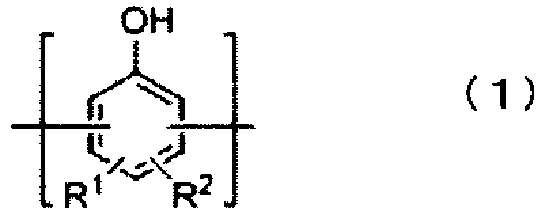

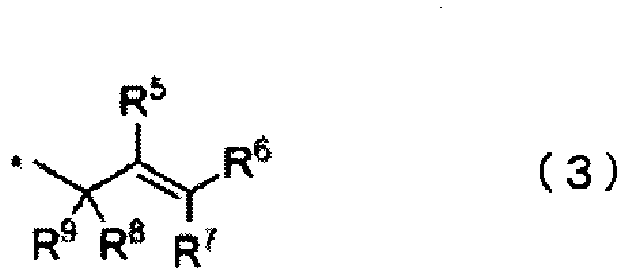
-Q- (4)
wherein each Q independently is an alkylene group represented by the formula CR3R4, a cycloalkylene group having 5 to 10 carbon atoms, a divalent organic group having an alicyclic fused ring having 7 to 10 carbon atoms, or a divalent group that is a combination thereof, and R3 and R4 each independently are a hydrogen atom, an alkyl group having 1 to 5 carbon atoms, an alkenyl group having 2 to 6 carbon atoms, a cycloalkyl group having 5 to 10 carbon atoms or an aryl group having 6 to 12 carbon atoms. - [3] A thermosetting resin composition according to [2], wherein Q in formula (4) is CH2.
- [4] A thermosetting resin composition according to [2] or [3], wherein the 2-alkenyl group represented by formula (3) is bonded to the carbon atom at the ortho position or the para position relative to the phenolic hydroxyl group.
- [5] A thermosetting resin composition according to any one of [2] to [4], wherein the 2-alkenyl group represented by formula (3) is an allyl group.
- [6] A thermosetting resin composition according to any one of [1] to [5], wherein the number-average molecular weight of the polyalkenylphenol resin (A) is 750 to 5000.
- [7] A thermosetting resin composition according to any one of [1] to [6], wherein the aromatic polymaleimide compound (B) is an aromatic bismaleimide compound having a maleimidephenyl group.
- [8] A thermosetting resin composition according to any one of [1] to [7], wherein the polymerization initiator (C) is an organic peroxide.
- [9] A thermosetting resin composition according to any one of [1] to [8], wherein the thermosetting resin composition comprises 0.1 to 5 parts by mass of the polymerization initiator (C) relative to 100 parts by mass of the total amount of the polyalkenylphenol resin (A) and the aromatic polymaleimide compound (B).
- [10] A thermosetting resin composition according to any one of [1] to [9], further comprising a filler.
- [11] A thermosetting resin composition according to [10], wherein the filler is an inorganic filler selected from the group consisting of amorphous silica, crystalline silica, alumina, boron nitride, aluminum nitride, silicon nitride, and mixtures thereof.
- According to the invention it is possible to provide a thermosetting resin composition with excellent workability, heat resistance and mechanical strength. In particular, when used as a semiconductor sealing material in a power device or the like, it is possible to produce a molded article having excellent workability during molding and having high mechanical strength and heat resistance after molding.
- The invention will now be explained in greater detail. The thermosetting resin composition of the invention comprises a polyalkenylphenol resin (A), an aromatic polymaleimide compound (B) and a polymerization initiator (C). These components will now be explained in detail.
- The polyalkenylphenol resin (A) used in the thermosetting resin composition of the invention has in the molecule at least one each of (a1) an aromatic ring unit with a phenolic hydroxyl group, the aromatic ring unit having a 2-alkenyl group bonded thereto, and (a2) an aromatic ring unit with a phenolic hydroxyl group, the aromatic ring unit not having a 2-alkenyl group bonded thereto, each aromatic ring unit being bonded by a linking group the main chain of which is not composed of an aromatic ring, wherein the ratio of m to (m + n) is 40 to 90% where m is the number of aromatic ring units of (a1) and n is the number of aromatic ring units of (a2), and wherein the thermosetting resin composition comprises the polyalkenylphenol resin (A) in an amount such that the proportion of 2-alkenyl groups is 0.4 to 1.5 mol relative to 1 mol of maleimide groups in the aromatic polymaleimide compound (B).
- The basic backbone composing the polyalkenylphenol resin (A) may include a backbone of a known phenol resin, such as a phenol-novolak resin, cresol-novolak resin, triphenylmethane-type phenol resin, phenolaralkyl resin, biphenylaralkylphenol resin or phenol-dicyclopentadiene copolymer resin.
- The polyalkenylphenol resin (A) is a compound having a 2-alkenyl group bonded to 40 to 90%, preferably 50 to 90%, more preferably 55 to 88% and even more preferably 60 to 85%, of the aromatic rings forming the basic backbone of the phenol resin, or in other words, aromatic rings with phenolic hydroxyl groups. Preferred among these are compounds wherein the aromatic ring unit of (a1) is a structural unit represented by formula (1), the aromatic ring unit of (a2) is a structural unit represented by formula (2), and the linking group is a divalent linking group represented by formula (4). Since the polyalkenylphenol resin (A) is typically a mixture of compounds with different numbers of aromatic ring units of (a1) and/or numbers of aromatic ring units of (a2), i.e., it has a molecular weight distribution, in the examples provided below the number m of structural units represented by formula (1) and the number n of structural units represented by formula (2), as calculated from the number-average molecular weight will be shown for reference.


-Q- (4)
Each Q independently is an alkylene group represented by the formula CR3R4, a cycloalkylene group having 5 to 10 carbon atoms, a divalent organic group having an alicyclic fused ring having 7 to 10 carbon atoms, or a divalent group that is a combination thereof, and R3 and R4 each independently are a hydrogen atom, an alkyl group having 1 to 5 carbon atoms, an alkenyl group having 2 to 6 carbon atoms, a cycloalkyl group having 5 to 10 carbon atoms or an aryl group having 6 to 12 carbon atoms. When at least one of R3 and R4 is an aryl group having 6 to 12 carbon atoms, the aryl group(s) are not considered to be composing the main chain of the linking group. - If the proportion of aromatic rings having 2-alkenyl groups bonded thereto is less than 40%, the flow property during molding will be reduced and the hygroscopicity of the cured product (molded article) will also increase. If the proportion of aromatic rings having 2-alkenyl groups bonded thereto is greater than 90%, on the other hand, the moldability during curing will be reduced and the cured product will be hard and brittle. Since the main chain in the linking group of the invention is not composed of an aromatic ring, the cured product is relatively flexible and has excellent impact resistance.
- When the polyalkenylphenol resin (A) has a plurality of either or both of the structural units represented by formula (1) and the structural units represented by formula (2), there is no particular restriction on the order of bonding of the structural units, but rather than having a structure in which a plurality of one of the units is contiguously bonded, it is preferred for them to be either randomly or alternately bonded each via a linking group Q.
- Specific examples of alkyl groups having 1 to 5 carbon atoms to form group R1 in formula (1) and formula (2) include methyl, ethyl, n-propyl, isopropyl, n-butyl, sec-butyl, t-butyl and n-pentyl. Specific examples of alkoxy groups having 1 to 5 carbon atoms include methoxy, ethoxy, n-propoxy, isopropoxy, n-butoxy, sec-butoxy, t-butoxy and n-pentoxy. Incidentally, the term "each independently" means that multiple R1 groups may be the same or different. The same applies for the linking group Q.
- The group R2 is a 2-alkenyl group represented by formula (3). Specific examples of alkyl groups having 1 to 5 carbon atoms to form groups R5, R6, R7, R8 and R9 in formula (3) include methyl, ethyl, n-propyl, isopropyl, n-butyl, sec-butyl, t-butyl and n-pentyl. Specific examples of cycloalkyl groups having 5 to 10 carbon atoms include cyclopentyl, cyclohexyl, methylcyclohexyl and cycloheptyl. Specific examples of aryl groups having 6 to 12 carbon atoms include phenyl, methylphenyl, ethylphenyl, biphenyl and naphthyl. The 2-alkenyl group R2 represented by formula (3) is preferably allyl, or in other words, preferably R5, R6, R7, R8 and R9 are all hydrogen atoms.
- Specific examples of cycloalkylene groups having 5 to 10 carbon atoms to form the linking group Q in formula (4) include cyclopentylene, cyclohexylene, methylcyclohexylene and cycloheptylene. A specific example of a divalent organic group with an alicyclic fused ring having 7 to 10 carbon atoms is dicyclopentadienylene. For R3 and R4, specific examples of alkyl groups having 1 to 5 carbon atoms include methyl, ethyl, n-propyl, isopropyl, n-butyl, sec-butyl, t-butyl and n-pentyl, specific examples of alkenyl groups having 2 to 6 carbon atoms include vinyl, allyl, butenyl, pentenyl and hexenyl, specific examples of cycloalkyl groups having 5 to 10 carbon atoms include cyclopentyl, cyclohexyl, methylcyclohexyl and cycloheptyl, and specific examples of aryl groups having 6 to 12 carbon atoms include phenyl, methylphenyl, ethylphenyl, biphenyl and naphthyl.
- Preferred among these are compounds in which the linking group Q is CR3R4, and more preferred is CH2, from the viewpoint of low viscosity and low cost.
- The preferred number-average molecular weight for the polyalkenylphenol resin (A) used for the invention is 750 to 5000 and more preferably 1000 to 3000. If the number-average molecular weight is less than 750, the thermal decomposition initiation temperature at high temperature will tend to be lower, and if it is greater than 5000, the viscosity will be high, thus tending to impair the workability during molding. The number-average molecular weight is determined by the method described in the examples below.
- The polyalkenylphenol resin (A) used for the invention can be obtained by alkenyl etherification of some of the hydroxyl groups of the starting phenol resin, and rearrangement of the 2-alkenyl group to the ortho position or the para position by Claisen rearrangement reaction. According to one embodiment of the invention, therefore, R2 as the 2-alkenyl group represented by formula (3) is bonded to the carbon atom at the ortho position or para position of the aromatic ring, relative to the phenolic hydroxyl group. The starting phenol resin used may be a known phenol resin, preferably having a structure represented by the following formula (5).

- Specific examples of starting phenol resins include phenol-novolak resins, cresol-novolak resins, triphenylmethane-type phenol resins, phenolaralkyl resins, biphenylaralkylphenol resins and phenol-dicyclopentadiene copolymer resins. From the viewpoint of viscosity reduction, it is preferred to use a phenol-novolak resin or cresol-novolak resin in which Q in formula (5) is CH2.
- The 2-alkenyl etherification reaction of the phenol resin may be, for example, one of the following two methods: (i) a known method to react a halogenated 2-alkenyl compound such as allyl chloride, methallyl chloride or allyl bromide and a phenol compound, or (ii) a method to react a 2-alkenyl carboxylate compound such as allyl acetate and a phenol compound. A 2-alkenyl etherification reaction using a halogenated 2-alkenyl compound may employ the method described in Japanese Unexamined Patent Publication No.
H2-91113 2011-26253 - The amount of halogenated 2-alkenyl compound or 2-alkenyl carboxylate compound used is preferably 0.4 to 0.95 equivalents, and more preferably 0.6 to 0.9 equivalents, relative to the phenolic hydroxyl groups. If it is less than 0.4 equivalents, fewer reactive sites with the aromatic polymaleimide compound (B) will be present after Claisen rearrangement, and lower heat resistance and mechanical strength may be observed in cured products after molding. The 2-alkenyl etherification reaction is carried out by mixing a 2-alkenyl compound with the starting phenol resin, and reacting them for 4 to 40 hours. A solvent that dissolves the starting phenol resin can be used in the 2-alkenyl etherification reaction. Alternatively, a 2-alkenyl carboxylate compound that can dissolve the starting phenol resin can be used to carry out the reaction under solventless conditions. The 2-alkenyl etherification rate of the phenol resin may be controlled by keeping the reaction rate (conversion rate) of the 2-alkenyl compound low, by using a larger amount of the halogenated 2-alkenyl compound or 2-alkenyl carboxylate compound than the amount specified above, and shortening the reaction time to be less than the reaction time specified above.
- The target polyalkenylphenol resin (A) can be obtained by Claisen rearrangement of a polyalkenyl ether resin produced by the method of (i) or (ii) above. Claisen rearrangement reaction can be conducted by heating the polyalkenyl ether resin at a temperature of 100 to 250°C and carrying out reaction for 1 to 20 hours. The Claisen rearrangement reaction can be conducted using a high-boiling-point solvent, or under solventless conditions. An inorganic salt such as sodium thiosulfate or sodium carbonate can also be added to accelerate the rearrangement reaction. The details in this regard are disclosed in Japanese Unexamined Patent Publication No.
H2-91113 - The aromatic polymaleimide compound (B) used in the thermosetting resin composition of the invention is an essential component for providing a cured product with heat resistance by polymerizing and curing with a polyalkenylphenol resin by radical reaction, and heating at 150 to 300°C. An aromatic polymaleimide compound is a compound having two or more maleimide groups, with the maleimide groups bonded to an aromatic ring. The aromatic ring may be a monocyclic ring such as benzene, or a fused ring such as naphthalene or anthracene. Specific examples for the aromatic polymaleimide compound (B) include bismaleimides such as bis(4-maleimidephenyl)methane, trismaleimides such as tris(4-maleimidephenyl)methane, tetrakismaleimides such as bis(3,4-dimaleimidephenyl)methane and aromatic polymaleimides such as poly(4-maleimidestyrene), with aromatic bismaleimide compounds being preferred. Specific examples of aromatic bismaleimide compounds include bis(4-maleimidephenyl)methane, bis(3-maleimidephenyl)methane, bis(3-methyl-4-maleimidephenyl)methane, bis(3,5-dimethyl-4-maleimidephenyl)methane, bis(3-ethyl-4-maleimidephenyl)methane, bis(3,5-diethyl-4-maleimidephenyl)methane, bis(3-propyl-4-maleimidephenyl)methane, bis(3,5-dipropyl-4-maleimidephenyl)methane, bis(3-butyl-4-maleimidephenyl)methane, bis(3,5-dibutyl-4-maleimidephenyl)methane, bis(3-ethyl-4-maleimide-5-methylphenyl)methane, 2,2-bis(4-maleimidephenyl)propane, 2,2-bis[4-(4-maleimidephenyloxy)phenyl]propane, bis(4-maleimidephenyl)ether, bis(3-maleimidephenyl)ether, bis(4-maleimidephenyl)ketone, bis(3-maleimidephenyl)ketone, bis(4-maleimidephenyl)sulfone, bis(3-maleimidephenyl)sulfone, bis[4-(4-maleimidephenyloxy)phenyl]sulfone, bis(4-maleimidephenyl)sulfide, bis(3-maleimidephenyl)sulfide, bis(4-maleimidephenyl)sulfoxide, bis(3-maleimidephenyl)sulfoxide, 1,4-bis(4-maleimidephenyl)cyclohexane, 1,4-dimaleimidenaphthalene, 2,3-dimaleimidenaphthalene, 1,5-dimaleimidenaphthalene, 1,8-dimaleimidenaphthalene, 2,6-dimaleimidenaphthalene, 2,7-dimaleimidenaphthalene, 4,4'-dimaleimidebiphenyl, 3,3'-dimaleimidebiphenyl, 3,4'-dimaleimidebiphenyl, 2,5-dimaleimide-1,3-xylene, 2,7-dimaleimidefluorene, 9,9-bis(4-maleimidephenyl)fluorene, 9,9-bis(4-maleimide-3-methylphenyl)fluorene, 9,9-bis(3-ethyl-4-maleimidephenyl)fluorene, 3,7-dimaleimide-2-methoxyfluorene, 9,10-dimaleimidephenanthrene, 1,2-dimaleimideanthraquinone, 1,5-dimaleimideanthraquinone, 2,6-dimaleimideanthraquinone, 1,2-dimaleimidebenzene, 1,3-dimaleimidebenzene, 1,4-dimaleimidebenzene, 1,4-bis(4-maleimidephenyl)benzene, 2-methyl-1,4-dimaleimidebenzene, 2,3-dimethyl-1,4-dimaleimidebenzene, 2,5-dimethyl-1,4-dimaleimidebenzene, 2,6-dimethyl-1,4-dimaleimidebenzene, 4-ethyl-1,3-dimaleimidebenzene, 5-ethyl-1,3-dimaleimidebenzene, 4,6-dimethyl-1,3-dimaleimidebenzene, 2,4,6-trimethyl-1,3-dimaleimidebenzene, 2,3,5,6-tetramethyl-1,4-dimaleimidebenzene and 4-methyl-1,3-dimaleimidebenzene. An example of a commercial product is the BMI Series (trade name of Daiwa Fine Chemicals Co., Ltd.). Preferred among these are aromatic bismaleimide compounds with maleimidephenyl groups, because they are inexpensive and readily available, and have high universal utility, and when mixed in compositions, they melt at temperatures of about 100°C and exhibit satisfactory mixed dispersibility.
- The thermosetting resin composition contains the polyalkenylphenol resin (A) in an amount such that the proportion of 2-alkenyl groups is 0.4 to 1.5 mol and preferably 0.5 to 1.0 mol relative to 1 mol of maleimide groups in the aromatic polymaleimide compound (B). At less than 0.4 mol, the heat resistance and/or mechanical strength will be reduced. At greater than 1.5 mol, the elastic modulus will increase, resulting in a cured product being fragile and easy to be broken.
- Since curing of the thermosetting resin composition of the invention is accomplished by radical polymerization, the thermosetting resin composition includes a polymerization initiator (C). The polymerization initiator (C) is preferably a thermal radical generator. Thermal radical generators include organic peroxides, azo-based compounds, phosphorus-based compounds and redox initiators. Organic peroxides include organic peroxides having a 10-hour half-life temperature of 100 to 170°C, such as dicumyl peroxide, 2,5-dimethyl-2,5-di(tert-butylperoxy)hexane, tert-butylcumyl peroxide, di-tert-butyl peroxide, 1,1,3,3-tetramethylbutyl hydroperoxide and cumene hydroperoxide. Azo-based compounds include azobisisobutyronitrile, 1,1'-azobis(cyclohexanecarbonitrile) and diethyl azodicarboxylate. Phosphorus-based compounds include triphenylphosphine, tri-o-tolylphosphine, tri-m-tolylphosphine, tris(p-methoxyphenyl)phosphine, tricyclohexylphosphine and tri-tert-butylphosphine. Redox initiators include combinations of organic peroxides (oxidizing agents) including organic hydroperoxides such as cumene hydroperoxide, dialkyl peroxides such as dicumyl peroxide, diacyl peroxides such as diacetyl peroxide and dibenzoyl peroxide, peroxidated esters such as t-butyl peroxyneodecanoate and t-butyl peroxypivalate, and reducing agents including tertiary amines such as triethylamine and N,N-dimethylaniline, aromatic thiol compounds such as mercaptobenzimidazole, organic acid metal salts such as copper acetate and copper naphthenate, metal chelate compounds such as vanadyl acetylacetonate and copper acetylacetonate, metal sulfides such as copper sulfide and manganese sulfide, and metal oxides such as copper oxide. Preferred among these are organic peroxides, since they have high curing reaction rates, can provide molding in short time periods, and have high storage stability.
- The preferred amount used of the polymerization initiator (C) is 0.1 to 5 parts by mass and more preferably 0.5 to 3 parts by mass, relative to 100 parts by mass of the total amount of the polyalkenylphenol resin (A) and the aromatic polymaleimide compound (B). At less than 0.1 part by mass the curing reaction will not be adequately promoted, and at greater than 5 parts by mass, the storage stability will tend to be reduced.
- The thermosetting resin composition of the invention may also contain other additives as necessary, within ranges that do not interfere with the curing property. Fillers may be mentioned as typical examples of additives. The types of fillers used may be selected as appropriate for the purpose of use. For example, when the thermosetting resin composition of the invention is used for sealing of a semiconductor, usually an inorganic filler with an insulating property is added to reduce the thermal expansion coefficient of the cured product. There are no particular restrictions on the inorganic filler, and any publicly known one may be used.
- Specific examples of inorganic fillers include particles of amorphous silica, crystalline silica, alumina, boron nitride, aluminum nitride and silicon nitride. From the viewpoint of viscosity reduction, spherical amorphous silica is preferred. The inorganic filler may be surface treated with a silane coupling agent or the like, or it may be one that has not been surface treated. The mean particle diameter of the inorganic filler is 0.1 to 20 µm, and preferably the maximum particle diameter is not greater than 50 µm and especially not greater than 20 µm. If the mean particle diameter is within this range, the viscosity of the thermosetting resin composition will not be too high, and injectability into narrow-pitch wiring sections and narrow gap sections will be suitable. The mean particle diameter referred to herein is the volume cumulative particle diameter D50 measured with a laser diffraction-scattering particle diameter distribution analyzer. The content of the inorganic filler in the thermosetting resin composition can be determined as appropriate for the purpose of use. For example, for semiconductor sealing purposes, the content of the inorganic filler in the thermosetting resin composition is usually 50 to 95 mass% and preferably 65 to 90 mass%.
- The thermosetting resin composition of the invention may contain a coupling agent for improved adhesiveness between the resin and the filler, substrate or element. The coupling agent is not particularly restricted, and examples include silane coupling agents such as vinyltriethoxysilane, vinyltrimethoxysilane, 3-glycidoxypropyltrimethoxysilane, γ-methacryloxypropyltrimethoxysilane, γ-aminopropyltrimethoxysilane and N-phenyl-3-aminopropyltrimethoxysilane. A single coupling agent may be used, or two or more may be used in combination. The content of the coupling agent is preferably 0.1 to 5 parts by mass relative to 100 parts by mass of the inorganic filler. If it is less than 0.1 part by mass, the effect of the coupling agent may not be adequately exhibited, and if it is greater than 5 parts by mass, the excess coupling agent may volatilize off, resulting in reduction of the film thickness when the thermosetting resin composition has been cured.
- The thermosetting resin composition of the invention may also contain other additives such as antifoaming agents, coloring agents, fluorescent materials, modifying agents, leveling agents, light diffusion agents and flame retardants, as necessary, in ranges that do not adversely affect the properties of the cured product.
- There are no particular restrictions on the method of preparing the thermosetting resin composition of the invention, and it can be prepared by loading and mixing in a mixer such as a pot mill, triple roll mill, rotating mixer, biaxial mixer, Disper mixer or the like, with the components in the prescribed mixing proportion. During preparation, if necessary, an organic solvent may be combined and uniformly mixed with the composition, and then the organic solvent may be volatilized off. The organic solvent used may be selected as appropriate depending on, for example, the solubility of the organic components of the composition including the polyalkenylphenol resin (A), aromatic polymaleimide compound (B) and polymerization initiator (C), but preferably it is one that is easy to remove, such as acetone, toluene, THF or ethyl acetate. Strongly acidic solvents such as acetic acid and basic solvents such as triethylamine and pyridine are not preferred because they react with maleimide or hydroxyl groups. Solvents with a high boiling point, such as dimethylformamide and dimethyl sulfoxide, are not preferred due to the problem of residue of the organic solvent. When an organic solvent is used, preferably the organic solvent is removed under reduced pressure at the final step, to obtain the composition. When the composition is to be powdered, the method is not particularly specified so long as the resin does not melt by the heat generated by the operating steps, but for a small amount, it is convenient to use an agate mortar. When a commercially available pulverizer is employed, types that generate heat during pulverizing can cause melting of the mixture and are therefore unsuitable. The particle diameter of the powder may be up to about 1 mm, for example.
- The thermosetting resin composition of the invention can be cured by heating. The thermosetting conditions are normally 150 to 300°C. Curing will not proceed sufficiently at a temperature of lower than 150°C. On the other hand, at a temperature of higher than 300°C, the composition may decompose and cause volatilization of the low-molecular-weight components, and it is an undesirable situation for the equipment. The heating time is preferably in the range of 0.5 to 48 hours. The heating may be divided and carried out in plural times. When an especially high degree of curing is desired then curing at an excessively high temperature is not preferred, but instead the temperature is raised as curing progresses, for example, to a final curing temperature of not higher than 250°C and preferably not higher than 230°C.
- The invention will now be explained in greater detail using examples and comparative examples, with the understanding that the invention is not limited to the examples.
- The starting materials in the examples and comparative examples were as follows.
-
- SHONOL™ BRG-556: Phenol-novolak resin (product of Showa Denko K.K.)
- BMI-1100H: 4,4'-diphenylmethanebismaleimide (bis(4-maleimidephenyl)methane) (product of Daiwa Fine Chemicals Co., Ltd.)
- Percumyl™ D: dicumyl peroxide (product of NOF Corp.)
- silica filler: MSR-2212 [spherical silica: mean particle diameter of 25.5 µm] (product of Tatsumori, Ltd.)
- silica filler: FUSELEX RD-8 [granular molten silica: mean particle diameter of 15.5 µm] (product of Tatsumori, Ltd.)
- silane coupling agent: KBM-403 [3-glycidoxypropyltrimethoxysilane] (product of Shin-Etsu Chemical Co., Ltd.)
- The analysis methods and characteristic evaluation methods used in the examples and comparative examples were as follows.
- The measuring conditions for GPC were as follows.
- apparatus: Shodex™ GPC-101
- column: Shodex™ KF-802, KF-803, KF-805
- mobile phase: Tetrahydrofuran
- flow rate: 1.0 mL/min
- detector: Shodex™ RI-71
- temperature: 40°C
- The number-average molecular weight and weight-average molecular weight were calculated based on a calibration curve prepared by using a polystyrene standard substance, under the measuring conditions specified above.
- Measurement was performed using a TENSILON tester (model: MSAT0002RTF/RTG) by A&D Co., Ltd.

- A 3-point bending test was conducted 5 times, and the average value was calculated.
- Measurement was performed using a thermomechanical analyzer (TMA). A TMA/SS6100 thermomechanical analyzer by SII NanoTechnology Inc. was used for measurement of a 8 mm × 8 mm × 3 mm test piece under conditions with a temperature range of 30 to 250°C, a temperature-elevating rate of 10°C/min and a load of 20.0 mN.
- Approximately 1 g of thermosetting resin composition was taken on a hot plate heated to 180°C and slowly and continuously kneaded while pressing with a spatula, and the time when the viscosity of the composition increased to form a gel was measured as the gelling start time.
- The allylation rate was calculated from 1H-NMR analysis. The hydrogen atoms at the meta position relative to the hydroxyl groups in the phenol compound of the starting material do not contribute to the reaction at any stage of the allyl etherification or Claisen rearrangement reaction. The integrated intensity (integrated intensity V1) of the signal for this hydrogen atom was used as an intramolecular internal standard, and the reaction rate at each stage was calculated by comparing V1 with the integrated intensity of the new signal after allyl etherification and Claisen rearrangement. For example, a signal for the methylene hydrogen atom in the allyl group is newly observed after allyl etherification. The value of V0, obtained when the integrated intensity of the signal for the methylene hydrogen atom in the allyl group observed when allyl etherification reaction had proceeded 100% by using an excess of allylation reagent (allyl acetate) had been normalized against V1, was defined as the maximum (100%) integrated intensity of the theoretically observed signal after 100% allyl etherification.
- The reaction rate for alkenyl etherification was calculated based on V0 by the formula: (V2/V0) × 100, where V2 was obtained by normalizing the integrated intensity of the signal of the methylene hydrogen atom in the 2-alkenyl group in the compound that had been partially 2-alkenyl etherified, against V1. The reaction rate for Claisen rearrangement was calculated in a similar manner based on the integrated intensity of the signal newly observed after Claisen rearrangement reaction. After Claisen rearrangement, a signal for the methylene hydrogen atom in the 2-alkenyl group was observed at the higher magnetic field from the chemical shift of the signal for the methylene hydrogen atom in the 2-alkenyl ether compound. The reaction rate for Claisen rearrangement reaction was calculated by the formula: (V3/V0) × 100, where V3 was obtained by normalizing the integrated intensity of the signal for the newly produced methylene hydrogen atom, against V1. The measuring sample solution was prepared so that the signal/noise (S/N) ratio of the spectrum in 1H-NMR analysis exceeded 100. The fact that the S/N ratio was greater than 100 guarantees that the resolution in 1H-NMR analysis was ±1.0% or greater. However, since the observed signal was broad, the resolution in 1H-NMR analysis was judged to be about ±5%. In the examples, the allylation rate of the final target compound was recorded as an approximate value.
- The 1H-NMR analysis was carried out under the following conditions.
-
- apparatus: BRUKER AVANCE400 (by Bruker)
- solvent: deuterated chloroform
- measuring temperature: 27°C
- In a 1 L three-necked flask there were charged 201 g (1.45 mol) of potassium carbonate (product of Nippon Soda Co., Ltd.) as a solution dissolved in 150 g of purified water, and 150.0 g of the phenol-novolak resin SHONOL™ BRG-556 (product of Showa Denko K.K.), and the reactor was exchanged with nitrogen gas and heated to 85°C. After adding 122 g of allyl acetate (product of Showa Denko K.K.) (1.22 mol, 0.6 mol equivalents relative to the hydroxyl groups of the phenol-novolak resin (catalog value), 3.82 g (14.6 mmol) of triphenylphosphine (product of Hokko Chemical Industry Co., Ltd.) and 0.62 g of 50% water-containing 5%-Pd/C-STD (product of N.E. Chemcat Corp.) (0.291 mmol as Pd atoms), under a nitrogen gas stream, the temperature was increased to 105°C in a nitrogen gas atmosphere, and heating was continued for 10 hours. Stirring was then halted, and the mixture was allowed to stand for separation of the organic layer and aqueous layer into two layers. After adding purified water (200 g) to dissolve the precipitated salt, 200 g of toluene was added and the mixture was kept at about 80°C while confirming no white deposit precipitation, after which the Pd/C was recovered by filtering (by using a 1 micrometer pore diameter membrane filter (KST-142-JA by Advantech, Inc.) with pressure at 0.3 MPa). The filter residue was rinsed with 100 g of toluene and the aqueous layer was separated. The organic layer was rinsed twice with 200 g of water, and the aqueous layer was confirmed to be neutral. After separating off the organic layer, it was concentrated under reduced pressure to obtain a phenol-novolak-type polyallyl ether resin in the form of a brown oil. The phenol-novolak-type polyallyl ether resin was then placed in a 500 mL flask with a mechanical stirrer set within it. The temperature was increased to 190°C while stirring at 300 rpm, and Claisen rearrangement reaction was carried out for 10 hours to obtain a phenol-novolak-type polyallylphenol resin (Synthetic Product A). The number-average molecular weight of the polyallylphenol resin (Synthetic Product A) was 770, and the weight-average molecular weight was 2100. Also, representing the number of structural units represented by formula (1) in the polyallylphenol resin (Synthetic Product A) as m and the number of structural units represented by formula (2) as n, calculation based on the number-average molecular weight produced a value of 3.6 for m and a value of 2.4 for n. Each R1 in formula (1) and formula (2) was a hydrogen atom, and R2 in formula (1) was an allyl group.
- Phenol-novolak-type polyallylphenol resins (Synthetic Products B, C, D and E) were obtained as reddish brown solids in the same manner as Production Example 1, except for changing the amount of allyl acetate used. In order to increase the allylation rate for synthesis of Synthetic Product C, the allyl acetate was used at 1 mol equivalent relative to the hydroxyl groups in the phenol-novolak resin at the start of the reaction, with further addition of 0.2 mol equivalent of allyl acetate after 4 hours from the start of the reaction.
- The number-average molecular weight, weight-average molecular weight and allylation rate ([m / (m + n)]%) of each resin are shown in Table 1.
Table 1 Number-average molecular weight Weight-average molecular weight m n m/ (m + n) Synthetic Product A 770 2100 3.6 2.4 60% Synthetic product B 830 2100 5.1 0.9 85% Synthetic product C 870 2400 6 0 100% Synthetic product D 690 1400 1.2 4.8 20% Synthetic product E 710 1400 1.8 4.2 30% - The polyallylphenol resins obtained by synthesis as described above and the components listed in Table 2 were mixed in the proportions listed in Table 2, and the mixture was melt kneaded (two rolls (8-inch roll diameter) by Toyo Seiki Co., Ltd., 110°C, 10 min). Each was then allowed to cool for 1 hour at room temperature (25°C) for solidification, after which a mill mixer (model WB-1 by Osaka Chemical Co., Ltd., 25°C, 30 sec) was used for pulverizing to obtain the target powdered resin composition. The resin composition was subjected to hot press molding using a hot press machine (product of Toyo Seiki Co., Ltd., press pressure: 5 MPa, 180°C, 10 min), to produce a plate-shaped cured sample. The cured sample was used for measurement of the flexural modulus and flexural strength, with the results shown in Table 3 below.
- For all of the examples and comparative examples, BMI-1100H was used as the aromatic bismaleimide compound (B). KBM-403 was used as the silane coupling agent, added at 0.2 mass% relative to the silica filler.
Table 2 Polyallylphenol resin Polymerization initiator2) Filler Type Molar ratio1) phr Type Mass% Example 1 Synthetic Product A 0.85 0.65 MSR-2212 75 Example 2 Synthetic product B 0.85 0.65 MSR-2212 75 Example 3 Synthetic product B 0.50 0.80 MSR-2212/RD-8 65/10 Example 4 Synthetic product B 0.85 0.80 MSR-2212/RD-8 65/10 Comp. Example 1 Synthetic product C 0.85 0.65 MSR-2212 75 Comp. Example 2 Synthetic product D 0.85 0.65 MSR-2212 75 Comp. Example 3 Synthetic product E 0.50 0.80 MSR-2212/RD-8 65/10 Comp. Example 4 Synthetic product E 0.85 0.80 MSR-2212/RD-8 65/10 Comp. Example 5 Synthetic product E 1.70 0.80 MSR-2212/RD-8 65/10 Comp. Example 6 Synthetic product B 1.70 0.80 MSR-2212/RD-8 65/10 Comp. Example 7 Synthetic product B 0.30 0.80 MSR-2212/RD-8 65/10 1) Number of moles (molar ratio) of allyl groups in polyallylphenol resin relative to 1 mol of maleimide groups in aromatic bismaleimide compound (BMI-1100H)
2) Parts by mass of polymerization initiator relative to 100 parts by mass of total amount of polyallylphenol resin and aromatic bismaleimide compoundTable 3 Gel start time (sec) Tg (°C) Flexural modulus (GPa) Flexural strength (MPa) Example 1 30 301 17.1 136.3 Example 2 28 293 15.9 114.2 Example 3 29 312 16.2 131.3 Example 4 33 308 14.8 153.2 Comp. Example 1 >180 315 21.0 77.0 Comp. Example 2 41 221 18.0 139.6 Comp. Example 3 38 284 19.8 145.7 Comp. Example 4 43 251 20.4 130.6 Comp. Example 5 45 208 15.8 151.9 Comp. Example 6 58 210 17.2 184.1 Comp. Example 7 37 291 25.0 54.1 - One major use of the thermosetting resin composition of the invention is a semiconductor sealing material for a power device. For use as a semiconductor sealing material, preferably the properties of the cured product satisfy the value ranges specified below.
- gel time: ≤30 seconds
- glass transition temperature: ≥250°C
- flexural modulus: ≤18 GPa
- flexural strength: ≥100 MPa
- While it is not necessary to satisfy all of these ranges, if one or more of the property ranges is not satisfied the balance of performance as a sealing material will be poor, and problems of moldability and heat resistance will be more likely to occur. In Comparative Example 1, the curing speed was slow and the flexural strength was low. In Comparative Example 2, the glass transition temperature was low. In Comparative Example 3, the flexural modulus was high. In Comparative Example 4, the glass transition temperature was low and the flexural modulus was high. In Comparative Example 5, the glass transition temperature was low. In Comparative Example 6, the gel time was long and the glass transition temperature was low. In Comparative Example 7, the flexural modulus was high and the flexural strength was low. In contrast, Examples 1 to 4 all satisfied all of the aforementioned conditions, indicating that they are suitable for use as semiconductor sealing materials.
- According to the invention it is possible to provide a thermosetting resin composition with excellent workability, heat resistance and mechanical strength. In particular, when used as a semiconductor sealing material in a power device or the like, it has excellent workability and fast-curing properties during molding, and allows production of a sealing material with high mechanical strength and heat resistance of the molded cured product.
Claims (11)
- A thermosetting resin composition comprising (A) a polyalkenylphenol resin, (B) an aromatic polymaleimide compound and (C) a polymerization initiator, wherein the polyalkenylphenol resin (A) has in the molecule at least one each of (a1) an aromatic ring unit with a phenolic hydroxyl group, the aromatic ring unit having a 2-alkenyl group bonded thereto, and (a2) an aromatic ring unit with a phenolic hydroxyl group, the aromatic ring unit not having a 2-alkenyl group bonded thereto, each aromatic ring unit being bonded by a linking group the main chain of which is not composed of an aromatic ring, wherein the ratio of m to (m + n) is 40 to 90% where m is the number of aromatic ring units of (a1) and n is the number of aromatic ring units of (a2), and wherein the thermosetting resin composition comprises the polyalkenylphenol resin (A) in an amount such that the proportion of 2-alkenyl groups is 0.4 to 1.5 mol relative to 1 mol of maleimide groups in the aromatic polymaleimide compound (B).
- A thermosetting resin composition according to claim 1, wherein the aromatic ring unit of (a1) is a structural unit represented by formula (1) and the aromatic ring unit of (a2) is a structural unit represented by formula (2):

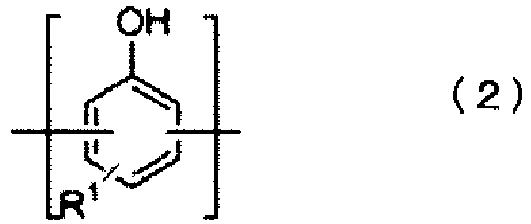

-Q- (4)
wherein each Q independently is an alkylene group represented by the formula CR3R4, a cycloalkylene group having 5 to 10 carbon atoms, a divalent organic group having an alicyclic fused ring having 7 to 10 carbon atoms, or a divalent group that is a combination thereof, and R3 and R4 each independently are a hydrogen atom, an alkyl group having 1 to 5 carbon atoms, an alkenyl group having 2 to 6 carbon atoms, a cycloalkyl group having 5 to 10 carbon atoms or an aryl group having 6 to 12 carbon atoms. - A thermosetting resin composition according to claim 2, wherein Q in formula (4) is CH2.
- A thermosetting resin composition according to claim 2 or 3, wherein the 2-alkenyl group represented by formula (3) is bonded to the carbon atom at the ortho position or the para position relative to the phenolic hydroxyl group.
- A thermosetting resin composition according to any one of claims 2 to 4, wherein the 2-alkenyl group represented by formula (3) is an allyl group.
- A thermosetting resin composition according to any one of claims 1 to 5, wherein the number-average molecular weight of the polyalkenylphenol resin (A) is 750 to 5000.
- A thermosetting resin composition according to any one of claims 1 to 6, wherein the aromatic polymaleimide compound (B) is an aromatic bismaleimide compound having a maleimidephenyl group.
- A thermosetting resin composition according to any one of claims 1 to 7, wherein the polymerization initiator (C) is an organic peroxide.
- A thermosetting resin composition according to any one of claims 1 to 8, wherein the thermosetting resin composition comprises 0.1 to 5 parts by mass of the polymerization initiator (C) relative to 100 parts by mass of the total amount of the polyalkenylphenol resin (A) and the aromatic polymaleimide compound (B).
- A thermosetting resin composition according to any one of claims 1 to 9, further comprising a filler.
- A thermosetting resin composition according to claim 10, wherein the filler is an inorganic filler selected from the group consisting of amorphous silica, crystalline silica, alumina, boron nitride, aluminum nitride, silicon nitride, and mixtures thereof.
Applications Claiming Priority (2)
| Application Number | Priority Date | Filing Date | Title |
|---|---|---|---|
| JP2014263518 | 2014-12-25 | ||
| PCT/JP2015/084837 WO2016104195A1 (en) | 2014-12-25 | 2015-12-11 | Thermosetting resin composition |
Publications (3)
| Publication Number | Publication Date |
|---|---|
| EP3239199A1 true EP3239199A1 (en) | 2017-11-01 |
| EP3239199A4 EP3239199A4 (en) | 2018-08-08 |
| EP3239199B1 EP3239199B1 (en) | 2019-09-25 |
Family
ID=56150224
Family Applications (1)
| Application Number | Title | Priority Date | Filing Date |
|---|---|---|---|
| EP15872764.4A Not-in-force EP3239199B1 (en) | 2014-12-25 | 2015-12-11 | Thermosetting resin composition |
Country Status (7)
| Country | Link |
|---|---|
| US (1) | US10160856B2 (en) |
| EP (1) | EP3239199B1 (en) |
| JP (1) | JP6271763B2 (en) |
| KR (1) | KR101900268B1 (en) |
| CN (1) | CN107108821B (en) |
| TW (1) | TWI591116B (en) |
| WO (1) | WO2016104195A1 (en) |
Families Citing this family (11)
| Publication number | Priority date | Publication date | Assignee | Title |
|---|---|---|---|---|
| JP6832938B2 (en) * | 2016-09-09 | 2021-02-24 | 昭和電工株式会社 | Method for Producing Curable Resin Mixture and Curable Resin Composition |
| CN109563223B (en) * | 2016-10-18 | 2021-07-09 | 昭和电工株式会社 | Method for producing polyalkenyl phenol compound, curable composition containing polyalkenyl phenol compound, and cured product thereof |
| CN110248970A (en) * | 2017-04-19 | 2019-09-17 | 昭和电工株式会社 | Hardening resin composition, its solidfied material and the structural body comprising the solidfied material |
| CN110770275A (en) * | 2017-05-31 | 2020-02-07 | 日立化成株式会社 | Liquid resin composition for compression molding and electronic component device |
| CN110785451A (en) | 2017-05-31 | 2020-02-11 | 日立化成株式会社 | Liquid resin composition for sealing and electronic component device |
| US11935803B2 (en) * | 2018-04-26 | 2024-03-19 | Mitsubishi Gas Chemical Company, Inc. | Resin composition, laminate, semiconductor wafer with resin composition layer, substrate for mounting semiconductor with resin composition layer and semiconductor device |
| TWI681991B (en) * | 2018-10-11 | 2020-01-11 | 日商昭和電工股份有限公司 | Curable resin composition, cured product thereof, method for manufacturing structure using the curable resin composition, and structure including the cured product |
| CN113316597A (en) * | 2019-01-24 | 2021-08-27 | 昭和电工株式会社 | Thermosetting resin composition |
| TWI733541B (en) * | 2019-08-09 | 2021-07-11 | 長春人造樹脂廠股份有限公司 | Allyl-containing resin and uses of the same |
| WO2021240879A1 (en) * | 2020-05-28 | 2021-12-02 | 昭和電工株式会社 | Thermosetting resin composition |
| JP7593401B2 (en) * | 2020-05-28 | 2024-12-03 | 株式会社レゾナック | Thermosetting resin composition |
Family Cites Families (13)
| Publication number | Priority date | Publication date | Assignee | Title |
|---|---|---|---|---|
| JPS6222812A (en) * | 1985-07-23 | 1987-01-31 | Sumitomo Chem Co Ltd | Thermosetting resin composition |
| EP0178546B1 (en) | 1984-10-15 | 1993-08-18 | Sumitomo Chemical Company, Limited | Thermosetting resin composition |
| JPS62268132A (en) * | 1986-05-15 | 1987-11-20 | Sumitomo Chem Co Ltd | Organic insulating film for semiconductor |
| JPH056869A (en) * | 1991-02-09 | 1993-01-14 | Nitto Denko Corp | Semiconductor device |
| US5290882A (en) * | 1991-08-13 | 1994-03-01 | Shin-Etsu Chemical Co., Ltd. | Thermosetting resin compositions |
| JPH0543630A (en) | 1991-08-14 | 1993-02-23 | Mitsubishi Petrochem Co Ltd | Aromatic bismaleimide resin composition |
| JP3022668B2 (en) | 1991-11-18 | 2000-03-21 | 東亞合成株式会社 | Curable resin composition |
| JP2005075866A (en) * | 2003-08-29 | 2005-03-24 | Tomoegawa Paper Co Ltd | Adhesive sheet for semiconductor devices |
| JP4793565B2 (en) * | 2005-03-24 | 2011-10-12 | 信越化学工業株式会社 | Epoxy resin composition for semiconductor encapsulation and semiconductor device |
| JP6060541B2 (en) * | 2012-02-23 | 2017-01-18 | 日立化成株式会社 | Thermosetting resin composition for semiconductor encapsulation and semiconductor device using the same |
| JP5991007B2 (en) * | 2012-04-27 | 2016-09-14 | 日立化成株式会社 | Thermosetting resin composition and semiconductor device using the same |
| JP2015117375A (en) * | 2013-11-15 | 2015-06-25 | 明和化成株式会社 | Allylphenol novolac resin composition, cured product obtained by curing the same, method for producing cured product, and fiber-reinforced resin molded article |
| JP6271272B2 (en) * | 2014-01-31 | 2018-01-31 | 昭和電工株式会社 | Radiation-sensitive composition and method for producing radiation lithography structure |
-
2015
- 2015-12-11 EP EP15872764.4A patent/EP3239199B1/en not_active Not-in-force
- 2015-12-11 WO PCT/JP2015/084837 patent/WO2016104195A1/en not_active Ceased
- 2015-12-11 KR KR1020177009388A patent/KR101900268B1/en not_active Expired - Fee Related
- 2015-12-11 CN CN201580058112.5A patent/CN107108821B/en not_active Expired - Fee Related
- 2015-12-11 JP JP2016566115A patent/JP6271763B2/en active Active
- 2015-12-11 US US15/533,549 patent/US10160856B2/en active Active
- 2015-12-23 TW TW104143381A patent/TWI591116B/en not_active IP Right Cessation
Also Published As
| Publication number | Publication date |
|---|---|
| CN107108821A (en) | 2017-08-29 |
| EP3239199A4 (en) | 2018-08-08 |
| WO2016104195A1 (en) | 2016-06-30 |
| KR20170051503A (en) | 2017-05-11 |
| CN107108821B (en) | 2019-07-16 |
| JPWO2016104195A1 (en) | 2017-06-15 |
| JP6271763B2 (en) | 2018-01-31 |
| TW201638199A (en) | 2016-11-01 |
| US20170349743A1 (en) | 2017-12-07 |
| TWI591116B (en) | 2017-07-11 |
| KR101900268B1 (en) | 2018-09-19 |
| EP3239199B1 (en) | 2019-09-25 |
| US10160856B2 (en) | 2018-12-25 |
Similar Documents
| Publication | Publication Date | Title |
|---|---|---|
| EP3239199B1 (en) | Thermosetting resin composition | |
| EP3239200B1 (en) | Thermosetting resin composition | |
| JP7153635B2 (en) | Curable resin composition, cured product thereof, and structure containing cured product | |
| JP6832938B2 (en) | Method for Producing Curable Resin Mixture and Curable Resin Composition | |
| JP7065832B2 (en) | A curable resin composition, a cured product thereof, and a structure containing the cured product thereof. | |
| JP5049408B2 (en) | Thermosetting resin composition having benzoxazine ring, method for producing the same, molded product and cured product | |
| JP5498200B2 (en) | Method for producing thermosetting resin having benzoxazine ring, and thermosetting resin having benzoxazine ring | |
| TWI639635B (en) | Method for producing polyalkenyl phenol compound, and curable composition containing polyalkenyl phenol compound and hardened product thereof |
Legal Events
| Date | Code | Title | Description |
|---|---|---|---|
| STAA | Information on the status of an ep patent application or granted ep patent |
Free format text: STATUS: THE INTERNATIONAL PUBLICATION HAS BEEN MADE |
|
| PUAI | Public reference made under article 153(3) epc to a published international application that has entered the european phase |
Free format text: ORIGINAL CODE: 0009012 |
|
| STAA | Information on the status of an ep patent application or granted ep patent |
Free format text: STATUS: REQUEST FOR EXAMINATION WAS MADE |
|
| 17P | Request for examination filed |
Effective date: 20170626 |
|
| AK | Designated contracting states |
Kind code of ref document: A1 Designated state(s): AL AT BE BG CH CY CZ DE DK EE ES FI FR GB GR HR HU IE IS IT LI LT LU LV MC MK MT NL NO PL PT RO RS SE SI SK SM TR |
|
| AX | Request for extension of the european patent |
Extension state: BA ME |
|
| DAV | Request for validation of the european patent (deleted) | ||
| DAX | Request for extension of the european patent (deleted) | ||
| A4 | Supplementary search report drawn up and despatched |
Effective date: 20180710 |
|
| RIC1 | Information provided on ipc code assigned before grant |
Ipc: C08L 61/16 20060101ALI20180704BHEP Ipc: C08K 3/00 20060101ALI20180704BHEP Ipc: C08F 290/14 20060101AFI20180704BHEP Ipc: C08K 5/3415 20060101ALI20180704BHEP Ipc: C08K 5/14 20060101ALI20180704BHEP Ipc: C08L 61/14 20060101ALI20180704BHEP |
|
| GRAP | Despatch of communication of intention to grant a patent |
Free format text: ORIGINAL CODE: EPIDOSNIGR1 |
|
| STAA | Information on the status of an ep patent application or granted ep patent |
Free format text: STATUS: GRANT OF PATENT IS INTENDED |
|
| RIC1 | Information provided on ipc code assigned before grant |
Ipc: C08K 5/3415 20060101ALI20190301BHEP Ipc: C08K 5/14 20060101ALI20190301BHEP Ipc: C08K 3/00 20180101ALI20190301BHEP Ipc: C08L 61/14 20060101ALI20190301BHEP Ipc: C08F 290/14 20060101AFI20190301BHEP Ipc: C08L 61/16 20060101ALI20190301BHEP |
|
| INTG | Intention to grant announced |
Effective date: 20190408 |
|
| GRAS | Grant fee paid |
Free format text: ORIGINAL CODE: EPIDOSNIGR3 |
|
| GRAA | (expected) grant |
Free format text: ORIGINAL CODE: 0009210 |
|
| STAA | Information on the status of an ep patent application or granted ep patent |
Free format text: STATUS: THE PATENT HAS BEEN GRANTED |
|
| AK | Designated contracting states |
Kind code of ref document: B1 Designated state(s): AL AT BE BG CH CY CZ DE DK EE ES FI FR GB GR HR HU IE IS IT LI LT LU LV MC MK MT NL NO PL PT RO RS SE SI SK SM TR |
|
| REG | Reference to a national code |
Ref country code: GB Ref legal event code: FG4D |
|
| REG | Reference to a national code |
Ref country code: CH Ref legal event code: EP |
|
| REG | Reference to a national code |
Ref country code: AT Ref legal event code: REF Ref document number: 1183763 Country of ref document: AT Kind code of ref document: T Effective date: 20191015 |
|
| REG | Reference to a national code |
Ref country code: IE Ref legal event code: FG4D |
|
| REG | Reference to a national code |
Ref country code: DE Ref legal event code: R096 Ref document number: 602015038856 Country of ref document: DE |
|
| REG | Reference to a national code |
Ref country code: NL Ref legal event code: FP |
|
| PG25 | Lapsed in a contracting state [announced via postgrant information from national office to epo] |
Ref country code: LT Free format text: LAPSE BECAUSE OF FAILURE TO SUBMIT A TRANSLATION OF THE DESCRIPTION OR TO PAY THE FEE WITHIN THE PRESCRIBED TIME-LIMIT Effective date: 20190925 Ref country code: SE Free format text: LAPSE BECAUSE OF FAILURE TO SUBMIT A TRANSLATION OF THE DESCRIPTION OR TO PAY THE FEE WITHIN THE PRESCRIBED TIME-LIMIT Effective date: 20190925 Ref country code: BG Free format text: LAPSE BECAUSE OF FAILURE TO SUBMIT A TRANSLATION OF THE DESCRIPTION OR TO PAY THE FEE WITHIN THE PRESCRIBED TIME-LIMIT Effective date: 20191225 Ref country code: HR Free format text: LAPSE BECAUSE OF FAILURE TO SUBMIT A TRANSLATION OF THE DESCRIPTION OR TO PAY THE FEE WITHIN THE PRESCRIBED TIME-LIMIT Effective date: 20190925 Ref country code: FI Free format text: LAPSE BECAUSE OF FAILURE TO SUBMIT A TRANSLATION OF THE DESCRIPTION OR TO PAY THE FEE WITHIN THE PRESCRIBED TIME-LIMIT Effective date: 20190925 Ref country code: NO Free format text: LAPSE BECAUSE OF FAILURE TO SUBMIT A TRANSLATION OF THE DESCRIPTION OR TO PAY THE FEE WITHIN THE PRESCRIBED TIME-LIMIT Effective date: 20191225 |
|
| REG | Reference to a national code |
Ref country code: LT Ref legal event code: MG4D |
|
| PG25 | Lapsed in a contracting state [announced via postgrant information from national office to epo] |
Ref country code: LV Free format text: LAPSE BECAUSE OF FAILURE TO SUBMIT A TRANSLATION OF THE DESCRIPTION OR TO PAY THE FEE WITHIN THE PRESCRIBED TIME-LIMIT Effective date: 20190925 Ref country code: GR Free format text: LAPSE BECAUSE OF FAILURE TO SUBMIT A TRANSLATION OF THE DESCRIPTION OR TO PAY THE FEE WITHIN THE PRESCRIBED TIME-LIMIT Effective date: 20191226 Ref country code: RS Free format text: LAPSE BECAUSE OF FAILURE TO SUBMIT A TRANSLATION OF THE DESCRIPTION OR TO PAY THE FEE WITHIN THE PRESCRIBED TIME-LIMIT Effective date: 20190925 |
|
| REG | Reference to a national code |
Ref country code: AT Ref legal event code: MK05 Ref document number: 1183763 Country of ref document: AT Kind code of ref document: T Effective date: 20190925 |
|
| PG25 | Lapsed in a contracting state [announced via postgrant information from national office to epo] |
Ref country code: ES Free format text: LAPSE BECAUSE OF FAILURE TO SUBMIT A TRANSLATION OF THE DESCRIPTION OR TO PAY THE FEE WITHIN THE PRESCRIBED TIME-LIMIT Effective date: 20190925 Ref country code: AT Free format text: LAPSE BECAUSE OF FAILURE TO SUBMIT A TRANSLATION OF THE DESCRIPTION OR TO PAY THE FEE WITHIN THE PRESCRIBED TIME-LIMIT Effective date: 20190925 Ref country code: PT Free format text: LAPSE BECAUSE OF FAILURE TO SUBMIT A TRANSLATION OF THE DESCRIPTION OR TO PAY THE FEE WITHIN THE PRESCRIBED TIME-LIMIT Effective date: 20200127 Ref country code: EE Free format text: LAPSE BECAUSE OF FAILURE TO SUBMIT A TRANSLATION OF THE DESCRIPTION OR TO PAY THE FEE WITHIN THE PRESCRIBED TIME-LIMIT Effective date: 20190925 Ref country code: RO Free format text: LAPSE BECAUSE OF FAILURE TO SUBMIT A TRANSLATION OF THE DESCRIPTION OR TO PAY THE FEE WITHIN THE PRESCRIBED TIME-LIMIT Effective date: 20190925 Ref country code: IT Free format text: LAPSE BECAUSE OF FAILURE TO SUBMIT A TRANSLATION OF THE DESCRIPTION OR TO PAY THE FEE WITHIN THE PRESCRIBED TIME-LIMIT Effective date: 20190925 Ref country code: PL Free format text: LAPSE BECAUSE OF FAILURE TO SUBMIT A TRANSLATION OF THE DESCRIPTION OR TO PAY THE FEE WITHIN THE PRESCRIBED TIME-LIMIT Effective date: 20190925 Ref country code: AL Free format text: LAPSE BECAUSE OF FAILURE TO SUBMIT A TRANSLATION OF THE DESCRIPTION OR TO PAY THE FEE WITHIN THE PRESCRIBED TIME-LIMIT Effective date: 20190925 |
|
| PG25 | Lapsed in a contracting state [announced via postgrant information from national office to epo] |
Ref country code: SM Free format text: LAPSE BECAUSE OF FAILURE TO SUBMIT A TRANSLATION OF THE DESCRIPTION OR TO PAY THE FEE WITHIN THE PRESCRIBED TIME-LIMIT Effective date: 20190925 Ref country code: SK Free format text: LAPSE BECAUSE OF FAILURE TO SUBMIT A TRANSLATION OF THE DESCRIPTION OR TO PAY THE FEE WITHIN THE PRESCRIBED TIME-LIMIT Effective date: 20190925 Ref country code: CZ Free format text: LAPSE BECAUSE OF FAILURE TO SUBMIT A TRANSLATION OF THE DESCRIPTION OR TO PAY THE FEE WITHIN THE PRESCRIBED TIME-LIMIT Effective date: 20190925 Ref country code: IS Free format text: LAPSE BECAUSE OF FAILURE TO SUBMIT A TRANSLATION OF THE DESCRIPTION OR TO PAY THE FEE WITHIN THE PRESCRIBED TIME-LIMIT Effective date: 20200224 |
|
| REG | Reference to a national code |
Ref country code: DE Ref legal event code: R097 Ref document number: 602015038856 Country of ref document: DE |
|
| PG2D | Information on lapse in contracting state deleted |
Ref country code: IS |
|
| PG25 | Lapsed in a contracting state [announced via postgrant information from national office to epo] |
Ref country code: DK Free format text: LAPSE BECAUSE OF FAILURE TO SUBMIT A TRANSLATION OF THE DESCRIPTION OR TO PAY THE FEE WITHIN THE PRESCRIBED TIME-LIMIT Effective date: 20190925 Ref country code: IS Free format text: LAPSE BECAUSE OF FAILURE TO SUBMIT A TRANSLATION OF THE DESCRIPTION OR TO PAY THE FEE WITHIN THE PRESCRIBED TIME-LIMIT Effective date: 20200126 |
|
| PLBE | No opposition filed within time limit |
Free format text: ORIGINAL CODE: 0009261 |
|
| STAA | Information on the status of an ep patent application or granted ep patent |
Free format text: STATUS: NO OPPOSITION FILED WITHIN TIME LIMIT |
|
| REG | Reference to a national code |
Ref country code: BE Ref legal event code: MM Effective date: 20191231 |
|
| PG25 | Lapsed in a contracting state [announced via postgrant information from national office to epo] |
Ref country code: MC Free format text: LAPSE BECAUSE OF FAILURE TO SUBMIT A TRANSLATION OF THE DESCRIPTION OR TO PAY THE FEE WITHIN THE PRESCRIBED TIME-LIMIT Effective date: 20190925 |
|
| 26N | No opposition filed |
Effective date: 20200626 |
|
| GBPC | Gb: european patent ceased through non-payment of renewal fee |
Effective date: 20191225 |
|
| PG25 | Lapsed in a contracting state [announced via postgrant information from national office to epo] |
Ref country code: LU Free format text: LAPSE BECAUSE OF NON-PAYMENT OF DUE FEES Effective date: 20191211 Ref country code: FR Free format text: LAPSE BECAUSE OF NON-PAYMENT OF DUE FEES Effective date: 20191231 Ref country code: GB Free format text: LAPSE BECAUSE OF NON-PAYMENT OF DUE FEES Effective date: 20191225 Ref country code: IE Free format text: LAPSE BECAUSE OF NON-PAYMENT OF DUE FEES Effective date: 20191211 |
|
| PG25 | Lapsed in a contracting state [announced via postgrant information from national office to epo] |
Ref country code: SI Free format text: LAPSE BECAUSE OF FAILURE TO SUBMIT A TRANSLATION OF THE DESCRIPTION OR TO PAY THE FEE WITHIN THE PRESCRIBED TIME-LIMIT Effective date: 20190925 Ref country code: BE Free format text: LAPSE BECAUSE OF NON-PAYMENT OF DUE FEES Effective date: 20191231 |
|
| PG25 | Lapsed in a contracting state [announced via postgrant information from national office to epo] |
Ref country code: CY Free format text: LAPSE BECAUSE OF FAILURE TO SUBMIT A TRANSLATION OF THE DESCRIPTION OR TO PAY THE FEE WITHIN THE PRESCRIBED TIME-LIMIT Effective date: 20190925 |
|
| PG25 | Lapsed in a contracting state [announced via postgrant information from national office to epo] |
Ref country code: MT Free format text: LAPSE BECAUSE OF FAILURE TO SUBMIT A TRANSLATION OF THE DESCRIPTION OR TO PAY THE FEE WITHIN THE PRESCRIBED TIME-LIMIT Effective date: 20190925 Ref country code: HU Free format text: LAPSE BECAUSE OF FAILURE TO SUBMIT A TRANSLATION OF THE DESCRIPTION OR TO PAY THE FEE WITHIN THE PRESCRIBED TIME-LIMIT; INVALID AB INITIO Effective date: 20151211 |
|
| PGFP | Annual fee paid to national office [announced via postgrant information from national office to epo] |
Ref country code: NL Payment date: 20211116 Year of fee payment: 7 Ref country code: DE Payment date: 20211102 Year of fee payment: 7 |
|
| PGFP | Annual fee paid to national office [announced via postgrant information from national office to epo] |
Ref country code: CH Payment date: 20211116 Year of fee payment: 7 |
|
| PG25 | Lapsed in a contracting state [announced via postgrant information from national office to epo] |
Ref country code: TR Free format text: LAPSE BECAUSE OF FAILURE TO SUBMIT A TRANSLATION OF THE DESCRIPTION OR TO PAY THE FEE WITHIN THE PRESCRIBED TIME-LIMIT Effective date: 20190925 |
|
| PG25 | Lapsed in a contracting state [announced via postgrant information from national office to epo] |
Ref country code: MK Free format text: LAPSE BECAUSE OF FAILURE TO SUBMIT A TRANSLATION OF THE DESCRIPTION OR TO PAY THE FEE WITHIN THE PRESCRIBED TIME-LIMIT Effective date: 20190925 |
|
| REG | Reference to a national code |
Ref country code: DE Ref legal event code: R119 Ref document number: 602015038856 Country of ref document: DE |
|
| REG | Reference to a national code |
Ref country code: CH Ref legal event code: PL |
|
| REG | Reference to a national code |
Ref country code: NL Ref legal event code: MM Effective date: 20230101 |
|
| PG25 | Lapsed in a contracting state [announced via postgrant information from national office to epo] |
Ref country code: NL Free format text: LAPSE BECAUSE OF NON-PAYMENT OF DUE FEES Effective date: 20230101 |
|
| PG25 | Lapsed in a contracting state [announced via postgrant information from national office to epo] |
Ref country code: LI Free format text: LAPSE BECAUSE OF NON-PAYMENT OF DUE FEES Effective date: 20221231 Ref country code: DE Free format text: LAPSE BECAUSE OF NON-PAYMENT OF DUE FEES Effective date: 20230701 Ref country code: CH Free format text: LAPSE BECAUSE OF NON-PAYMENT OF DUE FEES Effective date: 20221231 |