EP3237406B1 - 5-[(piperazin-1-yl)-3-oxo-propyl]-imidazolidine-2,4-dione derivatives as adamts inhibitors for the treatment of osteoarthritis - Google Patents
5-[(piperazin-1-yl)-3-oxo-propyl]-imidazolidine-2,4-dione derivatives as adamts inhibitors for the treatment of osteoarthritis Download PDFInfo
- Publication number
- EP3237406B1 EP3237406B1 EP15813831.3A EP15813831A EP3237406B1 EP 3237406 B1 EP3237406 B1 EP 3237406B1 EP 15813831 A EP15813831 A EP 15813831A EP 3237406 B1 EP3237406 B1 EP 3237406B1
- Authority
- EP
- European Patent Office
- Prior art keywords
- methyl
- dione
- piperazin
- imidazolidine
- oxo
- Prior art date
- Legal status (The legal status is an assumption and is not a legal conclusion. Google has not performed a legal analysis and makes no representation as to the accuracy of the status listed.)
- Active
Links
- 0 *C(CC(C1CC1)(C(N1)=O)NC1=O)C(N1CC(*)N(*)C(*)C1)=O Chemical compound *C(CC(C1CC1)(C(N1)=O)NC1=O)C(N1CC(*)N(*)C(*)C1)=O 0.000 description 11
- FMLPQHJYUZTHQS-QMMMGPOBSA-N C[C@@H](C1)NCCN1C(OC(C)(C)C)=O Chemical compound C[C@@H](C1)NCCN1C(OC(C)(C)C)=O FMLPQHJYUZTHQS-QMMMGPOBSA-N 0.000 description 3
- ZGIKWINFUGEQEO-UHFFFAOYSA-N Brc1cc2ccccc2nc1 Chemical compound Brc1cc2ccccc2nc1 ZGIKWINFUGEQEO-UHFFFAOYSA-N 0.000 description 1
- GLUUGHFHXGJENI-UHFFFAOYSA-N C1NCCNC1 Chemical compound C1NCCNC1 GLUUGHFHXGJENI-UHFFFAOYSA-N 0.000 description 1
- UNDFLEWXSOOISE-UHFFFAOYSA-N CC(C)(C)OC(CCC(C(N1)=O)(c2ccc(C)nc2)NC1=O)=O Chemical compound CC(C)(C)OC(CCC(C(N1)=O)(c2ccc(C)nc2)NC1=O)=O UNDFLEWXSOOISE-UHFFFAOYSA-N 0.000 description 1
- IXZZEDPYOQDXMN-UHFFFAOYSA-N CC(C)(C)OC(NCC(CCC(N(CC1)CCN1c1cccc(Cl)c1)=O)(C(N1)=O)NC1=O)=O Chemical compound CC(C)(C)OC(NCC(CCC(N(CC1)CCN1c1cccc(Cl)c1)=O)(C(N1)=O)NC1=O)=O IXZZEDPYOQDXMN-UHFFFAOYSA-N 0.000 description 1
- NTJNSNNHJZHGEA-UHFFFAOYSA-N CC(CC(C(N1)=O)(c2ncccc2)NC1=O)C(OC(C)(C)C)=O Chemical compound CC(CC(C(N1)=O)(c2ncccc2)NC1=O)C(OC(C)(C)C)=O NTJNSNNHJZHGEA-UHFFFAOYSA-N 0.000 description 1
- KTSVBNSBXWVDTE-UHFFFAOYSA-N CC(CC(C)(C(N1)=O)NC1=O)C(N(CC1)CCN1c1cc(Cl)cc(Cl)c1)=O Chemical compound CC(CC(C)(C(N1)=O)NC1=O)C(N(CC1)CCN1c1cc(Cl)cc(Cl)c1)=O KTSVBNSBXWVDTE-UHFFFAOYSA-N 0.000 description 1
- UWQOUEMCGCBXIC-XYEKJYRLSA-N CC(CC(C)(C(N1)=O)NC1=O)C(N(CC1)C[C@H](C)N1c1cccnc1)=O Chemical compound CC(CC(C)(C(N1)=O)NC1=O)C(N(CC1)C[C@H](C)N1c1cccnc1)=O UWQOUEMCGCBXIC-XYEKJYRLSA-N 0.000 description 1
- SHMISUFONPBXTA-LASWEOPPSA-N CC(CC(C)(C(N1)=O)NC1=O)C(N(CC1)C[C@H](C)N1c1cncc(Cl)c1)=O Chemical compound CC(CC(C)(C(N1)=O)NC1=O)C(N(CC1)C[C@H](C)N1c1cncc(Cl)c1)=O SHMISUFONPBXTA-LASWEOPPSA-N 0.000 description 1
- KHPCURXNLSBNJO-IZDPNCFFSA-N CC(CC(C)(C(N1)=[U])NC1=O)C(N(CC1)C[C@H](C)N1c1c(C)c(Cl)ccc1)=O Chemical compound CC(CC(C)(C(N1)=[U])NC1=O)C(N(CC1)C[C@H](C)N1c1c(C)c(Cl)ccc1)=O KHPCURXNLSBNJO-IZDPNCFFSA-N 0.000 description 1
- JRDQGFUDYUVAJA-UHFFFAOYSA-N CC(CC(C1CCOCC1)=O)C(N(CC1)CCN1c1cc(Cl)cc(Cl)c1)=O Chemical compound CC(CC(C1CCOCC1)=O)C(N(CC1)CCN1c1cc(Cl)cc(Cl)c1)=O JRDQGFUDYUVAJA-UHFFFAOYSA-N 0.000 description 1
- NYVPCVQUQDRQBM-UHFFFAOYSA-N CC(CC(CCS(C)(=O)=O)(C(N1)=[U])NC1=O)C(N(CC1)CCN1c1cc(Cl)cc(Cl)c1)=O Chemical compound CC(CC(CCS(C)(=O)=O)(C(N1)=[U])NC1=O)C(N(CC1)CCN1c1cc(Cl)cc(Cl)c1)=O NYVPCVQUQDRQBM-UHFFFAOYSA-N 0.000 description 1
- KQLFVCRYQYCSFN-MLZJXEJWSA-N CC(CC(COC)(C(N1)=O)NC1=O)C(N(CC1)C[C@H](C)N1c1cncc(Cl)c1)=O Chemical compound CC(CC(COC)(C(N1)=O)NC1=O)C(N(CC1)C[C@H](C)N1c1cncc(Cl)c1)=O KQLFVCRYQYCSFN-MLZJXEJWSA-N 0.000 description 1
- BVRDZTQNJSPQOJ-MLZJXEJWSA-N CC(CC(COC)(C(N1)=O)NC1=O)C(N(CC1)C[C@H](C)N1c1cncc(F)c1)=O Chemical compound CC(CC(COC)(C(N1)=O)NC1=O)C(N(CC1)C[C@H](C)N1c1cncc(F)c1)=O BVRDZTQNJSPQOJ-MLZJXEJWSA-N 0.000 description 1
- PTXWQSGHRYNNTA-UHFFFAOYSA-N CC(CC(COC)(C(N1)=O)NC1=O)C(OC(C)(C)C)=O Chemical compound CC(CC(COC)(C(N1)=O)NC1=O)C(OC(C)(C)C)=O PTXWQSGHRYNNTA-UHFFFAOYSA-N 0.000 description 1
- PVRPSMAZIXNLTF-UHFFFAOYSA-N CC(CC(COCc1ccccc1)C(N(CC1)CCN1c1cc(Cl)cc(Cl)c1)=O)(C(N1)=O)NC1=O Chemical compound CC(CC(COCc1ccccc1)C(N(CC1)CCN1c1cc(Cl)cc(Cl)c1)=O)(C(N1)=O)NC1=O PVRPSMAZIXNLTF-UHFFFAOYSA-N 0.000 description 1
- ZBNKMZREFDBUFP-UHFFFAOYSA-N CC(CCC(N(CC1)CCN1c(cc1)c(C)cc1F)=O)(C(N1)=O)NC1=O Chemical compound CC(CCC(N(CC1)CCN1c(cc1)c(C)cc1F)=O)(C(N1)=O)NC1=O ZBNKMZREFDBUFP-UHFFFAOYSA-N 0.000 description 1
- DBMZUGIQUYCADI-UHFFFAOYSA-N CC(CCC(N(CC1)CCN1c1c(C)c(C)ccc1)=O)(C(N1)=O)NC1=O Chemical compound CC(CCC(N(CC1)CCN1c1c(C)c(C)ccc1)=O)(C(N1)=O)NC1=O DBMZUGIQUYCADI-UHFFFAOYSA-N 0.000 description 1
- LWLVGVNLONOFAZ-UHFFFAOYSA-N CC(CCC(N(CC1)CCN1c1c(C)cccc1)=O)(C(N1)=O)NC1=O Chemical compound CC(CCC(N(CC1)CCN1c1c(C)cccc1)=O)(C(N1)=O)NC1=O LWLVGVNLONOFAZ-UHFFFAOYSA-N 0.000 description 1
- WSOBBSRVNOGVDE-UHFFFAOYSA-N CC(CCC(N(CC1)CCN1c1cc(F)cc(Cl)c1C)=O)(C(N1)=O)NC1=O Chemical compound CC(CCC(N(CC1)CCN1c1cc(F)cc(Cl)c1C)=O)(C(N1)=O)NC1=O WSOBBSRVNOGVDE-UHFFFAOYSA-N 0.000 description 1
- XMWREONCCQNTDL-UHFFFAOYSA-N CC(CCC(N(CC1)CCN1c1cccc(F)c1)=O)(C(N1)=O)NC1=O Chemical compound CC(CCC(N(CC1)CCN1c1cccc(F)c1)=O)(C(N1)=O)NC1=O XMWREONCCQNTDL-UHFFFAOYSA-N 0.000 description 1
- PLWLBULBFARPBY-UHFFFAOYSA-N CC(CCC(N(CC1)CCN1c1ccccc1Cl)=O)(C(N1)=O)NC1=O Chemical compound CC(CCC(N(CC1)CCN1c1ccccc1Cl)=O)(C(N1)=O)NC1=O PLWLBULBFARPBY-UHFFFAOYSA-N 0.000 description 1
- XXKZXOPRXHVYRX-UHFFFAOYSA-N CC(CCC(N(CC1)CCN1c1ccccc1F)=O)(C(N1)=O)NC1=O Chemical compound CC(CCC(N(CC1)CCN1c1ccccc1F)=O)(C(N1)=O)NC1=O XXKZXOPRXHVYRX-UHFFFAOYSA-N 0.000 description 1
- UTNIMGBNYMUQLH-UHFFFAOYSA-N CC(CCC(N(CC1)CCN1c1ncc[s]1)=O)(C(N1)=O)NC1=O Chemical compound CC(CCC(N(CC1)CCN1c1ncc[s]1)=O)(C(N1)=O)NC1=O UTNIMGBNYMUQLH-UHFFFAOYSA-N 0.000 description 1
- AFSFONATFSENCF-UHFFFAOYSA-N CC(CN(CC1)C(CCC(C2CC2)(C(N2)=O)NC2=O)=O)N1c1cccc(F)c1 Chemical compound CC(CN(CC1)C(CCC(C2CC2)(C(N2)=O)NC2=O)=O)N1c1cccc(F)c1 AFSFONATFSENCF-UHFFFAOYSA-N 0.000 description 1
- KWYKEQFSIKSAKJ-UHFFFAOYSA-N CC(CNCC1)N1c1cc(Cl)cc(Cl)c1 Chemical compound CC(CNCC1)N1c1cc(Cl)cc(Cl)c1 KWYKEQFSIKSAKJ-UHFFFAOYSA-N 0.000 description 1
- ZZTXPJCNKCOQDN-UHFFFAOYSA-N CCOC(C(C(C1CC1)=O)C(OCc1ccccc1)=O)C(N(CC1)CCN1c1cc(Cl)cc(Cl)c1)=O Chemical compound CCOC(C(C(C1CC1)=O)C(OCc1ccccc1)=O)C(N(CC1)CCN1c1cc(Cl)cc(Cl)c1)=O ZZTXPJCNKCOQDN-UHFFFAOYSA-N 0.000 description 1
- YCBMFALTBSONHM-UHFFFAOYSA-N CN(C)CC(CCC(N(CC1)CCN1c1cc(Cl)ccc1)=O)(C(N1)=O)NC1=O Chemical compound CN(C)CC(CCC(N(CC1)CCN1c1cc(Cl)ccc1)=O)(C(N1)=O)NC1=O YCBMFALTBSONHM-UHFFFAOYSA-N 0.000 description 1
- OKSLLJAVQDHVGK-UHFFFAOYSA-N CN(C)Cc(cc1)ccc1C(CCC(N(CC1)CCN1c1cc(Cl)ccc1)=O)=O Chemical compound CN(C)Cc(cc1)ccc1C(CCC(N(CC1)CCN1c1cc(Cl)ccc1)=O)=O OKSLLJAVQDHVGK-UHFFFAOYSA-N 0.000 description 1
- FECSGFDTWXCCLB-UHFFFAOYSA-N COCC(CC(CN(CC1)CCN1c1cc(Cl)cc(Cl)c1)C=O)=O Chemical compound COCC(CC(CN(CC1)CCN1c1cc(Cl)cc(Cl)c1)C=O)=O FECSGFDTWXCCLB-UHFFFAOYSA-N 0.000 description 1
- ZURDTDSRPUWYTO-UHFFFAOYSA-N COc1cc(C(CCC(N(CC2)CCN2c2cccc(Cl)c2)=O)(C(N2)=O)NC2=O)ccc1 Chemical compound COc1cc(C(CCC(N(CC2)CCN2c2cccc(Cl)c2)=O)(C(N2)=O)NC2=O)ccc1 ZURDTDSRPUWYTO-UHFFFAOYSA-N 0.000 description 1
- WTYDJMWCAGNHDM-GLIABKTBSA-N C[C@@H](CN(CC1)C(C(CC(C)(C(N2)=O)NC2=O)CO)=O)N1c1cc(F)ccc1 Chemical compound C[C@@H](CN(CC1)C(C(CC(C)(C(N2)=O)NC2=O)CO)=O)N1c1cc(F)ccc1 WTYDJMWCAGNHDM-GLIABKTBSA-N 0.000 description 1
- ZYZCLCKLVVRWJA-MEVBUXLWSA-N C[C@@H](CN(CC1)C(C(CC(C)(C(N2)=O)NC2=O)COC)=O)N1c1cc(Cl)cc(F)c1 Chemical compound C[C@@H](CN(CC1)C(C(CC(C)(C(N2)=O)NC2=O)COC)=O)N1c1cc(Cl)cc(F)c1 ZYZCLCKLVVRWJA-MEVBUXLWSA-N 0.000 description 1
- ALSZYJMJFQICON-CHPOKUKFSA-N C[C@@H](CN(CC1)C(C(CC(C)=O)OC)=O)N1c(cc1Cl)ccc1F Chemical compound C[C@@H](CN(CC1)C(C(CC(C)=O)OC)=O)N1c(cc1Cl)ccc1F ALSZYJMJFQICON-CHPOKUKFSA-N 0.000 description 1
- VMELWYWEPOGBHL-CHPOKUKFSA-N C[C@@H](CN(CC1)C(C(CC(C)=O)OC)=O)N1c1cc(F)cc(Cl)c1 Chemical compound C[C@@H](CN(CC1)C(C(CC(C)=O)OC)=O)N1c1cc(F)cc(Cl)c1 VMELWYWEPOGBHL-CHPOKUKFSA-N 0.000 description 1
- NDSPMKVDAZAWFU-JRQMZCAUSA-N C[C@@H](CN(CC1)C(CCC(C(N2)=O)(c(cn3)ccc3OC)NC2=O)=O)N1c1cc(F)cc(F)c1 Chemical compound C[C@@H](CN(CC1)C(CCC(C(N2)=O)(c(cn3)ccc3OC)NC2=O)=O)N1c1cc(F)cc(F)c1 NDSPMKVDAZAWFU-JRQMZCAUSA-N 0.000 description 1
- FPHDDDQNXZLHSC-XLEXHMCLSA-N C[C@@H](CN(CC1)C(CCC(C(N2)=O)(c3ccccn3)NC2=O)=O)N1c1cc(F)cc(F)c1 Chemical compound C[C@@H](CN(CC1)C(CCC(C(N2)=O)(c3ccccn3)NC2=O)=O)N1c1cc(F)cc(F)c1 FPHDDDQNXZLHSC-XLEXHMCLSA-N 0.000 description 1
- CLAJAWYSODGKMX-JRTLGTJJSA-N C[C@@H](CN(CC1)C(CCC(C(N2)=O)(c3nccnc3)NC2=O)=O)N1c(cc1)cc(Cl)c1Cl Chemical compound C[C@@H](CN(CC1)C(CCC(C(N2)=O)(c3nccnc3)NC2=O)=O)N1c(cc1)cc(Cl)c1Cl CLAJAWYSODGKMX-JRTLGTJJSA-N 0.000 description 1
- ODAORSCZAFEDIJ-YXWRBFHGSA-N C[C@@H](CN(CC1)C(CCC(C2CC2)(C(N2)=O)NC2=O)=O)N1c(cc1C)ccc1F Chemical compound C[C@@H](CN(CC1)C(CCC(C2CC2)(C(N2)=O)NC2=O)=O)N1c(cc1C)ccc1F ODAORSCZAFEDIJ-YXWRBFHGSA-N 0.000 description 1
- REYQTRNKPUKDBL-YXWRBFHGSA-N C[C@@H](CN(CC1)C(CCC(C2CC2)(C(N2)=O)NC2=O)=O)N1c1c(C)ccc(F)c1 Chemical compound C[C@@H](CN(CC1)C(CCC(C2CC2)(C(N2)=O)NC2=O)=O)N1c1c(C)ccc(F)c1 REYQTRNKPUKDBL-YXWRBFHGSA-N 0.000 description 1
- AVRLNBIWBFBQSY-WFFHQLTOSA-N C[C@@H](CN(CC1)C(CCC(C2CC2)(C(N2)=O)NC2=O)=O)N1c1cc(-c2cccnc2C)ccc1 Chemical compound C[C@@H](CN(CC1)C(CCC(C2CC2)(C(N2)=O)NC2=O)=O)N1c1cc(-c2cccnc2C)ccc1 AVRLNBIWBFBQSY-WFFHQLTOSA-N 0.000 description 1
- NVWYOERLHPCJLF-MDYZWHIJSA-N C[C@@H](CN(CC1)C(CCC(C2CC2)(C(N2)=O)NC2=O)=O)N1c1cc(-c2ccnc(C)c2)ccc1 Chemical compound C[C@@H](CN(CC1)C(CCC(C2CC2)(C(N2)=O)NC2=O)=O)N1c1cc(-c2ccnc(C)c2)ccc1 NVWYOERLHPCJLF-MDYZWHIJSA-N 0.000 description 1
- PAEHRMJYHURXAG-XLEXHMCLSA-N C[C@@H](CN(CC1)C(CCC(C2CC2)(C(N2)=O)NC2=O)=O)N1c1ccc2[n](C)ncc2c1 Chemical compound C[C@@H](CN(CC1)C(CCC(C2CC2)(C(N2)=O)NC2=O)=O)N1c1ccc2[n](C)ncc2c1 PAEHRMJYHURXAG-XLEXHMCLSA-N 0.000 description 1
- OWAWUDFSKQDLJG-JRTLGTJJSA-N C[C@@H](CN(CC1)C(CCC(C2CC2)(C(N2)=O)NC2=O)=O)N1c1ccc2nc[s]c2c1 Chemical compound C[C@@H](CN(CC1)C(CCC(C2CC2)(C(N2)=O)NC2=O)=O)N1c1ccc2nc[s]c2c1 OWAWUDFSKQDLJG-JRTLGTJJSA-N 0.000 description 1
- SSDGPGHIDMEECJ-HSLMYDHPSA-N C[C@@H](CN(CC1)C(CCC(C2CC2)(C(N2)=O)NC2=O)=O)N1c1cncc(Cl)c1 Chemical compound C[C@@H](CN(CC1)C(CCC(C2CC2)(C(N2)=O)NC2=O)=O)N1c1cncc(Cl)c1 SSDGPGHIDMEECJ-HSLMYDHPSA-N 0.000 description 1
- ZMZOIBBWYXGPDV-RSXQAXDFSA-N C[C@@H](CN(CC1)C(CCC(C2CC2)(C(N2)=O)NC2=O)=O)N1c1nnccc1 Chemical compound C[C@@H](CN(CC1)C(CCC(C2CC2)(C(N2)=O)NC2=O)=O)N1c1nnccc1 ZMZOIBBWYXGPDV-RSXQAXDFSA-N 0.000 description 1
- GQEKGNCPAFFOLT-AWEZNQCLSA-N C[C@@H](CN(CC1)C(CCC(c(cn2)ccc2OC)=O)=O)N1c1cc(F)cc(F)c1 Chemical compound C[C@@H](CN(CC1)C(CCC(c(cn2)ccc2OC)=O)=O)N1c1cc(F)cc(F)c1 GQEKGNCPAFFOLT-AWEZNQCLSA-N 0.000 description 1
- ZWUNQDSSQCZPDN-LBPRGKRZSA-N C[C@@H](CN(CC1)C(CCC(c2c[o]c(C)n2)=O)=O)N1c1cc(F)cc(F)c1 Chemical compound C[C@@H](CN(CC1)C(CCC(c2c[o]c(C)n2)=O)=O)N1c1cc(F)cc(F)c1 ZWUNQDSSQCZPDN-LBPRGKRZSA-N 0.000 description 1
- CHBRRXABVNYHLG-SVZXGPMESA-N C[C@@H](CN(CC1)C(CCC(c2c[o]cn2)(C(N2)=O)NC2=O)=O)N1c1cc(F)cc(Cl)c1 Chemical compound C[C@@H](CN(CC1)C(CCC(c2c[o]cn2)(C(N2)=O)NC2=O)=O)N1c1cc(F)cc(Cl)c1 CHBRRXABVNYHLG-SVZXGPMESA-N 0.000 description 1
- JJZLTBDJPLIZNL-HNNXBMFYSA-N C[C@@H](CN(CC1)C(CCC(c2cc(C)ncc2)=O)=O)N1c1cc(F)cc(F)c1 Chemical compound C[C@@H](CN(CC1)C(CCC(c2cc(C)ncc2)=O)=O)N1c1cc(F)cc(F)c1 JJZLTBDJPLIZNL-HNNXBMFYSA-N 0.000 description 1
- UNVNIBXTNXVUJA-FZADBTJQSA-N C[C@@H](CN(CC1)C(CCC(c2nc(C)ccc22)(C(N3)=O)[N]2(C)C3=O)=O)N1c(cc1Cl)ccc1Cl Chemical compound C[C@@H](CN(CC1)C(CCC(c2nc(C)ccc22)(C(N3)=O)[N]2(C)C3=O)=O)N1c(cc1Cl)ccc1Cl UNVNIBXTNXVUJA-FZADBTJQSA-N 0.000 description 1
- MENFVJKJBUHFHZ-AWEZNQCLSA-N C[C@@H](CN(CC1)C(CCC(c2ncccc2)=O)=O)N1c1cc(Cl)cc(Cl)c1 Chemical compound C[C@@H](CN(CC1)C(CCC(c2ncccc2)=O)=O)N1c1cc(Cl)cc(Cl)c1 MENFVJKJBUHFHZ-AWEZNQCLSA-N 0.000 description 1
- SDZHRLYVISHMEO-ORAYPTAESA-N C[C@@H](CN(CC1)C(CC[C@](C)(C(N2)=O)NC2=O)=O)N1c(cc1)cc(C)c1Cl Chemical compound C[C@@H](CN(CC1)C(CC[C@](C)(C(N2)=O)NC2=O)=O)N1c(cc1)cc(C)c1Cl SDZHRLYVISHMEO-ORAYPTAESA-N 0.000 description 1
- WITYYPMKACZCOT-ZDUSSCGKSA-N C[C@@H](CN(CC1)C(OC(C)(C)C)=O)N1c(cc1)cc2c1[n](C)nc2 Chemical compound C[C@@H](CN(CC1)C(OC(C)(C)C)=O)N1c(cc1)cc2c1[n](C)nc2 WITYYPMKACZCOT-ZDUSSCGKSA-N 0.000 description 1
- KTSOQOIIRUMLIX-LBPRGKRZSA-N C[C@@H](CN(CC1)C(OC(C)(C)C)=O)N1c1cc(C#N)cc(F)c1 Chemical compound C[C@@H](CN(CC1)C(OC(C)(C)C)=O)N1c1cc(C#N)cc(F)c1 KTSOQOIIRUMLIX-LBPRGKRZSA-N 0.000 description 1
- VELILFNPQLDCJE-AWEZNQCLSA-N C[C@@H](CN(CC1)C(OC(C)(C)C)=O)N1c1cnc(cccc2)c2c1 Chemical compound C[C@@H](CN(CC1)C(OC(C)(C)C)=O)N1c1cnc(cccc2)c2c1 VELILFNPQLDCJE-AWEZNQCLSA-N 0.000 description 1
- SDXADBCZVCAANK-NSHDSACASA-N C[C@@H](CNCC1)N1c(cc1C)cc(C)c1Cl Chemical compound C[C@@H](CNCC1)N1c(cc1C)cc(C)c1Cl SDXADBCZVCAANK-NSHDSACASA-N 0.000 description 1
- ZXBWCAVSVDIMSH-QMMMGPOBSA-N C[C@@H](CNCC1)N1c1cc(Cl)cc(F)c1 Chemical compound C[C@@H](CNCC1)N1c1cc(Cl)cc(F)c1 ZXBWCAVSVDIMSH-QMMMGPOBSA-N 0.000 description 1
- VRJXSCUWCQBIII-VIFPVBQESA-N C[C@@H](CNCC1)N1c1cc(F)cc(C#N)c1 Chemical compound C[C@@H](CNCC1)N1c1cc(F)cc(C#N)c1 VRJXSCUWCQBIII-VIFPVBQESA-N 0.000 description 1
- VQEWLWUWBQJULJ-NSHDSACASA-N C[C@@H](CNCC1)N1c1cc([n](C)cc2)c2cc1 Chemical compound C[C@@H](CNCC1)N1c1cc([n](C)cc2)c2cc1 VQEWLWUWBQJULJ-NSHDSACASA-N 0.000 description 1
- CYCNUAZAQMJVLF-GOSISDBHSA-N C[C@@](CCC(N(CC1)CCN1c1cc(C)ccc1)=O)(C(N1)=O)NC1=O Chemical compound C[C@@](CCC(N(CC1)CCN1c1cc(C)ccc1)=O)(C(N1)=O)NC1=O CYCNUAZAQMJVLF-GOSISDBHSA-N 0.000 description 1
- RMCHMXPTUMFFBZ-UHFFFAOYSA-N C[n]1ncc2cc(Br)ccc12 Chemical compound C[n]1ncc2cc(Br)ccc12 RMCHMXPTUMFFBZ-UHFFFAOYSA-N 0.000 description 1
- PZAWTJWQBUCUFR-UHFFFAOYSA-N Cc(c(N(CC1)CCN1C(CCC(C1CCCCC1)=O)=O)c1)ccc1Cl Chemical compound Cc(c(N(CC1)CCN1C(CCC(C1CCCCC1)=O)=O)c1)ccc1Cl PZAWTJWQBUCUFR-UHFFFAOYSA-N 0.000 description 1
- UXSXNOUGWDJHOT-UHFFFAOYSA-N Cc(c(N1CCNCC1)c1)cc(Cl)c1Cl Chemical compound Cc(c(N1CCNCC1)c1)cc(Cl)c1Cl UXSXNOUGWDJHOT-UHFFFAOYSA-N 0.000 description 1
- IYBHJPNFVKYDOX-UHFFFAOYSA-N Cc(ccc(Cl)c1)c1N(CC1)CCN1C(CCC(C1CC1)(C(N1)=O)NC1=O)=O Chemical compound Cc(ccc(Cl)c1)c1N(CC1)CCN1C(CCC(C1CC1)(C(N1)=O)NC1=O)=O IYBHJPNFVKYDOX-UHFFFAOYSA-N 0.000 description 1
- MKMMLBKFPHLZDP-UHFFFAOYSA-N Cc(cccc1)c1N(CC1)CCN1C(CCC(CN(C)C)(C(N1)=O)NC1=O)=O Chemical compound Cc(cccc1)c1N(CC1)CCN1C(CCC(CN(C)C)(C(N1)=O)NC1=O)=O MKMMLBKFPHLZDP-UHFFFAOYSA-N 0.000 description 1
- IEFNIJGYHWKTJD-UHFFFAOYSA-N Cc1c(C)c(N(CC2)CCN2C(CCC(C(N2)=O)(c3ccccn3)NC2=O)=O)ccc1 Chemical compound Cc1c(C)c(N(CC2)CCN2C(CCC(C(N2)=O)(c3ccccn3)NC2=O)=O)ccc1 IEFNIJGYHWKTJD-UHFFFAOYSA-N 0.000 description 1
- UCJWFZHKHAKXAP-UHFFFAOYSA-N Cc1cc(N(CC2)CCN2C(CCC(C(N2)=O)(c3ccccc3)NC2=O)=O)ccc1[N+]([O-])=O Chemical compound Cc1cc(N(CC2)CCN2C(CCC(C(N2)=O)(c3ccccc3)NC2=O)=O)ccc1[N+]([O-])=O UCJWFZHKHAKXAP-UHFFFAOYSA-N 0.000 description 1
- OTLJMVBKKYIDDF-UHFFFAOYSA-N Cc1ccc(C)c(N(CC2)CCN2C(CCC(C2CC2)(C(N2)=O)NC2=O)=O)c1 Chemical compound Cc1ccc(C)c(N(CC2)CCN2C(CCC(C2CC2)(C(N2)=O)NC2=O)=O)c1 OTLJMVBKKYIDDF-UHFFFAOYSA-N 0.000 description 1
- KKFRBVCMQOBSAX-UHFFFAOYSA-N Cc1ccccc1N(CC1)CCN1C(CCC(CN(C)C)=O)=O Chemical compound Cc1ccccc1N(CC1)CCN1C(CCC(CN(C)C)=O)=O KKFRBVCMQOBSAX-UHFFFAOYSA-N 0.000 description 1
- FYFDPDQHVFJZRI-UHFFFAOYSA-N Cc1ccccc1N(CC1)CCN1C(CCC(c1ccc(CN(C)C)cc1)=O)=O Chemical compound Cc1ccccc1N(CC1)CCN1C(CCC(c1ccc(CN(C)C)cc1)=O)=O FYFDPDQHVFJZRI-UHFFFAOYSA-N 0.000 description 1
- MYRHBCKCPROFGA-UHFFFAOYSA-N Clc1cc(N2CCNCC2)cnc1 Chemical compound Clc1cc(N2CCNCC2)cnc1 MYRHBCKCPROFGA-UHFFFAOYSA-N 0.000 description 1
- LTILYPOSFJLPSK-UHFFFAOYSA-N Fc1cc(Cl)cnc1 Chemical compound Fc1cc(Cl)cnc1 LTILYPOSFJLPSK-UHFFFAOYSA-N 0.000 description 1
- IADLVSLZPQYXIF-UHFFFAOYSA-N N#Cc1cc(Br)cc(F)c1 Chemical compound N#Cc1cc(Br)cc(F)c1 IADLVSLZPQYXIF-UHFFFAOYSA-N 0.000 description 1
- UTEYLYGYKJCCQK-UHFFFAOYSA-N N#Cc1cc(N(CC2)CCN2C(CCC(C2CC2)(C(N2)=O)NC2=O)=O)ccc1 Chemical compound N#Cc1cc(N(CC2)CCN2C(CCC(C2CC2)(C(N2)=O)NC2=O)=O)ccc1 UTEYLYGYKJCCQK-UHFFFAOYSA-N 0.000 description 1
- IJYMGOCZUKJEQK-UHFFFAOYSA-N NCC(CCC(N(CC1)CCN1c1cccc(Cl)c1)=O)(C(N1)=O)NC1=O Chemical compound NCC(CCC(N(CC1)CCN1c1cccc(Cl)c1)=O)(C(N1)=O)NC1=O IJYMGOCZUKJEQK-UHFFFAOYSA-N 0.000 description 1
- ABACAKIIODZGQJ-UHFFFAOYSA-N O=C(CCC(C(N1)=O)(c2ccccc2)NC1=O)N(CC1)CCN1c1nc(cccc2)c2cc1 Chemical compound O=C(CCC(C(N1)=O)(c2ccccc2)NC1=O)N(CC1)CCN1c1nc(cccc2)c2cc1 ABACAKIIODZGQJ-UHFFFAOYSA-N 0.000 description 1
- IPUKFXLBZCZHIQ-UHFFFAOYSA-N O=C(CCC(C(N1)=O)(c2cnccc2)NC1=O)N(CC1)CCN1c(cc1)cc(F)c1F Chemical compound O=C(CCC(C(N1)=O)(c2cnccc2)NC1=O)N(CC1)CCN1c(cc1)cc(F)c1F IPUKFXLBZCZHIQ-UHFFFAOYSA-N 0.000 description 1
- YLVNKSYPWFWMTF-UHFFFAOYSA-N O=C(CCC(C1CC1)(C(N1)=O)NC1=O)N(CC1)CCN1c(cc1)cc(Cl)c1F Chemical compound O=C(CCC(C1CC1)(C(N1)=O)NC1=O)N(CC1)CCN1c(cc1)cc(Cl)c1F YLVNKSYPWFWMTF-UHFFFAOYSA-N 0.000 description 1
- PFEOPFPCFQDIAW-UHFFFAOYSA-N O=C(CCC(C1CC1)(C(N1)=O)NC1=O)N(CC1)CCN1c(cc1F)ccc1F Chemical compound O=C(CCC(C1CC1)(C(N1)=O)NC1=O)N(CC1)CCN1c(cc1F)ccc1F PFEOPFPCFQDIAW-UHFFFAOYSA-N 0.000 description 1
- KSPAZPMDMYWAQB-UHFFFAOYSA-N O=CC(N(CC1)CCN1c1cc(Cl)cc(Cl)c1)=O Chemical compound O=CC(N(CC1)CCN1c1cc(Cl)cc(Cl)c1)=O KSPAZPMDMYWAQB-UHFFFAOYSA-N 0.000 description 1
- FLDOAXAQSJNRJD-UHFFFAOYSA-N OC(CCC(CN1CCOCC1)=O)=O Chemical compound OC(CCC(CN1CCOCC1)=O)=O FLDOAXAQSJNRJD-UHFFFAOYSA-N 0.000 description 1
Classifications
-
- C—CHEMISTRY; METALLURGY
- C07—ORGANIC CHEMISTRY
- C07D—HETEROCYCLIC COMPOUNDS
- C07D233/00—Heterocyclic compounds containing 1,3-diazole or hydrogenated 1,3-diazole rings, not condensed with other rings
- C07D233/54—Heterocyclic compounds containing 1,3-diazole or hydrogenated 1,3-diazole rings, not condensed with other rings having two double bonds between ring members or between ring members and non-ring members
- C07D233/66—Heterocyclic compounds containing 1,3-diazole or hydrogenated 1,3-diazole rings, not condensed with other rings having two double bonds between ring members or between ring members and non-ring members with hetero atoms or with carbon atoms having three bonds to hetero atoms with at the most one bond to halogen, e.g. ester or nitrile radicals, directly attached to ring carbon atoms
- C07D233/72—Two oxygen atoms, e.g. hydantoin
- C07D233/76—Two oxygen atoms, e.g. hydantoin with substituted hydrocarbon radicals attached to the third ring carbon atom
- C07D233/78—Radicals substituted by oxygen atoms
-
- C—CHEMISTRY; METALLURGY
- C07—ORGANIC CHEMISTRY
- C07D—HETEROCYCLIC COMPOUNDS
- C07D403/00—Heterocyclic compounds containing two or more hetero rings, having nitrogen atoms as the only ring hetero atoms, not provided for by group C07D401/00
- C07D403/02—Heterocyclic compounds containing two or more hetero rings, having nitrogen atoms as the only ring hetero atoms, not provided for by group C07D401/00 containing two hetero rings
- C07D403/06—Heterocyclic compounds containing two or more hetero rings, having nitrogen atoms as the only ring hetero atoms, not provided for by group C07D401/00 containing two hetero rings linked by a carbon chain containing only aliphatic carbon atoms
-
- A—HUMAN NECESSITIES
- A61—MEDICAL OR VETERINARY SCIENCE; HYGIENE
- A61K—PREPARATIONS FOR MEDICAL, DENTAL OR TOILETRY PURPOSES
- A61K31/00—Medicinal preparations containing organic active ingredients
- A61K31/33—Heterocyclic compounds
- A61K31/395—Heterocyclic compounds having nitrogen as a ring hetero atom, e.g. guanethidine or rifamycins
- A61K31/495—Heterocyclic compounds having nitrogen as a ring hetero atom, e.g. guanethidine or rifamycins having six-membered rings with two or more nitrogen atoms as the only ring heteroatoms, e.g. piperazine or tetrazines
- A61K31/496—Non-condensed piperazines containing further heterocyclic rings, e.g. rifampin, thiothixene or sparfloxacin
-
- A—HUMAN NECESSITIES
- A61—MEDICAL OR VETERINARY SCIENCE; HYGIENE
- A61K—PREPARATIONS FOR MEDICAL, DENTAL OR TOILETRY PURPOSES
- A61K31/00—Medicinal preparations containing organic active ingredients
- A61K31/33—Heterocyclic compounds
- A61K31/395—Heterocyclic compounds having nitrogen as a ring hetero atom, e.g. guanethidine or rifamycins
- A61K31/535—Heterocyclic compounds having nitrogen as a ring hetero atom, e.g. guanethidine or rifamycins having six-membered rings with at least one nitrogen and one oxygen as the ring hetero atoms, e.g. 1,2-oxazines
- A61K31/5375—1,4-Oxazines, e.g. morpholine
- A61K31/5377—1,4-Oxazines, e.g. morpholine not condensed and containing further heterocyclic rings, e.g. timolol
-
- A—HUMAN NECESSITIES
- A61—MEDICAL OR VETERINARY SCIENCE; HYGIENE
- A61K—PREPARATIONS FOR MEDICAL, DENTAL OR TOILETRY PURPOSES
- A61K31/00—Medicinal preparations containing organic active ingredients
- A61K31/33—Heterocyclic compounds
- A61K31/395—Heterocyclic compounds having nitrogen as a ring hetero atom, e.g. guanethidine or rifamycins
- A61K31/55—Heterocyclic compounds having nitrogen as a ring hetero atom, e.g. guanethidine or rifamycins having seven-membered rings, e.g. azelastine, pentylenetetrazole
-
- A—HUMAN NECESSITIES
- A61—MEDICAL OR VETERINARY SCIENCE; HYGIENE
- A61K—PREPARATIONS FOR MEDICAL, DENTAL OR TOILETRY PURPOSES
- A61K45/00—Medicinal preparations containing active ingredients not provided for in groups A61K31/00 - A61K41/00
- A61K45/06—Mixtures of active ingredients without chemical characterisation, e.g. antiphlogistics and cardiaca
-
- A—HUMAN NECESSITIES
- A61—MEDICAL OR VETERINARY SCIENCE; HYGIENE
- A61P—SPECIFIC THERAPEUTIC ACTIVITY OF CHEMICAL COMPOUNDS OR MEDICINAL PREPARATIONS
- A61P19/00—Drugs for skeletal disorders
- A61P19/02—Drugs for skeletal disorders for joint disorders, e.g. arthritis, arthrosis
-
- A—HUMAN NECESSITIES
- A61—MEDICAL OR VETERINARY SCIENCE; HYGIENE
- A61P—SPECIFIC THERAPEUTIC ACTIVITY OF CHEMICAL COMPOUNDS OR MEDICINAL PREPARATIONS
- A61P19/00—Drugs for skeletal disorders
- A61P19/04—Drugs for skeletal disorders for non-specific disorders of the connective tissue
-
- C—CHEMISTRY; METALLURGY
- C07—ORGANIC CHEMISTRY
- C07D—HETEROCYCLIC COMPOUNDS
- C07D401/00—Heterocyclic compounds containing two or more hetero rings, having nitrogen atoms as the only ring hetero atoms, at least one ring being a six-membered ring with only one nitrogen atom
- C07D401/02—Heterocyclic compounds containing two or more hetero rings, having nitrogen atoms as the only ring hetero atoms, at least one ring being a six-membered ring with only one nitrogen atom containing two hetero rings
- C07D401/04—Heterocyclic compounds containing two or more hetero rings, having nitrogen atoms as the only ring hetero atoms, at least one ring being a six-membered ring with only one nitrogen atom containing two hetero rings directly linked by a ring-member-to-ring-member bond
-
- C—CHEMISTRY; METALLURGY
- C07—ORGANIC CHEMISTRY
- C07D—HETEROCYCLIC COMPOUNDS
- C07D401/00—Heterocyclic compounds containing two or more hetero rings, having nitrogen atoms as the only ring hetero atoms, at least one ring being a six-membered ring with only one nitrogen atom
- C07D401/02—Heterocyclic compounds containing two or more hetero rings, having nitrogen atoms as the only ring hetero atoms, at least one ring being a six-membered ring with only one nitrogen atom containing two hetero rings
- C07D401/12—Heterocyclic compounds containing two or more hetero rings, having nitrogen atoms as the only ring hetero atoms, at least one ring being a six-membered ring with only one nitrogen atom containing two hetero rings linked by a chain containing hetero atoms as chain links
-
- C—CHEMISTRY; METALLURGY
- C07—ORGANIC CHEMISTRY
- C07D—HETEROCYCLIC COMPOUNDS
- C07D401/00—Heterocyclic compounds containing two or more hetero rings, having nitrogen atoms as the only ring hetero atoms, at least one ring being a six-membered ring with only one nitrogen atom
- C07D401/14—Heterocyclic compounds containing two or more hetero rings, having nitrogen atoms as the only ring hetero atoms, at least one ring being a six-membered ring with only one nitrogen atom containing three or more hetero rings
-
- C—CHEMISTRY; METALLURGY
- C07—ORGANIC CHEMISTRY
- C07D—HETEROCYCLIC COMPOUNDS
- C07D403/00—Heterocyclic compounds containing two or more hetero rings, having nitrogen atoms as the only ring hetero atoms, not provided for by group C07D401/00
- C07D403/14—Heterocyclic compounds containing two or more hetero rings, having nitrogen atoms as the only ring hetero atoms, not provided for by group C07D401/00 containing three or more hetero rings
-
- C—CHEMISTRY; METALLURGY
- C07—ORGANIC CHEMISTRY
- C07D—HETEROCYCLIC COMPOUNDS
- C07D405/00—Heterocyclic compounds containing both one or more hetero rings having oxygen atoms as the only ring hetero atoms, and one or more rings having nitrogen as the only ring hetero atom
- C07D405/02—Heterocyclic compounds containing both one or more hetero rings having oxygen atoms as the only ring hetero atoms, and one or more rings having nitrogen as the only ring hetero atom containing two hetero rings
- C07D405/12—Heterocyclic compounds containing both one or more hetero rings having oxygen atoms as the only ring hetero atoms, and one or more rings having nitrogen as the only ring hetero atom containing two hetero rings linked by a chain containing hetero atoms as chain links
-
- C—CHEMISTRY; METALLURGY
- C07—ORGANIC CHEMISTRY
- C07D—HETEROCYCLIC COMPOUNDS
- C07D417/00—Heterocyclic compounds containing two or more hetero rings, at least one ring having nitrogen and sulfur atoms as the only ring hetero atoms, not provided for by group C07D415/00
- C07D417/02—Heterocyclic compounds containing two or more hetero rings, at least one ring having nitrogen and sulfur atoms as the only ring hetero atoms, not provided for by group C07D415/00 containing two hetero rings
- C07D417/12—Heterocyclic compounds containing two or more hetero rings, at least one ring having nitrogen and sulfur atoms as the only ring hetero atoms, not provided for by group C07D415/00 containing two hetero rings linked by a chain containing hetero atoms as chain links
Definitions
- the present invention relates to hydantoin compounds, and their use in the prophylaxis and/or treatment of inflammatory conditions, and/or diseases involving degradation of cartilage and/or disruption of cartilage homeostasis.
- the present compounds are ADAMTS inhibitors, and more particularly ADAMTS-5.
- the present invention also provides methods for the production of a compound of the invention, pharmaceutical compositions comprising a compound of the invention and a compound of the invention for use in the prophylaxis and/or treatment of inflammatory conditions, and/or diseases involving degradation of cartilage and/or disruption of cartilage homeostasis.
- Cartilage is an avascular tissue of which chondrocytes are the main cellular component.
- One of the functional roles of cartilage in the joint is to allow bones to articulate on each other smoothly. Loss of articular cartilage, therefore, causes the bones to rub against each other leading to pain and loss of mobility, and is the hallmark of various diseases, among which rheumatoid arthritis and osteoarthritis are the most prominent.
- the chondrocytes in normal articular cartilage occupy approximately 5% of the tissue volume, while the extra-cellular matrix makes up the remaining 95% of the tissue.
- the chondrocytes secrete the components of the matrix, mainly proteoglycans (including aggrecan) and collagens, which in turn supply the chondrocytes with an environment suitable for their survival under mechanical stress.
- proteoglycans including aggrecan
- collagen type II together with collagen type IX, is arranged in solid fibril-like structures, and provides cartilage with high mechanical strength properties, whereas aggrecan and other proteoglycans can absorb water and provide the resilient and shock-absorbing properties of the cartilage.
- cartilage homeostasis is maintained by a balance between the production (anabolism) and degradation (catabolism) of aggrecan and collagen.
- this balance shifts toward catabolism. Loss of aggrecan occurs early in the onset of cartilage destruction, initially at the joint surface then spreading more deeply at more advanced stages (Pond and Nuki, 1973).
- Osteoarthritis also referred to as OA, or wear-and-tear arthritis
- OA wear-and-tear arthritis
- the disease mainly affects hands, spine and weight-bearing joints such as knees, and hips.
- the cartilage progressively deteriorates, which can be graded.
- the deeper layers of cartilage are affected, leading to calcification and exposure of the subchondral bone (Wieland et al., 2005).
- the clinical manifestations of the development of the osteoarthritis condition include: increased volume of the joint, pain, crepitation and functional disability that lead to pain and reduced mobility of the joints. When disease further develops, pain at rest emerges. If the condition persists without correction and/or therapy, the joint is destroyed leading to disability.
- Osteoarthritis is difficult to treat. At present, no cure is available and treatment focuses on relieving pain and preventing the affected joint from becoming deformed. Common treatments are currently limited to steroidal and non-steroidal anti-inflammatory drugs (NSAIDS), which provide symptomatic relief for pain and inflammation but do not arrest or slow down the progression of the disease (Mobasheri, 2013).
- NSAIDS steroidal and non-steroidal anti-inflammatory drugs
- joint replacement may be necessary. This is especially true for hips and knees. If a joint is extremely painful and cannot be replaced, it may be fused. This procedure stops the pain, but results in the permanent loss of joint function, making walking and bending difficult.
- chondral cellular material is taken from the patient, sent to a laboratory where it is expanded. The material is then implanted in the damaged tissues to cover the tissue's defects.
- Yet another treatment includes the intra-articular instillation of Hylan G-F 20 (Synvisc, Hyalgan, Artz etc.), a substance that improves temporarily the rheology of the synovial fluid, producing an almost immediate sensation of free movement and a marked reduction of pain.
- Hylan G-F 20 Synvisc, Hyalgan, Artz etc.
- the ADAMTS family of secreted zinc metalloproteinases includes nineteen members that are known to bind and degrade extra cartilage matrix (ECM) components (Shiomi et al., 2010).
- ECM extra cartilage matrix
- Several members of the ADAMTS family have been found to cleave aggrecan, the major proteoglycan component of cartilage: ADAMTS-1, -4, -5, -8, -9, -15, -16 and -18.
- ADAMTS-4 aggrecanase-1
- ADAMTS-5 aggrecanase-2
- ADAMTS-5 was identified in 1999 (Abbaszade et al., 1999). In 2005 two independent groups identified ADAMTS-5 as the principal aggrecanase in mouse cartilage (Glasson et al., 2005; Stanton et al., 2005). Proteolysis of aggrecan by ADAMTS-5 occurs at different sites: however cleavage at the Glu373-Ala374 bond (aggrecan IGD) is likely more important in the pathogenesis of osteoarthritis and inflammatory arthritis since a loss of integrity at this bond results in the loss of an entire aggrecan molecule, which is highly detrimental to cartilage integrity and function (Little et al., 2007).
- ADAMTS-5 ablation protects against cartilage damage and aggrecan loss after osteoarthritis induction through surgical instability of the medial meniscus (DMM) (Glasson et al., 2005).
- DMM medial meniscus
- ADAMTS-5 knock-out mice showed reduced subchondral bone changes (Botter et al., 2009) and did not develop osteoarthritis-associated mechanical allodynia (Malfait et al., 2010).
- clinical evidence also indicates the importance of and interest in ADAMTS-5 as a target for osteoarthritis.
- studies with an antibody targeting ADAMTS-5 Chousaroli et al., 2013 have been reported.
- ELISA's have been developed allowing the measurement of aggrecanase-derived cartilage neo-epitope levels in the synovial fluid as well as blood from rodents to human.
- This method revealed increased levels of ADAMTS-5 derived neo-epitope levels in the joints of rats in which cartilage degradation was induced by meniscal tear as well as in joints of osteoarthritis patients, thereby providing further translational evidence for the importance of this protease in the development of osteoarthritis (Chockalingam et al., 2011; Larsson et al., 2014).
- Matrix metalloproteinases constitute another family of 23 zinc metalloproteinases with many structural elements in common with ADAMTS family members (Georgiadis and Yiotakis, 2008). Clinical studies on broad spectrum MMP inhibitors in oncology revealed that inhibition of particular MMPs was associated with poorer prognosis and undesirable side effects. In particular, MMP8 and MMP12 have been categorized as antitargets based on in vivo animal studies (Dufour and Overall, 2013). Therefore, there is a need for selective ADAMTS, and in particular ADAMTS-5 inhibitors without affecting the activity of structurally related MMPs, and more particularly MMP-8 and -12.
- ADAMTS in particular ADAMTS-5
- ADAMTS-5 could provide desirable tools for the prophylaxis and/or treatment of diseases involving cartilage degradation, in particular osteoarthritis, and/or rheumatoid arthritis.
- the compounds of the present invention are inhibitors of ADAMTS, and more particularly ADAMTS-5.
- the present invention is based on the identification of novel hydantoin compounds that may be useful for the prophylaxis and/or treatment of inflammatory conditions, and/or diseases involving degradation of cartilage and/or disruption of cartilage homeostasis.
- the compounds of the invention are inhibitors of ADAMTS-5.
- the present invention also provides methods for the production of these compounds, pharmaceutical compositions comprising these compounds and the compounds of the invention for use in the prophylaxis and/or treatment of inflammatory conditions, and/or diseases involving degradation of cartilage and/or disruption of cartilage homeostasis.
- a compound of the invention having a Formula (I): wherein
- the compounds of the invention may exhibit selectivity towards the ADAMTS protease family, in particular towards the ADAMTS-5.
- the compounds of the invention may show low activity on MMP family members, in particular MMP8 and/or MMP12. Such selectivity may result in improved drug safety and/or reduce off-target associated risks.
- the compounds of the invention surprisingly exhibit activity against ADAMTS-5 compared to structurally related close analogues.
- the present invention provides pharmaceutical compositions comprising a compound of the invention, and a pharmaceutical carrier, excipient or diluent.
- the pharmaceutical composition may additionally comprise further therapeutically active ingredients suitable for use in combination with the compounds of the invention.
- the further therapeutically active ingredient is an agent for the prophylaxis and/or treatment of inflammatory conditions, and/or diseases involving degradation of cartilage and/or disruption of cartilage homeostasis.
- the compounds of the invention useful in the pharmaceutical compositions and treatment methods disclosed herein, are pharmaceutically acceptable as prepared and used.
- the present invention also provides pharmaceutical compositions comprising a compound of the invention, and a suitable pharmaceutical carrier, excipient or diluent for use in medicine.
- the pharmaceutical composition is for use in the prophylaxis and/or treatment of inflammatory conditions, and/or diseases involving degradation of cartilage and/or disruption of cartilage homeostasis.
- the compounds of the invention are provided for use in the prophylaxis and/or treatment of osteoarthritis.
- this invention provides methods for synthesizing the compounds of the invention, with representative synthetic protocols and pathways disclosed later on herein.
- analogue means one analogue or more than one analogue.
- 'Alkyl' means straight or branched aliphatic hydrocarbon with the number of carbon atoms specified. Particular alkyl groups have 1 to 8 carbon atoms. More particular is lower alkyl which has 1 to 6 carbon atoms. A further particular group has 1 to 4 carbon atoms. Exemplary straight chained groups include methyl, ethyl n-propyl, and n-butyl. Branched means that one or more lower alkyl groups such as methyl, ethyl, propyl or butyl is attached to a linear alkyl chain, exemplary branched chain groups include isopropyl, iso-butyl, t-butyl and isoamyl.
- alkoxy' refers to the group -OR 20 where R 20 is alkyl with the number of carbon atoms specified.
- Particular alkoxy groups are methoxy, ethoxy, n-propoxy, isopropoxy, n-butoxy, tert-butoxy, sec-butoxy, n-pentoxy, n-hexoxy, and 1,2-dimethylbutoxy.
- Particular alkoxy groups are lower alkoxy, i.e. with between 1 and 6 carbon atoms. Further particular alkoxy groups have between 1 and 4 carbon atoms.
- 'Alkylene' refers to divalent alkene radical groups having the number of carbon atoms specified, in particular having 1 to 6 carbon atoms and more particularly 1 to 4 carbon atoms which can be straight-chained or branched. This term is exemplified by groups such as methylene (-CH 2 -), ethylene (-CH 2 -CH 2 -), or -CH(CH 3 )- and the like.
- alkenyl' refers to monovalent olefinically (unsaturated) hydrocarbon groups with the number of carbon atoms specified.
- Particular alkenyl has 2 to 8 carbon atoms, and more particularly, from 2 to 6 carbon atoms, which can be straight-chained or branched and having at least 1 and particularly from 1 to 2 sites of olefinic unsaturation.
- 'Amino' refers to the radical -NH 2 .
- 'Aryl' refers to a monovalent aromatic hydrocarbon group derived by the removal of one hydrogen atom from a single carbon atom of a parent aromatic ring system.
- aryl refers to an aromatic ring structure, monocyclic or polycyclic, with the number of ring atoms specified.
- the term includes groups that include from 6 to 10 ring members. Where the aryl group is a monocyclic ring system it preferentially contains 6 carbon atoms.
- Particularly aryl groups include phenyl, and naphthyl.
- 'Cycloalkyl refers to a non-aromatic hydrocarbyl ring structure, monocyclic or polycyclic, with the number of ring atoms specified.
- a cycloalkyl may have from 3 to 10 carbon atoms, and in particular from 3 to 7 carbon atoms.
- Such cycloalkyl groups include, by way of example, single ring structures such as cyclopropyl, cyclobutyl, cyclopentyl, cyclohexyl, and cycloheptyl.
- 'Cyano' refers to the radical -CN.
- 'Halo' or 'halogen' refers to fluoro (F), chloro (Cl), bromo (Br) and iodo (I). Particular halo groups are either fluoro or chloro.
- Hetero when used to describe a compound or a group present on a compound means that one or more carbon atoms in the compound or group have been replaced by a nitrogen, oxygen, or sulfur heteroatom. Hetero may be applied to any of the hydrocarbyl groups described above such as alkyl, e.g. heteroalkyl, cycloalkyl, e.g. heterocycloalkyl, aryl, e.g. heteroaryl, and the like having from 1 to 4, and particularly from 1, 2 or 3 heteroatoms, more typically 1 or 2 heteroatoms, for example a single heteroatom.
- Heteroaryl' means an aromatic ring structure, monocyclic or fused polycyclic, that includes one or more heteroatoms independently selected from O, N and S and the number of ring atoms specified.
- the aromatic ring structure may have from 5 to 9 ring members.
- the heteroaryl group can be, for example, a five membered or six membered monocyclic ring or a fused bicyclic structure formed from fused five and six membered rings or two fused six membered rings or, by way of a further example, two fused five membered rings. Each ring may contain up to four heteroatoms typically selected from nitrogen, sulphur and oxygen.
- the heteroaryl ring will contain up to 4 heteroatoms, more typically up to 3 heteroatoms, more usually up to 2, for example a single heteroatom.
- the heteroaryl ring contains at least one ring nitrogen atom.
- the nitrogen atoms in the heteroaryl rings can be basic, as in the case of an imidazole or pyridine, or essentially non-basic as in the case of an indole or pyrrole nitrogen. In general the number of basic nitrogen atoms present in the heteroaryl group, including any amino group substituents of the ring, will be less than five.
- Examples of five membered monocyclic heteroaryl groups include but are not limited to pyrrolyl, furanyl, thiophenyl, imidazolyl, furazanyl, oxazolyl, oxadiazolyl, oxatriazolyl, isoxazolyl, thiazolyl, isothiazolyl, pyrazolyl, triazolyl and tetrazolyl groups.
- Examples of six membered monocyclic heteroaryl groups include but are not limited to pyridinyl, pyrazinyl, pyridazinyl, pyrimidinyl and triazinyl.
- Particular examples of bicyclic heteroaryl groups containing a five membered ring fused to another five-membered ring include but are not limited to imidazothiazolyl and imidazoimidazolyl.
- bicyclic heteroaryl groups containing a six membered ring fused to a five membered ring include but are not limited to benzfuranyl, benzthiophenyl, benzimidazolyl, benzoxazolyl, isobenzoxazolyl, benzisoxazolyl, benzothiazolyl, benzisothiazolyl, isobenzofuranyl, indolyl, isoindolyl, indolizinyl, purinyl ( e.g. adenine, guanine), indazolyl, pyrazolopyrimidinyl, triazolopyrimidinyl, and pyrazolopyridinyl groups.
- bicyclic heteroaryl groups containing two fused six membered rings include but are not limited to quinolinyl, isoquinolinyl, pyridopyridinyl, quinoxalinyl, quinazolinyl, cinnolinyl, phthalazinyl, naphthyridinyl, and pteridinyl groups.
- Particular heteroaryl groups are those derived from thiophenyl, pyrrolyl, benzothiophenyl, benzofuranyl, indolyl, pyridinyl, quinolinyl, imidazolyl, oxazolyl and pyrazinyl.
- heterocycloalkyl means a stable non-aromatic ring structure, mono-cyclic or polycyclic, that includes one or more heteroatoms independently selected from O, N and S and the number of ring atoms specified.
- the non-aromatic ring structure may have from 4 to 10 ring members, and in particular from 4 to 7 ring members.
- a fused heterocyclic ring system may include carbocyclic rings and need only to include one heterocyclic ring. Examples of heterocyclic rings include, but are not limited to, morpholine, piperidine (e.g. 1-piperidinyl, 2-piperidinyl, 3-piperidinyl and 4-piperidinyl), pyrrolidine (e.g.
- Still further examples include azetidine, piperidone, piperazone, and N-alkyl piperidines such as N-methyl piperidine.
- heterocycloalkenyl means a 'heterocycloalkyl, wherein one bond of the ring is reduced, thus the ring comprises a double bond.
- 'Hydroxyl' refers to the radical -OH.
- 'Substituted' refers to a group in which one or more hydrogen atoms are each independently replaced with the same or different substituent(s).
- 'Sulfo' or 'sulfonic acid' refers to a radical such as -SO 3 H.
- 'Thiol' refers to the group -SH.
- term 'substituted with one or more' refers to one to four substituents. In one embodiment it refers to one to three substituents. In further embodiments it refers to one or two substituents. In a yet further embodiment it refers to one substituent.
- 'Thioalkoxy' refers to the group -SR 20 where R 20 has the number of carbon atoms specified and particularlyC 1 -C 8 alkyl.
- Particular thioalkoxy groups are thiomethoxy, thioethoxy, n-thiopropoxy, isothiopropoxy, n-thiobutoxy, tert-thiobutoxy, sec-thiobutoxy, n-thiopentoxy, n-thiohexoxy, and 1,2-dimethylthiobutoxy.
- Particular thioalkoxy groups are lower thioalkoxy, i.e. with between 1 and 6 carbon atoms. Further particular alkoxy groups have between 1 and 4 carbon atoms.
- heterocyclic ring may have one to four heteroatoms so long as the heteroaromatic ring is chemically feasible and stable.
- 'Pharmaceutically acceptable means approved or approvable by a regulatory agency of the Federal or a state government or the corresponding agency in countries other than the United States, or that is listed in the U.S. Pharmacopoeia or other generally recognized pharmacopoeia for use in animals, and more particularly, in humans.
- 'Pharmaceutically acceptable salt' refers to a salt of a compound of the invention that is pharmaceutically acceptable and that possesses the desired pharmacological activity of the parent compound.
- such salts are non-toxic may be inorganic or organic acid addition salts and base addition salts.
- such salts include: (1) acid addition salts, formed with inorganic acids such as hydrochloric acid, hydrobromic acid, sulfuric acid, nitric acid, phosphoric acid, and the like; or formed with organic acids such as acetic acid, propionic acid, hexanoic acid, cyclopentanepropionic acid, glycolic acid, pyruvic acid, lactic acid, malonic acid, succinic acid, malic acid, maleic acid, fumaric acid, tartaric acid, citric acid, benzoic acid, 3-(4-hydroxybenzoyl) benzoic acid, cinnamic acid, mandelic acid, methanesulfonic acid, ethanesulfonic acid, 1,2-ethane-disulfonic acid, 2-hydroxyethanesulfonic acid, benzenesulfonic acid, 4-chlorobenzenesulfonic acid, 2-naphthalenesulfonic acid, 4-toluenesulfonic acid
- Salts further include, by way of example only, sodium, potassium, calcium, magnesium, ammonium, tetraalkylammonium, and the like; and when the compound contains a basic functionality, salts of non toxic organic or inorganic acids, such as hydrochloride, hydrobromide, tartrate, mesylate, acetate, maleate, oxalate and the like.
- the term 'pharmaceutically acceptable cation' refers to an acceptable cationic counter-ion of an acidic functional group. Such cations are exemplified by sodium, potassium, calcium, magnesium, ammonium, tetraalkylammonium cations, and the like.
- 'Pharmaceutically acceptable vehicle' refers to a diluent, adjuvant, excipient or carrier with which a compound of the invention is administered.
- Prodrugs' refers to compounds, including derivatives of the compounds of the invention,which have cleavable groups and become by solvolysis or under physiological conditions the compounds of the invention which are pharmaceutically active in vivo.
- Such examples include, but are not limited to, choline ester derivatives and the like, N-alkylmorpholine esters and the like.
- 'Solvate' refers to forms of the compound that are associated with a solvent, usually by a solvolysis reaction. This physical association includes hydrogen bonding.
- Conventional solvents include water, ethanol, acetic acid and the like.
- the compounds of the invention may be prepared e.g. in crystalline form and may be solvated or hydrated.
- Suitable solvates include pharmaceutically acceptable solvates, such as hydrates, and further include both stoichiometric solvates and non-stoichiometric solvates. In certain instances the solvate will be capable of isolation, for example when one or more solvent molecules are incorporated in the crystal lattice of the crystalline solid.
- 'Solvate' encompasses both solution-phase and isolable solvates.
- Representative solvates include hydrates, ethanolates and methanolates.
- 'Subject' includes humans.
- the terms 'human', 'patient' and 'subject' are used interchangeably herein.
- 'Effective amount means the amount of a compound of the invention that, when administered to a subject for treating a disease, is sufficient to effect such treatment for the disease.
- the "effective amount” can vary depending on the compound, the disease and its severity, and the age, weight, etc., of the subject to be treated.
- 'Preventing' or 'prevention' refers to a reduction in risk of acquiring or developing a disease or disorder (i.e. causing at least one of the clinical symptoms of the disease not to develop in a subject that may be exposed to a disease-causing agent, or predisposed to the disease in advance of disease onset.
- 'prophylaxis' is related to 'prevention', and refers to a measure or procedure the purpose of which is to prevent, rather than to treat or cure a disease.
- prophylactic measures may include the administration of vaccines; the administration of low molecular weight heparin to hospital patients at risk for thrombosis due, for example, to immobilization; and the administration of an anti-malarial agent such as chloroquine, in advance of a visit to a geographical region where malaria is endemic or the risk of contracting malaria is high.
- 'Treating' or 'treatment' of any disease or disorder refers, in one embodiment, to ameliorating the disease or disorder (i.e. arresting the disease or reducing the manifestation, extent or severity of at least one of the clinical symptoms thereof).
- 'treating' or 'treatment' refers to ameliorating at least one physical parameter, which may not be discernible by the subject.
- 'treating' or 'treatment' refers to modulating the disease or disorder, either physically, ( e.g. stabilization of a discernible symptom), physiologically, ( e.g. stabilization of a physical parameter), or both.
- "treating" or "treatment” relates to slowing the progression of the disease.
- the term 'inflammatory diseases' refers to the group of conditions including rheumatoid arthritis, osteoarthritis, juvenile idiopathic arthritis, psoriasis, psoriatic arthritis, allergic airway disease (e.g. asthma, rhinitis), chronic obstructive pulmonary disease (COPD), inflammatory bowel diseases (e.g. Crohn's disease, ulcerative colitis), endotoxin-driven disease states (e.g. complications after bypass surgery or chronic endotoxin states contributing to e.g. chronic cardiac failure), and related diseases involving cartilage, such as that of the joints.
- allergic airway disease e.g. asthma, rhinitis
- COPD chronic obstructive pulmonary disease
- COPD chronic obstructive pulmonary disease
- endotoxin-driven disease states e.g. complications after bypass surgery or chronic endotoxin states contributing to e.g. chronic cardiac failure
- related diseases involving cartilage such as that of the joints.
- the term refers to rheumatoid arthritis, osteoarthritis, allergic airway disease (e.g. asthma), chronic obstructive pulmonary disease (COPD) and inflammatory bowel diseases. More particularly the term refers to rheumatoid arthritis, and osteoarthritis (OA). Most particularly the term refers to osteoarthritis (OA).
- the term 'diseases involving degradation of cartilage and/or disruption of cartilage homeostasis' includes conditions such as osteoarthritis, psoriatic arthritis, juvenile rheumatoid arthritis, gouty arthritis, septic or infectious arthritis, reactive arthritis, reflex sympathetic dystrophy, algodystrophy, achondroplasia, Paget's disease, Tietze syndrome or costal chondritis, fibromyalgia, osteochondritis, neurogenic or neuropathic arthritis, arthropathy, sarcoidosis, amylosis, hydarthrosis, periodical disease, rheumatoid spondylitis, endemic forms of arthritis like osteoarthritis deformans endemica, Mseleni disease and Handigodu disease; degeneration resulting from fibromyalgia, systemic lupus erythematosus, scleroderma and ankylosing spondylitis. More
- Prodrugs include acid derivatives well known to practitioners of the art, such as, for example, esters prepared by reaction of the parent acid with a suitable alcohol, or amides prepared by reaction of the parent acid compound with a substituted or unsubstituted amine, or acid anhydrides, or mixed anhydrides. Simple aliphatic or aromatic esters, amides and anhydrides derived from acidic groups pendant on the compounds of this invention are particularly useful prodrugs.
- double ester type prodrugs such as (acyloxy)alkyl esters or ((alkoxycarbonyl)oxy)alkylesters.
- Particular such prodrugs are the C 1 - 8 alkyl, C 2 - 8 alkenyl, C 6 - 10 optionally substituted aryl, and (C 6 - 10 aryl)-(C 1-4 alkyl) esters of the compounds of the invention.
- the term 'isotopic variant' refers to a compound that contains unnatural proportions of isotopes at one or more of the atoms that constitute such compound.
- an 'isotopic variant' of a compound can contain one or more non-radioactive isotopes, such as for example, deuterium ( 2 H or D), carbon-13 ( 13 C), nitrogen-15 ( 15 N), or the like.
- non-radioactive isotopes such as for example, deuterium ( 2 H or D), carbon-13 ( 13 C), nitrogen-15 ( 15 N), or the like.
- the following atoms, where present may vary, so that for example, any hydrogen may be 2 H/D, any carbon may be 13 C, or any nitrogen may be 15 N, and that the presence and placement of such atoms may be determined within the skill of the art.
- the invention may include the preparation of isotopic variants with radioisotopes, in the instance for example, where the resulting compounds may be used for drug and/or substrate tissue distribution studies.
- the radioactive isotopes tritium, i.e. 3 H, and carbon-14, i.e. 14 C, are particularly useful for this purpose in view of their ease of incorporation and ready means of detection.
- compounds may be prepared that are substituted with positron emitting isotopes, such as 11 C, 18 F, 15 O and 13 N, and would be useful in Positron Emission Topography (PET) studies for examining substrate receptor occupancy.
- PET Positron Emission Topography
- Stereoisomers that are not mirror images of one another are termed 'diastereomers' and those that are non-superimposable mirror images of each other are termed 'enantiomers'.
- a compound has an asymmetric center, for example, it is bonded to four different groups, a pair of enantiomers is possible.
- An enantiomer can be characterized by the absolute configuration of its asymmetric center and is described by the R- and S-sequencing rules of Cahn and Prelog, or by the manner in which the molecule rotates the plane of polarized light and designated as dextrorotatory or levorotatory ( i.e. as (+) or (-)-isomers respectively).
- a chiral compound can exist as either individual enantiomer or as a mixture thereof. A mixture containing equal proportions of the enantiomers is called a 'racemic mixture'.
- 'Tautomers' refer to compounds that are interchangeable forms of a particular compound structure, and that vary in the displacement of hydrogen atoms and electrons. Thus, two structures may be in equilibrium through the movement of ⁇ electrons and an atom (usually H).
- enols and ketones are tautomers because they are rapidly interconverted by treatment with either acid or base.
- Another example of tautomerism is the aci- and nitro- forms of phenylnitromethane, that are likewise formed by treatment with acid or base.
- Tautomeric forms may be relevant to the attainment of the optimal chemical reactivity and biological activity of a compound of interest.
- the compounds of the invention may possess one or more asymmetric centers; such compounds can therefore be produced as individual (R)- or (S)- stereoisomers or as mixtures thereof.
- the present invention is based on the identification of novel hydantoin compounds that may be useful for the prophylaxis and/or treatment of inflammatory conditions, and/or diseases involving degradation of cartilage and/or disruption of cartilage homeostasis.
- the compounds of the invention are inhibitors of ADAMTS-5.
- the present invention also provides methods for the production of these compounds, pharmaceutical compositions comprising these compounds and the compounds of the invention for use in the prophylaxis and/or treatment of inflammatory conditions, and/or diseases involving degradation of cartilage and/or disruption of cartilage homeostasis.
- a compound of the invention is according to Formula II: wherein R 1 , R 2 , R 3a , R 3b , and Cy are as defined above.
- a compound of the invention is according to Formula I or II, wherein R 1 is H.
- a compound of the invention is according to Formula I or II, wherein R 1 is C 1-4 alkyl.
- R 1 is Me, Et, Pr, iPr, or tBu.
- R 1 is Me, or Et.
- a compound of the invention is according to Formula I or II, wherein R 1 is C 1-4 alkyl substituted with one or more independently selected R 4 groups.
- R 1 is Me, or Et, each of which is substituted with one or more independently selected R 4 groups.
- R 1 is C 1-4 alkyl substituted with one, two or three independently selected R 4 groups.
- R 1 is Me, or Et, each of which is substituted with one, two or three independently selected R 4 groups.
- R 1 is C 1-4 alkyl substituted with one R 4 group.
- R 1 is Me, or Et, each of which is substituted with one R 4 group.
- a compound of the invention is according to Formula I or II, wherein R 1 is C 3-7 monocyclic cycloalkyl.
- R 1 is cyclopropyl, cyclobutyl, cyclopentyl, or cyclohexyl.
- R 1 is cyclopropyl.
- a compound of the invention is according to Formula I or II, wherein R 1 is C 3-7 monocyclic cycloalkyl substituted with one or more independently selected R 4 groups.
- R 1 is cyclopropyl, cyclobutyl, cyclopentyl, or cyclohexyl, each of which is substituted with one or more independently selected R 4 groups.
- R 1 is C 3-7 monocyclic cycloalkyl substituted with one, two or three independently selected R 4 groups.
- R 1 is cyclopropyl, cyclobutyl, cyclopentyl, or cyclohexyl, each of which is substituted with one, two or three independently selected R 4 groups.
- R 1 is C 3-7 monocyclic cycloalkyl substituted with one R 4 group.
- R 1 is cyclopropyl, cyclobutyl, cyclopentyl, or cyclohexyl, each of which is substituted with one R 4 group.
- a compound of the invention is according to Formula I or II, wherein R 4 is halo, OH, and CN.
- R 4 is independently selected from F, Cl, OH, and CN.
- a compound of the invention is according to Formula I or II, wherein R 4 is C 1-4 alkyl.
- R 4 is -CH 3 , -CH 2 CH 3 , or -CH(CH 3 ) 2 .
- R 4 is -CH 3 .
- a compound of the invention is according to Formula I or II, wherein R 4 is C 1-4 alkoxy.
- R 4 is OMe, OEt, or OiPr.
- R 4 is OMe.
- a compound of the invention is according to Formula I or II, wherein R 4 is C 1-4 alkoxy substituted with one C 1-4 alkoxy, or phenyl.
- R 4 is OMe, OEt, or OiPr, each of which is substituted with one C 1-4 alkoxy, or phenyl.
- R 4 is C 1-4 alkoxy substituted with one OMe, OEt, or phenyl.
- R 4 is OMe, OEt, or OiPr, each of which is substituted with one OMe, OEt, or phenyl.
- R 4 is -OCH 2 -CH 2 -OCH 3 , -OCH 2 -Ph.
- a compound of the invention is according to Formula I or II, wherein R 4 is C 1-4 thioalkoxy.
- R 4 is -SCH 3 , or -SCH 2 CH 3 .
- R 4 is -SCH 3 .
- a compound of the invention is according to Formula I or II, wherein R 4 is 4-7-membered monocyclic heterocycloalkyl comprising one or more heteroatoms independently selected from N, S, and O.
- R 4 is azetidinyl, pyrrolidinyl, piperidinyl, piperazinyl, morpholinyl, tetrahydrofuranyl, tetrahydropyranyl, or dioxanyl.
- R 4 is azetidinyl, pyrrolidinyl, piperidinyl, or morpholinyl.
- R 4 is azetidinyl, pyrrolidinyl, piperidinyl, or morpholinyl, each of which is substituted with one, two or three independently selected F, Cl.
- a compound of the invention is according to Formula I or II, wherein R 4 is phenyl.
- R 7a is H.
- R 7a is C 1-4 alkyl.
- R 7a is C 1-4 alkyl substituted with one OH, C 1-4 alkoxy.
- R 7a is Me, Et, iPr or tBu.
- R 7a is Me, Et, iPr or tBu, each of which is substituted with one OH, C 1-4 alkoxy.
- R 7a is Me, Et, iPr or tBu, each of which is substituted with one OH, -OCH 3 .
- R 7b and R 7c are H.
- one of R 7b or R 7c is H, and the other is C 1-4 alkyl.
- one of R 7b or R 7c is H, and the other is C 1-4 alkyl substituted with one OH, C 1-4 alkoxy.
- R 7b and R 7c are C 1-4 alkyl.
- one of R 7b or R 7c is H, and the other is Me, Et, iPr or tBu. In another more particular embodiment, one of R 7b or R 7c is H, and the other is Me, Et, iPr or tBu, each of which is substituted with one OH, C 1-4 alkoxy. In yet another more particular embodiment, one of R 7b or R 7c is H, and the other is Me, Et, iPr or tBu, each of which is substituted with one OH, -OCH 3 .
- R 7d is H.
- R 7d is C 1-4 alkyl.
- R 7d is C 1-4 alkyl substituted with one OH, C 1-4 alkoxy.
- R 7d is Me, Et, iPr or tBu.
- R 7d is Me, Et, iPr or tBu, each of which is substituted with one OH, C 1-4 alkoxy.
- R 7d is Me, Et, iPr or tBu, each of which is substituted with one OH, -OCH 3 .
- R 7e is H.
- R 7e is C 1-4 alkyl.
- R 7e is C 1-4 alkyl substituted with one OH, C 1-4 alkoxy.
- R 7e is Me, Et, iPr or tBu.
- R 7e is Me, Et, iPr or tBu, each of which is substituted with one OH, C 1-4 alkoxy.
- R 7e is Me, Et, iPr or tBu, each of which is substituted with one OH, -OCH 3 .
- a compound of the invention is according to Formula I or II, wherein R 4 is -NR 8a R 8b , and each R 8a or R 8b is as previously described.
- R 8a and R 8b are H.
- one of R 8a or R 8b is H, and the other is C 1-4 alkyl.
- one of R 8a or R 8b is H, and the other is C 1-4 alkyl substituted with one OH, C 1-4 alkoxy, or phenyl.
- R 8a and R 8b are C 1-4 alkyl.
- one of R 8a or R 8b is H, and the other is Me, Et, iPr or tBu. In another more particular embodiment, one of R 8a or R 8b is H, and the other is Me, Et, iPr or tBu, each of which is substituted with one OH, C 1-4 alkoxy, or phenyl. In yet another more particular embodiment, one of R 8a or R 8b is H, and the other is Me, Et, iPr or tBu, each of which is substituted with one OH, -OCH 3 , or phenyl. In a most particular embodiment, R 4 is -NH 2 , -NHCH 3 , -N(CH 3 ) 2 , -NHCH 2 Phenyl, or -NHCH 2 CH 2 -OCH 3 .
- a compound of the invention is according to Formula I or II, wherein R 1 is 4-7 membered monocyclic heterocycloalkyl comprising 1 to 2 heteroatoms independently selected from N, O, and S.
- R 1 is azetidinyl, pyrrolidinyl, piperidinyl, piperazinyl, morpholinyl, tetrahydrofuranyl, tetrahydropyranyl, or dioxanyl.
- R 1 is azetidinyl.
- a compound of the invention is according to Formula I or II, wherein R 1 is phenyl.
- a compound of the invention is according to Formula I or II, wherein R 1 is phenyl substituted with one or more independently selected R 5 groups. In a particular embodiment, R 1 is phenyl substituted with one, two, or three independently selected R 5 groups. In another particular embodiment, R 1 is phenyl substituted with one R 5 group.
- a compound of the invention is according to Formula I or II, wherein R 1 is 5-6 membered monocyclic heteroaryl comprising 1 or 2 heteroatoms independently selected from N, O, and S.
- R 1 is imidazolyl, pyrazolyl, thiazolyl, oxazolyl, pyridinyl, pyrimidinyl or pyrazinyl.
- a compound of the invention is according to Formula I or II, wherein R 1 is 5-6 membered monocyclic heteroaryl comprising 1, 2 or 3 heteroatoms independently selected from N, O, and S substituted with one or more independently selected R 5 groups.
- R 1 is imidazolyl, pyrazolyl, thiazolyl, oxazolyl, pyridinyl, pyrimidinyl or pyrazinyl, each of which is substituted with one or more independently selected R 5 groups.
- R 1 is 5-6 membered monocyclic heteroaryl comprising 1, 2 or 3 heteroatoms independently selected from N, O, and S substituted with one, two, or three independently selected R 5 groups.
- R 1 is imidazolyl, pyrazolyl, thiazolyl, oxazolyl, pyridinyl, pyrimidinyl or pyrazinyl, each of which is substituted with one, two, or three independently selected R 5 groups.
- R 1 is 5-6 membered monocyclic heteroaryl comprising 1, 2 or 3 heteroatoms independently selected from N, O, and S substituted with one R 5 group.
- R 1 is imidazolyl, pyrazolyl, thiazolyl, oxazolyl, pyridinyl, pyrimidinyl or pyrazinyl, each of which is substituted with one R 5 group.
- a compound of the invention is according to Formula I or II, wherein R 5 is halo, OH, or CN.
- R 5 is F, Cl, OH, or CN.
- a compound of the invention is according to Formula I or II, wherein R 5 is C 1-4 alkyl. In a particular embodiment, R 5 is Me, Et, or iPr.
- each R 9a , R 9b , R 9c , or R 9d is independently selected from H, Me, and Et.
- a compound of the invention is according to Formula I or II, wherein R 5 is C 1-4 alkoxy.
- R 5 is -OMe, -OEt, or -OiPr.
- a compound of the invention is according to Formula I or II, wherein R 5 is C 1-4 alkoxy substituted with one -NR 9e R 9f , wherein R 9e are R 9f as previously described.
- R 5 is -OEt, substituted with one -NR 9e R 9f .
- each R 9e , and R 9f is independently selected from H, Me, and Et.
- R 5 is -OCH 2 CH 2 NH 2 , -OCH 2 CH 2 NHMe, or -OCH 2 CH 2 NMe 2 .
- a compound of the invention is according to Formula IIIa or IIIb: wherein R 2 , R 3a , R 3b , and Cy are as described above.
- a compound of the invention is according to any one of Formulae I-IIIb, wherein R 2 is H.
- a compound of the invention is according to any one of Formulae I-IIIb, wherein R 2 is -OH.
- a compound of the invention is according to any one of Formulae I-IIIb, wherein R 2 is C 1-4 alkoxy.
- R 2 is -OMe, -OEt, or -OiPr.
- R 2 is -OMe.
- a compound of the invention is according to any one of Formulae I-IIIb, wherein R 2 is C 1-4 alkyl.
- R 2 is Me, Et, or iPr.
- R 2 is Me, or Et.
- a compound of the invention is according to any one of Formulae I-IIIb, wherein R 2 is C 1-4 alkyl substituted with one OH, or CN.
- R 2 is Me, or Et, each of which is substituted with one OH, or CN.
- R 2 is -CH 2 -OH, or -CH 2 -CN.
- a compound of the invention is according to any one of Formulae I-IIIb, wherein R 2 is C 1-4 alkyl substituted with one C 1-4 alkoxy optionally substituted with one phenyl.
- R 2 is Me, or Et, each of which is substituted with one C 1-4 alkoxy optionally substituted with one phenyl.
- R 2 is C 1-4 alkyl substituted with one -OMe, -OEt, each of which is optionally substituted with one phenyl.
- R 2 is Me, or Et, each of which is substituted with one -OMe, -OEt, each of which is optionally substituted with one phenyl.
- R 2 is -CH 2 OCH 3 , -CH 2 OCH 2 CH 3 , -CH 2 OCH 2 CH 2 OCH 3 , or -CH 2 OCH 2 Phenyl.
- a compound of the invention is according to any one of Formulae I-IIIb, wherein R 2 is C 1-4 alkyl substituted with one 5-6 membered monocyclic heteroaryl comprising 1 or 2 heteroatoms independently selected from N, O, and S, optionally substituted with one or more independently selected C 1-4 alkyl.
- R 2 is Me, or Et, each of which is substituted with one 5-6 membered monocyclic heteroaryl comprising 1 or 2 heteroatoms independently selected from N, O, and S, optionally substituted with one or more independently selected C 1-4 alkyl.
- R 2 is C 1-4 alkyl substituted with one imidazolyl, pyrrazolyl, oxazolyl, each of which is optionally substituted with one or more independently selected C 1-4 alkyl.
- R 2 is Me or Et, each of which is substituted with one imidazolyl, pyrrazolyl, oxazolyl, each of which is optionally substituted with one or more independently selected C 1-4 alkyl.
- R 2 is C 1-4 alkyl substituted with one imidazolyl, pyrrazolyl, oxazolyl, each of which is optionally substituted with one or more independently selected Me, or Et.
- R 2 is Me, or Et, each of which is substituted with one imidazolyl, pyrrazolyl, oxazolyl, each of which is optionally substituted with one or more independently selected Me, or Et.
- a compound of the invention is according to Formula IVa or IVb: wherein R 3a , R 3b , X, and Cy are as described above.
- a compound of the invention is according to any one of Formulae I-IVb, wherein R 3a , and R 3b are both H.
- R 3a , and R 3b are both H.
- one of R 3a and R 3b is H, and the other is C 1-4 alkyl.
- one of R 3a and R 3b is H, and the other is Me, or Et.
- one of R 3a and R 3b is H, and the other is Me, or Et.
- one of R 3a and R 3b is H, and the other is Me.
- R 3a and R 3b are both Me.
- a compound of the invention is according to Formula Va, or Vb: wherein Cy is as described above.
- a compound of the invention is according to any one of Formulae I-Vb, wherein Cy is 6-10 membered monocyclic or fused bicyclic aryl.
- Cy is phenyl, or naphthyl.
- Cy is phenyl.
- a compound of the invention is according to any one of Formulae I-Vb, wherein Cy is 6-10 membered monocyclic or fused bicyclic aryl substituted with one or more independently selected R 6 groups.
- Cy is phenyl, or naphthyl, each of which is substituted with one or more independently selected R 6 groups.
- Cy is 6-10 membered monocyclic or fused bicyclic aryl substituted with one, two or three independently selected R 6 groups.
- Cy is phenyl, or naphthyl, each of which is substituted with one, two or three independently selected R 6 groups.
- Cy is 6-10 membered monocyclic or fused bicyclic aryl substituted with one R 6 group.
- Cy is phenyl, or naphthyl, each of which is substituted with one R 6 group.
- a compound of the invention is according to any one of Formulae I-Vb, wherein Cy is 5-10 membered monocyclic or fused bicyclic heteroaryl comprising 1, 2 or 3 heteroatoms independently selected from N, O, and S.
- Cy is pyrrazolyl, oxazolyl, oxadiazolyl, thiazolyl, pyridinyl, pyrazinyl, pyridazinyl, pyrimidinyl, indolyl, indazolyl, pyrrolopyridinyl, or benzofuranyl.
- Cy is pyridinyl.
- a compound of the invention is according to any one of Formulae I-Vb, wherein Cy is 5-10 membered monocyclic or fused bicyclic heteroaryl comprising 1, 2 or 3 heteroatoms independently selected from N, O, and S substituted with one or more independently selected R 6 groups.
- Cy is pyrrazolyl, oxazolyl, oxadiazolyl, thiazolyl, pyridinyl, pyrazinyl, pyridazinyl, pyrimidinyl, indolyl, indazolyl, pyrrolopyridinyl, or benzofuranyl, each of which is substituted with one or more independently selected R 6 groups.
- Cy is 5-10 membered monocyclic or fused bicyclic heteroaryl comprising 1, 2 or 3 heteroatoms independently selected from N, O, and S substituted with one, two or three independently selected R 6 groups.
- Cy is pyrrazolyl, oxazolyl, oxadiazolyl, thiazolyl, pyridinyl, pyrazinyl, pyridazinyl, pyrimidinyl, indolyl, indazolyl, pyrrolopyridinyl, or benzofuranyl, each of which is substituted with one, two or three independently selected R 6 groups.
- Cy is 5-10 membered monocyclic heteroaryl comprising 1, 2 or 3 heteroatoms independently selected from N, O, and S substituted with one R 6 group.
- Cy is pyrrazolyl, oxazolyl, oxadiazolyl, thiazolyl, pyridinyl, pyrazinyl, pyridazinyl, pyrimidinyl, indolyl, indazolyl, pyrrolopyridinyl, or benzofuranyl, each of which is substituted with one R 6 group.
- a compound of the invention is according to any one of Formulae I-Vb, wherein R 6 is halo, -CN, or -NO 2 .
- R 6 is F, Cl, -CN, or -NO 2 .
- a compound of the invention is according to any one of Formulae I-Vb, wherein R 6 is -CH 3 .
- a compound of the invention is according to any one of Formulae I-Vb, wherein R 6 is 5-10 membered monocyclic or fused bicyclic heteroaryl comprising 1, 2 or 3 heteroatoms independently selected from N, O, and S, optionally substituted with one or more independently selected halo, C 1-4 alkyl, C 1-4 alkoxy.
- R 6 is pyrrazolyl, oxazolyl, oxadiazolyl, thiazolyl, pyridinyl, pyrazinyl, pyridazinyl, or pyrimidinyl, each of which is optionally substituted with one or more independently selected halo, C 1-4 alkyl, C 1-4 alkoxy.
- R 6 is 5-10 membered monocyclic or fused bicyclic heteroaryl comprising 1, 2 or 3 heteroatoms independently selected from N, O, and S, optionally substituted with one, two, or three independently selected halo, C 1-4 alkyl, or C 1-4 alkoxy.
- R 6 is pyrrazolyl, oxazolyl, oxadiazolyl, thiazolyl, pyridinyl, pyrazinyl, pyridazinyl, or pyrimidinyl, each of which is optionally substituted with one, two, or three independently selected halo, C 1-4 alkyl, or C 1-4 alkoxy.
- R 6 is 5-10 membered monocyclic or fused bicyclic heteroaryl comprising 1, 2 or 3 heteroatoms independently selected from N, O, and S, optionally substituted with one halo, C 1-4 alkyl, C 1-4 alkoxy.
- R 6 is pyrrazolyl, oxazolyl, oxadiazolyl, thiazolyl, pyridinyl, pyrazinyl, pyridazinyl, or pyrimidinyl, each of which is optionally substituted with one halo, C 1-4 alkyl, or C 1-4 alkoxy.
- R 6 is 5-10 membered monocyclic or fused bicyclic heteroaryl comprising 1, 2 or 3 heteroatoms independently selected from N, O, and S, optionally substituted with one, two, or three independently selected F, Cl, Me, Et, -OMe, or -OEt.
- R 6 is pyrrazolyl, oxazolyl, oxadiazolyl, thiazolyl, pyridinyl, pyrazinyl, pyridazinyl, or pyrimidinyl, each of which is optionally substituted with one, two, or three independently selected F, Cl, Me, Et, -OMe, or -OEt.
- a compound of the invention is according to any one of Formulae I-Vb, wherein R 6 is -NR 9g R 9h , wherein R 9g and R 9h are as previously described.
- R 9g and R 9h are both H.
- R 9g and R 9h are both C 1-4 alkyl.
- one of R 9g and R 9h is H, and the other is C 1-4 alkyl.
- R 6 is -NH 2 , -NHMe, or -NMe 2 .
- a compound of the invention is according to Formula VIa or VIb: wherein each one of R 6a , R 6b and R 6c is independently selected from H, halo, -CN, and -CH 3 .
- a compound of the invention is according to Formula VIa or VIb, wherein each one of R 6a , R 6b and R 6c is independently selected from H, halo, and -CH 3 . In a more particular embodiment, each one of R 6a , R 6b and R 6c is independently selected from H, F, Cl, and -CH 3 .
- a compound of the invention is according to Formula VIa or VIb, wherein R 6b is H, and each one of R 6a , and R 6c is independently selected from H, halo, and -CH 3 .
- R 6b is H, and each one of R 6a , and R 6c is independently selected from H, F, Cl, and -CH 3 .
- R 6b is H, and each one of R 6a , and R 6c is independently selected from H, F, and Cl.
- a compound of the invention is according to Formula VIa or VIb, wherein R 6a is H, and each one of R 6b , and R 6c is independently selected from H, halo, and -CH 3 .
- R 6a is H, and each one of R 6b , and R 6c is independently selected from H, F, Cl, and -CH 3 .
- R 6a is H, and each one of R 6b , and R 6c is independently selected from H, F, and Cl.
- a compound of the invention is selected from:
- a compound of the invention is selected from:
- a compound of the invention is not an isotopic variant.
- a compound of the invention according to any one of the embodiments herein described is present as the free base.
- a compound of the invention according to any one of the embodiments herein described is a pharmaceutically acceptable salt.
- a compound of the invention according to any one of the embodiments herein described is a solvate of the compound.
- a compound of the invention according to any one of the embodiments herein described is a solvate of a pharmaceutically acceptable salt of a compound.
- a compound of the invention may be one for which one or more variables (for example, R groups) is selected from one or more embodiments according to any of the Formula(e) listed above. Therefore, the present invention is intended to include all combinations of variables from any of the disclosed embodiments within its scope.
- Prodrugs include acid derivatives well known to practitioners of the art, such as, for example, esters prepared by reaction of the parent acid with a suitable alcohol, or amides prepared by reaction of the parent acid compound with a substituted or unsubstituted amine, or acid anhydrides, or mixed anhydrides. Simple aliphatic or aromatic esters, amides and anhydrides derived from acidic groups pendant on the compounds of this invention are preferred prodrugs.
- double ester type prodrugs such as (acyloxy)alkyl esters or ((alkoxycarbonyl)oxy)alkylesters.
- Particularly useful are the C 1 to C 8 alkyl, C 2 -C 8 alkenyl, aryl, C 7 -C 12 substituted aryl, and C 7 -C 12 arylalkyl esters of the compounds of the invention.
- a compound of the invention When employed as a pharmaceutical, a compound of the invention is typically administered in the form of a pharmaceutical composition. Such compositions can be prepared in a manner well known in the pharmaceutical art and comprise at least one active compound of the invention according to Formula I. Generally, a compound of the invention is administered in a pharmaceutically effective amount. The amount of compound of the invention actually administered will typically be determined by a physician, in the light of the relevant circumstances, including the condition to be treated, the chosen route of administration, the actual compound of the invention administered, the age, weight, and response of the individual patient, the severity of the patient's symptoms, and the like.
- compositions of this invention can be administered by a variety of routes including oral, rectal, transdermal, subcutaneous, intra-articular, intravenous, intramuscular, and intranasal.
- routes including oral, rectal, transdermal, subcutaneous, intra-articular, intravenous, intramuscular, and intranasal.
- a compound of the invention is preferably formulated as either injectable or oral compositions or as salves, as lotions or as patches all for transdermal administration.
- compositions for oral administration can take the form of bulk liquid solutions or suspensions, or bulk powders. More commonly, however, the compositions are presented in unit dosage forms to facilitate accurate dosing.
- unit dosage forms refers to physically discrete units suitable as unitary dosages for human subjects and other mammals, each unit containing a predetermined quantity of active material calculated to produce the desired therapeutic effect, in association with a suitable pharmaceutical excipient, vehicle or carrier.
- Typical unit dosage forms include prefilled, premeasured ampules or syringes of the liquid compositions or pills, tablets, capsules or the like in the case of solid compositions.
- the compound of the invention according to Formula I is usually a minor component (from about 0.1 to about 50% by weight or preferably from about 1 to about 40% by weight) with the remainder being various vehicles or carriers and processing aids helpful for forming the desired dosing form.
- Liquid forms suitable for oral administration may include a suitable aqueous or non-aqueous vehicle with buffers, suspending and dispensing agents, colorants, flavors and the like.
- Solid forms may include, for example, any of the following ingredients, or compound of the inventions of a similar nature: a binder such as microcrystalline cellulose, gum tragacanth or gelatin; an excipient such as starch or lactose, a disintegrating agent such as alginic acid, Primogel, or corn starch; a lubricant such as magnesium stearate; a glidant such as colloidal silicon dioxide; a sweetening agent such as sucrose or saccharin; or a flavoring agent such as peppermint or orange flavoring.
- a binder such as microcrystalline cellulose, gum tragacanth or gelatin
- an excipient such as starch or lactose, a disintegrating agent such as alginic acid, Primogel, or corn starch
- a lubricant
- Injectable compositions are typically based upon injectable sterile saline or phosphate-buffered saline or other injectable carriers known in the art.
- the active compound of the invention according to Formula I in such compositions is typically a minor component, often being from about 0.05 to 10% by weight with the remainder being the injectable carrier and the like.
- Transdermal compositions are typically formulated as a topical ointment or cream containing the active ingredient(s), generally in an amount ranging from about 0.01 to about 20% by weight, preferably from about 0.1 to about 20% by weight, preferably from about 0.1 to about 10% by weight, and more preferably from about 0.5 to about 15% by weight.
- the active ingredients When formulated as an ointment, the active ingredients will typically be combined with either a paraffinic or a water-miscible ointment base. Alternatively, the active ingredients may be formulated in a cream with, for example an oil-in-water cream base.
- Such transdermal formulations are well-known in the art and generally include additional ingredients to enhance the dermal penetration of stability of the active ingredients or the formulation. All such known transdermal formulations and ingredients are included within the scope of this invention.
- a compound of the invention can also be administered by a transdermal device. Accordingly, transdermal administration can be accomplished using a patch either of the reservoir or porous membrane type, or of a solid matrix variety.
- a compound of the invention can also be administered in sustained release forms or from sustained release drug delivery systems.
- sustained release materials can be found in Remington's Pharmaceutical Sciences.
- a compound of the invention according to Formula I may be admixed as a dry powder with a dry gelatin binder in an approximate 1:2 weight ratio.
- a minor amount of magnesium stearate may be added as a lubricant.
- the mixture may be formed into 240-270 mg tablets (80-90 mg of active compound of the invention according to Formula I per tablet) in a tablet press.
- a compound of the invention according to Formula I may be admixed as a dry powder with a starch diluent in an approximate 1:1 weight ratio.
- the mixture may be filled into 250 mg capsules (125 mg of active compound of the invention according to Formula I per capsule).
- a compound of the invention according to Formula I may be admixed with sucrose (1.75 g) and xanthan gum (4 mg) and the resultant mixture may be blended, passed through a No. 10 mesh U.S. sieve, and then mixed with a previously made solution of microcrystalline cellulose and sodium carboxymethyl cellulose (11:89, 50 mg) in water.
- Sodium benzoate (10 mg) flavor, and color may be diluted with water and added with stirring. Sufficient water may then be added with stirring. Further sufficient water may be then added to produce a total volume of 5 mL.
- a compound of the invention according to Formula I may be admixed as a dry powder with a dry gelatin binder in an approximate 1:2 weight ratio.
- a minor amount of magnesium stearate may be added as a lubricant.
- the mixture may be formed into 450-900 mg tablets (150-300 mg of active compound of the invention according to Formula I) in a tablet press.
- a compound of the invention according to Formula I may be dissolved or suspended in a buffered sterile saline injectable aqueous medium to a concentration of approximately 5 mg/mL.
- Stearyl alcohol (250 g) and a white petrolatum (250 g) may be melted at about 75°C and then a mixture of A compound of the invention according to Formula I (50 g) methylparaben (0.25 g), propylparaben (0.15 g), sodium lauryl sulfate (10 g), and propylene glycol (120 g) dissolved in water (about 370 g) may be added and the resulting mixture may be stirred until it congeals.
- a compound of the invention according to Formula I 50 g) methylparaben (0.25 g), propylparaben (0.15 g), sodium lauryl sulfate (10 g), and propylene glycol (120 g) dissolved in water (about 370 g) may be added and the resulting mixture may be stirred until it congeals.
- the present invention provides compounds of the invention, or pharmaceutical compositions comprising a compound of the invention, for use in medicine.
- the present invention provides compounds of the invention or pharmaceutical compositions comprising a compound of the invention, for use in the prophylaxis and/or treatment of inflammatory conditions, and/or diseases involving degradation of cartilage and/or disruption of cartilage homeostasis.
- the present invention provides compounds of the invention, or pharmaceutical compositions comprising a compound of the invention for use in the prophylaxis and/or treatment of inflammatory conditions, and/or diseases involving degradation of cartilage and/or disruption of cartilage homeostasis.
- the present invention provides pharmaceutical compositions comprising a compound of the invention, and another therapeutic agent.
- the other therapeutic agent is an agent for the prophylaxis and/or treatment of inflammatory conditions, and/or diseases involving degradation of cartilage and/or disruption of cartilage homeostasis.
- the present invention provides compounds of the invention or pharmaceutical compositions comprising a compound of the invention, for use in the prophylaxis and/or treatment of inflammatory diseases.
- the inflammatory disease is selected from rheumatoid arthritis, and osteoarthritis. More particularly, the inflammatory disease is osteoarthritis.
- the present invention provides compounds of the invention, or pharmaceutical compositions comprising a compound of the invention for use in the prophylaxis and/or treatment of inflammatory diseases.
- the inflammatory disease is selected from rheumatoid arthritis, and osteoarthritis. More particularly, the inflammatory disease is osteoarthritis.
- the present invention provides compounds of the invention or pharmaceutical compositions comprising a compound of the invention, for use in the prophylaxis and/or treatment of diseases involving degradation of cartilage and/or disruption of cartilage homeostasis.
- the diseases involving degradation of cartilage and/or disruption of cartilage homeostasis is selected from osteoarthritis, psoriatic arthritis, juvenile rheumatoid arthritis, gouty arthritis, septic or infectious arthritis, reactive arthritis, reflex sympathetic dystrophy, algodystrophy, achondroplasia, Paget's disease, Tietze syndrome or costal chondritis, fibromyalgia, osteochondritis, neurogenic or neuropathic arthritis, arthropathy, sarcoidosis, amylosis, hydarthrosis, periodical disease, rheumatoid spondylitis, endemic forms of arthritis like osteoarthritis deformans endemica, Mseleni
- the present invention provides compounds of the invention, or pharmaceutical compositions comprising a compound of the invention for use in the manufacture of a medicament for use in the prophylaxis and/or treatment of diseases involving degradation of cartilage and/or disruption of cartilage homeostasis.
- the diseases involving degradation of cartilage and/or disruption of cartilage homeostasis is selected from osteoarthritis, psoriatic arthritis, juvenile rheumatoid arthritis, gouty arthritis, septic or infectious arthritis, reactive arthritis, reflex sympathetic dystrophy, algodystrophy, achondroplasia, Paget's disease, Tietze syndrome or costal chondritis, fibromyalgia, osteochondritis, neurogenic or neuropathic arthritis, arthropathy, sarcoidosis, amylosis, hydarthrosis, periodical disease, rheumatoid spondylitis, endemic forms of arthritis like osteoarthritis deformans endemica, Mseleni disease and Handigodu disease; degeneration resulting from fibromyalgia, systemic lupus erythematosus, scleroderma and ankylosing spondylitis. More particularly, the diseases involving osteoarthritis,
- Injection dose levels range from about 0.1 mg/kg/h to at least 10 mg/kg/h, all for from about 1 to about 120 h and especially 24 to 96 h.
- a preloading bolus of from about 0.1 mg/kg to about 10 mg/kg or more may also be administered to achieve adequate steady state levels.
- the maximum total dose is not expected to exceed about 1 g/day for a 40 to 80 kg human patient.
- the regimen for treatment usually stretches over many months or years so oral dosing is preferred for patient convenience and tolerance.
- one to four (1-4) regular doses daily especially one to three (1-3) regular doses daily, typically one to two (1-2) regular doses daily, and most typically one (1) regular dose daily are representative regimens.
- dosage regimen can be every 1-14 days, more particularly 1-10 days, even more particularly 1-7 days, and most particularly 1-3 days.
- each dose provides from about 1 to about 1000 mg of a compound of the invention, with particular doses each providing from about 10 to about 500 mg and especially about 30 to about 250 mg.
- Transdermal doses are generally selected to provide similar or lower blood levels than are achieved using injection doses.
- a compound of the invention When used to prevent the onset of a condition, a compound of the invention will be administered to a patient at risk for developing the condition, typically on the advice and under the supervision of a physician, at the dosage levels described above.
- Patients at risk for developing a particular condition generally include those that have a family history of the condition, or those who have been identified by genetic testing or screening to be particularly susceptible to developing the condition.
- a compound of the invention can be administered as the sole active agent or it can be administered in combination with other therapeutic agents, including other compound of the inventions that demonstrate the same or a similar therapeutic activity and that are determined to be safe and efficacious for such combined administration.
- co-administration of two (or more) agents allows for significantly lower doses of each to be used, thereby reducing the side effects seen.
- a compound of the invention or a pharmaceutical composition comprising a compound of the invention is administered as a medicament.
- said pharmaceutical composition additionally comprises a further active ingredient.
- a compound of the invention is co-administered with another therapeutic agent for the treatment and/or prophylaxis of a disease involving inflammation
- agents include, but are not limited to, immunoregulatory agents e.g. azathioprine, corticosteroids (e.g. prednisolone or dexamethasone), cyclophosphamide, cyclosporin A, tacrolimus, mycophenolate, mofetil, muromonab-CD3 (OKT3, e.g. Orthocolone®), ATG, aspirin, acetaminophen, ibuprofen, naproxen, and piroxicam.
- immunoregulatory agents e.g. azathioprine, corticosteroids (e.g. prednisolone or dexamethasone), cyclophosphamide, cyclosporin A, tacrolimus, mycophenolate, mofetil, muromonab-CD3 (
- a compound of the invention is co-administered with another therapeutic agent for the treatment and/or prophylaxis of arthritis (e.g. rheumatoid arthritis), particular agents include but are not limited to analgesics, non-steroidal anti-inflammatory drugs (NSAIDS), steroids, synthetic DMARDS (for example but without limitation methotrexate, leflunomide, sulfasalazine, Auranofin , sodium aurothiomalate, penicillamine, chloroquine, hydroxychloroquine, azathioprine, tofacitinib, baricitinib, fostamatinib, and cyclosporin), and biological DMARDS (for example but without limitation infliximab, etanercept, adalimumab, rituximab, and abatacept).
- analgesics for example but without limitation methotrexate, leflunomide, sulfasala
- a compound of the invention is co-administered with another therapeutic agent for the treatment and/or prophylaxis of SLE
- particular agents include but are not limited to: human monoclonal antibodies (belimumab (Benlysta)), Disease-modifying antirheumatic drugs (DMARDs) such as antimalarials (e.g. plaquenil, hydroxychloroquine), immunosuppressants (e.g. methotrexate and azathioprine), cyclophosphamide and mycophenolic acid, immunosuppressive drugs and analgesics, such as nonsteroidal anti-inflammatory drugs, opiates ( e.g. dextropropoxyphene and co-codamol), opioids (e.g. hydrocodone, oxycodone, MS Contin, or methadone) and the fentanyl duragesic transdermal patch.
- DMARDs Disease-modifying antirheumatic drugs
- antimalarials e.g. plaque
- a compound of the invention is co-administered with another therapeutic agent for the treatment and/or prophylaxis of psoriasis
- particular agents include but are not limited to: topical treatments such as bath solutions, moisturizers, medicated creams and ointments containing coal tar, dithranol (anthralin), corticosteroids like desoximetasone (TopicortTM), fluocinonide, vitamin D3 analogues (for example, calcipotriol), argan oil and retinoids (etretinate, acitretin, tazarotene), systemic treatments such as methotrexate, cyclosporine, retinoids, tioguanine, hydroxyurea, sulfasalazine, mycophenolate mofetil, azathioprine, tacrolimus, fumaric acid esters or biologics such as AmeviveTM, EnbrelTM, HumiraTM, Remicade
- any means of delivering two or more therapeutic agents to the patient as part of the same treatment regime is included any means of delivering two or more therapeutic agents to the patient as part of the same treatment regime, as will be apparent to the skilled person.
- the two or more agents may be administered simultaneously in a single formulation, i.e. as a single pharmaceutical composition, this is not essential.
- the agents may be administered in different formulations and at different times.
- the compound of the invention can be prepared from readily available starting materials using the following general methods and procedures. It will be appreciated that where typical or preferred process conditions (i.e. reaction temperatures, times, mole ratios of reactants, solvents, pressures, etc.) are given, other process conditions can also be used unless otherwise stated. Optimum reaction conditions may vary with the particular reactants or solvent used, but such conditions can be determined by one skilled in the art by routine optimization procedures.
- a compound of the invention may be prepared from known or commercially available starting materials and reagents by one skilled in the art of organic synthesis.
- Electrospray MS spectra are obtained on a Waters platform LC/MS spectrometer or with Waters Acquity UPLC with Waters Acquity PDA detector and SQD mass spectrometer.
- Preparative LCMS column used, Waters XBridge Prep C18 5 ⁇ m ODB 30mm ID x 100mm L (preparative column) and Waters XBridge C18 5 ⁇ m 4.6mm ID x 100mm L (analytical column). All the methods are using MeCN/H 2 O gradients.
- MeCN and H 2 O contain either 0.1% Formic Acid or 0.1% Diethylamine.
- Chiral HPLC analysis are obtained from a Waters 2690 Alliance HPLC system.Microwave heating is performed with a Biotage Initiator. Optical rotation was determined on a Dr. Kernchen Propol digital automatic polarimeter. Table I. List of abbreviations used in the experimental section: Abbreviation Definition ⁇ L microliter AUC Area Under the Curve BINAP 2,2'-Bis(diphenylphosphino)-1,1'-binaphthalene Bn Benzyl br.
- N-Boc protected piperazine (1 eq.), bromoderivative (0.5-2 eq.), BINAP (0.042-0.12 eq.), NaOtBu (0.7-1.4 eq.) and toluene.
- the reaction mixture is degassed with N 2 and Pd 2 (dba) 3 (0.021-0.06 eq.) is added. Reaction mixture is heated at 90-110°C for 2h-20h. The reaction mixture is quenched by addition of water or saturated NaHCO 3 solution, extracted with DCM or EtOAc.
- reaction mixture is degassed with N 2 and Pd 2 (dba) 3 (5.14g, 0.006 mol, 0.015 eq.) is added. Reaction mixture is stirred at 110°C for 2.5h, quenched with water and EtOAc, extracted with EtOAc. The combined organic layers are washed with water and brine, dried over anhydrous Na 2 SO 4 , filtered and concentrated in vacuo to afford the expected N-Boc-arylpiperazine.
- LCMS MW (calcd): 312; m/z MW (obsd): 313 (M+H).
- G 1 H, C or F
- a vial is charged with arylchloride derivative (1 eq.), (S)-3-methyl-piperazine-1-carboxylic acid tert-butyl ester (1 to 1.6 eq.), a base (Et 3 N or DIPEA, 1 to 3 eq.) and a solvant (DCM, DMF, THF or MeCN).
- the reaction mixture is heated (60°C-120°C) for 1.5h to 5 days.
- the appropriate work up concentration in vacuo or aqueous work up extracting with EtOAc
- purification by flash chromatography on silica gel affords the expected arylpiperazine.
- a vial is charged with 4,6-dichloropyrimidine (3.55 g, 23.83 mmol, 1 eq.), (S)-3-methylpiperazine-1-carboxylic acid tert-butyl ester (5g, 25.02 mmol, 1.05 eq.), Et 3 N (3.35 mL, 23.83 mmol, 1 eq.) and CH 3 CN (70 mL).
- the reaction mixture is heated at 120°C for 1.5h, concentrated in vacuo and the residue is taken up in EtOAC, washed with a saturated NH 4 Cl solution, brine, dried over anhydrous MgSO 4 , filtered and concentrated in vacuo.
- N-tert-butoxycarbonyl derivative (632 mg, 2.88 mmol, 1 eq.) is stirred in HCl 4N in dioxane (6 mL) at room temperature for 3 hours.
- the reaction mixture is diluted with water, a solution of saturated NaHCO 3 is added and the aqueous layer is extracted with DCM several times. The combined organic layers are dried over anhydrous Na 2 SO 4 , filtered and concentrated in vacuo to afford the expected product.
- LCMS MW (calcd): 194; m/z MW (obsd): 195 (M+H).
- a vial is charged with arylfluoride derivative (1 eq.), piperazine (2-8 eq.), K 2 CO 3 (1.5-2.6 eq.) and a solvant (dioxane, DMSO).
- the reaction mixture is heated at 100°C for 1-3 days, diluted with water and extracted with EtOAc or DCM.
- the combined organic layers are washed with water and brine, dried (over anhydrous Na 2 SO 4 or MgSO 4 ), filtered and concentrated in vacuo to afford the expected arylpiperazine used without further purification.
- a glass pressure flask is charged with the carboxylic acid (1 eq.), DCM and concentrated H 2 SO 4 (0.1 eq.). It is capped and weighted as such. It is then cooled to -45°C, the flask is opened and isobutene is bubbled through the cold reaction mixture for approximatively 5 min. The flask is capped and weighted. The process is repeated until the expected weigh of isobutene is obained (5 eq.). The reaction mixture is stirred at r.t. for 4 days, then the flask is cooled to -45°C prior to opening. A saturated NaHCO 3 solution is added portionwise, and the vigourous stiring kept for 30 min.
- the organic layer is separated; the aqueous layer is extracted with DCM.
- the combined organic layers are washed with brine, dried over anhydrous MgSO 4 and concentrated in vacuo (with a minimum vaccum of 50 mbar) to afford the expected ⁇ -ketoester.
- a glass pressure flask is charged with 2-Methyl-4-oxo-hexanoic acid (Kato et al., 2003) (7.3 g, 50.6 mmol, 1 eq.), DCM (40 mL) and concentrated H 2 SO 4 (270 ⁇ L, 5.06 mmol, 0.1 eq.).
- the flask is capped and weighted as such. It is then cooled to -45°C, the flask is opened and isobutene is bubbled through the cold reaction mixture for approximatively 5 min. The flask is capped and weighted (11g of isobutene is condensed).
- the process is repeated until the expected weight of isobutene is obained (14.2 g, 253.2 mmol, 5 eq.).
- the reaction mixture is stirred at r.t. for 4 days, then the flask is cooled to -45°C prior to opening.
- a saturated NaHCO 3 solution is added portionwise, and the vigourous stiring kept for 30 min.
- the organic layer is separated; the aqueous layer is extracted with DCM.
- the combined organic layers are washed with brine, dried over anhydrous MgSO 4 and concentrated in vacuo (with a minimum vaccum of 50 mbar) to afford the expected product.
- a vial is charged with aldehyde (1 eq.), tert -butyl ester acrylate (1 eq.), P(Bu) 3 (1eq.) and dry THF.
- the vial is capped and heated at 70°C for 2h to 16h.
- the reaction mixture is partitionned between EtOAc and water.
- the combined organic layers are washed with brine, dried over anhydrous MgSO 4 , filtered and concentrated in vacuo to afford the expected ⁇ -ketoester after purification by flash chromatography on silica gel.
- tert -butyl ester acrylate (0.3 mL, 0.25 eq.) is added and this process (heating 3h and addition of tert- butyl ester acrylate) is repeated until no evolution is observed by TLC (EtOAc) and UPLC/MS.
- the reaction mixture is concentrated in vacuo and the residue is purified by flash chromatography on silica gel (eluting with Heptane/EtOAc 100/0 to 0/100) to afford the expected product.
- LCMS MW (calcd): 238; m/z MW (obsd): 239 (M+H).
- a sealed tube is charged with the epoxide obtained in the previous step (0.19 g, 1.02 mmol, 1 eq.), EtOH (3 mL) and morpholine (0.134 mL, 1.53 mmol, 1.5 eq.). After heating at reflux for 3h30, the reaction mixture is concentrated in vacuo. The residue is taken up in DCM, washed with a saturated NH 4 Cl solution, dried over anhydrous MgSO 4 , filtered and concentrated in vacuo to afford the expected aminoalcohol used in next step without further purification.
- a vial is charged with aldehyde (1 eq.), acrylamide (0.95 eq.), P(Bu) 3 (1eq.) and dry THF.
- the vial is capped and heated at 70°C for 2h to 3h.
- the reaction mixture is partitionned between EtOAc and water.
- the combined organic layers are washed with brine, dried over anhydrous MgSO 4 , filtered and concentrated in vacuo to afford the expected ⁇ -ketoamide after purification by flash chromatography on silica gel.
- a vial is charged with 3-Methyl-benzaldehyde (0.141 mL, .1.2 mmol, 1 eq.), Int 005 (0.300 g, 1.2 mmol, 1 eq.), P(Bu) 3 (0.242 mL, 1.2 mmol, 1eq.) and dry THF (2 mL).
- the vial is capped and heated at 70°C for 2h.
- Additional P(Bu) 3 (15 ⁇ L, 0.05eq.) and 3-Methyl-benzaldehyde (10 ⁇ L, 0.1 eq.) is added, and the vial is capped and heated at 80°C for 2h.
- the reaction mixture is partitionned between EtOAc and water.
- a vial is charged with bis(1,5-cyclooctadiene)rhodium(I) tetrafluoroborate (0.10 eq.), 1,4-bis(diphenylphosphino)butane (0.10 eq.), dry DCM and sealed with a septum.
- the flask is evacuated and refilled with H 2 (3 times) and the reaction mixture is stirred under an atmosphere of H 2 . After 3h, volatiles are removed under a nitrogen stream. The residue is combined with acrylamide (1 eq.), aldehyde (1.5 equiv.) and 1,2-dichloroethane in a vial under a N 2 atmosphere.
- the vial is sealed with a cap and heated at 100°C. After 16h, the mixture is concentrated in vacuo and purified by flash chromatography on silica gel to afford the expected ⁇ -ketoamide.
- a vial is charged with bis(1,5-cyclooctadiene)rhodium(I) tetrafluoroborate (0.054 g, 0.132 mmol, 0.10 eq.), 1,4-bis(diphenylphosphino)butane (0.056 g, 0.132 mmol, 0.10 eq.), dry DCM (2mL) and sealed with a septum.
- the flask is evacuated and refilled with H 2 (3 times) and the reaction mixture is stirred under an atmosphere of H 2 . After 3h, volatiles are removed under a nitrogen stream.
- a vial is charged with aldehyde (3 eq.) and dry DMF. NaCN (1.5 eq) is added and the reaction mixture is stirred at r.t. for 5 min.
- a solution of acrylamide (1 eq.) in dry DMF is added, the vial is sealed and heated at 120°C for 3h30 and cooled to r.t..
- a saturated NaHCO 3 solution and water are added to the reaction mixture followed by extraction with EtOAc.
- the combined organic layer are washed with brine, dried over anhydrous MgSO 4 , filtered, concentrated in vacuo and purified by flash chromatography on silica gel to afford the expected ⁇ -ketoamide.
- a vial is charged with pyridine-4-carbaldehyde (0.227 g, 2.12 mmol, 3 eq.) and dry DMF (4 mL). NaCN (0.052 g, 1.06 mmol, 1.5 eq) is added and the reaction mixture is stirred at r.t. for 5 min.
- a solution of Int 006 (0.200 g, 0.71 mmol, 1 eq.) in dry DMF (2 mL) is added, the vial is sealed and heated at 120°C for 3h30 and cooled to r.t.. A saturated NaHCO 3 solution and water are added to the reaction mixture followed by extraction with EtOAc.
- a vial is charged with alkene (1 eq.), a mixture of dioxane/water or THF/water and OsO 4 (0.01-0.06 eq.). After 15 min, NaIO 4 (2-4 eq.) is added and the reaction mixture is strirred at r.t. for 2h to 20h, combined with water or a solution of NaHSO 3 and extracted with DCM. The combined organic layers are washed with brine, dried over anhydrous MgSO 4 , filtered, concentrated in vacuo and purified by flash chromatography on silica gel to afford the expected ⁇ -ketoamide.
- a vial is charged with alkene Int 124 (4.95 g, 15.1 mmol, 1 eq.), a mixture of dioxane (100 mL) and water (20 mL), and OsO 4 (2.5 wt% in t-BuOH, 2.8 mL, 223 mmol, 0.015 eq.). After 15min, a solution of NaIO 4 (6.61 g, 30.9 mmol, 2 eq.) in water (150 mL) is added dropwise over 10 minutes, and the reaction mixture is strirred at r.t. overnight, combined with water (600 mL) and extracted with CHCl 3 (250mL).
- Amino ester obtained in the previous step (1 eq.) is heated at 80°C with an excess of 1M solution of NaOH for 2 to 3h. After complete hydrolysis (followed by HPLC/MS), the reaction mixture is acidified and evaporated to dryness and the crude amino acid is used as such in next step or triturated in DMF to remove salts.
- Amino ester obtained in the previous step (1.75g crude assumed as 4.78 mmol, 1 eq.) is heated at 80°C with an excess of 1M solution of NaOH (15 mL, 15 mmol, 3eq.) for 2h. After complete hydrolysis (followed by HPLC/MS), the reaction mixture is acidified and evaporated to dryness and the crude amino acid is used as such.
- a vial is charged with bromide derivative (1 eq.), Xphos (0.06-0.018 eq.), Pd(OAc) 2 (0.03-0.09 eq.), Cs 2 CO 3 (4-5 eq.), [(Dimethylammonium)methyl]trifluoroborate internal salt (3 eq.), THF and water.
- the reaction mixture is heated at 80°C until completion is observed by UPLC/MS (6-8 days).
- Additions of Xphos, Pd(OAc) 2 , Cs 2 CO 3 and [(Dimethylammonium)methyl]trifluoroborate internal salt are performed every 24h to reach a good level of conversion.
- a saturated NaHCO 3 solution is added to the reaction mixture followed by extraction with EtOAc.
- the combined organic layers are washed with water and brine, dried over anhydrous MgSO 4 , filtered, concentrated in vacuo and purified by flash chromatography on silica gel to afford the expected functionalized ⁇ -keto
- a vial is charged with Int 118 (300 mg, 0.69 mmol, 1 eq.), Xphos (59 mg, 0.0124 mmol, 0.018 eq.), Pd(OAc) 2 (14 mg, 0.062 mmol, 0.09 eq.), Cs 2 CO 3 (1.12g, 3.44 mmol, 5 eq.), [(Dimethylammonium)methyl]trifluoroborate internal salt (262 mg, 2.07 mmol, 3 eq.), THF (2.3 mL) and water (0.6 mL). The reaction mixture is heated at 80°C for 2 days.
- a Dean-Starck apparatus is loaded with ⁇ -ketoamide (1 eq.) in toluene, ethylene glycol (1.2 to 1.4 eq.) and p -toluenesulfonic acid (0.06 to 0.2 eq.).
- the reaction mixture is heated at reflux for 2h to 4h.
- a solution of NaOH 0.1N and EtOAc are added, the organic layer is separated, dried over anhydrous MgSO 4 , filtered, concentrated in vacuo to afford the expected dioxolane. This residue is either purified by flash chromatography on silica gel or used as such in next step.
- Step i) 1-[(S)-4-(3-Fluoro-phenyl)-3-methyl-piperazin-1-yl]-3-(2-methyl-[1,3]dioxolan-2-yl)-propan-1-one
- a Dean-Starck apparatus is loaded with Int 122 (1 g, 3.4 mmol, 1 eq.), toluene (50 mL), ethylene glycol (220 ⁇ L, 3.9 mmol, 1.2 eq.) and p -toluenesulfonic acid (100 mg, 0.58 mmol, 0.17 eq.).
- the reaction mixture is heated at reflux for 2h.
- a solution of NaOH 0.1N and EtOAc are added, the organic layer is separated, dried over anhydrous MgSO 4 , filtered, concentrated in vacuo to afford the expected dioxolane used as such in next step.
- LCMS MW (calcd): 336; m/z MW (obsd): 337 (M+H).
- Step ii) 1-[(S)-4-(3-Fluoro-phenyl)-3-methyl-piperazin-1-yl]-2-methoxymethyl-3-(2-methyl-[1,3]dioxolan-2-yl)-propan-1-one
- G 7 O-Alk 1 , Alk 2 -N-Alk 3
- a pressure reactor or an open round bottom flask equipped with a condenser is charged with a solution of (NH 4 ) 2 CO 3 or (NH 4 )HCO 3 (8-12 eq.) in water.
- KCN (2 to 4 eq.) is added portionwise then a solution of ⁇ -ketoester or ⁇ -ketoamide (1eq.) in EtOH is added.
- the vessel is sealed and heated at 60-90°C for 1h to 2 days.
- the reaction mixture is cooled to r.t., combined with water and extracted with AcOEt or CHCl 3 /nBuOH 10%.
- the combined organic layers are washed with water and brine, dried (over anhydrous Na 2 SO 4 or MgSO 4 ), filtered and concentrated in vacuo.
- the residue is either recrystallized or purified by flash chromatography on silica gel to afford the expected hydantoin derivative.
- a pressure reactor is charged with a solution of (NH 4 ) 2 CO 3 (79.4g, 0.826 mol, 8 eq.) in water (400 mL).
- KCN (20g, 0.307 mol, 3 eq.) is added portionwise then a solution of ⁇ -ketoester (19.15 g, 0.103 mol, 1eq.) in EtOH (400 mL) is added.
- the vessel is sealed and heated at 90°C overnight.
- the reaction mixture is cooled to r.t., combined with water and extracted with CHCl 3 /nBuOH 10%.
- the combined organic layers are washed with brine, dried over anhydrous MgSO 4 , filtered, concentrated in vacuo.
- a pressure reactor is charged with (NH 4 ) 2 CO 3 (0.645 g, 6.71 mmol, 10 eq.), KCN (0.175 g, 2.69 mmol, 4 eq.), Int 046 (0.248g, 0.671 mmol, 1eq.), EtOH (4 mL) and water (4 mL).
- the vessel is sealed and heated at 60°C for 40h.
- the reaction mixture is cooled to r.t., combined with water and extracted with DCM.
- the combined organic layers are washed with brine, dried over anhydrous MgSO 4 , filtered, concentrated in vacuo.
- a vial is loaded with bromo derivative (1 eq.), bis(pinacolato)diboron (1.2 eq.), KOAc (3 eq.) and dioxane degassed with N 2 .
- PdCl 2 (dppf) (0.05 eq.) is added, the vial is sealed and stirred at 90°C overnight.
- the reaction mixture is filtered on celpure P65, washed with EtOAc. The filtrate is concentrated in vacuo and purified by flash chromatography on silica gel to afford the expected boronic ester.
- a vial is loaded with the boronic ester obtained in the previous step (1 eq.), aryl halide (1.1 to 1.2 eq.), Na 2 CO 3 (3 eq.) and a mixture dioxane/water (9/1) degassed with N 2 .
- PdCl 2 (dppf) (0.05 to 0.2 eq.) is added, the vial is sealed and stirred at 90°C overnight.
- the reaction mixture is filtered on celpure P65, washed with EtOAc. The filtrate is concentrated in vacuo and purified by flash chromatography on silica gel or preparative HPLC to afford the expected compound.
- a vial is loaded with Cpd 270 (90 mg, 0.200 mmol, 1 eq.), bis(pinacolato)diboron (61 mg, 0.240 mmol, 1.2 eq.), KOAc (59 mg, 0.601 mmol, 3 eq.) and dioxane (2 mL) degassed with N 2 .
- PdCl 2 (dppf) (7 mg, 0.010 mmol, 0.05 eq.) is added, the vial is sealed and stirred at 90°C overnight. The reaction mixture is filtered on celpure P65, washed with EtOAc.
- Step ii) 5-Cyclopropyl-5- ⁇ 3-[(S)-3-methyl-4-(3-pyrazin-2-yl-phenyl)-piperazin-1-yl]-3-oxo-propyl ⁇ -imidazolidine-2,4-dione
- a vial is loaded with the boronic ester obtained in the previous step (86 mg, 0.173 mmol, 1 eq.), iodopyrazine (39 mg, 0.191 mmol, 1.1 eq.), Na 2 CO 3 (100 mg, 0.520 mmol, 3 eq.) and a mixture dioxane/water (2.5 mL, 9/1) degassed with N 2 .
- PdCl 2 (dppf) (7 mg, 0.009 mmol, 0.05 eq.) is added, the vial is sealed and stirred at 90°C overnight. The reaction mixture is filtered on celpure P65, washed with EtOAc.
- a vial is loaded with bromo derivative (1 eq.), boronic acid or boronic ester (1.3 to 2 eq.), Na 2 CO 3 (3 eq.) and a mixture dioxane/water (9/1) degassed with N 2 .
- PdCl 2 (dppf) (0.05 to 0.2 eq.) is added, the vial is sealed and stirred at 90°C for 3h to 20h.
- the reaction mixture is quenched with water and extracted with EtOAc.
- the combined organic layers are washed with brine, dried (filtration over hydrophobic column or anhydrous MgSO 4 ), concentrated in vacuo and purified by flash chromatography on silica gel or preparative HPLC to afford the expected compound.
- a vial is loaded with Cpd 270 (100 mg, 0.223 mmol, 1 eq.), pyridine-4-boronic acid (55 mg, 0.445 mmol, 2 eq.), Na 2 CO 3 (128 mg, 0.668 mmol, 3 eq.) and a mixture dioxane/water (2 mL, 9/1) degassed with N 2 .
- PdCl 2 (dppf) 36 mg, 0.045 mmol, 0.2 eq.
- the reaction mixture is quenched with water and extracted with EtOAc.
- Step i) (4- ⁇ 3-[4-(4-Chloro-3-methyl-phenyl)-piperazin-1-yl]-3-oxo-propyl ⁇ -2,5-dioxo-imidazolidin-4-yl)-acetic acid
- the carboxylic acid (18 mg, 0.04 mmol, 1.0 eq.) and 1-[bis(dimethylamino)methylene]-1H-1,2,3-triazolo-[4,5-b]pyridinium-3-oxyde hexafluorophosphate (18 mg, 0.05 mmol, 1.1 eq.) are stirred in DMF (0.5 mL) at r.t.. After 30 min, ethanolamine (2.6 ⁇ L, 0.04 mmol, 1.0 eq.) is added; the reaction mixture is stirred at r.t. for 2h, then diluted with water and extracted 3 times with DCM.
- DMF 0.5 mL
- ethanolamine 2.6 ⁇ L, 0.04 mmol, 1.0 eq.
- Cpd 007 is purified by chiral HPLC using the following conditions:
- Cpd 191 is purified by SFC using the following conditions:
- Cpd 191 is dissolved in iPrOH (7 vol) and DCM (3 vol) (approximately 50mg/mL), Injection volume 1500 ⁇ l which equates to loading of 75 mg on column per injection. This purification affords the expected product as a single enantiomer.
- Cpd 405 is purified by SFC the following conditions:
- Cpd 405 is dissolved in iPrOH (2 vol) and acetonitrile (1 vol) (approximately 4.5mg/mL), Injection volume 1500 ⁇ L which equates to loading of 6.75mg on column per injection. This purification affords the expected product Cpd 265 as a single enantiomer.
- Cpd 406 is purified by SFC using the following conditions:
- Cpd 406 is dissolved in EtOH (70 mL) (approximately 20 mg/mL), Injection volume 1500 ⁇ L which equates to loading of 30mg on column per injection, total number of stacks: 49. This purification affords the expected product Cpd 331 as a single enantiomer.
- Step ii) 4-Cyclopropyl-1-[4-(3,5-dichloro-phenyl)-piperazin-1-yl]-2-hydroxy-butane-1,4-dione and 2-Cyclopropanecarbonyl-4-[4-(3,5-dichloro-phenyl)-piperazin-1-yl]-3-ethoxy-4-oxo-butyric acid benzyl ester
- a vial is charged with Int 149 (127 mg, 0.44 mmol, 1.0 eq), the ⁇ -keto ester from step i) (189 mg, 0.90 mmol, 2.0 eq), and DCM (2 mL). After 16h, volatiles are removed via rotary evaporation. The residue is combined with Pd(OH) 2 /C (20%) (81 mg, 0.12 mmol, 0.26 eq), ethanol (8 mL), and cyclohexene (2.0 mL, 20 mmol, 45eq.) in a round bottomed flask, and heated at reflux. After 1h, the mixture is filtered through a plug of clarcel on a fritted funnel. Volatiles are removed via rotary evaporation. The residue is charged onto a column of silica gel and eluted with EtOAc/DCM (1:9), to afford compound Int 053.
- step iii) A round bottom flask is charged with the aldehyde synthesized in step iii) (3.72 g, 12.9 mmol, 1.0 eq), the ⁇ -keto ester from step i) (7.10 g, 32.5 mmol, 2.5 eq), and DCM (10 mL) and left open to the air. After 16h, volatiles were removed via rotary evaporation.
- Step ii) 4-Cyclopropyl-1-[4-(3,5-dichlorophenyl)piperazin-1-yl]-2-methoxy-butane-1,4-dione (Int 056)
- step i) The intermediate from step i) is stirred with MeOH (20 mL), Pd(OH) 2 /C (10%) (45 mg, 0.032 mmol, 0.10 eq), and cyclohexene (4 mL, 39.5 mmol, 120 eq.) in a round bottom flask, and heated to reflux. After 2h, the mixture is filtered through filter paper. Volatiles are removed from the filtrate via rotary evaporation. The residue is charged onto a column of silica gel, and eluted with EtOAc/DCM (1:9) to afford Int 056.
- step i) The crude from step i) is stirred in THF/MeOH (1/1) (14 mL). Di-tert-butyl dicarbonate (445 mg, 2.04 mmol, 3 eq) is added, and the mixture is stirred under reflux for 18h. The organic solvents are removed, and the crude is purified by flash chromatography (DCM/Et 2 O 100/0 to 0/100 and then DCM/MeOH 100/0 to 90/10) to afford the expectedintermediate.
- LCMS MW (calcd): 472; m/z MW (obsd): 472-474-476 (M+H).
- racemic hydantoin propionic acid is separated by SFC to afford a fast eluting isomer ((R)-enantiomer) and a slow eluting isomer ((S)-enantiomer).
- the purification is done in 2 stages.
- racemic 3-(4-Methyl-2,5-dioxo-imidazolidin-4-yl)propionic acid (805 g) is separated by SFC to afford 384 g of the faster eluting isomer and 388 g of the slower eluting isomer.
- a vial is charged with 1,6-dioxaspiro[4.4]nonane-2,7-dione (47.4 mg, 0.30 mmol, 1 eq), Int 313 (79 mg, 0.29 mmol, 0.95 eq), dry dioxane (2 mL), and triethyl amine (0.2 mL, 1.4 mmol, 4.7 eq).
- the mixture is combined with DCM (100 mL) and aqueous H 3 PO 4 /NaH 2 PO 4 (1M, 100 mL) in a separation funnel.
- the organic phase is collected, washed with brine (100 mL), and dried over MgSO 4 . After filtration, volatiles are removed via rotary evaporation to give the expected product which is used in the following step without further purification.
- a pressure vessel is charged with the acid synthesized in step i) (0.92 mol), DCM (10 mL), and cooled in a NaCl/ice bath (-20°C).
- Isobutene (3.06 g, 54.5 mmol, 59 eq) is condensed into the cold solution, and concentrated H 2 SO 4 (0.1 mL, 1.8 mmol, 2.0 eq) is added.
- the vessel is hermetically sealed, and then the cold bath is removed. After 16h, the vessel is cooled in a NaCl/ice bath (-20°C), and opened.
- Et 3 N (1.0 mL, 7.2 mmol, 7.8 eq) is added, and the cold bath is removed.
- Diethylaminosulfur trifluoride (393 ⁇ L, 2.7 mmol, 2.0 eq.) is added slowly to a solution of 5-bromo-2-chlorobenzyl alcohol (200 mg, 1.4 mmol, 1.0 eq.) in DCM (2 mL) at 0°C.
- the reaction mixture is allowed to warm to r.t. for 1h45.
- the reaction mixture is concentrated to dryness and taken up in DCM.
- a saturated NaHCO 3 solution is cautiously added and the layers are separated.
- the combined organic layers are washed 3 times with water, dried over anhydrous Na 2 SO 4 , filtered, concentrated in vacuo to afford the expected product which is used as such in the next step.
- Cpd 432 is purified by SFC using the following conditions:
- Cpd 432 (1.372 g) is dissolved in EtOH (70 mL) (approximately 20 mg/mL), Injection volume 1500 ⁇ L which equates to loading of 30mg on column per injection, total number of stacks: 49. This purification affords the expected product Cpd 455 as a single enantiomer. Table II.
- Illustrative intermediate for the synthesis of illustrative compounds of the invention trans: Int Structure Name Mtd SM MW Ms'd 001 1-[4-(3,5-dichlorophenyl)pi perazin-1-yl]-2-methyl-prop-2-en-1-one D1a 2-Methyl-acryloyl chloride + 1-(3,5-dichloro phenyl)piperazine 299 299 - 301 002 1-[4-(3,4-difluorophenyl)pi perazin-1-yl]-2-methyl-prop-2-en-1-one D1a 2-Methyl-acryloyl chloride + 1-(3,4-difluoro phenyl)piperazine 266 267 003 1-[(3S)-4-(3,4-difluorophenyl)-3-methyl-piperazin-1-yl]-2-methyl-prop-2-en-1-one D1a 2-Methyl-acryloy
- 014 1-[4-(5-chloro-2-methyl-phenyl)piperazin-1-yl]-5-(dimethylamino)p entane-1,4-dione H2 Int 178 + 1-(5-chloro-2-methyl phenyl)-piperazine 352 N.A. 015 5-(dimethylamino)-1-[4-(o-tolyl)piperazin-1-yl]pentane-1,4-dione H2 Int 178 + 1-(o-tolyl) piperazine dihydrochloride 317 N.A.
- 016 1-[4-(3-chlorophenyl)pipe razin-1-yl]-5-[2-methoxyethyl(met hyl)amino]pentan e-1,4-dione H2 Int 130 + 1-(3-chloro phenyl) piperazine 382 N.A.
- 017 1-[4-(3-chlorophenyl)pipe razin-1-yl]-5-morpholino-pentane-1,4-dione H2 Int 131 + 1-(3-chloro phenyl) piperazine 380 N.A.
- 032 1-cyclopropyl-4-[4-(o-tolyl)piperazin-1-yl]butane-1,4-dione H3 4-Cyclopropyl-4-oxobutyric acid + 1-(o-tolyl)piperazine dihydrochloride 300 N.A.
- 033 1-[4-(5-chloro-2-methyl-phenyl)piperazin-1-yl]-4-cyclopropyl-butane-1,4-dione H3 4-Cyclopropyl-4-oxobutyric acid + 1-(5-chloro-2-methylphenyl)-piperazine 335 N.A.
- 034 1-[4-(3-chlorophenyl)pipe razin-1-yl]-4-cyclobutyl-butane-1,4-dione H3 4-Cyclobutyl-4-oxo-butyric acid + 1-(3-chlorophenyl)pip erazine 335 335-337
- 035 1-[4-(5-chloro-2-methyl-phenyl)piperazin-1-yl]-4-cyclobutyl-butane-1,4-dione
- 036 1-[4-(3-chloro-2-methyl-phenyl)piperazin-1-yl]-4-cyclopropyl-butane-1,4-dione H3 4-Cyclopropyl-4-oxobutyric acid + 1-(3-chloro-2-
- 037 1-cyclopropyl-4-[4-(3-fluoro-2-methyl-phenyl)piperazin-1-yl]butane-1,4-dione H3 4-Cyclopropyl-4-oxobutyric acid + 1-(3-fluoro-2-methylphenyl)-piperazine 318 N.A.
- 038 1-[4-(3-fluoro-2-methyl-phenyl)piperazin-1-yl]-4-(2-pyridyl)butane-1,4-dione H3 4-Oxo-4-pyridin-2-yl-butyric acid + 1-(3-fluoro-2-methylphenyl)-piperazine 355 N.A.
- 046 4-cyclopropyl-1-[4-(3,5-dichlorophenyl)pi perazin-1-yl]-2-methyl-butane-1,4-dione D2b Int 001 + cyclopropanecarb oxaldehyde 369 369-371 047 4-cyclopropyl-1-[4-(5-fluoro-2-methyl-phenyl)piperazin-1-yl]-2-methyl-butane-1,4-dione D2b Int 011 + cyclopropanecarb oxaldehyde 332 333 048 1-[4-(5-fluoro-2-methyl-phenyl)piperazin-1-yl]-2-methyl-pentane-1,4-dione D2b Int 011 + acetalde hyde 306 307 049 4-cyclopropyl-1-[(3S)-4-(3-fluorophenyl)-3-methyl-piperazin-1
- the basis for the assay is the cleavage of the substrate 5(6)-Fluorescein-NH-AELQGRPISIAK-5(6)-TAMRA (SEQ ID N°1) by human ADAMTS1
- the reaction is initiated by adding to the assay plate 5(6)-Fluorescein-NH-AELQGRPISIAK-5(6)-TAMRA (SEQ ID N°1) (10 ⁇ L, 7 ⁇ M, Anaspec) in the same buffer.
- the basis for the assay is the cleavage of the substrate TBIS-1 (5-FAM-TEGEARGSVILLK (5TAMRA)K-NH 2 ) (SEQ ID N°2) by human ADAMTS4
- the reaction is initiated by adding to the assay plate TBIS-1 (10 ⁇ L, 4.5 ⁇ M, Anaspec) in the same buffer.
- the basis for the assay is the cleavage of the substrate TBIS-1 (5 FAM-TEGEARGSVILLK (5TAMRA)K-NH 2 ) (SEQ ID N°2) by human ADAMTS4
- the reaction is initiated by adding to the assay plate TBIS-1 (10 ⁇ L, 4.5 ⁇ M, Anaspec) in the same buffer.
- the basis for the assay is the cleavage of the substrate TBIS-1 (5 FAM-TEGEARGSVILLK (5TAMRA)K-NH 2 ) (SEQ ID N°2) by rnADAMTS-5 (1-564-6H).
- the reaction is initiated by adding to the assay plate TBIS-1 (10 ⁇ L, 4.5 ⁇ M, Anaspec) in the same buffer.
- the IC 50 measured for illustrative compounds of the invention is reported in Table V below.
- the basis for the assay is the cleavage of the substrate TBIS-1 (5 FAM-TEGEARGSVILLK (5TAMRA)K-NH 2 ) (SEQ ID N°2) by human ADAMTS-5.
- the reaction is initiated by adding to the assay plate TBIS-1 (10 ⁇ L, 4.5 ⁇ M ,Anaspec) in the same buffer.
- the basis for the assay is the cleavage of the substrate TBIS-1 (5 FAM-TEGEARGSVILLK (5TAMRA)K-NH 2 ) (SEQ ID N°2) by human ADAMTS-5.
- the reaction is initiated by adding to the assay plate TBIS-1 (10 ⁇ L, 4.5 ⁇ M, Anaspec) in the same buffer.
- the IC 50 measured for illustrative compounds of the invention is reported in Table VI below.
- the basis for the assay is the cleavage of the substrate TBIS-1 (5 FAM-TEGEARGSVILLK (5TAMRA)K-NH 2 ) (SEQ ID N°2) by human ADAMTS-5.
- the reaction is initiated by adding to the assay plate TBIS-1 (10 ⁇ L, 4.5 ⁇ M, Anaspec) in the same buffer.
- the IC 50 measured for illustrative compounds of the invention is reported in Table VII below.
- the basis for the assay is the cleavage of the substrate 5FAM-LAQAVRSSSRK-5TAMRA (SEQ ID N°3) (Anaspec, custom 34891) by human TACE (R&D SYSTEMS INC., Cat#930-ADB).
- the reaction is initiated by adding to the assay plate 5FAM-LAQAVRSSSRK-5TAMRA (5 ⁇ L, 5 ⁇ M, Anaspec) in the same buffer.
- the IC 50 measured for illustrative compounds of the invention is reported in Table VIII below.
- IC 50 a compound is tested starting from 100 nM (highest dilution) with a 1/3 dilution.
- IC 50 measured for illustrative compounds of the invention is reported in Table IX below.
- Table IX.hMMP-1 potency of illustrative compounds of the invention Cpd IC 50 (nM) 27 30000 36 30000 40 >30000 55 >30000 255 >30000
- the basis for the assay is the cleavage of the substrate 520 MMP fret substrate XV (Anaspec, Catalog #: AS-60582-01) by human MMP2 (R&D SYSTEMS INC. Systems Inc., Cat# 902-MP).
- the reaction is initiated by adding to the assay plate 520 MMP fret substrate XV (10 ⁇ L, 4 ⁇ M, Anaspec) in the same buffer.
- the IC 50 measured for illustrative compounds of the invention is reported in Table X below.
- the basis for the assay is the cleavage of the substrate 390 MMP FRET substrate I (Anaspec, Catalog n#: AS-27076) by human MMP2 (R&D SYSTEMS INC., Cat#902-MP).
- the reaction is initiated by adding to the assay plate 390 MMP FRET substrate I (10 ⁇ L, 2.5 ⁇ M, Anaspec) in the same buffer.
- the IC 50 measured for illustrative compounds of the invention is reported in Table XI below.
- the basis for the assay is the cleavage of the substrate 520 MMP FRET Substrate XIV (Anaspec, cat# AS-60581) by human MMP8 (Enzo®, cat# SE-255) in a buffer solution (50 mM HEPES pH 7.5, 10 mM CaCl 2 , 0.01% Brij-35, 0.1 mg/mL BSA).
- test compound 10 final concentrations starting from 30 ⁇ M highest concentration, with 1/3 serial dilutions
- MMP8 10 final concentrations starting from 30 ⁇ M highest concentration, with 1/3 serial dilutions
- the reaction is then initiated by adding 520 MMP FRET Substrate XIV (5 ⁇ M final concentration) in the same buffer.
- Fluorescence is read at 5 min intervals for 2 h with an Envision (Perkin Elmer) at room temperature (Excitation 485 nm, Emission 520 nm). The slope of the initial linear portion of the fluorescence signal curve is then calculated by using Excel. Percent protease activity is calculated relative to a no inhibitor DMSO control defined as 100% activity. IC 50 curve fits are performed using Prism software.
- the basis for the assay is the cleavage of the substrate 520 MMP FRET Substrate XIV (Anaspec, cat# AS 60581) by human MMP12 (Enzo®, cat# SE-138) in a buffer solution (50 mM HEPES pH 7.5, 10 mM CaCl2, 0.01% Brij-35, 0.1 mg/mL BSA).
- test compound 10 final concentrations starting from 30 ⁇ M highest concentration, with 1/3 serial dilutions
- MMP12 10 final concentrations starting from 30 ⁇ M highest concentration, with 1/3 serial dilutions
- the reaction is then initiated by adding 520 MMP FRET Substrate XIV (5 ⁇ M final concentration) in the same buffer.
- Fluorescence is read at 5 min intervals for 2 h with an Envision (Perkin Elmer) at room temperature (Excitation 485 nm, Emission 520 nm). The slope of the initial linear portion of the fluorescence signal curve is then calculated by using Excel. Percent protease activity is calculated relative to a no inhibitor DMSO control defined as 100% activity. IC 50 curve fits are performed using Prism software.
- the basis for the assay is the cleavage of the substrate 390 MMP FRET Substrate I (Anaspec Cat# AS-27076) by human MMP13 (Chemicon, Cat#CC068).
- the reaction is initiated by adding to the assay plate 390 MMP FRET Substrate I (10 ⁇ L, 2.5 ⁇ M) in the same buffer.
- the IC 50 measured for illustrative compounds of the invention is reported in Table XII below.
- the basis for the assay is the cleavage of the substrate 520 MMP-fret substrate XV (Anaspec, Catalog #: AS-60582-01) by human MMP13 (Chemicon, Cat# CC068).
- the reaction is initiated by adding to the assay plate 520 MMP-fret substrate XV (10 ⁇ L, 4 ⁇ M) in the same buffer.
Landscapes
- Chemical & Material Sciences (AREA)
- Organic Chemistry (AREA)
- Health & Medical Sciences (AREA)
- Medicinal Chemistry (AREA)
- Veterinary Medicine (AREA)
- Public Health (AREA)
- General Health & Medical Sciences (AREA)
- Animal Behavior & Ethology (AREA)
- Life Sciences & Earth Sciences (AREA)
- Pharmacology & Pharmacy (AREA)
- Epidemiology (AREA)
- Engineering & Computer Science (AREA)
- Nuclear Medicine, Radiotherapy & Molecular Imaging (AREA)
- General Chemical & Material Sciences (AREA)
- Chemical Kinetics & Catalysis (AREA)
- Physical Education & Sports Medicine (AREA)
- Bioinformatics & Cheminformatics (AREA)
- Orthopedic Medicine & Surgery (AREA)
- Rheumatology (AREA)
- Biomedical Technology (AREA)
- Immunology (AREA)
- Pharmaceuticals Containing Other Organic And Inorganic Compounds (AREA)
- Plural Heterocyclic Compounds (AREA)
- Nitrogen Condensed Heterocyclic Rings (AREA)
- Medicines That Contain Protein Lipid Enzymes And Other Medicines (AREA)
- Acyclic And Carbocyclic Compounds In Medicinal Compositions (AREA)
Description
- The present invention relates to hydantoin compounds, and their use in the prophylaxis and/or treatment of inflammatory conditions, and/or diseases involving degradation of cartilage and/or disruption of cartilage homeostasis. In a particular aspect, the present compounds are ADAMTS inhibitors, and more particularly ADAMTS-5. The present invention also provides methods for the production of a compound of the invention, pharmaceutical compositions comprising a compound of the invention and a compound of the invention for use in the prophylaxis and/or treatment of inflammatory conditions, and/or diseases involving degradation of cartilage and/or disruption of cartilage homeostasis.
- Cartilage is an avascular tissue of which chondrocytes are the main cellular component. One of the functional roles of cartilage in the joint is to allow bones to articulate on each other smoothly. Loss of articular cartilage, therefore, causes the bones to rub against each other leading to pain and loss of mobility, and is the hallmark of various diseases, among which rheumatoid arthritis and osteoarthritis are the most prominent.
- The chondrocytes in normal articular cartilage occupy approximately 5% of the tissue volume, while the extra-cellular matrix makes up the remaining 95% of the tissue. The chondrocytes secrete the components of the matrix, mainly proteoglycans (including aggrecan) and collagens, which in turn supply the chondrocytes with an environment suitable for their survival under mechanical stress. Collagen type II, together with collagen type IX, is arranged in solid fibril-like structures, and provides cartilage with high mechanical strength properties, whereas aggrecan and other proteoglycans can absorb water and provide the resilient and shock-absorbing properties of the cartilage.
- Under physiological conditions, cartilage homeostasis is maintained by a balance between the production (anabolism) and degradation (catabolism) of aggrecan and collagen. However, in OA and other joint disorders, this balance shifts toward catabolism. Loss of aggrecan occurs early in the onset of cartilage destruction, initially at the joint surface then spreading more deeply at more advanced stages (Pond and Nuki, 1973).
- Osteoarthritis (also referred to as OA, or wear-and-tear arthritis) is the most common form of arthritis and is characterized by loss of articular cartilage, often associated with the subchondral bone remodelling and pain. The disease mainly affects hands, spine and weight-bearing joints such as knees, and hips. During the disease process, the cartilage progressively deteriorates, which can be graded. At more advanced stages, the deeper layers of cartilage are affected, leading to calcification and exposure of the subchondral bone (Wieland et al., 2005).
- The clinical manifestations of the development of the osteoarthritis condition include: increased volume of the joint, pain, crepitation and functional disability that lead to pain and reduced mobility of the joints. When disease further develops, pain at rest emerges. If the condition persists without correction and/or therapy, the joint is destroyed leading to disability.
- Osteoarthritis is difficult to treat. At present, no cure is available and treatment focuses on relieving pain and preventing the affected joint from becoming deformed. Common treatments are currently limited to steroidal and non-steroidal anti-inflammatory drugs (NSAIDS), which provide symptomatic relief for pain and inflammation but do not arrest or slow down the progression of the disease (Mobasheri, 2013).
- Therapeutic methods for the correction of the articular cartilage lesions that appear during the osteoarthritic disease have been developed, but so far none of them have been able to slow down the disease progression or to promote the regeneration of articular cartilage in situ and in vivo.
- Although some dietary supplements as chondroitin and glucosamine sulfate have been advocated as safe and effective options for the treatment of osteoarthritis, a clinical trial revealed that both treatments did not reduce pain associated to osteoarthritis (Clegg et al., 2006).
- In severe cases, joint replacement may be necessary. This is especially true for hips and knees. If a joint is extremely painful and cannot be replaced, it may be fused. This procedure stops the pain, but results in the permanent loss of joint function, making walking and bending difficult.
- Another possible treatment is the transplantation of cultured autologous chondrocytes. Here chondral cellular material is taken from the patient, sent to a laboratory where it is expanded. The material is then implanted in the damaged tissues to cover the tissue's defects.
- Yet another treatment includes the intra-articular instillation of Hylan G-F 20 (Synvisc, Hyalgan, Artz etc.), a substance that improves temporarily the rheology of the synovial fluid, producing an almost immediate sensation of free movement and a marked reduction of pain.
- Other methods include application of tendinous, periosteal, facial, muscular or perichondral grafts; implantation of fibrin or cultured chondrocytes; implantation of synthetic matrices, such as collagen, carbon fiber; and administration of electromagnetic fields. All of these have reported minimal and incomplete effects, resulting in a poor quality tissue that can neither support the weighted load nor allow the restoration of an articular function with normal movement.
- The ADAMTS family of secreted zinc metalloproteinases includes nineteen members that are known to bind and degrade extra cartilage matrix (ECM) components (Shiomi et al., 2010). Several members of the ADAMTS family have been found to cleave aggrecan, the major proteoglycan component of cartilage: ADAMTS-1, -4, -5, -8, -9, -15, -16 and -18. Since the expression and/or aggrecanase degrading activity of ADAMTS-1, -8, -9, -15, -16 and -18 are quite low, ADAMTS-4 (aggrecanase-1) and ADAMTS-5 (aggrecanase-2) are believed to be the two major functional aggrecanases (Tortorella and Malfait, 2008).
- ADAMTS-5 was identified in 1999 (Abbaszade et al., 1999). In 2005 two independent groups identified ADAMTS-5 as the principal aggrecanase in mouse cartilage (Glasson et al., 2005; Stanton et al., 2005). Proteolysis of aggrecan by ADAMTS-5 occurs at different sites: however cleavage at the Glu373-Ala374 bond (aggrecan IGD) is likely more important in the pathogenesis of osteoarthritis and inflammatory arthritis since a loss of integrity at this bond results in the loss of an entire aggrecan molecule, which is highly detrimental to cartilage integrity and function (Little et al., 2007).
- Studies in genetically engineered mouse models (GeMMs) have demonstrated that ADAMTS-5 ablation protects against cartilage damage and aggrecan loss after osteoarthritis induction through surgical instability of the medial meniscus (DMM) (Glasson et al., 2005). Moreover in the DMM model ADAMTS-5 knock-out mice showed reduced subchondral bone changes (Botter et al., 2009) and did not develop osteoarthritis-associated mechanical allodynia (Malfait et al., 2010). Besides preclinical evidence, clinical evidence also indicates the importance of and interest in ADAMTS-5 as a target for osteoarthritis. Recently, studies with an antibody targeting ADAMTS-5 (Chiusaroli et al., 2013) have been reported. ELISA's have been developed allowing the measurement of aggrecanase-derived cartilage neo-epitope levels in the synovial fluid as well as blood from rodents to human. This method revealed increased levels of ADAMTS-5 derived neo-epitope levels in the joints of rats in which cartilage degradation was induced by meniscal tear as well as in joints of osteoarthritis patients, thereby providing further translational evidence for the importance of this protease in the development of osteoarthritis (Chockalingam et al., 2011; Larsson et al., 2014).
- These findings provide strong evidence for a central role of ADAMTS-5 in osteoarthritis pathology as a key target and an ADAMTS-5 inhibitor capable to reach the joint cartilage at sufficient levels is expected to exert a protective effect on cartilage in osteoarthritic patients.
- Matrix metalloproteinases (MMPs) constitute another family of 23 zinc metalloproteinases with many structural elements in common with ADAMTS family members (Georgiadis and Yiotakis, 2008). Clinical studies on broad spectrum MMP inhibitors in oncology revealed that inhibition of particular MMPs was associated with poorer prognosis and undesirable side effects. In particular, MMP8 and MMP12 have been categorized as antitargets based on in vivo animal studies (Dufour and Overall, 2013). Therefore, there is a need for selective ADAMTS, and in particular ADAMTS-5 inhibitors without affecting the activity of structurally related MMPs, and more particularly MMP-8 and -12.
- Therefore the identification of novel inhibitors of ADAMTS, in particular ADAMTS-5, could provide desirable tools for the prophylaxis and/or treatment of diseases involving cartilage degradation, in particular osteoarthritis, and/or rheumatoid arthritis.
- It is therefore an object of the present invention to provide compounds for use in the prophylaxis and/or treatment of inflammatory conditions, and/or diseases involving degradation of cartilage and/or disruption of cartilage homeostasis. In particular the compounds of the present invention are inhibitors of ADAMTS, and more particularly ADAMTS-5.
- International patent application
WO2014/066151 discloses N-(4-cyclopropyl-2,5-dioxo-imidazolidin-4-ylmethyl)-3-(4-trifluoromethyl-phenyl)-propionamide derivatives as ADAMTS-4/5 inhibitors for the treatment of osteoarthritis and cartilage erosion. - The present invention is based on the identification of novel hydantoin compounds that may be useful for the prophylaxis and/or treatment of inflammatory conditions, and/or diseases involving degradation of cartilage and/or disruption of cartilage homeostasis. In a particular aspect, the compounds of the invention are inhibitors of ADAMTS-5. The present invention also provides methods for the production of these compounds, pharmaceutical compositions comprising these compounds and the compounds of the invention for use in the prophylaxis and/or treatment of inflammatory conditions, and/or diseases involving degradation of cartilage and/or disruption of cartilage homeostasis.
- Accordingly, in a first aspect of the invention, a compound of the invention is provided having a Formula (I):

- R1 is:
- H,
- C1-4 alkyl optionally substituted with one or more independently selected R4 groups,
- C3-7 monocyclic cycloalkyl optionally substituted with one or more independently selected R4 groups,
- 4-7 membered monocyclic heterocycloalkyl comprising 1 to 2 heteroatoms independently selected from N, O, and S, optionally substituted with one or more independently selected C1-4 alkyl, -C(=O)C1-4 alkyl, or -C(=O)OC1-4 alkyl,
- phenyl optionally substituted with one or more independently selected R5 groups,
- phenyl fused to a 5-6 membered monocyclic heterocycloalkyl comprising 1, 2 or 3 heteroatoms independently selected from N, O, and S, which heterocycloalkyl is optionally substituted with one or more =O, or
- 5-6 membered monocyclic heteroaryl comprising 1 or 2 heteroatoms independently selected from N, O, and S, optionally substituted with one or more independently selected R5 groups;
- R2 is independently selected from:
- H,
- OH,
- C1-4 alkoxy, and
- C1-4 alkyl optionally substituted with one
- ∘ OH,
- ∘ CN,
- ∘ C1-4 alkoxy optionally substituted with one phenyl, or
- ∘ 5-6 membered monocyclic heteroaryl comprising 1 or 2 heteroatoms independently selected from N, O, and S, optionally substituted with one or more independently selected C1-4 alkyl;
- each R3a, and R3b is independently selected from:
- H, and
- C1-4 alkyl;
- Cy is
- 6-10 membered monocyclic or fused bicyclic aryl optionally substituted with one or more independently selected R6 groups,
- 5-10 membered monocyclic or fused bicyclic heteroaryl comprising 1, 2 or 3 heteroatoms independently selected from N, O, and S, optionally substituted with one or more independently selected R6 groups;
- R4 is
- halo,
- OH,
- CN,
- C1-4 alkyl,
- C1-4 alkoxy optionally substituted with one C1-4 alkoxy, or phenyl,
- C1-4 thioalkoxy,
- 4-7-membered monocyclic heterocycloalkyl comprising one or more heteroatoms independently selected from N, S, and O, optionally substituted with one or more independently selected halo, or -C(=O)OC1-4 alkyl,
- phenyl,
- -S(=O)2C1-4 alkyl,
- -C(=O)OR7a,
- -C(=O)NR7bR7c,
- -NHC(=O)OR7d,
- -NHC(=O)R7e, or
- -NR8aR8b;
- each R5 is
- halo,
- OH,
- CN,
- C1-4 alkyl optionally substituted with one or more independently selected halo, -NR9aR9b, or -C(=O)NR9cR9d,
- C1-4 alkoxy optionally substituted with one -NR9eR9f, or
- -S(=O)2C1-4 alkyl;
- each R6 is
- halo,
- -CN,
- -NO2,
- -CH3,
- 5-10 membered monocyclic or fused bicyclic heteroaryl comprising 1, 2 or 3 heteroatoms independently selected from N, O, and S, optionally substituted with one or more independently selected halo, C1-4 alkyl, or C1-4 alkoxy, or
- -NR9gR9h;
- each R7a, R7b, R7c, R7d, or R7e is
- H, or
- C1-4 alkyl optionally substituted with one OH, C1-4 alkoxy;
- each R8a, or R8b is independently selected from
- H, and
- C1-4 alkyl optionally substituted with one or more independently selected OH, C1-4 alkoxy, or phenyl;
- each R9a, R9b, R9c, R9d, R9e, R9f, R9g, and R9h is independently selected from H, and C1-4 alkyl;
or a pharmaceutically acceptable salt, or a solvate, or a pharmaceutically acceptable salt of a solvate thereof;
provided that:- R1 and R2 are not simultaneously H, and
- when R1 is Me, then Cy is not

- In a particular aspect, the compounds of the invention may exhibit selectivity towards the ADAMTS protease family, in particular towards the ADAMTS-5. In a further particular aspect, the compounds of the invention may show low activity on MMP family members, in particular MMP8 and/or MMP12. Such selectivity may result in improved drug safety and/or reduce off-target associated risks. In another more particular embodiment, the compounds of the invention surprisingly exhibit activity against ADAMTS-5 compared to structurally related close analogues.
- In a further aspect, the present invention provides pharmaceutical compositions comprising a compound of the invention, and a pharmaceutical carrier, excipient or diluent. In a particular aspect, the pharmaceutical composition may additionally comprise further therapeutically active ingredients suitable for use in combination with the compounds of the invention. In a more particular aspect, the further therapeutically active ingredient is an agent for the prophylaxis and/or treatment of inflammatory conditions, and/or diseases involving degradation of cartilage and/or disruption of cartilage homeostasis.
- Moreover, the compounds of the invention, useful in the pharmaceutical compositions and treatment methods disclosed herein, are pharmaceutically acceptable as prepared and used.
- The present invention also provides pharmaceutical compositions comprising a compound of the invention, and a suitable pharmaceutical carrier, excipient or diluent for use in medicine. In a particular aspect, the pharmaceutical composition is for use in the prophylaxis and/or treatment of inflammatory conditions, and/or diseases involving degradation of cartilage and/or disruption of cartilage homeostasis.
- In a particular aspect, the compounds of the invention are provided for use in the prophylaxis and/or treatment of osteoarthritis.
- In additional aspects, this invention provides methods for synthesizing the compounds of the invention, with representative synthetic protocols and pathways disclosed later on herein.
- Other objects and advantages will become apparent to those skilled in the art from a consideration of the ensuing detailed description.
- It will be appreciated that compounds of the invention may be metabolized to yield biologically active metabolites.
- The following terms are intended to have the meanings presented therewith below and are useful in understanding the description and intended scope of the present invention.
- When describing the invention, which may include compounds and pharmaceutical compositions containing such compounds, the following terms, if present, have the following meanings unless otherwise indicated. It should also be understood that when described herein any of the moieties defined forth below may be substituted with a variety of substituents, and that the respective definitions are intended to include such substituted moieties within their scope as set out below. Unless otherwise stated, the term "substituted" is to be defined as set out below. It should be further understood that the terms "groups" and "radicals" can be considered interchangeable when used herein.
- The articles "a" and "an" may be used herein to refer to one or to more than one (i.e. at least one) of the grammatical objects of the article. By way of example "an analogue" means one analogue or more than one analogue.
- 'Alkyl' means straight or branched aliphatic hydrocarbon with the number of carbon atoms specified. Particular alkyl groups have 1 to 8 carbon atoms. More particular is lower alkyl which has 1 to 6 carbon atoms. A further particular group has 1 to 4 carbon atoms. Exemplary straight chained groups include methyl, ethyl n-propyl, and n-butyl. Branched means that one or more lower alkyl groups such as methyl, ethyl, propyl or butyl is attached to a linear alkyl chain, exemplary branched chain groups include isopropyl, iso-butyl, t-butyl and isoamyl.
- 'Alkoxy' refers to the group -OR20 where R20 is alkyl with the number of carbon atoms specified. Particular alkoxy groups are methoxy, ethoxy, n-propoxy, isopropoxy, n-butoxy, tert-butoxy, sec-butoxy, n-pentoxy, n-hexoxy, and 1,2-dimethylbutoxy. Particular alkoxy groups are lower alkoxy, i.e. with between 1 and 6 carbon atoms. Further particular alkoxy groups have between 1 and 4 carbon atoms.
- 'Alkylene' refers to divalent alkene radical groups having the number of carbon atoms specified, in particular having 1 to 6 carbon atoms and more particularly 1 to 4 carbon atoms which can be straight-chained or branched. This term is exemplified by groups such as methylene (-CH2-), ethylene (-CH2-CH2-), or -CH(CH3)- and the like.
- 'Alkenyl' refers to monovalent olefinically (unsaturated) hydrocarbon groups with the number of carbon atoms specified. Particular alkenyl has 2 to 8 carbon atoms, and more particularly, from 2 to 6 carbon atoms, which can be straight-chained or branched and having at least 1 and particularly from 1 to 2 sites of olefinic unsaturation. Particular alkenyl groups include ethenyl (-CH=CH2), n-propenyl (-CH2CH=CH2), isopropenyl (-C(CH3)=CH2) and the like.
- 'Amino' refers to the radical -NH2.
- 'Aryl' refers to a monovalent aromatic hydrocarbon group derived by the removal of one hydrogen atom from a single carbon atom of a parent aromatic ring system. In particular aryl refers to an aromatic ring structure, monocyclic or polycyclic, with the number of ring atoms specified. Specifically, the term includes groups that include from 6 to 10 ring members. Where the aryl group is a monocyclic ring system it preferentially contains 6 carbon atoms. Particularly aryl groups include phenyl, and naphthyl.
- 'Cycloalkyl'refers to a non-aromatic hydrocarbyl ring structure, monocyclic or polycyclic, with the number of ring atoms specified. A cycloalkyl may have from 3 to 10 carbon atoms, and in particular from 3 to 7 carbon atoms. Such cycloalkyl groups include, by way of example, single ring structures such as cyclopropyl, cyclobutyl, cyclopentyl, cyclohexyl, and cycloheptyl.
- 'Cyano' refers to the radical -CN.
- 'Halo' or 'halogen' refers to fluoro (F), chloro (Cl), bromo (Br) and iodo (I). Particular halo groups are either fluoro or chloro.
- 'Hetero' when used to describe a compound or a group present on a compound means that one or more carbon atoms in the compound or group have been replaced by a nitrogen, oxygen, or sulfur heteroatom. Hetero may be applied to any of the hydrocarbyl groups described above such as alkyl, e.g. heteroalkyl, cycloalkyl, e.g. heterocycloalkyl, aryl, e.g. heteroaryl, and the like having from 1 to 4, and particularly from 1, 2 or 3 heteroatoms, more typically 1 or 2 heteroatoms, for example a single heteroatom.
- 'Heteroaryl' means an aromatic ring structure, monocyclic or fused polycyclic, that includes one or more heteroatoms independently selected from O, N and S and the number of ring atoms specified. In particular, the aromatic ring structure may have from 5 to 9 ring members. The heteroaryl group can be, for example, a five membered or six membered monocyclic ring or a fused bicyclic structure formed from fused five and six membered rings or two fused six membered rings or, by way of a further example, two fused five membered rings. Each ring may contain up to four heteroatoms typically selected from nitrogen, sulphur and oxygen. Typically the heteroaryl ring will contain up to 4 heteroatoms, more typically up to 3 heteroatoms, more usually up to 2, for example a single heteroatom. In one embodiment, the heteroaryl ring contains at least one ring nitrogen atom. The nitrogen atoms in the heteroaryl rings can be basic, as in the case of an imidazole or pyridine, or essentially non-basic as in the case of an indole or pyrrole nitrogen. In general the number of basic nitrogen atoms present in the heteroaryl group, including any amino group substituents of the ring, will be less than five.
- Examples of five membered monocyclic heteroaryl groups include but are not limited to pyrrolyl, furanyl, thiophenyl, imidazolyl, furazanyl, oxazolyl, oxadiazolyl, oxatriazolyl, isoxazolyl, thiazolyl, isothiazolyl, pyrazolyl, triazolyl and tetrazolyl groups.
- Examples of six membered monocyclic heteroaryl groups include but are not limited to pyridinyl, pyrazinyl, pyridazinyl, pyrimidinyl and triazinyl. Particular examples of bicyclic heteroaryl groups containing a five membered ring fused to another five-membered ring include but are not limited to imidazothiazolyl and imidazoimidazolyl. Particular examples of bicyclic heteroaryl groups containing a six membered ring fused to a five membered ring include but are not limited to benzfuranyl, benzthiophenyl, benzimidazolyl, benzoxazolyl, isobenzoxazolyl, benzisoxazolyl, benzothiazolyl, benzisothiazolyl, isobenzofuranyl, indolyl, isoindolyl, indolizinyl, purinyl (e.g. adenine, guanine), indazolyl, pyrazolopyrimidinyl, triazolopyrimidinyl, and pyrazolopyridinyl groups. Particular examples of bicyclic heteroaryl groups containing two fused six membered rings include but are not limited to quinolinyl, isoquinolinyl, pyridopyridinyl, quinoxalinyl, quinazolinyl, cinnolinyl, phthalazinyl, naphthyridinyl, and pteridinyl groups. Particular heteroaryl groups are those derived from thiophenyl, pyrrolyl, benzothiophenyl, benzofuranyl, indolyl, pyridinyl, quinolinyl, imidazolyl, oxazolyl and pyrazinyl.
- Examples of representative heteroaryls include the following:


- As used herein, the term 'heterocycloalkyl' means a stable non-aromatic ring structure, mono-cyclic or polycyclic, that includes one or more heteroatoms independently selected from O, N and S and the number of ring atoms specified. The non-aromatic ring structure may have from 4 to 10 ring members, and in particular from 4 to 7 ring members. A fused heterocyclic ring system may include carbocyclic rings and need only to include one heterocyclic ring. Examples of heterocyclic rings include, but are not limited to, morpholine, piperidine (e.g. 1-piperidinyl, 2-piperidinyl, 3-piperidinyl and 4-piperidinyl), pyrrolidine (e.g. 1-pyrrolidinyl, 2-pyrrolidinyl and 3-pyrrolidinyl), pyrrolidone, pyran, , tetrahydrofuran, tetrahydrothiophene, dioxane, tetrahydropyran (e.g. 4-tetrahydro pyranyl), imidazoline, imidazolidinone, oxazoline, thiazoline, 2-pyrazoline, pyrazolidine, piperazine, and N-alkyl piperazines such as N-methyl piperazine. Further examples include thiomorpholine and its S-oxide and S,S-dioxide (particularly thiomorpholine). Still further examples include azetidine, piperidone, piperazone, and N-alkyl piperidines such as N-methyl piperidine. Particular examples of heterocycloalkyl groups are shown in the following illustrative examples:


- As used herein, the term 'heterocycloalkenyl' means a 'heterocycloalkyl, wherein one bond of the ring is reduced, thus the ring comprises a double bond. Particular examples of heterocycloalkenyl groups are shown in the following illustrative examples:


- 'Hydroxyl' refers to the radical -OH.
- 'Oxo' refers to the radical =O.
- 'Substituted' refers to a group in which one or more hydrogen atoms are each independently replaced with the same or different substituent(s).
- 'Sulfo' or 'sulfonic acid' refers to a radical such as -SO3H.
- 'Thiol' refers to the group -SH.
- As used herein, term 'substituted with one or more' refers to one to four substituents. In one embodiment it refers to one to three substituents. In further embodiments it refers to one or two substituents. In a yet further embodiment it refers to one substituent.
- 'Thioalkoxy' refers to the group -SR20 where R20 has the number of carbon atoms specified and particularlyC1-C8 alkyl. Particular thioalkoxy groups are thiomethoxy, thioethoxy, n-thiopropoxy, isothiopropoxy, n-thiobutoxy, tert-thiobutoxy, sec-thiobutoxy, n-thiopentoxy, n-thiohexoxy, and 1,2-dimethylthiobutoxy. Particular thioalkoxy groups are lower thioalkoxy, i.e. with between 1 and 6 carbon atoms. Further particular alkoxy groups have between 1 and 4 carbon atoms.
- One having ordinary skill in the art of organic synthesis will recognize that the maximum number of heteroatoms in a stable, chemically feasible heterocyclic ring, whether it is aromatic or non aromatic, is determined by the size of the ring, the degree of unsaturation and the valence of the heteroatoms. In general, a heterocyclic ring may have one to four heteroatoms so long as the heteroaromatic ring is chemically feasible and stable.
- 'Pharmaceutically acceptable' means approved or approvable by a regulatory agency of the Federal or a state government or the corresponding agency in countries other than the United States, or that is listed in the U.S. Pharmacopoeia or other generally recognized pharmacopoeia for use in animals, and more particularly, in humans.
- 'Pharmaceutically acceptable salt' refers to a salt of a compound of the invention that is pharmaceutically acceptable and that possesses the desired pharmacological activity of the parent compound. In particular, such salts are non-toxic may be inorganic or organic acid addition salts and base addition salts. Specifically, such salts include: (1) acid addition salts, formed with inorganic acids such as hydrochloric acid, hydrobromic acid, sulfuric acid, nitric acid, phosphoric acid, and the like; or formed with organic acids such as acetic acid, propionic acid, hexanoic acid, cyclopentanepropionic acid, glycolic acid, pyruvic acid, lactic acid, malonic acid, succinic acid, malic acid, maleic acid, fumaric acid, tartaric acid, citric acid, benzoic acid, 3-(4-hydroxybenzoyl) benzoic acid, cinnamic acid, mandelic acid, methanesulfonic acid, ethanesulfonic acid, 1,2-ethane-disulfonic acid, 2-hydroxyethanesulfonic acid, benzenesulfonic acid, 4-chlorobenzenesulfonic acid, 2-naphthalenesulfonic acid, 4-toluenesulfonic acid, camphorsulfonic acid, 4-methylbicyclo[2.2.2]-oct-2-ene-1-carboxylic acid, glucoheptonic acid, 3-phenylpropionic acid, trimethylacetic acid, tertiary butylacetic acid, lauryl sulfuric acid, gluconic acid, glutamic acid, hydroxynaphthoic acid, salicylic acid, stearic acid, muconic acid, and the like; or (2) salts formed when an acidic proton present in the parent compound either is replaced by a metal ion, e.g. an alkali metal ion, an alkaline earth ion, or an aluminum ion; or coordinates with an organic base such as ethanolamine, diethanolamine, triethanolamine, N-methylglucamine and the like. Salts further include, by way of example only, sodium, potassium, calcium, magnesium, ammonium, tetraalkylammonium, and the like; and when the compound contains a basic functionality, salts of non toxic organic or inorganic acids, such as hydrochloride, hydrobromide, tartrate, mesylate, acetate, maleate, oxalate and the like. The term 'pharmaceutically acceptable cation' refers to an acceptable cationic counter-ion of an acidic functional group. Such cations are exemplified by sodium, potassium, calcium, magnesium, ammonium, tetraalkylammonium cations, and the like.
- 'Pharmaceutically acceptable vehicle' refers to a diluent, adjuvant, excipient or carrier with which a compound of the invention is administered.
- 'Prodrugs' refers to compounds, including derivatives of the compounds of the invention,which have cleavable groups and become by solvolysis or under physiological conditions the compounds of the invention which are pharmaceutically active in vivo. Such examples include, but are not limited to, choline ester derivatives and the like, N-alkylmorpholine esters and the like.
- 'Solvate' refers to forms of the compound that are associated with a solvent, usually by a solvolysis reaction. This physical association includes hydrogen bonding. Conventional solvents include water, ethanol, acetic acid and the like. The compounds of the invention may be prepared e.g. in crystalline form and may be solvated or hydrated. Suitable solvates include pharmaceutically acceptable solvates, such as hydrates, and further include both stoichiometric solvates and non-stoichiometric solvates. In certain instances the solvate will be capable of isolation, for example when one or more solvent molecules are incorporated in the crystal lattice of the crystalline solid. 'Solvate' encompasses both solution-phase and isolable solvates. Representative solvates include hydrates, ethanolates and methanolates.
- 'Subject' includes humans. The terms 'human', 'patient' and 'subject' are used interchangeably herein.
- 'Effective amount' means the amount of a compound of the invention that, when administered to a subject for treating a disease, is sufficient to effect such treatment for the disease. The "effective amount" can vary depending on the compound, the disease and its severity, and the age, weight, etc., of the subject to be treated.
- 'Preventing' or 'prevention' refers to a reduction in risk of acquiring or developing a disease or disorder (i.e. causing at least one of the clinical symptoms of the disease not to develop in a subject that may be exposed to a disease-causing agent, or predisposed to the disease in advance of disease onset.
- The term 'prophylaxis' is related to 'prevention', and refers to a measure or procedure the purpose of which is to prevent, rather than to treat or cure a disease. Non-limiting examples of prophylactic measures may include the administration of vaccines; the administration of low molecular weight heparin to hospital patients at risk for thrombosis due, for example, to immobilization; and the administration of an anti-malarial agent such as chloroquine, in advance of a visit to a geographical region where malaria is endemic or the risk of contracting malaria is high.
- 'Treating' or 'treatment' of any disease or disorder refers, in one embodiment, to ameliorating the disease or disorder (i.e. arresting the disease or reducing the manifestation, extent or severity of at least one of the clinical symptoms thereof). In another embodiment 'treating' or 'treatment' refers to ameliorating at least one physical parameter, which may not be discernible by the subject. In yet another embodiment, 'treating' or 'treatment' refers to modulating the disease or disorder, either physically, (e.g. stabilization of a discernible symptom), physiologically, (e.g. stabilization of a physical parameter), or both. In a further embodiment, "treating" or "treatment" relates to slowing the progression of the disease.
- As used herein the term 'inflammatory diseases' refers to the group of conditions including rheumatoid arthritis, osteoarthritis, juvenile idiopathic arthritis, psoriasis, psoriatic arthritis, allergic airway disease (e.g. asthma, rhinitis), chronic obstructive pulmonary disease (COPD), inflammatory bowel diseases (e.g. Crohn's disease, ulcerative colitis), endotoxin-driven disease states (e.g. complications after bypass surgery or chronic endotoxin states contributing to e.g. chronic cardiac failure), and related diseases involving cartilage, such as that of the joints. Particularly the term refers to rheumatoid arthritis, osteoarthritis, allergic airway disease (e.g. asthma), chronic obstructive pulmonary disease (COPD) and inflammatory bowel diseases. More particularly the term refers to rheumatoid arthritis, and osteoarthritis (OA). Most particularly the term refers to osteoarthritis (OA).
- As used herein the term 'diseases involving degradation of cartilage and/or disruption of cartilage homeostasis' includes conditions such as osteoarthritis, psoriatic arthritis, juvenile rheumatoid arthritis, gouty arthritis, septic or infectious arthritis, reactive arthritis, reflex sympathetic dystrophy, algodystrophy, achondroplasia, Paget's disease, Tietze syndrome or costal chondritis, fibromyalgia, osteochondritis, neurogenic or neuropathic arthritis, arthropathy, sarcoidosis, amylosis, hydarthrosis, periodical disease, rheumatoid spondylitis, endemic forms of arthritis like osteoarthritis deformans endemica, Mseleni disease and Handigodu disease; degeneration resulting from fibromyalgia, systemic lupus erythematosus, scleroderma and ankylosing spondylitis. More particularly, the term refers to osteoarthritis (OA).
- 'Compound(s) of the invention', and equivalent expressions, are meant to embrace compounds of the Formula(e) as herein described, which expression includes the pharmaceutically acceptable salts, and the solvates, e.g. hydrates, and the solvates of the pharmaceutically acceptable salts where the context so permits. Similarly, reference to intermediates, whether or not they themselves are claimed, is meant to embrace their salts, and solvates, where the context so permits.
- When ranges are referred to herein, for example but without limitation, C1-8 alkyl, the citation of a range should be considered a representation of each member of said range.
- Other derivatives of the compounds of this invention have activity in both their acid and acid derivative forms, but in the acid sensitive form often offers advantages of solubility, tissue compatibility, or delayed release in the mammalian organism (Bundgaard, 1985). Prodrugs include acid derivatives well known to practitioners of the art, such as, for example, esters prepared by reaction of the parent acid with a suitable alcohol, or amides prepared by reaction of the parent acid compound with a substituted or unsubstituted amine, or acid anhydrides, or mixed anhydrides. Simple aliphatic or aromatic esters, amides and anhydrides derived from acidic groups pendant on the compounds of this invention are particularly useful prodrugs. In some cases it is desirable to prepare double ester type prodrugs such as (acyloxy)alkyl esters or ((alkoxycarbonyl)oxy)alkylesters. Particular such prodrugs are the C1-8 alkyl, C2-8 alkenyl, C6-10 optionally substituted aryl, and (C6-10 aryl)-(C1-4 alkyl) esters of the compounds of the invention.
- As used herein, the term 'isotopic variant' refers to a compound that contains unnatural proportions of isotopes at one or more of the atoms that constitute such compound. For example, an 'isotopic variant' of a compound can contain one or more non-radioactive isotopes, such as for example, deuterium (2H or D), carbon-13 (13C), nitrogen-15 (15N), or the like. It will be understood that, in a compound where such isotopic substitution is made, the following atoms, where present, may vary, so that for example, any hydrogen may be 2H/D, any carbon may be 13C, or any nitrogen may be 15N, and that the presence and placement of such atoms may be determined within the skill of the art. Likewise, the invention may include the preparation of isotopic variants with radioisotopes, in the instance for example, where the resulting compounds may be used for drug and/or substrate tissue distribution studies. The radioactive isotopes tritium, i.e. 3H, and carbon-14, i.e. 14C, are particularly useful for this purpose in view of their ease of incorporation and ready means of detection. Further, compounds may be prepared that are substituted with positron emitting isotopes, such as 11C, 18F, 15O and 13N, and would be useful in Positron Emission Topography (PET) studies for examining substrate receptor occupancy.
- All isotopic variants of the compounds provided herein, radioactive or not, are intended to be encompassed within the scope of the invention.
- It is also to be understood that compounds that have the same molecular formula but differ in the nature or sequence of bonding of their atoms or the arrangement of their atoms in space are termed 'isomers'. Isomers that differ in the arrangement of their atoms in space are termed 'stereoisomers'.
- Stereoisomers that are not mirror images of one another are termed 'diastereomers' and those that are non-superimposable mirror images of each other are termed 'enantiomers'. When a compound has an asymmetric center, for example, it is bonded to four different groups, a pair of enantiomers is possible. An enantiomer can be characterized by the absolute configuration of its asymmetric center and is described by the R- and S-sequencing rules of Cahn and Prelog, or by the manner in which the molecule rotates the plane of polarized light and designated as dextrorotatory or levorotatory (i.e. as (+) or (-)-isomers respectively). A chiral compound can exist as either individual enantiomer or as a mixture thereof. A mixture containing equal proportions of the enantiomers is called a 'racemic mixture'.
- 'Tautomers' refer to compounds that are interchangeable forms of a particular compound structure, and that vary in the displacement of hydrogen atoms and electrons. Thus, two structures may be in equilibrium through the movement of π electrons and an atom (usually H). For example, enols and ketones are tautomers because they are rapidly interconverted by treatment with either acid or base. Another example of tautomerism is the aci- and nitro- forms of phenylnitromethane, that are likewise formed by treatment with acid or base.
- Tautomeric forms may be relevant to the attainment of the optimal chemical reactivity and biological activity of a compound of interest.
- The compounds of the invention may possess one or more asymmetric centers; such compounds can therefore be produced as individual (R)- or (S)- stereoisomers or as mixtures thereof.
- Unless indicated otherwise, the description or naming of a particular compound in the specification and claims is intended to include both individual enantiomers and mixtures, racemic or otherwise, thereof. The methods for the determination of stereochemistry and the separation of stereoisomers are well-known in the art.
- It will be appreciated that compounds of the invention may be metabolized to yield biologically active metabolites.
- The present invention is based on the identification of novel hydantoin compounds that may be useful for the prophylaxis and/or treatment of inflammatory conditions, and/or diseases involving degradation of cartilage and/or disruption of cartilage homeostasis. In a particular aspect, the compounds of the invention are inhibitors of ADAMTS-5.
- The present invention also provides methods for the production of these compounds, pharmaceutical compositions comprising these compounds and the compounds of the invention for use in the prophylaxis and/or treatment of inflammatory conditions, and/or diseases involving degradation of cartilage and/or disruption of cartilage homeostasis.
- Accordingly, in a first aspect of the invention, acompound of the invention is provided having a Formula (I):

- R1 is:
- H,
- C1-4 alkyl optionally substituted with one or more independently selected R4 groups,
- C3-7 monocyclic cycloalkyl optionally substituted with one or more independently selected R4 groups,
- 4-7 membered monocyclic heterocycloalkyl comprising 1 to 2 heteroatoms independently selected from N, O, and S, optionally substituted with one or more independently selected C1-4 alkyl, -C(=O)C1-4 alkyl, or -C(=O)OC1-4 alkyl,
- phenyl optionally substituted with one or more independently selected R5 groups,
- phenyl fused to a 5-6 membered monocyclic heterocycloalkyl comprising 1, 2 or 3 heteroatoms independently selected from N, O, and S, which heterocycloalkyl is optionally substituted with one or more =O, or
- 5-6 membered monocyclic heteroaryl comprising 1 or 2 heteroatoms independently selected from N, O, and S, optionally substituted with one or more independently selected R5 groups;
- R2 is independently selected from:
- H,
- OH,
- C1-4 alkoxy, and
- C1-4 alkyl optionally substituted with one
- ∘ OH,
- ∘ CN,
- ∘ C1-4 alkoxy optionally substituted with one phenyl, or
- ∘ 5-6 membered monocyclic heteroaryl comprising 1 or 2 heteroatoms independently selected from N, O, and S, optionally substituted with one or more independently selected C1-4 alkyl;
- each R3a, and R3b is independently selected from:
- H, and
- C1-4 alkyl;
- Cy is
- 6-10 membered monocyclic or fused bicyclic aryl optionally substituted with one or more independently selected R6 groups,
- 5-10 membered monocyclic or fused bicyclic heteroaryl comprising 1, 2 or 3 heteroatoms independently selected from N, O, and S, optionally substituted with one or more independently selected R6 groups;
- R4 is
- halo,
- OH,
- CN,
- C1-4 alkyl,
- C1-4 alkoxy optionally substituted with one C1-4 alkoxy or phenyl,
- C1-4 thioalkoxy,
- 4-7-membered monocyclic heterocycloalkyl comprising one or more heteroatoms independently selected from N, S, and O, optionally substituted with one or more independently selected halo or -C(=O)OC1-4 alkyl,
- phenyl,
- -S(=O)2C1-4 alkyl,
- -C(=O)OR7a,
- -C(=O)NR7bR7c,
- -NHC(=O)OR7d,
- -NHC(=O)R7e, or
- -NR8aR8b;
- each R5 is
- halo,
- OH,
- CN,
- C1-4 alkyl optionally substituted with one or more independently selected halo, -NR9aR9b, or -C(=O)NR9cR9d,
- C1-4 alkoxy optionally substituted with one -NR9eR9f, or
- -S(=O)2C1-4 alkyl;
- each R6 is
- halo,
- -CN,
- -NO2,
- -CH3,
- 5-10 membered monocyclic or fused bicyclic heteroaryl comprising 1, 2 or 3 heteroatoms independently selected from N, O, and S, optionally substituted with one or more independently selected halo, C1-4 alkyl, C1-4 alkoxy, or
- -NR9gR9h;
- each R7a, R7b, R7c, R7d, or R7e is
- H, or
- C1-4 alkyl optionally substituted with one OH, or C1-4 alkoxy;
- each R8a or R8b is independently selected from:
- H, and
- C1-4 alkyl optionally substituted with one or more independently selected OH, C1-4 alkoxy, or phenyl;
- each R9a, R9b, R9c, R9d, R9e, R9f, R9g, and R9h is independently selected from H, and C1-4 alkyl;
or a pharmaceutically acceptable salt, or a solvate, or a pharmaceutically acceptable salt of a solvate thereof;
provided that:- R1, and R2 are not simultaneously H, and
- When R1 is Me, then Cy is not

- In one embodiment, a compound of the invention is according to Formula II:

- In one embodiment, a compound of the invention is according to Formula I or II, wherein R1 is H.
- In another embodiment, a compound of the invention is according to Formula I or II, wherein R1 is C1-4 alkyl. In a particular embodiment, R1 is Me, Et, Pr, iPr, or tBu. In a more particular embodiment, R1 is Me, or Et.
- In another embodiment, a compound of the invention is according to Formula I or II, wherein R1 is C1-4 alkyl substituted with one or more independently selected R4 groups. In another embodiment, R1 is Me, or Et, each of which is substituted with one or more independently selected R4 groups. In a particular embodiment, R1 is C1-4 alkyl substituted with one, two or three independently selected R4 groups. In another particular embodiment, R1 is Me, or Et, each of which is substituted with one, two or three independently selected R4 groups. In a more particular embodiment, R1 is C1-4 alkyl substituted with one R4 group. In another more particular embodiment, R1 is Me, or Et, each of which is substituted with one R4 group.
- In one embodiment, a compound of the invention is according to Formula I or II, wherein R1 is C3-7 monocyclic cycloalkyl. In a particular embodiment, R1 is cyclopropyl, cyclobutyl, cyclopentyl, or cyclohexyl. In a more particular embodiment, R1 is cyclopropyl.
- In another embodiment, a compound of the invention is according to Formula I or II, wherein R1 is C3-7 monocyclic cycloalkyl substituted with one or more independently selected R4 groups. In another embodiment, R1 is cyclopropyl, cyclobutyl, cyclopentyl, or cyclohexyl, each of which is substituted with one or more independently selected R4 groups. In a particular embodiment, R1 is C3-7 monocyclic cycloalkyl substituted with one, two or three independently selected R4 groups. In another particular embodiment, R1 is cyclopropyl, cyclobutyl, cyclopentyl, or cyclohexyl, each of which is substituted with one, two or three independently selected R4 groups. In a more particular embodiment, R1 is C3-7 monocyclic cycloalkyl substituted with one R4 group. In another more particular embodiment, R1 is cyclopropyl, cyclobutyl, cyclopentyl, or cyclohexyl, each of which is substituted with one R4 group.
- In one embodiment, a compound of the invention is according to Formula I or II, wherein R4 is halo, OH, and CN. In a more particular embodiment, each R4 is independently selected from F, Cl, OH, and CN.
- In one embodiment, a compound of the invention is according to Formula I or II, wherein R4 is C1-4 alkyl. In a particular embodiment, R4 is -CH3, -CH2CH3, or -CH(CH3)2. In a more particular embodiment, R4 is -CH3.
- In one embodiment, a compound of the invention is according to Formula I or II, wherein R4 is C1-4 alkoxy. In a particular embodiment, R4 is OMe, OEt, or OiPr. In a more particular embodiment, R4 is OMe.
- In one embodiment, a compound of the invention is according to Formula I or II, wherein R4 is C1-4 alkoxy substituted with one C1-4 alkoxy, or phenyl. In a particular embodiment, R4 is OMe, OEt, or OiPr, each of which is substituted with one C1-4 alkoxy, or phenyl. In a more particular embodiment, R4 is C1-4 alkoxy substituted with one OMe, OEt, or phenyl. In another more particular embodiment, R4 is OMe, OEt, or OiPr, each of which is substituted with one OMe, OEt, or phenyl. In a most particular embodiment, R4 is -OCH2-CH2-OCH3, -OCH2-Ph.
- In one embodiment, a compound of the invention is according to Formula I or II, wherein R4 is C1-4 thioalkoxy. In a particular embodiment, R4 is -SCH3, or -SCH2CH3. In a more particular embodiment, R4 is -SCH3.
- In one embodiment, a compound of the invention is according to Formula I or II, wherein R4 is 4-7-membered monocyclic heterocycloalkyl comprising one or more heteroatoms independently selected from N, S, and O. In a particular embodiment, R4 is azetidinyl, pyrrolidinyl, piperidinyl, piperazinyl, morpholinyl, tetrahydrofuranyl, tetrahydropyranyl, or dioxanyl. In a more particular embodiment, R4 is azetidinyl, pyrrolidinyl, piperidinyl, or morpholinyl.
- In one embodiment, a compound of the invention is according to Formula I or II, wherein R4 is 4-7-membered monocyclic heterocycloalkyl comprising one or more heteroatoms independently selected from N, S, and O, substituted with one or more halo, -C(=O)OC1-4 alkyl. In a particular embodiment, R4 is 4-7-membered monocyclic heterocycloalkyl comprising one or more heteroatoms independently selected from N, S, and O, substituted with one, two or three independently selected F, Cl, -C(=O)OCH3, -C(=O)OCH2CH3, or -C(=O)OC(CH3)3. In another particular embodiment, R4 is azetidinyl, pyrrolidinyl, piperidinyl, piperazinyl, morpholinyl, tetrahydrofuranyl, tetrahydropyranyl, or dioxanyl, each of which is substituted with one, two or three independently selected F, Cl, -C(=O)OCH3, -C(=O)OCH2CH3, or -C(=O)OC(CH3)3. In a more particular embodiment, R4 is 4-7-membered monocyclic heterocycloalkyl comprising one or more heteroatoms independently selected from N, S, and O, substituted with one F, Cl, -C(=O)OCH3, -C(=O)OCH2CH3, or -C(=O)OC(CH3)3. In another particular embodiment, R4 is azetidinyl, pyrrolidinyl, piperidinyl, piperazinyl, morpholinyl, tetrahydrofuranyl, tetrahydropyranyl, or dioxanyl, each of which is substituted with one F, Cl, -C(=O)OCH3, -C(=O)OCH2CH3, or -C(=O)OC(CH3)3. In a most particular embodiment, R4 is azetidinyl, pyrrolidinyl, piperidinyl, or morpholinyl, each of which is substituted with one, two or three independently selected F, Cl. In another most particular embodiment, R4 is azetidinyl, pyrrolidinyl, piperidinyl, or morpholinyl, each of which is substituted with one -C(=O)OCH3, -C(=O)OCH2CH3, or -C(=O)OC(CH3)3.
- In one embodiment, a compound of the invention is according to Formula I or II, wherein R4 is phenyl.
- In one embodiment, a compound of the invention is according to Formula I or II, wherein R4 is -S(=O)2C1-4 alkyl. In a particular embodiment, R4 is -S(=O)2CH3, or -S(=O)2CH2CH3.
- In one embodiment, a compound of the invention is according to Formula I or II, wherein R4 is -C(=O)OR7a, and R7a is as previously described. In a particular embodiment, R7a is H. In another particular embodiment, R7a is C1-4 alkyl. In yet another particular embodiment, R7a is C1-4 alkyl substituted with one OH, C1-4 alkoxy. In a more particular embodiment, R7a is Me, Et, iPr or tBu. In another more particular embodiment, R7a is Me, Et, iPr or tBu, each of which is substituted with one OH, C1-4 alkoxy. In yet another more particular embodiment, R7a is Me, Et, iPr or tBu, each of which is substituted with one OH, -OCH3. In a most particular embodiment, R4 is -C(=O)OCH3, -C(=O)OCH2CH3, or -C(=O)OC(CH3)3.
- In one embodiment, a compound of the invention is according to Formula I or II, wherein R4 is -C(=O)NR7bR7c, and each R7b or R7c is as previously described. In a particular embodiment, R7b and R7c are H. In another particular embodiment, one of R7b or R7c is H, and the other is C1-4 alkyl. In yet another particular embodiment, one of R7b or R7c is H, and the other is C1-4 alkyl substituted with one OH, C1-4 alkoxy. In a further particular embodiment, R7b and R7c are C1-4 alkyl. In a more particular embodiment, one of R7b or R7c is H, and the other is Me, Et, iPr or tBu. In another more particular embodiment, one of R7b or R7c is H, and the other is Me, Et, iPr or tBu, each of which is substituted with one OH, C1-4 alkoxy. In yet another more particular embodiment, one of R7b or R7c is H, and the other is Me, Et, iPr or tBu, each of which is substituted with one OH, -OCH3. In a most particular embodiment, R4 is -C(=O)NHCH3, -C(=O)N(CH3)2, -C(=O)NHCH2CH3, -C(=O)NHCH2CH2-OH or -C(=O)NHCH2CH2-OCH3.
- In one embodiment, a compound of the invention is according to Formula I or II, wherein R4 is -NHC(=O)OR7d, and R7d is as previously described. In a particular embodiment, R7d is H. In another particular embodiment, R7d is C1-4 alkyl. In yet another particular embodiment, R7d is C1-4 alkyl substituted with one OH, C1-4 alkoxy. In a more particular embodiment, R7d is Me, Et, iPr or tBu. In another more particular embodiment, R7d is Me, Et, iPr or tBu, each of which is substituted with one OH, C1-4 alkoxy. In yet another more particular embodiment, R7d is Me, Et, iPr or tBu, each of which is substituted with one OH, -OCH3. In a most particular embodiment, R4 is -NHC(=O)OCH3, -NHC(=O)OCH2CH3, or -NHC(=O)OC(CH3)3.
- In one embodiment, a compound of the invention is according to Formula I or II, wherein R4 is -NHC(=O)R7e, and R7e is as previously described. In a particular embodiment, R7e is H. In another particular embodiment, R7e is C1-4 alkyl. In yet another particular embodiment, R7e is C1-4 alkyl substituted with one OH, C1-4 alkoxy. In a more particular embodiment, R7e is Me, Et, iPr or tBu. In another more particular embodiment, R7e is Me, Et, iPr or tBu, each of which is substituted with one OH, C1-4 alkoxy. In yet another more particular embodiment, R7e is Me, Et, iPr or tBu, each of which is substituted with one OH, -OCH3. In a most particular embodiment, R4 is -NHC(=O)CH3, -NHC(=O)CH2CH3, or -NHC(=O)C(CH3)3.
- In one embodiment, a compound of the invention is according to Formula I or II, wherein R4 is -NR8aR8b, and each R8a or R8b is as previously described. In a particular embodiment, R8a and R8b are H. In another particular embodiment, one of R8a or R8b is H, and the other is C1-4 alkyl. In yet another particular embodiment, one of R8a or R8b is H, and the other is C1-4 alkyl substituted with one OH, C1-4 alkoxy, or phenyl. In a further particular embodiment, R8a and R8b are C1-4 alkyl. In a more particular embodiment, one of R8a or R8b is H, and the other is Me, Et, iPr or tBu. In another more particular embodiment, one of R8a or R8b is H, and the other is Me, Et, iPr or tBu, each of which is substituted with one OH, C1-4 alkoxy, or phenyl. In yet another more particular embodiment, one of R8a or R8b is H, and the other is Me, Et, iPr or tBu, each of which is substituted with one OH, -OCH3, or phenyl. In a most particular embodiment, R4 is -NH2, -NHCH3, -N(CH3)2, -NHCH2Phenyl, or -NHCH2CH2-OCH3.
- In another embodiment, a compound of the invention is according to Formula I or II, wherein R1 is 4-7 membered monocyclic heterocycloalkyl comprising 1 to 2 heteroatoms independently selected from N, O, and S. In a particular embodiment, R1 is azetidinyl, pyrrolidinyl, piperidinyl, piperazinyl, morpholinyl, tetrahydrofuranyl, tetrahydropyranyl, or dioxanyl. In a more particular embodiment, R1 is azetidinyl.
- In one embodiment, a compound of the invention is according to Formula I or II, wherein R1 is 4-7 membered monocyclic heterocycloalkyl comprising 1 to 2 heteroatoms independently selected from N, O, and S, substituted with one or more independently selected C1-4 alkyl, -C(=O)C1-4 alkyl, or -C(=O)OC1-4 alkyl. In another embodiment, R1 is azetidinyl, pyrrolidinyl, piperidinyl, piperazinyl, morpholinyl, tetrahydrofuranyl, tetrahydropyranyl, or dioxanyl, each of which is substituted with one or more independently selected C1-4 alkyl, -C(=O)C1-4 alkyl, or -C(=O)OC1-4 alkyl. In a particular embodiment, R1 is 4-7 membered monocyclic heterocycloalkyl comprising 1 to 2 heteroatoms independently selected from N, O, and S, substituted with one C1-4 alkyl, -C(=O)C1-4 alkyl, or -C(=O)OC1-4 alkyl. In another particular embodiment, R1 is azetidinyl, pyrrolidinyl, piperidinyl, piperazinyl, morpholinyl, tetrahydrofuranyl, tetrahydropyranyl, or dioxanyl, each of which is substituted with one C1-4 alkyl, -C(=O)C1-4 alkyl, or -C(=O)OC1-4 alkyl. In a more particular embodiment, R1 is 4-7 membered monocyclic heterocycloalkyl comprising 1 to 2 heteroatoms independently selected from N, O, and S, substituted with one or more independently selected -CH3, -C(=O)CH3, or -C(=O)OC(CH3)3. In another more particular embodiment, R1 is azetidinyl, pyrrolidinyl, piperidinyl, piperazinyl, morpholinyl, tetrahydrofuranyl, tetrahydropyranyl, or dioxanyl, each of which is substituted with one or more independently selected -CH3, -C(=O)CH3, -C(=O)OCH3, or -C(=O)OC(CH3)3. In yet another more particular embodiment, R1 is azetidinyl, pyrrolidinyl, piperidinyl, piperazinyl, morpholinyl, tetrahydrofuranyl, tetrahydropyranyl, or dioxanyl, each of which is substituted with one -C(=O)CH3, -C(=O)OCH3, or -C(=O)OC(CH3)3.
- In one embodiment, a compound of the invention is according to Formula I or II, wherein R1 is phenyl.
- In another embodiment, a compound of the invention is according to Formula I or II, wherein R1 is phenyl substituted with one or more independently selected R5 groups. In a particular embodiment, R1 is phenyl substituted with one, two, or three independently selected R5 groups. In another particular embodiment, R1 is phenyl substituted with one R5 group.
- In one embodiment, a compound of the invention is according to Formula I or II, wherein R1 is 5-6 membered monocyclic heteroaryl comprising 1 or 2 heteroatoms independently selected from N, O, and S. In a particular embodiment, R1 is imidazolyl, pyrazolyl, thiazolyl, oxazolyl, pyridinyl, pyrimidinyl or pyrazinyl.
- In another embodiment, a compound of the invention is according to Formula I or II, wherein R1 is 5-6 membered monocyclic heteroaryl comprising 1, 2 or 3 heteroatoms independently selected from N, O, and S substituted with one or more independently selected R5 groups. In another embodiment R1 is imidazolyl, pyrazolyl, thiazolyl, oxazolyl, pyridinyl, pyrimidinyl or pyrazinyl, each of which is substituted with one or more independently selected R5 groups. In a particular embodiment, R1 is 5-6 membered monocyclic heteroaryl comprising 1, 2 or 3 heteroatoms independently selected from N, O, and S substituted with one, two, or three independently selected R5 groups. In another particular embodiment, R1 is imidazolyl, pyrazolyl, thiazolyl, oxazolyl, pyridinyl, pyrimidinyl or pyrazinyl, each of which is substituted with one, two, or three independently selected R5 groups. In a more particular embodiment, R1 is 5-6 membered monocyclic heteroaryl comprising 1, 2 or 3 heteroatoms independently selected from N, O, and S substituted with one R5 group. In another more particular embodiment, R1 is imidazolyl, pyrazolyl, thiazolyl, oxazolyl, pyridinyl, pyrimidinyl or pyrazinyl, each of which is substituted with one R5 group.
- In one embodiment, a compound of the invention is according to Formula I or II, wherein R5 is halo, OH, or CN. In a particular embodiment, R5 is F, Cl, OH, or CN.
- In one embodiment, a compound of the invention is according to Formula I or II, wherein R5 is C1-4 alkyl. In a particular embodiment, R5 is Me, Et, or iPr.
- In another embodiment, a compound of the invention is according to Formula I or II, wherein R5 is C1-4 alkyl substituted with one or more independently selected halo, -NR9aR9b, -C(=O)NR9cR9d, wherein R9a, R9b, R9c, or R9d is as previously described. In another embodiment, R5 is Me, or Et, each of which is substituted with one or more independently selected halo, -NR9aR9b, -C(=O)NR9cR9d. In a particular embodiment, R5 is C1-4 alkyl substituted with one, two or three independently selected halo, -NR9aR9b, or -C(=O)NR9cR9d. In another particular embodiment, R5 is Me, or Et, each of which is substituted with one, two, or three independently selected halo, -NR9aR9b, or -C(=O)NR9cR9d. In a more particular embodiment, R5 is C1-4 alkyl substituted with one halo, -NR9aR9b, or -C(=O)NR9cR9d. In another more particular embodiment, R5 is Me, or Et, each of which is substituted with one halo, -NR9aR9b, or -C(=O)NR9cR9d. In one embodiment, each R9a, R9b, R9c, or R9d is independently selected from H, Me, and Et. In a most particular embodiment, R5 is -CF3, -CH2NH2, -CH2NHMe, -CH2NMe2, -CH2C(=O)NH2, -CH2C(=O)NHMe, or -CH2C(=O)NMe2.
- In one embodiment, a compound of the invention is according to Formula I or II, wherein R5 is C1-4 alkoxy. In a particular embodiment, R5 is -OMe, -OEt, or -OiPr.
- In another embodiment, a compound of the invention is according to Formula I or II, wherein R5 is C1-4 alkoxy substituted with one -NR9eR9f, wherein R9e are R9f as previously described. In another embodiment, R5 is -OEt, substituted with one -NR9eR9f. In one embodiment, each R9e, and R9f, is independently selected from H, Me, and Et. In a most particular embodiment, R5 is -OCH2CH2NH2, -OCH2CH2NHMe, or -OCH2CH2NMe2.
- In another embodiment, a compound of the invention is according to Formula I or II, wherein R5 is -S(=O)2C1-4 alkyl. In a particular embodiment, R5 is -S(=O)2CH3.
- In one embodiment, a compound of the invention is according to Formula IIIa or IIIb:

- In one embodiment, a compound of the invention is according to any one of Formulae I-IIIb, wherein R2 is H.
- In one embodiment, a compound of the invention is according to any one of Formulae I-IIIb, wherein R2 is -OH.
- In one embodiment, a compound of the invention is according to any one of Formulae I-IIIb, wherein R2 is C1-4 alkoxy. In a particular embodiment, R2 is -OMe, -OEt, or -OiPr. In a more particular embodiment, R2 is -OMe.
- In one embodiment, a compound of the invention is according to any one of Formulae I-IIIb, wherein R2 is C1-4 alkyl. In a particular embodiment, R2 is Me, Et, or iPr. In a more particular embodiment, R2 is Me, or Et.
- In one embodiment, a compound of the invention is according to any one of Formulae I-IIIb, wherein R2 is C1-4 alkyl substituted with one OH, or CN. In a particular embodiment, R2 is Me, or Et, each of which is substituted with one OH, or CN. In a more particular embodiment, R2 is -CH2-OH, or -CH2-CN.
- In one embodiment, a compound of the invention is according to any one of Formulae I-IIIb, wherein R2 is C1-4 alkyl substituted with one C1-4 alkoxy optionally substituted with one phenyl. In another embodiment, R2 is Me, or Et, each of which is substituted with one C1-4 alkoxy optionally substituted with one phenyl. In a particular embodiment, R2 is C1-4 alkyl substituted with one -OMe, -OEt, each of which is optionally substituted with one phenyl. In another particular embodiment, R2 is Me, or Et, each of which is substituted with one -OMe, -OEt, each of which is optionally substituted with one phenyl. In a more particular embodiment, R2 is -CH2OCH3, -CH2OCH2CH3, -CH2OCH2CH2OCH3, or -CH2OCH2Phenyl.
- In one embodiment, a compound of the invention is according to any one of Formulae I-IIIb, wherein R2 is C1-4 alkyl substituted with one 5-6 membered monocyclic heteroaryl comprising 1 or 2 heteroatoms independently selected from N, O, and S, optionally substituted with one or more independently selected C1-4 alkyl. In another embodiment, R2 is Me, or Et, each of which is substituted with one 5-6 membered monocyclic heteroaryl comprising 1 or 2 heteroatoms independently selected from N, O, and S, optionally substituted with one or more independently selected C1-4 alkyl. In a particular embodiment, R2 is C1-4 alkyl substituted with one imidazolyl, pyrrazolyl, oxazolyl, each of which is optionally substituted with one or more independently selected C1-4 alkyl. In another particular embodiment, R2 is Me or Et, each of which is substituted with one imidazolyl, pyrrazolyl, oxazolyl, each of which is optionally substituted with one or more independently selected C1-4 alkyl. In a more particular embodiment, R2 is C1-4 alkyl substituted with one imidazolyl, pyrrazolyl, oxazolyl, each of which is optionally substituted with one or more independently selected Me, or Et. In another particular embodiment, R2 is Me, or Et, each of which is substituted with one imidazolyl, pyrrazolyl, oxazolyl, each of which is optionally substituted with one or more independently selected Me, or Et.
- In one embodiment, a compound of the invention is according to Formula IVa or IVb:

- In one embodiment, a compound of the invention is according to any one of Formulae I-IVb, wherein R3a, and R3b are both H. In another embodiment, one of R3a and R3b is H, and the other is C1-4 alkyl. In a particular embodiment, one of R3a and R3b is H, and the other is Me, or Et. In a more particular embodiment, one of R3a and R3b is H, and the other is Me, or Et. In a most particular embodiment, one of R3a and R3b is H, and the other is Me. In another most particular embodiment, R3a and R3b are both Me.
- In one embodiment, a compound of the invention is according to Formula Va, or Vb:

- In one embodiment, a compound of the invention is according to any one of Formulae I-Vb, wherein Cy is 6-10 membered monocyclic or fused bicyclic aryl. In a particular embodiment, Cy is phenyl, or naphthyl. In a more particular embodiment, Cy is phenyl.
- In one embodiment, a compound of the invention is according to any one of Formulae I-Vb, wherein Cy is 6-10 membered monocyclic or fused bicyclic aryl substituted with one or more independently selected R6 groups. In another embodiment, Cy is phenyl, or naphthyl, each of which is substituted with one or more independently selected R6 groups. In a particular embodiment, Cy is 6-10 membered monocyclic or fused bicyclic aryl substituted with one, two or three independently selected R6 groups. In another embodiment, Cy is phenyl, or naphthyl, each of which is substituted with one, two or three independently selected R6 groups. In a more particular embodiment, Cy is 6-10 membered monocyclic or fused bicyclic aryl substituted with one R6 group. In another embodiment, Cy is phenyl, or naphthyl, each of which is substituted with one R6 group.
- In one embodiment, a compound of the invention is according to any one of Formulae I-Vb, wherein Cy is 5-10 membered monocyclic or fused bicyclic heteroaryl comprising 1, 2 or 3 heteroatoms independently selected from N, O, and S. In a particular embodiment, Cy is pyrrazolyl, oxazolyl, oxadiazolyl, thiazolyl, pyridinyl, pyrazinyl, pyridazinyl, pyrimidinyl, indolyl, indazolyl, pyrrolopyridinyl, or benzofuranyl. In a more particular embodiment, Cy is pyridinyl.
- In one embodiment, a compound of the invention is according to any one of Formulae I-Vb, wherein Cy is 5-10 membered monocyclic or fused bicyclic heteroaryl comprising 1, 2 or 3 heteroatoms independently selected from N, O, and S substituted with one or more independently selected R6 groups. In another embodiment, Cy is pyrrazolyl, oxazolyl, oxadiazolyl, thiazolyl, pyridinyl, pyrazinyl, pyridazinyl, pyrimidinyl, indolyl, indazolyl, pyrrolopyridinyl, or benzofuranyl, each of which is substituted with one or more independently selected R6 groups. In a particular embodiment, Cy is 5-10 membered monocyclic or fused bicyclic heteroaryl comprising 1, 2 or 3 heteroatoms independently selected from N, O, and S substituted with one, two or three independently selected R6 groups. In another embodiment, Cy is pyrrazolyl, oxazolyl, oxadiazolyl, thiazolyl, pyridinyl, pyrazinyl, pyridazinyl, pyrimidinyl, indolyl, indazolyl, pyrrolopyridinyl, or benzofuranyl, each of which is substituted with one, two or three independently selected R6 groups. In a more particular embodiment, Cy is 5-10 membered monocyclic heteroaryl comprising 1, 2 or 3 heteroatoms independently selected from N, O, and S substituted with one R6 group. In another embodiment, Cy is pyrrazolyl, oxazolyl, oxadiazolyl, thiazolyl, pyridinyl, pyrazinyl, pyridazinyl, pyrimidinyl, indolyl, indazolyl, pyrrolopyridinyl, or benzofuranyl, each of which is substituted with one R6 group.
- In one embodiment, a compound of the invention is according to any one of Formulae I-Vb, wherein R6 is halo, -CN, or -NO2. In a particular embodiment, R6 is F, Cl, -CN, or -NO2.
- In one embodiment, a compound of the invention is according to any one of Formulae I-Vb, wherein R6 is -CH3.
- In one embodiment, a compound of the invention is according to any one of Formulae I-Vb, wherein R6 is 5-10 membered monocyclic or fused bicyclic heteroaryl comprising 1, 2 or 3 heteroatoms independently selected from N, O, and S, optionally substituted with one or more independently selected halo, C1-4 alkyl, C1-4 alkoxy. In another embodiment, R6 is pyrrazolyl, oxazolyl, oxadiazolyl, thiazolyl, pyridinyl, pyrazinyl, pyridazinyl, or pyrimidinyl, each of which is optionally substituted with one or more independently selected halo, C1-4 alkyl, C1-4 alkoxy. In a particular embodiment, R6 is 5-10 membered monocyclic or fused bicyclic heteroaryl comprising 1, 2 or 3 heteroatoms independently selected from N, O, and S, optionally substituted with one, two, or three independently selected halo, C1-4 alkyl, or C1-4 alkoxy. In another particular embodiment, R6 is pyrrazolyl, oxazolyl, oxadiazolyl, thiazolyl, pyridinyl, pyrazinyl, pyridazinyl, or pyrimidinyl, each of which is optionally substituted with one, two, or three independently selected halo, C1-4 alkyl, or C1-4 alkoxy. In a more particular embodiment, R6 is 5-10 membered monocyclic or fused bicyclic heteroaryl comprising 1, 2 or 3 heteroatoms independently selected from N, O, and S, optionally substituted with one halo, C1-4 alkyl, C1-4 alkoxy. In another more particular embodiment, R6 is pyrrazolyl, oxazolyl, oxadiazolyl, thiazolyl, pyridinyl, pyrazinyl, pyridazinyl, or pyrimidinyl, each of which is optionally substituted with one halo, C1-4 alkyl, or C1-4 alkoxy. In a most particular embodiment, R6 is 5-10 membered monocyclic or fused bicyclic heteroaryl comprising 1, 2 or 3 heteroatoms independently selected from N, O, and S, optionally substituted with one, two, or three independently selected F, Cl, Me, Et, -OMe, or -OEt. In another more particular embodiment, R6 is pyrrazolyl, oxazolyl, oxadiazolyl, thiazolyl, pyridinyl, pyrazinyl, pyridazinyl, or pyrimidinyl, each of which is optionally substituted with one, two, or three independently selected F, Cl, Me, Et, -OMe, or -OEt.
- In one embodiment, a compound of the invention is according to any one of Formulae I-Vb, wherein R6 is -NR9gR9h, wherein R9g and R9h are as previously described. In a particular embodiment, R9g and R9h are both H. In another particular embodiment, R9g and R9h are both C1-4 alkyl. In yet another particular embodiment, one of R9g and R9h is H, and the other is C1-4 alkyl. In a more particular embodiment, R6 is -NH2, -NHMe, or -NMe2.
- In one embodiment, a compound of the invention is according to Formula VIa or VIb:

- In one embodiment, a compound of the invention is according to Formula VIa or VIb, wherein each one of R6a, R6b and R6c is independently selected from H, halo, and -CH3. In a more particular embodiment, each one of R6a, R6b and R6c is independently selected from H, F, Cl, and -CH3.
- In another particular embodiment, a compound of the invention is according to Formula VIa or VIb, wherein R6b is H, and each one of R6a, and R6c is independently selected from H, halo, and -CH3. In a particular embodiment, R6b is H, and each one of R6a, and R6c is independently selected from H, F, Cl, and -CH3. In a more particular embodiment, R6b is H, and each one of R6a, and R6c is independently selected from H, F, and Cl.
- In another particular embodiment, a compound of the invention is according to Formula VIa or VIb, wherein R6a is H, and each one of R6b, and R6c is independently selected from H, halo, and -CH3. In a particular embodiment, R6a is H, and each one of R6b, and R6c is independently selected from H, F, Cl, and -CH3. In a more particular embodiment, R6a is H, and each one of R6b, and R6c is independently selected from H, F, and Cl.
- In one embodiment, a compound of the invention is selected from:
- Cpd 1 5-methyl-5-[3-oxo-3-(4-phenylpiperazin-1-yl)propyl]imidazolidine-2,4-dione,
- Cpd 2 5-[3-[4-(4-chlorophenyl)piperazin-1-yl]-3-oxo-propyl]-5-methyl-imidazolidine-2,4-dione,
- Cpd 3 5-[3-[4-(3-chlorophenyl)piperazin-1-yl]-3-oxo-propyl]-5-methyl-imidazolidine-2,4-dione,
- Cpd 4 5-[3-oxo-3-(4-phenylpiperazin-1-yl)propyl]-5-phenyl-imidazolidine-2,4-dione,
- Cpd 5 5-[3-[4-(4-chlorophenyl)piperazin-1-yl]-3-oxo-propyl]-5-phenyl-imidazolidine-2,4-dione,
- Cpd 6 5-[3-[4-(3-chlorophenyl)piperazin-1-yl]-3-oxo-propyl]-5-phenyl-imidazolidine-2,4-dione,
- Cpd 7 5-[3-[4-(o-tolyl)piperazin-1-yl]-3-oxo-propyl]-5-phenyl-imidazolidine-2,4-dione,
- Cpd 8 5-[3-[4-(2,3-dimethylphenyl)piperazin-1-yl]-3-oxo-propyl]-5-phenyl-imidazolidine-2,4-dione,
- Cpd 9 5-[3-[4-(2-naphthyl)piperazin-1-yl]-3-oxo-propyl]-5-phenyl-imidazolidine-2,4-dione,
- Cpd 10 5-[3-[4-(4-chloro-3-fluoro-phenyl)piperazin-1-yl]-3-oxo-propyl]-5-phenyl-imidazolidine-2,4-dione,
- Cpd 11 5-[3-[4-(2,3-dimethylphenyl)piperazin-1-yl]-3-oxo-propyl]-5-methyl-imidazolidine-2,4-dione,
- Cpd 12 5-methyl-5-[3-[4-(o-tolyl)piperazin-1-yl]-3-oxo-propyl]imidazolidine-2,4-dione,
- Cpd 13 5-[3-[4-(4-chloro-2-methyl-phenyl)piperazin-1-yl]-3-oxo-propyl]-5-phenyl-imidazolidine-2,4-dione,
- Cpd 14 5-[3-[4-(6-isoquinolyl)piperazin-1-yl]-3-oxo-propyl]-5-phenyl-imidazolidine-2,4-dione,
- Cpd 15 5-[3-oxo-3-[4-(2-quinolyl)piperazin-1-yl]propyl]-5-phenyl-imidazolidine-2,4-dione,
- Cpd 16 5-[3-[4-(5-chloro-2-methyl-phenyl)piperazin-1-yl]-3-oxo-propyl]-5-methyl-imidazolidine-2,4-dione,
- Cpd 17 5-[3-[4-(4-chloro-2-methyl-phenyl)piperazin-1-yl]-3-oxo-propyl]-5-methyl-imidazolidine-2,4-dione,
- Cpd 18 5-[3-[4-(3-chloro-2-methyl-phenyl)piperazin-1-yl]-3-oxo-propyl]-5-methyl-imidazolidine-2,4-dione,
- Cpd 19 5-[3-[4-(2-chlorophenyl)piperazin-1-yl]-3-oxo-propyl]-5-methyl-imidazolidine-2,4-dione,
- Cpd 20 5-[3-[4-(2-chlorophenyl)piperazin-1-yl]-3-oxo-propyl]-5-phenyl-imidazolidine-2,4-dione,
- Cpd 21 5-[3-[4-(3-chloro-2-methyl-phenyl)piperazin-1-yl]-3-oxo-propyl]-5-phenyl-imidazolidine-2,4-dione,
- Cpd 22 5-[3-[4-(2,6-dimethylphenyl)piperazin-1-yl]-3-oxo-propyl]-5-phenyl-imidazolidine-2,4-dione,
- Cpd 23 5-[3-[4-(3-methyl-4-nitro-phenyl)piperazin-1-yl]-3-oxo-propyl]-5-phenyl-imidazolidine-2,4-dione,
- Cpd 24 5-[3-[4-(5-chloro-2-methyl-phenyl)piperazin-1-yl]-3-oxo-propyl]-5-phenyl-imidazolidine-2,4-dione,
- Cpd 25 5-[3-[4-(benzofuran-5-yl)piperazin-1-yl]-3-oxo-propyl]-5-phenyl-imidazolidine-2,4-dione,
- Cpd 26 5-[3-[4-(1,3-benzothiazol-5-yl)piperazin-1-yl]-3-oxo-propyl]-5-phenyl-imidazolidine-2,4-dione,
- Cpd 27 (5S)-5-[3-[4-(o-tolyl)piperazin-1-yl]-3-oxo-propyl]-5-phenyl-imidazolidine-2,4-dione,
- Cpd 28 5-[3-[4-(4-bromophenyl)piperazin-1-yl]-3-oxo-propyl]-5-methyl-imidazolidine-2,4-dione,
- Cpd 29 2-[4-[3-(4-methyl-2,5-dioxo-imidazolidin-4-yl)propanoyl]piperazin-1-yl]benzonitrile,
- Cpd 30 5-[3-[4-(2-fluorophenyl)piperazin-1-yl]-3-oxo-propyl]-5-methyl-imidazolidine-2,4-dione,
- Cpd 31 5-[3-[4-(2,4-dimethylphenyl)piperazin-1-yl]-3-oxo-propyl]-5-phenyl-imidazolidine-2,4-dione,
- Cpd 32 5-isopropyl-5-[3-[4-(o-tolyl)piperazin-1-yl]-3-oxo-propyl]imidazolidine-2,4-dione,
- Cpd 33 5-[3-[4-(5-chloro-2-methyl-phenyl)piperazin-1-yl]-3-oxo-propyl]-5-isopropyl-imidazolidine-2,4-dione,
- Cpd 34 5-[3-[4-(3-chlorophenyl)piperazin-1-yl]-3-oxo-propyl]-5-cyclopropyl-imidazolidine-2,4-dione,
- Cpd 35 5-cyclopropyl-5-[3-[4-(o-tolyl)piperazin-1-yl]-3-oxo-propyl]imidazolidine-2,4-dione,
- Cpd 36 5-[3-[4-(5-chloro-2-methyl-phenyl)piperazin-1-yl]-3-oxo-propyl]-5-cyclopropyl-imidazolidine-2,4-dione,
- Cpd 37 5-[3-[4-(3,4-difluorophenyl)piperazin-1-yl]-3-oxo-propyl]-5-methyl-imidazolidine-2,4-dione,
- Cpd 38 5-[3-[4-(2,4-dimethylphenyl)piperazin-1-yl]-3-oxo-propyl]-5-methyl-imidazolidine-2,4-dione,
- Cpd 39 5-[3-[4-(2,5-dimethylphenyl)piperazin-1-yl]-3-oxo-propyl]-5-methyl-imidazolidine-2,4-dione,
- Cpd 40 5-[3-[4-(3,5-dichlorophenyl)piperazin-1-yl]-3-oxo-propyl]-5-methyl-imidazolidine-2,4-dione,
- Cpd 41 5-[3-[4-(2,3-dichlorophenyl)piperazin-1-yl]-3-oxo-propyl]-5-methyl-imidazolidine-2,4-dione,
- Cpd 42 5-methyl-5-[3-oxo-3-[4-(2-pyridyl)piperazin-1-yl]propyl]imidazolidine-2,4-dione,
- Cpd 43 5-methyl-5-[3-oxo-3-[4-(3-pyridyl)piperazin-1-yl]propyl]imidazolidine-2,4-dione,
- Cpd 44 5-[3-[4-(3-chlorophenyl)piperazin-1-yl]-3-oxo-propyl]-5-(2-dimethylaminoethyl)imidazolidine-2,4-dione,
- Cpd 45 5-[3-oxo-3-[4-(3-pyridyl)piperazin-1-yl]propyl]-5-phenyl-imidazolidine-2,4-dione,
- Cpd 46 5-[3-[4-(5-chloro-2-methyl-phenyl)piperazin-1-yl]-3-oxo-propyl]-5-(3-pyridyl)imidazolidine-2,4-dione,
- Cpd 47 5-[3-[4-(3-fluorophenyl)piperazin-1-yl]-3-oxo-propyl]-5-methyl-imidazolidine-2,4-dione,
- Cpd 48 5-[3-[4-(3-bromophenyl)piperazin-1-yl]-3-oxo-propyl]-5-methyl-imidazolidine-2,4-dione,
- Cpd 49 5-[3-[4-(4-chloro-3-fluoro-phenyl)piperazin-1-yl]-3-oxo-propyl]-5-methyl-imidazolidine-2,4-dione,
- Cpd 50 5-[3-[4-[2-(dimethylamino)phenyl]piperazin-1-yl]-3-oxo-propyl]-5-methyl-imidazolidine-2,4-dione,
- Cpd 51 5-[3-[4-(5-fluoro-2-methyl-phenyl)piperazin-1-yl]-3-oxo-propyl]-5-methyl-imidazolidine-2,4-dione,
- Cpd 52 5-[3-[4-(3-chloro-4-fluoro-phenyl)piperazin-1-yl]-3-oxo-propyl]-5-methyl-imidazolidine-2,4-dione,
- Cpd 53 5-[3-[4-(3-chlorophenyl)piperazin-1-yl]-3-oxo-propyl]-5-isopropyl-imidazolidine-2,4-dione,
- Cpd 54 5-[3-[4-(3,5-dichlorophenyl)piperazin-1-yl]-3-oxo-propyl]-5-isopropyl-imidazolidine-2,4-dione,
- Cpd 55 5-cyclopropyl-5-[3-[4-(3,5-dichlorophenyl)piperazin-1-yl]-3-oxo-propyl]imidazolidine-2,4-dione,
- Cpd 56 5-[3-[4-(3-chlorophenyl)piperazin-1-yl]-3-oxo-propyl]-5-(3-pyridyl)imidazolidine-2,4-dione,
- Cpd 57 5-cyclopropyl-5-[3-[4-(2,3-dimethylphenyl)piperazin-1-yl]-3-oxo-propyl]imidazolidine-2,4-dione,
- Cpd 58 5-[3-[4-(3,5-dichlorophenyl)piperazin-1-yl]-3-oxo-propyl]-5-(2-dimethylaminoethyl)imidazolidine-2,4-dione,
- Cpd 59 5-methyl-5-[3-oxo-3-(4-thiazol-2-ylpiperazin-1-yl)propyl]imidazolidine-2,4-dione,
- Cpd 60 5-[3-[4-(3-fluoro-2-methyl-phenyl)piperazin-1-yl]-3-oxo-propyl]-5-methyl-imidazolidine-2,4-dione,
- Cpd 61 5-[3-[4-(4-fluoro-2-methyl-phenyl)piperazin-1-yl]-3-oxo-propyl]-5-methyl-imidazolidine-2,4-dione,
- Cpd 62 5-[3-(3-methyl-4-phenyl-piperazin-1-yl)-3-oxo-propyl]-5-phenyl-imidazolidine-2,4-dione,
- Cpd 63 5-methyl-5-[3-(3-methyl-4-phenyl-piperazin-1-yl)-3-oxo-propyl]imidazolidine-2,4-dione,
- Cpd 64 5-[3-[4-(o-tolyl)piperazin-1-yl]-3-oxo-propyl]-5-(3-pyridyl)imidazolidine-2,4-dione,
- Cpd 65 5-[3-[4-(5-chloro-2-methyl-phenyl)piperazin-1-yl]-3-oxo-propyl]-5-(2-pyridyl)imidazolidine-2,4-dione,
- Cpd 66 5-[3-[4-(4-fluorophenyl)piperazin-1-yl]-3-oxo-propyl]-5-methyl-imidazolidine-2,4-dione,
- Cpd 67 5-[3-[4-(3,4-dichlorophenyl)piperazin-1-yl]-3-oxo-propyl]-5-methyl-imidazolidine-2,4-dione,
- Cpd 68 5-[3-oxo-3-(4-phenylpiperazin-1-yl)propyl]-5-(3-pyridyl)imidazolidine-2,4-dione,
- Cpd 69 5-[3-[4-(2,3-dimethylphenyl)piperazin-1-yl]-3-oxo-propyl]-5-(3-pyridyl)imidazolidine-2,4-dione,
- Cpd 70 5-[3-[4-(3-chlorophenyl)piperazin-1-yl]-3-oxo-propyl]-5-cyclobutyl-imidazolidine-2,4-dione,
- Cpd 71 5-[3-[4-(5-chloro-2-methyl-phenyl)piperazin-1-yl]-3-oxo-propyl]-5-cyclobutyl-imidazolidine-2,4-dione,
- Cpd 72 5-[3-[4-(3-chlorophenyl)piperazin-1-yl]-3-oxo-propyl]-5-cyclohexyl-imidazolidine-2,4-dione,
- Cpd 73 5-[3-[4-(5-chloro-2-methyl-phenyl)piperazin-1-yl]-3-oxo-propyl]-5-cyclohexyl-imidazolidine-2,4-dione,
- Cpd 74 5-(4-chlorophenyl)-5-[3-[4-(3-chlorophenyl)piperazin-1-yl]-3-oxo-propyl]imidazolidine-2,4-dione,
- Cpd 75 5-[3-[4-(5-chloro-2-methyl-phenyl)piperazin-1-yl]-3-oxo-propyl]-5-(4-chlorophenyl)imidazolidine-2,4-dione,
- Cpd 76 5-[3-[4-(3-chlorophenyl)piperazin-1-yl]-3-oxo-propyl]-5-(p-tolyl)imidazolidine-2,4-dione,
- Cpd 77 5-[3-[4-(5-chloro-2-methyl-phenyl)piperazin-1-yl]-3-oxo-propyl]-5-(p-tolyl)imidazolidine-2,4-dione,
- Cpd 78 5-[3-[4-(3-chlorophenyl)piperazin-1-yl]-3-oxo-propyl]-5-(4-methoxyphenyl)imidazolidine-2,4-dione,
- Cpd 79 5-[3-[4-(5-chloro-2-methyl-phenyl)piperazin-1-yl]-3-oxo-propyl]-5-(4-methoxyphenyl)imidazolidine-2,4-dione,
- Cpd 80 5-[3-[4-(3-chlorophenyl)piperazin-1-yl]-3-oxo-propyl]-5-[4-(2-dimethylaminoethyloxy)phenyl]imidazolidine-2,4-dione,
- Cpd 81 5-[4-(2-dimethylaminoethyloxy)phenyl]-5-[3-[4-(o-tolyl)piperazin-1-yl]-3-oxo-propyl]imidazolidine-2,4-dione,
- Cpd 82 5-[4-(dimethylaminomethyl)phenyl]-5-[3-[4-(o-tolyl)piperazin-1-yl]-3-oxo-propyl]imidazolidine-2,4-dione,
- Cpd 83 5-[3-[4-(3-chlorophenyl)piperazin-1-yl]-3-oxo-propyl]-5-[4-(dimethylaminomethyl)phenyl]imidazolidine-2,4-dione,
- Cpd 84 5-[3-[4-(5-fluoro-3-pyridyl)piperazin-1-yl]-3-oxo-propyl]-5-methyl-imidazolidine-2,4-dione,
- Cpd 85 5-[3-[4-(5-chloro-3-pyridyl)piperazin-1-yl]-3-oxo-propyl]-5-methyl-imidazolidine-2,4-dione,
- Cpd 86 5-[3-[4-(5-bromo-3-pyridyl)piperazin-1-yl]-3-oxo-propyl]-5-methyl-imidazolidine-2,4-dione,
- Cpd 87 5-[3-[4-(2,5-dimethylphenyl)piperazin-1-yl]-3-oxo-propyl]-5-(2-pyridyl)imidazolidine-2,4-dione,
- Cpd 88 5-[3-[4-(2,5-dimethylphenyl)piperazin-1-yl]-3-oxo-propyl]-5-(3-pyridyl)imidazolidine-2,4-dione,
- Cpd 89 5-cyclopropyl-5-[3-[4-(2,5-dimethylphenyl)piperazin-1-yl]-3-oxo-propyl]imidazolidine-2,4-dione,
- Cpd 90 5-[3-[4-(3,4-difluorophenyl)piperazin-1-yl]-3-oxo-propyl]-5-(3-pyridyl)imidazolidine-2,4-dione,
- Cpd 91 5- [3 - [4-(3-chloro-4-fluoro-phenyl)piperazin-1-yl]-3-oxo-propyl]-5-(3-pyridyl)imidazolidine-2,4-dione,
- Cpd 92 5-[3-[4-(5-fluoro-2-methyl-phenyl)piperazin-1-yl]-3-oxo-propyl]-5-(3-pyridyl)imidazolidine-2,4-dione,
- Cpd 93 5-[3-[4-(4-chloro-5-fluoro-2-methyl-phenyl)piperazin-1-yl]-3-oxo-propyl]-5-methyl-imidazolidine-2,4-dione,
- Cpd 94 5-[3-[4-(4,5-difluoro-2-methyl-phenyl)piperazin-1-yl]-3-oxo-propyl]-5-methyl-imidazolidine-2,4-dione,
- Cpd 95 5-[3-[4-(3,4-difluorophenyl)piperazin-1-yl]-3-oxo-propyl]-5-(2-pyridyl)imidazolidine-2,4-dione,
- Cpd 96 5-[3-[4-(3-chloro-4-fluoro-phenyl)piperazin-1-yl]-3-oxo-propyl]-5-(2-pyridyl)imidazolidine-2,4-dione,
- Cpd 97 5-[3-[4-(3-fluoro-2-methyl-phenyl)piperazin-1-yl]-3-oxo-propyl]-5-(3-pyridyl)imidazolidine-2,4-dione,
- Cpd 98 5-[3-[4-(3-chloro-2-methyl-phenyl)piperazin-1-yl]-3-oxo-propyl]-5-cyclopropyl-imidazolidine-2,4-dione,
- Cpd 99 5-cyclopropyl-5-[3-[4-(3-fluoro-2-methyl-phenyl)piperazin-1-yl]-3-oxo-propyl]imidazolidine-2,4-dione,
- Cpd 100 5-[3-[4-(3-fluoro-2-methyl-phenyl)piperazin-1-yl]-3-oxo-propyl]-5-(2-pyridyl)imidazolidine-2,4-dione,
- Cpd 101 5-[3-[4-(2,3-dimethylphenyl)piperazin-1-yl]-3-oxo-propyl]-5-(2-pyridyl)imidazolidine-2,4-dione,
- Cpd 102 5-[3-[4-(3-chloro-2-methyl-phenyl)piperazin-1-yl]-3-oxo-propyl]-5-(3-pyridyl)imidazolidine-2,4-dione,
- Cpd 103 5-[3-[4-(3-fluorophenyl)piperazin-1-yl]-3-oxo-propyl]-5-(2-pyridyl)imidazolidine-2,4-dione,
- Cpd 104 5-[3-[4-(5-fluoro-2-methyl-phenyl)piperazin-1-yl]-3-oxo-propyl]-5-(2-pyridyl)imidazolidine-2,4-dione,
- Cpd 105 5-[3-(3-methyl-4-phenyl-piperazin-1-yl)-3-oxo-propyl]-5-(3-pyridyl)imidazolidine-2,4-dione,
- Cpd 106 5-cyclopropyl-5-[3-(3-methyl-4-phenyl-piperazin-1-yl)-3-oxo-propyl]imidazolidine-2,4-dione,
- Cpd 107 5-tert-butyl-5-[3-[4-(3-chlorophenyl)piperazin-1-yl]-3-oxo-propyl]imidazolidine-2,4-dione,
- Cpd 108 5-tert-butyl-5-[3-[4-(5-chloro-2-methyl-phenyl)piperazin-1-yl]-3-oxo-propyl]imidazolidine-2,4-dione,
- Cpd 109 5-[3-[4-(3-chlorophenyl)piperazin-1-yl]-3-oxo-propyl]-5-cyclopentyl-imidazolidine-2,4-dione,
- Cpd 110 5-[3-[4-(5-chloro-2-methyl-phenyl)piperazin-1-yl]-3-oxo-propyl]-5-cyclopentyl-imidazolidine-2,4-dione,
- Cpd 111 5-[3-[4-(3,5-dichlorophenyl)piperazin-1-yl]-3-oxo-propyl]-5-(3-pyridyl)imidazolidine-2,4-dione,
- Cpd 112 5-[3-[4-(3-fluorophenyl)piperazin-1-yl]-3-oxo-propyl]-5-(3-pyridyl)imidazolidine-2,4-dione,
- Cpd 113 5-cyclopropyl-5-[3-[4-(3,4-difluorophenyl)piperazin-1-yl]-3-oxo-propyl]imidazolidine-2,4-dione,
- Cpd 114 5-[3-[4-(3-chloro-4-fluoro-phenyl)piperazin-1-yl]-3-oxo-propyl]-5-cyclopropyl-imidazolidine-2,4-dione,
- Cpd 115 5-cyclopropyl-5-[3-[4-(3-fluorophenyl)piperazin-1-yl]-3-oxo-propyl]imidazolidine-2,4-dione,
- Cpd 116 5-cyclopropyl-5-[3-[4-(5-fluoro-2-methyl-phenyl)piperazin-1-yl]-3-oxo-propyl]imidazolidine-2,4-dione,
- Cpd 117 5-[3-[4-(3-chloro-5-fluoro-phenyl)piperazin-1-yl]-3-oxo-propyl]-5-methyl-imidazolidine-2,4-dione,
- Cpd 118 5-[3-[4-(3-chlorophenyl)piperazin-1-yl]-3-oxo-propyl]-5-(dimethylaminomethyl)imidazolidine-2,4-dione,
- Cpd 119 5-(dimethylaminomethyl)-5-[3-[4-(o-tolyl)piperazin-1-yl]-3-oxo-propyl]imidazolidine-2,4-dione,
- Cpd 120 5-[3-[4-(5-chloro-2-methyl-phenyl)piperazin-1-yl]-3-oxo-propyl]-5-(dimethylaminomethyl)imidazolidine-2,4-dione,
- Cpd 121 5-[3-[4-(3-chlorophenyl)piperazin-1-yl]-2-methyl-3-oxo-propyl]-5-cyclopropyl-imidazolidine-2,4-dione,
- Cpd 122 5-[3-[4-(3-chlorophenyl)piperazin-1-yl]-3-oxo-propyl]-5-ethyl-imidazolidine-2,4-dione,
- Cpd 123 5-[3-[4-(3-chlorophenyl)piperazin-1-yl]-3-oxo-propyl]-5-(3-methoxyphenyl)imidazolidine-2,4-dione,
- Cpd 124 5-[3-[4-(3-chlorophenyl)piperazin-1-yl]-3-oxo-propyl]-5-(4-methylsulfonylphenyl)imidazolidine-2,4-dione,
- Cpd 125 4-[4-[3-[4-(3-chlorophenyl)piperazin-1-yl]-3-oxo-propyl]-2,5-dioxo-imidazolidin-4-yl]benzonitrile,
- Cpd 126 5-[3-[4-(4-chlorophenyl)-3-methyl-piperazin-1-yl]-3-oxo-propyl]-5-(3-pyridyl)imidazolidine-2,4-dione,
- Cpd 127 5-[3-[4-(3,5-dichlorophenyl)-3-methyl-piperazin-1-yl]-3-oxo-propyl]-5-(3-pyridyl)imidazolidine-2,4-dione,
- Cpd 128 5-cyclopropyl-5-[3-[(3R)-3-methyl-4-phenyl-piperazin-1-yl]-3-oxo-propyl]imidazolidine-2,4-dione,
- Cpd 129 5-cyclopropyl-5-[3-[4-(5-fluoro-2-methyl-phenyl)-3-methyl-piperazin-1-yl]-3-oxo-propyl]imidazolidine-2,4-dione,
- Cpd 130 5-cyclopropyl-5-[3-[4-(3,5-dichlorophenyl)-3-methyl-piperazin-1-yl]-3-oxo-propyl]imidazolidine-2,4-dione,
- Cpd 131 5-[3-[(3R)-3-methyl-4-phenyl-piperazin-1-yl]-3-oxo-propyl]-5-phenyl-imidazolidine-2,4-dione,
- Cpd 132 5-(5-chloro-2-methoxy-phenyl)-5-[3-[4-(3-chlorophenyl)piperazin-1-yl]-3-oxo-propyl]imidazolidine-2,4-dione,
- Cpd 133 5-(5-chloro-2-methoxy-phenyl)-5-[3-[4-(5-chloro-2-methyl-phenyl)piperazin-1-yl]-3-oxo-propyl]imidazolidine-2,4-dione,
- Cpd 134 5-[3-[(3R)-3-methyl-4-phenyl-piperazin-1-yl]-3-oxo-propyl]-5-(3-pyridyl)imidazolidine-2,4-dione,
- Cpd 135 5-cyclopropyl-5-[3-[(3S)-3-methyl-4-phenyl-piperazin-1-yl]-3-oxo-propyl]imidazolidine-2,4-dione,
- Cpd 136 5-[3-[(3S)-3-methyl-4-phenyl-piperazin-1-yl]-3-oxo-propyl]-5-(3-pyridyl)imidazolidine-2,4-dione,
- Cpd 137 5-[3-[(3S)-3-methyl-4-phenyl-piperazin-1-yl]-3-oxo-propyl]-5-phenyl-imidazolidine-2,4-dione, Cpd 138 5-cyclopropyl-5-[3-oxo-3-(4-phenylpiperazin-1-yl)propyl]imidazolidine-2,4-dione,
- Cpd 139 5-[3-[4-(3,5-dichloro-2-methyl-phenyl)piperazin-1-yl]-3-oxo-propyl]-5-methyl-imidazolidine-2,4-dione,
- Cpd 140 5-[3-[4-(3,5-difluorophenyl)piperazin-1-yl]-3-oxo-propyl]-5-methyl-imidazolidine-2,4-dione,
- Cpd 141 5-[3-[4-(3-chlorophenyl)piperazin-1-yl]-3-oxo-propyl]-5-(m-tolyl)imidazolidine-2,4-dione,
- Cpd 142 5-cyclopropyl-5-[3-[(3S)-4-(3,5-dichlorophenyl)-3-methyl-piperazin-1-yl]-3-oxo-propyl]imidazolidine-2,4-dione,
- Cpd 143 5-[3-[(3S)-4-(4-chlorophenyl)-3-methyl-piperazin-1-yl]-3-oxo-propyl]-5-methyl-imidazolidine-2,4-dione,
- Cpd 144 5-[3-[(3S)-4-(3,5-dichlorophenyl)-3-methyl-piperazin-1-yl]-3-oxo-propyl]-5-methyl-imidazolidine-2,4-dione,
- Cpd 145 5-[3-[(3S)-4-(5-fluoro-2-methyl-phenyl)-3-methyl-piperazin-1-yl]-3-oxo-propyl]-5-methyl-imidazolidine-2,4-dione,
- Cpd 146 5-[3-[4-(3-chlorophenyl)piperazin-1-yl]-3-oxo-propyl]-5-(2-methoxyphenyl)imidazolidine-2,4-dione,
- Cpd 147 5-[3-[(3S)-4-(4-chlorophenyl)-3-methyl-piperazin-1-yl]-3-oxo-propyl]-5-cyclopropyl-imidazolidine-2,4-dione,
- Cpd 148 5-cyclopropyl-5-[3-[(3S)-4-(5-fluoro-2-methyl-phenyl)-3-methyl-piperazin-1-yl]-3-oxo-propyl]imidazolidine-2,4-dione,
- Cpd 149 5-cyclopropyl-5-[3-[4-(3-fluorophenyl)-3-methyl-piperazin-1-yl]-3-oxo-propyl]imidazolidine-2,4-dione,
- Cpd 150 5-[3-[4-(3-chlorophenyl)-3-methyl-piperazin-1-yl]-3-oxo-propyl]-5-cyclopropyl-imidazolidine-2,4-dione,
- Cpd 151 5-cyclopropyl-5- [3 - [(3 S)-4-(3 -fluorophenyl)-3 -methyl-piperazin-1 -yl] -3 -oxopropyl]imidazolidine-2,4-dione,
- Cpd 152 5-[3-[(3S)-4-(3-chlorophenyl)-3-methyl-piperazin-1-yl]-3-oxo-propyl]-5-cyclopropyl-imidazolidine-2,4-dione,
- Cpd 153 5-[3-[4-(3-chlorophenyl)piperazin-1-yl]-3-oxo-propyl]-5-(2-oxoindolin-5-yl)imidazolidine-2,4-dione,
- Cpd 154 5-[3-[4-(3-chlorophenyl)piperazin-1-yl]-3-oxo-propyl]-5-[[2-methoxyethyl(methyl)amino]methyl]imidazolidine-2,4-dione,
- Cpd 155 5-[3-[4-(3-chlorophenyl)piperazin-1-yl]-3-oxo-propyl]-5-(morpholinomethyl)imidazolidine-2,4-dione,
- Cpd 156 5-[3-[(3S)-4-(3,5-difluorophenyl)-3-methyl-piperazin-1-yl]-3-oxo-propyl]-5-methylimidazolidine-2,4-dione,
- Cpd 157 5-[3-[(3S)-4-(3-fluorophenyl)-3-methyl-piperazin-1-yl]-3-oxo-propyl]-5-methyl-imidazolidine-2,4-dione,
- Cpd 158 5-[3-[(3S)-4-(3-chlorophenyl)-3-methyl-piperazin-1-yl]-3-oxo-propyl]-5-methyl-imidazolidine-2,4-dione,
- Cpd 159 (5R)-5-[3-[4-(3,5-dichlorophenyl)piperazin-1-yl]-3-oxo-propyl]-5-methyl-imidazolidine-2,4-dione,
- Cpd 160 5-cyclopropyl-5-[3-[(3S)-4-(3,5-difluorophenyl)-3-methyl-piperazin-1-yl]-3-oxopropyl]imidazolidine-2,4-dione,
- Cpd 161 5-cyclopropyl-5-[3-[(3S)-4-(3,4-difluorophenyl)-3-methyl-piperazin-1-yl]-3-oxopropyl]imidazolidine-2,4-dione,
- Cpd 162 5-[3-[(3S)-4-(4-chloro-3-fluoro-phenyl)-3-methyl-piperazin-1-yl]-3-oxo-propyl]-5-cyclopropyl-imidazolidine-2,4-dione,
- Cpd 163 5-[3-[(3S)-4-(3-chloro-4-fluoro-phenyl)-3-methyl-piperazin-1-yl]-3-oxo-propyl]-5-cyclopropyl-imidazolidine-2,4-dione,
- Cpd 164 5-[3-[(3S)-4-(4-chloro-3-fluoro-phenyl)-3-methyl-piperazin-1-yl]-3-oxo-propyl]-5-methylimidazolidine-2,4-dione,
- Cpd 165 5-[3-[(3S)-4-(3,4-difluorophenyl)-3-methyl-piperazin-1-yl]-3-oxo-propyl]-5-methylimidazolidine-2,4-dione,
- Cpd 166 5-[3-[(3S)-4-(3-chloro-4-fluoro-phenyl)-3-methyl-piperazin-1-yl]-3-oxo-propyl]-5-methylimidazolidine-2,4-dione,
- Cpd 167 5-cyclopropyl-5-[3-[(3S)-4-(3,4-dichlorophenyl)-3-methyl-piperazin-1-yl]-3-oxopropyl]imidazolidine-2,4-dione,
- Cpd 168 5-[3-[(3S)-4-(3,4-dichlorophenyl)-3-methyl-piperazin-1-yl]-3-oxo-propyl]-5-methylimidazolidine-2,4-dione,
- Cpd 169 5-[3-[(3S)-4-(3-chloro-5-fluoro-phenyl)-3-methyl-piperazin-1-yl]-3-oxo-propyl]-5-cyclopropyl-imidazolidine-2,4-dione,
- Cpd 170 5-[3-[(3S)-4-(3-chloro-5-fluoro-phenyl)-3-methyl-piperazin-1-yl]-3-oxo-propyl]-5-methylimidazolidine-2,4-dione,
- Cpd 171 5-(aminomethyl)-5-[3-[4-(3-chlorophenyl)piperazin-1-yl]-3-oxo-propyl]imidazolidine-2,4-dione,
- Cpd 172 5-cyclopropyl-5-[3-[4-(3,5-dichlorophenyl)piperazin-1-yl]-2-methyl-3-oxopropyl]imidazolidine-2,4-dione,
- Cpd 173 (5S)-5-cyclopropyl-5-[3-[4-(3,5-dichlorophenyl)piperazin-1-yl]-3-oxo-propyl]imidazolidine-2,4-dione,
- Cpd 174 5-cyclopropyl-5-[3-[4-(5-fluoro-2-methyl-phenyl)piperazin-1-yl]-2-methyl-3-oxopropyl]imidazolidine-2,4-dione,
- Cpd 175 5-[3-[4-(5-fluoro-2-methyl-phenyl)piperazin-1-yl]-2-methyl-3-oxo-propyl]-5-methylimidazolidine-2,4-dione,
- Cpd 176 5-[3-[4-(3-chloro-2-methyl-phenyl)piperazin-1-yl]-2-methyl-3-oxo-propyl]-5-cyclopropyl-imidazolidine-2,4-dione,
- Cpd 177 5-cyclopropyl-5-[3-[(3S)-4-(3,5-dichloro-2-methyl-phenyl)-3-methyl-piperazin-1-yl]-3-oxopropyl]imidazolidine-2,4-dione,
- Cpd 178 5-[3-[(3S)-4-(3,5-dichloro-2-methyl-phenyl)-3-methyl-piperazin-1-yl]-3-oxo-propyl]-5-methylimidazolidine-2,4-dione,
- Cpd 179 5-[3-[4-(3-chloro-2-methyl-phenyl)piperazin-1-yl]-2-methyl-3-oxo-propyl]-5-methylimidazolidine-2,4-dione,
- Cpd 180 5-(aminomethyl)-5-[3-[4-(3,5-dichlorophenyl)piperazin-1-yl]-3-oxo-propyl]imidazolidine-2,4-dione,
- Cpd 181 5-[(benzylamino)methyl]-5-[3-[4-(3,5-dichlorophenyl)piperazin-1-yl]-3-oxopropyl]imidazolidine-2,4-dione,
- Cpd 182 methyl 2-[4-[3-[4-(3,5-dichlorophenyl)piperazin-1-yl]-3-oxo-propyl]-2,5-dioxo-imidazolidin-4-yl] acetate,
- Cpd 183 2-[4-[3-[4-(3,5-dichlorophenyl)piperazin-1-yl]-3-oxo-propyl]-2,5-dioxo-imidazolidin-4-yl]acetic acid,
- Cpd 184 5-[(benzylamino)methyl]-5-[3-[4-(3-chlorophenyl)piperazin-1-yl]-3-oxo-propyl]imidazolidine-2,4-dione,
- Cpd 185 5-cyclopropyl-5-[3-[4-[2-(methylamino)phenyl]piperazin-1-yl]-3-oxo-propyl]imidazolidine-2,4-dione,
- Cpd 186 5-[3-[4-(3,5-dichlorophenyl)piperazin-1-yl]-3-oxo-propyl]-5-(methoxymethyl)imidazolidine-2,4-dione,
- Cpd 187 2-[4-[3-[4-(3,5-dichlorophenyl)piperazin-1-yl]-3-oxo-propyl]-2,5-dioxo-imidazolidin-4-yl]-N-(2-methoxyethyl)acetamide,
- Cpd 188 tert-butyl 2-[4-[3-[4-(3,5-dichlorophenyl)piperazin-1-yl]-3-oxo-propyl]-2,5-dioxo-imidazolidin-4-yl] acetate,
- Cpd 189 2-[4-[3-[4-(3,5-dichlorophenyl)piperazin-1-yl]-3-oxo-propyl]-2,5-dioxo-imidazolidin-4-yl]-N-(2-hydroxyethyl)acetamide,
- Cpd 190 5-cyclopropyl-5-[3-[(3S)-4-(3-fluorophenyl)-3-methyl-piperazin-1-yl]-2-methyl-3-oxopropyl]imidazolidine-2,4-dione,
- Cpd 191 5-cyclopropyl-5-[3-[(3S)-4-(3,4-difluorophenyl)-3-methyl-piperazin-1-yl]-2-methyl-3-oxopropyl]imidazolidine-2,4-dione,
- Cpd 192 5-[3-[(3S)-4-(3-chloro-4-fluoro-phenyl)-3-methyl-piperazin-1-yl]-2-methyl-3-oxo-propyl]-5-cyclopropyl-imidazolidine-2,4-dione,
- Cpd 193 5-[3-[(3S)-4-(4-chlorophenyl)-3-methyl-piperazin-1-yl]-2-methyl-3-oxo-propyl]-5-cyclopropyl-imidazolidine-2,4-dione,
- Cpd 194 5-[3-[(3S)-4-(3-chloro-5-fluoro-phenyl)-3-methyl-piperazin-1-yl]-2-methyl-3-oxo-propyl]-5-cyclopropyl-imidazolidine-2,4-dione,
- Cpd 195 3-[4-[3-(4-cyclopropyl-2,5-dioxo-imidazolidin-4-yl)propanoyl]piperazin-1-yl]benzonitrile,
- Cpd 196 5-(azetidin-3-yl)-53-[4-(3,5-dichlorophenyl)piperazin-1-yl]-2-methyl-3-oxopropyl]imidazolidine-2,4-dione,
- Cpd 197 5-[3-[4-(3,5-dichlorophenyl)piperazin-1-yl]-2-methyl-3-oxo-propyl]-5-(2-methylsulfanylethyl)imidazolidine-2,4-dione,
- Cpd 198 tert-butyl 4-[[4-[3-[4-(3,5-dichlorophenyl)piperazin-1-yl]-2-methyl-3-oxo-propyl]-2,5-dioxo-imidazolidin-4-yl]methyl]piperidine-1-carboxylate,
- Cpd 199 5-[3-[4-(3,5-dichlorophenyl)piperazin-1-yl]-2-methyl-3-oxo-propyl]-5-tetrahydropyran-4-yl-imidazolidine-2,4-dione,
- Cpd 200 5-[3-[4-(3,5-dichlorophenyl)piperazin-1-yl]-2-methyl-3-oxo-propyl]imidazolidine-2,4-dione,
- Cpd 201 5-cyclopropyl-5-[3-[4-(3,5-dichlorophenyl)piperazin-1-yl]-2-hydroxy-3-oxopropyl]imidazolidine-2,4-dione,
- Cpd 202 5-[3-[(3S)-4-(4-chloro-5-fluoro-2-methyl-phenyl)-3-methyl-piperazin-1-yl]-3-oxo-propyl]-5-methyl-imidazolidine-2,4-dione,
- Cpd 203 (5S)-5-cyclopropyl-5-[3-[(3S)-4-(3-fluorophenyl)-3-methyl-piperazin-1-yl]-3-oxopropyl]imidazolidine-2,4-dione,
- Cpd 204 (5S)-5-cyclopropyl-5-[3-[(3S)-4-(3,5-dichlorophenyl)-3-methyl-piperazin-1-yl]-3-oxopropyl]imidazolidine-2,4-dione,
- Cpd 205 (5S)-5-cyclopropyl-5-[3-[(3S)-4-(3,4-difluorophenyl)-3-methyl-piperazin-1-yl]-3-oxopropyl]imidazolidine-2,4-dione,
- Cpd 206 5-cyclopropyl-5-[3-[4-(3,5-dichlorophenyl)piperazin-1-yl]-2-methoxy-3-oxopropyl]imidazolidine-2,4-dione,
- Cpd 207 (5S)-5-cyclopropyl-5-[3-[(3S)-4-(3,4-dichlorophenyl)-3-methyl-piperazin-1-yl]-3-oxopropyl]imidazolidine-2,4-dione,
- Cpd 208 5-[3-[4-(3,5-dichlorophenyl)piperazin-1-yl]-2-methyl-3-oxo-propyl]-5-(4-piperidylmethyl)imidazolidine-2,4-dione,
- Cpd 209 5-cyclopropyl-5-[3-[4-[3-(dimethylamino)phenyl]piperazin-1-yl]-3-oxo-propyl]imidazolidine-2,4-dione,
- Cpd 210 5-(2-aminoethyl)-5-[3-[4-(3,5-dichlorophenyl)piperazin-1-yl]-2-methyl-3-oxopropyl]imidazolidine-2,4-dione,
- Cpd 211 5-[3-[4-(3,4-difluorophenyl)piperazin-1-yl]-2-methyl-3-oxo-propyl]-5-methyl-imidazolidine-2,4-dione,
- Cpd 212 (5S)-5-cyclopropyl-5-[(2S)-3-[(3S)-4-(3,4-difluorophenyl)-3-methyl-piperazin-1-yl]-2-methyl-3-oxo-propyl]imidazolidine-2,4-dione,
- Cpd 213 5-[3-[(3S)-4-(3,5-difluorophenyl)-3-methyl-piperazin-1-yl]-2-methyl-3-oxo-propyl]-5-methylimidazolidine-2,4-dione,
- Cpd 214 5-[3-[(3S)-4-(3-chlorophenyl)-3-methyl-piperazin-1-yl]-2-methyl-3-oxo-propyl]-5-methylimidazolidine-2,4-dione,
- Cpd 215 5-[3-[(3S)-4-(3-fluorophenyl)-3-methyl-piperazin-1-yl]-2-methyl-3-oxo-propyl]-5-methylimidazolidine-2,4-dione,
- Cpd 216 5-[3-[(3S)-4-(5-fluoro-2-methyl-phenyl)-3-methyl-piperazin-1-yl]-2-methyl-3-oxo-propyl]-5-methyl-imidazolidine-2,4-dione,
- Cpd 217 5-methyl-5-[2-methyl-3-[(3S)-3-methyl-4-phenyl-piperazin-1-yl]-3-oxo-propyl]imidazolidine-2,4-dione,
- Cpd 218 5-[3-[4-(3,5-dichlorophenyl)piperazin-1-yl]-2-methyl-3-oxo-propyl]-5-(2-methylsulfonylethyl)imidazolidine-2,4-dione,
- Cpd 219 5-[3-[4-(3,5-dichlorophenyl)piperazin-1-yl]-2-methyl-3-oxo-propyl]imidazolidine-2,4-dione,
- Cpd 220 5-[3-[4-(3,5-dichlorophenyl)piperazin-1-yl]-2-(hydroxymethyl)-3-oxo-propyl]-5-methylimidazolidine-2,4-dione,
- Cpd 221 5-[3-[(3S)-4-(3,5-dichlorophenyl)-3-methyl-piperazin-1-yl]-2-methyl-3-oxo-propyl]-5-(2-methoxyethoxymethyl)imidazolidine-2,4-dione,
- Cpd 222 5-[3-[4-(3,5-dichlorophenyl)piperazin-1-yl]-2-methyl-3-oxo-propyl]-5-(methoxymethyl)imidazolidine-2,4-dione,
- Cpd 223 N-[[4-[3-[4-(3,5-dichlorophenyl)piperazin-1-yl]-3-oxo-propyl]-2,5-dioxo-imidazolidin-4-yl]methyl] acetamide,
- Cpd 224 5-[3-[4-(3,4-difluorophenyl)piperazin-1-yl]-2-methyl-3-oxo-propyl]-5-(methoxymethyl)imidazolidine-2,4-dione,
- Cpd 225 5-[3-[(3S)-4-(3,5-difluorophenyl)-3-methyl-piperazin-1-yl]-2-methyl-3-oxo-propyl]-5-(methoxymethyl)imidazolidine-2,4-dione,
- Cpd 226 5-[3-[(S)-4-(3,4-difluorophenyl)-3-methyl-piperazin-1-yl]-2-methyl-3-oxo-propyl]-5-(methoxymethyl)imidazolidine-2,4-dione,
- Cpd 227 5-[3-[(3S)-4-(3,5-dichloro-2-methyl-phenyl)-3-methyl-piperazin-1-yl]-2-methyl-3-oxo-propyl]-5-(methoxymethyl)imidazolidine-2,4-dione,
- Cpd 228 5-[3-[(3S)-4-(5-fluoro-2-methyl-phenyl)-3-methyl-piperazin-1-yl]-2-methyl-3-oxo-propyl]-5-(methoxymethyl)imidazolidine-2,4-dione,
- Cpd 229 5-[3-[(3S)-4-(3-fluorophenyl)-3-methyl-piperazin-1-yl]-2-methyl-3-oxo-propyl]-5-(methoxymethyl)imidazolidine-2,4-dione,
- Cpd 230 5-[3-[4-(5-fluoro-2-methyl-phenyl)piperazin-1-yl]-2-methyl-3-oxo-propyl]-5-(methoxymethyl)imidazolidine-2,4-dione,
- Cpd 231 5-[3-[4-(3,5-dichlorophenyl)piperazin-1-yl]-2-methyl-3-oxo-propyl]-5-(2-pyridyl)imidazolidine-2,4-dione,
- Cpd 232 5-[3-[(3S)-4-(3-chloro-2-methyl-phenyl)-3-methyl-piperazin-1-yl]-2-methyl-3-oxo-propyl]-5-(methoxymethyl)imidazolidine-2,4-dione,
- Cpd 233 5-[3-[(3S)-4-(3-chlorophenyl)-3-methyl-piperazin-1-yl]-2-methyl-3-oxo-propyl]-5-(methoxymethyl)imidazolidine-2,4-dione,
- Cpd 234 tert-butyl 3-[4-[3-[4-(3,4-difluorophenyl)piperazin-1-yl]-2-methyl-3-oxo-propyl]-2,5-dioxo-imidazolidin-4-yl] azetidine-1 -carboxylate,
- Cpd 235 tert-butyl N-[2-[4-[3-[4-(3,4-difluorophenyl)piperazin-1-yl]-2-methyl-3-oxo-propyl]-2,5-dioxo-imidazolidin-4-yl]ethyl]carbamate,
- Cpd 236 5-[2-[4-(3,5-dichlorophenyl)piperazine-1-carbonyl]butyl]-5-methyl-imidazolidine-2,4-dione,
- Cpd 237 5-[3-[(3S)-4-(3-chloro-2-methyl-phenyl)-3-methyl-piperazin-1-yl]-2-methyl-3-oxo-propyl]-5-methyl-imidazolidine-2,4-dione,
- Cpd 238 5-[3-[4-(3,5-dichlorophenyl)piperazin-1-yl]-2-[(2,5-dimethylpyrazol-3-yl)methyl]-3-oxopropyl]-5-methyl-imidazolidine-2,4-dione,
- Cpd 239 tert-butyl 3-[4-[3-[(3S)-4-(3,4-difluorophenyl)-3-methyl-piperazin-1-yl]-2-methyl-3-oxopropyl]-2,5-dioxo-imidazolidin-4-yl]azetidine-1-carboxylate,
- Cpd 240 5-(azetidin-3-yl)-5-[3-[4-(3,4-difluorophenyl)piperazin-1-yl]-2-methyl-3-oxopropyl]imidazolidine-2,4-dione,
- Cpd 241 5-(2-aminoethyl)-5-[3-[4-(3,4-difluorophenyl)piperazin-1-yl]-2-methyl-3-oxopropyl]imidazolidine-2,4-dione,
- Cpd 242 5-[3-[4-(3,5-dichlorophenyl)piperazin-1-yl]-2-methyl-3-oxo-propyl]-5-(morpholinomethyl)imidazolidine-2,4-dione,
- Cpd 243 5-[3-[(3R,5S)-4-(3,5-dichlorophenyl)-3,5-dimethyl-piperazin-1-yl]-2-methyl-3-oxo-propyl]-5-methyl-imidazolidine-2,4-dione,
- Cpd 244 5-[3-[(3R,5S)-4-(3,5-dichlorophenyl)-3,5-dimethyl-piperazin-1-yl]-2-methyl-3-oxo-propyl]-5-(methoxymethyl)imidazolidine-2,4-dione,
- Cpd 245 5-[3-[(3S)-4-(3-chloro-4-fluoro-phenyl)-3-methyl-piperazin-1-yl]-2-methyl-3-oxo-propyl]-5-(2-pyridyl)imidazolidine-2,4-dione,
- Cpd 246 5-[3-[(3S)-4-(3,5-dichlorophenyl)-3-methyl-piperazin-1-yl]-2-methyl-3-oxo-propyl]-5-(morpholinomethyl)imidazolidine-2,4-dione,
- Cpd 247 5-(azetidin-3-yl)-5-[3-[(3S)-4-(3,4-difluorophenyl)-3-methyl-piperazin-1-yl]-2-methyl-3-oxopropyl]imidazolidine-2,4-dione,
- Cpd 248 5-(1-acetylazetidin-3-yl)-5-[3-[4-(3,4-difluorophenyl)piperazin-1-yl]-2-methyl-3-oxopropyl]imidazolidine-2,4-dione,
- Cpd 249 5-(1-acetylazetidin-3-yl)-5-[3-[(3S)-4-(3,4-difluorophenyl)-3-methyl-piperazin-1-yl]-2-methyl-3-oxo-propyl]imidazolidine-2,4-dione,
- Cpd 250 5-[3-[4-(4,5-dichloro-2-methyl-phenyl)piperazin-1-yl]-3-oxo-propyl]-5-methyl-imidazolidine-2,4-dione,
- Cpd 251 5-[3-[(3S)-4-(3,4-difluorophenyl)-3-methyl-piperazin-1-yl]-2-methyl-3-oxopropyl]imidazolidine-2,4-dione,
- Cpd 252 5-[3-[4-(3,5-dichlorophenyl)piperazin-1-yl]-2-methyl-3-oxo-propyl]-5-[(3,3-difluoropyrrolidin-1-yl)methyl]imidazolidine-2,4-dione,
- Cpd 253 5-[3-[(3S)-4-(3-chloro-4-fluoro-phenyl)-3-methyl-piperazin-1-yl]-2-methyl-3-oxo-propyl]-5-[(3,3-difluoropyrrolidin-1-yl)methyl]imidazolidine-2,4-dione,
- Cpd 254 4-[4-(3,5-dichlorophenyl)piperazin-1-yl]-3-[(4-methyl-2,5-dioxo-imidazolidin-4-yl)methyl]-4-oxo-butanenitrile,
- Cpd 255 (5S)-cyclopropyl-5-[3-[(3S)-4-(3,5-difluorophenyl)-3-methyl-piperazin-1-yl]-3-oxopropyl]imidazolidine-2,4-dione,
- Cpd 256 5-[3-[(3S)-4-(6-chloropyrimidin-4-yl)-3-methyl-piperazin-1-yl]-3-oxo-propyl]-5-cyclopropyl-imidazolidine-2,4-dione,
- Cpd 257 5-cyclopropyl-5-[3-[(3S)-4-(4,6-dichloro-2-pyridyl)-3-methyl-piperazin-1-yl]-3-oxopropyl]imidazolidine-2,4-dione,
- Cpd 258 5-cyclopropyl-5-[3-[(3S)-4-(2,6-dichloro-4-pyridyl)-3-methyl-piperazin-1-yl]-3-oxopropyl]imidazolidine-2,4-dione,
- Cpd 259 5-cyclopropyl-5-[3-[(3S)-3-methyl-4-(3-pyridyl)piperazin-1-yl]-3-oxo-propyl]imidazolidine-2,4-dione,
- Cpd 260 5-[3-[(3S)-4-(5-chloro-3-pyridyl)-3-methyl-piperazin-1-yl]-3-oxo-propyl]-5-cyclopropyl-imidazolidine-2,4-dione,
- Cpd 261 5-cyclopropyl-5-[3-[(3S)-4-(5-fluoro-3-pyridyl)-3-methyl-piperazin-1-yl]-3-oxopropyl]imidazolidine-2,4-dione,
- Cpd 262 5-[3-[(3S)-4-(4,5-dichloro-2-methyl-phenyl)-3-methyl-piperazin-1-yl]-3-oxo-propyl]-5-methylimidazolidine-2,4-dione,
- Cpd 263 5-[3-[(3S)-4-(3-fluorophenyl)-3-methyl-piperazin-1-yl]-2-methyl-3-oxo-propyl]-5-(2-pyridyl)imidazolidine-2,4-dione,
- Cpd 264 5-[3-[(3S)-4-(3,4-difluorophenyl)-3-methyl-piperazin-1-yl]-2-methyl-3-oxo-propyl]-5-(2-pyridyl)imidazolidine-2,4-dione,
- Cpd 265 (5R)-5-[(2S)-3-[(3S)-4-(3-chloro-4-fluoro-phenyl)-3-methyl-piperazin-1-yl]-2-methyl-3-oxopropyl]-5-methyl-imidazolidine-2,4-dione,
- Cpd 266 5-ethyl-5-[3-[(3S)-4-(3-fluorophenyl)-3-methyl-piperazin-1-yl]-2-methyl-3-oxopropyl]imidazolidine-2,4-dione,
- Cpd 267 5-[3-[4-(4-chloro-2-fluoro-5-methyl-phenyl)piperazin-1-yl]-3-oxo-propyl]-5-methylimidazolidine-2,4-dione,
- Cpd 268 5-[3-[(3S)-4-(3-fluorophenyl)-3-methyl-piperazin-1-yl]-2-(hydroxymethyl)-3-oxo-propyl]-5-methyl-imidazolidine-2,4-dione,
- Cpd 269 5-[3-[(3S)-4-(3-chlorophenyl)-3-methyl-piperazin-1-yl]-2-methyl-3-oxo-propyl]-5-(2-pyridyl)imidazolidine-2,4-dione,
- Cpd 270 5-[3-[(3S)-4-(3-bromophenyl)-3-methyl-piperazin-1-yl]-3-oxo-propyl]-5-cyclopropyl-imidazolidine-2,4-dione,
- Cpd 271 5-[3-[(3S,5S)-4-(3,5-dichlorophenyl)-3,5-dimethyl-piperazin-1-yl]-2-methyl-3-oxo-propyl]-5-methyl-imidazolidine-2,4-dione,
- Cpd 272 5-[3-[(3S,5S)-4-(3,5-dichlorophenyl)-3,5-dimethyl-piperazin-1-yl]-2-methyl-3-oxo-propyl]-5-(methoxymethyl)imidazolidine-2,4-dione,
- Cpd 273 5-cyclopropyl-5-[3-[(3S)-3-methyl-4-[3-(3-pyridyl)phenyl]piperazin-1-yl]-3-oxopropyl]imidazolidine-2,4-dione,
- Cpd 274 5-cyclopropyl-5-[3-[(3S)-4-(1H-indol-5-yl)-3-methyl-piperazin-1-yl]-3-oxopropyl]imidazolidine-2,4-dione,
- Cpd 275 5-methyl-5-[2-methyl-3-[(3S)-3-methyl-4-(3-pyridyl)piperazin-1-yl]-3-oxopropyl]imidazolidine-2,4-dione,
- Cpd 276 5-[3-[(3S)-4-(5-chloro-3-pyridyl)-3-methyl-piperazin-1-yl]-2-methyl-3-oxo-propyl]-5-methylimidazolidine-2,4-dione,
- Cpd 277 5-[3-[(3S)-4-(5-fluoro-3-pyridyl)-3-methyl-piperazin-1-yl]-2-methyl-3-oxo-propyl]-5-methylimidazolidine-2,4-dione,
- Cpd 278 5-cyclopropyl-5-[3-oxo-3-[4-(4-pyridyl)piperazin-1-yl]propyl]imidazolidine-2,4-dione,
- Cpd 279 5-[3-[4-(4-chloro-3,5-difluoro-phenyl)piperazin-1-yl]-2-methyl-3-oxo-propyl]-5-(methoxymethyl)imidazolidine-2,4-dione,
- Cpd 280 5-[3-[(3S)-4-(benzofuran-7-yl)-3-methyl-piperazin-1-yl]-3-oxo-propyl]-5-cyclopropyl-imidazolidine-2,4-dione,
- Cpd 281 5-cyclopropyl-5-[3-[(3S)-3-methyl-4-[3-(4-pyridyl)phenyl]piperazin-1-yl]-3-oxopropyl]imidazolidine-2,4-dione,
- Cpd 282 5-cyclopropyl-5-[3-[(3S)-3-methyl-4-[3-(1H-pyrazol-4-yl)phenyl]piperazin-1-yl]-3-oxopropyl]imidazolidine-2,4-dione,
- Cpd 283 5-cyclopropyl-5-[3-[(3S)-3-methyl-4-[3-(1-methylpyrazol-4-yl)phenyl]piperazin-1-yl]-3-oxopropyl]imidazolidine-2,4-dione,
- Cpd 284 5-[3-[(3S)-4-(4-chloropyrimidin-2-yl)-3-methyl-piperazin-1-yl]-3-oxo-propyl]-5-cyclopropyl-imidazolidine-2,4-dione,
- Cpd 285 5-[3-[(3S)-4-(6-chloropyridazin-3-yl)-3-methyl-piperazin-1-yl]-3-oxo-propyl]-5-cyclopropyl-imidazolidine-2,4-dione,
- Cpd 286 5-cyclopropyl-5-[3-[(3S)-3-methyl-4-pyrazin-2-yl-piperazin-1-yl]-3-oxo-propyl]imidazolidine-2,4-dione,
- Cpd 287 5-[3-[(3S)-4-(3-chloro-4-fluoro-phenyl)-3-methyl-piperazin-1-yl]-3-oxo-propyl]-5-(6-methyl-3-pyridyl)imidazolidine-2,4-dione,
- Cpd 288 5-[3-[(3S)-4-(3-chloro-4-fluoro-phenyl)-3-methyl-piperazin-1-yl]-3-oxo-propyl]-5-(4-pyridyl)imidazolidine-2,4-dione,
- Cpd 289 5-cyclopropyl-5-[3-[(3S)-3-methyl-4-(3-quinolyl)piperazin-1-yl]-3-oxo-propyl]imidazolidine-2,4-dione,
- Cpd 290 5-cyclopropyl-5-[3-[(3S)-3-methyl-4-(1-methylindol-5-yl)piperazin-1-yl]-3-oxopropyl]imidazolidine-2,4-dione,
- Cpd 291 5-cyclopropyl-5-[3-[(3S)-3-methyl-4-(1-methylindol-6-yl)piperazin-1-yl]-3-oxopropyl]imidazolidine-2,4-dione,
- Cpd 292 5-[3-[(3S)-4-(3-fluorophenyl)-3-methyl-piperazin-1-yl]-2-(methoxymethyl)-3-oxo-propyl]-5-methyl-imidazolidine-2,4-dione,
- Cpd 293 5-[3-[4-(3-chloro-5-fluoro-2-methyl-phenyl)piperazin-1-yl]-3-oxo-propyl]-5-methylimidazolidine-2,4-dione,
- Cpd 294 5-[3-[(3S)-4-(3-fluorophenyl)-3-methyl-piperazin-1-yl]-2-methoxy-3-oxo-propyl]-5-methylimidazolidine-2,4-dione,
- Cpd 295 5-[3-[(3S)-4-(3-chloro-5-fluoro-phenyl)-3-methyl-piperazin-1-yl]-2-methoxy-3-oxo-propyl]-5-methyl-imidazolidine-2,4-dione,
- Cpd 296 5-cyclopropyl-5-[3-[(3S)-4-(1H-indazol-5-yl)-3-methyl-piperazin-1-yl]-3-oxopropyl]imidazolidine-2,4-dione,
- Cpd 297 5-cyclopropyl-5-[3-[(3S)-3-methyl-4-(1-methylindazol-5-yl)piperazin-1-yl]-3-oxopropyl]imidazolidine-2,4-dione,
- Cpd 298 5-cyclopropyl-5-[3-[(3S)-4-(4-fluoro-3-methyl-phenyl)-3-methyl-piperazin-1-yl]-3-oxopropyl]imidazolidine-2,4-dione,
- Cpd 299 5-cyclopropyl-5-[3-[(3S)-4-(3-fluoro-4-methyl-phenyl)-3-methyl-piperazin-1-yl]-3-oxopropyl]imidazolidine-2,4-dione,
- Cpd 300 5-cyclopropyl-5- [3 - [(3 S)-4-(4-fluorophenyl)-3 -methyl-piperazin-1 -yl] -3 -oxopropyl]imidazolidine-2,4-dione,
- Cpd 301 5-[3-[(3S)-4-(2-chloropyrimidin-4-yl)-3-methyl-piperazin-1-yl]-3-oxo-propyl]-5-cyclopropyl-imidazolidine-2,4-dione,
- Cpd 302 5-cyclopropyl-5-[3-[(3S)-3-methyl-4-pyridazin-3-yl-piperazin-1-yl]-3-oxopropyl]imidazolidine-2,4-dione,
- Cpd 303 5-cyclopropyl-5-[3-[(3S)-3-methyl-4-(5-methyl-3-pyridyl)piperazin-1-yl]-3-oxopropyl]imidazolidine-2,4-dione,
- Cpd 304 5-cyclopropyl-5-[3-[(3S)-3-methyl-4-pyrimidin-5-yl-piperazin-1-yl]-3-oxopropyl]imidazolidine-2,4-dione,
- Cpd 305 5-[3-[(3S)-4-(1,3-benzothiazol-6-yl)-3-methyl-piperazin-1-yl]-3-oxo-propyl]-5-cyclopropyl-imidazolidine-2,4-dione,
- Cpd 306 5-[3-[(3S)-4-(3-chloro-4-methyl-phenyl)-3-methyl-piperazin-1-yl]-3-oxo-propyl]-5-cyclopropyl-imidazolidine-2,4-dione,
- Cpd 307 5-[3-[(3S)-4-(3-chloro-5-fluoro-phenyl)-3-methyl-piperazin-1-yl]-3-oxo-propyl]-5-(6-methyl-2-pyridyl)imidazolidine-2,4-dione,
- Cpd 308 5-[3-[(3S)-4-(3-fluorophenyl)-3-methyl-piperazin-1-yl]-3-oxo-propyl]-5-(6-methyl-2-pyridyl)imidazolidine-2,4-dione,
- Cpd 309 5-[3-[(3S)-4-(3,5-difluorophenyl)-3-methyl-piperazin-1-yl]-3-oxo-propyl]-5-(6-methyl-2-pyridyl)imidazolidine-2,4-dione,
- Cpd 310 5-[3-[(3S)-4-(3,5-dichlorophenyl)-3-methyl-piperazin-1-yl]-3-oxo-propyl]-5-(6-methyl-2-pyridyl)imidazolidine-2,4-dione,
- Cpd 311 5-[3-[(3S)-4-(3-chlorophenyl)-3-methyl-piperazin-1-yl]-3-oxo-propyl]-5-(6-methyl-2-pyridyl)imidazolidine-2,4-dione,
- Cpd 312 5-[3-[(3S)-4-(4-chlorophenyl)-3-methyl-piperazin-1-yl]-3-oxo-propyl]-5-(6-methyl-2-pyridyl)imidazolidine-2,4-dione,
- Cpd 313 5-cyclopropyl-5-[3-[(3S)-4-(5-fluoro-3-pyridyl)-3-methyl-piperazin-1-yl]-2-methyl-3-oxopropyl]imidazolidine-2,4-dione,
- Cpd 314 5-[3-[(3S)-4-(5-chloro-3-pyridyl)-3-methyl-piperazin-1-yl]-2-methyl-3-oxo-propyl]-5-cyclopropyl-imidazolidine-2,4-dione,
- Cpd 315 5-[3-[(3S)-4-(4-chloro-3-fluoro-phenyl)-3-methyl-piperazin-1-yl]-3-oxo-propyl]-5-(3-pyridyl)imidazolidine-2,4-dione,
- Cpd 316 5-[3-[(3S)-4-(3-chloro-4-fluoro-phenyl)-3-methyl-piperazin-1-yl]-3-oxo-propyl]-5-(3-pyridyl)imidazolidine-2,4-dione,
- Cpd 317 5-[3-[(3S)-4-(3-chloro-5-fluoro-phenyl)-3-methyl-piperazin-1-yl]-3-oxo-propyl]-5-(3-pyridyl)imidazolidine-2,4-dione,
- Cpd 318 5-[3-[(3S)-4-(3,5-dichlorophenyl)-3-methyl-piperazin-1-yl]-3-oxo-propyl]-5-(3-pyridyl)imidazolidine-2,4-dione,
- Cpd 319 5-[3-[(3S)-4-(3-fluorophenyl)-3-methyl-piperazin-1-yl]-3-oxo-propyl]-5-(3-pyridyl)imidazolidine-2,4-dione,
- Cpd 320 5-[3-[(3S)-4-(3,5-difluorophenyl)-3-methyl-piperazin-1-yl]-3-oxo-propyl]-5-(3-pyridyl)imidazolidine-2,4-dione,
- Cpd 321 5-cyclopropyl-5-[3-[(3S)-4-[3-(2-methoxy-4-pyridyl)phenyl]-3-methyl-piperazin-1-yl]-3-oxopropyl]imidazolidine-2,4-dione,
- Cpd 322 5-[3-[(3S)-4-[3-(5-chloro-3-pyridyl)phenyl]-3-methyl-piperazin-1-yl]-3-oxo-propyl]-5-cyclopropyl-imidazolidine-2,4-dione,
- Cpd 323 5-cyclopropyl-5-[3-[(3S)-3-methyl-4-[3-(2-methyl-3-pyridyl)phenyl]piperazin-1-yl]-3-oxopropyl]imidazolidine-2,4-dione,
- Cpd 324 5-cyclopropyl-5-[3-[(3S)-3-methyl-4-[3-(6-methyl-3-pyridyl)phenyl]piperazin-1-yl]-3-oxopropyl]imidazolidine-2,4-dione,
- Cpd 325 5-[3-[(3S)-4-(4-chloro-2-pyridyl)-3-methyl-piperazin-1-yl]-3-oxo-propyl]-5-cyclopropyl-imidazolidine-2,4-dione,
- Cpd 326 5-[3-[(3S)-4-(3-chloro-5-fluoro-phenyl)-3-methyl-piperazin-1-yl]-3-oxo-propyl]-5-pyrazin-2-yl-imidazolidine-2,4-dione,
- Cpd 327 5-[3-[(3S)-4-(3,5-difluorophenyl)-3-methyl-piperazin-1-yl]-3-oxo-propyl]-5-pyrazin-2-yl-imidazolidine-2,4-dione,
- Cpd 328 5-cyclopropyl-5-[3-[(3S)-3-methyl-4-(1-methylindol-4-yl)piperazin-1-yl]-3-oxopropyl]imidazolidine-2,4-dione,
- Cpd 329 5-cyclopropyl-5-[3-[(3S)-3-methyl-4-[3-(2-methyl-4-pyridyl)phenyl]piperazin-1-yl]-3-oxopropyl]imidazolidine-2,4-dione,
- Cpd 330 5-[(2S)-4-[3-(4-cyclopropyl-2,5-dioxo-imidazolidin-4-yl)propanoyl]-2-methyl-piperazin-1-yl]pyridine-3-carbonitrile,
- Cpd 331 (S)-5-((S)-3-((S)-4-(3-chloro-4-fluorophenyl)-3-methylpiperazin-1-yl)-2-methyl-3-oxopropyl)-5-(methoxymethyl)imidazolidine-2,4-dione,
- Cpd 332 5-[3-[(3S)-4-(3,5-difluorophenyl)-3-methyl-piperazin-1-yl]-3-oxo-propyl]-5-pyrimidin-5-yl-imidazolidine-2,4-dione,
- Cpd 333 5-cyclopropyl-5-[3-[(3S)-3-methyl-4-(1-methylindazol-4-yl)piperazin-1-yl]-3-oxopropyl]imidazolidine-2,4-dione,
- Cpd 334 3-[(2S)-4-[3-(4-cyclopropyl-2,5-dioxo-imidazolidin-4-yl)propanoyl]-2-methyl-piperazin-1-yl]-5-fluoro-benzonitrile,
- Cpd 335 5-[3-[(3S)-4-(3,5-difluorophenyl)-3-methyl-piperazin-1-yl]-3-oxo-propyl]-5-[6-(trifluoromethyl)-3-pyridyl]imidazolidine-2,4-dione,
- Cpd 336 5-[3-[(3S)-4-(3,5-difluorophenyl)-3-methyl-piperazin-1-yl]-3-oxo-propyl]-5-(6-methoxy-2-pyridyl)imidazolidine-2,4-dione,
- Cpd 337 5-cyclopropyl-5-[3-[(3S)-3-methyl-4-(1-methylpyrrolo[3,2-b]pyridin-6-yl)piperazin-1-yl]-3-oxo-propyl]imidazolidine-2,4-dione,
- Cpd 338 5-cyclopropyl-5-[3-[(3S)-4-[3-fluoro-5-(1H-pyrazol-4-yl)phenyl]-3-methyl-piperazm-1-yl]-3-oxo-propyl]imidazolidine-2,4-dione,
- Cpd 339 5-cyclopropyl-5-[(2S)-2-methyl-3-[(3S)-3-methyl-4-[3-(1H-pyrazol-4-yl)phenyl]piperazin-1-yl]-3-oxo-propyl]imidazolidine-2,4-dione,
- Cpd 340 5-cyclopropyl-5-[3-[(3S)-4-[4-fluoro-3-(1H-pyrazol-4-yl)phenyl]-3-methyl-piperazin-1-yl]-3-oxo-propyl]imidazolidine-2,4-dione,
- Cpd 341 5-cyclopropyl-5-[3-[(3S)-3-methyl-4-(1-methylindazol-6-yl)piperazin-1-yl]-3-oxopropyl]imidazolidine-2,4-dione,
- Cpd 342 5-cyclopropyl-5-[2-methyl-3-[(3S)-3-methyl-4-(5-methyl-3-pyridyl)piperazin-1-yl]-3-oxopropyl]imidazolidine-2,4-dione,
- Cpd 343 5-cyclopropyl-5-[3-[(3S)-4-(4-fluorophenyl)-3-methyl-piperazin-1-yl]-2-methyl-3-oxopropyl]imidazolidine-2,4-dione,
- Cpd 344 5-cyclopropyl-5-[3-[(3S)-3-methyl-4-(5-methyl-1,2,4-oxadiazol-3-yl)piperazin-1-yl]-3-oxopropyl]imidazolidine-2,4-dione,
- Cpd 345 5-[3-[(3S)-4-(3-fluorophenyl)-3-methyl-piperazin-1-yl]-3-oxo-propyl]-5-(2-pyridyl)imidazolidine-2,4-dione,
- Cpd 346 5-[3-[(3S)-4-(3-chloro-5-fluoro-phenyl)-3-methyl-piperazin-1-yl]-3-oxo-propyl]-5-(2-pyridyl)imidazolidine-2,4-dione,
- Cpd 347 5-[3-[(3S)-4-(3,4-dichlorophenyl)-3-methyl-piperazin-1-yl]-3-oxo-propyl]-5-(2-pyridyl)imidazolidine-2,4-dione,
- Cpd 348 5-[3-[(3S)-4-(3,5-difluorophenyl)-3-methyl-piperazin-1-yl]-3-oxo-propyl]-5-(2-pyridyl)imidazolidine-2,4-dione,
- Cpd 349 5-[3-[(3S)-4-(3-chloro-4-fluoro-phenyl)-3-methyl-piperazin-1-yl]-3-oxo-propyl]-5-pyrazin-2-yl-imidazolidine-2,4-dione,
- Cpd 350 5-[3-[(3S)-4-(3-fluorophenyl)-3-methyl-piperazin-1-yl]-3-oxo-propyl]-5-pyrazin-2-yl-imidazolidine-2,4-dione,
- Cpd 351 5-cyclopropyl-5-[2-methyl-3-[(3S)-3-methyl-4-(3-pyridyl)piperazin-1-yl]-3-oxopropyl]imidazolidine-2,4-dione,
- Cpd 352 5-cyclopropyl-5-[3-[(3S)-3-methyl-4-(3-methyl-1,2,4-oxadiazol-5-yl)piperazin-1-yl]-3-oxopropyl]imidazolidine-2,4-dione,
- Cpd 353 5-cyclopropyl-5-[3-[(3S)-4-[3-(3,5-dimethyl-1H-pyrazol-4-yl)phenyl]-3-methyl-piperazin-1-yl]-3-oxo-propyl]imidazolidine-2,4-dione,
- Cpd 354 5-[3-[(3S)-4-(3,5-difluorophenyl)-3-methyl-piperazin-1-yl]-3-oxo-propyl]-5-(2-methyl-1H-imidazol-4-yl)imidazolidine-2,4-dione,
- Cpd 355 5-cyclopropyl-5-[3-[(3S)-3-methyl-4-[3-(3-methyl-1H-pyrazol-4-yl)phenyl]piperazin-1-yl]-3-oxo-propyl]imidazolidine-2,4-dione,
- Cpd 356 5-[3-[(3S)-4-(3,5-difluorophenyl)-3-methyl-piperazin-1-yl]-3-oxo-propyl]-5-(6-methoxy-3-pyridyl)imidazolidine-2,4-dione,
- Cpd 357 (5S)-5-cyclopropyl-5-[3-[(3S)-4-[3-fluoro-5-(1H-pyrazol-4-yl)phenyl]-3-methyl-piperazin-1-yl]-3-oxo-propyl]imidazolidine-2,4-dione,
- Cpd 358 5-cyclopropyl-5-[3-[(3S)-3-methyl-4-[3-(1H-pyrazol-3-yl)phenyl]piperazin-1-yl]-3-oxopropyl]imidazolidine-2,4-dione,
- Cpd 359 5-[(2S)-3-[4-(5-chloro-3-pyridyl)-3-methyl-piperazin-1-yl]-2-methyl-3-oxo-propyl]-5-ethyl-imidazolidine-2,4-dione,
- Cpd 360 5-ethyl-5-[3-[(3S)-4-(5-fluoro-3-pyridyl)-3-methyl-piperazin-1-yl]-2-methyl-3-oxopropyl]imidazolidine-2,4-dione,
- Cpd 361 5-[3-[(3S)-4-(3,5-difluorophenyl)-3-methyl-piperazin-1-yl]-3-oxo-propyl]-5-(1-methylimidazol-4-yl)imidazolidine-2,4-dione,
- Cpd 362 5-[3-[(3S)-4-(3,5-difluorophenyl)-3-methyl-piperazin-1-yl]-3-oxo-propyl]-5-oxazol-4-yl-imidazolidine-2,4-dione,
- Cpd 363 5-[3-[(3S)-4-(5-chloro-3-pyridyl)-3-methyl-piperazin-1-yl]-2-methyl-3-oxo-propyl]-5-(methoxymethyl)imidazolidine-2,4-dione,
- Cpd 364 5-[3-[(3S)-4-(5-fluoro-3-pyridyl)-3-methyl-piperazin-1-yl]-2-methyl-3-oxo-propyl]-5-(methoxymethyl)imidazolidine-2,4-dione,
- Cpd 365 5-[3-[(3S)-4-(4-fluorophenyl)-3-methyl-piperazin-1-yl]-2-methyl-3-oxo-propyl]-5-methylimidazolidine-2,4-dione,
- Cpd 366 5-[3-[(3S)-4-(4-fluorophenyl)-3-methyl-piperazin-1-yl]-2-methyl-3-oxo-propyl]-5-(methoxymethyl)imidazolidine-2,4-dione,
- Cpd 367 5-[3-[(3S)-4-(3,5-difluorophenyl)-3-methyl-piperazin-1-yl]-3-oxo-propyl]-5-(2-methyl-4-pyridyl)imidazolidine-2,4-dione,
- Cpd 368 5-cyclopropyl-5-[3-[(3S)-3-methyl-4-[3-(2-methylpyrazol-3-yl)phenyl]piperazin-1-yl]-3-oxopropyl]imidazolidine-2,4-dione,
- Cpd 369 5-cyclopropyl-5-[3-[(3S)-4-[3-(3,5-dimethylisoxazol-4-yl)phenyl]-3-methyl-piperazin-1-yl]-3-oxo-propyl]imidazolidine-2,4-dione,
- Cpd 370 5-cyclopropyl-5-[3-[(3S)-4-[3-(1-isopropylpyrazol-4-yl)phenyl]-3-methyl-piperazin-1-yl]-3-oxo-propyl]imidazolidine-2,4-dione,
- Cpd 371 5-methyl-5-[(2-methyl-3-[(3S)-3-methyl-4-[3-(1H-pyrazol-4-yl)phenyl]piperazin-1-yl]-3-oxopropyl]imidazolidine-2,4-dione,
- Cpd 372 5-cyclopropyl-5-[3-[(3S)-3-methyl-4-(3-pyrazin-2-ylphenyl)piperazin-1-yl]-3-oxopropyl]imidazolidine-2,4-dione,
- Cpd 373 5-[3-[(3S)-4-(6-chloropyridazin-4-yl)-3-methyl-piperazin-1-yl]-3-oxo-propyl]-5-cyclopropyl-imidazolidine-2,4-dione,
- Cpd 374 5-cyclopropyl-5-[3-[(3S)-3-methyl-4-(1-methylpyrazol-3-yl)piperazin-1-yl]-3-oxopropyl]imidazolidine-2,4-dione,
- Cpd 375 5-[3-[(3S)-4-[3-fluoro-5-(1H-pyrazol-4-yl)phenyl]-3-methyl-piperazin-1-yl]-2-methyl-3-oxopropyl]-5-methyl-imidazolidine-2,4-dione,
- Cpd 376 5-[3-[(3S)-4-[3-fluoro-5-(1H-pyrazol-4-yl)phenyl]-3-methyl-piperazin-1-yl]-2-methyl-3-oxopropyl]-5-(methoxymethyl)imidazolidine-2,4-dione,
- Cpd 377 5-cyclopropyl-5-[3-[(3S)-3-methyl-4-(3-pyrimidin-5-ylphenyl)piperazin-1-yl]-3-oxopropyl]imidazolidine-2,4-dione,
- Cpd 378 5-cyclopropyl-5-[3-[(3S)-4-[4-fluoro-3-(1H-pyrazol-4-yl)phenyl]-3-methyl-piperazin-1-yl]-2-methyl-3-oxo-propyl]imidazolidine-2,4-dione,
- Cpd 379 5-cyclopropyl-5-[3-[(3S)-4-[3-fluoro-5-(1H-pyrazol-4-yl)phenyl]-3-methyl-piperazin-1-yl]-2-methyl-3-oxo-propyl]imidazolidine-2,4-dione,
- Cpd 380 5-(methoxymethyl)-5-[2-methyl-3-[(3S)-3-methyl-4-[3-(1H-pyrazol-4-yl)phenyl]piperazin-1-yl]-3-oxo-propyl]imidazolidine-2,4-dione,
- Cpd 381 5-[3-[(3S)-4-[3-(6-chloropyridazin-3-yl)phenyl]-3-methyl-piperazin-1-yl]-3-oxo-propyl]-5-cyclopropyl-imidazolidine-2,4-dione,
- Cpd 382 5-[3-[(3S)-4-(3,5-difluorophenyl)-3-methyl-piperazin-1-yl]-3-oxo-propyl]-5-pyrimidin-2-yl-imidazolidine-2,4-dione,
- Cpd 383 5-[3-[(3S)-4-(3-chloro-5-fluoro-phenyl)-3-methyl-piperazin-1-yl]-3-oxo-propyl]-5-(6-methyl-3-pyridyl)imidazolidine-2,4-dione,
- Cpd 384 5-[3-[(3S)-4-(3,5-dichlorophenyl)-3-methyl-piperazin-1-yl]-3-oxo-propyl]-5-(6-methyl-3-pyridyl)imidazolidine-2,4-dione,
- Cpd 385 5-[3-[(3S)-4-(3-fluorophenyl)-3-methyl-piperazin-1-yl]-3-oxo-propyl]-5-(6-methyl-3-pyridyl)imidazolidine-2,4-dione,
- Cpd 386 5-[3-[(3S)-4-(3,5-difluorophenyl)-3-methyl-piperazin-1-yl]-3-oxo-propyl]-5-(6-methyl-3-pyridyl)imidazolidine-2,4-dione,
- Cpd 387 5-[3-[(3S)-4-(3,5-difluorophenyl)-3-methyl-piperazin-1-yl]-3-oxo-propyl]-5-(5-methylisoxazol-3-yl)imidazolidine-2,4-dione,
- Cpd 388 5-[3-[(3S)-4-(3-chloro-5-fluoro-phenyl)-3-methyl-piperazin-1-yl]-3-oxo-propyl]-5-oxazol-4-yl-imidazolidine-2,4-dione,
- Cpd 389 5-[3-[(3S)-4-(3-chloro-5-fluoro-phenyl)-3-methyl-piperazin-1-yl]-3-oxo-propyl]-5-(1-methylimidazol-4-yl)imidazolidine-2,4-dione,
- Cpd 390 (5R)-5-[3-[4-(4-chloro-3-methyl-phenyl)piperazin-1-yl]-3-oxo-propyl]-5-methylimidazolidine-2,4-dione,
- Cpd 391 (5R)-5-[3-[(3S)-4-[4-chloro-3-(dimethylamino)phenyl]-3-methyl-piperazin-1-yl]-3-oxopropyl]-5-methyl-imidazolidine-2,4-dione,
- Cpd 392 (5R)-5-[3-[(3S)-4-[4-chloro-3-(methylamino)phenyl]-3-methyl-piperazin-1-yl]-3-oxo-propyl]-5-methyl-imidazolidine-2,4-dione,
- Cpd 393 (5R)-5-methyl-5-[3-[4-(m-tolyl)piperazin-1-yl]-3-oxo-propyl]imidazolidine-2,4-dione,
- Cpd 394 5-[3-[(3S)-4-(3,5-difluorophenyl)-3-methyl-piperazin-1-yl]-3-oxo-propyl]-5-(1-methylpyrazol-3-yl)imidazolidine-2,4-dione,
- Cpd 395 5-[3-[(3S)-4-(3,5-difluorophenyl)-3-methyl-piperazin-1-yl]-3-oxo-propyl]-5-(2-methyloxazol-4-yl)imidazolidine-2,4-dione,
- Cpd 396 5-[3-[(3S)-4-(3,5-difluorophenyl)-3-methyl-piperazin-1-yl]-3-oxo-propyl]-5-(2,5-dimethyloxazol-4-yl)imidazolidine-2,4-dione,
- Cpd 397 5-[3-[(3S)-4-(3,5-difluorophenyl)-3-methyl-piperazin-1-yl]-3-oxo-propyl]-5-(1-methylpyrazol-4-yl)imidazolidine-2,4-dione,
- Cpd 398 (5R)-5-[3-[(3S)-4-(2,5-dimethylphenyl)-3-methyl-piperazin-1-yl]-3-oxo-propyl]-5-methylimidazolidine-2,4-dione,
- Cpd 399 5-[3-[(3S)-4-(3,4-difluorophenyl)-3-methyl-piperazin-1-yl]-2-methyl-3-oxo-propyl]-5-(1-methylazetidin-3-yl)imidazolidine-2,4-dione,
- Cpd 400 (5R)-5-[3-[(3S)-4-(4-chloro-3,5-dimethyl-phenyl)-3-methyl-piperazin-1-yl]-3-oxo-propyl]-5-methyl-imidazolidine-2,4-dione,
- Cpd 401 (5R)-5-[3-[4-(4-chloro-3,5-dimethyl-phenyl)piperazin-1-yl]-3-oxo-propyl]-5-methylimidazolidine-2,4-dione,
- Cpd 402 2-[4-[3-[4-(4-chloro-3-methyl-phenyl)piperazin-1-yl]-3-oxo-propyl]-2,5-dioxo-imidazolidin-4-yl]-N-(2-hydroxyethyl)acetamide,
- Cpd 403 (5S)-5-cyclopropyl-5-[3-[(3R)-4-(3,5-difluorophenyl)-3-methyl-piperazin-1-yl]-3-oxopropyl]imidazolidine-2,4-dione,
- Cpd 404 5-[3-[(3S)-4-(4-chloro-3,5-difluoro-phenyl)-3-methyl-piperazin-1-yl]-2-methyl-3-oxo-propyl]-5-methyl-imidazolidine-2,4-dione,
- Cpd 405 5-{3-[(S)-4-(3-Chloro-4-fluoro-phenyl)-3-methyl-piperazin-1-yl]-2-methyl-3-oxo-propyl}-5-methyl-imidazolidine-2,4-dione, and
- Cpd 406 5-{3-[(S)-4-(3-Chloro-4-fluoro-phenyl)-3-methyl-piperazin-1-yl]-2-methyl-3-oxo-propyl}-5-methoxymethyl-imidazolidine-2,4-dione.
- In another embodiment, a compound of the invention is selected from:
- Cpd 407 5-(3-(4-(3,5-dichlorophenyl)piperazin-1-yl)-3-oxopropyl)-5-(pyridin-2-yl)imidazolidine-2,4-dione,
- Cpd 408 5-cyclopropyl-5-(3-((S)-4-(3,4-dichlorophenyl)-3-methylpiperazin-1-yl)-3-oxopropyl)imidazolidine-2,4-dione,
- Cpd 409 5-cyclopropyl-5-(3-(4-(3,5-dichlorophenyl)piperazin-1-yl)-2-methyl-3-oxopropyl)imidazolidine-2,4-dione,
- Cpd 410 5-(3-(4-(3,5-dichlorophenyl)piperazin-1-yl)-2-methyl-3-oxopropyl)-5-methylimidazolidine-2,4-dione,
- Cpd 411 5-(3-((S)-4-(3-chloro-4-fluorophenyl)-3-methylpiperazin-1-yl)-2-methyl-3-oxopropyl)-5-cyclopropylimidazolidine-2,4-dione,
- Cpd 412 5-(3-((S)-4-(4-chlorophenyl)-3-methylpiperazin-1-yl)-2-methyl-3-oxopropyl)-5-cyclopropylimidazolidine-2,4-dione,
- Cpd 413 5-(3-((S)-4-(3-chloro-5-fluorophenyl)-3-methylpiperazin-1-yl)-2-methyl-3-oxopropyl)-5-cyclopropylimidazolidine-2,4-dione,
- Cpd 414 (R)-5-(3-((S)-4-(3,4-dichlorophenyl)-3-methylpiperazin-1-yl)-3-oxopropyl)-5-methylimidazolidine-2,4-dione,
- Cpd 415 5-(benzyloxymethyl)-5-(3-(4-(3,5-dichlorophenyl)piperazin-1-yl)-2-methyl-3-oxopropyl)imidazolidine-2,4-dione,
- Cpd 416 5-cyclopropyl-5-(3-((S)-4-(3,4-dichlorophenyl)-3-methylpiperazin-1-yl)-3-oxopropyl)imidazolidine-2,4-dione,
- Cpd 417 5-(3-(4-(3,5-dichlorophenyl)piperazin-1-yl)-2-methyl-3-oxopropyl)-5-(hydroxymethyl)imidazolidine-2,4-dione,
- Cpd 418 5-(3-((S)-4-(3-chloro-5-fluorophenyl)-3-methylpiperazin-1-yl)-2-methyl-3-oxopropyl)-5-methylimidazolidine-2,4-dione,
- Cpd 419 (R)-5-((S)-3-((S)-4-(3,4-dichlorophenyl)-3-methylpiperazin-1-yl)-2-methyl-3-oxopropyl)-5-methylimidazolidine-2,4-dione,
- Cpd 420 5-(3-((S)-4-(3,5-dichlorophenyl)-3-methylpiperazin-1-yl)-2-methyl-3-oxopropyl)-5-methylimidazolidine-2,4-dione,
- Cpd 421 5-(3-((S)-4-(3,4-difluorophenyl)-3-methylpiperazin-1-yl)-2-methyl-3-oxopropyl)-5-methylimidazolidine-2,4-dione,
- Cpd 422 5-(3-((S)-4-(3-chloro-4-fluorophenyl)-3-methylpiperazin-1-yl)-2-methyl-3-oxopropyl)-5-methylimidazolidine-2,4-dione,
- Cpd 423 5-(3-((S)-4-(3,5-dichloro-2-methylphenyl)-3-methylpiperazin-1-yl)-2-methyl-3-oxopropyl)-5-methylimidazolidine-2,4-dione,
- Cpd 424 5-(2-(benzyloxymethyl)-3-(4-(3,5-dichlorophenyl)piperazin-1-yl)-3-oxopropyl)-5-methylimidazolidine-2,4-dione,
- Cpd 425 5-(3-(4-(3,5-dichlorophenyl)piperazin-1-yl)-2-(hydroxymethyl)-3-oxopropyl)-5-methylimidazolidine-2,4-dione,
- Cpd 426 5-(3-((S)-4-(3,5-dichlorophenyl)-3-methylpiperazin-1-yl)-2-methyl-3-oxopropyl)-5-((2-methoxyethoxy)methyl)imidazolidine-2,4-dione,
- Cpd 427 5-(3-(4-(3,5-dichlorophenyl)piperazin-1-yl)-2-methyl-3-oxopropyl)-5-(methoxymethyl)imidazolidine-2,4-dione,
- Cpd 428 5-(3-(4-(3,4-difluorophenyl)piperazin-1-yl)-2-methyl-3-oxopropyl)-5-(methoxymethyl)imidazolidine-2,4-dione,
- Cpd 429 5-(3-((S)-4-(3,5-dichlorophenyl)-3-methylpiperazin-1-yl)-2-methyl-3-oxopropyl)-5-(methoxymethyl)imidazolidine-2,4-dione,
- Cpd 430 5-(3-((S)-4-(3,5-dichloro-2-methylphenyl)-3-methylpiperazin-1-yl)-2-methyl-3-oxopropyl)-5-(methoxymethyl)imidazolidine-2,4-dione,
- Cpd431 5-(3-((S)-4-(3-chloro-5-fluorophenyl)-3-methylpiperazin-1-yl)-2-methyl-3-oxopropyl)-5-(methoxymethyl)imidazolidine-2,4-dione,
- Cpd 432 5-(3-((S)-4-(3-chloro-4-fluorophenyl)-3-methylpiperazin-1-yl)-2-methyl-3-oxopropyl)-5-(methoxymethyl)imidazolidine-2,4-dione,
- Cpd 433 5-(3-(4-(3-chloro-2-methylphenyl)piperazin-1-yl)-2-methyl-3-oxopropyl)-5-(methoxymethyl)imidazolidine-2,4-dione,
- Cpd 434 5-(3-(4-(3,5-dichlorophenyl)piperazin-1-yl)-2-methyl-3-oxopropyl)-5-(pyridin-2-yl)imidazolidine-2,4-dione,
- Cpd 435 5-(2-(4-(3,5-dichlorophenyl)piperazine-1-carbonyl)butyl)-5-methylimidazolidine-2,4-dione,
- Cpd 436 5-(3-(4-(3,5-dichlorophenyl)piperazin-1-yl)-2-(methoxymethyl)-3-oxopropyl)-5-methylimidazolidine-2,4-dione,
- Cpd 437 5-(3-((S)-4-(3-chloro-4-fluorophenyl)-3-methylpiperazin-1-yl)-2-methyl-3-oxopropyl)-5-(pyridin-2-yl)imidazolidine-2,4-dione,
- Cpd 438 5-(2-(4-(3,5-dichlorophenyl)piperazine-1-carbonyl)-3-methylbutyl)-5-methylimidazolidine-2,4-dione,
- Cpd 439 5-(3-(4-(3,5-dichlorophenyl)piperazin-1-yl)-2-methoxy-3-oxopropyl)-5-methylimidazolidine-2,4-dione,
- Cpd 440 5-(3-(4-(4,5-dichloro-2-methylphenyl)piperazin-1-yl)-3-oxopropyl)-5-methylimidazolidine-2,4-dione,
- Cpd441 5-(3-((S)-4-(3-chloro-4-fluorophenyl)-3-methylpiperazin-1-yl)-2-methyl-3-oxopropyl)imidazolidine-2,4-dione,
- Cpd 442 5-(3-((S)-4-(3,5-dichlorophenyl)-3-methylpiperazin-1-yl)-2-methyl-3-oxopropyl)-5-(pyridin-2-yl)imidazolidine-2,4-dione,
- Cpd 443 5-(3-((S)-4-(3-chloro-4-fluorophenyl)-3-methylpiperazin-1-yl)-2-(hydroxymethyl)-3-oxopropyl)-5-methylimidazolidine-2,4-dione,
- Cpd 444 5-(3-((S)-4-(3-chloro-4-fluorophenyl)-3-methylpiperazin-1-yl)-2-methyl-3-oxopropyl)-5-ethylimidazolidine-2,4-dione,
- Cpd 445 5-(3-((S)-4-(3-chloro-5-fluorophenyl)-3-methylpiperazin-1-yl)-2-methyl-3-oxopropyl)-5-ethylimidazolidine-2,4-dione,
- Cpd 446 5-(3-((S)-4-(3-chlorophenyl)-3-methylpiperazin-1-yl)-2-methyl-3-oxopropyl)-5-(pyridin-2-yl)imidazolidine-2,4-dione,
- Cpd 447 5-[3-[(3S)-4-(3-chloro-4-fluoro-phenyl)-3-methyl-piperazin-1-yl]-3-oxo-propyl]-5-(6-methyl-2-pyridyl)imidazolidine-2,4-dione,
- Cpd 448 5-(3-(4-(4-chloro-3,5-difluorophenyl)piperazin-1-yl)-2-methyl-3-oxopropyl)-5-(methoxymethyl)imidazolidine-2,4-dione,
- Cpd 449 5-(3-((S)-4-(3-chloro-4-fluorophenyl)-3-methylpiperazin-1-yl)-2-(methoxymethyl)-3-oxopropyl)-5-methylimidazolidine-2,4-dione,
- Cpd 450 5-(3-((S)-4-(3-chloro-4-fluorophenyl)-3-methylpiperazin-1-yl)-2-methoxy-3-oxopropyl)-5-methylimidazolidine-2,4-dione,
- Cpd 451 5-(3-((S)-4-(3-chloro-5-fluorophenyl)-3-methylpiperazin-1-yl)-2-(methoxymethyl)-3-oxopropyl)-5-methylimidazolidine-2,4-dione,
- Cpd 452 5-[3-[(3S)-4-(3,4-dichlorophenyl)-3-methyl-piperazin-1-yl]-3-oxo-propyl]-5-(6-methyl-2-pyridyl)imidazolidine-2,4-dione,
- Cpd 453 5-[3-[(3S)-4-(3,4-dichlorophenyl)-3-methyl-piperazin-1-yl]-3-oxo-propyl]-5-(3-pyridyl)imidazolidine-2,4-dione,
- Cpd 454 5-[3-[(3S)-4-(4-chloro-3-fluoro-phenyl)-3-methyl-piperazin-1-yl]-3-oxo-propyl]-5-(6-methyl-2-pyridyl)imidazolidine-2,4-dione,
- Cpd 455 (S)-5-{(S)-3-[(S)-4-(3-Chloro-4-fluoro-phenyl)-3-methyl-piperazin-1-yl]-2-methyl-3-oxopropyl}-5-methoxymethyl-imidazolidine-2,4-dione,
- Cpd 456 5-cyclopropyl-5-(3-((S)-4-(4-fluoro-3-methylphenyl)-3-methylpiperazin-1-yl)-2-methyl-3-oxopropyl)imidazolidine-2,4-dione,
- Cpd 457 5-[3-[(3S)-4-(3-chloro-4-fluoro-phenyl)-3-methyl-piperazin-1-yl]-3-oxo-propyl]-5-(2-pyridyl)imidazolidine-2,4-dione,
- Cpd 458 5-[3-[(3S)-4-(3,4-dichlorophenyl)-3-methyl-piperazin-1-yl]-3-oxo-propyl]-5-(2-pyridyl)imidazolidine-2,4-dione,
- Cpd 459 5-[3-[(3S)-4-(3,5-dichlorophenyl)-3-methyl-piperazin-1-yl]-3-oxo-propyl]-5-(2-pyridyl)imidazolidine-2,4-dione,
- Cpd 460 5-[3-[(3S)-4-(3,4-dichlorophenyl)-3-methyl-piperazin-1-yl]-3-oxo-propyl]-5-pyrazin-2-yl-imidazolidine-2,4-dione,
- Cpd 461 5-[3-[(3S)-4-(3,5-dichlorophenyl)-3-methyl-piperazin-1-yl]-3-oxo-propyl]-5-pyrazin-2-yl-imidazolidine-2,4-dione,
- Cpd 462 5-[3-[(3S)-4-(3,4-dichlorophenyl)-3-methyl-piperazin-1-yl]-3-oxo-propyl]-5-pyrimidin-2-yl-imidazolidine-2,4-dione,
- Cpd 463 5-[3-[(3S)-4-(3-chloro-5-fluoro-phenyl)-3-methyl-piperazin-1-yl]-3-oxo-propyl]-5-pyrimidin-2-yl-imidazolidine-2,4-dione,
- Cpd 464 5-[3-[(3S)-4-(3,4-dichlorophenyl)-3-methyl-piperazin-1-yl]-3-oxo-propyl]-5-(6-methyl-3-pyridyl)imidazolidine-2,4-dione,
- Cpd 465 5-[3-[(3S)-4-(3,5-dichlorophenyl)-3-methyl-piperazin-1-yl]-3-oxo-propyl]-5-oxazol-4-yl-imidazolidine-2,4-dione,
- Cpd 466 5-[3-[(3S)-4-(3,5-dichlorophenyl)-3-methyl-piperazin-1-yl]-3-oxo-propyl]-5-(1-methylimidazol-4-yl)imidazolidine-2,4-dione,
- Cpd 467 5-[3-[(3S)-4-(3-chloro-4-fluoro-phenyl)-3-methyl-piperazin-1-yl]-3-oxo-propyl]-5-(1-methylimidazol-4-yl)imidazolidine-2,4-dione,
- Cpd 468 (5R)-5-[3-[(3S)-4-(4-chloro-3-isopropyl-phenyl)-3-methyl-piperazin-1-yl]-3-oxo-propyl]-5-methyl-imidazolidine-2,4-dione,
- Cpd 469 (5R)-5-[3-[(3S)-4-(4-chloro-3-methyl-phenyl)-3-methyl-piperazin-1-yl]-3-oxo-propyl]-5-methyl-imidazolidine-2,4-dione,
- Cpd 470 (5R)-5-[3-[(3S)-4-(4-chloro-3,5-dimethyl-phenyl)-3-methyl-piperazin-1-yl]-3-oxo-propyl]-5-methyl-imidazolidine-2,4-dione,
- Cpd 471 2-[4-[3-[(3S)-4-(4-chloro-3-ethyl-phenyl)-3-methyl-piperazin-1-yl]-3-oxo-propyl]-2,5-dioxo-imidazolidin-4-yl] acetic acid,
- Cpd 472 (5R)-5-[3-[(3S)-4-[4-chloro-3-(trifluoromethyl)phenyl]-3-methyl-piperazin-1-yl]-3-oxopropyl]-5-methyl-imidazolidine-2,4-dione,
- Cpd 473 5-[3-[(3S)-4-(4-chloro-3-ethyl-phenyl)-3-methyl-piperazin-1-yl]-3-oxo-propyl]-5-(6-methyl-2-pyridyl)imidazolidine-2,4-dione,
- Cpd 474 (5R)-5-[3-[(3S)-4-[4-chloro-3-(difluoromethyl)phenyl]-3-methyl-piperazin-1-yl]-3-oxopropyl]-5-methyl-imidazolidine-2,4-dione,
- Cpd 475 tert-butyl 3-[4-[3-[(3S)-4-(4-chloro-3-ethyl-phenyl)-3-methyl-piperazin-1-yl]-3-oxo-propyl]-2,5-dioxo-imidazolidin-4-yl]propanoate,
- Cpd 476 (5R)-5-[3-[(3S)-4-[4-chloro-3-(fluoromethyl)phenyl]-3-methyl-piperazin-1-yl]-3-oxo-propyl]-5-methyl-imidazolidine-2,4-dione,
- Cpd 477 3-[4-[3-[(3S)-4-(4-chloro-3-ethyl-phenyl)-3-methyl-piperazin-1-yl]-3-oxo-propyl]-2,5-dioxo-imidazolidin-4-yl]propanoic acid,
- Cpd 478 5-{3-[(S)-4-(4-Chloro-3-trifluoromethyl-phenyl)-3-methyl-piperazin-1-yl]-2-methyl-3-oxopropyl}-5-methoxymethyl-imidazolidine-2,4-dione,
- Cpd 479 5-[3-[(3S)-4-(4-chloro-3,5-difluoro-phenyl)-3-methyl-piperazin-1-yl]-2-methyl-3-oxo-propyl]-5-methyl-imidazolidine-2,4-dione,
- Cpd 480 5-[3-[(3S)-4-(4-chloro-3,5-difluoro-phenyl)-3-methyl-piperazin-1-yl]-2-methyl-3-oxo-propyl]-5-(methoxymethyl)imidazolidine-2,4-dione, and
- Cpd 481 5-[3-[(3S)-4-(4-chloro-3-ethyl-phenyl)-3-methyl-piperazin-1-yl]-2-methyl-3-oxo-propyl]-5-(methoxymethyl)imidazolidine-2,4-dione.
- In one embodiment a compound of the invention is not an isotopic variant.
- In one aspect a compound of the invention according to any one of the embodiments herein described is present as the free base.
- In one aspect a compound of the invention according to any one of the embodiments herein described is a pharmaceutically acceptable salt.
- In one aspect a compound of the invention according to any one of the embodiments herein described is a solvate of the compound.
- In one aspect a compound of the invention according to any one of the embodiments herein described is a solvate of a pharmaceutically acceptable salt of a compound.
- While specified groups for each embodiment have generally been listed above separately, a compound of the invention includes one in which several or each embodiment in the above Formula, as well as other formulae presented herein, is selected from one or more of particular members or groups designated respectively, for each variable. Therefore, this invention is intended to include all combinations of such embodiments within its scope.
- While specified groups for each embodiment have generally been listed above separately, a compound of the invention may be one for which one or more variables (for example, R groups) is selected from one or more embodiments according to any of the Formula(e) listed above. Therefore, the present invention is intended to include all combinations of variables from any of the disclosed embodiments within its scope.
- Alternatively, the exclusion of one or more of the specified variables from a group or an embodiment, or combinations thereof is also contemplated by the present invention.
- Other derivatives of the compounds of this invention have activity in both their acid and acid derivative forms, but the acid sensitive form often offers advantages of solubility, tissue compatibility, or delayed release in the mammalian organism(Bundgaard, 1985). Prodrugs include acid derivatives well known to practitioners of the art, such as, for example, esters prepared by reaction of the parent acid with a suitable alcohol, or amides prepared by reaction of the parent acid compound with a substituted or unsubstituted amine, or acid anhydrides, or mixed anhydrides. Simple aliphatic or aromatic esters, amides and anhydrides derived from acidic groups pendant on the compounds of this invention are preferred prodrugs. In some cases it is desirable to prepare double ester type prodrugs such as (acyloxy)alkyl esters or ((alkoxycarbonyl)oxy)alkylesters. Particularly useful are the C1 to C8 alkyl, C2-C8 alkenyl, aryl, C7-C12 substituted aryl, and C7-C12 arylalkyl esters of the compounds of the invention.
- When employed as a pharmaceutical, a compound of the invention is typically administered in the form of a pharmaceutical composition. Such compositions can be prepared in a manner well known in the pharmaceutical art and comprise at least one active compound of the invention according to Formula I. Generally, a compound of the invention is administered in a pharmaceutically effective amount. The amount of compound of the invention actually administered will typically be determined by a physician, in the light of the relevant circumstances, including the condition to be treated, the chosen route of administration, the actual compound of the invention administered, the age, weight, and response of the individual patient, the severity of the patient's symptoms, and the like.
- The pharmaceutical compositions of this invention can be administered by a variety of routes including oral, rectal, transdermal, subcutaneous, intra-articular, intravenous, intramuscular, and intranasal. Depending on the intended route of delivery, a compound of the invention is preferably formulated as either injectable or oral compositions or as salves, as lotions or as patches all for transdermal administration.
- The compositions for oral administration can take the form of bulk liquid solutions or suspensions, or bulk powders. More commonly, however, the compositions are presented in unit dosage forms to facilitate accurate dosing. The term 'unit dosage forms' refers to physically discrete units suitable as unitary dosages for human subjects and other mammals, each unit containing a predetermined quantity of active material calculated to produce the desired therapeutic effect, in association with a suitable pharmaceutical excipient, vehicle or carrier. Typical unit dosage forms include prefilled, premeasured ampules or syringes of the liquid compositions or pills, tablets, capsules or the like in the case of solid compositions. In such compositions, the compound of the invention according to Formula I is usually a minor component (from about 0.1 to about 50% by weight or preferably from about 1 to about 40% by weight) with the remainder being various vehicles or carriers and processing aids helpful for forming the desired dosing form.
- Liquid forms suitable for oral administration may include a suitable aqueous or non-aqueous vehicle with buffers, suspending and dispensing agents, colorants, flavors and the like. Solid forms may include, for example, any of the following ingredients, or compound of the inventions of a similar nature: a binder such as microcrystalline cellulose, gum tragacanth or gelatin; an excipient such as starch or lactose, a disintegrating agent such as alginic acid, Primogel, or corn starch; a lubricant such as magnesium stearate; a glidant such as colloidal silicon dioxide; a sweetening agent such as sucrose or saccharin; or a flavoring agent such as peppermint or orange flavoring.
- Injectable compositions are typically based upon injectable sterile saline or phosphate-buffered saline or other injectable carriers known in the art. As before, the active compound of the invention according to Formula I in such compositions is typically a minor component, often being from about 0.05 to 10% by weight with the remainder being the injectable carrier and the like.
- Transdermal compositions are typically formulated as a topical ointment or cream containing the active ingredient(s), generally in an amount ranging from about 0.01 to about 20% by weight, preferably from about 0.1 to about 20% by weight, preferably from about 0.1 to about 10% by weight, and more preferably from about 0.5 to about 15% by weight. When formulated as an ointment, the active ingredients will typically be combined with either a paraffinic or a water-miscible ointment base. Alternatively, the active ingredients may be formulated in a cream with, for example an oil-in-water cream base. Such transdermal formulations are well-known in the art and generally include additional ingredients to enhance the dermal penetration of stability of the active ingredients or the formulation. All such known transdermal formulations and ingredients are included within the scope of this invention.
- A compound of the invention can also be administered by a transdermal device. Accordingly, transdermal administration can be accomplished using a patch either of the reservoir or porous membrane type, or of a solid matrix variety.
- The above-described components for orally administrable, injectable or topically administrable compositions are merely representative. Other materials as well as processing techniques and the like are set forth in Part 8 of Remington's Pharmaceutical Sciences, 17th edition, 1985, Mack Publishing Company, Easton, Pennsylvania.
- A compound of the invention can also be administered in sustained release forms or from sustained release drug delivery systems. A description of representative sustained release materials can be found in Remington's Pharmaceutical Sciences.
- The following formulation examples illustrate representative pharmaceutical compositions that may be prepared in accordance with this invention. The present invention, however, is not limited to the following pharmaceutical compositions.
- A compound of the invention according to Formula I may be admixed as a dry powder with a dry gelatin binder in an approximate 1:2 weight ratio. A minor amount of magnesium stearate may be added as a lubricant. The mixture may be formed into 240-270 mg tablets (80-90 mg of active compound of the invention according to Formula I per tablet) in a tablet press.
- A compound of the invention according to Formula I may be admixed as a dry powder with a starch diluent in an approximate 1:1 weight ratio. The mixture may be filled into 250 mg capsules (125 mg of active compound of the invention according to Formula I per capsule).
- A compound of the invention according to Formula I (125 mg), may be admixed with sucrose (1.75 g) and xanthan gum (4 mg) and the resultant mixture may be blended, passed through a No. 10 mesh U.S. sieve, and then mixed with a previously made solution of microcrystalline cellulose and sodium carboxymethyl cellulose (11:89, 50 mg) in water. Sodium benzoate (10 mg), flavor, and color may be diluted with water and added with stirring. Sufficient water may then be added with stirring. Further sufficient water may be then added to produce a total volume of 5 mL.
- A compound of the invention according to Formula I may be admixed as a dry powder with a dry gelatin binder in an approximate 1:2 weight ratio. A minor amount of magnesium stearate may be added as a lubricant. The mixture may be formed into 450-900 mg tablets (150-300 mg of active compound of the invention according to Formula I) in a tablet press.
- A compound of the invention according to Formula I may be dissolved or suspended in a buffered sterile saline injectable aqueous medium to a concentration of approximately 5 mg/mL.
- Stearyl alcohol (250 g) and a white petrolatum (250 g) may be melted at about 75°C and then a mixture of A compound of the invention according to Formula I (50 g) methylparaben (0.25 g), propylparaben (0.15 g), sodium lauryl sulfate (10 g), and propylene glycol (120 g) dissolved in water (about 370 g) may be added and the resulting mixture may be stirred until it congeals.
- In one embodiment, the present invention provides compounds of the invention, or pharmaceutical compositions comprising a compound of the invention, for use in medicine. In a particular embodiment, the present invention provides compounds of the invention or pharmaceutical compositions comprising a compound of the invention, for use in the prophylaxis and/or treatment of inflammatory conditions, and/or diseases involving degradation of cartilage and/or disruption of cartilage homeostasis.
- In another embodiment, the present invention provides compounds of the invention, or pharmaceutical compositions comprising a compound of the invention for use in the prophylaxis and/or treatment of inflammatory conditions, and/or diseases involving degradation of cartilage and/or disruption of cartilage homeostasis.
- In one embodiment, the present invention provides pharmaceutical compositions comprising a compound of the invention, and another therapeutic agent. In a particular embodiment, the other therapeutic agent is an agent for the prophylaxis and/or treatment of inflammatory conditions, and/or diseases involving degradation of cartilage and/or disruption of cartilage homeostasis.
- In one embodiment, the present invention provides compounds of the invention or pharmaceutical compositions comprising a compound of the invention, for use in the prophylaxis and/or treatment of inflammatory diseases. In a particular embodiment, the inflammatory disease is selected from rheumatoid arthritis, and osteoarthritis. More particularly, the inflammatory disease is osteoarthritis.
- In another embodiment, the present invention provides compounds of the invention, or pharmaceutical compositions comprising a compound of the invention for use in the prophylaxis and/or treatment of inflammatory diseases. In a particular embodiment, the inflammatory disease is selected from rheumatoid arthritis, and osteoarthritis. More particularly, the inflammatory disease is osteoarthritis.
- In one embodiment, the present invention provides compounds of the invention or pharmaceutical compositions comprising a compound of the invention, for use in the prophylaxis and/or treatment of diseases involving degradation of cartilage and/or disruption of cartilage homeostasis. In a particular embodiment, the diseases involving degradation of cartilage and/or disruption of cartilage homeostasis is selected from osteoarthritis, psoriatic arthritis, juvenile rheumatoid arthritis, gouty arthritis, septic or infectious arthritis, reactive arthritis, reflex sympathetic dystrophy, algodystrophy, achondroplasia, Paget's disease, Tietze syndrome or costal chondritis, fibromyalgia, osteochondritis, neurogenic or neuropathic arthritis, arthropathy, sarcoidosis, amylosis, hydarthrosis, periodical disease, rheumatoid spondylitis, endemic forms of arthritis like osteoarthritis deformans endemica, Mseleni disease and Handigodu disease; degeneration resulting from fibromyalgia, systemic lupus erythematosus, scleroderma and ankylosing spondylitis. More particularly, the diseases involving degradation of cartilage and/or disruption of cartilage homeostasis is osteoarthritis (OA).
- In another embodiment, the present invention provides compounds of the invention, or pharmaceutical compositions comprising a compound of the invention for use in the manufacture of a medicament for use in the prophylaxis and/or treatment of diseases involving degradation of cartilage and/or disruption of cartilage homeostasis. In a particular embodiment, the diseases involving degradation of cartilage and/or disruption of cartilage homeostasis is selected from osteoarthritis, psoriatic arthritis, juvenile rheumatoid arthritis, gouty arthritis, septic or infectious arthritis, reactive arthritis, reflex sympathetic dystrophy, algodystrophy, achondroplasia, Paget's disease, Tietze syndrome or costal chondritis, fibromyalgia, osteochondritis, neurogenic or neuropathic arthritis, arthropathy, sarcoidosis, amylosis, hydarthrosis, periodical disease, rheumatoid spondylitis, endemic forms of arthritis like osteoarthritis deformans endemica, Mseleni disease and Handigodu disease; degeneration resulting from fibromyalgia, systemic lupus erythematosus, scleroderma and ankylosing spondylitis. More particularly, the diseases involving degradation of cartilage and/or disruption of cartilage homeostasis is osteoarthritis (OA).
- Injection dose levels range from about 0.1 mg/kg/h to at least 10 mg/kg/h, all for from about 1 to about 120 h and especially 24 to 96 h. A preloading bolus of from about 0.1 mg/kg to about 10 mg/kg or more may also be administered to achieve adequate steady state levels. The maximum total dose is not expected to exceed about 1 g/day for a 40 to 80 kg human patient.
- For the prophylaxis and/or treatment of long-term conditions, such as degenerative conditions, the regimen for treatment usually stretches over many months or years so oral dosing is preferred for patient convenience and tolerance. With oral dosing, one to four (1-4) regular doses daily, especially one to three (1-3) regular doses daily, typically one to two (1-2) regular doses daily, and most typically one (1) regular dose daily are representative regimens. Alternatively for long lasting effect drugs, with oral dosing, once every other week, once weekly, and once a day are representative regimens. In particular, dosage regimen can be every 1-14 days, more particularly 1-10 days, even more particularly 1-7 days, and most particularly 1-3 days.
- Using these dosing patterns, each dose provides from about 1 to about 1000 mg of a compound of the invention, with particular doses each providing from about 10 to about 500 mg and especially about 30 to about 250 mg.
- Transdermal doses are generally selected to provide similar or lower blood levels than are achieved using injection doses.
- When used to prevent the onset of a condition, a compound of the invention will be administered to a patient at risk for developing the condition, typically on the advice and under the supervision of a physician, at the dosage levels described above. Patients at risk for developing a particular condition generally include those that have a family history of the condition, or those who have been identified by genetic testing or screening to be particularly susceptible to developing the condition.
- A compound of the invention can be administered as the sole active agent or it can be administered in combination with other therapeutic agents, including other compound of the inventions that demonstrate the same or a similar therapeutic activity and that are determined to be safe and efficacious for such combined administration. In a specific embodiment, co-administration of two (or more) agents allows for significantly lower doses of each to be used, thereby reducing the side effects seen.
- In one embodiment, a compound of the invention or a pharmaceutical composition comprising a compound of the invention is administered as a medicament. In a specific embodiment, said pharmaceutical composition additionally comprises a further active ingredient.
- In one embodiment, a compound of the invention is co-administered with another therapeutic agent for the treatment and/or prophylaxis of a disease involving inflammation, particular agents include, but are not limited to, immunoregulatory agents e.g. azathioprine, corticosteroids (e.g. prednisolone or dexamethasone), cyclophosphamide, cyclosporin A, tacrolimus, mycophenolate, mofetil, muromonab-CD3 (OKT3, e.g. Orthocolone®), ATG, aspirin, acetaminophen, ibuprofen, naproxen, and piroxicam.
- In one embodiment, a compound of the invention is co-administered with another therapeutic agent for the treatment and/or prophylaxis of arthritis (e.g. rheumatoid arthritis), particular agents include but are not limited to analgesics, non-steroidal anti-inflammatory drugs (NSAIDS), steroids, synthetic DMARDS (for example but without limitation methotrexate, leflunomide, sulfasalazine, Auranofin , sodium aurothiomalate, penicillamine, chloroquine, hydroxychloroquine, azathioprine, tofacitinib, baricitinib, fostamatinib, and cyclosporin), and biological DMARDS (for example but without limitation infliximab, etanercept, adalimumab, rituximab, and abatacept).
- In one embodiment, a compound of the invention is co-administered with another therapeutic agent for the treatment and/or prophylaxis of SLE, particular agents include but are not limited to: human monoclonal antibodies (belimumab (Benlysta)), Disease-modifying antirheumatic drugs (DMARDs) such as antimalarials (e.g. plaquenil, hydroxychloroquine), immunosuppressants (e.g. methotrexate and azathioprine), cyclophosphamide and mycophenolic acid, immunosuppressive drugs and analgesics, such as nonsteroidal anti-inflammatory drugs, opiates (e.g. dextropropoxyphene and co-codamol), opioids (e.g. hydrocodone, oxycodone, MS Contin, or methadone) and the fentanyl duragesic transdermal patch.
- In one embodiment, a compound of the invention is co-administered with another therapeutic agent for the treatment and/or prophylaxis of psoriasis, particular agents include but are not limited to: topical treatments such as bath solutions, moisturizers, medicated creams and ointments containing coal tar, dithranol (anthralin), corticosteroids like desoximetasone (Topicort™), fluocinonide, vitamin D3 analogues (for example, calcipotriol), argan oil and retinoids (etretinate, acitretin, tazarotene), systemic treatments such as methotrexate, cyclosporine, retinoids, tioguanine, hydroxyurea, sulfasalazine, mycophenolate mofetil, azathioprine, tacrolimus, fumaric acid esters or biologics such as Amevive™, Enbrel™, Humira™, Remicade™, Raptiva™ and ustekinumab (a IL-12 and IL-23 blocker). Additionally, a compound of the invention may be administered in combination with other therapies including, but not limited to phototherapy, or photochemotherapy (e.g. psoralen and ultraviolet A phototherapy (PUVA)).
- By co-administration is included any means of delivering two or more therapeutic agents to the patient as part of the same treatment regime, as will be apparent to the skilled person. Whilst the two or more agents may be administered simultaneously in a single formulation, i.e. as a single pharmaceutical composition, this is not essential. The agents may be administered in different formulations and at different times.
- The compound of the invention can be prepared from readily available starting materials using the following general methods and procedures. It will be appreciated that where typical or preferred process conditions (i.e. reaction temperatures, times, mole ratios of reactants, solvents, pressures, etc.) are given, other process conditions can also be used unless otherwise stated. Optimum reaction conditions may vary with the particular reactants or solvent used, but such conditions can be determined by one skilled in the art by routine optimization procedures.
- Additionally, as will be apparent to those skilled in the art, conventional protecting groups may be necessary to prevent certain functional groups from undergoing undesired reactions. The choice of a suitable protecting group for a particular functional group as well as suitable conditions for protection and deprotection are well known in the art(Wuts and Greene, 2012).
- The following methods are presented with details as to the preparation of a compound of the invention as defined hereinabove and the comparative examples. A compound of the invention may be prepared from known or commercially available starting materials and reagents by one skilled in the art of organic synthesis.
- All reagents are of commercial grade and are used as received without further purification, unless otherwise stated. Commercially available anhydrous solvents are used for reactions conducted under inert atmosphere. Reagent grade solvents are used in all other cases, unless otherwise specified. Column chromatography is performed on silica gel 60 (35-70 µm). Thin layer chromatography is carried out using pre-coated silica gel 60F-254 plates (thickness 0.25 mm). 1H NMR spectra are recorded on a 400 MHz Avance Bruker spectrometer or a 300 MHz DPX Bruker spectrometer. Chemical shifts (δ) for 1H NMR spectra are reported in parts per million (ppm) relative to tetramethylsilane (δ 0.00) or the appropriate residual solvent peak, i.e. CHCl3 (δ 7.27), as internal reference. Multiplicities are given as singlet (s), doublet (d), triplet (t), quartet (q), quintuplet (quin), multiplet (m) and broad (br). Electrospray MS spectra are obtained on a Waters platform LC/MS spectrometer or with Waters Acquity UPLC with Waters Acquity PDA detector and SQD mass spectrometer. Columns used: UPLC BEH C18 1.7µm 2.1x5mm VanGuard Pre-column with Acquity UPLC BEH C18 1.7 µm 2.1x30mm Column or Acquity UPLC BEH C18 1.7µm 2.1x50mm Column. All the methods are using MeCN/H2O gradients. MeCN and H2O contain either 0.1% Formic Acid or 0.05% NH3. Preparative LCMS: column used, Waters XBridge Prep C18 5µm ODB 30mm ID x 100mm L (preparative column) and Waters XBridge C18 5µm 4.6mm ID x 100mm L (analytical column). All the methods are using MeCN/H2O gradients. MeCN and H2O contain either 0.1% Formic Acid or 0.1% Diethylamine. Chiral HPLC analysis are obtained from a Waters 2690 Alliance HPLC system.Microwave heating is performed with a Biotage Initiator. Optical rotation was determined on a Dr. Kernchen Propol digital automatic polarimeter.
Table I. List of abbreviations used in the experimental section: Abbreviation Definition µL microliter AUC Area Under the Curve BINAP 2,2'-Bis(diphenylphosphino)-1,1'-binaphthalene Bn Benzyl br. d Broad doublet Boc tert-Butyloxy-carbonyl BOP (Benzotriazol-1-yloxy)tris(dimethylamino)phosphonium hexafluorophosphate br. s Broad singlet br. t Broad triplet Cat. Catalytic amount CDI 1,1'-Carbonyldiimidazole COCl2 Phosgene Cpd Compound d doublet DavePhos 2-Dicyclohexylphosphino-2'-(N,N-dimethylamino)biphenyl DCM Dichloromethane DEAD Diethyl azodicarboxylate DIPE Diisopropylether DIPEA N,N-diisopropylethylamine DMA Dimethylacetamide DMAP 4-Dimethylaminopyridine DME Dimethoxyethane DMF N,N-dimethylformamide DMPU 1,3-Dimethyl-3,4,5,6-tetrahydro-2(1H)-pyrimidinone DMSO Dimethylsulfoxide dppf 1,1'-Bis(diphenylphosphino) ferrocene EDC 1-ethyl-3-(3-dimethylaminopropyl)carbodiimide) EDC.HCl N-(3-Dimethylaminopropyl)-N'-ethylcarbodiimide hydrochloride eq. Equivalent Et3N Triethylamine Et2O Diethyl ether EtOAc Ethyl acetate EtOH Ethanol FBS Fetal bovine serum g gram h hour HATU O-(7-azabenzotriazol-1-yl)-N,N,N',N'-tetramethyluronium hexafluorophosphate HOBt Hydroxybenzotriazole HPLC High-performance liquid chromatography HPLC/MS High-performance liquid chromatography / mass-spectrometry HRMS High-resolution Mass Spectrometry HRP horseradish peroxydase Int Intermediate JohnPhos (2-Biphenyl)di-tert-butylphosphine kg kilogram L liter LCMS Liquid Chromatography-Mass Spectrometry LDA Lithium diisopropylamide LiHMDS Lithium bis(trimethylsilyl)amide m multiplet m-CPBA 3-Chloroperbenzoic acid MeCN Acetonitrile MEK Methyl ethyl ketone Meldrum's acid 2,2-dimethyl-1,3-dioxane-4,6-dione MeOH Methanol mg milligram min minute mL millilitre mmol millimoles MMP Matrix Metallo Proteinase Ms'd Mass measured by LCMS Mtd Method Mukaiyama reagent 2-Chloro-1-methylpyridinium iodide MW Molecular weight N.A. Not available n/a No measurable activity iPrOH Isopropyl alcohol nBuOH n-Butanol NMR Nuclear Magnetic Resonance PBF phosphate buffered formalin PBS Phosphate buffered salin P(tBu)3 Tristertbutylphosphine P(Bu)3 Tributylphosphine Pd(PPh3)4 Tetrakis(triphenylphosphine)palladium(0) Pd/C Palladium on Carbon 10% Pd2(dba)3 Tris(dibenzylideneacetone) dipalladium(0) PdCl2(dppf) [1,1'-Bis(diphenylphosphino)ferrocene] dichloropalladium(II) PdCl2[P(o-Tol)3]2 Dichlorobis(tri-o-tolylphosphine)palladium(II) Pd(OAc)2 Palladium(II) acetate Pd(OH)2/C Palladium hydroxide on carbon PEG Polyethylene glycol PEPPSI™-IPr [1,3-Bis(2,6-Diisopropylphenyl)imidazol-2-ylidene](3-chloropyridyl) palladium(II) dichloride ppm part-per-million PS-CDI Polymer supported 1,1'-Carbonyldiimidazole PS-Mukaiyama reagent Polymer supported Mukaiyama reagent q quadruplet r.t. room temperature RNA Ribonucleic acid Rt retention time RuPhos 2-Dicyclohexylphosphino-2',6'-diisopropoxybiphenyl s singlet SCX Biotage Isolute® SCX(Biotage Part 530) SCX-2 Biotage Isolute® SCX-2 (Biotage Part 532) sept septuplet SFC Supercritical fluid chromatography SM Starting Material Ster Stereochemistry t triplet TBAF Tetra-n-butylammonium fluoride 5(6)-TAMRA 5(6)-Carboxytetramethylrhodamine (CAS# 98181-63-6) 5-FAM 5-carboxyfluorescein (CAS# 76823-03-5) t-BuOH Tert-butanol TBDPSC1 Tert-butyldiphenylsilyl chloride TBSC1 Tert-butyldimethylsilyl chloride TEA Triethylamine TFA Trifluoroacetic acid THF Tetrahydrofuran TLC Thin-layer chromatography TIPS triisopropyl silyl UPLC/MS Ultra-performance liquid chromatography / mass-spectrometry XantPhos 4,5-Bis(diphenylphosphino)-9,9-dimethylxanthene XPhos 2-Dicyclohexylphosphino-2',4',6'-triisopropylbiphenyl -

-
- Method A1 : NBoc protection
- Method A2 : Buchwald reaction with NBoc-piperazine
- Method A3 : Suzuki reaction
- Method A4 : SNAr with NBoc-piperazine
- Method A5 : NBoc deprotection
- Method A6 : with TIPS protecting group
- Method A7 : Buchwald reaction with NH-piperazine
- Method A8 : SNAr with NH-piperazine
-
- Method C1 : from Meldrum's acid
- Method C2 : with tert-butyl bromoacetate
- Method C3: esterification
- Method C4 : Stetter reaction
- Method C5 : via epoxide opening
-
- Method D1: preparation of acrylamide
- Method D2: Stetter reaction
- Method D4 : Oxidative cleavage
- Method D5 : via furan oxidation
- Method D6 : via a-bromo ketone
- Method D7 : ketoamide functionalization by Suzuki coupling
-
- Method H1 : EDC/HOBt
- Method H2 : HATU
- Method H3 : BOP
- Method H4 : CDI
- Method H5 : Mukaiyama reagent
-
- Method I1: acetylation
- Method 12 : N-Boc deprotection
- Method 13 : alkylation
- Method 14 : O-debenzylation
- Method 15 : Two-steps functionalization by Suzuki reaction
- Method 16 : Suzuki reaction
-

-

- To a solution of the cis-2,6-dimethyl-piperazine (2 g, 17.515 mmol, 1 eq.) in DCM (200 mL) at 0°C is added dropwise a solution of di-tert-butyl dicarbonate in DCM (20 mL). After 3.5h, reaction mixture is quenched by a saturated Na2CO3 solution, the organic layer is separated, and the aqueous layer is extracted with DCM. The combined organic layers are washed with brine, dried over anhydrous Na2SO4, filtered and concentrated in vacuo. Purification by flash chromatography on silica gel (eluting with DCM/MeOH 100/0 to 90/10) affords the expected product.
-

- A flask is charged with N-Boc protected piperazine (1 eq.), bromoderivative (0.5-2 eq.), BINAP (0.042-0.12 eq.), NaOtBu (0.7-1.4 eq.) and toluene. The reaction mixture is degassed with N2 and Pd2(dba)3 (0.021-0.06 eq.) is added. Reaction mixture is heated at 90-110°C for 2h-20h. The reaction mixture is quenched by addition of water or saturated NaHCO3 solution, extracted with DCM or EtOAc. The combined organic layers are washed with water and brine, dried (over anhydrous Na2SO4 or MgSO4), filtered and concentrated in vacuo to afford the expected arylpiperazine (used as such or purified by flash chromatography on silica gel).
-

- A flask is charged with (S)-3-methyl-piperazine-1-carboxylic acid tert-butyl ester (291 mg, 1.453 mmol, 1 eq.), 3-bromo-5-methyl-pyridine (300 mg, 1.744 mmol, 1.2 eq.), BINAP (45 mg, 0.073 mmol, 0.05 eq.), NaOtBu (196 mg, 2.034 mmol, 1.4 eq.) and toluene (2 mL). The reaction mixture is degassed with N2 and Pd2(dba)3 (33 mg, 0.036 mmol, 0.025 eq.) is added. Reaction mixture is heated at 110°C overnight, quenched with water, extracted with EtOAc. The combined organic layers are washed with water and brine, dried over anhydrous Na2SO4, filtered and concentrated in vacuo. Purification by flash chromatography on silica gel (eluting with DCM/MeOH 100/0 to 98/2) affords the expected product. LCMS: MW (calcd): 291; m/z MW (obsd): 292 (M+H).
-

- A flask is loaded with (S)-3-Methyl-piperazine-1-carboxylic acid tert-butyl ester (75 g, 0.374 mol, 1eq.) and dry toluene (375 mL). The reaction mixture is degassed with N2, 1-Bromo-3,5-difluorobenzene (47.3 mL, 0.412 mol, 1.1 eq.), NaOtBu (50.4 g, 0.524 mol, 1.4 eq.) and BINAP (11.66 g, 0.019 g, 0.05 eq.) are added. The reaction mixture is degassed with N2 and Pd2(dba)3 (5.14g, 0.006 mol, 0.015 eq.) is added. Reaction mixture is stirred at 110°C for 2.5h, quenched with water and EtOAc, extracted with EtOAc. The combined organic layers are washed with water and brine, dried over anhydrous Na2SO4, filtered and concentrated in vacuo to afford the expected N-Boc-arylpiperazine. LCMS: MW (calcd): 312; m/z MW (obsd): 313 (M+H).
- A flask is charged with N-Boc protected piperazine (1 eq.), halide derivative (1.1-1.2 eq.), JohnPhos (0.1-0.12 eq.), NaOtBu (1.2-1.4 eq.) and toluene. The reaction mixture is degassed with N2 and Pd(OAc)2 (0.06-0.1 eq.) is added. Reaction mixture is heated at 100°C for 2h-20h, quenched by addition of water or saturated NaHCO3 solution, extracted with DCM or EtOAc. The combined organic layers are washed with water and brine, dried (over anhydrous Na2SO4 or MgSO4), filtered and concentrated in vacuo to afford the expected arylpiperazine after purification by flash chromatography on silica gel.
-

- A flask is charged with (S)-3-methyl-piperazine-1-carboxylic acid tert-butyl ester (1 g, 4.993 mmol, 1 eq.), 2,4-dichloro-pyridine (887 mg, 5.992 mmol, 1.2 eq.), JohnPhos (149 mg, 0.499 mmol, 0.1 eq.), NaOtBu (672 mg, 6.990 mmol, 1.4 eq.) and toluene (5 mL). The reaction mixture is degassed with N2 and Pd(OAc)2 (112 mg, 0.499 mmol, 0.1 eq.) is added. Reaction mixture is heated at 100°C overnight, quenched by addition of water, extracted with EtOAc. The combined organic layers are washed with brine, dried over anhydrous Na2SO4, filtered and concentrated in vacuo. Purification by flash chromatography on silica gel affords the expected product. LCMS: MW (calcd): 312; m/z MW (obsd): 312-314 (M+H).
-

- A flask is charged with (S)-3-methyl-piperazine-1-carboxylic acid tert-butyl ester (3 g, 14.979 mmol, 1 eq.), 2-chloropyrazine (1.71g, 14.979 mmol, 1eq.), Cs2CO3 (6.83g, 20.97 mmol, 1.4 eq.) and DME (60 mL). The reaction mixture is degassed with N2 and PEPPSI™-IPr (0.2g, 0.3 mmol, 0.02 eq.) is added. Reaction mixture is heated at 110°C overnight, quenched with water, extracted with Et2O. The combined organic layers are washed with water and brine, dried over anhydrous MgSO4, filtered and concentrated in vacuo. Purification by flash chromatography on silica gel (eluting with Heptane/EtOAc 80/20 to 30/70) affords the expected product. LCMS: MW (calcd): 278; m/z MW (obsd): 279 (M+H).
- A flask is charged with N-Boc protected piperazine (1 eq.), bromo derivative (1.1 eq.), Pd(OAc)2 (0.06 eq.), NaOtBu (1.5 eq.) and toluene. The reaction mixture is degassed with N2 and P(tBu)3 (1M solution in toluene, 0.12 eq.) is added. Reaction mixture is heated at 105°C for 4h-20h, filtered on celpure P65, washed with EtOAc and DCM. The filtrate is concentrated in vacuo to afford the expected arylpiperazine after purification by flash chromatography on silica gel.
-

- A flask is charged with (S)-3-methyl-piperazine-1-carboxylic acid tert-butyl ester (50 mg, 0.25 mmol, 1 eq.), 5-bromomethylindazole (58 mg, 0.27 mmol, 1.1 eq.), Pd(OAc)2 (3 mg, 0.015 mmol, 0.06 eq.), NaOtBu (36 mg, 0.38 mmol, 1.5 eq.) and toluene. The reaction mixture is degassed with N2 and P(tBu)3 (1M solution in toluene, 30 µL, 0.03 mmol, 0.12 eq.) is added. Reaction mixture is heated at 105°C overnight, filtered on celpure P65, washed with EtOAc and DCM. The filtrate is concentrated in vacuo and purified by flash chromatography on silica gel (eluting with Heptane/EtOAc 100/0 to 70/30) to afford the expected product. LCMS: MW (calcd): 330; m/z MW (obsd): 331 (M+H).
- A flask is charged with N-Boc protected piperazine (1 eq.), bromo derivative (0.67 eq. to 1.1 eq.), a base (Cs2CO3, 2eq. or NaOtBu, 1.4 eq.), Xantphos (0.12 eq.) and a solvent (toluene or dioxane). The reaction mixture is degassed with N2 and Pd2(dba)3 (0.06 eq.) is added. Reaction mixture is heated at 115°C for 4.5h and is either filtered on celpure P65 or submitted to water/EtOAc work up. The filtrate is concentrated in vacuo to afford the expected arylpiperazine after purification by flash chromatography on silica gel.
-

- A flask is charged with (S)-3-methyl-piperazine-1-carboxylic acid tert-butyl ester (100 mg, 0.50 mmol, 1 eq.), 3-bromo-5-fluoro-benzonitrile (110 mg, 0.55 mmol, 1.1 eq.), NaOtBu (67 mg, 0.7 mmol, 1.4 eq.), Xantphos (35 mg, 0.06 mmol, 0.12 eq.) and toluene (2 mL). The reaction mixture is degassed with N2 and Pd2(dba)3 (27 mg, 0.03 mmol, 0.06 eq.) is added. Reaction mixture is heated at 115°C for 4.5h and filtered on celpure P65. The filtrate is concentrated in vacuo and purified by flash chromatography on silica gel (eluting with Heptane/EtOAc 100/0 to 80/20) to afford the expected product. LCMS: MW (calcd): 319; m/z MW (obsd): 320 (M+H).
- A flask is charged with N-Boc protected piperazine (1 eq.), bromoderivative (1.1 eq.), DavePhos (0.12 eq.), NaOtBu (1.2 eq.) and toluene. The reaction mixture is degassed with N2 and Pd2(dba)3 (0.06 eq.) is added. Reaction mixture heated at 90-110°C for 2h-20h and filtered on celpure P65. The filtrate is concentrated in vacuo to afford the expected arylpiperazine after purification by flash chromatography on silica gel.
-

- A flask is charged with (S)-3-methyl-piperazine-1-carboxylic acid tert-butyl ester (100 mg, 0.50 mmol, 1 eq.), 3-bromoquinoleine (114 mg, 0.55 mmol, 1.1 eq.), DavePhos (24 mg, 0.06 mmol, 0.12 eq.), NaOtBu (58 mg, 0.60 mmol, 1.2 eq.) and toluene (2 mL). The reaction mixture is degassed with N2 and Pd2(dba)3 (27 mg, 0.03 mmol, 0.06 eq.) is added. Reaction mixture is heated at 95°C overnight and filtered on celpure P65. The filtrate is concentrated in vacuo and purified by flash chromatography on silica gel (eluting with Heptane/EtOAc 100/0 to 70/30) to afford the expected product. LCMS: MW (calcd): 327; m/z MW (obsd): 328 (M+H).
-

- A flask is charged with (S)-3-methyl-piperazine-1-carboxylic acid tert-butyl ester (500 mg, 2.5 mmol, 1 eq.), 3-bromo-1-methyl-1H-pyrazole (442 mg, 2.75 mmol, 1.1 eq.), NaOtBu (288 mg, 3 mmol, 1.2 eq.), XPhos (143 mg, 0.3 mmol, 0.12 eq.) and tolulene (15 mL). The reaction mixture is degassed with N2 and Pd2(dba)3 (137 mg, 0.15 mmol, 0.06 eq.) is added. Reaction mixture is heated at 105°C overnight, quenched with saturated NaHCO3 solution, extracted with EtOAc. The combined organic layers are washed with brine, dried over anhydrous Na2SO4 and concentrated in vacuo. The residue is purified by flash chromatography on silica gel (eluting with Heptane/EtOAc 100/0 to 50/50) to afford the expected product. LCMS: MW (calcd): 280; m/z MW (obsd): 281 (M+H).
-

- A solution of Na2CO3 (3 eq.) in water is added to a mixture of halogeno derivative (1 eq., obtained by any method A2), boronic ester (2 eq.) and dioxane degassed with argon. PdCl2(dppf) (0.2 eq.) is added, and the reaction is stirred at 140°C in a microwave reactor for 30 min to 45 min. The reaction mixture is poured in water and DCM. The organic layer is washed with water and concentrated in vacuo to afford the expected arylpiperazine (used as such or purified by flash chromatography on silica gel).
-

- A solution of Na2CO3 (771 mg, 4.02 mmol, 3 eq.) in water (4 mL) is added to a mixture of ((S)-4-(3-Bromo-5-fluoro-phenyl)-3-methyl-piperazine-1-carboxylic acid tert-butyl ester (500 mg, 1.34 mmol, 1 eq.), 4-(4,4,5,5-Tetramethyl-[1,3,2]dioxaborolan-2-yl)-1H-pyrazole (520 mg, 2.68 mmol, 2 eq.) and dioxane (8 mL) degassed with argon. PdCl2(dppf) (219 mg, 0.27 mmol, 0.2 eq.) is added, and the reaction is stirred at 140°C in a microwave reactor for 40 min. Reaction mixture is poured in 50 mL water and 50 mL DCM and extracted. The organic layer is washed with water and concentrated in vacuo to afford the expected product used in next reaction step without further purification. LCMS: MW (calcd): 360; m/z MW (obsd): 361 (M+H).
-

- A vial is charged with arylchloride derivative (1 eq.), (S)-3-methyl-piperazine-1-carboxylic acid tert-butyl ester (1 to 1.6 eq.), a base (Et3N or DIPEA, 1 to 3 eq.) and a solvant (DCM, DMF, THF or MeCN). The reaction mixture is heated (60°C-120°C) for 1.5h to 5 days. The appropriate work up (concentration in vacuo or aqueous work up extracting with EtOAc) followed by purification by flash chromatography on silica gel affords the expected arylpiperazine.
-

- A vial is charged with 4,6-dichloropyrimidine (3.55 g, 23.83 mmol, 1 eq.), (S)-3-methylpiperazine-1-carboxylic acid tert-butyl ester (5g, 25.02 mmol, 1.05 eq.), Et3N (3.35 mL, 23.83 mmol, 1 eq.) and CH3CN (70 mL). The reaction mixture is heated at 120°C for 1.5h, concentrated in vacuo and the residue is taken up in EtOAC, washed with a saturated NH4Cl solution, brine, dried over anhydrous MgSO4, filtered and concentrated in vacuo. The residue is purified by flash chromatography on silica gel (eluting with Heptane/EtOAc 90/10 to 80/20) to afford the expected product. LCMS: MW (calcd): 323; m/z MW (obsd): 313-315 (M+H).
-

- A flask is charged with N-tert-butoxycarbonyl derivative (1 eq.), HCl 4N in dioxane (10 to 40 eq.) is added. The reaction mixture is stirred at r.t. for 1h to 2 days. If a precipitate is formed, it is filtered and washed with Et2O or CH3CN, otherwise, the reaction mixture is concentrated in vacuo. Both work up afford the expected arylpiperazine as hydrochloride salt.
-

- A flask is charged with N-tert-butoxycarbonyl derivative (4.06g, 12.35 mmol, 1 eq.), HCl 4N in dioxane (100 mL, 400 mmol, 32 eq.) is added. The reaction mixture is stirred at r.t. overnight and concentrated in vacuo. The residue is triturated in Et2O, filtered and dried in vacuo to afford the expected product as hydrochloride salt. LCMS: MW (calcd): 229; m/z MW (obsd): 229-231 (M+H).
-

- A flask is loaded with (S)-4-(3,5-Difluoro-phenyl)-3-methyl-piperazine-1-carboxylic acid tert-butyl ester (64g, 0.204 mol, 1eq.) and acetonitrile (191 mL). HCl 4N in dioxane (255 mL, 1.018 mol, 5 eq.) is added at 0°C and the reaction mixture is stirred at 0°C for 1.5h then at r.t. for 3.5h. The precipitate is filtered, washed with acetonitrile and Et2O, suspended in a mixture acetonitrile/Et2O (300 mL/100mL) and stirred at r.t. ovenright. The suspension is filtered; the precipitate is washed again with acetonitrile and Et2O and dried in vacuo to afford the expected arylpiperazine hydrochloride salt. LCMS: MW (calcd): 212; m/z MW (obsd): 213 (M+H).
- To a solution of N-tert-butoxycarbonyl derivative (1 eq.) in acetonitrile or DCM is added HCl 4N in dioxane (10 to 40 eq.). The reaction mixture is stirred at r.t. for 1h to 2 days, concentrated in vacuo and the residue is taken up in water and EtOAc or DCM. The aqueous layer is separated and basified (with either NaOH 1N solution or with a saturated Na2CO3 or NaHCO3 solution) and extracted with EtOAc or DCM. The combined organic layers are dried over anhydrous Na2SO4 (or MgSO4), filtered and concentrated in vacuo to afford the expected arylpiperazine.
-

- N-tert-butoxycarbonyl derivative (632 mg, 2.88 mmol, 1 eq.) is stirred in HCl 4N in dioxane (6 mL) at room temperature for 3 hours. The reaction mixture is diluted with water, a solution of saturated NaHCO3 is added and the aqueous layer is extracted with DCM several times. The combined organic layers are dried over anhydrous Na2SO4, filtered and concentrated in vacuo to afford the expected product. LCMS: MW (calcd): 224; m/z MW (obsd): 225-227 (M+H).
- A flask is charged with N-tert-butoxycarbonyl derivative (1 eq.) and a mixture DCM/TFA (5/1). The reaction mixture is stirred at r.t. for 2h to 3h, concentrated in vacuo. The residue is taken up in a saturated Na2CO3 solution and extracted with EtOAc and/or EtOAc/n-BuOH. The combined organic layers are dried over anhydrous Na2SO4, filtered and concentrated in vacuo to afford the expected arylpiperazine.
-

- A flask is charged with N-tert-butoxycarbonyl derivative (320 mg, 0.97 mmol, 1 eq.), DCM (5 mL) and TFA (1 mL). The reaction mixture is stirred at r.t. for 2h, concentrated in vacuo. The residue is taken up in a saturated Na2CO3 solution and extracted with EtOAc and EtOAc/n-BuOH. The combined organic layers are dried over anhydrous Na2SO4, filtered and concentrated in vacuo to afford the expected product. LCMS: MW (calcd): 230; m/z MW (obsd): 231 (M+H).
-

- A flask is charged with with N-tert-butoxycarbonyl derivative (60 mg, 0.16 mmol, 1.0 eq.) and water (1 mL), and concentrated sulfuric acid (0.2 mL) is added. The reaction mixture is stirred at 80°C for 16h. An aqueous NaOH 2N solution is added until pH reaches 13, and the aqueous phase is extracted 3 times with DCM. The combined organic phases are dried over anhydrous MgSO4, filtered and concentrated in vacuo to afford the expected product. LCMS: MW (calcd): 239; m/z MW (obsd): 240 (M+H).
-

- To a solution of the bromo heteroaryl derivative (1 eq.) in THF at 0°C is added NaH portionwise (50% in oil, 2 eq.). Reaction mixture is stirred at r.t. for 1h, cooled to 0°C and a solution of triisopropylsilyl chloride (1.2 eq.) in THF is added dropwise. The reaction mixture is stirred at r.t. and concentrated in vacuo. The residue is partitionned between water and EtOAc, the organic layer is dried over anhydrous Na2SO4, filtered and concentrated in vacuo. Purification by flash chromatography on silica gel affords the expected triisopropylsilyl derivative.
- A flask is charged with bromoderivative (1 eq.), (S)-3-methyl-piperazine-1-carboxylic acid tert-butyl ester (1.15 eq.), NaOtBu (1.7 eq.) and toluene. The reaction mixture is degassed with N2 and PdCl2[P(o-Tol)3]2 (0.05 eq.) is added. Reaction mixture is heated at 110°C overnight, quenched by addition of water, extracted with EtOAc. The combined organic layers are washed with water and brine, dried over anhydrous Na2SO4, filtered and concentrated in vacuo. The residue is purified by flash chromatography on silica gel to afford the expected NBoc-arylpiperazine.
- To a solution of the NBoc-arylpiperazine (1 eq.) in DCM is added TFA (50 eq.). Reaction mixture stirred at r.t. overnight and concentrated in vacuo. The residue is taken up in EtOAc and saturated NaHCO3 solution and extracted with EtOAc. The combined organic layers are dried over anhydrous Na2SO4, filtered and concentrated in vacuo to afford the expected NH-arylpiperazine.
-

- To a solution of 5-bromo-1H-indole (1.96 g, 10 mmol, 1 eq.) in THF (80 mL) at 0°C is added NaH portionwise (50% in oil, 1g, 20 mmol, 2 eq.). Reaction mixture is stirred at r.t. for 1h, cooled to 0°C and a solution of triisopropylsilyl chloride (2.3 g, 12 mmol, 1.2 eq.) in THF (10 mL) is added dropwise. The reaction mixture is stirred at r.t. and concentrated in vacuo. The residue is partitionned between water and EtOAc, the organic layer is dried over anhydrous Na2SO4, filtered and concentrated in vacuo. Purification by flash chromatography on silica gel (eluting with Heptane/EtOAc 100/0 to 50/50) affords the expected triisopropylsilyl derivative. LCMS: MW (calcd): 352; m/z MW (obsd): 352-354 (M+H).
- A flask is charged with bromo triisopropylsilyl derivative (1.4 g, 3.5 mmol, 1 eq.), (S)-3-methyl-piperazine-1-carboxylic acid tert-butyl ester (800 mg, 4 mmol, 1.15 eq.), NaOtBu (576 mg, 6 mmol, 1.7 eq.) and toluene (25 mL). The reaction mixture is degassed with N2 and PdCl2[P(o-Tol)3]2 (160 mg, 0.2 mmol, 0.05 eq.) is added. Reaction mixture is heated at 110°C overnight, quenched by addition of water, extracted with EtOAc. The combined organic layers are washed with water and brine, dried over anhydrous Na2SO4, filtered and concentrated in vacuo. The residue is purified by flash chromatography on silica gel (eluting with Heptane/EtOAc 100/0 to 50/50) to afford the expected NBoc-arylpiperazine. LCMS: MW (calcd): 472; m/z MW (obsd): 473 (M+H).
- To a solution of the NBoc-arylpiperazine (370 mg, 0.79 mmol, 1 eq.) in DCM (30 mL) is added TFA (3 mL). Reaction mixture stirred at r.t. overnight and concentrated in vacuo. The residue is taken up in EtOAc and saturated NaHCO3 solution and extracted with EtOAc. The combined organic layers are dried over anhydrous Na2SO4, filtered and concentrated in vacuo to afford the expected product. LCMS: MW (calcd): 215; m/z MW (obsd): 216 (M+H).
-

- A flask is charged with bromoaryl derivative (1 eq.), piperazine (4-6 eq.), BINAP (0.06-0.22 eq.), NaOtBu (1.4-2.5 eq.) and toluene. The reaction mixture is degassed with N2 and Pd2(dba)3 (0.03-0.11 eq.) is added. Reaction mixture is heated at 100-110°C for 2h-20h. The reaction mixture is extracted with HCl 1N solution. The aqueous layer is basified with NaOH 2N solution and extracted with EtOAc or DCM. The combined organic layers are washed with water and brine, dried (over anhydrous Na2SO4 or MgSO4), filtered and concentrated in vacuo to afford the expected arylpiperazine used without further purification.
-

- A flask is charged with 1-bromo-3-fluoro-2-methyl-benzene (189 mg, 1 mmol, 1 eq.), piperazine (517 mg, 6 mmol, 6 eq.), BINAP (37 mg, 0.06 mmol, 0.06 eq.), NaOtBu (135 mg, 1.4 mmol, 1.4 eq.) and toluene (2 mL). The reaction mixture is degassed with N2 and Pd2(dba)3 (27 mg, 0.03 mmol, 0.03 eq.) is added. Reaction mixture is heated at 110°C overnight. The reaction mixture is extracted with HCl 1N solution. The aqueous layer is basified with NaOH 2N solution and extracted with DCM. The combined organic layers are washed with water and brine, dried over anhydrous MgSO4, filtered and concentrated in vacuo to afford the expected product. LCMS: MW (calcd): 194; m/z MW (obsd): 195 (M+H).
-

- A vial is charged with arylfluoride derivative (1 eq.), piperazine (2-8 eq.), K2CO3 (1.5-2.6 eq.) and a solvant (dioxane, DMSO). The reaction mixture is heated at 100°C for 1-3 days, diluted with water and extracted with EtOAc or DCM. The combined organic layers are washed with water and brine, dried (over anhydrous Na2SO4 or MgSO4), filtered and concentrated in vacuo to afford the expected arylpiperazine used without further purification.
-

- A vial is charged with 3-chloro-5-fluoro-pyridine (195 mg, 1.5 mmol, 1 eq.), piperazine (1.03 g, 12.0 mmol, 8 eq.), K2CO3 (553 mg, 4.0 mmol, 2.6 eq.) and a solvant dry dioxane (5 mL). The reaction mixture is heated at 100°C for 3 days, diluted with water and extracted with DCM. The combined organic layers are washed with water and brine, dried over anhydrous MgSO4, filtered and concentrated in vacuo to afford the expected product. LCMS: MW (calcd): 198; m/z MW (obsd): 198-200 (M+H).
-

- To a solution of the carboxylic acid (1 eq.) in DCM at 0°C under N2 atmosphere is added portionwise DMAP (1.5 eq.) then 2,2-Dimethyl-[1,3]dioxane-4,6-dione (1.1 eq.) then EDC.HCl (1.2 eq.). After 10min at 0°C, the reaction mixture is warmed to r.t. and stirred for 4h. The reaction mixture is quenched with a solution of KHSO4 5%. The aqueous phase is extracted with DCM, the combined organic layers are washed with a solution of KHSO4 5%., water and brine, dried over anhydrous Na2SO4, filtered and concentrated in vacuo. This residue is taken up in anhydrous toluene and benzyl alcohol (1.1 eq.) is added. The reaction mixture is stirred at 120°C for 16h to 20h, concentrated in vacuo and purified by flash chromatography on silica gel to afford the expected β-ketoester.
- To a solution of the β-ketoester (1 eq.) in MEK are added K2CO3 (2 eq.), NaI (0.1 eq.) and bromoderivative (1 eq.). The reaction mixture is stirred at 90°C for 6h to 16h and cooled to r.t. Water is added, reaction mixture acidified to pH 8 and extracted with EtOAc. The combined organic layers are washed with water and brine, dried over anhydrous Na2SO4, filtered and concentrated in vacuo. The residue is purified by flash chromatography on silica gel to afford the expected γ-ketoester.
- To a solution of the γ-ketoester (1 eq.) in MeOH (or EtOH) are added Pd(OH)2/C (0.01 eq.), and cyclohexene (10-50 eq.). The reaction mixture is stirred at 70-80°C for 19h. The reaction mixture is filtered on celpure P65 and the filtrate is concentrated in vacuo. The residue is used as such or is purified by flash chromatography on silica gel to afford the expected γ-ketoester.
-

- To a solution of methoxy-acetic acid (5.11 mL, 0.067 mol, 1 eq.) in DCM (160 mL) at 0°C under N2 atmosphere is added portionwise DMAP (12.21 g, 0.100 mol, 1.5 eq.) then 2,2-Dimethyl-[1,3]dioxane-4,6-dione (10.56 g, 0.073 mol, 1.1 eq.) then EDC.HCl (15.32 g, 0.080 mol, 1.2 eq.). After 10min at 0°C, the reaction mixture is warmed to r.t. and stirred for 4h. The reaction mixture is quenched with a solution of KHSO4 5%. The aqueous phase is extracted with DCM, the combined organic layers are washed with a solution of KHSO4 5%, water and brine, dried over anhydrous Na2SO4, filtered and concentrated in vacuo. This residue is taken up in anhydrous toluene (220 mL) and benzyl alcohol (7.59 mL, 0.073 mol, 1.1 eq.) is added. The reaction mixture is stirred at 120°C for 16h, concentrated in vacuo and purified by flash chromatography on silica gel (eluting with DCM 100%) to afford the expected β-ketoester. LCMS: MW (calcd): 222; m/z MW (obsd): 245.3 (M+Na)
- To a solution of the β-ketoester (8.96 g, 0.040 mol, 1 eq.) in MEK (120 mL) are added K2CO3 (11.14 g, 0.081 mol, 2 eq.), NaI (0.6 g, 0.004 mol, 0.1 eq.) and 2-Bromo-propionic acid tert-butyl ester (6.69 mL, 0.040 mol, 1 eq.). The reaction mixture is stirred at 90°C for 6h and cooled to r.t.. Water is added, reaction mixture is acidified to pH 8 and extracted with EtOAc. The combined organic layers are washed with water and brine, dried over anhydrous Na2SO4, filtered and concentrated in vacuo. The residue is purified by flash chromatography on silica gel (eluting with Heptane/EtOAc 100/0 to 50/50) to afford the expected γ-ketoester. LCMS: MW (calcd): 350; m/z MW (obsd): 373.4 (M+Na)
- To a solution of the γ-ketoester (6.42 g, 0.018 mol, 1 eq.) in MeOH are added Pd(OH)2/C (0.642 g, 0.002 mol, 0.01 eq.), and cyclohexene (93 mL, 0.916 mol, 50 eq.). The reaction mixture is stirred at 70°C for 19h. The reaction mixture is filtered on celpure P65, washed with MeOH and the filtrate is concentrated in vacuo. The residue is purified by flash chromatography on silica gel (eluting with Heptane/EtOAc 100/0 to 70/30) to afford the expectected product. LCMS: MW (calcd): 216; m/z MW (obsd): 239.3 (M+Na).
-

- To a solution of the acetyl derivative (1 eq.) in THF and DMPU at 0°C under N2 atmosphere is added LiHMDS (1M solution in THF, 1.2 eq.) dropwise. After 15min at 0°C, tert-butyl bromoacetate (1.5 eq.) is added dropwise and the reaction mixture is stirred at 0°C for 3h. The reaction mixture is quenched by a saturated NH4Cl solution, the organic layer is separated, and the aqueous layer is extracted with EtOAc. The combined organic layers are washed with water and brine, dried over anhydrous MgSO4, filtered and concentrated in vacuo. Purification by flash chromatography on silica gel affords the expected γ-ketoester.
-

- To a solution of the 2-acetyl pyrimidine (2 g, 16.38 mmol, 1 eq.) in THF and DMPU at 0°C under N2 atmosphere is added LiHMDS (1M solution in THF, 19.6 mL, 19.65 mmol, 1.2 eq.) dropwise. After 15min at 0°C, tert-butyl bromoacetate (3.96 mL, 24.56 mmol, 1.5 eq.) is added dropwise and the reaction mixture is stirred at 0°C for 3h. The reaction mixture is quenched by a saturated NH4Cl solution, the organic layer is separated, and the aqueous layer is extracted with EtOAc. The combined organic layers are washed with water and brine, dried over anhydrous MgSO4, filtered and concentrated in vacuo. Purification by flash chromatography on silica gel (eluting with Heptane/EtOAc 80/20 to 50/50) affords the expected product. LCMS: MW (calcd): 236; m/z MW (obsd): 237 (M+H).
-

- A glass pressure flask is charged with the carboxylic acid (1 eq.), DCM and concentrated H2SO4 (0.1 eq.). It is capped and weighted as such. It is then cooled to -45°C, the flask is opened and isobutene is bubbled through the cold reaction mixture for approximatively 5 min. The flask is capped and weighted. The process is repeated until the expected weigh of isobutene is obained (5 eq.). The reaction mixture is stirred at r.t. for 4 days, then the flask is cooled to -45°C prior to opening. A saturated NaHCO3 solution is added portionwise, and the vigourous stiring kept for 30 min. The organic layer is separated; the aqueous layer is extracted with DCM. The combined organic layers are washed with brine, dried over anhydrous MgSO4 and concentrated in vacuo (with a minimum vaccum of 50 mbar) to afford the expected γ-ketoester.
-

- A glass pressure flask is charged with 2-Methyl-4-oxo-hexanoic acid (Kato et al., 2003) (7.3 g, 50.6 mmol, 1 eq.), DCM (40 mL) and concentrated H2SO4 (270 µL, 5.06 mmol, 0.1 eq.). The flask is capped and weighted as such. It is then cooled to -45°C, the flask is opened and isobutene is bubbled through the cold reaction mixture for approximatively 5 min. The flask is capped and weighted (11g of isobutene is condensed). The process is repeated until the expected weight of isobutene is obained (14.2 g, 253.2 mmol, 5 eq.). The reaction mixture is stirred at r.t. for 4 days, then the flask is cooled to -45°C prior to opening. A saturated NaHCO3 solution is added portionwise, and the vigourous stiring kept for 30 min. The organic layer is separated; the aqueous layer is extracted with DCM. The combined organic layers are washed with brine, dried over anhydrous MgSO4 and concentrated in vacuo (with a minimum vaccum of 50 mbar) to afford the expected product.
-

- A vial is charged with aldehyde (1 eq.), tert-butyl ester acrylate (1 eq.), P(Bu)3 (1eq.) and dry THF. The vial is capped and heated at 70°C for 2h to 16h. The reaction mixture is partitionned between EtOAc and water. The combined organic layers are washed with brine, dried over anhydrous MgSO4, filtered and concentrated in vacuo to afford the expected γ-ketoester after purification by flash chromatography on silica gel.
-

- To a solution of 1-methyl-1H-imidazole-4-carbaldehyde (1g, 9.1 mmol, 1.1 eq.) in THF (12 mL) is added P(Bu)3 (2.16 mL, 8.7 mmol, 1.05 eq.) and the reaction mixture is heated at 50°C for 5 min. tert-butyl ester acrylate (1.2 mL, 8.3 mmol, 1 eq.) is added and the reaction mixture is stirred at 80°C for 3h. tert-butyl ester acrylate (0.3 mL, 0.25 eq.) is added and this process (heating 3h and addition of tert-butyl ester acrylate) is repeated until no evolution is observed by TLC (EtOAc) and UPLC/MS. The reaction mixture is concentrated in vacuo and the residue is purified by flash chromatography on silica gel (eluting with Heptane/EtOAc 100/0 to 0/100) to afford the expected product. LCMS: MW (calcd): 238; m/z MW (obsd): 239 (M+H).
-

- To a solution of alkene (1eq.) in DCM at 0°C, is added m-CPBA (1.5 eq.) and the reaction mixture is stirred at r.t. overnight. The white precipitate is filtered and washed with DCM. The filtrate is washed with a saturated NaHCO3 solution, brine, dried over anhydrous MgSO4 and concentrated in vacuo. The residue is purified by flash chromatography on silica gel to afford the expected epoxide.
- A sealed tube is charged with the epoxide (1 eq.), EtOH and secondary amine (1.5 eq.). After heating at reflux for 3h30, the reaction mixture is concentrated in vacuo. The residue is taken up in DCM, washed with a saturated NH4Cl solution, dried over anhydrous MgSO4, filtered and concentrated in vacuo to afford the expected aminoalcohol used in next step without further purification.
- A two necked flask, under N2 atmosphere, is charged with dry DCM and (COCl)2 (1.1 eq.). The reaction mixture is cooled to -70°C, a solution of DMSO (2.4 eq.) in dry DCM is added dropwise and the reaction mixture is stirred at -70°C/-60°C for 45 min. A solution of the aminoalcohol (1eq.) in dry DCM is added dropwise and the reaction mixture is stirred for 1h at -60°C. Et3N (5 eq.) is added dropwise. Reaction mixture stirred at -40°C for 30 min then warmed to r.t. and stirred overnight. Water is added, the organic layer is separated and washed with brine, dried over anhydrous MgSO4 and concentrated in vacuo. The residue is purified by flash chromatography on silica gel to afford the expected γ-ketoester.
-

- To a solution of Int 148 (2 g, 11.8 mmol, 1eq.) in DCM (20 mL) at 0°C, is added m-CPBA (3.05 g, 17.7 mmol, 1.5 eq.) and the reaction mixture is stirred at r.t. overnight. The white precipitate is filtered and washed with DCM. The filtrate is washed with a saturated NaHCO3 solution, brine, dried over anhydrous MgSO4 and concentrated in vacuo. The residue is purified by flash chromatography on silica gel (eluting with Heptane/EtOAc 100/0 to 80/20) to afford the expected epoxide.
- A sealed tube is charged with the epoxide obtained in the previous step (0.19 g, 1.02 mmol, 1 eq.), EtOH (3 mL) and morpholine (0.134 mL, 1.53 mmol, 1.5 eq.). After heating at reflux for 3h30, the reaction mixture is concentrated in vacuo. The residue is taken up in DCM, washed with a saturated NH4Cl solution, dried over anhydrous MgSO4, filtered and concentrated in vacuo to afford the expected aminoalcohol used in next step without further purification.
- A two necked flask, under N2 atmosphere, is charged with dry DCM (5 mL) and (COCl)2 (0.153 mL, 1.81 mmol, 1.1 eq.). The reaction mixture is cooled to -70°C, a solution of DMSO (0.281 mL, 3.96 mmol, 2.4 eq.) in dry DCM (0.5 mL) is added dropwise and the reaction mixture is stirred at -70°C/-60°C for 45 min. A solution of the aminoalcohol obtained in the previous step (0.450 g, 1.65 mmol, 1eq.) in dry DCM (2 mL) is added dropwise and the reaction mixture is stirred for 1h at -60°C. Et3N (1.19 mL, 8.24 mmol, 5 eq.) is added dropwise. Reaction mixture stirred at -40°C for 30 min then warmed to r.t. and stirred overnight. Water is added, the organic layer is separated and washed with brine, dried over anhydrous MgSO4 and concentrated in vacuo. The residue is purified by flash chromatography on silica gel (eluting with DCM/acteone 90/10) to afford the expected product.
-

- To a solution of piperazine (1 eq.) in EtOAc/NaHCO3 sat. aq. (2/1 v/v) at 0°C is added dropwise the acryloyl chloride derivative (1.1 eq.). Reaction mixture is stirred at 0°C for 30 min then r.t. for 1h. The organic layer is separated. The aqueous layer is extracted with EtOAc and the combined organic layers are washed with water, brine and dried over anhydrous MgSO4, filtered and concentrated in vacuo to afford the expected acrylamide (used as such or purified by flash chromatography on silica gel).
-

- To a solution of (S)-1-(3-Chloro-4-fluoro-phenyl)-2-methyl-piperazine dihydrochloride (2 g, 6.63 mmol, 1 eq.) in EtOAc/NaHCO3 sat. aq. (60 mL/30mL) at 0°C is added dropwise acryloyl chloride (0.595 mL, 7.29 mmol, 1.1 eq.). Reaction mixture is stirred at 0°C for 30 min then r.t. for 1h. The organic layer is separated. The aqueous layer is extracted with EtOAc and the combined organic layers are washed with water, brine and dried over anhydrous MgSO4, filtered and concentrated in vacuo to afford the expected product. LCMS: MW (calcd): 283; m/z MW (obsd): 283-285 (M+H).
- To a solution of piperazine (1 eq.) and Et3N (1.5 eq.) in DCM at 0°C is added dropwise the acryloyl chloride derivative (1.5 eq.). Reaction mixture is stirred at 0°C for 1h and allowed to reach r.t.. Water and DCM are added, the organic layer is separated. The aqueous layer is extracted with DCM, the combined organic layers are washed with brine and dried over anhydrous Na2SO4, filtered and concentrated in vacuo to afford the expected acrylamide after purification by flash chromatography on silica gel.
-

- To a solution of 1-(3-Chloro-2-methyl-phenyl)-piperazine (2.06 g, 9.8 mmol, 1 eq.) and Et3N (1.5 mL, 14.7 mmol, 1.5 eq.) in DCM at 0°C is added dropwise 2-Methyl-acryloyl chloride (2.05 mL, 14.7 mmol, 1.5 eq.). Reaction mixture is stirred at 0°C for 1h and allowed to reach r.t.. Water and DCM are added, the organic layer is separated. The aqueous layer is extracted with DCM, the combined organic layers are washed with brine and dried over anhydrous Na2SO4, filtered and concentrated in vacuo. The residue is purified by flash chromatography on silica gel (eluting with DCM/MeOH 100/0 to 90/10) to afford the expected product. LCMS: MW (calcd): 279; m/z MW (obsd): 279-281 (M+H).
-

- A vial is charged with aldehyde (1 eq.), acrylamide (0.95 eq.), P(Bu)3 (1eq.) and dry THF. The vial is capped and heated at 70°C for 2h to 3h. The reaction mixture is partitionned between EtOAc and water. The combined organic layers are washed with brine, dried over anhydrous MgSO4, filtered and concentrated in vacuo to afford the expected γ-ketoamide after purification by flash chromatography on silica gel.
-

- A vial is charged with 3-Methyl-benzaldehyde (0.141 mL, .1.2 mmol, 1 eq.), Int 005 (0.300 g, 1.2 mmol, 1 eq.), P(Bu)3 (0.242 mL, 1.2 mmol, 1eq.) and dry THF (2 mL). The vial is capped and heated at 70°C for 2h. Additional P(Bu)3 (15 µL, 0.05eq.) and 3-Methyl-benzaldehyde (10 µL, 0.1 eq.) is added, and the vial is capped and heated at 80°C for 2h. The reaction mixture is partitionned between EtOAc and water. The combined organic layers are washed with brine, dried over anhydrous MgSO4, filtered and concentrated in vacuo. The residue is purified by flash chromatography on silica gel (eluting with Heptane/EtOAc, from 100/0 to 0/100) to afford the expected product. LCMS: MW (calcd): 370; m/z MW (obsd): 371-373 (M+H).
- A vial is charged with bis(1,5-cyclooctadiene)rhodium(I) tetrafluoroborate (0.10 eq.), 1,4-bis(diphenylphosphino)butane (0.10 eq.), dry DCM and sealed with a septum. The flask is evacuated and refilled with H2 (3 times) and the reaction mixture is stirred under an atmosphere of H2. After 3h, volatiles are removed under a nitrogen stream. The residue is combined with acrylamide (1 eq.), aldehyde (1.5 equiv.) and 1,2-dichloroethane in a vial under a N2 atmosphere. The vial is sealed with a cap and heated at 100°C. After 16h, the mixture is concentrated in vacuo and purified by flash chromatography on silica gel to afford the expected γ-ketoamide.
-

- A vial is charged with bis(1,5-cyclooctadiene)rhodium(I) tetrafluoroborate (0.054 g, 0.132 mmol, 0.10 eq.), 1,4-bis(diphenylphosphino)butane (0.056 g, 0.132 mmol, 0.10 eq.), dry DCM (2mL) and sealed with a septum. The flask is evacuated and refilled with H2 (3 times) and the reaction mixture is stirred under an atmosphere of H2. After 3h, volatiles are removed under a nitrogen stream. The residue is combined with Int 001 (0.397 g, 1.328 mmol, 1 eq.), 3-(1,3-dioxo-1,3-dihydroisoindol-2-yl)-propionaldehyde (0.406 g, 2.00 mmol, 1.5 equiv.) and 1,2-dichloroethane (2 mL) in a vial under a N2 atmosphere. The vial is sealed with a cap and heated at 100°C. After 2 days, the mixture is concentrated in vacuo. The residue is purified by flash chromatography on silica gel (eluting with Heptane/EtOAc 100/0 to 0/100, then DCM/MeOH 90/10) to afford Int 021. LCMS: MW (calcd): 502; m/z MW (obsd): 502-504 (M+H).
- A vial is charged with aldehyde (3 eq.) and dry DMF. NaCN (1.5 eq) is added and the reaction mixture is stirred at r.t. for 5 min. A solution of acrylamide (1 eq.) in dry DMF is added, the vial is sealed and heated at 120°C for 3h30 and cooled to r.t.. A saturated NaHCO3 solution and water are added to the reaction mixture followed by extraction with EtOAc. The combined organic layer are washed with brine, dried over anhydrous MgSO4, filtered, concentrated in vacuo and purified by flash chromatography on silica gel to afford the expected γ-ketoamide.
-

- A vial is charged with pyridine-4-carbaldehyde (0.227 g, 2.12 mmol, 3 eq.) and dry DMF (4 mL). NaCN (0.052 g, 1.06 mmol, 1.5 eq) is added and the reaction mixture is stirred at r.t. for 5 min. A solution of Int 006 (0.200 g, 0.71 mmol, 1 eq.) in dry DMF (2 mL) is added, the vial is sealed and heated at 120°C for 3h30 and cooled to r.t.. A saturated NaHCO3 solution and water are added to the reaction mixture followed by extraction with EtOAc. The combined organic layers are washed with brine, dried over anhydrous MgSO4, filtered, concentrated in vacuo. The residue is purified by flash chromatography on silica gel (eluting with DCM/MeOH 100/0 to 98/2) to afford the expected product. LCMS: MW (calcd): 390; m/z MW (obsd): 390-392 (M+H).
-

- A vial is charged with alkene (1 eq.), a mixture of dioxane/water or THF/water and OsO4 (0.01-0.06 eq.). After 15 min, NaIO4 (2-4 eq.) is added and the reaction mixture is strirred at r.t. for 2h to 20h, combined with water or a solution of NaHSO3 and extracted with DCM. The combined organic layers are washed with brine, dried over anhydrous MgSO4, filtered, concentrated in vacuo and purified by flash chromatography on silica gel to afford the expected γ-ketoamide.
-
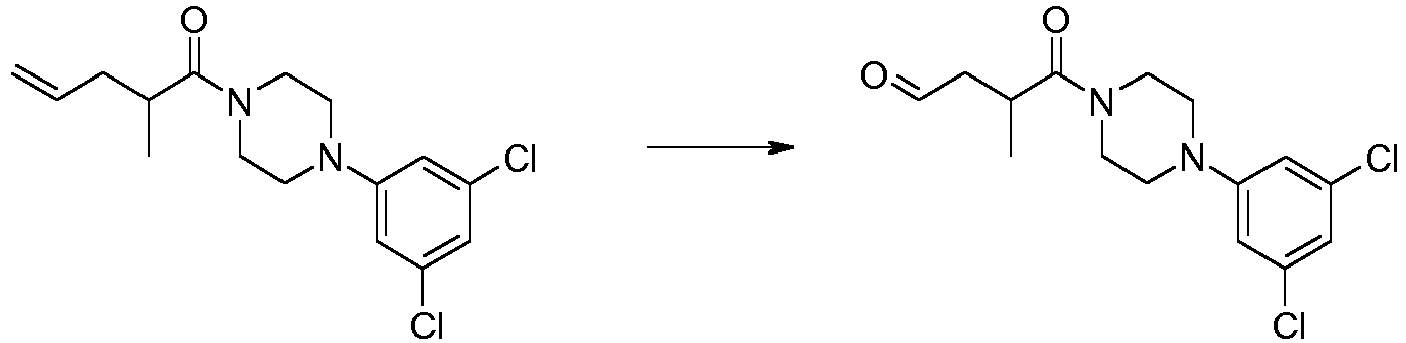
- A vial is charged with alkene Int 124 (4.95 g, 15.1 mmol, 1 eq.), a mixture of dioxane (100 mL) and water (20 mL), and OsO4 (2.5 wt% in t-BuOH, 2.8 mL, 223 mmol, 0.015 eq.). After 15min, a solution of NaIO4 (6.61 g, 30.9 mmol, 2 eq.) in water (150 mL) is added dropwise over 10 minutes, and the reaction mixture is strirred at r.t. overnight, combined with water (600 mL) and extracted with CHCl3 (250mL). The organic layer is washed with brine, dried over anhydrous MgSO4, filtered, concentrated in vacuo and purified by flash chromatography on silica gel (eluting with EtOAc/DCM 20/80) to afford the expected the expected product. LCMS: MW (calcd): 329; m/z MW (obsd): 329-331 (M+H).
-

- To a solution of phosphonate (1.1 eq.) in EtOH is added K2CO3 (1.2 eq.). The reaction mixture is stirred at r.t. for 2h prior to addition of the aldehyde (1 eq.). The reaction mixture is stirred at r.t. (1h to 3h), diluted with EtOAc and filtered on celpure P65. The filtrate is concentrated in vacuo. The residue is taken up in EtOAc and washed with a saturated NH4Cl solution, a saturated NaHCO3 solution, brine and dried over anhydrous MgSO4, filtered, concentrated in vacuo and purified by flash chromatography on silica gel to afford the expected α,β-unsaturated ketone.
- To a solution of the α,β-unsaturated ketone obtained in the previous step (1 eq.) in dry MeOH are added PdCl2 (0.1 eq.) and 2-methylfuran (2 eq.). The reaction mixture is stirred at r.t. for 3h to 24h, diluted with EtOAc and filtered on celpure P65. The filtrate is concentrated in vacuo and purified by flash chromatography on silica gel to afford the expected ketone.
- To a solution of ketone obtained in the previous step (1 eq.) in Heptane/EtOAc/water (1/3/4) is added NaIO4 (7 eq.). The reaction mixture is stirred for 10 min then RuCl3·3H2O (0.02 eq.) is added. The reaction mixture is stirred for 30 min to 1h30, filtered on celpure P65, washed with MeCN and the filtrate is concentrated in vacuo. The residue is purified by flash chromatography on silica gel to afford the expected γ-ketoacid.
-

- To a solution of phosphonate (14.22 g, 73.24 mmol, 1.1 eq.) in EtOH (150 mL) is added K2CO3 (11 g, 79.90 mmol, 1.2 eq.). The reaction mixture is stirred at r.t. for 2h prior to addition of benzyloxy-acetaldehyde (10 g, 66.59 mmol, 1 eq.). The reaction mixture is stirred at r.t. for 3h, diluted with EtOAc and filtered on celpure P65. The filtrate is concentrated in vacuo. The residue is taken up in EtOAc and washed with a saturated NH4Cl solution , a saturated NaHCO3 solution, brine and dried over anhydrous MgSO4, filtered, concentrated in vacuo and purified by flash chromatography on silica gel (eluting with Heptane/EtOAc 100/0 to 80/20) to afford the expected α,β-unsaturated ketone.
- To a solution of the α,β-unsaturated ketone obtained in the previous step (8.7 g, 45.73 mmol, 1 eq.) in dry MeOH (183 mL) are added PdCl2 (0.811 g, 0.457 mmol, 0.1 eq.) and 2-methylfuran (8.25 mL, 91.46 mmol, 2 eq.). The reaction mixture is stirred at r.t. for 3h, diluted with EtOAc and filtered on celpure P65. The filtrate is concentrated in vacuo and purified by flash chromatography on silica gel eluting with Heptane/EtOAc 100/0 to 85/15) to afford the expected ketone.
- To a solution of ketone obtained in the previous step (1g, 3.67 mmol, 1 eq.) in Heptane/EtOAc/water (6 mL/18 mL/24 mL) is added NaIO4 (5.48 g, 25.69 mmol, 7 eq.). The reaction mixture is stirred for 10 min then RuCl3·3H2O (0.019 g, 0.073 mmol, 0.02 eq.) is added. The reaction mixture is stirred for 1h15, filtered on celpure P65, washed with MeCN and the filtrate is concentrated in vacuo. The residue is purified by flash chromatography on silica gel (eluting with DCM/MeOH 98/2 to 95/5) to afford the expected product (stored at 4°C).
-

- To a solution of levulinic acid (1 eq.) in MeOH, bromine (1 eq.) is added dropwise. The reaction mixture is stirred at r.t. overnight and concentrated in vacuo. The residue is partitioned between water and Et2O, the pH is adjusted to 8 using a saturated NaHCO3 solution. After extraction with Et2O, the combined organic layer are dried over anhydrous MgSO4, filtered, concentrated in vacuo and purified by flash chromatography on silica gel to afford the expected bromo derivative as a methylester.
- To a solution of the bromo derivative obtained in the previous step (1 eq.) in MeOH is added Et3N (0 or 1 eq.) and secondary amine (1 to 2 eq.). Reaction mixture is stirred at r.t. for 30 to 120 min and concentrated in vacuo. The residue is used as such or purified by flash chromatography on silica gel to afford the expected amino ester derivative.
- Amino ester obtained in the previous step (1 eq.) is heated at 80°C with an excess of 1M solution of NaOH for 2 to 3h. After complete hydrolysis (followed by HPLC/MS), the reaction mixture is acidified and evaporated to dryness and the crude amino acid is used as such in next step or triturated in DMF to remove salts.
-

- To a solution of levulinic acid (5 g, 43.1 mmol, 1 eq.) in MeOH (103 mL) under N2 atmosphere, bromine (2.2 mL, 43.1 mmol, 1 eq.) is added dropwise. The resultant solution is stirred at r.t. overnight and concentrated in vacuo. The residue is partitioned between water and Et2O, the pH is adjusted to 8 using a saturated NaHCO3 solution. After extraction with Et2O, the combined organic layers are dried over anhydrous MgSO4, filtered, concentrated in vacuo and purified by flash chromatography on silica gel (eluting with iso-Hexane/EtOAc 100/0 to 50/50) to afford the expected bromo derivative as a methylester.
- To a solution of the bromo derivative obtained in the previous step (1g, 4.78 mmol, 1 eq.) in MeOH (12.5 mL) is added Et3N (0.670 mL, 4.82 mmol, 1 eq.) and (2-methoxy-ethyl)-methyl-amine (0.420mL, 4.83 mmol, 1 eq.). Reaction mixture is stirred at r.t. for 2h and concentrated in vacuo. The expected amino ester derivative is used as such in next step.
- Amino ester obtained in the previous step (1.75g crude assumed as 4.78 mmol, 1 eq.) is heated at 80°C with an excess of 1M solution of NaOH (15 mL, 15 mmol, 3eq.) for 2h. After complete hydrolysis (followed by HPLC/MS), the reaction mixture is acidified and evaporated to dryness and the crude amino acid is used as such.
-

- A vial is charged with bromide derivative (1 eq.), Xphos (0.06-0.018 eq.), Pd(OAc)2 (0.03-0.09 eq.), Cs2CO3 (4-5 eq.), [(Dimethylammonium)methyl]trifluoroborate internal salt (3 eq.), THF and water. The reaction mixture is heated at 80°C until completion is observed by UPLC/MS (6-8 days). Additions of Xphos, Pd(OAc)2, Cs2CO3 and [(Dimethylammonium)methyl]trifluoroborate internal salt are performed every 24h to reach a good level of conversion. A saturated NaHCO3 solution is added to the reaction mixture followed by extraction with EtOAc. The combined organic layers are washed with water and brine, dried over anhydrous MgSO4, filtered, concentrated in vacuo and purified by flash chromatography on silica gel to afford the expected functionalized γ-ketoamide.
-

- A vial is charged with Int 118 (300 mg, 0.69 mmol, 1 eq.), Xphos (59 mg, 0.0124 mmol, 0.018 eq.), Pd(OAc)2 (14 mg, 0.062 mmol, 0.09 eq.), Cs2CO3 (1.12g, 3.44 mmol, 5 eq.), [(Dimethylammonium)methyl]trifluoroborate internal salt (262 mg, 2.07 mmol, 3 eq.), THF (2.3 mL) and water (0.6 mL). The reaction mixture is heated at 80°C for 2 days. Xphos (30 mg, 0.0062 mmol, 0.009 eq.), Pd(OAc)2 (7 mg, 0.031 mmol, 0.045 eq.) and [(Dimethylammonium)methyl]trifluoroborate internal salt (66 mg, 0.52 mmol, 0.75 eq.) are added and the reaction mixture is heated at 80°C for 24h. Cs2CO3 (440 mg, 1.35 mmol, 2 eq.), and [(Dimethylammonium)methyl]trifluoroborate internal salt (80 mg, 0.63 mmol, 1 eq.) are added and the reaction mixture is heated at 80°C for 2 days. Xphos (30 mg, 0.0062 mmol, 0.009 eq.) and Pd(OAc)2 (7 mg, 0.031 mmol, 0.045 eq.) are added and the reaction mixture is stirred at r.t. for 3 days. A saturated NaHCO3 solution is added to the reaction mixture followed by extraction with EtOAc. The combined organic layer are washed with water and brine, dried over anhydrous MgSO4, filtered, concentrated in vacuo and purified by flash chromatography on silica gel (eluting with heptane/DCM 1/0 to 0/1 then DCM/MeOH 100/0 to 90/10) to afford the expected product. LCMS: MW (calcd): 414; m/z MW (obsd): 414-416 (M+H).
-

- A Dean-Starck apparatus is loaded with γ-ketoamide (1 eq.) in toluene, ethylene glycol (1.2 to 1.4 eq.) and p-toluenesulfonic acid (0.06 to 0.2 eq.). The reaction mixture is heated at reflux for 2h to 4h. A solution of NaOH 0.1N and EtOAc are added, the organic layer is separated, dried over anhydrous MgSO4, filtered, concentrated in vacuo to afford the expected dioxolane. This residue is either purified by flash chromatography on silica gel or used as such in next step.
- To a solution of the dioxolane obtained in the previous step (1 eq.) in dry THF at -78°C is added dropwise LDA or LiHMDS (2M solution in THF, 1.1 eq.). The reaction mixture is stirred at -78°C for 30 min, then 0°C for 10 min then cooled to -78°C for dropwise addition of a solution of alkyl halide (1.4 eq.) in dry THF. The reaction mixture is allowed to warm to r.t. and quenched with a saturated NH4Cl solution. After evaporation of the THF, the aqueous layer is extracted with EtOAc, the combined organic layer are washed with water and brine, dried over anhydrous MgSO4, filtered, concentrated in vacuo and purified by flash chromatography on silica gel to afford the expected functionalized dioxolane.
- To a solution of the functionalized dioxolane obtained in the previous step (1 eq.) in MeOH is added an aqueous solution of HCl 6N (6 eq.). The reaction mixture is stirred at r.t. for 3h, a saturated NaHCO3 solution is added to the reaction mixture followed by extraction with EtOAc. The combined organic layers are washed with water and brine, dried over anhydrous MgSO4, filtered, concentrated in vacuo and purified by flash chromatography on silica gel to afford the expected functionalized γ-ketoamide.
-

- A Dean-Starck apparatus is loaded with Int 122 (1 g, 3.4 mmol, 1 eq.), toluene (50 mL), ethylene glycol (220 µL, 3.9 mmol, 1.2 eq.) and p-toluenesulfonic acid (100 mg, 0.58 mmol, 0.17 eq.). The reaction mixture is heated at reflux for 2h. A solution of NaOH 0.1N and EtOAc are added, the organic layer is separated, dried over anhydrous MgSO4, filtered, concentrated in vacuo to afford the expected dioxolane used as such in next step. LCMS: MW (calcd): 336; m/z MW (obsd): 337 (M+H).
- To a solution of the dioxolane obtained in the previous step (380 mg, 1.13 mmol, 1 eq.) in dry THF (30 mL) at -78°C is added dropwise LDA (2M solution in THF, 0.6 mL, 1.2 mmol, 1.1 eq.). The reaction mixture is stirred at -78°C for 30 min, then 0°C for 10 min then cooled to -78°C for dropwise addition of a solution of bromomethylether (137 µL, 1.5 mmol, 1.4 eq.) in dry THF (5 mL). The reaction mixture is allowed to warm to r.t. and quenched with a saturated NH4Cl solution. After evaporation of the THF, the aqueous layer is extracted with EtOAc, the combined organic layer are washed with water and brine, dried over anhydrous MgSO4, filtered, concentrated in vacuo and purified by flash chromatography on silica gel (eluting with Heptane/EtOAc 100/0 to 50/50) to afford the expected functionalized dioxolane. LCMS: MW (calcd): 380; m/z MW (obsd): 381 (M+H).
- To a solution of the functionalized dioxolane obtained in the previous step (190 mg, 0.5 mmol, 1 eq.) in MeOH (5 mL) is added an aqueous solution of HCl 6N (0.5 mL, 3 mmol, 6 eq.). The reaction mixture is stirred at r.t. for 3h, a saturated NaHCO3 solution is added to the reaction mixture followed by extraction with EtOAc. The combined organic layers are washed with water and brine, dried over anhydrous MgSO4, filtered, concentrated in vacuo and purified by flash chromatography on silica gel (eluting with DCM/acetone 100/0 to 90/10) to afford the expected product. LCMS: MW (calcd): 336; m/z MW (obsd): 337 (M+H).
-

- A pressure reactor or an open round bottom flask equipped with a condenser is charged with a solution of (NH4)2CO3 or (NH4)HCO3 (8-12 eq.) in water. KCN (2 to 4 eq.) is added portionwise then a solution of γ-ketoester or γ-ketoamide (1eq.) in EtOH is added. The vessel is sealed and heated at 60-90°C for 1h to 2 days. The reaction mixture is cooled to r.t., combined with water and extracted with AcOEt or CHCl3/nBuOH 10%. The combined organic layers are washed with water and brine, dried (over anhydrous Na2SO4 or MgSO4), filtered and concentrated in vacuo. The residue is either recrystallized or purified by flash chromatography on silica gel to afford the expected hydantoin derivative.
-

- A pressure reactor is charged with a solution of (NH4)2CO3 (79.4g, 0.826 mol, 8 eq.) in water (400 mL). KCN (20g, 0.307 mol, 3 eq.) is added portionwise then a solution of γ-ketoester (19.15 g, 0.103 mol, 1eq.) in EtOH (400 mL) is added. The vessel is sealed and heated at 90°C overnight. The reaction mixture is cooled to r.t., combined with water and extracted with CHCl3/nBuOH 10%. The combined organic layers are washed with brine, dried over anhydrous MgSO4, filtered, concentrated in vacuo.
- The above reaction is performed twice and the two crude residues are gathered for recrystallization. A flask is charged with the two crude residues, EtOH (250 mL) is added and the reaction mixture is heated at reflux. Upon complete dissolution, the reaction mixture is allowed to cool to r.t. for 2 days, it is filtered and the crystalline solid is combined with EtOH (200 mL), heated to reflux, cooled to r.t. overnight and filtered to afford the expected hydantoin as a trans-Me racemic mixture (LCMS: > 99% de, MW (calcd): 256; m/z MW (obsd): 257 (M+H)).
-

- A pressure reactor is charged with (NH4)2CO3 (0.645 g, 6.71 mmol, 10 eq.), KCN (0.175 g, 2.69 mmol, 4 eq.), Int 046 (0.248g, 0.671 mmol, 1eq.), EtOH (4 mL) and water (4 mL). The vessel is sealed and heated at 60°C for 40h. The reaction mixture is cooled to r.t., combined with water and extracted with DCM. The combined organic layers are washed with brine, dried over anhydrous MgSO4, filtered, concentrated in vacuo. Purification by flash chromatography on silica gel (eluting with DCM/iPrOH 20/1) afforded the two diastereoisomers, of which the faster eluting compound is the expected product. (LCMS: MW (calcd): 439-441; m/z MW (obsd): 439-441 (M+H)).
-

- A flask is charged with tert-butyl ester (1 eq.) and HCl 4N in dioxane (5 to 40 eq.). In some cases, an additionnal solvent such as DCM, dioxane or water is added to increase solubilty. The reaction mixture is stirred at r.t. for 1h to 4 days until complete conversion. The reaction mixture is either concentrated in vacuo or filtered and washed with Et2O to afford the expected carboxylic acid.
-

- A flask is charged with Int 170 (3.6g, 13.32 mmol, 1 eq.) and HCl 4N in dioxane (33.3 mL, 133 mmol, 10 eq.). The reaction mixture is stirred at r.t. for 2 days and concentrated in vacuo to afford the expected product.
-

- A solution of acid (1 eq.), Et3N (3 to 4 eq.), HOBt (0.1 to 1.1 eq.) in DMF (or DCM) is stirred at r.t.. EDC.HCl (1 to 1.2 eq.) is added, then amine (0.95 to 2 eq.) is added and the reaction mixture is stirred at r.t. for 5h to 2 days. The reaction mixture is partitioned between DCM (or EtOAC) and water, extracted with DCM (or EtOAc). The combined organic layers are washed with water and brine, dried over anhydrous Na2SO4 (or MgSO4), filtered, concentrated in vacuo and purified by flash chromatography on silica gel or preparative LCMS to afford the expected amide.
-

- A solution of 3-(4-methyl-2,5-dioxo-imidazolidin-4-yl)propionic acid (64 mg, 0.34 mmol, 1 eq.), Et3N (142 µL, 1.02 mmol, 3 eq.), HOBt (46 mg, 0.34 mmol, 1 eq.) in DMF (2 mL) is stirred at r.t.. EDC.HCl (78 mg, 0.41 mmol, 1.2 eq.) is added, then 1-(3-chloro-4-fluorophenyl)piperazine dihydrochloride (150 mg, 0.52 mmol, 1.5 2 eq.) is added and the reaction mixture is stirred at r.t. overnight.The reaction mixture is partitioned between DCM and water, extracted with DCM. The combined organic layers are washed with water and brine, dried over anhydrous MgSO4, filtered, concentrated in vacuo and purified by preparative LCMS to afford the expected product. LCMS: MW (calcd): 383; m/z MW (obsd): 383-385 (M+H).
- A flask is charged with acid (1 eq.), amine (0.85 to 1.1 eq.), HATU (0.85 to 1.1 eq.) and DMF (or THF). DIPEA (2 to 6 eq.) is added and the reaction mixture is stirred at r.t. for 5h to 2 days.The reaction mixture is partitioned between EtOAc and water, extracted with EtOAc. The combined organic layers are washed with water and brine, dried (over anhydrous Na2SO4, MgSO4, or hydrophobic column), filtered, concentrated in vacuo and purified by flash chromatography on silica gel or preparative LCMS to afford the expected amide.
-

- A flask is charged with Int 165 (70 mg, 0.35 mmol, 1.1 eq.), Int 216 (95 mg, 0.32 mmol, 1 eq.), HATU (127 mg, 0.34 mmol, 1.05 eq) and DMF (3 mL). DIPEA (167 µL, 0.96 mmol, 3 eq.) is added and the reaction mixture is stirred at r.t. overnight.The reaction mixture is partitioned between EtOAc and water, extracted with EtOAc. The combined organic layers are washed with water and brine, dried over hydrophobic column, filtered, concentrated in vacuo and purified by flash chromatography on silica gel (eluting with DCM/MeOH 100/0 to 96/4) to afford the expected product. LCMS: MW (calcd): 407; m/z MW (obsd): 407-409 (M+H).
- A flask is charged with acid (1 eq.), DMF (or DCM), DIPEA or Et3N (2 to 6 eq.) and BOP (0.77 to 1.1 eq.). After 5-15 min, amine (0.77 to 1.5 eq.) is added and the reaction mixture is stirred at r.t. for 5h to 2 days.The reaction mixture is partitioned between EtOAc (or DCM) and water, extracted with EtOAc (or DCM). The combined organic layers are washed with water and brine, dried (over anhydrous Na2SO4, MgSO4, or hydrophobic column), filtered, concentrated in vacuo and purified by flash chromatography on silica gel or preparative LCMS to afford the expected amide.
-

- A flask is charged with 4-cyclobutyl-4-oxo-butyric acid (104 mg, 0.67 mmol, 1 eq.), DMF (2 mL), Et3N (0.4 mL, 2.88 mmol, 4.3 eq.) and BOP (320 mg, 0.72 mmol, 1.1 eq.). After 5-15 min, 1-(3-chlorophenyl)piperazine (157 mg, 0.67 mmol, 1 eq.) is added and the reaction mixture is stirred at r.t. overnight. The reaction mixture is partitioned between DCM and water, extracted with DCM. The combined organic layers are washed with water and brine, concentrated in vacuo and purified by flash chromatography on silica gel (eluting with DCM/EtOAc 90/10) afford the expected product. LCMS: MW (calcd): 335; m/z MW (obsd): 335-337 (M+H).
- A flask is charged with acid (1 eq.), amine (1 eq.) and DMF. HOBt (0.8 eq.), DIPEA (1.5 eq.) and PS-CDI (load 1.25 mmol/g, 1.3 eq.) are added and the reaction mixture is stirred in a microwave reactor at 60°C for 30-60 min. Reaction mixture is filtered to remove PS-CDI, washed with EtOAc and the filtrate is extracted with EtOAc and brine. The combined organic layers concentrated in vacuo and purified by flash chromatography on silica gel or preparative LCMS to afford the expected amide.
-

- A flask is charged with Int 164 (41 mg, 0.23 mmol, 1 eq.), Int 232 (60 mg, 0.23 mmol, 1 eq.) and DMF (5 mL). HOBt (28 mg, 0.18 mmol, 0.8 eq.), DIPEA (60 µL, 0.34 mmol, 1.5 eq.) and PS-CDI (load 1.25 mmol/g, 237 mg, 0.29 mmol, 1.3 eq.) are added and the reaction mixture is stirred in a microwave reactor at 60°C for 30 min. Reaction mixture is filtered to remove PS-CDI, washed with EtOAc and the filtrate is extracted with EtOAc and brine. The combined organic layers concentrated in vacuo and purified by flash chromatography (eluting with DCM/MeOH 100/0 to 90/10) to afford the expected product. LCMS: MW (calcd): 468; m/z MW (obsd): 469 (M+H).
- A flask is charged with acide (1 eq.), amine (1.5 eq.) and DMF/DCM. Et3N (4 eq.) and PS-Mukaiyama reagent (load 1.17 mmol/g, 2 eq.) are added and the reaction mixture is stirred at r.t. for 24h. Reaction mixture is filtered, washed with DCM and the filtrate is concentrated in vacuo and purified by preparative LCMS to afford the expected amide.
-

- A flask is charged with 3-(2,5-dioxo-4-phenyl-imidazolidin-4-yl)propionic acid (77 mg, 0.31 mmol, 1 eq.), 1-(4-chloro-phenyl)-piperazine dihydrochloride (126 mg, 0.47 mmol, 1.5 eq.) and DMF/DCM (1mL/4mL). Et3N (169 µL, 1.25 mmol, 4 eq.) and PS-Mukaiyama reagent (load 1.17 mmol/g, 540 mmg, 0.63 mmol, 2 eq.) are added and the reaction mixture is stirred at r.t. for 24h. Reaction mixture is filtered, washed with DCM and the filtrate is concentrated in vacuo and purified by preparative LCMS to afford the expected product. LCMS: MW (calcd): 427; m/z MW (obsd): 427-429 (M+H).
-

- To a solution of amino derivative (1 eq.) in pyridine is added acetic anhydride (1.02 eq.). The reaction mixture is stirred at r.t. for 4h to 16h, concentrated in vacuo and purified by flash chromatography on silica gel to afford the expected acetamide.
-

- To a solution of Cpd 180 (150 mg, 0.33 mmol, 1 eq.) in pyridine (2 mL) is added acetic anhydride (32 µL, 0.34 mmol, 1.02 eq.). The reaction mixture is stirred at r.t. for 4h, concentrated in vacuo and purified by flash chromatography on silica gel (eluting with DCM/MeOH 100/0 to 90/10) to afford the expected product. LCMS: MW (calcd): 456; m/z MW (obsd): 456-458 (M+H).
-

- To a solution of N-tert-butoxycarbonyl derivative (1 eq.) in a mixture DCM/MeOH is added HCl 4N in dioxane (10 to 20 eq.). The reaction mixture is stirred at r.t. for 4h to 2 days and concentrated in vacuo.The residue is either purified by preparative HPLC or dissolved in DCM/MeOH, neutralized by addition of a base (NH3 in MeOH (7N) or NaHCO3) and purified by SCX column or flash chromatography on silica gel to afford the expected amine.
-

- To a solution of Cpd 235(39 mg, 0.076 mmol, 1 eq.) in a mixture DCM/MeOH (1.5mL/1mL) is added HCl 4N in dioxane (0.37 mL, 1.51 mmol, 20 eq.). The reaction mixture is stirred at r.t. for 16h and concentrated in vacuo. The residue is dissolved in DCM/MeOH, neutralized by addition of NH3 in MeOH (7N, 110 µL, 0.75 mmol, 10 eq.) and purified by SCX-2 column (eluting successively with DCM/MeOH/NH3 : 8/1/1, 6/3/1 and 0/9/1) to afford the expected product. LCMS: MW (calcd): 409; m/z MW (obsd): 410 (M+H).
-

- To a solution of amino derivative (1 eq.) in DMF is added K2CO3 (3 eq.) then benzyl bromide (1 eq.). The reaction mixture is stirred at r.t. for 16h to 4 days, quenched by addition of water and extracted with EtOAc. The organic layers are combined, washed with brine, dried by filtration over hydrophobic column, concentrated in vacuo and purified by flash chromatography on silica gel to afford the expected benzylamine.
-

- To a solution of Cpd 180(200 mg, 0.444 mmol, 1 eq.) in DMF (2 mL) is added K2CO3 (184 mg, 1.331 mmol, 3 eq.) then benzyl bromide (76 mg, 0. 444 mmol, 1 eq.). The reaction mixture is stirred at r.t. overnight, quenched by addition of water and extracted with EtOAc. The organic layers are combined, washed with brine, dried by filtration over hydrophobic column, concentrated in vacuo and purified by flash chromatography on silica gel (eluting with DCM/isopropyl alcohol 100/0 to 90/10) to afford the expected product. LCMS: MW (calcd): 504; m/z MW (obsd): 504-506 (M+H).
-

- To a solution of benzyloxy derivative (1 eq.) in dry THF or MeOH under argon atmosphere is added Pd(OH)2/C. The reaction mixture is stirred under H2 atmosphere at r.t. for 5h to 2 days then filtered on celpure P65. The filtrate is concentrated in vacuo and purified by flash chromatography on silica gel to afford the expected alcohol.
-

- To a solution of Int 062 (70 mg, 0.15mmol, 1 eq.) in dry THF (75 mL) under argon atmosphere is added Pd(OH)2/C (35 mg, 50%w/w). The reaction mixture is degassed by 3 vacuum/hydrogen filling cycles, and stirred under H2 atmosphere at r.t. for 2 days then filtered on celpure P65. The filtrate is concentrated in vacuo and purified by flash chromatography on silica gel (eluting with DCM/MeOH 100/0 to 95/5) to afford the expected product. LCMS: MW (calcd): 392; m/z MW (obsd): 429-431 (M+H).
-

- A vial is loaded with bromo derivative (1 eq.), bis(pinacolato)diboron (1.2 eq.), KOAc (3 eq.) and dioxane degassed with N2. PdCl2(dppf) (0.05 eq.) is added, the vial is sealed and stirred at 90°C overnight. The reaction mixture is filtered on celpure P65, washed with EtOAc. The filtrate is concentrated in vacuo and purified by flash chromatography on silica gel to afford the expected boronic ester.
- A vial is loaded with the boronic ester obtained in the previous step (1 eq.), aryl halide (1.1 to 1.2 eq.), Na2CO3 (3 eq.) and a mixture dioxane/water (9/1) degassed with N2. PdCl2(dppf) (0.05 to 0.2 eq.) is added, the vial is sealed and stirred at 90°C overnight. The reaction mixture is filtered on celpure P65, washed with EtOAc. The filtrate is concentrated in vacuo and purified by flash chromatography on silica gel or preparative HPLC to afford the expected compound.
-

- A vial is loaded with Cpd 270 (90 mg, 0.200 mmol, 1 eq.), bis(pinacolato)diboron (61 mg, 0.240 mmol, 1.2 eq.), KOAc (59 mg, 0.601 mmol, 3 eq.) and dioxane (2 mL) degassed with N2. PdCl2(dppf) (7 mg, 0.010 mmol, 0.05 eq.) is added, the vial is sealed and stirred at 90°C overnight. The reaction mixture is filtered on celpure P65, washed with EtOAc. The filtrate is concentrated in vacuo and purified by flash chromatography on silica gel (eluting with DCM/MeOH 100/0 to 97/3) to afford the expected boronic ester. LCMS: MW (calcd): 496; m/z MW (obsd): 497 (M+H).
- A vial is loaded with the boronic ester obtained in the previous step (86 mg, 0.173 mmol, 1 eq.), iodopyrazine (39 mg, 0.191 mmol, 1.1 eq.), Na2CO3 (100 mg, 0.520 mmol, 3 eq.) and a mixture dioxane/water (2.5 mL, 9/1) degassed with N2. PdCl2(dppf) (7 mg, 0.009 mmol, 0.05 eq.) is added, the vial is sealed and stirred at 90°C overnight. The reaction mixture is filtered on celpure P65, washed with EtOAc. The filtrate is concentrated in vacuo and purified by flash chromatography on silica gel (eluting with DCM/MeOH 100/0 to 95/5) to afford the expected product. LCMS: MW (calcd): 449; m/z MW (obsd): 450 (M+H).
-

- A vial is loaded with bromo derivative (1 eq.), boronic acid or boronic ester (1.3 to 2 eq.), Na2CO3 (3 eq.) and a mixture dioxane/water (9/1) degassed with N2. PdCl2(dppf) (0.05 to 0.2 eq.) is added, the vial is sealed and stirred at 90°C for 3h to 20h. The reaction mixture is quenched with water and extracted with EtOAc. The combined organic layers are washed with brine, dried (filtration over hydrophobic column or anhydrous MgSO4), concentrated in vacuo and purified by flash chromatography on silica gel or preparative HPLC to afford the expected compound.
-

- A vial is loaded with Cpd 270 (100 mg, 0.223 mmol, 1 eq.), pyridine-4-boronic acid (55 mg, 0.445 mmol, 2 eq.), Na2CO3 (128 mg, 0.668 mmol, 3 eq.) and a mixture dioxane/water (2 mL, 9/1) degassed with N2. PdCl2(dppf) (36 mg, 0.045 mmol, 0.2 eq.) is added, the vial is sealed and stirred at 90°C for 3h. The reaction mixture is quenched with water and extracted with EtOAc. The combined organic layers are washed with a saturated NaHCO3 solution, brine, dried by filtration over hydrophobic column, concentrated in vacuo and purified by flash chromatography on silica gel (eluting with DCM/MeOH 100/0 to 94/6) to afford the expected product. LCMS: MW (calcd): 448; m/z MW (obsd): 449 (M+H).
-

- A vial is charged with Cpd 188 (1.61 g, 3.2 mmol, 1eq.), dioxane (5 mL) and HCl 4N in dioxane (5 mL). The reaction is heated at 80°C for 20h, concentrated in vacuo and purified by flash chromatography on silica gel (eluting with DCM/EtOAc 60/40 to 10/90, then DCM/MeOH 90/10) to afford Cpd 182 (LCMS: MW (calcd): 457; m/z MW (obsd): 457-459 (M+H)) and Cpd 183 (LCMS: MW (calcd): 443; m/z MW (obsd): 443-445 (M+H)).
-

- A flask is charged with succinic anhydride (2.38g, 24 mmol, 1.1 eq.) and 1-(3,5-dichloro-phenyl)-piperazine (5g, 22 mmol, 1eq.) and toluene (100 mL). The reaction mixture is heated at reflux overnight, concentrated in vacuo and purified by flash chromatography on silica gel (eluting with DCM/MeOH 100/0 to 80/20) to afford the carboxylic acid derivative.
- To a solution of the carboxylic acid obtained in the previous step (7.29g, 22 mmol, 1 eq.) in DCM (125 mL) are added DMAP (0.537 g, 4.4 mmol, 0.2 eq.), EDC.HCl (5.06 g, 26.4 mmol, 1.2 eq.) and Et3N (9.2 mL, 66 mmol, 3 eq). The reaction mixture is stirred at r.t. for 15 min then a solution of 2,2-dimethyl-[1,3]dioxane-4,6-dione (3.8 g, 26.4 mmol, 1.2 eq.) in DCM (25 mL) is added and the reaction mixture is stirred at r.t. overnight. DMAP (1 g) and EDC.HCl (1.5g) are added and the RM is stirred at 40°C for 2h, concentrated in vacuo and purified by flash chromatography on silica gel (eluting with DCM/MeOH 100/0 to 90/10). The residue is taken up in toluene (100 mL) and t-BuOH (5.8 mL, 61 mmol) is added. The reaction mixture is heated at reflux for 4h, concentrated in vacuo and purified by flash chromatography on silica gel (eluting with Hexanes/EtOAc 70/30 to 30/70) to afford the expected β-ketoester.
- Starting from the above β-ketoester, the expected product is obtained according to Method F. LCMS: MW (calcd): 499; m/z MW (obsd): 499-501 (M+H).
-

- A vial is charged with Cpd 182 (150 mg, 0.32 mmol, 1 eq.), 2-amino-ethanol (193 µL, 3.2 mmol, 10 eq.) and EtOH (2 mL). The reaction mixture is heated at 160°C for 1h in microwave reactor, concentrated in vacuo and purified by preparative LCMS to afford the expected product. LCMS: MW (calcd): 486; m/z MW (obsd): 486-488 (M+H).
-

- To a solution of Cpd 197 (40 mg, 0.084 mmol, 1 eq.) in DCM (2 mL) at 0°C is added meta-chloroperoxybenzoic acid (32 mg, 0.186 mmol, 2.2 eq.). The reaction mixture is stirred at 0°C for 45min then at r.t. for 24h, quenched with a saturated NaHCO3 solution, extracted with DCM. The combined organic layers are washed with brine, dried by filtration over hydrophobic column and concentrated in vacuo. The residue is purified by flash chromatography on silica gel (eluting with DCM/MeOH 100/0 to 98/2) to afford the expected product. LCMS: MW (calcd): 505; m/z MW (obsd): 505-507 (M+H).
-

- (S)-Hydantoin propionic acid (Int 163, 50 g, 0.24 mol, 1.1 eq.) is dissolved in DMF (360 mL). Amine hydrochloride (61 g, 0.21 mol, 1 eq.), DIPEA (148 mL, 0.84 mol, 4 eq., added through glass funnel over 2min), EDC.HCl (45 g, 0.24 mol, 1.1 eq.) and HOBt hydrate (4.95 g, 0.032 mol, 0.15 eq.) are added and reaction mixture is stirred at r.t. for 18h. Reaction mixture is poured into cold stirring water (1.8 L) and stirred for 45 min. A small precipitate is formed, filtered off through black ribbon. Filtrate is extracted with EtOAc (2x650 mL and 300 mL). Combined organic layers are washed with sat. aq. NaHCO3 (2x800 mL and 500 mL), brine (2x500 mL), dried over Na2SO4 and concentrated in vacuo. This residue is purified by flash chromatography on silica gel (eluting with DCM/MeOH/NH3 100/0/0 to 90/5/0.5) to afford the desired compound.
- Chiral HPLC: ee ≥ 99.4%; Condition used to determine the enantiomeric excess are the following:
- column: Chiralpak IC (250 x 4.6 mm), 5µm, at room temperature
- mobile phase: Heptane/Ethanol/DEA (70/30/0.1, v/v/v)
- flow rate of 1 mL/min
-

- To a solution of Cpd 285 (72 mg, 0.177 mmol, 1 eq.) in EtOH (3.7 mL) and DMF (0.7 mL) is added Et3N (0.2 mL, 1.44 mmol, 8 eq.) and the reaction mixture is heated at 40°C to increase solubility. Pd/C 10% (14 mg) is added and the reaction mixture is stirred at r.t. overnight and filtered. The filtrate is concentrated in vacuo and purified by flash chromatography on silica gel (DCM/MeOH 100/0 to 94/6) to afford the expected product. LCMS: MW (calcd): 372; m/z MW (obsd): 373 (M+H).
-

- To a suspension of Cpd 247 (55 mg, 0.13 mmol, 1.0 eq.) in MeCN (1 mL) is added a formaldehyde in water solution (37%wt, 37 µL, 0.51 mmol, 4.0 eq.) and the mixture is stirred at r.t. for 10 min. Sodium cyanoborohydride is added (16 mg, 0.25 mmol, 2.0 eq.) and the reaction mixture is stirred at r.t. for 1h. Sodium triacetoxyborohydride is added (53 mg, 0.25 mmol, 2.0 eq.) and the reaction mixture is stirred at r.t. for 2h. An aqueous NaHCO3 solution (1 mL) is added and the mixture is concentrated to dryness. The residue is purified by flash chromatography on KP-NH type silica gel (eluting with DCM/MeOH 100/0 to 95/5) to afford the expected product. LCMS: MW (calcd): 449; m/z MW (obsd): 450 (M+H).
-

- A flask is charged with Int 116 (30 mg, 0.06 mmol 1.0 eq.) and a solution of HCl in dioxane (4.0M, 630 µL, 40 mmol, 2.5 eq.). The reaction mixture is stirred at r.t. for 2h, and then diltuted with water and extracted 3 times with DCM. The combined organic layers are dried over anhydrous Na2SO4, filtered and concentrated in vacuo to afford the expected product. LCMS: MW (calcd): 422; m/z MW (obsd): 423 (M+H).
- The carboxylic acid (18 mg, 0.04 mmol, 1.0 eq.) and 1-[bis(dimethylamino)methylene]-1H-1,2,3-triazolo-[4,5-b]pyridinium-3-oxyde hexafluorophosphate (18 mg, 0.05 mmol, 1.1 eq.) are stirred in DMF (0.5 mL) at r.t.. After 30 min, ethanolamine (2.6 µL, 0.04 mmol, 1.0 eq.) is added; the reaction mixture is stirred at r.t. for 2h, then diluted with water and extracted 3 times with DCM. The combined organic layers are dried over anhydrous Na2SO4, filtered, concentrated in vacuo, and purified by preparative HPLC to afford the expected product. LCMS: MW (calcd): 465; m/z MW (obsd): 466 (M+H).
-

- Cpd 007 is purified by chiral HPLC using the following conditions:
- Column: Chiralpak AD 20 µm 250 x 21.7mm,
- Mobile phase: 100% EtOH,
- Flow rate: 20 mL/min.
- This purification affords the expected product as a single enantiomer.
-

- Cpd 191 is purified by SFC using the following conditions:
- Instrument: Waters Thar SFC prep100
- Column: Chiralpak IA (30 x 250mm), 5 µM
- Mobile phase: Isocratic 25% iPrOH/DCM (80/20) and 75% CO2,
- Flow rate: 100 mL/min
- Cpd 191 is dissolved in iPrOH (7 vol) and DCM (3 vol) (approximately 50mg/mL), Injection volume 1500 µl which equates to loading of 75 mg on column per injection. This purification affords the expected product as a single enantiomer.
- Cpd 405 is purified by SFC the following conditions:
- Instrument: Waters Thar SFC prep100
- Column: Chiralpak IA (30 x 250mm), 5uM
- Mobile phase: Isocratic 20% iPrOH and 80% CO2,
- Flow rate: 100 mL/min
- Cpd 405 is dissolved in iPrOH (2 vol) and acetonitrile (1 vol) (approximately 4.5mg/mL), Injection volume 1500µL which equates to loading of 6.75mg on column per injection. This purification affords the expected product Cpd 265 as a single enantiomer.
- Cpd 406 is purified by SFC using the following conditions:
- Instrument: Waters Thar SFC prep100
- Column: Chiralpak IA (20 x 250mm), 5uM
- Mobile phase: Isocratic 35% EtOH and 65% CO2,
- Flow rate: 100 mL/min
- Cpd 406 is dissolved in EtOH (70 mL) (approximately 20 mg/mL), Injection volume 1500µL which equates to loading of 30mg on column per injection, total number of stacks: 49. This purification affords the expected product Cpd 331 as a single enantiomer.
-
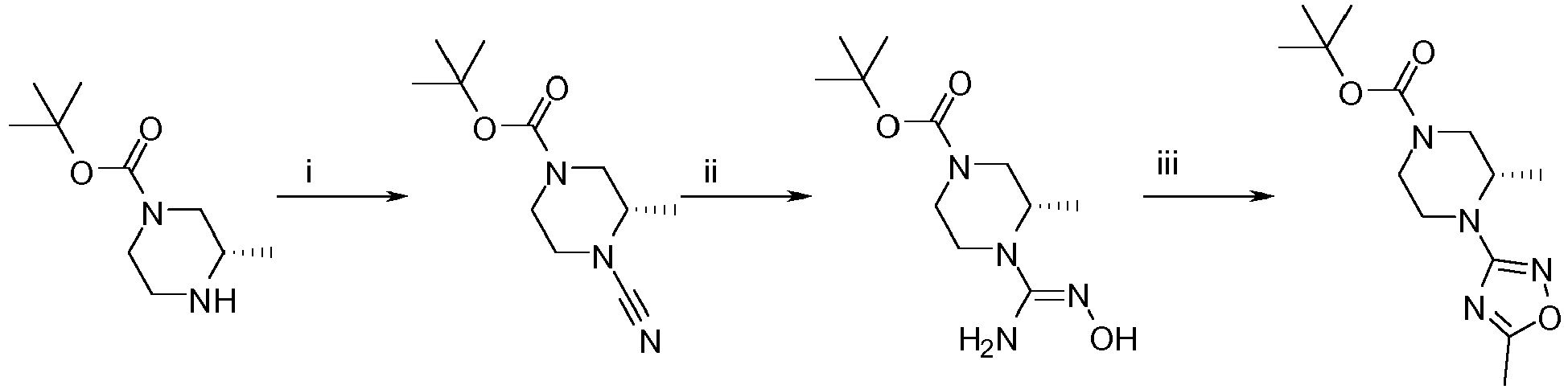
- (S)-3-Methyl-piperazine-1-carboxylic acid tert-butyl ester (1g, 4.99 mmol, 1eq.) is suspended in acetonitrile (20 mL), K2CO3 (1.851 g, 13.4 mmol, 2.7 eq.) is added and the suspension is stirred for 10 min before the addition of BrCN (5.0M in acetonitrile, 1.248 mL, 6.24 mmol, 1.25 eq.). The reaction is stirred at r.t. for 3h and filtered; the solid is washed with EtOAc and the filtrate is concentrated in vacuo to afford the expected cyano derivative. LCMS: MW (calcd): 225; m/z MW (obsd): 226 (M+H).
- To a solution of (S)-4-Cyano-3-methyl-piperazine-1-carboxylic acid tert-butyl ester (500 mg, 2.22 nmol, 1 eq.) in EtOH (10 mL), hydroxylamine hydrochloride (261 mg, 3.75 mmol, 1.5 eq.) and Et3N (869 µL, 6.25 mmol, 2.5 eq.) are added and reaction mixture is refluxed for 2h concentrated in vacuo to afford the expected N-hydroxy amidine derivative used as such in the next reaction step.
- Crude N-hydroxy amidine derivative (2.22 mmol, 1eq.) is dissolved in pyridine (10 mL) and acetylchloride (266 µL, 3.75mmol, 1.5 eq.) is added. Reaction mixture is stirred at 120°C for 1h, poured into water, extracted with EtOAc. The combined organic layers are washed with brine, dried over anhydrous Na2SO4, filtered and concentrated in vacuo to afford the expected product (precursor of Int 237). LCMS: MW (calcd): 282; m/z MW (obsd): 283 (M+H).
-

- A flask is charged with Meldrum's acid (50.3 g, 349 mmol, 1.0 eq.), DCM (300 mL) and pyridine (90 mL, 1.1 mol, 3.2 eq), and cooled in an ice bath. To the resulting solution, is added dropwise cyclopropane carbonyl chloride (35.0 mL, 386 mmol, 1.1 eq). After 2h, the cold bath is removed. After 16h, the mixture is combined with aqueous HCl (2N, 700 mL) and DCM (200 mL) in a separatory funnel and agitated. The organic phase is collected and washed with aqueous HCl (2N) (500 mL), brine (500 mL), and dried over MgSO4 and activated charcoal. After filtration, volatiles are removed via rotary evaporation. The residue is combined with toluene (100 mL) and benzyl alcohol (37 mL, 356 mmol, 1.02 eq) in a round bottomed flask equipped with a reflux condenser, and heated at reflux. After 16h, the mixture is allowed to cool to room temperature. Volatiles are removed via rotary evaporation to give the crude product.
- A vial is charged with Int 149 (127 mg, 0.44 mmol, 1.0 eq), the β-keto ester from step i) (189 mg, 0.90 mmol, 2.0 eq), and DCM (2 mL). After 16h, volatiles are removed via rotary evaporation. The residue is combined with Pd(OH)2/C (20%) (81 mg, 0.12 mmol, 0.26 eq), ethanol (8 mL), and cyclohexene (2.0 mL, 20 mmol, 45eq.) in a round bottomed flask, and heated at reflux. After 1h, the mixture is filtered through a plug of clarcel on a fritted funnel. Volatiles are removed via rotary evaporation. The residue is charged onto a column of silica gel and eluted with EtOAc/DCM (1:9), to afford compound Int 053.
- By-product Int 054 is obtained when step iv) is done in higher scale and concentration:
- A round bottom flask is charged with the aldehyde synthesized in step iii) (3.72 g, 12.9 mmol, 1.0 eq), the β-keto ester from step i) (7.10 g, 32.5 mmol, 2.5 eq), and DCM (10 mL) and left open to the air. After 16h, volatiles were removed via rotary evaporation. The residue is combined with Pd(OH)2/C (10%) (2.06 g, 1.47 mmol, 0.11 eq), ethanol (100 mL), and cyclohexene (25 mL, 250 mmol, 19 eq.) in a round bottomed flask, and heated at reflux for 16h, and then allowed to cool to room temperature. The mixture is filtered through filter paper, and volatiles are removed via rotary evaporation. The residue is charged onto a column of silica gel and eluted with EtOAc/DCM (1/20), to afford Int 054 (3.55 g).
-

- A flask is charged with Int 054 (289 mg, 0.54 mmol, 1.0 eq.), and MeOH (8mL), and heated at 60°C. After 16h, volatiles are removed from the filtrate via rotary evaporation.The residue is charged onto a column of silica gel, and eluted with EtOAc/DCM (1:20) to afford the expected intermediate.
- The intermediate from step i) is stirred with MeOH (20 mL), Pd(OH)2/C (10%) (45 mg, 0.032 mmol, 0.10 eq), and cyclohexene (4 mL, 39.5 mmol, 120 eq.) in a round bottom flask, and heated to reflux. After 2h, the mixture is filtered through filter paper. Volatiles are removed from the filtrate via rotary evaporation. The residue is charged onto a column of silica gel, and eluted with EtOAc/DCM (1:9) to afford Int 056.
-

- A solution of n-Butyl lithium (1.6M in hexane) (25mL, 40 mmol, 2.0 eq) is added at 0°C to a stirred solution of 1,1,1,3,3,3-hexamethyldisilazane (8.5 mL, 41 mmol, 2.04 eq) in anhydrous THF (17 mL). After cooling to -78°C, tertbutyl acetate (5.44 mL, 40 mmol, 2.0 eq) is added within 20min to the solution and stirring is continued for 45min. The resulting α-lithio acetic ester solution is added dropwise over 30 minutes to a solution of succinic anhydride (2g, 20 mmol, 1.0 eq) in THF (24 mL). The resulting mixture is stirred for 3h in a methanol/dry ice bath while the temperature is allowed to increase to -20°C.
- The reaction mixture is warmed up to room temperature, then concentrated HCl (4mL) and water (25 mL) are added. The organic solvent is evaporated, and the resulting aqueous solution is adjusted to pH = 2, and extraction with ethyl acetate followed. Organic layers are combined, dried over Na2SO4, filtered, and concentrated under reduced pressure to give the expected product (used in the next step without further purification).
-

- To a solution of Int 138 (530 mg, 2.24 mmol, 1 eq.) in toluene (7 mL) is added N,N-dimethylformamide di-tert-butyl acetal (2.69 mL, 11.2 mmol, 5 eq.). Reaction mixture is heated at 100°C in a sealed tube for 4.5h, quenched by addition of a saturated NaHCO3 solution at 0°C, extracted with EtOAc. The combined organic layers are washed with saturated NaHCO3 solution, brine, dried over anhydrous Na2SO4, filtered, concentrated in vacuo and purified by flash chromatography on silica gel (Heptane/EtOAc 100/0 to 60/40) to afford the expected product. LCMS: MW (calcd): 292; m/z MW (obsd): 315 (M+Na)
-

- A mixture of γ-ketoester 4-Cyclopropyl-4-oxo-butyric acid tert-butyl ester (120g, 605 mmol, 1 eq.), (NH4)2CO3 (494g, 5.15 mol, 8.5 eq.), NaCN (60g, 1.45 mol, 2.4 eq.), H2O (600mL) and ethanol (600mL) is heated at 60°C for 18h in the sealed reactor. The reaction mixture is poured in a mixture of EtOAc (900mL) and water (900mL), and the aqueous layer is additionally extracted with EtOAc (3x600mL). The organic layer is concentrated until only about 100 mL EtOAc left, and added 500 mL petroleum ether dropwise to afford the expected hydantoin derivative Int 110.
-

- To a solution of Int 021 (341 mg, 0.68 mmol, 1.0 eq) in ethanol (27 mL) is added methylamine (40% in water) (845 µL). Stirring is then kept at room temperature overnight. The organic solvent is then removed under reduced pressure, and the aqueuous residue is diluted with water and K2CO3 (10%), and extracted with ethyl acetate several times. The combined organic layer is washed with water and brine, before being dried, filtered, and concentrated under reduced pressure, to afford crude compound used directly in the next step.
- The crude from step i) is stirred in THF/MeOH (1/1) (14 mL). Di-tert-butyl dicarbonate (445 mg, 2.04 mmol, 3 eq) is added, and the mixture is stirred under reflux for 18h. The organic solvents are removed, and the crude is purified by flash chromatography (DCM/Et2O 100/0 to 0/100 and then DCM/MeOH 100/0 to 90/10) to afford the expectedintermediate. LCMS: MW (calcd): 472; m/z MW (obsd): 472-474-476 (M+H).
-

- A three neck flask is charged with a solution of alkene Int 148 (6.3 g, 37 mmol, 1 eq.) and suddan III (cat.) in DCM and cooled at -78°C. O3 is bubbled trough the reaction mixture until the color became deep blue. The reaction mixture is purged with N2 for 30 min, Me2S is added and the reaction mixture is allowed to warm to r.t. overnight. The reaction mixture is washed with water and brine, dried over anhydrous MgSO4, filtered and concentrated in vacuo. Purification by flash chromatography on silica gel (Heptane/EtOAc 100/0 to 80/20) affords the expected product.
-

- To a solution of methoxy-acetic acid (15.54 g, 173 mmol, 1.1 eq.) and 2-methyl-prop-2-en-1-ol (14.5 mL, 172 mmol, 1 eq.) in pyridine (100 mL) at 0°C, is added p-toluenesulfonyl chloride (33.08 g, 173 mmol, 1eq.). After 1h, the cold bath is removed and the reaction mixture is stirred at r.t. overnight. The reaction mixture is concentrated in vacuo and combined with a EtOAc and a saturated NaHCO3 solution is added. The organic layer is collected, washed with a solution of HCl 1N, water, brine, dried over anhydrous MgSO4, filtered and concentrated in vacuo to afford the expected ester used as such in next step. LCMS: MW (calcd): 144; m/z MW (obsd): 145 (M+H); 167 (M+Na)
- To a solution of the ester (1 g, 6.94 mmol, 1eq.) in dry Et2O (10 mL) is added Et3N (1 mL, 7.17 mmol, 1.03 eq.) and trimethylsilyl trifluoromethanesulfonate (1.3 mL, 7.18 mmol, 1.03 eq.). The reaction mixture is stirred at r.t. overnight, a solution of K2CO3 (5.45 g, 39.4 mmol, 5.68 eq.) in water (20 mL) is added. After 30min, the reaction mixture is combined with Et2O, the aqueous layer is collected, cooled in an ice bath and the pH adjusted to pH=2 with H3PO4 (85%). The solution is saturated with NaCl and extracted with Et2O. The combined organic layers are dried over anhydrous MgSO4, filtered, concentrated in vacuo to afford the expected product used as such in next step. LCMS: MW (calcd): 144; m/z MW (obsd): 143 (M-H).
-

- A flask is charged with a solution of hydantoin (200 g, 746 mmol, 1 eq.) in dioxane (100 mL) and is cooled in an ice bath, HCl 6N in dioxane (1 L) is added slowly. The reaction mixture is stirred at r.t. for 4h and concentrated in vacuo. The resulting solid is suspended in 240 mL of acetonitrile, then stirred at reflux for 1h, and allowed to cool down to r.t. under stirring. The resulting solid is separated by filtration, washed twice with acetonitrile (2 x 30 mL), and finally dried under vacuum at 45°C to afford the expected carboxylic acid.
- The racemic hydantoin propionic acid is separated by SFC to afford a fast eluting isomer ((R)-enantiomer) and a slow eluting isomer ((S)-enantiomer).
- The purification is done in 2 stages.
- Conditions of the first separation: preparative SFC, Column: ChiralPak AD-10µm, 300×50mmI.D., Mobile phase: A for CO2 and B for Ethanol, Gradient: B 45% , Flow rate: 200mL /min, Back pressure: 100 bar, Column temperature: 38°C, Wavelength: 220nm, Cycletime: ∼10.0min. The compound is dissolved in methanol to ∼120mg/mL, and loaded on the column (16mL per injection). After separation, the fractions are dried off via rotary evaporator to get the desired isomers.
- Conditions of the second separation: Prep HPLC, Column: C18, 250×50mm I.D., Mobile phase: A for H2O and B for Acetonitrile, Gradient: B 5%-20% in 15min linearly, Flow rate: 80 mL/min, Wavelength: 220nm. The compound is dissolved in methanol (∼100mg/mL) and loaded on the column (10mL per injection). After separation, the fraction is concentrated via rotary evaporator and the remaining aqueous layer is lyophilized.
-

- To a solution of Meldrum's acid (2,2-dimethyl-[1,3]dioxane-4,6-dione, 50.10 g, 0.347 mol, 1 eq.) in DCM (500 mL) and pyridine (90 mL, 1.11 mol, 3.2 eq.) at 0°C, cyclopropanecarbonyl chloride (35 mL, 0.386 mol, 1.1 eq.) is added dropwise. After 2h, the cold bath is removed and the reaction mixture is stirred at r.t. overnight and combined with a solution of HCl 2N. The organic layer is collected, washed with brine, dried over anhydrous MgSO4, filtered over activated charcoal and concentrated in vacuo. This residue is taken up in ethanol (300 mL) and stirred at reflux overnight, concentrated in vacuo and purified by flash chromatography on silica gel (Heptane/EtOAc 80/20) to afford the expected β-ketoester. LCMS: MW (calcd): 156; m/z MW (obsd): 157 (M+H); 179 (M+Na)
- To a solution of the β-ketoester (16.09 g, 0.103 mol, 1 eq.) in MEK (200 mL) are added K2CO3 (28.56 g, 0.207 mol, 2 eq.), NaI (1.65 g, 0.011 mol, 0.1 eq.) and 2-Bromo-propionic acid tert-butyl ester (18 mL, 0.108 mol, 1.04 eq.). The reaction mixture is heated at reflux for 40h and cooled to r.t.. Water is added, reaction mixture acidified to pH 8 and extracted with EtOAc. The combined organic layers are washed with water and brine, dried over anhydrous MgSO4, filtered and concentrated in vacuo to afford the expected γ-ketoester used as such in next step. LCMS: MW (calcd): 284; m/z MW (obsd): 307 (M+Na)
- To a solution of the γ-ketoester (29.2 g, 0.103 mol, 1 eq.) in EtOH (100 mL) is added a solution of NaOH (12.6 g, 0.315 mol, 3 eq.) in water (100 mL). The reaction mixture is heated at reflux for 16h, cooled to r.t., diluted with water (500 mL) and cooled in an ice bath. To this is added dropwise H3PO4 (85%, 4 mL, 0.059 mol) and conc. HCl (24 mL, 0.288 mol), the ice bath is removed and reaction mixture is stirred at r.t. for 30min. The reaction mixture is cooled in an ice bath and a solution of NaOH (17g, 0.425 mol) in water (50 mL) is added to adjust the pH to 8. The solution is combined with DCM, the aqueous layer is collected, cooled in an ice bath and the pH adjusted to pH=2 with conc. HCl. The solution is saturated with NaCl and extracted with DCM. The combined organic layers are dried over anhydrous MgSO4, filtered, concentrated in vacuo to afford the expected product. LCMS: MW (calcd): 156; m/z MW (obsd): 157 (M+H); 179 (M+Na).
-

- The racemic 3-(4-Methyl-2,5-dioxo-imidazolidin-4-yl)propionic acid (805 g) is separated by SFC to afford 384 g of the faster eluting isomer and 388 g of the slower eluting isomer. Conditions of the separation : Instrument: Thar350 preparative SFC, Column: ChiralPak AD-10µm, 300×50mmI.D., Mobile phase: A for CO2 and B for iPrOH (0.1%TFA), Gradient: B 25% , Flow rate: 220mL /min, Back pressure: 100bar, Column temperature: 38°C, Wavelength: 210nm, Cycletime: ∼3.8min, Sample preparation: Compound is dissolved in methanol to ∼80mg/mL, Injection: 1.0 mL per injection, Work up: After separation, the fractions are dried off via rotary evaporator at bath temperature 40°C to get the desired isomers.
-

- To a solution of 5-amino-4-oxo-pentanoic acid hydrochloride (0.5 g, 2.98 mmol, 1 eq.) in MeOH (3 mL) at 0°C is added thionyl chloride (0.7 mL, 8.95 mmol, 3 eq.). The reaction mixture is stirred at r.t. overnight and concentrated in vacuo to afford the expected methyl ester (hydrochloride salt) used as such in next step.
- To a solution of the methyl ester (0.54 g, 2.98 mmol, 1 eq.) and di-tert-butyl dicarbonate (1.3 g, 5.97 mmol, 2 eq.) in dry DMF (5 mL) at 0°C is added Et3N (0.8 mL, 5.97 mmol, 2 eq.). Reaction mixture is stirred at 0°C for 2h then at r.t. overnight, concentrated in vacuo. The residue is taken up in water, extracted with EtOAc. The combined organic layers are dried by filtration over hydrophobic column and concentrated in vacuo to afford the expected NBoc derivative.
- To a solution of the methyl ester (0.495 g, 2.02 mmol, 1 eq.) in THF (4 mL) is added a solution of LiOH 1M (4 mL, 4 mmol, 2 eq.). Reaction mixture is stirred at r.t. for 3h, neutralised to pH 5 and concentrated in vacuo (toluene azeotrope) to afford the expected product used as such in next step.
-

- To a solution of iodosylbenzene (4.75 g, 21.6 mmol, 1.5 eq.) in DCM (200 mL) at 0°C under N2 atmosphere is added pent-4-ynoic acid (1.41 g, 14.4 mmol, 1eq.) portionwise. BF3.OEt (3.65 mL, 28.8 mmol, 2 eq.) is added dropwise and the reaction mixture is stirred at r.t. for 30 min. The resulting precipitate is separated by filtration,and dried under N2. MeOH (100 mL) is added, the reaction mixture is stirred at r.t. overnight, concentrated in vacuo and purified by flash chromatography on silica gel (Hexanes/EtOAc 700/30 to 400/60) to afford the expected methoxy methyl ester derivative used as such in the next step.
- A solution of the methyl ester (500 mg, 3.1 mmol, 1 eq.) and NaOH (625 mg, 15 mmol, 5 eq.) in THF (6.6 mL), water (4.4 mL) and MeOH (11 mL) is stirred at r.t. for 2h. Then the pH is adjusted to 3.3 with conc. HCl. Reaction mixture is extracted with EtOAc, the combined organic layers are dried over anhydrous MgSO4, filtered and concentrated in vacuo to afford the expected product used as such in next step.
-

- To a solution of monoethyl malonic acid (5.9 mL, 50 mmol, 1.25 eq.) in dry THF (200 mL), is added magnesium ethoxide (2.86 g, 25 mmol, 0.625 eq.). The reaction mixture is stirred for 1.5h and concentrated in vacuo. In another flask, CDI (7.13 g, 44 mmol, 1.1 eq.) is added to a solution of (2-methoxy-ethoxy)-acetic acid (4.6 mL, 40 mmol, 1eq.) in THF (200 mL) . After 4h at r.t., this reaction mixture is added to the magnesium salt prepared above. This new mixture is heated at reflux for 4h, stirred at r.t. for 2 days and concentrated in vacuo. The residue is taken up in water and EtOAc, a solution of HCl 0.5N is added, the organic layer is collected, dried over anhydrous MgSO4, filtered and concentrated in vacuo. Purification by flash chromatography on silica gel (Heptane/EtOAc 100/0 to 50/50) affords the expected β-ketoester. LCMS: MW (calcd): 204; m/z MW (obsd): 205 (M+H); 227 (M+Na)
- To a solution of the β-ketoester (3 g, 14.7 mmol, 1 eq.) in MEK (60 mL) are added K2CO3 (4.1 g, 29.5 mmol, 2 eq.), KI (0.32 g, 1.5 mmol, 0.1 eq.) and 2-bromo-propionic acid tert-butyl ester (2.4 mL, 14.7 mmol, 1 eq.). The reaction mixture is heated at reflux overnight and concentrated in vacuo. The residue is taken up in water and EtOAc, extracted with EtOAc. The combined organic layers are dried over anhydrous MgSO4, filtered, concentrated in vacuo and purified by flash chromatography on silica gel (Heptane/EtOAc 100/0 to 0/100) to afford the expected γ-ketoester. LCMS: MW (calcd): 332; m/z MW (obsd): 333 (M+H), 355 (M+Na).
- To a solution of the γ-ketoester (332 mg, 1 mmol, 1 eq.) in EtOH (1.5 mL) is added a solution of NaOH 2N (1.5 mL). Reaction mixtureis heated at reflux for 16h, cooled to r.t., diluted with water (2 mL) and cooled in an ice bath. To this is added dropwise H3PO4 (85%, 16 µL) and conc. HCl (180 µL), the ice bath is removed and reaction mixture is stirred at r.t. for 30min. The reaction mixture is cooled in an ice bath, a solution of NaOH 2N is added to adjust the pH to 8. The solution is combined with DCM, the aqueous layer is collected, cooled in an ice bath and the pH adjusted to pH=2 with conc. HCl. The solution is saturated with NaCl and extracted with DCM. The combined organic layers are dried over anhydrous MgSO4, filtered, concentrated in vacuo to afford the expected product. LCMS: MW (calcd): 248; m/z MW (obsd): 249 (M+H); 271 (M+Na).
-

- To a solution of 4-(4-fluoro-phenyl)-4-oxo-butyric acid (1g, 5.1 mmol, 1 eq.) in DMA (20 mL) are added 2-dimethylamino-ethanol (1.02 mL, 10.2 mmol, 2 eq.) and KOH (1.43g, 25.5 mmol, 5 eq.). Reaction mixture is heated at 120°C for 1h, 2-dimethylamino-ethanol (1.02 mL, 2 eq.) is added, heating is pursued for 2h, 2-dimethylamino-ethanol (4.08 mL, 8 eq.) is added, heating is pursued for 3h. A solution of 2N HCl is added and reaction mixture is extracted with EtOAc and n-BuOH. The combined organic layers are washed with brine, dried over anhydrous Na2SO4, filtered and concentrated in vacuo. The residue is taken up in MeOH and the precipitate is filtered. Analysis of the precipitate shows a mixture of expected carboxylic acid contaminated with methyl ester and n-butyl ester. The mixture is used as such for next step. LCMS: MW (calcd): 265 (R=H); 279 (R=Me); 321 (R=n-Bu); m/z MW (obsd): 266 (M+H, R=H), 280 (M+H, R=Me), 322 (M+H, R=n-Bu).
- To a solution of the above mixture of carboxylic acid, methyl ester and n-butyl ester in MeOH (100 mL) is added conc. HCl (4 mL). Reaction mixture is heated at 70°C overnight and concentrated in vacuo. The residue is taken up with saturated NaHCO3 solution, extracted with EtOAc, the combined organic layers are washed with brine, dried over anhydrous Na2SO4, filtered and concentrated in vacuo. Purification by flash chromatography on silica gel (DCM/MeOH 100/0 to 80/20) affords the expected methyl ester derivative. LCMS: MW (calcd): 279; m/z MW (obsd): 280 (M+H).
- To a solution of the methyl ester (535 mg, 1.92 mmol, 1 eq.) in MeOH (16 mL) is added a solution of NaOH 2N (1.15 mL, 2.3 mmol, 1.2 eq.). Reaction mixture is heated at 70°C for 2h and concentrated in vacuo to afford the expected product used as such in next step. LCMS: MW (calcd): 265; m/z MW (obsd): 266 (M+H).
-

- To a solution of 3-tert-butoxycarbonylamino-propionic acid (1g, 5.29 mmol, 1 eq.) in DCM (30 mL) at 0°C under N2 atmosphere are added portionwise DMAP (969 mg, 7.93 mmol, 1.5 eq.) and 2,2-dimethyl-[1,3]dioxane-4,6-dione (838 mg, 5.81 mmol, 1.1 eq.) and finally EDC.HCl (1.22g, 6.34 mmol, 1.2 eq.). The reaction mixture is stirred at r.t. overnight, diluted with DCM and washed with a solution of KHSO4 5%, brine, dried over anhydrous Na2SO4, filtered and concentrated in vacuo. This residue is taken up in dry Ethanol (20 mL) and the reaction mixture is stirred at reflux overnight, concentrated in vacuo and purified by flash chromatography on silica gel (eluting with DCM/EtOAc 100/0 to 50/50) to afford the expected β-ketoester. LCMS: MW (calcd): 259; m/z MW (obsd): 282 (M+Na).
- To a solution of the β-ketoester (919 mg, 3.54 mmol, 1 eq.) in MEK are added K2CO3 (980 mg, 7.09 mmol, 2 eq.), NaI (53 mg, 0.35 mmol, 0.1 eq.) and 2-bromo-propionic acid tert-butyl ester (588 µL, 3.54 mmol, 1 eq.). The reaction mixture is stirred at 95°C for 24h and cooled to r.t. Water is added, reaction mixture acidified to pH 8 and extracted with EtOAc. The combined organic layers are washed with water and brine, dried over anhydrous Na2SO4, filtered and concentrated in vacuo. The residue is purified by flash chromatography on silica gel (eluting with heptane/EtOAc 100/0 to 80/20) to afford the expected γ-ketoester. LCMS: MW (calcd): 387; m/z MW (obsd): 388 (M+H).
- To a solution of the γ-ketoester (1.2 g, 3.1 mmol, 1 eq.) in EtOH (4.7 mL) is added a solution of NaOH 2N (4.65 mL, 9.29 mmol, 3 eq.). The reaction mixture is heated at reflux for 16h, cooled to r.t, diluted with water (500 mL) and cooled in an ice bath. To this is added dropwise H3PO4 (85%, 48 µL) and conc. HCl (3.4 mL), the ice bath is removed and reaction mixture stirred at r.t. for 2 days. The reaction mixture is cooled in an ice bath, a solution of NaOH 2N is added to adjust the pH to 8. The solution is combined with DCM, the aqueous layer is collected, cooled in an ice bath and the pH adjusted to pH=3-4 with HCl 2N. The solution is extracted with DCM. The combined organic layers are dried over anhydrous MgSO4, filtered, concentrated in vacuo to afford the expected product. LCMS: MW (calcd): 259; m/z MW (obsd): 260 (M+H).
-

- Same as 2.13, step i)
- To a solution of (S)-4-cyano-3-methyl-piperazine-1-carboxylic acid tert-butyl ester (617 mg, 2.74 nmol, 1 eq.) and N-hydroxy-acetamidine (304 mg, 4.11 mmol, 1.5 eq.) in THF (10 mL) and EtOAc (10 mL) under argon, is slowly added ZnCl2 (1M in Et2O, 6.85 mL, 6.85 mmol, 2.5eq.) and the reaction mixture is stirred at r.t. for 3h and concentrated in vacuo. The residue is dissolved in ethanol (20 mL) and conc. HCl is added (2.5 mL). The resulting solution is stirred at 100°C for 4h, cooled and concentrated in vacuo. The residue is dissolved in water and pH adjusted to 12 with 2M NaOH. The white precipitate is filtered off and the water filtrate extracted with 10% MeOH in DCM. The combined organic layers are evaporated in vacuo to afford the expected product. LCMS: MW (calcd): 182; m/z MW (obsd): 183 (M+H).
-

- 1-bromo-4-chloro-3-fluoro-benzene (367 µL, 3.0 mmol, 1.0 eq.), dimethylamine hydrochloride (489 mg, 6.0 mmol, 2.0 eq.) and DIPEA (1.6 mL, 9.0 mmol, 3.0 eq.) are heated in DMA (5 mL) in a sealed microwave vial at 115°C for 18h, then 125°C for 2days. Dimethylamine hydrochloride (400 mg, 4.9 mmol, 1.6 eq.) is added to the reaction mixture and the vial is heated at 130°C for 2days. The reaction mixture is then poured into water and brine. The aqueous layer is extracted 3 times with EtOAc. The combined organic phases are washed successively with water and brine, dried over anhydrous Na2SO4, filtered, concentrated in vacuo and purified by flash chromatography on silica gel to afford the expected product. LCMS: MW (calcd): 233; m/z MW (obsd): 234-236 (M+H).
-

- To a solution of 3-bromo-6-chloroaniline (2.0 g, 9.7 mmol, 1.0 eq.) in DCM (30 mL) is added acetic anhydride (1.1 mL, 11.6 mmol, 1.2 eq.). The reaction mixture is stirred at r.t. for 22h. The reaction mixture is washed successively with water and a saturated NaHCO3 solution. The organic layer is dried over anhydrous Na2SO4, filtered and concentrated in vacuo. The crude residue is stirred in DCM and Et2O is added. The resulting suspension is filtered and the solid is dried under suction to afford the expected acetamide. MW (calcd): 247; m/z MW (obsd): 248-250 (M+H).
- To a solution of 3-bromo-6-chloroacetanilide (1.53 g, 6.2 mmol, 1.0 eq.) in DMF (17 mL) is added sodium hydride (322 mg, 8.1 mmol, 1.3 eq.) under nitrogen atmosphere. After 10 min stirring at r.t., methyl iodide (502 µL, 8.1 mmol, 1.3 eq.) is added. The reaction mixture is allowed to stir at r.t. under nitrogen atmosphere for 18h. The mixture is poured into water and brine and extracted 3 times with EtOAc. The combined organic phases are washed successively with water and brine, dried over anhydrous Na2SO4, filtered, concentrated in vacuo and purified by flash chromatography on silica gel to afford the expected product. LCMS: MW (calcd): 261; m/z MW (obsd): 262-264 (M+H).
-

- Sulfuric acid (0.9 mL) and NBS (1.0 g, 6.0 mmol, 1.2 eq.) are added to a solution of 2-chloro-4-fluorotoluene (604 µL, 5.0 mmol, 1.0 eq.) in TFA (3 mL). The reaction mixture is allowed to stir at r.t. for 18h. The reaction is quenched with brine at 0°C, then extracted twice with DCM. The combined organic phases are washed with brine, dried over anhydrous Na2SO4, filtered, concentrated in vacuo and purified by flash chromatography on silica gel to afford the expected product as a mixture, which is used as such in the next step.
-

- A solution of LDA (3.0 L, 5.98 mol, 1.17 eq.) in THF (2.5 L) is cooled to -78°C. A solution of 1-cyclopropylethanone (460 g, 5.11 mol, 1 eq.) in THF (0.5 L) is added dropwise, then warmed to -20°C and stirred for 30 min. The reaction mixture is cooled to -78°C and tert-butyl bromoacetate (997 g, 5.11 mol, 1 eq.) in THF (0.5 L) is added slowly. The reaction is stirred at 0°C overnight, quenched with saturated NH4Cl aq. (3.3 L), extracted with EtOAc (0.5 L x 3), washed with water (0.5 L x 2), saturated NH4Cl aq. (1L), and brine (1 L), dried over anhydrous Na2SO4. Purifcation by distillation under reduced pressure (5 mbar, 95°C) affords the expected γ-ketoester.
-

- To a suspension of Cpd 285 (72 mg, 0.177 mmol, 1.0 eq.) in EtOH (1.7 mL) and DMF (0.7 mL) is added Et3N (0.2 mL, 1.44 mmol, 8 eq.). The mixture is heated at 40-50°C and Pd/C (14 mg) is added. The reaction mixture is stirred at room temperature for 21 hours. The mixture is filtered through diatonite and evaporated under vaccum. The crude residue is purified by flash chromatography on silica gel to afford the expected product.
-

- A vial is charged with 1,6-dioxaspiro[4.4]nonane-2,7-dione (47.4 mg, 0.30 mmol, 1 eq), Int 313 (79 mg, 0.29 mmol, 0.95 eq), dry dioxane (2 mL), and triethyl amine (0.2 mL, 1.4 mmol, 4.7 eq). After 16h, the mixture is combined with DCM (100 mL) and aqueous H3PO4/NaH2PO4 (1M, 100 mL) in a separation funnel. The organic phase is collected, washed with brine (100 mL), and dried over MgSO4. After filtration, volatiles are removed via rotary evaporation to give the expected product which is used in the following step without further purification.
- A pressure vessel is charged with the acid synthesized in step i) (0.92 mol), DCM (10 mL), and cooled in a NaCl/ice bath (-20°C). Isobutene (3.06 g, 54.5 mmol, 59 eq) is condensed into the cold solution, and concentrated H2SO4 (0.1 mL, 1.8 mmol, 2.0 eq) is added. The vessel is hermetically sealed, and then the cold bath is removed. After 16h, the vessel is cooled in a NaCl/ice bath (-20°C), and opened. Et3N (1.0 mL, 7.2 mmol, 7.8 eq) is added, and the cold bath is removed. Once all volatiles had evaporated, the mixture is combined with H2O (100 mL) and DCM (100 mL) in a separatory funnel, and agitated. The organic phase is collected, washed with brine (100 mL) and dried over MgSO4. After filtration, volatiles are removed from the filtrate via rotary evaporation. The residue is purified by flash chromatography on silica gel (EtOAc/DCM 1:4), to afford the expected compound Int 317.
-

- Sodium tetraborohydride (345 mg, 9.1 mmol, 2.0 eq.) is added portionwise to a solution of 5-bromo-2-chloro-benzaldehyde (1.0 g, 4.6 mmol, 1.0 eq.) in EtOH (12.5 mL). The reaction mixture is allowed to stir at r.t. for 40min. Water and EtOAc are added and the reaction mixture is extracted 3 times with EtOAc. The organic phases are combined, dried over anhydrous Na2SO4, filtered and concentrated in vacuo to afford the expected intermediate.
- Diethylaminosulfur trifluoride (393 µL, 2.7 mmol, 2.0 eq.) is added slowly to a solution of 5-bromo-2-chlorobenzyl alcohol (200 mg, 1.4 mmol, 1.0 eq.) in DCM (2 mL) at 0°C. The reaction mixture is allowed to warm to r.t. for 1h45. The reaction mixture is concentrated to dryness and taken up in DCM. A saturated NaHCO3 solution is cautiously added and the layers are separated. The combined organic layers are washed 3 times with water, dried over anhydrous Na2SO4, filtered, concentrated in vacuo to afford the expected product which is used as such in the next step.
-

- A flask is charged with Int 315 (28mg, 0.06 mmol, 1.0 eq.) and a solution of HCl in dioxane (4N) (1mL) is added, and stirring is kept at room temperature for 3h. Reaction mixure is diluted with water, a solution of NaHCO3 is added and extracted with DCM. Organic layers are combined and evaporated under reduced pressure to obtain crude product which is purified by flash chromatography on silica gel (DCM/MeOH 100/0 to 92/8) to afford the expected carboxylic acid. LCMS: MW (calcd): 450; m/z MW (obsd): 451-453 (M+H).
-

- A flask is charged with Cpd 475 (68 mg, 0.013 mmol, 1.0 eq.) and a solution of HCl in dioxane (4.0M, 10 mL, 40 mmol, 300 eq.). The flask is capped with an oil bubbler and slowly flushed with a stream of N2. After 64 h, volatiles are removed via rotary evaporation, and the residue is dissolved in a solution of HCl in dioxane (4.0M, 10 mL, 40 mmol, 300 eq.). The reaction mixture is allowed to stir at r.t. for 40h. Volatiles are removed via rotary evaporation. The residue is dissolved in DMSO and purified by preparative LC-MS to afford the expected product. LCMS: MW (calcd): 464; m/z MW (obsd): 465 (M+H).
- Cpd 432 is purified by SFC using the following conditions:
- Instrument: Waters Thar SFC prep100
- Column: Chiralpak IA (20 x 250mm), 5uM
- Mobile phase: Isocratic 35% EtOH and 65% CO2,
- Flow rate: 100 mL/min
- Cpd 432 (1.372 g) is dissolved in EtOH (70 mL) (approximately 20 mg/mL), Injection volume 1500µL which equates to loading of 30mg on column per injection, total number of stacks: 49. This purification affords the expected product Cpd 455 as a single enantiomer.
Table II. Illustrative intermediate for the synthesis of illustrative compounds of the invention trans: 
Int Structure Name Mtd SM MW Ms'd 001 
1-[4-(3,5-dichlorophenyl)pi perazin-1-yl]-2-methyl-prop-2-en-1-one D1a 2-Methyl-acryloyl chloride + 1-(3,5-dichloro phenyl)piperazine 299 299 - 301 002 
1-[4-(3,4-difluorophenyl)pi perazin-1-yl]-2-methyl-prop-2-en-1-one D1a 2-Methyl-acryloyl chloride + 1-(3,4-difluoro phenyl)piperazine 266 267 003 
1-[(3S)-4-(3,4-difluorophenyl)-3-methyl-piperazin-1-yl]-2-methyl-prop-2-en-1-one D1a 2-Methyl-acryloyl chloride + Int 199 280 281 004 
1-[(3S)-4-(3,5-difluorophenyl)-3-methyl-piperazin-1-yl]prop-2-en-1-one D1a Acryloyl chloride + Int 207 266 267 005 
1-[4-(3-chlorophenyl)pipe razin-1-yl]prop-2-en-1-one D1a Acryloyl chloride + 1-(3-Chlorophenyl)pip erazine 251 N.A. 006 
1-[(3S)-4-(3-chloro-4-fluoro-phenyl)-3-methyl-piperazin-1-yl]prop-2-en-1-one D1a Acryloyl chloride + Int 198 283 283-285 007 
1-[(3S)-4-(3-chloro-5-fluoro-phenyl)-3-methyl-piperazin-1-yl]prop-2-en-1-one D1a Acryloyl chloride + Int 206 283 283-285 008 
1-[(3S)-4-(3,5-dichlorophenyl)-3-methyl-piperazin-1-yl]prop-2-en-1-one D1a Acryloyl chloride + Int 197 299 299-301 009 
1-[4-(3-chloro-2-methyl-phenyl)piperazin-1-yl]-2-methyl-prop-2-en-1-one D1b 2-Methyl-acryloyl chloride + Int 196 279 279-281 010 
1-[4-(3-chlorophenyl)pipe razin-1-yl]-2-methyl-prop-2-en-1-one D1a 2-Methyl-acryloyl chloride + 1-(3-Chloro phenyl) piperazine 265 N.A. 011 
1-[4-(5-fluoro-2-methyl-phenyl)piperazin-1-yl]-2-methyl-prop-2-en-1-one D1a 2-Methyl-acryloyl chloride + Int 204 262 N.A. 012 
1-[(3S)-4-(3,5-difluorophenyl)-3-methyl-piperazin-1-yl]-4-(2-methyl-1H-imidazol-5-yl)butane-1,4-dione D2a 2-methyl-1H-imidazole-4-carbal dehyde + Int 004 376 377 013 
1-[4-(3-chlorophenyl)pipe razin-1-yl]-5-(dimethylamino)p entane-1,4-dione H2 Int 178 + 1-(3-chloro phenyl) piperazine 338 N.A. 014 
1-[4-(5-chloro-2-methyl-phenyl)piperazin-1-yl]-5-(dimethylamino)p entane-1,4-dione H2 Int 178 + 1-(5-chloro-2-methyl phenyl)-piperazine 352 N.A. 015 
5-(dimethylamino)-1-[4-(o-tolyl)piperazin-1-yl]pentane-1,4-dione H2 Int 178 + 1-(o-tolyl) piperazine dihydrochloride 317 N.A. 016 
1-[4-(3-chlorophenyl)pipe razin-1-yl]-5-[2-methoxyethyl(met hyl)amino]pentan e-1,4-dione H2 Int 130 + 1-(3-chloro phenyl) piperazine 382 N.A. 017 
1-[4-(3-chlorophenyl)pipe razin-1-yl]-5-morpholino-pentane-1,4-dione H2 Int 131 + 1-(3-chloro phenyl) piperazine 380 N.A. 018 
tert-butyl N-[[4-[3-[4-(3-chlorophenyl)pipe razin-1-yl]-3-oxo-propyl]-2,5-dioxo-imidazolidin-4-yl]methyl]carbam ate F Int 127 480 N.A. 019 
tert-butyl N-[[4-[3-[4-(3,5-dichlorophenyl)pi perazin-1-yl]-3-oxo-propyl]-2,5-dioxo-imidazolidin-4-yl]methyl]carbam ate F Int 128 514 N.A. 020 
1-[4-(3,5-dichlorophenyl)pi perazin-1-yl]-5-methoxy-pentane-1,4-dione H2 Int 177 + 1-(3,5-dichlorophenyl)pi perazine 359 359-361 021 
2-[6-[4-(3,5-dichlorophenyl)pi perazin-1-yl]-5-methyl-3,6-dioxo-hexyl]isoindoline-1,3-dione D2a Int 001 + 3-(1,3-Dioxo-1,3-dihydroisoindol-2-yl)-propionaldehyde 502 502-504-506 022 
1-[(3S)-4-(3,5-difluorophenyl)-3-methyl-piperazin-1-yl]-4-(1-methylpyrazol-3-yl)butane-1,4-dione D2a Int 004 + 1-Methyl-1H-pyrazole-3-carbaldehyde 376 377 023 
1-[(3S)-4-(3,5-difluorophenyl)-3-methyl-piperazin-1-yl]-4-(2-methyloxazol-4-yl)butane-1,4-dione D2a Int 004 + 2-Methyl-oxazole-4-carbaldehyde 377 378 024 
1-[(3S)-4-(3,5-difluorophenyl)-3-methyl-piperazin-1-yl]-4-(6-methoxy-3-pyridyl)butane-1,4-dione D2a Int 004 + 6-Methoxy-pyridine-3-carbaldehyde 403 404 025 
1-[4-(5-chloro-2-methyl-phenyl)piperazin-1-yl]-4-(3-pyridyl)butane-1,4-dione H1 4-Oxo-4-pyridin-3-yl-butyric acid + 1-(5-Chloro-2-methylphenyl)-piperazine 372 372-374 026 
1-[4-(3-chlorophenyl)pipe razin-1-yl]-4-(3-pyridyl)butane-1,4-dione H1 4-Oxo-4-pyridin-3-yl-butyric acid + 1-(3-chlorophenyl)pip erazine 358 358-360 027 
1-[4-(o-tolyl) piperazin-1-yl]-4-(3-pyridyl)butane-1,4-dione H1 4-Oxo-4-pyridin-3-yl-butyric acid + 1-(o-tolyl)piperazine dihydrochloride 337 338 028 
1-[4-(5-chloro-2-methyl-phenyl)piperazin-1-yl]-4-(2-pyridyl)butane-1,4-dione H1 4-Oxo-4-pyridin-2-yl-butyric acid + 1-(5-Chloro-2-methylphenyl)-piperazine 372 372-374 029 
5-methyl-1-[4-(o-tolyl) piperazin-1-yl]hexane-1,4-dione H3 5-Methyl-4-oxohexanoic acid + 1-(o-tolyl)piperazine dihydrochloride 302 N.A. 030 
1-[4-(5-chloro-2-methyl-phenyl)piperazin-1-yl]-5-methyl-hexane-1,4-dione H3 5-Methyl-4-oxohexanoic acid + 1-(5-chloro-2-methylphenyl)-piperazine 337 N.A. 031 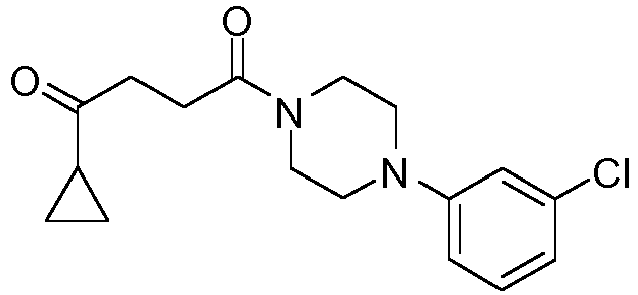
1-[4-(3-chlorophenyl)pipe razin-1-yl]-4-cyclopropyl-butane-1,4-dione H3 4-Cyclopropyl-4-oxobutyric acid + 1-(3-chlorophenyl)pip erazine 321 N.A. 032 
1-cyclopropyl-4-[4-(o-tolyl)piperazin-1-yl]butane-1,4-dione H3 4-Cyclopropyl-4-oxobutyric acid + 1-(o-tolyl)piperazine dihydrochloride 300 N.A. 033 
1-[4-(5-chloro-2-methyl-phenyl)piperazin-1-yl]-4-cyclopropyl-butane-1,4-dione H3 4-Cyclopropyl-4-oxobutyric acid + 1-(5-chloro-2-methylphenyl)-piperazine 335 N.A. 034 
1-[4-(3-chlorophenyl)pipe razin-1-yl]-4-cyclobutyl-butane-1,4-dione H3 4-Cyclobutyl-4-oxo-butyric acid + 1-(3-chlorophenyl)pip erazine 335 335-337 035 
1-[4-(5-chloro-2-methyl-phenyl)piperazin-1-yl]-4-cyclobutyl-butane-1,4-dione H3 4-Cyclobutyl-4-oxo-butyric acid + 1-(5-chloro-2-methylphenyl)-piperazine 349 349-351 036 
1-[4-(3-chloro-2-methyl-phenyl)piperazin-1-yl]-4-cyclopropyl-butane-1,4-dione H3 4-Cyclopropyl-4-oxobutyric acid + 1-(3-chloro-2-methylphenyl)-piperazine 335 N.A. 037 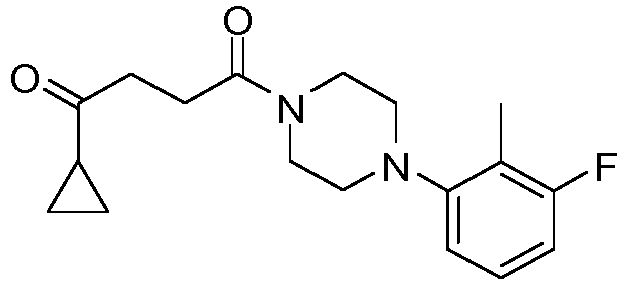
1-cyclopropyl-4-[4-(3-fluoro-2-methyl-phenyl)piperazin-1-yl]butane-1,4-dione H3 4-Cyclopropyl-4-oxobutyric acid + 1-(3-fluoro-2-methylphenyl)-piperazine 318 N.A. 038 
1-[4-(3-fluoro-2-methyl-phenyl)piperazin-1-yl]-4-(2-pyridyl)butane-1,4-dione H3 4-Oxo-4-pyridin-2-yl-butyric acid + 1-(3-fluoro-2-methylphenyl)-piperazine 355 N.A. 039 
1-[4-(2,3-dimethylphenyl)p iperazin-1-yl]-4-(2-pyridyl)butane-1,4-dione H3 4-Oxo-4-pyridin-2-yl-butyric acid + 1-(2,3-Dimethyl-phenyl)-piperazine 351 N.A. 040 
1-[4-(3-chlorophenyl)pipe razin-1-yl]-4-cyclopropyl-2-methyl-butane-1,4-dione D2b Int 010 + cyclopropanecarb oxaldehyde 335 335-337 041 
1-[4-(3-chlorophenyl)pipe razin-1-yl]hexane-1,4-dione D2b Int 005 + propanal 309 N.A. 042 
1-[4-(3-chlorophenyl)pipe razin-1-yl]-4-(3-methoxyphenyl)b utane-1,4-dione D2b Int 005 + 3-Methoxy benzaldehyde 387 387-389 043 
1-[4-(3-chlorophenyl)pipe razin-1-yl]-4-(4-methylsulfonylph enyl)butane-1,4-dione D2b Int 005 + 4-Methylsulphonyl benz aldehyde 435 435-437 044 
4-[4-[4-(3-chlorophenyl)pipe razin-1-yl]-4-oxo-butanoyl]benzonit rile D2a Int 005 + 4-cyano benzaldehyde 382 382-384 045 
1-cyclopropyl-4-[4-(3,5-dichlorophenyl)pi perazin-1-yl]butane-1,4-dione H3 4-Cyclopropyl-4-oxobutyric acid + 1-(3,5-dichlorophenyl)pi perazine 355 N.A. 046 
4-cyclopropyl-1-[4-(3,5-dichlorophenyl)pi perazin-1-yl]-2-methyl-butane-1,4-dione D2b Int 001 + cyclopropanecarb oxaldehyde 369 369-371 047 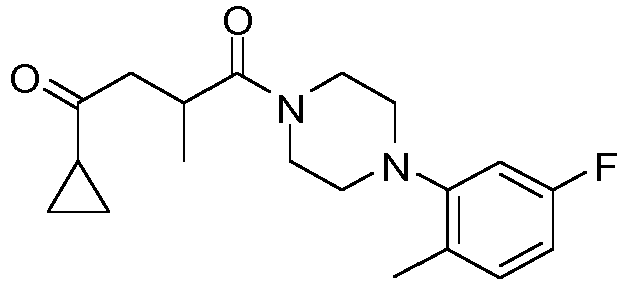
4-cyclopropyl-1-[4-(5-fluoro-2-methyl-phenyl)piperazin-1-yl]-2-methyl-butane-1,4-dione D2b Int 011 + cyclopropanecarb oxaldehyde 332 333 048 
1-[4-(5-fluoro-2-methyl-phenyl)piperazin-1-yl]-2-methyl-pentane-1,4-dione D2b Int 011 + acetalde hyde 306 307 049 
4-cyclopropyl-1-[(3S)-4-(3-fluorophenyl)-3-methyl-piperazin-1-yl]-2-methyl-butane-1,4-dione H3 Int 155 + Int 202 332 333 050 
1-[(3S)-4-(3-chloro-4-fluoro-phenyl)-3-methyl-piperazin-1-yl]-4-cyclopropyl-2-methyl-butane-1,4-dione H3 Int 155 + Int 198 367 367-369 051 
1-[(3S)-4-(4-chlorophenyl)-3-methyl-piperazin-1-yl]-4-cyclopropyl-2-methyl-butane-1,4-dione H3 Int 155 + Int 205 349 349-351 052 
1-[(3S)-4-(3-chloro-5-fluoro-phenyl)-3-methyl-piperazin-1-yl]-4-cyclopropyl-2-methyl-butane-1,4-dione H3 Int 155 + Int 206 367 367-369 053 
4-cyclopropyl-1-[4-(3,5-dichlorophenyl)pi perazin-1-yl]-2-hydroxy-butane-1,4-dione 2.14 Cyclopropane carbonyl chloride + Meldrum's acid + benzyl alcohol + crotonyl chloride + 3,5-dichlorophenyl piperazine 371 N.A. 054 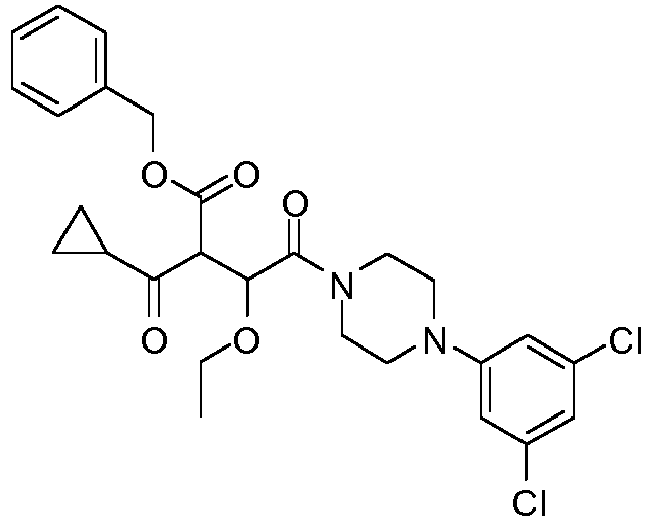
benzyl 2-(cyclopropanecar bonyl)-4-[4-(3,5-dichlorophenyl)pi perazin-1-yl]-3-ethoxy-4-oxo-butanoate 2.14 Cyclopropane carbonyl chloride + Meldrum's acid + benzyl alcohol + crotonyl chloride + 3,5-dichlorophenyl piperazine 533 N.A. 055 
4-[4-(3,5-dichlorophenyl)pi perazin-1-yl]-3-methyl-4-oxo-butanal D4 Int 124 329 329-331 056 
4-cyclopropyl-1-[4-(3,5-dichlorophenyl)pi perazin-1-yl]-2-methoxy-butane-1,4-dione 2.15 Int 054 385 N.A. 057 
1-[(3S)-4-(3-fluorophenyl)-3-methyl-piperazin-1-yl]-2-methoxy-pentane-1,4-dione D4 Int 125 322 N.A. 058 
1-[(3S)-4-(3-chloro-5-fluoro-phenyl)-3-methyl-piperazin-1-yl]-2-methoxy-pentane-1,4-dione D4 Int 126 357 N.A. 059 
1-[(3S)-4-(3-chloro-4-fluoro-phenyl)-3-methyl-piperazin-1-yl]-4-(6-methyl-3-pyridyl)butane-1,4-dione D2c Int 006 + 6-Methyl-pyridine-3-carbaldehyde 404 404-406 060 
1-[(3S)-4-(3-chloro-4-fluoro-phenyl)-3-methyl-piperazin-1-yl]-4-(4-pyridyl)butane-1,4-dione D2c Int 006 + Pyridine-4-carbaldehyde 390 390-392 061 
1-[4-(3,5-dichlorophenyl)pi perazin-1-yl]-2-ethyl-pentane-1,4-dione H2 Int 190 + 1-(3,5-dichlorophenyl)pi perazine 357 357-359 062 
5-[2-(benzyloxymethyl )-3-[(3S)-4-(3-fluorophenyl)-3-methyl-piperazin-1-yl]-3-oxopropyl]-5-methylimidazolidine-2,4-dione H2 Int 135 + Int 202 483 N.A. 063 
1-[(3S)-4-(3,5-dichlorophenyl)-3-methyl-piperazin-1-yl]-5-(2-methoxyethoxy)-2-methyl-pentane-1,4-dione H2 Int 185 + Int 197 431 431-433 064 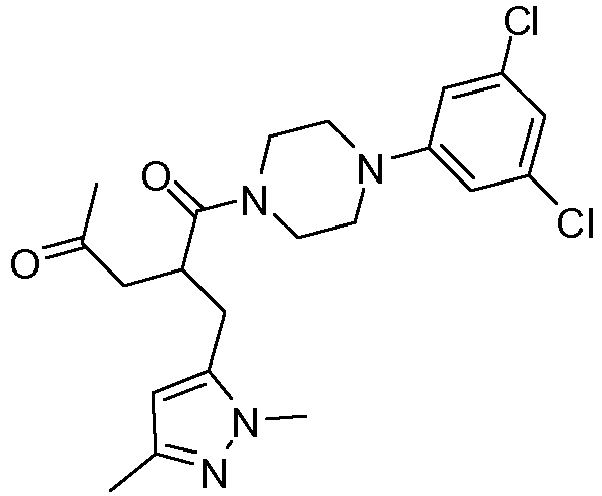
1-[4-(3,5-dichlorophenyl)pi perazin-1-yl]-2-[(2,5-dimethylpyrazol-3-yl)methyl]pentane -1,4-dione E Int 121 + 5-Chloromethyl-1,3-dimethyl-1H-pyrazole 437 437-439 065 
3-[4-(3,5-dichlorophenyl)pi perazine-1-carbonyl]-5-oxo-hexanenitrile E Int 121 + Bromo-acetonitrile 368 368-370 066 
1-[(3S)-4-(3-fluorophenyl)-3-methyl-piperazin-1-yl]-2-(methoxymethyl) pentane-1,4-dione E Int 122 + Bromo-methoxy-methane 336 337 067 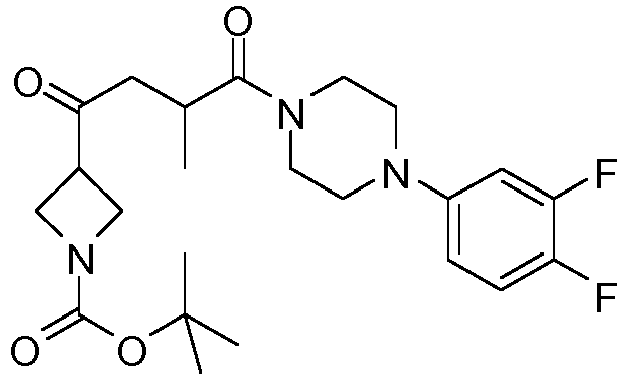
tert-butyl 3-[4-[4-(3,4-difluorophenyl)pi perazin-1-yl]-3-methyl-4-oxo-butanoyl]azetidin e-1-carboxylate D2b Int 002 + 1-Boc-3-azetidinecarboxal dehyde 452 453 068 
tert-butyl 3-[4-[(3S)-4-(3,4-difluorophenyl)-3-methyl-piperazin-1-yl]-3-methyl-4-oxo-butanoyl]azetidin e-1-carboxylate D2b Int 003 + 1-Boc-3-azetidinecarboxal dehyde 466 467 069 
tert-butyl N-[6-[4-(3,4-difluorophenyl)pi perazin-1-yl]-5-methyl-3,6-dioxo-hexyl]carbamate H2 Int 191 + 1-(3,4-difluoro phenyl) piperazine 440 441 070 
1-[(3S)-4-(3,5-difluorophenyl)-3-methyl-piperazin-1-yl]-4-(6-methoxy-2-pyridyl)butane-1,4-dione D2a Int 004 + 6-Methoxy-pyridine-2-carbaldehyde 403 404 071 
1-[(3S)-4-(3,5-difluorophenyl)-3-methyl-piperazin-1-yl]-4-(6-methoxy-3-pyridyl)butane-1,4-dione D2a Int 004 + 6-Methoxy-pyridine-3-carbaldehyde 403 404 072 
1-[(3S)-4-(3,5-difluorophenyl)-3-methyl-piperazin-1-yl]-4-[6-(trifluoromethyl)-3-pyridyl]butane-1,4-dione D2a Int 004 + 6-Trifluoromethyl-pyridine-3-carbaldehyde 441 442 073 
1-[(3S)-4-(3,5-difluorophenyl)-3-methyl-piperazin-1-yl]-4-(2-methyl-4-pyridyl)butane-1,4-dione D2a Int 004 + 2-Methyl-pyridine-4-carbaldehyde 387 388 074 
1-[4-(3-chlorophenyl)pipe razin-1-yl]-5-methyl-hexane-1,4-dione H3 5-Methyl-4-oxohexanoic acid + 1-(3-chlorophenyl)pip erazine 323 323-325 075 
1-[4-(3,5-dichlorophenyl)pi perazin-1-yl]-5-methyl-hexane-1,4-dione H3 5-Methyl-4-oxohexanoic acid + 1-(3,5-dichlorophenyl)pi perazine 357 357-359 076 
1-[4-(2,5-dimethylphenyl)p iperazin-1-yl]-4-(2-pyridyl)butane-1,4-dione H1 4-Oxo-4-pyridin-2-yl-butyric acid + 1-(2,5-Dimethylphenyl) piperazine 351 352 077 
1-cyclopropyl-4-[4-(2,5-dimethylphenyl)p iperazin-1-yl]butane-1,4-dione H1 4-Cyclopropyl-4-oxo-butyric acid + 1-(2,5-Dimethylphenyl) piperazine 314 315 078 
1-[4-(3-chlorophenyl)pipe razin-1-yl]-4-(2-methoxyphenyl)b utane-1,4-dione H2 4-(2-methoxyphenyl)-4-oxobutyric acid + 1-(3-chlorophenyl)pip erazine 387 387-389 079 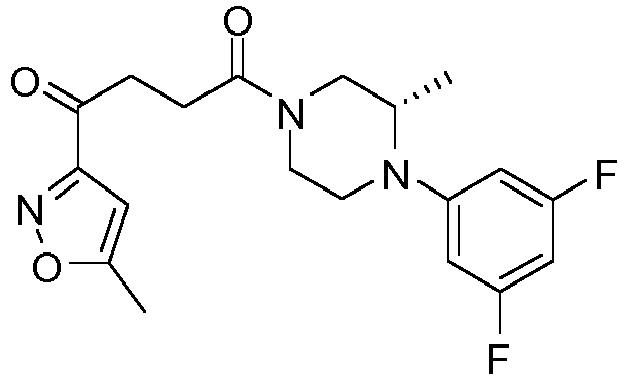
1-[(3S)-4-(3,5-difluorophenyl)-3-methyl-piperazin-1-yl]-4-(5-methylisoxazol-3-yl)butane-1,4-dione D2a Int 004 + 5-Methylisoxazole-3-carboxaldehyde 377 378 080 
1-[4-(5-chloro-2-methyl-phenyl)piperazin-1-yl]-4-cyclohexyl-butane-1,4-dione H3 4-cyclohexyl-4-oxobutyric acid + 1-(5-chloro-2-methylphenyl)-piperazine 377 377-379 081 
(E)-1-[4-(3,5-dichlorophenyl)pi perazin-1-yl]but-2-en-1-one D1 crotonyl chloride + 3,5-dichloro phenyl piperazine 299 N.A. 082 
1-cyclopropyl-4-[4-(2,3-dimethyl phenyl)piperazin-1-yl]butane-1,4-dione H1 4-Cyclopropyl-4-oxo-butyric acid + 1-(2,3-Dimethylphenyl) piperazine 314 N.A. 083 
1-[4-(3,4-difluorophenyl) piperazin-1-yl]-4-(2-pyridyl)butane-1,4-dione H1 4-Oxo-4-pyridin-2-yl-butyric acid + 1-(3,4-difluorophenyl)pi perazine 359 360 084 
1-[4-(3-chloro-4-fluoro-phenyl) piperazin-1-yl]-4-(2-pyridyl)butane-1,4-dione H1 4-Oxo-4-pyridin-2-yl-butyric acid + 1-(3-Chloro-4-fluorophenyl)pipe razine dihydrochloride 376 376-378 085 
1-[(3S)-4-(3-chloro-5-fluoro-phenyl)-3-methyl-piperazin-1-yl]-4-oxazol-4-yl-butane-1,4-dione D2a Int 007 + Oxazole-4-carbaldehyde 380 380-382 086 
1-[4-(3,5-dichlorophenyl) piperazin-1-yl]-6-(dimethylamino)h exane-1,4-dione H1 6-dimethylamino-4-ketohexanoic acid hydrochloride + 1-(3,5-dichlorophenyl)pi perazine 386 386-388-390 087 
1-[4-(dimethylamino methyl)phenyl]-4-[4-(o-tolyl) piperazin-1-yl] butane-1,4-dione D7 Int 117 394 395 088 
1-[4-(3-chloro phenyl)piperazin-1-yl]-4-[4-(2-dimethylamino ethyloxy)phenyl] butane-1,4-dione H1 Int 189 + 1-(3-chlorophenyl)pip erazine 444 444-446 089 
1-[4-(2-dimethylaminoeth yloxy)phenyl]-4-[4-(o-tolyl)piperazin-1-yl]butane-1,4-dione H1 Int 189 + 1-(o-tolyl)piperazine dihydrochloride 424 425 090 
1-[4-(3-chlorophenyl)pipe razin-1-yl]-4-[4-(dimethylaminom ethyl)phenyl]buta ne-1,4-dione D7 Int 118 414 414-416 091 
1-[4-(3-chlorophenyl)pipe razin-1-yl]-5,5-dimethyl-hexane-1,4-dione H1 5,5-Dimethyl-4-oxo-hexanoic acid + 1-(3-chlorophenyl)pip erazine 337 337-339 092 
1-[4-(5-chloro-2-methyl-phenyl) piperazin-1-yl]-5,5-dimethyl-hexane-1,4-dione H1 5,5-Dimethyl-4-oxo-hexanoic acid + 1-(5-chloro-2-methylphenyl)-piperazine 351 351-353 093 
1-[4-(3-chlorophenyl)pipe razin-1-yl]-4-cyclopentyl-butane-1,4-dione H1 4-Cyclopentyl-4-oxo-butyric acid + 1-(3-chlorophenyl)pip erazine 349 349-351 094 
1-[4-(5-chloro-2-methyl-phenyl)piperazin-1-yl]-4-cyclopentyl-butane-1,4-dione H1 4-Cyclopentyl-4-oxo-butyric acid + 1-(5-chloro-2-methylphenyl)-piperazine 363 363-365 095 
1-[4-(3-chlorophenyl)pipe razin-1-yl]-4-(m-tolyl)butane-1,4-dione D2a Int 005 + 3-Methyl-benzaldehyde 371 371-373 096 
tert-butyl 3-[4-[3-[4-(3,5-dichlorophenyl)pi perazin-1-yl]-2-methyl-3-oxo-propyl]-2,5-dioxo-imidazolidin-4-yl]azetidine-1-carboxylate F Int 119 554 554-556 trans 097 
1-[4-(3,5-dichlorophenyl)pi perazin-1-yl]-2-methyl-4-tetrahydropyran-4-yl-butane-1,4-dione D2b Int 001 + Tetrahydro-pyran-4-carbaldehyde 413 413-415 098 
1-[4-(3,5-dichlorophenyl)pi perazin-1-yl]-2-methyl-6-methylsulfanyl-hexane-1,4-dione D2b Int 001 + 3-(Methylthio)propi onaldehyde 403 403-405 099 
tert-butyl 4-[5-[4-(3,5-dichlorophenyl)pi perazin-1-yl]-4-methyl-2,5-dioxo-pentyl]piperidine-1-carboxylate D2b Int 001 + 4-(2-Oxo-ethyl)-piperidine-1-carboxylic acid tert-butyl ester 527 527-529 100 
tert-butyl N-[2-[4-[3-[4-(3,5-dichlorophenyl)pi perazin-1-yl]-2-methyl-3-oxo-propyl]-2,5-dioxo-imidazolidin-4-yl]ethyl] carbamate F Int 150 542 542-544 trans 101 
1-[4-(3-chloro-2-methyl-phenyl)piperazin-1-yl]-4-cyclopropyl-2-methyl-butane-1,4-dione D2b Int 009 + cyclopropanecarb oxaldehyde 349 349-351 102 
1-[4-(3-chloro-2-methylphenyl)piperazin-1-yl]-2-methylpentane-1,4-dione D2b Int 009 + Acetaldehyde 323 323-325 103 
1-[(3S)-4-(3-fluorophenyl)-3-methyl-piperazin-1-yl]-4-(2-pyridyl)butane-1,4-dione H3 4-oxo-4-pyridin-2ylbutyric acid + Int 202 355 356 104 
1-[(3S)-4-(3-chloro-5-fluoro-phenyl)-3-methyl-piperazin-1-yl]-4-(2-pyridyl)butane-1,4-dione H3 4-oxo-4-pyridin-2ylbutyric acid + Int 206 390 309-392 105 
1-[(3S)-4-(3,4-dichlorophenyl)-3-methyl-piperazin-1-yl]-4-(2-pyridyl)butane-1,4-dione H3 4-oxo-4-pyridin-2ylbutyric acid + Int 201 406 406-408 106 
1-[(3S)-4-(3,5-difluorophenyl)-3-methyl-piperazin-1-yl]-4-(2-pyridyl)butane-1,4-dione H3 4-oxo-4-pyridin-2ylbutyric acid + Int 207 373 374 107 
1-[(3S)-4-(3,5-difluorophenyl)-3-methyl-piperazin-1-yl]-4-oxazol-4-yl-butane-1,4-dione D2a Int 004 + Oxazole-4-carbaldehyde 363 364 108 
1-[(3S)-4-(3,5-difluorophenyl)-3-methyl-piperazin-1-yl]-4-(1-methylimidazol-4-yl)butane-1,4-dione D2a Int 004 + 1-Methyl-1H-imidazole-4-carbaldehyde 376 377 109 
1-[4-(3-chlorophenyl)pipe razin-1-yl]-6-(dimethylamino)h exane-1,4-dione H1 6-dimethylamino-4-ketohexanoic acid hydrochloride + 1-(3-chlorophenyl)pip erazine 352 352 - 354 110 
(S)-4-(3,5-Di fluoro-phenyl) -3-methyl-pi perazine-1-car boxylic acid tert-butyl ester 2.18 Int 290 268 N.A. 111 
1-[4-(3-chlorophenyl)pipe razin-1-yl]-4-cyclohexyl-butane-1,4-dione H3 4-cyclohexyl-4-oxobutyric acid + 1-(3-chlorophenyl)pip erazine 363 363-365 112 
1-[4-(3-fluorophenyl)pipe razin-1-yl]-4-(2-pyridyl)butane-1,4-dione H1 4-oxo-4-pyridin-2ylbutyric acid + 1-(3-Fluorophenyl)pip erazine 341 342 113 
1-[4-(5-fluoro-2-methyl-phenyl)piperazin-1-yl]-4-(2-pyridyl)butane-1,4-dione H1 4-oxo-4-pyridin-2ylbutyric acid + Int 204 355 356 114 
1-[(3S)-4-(3,5-difluorophenyl)-3-methyl-piperazin-1-yl]-4-(1-methylpyrazol-4-yl)butane-1,4-dione D2a Int 004 + 1-Methyl-1H-pyrazole-4-carbaldehyde 376 377 115 
1-[(3S)-4-(3,5-difluorophenyl)-3-methyl-piperazin-1-yl]-4-(2,5-dimethyloxazol-4-yl)butane-1,4-dione D2a Int 004 + 2,5-Dimethyl-oxazole-4-carbaldehyde 391 392 116 
tert-butyl 2-[4-[3-[4-(4-chloro-3-methyl-phenyl)piperazin-1-yl]-3-oxo-propyl]-2,5-dioxo-imidazolidin-4-yl]acetate F Int 120 479 479 117 
1-(4-bromophenyl)-4-[4-(o-tolyl)piperazin-1-yl]butane-1,4-dione H1 4-(4-Bromo-phenyl)-4-oxo-butyric acid + 1-(o-tolyl)piperazine dihydrochloride 415 415-417 118 
1-(4-bromophenyl)-4-[4-(3-chlorophenyl)pipe razin-1-yl]butane-1,4-dione H1 4-(4-Bromo-phenyl)-4-oxo-butyric acid + 1-(3-chlorophenyl)pip erazine 436 435-437 119 
tert-butyl 3-[4-[4-(3,5-dichlorophenyl)pi perazin-1-yl]-3-methyl-4-oxo-butanoyl]azetidin e-1-carboxylate D2b Int 001 + 3-Formyl-azetidine-1-carboxylic acid tert-butyl ester 484 484-486 120 
tert-butyl 6-[4-(4-chloro-3 -methyl-phenyl)piperazin-1-yl]-3,6-dioxo-hexanoate H2 Int 129 + Int 284 409 409 121 
1-[4-(3,5-dichlorophenyl)pi perazin-1-yl]pentane-1,4-dione H2 levulinic acid + 1-(3,5-dichlorophenyl)pi perazine 329 329-331 122 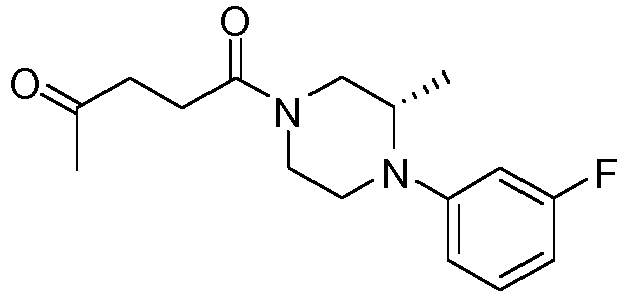
1-[(3S)-4-(3-fluorophenyl)-3-methyl-piperazin-1-yl]pentane-1,4-dione H2 levulinic acid + Int 202 292 293 123 
1-[4-(3,5-dichlorophenyl)pi perazin-1-yl]-3-methyl-pent-4-en-1-one H3 3-Methyl-4-pentenoic acid + 1-(3,5-dichlorophenyl)pi perazine 327 N.A. 124 
1-[4-(3,5-dichlorophenyl)pi perazin-1-yl]-2-methyl-pent-4-en-1-one H3 2-Methyl-4-pentenoic acid + 1-(3,5-dichlorophenyl)pi perazine 327 327-329 125 
1-[(3S)-4-(3-fluorophenyl)-3-methyl-piperazin-1-yl]-2-methoxy-4-methyl-pent-4-en-1-one H3 Int 154 + Int 202 320 321 126 
1-[(3S)-4-(3-chloro-5-fluoro-phenyl)-3-methyl-piperazin-1-yl]-2-methoxy-4-methyl-pent-4-en-1-one H3 Int 154 + Int 206 355 355-357 127 
tert-butyl N-[5-[4-(3-chlorophenyl)pipe razin-1-yl]-2,5-dioxo-pentyl]carbamate H2 Int 173 + 1-(3-chlorophenyl)pip erazine 410 N.A. 128 
tert-butyl N-[5-[4-(3,5-dichlorophenyl)pi perazin-1-yl]-2,5-dioxo-pentyl]carbamate H2 Int 173 + 1-(3,5-dichlorophenyl)pi perazine 444 N.A. 129 
6-tert-butoxy-4,6-dioxo-hexanoic acid 2.16 Succinic anhydride + tertbutyl acetate 216 N.A. 130 
5-[2-methoxyethyl(met hyl)amino]-4-oxo-pentanoic acid D6 levulinic acid + (2-methoxy-ethyl)-methyl-amine 203 N.A. 131 
5-morpholino-4-oxo-pentanoic acid D6 levulinic acid + morpholine 201 N.A. 132 
3-[2,5-dioxo-4-(3-pyridyl)imidazoli din-4-yl]propanoic acid G Int 133 249 N.A. 133 
tert-butyl 3-[2,5-dioxo-4-(3-pyridyl)imidazoli din-4-yl]propanoate F Int 134 305 306 134 
tert-butyl 4-oxo-4-(3-pyridyl)butanoate C4 Pyridine- 3-carbaldehyde + Acrylic acid tert-butyl ester 235 236 135 
2-(benzyloxymethyl )-3-(4-methyl-2,5-dioxo-imidazolidin-4-yl)propanoic acid G Int 136 306 307 trans 136 
tert-butyl 2-(benzyloxymethyl )-3-(4-methyl-2,5-dioxo-imidazolidin-4-yl)propanoate F Int 137 362 N.A. trans 137 
tert-butyl 2-(benzyloxy methyl)-4-oxo-pentanoate 2.17 Int 138 292 315 (M+ Na) 138 
2-(benzyloxymethyl )-4-oxo-pentanoic acid D5 benzyloxy-acetaldehyde 236 N.A. 139 
3-(2,5-dioxo-4-pyrimidin-2-yl-imidazolidin-4-yl)propanoic acid G + H2O Int 140 250 251 140 
tert-butyl 3-(2,5-dioxo-4-pyrimidin-2-yl-imidazolidin-4-yl)propanoate F Int 141 306 307 141 
tert-butyl 4-oxo-4-pyrimidin-2-yl-butanoate C2 1-Pyrimidin-2-yl-ethanone + Bromo-acetic acid tert-butyl ester 236 237 142 
3-(2,5-dioxo-4-pyrazin-2-yl-imidazolidin-4-yl)propanoic acid G Int 143 250 249 (M-H) 143 
tert-butyl 3-(2,5-dioxo-4-pyrazin-2-yl-imidazolidin-4-yl)propanoate F Int 144 306 307 144 
tert-butyl 4-oxo-4-pyrazin-2-yl-butanoate C2 1-Pyrazin-2-yl-ethanone + Bromo-acetic acid tert-butyl ester 236 237 145 
3-[4-[(3,3-difluoropyrrolidin -1-yl)methyl]-2,5-dioxo-imidazolidin-4-yl]-2-methyl-propanoic acid G Int 146 305 N.A. trans 146 
tert-butyl 3-[4-[(3,3-difluoropyrrolidin -1-yl)methyl]-2,5-dioxo-imidazolidin-4-yl]-2-methyl-propanoate F Int 147 361 N.A. trans 147 
tert-butyl 5-(3,3-difluoropyrrolidin -1-yl)-2-methyl-4-oxo-pentanoate C5 Int 148 + 2,2-Difluoro-pyrrolidine hydrochloride 291 292 148 
tert-butyl 2-methylpent-4-enoate C3 2-Methyl-pent-4-enoic acid 170 N.A. 149 
2-[4-(3,5-dichlorophenyl)pi perazin-1-yl]-2-oxo-acetaldehyde D4 Int 081 287 N.A. 150 
tert-butyl N-[6-[4-(3,5-dichlorophenyl)pi perazin-1-yl]-5-methyl-3,6-dioxo-hexyl]carbamate 2.19 Int 021 472 472-474-476 151 
3-(2,5-dioxoimidazolidin -4-yl)-2-methyl-propanoic acid G Int 152 186 N.A. trans 152 
tert-butyl 3-(2,5-dioxoimidazolidin -4-yl)-2-methyl-propanoate F Int 153 242 N.A. trans 153 
tert-butyl 2-methyl-4-oxo-butanoate 2.20 Int 148 172 N.A. 154 
2-methoxy-4-methyl-pent-4-enoic acid 2.21 Methoxy-acetic acid + 2-Methyl-prop-2-en-1-ol 144 143 (M-H) 155 
4-cyclopropyl-2-methyl-4-oxo-butanoic acid 2.23 cyclopropanecarb onyl chloride + 2,2-Dimethyl-[1,3]dioxane-4,6-dione 156 155 (M-H) 156 
3-[4-(methoxymethyl)-2,5-dioxo-imidazolidin-4-yl]-2-methyl-propanoic acid G Int 157 230 231 trans 157 
tert-butyl 3-[4-(methoxymethyl)-2,5-dioxo-imidazolidin-4-yl]-2-methyl-propanoate F Int 158 286 309 (M+ Na) trans 158 
tert-butyl 5-methoxy-2-methyl-4-oxo-pentanoate C1 Methoxy-acetic acid + 2,2-Dimethyl-[1,3]dioxane-4,6-dione 216 239 (M+ Na) 159 
3-[2,5-dioxo-4-(2-pyridyl)imidazoli din-4-yl]-2-methyl-propanoic acid G Int 160 263 264 trans 160 
tert-butyl 3-[2,5-dioxo-4-(2-pyridyl)imidazoli din-4-yl]-2-methyl-propanoate F Int 161 319 320 trans 161 
tert-butyl 2-methyl-4-oxo-4-(2-pyridyl)butanoate C1 step ii + step iii 3-Oxo-3-pyridin-2-yl-propionic acid benzyl ester + Bromo-acetic acid tert-butyl ester 249 272 (M+ Na) 162 
3-(4-cyclopropyl-2,5-dioxo-imidazolidin-4-yl)propanoic acid 2.22 Int 110 212 211 (M-H) 163 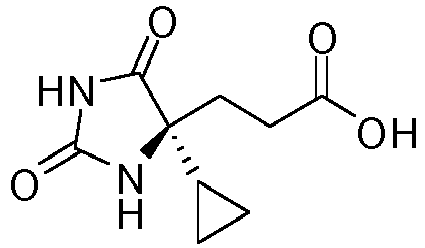
3-[(4S)-4-cyclopropyl-2,5-dioxo-imidazolidin-4-yl]propanoic acid 2.22 Int 162 212 N.A. 164 
3-(4-cyclopropyl-2,5-dioxo-imidazolidin-4-yl)-2-methyl-propanoic acid C3 + F + G Int 155 226 225 (M-H) trans 165 
2-methyl-3-(4-methyl-2,5-dioxo-imidazolidin-4-yl)propanoic acid G Int 289 200 201 trans 166 
3-[4-(6-methyl-2-pyridyl)-2,5-dioxo-imidazolidin-4-yl]propanoic acid G Int 167 263 264 167 
tert-butyl 3-[4-(6-methyl-2-pyridyl)-2,5-dioxo-imidazolidin-4-yl]propanoate F Int 168 319 320 168 
tert-butyl 4-(6-methyl-2-pyridyl)-4-oxo-butanoate C4 6-Methyl-pyridine-2-carbaldehyde + Acrylic acid tert-butyl ester 249 250 169 
3-(4-ethyl-2,5-dioxo-imidazolidin-4-yl)-2-methyl-propanoic acid G Int 170 214 215 trans 170 
tert-butyl 3-(4-ethyl-2,5-dioxo-imidazolidin-4-yl)-2-methyl-propanoate F Int 171 270 271 trans 171 
tert-butyl 2-methyl-4-oxo-hexanoate C3 2-Methyl-4-oxo-hexanoic acid [ref J. Org. Chem. 2003, 68, 7983-7989] 200 N.A. 172 
3-[(4R)-4-methyl-2,5-dioxo-imidazolidin-4-yl]propanoic acid 2.24 3-(4-Methyl-2,5-dioxo-imidazolidin-4-yl)propionic acid 186 373 (2M+ H) 173 
5-(tert-butoxycarbonyla mino)-4-oxo-pentanoic acid 2.25 5-Amino-4-oxo-pentanoic acid 231 N.A. 174 
3-[4-(6-methyl-3-pyridyl)-2,5-dioxo-imidazolidin-4-yl]propanoic acid G Int 175 263 264 175 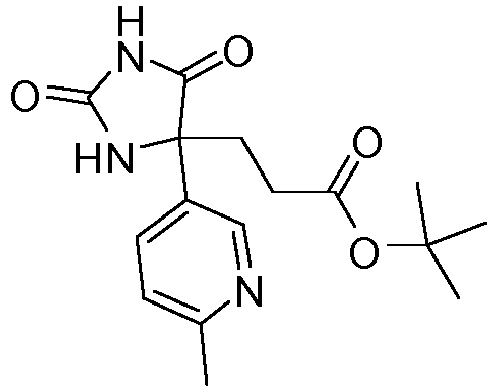
tert-butyl 3-[4-(6-methyl-3-pyridyl)-2,5-dioxo-imidazolidin-4-yl]propanoate F Int 176 319 320 176 
tert-butyl 4-(6-methyl-3-pyridyl)-4-oxo-butanoate D2c 6-Methyl-pyridine-3-carbaldehyde + Acrylic acid tert-butyl ester 249 250 177 
5-methoxy-4-oxo-pentanoic acid 2.26 pent-4-ynoic acid 146 N.A. 178 
5-(dimethylamino)-4-oxo-pentanoic acid D6 levulinic acid + dimethylamine 159 N.A. 179 
3-[4-(1-methylimidazol-4-yl)-2,5-dioxo-imidazolidin-4-yl]propanoic acid G Int 180 252 253 180 
tert-butyl 3-[4-(1-methylimidazol-4-yl)-2,5-dioxo-imidazolidin-4-yl]propanoate F Int 181 308 309 181 
tert-butyl 4-(1-methylimidazol-4-yl)-4-oxo-butanoate C4 1-Methyl-1H-imida zole-4-car baldehyde + Acrylic acid tert-butyl ester 238 239 182 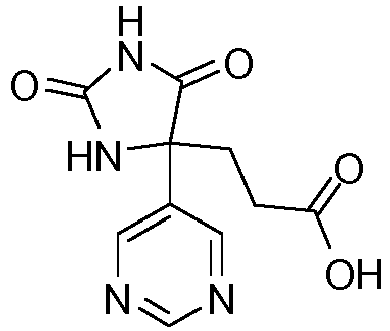
3-(2,5-dioxo-4-pyrimidin-5-yl-imidazolidin-4-yl)propanoic acid G Int 183 250 N.A. 183 
tert-butyl 3-(2,5-dioxo-4-pyrimidin-5-yl-imidazolidin-4-yl)propanoate F Int 184 306 307 184 
tert-butyl 4-oxo-4-pyrimidin-5-yl-butanoate C2 1 -Pyrimi din-5-yl-ethanone + Bromo-acetic acid tert-butyl ester 236 237 185 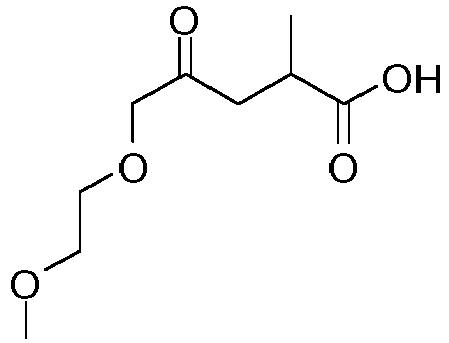
5-(2-methoxyethoxy)-2-methyl-4-oxo-pentanoic acid 2.27 (2-methoxy-ethoxy)-acetic acid 204 203 (M-H) 186 
2-methyl-3-[4-(morpholinometh yl)-2,5-dioxo-imidazolidin-4-yl]propanoic acid G Int 187 285 N.A. trans 187 
tert-butyl 2-methyl-3-[4-(morpholinometh yl)-2,5-dioxo-imidazolidin-4-yl]propanoate F Int 188 341 342 trans 188 
tert-butyl 2-methyl-5-morpholino-4-oxo-pentanoate C5 Int 148 + morpholine 271 N.A. 189 
4-[4-(2-dimethylaminoeth yloxy)phenyl]-4-oxo-butanoic acid 2.28 4-(4-fluoro-phenyl)-4-oxo-butyric acid + 2-dimethyl amino-ethanol 265 266 190 
2-ethyl-4-oxo-pentanoic acid D5 propionaldehyde 144 N.A. 191 
6-(tert-butoxycarbonyla mino)-2-methyl-4-oxo-hexanoic acid 2.29 3-tert-butoxycarbonyla mino-propionic acid + Meldrum's acid 259 260 192 
2-chloro-N,N-dimethyl-5-[(2S)-2-methylpiperazin-1-yl]aniline A2a + A5a (S)-3-Methyl-piperazine-1-carboxy lic acid tert-butyl ester + Int 285 254 254 193 
2-chloro-N-methyl-5-[(2S)-2-methylpiperazin-1-yl]aniline A2a + A5e (S)-3-Methyl-piperazine-1-carboxy lic acid tert-butyl ester + Int 286 240 240 194 
1-(m-tolyl) piperazine A2a + A5a Piperazine-1-carboxylic acid tert-butyl ester + 3-bromo toluene 176 177 195 
(2S)-1-(2,5-dimethylphenyl)-2-methyl-piperazine A2a + A5a (S)-3-Methyl-piperazine-1-carbox ylic acid tert-butyl ester + 2-bromo-1,4-dimethyl benzene 204 205 196 
1-(3-chloro-2-methyl-phenyl)piperazine A7 Piperazine + 1-Bromo-3-chloro-2-methyl-benzene 211 211 197 
(2S)-1-(3,5-dichlorophenyl)-2-methyl-piperazine A2a + A5a (S)-3-Methyl-piperazine-1-carboxylic acid tert-butyl ester + 1-Bromo-3,5-dichloro-benzene 245 245-247 198 
(2S)-1-(3-chloro-4-fluoro-phenyl)-2-methyl-piperazine A2a + A5a (S)-3-Methyl-piperazine-1-carboxylic acid tert-butyl ester + 4-Bromo-2-chloro-1-fluoro-benzene 229 229 199 
(2S)-1-(3,4-difluorophenyl)-2-methyl-piperazine A2a + A5b (S)-3-Methyl-piperazine-1-carboxylic acid tert-butyl ester + 4-Bromo-1,2-difluoro-benzene 212 214 200 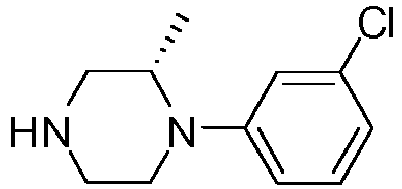
(2S)-1-(3-chlorophenyl)-2-methyl-piperazine A2a + A5a (S)-3-Methyl-piperazine-1-carboxylic acid tert-butyl ester + 1-Bromo-3-chloro-benzene 211 211 201 
(2S)-1-(3,4-dichlorophenyl)-2-methyl-piperazine A2a + A5a (S)-3-Methyl-piperazine-1-carboxylic acid tert-butyl ester + 1,2-Dichloro-4-iodo-benzene 245 245 202 
(2S)-1-(3-fluorophenyl)-2-methyl-piperazine A2a + A5b (S)-3-Methyl-piperazine-1-carboxylic acid tert-butyl ester + 1-Bromo-3-fluoro-benzene 194 195 203 
1-(4-chloro-3,5-difluoro-phenyl)piperazine A7 Piperazine + 5-Bromo-2-chloro-1,3-difluoro-benzene 233 233 204 
1-(5-fluoro-2-methyl-phenyl)pip erazine A7 Piperazine + 4-Fluoro-2-bromo-1-methyl-benzene 194 195 205 
(2S)-1-(4-chlorophenyl)-2-methyl-piperazine A2a + A5a (S)-3-Methyl-piperazine-1-carboxylic acid tert-butyl ester + 1-Bromo-4-chloro-benzene 211 211 206 
(2S)-1-(3-chloro-5-fluoro-phenyl)-2-methyl-piperazine A2a + A5a (S)-3-Methyl-piperazine-1-carboxylic acid tert-butyl ester + 1-Bromo-3-chloro-5-fluoro-benzene 229 229-231 207 
(2S)-1-(3,5-di fluorophenyl)-2-methyl-piperazine A2a + A5a (S)-3-Methyl-piperazine-1-carboxylic acid tert-butyl ester + 1-Bromo-3,5-difluoro-benzene 212 213 208 
(2S)-1-(5-fluoro-2-methyl-phenyl)-2-methyl-piperazine A2a + A5a (S)-3-Methyl-piperazine-1-carboxy lic acid tert-butyl ester + 2-Bromo-4-fluoro-1-methyl-benzene 208 N.A. 209 
(2S)-1-(4-fluorophenyl)-2-methyl-piperazine A2a + A5b (S)-3-Methyl-piperazine-1-carboxylic acid tert-butyl ester + 1-Bromo-4-fluoro-benzene 194 195 210 
(2S)-1-(4-fluoro-3-methyl-phenyl)-2-methyl-piperazine A2a + A5b (S)-3-Methyl-piperazine-1-carboxy lic acid tert-butyl ester + 4-Bromo-1-fluoro-2-methyl-benzene 208 209 211 
(2S)-1-(3,5-dichloro-2-methyl-phenyl)-2-methyl-piperazine A2a + A5a (S)-3-Methyl-piperazine-1-carboxy lic acid tert-butyl ester + 1 -Bromo-3,5-dichloro-2-methyl-benzene 259 261 212 
(2S)-2-methyl-1-phenyl-piperazine A2a + A5b (S)-3-Methyl-piperazine-1-carboxy lic acid tert-butyl ester + Bromo-benzene 176 177 213 
(2S)-1-(4-chloro-3-fluoro-phenyl)-2-methyl-piperazine A2a + A5a (S)-3-Methyl-piperazine-1-carboxy lic acid tert-butyl ester + 4-Bromo-1-chloro-2-fluoro-benzene 229 229 214 
(2S)-1-(5-fluoro-3-pyridyl)-2-methyl-piperazine A2a + A5a (S)-3-Methyl-piperazine-1-carboxylic acid tert-butyl ester + 3-Bromo-5-fluoro-pyridine 195 196 215 
(2S)-1-(5-chloro-3-pyridyl)-2-methyl-piperazine A2a + A5a (S)-3-Methyl-piperazine-1-carboxylic acid tert-butyl ester + 3-Bromo-5-chloro-pyridine 212 212 216 
(2S)-1-(3-chloro-2-methyl-phenyl)-2-methyl-piperazine A2a + A5a (S)-3-Methyl-piperazine-1-carboxylic acid tert-butyl ester + 1-Bromo-3-chloro-2-methyl-benzene 225 225 217 
1-(5-fluoro-2-methyl-phenyl)-2-methyl-piperazine A2a + A5b 3-Methyl-piperazine-1-carboxylic acid tert-butyl ester + 2-Bromo-4-fluoro-1-methyl-benzene 208 209 218 
1-(3,5-dichlorophenyl)-2-methyl-piperazine A2a + A5a 3-Methyl-piperazine-1-carboxylic acid tert-butyl ester + 1-Bromo-3,5-dichloro-benzene 245 245-247 219 
(2R)-2-methyl-1-phenyl-piperazine A2a + A5b (R)-3-Methyl-piperazine-1-carboxylic acid tert-butyl ester + Bromo-benzene 176 177 220 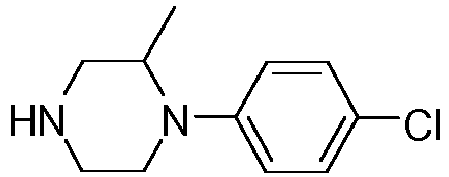
1-(4-chlorophenyl)-2-methyl-piperazine A2a + A5b 3-Methyl-piperazine-1-carboxylic acid tert-butyl ester + 1-Bromo-4-chloro-benzene 211 211 221 
(2S)-2-methyl-1-(3-pyridyl)piperazin e A2a + A5a (S)-3-Methyl-piperazine-1-carboxylic acid tert-butyl ester + 3-Bromo-pyridine 177 178 222 
(2S)-2-methyl-1-(5-methyl-3-pyridyl)piperazin e A2a + A5a (S)-3-Methyl-piperazine-1-carboxylic acid tert-butyl ester + 3-Bromo-5-methyl-pyridine 191 N.A. 223 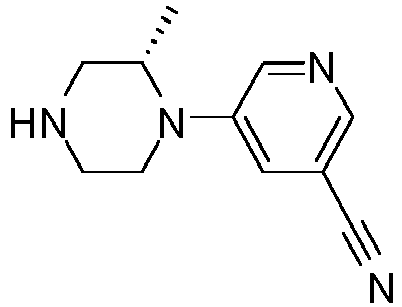
5-[(2S)-2-methylpiperazin-1-yl]pyridine-3-carbonitrile A2a + A5a (S)-3-Methyl-piperazine-1-carboxylic acid tert-butyl ester + 5-Bromo-nicotinonitrile 202 203 224 
(2S)-1-(3-fluoro-4-methyl-phenyl)-2-methyl-piperazine A2a + A5b (S)-3-Methyl-piperazine-1-carboxylic acid tert-butyl ester + 4-Bromo-2-fluoro-1-methyl-benzene 208 209 225 
(2S)-1-(3-chloro-4-methyl-phenyl)-2-methyl-piperazine A2a + A5b (S)-3-Methyl-piperazine-1-carboxylic acid tert-butyl ester + 4-Bromo-2-chloro-1-methyl-benzene 225 225-227 226 
4-chloro-2-[(2S)-2-methylpiperazin-1-yl]pyrimidine A4 + A5a (S)-3-Methyl-piperazine-1-carboxylic acid tert-butyl ester + 2,4-Dichloro-pyrimidine 213 213 227 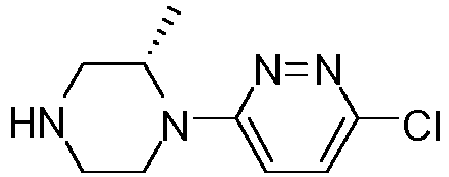
3-chloro-6-[(2S)-2-methylpiperazin-1-yl]pyridazine A4 + A5a (S)-3-Methyl-piperazine-1-carboxylic acid tert-butyl ester + 3,6-Dichloro-pyridazine 213 213 228 
2-[(2S)-2-methylpiperazin-1-yl]pyrazine A2c + A5a (S)-3-Methyl-piperazine-1-carboxylic acid tert-butyl ester + 2-Chloro-pyrazine 178 179 229 
(2S)-1-(4-chloro-2-pyridyl)-2-methyl-piperazine A2b + A5a (S)-3-Methyl-piperazine-1-carboxylic acid tert-butyl ester + 2,4-Dichloro-pyridine 212 N.A. 230 
1-methyl-4-[(2S)-2-methylpiperazin-1-yl]indazole A2d + A5b (S)-3-Methyl-piperazine-1-carboxylic acid tert-butyl ester + 4-Bromo-1-methyl-1H-indazole 230 231 231 
1-methyl-6-[(2S)-2-methylpiperazin-1-yl]pyrrolo[3,2-b]pyridine A2d + A5b (S)-3-Methyl-piperazine-1-carboxylic acid tert-butyl ester + 6-Bromo-1-methyl-1H-pyrrolo[3,2-b]pyridine 230 231 232 
(2S)-1-[3-fluoro-5-(1H-pyrazol-4-yl)phenyl]-2-methyl-piperazine A2a + A3 + A5b (S)-3-Methyl-piperazine-1-carboxylic acid tert-butyl ester + 1,3-Dibromo-5-fluoro-benzene 260 261 233 
(2S)-2-methyl-1-[3-(1H-pyrazol-4-yl)phenyl]piperaz ine A2a + A3 + A5b (S)-3-Methyl-piperazine-1-carboxylic acid tert-butyl ester + 1,3-Dibromo-benzene 242 243 234 
(2S)-1-[4-fluoro-3-(1 H-pyrazol-4-yl)phenyl]-2-methyl-piperazine A2a + A3 + A5a (S)-3-Methyl-piperazine-1-carboxylic acid tert-butyl ester + 4-Bromo-2-chloro-1-fluoro-benzene 260 261 235 
(2S)-2-methyl-1-(3-nitrophenyl)piper azine A2a + A5b (S)-3-Methyl-piperazine-1-carboxylic acid tert-butyl ester + 1 -Bromo-3-nitro-benzene 221 222 236 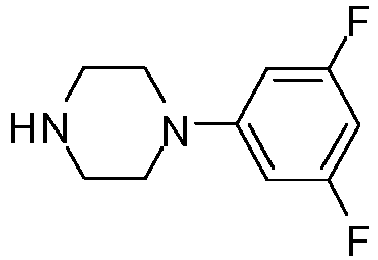
1-(3,5-difluorophenyl)pi perazine A2a + A5b Piperazine-1-carboxylic acid tert-butyl ester + 1-Bromo-3,5-difluoro-benzene 198 199 237 
5-methyl-3-[(2S)-2-methylpiperazin-1-yl]-1,2,4-oxadiazole 2.13 + A5a (S)-3-Methyl-piperazine-1-carbo xylic acid tert-butyl ester + BrCN 182 N.A. 238 
3-methyl-5-[(2S)-2-methylpiperazin-1-yl]-1,2,4-oxadiazole 2.30 (S)-3-Methyl-piperazine-1-carbo xylic acid tert-butyl ester + BrCN 182 183 239 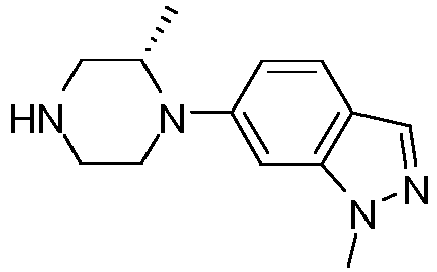
1-methyl-6-[(2S)-2-methylpiperazin-1-yl]indazole A2d + A5c (S)-3-Methyl-piperazine-1-carbo xylic acid tert-butyl ester + 6-Bromo-1-methyl-1H-indazole 230 231 240 
1-(3-fluorophenyl)-2-methyl-piperazine A2a + A5a 3-Methyl-piperazine-1-carbo xylic acid tert-butyl ester + 1-Bromo-3-fluoro-benzene 194 195 241 
1-(3-chlorophenyl)-2-methyl-piperazine A2a + A5a 3-Methyl-piperazine-1-carbo xylic acid tert-butyl ester + 1-Bromo-3-chloro-benzene 211 211-213 242 
1-(3,5-dichloro-2-methylphenyl)piperazine A7 Piperazine + 1-Bromo-3,5-dichloro-2-methyl-benzene 245 245-247 243 
(2S,6R)-1-(3,5-dichlorophenyl)-2,6-dimethyl-piperazine A1 + A2a + A5a cis-2,6-Dimethyl-piperazine + 3,5-dichloro bromobenzene 259 259-261 244 
(2S)-1-(3-bromophenyl)-2-methyl-piperazine A2a + A5a (S)-3-Methyl-piperazine-1-carboxylic acid tert-butyl ester + 1,3-Dibromo-benzene 255 255-257 245 
(2S,6S)-1-(3,5-dichlorophenyl)-2,6-dimethyl-piperazine A2a + A5a (3S,5S)-3,5-Dimethyl-piperazine-1-carboxylic acid tert-butyl ester + 1-Bromo-3,5-dichloro-benzene 259 259-261 246 
1-(benzofuran-5-yl)piperazine A2e + A5a Piperazine-1-carboxylic acid tert-butyl ester + 5-Bromo-benzofuran 202 N.A. 247 
5-piperazin-1-yl-1,3-benzothiazole A2e + A5a Piperazine-1-carboxylic acid tert-butyl ester + 5-Bromo-benzothiazole 219 N.A. 248 
5-[(2S)-2-methylpiperazin-1-yl]pyrimidine A2a + A5b (S)-3-Methyl-piperazine-1-carboxylic acid tert-butyl ester + 5-Bromo-pyrimidine 178 N.A. 249 
(2S)-1-(benzofuran-7-yl)-2-methyl-piperazine A2f + A5a (S)-3-Methyl-piperazine-1-carboxylic acid tert-butyl ester + 7-Bromo-benzofuran 216 217 250 
3-[(2S)-2-methylpiperazin-1-yl]quinoline A2f + A5a (S)-3-Methyl-piperazine-1-carboxylic acid tert-butyl ester + 3-Bromo-quinoline 227 228 251 
1-methyl-5-[(2S)-2-methylpiperazin-1-yl]indole A2b + A5a (S)-3-Methyl-piperazine-1-carboxylic acid tert-butyl ester + 5-Bromo-1-methyl-1H-indole 229 230 252 
1-methyl-6-[(2S)-2-methylpiperazin-1-yl]indole A2d + A5b (S)-3-Methyl-piperazine-1-carboxylic acid tert-butyl ester + 6-Bromo-1-methyl-1H-indole 229 230 253 
6-[(2S)-2-methylpiperazin-1-yl]-1,3-benzothiazole A2d + A5a (S)-3-Methyl-piperazine-1-carboxylic acid tert-butyl ester + 6-Bromo-benzothiazole 233 234 254 
1-methyl-4-[(2S)-2-methylpiperazin-1-yl]indole A2d + A5c (S)-3-Methyl-piperazine-1-carboxylic acid tert-butyl ester + 4-Bromo-1-methyl-1H-indole 229 230 255 
3-fluoro-5-[(2S)-2-methylpiperazin-1-yl]benzonitrile A2e + A5a (S)-3-Methyl-piperazine-1-carboxylic acid tert-butyl ester + 3-Bromo-5-fluoro-benzonitrile 219 220 256 
(2S)-2-methyl-1-(1-methylpyrazol-3-yl)piperazine A2g + A5a (S)-3-Methyl-piperazine-1-carboxylic acid tert-butyl ester + 3-Bromo-1-methyl-1H-pyrazole 180 181 257 
5-[(2S)-2-methylpiperazin-1-yl]-1H-indole A6 5-Bromo-1H-indole 215 216 258 
5-[(2S)-2-methylpiperazin-1-yl]-1 H-indazole A6 5-Bromo-1H-indazole 216 N.A. 259 
1-methyl-5-[(2S)-2-methylpipera zin-1-yl] indazole A2d + A5c (S)-3-Methyl-piperazine-1-carbo xylic acid tert-butyl ester + 5-Bromo-1-methyl-1H-indazole 230 231 260 
4-chloro-6-[(2S)-2-methylpiperazin-1-yl] pyrimidine A4 + A5a (S)-3-Methyl-piperazine-1-carbo xylic acid tert-butyl ester + 4,6-Dichloro-pyrimidine 213 213 261 
(2S)-1-(4,6-dichloro-2-pyridyl)-2-methyl-piperazine A4 + A5a (S)-3-Methyl-piperazine-1-carbo xylic acid tert-butyl ester + 2,4,6-Trichloro-pyridine 246 246 262 
(2S)-1-(2,6-dichloro-4-pyridyl)-2-methyl-piperazine A4 + A5a (S)-3-Methyl-piperazine-1-carbo xylic acid tert-butyl ester + 2,4,6-Trichloro-pyridine 246 246 263 
3-chloro-5-[(2S)-2-methylpiperazin-1-yl] pyridazine A4 + A5a (S)-3-Methyl-piperazine-1-carboxylic acid tert-butyl ester + 3,5-Dichloro-pyridazine 213 213 264 
2-chloro-4-[(2S)-2-methylpiperazin-1-yl] pyrimidine A4 + A5a (S)-3-Methyl-piperazine-1-carbo xylic acid tert-butyl ester + 2,4-Dichloro-pyrimidine 213 213 265 
N,N-dimethyl-2-piperazin-1-yl-aniline A7 piperazine + (2-Bromo-phenyl)-dimethyl-amine 205 N.A. 266 
1-(3-fluoro-2-methyl-phenyl)piperazine A7 piperazine + 1-Bromo-3-fluoro-2-methyl-benzene 194 195 267 
1-(4-fluoro-2-methyl-phenyl)piperazine A7 piperazine + 1-Bromo-4-fluoro-2-methyl-benzene 194 195 268 
1-(5-fluoro-3-pyridyl)piperazin e A2a + A5a Piperazine-1-carboxylic acid tert-butyl ester + 3-Bromo-5-fluoro-pyridine 181 N.A. 269 
1-(5-chloro-3-pyridyl)piperazin e A8 piperazine + 3-Chloro-5-fluoro-pyridine 198 198-200 270 
1-(5-bromo-3-pyridyl)piperazin e A8 piperazine + 3-Bromo-5-fluoro-pyridine 242 242-244 271 
1-(3-chloro-5-fluoro-phenyl)piperazine A2a + A5a Piperazine-1-carboxylic acid tert-butyl ester + 1-Bromo-3-chloro-5-fluoro-benzene 215 215-217 272 
1-(4-chloro-5-fluoro-2-methyl-phenyl)piperazine A7 Piperazine + 1-Bromo-4-chloro-5-fluoro-2-methyl-benzene 229 229-231 273 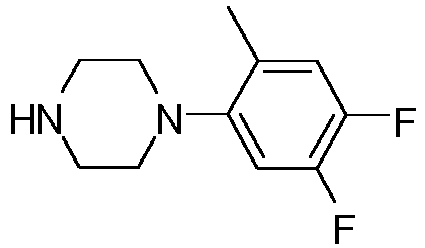
1-(4,5-difluoro-2-methyl-phenyl)piperazine A7 Piperazine + 1-Bromo-4,5-difluoro-2-methyl-benzene 212 213 274 
3-piperazin-1-ylbenzonitrile A8 Piperazine + 3-Fluoro-benzonitrile 187 N.A. 275 
(2S)-1-(4-chloro-5-fluoro-2-methyl-phenyl)-2-methyl-piperazine A2a + A5a (S)-3-Methyl-piperazine-1-carboxylic acid tert-butyl ester + 1-bromo-2-methyl-4-chloro-5-fluoro benzene 243 N.A. 276 
(2R)-1-(3,5-difluorophenyl)-2-methyl-piperazine A2a + A5a (S)-3-Methyl-piperazine-1-carboxylic acid tert-butyl ester + 1-bromo-3,5-difluoro benzene 212 213 277 
(2S)-1-(4-chloro-3,5-difluoro-phenyl)-2-methyl-piperazine A2a + A5b (S)-3-Methyl-piperazine-1-carbo xylic acid tert-butyl ester + 1-bromo-3,5-difluoro-4-chlorobenzene 247 N.A. 278 
1-(4-chloro-3,5-dimethyl-phenyl)piperazine A2a + A5b Piperazine-1-carboxylic acid tert-butyl ester + 5-bromo-2-chloro-1,4-dimethyl benzene 225 225-227 279 
1-(4,5-dichloro-2-methyl-phenyl)piperazine A2a + A5a Piperazine-1-carboxylic acid tert-butyl ester + 3,4-dichloro-6-bromotoluene 245 N.A 280 
(2S)-1-(4-chloro-3,5-dimethyl-phenyl)-2-methyl-piperazine A2a + A5a Piperazine-1-carboxylic acid tert-butyl ester + 5-bromo-2-chloro-1,3-dimethyl benzene 239 239 281 
(2S)-1-(4,5-dichloro-2-methyl-phenyl)-2-methyl-piperazine A2a + A5a (S)-3-Methyl-piperazine-1-carboxylic acid tert-butyl ester + 3,4-dichloro-6-bromotoluene 259 N.A. 282 
1-(4-chloro-2-fluoro-5-methyl-phenyl) piperazine A2a + A5a Piperazine-1-carbo xylic acid tert-butyl ester + 1-Bromo-4-chloro-2-fluoro-5-methylbenzene 229 N.A. 283 
1-(3-chloro-5-fluoro-2-methyl-phenyl)piperazine A2a + A5c Piperazine-1-carboxylic acid tert-butyl ester + Int 287 229 N.A. 284 
1-(4-chloro-3-methyl-phenyl)piperazine A2a + A5a Piperazine-1-carboxylic acid tert-butyl ester + 5-bromo-2-chloro toluene 211 211-213 285 
5-bromo-2-chloro-N,N-dimethyl-aniline 2.31 1-bromo-4-chloro-3-fluoro-benzene 235 234-236 286 
N-(5-bromo-2-chloro-phenyl)-N-methyl-acetamide 2.32 3-bromo-6-chloroaniline 263 262 - 264 287 
1-bromo-3-chloro-5-fluoro-2-methyl-benzene 2.33 2-chloro-4-fluorotoluene 223 N.A. 288 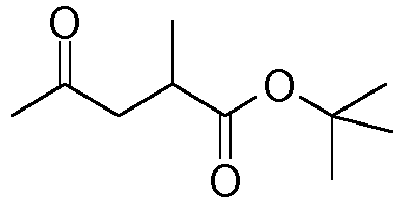
2-Methyl-4-oxo-pentanoic acid tert-butyl ester C1 step ii + step iii 3-Oxo-butyric acid benzyl ester 186 N.A. 289 
2-Methyl-3-(4-methyl-2,5-dioxo-imida zolidin-4-yl)-propionic acid tert-butyl ester F Int 288 256 N.A. trans 290 
4-Cyclo propyl-4-oxo-butyric acid tert-butyl ester 2.34 1-cyclopropylethan one 198 N.A. 291 
1-[4-(3,5-dichlorophenyl)pi perazin-1-yl]-4-(2-pyridyl)butane-1,4-dione H3 4-oxo-4-pyridin-2ylbutyric acid + 1-(3,5-dichlorophenyl)pi perazine 392 392-394 292 
1-[4-(3,5-dichlorophenyl)pi perazin-1-yl]-2-methyl-pentane-1,4-dione D2b Int 001 + acetaldehyde 343 343-345 293 
5-benzyloxy-1-[4-(3,5-dichlorophenyl)pi perazin-1-yl]-2-methyl-pentane-1,4-dione D2b Int 001 + Benzyloxyacetald ehyde 449 449-451 294 
2-(benzyloxymethyl )-1-[4-(3,5-dichlorophenyl)pi perazin-1-yl]pentane-1,4-dione H2 Int 138 + 1-(3,5-dichlorophenyl)pi perazine 449 449-451 295 
1-[4-(3,5-dichlorophenyl)pi perazin-1-yl]-2-(methoxymethyl) pentane-1,4-dione E Int 121 + Bromo-methoxy-methane 373 373-375 296 
1-[4-(3,5-dichlorophenyl)pi perazin-1-yl]-2-isopropyl-pentane-1,4-dione E Int 121 + 2-Chloro-propane 371 371-373 297 
1-[4-(3,5-dichlorophenyl)pi perazin-1-yl]-2-methoxy-4-methyl-pent-4-en-1-one H3 Int 154 + 1-(3,5-dichlorophenyl)pi perazine 357 357-359 298 
1-[4-(3,5-dichlorophenyl)pi perazin-1-yl]-2-methoxy-pentane-1,4-dione D4 Int 297 359 359-361 299 
5-[2-(benzyloxymethyl )-3-[(3S)-4-(3-chloro-4-fluoro-phenyl)-3-methyl-piperazin-1-yl]-3-oxo-propyl]-5-methyl-imidazolidine-2,4-dione H2 Int 135 + Int 198 517 N.A. trans 300 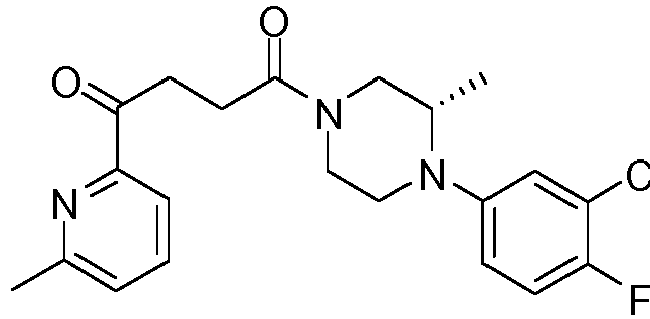
1-[(3S)-4-(3-chloro-4-fluoro-phenyl)-3-methyl-piperazin-1-yl]-4-(6-methyl-2-pyridyl)butane-1,4-dione D2a Int 006 + 6-Methyl-pyridine-2-carbaldehyde 404 404-406 301 
1-[(3S)-4-(3-chloro-4-fluoro-phenyl)-3-methyl-piperazin-1-yl]pentane-1,4-dione H2 levulinic acid + Int 198 327 302 
1-[(3S)-4-(3-chloro-4-fluoro-phenyl)-3-methyl-piperazin-1-yl]-2-(methoxymethyl) pentane-1,4-dione E Int 301 + Bromo-methoxy-methane 371 371-373 303 
1-[(3S)-4-(3-chloro-4-fluoro-phenyl)-3-methyl-piperazin-1-yl]-2-methoxy-4-methyl-pent-4-en-1-one H3 Int 154 + Int 198 355 355-357 304 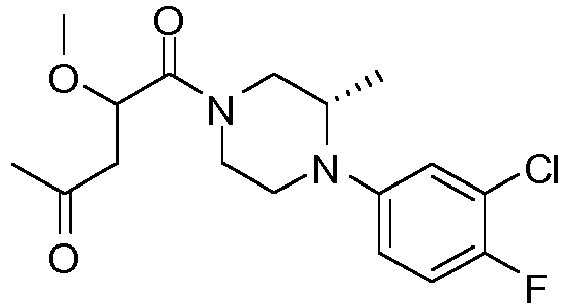
1-[(3S)-4-(3-chloro-4-fluoro-phenyl)-3-methyl-piperazin-1-yl]-2-methoxy-pentane-1,4-dione D4 Int 303 357 N.A. 305 
1-[(3S)-4-(3-chloro-5-fluoro-phenyl)-3-methyl-piperazin-1-yl]pentane-1,4-dione H2 levulinic acid + Int 206 327 327-329 306 
1-[(3S)-4-(3-chloro-5-fluoro-phenyl)-3-methyl-piperazin-1-yl]-2-(methoxymethyl) pentane-1,4-dione E Int 305 + Bromo-methoxy-methane 371 371-373 307 
1-[(3S)-4-(3-chloro-4-fluoro-phenyl)-3-methyl-piperazin-1-yl]-4-(2-pyridyl)butane-1,4-dione H3 4-oxo-4-pyridin-2ylbutyric acid + Int 198 390 390-392 308 
1-[(3S)-4-(3,5-dichlorophenyl)-3-methyl-piperazin-1-yl]-4-(2-pyridyl)butane-1,4-dione H3 4-oxo-4-pyridin-2ylbutyric acid + Int 197 406 406-408 309 
1-[(3S)-4-(3,5-dichlorophenyl)-3-methyl-piperazin-1-yl]-4-oxazol-4-yl-butane-1,4-dione D2a Int 008 + Oxazole-4-carbaldehyde 396 396-398 310 
(2S)-1-(4-chloro-3-isopropyl-phenyl)-2-methyl-piperazine A2a + A5a (S)-3-Methyl-piperazine-1-carboxylic acid tert-butyl ester + 1-bromo-3-isopropyl-4-chlorobenzene 253 253 311 
(2S)-1-(4-chloro-3-methyl-phenyl)-2-methyl-piperazine A2a + A5b (S)-3-Methyl-piperazine-1-carboxylic acid tert-butyl ester + 5-bromo-2-chloro toluene 225 225-227 312 
(2S)-1-(4-chloro-3-ethyl-phenyl)-2-methyl-piperazine A2a + A5a (S)-3-Methyl-piperazine-1-carboxylic acid tert-butyl ester + 1-bromo-3-ethyl-4-chloro benzene 239 239 313 
tert-butyl 6-[(3S)-4-(4-chloro-3-ethyl-phenyl)-3-methyl-piperazin-1-yl]-3,6-dioxo-hexanoate H2 Int 129 + Int 312 437 437-439 314 
(2S)-1-[4-chloro-3-(trifluoromethyl)p henyl]-2-methyl-piperazine A2a + A5a (S)-3-Methyl-piperazine-1-carboxylic acid tert-butyl ester + 4-bromo-1-chloro-2-trifluoromethyl benzene 279 279 315 
tert-butyl 2-[4-[3-[(3S)-4-(4-chloro-3-ethyl-phenyl)-3-methyl-piperazin-1-yl]-3-oxo-propyl]-2,5-dioxo-imidazolidin-4-yl]acetate F Int 313 507 507-509 316 
(2S)-1-[4-chloro-3-(difluoromethyl)p henyl]-2-methyl-piperazine A2a + A5a (S)-3-Methyl-piperazine-1-carboxylic acid tert-butyl ester + 4-bromo-1-chloro-2-(difluoromethyl)b enzene (CAS 627527-07-5) 261 261-263 317 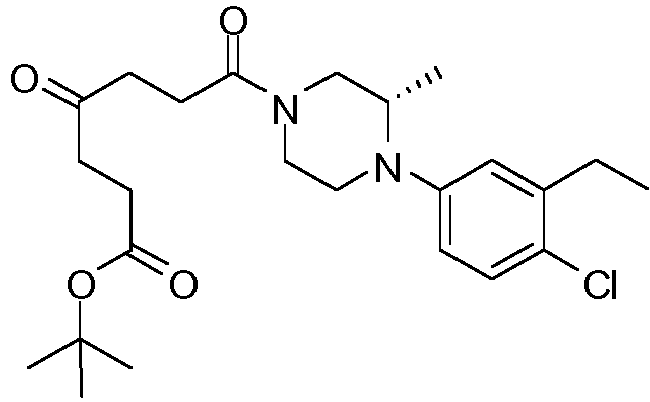
tert-butyl 7-[(3S)-4-(4-chloro-3-ethyl-phenyl)-3-methyl-piperazin-1-yl]-4,7-dioxo-heptanoate 2.36 1,6-dioxaspiro[4.4]no nane-2,7-dione + Int 313 451 451-453 318 
4-bromo-1-chloro-2-(fluoromethyl)ben zene 2.37 5-bromo-2-chloro-benzaldehyde 223 N.A 319 
(2S)-1-[4-chloro-3-(fluoromethyl)phe nyl]-2-methyl-piperazine A2A + A5b (S)-3-Methyl-piperazine-1-carboxylic acid tert-butyl ester + 4-bromo-1-chloro-2-(fluoromethyl)be nzene Int 318 243 243 320 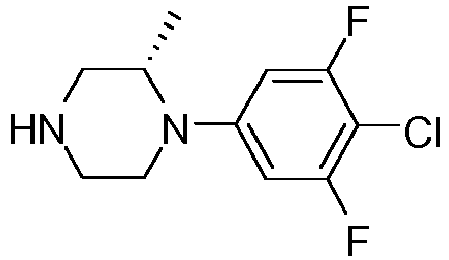
(2S)-1-(4-chloro-3,5-difluorophenyl)-2-methylpiperazine A2A + A5b (S)-3-Methylpiperazine-1-carboxylic acid tert-butyl ester + 1-bromo-3,5-difluoro-4-chlorobenzene 247 N.A. Table III.Illustrative compounds of the invention trans: 
Cpd Structure MW Ms'd Mtd SM 001 
330 331 H5 3-(4-Methyl-2,5-dioxo-imidazolidin-4-yl)propionic acid + 1 -Phenyl-piperazine 002 
365 365 H5 3-(4-Methyl-2,5-dioxo-imidazolidin-4-yl)propionic acid + 1-(4-Chloro-phenyl)-piperazine 003 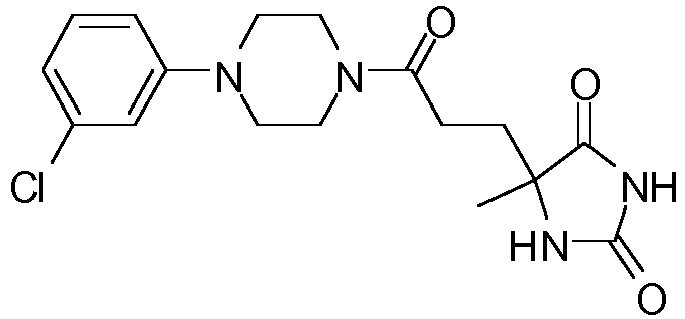
365 365 - 367 H5 3-(4-Methyl-2,5-dioxo-imidazolidin-4-yl)propionic acid + 1-(3-chlorophenyl) piperazine 004 
392 393 H5 3-(2,5-Dioxo-4-phenyl-imidazolidin-4-yl)propionic acid + 1 -Phenyl-piperazine 005 
427 427 - 429 H5 3-(2,5-Dioxo-4-phenyl-imidazolidin-4-yl)propionic acid + 1-(4-Chloro-phenyl)-piperazine 006 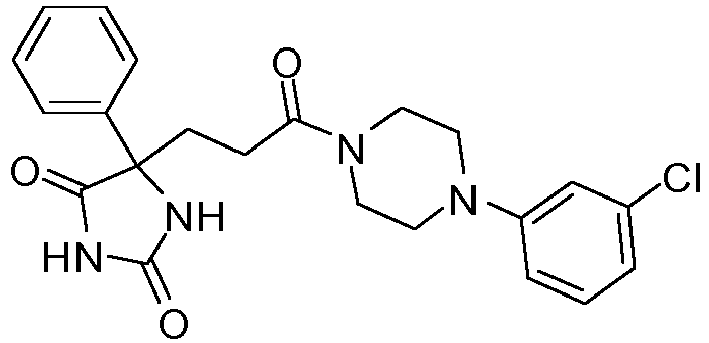
427 427 - 429 H3 3-(2,5-Dioxo-4-phenyl-imidazolidin-4-yl)propionic acid + 1-(3-chlorophenyl) piperazine 007 
406 407 HI 3-(2,5-Dioxo-4-phenyl-imidazolidin-4-yl)propionic acid + 1 -(o-tolyl)piperazine dihydrochloride 008 
421 421 H1 3-(2,5-Dioxo-4-phenyl-imidazolidin-4-yl)propionic acid + 1-(2,3-Dimethylphenyl) piperazine 009 
443 443 H1 3-(2,5-Dioxo-4-phenyl-imidazolidin-4-yl)propionic acid + 1-(2-naphthyl) piperazine dihydrochloride 010 
445 445 H1 3-(2,5-Dioxo-4-phenyl-imidazolidin-4-yl)propionic acid + 1-(4-Chloro-3-fluorophenyl) piperazine 011 
358 359 H1 3-(4-Methyl-2,5-dioxo-imidazolidin-4-yl)propionic acid + 1-(2,3-Dimethyl phenyl)piperazine 012 
344 345 H1 3-(4-Methyl-2,5-dioxo-imidazolidin-4-yl)propionic acid + 1 -(o-tolyl)piperazine dihydrochloride 013 
441 441 - 443 H1 3-(2,5-Dioxo-4-phenyl-imidazolidin-4-yl)propionic acid + 1-(4-chloro-2-methylphenyl)piperazine hydrochloride 014 
444 444 H1 3-(2,5-Dioxo-4-phenyl-imidazolidin-4-yl)propionic acid + 6-(1-piperazinyl)-isoquinoline hydrochloride 015 
444 444 H1 3-(2,5-Dioxo-4-phenyl-imidazolidin-4-yl)propionic acid + 2-piperazin-1-yl-quinoline 016 
379 379 - 381 H1 3-(4-Methyl-2,5-dioxo-imidazolidin-4-yl)propionic acid + 1-(5-chloro-2-methylphenyl) piperazine 017 
379 379 - 381 H2 3-(4-Methyl-2,5-dioxo-imidazolidin-4-yl)propionic acid + 1-(4-chloro-2-methyl phenyl)piperazine hydrochloride 018 
379 379 - 381 H1 3-(4-Methyl-2,5-dioxo-imidazolidin-4-yl)propionic acid + 1-(3-chloro-2-methylphenyl)-piperazine 019 
365 365 H1 3-(4-Methyl-2,5-dioxo-imidazolidin-4-yl)propionic acid + 1-(2-chlorophenyl) piperazine hydrochloride 020 
427 427 H1 3-(2,5-Dioxo-4-phenyl-imidazolidin-4-yl)propionic acid + 1-(2-chlorophenyl) piperazine hydrochloride 021 
441 441 - 443 H1 3-(2,5-Dioxo-4-phenyl-imidazolidin-4-yl)propionic acid + Int 196 022 
421 421 H1 3-(2,5-Dioxo-4-phenyl-imidazolidin-4-yl)propionic acid + 1-(2,6-Dimethyl phenyl)piperazine 023 
451 452 H1 3-(2,5-Dioxo-4-phenyl-imidazolidin-4-yl)propionic acid + 1-(3-methyl-4-nitro phenyl)piperazine 024 
441 441 - 443 H1 3-(2,5-Dioxo-4-phenyl-imidazolidin-4-yl)propionic acid + 1-(5-chloro-2-methyl phenyl)-piperazine 025 
432 433 H1 3-(2,5-Dioxo-4-phenyl-imidazolidin-4-yl)propionic acid + Int 246 026 
450 450 H1 3-(2,5-Dioxo-4-phenyl-imidazolidin-4-yl)propionic acid + Int 247 027 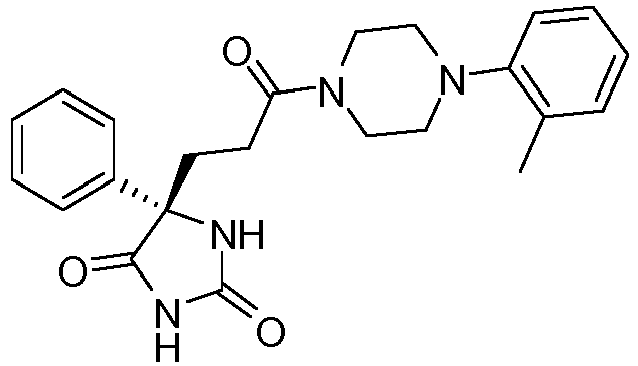
406 407 2.9 Cpd 007 028 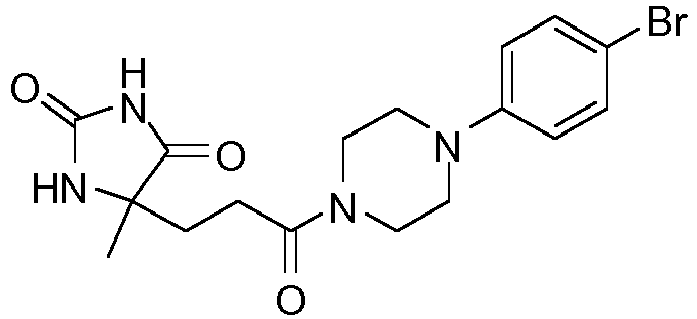
409 409 - 411 H1 3-(4-Methyl-2,5-dioxo-imidazolidin-4-yl)propionic acid + 1 -(4-bromophenyl) piperazine 029 
355 356 H1 3-(4-Methyl-2,5-dioxo-imidazolidin-4-yl)propionic acid + 1-(2-cyanophenyl) piperazine 030 
348 349 H1 3-(4-Methyl-2,5-dioxo-imidazolidin-4-yl)propionic acid + 1-(2-fluorophenyl) piperazine 031 
421 421 H1 3-(2,5-Dioxo-4-phenyl-imidazolidin-4-yl)propionic acid + 1 -(2,4-Dimethylphenyl) piperazine 032 
372 373 F Int 029 033 
407 407 - 409 F Int 030 034 
391 391 - 393 F Int 031 035 
370 371 F Int 032 036 
405 405 - 407 F Int 033 037 
366 367 H1 3-(4-Methyl-2,5-dioxo-imidazolidin-4-yl)propionic acid + 1-(3,4-difluorophenyl) piperazine 038 
358 359 H1 3-(4-Methyl-2,5-dioxo-imidazolidin-4-yl)propionic acid + 1-(2,4-Dimethyl phenyl)piperazine 039 
358 359 H1 3-(4-Methyl-2,5-dioxo-imidazolidin-4-yl)propionic acid + 1-(2,5-Dimethyl phenyl)piperazine 040 
399 399 - 401 H1 3-(4-Methyl-2,5-dioxo-imidazolidin-4-yl)propionic acid + 1-(3,5-dichloro phenyl)piperazine 041 
399 399 - 401 H1 3-(4-Methyl-2,5-dioxo-imidazolidin-4-yl)propionic acid + 1-(2,3-dichloro phenyl)-piperazine 042 
331 332 H1 3-(4-Methyl-2,5-dioxo-imidazolidin-4-yl)propionic acid + 1-(2-pyridyl) piperazine 043 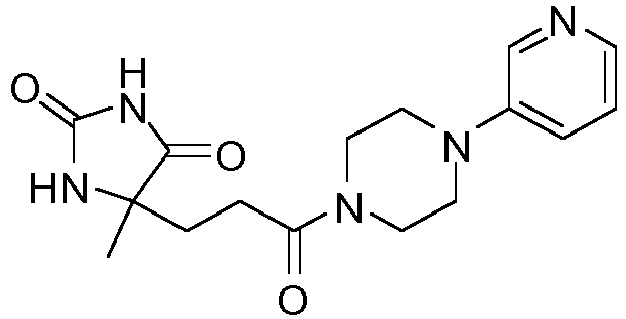
331 332 H1 3-(4-Methyl-2,5-dioxo-imidazolidin-4-yl)propionic acid + 1-Pyridin-3-yl-piperazine 044 
422 422 - 424 F Int 109 045 
393 394 H1 3-(2,5-Dioxo-4-phenyl-imidazolidin-4-yl)propionic acid + 1-Pyridin-3-yl-piperazine 046 
442 442 - 44 F Int 025 047 
348 349 H1 3-(4-Methyl-2,5-dioxo-imidazolidin-4-yl)propionic acid + 1-(3-fluorophenyl) piperazine 048 
409 409 - 411 H1 3-(4-Methyl-2,5-dioxo-imidazolidin-4-yl)propionic acid + 1-(3-bromophenyl) piperazine 049 
383 383 - 385 H1 3-(4-Methyl-2,5-dioxo-imidazolidin-4-yl)propionic acid + 1-(4-Chloro-3-fluorophenyl) piperazine 050 
373 375 H1 3-(4-Methyl-2,5-dioxo-imidazolidin-4-yl)propionic acid + Int 265 051 
362 363 H1 3-(4-Methyl-2,5-dioxo-imidazolidin-4-yl)propionic acid + Int 204 052 
383 383 - 385 H1 3-(4-Methyl-2,5-dioxo-imidazolidin-4-yl)propionic acid + 1-(3-Chloro-4-fluoro phenyl)piperazine dihydrochloride 053 
393 393 - 395 F Int 074 054 
427 427 - 429 F Int 075 055 
425 425 - 427 F Int 045 056 
428 428 - 430 F Int 026 057 
384 385 F Int 082 058 
456 456 - 458 F Int 086 059 
337 338 H3 3-(4-Methyl-2,5-dioxo-imidazolidin-4-yl)propionic acid + 1 -Thiazol-2-yl-piperazine 060 
362 363 H1 3-(4-Methyl-2,5-dioxo-imidazolidin-4-yl)propionic acid + Int 266 061 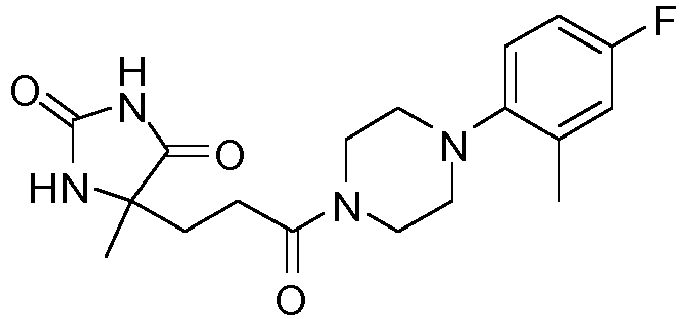
362 363 H1 3-(4-Methyl-2,5-dioxo-imidazolidin-4-yl)propionic acid + Int 267 062 
406 407 H1 3-(2,5-Dioxo-4-phenyl-imidazolidin-4-yl)propionic acid + 2-Methyl-1-phenyl piperazine 063 
344 345 H1 3-(4-Methyl-2,5-dioxo-imidazolidin-4-yl)propionic acid + 2-Methyl-1-phenyl piperazine 064 
407 408 F Int 027 065 
442 442 - 444 F Int 028 066 
348 349 H3 3-(4-Methyl-2,5-dioxo-imidazolidin-4-yl)propionic acid + 1-(4-fluorophenyl) piperazine 067 
399 399 - 401 H3 3-(4-Methyl-2,5-dioxo-imidazolidin-4-yl)propionic acid + 1-(3,4-dichloro phenyl)piperazine hydrochloride 068 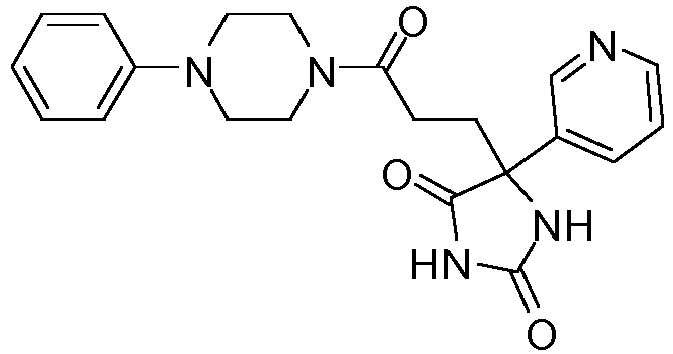
393 394 H1 Int 132 + 1-Phenyl-piperazine 069 
422 422 H1 Int 132 + 1-(2,3-Dimethyl-phenyl)-piperazine 070 
405 405 - 407 F Int 034 071 
419 419 - 421 F Int 035 072 
433 433 - 435 F Int 111 073 
447 393 F Int 080 074 
461 461 - 463 H1 3-[4-(4-Chloro-phenyl)-2,5-dioxo-imidazolidin-4-yl] propionic acid + 1-(3-chlorophenyl) piperazine 075 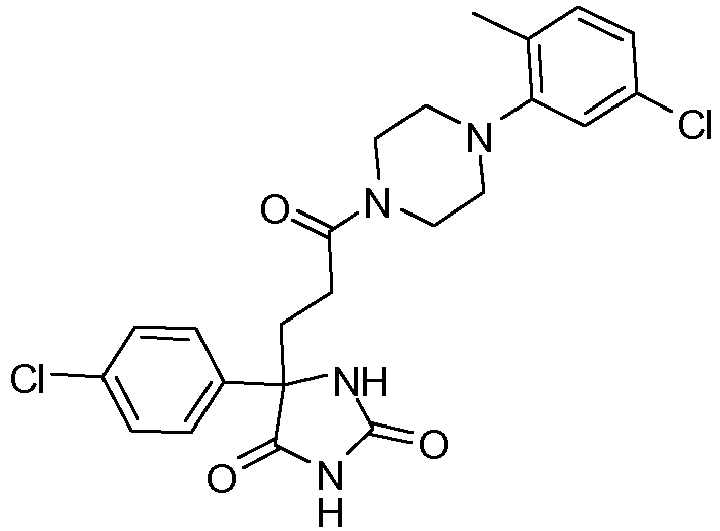
475 475 - 477 H1 3-[4-(4-Chloro-phenyl)-2,5-dioxo-imidazolidin-4-yl]-propionic acid + 1-(5-chloro-2-methylphenyl)-piperazine 076 
441 441 - 443 H1 3-(2,5-Dioxo-4-p-tolyl-imidazolidin-4-yl)propionic acid + 1-(3-chloro phenyl)piperazine 077 
455 455 H1 3-(2,5-Dioxo-4-p-tolyl-imidazolidin-4-yl)-propionic acid + 1-(5-chloro-2-methylphenyl)-piperazine 078 
457 457 HI 3-[4-(4-Methoxy-phenyl)-2,5-dioxo-imidazolidin-4-yl]-propionic acid + 1-(3-chlorophenyl) piperazine 079 
471 471 - 473 HI 3-[4-(4-Methoxy-phenyl)-2,5-dioxo-imidazolidin-4-yl]-propionic acid + 1-(5-chloro-2-methylphenyl)-piperazine 080 
514 514 F Int 088 081 
494 494 F Int 089 082 
464 464 F Int 087 083 
484 484 F Int 090 084 
349 350 H3 3-(4-Methyl-2,5-dioxo-imidazolidin-4-yl)propionic acid + Int 268 085 
366 366 - 368 H3 3-(4-Methyl-2,5-dioxo-imidazolidin-4-yl)propionic acid + Int 269 086 
410 410 - 412 H3 3-(4-Methyl-2,5-dioxo-imidazolidin-4-yl)propionic acid + Int 270 087 
422 422 F Int 076 088 
422 422 H3 Int 132 + 1-(2,5-Dimethylphenyl) piperazine 089 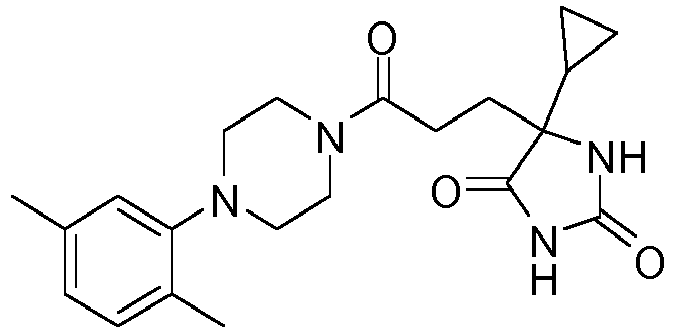
384 386 F Int 077 090 
429 430 H1 Int 132 + 1-(3,4-difluoro phenyl)piperazine 091 
446 446 - 448 H1 Int 132 + 1-(3-Chloro-4-fluorophenyl)piperazine dihydrochloride 092 
425 426 H1 Int 132 + Int 204 093 
397 397 H1 3-(4-Methyl-2,5-dioxo-imidazolidin-4-yl)propionic acid + Int 272 094 
380 381 H1 3-(4-Methyl-2,5-dioxo-imidazolidin-4-yl)propionic acid + Int 273 095 
429 430 F Int 083 096 
446 446 - 448 F Int 084 097 
425 426 H3 Int 132 + 1-(3-fluoro-2-methylphenyl)-piperazine 098 
405 405 - 407 F Int 036 099 
388 389 F Int 037 100 
425 426 F Int 038 101 
422 422 F Int 039 102 
442 442 - 444 H3 Int 132 + 1-(3-chloro-2-methylphenyl)-piperazine 103 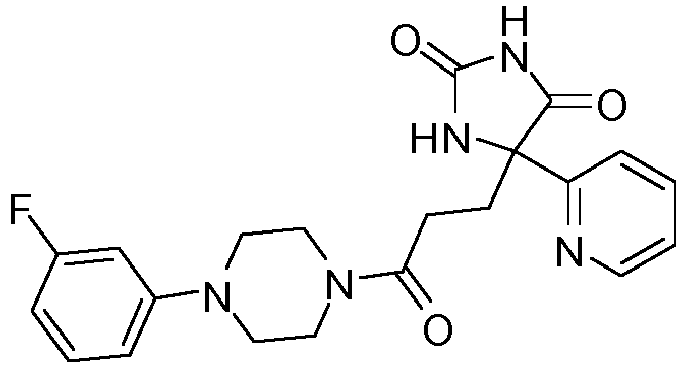
411 412 F Int 112 104 
425 426 F Int 113 105 
407 408 H3 Int 132 + 2-methyl-1-phenyl piperazine 106 
370 371 H1 Int 162 + 2-methyl-1-phenylpiperazine 107 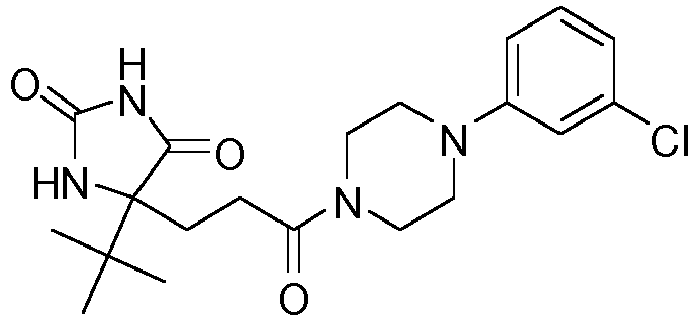
407 407 F Int 091 108 
421 421 F Int 092 109 
419 419 F Int 093 110 
433 433 F Int 094 111 
462 462 - 464 H1 Int 132 + 1-(3,5-dichloro phenyl)piperazine 112 
411 412 H1 Int 132 + 1-(3-fluoro phenyl)piperazine 113 
392 393 H1 Int 162 + 1-(3,4-difluoro phenyl)piperazine 114 
409 409 - 411 H1 Int 162 + 1-(3-Chloro-4-fluorophenyl) piperazine dihydrochloride 115 
374 375 H1 Int 162 + 1-(3-fluorophenyl) piperazine 116 
388 389 H1 Int 162 + Int 204 117 
383 383 - 385 H3 3-(4-Methyl-2,5-dioxo-imidazolidin-4-yl)propionic acid + Int 271 118 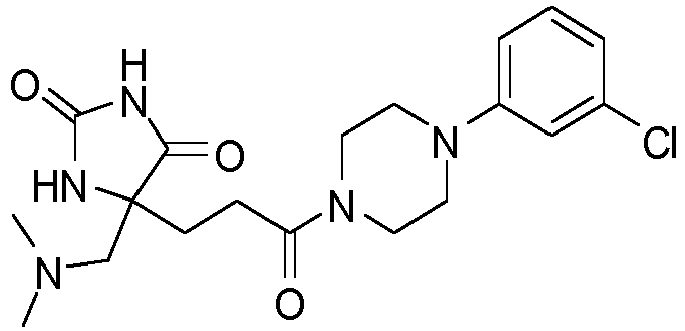
408 408 F Int 013 119 
387 388 F Int 015 120 
422 422 - 424 F Int 014 121 
405 405 - 407 F Int 040 trans 122 
379 379 - 381 F Int 041 123 
457 457 - 459 F Int 042 124 
505 505 - 507 F Int 043 125 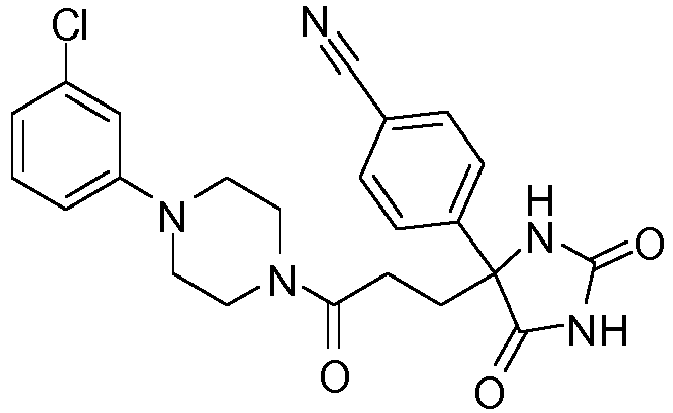
452 452 - 454 F Int 044 126 
442 442 - 444 H1 Int 132 + Int 220 127 
476 476 - 478 H1 Int 132 + Int 218 128 
370 371 H1 Int 162 + Int 219 129 
402 403 H1 Int 162 + Int 217 130 
439 439 - 441 H1 Int 162 + Int 218 131 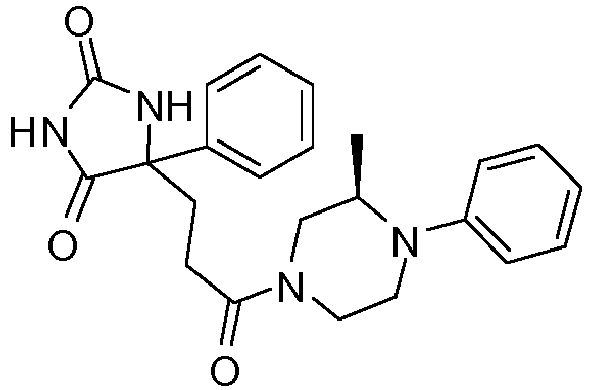
406 407 H1 3-(2,5-Dioxo-4-phenylimidazolidin-4-yl)propanoic acid + Int 219 132 
491 491 - 493 H1 3-[4-(5-Chloro-2-methoxy-phenyl)-2,5-dioxo-imidazolidin-4-yl]-propionic acid + 1-(3-chlorophenyl)piperazine 133 
505 505 - 507 H1 3-[4-(5-Chloro-2-methoxy-phenyl)-2,5-dioxo-imidazolidin-4-yl]-propionic acid + 1-(5-chloro-2-methylphenyl)-piperazine 134 
407 408 H1 Int 132 + Int 219 135 
370 371 H1 Int 162 + Int 212 136 
407 408 H1 Int 132 + Int 212 137 
406 407 H1 3-(2,5-Dioxo-4-phenyl-imidazolidin-4-yl)propionic acid + Int 212 138 
356 357 H1 Int 162 + 1-Phenyl-piperazine 139 
413 413 - 415 H1 3-(4-Methyl-2,5-dioxo-imidazolidin-4-yl)propionic acid + Int 242 140 
366 367 H1 3-(4-Methyl-2,5-dioxo-imidazolidin-4-yl)propionic acid + Int 236 141 
441 441 F Int 095 142 
439 439 - 441 H1 Int 162 + Int 197 143 
379 379 - 381 H1 3-(4-Methyl-2,5-dioxo-imidazolidin-4-yl)propionic acid + Int 205 144 
413 413 - 415 H1 3-(4-Methyl-2,5-dioxo-imidazolidin-4-yl)propionic acid + Int 197 145 
376 377 H1 3-(4-Methyl-2,5-dioxo-imidazolidin-4-yl)propionic acid + Int 208 146 
457 457 - 459 F Int 078 147 
405 405 - 407 H1 Int 162 + Int 205 148 
402 403 H1 Int 162 + Int 208 149 
388 389 H1 Int 162 + Int 240 150 
405 405 - 407 H1 Int 162 + Int 241 151 
388 389 H1 Int 162 + Int 202 152 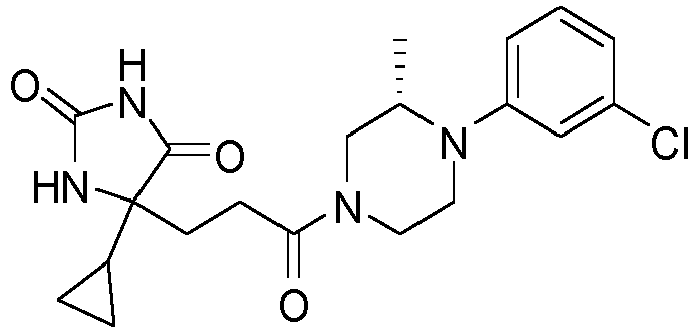
405 405 - 407 H1 Int 162 + Int 200 153 
482 482 H1 3-[2,5-Dioxo-4-(2-oxo-2,3-dihydro-1H-indol-5-yl)-imidazolidin-4-yl]-propionic acid + 1-(3-chlorophenyl)piperazine 154 
452 452 F Int 016 155 
450 450 F Int 017 156 
380 381 H1 3-(4-Methyl-2,5-dioxo-imidazolidin-4-yl)propionic acid + Int 207 157 
362 363 H1 3-(4-Methyl-2,5-dioxo-imidazolidin-4-yl)propionic acid + Int 202 158 
379 379 - 381 H1 3-(4-Methyl-2,5-dioxo-imidazolidin-4-yl)propionic acid + Int 200 159 
399 399 401 H1 Int 172 + 1-(3,5-dichlorophenyl)piperazine 160 
406 407 H1 Int 162 + Int 207 161 
406 407 H1 Int 162 + Int 199 162 
423 423 - 425 H1 Int 162 + Int 213 163 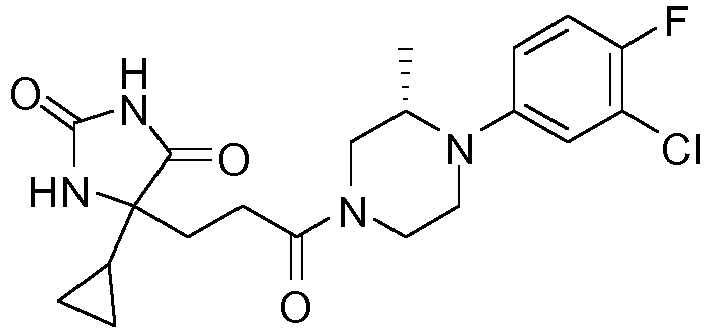
423 423 - 425 H1 Int 162 + Int 198 164 
397 397 H1 3-(4-Methyl-2,5-dioxo-imidazolidin-4-yl) propionic acid + Int 213 165 
380 381 H1 3-(4-Methyl-2,5-dioxo-imidazolidin-4-yl) propionic acid + Int 199 166 
397 397 H1 3-(4-Methyl-2,5-dioxo-imidazolidin-4-yl) propionic acid + Int 198 167 
439 439 - 441 H1 Int 162 + Int 201 168 
413 413 - 415 H1 3-(4-Methyl-2,5-dioxo-imidazolidin-4-yl) propionic acid + Int 201 169 
423 423 - 425 H1 Int 162 + Int 206 170 
397 397 - 399 H1 3-(4-Methyl-2,5-dioxo-imidazolidin-4-yl)-propionic acid + Int 206 171 
380 380 I2 Int 018 172 
439 439 - 441 F Int 046 173 
425 425 - 427 H1 Int 163 + 1-(3,5-dichlorophenyl) piperazine 174 
402 403 - 404 F Int 047 trans 175 
376 377 F Int 048 trans 176 
419 419 - 421 F Int 101 trans 177 
453 453 - 455 H1 Int 162 + Int 211 178 
427 427 - 429 H1 3-(4-Methyl-2,5-dioxo-imidazolidin-4-yl)propionic acid + Int 211 179 
393 393 - 395 F Int 102 trans 180 
414 414 - 416 I2 Int 019 181 
504 504 - 506 I3 Cpd 180 182 
457 457 - 459 2.1 Cpd 188 183 
443 443 - 445 2.1 Cpd 188 184 
470 470 I3 Cpd 171 185 
385 386 H1 Int 162 + N-methyl-2-piperazin-1-ylaniline 186 
429 429 - 431 F Int 020 187 
500 500 - 502 H1 Cpd 183 + 2-Methoxy-ethylamine 188 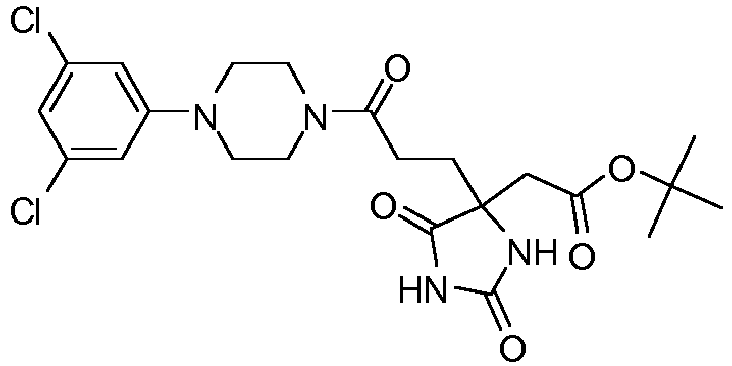
499 499 501 2.2 succininc anhydride + 1-(3,5-dichloro phenyl)piperazine 189 
486 486 - 488 2.3 Cpd 182 + 2-Amino-ethanol 190 
402 403 F Int 049 trans 191 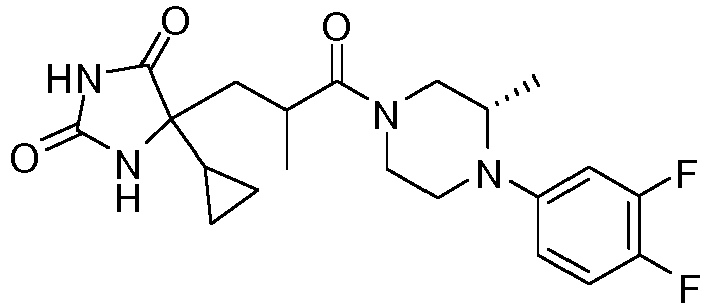
420 421 H2 Int 164 + Int 199 trans 192 
437 437 - 439 F Int 050 trans 193 
419 419 - 421 F Int 051 trans 194 
437 437 - 439 F Int 052 trans 195 
381 382 H1 Int 162 + Int 274 196 
454 454 - 456 I2 Int 096 trans 197 
473 473 - 475 F Int 098 trans 198 
597 596 - 598 F Int 099 trans 199 
483 483 - 485 F Int 097 trans 200 
399 399 - 401 F Int 055 201 
441 441 - 443 F Int 053 202 
411 411 H2 3-(4-Methyl-2,5-dioxo-imidazolidin-4-yl)propionic acid + Int 275 203 
388 389 H2 Int 163 + Int 202 204 
439 439 - 441 H3 Int 163 + Int 197 205 
406 407 H2 Int 163 + Int 199 206 
455 455 - 457 F Int 056 207 
439 439 - 441 H2 Int 163 + (S)-1-(3,4-Dichloro-phenyl)-2-methyl-piperazine 208 
496 796 - 798 I2 Cpd 198 trans 209 
399 400 H1 Int 162 + N,N-dimethyl-3-piperazine-1-yl aniline trihydrochloride 210 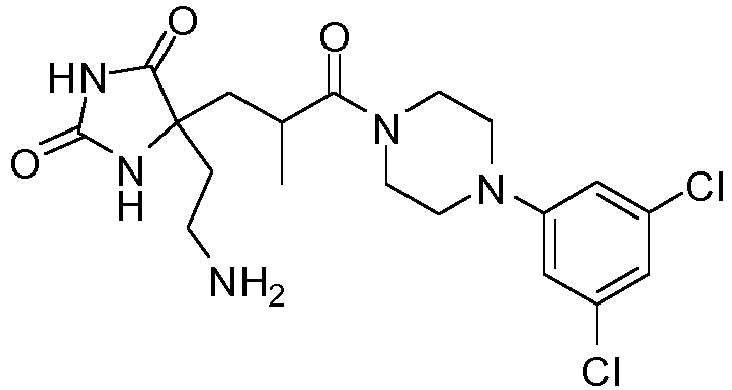
442 442 - 444 I2 Int 100 trans 211 
380 381 H2 Int 165 + 1-(3,4-difluoro phenyl)piperazine trans 212 
420 421 2.10 Cpd 191 213 
394 395 H2 Int 165 + Int 207 trans 214 
393 393 - 395 H2 Int 165 + Int 200 trans 215 
376 377 H2 Int 165 + Int 202 trans 216 
390 391 H2 Int 165 + Int 208 trans 217 
358 359 H2 Int 165 + Int 212 trans 218 
505 505 - 507 2.4 Cpd 197 trans 219 
399 399 - 401 H2 Int 151 + 1-(3,5-dichloro phenyl)piperazine trans 220 
429 429 - 431 H2 + F + I4 Int 138 + 1-(3,5-dichloro phenyl)piperazine trans 221 
501 501 - 503 F Int 063 trans 222 
443 443 - 445 H2 Int 156 + 1-(3,5-dichlorophenyl)piperazine trans 223 
456 456 - 458 I1 Cpd 180 224 
410 411 H2 Int 156 + 1-(3,4-difluoro phenyl)piperazine trans 225 
424 425 H2 Int 156 + Int 207 trans 226 
424 425 H2 Int 156 + Int 199 trans 227 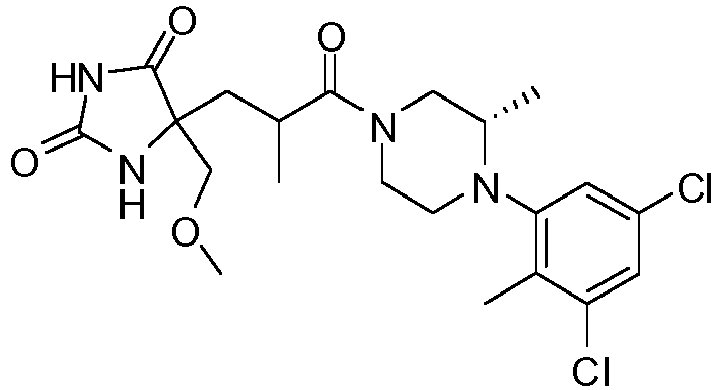
471 471 H2 Int 156 + Int 211 trans 228 
420 421 H2 Int 156 + Int 208 trans 229 
406 407 H2 Int 156 + Int 202 trans 230 
406 407 H2 Int 156 + Int 204 trans 231 
476 476 - 478 H2 Int 159 + 1-(3,5-dichloro phenyl)piperazine trans 232 
437 437 - 439 H2 Int 156 + Int 216 trans 233 
423 423 - 425 H2 Int 156 + Int 200 trans 234 
522 522 F Int 067 trans 235 
510 510 F Int 069 trans 236 
427 427 - 429 F Int 061 trans 237 
407 407 - 409 H2 Int 165 + Int 216 trans 238 
507 507 - 509 F Int 064 trans 239 
536 536 F Int 068 trans 240 
421 422 I2 Cpd 234 trans 241 
409 410 I2 Cpd 235 trans 242 
498 498 - 500 H2 Int 186 + 1-(3,5-dichloro phenyl)piperazine trans 243 
441 441 H2 Int 165 + Int 243 trans 244 
471 471 H2 Int 156 + Int 243 trans 245 
474 474 H2 Int 159 + Int 198 trans 246 
512 512 - 514 H2 Int 186 + Int 197 trans 247 
435 436 I2 Cpd 239 trans 248 
463 464 I1 Cpd 240 trans 249 
478 478 I1 Cpd 247 trans 250 
413 412 - 414 - 416 H2 3-(4-Methyl-2,5-dioxo-imidazolidin-4-yl)propionic acid + Int 279 251 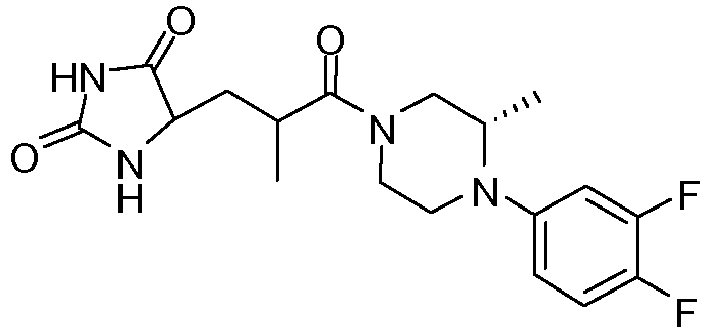
380 381 H2 Int 151 + Int 199 trans 252 
518 518 - 520 H2 Int 145 + 1-(3,5-dichloro phenyl)piperazine trans 253 
516 516 - 518 H2 Int 145 + Int 198 trans 254 
438 438 - 440 F Int 065 trans 255 
406 407 2.5 Int 163 + Int 207 256 
407 407 - 409 H2 Int 162 + Int 260 257 
440 440 - 442 H2 Int 162 + Int 261 258 
440 440 - 442 H2 Int 162 + Int 262 259 
371 372 H2 Int 162 + Int 221 260 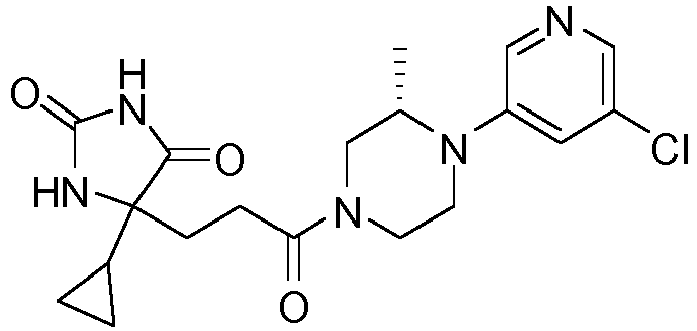
406 406 - 408 H2 Int 162 + Int 215 261 
389 390 H2 Int 162 + Int 214 262 
427 426 428 - 430 H2 3-(4-Methyl-2,5-dioxo-imidazolidin-4-yl)propionic acid + Int 281 263 
439 440 H2 Int 159 + Int 202 264 
457 458 H2 Int 159 + Int 199 trans 265 
411 411 - 413 2.11 Cpd 405 266 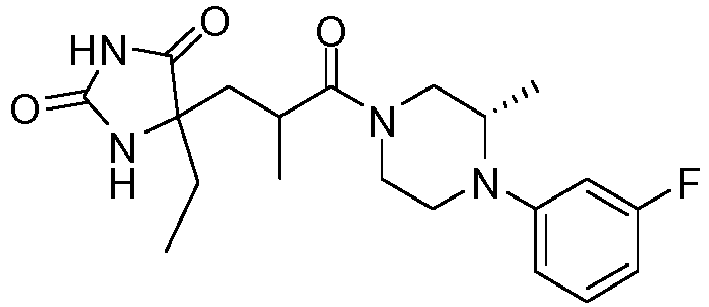
390 391 H2 Int 169 + Int 202 trans 267 
397 397 - 399 H2 3-(4-Methyl-2,5-dioxo-imidazolidin-4-yl)propionic acid + Int 282 268 
392 393 I4 Int 062 trans 269 
456 456 - 458 H2 Int 159 + Int 200 trans 270 
449 449 - 451 H2 Int 162 + Int 244 271 
441 441 H2 Int 165 + Int 245 trans 272 
471 471 H2 Int 156 + Int 245 trans 273 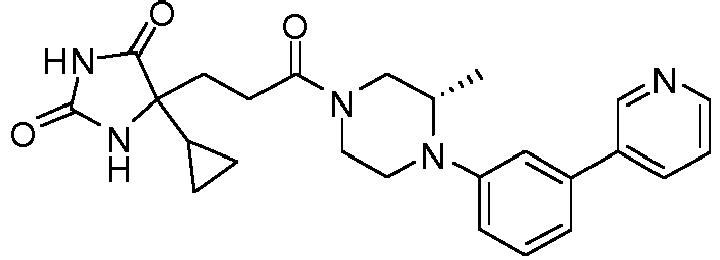
448 449 I6 Cpd 270 + Pyridine-3-boronic acid 274 
409 410 H2 Int 162 + Int 257 275 
359 360 H2 Int 165 + Int 221 trans 276 
394 394 - 936 H2 Int 165 + Int 215 trans 277 
377 378 H2 Int 165 + Int 214 trans 278 
357 358 H2 Int 162 + 1-(4-pyridyl) piperazine 279 
445 445 - 447 H2 Int 156 + Int 203 trans 280 
410 411 H1 Int 162 + Int 249 281 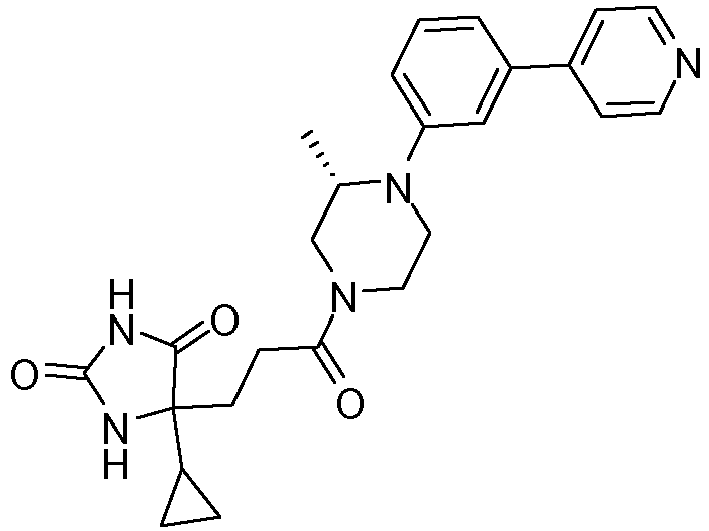
448 449 I6 Cpd 270 + Pyridine-4-boronic acid 282 
437 437 I6 Cpd 270 + Pyrazole-4-boronic acid 283 
451 451 I6 Cpd 270 + 1-Methyl-1 H-pyrazole-4-boronic acid 284 
407 407 - 409 H1 Int 162 + Int 226 285 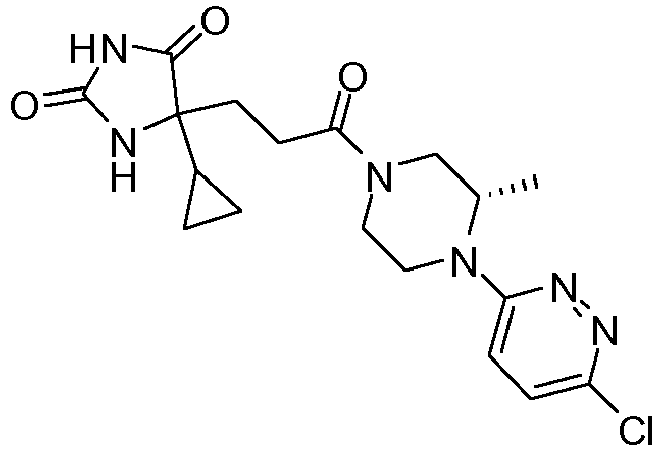
407 407 - 409 H1 Int 162 + Int 227 286 
372 373 H1 Int 162 + Int 228 287 
474 474 - 476 F Int 059 288 
460 460 - 462 F Int 060 289 
422 422 H1 Int 162 + Int 250 290 
424 425 H1 Int 162 + Int 251 291 
424 425 H1 Int 162 + Int 252 292 
406 407 F Int 066 trans 293 
397 397 - 399 H4 3-(4-Methyl-2,5-dioxo-imidazolidin-4-yl)propionic acid + Int 283 294 
392 393 F Int 057 trans 295 
427 427 - 429 F Int 058 trans 296 
410 411 H2 Int 162 + Int 258 297 
425 425 H2 Int 162 + Int 259 298 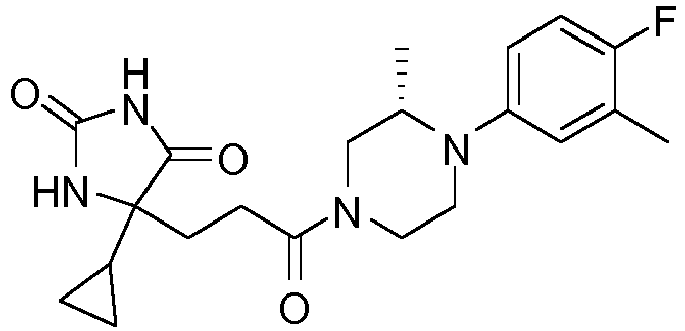
402 403 H2 Int 162 + Int 210 299 
402 403 H2 Int 162 + Int 224 300 
388 389 H2 Int 162 + Int 209 301 
407 407 - 409 H2 Int 162 + Int 264 302 
372 373 2.35 Cpd 285 303 
385 386 H2 Int 162 + Int 222 304 
372 373 H2 Int 162 + Int 248 305 
428 428 H1 Int 162 + Int 253 306 
419 419 - 421 H2 Int 162 + Int 225 307 
474 474 - 476 H1 Int 166 + Int 206 308 
439 440 H1 Int 166 + Int 202 309 
457 458 H1 Int 166 + Int 207 310 
490 490 - 492 H1 Int 166 + Int 197 311 
456 456 - 458 H1 Int 166 + Int 200 312 
456 456 - 458 H1 Int 166 + Int 205 313 
403 404 H2 Int 164 + Int 214 trans 314 
420 420 - 422 H2 Int 164 + Int 215 trans 315 
460 460 - 462 H2 Int 132 + Int 213 316 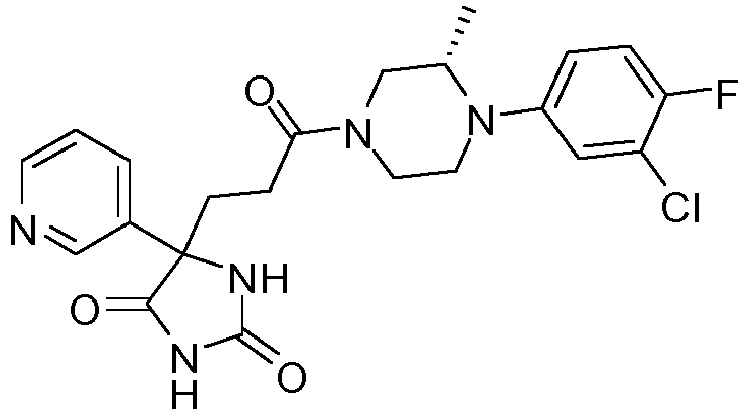
460 460 - 462 H2 Int 132 + Int 198 317 
460 460 - 462 H2 Int 132 + Int 206 318 
476 476 - 478 H2 Int 132 + Int 197 319 
425 426 H2 Int 132 + Int 202 320 
443 444 H2 Int 132 + Int 207 321 
478 479 I6 Cpd 270 + 2-Methoxypyridine-4-boronic acid 322 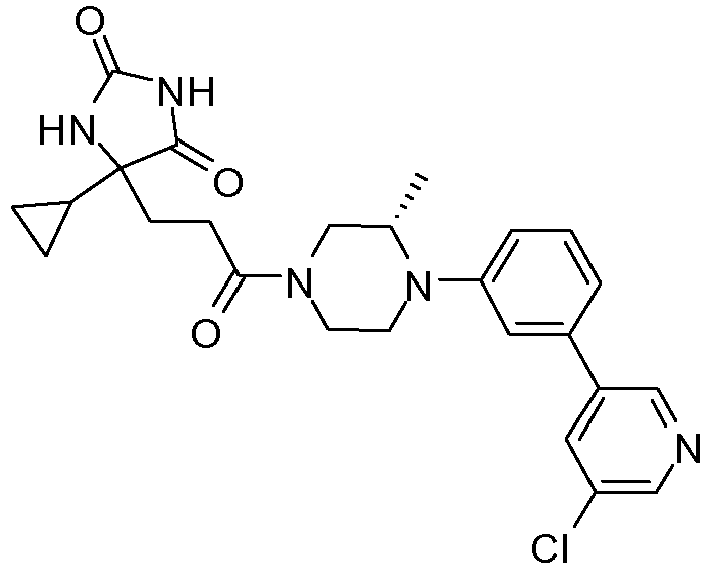
482 482 - 484 I6 Cpd 270 + 5-Chloropyridine-3-boronic acid 323 
462 462 I6 Cpd 270 + 2-Methyl-3-(4,4,5,5-tetramethyl-[1,3,2]dioxaborolan-2-yl)-pyridine 324 
462 462 I6 Cpd 270 + 2-methyl-5-pyridinylboronic acid 325 
406 406 - 408 H2 Int 162 + Int 229 326 
461 461 - 463 H2 Int 142 + Int 206 327 
444 445 H2 Int 142 + Int 207 328 
424 424 H1 Int 162 + Int 254 329 
462 462 I6 Cpd 270 + 2-Methyl-4-(4,4,5,5-tetramethyl-[1,3,2]dioxaborolan-2-yl)-pyridine 330 
396 397 H2 Int 162 + Int 223 331 
441 441 - 443 2.12 Cpd 406 332 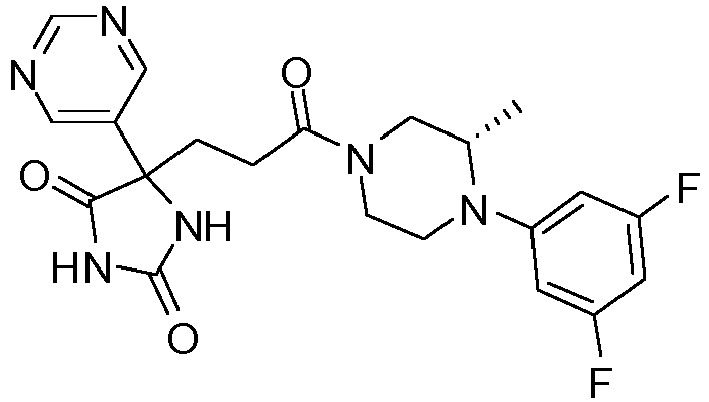
444 445 H2 Int 182 + Int 207 333 
425 425 H2 Int 162 + Int 230 334 
413 414 H1 Int 162 + Int 255 335 
511 512 F Int 072 336 
473 474 F Int 070 337 
425 425 H2 Int 162 + Int 231 338 
455 455 H2 Int 162 + Int 232 339 
451 451 H2 Int 164 + Int 233 trans 340 
455 455 H2 Int 162 + Int 234 341 
425 425 H2 Int 162 + Int 239 342 
399 400 H2 Int 164 + Int 222 trans 343 
402 403 H2 Int 164 + Int 209 trans 344 
376 377 H2 Int 162 + Int 237 345 
425 426 F Int 103 346 
460 460 - 462 F Int 104 347 
476 476 - 478 F Int 105 348 
443 444 F Int 106 349 
461 461 - 463 H2 Int 142 + Int 198 350 
426 427 H2 Int 142 + Int 202 351 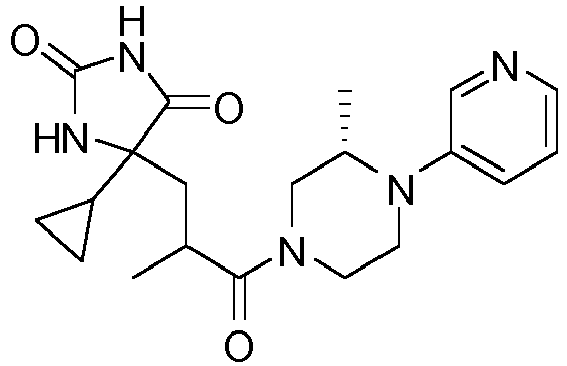
385 386 H2 Int 164 + Int 221 trans 352 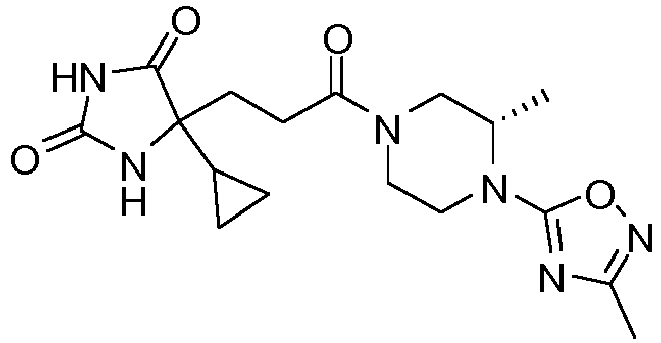
376 377 H2 Int 162 + Int 238 353 
465 466 I6 Cpd 270 + 3,5-dimethylpyrazole-4-boronic acid, pinacol ester 354 
446 447 F Int 012 355 
451 452 I6 Cpd 270 + 3-methyl-1H-pyrazole-4-boronic acid pinacol ester 356 
473 474 F Int 024 357 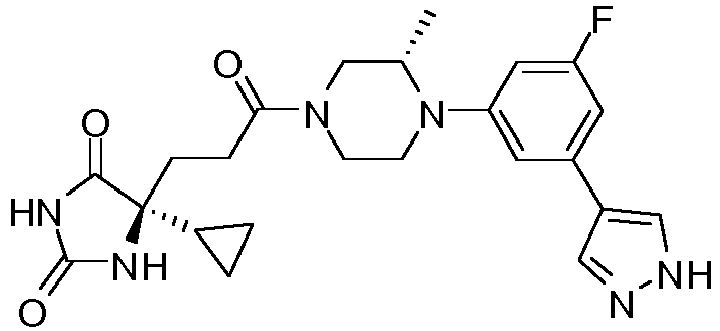
455 455 H2 Int 163 + Int 232 358 
437 438 I6 Cpd 270 + 1H-pyrazole-3-boronic acid 359 
408 408 H2 Int 169 + Int 215 trans 360 
391 392 H2 Int 169 + Int 214 trans 361 
446 447 F Int 108 362 
433 434 F Int 107 363 
424 424 H2 Int 156 + Int 215 trans 364 
407 408 H2 Int 156 + Int 214 trans 365 
376 377 H2 Int 165 + Int 209 trans 366 
406 407 H2 Int 156 + Int 209 trans 367 
457 458 F Int 073 368 
451 451 I6 Cpd 270 + 1-Methyl-5-(4,4,5,5-tetramethyl-[1,3,2]dioxaborolan-2-yl)-1H-pyrazole 369 
466 466 I6 Cpd 270 + 3,5-Dimethyl-4-(4,4,5,5-tetramethyl-[1,3,2]dioxaborolan-2-yl)-isoxazole 370 
479 479 I6 Cpd 270 + 1-Isopropyl-4-(4,4,5,5-tetramethyl-[1,3,2]dioxaborolan-2-yl)-1H-pyrazole 371 
425 425 H2 Int 165 + Int 233 trans 372 
449 449 I5 Cpd 270 + 2-Iodo-pyrazine 373 
407 407 - 409 H2 Int 162 + Int 263 374 
374 375 H1 Int 162 + Int 256 375 
442 443 H4 Int 165 + Int 232 trans 376 
473 473 H4 Int 156 + Int 232 trans 377 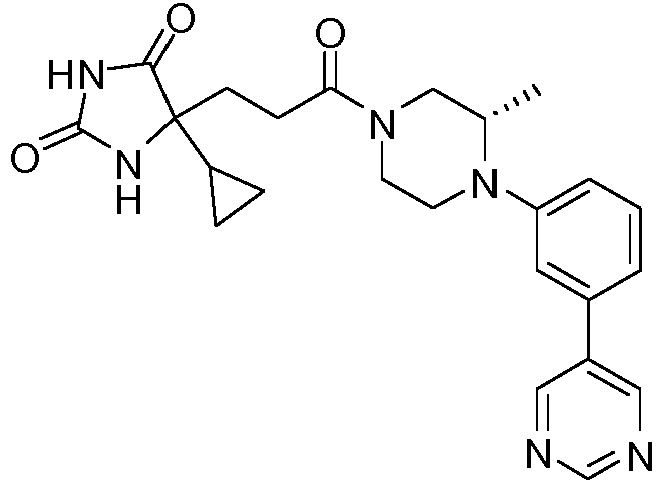
449 449 I5 Cpd 270 + 5-Bromo-pyrimidine 378 
469 469 H4 Int 164 + Int 234 trans 379 
469 469 H4 Int 164 + Int 232 trans 380 
455 455 H4 Int 156 + Int 233 trans 381 
483 483 I5 Cpd 270 + 3-Chloro-6-iodo-pyridazine 382 
444 445 H2 Int 139 + Int 207 383 
474 474 H2 Int 174 + Int 206 384 
490 490 - 492 H2 Int 174 + Int 197 385 
439 440 H2 Int 174 + Int 202 386 
457 458 H2 Int 174 + Int 207 387 
447 448 F Int 079 388 
450 450 - 452 F Int 085 389 
463 463 - 465 H1 Int 179 + Int 206 390 
379 379 - 381 H2 Int 172 + Int 284 391 
422 422 - 424 H2 Int 172 + Int 192 392 
408 408 - 410 H2 Int 172 + Int 193 393 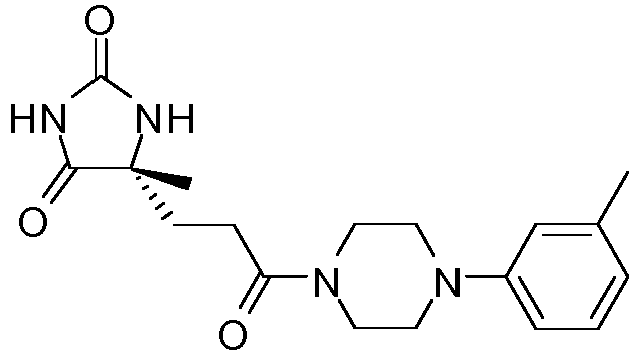
344 345 H2 Int 172 + Int 194 394 
446 447 F Int 022 395 
447 448 F Int 023 396 
461 462 F Int 115 397 
446 447 F Int 114 398 
372 373 H2 Int 172 + Int 195 399 
450 450 2.7 Cpd 247 trans 400 
407 407 - 409 H2 Int 172 + Int 280 401 
393 393 - 395 H2 Int 172 + Int 278 402 
466 466 - 468 2.8 Int 116 403 
406 407 H1 Int 163 + Int 276 404 
429 429 H2 Int 165 + Int 277 405 
410 411 H2 Int 165 + Int 229 trans 406 
441 441 - 443 H2 Int 156 + Int 229 trans 407 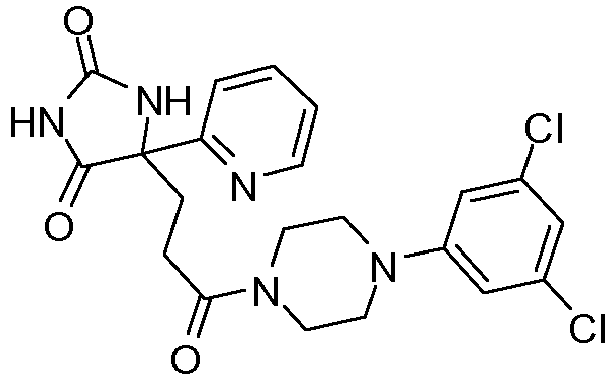
462 462-464 F Int 291 408 
439 439-441 H1 Int 162 + Int 201 409 
439 439.38-441.37 F Int 046 trans 410 
413 413.36-415.36 F Int 292 trans 411 
437 437-439 F Int 050 trans 412 
419 419.45-421.42 F Int 051 trans 413 
437 437-439 F Int052 trans 414 
413 413-415 H1 Int 172 + Int 201 415 
519 519-521 F Int 293 trans 416 
439 439-441 H2 Int 163 + Int 201 417 
429 429-431 I4 Cpd 415 trans 418 
411 411-413 H2 Int 165 + Int 206 trans 419 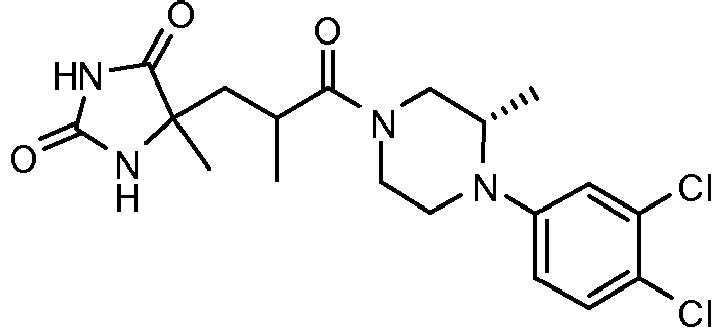
427 427-429 H2 Int 165 + Int 201 trans 420 421 422 
427 427-429 H2 Int 165 + Int 197 trans 
394 395 H2 Int 165 + Int 199 trans 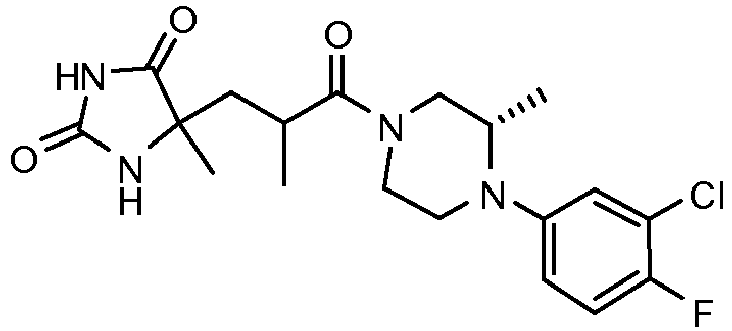
411 411-413 H2 Int 165 + Int 198 trans 423 
441 441-443 H2 Int 165 + Int 211 trans 424 
519 519-521 F Int 294 trans 425 
429 429-431 I4 Cpd 424 trans 426 
501 501-503 F Int 063 trans 427 
443 443-445 H2 Int 156 + 1-(3,5-dichlorophenyl)piperazine trans 428 
410 411 H2 Int 156 + 1-(3,4-difluorophenyl)piperazine trans 429 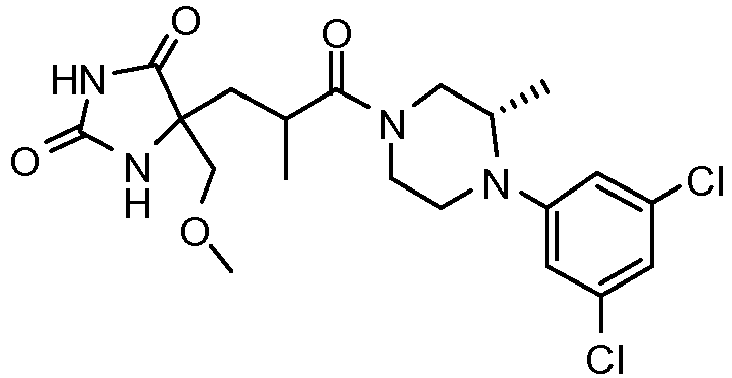
457 457-459 H2 Int 156 + Int 197 trans 430 
471 471 H2 Int 156 + Int 211 trans 431 
441 441-443 H2 Int 156 + Int 206 trans 432 
441 441-443 H2 Int 156 + Int 198 trans 433 
423 423-425 H2 Int 156 + Int 196 trans 434 
476 476-478 H2 Int 159 + 1-(3,5-dichlorophenyl)piperazine trans 435 
427 427-429 F Int 061 trans 436 
443 443-445 F Int 295 trans 437 
474 474 H2 Int 159 + Int 198 trans 438 
441 441-443 F Int 296 439 
429 429-431 F Int 298 trans 440 
413 412-414-416 H2 3-(4-Methyl-2,5-dioxo-imidazolidin-4-yl) propionic acid + Int 279 441 
397 397-399 H2 Int 151 + Int 198 trans 442 
490 490-492 H2 Int 159 + Int 197 trans 443 
427 427-429 I4 Int 299 trans 444 
425 425-427 H2 Int 169 + Int 198 trans 445 
425 425-427 H2 Int 169 + Int 206 trans 446 
456 456-458 H2 Int 159 + Int 200 trans 447 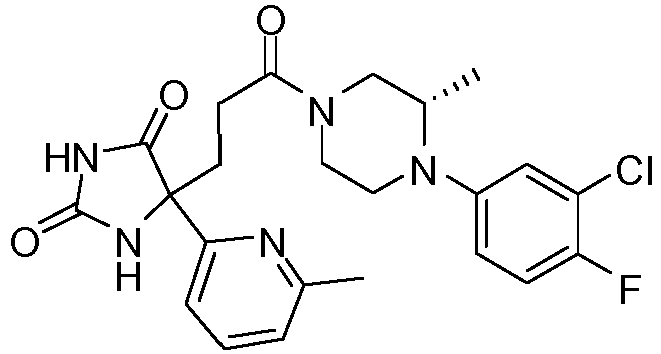
474 474-476 F Int 300 448 
445 445-447 H2 Int 156 + Int 203 trans 449 
441 441-443 F Int 302 trans 450 
427 427-429 F Int 304 trans 451 
441 441-443 F Int 306 trans 452 
490 490-492 H1 Int 166 + Int 201 453 
476 476-478 H2 Int 132 + Int 201 454 
474 474-476 H1 Int 166 + Int 213 455 
441 441-443 2.40 Cpd 432 456 
417 417 H2 Int 164 + Int 210 trans 457 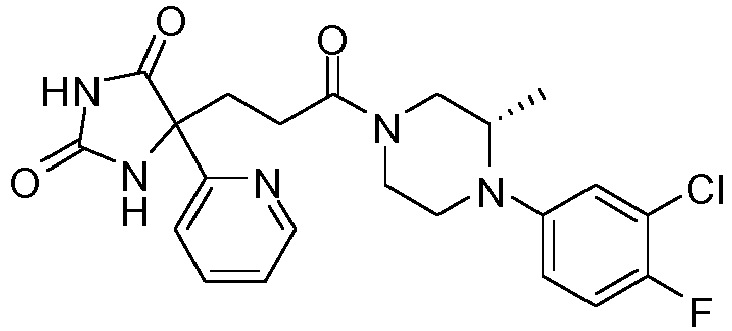
460 460-462 F Int 307 458 
476 476-478 F Int 105 459 
476 476-478 F Int 308 460 
477 477-479 H2 Int 142 + Int 201 461 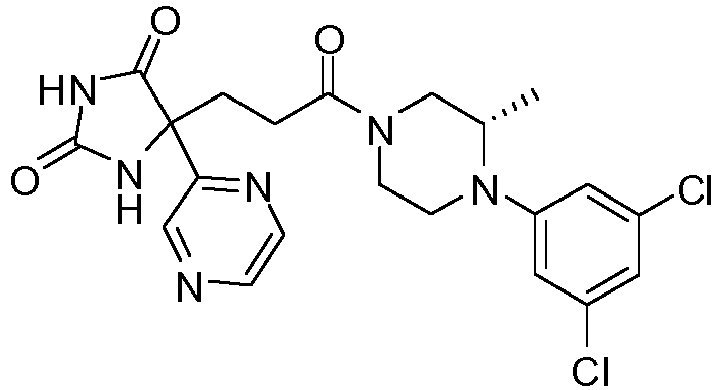
477 477 H2 Int 142 + Int 197 462 
477 477-479 H2 Int 139 + Int 201 463 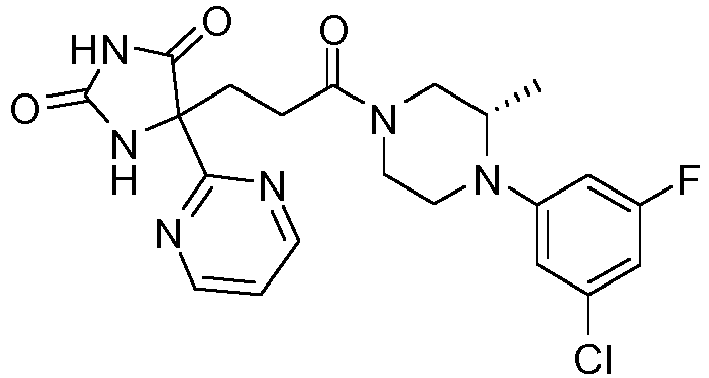
461 461-463 H2 Int 139 + Int 206 464 
490 490-492 H2 Int 174 + Int 201 465 
466 466-468 F Int 309 466 
479 479-481 H1 Int 179 + Int 197 467 
463 463-465 H1 Int 179 + Int 198 468 
421 421-423 H2 Int 172 + Int 310 469 
393 393-395 H2 Int 172 + Int 311 470 
407 407-409 H2 Int 172 + Int 280 471 
451 451-453 2.38 Int 315 472 
447 447-449 H2 Int 172 + Int 314 473 
484 484-486 H2 Int 166 + Int 312 474 
429 429-431 H2 Int 172 + Int 316 475 
521 521-523 F Int 317 476 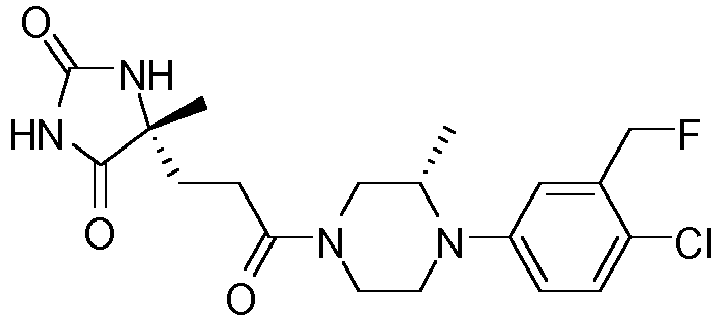
411 411 H2 Int 172 + Int 319 477 
465 465-467 2.39 Cpd 475 478 
491 491 H2 Int 156 + Int 314 trans 479 
429 429 H2 Int 165 + Int 320 trans 480 
459 459 H2 Int 156 + Int 320 trans 481 
451 451 H2 Int 156 + Int 312 trans Table IV.NMR of illustrative compounds of the invention Cpd NMR 003 1H NMR (400 MHz, DMSO-d6) δ ppm 10.61 (1H, s), 7.91 (1H, m), 7.22 (1H, t), 6.97-6.94 (1H, m), 6.90 (1H, dd), 6.80 (1H, dd), 3.60-3.49 (4H, m), 3.24-3.10 (4H, m), 2.42-2.31 (1H, m), 2.27-2.16 (1H, m), 1.82 (2H, t), 1.27 (3H, s) 006 1H NMR (400 MHz, DMSO-d6) δ ppm 10.81 (1H, s), 8.69 (1H, s), 7.53-7.48 (2H, m), 7.44-7.38 (2H, m), 7.36-7.31 (1H, m), 7.22 (1H, t), 6.96-6.93 -1H, m), 6.89 (1H, dd), 6.80 (1H, dd), 3.58-3.40 (4H, m), 3.21-3.08 (4H, m), 2.40-2.11 (4H, m) 034 1H NMR (400 MHz, DMSO-d6) δ ppm 10.60 (1H, s), 7.70 (1H, m), 7.22 (1H, t), 6.98-6.94 (1H, m), 6.90 (1H, dd), 6.80 (1H, dd), 3.60-3.49 (4H, m), 3.25-3.10 (4H, m), 2.47-2.36 (1H, m), 2.33-2.21 (1H, m), 2.00-1.89 (2H, m), 1.14-1.05 (1H, m), 0.50-0.41 (1H, m), 0.41-0.27 (2H, m), 0.15-0.06 (1H, m) 049 1H NMR (400 MHz, DMSO-d6) δ ppm 10.61 (1H, s), 7.91 (1H, m), 7.35 (1H, t), 6.97 (1H, dd), 6.79 (1H, dd), 3.59-3.47 (4H, m), 3.27-3.10 (4H, m), 2.42-2.31 (1H, m), 2.27-2.15 (1H, m), 1.81 (2H, t), 1.27 (3H, s) 052 1H NMR (400 MHz, CDCl3) δ ppm 8.40 (1H, s), 7.04 (1H, t), 6.92 (1H, dd), 6.79-6.74 (1H,m), 6.15 (1H, s), 3.82-3.68 (2H, m), 3.64-3.54 (2H, m), 3.12-3.03 (4H, m), 2.41-2.35 (2H, m), 2.25-2.08 (2H, m), 1.48 (3H, s) 054 1H NMR (400 MHz, DMSO-d6) δ ppm 10.63 (1H, s), 7.85 (1H, s), 6.94 (2H, d), 6.87 (1H, t), 3.58-3.46 (4H, m), 3.30-3.16 (4H, m), 2.36-2.25 (1H, m), 2.20-2.09 (1H, m), 1.96-1.75 (3H, m), 0.89 (3H, d), 0.81 (3H, d) 059 1H NMR (400 MHz, CDCl3) δ ppm 8.56 (1H, s), 7.22 (1H, d), 6.62 (1H, d), 6.30 (1H, s), 3.83-3.75 (1H, m), 3.75-3.67 (1H, m), 3.63-3.50 (4H, m), 3.48-3.42 (2H, m), 2.39 (2H, t), 2.25-2.08 (2H, m), 1.48 (3H, s) 067 1H NMR (400 MHz, DMSO-d6) δ ppm 10.61 (1H, s), 7.91 (1H, m), 7.41 (1H, d), 7.14 (1H, d), 6.94 (1H, dd), 3.62-3.46 (4H, m), 3.26-3.10 (4H, m), 2.43-2.30 (1H, m), 2.26-2.15 (1H, m), 1.81 (2H, t), 1.27 (3H, s) 088 1H NMR (400 MHz, DMSO-d6) δ ppm 11.0 (1H, s), 8.80 (1H, s), 8.71 (1H, d), 8.57 (1H, dd), 7.94-7.89 (1H, m), 7.56 (1H, dd), 7.04 (1H, d), 6.82-6.76 (2H, m), 3.60-3.43 (4H, m), 2.84-2.68 (4H, m), 2.42-2.16 (4H, m), 2.23 (3H, s), 2.20 (3H, s) 113 1H NMR (400 MHz, DMSO-d6) δ ppm 10.60 (1H, s), 7.70 (1H, s), 7.26 (1H, q), 7.02 (1H, ddd), 6.79-6.69 (1H, m), 3.62-3.47 (4H, m), 3.19-3.01 (4H, m), 2.48-2.34 (1H, m), 2.34-2.19 (1H, m), 2.00-1.87 (2H, m), 1.15-1.03 (1H, m), 0.51-0.25 (3H, m), 0.15-0.03 (1H, m) 181 1H NMR (400 MHz, DMSO-d6) δ ppm 10.59 (1H, s), 7.72 (1H, s), 7.39-7.12 (5H, m), 6.94 (2H, s), 6.88 (1H, s), 3.74-3.62 (2H, m), 3.59-3.42 (4H, m), 3.29-3.12 (4H, m), 2.75-2.67 (2H, m), 2.40-2.27 (1H, m), 2.25-2.20 (2H, m), 1.88-1.69 (2H, m) 188 1H NMR (400 MHz, DMSO-d6) δ ppm 10.66 (1H, s), 7.92 (1H, s), 6.95 (2H, d), 6.88 (1H, t), 3.59-3.45 (4H, m), 3.30-3.15 (4H, m), 2.77 (1H, d), 2.48 (1H, d), 2.44-2.32 (1H, m), 2.28-2.16 (1H, m), 1.88-1.72 (2H, m), 1.36 (9H, s) 212 1H NMR (400 MHz, DMSO-d6) δ ppm 10.61 (1H, s), 7.60 (0.4H, s), 7.56 (0.6H, s), 7.25 (1H, q), 7.02-6.91 (1H, m), 6.74-6.65 (1H, m), 4.24-4.16 (0.6H, m), 4.04-3.97 (0.4H, m), 3.97-3.82 (1.4H, m), 3.75-3.67 (0.6H, m), 3.47-3.38 (0.6H, m), 3.37-3.21 (1.4H, m), 3.16-3.08 (0.4H, m), 3.00-2.73 (2.6H, m), 2.42-2.25 (1H, m), 1.70 (1H, dd), 1.10-0.94 (4H, m), 0.90 (3H, dd), 0.47-0.21 (3H, m), 0.12-(-0.03) (1H, m) Rotamers ratio : 6:4 218 1H NMR (400 MHz, CDCl3) δ ppm 8.71 (1H, s), 6.83 (1H, t), 6.74 (2H, d), 6.20 (1H, br.s), 3.90-3.77 (1H, m), 3.70-3.49 (3H, m), 3.26-3.08 (5H, m), 3.07-2.94 (1H, m), 2.91 (3H, s), 2.73-2.49 (2H, m), 2.35-2.13 (2H, m), 1.85 (1H, d), 1.13 (3H, d) 223 1H NMR (400 MHz, DMSO-d6) δ ppm 10.66 (1H, s), 7.91 (1H, t), 7.67 (1H, m), 6.95 (2H, s), 6.88 (1H, s), 3.60-3.42 (4H, m), 3.42-3.10 (6H, m), 2.44-2.28 (1H, m), 2.26-2.12 (1H, m), 1.88-1.74 (5H, m) 241 1H NMR (400 MHz, DMSO-d6) δ ppm 7.9-7.4 (1H, br. s), 7.26 (1H, q), 7.00 (1H, ddd), 6.77-6.70 (1H, m), 3.72-3.41 (4H, m), 3.20-3.00 (4H, m), 2.72-2.61 (1H, m), 2.55-2.45 (1H, m), 2.43-2.34 (1H, m), 2.23 (1H, dd), 1.70-1.50 (3H, m), 0.96 (3H, d) 255 1H NMR (400 MHz, DMSO-d6): δ (ppm) 0.06-0.14 (m, 1H), 0.28-0.40 (m, 2H), 0.42-0.49 (m, 1H), 0.91 (d, 1.5H), 0.97 (d, 1.5H), 1.04-1.14 (m, 1H), 1.88-2.03 (m, 2H), 2.20-2.33 (m, 1H), 2.37-2.52 (m, 1H), 2.81-3.05 (m, 2H), 3.21-3.29 (m, 0.5H), 3.40-3.49 (m, 1.5H), 3.65 (d, 0.5H), 3.80 (d, 0.5H), 4.10 (br. s., 1H), 4.17 (d, 0.5H), 4.29 (d, 0.5H), 6.44 (t, 1H), 6.50-6.60 (m, 2H), 7.70 (s, 0.5H), 7.74 (s, 0.5H), 10.61 (br. s., 1H) 281 1H NMR (400 MHz, DMSO-d6) δ ppm 10.62 (1H, br. s), 8.62 (2H,s), 7.78-7.64 (3H, m), 7.36 (1H, t), 7.24 (1H, s), 7.17 (1H, d), 7.05-6.98 (1H, m), 4.32-4.23 (0.5H, m), 4.20-4.10 (1.5H, m), 3.87-3.78 (0.5H, m), 3.68-3.60 (0.5H, m), 3.54-3.41 (1.5H, m), 3.37-3.30 (0.5H, m), 3.14-2.90 (2H, m), 2.48-2.18 (2H, m), 2.02-1.92 (2H, m), 1.16-1.06 (1H, m), 0.96 (1.5H, d), 0.89 (1.5H, d), 0.50-0.41 (1H, m), 0.41-0.27 (2H, m), 0.15-0.05 (1H, m) 293 1H NMR (400 MHz, DMSO-d6) δ ppm 10.62 (1H, s), 7.93 (1H, s), 7.11 (1H, dd), 6.89 (1H, dd), 3.63-3.53 (4H, m), 2.88-2.76 (4H, m), 2.42-2.34 (1H, m), 2.26 (3H, s), 2.26-2.16 (1H, m), 1.82 (2H, t), 1.27 (3H, s) 302 1H NMR (400 MHz, DMSO-d6) δ ppm 10.62 (1H, s), 8.56-8.54 (1H, m), 7.78-7.71 (1H, m), 7.39 (1H, dd), 7.20 (1H, d), 4.66-4.52 (1H, m), 4.37-4.28 (0.5H, m), 4.23 (0.5H, d), 4.18-4.05 (1H, m), 3.90-3.83 (0.5H, m), 3.75-3.67 (0.5H, m), 3.45 (0.5H, dd), 3.32-3.13 (1H, m), 3.12-2.95 (1H, m), 2.91-2.80 (0.5H, m), 2.49-2.21 (2H, m), 2.05-1.88 (2H, m), 1.15-1.05 (1H, m), 1.08 (1.5H, d), 1.00 (1.5H, d), 0.50-0.40 (1H, m), 0.40-0.26 (2H, m), 0.14-0.05 (1H, m) 372 1H NMR (400 MHz, DMSO-d6) δ ppm 10.62 (1H, s), 9.25 (1H, d), 8.71-8.69 (1H, m), 8.60 (1H, d), 7.76-7.70 (1H, t), 7.65-7.61 (1H, m), 7.53 (1H, d), 7.39 (1H, t), 7.09-7.03 (1H, m), 4.33-4.26 (0.5H, m), 4.20-4.11 (1.5H, m), 3.88-3.80 (0.5H, m), 3.70-3.60 (0.5H, m), 3.55-3.36 (2H, m), 3.14-2.90 (2H, m), 2.48-2.20 (2H, m), 2.05-1.91 (2H, m), 1.17-1.03 (1H, m), 0.97 (1.5H, d), 0.90 (1.5H, d), 0.51-0.41 (1H, m), 0.41-0.27 (2H, m), 0.16-0.05 (1H, m) - The basis for the assay is the cleavage of the substrate 5(6)-Fluorescein-NH-AELQGRPISIAK-5(6)-TAMRA (SEQ ID N°1) by human ADAMTS1
- For the dose response (10 point), 4 µL of a dilution series of compound (2 mM highest concentration, 1/5 dilution in DMSO further diluted 1 in 10 in water corresponding to a final highest concentration of 20 µM), is transfered to 384 well Fluotrac 200 plate (Greiner, cat# 781076) and incubated at room temperature for 30 min with a 26 µL buffer solution (50mM MOPS pH7; 50mM NaCl; 5mM CaCl2; 0.05% CHAPS; 5µM ZnCl2) containing hADAMTS1 (0.38 ng/µL, R&D SYSTEMS INC., Cat# 2197-AD)) (it will be appreciated by the skilled person that the potency read out is independent of the enzyme concentration).
- The reaction is initiated by adding to the assay plate 5(6)-Fluorescein-NH-AELQGRPISIAK-5(6)-TAMRA (SEQ ID N°1) (10 µL, 7µM, Anaspec) in the same buffer.
- Finally, the fluorescence is read on the Envision (Perkin Elmer) after an incubation of 120 min at 37°C (Excitation 485 nm, Emission 535).
- The basis for the assay is the cleavage of the substrate TBIS-1 (5-FAM-TEGEARGSVILLK (5TAMRA)K-NH2) (SEQ ID N°2) by human ADAMTS4
- For the dose response (10 point), 4 µL of a dilution series of compound (2 mM highest concentration, 1/5 dilution in DMSO further diluted 1 in 10 in water corresponding to a final highest concentration of 20 µM), is transfered to 384 well Fluotrac 200 plate (Greiner, cat# 781076) and incubated at room temperature for 30 min with a 26 µL buffer solution (50mM Hepes pH7.5 , 100mM NaCl, 5mM CaCl2, 0.1% CHAPS, 5% glycerol) containing hADAMTS4 (0.325 ng/µL) (it will be appreciated by the skilled person that the potency read out is independent of the enzyme concentration).
- The reaction is initiated by adding to the assay plate TBIS-1 (10 µL, 4.5µM, Anaspec) in the same buffer.
- Finally, the fluorescence is read on the Envision (Perkin Elmer) after an incubation of 60 min at room temperature (Excitation 485 nm, emission 535).
- The basis for the assay is the cleavage of the substrate TBIS-1 (5 FAM-TEGEARGSVILLK (5TAMRA)K-NH2) (SEQ ID N°2) by human ADAMTS4
- For the dose response (10 point), 4 µL of a dilution series of compound (2 mM highest concentration, 1/5 dilution in DMSO further diluted 1 in 10 in water corresponding to a final highest concentration of 20 µM), is transfered to 384 well Fluotrac 200 plate (Greiner, cat# 781076) and incubated at room temperature for 30 min with a 26 µL buffer solution (50mM Hepes pH 7.5 , 100mM NaCl, 5mM CaCl2, 0.1% CHAPS) containing hADAMTS4 (0.38 ng/µL) (it will be appreciated by the skilled person that the potency read out is independent of the enzyme concentration).
- The reaction is initiated by adding to the assay plate TBIS-1 (10 µL, 4.5µM, Anaspec) in the same buffer.
- Finally, the fluorescence is read on the Envision (Perkin Elmer) after an incubation of 180 min at 37°C (Excitation 485 nm, emission 535).
- The basis for the assay is the cleavage of the substrate TBIS-1 (5 FAM-TEGEARGSVILLK (5TAMRA)K-NH2) (SEQ ID N°2) by rnADAMTS-5 (1-564-6H).
- For the dose response (10 point), 4 µL of a dilution series of compound (2 mM highest concentration, 1/5 dilution in DMSO further diluted 1 in 10 in water, corresponding to a final highest concentration of 20 µM), is transfered to 384 well Fluotrac 200 plate (Greiner, cat# 781076) and incubated at room temperature for 30 min with a 26 µL buffer solution (50mM TRIS pH7.5, 100mM NaCl, 5mM CaCl2, 0.1% CHAPS) containing rnADAMTS-5 (0.5 ng/µL) (it will be appreciated by the skilled person that the potency read out is independent of the enzyme concentration).
- The reaction is initiated by adding to the assay plate TBIS-1 (10 µL, 4.5µM, Anaspec) in the same buffer.
- Finally, the fluorescence is read on the Envision (Perkin Elmer) after an incubation of 120 min at 37°C (Excitation 485 nm, emission 535).
- The IC50 measured for illustrative compounds of the invention is reported in Table V below.



- The basis for the assay is the cleavage of the substrate TBIS-1 (5 FAM-TEGEARGSVILLK (5TAMRA)K-NH2) (SEQ ID N°2) by human ADAMTS-5.
- For the dose response (10 point), 4 µL of a dilution series of compound (2 mM highest concentration, 1/5 dilution in DMSO further diluted 1 in 10 in water, corresponding to a final highest concentration of 20 µM), is transfered to 384 well Fluotrac 200 plate (Greiner, cat# 781076) and incubated at room temperature for 30 min with a 26 µL buffer solution (50mM Hepes pH7.5 , 100mM NaCl, 5mM CaCl2, 0.1% CHAPS, 5% glycerol) containing hADAMTS-5 (0.5 ng/µL) (it will be appreciated by the skilled person that the potency read out is independent of the enzyme concentration).
- The reaction is initiated by adding to the assay plate TBIS-1 (10 µL, 4.5µM ,Anaspec) in the same buffer.
- Finally, the fluorescence is read on the Envision (Perkin Elmer) after an incubation of 60 min at Room Temperature (Excitation 485 nm, emission 530).
- The basis for the assay is the cleavage of the substrate TBIS-1 (5 FAM-TEGEARGSVILLK (5TAMRA)K-NH2) (SEQ ID N°2) by human ADAMTS-5.
- For the dose response (10 point), 4 µL of a dilution series of compound (2 mM highest concentration, 1/5 dilution in DMSO further diluted 1 in 10 in water, corresponding to a final highest concentration of 20 µM), is transfered to 384 well Fluotrac 200 plate (Greiner, cat# 781076) and incubated at room temperature for 30 min with a 26 µL buffer solution (50mM Hepes pH7.5 , 100mM NaCl, 5mM CaCl2, 0.1% CHAPS 1) containing hADAMTS-5 (1 ng/µL, affinity purified, followed by overnight digestion of 6His tag by thrombin and dialysis) (it will be appreciated by the skilled person that the potency read out is independent of the enzyme concentration).
- The reaction is initiated by adding to the assay plate TBIS-1 (10 µL, 4.5µM, Anaspec) in the same buffer.
- Finally, the fluorescence is read on the Envision (Perkin Elmer) after an incubation of 45 min at 37°C (Excitation 485 nm, emission 530).
- The IC50 measured for illustrative compounds of the invention is reported in Table VI below.


- The basis for the assay is the cleavage of the substrate TBIS-1 (5 FAM-TEGEARGSVILLK (5TAMRA)K-NH2) (SEQ ID N°2) by human ADAMTS-5.
- For the dose response (10 point), 4 µL of a dilution series of compound (2 mM highest concentration, 1/5 dilution in DMSO further diluted 1 in 10 in water, corresponding to a final highest concentration of 20 µM), is transfered to 384 well Fluotrac 200 plate (Greiner, cat# 781076) and incubated at room temperature for 30 min with a 26 µL buffer solution (50mM Hepes pH7.5 , 100mM NaCl, 5mM CaCl2, 0.1% CHAPS) containing hADAMTS-5 (0.63 ng/µL) (it will be appreciated by the skilled person that the potency read out is independent of the enzyme concentration).
- The reaction is initiated by adding to the assay plate TBIS-1 (10 µL, 4.5µM, Anaspec) in the same buffer.
- Finally, the fluorescence is read on the Envision (Perkin Elmer) after an incubation of 90 min at 37°C (Excitation 485 nm, emission 530).
- The IC50 measured for illustrative compounds of the invention is reported in Table VII below.


- The basis for the assay is the cleavage of the substrate 5FAM-LAQAVRSSSRK-5TAMRA (SEQ ID N°3) (Anaspec, custom 34891) by human TACE (R&D SYSTEMS INC., Cat#930-ADB).
- For the dose response (10 point), 4 µL of a dilution series of compound (2 mM highest concentration, 1/5 dilution in DMSO further diluted1 in 10 in water, corresponding to a final highest concentration of 20 µM), is transfered to 384 well Fluotrac 200 plate (Greiner, cat# 781076) and incubated at room temperature for 30 min with a 26 µL buffer solution (25mM Tris pH8.0, 2.5µM ZnCl2, 0.01% CHAPS) containing TACE (0.05 ng/µL) (it will be appreciated by the skilled person that the potency read out is independent of the enzyme concentration).
- The reaction is initiated by adding to the assay plate 5FAM-LAQAVRSSSRK-5TAMRA (5 µL, 5µM, Anaspec) in the same buffer.
- Finally, the fluorescence is read on the Envision (Perkin Elmer) after an incubation of 75 min at room temperature (Excitation 485 nm, Emission 530).
- The IC50 measured for illustrative compounds of the invention is reported in Table VIII below.


- Inhibition of the proteases human MMP1 was determined at REACTION BIOLOGY (Reaction Biology Corp. 1 Great Valley Parkway, Suite 2 Malvern, PA 19355, USA) in fluorescent based biochemical assays. The protease activities were monitored as a time-course measurement of the increase in fluorescence signal from fluorescently-labeled peptide substrates, and initial linear portion of slope (signal/min) was analyzed.
- To determine the IC50, a compound is tested starting from 100 nM (highest dilution) with a 1/3 dilution.
- The IC50 measured for illustrative compounds of the invention is reported in Table IX below.
Table IX.hMMP-1 potency of illustrative compounds of the invention Cpd IC50 (nM) 27 30000 36 30000 40 >30000 55 >30000 255 >30000 - The basis for the assay is the cleavage of the substrate 520 MMP fret substrate XV (Anaspec, Catalog #: AS-60582-01) by human MMP2 (R&D SYSTEMS INC. Systems Inc., Cat# 902-MP).
- For the dose response (10 point), 4 µL of a dilution series of compound (2 mM highest concentration, 1/5 dilution in DMSO further diluted 1 in 10 in water, corresponding to a final highest concentration of 20 µM), is transfered to 384 well Fluotrac 200 plate (Greiner, cat# 781076) and incubated at room temperature for 30 min with a 26 µL buffer solution (50 mM Tris pH 7.5 , 10mM, CaCl2, 150 mM NaCl, 0.05% Brij35) containing preactivated MMP2 (0.0125 ng/µL) (it will be appreciated by the skilled person that the potency read out is independent of the enzyme concentration). Human MMP2 is preactivated by incubated the enzyme in the same buffer complemented with 1 mM freshly prepared p-Aminophenylmercuric acetate (AMPA) for 1 hour at 37°C.
- The reaction is initiated by adding to the assay plate 520 MMP fret substrate XV (10 µL, 4µM, Anaspec) in the same buffer.
- Finally, the fluorescence is read on the Envision (Perkin Elmer) after an incubation of 30 min at room temperature (Excitation 485 nm, Emission 530).
- The IC50 measured for illustrative compounds of the invention is reported in Table X below.


- The basis for the assay is the cleavage of the substrate 390 MMP FRET substrate I (Anaspec, Catalog n#: AS-27076) by human MMP2 (R&D SYSTEMS INC., Cat#902-MP).
- For the dose response (10 point), 4 µL of a dilution series of compound (2 mM highest concentration, 1/5 dilution in DMSO further diluted1 in 10 in water, corresponding to a final highest concentration of 20 µM), is transfered to 384 well Fluotrac 200 plate (Greiner, cat# 781076) and incubated at room temperature for 30 min with a 26 µL buffer solution (45 mM Tris pH 7.5, 9mM CaCl2, 135mM NaCl, 0.045% Brij35) containing MMP2 (0.03 ng/µL) (it will be appreciated by the skilled person that the potency read out is independent of the enzyme concentration).
- The reaction is initiated by adding to the assay plate 390 MMP FRET substrate I (10 µL, 2.5µM, Anaspec) in the same buffer.
- Finally, the fluorescence is read on the Envision (Perkin Elmer) after an incubation of 30 min at room temperature (Excitation 485 nm, Emission 530).
- The IC50 measured for illustrative compounds of the invention is reported in Table XI below.


- Inhibition of the human MMP8 protease is determined at REACTION BIOLOGY (Reaction Biology Corp. 1 Great Valley Parkway, Suite 2 Malvern, PA 19355, USA; cat# MMP8) in fluorescence based biochemical assays. The protease activity is monitored as a time-course measurement of the increase in fluorescence signal from fluorescently-labeled peptide substrates, and the slope (signal/min) of the initial linear portion is measured.
- The basis for the assay is the cleavage of the substrate 520 MMP FRET Substrate XIV (Anaspec, cat# AS-60581) by human MMP8 (Enzo®, cat# SE-255) in a buffer solution (50 mM HEPES pH 7.5, 10 mM CaCl2, 0.01% Brij-35, 0.1 mg/mL BSA).
- A 100% DMSO dilution series of test compound (10 final concentrations starting from 30 µM highest concentration, with 1/3 serial dilutions) is added to MMP8 in buffer solution and incubated at room temperature for 5-15 min (it will be appreciated by the skilled person that the potency read out is independent of the enzyme concentration). The reaction is then initiated by adding 520 MMP FRET Substrate XIV (5 µM final concentration) in the same buffer.
- Fluorescence is read at 5 min intervals for 2 h with an Envision (Perkin Elmer) at room temperature (Excitation 485 nm, Emission 520 nm). The slope of the initial linear portion of the fluorescence signal curve is then calculated by using Excel. Percent protease activity is calculated relative to a no inhibitor DMSO control defined as 100% activity. IC50 curve fits are performed using Prism software.
- Inhibition of the human MMP12 protease is determined at REACTION BIOLOGY (Reaction Biology Corp. 1 Great Valley Parkway, Suite 2 Malvern, PA 19355, USA; cat# MMP12) in fluorescence based biochemical assays. The protease activity is monitored as a time-course measurement of the increase in fluorescence signal from fluorescently-labeled peptide substrates, and the slope (signal/min) of the initial linear portion is measured.
- The basis for the assay is the cleavage of the substrate 520 MMP FRET Substrate XIV (Anaspec, cat# AS 60581) by human MMP12 (Enzo®, cat# SE-138) in a buffer solution (50 mM HEPES pH 7.5, 10 mM CaCl2, 0.01% Brij-35, 0.1 mg/mL BSA).
- A 100% DMSO dilution series of test compound (10 final concentrations starting from 30 µM highest concentration, with 1/3 serial dilutions) is added to MMP12 in buffer solution and incubated at room temperature for 5-15 min (it will be appreciated by the skilled person that the potency read out is independent of the enzyme concentration). The reaction is then initiated by adding 520 MMP FRET Substrate XIV (5 µM final concentration) in the same buffer.
- Fluorescence is read at 5 min intervals for 2 h with an Envision (Perkin Elmer) at room temperature (Excitation 485 nm, Emission 520 nm). The slope of the initial linear portion of the fluorescence signal curve is then calculated by using Excel. Percent protease activity is calculated relative to a no inhibitor DMSO control defined as 100% activity. IC50 curve fits are performed using Prism software.
- The basis for the assay is the cleavage of the substrate 390 MMP FRET Substrate I (Anaspec Cat# AS-27076) by human MMP13 (Chemicon, Cat#CC068).
- For the dose response (10 point), 4 µL of a dilution series of compound (20 µM highest concentration, 1/5 dilution in water), is transfered to 384 well Fluotrac 200 plate (Greiner, cat# 781076) and incubated at room temperature for 30 min with a 26 µL buffer solution (50mM Tris pH7.5 , 150mM NaCl, 10mM CaCl2, 0.05% CHAPS, 5µM ZnCl2) containing MMP13 (0.01 ng/µL) (it will be appreciated by the skilled person that the potency read out is independent of the enzyme concentration). Human MMP13 is preactivated by incubated the enzyme in the same buffer complemented with 1 mM freshly prepared p-Aminophenylmercuric acetate (AMPA) for 1 hour at 37°C.
- The reaction is initiated by adding to the assay plate 390 MMP FRET Substrate I (10 µL, 2.5 µM) in the same buffer.
- Finally, the fluorescence is read on the Envision (Perkin Elmer) after an incubation of 45 min at room temperature (Excitation 485 nm, Emission 530).
- The IC50 measured for illustrative compounds of the invention is reported in Table XII below.
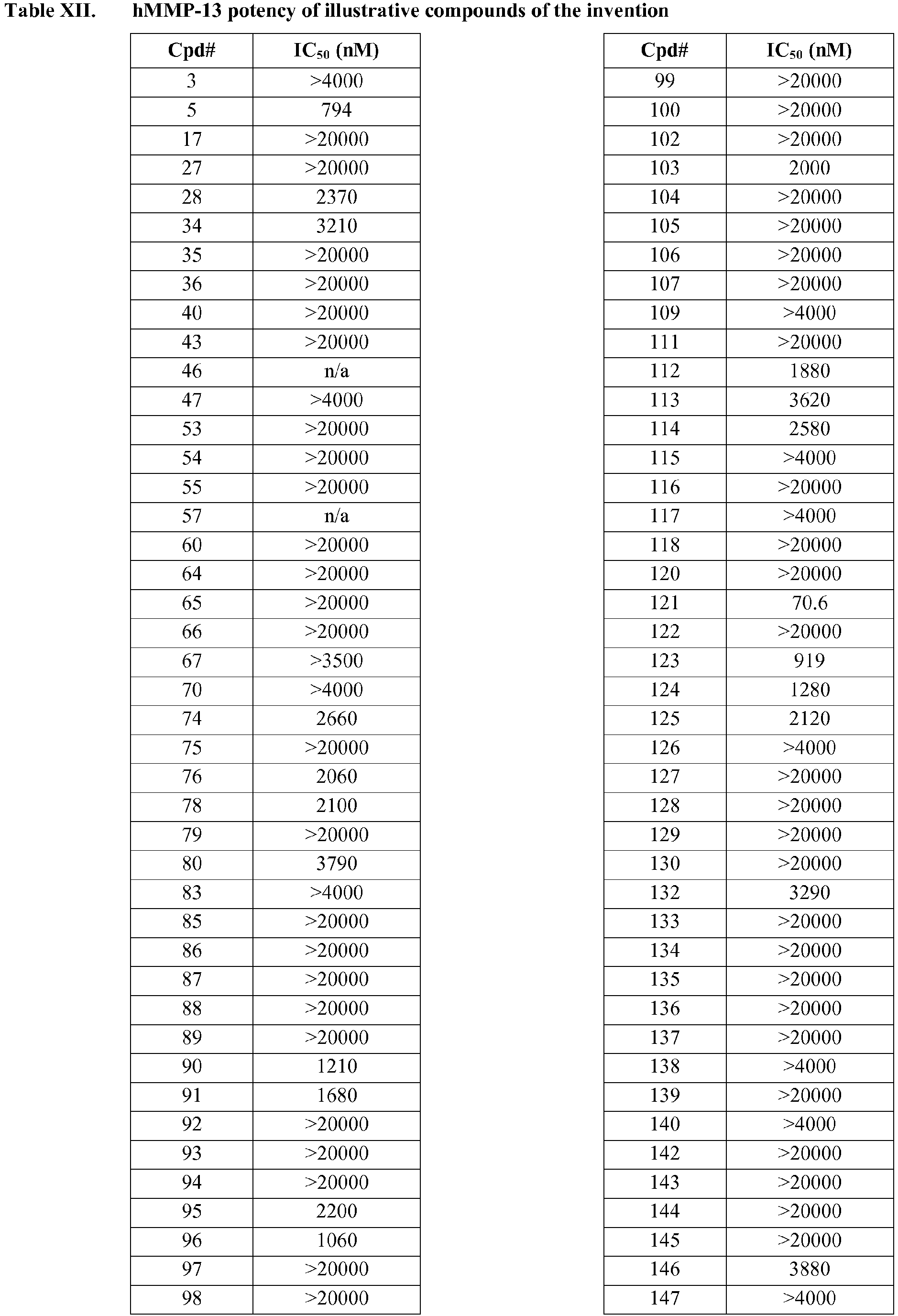


- The basis for the assay is the cleavage of the substrate 520 MMP-fret substrate XV (Anaspec, Catalog #: AS-60582-01) by human MMP13 (Chemicon, Cat# CC068).
- For the dose response (10 point), 4 µL of a dilution series of compound (2 mM highest concentration, 1/5 dilution in DMSO further diluted1 in 10 in water, corresponding to a final highest concentration of 20 µM), is transfered to 384 well Fluotrac 200 plate (Greiner, cat# 781076) and incubated at room temperature for 30 min with a 26 µL buffer solution (50mM Tris pH7.5, 150mM NaCl, 10mM CaCl2, 0.05% CHAPS, 5µM ZnCl2) containing MMP13 (6.25 10-6 µg/µL) (it will be appreciated by the skilled person that the potency read out is independent of the enzyme concentration).
- The reaction is initiated by adding to the assay plate 520 MMP-fret substrate XV (10 µL, 4µM) in the same buffer.
- Finally, the fluorescence is read on the Envision (Perkin Elmer) after an incubation of 60 min at room temperature (Excitation 485 nm, Emission 530).
- The IC50 measured for illustrative compounds of the invention is reported in Table XIII below.


- The basis for the assay is the cleavage of the substrate 390 MMP FRET Substrate I (Anaspec Cat# AS-27076) by human MMP14 (Biomol, Cat#SE-259).
- For the dose response (10 point), 4 µL of a dilution series of compound 2 mM highest concentration, 1/5 dilution in DMSO further diluted 1 in 10 in water, corresponding to a final highest concentration of 20 µM), is transfered to 384 well Fluotrac 200 plate (Greiner, cat# 781076) and incubated at room temperature for 30 min with a 26 µL buffer solution (50mM MOPS pH7, 5mM CaCl2, 1µM ZnCl2, 0.1% Brij-35) containing MMP14 (0.05 ng/µL) (it will be appreciated by the skilled person that the potency read out is independent of the enzyme concentration).
- The reaction is initiated by adding to the assay plate 390 MMP FRET Substrate I (10 µL, 2.5 µM) in the same buffer.
- Finally, the fluorescence is read on the Envision (Perkin Elmer) after an incubation of 60 min at room temperature (Excitation 485 nm, Emission 530).
- The IC50 measured for illustrative compounds of the invention is reported in Table XIV below.

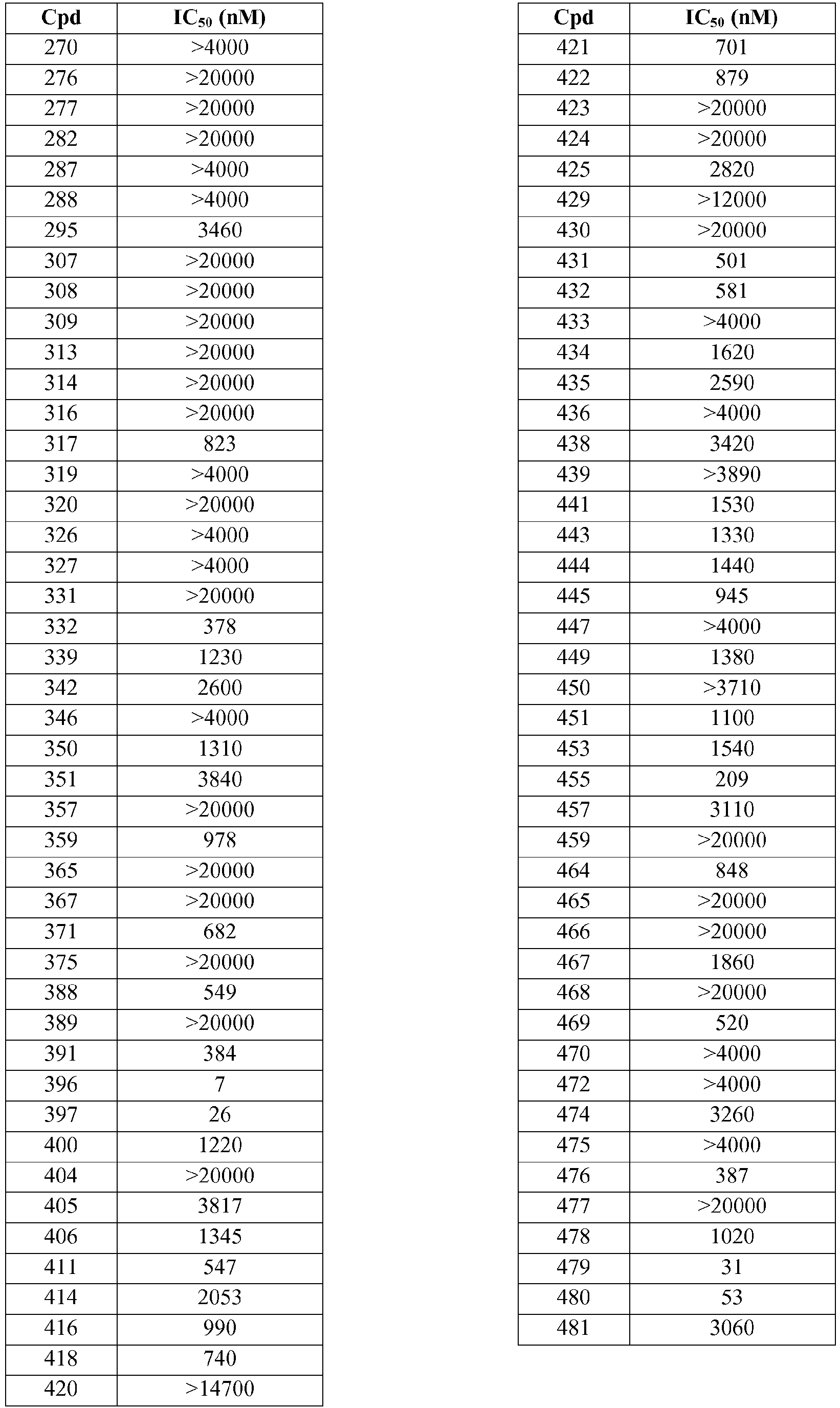
- In this assay, quantitation of glycosaminoglycans (GAGs) in the form of aggrecan fragments released from cartilage in culture is used to determine the efficacy of a test compound in preventing cartilage catabolism.
- The protocol of mouse cartilage explants is described by Stanton (Stanton et al., 2011). After euthanasia, the femoral head cartilage from the right and left leg of a 3-days-old C57Bl6 male mouse (Janvier, 7-10g), were placed in a 48-wells culture plate. Cell culture medium (400µL) containing human IL1α (1ng/mL) and test compound (3µM) were added to the femoral head cartilage.
- After 3 days of incubation, the supernatant is harvested and stored at -20°C until analysis and the cartilages are digested with a papaïn solution at 60°C for 24h. Using the standard curve performed with a dose range of chondroitin sulfate, the concentration of GAG is determined in the supernatant and on the lysate using dimethylmethylene blue solution (reading at a wavelength of 590nm).
- The percentage of GAG release is calculated as follows:

- The test compound effect is expressed as percent of inhibition (PIN) using the following formula:

- In this assay, compounds are tested in human articular cartilage explants in order to evaluate their activity on aggrecan degradation induced by IL1β. AGNx1 is the epitope for aggrecanase-mediated aggrecan degradation; on the other hand, AGNx2 is the epitope for MMP-mediated aggrecan degradation. Therefore quantification of AGNx1 and AGNx2 may be used to evaluate the activity of a test compound.
- These studies were conducted in Nordic Bioscience (Herlev Hovedgade 207, DK-2730 Herlev, Denmark).
- Human articular cartilage explants are collected from 3 nearby hospitals under an existing ethical committee application.
- Full-depth cartilage explants from OA cartilage from different patients are cultured for 21 days in culture medium (DMEM/F12 with 0.5% FCS, 1% PS) containing various (positive control, untreated, and test compound at 0.1, 1 and 10 µM).
- The explants from each patient are cultured in a separate 96-well culture plate with 200µL/well PBS, and the 6 replicates of each treatment are distributed in a diagonal pattern on the plate. At each experimental time point (5, 12 and 19 days), supernatants are harvested from the explants cultures, and new treatment-mediums are added. The supernatants are stored at -20°C for later biomarker analysis. The human IL1β (Sigma-Aldrich SRP3083) is used at a concentration of 10 ng/mL.
- The AGNx1 and AGNx2 concentrations were determined against a standard curve. Mean and SEM were graphed using the excel software. One-way ANOVA plus Dunnett's multiple comparisons post-hoc test are used for the statistical analysis (Prism 3.03 software).
- In vivo efficacy was studied in a female Lewis meniscectomised rat (MNX) model. The MNX rat model is a well-validated disease model of osteoarthritis (Bendele, 2001; Janusz et al., 2002; Pritzker et al., 2006).
- Osteoarthritis is induced by meniscectomy at day 0 (D0) in the right leg of each rat by a transection of the medial collateral ligament and 4 mm of ligament are removed. Internal part of the meniscus is transected vertically into two flaps which are pushed to the front and the back of the synovial cavity. Sham animals undergo only anaesthesia, skin and muscle incision then suture. On day 1, rats are randomly assigned to a treatment group (n=20 per group) according to their body weight, in order to have a homogenous distribution. From D2 to D21, rats are dosed per os (po) once daily (qd) or twice a day (bid) with compounds formulated in methylcellulose (MC) 0.5% or in HPβCD 10% pH3.0.
- After at least 7 days of treatment, blood is sampled at 4 time points post administration: 0, 1, 3 and 6 h (and assuming 24 h is equal to the pre-dose sample), in order to determine steady-state plasma exposure.
- At sacrifice, the right tibia of each rat is collected and processed for histological analysis. After 48h of fixation in 4% formaldehyde, tibias are decalcified in Osteosoft for 7 days, and cut into 2 half parts prior to embedding face to face in paraffin. Five series of sections are cut at 200 µm intervals, covering about 1.5 mm of the middle part of the bone. One series of slides is stained with Safranin O and light green for morphological evaluation and OARSI scoring. The other series of slides are mounted with DAPI for chondrocyte density measurement.
- The extent of cartilage injury reflecting osteoarthritis in the tibial plateau is evaluated and scored using the OARSI method based on the grading and the staging of cartilage lesion (Pritzker et al, 2006). The OARSI scoring is assessed in a blinded manner by two different readers. For each tibia, one score is attributed as the median of the OARSI score of the 5 sections.
- For statistical analysis, medians of groups are compared with a stratified Kruskal-Wallis test followed by Dunnett multiple comparison post hoc test.
- Significance levels: ns: not statistically significant; *p<0.05; **p<0.01; ***p<0.001 versus MNX-vehicle. Statistical analyses are done on all groups of the studies.
- It will be appreciated by those skilled in the art that the foregoing descriptions are exemplary and explanatory in nature, and intended to illustrate the invention and its preferred embodiments.
- It should be understood that factors such as the differential cell penetration capacity of the various compounds can contribute to discrepancies between the activity of the compounds in the in vitro biochemical and cellular assays.
- At least some of the chemical names of compound of the invention as given and set forth in this application, may have been generated on an automated basis by use of a commercially available chemical naming software program, and have not been independently verified. Representative programs performing this function include the Lexichem naming tool sold by Open Eye Software, Inc. and the Autonom Software tool sold by MDL, Inc. In the instance where the indicated chemical name and the depicted structure differ, the depicted structure will control.
-
- Ref 1):
- Abbaszade, I., Liu, R.-Q., Yang, F., Rosenfeld, S.A., Ross, O.H., Link, J.R., Ellis, D.M., Tortorella, M.D., Pratta, M.A., Hollis, J.M., Wynn, R., Duke, J.L., George, H.J., Hillman, M.C., Murphy, K., Wiswall, B.H., Copeland, R.A., Decicco, C.P., Bruckner, R., Nagase, H., Itoh, Y., Newton, R.C., Magolda, R.L., Trzaskos, J.M., Hollis, G.F., Arner, E.C., Burn, T.C., 1999. Cloning and Characterization of ADAMTS11, an Aggrecanase from the ADAMTS Family. J. Biol. Chem. 274, 23443-23450.
- Ref 2):
- Bendele, A., 2001. Animal models of rheumatoid arthritis. J. Musculoskelet. Neuronal Interact. 1, 377-385.
- Ref 3):
- Botter, S.M., Glasson, S.S., Hopkins, B., Clockaerts, S., Weinans, H., van Leeuwen, J.P.T.M., van Osch, G.J.V.M., 2009. ADAMTS5-/- mice have less subchondral bone changes after induction of osteoarthritis through surgical instability: implications for a link between cartilage and subchondral bone changes. Osteoarthritis Cartilage 17, 636-645. doi:10.1016/j.joca.2008.09.018
- Ref 4):
- Bundgaard, H., 1985. Design of prodrugs. Elsevier.
- Ref 5):
- Chiusaroli, R., Visintin, M., Caselli, G., Rovati, L.C., 2013. Anti-Adamts-5 Antibody, Derivatives and Uses Thereof.
WO2013153189 (A1 ). - Ref 6):
- Chockalingam, P.S., Sun, W., Rivera-Bermudez, M.A., Zeng, W., Dufield, D.R., Larsson, S., Lohmander, L.S., Flannery, C.R., Glasson, S.S., Georgiadis, K.E., Morris, E.A., 2011. Elevated aggrecanase activity in a rat model of joint injury is attenuated by an aggrecanase specific inhibitor. Osteoarthritis Cartilage 19, 315-323. doi:10.1016/j.joca.2010.12.004
- Ref 7):
- Clegg, D.O., Reda, D.J., Harris, C.L., Klein, M.A., O'Dell, J.R., Hooper, M.M., Bradley, J.D., Bingham, C.O., Weisman, M.H., Jackson, C.G., Lane, N.E., Cush, J.J., Moreland, L.W., Schumacher, H.R., Oddis, C.V., Wolfe, F., Molitor, J.A., Yocum, D.E., Schnitzer, T.J., Furst, D.E., Sawitzke, A.D., Shi, H., Brandt, K.D., Moskowitz, R.W., Williams, H.J., 2006. Glucosamine, Chondroitin Sulfate, and the Two in Combination for Painful Knee Osteoarthritis. N. Engl. J. Med. 354, 795-808. doi:10.1056/NEJMoa052771
- Ref 8):
- Dufour, A., Overall, C.M., 2013. Missing the target: matrix metalloproteinase antitargets in inflammation and cancer. Trends Pharmacol. Sci. 34, 233-242. doi:10.1016/j.tips.2013.02.004
- Ref 9):
- Georgiadis, D., Yiotakis, A., 2008. Specific targeting of metzincin family members with small-molecule inhibitors: Progress toward a multifarious challenge. Bioorg. Med. Chem. 16, 8781-8794. doi:10.1016/j.bmc.2008.08.058
- Ref 10):
- Glasson, S.S., Askew, R., Sheppard, B., Carito, B., Blanchet, T., Ma, H.-L., Flannery, C.R., Peluso, D., Kanki, K., Yang, Z., Majumdar, M.K., Morris, E.A., 2005. Deletion of active ADAMTS5 prevents cartilage degradation in a murine model of osteoarthritis. Nature 434, 644-648. doi:10.1038/nature03369
- Ref 11):
- Janusz, M.J., Bendele, A.M., Brown, K.K., Taiwo, Y.O., Hsieh, L., Heitmeyer, S.A., 2002. Induction of osteoarthritis in the rat by surgical tear of the meniscus: Inhibition of joint damage by a matrix metalloproteinase inhibitor. Osteoarthritis Cartilage 10, 785-791. doi:10.1053/joca.2002.0823
- Ref 12):
- Kato, I., Higashimoto, M., Tamura, O., Ishibashi, H., 2003. Total Synthesis of Mappicine Ketone (Nothapodytine B) by Means of Sulfur-Directed 5-exo-Selective Aryl Radical Cyclization onto Enamides. J. Org. Chem. 68, 7983-7989. doi:10.1021/jo030177m
- Ref 13):
- Larsson, S., Lohmander, L.S., Struglics, A., 2014. An ARGS-aggrecan assay for analysis in blood and synovial fluid. Osteoarthritis Cartilage 22, 242-249. doi:10.1016/j.joca.2013.12.010
- Ref 14):
- Little, C.B., Meeker, C.T., Golub, S.B., Lawlor, K.E., Farmer, P.J., Smith, S.M., Fosang, A.J., 2007. Blocking aggrecanase cleavage in the aggrecan interglobular domain abrogates cartilage erosion and promotes cartilage repair. J. Clin. Invest. 117, 1627-1636. doi:10.1172/JCI30765
- Ref 15):
- Malfait, A.M., Ritchie, J., Gil, A.S., Austin, J.-S., Hartke, J., Qin, W., Tortorella, M.D., Mogil, J.S., 2010. ADAMTS-5 deficient mice do not develop mechanical allodynia associated with osteoarthritis following medial meniscal destabilization. Osteoarthritis Cartilage 18, 572-580. doi:10.1016/j.joca.2009.11.013
- Ref 16):
- Mobasheri, A., 2013. The Future of Osteoarthritis Therapeutics: Targeted Pharmacological Therapy. Curr. Rheumatol. Rep. 15. doi:10.1007/s11926-013-0364-9
- Ref 17):
- Pond, M.J., Nuki, G., 1973. Experimentally-induced osteoarthritis in the dog. Ann. Rheum. Dis. 32, 387-388.
- Ref 18):
- Pritzker, K.P.H., Gay, S., Jimenez, S.A., Ostergaard, K., Pelletier, J.-P., Revell, P.A., Salter, D., van den Berg, W.B., 2006. Osteoarthritis cartilage histopathology: grading and staging. Osteoarthritis Cartilage 14, 13-29. doi:10.1016/j.joca.2005.07.014
- Ref 19):
- Shiomi, T., Lemaitre, V., D'Armiento, J., Okada, Y., 2010. Matrix metalloproteinases, a disintegrin and metalloproteinases, and a disintegrin and metalloproteinases with thrombospondin motifs in non-neoplastic diseases. Pathol. Int. 60, 477-496. doi:10.1111/j.1440-1827.2010.02547.x
- Ref 20):
- Stanton, H., Golub, S.B., Rogerson, F.M., Last, K., Little, C.B., Fosang, A.J., 2011. Investigating ADAMTS-mediated aggrecanolysis in mouse cartilage. Nat. Protoc. 6, 388-404. doi:10.1038/nprot.2010.179
- Ref 21):
- Stanton, H., Rogerson, F.M., East, C.J., Golub, S.B., Lawlor, K.E., Meeker, C.T., Little, C.B., Last, K., Farmer, P.J., Campbell, I.K., Fourie, A.M., Fosang, A.J., 2005. ADAMTS5 is the major aggrecanase in mouse cartilage in vivo and in vitro. Nature 434, 648-652. doi:10.1038/nature03417
- Ref 22):
- Tortorella, M.D., Malfait, A.M., 2008. Will the real aggrecanase(s) step up: evaluating the criteria that define aggrecanase activity in osteoarthritis. Curr. Pharm. Biotechnol. 9, 16-23.
- Ref 23):
- Wieland, H.A., Michaelis, M., Kirschbaum, B.J., Rudolphi, K.A., 2005. Osteoarthritis - an untreatable disease? Nat. Rev. Drug Discov. 4, 331-344. doi:10.1038/nrd1693
- Ref 24):
- Wuts, P.G.M., Greene, T.W., 2012. Greene's Protective Groups in Organic Synthesis, 4 edition. ed. Wiley-Interscience.
-
- <110> Galapagos NV
- <120> NOVEL COMPOUNDS AND PHARMACEUTICAL COMPOSITIONS THEREOF FOR THE TREATMENT OF INFLAMMATORY DISORDERS AND OSTEOARTHRITIS.
- <130> GAL-223-WO-PCT
- <160> 3
- <170> PatentIn version 3.5
- <210> 1
<211> 12
<212> PRT
<213> Artificial Sequence - <220>
<223> polypeptide - <220>
<221> MOD_RES
<222> (1)..(1)
<223> 5(6)-Fluorescein-NH
AMIDATION - <220>
<221> MOD_RES
<222> (12)..(12)
<223> 5(6)-TAMRA
AMIDATION - <400> 1

- <210> 2
<211> 14
<212> PRT
<213> Artificial Sequence - <220>
<223> polypeptide - <220>
<221> MOD_RES
<222> (1)..(1)
<223> 5FAM - <220>
<221> MOD_RES
<222> (13)..(13)
<223> (5TAMRA) - <400> 2

- <210> 3
<211> 11
<212> PRT
<213> Artificial Sequence - <220>
<223> polypeptide - <220>
<221> MOD_RES
<222> (1)..(1)
<223> 5 FAM
AMIDATION - <220>
<221> MOD_RES
<222> (11)..(11)
<223> 5 TAMRA
AMIDATION - <400> 3

Claims (18)
- A compound according to Formula I:
 R1 is:- H,- C1-4 alkyl optionally substituted with one or more independently selected R4 groups,- C3-7 monocyclic cycloalkyl optionally substituted with one or more independently selected R4 groups,- 4-7 membered monocyclic heterocycloalkyl comprising 1 to 2 heteroatoms independently selected from N, O, and S, optionally substituted with one or more independently selected C1-4 alkyl, -C(=O)C1-4 alkyl, or -C(=O)OC1-4 alkyl,- phenyl optionally substituted with one or more independently selected R5 groups,- phenyl fused to a 5-6 membered monocyclic heterocycloalkyl comprising 1, 2 or 3 heteroatoms independently selected from N, O, and S, which heterocycloalkyl is optionally substituted with one or more =O,- 5-6 membered monocyclic heteroaryl comprising 1 or 2 heteroatoms independently selected from N, O, and S, optionally substituted with one or more independently selected R5 groups;R2 is independently selected from:- H,- OH,- C1-4 alkoxy, and- C1-4 alkyl optionally substituted with one∘ OH,∘ -CN,∘ C1-4 alkoxy optionally substituted with one phenyl, and∘ 5-6 membered monocyclic heteroaryl comprising 1 or 2 heteroatoms independently selected from N, O, and S, optionally substituted with one or more independently selected C1-4 alkyl;each R3a, and R3b is independently selected from:- H, and- C1-4 alkyl;Cy is- 6-10 membered monocyclic or fused bicyclic aryl optionally substituted with one or more independently selected R6 groups,- 5-10 membered monocyclic or fused bicyclic heteroaryl comprising 1, 2 or 3 heteroatoms independently selected from N, O, and S, optionally substituted with one or more independently selected R6 groups;R4 is- halo,- OH,- -CN,- C1-4 alkyl,- C1-4 alkoxy optionally substituted with C1-4 alkoxy, or phenyl,- C1-4 thioalkoxy,- 4-7-membered monocyclic heterocycloalkyl comprising one or more heteroatoms independently selected from N, S, and O, optionally substituted with one or more halo, or -C(=O)OC1-4 alkyl,- phenyl,- -S(=O)2C1-4 alkyl- -C(=O)OR7a- -C(=O)NR7bR7c- -NHC(=O)OR7d- -NHC(=O)R7e- -NR8aR8b;each R5 is- halo,- OH,- -CN,- C1-4 alkyl optionally substituted with one or more independently selected halo, -NR9aR9b, or -C(=O)NR9cR9d,- C1-4 alkoxy optionally substituted with -NR9eR9f, or- -S(=O)2C1-4 alkyl;each R6 is- halo,- -CN,- -NO2,- -CH3,- 5-10 membered monocyclic or fused bicyclic heteroaryl comprising 1, 2 or 3 heteroatoms independently selected from N, O, and S, optionally substituted with one or more independently selected halo, C1-4 alkyl, or C1-4 alkoxy, or- -NR9gR9h;each R7a, R7b, R7c, R7d, or R7e, is- H, or- C1-4 alkyl optionally substituted with OH, or C1-4 alkoxy;each R8a, or R8b is independently selected from- H, and- C1-4 alkyl optionally substituted with OH, C1-4 alkoxy, or phenyl;each R9a, R9b, R9c, R9d, R9e, R9f, R9g, and R9h is independently selected from H, and C1-4 alkyl;
or a pharmaceutically acceptable salt, or a solvate, or a pharmaceutically acceptable salt of a solvate thereof;
provided that:- R1 and R2 are not simultaneously H, and- When R1 is Me, and R2 is H, then Cy is not
- A compound or pharmaceutically acceptable salt thereof, according to claim 1, wherein the compound is according to Formula II:

- A compound or pharmaceutically acceptable salt thereof, according to claim 1 or 2, wherein R1 is H.
- A compound or pharmaceutically acceptable salt thereof, according to claim 1 or 2, wherein R1 is C1-4 alkyl.
- A compound or pharmaceutically acceptable salt thereof, according to claim 1 or 2, wherein R1 is C3-7 monocyclic cycloalkyl.
- A compound or pharmaceutically acceptable salt thereof, according to any one of claim 1, wherein the compound is according to Formula IIIa or IIIb:
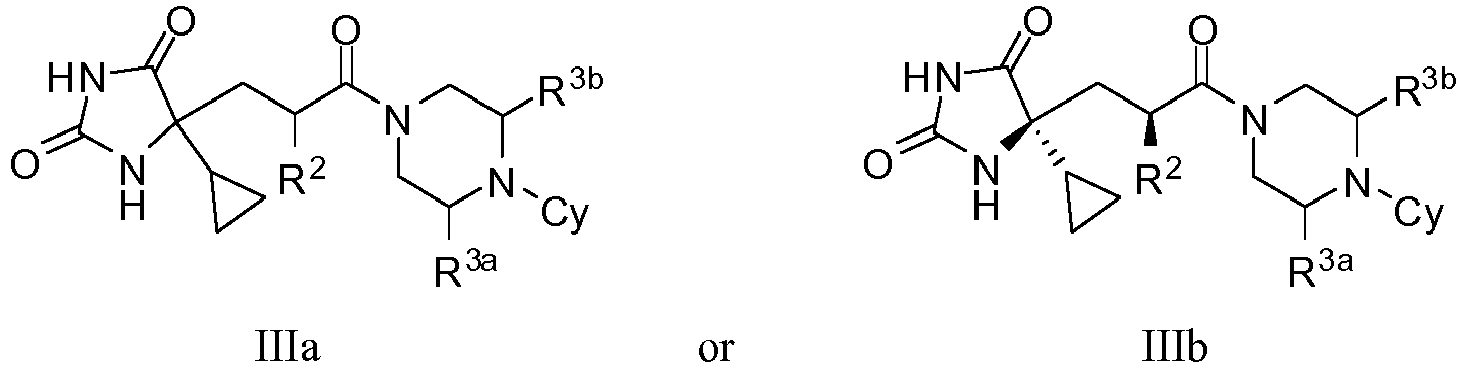
- A compound or pharmaceutically acceptable salt thereof, according to any one of claims 1-6, wherein R2 is C1-4 alkyl.
- A compound or pharmaceutically acceptable salt thereof, according to claim 1, wherein the compound is according to Formula IVa or IVb:

- A compound or pharmaceutically acceptable salt thereof, according to any one of claims 1-8, wherein each R3a, and R3b is independently selected from H, and CH3.
- A compound or pharmaceutically acceptable salt thereof, according to any one of claims 1-9, wherein Cy is 6-10 membered aryl, substituted with one or more independently selected R6 groups.
- A compound or pharmaceutically acceptable salt thereof, according to any one of claims 1-9, wherein Cy is phenyl substituted with one or more independently selected R6 groups.
- A compound or pharmaceutically acceptable salt thereof, according to claims 10 or 11, wherein each R6 is F, Cl, CN, -CH3, or NO2.
- A compound or pharmaceutically acceptable salt thereof according to claim 1, wherein the compound is selected from
5-[3-[(3S)-4-(3-chloro-4-fluoro-phenyl)-3-methyl-piperazin-1-yl]-2-methyl-3-oxo-propyl]-5-cyclopropyl-imidazolidine-2,4-dione,
5-[3-[(3S)-4-(3-chloro-5-fluoro-phenyl)-3-methyl-piperazin-1-yl]-2-methyl-3-oxo-propyl]-5-cyclopropyl-imidazolidine-2,4-dione,
(5S)-5-cyclopropyl-5-[3-[(3S)-4-(3,4-dichlorophenyl)-3-methyl-piperazin-1-yl]-3-oxo-propyl]imidazolidine-2,4-dione,
(5S)-5-cyclopropyl-5-[(2S)-3-[(3S)-4-(3,4-difluorophenyl)-3-methyl-piperazin-1-yl]-2-methyl-3-oxo-propyl]imidazolidine-2,4-dione,
5-[3-[(3S)-4-(4-chlorophenyl)-3-methyl-piperazin-1-yl]-2-methyl-3-oxo-propyl]-5-cyclopropyl-imidazolidine-2,4-dione,
5-[3-[4-(3,4-difluorophenyl)piperazin-1-yl]-2-methyl-3-oxo-propyl]-5-(methoxymethyl)imidazolidine-2,4-dione,
5-[2-[4-(3,5-dichlorophenyl)piperazine-1-carbonyl]butyl]-5-methyl-imidazolidine-2,4-dione, (S)-5-((S)-3-((S)-4-(3-chloro-4-fluorophenyl)-3-methylpiperazin-1-yl)-2-methyl-3-oxopropyl)-5-(methoxymethyl)imidazolidine-2,4-dione,
5-[3-[4-(3-chlorophenyl)piperazin-1-yl]-2-methyl-3-oxo-propyl]-5-cyclopropyl-imidazolidine-2,4-dione,
5-[3-[4-(3-chloro-2-methyl-phenyl)piperazin-1-yl]-2-methyl-3-oxo-propyl]-5-cyclopropyl-imidazolidine-2,4-dione,
tert-butyl N-[2-[4-[3-[4-(3,4-difluorophenyl)piperazin-1-yl]-2-methyl-3-oxo-propyl]-2,5-dioxo-imidazolidin-4-yl]ethyl]carbamate,
(5S)-5-cyclopropyl-5-[3-[(3S)-4-(3,5-dichlorophenyl)-3-methyl-piperazin-1-yl]-3-oxo-propyl]imidazolidine-2,4-dione,
5-[3-[(3S)-4-(3-chloro-4-fluoro-phenyl)-3-methyl-piperazin-1-yl]-2-methyl-3-oxo-propyl]-5-(2-pyridyl)imidazolidine-2,4-dione,
5-cyclopropyl-5-[3-[4-(3,5-dichlorophenyl)piperazin-1-yl]-2-methyl-3-oxo-propyl]imidazolidine-2,4-dione,
(5R)-5-[(2S)-3-[(3S)-4-(3-chloro-4-fluoro-phenyl)-3-methyl-piperazin-1-yl]-2-methyl-3-oxo-propyl]-5-methyl-imidazolidine-2,4-dione,
5-cyclopropyl-5-[3-[(3S)-4-[3-fluoro-5-(1H-pyrazol-4-yl)phenyl]-3-methyl-piperazin-1-yl]-2-methyl-3-oxo-propyl]imidazolidine-2,4-dione,
5-cyclopropyl-5-[3-[(3S)-4-(3,4-difluorophenyl)-3-methyl-piperazin-1-yl]-2-methyl-3-oxo-propyl]imidazolidine-2,4-dione,
5-[3-[4-(3,5-dichlorophenyl)piperazin-1-yl]-2-(hydroxymethyl)-3-oxo-propyl]-5-methyl-imidazolidine-2,4-dione,
5-[3-[(3S)-4-(3,4-difluorophenyl)-3-methyl-piperazin-1-yl]-2-methyl-3-oxo-propyl]-5-(2-pyridyl)imidazolidine-2,4-dione,
5-[3-[(3S)-4-(3-chlorophenyl)-3-methyl-piperazin-1-yl]-2-methyl-3-oxo-propyl]-5-(2-pyridyl)imidazolidine-2,4-dione,
5-[3-[(3S)-4-(4-chloro-3,5-difluoro-phenyl)-3-methyl-piperazin-1-yl]-2-methyl-3-oxo-propyl]-5-methyl-imidazolidine-2,4-dione,
5-cyclopropyl-5-[3-[(3S)-4-(3,4-dichlorophenyl)-3-methyl-piperazin-1-yl]-3-oxo-propyl]imidazolidine-2,4-dione,
5-[3-[4-(3,5-dichlorophenyl)piperazin-1-yl]-2-methyl-3-oxo-propyl]-5-(2-methylsulfonylethyl)imidazolidine-2,4-dione,
5-[3-[4-(3,5-dichlorophenyl)piperazin-1-yl]-2-methyl-3-oxo-propyl]-5-(2-pyridyl)imidazolidine-2,4-dione,
(5S)-cyclopropyl-5-[3-[(3S)-4-(3,5-difluorophenyl)-3-methyl-piperazin-1-yl]-3-oxo-propyl]imidazolidine-2,4-dione,
5-[3-[(3S)-4-(3-fluorophenyl)-3-methyl-piperazin-1-yl]-2-methyl-3-oxo-propyl]-5-(2-pyridyl)imidazolidine-2,4-dione,
5-[3-[4-(4-chloro-3,5-difluoro-phenyl)piperazin-1-yl]-2-methyl-3-oxo-propyl]-5-(methoxymethyl)imidazolidine-2,4-dione,
5-cyclopropyl-5-[3-[4-(5-fluoro-2-methyl-phenyl)piperazin-1-yl]-2-methyl-3-oxo-propyl]imidazolidine-2,4-dione,
5-[3-[4-(3,5-dichlorophenyl)piperazin-1-yl]-2-methyl-3-oxo-propyl]-5-(methoxymethyl)imidazolidine-2,4-dione, and
5-[3-[(3S)-4-(3,4-dichlorophenyl)-3-methyl-piperazin-1-yl]-3-oxo-propyl]-5-(2-pyridyl)imidazolidine-2,4-dione. - A pharmaceutical composition comprising a pharmaceutically acceptable carrier and a pharmaceutically effective amount of a compound according to any one of claims 1-13.
- A pharmaceutical composition according to claim 14 comprising a further therapeutic agent.
- A compound or pharmaceutically acceptable salt thereof, according to any one of claims 1-13, or a pharmaceutical composition according to claims 14 or 15 for use in medicine.
- A compound or pharmaceutically acceptable salt thereof, according to any one of claims 1-13, or a pharmaceutical composition according to claim 14 or 15 for use in the prophylaxis and/or treatment of inflammatory conditions, and/or diseases involving degradation of cartilage and/or disruption of cartilage homeostasis.
- The pharmaceutical composition according to claim 15, wherein the further therapeutic agent is an agent for the prophylaxis and/or treatment of inflammatory conditions, and/or diseases involving degradation of cartilage and/or disruption of cartilage homeostasis.
Priority Applications (7)
| Application Number | Priority Date | Filing Date | Title |
|---|---|---|---|
| PL15813831T PL3237406T3 (en) | 2014-12-22 | 2015-12-18 | 5-[(piperazin-1-yl)-3-oxo-propyl]-imidazolidine-2,4-dione derivatives as adamts inhibitors for the treatment of osteoarthritis |
| RS20190497A RS58617B1 (en) | 2014-12-22 | 2015-12-18 | 5-[(piperazin-1-yl)-3-oxo-propyl]-imidazolidine-2,4-dione derivatives as adamts inhibitors for the treatment of osteoarthritis |
| MA41238A MA41238B1 (en) | 2014-12-22 | 2015-12-18 | 5 - [(piperazin-1-yl) -3-oxo-propyl] -imidazolidine-2,4-dione derivatives as adamt inhibitors for the treatment of osteoarthritis |
| MEP-2019-92A ME03374B (en) | 2014-12-22 | 2015-12-18 | DERIVATIVES 5 - [(PIPERAZINE-1-YL) -3-OXO-PROPYL] -IMIDAZOLIDINE -2,4-DIONE AS ADAMT INHIBITORS FOR THE TREATMENT OF ARTHROSIS |
| EP19154886.6A EP3575294A1 (en) | 2014-12-22 | 2015-12-18 | 5-[(piperazin-1-yl)-3-oxo-propyl]-imidazolidine-2,4-dione derivatives as adamts inhibitors for the treatment of osteoarthritis |
| SI201530668T SI3237406T1 (en) | 2014-12-22 | 2015-12-18 | 5-((piperazin-1-yl)-3-oxo-propyl)-imidazolidine-2,4-dione derivatives as adamts inhibitors for the treatment of osteoarthritis |
| HRP20190514TT HRP20190514T1 (en) | 2014-12-22 | 2015-12-18 | DERIVATIVES 5 - [(PIPERAZIN-1-IL) -3-OXO-PROPYL] -IMIDAZOLIDINE-2,4-DION AS ADAMTS INHIBITORS FOR OSTEOARTRITIS TREATMENT |
Applications Claiming Priority (2)
| Application Number | Priority Date | Filing Date | Title |
|---|---|---|---|
| EP14307129 | 2014-12-22 | ||
| PCT/EP2015/080430 WO2016102347A1 (en) | 2014-12-22 | 2015-12-18 | 5-[(piperazin-1-yl)-3-oxo-propyl]-imidazolidine-2,4-dione derivatives as adamts inhibitors for the treatment of osteoarthritis |
Related Child Applications (2)
| Application Number | Title | Priority Date | Filing Date |
|---|---|---|---|
| EP19154886.6A Division EP3575294A1 (en) | 2014-12-22 | 2015-12-18 | 5-[(piperazin-1-yl)-3-oxo-propyl]-imidazolidine-2,4-dione derivatives as adamts inhibitors for the treatment of osteoarthritis |
| EP19154886.6A Previously-Filed-Application EP3575294A1 (en) | 2014-12-22 | 2015-12-18 | 5-[(piperazin-1-yl)-3-oxo-propyl]-imidazolidine-2,4-dione derivatives as adamts inhibitors for the treatment of osteoarthritis |
Publications (2)
| Publication Number | Publication Date |
|---|---|
| EP3237406A1 EP3237406A1 (en) | 2017-11-01 |
| EP3237406B1 true EP3237406B1 (en) | 2019-02-06 |
Family
ID=52345014
Family Applications (2)
| Application Number | Title | Priority Date | Filing Date |
|---|---|---|---|
| EP15813831.3A Active EP3237406B1 (en) | 2014-12-22 | 2015-12-18 | 5-[(piperazin-1-yl)-3-oxo-propyl]-imidazolidine-2,4-dione derivatives as adamts inhibitors for the treatment of osteoarthritis |
| EP19154886.6A Withdrawn EP3575294A1 (en) | 2014-12-22 | 2015-12-18 | 5-[(piperazin-1-yl)-3-oxo-propyl]-imidazolidine-2,4-dione derivatives as adamts inhibitors for the treatment of osteoarthritis |
Family Applications After (1)
| Application Number | Title | Priority Date | Filing Date |
|---|---|---|---|
| EP19154886.6A Withdrawn EP3575294A1 (en) | 2014-12-22 | 2015-12-18 | 5-[(piperazin-1-yl)-3-oxo-propyl]-imidazolidine-2,4-dione derivatives as adamts inhibitors for the treatment of osteoarthritis |
Country Status (50)
Families Citing this family (17)
| Publication number | Priority date | Publication date | Assignee | Title |
|---|---|---|---|---|
| JO3501B1 (en) | 2014-12-22 | 2020-07-05 | Servier Lab | 5-{(piperazine-1-yl)-3-oxo-propyl}-imidazolidine-2,4-dione derivatives as ADAMTS inhibitors for the treatment of osteoporosis) |
| GB201610055D0 (en) * | 2016-06-09 | 2016-07-27 | Galapagos Nv And Laboratoires Servier Les | Novel compounds and pharmaceutical compositions thereof for the treatment of inflammatory disorders and osteoarthritis |
| GB201610056D0 (en) | 2016-06-09 | 2016-07-27 | Galapagos Nv And Laboratoires Servier Les | Novel compounds and pharmaceutical compositions thereof for the treatment of inflammatory disorders and osteoarthritis |
| CN107652277A (en) * | 2017-08-09 | 2018-02-02 | 江苏工程职业技术学院 | A kind of preparation method net Yi Palie |
| CN107540648A (en) * | 2017-08-09 | 2018-01-05 | 江苏工程职业技术学院 | A kind of preparation method of Dapagliflozin |
| WO2021011720A2 (en) * | 2019-07-18 | 2021-01-21 | Avidence Therapeutics, Inc. | Anti-osteoarthritis compounds and related compositions and methods |
| TW202136236A (en) * | 2020-02-04 | 2021-10-01 | 美商永恒生物科技公司 | Adamts inhibitors, preparation methods and medicinal uses thereof |
| WO2021204185A1 (en) * | 2020-04-10 | 2021-10-14 | 深圳信立泰药业股份有限公司 | Benzo[d]azepine derivative as inhibitor of aggrecanase-2, preparation method therefor, and pharmaceutical use thereof |
| CN113735825B (en) * | 2020-05-27 | 2024-08-27 | 成都康弘药业集团股份有限公司 | 1,2,3, 6-Tetrahydropyridine compound and preparation method and application thereof |
| CN113754635B (en) * | 2020-06-02 | 2024-06-21 | 成都康弘药业集团股份有限公司 | Condensed ring compound and preparation method and application thereof |
| WO2022007866A1 (en) * | 2020-07-09 | 2022-01-13 | 深圳信立泰药业股份有限公司 | Fused tricyclic derivative, preparation method therefor, and pharmaceutical application thereof |
| CN113943255B (en) * | 2020-07-17 | 2024-08-06 | 深圳信立泰药业股份有限公司 | Preparation method of chiral 3- (4-cyclopropyl-2, 5-dioxaimidazoline-4-yl) propionic acid |
| CN116723840A (en) * | 2020-12-15 | 2023-09-08 | 加拉帕戈斯股份有限公司 | (5S)-Cyclopropyl-5-[3-[(3S)-4-(3,5-difluorophenyl)-3-methyl-piperazin-1-yl]-3-oxo-propanyl Solid form of imidazolidine-2,4-dione |
| WO2022128849A1 (en) | 2020-12-15 | 2022-06-23 | Galapagos Nv | Solid forms of (5s)-cyclopropyl-5-[3-[(3s)-4-(3,5-difluorophenyl)-3-methyl-piperazin-1-yl]-3-oxo-propyl]imidazolidine-2,4-dione |
| WO2022212638A1 (en) * | 2021-04-02 | 2022-10-06 | Jiangsu Hengrui Pharmaceuticals Co., Ltd. | Prodrugs of adamts inhibitors, preparation methods and medicinal uses thereof |
| TW202321221A (en) * | 2021-08-03 | 2023-06-01 | 大陸商江蘇恒瑞醫藥股份有限公司 | Crystal form of compound that inhibits the function of adamts-5 and/or adamts-4, and preparation method and application thereof |
| US20250313558A1 (en) | 2023-03-17 | 2025-10-09 | Cellus Inc. | Imidazolidine derivative or pharmaceutically acceptable salt thereof, and use thereof |
Family Cites Families (11)
| Publication number | Priority date | Publication date | Assignee | Title |
|---|---|---|---|---|
| US4556670A (en) * | 1982-12-06 | 1985-12-03 | Pfizer Inc. | Spiro-3-hetero-azolones for treatment of diabetic complications |
| WO1986000807A1 (en) * | 1984-07-20 | 1986-02-13 | Pfizer Inc. | Spiro-imidazolones for treatment of diabetes complications |
| US5043447A (en) * | 1987-04-24 | 1991-08-27 | Syntex Pharmaceuticals, Ltd. | Substituted imidazolyl-alkyl-piperazine and -diazepine derivatives |
| SE0100902D0 (en) | 2001-03-15 | 2001-03-15 | Astrazeneca Ab | Compounds |
| JP2004535411A (en) | 2001-05-25 | 2004-11-25 | ブリストルーマイヤーズ スクイブ カンパニー | Hydantoins and related heterocyclic compounds as inhibitors of matrix metalloproteinases and / or TNF-α convertases (TACE) |
| GB0405101D0 (en) | 2004-03-06 | 2004-04-07 | Astrazeneca Ab | Compounds |
| US7504424B2 (en) * | 2004-07-16 | 2009-03-17 | Schering Corporation | Compounds for the treatment of inflammatory disorders |
| PL2650310T3 (en) * | 2012-04-13 | 2017-01-31 | Rottapharm Biotech S.R.L. | Anti-ADAMTS-5 antibody, derivatives and uses thereof |
| AR092971A1 (en) * | 2012-10-26 | 2015-05-06 | Lilly Co Eli | AGRECANASA INHIBITORS |
| CN104955806B (en) | 2013-02-06 | 2018-09-14 | 默克专利股份公司 | The substituted carboxylic acid derivative as polyprotein xylanase inhibitor for treating osteoarthritis |
| JO3501B1 (en) * | 2014-12-22 | 2020-07-05 | Servier Lab | 5-{(piperazine-1-yl)-3-oxo-propyl}-imidazolidine-2,4-dione derivatives as ADAMTS inhibitors for the treatment of osteoporosis) |
-
2015
- 2015-11-19 JO JOP/2015/0284A patent/JO3501B1/en active
- 2015-12-14 TW TW104141953A patent/TWI687414B/en active
- 2015-12-18 MD MDE20170225T patent/MD3237406T2/en unknown
- 2015-12-18 CA CA2971110A patent/CA2971110C/en active Active
- 2015-12-18 MA MA41238A patent/MA41238B1/en unknown
- 2015-12-18 MX MX2017008048A patent/MX2017008048A/en active IP Right Grant
- 2015-12-18 GE GEAP201914546A patent/GEAP201914546A/en unknown
- 2015-12-18 AR ARP150104189A patent/AR103170A1/en active IP Right Grant
- 2015-12-18 RS RS20190497A patent/RS58617B1/en unknown
- 2015-12-18 CR CR20170248A patent/CR20170248A/en unknown
- 2015-12-18 EA EA201791451A patent/EA030637B1/en unknown
- 2015-12-18 TN TN2017000213A patent/TN2017000213A1/en unknown
- 2015-12-18 EP EP15813831.3A patent/EP3237406B1/en active Active
- 2015-12-18 SG SG11201705030SA patent/SG11201705030SA/en unknown
- 2015-12-18 ME MEP-2019-92A patent/ME03374B/en unknown
- 2015-12-18 LT LTEP15813831.3T patent/LT3237406T/en unknown
- 2015-12-18 WO PCT/EP2015/080430 patent/WO2016102347A1/en not_active Ceased
- 2015-12-18 ES ES15813831T patent/ES2724989T3/en active Active
- 2015-12-18 PL PL15813831T patent/PL3237406T3/en unknown
- 2015-12-18 SI SI201530668T patent/SI3237406T1/en unknown
- 2015-12-18 CN CN201580070274.0A patent/CN107108579B/en active Active
- 2015-12-18 US US15/538,393 patent/US9926281B2/en active Active
- 2015-12-18 AU AU2015371400A patent/AU2015371400B2/en active Active
- 2015-12-18 DK DK15813831.3T patent/DK3237406T3/en active
- 2015-12-18 TR TR2019/04158T patent/TR201904158T4/en unknown
- 2015-12-18 CU CUP2017000085A patent/CU20170085A7/en unknown
- 2015-12-18 UA UAA201707702A patent/UA122065C2/en unknown
- 2015-12-18 GE GEAP201514546A patent/GEP20197043B/en unknown
- 2015-12-18 PT PT15813831T patent/PT3237406T/en unknown
- 2015-12-18 NZ NZ732909A patent/NZ732909A/en unknown
- 2015-12-18 EP EP19154886.6A patent/EP3575294A1/en not_active Withdrawn
- 2015-12-18 HK HK18105455.7A patent/HK1245793B/en unknown
- 2015-12-18 RU RU2017126187A patent/RU2693459C2/en active
- 2015-12-18 JP JP2017551003A patent/JP6636539B2/en active Active
- 2015-12-18 HU HUE15813831A patent/HUE042840T2/en unknown
- 2015-12-18 KR KR1020177020379A patent/KR102711990B1/en active Active
- 2015-12-18 PE PE2017001122A patent/PE20171099A1/en unknown
- 2015-12-18 BR BR112017013258-3A patent/BR112017013258B1/en active IP Right Grant
- 2015-12-18 HR HRP20190514TT patent/HRP20190514T1/en unknown
- 2015-12-18 MY MYPI2017702301A patent/MY189764A/en unknown
- 2015-12-22 UY UY0001036470A patent/UY36470A/en not_active Application Discontinuation
-
2017
- 2017-05-24 GT GT201700107A patent/GT201700107A/en unknown
- 2017-06-07 ZA ZA2017/03905A patent/ZA201703905B/en unknown
- 2017-06-14 DO DO2017000139A patent/DOP2017000139A/en unknown
- 2017-06-15 SA SA517381743A patent/SA517381743B1/en unknown
- 2017-06-18 IL IL252981A patent/IL252981B/en active IP Right Grant
- 2017-06-20 PH PH12017501160A patent/PH12017501160A1/en unknown
- 2017-06-21 NI NI201700081A patent/NI201700081A/en unknown
- 2017-06-21 CL CL2017001650A patent/CL2017001650A1/en unknown
- 2017-06-21 CO CONC2017/0006174A patent/CO2017006174A2/en unknown
- 2017-07-20 EC ECIEPI201746848A patent/ECSP17046848A/en unknown
-
2018
- 2018-02-14 US US15/896,779 patent/US10487060B2/en active Active
-
2019
- 2019-05-02 CY CY20191100464T patent/CY1121692T1/en unknown
- 2019-10-15 US US16/653,668 patent/US10941117B2/en active Active
- 2019-12-18 JP JP2019227801A patent/JP2020063278A/en active Pending
-
2021
- 2021-01-05 US US17/141,902 patent/US11718588B2/en active Active
Non-Patent Citations (1)
| Title |
|---|
| None * |
Also Published As
Similar Documents
| Publication | Publication Date | Title |
|---|---|---|
| US11718588B2 (en) | 5-[(piperazin-1-yl)-3-oxo-propyl]-imidazolidine-2,4-dione derivatives as ADAMTS inhibitors for the treatment of osteoarthritis | |
| HK1245793A1 (en) | 5-[(piperazin-1-yl)-3-oxo-propyl]-imidazolidine-2,4-dione derivatives as adamts inhibitors for the treatment of osteoarthritis | |
| EP3468961B1 (en) | 5-[3-[piperidin-1-yl]-3-oxo-propyl]-imidazolidine-2,4-dione derivatives as adamts 4 and 5 inhibitors for treating e.g. osteoarthritis | |
| KR102534962B1 (en) | 8,9-dihydroimidazole[1,2-a]pyrimido[5,4-e]pyrimidine-5(6H)-ketone compound | |
| EP3468955B1 (en) | 5-[3-[piperazin-1-yl]-3-oxo-propyl]-imidazolidine-2,4-dione derivatives as adamts 4 and 5 inhibitors for treating e.g. osteoarthritis | |
| KR20180118752A (en) | Novel compounds for the treatment of fibrosis and pharmaceutical compositions thereof | |
| EP3212652B1 (en) | Ripk2 inhibitors and method of treating cancer with same | |
| CN116964061A (en) | Tricyclic pyrimidines as cyclin-dependent kinase 7 (CDK7) inhibitors | |
| HK1241369A1 (en) | 5-[(piperazin-1-yl)-3-oxo-propyl]-imidazolidine-2,4-dione derivatives as adamts inhibitors for the treatment of osteoarthritis | |
| CN113735825B (en) | 1,2,3, 6-Tetrahydropyridine compound and preparation method and application thereof |
Legal Events
| Date | Code | Title | Description |
|---|---|---|---|
| PUAI | Public reference made under article 153(3) epc to a published international application that has entered the european phase |
Free format text: ORIGINAL CODE: 0009012 |
|
| 17P | Request for examination filed |
Effective date: 20170706 |
|
| AK | Designated contracting states |
Kind code of ref document: A1 Designated state(s): AL AT BE BG CH CY CZ DE DK EE ES FI FR GB GR HR HU IE IS IT LI LT LU LV MC MK MT NL NO PL PT RO RS SE SI SK SM TR |
|
| AX | Request for extension of the european patent |
Extension state: BA ME |
|
| GRAP | Despatch of communication of intention to grant a patent |
Free format text: ORIGINAL CODE: EPIDOSNIGR1 |
|
| REG | Reference to a national code |
Ref country code: HK Ref legal event code: DE Ref document number: 1245793 Country of ref document: HK |
|
| INTG | Intention to grant announced |
Effective date: 20180828 |
|
| GRAS | Grant fee paid |
Free format text: ORIGINAL CODE: EPIDOSNIGR3 |
|
| GRAJ | Information related to disapproval of communication of intention to grant by the applicant or resumption of examination proceedings by the epo deleted |
Free format text: ORIGINAL CODE: EPIDOSDIGR1 |
|
| GRAL | Information related to payment of fee for publishing/printing deleted |
Free format text: ORIGINAL CODE: EPIDOSDIGR3 |
|
| GRAR | Information related to intention to grant a patent recorded |
Free format text: ORIGINAL CODE: EPIDOSNIGR71 |
|
| INTC | Intention to grant announced (deleted) | ||
| GRAA | (expected) grant |
Free format text: ORIGINAL CODE: 0009210 |
|
| INTG | Intention to grant announced |
Effective date: 20181206 |
|
| AK | Designated contracting states |
Kind code of ref document: B1 Designated state(s): AL AT BE BG CH CY CZ DE DK EE ES FI FR GB GR HR HU IE IS IT LI LT LU LV MC MK MT NL NO PL PT RO RS SE SI SK SM TR |
|
| AX | Request for extension of the european patent |
Extension state: BA ME |
|
| REG | Reference to a national code |
Ref country code: GB Ref legal event code: FG4D |
|
| REG | Reference to a national code |
Ref country code: AT Ref legal event code: REF Ref document number: 1094829 Country of ref document: AT Kind code of ref document: T Effective date: 20190215 Ref country code: CH Ref legal event code: EP |
|
| REG | Reference to a national code |
Ref country code: CH Ref legal event code: NV Representative=s name: BOHEST AG, CH |
|
| REG | Reference to a national code |
Ref country code: IE Ref legal event code: FG4D |
|
| REG | Reference to a national code |
Ref country code: DE Ref legal event code: R096 Ref document number: 602015024435 Country of ref document: DE |
|
| REG | Reference to a national code |
Ref country code: HR Ref legal event code: TUEP Ref document number: P20190514 Country of ref document: HR |
|
| REG | Reference to a national code |
Ref country code: PT Ref legal event code: SC4A Ref document number: 3237406 Country of ref document: PT Date of ref document: 20190319 Kind code of ref document: T Free format text: AVAILABILITY OF NATIONAL TRANSLATION Effective date: 20190228 |
|
| REG | Reference to a national code |
Ref country code: SE Ref legal event code: TRGR |
|
| REG | Reference to a national code |
Ref country code: RO Ref legal event code: EPE |
|
| REG | Reference to a national code |
Ref country code: NL Ref legal event code: FP |
|
| REG | Reference to a national code |
Ref country code: MA Ref legal event code: VAGR Ref document number: 41238 Country of ref document: MA Kind code of ref document: B1 |
|
| REG | Reference to a national code |
Ref country code: HR Ref legal event code: T1PR Ref document number: P20190514 Country of ref document: HR |
|
| REG | Reference to a national code |
Ref country code: DK Ref legal event code: T3 Effective date: 20190429 |
|
| REG | Reference to a national code |
Ref country code: MD Ref legal event code: VAGR Ref document number: 3237406 Country of ref document: MD Kind code of ref document: T2 |
|
| REG | Reference to a national code |
Ref country code: EE Ref legal event code: FG4A Ref document number: E017286 Country of ref document: EE Effective date: 20190502 |
|
| REG | Reference to a national code |
Ref country code: NO Ref legal event code: T2 Effective date: 20190206 |
|
| REG | Reference to a national code |
Ref country code: HU Ref legal event code: AG4A Ref document number: E042840 Country of ref document: HU |
|
| REG | Reference to a national code |
Ref country code: SK Ref legal event code: T3 Ref document number: E 30849 Country of ref document: SK |
|
| REG | Reference to a national code |
Ref country code: GR Ref legal event code: EP Ref document number: 20190401289 Country of ref document: GR Effective date: 20190620 |
|
| REG | Reference to a national code |
Ref country code: ES Ref legal event code: FG2A Ref document number: 2724989 Country of ref document: ES Kind code of ref document: T3 Effective date: 20190918 |
|
| REG | Reference to a national code |
Ref country code: DE Ref legal event code: R097 Ref document number: 602015024435 Country of ref document: DE |
|
| PG25 | Lapsed in a contracting state [announced via postgrant information from national office to epo] |
Ref country code: SM Free format text: LAPSE BECAUSE OF FAILURE TO SUBMIT A TRANSLATION OF THE DESCRIPTION OR TO PAY THE FEE WITHIN THE PRESCRIBED TIME-LIMIT Effective date: 20190206 |
|
| PLBE | No opposition filed within time limit |
Free format text: ORIGINAL CODE: 0009261 |
|
| STAA | Information on the status of an ep patent application or granted ep patent |
Free format text: STATUS: NO OPPOSITION FILED WITHIN TIME LIMIT |
|
| REG | Reference to a national code |
Ref country code: HR Ref legal event code: ODRP Ref document number: P20190514 Country of ref document: HR Payment date: 20191115 Year of fee payment: 5 |
|
| 26N | No opposition filed |
Effective date: 20191107 |
|
| VSFP | Annual fee paid to validation state [announced via postgrant information from national office to epo] |
Ref country code: MD Payment date: 20191104 Year of fee payment: 5 |
|
| REG | Reference to a national code |
Ref country code: HR Ref legal event code: ODRP Ref document number: P20190514 Country of ref document: HR Payment date: 20201216 Year of fee payment: 6 |
|
| VSFP | Annual fee paid to validation state [announced via postgrant information from national office to epo] |
Ref country code: MD Payment date: 20201113 Year of fee payment: 6 Ref country code: MA Payment date: 20191211 Year of fee payment: 5 |
|
| VSFP | Annual fee paid to validation state [announced via postgrant information from national office to epo] |
Ref country code: MA Payment date: 20201207 Year of fee payment: 6 |
|
| REG | Reference to a national code |
Ref country code: HR Ref legal event code: ODRP Ref document number: P20190514 Country of ref document: HR Payment date: 20211217 Year of fee payment: 7 |
|
| REG | Reference to a national code |
Ref country code: SK Ref legal event code: PC4A Ref document number: E 30849 Country of ref document: SK Owner name: GALAPAGOS NV, MECHELEN, BE Free format text: FORMER OWNER: GALAPAGOS NV, MECHELEN, BE; LES LABORATOIRES SERVIER, SURESNES, FR Effective date: 20220117 |
|
| REG | Reference to a national code |
Ref country code: EE Ref legal event code: GB1A Ref document number: E017286 Country of ref document: EE |
|
| REG | Reference to a national code |
Ref country code: ES Ref legal event code: PC2A Owner name: GALAPAGOS N.V. Effective date: 20220217 |
|
| REG | Reference to a national code |
Ref country code: HU Ref legal event code: GB9C Owner name: GALAPAGOS NV, BE Free format text: FORMER OWNER(S): GALAPAGOS NV, BE; LES LABORATOIRES SERVIER, FR |
|
| VSFP | Annual fee paid to validation state [announced via postgrant information from national office to epo] |
Ref country code: MD Payment date: 20211105 Year of fee payment: 7 |
|
| REG | Reference to a national code |
Ref country code: LU Ref legal event code: PD Owner name: GALAPAGOS NV; BE Free format text: FORMER OWNER: LES LABORATOIRES SERVIER Effective date: 20220201 |
|
| REG | Reference to a national code |
Ref country code: BE Ref legal event code: PD Owner name: GALAPAGOS NV; BE Free format text: DETAILS ASSIGNMENT: CHANGE OF OWNER(S), ASSIGNMENT; FORMER OWNER NAME: LES LABORATOIRES SERVIER Effective date: 20220204 Ref country code: NO Ref legal event code: CREP Representative=s name: BRYN AARFLOT AS, STORTINGSGATA 8, 0161 OSLO, NORGE Ref country code: NO Ref legal event code: CHAD Owner name: GALAPAGOS NV, BE |
|
| REG | Reference to a national code |
Ref country code: DE Ref legal event code: R081 Ref document number: 602015024435 Country of ref document: DE Owner name: GALAPAGOS NV, BE Free format text: FORMER OWNERS: GALAPAGOS NV, MECHELEN, BE; LES LABORATOIRES SERVIER, SURESNES, FR |
|
| REG | Reference to a national code |
Ref country code: HU Ref legal event code: GB9C Owner name: GALAPAGOS NV, BE Free format text: FORMER OWNER(S): GALAPAGOS NV, BE; LES LABORATOIRES SERVIER, FR; GALAPAGOS NV, BE; LES LABORATOIRES SERVIER, FR; GALAPAGOS NV, BE Ref country code: HU Ref legal event code: FH1C Free format text: FORMER REPRESENTATIVE(S): DANUBIA SZABADALMI ES JOGI IRODA KFT., HU Representative=s name: DANUBIA SZABADALMI ES JOGI IRODA KFT., HU |
|
| REG | Reference to a national code |
Ref country code: SI Ref legal event code: SP73 Owner name: GALAPAGOS NV; BE Effective date: 20220222 |
|
| REG | Reference to a national code |
Ref country code: GB Ref legal event code: 732E Free format text: REGISTERED BETWEEN 20220310 AND 20220316 |
|
| REG | Reference to a national code |
Ref country code: NL Ref legal event code: PD Owner name: GALAPAGOS NV; BE Free format text: DETAILS ASSIGNMENT: CHANGE OF OWNER(S), ASSIGNMENT; FORMER OWNER NAME: LES LABORATOIRES SERVIER Effective date: 20220222 |
|
| REG | Reference to a national code |
Ref country code: AT Ref legal event code: PC Ref document number: 1094829 Country of ref document: AT Kind code of ref document: T Owner name: GALAPAGOS NV, BE Effective date: 20220216 |
|
| REG | Reference to a national code |
Ref country code: HR Ref legal event code: PPPP Ref document number: P20190514 Country of ref document: HR Owner name: GALAPAGOS NV, BE |
|
| REG | Reference to a national code |
Ref country code: FI Ref legal event code: PCE Owner name: GALAPAGOS NV |
|
| REG | Reference to a national code |
Ref country code: HR Ref legal event code: ODRP Ref document number: P20190514 Country of ref document: HR Payment date: 20221214 Year of fee payment: 8 |
|
| VSFP | Annual fee paid to validation state [announced via postgrant information from national office to epo] |
Ref country code: MD Payment date: 20221101 Year of fee payment: 8 |
|
| REG | Reference to a national code |
Ref country code: AT Ref legal event code: UEP Ref document number: 1094829 Country of ref document: AT Kind code of ref document: T Effective date: 20190206 |
|
| P01 | Opt-out of the competence of the unified patent court (upc) registered |
Effective date: 20230316 |
|
| REG | Reference to a national code |
Ref country code: HR Ref legal event code: ODRP Ref document number: P20190514 Country of ref document: HR Payment date: 20231102 Year of fee payment: 9 |
|
| REG | Reference to a national code |
Ref country code: DE Ref legal event code: R082 Ref document number: 602015024435 Country of ref document: DE Representative=s name: TER MEER STEINMEISTER & PARTNER PATENTANWAELTE, DE |
|
| VSFP | Annual fee paid to validation state [announced via postgrant information from national office to epo] |
Ref country code: MD Payment date: 20231027 Year of fee payment: 9 |
|
| REG | Reference to a national code |
Ref country code: HR Ref legal event code: ODRP Ref document number: P20190514 Country of ref document: HR Payment date: 20241025 Year of fee payment: 10 |
|
| PGFP | Annual fee paid to national office [announced via postgrant information from national office to epo] |
Ref country code: LT Payment date: 20241122 Year of fee payment: 10 |
|
| PGFP | Annual fee paid to national office [announced via postgrant information from national office to epo] |
Ref country code: MC Payment date: 20241128 Year of fee payment: 10 |
|
| PGFP | Annual fee paid to national office [announced via postgrant information from national office to epo] |
Ref country code: PL Payment date: 20241016 Year of fee payment: 10 Ref country code: PT Payment date: 20241218 Year of fee payment: 10 Ref country code: GR Payment date: 20241114 Year of fee payment: 10 Ref country code: LU Payment date: 20241213 Year of fee payment: 10 |
|
| PGFP | Annual fee paid to national office [announced via postgrant information from national office to epo] |
Ref country code: BG Payment date: 20241017 Year of fee payment: 10 |
|
| PGFP | Annual fee paid to national office [announced via postgrant information from national office to epo] |
Ref country code: LV Payment date: 20241021 Year of fee payment: 10 |
|
| PGFP | Annual fee paid to national office [announced via postgrant information from national office to epo] |
Ref country code: HU Payment date: 20241112 Year of fee payment: 10 Ref country code: IS Payment date: 20241105 Year of fee payment: 10 |
|
| PGFP | Annual fee paid to national office [announced via postgrant information from national office to epo] |
Ref country code: CZ Payment date: 20241129 Year of fee payment: 10 Ref country code: HR Payment date: 20241025 Year of fee payment: 10 |
|
| PGFP | Annual fee paid to national office [announced via postgrant information from national office to epo] |
Ref country code: RO Payment date: 20241113 Year of fee payment: 10 Ref country code: SK Payment date: 20241112 Year of fee payment: 10 |
|
| PGFP | Annual fee paid to national office [announced via postgrant information from national office to epo] |
Ref country code: RS Payment date: 20241128 Year of fee payment: 10 |
|
| PGFP | Annual fee paid to national office [announced via postgrant information from national office to epo] |
Ref country code: MT Payment date: 20241220 Year of fee payment: 10 |
|
| PGFP | Annual fee paid to national office [announced via postgrant information from national office to epo] |
Ref country code: TR Payment date: 20241204 Year of fee payment: 10 |
|
| PGFP | Annual fee paid to national office [announced via postgrant information from national office to epo] |
Ref country code: AL Payment date: 20241210 Year of fee payment: 10 |
|
| PGFP | Annual fee paid to national office [announced via postgrant information from national office to epo] |
Ref country code: SI Payment date: 20241025 Year of fee payment: 10 |
|
| VSFP | Annual fee paid to validation state [announced via postgrant information from national office to epo] |
Ref country code: MD Payment date: 20241030 Year of fee payment: 10 |
|
| PGFP | Annual fee paid to national office [announced via postgrant information from national office to epo] |
Ref country code: CY Payment date: 20241122 Year of fee payment: 10 |
|
| PGFP | Annual fee paid to national office [announced via postgrant information from national office to epo] |
Ref country code: EE Payment date: 20250925 Year of fee payment: 11 |
|
| VSFP | Annual fee paid to validation state [announced via postgrant information from national office to epo] |
Ref country code: MA Payment date: 20231122 Year of fee payment: 9 |
|
| VSFP | Annual fee paid to validation state [announced via postgrant information from national office to epo] |
Ref country code: MA Payment date: 20221128 Year of fee payment: 8 Ref country code: MA Payment date: 20211116 Year of fee payment: 7 |
|
| PGFP | Annual fee paid to national office [announced via postgrant information from national office to epo] |
Ref country code: MK Payment date: 20241022 Year of fee payment: 10 |
|
| VSFP | Annual fee paid to validation state [announced via postgrant information from national office to epo] |
Ref country code: MA Payment date: 20241210 Year of fee payment: 10 Ref country code: MA Payment date: 20201207 Year of fee payment: 6 Ref country code: MA Payment date: 20191211 Year of fee payment: 5 |
|
| REG | Reference to a national code |
Ref country code: CH Ref legal event code: U11 Free format text: ST27 STATUS EVENT CODE: U-0-0-U10-U11 (AS PROVIDED BY THE NATIONAL OFFICE) Effective date: 20260101 |
|
| PGFP | Annual fee paid to national office [announced via postgrant information from national office to epo] |
Ref country code: DE Payment date: 20251126 Year of fee payment: 11 |
|
| PGFP | Annual fee paid to national office [announced via postgrant information from national office to epo] |
Ref country code: GB Payment date: 20251204 Year of fee payment: 11 |
|
| PGFP | Annual fee paid to national office [announced via postgrant information from national office to epo] |
Ref country code: NO Payment date: 20251205 Year of fee payment: 11 |
|
| PGFP | Annual fee paid to national office [announced via postgrant information from national office to epo] |
Ref country code: AT Payment date: 20251205 Year of fee payment: 11 |
|
| PGFP | Annual fee paid to national office [announced via postgrant information from national office to epo] |
Ref country code: IT Payment date: 20251204 Year of fee payment: 11 Ref country code: FI Payment date: 20251203 Year of fee payment: 11 Ref country code: DK Payment date: 20251203 Year of fee payment: 11 |
|
| PGFP | Annual fee paid to national office [announced via postgrant information from national office to epo] |
Ref country code: FR Payment date: 20251204 Year of fee payment: 11 Ref country code: NL Payment date: 20251204 Year of fee payment: 11 |
|
| PGFP | Annual fee paid to national office [announced via postgrant information from national office to epo] |
Ref country code: BE Payment date: 20251204 Year of fee payment: 11 |
|
| PGFP | Annual fee paid to national office [announced via postgrant information from national office to epo] |
Ref country code: SE Payment date: 20251203 Year of fee payment: 11 |
|
| PGFP | Annual fee paid to national office [announced via postgrant information from national office to epo] |
Ref country code: IE Payment date: 20251203 Year of fee payment: 11 |
|
| PGFP | Annual fee paid to national office [announced via postgrant information from national office to epo] |
Ref country code: ES Payment date: 20260113 Year of fee payment: 11 |
|
| PGFP | Annual fee paid to national office [announced via postgrant information from national office to epo] |
Ref country code: CH Payment date: 20260101 Year of fee payment: 11 |