EP3235880A1 - Verfahren zur herstellung von polymer-funktionalisierten füllstoffpartikeln - Google Patents
Verfahren zur herstellung von polymer-funktionalisierten füllstoffpartikeln Download PDFInfo
- Publication number
- EP3235880A1 EP3235880A1 EP17170135.2A EP17170135A EP3235880A1 EP 3235880 A1 EP3235880 A1 EP 3235880A1 EP 17170135 A EP17170135 A EP 17170135A EP 3235880 A1 EP3235880 A1 EP 3235880A1
- Authority
- EP
- European Patent Office
- Prior art keywords
- polymer
- rubber
- filler particles
- group
- filler
- Prior art date
- Legal status (The legal status is an assumption and is not a legal conclusion. Google has not performed a legal analysis and makes no representation as to the accuracy of the status listed.)
- Granted
Links
- MCROPZJJYBWMOA-UHFFFAOYSA-O CCCSC(SC(C)C(OCC1=CC(C2C3CCCCCCC(CCCSC([SH2+])=S)CCCCCC2)C3N1)=O)=S Chemical compound CCCSC(SC(C)C(OCC1=CC(C2C3CCCCCCC(CCCSC([SH2+])=S)CCCCCC2)C3N1)=O)=S MCROPZJJYBWMOA-UHFFFAOYSA-O 0.000 description 1
Images





Classifications
-
- C—CHEMISTRY; METALLURGY
- C08—ORGANIC MACROMOLECULAR COMPOUNDS; THEIR PREPARATION OR CHEMICAL WORKING-UP; COMPOSITIONS BASED THEREON
- C08F—MACROMOLECULAR COMPOUNDS OBTAINED BY REACTIONS ONLY INVOLVING CARBON-TO-CARBON UNSATURATED BONDS
- C08F236/00—Copolymers of compounds having one or more unsaturated aliphatic radicals, at least one having two or more carbon-to-carbon double bonds
- C08F236/02—Copolymers of compounds having one or more unsaturated aliphatic radicals, at least one having two or more carbon-to-carbon double bonds the radical having only two carbon-to-carbon double bonds
- C08F236/04—Copolymers of compounds having one or more unsaturated aliphatic radicals, at least one having two or more carbon-to-carbon double bonds the radical having only two carbon-to-carbon double bonds conjugated
- C08F236/06—Butadiene
-
- B—PERFORMING OPERATIONS; TRANSPORTING
- B60—VEHICLES IN GENERAL
- B60C—VEHICLE TYRES; TYRE INFLATION; TYRE CHANGING; CONNECTING VALVES TO INFLATABLE ELASTIC BODIES IN GENERAL; DEVICES OR ARRANGEMENTS RELATED TO TYRES
- B60C1/00—Tyres characterised by the chemical composition or the physical arrangement or mixture of the composition
- B60C1/0016—Compositions of the tread
-
- B—PERFORMING OPERATIONS; TRANSPORTING
- B29—WORKING OF PLASTICS; WORKING OF SUBSTANCES IN A PLASTIC STATE IN GENERAL
- B29B—PREPARATION OR PRETREATMENT OF THE MATERIAL TO BE SHAPED; MAKING GRANULES OR PREFORMS; RECOVERY OF PLASTICS OR OTHER CONSTITUENTS OF WASTE MATERIAL CONTAINING PLASTICS
- B29B7/00—Mixing; Kneading
- B29B7/74—Mixing; Kneading using other mixers or combinations of mixers, e.g. of dissimilar mixers ; Plant
- B29B7/7476—Systems, i.e. flow charts or diagrams; Plants
- B29B7/7495—Systems, i.e. flow charts or diagrams; Plants for mixing rubber
-
- C—CHEMISTRY; METALLURGY
- C08—ORGANIC MACROMOLECULAR COMPOUNDS; THEIR PREPARATION OR CHEMICAL WORKING-UP; COMPOSITIONS BASED THEREON
- C08K—Use of inorganic or non-macromolecular organic substances as compounding ingredients
- C08K3/00—Use of inorganic substances as compounding ingredients
- C08K3/34—Silicon-containing compounds
- C08K3/36—Silica
-
- C—CHEMISTRY; METALLURGY
- C08—ORGANIC MACROMOLECULAR COMPOUNDS; THEIR PREPARATION OR CHEMICAL WORKING-UP; COMPOSITIONS BASED THEREON
- C08K—Use of inorganic or non-macromolecular organic substances as compounding ingredients
- C08K9/00—Use of pretreated ingredients
- C08K9/04—Ingredients treated with organic substances
- C08K9/06—Ingredients treated with organic substances with silicon-containing compounds
-
- C—CHEMISTRY; METALLURGY
- C09—DYES; PAINTS; POLISHES; NATURAL RESINS; ADHESIVES; COMPOSITIONS NOT OTHERWISE PROVIDED FOR; APPLICATIONS OF MATERIALS NOT OTHERWISE PROVIDED FOR
- C09C—TREATMENT OF INORGANIC MATERIALS, OTHER THAN FIBROUS FILLERS, TO ENHANCE THEIR PIGMENTING OR FILLING PROPERTIES ; PREPARATION OF CARBON BLACK ; PREPARATION OF INORGANIC MATERIALS WHICH ARE NO SINGLE CHEMICAL COMPOUNDS AND WHICH ARE MAINLY USED AS PIGMENTS OR FILLERS
- C09C1/00—Treatment of specific inorganic materials other than fibrous fillers; Preparation of carbon black
- C09C1/28—Compounds of silicon
- C09C1/30—Silicic acid
- C09C1/3072—Treatment with macro-molecular organic compounds
-
- C—CHEMISTRY; METALLURGY
- C09—DYES; PAINTS; POLISHES; NATURAL RESINS; ADHESIVES; COMPOSITIONS NOT OTHERWISE PROVIDED FOR; APPLICATIONS OF MATERIALS NOT OTHERWISE PROVIDED FOR
- C09C—TREATMENT OF INORGANIC MATERIALS, OTHER THAN FIBROUS FILLERS, TO ENHANCE THEIR PIGMENTING OR FILLING PROPERTIES ; PREPARATION OF CARBON BLACK ; PREPARATION OF INORGANIC MATERIALS WHICH ARE NO SINGLE CHEMICAL COMPOUNDS AND WHICH ARE MAINLY USED AS PIGMENTS OR FILLERS
- C09C1/00—Treatment of specific inorganic materials other than fibrous fillers; Preparation of carbon black
- C09C1/44—Carbon
- C09C1/48—Carbon black
- C09C1/56—Treatment of carbon black ; Purification
-
- C—CHEMISTRY; METALLURGY
- C09—DYES; PAINTS; POLISHES; NATURAL RESINS; ADHESIVES; COMPOSITIONS NOT OTHERWISE PROVIDED FOR; APPLICATIONS OF MATERIALS NOT OTHERWISE PROVIDED FOR
- C09C—TREATMENT OF INORGANIC MATERIALS, OTHER THAN FIBROUS FILLERS, TO ENHANCE THEIR PIGMENTING OR FILLING PROPERTIES ; PREPARATION OF CARBON BLACK ; PREPARATION OF INORGANIC MATERIALS WHICH ARE NO SINGLE CHEMICAL COMPOUNDS AND WHICH ARE MAINLY USED AS PIGMENTS OR FILLERS
- C09C3/00—Treatment in general of inorganic materials, other than fibrous fillers, to enhance their pigmenting or filling properties
- C09C3/10—Treatment with macromolecular organic compounds
-
- C—CHEMISTRY; METALLURGY
- C01—INORGANIC CHEMISTRY
- C01P—INDEXING SCHEME RELATING TO STRUCTURAL AND PHYSICAL ASPECTS OF SOLID INORGANIC COMPOUNDS
- C01P2004/00—Particle morphology
- C01P2004/80—Particles consisting of a mixture of two or more inorganic phases
Definitions
- the invention relates to a process for the preparation of polymer-functionalized filler particles, the polymer-functionalized filler particles prepared by the process and their use in rubber mixtures.
- hybrid inorganic-organic materials are significantly dependent on the strength as well as the structure and properties of the interface between the components involved.
- the use of coupling reagents is usually carried out. Often, these are functionalized alkyl, alkoxy or halosilanes, which are capable of establishing a covalent bond to the filler surface in the course of vulcanization or curing of the polymeric system.
- This conventional method has the disadvantage that often only a low coupling density is achieved. Even a targeted manipulation of the boundary phase between the polymer matrix and filler surface is not or only partially possible in this way.
- RAFT reversible addition fragmentation chain transfer process
- the structural attachment of the polymer to the surface can be controlled by the choice and chemical structure of the so-called RAFT agents.
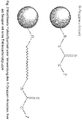
- the functional centers of the RAFT agent usually remain here during the polymerization directly at the surface (Z-group approach, see Fig.1 and Fig. 1a ).
- the so-called R groups thus remain on the polymer and can be used for the specific Functionalization, but structurally limited by the use of the RAFT agent lead.
- the attachment of the filler surface is usually via coupling silyl substituents, often referred to as Z group, (such as -Si (OAlk) 3 , -SiAlk (OAlk) 2 or -SiAlk 2 (OAlk)) to the corresponding RAFT agents.
- silyl substituents often referred to as Z group
- Z group such as -Si (OAlk) 3 , -SiAlk (OAlk) 2 or -SiAlk 2 (OAlk)
- a RAFT reagent which has a Z-group equipped with a coupling-capable silyl substituent.
- the Z group is the functionality that stabilizes the radical intermediate after addition of a polymer chain.
- This polymerization method is called grafting-to-approach. Disadvantages here are the low graft densities and a certain instability, since the thiocarbonylthio group of the control agent is involved in the attachment to the filler. In addition, the localization of the RAFT group on the filler surface further modification of the second, free polymer end is no longer possible.
- the functional group of the RAFT agent Upon completion of the controlled radical polymerization, the functional group of the RAFT agent is at the free chain end, which is not anchored to the filler surface. This opens up ways for subsequent modification of the functionalized filler.
- the anchoring of the RAFT agent on the filler surface is quantitative and can thus be controlled by the weight.
- modified or functionalized filler particles with different loading densities can be produced, which have the stated advantages.
- the filler is preferably carbon black, although it is also possible to use further polar or nonpolar fillers, such as those used in the rubber industry.
- RAFT agents can be used as RAFT agents.
- RAFT agents from the group of dithioesters, dithiobenzoates, such as, for example, cumyldithiobenzoates (CDB), trithiocarbonates, dithiocarbamates, such as, for example, 1-phenylethyl-9H-carbazole-9-dithiocarbamate (BCC), and xanthates (also US Pat called xanthates) have been found to be advantageous.
- PPT propyl (phenylmethyl) trithiocarbonate
- PPTS propyl ((trimethoxysilane) ethylphenylmethyl) trithiocarbonate
- HDPS trimethoxysilaneethyl-phenylmethyl
- BPETC bis ( 1-phenylethyl) trithiocarbonate
- propyl (2-furfuryl-2-propanioate) trithiocarbonate (1.31 g, 0.0043 mol) is added to a suspension of carbon black (0.557 g, 0.046 mol) in 30 mL of dibenzyl ether and the reaction mixture is replaced with water Stirred for 24 hours at 100 ° C. Thereafter, the carbon black is washed in Soxhlet with THF for several hours and then dried under high vacuum.
- furfuryl 2-bromopropionate (2.09 g, 0.009 mol) is added dropwise to a suspension of carbon black (5.40 g, 0.450 mol) in 200 ml of dibenzyl ether and the reaction is stirred at 130 ° C for 48 hours. Thereafter, the soot is washed in Soxhlet with THF and dried under high vacuum.
- the dried carbon black (5.40 g, 0.450 mol) is suspended in dimethylsulfoxide and then sodium (propyl) trithiocarbonate (1.71 g, 0.009 mol) is added.
- the reaction mixture is stirred at room temperature for 24 hours, washed in Soxhlet with THF and dried under high vacuum.
- the elemental analysis determined a loading density of 0.192 mmol RAFT agent per gram of carbon black.
- any radically polymerizable monomers may be used singly or in combination to give, upon completion of the polymerization, a homopolymer or a copolymer or a block polymer or a block copolymer.
- These are preferably 1,2-butadiene, 1,3-butadiene, isoprene, styrene, acrylonitrile, 2-propenenitrile, vinyl compounds, methacrylic compounds, acrylic compounds and so-called "ene” compounds, such as, for example, norbornenes.
- Particularly suitable diene monomers and preferably butadiene monomers for the formation of polybutadiene or butadiene copolymers have been found.
- Another object of the present invention is to provide rubber blends which are characterized by improved polymer-filler attachment and dispersion of the filler in the rubber blend. As a result, optimized physical properties of the rubber compound are shown.
- the rubber composition can be used for the production of tires, in particular car tires, truck tires, two-wheeled tires or industrial tires, which can also be pronounced as solid rubber tires.
- the rubber mixture according to the invention is preferably used as a tread, but also the use as Rubber compound for the inner components (body compounds) is possible.
- the rubber composition can be used to make technical rubber articles such as belts, straps, hoses, gaskets, air bags and blankets.
- the rubber mixture may additionally contain, in addition to the rubber already present from the polymer-modified filler particles, at least one further polar or apolar rubber.
- the polar or non-polar rubber is selected from the group consisting of natural polyisoprene and / or synthetic polyisoprene and / or butadiene rubber and / or styrene-butadiene rubber and / or solution-polymerized styrene-butadiene rubber and / or emulsion-polymerized styrene-butadiene rubber and / or liquid rubbers and / or halobutyl rubber and / or polynorbornene and / or isoprene-isobutylene copolymer and / or ethylene-propylene-diene rubber and / or nitrile rubber and / or chloroprene rubber and / or acrylate rubber and / or fluororubber and / or silicone rubber and / or polys
- nitrile rubber, hydrogenated acrylonitrile-butadiene rubber, chloroprene rubber, butyl rubber, halobutyl rubber or ethylene-propylene-diene rubber are used in the production of technical rubber articles such as straps, belts and hoses.
- the rubber mixture further contains the polymer-functionalized filler particles according to the invention.
- the filler is preferably carbon black.
- the rubber mixture contains preferably 1 to 180 phr, particularly preferably 1 to 170 phr and very particularly preferably 1 to 100 phr of polymer-functionalized carbon black particles.
- the rubber mixture may contain either only polymer-functionalized carbon black particles or else additionally polymer-functionalized silica particles.
- Other fillers known in the rubber industry such as alumina, talc, kaolin, carbonates, metal oxides (eg Mg oxides, Fe oxides, Ti oxides), mica, carbon fibers, clay minerals, modified phyllosilicates and others are possible.
- fibers, z. Example of aramid or nylon, hollow microspheres, or glass flakes may be contained in the rubber mixture.
- the rubber mixture contains other additives.
- Other additives essentially include plasticizers, zinc oxide, the crosslinking system (crosslinkers, sulfur donors and / or elemental sulfur, accelerators and retarders), antiozonants, anti-aging agents, masticating aids and other activators or processing aids.
- the proportion of the total amount of further additives is 3 to 150 phr, preferably 3 to 100 phr and more preferably 5 to 80 phr.
- Preferred plasticizers are mineral oils such as distilled aromatic extracts (DAE), residual aromatic extract (RAE), treated distilled aromatic extracts (TDAE), mild extracted solvents (MES) and / or naphthenic oils and / or synthetic plasticizers and / or fatty acids and / or a fatty acid derivatives and / or a resins and / or a fact and / or vegetable oils or BTL oils (biomass-to-liquid) and / or liquid polymers.
- DAE distilled aromatic extracts
- RAE residual aromatic extract
- TDAE treated distilled aromatic extracts
- MES mild extracted solvents
- MES mild extracted solvents
- / or naphthenic oils and / or synthetic plasticizers and / or fatty acids and / or a fatty acid derivatives and / or a resins and / or a fact and / or vegetable oils or BTL oils (biomass-to-liquid) and / or liquid polymers.
- phr parts per hundred parts of rubber by weight
- the dosage of the parts by weight of the individual substances is always based on 100 parts by weight of the total mass of all the rubbers present in the mixture.
Landscapes
- Chemical & Material Sciences (AREA)
- Organic Chemistry (AREA)
- Health & Medical Sciences (AREA)
- Chemical Kinetics & Catalysis (AREA)
- Medicinal Chemistry (AREA)
- Polymers & Plastics (AREA)
- Engineering & Computer Science (AREA)
- Mechanical Engineering (AREA)
- Compositions Of Macromolecular Compounds (AREA)
- Polymerisation Methods In General (AREA)
- Other Resins Obtained By Reactions Not Involving Carbon-To-Carbon Unsaturated Bonds (AREA)
Abstract
Description
- Die Erfindung betrifft ein Verfahren zur Herstellung von polymer-funktionalisierten Füllstoffpartikeln, die nach dem Verfahren hergestellten polymer-funktionalisierten Füllstoffpartikel und deren Verwendung in Kautschukmischungen.
- Die physikalischen Eigenschaften von anorganisch-organischen Hybridmaterialien hängen in erheblicher Weise von der Stärke sowie der Struktur und den Eigenschaften der Grenzfläche zwischen den enthaltenen Komponenten ab. Zur Verstärkung der Wechselwirkung zwischen polymerer und Füllstoffphase erfolgt zumeist der Einsatz von Kupplungsreagentien. Häufig handelt es sich dabei um funktionalisierte Alkyl-, Alkoxy- oder Halogensilane, welche befähigt sind, im Verlauf der Vulkanisation bzw. der Aushärtung des polymeren Systems eine kovalente Bindung an die Füllstoffoberfläche zu etablieren. Dieses konventionelle Verfahren ist mit dem Nachteil behaftet, dass oftmals lediglich eine geringe Kopplungsdichte erreicht wird. Auch eine gezielte Manipulation der Grenzphase zwischen polymerer Matrix und Füllstoffoberfläche ist auf diese Weise nicht oder nur begrenzt möglich.
- Der "Reversible Addition Fragmentation Chain Transfer"-Prozess (RAFT) ist eine vielversprechende Methode zur Durchführung kontrolliert radikalischer Polymerisationen. Die strukturelle Anbindung des Polymeren an der Oberfläche kann durch die Wahl und den chemischen Aufbau der so genannten RAFT-Agentien gesteuert werden. Die funktionellen Zentren des RAFT-Agens verbleiben hierbei üblicherweise während der Polymerisation direkt an der Oberfläche (Z-Gruppen-Ansatz, siehe
Fig.1 undFig 1a ). Die sogenannten R-Gruppen verbleiben folglich am Polymer und können zur spezifischen Funktionalisierung, allerdings durch die Verwendung des RAFT-Agens strukturell eingeschränkt, führen. - Die Anbindung der Füllstoffoberfläche erfolgt üblicherweise über kopplungsfähige Silylsubstituenten, oft als Z-Gruppe bezeichnet, (wie zum Beispiel -Si(OAlk)3, -SiAlk(OAlk)2 oder -SiAlk2(OAlk)) an den entsprechenden RAFT-Agentien. Die Herstellung dieser Silan-substituierten RAFT-Agentien und die Möglichkeit der Vernetzung der einzelnen Silan-Gruppen von silanterminierten Polymerketten wird in der Offenlegungsschrift
DE 10 2007 000 833 beschrieben. Allerdings war die Herstellung von silan-substituierten RAFT-Agentien der fachkundigen Person schon vorher bekannt, beispielsweise aus D.H. Nguyen, P.Vana, Polymers forAdvances Technologies, 2006, 17, 625 oder aus L. Barner, T.P. Davis, M.H. Stenzel, C. Barner-Kowollik, Macromol. Rapid Commun., 2007, 28, 539.
Auch die Verankerung der RAFT-Agentien über die kopplungsfähige Silylgruppe wird in verschiedenen Veröffentlichungen beschrieben, beispielsweise in C.H. Liu, C.Y. Pan, Polymer, 2007, 48, 3679 oder in Y.L. Zhao, S. Perrier, Macromolecules, 2006, 39, 8603. Konventionelle Verfahren beinhalten die Ausstattung von Polymeren mit Endgruppen, welche sich reaktiv gegenüber der Füllstoffoberfläche verhalten und somit eine kovalente oder anders geartete Anbindung an die Füllstoffoberfläche im Verlauf des Misch- oder Vulkanisationsprozesses gestatten. InUS 6,998,452 wird beispielsweise ein RAFT-ReAgens dargestellt, welches über eine mit einem kopplungsfähigen Silylsubstituenten ausgestattete Z-Gruppe verfügt. Die Z-Gruppe ist die Funktionalität, welche das radikalische Intermediat nach Addition einer Polymerkette stabilisiert. Diese Polymerisationsmethode wird als Grafting-to-Ansatz bezeichnet. Nachteil sind hierbei die geringen Pfropfdichten und eine gewisse Instabilität, da die Thiocarbonylthiogruppe des Kontrollagens in die Anbindung an den Füllstoff involviert ist. Darüber hinaus ist durch die Lokalisierung der RAFT-Gruppe an der Füllstoffoberfläche eine weitere Modifizierung des zweiten, freien Polymerendes nicht mehr möglich. Zudem gewinnen bei diesem Ansatz zunehmend sterische Hinderungen zwischen den wachsenden und den an die Oberfläche gebundenen Ketten an Einfluss, da die reaktiven Ketten zunächst durch die oberflächlichengebundene Polymerschicht diffundieren müssen, um mit der funktionellen RAFT-Gruppe zu reagieren.
Aus Q. Yang, L. Wang, W. D. Xiang, J. F. Zhou, Q. H. Tan, Polymer 2007, 48, 3444 ist die Möglichkeit der RAFT-Polymerisation von Rußpartikel bereits bekannt. Allerdings wird hier ein anderer Verankerungsmechanismus verwendet, wodurch eine starke und aufwändige Oberflächenmodifikation des Rußes von Nöten ist. Diese wird in mehreren Schritten durchgeführt und ist nur in kleineren Mengen präparativ durchführbar. - Der Erfindung liegt daher die Aufgabe zu Grunde, ein Verfahren zur Herstellung polymer-funktionalisierter Füllstoffpartikel und polymer-funktionalisierte Füllstoffpartikel hergestellt nach dem Verfahren bereitzustellen, wodurch sich Vorteile, insbesondere hinsichtlich
- höherer Pfropfdichte;
- verbesserter chemischer Stabilität;
- nachträglicher Modifizierbarkeit und
- gezielter Beeinflussung der Grenzschicht zwischen fester Phase und polymerer Matrix
- Gelöst wird diese Aufgabe durch ein Verfahren zur Herstellung polymer-funktionalisierter Füllstoffpartikel und durch polymer-funktionalisierte Füllstoffpartikel hergestellt nach dem Verfahren, wobei das Verfahren durch wenigstens folgende Verfahrensschritte gekennzeichnet ist:
- Anbindung eines Diels-Alder-Kontrollagens zur kontrollierten radikalischen Polymerisation an die Oberfläche eines Füllstoffpartikels, wobei die Gruppe R des RAFT-Agens über eine Gruppe R1 an die Oberfläche eines Füllstoffpartikels angebunden ist, wobei R1 wenigstens eine Diels-Alder-reaktive Funktionalität ist, und
- anschließende kontrollierte radikalische Polymerisation von Monomeren mit Hilfe des Kontrollagens, welches an dem Füllstoffpartikel gebunden ist.
- Die Anbindung von Diels-Alder-RAFT-Agentien erfolgt gemäß dem obigen Verfahren folglich über die R-Gruppe und die anschließende RAFT-Polymerisation erfolgt somit von der festen Füllstoffoberfläche aus. Der Begriff RAFT-Agens wird in dieser Schrift synonym zu dem Begriff "Kontrollagens für die kontrollierte radikalische Polymerisation" verwendet.
Überraschenderweise wurde gefunden, dass die Etablierung der Diels-Alder-Gruppe an die abgangsfähige R-Gruppe des RAFT-Agens (R-Gruppen-Ansatz, sieheFig.2 ) folgende Vorteile hat: - Das reaktive Zentrum für die Addition wachsender Makroradikale entfernt sich im Laufe der Polymerisation von der Oberfläche. Dies impliziert in Relation zur Verankerung über die Z-Gruppe eine verminderte sterische Hinderung zwischen wachsenden und an der Oberfläche verankerten Ketten und somit einen höheren Belegungsgrad. Dies ist vor allem für schwierig zu kontrollierende Monomere wie 1,3-Diene von Bedeutung.
- Nach Abschluss der kontrolliert radikalischen Polymerisation befindet sich die funktionelle Gruppe des RAFT-Agens am freien Kettenende, welches nicht auf der Füllstoffoberfläche verankert ist. Dies eröffnet Wege zur nachträglichen Modifikation des funktionalisierten Füllstoffs.
- Die Tatsache, dass die Verankerung des Polymers im Gegensatz zum Z-Gruppen-Ansatz nicht über die RAFT-Gruppe erfolgt, impliziert zudem eine erhöhte Stabilität des Endproduktes.
- Die Verankerung des RAFT-Agens auf der Füllstoffoberfläche erfolgt quantitativ und kann somit über die Einwaagen gesteuert werden. Dadurch können modifizierte bzw. funktionalisierte Füllstoff-Partikel mit unterschiedlichsten Beladungsdichten hergestellt werden, welche die genannten Vorteile aufweisen.
- Bevorzugt handelt es sich bei dem Füllstoff um Ruß, wobei auch weitere polare oder unpolare Füllstoffe, wie sie in der Kautschukindustrie eingesetzt werden, verwendet werden können.
- Als RAFT-Agentien können alle der fachkundigen Person bekannten RAFT-Agentien verwendet werden. Insbesondere RAFT-Agentien aus der Gruppe der Dithioester, der Dithiobenzoate, wie bspw. Cumyldithiobenzoate (CDB), der Trithiocarbonate, der Dithiocarbamate, wie bspw. 1-Phenylethyl-9H-carbazol-9-dithiocarbamat (BCC), und der Xanthogenate (auch als Xanthate bezeichnet) haben sich als vorteilhaft erwiesen.
- Als besonders bevorzugtes RAFT-Agens wird die Klasse der Trithiocarbonate (=Salze der Trithiokohlensäure) gewählt, da diese leicht zu synthetisieren sind und selbst bei Zerstörung der RAFT-Gruppe ein Thiol als funktionelle Gruppe erhalten bleibt (siehe auch
Fig.3 ). Hierbei sind Propyl-(phenylmethyl)-trithiocarbonat (PPT) und Propyl-((trimethoxysilan)ethyl-phenylmethyl)-trithiocarbonat (PPTS) und 1,6-Hexyl-di((trimethoxysilanethyl-phenylmethyl)-trithiocarbonat (HDPS) und Bis(1-phenylethyl)trithiocarbonat (BPETC) besonders zu erwähnen. - Im Folgenden wird die Herstellung einzelner bevorzugter RAFT-Agentien dargestellt:
- Ein Gemisch aus Schwefelkohlenstoff (1,90 g; 0,025 mol) und Caesiumcarbonat (8,14 g; 0,025 mol) in N,N-Dimethylacetamid (20 ml) wird für 20 Minuten bei Raumtemperatur gerührt. Es kommt zu einer intensiven Rotfärbung der Reaktionsmischung.
Es erfolgt die langsame Zugabe von 1-Bromo-ethylbenzol (4,62 g; 0,025 mol) in N,N-Dimethylacetamid (5 ml). Die Reaktionslösung wird für 24 Stunden bei Raumtemperatur gerührt und danach in Eiswasser (150 ml) überführt. Die wässrige Phase wird mit Essigester (3 mal 50 ml) extrahiert. Die vereinigten organischen Phasen werden über Natriumsulfat getrocknet und das Lösungsmittel im Hochvakuum entfernt. Das gewünschte Produkt wird als gelbliches Öl (7,79 g) in einer Ausbeute von 98% erhalten. - Zu einer Lösung von Propanthiol (3,00 g; 0,039 mol) in Chloroform (200 ml) erfolgt die langsame Zugabe von Triethylamin (4,78 g; 0,047 mol). Das Reaktionsgemisch wird für eine Stunde bei Raumtemperatur gerührt. Anschließend erfolgt die Zugabe von Schwefelkohlenstoff (7,50; 0,098 mol) und das Reaktionsgemisch wird für weitere zwei Stunden bei Raumtemperatur gerührt. Danach erfolgt die Zugabe von Benzylbromid (8,08 g; 0,047 mol) und die Reaktionslösung wird für 24 Stunden bei Raumtemperatur gerührt. Es erfolgt die Zugabe von 10%iger Salzsäure (200 ml). Die organische Phase wird abgetrennt und mit Wasser gewaschen (3 mal 100 ml). Die vereinigten organischen Phasen werden über Natriumsulfat getrocknet und das Lösungsmittel im Hochvakuum entfernt. Das gewünschte Produkt wird als gelbliches Öl (9,36 g) in einer Ausbeute von 98% erhalten.
- Zu einer eisgekühlten Lösung von 2-Furylmethanol (5,10 g; 0,052 mol) in 70 ml Chloroform wird Triethylamin (5,26 g; 0,052 mol) hinzugegeben. Danach erfolgt die langsame Zugabe von 2-Bromopropionylbromid (9,93 g; 0,046 mol) in 10 ml Chloroform. Die Reaktionsmischung wird für 24 h bei RT gerührt. Zur Aufarbeitung wird das Reaktionsgemisch mit Wasser (1 mal 80 ml), 10 %iger Schwefelsäure (1 mal 80 ml) und mit gesättigter NaHCO3-Lsg. (2 mal 50 ml) gewaschen. Die organische Phase wird über Magnesiumsulfat getrocknet, eingeengt und im Hochvakuum getrocknet. Die Ausbeute beträgt 67%.
- Die synthetische Prozedur ist analog zu der Reaktionsvorschrift von Furfuryl-2-bromopropionat, außer das anstatt 2-Furylmethanol 2-Furuylmethanthiol (5,94 g, 0,052 mol) verwendet wird.
- Zu einer eisgekühlten Lösung von Propanthiol (4,00 g; 0,053 mol) in 50 ml Tetrahydrofuran erfolgt die Zugabe von 50 %iger Natriumhydroxidlösung. Danach erfolgt die langsame Zugabe von CS2 (4,00 g; 0,053 mol). Dabei ist darauf zu achten, dass die Temperatur 10 °C nicht übersteigt. Die Reaktionsmischung wird für 24 h bei Raumtemperatur gerührt und aus Hexan umkristallisiert. Die Ausbeute beträgt 64 %.
- Zu einer Lösung von Furfuryl-2-bromopropionat (1,49 g; 0,0064 mol) in DMSO (25 ml) wird eine Lösung von Natrium-(propyl)-trithiocarbonat (1,12 g; 0,0064 mol) in 10 ml DMSO hinzugegeben. Das Reaktionsgemisch wird bei RT für 48 h gerührt und danach mit Diethylether (3 mal 20 ml) gewaschen. Die vereinigten organischen Phasen werden mit Wasser gewaschen und über Natriumsulfat getrocknet. Das Lösungsmittel wird im Hochvakuum verdampft und das Produkt wird mit einer Ausbeute von 72 % erhalten.
- Die Anbindung des RAFT-Agens an die Oberfläche der Füllstoffpartikel erfolgt bei dem Füllstoff Ruß über eine Diels-Alder-Reaktion (siehe
Fig. 4 ,5 und6 ).
Die Verankerung unter Ausnutzung der Diels-Alder-Reaktion und der strukturelle Aufbau des RAFT-Agens implizieren folgende Vorteile: - 1) Die Anbindung erfolgt ohne die Bildung von Nebenprodukten und kann unter milden Reaktionsbedingungen durchgeführt werden.
- 2) Es werden keine weiteren Zusätze benötigt (auch nicht in katalytischen Mengen).
- 3)Die Immobilisierung kann in einer ein- bzw. zweistufigen Synthesestrategie durchgeführt werden. Es ist auch möglich, dass die Immobilisierung über eine Steglich-Veresterung erfolgt.
- 4) Die Immobilisierung erfolgt nicht quantitativ. Allerdings kann die Beladungsdichte über die Reaktionsdauer und die Temperatur gesteuert werden und ggf. mittels Elementaranalyse überprüft werden.
- 5) Aufgrund des strukturellen Aufbaus des RAFT-Agens kann nach Beendigung der Polymerisation die Polymerkette an der Ester- bzw. Thioesterbindung abgespalten werden, um eine Analyse hinsichtlich Molekulargewicht und Molekulargewichtsverteilung zu ermöglichen.
- Die Immobilisierung erfolgt über die R-Gruppe, womit sich folgende Vorteile ergeben:
- 1) Das reaktive Zentrum für die Addition wachsender Makroradikale entfernt sich im Laufe der Polymerisation von der Oberfläche. Dies impliziert in Relation zur Verankerung über die Z-Gruppe eine verminderte sterische Hinderung zwischen wachsenden und an der Oberfläche verankerten Ketten. Somit kann ein höherer Belegungsgrad realisiert werden.
- 2) Nach Abschluss der kontrolliert radikalischen Polymerisation befindet sich die funktionelle Gruppe des RAFT-Agens am freien Kettenende, welches nicht auf der Füllstoffoberfläche verankert ist. Dies eröffnet Wege zur nachträglichen Modifikation des Kettenendes.
- 3) Die Etablierung der funktionellen RAFT-Gruppe am Polymerkettenende impliziert einen gewissen Anteil von Schwefelatomen, welche z.B. bei der Vulkanisation verwendet werden können.
- Als Beispiel siehe
Fig. 4 . - In einer typischen Umsetzung wird Propyl-(2-Furfuryl-2-propanioat)-trithiocarbonat (1,31 g; 0,0043 mol) zu einer Suspension von Ruß (0,557 g; 0,046 mol) in 30 ml Dibenzylether gegeben und das Reaktionsgemisch für 24 Stunden bei 100°C gerührt. Danach wird der Ruß im Soxhlet mit THF für mehrere Stunden gewaschen und anschließend im Hochvakuum getrocknet.
- Im Vergleich zum unbehandelten Ruß bestimmt die Elementaranalyse eine Beladungsdichte von 0,118 mmol RAFT-Agens pro Gramm Ruß.
- Als Beispiel siehe
Fig. 5 . - In einer typischen Umsetzung wird Furfuryl-2-bromopropionat (2,09 g, 0,009 mol) zu einer Suspension von Ruß (5,40 g; 0,450 mol) in 200 ml Dibenzylether getropft und das Reaktionsgemisch für 48 Stunden bei 130°C gerührt. Danach wird der Ruß im Soxhlet mit THF gewaschen und im Hochvakuum getrocknet.
- Der getrocknete Ruß (5,40 g; 0,450 mol) wird in Dimethylsulfoxid suspendiert und danach mit Natrium-(propyl)-trithiocarbonat (1,71 g; 0,009 mol) versetzt. Das Reaktionsgemisch wird bei Raumtemperatur für 24 Stunden gerührt, im Soxhlet mit THF gewaschen und im Hochvakuum getrocknet.
Im Vergleich zum unbehandelten Ruß bestimmt die Elementaranalyse eine Beladungsdichte von 0,192 mmol RAFT-Agens pro Gramm Ruß. - Als Monomere können alle radikalisch polymerisierbaren Monomere einzeln oder in Kombination verwendet werden, so dass sich nach Abschluss der Polymerisation ein Homopolymer oder ein Copolymer oder ein Blockpolymer oder ein Blockcopolymer ergibt. Vorzugsweise handelt es sich hierbei um 1,2-Butadien, 1,3-Butadien, Isopren, Styrol, Acrylnitril, 2-Propennitril, Vinylverbindungen, Methacrylverbindungen, Acrylverbindungen und so genannte "En"-Verbindungen, wie bspw. Norbornene. Als besonders geeignet haben sich Dien-Monomere und hier bevorzugt Butadien-Monomere zur Ausbildung von Polybutadien oder Butadien-Copolymeren erwiesen.
- Eine weitere Aufgabe der vorliegenden Erfindung ist es, Kautschukmischungen bereitzustellen, welche sich durch eine verbesserte Polymer-Füllstoff-Anbindung und eine verbesserte Dispersion des Füllstoffs in der Kautschukmischung auszeichnen. Dadurch bedingt zeigen sich optimierte physikalische Eigenschaften der Kautschukmischung.
- Gelöst wird diese Aufgabe dadurch, dass die Kautschukmischung polymer-funktionalisierte Füllstoffpartikel, welche nach dem erfindungsgemäßen Verfahren hergestellt wurden, enthält.
Durch die bereits oben genannten Eigenschaften der polymer-funktionalisierten Füllstoffpartikel ergeben sich optimierte physikalische Eigenschaften der Kautschukmischung - Die Kautschukmischung kann für die Herstellung von Reifen, insbesondere Pkw-Reifen, LKW-Reifen, Zweiradreifen oder Industriereifen, welche auch als Vollgummireifen ausgeprägt sein können, verwendet werden. Bevorzugt wird die erfindungsgemäße Kautschukmischung als Laufstreifen eingesetzt, aber auch die Verwendung als Kautschukmischung für die inneren Bauteile (body compounds) ist möglich. Des Weiteren kann die Kautschukmischung zur Herstellung von technischen Gummiartikeln, wie beispielsweise Gurte, Riemen, Schläuche, Dichtungen, Luftfederbälgen und Drucktüchern verwendet werden.
- Die Kautschukmischung kann zusätzlich, neben dem bereits aus den polymermodifizierten Füllstoffpartikeln vorhandenen Kautschuk, zumindest einen weiteren polaren oder unpolaren Kautschuk enthalten.
Der polare oder unpolare Kautschuk ist dabei ausgewählt aus der Gruppe, bestehend aus natürlichem Polyisopren und / oder synthetischem Polyisopren und / oder Butadien-Kautschuk und / oder Styrolbutadienkautschuk und / oder lösungspolymerisierter Styrolbutadienkautschuk und / oder emulsionspolymerisierter Styrolbutadienkautschuk und / oder Flüssigkautschuken und / oder Halobutylkautschuk und / oder Polynorbornen und / oder Isopren-Isobutylen-Copolymer und / oder Ethylen-Propylen-Dien-Kautschuk und / oder Nitrilkautschuk und / oder Chloroprenkautschuk und / oder Acrylat-Kautschuk und / oder Fluorkautschuk und / oder Silikon-Kautschuk und / oder Polysulfidkautschuk und / oder Epichlorhydrinkautschuk und / oder Styrol-Isopren-Butadien-Terpolymer und / oder hydrierter Acrylnitrilbutadienkautschuk und / oder Isopren-Butadien-Copolymer und / oder hydrierter Styrolbutadienkautschuk. - Insbesondere Nitrilkautschuk, hydrierter Acrylnitrilbutadienkautschuk, Chloroprenkautschuk, Butylkautschuk, Halobutylkautschuk oder Ethylen-Propylen-Dien-Kautschuk kommen bei der Herstellung von technischen Gummiartikeln, wie Gurte, Riemen und Schläuche, zum Einsatz.
Die Kautschukmischung enthält des Weiteren die erfindungsgemäßen polymer-funktionalisierten Füllstoffpartikel. Wie bereits erwähnt, ist der Füllstoff bevorzugt Ruß. Die Kautschukmischung enthält dabei bevorzugt 1 bis 180 phr, besonders bevorzugt 1 bis 170 phr und ganz besonders bevorzugt 1 bis 100 phr polymer-funktionalisierte Rußpartikel. - Es ist auch möglich, dass die Kautschukmischung entweder nur polymer-funktionalisierte Rußpartikel, oder aber zusätzlich auch polymer-funktionalisierte Kieselsäurepartikel enthalten kann.
Weitere, in der Kautschukindustrie bekannte Füllstoffe, wie Aluminiumoxid, Talk, Kaolin, Karbonate, Metalloxide (bspw. Mg-Oxide, Fe-Oxide, Ti-Oxide), Glimmer, Kohlenstofffasern, Tonminerale, modifizierte Schichtsilikate und weitere sind möglich. Ebenso können noch Fasern, z. Bsp. aus Aramid oder Nylon, Mikrohohlkugeln, oder Glasflocken in der Kautschukmischung enthalten sein. - Weiterhin enthält die Kautschukmischung noch weitere Zusatzstoffe.
Weitere Zusatzstoffe beinhaltet im Wesentlichen Weichmacher, Zinkoxid, das Vernetzungssystem (Vernetzer, Schwefelspendern und / oder elementaren Schwefel, Beschleuniger und Verzögerer), Ozonschutzmittel, Alterungsschutzmittel, Mastikationshilfsmittel und weitere Aktivatoren bzw. Verarbeitungshilfsmittel.
Der Mengenanteil der Gesamtmenge an weiteren Zusatzstoffen beträgt 3 bis 150 phr, bevorzugt 3 bis 100 phr und besonders bevorzugt 5 bis 80 phr.
Als Weichmacher werden bevorzugt Mineralöle, wie beispielsweise DAE (Destillated Aromatic Extracts), RAE (Residual Aromatic Extract), TDAE (Treated Destillated Aromatic Extracts), MES (Mild Extracted Solvents) und / oder naphtenische Öle und /oder synthetische Weichmacher und / oder Fettsäuren und / oder ein Fettsäurederivate und / oder ein Harze und / oder ein Faktisse und / oder Pflanzenöle oder BTL-Öle (Biomass- To-Liquid) und / oder Flüssigpolymere eingesetzt. - Die in dieser Schrift verwendete Angabe phr (parts per hundred parts of rubber by weight) ist dabei die in der Kautschukindustrie übliche Mengenangabe für Mischungsrezepturen. Die Dosierung der Gewichtsteile der einzelnen Substanzen wird dabei stets auf 100 Gewichtsteile der gesamten Masse aller in der Mischung vorhandenen Kautschuke bezogen.
Claims (9)
- Verfahren zur Herstellung polymer-funktionalisierter Füllstoffpartikel, gekennzeichnet durch wenigstens folgende Verfahrensschritte:- Anbindung eines Diels-Alder-Kontrollagens zur kontrollierten radikalischen Polymerisation an die Oberfläche eines Füllstoffpartikels, wobei die Gruppe R des RAFT-Agens über eine Gruppe R1 an die Oberfläche eines Füllstoffpartikels angebunden ist, wobei R1 wenigstens eine Diels-Alder-reaktive Funktionalität ist, und- anschließende kontrollierte radikalische Polymerisation von Monomeren mit Hilfe des Kontrollagens, welches an dem Füllstoffpartikel gebunden ist.
- Verfahren nach Anspruch 1, dadurch gekennzeichnet, dass es sich bei den Füllstoffpartikeln um Rußpartikel handelt.
- Verfahren nach einem der Ansprüche 1 bis 2, dadurch gekennzeichnet, dass das Kontrollagens zur kontrolliert radikalischen Polymerisation ausgewählt ist aus der Gruppe der Trithiocarbonate.
- Verfahren nach einem der Ansprüche 1 bis 3, dadurch gekennzeichnet, dass wenigstens eines der Monomere ein Dien-Monomer ist.
- Polymer-funktionalisierte Füllstoffpartikel hergestellt nach dem Verfahren nach einem der Ansprüche 1 bis 4.
- Kautschukmischung, dadurch gekennzeichnet, dass sie polymer-funktionalisierte Füllstoffpartikel nach Anspruch 5 enthält.
- Verwendung einer Kautschukmischung nach Anspruch 6 zur Herstellung eines Reifens.
- Verwendung einer Kautschukmischung nach Anspruch 7 zur Herstellung des Laufstreifens oder einer Body-Mischung eines Reifens.
- Verwendung einer Kautschukmischung nach Anspruch 6 zur Herstellung eines Gurtes, Riemens oder Schlauches.
Applications Claiming Priority (3)
| Application Number | Priority Date | Filing Date | Title |
|---|---|---|---|
| DE201010060780 DE102010060780A1 (de) | 2010-11-24 | 2010-11-24 | Verfahren zur Herstellung von polymer-funktionalisierten Füllstoffpartikeln |
| PCT/EP2011/070538 WO2012069403A2 (de) | 2010-11-24 | 2011-11-21 | Verfahren zur herstellung von polymer-funktionalisierten füllstoffpartikeln |
| EP11787844.7A EP2643414B1 (de) | 2010-11-24 | 2011-11-21 | Verfahren zur herstellung von polymer-funktionalisierten kieselsäurepartikel |
Related Parent Applications (2)
| Application Number | Title | Priority Date | Filing Date |
|---|---|---|---|
| EP11787844.7A Division EP2643414B1 (de) | 2010-11-24 | 2011-11-21 | Verfahren zur herstellung von polymer-funktionalisierten kieselsäurepartikel |
| EP11787844.7A Division-Into EP2643414B1 (de) | 2010-11-24 | 2011-11-21 | Verfahren zur herstellung von polymer-funktionalisierten kieselsäurepartikel |
Publications (2)
| Publication Number | Publication Date |
|---|---|
| EP3235880A1 true EP3235880A1 (de) | 2017-10-25 |
| EP3235880B1 EP3235880B1 (de) | 2018-11-14 |
Family
ID=45033965
Family Applications (2)
| Application Number | Title | Priority Date | Filing Date |
|---|---|---|---|
| EP17170135.2A Active EP3235880B1 (de) | 2010-11-24 | 2011-11-21 | Verfahren zur herstellung von polymer-funktionalisierten russpartikeln |
| EP11787844.7A Active EP2643414B1 (de) | 2010-11-24 | 2011-11-21 | Verfahren zur herstellung von polymer-funktionalisierten kieselsäurepartikel |
Family Applications After (1)
| Application Number | Title | Priority Date | Filing Date |
|---|---|---|---|
| EP11787844.7A Active EP2643414B1 (de) | 2010-11-24 | 2011-11-21 | Verfahren zur herstellung von polymer-funktionalisierten kieselsäurepartikel |
Country Status (6)
| Country | Link |
|---|---|
| US (1) | US8912267B2 (de) |
| EP (2) | EP3235880B1 (de) |
| CN (1) | CN103221490B (de) |
| DE (1) | DE102010060780A1 (de) |
| ES (2) | ES2710106T3 (de) |
| WO (1) | WO2012069403A2 (de) |
Families Citing this family (12)
| Publication number | Priority date | Publication date | Assignee | Title |
|---|---|---|---|---|
| CN105916961B (zh) * | 2014-01-06 | 2018-06-12 | 纳米技术有限公司 | 表面改性的纳米粒子 |
| DE102015208810A1 (de) | 2015-05-12 | 2016-11-17 | Continental Reifen Deutschland Gmbh | RAFT-Agens, Verfahren zur Polymerisation, Polymer und Kautschukmischung sowie deren Verwendung |
| US10731018B2 (en) | 2015-08-11 | 2020-08-04 | Arizona Board Of Regents On Behalf Of The University Of Arizona | Antioxidant polydihydropyridazine and polypyridazine foams from 1,2,4,5-tetrazine |
| US10851192B2 (en) | 2015-08-11 | 2020-12-01 | Arizona Board Of Regents On Behalf Of The University Of Arizona | Dihydropyridazine-based antioxidants and uses thereof |
| WO2017027521A2 (en) * | 2015-08-11 | 2017-02-16 | The Arizona Board Of Regents On Behalf Of The University Of Arizona | Green chemistry method of synthesizing polymer structures that can function as a built-in antioxidant |
| WO2018005864A1 (en) | 2016-06-29 | 2018-01-04 | The Arizona Board Of Regents On Behalf Of The University Of Arizona | Method of formation of a robust network of foam through diels-alder reaction |
| US10633517B2 (en) | 2017-03-10 | 2020-04-28 | Arizona Board Of Regents On Behalf Of The University Of Arizona | Hydrogenated tetrazine-based antioxidants and free radical reaction inhibitors and uses thereof |
| EP3630882A4 (de) | 2017-06-02 | 2021-02-24 | W.R. Grace & Co.-Conn. | Beschichtete partikel und verfahren zur herstellung und verwendung davon |
| CN111655774B (zh) | 2017-08-03 | 2023-05-02 | 格雷斯公司 | 基于二氧化硅的消光剂及其制备和使用方法 |
| US11945896B2 (en) | 2019-09-18 | 2024-04-02 | W.R. Grace & Co.-Conn. | Catalyst composition and system having extended lifetime |
| CN112778591B (zh) * | 2019-11-04 | 2023-02-28 | 中国石油化工股份有限公司 | 橡胶组合物及其制备方法与应用、轮胎胎面用橡胶组合物及其制备方法 |
| EP3885411A1 (de) | 2020-03-27 | 2021-09-29 | Continental Reifen Deutschland GmbH | Silica mit modifizierter oberfläche |
Citations (3)
| Publication number | Priority date | Publication date | Assignee | Title |
|---|---|---|---|---|
| EP0272127A2 (de) * | 1986-12-17 | 1988-06-22 | Nippon Shokubai Co., Ltd. | Carbon Black-Pfropfpolymer, seine Herstellung und Verwendung |
| US6998452B1 (en) | 2005-01-14 | 2006-02-14 | The Goodyear Tire & Rubber Company | Controlled free radical agent for nanocomposite synthesis |
| DE102007000833A1 (de) | 2007-10-08 | 2009-04-09 | Wacker Chemie Ag | Silan-substituierte RAFT-Reagenzien und Silan-vernetzbare Polymere |
Family Cites Families (2)
| Publication number | Priority date | Publication date | Assignee | Title |
|---|---|---|---|---|
| WO2008051616A2 (en) * | 2006-10-27 | 2008-05-02 | The University Of Akron | Organic-inorganic hybrid nanomaterials and method for synthesizing same |
| CN102597031A (zh) * | 2009-04-10 | 2012-07-18 | 伦斯勒理工学院 | 被二嵌段共聚物改性的纳米粒子/聚合物复合物 |
-
2010
- 2010-11-24 DE DE201010060780 patent/DE102010060780A1/de not_active Withdrawn
-
2011
- 2011-11-21 CN CN201180056102.XA patent/CN103221490B/zh active Active
- 2011-11-21 EP EP17170135.2A patent/EP3235880B1/de active Active
- 2011-11-21 EP EP11787844.7A patent/EP2643414B1/de active Active
- 2011-11-21 WO PCT/EP2011/070538 patent/WO2012069403A2/de not_active Ceased
- 2011-11-21 ES ES11787844T patent/ES2710106T3/es active Active
- 2011-11-21 ES ES17170135T patent/ES2707375T3/es active Active
-
2013
- 2013-05-24 US US13/902,275 patent/US8912267B2/en active Active
Patent Citations (3)
| Publication number | Priority date | Publication date | Assignee | Title |
|---|---|---|---|---|
| EP0272127A2 (de) * | 1986-12-17 | 1988-06-22 | Nippon Shokubai Co., Ltd. | Carbon Black-Pfropfpolymer, seine Herstellung und Verwendung |
| US6998452B1 (en) | 2005-01-14 | 2006-02-14 | The Goodyear Tire & Rubber Company | Controlled free radical agent for nanocomposite synthesis |
| DE102007000833A1 (de) | 2007-10-08 | 2009-04-09 | Wacker Chemie Ag | Silan-substituierte RAFT-Reagenzien und Silan-vernetzbare Polymere |
Non-Patent Citations (6)
| Title |
|---|
| C.H. LIU; C.Y. PAN, POLYMER, vol. 48, 2007, pages 3679 |
| D.H. NGUYEN; P.VANA, POLYMERS FORADVANCES TECHNOLOGIES, vol. 17, 2006, pages 625 |
| L. BARNER; T.P. DAVIS; M.H. STENZEL; C. BARNER-KOWOLLIK, MACROMOL. RAPID COMMUN., vol. 28, 2007, pages 539 |
| Q. YANG; L. WANG; W. D. XIANG; J. F. ZHOU; Q. H. TAN, POLYMER, vol. 48, 2007, pages 3444 |
| QIANG YANG ET AL: "A temperature-responsive carbon black nanoparticle prepared by surface-induced reversible addition-fragmentation chain transfer polymerization", vol. 48, no. 12, 4 June 2007 (2007-06-04), pages 3444 - 3451, XP002677230, ISSN: 0032-3861, Retrieved from the Internet <URL:http://www.sciencedirect.com/science/article/pii/S003238610700153X> [retrieved on 20070307], DOI: 10.1016/J.POLYMER.2007.02.064 * |
| Y.L. ZHAO; S. PERRIER, MACROMOLECULES, vol. 39, 2006, pages 8603 |
Also Published As
| Publication number | Publication date |
|---|---|
| WO2012069403A3 (de) | 2012-09-13 |
| EP3235880B1 (de) | 2018-11-14 |
| EP2643414A2 (de) | 2013-10-02 |
| CN103221490B (zh) | 2015-08-12 |
| WO2012069403A2 (de) | 2012-05-31 |
| EP2643414B1 (de) | 2018-11-07 |
| ES2707375T3 (es) | 2019-04-03 |
| DE102010060780A1 (de) | 2012-05-24 |
| US8912267B2 (en) | 2014-12-16 |
| ES2710106T3 (es) | 2019-04-23 |
| US20130261272A1 (en) | 2013-10-03 |
| CN103221490A (zh) | 2013-07-24 |
Similar Documents
| Publication | Publication Date | Title |
|---|---|---|
| EP3235880B1 (de) | Verfahren zur herstellung von polymer-funktionalisierten russpartikeln | |
| EP1000971B1 (de) | Carboxylgruppen-haltige Lösungskautschuke enthaltende Kautschukmischungen | |
| EP3303004B2 (de) | Kautschukmischung und fahrzeugreifen | |
| EP2152791B1 (de) | Verfahren zur herstellung von kautschukmischungen | |
| EP3150402B1 (de) | Kautschukmischung und fahrzeugreifen | |
| WO2019105614A1 (de) | Schwefelvernetzbare kautschukmischung, vulkanisat der kautschukmischung und fahrzeugreifen | |
| EP3717557B1 (de) | Schwefelvernetzbare kautschukmischung, vulkanisat der kautschukmischung und fahrzeugreifen | |
| EP3827064A1 (de) | Haftmischungen für kautschuke | |
| EP1837368A2 (de) | Zusammensetzung mit Zinkhydroxid, Mischung enthaltend die Zusammensetzung und Artikel daraus | |
| EP2886566B1 (de) | Kautschukmischung und Fahrzeugreifen | |
| EP3109064B1 (de) | Verfahren zur co-polymerisation, co-polymer und kautschukmischung sowie deren verwendung | |
| EP3885411A1 (de) | Silica mit modifizierter oberfläche | |
| EP3720905B1 (de) | Schwefelvernetzbare kautschukmischung, vulkanisat der kautschukmischung und fahrzeugreifen | |
| EP3500626A1 (de) | Kautschukblend, schwefelvernetzbare kautschukmischung und fahrzeugreifen | |
| EP1110973A1 (de) | Lösungskautschuke mit unpolaren Seitengruppen | |
| EP3452518B1 (de) | Kautschukmischung, vulkanisat der kautschukmischung und fahrzeugreifen | |
| DE19920788A1 (de) | Carboxylgruppen-haltige Dienkautschuke | |
| WO2009033997A1 (de) | Funktionalisierte russhaltige kautschuke | |
| DE102005044996A1 (de) | Kautschukmischung und Reifen | |
| EP3294785B1 (de) | Raft-agens, verfahren zur polymerisation, polymer und kautschukmischung sowie deren verwendung | |
| EP1169384A1 (de) | Hydroxylgruppenhaltige lösungskautschuke | |
| DE102005044997A1 (de) | Kautschukmischung und Reifen | |
| EP3294784A1 (de) | Verfahren zur herstellung eines copolymers, copolymer und kautschukmischung sowie deren verwendung | |
| DE10062945A1 (de) | Kautschukmischung und Kieselsäure für eine Kautschukmischung | |
| EP1670836A1 (de) | Katalysatorsystem zur herstellung von homo- und copolymeren von dienen und vinylaromaten durch anionische polymerisation |
Legal Events
| Date | Code | Title | Description |
|---|---|---|---|
| PUAI | Public reference made under article 153(3) epc to a published international application that has entered the european phase |
Free format text: ORIGINAL CODE: 0009012 |
|
| AC | Divisional application: reference to earlier application |
Ref document number: 2643414 Country of ref document: EP Kind code of ref document: P |
|
| AK | Designated contracting states |
Kind code of ref document: A1 Designated state(s): AL AT BE BG CH CY CZ DE DK EE ES FI FR GB GR HR HU IE IS IT LI LT LU LV MC MK MT NL NO PL PT RO RS SE SI SK SM TR |
|
| 17P | Request for examination filed |
Effective date: 20180425 |
|
| RBV | Designated contracting states (corrected) |
Designated state(s): AL AT BE BG CH CY CZ DE DK EE ES FI FR GB GR HR HU IE IS IT LI LT LU LV MC MK MT NL NO PL PT RO RS SE SI SK SM TR |
|
| GRAP | Despatch of communication of intention to grant a patent |
Free format text: ORIGINAL CODE: EPIDOSNIGR1 |
|
| INTG | Intention to grant announced |
Effective date: 20180718 |
|
| GRAS | Grant fee paid |
Free format text: ORIGINAL CODE: EPIDOSNIGR3 |
|
| GRAA | (expected) grant |
Free format text: ORIGINAL CODE: 0009210 |
|
| AC | Divisional application: reference to earlier application |
Ref document number: 2643414 Country of ref document: EP Kind code of ref document: P |
|
| AK | Designated contracting states |
Kind code of ref document: B1 Designated state(s): AL AT BE BG CH CY CZ DE DK EE ES FI FR GB GR HR HU IE IS IT LI LT LU LV MC MK MT NL NO PL PT RO RS SE SI SK SM TR |
|
| REG | Reference to a national code |
Ref country code: CH Ref legal event code: EP Ref country code: AT Ref legal event code: REF Ref document number: 1064766 Country of ref document: AT Kind code of ref document: T Effective date: 20181115 |
|
| REG | Reference to a national code |
Ref country code: DE Ref legal event code: R096 Ref document number: 502011015025 Country of ref document: DE |
|
| REG | Reference to a national code |
Ref country code: IE Ref legal event code: FG4D Free format text: LANGUAGE OF EP DOCUMENT: GERMAN |
|
| REG | Reference to a national code |
Ref country code: NL Ref legal event code: MP Effective date: 20181114 |
|
| REG | Reference to a national code |
Ref country code: LT Ref legal event code: MG4D |
|
| REG | Reference to a national code |
Ref country code: ES Ref legal event code: FG2A Ref document number: 2707375 Country of ref document: ES Kind code of ref document: T3 Effective date: 20190403 |
|
| PG25 | Lapsed in a contracting state [announced via postgrant information from national office to epo] |
Ref country code: IS Free format text: LAPSE BECAUSE OF FAILURE TO SUBMIT A TRANSLATION OF THE DESCRIPTION OR TO PAY THE FEE WITHIN THE PRESCRIBED TIME-LIMIT Effective date: 20190314 Ref country code: FI Free format text: LAPSE BECAUSE OF FAILURE TO SUBMIT A TRANSLATION OF THE DESCRIPTION OR TO PAY THE FEE WITHIN THE PRESCRIBED TIME-LIMIT Effective date: 20181114 Ref country code: LT Free format text: LAPSE BECAUSE OF FAILURE TO SUBMIT A TRANSLATION OF THE DESCRIPTION OR TO PAY THE FEE WITHIN THE PRESCRIBED TIME-LIMIT Effective date: 20181114 Ref country code: BG Free format text: LAPSE BECAUSE OF FAILURE TO SUBMIT A TRANSLATION OF THE DESCRIPTION OR TO PAY THE FEE WITHIN THE PRESCRIBED TIME-LIMIT Effective date: 20190214 Ref country code: HR Free format text: LAPSE BECAUSE OF FAILURE TO SUBMIT A TRANSLATION OF THE DESCRIPTION OR TO PAY THE FEE WITHIN THE PRESCRIBED TIME-LIMIT Effective date: 20181114 Ref country code: LV Free format text: LAPSE BECAUSE OF FAILURE TO SUBMIT A TRANSLATION OF THE DESCRIPTION OR TO PAY THE FEE WITHIN THE PRESCRIBED TIME-LIMIT Effective date: 20181114 Ref country code: NO Free format text: LAPSE BECAUSE OF FAILURE TO SUBMIT A TRANSLATION OF THE DESCRIPTION OR TO PAY THE FEE WITHIN THE PRESCRIBED TIME-LIMIT Effective date: 20190214 |
|
| PG25 | Lapsed in a contracting state [announced via postgrant information from national office to epo] |
Ref country code: AL Free format text: LAPSE BECAUSE OF FAILURE TO SUBMIT A TRANSLATION OF THE DESCRIPTION OR TO PAY THE FEE WITHIN THE PRESCRIBED TIME-LIMIT Effective date: 20181114 Ref country code: PT Free format text: LAPSE BECAUSE OF FAILURE TO SUBMIT A TRANSLATION OF THE DESCRIPTION OR TO PAY THE FEE WITHIN THE PRESCRIBED TIME-LIMIT Effective date: 20190314 Ref country code: RS Free format text: LAPSE BECAUSE OF FAILURE TO SUBMIT A TRANSLATION OF THE DESCRIPTION OR TO PAY THE FEE WITHIN THE PRESCRIBED TIME-LIMIT Effective date: 20181114 Ref country code: GR Free format text: LAPSE BECAUSE OF FAILURE TO SUBMIT A TRANSLATION OF THE DESCRIPTION OR TO PAY THE FEE WITHIN THE PRESCRIBED TIME-LIMIT Effective date: 20190215 Ref country code: NL Free format text: LAPSE BECAUSE OF FAILURE TO SUBMIT A TRANSLATION OF THE DESCRIPTION OR TO PAY THE FEE WITHIN THE PRESCRIBED TIME-LIMIT Effective date: 20181114 Ref country code: SE Free format text: LAPSE BECAUSE OF FAILURE TO SUBMIT A TRANSLATION OF THE DESCRIPTION OR TO PAY THE FEE WITHIN THE PRESCRIBED TIME-LIMIT Effective date: 20181114 |
|
| REG | Reference to a national code |
Ref country code: CH Ref legal event code: PL |
|
| PG25 | Lapsed in a contracting state [announced via postgrant information from national office to epo] |
Ref country code: CZ Free format text: LAPSE BECAUSE OF FAILURE TO SUBMIT A TRANSLATION OF THE DESCRIPTION OR TO PAY THE FEE WITHIN THE PRESCRIBED TIME-LIMIT Effective date: 20181114 Ref country code: LU Free format text: LAPSE BECAUSE OF NON-PAYMENT OF DUE FEES Effective date: 20181121 Ref country code: DK Free format text: LAPSE BECAUSE OF FAILURE TO SUBMIT A TRANSLATION OF THE DESCRIPTION OR TO PAY THE FEE WITHIN THE PRESCRIBED TIME-LIMIT Effective date: 20181114 Ref country code: IT Free format text: LAPSE BECAUSE OF FAILURE TO SUBMIT A TRANSLATION OF THE DESCRIPTION OR TO PAY THE FEE WITHIN THE PRESCRIBED TIME-LIMIT Effective date: 20181114 Ref country code: PL Free format text: LAPSE BECAUSE OF FAILURE TO SUBMIT A TRANSLATION OF THE DESCRIPTION OR TO PAY THE FEE WITHIN THE PRESCRIBED TIME-LIMIT Effective date: 20181114 |
|
| REG | Reference to a national code |
Ref country code: DE Ref legal event code: R097 Ref document number: 502011015025 Country of ref document: DE |
|
| REG | Reference to a national code |
Ref country code: BE Ref legal event code: MM Effective date: 20181130 |
|
| REG | Reference to a national code |
Ref country code: IE Ref legal event code: MM4A |
|
| PG25 | Lapsed in a contracting state [announced via postgrant information from national office to epo] |
Ref country code: MC Free format text: LAPSE BECAUSE OF FAILURE TO SUBMIT A TRANSLATION OF THE DESCRIPTION OR TO PAY THE FEE WITHIN THE PRESCRIBED TIME-LIMIT Effective date: 20181114 Ref country code: LI Free format text: LAPSE BECAUSE OF NON-PAYMENT OF DUE FEES Effective date: 20181130 Ref country code: CH Free format text: LAPSE BECAUSE OF NON-PAYMENT OF DUE FEES Effective date: 20181130 Ref country code: RO Free format text: LAPSE BECAUSE OF FAILURE TO SUBMIT A TRANSLATION OF THE DESCRIPTION OR TO PAY THE FEE WITHIN THE PRESCRIBED TIME-LIMIT Effective date: 20181114 Ref country code: SK Free format text: LAPSE BECAUSE OF FAILURE TO SUBMIT A TRANSLATION OF THE DESCRIPTION OR TO PAY THE FEE WITHIN THE PRESCRIBED TIME-LIMIT Effective date: 20181114 Ref country code: SM Free format text: LAPSE BECAUSE OF FAILURE TO SUBMIT A TRANSLATION OF THE DESCRIPTION OR TO PAY THE FEE WITHIN THE PRESCRIBED TIME-LIMIT Effective date: 20181114 Ref country code: EE Free format text: LAPSE BECAUSE OF FAILURE TO SUBMIT A TRANSLATION OF THE DESCRIPTION OR TO PAY THE FEE WITHIN THE PRESCRIBED TIME-LIMIT Effective date: 20181114 |
|
| PLBE | No opposition filed within time limit |
Free format text: ORIGINAL CODE: 0009261 |
|
| STAA | Information on the status of an ep patent application or granted ep patent |
Free format text: STATUS: NO OPPOSITION FILED WITHIN TIME LIMIT |
|
| 26N | No opposition filed |
Effective date: 20190815 |
|
| GBPC | Gb: european patent ceased through non-payment of renewal fee |
Effective date: 20190214 |
|
| PG25 | Lapsed in a contracting state [announced via postgrant information from national office to epo] |
Ref country code: IE Free format text: LAPSE BECAUSE OF NON-PAYMENT OF DUE FEES Effective date: 20181121 Ref country code: SI Free format text: LAPSE BECAUSE OF FAILURE TO SUBMIT A TRANSLATION OF THE DESCRIPTION OR TO PAY THE FEE WITHIN THE PRESCRIBED TIME-LIMIT Effective date: 20181114 |
|
| PG25 | Lapsed in a contracting state [announced via postgrant information from national office to epo] |
Ref country code: BE Free format text: LAPSE BECAUSE OF NON-PAYMENT OF DUE FEES Effective date: 20181130 |
|
| REG | Reference to a national code |
Ref country code: AT Ref legal event code: MM01 Ref document number: 1064766 Country of ref document: AT Kind code of ref document: T Effective date: 20181121 |
|
| PG25 | Lapsed in a contracting state [announced via postgrant information from national office to epo] |
Ref country code: AT Free format text: LAPSE BECAUSE OF NON-PAYMENT OF DUE FEES Effective date: 20181121 Ref country code: MT Free format text: LAPSE BECAUSE OF FAILURE TO SUBMIT A TRANSLATION OF THE DESCRIPTION OR TO PAY THE FEE WITHIN THE PRESCRIBED TIME-LIMIT Effective date: 20181114 Ref country code: GB Free format text: LAPSE BECAUSE OF NON-PAYMENT OF DUE FEES Effective date: 20190214 |
|
| PG25 | Lapsed in a contracting state [announced via postgrant information from national office to epo] |
Ref country code: TR Free format text: LAPSE BECAUSE OF FAILURE TO SUBMIT A TRANSLATION OF THE DESCRIPTION OR TO PAY THE FEE WITHIN THE PRESCRIBED TIME-LIMIT Effective date: 20181114 |
|
| PG25 | Lapsed in a contracting state [announced via postgrant information from national office to epo] |
Ref country code: CY Free format text: LAPSE BECAUSE OF FAILURE TO SUBMIT A TRANSLATION OF THE DESCRIPTION OR TO PAY THE FEE WITHIN THE PRESCRIBED TIME-LIMIT Effective date: 20181114 Ref country code: MK Free format text: LAPSE BECAUSE OF NON-PAYMENT OF DUE FEES Effective date: 20181114 Ref country code: HU Free format text: LAPSE BECAUSE OF FAILURE TO SUBMIT A TRANSLATION OF THE DESCRIPTION OR TO PAY THE FEE WITHIN THE PRESCRIBED TIME-LIMIT; INVALID AB INITIO Effective date: 20111121 |
|
| P01 | Opt-out of the competence of the unified patent court (upc) registered |
Effective date: 20230602 |
|
| REG | Reference to a national code |
Ref country code: DE Ref legal event code: R081 Ref document number: 502011015025 Country of ref document: DE Owner name: CONTINENTAL REIFEN DEUTSCHLAND GMBH, DE Free format text: FORMER OWNER: CONTINENTAL REIFEN DEUTSCHLAND GMBH, 30165 HANNOVER, DE |
|
| PGFP | Annual fee paid to national office [announced via postgrant information from national office to epo] |
Ref country code: ES Payment date: 20240129 Year of fee payment: 13 |
|
| REG | Reference to a national code |
Ref country code: ES Ref legal event code: FD2A Effective date: 20260105 |
|
| PGFP | Annual fee paid to national office [announced via postgrant information from national office to epo] |
Ref country code: DE Payment date: 20251130 Year of fee payment: 15 |
|
| PGFP | Annual fee paid to national office [announced via postgrant information from national office to epo] |
Ref country code: FR Payment date: 20251126 Year of fee payment: 15 |
|
| PG25 | Lapsed in a contracting state [announced via postgrant information from national office to epo] |
Ref country code: ES Free format text: LAPSE BECAUSE OF NON-PAYMENT OF DUE FEES Effective date: 20241122 |