EP3235674A1 - Rough terrain crane - Google Patents
Rough terrain crane Download PDFInfo
- Publication number
- EP3235674A1 EP3235674A1 EP15869593.2A EP15869593A EP3235674A1 EP 3235674 A1 EP3235674 A1 EP 3235674A1 EP 15869593 A EP15869593 A EP 15869593A EP 3235674 A1 EP3235674 A1 EP 3235674A1
- Authority
- EP
- European Patent Office
- Prior art keywords
- reducing agent
- urea water
- rough terrain
- disposed
- exhaust emission
- Prior art date
- Legal status (The legal status is an assumption and is not a legal conclusion. Google has not performed a legal analysis and makes no representation as to the accuracy of the status listed.)
- Granted
Links
Images


Classifications
-
- B—PERFORMING OPERATIONS; TRANSPORTING
- B66—HOISTING; LIFTING; HAULING
- B66C—CRANES; LOAD-ENGAGING ELEMENTS OR DEVICES FOR CRANES, CAPSTANS, WINCHES, OR TACKLES
- B66C23/00—Cranes comprising essentially a beam, boom, or triangular structure acting as a cantilever and mounted for translatory of swinging movements in vertical or horizontal planes or a combination of such movements, e.g. jib-cranes, derricks, tower cranes
- B66C23/62—Constructional features or details
-
- B—PERFORMING OPERATIONS; TRANSPORTING
- B60—VEHICLES IN GENERAL
- B60K—ARRANGEMENT OR MOUNTING OF PROPULSION UNITS OR OF TRANSMISSIONS IN VEHICLES; ARRANGEMENT OR MOUNTING OF PLURAL DIVERSE PRIME-MOVERS IN VEHICLES; AUXILIARY DRIVES FOR VEHICLES; INSTRUMENTATION OR DASHBOARDS FOR VEHICLES; ARRANGEMENTS IN CONNECTION WITH COOLING, AIR INTAKE, GAS EXHAUST OR FUEL SUPPLY OF PROPULSION UNITS IN VEHICLES
- B60K13/00—Arrangement in connection with combustion air intake or gas exhaust of propulsion units
- B60K13/04—Arrangement in connection with combustion air intake or gas exhaust of propulsion units concerning exhaust
-
- B—PERFORMING OPERATIONS; TRANSPORTING
- B60—VEHICLES IN GENERAL
- B60K—ARRANGEMENT OR MOUNTING OF PROPULSION UNITS OR OF TRANSMISSIONS IN VEHICLES; ARRANGEMENT OR MOUNTING OF PLURAL DIVERSE PRIME-MOVERS IN VEHICLES; AUXILIARY DRIVES FOR VEHICLES; INSTRUMENTATION OR DASHBOARDS FOR VEHICLES; ARRANGEMENTS IN CONNECTION WITH COOLING, AIR INTAKE, GAS EXHAUST OR FUEL SUPPLY OF PROPULSION UNITS IN VEHICLES
- B60K15/00—Arrangement in connection with fuel supply of combustion engines or other fuel consuming energy converters, e.g. fuel cells; Mounting or construction of fuel tanks
- B60K15/03—Fuel tanks
- B60K15/063—Arrangement of tanks
-
- B—PERFORMING OPERATIONS; TRANSPORTING
- B66—HOISTING; LIFTING; HAULING
- B66C—CRANES; LOAD-ENGAGING ELEMENTS OR DEVICES FOR CRANES, CAPSTANS, WINCHES, OR TACKLES
- B66C23/00—Cranes comprising essentially a beam, boom, or triangular structure acting as a cantilever and mounted for translatory of swinging movements in vertical or horizontal planes or a combination of such movements, e.g. jib-cranes, derricks, tower cranes
- B66C23/18—Cranes comprising essentially a beam, boom, or triangular structure acting as a cantilever and mounted for translatory of swinging movements in vertical or horizontal planes or a combination of such movements, e.g. jib-cranes, derricks, tower cranes specially adapted for use in particular purposes
- B66C23/36—Cranes comprising essentially a beam, boom, or triangular structure acting as a cantilever and mounted for translatory of swinging movements in vertical or horizontal planes or a combination of such movements, e.g. jib-cranes, derricks, tower cranes specially adapted for use in particular purposes mounted on road or rail vehicles; Manually-movable jib-cranes for use in workshops; Floating cranes
- B66C23/40—Cranes comprising essentially a beam, boom, or triangular structure acting as a cantilever and mounted for translatory of swinging movements in vertical or horizontal planes or a combination of such movements, e.g. jib-cranes, derricks, tower cranes specially adapted for use in particular purposes mounted on road or rail vehicles; Manually-movable jib-cranes for use in workshops; Floating cranes with a single prime mover for both crane and vehicle
-
- B—PERFORMING OPERATIONS; TRANSPORTING
- B66—HOISTING; LIFTING; HAULING
- B66C—CRANES; LOAD-ENGAGING ELEMENTS OR DEVICES FOR CRANES, CAPSTANS, WINCHES, OR TACKLES
- B66C23/00—Cranes comprising essentially a beam, boom, or triangular structure acting as a cantilever and mounted for translatory of swinging movements in vertical or horizontal planes or a combination of such movements, e.g. jib-cranes, derricks, tower cranes
- B66C23/62—Constructional features or details
- B66C23/72—Counterweights or supports for balancing lifting couples
- B66C23/78—Supports, e.g. outriggers, for mobile cranes
-
- F—MECHANICAL ENGINEERING; LIGHTING; HEATING; WEAPONS; BLASTING
- F01—MACHINES OR ENGINES IN GENERAL; ENGINE PLANTS IN GENERAL; STEAM ENGINES
- F01N—GAS-FLOW SILENCERS OR EXHAUST APPARATUS FOR MACHINES OR ENGINES IN GENERAL; GAS-FLOW SILENCERS OR EXHAUST APPARATUS FOR INTERNAL-COMBUSTION ENGINES
- F01N3/00—Exhaust or silencing apparatus having means for purifying, rendering innocuous, or otherwise treating exhaust
- F01N3/08—Exhaust or silencing apparatus having means for purifying, rendering innocuous, or otherwise treating exhaust for rendering innocuous
-
- F—MECHANICAL ENGINEERING; LIGHTING; HEATING; WEAPONS; BLASTING
- F01—MACHINES OR ENGINES IN GENERAL; ENGINE PLANTS IN GENERAL; STEAM ENGINES
- F01N—GAS-FLOW SILENCERS OR EXHAUST APPARATUS FOR MACHINES OR ENGINES IN GENERAL; GAS-FLOW SILENCERS OR EXHAUST APPARATUS FOR INTERNAL-COMBUSTION ENGINES
- F01N3/00—Exhaust or silencing apparatus having means for purifying, rendering innocuous, or otherwise treating exhaust
- F01N3/08—Exhaust or silencing apparatus having means for purifying, rendering innocuous, or otherwise treating exhaust for rendering innocuous
- F01N3/10—Exhaust or silencing apparatus having means for purifying, rendering innocuous, or otherwise treating exhaust for rendering innocuous by thermal or catalytic conversion of noxious components of exhaust
- F01N3/18—Exhaust or silencing apparatus having means for purifying, rendering innocuous, or otherwise treating exhaust for rendering innocuous by thermal or catalytic conversion of noxious components of exhaust characterised by methods of operation; Control
- F01N3/20—Exhaust or silencing apparatus having means for purifying, rendering innocuous, or otherwise treating exhaust for rendering innocuous by thermal or catalytic conversion of noxious components of exhaust characterised by methods of operation; Control specially adapted for catalytic conversion
- F01N3/206—Adding periodically or continuously substances to exhaust gases for promoting purification, e.g. catalytic material in liquid form, NOx reducing agents
- F01N3/2066—Selective catalytic reduction [SCR]
-
- B—PERFORMING OPERATIONS; TRANSPORTING
- B60—VEHICLES IN GENERAL
- B60Y—INDEXING SCHEME RELATING TO ASPECTS CROSS-CUTTING VEHICLE TECHNOLOGY
- B60Y2200/00—Type of vehicle
- B60Y2200/40—Special vehicles
- B60Y2200/41—Construction vehicles, e.g. graders, excavators
- B60Y2200/416—Cranes
-
- B—PERFORMING OPERATIONS; TRANSPORTING
- B66—HOISTING; LIFTING; HAULING
- B66C—CRANES; LOAD-ENGAGING ELEMENTS OR DEVICES FOR CRANES, CAPSTANS, WINCHES, OR TACKLES
- B66C23/00—Cranes comprising essentially a beam, boom, or triangular structure acting as a cantilever and mounted for translatory of swinging movements in vertical or horizontal planes or a combination of such movements, e.g. jib-cranes, derricks, tower cranes
- B66C23/18—Cranes comprising essentially a beam, boom, or triangular structure acting as a cantilever and mounted for translatory of swinging movements in vertical or horizontal planes or a combination of such movements, e.g. jib-cranes, derricks, tower cranes specially adapted for use in particular purposes
- B66C23/36—Cranes comprising essentially a beam, boom, or triangular structure acting as a cantilever and mounted for translatory of swinging movements in vertical or horizontal planes or a combination of such movements, e.g. jib-cranes, derricks, tower cranes specially adapted for use in particular purposes mounted on road or rail vehicles; Manually-movable jib-cranes for use in workshops; Floating cranes
- B66C23/42—Cranes comprising essentially a beam, boom, or triangular structure acting as a cantilever and mounted for translatory of swinging movements in vertical or horizontal planes or a combination of such movements, e.g. jib-cranes, derricks, tower cranes specially adapted for use in particular purposes mounted on road or rail vehicles; Manually-movable jib-cranes for use in workshops; Floating cranes with jibs of adjustable configuration, e.g. foldable
-
- B—PERFORMING OPERATIONS; TRANSPORTING
- B66—HOISTING; LIFTING; HAULING
- B66C—CRANES; LOAD-ENGAGING ELEMENTS OR DEVICES FOR CRANES, CAPSTANS, WINCHES, OR TACKLES
- B66C2700/00—Cranes
- B66C2700/03—Cranes with arms or jibs; Multiple cranes
- B66C2700/0321—Travelling cranes
- B66C2700/0357—Cranes on road or off-road vehicles, on trailers or towed vehicles; Cranes on wheels or crane-trucks
-
- F—MECHANICAL ENGINEERING; LIGHTING; HEATING; WEAPONS; BLASTING
- F01—MACHINES OR ENGINES IN GENERAL; ENGINE PLANTS IN GENERAL; STEAM ENGINES
- F01N—GAS-FLOW SILENCERS OR EXHAUST APPARATUS FOR MACHINES OR ENGINES IN GENERAL; GAS-FLOW SILENCERS OR EXHAUST APPARATUS FOR INTERNAL-COMBUSTION ENGINES
- F01N2590/00—Exhaust or silencing apparatus adapted to particular use, e.g. for military applications, airplanes, submarines
- F01N2590/08—Exhaust or silencing apparatus adapted to particular use, e.g. for military applications, airplanes, submarines for heavy duty applications, e.g. trucks, buses, tractors, locomotives
-
- F—MECHANICAL ENGINEERING; LIGHTING; HEATING; WEAPONS; BLASTING
- F01—MACHINES OR ENGINES IN GENERAL; ENGINE PLANTS IN GENERAL; STEAM ENGINES
- F01N—GAS-FLOW SILENCERS OR EXHAUST APPARATUS FOR MACHINES OR ENGINES IN GENERAL; GAS-FLOW SILENCERS OR EXHAUST APPARATUS FOR INTERNAL-COMBUSTION ENGINES
- F01N2610/00—Adding substances to exhaust gases
- F01N2610/02—Adding substances to exhaust gases the substance being ammonia or urea
-
- F—MECHANICAL ENGINEERING; LIGHTING; HEATING; WEAPONS; BLASTING
- F01—MACHINES OR ENGINES IN GENERAL; ENGINE PLANTS IN GENERAL; STEAM ENGINES
- F01N—GAS-FLOW SILENCERS OR EXHAUST APPARATUS FOR MACHINES OR ENGINES IN GENERAL; GAS-FLOW SILENCERS OR EXHAUST APPARATUS FOR INTERNAL-COMBUSTION ENGINES
- F01N2610/00—Adding substances to exhaust gases
- F01N2610/14—Arrangements for the supply of substances, e.g. conduits
- F01N2610/1406—Storage means for substances, e.g. tanks or reservoirs
-
- Y—GENERAL TAGGING OF NEW TECHNOLOGICAL DEVELOPMENTS; GENERAL TAGGING OF CROSS-SECTIONAL TECHNOLOGIES SPANNING OVER SEVERAL SECTIONS OF THE IPC; TECHNICAL SUBJECTS COVERED BY FORMER USPC CROSS-REFERENCE ART COLLECTIONS [XRACs] AND DIGESTS
- Y02—TECHNOLOGIES OR APPLICATIONS FOR MITIGATION OR ADAPTATION AGAINST CLIMATE CHANGE
- Y02A—TECHNOLOGIES FOR ADAPTATION TO CLIMATE CHANGE
- Y02A50/00—TECHNOLOGIES FOR ADAPTATION TO CLIMATE CHANGE in human health protection, e.g. against extreme weather
- Y02A50/20—Air quality improvement or preservation, e.g. vehicle emission control or emission reduction by using catalytic converters
-
- Y—GENERAL TAGGING OF NEW TECHNOLOGICAL DEVELOPMENTS; GENERAL TAGGING OF CROSS-SECTIONAL TECHNOLOGIES SPANNING OVER SEVERAL SECTIONS OF THE IPC; TECHNICAL SUBJECTS COVERED BY FORMER USPC CROSS-REFERENCE ART COLLECTIONS [XRACs] AND DIGESTS
- Y02—TECHNOLOGIES OR APPLICATIONS FOR MITIGATION OR ADAPTATION AGAINST CLIMATE CHANGE
- Y02T—CLIMATE CHANGE MITIGATION TECHNOLOGIES RELATED TO TRANSPORTATION
- Y02T10/00—Road transport of goods or passengers
- Y02T10/10—Internal combustion engine [ICE] based vehicles
- Y02T10/12—Improving ICE efficiencies
Definitions
- the present invention relates to a rough terrain crane equipped with a selective catalytic reduction (hereinafter, referred to as "SCR"), particularly, to a layout of a urea water tank as a constituent element of the SCR.
- SCR selective catalytic reduction
- the exhaust emission of diesel engines contains particulate matter (hereinafter, referred to as "PM”), nitride oxide (hereinafter, referred to as “NOx”), or the like.
- An exhaust emission control device that prevents the particulate matter from being released into the air so as to prevent the air pollution has been developed heretofore.
- the exhaust emission control device includes, as the constituent elements, a diesel particulate filter (hereinafter, referred to as a "DPF”) for collecting the PM, a diesel oxidation catalyst (hereinafter referred to as "DOC”) for removing the NOx, a decomposition reactor tube (hereinafter referred to as "DRT”), and a selective catalytic reduction (hereinafter referred to as "SCR”).
- DPF diesel particulate filter
- DOC diesel oxidation catalyst
- DAT decomposition reactor tube
- SCR selective catalytic reduction
- the diesel engine is mounted on various types of vehicles; however, recently, there has been a high demand for exhaust emission control processing, and thus the SCR is employed also in a passenger car, a truck, a crawler construction machine, or the like. Since the urea water is used in the exhaust emission control processing by the SCR, a urea water tank, in which the urea water is stored, is additionally provided on a vehicle (for example, see Patent Documents 1 and 2).
- a rough terrain crane in general, includes a carrier device that is capable of four-wheel driving and four-wheel steering, and exhibits excellent small-radius turning performance and rough terrain traveling performance.
- the rough terrain crane includes a single driver seat, has special performance that enables an operator on the driver seat to drive a vehicle and to perform an operation of a crane.
- the rough terrain crane is manufactured from compact design for exhibiting such special performance (merit) in which the entire length of the vehicle body is set to be short, an engine is disposed on the rear side of the vehicle body, and a crane operation is controlled by hydraulic pressure.
- the entire length and the entire width of the vehicle body must avoid an increase in size, a wide range of view and high visibility need to be secured when an operator performs the crane operation and vehicle driving on a single driving seat.
- the DOC, the DRT, and the SCR are laid out such that the exhaust emission control device does not overhang from an end portion of the vehicle body, a blind spot is not generated to the operator, and the exhaust emission control device does not interfere with the driving seat, a counterweight, or the like during the crane operation and crane slewing (for example, see Patent Document 3).
- a front axle or a rear axle has a multi-axle structure, and a structure with a premise of attaching and detaching an outrigger and a boom to and from a vehicle-body frame is employed in some cases.
- the main reason for the front axle or the rear axle to have the multi-axis structure is to reduce the entirety of axle load to a certain load or lower.
- the reason for the structure with the premise of attaching and detaching the outrigger and the boom to and from the vehicle-body frame is employed is to be in accordance with the legislation of a country or a region where the large rough terrain crane is used.
- the urea water contained in the urea water tank selectively reduces the NOx in the exhaust gas; however, the urea water has properties of being frozen in a low-temperature environment and having degraded product quality in a high-temperature environment. Therefore, in a case where the rough terrain crane is used in a cold region, the urea water needs to avoid being frozen. In addition, also even in a case where the urea water is used in a high-temperature environment, the temperature of the urea water needs to be maintained to be a certain degree (preferably, 52°C or lower) (Request 2).
- piping through which the urea water is supplied, becomes unnecessarily long, it is difficult to perform filling work of the urea water to the urea water tank, the urea water is frozen due to an environmental temperature, it is likely to degrade the product quality, and the like. Therefore, special measures are required for the layout of the urea water.
- the present invention is made under such background, and an object thereof is to provide a rough terrain crane in which an outrigger or a boom is freely attached and detached, as a compact rough terrain crane including a urea water tank which is laid out at the optimal position in a compact manner without impairing excellent small-radius turning performance such that SCR exhibit a good function in a low-temperature environment and a high-temperature environment.
- the layout design of the reducing agent tank even in a structure in which the outrigger is freely attached and detached.
- the reducing agent tank is laid out at the optimal position without a loss in the small-radius turning performance of the rough terrain crane, rough terrain traveling performance, and high visibility or a wide range of view in a crane operation.
- FIG. 1 is a perspective view of a rough terrain crane 10 according to an embodiment of the present invention.
- the rough terrain crane 10 includes a lower carrier 11 and an upper working unit 12 disposed above the lower carrier 11.
- the lower carrier 11 includes a lower frame 13, and a front axle 14 and a rear axle 15 are provided on the lower frame 13.
- a diesel engine 20 (refer to FIGS. 2 and 3 ) as a drive source of the front axle 14 and the rear axle 15 are mounted on an upper side of a rear end portion of the lower frame 13.
- the diesel engine 20 includes an engine main body (not illustrated) and an engine cover 49 that covers the engine main body, and, in the embodiment, the diesel engine including the engine cover 49 is referred to as the diesel engine 20.
- Wheels 16 and 17 of the front axle 14 and the rear axle 15 are driven by the diesel engine 20 via a transmission not illustrated and is steered by a hydraulic actuator not illustrated.
- a front outrigger 18 and a rear outrigger 19 are mounted on a front end and a rear end of the lower frame 13, respectively, and overhang outward from the vehicle in order to maintain the stability of the vehicle during an operation of the upper working unit 12.
- the front outrigger 18 is connected to the front end of the lower frame 13 and is attachable to and detachable from the lower frame 13.
- the front outrigger 19 is connected to the rear end of the lower frame 13 and is attachable to and detachable from the lower frame 13. Note that the front outrigger 18, the rear outrigger 19, and the lower frame 13 are connected by a pin or other known means which is employed.
- the hydraulic actuator, a hydraulic actuator 29 provided in the upper working unit 12, or a hydraulic pump (not illustrated) that supplies hydraulic pressure to the hydraulic actuator (not illustrated) provided in the upper working unit 12 is provided in the upper frame 13.
- the hydraulic pump is driven by the diesel engine 20.
- the upper working unit 12 includes a slewing base 22 having a rear end on which a counterweight is disposed.
- the slewing base 22 is turnably mounted on the lower frame 13 through a slewing bearing (not illustrated).
- the boom device 23 is connected to the slewing base 22 via a boom-root fulcrum pin (not illustrated).
- the boom device 23 is supported to be undulated by the boom-root fulcrum pin.
- the boom device 23 undulates in response to expansion and contraction of the hydraulic actuator 29.
- An expansion boom 24 has an internally-installed hydraulic actuator (not illustrated), and operating of the hydraulic actuator causes the expansion boom to expand and contract.
- the boom device 23 has a winch 27 that is driven by a hydraulic motor (not illustrated), and operating of the winch 27 causes a work to move up and down. Note that the boom device 23 is attachable to and detachable from the upper working unit 12.
- a single working unit 26 for driving the lower carrier 11 and operating the upper working unit 12 is supported on the lower carrier 11.
- the driving of the lower carrier 11 means driving and steering of the wheels 16 and 17 for causing the rough terrain crane 10 to travel.
- the operating of the upper driving unit 12 means the undulation and expansion and contraction (boom operation) of the boom device 23 via the hydraulic actuator 29 and the internally hydraulic actuator installed in the expansion boom 24.
- the rough terrain crane 10 is characterized in that an exhaust emission control device 30, which will be described below, is mounted to be adjacent to the diesel engine 20 and a urea water tank 50 (corresponding to a "reducing agent tank” according to claims) included in the exhaust emission control device 30 is disposed as follows.
- FIG. 2 is a rear view of the rough terrain crane 10 according to the embodiment of the present invention.
- the exhaust emission control device 30 receives exhaust gas exhausted from the diesel engine 20 and control the same.
- the exhaust emission control device 30 is disposed on a left side when viewed from a vehicle rear side.
- the exhaust emission control device 30 is mounted to be adjacent to the diesel engine 20.
- the exhaust emission control device 30 is provided with a cover 34.
- the cover 34 protects the exhaust emission control device 30 from being exposed to rain and dust.
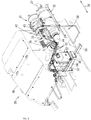
- FIG. 3 is a perspective view illustrating the exhaust emission control device 30 and the periphery of the diesel engine 20 in the lower carrier 11.
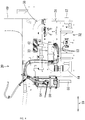
- FIG. 4 is a plan view illustrating the exhaust emission control device 30 and the periphery of the diesel engine 20 in the lower carrier 11. Note that the figures illustrate the layout of the exhaust emission control device 30 and the diesel engine 20, and the cover 34, the engine cover 49, or the like is omitted in the figures depending on views.
- the rough terrain crane 10 includes the urea water tank 50 in which a predetermined reducing agent (urea water in the embodiment) is stored and the exhaust emission control device 30.
- the exhaust emission control device 30 includes a diesel oxidation catalyst (hereinafter, referred to as "DOC") 31, selective catalyst reduction (hereinafter, referred to as “SCR”) 32 that reduces nitrogen oxide in the exhaust emission through the urea water, and a decompression reactor tube (hereinafter, referred to as "DRT”) 33 that supplies the urea water to the SCR 32.
- DOC diesel oxidation catalyst
- SCR selective catalyst reduction
- DTT decompression reactor tube
- the exhaust emission from the diesel engine 20 is first supplied to the DOC 31, passes the DRT 33 and the SCR 32 in this order, and is released as exhaust gas from a muffler 37 to the atmosphere.
- the muffler 37 a device (muffling device) reduces sound produced when the exhaust gas is released, which is neither the SCR nor a part of the SCR 32.
- the DOC 31 is connected to the exhaust pipe 38 of the diesel engine 20.
- the structure of the DOC 31 is already known.
- the DOC 31 mainly aims at treating of unburned fuel (HC and the like) and carbon monoxide (CO) contained in the exhaust emission and oxidizing nitrogen monoxide (NO) to nitrogen dioxide (NO2) contained in the exhaust emission.
- the DOC 31 oxidizes CO to carbon dioxide (CO2) burns HC as an increase in the exhaust gas temperature.
- the DOC 31 has a casing and the outer shape of the casing is a cylindrical shape.
- the center axis line of the DOC 31 is in a frontward-rearward direction of the vehicle, i.e., a longitudinal direction 39 of the lower frame 13.
- the exhaust emission from the exhaust pipe 38 flows on the front side of the DOC 31 in the longitudinal direction 39.
- the SCR 32 reacts with a reducing agent in the exhaust to reduce nitrogen oxide (NOX), and then finally converts the exhaust to a gas mixture of nitrogen (N2) and water (H2O) and emits the same to the atmosphere.
- NOX nitrogen oxide
- N2O nitrogen oxide
- the DRT 33 supplies urea water for reducing the NOX in the exhaust emission.
- hydrolysis occurs to generate ammonium (NH3), and then the NOX is reduced by the NH3.
- NH3 ammonium
- the DRT 33 includes a cylindrical pipe 42 and a supply valve 43 connected to the cylindrical pipe 42, and guides the urea water from the urea water tank 50.
- the supply valve 43 is connected to the urea water tank 50 via a pipe 53 and ejects the urea water into the cylindrical pipe 42 at a predetermined pressure.
- the DRT 33 is disposed in series with the DOC 31. In other words, the center axis line of the DRT 33 is in agreement with the center axis line of the DOC 31.
- the DRT 33 is disposed on the front side of the DOC 31 in the longitudinal direction 39 and extends in the forward direction. The exhaust emission passing through the DOC 31 flows in the longitudinal direction 39 to flow into the cylindrical pipe 42 of the DRT 33, and then receives the supply of the urea water from the supply valve 43.
- the SCR 32 has a casing and the outer shape thereof is formed into a cylindrical shape.
- the center axis line of the SCR 32 is parallel to the longitudinal direction 39 of the rough terrain crane 10.
- the SCR 32 is disposed in parallel to the DOC 31, and a coupling pipe 44 is connected both of them, in which the coupling pipe is formed to be a substantial U shape.
- the exhaust emission passing through the DRT 33 enters the coupling pipe 44, and then makes a U-turn to enter the SCR 32 disposed downstream of the DRT 33.
- the exhaust emission is controlled to be discharged as N2 and H2O as described above.
- the urea water tank 50 illustrated in FIG. 3 is made of a material such as resin or stainless steel having high corrosion resistance against the urea water and excellent weather resistance and impact resistance.
- a material such as resin or stainless steel having high corrosion resistance against the urea water and excellent weather resistance and impact resistance.
- the shape of the urea water tank 50 is formed to have a substantially rectangular parallelepiped shape.
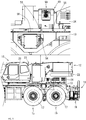
- FIG. 5 is a side view of the rough terrain crane 10 according to the embodiment of the present invention and a view illustrating the periphery of the urea water tank 50.
- the urea water tank 50 is disposed on the rear side from a front-side axle of the rear axle 15, and on the front side from the rear-side axle thereof.
- the urea water tank 50 is disposed on the front side of the DOC 31, the DRT 33, and the SCR 32.
- the urea water tank 50 is disposed in the vicinity of the left side of the diesel engine 20 when viewed from the rear side of the vehicle.
- the urea water tank 50 is disposed on a front side of the exhaust emission control device 30 in the vicinity of the engine 20.
- the urea water tank 50 is supported by a support base 54.
- the support base 54 is fixed to the lower frame 13.
- the support base 54 has a box shape of which the upper side is opened.
- the urea water tank 50 is supported on the support base 54 in a state in which a lower portion of the urea water tank 50 enters the inside of the support base 54.
- a reinforcement frame 55 fixed to the lower frame 13 is disposed on the lower side of the support base 54.
- the support base 54 is supported by the reinforcement frame 55.
- the support base 54 is disposed below the top surface 56 of the lower carrier 11.
- an opening (not illustrated) is formed above the support base 54.
- the urea water tank 50 communicates with the opening and is disposed in a state of being dropping downward from the top surface 56.
- An upper portion of the urea water tank 50 overhangs and is exposed upward from the lower carrier 11 through the opening.
- the urea water tank 50 has a protective frame 60 that surrounds and protects the urea water tank 50.
- the protective frame 60 covers the urea water tank 50 from above.
- the protective frame 60 is fixed to the upper end portion 57 (refer to FIG. 3 ) of the support base 54 with a screw 58.
- the protective frame 60 is reinforced by an increase in thickness of frames constituting the frame or bending of the frames. In this manner, the protective frame 60 functions as a step on which an operator steps.
- the protective frame 60 may include an insulation member that surrounds and protects the urea water tank 50.
- an insulation member that surrounds and protects the urea water tank 50.
- a fibrous insulation member such as glass wool or a foam-type insulation member such as urethane foam may be used.
- the insulation member is bonded to the outside of the protective frame 60.
- the insulation member may be bonded to the inside of the protective frame 60 or may be bonded to both of the outside and the inside of the protective frame 60.
- the insulation member may be bonded to the protective frame 60 by means of a method other than the bonding.
- the protective frame 60 is configured to have a cavity, and thus the insulation member may be disposed in an internal space of the protective frame 60.
- the urea water tank 50 included in the exhaust emission control device 30 is disposed on the front side of the exhaust emission control device 30 as illustrated in FIG. 3 .
- the piping from the urea water tank 50 to the SCR 32 via the DRT 33 is simplified without an increase in the entire length and the entire width of the lower carrier 11 and the upper working unit 12, and thus the urea water is efficiently supplied to the DRT 33.
- the urea water tank 50 is disposed at a position illustrated in FIG.
- the urea water tank 50 is disposed at a position facing an outer side of a side of the vehicle body. Therefore, it is easy to perform injecting work of the urea water into the urea water tank 50.
- the urea water tank 50 is disposed in the vicinity of the left side of the diesel engine 20 when viewed from the rear side of the vehicle. Hence, the urea water tank 50 is likely to receive radiation heat from the diesel engine 20. Further, cooling water of the diesel engine 20 is supplied to the urea water tank 50 such that it is easy to arrange the piping for heating ⁇ maintaining temperature of the urea water tank 50.
- the urea water tank 50 is disposed at the position described above, there is no limitation on the layout design of the urea water tank 50 even in a structure in which the outriggers 18 and 19 are freely attached and detached as in the rough terrain crane 10 according to the embodiment. As described above, the urea water tank 50 is laid out at the optimal position without a loss in the small-radius turning performance, the rough terrain traveling performance of the rough terrain crane 10, and the high visibility or a wide range of view in a crane operation.
- the urea water tank 50 is exposed from the top surface 56 of the lower carrier 11 and thus it is easy to inject the urea water into the urea water tank 50.
- the urea water tank 50 is dropped downward from the top surface 56 of the lower carrier 11, the urea water tank 50 is laid out in a more compact manner.
- the protective frame 60 since the protective frame 60 surrounds the urea water tank 50, the protective frame 60 protects the urea water tank 50, and the protective frame 60 functions as a step of an operator. In this manner, it is easy to remove a boom root fulcrum pin that connects the boom device 23 to the lower carrier 11. Moreover, the protective frame 60 functions as the step for the operator, and thereby it is possible to satisfy requests of the exhaust gas regulations.
- the insulation member is bonded to the protective frame 60, it is possible to reduce an increase in the temperature of the urea water tank 50 when the environment temperature increases during the work or in a case where the radiation heat from the diesel engine 20 is high. In this manner, the urea water is prevented from being degraded.
- the urea water tank 50 is disposed at the position illustrated in FIG. 5 ; however, the position is not limited thereto.
- the urea water tank 50 may be disposed on the right side of the diesel engine 20 from the rear direction of the vehicle.
- the urea water tank 50 may be disposed in a space between the front axle 14 and the rear axle 15.
- the urea water tank 50 may be disposed at any portion.
- the exhaust emission control device 30 is disposed at the position adjacent to the left side of the diesel engine 20 when viewed from the vehicle-rear direction as illustrated in FIG. 2 ; however, the position is not limited thereto.
- the exhaust emission control device 30 may be disposed at a position adjacent to the right side of the diesel engine 20 when viewed from the vehicle-rear direction.
- the urea water tank 50 is disposed with an interval from the exhaust emission control device 30 as illustrated in FIG. 5 ; however, the urea water tank 50 may be disposed to be adjacent to the exhaust emission control device 30. Specifically, the urea water tank 50 may be disposed in the vicinity of the front side of the coupling pipe 44. The urea water tank 50 is disposed in the vicinity of the front side of the coupling pipe 44, and thereby it is advantageous in that the piping from the urea water tank 50 to the DRT 33 is much more simplified.
Landscapes
- Engineering & Computer Science (AREA)
- Mechanical Engineering (AREA)
- Chemical & Material Sciences (AREA)
- Combustion & Propulsion (AREA)
- Transportation (AREA)
- Chemical Kinetics & Catalysis (AREA)
- General Engineering & Computer Science (AREA)
- Toxicology (AREA)
- Health & Medical Sciences (AREA)
- Life Sciences & Earth Sciences (AREA)
- Sustainable Development (AREA)
- Sustainable Energy (AREA)
- Exhaust Gas After Treatment (AREA)
- Exhaust Gas Treatment By Means Of Catalyst (AREA)
- Cooling, Air Intake And Gas Exhaust, And Fuel Tank Arrangements In Propulsion Units (AREA)
- Jib Cranes (AREA)
Abstract
Description
- The present invention relates to a rough terrain crane equipped with a selective catalytic reduction (hereinafter, referred to as "SCR"), particularly, to a layout of a urea water tank as a constituent element of the SCR.
- The exhaust emission of diesel engines contains particulate matter (hereinafter, referred to as "PM"), nitride oxide (hereinafter, referred to as "NOx"), or the like. An exhaust emission control device that prevents the particulate matter from being released into the air so as to prevent the air pollution has been developed heretofore. The exhaust emission control device includes, as the constituent elements, a diesel particulate filter (hereinafter, referred to as a "DPF") for collecting the PM, a diesel oxidation catalyst (hereinafter referred to as "DOC") for removing the NOx, a decomposition reactor tube (hereinafter referred to as "DRT"), and a selective catalytic reduction (hereinafter referred to as "SCR"). By combining the constituent elements, a desired exhaust emission control device is constituted.
- The diesel engine is mounted on various types of vehicles; however, recently, there has been a high demand for exhaust emission control processing, and thus the SCR is employed also in a passenger car, a truck, a crawler construction machine, or the like. Since the urea water is used in the exhaust emission control processing by the SCR, a urea water tank, in which the urea water is stored, is additionally provided on a vehicle (for example, see
Patent Documents 1 and 2). - In general, a rough terrain crane includes a carrier device that is capable of four-wheel driving and four-wheel steering, and exhibits excellent small-radius turning performance and rough terrain traveling performance. The rough terrain crane includes a single driver seat, has special performance that enables an operator on the driver seat to drive a vehicle and to perform an operation of a crane. The rough terrain crane is manufactured from compact design for exhibiting such special performance (merit) in which the entire length of the vehicle body is set to be short, an engine is disposed on the rear side of the vehicle body, and a crane operation is controlled by hydraulic pressure.
- In a case where the exhaust emission control device is mounted on the rough terrain crane, the entire length and the entire width of the vehicle body must avoid an increase in size, a wide range of view and high visibility need to be secured when an operator performs the crane operation and vehicle driving on a single driving seat. Specifically, the DOC, the DRT, and the SCR are laid out such that the exhaust emission control device does not overhang from an end portion of the vehicle body, a blind spot is not generated to the operator, and the exhaust emission control device does not interfere with the driving seat, a counterweight, or the like during the crane operation and crane slewing (for example, see Patent Document 3).
-
- [Patent Document 1] Japanese Patent No.
4851370 - [Patent Document 2] Japanese Patent No.
5054613 - [Patent Document 3] Japanese Patent Laid-open
HEI 5-213076 - However, in a large rough terrain crane, a front axle or a rear axle has a multi-axle structure, and a structure with a premise of attaching and detaching an outrigger and a boom to and from a vehicle-body frame is employed in some cases. The main reason for the front axle or the rear axle to have the multi-axis structure is to reduce the entirety of axle load to a certain load or lower. In addition, the reason for the structure with the premise of attaching and detaching the outrigger and the boom to and from the vehicle-body frame is employed is to be in accordance with the legislation of a country or a region where the large rough terrain crane is used. In other words, in some countries or regions, strict weight limit (axle load limit) is imposed on a vehicle traveling on a public road. Therefore, when the large rough terrain crane runs on a public road, the vehicle body, the outrigger, and the boom must be individually transported on a trailer in some cases (Request 1).
- The urea water contained in the urea water tank selectively reduces the NOx in the exhaust gas; however, the urea water has properties of being frozen in a low-temperature environment and having degraded product quality in a high-temperature environment. Therefore, in a case where the rough terrain crane is used in a cold region, the urea water needs to avoid being frozen. In addition, also even in a case where the urea water is used in a high-temperature environment, the temperature of the urea water needs to be maintained to be a certain degree (preferably, 52°C or lower) (Request 2).
- If the urea water tank is disposed in any position around a vehicle frame without being in accordance with the requests, various problems arise in that piping, through which the urea water is supplied, becomes unnecessarily long, it is difficult to perform filling work of the urea water to the urea water tank, the urea water is frozen due to an environmental temperature, it is likely to degrade the product quality, and the like. Therefore, special measures are required for the layout of the urea water.
- The present invention is made under such background, and an object thereof is to provide a rough terrain crane in which an outrigger or a boom is freely attached and detached, as a compact rough terrain crane including a urea water tank which is laid out at the optimal position in a compact manner without impairing excellent small-radius turning performance such that SCR exhibit a good function in a low-temperature environment and a high-temperature environment.
-
- (1) In order to achieve the object described above, a rough terrain crane according to the present invention includes: a lower carrier having a front axle and a rear axle; a boom device disposed above the lower carrier; and a single operating unit that performs driving and a boom operation via a hydraulic actuator. The lower carrier includes a lower frame, an outrigger provided to be freely attached and detached to an end portion of the lower frame, and an engine that is disposed on an upper side of a rear end portion of the lower carrier, drives the axles, and supplies hydraulic pressure to the hydraulic actuator. The rough terrain crane further includes a reducing agent tank in which a reducing agent is stored; and an exhaust emission control device that has a decompression reactor tube and a selective catalyst reduction disposed downstream of the decompression reactor tube. The exhaust emission control device is mounted to be laterally adjacent to the engine. The reducing agent tank is disposed on a front side of the exhaust emission control device in the vicinity of the engine.
In this configuration, since the exhaust emission control device is mounted, it is possible to control the exhaust of the rough terrain crane, and thus it is possible to meet the strict exhaust gas regulations in recent years. The reducing agent tank is disposed on a front side of the exhaust emission control device. Hence, the piping from the reducing tank to the selective catalyst reduction via the decompression reactor tube is simplified without an increase in the entire length and the entire width of the lower carrier, and thus a reducing agent is efficiently supplied to the decompression reactor tube. Moreover, it is easy to perform injection work of the reducing agent. In addition, the reducing agent tank is disposed in the vicinity of the engine. Hence, radiation heat from the engine is likely to be received. Further, cooling water of the engine is supplied to the reducing agent tank such that it is easy to arrange the piping for heating·maintaining temperature of the reducing agent tank. In addition, since the reducing agent tank is disposed at the position described above, there is no limitation on the layout design of the reducing agent tank even in a structure in which the outrigger is freely attached and detached. - (2) It is preferable that the reducing agent tank be disposed at a position adjacent to the exhaust emission control device.
In this configuration, it is advantageous in that the piping from the reducing agent tank to the decompression reactor tube is even more simplified. - (3) It is preferable that the reducing agent tank be disposed in a state of being dropped downward from the top surface of the lower carrier and a part of the reducing agent tank is exposed through the top surface.
In this configuration, since the reducing agent tank is exposed from the top surface of the lower carrier and thus it is easy to inject the reducing agent. Since the reducing agent tank is dropped downward from the top surface, the layout is performed in a more compact manner. - (4) It is preferable that the reducing agent tank has a protective frame that surrounds and protects the reducing agent tank.
In this configuration, the reducing agent tank is protected by the protective frame, and the protective frame functions as a step for an operator. In this manner, it is easy to remove a boom root fulcrum pin that connects the boom device to the lower carrier. Moreover, the protective frame functions as a step, and thereby it is possible to satisfy request of the exhaust gas regulations. - (5) It is preferable that the protective frame has an insulation member that surrounds the reducing agent tank.
- In this configuration, when the environmental temperature during work increases, or the radiation heat increases, it is possible to reduce an increase in the temperature of the reducing agent tank. In this manner, the reducing agent is prevented from being degraded. Advantageous Effects of Invention
- According to the invention, there is no limitation on the layout design of the reducing agent tank even in a structure in which the outrigger is freely attached and detached. In addition, it is easy to receive the radiation heat of the engine, and the cooling water of the engine is supplied to the reducing agent tank such that it is easy to arrange the piping for heating·maintaining temperature of the reducing agent tank. Moreover, it is easy to achieve the piping through which the reducing agent is supplied from the reducing agent tank to the selective catalyst reduction. In other words, the reducing agent tank is laid out at the optimal position without a loss in the small-radius turning performance of the rough terrain crane, rough terrain traveling performance, and high visibility or a wide range of view in a crane operation.
-
-
FIG. 1 is a perspective view of a rough terrain crane according to an embodiment of the present invention. -
FIG. 2 is a rear view of the rough terrain crane according to the embodiment of the present invention. -
FIG. 3 is a perspective view illustrating an exhaust emission control device and the periphery of a diesel engine in the lower carrier according to the embodiment of the present invention. -
FIG. 4 is a plan view illustrating the exhaust emission control device and the periphery of the diesel engine in the lower carrier according to the embodiment of the present invention. -
FIG. 5 is a side view of the rough terrain crane according to the embodiment of the present invention and a view illustrating the periphery of a urea water tank. - Hereinafter, a preferred embodiment of the present invention will be described with reference to appropriate figures. Note that the embodiment is only an example of a rough terrain crane according to the present invention, and it is needless to say that the embodiment may be modified in a range without departing from a gist of the present invention.
-
FIG. 1 is a perspective view of arough terrain crane 10 according to an embodiment of the present invention. - The
rough terrain crane 10 includes alower carrier 11 and an upper workingunit 12 disposed above thelower carrier 11. - The
lower carrier 11 includes alower frame 13, and afront axle 14 and arear axle 15 are provided on thelower frame 13. A diesel engine 20 (refer toFIGS. 2 and3 ) as a drive source of thefront axle 14 and therear axle 15 are mounted on an upper side of a rear end portion of thelower frame 13. Note that thediesel engine 20 includes an engine main body (not illustrated) and anengine cover 49 that covers the engine main body, and, in the embodiment, the diesel engine including theengine cover 49 is referred to as thediesel engine 20. -
Wheels front axle 14 and therear axle 15 are driven by thediesel engine 20 via a transmission not illustrated and is steered by a hydraulic actuator not illustrated. - A
front outrigger 18 and arear outrigger 19 are mounted on a front end and a rear end of thelower frame 13, respectively, and overhang outward from the vehicle in order to maintain the stability of the vehicle during an operation of the upper workingunit 12. Thefront outrigger 18 is connected to the front end of thelower frame 13 and is attachable to and detachable from thelower frame 13. Thefront outrigger 19 is connected to the rear end of thelower frame 13 and is attachable to and detachable from thelower frame 13. Note that thefront outrigger 18, therear outrigger 19, and thelower frame 13 are connected by a pin or other known means which is employed. - The hydraulic actuator, a
hydraulic actuator 29 provided in the upper workingunit 12, or a hydraulic pump (not illustrated) that supplies hydraulic pressure to the hydraulic actuator (not illustrated) provided in the upper workingunit 12 is provided in theupper frame 13. The hydraulic pump is driven by thediesel engine 20. - The upper working
unit 12 includes aslewing base 22 having a rear end on which a counterweight is disposed. The slewingbase 22 is turnably mounted on thelower frame 13 through a slewing bearing (not illustrated). Theboom device 23 is connected to theslewing base 22 via a boom-root fulcrum pin (not illustrated). Theboom device 23 is supported to be undulated by the boom-root fulcrum pin. Theboom device 23 undulates in response to expansion and contraction of thehydraulic actuator 29. Anexpansion boom 24 has an internally-installed hydraulic actuator (not illustrated), and operating of the hydraulic actuator causes the expansion boom to expand and contract. Theboom device 23 has awinch 27 that is driven by a hydraulic motor (not illustrated), and operating of thewinch 27 causes a work to move up and down. Note that theboom device 23 is attachable to and detachable from the upper workingunit 12. - A single working
unit 26 for driving thelower carrier 11 and operating the upper workingunit 12 is supported on thelower carrier 11. For example, the driving of thelower carrier 11 means driving and steering of thewheels rough terrain crane 10 to travel. The operating of theupper driving unit 12 means the undulation and expansion and contraction (boom operation) of theboom device 23 via thehydraulic actuator 29 and the internally hydraulic actuator installed in theexpansion boom 24. - The
rough terrain crane 10 according to the embodiment is characterized in that an exhaustemission control device 30, which will be described below, is mounted to be adjacent to thediesel engine 20 and a urea water tank 50 (corresponding to a "reducing agent tank" according to claims) included in the exhaustemission control device 30 is disposed as follows. -
FIG. 2 is a rear view of therough terrain crane 10 according to the embodiment of the present invention. The exhaustemission control device 30 receives exhaust gas exhausted from thediesel engine 20 and control the same. The exhaustemission control device 30 is disposed on a left side when viewed from a vehicle rear side. The exhaustemission control device 30 is mounted to be adjacent to thediesel engine 20. In the embodiment, the exhaustemission control device 30 is provided with acover 34. Thecover 34 protects the exhaustemission control device 30 from being exposed to rain and dust. -
FIG. 3 is a perspective view illustrating the exhaustemission control device 30 and the periphery of thediesel engine 20 in thelower carrier 11.FIG. 4 is a plan view illustrating the exhaustemission control device 30 and the periphery of thediesel engine 20 in thelower carrier 11. Note that the figures illustrate the layout of the exhaustemission control device 30 and thediesel engine 20, and thecover 34, theengine cover 49, or the like is omitted in the figures depending on views. - The
rough terrain crane 10 includes theurea water tank 50 in which a predetermined reducing agent (urea water in the embodiment) is stored and the exhaustemission control device 30. The exhaustemission control device 30 includes a diesel oxidation catalyst (hereinafter, referred to as "DOC") 31, selective catalyst reduction (hereinafter, referred to as "SCR") 32 that reduces nitrogen oxide in the exhaust emission through the urea water, and a decompression reactor tube (hereinafter, referred to as "DRT") 33 that supplies the urea water to theSCR 32. - The exhaust emission from the
diesel engine 20 is first supplied to theDOC 31, passes theDRT 33 and theSCR 32 in this order, and is released as exhaust gas from amuffler 37 to the atmosphere. Note that, in the embodiment, the muffler 37 a device (muffling device) reduces sound produced when the exhaust gas is released, which is neither the SCR nor a part of theSCR 32. - The
DOC 31 is connected to theexhaust pipe 38 of thediesel engine 20. The structure of theDOC 31 is already known. TheDOC 31 mainly aims at treating of unburned fuel (HC and the like) and carbon monoxide (CO) contained in the exhaust emission and oxidizing nitrogen monoxide (NO) to nitrogen dioxide (NO2) contained in the exhaust emission. TheDOC 31 oxidizes CO to carbon dioxide (CO2) burns HC as an increase in the exhaust gas temperature. In the embodiment, theDOC 31 has a casing and the outer shape of the casing is a cylindrical shape. The center axis line of theDOC 31 is in a frontward-rearward direction of the vehicle, i.e., alongitudinal direction 39 of thelower frame 13. The exhaust emission from theexhaust pipe 38 flows on the front side of theDOC 31 in thelongitudinal direction 39. - The
SCR 32 reacts with a reducing agent in the exhaust to reduce nitrogen oxide (NOX), and then finally converts the exhaust to a gas mixture of nitrogen (N2) and water (H2O) and emits the same to the atmosphere. In the embodiment, theDRT 33 supplies urea water for reducing the NOX in the exhaust emission. When theDRT 33 ejects the urea water into the exhaust emission, hydrolysis occurs to generate ammonium (NH3), and then the NOX is reduced by the NH3. Note that both the structure of theSCR 32 and the structure of theDRT 33 are already known. - In the embodiment, the
DRT 33 includes acylindrical pipe 42 and asupply valve 43 connected to thecylindrical pipe 42, and guides the urea water from theurea water tank 50. Thesupply valve 43 is connected to theurea water tank 50 via apipe 53 and ejects the urea water into thecylindrical pipe 42 at a predetermined pressure. TheDRT 33 is disposed in series with theDOC 31. In other words, the center axis line of theDRT 33 is in agreement with the center axis line of theDOC 31. TheDRT 33 is disposed on the front side of theDOC 31 in thelongitudinal direction 39 and extends in the forward direction. The exhaust emission passing through theDOC 31 flows in thelongitudinal direction 39 to flow into thecylindrical pipe 42 of theDRT 33, and then receives the supply of the urea water from thesupply valve 43. - The
SCR 32 has a casing and the outer shape thereof is formed into a cylindrical shape. The center axis line of theSCR 32 is parallel to thelongitudinal direction 39 of therough terrain crane 10. In the embodiment, theSCR 32 is disposed in parallel to theDOC 31, and acoupling pipe 44 is connected both of them, in which the coupling pipe is formed to be a substantial U shape. The exhaust emission passing through theDRT 33 enters thecoupling pipe 44, and then makes a U-turn to enter theSCR 32 disposed downstream of theDRT 33. In theSCR 32, the exhaust emission is controlled to be discharged as N2 and H2O as described above. - In general, the
urea water tank 50 illustrated inFIG. 3 is made of a material such as resin or stainless steel having high corrosion resistance against the urea water and excellent weather resistance and impact resistance. There is no particular limitation on the shape of theurea water tank 50; however, in the embodiment, the tank is formed to have a substantially rectangular parallelepiped shape. -
FIG. 5 is a side view of therough terrain crane 10 according to the embodiment of the present invention and a view illustrating the periphery of theurea water tank 50. As illustrated inFIG. 5 , theurea water tank 50 is disposed on the rear side from a front-side axle of therear axle 15, and on the front side from the rear-side axle thereof. In addition, as illustrated inFIGS. 3 and4 , theurea water tank 50 is disposed on the front side of theDOC 31, theDRT 33, and theSCR 32. In addition, theurea water tank 50 is disposed in the vicinity of the left side of thediesel engine 20 when viewed from the rear side of the vehicle. In other words, theurea water tank 50 is disposed on a front side of the exhaustemission control device 30 in the vicinity of theengine 20. - As illustrated in
FIG. 3 , theurea water tank 50 is supported by asupport base 54. Thesupport base 54 is fixed to thelower frame 13. Thesupport base 54 has a box shape of which the upper side is opened. Theurea water tank 50 is supported on thesupport base 54 in a state in which a lower portion of theurea water tank 50 enters the inside of thesupport base 54. Note that areinforcement frame 55 fixed to thelower frame 13 is disposed on the lower side of thesupport base 54. Thesupport base 54 is supported by thereinforcement frame 55. - As illustrated in
FIG. 5 , thesupport base 54 is disposed below thetop surface 56 of thelower carrier 11. In addition, an opening (not illustrated) is formed above thesupport base 54. Theurea water tank 50 communicates with the opening and is disposed in a state of being dropping downward from thetop surface 56. An upper portion of theurea water tank 50 overhangs and is exposed upward from thelower carrier 11 through the opening. - As illustrated in
FIG. 5 , theurea water tank 50 has aprotective frame 60 that surrounds and protects theurea water tank 50. Theprotective frame 60 covers theurea water tank 50 from above. Theprotective frame 60 is fixed to the upper end portion 57 (refer toFIG. 3 ) of thesupport base 54 with ascrew 58. Theprotective frame 60 is reinforced by an increase in thickness of frames constituting the frame or bending of the frames. In this manner, theprotective frame 60 functions as a step on which an operator steps. - The
protective frame 60 may include an insulation member that surrounds and protects theurea water tank 50. There is no particular limitation on types of insulation members, and a fibrous insulation member such as glass wool or a foam-type insulation member such as urethane foam may be used. The insulation member is bonded to the outside of theprotective frame 60. Note that the insulation member may be bonded to the inside of theprotective frame 60 or may be bonded to both of the outside and the inside of theprotective frame 60. In addition, the insulation member may be bonded to theprotective frame 60 by means of a method other than the bonding. For example, theprotective frame 60 is configured to have a cavity, and thus the insulation member may be disposed in an internal space of theprotective frame 60. - In the
rough terrain crane 10, since the exhaustemission control device 30 is mounted, it is possible to control the exhaust of therough terrain crane 10, and thus it is possible to meet the strict exhaust gas regulations in recent years. Theurea water tank 50 included in the exhaustemission control device 30 is disposed on the front side of the exhaustemission control device 30 as illustrated inFIG. 3 . Hence, the piping from theurea water tank 50 to theSCR 32 via theDRT 33 is simplified without an increase in the entire length and the entire width of thelower carrier 11 and the upper workingunit 12, and thus the urea water is efficiently supplied to theDRT 33. Moreover, since theurea water tank 50 is disposed at a position illustrated inFIG. 5 , theurea water tank 50 is disposed at a position facing an outer side of a side of the vehicle body. Therefore, it is easy to perform injecting work of the urea water into theurea water tank 50. In addition, theurea water tank 50 is disposed in the vicinity of the left side of thediesel engine 20 when viewed from the rear side of the vehicle. Hence, theurea water tank 50 is likely to receive radiation heat from thediesel engine 20. Further, cooling water of thediesel engine 20 is supplied to theurea water tank 50 such that it is easy to arrange the piping for heating·maintaining temperature of theurea water tank 50. In addition, since theurea water tank 50 is disposed at the position described above, there is no limitation on the layout design of theurea water tank 50 even in a structure in which theoutriggers rough terrain crane 10 according to the embodiment. As described above, theurea water tank 50 is laid out at the optimal position without a loss in the small-radius turning performance, the rough terrain traveling performance of therough terrain crane 10, and the high visibility or a wide range of view in a crane operation. - In addition, as illustrated in
FIG. 5 , since theurea water tank 50 is exposed from thetop surface 56 of thelower carrier 11 and thus it is easy to inject the urea water into theurea water tank 50. In addition, since theurea water tank 50 is dropped downward from thetop surface 56 of thelower carrier 11, theurea water tank 50 is laid out in a more compact manner. - In addition, as illustrated in
FIG. 5 , since theprotective frame 60 surrounds theurea water tank 50, theprotective frame 60 protects theurea water tank 50, and theprotective frame 60 functions as a step of an operator. In this manner, it is easy to remove a boom root fulcrum pin that connects theboom device 23 to thelower carrier 11. Moreover, theprotective frame 60 functions as the step for the operator, and thereby it is possible to satisfy requests of the exhaust gas regulations. - In addition, in a case where the insulation member is bonded to the
protective frame 60, it is possible to reduce an increase in the temperature of theurea water tank 50 when the environment temperature increases during the work or in a case where the radiation heat from thediesel engine 20 is high. In this manner, the urea water is prevented from being degraded. - In the embodiment described above, the
urea water tank 50 is disposed at the position illustrated inFIG. 5 ; however, the position is not limited thereto. For example, as long as the piping of thepipe 53 is allowed to be somewhat complicated, theurea water tank 50 may be disposed on the right side of thediesel engine 20 from the rear direction of the vehicle. In addition, theurea water tank 50 may be disposed in a space between thefront axle 14 and therear axle 15. In short, as long as theurea water tank 50 is positioned at a position at which it is easy to perform the injection work of the urea water and it is easy to receive the impact of the radiation heat from thediesel engine 20, theurea water tank 50 may be disposed at any portion. - In the embodiment described above, the exhaust
emission control device 30 is disposed at the position adjacent to the left side of thediesel engine 20 when viewed from the vehicle-rear direction as illustrated inFIG. 2 ; however, the position is not limited thereto. For example, the exhaustemission control device 30 may be disposed at a position adjacent to the right side of thediesel engine 20 when viewed from the vehicle-rear direction. - In the embodiment described above, the
urea water tank 50 is disposed with an interval from the exhaustemission control device 30 as illustrated inFIG. 5 ; however, theurea water tank 50 may be disposed to be adjacent to the exhaustemission control device 30. Specifically, theurea water tank 50 may be disposed in the vicinity of the front side of thecoupling pipe 44. Theurea water tank 50 is disposed in the vicinity of the front side of thecoupling pipe 44, and thereby it is advantageous in that the piping from theurea water tank 50 to theDRT 33 is much more simplified. -
- 10:
- rough terrain crane
- 11:
- lower carrier
- 12:
- upper working unit
- 13:
- lower frame
- 14:
- front axle
- 15:
- rear axle
- 18:
- front outrigger
- 19:
- rear outrigger
- 20:
- diesel engine
- 23:
- boom device
- 26:
- wheel-control unit
- 29:
- hydraulic actuator
- 30:
- exhaust emission control device
- 31:
- DOC (diesel oxidation catalyst)
- 32:
- SCR (selective catalyst reduction)
- 33:
- DRT (decompression reactor tube)
- 50:
- urea water tank
Claims (5)
- A rough terrain crane comprising:a lower carrier having a front axle and a rear axle;a boom device disposed above the lower carrier; anda single operating unit that performs driving and a boom operation via a hydraulic actuator,wherein the lower carrier includes a lower frame, an outrigger provided to be freely attached and detached to an end portion of the lower frame, and an engine that is disposed on an upper side of a rear end portion of the lower carrier, drives the axles, and supplies hydraulic pressure to the hydraulic actuator,the rough terrain crane further comprising:a reducing agent tank in which a reducing agent is stored; andan exhaust emission control device that has a decompression reactor tube and a selective catalyst reduction disposed downstream of the decompression reactor tube,wherein the exhaust emission control device is mounted to be laterally adjacent to the engine, andwherein the reducing agent tank is disposed on a front side of the exhaust emission control device in the vicinity of the engine.
- The rough terrain crane according to claim 1,
wherein the reducing agent tank is disposed at a position adjacent to the exhaust emission control device. - The rough terrain crane according to claim 1 or 2,
wherein the reducing agent tank is disposed in a state of being dropped downward from the top surface of the lower carrier and a part of the reducing agent tank is exposed through the top surface. - The rough terrain crane according to any of claims 1 to 3,
wherein the reducing agent tank has a protective frame that surrounds and protects the reducing agent tank. - The rough terrain crane according to claim 4,
wherein the protective frame has an insulation member that surrounds the reducing agent tank.
Applications Claiming Priority (2)
| Application Number | Priority Date | Filing Date | Title |
|---|---|---|---|
| JP2014257065A JP6497060B2 (en) | 2014-12-19 | 2014-12-19 | Rough terrain crane |
| PCT/JP2015/073019 WO2016098384A1 (en) | 2014-12-19 | 2015-08-17 | Rough terrain crane |
Publications (3)
| Publication Number | Publication Date |
|---|---|
| EP3235674A1 true EP3235674A1 (en) | 2017-10-25 |
| EP3235674A4 EP3235674A4 (en) | 2018-07-18 |
| EP3235674B1 EP3235674B1 (en) | 2021-01-13 |
Family
ID=56126288
Family Applications (1)
| Application Number | Title | Priority Date | Filing Date |
|---|---|---|---|
| EP15869593.2A Active EP3235674B1 (en) | 2014-12-19 | 2015-08-17 | Rough terrain crane |
Country Status (6)
| Country | Link |
|---|---|
| US (1) | US10273123B2 (en) |
| EP (1) | EP3235674B1 (en) |
| JP (1) | JP6497060B2 (en) |
| KR (1) | KR102240594B1 (en) |
| CN (1) | CN107107738B (en) |
| WO (1) | WO2016098384A1 (en) |
Cited By (1)
| Publication number | Priority date | Publication date | Assignee | Title |
|---|---|---|---|---|
| EP3574982A1 (en) * | 2018-06-01 | 2019-12-04 | Manitowoc Crane Companies, LLC | Mounting arrangement for engine exhaust aftertreatment system on crane carrier |
Families Citing this family (3)
| Publication number | Priority date | Publication date | Assignee | Title |
|---|---|---|---|---|
| CN111762267A (en) * | 2020-06-15 | 2020-10-13 | 中联重科股份有限公司 | Engine cover, chassis assembly of truck crane and truck crane |
| US11970374B2 (en) | 2021-10-04 | 2024-04-30 | Caterpillar Inc. | Pipelayer machine with rear engine configuration |
| US11970375B2 (en) | 2021-10-04 | 2024-04-30 | Caterpillar Inc. | Pipelayer machine with forward towing winch configuration |
Family Cites Families (13)
| Publication number | Priority date | Publication date | Assignee | Title |
|---|---|---|---|---|
| JP2570051B2 (en) | 1992-02-06 | 1997-01-08 | 株式会社豊田自動織機製作所 | Industrial vehicle tank structure |
| JP2003020936A (en) * | 2001-07-03 | 2003-01-24 | Komatsu Ltd | Arrangement structure of liquid reducing agent tank for NOx reduction catalyst |
| JP4851370B2 (en) | 2007-03-06 | 2012-01-11 | 日立建機株式会社 | Construction machinery |
| JPWO2009001587A1 (en) * | 2007-06-26 | 2010-08-26 | 日立建機株式会社 | Self-propelled construction machinery |
| JP5121352B2 (en) * | 2007-08-10 | 2013-01-16 | 株式会社タダノ | Mobile crane |
| JP5071792B2 (en) | 2007-09-25 | 2012-11-14 | 独立行政法人産業技術総合研究所 | Aperture correction lens |
| JP4900163B2 (en) * | 2007-09-26 | 2012-03-21 | コベルコ建機株式会社 | Construction machinery |
| JP4928474B2 (en) * | 2008-01-08 | 2012-05-09 | 日立建機株式会社 | Arrangement structure of NOx reduction device for construction machinery |
| JP5054613B2 (en) | 2008-05-16 | 2012-10-24 | 三菱ふそうトラック・バス株式会社 | Engine exhaust gas purification device |
| JP5615763B2 (en) * | 2011-06-14 | 2014-10-29 | 日立建機株式会社 | Construction machinery |
| US9624649B2 (en) * | 2012-10-19 | 2017-04-18 | Hitachi Construction Machinery Co., Ltd. | Wheel type working vehicle |
| CN105229270A (en) * | 2013-05-22 | 2016-01-06 | 日立建机株式会社 | Engineering machinery |
| US9217236B2 (en) | 2013-12-27 | 2015-12-22 | Komatsu Ltd. | Work vehicle |
-
2014
- 2014-12-19 JP JP2014257065A patent/JP6497060B2/en active Active
-
2015
- 2015-08-17 WO PCT/JP2015/073019 patent/WO2016098384A1/en not_active Ceased
- 2015-08-17 US US15/537,772 patent/US10273123B2/en active Active
- 2015-08-17 EP EP15869593.2A patent/EP3235674B1/en active Active
- 2015-08-17 KR KR1020177018703A patent/KR102240594B1/en active Active
- 2015-08-17 CN CN201580068962.3A patent/CN107107738B/en active Active
Cited By (2)
| Publication number | Priority date | Publication date | Assignee | Title |
|---|---|---|---|---|
| EP3574982A1 (en) * | 2018-06-01 | 2019-12-04 | Manitowoc Crane Companies, LLC | Mounting arrangement for engine exhaust aftertreatment system on crane carrier |
| US11518235B2 (en) | 2018-06-01 | 2022-12-06 | Manitowoc Crane Companies, Llc | Mounting arrangement for engine exhaust aftertreatment system on crane carrier |
Also Published As
| Publication number | Publication date |
|---|---|
| JP2016117347A (en) | 2016-06-30 |
| CN107107738A (en) | 2017-08-29 |
| KR20170099931A (en) | 2017-09-01 |
| US20180273351A1 (en) | 2018-09-27 |
| US10273123B2 (en) | 2019-04-30 |
| JP6497060B2 (en) | 2019-04-10 |
| WO2016098384A1 (en) | 2016-06-23 |
| KR102240594B1 (en) | 2021-04-15 |
| EP3235674A4 (en) | 2018-07-18 |
| EP3235674B1 (en) | 2021-01-13 |
| CN107107738B (en) | 2020-06-09 |
Similar Documents
| Publication | Publication Date | Title |
|---|---|---|
| US9469511B2 (en) | Exhaust emission control device for rough terrain crane | |
| KR102664511B1 (en) | Working vehicle | |
| KR102183434B1 (en) | tractor | |
| US20160115840A1 (en) | Construction Machine | |
| EP3235674B1 (en) | Rough terrain crane | |
| EP3235774B1 (en) | Rough terrain crane | |
| JP6131129B2 (en) | Rough terrain crane | |
| KR102052002B1 (en) | Work vehicle | |
| JP5054613B2 (en) | Engine exhaust gas purification device | |
| EP3339593B1 (en) | Vehicle body structure | |
| CN105386829B (en) | The motor vehicle of reducing agent tank with caudal | |
| JP2019019782A (en) | Work vehicle with exhaust gas purifier | |
| JP2007161048A (en) | Urea water storage device for transport vehicles |
Legal Events
| Date | Code | Title | Description |
|---|---|---|---|
| STAA | Information on the status of an ep patent application or granted ep patent |
Free format text: STATUS: THE INTERNATIONAL PUBLICATION HAS BEEN MADE |
|
| PUAI | Public reference made under article 153(3) epc to a published international application that has entered the european phase |
Free format text: ORIGINAL CODE: 0009012 |
|
| STAA | Information on the status of an ep patent application or granted ep patent |
Free format text: STATUS: REQUEST FOR EXAMINATION WAS MADE |
|
| 17P | Request for examination filed |
Effective date: 20170704 |
|
| AK | Designated contracting states |
Kind code of ref document: A1 Designated state(s): AL AT BE BG CH CY CZ DE DK EE ES FI FR GB GR HR HU IE IS IT LI LT LU LV MC MK MT NL NO PL PT RO RS SE SI SK SM TR |
|
| AX | Request for extension of the european patent |
Extension state: BA ME |
|
| DAV | Request for validation of the european patent (deleted) | ||
| DAX | Request for extension of the european patent (deleted) | ||
| A4 | Supplementary search report drawn up and despatched |
Effective date: 20180618 |
|
| RIC1 | Information provided on ipc code assigned before grant |
Ipc: F01N 3/08 20060101ALI20180612BHEP Ipc: B60K 13/04 20060101AFI20180612BHEP Ipc: F01N 3/20 20060101ALI20180612BHEP Ipc: B66C 23/40 20060101ALI20180612BHEP Ipc: B60K 15/063 20060101ALI20180612BHEP |
|
| STAA | Information on the status of an ep patent application or granted ep patent |
Free format text: STATUS: EXAMINATION IS IN PROGRESS |
|
| 17Q | First examination report despatched |
Effective date: 20200309 |
|
| GRAP | Despatch of communication of intention to grant a patent |
Free format text: ORIGINAL CODE: EPIDOSNIGR1 |
|
| STAA | Information on the status of an ep patent application or granted ep patent |
Free format text: STATUS: GRANT OF PATENT IS INTENDED |
|
| INTG | Intention to grant announced |
Effective date: 20201002 |
|
| GRAS | Grant fee paid |
Free format text: ORIGINAL CODE: EPIDOSNIGR3 |
|
| GRAA | (expected) grant |
Free format text: ORIGINAL CODE: 0009210 |
|
| STAA | Information on the status of an ep patent application or granted ep patent |
Free format text: STATUS: THE PATENT HAS BEEN GRANTED |
|
| AK | Designated contracting states |
Kind code of ref document: B1 Designated state(s): AL AT BE BG CH CY CZ DE DK EE ES FI FR GB GR HR HU IE IS IT LI LT LU LV MC MK MT NL NO PL PT RO RS SE SI SK SM TR |
|
| REG | Reference to a national code |
Ref country code: GB Ref legal event code: FG4D |
|
| REG | Reference to a national code |
Ref country code: CH Ref legal event code: EP |
|
| REG | Reference to a national code |
Ref country code: DE Ref legal event code: R096 Ref document number: 602015064852 Country of ref document: DE |
|
| REG | Reference to a national code |
Ref country code: IE Ref legal event code: FG4D |
|
| REG | Reference to a national code |
Ref country code: AT Ref legal event code: REF Ref document number: 1354299 Country of ref document: AT Kind code of ref document: T Effective date: 20210215 |
|
| REG | Reference to a national code |
Ref country code: AT Ref legal event code: MK05 Ref document number: 1354299 Country of ref document: AT Kind code of ref document: T Effective date: 20210113 |
|
| REG | Reference to a national code |
Ref country code: NL Ref legal event code: MP Effective date: 20210113 |
|
| REG | Reference to a national code |
Ref country code: LT Ref legal event code: MG9D |
|
| PG25 | Lapsed in a contracting state [announced via postgrant information from national office to epo] |
Ref country code: NO Free format text: LAPSE BECAUSE OF FAILURE TO SUBMIT A TRANSLATION OF THE DESCRIPTION OR TO PAY THE FEE WITHIN THE PRESCRIBED TIME-LIMIT Effective date: 20210413 Ref country code: PT Free format text: LAPSE BECAUSE OF FAILURE TO SUBMIT A TRANSLATION OF THE DESCRIPTION OR TO PAY THE FEE WITHIN THE PRESCRIBED TIME-LIMIT Effective date: 20210513 Ref country code: BG Free format text: LAPSE BECAUSE OF FAILURE TO SUBMIT A TRANSLATION OF THE DESCRIPTION OR TO PAY THE FEE WITHIN THE PRESCRIBED TIME-LIMIT Effective date: 20210413 Ref country code: LT Free format text: LAPSE BECAUSE OF FAILURE TO SUBMIT A TRANSLATION OF THE DESCRIPTION OR TO PAY THE FEE WITHIN THE PRESCRIBED TIME-LIMIT Effective date: 20210113 Ref country code: FI Free format text: LAPSE BECAUSE OF FAILURE TO SUBMIT A TRANSLATION OF THE DESCRIPTION OR TO PAY THE FEE WITHIN THE PRESCRIBED TIME-LIMIT Effective date: 20210113 Ref country code: GR Free format text: LAPSE BECAUSE OF FAILURE TO SUBMIT A TRANSLATION OF THE DESCRIPTION OR TO PAY THE FEE WITHIN THE PRESCRIBED TIME-LIMIT Effective date: 20210414 Ref country code: HR Free format text: LAPSE BECAUSE OF FAILURE TO SUBMIT A TRANSLATION OF THE DESCRIPTION OR TO PAY THE FEE WITHIN THE PRESCRIBED TIME-LIMIT Effective date: 20210113 |
|
| PG25 | Lapsed in a contracting state [announced via postgrant information from national office to epo] |
Ref country code: RS Free format text: LAPSE BECAUSE OF FAILURE TO SUBMIT A TRANSLATION OF THE DESCRIPTION OR TO PAY THE FEE WITHIN THE PRESCRIBED TIME-LIMIT Effective date: 20210113 Ref country code: LV Free format text: LAPSE BECAUSE OF FAILURE TO SUBMIT A TRANSLATION OF THE DESCRIPTION OR TO PAY THE FEE WITHIN THE PRESCRIBED TIME-LIMIT Effective date: 20210113 Ref country code: PL Free format text: LAPSE BECAUSE OF FAILURE TO SUBMIT A TRANSLATION OF THE DESCRIPTION OR TO PAY THE FEE WITHIN THE PRESCRIBED TIME-LIMIT Effective date: 20210113 Ref country code: AT Free format text: LAPSE BECAUSE OF FAILURE TO SUBMIT A TRANSLATION OF THE DESCRIPTION OR TO PAY THE FEE WITHIN THE PRESCRIBED TIME-LIMIT Effective date: 20210113 Ref country code: SE Free format text: LAPSE BECAUSE OF FAILURE TO SUBMIT A TRANSLATION OF THE DESCRIPTION OR TO PAY THE FEE WITHIN THE PRESCRIBED TIME-LIMIT Effective date: 20210113 |
|
| PG25 | Lapsed in a contracting state [announced via postgrant information from national office to epo] |
Ref country code: IS Free format text: LAPSE BECAUSE OF FAILURE TO SUBMIT A TRANSLATION OF THE DESCRIPTION OR TO PAY THE FEE WITHIN THE PRESCRIBED TIME-LIMIT Effective date: 20210513 |
|
| REG | Reference to a national code |
Ref country code: DE Ref legal event code: R097 Ref document number: 602015064852 Country of ref document: DE |
|
| PG25 | Lapsed in a contracting state [announced via postgrant information from national office to epo] |
Ref country code: SM Free format text: LAPSE BECAUSE OF FAILURE TO SUBMIT A TRANSLATION OF THE DESCRIPTION OR TO PAY THE FEE WITHIN THE PRESCRIBED TIME-LIMIT Effective date: 20210113 Ref country code: CZ Free format text: LAPSE BECAUSE OF FAILURE TO SUBMIT A TRANSLATION OF THE DESCRIPTION OR TO PAY THE FEE WITHIN THE PRESCRIBED TIME-LIMIT Effective date: 20210113 Ref country code: EE Free format text: LAPSE BECAUSE OF FAILURE TO SUBMIT A TRANSLATION OF THE DESCRIPTION OR TO PAY THE FEE WITHIN THE PRESCRIBED TIME-LIMIT Effective date: 20210113 |
|
| PLBE | No opposition filed within time limit |
Free format text: ORIGINAL CODE: 0009261 |
|
| STAA | Information on the status of an ep patent application or granted ep patent |
Free format text: STATUS: NO OPPOSITION FILED WITHIN TIME LIMIT |
|
| PG25 | Lapsed in a contracting state [announced via postgrant information from national office to epo] |
Ref country code: DK Free format text: LAPSE BECAUSE OF FAILURE TO SUBMIT A TRANSLATION OF THE DESCRIPTION OR TO PAY THE FEE WITHIN THE PRESCRIBED TIME-LIMIT Effective date: 20210113 Ref country code: SK Free format text: LAPSE BECAUSE OF FAILURE TO SUBMIT A TRANSLATION OF THE DESCRIPTION OR TO PAY THE FEE WITHIN THE PRESCRIBED TIME-LIMIT Effective date: 20210113 Ref country code: RO Free format text: LAPSE BECAUSE OF FAILURE TO SUBMIT A TRANSLATION OF THE DESCRIPTION OR TO PAY THE FEE WITHIN THE PRESCRIBED TIME-LIMIT Effective date: 20210113 |
|
| 26N | No opposition filed |
Effective date: 20211014 |
|
| PG25 | Lapsed in a contracting state [announced via postgrant information from national office to epo] |
Ref country code: AL Free format text: LAPSE BECAUSE OF FAILURE TO SUBMIT A TRANSLATION OF THE DESCRIPTION OR TO PAY THE FEE WITHIN THE PRESCRIBED TIME-LIMIT Effective date: 20210113 Ref country code: ES Free format text: LAPSE BECAUSE OF FAILURE TO SUBMIT A TRANSLATION OF THE DESCRIPTION OR TO PAY THE FEE WITHIN THE PRESCRIBED TIME-LIMIT Effective date: 20210113 |
|
| PG25 | Lapsed in a contracting state [announced via postgrant information from national office to epo] |
Ref country code: SI Free format text: LAPSE BECAUSE OF FAILURE TO SUBMIT A TRANSLATION OF THE DESCRIPTION OR TO PAY THE FEE WITHIN THE PRESCRIBED TIME-LIMIT Effective date: 20210113 |
|
| REG | Reference to a national code |
Ref country code: CH Ref legal event code: PL |
|
| PG25 | Lapsed in a contracting state [announced via postgrant information from national office to epo] |
Ref country code: MC Free format text: LAPSE BECAUSE OF FAILURE TO SUBMIT A TRANSLATION OF THE DESCRIPTION OR TO PAY THE FEE WITHIN THE PRESCRIBED TIME-LIMIT Effective date: 20210113 |
|
| REG | Reference to a national code |
Ref country code: BE Ref legal event code: MM Effective date: 20210831 |
|
| GBPC | Gb: european patent ceased through non-payment of renewal fee |
Effective date: 20210817 |
|
| PG25 | Lapsed in a contracting state [announced via postgrant information from national office to epo] |
Ref country code: LI Free format text: LAPSE BECAUSE OF NON-PAYMENT OF DUE FEES Effective date: 20210831 Ref country code: IT Free format text: LAPSE BECAUSE OF FAILURE TO SUBMIT A TRANSLATION OF THE DESCRIPTION OR TO PAY THE FEE WITHIN THE PRESCRIBED TIME-LIMIT Effective date: 20210113 Ref country code: CH Free format text: LAPSE BECAUSE OF NON-PAYMENT OF DUE FEES Effective date: 20210831 |
|
| PG25 | Lapsed in a contracting state [announced via postgrant information from national office to epo] |
Ref country code: IS Free format text: LAPSE BECAUSE OF FAILURE TO SUBMIT A TRANSLATION OF THE DESCRIPTION OR TO PAY THE FEE WITHIN THE PRESCRIBED TIME-LIMIT Effective date: 20210513 Ref country code: LU Free format text: LAPSE BECAUSE OF NON-PAYMENT OF DUE FEES Effective date: 20210817 |
|
| PG25 | Lapsed in a contracting state [announced via postgrant information from national office to epo] |
Ref country code: IE Free format text: LAPSE BECAUSE OF NON-PAYMENT OF DUE FEES Effective date: 20210817 Ref country code: GB Free format text: LAPSE BECAUSE OF NON-PAYMENT OF DUE FEES Effective date: 20210817 Ref country code: FR Free format text: LAPSE BECAUSE OF NON-PAYMENT OF DUE FEES Effective date: 20210831 Ref country code: BE Free format text: LAPSE BECAUSE OF NON-PAYMENT OF DUE FEES Effective date: 20210831 |
|
| PG25 | Lapsed in a contracting state [announced via postgrant information from national office to epo] |
Ref country code: HU Free format text: LAPSE BECAUSE OF FAILURE TO SUBMIT A TRANSLATION OF THE DESCRIPTION OR TO PAY THE FEE WITHIN THE PRESCRIBED TIME-LIMIT; INVALID AB INITIO Effective date: 20150817 |
|
| PG25 | Lapsed in a contracting state [announced via postgrant information from national office to epo] |
Ref country code: NL Free format text: LAPSE BECAUSE OF NON-PAYMENT OF DUE FEES Effective date: 20210113 Ref country code: CY Free format text: LAPSE BECAUSE OF FAILURE TO SUBMIT A TRANSLATION OF THE DESCRIPTION OR TO PAY THE FEE WITHIN THE PRESCRIBED TIME-LIMIT Effective date: 20210113 |
|
| PG25 | Lapsed in a contracting state [announced via postgrant information from national office to epo] |
Ref country code: MK Free format text: LAPSE BECAUSE OF FAILURE TO SUBMIT A TRANSLATION OF THE DESCRIPTION OR TO PAY THE FEE WITHIN THE PRESCRIBED TIME-LIMIT Effective date: 20210113 |
|
| PG25 | Lapsed in a contracting state [announced via postgrant information from national office to epo] |
Ref country code: MT Free format text: LAPSE BECAUSE OF FAILURE TO SUBMIT A TRANSLATION OF THE DESCRIPTION OR TO PAY THE FEE WITHIN THE PRESCRIBED TIME-LIMIT Effective date: 20210113 |
|
| PGFP | Annual fee paid to national office [announced via postgrant information from national office to epo] |
Ref country code: DE Payment date: 20250826 Year of fee payment: 11 |
|
| PG25 | Lapsed in a contracting state [announced via postgrant information from national office to epo] |
Ref country code: TR Free format text: LAPSE BECAUSE OF FAILURE TO SUBMIT A TRANSLATION OF THE DESCRIPTION OR TO PAY THE FEE WITHIN THE PRESCRIBED TIME-LIMIT Effective date: 20210113 |