EP3234206B1 - Heap leaching method - Google Patents
Heap leaching method Download PDFInfo
- Publication number
- EP3234206B1 EP3234206B1 EP15868711.1A EP15868711A EP3234206B1 EP 3234206 B1 EP3234206 B1 EP 3234206B1 EP 15868711 A EP15868711 A EP 15868711A EP 3234206 B1 EP3234206 B1 EP 3234206B1
- Authority
- EP
- European Patent Office
- Prior art keywords
- solution
- ore
- leach
- heap
- uranium
- Prior art date
- Legal status (The legal status is an assumption and is not a legal conclusion. Google has not performed a legal analysis and makes no representation as to the accuracy of the status listed.)
- Active
Links
- 238000000034 method Methods 0.000 title claims description 116
- 238000002386 leaching Methods 0.000 title description 43
- VEXZGXHMUGYJMC-UHFFFAOYSA-M Chloride anion Chemical compound [Cl-] VEXZGXHMUGYJMC-UHFFFAOYSA-M 0.000 claims description 96
- XEEYBQQBJWHFJM-UHFFFAOYSA-N Iron Chemical compound [Fe] XEEYBQQBJWHFJM-UHFFFAOYSA-N 0.000 claims description 65
- 229910052770 Uranium Inorganic materials 0.000 claims description 61
- JFALSRSLKYAFGM-UHFFFAOYSA-N uranium(0) Chemical compound [U] JFALSRSLKYAFGM-UHFFFAOYSA-N 0.000 claims description 61
- 239000010949 copper Substances 0.000 claims description 52
- 239000000463 material Substances 0.000 claims description 40
- RYGMFSIKBFXOCR-UHFFFAOYSA-N Copper Chemical compound [Cu] RYGMFSIKBFXOCR-UHFFFAOYSA-N 0.000 claims description 38
- 229910052802 copper Inorganic materials 0.000 claims description 38
- 229910052500 inorganic mineral Inorganic materials 0.000 claims description 37
- 239000011707 mineral Substances 0.000 claims description 37
- 239000002253 acid Substances 0.000 claims description 32
- 229910052742 iron Inorganic materials 0.000 claims description 32
- 229910021607 Silver chloride Inorganic materials 0.000 claims description 27
- 150000003839 salts Chemical class 0.000 claims description 27
- HKZLPVFGJNLROG-UHFFFAOYSA-M silver monochloride Chemical compound [Cl-].[Ag+] HKZLPVFGJNLROG-UHFFFAOYSA-M 0.000 claims description 27
- 230000002378 acidificating effect Effects 0.000 claims description 23
- VTLYFUHAOXGGBS-UHFFFAOYSA-N Fe3+ Chemical compound [Fe+3] VTLYFUHAOXGGBS-UHFFFAOYSA-N 0.000 claims description 21
- 229910001447 ferric ion Inorganic materials 0.000 claims description 21
- QVGXLLKOCUKJST-UHFFFAOYSA-N atomic oxygen Chemical compound [O] QVGXLLKOCUKJST-UHFFFAOYSA-N 0.000 claims description 19
- 239000001301 oxygen Substances 0.000 claims description 19
- 229910052760 oxygen Inorganic materials 0.000 claims description 19
- CWYNVVGOOAEACU-UHFFFAOYSA-N Fe2+ Chemical compound [Fe+2] CWYNVVGOOAEACU-UHFFFAOYSA-N 0.000 claims description 18
- 238000003973 irrigation Methods 0.000 claims description 18
- 230000002262 irrigation Effects 0.000 claims description 18
- 238000006243 chemical reaction Methods 0.000 claims description 14
- 239000010970 precious metal Substances 0.000 claims description 13
- 239000002244 precipitate Substances 0.000 claims description 11
- BWFPGXWASODCHM-UHFFFAOYSA-N copper monosulfide Chemical class [Cu]=S BWFPGXWASODCHM-UHFFFAOYSA-N 0.000 claims description 10
- 230000002829 reductive effect Effects 0.000 claims description 10
- 229910001448 ferrous ion Inorganic materials 0.000 claims description 9
- 239000007789 gas Substances 0.000 claims description 9
- 238000011084 recovery Methods 0.000 claims description 9
- PCHJSUWPFVWCPO-UHFFFAOYSA-N gold Chemical compound [Au] PCHJSUWPFVWCPO-UHFFFAOYSA-N 0.000 claims description 8
- 229910052737 gold Inorganic materials 0.000 claims description 8
- 239000010931 gold Substances 0.000 claims description 8
- 244000005700 microbiome Species 0.000 claims description 8
- 230000002939 deleterious effect Effects 0.000 claims description 7
- 239000007800 oxidant agent Substances 0.000 claims description 7
- 230000001590 oxidative effect Effects 0.000 claims description 6
- 230000009467 reduction Effects 0.000 claims description 6
- 150000002500 ions Chemical class 0.000 claims description 5
- 229910001727 uranium mineral Inorganic materials 0.000 claims description 5
- 229910052709 silver Inorganic materials 0.000 claims description 4
- 239000004332 silver Substances 0.000 claims description 4
- 238000002156 mixing Methods 0.000 claims description 2
- 239000000243 solution Substances 0.000 description 126
- 230000008569 process Effects 0.000 description 73
- VYPSYNLAJGMNEJ-UHFFFAOYSA-N silicon dioxide Inorganic materials O=[Si]=O VYPSYNLAJGMNEJ-UHFFFAOYSA-N 0.000 description 21
- 238000004090 dissolution Methods 0.000 description 18
- 238000000638 solvent extraction Methods 0.000 description 18
- 238000007792 addition Methods 0.000 description 16
- QAOWNCQODCNURD-UHFFFAOYSA-N Sulfuric acid Chemical compound OS(O)(=O)=O QAOWNCQODCNURD-UHFFFAOYSA-N 0.000 description 10
- 229910052751 metal Inorganic materials 0.000 description 10
- 239000002184 metal Substances 0.000 description 10
- 239000000377 silicon dioxide Substances 0.000 description 10
- 239000001117 sulphuric acid Substances 0.000 description 10
- 235000011149 sulphuric acid Nutrition 0.000 description 10
- UCKMPCXJQFINFW-UHFFFAOYSA-N Sulphide Chemical compound [S-2] UCKMPCXJQFINFW-UHFFFAOYSA-N 0.000 description 9
- 238000005054 agglomeration Methods 0.000 description 9
- 230000002776 aggregation Effects 0.000 description 9
- 239000010432 diamond Substances 0.000 description 9
- 238000000605 extraction Methods 0.000 description 9
- 230000003647 oxidation Effects 0.000 description 8
- 238000007254 oxidation reaction Methods 0.000 description 8
- FAPWRFPIFSIZLT-UHFFFAOYSA-M Sodium chloride Chemical compound [Na+].[Cl-] FAPWRFPIFSIZLT-UHFFFAOYSA-M 0.000 description 7
- 238000005273 aeration Methods 0.000 description 7
- 239000010953 base metal Substances 0.000 description 7
- 229910052951 chalcopyrite Inorganic materials 0.000 description 7
- DVRDHUBQLOKMHZ-UHFFFAOYSA-N chalcopyrite Chemical compound [S-2].[S-2].[Fe+2].[Cu+2] DVRDHUBQLOKMHZ-UHFFFAOYSA-N 0.000 description 7
- 230000004048 modification Effects 0.000 description 7
- 238000012986 modification Methods 0.000 description 7
- 229910052948 bornite Inorganic materials 0.000 description 6
- 238000010586 diagram Methods 0.000 description 6
- 229910052976 metal sulfide Inorganic materials 0.000 description 6
- 230000035699 permeability Effects 0.000 description 6
- 239000012071 phase Substances 0.000 description 6
- 238000001556 precipitation Methods 0.000 description 6
- XLYOFNOQVPJJNP-UHFFFAOYSA-N water Substances O XLYOFNOQVPJJNP-UHFFFAOYSA-N 0.000 description 6
- 229910052947 chalcocite Inorganic materials 0.000 description 5
- 238000010926 purge Methods 0.000 description 5
- 239000011780 sodium chloride Substances 0.000 description 5
- 239000002904 solvent Substances 0.000 description 5
- YIIYNAOHYJJBHT-UHFFFAOYSA-N uranium;dihydrate Chemical compound O.O.[U] YIIYNAOHYJJBHT-UHFFFAOYSA-N 0.000 description 5
- VEXZGXHMUGYJMC-UHFFFAOYSA-N Hydrochloric acid Chemical compound Cl VEXZGXHMUGYJMC-UHFFFAOYSA-N 0.000 description 4
- 239000012141 concentrate Substances 0.000 description 4
- 238000011065 in-situ storage Methods 0.000 description 4
- 150000002739 metals Chemical class 0.000 description 4
- 238000006386 neutralization reaction Methods 0.000 description 4
- 239000012074 organic phase Substances 0.000 description 4
- 230000008901 benefit Effects 0.000 description 3
- 229910001919 chlorite Inorganic materials 0.000 description 3
- 229910052619 chlorite group Inorganic materials 0.000 description 3
- QBWCMBCROVPCKQ-UHFFFAOYSA-N chlorous acid Chemical compound OCl=O QBWCMBCROVPCKQ-UHFFFAOYSA-N 0.000 description 3
- 229910000169 coffinite Inorganic materials 0.000 description 3
- 239000011019 hematite Substances 0.000 description 3
- 229910052595 hematite Inorganic materials 0.000 description 3
- 230000006872 improvement Effects 0.000 description 3
- LIKBJVNGSGBSGK-UHFFFAOYSA-N iron(3+);oxygen(2-) Chemical compound [O-2].[O-2].[O-2].[Fe+3].[Fe+3] LIKBJVNGSGBSGK-UHFFFAOYSA-N 0.000 description 3
- -1 sericite Substances 0.000 description 3
- 229910021646 siderite Inorganic materials 0.000 description 3
- ZNQVEEAIQZEUHB-UHFFFAOYSA-N 2-ethoxyethanol Chemical compound CCOCCO ZNQVEEAIQZEUHB-UHFFFAOYSA-N 0.000 description 2
- OYPRJOBELJOOCE-UHFFFAOYSA-N Calcium Chemical compound [Ca] OYPRJOBELJOOCE-UHFFFAOYSA-N 0.000 description 2
- TWRXJAOTZQYOKJ-UHFFFAOYSA-L Magnesium chloride Chemical compound [Mg+2].[Cl-].[Cl-] TWRXJAOTZQYOKJ-UHFFFAOYSA-L 0.000 description 2
- PXHVJJICTQNCMI-UHFFFAOYSA-N Nickel Chemical compound [Ni] PXHVJJICTQNCMI-UHFFFAOYSA-N 0.000 description 2
- WCUXLLCKKVVCTQ-UHFFFAOYSA-M Potassium chloride Chemical compound [Cl-].[K+] WCUXLLCKKVVCTQ-UHFFFAOYSA-M 0.000 description 2
- 230000002411 adverse Effects 0.000 description 2
- 229910052782 aluminium Inorganic materials 0.000 description 2
- VSCWAEJMTAWNJL-UHFFFAOYSA-K aluminium trichloride Chemical compound Cl[Al](Cl)Cl VSCWAEJMTAWNJL-UHFFFAOYSA-K 0.000 description 2
- 230000015572 biosynthetic process Effects 0.000 description 2
- 239000011575 calcium Substances 0.000 description 2
- 229910052791 calcium Inorganic materials 0.000 description 2
- 229910003460 diamond Inorganic materials 0.000 description 2
- 238000009826 distribution Methods 0.000 description 2
- 230000000694 effects Effects 0.000 description 2
- 230000006870 function Effects 0.000 description 2
- 229940113601 irrigation solution Drugs 0.000 description 2
- 238000011068 loading method Methods 0.000 description 2
- 230000001404 mediated effect Effects 0.000 description 2
- 230000036961 partial effect Effects 0.000 description 2
- 238000002161 passivation Methods 0.000 description 2
- 239000011734 sodium Substances 0.000 description 2
- YPPMLCHGJUMYPZ-UHFFFAOYSA-L sodium;iron(2+);sulfate Chemical class [Na+].[Fe+2].[O-]S([O-])(=O)=O YPPMLCHGJUMYPZ-UHFFFAOYSA-L 0.000 description 2
- 239000007787 solid Substances 0.000 description 2
- 241000894007 species Species 0.000 description 2
- WWNBZGLDODTKEM-UHFFFAOYSA-N sulfanylidenenickel Chemical compound [Ni]=S WWNBZGLDODTKEM-UHFFFAOYSA-N 0.000 description 2
- QPLDLSVMHZLSFG-UHFFFAOYSA-N Copper oxide Chemical compound [Cu]=O QPLDLSVMHZLSFG-UHFFFAOYSA-N 0.000 description 1
- 239000005751 Copper oxide Substances 0.000 description 1
- 229910006130 SO4 Inorganic materials 0.000 description 1
- HCHKCACWOHOZIP-UHFFFAOYSA-N Zinc Chemical compound [Zn] HCHKCACWOHOZIP-UHFFFAOYSA-N 0.000 description 1
- 239000005083 Zinc sulfide Substances 0.000 description 1
- 238000009825 accumulation Methods 0.000 description 1
- 239000004411 aluminium Substances 0.000 description 1
- XAGFODPZIPBFFR-UHFFFAOYSA-N aluminium Chemical compound [Al] XAGFODPZIPBFFR-UHFFFAOYSA-N 0.000 description 1
- 150000001450 anions Chemical class 0.000 description 1
- 238000007664 blowing Methods 0.000 description 1
- 239000012267 brine Substances 0.000 description 1
- 239000006227 byproduct Substances 0.000 description 1
- WUKWITHWXAAZEY-UHFFFAOYSA-L calcium difluoride Chemical compound [F-].[F-].[Ca+2] WUKWITHWXAAZEY-UHFFFAOYSA-L 0.000 description 1
- 230000003197 catalytic effect Effects 0.000 description 1
- 150000001768 cations Chemical class 0.000 description 1
- 239000012459 cleaning agent Substances 0.000 description 1
- BUGICWZUDIWQRQ-UHFFFAOYSA-N copper iron sulfane Chemical compound S.[Fe].[Cu] BUGICWZUDIWQRQ-UHFFFAOYSA-N 0.000 description 1
- 229910000431 copper oxide Inorganic materials 0.000 description 1
- ARUVKPQLZAKDPS-UHFFFAOYSA-L copper(II) sulfate Chemical compound [Cu+2].[O-][S+2]([O-])([O-])[O-] ARUVKPQLZAKDPS-UHFFFAOYSA-L 0.000 description 1
- 229910052955 covellite Inorganic materials 0.000 description 1
- 230000003247 decreasing effect Effects 0.000 description 1
- 230000003111 delayed effect Effects 0.000 description 1
- 238000010612 desalination reaction Methods 0.000 description 1
- 239000010433 feldspar Substances 0.000 description 1
- 239000010436 fluorite Substances 0.000 description 1
- 230000004907 flux Effects 0.000 description 1
- 239000010440 gypsum Substances 0.000 description 1
- 229910052602 gypsum Inorganic materials 0.000 description 1
- 239000012535 impurity Substances 0.000 description 1
- 230000000670 limiting effect Effects 0.000 description 1
- 230000007774 longterm Effects 0.000 description 1
- 229910001629 magnesium chloride Inorganic materials 0.000 description 1
- 229910052953 millerite Inorganic materials 0.000 description 1
- 238000003801 milling Methods 0.000 description 1
- 229910052759 nickel Inorganic materials 0.000 description 1
- 229910052592 oxide mineral Inorganic materials 0.000 description 1
- 229910052954 pentlandite Inorganic materials 0.000 description 1
- 239000012466 permeate Substances 0.000 description 1
- 239000001103 potassium chloride Substances 0.000 description 1
- 238000002360 preparation method Methods 0.000 description 1
- 238000002203 pretreatment Methods 0.000 description 1
- 239000000047 product Substances 0.000 description 1
- NIFIFKQPDTWWGU-UHFFFAOYSA-N pyrite Chemical compound [Fe+2].[S-][S-] NIFIFKQPDTWWGU-UHFFFAOYSA-N 0.000 description 1
- 229910052683 pyrite Inorganic materials 0.000 description 1
- 239000011028 pyrite Substances 0.000 description 1
- 239000010453 quartz Substances 0.000 description 1
- HPALAKNZSZLMCH-UHFFFAOYSA-M sodium;chloride;hydrate Chemical compound O.[Na+].[Cl-] HPALAKNZSZLMCH-UHFFFAOYSA-M 0.000 description 1
- 239000007921 spray Substances 0.000 description 1
- 238000003860 storage Methods 0.000 description 1
- 238000010977 unit operation Methods 0.000 description 1
- 229910052725 zinc Inorganic materials 0.000 description 1
- 239000011701 zinc Substances 0.000 description 1
- DRDVZXDWVBGGMH-UHFFFAOYSA-N zinc;sulfide Chemical compound [S-2].[Zn+2] DRDVZXDWVBGGMH-UHFFFAOYSA-N 0.000 description 1
Images







Classifications
-
- C—CHEMISTRY; METALLURGY
- C22—METALLURGY; FERROUS OR NON-FERROUS ALLOYS; TREATMENT OF ALLOYS OR NON-FERROUS METALS
- C22B—PRODUCTION AND REFINING OF METALS; PRETREATMENT OF RAW MATERIALS
- C22B60/00—Obtaining metals of atomic number 87 or higher, i.e. radioactive metals
- C22B60/02—Obtaining thorium, uranium, or other actinides
- C22B60/0204—Obtaining thorium, uranium, or other actinides obtaining uranium
- C22B60/0217—Obtaining thorium, uranium, or other actinides obtaining uranium by wet processes
- C22B60/0221—Obtaining thorium, uranium, or other actinides obtaining uranium by wet processes by leaching
- C22B60/0226—Obtaining thorium, uranium, or other actinides obtaining uranium by wet processes by leaching using acidic solutions or liquors
- C22B60/023—Obtaining thorium, uranium, or other actinides obtaining uranium by wet processes by leaching using acidic solutions or liquors halogenated ion as active agent
-
- C—CHEMISTRY; METALLURGY
- C22—METALLURGY; FERROUS OR NON-FERROUS ALLOYS; TREATMENT OF ALLOYS OR NON-FERROUS METALS
- C22B—PRODUCTION AND REFINING OF METALS; PRETREATMENT OF RAW MATERIALS
- C22B11/00—Obtaining noble metals
- C22B11/04—Obtaining noble metals by wet processes
-
- C—CHEMISTRY; METALLURGY
- C22—METALLURGY; FERROUS OR NON-FERROUS ALLOYS; TREATMENT OF ALLOYS OR NON-FERROUS METALS
- C22B—PRODUCTION AND REFINING OF METALS; PRETREATMENT OF RAW MATERIALS
- C22B15/00—Obtaining copper
- C22B15/0063—Hydrometallurgy
- C22B15/0065—Leaching or slurrying
- C22B15/0067—Leaching or slurrying with acids or salts thereof
- C22B15/0069—Leaching or slurrying with acids or salts thereof containing halogen
-
- C—CHEMISTRY; METALLURGY
- C22—METALLURGY; FERROUS OR NON-FERROUS ALLOYS; TREATMENT OF ALLOYS OR NON-FERROUS METALS
- C22B—PRODUCTION AND REFINING OF METALS; PRETREATMENT OF RAW MATERIALS
- C22B15/00—Obtaining copper
- C22B15/0063—Hydrometallurgy
- C22B15/0065—Leaching or slurrying
- C22B15/0067—Leaching or slurrying with acids or salts thereof
- C22B15/0071—Leaching or slurrying with acids or salts thereof containing sulfur
-
- Y—GENERAL TAGGING OF NEW TECHNOLOGICAL DEVELOPMENTS; GENERAL TAGGING OF CROSS-SECTIONAL TECHNOLOGIES SPANNING OVER SEVERAL SECTIONS OF THE IPC; TECHNICAL SUBJECTS COVERED BY FORMER USPC CROSS-REFERENCE ART COLLECTIONS [XRACs] AND DIGESTS
- Y02—TECHNOLOGIES OR APPLICATIONS FOR MITIGATION OR ADAPTATION AGAINST CLIMATE CHANGE
- Y02P—CLIMATE CHANGE MITIGATION TECHNOLOGIES IN THE PRODUCTION OR PROCESSING OF GOODS
- Y02P10/00—Technologies related to metal processing
- Y02P10/20—Recycling
Definitions
- the present disclosure relates to a method for heap leaching ore.
- the present disclosure relates to a method for heap leaching copper and/or uranium containing ore which includes using a high chloride leach liquor.
- the method may be used for heap leaching of copper from principally sulphide minerals such as chalcocite, covellite, bornite and chalcopyrite, or a mixed sulphide with copper oxide mineral.
- the method may additionally or instead be used for leaching uranium from such uranium minerals as uraninite, coffinite and brannerite.
- the method may instead or additionally be used to leach precious metals, such as gold and/or silver.
- the copper is principally in the form of sulphide minerals such as Chalcocite (Cu 2 S), Bornite (Cu 5 FeS 4 ) and Chalcopyrite (CuFeS 2 ).
- the uranium is principally in the form of such minerals as Uraninite, Coffinite and Brannerite.
- the common gangue minerals may include quartz, hematite, feldspar, sericite, fluorite, siderite, chlorite and pyrite.
- heap leaching It has recently been proposed to recover metal values from the Stuart Shelf ore minerals by a process including a heap leaching step.
- a disadvantage of heap leaching is the relatively slow leach rates of ore minerals.
- the surfaces of some ore minerals, particularly copper sulphides such as chalcopyrite can become passivated during the leaching step which can further reduce the leaching rate and lower the overall metal recovery.
- WO2014/030048A1 in the name of BHP Chile Inc., discloses a process of extracting copper from copper sulphide minerals in which ore is subjected to a pre-treatment phase followed by an active leach cycle.
- the copper sulphide minerals are contacted with a solution having a high chloride concentration, a solution potential above 700 mV (SHE) and a dissolved oxygen level below 1 mg/L.
- SHE solution potential above 700 mV
- the pretreatment step is conducted for a period of up to 200 days prior to commencement of active heap irrigation.
- EP1424403 A1 discloses a procedure to agglutinate ore concentrates, which can be of copper, on a gravel heap.
- WO98/19779 A1 discloses a process for oxidation of ferrous ions in solution, and more particularly a process for improved base metal and/or uranium leaching from ores, concentrates or tailings using ferric ion as an oxidising agent.
- the present disclosure is based on the discovery that the addition of high amounts of chloride to an oxidising sulphuric acid based leaching process in the presence of soluble iron, results in the leaching process operating at higher solution redox potentials.
- the presence of chloride, and to a lesser extent copper, increases the rate at which ferrous iron is oxidised to the trivalent state (ferric).
- a greater concentration of ferric equates to higher solution redox potentials.
- Metal recovery from ore minerals may be enhanced at increased solution redox potentials, such as at redox potentials exceeding 450 mV Ag/AgCl (approx. 660 mV SHE). This may be achieved, for example, by contacting the minerals during active heap irrigation with an acid solution having a high oxidation potential resulting from an elevated chloride content.
- the present disclosure is also based on the discovery that the phenomena of "passivation" of chalcopyrite during leaching at increased solution oxidation potential may be avoided, or the onset delayed to higher redox potentials, in the presence of high chloride levels in solution.
- a heap includes a heap, a dump, a vat or a column which contains an ore which is to be processed.
- active heap irrigation means the process of actively applying a solution to a heap such that it moves through the heap to cause leaching of ore minerals within the heap.
- the solution may comprise a leach liquor per se, or it may combine with other components within the heap (such as salt or acid) to form a leach liquor in situ.
- the solution may be applied by irrigating the heap, such as by using an irrigation grid.
- the heap may also be aerated during the active heap irrigation.
- the active leach irrigation may be continuous. For example, there may be no "rest” stages, during which application of solution to the heap is suspended, after active leach irrigation commences.
- the present invention provides a method for recovering one or more of copper, uranium and a precious metal from an ore material, including:
- the ore material may be ore and/or an ore concentrate.
- the ore material may comprise the product of a prior leaching operation, such as a heap leach ripios.
- the "leach liquor” is the solution that contacts the ore. It may be formed separately and applied to the ore. Alternatively, it may be at least partially formed in situ from a combination of the applied irrigation solution, the concentrated sulphuric acid in the agglomerated ore and the in situ dissolution of any salt in the agglomerated ore.
- the ore material contains copper sulphides and uranium minerals.
- the ore material may additionally contain one or more precious metals selected from gold and/or silver.
- the chloride content in the leach liquor is a minimum of 15 g/L.
- the chloride content in the leach liquor is a minimum of 30 g/L.
- the chloride content in the leach liquor is a minimum of 45 g/L.
- the chloride content in the leach liquor is preferably a minimum of 50 g/L.
- the chloride content is at least 70 g/L.
- the chloride content in the leach liquor is a minimum of 90 g/L.
- the chloride content may be a minimum of 100 g/L, such as a minimum of 105 g/L.
- the chloride content in the leach liquor is a minimum of 130 g/L.
- the chloride content in the leach liquor is a minimum of 150 g/L.
- the chloride content in the leach liquor may be a maximum of 190 g/L.
- the chloride content in the leach liquor may be a maximum of 230 g/L.
- the chloride content in the leach liquor ranges from around 70 g/L up to 150 g/L.
- the chloride content may preferably range from about 90 to about 110 g/L.
- the oxygen containing gas is air. In another embodiment, the oxygen containing gas is oxygen-enriched air.
- the iron containing leach liquor contains ferric ions which oxidise the ore material to dissolve one or more metals, resulting in reduction to ferrous ions.
- the ferrous ions are then reoxidised to ferric ions by reaction with the oxygen containing gas.
- the iron containing leach liquor also contains cupric ions that catalyse the reaction of ferrous to ferric ions.
- the catalytic effect of the cupric ions may diminish above a concentration of approximately 1 g/L Cu.
- the ore material may also contain one or more iron containing minerals.
- the iron containing minerals may include gangue minerals, such as one or more of hematite, siderite and chlorite. These minerals may partly or wholly comprise the source of the iron in the iron containing leach liquor.
- the copper sulphides may partly or wholly comprise the source of cupric ions in the acidic leach liquor.
- the ore material is agglomerated prior to forming a heap.
- Agglomeration may be effected by mixing the ore material with a desired quantity of acidic agglomerating solution to give the agglomerates the desired final moisture content.
- the desired final moisture content may be up to 25 wt%. In an embodiment, the final moisture is less than 10 wt%, such as less than 8 wt%. In an embodiment, the final moisture is a minimum of 3.5 wt.%.
- the acidic agglomerating solution may comprise a combination of process solution (eg, recycled leach liquor or heap leach raffinate) and concentrated sulphuric acid.
- the acidic agglomerating solution may be added to the ore material in the range of 0 to approximately 20kg/ton. In one embodiment of the process, the addition is in the range 6 to 12 kg/ton ore.
- the acid addition at this level may result in process improvement by reducing silica levels in solution.
- Solubilized silica becomes problematic as it preferentially precipitates at the surface of the heaps and causes permeability problems. It can be removed from solution by the addition of poly ethyl glycol (PEG) to the part of the first stage leachate. However, it can be preferential to minimize soluble silica from the start. Increasing chloride concentration has also been shown to further reduce soluble silica.
- the precipitated silica from PEG addition may be settled in a clarifier and recycled to agglomeration as a method of disposal.
- the chloride content in the leach liquor may be at least partially derived from water which naturally contains salt, e.g. water drawn from underground bores, or from the sea or a salt lake or reservoir.
- the water may be brine, produced for example as a by-product during a desalination process.
- the solution is applied to the heap by irrigation.
- the redox potential of the leach liquor will be influenced by the salinity of the leach liquor and generally, the higher the salinity, the higher the redox potential.
- the redox potential of the leach liquor exceeds 420 mV Ag/AgCl, such as greater than 425 mV Ag/AgCl in the absence of bioleaching microorganisms.
- the redox potential of the leach liquor exceeds 430 mV Ag/AgCl, such as greater than 440 mV Ag/AgCl in the absence of bioleaching microorganisms.
- the redox potential of the leach liquor exceeds 450 mV Ag/AgCl (approx. 660 mV SHE), in the absence of bioleaching microorganisms.
- the redox potential of the leach liquor exceeds 460 mV Ag/AgCl, in the absence of bioleaching microorganisms.
- the redox potential of the leach liquor exceeds 470 mV Ag/AgCl, such as around 480 mV Ag/AgCl, in the absence of bioleaching microorganisms.
- the total iron concentration of the leach liquor is >0.1 g/L.
- the total iron concentration may be at least 5 g/L. In an embodiment, the total iron concentration is at least 20 g/L, such as at least 25 g/L.
- the total iron concentration may be a maximum of 50 g/L. In another embodiment, the total iron concentration is a maximum of 80 g/L.
- the pH of the leach liquor during the active leach cycle is effected by the addition of sulphuric acid directly to the ore during the prior agglomeration process or by the addition of sulphuric acid to the solution which contacts the ore during irrigation or by using both techniques.
- the pH of the leach liquor may vary as it reacts with ore and gangue minerals.
- the acidity is such that the pH of the solution contacting the ore may not exceed pH 3.5.
- the pH is below pH 3.
- the pH may be less than 1.
- the pH may be less than -0.3.
- the dissolved oxygen level in the leach liquor contacting the ore may vary significantly from very low values to approximately saturation during the heap leach. Accordingly, the DO may be above 0 mg/L (0 ppm). The maximum dissolved oxygen may be the value at saturation. The dissolved oxygen may be at least 3 ppm. In an embodiment, it is less than 10 ppm. In another embodiment it is at least 5 ppm. At any point in the process, the DO will be at the equilibrium established between the rate of transfer from the supplied gas and the rate of consumption by reaction in solution. The dissolved oxygen level in the leach liquor contacting the ore may be maintained by forced aeration.
- the method may include the step of providing an irrigation grid whereby the irrigation solution is applied to the heap.
- the irrigation grid may be located on a surface of the heap, or within the heap, or a combination of both locations may be employed.
- the irrigation grid may be used directly on an established heap, or in combination with an agglomeration technique.
- the irrigation grid may be of any suitable kind and the invention is not limited in this respect.
- the irrigation grid may include a reticulated network of pipes, sprays and the like located on a surface of the heap, or within the heap, or both.
- the heap leach process may be carried out under ambient conditions i.e. at temperature and atmospheric pressure conditions prevailing at the heap.
- the leaching method may be carried out for a period of at least 50 days, such as at least 100 days. In one embodiment, the leaching method may be carried out for a period of at least 450 days. In another embodiment, the leaching method may be carried out for a period of up to 600 days. The duration of the leaching method is determined by a number of factors, such as the time to complete mineral oxidation.
- the ore in the heap may be irrigated with a solution.
- the subsequently-leached metals e.g. copper and/or uranium and/or gold, may thereafter be recovered using any suitable process e.g. a solvent extraction process.
- hydrochloric acid may be added to the leach liquor.
- the hydrochloric acid may be utilised as a cleaning agent for the irrigation drippers.
- the leach liquor may contain copper, iron and other anion and cation species that may originate from recycled process water drawn from the heap, or which may have dissolved from the ore which is being treated.
- the pregnant leach solution contains copper and uranium. In another embodiment, the pregnant leach solution may also contain precious metal.
- the pregnant leach solution may be pretreated to adjust solution chemistry prior to extraction of the target metal/s therefrom.
- the pretreatment of the pregnant leach solution may comprise reduction of solution redox potential.
- Reducing solution potential may be advantageous in the subsequent extraction of uranium (such as by solvent extraction).
- the reduction in solution redox potential may be achieved by reducing the ferric ion concentration in solution.
- Ferric ion reduction may be conveniently achieved by contacting the pregnant leach solution with ferric consuming material, eg ore minerals such as metal sulphides.
- the contact with ferric consuming material may be in the absence of an oxidant.
- the pregnant leach solution may be contacted with metal sulphides in the absence of an oxidising gas.
- the metal sulphides may be provided in a heap which is not under forced aeration.
- the pretreatment may alternatively or additionally comprise consumption of at least some acid.
- Acid consumption may be of assistance in the subsequent extraction of copper (such as by solvent extraction).
- Neutralisation may be achieved by contacting the pregnant leach solution with acid consuming materials, such as acid consuming ores and gangue.
- acid can be consumed in the above described reaction of ferric ion with metal sulphides. Accordingly, neutralisation may occur simultaneously with reduction in solution potential.
- the pretreated pregnant leach solution can then be subjected to solvent extraction to recover one or more target metals.
- the process may include a pretreatment step in which the ore material is treated with a solution having either lower chloride concentration or lower solution potential, or both, as compared with the high chloride, acidic leach liquor discussed above.
- the solution used in the pretreatment step will be hereinafter referred to as a "pre-leach" solution, although it is to be appreciated that leaching of the ore material still occurs during the pretreatment step. It has been found that a substantial amount of uranium, and at least some base metal, may be leached during the pretreatment step.
- the pretreatment step comprises treatment of the ore material with a pre-leach solution having a relatively low solution redox potential.
- This modification may be effected by treatment of at least a portion of the ore material with an acidic leaching solution in the presence of no or reduced oxidant.
- the pretreatment may be conducted under no or reduced aeration of the leach solution.
- the pre-leach solution may contain a high chloride content. The maximum chloride content may be 100 g/L, particularly if solvent extraction is used to recover dissolved uranium from the pregnant leach solution.
- the ore material includes a substantial amount of unreacted sulphide minerals.
- the salt precipitates predominantly comprise sodium iron sulphates, such as metasideronatrite (Na 4 Fe 2 (SO 4 ) 4 (OH) 2 ⁇ 3H 2 O).
- the precipitates may also comprise gypsum and other minor salts.
- additional salt may be added to process solutions in order to force the precipitation of oversaturated salts such as metasideronatrite prior to its use as the preleach solution.
- a purge of process liquors would be required in order to keep overall salinities of process liquors within acceptable limits.
- the first reference example may therefore require a facility for the addition of salt and the precipitation of metasideronatrite, which is likely to be large and costly.
- Another potential disadvantage is that the pretreatment step, being deliberately oxidant-poor, is not an efficient copper leach sector. As the duration of the pretreatment step may extend for a significant period of time- eg, up to 150 days, this may result in significant delay before commencement of substantive copper recovery.
- the pretreatment step comprises treatment of the ore material with a pre-leach solution having a relatively low chloride content, as compared with the high chloride, acidic leach liquor. Accordingly, it would not be appropriate to add salt to the ore material during or post agglomeration.
- This modification may be effected by treatment of at least a portion of the ore material with a low (or no) chloride containing acidic leaching solution in the presence of an oxidant.
- the chloride content will depend on the source/s of the process solutions used.
- the chloride content may range up to 80 g/L, such as up to 70 g/L.
- the chloride content may range up to 50 g/L.
- the chloride content may range up to 45 g/L.
- chloride content may range up to 35 g/L.
- the average chloride content may range from 5 to 45 g/L, such as from 25 to 35 g/L.
- the pre-leach solution may be aerated during the pretreatment step.
- the solution redox potential of the pre-leach solution may be less than 450 mV Ag/AgCl. In an embodiment, the solution redox potential of the pre-leach solution may be less than 440 mV Ag/AgCl. In an embodiment, the solution redox potential of the pre-leach solution may be less than 430 mV Ag/AgCl. In an embodiment, the solution redox potential of the pre-leach solution may be less than 420 mV Ag/AgCl. The solution redox potential may be greater than 390 mV Ag/AgCl. In an embodiment, the solution redox potential of the pre-leach solution may be greater than 400 mV Ag/AgCl.
- the solution redox potential of the pre-leach solution may range from 390 to 420 mV Ag/AgCl.
- the pretreatment may be conducted for a period of time sufficient for at least the majority of uranium to be leached during this step. Moreover the majority of the gangue in the ore material reacts with the acid in the pre-leach solution resulting in a ripios that is depleted in such deleterious elements as iron, aluminium and calcium. There would also be partial leaching of base metals, eg copper, during the pretreatment step.
- the ripios from the pretreatment step is then subjected to the high chloride leach during which the chloride concentration in the leach solution is increased.
- the depletion in gangue in the pretreatment ripios means that there is less ferrous available to form salt precipitates, such as metasideronatrite, and therefore there is a reduced risk of heap blockage.
- the process liquor from the pretreatment step can be purged from the system and thus reduce dissolved solids loading in the subsequent hypersaline section. This can reduce precipitate formation and help ensure permeability can be maintained in the hypersaline section. Liquor transferring, if required, from the pre-leach to the hypersaline would be subjected to precipitation and removal of deleterious salts prior to transfer to the high chloride leach step.
- the high chloride leach is primarily focussed on leaching and recovery of copper, the salinity limitations on uranium solvent extraction are not a consideration and therefore, the salinity of the leaching solution can be increased as required to accommodate the ore mineralogy.
- the salinity of the leaching solution can be increased as required to accommodate the ore mineralogy.
- An advantage of the disclosed method is to significantly increase the oxidation rate of sulphide minerals or mixed sulphide and oxide minerals during active heap irrigation, and thereby improve metal recovery in a shorter leach cycle and, additionally, to lower, at least to some extent, the operational cost of a heap leach.
- the crushed ore was agglomerated 12, 112 with a combination of process solution (heap leach raffinate liquor) and concentrated sulphuric acid.
- the concentrated sulphuric acid was added at a concentration in the range of 0 to approximately 20kg/tonne of ore. The optimal addition was in the range of 6 to 12 kg/ton ore.
- the raffinate liquor was added (as required) to give a final moisture of around 3.5% (which was preferred for agglomerate formation).
- Solid salt selected from one or more of the following: NaCl, MgCl 2 , KCl and AlCl 3 , was added to the ore during or post agglomeration as required to tailor the ultimate chloride concentration of the leach liquor. It was preferred to add the salt to the ore as opposed to adding it directly to the solution irrigated in the heap as the salt was then dissolved in situ and the heap acted as a fines filter for any insoluble impurities.
- the agglomerated ore was stacked in heaps, 14a, b, c and 114a, b, c on either multilift non-reusable pad or on a reusable pad (not shown). While diagrammatically each heap is shown as separate units a, b, and c, in practice these units are usually continuously stacked.
- the ripios may be removed after heap leaching and transferred to a ripios dump for storage and potentially extra Cu recovery from long term permeate collection.
- Each heap unit 14a, b, c and 114a, b, c is irrigated at flux of 5 - 20 l/m 2 /h with an optimum of between 8-15 l/m 2 /h.
- Concentrated sulphuric acid is added to the solution irrigated to each heap unit to achieve a desired concentration of acid in the discharge. This is usually a minimum to minimize overall process acid consumption.
- the acid reacts with gangue minerals in each heap unit to produce ferrous ions from minerals such as siderite and chlorite.
- ferrous ions may be derived from acid reaction with hematite.
- the ferrous ions are converted to ferric ions by oxidation with oxygen.
- Oxygen is supplied into the heap by blowing air into the heap.
- the acid and ferric ions react with copper sulphide minerals in the ore to release copper sulphate into solution with the ferric consequentially reduced to ferrous ions.
- An equivalent reaction occurs between acid, ferric ions and uranium minerals in order to release uranium into solution. Under some conditions, an equivalent reaction occurs to release precious metal, especially gold, into solution.
- the ferrous ions generated are re-oxidized to ferric ions by oxygen.
- the intermediate leach solution (ILS) produced by heap units 14a and 114a reports to an ILS pond 16, 116. It is then applied to the heap units 14b and 114b, respectively to produce the final pregnant leach solution (PLS) 15, 115 which report to the PLS ponds 18, 118, respectively.
- ILS intermediate leach solution
- Copper and uranium are recovered from the PLS 15, 115 through independent copper (CuSX) and uranium (USX) solvent extraction processes, 20, 120 and 22, 122, respectively.
- the raffinate from the USX process reports to the heap leach unit 14c as a process solution.
- the leachate arising from the heap leach unit 14c reports to the heap leach unit 14a as a process solution.
- Saline water is added to the ILS in the ILS pond 16.
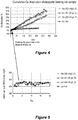
- Figure 4 is a graph showing Cu dissolution % versus time (days) for different concentrations of chloride in leach liquor.
- Figure 5 shows discharge liquor redox potential (mV (Ag/AgCl)) versus time for the same chloride concentrations.
- Figure 4 & 5 showing that chalcopyrite leaching passivates in the absence of chloride above 420 mV (Ag/AgCl). However this is not the case when the chloride in solution is at or above 15 g/L. This indicates that the passivation point is extended in the presence of chloride.
- Figure 6 is a plot of the discharge liquor redox potential (mV (Ag/AgCl)) versus time (days) for three different solution chloride concentrations: 1-3 g/L, 15 g/L and 150 g/L.
- Figure 7 is a graph of the DO (ppm) in discharge liquor versus time for the same chloride concentrations.
- Figure 6 shows that the rate of ferrous to ferric oxidation by air is enhanced in the presence of chloride and so the overall process equilibrates at higher REDOX potentials. This is also evident in the decreased dissolved oxygen in the discharge liquor arising from the increased rate of ferric oxidation ( Fig 7 ).
- Figure 8 is a graph showing Cu dissolution (weight percent) of predominantly chalcopyrite ore versus time (days) for three different chloride concentrations 1-3 g/L, 15 g/L and 150 g/L.
- Figure 9 is a similar graph showing Cu dissolution for bornite/chalcocite ore. It can be seen that copper sulphide minerals dissolution rates increase as a function of increasing redox.
- Figure 10 is a graph showing uraninite dissolution % versus time (days) for chloride concentrations of 1-3 g/L and 15 g/L. It can be seen that uranium mineral leach extents can also be increased by higher chloride concentration resulting in increased solution REDOX potential.
- Figure 13 shows the % dissolution of uranium versus time (days) for leaching uranium ores at varying chloride concentrations commencing at 3 to 5 g/L, increasing to between 15 and 20 g/L, then increasing again to 100 g/L. It was found that once the salinity had increased to above 15 to 20 g/l, there was little effect on the amount of uranium dissolution. The data shows that for most leach conditions, irrespective of the salinity of leaching solution, the leach is essentially complete after approximately 100 to 150 days. In contrast, Figure 14 shows that the rate of copper dissolution is significantly slower and that a minimum of 200 days is required to achieve maximum dissolution.
- Figures 15 and 16 illustrate the effects of solution redox potential and salinity on extraction of uranium into the solvent phase during solvent extraction.
- Figure 15 shows that the extraction of uranium is favoured at relatively low chloride concentrations, and steadily deteriorates as chloride concentration increases.
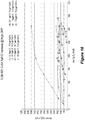
- Figure 16 shows that under relatively high solution redox conditions (approx. 10 to 18 g/L ferric) uranium solvent extraction was poor for anything other than the lowest salinity (25 g/L).
- These graphs therefore demonstrate that high salinity and/or high solution redox adversely affect uranium solvent extraction.
- leaching of uranium is conducted under lowered solution redox or reduced salinity.
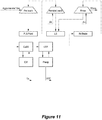
- FIG 11 illustrates in block diagram form a third reference example 210 of a flowsheet for the heap leaching of copper and uranium ore, which is a first modification of the disclosed process that includes a low redox pretreatment step.
- This reference example differs primarily from the previous reference examples in that the intermediate leach solution (ILS), 216, arising from an aerated heap leach reports to a "pre-leach" heap, 214b, containing acid and ferric consuming materials in the absence of forced aeration.
- the mineralogy of the pre-leach heap is similar to that of the other (aerated) heap/s, 214a, and primarily contains metal sulphides and uranium ore minerals.
- the ILS is contacted with the metal sulphides and acid consuming minerals in the pre-leach heap to reduce the ferric ion concentration and acid in solution. Reducing solution redox potential has been found to be advantageous in the subsequent extraction of uranium by solvent extraction. Acid consumption (neutralisation) has been found to be of assistance in the subsequent extraction of copper by solvent extraction.
- the pretreated pregnant leach solution can then be subjected to solvent extraction to recover one or more target metals.
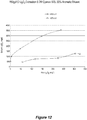
- Figure 12 is a graph showing the concentration of U 3 O 8 (mg/L) extracted into solvent from a pregnant leach solution at two solution redox potentials: 475 mV (squares) and 410 mV (diamonds). This graph illustrates the advantage of reducing solution redox prior to subjecting the pregnant leach solution to uranium solvent extraction. As can be seen, the amount of uranium that loads onto the organic phase at 410 mV is more than 3 times that which loads at 475 mV.
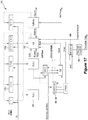
- Figure 17 is a fourth reference example 310 of a flowsheet for the heap leaching of copper and uranium ore.
- part of the heap leach is conducted under lower solution redox.
- the intermediate leach solution (316) arising from aerated heap leach stage 314a reports to a number of other heap leach stages, including a pretreatment stage 314b.
- the pretreatment stage 314b comprises treatment of the ore material with the ILS during which the heap is not subjected to forced aeration. Accordingly, the pretreatment is conducted under reduced solution redox as compared with later stages of the leach.
- the pretreatment stage 314b contains mostly dissolved uranium and some copper.
- the PLS is subjected to USX and CuSX 320, 322.
- FIG 18 illustrates an embodiment 410 of a flowsheet for the heap leaching of copper and uranium ore.
- the embodiment relates to the second modification of the disclosed process that includes a lower salinity pretreatment step.
- the heap includes a pretreatment stage 414b comprising treatment of the ore material with a pre-leach solution having a relatively low chloride content, as compared with the high chloride, acidic leach liquor in the presence of an oxidant, (ie, air).
- the chloride content may range up to 35 g/L.
- the pretreatment may be conducted for a period of time sufficient for at least the majority of uranium to be leached during this step.
- the pretreatment stage 414b may be conducted for approximately 150 days of the overall heap leach.
- the majority of the gangue in the ore material reacts with the acid in the pre-leach solution resulting in a ripios that is depleted in such elements as iron and calcium.
- base metals eg copper
- the ripios from the pretreatment step is then subjected to one or more high chloride leach stages 414a during which the chloride concentration in the leach solution is increased.
- the high chloride leach stage/s may be conducted for a sufficient period of time (eg, approximately 300 days) for at least the majority of copper to be leached during these stages. These stages are aerated.
- the depletion in gangue in the pretreatment ripios means that there is less ferrous available to form salt precipitates, such as metasideronatrite, and therefore a reduced risk of heap blockage.
- the PLS 418 from the pretreatment stage 414b is subjected to CuSX and USX, 420, 422.
- the raffinate 424 is treated with additional salt, 440, if necessary, in order to cause precipitation and removal of deleterious salts 442 prior to transfer to the high chloride leach stage/s 414a of the process.
- Figure 18 shows the pretreatment and high chloride leach stages as being separate stages, there is not necessarily physical relocation of the leached ripios between the two stages.
Landscapes
- Chemical & Material Sciences (AREA)
- Engineering & Computer Science (AREA)
- Organic Chemistry (AREA)
- Materials Engineering (AREA)
- Mechanical Engineering (AREA)
- Metallurgy (AREA)
- Manufacturing & Machinery (AREA)
- Life Sciences & Earth Sciences (AREA)
- General Life Sciences & Earth Sciences (AREA)
- Environmental & Geological Engineering (AREA)
- Geology (AREA)
- Manufacture And Refinement Of Metals (AREA)
- Secondary Cells (AREA)
Description
- The present disclosure relates to a method for heap leaching ore. In particular, the present disclosure relates to a method for heap leaching copper and/or uranium containing ore which includes using a high chloride leach liquor. The method may be used for heap leaching of copper from principally sulphide minerals such as chalcocite, covellite, bornite and chalcopyrite, or a mixed sulphide with copper oxide mineral. The method may additionally or instead be used for leaching uranium from such uranium minerals as uraninite, coffinite and brannerite. The method may instead or additionally be used to leach precious metals, such as gold and/or silver.
- These applications are however exemplary only and are non-limiting for the principles of the disclosed method may be used for the recovery of base metals such as nickel from nickel sulphide minerals e.g. pentlandite and millerite, and for the recovery of zinc from zinc sulphide minerals. The method is described hereinafter with reference to the use of a high chloride mediated, high solution potential, heap leaching of run-of-mine (ROM) or crushed ore material.
- Mineral deposits in the Stuart Shelf, Australia, generally contain three metal values, namely copper, uranium and precious metals (mainly gold and silver). The copper is principally in the form of sulphide minerals such as Chalcocite (Cu2S), Bornite (Cu5FeS4) and Chalcopyrite (CuFeS2). The uranium is principally in the form of such minerals as Uraninite, Coffinite and Brannerite. The common gangue minerals may include quartz, hematite, feldspar, sericite, fluorite, siderite, chlorite and pyrite.
- It has recently been proposed to recover metal values from the Stuart Shelf ore minerals by a process including a heap leaching step. A disadvantage of heap leaching is the relatively slow leach rates of ore minerals. In addition, the surfaces of some ore minerals, particularly copper sulphides such as chalcopyrite, can become passivated during the leaching step which can further reduce the leaching rate and lower the overall metal recovery.
-
WO2014/030048A1 , in the name of BHP Chile Inc., discloses a process of extracting copper from copper sulphide minerals in which ore is subjected to a pre-treatment phase followed by an active leach cycle. During the pretreatment phase, the copper sulphide minerals are contacted with a solution having a high chloride concentration, a solution potential above 700 mV (SHE) and a dissolved oxygen level below 1 mg/L. In the case of a heap leaching operation, the pretreatment step is conducted for a period of up to 200 days prior to commencement of active heap irrigation. - It would be desirable to provide an alternative heap leaching method for increased leaching rate of ore minerals that may be conducted without requiring a pretreatment phase and can instead be conducted during an active leach cycle.
-
EP1424403 A1 discloses a procedure to agglutinate ore concentrates, which can be of copper, on a gravel heap. -
WO98/19779 A1 - The above references to the background art do not constitute an admission that the art forms a part of the common general knowledge of a person of ordinary skill in the art. The above references are also not intended to limit the application of the methods as disclosed herein.
- The present disclosure is based on the discovery that the addition of high amounts of chloride to an oxidising sulphuric acid based leaching process in the presence of soluble iron, results in the leaching process operating at higher solution redox potentials. The presence of chloride, and to a lesser extent copper, increases the rate at which ferrous iron is oxidised to the trivalent state (ferric). A greater concentration of ferric equates to higher solution redox potentials. Metal recovery from ore minerals may be enhanced at increased solution redox potentials, such as at redox potentials exceeding 450 mV Ag/AgCl (approx. 660 mV SHE). This may be achieved, for example, by contacting the minerals during active heap irrigation with an acid solution having a high oxidation potential resulting from an elevated chloride content.
- The present disclosure is also based on the discovery that the phenomena of "passivation" of chalcopyrite during leaching at increased solution oxidation potential may be avoided, or the onset delayed to higher redox potentials, in the presence of high chloride levels in solution.
- As used herein "a heap" includes a heap, a dump, a vat or a column which contains an ore which is to be processed.
- As used herein "active heap irrigation" means the process of actively applying a solution to a heap such that it moves through the heap to cause leaching of ore minerals within the heap. The solution may comprise a leach liquor per se, or it may combine with other components within the heap (such as salt or acid) to form a leach liquor in situ. The solution may be applied by irrigating the heap, such as by using an irrigation grid. The heap may also be aerated during the active heap irrigation.
- The active leach irrigation may be continuous. For example, there may be no "rest" stages, during which application of solution to the heap is suspended, after active leach irrigation commences.
- In one aspect the present invention provides a method for recovering one or more of copper, uranium and a precious metal from an ore material, including:
- (a) forming a heap of the ore material;
- (b) during active heap irrigation, contacting the heap of the ore material with an iron containing acidic leach liquor having a high chloride content in the presence of an oxygen containing gas, and producing a pregnant leach solution; and
- (c) recovering one or more of copper, uranium and a precious metal from
- i. treating the ore with a pre-leach solution having no, or a relatively low, chloride content, as compared with the iron containing acidic leach liquor of step (b), in order to dissolve at least some of the uranium and gangue minerals in the ore and produce a leachate, and to deplete deleterious elements in the ore available to form salt precipitates; and
- ii. treating the leachate to recover uranium and remove the deleterious elements.
- The ore material may be ore and/or an ore concentrate. The ore material may comprise the product of a prior leaching operation, such as a heap leach ripios.
- The "leach liquor" is the solution that contacts the ore. It may be formed separately and applied to the ore. Alternatively, it may be at least partially formed in situ from a combination of the applied irrigation solution, the concentrated sulphuric acid in the agglomerated ore and the in situ dissolution of any salt in the agglomerated ore.
- In one embodiment of the process, the ore material contains copper sulphides and uranium minerals. The ore material may additionally contain one or more precious metals selected from gold and/or silver.
- In one embodiment of the process, the chloride content in the leach liquor is a minimum of 15 g/L.
- In one embodiment of the process, the chloride content in the leach liquor is a minimum of 30 g/L.
- In one embodiment of the process, the chloride content in the leach liquor is a minimum of 45 g/L.
- In one embodiment of the process, the chloride content in the leach liquor is preferably a minimum of 50 g/L. Preferably, the chloride content is at least 70 g/L.
- In one embodiment of the process, the chloride content in the leach liquor is a minimum of 90 g/L. The chloride content may be a minimum of 100 g/L, such as a minimum of 105 g/L.
- In one embodiment of the process, the chloride content in the leach liquor is a minimum of 130 g/L.
- In one embodiment of the process, the chloride content in the leach liquor is a minimum of 150 g/L.
- In one embodiment of the process, the chloride content in the leach liquor may be a maximum of 190 g/L.
- In one embodiment of the process, the chloride content in the leach liquor may be a maximum of 230 g/L.
- In one embodiment of the process, the chloride content in the leach liquor ranges from around 70 g/L up to 150 g/L. The chloride content may preferably range from about 90 to about 110 g/L.
- In one embodiment of the process, the oxygen containing gas is air. In another embodiment, the oxygen containing gas is oxygen-enriched air.
- In one embodiment of the process, the iron containing leach liquor contains ferric ions which oxidise the ore material to dissolve one or more metals, resulting in reduction to ferrous ions. The ferrous ions are then reoxidised to ferric ions by reaction with the oxygen containing gas.
- In one embodiment of the process, the iron containing leach liquor also contains cupric ions that catalyse the reaction of ferrous to ferric ions. The catalytic effect of the cupric ions may diminish above a concentration of approximately 1 g/L Cu.
- The ore material may also contain one or more iron containing minerals. The iron containing minerals may include gangue minerals, such as one or more of hematite, siderite and chlorite. These minerals may partly or wholly comprise the source of the iron in the iron containing leach liquor. The copper sulphides may partly or wholly comprise the source of cupric ions in the acidic leach liquor.
- In one embodiment of the process, the ore material is agglomerated prior to forming a heap. Agglomeration may be effected by mixing the ore material with a desired quantity of acidic agglomerating solution to give the agglomerates the desired final moisture content. The desired final moisture content may be up to 25 wt%. In an embodiment, the final moisture is less than 10 wt%, such as less than 8 wt%. In an embodiment, the final moisture is a minimum of 3.5 wt.%. The acidic agglomerating solution may comprise a combination of process solution (eg, recycled leach liquor or heap leach raffinate) and concentrated sulphuric acid. The acidic agglomerating solution may be added to the ore material in the range of 0 to approximately 20kg/ton. In one embodiment of the process, the addition is in the
range 6 to 12 kg/ton ore. - The acid addition at this level may result in process improvement by reducing silica levels in solution. Solubilized silica becomes problematic as it preferentially precipitates at the surface of the heaps and causes permeability problems. It can be removed from solution by the addition of poly ethyl glycol (PEG) to the part of the first stage leachate. However, it can be preferential to minimize soluble silica from the start. Increasing chloride concentration has also been shown to further reduce soluble silica. The precipitated silica from PEG addition may be settled in a clarifier and recycled to agglomeration as a method of disposal.
- The chloride content in the leach liquor may be at least partially derived from water which naturally contains salt, e.g. water drawn from underground bores, or from the sea or a salt lake or reservoir. Alternatively, the water may be brine, produced for example as a by-product during a desalination process.
- In one embodiment of the process, the solution is applied to the heap by irrigation.
- The redox potential of the leach liquor will be influenced by the salinity of the leach liquor and generally, the higher the salinity, the higher the redox potential.
- In one embodiment of the process, the redox potential of the leach liquor exceeds 420 mV Ag/AgCl, such as greater than 425 mV Ag/AgCl in the absence of bioleaching microorganisms.
- In one embodiment of the process, the redox potential of the leach liquor exceeds 430 mV Ag/AgCl, such as greater than 440 mV Ag/AgCl in the absence of bioleaching microorganisms.
- In one embodiment of the process, the redox potential of the leach liquor exceeds 450 mV Ag/AgCl (approx. 660 mV SHE), in the absence of bioleaching microorganisms.
- In one embodiment of the process, the redox potential of the leach liquor exceeds 460 mV Ag/AgCl, in the absence of bioleaching microorganisms.
- In one embodiment of the process, the redox potential of the leach liquor exceeds 470 mV Ag/AgCl, such as around 480 mV Ag/AgCl, in the absence of bioleaching microorganisms.
- In one embodiment of the process, the total iron concentration of the leach liquor is >0.1 g/L. The total iron concentration may be at least 5 g/L. In an embodiment, the total iron concentration is at least 20 g/L, such as at least 25 g/L. The total iron concentration may be a maximum of 50 g/L. In another embodiment, the total iron concentration is a maximum of 80 g/L.
- The pH of the leach liquor during the active leach cycle is effected by the addition of sulphuric acid directly to the ore during the prior agglomeration process or by the addition of sulphuric acid to the solution which contacts the ore during irrigation or by using both techniques.
- During the course of the heap leach process, the pH of the leach liquor may vary as it reacts with ore and gangue minerals. However, the acidity is such that the pH of the solution contacting the ore may not exceed pH 3.5. In another embodiment, the pH is below pH 3. In another embodiment, the pH may be less than 1. In another embodiment, the pH may be less than -0.3.
- In one embodiment of the process, the dissolved oxygen level in the leach liquor contacting the ore may vary significantly from very low values to approximately saturation during the heap leach. Accordingly, the DO may be above 0 mg/L (0 ppm). The maximum dissolved oxygen may be the value at saturation. The dissolved oxygen may be at least 3 ppm. In an embodiment, it is less than 10 ppm. In another embodiment it is at least 5 ppm. At any point in the process, the DO will be at the equilibrium established between the rate of transfer from the supplied gas and the rate of consumption by reaction in solution. The dissolved oxygen level in the leach liquor contacting the ore may be maintained by forced aeration.
- The method may include the step of providing an irrigation grid whereby the irrigation solution is applied to the heap. The irrigation grid may be located on a surface of the heap, or within the heap, or a combination of both locations may be employed. The irrigation grid may be used directly on an established heap, or in combination with an agglomeration technique.
- The irrigation grid may be of any suitable kind and the invention is not limited in this respect. By way of example the irrigation grid may include a reticulated network of pipes, sprays and the like located on a surface of the heap, or within the heap, or both.
- The heap leach process may be carried out under ambient conditions i.e. at temperature and atmospheric pressure conditions prevailing at the heap.
- The leaching method may be carried out for a period of at least 50 days, such as at least 100 days. In one embodiment, the leaching method may be carried out for a period of at least 450 days. In another embodiment, the leaching method may be carried out for a period of up to 600 days. The duration of the leaching method is determined by a number of factors, such as the time to complete mineral oxidation.
- During the active leach cycle, the ore in the heap may be irrigated with a solution. The subsequently-leached metals, e.g. copper and/or uranium and/or gold, may thereafter be recovered using any suitable process e.g. a solvent extraction process.
- Optionally, hydrochloric acid may be added to the leach liquor. The hydrochloric acid may be utilised as a cleaning agent for the irrigation drippers.
- The leach liquor may contain copper, iron and other anion and cation species that may originate from recycled process water drawn from the heap, or which may have dissolved from the ore which is being treated.
- In one embodiment of the process, the pregnant leach solution contains copper and uranium. In another embodiment, the pregnant leach solution may also contain precious metal.
- The pregnant leach solution may be pretreated to adjust solution chemistry prior to extraction of the target metal/s therefrom.
- The pretreatment of the pregnant leach solution may comprise reduction of solution redox potential. Reducing solution potential may be advantageous in the subsequent extraction of uranium (such as by solvent extraction). The reduction in solution redox potential may be achieved by reducing the ferric ion concentration in solution. Ferric ion reduction may be conveniently achieved by contacting the pregnant leach solution with ferric consuming material, eg ore minerals such as metal sulphides. The contact with ferric consuming material may be in the absence of an oxidant. For example, the pregnant leach solution may be contacted with metal sulphides in the absence of an oxidising gas. The metal sulphides may be provided in a heap which is not under forced aeration.
- The pretreatment may alternatively or additionally comprise consumption of at least some acid. Acid consumption (neutralisation) may be of assistance in the subsequent extraction of copper (such as by solvent extraction). Neutralisation may be achieved by contacting the pregnant leach solution with acid consuming materials, such as acid consuming ores and gangue. Also, acid can be consumed in the above described reaction of ferric ion with metal sulphides. Accordingly, neutralisation may occur simultaneously with reduction in solution potential.
- The pretreated pregnant leach solution can then be subjected to solvent extraction to recover one or more target metals.
- In another aspect, there is disclosed a method of recovering one or more of a base metal, uranium and a precious metal from an ore wherein the ore is subjected to an active leach cycle in which the ore is contacted with an iron containing acidic leach liquor having a high chloride content in the presence of an oxygen containing gas, wherein:
- a. the ore is optionally agglomerated;
- b. the solution potential of the leach liquor exceeds 450 mV Ag/AgCl, in the absence of microorganisms;
- c. the total iron concentration of the leach liquor contacting the ore is >0.1 g/L;
- d. the final ore moisture content is optionally in the
range 2 to 25 wt.%; - e. the pH of the leach liquor does not exceed pH 3.5; and
- f. the Cl- ion concentration of the leach liquor contacting the ore is between 20 and 230 g/L.
- In a further aspect, there is disclosed a process of extracting one or more of a base metal, uranium and a precious metal from an ore material which is enhanced at solution potentials exceeding 450 mV Ag/AgCl, in the absence of any microorganism, by contacting the ore material in an active leach cycle using an acid solution at a high chloride content containing dissolved iron.
- It has been found that operation of the uranium solvent extraction (USX) process may be adversely affected under high chloride and/or high ferric ion concentrations. Accordingly, in a modification of the present disclosure, the process may include a pretreatment step in which the ore material is treated with a solution having either lower chloride concentration or lower solution potential, or both, as compared with the high chloride, acidic leach liquor discussed above. The solution used in the pretreatment step will be hereinafter referred to as a "pre-leach" solution, although it is to be appreciated that leaching of the ore material still occurs during the pretreatment step. It has been found that a substantial amount of uranium, and at least some base metal, may be leached during the pretreatment step.
- In a reference example, the pretreatment step comprises treatment of the ore material with a pre-leach solution having a relatively low solution redox potential. This modification may be effected by treatment of at least a portion of the ore material with an acidic leaching solution in the presence of no or reduced oxidant. For example, the pretreatment may be conducted under no or reduced aeration of the leach solution. The pre-leach solution may contain a high chloride content. The maximum chloride content may be 100 g/L, particularly if solvent extraction is used to recover dissolved uranium from the pregnant leach solution. As the pretreatment occurs near the beginning of the leach cycle, the ore material includes a substantial amount of unreacted sulphide minerals. These sulphide minerals react with the ferric ions in the leach solution, converting them to ferrous ions. However, the lack of oxidant (eg, aeration) means there is no subsequent conversion of the ferrous back to ferric ions. Depending on the acid demand of the ore material, this reference example may result in a high concentration of dissolved salts from the acid gangue reactions, which may in turn result in oversaturation of those salts and precipitates to accumulate in the heap. This can lead to poor permeability to the point in some cases of process failure. The salt precipitates predominantly comprise sodium iron sulphates, such as metasideronatrite (Na4Fe2(SO4)4(OH)2·3H2O). The precipitates may also comprise gypsum and other minor salts.
- In order to ameliorate the problem of precipitation in the heap in the first reference example, additional salt may be added to process solutions in order to force the precipitation of oversaturated salts such as metasideronatrite prior to its use as the preleach solution. In addition, a purge of process liquors would be required in order to keep overall salinities of process liquors within acceptable limits. The first reference example may therefore require a facility for the addition of salt and the precipitation of metasideronatrite, which is likely to be large and costly. Another potential disadvantage is that the pretreatment step, being deliberately oxidant-poor, is not an efficient copper leach sector. As the duration of the pretreatment step may extend for a significant period of time- eg, up to 150 days, this may result in significant delay before commencement of substantive copper recovery.
- In accordance with the invention, the pretreatment step comprises treatment of the ore material with a pre-leach solution having a relatively low chloride content, as compared with the high chloride, acidic leach liquor. Accordingly, it would not be appropriate to add salt to the ore material during or post agglomeration.
- This modification may be effected by treatment of at least a portion of the ore material with a low (or no) chloride containing acidic leaching solution in the presence of an oxidant. The chloride content will depend on the source/s of the process solutions used. The chloride content may range up to 80 g/L, such as up to 70 g/L. In an embodiment, the chloride content may range up to 50 g/L. In an embodiment, the chloride content may range up to 45 g/L. In another embodiment, chloride content may range up to 35 g/L. The average chloride content may range from 5 to 45 g/L, such as from 25 to 35 g/L.
- The pre-leach solution may be aerated during the pretreatment step.
- The solution redox potential of the pre-leach solution may be less than 450 mV Ag/AgCl. In an embodiment, the solution redox potential of the pre-leach solution may be less than 440 mV Ag/AgCl. In an embodiment, the solution redox potential of the pre-leach solution may be less than 430 mV Ag/AgCl. In an embodiment, the solution redox potential of the pre-leach solution may be less than 420 mV Ag/AgCl. The solution redox potential may be greater than 390 mV Ag/AgCl. In an embodiment, the solution redox potential of the pre-leach solution may be greater than 400 mV Ag/AgCl. In an embodiment, the solution redox potential of the pre-leach solution may range from 390 to 420 mV Ag/AgCl. The pretreatment may be conducted for a period of time sufficient for at least the majority of uranium to be leached during this step. Moreover the majority of the gangue in the ore material reacts with the acid in the pre-leach solution resulting in a ripios that is depleted in such deleterious elements as iron, aluminium and calcium. There would also be partial leaching of base metals, eg copper, during the pretreatment step. The ripios from the pretreatment step is then subjected to the high chloride leach during which the chloride concentration in the leach solution is increased. The depletion in gangue in the pretreatment ripios means that there is less ferrous available to form salt precipitates, such as metasideronatrite, and therefore there is a reduced risk of heap blockage. The process liquor from the pretreatment step can be purged from the system and thus reduce dissolved solids loading in the subsequent hypersaline section. This can reduce precipitate formation and help ensure permeability can be maintained in the hypersaline section. Liquor transferring, if required, from the pre-leach to the hypersaline would be subjected to precipitation and removal of deleterious salts prior to transfer to the high chloride leach step. The high chloride leach is primarily focussed on leaching and recovery of copper, the salinity limitations on uranium solvent extraction are not a consideration and therefore, the salinity of the leaching solution can be increased as required to accommodate the ore mineralogy. There are two other benefits of this embodiment:
- In the first reference example in which the pretreatment step is conducted at high salinity, a purge may be required to maintain liquor permeability. This purge would contain high concentrations of chloride. This would lead to the need for increased addition of a chloride source such as NaCl to make up the loss. This would not be the case for the second embodiment where any purged liquor would have a relatively low chloride concentration.
- Uranium solvent extraction is more efficient at lower chloride concentrations. This leads to a smaller uranium solvent extraction facility and hence lower capital and operating costs.
- The process is further described by way of example with reference to the accompanying drawings in which:
-
Figure 1 illustrates in block diagram form a first reference example of a flowsheet for the heap leaching of copper and uranium ore. -
Figure 2 illustrates in block diagram form a second reference example of a flowsheet for the heap leaching of copper and uranium ore. -
Figure 3 is a graph of dissolved silica concentration (mg/L) versus leach time (days) for different amounts of concentrated sulphuric acid added during ore agglomeration. Stars = no acid; squares = 8 kg/ton acid; triangles = 12 kg/ton acid; crosses = 25 kg/ton acid. -
Figure 4 is a graph showing Cu dissolution (ie, mass Cu dissolved/mass Cu in sample, expressed as percent) versus time (days) for different concentrations of chloride in leach liquor. Circle= no chloride; square= 15 g/L chloride; diamond= 30 g/L chloride; triangle= 45 g/L chloride. -
Figure 5 shows discharge liquor (such as pregnant leach solution, or an intermediate leach solution) redox potential (mV (Ag/AgCl)) versus time for the same chloride concentrations. Circle= no chloride; square= 15 g/L chloride; diamond= 30 g/L chloride; triangle= 45 g/L chloride. -
Figure 6 is a plot of the discharge liquor redox potential (mV (Ag/AgCl)) versus time (days) for three different solution chloride concentrations: triangles=1-3 g/L, diamonds=15 g/L and squares=150 g/L. -
Figure 7 is a graph of the Dissolved Oxygen (DO- ppm) in discharge liquor versus time for the same chloride concentrations as inFigure 6 : triangles=1-3 g/L, diamonds=15 g/L and squares=150 g/L. -
Figure 8 is a graph showing Cu dissolution (ie, mass Cu dissolved/mass Cu in sample, expressed as percent) of predominantly chalcopyrite ore versus time (days) for three different chloride concentrations: triangles=1-3 g/L, diamonds=15 g/L and squares=150 g/L. -
Figure 9 is a graph showing Cu dissolution (ie, mass Cu dissolved/mass Cu in sample, expressed as percent) bornite/chalcocite ore versus time (days) for three different chloride concentrations: crosses=1-3 g/L, diamonds=15 g/L and squares=150 g/L. -
Figure 10 is a graph showing uraninite dissolution (ie, mass U dissolved/mass U in sample, expressed as percent) versus time (days) for chloride concentrations of 1-3 g/L (triangles) and 15 g/L (diamonds). -
Figure 11 illustrates in block diagram form a third reference example of a flowsheet for the heap leaching of copper and uranium ore. -
Figure 12 is a graph showing the concentration of U3O8 (mg/L) extracted into solvent from a pregnant leach solution at two solution redox potentials: 475 mV (squares) and 410 mV (diamonds). -
Figure 13 is a graph showing % dissolution of uranium (as U3O8) versus time (days) for a chloride leach of uranium ore. -
Figure 14 is a graph showing % dissolution of copper versus time (days) for a chloride leach of copper ore. -
Figure 15 is a graph showing the extraction of uranium into the solvent phase at low solution ORP for a range of chloride concentrations. -
Figure 16 is a graph showing the extraction of uranium into the solvent phase at high solution ORP for a range of chloride concentrations. -
Figure 17 illustrates in block diagram form a fourth reference example of a flowsheet for the heap leaching of copper and uranium ore. -
Figure 18 illustrates in block diagram form an embodiment of a flowsheet for the heap leaching of copper and uranium ore. - The method is described herein with reference to the use of a high chloride mediated, high solution potential, active heap leach cycle, for crushed or run-of-mine (ROM) ore (or ore concentrate).
- An advantage of the disclosed method is to significantly increase the oxidation rate of sulphide minerals or mixed sulphide and oxide minerals during active heap irrigation, and thereby improve metal recovery in a shorter leach cycle and, additionally, to lower, at least to some extent, the operational cost of a heap leach.
- With reference to
Figures 1 and2 , two flowsheet reference examples 10, 110 of the disclosed method are illustrated. In each reference example, an ore that contained the following value minerals: - Copper sulphides mostly in the form of chalcopyrite, bornite and chalcocite, but may include other copper sulphide species;
- Uranium in the form of uraninite, coffinite and brannerite; and
- Gold,
- The crushed ore was agglomerated 12, 112 with a combination of process solution (heap leach raffinate liquor) and concentrated sulphuric acid. The concentrated sulphuric acid was added at a concentration in the range of 0 to approximately 20kg/tonne of ore. The optimal addition was in the range of 6 to 12 kg/ton ore. The raffinate liquor was added (as required) to give a final moisture of around 3.5% (which was preferred for agglomerate formation).
- Solid salt selected from one or more of the following: NaCl, MgCl2, KCl and AlCl3, was added to the ore during or post agglomeration as required to tailor the ultimate chloride concentration of the leach liquor. It was preferred to add the salt to the ore as opposed to adding it directly to the solution irrigated in the heap as the salt was then dissolved in situ and the heap acted as a fines filter for any insoluble impurities.
- Salt was added onto the agglomerate conveyor.
- The agglomerated ore was stacked in heaps, 14a, b, c and 114a, b, c on either multilift non-reusable pad or on a reusable pad (not shown). While diagrammatically each heap is shown as separate units a, b, and c, in practice these units are usually continuously stacked. The ripios may be removed after heap leaching and transferred to a ripios dump for storage and potentially extra Cu recovery from long term permeate collection.
- Each
heap unit 14a, b, c and 114a, b, c is irrigated at flux of 5 - 20 l/m2/h with an optimum of between 8-15 l/m2/h. - Concentrated sulphuric acid is added to the solution irrigated to each heap unit to achieve a desired concentration of acid in the discharge. This is usually a minimum to minimize overall process acid consumption.
- The acid reacts with gangue minerals in each heap unit to produce ferrous ions from minerals such as siderite and chlorite. Some ferric ions may be derived from acid reaction with hematite.
- The ferrous ions are converted to ferric ions by oxidation with oxygen. Oxygen is supplied into the heap by blowing air into the heap.
- The acid and ferric ions react with copper sulphide minerals in the ore to release copper sulphate into solution with the ferric consequentially reduced to ferrous ions. An equivalent reaction occurs between acid, ferric ions and uranium minerals in order to release uranium into solution. Under some conditions, an equivalent reaction occurs to release precious metal, especially gold, into solution. In each case, the ferrous ions generated are re-oxidized to ferric ions by oxygen.
- In each of
Figures 1 and2 , the intermediate leach solution (ILS) produced byheap units ILS pond heap units PLS ponds - Copper and uranium are recovered from the
PLS - In
Figure 1 , the raffinate from the USX process reports to the heap leach unit 14c as a process solution. The leachate arising from the heap leach unit 14c reports to theheap leach unit 14a as a process solution. Saline water is added to the ILS in theILS pond 16. - In
Figure 2 , the raffinate from the USX process and the leachate arising from theheap leach unit 114c both report to theraffinate pond 124.Raffinate 126 from theraffinate pond 124 then reports toheap leach unit 114a as a process solution. Saline water is added to theheap leach unit 114c. - In
Figure 1 theripios 28 is not washed for any other use. InFigure 2 the ripios is washed in preparation for milling and floating residual sulphide as well as gold. The process inFigure 2 may accordingly require a greater raffinate purge to control ions such as Fe, Al and SO4 -2 because of the wash stage. - While
Figures 1 and2 illustrate two flowsheet reference examples, it is to be understood that there may be a variety of configurations of the same unit operations that could be considered. - Referring now to
Figure 3 , the amount of soluble silica as a function of leach time is shown for different additions of concentrated sulphuric acid during agglomeration. While increased acid addition has not shown to have process improvements in regard to extent of uranium or copper dissolution, there are process improvements arising from reduced silica levels in solution. Solubilized silica becomes problematic as it preferentially precipitates at the surface of the heaps and can cause permeability problems. It is removed from solution by the addition of poly ethyl glycol (PEG) to the part of the first stage leachate. It is preferential to minimize it from the start. The precipitated silica from PEG addition is settled in a clarifier and recycled to agglomeration as a method of disposal. -
Figure 4 is a graph showing Cu dissolution % versus time (days) for different concentrations of chloride in leach liquor.Figure 5 shows discharge liquor redox potential (mV (Ag/AgCl)) versus time for the same chloride concentrations.Figure 4 & 5 showing that chalcopyrite leaching passivates in the absence of chloride above 420 mV (Ag/AgCl). However this is not the case when the chloride in solution is at or above 15 g/L. This indicates that the passivation point is extended in the presence of chloride.Figure 6 is a plot of the discharge liquor redox potential (mV (Ag/AgCl)) versus time (days) for three different solution chloride concentrations: 1-3 g/L, 15 g/L and 150 g/L.Figure 7 is a graph of the DO (ppm) in discharge liquor versus time for the same chloride concentrations.Figure 6 shows that the rate of ferrous to ferric oxidation by air is enhanced in the presence of chloride and so the overall process equilibrates at higher REDOX potentials. This is also evident in the decreased dissolved oxygen in the discharge liquor arising from the increased rate of ferric oxidation (Fig 7 ). -
Figure 8 is a graph showing Cu dissolution (weight percent) of predominantly chalcopyrite ore versus time (days) for three different chloride concentrations 1-3 g/L, 15 g/L and 150 g/L.Figure 9 is a similar graph showing Cu dissolution for bornite/chalcocite ore. It can be seen that copper sulphide minerals dissolution rates increase as a function of increasing redox. -
Figure 10 is a graph showing uraninite dissolution % versus time (days) for chloride concentrations of 1-3 g/L and 15 g/L. It can be seen that uranium mineral leach extents can also be increased by higher chloride concentration resulting in increased solution REDOX potential. -
Figure 13 shows the % dissolution of uranium versus time (days) for leaching uranium ores at varying chloride concentrations commencing at 3 to 5 g/L, increasing to between 15 and 20 g/L, then increasing again to 100 g/L. It was found that once the salinity had increased to above 15 to 20 g/l, there was little effect on the amount of uranium dissolution. The data shows that for most leach conditions, irrespective of the salinity of leaching solution, the leach is essentially complete after approximately 100 to 150 days. In contrast,Figure 14 shows that the rate of copper dissolution is significantly slower and that a minimum of 200 days is required to achieve maximum dissolution. The rate increase observed for many of the columns is due to the addition of salt to increase the salinity of the leach solution from 25 g/L (saline) to 100 g/L (hypersaline). It is evident that an increase in salinity results in an increase in copper dissolution. -
Figures 15 and16 illustrate the effects of solution redox potential and salinity on extraction of uranium into the solvent phase during solvent extraction. At relatively low redox potentials (approximately 2 to 5 g/L ferric),Figure 15 shows that the extraction of uranium is favoured at relatively low chloride concentrations, and steadily deteriorates as chloride concentration increases.Figure 16 shows that under relatively high solution redox conditions (approx. 10 to 18 g/L ferric) uranium solvent extraction was poor for anything other than the lowest salinity (25 g/L). These graphs therefore demonstrate that high salinity and/or high solution redox adversely affect uranium solvent extraction. In the following embodiments, leaching of uranium is conducted under lowered solution redox or reduced salinity. -
Figure 11 illustrates in block diagram form a third reference example 210 of a flowsheet for the heap leaching of copper and uranium ore, which is a first modification of the disclosed process that includes a low redox pretreatment step. This reference example differs primarily from the previous reference examples in that the intermediate leach solution (ILS), 216, arising from an aerated heap leach reports to a "pre-leach" heap, 214b, containing acid and ferric consuming materials in the absence of forced aeration. The mineralogy of the pre-leach heap is similar to that of the other (aerated) heap/s, 214a, and primarily contains metal sulphides and uranium ore minerals. The ILS is contacted with the metal
sulphides and acid consuming minerals in the pre-leach heap to reduce the ferric ion concentration and acid in solution. Reducing solution redox potential has been found to be advantageous in the subsequent extraction of uranium by solvent extraction. Acid consumption (neutralisation) has been found to be of assistance in the subsequent extraction of copper by solvent extraction. - The pretreated pregnant leach solution can then be subjected to solvent extraction to recover one or more target metals.
-
Figure 12 is a graph showing the concentration of U3O8 (mg/L) extracted into solvent from a pregnant leach solution at two solution redox potentials: 475 mV (squares) and 410 mV (diamonds). This graph illustrates the advantage of reducing solution redox prior to subjecting the pregnant leach solution to uranium solvent extraction. As can be seen, the amount of uranium that loads onto the organic phase at 410 mV is more than 3 times that which loads at 475 mV. It is believed the significant difference is due to the much lower ferric present in the PLS at the lower redox- as uranium and ferric ion tend to coload onto the organic phase, the less ferric in solution, the more uranium can be loaded. The practical consequence of a higher uranium loading onto organic phase for a given uranium concentration in the PLS, is that the volume of required organic phase, and therefore the size of the required solvent extraction plant, can be correspondingly smaller, which is a saving in capital expenditure. -
Figure 17 is a fourth reference example 310 of a flowsheet for the heap leaching of copper and uranium ore. Similarly to the third reference example, in the fourth reference example, part of the heap leach is conducted under lower solution redox. The intermediate leach solution (316) arising from aeratedheap leach stage 314a reports to a number of other heap leach stages, including apretreatment stage 314b. Thepretreatment stage 314b comprises treatment of the ore material with the ILS during which the heap is not subjected to forced aeration. Accordingly, the pretreatment is conducted under reduced solution redox as compared with later stages of the leach. Because the pretreatment stage occurs near the beginning of the leach cycle, there are significant unreacted sulphide minerals which react with the ferric in the ILS converting it to ferrous. The lack of aeration creates oxygen limitation and hence there is reduced subsequent conversion of the ferrous back to ferric ions. ThePLS 318 produced by thepretreatment stage 314b contains mostly dissolved uranium and some copper. The PLS is subjected to USX and CuSX 320, 322. - Because of the reasonably high acid demand (40-80kg/T) of ores deposits in the Stuart Shelf, Australia, this translates to a high concentration of dissolved salts from the acid gangue reactions. This reference example may result in oversaturation of the dissolved salts (eg sodium iron sulphates, such as metasideronatrite (Na4Fe2(SO4)4(OH)2·3H2O) in the process solutions arising from the acid gangue reactions, which may in turn result in accumulation of precipitates in the heap and poor permeability. In order to address this problem,
additional salt 340 may be added to the process solution/s in order to force the precipitation of oversaturated salts, 342, which can then be removed. In addition, a purge of process liquors would be required in order to keep overall salinities of process liquors within acceptable limits. -
Figure 18 illustrates anembodiment 410 of a flowsheet for the heap leaching of copper and uranium ore. The embodiment relates to the second modification of the disclosed process that includes a lower salinity pretreatment step. The heap includes apretreatment stage 414b comprising treatment of the ore material with a pre-leach solution having a relatively low chloride content, as compared with the high chloride, acidic leach liquor in the presence of an oxidant, (ie, air). The chloride content may range up to 35 g/L. The pretreatment may be conducted for a period of time sufficient for at least the majority of uranium to be leached during this step. For example, thepretreatment stage 414b may be conducted for approximately 150 days of the overall heap leach. Moreover the majority of the gangue in the ore material reacts with the acid in the pre-leach solution resulting in a ripios that is depleted in such elements as iron and calcium. There would also be partial leaching of base metals, eg copper, during the pretreatment step. The ripios from the pretreatment step is then subjected to one or more highchloride leach stages 414a during which the chloride concentration in the leach solution is increased. The high chloride leach stage/s may be conducted for a sufficient period of time (eg, approximately 300 days) for at least the majority of copper to be leached during these stages. These stages are aerated. The depletion in gangue in the pretreatment ripios means that there is less ferrous available to form salt precipitates, such as metasideronatrite, and therefore a reduced risk of heap blockage. ThePLS 418 from thepretreatment stage 414b is subjected to CuSX and USX, 420, 422. Theraffinate 424 is treated with additional salt, 440, if necessary, in order to cause precipitation and removal ofdeleterious salts 442 prior to transfer to the high chloride leach stage/s 414a of the process. AlthoughFigure 18 shows the pretreatment and high chloride leach stages as being separate stages, there is not necessarily physical relocation of the leached ripios between the two stages. - Whilst a number of specific embodiments have been described, it should be appreciated that the process and plant may be embodied in many other forms within the scope of the claims.
- References to the background art herein do not constitute an admission that the art forms a part of the common general knowledge of a person of ordinary skill in the art. Those references are also not intended to limit the application of the process as disclosed herein.
- In the claims which follow, and in the preceding description, except where the context requires otherwise due to express language or necessary implication, the word "comprise" and variations such as "comprises" or "comprising" are used in an inclusive sense, i.e. to specify the presence of the stated features but not to preclude the presence or addition of further features in various embodiments of the process and plant as disclosed herein.
Claims (15)
- A method for recovering one or more of copper, uranium and a precious metal from an ore material, including:(a) forming a heap of the ore material;(b) during active heap irrigation, contacting the heap of the ore material with an iron containing acidic leach liquor having a high chloride content in the presence of an oxygen containing gas, and producing a pregnant leach solution; and(c) recovering one or more of copper, uranium and a precious metal from the pregnant leach solution;wherein, prior to contacting the ore with the iron containing acidic leach liquor in step (b), the method includes the steps of:i. treating the ore with a pre-leach solution having no, or a relatively low, chloride content, as compared with the iron containing acidic leach liquor of step (b), in order to dissolve at least some of the uranium and gangue minerals in the ore and produce a leachate, and to deplete deleterious elements in the ore available to form salt precipitates; andii. treating the leachate to recover uranium and remove the deleterious elements.
- The method of claim 1 wherein the ore material contains copper sulphides and/or uranium minerals.
- The method of claim 2, wherein the ore material additionally contains one or more precious metals selected from gold and silver.
- The method of any preceding claim wherein the chloride content in the iron containing acidic leach liquor of step (b) is a minimum of 15 g/L, such as a minimum of 30 g/L, preferably a minimum of 100 g/L, such as a minimum of 150 g/L.
- The method of any preceding claim wherein the iron containing acidic leach liquor contains ferric ions, which oxidise the ore material and are reduced to ferrous ions which are subsequently reoxidised to ferric ions by reaction with the oxygen containing gas.
- The method of claim 5 wherein the iron containing acidic leach liquor contains cupric ions that catalyse the reaction of ferrous to ferric ions.
- The method of any preceding claim wherein the redox potential of the iron containing acidic leach liquor exceeds 420 mV Ag/AgCl, preferably exceeds 450 mV Ag/AgCl, in the absence of bioleaching microorganisms.
- The method of any preceding claim wherein the iron containing acidic leach liquor has a total iron concentration >0.1 g/L, preferably at least 5 g/L, more preferably at least 20 g/L, such as at least 25 g/L.
- The method of any preceding claim wherein the acidity of the iron containing acidic leach liquor is such that the pH of the solution contacting the ore does not exceed pH 3.5.
- The method according to claim 9 wherein the method is carried out under ambient temperature and atmospheric pressure conditions.
- The method of any preceding claim wherein the pregnant leach solution is pretreated to adjust solution chemistry prior to recovery of one or more of copper, uranium and a precious metal therefrom.
- The method according to claim 11 wherein pretreatment of the pregnant leach solution formed in step (a) comprises reduction of solution redox potential and/or consumption of at least some acid.
- The method of any preceding claim wherein prior to forming the heap in step (a), the ore material is formed into agglomerates by mixing the ore material with acidic agglomerating solution to give the agglomerates the desired final moisture content of up to 25 wt%, preferably less than 10 wt%, such as less than 8 wt%, further wherein the desired final moisture content is preferably a minimum of 3.5 wt%.
- The method of any preceding claim, wherein the chloride content in the pre-leach solution ranges from 0 to 50 g/L, preferably from 0 to 35 g/L, further wherein step (i) is preferably conducted in the presence of an oxidant, such as air.
- The method of any preceding claim, wherein the solution redox potential of the pre-leach solution is less than 450 mV Ag/AgCl and preferably ranges from 390 to 420 mV Ag/AgCl.
Applications Claiming Priority (3)
| Application Number | Priority Date | Filing Date | Title |
|---|---|---|---|
| AU2014905118A AU2014905118A0 (en) | 2014-12-17 | Heap Leaching Method | |
| AU2015901661A AU2015901661A0 (en) | 2015-05-08 | Heap Leaching Method | |
| PCT/AU2015/050806 WO2016094956A1 (en) | 2014-12-17 | 2015-12-17 | Heap leaching method |
Publications (3)
| Publication Number | Publication Date |
|---|---|
| EP3234206A1 EP3234206A1 (en) | 2017-10-25 |
| EP3234206A4 EP3234206A4 (en) | 2017-12-27 |
| EP3234206B1 true EP3234206B1 (en) | 2019-10-30 |
Family
ID=56125455
Family Applications (1)
| Application Number | Title | Priority Date | Filing Date |
|---|---|---|---|
| EP15868711.1A Active EP3234206B1 (en) | 2014-12-17 | 2015-12-17 | Heap leaching method |
Country Status (10)
| Country | Link |
|---|---|
| US (1) | US10947606B2 (en) |
| EP (1) | EP3234206B1 (en) |
| CN (1) | CN107208176B (en) |
| AU (1) | AU2015367301B2 (en) |
| CA (1) | CA2971223C (en) |
| CL (1) | CL2017001589A1 (en) |
| EA (1) | EA037522B1 (en) |
| HU (1) | HUE046731T2 (en) |
| PE (1) | PE20171792A1 (en) |
| WO (1) | WO2016094956A1 (en) |
Families Citing this family (11)
| Publication number | Priority date | Publication date | Assignee | Title |
|---|---|---|---|---|
| CL2016001188A1 (en) * | 2016-05-18 | 2017-02-24 | Antofagasta Minerales S A | Procedure for the improvement of copper leaching processes using calcium chloride |
| AU2017346972B2 (en) | 2016-10-19 | 2023-01-19 | Jetti Resources, Llc | Process for leaching metal sulfides with reagents having thiocarbonyl functional groups |
| US11732325B2 (en) | 2017-12-21 | 2023-08-22 | Bhp Chile Inc | Acid balance in a chloride heap leach |
| WO2020099912A1 (en) * | 2018-11-14 | 2020-05-22 | Nova Mineralis S.A. | Solid-liquid-solid method for the solubilisation of copper minerals and concentrates, independent of the redox potential and with low consumption of water and acid |
| PE20230857A1 (en) | 2020-09-18 | 2023-05-29 | Jetti Resources Llc | EXTRACTION OF BASE METALS WITH A WETTING AGENT AND A THIOCARBONYL FUNCTIONAL GROUP REAGENT |
| CN115679133A (en) * | 2021-07-26 | 2023-02-03 | 核工业北京化工冶金研究院 | Leaching method for reducing reagent consumption of sulfur-containing siliceous uranium ore |
| CN115232994B (en) * | 2022-05-19 | 2024-01-12 | 核工业北京化工冶金研究院 | Method for treating uranium-containing chlorine-containing high-acidity resin transfer fluid |
| CL2023002049A1 (en) | 2022-07-15 | 2024-02-23 | Corporacion Nac Del Cobre De Chile | Mineral heap leaching process with semi-autogenous heating |
| CN115094236B (en) * | 2022-07-20 | 2023-09-26 | 万宝矿产有限公司 | A kind of enhanced leaching method for copper ore |
| CN115404341A (en) * | 2022-08-31 | 2022-11-29 | 安徽省地质矿产勘查局321地质队 | Method for promoting microbial leaching of chalcopyrite by using mica |
| CN118516550B (en) * | 2024-06-07 | 2025-04-29 | 中核韶关锦原铀业有限公司 | Uranium leaching device and method for uranium raw ore |
Family Cites Families (10)
| Publication number | Priority date | Publication date | Assignee | Title |
|---|---|---|---|---|
| US4017309A (en) | 1975-03-28 | 1977-04-12 | Holmes & Narver, Inc. | Thin layer leaching method |
| US5236492A (en) | 1992-07-29 | 1993-08-17 | Fmc Gold Company | Recovery of precious metal values from refractory ores |
| PE69399A1 (en) * | 1996-11-06 | 1999-07-21 | Atomaer Pty Ltd | IMPROVED LEACHING OF METALLIC MINERALS |
| CA2432743C (en) * | 2002-11-26 | 2010-12-14 | Minera Michilla S.A. | Non-biochemical method to heap leach copper concentrates |
| CA2475833C (en) | 2004-01-29 | 2011-02-01 | Minera Michilla S.A. | Procedure to leach copper concentrates, under pressure and at ambient temperature, by forming a colloidal mass in a sulfate - chloride medium |
| EP2307582A4 (en) * | 2008-07-29 | 2014-12-03 | Bhp Billiton Ssm Dev Pty Ltd | METHOD FOR CONTROLLED HOMOGENEOUS ACID LEACHING |
| JP5797162B2 (en) * | 2012-06-29 | 2015-10-21 | シャープ株式会社 | Collecting member cleaning tool, particle detector, and method of manufacturing collecting member cleaning tool |
| JP6158927B2 (en) * | 2012-08-22 | 2017-07-05 | ビーエイチピー チリ インコーポレイテッド | Sediment leach method |
| WO2014040136A1 (en) * | 2012-09-13 | 2014-03-20 | Bhp Billiton Olympic Dam Corporation Pty Ltd | Solvent extraction process |
| WO2014169325A1 (en) * | 2013-04-15 | 2014-10-23 | Bhp Billiton Olympic Dam Corporation Pty Ltd | Method for processing ore |
-
2015
- 2015-12-17 EA EA201791360A patent/EA037522B1/en unknown
- 2015-12-17 EP EP15868711.1A patent/EP3234206B1/en active Active
- 2015-12-17 CA CA2971223A patent/CA2971223C/en active Active
- 2015-12-17 CN CN201580074268.2A patent/CN107208176B/en active Active
- 2015-12-17 PE PE2017001089A patent/PE20171792A1/en unknown
- 2015-12-17 AU AU2015367301A patent/AU2015367301B2/en active Active
- 2015-12-17 WO PCT/AU2015/050806 patent/WO2016094956A1/en not_active Ceased
- 2015-12-17 US US15/537,544 patent/US10947606B2/en active Active
- 2015-12-17 HU HUE15868711A patent/HUE046731T2/en unknown
-
2017
- 2017-06-16 CL CL2017001589A patent/CL2017001589A1/en unknown
Non-Patent Citations (1)
| Title |
|---|
| None * |
Also Published As
| Publication number | Publication date |
|---|---|
| CA2971223A1 (en) | 2016-06-23 |
| US10947606B2 (en) | 2021-03-16 |
| CN107208176B (en) | 2020-04-03 |
| AU2015367301A1 (en) | 2017-07-13 |
| EA037522B1 (en) | 2021-04-07 |
| AU2015367301B2 (en) | 2021-06-24 |
| WO2016094956A1 (en) | 2016-06-23 |
| HUE046731T2 (en) | 2020-03-30 |
| CA2971223C (en) | 2023-08-01 |
| CN107208176A (en) | 2017-09-26 |
| CL2017001589A1 (en) | 2018-05-18 |
| EP3234206A4 (en) | 2017-12-27 |
| EA201791360A1 (en) | 2017-10-31 |
| EP3234206A1 (en) | 2017-10-25 |
| PE20171792A1 (en) | 2017-12-28 |
| US20170349972A1 (en) | 2017-12-07 |
Similar Documents
| Publication | Publication Date | Title |
|---|---|---|
| AU2015367301B2 (en) | Heap leaching method | |
| Wang | Copper leaching from chalcopyrite concentrates | |
| AU2008278269B2 (en) | Method for ammoniacal leaching | |
| US7125436B2 (en) | Method for improving metals recovery using high temperature pressure leaching | |
| EP2888380B1 (en) | Heap leaching method | |
| AU2002332423A1 (en) | Method for improving metals recovery using high temperature pressure leaching | |
| CN118421953A (en) | Leaching of copper ore | |
| EA005630B1 (en) | System and process for recovering copper from a copper-containing material | |
| WO2011116426A1 (en) | Process for leaching refractory uraniferous minerals | |
| AU2002329630A1 (en) | Process for direct electrowinning of copper | |
| JP2013189687A (en) | Leaching method of copper ore | |
| CN101984094A (en) | Method for controlling oxidation-reduction potential in biological heap leaching process | |
| US7037357B2 (en) | Recovery of metals from jarosite-containing materials | |
| RU2354819C1 (en) | Method for leaching of oxidised and mixed copper-bearing ores and products of their enrichment | |
| AU2015268083B2 (en) | Method for ammoniacal leaching of copper from oxidised copper ores | |
| EA047380B1 (en) | METHOD OF EXTRACTING BASE AND PRECIOUS METALS BY PRELIMINARY TREATMENT TO SOLUBILIZE THEIR REFRACTORY MATRICES | |
| JP2012077373A (en) | Method of recovering gold from leached residue of copper sulfide mineral |
Legal Events
| Date | Code | Title | Description |
|---|---|---|---|
| STAA | Information on the status of an ep patent application or granted ep patent |
Free format text: STATUS: THE INTERNATIONAL PUBLICATION HAS BEEN MADE |
|
| PUAI | Public reference made under article 153(3) epc to a published international application that has entered the european phase |
Free format text: ORIGINAL CODE: 0009012 |
|
| STAA | Information on the status of an ep patent application or granted ep patent |
Free format text: STATUS: REQUEST FOR EXAMINATION WAS MADE |
|
| 17P | Request for examination filed |
Effective date: 20170630 |
|
| AK | Designated contracting states |
Kind code of ref document: A1 Designated state(s): AL AT BE BG CH CY CZ DE DK EE ES FI FR GB GR HR HU IE IS IT LI LT LU LV MC MK MT NL NO PL PT RO RS SE SI SK SM TR |
|
| AX | Request for extension of the european patent |
Extension state: BA ME |
|
| A4 | Supplementary search report drawn up and despatched |
Effective date: 20171124 |
|
| RIC1 | Information provided on ipc code assigned before grant |
Ipc: C22B 15/00 20060101ALI20171120BHEP Ipc: C22B 60/00 20060101ALI20171120BHEP Ipc: C22B 3/06 20060101AFI20171120BHEP |
|
| DAV | Request for validation of the european patent (deleted) | ||
| DAX | Request for extension of the european patent (deleted) | ||
| GRAP | Despatch of communication of intention to grant a patent |
Free format text: ORIGINAL CODE: EPIDOSNIGR1 |
|
| STAA | Information on the status of an ep patent application or granted ep patent |
Free format text: STATUS: GRANT OF PATENT IS INTENDED |
|
| INTG | Intention to grant announced |
Effective date: 20190314 |
|
| GRAS | Grant fee paid |
Free format text: ORIGINAL CODE: EPIDOSNIGR3 |
|
| GRAJ | Information related to disapproval of communication of intention to grant by the applicant or resumption of examination proceedings by the epo deleted |
Free format text: ORIGINAL CODE: EPIDOSDIGR1 |
|
| GRAL | Information related to payment of fee for publishing/printing deleted |
Free format text: ORIGINAL CODE: EPIDOSDIGR3 |
|
| STAA | Information on the status of an ep patent application or granted ep patent |
Free format text: STATUS: REQUEST FOR EXAMINATION WAS MADE |
|
| INTC | Intention to grant announced (deleted) | ||
| GRAR | Information related to intention to grant a patent recorded |
Free format text: ORIGINAL CODE: EPIDOSNIGR71 |
|
| STAA | Information on the status of an ep patent application or granted ep patent |
Free format text: STATUS: GRANT OF PATENT IS INTENDED |
|
| GRAA | (expected) grant |
Free format text: ORIGINAL CODE: 0009210 |
|
| STAA | Information on the status of an ep patent application or granted ep patent |
Free format text: STATUS: THE PATENT HAS BEEN GRANTED |
|
| INTG | Intention to grant announced |
Effective date: 20190918 |
|
| AK | Designated contracting states |
Kind code of ref document: B1 Designated state(s): AL AT BE BG CH CY CZ DE DK EE ES FI FR GB GR HR HU IE IS IT LI LT LU LV MC MK MT NL NO PL PT RO RS SE SI SK SM TR |
|
| REG | Reference to a national code |
Ref country code: GB Ref legal event code: FG4D |
|
| REG | Reference to a national code |
Ref country code: CH Ref legal event code: EP |
|
| REG | Reference to a national code |
Ref country code: AT Ref legal event code: REF Ref document number: 1196191 Country of ref document: AT Kind code of ref document: T Effective date: 20191115 |
|
| REG | Reference to a national code |
Ref country code: DE Ref legal event code: R096 Ref document number: 602015040885 Country of ref document: DE |
|
| REG | Reference to a national code |
Ref country code: IE Ref legal event code: FG4D |
|
| REG | Reference to a national code |
Ref country code: CH Ref legal event code: NV Representative=s name: NOVAGRAAF INTERNATIONAL SA, CH |
|
| REG | Reference to a national code |
Ref country code: SE Ref legal event code: TRGR |
|
| REG | Reference to a national code |
Ref country code: LT Ref legal event code: MG4D |
|
| REG | Reference to a national code |
Ref country code: HU Ref legal event code: AG4A Ref document number: E046731 Country of ref document: HU |
|
| PG25 | Lapsed in a contracting state [announced via postgrant information from national office to epo] |
Ref country code: LV Free format text: LAPSE BECAUSE OF FAILURE TO SUBMIT A TRANSLATION OF THE DESCRIPTION OR TO PAY THE FEE WITHIN THE PRESCRIBED TIME-LIMIT Effective date: 20191030 Ref country code: NL Free format text: LAPSE BECAUSE OF FAILURE TO SUBMIT A TRANSLATION OF THE DESCRIPTION OR TO PAY THE FEE WITHIN THE PRESCRIBED TIME-LIMIT Effective date: 20191030 Ref country code: PT Free format text: LAPSE BECAUSE OF FAILURE TO SUBMIT A TRANSLATION OF THE DESCRIPTION OR TO PAY THE FEE WITHIN THE PRESCRIBED TIME-LIMIT Effective date: 20200302 Ref country code: BG Free format text: LAPSE BECAUSE OF FAILURE TO SUBMIT A TRANSLATION OF THE DESCRIPTION OR TO PAY THE FEE WITHIN THE PRESCRIBED TIME-LIMIT Effective date: 20200130 Ref country code: LT Free format text: LAPSE BECAUSE OF FAILURE TO SUBMIT A TRANSLATION OF THE DESCRIPTION OR TO PAY THE FEE WITHIN THE PRESCRIBED TIME-LIMIT Effective date: 20191030 Ref country code: PL Free format text: LAPSE BECAUSE OF FAILURE TO SUBMIT A TRANSLATION OF THE DESCRIPTION OR TO PAY THE FEE WITHIN THE PRESCRIBED TIME-LIMIT Effective date: 20191030 Ref country code: GR Free format text: LAPSE BECAUSE OF FAILURE TO SUBMIT A TRANSLATION OF THE DESCRIPTION OR TO PAY THE FEE WITHIN THE PRESCRIBED TIME-LIMIT Effective date: 20200131 Ref country code: NO Free format text: LAPSE BECAUSE OF FAILURE TO SUBMIT A TRANSLATION OF THE DESCRIPTION OR TO PAY THE FEE WITHIN THE PRESCRIBED TIME-LIMIT Effective date: 20200130 |
|
| REG | Reference to a national code |
Ref country code: NL Ref legal event code: MP Effective date: 20191030 |
|
| PG25 | Lapsed in a contracting state [announced via postgrant information from national office to epo] |
Ref country code: RS Free format text: LAPSE BECAUSE OF FAILURE TO SUBMIT A TRANSLATION OF THE DESCRIPTION OR TO PAY THE FEE WITHIN THE PRESCRIBED TIME-LIMIT Effective date: 20191030 Ref country code: HR Free format text: LAPSE BECAUSE OF FAILURE TO SUBMIT A TRANSLATION OF THE DESCRIPTION OR TO PAY THE FEE WITHIN THE PRESCRIBED TIME-LIMIT Effective date: 20191030 Ref country code: IS Free format text: LAPSE BECAUSE OF FAILURE TO SUBMIT A TRANSLATION OF THE DESCRIPTION OR TO PAY THE FEE WITHIN THE PRESCRIBED TIME-LIMIT Effective date: 20200229 |
|
| PG25 | Lapsed in a contracting state [announced via postgrant information from national office to epo] |
Ref country code: AL Free format text: LAPSE BECAUSE OF FAILURE TO SUBMIT A TRANSLATION OF THE DESCRIPTION OR TO PAY THE FEE WITHIN THE PRESCRIBED TIME-LIMIT Effective date: 20191030 |
|
| REG | Reference to a national code |
Ref country code: DE Ref legal event code: R119 Ref document number: 602015040885 Country of ref document: DE |
|
| PG25 | Lapsed in a contracting state [announced via postgrant information from national office to epo] |
Ref country code: RO Free format text: LAPSE BECAUSE OF FAILURE TO SUBMIT A TRANSLATION OF THE DESCRIPTION OR TO PAY THE FEE WITHIN THE PRESCRIBED TIME-LIMIT Effective date: 20191030 Ref country code: ES Free format text: LAPSE BECAUSE OF FAILURE TO SUBMIT A TRANSLATION OF THE DESCRIPTION OR TO PAY THE FEE WITHIN THE PRESCRIBED TIME-LIMIT Effective date: 20191030 Ref country code: EE Free format text: LAPSE BECAUSE OF FAILURE TO SUBMIT A TRANSLATION OF THE DESCRIPTION OR TO PAY THE FEE WITHIN THE PRESCRIBED TIME-LIMIT Effective date: 20191030 Ref country code: DK Free format text: LAPSE BECAUSE OF FAILURE TO SUBMIT A TRANSLATION OF THE DESCRIPTION OR TO PAY THE FEE WITHIN THE PRESCRIBED TIME-LIMIT Effective date: 20191030 |
|
| REG | Reference to a national code |
Ref country code: AT Ref legal event code: MK05 Ref document number: 1196191 Country of ref document: AT Kind code of ref document: T Effective date: 20191030 |
|
| REG | Reference to a national code |
Ref country code: BE Ref legal event code: MM Effective date: 20191231 |
|
| PG25 | Lapsed in a contracting state [announced via postgrant information from national office to epo] |
Ref country code: SK Free format text: LAPSE BECAUSE OF FAILURE TO SUBMIT A TRANSLATION OF THE DESCRIPTION OR TO PAY THE FEE WITHIN THE PRESCRIBED TIME-LIMIT Effective date: 20191030 Ref country code: MC Free format text: LAPSE BECAUSE OF FAILURE TO SUBMIT A TRANSLATION OF THE DESCRIPTION OR TO PAY THE FEE WITHIN THE PRESCRIBED TIME-LIMIT Effective date: 20191030 Ref country code: IT Free format text: LAPSE BECAUSE OF FAILURE TO SUBMIT A TRANSLATION OF THE DESCRIPTION OR TO PAY THE FEE WITHIN THE PRESCRIBED TIME-LIMIT Effective date: 20191030 Ref country code: SM Free format text: LAPSE BECAUSE OF FAILURE TO SUBMIT A TRANSLATION OF THE DESCRIPTION OR TO PAY THE FEE WITHIN THE PRESCRIBED TIME-LIMIT Effective date: 20191030 |
|
| PLBE | No opposition filed within time limit |
Free format text: ORIGINAL CODE: 0009261 |
|
| STAA | Information on the status of an ep patent application or granted ep patent |
Free format text: STATUS: NO OPPOSITION FILED WITHIN TIME LIMIT |
|
| 26N | No opposition filed |
Effective date: 20200731 |
|
| PG25 | Lapsed in a contracting state [announced via postgrant information from national office to epo] |
Ref country code: LU Free format text: LAPSE BECAUSE OF NON-PAYMENT OF DUE FEES Effective date: 20191217 Ref country code: DE Free format text: LAPSE BECAUSE OF NON-PAYMENT OF DUE FEES Effective date: 20200701 Ref country code: IE Free format text: LAPSE BECAUSE OF NON-PAYMENT OF DUE FEES Effective date: 20191217 |
|
| PG25 | Lapsed in a contracting state [announced via postgrant information from national office to epo] |
Ref country code: SI Free format text: LAPSE BECAUSE OF FAILURE TO SUBMIT A TRANSLATION OF THE DESCRIPTION OR TO PAY THE FEE WITHIN THE PRESCRIBED TIME-LIMIT Effective date: 20191030 Ref country code: BE Free format text: LAPSE BECAUSE OF NON-PAYMENT OF DUE FEES Effective date: 20191231 Ref country code: AT Free format text: LAPSE BECAUSE OF FAILURE TO SUBMIT A TRANSLATION OF THE DESCRIPTION OR TO PAY THE FEE WITHIN THE PRESCRIBED TIME-LIMIT Effective date: 20191030 |
|
| REG | Reference to a national code |
Ref country code: CH Ref legal event code: PCOW Free format text: NEW ADDRESS: LEVEL 15 171 COLLINS STREET, MELBOURNE VIC 3000 (AU) |
|
| REG | Reference to a national code |
Ref country code: HU Ref legal event code: HC9C Owner name: BHP BILLITON OLYMPIC DAM CORPORATION PTY LTD, AU Free format text: FORMER OWNER(S): BHP BILLITON OLYMPIC DAM CORPORATION PTY LTD, AU |
|
| PG25 | Lapsed in a contracting state [announced via postgrant information from national office to epo] |
Ref country code: CY Free format text: LAPSE BECAUSE OF FAILURE TO SUBMIT A TRANSLATION OF THE DESCRIPTION OR TO PAY THE FEE WITHIN THE PRESCRIBED TIME-LIMIT Effective date: 20191030 |
|
| PG25 | Lapsed in a contracting state [announced via postgrant information from national office to epo] |
Ref country code: MT Free format text: LAPSE BECAUSE OF FAILURE TO SUBMIT A TRANSLATION OF THE DESCRIPTION OR TO PAY THE FEE WITHIN THE PRESCRIBED TIME-LIMIT Effective date: 20191030 |
|
| REG | Reference to a national code |
Ref country code: HU Ref legal event code: HC9C Owner name: BHP OLYMPIC DAM CORPORATION PTY LTD, AU Free format text: FORMER OWNER(S): BHP BILLITON OLYMPIC DAM CORPORATION PTY LTD, AU; BHP BILLITON OLYMPIC DAM CORPORATION PTY LTD, AU |
|
| PGFP | Annual fee paid to national office [announced via postgrant information from national office to epo] |
Ref country code: FI Payment date: 20211222 Year of fee payment: 7 |
|
| PGFP | Annual fee paid to national office [announced via postgrant information from national office to epo] |
Ref country code: CH Payment date: 20211221 Year of fee payment: 7 |
|
| PG25 | Lapsed in a contracting state [announced via postgrant information from national office to epo] |
Ref country code: TR Free format text: LAPSE BECAUSE OF FAILURE TO SUBMIT A TRANSLATION OF THE DESCRIPTION OR TO PAY THE FEE WITHIN THE PRESCRIBED TIME-LIMIT Effective date: 20191030 |
|
| PGFP | Annual fee paid to national office [announced via postgrant information from national office to epo] |
Ref country code: CZ Payment date: 20211217 Year of fee payment: 7 |
|
| PG25 | Lapsed in a contracting state [announced via postgrant information from national office to epo] |
Ref country code: MK Free format text: LAPSE BECAUSE OF FAILURE TO SUBMIT A TRANSLATION OF THE DESCRIPTION OR TO PAY THE FEE WITHIN THE PRESCRIBED TIME-LIMIT Effective date: 20191030 |
|
| PG25 | Lapsed in a contracting state [announced via postgrant information from national office to epo] |
Ref country code: CZ Free format text: LAPSE BECAUSE OF NON-PAYMENT OF DUE FEES Effective date: 20221217 |
|
| REG | Reference to a national code |
Ref country code: CH Ref legal event code: PL |
|
| PG25 | Lapsed in a contracting state [announced via postgrant information from national office to epo] |
Ref country code: LI Free format text: LAPSE BECAUSE OF NON-PAYMENT OF DUE FEES Effective date: 20221231 Ref country code: CH Free format text: LAPSE BECAUSE OF NON-PAYMENT OF DUE FEES Effective date: 20221231 |
|
| PG25 | Lapsed in a contracting state [announced via postgrant information from national office to epo] |
Ref country code: FI Free format text: LAPSE BECAUSE OF NON-PAYMENT OF DUE FEES Effective date: 20221217 |
|
| PGFP | Annual fee paid to national office [announced via postgrant information from national office to epo] |
Ref country code: GB Payment date: 20241226 Year of fee payment: 10 |
|
| PGFP | Annual fee paid to national office [announced via postgrant information from national office to epo] |
Ref country code: FR Payment date: 20241224 Year of fee payment: 10 |
|
| PGFP | Annual fee paid to national office [announced via postgrant information from national office to epo] |
Ref country code: HU Payment date: 20241223 Year of fee payment: 10 |
|
| PGFP | Annual fee paid to national office [announced via postgrant information from national office to epo] |
Ref country code: SE Payment date: 20241219 Year of fee payment: 10 |