EP3231895A1 - Method for making corrosion resistant coating - Google Patents
Method for making corrosion resistant coating Download PDFInfo
- Publication number
- EP3231895A1 EP3231895A1 EP17161792.1A EP17161792A EP3231895A1 EP 3231895 A1 EP3231895 A1 EP 3231895A1 EP 17161792 A EP17161792 A EP 17161792A EP 3231895 A1 EP3231895 A1 EP 3231895A1
- Authority
- EP
- European Patent Office
- Prior art keywords
- metal substrate
- coating
- chromium
- based alloys
- relative humidity
- Prior art date
- Legal status (The legal status is an assumption and is not a legal conclusion. Google has not performed a legal analysis and makes no representation as to the accuracy of the status listed.)
- Granted
Links
Images



Classifications
-
- C—CHEMISTRY; METALLURGY
- C23—COATING METALLIC MATERIAL; COATING MATERIAL WITH METALLIC MATERIAL; CHEMICAL SURFACE TREATMENT; DIFFUSION TREATMENT OF METALLIC MATERIAL; COATING BY VACUUM EVAPORATION, BY SPUTTERING, BY ION IMPLANTATION OR BY CHEMICAL VAPOUR DEPOSITION, IN GENERAL; INHIBITING CORROSION OF METALLIC MATERIAL OR INCRUSTATION IN GENERAL
- C23C—COATING METALLIC MATERIAL; COATING MATERIAL WITH METALLIC MATERIAL; SURFACE TREATMENT OF METALLIC MATERIAL BY DIFFUSION INTO THE SURFACE, BY CHEMICAL CONVERSION OR SUBSTITUTION; COATING BY VACUUM EVAPORATION, BY SPUTTERING, BY ION IMPLANTATION OR BY CHEMICAL VAPOUR DEPOSITION, IN GENERAL
- C23C22/00—Chemical surface treatment of metallic material by reaction of the surface with a reactive liquid, leaving reaction products of surface material in the coating, e.g. conversion coatings, passivation of metals
- C23C22/05—Chemical surface treatment of metallic material by reaction of the surface with a reactive liquid, leaving reaction products of surface material in the coating, e.g. conversion coatings, passivation of metals using aqueous solutions
- C23C22/06—Chemical surface treatment of metallic material by reaction of the surface with a reactive liquid, leaving reaction products of surface material in the coating, e.g. conversion coatings, passivation of metals using aqueous solutions using aqueous acidic solutions with pH less than 6
- C23C22/34—Chemical surface treatment of metallic material by reaction of the surface with a reactive liquid, leaving reaction products of surface material in the coating, e.g. conversion coatings, passivation of metals using aqueous solutions using aqueous acidic solutions with pH less than 6 containing fluorides or complex fluorides
-
- C—CHEMISTRY; METALLURGY
- C23—COATING METALLIC MATERIAL; COATING MATERIAL WITH METALLIC MATERIAL; CHEMICAL SURFACE TREATMENT; DIFFUSION TREATMENT OF METALLIC MATERIAL; COATING BY VACUUM EVAPORATION, BY SPUTTERING, BY ION IMPLANTATION OR BY CHEMICAL VAPOUR DEPOSITION, IN GENERAL; INHIBITING CORROSION OF METALLIC MATERIAL OR INCRUSTATION IN GENERAL
- C23C—COATING METALLIC MATERIAL; COATING MATERIAL WITH METALLIC MATERIAL; SURFACE TREATMENT OF METALLIC MATERIAL BY DIFFUSION INTO THE SURFACE, BY CHEMICAL CONVERSION OR SUBSTITUTION; COATING BY VACUUM EVAPORATION, BY SPUTTERING, BY ION IMPLANTATION OR BY CHEMICAL VAPOUR DEPOSITION, IN GENERAL
- C23C22/00—Chemical surface treatment of metallic material by reaction of the surface with a reactive liquid, leaving reaction products of surface material in the coating, e.g. conversion coatings, passivation of metals
- C23C22/78—Pretreatment of the material to be coated
-
- C—CHEMISTRY; METALLURGY
- C23—COATING METALLIC MATERIAL; COATING MATERIAL WITH METALLIC MATERIAL; CHEMICAL SURFACE TREATMENT; DIFFUSION TREATMENT OF METALLIC MATERIAL; COATING BY VACUUM EVAPORATION, BY SPUTTERING, BY ION IMPLANTATION OR BY CHEMICAL VAPOUR DEPOSITION, IN GENERAL; INHIBITING CORROSION OF METALLIC MATERIAL OR INCRUSTATION IN GENERAL
- C23C—COATING METALLIC MATERIAL; COATING MATERIAL WITH METALLIC MATERIAL; SURFACE TREATMENT OF METALLIC MATERIAL BY DIFFUSION INTO THE SURFACE, BY CHEMICAL CONVERSION OR SUBSTITUTION; COATING BY VACUUM EVAPORATION, BY SPUTTERING, BY ION IMPLANTATION OR BY CHEMICAL VAPOUR DEPOSITION, IN GENERAL
- C23C22/00—Chemical surface treatment of metallic material by reaction of the surface with a reactive liquid, leaving reaction products of surface material in the coating, e.g. conversion coatings, passivation of metals
- C23C22/82—After-treatment
-
- C—CHEMISTRY; METALLURGY
- C23—COATING METALLIC MATERIAL; COATING MATERIAL WITH METALLIC MATERIAL; CHEMICAL SURFACE TREATMENT; DIFFUSION TREATMENT OF METALLIC MATERIAL; COATING BY VACUUM EVAPORATION, BY SPUTTERING, BY ION IMPLANTATION OR BY CHEMICAL VAPOUR DEPOSITION, IN GENERAL; INHIBITING CORROSION OF METALLIC MATERIAL OR INCRUSTATION IN GENERAL
- C23C—COATING METALLIC MATERIAL; COATING MATERIAL WITH METALLIC MATERIAL; SURFACE TREATMENT OF METALLIC MATERIAL BY DIFFUSION INTO THE SURFACE, BY CHEMICAL CONVERSION OR SUBSTITUTION; COATING BY VACUUM EVAPORATION, BY SPUTTERING, BY ION IMPLANTATION OR BY CHEMICAL VAPOUR DEPOSITION, IN GENERAL
- C23C22/00—Chemical surface treatment of metallic material by reaction of the surface with a reactive liquid, leaving reaction products of surface material in the coating, e.g. conversion coatings, passivation of metals
- C23C22/82—After-treatment
- C23C22/83—Chemical after-treatment
-
- C—CHEMISTRY; METALLURGY
- C23—COATING METALLIC MATERIAL; COATING MATERIAL WITH METALLIC MATERIAL; CHEMICAL SURFACE TREATMENT; DIFFUSION TREATMENT OF METALLIC MATERIAL; COATING BY VACUUM EVAPORATION, BY SPUTTERING, BY ION IMPLANTATION OR BY CHEMICAL VAPOUR DEPOSITION, IN GENERAL; INHIBITING CORROSION OF METALLIC MATERIAL OR INCRUSTATION IN GENERAL
- C23C—COATING METALLIC MATERIAL; COATING MATERIAL WITH METALLIC MATERIAL; SURFACE TREATMENT OF METALLIC MATERIAL BY DIFFUSION INTO THE SURFACE, BY CHEMICAL CONVERSION OR SUBSTITUTION; COATING BY VACUUM EVAPORATION, BY SPUTTERING, BY ION IMPLANTATION OR BY CHEMICAL VAPOUR DEPOSITION, IN GENERAL
- C23C2222/00—Aspects relating to chemical surface treatment of metallic material by reaction of the surface with a reactive medium
- C23C2222/10—Use of solutions containing trivalent chromium but free of hexavalent chromium
Definitions
- Chromium based conversion coatings are used to passivate metals such as aluminum, copper, cadmium, zinc, magnesium, tin, silver, iron, and their alloys to reduce and slow corrosion of the metal, or as a finishing coating. Chromium conversion coatings can be applied to everyday items such as tools or hardware to prevent corrosion, and to aerospace and commercial equipment with high requirements for corrosion durability.
- chromic acid was used to create conversion coating.
- chromic acid contains high levels of hexavalent chromium.
- Hexavalent chromium was used to create conversion coatings due to its high oxidation state, resulting in highly effective anticorrosion coatings.
- hexavalent chromium based conversion coatings prevent oxide formation on the surface of the metal, are conductive, thin and flexible, provide adhesion for other coatings such as adhesives, paints, sealants, and substantially slow corrosion.
- hexavalent chromium is now known to be a dangerous toxin and a known carcinogen. Chronic inhalation of hexavalent chromium increases risk of lung cancer among other health complications. The presence of hexavalent chromium in drinking water has created substantial health risk as well. For this reason, hexavalent chromium is heavily regulated in both the U.S. and abroad. In 2017, the EU will ban hexavalent chromium for many applications unless an authorization for a specific application or use has been granted.
- Corrosion resistance of a conversion coating is a function of the amount of hexavalent chromium on the surface of the coating.
- industry has been actively trying to find a substitute for hexavalent chromium based conversion coatings.
- No alternatives to hexavalent chromium coatings have exhibited as high a corrosion resistance.
- many inventors have tried to use non-toxic trivalent chromium solutions to passivate metals and create corrosion resistant coatings. In these methods, trivalent chromium solutions are used during processing rather than hexavalent chromium solutions.
- the suggested methods such as that disclosed in U.S. Patent No. 5,304,257 to Pearlstein et al. (“Pearlstein"), do not create corrosion coatings that are as effective as the previous hexavalent chromium based coatings.
- Pearlstein discloses a method of making a coating which uses an immersion bath of aqueous trivalent chromium to coat an aluminum substrate. After the substrate is removed from the bath, the coating is exposed to an oxidizing solution such that a small portion of the trivalent chromium is converted to hexavalent chromium.
- the method disclosed in Pearlstein contaminates the oxidizing solution and any subsequent rinse waters with hexavalent chromium, creating a chemical waste stream and a chemical exposure hazard.
- a method of producing a corrosion resistant coating includes pre-treating a metal substrate such that a surface of the metal substrate is de-oxidized; immersing the metal substrate in a coating solution to produce a chromium based coating on the metal substrate, wherein the coating solution comprises, e.g. consists of, a trivalent chromium compound, and a fluoride compound, but not containing hexavalent chromium; removing the coated metal substrate from the coating solution; and curing the chromium based coating in a controlled environment containing a gaseous atmosphere to produce a hexavalent chromium enriched corrosion resistant coating on the metal substrate.
- the present invention discloses a method for making a corrosion resistant coating using non-toxic trivalent chromium during processing.
- Trivalent chromium conversion coatings once applied to a metal substrate, include varying amounts of naturally occurring hexavalent chromium compounds in the coating.
- the relative amount of hexavalent chromium to trivalent chromium in conversion coatings varies systemically with types of pre-treatment, processing conditions, and post-treatment.
- the relative amount of hexavalent chromium to trivalent chromium correlates strongly with corrosion resistance, as hexavalent chromium compounds are corrosion inhibitors.
- the oxidation state of trivalent chromium will change to hexavalent chromium, increasing the corrosion resistant properties of the coating without utilizing hexavalent chromium during processing.
- the coating is cured in an environment where relative humidity, temperature, atmosphere and other variables can be controlled. The controlled curing allows for optimization of hexavalent chromium on the surface of the metal substrate, and higher corrosion resistance, without the toxin impact of using hexavalent chromium solutions.
- Figure 1 depicts method 10 of making a trivalent chromium based corrosion resistant coating.
- Method 10 includes pre-treating a metal substrate (step 12), immersing the metal substrate in a solution including trivalent chromium but not including hexavalent chromium (step 14), removing the coated metal substrate from the solution (step 16), post-treating the coated metal substrate with an oxidizer (step 18), and curing the metal substrate in a controlled environment to produce a hexavalent chromium enriched, corrosion resistant coating on the metal substrate (step 20).
- the metal substrate is pre-treated (step 12).
- the metal substrate may be aluminum, zinc, cadmium, copper, silver, magnesium, tin, iron, or alloys of those metals, such as aluminum based alloys, zinc based alloys, cadmium based alloys, copper based alloys, silver based alloys, magnesium based alloys, tin based alloys, or iron based alloys.
- the pre-treatment may be chemical or mechanical.
- a chemical pre-treatment can include degreasing with an alkaline degreaser or with a different solvent, such as acetone or isopropanol, rinsing with water, and using an acid cleaner, such as nitric acid, to de-oxidize the surface of the metal substrate.
- a mechanical pre-treatment can include grit-blasting, sanding, pumice scrubbing, or abrasive pad processing of the metal substrate, and subsequently degreasing the metal substrate in acetone, a different solvent, or a different degreaser.
- the metal substrate is pre-treated, it is immersed in a trivalent chromium rich bath (step 14).
- the bath is a solution containing a trivalent chromium salt, such as chromium sulfate, a fluoride compound, such as an alkali metal flurosilicate, and a sufficient amount of alkali to maintain the solution pH.
- a trivalent chromium salt such as chromium sulfate
- a fluoride compound such as an alkali metal flurosilicate
- a trivalent chromium coating adheres to the metal substrate.
- the coating is formed on the metal substrate, it is initially in the form of a hydrated gel on the surface of the metal substrate. While still in the bath, the hydrated gel is surrounded by the solution. The hydrated gel is permeable to oxygen and fluoride ions from the solution. These molecules remove a native oxide layer from the metal substrate to allow formation of the chromium based coating on the surface of the metal substrate, and allow for oxidation of trivalent chromium on the surface to corrosion resistant hexavalent chromium.
- trivalent chromium When the chromium coating is formed, a small amount trivalent chromium is naturally converted to hexavalent chromium.
- the oxidation of trivalent chromium to hexavalent chromium occurs as hydrogen peroxide is generated from the interaction of the metal substrate with the TCP solution. Specifically, the metal substrate undergoes oxidation and produces electrons. If the substrate is aluminum, the aluminum is oxidized, forming an inner alumina film that stretches across the aluminum surface, as shown in Equation 1: 2 Al + 3 H 2 O ⁇ Al 2 O 3 + 6 H + + 6 e ⁇
- the alumina film dissolves through a reaction with hydrofluoric acid.
- the electrons produced through metal dissolution generate hydrogen peroxide, as shown in Equation 2: O 2 + 2 H 2 O + 2 e ⁇ ⁇ H 2 O 2 + 2 O H ⁇
- Equation 2 the reduction of oxygen to hydroxyl ions (pictured in Equation 2), and the evolution of hydrogen gas from hydrogen ions, as shown in Equation 4 below.
- the coating is post-treated with an oxidizer, such as hydrogen peroxide (step 18).
- an oxidizer such as hydrogen peroxide
- This post-treatment increases the oxidation environment on the coating, and induces further oxidation of trivalent chromium to hexavalent chromium (as shown in Equation 3), and increases corrosion resistance of the coating.
- the hydrogen peroxide solution can be 0.3wt% to 3.5wt%.
- the post-treatment further oxidizes trivalent chromium on the surface of the coating to increase the amount of hexavalent chromium on the surface of the coating before it is placed in the controlled environment for curing.
- Raman spectral data shows samples treated with hydrogen peroxide at this stage have a higher ratio of hexavalent chromium to total chromium on the surface of the coating, as shown in Table 1.
- the ratio of hexavalent chromium to total chromium content given here is not an actual concentration, but is a relative proportion estimated from detected Raman spectra peak heights, where hexavalent chromium is obtained from a peak height of 880cm -1 and a mixture of hexavalent chromium and trivalent chromium is obtained from 860cm -1 .
- the peak assigned for trivalent chromium is measured at 535cm -1 .
- the coated metal substrate is cured in a controlled environment (step 20).
- atmosphere, temperature, relative humidity, curing gas, and exposure to oxidizer is controlled.
- Each of these variables can enrich the hexavalent chromium on the surface of the chromium conversion coating by creating an environment favorable to oxidation of the trivalent chromium, and consequently increase the corrosion resistance of the coating.
- the coatings resulting from these conditions were analyzed using Raman spectroscopy to show the presence of hexavalent chromium, trivalent chromium, and total chromium was on the surface of the conversion coatings (Table 2). In these tests, the temperature of the controlled environment was kept consistent at 22°C to 24°C.
- the atmosphere in the controlled environment may be air, oxygen, nitrogen, argon, other inert or oxidizing gases, or some combination of those gases.
- air containing oxygen resulted in a higher ratio of hexavalent chromium to total chromium content on the surface of the conversion coating.
- Test data shows the effect of curing gas environment on the relative amount of hexavalent chromium on the surface of the coating, as shown in Table 2: Table 2 Curing Atmosphere Ar Air Average Ratio of Cr 6+ /[Cr 6+ +Cr 3+ ] 0.42 0.45
- Relative humidity of the controlled curing environment can also significantly alter the amount of hexavalent chromium on the surface of the conversion coating.
- the coating environment contains a higher concentration of water, which naturally induces the production of hydrogen peroxide, as discussed above, and allows for oxidation of the trivalent chromium.
- relative humidity of ⁇ 20% was ineffective at curing a conversion coating such that a high ratio of hexavalent chromium formed.
- Relative humidity 50% or higher produced the best results.
- Relative humidity of ⁇ 20% which induced rapid drying, induces cracks in the coating, which minimize corrosion protection.
- the controlled environment can be altered to be an oxidizing environment through the use of irradiation with ultra-violet light, or through the injection of an oxidizing, non-corrosive gas, such as ozone.
- an oxidizing, non-corrosive gas such as ozone.
- the preferred UV integrated flux is 360 kJ/m 2 , but metal substrates with favorable geometries, such as flat surfaces, many require less, while metal substrates with complex geometries may require diffuse exposure with greater nominal flux.
- UV wavelengths in the UV-A class, of 315-400nm, is preferred due to safety concerns; but UV-B and UV-C wavelengths can be used to the same effect.
- the exposure of the coating to UV radiation will induce further oxidation of trivalent chromium to hexavalent chromium, creating a more corrosion resistant coating.
- the coating can alternatively be exposed to ozone to oxidize the trivalent chromium in the coating to hexavalent chromium.
- the preferred ozone exposure is 1 ppm O 3 for one hour.
- the controlled environment can be exposed to 0.1 ppm O 3 for anywhere between four and twenty-four hours.
- ozone exposure is conducted when the environment has over 50% relative humidity. Ozone, a strong oxidizer, also induces the oxidation of trivalent chromium to hexavalent chromium.
- Figure 2 is a series of graphs summarizing the ASTM B117 salt-fog test corrosion performance results of varying curing conditions, such as the type of trivalent chromium bath vendor and chemistry (graph 22), curing time (graph 24), relative humidity (graph 26), curing atmosphere (graph 28), hydrogen peroxide post-treatment (graph 30), and surface pre-treatments (graph 32).
- the other variables were held constant.
- ASTM B117 neutral salt-fog testing is an industry-known method of testing the corrosion resistance of surface coatings. With this method, ASTM B117 neutral salt fog testing was completed on test panels of coatings cured under different conditions.
- TCP trivalent chromium processes
- Graph 24 shows the salt-spray corrosion rating as a function of curing time. If the sample was cured between one hour and twenty-four hours, and then removed from the controlled environment, the rating averaged between about 3.31 and 3.36 out of 5.00. At curing time greater than twenty-four hours the rating dropped, for example down to 2.44 or lower after 168 hours of curing. Thus, shorter curing times resulted in better corrosion resistance.
- Graph 26 shows the effect of relative humidity in the controlled curing environment on the corrosion resistance of the coating.
- the samples with the best corrosion resistance were cured in an environment containing at least 50% relative humidity. Samples cured in atmospheres with 90% or greater relative humidity also produced good corrosion resistance, with a rating of up to 3.41.
- the amount of water in the curing environment continuously drives the metal oxidation and oxygen reduction reactions (shown in equations 1 and 2 above), resulting in hydrogen peroxide on the surface of the coating which oxidizes trivalent chromium to hexavalent chromium, increasing the ratio of hexavalent chromium to total chromium, thus increasing corrosion resistance.
- Graph 28 depicts the effect of a curing atmosphere that is inert as opposed to a curing atmosphere which consists of air.
- argon was used as the inert curing environment, the average corrosion resistance rating was lower than when air was used.
- the oxygen present in air may drive the oxygen reduction reaction shown in Equation 2 above, producing hydrogen peroxide which may oxidize trivalent chromium to hexavalent chromium, and increase the corrosion resistance of the coating.
- Samples cured in air had a rating of 3.31 on average.
- Graph 30 depicts the difference between samples post-treated with hydrogen peroxide after the trivalent chromium bath and those not post-treated with hydrogen peroxide.
- Samples not post-treated with an oxidizer had an average corrosion resistance rating below 3.00, whereas those samples treated with hydrogen peroxide post-bath contained a rating of 3.64 or higher on average, up to 3.75.
- the post-treatment with hydrogen peroxide drives the oxidation of trivalent chromium as shown in Equation 3.
- graph 32 shows the difference in corrosion resistance rating of samples pre-treated (step 12 of Figure 1 ) with mechanical means as opposed to chemical means.
- the pre-treatment process (step 12 of Figure 1 ) cleans the surface of the metal substrate to allow for formation of the corrosion resistant coating.
- the corrosion resistance rating was higher, up to 3.57 on average, than when a chemical pre-treatment was used.
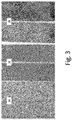
- FIG 3 depicts photographs of several corrosion resistant coating created under different conditions.
- Each photograph 34, 36, 38 shows two 3 inch by 5 inch metal test panels which were coated according to the method in Figure 1 , but each sample 34, 36, 38 was cured under different conditions.
- Each test panel was then tested for corrosion resistance with salt fog testing, as discussed above.
- the samples were analyzed for corrosion resistance and rated on a scale from 0.0 to 5.0, where 5.0 is an ideal corrosion resistance coating.
- a coating with a 5.0 rating exhibited high corrosion resistance, a large ratio of hexavalent chromium to total chromium, and good morphology.
- Photograph 34 shows a corrosion resistant coating processed under conditions that included a mechanical pre-treatment, a 0.3 wt% hydrogen-peroxide post-treatment, and curing for a short time in a controlled environment containing air at a relative humidity of around 50%.
- the morphology of the samples in photograph 34 is smooth and lighter in color with no discernable pits.
- photograph 36 shows a corrosion resistant coating processed under the same conditions, but without the hydrogen-peroxide post-treatment.
- the morphology of the samples in photograph 36 is also smooth, but it is darker in color, indicating the early stages of coating failure and aluminum substrate pitting compared to the sample treated with hydrogen peroxide after the TCP bath.
- photograph 38 shows non-ideal processing where the curing method of the coating is not controlled. Instead, the samples were removed from the TCP and left to dry without any post-treatment or controlled environment. The corrosion in the coating and aluminum substrate corrosion is visible as compared to the other samples.
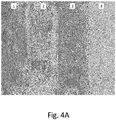
- Figures 4A and 4B show another set of 3" by 5" sample coatings, similar to those exhibited in Figure 3 .
- the testing completed on various samples showed that samples post-treated with hydrogen peroxide, and cured in environments with a relative humidity of >90% obtained the best corrosion-resistance performance in salt fog testing.
- Sample 1 was pre-treated with a chemical agent, was not post-treated with an oxidizer, and was cured for 24 hours in a controlled environment of argon with less than 20% relative humidity. Sample 1 showed both a low ratio of hexavalent chromium to total chromium of only 0.09, and a poor salt fog testing performance rating of 1.0.
- the photograph of sample 1 in Figure 4 shows cracking, apparent corrosion and pitting on the surface of the coating.
- sample 2 was pre-treated with a chemical agent, was not post-treated with an oxidizer, and was cured for 168 hours in a controlled environment of argon with less than 20% relative humidity.
- Sample 2 showed both a low ratio of hexavalent chromium to total chromium of only 0.15, and a poor salt fog testing performance rating of 2.5 initially, which dropped to 1.0 after 336 hours of exposure to the outside environment.
- the photograph of sample 2 in Figure 4 shows cracking, apparent corrosion and pitting on the surface of the coating.
- Samples 3 and 4 were pre-treated with a chemical agent, were not post-treated with an oxidizer, but were cured in an environment of air with greater than 90% relative humidity. Sample 3 was cured for 24 hours in this environment, while sample 4 was cured for 168 hours. The ratio of hexavalent chromium to total chromium of the sample has increased compared to samples 1 and 2 due to the increased humidity and air in the controlled environment; sample 3 showed a ratio of 0.33 and sample 4 showed a ratio of 0.38. Additionally, the salt fog performance testing ratings of samples 3 and 4 were 3.5 and 3.0, respectively, but dropped to 2.5 and 2.0 after 336 hours of exposure to the outside environment.
- sample 5 was not post-treated with an oxidizer, but was cured in an environment of air with greater than 90% relative humidity for 24 hours. Sample 5 was mechanically pretreated. The controlled relative humidity environment produced samples which had some pitting on the surface, and salt fog testing ratings of about 4.3 after removal from the environment.
- samples 6, 7 and 8 which were cured in increased relative humidity and a curing environment consisting of air, were also post-treated with an oxidizer conducted before placing the coatings in the curing environment.
- Samples 6 and 7 were post-treated with 0.3wt% H 2 O 2
- sample 8 was post-treated with 3.5wt% H 2 O 2 . All three samples produced coatings without any visible corrosion, cracking or pits on the surface.
- samples 6, 7, and 8, respectively produced salt fog test ratings of 4.5, 4.3 and 5.0.
- the samples treated with hydrogen peroxide before being cured produced the best corrosion resistant coatings.
- a method of producing a corrosion resistant coating includes pre-treating a metal substrate such that a surface of the metal substrate is de-oxidized; immersing the metal substrate in a coating solution to produce a chromium based coating on the metal substrate, wherein the coating solution comprises, e.g. consists of, a trivalent chromium compound, and a fluoride compound, but not containing hexavalent chromium; removing the coated metal substrate from the solution; and curing the chromium based coating in a controlled environment containing a gaseous atmosphere to produce a hexavalent chromium enriched corrosion resistant coating on the metal substrate.
- the method of the preceding paragraph can optionally include, additionally and/or alternatively, any one or more of the following features, configurations and/or additional components:
- the method includes controlling relative humidity within the controlled environment.
- the temperature of the controlled environment is between 5°C and 60 °C.
- the temperature of the controlled environment is between 15 °C and 30 °C.
- the metal substrate is selected from the group consisting of aluminum, zinc, cadmium, copper, silver, magnesium, tin, iron, aluminum based alloys, zinc based alloys, cadmium based alloys, copper based alloys, silver based alloys, magnesium based alloys, tin based alloys, and iron alloys (e.g. iron-based alloys).
- the metal substrate is pre-treated with a chemical de-oxidizer.
- the method includes degreasing the metal substrate prior to pre-treating the metal surface.
- the metal substrate is pre-treated through a mechanical method.
- the method includes degreasing the metal substrate prior to immersing the metal substrate in a solution (e.g. the coating solution).
- the method includes post-treating the coated metal substrate with an oxidizer after removing the coated metal substrate from the coating solution, but before curing the coating.
- the metal substrate is post-treated with 0.3wt% to 3.5wt% hydrogen peroxide solution.
- the metal substrate is post-treated with 1.0wt% to 2.5wt% hydrogen peroxide solution.
- the gaseous atmosphere has a relative humidity of at least twenty percent.
- the gaseous atmosphere has a relative humidity of twenty to fifty percent.
- the gaseous atmosphere has a relative humidity of fifty to ninety percent.
- the gaseous atmosphere has a relative humidity of more than ninety percent.
- the method includes exposing the coated metal substrate in the controlled environment to ozone.
- the method includes exposing the coated metal substrate in the controlled environment to ultra-violet radiation.
- the coated metal substrate remains in the controlled environment for at least an hour.
- the coated metal substrate remains in the controlled environment for at least twenty-four hours.
Landscapes
- Chemical & Material Sciences (AREA)
- General Chemical & Material Sciences (AREA)
- Chemical Kinetics & Catalysis (AREA)
- Engineering & Computer Science (AREA)
- Materials Engineering (AREA)
- Mechanical Engineering (AREA)
- Metallurgy (AREA)
- Organic Chemistry (AREA)
- Chemical Treatment Of Metals (AREA)
- Other Surface Treatments For Metallic Materials (AREA)
Abstract
Description
- Chromium based conversion coatings are used to passivate metals such as aluminum, copper, cadmium, zinc, magnesium, tin, silver, iron, and their alloys to reduce and slow corrosion of the metal, or as a finishing coating. Chromium conversion coatings can be applied to everyday items such as tools or hardware to prevent corrosion, and to aerospace and commercial equipment with high requirements for corrosion durability.
- Traditionally, chromic acid was used to create conversion coating. However, chromic acid contains high levels of hexavalent chromium. Hexavalent chromium was used to create conversion coatings due to its high oxidation state, resulting in highly effective anticorrosion coatings. Specifically, hexavalent chromium based conversion coatings prevent oxide formation on the surface of the metal, are conductive, thin and flexible, provide adhesion for other coatings such as adhesives, paints, sealants, and substantially slow corrosion.
- However, hexavalent chromium is now known to be a dangerous toxin and a known carcinogen. Chronic inhalation of hexavalent chromium increases risk of lung cancer among other health complications. The presence of hexavalent chromium in drinking water has created substantial health risk as well. For this reason, hexavalent chromium is heavily regulated in both the U.S. and abroad. In 2017, the EU will ban hexavalent chromium for many applications unless an authorization for a specific application or use has been granted.
- Corrosion resistance of a conversion coating is a function of the amount of hexavalent chromium on the surface of the coating. Thus, industry has been actively trying to find a substitute for hexavalent chromium based conversion coatings. No alternatives to hexavalent chromium coatings have exhibited as high a corrosion resistance. Specifically, many inventors have tried to use non-toxic trivalent chromium solutions to passivate metals and create corrosion resistant coatings. In these methods, trivalent chromium solutions are used during processing rather than hexavalent chromium solutions. The suggested methods, such as that disclosed in
U.S. Patent No. 5,304,257 to Pearlstein et al. ("Pearlstein"), do not create corrosion coatings that are as effective as the previous hexavalent chromium based coatings. - Pearlstein discloses a method of making a coating which uses an immersion bath of aqueous trivalent chromium to coat an aluminum substrate. After the substrate is removed from the bath, the coating is exposed to an oxidizing solution such that a small portion of the trivalent chromium is converted to hexavalent chromium. However, the method disclosed in Pearlstein contaminates the oxidizing solution and any subsequent rinse waters with hexavalent chromium, creating a chemical waste stream and a chemical exposure hazard.
- A method of producing a corrosion resistant coating includes pre-treating a metal substrate such that a surface of the metal substrate is de-oxidized; immersing the metal substrate in a coating solution to produce a chromium based coating on the metal substrate, wherein the coating solution comprises, e.g. consists of, a trivalent chromium compound, and a fluoride compound, but not containing hexavalent chromium; removing the coated metal substrate from the coating solution; and curing the chromium based coating in a controlled environment containing a gaseous atmosphere to produce a hexavalent chromium enriched corrosion resistant coating on the metal substrate.
-
-
FIG. 1 is a flow chart depicting a method of producing a corrosion resistant coating. -
FIG. 2 is a graph depicting the corrosion resistance rating of coatings as a function of varying processing and curing conditions. -
FIG. 3 is a series of photographs showing the morphology of chromium based corrosion resistant coatings processed and cured under different conditions. -
FIG. 4A is a second series of photographs showing the morphology of chromium based corrosion resistant coatings processed and cured under different conditions as described in Table 5. -
FIG. 4B is a third series of photographs showing the morphology of chromium based corrosion resistant coatings processed and cured under different conditions as described in Table 5. - The present invention discloses a method for making a corrosion resistant coating using non-toxic trivalent chromium during processing. Trivalent chromium conversion coatings, once applied to a metal substrate, include varying amounts of naturally occurring hexavalent chromium compounds in the coating. The relative amount of hexavalent chromium to trivalent chromium in conversion coatings varies systemically with types of pre-treatment, processing conditions, and post-treatment. The relative amount of hexavalent chromium to trivalent chromium correlates strongly with corrosion resistance, as hexavalent chromium compounds are corrosion inhibitors.
- Thus, when the trivalent chromium based coating is cured under a certain set of conditions, the oxidation state of trivalent chromium will change to hexavalent chromium, increasing the corrosion resistant properties of the coating without utilizing hexavalent chromium during processing. Specifically, the coating is cured in an environment where relative humidity, temperature, atmosphere and other variables can be controlled. The controlled curing allows for optimization of hexavalent chromium on the surface of the metal substrate, and higher corrosion resistance, without the toxin impact of using hexavalent chromium solutions.
-
Figure 1 depictsmethod 10 of making a trivalent chromium based corrosion resistant coating.Method 10 includes pre-treating a metal substrate (step 12), immersing the metal substrate in a solution including trivalent chromium but not including hexavalent chromium (step 14), removing the coated metal substrate from the solution (step 16), post-treating the coated metal substrate with an oxidizer (step 18), and curing the metal substrate in a controlled environment to produce a hexavalent chromium enriched, corrosion resistant coating on the metal substrate (step 20). - First, the metal substrate is pre-treated (step 12). The metal substrate may be aluminum, zinc, cadmium, copper, silver, magnesium, tin, iron, or alloys of those metals, such as aluminum based alloys, zinc based alloys, cadmium based alloys, copper based alloys, silver based alloys, magnesium based alloys, tin based alloys, or iron based alloys. The pre-treatment may be chemical or mechanical. A chemical pre-treatment can include degreasing with an alkaline degreaser or with a different solvent, such as acetone or isopropanol, rinsing with water, and using an acid cleaner, such as nitric acid, to de-oxidize the surface of the metal substrate. In contrast, a mechanical pre-treatment can include grit-blasting, sanding, pumice scrubbing, or abrasive pad processing of the metal substrate, and subsequently degreasing the metal substrate in acetone, a different solvent, or a different degreaser.
- After the metal substrate is pre-treated, it is immersed in a trivalent chromium rich bath (step 14). The bath is a solution containing a trivalent chromium salt, such as chromium sulfate, a fluoride compound, such as an alkali metal flurosilicate, and a sufficient amount of alkali to maintain the solution pH. Various trivalent chromium process (TCP) solutions are readily available.
- During the bath, a trivalent chromium coating adheres to the metal substrate. When the coating is formed on the metal substrate, it is initially in the form of a hydrated gel on the surface of the metal substrate. While still in the bath, the hydrated gel is surrounded by the solution. The hydrated gel is permeable to oxygen and fluoride ions from the solution. These molecules remove a native oxide layer from the metal substrate to allow formation of the chromium based coating on the surface of the metal substrate, and allow for oxidation of trivalent chromium on the surface to corrosion resistant hexavalent chromium.
- When the chromium coating is formed, a small amount trivalent chromium is naturally converted to hexavalent chromium. The oxidation of trivalent chromium to hexavalent chromium occurs as hydrogen peroxide is generated from the interaction of the metal substrate with the TCP solution. Specifically, the metal substrate undergoes oxidation and produces electrons. If the substrate is aluminum, the aluminum is oxidized, forming an inner alumina film that stretches across the aluminum surface, as shown in Equation 1:

- The alumina film dissolves through a reaction with hydrofluoric acid. At the same time, in a water-rich environment, such as the aqueous bath in this coating method, the electrons produced through metal dissolution generate hydrogen peroxide, as shown in Equation 2:

- The production of hydrogen peroxide on the surface of the metal substrate allows for an oxidizing environment which oxidizes some of the trivalent chromium on the surface to hexavalent chromium, as shown in Equation 3:

- Two other chemical reactions compete with the hydrogen peroxide-producing reaction: the reduction of oxygen to hydroxyl ions (pictured in Equation 2), and the evolution of hydrogen gas from hydrogen ions, as shown in
Equation 4 below.
- Even though some hexavalent chromium is formed on the surface of the metal substrate as it is exposed to the trivalent chromium bath, there is still a high ratio of trivalent chromium on the surface of the metal substrate when it is removed from the bath (step 16).
- After the coated metal substrate is removed from the bath, the coating is post-treated with an oxidizer, such as hydrogen peroxide (step 18). This post-treatment increases the oxidation environment on the coating, and induces further oxidation of trivalent chromium to hexavalent chromium (as shown in Equation 3), and increases corrosion resistance of the coating. The hydrogen peroxide solution can be 0.3wt% to 3.5wt%. The post-treatment further oxidizes trivalent chromium on the surface of the coating to increase the amount of hexavalent chromium on the surface of the coating before it is placed in the controlled environment for curing. Raman spectral data shows samples treated with hydrogen peroxide at this stage have a higher ratio of hexavalent chromium to total chromium on the surface of the coating, as shown in Table 1. The ratio of hexavalent chromium to total chromium content given here is not an actual concentration, but is a relative proportion estimated from detected Raman spectra peak heights, where hexavalent chromium is obtained from a peak height of 880cm-1 and a mixture of hexavalent chromium and trivalent chromium is obtained from 860cm-1. The peak assigned for trivalent chromium is measured at 535cm-1.
Table 1 Post-Treatment None 0.3wt% H2O2 Average Ratio of Cr6+/[Cr6++Cr3+] 0.38 0.51 - Finally, the coated metal substrate is cured in a controlled environment (step 20). In the controlled environment, atmosphere, temperature, relative humidity, curing gas, and exposure to oxidizer is controlled. Each of these variables can enrich the hexavalent chromium on the surface of the chromium conversion coating by creating an environment favorable to oxidation of the trivalent chromium, and consequently increase the corrosion resistance of the coating. The coatings resulting from these conditions were analyzed using Raman spectroscopy to show the presence of hexavalent chromium, trivalent chromium, and total chromium was on the surface of the conversion coatings (Table 2). In these tests, the temperature of the controlled environment was kept consistent at 22°C to 24°C.
- The atmosphere in the controlled environment may be air, oxygen, nitrogen, argon, other inert or oxidizing gases, or some combination of those gases. When tested, the use of air containing oxygen resulted in a higher ratio of hexavalent chromium to total chromium content on the surface of the conversion coating. Test data shows the effect of curing gas environment on the relative amount of hexavalent chromium on the surface of the coating, as shown in Table 2:
Table 2 Curing Atmosphere Ar Air Average Ratio of Cr6+/[Cr6++Cr3+] 0.42 0.45 - Relative humidity of the controlled curing environment can also significantly alter the amount of hexavalent chromium on the surface of the conversion coating. When relative humidity is increased, the coating environment contains a higher concentration of water, which naturally induces the production of hydrogen peroxide, as discussed above, and allows for oxidation of the trivalent chromium. When tested, relative humidity of <20% was ineffective at curing a conversion coating such that a high ratio of hexavalent chromium formed. Relative humidity 50% or higher produced the best results. Relative humidity of <20%, which induced rapid drying, induces cracks in the coating, which minimize corrosion protection. This is summarized in Table 3, where the relative amount of surface hexavalent chromium was determined from both Cr(VI) and Cr(III) characteristic peak heights in area around 860cm-1 and 535 cm-1, individually using Raman spectroscopy:
Table 3 Relative Humidity <20% ∼50% >90% Average Ratio of Cr6+/[Cr6++Cr3+] 0.41 0.56 0.44 - The controlled environment can be altered to be an oxidizing environment through the use of irradiation with ultra-violet light, or through the injection of an oxidizing, non-corrosive gas, such as ozone. If UV is used, the preferred UV integrated flux is 360 kJ/m2, but metal substrates with favorable geometries, such as flat surfaces, many require less, while metal substrates with complex geometries may require diffuse exposure with greater nominal flux. UV wavelengths in the UV-A class, of 315-400nm, is preferred due to safety concerns; but UV-B and UV-C wavelengths can be used to the same effect. The exposure of the coating to UV radiation will induce further oxidation of trivalent chromium to hexavalent chromium, creating a more corrosion resistant coating.
- The coating can alternatively be exposed to ozone to oxidize the trivalent chromium in the coating to hexavalent chromium. In this case, the preferred ozone exposure is 1 ppm O3 for one hour. Alternatively, for safety reasons, the controlled environment can be exposed to 0.1 ppm O3 for anywhere between four and twenty-four hours. Preferably, ozone exposure is conducted when the environment has over 50% relative humidity. Ozone, a strong oxidizer, also induces the oxidation of trivalent chromium to hexavalent chromium.
- Finally, shorter curing times in the controlled environment produced more hexavalent chromium-rich coatings (Table 4). Curing the coatings for a time between one hour and one day produced the most corrosion resistant coatings, while curing the coatings for one week long (168hrs) did not.
Table 4 Cure Time 1 Hour 24 Hours 168 Hours Average Ratio of Cr6+/[Cr6++Cr3+] 0.49 0.43 0.43 -
Figure 2 is a series of graphs summarizing the ASTM B117 salt-fog test corrosion performance results of varying curing conditions, such as the type of trivalent chromium bath vendor and chemistry (graph 22), curing time (graph 24), relative humidity (graph 26), curing atmosphere (graph 28), hydrogen peroxide post-treatment (graph 30), and surface pre-treatments (graph 32). In each set of tests, the other variables were held constant. After curing, each sample set was ASTM B117 neutral salt-fog tested for corrosion resistance. ASTM B117 neutral salt-fog testing is an industry-known method of testing the corrosion resistance of surface coatings. With this method, ASTM B117 neutral salt fog testing was completed on test panels of coatings cured under different conditions. The samples were then analyzed for corrosion resistance and rated on a scale from 0.00 to 5.00, where 5.00 is an ideal corrosion resistance coating, with no pits. Thus, a coating with a 5.00 rating exhibited high corrosion resistance, a large ratio of hexavalent chromium to total chromium, and good surface morphology with no pits. -
Graph 22 shows the use of six types of commercially available trivalent chromium processes ("TCP"): "A", "B", "C", "D", "E", and "F". The effects of different TCP was unpredictable, as some trivalent bath solutions resulted in a better corrosion resistance rating, and others did not. Specifically, TCP solutions D and E performed the best, resulting in ASTM B117 salt-fog test ratings of 3.75 and 3.63 on average, while TCP solution F produced the lowest rating during salt-spray testing, only 3.01 on average. -
Graph 24 shows the salt-spray corrosion rating as a function of curing time. If the sample was cured between one hour and twenty-four hours, and then removed from the controlled environment, the rating averaged between about 3.31 and 3.36 out of 5.00. At curing time greater than twenty-four hours the rating dropped, for example down to 2.44 or lower after 168 hours of curing. Thus, shorter curing times resulted in better corrosion resistance. -
Graph 26 shows the effect of relative humidity in the controlled curing environment on the corrosion resistance of the coating. The samples with the best corrosion resistance were cured in an environment containing at least 50% relative humidity. Samples cured in atmospheres with 90% or greater relative humidity also produced good corrosion resistance, with a rating of up to 3.41. The amount of water in the curing environment continuously drives the metal oxidation and oxygen reduction reactions (shown inequations -
Graph 28 depicts the effect of a curing atmosphere that is inert as opposed to a curing atmosphere which consists of air. When argon was used as the inert curing environment, the average corrosion resistance rating was lower than when air was used. When air was used, the oxygen present in air may drive the oxygen reduction reaction shown inEquation 2 above, producing hydrogen peroxide which may oxidize trivalent chromium to hexavalent chromium, and increase the corrosion resistance of the coating. Samples cured in air had a rating of 3.31 on average. -
Graph 30 depicts the difference between samples post-treated with hydrogen peroxide after the trivalent chromium bath and those not post-treated with hydrogen peroxide. Samples not post-treated with an oxidizer had an average corrosion resistance rating below 3.00, whereas those samples treated with hydrogen peroxide post-bath contained a rating of 3.64 or higher on average, up to 3.75. The post-treatment with hydrogen peroxide drives the oxidation of trivalent chromium as shown inEquation 3. - Finally,
graph 32 shows the difference in corrosion resistance rating of samples pre-treated (step 12 ofFigure 1 ) with mechanical means as opposed to chemical means. The pre-treatment process (step 12 ofFigure 1 ) cleans the surface of the metal substrate to allow for formation of the corrosion resistant coating. When a mechanical pre-treatment was used, the corrosion resistance rating was higher, up to 3.57 on average, than when a chemical pre-treatment was used. -
Figure 3 depicts photographs of several corrosion resistant coating created under different conditions. Eachphotograph Figure 1 , but eachsample -
Photograph 34 shows a corrosion resistant coating processed under conditions that included a mechanical pre-treatment, a 0.3 wt% hydrogen-peroxide post-treatment, and curing for a short time in a controlled environment containing air at a relative humidity of around 50%. The morphology of the samples inphotograph 34 is smooth and lighter in color with no discernable pits. - In contrast,
photograph 36 shows a corrosion resistant coating processed under the same conditions, but without the hydrogen-peroxide post-treatment. The morphology of the samples inphotograph 36 is also smooth, but it is darker in color, indicating the early stages of coating failure and aluminum substrate pitting compared to the sample treated with hydrogen peroxide after the TCP bath. - Finally,
photograph 38 shows non-ideal processing where the curing method of the coating is not controlled. Instead, the samples were removed from the TCP and left to dry without any post-treatment or controlled environment. The corrosion in the coating and aluminum substrate corrosion is visible as compared to the other samples. -
Figures 4A and4B show another set of 3" by 5" sample coatings, similar to those exhibited inFigure 3 . The testing completed on various samples showed that samples post-treated with hydrogen peroxide, and cured in environments with a relative humidity of >90% obtained the best corrosion-resistance performance in salt fog testing. The results of select samples are summarized in Table 5 below:Table 5 Curing time (hr) Relative Humidity Curing Gas Post-treatment Pre-treatment Rating at 168 hr Rating at 336 hr Cr(6+)/ [Cr(3+)+Cr(6 +)] Morphology 1 24 <20% Ar None Chemical 1.0 1.0 0.09 Corrosion + lots of pits 2 168 <20% Ar None Chemical 2.5 1.0 0.15 Corrosion + lots of pits 3 24 >90% Air None Chemical 3.5 2.5 0.33 About 20 pits 4 168 >90% Air None Chemical 3.0 2.0 0.38 Greater than 20 pits 5 24 >90% Air None Mechanical 4.3 3.8 0.70 1∼ 2pit 6 24 >90% Air 0.3wt% H2O2 Mechanical 4.5 4.5 0.70 No pits 7 24 50% Air 0.3wt% H2O2 Mechanical 4.3 4.3 0.73 No pits 8 1 50% Air 3.5wt% H2O2 Chemical 5.0 4.5 0.92 No pits -
Sample 1 was pre-treated with a chemical agent, was not post-treated with an oxidizer, and was cured for 24 hours in a controlled environment of argon with less than 20% relative humidity.Sample 1 showed both a low ratio of hexavalent chromium to total chromium of only 0.09, and a poor salt fog testing performance rating of 1.0. The photograph ofsample 1 inFigure 4 shows cracking, apparent corrosion and pitting on the surface of the coating. - Similarly,
sample 2 was pre-treated with a chemical agent, was not post-treated with an oxidizer, and was cured for 168 hours in a controlled environment of argon with less than 20% relative humidity.Sample 2 showed both a low ratio of hexavalent chromium to total chromium of only 0.15, and a poor salt fog testing performance rating of 2.5 initially, which dropped to 1.0 after 336 hours of exposure to the outside environment. The photograph ofsample 2 inFigure 4 shows cracking, apparent corrosion and pitting on the surface of the coating. -
Samples Sample 3 was cured for 24 hours in this environment, whilesample 4 was cured for 168 hours. The ratio of hexavalent chromium to total chromium of the sample has increased compared tosamples sample 3 showed a ratio of 0.33 andsample 4 showed a ratio of 0.38. Additionally, the salt fog performance testing ratings ofsamples samples Figure 4A . Thus, increased relative humidity and air in the controlled curing environment are beneficial, but do not alone produce the optimal results. - Similarly,
sample 5 was not post-treated with an oxidizer, but was cured in an environment of air with greater than 90% relative humidity for 24 hours.Sample 5 was mechanically pretreated. The controlled relative humidity environment produced samples which had some pitting on the surface, and salt fog testing ratings of about 4.3 after removal from the environment. - In contrast,
samples Samples 6 and 7 were post-treated with 0.3wt% H2O2, whilesample 8 was post-treated with 3.5wt% H2O2. All three samples produced coatings without any visible corrosion, cracking or pits on the surface. Moreover,samples - Overall, curing in a controlled environment of air at a relative humidity of above 20%, followed by hydrogen peroxide post-treatment and exposure to ozone or ultra-violet radiation were the most successful at producing hexavalent rich corrosion resistant conversion coatings that withstood salt fog chamber testing.
- The following are non-exclusive descriptions of possible embodiments of the present invention.
- A method of producing a corrosion resistant coating includes pre-treating a metal substrate such that a surface of the metal substrate is de-oxidized; immersing the metal substrate in a coating solution to produce a chromium based coating on the metal substrate, wherein the coating solution comprises, e.g. consists of, a trivalent chromium compound, and a fluoride compound, but not containing hexavalent chromium; removing the coated metal substrate from the solution; and curing the chromium based coating in a controlled environment containing a gaseous atmosphere to produce a hexavalent chromium enriched corrosion resistant coating on the metal substrate.
- The method of the preceding paragraph can optionally include, additionally and/or alternatively, any one or more of the following features, configurations and/or additional components:
- The method includes controlling relative humidity within the controlled environment.
- The temperature of the controlled environment is between 5°C and 60 °C.
- The temperature of the controlled environment is between 15 °C and 30 °C.
- The metal substrate is selected from the group consisting of aluminum, zinc, cadmium, copper, silver, magnesium, tin, iron, aluminum based alloys, zinc based alloys, cadmium based alloys, copper based alloys, silver based alloys, magnesium based alloys, tin based alloys, and iron alloys (e.g. iron-based alloys).
- The metal substrate is pre-treated with a chemical de-oxidizer.
- The method includes degreasing the metal substrate prior to pre-treating the metal surface.
- The metal substrate is pre-treated through a mechanical method.
- The method includes degreasing the metal substrate prior to immersing the metal substrate in a solution (e.g. the coating solution).
- The method includes post-treating the coated metal substrate with an oxidizer after removing the coated metal substrate from the coating solution, but before curing the coating.
- The metal substrate is post-treated with 0.3wt% to 3.5wt% hydrogen peroxide solution.
- The metal substrate is post-treated with 1.0wt% to 2.5wt% hydrogen peroxide solution.
- The gaseous atmosphere has a relative humidity of at least twenty percent.
- The gaseous atmosphere has a relative humidity of twenty to fifty percent.
- The gaseous atmosphere has a relative humidity of fifty to ninety percent.
- The gaseous atmosphere has a relative humidity of more than ninety percent.
- The method includes exposing the coated metal substrate in the controlled environment to ozone.
- The method includes exposing the coated metal substrate in the controlled environment to ultra-violet radiation.
- The coated metal substrate remains in the controlled environment for at least an hour.
- The coated metal substrate remains in the controlled environment for at least twenty-four hours.
- While the invention has been described with reference to an exemplary embodiment(s), it will be understood by those skilled in the art that various changes may be made and equivalents may be substituted for elements thereof without departing from the scope of the invention. In addition, many modifications may be made to adapt a particular situation or material to the teachings of the invention without departing from the essential scope thereof. Therefore, it is intended that the invention not be limited to the particular embodiment(s) disclosed, but that the invention will include all embodiments falling within the scope of the appended claims.
- Certain preferred embodiments of the present disclosure are as follows:
- 1. A method comprising:
- pre-treating a metal substrate such that a surface of the metal substrate is de-oxidized;
- immersing the metal substrate in a coating solution to produce a chromium based coating on the metal substrate, wherein the coating solution comprises a trivalent chromium compound and a fluoride compound, but does not contain hexavalent chromium;
- removing the coated metal substrate from the coating solution; and
- curing the chromium based coating in a controlled environment containing a gaseous atmosphere to produce a hexavalent chromium enriched corrosion resistant coating on the metal substrate.
- 2. The method of
embodiment 1, and further comprising controlling relative humidity within the controlled environment. - 3. The method of
embodiment 1, wherein temperature of the controlled environment is between 5 °C and 60 °C. - 4. The method of
embodiment 1, wherein the metal substrate is selected from the group consisting of aluminum, zinc, cadmium, copper, silver, magnesium, tin, iron, aluminum based alloys, zinc based alloys, cadmium based alloys, copper based alloys, silver based alloys, magnesium based alloys, iron based alloys, and tin based alloys. - 5. The method of
embodiment 1, wherein the metal substrate is pre-treated with a chemical de-oxidizer. - 6. The method of
embodiment 5, and further comprising degreasing the metal substrate prior to pre-treating the metal substrate. - 7. The method of
embodiment 1, wherein the metal substrate is pre-treated through a mechanical method. - 8. The method of
embodiment 1, and further comprising degreasing the metal substrate prior to immersing the metal substrate in the coating solution. - 9. The method of
embodiment 1, and further comprising post-treating the coated metal substrate with an oxidizer after removing the coated metal substrate from the coating solution, but before curing the coating. - 10. The method of embodiment 9, wherein the metal substrate is post-treated with 0.3wt% to 3.5wt% hydrogen peroxide solution.
- 11. The method of
embodiment 10, wherein the metal substrate is post-treated with 1.0wt% to 2.5wt% hydrogen peroxide solution. - 12. The method of
embodiment 2, wherein the gaseous atmosphere has a relative humidity of at least twenty percent. - 13. The method of
embodiment 12, wherein the gaseous atmosphere has a relative humidity of twenty to fifty percent. - 14. The method of
embodiment 12, wherein the gaseous atmosphere has a relative humidity of fifty to ninety percent. - 15. The method of
embodiment 12, wherein the gaseous atmosphere has a relative humidity of more than ninety percent. - 16. The method of embodiment 9, and further comprising exposing the coated metal substrate to ozone in the controlled environment.
- 17. The method of embodiment 9, and further comprising exposing the coated metal substrate in the controlled environment to ultra-violet radiation.
- 18. The method of
embodiment 1, wherein the coated metal substrate remains in the controlled environment for at least an hour. - 19. The method of
embodiment 18, wherein the coated metal substrate remains in the controlled environment for at least twenty-four hours.
Claims (15)
- A method comprising:pre-treating a metal substrate such that a surface of the metal substrate is de-oxidized;immersing the metal substrate in a coating solution to produce a chromium based coating on the metal substrate, wherein the coating solution comprises a trivalent chromium compound and a fluoride compound, but does not contain hexavalent chromium;removing the coated metal substrate from the coating solution; andcuring the chromium based coating in a controlled environment containing a gaseous atmosphere to produce a hexavalent chromium enriched corrosion resistant coating on the metal substrate.
- The method of claim 1, and further comprising controlling relative humidity within the controlled environment.
- The method of claim 1 or claim 2, wherein temperature of the controlled environment is between 5 °C and 60 °C.
- The method of any preceding claim, wherein the metal substrate is selected from the group consisting of aluminum, zinc, cadmium, copper, silver, magnesium, tin, iron, aluminum based alloys, zinc based alloys, cadmium based alloys, copper based alloys, silver based alloys, magnesium based alloys, iron based alloys, and tin based alloys.
- The method of any preceding claim, wherein the metal substrate is pre-treated with a chemical de-oxidizer or wherein the metal substrate is pre-treated through a mechanical method.
- The method of any preceding claim, further comprising degreasing the metal substrate prior to pre-treating the metal substrate.
- The method of any preceding claim, and further comprising degreasing the metal substrate prior to immersing the metal substrate in the coating solution.
- The method of any preceding claim, and further comprising post-treating the coated metal substrate with an oxidizer after removing the coated metal substrate from the coating solution, but before curing the coating.
- The method of claim 8, wherein the metal substrate is post-treated with 0.3wt% to 3.5wt% hydrogen peroxide solution, preferably 1.0wt% to 2.5wt% hydrogen peroxide solution.
- The method of any preceding claim, wherein the gaseous atmosphere has a relative humidity of at least twenty percent.
- The method of any preceding claim, wherein the gaseous atmosphere has a relative humidity of twenty to fifty percent.
- The method of any one of claims 1-10, wherein the gaseous atmosphere has a relative humidity of fifty to ninety percent.
- The method of any one of claims 1-10, wherein the gaseous atmosphere has a relative humidity of more than ninety percent.
- The method of any preceding claim, further comprising exposing the coated metal substrate to ozone and/or ultra-violet radiation in the controlled environment.
- The method of any preceding claim, wherein the coated metal substrate remains in the controlled environment for at least an hour, preferably for at least twenty-four hours.
Applications Claiming Priority (1)
| Application Number | Priority Date | Filing Date | Title |
|---|---|---|---|
| US15/095,926 US10294570B2 (en) | 2016-04-11 | 2016-04-11 | Method for making corrosion resistant coating |
Publications (2)
| Publication Number | Publication Date |
|---|---|
| EP3231895A1 true EP3231895A1 (en) | 2017-10-18 |
| EP3231895B1 EP3231895B1 (en) | 2021-04-28 |
Family
ID=58428069
Family Applications (1)
| Application Number | Title | Priority Date | Filing Date |
|---|---|---|---|
| EP17161792.1A Active EP3231895B1 (en) | 2016-04-11 | 2017-03-20 | Method for making corrosion resistant coating |
Country Status (2)
| Country | Link |
|---|---|
| US (2) | US10294570B2 (en) |
| EP (1) | EP3231895B1 (en) |
Families Citing this family (2)
| Publication number | Priority date | Publication date | Assignee | Title |
|---|---|---|---|---|
| JP2019151892A (en) * | 2018-03-02 | 2019-09-12 | 東京エレクトロン株式会社 | Processing method for metal member, processing apparatus, and evaluation method |
| CN117947415A (en) * | 2024-01-29 | 2024-04-30 | 中国石油大学(华东) | A post-treatment process for improving the corrosion resistance of trivalent chromium conversion film on light alloy surface |
Citations (4)
| Publication number | Priority date | Publication date | Assignee | Title |
|---|---|---|---|---|
| US5304257A (en) | 1993-09-27 | 1994-04-19 | The United States Of America As Represented By The Secretary Of The Navy | Trivalent chromium conversion coatings for aluminum |
| US20070187001A1 (en) * | 2006-02-14 | 2007-08-16 | Kirk Kramer | Composition and Processes of a Dry-In-Place Trivalent Chromium Corrosion-Resistant Coating for Use on Metal Surfaces |
| WO2007134152A1 (en) * | 2006-05-10 | 2007-11-22 | Henkel Ag & Co. Kgaa. | Improved trivalent chromium-containing composition for use in corrosion resistant coating on metal surfaces |
| WO2009007208A1 (en) * | 2007-07-12 | 2009-01-15 | International Business Machines Corporation | Methods for reducing hexavalent chromium in trivalent chromate conversion coatings |
Family Cites Families (2)
| Publication number | Priority date | Publication date | Assignee | Title |
|---|---|---|---|---|
| EP2576706A1 (en) * | 2010-06-04 | 2013-04-10 | Allfast Fastening Systems Inc. | A metal part coated with a first non - hexavalent chromium chemical conversion coating and a second sol gel coating and a process for its production |
| CA2897973C (en) | 2013-01-10 | 2021-06-22 | Coventya, Inc. | Apparatus and method of maintaining trivalent chromium bath plating efficiency |
-
2016
- 2016-04-11 US US15/095,926 patent/US10294570B2/en active Active
-
2017
- 2017-03-20 EP EP17161792.1A patent/EP3231895B1/en active Active
-
2019
- 2019-04-05 US US16/376,768 patent/US20190233943A1/en not_active Abandoned
Patent Citations (4)
| Publication number | Priority date | Publication date | Assignee | Title |
|---|---|---|---|---|
| US5304257A (en) | 1993-09-27 | 1994-04-19 | The United States Of America As Represented By The Secretary Of The Navy | Trivalent chromium conversion coatings for aluminum |
| US20070187001A1 (en) * | 2006-02-14 | 2007-08-16 | Kirk Kramer | Composition and Processes of a Dry-In-Place Trivalent Chromium Corrosion-Resistant Coating for Use on Metal Surfaces |
| WO2007134152A1 (en) * | 2006-05-10 | 2007-11-22 | Henkel Ag & Co. Kgaa. | Improved trivalent chromium-containing composition for use in corrosion resistant coating on metal surfaces |
| WO2009007208A1 (en) * | 2007-07-12 | 2009-01-15 | International Business Machines Corporation | Methods for reducing hexavalent chromium in trivalent chromate conversion coatings |
Also Published As
| Publication number | Publication date |
|---|---|
| US20170292193A1 (en) | 2017-10-12 |
| US20190233943A1 (en) | 2019-08-01 |
| EP3231895B1 (en) | 2021-04-28 |
| US10294570B2 (en) | 2019-05-21 |
Similar Documents
| Publication | Publication Date | Title |
|---|---|---|
| KR101629592B1 (en) | Method for prevention of yellowing on surface of steel sheet after pickling | |
| US5304257A (en) | Trivalent chromium conversion coatings for aluminum | |
| KR101897771B1 (en) | Method for the manufacture of a substrate provided with a chromium VI-free and cobalt-free passivation | |
| EP2044239B1 (en) | Method for making a corrosion resistant coating on metal surfaces using an improved trivalent chromium-containing composition | |
| EP1206977B1 (en) | Process for providing coatings on a metallic surface | |
| CN102844459B (en) | Low temperature carburizing under low vacuum | |
| JP5222308B2 (en) | Methods for thermochemical passivation of stainless steel. | |
| CN107709620B (en) | Manufacturing method and manufacturing equipment of cold-rolled steel strip | |
| RU2751038C2 (en) | Pre-treatment composition | |
| CN103502501A (en) | Molten salt bath for nitriding steel mechanical components and method of implementation | |
| JPH07505445A (en) | Nickel-free phosphate treatment method | |
| EP3231895B1 (en) | Method for making corrosion resistant coating | |
| NZ273541A (en) | Cleaning metal surfaces by treatment with alkaline cleaning solution and then with rare earth ion-containing, acidic solution; metal surfaces coated with rare earth (compounds) | |
| EP1556676B1 (en) | Chrome free final rinse for phosphated metal surfaces | |
| JP4606929B2 (en) | Clear coated stainless steel sheet with excellent design and method for producing the material | |
| EP0074211B1 (en) | Coated metal substrate and method of coating a metal substrate | |
| JP3056965B2 (en) | Salt bath composition containing alkali nitrate for oxidizing iron metal for improving corrosion resistance of iron metal | |
| EP3523459B1 (en) | Aqueous solution and method for improving corrosion resistance of a cr(iii) conversion coating and modified cr(iii) conversion coating | |
| JP6249948B2 (en) | Metal surface modification liquid and metal surface modification method | |
| JPH0517882A (en) | Method for modifying metallic surface | |
| US6395106B1 (en) | Conversion coatings prepared or treated with calcium hydroxide solutions | |
| JP4261820B2 (en) | Method for producing titanium for acid rain atmosphere excellent in discoloration resistance | |
| JP2005240084A (en) | Trivalent chromate plating system | |
| JP4798755B2 (en) | Improved black rust-proof metal, set of black rust-proof film forming treatment liquid and black rust-proof film forming method | |
| CN114829675A (en) | Sn-based plated steel sheet |
Legal Events
| Date | Code | Title | Description |
|---|---|---|---|
| PUAI | Public reference made under article 153(3) epc to a published international application that has entered the european phase |
Free format text: ORIGINAL CODE: 0009012 |
|
| STAA | Information on the status of an ep patent application or granted ep patent |
Free format text: STATUS: THE APPLICATION HAS BEEN PUBLISHED |
|
| AK | Designated contracting states |
Kind code of ref document: A1 Designated state(s): AL AT BE BG CH CY CZ DE DK EE ES FI FR GB GR HR HU IE IS IT LI LT LU LV MC MK MT NL NO PL PT RO RS SE SI SK SM TR |
|
| AX | Request for extension of the european patent |
Extension state: BA ME |
|
| STAA | Information on the status of an ep patent application or granted ep patent |
Free format text: STATUS: REQUEST FOR EXAMINATION WAS MADE |
|
| 17P | Request for examination filed |
Effective date: 20180417 |
|
| RBV | Designated contracting states (corrected) |
Designated state(s): AL AT BE BG CH CY CZ DE DK EE ES FI FR GB GR HR HU IE IS IT LI LT LU LV MC MK MT NL NO PL PT RO RS SE SI SK SM TR |
|
| STAA | Information on the status of an ep patent application or granted ep patent |
Free format text: STATUS: EXAMINATION IS IN PROGRESS |
|
| 17Q | First examination report despatched |
Effective date: 20200408 |
|
| GRAP | Despatch of communication of intention to grant a patent |
Free format text: ORIGINAL CODE: EPIDOSNIGR1 |
|
| STAA | Information on the status of an ep patent application or granted ep patent |
Free format text: STATUS: GRANT OF PATENT IS INTENDED |
|
| INTG | Intention to grant announced |
Effective date: 20201023 |
|
| RIN1 | Information on inventor provided before grant (corrected) |
Inventor name: ZHANG, WEILONG Inventor name: HUGENER-CAMPBELL, TREESE Inventor name: ZAFIRIS, GEORGIOS S. Inventor name: KRYZMAN, MICHAEL A. Inventor name: SMITH, BLAIR A. Inventor name: VAN HASSEL, BART ANTONIE Inventor name: JAWOROWSKI, MARK R. |
|
| GRAS | Grant fee paid |
Free format text: ORIGINAL CODE: EPIDOSNIGR3 |
|
| GRAA | (expected) grant |
Free format text: ORIGINAL CODE: 0009210 |
|
| STAA | Information on the status of an ep patent application or granted ep patent |
Free format text: STATUS: THE PATENT HAS BEEN GRANTED |
|
| AK | Designated contracting states |
Kind code of ref document: B1 Designated state(s): AL AT BE BG CH CY CZ DE DK EE ES FI FR GB GR HR HU IE IS IT LI LT LU LV MC MK MT NL NO PL PT RO RS SE SI SK SM TR |
|
| REG | Reference to a national code |
Ref country code: GB Ref legal event code: FG4D |
|
| REG | Reference to a national code |
Ref country code: CH Ref legal event code: EP |
|
| REG | Reference to a national code |
Ref country code: AT Ref legal event code: REF Ref document number: 1387126 Country of ref document: AT Kind code of ref document: T Effective date: 20210515 |
|
| REG | Reference to a national code |
Ref country code: DE Ref legal event code: R096 Ref document number: 602017037432 Country of ref document: DE |
|
| REG | Reference to a national code |
Ref country code: IE Ref legal event code: FG4D |
|
| REG | Reference to a national code |
Ref country code: LT Ref legal event code: MG9D |
|
| REG | Reference to a national code |
Ref country code: AT Ref legal event code: MK05 Ref document number: 1387126 Country of ref document: AT Kind code of ref document: T Effective date: 20210428 |
|
| PG25 | Lapsed in a contracting state [announced via postgrant information from national office to epo] |
Ref country code: FI Free format text: LAPSE BECAUSE OF FAILURE TO SUBMIT A TRANSLATION OF THE DESCRIPTION OR TO PAY THE FEE WITHIN THE PRESCRIBED TIME-LIMIT Effective date: 20210428 Ref country code: LT Free format text: LAPSE BECAUSE OF FAILURE TO SUBMIT A TRANSLATION OF THE DESCRIPTION OR TO PAY THE FEE WITHIN THE PRESCRIBED TIME-LIMIT Effective date: 20210428 Ref country code: HR Free format text: LAPSE BECAUSE OF FAILURE TO SUBMIT A TRANSLATION OF THE DESCRIPTION OR TO PAY THE FEE WITHIN THE PRESCRIBED TIME-LIMIT Effective date: 20210428 Ref country code: AT Free format text: LAPSE BECAUSE OF FAILURE TO SUBMIT A TRANSLATION OF THE DESCRIPTION OR TO PAY THE FEE WITHIN THE PRESCRIBED TIME-LIMIT Effective date: 20210428 Ref country code: BG Free format text: LAPSE BECAUSE OF FAILURE TO SUBMIT A TRANSLATION OF THE DESCRIPTION OR TO PAY THE FEE WITHIN THE PRESCRIBED TIME-LIMIT Effective date: 20210728 Ref country code: NL Free format text: LAPSE BECAUSE OF FAILURE TO SUBMIT A TRANSLATION OF THE DESCRIPTION OR TO PAY THE FEE WITHIN THE PRESCRIBED TIME-LIMIT Effective date: 20210428 |
|
| PG25 | Lapsed in a contracting state [announced via postgrant information from national office to epo] |
Ref country code: IS Free format text: LAPSE BECAUSE OF FAILURE TO SUBMIT A TRANSLATION OF THE DESCRIPTION OR TO PAY THE FEE WITHIN THE PRESCRIBED TIME-LIMIT Effective date: 20210828 Ref country code: LV Free format text: LAPSE BECAUSE OF FAILURE TO SUBMIT A TRANSLATION OF THE DESCRIPTION OR TO PAY THE FEE WITHIN THE PRESCRIBED TIME-LIMIT Effective date: 20210428 Ref country code: GR Free format text: LAPSE BECAUSE OF FAILURE TO SUBMIT A TRANSLATION OF THE DESCRIPTION OR TO PAY THE FEE WITHIN THE PRESCRIBED TIME-LIMIT Effective date: 20210729 Ref country code: NO Free format text: LAPSE BECAUSE OF FAILURE TO SUBMIT A TRANSLATION OF THE DESCRIPTION OR TO PAY THE FEE WITHIN THE PRESCRIBED TIME-LIMIT Effective date: 20210728 Ref country code: PL Free format text: LAPSE BECAUSE OF FAILURE TO SUBMIT A TRANSLATION OF THE DESCRIPTION OR TO PAY THE FEE WITHIN THE PRESCRIBED TIME-LIMIT Effective date: 20210428 Ref country code: PT Free format text: LAPSE BECAUSE OF FAILURE TO SUBMIT A TRANSLATION OF THE DESCRIPTION OR TO PAY THE FEE WITHIN THE PRESCRIBED TIME-LIMIT Effective date: 20210830 Ref country code: RS Free format text: LAPSE BECAUSE OF FAILURE TO SUBMIT A TRANSLATION OF THE DESCRIPTION OR TO PAY THE FEE WITHIN THE PRESCRIBED TIME-LIMIT Effective date: 20210428 Ref country code: SE Free format text: LAPSE BECAUSE OF FAILURE TO SUBMIT A TRANSLATION OF THE DESCRIPTION OR TO PAY THE FEE WITHIN THE PRESCRIBED TIME-LIMIT Effective date: 20210428 |
|
| REG | Reference to a national code |
Ref country code: NL Ref legal event code: MP Effective date: 20210428 |
|
| PG25 | Lapsed in a contracting state [announced via postgrant information from national office to epo] |
Ref country code: SM Free format text: LAPSE BECAUSE OF FAILURE TO SUBMIT A TRANSLATION OF THE DESCRIPTION OR TO PAY THE FEE WITHIN THE PRESCRIBED TIME-LIMIT Effective date: 20210428 Ref country code: SK Free format text: LAPSE BECAUSE OF FAILURE TO SUBMIT A TRANSLATION OF THE DESCRIPTION OR TO PAY THE FEE WITHIN THE PRESCRIBED TIME-LIMIT Effective date: 20210428 Ref country code: RO Free format text: LAPSE BECAUSE OF FAILURE TO SUBMIT A TRANSLATION OF THE DESCRIPTION OR TO PAY THE FEE WITHIN THE PRESCRIBED TIME-LIMIT Effective date: 20210428 Ref country code: ES Free format text: LAPSE BECAUSE OF FAILURE TO SUBMIT A TRANSLATION OF THE DESCRIPTION OR TO PAY THE FEE WITHIN THE PRESCRIBED TIME-LIMIT Effective date: 20210428 Ref country code: CZ Free format text: LAPSE BECAUSE OF FAILURE TO SUBMIT A TRANSLATION OF THE DESCRIPTION OR TO PAY THE FEE WITHIN THE PRESCRIBED TIME-LIMIT Effective date: 20210428 Ref country code: DK Free format text: LAPSE BECAUSE OF FAILURE TO SUBMIT A TRANSLATION OF THE DESCRIPTION OR TO PAY THE FEE WITHIN THE PRESCRIBED TIME-LIMIT Effective date: 20210428 Ref country code: EE Free format text: LAPSE BECAUSE OF FAILURE TO SUBMIT A TRANSLATION OF THE DESCRIPTION OR TO PAY THE FEE WITHIN THE PRESCRIBED TIME-LIMIT Effective date: 20210428 |
|
| REG | Reference to a national code |
Ref country code: DE Ref legal event code: R097 Ref document number: 602017037432 Country of ref document: DE |
|
| PLBE | No opposition filed within time limit |
Free format text: ORIGINAL CODE: 0009261 |
|
| STAA | Information on the status of an ep patent application or granted ep patent |
Free format text: STATUS: NO OPPOSITION FILED WITHIN TIME LIMIT |
|
| 26N | No opposition filed |
Effective date: 20220131 |
|
| PG25 | Lapsed in a contracting state [announced via postgrant information from national office to epo] |
Ref country code: IS Free format text: LAPSE BECAUSE OF FAILURE TO SUBMIT A TRANSLATION OF THE DESCRIPTION OR TO PAY THE FEE WITHIN THE PRESCRIBED TIME-LIMIT Effective date: 20210828 Ref country code: AL Free format text: LAPSE BECAUSE OF FAILURE TO SUBMIT A TRANSLATION OF THE DESCRIPTION OR TO PAY THE FEE WITHIN THE PRESCRIBED TIME-LIMIT Effective date: 20210428 |
|
| PG25 | Lapsed in a contracting state [announced via postgrant information from national office to epo] |
Ref country code: IT Free format text: LAPSE BECAUSE OF FAILURE TO SUBMIT A TRANSLATION OF THE DESCRIPTION OR TO PAY THE FEE WITHIN THE PRESCRIBED TIME-LIMIT Effective date: 20210428 |
|
| PG25 | Lapsed in a contracting state [announced via postgrant information from national office to epo] |
Ref country code: MC Free format text: LAPSE BECAUSE OF FAILURE TO SUBMIT A TRANSLATION OF THE DESCRIPTION OR TO PAY THE FEE WITHIN THE PRESCRIBED TIME-LIMIT Effective date: 20210428 |
|
| REG | Reference to a national code |
Ref country code: CH Ref legal event code: PL |
|
| REG | Reference to a national code |
Ref country code: BE Ref legal event code: MM Effective date: 20220331 |
|
| PG25 | Lapsed in a contracting state [announced via postgrant information from national office to epo] |
Ref country code: LU Free format text: LAPSE BECAUSE OF NON-PAYMENT OF DUE FEES Effective date: 20220320 Ref country code: LI Free format text: LAPSE BECAUSE OF NON-PAYMENT OF DUE FEES Effective date: 20220331 Ref country code: IE Free format text: LAPSE BECAUSE OF NON-PAYMENT OF DUE FEES Effective date: 20220320 Ref country code: CH Free format text: LAPSE BECAUSE OF NON-PAYMENT OF DUE FEES Effective date: 20220331 |
|
| PG25 | Lapsed in a contracting state [announced via postgrant information from national office to epo] |
Ref country code: BE Free format text: LAPSE BECAUSE OF NON-PAYMENT OF DUE FEES Effective date: 20220331 |
|
| P01 | Opt-out of the competence of the unified patent court (upc) registered |
Effective date: 20230522 |
|
| PG25 | Lapsed in a contracting state [announced via postgrant information from national office to epo] |
Ref country code: HU Free format text: LAPSE BECAUSE OF FAILURE TO SUBMIT A TRANSLATION OF THE DESCRIPTION OR TO PAY THE FEE WITHIN THE PRESCRIBED TIME-LIMIT; INVALID AB INITIO Effective date: 20170320 |
|
| PG25 | Lapsed in a contracting state [announced via postgrant information from national office to epo] |
Ref country code: MK Free format text: LAPSE BECAUSE OF FAILURE TO SUBMIT A TRANSLATION OF THE DESCRIPTION OR TO PAY THE FEE WITHIN THE PRESCRIBED TIME-LIMIT Effective date: 20210428 Ref country code: CY Free format text: LAPSE BECAUSE OF FAILURE TO SUBMIT A TRANSLATION OF THE DESCRIPTION OR TO PAY THE FEE WITHIN THE PRESCRIBED TIME-LIMIT Effective date: 20210428 |
|
| PG25 | Lapsed in a contracting state [announced via postgrant information from national office to epo] |
Ref country code: TR Free format text: LAPSE BECAUSE OF FAILURE TO SUBMIT A TRANSLATION OF THE DESCRIPTION OR TO PAY THE FEE WITHIN THE PRESCRIBED TIME-LIMIT Effective date: 20210428 |
|
| PG25 | Lapsed in a contracting state [announced via postgrant information from national office to epo] |
Ref country code: MT Free format text: LAPSE BECAUSE OF FAILURE TO SUBMIT A TRANSLATION OF THE DESCRIPTION OR TO PAY THE FEE WITHIN THE PRESCRIBED TIME-LIMIT Effective date: 20210428 |
|
| PGFP | Annual fee paid to national office [announced via postgrant information from national office to epo] |
Ref country code: GB Payment date: 20260219 Year of fee payment: 10 |
|
| PGFP | Annual fee paid to national office [announced via postgrant information from national office to epo] |
Ref country code: DE Payment date: 20260219 Year of fee payment: 10 |
|
| PGFP | Annual fee paid to national office [announced via postgrant information from national office to epo] |
Ref country code: FR Payment date: 20260219 Year of fee payment: 10 |