EP3231606A1 - Method for producing fabric substrate molded product coated with silicone rubber, and artificial leather-like sheet molded product - Google Patents
Method for producing fabric substrate molded product coated with silicone rubber, and artificial leather-like sheet molded product Download PDFInfo
- Publication number
- EP3231606A1 EP3231606A1 EP15866595.0A EP15866595A EP3231606A1 EP 3231606 A1 EP3231606 A1 EP 3231606A1 EP 15866595 A EP15866595 A EP 15866595A EP 3231606 A1 EP3231606 A1 EP 3231606A1
- Authority
- EP
- European Patent Office
- Prior art keywords
- silicone rubber
- coating layer
- rubber composition
- units
- silicon
- Prior art date
- Legal status (The legal status is an assumption and is not a legal conclusion. Google has not performed a legal analysis and makes no representation as to the accuracy of the status listed.)
- Withdrawn
Links
- 229920002379 silicone rubber Polymers 0.000 title claims abstract description 136
- 239000004945 silicone rubber Substances 0.000 title claims abstract description 94
- 239000004744 fabric Substances 0.000 title claims abstract description 74
- 238000004519 manufacturing process Methods 0.000 title claims abstract description 29
- 239000000758 substrate Substances 0.000 title abstract 6
- 239000000203 mixture Substances 0.000 claims abstract description 137
- 239000011247 coating layer Substances 0.000 claims abstract description 114
- 239000004944 Liquid Silicone Rubber Substances 0.000 claims abstract description 42
- 229920002050 silicone resin Polymers 0.000 claims abstract description 38
- VYPSYNLAJGMNEJ-UHFFFAOYSA-N Silicium dioxide Chemical compound O=[Si]=O VYPSYNLAJGMNEJ-UHFFFAOYSA-N 0.000 claims description 49
- 125000004435 hydrogen atom Chemical group [H]* 0.000 claims description 46
- 125000000732 arylene group Chemical group 0.000 claims description 38
- 229920001296 polysiloxane Polymers 0.000 claims description 36
- 239000004615 ingredient Substances 0.000 claims description 30
- 125000003342 alkenyl group Chemical group 0.000 claims description 29
- 229910020485 SiO4/2 Inorganic materials 0.000 claims description 26
- 239000000843 powder Substances 0.000 claims description 26
- 229920006136 organohydrogenpolysiloxane Polymers 0.000 claims description 24
- 229910020388 SiO1/2 Inorganic materials 0.000 claims description 23
- 239000000377 silicon dioxide Substances 0.000 claims description 20
- 125000001183 hydrocarbyl group Chemical group 0.000 claims description 17
- 150000003961 organosilicon compounds Chemical class 0.000 claims description 16
- XUIMIQQOPSSXEZ-UHFFFAOYSA-N Silicon Chemical group [Si] XUIMIQQOPSSXEZ-UHFFFAOYSA-N 0.000 claims description 15
- 238000007259 addition reaction Methods 0.000 claims description 15
- 239000007809 chemical reaction catalyst Substances 0.000 claims description 15
- 125000004432 carbon atom Chemical group C* 0.000 claims description 13
- 230000003014 reinforcing effect Effects 0.000 claims description 12
- 230000003197 catalytic effect Effects 0.000 claims description 10
- 238000010073 coating (rubber) Methods 0.000 claims description 10
- 238000010030 laminating Methods 0.000 claims description 10
- 229910020447 SiO2/2 Inorganic materials 0.000 claims description 7
- NIXOWILDQLNWCW-UHFFFAOYSA-N acrylic acid group Chemical group C(C=C)(=O)O NIXOWILDQLNWCW-UHFFFAOYSA-N 0.000 claims description 7
- 125000005395 methacrylic acid group Chemical group 0.000 claims description 7
- 125000005370 alkoxysilyl group Chemical group 0.000 claims description 6
- 125000003368 amide group Chemical group 0.000 claims description 6
- 150000001244 carboxylic acid anhydrides Chemical class 0.000 claims description 6
- 125000000524 functional group Chemical group 0.000 claims description 6
- 125000002924 primary amino group Chemical group [H]N([H])* 0.000 claims description 5
- 239000004593 Epoxy Substances 0.000 claims description 4
- 150000002148 esters Chemical class 0.000 claims description 4
- 239000012948 isocyanate Substances 0.000 claims description 4
- 150000002513 isocyanates Chemical class 0.000 claims description 4
- 238000000034 method Methods 0.000 abstract description 14
- 238000005336 cracking Methods 0.000 abstract description 8
- 238000000576 coating method Methods 0.000 abstract description 7
- 239000011248 coating agent Substances 0.000 abstract description 6
- 238000000465 moulding Methods 0.000 abstract description 6
- 239000000428 dust Substances 0.000 abstract description 5
- -1 dimethylsiloxane Chemical class 0.000 description 32
- 239000000047 product Substances 0.000 description 32
- 238000001723 curing Methods 0.000 description 28
- 125000002496 methyl group Chemical group [H]C([H])([H])* 0.000 description 18
- BASFCYQUMIYNBI-UHFFFAOYSA-N platinum Chemical group [Pt] BASFCYQUMIYNBI-UHFFFAOYSA-N 0.000 description 17
- 125000000391 vinyl group Chemical group [H]C([*])=C([H])[H] 0.000 description 15
- 125000001997 phenyl group Chemical group [H]C1=C([H])C([H])=C(*)C([H])=C1[H] 0.000 description 10
- 229920000139 polyethylene terephthalate Polymers 0.000 description 10
- 239000005020 polyethylene terephthalate Substances 0.000 description 10
- 238000006116 polymerization reaction Methods 0.000 description 10
- 239000000835 fiber Substances 0.000 description 9
- 239000003054 catalyst Substances 0.000 description 7
- 239000003795 chemical substances by application Substances 0.000 description 7
- 229920001577 copolymer Polymers 0.000 description 7
- 230000007423 decrease Effects 0.000 description 7
- 235000013870 dimethyl polysiloxane Nutrition 0.000 description 7
- 229920000435 poly(dimethylsiloxane) Polymers 0.000 description 7
- KDLHZDBZIXYQEI-UHFFFAOYSA-N Palladium Chemical compound [Pd] KDLHZDBZIXYQEI-UHFFFAOYSA-N 0.000 description 6
- YXFVVABEGXRONW-UHFFFAOYSA-N Toluene Chemical compound CC1=CC=CC=C1 YXFVVABEGXRONW-UHFFFAOYSA-N 0.000 description 6
- 230000000052 comparative effect Effects 0.000 description 6
- 239000004205 dimethyl polysiloxane Substances 0.000 description 6
- 229920001971 elastomer Polymers 0.000 description 6
- 238000010438 heat treatment Methods 0.000 description 6
- 238000002156 mixing Methods 0.000 description 6
- 229910052697 platinum Inorganic materials 0.000 description 6
- 125000000217 alkyl group Chemical group 0.000 description 5
- 150000001875 compounds Chemical class 0.000 description 5
- 125000004122 cyclic group Chemical group 0.000 description 5
- 229910021485 fumed silica Inorganic materials 0.000 description 5
- 239000010410 layer Substances 0.000 description 5
- 229910052751 metal Inorganic materials 0.000 description 5
- 239000002184 metal Substances 0.000 description 5
- VTYYLEPIZMXCLO-UHFFFAOYSA-L Calcium carbonate Chemical compound [Ca+2].[O-]C([O-])=O VTYYLEPIZMXCLO-UHFFFAOYSA-L 0.000 description 4
- UQSXHKLRYXJYBZ-UHFFFAOYSA-N Iron oxide Chemical compound [Fe]=O UQSXHKLRYXJYBZ-UHFFFAOYSA-N 0.000 description 4
- 125000003118 aryl group Chemical group 0.000 description 4
- 238000006243 chemical reaction Methods 0.000 description 4
- 230000000694 effects Effects 0.000 description 4
- 125000001495 ethyl group Chemical group [H]C([H])([H])C([H])([H])* 0.000 description 4
- 238000005227 gel permeation chromatography Methods 0.000 description 4
- FFUAGWLWBBFQJT-UHFFFAOYSA-N hexamethyldisilazane Chemical compound C[Si](C)(C)N[Si](C)(C)C FFUAGWLWBBFQJT-UHFFFAOYSA-N 0.000 description 4
- AMWRITDGCCNYAT-UHFFFAOYSA-L hydroxy(oxo)manganese;manganese Chemical compound [Mn].O[Mn]=O.O[Mn]=O AMWRITDGCCNYAT-UHFFFAOYSA-L 0.000 description 4
- 230000000704 physical effect Effects 0.000 description 4
- 229920005989 resin Polymers 0.000 description 4
- 239000011347 resin Substances 0.000 description 4
- 125000003710 aryl alkyl group Chemical group 0.000 description 3
- 238000004132 cross linking Methods 0.000 description 3
- 239000003431 cross linking reagent Substances 0.000 description 3
- 125000000113 cyclohexyl group Chemical group [H]C1([H])C([H])([H])C([H])([H])C([H])(*)C([H])([H])C1([H])[H] 0.000 description 3
- 238000001035 drying Methods 0.000 description 3
- 238000011156 evaluation Methods 0.000 description 3
- 125000004051 hexyl group Chemical group [H]C([H])([H])C([H])([H])C([H])([H])C([H])([H])C([H])([H])C([H])([H])* 0.000 description 3
- 125000000959 isobutyl group Chemical group [H]C([H])([H])C([H])(C([H])([H])[H])C([H])([H])* 0.000 description 3
- 125000001449 isopropyl group Chemical group [H]C([H])([H])C([H])(*)C([H])([H])[H] 0.000 description 3
- 239000003960 organic solvent Substances 0.000 description 3
- 229910052763 palladium Inorganic materials 0.000 description 3
- 125000001147 pentyl group Chemical group C(CCCC)* 0.000 description 3
- 229920000642 polymer Polymers 0.000 description 3
- 229920001843 polymethylhydrosiloxane Polymers 0.000 description 3
- 125000001436 propyl group Chemical group [H]C([*])([H])C([H])([H])C([H])([H])[H] 0.000 description 3
- 229910052703 rhodium Inorganic materials 0.000 description 3
- 239000010948 rhodium Substances 0.000 description 3
- MHOVAHRLVXNVSD-UHFFFAOYSA-N rhodium atom Chemical compound [Rh] MHOVAHRLVXNVSD-UHFFFAOYSA-N 0.000 description 3
- 239000004447 silicone coating Substances 0.000 description 3
- 125000000999 tert-butyl group Chemical group [H]C([H])([H])C(*)(C([H])([H])[H])C([H])([H])[H] 0.000 description 3
- 229920002554 vinyl polymer Polymers 0.000 description 3
- QYLFHLNFIHBCPR-UHFFFAOYSA-N 1-ethynylcyclohexan-1-ol Chemical compound C#CC1(O)CCCCC1 QYLFHLNFIHBCPR-UHFFFAOYSA-N 0.000 description 2
- 125000003903 2-propenyl group Chemical group [H]C([*])([H])C([H])=C([H])[H] 0.000 description 2
- OKTJSMMVPCPJKN-UHFFFAOYSA-N Carbon Chemical compound [C] OKTJSMMVPCPJKN-UHFFFAOYSA-N 0.000 description 2
- RYGMFSIKBFXOCR-UHFFFAOYSA-N Copper Chemical compound [Cu] RYGMFSIKBFXOCR-UHFFFAOYSA-N 0.000 description 2
- 239000005909 Kieselgur Substances 0.000 description 2
- BQCADISMDOOEFD-UHFFFAOYSA-N Silver Chemical compound [Ag] BQCADISMDOOEFD-UHFFFAOYSA-N 0.000 description 2
- GWEVSGVZZGPLCZ-UHFFFAOYSA-N Titan oxide Chemical compound O=[Ti]=O GWEVSGVZZGPLCZ-UHFFFAOYSA-N 0.000 description 2
- WGLPBDUCMAPZCE-UHFFFAOYSA-N Trioxochromium Chemical compound O=[Cr](=O)=O WGLPBDUCMAPZCE-UHFFFAOYSA-N 0.000 description 2
- 239000007983 Tris buffer Substances 0.000 description 2
- XHCLAFWTIXFWPH-UHFFFAOYSA-N [O-2].[O-2].[O-2].[O-2].[O-2].[V+5].[V+5] Chemical compound [O-2].[O-2].[O-2].[O-2].[O-2].[V+5].[V+5] XHCLAFWTIXFWPH-UHFFFAOYSA-N 0.000 description 2
- 239000002253 acid Substances 0.000 description 2
- 239000000654 additive Substances 0.000 description 2
- 125000003545 alkoxy group Chemical group 0.000 description 2
- PNEYBMLMFCGWSK-UHFFFAOYSA-N aluminium oxide Inorganic materials [O-2].[O-2].[O-2].[Al+3].[Al+3] PNEYBMLMFCGWSK-UHFFFAOYSA-N 0.000 description 2
- 125000003277 amino group Chemical group 0.000 description 2
- 229920005601 base polymer Polymers 0.000 description 2
- 239000011324 bead Substances 0.000 description 2
- 125000001797 benzyl group Chemical group [H]C1=C([H])C([H])=C(C([H])=C1[H])C([H])([H])* 0.000 description 2
- 230000015572 biosynthetic process Effects 0.000 description 2
- 125000004369 butenyl group Chemical group C(=CCC)* 0.000 description 2
- 125000000484 butyl group Chemical group [H]C([*])([H])C([H])([H])C([H])([H])C([H])([H])[H] 0.000 description 2
- 229910000019 calcium carbonate Inorganic materials 0.000 description 2
- 229910052799 carbon Inorganic materials 0.000 description 2
- 229910000420 cerium oxide Inorganic materials 0.000 description 2
- 125000004218 chloromethyl group Chemical group [H]C([H])(Cl)* 0.000 description 2
- IJOOHPMOJXWVHK-UHFFFAOYSA-N chlorotrimethylsilane Chemical compound C[Si](C)(C)Cl IJOOHPMOJXWVHK-UHFFFAOYSA-N 0.000 description 2
- 229910000423 chromium oxide Inorganic materials 0.000 description 2
- 229910000428 cobalt oxide Inorganic materials 0.000 description 2
- IVMYJDGYRUAWML-UHFFFAOYSA-N cobalt(ii) oxide Chemical compound [Co]=O IVMYJDGYRUAWML-UHFFFAOYSA-N 0.000 description 2
- 239000002131 composite material Substances 0.000 description 2
- 238000013329 compounding Methods 0.000 description 2
- 230000006835 compression Effects 0.000 description 2
- 238000007906 compression Methods 0.000 description 2
- 229910052802 copper Inorganic materials 0.000 description 2
- 239000010949 copper Substances 0.000 description 2
- 125000004093 cyano group Chemical group *C#N 0.000 description 2
- 125000000753 cycloalkyl group Chemical group 0.000 description 2
- 125000005388 dimethylhydrogensiloxy group Chemical group 0.000 description 2
- 125000004185 ester group Chemical group 0.000 description 2
- 239000003063 flame retardant Substances 0.000 description 2
- 239000011521 glass Substances 0.000 description 2
- PCHJSUWPFVWCPO-UHFFFAOYSA-N gold Chemical compound [Au] PCHJSUWPFVWCPO-UHFFFAOYSA-N 0.000 description 2
- 229910052737 gold Inorganic materials 0.000 description 2
- 239000010931 gold Substances 0.000 description 2
- 125000005843 halogen group Chemical group 0.000 description 2
- 125000006038 hexenyl group Chemical group 0.000 description 2
- 239000011256 inorganic filler Substances 0.000 description 2
- 229910003475 inorganic filler Inorganic materials 0.000 description 2
- IQPQWNKOIGAROB-UHFFFAOYSA-N isocyanate group Chemical group [N-]=C=O IQPQWNKOIGAROB-UHFFFAOYSA-N 0.000 description 2
- 125000000555 isopropenyl group Chemical group [H]\C([H])=C(\*)C([H])([H])[H] 0.000 description 2
- 238000011068 loading method Methods 0.000 description 2
- ZLNQQNXFFQJAID-UHFFFAOYSA-L magnesium carbonate Chemical compound [Mg+2].[O-]C([O-])=O ZLNQQNXFFQJAID-UHFFFAOYSA-L 0.000 description 2
- 239000001095 magnesium carbonate Substances 0.000 description 2
- 229910000021 magnesium carbonate Inorganic materials 0.000 description 2
- 229910044991 metal oxide Inorganic materials 0.000 description 2
- 150000004706 metal oxides Chemical class 0.000 description 2
- BMMGVYCKOGBVEV-UHFFFAOYSA-N oxo(oxoceriooxy)cerium Chemical compound [Ce]=O.O=[Ce]=O BMMGVYCKOGBVEV-UHFFFAOYSA-N 0.000 description 2
- 238000012856 packing Methods 0.000 description 2
- 239000003973 paint Substances 0.000 description 2
- 125000000843 phenylene group Chemical group C1(=C(C=CC=C1)*)* 0.000 description 2
- 239000004014 plasticizer Substances 0.000 description 2
- 238000007747 plating Methods 0.000 description 2
- 238000002360 preparation method Methods 0.000 description 2
- 239000010453 quartz Substances 0.000 description 2
- 239000012508 resin bead Substances 0.000 description 2
- 150000004756 silanes Chemical class 0.000 description 2
- 229910052709 silver Inorganic materials 0.000 description 2
- 239000004332 silver Substances 0.000 description 2
- 239000012756 surface treatment agent Substances 0.000 description 2
- 238000012360 testing method Methods 0.000 description 2
- OGIDPMRJRNCKJF-UHFFFAOYSA-N titanium oxide Inorganic materials [Ti]=O OGIDPMRJRNCKJF-UHFFFAOYSA-N 0.000 description 2
- PZJJKWKADRNWSW-UHFFFAOYSA-N trimethoxysilicon Chemical group CO[Si](OC)OC PZJJKWKADRNWSW-UHFFFAOYSA-N 0.000 description 2
- 229910001935 vanadium oxide Inorganic materials 0.000 description 2
- 239000002966 varnish Substances 0.000 description 2
- KWEKXPWNFQBJAY-UHFFFAOYSA-N (dimethyl-$l^{3}-silanyl)oxy-dimethylsilicon Chemical compound C[Si](C)O[Si](C)C KWEKXPWNFQBJAY-UHFFFAOYSA-N 0.000 description 1
- WZJUBBHODHNQPW-UHFFFAOYSA-N 2,4,6,8-tetramethyl-1,3,5,7,2$l^{3},4$l^{3},6$l^{3},8$l^{3}-tetraoxatetrasilocane Chemical compound C[Si]1O[Si](C)O[Si](C)O[Si](C)O1 WZJUBBHODHNQPW-UHFFFAOYSA-N 0.000 description 1
- 125000001731 2-cyanoethyl group Chemical group [H]C([H])(*)C([H])([H])C#N 0.000 description 1
- OXYZDRAJMHGSMW-UHFFFAOYSA-N 3-chloropropyl(trimethoxy)silane Chemical compound CO[Si](OC)(OC)CCCCl OXYZDRAJMHGSMW-UHFFFAOYSA-N 0.000 description 1
- QYXVDGZUXHFXTO-UHFFFAOYSA-L 3-oxobutanoate;platinum(2+) Chemical compound [Pt+2].CC(=O)CC([O-])=O.CC(=O)CC([O-])=O QYXVDGZUXHFXTO-UHFFFAOYSA-L 0.000 description 1
- 229910002012 Aerosil® Inorganic materials 0.000 description 1
- 229910002018 Aerosil® 300 Inorganic materials 0.000 description 1
- 238000004438 BET method Methods 0.000 description 1
- WKBOTKDWSSQWDR-UHFFFAOYSA-N Bromine atom Chemical group [Br] WKBOTKDWSSQWDR-UHFFFAOYSA-N 0.000 description 1
- 229920003043 Cellulose fiber Polymers 0.000 description 1
- VEXZGXHMUGYJMC-UHFFFAOYSA-M Chloride anion Chemical compound [Cl-] VEXZGXHMUGYJMC-UHFFFAOYSA-M 0.000 description 1
- ZAMOUSCENKQFHK-UHFFFAOYSA-N Chlorine atom Chemical group [Cl] ZAMOUSCENKQFHK-UHFFFAOYSA-N 0.000 description 1
- 239000004677 Nylon Substances 0.000 description 1
- CTQNGGLPUBDAKN-UHFFFAOYSA-N O-Xylene Chemical compound CC1=CC=CC=C1C CTQNGGLPUBDAKN-UHFFFAOYSA-N 0.000 description 1
- 239000004952 Polyamide Substances 0.000 description 1
- 239000004743 Polypropylene Substances 0.000 description 1
- 239000004793 Polystyrene Substances 0.000 description 1
- 229910020487 SiO3/2 Inorganic materials 0.000 description 1
- 239000006087 Silane Coupling Agent Substances 0.000 description 1
- 125000003647 acryloyl group Chemical group O=C([*])C([H])=C([H])[H] 0.000 description 1
- 239000000853 adhesive Substances 0.000 description 1
- 230000001070 adhesive effect Effects 0.000 description 1
- 150000001298 alcohols Chemical class 0.000 description 1
- 125000001931 aliphatic group Chemical group 0.000 description 1
- 150000001336 alkenes Chemical class 0.000 description 1
- 125000003282 alkyl amino group Chemical group 0.000 description 1
- ZPECUSGQPIKHLT-UHFFFAOYSA-N bis(ethenyl)-dimethoxysilane Chemical compound CO[Si](OC)(C=C)C=C ZPECUSGQPIKHLT-UHFFFAOYSA-N 0.000 description 1
- 230000000740 bleeding effect Effects 0.000 description 1
- GDTBXPJZTBHREO-UHFFFAOYSA-N bromine Chemical group BrBr GDTBXPJZTBHREO-UHFFFAOYSA-N 0.000 description 1
- 229910052794 bromium Inorganic materials 0.000 description 1
- 125000005998 bromoethyl group Chemical group 0.000 description 1
- SXPLZNMUBFBFIA-UHFFFAOYSA-N butyl(trimethoxy)silane Chemical compound CCCC[Si](OC)(OC)OC SXPLZNMUBFBFIA-UHFFFAOYSA-N 0.000 description 1
- 239000007795 chemical reaction product Substances 0.000 description 1
- 239000000460 chlorine Chemical group 0.000 description 1
- 229910052801 chlorine Inorganic materials 0.000 description 1
- 238000013005 condensation curing Methods 0.000 description 1
- 239000007859 condensation product Substances 0.000 description 1
- 238000006482 condensation reaction Methods 0.000 description 1
- 239000007822 coupling agent Substances 0.000 description 1
- 125000000596 cyclohexenyl group Chemical group C1(=CCCCC1)* 0.000 description 1
- 125000001511 cyclopentyl group Chemical group [H]C1([H])C([H])([H])C([H])([H])C([H])(*)C1([H])[H] 0.000 description 1
- 230000003247 decreasing effect Effects 0.000 description 1
- 125000002704 decyl group Chemical group [H]C([H])([H])C([H])([H])C([H])([H])C([H])([H])C([H])([H])C([H])([H])C([H])([H])C([H])([H])C([H])([H])C([H])([H])* 0.000 description 1
- 230000006866 deterioration Effects 0.000 description 1
- VSYLGGHSEIWGJV-UHFFFAOYSA-N diethyl(dimethoxy)silane Chemical compound CC[Si](CC)(OC)OC VSYLGGHSEIWGJV-UHFFFAOYSA-N 0.000 description 1
- JJQZDUKDJDQPMQ-UHFFFAOYSA-N dimethoxy(dimethyl)silane Chemical compound CO[Si](C)(C)OC JJQZDUKDJDQPMQ-UHFFFAOYSA-N 0.000 description 1
- LIKFHECYJZWXFJ-UHFFFAOYSA-N dimethyldichlorosilane Chemical compound C[Si](C)(Cl)Cl LIKFHECYJZWXFJ-UHFFFAOYSA-N 0.000 description 1
- 229920005645 diorganopolysiloxane polymer Polymers 0.000 description 1
- 238000003618 dip coating Methods 0.000 description 1
- KPUWHANPEXNPJT-UHFFFAOYSA-N disiloxane Chemical class [SiH3]O[SiH3] KPUWHANPEXNPJT-UHFFFAOYSA-N 0.000 description 1
- 125000003700 epoxy group Chemical group 0.000 description 1
- FWDBOZPQNFPOLF-UHFFFAOYSA-N ethenyl(triethoxy)silane Chemical compound CCO[Si](OCC)(OCC)C=C FWDBOZPQNFPOLF-UHFFFAOYSA-N 0.000 description 1
- NKSJNEHGWDZZQF-UHFFFAOYSA-N ethenyl(trimethoxy)silane Chemical compound CO[Si](OC)(OC)C=C NKSJNEHGWDZZQF-UHFFFAOYSA-N 0.000 description 1
- WOXXJEVNDJOOLV-UHFFFAOYSA-N ethenyl-tris(2-methoxyethoxy)silane Chemical compound COCCO[Si](OCCOC)(OCCOC)C=C WOXXJEVNDJOOLV-UHFFFAOYSA-N 0.000 description 1
- SBRXLTRZCJVAPH-UHFFFAOYSA-N ethyl(trimethoxy)silane Chemical compound CC[Si](OC)(OC)OC SBRXLTRZCJVAPH-UHFFFAOYSA-N 0.000 description 1
- 239000000945 filler Substances 0.000 description 1
- 229910052731 fluorine Inorganic materials 0.000 description 1
- 239000011737 fluorine Substances 0.000 description 1
- 125000001153 fluoro group Chemical group F* 0.000 description 1
- 230000002209 hydrophobic effect Effects 0.000 description 1
- 238000011065 in-situ storage Methods 0.000 description 1
- 239000011261 inert gas Substances 0.000 description 1
- 229910052500 inorganic mineral Inorganic materials 0.000 description 1
- 238000011835 investigation Methods 0.000 description 1
- 239000010985 leather Substances 0.000 description 1
- 239000007788 liquid Substances 0.000 description 1
- POPACFLNWGUDSR-UHFFFAOYSA-N methoxy(trimethyl)silane Chemical compound CO[Si](C)(C)C POPACFLNWGUDSR-UHFFFAOYSA-N 0.000 description 1
- UIUXUFNYAYAMOE-UHFFFAOYSA-N methylsilane Chemical compound [SiH3]C UIUXUFNYAYAMOE-UHFFFAOYSA-N 0.000 description 1
- BFXIKLCIZHOAAZ-UHFFFAOYSA-N methyltrimethoxysilane Chemical compound CO[Si](C)(OC)OC BFXIKLCIZHOAAZ-UHFFFAOYSA-N 0.000 description 1
- 239000011707 mineral Substances 0.000 description 1
- 238000012986 modification Methods 0.000 description 1
- 230000004048 modification Effects 0.000 description 1
- 125000004108 n-butyl group Chemical group [H]C([H])([H])C([H])([H])C([H])([H])C([H])([H])* 0.000 description 1
- 125000004123 n-propyl group Chemical group [H]C([H])([H])C([H])([H])C([H])([H])* 0.000 description 1
- 125000001624 naphthyl group Chemical group 0.000 description 1
- 125000001971 neopentyl group Chemical group [H]C([*])([H])C(C([H])([H])[H])(C([H])([H])[H])C([H])([H])[H] 0.000 description 1
- 125000001400 nonyl group Chemical group [H]C([*])([H])C([H])([H])C([H])([H])C([H])([H])C([H])([H])C([H])([H])C([H])([H])C([H])([H])C([H])([H])[H] 0.000 description 1
- 229920001778 nylon Polymers 0.000 description 1
- 125000004365 octenyl group Chemical group C(=CCCCCCC)* 0.000 description 1
- 125000002347 octyl group Chemical group [H]C([*])([H])C([H])([H])C([H])([H])C([H])([H])C([H])([H])C([H])([H])C([H])([H])C([H])([H])[H] 0.000 description 1
- 125000005375 organosiloxane group Chemical group 0.000 description 1
- 239000000123 paper Substances 0.000 description 1
- 125000002255 pentenyl group Chemical group C(=CCCC)* 0.000 description 1
- 125000000286 phenylethyl group Chemical group [H]C1=C([H])C([H])=C(C([H])=C1[H])C([H])([H])C([H])([H])* 0.000 description 1
- 125000004344 phenylpropyl group Chemical group 0.000 description 1
- PARWUHTVGZSQPD-UHFFFAOYSA-N phenylsilane Chemical compound [SiH3]C1=CC=CC=C1 PARWUHTVGZSQPD-UHFFFAOYSA-N 0.000 description 1
- 229920002647 polyamide Polymers 0.000 description 1
- 229920000728 polyester Polymers 0.000 description 1
- 229920000098 polyolefin Polymers 0.000 description 1
- 229920001155 polypropylene Polymers 0.000 description 1
- 229920002223 polystyrene Polymers 0.000 description 1
- 229920001343 polytetrafluoroethylene Polymers 0.000 description 1
- 239000004810 polytetrafluoroethylene Substances 0.000 description 1
- 238000003825 pressing Methods 0.000 description 1
- 125000004368 propenyl group Chemical group C(=CC)* 0.000 description 1
- 230000002787 reinforcement Effects 0.000 description 1
- 238000000926 separation method Methods 0.000 description 1
- 229910052710 silicon Inorganic materials 0.000 description 1
- 125000003808 silyl group Chemical group [H][Si]([H])([H])[*] 0.000 description 1
- 239000002904 solvent Substances 0.000 description 1
- 235000015096 spirit Nutrition 0.000 description 1
- 238000005507 spraying Methods 0.000 description 1
- 238000003756 stirring Methods 0.000 description 1
- 125000000547 substituted alkyl group Chemical group 0.000 description 1
- 230000001629 suppression Effects 0.000 description 1
- 239000002344 surface layer Substances 0.000 description 1
- 238000004381 surface treatment Methods 0.000 description 1
- 229920002994 synthetic fiber Polymers 0.000 description 1
- 239000012209 synthetic fiber Substances 0.000 description 1
- 238000009864 tensile test Methods 0.000 description 1
- LFQCEHFDDXELDD-UHFFFAOYSA-N tetramethyl orthosilicate Chemical compound CO[Si](OC)(OC)OC LFQCEHFDDXELDD-UHFFFAOYSA-N 0.000 description 1
- 125000003944 tolyl group Chemical group 0.000 description 1
- HUZZQXYTKNNCOU-UHFFFAOYSA-N triethyl(methoxy)silane Chemical compound CC[Si](CC)(CC)OC HUZZQXYTKNNCOU-UHFFFAOYSA-N 0.000 description 1
- 125000000725 trifluoropropyl group Chemical group [H]C([H])(*)C([H])([H])C(F)(F)F 0.000 description 1
- HQYALQRYBUJWDH-UHFFFAOYSA-N trimethoxy(propyl)silane Chemical compound CCC[Si](OC)(OC)OC HQYALQRYBUJWDH-UHFFFAOYSA-N 0.000 description 1
- 239000005051 trimethylchlorosilane Substances 0.000 description 1
- XLYOFNOQVPJJNP-UHFFFAOYSA-N water Substances O XLYOFNOQVPJJNP-UHFFFAOYSA-N 0.000 description 1
- 239000008096 xylene Substances 0.000 description 1
- 125000005023 xylyl group Chemical group 0.000 description 1
Classifications
-
- D—TEXTILES; PAPER
- D06—TREATMENT OF TEXTILES OR THE LIKE; LAUNDERING; FLEXIBLE MATERIALS NOT OTHERWISE PROVIDED FOR
- D06N—WALL, FLOOR, OR LIKE COVERING MATERIALS, e.g. LINOLEUM, OILCLOTH, ARTIFICIAL LEATHER, ROOFING FELT, CONSISTING OF A FIBROUS WEB COATED WITH A LAYER OF MACROMOLECULAR MATERIAL; FLEXIBLE SHEET MATERIAL NOT OTHERWISE PROVIDED FOR
- D06N3/00—Artificial leather, oilcloth or other material obtained by covering fibrous webs with macromolecular material, e.g. resins, rubber or derivatives thereof
- D06N3/0002—Artificial leather, oilcloth or other material obtained by covering fibrous webs with macromolecular material, e.g. resins, rubber or derivatives thereof characterised by the substrate
- D06N3/0015—Artificial leather, oilcloth or other material obtained by covering fibrous webs with macromolecular material, e.g. resins, rubber or derivatives thereof characterised by the substrate using fibres of specified chemical or physical nature, e.g. natural silk
- D06N3/0036—Polyester fibres
-
- B—PERFORMING OPERATIONS; TRANSPORTING
- B32—LAYERED PRODUCTS
- B32B—LAYERED PRODUCTS, i.e. PRODUCTS BUILT-UP OF STRATA OF FLAT OR NON-FLAT, e.g. CELLULAR OR HONEYCOMB, FORM
- B32B25/00—Layered products comprising a layer of natural or synthetic rubber
- B32B25/10—Layered products comprising a layer of natural or synthetic rubber next to a fibrous or filamentary layer
-
- B—PERFORMING OPERATIONS; TRANSPORTING
- B32—LAYERED PRODUCTS
- B32B—LAYERED PRODUCTS, i.e. PRODUCTS BUILT-UP OF STRATA OF FLAT OR NON-FLAT, e.g. CELLULAR OR HONEYCOMB, FORM
- B32B25/00—Layered products comprising a layer of natural or synthetic rubber
- B32B25/20—Layered products comprising a layer of natural or synthetic rubber comprising silicone rubber
-
- B—PERFORMING OPERATIONS; TRANSPORTING
- B32—LAYERED PRODUCTS
- B32B—LAYERED PRODUCTS, i.e. PRODUCTS BUILT-UP OF STRATA OF FLAT OR NON-FLAT, e.g. CELLULAR OR HONEYCOMB, FORM
- B32B37/00—Methods or apparatus for laminating, e.g. by curing or by ultrasonic bonding
- B32B37/02—Methods or apparatus for laminating, e.g. by curing or by ultrasonic bonding characterised by a sequence of laminating steps, e.g. by adding new layers at consecutive laminating stations
- B32B37/025—Transfer laminating
-
- B—PERFORMING OPERATIONS; TRANSPORTING
- B32—LAYERED PRODUCTS
- B32B—LAYERED PRODUCTS, i.e. PRODUCTS BUILT-UP OF STRATA OF FLAT OR NON-FLAT, e.g. CELLULAR OR HONEYCOMB, FORM
- B32B5/00—Layered products characterised by the non- homogeneity or physical structure, i.e. comprising a fibrous, filamentary, particulate or foam layer; Layered products characterised by having a layer differing constitutionally or physically in different parts
- B32B5/02—Layered products characterised by the non- homogeneity or physical structure, i.e. comprising a fibrous, filamentary, particulate or foam layer; Layered products characterised by having a layer differing constitutionally or physically in different parts characterised by structural features of a fibrous or filamentary layer
-
- C—CHEMISTRY; METALLURGY
- C09—DYES; PAINTS; POLISHES; NATURAL RESINS; ADHESIVES; COMPOSITIONS NOT OTHERWISE PROVIDED FOR; APPLICATIONS OF MATERIALS NOT OTHERWISE PROVIDED FOR
- C09D—COATING COMPOSITIONS, e.g. PAINTS, VARNISHES OR LACQUERS; FILLING PASTES; CHEMICAL PAINT OR INK REMOVERS; INKS; CORRECTING FLUIDS; WOODSTAINS; PASTES OR SOLIDS FOR COLOURING OR PRINTING; USE OF MATERIALS THEREFOR
- C09D183/00—Coating compositions based on macromolecular compounds obtained by reactions forming in the main chain of the macromolecule a linkage containing silicon, with or without sulfur, nitrogen, oxygen, or carbon only; Coating compositions based on derivatives of such polymers
- C09D183/04—Polysiloxanes
-
- C—CHEMISTRY; METALLURGY
- C09—DYES; PAINTS; POLISHES; NATURAL RESINS; ADHESIVES; COMPOSITIONS NOT OTHERWISE PROVIDED FOR; APPLICATIONS OF MATERIALS NOT OTHERWISE PROVIDED FOR
- C09D—COATING COMPOSITIONS, e.g. PAINTS, VARNISHES OR LACQUERS; FILLING PASTES; CHEMICAL PAINT OR INK REMOVERS; INKS; CORRECTING FLUIDS; WOODSTAINS; PASTES OR SOLIDS FOR COLOURING OR PRINTING; USE OF MATERIALS THEREFOR
- C09D5/00—Coating compositions, e.g. paints, varnishes or lacquers, characterised by their physical nature or the effects produced; Filling pastes
-
- C—CHEMISTRY; METALLURGY
- C09—DYES; PAINTS; POLISHES; NATURAL RESINS; ADHESIVES; COMPOSITIONS NOT OTHERWISE PROVIDED FOR; APPLICATIONS OF MATERIALS NOT OTHERWISE PROVIDED FOR
- C09D—COATING COMPOSITIONS, e.g. PAINTS, VARNISHES OR LACQUERS; FILLING PASTES; CHEMICAL PAINT OR INK REMOVERS; INKS; CORRECTING FLUIDS; WOODSTAINS; PASTES OR SOLIDS FOR COLOURING OR PRINTING; USE OF MATERIALS THEREFOR
- C09D7/00—Features of coating compositions, not provided for in group C09D5/00; Processes for incorporating ingredients in coating compositions
- C09D7/40—Additives
-
- C—CHEMISTRY; METALLURGY
- C09—DYES; PAINTS; POLISHES; NATURAL RESINS; ADHESIVES; COMPOSITIONS NOT OTHERWISE PROVIDED FOR; APPLICATIONS OF MATERIALS NOT OTHERWISE PROVIDED FOR
- C09D—COATING COMPOSITIONS, e.g. PAINTS, VARNISHES OR LACQUERS; FILLING PASTES; CHEMICAL PAINT OR INK REMOVERS; INKS; CORRECTING FLUIDS; WOODSTAINS; PASTES OR SOLIDS FOR COLOURING OR PRINTING; USE OF MATERIALS THEREFOR
- C09D7/00—Features of coating compositions, not provided for in group C09D5/00; Processes for incorporating ingredients in coating compositions
- C09D7/40—Additives
- C09D7/60—Additives non-macromolecular
- C09D7/61—Additives non-macromolecular inorganic
-
- D—TEXTILES; PAPER
- D06—TREATMENT OF TEXTILES OR THE LIKE; LAUNDERING; FLEXIBLE MATERIALS NOT OTHERWISE PROVIDED FOR
- D06M—TREATMENT, NOT PROVIDED FOR ELSEWHERE IN CLASS D06, OF FIBRES, THREADS, YARNS, FABRICS, FEATHERS OR FIBROUS GOODS MADE FROM SUCH MATERIALS
- D06M15/00—Treating fibres, threads, yarns, fabrics, or fibrous goods made from such materials, with macromolecular compounds; Such treatment combined with mechanical treatment
- D06M15/19—Treating fibres, threads, yarns, fabrics, or fibrous goods made from such materials, with macromolecular compounds; Such treatment combined with mechanical treatment with synthetic macromolecular compounds
- D06M15/37—Macromolecular compounds obtained otherwise than by reactions only involving carbon-to-carbon unsaturated bonds
- D06M15/643—Macromolecular compounds obtained otherwise than by reactions only involving carbon-to-carbon unsaturated bonds containing silicon in the main chain
-
- D—TEXTILES; PAPER
- D06—TREATMENT OF TEXTILES OR THE LIKE; LAUNDERING; FLEXIBLE MATERIALS NOT OTHERWISE PROVIDED FOR
- D06N—WALL, FLOOR, OR LIKE COVERING MATERIALS, e.g. LINOLEUM, OILCLOTH, ARTIFICIAL LEATHER, ROOFING FELT, CONSISTING OF A FIBROUS WEB COATED WITH A LAYER OF MACROMOLECULAR MATERIAL; FLEXIBLE SHEET MATERIAL NOT OTHERWISE PROVIDED FOR
- D06N3/00—Artificial leather, oilcloth or other material obtained by covering fibrous webs with macromolecular material, e.g. resins, rubber or derivatives thereof
-
- D—TEXTILES; PAPER
- D06—TREATMENT OF TEXTILES OR THE LIKE; LAUNDERING; FLEXIBLE MATERIALS NOT OTHERWISE PROVIDED FOR
- D06N—WALL, FLOOR, OR LIKE COVERING MATERIALS, e.g. LINOLEUM, OILCLOTH, ARTIFICIAL LEATHER, ROOFING FELT, CONSISTING OF A FIBROUS WEB COATED WITH A LAYER OF MACROMOLECULAR MATERIAL; FLEXIBLE SHEET MATERIAL NOT OTHERWISE PROVIDED FOR
- D06N3/00—Artificial leather, oilcloth or other material obtained by covering fibrous webs with macromolecular material, e.g. resins, rubber or derivatives thereof
- D06N3/0002—Artificial leather, oilcloth or other material obtained by covering fibrous webs with macromolecular material, e.g. resins, rubber or derivatives thereof characterised by the substrate
- D06N3/0015—Artificial leather, oilcloth or other material obtained by covering fibrous webs with macromolecular material, e.g. resins, rubber or derivatives thereof characterised by the substrate using fibres of specified chemical or physical nature, e.g. natural silk
- D06N3/0034—Polyamide fibres
-
- D—TEXTILES; PAPER
- D06—TREATMENT OF TEXTILES OR THE LIKE; LAUNDERING; FLEXIBLE MATERIALS NOT OTHERWISE PROVIDED FOR
- D06N—WALL, FLOOR, OR LIKE COVERING MATERIALS, e.g. LINOLEUM, OILCLOTH, ARTIFICIAL LEATHER, ROOFING FELT, CONSISTING OF A FIBROUS WEB COATED WITH A LAYER OF MACROMOLECULAR MATERIAL; FLEXIBLE SHEET MATERIAL NOT OTHERWISE PROVIDED FOR
- D06N3/00—Artificial leather, oilcloth or other material obtained by covering fibrous webs with macromolecular material, e.g. resins, rubber or derivatives thereof
- D06N3/0002—Artificial leather, oilcloth or other material obtained by covering fibrous webs with macromolecular material, e.g. resins, rubber or derivatives thereof characterised by the substrate
- D06N3/0015—Artificial leather, oilcloth or other material obtained by covering fibrous webs with macromolecular material, e.g. resins, rubber or derivatives thereof characterised by the substrate using fibres of specified chemical or physical nature, e.g. natural silk
- D06N3/0038—Polyolefin fibres
-
- D—TEXTILES; PAPER
- D06—TREATMENT OF TEXTILES OR THE LIKE; LAUNDERING; FLEXIBLE MATERIALS NOT OTHERWISE PROVIDED FOR
- D06N—WALL, FLOOR, OR LIKE COVERING MATERIALS, e.g. LINOLEUM, OILCLOTH, ARTIFICIAL LEATHER, ROOFING FELT, CONSISTING OF A FIBROUS WEB COATED WITH A LAYER OF MACROMOLECULAR MATERIAL; FLEXIBLE SHEET MATERIAL NOT OTHERWISE PROVIDED FOR
- D06N3/00—Artificial leather, oilcloth or other material obtained by covering fibrous webs with macromolecular material, e.g. resins, rubber or derivatives thereof
- D06N3/0086—Artificial leather, oilcloth or other material obtained by covering fibrous webs with macromolecular material, e.g. resins, rubber or derivatives thereof characterised by the application technique
- D06N3/0088—Artificial leather, oilcloth or other material obtained by covering fibrous webs with macromolecular material, e.g. resins, rubber or derivatives thereof characterised by the application technique by directly applying the resin
-
- D—TEXTILES; PAPER
- D06—TREATMENT OF TEXTILES OR THE LIKE; LAUNDERING; FLEXIBLE MATERIALS NOT OTHERWISE PROVIDED FOR
- D06N—WALL, FLOOR, OR LIKE COVERING MATERIALS, e.g. LINOLEUM, OILCLOTH, ARTIFICIAL LEATHER, ROOFING FELT, CONSISTING OF A FIBROUS WEB COATED WITH A LAYER OF MACROMOLECULAR MATERIAL; FLEXIBLE SHEET MATERIAL NOT OTHERWISE PROVIDED FOR
- D06N3/00—Artificial leather, oilcloth or other material obtained by covering fibrous webs with macromolecular material, e.g. resins, rubber or derivatives thereof
- D06N3/0086—Artificial leather, oilcloth or other material obtained by covering fibrous webs with macromolecular material, e.g. resins, rubber or derivatives thereof characterised by the application technique
- D06N3/0095—Artificial leather, oilcloth or other material obtained by covering fibrous webs with macromolecular material, e.g. resins, rubber or derivatives thereof characterised by the application technique by inversion technique; by transfer processes
-
- D—TEXTILES; PAPER
- D06—TREATMENT OF TEXTILES OR THE LIKE; LAUNDERING; FLEXIBLE MATERIALS NOT OTHERWISE PROVIDED FOR
- D06N—WALL, FLOOR, OR LIKE COVERING MATERIALS, e.g. LINOLEUM, OILCLOTH, ARTIFICIAL LEATHER, ROOFING FELT, CONSISTING OF A FIBROUS WEB COATED WITH A LAYER OF MACROMOLECULAR MATERIAL; FLEXIBLE SHEET MATERIAL NOT OTHERWISE PROVIDED FOR
- D06N3/00—Artificial leather, oilcloth or other material obtained by covering fibrous webs with macromolecular material, e.g. resins, rubber or derivatives thereof
- D06N3/0086—Artificial leather, oilcloth or other material obtained by covering fibrous webs with macromolecular material, e.g. resins, rubber or derivatives thereof characterised by the application technique
- D06N3/0095—Artificial leather, oilcloth or other material obtained by covering fibrous webs with macromolecular material, e.g. resins, rubber or derivatives thereof characterised by the application technique by inversion technique; by transfer processes
- D06N3/0097—Release surface, e.g. separation sheets; Silicone papers
-
- D—TEXTILES; PAPER
- D06—TREATMENT OF TEXTILES OR THE LIKE; LAUNDERING; FLEXIBLE MATERIALS NOT OTHERWISE PROVIDED FOR
- D06N—WALL, FLOOR, OR LIKE COVERING MATERIALS, e.g. LINOLEUM, OILCLOTH, ARTIFICIAL LEATHER, ROOFING FELT, CONSISTING OF A FIBROUS WEB COATED WITH A LAYER OF MACROMOLECULAR MATERIAL; FLEXIBLE SHEET MATERIAL NOT OTHERWISE PROVIDED FOR
- D06N3/00—Artificial leather, oilcloth or other material obtained by covering fibrous webs with macromolecular material, e.g. resins, rubber or derivatives thereof
- D06N3/12—Artificial leather, oilcloth or other material obtained by covering fibrous webs with macromolecular material, e.g. resins, rubber or derivatives thereof with macromolecular compounds obtained otherwise than by reactions only involving carbon-to-carbon unsaturated bonds, e.g. gelatine proteins
- D06N3/128—Artificial leather, oilcloth or other material obtained by covering fibrous webs with macromolecular material, e.g. resins, rubber or derivatives thereof with macromolecular compounds obtained otherwise than by reactions only involving carbon-to-carbon unsaturated bonds, e.g. gelatine proteins with silicon polymers
-
- B—PERFORMING OPERATIONS; TRANSPORTING
- B32—LAYERED PRODUCTS
- B32B—LAYERED PRODUCTS, i.e. PRODUCTS BUILT-UP OF STRATA OF FLAT OR NON-FLAT, e.g. CELLULAR OR HONEYCOMB, FORM
- B32B2250/00—Layers arrangement
- B32B2250/02—2 layers
-
- B—PERFORMING OPERATIONS; TRANSPORTING
- B32—LAYERED PRODUCTS
- B32B—LAYERED PRODUCTS, i.e. PRODUCTS BUILT-UP OF STRATA OF FLAT OR NON-FLAT, e.g. CELLULAR OR HONEYCOMB, FORM
- B32B2255/00—Coating on the layer surface
- B32B2255/02—Coating on the layer surface on fibrous or filamentary layer
-
- B—PERFORMING OPERATIONS; TRANSPORTING
- B32—LAYERED PRODUCTS
- B32B—LAYERED PRODUCTS, i.e. PRODUCTS BUILT-UP OF STRATA OF FLAT OR NON-FLAT, e.g. CELLULAR OR HONEYCOMB, FORM
- B32B2255/00—Coating on the layer surface
- B32B2255/26—Polymeric coating
-
- B—PERFORMING OPERATIONS; TRANSPORTING
- B32—LAYERED PRODUCTS
- B32B—LAYERED PRODUCTS, i.e. PRODUCTS BUILT-UP OF STRATA OF FLAT OR NON-FLAT, e.g. CELLULAR OR HONEYCOMB, FORM
- B32B2262/00—Composition or structural features of fibres which form a fibrous or filamentary layer or are present as additives
- B32B2262/02—Synthetic macromolecular fibres
- B32B2262/0276—Polyester fibres
- B32B2262/0284—Polyethylene terephthalate [PET] or polybutylene terephthalate [PBT]
-
- B—PERFORMING OPERATIONS; TRANSPORTING
- B32—LAYERED PRODUCTS
- B32B—LAYERED PRODUCTS, i.e. PRODUCTS BUILT-UP OF STRATA OF FLAT OR NON-FLAT, e.g. CELLULAR OR HONEYCOMB, FORM
- B32B2307/00—Properties of the layers or laminate
- B32B2307/50—Properties of the layers or laminate having particular mechanical properties
- B32B2307/51—Elastic
-
- B—PERFORMING OPERATIONS; TRANSPORTING
- B32—LAYERED PRODUCTS
- B32B—LAYERED PRODUCTS, i.e. PRODUCTS BUILT-UP OF STRATA OF FLAT OR NON-FLAT, e.g. CELLULAR OR HONEYCOMB, FORM
- B32B2307/00—Properties of the layers or laminate
- B32B2307/50—Properties of the layers or laminate having particular mechanical properties
- B32B2307/536—Hardness
-
- B—PERFORMING OPERATIONS; TRANSPORTING
- B32—LAYERED PRODUCTS
- B32B—LAYERED PRODUCTS, i.e. PRODUCTS BUILT-UP OF STRATA OF FLAT OR NON-FLAT, e.g. CELLULAR OR HONEYCOMB, FORM
- B32B2307/00—Properties of the layers or laminate
- B32B2307/70—Other properties
- B32B2307/746—Slipping, anti-blocking, low friction
-
- B—PERFORMING OPERATIONS; TRANSPORTING
- B32—LAYERED PRODUCTS
- B32B—LAYERED PRODUCTS, i.e. PRODUCTS BUILT-UP OF STRATA OF FLAT OR NON-FLAT, e.g. CELLULAR OR HONEYCOMB, FORM
- B32B2367/00—Polyesters, e.g. PET, i.e. polyethylene terephthalate
-
- B—PERFORMING OPERATIONS; TRANSPORTING
- B32—LAYERED PRODUCTS
- B32B—LAYERED PRODUCTS, i.e. PRODUCTS BUILT-UP OF STRATA OF FLAT OR NON-FLAT, e.g. CELLULAR OR HONEYCOMB, FORM
- B32B2383/00—Polysiloxanes
-
- D—TEXTILES; PAPER
- D06—TREATMENT OF TEXTILES OR THE LIKE; LAUNDERING; FLEXIBLE MATERIALS NOT OTHERWISE PROVIDED FOR
- D06N—WALL, FLOOR, OR LIKE COVERING MATERIALS, e.g. LINOLEUM, OILCLOTH, ARTIFICIAL LEATHER, ROOFING FELT, CONSISTING OF A FIBROUS WEB COATED WITH A LAYER OF MACROMOLECULAR MATERIAL; FLEXIBLE SHEET MATERIAL NOT OTHERWISE PROVIDED FOR
- D06N2209/00—Properties of the materials
- D06N2209/10—Properties of the materials having mechanical properties
- D06N2209/103—Resistant to mechanical forces, e.g. shock, impact, puncture, flexion, shear, compression, tear
-
- D—TEXTILES; PAPER
- D06—TREATMENT OF TEXTILES OR THE LIKE; LAUNDERING; FLEXIBLE MATERIALS NOT OTHERWISE PROVIDED FOR
- D06N—WALL, FLOOR, OR LIKE COVERING MATERIALS, e.g. LINOLEUM, OILCLOTH, ARTIFICIAL LEATHER, ROOFING FELT, CONSISTING OF A FIBROUS WEB COATED WITH A LAYER OF MACROMOLECULAR MATERIAL; FLEXIBLE SHEET MATERIAL NOT OTHERWISE PROVIDED FOR
- D06N2209/00—Properties of the materials
- D06N2209/10—Properties of the materials having mechanical properties
- D06N2209/108—Slipping, anti-blocking, low friction
-
- D—TEXTILES; PAPER
- D06—TREATMENT OF TEXTILES OR THE LIKE; LAUNDERING; FLEXIBLE MATERIALS NOT OTHERWISE PROVIDED FOR
- D06N—WALL, FLOOR, OR LIKE COVERING MATERIALS, e.g. LINOLEUM, OILCLOTH, ARTIFICIAL LEATHER, ROOFING FELT, CONSISTING OF A FIBROUS WEB COATED WITH A LAYER OF MACROMOLECULAR MATERIAL; FLEXIBLE SHEET MATERIAL NOT OTHERWISE PROVIDED FOR
- D06N2209/00—Properties of the materials
- D06N2209/16—Properties of the materials having other properties
- D06N2209/1635—Elasticity
-
- D—TEXTILES; PAPER
- D06—TREATMENT OF TEXTILES OR THE LIKE; LAUNDERING; FLEXIBLE MATERIALS NOT OTHERWISE PROVIDED FOR
- D06N—WALL, FLOOR, OR LIKE COVERING MATERIALS, e.g. LINOLEUM, OILCLOTH, ARTIFICIAL LEATHER, ROOFING FELT, CONSISTING OF A FIBROUS WEB COATED WITH A LAYER OF MACROMOLECULAR MATERIAL; FLEXIBLE SHEET MATERIAL NOT OTHERWISE PROVIDED FOR
- D06N2211/00—Specially adapted uses
- D06N2211/12—Decorative or sun protection articles
- D06N2211/28—Artificial leather
Definitions
- This invention relates to a method of manufacturing a silicone rubber-coated fabric-based molded product that can be suitably used as, for example, a synthetic leather-like sheet-formed product.
- the invention relates more particularly to a method of manufacturing a silicone rubber-coated fabric-based molded product, which method is able, by applying a silicone rubber coating layer onto the surface of a fabric base, to impart slip characteristics that prevent dust and foreign matter from adhering, and moreover provides a cured film that conforms well during deformation of a molded article, does not incur surface checking or cracking, and has a good adhesion.
- the invention also relates to a synthetic leather-like sheet-formed product in which a silicone rubber coating layer has been laminated onto the surface of a fabric base.
- Patent Document 1 discloses an applied film having surface slip that is composed of a phenyl block polymer to which a small amount of dimethylpolysiloxane has been added. However, checking and cracking similarly arise in this as well.
- Patent Document 2 JP-A H06-248186 (Patent Document 2), an organotitanium compound is added to a phenyl block polymer and a cured product having asperities on the surface is formed, giving an applied film with antistatic properties. However, this similarly incurs check and crack formation.
- Patent Document 3 discloses a condensation curing composition based on the condensation product of an organosiloxane consisting of R 3 SiO 1/2 units (wherein each R is independently a substituted or unsubstituted monovalent hydrocarbon group of 1 to 6 carbon atoms) and SiO 4/2 units with a diorganopolysiloxane capped at the ends of the molecular chain with functional group-containing silyl groups.
- organosiloxane consisting of R 3 SiO 1/2 units (wherein each R is independently a substituted or unsubstituted monovalent hydrocarbon group of 1 to 6 carbon atoms) and SiO 4/2 units with a diorganopolysiloxane capped at the ends of the molecular chain with functional group-containing silyl groups.
- R 3 SiO 1/2 units wherein each R is independently a substituted or unsubstituted monovalent hydrocarbon group of 1 to 6 carbon atoms
- SiO 4/2 units with a diorganopolysiloxan
- one object of this invention is to provide a method of manufacturing a silicone rubber-coated fabric-based molded product which, because the resulting cured film (silicone rubber coating layer) has surface slip, prevents dust, molding flash and foreign matter from adhering, and moreover which, because the resulting cured film has stretch, does not give rise to checking and cracking during deformation of the fabric base.
- Another object is to provide a synthetic leather-like sheet-formed product in which a silicone rubber coating layer has been laminated onto the surface of a fabric base.
- the inventors have conducted extensive investigations in order to achieve the above objects. As a result, they have discovered that by forming, on at least one surface of a fabric base, a first coating layer consisting of the cured form of an adhesion-imparting ingredient-containing liquid silicone rubber composition in order to increase adherence, and by also laminating onto the outside surface of this first coating layer a second coating layer consisting of the cured form of a silicone resin-containing silicone rubber composition, the surface slip of the cured film dramatically improves and adherence to the fabric base is also good. In addition, because the cured film has stretch, checking and cracking do not arise.
- this invention provides the following methods of manufacturing silicone rubber-coated fabric-based molded products, and the following synthetic leather-like sheet-formed products in which silicone rubber coating layers have been laminated onto a surface of a fabric base and which are produced by these manufacturing methods.
- adhesion between one of the cured films obtained and the fabric base is good and the other cured film obtained has a good surface slip, thus preventing the adherence of dust, molding flash and foreign matter.
- the resulting cured films have good stretch, when the film-forming silicone rubber compositions of the invention are applied onto the surface of articles such as molded products, gaskets and packings and then cured, silicone rubber-coated fabric-based molded products can be obtained in which checking and cracking do not arise even during deformation of the article.
- Such molded products are useful as, for example, synthetic leather-like sheet-formed products.
- the inventive method of manufacturing a silicone rubber-coated fabric-based molded product includes the steps of applying an adhesion-imparting ingredient-containing liquid silicone rubber composition onto at least one surface of a fabric base and curing the composition so as to form a first coating layer, and subsequently applying a silicone resin-containing silicone rubber composition onto an outside surface of the first coating layer and curing the silicone resin-containing silicone rubber composition so as to form a second coating layer; or by including the steps of applying a silicone resin-containing silicone rubber composition onto a surface of a release liner and curing the composition so as to form a second coating layer, and subsequently applying an adhesion-imparting ingredient-containing liquid silicone rubber composition onto an outside surface of the second coating layer, laminating thereon a fabric base and curing the liquid silicone rubber composition so as to form a first coating layer.
- the method of the invention may include the steps of applying an adhesion-imparting ingredient-containing liquid silicone rubber composition onto at least one side of a fabric base and curing the composition so as to form a first coating layer, and applying a silicone resin-containing silicone rubber composition onto a surface of the release liner, laminating the silicone resin-containing silicone rubber composition-coated surface of the release liner onto the first coating layer and then curing the silicone resin-containing silicone rubber composition so as to form a second coating layer on the first coating layer.
- the liquid silicone rubber composition used in the first coating layer is an adhesion-imparting ingredient-containing liquid silicone rubber composition for bonding together the fabric base and the cured form of the silicone rubber composition that serves as the second coating layer.
- a liquid silicone rubber composition that includes components (1-A), (1-B) and (1-E) below, and optionally includes also components (1-C) and/or (1-D), may be used as the liquid silicone rubber composition used in the first coating layer.
- component (1-B) below as the adhesion-imparting ingredient.
- Components (1-A) to (1-E) are as follows:
- Component (1-A) is an organopolysiloxane which contains at least an average of two silicon-bonded alkenyl groups per molecule and serves as the base polymer of the liquid silicone rubber composition.
- An organopolysiloxane having the following average compositional formula (I) may be used.
- each R 1 is a like or unlike substituted or unsubstituted monovalent hydrocarbon group having 1 to 10, preferably 1 to 8, carbon atoms; and the subscript 'a' is a positive number in the range of 1.5 to 2.8, preferably 1.8 to 2.5, and more preferably 1.95 to 2.05.
- illustrative examples of the substituted or unsubstituted monovalent hydrocarbon groups that are bonded to the silicon atom and represented above as R 1 include alkyl groups such as methyl, ethyl, propyl, isopropyl, butyl, isobutyl, tert-butyl, pentyl, neopentyl, hexyl, cyclohexyl, octyl, nonyl and decyl groups; aryl groups such as phenyl, tolyl, xylyl and naphthyl groups; aralkyl groups such as benzyl, phenylethyl and phenylpropyl groups; alkenyl groups such as vinyl, allyl, propenyl, isopropenyl, butenyl, hexenyl, cyclohexenyl and octenyl groups; and any of these groups in which some or all of the hydrogen atoms
- the alkenyl groups preferably have from 2 to 8 carbon atoms, more preferably have from 2 to 6 carbon atoms, and most preferably are vinyl groups.
- the alkenyl group content in the organopolysiloxane is set to preferably from 1.0 ⁇ 10 -6 mol/g to 10.0 ⁇ 10 -4 mol/g, and especially from 1.0 ⁇ 10 -5 mol/g to 8.0 ⁇ 10 -4 mol/g.
- the alkenyl group content is below 1.0 ⁇ 10 -6 mol/g, the rubber hardness may be too low, with the cured product becoming gel-like.
- the crosslink density may be too high, resulting in a rubber having a high hardness.
- These alkenyl groups may be bonded to silicon atoms at the ends of the molecular chain, may be bonded to non-terminal silicon atoms along the molecular chain, or may be bonded to both.
- This organopolysiloxane preferably has a structure which is basically a straight-chain structure wherein both ends of the molecular chain are capped with triorganosiloxy groups (R 1 3 SiO 1/2 ) and the main chain consists of recurring diorganosiloxane units (R 1 2 SiO 2/2 ), although it may have a branched chain structure or a cyclic structure in portions of the molecule.
- the average degree of polymerization (which refers, here and below, to the number-average degree of polymerization) is not more than 1,500, generally from 100 to 1,500, and preferably from 150 to 1,000. At below 100, the cured product may not achieve a sufficiently rubbery feel; at above 1,500, the viscosity is high and molding may be difficult to carry out.
- the number-average degree of polymerization and number-average molecular weight can be determined by calculation relative to the values obtained for polystyrene by gel permeation chromatography (GPC) using toluene as the developing solvent.
- the organopolysiloxane has a viscosity at 23°C of preferably from 0.1 to 2,000 Pa ⁇ s, and especially from 0.5 to 500 Pa ⁇ s.
- the viscosity can be measured with a rotational viscometer (examples of which include BL, BH and BS viscometers, cone-and-plate viscometers, and rheometers). The same applies below.
- Component (1-B) which serves as an adhesion-imparting ingredient, is an organosilicon compound of from 1 to 100, preferably 2 to 30, silicon atoms that has, per molecule, at least one silicon-bonded hydrogen atom (i.e., SiH group) and at least one arylene skeleton or a trivalent or tetravalent group with the arylene skeleton from which 1 or 2 hydrogen atoms have been removed (the group generally having a divalent to tetravalent aromatic cyclic skeleton).
- the arylene skeleton or the trivalent or tetravalent group with the arylene skeleton from which 1 or 2 hydrogen atoms have been removed is exemplified by the following.
- an organosilicon compound which has at least one, generally about 1 to 100, preferably about 2 to 50, and more preferably about 2 to 30, SiH groups per molecule, and which also has at least one, and preferably about 1 to 4, arylene skeletons and/or trivalent or tetravalent groups with the arylene skeleton from which 1 or 2 hydrogen atoms have been removed per molecule.
- the organosilicon compound may optionally have one, two or more functional groups selected from among glycidoxy and other epoxy groups, trimethoxysilyl, triethoxysilyl, methyldimethoxysilyl and other alkoxysilyl groups, ester groups, acrylic groups, methacrylic groups, carboxylic anhydride groups, isocyanate groups, amino groups and amide groups.
- Such organosilicon compounds are exemplified by linear or cyclic organosiloxane oligomers and organoalkoxysilanes which have about 1 to 100, preferably about 2 to 50, and especially about 4 to 30, silicon atoms.
- Illustrative examples include the compounds shown below: (wherein n is from 1 to 4), [wherein X is Y is a group represented by (wherein n is from 1 to 4; R' is a group selected from among the following: R w and R x are substituted or unsubstituted monovalent hydrocarbon groups; and q is from 1 to 50 and h is from 0 to 100, with q preferably being from 1 to 20 and h preferably being from 1 to 50); R" is a group selected from among (wherein R w and R x are as defined above, and y is from 0 to 100); Y' is (wherein n is from 1 to 4, and R w , R x , q and h are as defined above); and z is from 1 to 10].
- organosilicon compounds which contain, for example, alkoxysilyl groups (e.g., trimethoxysilyl, triethoxysilyl, methyldimethoxysilyl), acrylic groups, methacrylic groups, ester groups, carboxylic anhydride groups, isocyanate groups, amino groups and amide groups may also be used as this compound.
- substituted or unsubstituted monovalent hydrocarbon groups represented by R w and R x above are exemplified by the same groups as for R 1 , including alkyl, aryl, aralkyl and alkenyl groups of preferably 1 to 12, and especially 1 to 8, carbon atoms, and also by substituted monovalent hydrocarbon groups such as alkoxy, acrylic, methacrylic, acryloyl, methacryloyl, amino and alkylamino groups.
- the SiH group content within the organosilicon compound is preferably set to from 0.001 to 0.02 mol/g, and especially from 0.002 to 0.01 mol/g. When the SiH group content is too small or too large, the adhesive strength may decrease.
- the content of component (1-B) per 100 parts by weight of component (1-A) is from 0.1 to 30 parts by weight, preferably from 0.2 to 20 parts by weight, and more preferably from 0.3 to 10 parts by weight. At a content below 0.1 part by weight, sufficient adhesion may not be obtained, whereas a content of more than 30 parts by weight may lead to a decline in the physical properties.
- Component (1-C) is an organohydrogenpolysiloxane which has at least 2, and preferably 3 or more, silicon-bonded hydrogen atoms (SiH groups) per molecule and lacks an arylene skeleton and a trivalent or tetravalent group with the arylene skeleton from which 1 or 2 hydrogen atoms have been removed (thus differing from component (1-B)).
- SiH groups silicon-bonded hydrogen atoms
- R 2 is a substituted or unsubstituted monovalent hydrocarbon group of 1 to 8 carbon atoms which preferably has no aliphatic unsaturated bonds.
- Illustrative examples include unsubstituted monovalent hydrocarbon groups such as methyl, ethyl, propyl, isopropyl, butyl, isobutyl, tert-butyl, pentyl, hexyl and other alkyl groups, cyclohexyl and other cycloalkyl groups, phenyl and other aryl groups, and benzyl and other aralkyl groups; and substituted monovalent hydrocarbon groups such as substituted alkyl groups in which at least some of the hydrogen atoms on the above monovalent hydrocarbon groups have been substituted with halogen atoms, cyano groups or the like, such as 3,3,3-trifluoropropyl and cyanomethyl groups.
- the subscripts 'b' and 'c' are positive numbers which satisfy the following conditions: b is from 0.7 to 2.1, c is from 0.01 to 1.0, and the sum b+c is from 0.8 to 3.0.
- the subscript 'b' is preferably from 0.8 to 2.0.
- the subscript 'c' is preferably from 0.10 to 1.0, more preferably from 0.18 to 1.0, and even more preferably from 0.2 to 1.0.
- the sum b+c is preferably from 1.0 to 2.5.
- the organohydrogenpolysiloxane has a molecular structure which may be linear, cyclic, branched, or a three-dimensional network structure. Preferred use can be made of an organohydrogenpolysiloxane which is liquid at room temperature and wherein the number of silicon atoms per molecule (or the degree of polymerization) is about 2 to 300, and especially about 4 to 200.
- the silicon-bonded hydrogen atoms (SiH groups) may be positioned at the ends of the molecular chain or on side chains (non-terminal positions along the molecular chain), or may be positioned at both.
- the organohydrogenpolysiloxane used has at least two (generally from 2 to 300), preferably at least three (e.g., from 3 to 200), and more preferably about 4 to 150, SiH groups per molecule.
- the SiH group content in the organohydrogenpolysiloxane is preferably set to from 0.001 to 0.020 mol/g, and especially from 0.002 to 0.017 mol/g.
- crosslinking may be inadequate.
- the physical properties may be unstable.
- organohydrogenpolysiloxane examples include 1,1,3,3-tetramethyldisiloxane, 1,3,5,7-tetramethylcyclotetrasiloxane, methylhydrogencyclopolysiloxane, methylhydrogensiloxane-dimethylsiloxane cyclic copolymers, tris(dimethylhydrogensiloxy)methylsilane, tris(dimethylhydrogensiloxy)phenylsilane, methylhydrogenpolysiloxanes capped at both ends with trimethylsiloxy groups, dimethylsiloxane-methylhydrogensiloxane copolymers capped at both ends with trimethylsiloxy groups, dimethylpolysiloxanes capped at both ends with dimethylhydrogensiloxy groups, dimethylsiloxane-methylhydrogensiloxane copolymers capped at both ends with dimethylhydrogensiloxy groups, methylhydrogensiloxane-dipheny
- organohydrogenpolysiloxanes include compounds of the following structural formulas.
- the subscript 'k' is an integer from 2 to 10
- the subscripts 's' and 't' are each integers from 0 to 10.
- This organohydrogenpolysiloxane preferably has a viscosity at 23°C of from 0.5 to 10,000 mPa ⁇ s, and especially from 1 to 300 mPa ⁇ s. When the viscosity is too low, the resulting composition may have a low viscosity; when it is too high, compounding may be difficult.
- the organohydrogenpolysiloxane serving as component (1-C) is included in an amount of from 0 to 20 parts by weight, preferably from 0.1 to 20 parts by weight, more preferably from 0.2 to 10 parts by weight, and even more preferably from 0.3 to 10 parts by weight, per 100 parts by weight of the organopolysiloxane serving as component (1-A).
- the organohydrogenpolysiloxane serving as component (1-C) it is desirable to include it in an amount such that the molar ratio of the sum of the silicon-bonded hydrogen atoms (SiH groups) in components (1-B) and (1-C) to the silicon-bonded alkenyl groups in component (1-A) is from 0.5 to 10 mol/mol, preferably from 0.8 to 6 mol/mol, and more preferably from 1 to 5 mol/mol. At less than 0.5 mol/mol, crosslinking is inadequate, and so a sufficient mechanical strength may not be obtained. At more than 10 mol/mol, the physical characteristics after curing may decline, with the heat resistance and compression set in particular worsening considerably.
- Component (D-1) is a fine reinforcing silica powder.
- This fine reinforcing silica powder is not particularly limited as to the type of silica, and may be any such powder that is commonly used as a rubber reinforcement.
- the fine reinforcing silica powder used here may be one that is employed in conventional silicone rubber compositions, particularly one having a specific surface area as determined by the BET method of 50 m 2 /g or more.
- the use of precipitated silica, fumed silica or pyrogenic silica having a BET specific surface area of from 50 to 400 m 2 /g is preferred. Fumed silica is especially desirable because it enhances the rubber strength.
- the fine reinforcing silica powder may be a fine silica powder that has been surface treated.
- the fine silica powder may be one which has been directly treated beforehand in the state of a powder.
- treatment may be carried out by a commonly known technique, such as that of placing the untreated fine silica powder and the surface treatment agent in an internal mixer sealed at normal pressure or a fluidized bed, and mixing at room temperature or under heat treatment in the presence of, where necessary, an inert gas. In some cases, treatment may be accelerated by using a catalyst.
- the treated silica fine powder can be produced by drying subsequent to intensive mixture.
- surface hydrophobizing treatment of the fine reinforcing silica powder (1-D) may involve carrying out surface hydrophobizing treatment in situ, i.e., at the same time as preparation of the liquid silicone rubber composition by, in the course of the composition preparation step, uniformly mixing the alkenyl group-containing organopolysiloxane (base polymer) serving as component (1-A) and untreated fine reinforcing silica powder together with a surface treatment agent under heating.
- Illustrative examples of the treatment agent include silazanes such as hexamethyldisilazane; silane coupling agents such as methyltrimethoxysilane, ethyltrimethoxysilane, propyltrimethoxysilane, butyltrimethoxysilane, dimethyldimethoxysilane, diethyldimethoxysilane, vinyltriethoxysilane, vinyltrimethoxysilane, trimethylmethoxysilane, triethylmethoxysilane, vinyltris(methoxyethoxy)silane, trimethylchlorosilane, dimethyldichlorosilane, divinyldimethoxysilane and chloropropyltrimethoxysilane; and organosilicon compounds such as polymethylsiloxane and organohydrogenpolysiloxane. Surface treatment with these enables the fine silica powder to be used as a hydrophobic powder.
- the content of the treatment agent should be no less than the amount calculated from the coating surface area for the treatment agent.
- the content of component (1-D) per 100 parts by weight of component (1-A) is from 0 to 100 parts by weight, preferably from 5 to 80 parts by weight, and more preferably from 10 to 50 parts by weight.
- This component need not be added, although the mechanical strength of the cured rubber may weaken and problems with the film strength may arise in such a case.
- loading becomes difficult and the workability and processability of the composition may worsen.
- Component (1-E) is an addition reaction catalyst.
- This addition reaction catalyst is exemplified by platinum group metal catalysts, including platinum catalysts such as platinum black, platinic chloride, reaction products of chloroplatinic acid with monohydric alcohols, complexes of chloroplatinic acid and olefins, and platinum bisacetoacetate; palladium catalysts; and rhodium catalysts.
- This addition reaction catalyst is added in a catalytic amount.
- the amount expressed in terms of the weight of the platinum group metal such as platinum, palladium or rhodium metal, is generally from 0.1 to 1,000 ppm, and especially from 1 to 200 ppm, based on component (1-A).
- liquid silicone rubber composition used in the first coating layer of the invention may also have added thereto, depending on the intended purpose, various types of additives, including the following inorganic fillers: metal oxides such as titanium oxide, iron oxide, cerium oxide, vanadium oxide, cobalt oxide, chromium oxide, manganese oxide, as well as composites thereof; quartz powder, diatomaceous earth, calcium carbonate, magnesium carbonate, alumina, carbon, hollow glass beads, hollow resin beads, inorganic powders having electrical conductivity, such as gold, silver or copper; and plating powder.
- metal oxides such as titanium oxide, iron oxide, cerium oxide, vanadium oxide, cobalt oxide, chromium oxide, manganese oxide, as well as composites thereof
- paints, heat-resisting agents, flame retardants, plasticizers, reaction regulators and the like may be added, insofar as doing so does not detract from the intended properties.
- These optional ingredients may be added in customary amounts within ranges that do not compromise the advantageous effects of the invention.
- the liquid silicone rubber composition used in the first coating layer of the invention may be obtained simply by uniformly mixing together, at a normal temperature, above components (1-A), (1-B) and (1-E), and also, where necessary, components (1-C) and (1-D) and any optional ingredients.
- a composition having a viscosity at 23°C of about 50 to 20,000 Pa ⁇ s, and especially about 100 to 5,000 Pa ⁇ s, can be advantageously used.
- the cured form of the silicone rubber composition used in the first coating layer preferably has a hardness, as measured with a type A durometer in accordance with JIS K6249, of at least 50 (generally, from 50 to 80), and especially about 50 to 60. When the hardness is too low, the resulting leather may lack stiffness.
- the hardness may be set within this range by suitably adjusting, for example, the alkenyl group content in component (1-A) and the amount of component (1-A) added, the SiH group contents in components (1-B) and (1-C) and the amounts of components (1-B) and (1-C) added, and the specific surface area and loadings of the fine reinforcing silica powder.
- the second coating layer is formed on the outside surface of the first coating layer which has been formed on the surface of a fabric base.
- a silicone rubber composition that contains a silicone resin component (a silicone resin component having a three-dimensional network structure) is used to form this second coating layer.
- the purpose of the second coating layer is to eliminate surface tack and impart slip characteristics to the surface.
- a silicone rubber composition containing components (2-A) to (2-D) below may be used as the second coating layer:
- Component (2-A) is an organopolysiloxane having at least two silicon-bonded alkenyl groups per molecule, and may be an organopolysiloxane similar to component (1-A) of the liquid silicone rubber composition used in the first coating layer.
- Component (2-B) is a silicone resin (organopolysiloxane having a three-dimensional network (resinous) structure) which has R 3 SiO 1/2 units (wherein each R is independently a substituted or unsubstituted monovalent hydrocarbon group of 1 to 6 carbon atoms) and SiO 4/2 units, the number of moles of R 3 SiO 1/2 units per mole of SiO 4/2 units being from 0.5 to 1.5 moles, and which may further have R 2 SiO 2/2 units and RSiO 3/2 units (with R in each of these formulas being as defined above) in respective amounts of from 0 to 1.0 mole, preferably from 0 to 0.5 mole, and even more preferably from 0 to 0.3 mole, per mole of the SiO 4/2 units.
- R 3 SiO 1/2 units wherein each R is independently a substituted or unsubstituted monovalent hydrocarbon group of 1 to 6 carbon atoms
- SiO 4/2 units the number of moles of R 3 SiO 1/2 units per
- the molar ratio of R 3 SiO 1/2 units (M units) to SiO 4/2 units (Q units) is smaller than 0.5, the compatibility with other ingredients within the silicone rubber composition used for the second coating layer may end up worsening; when the molar ratio is larger than 1.5, the hardness of the cured form of the silicone rubber composition used in the second coating layer (i.e., the hardness of the second silicone coating layer) may end up decreasing. Therefore, the molar ratio of M units to Q units is in the range of 0.5 to 1.5, and preferably in the range of 0.7 to 1.2.
- Each R is independently a substituted or unsubstituted monovalent hydrocarbon group of 1 to 8, and especially 1 to 6, carbon atoms.
- Illustrative examples include alkyl groups such as methyl, ethyl, n-propyl, isopropyl, n-butyl, isobutyl, tert-butyl, pentyl and hexyl groups; cycloalkyl groups such as cyclopentyl and cyclohexyl groups; alkenyl groups such as vinyl, allyl, isopropenyl, butenyl, pentenyl and hexenyl groups; phenyl groups; and halogen-substituted alkyl groups such as chloromethyl, 3-chloropropyl, 1-chloro-2-methylpropyl and 3,3,3-trifluoropropyl groups. Of these, methyl, vinyl and phenyl groups are preferred, with methyl groups being especially preferred.
- the number-average molecular weight of the organopolysiloxane serving as component (2-B) is preferably from 500 to 100,000, and especially from 1,000 to 50,000. When the number-average molecular weight is too low, the slip characteristics of the surface of the second silicone coating layer may decrease; when it is too high, the viscosity may increase and the solubility may worsen.
- the alkenyl group content within the organopolysiloxane is preferably from 0.0001 to 0.05 mol/g, and especially from 0.001 to 0.01 mol/g.
- the hardness of the second silicone coating layer may decline and the surface slip may be low; when the alkenyl group content is too high, the surface layer may become brittle.
- the organopolysiloxane itself of component (2-B) can be obtained by cohydrolyzing and condensing alkoxy group-containing silane compounds corresponding to each of the above units in an organic solvent by a known method.
- R 3 SiOMe and Si(OMe) 4 may be cohydrolyzed and condensed within an organic solvent together with, if desired, R 2 Si(OMe) 2 and/or RSi(OMe) 3 (in these formulas, each R is independently as defined above, and Me stands for a methyl group).
- the organic solvent is preferably one which can dissolve the organopolysiloxane that forms by a co-hydrolytic condensation reaction.
- Typical examples include toluene, xylene, naphtha and mineral spirits.
- the molar ratios of the respective units included in component (2-B) may be suitably set by, for example, adjusting the charged amounts (molar ratios) of the silane compounds corresponding to the respective units.
- the content of component (2-B) is from 1 to 300 parts by weight, preferably from 10 to 200 parts by weight, and more preferably from 20 to 150 parts by weight, per 100 parts by weight of component (2-A).
- component (2-B) content is too small, it may not be possible to reduce the surface tack of the second coating layer.
- the component (2-B) content is too large, the composition becomes thicker, which may make uniform compounding difficult, or the workability worsens, which may make uniform application difficult.
- Component (2-C) is an organohydrogenpolysiloxane containing at least two silicon-bonded hydrogen atoms per molecule. This may be an organohydrogenpolysiloxane similar to component (1-C) in the liquid silicone rubber composition used in the first coating layer (that is, one lacking an arylene skeleton and a trivalent or tetravalent group with the arylene skeleton from which 1 or 2 hydrogen atoms have been removed).
- component (2-C) is from 0.1 to 50 parts by weight, preferably from 0.1 to 20 parts by weight, and more preferably from 0.2 to 15 parts by weight, per 100 parts by weight of component (2-A). It is desirable to include component (2-C) in an amount such that the molar ratio of silicon-bonded hydrogen atoms (SiH groups) in component (2-C) to the sum of the silicon-bonded alkenyl groups in components (2-A) and (2-B) is from 0.5 to 10 mol/mol, preferably from 0.8 to 6 mol/mol, and more preferably from 1 to 5 mol/mol. At less than 0.5 mol/mol, crosslinking is inadequate and a sufficient mechanical strength may not be achieved, or the suppression of surface tack may be inadequate. On the other hand, at more than 10 mol/mol, the physical characteristics after curing may decline, with the heat resistance and compression set in particular sometimes worsening dramatically.
- Component (2-D) is an addition reaction catalyst. This may be an addition reaction catalyst similar to component (1-E) in the liquid silicone rubber composition used in the first coating layer.
- Component (2-D) is added in a catalytic amount.
- the amount expressed in terms of the weight of the platinum family metal such as platinum, palladium or rhodium metal, is generally from 0.1 to 1,000 ppm, and especially from 1 to 200 ppm, based on component (2-A).
- the silicone rubber composition used in the second coating layer of the invention may also have added thereto, depending on the intended purpose, various types of additives, including the following inorganic fillers: metal oxides such as titanium oxide, iron oxide, cerium oxide, vanadium oxide, cobalt oxide, chromium oxide, manganese oxide, as well as composites thereof; quartz powder, diatomaceous earth, calcium carbonate, magnesium carbonate, alumina, carbon, hollow glass beads, hollow resin beads, inorganic powders having electrical conductivity such as gold, silver or copper; and plating powder. Also, paints, heat-resisting agents, flame retardants, plasticizers, reaction regulators and the like may be added, insofar as doing so does not detract from the intended properties. These optional ingredients may be added in the customary amounts within ranges that do not compromise the advantageous effects of the invention.
- the silicone rubber composition used in the second coating layer of the invention may be obtained simply by uniformly mixing together, at a normal temperature, above components (2-A) to (2-D), and also, where necessary, the optional ingredients.
- a composition having a viscosity at 23°C of about 10 to 1,000 Pa ⁇ s, and especially about 20 to 500 Pa ⁇ s, can be advantageously used.
- the cured form of the silicone rubber composition used in the second coating layer preferably has a hardness, as measured with a type A durometer in accordance with JIS K6249, of at least 50 (generally, from 50 to 90), and especially about 60 to 85. When the hardness is too low, the surface slip may decrease. A hardness within the above range can be achieved by including a given amount of the silicone resin component (silicone resin component having a three-dimensional network structure) in the silicone rubber composition.
- the first method of manufacturing the silicone rubber-coated fabric-based molded product of the invention is a method wherein the surface of a fabric base is laminated with a first coating layer and a second coating layer by the steps of, in order to increase adhesion, applying an adhesion-imparting ingredient-containing liquid silicone rubber composition onto at least one surface of a fabric base and curing the composition so as to form a first coating layer consisting of the cured form of this composition, and subsequently, in order to impart slip properties, applying a silicone resin-containing silicone rubber composition onto an outside surface of the first coating layer and curing the silicone resin-containing silicone rubber composition so as to form a second coating layer consisting of the cured form of this composition.
- a second manufacturing method which includes the steps of applying a silicone resin-containing silicone rubber composition onto a surface of a release liner and curing the composition so as to form a second coating layer, and subsequently applying an adhesion-imparting ingredient-containing liquid silicone rubber composition onto an outside surface of the second coating layer, laminating thereon a fabric base and curing the liquid silicone rubber composition so as to form a first coating layer.
- a laminated fabric-based molded product can be obtained in which the surface slip of the cured film is dramatically improved, adherence to the fabric base also is good and, because the cured films have stretch, checking and cracking do not arise.
- Fabric-based molded products manufactured by these methods can be advantageously used as synthetic leather-like sheet-formed products having silicone rubber coating layers laminated on the surface.
- the adhesion-imparting ingredient-containing liquid silicone rubber composition employed in the first coating layer is used by being applied onto a fabric base and cured.
- this composition is used by applying the composition onto a second coating layer, placing and laminating a fabric base thereon, and then curing the composition.
- the method used here to apply the liquid silicone rubber composition may be a coating method known to the industry, such as brush coating, spray coating or dip coating.
- the coating layer that is applied may have any thickness, although the composition is generally applied to a thickness of about 1 to 1,000 ⁇ m.
- curing is carried out by heating at from 50 to 200°C for about 1 to 20 minutes.
- the curing temperature is low, curing takes time; when the curing temperature is too high, the fabric base may undergo deterioration due to the heat.
- a curing temperature of from 100 to 150°C is preferred.
- the silicone resin-containing silicone rubber composition used in the second coating layer is a composition that manifests slipperiness on the surface, and is laminated onto the first coating layer.
- any method may be used here for applying and laminating the silicone rubber composition
- preferred use can be made of, as a third manufacturing method, the method of applying the silicone rubber composition used in the second coating layer onto a release liner, subsequently bonding this onto the fabric to which the first coating layer has been laminated, and then curing.
- the silicone rubber composition used in the second coating layer may have any coating thickness, although the composition is typically applied to a thickness of about 1 to 1,000 ⁇ m.
- the curing conditions after bonding are not particularly limited, with conditions similar to those for curing the first coating layer being selected, and curing being carried out by heating at from 50 to 200°C, especially from 100 to 150°C, for about 1 to 20 minutes.
- the fabric base used in this invention is made of synthetic fibers such as polyester (e.g., polyethylene terephthalate (PET)), nylon, polyamide or polyolefin fibers, or of natural fibers such as cellulose fibers.
- polyester e.g., polyethylene terephthalate (PET)
- nylon e.g., polyamide or polyolefin fibers
- natural fibers such as cellulose fibers.
- the release liner used may be made of, for example, paper and polypropylene, polytetrafluoroethylene, polyethylene terephthalate or the like.
- the release liner is peeled off and removed at the time of use.
- the invention is illustrated more fully below by way of Working Examples and Comparative Examples, although these Examples are not intended to limit the invention.
- the degrees of polymerization and molecular weights of the respective ingredients are polystyrene-equivalent weight-average values as determined by gel permeation chromatography (GPC).
- the viscosities are values measured with a rotational viscometer. Also, all references to "parts" are by weight.
- a first liquid silicone rubber composition containing the adhesion-imparting ingredient indicated below was applied onto the surface of a fabric base made of PET fibers in an amount such as to give a thickness of 100 ⁇ m, following which it was cured by heating in a drying oven at 120°C for 5 minutes.
- a second silicone rubber composition containing the silicone resin indicated below was applied onto a release liner to a thickness of 50 ⁇ m.
- This second silicone rubber composition layer coated onto the release liner was then bonded to the side of the fabric base on which the first liquid silicone rubber composition had been applied and cured by heating.
- the bonded assembly was cured in a drying oven at 120°C for 5 minutes, thereby giving a silicone rubber-laminated PET fiber fabric base.
- a liquid silicone rubber composition (viscosity at 23°C, 400 Pa ⁇ s) was obtained by uniformly mixing together the following for about 30 minutes: 129 parts of the above silicone rubber base, 40 parts of dimethylpolysiloxane (1-A1) (vinyl group content, 3 ⁇ 10 -5 mol/g) capped at both ends of the molecular chain with dimethylvinylsiloxy groups and having a viscosity at 23°C of 30 Pa ⁇ s (average degree of polymerization, about 750), 2.4 parts of, as a crosslinking agent, methylhydrogenpolysiloxane (1-C1) having pendant SiH groups (a dimethylsiloxane-methylhydrogensiloxane copolymer having a viscosity at 25°C of 0.010 Pa ⁇ s, 34 SiH groups per molecule (SiH group content, 0.0050 mol/g) and capped at both ends with trimethylsiloxy groups), 2.0 parts of an adhesion-imparting ingredient having the pheny
- the physical properties (hardness, tensile strength, elongation at break) of the cured forms of the above silicone resin-containing second silicone rubber compositions were measured in accordance with JIS K6249.
- the cured forms of the silicone rubber compositions were produced by press molding at 120°C for 10 minutes.
- the hardness of the cured form of the first silicone rubber composition was 52.
- the adhesion test was carried out using a Scott-type crease-flex tester under the following conditions. That is, a crease-flex test was carried out ten times at a pressing force of 5 kgf on the above rubber-coated fabric base, following which the state of failure in the coated portion was visually examined. Cases in which the silicone rubber coating layer has not separated from the fabric base are rated as "Good” (adheres), and cases in which the silicone rubber coating layer has separated from the fabric base are rated as "NG” (peeled).
- the slipperiness of the surface was evaluated by measuring the dynamic coefficient of friction under the following conditions. That is, the dynamic coefficient of friction was measured using a Type 14FW Surface Property Tester (Shinto Scientific Co., Ltd.) in accordance with ASTM D1894 under the following conditions: load, 100 gf; tensile test speed, 500 mm/min. Specimens having a dynamic coefficient of friction of 0.5 or less were rated as having good slip characteristics (Good), and those having a dynamic coefficient of friction greater than 0.5 were rated as having poor slip characteristics (NG).
Landscapes
- Engineering & Computer Science (AREA)
- Chemical & Material Sciences (AREA)
- Textile Engineering (AREA)
- Organic Chemistry (AREA)
- Life Sciences & Earth Sciences (AREA)
- Materials Engineering (AREA)
- Wood Science & Technology (AREA)
- Chemical Kinetics & Catalysis (AREA)
- Dispersion Chemistry (AREA)
- Inorganic Chemistry (AREA)
- Laminated Bodies (AREA)
- Paints Or Removers (AREA)
- Compositions Of Macromolecular Compounds (AREA)
- Application Of Or Painting With Fluid Materials (AREA)
- Synthetic Leather, Interior Materials Or Flexible Sheet Materials (AREA)
- Treatments For Attaching Organic Compounds To Fibrous Goods (AREA)
Abstract
Description
- This invention relates to a method of manufacturing a silicone rubber-coated fabric-based molded product that can be suitably used as, for example, a synthetic leather-like sheet-formed product. The invention relates more particularly to a method of manufacturing a silicone rubber-coated fabric-based molded product, which method is able, by applying a silicone rubber coating layer onto the surface of a fabric base, to impart slip characteristics that prevent dust and foreign matter from adhering, and moreover provides a cured film that conforms well during deformation of a molded article, does not incur surface checking or cracking, and has a good adhesion. The invention also relates to a synthetic leather-like sheet-formed product in which a silicone rubber coating layer has been laminated onto the surface of a fabric base.
- One method for ameliorating the surface tack of molded articles involves coating a silicone varnish, but the surface of the applied film has a glossy appearance and lacks sufficient slip. Moreover, because the silicone varnish has substantially no stretch, it is unable to follow the deformation and elongation of molded articles, gaskets and packings, thus giving rise to surface checking and cracking.
JP-A 2010-100667 - In
JP-A H06-248186 -
JP-A 2004-143331 - In connection with the composition described in
JP-A 2004-143331 -
- Patent Document 1:
JP-A 2010-100667 - Patent Document 2:
JP-A H06-248186 - Patent Document 3:
JP-A 2004-143331 - In light of the above circumstances, one object of this invention is to provide a method of manufacturing a silicone rubber-coated fabric-based molded product which, because the resulting cured film (silicone rubber coating layer) has surface slip, prevents dust, molding flash and foreign matter from adhering, and moreover which, because the resulting cured film has stretch, does not give rise to checking and cracking during deformation of the fabric base. Another object is to provide a synthetic leather-like sheet-formed product in which a silicone rubber coating layer has been laminated onto the surface of a fabric base.
- The inventors have conducted extensive investigations in order to achieve the above objects. As a result, they have discovered that by forming, on at least one surface of a fabric base, a first coating layer consisting of the cured form of an adhesion-imparting ingredient-containing liquid silicone rubber composition in order to increase adherence, and by also laminating onto the outside surface of this first coating layer a second coating layer consisting of the cured form of a silicone resin-containing silicone rubber composition, the surface slip of the cured film dramatically improves and adherence to the fabric base is also good. In addition, because the cured film has stretch, checking and cracking do not arise.
- Accordingly, this invention provides the following methods of manufacturing silicone rubber-coated fabric-based molded products, and the following synthetic leather-like sheet-formed products in which silicone rubber coating layers have been laminated onto a surface of a fabric base and which are produced by these manufacturing methods.
- [1] A method of manufacturing a fabric-based molded product comprising the steps of applying an adhesion-imparting ingredient-containing liquid silicone rubber composition onto at least one surface of a fabric base and curing the composition so as to form a first coating layer, and subsequently applying a silicone resin-containing silicone rubber composition onto an outside surface of the first coating layer and curing the silicone resin-containing silicone rubber composition so as to form a second coating layer.
- [2] A method of manufacturing a fabric-based molded product comprising the steps of applying a silicone resin-containing silicone rubber composition onto a surface of a release liner and curing the composition so as to form a second coating layer, and subsequently applying an adhesion-imparting ingredient-containing liquid silicone rubber composition onto an outside surface of the second coating layer, laminating thereon a fabric base and curing the liquid silicone rubber composition so as to form a first coating layer.
- [3] A method of manufacturing a fabric-based molded product comprising the steps of applying an adhesion-imparting ingredient-containing liquid silicone rubber composition onto at least one side of a fabric base and curing the composition so as to form a first coating layer, and applying a silicone resin-containing silicone rubber composition onto a surface of a release liner, laminating the silicone resin-containing silicone rubber composition-coated surface of the release liner onto the first coating layer and then curing the silicone resin-containing silicone rubber composition so as to form a second coating layer on the first coating layer.
- [4] The method of manufacturing a silicone rubber-coated fabric-based molded product of any of [1] to [3], wherein the liquid silicone rubber composition used in the first coating layer comprises:
- (1-A) 100 parts by weight of an organopolysiloxane which contains at least two silicon-bonded alkenyl groups per molecule and has a viscosity at 23°C of from 0.1 to 2,000 Pa·s,
- (1-B) from 0.1 to 30 parts by weight of an organosilicon compound of from 1 to 100 silicon atoms which has, per molecule, at least one silicon-bonded hydrogen atom and at least one arylene skeleton and/or a trivalent or tetravalent group with the arylene skeleton from which 1 or 2 hydrogen atoms have been removed,
- (1-C) from 0 to 20 parts by weight of an organohydrogenpolysiloxane which has at least two silicon-bonded hydrogen atoms per molecule and lacks an arylene skeleton and a trivalent or tetravalent group with the arylene skeleton from which 1 or 2 hydrogen atoms have been removed,
- (1-D) from 0 to 100 parts by weight of a fine reinforcing silica powder, and
- (1-E) a catalytic amount of an addition reaction catalyst; and wherein the silicone rubber composition used in the second coating layer comprises:
- (2-A) 100 parts by weight of an organopolysiloxane containing at least two silicon-bonded alkenyl groups per molecule,
- (2-B) from 1 to 300 parts by weight of a silicone resin which has R3SiO1/2 units (wherein each R is independently a substituted or unsubstituted monovalent hydrocarbon group of 1 to 6 carbon atoms) and SiO4/2 units, the number of moles of R3SiO1/2 units per mole of SiO4/2 units being from 0.5 to 1.5 moles, and which may further have R2SiO2/2 units and RSiO3/2 units (with R in each of these formulas being as defined above) in respective amounts of from 0 to 1.0 mole per mole of SiO4/2 units,
- (2-C) from 0.1 to 50 parts by weight of an organohydrogenpolysiloxane containing at least two silicon-bonded hydrogen atoms per molecule, and
- (2-D) a catalytic amount of an addition reaction catalyst.
- [5] The method of manufacturing a silicone rubber-coated fabric-based molded product of [4], wherein component (1-B) is an organosilicon compound of from 1 to 100 silicon atoms which has at least one silicon-bonded hydrogen atom per molecule, has at least one arylene skeleton and/or a trivalent or tetravalent group with the arylene skeleton from which 1 or 2 hydrogen atoms have been removed per molecule, and has one, two or more functional groups selected from among epoxy, alkoxysilyl, ester, acrylic, methacrylic, carboxylic anhydride, isocyanate, amino and amide groups.
- [6] The method of manufacturing a silicone rubber-coated fabric-based molded product of any of [1] to [5], wherein the cured form of the silicone rubber composition used in the first coating layer has a hardness, as measured with a type A durometer in accordance with JIS K6249, of 50 or more.
- [7] The method of manufacturing a silicone rubber-coated fabric-based molded product of any of [1] to [6], wherein the cured form of the silicone rubber composition used in the second coating layer has a hardness, as measured with a type A durometer in accordance with JIS K6249, of 50 or more.
- [8] A synthetic leather-like sheet-formed product comprising, as silicone rubber coating layers, a first coating layer formed on a surface of a fabric base and a second coating layer laminated onto the first coating layer, wherein the first coating layer is a cured form of an adhesion-imparting ingredient-containing liquid silicone rubber composition, and the second coating layer is a cured form of a silicone resin-containing silicone rubber composition.
- [9] The synthetic leather-like sheet-formed product of [8], wherein the liquid silicone rubber composition used in the first coating layer comprises:
- (1-A) 100 parts by weight of an organopolysiloxane which contains at least two silicon-bonded alkenyl groups per molecule and has a viscosity at 23°C of from 0.1 to 2,000 Pa·s,
- (1-B) from 0.1 to 30 parts by weight of an organosilicon compound of from 1 to 100 silicon atoms which has, per molecule, at least one silicon-bonded hydrogen atom and at least one arylene skeleton and/or a trivalent or tetravalent group with the arylene skeleton from which 1 or 2 hydrogen atoms have been removed,
- (1-C) from 0 to 20 parts by weight of an organohydrogenpolysiloxane which has at least two silicon-bonded hydrogen atoms per molecule and lacks an arylene skeleton and a trivalent or tetravalent group with the arylene skeleton from which 1 or 2 hydrogen atoms have been removed,
- (1-D) from 0 to 100 parts by weight of a fine reinforcing silica powder, and
- (1-E) a catalytic amount of an addition reaction catalyst;
- (2-A) 100 parts by weight of an organopolysiloxane containing at least two silicon-bonded alkenyl groups per molecule,
- (2-B) from 1 to 300 parts by weight of a silicone resin which has R3SiO1/2 units (wherein each R is independently a substituted or unsubstituted monovalent hydrocarbon group of 1 to 6 carbon atoms) and SiO4/2 units, the number of moles of R3SiO1/2 units per mole of SiO4/2 units being from 0.5 to 1.5 moles, and which may further have R2SiO2/2 units and RSiO3/2 units (with R in each of these formulas being as defined above) in respective amounts of from 0 to 1.0 mole per mole of SiO4/2 units,
- (2-C) from 0.1 to 50 parts by weight of an organohydrogenpolysiloxane containing at least two silicon-bonded hydrogen atoms per molecule, and
- (2-D) a catalytic amount of an addition reaction catalyst.
- [10] The synthetic leather-like sheet-formed product of [9], wherein component (1-B) is an organosilicon compound of 1 to 100 silicon atoms which has at least one silicon-bonded hydrogen atom per molecule, has at least one arylene skeleton and/or a trivalent or tetravalent group with the arylene skeleton from which 1 or 2 hydrogen atoms have been removed per molecule, and has one, two or more functional groups selected from among epoxy, alkoxysilyl, ester, acrylic, methacrylic, carboxylic anhydride, isocyanate, amino and amide groups.
- [11] The synthetic leather-like sheet-formed product of any of [8] to [10], wherein the cured form of the silicone rubber composition used in the first coating layer has a hardness, as measured with a type A durometer in accordance with JIS K6249, of 50 or more.
- [12] The synthetic leather-like sheet-formed product of any of [8] to [11], wherein the cured form of the silicone rubber composition used in the second coating layer has a hardness, as measured with a type A durometer in accordance with JIS K6249, of 50 or more.
- In the manufacturing method of the invention, adhesion between one of the cured films obtained and the fabric base is good and the other cured film obtained has a good surface slip, thus preventing the adherence of dust, molding flash and foreign matter. Moreover, because the resulting cured films have good stretch, when the film-forming silicone rubber compositions of the invention are applied onto the surface of articles such as molded products, gaskets and packings and then cured, silicone rubber-coated fabric-based molded products can be obtained in which checking and cracking do not arise even during deformation of the article. Such molded products are useful as, for example, synthetic leather-like sheet-formed products.
- The invention is described more fully below.
- The inventive method of manufacturing a silicone rubber-coated fabric-based molded product includes the steps of applying an adhesion-imparting ingredient-containing liquid silicone rubber composition onto at least one surface of a fabric base and curing the composition so as to form a first coating layer, and subsequently applying a silicone resin-containing silicone rubber composition onto an outside surface of the first coating layer and curing the silicone resin-containing silicone rubber composition so as to form a second coating layer; or by including the steps of applying a silicone resin-containing silicone rubber composition onto a surface of a release liner and curing the composition so as to form a second coating layer, and subsequently applying an adhesion-imparting ingredient-containing liquid silicone rubber composition onto an outside surface of the second coating layer, laminating thereon a fabric base and curing the liquid silicone rubber composition so as to form a first coating layer.
- Alternatively, the method of the invention may include the steps of applying an adhesion-imparting ingredient-containing liquid silicone rubber composition onto at least one side of a fabric base and curing the composition so as to form a first coating layer, and applying a silicone resin-containing silicone rubber composition onto a surface of the release liner, laminating the silicone resin-containing silicone rubber composition-coated surface of the release liner onto the first coating layer and then curing the silicone resin-containing silicone rubber composition so as to form a second coating layer on the first coating layer.
- The liquid silicone rubber composition used in the first coating layer is an adhesion-imparting ingredient-containing liquid silicone rubber composition for bonding together the fabric base and the cured form of the silicone rubber composition that serves as the second coating layer. A liquid silicone rubber composition that includes components (1-A), (1-B) and (1-E) below, and optionally includes also components (1-C) and/or (1-D), may be used as the liquid silicone rubber composition used in the first coating layer. In particular, it is preferable to use component (1-B) below as the adhesion-imparting ingredient.
- Components (1-A) to (1-E) are as follows:
- (1-A) an organopolysiloxane which contains at least two silicon-bonded alkenyl groups per molecule;
- (1-B) an organosilicon compound of from 1 to 100 silicon atoms which has, per molecule, at least one silicon-bonded hydrogen atom and at least one arylene skeleton and/or a trivalent or tetravalent group with the arylene skeleton from which 1 or 2 hydrogen atoms have been removed;
- (1-C) an organohydrogenpolysiloxane which has at least two silicon-bonded hydrogen atoms per molecule and lacks an arylene skeleton and a trivalent or tetravalent group with the arylene skeleton from which 1 or 2 hydrogen atoms have been removed;
- (1-D) a fine reinforcing silica powder; and
- (1-E) an addition reaction catalyst.
- Component (1-A) is an organopolysiloxane which contains at least an average of two silicon-bonded alkenyl groups per molecule and serves as the base polymer of the liquid silicone rubber composition. An organopolysiloxane having the following average compositional formula (I) may be used.
R1 aSiO(4-a)/2 (I)
In this formula, each R1 is a like or unlike substituted or unsubstituted monovalent hydrocarbon group having 1 to 10, preferably 1 to 8, carbon atoms; and the subscript 'a' is a positive number in the range of 1.5 to 2.8, preferably 1.8 to 2.5, and more preferably 1.95 to 2.05. - Here, illustrative examples of the substituted or unsubstituted monovalent hydrocarbon groups that are bonded to the silicon atom and represented above as R1 include alkyl groups such as methyl, ethyl, propyl, isopropyl, butyl, isobutyl, tert-butyl, pentyl, neopentyl, hexyl, cyclohexyl, octyl, nonyl and decyl groups; aryl groups such as phenyl, tolyl, xylyl and naphthyl groups; aralkyl groups such as benzyl, phenylethyl and phenylpropyl groups; alkenyl groups such as vinyl, allyl, propenyl, isopropenyl, butenyl, hexenyl, cyclohexenyl and octenyl groups; and any of these groups in which some or all of the hydrogen atoms are substituted with fluorine, bromine, chlorine or other halogen atoms, cyano groups or the like, such as chloromethyl, chloropropyl, bromoethyl, trifluoropropyl and cyanoethyl groups. Preferably, at least 90 mol% of all R1 groups are methyl groups.
- It is critical for at least two of the R1 groups to be alkenyl groups. The alkenyl groups preferably have from 2 to 8 carbon atoms, more preferably have from 2 to 6 carbon atoms, and most preferably are vinyl groups.
- The alkenyl group content in the organopolysiloxane is set to preferably from 1.0×10⁻⁶ mol/g to 10.0×10⁻⁴ mol/g, and especially from 1.0×10⁻⁵ mol/g to 8.0×10⁻⁴ mol/g. When the alkenyl group content is below 1.0×10⁻⁶ mol/g, the rubber hardness may be too low, with the cured product becoming gel-like. On the other hand, at an alkenyl group content greater than 10.0×10⁻⁴ mol/g, the crosslink density may be too high, resulting in a rubber having a high hardness. These alkenyl groups may be bonded to silicon atoms at the ends of the molecular chain, may be bonded to non-terminal silicon atoms along the molecular chain, or may be bonded to both.
- This organopolysiloxane preferably has a structure which is basically a straight-chain structure wherein both ends of the molecular chain are capped with triorganosiloxy groups (R1 3SiO1/2) and the main chain consists of recurring diorganosiloxane units (R1 2SiO2/2), although it may have a branched chain structure or a cyclic structure in portions of the molecule.
- With regard to the molecular weight, the average degree of polymerization (which refers, here and below, to the number-average degree of polymerization) is not more than 1,500, generally from 100 to 1,500, and preferably from 150 to 1,000. At below 100, the cured product may not achieve a sufficiently rubbery feel; at above 1,500, the viscosity is high and molding may be difficult to carry out. The number-average degree of polymerization and number-average molecular weight can be determined by calculation relative to the values obtained for polystyrene by gel permeation chromatography (GPC) using toluene as the developing solvent.
- Also, the organopolysiloxane has a viscosity at 23°C of preferably from 0.1 to 2,000 Pa·s, and especially from 0.5 to 500 Pa·s. In this invention, the viscosity can be measured with a rotational viscometer (examples of which include BL, BH and BS viscometers, cone-and-plate viscometers, and rheometers). The same applies below.
- Component (1-B), which serves as an adhesion-imparting ingredient, is an organosilicon compound of from 1 to 100, preferably 2 to 30, silicon atoms that has, per molecule, at least one silicon-bonded hydrogen atom (i.e., SiH group) and at least one arylene skeleton or a trivalent or tetravalent group with the arylene skeleton from which 1 or 2 hydrogen atoms have been removed (the group generally having a divalent to tetravalent aromatic cyclic skeleton).
- The arylene skeleton or the trivalent or tetravalent group with the arylene skeleton from which 1 or 2 hydrogen atoms have been removed is exemplified by the following.

- It is preferable to use, as the adhesion-imparting ingredient, an organosilicon compound which has at least one, generally about 1 to 100, preferably about 2 to 50, and more preferably about 2 to 30, SiH groups per molecule, and which also has at least one, and preferably about 1 to 4, arylene skeletons and/or trivalent or tetravalent groups with the arylene skeleton from which 1 or 2 hydrogen atoms have been removed per molecule. In addition, the organosilicon compound may optionally have one, two or more functional groups selected from among glycidoxy and other epoxy groups, trimethoxysilyl, triethoxysilyl, methyldimethoxysilyl and other alkoxysilyl groups, ester groups, acrylic groups, methacrylic groups, carboxylic anhydride groups, isocyanate groups, amino groups and amide groups. Such organosilicon compounds are exemplified by linear or cyclic organosiloxane oligomers and organoalkoxysilanes which have about 1 to 100, preferably about 2 to 50, and especially about 4 to 30, silicon atoms.
- Illustrative examples include the compounds shown below:


- In addition, organosilicon compounds which contain, for example, alkoxysilyl groups (e.g., trimethoxysilyl, triethoxysilyl, methyldimethoxysilyl), acrylic groups, methacrylic groups, ester groups, carboxylic anhydride groups, isocyanate groups, amino groups and amide groups may also be used as this compound.
- The substituted or unsubstituted monovalent hydrocarbon groups represented by Rw and Rx above are exemplified by the same groups as for R1, including alkyl, aryl, aralkyl and alkenyl groups of preferably 1 to 12, and especially 1 to 8, carbon atoms, and also by substituted monovalent hydrocarbon groups such as alkoxy, acrylic, methacrylic, acryloyl, methacryloyl, amino and alkylamino groups.
- The SiH group content within the organosilicon compound is preferably set to from 0.001 to 0.02 mol/g, and especially from 0.002 to 0.01 mol/g. When the SiH group content is too small or too large, the adhesive strength may decrease.
- The content of component (1-B) per 100 parts by weight of component (1-A) is from 0.1 to 30 parts by weight, preferably from 0.2 to 20 parts by weight, and more preferably from 0.3 to 10 parts by weight. At a content below 0.1 part by weight, sufficient adhesion may not be obtained, whereas a content of more than 30 parts by weight may lead to a decline in the physical properties.
- Component (1-C) is an organohydrogenpolysiloxane which has at least 2, and preferably 3 or more, silicon-bonded hydrogen atoms (SiH groups) per molecule and lacks an arylene skeleton and a trivalent or tetravalent group with the arylene skeleton from which 1 or 2 hydrogen atoms have been removed (thus differing from component (1-B)). Use may be made of hitherto known organohydrogenpolysiloxanes of the average compositional formula (II) below.
R2 bHcSiO(4-b-c)/2 (II)
- Here, R2 is a substituted or unsubstituted monovalent hydrocarbon group of 1 to 8 carbon atoms which preferably has no aliphatic unsaturated bonds. Illustrative examples include unsubstituted monovalent hydrocarbon groups such as methyl, ethyl, propyl, isopropyl, butyl, isobutyl, tert-butyl, pentyl, hexyl and other alkyl groups, cyclohexyl and other cycloalkyl groups, phenyl and other aryl groups, and benzyl and other aralkyl groups; and substituted monovalent hydrocarbon groups such as substituted alkyl groups in which at least some of the hydrogen atoms on the above monovalent hydrocarbon groups have been substituted with halogen atoms, cyano groups or the like, such as 3,3,3-trifluoropropyl and cyanomethyl groups.
- In the above formula, the subscripts 'b' and 'c' are positive numbers which satisfy the following conditions: b is from 0.7 to 2.1, c is from 0.01 to 1.0, and the sum b+c is from 0.8 to 3.0. The subscript 'b' is preferably from 0.8 to 2.0. The subscript 'c' is preferably from 0.10 to 1.0, more preferably from 0.18 to 1.0, and even more preferably from 0.2 to 1.0. The sum b+c is preferably from 1.0 to 2.5.
- The organohydrogenpolysiloxane has a molecular structure which may be linear, cyclic, branched, or a three-dimensional network structure. Preferred use can be made of an organohydrogenpolysiloxane which is liquid at room temperature and wherein the number of silicon atoms per molecule (or the degree of polymerization) is about 2 to 300, and especially about 4 to 200. The silicon-bonded hydrogen atoms (SiH groups) may be positioned at the ends of the molecular chain or on side chains (non-terminal positions along the molecular chain), or may be positioned at both. The organohydrogenpolysiloxane used has at least two (generally from 2 to 300), preferably at least three (e.g., from 3 to 200), and more preferably about 4 to 150, SiH groups per molecule.
- The SiH group content in the organohydrogenpolysiloxane is preferably set to from 0.001 to 0.020 mol/g, and especially from 0.002 to 0.017 mol/g. When the SiH group content is too low, crosslinking may be inadequate. On the other hand, when it is too high, the physical properties may be unstable.
- Examples of this organohydrogenpolysiloxane include 1,1,3,3-tetramethyldisiloxane, 1,3,5,7-tetramethylcyclotetrasiloxane, methylhydrogencyclopolysiloxane, methylhydrogensiloxane-dimethylsiloxane cyclic copolymers, tris(dimethylhydrogensiloxy)methylsilane, tris(dimethylhydrogensiloxy)phenylsilane, methylhydrogenpolysiloxanes capped at both ends with trimethylsiloxy groups, dimethylsiloxane-methylhydrogensiloxane copolymers capped at both ends with trimethylsiloxy groups,
dimethylpolysiloxanes capped at both ends with dimethylhydrogensiloxy groups, dimethylsiloxane-methylhydrogensiloxane copolymers capped at both ends with dimethylhydrogensiloxy groups,
methylhydrogensiloxane-diphenylsiloxane copolymers capped at both ends with trimethylsiloxy groups,
methylhydrogensiloxane-diphenylsiloxane-dimethylsiloxane copolymers capped at both ends with trimethylsiloxy groups,
cyclic methylhydrogenpolysiloxanes,
cyclic methylhydrogensiloxane-dimethylsiloxane copolymers,
cyclic methylhydrogensiloxane-diphenylsiloxane-dimethylsiloxane copolymers, copolymers consisting of (CH3)2HSiO1/2 units and SiO4/2 units,
copolymers consisting of (CH3)2HSiO1/2 units, SiO4/2 units and (C6H5)SiO3/2 units, and any of these example compounds in which some or all of the methyl groups are replaced with other alkyl groups such as ethyl and propyl groups or with aryl groups such as phenyl groups. - Illustrative examples of such organohydrogenpolysiloxanes include compounds of the following structural formulas.
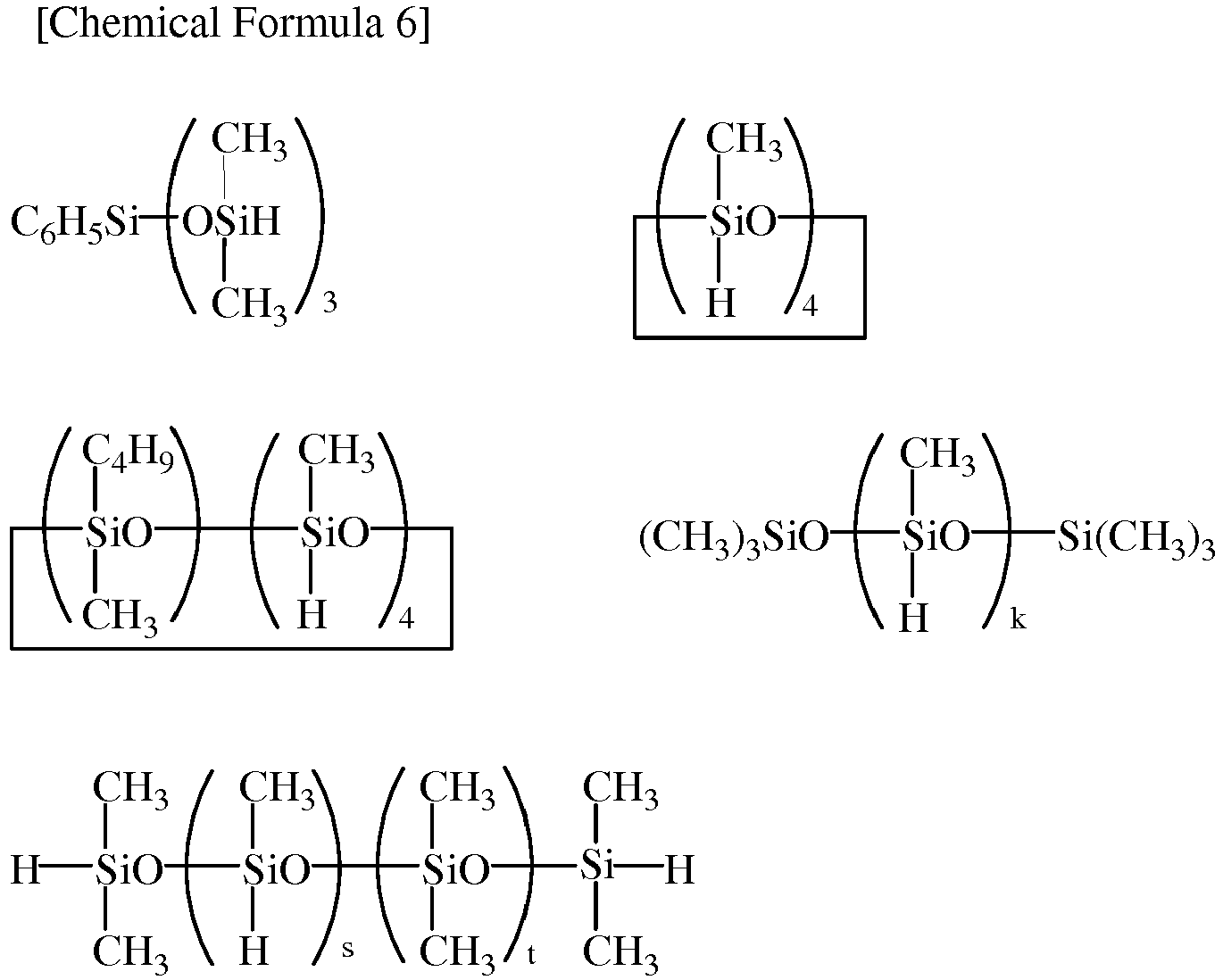
- This organohydrogenpolysiloxane preferably has a viscosity at 23°C of from 0.5 to 10,000 mPa·s, and especially from 1 to 300 mPa·s. When the viscosity is too low, the resulting composition may have a low viscosity; when it is too high, compounding may be difficult.
- The organohydrogenpolysiloxane serving as component (1-C) is included in an amount of from 0 to 20 parts by weight, preferably from 0.1 to 20 parts by weight, more preferably from 0.2 to 10 parts by weight, and even more preferably from 0.3 to 10 parts by weight, per 100 parts by weight of the organopolysiloxane serving as component (1-A). When adding this organohydrogenpolysiloxane serving as component (1-C), it is desirable to include it in an amount such that the molar ratio of the sum of the silicon-bonded hydrogen atoms (SiH groups) in components (1-B) and (1-C) to the silicon-bonded alkenyl groups in component (1-A) is from 0.5 to 10 mol/mol, preferably from 0.8 to 6 mol/mol, and more preferably from 1 to 5 mol/mol. At less than 0.5 mol/mol, crosslinking is inadequate, and so a sufficient mechanical strength may not be obtained. At more than 10 mol/mol, the physical characteristics after curing may decline, with the heat resistance and compression set in particular worsening considerably.
- Component (D-1) is a fine reinforcing silica powder. This fine reinforcing silica powder is not particularly limited as to the type of silica, and may be any such powder that is commonly used as a rubber reinforcement. The fine reinforcing silica powder used here may be one that is employed in conventional silicone rubber compositions, particularly one having a specific surface area as determined by the BET method of 50 m2/g or more. The use of precipitated silica, fumed silica or pyrogenic silica having a BET specific surface area of from 50 to 400 m2/g is preferred. Fumed silica is especially desirable because it enhances the rubber strength.
- The fine reinforcing silica powder may be a fine silica powder that has been surface treated. In such a case, the fine silica powder may be one which has been directly treated beforehand in the state of a powder. In terms of customary treatment methods, treatment may be carried out by a commonly known technique, such as that of placing the untreated fine silica powder and the surface treatment agent in an internal mixer sealed at normal pressure or a fluidized bed, and mixing at room temperature or under heat treatment in the presence of, where necessary, an inert gas. In some cases, treatment may be accelerated by using a catalyst. The treated silica fine powder can be produced by drying subsequent to intensive mixture.
- Alternatively, surface hydrophobizing treatment of the fine reinforcing silica powder (1-D) may involve carrying out surface hydrophobizing treatment in situ, i.e., at the same time as preparation of the liquid silicone rubber composition by, in the course of the composition preparation step, uniformly mixing the alkenyl group-containing organopolysiloxane (base polymer) serving as component (1-A) and untreated fine reinforcing silica powder together with a surface treatment agent under heating.
- Illustrative examples of the treatment agent include silazanes such as hexamethyldisilazane; silane coupling agents such as methyltrimethoxysilane, ethyltrimethoxysilane, propyltrimethoxysilane, butyltrimethoxysilane, dimethyldimethoxysilane, diethyldimethoxysilane, vinyltriethoxysilane, vinyltrimethoxysilane, trimethylmethoxysilane, triethylmethoxysilane, vinyltris(methoxyethoxy)silane, trimethylchlorosilane, dimethyldichlorosilane, divinyldimethoxysilane and chloropropyltrimethoxysilane; and organosilicon compounds such as polymethylsiloxane and organohydrogenpolysiloxane. Surface treatment with these enables the fine silica powder to be used as a hydrophobic powder. The treatment agent is most preferably a silane-type coupling agent or a silazane.
- The content of the treatment agent should be no less than the amount calculated from the coating surface area for the treatment agent.
- The content of component (1-D) per 100 parts by weight of component (1-A) is from 0 to 100 parts by weight, preferably from 5 to 80 parts by weight, and more preferably from 10 to 50 parts by weight. This component need not be added, although the mechanical strength of the cured rubber may weaken and problems with the film strength may arise in such a case. When the content is more than 100 parts by weight, loading becomes difficult and the workability and processability of the composition may worsen.
- Component (1-E) is an addition reaction catalyst. This addition reaction catalyst is exemplified by platinum group metal catalysts, including platinum catalysts such as platinum black, platinic chloride, reaction products of chloroplatinic acid with monohydric alcohols, complexes of chloroplatinic acid and olefins, and platinum bisacetoacetate; palladium catalysts; and rhodium catalysts.
- This addition reaction catalyst is added in a catalytic amount. The amount, expressed in terms of the weight of the platinum group metal such as platinum, palladium or rhodium metal, is generally from 0.1 to 1,000 ppm, and especially from 1 to 200 ppm, based on component (1-A).
- Aside from the above components, the liquid silicone rubber composition used in the first coating layer of the invention may also have added thereto, depending on the intended purpose, various types of additives, including the following inorganic fillers: metal oxides such as titanium oxide, iron oxide, cerium oxide, vanadium oxide, cobalt oxide, chromium oxide, manganese oxide, as well as composites thereof; quartz powder, diatomaceous earth, calcium carbonate, magnesium carbonate, alumina, carbon, hollow glass beads, hollow resin beads, inorganic powders having electrical conductivity, such as gold, silver or copper; and plating powder. Also, paints, heat-resisting agents, flame retardants, plasticizers, reaction regulators and the like may be added, insofar as doing so does not detract from the intended properties. These optional ingredients may be added in customary amounts within ranges that do not compromise the advantageous effects of the invention.
- The liquid silicone rubber composition used in the first coating layer of the invention may be obtained simply by uniformly mixing together, at a normal temperature, above components (1-A), (1-B) and (1-E), and also, where necessary, components (1-C) and (1-D) and any optional ingredients. Generally, a composition having a viscosity at 23°C of about 50 to 20,000 Pa·s, and especially about 100 to 5,000 Pa·s, can be advantageously used.
- The cured form of the silicone rubber composition used in the first coating layer preferably has a hardness, as measured with a type A durometer in accordance with JIS K6249, of at least 50 (generally, from 50 to 80), and especially about 50 to 60. When the hardness is too low, the resulting leather may lack stiffness. The hardness may be set within this range by suitably adjusting, for example, the alkenyl group content in component (1-A) and the amount of component (1-A) added, the SiH group contents in components (1-B) and (1-C) and the amounts of components (1-B) and (1-C) added, and the specific surface area and loadings of the fine reinforcing silica powder.
- The second coating layer is formed on the outside surface of the first coating layer which has been formed on the surface of a fabric base. A silicone rubber composition that contains a silicone resin component (a silicone resin component having a three-dimensional network structure) is used to form this second coating layer. The purpose of the second coating layer is to eliminate surface tack and impart slip characteristics to the surface. A silicone rubber composition containing components (2-A) to (2-D) below may be used as the second coating layer:
- (2-A) an organopolysiloxane containing at least two silicon-bonded alkenyl groups per molecule;
- (2-B) a silicone resin which has R3SiO1/2 units (wherein each R is independently a substituted or unsubstituted monovalent hydrocarbon group of 1 to 6 carbon atoms) and SiO4/2 units, the number of moles of R3SiO1/2 units per mole of SiO4/2 units being from 0.5 to 1.5 moles, and which may further have R2SiO2/2 units and RSiO3/2 units (with R in each of these formulas being as defined above) in respective amounts of from 0 to 1.0 mole per mole of the SiO4/2 units;
- (2-C) an organohydrogenpolysiloxane containing at least two silicon-bonded hydrogen atoms per molecule; and
- (2-D) an addition reaction catalyst.
- Component (2-A) is an organopolysiloxane having at least two silicon-bonded alkenyl groups per molecule, and may be an organopolysiloxane similar to component (1-A) of the liquid silicone rubber composition used in the first coating layer.
- Component (2-B) is a silicone resin (organopolysiloxane having a three-dimensional network (resinous) structure) which has R3SiO1/2 units (wherein each R is independently a substituted or unsubstituted monovalent hydrocarbon group of 1 to 6 carbon atoms) and SiO4/2 units, the number of moles of R3SiO1/2 units per mole of SiO4/2 units being from 0.5 to 1.5 moles, and which may further have R2SiO2/2 units and RSiO3/2 units (with R in each of these formulas being as defined above) in respective amounts of from 0 to 1.0 mole, preferably from 0 to 0.5 mole, and even more preferably from 0 to 0.3 mole, per mole of the SiO4/2 units.
- When the molar ratio of R3SiO1/2 units (M units) to SiO4/2 units (Q units) is smaller than 0.5, the compatibility with other ingredients within the silicone rubber composition used for the second coating layer may end up worsening; when the molar ratio is larger than 1.5, the hardness of the cured form of the silicone rubber composition used in the second coating layer (i.e., the hardness of the second silicone coating layer) may end up decreasing. Therefore, the molar ratio of M units to Q units is in the range of 0.5 to 1.5, and preferably in the range of 0.7 to 1.2.
- Each R is independently a substituted or unsubstituted monovalent hydrocarbon group of 1 to 8, and especially 1 to 6, carbon atoms. Illustrative examples include alkyl groups such as methyl, ethyl, n-propyl, isopropyl, n-butyl, isobutyl, tert-butyl, pentyl and hexyl groups; cycloalkyl groups such as cyclopentyl and cyclohexyl groups; alkenyl groups such as vinyl, allyl, isopropenyl, butenyl, pentenyl and hexenyl groups; phenyl groups; and halogen-substituted alkyl groups such as chloromethyl, 3-chloropropyl, 1-chloro-2-methylpropyl and 3,3,3-trifluoropropyl groups. Of these, methyl, vinyl and phenyl groups are preferred, with methyl groups being especially preferred.
- The number-average molecular weight of the organopolysiloxane serving as component (2-B) is preferably from 500 to 100,000, and especially from 1,000 to 50,000. When the number-average molecular weight is too low, the slip characteristics of the surface of the second silicone coating layer may decrease; when it is too high, the viscosity may increase and the solubility may worsen.
- When this organopolysiloxane contains alkenyl groups, the alkenyl group content within the organopolysiloxane is preferably from 0.0001 to 0.05 mol/g, and especially from 0.001 to 0.01 mol/g. At an alkenyl group content that is too low, the hardness of the second silicone coating layer may decline and the surface slip may be low; when the alkenyl group content is too high, the surface layer may become brittle.
- The organopolysiloxane itself of component (2-B) can be obtained by cohydrolyzing and condensing alkoxy group-containing silane compounds corresponding to each of the above units in an organic solvent by a known method. For example, R3SiOMe and Si(OMe)4 may be cohydrolyzed and condensed within an organic solvent together with, if desired, R2Si(OMe)2 and/or RSi(OMe)3 (in these formulas, each R is independently as defined above, and Me stands for a methyl group).
- The organic solvent is preferably one which can dissolve the organopolysiloxane that forms by a co-hydrolytic condensation reaction. Typical examples include toluene, xylene, naphtha and mineral spirits. The molar ratios of the respective units included in component (2-B) may be suitably set by, for example, adjusting the charged amounts (molar ratios) of the silane compounds corresponding to the respective units.
- The content of component (2-B) is from 1 to 300 parts by weight, preferably from 10 to 200 parts by weight, and more preferably from 20 to 150 parts by weight, per 100 parts by weight of component (2-A). When the component (2-B) content is too small, it may not be possible to reduce the surface tack of the second coating layer. On the other hand, when the component (2-B) content is too large, the composition becomes thicker, which may make uniform compounding difficult, or the workability worsens, which may make uniform application difficult.
- Component (2-C) is an organohydrogenpolysiloxane containing at least two silicon-bonded hydrogen atoms per molecule. This may be an organohydrogenpolysiloxane similar to component (1-C) in the liquid silicone rubber composition used in the first coating layer (that is, one lacking an arylene skeleton and a trivalent or tetravalent group with the arylene skeleton from which 1 or 2 hydrogen atoms have been removed).
- The content of component (2-C) is from 0.1 to 50 parts by weight, preferably from 0.1 to 20 parts by weight, and more preferably from 0.2 to 15 parts by weight, per 100 parts by weight of component (2-A). It is desirable to include component (2-C) in an amount such that the molar ratio of silicon-bonded hydrogen atoms (SiH groups) in component (2-C) to the sum of the silicon-bonded alkenyl groups in components (2-A) and (2-B) is from 0.5 to 10 mol/mol, preferably from 0.8 to 6 mol/mol, and more preferably from 1 to 5 mol/mol. At less than 0.5 mol/mol, crosslinking is inadequate and a sufficient mechanical strength may not be achieved, or the suppression of surface tack may be inadequate. On the other hand, at more than 10 mol/mol, the physical characteristics after curing may decline, with the heat resistance and compression set in particular sometimes worsening dramatically.
- Component (2-D) is an addition reaction catalyst. This may be an addition reaction catalyst similar to component (1-E) in the liquid silicone rubber composition used in the first coating layer.
- Component (2-D) is added in a catalytic amount. The amount, expressed in terms of the weight of the platinum family metal such as platinum, palladium or rhodium metal, is generally from 0.1 to 1,000 ppm, and especially from 1 to 200 ppm, based on component (2-A).
- Aside from the above components, the silicone rubber composition used in the second coating layer of the invention may also have added thereto, depending on the intended purpose, various types of additives, including the following inorganic fillers: metal oxides such as titanium oxide, iron oxide, cerium oxide, vanadium oxide, cobalt oxide, chromium oxide, manganese oxide, as well as composites thereof; quartz powder, diatomaceous earth, calcium carbonate, magnesium carbonate, alumina, carbon, hollow glass beads, hollow resin beads, inorganic powders having electrical conductivity such as gold, silver or copper; and plating powder. Also, paints, heat-resisting agents, flame retardants, plasticizers, reaction regulators and the like may be added, insofar as doing so does not detract from the intended properties. These optional ingredients may be added in the customary amounts within ranges that do not compromise the advantageous effects of the invention.
- The silicone rubber composition used in the second coating layer of the invention may be obtained simply by uniformly mixing together, at a normal temperature, above components (2-A) to (2-D), and also, where necessary, the optional ingredients. Generally, a composition having a viscosity at 23°C of about 10 to 1,000 Pa·s, and especially about 20 to 500 Pa·s, can be advantageously used.
- The cured form of the silicone rubber composition used in the second coating layer preferably has a hardness, as measured with a type A durometer in accordance with JIS K6249, of at least 50 (generally, from 50 to 90), and especially about 60 to 85. When the hardness is too low, the surface slip may decrease. A hardness within the above range can be achieved by including a given amount of the silicone resin component (silicone resin component having a three-dimensional network structure) in the silicone rubber composition.
- The first method of manufacturing the silicone rubber-coated fabric-based molded product of the invention is a method wherein the surface of a fabric base is laminated with a first coating layer and a second coating layer by the steps of, in order to increase adhesion, applying an adhesion-imparting ingredient-containing liquid silicone rubber composition onto at least one surface of a fabric base and curing the composition so as to form a first coating layer consisting of the cured form of this composition, and subsequently, in order to impart slip properties, applying a silicone resin-containing silicone rubber composition onto an outside surface of the first coating layer and curing the silicone resin-containing silicone rubber composition so as to form a second coating layer consisting of the cured form of this composition.
- Alternatively, a second manufacturing method may be used which includes the steps of applying a silicone resin-containing silicone rubber composition onto a surface of a release liner and curing the composition so as to form a second coating layer, and subsequently applying an adhesion-imparting ingredient-containing liquid silicone rubber composition onto an outside surface of the second coating layer, laminating thereon a fabric base and curing the liquid silicone rubber composition so as to form a first coating layer.
- As a result, a laminated fabric-based molded product can be obtained in which the surface slip of the cured film is dramatically improved, adherence to the fabric base also is good and, because the cured films have stretch, checking and cracking do not arise. Fabric-based molded products manufactured by these methods can be advantageously used as synthetic leather-like sheet-formed products having silicone rubber coating layers laminated on the surface.
- In the first manufacturing method, the adhesion-imparting ingredient-containing liquid silicone rubber composition employed in the first coating layer is used by being applied onto a fabric base and cured. In the second production method, this composition is used by applying the composition onto a second coating layer, placing and laminating a fabric base thereon, and then curing the composition.
- The method used here to apply the liquid silicone rubber composition may be a coating method known to the industry, such as brush coating, spray coating or dip coating. The coating layer that is applied may have any thickness, although the composition is generally applied to a thickness of about 1 to 1,000 µm.
- Following application of the composition, curing is carried out by heating at from 50 to 200°C for about 1 to 20 minutes. When the curing temperature is low, curing takes time; when the curing temperature is too high, the fabric base may undergo deterioration due to the heat. Hence, a curing temperature of from 100 to 150°C is preferred.
- The silicone resin-containing silicone rubber composition used in the second coating layer is a composition that manifests slipperiness on the surface, and is laminated onto the first coating layer.
- Although any method may be used here for applying and laminating the silicone rubber composition, preferred use can be made of, as a third manufacturing method, the method of applying the silicone rubber composition used in the second coating layer onto a release liner, subsequently bonding this onto the fabric to which the first coating layer has been laminated, and then curing.
- The silicone rubber composition used in the second coating layer may have any coating thickness, although the composition is typically applied to a thickness of about 1 to 1,000 µm.
- The curing conditions after bonding are not particularly limited, with conditions similar to those for curing the first coating layer being selected, and curing being carried out by heating at from 50 to 200°C, especially from 100 to 150°C, for about 1 to 20 minutes.
- The fabric base used in this invention is made of synthetic fibers such as polyester (e.g., polyethylene terephthalate (PET)), nylon, polyamide or polyolefin fibers, or of natural fibers such as cellulose fibers.
- The release liner used may be made of, for example, paper and polypropylene, polytetrafluoroethylene, polyethylene terephthalate or the like. The release liner is peeled off and removed at the time of use.
- The invention is illustrated more fully below by way of Working Examples and Comparative Examples, although these Examples are not intended to limit the invention. The degrees of polymerization and molecular weights of the respective ingredients are polystyrene-equivalent weight-average values as determined by gel permeation chromatography (GPC). The viscosities are values measured with a rotational viscometer. Also, all references to "parts" are by weight.
- A first liquid silicone rubber composition containing the adhesion-imparting ingredient indicated below was applied onto the surface of a fabric base made of PET fibers in an amount such as to give a thickness of 100 µm, following which it was cured by heating in a drying oven at 120°C for 5 minutes.
- Next, a second silicone rubber composition containing the silicone resin indicated below was applied onto a release liner to a thickness of 50 µm. This second silicone rubber composition layer coated onto the release liner was then bonded to the side of the fabric base on which the first liquid silicone rubber composition had been applied and cured by heating. The bonded assembly was cured in a drying oven at 120°C for 5 minutes, thereby giving a silicone rubber-laminated PET fiber fabric base.
- The following ingredients were mixed together for 30 minutes at room temperature (25°C): 84 parts of dimethylpolysiloxane (1-A1) (vinyl group content, 3×10⁻⁵ mol/g) capped at both ends of the molecular chain with dimethylvinylsiloxy groups and having a viscosity at 23°C of 30 Pa·s (average degree of polymerization, about 750), 5 parts of dimethylpolysiloxane (1-A2) (vinyl group content, 6.5×10⁻⁴ mol/g) capped at both ends of the molecular chain with trimethylsiloxy groups, having an average degree of polymerization of about 230 and containing 5 mol% of vinylmethylsiloxane units on side chains (at non-terminal positions along the molecular chain), 40 parts of fumed silica (1-D1) that has a BET specific surface area of 300 m2/g and is not surface-treated (Aerosil 300, from Nippon Aerosil Co., Ltd.), 8 parts of hexamethyldisilazane as a surface hydrophobizing treatment agent, and 2 parts of water. The temperature of the mixture was then raised to 150°C and stirring was continued for 3 hours, following which the mixture was cooled, thereby carrying out surface hydrophobizing treatment of the fumed silica and also obtaining a silicone rubber base.
- A liquid silicone rubber composition (viscosity at 23°C, 400 Pa·s) was obtained by uniformly mixing together the following for about 30 minutes: 129 parts of the above silicone rubber base, 40 parts of dimethylpolysiloxane (1-A1) (vinyl group content, 3×10⁻⁵ mol/g) capped at both ends of the molecular chain with dimethylvinylsiloxy groups and having a viscosity at 23°C of 30 Pa·s (average degree of polymerization, about 750), 2.4 parts of, as a crosslinking agent, methylhydrogenpolysiloxane (1-C1) having pendant SiH groups (a dimethylsiloxane-methylhydrogensiloxane copolymer having a viscosity at 25°C of 0.010 Pa·s, 34 SiH groups per molecule (SiH group content, 0.0050 mol/g) and capped at both ends with trimethylsiloxy groups), 2.0 parts of an adhesion-imparting ingredient having the phenylene skeleton of formula (1) below (1-B1) (SiH group content, 0.0066 mol/g) [sum of SiH groups in (1-C1) and (1-B1)/sum of vinyl groups in (1-A1) and (1-A2) = 2.8 mol/mol], 0.10 part of ethynylcyclohexanol as a reaction regulator, and 0.2 part of platinum catalyst (1-E1) (Pt concentration, 1 wt%).

- A silicone rubber composition (viscosity at 23°C, 35 Pa·s) was obtained by uniformly mixing together the following for about 30 minutes: 84 parts of dimethylpolysiloxane (2-A1) (vinyl group content, 3×10⁻⁵ mol/g) capped at both ends of the molecular chain with dimethylvinylsiloxy groups and having a viscosity at 23°C of 30 Pa·s (average degree of polymerization, about 750), 84 parts of organopolysiloxane resin (2-B 1) (number-average molecular weight, 30,000) that has a three-dimensional network structure and consists of (CH3)3SiO1/2 units, (CH2=CH)(CH3)2SiO1/2 units and SiO4/2 units, with the molar ratio (CH3)3SiO1/2/(CH2=CH)(CH3)2SiO1/2/SiO4/2 being 40/10/50 and the vinyl group content being 0.00054 mol/g, 14.5 parts of, as a crosslinking agent, methylhydrogenpolysiloxane (2-C1) having pendant SiH groups (a methylhydrogenpolysiloxane having a viscosity at 23°C of 20 mPa·s, 40 SiH groups per molecule (SiH group content, 0.016 mol/g) and capped at both ends with trimethylsiloxy groups [SiH groups in (2-Cl)/sum of vinyl groups in (2-A1) and (2-B1) = 3.5 mol/mol], 0.10 part of ethynylcyclohexanol as a reaction regulator, and 0.2 part of a platinum catalyst (Pt concentration, 1 wt%).
- Aside from using 100 parts of organopolysiloxane resin (2-B2) (number-average molecular weight, 5,000; vinyl group content, 0.00027 mol/g) that has a three-dimensional network structure and consists of (CH3)3SiO1/2 units, (CH2=CH)(CH3)2SiO1/2 units and SiO4/2 units, with the molar ratio (CH3)3SiO1/2/(CH2=CH)(CH3)2SiO1/2/SiO4/2 being 40/5/55, instead of organopolysiloxane resin (2-B 1) in the second silicone rubber composition, a silicone rubber-laminated PET fiber fabric base was obtained in the same way as in Working Example 1.
- Aside from not including an adhesion-imparting ingredient having a phenylene skeleton (1-B1) in the first liquid silicone rubber composition [SiH groups in (1-C1)/sum of vinyl groups in (1-A1) and (1-A2) = 1.8 mol/mol], a silicone rubber-laminated PET fiber fabric base was obtained in the same way as in Working Example 1.
- Aside from using an additional 84 parts (for a total of 168 parts) of dimethylpolysiloxane (2-A1) (vinyl group content, 3×10⁻⁵ mol/g) capped at both ends of the molecular chain with dimethylvinylsiloxy groups and having a viscosity at 23°C of 30 Pa·s (average degree of polymerization, about 750) instead of organopolysiloxane resin (2-B1) in the second silicone rubber composition, and 0.56 part of, as a crosslinking agent, methylhydrogenpolysiloxane (2-C1) having SiH groups [a methylhydrogenpolysiloxane capped at both ends with trimethylsiloxy groups; viscosity at 23°C, 20 mPa·s; number of SiH groups per molecule, 40 (SiH group content, 0.016 mol/g)], such that the ratio of SiH groups in (2-C1)/vinyl groups in (2-A1) = 3.0 mol/mol, a silicone rubber-laminated PET fiber fabric base was obtained in the same way as in Working Example 1.
- The physical properties (hardness, tensile strength, elongation at break) of the cured forms of the above silicone resin-containing second silicone rubber compositions were measured in accordance with JIS K6249. The cured forms of the silicone rubber compositions were produced by press molding at 120°C for 10 minutes.
- Also, with regard to the PET fiber fabric bases obtained, adhesion to the fabric base and surface slip were measured by the following methods and evaluated according to the criteria indicated below. The results are presented in Table 1.
- In each of the Working Examples and Comparative Examples, the hardness of the cured form of the first silicone rubber composition, as determined with a type A durometer, was 52.
- The adhesion test was carried out using a Scott-type crease-flex tester under the following conditions. That is, a crease-flex test was carried out ten times at a pressing force of 5 kgf on the above rubber-coated fabric base, following which the state of failure in the coated portion was visually examined. Cases in which the silicone rubber coating layer has not separated from the fabric base are rated as "Good" (adheres), and cases in which the silicone rubber coating layer has separated from the fabric base are rated as "NG" (peeled).
-
- Good: adheres
- NG: peeled (separation between the silicone layer and the base fabric)
- The slipperiness of the surface was evaluated by measuring the dynamic coefficient of friction under the following conditions. That is, the dynamic coefficient of friction was measured using a Type 14FW Surface Property Tester (Shinto Scientific Co., Ltd.) in accordance with ASTM D1894 under the following conditions: load, 100 gf; tensile test speed, 500 mm/min. Specimens having a dynamic coefficient of friction of 0.5 or less were rated as having good slip characteristics (Good), and those having a dynamic coefficient of friction greater than 0.5 were rated as having poor slip characteristics (NG).
-
- Good: Surface slip is good
- NG: Surface slip is poor
| Working Example 1 | Working Example 2 | Comparative Example 1 | Comparative Example 2 | |
| Physical properties of cured form of second silicone rubber composition | ||||
| Hardness (type A durometer) | 79 | 70 | 79 | 40 |
| Tensile strength (MPa) | 5.8 | 5.5 | 5.8 | 0.8 |
| Elongation at break (%) | 50 | 210 | 50 | 250 |
| Evaluation of PET fiber fabric base | ||||
| Adhesion to fabric base | Good | Good | NG | NG |
| Surface slip | Good | Good | Good | NG |
Claims (12)
- A method of manufacturing a fabric-based molded product comprising the steps of applying an adhesion-imparting ingredient-containing liquid silicone rubber composition onto at least one surface of a fabric base and curing the composition so as to form a first coating layer, and subsequently applying a silicone resin-containing silicone rubber composition onto an outside surface of the first coating layer and curing the silicone resin-containing silicone rubber composition so as to form a second coating layer.
- A method of manufacturing a fabric-based molded product comprising the steps of applying a silicone resin-containing silicone rubber composition onto a surface of a release liner and curing the composition so as to form a second coating layer, and subsequently applying an adhesion-imparting ingredient-containing liquid silicone rubber composition onto an outside surface of the second coating layer, laminating thereon a fabric base and curing the liquid silicone rubber composition so as to form a first coating layer.
- A method of manufacturing a fabric-based molded product comprising the steps of applying an adhesion-imparting ingredient-containing liquid silicone rubber composition onto at least one side of a fabric base and curing the composition so as to form a first coating layer, and applying a silicone resin-containing silicone rubber composition onto a surface of a release liner, laminating the silicone resin-containing silicone rubber composition-coated surface of the release liner onto the first coating layer and then curing the silicone resin-containing silicone rubber composition so as to form a second coating layer on the first coating layer.
- The method of manufacturing a silicone rubber-coated fabric-based molded product of any one of claims 1 to 3, wherein the liquid silicone rubber composition used in the first coating layer comprises:(1-A) 100 parts by weight of an organopolysiloxane which contains at least two silicon-bonded alkenyl groups per molecule and has a viscosity at 23°C of from 0.1 to 2,000 Pa·s,(1-B) from 0.1 to 30 parts by weight of an organosilicon compound of from 1 to 100 silicon atoms which has, per molecule, at least one silicon-bonded hydrogen atom and at least one arylene skeleton and/or a trivalent or tetravalent group with the arylene skeleton from which 1 or 2 hydrogen atoms have been removed,(1-C) from 0 to 20 parts by weight of an organohydrogenpolysiloxane which has at least two silicon-bonded hydrogen atoms per molecule and lacks an arylene skeleton and a trivalent or tetravalent group with the arylene skeleton from which 1 or 2 hydrogen atoms have been removed,(1-D) from 0 to 100 parts by weight of a fine reinforcing silica powder, and(1-E) a catalytic amount of an addition reaction catalyst;and wherein the silicone rubber composition used in the second coating layer comprises:(2-A) 100 parts by weight of an organopolysiloxane containing at least two silicon-bonded alkenyl groups per molecule,(2-B) from 1 to 300 parts by weight of a silicone resin which has R3SiO1/2 units (wherein each R is independently a substituted or unsubstituted monovalent hydrocarbon group of 1 to 6 carbon atoms) and SiO4/2 units, the number of moles of R3SiO1/2 units per mole of SiO4/2 units being from 0.5 to 1.5 moles, and which may further have R2SiO2/2 units and RSiO3/2 units (with R in each of these formulas being as defined above) in respective amounts of from 0 to 1.0 mole per mole of SiO4/2 units,(2-C) from 0.1 to 50 parts by weight of an organohydrogenpolysiloxane containing at least two silicon-bonded hydrogen atoms per molecule, and(2-D) a catalytic amount of an addition reaction catalyst.
- The method of manufacturing a silicone rubber-coated fabric-based molded product of claim 4, wherein component (1-B) is an organosilicon compound of from 1 to 100 silicon atoms which has at least one silicon-bonded hydrogen atom per molecule, has at least one arylene skeleton and/or a trivalent or tetravalent group with the arylene skeleton from which 1 or 2 hydrogen atoms have been removed per molecule, and has one, two or more functional groups selected from among epoxy, alkoxysilyl, ester, acrylic, methacrylic, carboxylic anhydride, isocyanate, amino and amide groups.
- The method of manufacturing a silicone rubber-coated fabric-based molded product of any one of claims 1 to 5, wherein the cured form of the silicone rubber composition used in the first coating layer has a hardness, as measured with a type A durometer in accordance with JIS K6249, of 50 or more.
- The method of manufacturing a silicone rubber-coated fabric-based molded product of any one of claims 1 to 6, wherein the cured form of the silicone rubber composition used in the second coating layer has a hardness, as measured with a type A durometer in accordance with JIS K6249, of 50 or more.
- A synthetic leather-like sheet-formed product comprising, as silicone rubber coating layers, a first coating layer formed on a surface of a fabric base and a second coating layer laminated onto the first coating layer, wherein the first coating layer is a cured form of an adhesion-imparting ingredient-containing liquid silicone rubber composition, and the second coating layer is a cured form of a silicone resin-containing silicone rubber composition.
- The synthetic leather-like sheet-formed product of claim 8, wherein the liquid silicone rubber composition used in the first coating layer comprises:(1-A) 100 parts by weight of an organopolysiloxane which contains at least two silicon-bonded alkenyl groups per molecule and has a viscosity at 23°C of from 0.1 to 2,000 Pa·s,(1-B) from 0.1 to 30 parts by weight of an organosilicon compound of from 1 to 100 silicon atoms which has, per molecule, at least one silicon-bonded hydrogen atom and at least one arylene skeleton and/or a trivalent or tetravalent group with the arylene skeleton from which 1 or 2 hydrogen atoms have been removed,(1-C) from 0 to 20 parts by weight of an organohydrogenpolysiloxane which has at least two silicon-bonded hydrogen atoms per molecule and lacks an arylene skeleton and a trivalent or tetravalent group with the arylene skeleton from which 1 or 2 hydrogen atoms have been removed,(1-D) from 0 to 100 parts by weight of a fine reinforcing silica powder, and(1-E) a catalytic amount of an addition reaction catalyst;and wherein the silicone rubber composition used in the second coating layer comprises:(2-A) 100 parts by weight of an organopolysiloxane containing at least two silicon-bonded alkenyl groups per molecule,(2-B) from 1 to 300 parts by weight of a silicone resin which has R3SiO1/2 units (wherein each R is independently a substituted or unsubstituted monovalent hydrocarbon group of 1 to 6 carbon atoms) and SiO4/2 units, the number of moles of R3SiO1/2 units per mole of SiO4/2 units being from 0.5 to 1.5 moles, and which may further have R2SiO2/2 units and RSiO3/2 units (with R in each of these formulas being as defined above) in respective amounts of from 0 to 1.0 mole per mole of SiO4/2 units,(2-C) from 0.1 to 50 parts by weight of an organohydrogenpolysiloxane containing at least two silicon-bonded hydrogen atoms per molecule, and(2-D) a catalytic amount of an addition reaction catalyst.
- The synthetic leather-like sheet-formed product of claim 9, wherein component (1-B) is an organosilicon compound of 1 to 100 silicon atoms which has at least one silicon-bonded hydrogen atom per molecule, has at least one arylene skeleton and/or a trivalent or tetravalent group with the arylene skeleton from which 1 or 2 hydrogen atoms have been removed per molecule, and has one, two or more functional groups selected from among epoxy, alkoxysilyl, ester, acrylic, methacrylic, carboxylic anhydride, isocyanate, amino and amide groups.
- The synthetic leather-like sheet-formed product of any one of claims 8 to 10, wherein the cured form of the silicone rubber composition used in the first coating layer has a hardness, as measured with a type A durometer in accordance with JIS K6249, of 50 or more.
- The synthetic leather-like sheet-formed product of any one of claims 8 to 11, wherein the cured form of the silicone rubber composition used in the second coating layer has a hardness, as measured with a type A durometer in accordance with JIS K6249, of 50 or more.
Applications Claiming Priority (2)
| Application Number | Priority Date | Filing Date | Title |
|---|---|---|---|
| JP2014251465 | 2014-12-12 | ||
| PCT/JP2015/084549 WO2016093281A1 (en) | 2014-12-12 | 2015-12-09 | Method for producing fabric substrate molded product coated with silicone rubber, and artificial leather-like sheet molded product |
Publications (2)
| Publication Number | Publication Date |
|---|---|
| EP3231606A1 true EP3231606A1 (en) | 2017-10-18 |
| EP3231606A4 EP3231606A4 (en) | 2018-08-01 |
Family
ID=56107459
Family Applications (1)
| Application Number | Title | Priority Date | Filing Date |
|---|---|---|---|
| EP15866595.0A Withdrawn EP3231606A4 (en) | 2014-12-12 | 2015-12-09 | Method for producing fabric substrate molded product coated with silicone rubber, and artificial leather-like sheet molded product |
Country Status (7)
| Country | Link |
|---|---|
| US (1) | US20180355552A1 (en) |
| EP (1) | EP3231606A4 (en) |
| JP (1) | JP6323569B2 (en) |
| KR (1) | KR102392412B1 (en) |
| CN (1) | CN107000394B (en) |
| TW (1) | TWI683868B (en) |
| WO (1) | WO2016093281A1 (en) |
Cited By (3)
| Publication number | Priority date | Publication date | Assignee | Title |
|---|---|---|---|---|
| EP3725856A1 (en) | 2019-04-15 | 2020-10-21 | CHT Germany GmbH | Silicone preparation suitable for the preparation of multilayer composite |
| EP3732264A4 (en) * | 2017-12-28 | 2021-12-29 | Elkem Silicones Shanghai Co., Ltd. | Low tvoc release silicone composite sheet |
| EP3778806A4 (en) * | 2018-04-02 | 2022-02-16 | Anymedi Inc. | LIQUID COATING COMPOSITION FOR A 3D MODEL AND METHOD FOR MAKING A 3D MODEL USING THE SAME |
Families Citing this family (15)
| Publication number | Priority date | Publication date | Assignee | Title |
|---|---|---|---|---|
| CN105625047A (en) * | 2016-03-15 | 2016-06-01 | 惠州赛力珑新材料有限公司 | Multi-color organic silicon synthetic leather and manufacturing technology |
| CN108559398A (en) * | 2018-01-10 | 2018-09-21 | 广东天跃新材料股份有限公司 | A kind of environmental-friendly silicon rubber leather and its coating process |
| TWI668106B (en) * | 2018-04-11 | 2019-08-11 | 厚生股份有限公司 | Composite sheet and method for manufacturing the same |
| KR102099263B1 (en) * | 2019-02-25 | 2020-04-08 | 조맹상 | Silicon Resin Coated Fabric Having Slip Property, and Method for Manufacturing the Same |
| US12606927B2 (en) * | 2019-03-18 | 2026-04-21 | Sookmyung Women's University Industry-Academic Cooperation Foundation | Functional material and method for manufacturing the same |
| WO2020232568A1 (en) | 2019-05-17 | 2020-11-26 | Dow Silicones Corporation | Coating composition and its uses |
| CN110982275A (en) * | 2019-12-16 | 2020-04-10 | 九牧厨卫股份有限公司 | Anti-aging soft and hard composite sealing strip and preparation method thereof |
| GB202000594D0 (en) * | 2020-01-15 | 2020-02-26 | Supercrease Ltd | Resin for use in setting a crease in a garment |
| JP2022132959A (en) * | 2021-03-01 | 2022-09-13 | 株式会社ニッシリ | Cloth materials and manufacturing apparatus and manufacturing method for cloth materials |
| WO2022188084A1 (en) * | 2021-03-11 | 2022-09-15 | Dow Silicones Corporation | Coating composition and its uses |
| CN115704189B (en) * | 2021-08-05 | 2024-05-31 | 杭州希力高新材料科技有限公司 | Method for preparing antibacterial printed silica gel leather from high-transparency organic silicon coated fabric |
| CN115704053B (en) * | 2021-08-05 | 2026-02-13 | 杭州希力高新材料科技有限公司 | A process for manufacturing simulated sheepskin by coating two layers of sheepskin with silicone. |
| KR102684769B1 (en) | 2021-08-24 | 2024-07-11 | 현대트랜시스 주식회사 | Manufacturing method of artificial leather seat covering |
| CN121986199A (en) | 2023-10-19 | 2026-05-05 | 美国陶氏有机硅公司 | Silicone coatings for textiles and fabrics |
| KR102885915B1 (en) * | 2025-03-26 | 2025-11-13 | 주식회사 덕일하이스킨 | Silicon Resin Coated Fabric with Improved Durability and Moisture Permeability, and Method for Manufacturing the Same |
Family Cites Families (12)
| Publication number | Priority date | Publication date | Assignee | Title |
|---|---|---|---|---|
| US4472470A (en) * | 1983-07-07 | 1984-09-18 | General Electric Silicones | Transparent membrane structures |
| JP2814179B2 (en) | 1993-02-22 | 1998-10-22 | 信越化学工業株式会社 | Antistatic curable composition |
| GB9919083D0 (en) * | 1999-08-13 | 1999-10-13 | Dow Corning | Silicone coated textile fabrics |
| JP4221545B2 (en) * | 2001-01-05 | 2009-02-12 | 信越化学工業株式会社 | Silicone rubber adhesive composition, integral molded body of silicone rubber and thermoplastic resin, and method for producing the same |
| KR100474060B1 (en) * | 2002-06-15 | 2005-03-08 | (주)대우인터내셔널 | Method for producing artificial leather by liquid silicone lubber |
| JP4777591B2 (en) | 2002-10-25 | 2011-09-21 | 信越化学工業株式会社 | Room temperature curable organopolysiloxane composition |
| FR2894997A1 (en) * | 2005-12-19 | 2007-06-22 | Rhodia Recherches & Tech | FIBROUS SUPPORT COMPRISING A SILICONE COATING |
| JP2010100667A (en) | 2008-10-21 | 2010-05-06 | Shin-Etsu Chemical Co Ltd | Condensation curable organopolysiloxane composition |
| JP5397350B2 (en) * | 2009-09-11 | 2014-01-22 | 信越化学工業株式会社 | Liquid silicone rubber coating composition, curtain airbag and method for producing the same |
| KR101381914B1 (en) | 2012-07-19 | 2014-04-07 | (주) 정산인터내셔널 | Method for producing artificial leather by coating solution having different liquid silicone lubber each other |
| JP2014074247A (en) * | 2012-10-04 | 2014-04-24 | Kuraray Co Ltd | Grained artificial leather |
| JP5910566B2 (en) * | 2013-04-18 | 2016-04-27 | 信越化学工業株式会社 | Addition-curing self-adhesive silicone rubber composition and molded article |
-
2015
- 2015-12-09 US US15/534,942 patent/US20180355552A1/en not_active Abandoned
- 2015-12-09 JP JP2016563717A patent/JP6323569B2/en active Active
- 2015-12-09 WO PCT/JP2015/084549 patent/WO2016093281A1/en not_active Ceased
- 2015-12-09 CN CN201580067480.6A patent/CN107000394B/en active Active
- 2015-12-09 KR KR1020177018776A patent/KR102392412B1/en active Active
- 2015-12-09 EP EP15866595.0A patent/EP3231606A4/en not_active Withdrawn
- 2015-12-11 TW TW104141736A patent/TWI683868B/en active
Cited By (4)
| Publication number | Priority date | Publication date | Assignee | Title |
|---|---|---|---|---|
| EP3732264A4 (en) * | 2017-12-28 | 2021-12-29 | Elkem Silicones Shanghai Co., Ltd. | Low tvoc release silicone composite sheet |
| US12083783B2 (en) | 2017-12-28 | 2024-09-10 | Elkem Silicones Shanghai Co., Ltd. | Low TVOC release silicone composite sheet |
| EP3778806A4 (en) * | 2018-04-02 | 2022-02-16 | Anymedi Inc. | LIQUID COATING COMPOSITION FOR A 3D MODEL AND METHOD FOR MAKING A 3D MODEL USING THE SAME |
| EP3725856A1 (en) | 2019-04-15 | 2020-10-21 | CHT Germany GmbH | Silicone preparation suitable for the preparation of multilayer composite |
Also Published As
| Publication number | Publication date |
|---|---|
| US20180355552A1 (en) | 2018-12-13 |
| TW201634616A (en) | 2016-10-01 |
| WO2016093281A1 (en) | 2016-06-16 |
| TWI683868B (en) | 2020-02-01 |
| JP6323569B2 (en) | 2018-05-16 |
| CN107000394B (en) | 2019-05-21 |
| JPWO2016093281A1 (en) | 2017-07-20 |
| EP3231606A4 (en) | 2018-08-01 |
| KR102392412B1 (en) | 2022-04-29 |
| KR20170097087A (en) | 2017-08-25 |
| CN107000394A (en) | 2017-08-01 |
Similar Documents
| Publication | Publication Date | Title |
|---|---|---|
| US20180355552A1 (en) | Method for producing fabric substrate molded product coated with silicone rubber, and artificial leather-like sheet molded product | |
| CN1207361C (en) | Adhesive for silicone rubber | |
| JP5761103B2 (en) | Liquid silicone rubber coating composition for curtain airbag and method for producing the same | |
| KR20140105511A (en) | Method for the adhesion of a layer of fluorosilicone rubber to a layer of silicone rubber | |
| US12227649B2 (en) | Addition-curable self-adhesive silicone rubber composition and silicone rubber cured product | |
| JP5397326B2 (en) | Liquid silicone rubber coating composition, curtain airbag and method for producing the same | |
| US8658547B2 (en) | Compositions for textile coatings | |
| KR20220117284A (en) | Wear-resistant multi-layer composite | |
| EP0798344B1 (en) | Fluorosilicone rubber composition and method of adhering it to a substrate | |
| JP4541842B2 (en) | Self-adhesive organopolysiloxane composition | |
| JP2010083946A (en) | Silicone composition for use in covering, and covered film covered with cured film of the same | |
| WO2019012863A1 (en) | Addition-curable silicone rubber composition and air bag | |
| JP6003866B2 (en) | Silicone airbag manufacturing method and blocking resistance improving method | |
| WO2016076010A1 (en) | Addition-curable silicone rubber composition | |
| US7608657B2 (en) | Liquid silicone rubber coating agent composition and air bag using the composition | |
| JP5359415B2 (en) | Oil-bleedable silicone rubber adhesive composition and integrally molded body of cured product of the composition and thermoplastic resin | |
| KR20190045098A (en) | The addition-curable silicone rubber composition and the air bag | |
| EP1788032B1 (en) | Use of basic carbonates for reducing the compression set in addition curing silicone compositions | |
| KR20200008656A (en) | Silicone Coating Composition | |
| KR20220062334A (en) | Addition curing liquid silicone rubber composition for airbag and airbag | |
| WO2026048561A1 (en) | Addition-curable silicone rubber composition and cured object thereof | |
| WO2025140702A1 (en) | Composite with high air-holding property | |
| JP2023027794A (en) | Joint material of polypropylene resin and silicone rubber, and method for producing the same | |
| KR20220038401A (en) | Silicone Compositions and Methods for Making Composite Moldings |
Legal Events
| Date | Code | Title | Description |
|---|---|---|---|
| PUAI | Public reference made under article 153(3) epc to a published international application that has entered the european phase |
Free format text: ORIGINAL CODE: 0009012 |
|
| 17P | Request for examination filed |
Effective date: 20170628 |
|
| AK | Designated contracting states |
Kind code of ref document: A1 Designated state(s): AL AT BE BG CH CY CZ DE DK EE ES FI FR GB GR HR HU IE IS IT LI LT LU LV MC MK MT NL NO PL PT RO RS SE SI SK SM TR |
|
| AX | Request for extension of the european patent |
Extension state: BA ME |
|
| DAV | Request for validation of the european patent (deleted) | ||
| DAX | Request for extension of the european patent (deleted) | ||
| A4 | Supplementary search report drawn up and despatched |
Effective date: 20180704 |
|
| RIC1 | Information provided on ipc code assigned before grant |
Ipc: D06N 3/12 20060101ALI20180627BHEP Ipc: C09D 5/00 20060101ALI20180627BHEP Ipc: C09D 183/04 20060101ALI20180627BHEP Ipc: B32B 25/10 20060101AFI20180627BHEP Ipc: C09D 183/05 20060101ALI20180627BHEP Ipc: C09D 183/07 20060101ALI20180627BHEP Ipc: B32B 25/20 20060101ALI20180627BHEP Ipc: D06M 15/643 20060101ALI20180627BHEP Ipc: D06N 3/00 20060101ALI20180627BHEP |
|
| STAA | Information on the status of an ep patent application or granted ep patent |
Free format text: STATUS: THE APPLICATION IS DEEMED TO BE WITHDRAWN |
|
| 18D | Application deemed to be withdrawn |
Effective date: 20190131 |