EP3230751B1 - Signalverarbeitungsverfahren und -vorrichtung - Google Patents
Signalverarbeitungsverfahren und -vorrichtung Download PDFInfo
- Publication number
- EP3230751B1 EP3230751B1 EP15808021.8A EP15808021A EP3230751B1 EP 3230751 B1 EP3230751 B1 EP 3230751B1 EP 15808021 A EP15808021 A EP 15808021A EP 3230751 B1 EP3230751 B1 EP 3230751B1
- Authority
- EP
- European Patent Office
- Prior art keywords
- signal
- frequency
- input signal
- synthetic
- estimate
- Prior art date
- Legal status (The legal status is an assumption and is not a legal conclusion. Google has not performed a legal analysis and makes no representation as to the accuracy of the status listed.)
- Active
Links
Images

Classifications
-
- A—HUMAN NECESSITIES
- A61—MEDICAL OR VETERINARY SCIENCE; HYGIENE
- A61B—DIAGNOSIS; SURGERY; IDENTIFICATION
- A61B5/00—Measuring for diagnostic purposes; Identification of persons
- A61B5/72—Signal processing specially adapted for physiological signals or for diagnostic purposes
- A61B5/7271—Specific aspects of physiological measurement analysis
- A61B5/7278—Artificial waveform generation or derivation, e.g. synthesizing signals from measured signals
-
- A—HUMAN NECESSITIES
- A61—MEDICAL OR VETERINARY SCIENCE; HYGIENE
- A61B—DIAGNOSIS; SURGERY; IDENTIFICATION
- A61B5/00—Measuring for diagnostic purposes; Identification of persons
- A61B5/02—Detecting, measuring or recording for evaluating the cardiovascular system, e.g. pulse, heart rate, blood pressure or blood flow
- A61B5/024—Measuring pulse rate or heart rate
- A61B5/02416—Measuring pulse rate or heart rate using photoplethysmograph signals, e.g. generated by infrared radiation
-
- A—HUMAN NECESSITIES
- A61—MEDICAL OR VETERINARY SCIENCE; HYGIENE
- A61B—DIAGNOSIS; SURGERY; IDENTIFICATION
- A61B5/00—Measuring for diagnostic purposes; Identification of persons
- A61B5/08—Measuring devices for evaluating the respiratory organs
- A61B5/0816—Measuring devices for examining respiratory frequency
-
- A—HUMAN NECESSITIES
- A61—MEDICAL OR VETERINARY SCIENCE; HYGIENE
- A61B—DIAGNOSIS; SURGERY; IDENTIFICATION
- A61B5/00—Measuring for diagnostic purposes; Identification of persons
- A61B5/08—Measuring devices for evaluating the respiratory organs
- A61B5/083—Measuring rate of metabolism by using breath test, e.g. measuring rate of oxygen consumption
- A61B5/0836—Measuring rate of CO2 production
-
- A—HUMAN NECESSITIES
- A61—MEDICAL OR VETERINARY SCIENCE; HYGIENE
- A61B—DIAGNOSIS; SURGERY; IDENTIFICATION
- A61B5/00—Measuring for diagnostic purposes; Identification of persons
- A61B5/145—Measuring characteristics of blood in vivo, e.g. gas concentration or pH-value ; Measuring characteristics of body fluids or tissues, e.g. interstitial fluid or cerebral tissue
- A61B5/1455—Measuring characteristics of blood in vivo, e.g. gas concentration or pH-value ; Measuring characteristics of body fluids or tissues, e.g. interstitial fluid or cerebral tissue using optical sensors, e.g. spectral photometrical oximeters
- A61B5/14551—Measuring characteristics of blood in vivo, e.g. gas concentration or pH-value ; Measuring characteristics of body fluids or tissues, e.g. interstitial fluid or cerebral tissue using optical sensors, e.g. spectral photometrical oximeters for measuring blood gases
-
- A—HUMAN NECESSITIES
- A61—MEDICAL OR VETERINARY SCIENCE; HYGIENE
- A61B—DIAGNOSIS; SURGERY; IDENTIFICATION
- A61B5/00—Measuring for diagnostic purposes; Identification of persons
- A61B5/72—Signal processing specially adapted for physiological signals or for diagnostic purposes
- A61B5/7203—Signal processing specially adapted for physiological signals or for diagnostic purposes for noise prevention, reduction or removal
- A61B5/7207—Signal processing specially adapted for physiological signals or for diagnostic purposes for noise prevention, reduction or removal of noise induced by motion artifacts
- A61B5/7214—Signal processing specially adapted for physiological signals or for diagnostic purposes for noise prevention, reduction or removal of noise induced by motion artifacts using signal cancellation, e.g. based on input of two identical physiological sensors spaced apart, or based on two signals derived from the same sensor, for different optical wavelengths
-
- A—HUMAN NECESSITIES
- A61—MEDICAL OR VETERINARY SCIENCE; HYGIENE
- A61B—DIAGNOSIS; SURGERY; IDENTIFICATION
- A61B5/00—Measuring for diagnostic purposes; Identification of persons
- A61B5/72—Signal processing specially adapted for physiological signals or for diagnostic purposes
- A61B5/7235—Details of waveform analysis
- A61B5/7246—Details of waveform analysis using correlation, e.g. template matching or determination of similarity
-
- A—HUMAN NECESSITIES
- A61—MEDICAL OR VETERINARY SCIENCE; HYGIENE
- A61B—DIAGNOSIS; SURGERY; IDENTIFICATION
- A61B5/00—Measuring for diagnostic purposes; Identification of persons
- A61B5/72—Signal processing specially adapted for physiological signals or for diagnostic purposes
- A61B5/7235—Details of waveform analysis
- A61B5/7253—Details of waveform analysis characterised by using transforms
-
- A—HUMAN NECESSITIES
- A61—MEDICAL OR VETERINARY SCIENCE; HYGIENE
- A61B—DIAGNOSIS; SURGERY; IDENTIFICATION
- A61B5/00—Measuring for diagnostic purposes; Identification of persons
- A61B5/72—Signal processing specially adapted for physiological signals or for diagnostic purposes
- A61B5/7235—Details of waveform analysis
- A61B5/7253—Details of waveform analysis characterised by using transforms
- A61B5/7257—Details of waveform analysis characterised by using transforms using Fourier transforms
-
- G—PHYSICS
- G01—MEASURING; TESTING
- G01R—MEASURING ELECTRIC VARIABLES; MEASURING MAGNETIC VARIABLES
- G01R23/00—Arrangements for measuring frequencies; Arrangements for analysing frequency spectra
- G01R23/16—Spectrum analysis; Fourier analysis
- G01R23/165—Spectrum analysis; Fourier analysis using filters
- G01R23/167—Spectrum analysis; Fourier analysis using filters with digital filters
-
- A—HUMAN NECESSITIES
- A61—MEDICAL OR VETERINARY SCIENCE; HYGIENE
- A61B—DIAGNOSIS; SURGERY; IDENTIFICATION
- A61B2576/00—Medical imaging apparatus involving image processing or analysis
Definitions
- the present invention relates to the processing of signals, especially noisy signals, to determine the frequency of periodic components thereof.
- US-A-4291269 discloses a method and apparatus for quickly analysing an input signal known to consist of one of sixty-four frequencies by digitizing the input signal into a pattern of bits representing its frequency and comparing this to bit patterns representing each of the sixty-four frequencies to output signals whose magnitudes are proportional to the degree of correlation therebetween. By determining which is the largest output signal, the frequency of the reference signal which produced the largest output signal can be found, this corresponding to the input frequency.
- WO-A1-2014/031082 discloses a method and device for quantifying heart rate variability coherence of a subject. A bio-signal such as a PPG signal is obtained from the subject and a time domain heart rate variability signal is derived from it.
- This time-domain heart rate variability signal is correlated with a sign wave of varying frequency scanned over the expected range, to find the frequency at which there is maximum correlation.
- US-A-3656097 discloses a detector for identifying the frequency of a periodic signal buried beneath the threshold of background noise. A correlator compares the frequency of the output of a sweep generator with the incoming signal. When the correlator indicates that the frequency of the sweep generator output coincides with that of the periodic signal, the sweep generator output is recorded as the input signal frequency.
- US-A1-2014/0073956 discloses a physiological monitoring system in which an input PPG signal can be compared to a synthetic signal having a range formed by concatenating several signal segments of different frequencies and finding the cross-correlation to determine which segment of the synthetic signal has the maximum cross-correlation with the input, thus indicating the frequency of the input signal.
- a common technique in signal processing is spectral analysis, that is to say examining the frequency content of a signal. For example there may be a desire to detect one or more periodic components of a noisy signal and to produce estimates of the frequency and possibly amplitude of those components.
- spectral analysis There are many standard techniques for spectral analysis, such as the Fast Fourier Transform or the use of auto-regressive (AR) models and different techniques are used in different circumstances depending on the nature of the signal and the result required.
- AR auto-regressive
- the basic assumption underlying AR modelling is that a new data point can be predicted by using a weighted sum of the previous N data points.
- N also known as the model order
- the choice of N is critical in determining how well a given model will fit the time-series.
- a single model order will not necessarily fit optimally to a whole input signal.
- One reason for this is that in a noisy signal, the noise varies and at different times different model orders may fit better. For this reason when using AR modelling to analyse noisy signals it has been proposed, as in the two patent applications mentioned above, to fit multiple models of different order to the input signal and at any time to select the model order and dominant pole from that model order in some way.
- the spectral properties of the model may be visualised by treating the model as a noise-shaping filter.
- the AR model's difference equation By transforming the AR model's difference equation into the z-domain, its transfer function may be found.
- the present invention provides a method of analysing an input signal to estimate the frequency of a periodic signal therein as defined by claim 1.
- the measure of similarity may be for example the correlation or the cross-correlation or another technique which maximises linearity between the synthetic signal and the input signal.
- the candidates for the periodic signal which are effectively chosen in the frequency domain are used to generate a synthetic signal such as a pure sinusoid of the same frequency and this synthetic signal is compared in the time domain with the input signal.
- Whichever time domain synthetic signal has the highest cross-correlation with the input signal is regarded as the best estimate of the dominant periodic signal within the input signal.
- the spectral analysis of the input signal is, for example by auto-regressive modelling, or by Fourier transform or any standard spectral analysis technique.
- a plurality of auto-regressive models of different order are fitted to the input signal, for example models of order from 2-20, though the range of orders used depends on the circumstances.
- synthetic signals are generated for the dominant (i.e. largest magnitude) pole from each of the fitted auto-regressive models, though with successively greater processing requirements the synthetic signals can be generated for all poles within a certain allowed frequency range and/or with a magnitude greater than a certain threshold (i.e. representing a periodic component of greater than a certain strength), or for all poles in the model.
- the input signal is temporally windowed, the window length being selected based on the particular application and the variability of the signal (for example into windows from 5 to 60 seconds long) and the steps of calculating the similarity and outputting a frequency estimate are performed for each window.
- the windows may be overlapping, for example with an overlap from 0.5 to 10 seconds, or spaced apart, for example by 1 to 10 seconds.
- the input signal can be the noisy signal itself, or it can be subject to pre-processing before the generation of frequency domain candidates and similarity measurement.
- the pre-processing could involve detrending and/or filtering and/or re-sampling.
- the step of calculating the cross-correlation of each synthetic signal with the input signal results in the output of a correlation coefficient.
- a threshold is placed on the similarity, e.g. the correlation coefficient, and a frequency estimate would only be output if the similarity for the synthetic signal of that frequency is above the threshold.
- the invention is applicable to any noisy signal where the desire is to detect a single dominant periodic component.
- a noisy signal is a signal from a physiological sensor such as a PPG signal or a PPGi signal from a video camera.
- the periodic component to be detected can be the heart rate or breathing rate.
- the input signal can be a time series of image intensity data such as a PPGi signal and it can comprise several colour channels, for example the conventional red, green and blue video channels, with each channel being processed separately.
- the invention may be embodied in a computer program comprising program code means for executing on a computer system the method steps. Alternatively it can be embodied in firmware or hardware.
- Another aspect of the invention provides an apparatus for analysing an input signal to estimate the frequency of a periodic signal therein, the apparatus comprising an input for receiving the input signal, a processor for processing the input signal, wherein the processor is configured to execute the method above.
- the apparatus further includes an output to output the frequency estimate, for example by means of a display.
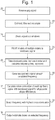
- FIG. 1 is a flow diagram showing the application of an embodiment of the invention to the analysis of a PPG signal.
- a PPG signal which is the pulsatile waveform produced by a pulse oximeter at one of its two wavelengths (red and infra-red) is received.
- the signal is resampled, for example at a frequency of 5 Hz. This resampling is required in this embodiment because the intention is to find the respiration rate.
- the PPG signal itself has a high sampling rate of 100-250 Hz to ensure that the shape and heart rate information are preserved. However at such high sample rates the phase angles corresponding to breathing frequencies are very small and the cardiac-synchronous pulsatile component of the PPG signal (heart beat) is dominant. Downsampling ensures that the cardiac-synchronous pulsatile component is no longer dominant.
- step 24 the signal is divided into consecutive 32-second windows, each separated by 3 seconds. Longer or shorter windows can be used, and rather than being separated, the windows can overlap.
- step 26 multiple auto-regressive models with model orders ranging from 2-20 are applied to the windowed signal.
- step 28 for each AR model the dominant pole, that it is to say the pole with the highest magnitude is identified.
- 19 dominant poles one from each of the model orders, is produced.
- the dominant pole is taken from each model, it is possible alternatively to take all poles within a certain allowed frequency range, or to take all poles of each model onto the next step. Clearly taking more poles means a greater amount of processing.
- step 30 for each of the selected poles (in this example the nineteen dominant poles, one from each model order) a synthetic signal which is a pure sinusoidal signal at the frequency represented by the pole's phase angle and whose amplitude is determined by that of the signal that was modelled (for example by setting it equal to the standard deviation of the original signal) is generated.
- This sinusoid is therefore a time-domain representation of the dominant pole from each model.
- step 32 the cross-correlation is calculated between each of the synthetic signals and the original modelled signal for all possible phase differences between the synthetic signal and the modelled signal. Each calculation will return a cross-correlation coefficient c.
- step 34 whichever of the synthetic signals has the highest cross-correlation with the original signal is found (the maximum value of c ) and in step 36 the frequency of this synthetic signal is output as the estimate of the strongest periodic component of the original input signal.
- the estimated respiration rate in breaths per minute can be obtained by taking the reciprocal of this frequency in Hertz and multiplying by 60.
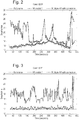
- Figure 2 illustrates the results of applying this example of the invention to a PPG recording in comparison with capnometry data as a reference and the auto-regressive modelling technique described in WO-A2-2013/027027 .
- the capnometry reference measurements are shown in dotted
- the results of applying the embodiment of the invention are shown in a thin line with ticks
- the results of the prior art auto-regressive modelling technique are shown in a thick line with dots.
- Figure 2 is for a patient with spontaneous breathing
- Figure 3 shows results for a patient with controlled breathing (in Figure 3 the reference is shown dashed, the prior art AR model in a solid line, and the embodiment of the invention in a dotted line with crosses).
- the method of this embodiment of the invention tracks the breathing rate much more accurately than the prior art auto-regressive modelling method.
- I x ⁇ I x + ⁇ j a j cos ⁇ j + ⁇ j + ⁇ x
- ⁇ ( I ( x )) is the average offset or trend
- ⁇ (x) is a random error associated with each data-point
- ⁇ j ( a j cos ( ⁇ j x + ⁇ j )) defines the Fourier series that describes the signal.
- the frequency ⁇ k found to maximise the absolute value of R k is then selected as the best approximation of the dominant signal frequency ⁇ , i.e. find ⁇ k that satisfies argmax O * S k ⁇ , ⁇ k
- R k ⁇ x O x ⁇ O ⁇ ⁇ S x ⁇ ⁇ ⁇ S ⁇
- F f * g F f * ⁇ F g
- F denotes the Fourier Transform
- * denotes the complex conjugate operand
- the candidates for the periodic component of the input signal are selected using auto-regressive modelling.
- auto-regressive modelling another spectral analysis technique can be used to identify candidate spectral components. For example peaks in the Fourier transform spectrum or a wavelet transform method may be used.
- peaks in the Fourier transform spectrum or a wavelet transform method may be used.
- a certain resolution separating them it is possible to generate synthetic signals corresponding to each of those frequencies.
- cross-correlation is used as the time domain validation technique but other validation techniques in the time domain can be used. For example calculating the correlation or any other method that maximises the linearity between the synthetic signal and the input signal.
- the invention may be embodied as a computer program for running on a computer system which receives the input time series and outputs an estimate of the dominant periodic component within the time series.
- the invention may be incorporated into a dedicated apparatus, such as a monitor, as schematically illustrated in Figure 4 .
- Such apparatus comprises an input 40 for receiving the input data, a process 42 for executing the data processing steps described above and an output 44, such as a display, for outputting the estimate of the dominant periodic component, for example as a physiological measurement such as a breathing rate or heart rate.
Landscapes
- Health & Medical Sciences (AREA)
- Life Sciences & Earth Sciences (AREA)
- Engineering & Computer Science (AREA)
- Physics & Mathematics (AREA)
- General Health & Medical Sciences (AREA)
- Biophysics (AREA)
- Pathology (AREA)
- Biomedical Technology (AREA)
- Heart & Thoracic Surgery (AREA)
- Medical Informatics (AREA)
- Molecular Biology (AREA)
- Surgery (AREA)
- Animal Behavior & Ethology (AREA)
- Public Health (AREA)
- Veterinary Medicine (AREA)
- Physiology (AREA)
- Signal Processing (AREA)
- Artificial Intelligence (AREA)
- Computer Vision & Pattern Recognition (AREA)
- Psychiatry (AREA)
- Cardiology (AREA)
- Pulmonology (AREA)
- Mathematical Physics (AREA)
- Spectroscopy & Molecular Physics (AREA)
- Optics & Photonics (AREA)
- General Physics & Mathematics (AREA)
- Emergency Medicine (AREA)
- Obesity (AREA)
- Measuring Pulse, Heart Rate, Blood Pressure Or Blood Flow (AREA)
- Measurement And Recording Of Electrical Phenomena And Electrical Characteristics Of The Living Body (AREA)
Claims (15)
- Verfahren zum Analysieren eines Eingangssignals, um die Frequenz eines periodischen Signals darin zu schätzen, umfassend die Schritte von:Empfangen des Eingangssignals (20);Durchführen einer Spektralanalyse an dem Eingangssignal, um dessen Spektralkomponenten (26) zu erfassen; undAusgeben einer Schätzung der Frequenz des periodischen Signals (36);dadurch gekennzeichnet, dass:
die erfassten Spektralkomponenten Frequenzbereichskandidaten für das periodische Signal darstellen; und durch:Erzeugen für jeden Frequenzbereichskandidaten eines synthetischen Signals der gleichen Frequenz (30);Berechnen eines Maßes für die Ähnlichkeit jedes synthetischen Signals mit dem Eingangssignal (32) in dem Zeitbereich; undAusgeben der Frequenz des synthetischen Signals mit der größten Ähnlichkeit mit dem Eingangssignal (34, 36) als die Schätzung der Frequenz des periodischen Signals. - Verfahren nach Anspruch 1, wobei die Spektralanalyse (26) durch autoregressive Modellierung erfolgt.
- Verfahren nach Anspruch 2, wobei eine Mehrzahl von autoregressiven Modellen unterschiedlicher Ordnungen an das Eingangssignal (26) angepasst wird.
- Verfahren nach Anspruch 2 oder 3, wobei synthetische Signale für jeden Pol in den angepassten autoregressiven Modellen (30) erzeugt werden.
- Verfahren nach Anspruch 2, 3 oder 4, wobei synthetische Signale nur für Pole in den angepassten autoregressiven Modellen erzeugt werden, die einem vorbestimmten zulässigen Frequenzbereich für das periodische Signal (30) entsprechen.
- Verfahren nach Anspruch 2, 3, 4 oder 5, wobei synthetische Signale nur für Pole in den angepassten autoregressiven Modellen erzeugt werden, die eine vorbestimmte Größe (30) aufweisen.
- Verfahren nach Anspruch 2, 3 oder 4, wobei synthetische Signale nur für die dominanten Pole in den angepassten autoregressiven Modellen (30) erzeugt werden.
- Verfahren nach einem der vorhergehenden Ansprüche, wobei das synthetische Signal sinusförmig ist.
- Verfahren nach einem der vorhergehenden Ansprüche, das ferner den Schritt des Definierens eines Ähnlichkeitsschwellenwerts und des Hemmens des Ausgabeschritts umfasst, wenn die Ähnlichkeit des synthetischen Signals mit der maximalen Ähnlichkeit mit dem Eingangssignal unter dem Schwellenwert liegt.
- Verfahren nach einem der vorhergehenden Ansprüche, wobei das Eingangssignal eine Zeitreihe von Bildintensitätsdaten ist.
- Verfahren nach einem der vorhergehenden Ansprüche, wobei das Eingangssignal Videobilddaten sind, die eine Zeitreihe von Intensitätsdaten für jeden Farbkanal umfassen.
- Verfahren nach einem der vorhergehenden Ansprüche, wobei das Eingangssignal eine Messung eines physiologischen Parameters eines menschlichen oder tierischen Subjekts ist.
- Verfahren nach Anspruch 12, wobei das periodische Signal die Herzfrequenz oder die Atmungsfrequenz des Subjekts ist.
- Computerprogramm, umfassend Programmcodemittel zum Ausführen des Verfahrens nach einem der vorhergehenden Ansprüche auf einem Computersystem.
- Vorrichtung zum Analysieren eines Eingangssignals, um die Frequenz eines periodischen Signals zu schätzen, umfassend:einen Eingang (40) zum Empfangen des Eingangssignals;einen Prozessor (42) zum Verarbeiten des Eingangssignals;wobei der Prozessor (42) derart konfiguriert ist, dass er die Schritte nach einem der Ansprüche 1 bis 13 ausführt; wobei die Vorrichtung ferner einen Ausgang (44) umfasst, um als die Frequenzschätzung die Frequenz des synthetischen Signals mit der maximalen Kreuzkorrelation mit dem Eingangssignal auszugeben.
Applications Claiming Priority (2)
| Application Number | Priority Date | Filing Date | Title |
|---|---|---|---|
| GBGB1421786.3A GB201421786D0 (en) | 2014-12-08 | 2014-12-08 | Signal processing method and apparatus |
| PCT/GB2015/053755 WO2016092291A1 (en) | 2014-12-08 | 2015-12-08 | Signal processing method and apparatus |
Publications (2)
| Publication Number | Publication Date |
|---|---|
| EP3230751A1 EP3230751A1 (de) | 2017-10-18 |
| EP3230751B1 true EP3230751B1 (de) | 2021-11-03 |
Family
ID=52425611
Family Applications (1)
| Application Number | Title | Priority Date | Filing Date |
|---|---|---|---|
| EP15808021.8A Active EP3230751B1 (de) | 2014-12-08 | 2015-12-08 | Signalverarbeitungsverfahren und -vorrichtung |
Country Status (4)
| Country | Link |
|---|---|
| US (1) | US10993676B2 (de) |
| EP (1) | EP3230751B1 (de) |
| GB (1) | GB201421786D0 (de) |
| WO (1) | WO2016092291A1 (de) |
Cited By (1)
| Publication number | Priority date | Publication date | Assignee | Title |
|---|---|---|---|---|
| WO2024121066A1 (en) * | 2022-12-05 | 2024-06-13 | Koninklijke Philips N.V. | System for respiratory rate determination based on multiple contactless sensing modalities and related methods |
Families Citing this family (2)
| Publication number | Priority date | Publication date | Assignee | Title |
|---|---|---|---|---|
| CN116803338A (zh) * | 2023-06-06 | 2023-09-26 | 无锡伴创科技有限公司 | 基于信号自适应标准比对的呼吸心跳检测方法及装置 |
| CN117347711B (zh) * | 2023-08-23 | 2026-03-06 | 浙江大学 | 基于互相关计算的高速高精度闭环频率测量方法及系统 |
Family Cites Families (11)
| Publication number | Priority date | Publication date | Assignee | Title |
|---|---|---|---|---|
| US3656097A (en) | 1969-12-29 | 1972-04-11 | Dynamics Corp America | Signal processing system for extracting a periodic signal of unknown frequency from a high level background noise |
| US4037151A (en) | 1976-02-27 | 1977-07-19 | Hewlett-Packard Company | Apparatus for measuring the period and frequency of a signal |
| US4291269A (en) | 1979-06-28 | 1981-09-22 | Rca Corporation | System and method for frequency discrimination |
| BR0316272A (pt) * | 2002-11-14 | 2005-10-11 | Team Medical Llc | Método e sistema para o processamento de sinal de diagnóstico |
| GB0714807D0 (en) * | 2007-07-30 | 2007-09-12 | Oxford Biosignals Ltd | Method and apparatus for measuring breathing rate |
| US8380151B2 (en) | 2009-12-18 | 2013-02-19 | Broadcom Corporation | Method and system for reducing the complexity of multi-frequency hypothesis testing using an iterative approach |
| GB201114406D0 (en) | 2011-08-22 | 2011-10-05 | Isis Innovation | Remote monitoring of vital signs |
| US20150208931A1 (en) * | 2012-08-23 | 2015-07-30 | Nitto Denko Corporation | Method and device for quantifying heart rate variability (hrv) coherence |
| US20140073956A1 (en) * | 2012-09-11 | 2014-03-13 | Nellcor Puritan Bennett Llc | Methods and systems for determining physiological information based on a cross-correlation waveform |
| GB201421785D0 (en) * | 2014-12-08 | 2015-01-21 | Oxehealth Ltd | Method and apparatus for physiological monitoring |
| US9872652B2 (en) * | 2015-06-09 | 2018-01-23 | University Of Connecticut | Method and apparatus for heart rate monitoring using an electrocardiogram sensor |
-
2014
- 2014-12-08 GB GBGB1421786.3A patent/GB201421786D0/en not_active Ceased
-
2015
- 2015-12-08 EP EP15808021.8A patent/EP3230751B1/de active Active
- 2015-12-08 WO PCT/GB2015/053755 patent/WO2016092291A1/en not_active Ceased
- 2015-12-08 US US15/533,892 patent/US10993676B2/en active Active
Cited By (1)
| Publication number | Priority date | Publication date | Assignee | Title |
|---|---|---|---|---|
| WO2024121066A1 (en) * | 2022-12-05 | 2024-06-13 | Koninklijke Philips N.V. | System for respiratory rate determination based on multiple contactless sensing modalities and related methods |
Also Published As
| Publication number | Publication date |
|---|---|
| GB201421786D0 (en) | 2015-01-21 |
| WO2016092291A1 (en) | 2016-06-16 |
| US20170332978A1 (en) | 2017-11-23 |
| US10993676B2 (en) | 2021-05-04 |
| EP3230751A1 (de) | 2017-10-18 |
Similar Documents
| Publication | Publication Date | Title |
|---|---|---|
| US9198634B2 (en) | Medical decision support system | |
| Pal et al. | Empirical mode decomposition based ECG enhancement and QRS detection | |
| Zhu et al. | An R-peak detection method based on peaks of Shannon energy envelope | |
| Rakshit et al. | An efficient wavelet-based automated R-peaks detection method using Hilbert transform | |
| EP3229676B1 (de) | Verfahren und vorrichtung zur physiologischen überwachung | |
| US9050007B1 (en) | Extraction of cardiac signal data | |
| JP5416218B2 (ja) | バリストカルジオグラム信号の分析方法と装置 | |
| US20150150515A1 (en) | Respiration rate extraction from cardiac signals | |
| US20150105666A1 (en) | Narrow band feature extraction from cardiac signals | |
| JP5210872B2 (ja) | 準周期信号を高分解能で抽出する方法及びシステム | |
| KR101779018B1 (ko) | 초음파 도플러 태아감시 장치의 심박 검출 신호처리 방법 | |
| US10918302B2 (en) | Biological signal processing method and biological signal processing apparatus | |
| US8419651B2 (en) | Spectrum analysis of coronary artery turbulent blood flow | |
| Fedotov et al. | Effective QRS-detector based on Hilbert transform and adaptive thresholding | |
| US10993676B2 (en) | Signal processing method and apparatus | |
| Li et al. | Optimum heart sound signal selection based on the cyclostationary property | |
| de Micheaux et al. | Residual convolutional autoencoder combined with a non-negative matrix factorization to estimate fetal heart rate | |
| CN101897578B (zh) | 一种动脉压信号逐拍分割方法 | |
| KR101524596B1 (ko) | Qrs 패턴을 이용한 pvc 분류 장치 및 방법, pvc 패턴 분류 방법, 그리고 원격 모니터링 장치 | |
| JP6315633B2 (ja) | 心拍検出方法および心拍検出装置 | |
| Sieczkowski et al. | Autocorrelation algorithm for determining a pulse wave delay | |
| Moukadem et al. | High Order Statistics and Time‐Frequency Domain to Classify Heart Sounds for Subjects under Cardiac Stress Test | |
| Sassi et al. | Analysis of surface atrial signals: time series with missing data? | |
| JP2014176427A (ja) | データ解析装置、及びデータ解析プログラム | |
| CN101879058B (zh) | 一种颅内压信号逐拍分割方法 |
Legal Events
| Date | Code | Title | Description |
|---|---|---|---|
| STAA | Information on the status of an ep patent application or granted ep patent |
Free format text: STATUS: THE INTERNATIONAL PUBLICATION HAS BEEN MADE |
|
| PUAI | Public reference made under article 153(3) epc to a published international application that has entered the european phase |
Free format text: ORIGINAL CODE: 0009012 |
|
| STAA | Information on the status of an ep patent application or granted ep patent |
Free format text: STATUS: REQUEST FOR EXAMINATION WAS MADE |
|
| 17P | Request for examination filed |
Effective date: 20170512 |
|
| AK | Designated contracting states |
Kind code of ref document: A1 Designated state(s): AL AT BE BG CH CY CZ DE DK EE ES FI FR GB GR HR HU IE IS IT LI LT LU LV MC MK MT NL NO PL PT RO RS SE SI SK SM TR |
|
| AX | Request for extension of the european patent |
Extension state: BA ME |
|
| DAV | Request for validation of the european patent (deleted) | ||
| DAX | Request for extension of the european patent (deleted) | ||
| GRAP | Despatch of communication of intention to grant a patent |
Free format text: ORIGINAL CODE: EPIDOSNIGR1 |
|
| STAA | Information on the status of an ep patent application or granted ep patent |
Free format text: STATUS: GRANT OF PATENT IS INTENDED |
|
| RIC1 | Information provided on ipc code assigned before grant |
Ipc: A61B 5/024 20060101ALI20210422BHEP Ipc: A61B 5/1455 20060101ALI20210422BHEP Ipc: A61B 5/00 20060101ALI20210422BHEP Ipc: G01R 23/167 20060101AFI20210422BHEP |
|
| INTG | Intention to grant announced |
Effective date: 20210518 |
|
| GRAS | Grant fee paid |
Free format text: ORIGINAL CODE: EPIDOSNIGR3 |
|
| GRAA | (expected) grant |
Free format text: ORIGINAL CODE: 0009210 |
|
| STAA | Information on the status of an ep patent application or granted ep patent |
Free format text: STATUS: THE PATENT HAS BEEN GRANTED |
|
| AK | Designated contracting states |
Kind code of ref document: B1 Designated state(s): AL AT BE BG CH CY CZ DE DK EE ES FI FR GB GR HR HU IE IS IT LI LT LU LV MC MK MT NL NO PL PT RO RS SE SI SK SM TR |
|
| REG | Reference to a national code |
Ref country code: GB Ref legal event code: FG4D |
|
| REG | Reference to a national code |
Ref country code: AT Ref legal event code: REF Ref document number: 1444431 Country of ref document: AT Kind code of ref document: T Effective date: 20211115 Ref country code: CH Ref legal event code: EP |
|
| REG | Reference to a national code |
Ref country code: IE Ref legal event code: FG4D |
|
| REG | Reference to a national code |
Ref country code: DE Ref legal event code: R096 Ref document number: 602015074729 Country of ref document: DE |
|
| REG | Reference to a national code |
Ref country code: SE Ref legal event code: TRGR |
|
| REG | Reference to a national code |
Ref country code: NL Ref legal event code: FP |
|
| REG | Reference to a national code |
Ref country code: LT Ref legal event code: MG9D |
|
| REG | Reference to a national code |
Ref country code: AT Ref legal event code: MK05 Ref document number: 1444431 Country of ref document: AT Kind code of ref document: T Effective date: 20211103 |
|
| PG25 | Lapsed in a contracting state [announced via postgrant information from national office to epo] |
Ref country code: RS Free format text: LAPSE BECAUSE OF FAILURE TO SUBMIT A TRANSLATION OF THE DESCRIPTION OR TO PAY THE FEE WITHIN THE PRESCRIBED TIME-LIMIT Effective date: 20211103 Ref country code: LT Free format text: LAPSE BECAUSE OF FAILURE TO SUBMIT A TRANSLATION OF THE DESCRIPTION OR TO PAY THE FEE WITHIN THE PRESCRIBED TIME-LIMIT Effective date: 20211103 Ref country code: FI Free format text: LAPSE BECAUSE OF FAILURE TO SUBMIT A TRANSLATION OF THE DESCRIPTION OR TO PAY THE FEE WITHIN THE PRESCRIBED TIME-LIMIT Effective date: 20211103 Ref country code: BG Free format text: LAPSE BECAUSE OF FAILURE TO SUBMIT A TRANSLATION OF THE DESCRIPTION OR TO PAY THE FEE WITHIN THE PRESCRIBED TIME-LIMIT Effective date: 20220203 Ref country code: AT Free format text: LAPSE BECAUSE OF FAILURE TO SUBMIT A TRANSLATION OF THE DESCRIPTION OR TO PAY THE FEE WITHIN THE PRESCRIBED TIME-LIMIT Effective date: 20211103 |
|
| PG25 | Lapsed in a contracting state [announced via postgrant information from national office to epo] |
Ref country code: IS Free format text: LAPSE BECAUSE OF FAILURE TO SUBMIT A TRANSLATION OF THE DESCRIPTION OR TO PAY THE FEE WITHIN THE PRESCRIBED TIME-LIMIT Effective date: 20220303 Ref country code: PT Free format text: LAPSE BECAUSE OF FAILURE TO SUBMIT A TRANSLATION OF THE DESCRIPTION OR TO PAY THE FEE WITHIN THE PRESCRIBED TIME-LIMIT Effective date: 20220303 Ref country code: PL Free format text: LAPSE BECAUSE OF FAILURE TO SUBMIT A TRANSLATION OF THE DESCRIPTION OR TO PAY THE FEE WITHIN THE PRESCRIBED TIME-LIMIT Effective date: 20211103 Ref country code: NO Free format text: LAPSE BECAUSE OF FAILURE TO SUBMIT A TRANSLATION OF THE DESCRIPTION OR TO PAY THE FEE WITHIN THE PRESCRIBED TIME-LIMIT Effective date: 20220203 Ref country code: LV Free format text: LAPSE BECAUSE OF FAILURE TO SUBMIT A TRANSLATION OF THE DESCRIPTION OR TO PAY THE FEE WITHIN THE PRESCRIBED TIME-LIMIT Effective date: 20211103 Ref country code: HR Free format text: LAPSE BECAUSE OF FAILURE TO SUBMIT A TRANSLATION OF THE DESCRIPTION OR TO PAY THE FEE WITHIN THE PRESCRIBED TIME-LIMIT Effective date: 20211103 Ref country code: GR Free format text: LAPSE BECAUSE OF FAILURE TO SUBMIT A TRANSLATION OF THE DESCRIPTION OR TO PAY THE FEE WITHIN THE PRESCRIBED TIME-LIMIT Effective date: 20220204 Ref country code: ES Free format text: LAPSE BECAUSE OF FAILURE TO SUBMIT A TRANSLATION OF THE DESCRIPTION OR TO PAY THE FEE WITHIN THE PRESCRIBED TIME-LIMIT Effective date: 20211103 |
|
| PG25 | Lapsed in a contracting state [announced via postgrant information from national office to epo] |
Ref country code: SM Free format text: LAPSE BECAUSE OF FAILURE TO SUBMIT A TRANSLATION OF THE DESCRIPTION OR TO PAY THE FEE WITHIN THE PRESCRIBED TIME-LIMIT Effective date: 20211103 Ref country code: SK Free format text: LAPSE BECAUSE OF FAILURE TO SUBMIT A TRANSLATION OF THE DESCRIPTION OR TO PAY THE FEE WITHIN THE PRESCRIBED TIME-LIMIT Effective date: 20211103 Ref country code: RO Free format text: LAPSE BECAUSE OF FAILURE TO SUBMIT A TRANSLATION OF THE DESCRIPTION OR TO PAY THE FEE WITHIN THE PRESCRIBED TIME-LIMIT Effective date: 20211103 Ref country code: EE Free format text: LAPSE BECAUSE OF FAILURE TO SUBMIT A TRANSLATION OF THE DESCRIPTION OR TO PAY THE FEE WITHIN THE PRESCRIBED TIME-LIMIT Effective date: 20211103 Ref country code: DK Free format text: LAPSE BECAUSE OF FAILURE TO SUBMIT A TRANSLATION OF THE DESCRIPTION OR TO PAY THE FEE WITHIN THE PRESCRIBED TIME-LIMIT Effective date: 20211103 Ref country code: CZ Free format text: LAPSE BECAUSE OF FAILURE TO SUBMIT A TRANSLATION OF THE DESCRIPTION OR TO PAY THE FEE WITHIN THE PRESCRIBED TIME-LIMIT Effective date: 20211103 |
|
| REG | Reference to a national code |
Ref country code: CH Ref legal event code: PL |
|
| REG | Reference to a national code |
Ref country code: DE Ref legal event code: R097 Ref document number: 602015074729 Country of ref document: DE |
|
| PG25 | Lapsed in a contracting state [announced via postgrant information from national office to epo] |
Ref country code: MC Free format text: LAPSE BECAUSE OF FAILURE TO SUBMIT A TRANSLATION OF THE DESCRIPTION OR TO PAY THE FEE WITHIN THE PRESCRIBED TIME-LIMIT Effective date: 20211103 |
|
| PLBE | No opposition filed within time limit |
Free format text: ORIGINAL CODE: 0009261 |
|
| STAA | Information on the status of an ep patent application or granted ep patent |
Free format text: STATUS: NO OPPOSITION FILED WITHIN TIME LIMIT |
|
| REG | Reference to a national code |
Ref country code: BE Ref legal event code: MM Effective date: 20211231 |
|
| 26N | No opposition filed |
Effective date: 20220804 |
|
| PG25 | Lapsed in a contracting state [announced via postgrant information from national office to epo] |
Ref country code: LU Free format text: LAPSE BECAUSE OF NON-PAYMENT OF DUE FEES Effective date: 20211208 Ref country code: IE Free format text: LAPSE BECAUSE OF NON-PAYMENT OF DUE FEES Effective date: 20211208 Ref country code: AL Free format text: LAPSE BECAUSE OF FAILURE TO SUBMIT A TRANSLATION OF THE DESCRIPTION OR TO PAY THE FEE WITHIN THE PRESCRIBED TIME-LIMIT Effective date: 20211103 |
|
| PG25 | Lapsed in a contracting state [announced via postgrant information from national office to epo] |
Ref country code: SI Free format text: LAPSE BECAUSE OF FAILURE TO SUBMIT A TRANSLATION OF THE DESCRIPTION OR TO PAY THE FEE WITHIN THE PRESCRIBED TIME-LIMIT Effective date: 20211103 Ref country code: BE Free format text: LAPSE BECAUSE OF NON-PAYMENT OF DUE FEES Effective date: 20211231 |
|
| PG25 | Lapsed in a contracting state [announced via postgrant information from national office to epo] |
Ref country code: LI Free format text: LAPSE BECAUSE OF NON-PAYMENT OF DUE FEES Effective date: 20211231 Ref country code: CH Free format text: LAPSE BECAUSE OF NON-PAYMENT OF DUE FEES Effective date: 20211231 |
|
| REG | Reference to a national code |
Ref country code: GB Ref legal event code: 732E Free format text: REGISTERED BETWEEN 20230105 AND 20230111 |
|
| REG | Reference to a national code |
Ref country code: DE Ref legal event code: R081 Ref document number: 602015074729 Country of ref document: DE Owner name: OXEHEALTH LIMITED, GB Free format text: FORMER OWNER: OXFORD UNIVERSITY INNOVATION LIMITED, BOTLEY, OXFORD, GB |
|
| REG | Reference to a national code |
Ref country code: NL Ref legal event code: PD Owner name: OXEHEALTH LIMITED; GB Free format text: DETAILS ASSIGNMENT: CHANGE OF OWNER(S), ASSIGNMENT; FORMER OWNER NAME: OXFORD UNIVERSITY INNOVATION LIMITED Effective date: 20230206 |
|
| PG25 | Lapsed in a contracting state [announced via postgrant information from national office to epo] |
Ref country code: IT Free format text: LAPSE BECAUSE OF FAILURE TO SUBMIT A TRANSLATION OF THE DESCRIPTION OR TO PAY THE FEE WITHIN THE PRESCRIBED TIME-LIMIT Effective date: 20211103 Ref country code: HU Free format text: LAPSE BECAUSE OF FAILURE TO SUBMIT A TRANSLATION OF THE DESCRIPTION OR TO PAY THE FEE WITHIN THE PRESCRIBED TIME-LIMIT; INVALID AB INITIO Effective date: 20151208 |
|
| P01 | Opt-out of the competence of the unified patent court (upc) registered |
Effective date: 20230518 |
|
| PG25 | Lapsed in a contracting state [announced via postgrant information from national office to epo] |
Ref country code: CY Free format text: LAPSE BECAUSE OF FAILURE TO SUBMIT A TRANSLATION OF THE DESCRIPTION OR TO PAY THE FEE WITHIN THE PRESCRIBED TIME-LIMIT Effective date: 20211103 |
|
| PGFP | Annual fee paid to national office [announced via postgrant information from national office to epo] |
Ref country code: NL Payment date: 20240214 Year of fee payment: 9 |
|
| PG25 | Lapsed in a contracting state [announced via postgrant information from national office to epo] |
Ref country code: MK Free format text: LAPSE BECAUSE OF FAILURE TO SUBMIT A TRANSLATION OF THE DESCRIPTION OR TO PAY THE FEE WITHIN THE PRESCRIBED TIME-LIMIT Effective date: 20211103 |
|
| PGFP | Annual fee paid to national office [announced via postgrant information from national office to epo] |
Ref country code: DE Payment date: 20240130 Year of fee payment: 9 |
|
| PGFP | Annual fee paid to national office [announced via postgrant information from national office to epo] |
Ref country code: SE Payment date: 20240212 Year of fee payment: 9 Ref country code: FR Payment date: 20240214 Year of fee payment: 9 |
|
| PG25 | Lapsed in a contracting state [announced via postgrant information from national office to epo] |
Ref country code: MT Free format text: LAPSE BECAUSE OF FAILURE TO SUBMIT A TRANSLATION OF THE DESCRIPTION OR TO PAY THE FEE WITHIN THE PRESCRIBED TIME-LIMIT Effective date: 20211103 |
|
| REG | Reference to a national code |
Ref country code: DE Ref legal event code: R119 Ref document number: 602015074729 Country of ref document: DE |
|
| REG | Reference to a national code |
Ref country code: SE Ref legal event code: EUG |
|
| REG | Reference to a national code |
Ref country code: NL Ref legal event code: MM Effective date: 20250101 |
|
| PG25 | Lapsed in a contracting state [announced via postgrant information from national office to epo] |
Ref country code: NL Free format text: LAPSE BECAUSE OF NON-PAYMENT OF DUE FEES Effective date: 20250101 |
|
| PG25 | Lapsed in a contracting state [announced via postgrant information from national office to epo] |
Ref country code: DE Free format text: LAPSE BECAUSE OF NON-PAYMENT OF DUE FEES Effective date: 20250701 |
|
| PG25 | Lapsed in a contracting state [announced via postgrant information from national office to epo] |
Ref country code: FR Free format text: LAPSE BECAUSE OF NON-PAYMENT OF DUE FEES Effective date: 20241231 |
|
| PG25 | Lapsed in a contracting state [announced via postgrant information from national office to epo] |
Ref country code: TR Free format text: LAPSE BECAUSE OF FAILURE TO SUBMIT A TRANSLATION OF THE DESCRIPTION OR TO PAY THE FEE WITHIN THE PRESCRIBED TIME-LIMIT Effective date: 20211103 |
|
| PGFP | Annual fee paid to national office [announced via postgrant information from national office to epo] |
Ref country code: GB Payment date: 20260325 Year of fee payment: 11 |