EP3229284A1 - Organic electroluminescent element - Google Patents
Organic electroluminescent element Download PDFInfo
- Publication number
- EP3229284A1 EP3229284A1 EP15866092.8A EP15866092A EP3229284A1 EP 3229284 A1 EP3229284 A1 EP 3229284A1 EP 15866092 A EP15866092 A EP 15866092A EP 3229284 A1 EP3229284 A1 EP 3229284A1
- Authority
- EP
- European Patent Office
- Prior art keywords
- substituted
- group
- unsubstituted
- substituent
- carbon atoms
- Prior art date
- Legal status (The legal status is an assumption and is not a legal conclusion. Google has not performed a legal analysis and makes no representation as to the accuracy of the status listed.)
- Granted
Links
- 0 C*c1c(*)c(C)c(*)c(*)c1* Chemical compound C*c1c(*)c(C)c(*)c(*)c1* 0.000 description 12
- HHHXCZKMIGBEAC-UHFFFAOYSA-N C(C1C=CC=C2)C12C(C=CC1)=CC1C1=NC(C2=CC=CCC2)NC(c2cc(-c3c(cccc4)c4cnc3)ccc2)=C1 Chemical compound C(C1C=CC=C2)C12C(C=CC1)=CC1C1=NC(C2=CC=CCC2)NC(c2cc(-c3c(cccc4)c4cnc3)ccc2)=C1 HHHXCZKMIGBEAC-UHFFFAOYSA-N 0.000 description 1
- VBYLZIYYQDOPRW-UHFFFAOYSA-O C(C1c2cccc(-c3nc(-c(cc4)ccc4-c4cc(cccc5)c5c5c4cccc5)nc(-c(cc4)ccc4-c4c[nH+]ccc4)c3)c2)c2ccccc2-c2c1cccc2 Chemical compound C(C1c2cccc(-c3nc(-c(cc4)ccc4-c4cc(cccc5)c5c5c4cccc5)nc(-c(cc4)ccc4-c4c[nH+]ccc4)c3)c2)c2ccccc2-c2c1cccc2 VBYLZIYYQDOPRW-UHFFFAOYSA-O 0.000 description 1
- LTXOYZHHWPKKGT-UHFFFAOYSA-N C1C(C=CC=N2)C2=CCC1c1cccc(-c2cc(C(C=C3)=CCC3c3ccccc3)nc(-c3cc(cccc4)c4c4c3cccc4)n2)c1 Chemical compound C1C(C=CC=N2)C2=CCC1c1cccc(-c2cc(C(C=C3)=CCC3c3ccccc3)nc(-c3cc(cccc4)c4c4c3cccc4)n2)c1 LTXOYZHHWPKKGT-UHFFFAOYSA-N 0.000 description 1
- MIHAJQRCPMAPAX-UHFFFAOYSA-N C1C(c(cc2)ccc2-c2ccccc2)NC(c2ccccc2)NC1C(CC=C1)C=C1c1cccnc1 Chemical compound C1C(c(cc2)ccc2-c2ccccc2)NC(c2ccccc2)NC1C(CC=C1)C=C1c1cccnc1 MIHAJQRCPMAPAX-UHFFFAOYSA-N 0.000 description 1
- HPXSTRRYGIYHNP-UHFFFAOYSA-N C1C=CC(C2=CC(C3C4NC(c5cc6ccccc6cc5)NC(C5=CCCC(C6C=C7C=CC=CC7NC6)=C5)=C4)C3C=C2)=CC1 Chemical compound C1C=CC(C2=CC(C3C4NC(c5cc6ccccc6cc5)NC(C5=CCCC(C6C=C7C=CC=CC7NC6)=C5)=C4)C3C=C2)=CC1 HPXSTRRYGIYHNP-UHFFFAOYSA-N 0.000 description 1
- YILOPHIWTGKAKJ-UHFFFAOYSA-N C1C=CC(c(cc2)ccc2C2=NC(c3cccc4c3cccc4)NC(c3cc(-c4cccnc4)ccc3)=C2)=CC1 Chemical compound C1C=CC(c(cc2)ccc2C2=NC(c3cccc4c3cccc4)NC(c3cc(-c4cccnc4)ccc3)=C2)=CC1 YILOPHIWTGKAKJ-UHFFFAOYSA-N 0.000 description 1
- KSGDATIODYVDPV-UHFFFAOYSA-N C1C=CC(c(cc2)ccc2N(c2ccccc2)c(cc2)ccc2-c2c3[o]c(cccc4)c4c3ccc2)=CC1c(cc1)ccc1N(c1ccccc1)c(cc1)ccc1-c1cccc2c1[o]c1c2cccc1 Chemical compound C1C=CC(c(cc2)ccc2N(c2ccccc2)c(cc2)ccc2-c2c3[o]c(cccc4)c4c3ccc2)=CC1c(cc1)ccc1N(c1ccccc1)c(cc1)ccc1-c1cccc2c1[o]c1c2cccc1 KSGDATIODYVDPV-UHFFFAOYSA-N 0.000 description 1
- OCDCIZIRUJWVBT-UHFFFAOYSA-N c(cc1)ccc1-[n]1c(ccnc2)c2c2cc(-c(cc3)cc4c3c(-c3cccc5c3cccc5)c(cccc3)c3c4-c3c(cccc4)c4ccc3)ccc12 Chemical compound c(cc1)ccc1-[n]1c(ccnc2)c2c2cc(-c(cc3)cc4c3c(-c3cccc5c3cccc5)c(cccc3)c3c4-c3c(cccc4)c4ccc3)ccc12 OCDCIZIRUJWVBT-UHFFFAOYSA-N 0.000 description 1
- CZZLMMKKCPYCPU-UHFFFAOYSA-N c(cc1)ccc1-c1nccc2c1c1cc(-c(cc3)cc4c3c(-c3c(cccc5)c5ccc3)c(cccc3)c3c4-c3c(cccc4)c4ccc3)ccc1[n]2-c1ccccc1 Chemical compound c(cc1)ccc1-c1nccc2c1c1cc(-c(cc3)cc4c3c(-c3c(cccc5)c5ccc3)c(cccc3)c3c4-c3c(cccc4)c4ccc3)ccc1[n]2-c1ccccc1 CZZLMMKKCPYCPU-UHFFFAOYSA-N 0.000 description 1
- UKNHRRUSRRZSGN-UHFFFAOYSA-N c1ccc(cc(cc2)-[n]3c4ccncc4c4cc(-c(cc5)cc6c5c(-c5c(cccc7)c7ccc5)c(cccc5)c5c6-c5c(cccc6)c6ccc5)ccc34)c2c1 Chemical compound c1ccc(cc(cc2)-[n]3c4ccncc4c4cc(-c(cc5)cc6c5c(-c5c(cccc7)c7ccc5)c(cccc5)c5c6-c5c(cccc6)c6ccc5)ccc34)c2c1 UKNHRRUSRRZSGN-UHFFFAOYSA-N 0.000 description 1
Images

Classifications
-
- H—ELECTRICITY
- H10—SEMICONDUCTOR DEVICES; ELECTRIC SOLID-STATE DEVICES NOT OTHERWISE PROVIDED FOR
- H10K—ORGANIC ELECTRIC SOLID-STATE DEVICES
- H10K85/00—Organic materials used in the body or electrodes of devices covered by this subclass
- H10K85/60—Organic compounds having low molecular weight
- H10K85/631—Amine compounds having at least two aryl rest on at least one amine-nitrogen atom, e.g. triphenylamine
- H10K85/633—Amine compounds having at least two aryl rest on at least one amine-nitrogen atom, e.g. triphenylamine comprising polycyclic condensed aromatic hydrocarbons as substituents on the nitrogen atom
-
- C—CHEMISTRY; METALLURGY
- C09—DYES; PAINTS; POLISHES; NATURAL RESINS; ADHESIVES; COMPOSITIONS NOT OTHERWISE PROVIDED FOR; APPLICATIONS OF MATERIALS NOT OTHERWISE PROVIDED FOR
- C09B—ORGANIC DYES OR CLOSELY-RELATED COMPOUNDS FOR PRODUCING DYES, e.g. PIGMENTS; MORDANTS; LAKES
- C09B57/00—Other synthetic dyes of known constitution
- C09B57/008—Triarylamine dyes containing no other chromophores
-
- C—CHEMISTRY; METALLURGY
- C09—DYES; PAINTS; POLISHES; NATURAL RESINS; ADHESIVES; COMPOSITIONS NOT OTHERWISE PROVIDED FOR; APPLICATIONS OF MATERIALS NOT OTHERWISE PROVIDED FOR
- C09K—MATERIALS FOR MISCELLANEOUS APPLICATIONS, NOT PROVIDED FOR ELSEWHERE
- C09K11/00—Luminescent materials, e.g. electroluminescent or chemiluminescent
- C09K11/02—Use of particular materials as binders, particle coatings or suspension media therefor
- C09K11/025—Use of particular materials as binders, particle coatings or suspension media therefor non-luminescent particle coatings or suspension media
-
- C—CHEMISTRY; METALLURGY
- C09—DYES; PAINTS; POLISHES; NATURAL RESINS; ADHESIVES; COMPOSITIONS NOT OTHERWISE PROVIDED FOR; APPLICATIONS OF MATERIALS NOT OTHERWISE PROVIDED FOR
- C09K—MATERIALS FOR MISCELLANEOUS APPLICATIONS, NOT PROVIDED FOR ELSEWHERE
- C09K11/00—Luminescent materials, e.g. electroluminescent or chemiluminescent
- C09K11/06—Luminescent materials, e.g. electroluminescent or chemiluminescent containing organic luminescent materials
-
- H—ELECTRICITY
- H10—SEMICONDUCTOR DEVICES; ELECTRIC SOLID-STATE DEVICES NOT OTHERWISE PROVIDED FOR
- H10K—ORGANIC ELECTRIC SOLID-STATE DEVICES
- H10K50/00—Organic light-emitting devices
-
- H—ELECTRICITY
- H10—SEMICONDUCTOR DEVICES; ELECTRIC SOLID-STATE DEVICES NOT OTHERWISE PROVIDED FOR
- H10K—ORGANIC ELECTRIC SOLID-STATE DEVICES
- H10K50/00—Organic light-emitting devices
- H10K50/10—OLEDs or polymer light-emitting diodes [PLED]
- H10K50/11—OLEDs or polymer light-emitting diodes [PLED] characterised by the electroluminescent [EL] layers
-
- H—ELECTRICITY
- H10—SEMICONDUCTOR DEVICES; ELECTRIC SOLID-STATE DEVICES NOT OTHERWISE PROVIDED FOR
- H10K—ORGANIC ELECTRIC SOLID-STATE DEVICES
- H10K50/00—Organic light-emitting devices
- H10K50/10—OLEDs or polymer light-emitting diodes [PLED]
- H10K50/11—OLEDs or polymer light-emitting diodes [PLED] characterised by the electroluminescent [EL] layers
- H10K50/12—OLEDs or polymer light-emitting diodes [PLED] characterised by the electroluminescent [EL] layers comprising dopants
-
- H—ELECTRICITY
- H10—SEMICONDUCTOR DEVICES; ELECTRIC SOLID-STATE DEVICES NOT OTHERWISE PROVIDED FOR
- H10K—ORGANIC ELECTRIC SOLID-STATE DEVICES
- H10K50/00—Organic light-emitting devices
- H10K50/10—OLEDs or polymer light-emitting diodes [PLED]
- H10K50/14—Carrier transporting layers
- H10K50/15—Hole transporting layers
-
- H—ELECTRICITY
- H10—SEMICONDUCTOR DEVICES; ELECTRIC SOLID-STATE DEVICES NOT OTHERWISE PROVIDED FOR
- H10K—ORGANIC ELECTRIC SOLID-STATE DEVICES
- H10K50/00—Organic light-emitting devices
- H10K50/10—OLEDs or polymer light-emitting diodes [PLED]
- H10K50/14—Carrier transporting layers
- H10K50/16—Electron transporting layers
-
- H—ELECTRICITY
- H10—SEMICONDUCTOR DEVICES; ELECTRIC SOLID-STATE DEVICES NOT OTHERWISE PROVIDED FOR
- H10K—ORGANIC ELECTRIC SOLID-STATE DEVICES
- H10K50/00—Organic light-emitting devices
- H10K50/10—OLEDs or polymer light-emitting diodes [PLED]
- H10K50/17—Carrier injection layers
-
- H—ELECTRICITY
- H10—SEMICONDUCTOR DEVICES; ELECTRIC SOLID-STATE DEVICES NOT OTHERWISE PROVIDED FOR
- H10K—ORGANIC ELECTRIC SOLID-STATE DEVICES
- H10K85/00—Organic materials used in the body or electrodes of devices covered by this subclass
- H10K85/60—Organic compounds having low molecular weight
- H10K85/615—Polycyclic condensed aromatic hydrocarbons, e.g. anthracene
-
- H—ELECTRICITY
- H10—SEMICONDUCTOR DEVICES; ELECTRIC SOLID-STATE DEVICES NOT OTHERWISE PROVIDED FOR
- H10K—ORGANIC ELECTRIC SOLID-STATE DEVICES
- H10K85/00—Organic materials used in the body or electrodes of devices covered by this subclass
- H10K85/60—Organic compounds having low molecular weight
- H10K85/631—Amine compounds having at least two aryl rest on at least one amine-nitrogen atom, e.g. triphenylamine
-
- H—ELECTRICITY
- H10—SEMICONDUCTOR DEVICES; ELECTRIC SOLID-STATE DEVICES NOT OTHERWISE PROVIDED FOR
- H10K—ORGANIC ELECTRIC SOLID-STATE DEVICES
- H10K85/00—Organic materials used in the body or electrodes of devices covered by this subclass
- H10K85/60—Organic compounds having low molecular weight
- H10K85/631—Amine compounds having at least two aryl rest on at least one amine-nitrogen atom, e.g. triphenylamine
- H10K85/636—Amine compounds having at least two aryl rest on at least one amine-nitrogen atom, e.g. triphenylamine comprising heteroaromatic hydrocarbons as substituents on the nitrogen atom
-
- H—ELECTRICITY
- H10—SEMICONDUCTOR DEVICES; ELECTRIC SOLID-STATE DEVICES NOT OTHERWISE PROVIDED FOR
- H10K—ORGANIC ELECTRIC SOLID-STATE DEVICES
- H10K85/00—Organic materials used in the body or electrodes of devices covered by this subclass
- H10K85/60—Organic compounds having low molecular weight
- H10K85/649—Aromatic compounds comprising a hetero atom
- H10K85/654—Aromatic compounds comprising a hetero atom comprising only nitrogen as heteroatom
-
- H—ELECTRICITY
- H10—SEMICONDUCTOR DEVICES; ELECTRIC SOLID-STATE DEVICES NOT OTHERWISE PROVIDED FOR
- H10K—ORGANIC ELECTRIC SOLID-STATE DEVICES
- H10K85/00—Organic materials used in the body or electrodes of devices covered by this subclass
- H10K85/60—Organic compounds having low molecular weight
- H10K85/649—Aromatic compounds comprising a hetero atom
- H10K85/657—Polycyclic condensed heteroaromatic hydrocarbons
- H10K85/6574—Polycyclic condensed heteroaromatic hydrocarbons comprising only oxygen in the heteroaromatic polycondensed ring system, e.g. cumarine dyes
-
- H—ELECTRICITY
- H10—SEMICONDUCTOR DEVICES; ELECTRIC SOLID-STATE DEVICES NOT OTHERWISE PROVIDED FOR
- H10K—ORGANIC ELECTRIC SOLID-STATE DEVICES
- H10K85/00—Organic materials used in the body or electrodes of devices covered by this subclass
- H10K85/60—Organic compounds having low molecular weight
- H10K85/649—Aromatic compounds comprising a hetero atom
- H10K85/657—Polycyclic condensed heteroaromatic hydrocarbons
- H10K85/6576—Polycyclic condensed heteroaromatic hydrocarbons comprising only sulfur in the heteroaromatic polycondensed ring system, e.g. benzothiophene
-
- C—CHEMISTRY; METALLURGY
- C09—DYES; PAINTS; POLISHES; NATURAL RESINS; ADHESIVES; COMPOSITIONS NOT OTHERWISE PROVIDED FOR; APPLICATIONS OF MATERIALS NOT OTHERWISE PROVIDED FOR
- C09K—MATERIALS FOR MISCELLANEOUS APPLICATIONS, NOT PROVIDED FOR ELSEWHERE
- C09K2211/00—Chemical nature of organic luminescent or tenebrescent compounds
- C09K2211/10—Non-macromolecular compounds
- C09K2211/1003—Carbocyclic compounds
- C09K2211/1007—Non-condensed systems
-
- C—CHEMISTRY; METALLURGY
- C09—DYES; PAINTS; POLISHES; NATURAL RESINS; ADHESIVES; COMPOSITIONS NOT OTHERWISE PROVIDED FOR; APPLICATIONS OF MATERIALS NOT OTHERWISE PROVIDED FOR
- C09K—MATERIALS FOR MISCELLANEOUS APPLICATIONS, NOT PROVIDED FOR ELSEWHERE
- C09K2211/00—Chemical nature of organic luminescent or tenebrescent compounds
- C09K2211/10—Non-macromolecular compounds
- C09K2211/1003—Carbocyclic compounds
- C09K2211/1011—Condensed systems
-
- C—CHEMISTRY; METALLURGY
- C09—DYES; PAINTS; POLISHES; NATURAL RESINS; ADHESIVES; COMPOSITIONS NOT OTHERWISE PROVIDED FOR; APPLICATIONS OF MATERIALS NOT OTHERWISE PROVIDED FOR
- C09K—MATERIALS FOR MISCELLANEOUS APPLICATIONS, NOT PROVIDED FOR ELSEWHERE
- C09K2211/00—Chemical nature of organic luminescent or tenebrescent compounds
- C09K2211/10—Non-macromolecular compounds
- C09K2211/1003—Carbocyclic compounds
- C09K2211/1014—Carbocyclic compounds bridged by heteroatoms, e.g. N, P, Si or B
-
- C—CHEMISTRY; METALLURGY
- C09—DYES; PAINTS; POLISHES; NATURAL RESINS; ADHESIVES; COMPOSITIONS NOT OTHERWISE PROVIDED FOR; APPLICATIONS OF MATERIALS NOT OTHERWISE PROVIDED FOR
- C09K—MATERIALS FOR MISCELLANEOUS APPLICATIONS, NOT PROVIDED FOR ELSEWHERE
- C09K2211/00—Chemical nature of organic luminescent or tenebrescent compounds
- C09K2211/10—Non-macromolecular compounds
- C09K2211/1018—Heterocyclic compounds
- C09K2211/1025—Heterocyclic compounds characterised by ligands
- C09K2211/1029—Heterocyclic compounds characterised by ligands containing one nitrogen atom as the heteroatom
-
- C—CHEMISTRY; METALLURGY
- C09—DYES; PAINTS; POLISHES; NATURAL RESINS; ADHESIVES; COMPOSITIONS NOT OTHERWISE PROVIDED FOR; APPLICATIONS OF MATERIALS NOT OTHERWISE PROVIDED FOR
- C09K—MATERIALS FOR MISCELLANEOUS APPLICATIONS, NOT PROVIDED FOR ELSEWHERE
- C09K2211/00—Chemical nature of organic luminescent or tenebrescent compounds
- C09K2211/10—Non-macromolecular compounds
- C09K2211/1018—Heterocyclic compounds
- C09K2211/1025—Heterocyclic compounds characterised by ligands
- C09K2211/1088—Heterocyclic compounds characterised by ligands containing oxygen as the only heteroatom
-
- C—CHEMISTRY; METALLURGY
- C09—DYES; PAINTS; POLISHES; NATURAL RESINS; ADHESIVES; COMPOSITIONS NOT OTHERWISE PROVIDED FOR; APPLICATIONS OF MATERIALS NOT OTHERWISE PROVIDED FOR
- C09K—MATERIALS FOR MISCELLANEOUS APPLICATIONS, NOT PROVIDED FOR ELSEWHERE
- C09K2211/00—Chemical nature of organic luminescent or tenebrescent compounds
- C09K2211/10—Non-macromolecular compounds
- C09K2211/1018—Heterocyclic compounds
- C09K2211/1025—Heterocyclic compounds characterised by ligands
- C09K2211/1092—Heterocyclic compounds characterised by ligands containing sulfur as the only heteroatom
-
- C—CHEMISTRY; METALLURGY
- C09—DYES; PAINTS; POLISHES; NATURAL RESINS; ADHESIVES; COMPOSITIONS NOT OTHERWISE PROVIDED FOR; APPLICATIONS OF MATERIALS NOT OTHERWISE PROVIDED FOR
- C09K—MATERIALS FOR MISCELLANEOUS APPLICATIONS, NOT PROVIDED FOR ELSEWHERE
- C09K2211/00—Chemical nature of organic luminescent or tenebrescent compounds
- C09K2211/10—Non-macromolecular compounds
- C09K2211/1018—Heterocyclic compounds
- C09K2211/1025—Heterocyclic compounds characterised by ligands
- C09K2211/1096—Heterocyclic compounds characterised by ligands containing other heteroatoms
-
- H—ELECTRICITY
- H10—SEMICONDUCTOR DEVICES; ELECTRIC SOLID-STATE DEVICES NOT OTHERWISE PROVIDED FOR
- H10K—ORGANIC ELECTRIC SOLID-STATE DEVICES
- H10K50/00—Organic light-emitting devices
- H10K50/10—OLEDs or polymer light-emitting diodes [PLED]
- H10K50/14—Carrier transporting layers
-
- H—ELECTRICITY
- H10—SEMICONDUCTOR DEVICES; ELECTRIC SOLID-STATE DEVICES NOT OTHERWISE PROVIDED FOR
- H10K—ORGANIC ELECTRIC SOLID-STATE DEVICES
- H10K50/00—Organic light-emitting devices
- H10K50/80—Constructional details
- H10K50/805—Electrodes
- H10K50/81—Anodes
-
- H—ELECTRICITY
- H10—SEMICONDUCTOR DEVICES; ELECTRIC SOLID-STATE DEVICES NOT OTHERWISE PROVIDED FOR
- H10K—ORGANIC ELECTRIC SOLID-STATE DEVICES
- H10K50/00—Organic light-emitting devices
- H10K50/80—Constructional details
- H10K50/805—Electrodes
- H10K50/82—Cathodes
-
- H—ELECTRICITY
- H10—SEMICONDUCTOR DEVICES; ELECTRIC SOLID-STATE DEVICES NOT OTHERWISE PROVIDED FOR
- H10K—ORGANIC ELECTRIC SOLID-STATE DEVICES
- H10K85/00—Organic materials used in the body or electrodes of devices covered by this subclass
- H10K85/60—Organic compounds having low molecular weight
- H10K85/615—Polycyclic condensed aromatic hydrocarbons, e.g. anthracene
- H10K85/622—Polycyclic condensed aromatic hydrocarbons, e.g. anthracene containing four rings, e.g. pyrene
-
- H—ELECTRICITY
- H10—SEMICONDUCTOR DEVICES; ELECTRIC SOLID-STATE DEVICES NOT OTHERWISE PROVIDED FOR
- H10K—ORGANIC ELECTRIC SOLID-STATE DEVICES
- H10K85/00—Organic materials used in the body or electrodes of devices covered by this subclass
- H10K85/60—Organic compounds having low molecular weight
- H10K85/615—Polycyclic condensed aromatic hydrocarbons, e.g. anthracene
- H10K85/626—Polycyclic condensed aromatic hydrocarbons, e.g. anthracene containing more than one polycyclic condensed aromatic rings, e.g. bis-anthracene
-
- H—ELECTRICITY
- H10—SEMICONDUCTOR DEVICES; ELECTRIC SOLID-STATE DEVICES NOT OTHERWISE PROVIDED FOR
- H10K—ORGANIC ELECTRIC SOLID-STATE DEVICES
- H10K85/00—Organic materials used in the body or electrodes of devices covered by this subclass
- H10K85/60—Organic compounds having low molecular weight
- H10K85/649—Aromatic compounds comprising a hetero atom
- H10K85/657—Polycyclic condensed heteroaromatic hydrocarbons
- H10K85/6572—Polycyclic condensed heteroaromatic hydrocarbons comprising only nitrogen in the heteroaromatic polycondensed ring system, e.g. phenanthroline or carbazole
Definitions
- Non-Patent Document 3 Devices that use light emission caused by thermally activated delayed fluorescence (TADF) have also been developed.
- TADF thermally activated delayed fluorescence
- the light emitting layer can be also fabricated by doping a charge-transporting compound generally called a host material, with a fluorescent compound, a phosphorescence-emitting compound, or a delayed fluorescent-emitting material.
- a charge-transporting compound generally called a host material
- a fluorescent compound e.g., a fluorescent compound
- a phosphorescence-emitting compound e.g., a fluorescent compound
- a delayed fluorescent-emitting material e.g., a delayed fluorescent-emitting material.
- the present inventors who pay attention to the fact that an arylamine compound doped with an electron acceptor is excellent in the hole injection/transport performances and the stability and durability of the thin film, select a particular arylamine compound (having a particular structure), so as to perform efficiently injection/transport of holes from the anode, and produce various organic EL devices having a material of a hole injection layer doped with an electron acceptor, and the devices are earnestly evaluated for characteristics.
- the following organic EL devices are provided.
- aromatic hydrocarbon group the "aromatic heterocyclic group”, or the “condensed polycyclic aromatic group” in the "substituted or unsubstituted aromatic hydrocarbon group", the "substituted or unsubstituted aromatic heterocyclic group”, or the "substituted or unsubstituted condensed polycyclic aromatic group” represented by Ar 1 to Ar 4 in the general formula (1)
- These divalent groups may have a substituent.
- substituents of the "linear or branched alkylene of 1 to 6 carbon atoms” , the “cycloalkylene of 5 to 10 carbon atoms", or the “linear or branched alkenylene of 2 to 6 carbon atoms” include the same groups exemplified as the "substituent” in the "linear or branched alkyl of 1 to 6 carbon atoms that has a substituent", the "cycloalkyl of 5 to 10 carbon atoms that has a substituent”, or the “linear or branched alkenyl of 2 to 6 carbon atoms that has a substituent” represented by R 1 to R 6 in the general formula (3), and examples of the substituent in the "divalent group of aromatic hydrocarbons” or the “divalent group of condensed polycyclic aromatics” include the same groups exemplified as the "substituent” in the "substituted aromatic hydrocarbon group", the "
- Examples of the "aromatic hydrocarbon group”, the "aromatic heterocyclic group”, or the “condensed polycyclic aromatic group” in the “substituted or unsubstituted aromatic hydrocarbon group", the "substituted or unsubstituted aromatic heterocyclic group”, or the “substituted or unsubstituted condensed polycyclic aromatic group” represented by R 7 to R 18 in the general formula (4) include the same groups exemplified as the groups for the "aromatic hydrocarbon group", the "aromatic heterocyclic group”, or the “condensed polycyclic aromatic group” in the "substituted or unsubstituted aromatic hydrocarbon group", the "substituted or unsubstituted aromatic heterocyclic group", or the "substituted or unsubstituted condensed polycyclic aromatic group” represented by Ar 1 to Ar 4 in the general formula (1).
- These groups may bind to each other via a single bond, substituted or unsubstit
- substituents may be further substituted with the exemplified substituents above. These substituents may bind to each other via a single bond, substituted or unsubstituted methylene, an oxygen atom, or a sulfur atom to form a ring.
- These groups may bind to each other via a single bond, substituted or unsubstituted methylene, an oxygen atom, or a sulfur atom to form a ring.
- These groups (R 23 to R 29 ) may bind to the benzene ring, to which these groups (R 23 to R 29 ) directly bind, via a linking group, such as substituted or unsubstituted methylene, an oxygen atom, a sulfur atom, or a monosubstituted amino group, to form a ring.
- Examples of the "substituent" in the "monosubstituted amino group” as the linking group in the general formula (8) include the same groups exemplified as the “linear or branched alkyl of 1 to 6 carbon atoms” , the “cycloalkyl of 5 to 10 carbon atoms", the “aromatic hydrocarbon group”, the “aromatic heterocyclic group”, or the “condensed polycyclic aromatic group” in the "linear or branched alkyl of 1 to 6 carbon atoms that may have a substituent", the "cycloalkyl of 5 to 10 carbon atoms that may have a substituent", the "substituted or unsubstituted aromatic hydrocarbon group", the "substituted or unsubstituted aromatic heterocyclic group”, or the "substituted or unsubstituted condensed polycyclic aromatic group” represented by R 23 to R 29 in the general formula (8).
- n1 represents an integer of 1 to 3.
- aryloxy group in the "substituted or unsubstituted aryloxy group” represented by R 32 to R 38 in the general formula (5a) include phenyloxy, biphenylyloxy, terphenylyloxy, naphthyloxy, anthracenyloxy, phenanthrenyloxy, fluorenyloxy, indenyloxy, pyrenyloxy, and perylenyloxy. These groups may bind to each other via a single bond, substituted or unsubstituted methylene, an oxygen atom, or a sulfur atom to form a ring.
- These groups may have a substituent.
- substituents include the same groups exemplified as the "substituent" in the "substituted aromatic hydrocarbon group", the “substituted aromatic heterocyclic group”, or the “substituted condensed polycyclic aromatic group” represented by Ar 1 to Ar 4 in the general formula (1), and possible embodiments may also be the same embodiments as the exemplified embodiments.
- the binding position of the linking group L 1 is preferably the position corresponding to the para-position of the nitrogen atom of the pyridoindole ring.
- Examples of the "aromatic hydrocarbon group”, the "aromatic heterocyclic group”, or the “condensed polycyclic aromatic group” in the “substituted or unsubstituted aromatic hydrocarbon group", the "substituted or unsubstituted aromatic heterocyclic group”, or the “substituted or unsubstituted condensed polycyclic aromatic group” represented by Ar 17 , Ar 18 , and Ar 19 in the general formula (5b) include the same groups exemplified as the groups for the "aromatic hydrocarbon group", the "aromatic heterocyclic group", or the “condensed polycyclic aromatic group” in the "substituted or unsubstituted aromatic hydrocarbon group", the "substituted or unsubstituted aromatic heterocyclic group", or the "substituted or unsubstituted condensed polycyclic aromatic group” represented by Ar 1 to Ar 4 in the general formula (1).
- These groups may have a substituent.
- substituents include the same groups exemplified as the "substituent" in the "substituted aromatic hydrocarbon group", the “substituted aromatic heterocyclic group”, or the “substituted condensed polycyclic aromatic group” represented by Ar 1 to Ar 4 in the general formula (1), and possible embodiments may also be the same embodiments as the exemplified embodiments.
- Examples of the "linear or branched alkyl of 1 to 6 carbon atoms", the “cycloalkyl of 5 to 10 carbon atoms” , or the “linear or branched alkenyl of 2 to 6 carbon atoms” in the “linear or branched alkyl of 1 to 6 carbon atoms that may have a substituent", the "cycloalkyl of 5 to 10 carbon atoms that may have a substituent”, or the “linear or branched alkenyl of 2 to 6 carbon atoms that may have a substituent” represented by R 39 in the general formula (5c) include the same groups exemplified as the groups for the "linear or branched alkyl of 1 to 6 carbon atoms", the “cycloalkyl of 5 to 10 carbon atoms” , or the “linear or branched alkenyl of 2 to 6 carbon atoms” in the "linear or branched alkyl of 1 to 6 carbon atoms that may have a substituent",
- Examples of the "linear or branched alkyloxy of 1 to 6 carbon atoms” or the “cycloalkyloxy of 5 to 10 carbon atoms” in the “linear or branched alkyloxy of 1 to 6 carbon atoms that may have a substituent” or the “cycloalkyloxy of 5 to 10 carbon atoms that may have a substituent” represented by R 39 in the general formula (5c) include the same groups exemplified as the "substituent” in the "linear or branched alkyloxy of 1 to 6 carbon atoms” or the “cycloalkyloxy of 5 to 10 carbon atoms” in the "linear or branched alkyloxy of 1 to 6 carbon atoms that may have a substituent” or the "cycloalkyloxy of 5 to 10 carbon atoms that may have a substituent” represented by R 32 to R 38 in the general formula (5a).
- These groups may have a substituent.
- substituents include the same groups exemplified as the "substituent" in the "substituted aromatic hydrocarbon group", the “substituted aromatic heterocyclic group”, or the “substituted condensed polycyclic aromatic group” represented by Ar 1 to Ar 4 in the general formula (1), and possible embodiments may also be the same embodiments as the exemplified embodiments.
- These groups may have a substituent.
- substituents include the same groups exemplified as the "substituent" in the "substituted aromatic hydrocarbon group", the “substituted aromatic heterocyclic group”, or the “substituted condensed polycyclic aromatic group” represented by Ar 1 to Ar 4 in the general formula (1), and possible embodiments may also be the same embodiments as the exemplified embodiments.
- Ar 10 in the general formula (6) is preferably a hydrogen atom, phenyl that has a substituent, substituted or unsubstituted spirobifluorenyl, an oxygen-containing aromatic heterocyclic group, such as furyl, benzofuranyl, and dibenzofuranyl, or a sulfur-containing aromatic heterocyclic group, such as thienyl, benzothienyl, and dibenzothienyl.
- Ar 11 in the general formula (7) is preferably a nitrogen-containing heterocyclic group, such as triazinyl, pyridyl, pyrimidinyl, pyrrolyl, quinolyl, isoquinolyl, indolyl, carbazolyl, benzoxazolyl, benzothiazolyl, quinoxalinyl, benzoimidazolyl, pyrazolyl, azafluorenyl, diazafluorenyl, naphthyridinyl, phenanthrolinyl, acridinyl, carbolinyl, azaspirobifluorenyl, and diazaspirobifluorenyl, further preferably triazinyl, pyridyl, pyrimidinyl, quinolyl, isoquinolyl, indolyl, quinoxalinyl, azafluorenyl, diazafluorenyl, benzoimidazolyl, naphthyridinyl
- a 2 in the general formula (8) is preferably the "divalent group of a substituted or unsubstituted aromatic hydrocarbon" or a single bond, further preferably a divalent group that result from the removal of two hydrogen atoms from benzene, biphenyl, or naphthalene, or a single bond, and particularly preferably a single bond.
- Ar 12 and Ar 13 in the general formula (8) are preferably phenyl, biphenylyl, naphthyl, fluorenyl, indenyl, pyridyl, dibenzofuranyl, or pyridobenzofuranyl.
- R 27 to R 29 is the "aromatic hydrocarbon group", and binds to the benzene ring, to which R 27 to R 29 bind, via substituted or unsubstituted methylene, an oxygen atom, or a sulfur atom to form a ring is preferable.
- the "aromatic hydrocarbon group” is phenyl, and binds to the benzene ring, to which R 27 to R 29 bind, via an oxygen atom or a sulfur atom to form a ring, that is an embodiment where the group forms a dibenzofuran ring or a dibenzothiophene ring is particularly preferable.
- X and Y may be the same or different and represent an oxygen atom or a sulfur atom, and A 2 , Ar 12 , Ar 13 , R 23 to R 26 , and R 29 have the same meanings as shown for the general formula (8).
- the arylamine compound of the general formula (1) preferably used in the organic EL device of the present invention can be used as a constitutive material of a hole injection layer or a hole transport layer of an organic EL device.
- the compound has high hole mobility and is a preferred compound as a material of a hole injection layer or a hole transport layer.
- the compound of the general formula (5) having an anthracene ring structure preferably used in the organic EL device of the present invention is a preferred compound as a constitutive material of an electron transport layer of an organic EL device.
- the organic EL device of the present invention can achieve an organic EL device having excellent hole injection/transport performance, low driving voltage, and high luminous efficiency, as a result of attaining efficient hole injection/transport from the electrode to the hole transport layer, by selecting the particular arylamine compound (having the particular structure) that can effectively achieves the hole injection/transport roles, as the material of the hole injection layer, and subjecting the electron acceptor to p-type doping.
- the arylamine compounds of the general formula (1) were purified by methods such as column chromatography, adsorption using, for example, a silica gel, activated carbon, or activated clay, recrystallization or crystallization using a solvent, and a sublimationpurificationmethod.
- the compounds were identified by an NMR analysis.
- a melting point, a glass transition point (Tg), and a work function were measured as material property values.
- the melting point can be used as an index of vapor deposition, the glass transition point (Tg) as an index of stability in a thin-film state, and the work function as an index of hole transportability and hole blocking performance.
- the organic layers having a same function may have a laminate structure of two or more layers, for example, the hole transport layers may have a laminate structure of two or more layers, the light emitting layers may have a laminate structure of two or more layers, or the electron transport layers may have a laminate structure of two or more layers.
- the electron acceptor in the layer adjacent to the light emitting layer is not subjected to p-type doping.
- the light-emitting material may be a phosphorescent material.
- Phosphorescent materials as metal complexes of metals such as iridium and platinum may be used.
- the phosphorescent materials include green phosphorescent materials such as Ir (ppy) 3 , blue phosphorescent materials such as FIrpic and FIr6, and red phosphorescent materials such as Btp 2 Ir(acac).
- carbazole derivatives such as 4,4'-di(N-carbazolyl)biphenyl (CBP) , TCTA, and mCP may be used as the hole injecting and transporting host material.
- These materials may be formed into a thin-film by using a vapor deposition method or other known methods such as a spin coating method and an inkjet method.
- Material used for the electron transport layer of the organic EL device of the present invention can be preferably the compounds of the general formula (5) having an anthracene ring structure, and the compounds of the general formula (6) having a pyrimidine ring structure.
- Other examples of material can be metal complexes of quinolinol derivatives such as Alq 3 and BAlq, various metal complexes, triazole derivatives, triazine derivatives, oxadiazole derivatives, thiadiazole derivatives, carbodiimide derivatives, quinoxaline derivatives, phenanthroline derivatives, and silole derivatives.
- Examples of material used for the electron injection layer of the organic EL device of the present invention can be alkali metal salts such as lithium fluoride and cesium fluoride; alkaline earth metal salts such as magnesium fluoride; and metal oxides such as aluminum oxide.
- the electron injection layer may be omitted in the preferred selection of the electron transport layer and the cathode.
- a precipitated solid was collected by filtration and dissolved under heat after adding 1,2-dichlorobenzene (200 ml). After silica gel (50 g) was added, insoluble matter was removed by filtration. After the filtrate was concentrated under reduced pressure, toluene and acetone were added.
- a precipitated solid was collected by filtration, and the precipitated solid was crystallized with 1, 2-dichloromethane followed by crystallization with acetone, and further crystallized with 1, 2-dichloromethane followed by crystallization with methanol to obtain a pale yellow powder of 4,4"-bis ⁇ (biphenyl-3-yl)-(biphenyl-4-yl)amino ⁇ -1,1':4',1"-terphenyl (Compound 1-22; 25.5 g; yield 77%).
- the mixture was cooled to a room temperature and subjected to an extraction procedure using 1,2-dichlorobenzene and then to purification by adsorption with a silica gel, followed by crystallization with a 1,2-dichlorobenzene/methanol mixed solvent to obtain a yellowish white powder of 4,4"-bis ⁇ (triphenylen-2-yl)-phenylamino ⁇ -1,1':3',1"-terp henyl (Compound 1-51; 11.67 g; yield 64%).
- the melting points and the glass transition points of the arylamine compounds of the general formula (1) were measured using a high-sensitive differential scanning calorimeter (DSC3100SA produced by Bruker AXS). Melting point Glass transition point Compound of Example 1 263°C 111°C Compound of Example 2 210°C 113°C Compound of Example 3 265°C 111°C Compound of Example 4 279°C 107°C Compound of Example 5 266°C 104°C Compound of Example 6 263°C 111°C Compound of Example 7 262°C 117°C Compound of Example 8 303°C 149°C Compound of Example 10 365°C 163°C Compound of Example 11 289°C 138°C Compound of Example 13 No melting point observed 125°C Compound of Example 14 252°C 108°C Compound of Example 15 252°C 108°C Compound of Example 16 No melting point observed 106°C Compound of Example 17 No melting point observed 135°C Compound of Example
- the arylamine compounds of the general formula (1) have desirable energy levels compared to the work function 5.4 eV of common hole transport materials such as NPD and TPD, and thus possess desirable hole transportability.
- Compound 1-1 of Example 1 was formed in a film thickness of 40 nm.
- the characteristics of the thus fabricated organic EL device were measured in the atmosphere at an ordinary temperature. Table 1 summarizes the results of the measurement of emission characteristics performed by applying a direct current voltage to the fabricated organic EL device.
- the characteristics of the thus fabricated organic EL device were measured in the atmosphere at an ordinary temperature. Table 1 summarizes the results of the measurement of emission characteristics performed by applying a direct current voltage to the fabricated organic EL device.
- the characteristics of the thus fabricated organic EL device were measured in the atmosphere at an ordinary temperature. Table 1 summarizes the results of the measurement of emission characteristics performed by applying a direct current voltage to the fabricated organic EL device.
- the characteristics of the thus fabricated organic EL device were measured in the atmosphere at an ordinary temperature. Table 1 summarizes the results of the measurement of emission characteristics performed by applying a direct current voltage to the fabricated organic EL device.
- the characteristics of the thus fabricated organic EL device were measured in the atmosphere at an ordinary temperature. Table 1 summarizes the results of the measurement of emission characteristics performed by applying a direct current voltage to the fabricated organic EL device.
- the characteristics of the thus fabricated organic EL device were measured in the atmosphere at an ordinary temperature. Table 1 summarizes the results of the measurement of emission characteristics performed by applying a direct current voltage to the fabricated organic EL device.
- the characteristics of the thus fabricated organic EL device were measured in the atmosphere at an ordinary temperature. Table 1 summarizes the results of the measurement of emission characteristics performed by applying a direct current voltage to the fabricated organic EL device.
- the characteristics of the thus fabricated organic EL device were measured in the atmosphere at an ordinary temperature. Table 1 summarizes the results of the measurement of emission characteristics performed by applying a direct current voltage to the fabricated organic EL device.
- the characteristics of the thus fabricated organic EL device were measured in the atmosphere at an ordinary temperature. Table 1 summarizes the results of the measurement of emission characteristics performed by applying a direct current voltage to the fabricated organic EL device.
- the characteristics of the thus fabricated organic EL device were measured in the atmosphere at an ordinary temperature. Table 1 summarizes the results of the measurement of emission characteristics performed by applying a direct current voltage to the fabricated organic EL device.
- the characteristics of the thus fabricated organic EL device were measured in the atmosphere at an ordinary temperature. Table 1 summarizes the results of the measurement of emission characteristics performed by applying a direct current voltage to the fabricated organic EL device.
- the characteristics of the thus fabricated organic EL device were measured in the atmosphere at an ordinary temperature. Table 1 summarizes the results of the measurement of emission characteristics performed by applying a direct current voltage to the fabricated organic EL device.
- the characteristics of the thus fabricated organic EL device were measured in the atmosphere at an ordinary temperature. Table 1 summarizes the results of the measurement of emission characteristics performed by applying a direct current voltage to the fabricated organic EL device.
- Table 1 summarizes the results of the measurement of device lifetime performed with organic EL devices fabricated in Examples 52 to 59 and Comparative Examples 1 to 8.
- the device lifetime was measured as the time elapsed until the emission luminance of 2,000 cd/m 2 (initial luminance) at the start of emission was attenuated to 1,900 cd/m 2 (corresponding to attenuation to 95% with respect to the initial luminance as 100%, 95% attenuation) when carrying out constant current driving.
- the luminous efficiency upon passing a current with a current density of 10 mA/cm 2 was 0.55 to 0.80 cd/A for the organic EL devices in Comparative Examples 5 to 8 having the hole transport layer that was also doped with an electron acceptor, whereas was a high efficiency of 4.84 to 5.44 cd/A for the organic EL devices in Comparative Examples 1 to 4 having the hole transport layer that was not doped with an electron acceptor.
- the luminous efficiency was a further higher efficiency of 6.06 to 7.20 cd/A for the organic EL devices in Examples 52 to 59 using the arylamine derivative of the general formula (1) in the hole injection layer.
- the power efficiency was 0.45 to 0.64 1m/W for the organic EL devices in Comparative Examples 5 to 8 having the hole transport layer that was also doped with an electron acceptor, whereas was a high efficiency of 4.07 to 4.45 1m/W for the organic EL devices in Comparative Examples 1 to 4 having the hole transport layer that was not doped with an electron acceptor.
- the power efficiency was a further higher efficiency of 4.99 to 5. 85 1m/W for the organic EL devices in Examples 52 to 59 using the arylamine compound of the general formula (1) in the hole injection layer.
- the device lifetime (95% attenuation) was 1 hour for the organic EL devices in Comparative Examples 5 to 8 having the hole transport layer that was also doped with an electron acceptor, whereas was a long lifetime of 6 to 69 hours for the organic EL devices in Comparative Examples 1 to 4 having the hole transport layer that was not doped with an electron acceptor.
- the device lifetime was 116 to 143 hours, which showed large increase of lifetime, for the organic EL devices in Examples 52 to 59 using the arylamine compound of the general formula (1) in the hole injection layer.
- holes can be efficiently injected and transported from the electrode to the hole transport layer by selecting the particular arylamine compound (having the particular structure) as the material of the hole injection layer, and subjecting to p-type doping with an electron acceptor, and the carrier balance in the organic EL device can be improved to achieve an organic EL device having a higher luminous efficiency and a longer lifetime than the conventional organic EL devices by selecting the particular arylamine compound (having the particular structure) without p-type doping as the material of the hole transport layer.
- the organic EL devices of the present invention with the combination of the particular arylamine compound (having the particular structure) and the electron acceptor that achieves excellent carrier balance in the organic EL device has an improved luminous efficiency and an improved durability of the organic EL device, and can be applied, for example, to home electric appliances and illuminations.
Landscapes
- Chemical & Material Sciences (AREA)
- Physics & Mathematics (AREA)
- Engineering & Computer Science (AREA)
- Materials Engineering (AREA)
- Spectroscopy & Molecular Physics (AREA)
- Organic Chemistry (AREA)
- Optics & Photonics (AREA)
- Electroluminescent Light Sources (AREA)
- Indole Compounds (AREA)
Abstract

Description
- The present invention relates to an organic electroluminescent device which is a preferred self-luminous device for various display devices. Specifically, this invention relates to organic electroluminescent devices (hereinafter referred to as organic EL devices) using specific arylamine compounds doped with an electron acceptor.
- The organic EL device is a self-luminous device and has been actively studied for their brighter, superior visibility and the ability to display clearer images in comparison with liquid crystal devices.
- In 1987, C. W. Tang and colleagues at Eastman Kodak developed a laminated structure device using materials assigned with different roles, realizing practical applications of an organic EL device with organic materials. These researchers laminated an electron-transporting phosphor and a hole-transporting organic substance, and injected both charges into a phosphor layer to cause emission in order to obtain a high luminance of 1,000 cd/m2 or more at a voltage of 10 V or less (refer to Patent Documents 1 and 2, for example).
- To date, various improvements have been made for practical applications of the organic EL device. Various roles of the laminated structure are further subdivided to provide an electroluminescence device that includes an anode, a hole injection layer, a hole transport layer, a light emitting layer, an electron transport layer, an electron injection layer, and a cathode successively formed on a substrate, and high efficiency and durability have been achieved by the electroluminescence device (refer to Non-Patent Document 1, for example).
- Further, there have been attempts to use triplet excitons for further improvements of luminous efficiency, and the use of a phosphorescence-emitting compound has been examined (refer to Non-Patent Document 2, for example).
- Devices that use light emission caused by thermally activated delayed fluorescence (TADF) have also been developed. In 2011, Adachi et al. at Kyushu University, National University Corporation realized 5.3% external quantum efficiency with a device using a thermally activated delayed fluorescent material (refer to Non-Patent Document 3, for example).
- The light emitting layer can be also fabricated by doping a charge-transporting compound generally called a host material, with a fluorescent compound, a phosphorescence-emitting compound, or a delayed fluorescent-emitting material. As described in the Non-Patent Document, the selection of organic materials in an organic EL device greatly influences various device characteristics such as efficiency and durability (refer to Non-Patent Document 2, for example).
- In an organic EL device, charges injected from both electrodes recombine in a light emitting layer to cause emission. What is important here is how efficiently the hole and electron charges are transferred to the light emitting layer in order to form a device having excellent carrier balance. The probability of hole-electron recombination can be improved by improving hole injectability and electron blocking performance of blocking injected electrons from the cathode, and high luminous efficiency can be obtained by confining excitons generated in the light emitting layer. The role of a hole transport material is therefore important, and there is a need for a hole transport material that has high hole injectability, high hole mobility, high electron blocking performance, and high durability to electrons.
- Heat resistance and amorphousness of the materials are also important with respect to the lifetime of the device. The materials with low heat resistance cause thermal decomposition even at a low temperature by heat generated during the drive of the device, which leads to the deterioration of the materials. The materials with low amorphousness cause crystallization of a thin film even in a short time and lead to the deterioration of the device. The materials in use are therefore required to have characteristics of high heat resistance and satisfactory amorphousness.
- N,N'-diphenyl-N,N'-di(α-naphthyl)benzidine (NPD) and various aromatic amine derivatives are known as the hole transport materials used for the organic EL device (refer to Patent Documents 1 and 2, for example). Although NPD has desirable hole transportability, its glass transition point (Tg), which is an index of heat resistance, is as low as 96°C, which causes the degradation of device characteristics by crystallization under a high-temperature condition (refer to Non-Patent Document 4, for example). The aromatic amine derivatives described in the Patent Documents include a compound known to have an excellent hole mobility of 10-3 cm2/Vs or higher (refer to Patent Documents 1 and 2, for example). However, since the compound is insufficient in terms of electron blocking performance, some of the electrons pass through the light emitting layer, and improvements in luminous efficiency cannot be expected. For such a reason, a material with higher electron blocking performance, a more stable thin-film state and higher heat resistance is needed for higher efficiency. Although an aromatic amine derivative having high durability is reported (refer to Patent Document 3, for example), the derivative is used as a charge transporting material used in an electrophotographic photoconductor, and there is no example of using the derivative in the organic EL device.
- Arylamine compounds having a substituted carbazole structure are proposed as compounds improved in the characteristics such as heat resistance and hole inj ectability (refer to Patent Documents 4 and 5, for example). Further, it is proposed that hole injectability can be improved by p-doping materials such as trisbromophenylamine hexachloroantimony, radialene derivatives, and F4-TCNQ into a material commonly used for the hole injection layer or the hole transport layer (refer to Patent Document 6 and Non-Patent Document 5). However, while the devices using these compounds for the hole injection layer or the hole transport layer have been improved in lower driving voltage and heat resistance, luminous efficiency and the like, the improvements are still insufficient. Further lower driving voltage and higher luminous efficiency are therefore needed.
- In order to improve characteristics of the organic EL device and to improve the yield of the device production, it has been desired to develop a device having high luminous efficiency, low driving voltage and a long lifetime by using in combination the materials that excel in hole and electron injection/transport performances, stability as a thin film and durability, permitting holes and electrons to be highly efficiently recombined together.
- Further, in order to improve characteristics of the organic EL device, it has been desired to develop a device that maintains carrier balance and has high efficiency, low driving voltage and a long lifetime by using in combination the materials that excel in hole and electron injection/transport performances, stability as a thin film and durability.
-
- Patent Document 1:
JP-A-8-048656 - Patent Document 2: Japanese Patent No.
3194657 - Patent Document 3: Japanese Patent No.
4943840 - Patent Document 4:
JP-A-2006-151979 - Patent Document 5:
WO2008/62636 - Patent Document 6:
WO2014/009310 - Patent Document 7:
WO2005/115970 - Patent Document 8:
JP-A-7-126615 - Patent Document 9:
JP-A-8-048656 - Patent Document 10:
JP-A-2005-108804 - Patent Document 11:
WO2011/059000 - Patent Document 12:
WO2003/060956 - Patent Document 13:
KR-A-2013-060157 -
- Non-Patent Document 1: The Japan Society of Applied Physics, 9th Lecture Preprints, pp. 55 to 61 (2001)
- Non-Patent Document 2: The Japan Society of Applied Physics, 9th Lecture Preprints, pp. 23 to 31 (2001)
- Non-Patent Document 3: Appl. Phys. Let., 98, 083302 (2011)
- Non-Patent Document 4: Organic EL Symposium, the 3rd Regular presentation Preprints, pp. 13 to 14 (2006)
- Non-Patent Document 5: Appl. Phys. Let., 89, 253506 (2006)
- An object of the present invention is to provide an organic EL device having low driving voltage, high luminous efficiency and a long lifetime, by combining various materials for an organic EL device, which are excellent, as materials for an organic EL device having high luminous efficiency and high durability, in hole and electron injection/transport performances, electron blocking ability, stability in a thin-film state and durability, so as to allow the respective materials to effectively reveal their characteristics.
- Physical properties of the organic EL device to be provided by the present invention include (1) low turn on voltage, (2) low actual driving voltage, (3) high luminous efficiency and high power efficiency, and (4) a long lifetime.
- For achieving the object, the present inventors, who pay attention to the fact that an arylamine compound doped with an electron acceptor is excellent in the hole injection/transport performances and the stability and durability of the thin film, select a particular arylamine compound (having a particular structure), so as to perform efficiently injection/transport of holes from the anode, and produce various organic EL devices having a material of a hole injection layer doped with an electron acceptor, and the devices are earnestly evaluated for characteristics. Furthermore, the inventors produce various organic EL devices having a combination of a particular arylamine compound (having a particular structure) doped with an electron acceptor and a particular arylamine compound (having a particular structure) not doped with an electron acceptor, and the devices are earnestly evaluated for characteristics. As a result, the present invention has been completed.
- According to the present invention, the following organic EL devices are provided.
- 1) An organic electroluminescent device having at least an anode, a hole injection layer, a hole transport layer, a light emitting layer, an electron transport layer, and a cathode, in this order, wherein the hole injection layer includes an arylamine compound of the following general formula (1) and an electron acceptor:


In the formula, Ar1 to Ar4 may be the same or different, and represent a substituted or unsubstituted aromatic hydrocarbon group, a substituted or unsubstituted aromatic heterocyclic group, or a substituted or unsubstituted condensed polycyclic aromatic group. - 2) The organic electroluminescent device of 1), wherein the layers that are adjacent to the light emitting layer do not include an electron acceptor.
- 3) The organic EL device of 1) or 2), wherein the electron acceptor is an electron acceptor selected from trisbromophenylamine hexachloroantimony, tetracyanoquinodimethane (TCNQ), 2,3,5,6-tetrafluoro-tetracyano-1,4-benzoquinodimethane (F4TCNQ), and a radialene derivative.
- 4) The organic EL device of any one of 1) to 3), wherein the electron acceptor is a radialene derivative of the following general formula (2):

In the formula, Ar5 to Ar7 may be the same or different, and represent an aromatic hydrocarbon group, an aromatic heterocyclic group, or a condensed polycyclic aromatic group, having an electron acceptor group as a substituent. - 5) The organic EL device of any one of 1) to 4), wherein the hole transport layer includes an arylamine compound having a structure in which two to six triphenylamine structures are joined within a molecule via a single bond or a divalent group that does not contain a heteroatom.
- 6) The organic EL device of 5), wherein the arylamine compound having a structure in which two to six triphenylamine structures are joined within a molecule via a single bond or a divalent group that does not contain a heteroatom is an arylamine compound of the following general formula (3).

In the formula, R1 to R6 represent a deuterium atom, a fluorine atom, a chlorine atom, cyano, nitro, linear or branched alkyl of 1 to 6 carbon atoms that may have a substituent, cycloalkyl of 5 to 10 carbon atoms that may have a substituent, linear or branched alkenyl of 2 to 6 carbon atoms that may have a substituent, linear or branched alkyloxy of 1 to 6 carbon atoms that may have a substituent, cycloalkyloxy of 5 to 10 carbon atoms that may have a substituent, a substituted or unsubstituted aromatic hydrocarbon group, a substituted or unsubstituted aromatic heterocyclic group, a substituted or unsubstituted condensed polycyclic aromatic group, or substituted or unsubstituted aryloxy. r1 to r6 may be the same or different, r1, r2, r5, and r6 representing an integer of 0 to 5, and r3 and r4 representing an integer of 0 to 4. When r1, r2, r5, and r6 are an integer of 2 to 5, or when r3 and r4 are an integer of 2 to 4, R1 to R6, a plurality of which bind to the same benzene ring, may be the same or different and may bind to each other via a single bond, substituted or unsubstituted methylene, an oxygen atom, or a sulfur atom to form a ring. L1 represents a divalent linking group. - 7) The organic EL device of 5), wherein the arylamine compound having a structure in which two to six triphenylamine structures are joined within a molecule via a single bond or a divalent group that does not contain a heteroatom is an arylamine compound of the following general formula (4).

In the formula, R7 to R18 represent a deuterium atom, a fluorine atom, a chlorine atom, cyano, nitro, linear or branched alkyl of 1 to 6 carbon atoms that may have a substituent, cycloalkyl of 5 to 10 carbon atoms that may have a substituent, linear or branched alkenyl of 2 to 6 carbon atoms that may have a substituent, linear or branched alkyloxy of 1 to 6 carbon atoms that may have a substituent, cycloalkyloxy of 5 to 10 carbon atoms that may have a substituent, a substituted or unsubstituted aromatic hydrocarbon group, a substituted or unsubstituted aromatic heterocyclic group, a substituted or unsubstituted condensed polycyclic aromatic group, or substituted or unsubstituted aryloxy. r24 to r35 may be the same or different, r7, r8, r11, r14, r17, and r18 representing an integer of 0 to 5, and r9, r10, r12, r13, r15, and r16 representing an integer of 0 to 4. When r7, r8, r11, r14, r17, and r18 are an integer of 2 to 5, or when r9, r10, r12, r13, r15, and r16 are an integer of 2 to 4, R7 to R18, a plurality of which bind to the same benzene ring, may be the same or different and may bind to each other via a single bond, substituted or unsubstituted methylene, an oxygen atom, or a sulfur atom to form a ring. L2, L3, and L4 may be the same or different, and represent a divalent linking group or a single bond. - 8) The organic EL device of any one of 1) to 7), wherein the electron transport layer includes a compound of the following general formula (5) having an anthracene ring structure.

In the formula, A1 represents a divalent group of a substituted or unsubstituted aromatic hydrocarbon, a divalent group of a substituted or unsubstituted aromatic heterocyclic ring, a divalent group of substituted or unsubstituted condensed polycyclic aromatics, or a single bond. B represents a substituted or unsubstituted aromatic heterocyclic group. C represents a substituted or unsubstituted aromatic hydrocarbon group, a substituted or unsubstituted aromatic heterocyclic group, or a substituted or unsubstituted condensed polycyclic aromatic group. D may be the same or different, and represents a hydrogen atom, a deuterium atom, a fluorine atom, a chlorine atom, cyano, trifluoromethyl, linear or branched alkyl of 1 to 6 carbon atoms, a substituted or unsubstituted aromatic hydrocarbon group, a substituted or unsubstituted aromatic heterocyclic group, or a substituted or unsubstituted condensed polycyclic aromatic group. p represents 7 or 8, and q represents 1 or 2 while maintaining a relationship that a sum of p and q is 9. - 9) The organic EL device of any one of 1) to 7), wherein the electron transport layer includes a compound of the following general formula (6) having a pyrimidine ring structure.


In the formula, Ar8 represents a substituted or unsubstituted aromatic hydrocarbon group, a substituted or unsubstituted aromatic heterocyclic group, or a substituted or unsubstituted condensed polycyclic aromatic group. Ar9 and Ar10 may be the same or different, and represent a hydrogen atom, a substituted or unsubstituted aromatic hydrocarbon group, a substituted or unsubstituted aromatic heterocyclic group, or a substituted or unsubstituted condensed polycyclic aromatic group. A represents a monovalent group of the following structural formula (7). Herein, Ar9 and Ar10 are not simultaneously a hydrogen atom.
In the formula, Ar11 represents a substituted or unsubstituted aromatic heterocyclic group. R19 to R22 may be the same or different, and represent a hydrogen atom, a deuterium atom, a fluorine atom, a chlorine atom, cyano, trifluoromethyl, linear or branched alkyl of 1 to 6 carbon atoms, a substituted or unsubstituted aromatic hydrocarbon group, a substituted or unsubstituted aromatic heterocyclic group, or a substituted or unsubstituted condensed polycyclic aromatic group, where R19 to R22 may bind to Ar11 via a single bond, substituted or unsubstituted methylene, an oxygen atom, or a sulfur atom to form a ring. - 10) The organic EL device of any one of 1) to 9), wherein the light emitting layer includes a blue light emitting dopant.
- 11) The organic EL device of 10), wherein the light emitting layer includes a pyrene derivative as the blue light emitting dopant.
- 12) The organic EL device of 10), wherein the blue light emitting dopant includes a light emitting dopant which is an amine derivative having a condensed ring structure of the following general formula (8).


In the formula, A2 represents a divalent group of a substituted or unsubstituted aromatic hydrocarbon, a divalent group of a substituted or unsubstituted aromatic heterocyclic ring, a divalent group of substituted or unsubstituted condensed polycyclic aromatics, or a single bond. Ar12 and Ar13 may be the same or different, represent a substituted or unsubstituted aromatic hydrocarbon group, a substituted or unsubstituted aromatic heterocyclic group, or a substituted or unsubstituted condensed polycyclic aromatic group, and may bind to each other via a single bond, substituted or unsubstituted methylene, an oxygen atom, or a sulfur atom to form a ring. R23 to R26 may be the same or different, and represent a hydrogen atom, a deuterium atom, a fluorine atom, a chlorine atom, cyano, nitro, linear or branched alkyl of 1 to 6 carbon atoms that may have a substituent, cycloalkyl of 5 to 10 carbon atoms that may have a substituent, linear or branched alkenyl of 2 to 6 carbon atoms that may have a substituent, linear or branched alkyloxy of 1 to 6 carbon atoms that may have a substituent, cycloalkyloxy of 5 to 10 carbon atoms that may have a substituent, a substituted or unsubstituted aromatic hydrocarbon group, a substituted or unsubstituted aromatic heterocyclic group, a substituted or unsubstituted condensed polycyclic aromatic group, substituted or unsubstituted aryloxy, or a disubstituted amino group substituted by groups selected from an aromatic hydrocarbon group, an aromatic heterocyclic group, and a condensed polycyclic aromatic group, where these groups may bind to each other via a single bond, substituted or unsubstituted methylene, an oxygen atom, or a sulfur atom to form a ring, and may bind to the benzene ring binding to R23 to R26 via substituted or unsubstituted methylene, an oxygen atom, a sulfur atom, or a monosubstituted amino group to form a ring. R27 to R29 may be the same or different, and represent a hydrogen atom, a deuterium atom, a fluorine atom, a chlorine atom, cyano, nitro, linear or branched alkyl of 1 to 6 carbon atoms that may have a substituent, cycloalkyl of 5 to 10 carbon atoms that may have a substituent, linear or branched alkenyl of 2 to 6 carbon atoms that may have a substituent, linear or branched alkyloxy of 1 to 6 carbon atoms that may have a substituent, cycloalkyloxy of 5 to 10 carbon atoms that may have a substituent, a substituted or unsubstituted aromatic hydrocarbon group, a substituted or unsubstituted aromatic heterocyclic group, a substituted or unsubstituted condensed polycyclic aromatic group, or substituted or unsubstituted aryloxy, where these groups may bind to each other via a single bond, substituted or unsubstituted methylene, an oxygen atom, or a sulfur atom to form a ring, and may bind to the benzene ring binding to R27 to R29 via substituted or unsubstituted methylene, an oxygen atom, a sulfur atom, or a monosubstituted amino group to form a ring. R30 and R31 may be the same or different, and represent linear or branched alkyl of 1 to 6 carbon atoms that may have a substituent, cycloalkyl of 5 to 10 carbon atoms that may have a substituent, linear or branched alkenyl of 2 to 6 carbon atoms that may have a substituent, a substituted or unsubstituted aromatic hydrocarbon group, a substituted or unsubstituted aromatic heterocyclic group, a substituted or unsubstituted condensed polycyclic aromatic group, or a substituted or unsubstituted aryloxy, where these groups may bind to each other via a single bond, substituted or unsubstituted methylene, an oxygen atom, a sulfur atom, or a monosubstituted amino group to form a ring. - 13) The organic EL device of any one of 1) to 12), wherein the light emitting layer includes an anthracene derivative.
- 14) The organic EL device of 13), wherein the light emitting layer includes a host material which is the anthracene derivative.
- Specific examples of the "aromatic hydrocarbon group", the "aromatic heterocyclic group", or the "condensed polycyclic aromatic group" in the "substituted or unsubstituted aromatic hydrocarbon group", the "substituted or unsubstituted aromatic heterocyclic group", or the "substituted or unsubstituted condensed polycyclic aromatic group" represented by Ar1 to Ar4 in the general formula (1) include phenyl, biphenylyl, terphenylyl, naphthyl, anthracenyl, phenanthrenyl, fluorenyl, indenyl, pyrenyl, perylenyl, fluoranthenyl, triphenylenyl, pyridyl, pyrimidinyl, triazinyl, furyl, pyrrolyl, thienyl, quinolyl, isoquinolyl, benzofuranyl, benzothienyl, indolyl, carbazolyl, benzoxazolyl, benzothiazolyl, quinoxalinyl, benzoimidazolyl, pyrazolyl, dibenzofuranyl, dibenzothienyl, naphthyridinyl, phenanthrolinyl, acridinyl, and carbolinyl.
- Specific examples of the "substituent" in the "substituted aromatic hydrocarbon group", the "substituted aromatic heterocyclic group", or the "substituted condensed polycyclic aromatic group" represented by Ar1 to Ar4 in the general formula (1) include a deuterium atom; cyano; nitro; halogen atoms such as a fluorine atom, a chlorine atom, a bromine atom, and an iodine atom; linear or branched alkyls of 1 to 6 carbon atoms such as methyl, ethyl, n-propyl, isopropyl, n-butyl, isobutyl, tert-butyl, n-pentyl, isopentyl, neopentyl, and n-hexyl; linear or branched alkyloxys of 1 to 6 carbon atoms such as methyloxy, ethyloxy, and propyloxy; alkenyls such as allyl; aryloxys such as phenyloxy and tolyloxy; arylalkyloxys such as benzyloxy and phenethyloxy; aromatic hydrocarbon groups or condensed polycyclic aromatic groups such as phenyl, biphenylyl, terphenylyl, naphthyl, anthracenyl, phenanthrenyl, fluorenyl, indenyl, pyrenyl, perylenyl, fluoranthenyl, and triphenylenyl; aromatic heterocyclic groups such as pyridyl, pyrimidinyl, triazinyl, thienyl, furyl, pyrrolyl, quinolyl, isoquinolyl, benzofuranyl, benzothienyl, indolyl, carbazolyl, . benzoxazolyl, benzothiazolyl, quinoxalinyl, benzoimidazolyl, pyrazolyl, dibenzofuranyl, dibenzothienyl, and carbolinyl; arylvinyls such as styryl and naphthylvinyl; acyls such as acetyl and benzoyl; and silyls, such as trimethylsilyl and triphenylsilyl. These substituents may be further substituted with the exemplified substituents above. These substituents may bind to each other via a single bond, substituted or unsubstituted methylene, an oxygen atom, or a sulfur atom to form a ring.
- Specific examples of the "electron acceptor group" in the "aromatic hydrocarbon group, aromatic heterocyclic group, or condensed polycyclic aromatic ring having an electron acceptor group as a substituent" represented by Ar5 to Ar7 in the general formula (2) include a fluorine atom, a chlorine atom, a bromine atom, cyano, trimethylfluoro, and nitro.
- Examples of the "aromatic hydrocarbon group", the "aromatic heterocyclic group", or the "condensed polycyclic aromatic group" in the "aromatic hydrocarbon group, aromatic heterocyclic group, or condensed polycyclic aromatic ring having an electron acceptor group as a substituent" represented by Ar5 to Ar7 in the general formula (2) include the same groups exemplified as the "aromatic hydrocarbon group", the "aromatic heterocyclic group", or the "condensed polycyclic aromatic group" in the "substituted or unsubstituted aromatic hydrocarbon group", the "substituted or unsubstituted aromatic heterocyclic group", or the "substituted or unsubstituted condensed polycyclic aromatic group" represented by Ar1 to Ar4 in the general formula (1).
- These groups may have a substituent, in addition to the electron acceptor group, and specific examples of the substituent include a deuterium atom; aromatic hydrocarbon groups or condensed polycyclic aromatic groups such as phenyl, biphenylyl, terphenylyl, naphthyl, anthracenyl, phenanthrenyl, fluorenyl, indenyl, pyrenyl, perylenyl, fluoranthenyl, and triphenylenyl; and aromatic heterocyclic groups such as pyridyl, pyrimidinyl, triazinyl, thienyl, furyl, pyrrolyl, quinolyl, isoquinolyl, benzofuranyl, benzothienyl, indolyl, carbazolyl, benzoxazolyl, benzothiazolyl, quinoxalinyl, benzoimidazolyl, pyrazolyl, dibenzofuranyl, dibenzothienyl, and carbolinyl. These substituents may be further substituted with the exemplified substituents or electron acceptor groups above. These substituents may bind to each other via a single bond, substituted or unsubstituted methylene, an oxygen atom, or a sulfur atom to form a ring.
- Specific examples of the "linear or branched alkyl of 1 to 6 carbon atoms", the "cycloalkyl of 5 to 10 carbon atoms", or the "linear or branched alkenyl of 2 to 6 carbon atoms" in the "linear or branched alkyl of 1 to 6 carbon atoms that may have a substituent", the "cycloalkyl of 5 to 10 carbon atoms that may have a substituent", or the "linear or branched alkenyl of 2 to 6 carbon atoms that may have a substituent" represented by R1 to R6 in the general formula (3) include methyl, ethyl, n-propyl, isopropyl, n-butyl, isobutyl, tert-butyl, n-pentyl, isopentyl, neopentyl, n-hexyl, cyclopentyl, cyclohexyl, 1-adamantyl, 2-adamantyl, vinyl, allyl, isopropenyl, and 2-butenyl. These groups may bind to each other via a single bond, substituted or unsubstituted methylene, an oxygen atom, or a sulfur atom to form a ring.
- Specific examples of the "substituent" in the "linear or branched alkyl of 1 to 6 carbon atoms that has a substituent" , the "cycloalkyl of 5 to 10 carbon atoms that has a substituent", or the "linear or branched alkenyl of 2 to 6 carbon atoms that has a substituent" represented by R1 to R6 in the general formula (3) include a deuterium atom; cyano; nitro; halogen atoms such as a fluorine atom, a chlorine atom, a bromine atom, and an iodine atom; linear or branched alkyloxys of 1 to 6 carbon atoms such as methyloxy, ethyloxy, and propyloxy; alkenyls such as allyl; aryloxys such as phenyloxy and tolyloxy; arylalkyloxys such as benzyloxy and phenethyloxy; aromatic hydrocarbon groups or condensed polycyclic aromatic groups such as phenyl, biphenylyl, terphenylyl, naphthyl, anthracenyl, phenanthrenyl, fluorenyl, indenyl, pyrenyl, perylenyl, fluoranthenyl, and triphenylenyl; and aromatic heterocyclic groups such as pyridyl, pyrimidinyl, triazinyl, thienyl, furyl, pyrrolyl, quinolyl, isoquinolyl, benzofuranyl, benzothienyl, indolyl, carbazolyl, benzoxazolyl, benzothiazolyl, quinoxalinyl, benzoimidazolyl, pyrazolyl, dibenzofuranyl, dibenzothienyl, and carbolinyl. These substituents may be further substituted with the exemplified substituents above. These substituents may bind to each other via a single bond, substituted or unsubstituted methylene, an oxygen atom, or a sulfur atom to form a ring.
- Specific examples of the "linear or branched alkyloxy of 1 to 6 carbon atoms" or the "cycloalkyloxy of 5 to 10 carbon atoms" in the "linear or branched alkyloxy of 1 to 6 carbon atoms that may have a substituent" or the "cycloalkyloxy of 5 to 10 carbon atoms that may have a substituent" represented by R1 to R6 in the general formula (3) include methyloxy, ethyloxy, n-propyloxy, isopropyloxy, n-butyloxy, tert-butyloxy, n-pentyloxy, n-hexyloxy, cyclopentyloxy, cyclohexyloxy, cycloheptyloxy, cyclooctyloxy, 1-adamantyloxy, and 2-adamantyloxy. These groups may bind to each other via a single bond, substituted or unsubstituted methylene, an oxygen atom, or a sulfur atom to form a ring.
- These groups may have a substituent. Examples of the substituent include the same groups exemplified as the "substituent" in the "linear or branched alkyl of 1 to 6 carbon atoms that has a substituent" , the "cycloalkyl of 5 to 10 carbon atoms that has a substituent", or the "linear or branched alkenyl of 2 to 6 carbon atoms that has a substituent" represented by R1 to R6 in the general formula (3), and possible embodiments may also be the same embodiments as the exemplified embodiments.
- Examples of the "aromatic hydrocarbon group", the "aromatic heterocyclic group", or the "condensed polycyclic aromatic group" in the "substituted or unsubstituted aromatic hydrocarbon group", the "substituted or unsubstituted aromatic heterocyclic group", or the "substituted or unsubstituted condensed polycyclic aromatic group" represented by R1 to R6 in the general formula (3) include the same groups exemplified as the groups for the "aromatic hydrocarbon group", the "aromatic heterocyclic group", or the "condensed polycyclic aromatic group" in the "substituted or unsubstituted aromatic hydrocarbon group", the "substituted or unsubstituted aromatic heterocyclic group", or the "substituted or unsubstituted condensed polycyclic aromatic group" represented by Ar1 to Ar4 in the general formula (1). These groups may bind to each other via a single bond, substituted or unsubstituted methylene, an oxygen atom, or a sulfur atom to form a ring.
- These groups may have a substituent. Examples of the substituent include the same groups exemplified as the "substituent" in the "substituted aromatic hydrocarbon group", the "substituted aromatic heterocyclic group", or the "substituted condensed polycyclic aromatic group" represented by Ar1 to Ar4 in the general formula (1), and possible embodiments may also be the same embodiments as the exemplified embodiments.
- Specific examples of the "aryloxy group" in the "substituted or unsubstituted aryloxy group" represented by R1 to R6 in the general formula (3) include phenyloxy, biphenylyloxy, terphenylyloxy, naphthyloxy, anthracenyloxy, phenanthrenyloxy, fluorenyloxy, indenyloxy, pyrenyloxy, and perylenyloxy. These groups may bind to each other via a single bond, substituted or unsubstituted methylene, an oxygen atom, or a sulfur atom to form a ring.
- These groups may have a substituent. Examples of the substituent include the same groups exemplified as the "substituent" in the "substituted aromatic hydrocarbon group", the "substituted aromatic heterocyclic group", or the "substituted condensed polycyclic aromatic group" represented by Ar1 to Ar4 in the general formula (1), and possible embodiments may also be the same embodiments as the exemplified embodiments.
- In the general formula (3), r1 to r6 may be the same or different, r1, r2, r5, and r6 representing an integer of 0 to 5, and r3 and r4 representing an integer of 0 to 4. When r1, r2, r5, and r6 are an integer of 2 to 5, or when r3 and r4 are an integer of 2 to 4, R1 to R6, a plurality of which bind to the same benzene ring, may be the same or different and may bind to each other via a single bond, substituted or unsubstituted methylene, an oxygen atom, or a sulfur atom to form a ring.
- Examples of the "divalent linking group" represented by L1 in the general formula (3) include "linear or branched alkylenes of 1 to 6 carbon atoms", such as methylene, ethylene, n-propylylene, isopropylylene, n-butylylene, isobutylylene, tert-butylylene, n-pentylylene, isopentylylene, neopentylylene, and n-hexylylene; "cycloalkylenes of 5 to 10 carbon atoms", such as cyclopentylylene, cyclohexylylene, and adamantylylene; "linear or branched alkenylenes of 2 to 6 carbon atoms", such as vinylene, arylene, isopropenylene, and butenylene; "divalent groups of aromatic hydrocarbons" that result from the removal of two hydrogen atoms from aromatic hydrocarbons, such as benzene, biphenyl, terphenyl, and tetrakisphenyl; and "divalent groups of condensed polycyclic aromatics" that result from the removal of two hydrogen atoms from condensed polycyclic aromatics, such as naphthalene, anthracene, acenaphthalene, fluorene, phenanthrene, indane, pyrene, and triphenylene.
- These divalent groups may have a substituent. Examples of the substituent of the "linear or branched alkylene of 1 to 6 carbon atoms" , the "cycloalkylene of 5 to 10 carbon atoms", or the "linear or branched alkenylene of 2 to 6 carbon atoms" include the same groups exemplified as the "substituent" in the "linear or branched alkyl of 1 to 6 carbon atoms that has a substituent", the "cycloalkyl of 5 to 10 carbon atoms that has a substituent", or the "linear or branched alkenyl of 2 to 6 carbon atoms that has a substituent" represented by R1 to R6 in the general formula (3), and examples of the substituent in the "divalent group of aromatic hydrocarbons" or the "divalent group of condensed polycyclic aromatics" include the same groups exemplified as the "substituent" in the "substituted aromatic hydrocarbon group", the "substituted aromatic heterocyclic group", or the "substituted condensed polycyclic aromatic group" represented by Ar1 to Ar4 in the general formula (1).
- Examples of the "linear or branched alkyl of 1 to 6 carbon atoms", the "cycloalkyl of 5 to 10 carbon atoms", or the "linear or branched alkenyl of 2 to 6 carbon atoms" in the "linear or branched alkyl of 1 to 6 carbon atoms that may have a substituent", the "cycloalkyl of 5 to 10 carbon atoms that may have a substituent", or the "linear or branched alkenyl of 2 to 6 carbon atoms that may have a substituent" represented by R7 to R18 in the general formula (4) include the same groups exemplified as the groups for the "linear or branched alkyl of 1 to 6 carbon atoms", the "cycloalkyl of 5 to 10 carbon atoms" , or the "linear or branched alkenyl of 2 to 6 carbon atoms" in the "linear or branched alkyl of 1 to 6 carbon atoms that may have a substituent", the "cycloalkyl of 5 to 10 carbon atoms that may have a substituent", or the "linear or branched alkenyl of 2 to 6 carbon atoms that may have a substituent" represented by R1 to R6 in the general formula (3), and possible embodiments may also be the same embodiments as the exemplified embodiments.
- Examples of the "linear or branched alkyloxy of 1 to 6 carbon atoms" or the "cycloalkyloxy of 5 to 10 carbon atoms" in the "linear or branched alkyloxy of 1 to 6 carbon atoms that may have a substituent" or the "cycloalkyloxy of 5 to 10 carbon atoms that may have a substituent" represented by R7 to R18 in the general formula (4) include the same groups exemplified as the groups for the "linear or branched alkyloxy of 1 to 6 carbon atoms" or the "cycloalkyloxy of 5 to 10 carbon atoms" in the "linear or branched alkyloxy of 1 to 6 carbon atoms that may have a substituent" or the "cycloalkyloxy of 5 to 10 carbon atoms that may have a substituent" represented by R1 to R6 in the general formula (3), and possible embodiments may also be the same embodiments as the exemplified embodiments.
- Examples of the "aromatic hydrocarbon group", the "aromatic heterocyclic group", or the "condensed polycyclic aromatic group" in the "substituted or unsubstituted aromatic hydrocarbon group", the "substituted or unsubstituted aromatic heterocyclic group", or the "substituted or unsubstituted condensed polycyclic aromatic group" represented by R7 to R18 in the general formula (4) include the same groups exemplified as the groups for the "aromatic hydrocarbon group", the "aromatic heterocyclic group", or the "condensed polycyclic aromatic group" in the "substituted or unsubstituted aromatic hydrocarbon group", the "substituted or unsubstituted aromatic heterocyclic group", or the "substituted or unsubstituted condensed polycyclic aromatic group" represented by Ar1 to Ar4 in the general formula (1). These groups may bind to each other via a single bond, substituted or unsubstituted methylene, an oxygen atom, or a sulfur atom to form a ring.
- These groups may have a substituent, and examples of the substituent include the same substituents exemplified as the "substituent" in the "substituted aromatic hydrocarbon group", the "substituted aromatic heterocyclic group", or the "substituted condensed polycyclic aromatic group" represented by Ar1 to Ar4 in the general formula (1), and possible embodiments may also be the same embodiments as the exemplified embodiments.
- Examples of the "aryloxy" in the "substituted or unsubstituted aryloxy" represented by R7 to R18 in the general formula (4) include the same groups exemplified as the groups for the "aryloxy" in the "substituted or unsubstituted aryloxy" represented by R1 to R6 in the general formula (3), and possible embodiments may also be the same embodiments as the exemplified embodiments.
- In the general formula (4), r7 to r18 may be the same or different, r7, r8, r11, r14, r17, and r18 representing an integer of 0 to 5, and r9, r10, r12, r13, r15 and r16 representing an integer of 0 to 4. When r7, r8, r11, r14, r17, and r18 is an integer of 2 to 5, or r9, r10, r12, r13, r15 and r16 is an integer of 2 to 4, R7 to R18, a plurality of which bind to the same benzene ring, may be the same or different and may bind to each other via a single bond, substituted or unsubstituted methylene, an oxygen atom, or a sulfur atom to form a ring.
- Examples of the "divalent linking group" represented by L2, L3, and L4 in the general formula (4) include the same groups exemplified as the groups for the "divalent linking group" represented by L1 in the general formula (3), and possible embodiments may also be the same embodiments as the exemplified embodiments.
- Specific examples of the "aromatic hydrocarbon", the "aromatic heterocyclic ring", or the "condensed polycyclic aromatics" of the "substituted or unsubstituted aromatic hydrocarbon", the "substituted or unsubstituted aromatic heterocyclic ring", or the "substituted or unsubstituted condensed polycyclic aromatics" in the "divalent group of a substituted or unsubstituted aromatic hydrocarbon", the "divalent group of a substituted or unsubstituted aromatic heterocyclic ring", or the "divalent group of substituted or unsubstituted condensed polycyclic aromatics" represented by A1 in the general formula (5) include benzene, biphenyl, terphenyl, tetrakisphenyl, styrene, naphthalene, anthracene, acenaphthalene, fluorene, phenanthrene, indane, pyrene, triphenylene, pyridine, pyrimidine, triazine, pyrrole, furan, thiophene, quinoline, isoquinoline, benzofuran, benzothiophene, indoline, carbazole, carboline, benzoxazole, benzothiazole, quinoxaline, benzimidazole, pyrazole, dibenzofuran, dibenzothiophene, naphthyridine, phenanthroline, and acridine.
- The "divalent group of a substituted or unsubstituted aromatic hydrocarbon", the "divalent group of a substituted or unsubstituted aromatic heterocyclic ring", or the "divalent group of substituted or unsubstituted condensed polycyclic aromatics" represented by A1 in the general formula (5) is a divalent group that results from the removal of two hydrogen atoms from the above "aromatic hydrocarbon", "aromatic heterocyclic ring", or "condensed polycyclic aromatics".
- These divalent groups may have a substituent, and examples of the substituent include the same substituents exemplified as the "substituent" in the "substituted aromatic hydrocarbon group", the "substituted aromatic heterocyclic group", or the "substituted condensed polycyclic aromatic group" represented by Ar1 to Ar4 in the general formula (1), and possible embodiments may also be the same embodiments as the exemplified embodiments.
- Specific examples of the "aromatic heterocyclic group" in the "substituted or unsubstituted aromatic heterocyclic group" represented by B in the general formula (5) include triazinyl, pyridyl, pyrimidinyl, furyl, pyrrolyl, thienyl, quinolyl, isoquinolyl, benzofuranyl, benzothienyl, indolyl, carbazolyl, benzoxazolyl, benzothiazolyl, quinoxalinyl, benzoimidazolyl, pyrazolyl, dibenzofuranyl, dibenzothienyl, naphthyridinyl, phenanthrolinyl, acridinyl, and carbolinyl.
- Specific examples of the "substituent" in the "substituted aromatic heterocyclic group" represented by B in the general formula (5) include a deuterium atom; cyano; nitro; halogen atoms such as a fluorine atom, a chlorine atom, a bromine atom, and an iodine atom; linear or branched alkyls of 1 to 6 carbon atoms such as methyl, ethyl, n-propyl, isopropyl, n-butyl, isobutyl, tert-butyl, n-pentyl, isopentyl, neopentyl, and n-hexyl; cycloalkyls of 5 to 10 carbon atoms such as cyclopentyl, cyclohexyl, 1-adamantyl, and 2 -adamantyl; linear or branched alkyloxys of 1 to 6 carbon atoms such as methyloxy, ethyloxy, and propyloxy; cycloalkyloxys of 5 to 10 carbon atoms such as cyclopentyloxy, cyclohexyloxy, 1-adamantyloxy, and 2-adamantyloxy; alkenyls such as allyl; aryloxys such as phenyloxy and tolyloxy; arylalkyloxys such as benzyloxy and phenethyloxy; aromatic hydrocarbon groups or condensed polycyclic aromatic groups such as phenyl, biphenylyl, terphenylyl, naphthyl, anthracenyl, phenanthrenyl, fluorenyl, indenyl, pyrenyl, perylenyl, fluoranthenyl, and triphenylenyl; aromatic heterocyclic groups such as pyridyl, pyrimidinyl, triazinyl, thienyl, furyl, pyrrolyl, quinolyl, isoquinolyl, benzofuranyl, benzothienyl, indolyl, carbazolyl, benzoxazolyl, benzothiazolyl, quinoxalinyl, benzoimidazolyl, pyrazolyl, dibenzofuranyl, dibenzothienyl, and carbolinyl; aryloxys such as phenyloxy, biphenylyloxy, naphthyloxy, anthracenyloxy, and phenanthrenyloxy; arylvinyls such as styryl and naphthylvinyl; and acyls such as acetyl and benzoyl. These substituents may be further substituted with the exemplified substituents above. These substituents may bind to each other via a single bond, substituted or unsubstituted methylene, an oxygen atom, or a sulfur atom to form a ring.
- Examples of the "aromatic hydrocarbon group", the "aromatic heterocyclic group", or the "condensed polycyclic aromatic group" in the "substituted or unsubstituted aromatic hydrocarbon group", the "substituted or unsubstituted aromatic heterocyclic group", or the "substituted or unsubstituted condensed polycyclic aromatic group" represented by C in the general formula (5) include the same groups exemplified as the groups for the "aromatic hydrocarbon group", the "aromatic heterocyclic group", or the "condensed polycyclic aromatic group" in the "substituted or unsubstituted aromatic hydrocarbon group", the "substituted or unsubstituted aromatic heterocyclic group", or the "substituted or unsubstituted condensed polycyclic aromatic group" represented by Ar1 to Ar4 in the general formula (1). When a plurality of these groups binds to the same anthracene ring (when q is 2), these groups may be the same or different.
- These groups may have a substituent, and examples of the substituent include the same substituents exemplified as the "substituent" in the "substituted aromatic hydrocarbon group", the "substituted aromatic heterocyclic group", or the "substituted condensed polycyclic aromatic group" represented by Ar1 to Ar4 in the general formula (1), and possible embodiments may also be the same embodiments as the exemplified embodiments.
- Specific examples of the "linear or branched alkyl of 1 to 6 carbon atoms" represented by D in the general formula (5) include methyl, ethyl, n-propyl, isopropyl, n-butyl, isobutyl, tert-butyl, n-pentyl, isopentyl, neopentyl, and n-hexyl.
- The plural groups represented by D may be the same or different, and may bind to each other via a single bond, substituted or unsubstituted methylene, an oxygen atom, or a sulfur atom to form a ring.
- Examples of the "aromatic hydrocarbon group", the "aromatic heterocyclic group", or the "condensed polycyclic aromatic group" in the "substituted or unsubstituted aromatic hydrocarbon group", the "substituted or unsubstituted aromatic heterocyclic group", or the "substituted or unsubstituted condensed polycyclic aromatic group" represented by D in the general formula (5) include the same groups exemplified as the groups for the "aromatic hydrocarbon group", the "aromatic heterocyclic group", or the "condensed polycyclic aromatic group" in the "substituted or unsubstituted aromatic hydrocarbon group", the "substituted or unsubstituted aromatic heterocyclic group", or the "substituted or unsubstituted condensed polycyclic aromatic group" represented by Ar1 to Ar4 in the general formula (1). The plural groups represented by D may be the same or different, and may bind to each other via a single bond, substituted or unsubstituted methylene, an oxygen atom, or a sulfur atom to form a ring.
- These groups may have a substituent, and examples of the substituent include the same substituents exemplified as the "substituent" in the "substituted aromatic hydrocarbon group", the "substituted aromatic heterocyclic group", or the "substituted condensed polycyclic aromatic group" represented by Ar1 to Ar4 in the general formula (1), and possible embodiments may also be the same embodiments as the exemplified embodiments.
- Examples of the "aromatic hydrocarbon group", the "aromatic heterocyclic group", or the "condensed polycyclic aromatic group" in the "substituted or unsubstituted aromatic hydrocarbon group", the "substituted or unsubstituted aromatic heterocyclic group", or the "substituted or unsubstituted condensed polycyclic aromatic group" represented by ArB, Ar9, and Ar10 in the general formula (6) include phenyl, biphenylyl, terphenylyl, tetrakisphenyl, styryl, naphthyl, anthracenyl, acenaphthenyl, phenanthrenyl, fluorenyl, indenyl, pyrenyl, perylenyl, fluoranthenyl, triphenylenyl, spirobifluorenyl, furyl, thienyl, benzofuranyl, benzothienyl, dibenzofuranyl, and dibenzothienyl.
- Specific examples of the "substituent" in the "substituted aromatic hydrocarbon group", the "substituted aromatic heterocyclic group", and the "substituted condensed polycyclic aromatic group" represented by Ar8, Ar9, and Ar10 in the general formula (6) include a deuterium atom; cyano; nitro; halogen atoms such as a fluorine atom, a chlorine atom, a bromine atom, and an iodine atom; linear or branched alkyls of 1 to 6 carbon atoms such as methyl, ethyl, n-propyl, isopropyl, n-butyl, isobutyl, tert-butyl, n-pentyl, isopentyl, neopentyl, and n-hexyl; linear or branched alkyloxys of 1 to 6 carbon atoms such as methyloxy, ethyloxy, and propyloxy; alkenyls such as vinyl and allyl; aryloxys such as phenyloxy and tolyloxy; arylalkyloxys such as benzyloxy and phenethyloxy; aromatic hydrocarbon groups or condensed polycyclic aromatic groups such as phenyl, biphenylyl, terphenylyl, naphthyl, anthracenyl, phenanthrenyl, fluorenyl, indenyl, pyrenyl, perylenyl, fluoranthenyl, triphenylenyl, and spirobifluorenyl; aromatic heterocyclic groups such as pyridyl, thienyl, furyl, pyrrolyl, quinolyl, isoquinolyl, benzofuranyl, benzothienyl, indolyl, carbazolyl, benzoxazolyl, benzothiazolyl, quinoxalinyl, benzoimidazolyl, pyrazolyl, dibenzofuranyl, dibenzothienyl, azafluorenyl, diazafluorenyl, carbolinyl, azaspirobifluorenyl, and diazaspirobifluorenyl; arylvinyls such as styryl and naphthylvinyl; and acyls such as acetyl and benzoyl. These substituents may be further substituted with the exemplified substituents above.
- These substituents may bind to each other via a single bond, substituted or unsubstituted methylene, an oxygen atom, or a sulfur atom to form a ring. These substituents may bind to Ar8, Ar9, or Ar10 that bind to the substituents, via an oxygen atom or a sulfur atom to form a ring.
- Specific examples of the "aromatic heterocyclic group" in the "substituted or unsubstituted aromatic heterocyclic group" represented by Ar11 in the structural formula (7) include triazinyl, pyridyl, pyrimidinyl, furyl, pyrrolyl, thienyl, quinolyl, isoquinolyl, benzofuranyl, benzothienyl, indolyl, carbazolyl, benzoxazolyl, benzothiazolyl, quinoxalinyl, benzoimidazolyl, pyrazolyl, dibenzofuranyl, dibenzothienyl, azafluorenyl, diazafluorenyl, naphthyridinyl, phenanthrolinyl, acridinyl, carbolinyl, azaspirobifluorenyl, and diazaspirobifluorenyl.
- These groups may have a substituent, and examples of the substituent include the same substituents exemplified as the "substituent" in the "substituted aromatic hydrocarbon group", the "substituted aromatic heterocyclic group", or the "substituted condensed polycyclic aromatic group" represented by Ar8, Ar9, or Ar10 in the general formula (6), and possible embodiments may also be the same embodiments as the exemplified embodiments.
- Specific examples of the "linear or branched alkyl of 1 to 6 carbon atoms" represented by R19 to R22 in the structural formula (7) include methyl, ethyl, n-propyl, i-propyl, n-butyl, 2-methylpropyl, t-butyl, n-pentyl, 3-methylbutyl, tert-pentyl, n-hexyl, iso-hexyl, and tert-hexyl.
- Specific examples of the "aromatic hydrocarbon group", the "aromatic heterocyclic group", or the "condensed polycyclic aromatic group" in the "substituted or unsubstituted aromatic hydrocarbon group", the "substituted or unsubstituted aromatic heterocyclic group", or the "substituted or unsubstituted condensed polycyclic aromatic group" represented by R19 to R22 in the structural formula (7) include phenyl, biphenylyl, terphenylyl, tetrakisphenyl, styryl, naphthyl, anthracenyl, acenaphthenyl, phenanthrenyl, fluorenyl, indenyl, pyrenyl, perylenyl, fluoranthenyl, triphenylenyl, spirobifluorenyl, triazinyl, pyridyl, pyrimidinyl, furyl, pyrrolyl, thienyl, quinolyl, isoquinolyl, benzofuranyl, benzothienyl, indolyl, carbazolyl, benzoxazolyl, benzothiazolyl, quinoxalinyl, benzoimidazolyl, pyrazolyl, dibenzofuranyl, dibenzothienyl, azafluorenyl, diazafluorenyl, naphthyridinyl, phenanthrolinyl, acridinyl, carbolinyl, phenoxazinyl, phenothiazinyl, phenazinyl, azaspirobifluorenyl, and diazaspirobifluorenyl.
- These groups may have a substituent, and examples of the substituent include the same substituents exemplified as the "substituent" in the "substituted aromatic hydrocarbon group", the "substituted aromatic heterocyclic group", or the "substituted condensed polycyclic aromatic group" represented by Ar8, Ar9, or Ar10 in the general formula (6), and possible embodiments may also be the same embodiments as the exemplified embodiments.
- Examples of the "aromatic hydrocarbon", the "aromatic heterocyclic ring", or the "condensed polycyclic aromatics" of the "substituted or unsubstituted aromatic hydrocarbon", the "substituted or unsubstituted aromatic heterocyclic ring", or the "substituted or unsubstituted condensed polycyclic aromatics" in the "divalent group of a substituted or unsubstituted aromatic hydrocarbon", the "divalent group of a substituted or unsubstituted aromatic heterocyclic ring", or the "divalent group of substituted or unsubstituted condensed polycyclic aromatics" represented by A2 in the general formula (8) include the same groups exemplified as the groups for the "aromatic hydrocarbon", the "aromatic heterocyclic ring", or the "condensed polycyclic aromatics" of the "substituted or unsubstituted aromatic hydrocarbon", the "substituted or unsubstituted aromatic heterocyclic ring", or the "substituted or unsubstituted condensed polycyclic aromatics" in the "divalent group of a substituted or unsubstituted aromatic hydrocarbon", the "divalent group of a substituted or unsubstituted aromatic heterocyclic ring", or the "divalent group of substituted or unsubstituted condensed polycyclic aromatics" represented by A1 in the general formula (5).
- The "divalent group of a substituted or unsubstituted aromatic hydrocarbon", the "divalent group of a substituted or unsubstituted aromatic heterocyclic ring", or the "divalent group of substituted or unsubstituted condensed polycyclic aromatics" represented by A2 in the general formula (8) is a divalent group that results from the removal of two hydrogen atoms from the above "aromatic hydrocarbon", "aromatic heterocyclic ring", or "condensed polycyclic aromatics".
- These divalent groups may have a substituent, and examples of the substituent include the same substituents exemplified as the "substituent" in the "substituted aromatic hydrocarbon group", the "substituted aromatic heterocyclic group", or the "substituted condensed polycyclic aromatic group" represented by Ar1 to Ar4 in the general formula (1), and possible embodiments may also be the same embodiments as the exemplified embodiments.
- Examples of the "aromatic hydrocarbon group", the "aromatic heterocyclic group", or the "condensed polycyclic aromatic group" in the "substituted or unsubstituted aromatic hydrocarbon group", the "substituted or unsubstituted aromatic heterocyclic group", or the "substituted or unsubstituted condensed polycyclic aromatic group" represented by Ar12 and Ar13 in the general formula (8) include the same groups exemplified as the groups for the "aromatic hydrocarbon group", the "aromatic heterocyclic group", or the "condensed polycyclic aromatic group" in the "substituted or unsubstituted aromatic hydrocarbon group", the "substituted or unsubstituted aromatic heterocyclic group", or the "substituted or unsubstituted condensed polycyclic aromatic group" represented by Ar1 to Ar4 in the general formula (1), and Ar12 and Ar13 may bind to each other via a single bond, substituted or unsubstituted methylene, an oxygen atom, or a sulfur atom to form a ring.
- These groups may have a substituent, and examples of the substituent include the same substituents exemplified as the "substituent" in the "substituted aromatic hydrocarbon group", the "substituted aromatic heterocyclic group", or the "substituted condensed polycyclic aromatic group" represented by Ar1 to Ar4 in the general formula (1), and possible embodiments may also be the same embodiments as the exemplified embodiments.
- Specific examples of the "linear or branched alkyl of 1 to 6 carbon atoms", the "cycloalkyl of 5 to 10 carbon atoms", or the "linear or branched alkenyl of 2 to 6 carbon atoms" in the "linear or branched alkyl of 1 to 6 carbon atoms that may have a substituent", the "cycloalkyl of 5 to 10 carbon atoms that may have a substituent" , or the "linear or branched alkenyl of 2 to 6 carbon atoms that may have a substituent" represented by R23 to R29 in the general formula (8) include methyl, ethyl, n-propyl, isopropyl, n-butyl, isobutyl, tert-butyl, n-pentyl, isopentyl, neopentyl, n-hexyl, cyclopentyl, cyclohexyl, 1-adamantyl, 2-adamantyl, vinyl, allyl, isopropenyl, and 2-butenyl. These groups may bind to each other via a single bond, substituted or unsubstituted methylene, an oxygen atom, or a sulfur atom to form a ring. These groups (R23 to R29) may bind to the benzene ring, to which these groups (R23 to R29) directly bind, via a linking group, such as substituted or unsubstituted methylene, an oxygen atom, a sulfur atom, or a monosubstituted amino group, to form a ring.
- Specific examples of the "substituent" in the "linear or branched alkyl of 1 to 6 carbon atoms that has a substituent" , the "cycloalkyl of 5 to 10 carbon atoms that has a substituent", or the "linear or branched alkenyl of 2 to 6 carbon atoms that has a substituent" represented by R23 to R29 in the general formula (8) include a deuterium atom; cyano; nitro; halogen atoms such as a fluorine atom, a chlorine atom, a bromine atom, and an iodine atom; linear or branched alkyloxys of 1 to 6 carbon atoms such as methyloxy, ethyloxy, and propyloxy; alkenyls such as allyl; aryloxys such as phenyloxy and tolyloxy; arylalkyloxys such as benzyloxy and phenethyloxy; aromatic hydrocarbon groups or condensed polycyclic aromatic groups such as phenyl, biphenylyl, terphenylyl, naphthyl, anthracenyl, phenanthrenyl, fluorenyl, indenyl, pyrenyl, perylenyl, fluoranthenyl, and triphenylenyl; aromatic heterocyclic groups such as pyridyl, pyrimidinyl, triazinyl, thienyl, furyl, pyrrolyl, quinolyl, isoquinolyl,benzofuranyl, benzothienyl, indolyl, carbazolyl, benzoxazolyl, benzothiazolyl, quinoxalinyl, benzoimidazolyl, pyrazolyl, dibenzofuranyl, dibenzothienyl, and carbolinyl; disubstituted amino groups substituted by an aromatic hydrocarbon group or a condensed polycyclic aromatic group, such as diphenylamino and dinaphthylamino; disubstituted amino groups substituted by an aromatic heterocyclic group, such as dipyridylamino and dithienylamino; and disubstituted amino groups substituted by substituents selected from aromatic hydrocarbon groups, condensed polycyclic aromatic groups, and aromatic heterocyclic groups. These substituents may be further substituted with the exemplified substituents above. These substituents may bind to each other via a single bond, substituted or unsubstituted methylene, an oxygen atom, or a sulfur atom to form a ring.
- Specific examples of the "linear or branched alkyloxy of 1 to 6 carbon atoms" or the "cycloalkyloxy of 5 to 10 carbon atoms" in the "linear or branched alkyloxy of 1 to 6 carbon atoms that may have a substituent" or the "cycloalkyloxy of 5 to 10 carbon atoms that may have a substituent" represented by R23 to R29 in the general formula (8) include methyloxy, ethyloxy, n-propyloxy, isopropyloxy, n-butyloxy, tert-butyloxy, n-pentyloxy, n-hexyloxy, cyclopentyloxy, cyclohexyloxy, cycloheptyloxy, cyclooctyloxy, 1-adamantyloxy, and 2-adamantyloxy. These groups may bind to each other via a single bond, substituted or unsubstituted methylene, an oxygen atom, or a sulfur atom to form a ring. These groups (R23 to R29) may bind to the benzene ring, to which these groups (R23 to R29) directly bind, via a linking group, such as substituted or unsubstituted,methylene, an oxygen atom, a sulfur atom, or a monosubstituted amino group, to form a ring.
- These groups may have a substituent. Examples of the substituent include the same groups exemplified as the "substituent" in the "linear or branched alkyl of 1 to 6 carbon atoms that has a substituent" , the "cycloalkyl of 5 to 10 carbon atoms that has a substituent", or the "linear or branched alkenyl of 2 to 6 carbon atoms that has a substituent" represented by R23 to R29 in the general formula (8), and possible embodiments may also be the same embodiments as the exemplified embodiments.
- Examples of the "aromatic hydrocarbon group", the "aromatic heterocyclic group", or the "condensed polycyclic aromatic group" in the "substituted or unsubstituted aromatic hydrocarbon group", the "substituted or unsubstituted aromatic heterocyclic group", or the "substituted or unsubstituted condensed polycyclic aromatic group" represented by R23 to R29 in the general formula (8) include the same groups exemplified as the groups for the "aromatic hydrocarbon group", the "aromatic heterocyclic group", or the "condensed polycyclic aromatic group" in the "substituted or unsubstituted aromatic hydrocarbon group", the "substituted or unsubstituted aromatic heterocyclic group", or the "substituted or unsubstituted condensed polycyclic aromatic group" represented by Ar1 to Ar4 in the general formula (1). These groups may bind to each other via a single bond, substituted or unsubstituted methylene, an oxygen atom, or a sulfur atom to form a ring. These groups (R23 to R29) may bind to the benzene ring, to which these groups (R23 to R29) directly bind, via a linking group, such as substituted or unsubstituted methylene, an oxygen atom, a sulfur atom, or a monosubstituted amino group, to form a ring.
- Specific examples of the "substituent" in the "substituted or unsubstituted aromatic hydrocarbon group", the "substituted or unsubstituted aromatic heterocyclic group", and the "substituted or unsubstituted condensed polycyclic aromatic group" represented by R23 to R29 in the general formula (8) include a deuterium atom; cyano; nitro; halogen atoms such as a fluorine atom, a chlorine atom, a bromine atom, and an iodine atom; linear or branched alkyls of 1 to 6 carbon atoms such as methyl, ethyl, n-propyl, isopropyl, n-butyl, isobutyl, tert-butyl, n-pentyl, isopentyl, neopentyl, and n-hexyl; linear or branched alkyloxys of 1 to 6 carbon atoms such as methyloxy, ethyloxy, and propyloxy; alkenyls such as allyl; aryloxys such as phenyloxy and tolyloxy; arylalkyloxys such as benzyloxy and phenethyloxy; aromatic hydrocarbon groups or condensed polycyclic aromatic groups such as phenyl, biphenylyl, terphenylyl, naphthyl, anthracenyl, phenanthrenyl, fluorenyl, indenyl, pyrenyl, perylenyl, fluoranthenyl, and triphenylenyl; aromatic heterocyclic groups such as pyridyl, pyrimidinyl, triazinyl, thienyl, furyl, pyrrolyl, quinolyl, isoquinolyl, benzofuranyl, benzothienyl, indolyl, carbazolyl, benzoxazolyl, benzothiazolyl, quinoxalinyl, benzoimidazolyl, pyrazolyl, dibenzofuranyl, dibenzothienyl, and carbolinyl; arylvinyls such as styryl and naphthylvinyl; acyls such as acetyl and benzoyl; silyls, such as trimethylsilyl and triphenylsilyl; disubstituted amino groups substituted by an aromatic hydrocarbon group or a condensed polycyclic aromatic group, such as diphenylamino and dinaphthylamino; disubstituted amino groups substituted by an aromatic heterocyclic group, such as dipyridylamino and dithienylamino; and disubstituted amino groups substituted by substituents selected from aromatic hydrocarbon groups, condensed polycyclic aromatic groups, and aromatic heterocyclic groups. These substituents may be further substituted with the exemplified substituents above. These substituents may bind to each other via a single bond, substituted or unsubstituted methylene, an oxygen atom, or a sulfur atom to form a ring.
- Specific examples of the "aryloxy group" in the "substituted or unsubstituted aryloxy group" represented by R23 to R29 in the general formula (8) include phenyloxy, biphenylyloxy, terphenylyloxy, naphthyloxy, anthracenyloxy, phenanthrenyloxy, fluorenyloxy, indenyloxy, pyrenyloxy, and perylenyloxy. These groups may bind to each other via a single bond, substituted or unsubstituted methylene, an oxygen atom, or a sulfur atom to form a ring. These groups (R23 to R29) may bind to the benzene ring, to which these groups (R23 to R29) directly bind, via a linking group, such as substituted or unsubstituted methylene, an oxygen atom, a sulfur atom, or a monosubstituted amino group, to form a ring.
- These groups may have a substituent. Examples of the substituent include the same groups exemplified as the "substituent" in the "substituted aromatic hydrocarbon group", the "substituted aromatic heterocyclic group", or the "substituted condensed polycyclic aromatic group" represented by R23 to R29 in the general formula (8), and possible embodiments may also be the same embodiments as the exemplified embodiments.
- Examples of the "aromatic hydrocarbon group", the "aromatic heterocyclic group", or the "condensed polycyclic aromatic group" in the "disubstituted amino group substituted by substituents selected from aromatic hydrocarbon groups, condensed polycyclic aromatic groups, and aromatic heterocyclic groups" represented by R23 to R26 in the general formula (8) include the same groups exemplified as the groups for the "aromatic hydrocarbon group", the "aromatic heterocyclic group", or the "condensed polycyclic aromatic group" in the "substituted or unsubstituted aromatic hydrocarbon group", the "substituted or unsubstituted aromatic heterocyclic group", or the "substituted or unsubstituted condensed polycyclic aromatic group" represented by Ar1 to Ar4 in the general formula (1).
- These groups may have a substituent. Examples of the substituent include the same groups exemplified as the "substituent" in the "substituted aromatic hydrocarbon group", the "substituted aromatic heterocyclic group", or the "substituted condensed polycyclic aromatic group" represented by R23 to R29 in the general formula (8), and possible embodiments may also be the same embodiments as the exemplified embodiments.
- As for the "disubstituted amino group substituted by substituents selected from aromatic hydrocarbon groups, condensed polycyclic aromatic groups, and aromatic heterocyclic groups" represented by R23 to R26 in the general formula (8), these groups (R23 to R26) may bind to each other via a single bond, substituted or unsubstituted methylene, an oxygen atom, or a sulfur atom and via the "aromatic hydrocarbon group", the "aromatic heterocyclic group", or the "condensed polycyclic aromatic group" of these groups (R23 to R26) to form a ring, and these groups (R23 to R26) may bind to the benzene ring, to which these groups (R23 to R26) directly bind, via a linking group, such as substituted or unsubstituted methylene, an oxygen atom, a sulfur atom, or a monosubstituted amino group, and via the "aromatic hydrocarbon group", the "aromatic heterocyclic group", or the "condensed polycyclic aromatic group" of these groups (R23 to R26) to form a ring.
- Examples of the "linear or branched alkyl of 1 to 6 carbon atoms", the "cycloalkyl of 5 to 10 carbon atoms", or the "linear or branched alkenyl of 2 to 6 carbon atoms" in the "linear or branched alkyl of 1 to 6 carbon atoms that may have a substituent", the "cycloalkyl of 5 to 10 carbon atoms that may have a substituent", or the "linear or branched alkenyl of 2 to 6 carbon atoms that may have a substituent" represented by R30 and R31 in the general formula (8) include the same groups exemplified as the groups for the "linear or branched alkyl of 1 to 6 carbon atoms", the "cycloalkyl of 5 to 10 carbon atoms" , or the "linear or branched alkenyl of 2 to 6 carbon atoms" in the "linear or branched alkyl of 1 to 6 carbon atoms that may have a substituent", the "cycloalkyl of 5 to 10 carbon atoms that may have a substituent" , or the "linear or branched alkenyl of 2 to 6 carbon atoms that may have a substituent" represented by R23 to R29 in the general formula (8). These groups may bind to each other via a linking group, such as a single bond, substituted or unsubstituted methylene, an oxygen atom, a sulfur atom, or a monosubstituted amino group to form a ring.
- These groups may have a substituent. Examples of the substituent include the same groups exemplified as the "substituent" in the "linear or branched alkyl of 1 to 6 carbon atoms that has a substituent", the "cycloalkyl of 5 to 10 carbon atoms that has a substituent", or the "linear or branched alkenyl of 2 to 6 carbon atoms that has a substituent" represented by R23 to R29 in the general formula (8), and possible embodiments may also be the same embodiments as the exemplified embodiments.
- Examples of the "aromatic hydrocarbon group", the "aromatic heterocyclic group", or the "condensed polycyclic aromatic group" in the "substituted or unsubstituted aromatic hydrocarbon group", the "substituted or unsubstituted aromatic heterocyclic group", or the "substituted or unsubstituted condensed polycyclic aromatic group" represented by R30 and R31 in the general formula (8) include the same groups exemplified as the groups for the "aromatic hydrocarbon group", the "aromatic heterocyclic group", or the "condensed polycyclic aromatic group" in the "substituted or unsubstituted aromatic hydrocarbon group", the "substituted or unsubstituted aromatic heterocyclic group", or the "substituted or unsubstituted condensed polycyclic aromatic group" represented by Ar1 to Ar4 in the general formula (1). These groups may bind to each other via a linking group, such as a single bond, substituted or unsubstituted methylene, an oxygen atom, a sulfur atom, or a monosubstituted amino group to form a ring.
- These groups may have a substituent. Examples of the substituent include the same groups exemplified as the "substituent" in the "substituted aromatic hydrocarbon group", the "substituted aromatic heterocyclic group", or the "substituted condensed polycyclic aromatic group" represented by R23 to R29 in the general formula (8), and possible embodiments may also be the same embodiments as the exemplified embodiments.
- Examples of the "aryloxy" in the "substituted or unsubstituted aryloxy" represented by R30 and R31 in the general formula (8) include the same groups exemplified as the groups for the "aryloxy" in the "substituted or unsubstituted aryloxy" represented by R23 to R29 in the general formula (8), and possible embodiments may also be the same embodiments as the exemplified embodiments. These groups may bind to each other via a single bond, substituted or unsubstituted methylene, an oxygen atom, or a sulfur atom to form a ring.
- These groups may have a substituent. Examples of the substituent include the same groups exemplified as the "substituent" in the "substituted aromatic hydrocarbon group", the "substituted aromatic heterocyclic group", or the "substituted condensed polycyclic aromatic group" represented by R23 to R29 in the general formula (8), and possible embodiments may also be the same embodiments as the exemplified embodiments.
- Examples of the "substituent" in the "monosubstituted amino group" as the linking group in the general formula (8) include the same groups exemplified as the "linear or branched alkyl of 1 to 6 carbon atoms" , the "cycloalkyl of 5 to 10 carbon atoms", the "aromatic hydrocarbon group", the "aromatic heterocyclic group", or the "condensed polycyclic aromatic group" in the "linear or branched alkyl of 1 to 6 carbon atoms that may have a substituent", the "cycloalkyl of 5 to 10 carbon atoms that may have a substituent", the "substituted or unsubstituted aromatic hydrocarbon group", the "substituted or unsubstituted aromatic heterocyclic group", or the "substituted or unsubstituted condensed polycyclic aromatic group" represented by R23 to R29 in the general formula (8).
- These groups may have a substituent. Examples of the substituent of the "linear or branched alkyl of 1 to 6 carbon atoms that has a substituent" and the "cycloalkyl of 5 to 10 carbon atoms that has a substituent" include the same groups exemplified as the "substituent" in the "linear or branched alkyl of 1 to 6 carbon atoms that has a substituent" or the "cycloalkyl of 5 to 10 carbon atoms that has a substituent" represented by R23 to R29 in the general formula (8), and examples of the substituent of the "substituted aromatic hydrocarbon group", the "substituted aromatic heterocyclic group", or the "substituted condensed polycyclic aromatic group" include the same groups exemplified as the "substituent" in the "substituted aromatic hydrocarbon group", the "substituted aromatic heterocyclic group" represented by R23 to R29 in the general formula (8), and possible embodiments may also be the same embodiments as the exemplified embodiments.
- Ar1 to Ar4 in the general formula (1) are preferably the "substituted or unsubstituted aromatic hydrocarbon group", the "substituted or unsubstituted sulfur-containing aromatic heterocyclic group", or the "substituted or unsubstituted condensed polycyclic aromatic group", and further preferably, phenyl, biphenylyl, terphenylyl, naphthyl, phenanthryl, fluorenyl, or dibenzothienyl.
- The "substituent" in the "substituted aromatic hydrocarbon group", the "substituted aromatic heterocyclic group", or the "substituted condensed polycyclic aromatic group" represented by Ar1 to Ar4 in the general formula (1) is preferably a deuterium atom, the "linear or branched alkyl of 1 to 6 carbon atoms that may have a substituent", the "linear or branched alkenyl of 2 to 6 carbon atoms that may have a substituent", the "substituted or unsubstituted aromatic hydrocarbon group", or the "substituted or unsubstituted condensed polycyclic aromatic group", and further preferably, a deuterium atom, phenyl, biphenylyl, naphthyl, or vinyl. It is preferable that these groups bind to each other via a single bond to form a condensed aromatic ring.
- Examples of the electron acceptor, with which the arylamine compound represented by the general formula (1) is doped, in the hole injection layer of the organic EL device of the present invention include trisbromophenylamine hexachloroantimony, tetracyanoquinodimethane (TCNQ), 2,3,5,6-tetrafluoro-tetracyano-1,4-benzoquinodimethane (F4TCNQ), and a radialene derivative (see, for example,
JP-A-2011-100621 - Ar5 to Ar7 in the general formula (2) are preferably the "aromatic hydrocarbon group", the "condensed polycyclic aromatic group", or pyridyl, and further preferably phenyl, biphenylyl, terphenylyl, naphthyl, phenanthryl, fluorenyl, or pyridyl, and the "electron acceptor group" therein is preferably a fluorine atom, a chlorine atom, cyano, or trifluoromethyl.
- An embodiment is preferable that Ar5 to Ar7 in the general formula (2) are at least partially, preferably completely, substituted by the "electron acceptor group".
- Ar5 to Ar7 in the general formula (2) are preferably phenyl that is completely substituted by a fluorine atom, a chlorine atom, cyano, or trifluoromethyl, such as tetrafluoropyridyl, tetrafluoro(trifluoromethyl)phenyl, cyanotetrafluorophenyl, dichlorodifluoro(trifluoromethyl)phenyl, or pentafluorophenyl, or pyridyl.
- R1 to R6 in the general formula (3) are preferably a deuterium atom, the "linear or branched alkyl of 1 to 6 carbon atoms that may have a substituent", the "linear or branched alkenyl of 2 to 6 carbon atoms that may have a substituent", the "substituted or unsubstituted aromatic hydrocarbon group", or the "substituted or unsubstituted condensed polycyclic aromatic group", and further preferably, a deuterium atom, phenyl, biphenylyl, naphthyl, or vinyl. It is also preferable that these groups bind to each other via a single bond to form a condensed aromatic ring. A deuterium atom, phenyl, and biphenylyl are particularly preferable.
- r1 to r6 in the general formula (3) are preferably an integer of 0 to 3, and further preferably an integer of 0 to 2.
- The "divalent linking group" represented by L1 in the general formula (3) is preferably methylene, the "cycloalkyl of 5 to 10 carbon atoms", the "divalent group of an aromatic hydrocarbon", or the "divalent group of condensed polycyclic aromatics", or a single bond, further preferably divalent groups represented by the following structural formulae (B) to (G), or a single bond, and particularly preferably a divalent group represented by the following structural formula (B).

- In the formula, n1 represents an integer of 1 to 3.


-CH2- (E)


- R7 to R18 in the general formula (4) are preferably a deuterium atom, the "linear or branched alkyl of 1 to 6 carbon atoms that may have a substituent", the "linear or branched alkenyl of 2 to 6 carbon atoms that may have a substituent", the "substituted or unsubstituted aromatic hydrocarbon group", or the "substituted or unsubstituted condensed polycyclic aromatic group", and further preferably, a deuterium atom, phenyl, biphenylyl, naphthyl, or vinyl. It is also preferable that these groups bind to each other via a single bond to form a condensed aromatic ring. A deuterium atom, phenyl, and biphenylyl are particularly preferable.
- r7 to r18 in the general formula (4) are preferably an integer of 0 to 3, and further preferably an integer of 0 to 2.
- The "divalent linking groups" represented by L2 to L4 in the general formula (4) are preferably methylene, the "cycloalkyl of 5 to 10 carbon atoms", the "divalent group of an aromatic hydrocarbon", or the "divalent group of condensed polycyclic aromatics", or a single bond, and further preferably divalent groups represented by the structural formulae (B) to (G), or a single bond.
- The "aromatic heterocyclic group" in the "substituted or unsubstituted aromatic heterocyclic group" represented by B in the general formula (5) is preferably a nitrogen-containing aromatic heterocyclic group, such as pyridyl, pyrimidinyl, pyrrolyl, quinolyl, isoquinolyl, indolyl, carbazolyl, benzoxazolyl, benzothiazolyl, quinoxalinyl, benzoimidazolyl, pyrazolyl, or carbolinyl, and further preferably pyridyl, pyrimidinyl, quinolyl, isoquinolyl, indolyl, pyrazolyl, benzoimidazolyl, or carbolinyl.
- For p and q in the general formula (5), p represents 7 or 8, and q represents 1 or 2, while maintaining the relationship, in which the sum of p and q (p+q) is 9.
- A1 in the general formula (5) is preferably the "divalent group of a substituted or unsubstituted aromatic hydrocarbon" or the "divalent group of substituted or unsubstituted condensed polycyclic aromatics", and further preferably divalent groups that result from the removal of two hydrogen atoms from benzene, biphenyl, naphthalene, or phenanthrene.
- The compound having an anthracene ring structure of the general formula (5) is preferably a compound having an anthracene ring structure of the following general formula (5a), the following general formula (5b), or the following general formula (5c).


- In the formula, A1 represents a divalent group of a substituted or unsubstituted aromatic hydrocarbon, a divalent group of a substituted or unsubstituted aromatic heterocyclic ring, a divalent group of substituted or unsubstituted condensed polycyclic aromatics, or a single bond. Ar14, Ar15, and Ar16 may be the same or different, and represent a substituted or unsubstituted aromatic hydrocarbon group, a substituted or unsubstituted aromatic heterocyclic group, or a substituted or unsubstituted condensed polycyclic aromatic group. R32 to R38 may be the same or different, and represent a hydrogen atom, a deuterium atom, a fluorine atom, a chlorine atom, cyano, nitro, linear or branched alkyl of 1 to 6 carbon atoms that may have a substituent, cycloalkyl of 5 to 10 carbon atoms that may have a substituent, linear or branched alkenyl of 2 to 6 carbon atoms that may have a substituent, linear or branched alkyloxy of 1 to 6 carbon atoms that may have a substituent, cycloalkyloxy of 5 to 10 carbon atoms that may have a substituent, a substituted or unsubstituted aromatic hydrocarbon group, a substituted or unsubstituted aromatic heterocyclic group, a substituted or unsubstituted condensed polycyclic aromatic group, or substituted or unsubstituted aryloxy, where these groups may bind to each other via a single bond, substituted or unsubstituted methylene, an oxygen atom, or a sulfur atom to form a ring. X1, X2, X3, and X4 represent a carbon atom or a nitrogen atom, and only one of X1, X2, X3, and X4 is a nitrogen atom. In this case, the nitrogen atom does not have the hydrogen atom or substituent for R32 to R35.

- In the formula, A1 represents a divalent group of a substituted or unsubstituted aromatic hydrocarbon, a divalent group of a substituted or unsubstituted aromatic heterocyclic ring, a divalent group of substituted or unsubstituted condensed polycyclic aromatics, or a single bond. Ar17, Ar18, and Ar19 may be the same or different, and represent a substituted or unsubstituted aromatic hydrocarbon group, a substituted or unsubstituted aromatic heterocyclic group, or a substituted or unsubstituted condensed polycyclic aromatic group.

- In the formula, A1 represents a divalent group of a substituted or unsubstituted aromatic hydrocarbon, a divalent group of a substituted or unsubstituted aromatic heterocyclic ring, a divalent group of substituted or unsubstituted condensed polycyclic aromatics, or a single bond. Ar20, Ar21, and Ar22 may be the same or different, and represent a substituted or unsubstituted aromatic hydrocarbon group, a substituted or unsubstituted aromatic heterocyclic group, or a substituted or unsubstituted condensed polycyclic aromatic group. R39 represents a hydrogen atom, a deuterium atom, a fluorine atom, a chlorine atom, cyano, nitro, linear or branched alkyl of 1 to 6 carbon atoms that may have a substituent, cycloalkyl of 5 to 10 carbon atoms that may have a substituent, linear or branched alkenyl of 2 to 6 carbon atoms that may have a substituent, linear or branched alkyloxy of 1 to 6 carbon atoms that may have a substituent, cycloalkyloxy of 5 to 10 carbon atoms that may have a substituent, a substituted or unsubstituted aromatic hydrocarbon group, a substituted or unsubstituted aromatic heterocyclic group, a substituted or unsubstituted condensed polycyclic aromatic group, or substituted or unsubstituted aryloxy.
- Examples of the "aromatic hydrocarbon group", the "aromatic heterocyclic group", or the "condensed polycyclic aromatic group" in the "substituted or unsubstituted aromatic hydrocarbon group", the "substituted or unsubstituted aromatic heterocyclic group", or the "substituted or unsubstituted condensed polycyclic aromatic group" represented by Ar14, Ar15, and Ar16 in the general formula (5a) include the same groups exemplified as the groups for the "aromatic hydrocarbon group", the "aromatic heterocyclic group", or the "condensed polycyclic aromatic group" in the "substituted or unsubstituted aromatic hydrocarbon group", the "substituted or unsubstituted aromatic heterocyclic group", or the "substituted or unsubstituted condensed polycyclic aromatic group" represented by Ar1 to Ar4 in the general formula (1).
- These groups may have a substituent. Examples of the substituent include the same groups exemplified as the "substituent" in the "substituted aromatic hydrocarbon group", the "substituted aromatic heterocyclic group", or the "substituted condensed polycyclic aromatic group" represented by Ar1 to Ar4 in the general formula (1), and possible embodiments may also be the same embodiments as the exemplified embodiments.
- Specific examples of the "linear or branched alkyl of 1 to 6 carbon atoms", the "cycloalkyl of 5 to 10 carbon atoms", or the "linear or branched alkenyl of 2 to 6 carbon atoms" in the "linear or branched alkyl of 1 to 6 carbon atoms that may have a substituent", the "cycloalkyl of 5 to 10 carbon atoms that may have a substituent" , or the "linear or branched alkenyl of 2 to 6 carbon atoms that may have a substituent" represented by R32 to R38 in the general formula (5a) include methyl, ethyl, n-propyl, isopropyl, n-butyl, isobutyl, tert-butyl, n-pentyl, isopentyl, neopentyl, n-hexyl, cyclopentyl, cyclohexyl, 1-adamantyl, 2-adamantyl, vinyl, allyl, isopropenyl, and 2-butenyl. These groups may bind to each other via a single bond, substituted or unsubstituted methylene, an oxygen atom, or a sulfur atom to form a ring.
- Specific examples of the "substituent" in the "linear or branched alkyl of 1 to 6 carbon atoms that has a substituent" , the "cycloalkyl of 5 to 10 carbon atoms that has a substituent", or the "linear or branched alkenyl of 2 to 6 carbon atoms that has a substituent" represented by R32 to R38 in the general formula (5a) include a deuterium atom; cyano; nitro; halogen atoms such as a fluorine atom, a chlorine atom, a bromine atom, and an iodine atom; linear or branched alkyloxys of 1 to 6 carbon atoms such as methyloxy, ethyloxy, and propyloxy; alkenyls such as allyl; aryloxys such as phenyloxy and tolyloxy; arylalkyloxys such as benzyloxy and phenethyloxy; aromatic hydrocarbon groups or condensed polycyclic aromatic groups such as phenyl, biphenylyl, terphenylyl, naphthyl, anthracenyl, phenanthrenyl, fluorenyl, indenyl, pyrenyl, perylenyl, fluoranthenyl, and triphenylenyl; and aromatic heterocyclic groups such as pyridyl, pyrimidinyl, triazinyl, thienyl, furyl, pyrrolyl, quinolyl, isoquinolyl, benzofuranyl, benzothienyl, indolyl, carbazolyl, benzoxazolyl, benzothiazolyl, quinoxalinyl, benzoimidazolyl, pyrazolyl, dibenzofuranyl, dibenzothienyl, and carbolinyl. These substituents may be further substituted with the exemplified substituents above. These substituents may bind to each other via a single bond, substituted or unsubstituted methylene, an oxygen atom, or a sulfur atom to form a ring.
- Specific examples of the "linear or branched alkyloxy of 1 to 6 carbon atoms" or the "cycloalkyloxy of 5 to 10 carbon atoms" in the "linear or branched alkyloxy of 1 to 6 carbon atoms that may have a substituent" or the "cycloalkyloxy of 5 to 10 carbon atoms that may have a substituent" represented by R32 to R38 in the general formula (5a) include methyloxy, ethyloxy, n-propyloxy, isopropyloxy, n-butyloxy, tert-butyloxy, n-pentyloxy, n-hexyloxy, cyclopentyloxy, cyclohexyloxy, cycloheptyloxy, cyclooctyloxy, 1-adamantyloxy, and 2-adamantyloxy. These groups may bind to each other via a single bond, substituted or unsubstituted methylene, an oxygen atom, or a sulfur atom to form a ring.
- These groups may have a substituent. Examples of the substituent include the same groups exemplified as the "substituent" in the "linear or branched alkyl of 1 to 6 carbon atoms that has a substituent" , the "cycloalkyl of 5 to 10 carbon atoms that has a substituent", or the "linear or branched alkenyl of 2 to 6 carbon atoms that has a substituent" represented by R32 to R38 in the general formula (5a), and possible embodiments may also be the same embodiments as the exemplified embodiments.
- Examples of the "aromatic hydrocarbon group", the "aromatic heterocyclic group", or the "condensed polycyclic aromatic group" in the "substituted or unsubstituted aromatic hydrocarbon group", the "substituted or unsubstituted aromatic heterocyclic group", or the "substituted or unsubstituted condensed polycyclic aromatic group" represented by R32 to R38 in the general formula (5a) include the same groups exemplified as the groups for the "aromatic hydrocarbon group", the "aromatic heterocyclic group", or the "condensed polycyclic aromatic group" in the "substituted or unsubstituted aromatic hydrocarbon group", the "substituted or unsubstituted aromatic heterocyclic group", or the "substituted or unsubstituted condensed polycyclic aromatic group" represented by Ar1 to Ar4 in the general formula (1). These groups may bind to each other via a single bond, substituted or unsubstituted methylene, an oxygen atom, or a sulfur atom to form a ring.
- These groups may have a substituent. Examples of the substituent include the same groups exemplified as the "substituent" in the "substituted aromatic hydrocarbon group", the "substituted aromatic heterocyclic group", or the "substituted condensed polycyclic aromatic group" represented by Ar1 to Ar4 in the general formula (1), and possible embodiments may also be the same embodiments as the exemplified embodiments.
- Specific examples of the "aryloxy group" in the "substituted or unsubstituted aryloxy group" represented by R32 to R38 in the general formula (5a) include phenyloxy, biphenylyloxy, terphenylyloxy, naphthyloxy, anthracenyloxy, phenanthrenyloxy, fluorenyloxy, indenyloxy, pyrenyloxy, and perylenyloxy. These groups may bind to each other via a single bond, substituted or unsubstituted methylene, an oxygen atom, or a sulfur atom to form a ring.
- These groups may have a substituent. Examples of the substituent include the same groups exemplified as the "substituent" in the "substituted aromatic hydrocarbon group", the "substituted aromatic heterocyclic group", or the "substituted condensed polycyclic aromatic group" represented by Ar1 to Ar4 in the general formula (1), and possible embodiments may also be the same embodiments as the exemplified embodiments.
- In the general formula (5a), X1, X2, X3, and X4 represent a carbon atom or a nitrogen atom, and only one of X1, X2, X3, and X4 is a nitrogen atom (and the others are carbon atoms). In this case, the nitrogen atom does not have the hydrogen atom or substituent for R32 to R35. That is, R32 does not exist when X1 is a nitrogen atom, R33 does not exist when X2 is a nitrogen atom, R34 does not exist when X3 is a nitrogen atom, and R35 does not exist when X4 is a nitrogen atom.
- In the general formula (5a), it is preferable that X3 is a nitrogen atom (and X1, X2, and X4 are carbon atoms), and in this case, a hydrogen atom or substituent for R34 does not exist.
- The binding position of the linking group L1 is preferably the position corresponding to the para-position of the nitrogen atom of the pyridoindole ring.
- Examples of the "aromatic hydrocarbon group", the "aromatic heterocyclic group", or the "condensed polycyclic aromatic group" in the "substituted or unsubstituted aromatic hydrocarbon group", the "substituted or unsubstituted aromatic heterocyclic group", or the "substituted or unsubstituted condensed polycyclic aromatic group" represented by Ar17, Ar18, and Ar19 in the general formula (5b) include the same groups exemplified as the groups for the "aromatic hydrocarbon group", the "aromatic heterocyclic group", or the "condensed polycyclic aromatic group" in the "substituted or unsubstituted aromatic hydrocarbon group", the "substituted or unsubstituted aromatic heterocyclic group", or the "substituted or unsubstituted condensed polycyclic aromatic group" represented by Ar1 to Ar4 in the general formula (1).
- These groups may have a substituent. Examples of the substituent include the same groups exemplified as the "substituent" in the "substituted aromatic hydrocarbon group", the "substituted aromatic heterocyclic group", or the "substituted condensed polycyclic aromatic group" represented by Ar1 to Ar4 in the general formula (1), and possible embodiments may also be the same embodiments as the exemplified embodiments.
- Examples of the "aromatic hydrocarbon group", the "aromatic heterocyclic group", or the "condensed polycyclic aromatic group" in the "substituted or unsubstituted aromatic hydrocarbon group", the "substituted or unsubstituted aromatic heterocyclic group", or the "substituted or unsubstituted condensed polycyclic aromatic group" represented by Ar20, Ar21, and Ar22 in the general formula (5c) include the same groups exemplified as the groups for the "aromatic hydrocarbon group", the "aromatic heterocyclic group", or the "condensed polycyclic aromatic group" in the "substituted or unsubstituted aromatic hydrocarbon group", the "substituted or unsubstituted aromatic heterocyclic group", or the "substituted or unsubstituted condensed polycyclic aromatic group" represented by Ar1 to Ar4 in the general formula (1).
- These groups may have a substituent. Examples of the substituent include the same groups exemplified as the "substituent" in the "substituted aromatic hydrocarbon group", the "substituted aromatic heterocyclic group", or the "substituted condensed polycyclic aromatic group" represented by Ar1 to Ar4 in the general formula (1), and possible embodiments may also be the same embodiments as the exemplified embodiments.
- Examples of the "linear or branched alkyl of 1 to 6 carbon atoms", the "cycloalkyl of 5 to 10 carbon atoms" , or the "linear or branched alkenyl of 2 to 6 carbon atoms" in the "linear or branched alkyl of 1 to 6 carbon atoms that may have a substituent", the "cycloalkyl of 5 to 10 carbon atoms that may have a substituent", or the "linear or branched alkenyl of 2 to 6 carbon atoms that may have a substituent" represented by R39 in the general formula (5c) include the same groups exemplified as the groups for the "linear or branched alkyl of 1 to 6 carbon atoms", the "cycloalkyl of 5 to 10 carbon atoms" , or the "linear or branched alkenyl of 2 to 6 carbon atoms" in the "linear or branched alkyl of 1 to 6 carbon atoms that may have a substituent", the "cycloalkyl of 5 to 10 carbon atoms that may have a substituent", or the "linear or branched alkenyl of 2 to 6 carbon atoms that may have a substituent" represented by R32 to R38 in the general formula (5a).
- These groups may have a substituent. Examples of the substituent include the same groups exemplified as the "substituent" in the "linear or branched alkyl of 1 to 6 carbon atoms that may have a substituent", the "cycloalkyl of 5 to 10 carbon atoms that may have a substituent", or the "linear or branched alkenyl of 2 to 6 carbon atoms that may have a substituent" represented by R32 to R38 in the general formula (5a), and possible embodiments may also be the same embodiments as the exemplified embodiments.
- Examples of the "linear or branched alkyloxy of 1 to 6 carbon atoms" or the "cycloalkyloxy of 5 to 10 carbon atoms" in the "linear or branched alkyloxy of 1 to 6 carbon atoms that may have a substituent" or the "cycloalkyloxy of 5 to 10 carbon atoms that may have a substituent" represented by R39 in the general formula (5c) include the same groups exemplified as the "substituent" in the "linear or branched alkyloxy of 1 to 6 carbon atoms" or the "cycloalkyloxy of 5 to 10 carbon atoms" in the "linear or branched alkyloxy of 1 to 6 carbon atoms that may have a substituent" or the "cycloalkyloxy of 5 to 10 carbon atoms that may have a substituent" represented by R32 to R38 in the general formula (5a).
- These groups may have a substituent. Examples of the substituent include the same groups exemplified as the "substituent" in the "linear or branched alkyl of 1 to 6 carbon atoms that may have a substituent", the "cycloalkyl of 5 to 10 carbon atoms that may have a substituent", or the "linear or branched alkenyl of 2 to 6 carbon atoms that may have a substituent" represented by R32 to R38 in the general formula (5a), and possible embodiments may also be the same embodiments as the exemplified embodiments.
- Examples of the "aromatic hydrocarbon group", the "aromatic heterocyclic group", or the "condensed polycyclic aromatic group" in the "substituted or unsubstituted aromatic hydrocarbon group", the "substituted or unsubstituted aromatic heterocyclic group", or the "substituted or unsubstituted condensed polycyclic aromatic group" represented by R39 in the general formula (5c) include the same groups exemplified as the groups for the "aromatic hydrocarbon group", the "aromatic heterocyclic group", or the "condensed polycyclic aromatic group" in the "substituted or unsubstituted aromatic hydrocarbon group", the "substituted or unsubstituted aromatic heterocyclic group", or the "substituted or unsubstituted condensed polycyclic aromatic group" represented by Ar1 to Ar4 in the general formula (1).
- These groups may have a substituent. Examples of the substituent include the same groups exemplified as the "substituent" in the "substituted aromatic hydrocarbon group", the "substituted aromatic heterocyclic group", or the "substituted condensed polycyclic aromatic group" represented by Ar1 to Ar4 in the general formula (1), and possible embodiments may also be the same embodiments as the exemplified embodiments.
- Examples of the "aryloxy group" in the "substituted or unsubstituted aryloxy group" represented by R39 in the general formula (5c) include the same groups exemplified as the groups for the "aryloxy group" in the "substituted or unsubstituted aryloxy group" represented by R32 to R38 in the general formula (5a).
- These groups may have a substituent. Examples of the substituent include the same groups exemplified as the "substituent" in the "substituted aromatic hydrocarbon group", the "substituted aromatic heterocyclic group", or the "substituted condensed polycyclic aromatic group" represented by Ar1 to Ar4 in the general formula (1), and possible embodiments may also be the same embodiments as the exemplified embodiments.
- Ar8 in the general formula (6) is preferably phenyl, biphenylyl, naphthyl, anthracenyl, acenaphthenyl, phenanthrenyl, fluorenyl, indenyl, pyrenyl, perylenyl, fluoranthenyl, triphenylenyl, spirobifluorenyl, an oxygen-containing aromatic heterocyclic group, such as furyl, benzofuranyl, and dibenzofuranyl, or a sulfur-containing aromatic heterocyclic group, such as thienyl, benzothienyl, and dibenzothienyl, and further preferably phenyl, biphenylyl, naphthyl, phenanthrenyl, fluorenyl, pyrenyl, fluoranthenyl, triphenylenyl, spirobifluorenyl, dibenzofuranyl, or dibenzothienyl. The phenyl group preferably has a substituted or unsubstituted condensed polycyclic aromatic group or a phenyl group as a substituent, and further preferably has a substituent selected from naphthyl, phenanthrenyl, pyrenyl, fluoranthenyl, triphenylenyl, spirobifluorenyl, or phenyl, and it is also preferable that the substituent of the phenyl group and the phenyl group bind to each other via an oxygen atom or a sulfur atom to form a ring.
- Ar9 in the general formula (6) is preferably phenyl that has a substituent, substituted or unsubstituted spirobifluorenyl, an oxygen-containing aromatic heterocyclic group, such as furyl, benzofuranyl, and dibenzofuranyl, or a sulfur-containing aromatic heterocyclic group, such as thienyl, benzothienyl, and dibenzothienyl. The substituent of the phenyl in this case is preferably an aromatic hydrocarbon group, such as phenyl, biphenylyl, and terphenylyl, a condensed polycyclic aromatic group, such as naphthyl, acenaphthenyl, phenanthrenyl, fluorenyl, indenyl, pyrenyl, perylenyl, fluoranthenyl, triphenylenyl, and spirobifluorenyl, an oxygen-containing aromatic heterocyclic group, such as furyl, benzofuranyl, and dibenzofuranyl, or a sulfur-containing aromatic heterocyclic group, such as thienyl, benzothienyl, and dibenzothienyl, and further preferably phenyl, naphthyl, phenanthrenyl, fluorenyl, pyrenyl, fluoranthenyl, triphenylenyl, spirobifluorenyl, dibenzofuranyl, or dibenzothienyl, and it is also preferable that the substituent of the phenyl group and the phenyl group bind to each other via an oxygen atom or a sulfur atom to form a ring.
- Ar10 in the general formula (6) is preferably a hydrogen atom, phenyl that has a substituent, substituted or unsubstituted spirobifluorenyl, an oxygen-containing aromatic heterocyclic group, such as furyl, benzofuranyl, and dibenzofuranyl, or a sulfur-containing aromatic heterocyclic group, such as thienyl, benzothienyl, and dibenzothienyl. The substituent of the phenyl in this case is preferably an aromatic hydrocarbon group, such as phenyl, biphenylyl, and terphenylyl, a condensed polycyclic aromatic group, such as naphthyl, acenaphthenyl, phenanthrenyl, fluorenyl, indenyl, pyrenyl, perylenyl, fluoranthenyl, triphenylenyl, and spirobifluorenyl, an oxygen-containing aromatic heterocyclic group, such as furyl, benzofuranyl, and dibenzofuranyl, or a sulfur-containing aromatic heterocyclic group, such as thienyl, benzothienyl, and dibenzothienyl, and further preferably phenyl, naphthyl, phenanthrenyl, fluorenyl, pyrenyl, fluoranthenyl, triphenylenyl, spirobifluorenyl, dibenzofuranyl, or dibenzothienyl, and it is also preferable that the substituent of the phenyl group and the phenyl group bind to each other via an oxygen atom or a sulfur atom to form a ring.
- In the general formula (6), it is preferable that Ar8 and Ar9 are not the same as each other from the viewpoint of thin film stability. In the case where Ar8 and Ar9 are the same groups, the groups may have different substituents and may be substituted on different positions.
- In the general formula (6), Ar9 and Ar10 may be the same groups, but there may be a possibility that the compound is easily crystallized due to the high symmetry of the entire molecule, and from the viewpoint of thin film stability, it is preferable that Ar9 and Ar10 are not the same as each other, and Ar9 and Ar10 are not simultaneously a hydrogen atom.
- It is preferable that one of Ar9 and Ar10 is a hydrogen atom.
- Examples of the compound of the general formula (6) having a pyrimidine ring structure include compounds of the following general formula (6a) and general formula (6b) having pyrimidine ring structures with different bonding patterns of substituents.

- In the formula, Ar8, Ar9, Ar10, and A have the same meanings as shown for the general formula (6).
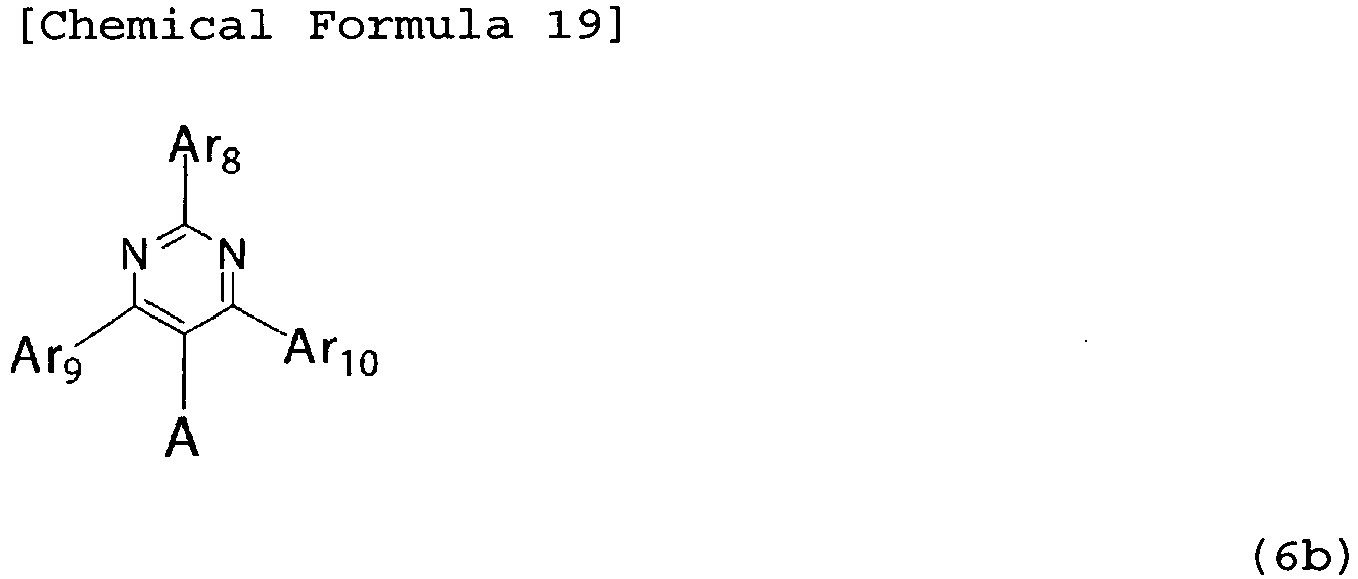
- In the formula, Ar8, Ar9, Ar10, and A have the same meanings as shown for the general formula (6).
- Ar11 in the general formula (7) is preferably a nitrogen-containing heterocyclic group, such as triazinyl, pyridyl, pyrimidinyl, pyrrolyl, quinolyl, isoquinolyl, indolyl, carbazolyl, benzoxazolyl, benzothiazolyl, quinoxalinyl, benzoimidazolyl, pyrazolyl, azafluorenyl, diazafluorenyl, naphthyridinyl, phenanthrolinyl, acridinyl, carbolinyl, azaspirobifluorenyl, and diazaspirobifluorenyl, further preferably triazinyl, pyridyl, pyrimidinyl, quinolyl, isoquinolyl, indolyl, quinoxalinyl, azafluorenyl, diazafluorenyl, benzoimidazolyl, naphthyridinyl, phenanthrolinyl, acridinyl, azaspirobifluorenyl, and diazaspirobifluorenyl, and particularly preferably pyridyl, pyrimidinyl, quinolyl, isoquinolyl, indolyl, azafluorenyl, diazafluorenyl, quinoxalinyl, benzoimidazolyl, naphthyridinyl, phenanthrolinyl, acridinyl, azaspirobifluorenyl, and diazaspirobifluorenyl.
- In the general formula (7), the binding position of Ar11 on the benzene ring is preferably the meta-position with respect to the binding position to the pyrimidine ring of the general formula (6) as shown in the following structural formula (7a) from the viewpoint of thin film stability.

- In the formula, Ar11 and R19 to R22 have the same meanings as shown for the general formula (7).
- A2 in the general formula (8) is preferably the "divalent group of a substituted or unsubstituted aromatic hydrocarbon" or a single bond, further preferably a divalent group that result from the removal of two hydrogen atoms from benzene, biphenyl, or naphthalene, or a single bond, and particularly preferably a single bond.
- Ar12 and Ar13 in the general formula (8) are preferably phenyl, biphenylyl, naphthyl, fluorenyl, indenyl, pyridyl, dibenzofuranyl, or pyridobenzofuranyl.
- Ar12 and Ar13 in the general formula (8) may bind to each other via a single bond, substituted or unsubstituted methylene, an oxygen atom, or a sulfur atom and via the substituent of these groups or directly to form a ring.
- In the general formula (8), at least one of R23 to R26 is preferably the "disubstituted amino group substituted by groups selected from an aromatic hydrocarbon group, an aromatic heterocyclic group, and a condensed polycyclic aromatic group", and the "aromatic hydrocarbon group", the "aromatic heterocyclic group", and the "condensed polycyclic aromatic group" in this case are preferably phenyl, biphenylyl, naphthyl, fluorenyl, indenyl, pyridyl, dibenzofuranyl, or pyridobenzofuranyl.
- In the general formula (8), an embodiment where adjacent two or all of R23 to R26 are vinyls, and the adjacent vinyls bind to each other via a single bond to form a condensed ring, that is an embodiment where the groups form a naphthalene ring or a phenanthrene ring with the benzene ring, to which R23 to R26 bind, is also preferable.
- In the general formula (8), an embodiment where any one of R23 to R26 is the "aromatic hydrocarbon group", and binds to the benzene ring, to which R23 to R26 bind, via substituted or unsubstituted methylene, an oxygen atom, or a sulfur atom to form a ring is preferable. In this case, an embodiment where the "aromatic hydrocarbon group" is phenyl, and binds to the benzene ring, to which R23 to R26 bind, via an oxygen atom or a sulfur atom to form a ring, that is an embodiment where the group forms a dibenzofuran ring or a dibenzothiophene ring with the benzene ring, to which R23 to R26 bind, is particularly preferable.
- In the general formula (8), an embodiment where any one of R27 to R29 is the "aromatic hydrocarbon group", and binds to the benzene ring, to which R27 to R29 bind, via substituted or unsubstituted methylene, an oxygen atom, or a sulfur atom to form a ring is preferable. In this case, an embodiment where the "aromatic hydrocarbon group" is phenyl, and binds to the benzene ring, to which R27 to R29 bind, via an oxygen atom or a sulfur atom to form a ring, that is an embodiment where the group forms a dibenzofuran ring or a dibenzothiophene ring is particularly preferable.
- In the amine derivative having a condensed ring structure of the general formula (8), as the embodiment where R23 to R29 bind to each other to form a ring, or the embodiment where R23 to R29 bind to the benzene rings, to which R23 to R29 bind, to form a ring, as described above, embodiments of the following general formulae (8a-a), (8a-b), (8b-a), (8b-b), (8b-c), (8b-d), (8c-a), and (8c-b) are preferably used.

- In the formulae, X and Y may be the same or different and represent an oxygen atom or a sulfur atom, and A2, Ar12, Ar13, R23 to R26, R29, and R30 to R31 have the same meanings as shown for the general formula (8).
- R30 and R31 in the general formula (8) are preferably the "substituted or unsubstituted aromatic hydrocarbon group", the "substituted or unsubstituted aromatic heterocyclic group", or the "substituted or unsubstituted condensed polycyclic aromatic group", further preferably phenyl, naphthyl, phenanthrenyl, pyridyl, quinolyl, isoquinolyl, or dibenzofuranyl, and particularly preferably phenyl.
- An embodiment where R30 and R31 bind to each other via a linking group, such as a single bond, substituted or unsubstituted methylene, an oxygen atom, a sulfur atom, or a monosubstituted amino group to form a ring is preferable, and an embodiment where the groups bind to each other via a single bond to form a ring is particularly preferable.
- In the amine derivative having a condensed ring structure of the general formula (8), as the embodiment where R30 and R31 bind to each other to form a ring as described above, embodiments of the following general formulae (8a-a1), (8a-b1), (8b-a1), (8b-b1), (8b-c1), (8b-dl), (8c-a1), and (8c-b1) are preferably used.


- In the formulae, X and Y may be the same or different and represent an oxygen atom or a sulfur atom, and A2, Ar12, Ar13, R23 to R26, and R29 have the same meanings as shown for the general formula (8).
- The arylamine compound of the general formula (1) preferably used in the organic EL device of the present invention can be used as a constitutive material of a hole injection layer or a hole transport layer of an organic EL device. The compound has high hole mobility and is a preferred compound as a material of a hole injection layer or a hole transport layer.
- The radialene derivative of the general formula (2) preferably used in the organic EL device of the present invention is a preferred compound as a p-type doping material for a material generally used in a hole injection layer or a hole transport layer of an organic EL device.
- The arylamine compound of general formula (3) having two triphenylamine structures in the molecule and the arylamine compound of general formula (4) having four triphenylamine structures in the molecule preferably used in the organic EL device of the present invention are a preferred compound as a constitutive material of a hole injection layer or a hole transport layer of an organic EL device.
- The compound of the general formula (5) having an anthracene ring structure preferably used in the organic EL device of the present invention is a preferred compound as a constitutive material of an electron transport layer of an organic EL device.
- The compound of the general formula (6) having a pyrimidine ring structure preferably used in the organic EL device of the present invention is a preferred compound as a constitutive material of an electron transport layer of an organic EL device.
- The amine derivative of the general formula (8) having a condensed ring structure preferably used in the organic EL device of the present invention can be used as a constitutive material of a light emitting layer of an organic EL device. The compound is excellent in light emission efficiency as compared to the ordinary materials, and is a preferred compound as a dopant material for a light emitting layer.
- The organic EL device of the present invention combines the materials for an organic EL device excellent in hole injection/transport performances, stability and durability as a thin film, taking the carrier balance into consideration. Therefore, as compared to the ordinary organic EL devices, the hole transport efficiency from the anode to the light emitting layer is improved (and furthermore the particular arylamine compound (having the particular structure) is used in the hole transport layer), and thereby the luminous efficiency is improved, and the durability of the organic EL device is improved, while retaining the lower driving voltage.
- Thus, an organic EL device having a low driving voltage, a high light emission efficiency, and a long lifetime can be attained.
- The organic EL device of the present invention can achieve an organic EL device having excellent hole injection/transport performance, low driving voltage, and high luminous efficiency, as a result of attaining efficient hole injection/transport from the electrode to the hole transport layer, by selecting the particular arylamine compound (having the particular structure) that can effectively achieves the hole injection/transport roles, as the material of the hole injection layer, and subjecting the electron acceptor to p-type doping.
- An organic EL device having high efficiency, low driving voltage and a long lifetime can be achieved as a result of attaining good carrier balance, by selecting the particular arylamine compound (having the particular structure) without p-type doping as the material of the hole injection layer.
- The organic EL device of the present invention can improve the luminous efficiency, particularly the durability, while retaining the low driving voltage of the conventional organic EL devices.
-
FIG. 1 is a diagram illustrating the configuration of the organic EL devices of Examples 52 to 59 and Comparative Examples 1 to 8. - The following presents specific examples of preferred compounds among the arylamine compounds of the general formula (1) preferably used in the organic EL device of the present invention. The present invention, however, is not restricted to these compounds.


- The arylamine compounds described above can be synthesized according to the known methods (refer to
Patent Document 7, for example). - The following presents specific examples of preferred compounds among the arylamine compounds of the general formula (3) preferably used in the organic EL device of the present invention. The present invention, however, is not restricted to these compounds.


- The following presents specific examples of preferred compounds of the arylamine compounds having two triphenylamine structures in the molecule among the triphenylamine compounds having a structure in which two to six triphenylamine structures in the molecule bind via a single bond or a divalent group that does not contain a heteroatom preferably used in the organic EL device of the present invention, in addition to the arylamine compounds of general formula (3). The present invention, however, is not restricted to these compounds.

- The following presents specific examples of preferred compounds among the arylamine compounds of the general formula (4) preferably used in the organic EL device of the present invention. The present invention, however, is not restricted to these compounds.


- The arylamine compounds of the general formula (3) and the arylamine compounds of the general formula (4) can be synthesized by a known method (refer to
Patent Documents 8 to 10, for example). - The following presents specific examples of preferred compounds among the compounds of the general formula (5a) preferably used in the organic EL device of the present invention and having an anthracene ring structure. The present invention, however, is not restricted to these compounds.


- The following presents specific examples of preferred compounds among the compounds of the general formula (5b) preferably used in the organic EL device of the present invention and having an anthracene ring structure. The present invention, however, is not restricted to these compounds.


- The following presents specific examples of preferred compounds among the compounds of the general formula (5c) preferably used in the organic EL device of the present invention and having an anthracene ring structure. The present invention, however, is not restricted to these compounds.


- The compounds described above having an anthracene ring structure can be synthesized by a known method (refer to Patent Documents 11 to 13, for example).
- The following presents specific examples of preferred compounds among the compounds of the general formula (6) preferably used in the organic EL device of the present invention and having a pyrimidine ring structure. The present invention, however, is not restricted to these compounds.


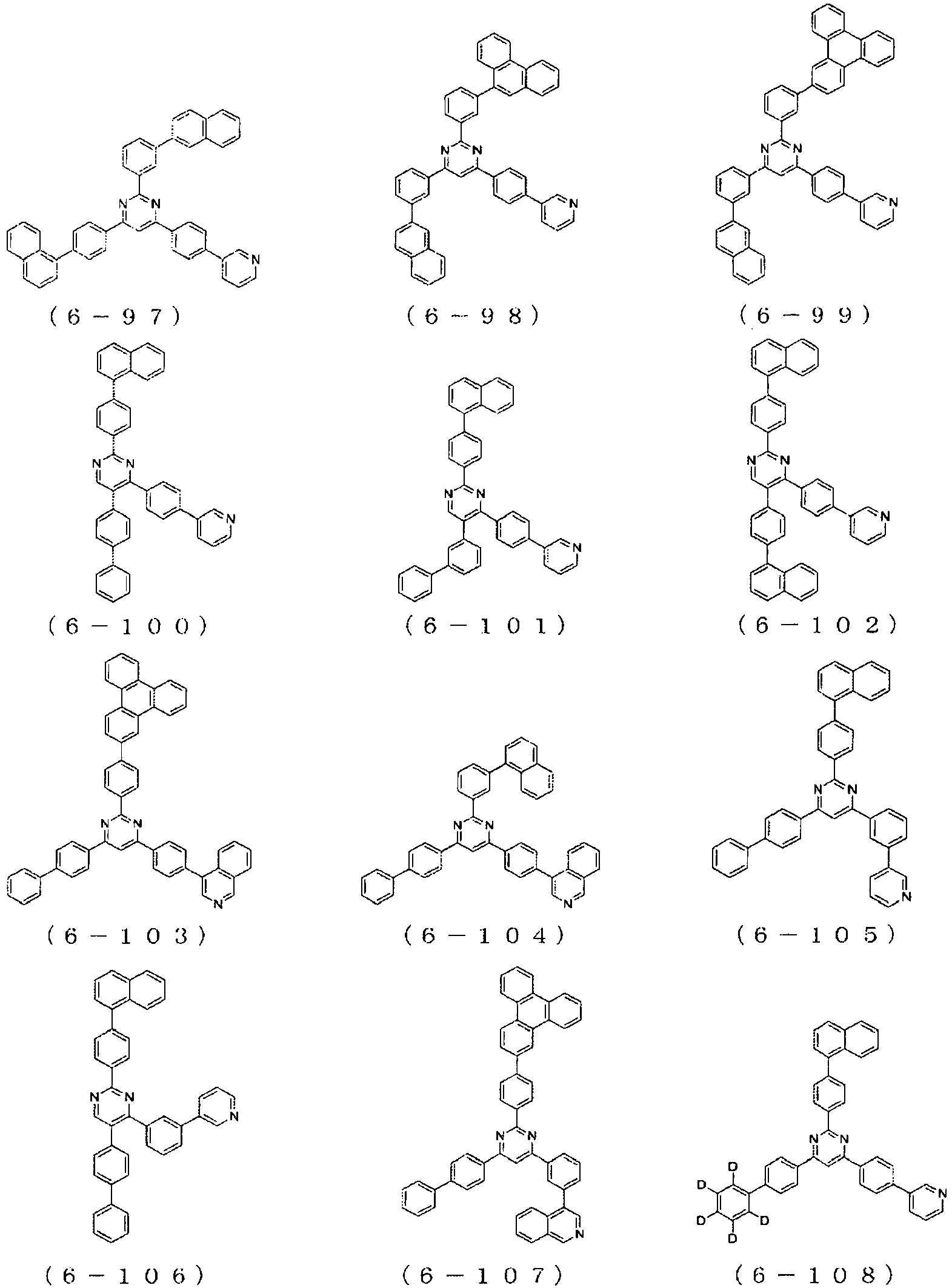


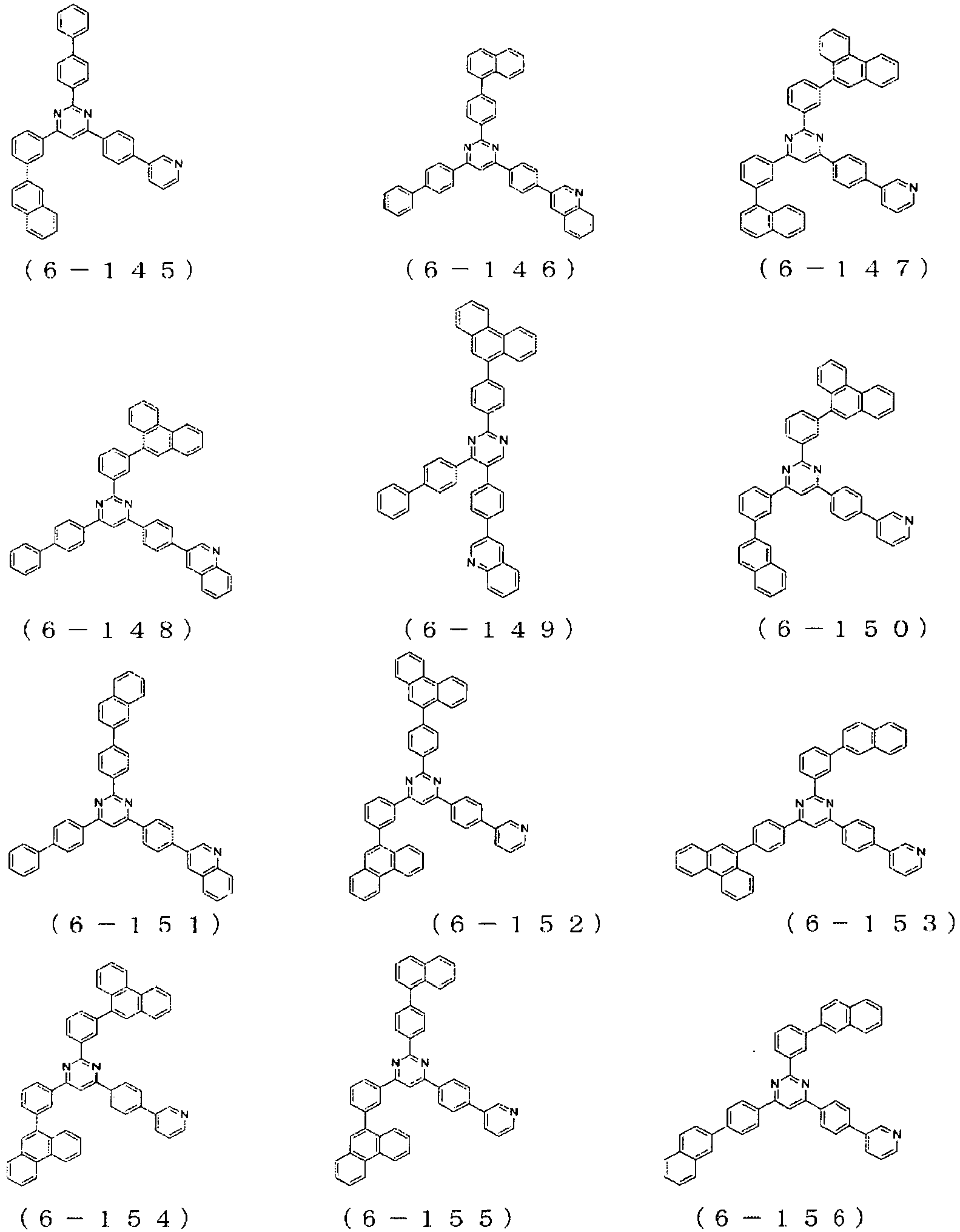





- The compounds described above having a pyrimidine ring structure can be synthesized by a known method (refer to Patent Document 13, for example).
- The following presents specific examples of preferred compounds among the amine derivatives of the general formula (8) preferably used in the organic EL device of the present invention and having a condensed ring structure. The present invention, however, is not restricted to these compounds.


- The arylamine compounds of the general formula (1) were purified by methods such as column chromatography, adsorption using, for example, a silica gel, activated carbon, or activated clay, recrystallization or crystallization using a solvent, and a sublimationpurificationmethod. The compounds were identified by an NMR analysis. A melting point, a glass transition point (Tg), and a work function were measured as material property values. The melting point can be used as an index of vapor deposition, the glass transition point (Tg) as an index of stability in a thin-film state, and the work function as an index of hole transportability and hole blocking performance.
- Other compounds used for the organic EL device of the present invention were purified by methods such as column chromatography, adsorption using, for example, a silica gel, activated carbon, or activated clay, and recrystallization or crystallization using a solvent, and finally purified by sublimation.
- The melting point and the glass transition point (Tg) were measured by a high-sensitive differential scanning calorimeter (DSC3100SA produced by Bruker AXS) using powder.
- For the measurement of the work function, a 100 nm-thick thin film was fabricated on an ITO substrate, and an ionization potential measuring device (PYS-202 produced by Sumitomo Heavy Industries, Ltd.) was used.
- The organic EL device of the present invention may have a structure including an anode, a hole injection layer, a hole transport layer, a light emitting layer, an electron transport layer, an electron injection layer, and a cathode successively formed on a substrate, optionally with an electron blocking layer between the hole transport layer and the light emitting layer, and a hole blocking layer between the light emitting layer and the electron transport layer. Some of the organic layers in the multilayer structure may be omitted, or may serve more than one function. For example, a single organic layer may serve as the electron injection layer and the electron transport layer. Further, the organic layers having a same function may have a laminate structure of two or more layers, for example, the hole transport layers may have a laminate structure of two or more layers, the light emitting layers may have a laminate structure of two or more layers, or the electron transport layers may have a laminate structure of two or more layers.
- Electrode materials with high work functions such as ITO and gold are used as the anode of the organic EL device of the present invention.
- As the hole injection layer of the organic EL device of the present invention, the arylamine compound of the general formula (1) subjected to p-type doping with an electron acceptor is preferably used.
- As a hole inj ection/transport material that can be mixed with or can be used simultaneously with the arylamine compound of the general formula (1), material such as starburst-type triphenylamine derivatives and various triphenylamine tetramers; porphyrin compounds as represented by copper phthalocyanine; accepting heterocyclic compounds such as hexacyanoazatriphenylene; coating-type polymer materials, and the like can be used. These materials may be formed into a thin film by a vapor deposition method or other known methods such as a spin coating method and an inkjet method.
- As the hole transport layer of the organic EL device of the present invention, the arylamine compound of the general formula (3) and the arylamine compound of the general formula (4) are preferably used.
- The compounds that are not subjected to p-type doping are preferably used.
- These may be individually formed into a film, may be used as a single layer formed with another hole transport material mixed, or may be formed as a laminated structure of the individually deposited layers, a laminated structure of the mixed layers, or a laminated structure of the individually deposited layer and the mixed layer. These materials may be formed into a thin-film by a vapor deposition method or other known methods such as a spin coating method and an inkjet method.
- As the electron blocking layer of the organic EL device of the present invention, the arylamine compound of the general formula (1) is preferably used, and in addition, compounds having an electron blocking effect can be used, for example, an arylamine compound having a structure in which four triphenylamine structures in the molecule are joined within a molecule via a single bond or a divalent group that does not contain a heteroatom, an arylamine compound having a structure in which two triphenylamine structures in the molecule are joined within a molecule via a single bond or a divalent group that does not contain a heteroatom, carbazole derivatives such as 4,4',4"-tri(N-carbazolyl)triphenylamine (TCTA), 9,9-bis[4-(carbazol-9-yl)phenyl]fluorene, 1,3-bis(carbazol-9-yl)benzene (mCP) , and 2,2-bis(4-carbazol-9-ylphenyl)adamantane (Ad-Cz) ; and compounds having a triphenylsilyl group and a triarylamine structure, as represented by 9-[4-(carbazol-9-yl)phenyl]-9-[4-(triphenylsilyl)phenyl]-9 H-fluorene. These may be individually formed into a film, may be used as a single layer formed with another hole transport material mixed, or may be formed as a laminated structure of the individually deposited layers, a laminated structure of the mixed layers, or a laminated structure of the individually deposited layer and the mixed layer. These materials may be formed into a thin-film by a vapor deposition method or other known methods such as a spin coating method and an inkjet method.
- In the organic EL device of the present invention, it is preferable that the electron acceptor in the layer adjacent to the light emitting layer (for example, the hole transport layer and the electron blocking layer) is not subjected to p-type doping.
- In these layers, the arylamine compound of the general formula (3) and the arylamine compound of the general formula (4) are preferably used, and the arylamine compound of the general formula (1) is particularly preferably used.
- The thicknesses of these layers are not particularly limited, as far as the thicknesses are ordinarily used, and may be, for example, 20 to 100 nm for the hole transport layer and 5 to 30 nm for the electron blocking layer.
- Examples of material used for the light emitting layer of the organic EL device of the present invention can be various metal complexes, anthracene derivatives, bis(styryl)benzene derivatives, pyrene derivatives, oxazole derivatives, and polyparaphenylene vinylene derivatives, in addition to quinolinol derivative metal complexes such as Alq3. Further, the light emitting layer may be made of a host material and a dopant material. Examples of the host material can be preferably anthracene derivatives. Other examples of the host material can be thiazole derivatives, benzimidazole derivatives, and polydialkyl fluorene derivatives, in addition to the above light-emitting materials. Examples of the dopant material can be preferably pyrene derivatives, amine derivatives of the general formula (8) having a condensed ring structure. Other examples of the dopant material can be quinacridone, coumarin, rubrene, perylene, derivatives thereof, benzopyran derivatives, indenophenanthrene derivatives, rhodamine derivatives, and aminostyryl derivatives. These may be individually deposited for film forming, may be used as a single layer deposited mixed with other materials, or may be formed as a laminate of individually deposited layers, a laminate of mixedly deposited layers, or a laminate of the individually deposited layer and the mixedly deposited layer.
- Further, the light-emitting material may be a phosphorescent material. Phosphorescent materials as metal complexes of metals such as iridium and platinum may be used. Examples of the phosphorescent materials include green phosphorescent materials such as Ir (ppy)3, blue phosphorescent materials such as FIrpic and FIr6, and red phosphorescent materials such as Btp2Ir(acac). Here, carbazole derivatives such as 4,4'-di(N-carbazolyl)biphenyl (CBP) , TCTA, and mCP may be used as the hole injecting and transporting host material. Compounds such as p-bis(triphenylsilyl)benzene (UGH2) and 2,2',2"-(1,3,5-phenylene)-tris(1-phenyl-1H-benzimidazole) (TPBI) may be used as the electron transporting host material. In this way, a high-performance organic EL device can be produced.
- In order to avoid concentration quenching, the doping of the host material with the phosphorescent light-emitting material should preferably be made by co-evaporation in a range of 1 to 30 weight percent with respect to the whole light emitting layer.
- Further, Examples of the light-emitting material may be delayed fluorescent-emitting material such as a CDCB derivative of PIC-TRZ, CC2TA, PXZ-TRZ, 4CzIPN or the like (refer to Non-Patent Document 3, for example).
- These materials may be formed into a thin-film by using a vapor deposition method or other known methods such as a spin coating method and an inkjet method.
- The hole blocking layer of the organic EL device of the present invention may be formed by using hole blocking compounds such as various rare earth complexes, triazole derivatives, triazine derivatives, and oxadiazole derivatives, in addition to the metal complexes of phenanthroline derivatives such as bathocuproin (BCP), and the metal complexes of quinolinol derivatives such as aluminum(III) bis(2-methyl-8-quinolinate)-4-phenylphenolate (BAlq). These materials may also serve as the material of the electron transport layer. These may be individually deposited for film forming, may be used as a single layer deposited mixed with other materials, or may be formed as a laminate of individually deposited layers, a laminate of mixedly deposited layers, or a laminate of the individually deposited layer and the mixedly deposited layer. These materials may be formed into a thin-film by using a vapor deposition method or other known methods such as a spin coating method and an inkjet method.
- Material used for the electron transport layer of the organic EL device of the present invention can be preferably the compounds of the general formula (5) having an anthracene ring structure, and the compounds of the general formula (6) having a pyrimidine ring structure. Other examples of material can be metal complexes of quinolinol derivatives such as Alq3 and BAlq, various metal complexes, triazole derivatives, triazine derivatives, oxadiazole derivatives, thiadiazole derivatives, carbodiimide derivatives, quinoxaline derivatives, phenanthroline derivatives, and silole derivatives. These may be individually deposited for film forming, may be used as a single layer deposited mixed with other materials, or may be formed as a laminate of individually deposited layers, a laminate of mixedly deposited layers, or a laminate of the individually deposited layer and the mixedly deposited layer. These materials may be formed into a thin-film by using a vapor deposition method or other known methods such as a spin coating method and an inkjet method.
- Examples of material used for the electron injection layer of the organic EL device of the present invention can be alkali metal salts such as lithium fluoride and cesium fluoride; alkaline earth metal salts such as magnesium fluoride; and metal oxides such as aluminum oxide. However, the electron injection layer may be omitted in the preferred selection of the electron transport layer and the cathode.
- The cathode of the organic EL device of the present invention may be made of an electrode material with a low work function such as aluminum, or an alloy of an electrode material with an even lower work function such as a magnesium-silver alloy, a magnesium-indium alloy, or an aluminum-magnesium alloy.
- The following describes an embodiment of the present invention in more detail based on Examples. The present invention, however, is not restricted to the following Examples.
- (Biphenyl-4-yl)-phenylamine (39.5 g), 4,4"-diiodo-1,1':4',1"-terphenyl (32.4g), a copper powder (0.42 g), potassium carbonate (27.8 g), 3,5-di-tert-butylsalicylic acid (1.69 g), sodium bisulfite (2.09 g), dodecylbenzene (32 ml), and toluene (50 ml) were added into a reaction vessel and heated up to 210°C while removing the toluene by distillation. After the obtained product was stirred for 30 hours, the product was cooled, and toluene (50 ml) and methanol (100 ml) were added. A precipitated solid was collected by filtration and washed with a methanol/water (5/1, v/v) mixed solution (500 ml) . The solid was heated after adding 1,2-dichlorobenzene (350 ml), and insoluble matter was removed by filtration. After the filtrate was left to cool, methanol (400 ml) was added, and a precipitated crude product was collected by filtration. The crude product was washed under reflux with methanol (500 ml) to obtain a gray powder of 4,4"-bis{(biphenyl-4-yl)-phenylamino}-1,1':4',1"-terphen yl (Compound 1-1; 45.8 g; yield 91%).
- The structure of the obtained gray powder was identified by NMR.
1H-NMR (CDCl3) detected 40 hydrogen signals, as follows.
δ (ppm) = 7.68-7.63 (4H), 7.62-7.48 (12H), 7.45 (4H), 7.38-7.10 (20H) .
- (Biphenyl-4-yl)-4-tolylamine (16.7 g), 4,4"-diiodo-1,1':4',1"-terphenyl (12.9g), a copper powder (0.17 g), potassium carbonate (11.2 g), 3,5-di-tert-butylsalicylic acid (0.71 g), sodium bisulfite (0.89 g), dodecylbenzene (20 ml), and toluene (20 ml) were added into a reaction vessel and heated up to 210°C while removing the toluene by distillation. The obtained product was stirred for 28 hours, and after the product was cooled, toluene (150 ml) was added, and insoluble matter was removed by filtration. Methanol (100 ml) was added, and a precipitated crude product was collected by filtration. Recrystallization of the crude product using a toluene/methanol mixed solvent was repeated three times to obtain a yellowish white powder of 4,4"-bis{(biphenyl-4-yl)-4-tolylamino}-1,1':4',1" -terphe nyl (Compound 1-10; 12.3 g; yield 61%).
- The structure of the obtained yellowish white powder was identified by NMR.
1H-NMR (CDCl3) detected 44 hydrogen signals, as follows.
δ (ppm) = 7.68-7.62 (4H), 7.61-7.41 (16H), 7.38-7.08 (18H), 2.38 (6H).

- (Biphenyl-4-yl)-(phenyl-d5)amine (25.3 g), 4,4"-diiodo-1,1':4',1"-terphenyl (20.3g), a copper powder (0.30 g), potassium carbonate (17.5 g), 3,5-di-tert-butylsalicylic acid (1.05 g), sodium bisulfite (1.31 g), dodecylbenzene (20 ml), and toluene (30 ml) were added into a reaction vessel and heated up to 210 °C while removing the toluene by distillation. After the obtained product was stirred for 23 hours, the product was cooled, and toluene (30 ml) and methanol (60 ml) were added. A precipitated solid was collected by filtration and washed with a methanol/water (1/5, v/v) mixed solution (180 ml) followed by washing with methanol (90 ml). An obtained gray powder was heated after adding 1, 2-dichlorobenzene (210 ml), and insoluble matter was removed by filtration. After the filtrate was left to cool, methanol (210 ml) was added, and a precipitated crude product was collected by filtration. The crude product was washed under reflux with methanol (210 ml) to obtain a gray powder of 4,4" -bis{(biphenyl-4-yl)-(phenyl-d5)amino}-1,1':4',1"-te rphenyl (Compound 1-14; 29.3 g; yield 96%).
- The structure of the obtained gray powder was identified by NMR.
1H-NMR (THF-d8) detected 30 hydrogen signals, as follows.
δ (ppm) =7.69 (4H), 7.65-7.52 (12H), 7.39 (4H), 7.28 (2H), 7.20-7.14 (8H).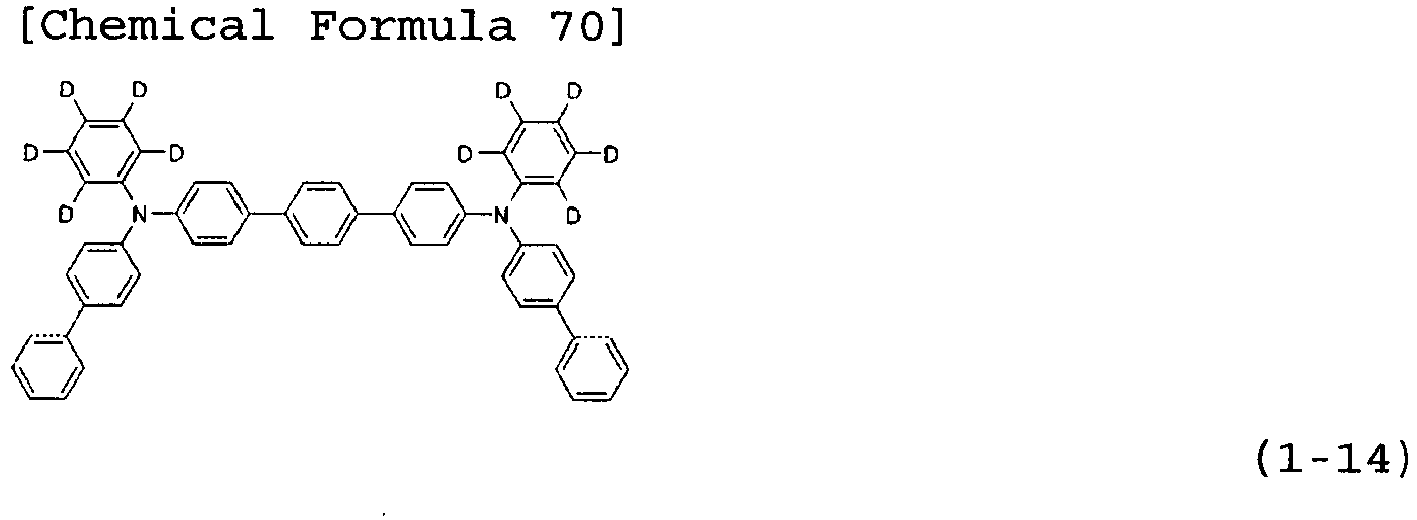
- (Naphthalen-1-yl)-phenylamine (40.0 g), 4,4"-diiodo-1,1' :4',1"-terphenyl (43.7 g), a copper powder (0.53 g), potassium carbonate (34.4 g), 3,5-di-tert-butylsalicylic acid (2.08 g), sodium bisulfite (2.60 g), dodecylbenzene (40 ml), and xylene (40 ml) were added into a reaction vessel and heated up to 210°C while removing the xylene by distillation. After the obtained product was stirred for 35 hours, the product was cooled. Toluene (100 ml) was added, and a precipitated solid was collected by filtration. 1,2-dichlorobenzene (210 ml) was added to the obtained solid, and the solid was dissolved under heat, and after silica gel (30 g) was added, insoluble matter was removed by filtration. After the filtrate was left to cool, a precipitated crude product was collected by filtration. The crude product was washed under reflux with methanol to obtain a pale yellow powder of 4,4"-bis{(naphthalen-1-yl)-phenylamino}-1,1':4',1"-terph enyl (Compound 1-2; 21.9 g; yield 40%).
- The structure of the obtained pale yellow powder was identified by NMR.
1H-NMR (THF-d8) detected 36 hydrogen signals, as follows.
δ (ppm) = 7.98-7.88 (4H), 7.80 (2H), 7.60 (4H), 7.52-7.40 (8H), 7.36 (4H), 7.18 (4H), 7.08-7.01 (8H), 6.93(2H).

- (Naphthalen-2-yl)-phenylamine (50.0 g), 4,4"-diiodo-1,1':4',1"-terphenyl (50.0g), tert-butoxy sodium (23 .9 g), and xylene (500 ml) were added into a reaction vessel and aerated with nitrogen gas for 1 hour under ultrasonic irradiation. Palladium acetate (0.47 g) and a toluene solution (2.96 ml) containing 50% (w/v) tri-tert-butylphosphine were added, and the mixture was heated up to 120°C and stirred for 15 hours. After the mixture was left to cool, the mixture was concentrated under reduced pressure, and methanol (300 ml) was added. A precipitated solid was collected by filtration and dissolved under heat after adding 1,2-dichlorobenzene (300 ml). After silica gel (140 g) was added, insoluble matter was removed by filtration. The filtrate was concentrated under reduced pressure, and after the product was purified by recrystallization with 1,2-dichlorobenzene (250 ml), the purified product was washed under reflux with methanol to obtain a white powder of 4,4"-bis{(naphthalen-2-yl)-phenylamino}-1,1':4',1"-terph enyl (Compound 1-6; 51.0 g; yield 74%).
- The structure of the obtained white powder was identified by NMR.
1H-NMR (THF-d8) detected 36 hydrogen signals, as follows.
δ (ppm) = 7.77 (4H), 7.70 (4H), 7.64-7.58 (6H), 7.48 (2H), 7.40-7.21 (10H), 7.21-7.12 (8H), 7.04 (2H).
- {(Biphenyl-2',3',4',5',6'-d5)-4-yl}-phenylamine (24.8 g), 4,4"-diiodo-1,1':4',1"-terphenyl (19.9 g), a copper powder (0.26 g), potassium carbonate (17.2 g), 3,5-di-tert-butylsalicylic acid (2.06 g), sodium bisulfite (1.30 g), and dodecylbenzene (20 ml) were added into a reaction vessel and heated up to 215°C. After the obtained product was stirred for 21 hours, the product was cooled, and toluene (30 ml) and methanol (60 ml) were added. A precipitated solid was collected by filtration and washed with a methanol/water (1/5, v/v) mixed solution. After adding 1,2-dichlorobenzene (300 ml) to the obtained solid, the solid was heated, and insoluble matter was removed by filtration. After the filtrate was left to cool, methanol (300 ml) was added, and a precipitate was collected by filtration to obtain a yellow powder of 4,44"-bis[{(biphenyl-2',3',4',5',6'-d5)-4-yl}-phenylamino] -1,1':4',1" -terphenyl (Compound 1-21; 25.5 g; yield 85%).
- The structure of the obtained yellow powder was identified by NMR.
1H-NMR (THF-d8) detected 30 hydrogen signals, as follows.
δ (ppm) = 7.69 (4H), 7.65-7.52 (8H), 7.28 (4H), 7.20-7.12 (10H), 7.03 (4H).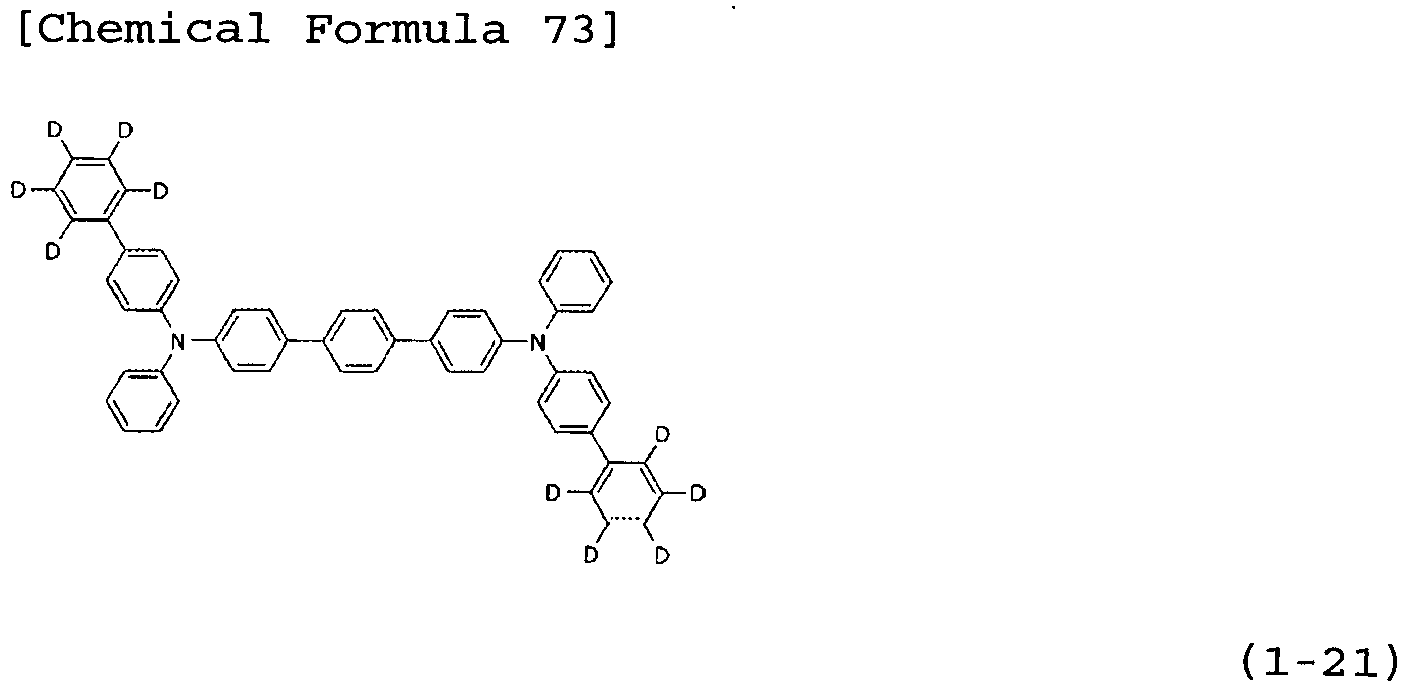
- (Biphenyl-3-yl)-(biphenyl-4-yl)amine (16.1 g), 4,4"-diiodo-1,1':4',1"-terphenyl (11.0 g), a copper powder (0.29 g), potassium carbonate (9.46 g), 3,5-di-tert-butylsalicylic acid (1.14 g), sodium bisulfite (0.71 g), and dodecylbenzene (22 ml) were added into a reaction vessel and heated up to 220°C. After the obtained product was stirred for 34 hours, the product was cooled, and toluene and heptane were added. A precipitated solid was collected by filtration and dissolved under heat after adding 1,2-dichlorobenzene (200 ml). After silica gel (50 g) was added, insoluble matter was removed by filtration. After the filtrate was concentrated under reduced pressure, toluene and acetone were added. A precipitated solid was collected by filtration, and the precipitated solid was crystallized with 1, 2-dichloromethane followed by crystallization with acetone, and further crystallized with 1, 2-dichloromethane followed by crystallization with methanol to obtain a pale yellow powder of 4,4"-bis{(biphenyl-3-yl)-(biphenyl-4-yl)amino}-1,1':4',1"-terphenyl (Compound 1-22; 25.5 g; yield 77%).
- The structure of the obtained pale yellow powder was identified by NMR.
1H-NMR (THF-d8) detected 48 hydrogen signals, as follows.
δ (ppm) = 7.71 (4H), 7.67-7.50 (16H), 7.47 (4H), 7.43-7.20 (20H), 7.12 (4H).
- (Phenanthren-9-yl)-phenylamine (16.9 g), 4,4"-diiodo-1,1':4',1"-terphenyl (12.6 g), a copper powder (0.16 g), potassium carbonate (10.9 g), 3,5-di-tert-butylsalicylic acid (0.65 g), sodium bisulfite (0.83 g), and dodecylbenzene (13 ml) were added into a reaction vessel and heated up to 210°C. After the obtained product was stirred for 23 hours, the product was cooled, and toluene (26 ml) and methanol (26 ml) were added. A precipitated solid was collected by filtration and washed with a methanol/water (1/5, v/v) mixed solution (120 ml). The precipitated solid was crystallized with 1,2-dichlorobenzene followed by crystallization with methanol to obtain a white powder of 4,4"-bis{(phenanthren-9-yl)-phenylamino}-1,1':4',1"-terp henyl (Compound 1-3; 9.38 g; yield 47%).
- The structure of the obtained yellow powder was identified by NMR.
1H-NMR (THF-d8) detected 40 hydrogen signals, as follows.
δ (ppm) = 8.88-8.73 (4H), 8.09 (2H), 7.71 (2H), 7.68-7.41 (18H), 7.21-7.10 (12H), 6.92 (2H).
- (Biphenyl-3-yl)-phenylamine (12.7 g), 4,4"-diiodo-1,1':4',1"-terphenyl (11.3 g), a copper powder (0.30 g), potassium carbonate (9.72 g), 3,5-di-tert-butylsalicylic acid (1.17 g), sodium bisulfite (0.73 g), and dodecylbenzene (23 ml) were added into a reaction vessel and heated up to 220°C. After the obtained product was stirred for 21 hours, the product was cooled, and after 1,2-dichlorobenzene (250 ml) and silica (30 g) were added, insoluble matter was removed by filtration. After the filtrate was concentrated under reduced pressure, heptane was added. A precipitated solid was collected by filtration, and the precipitated solid was crystallized with a 1,2-dichlorobenzene/heptane mixed solvent and further crystallized with a 1,2-dichlorobenzene/methanol mixed solvent to obtain a pale brown powder of 4,4"-bis{(biphenyl-3-yl)-phenylamino}-1,1':4',1"-terphen yl (Compound 1-5; 10.8 g; yield 64%).
- The structure of the obtained pale brown powder was identified by NMR.
1H-NMR (THF-d8) detected 40 hydrogen signals, as follows.
δ (ppm) = 7.69 (4H), 7.60 (4H), 7.52 (4H), 7.42-7.21 (16H), 7.20-7.13 (8H), 7.10-7.00 (4H).
- (Triphenylen-2-yl)-phenylamine (11.9 g), 4,4"-diiodo-1,1':4'1"-terphenyl (8.55 g), tert-butoxy sodium (4.09 g), and xylene (86 ml) were added into a reaction vessel and aerated with nitrogen gas for 40 minutes under ultrasonic irradiation. Palladium acetate (0.08 g) and a toluene solution (0.55 ml) containing 50% (w/v) tri-tert-butylphosphine were added, and the mixture was heated up to 100°C. After the mixture was stirred for 7 hours, the mixture was cooled. Methanol (80 ml) was added, and a precipitated solid was collected by filtration. 1,2-dichlorobenzene (300 ml) was added to the obtained solid, and the solid was heated, and after silica gel (45 g) was added, insoluble matter was removed by filtration. The filtrate was concentrated under reduced pressure, and after purified by recrystallization with 1,2-dichlorobenzene, the purified product was washed under reflux with methanol to obtain a pale yellowish green powder of 4,4"-bis{(triphenylen-2-yl)-phenylamino}-1,1':4',1"-terp henyl (Compound 1-23; 11.4 g; yield 74%).
- The structure of the obtained pale yellowish green powder was identified by NMR.
1H-NMR (THF-d8) detected 44 hydrogen signals, as follows.
δ (ppm) = 8.72-8.62 (8H), 8.45 (2H), 8.36 (2H), 7.75 (4H), 7.70-7.21 (26H), 7.09 (2H).
- Di(naphthalen-2-yl)amine (12.2 g), 4,4"-diiodo-1',1':4',1"-terphenyl (9.49 g), a copper powder (0.14 g), potassium carbonate (8.2 g), 3,5-di-tert-butylsalicylic acid (0.51 g), sodium bisulfite (0.69 g), dodecylbenzene (15 ml), and toluene (20 ml) were added into a reaction vessel and heated up to 210°C while removing the toluene by distillation. After the obtained product was stirred for 28 hours, the product was cooled, and 1,2-dichlorobenzene (20 ml) and methanol (20 ml) were added. A precipitated solid was collected by filtration and washed with a methanol/water (1/4, v/v) mixed solution (200 ml). Then, the solid was dissolved under heat after adding 1,2-dichlorobenzene (100 ml), and after silica gel was added, insoluble matter was removed by filtration. After the filtrate was left to cool, methanol (250 ml) was added, and a precipitated solid was collected by filtration. The precipitated solid was crystallized with a 1,2-dichlorobenzene/methanol mixed solvent followed by washing under reflux with methanol to obtain a yellowish white powder of 4,4"-bis{di(naphthalen-2-yl)amino}-1,1':4',1"-terphenyl (Compound 1-24; 10.5 g; yield 70%).
- The structure of the obtained yellowish white powder was identified by NMR.
1H-NMR (THF-d8) detected 40 hydrogen signals, as follows.
δ (ppm) = 7.82-7.75 (6H), 7.72 (4H), 7.68-7.60 (8H), 7.56 (4H), 7.40-7.30 (14H), 7.24 (4H).
- {4-(Naphthalen-2-yl)phenyl}-phenylamine (16.6 g), 4,4"-diiodo-1',1':4',1"-terphenyl (11.8 g), a copper powder (0.18 g), potassium carbonate (10.5 g), 3,5-di-tert-butylsalicylic acid (0.61 g), sodium bisulfite (0.83 g), dodecylbenzene (15ml), and toluene (20ml) were added into a reaction vessel and heated up to 210°C while removing the toluene by distillation. After the obtained product was stirred for 19 hours, the product was cooled, and toluene (20 ml) and methanol (20 ml) were added. A precipitated solid was collected by filtration, washed with a methanol/water (1/4, v/v) mixed solution (180 ml), and further washed with methanol (100 ml). An obtained brownish yellow powder was heated after adding 1,2-dichlorobenzene (175 ml), and insoluble matter was removed by filtration. After the filtrate was left to cool, methanol (200 ml) was added, and a precipitated solid was collected by filtration. The precipitated solid was crystallized with a 1,2-dichlorobenzene/methanol mixed solvent followed by washing under reflux with methanol to obtain a brownish white powder of 4,4"-bis[{4-(naphthalen-2-yl)phenyl}-phenylamino]-1,1':4' ,1"-terphenyl (Compound 1-25; 11.9 g; yield 53%).
- The structure of the obtained brownish white powder was identified by NMR.
1H-NMR (THF-d8) detected 44 hydrogen signals, as follows.
δ (ppm) = 8.10 (2H), 7.93-7.78 (8H), 7.76-7.70 (8H), 7.62 (4H), 7.44 (4H), 7.30 (4H), 7.25-7.16 (12H), 7.05 (2H).
- (4'-Bromo-1,1'-biphenyl-4-yl)-14-(1-phenyl-indol-4-y 1)phenyl}-phenylamine (7.25 g), {4-(4,4,5,5-tetramethyl-1,3,2-dioxabororan-2-yl)phenyl}-(1 ,1'-biphenyl-4-yl)-phenylamine (5.76 g), a 2 M potassium carbonate aqueous solution (12.3 ml), toluene (80 ml), and ethanol (20 ml) were added into a reaction vessel and aerated with nitrogen gas for 40 minutes under ultrasonic irradiation. After adding tetrakistriphenylphosphinepalladium (0.43 g), the mixture was heated and refluxed for 7 hours while being stirred. After the mixture was left to cool, water (50 ml) and toluene (100 ml) were added, and insoluble matter was removed by filtration. An organic layer was collected by liquid separation, then dried over anhydrous magnesium sulfate and concentrated under reduced pressure to obtain a crude product. After the crude product was purified by column chromatography (support: silica gel, eluent: toluene/heptane), the purified product was crystallized with THF followed by crystallization with methanol to obtain a pale yellow powder of 4-{(biphenyl-4-yl)-phenylamino}-4"-[{4-(1-phenyl-indol-4-yl)phenyl}-phenylamino]-1,1':4',1"-terphenyl (Compound 1-26; 6.80 g; yield 67%).
- The structure of the obtained pale yellow powder was identified by NMR.
1H-NMR (THF-d8) detected 45 hydrogen signals, as follows.
δ (ppm) = 7.70 (4H), 7.68-7.50 (16H), 7.42-7.11 (23H), 7.05 (1H), 6.88 (1H).
- 3-Bromoiodobenzene (8.83 g), (biphenyl-4-yl)-{4-(4,4,5,5-tetramethyl-[1,3,2]dioxaborola n-2-yl)phenyl}-phenylamine (30.5 g), potassium carbonate (13.0 g), water (30 ml), toluene (300 ml), and ethanol (75 ml) were added into a nitrogen-substituted reaction vessel and aerated with nitrogen gas under ultrasonic irradiation for 30 minutes. The mixture was heated after adding tetrakis(triphenylphosphine)palladium (1.1g), and stirred at 80°C for 16 hours. The mixture was cooled to a room temperature, and methanol (300 ml) was added. A precipitated solid was collected by filtration, and the solid was dissolved under heat after adding 1,2-dichlorobenzene (270 ml). Silica gel (16 g) was added, and the mixture was stirred for 30 minutes. After insoluble matter was removed by filtration, a crude product precipitated by adding methanol (300 ml) was collected by filtration. The crude product was washed under reflux with methanol (200 ml) to obtain a white powder of 4,4"-bis{(biphenyl-4-yl)-phenylamino}-1,1':3',1"-terphen yl (Compound 1-27; 14.3 g; yield 71%).
- The structure of the obtained white powder was identified by NMR.
1H-NMR (CDCl3) detected 40 hydrogen signals, as follows.
δ (ppm) = 7.87 (1H), 7.64-7.50 (12H), 7.48-7.32 (6H), 7.31-6.98 (21H).
- 1,3-dibromobenzene (6.51 g), (biphenyl-4-yl)-{4-(4,4,5,5-tetramethyl-[1,3,2]dioxaborola n-2-yl)phenyl}-(phenyl-d5)amine (26.9 g), potassium carbonate (11.4 g), water (50ml), toluene (200 ml), and ethanol (50 ml) were added into a nitrogen-substituted reaction vessel and aerated with nitrogen gas under ultrasonic irradiation for 30 minutes. The mixture was heated after adding tetrakis(triphenylphosphine)palladium (0.95 g), and stirred at 70°C for 12 hours. The mixture was cooled to a room temperature, and methanol (200 ml) was added. A precipitated solid was collected by filtration, and the solid was dissolved under heat after adding 1, 2-dichlorobenzene (400 ml). Silica gel (20 g) was added, and the mixture was stirred for 30 minutes . After insoluble matter was removed by filtration, a precipitate formed by adding methanol (500 ml) was collected by filtration. The precipitate was dissolved by adding 1, 2-dichlorobenzene (100 ml), and a crude product precipitated by adding toluene (100 ml) and methanol (100 ml) was collected by filtration. The crude product was washed under reflux with methanol (250 ml) to obtain a white powder of 4,4"-bis{(biphenyl-4-yl)-(phenyl-d5)amino}-1,1':3',1"-te rphenyl (Compound 1-28; 18.3 g; yield 91%).
- The structure of the obtained white powder was identified by NMR.
1H-NMR (CDCl3) detected 30 hydrogen signals, as follows.
δ (ppm) = 7.87 (1H), 7.64-7.32 (18H), 7.31-6.98 (11H).
- The reaction was carried out under the same conditions as those of Example 15, except that (biphenyl-4-yl)-{4-(4,4,5,5-tetramethyl-[1,3,2]dioxaborola n-2-yl)phenyl}-(phenyl-d5)amine was replaced with (naphthalen-1-yl)-{4-(4,4,5,5-tetramethyl-[1,3,2]dioxaboro lan-2-yl)phenyl}-phenylamine. As a result, a white powder of 4,4"-bis{(naphthalen-1-yl)-phenylamino}-1,1':3',11"-terph enyl (Compound 1-29; 8.8 g; yield 59%) was obtained.
- The structure of the obtained white powder was identified by NMR.
1H-NMR (CDCl3) detected 36 hydrogen signals, as follows.
δ (ppm) = 7.99 (2H), 7.92 (2H), 7.81 (2H), 7.72 (1H), 7.57-6.92 (29H).
- The reaction was carried out under the same conditions as those of Example 15, except that (biphenyl-4-yl)-{4-(4,4,5,5-tetramethyl-[1,3,2]dioxaborola n-2-yl)phenyl}-(phenyl-d5)amine was replaced with {4-(dibenzofuran-4-yl)phenyl}-{4-(4,4,5,5-tetramethyl-[1,3 ,2]dioxaborolan-2-yl)phenyl}-phenylamine. As a result, a white powder of 4,4"-bis[{4-(dibenzofuran-4-yl)phenyl}-phenylamino]-1,1': 3',1"-terphenyl (Compound 1-32; 6.8 g; yield 86%) was obtained.
- The structure of the obtained white powder was identified by NMR.
1H-NMR (CDCl3) detected 44 hydrogen signals, as follows.
δ (ppm) = 8.01 (2H), 7.97-7.82 (8H), 7.67-7.24 (34H).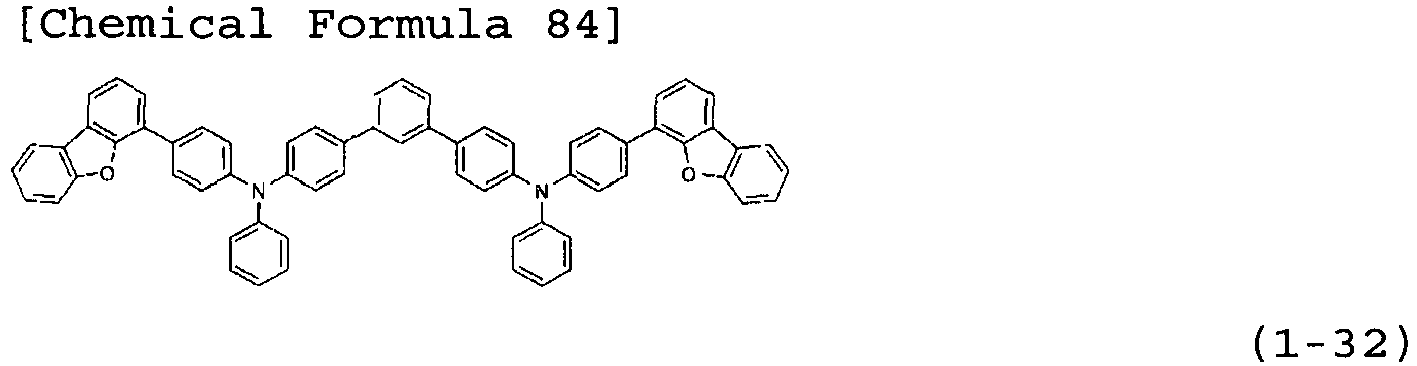
- 4-Bromo-4'-{(biphenyl-4-yl)-phenylamino}-biphenyl (16.8 g), (biphenyl-4-yl)-{2-(4,4,5,5-tetramethyl-[1,3,2]dioxaborola n-2-yl)phenyl}-phenylamine (19.0 g), potassium carbonate (7.4 g), water (26 ml), toluene (200 ml), and ethanol (50 ml) were added into a nitrogen-substituted reaction vessel and aerated with nitrogen gas under ultrasonic irradiation for 30 minutes. After adding tetrakis (triphenylphosphine) palladium (0.87 g), the mixture was heated and refluxed for 20 hours while being stirred. After the mixture was cooled to a room temperature, an organic layer was collected by liquid separation, then dried over anhydrous magnesium sulfate and concentrated to obtain a crude product. After the crude product was purified by column chromatography (support: silica gel, eluent: heptane/toluene), the purified product was crystallized with an ethyl acetate/methanol mixed solvent to obtain a white powder of 2,4"-bis{(biphenyl-4-yl)-phenylamino}-1,1':4',1"-terphen yl (Compound 1-50; 20.8 g; yield 82%).
- The structure of the obtained white powder was identified by NMR.
1H-NMR (CDCl3) detected 40 hydrogen signals, as follows.
δ (ppm) = 7.61 (2H), 7.56-6.83 (38H).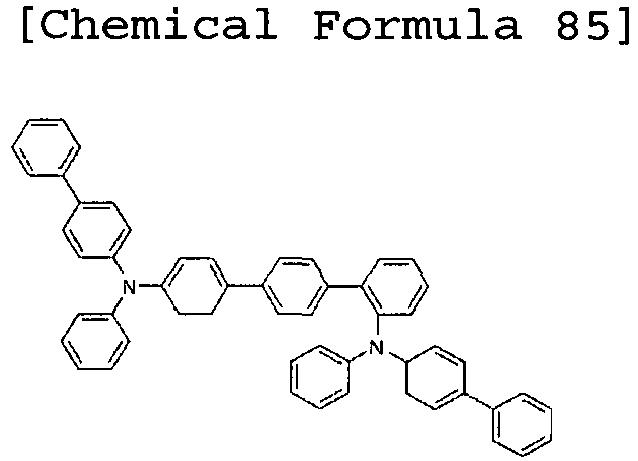

- 4,4"-Dibromo-1,1':3',1"-terphenyl (8.2 g), (triphenylen-2-yl)-phenylamine (15.4 g), tert-butoxy sodium (5.1 g), and toluene (180 ml) were added into a nitrogen-substituted reaction vessel and aerated with nitrogen gas under ultrasonic irradiation for 30 minutes. Palladium acetate (0.11 g) and a toluene solution (0.31 ml) containing 50% (w/v) tri-tert-butylphosphine were added, and the mixture was heated and refluxed for 5 hours while being stirred.
- The mixture was cooled to a room temperature and subjected to an extraction procedure using 1,2-dichlorobenzene and then to purification by adsorption with a silica gel, followed by crystallization with a 1,2-dichlorobenzene/methanol mixed solvent to obtain a yellowish white powder of 4,4"-bis{(triphenylen-2-yl)-phenylamino}-1,1':3',1"-terp henyl (Compound 1-51; 11.67 g; yield 64%).
- The structure of the obtained yellowish white powder was identified by NMR.
1H-NMR (CDCl3) detected 44 hydrogen signals, as follows.
δ (ppm) = 8.67 (4H), 8.57 (4H), 8.41 (2H), 8.36 (2H), 7.88 (1H), 7.70-7.10 (31H).
- The reaction was carried out under the same conditions as those of Example 19, except that (triphenylen-2-yl)-phenylamine was replaced with (phenanthren-9-yl)-phenylamine. As a result, a yellowish white powder of 4,4"-bis{(phenanthren-9-yl)-phenylamino}-1,1':3',1"-terp henyl (Compound 1-52; 8.0 g; yield 50%) was obtained.
- The structure of the obtained yellowish white powder was identified by NMR.
1H-NMR (CDCl3) detected 40 hydrogen signals, as follows.
δ (ppm) = 8.81-8.71 (4H), 8.10 (2H), 7.83-7.39 (20H), 7.29-6.97 (14H).
- 2-{(biphenyl-4-yl)-phenylamino}-4"-bromo-1,1':4',1' '-terphenyl (12.1 g), bis(biphenyl-4-yl)amine (8.0 g), tris(dibenzylideneacetone)palladium (0.6 g), tri-tert-butylphosphine (0.22 g), and tert-butoxy sodium (6.3 g) were added into a nitrogen-substituted reaction vessel, heated and refluxed for 3 hours while being stirred. After the mixture was cooled to a room temperature, methanol (600 ml) was added, and a precipitated crude product was collected by filtration. The crude product was dissolved in toluene, and after insoluble matter was removed by filtration, purification by crystallization with methanol was carried out. Then, recrystallization with a THF/methanol mixed solvent was carried out to obtain a white powder of 4-{bis(biphenyl-4-yl)amino}-2"-{(biphenyl-4-yl)-phenylami no}-1,1':4',1"-terphenyl (Compound 1-53; 15 g; yield 87%).
- The structure of the obtained white powder was identified by NMR.
1H-NMR (CDCl3) detected 44 hydrogen signals, as follows.
δ (ppm) = 7.62 (4H), 7.58-6.91 (38H), 6.87 (2H).
- The reaction was carried out under the same conditions as those of Example 15, except that (biphenyl-4-yl)-{4-(4,4,5,5-tetramethyl-[1,3,2]dioxaborola n-2-yl)phenyl}-(phenyl-d5)amine was replaced with (naphthalen-1-yl)-{4-(4,4,5,5-tetramethyl-[1,3,2]dioxaboro lan-2-yl)phenyl}-(phenyl-d5)amine. As a result, a white powder of 4,4"-bis{(naphthalen-1-yl)-(phenyl-d5)amino}-1,1':3',1"-terphenyl (Compound 1-54; 5.2 g; yield 30%) was obtained.
- The structure of the obtained white powder was identified by NMR.
1H-NMR (CDCl3) detected 26 hydrogen signals, as follows.
δ (ppm) = 7.99 (2H), 7.92 (2H), 7.81 (2H), 7.72 (1H), 7.55-7.36 (15H), 7.13-7.07 (4H).
- The reaction was carried out under the same conditions as those of Example 18, except that (biphenyl-4-yl)-{2-(4,4,5,5-tetramethyl-[1,3,2]dioxaborola n-2-yl)phenyl}-phenylamine was replaced with bis(biphenyl-4-yl)-{2-(4,4,5,5-tetramethyl-[1,3,2]dioxabor olan-2-yl)phenyl}amine. As a result, a white powder of 2-{bis(biphenyl-4-yl)amino}-4"-{(biphenyl-4-yl)-phenylami no}-1,1':4',1"-terphenyl (Compound 1-56; 15.7 g; yield 94%) was obtained.
- The structure of the obtained white powder was identified by NMR.
1H-NMR (CDCl3) detected 44 hydrogen signals, as follows.
δ (ppm) = 7.60 (2H), 7.56-6.97 (42H).
- The reaction was carried out under the same conditions as those of Example 18, except that 4-bromo-4'-{(biphenyl-4-yl)-phenylamino}-biphenyl was replaced with 4-bromo-4'-{bis(biphenyl-4-yl)amino}-biphenyl, and (biphenyl-4-yl)-{2-(4,4,5,5-tetramethyl-[1,3,2]dioxaborola n-2-yl)phenyl}-phenylamine was replaced with 2-{bis(biphenyl-4-yl)amino}phenylboronic acid. As a result, a white powder of 2,4"-bis{bis(biphenyl-4-yl)amino}-1,1':4',1"-terphenyl (Compound 1-57; 12 g; yield 76%) was obtained.
- The structure of the obtained white powder was identified by NMR.
1H-NMR (CDCl3) detected 48 hydrogen signals, as follows.
δ (ppm) = 7.65-6.98 (48H).
- The reaction was carried out under the same conditions as those of Example 19, except that (triphenylen-2-yl)-phenylamine was replaced with (biphenyl-4-yl)-(naphthalen-1-yl)amine. As a result, a white powder of 4,4"-bis{(biphenyl-4-yl)-(naphthalen-1-yl)amino}-1,1':3', 1"-terphenyl (Compound 1-59; 6.4 g; yield 36%) was obtained.
- The structure of the obtained white powder was identified by NMR.
1H-NMR (CDCl3) detected 44 hydrogen signals, as follows.
δ (ppm) = 8.02 (2H), 7.94 (2H), 7.84 (2H), 7.76 (1H), 7.62-7.38 (27H), 7.33 (2H), 7.19-7.13 (8H).
- The reaction was carried out under the same conditions as those of Example 19, except that (triphenylen-2-yl)-phenylamine was replaced with (9,9-dimethyl-9H-fluoren-2-yl)-phenylamine. As a result, a white powder of 4,4"-bis{(9,9-dimethyl-9H-fluoren-2-yl)-phenylamino}-1,1' :3',1"-terphenyl (Compound 1-60; 14.6 g; yield 80%) was obtained.
- The structure of the obtained white powder was identified by NMR.
1H-NMR (CDCl3) detected 48 hydrogen signals, as follows.
δ (ppm) = 7.84 (1H), 7.70-7.03 (35H), 1.48 (12H).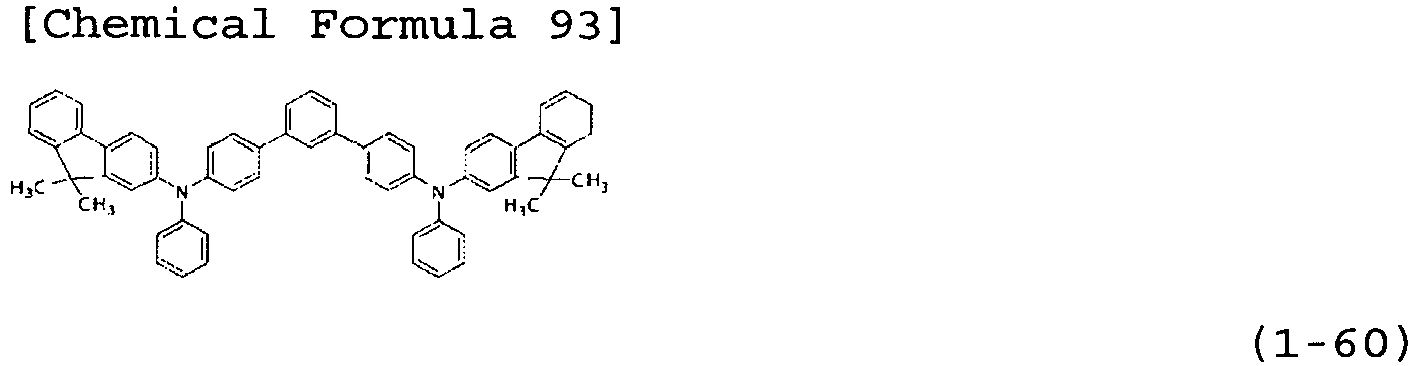
- The reaction was carried out under the same conditions as those of Example 18, except that 4-bromo-4'-{(biphenyl-4-yl)-phenylamino}-biphenyl was replaced with 4-bromo-4'-{(naphthalen-1-yl)-phenylamino}-biphenyl, and (biphenyl-4-yl)-{2-(4,4,5,5-tetramethyl-[1,3,2]dioxaborola n-2-yl)phenyl}-phenylamine was replaced with 2-{bis(biphenyl-4-yl)amino}phenylboronic acid. As a result, a white powder of 2-{bis(biphenyl-4-yl)amino}-4"-{(naphthalen-1-yl)-phenyla mino}-1,1':4',1"-terphenyl (Compound 1-62; 12.8 g; yield 75%) was obtained.
- The structure of the obtained white powder was identified by NMR.
1H-NMR (CDCl3) detected 42 hydrogen signals, as follows.
δ (ppm) = 7.99 (2H), 7.93 (2H), 7.81 (2H), 7.57-6.96 (36H) .
- The reaction was carried out under the same conditions as those of Example 18, except that 4-bromo-4'-{(biphenyl-4-yl)-phenylamino}-biphenyl was replaced with 4-bromo-4'-{(9,9-dimethyl-9H-fluoren-2-yl)-phenylamino}-bi phenyl. As a result, a white powder of 2-{(biphenyl-4-yl)-phenylamino}-4"-{(9,9-dimethyl-9H-fluo ren-2-yl)-phenylamino}-1,1':4',1"-terphenyl (Compound 1-63; 11.7 g; yield 73%) was obtained.
- The structure of the obtained white powder was identified by NMR.
1H-NMR (CDCl3) detected 44 hydrogen signals, as follows.
δ (ppm) = 7.68 (1H), 7.64-6.84 (37H), 1.48 (6H).

- The reaction was carried out under the same conditions as those of Example 19, except that 4,4"-dibromo-1,1':3',1"-terphenyl was replaced with 4,4"-dibromo-1,1':2',1"-terphenyl, and (triphenylen-2-yl)-phenylamine was replaced with (biphenyl-4-yl)-(naphthalen-1-yl)amine. As a result, a white powder of 4,4"-bis{(biphenyl-4-yl)-(naphthalen-1-yl)amino}-1,1':2', 1"-terphenyl (Compound 1-67; 5.0 g; yield 30%) was obtained.
- The structure of the obtained white powder was identified by NMR.
1H-NMR (CDCl3) detected 44 hydrogen signals, as follows.
5 (ppm) = 7.93-7.84 (4H), 7.79 (2H), 7.60-7.26 (24H), 7.25-6.92 (14H).
- The reaction was carried out under the same conditions as those of Example 19, except that 4,4"-dibromo-1,1':3',1"-terphenyl was replaced with 4,4"-dibromo-1,1':2',1"-terphenyl, and (triphenylen-2-yl)-phenylamine was replaced with {4-(naphthalen-1-yl)phenyl}-phenylamine. As a result, a white powder of 4,4"-bis[{4-(naphthalen-1-yl)phenyl}-phenylamino]-1,1':2' ,1"-terphenyl (Compound 1-68; 7.3 g; yield 43%) was obtained.
- The structure of the obtained white powder was identified by NMR.
1H-NMR (CDCl3) detected 44 hydrogen signals, as follows.
δ (ppm) = 8.01 (2H), 7.91 (2H), 7.84 (2H), 7.53-6.98 (38H) .
- The reaction was carried out under the same conditions as those of Example 14, except that 3-bromoiodobenzene was replaced with 1,3-diiodobenzene, and (biphenyl-4-yl)-{4-(4,4,5,5-tetramethyl-[1,3,2]dioxaborola n-2-yl)phenyl}-phenylamine was replaced with 2-[{4-(naphthalen-1-yl)phenyl}-phenylamino]-phenylboronic acid. As a result, a white powder of 2,2"-bis[{4-(naphthalen-1-yl)phenyl}-phenylamino]-1,1':3' ,1"-terphenyl (Compound 1-69; 7.3 g; yield 43%) was obtained.
- The structure of the obtained white powder was identified by NMR.
1H-NMR (CDCl3) detected 44 hydrogen signals, as follows.
δ (ppm) = 7.94-6.85 (44H).
- The reaction was carried out under the same conditions as those of Example 19, except that (triphenylen-2-yl)-phenylamine was replaced with 14-(naphthalen-1-yl)phenyll-phenylamine. As a result, a white powder of 4,4"-bis[4-(naphthalen-1-yl)phenyl}-phenylamino]-1,1':3' ,1"-terphenyl (Compound 1-71; 16.7 g; yield 79%) was obtained.
- The structure of the obtained white powder was identified by NMR.
1H-NMR (CDCl3) detected 44 hydrogen signals, as follows.
δ (ppm) = 8.08 (2H), 7.94 (2H), 7.90-7.80 (3H), 7.65-7.00 (37H).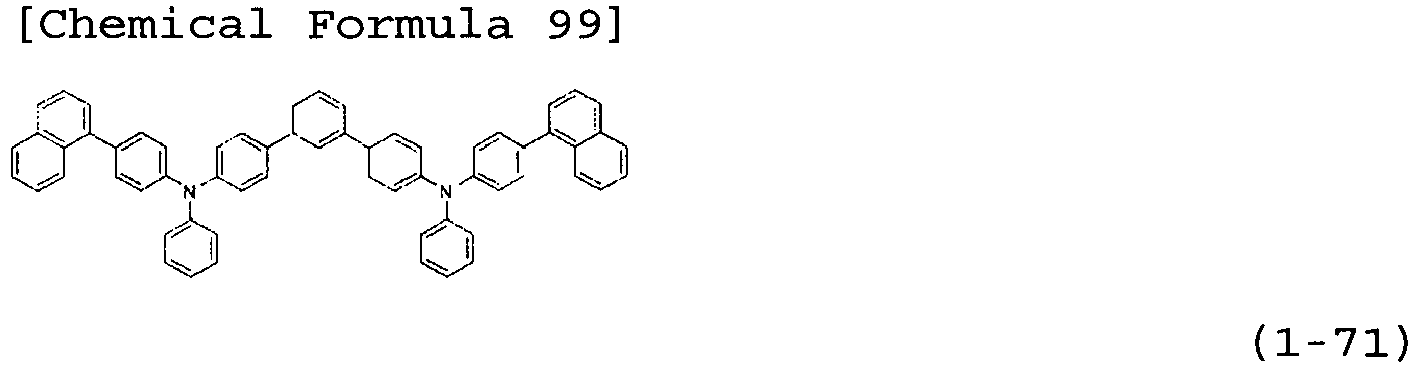
- The reaction was carried out under the same conditions as those of Example 15, except that 1,3-dibromobenzene was replaced with 1,4-dibromobenzene, and (biphenyl-4-yl)-{4-(4,4,5,5-tetramethyl-[1,3,2]dioxaborola n-2-yl)phenyl}-(phenyl-d5)amine was replaced with 2-{(9,9-dimethyl-9H-fluoren-2-yl)-phenylamino}-phenylboron ic acid. As a result, a white powder of 2,2"-bis{(9,9-dimethyl-9H-fluoren-2-yl)-phenylamino}-1,1' :4',1"-terphenyl (Compound 1-75; 13.7 g; yield 76%) was obtained.
- The structure of the obtained white powder was identified by NMR.
1H-NMR (THF-d8) detected 48 hydrogen signals, as follows.
δ (ppm) = 7.53 (2H), 7.35-6.81 (30H), 6.76 (2H), 6.67 (2H), 1.29 (12H).
- The reaction was carried out under the same conditions as those of Example 15, except that 1,3-dibromobenzene was replaced with 1,4-dibromobenzene, and (biphenyl-4-yl)-{4-(4,4,5,5-tetramethyl-[1,3,2]dioxaborola n-2-yl)phenyl}-(phenyl-d5)amine was replaced with 2-{bis(biphenyl-4-yl)amino}-phenylboronic acid. As a result, a white powder of 2,2"-bis{bis(biphenyl-4-yl)amino}-1,1':4',1"-terphenyl (Compound 1-76; 15.7 g; yield 78%) was obtained.
- The structure of the obtained white powder was identified by NMR.
1H-NMR (THF-d8) detected 48 hydrogen signals, as follows.
δ (ppm) = 7.51-7.45 (8H), 7.33-7.18 (28H), 7.00 (4H), 6.90-6.82 (8H).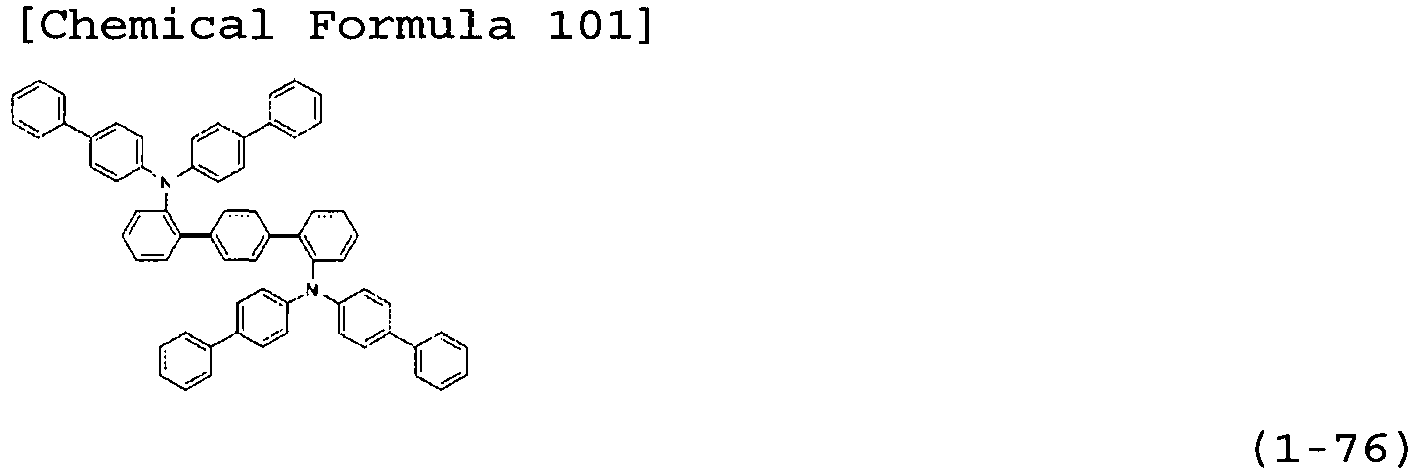
- The reaction was carried out under the same conditions as those of Example 18, except that 4-bromo-4'-{(biphenyl-4-yl)-phenylamino}-biphenyl was replaced with 4-bromo-2'-{4-(naphthalen-1-yl)phenyl}-phenylamino}-biphen yl, and (biphenyl-4-yl)-{2-(4,4,5,5-tetramethyl-[1,3,2]dioxaborola n-2-yl)phenyl}-phenylamine was replaced with 2-{(9,9-dimethyl-9H-fluoren-2-yl)-phenylamino}-phenylboron ic acid. As a result, a white powder of 2-{(9,9-dimethyl-9H-fluoren-2-yl)-phenylamino}-2"-[{4-(na phthalen-1-yl)phenyl}-phenylamino]-1,1':4',1"-terphenyl (Compound 1-81; 7.3 g; yield 48%) was obtained.
- The structure of the obtained white powder was identified by NMR.
1H-NMR (THF-d8) detected 46 hydrogen signals, as follows.
δ (ppm) = 7.89-7.76 (3H), 7.55-6.69 (37H), 1.29 (6H).
- 4,4"-diiodo-1,1';4',1"-terphenyl (13.0 g), N-phenyl-N-(2-phenyl-biphenyl-4-yl)amine (20.0 g), copper powder (0.18 g), potassium carbonate (11.3 g), 3,5-di-tert-butylsalicylic acid (0.7 g), sodium bisulfite (0.86 g), and dodecylbenzene (30 mL) were added into a nitrogen-substituted reaction vessel, and heated and stirred for 24 hours at 210°C. After cooling, xylene (30 mL) and methanol (60 mL) were added, and then a solid matter was collected by filtration. Toluene (250 mL) and silica gel (20 g) were added to the solid matter, and after stirring while heating to 90°C, insoluble matters were removed by hot filtration. After concentration, a crude product deposited by adding ethyl acetate and methanol was collected, and subjected to recrystallization from chlorobenzene and reflux washing with methanol, so as to obtain 16.9 g of white powder of 4,4"-bis{N-phenyl-N-(2-phenyl-biphenyl-4-yl)amino}-1,1';4 ',1"-terphenyl (Compound 1-103) (yield: 72%).

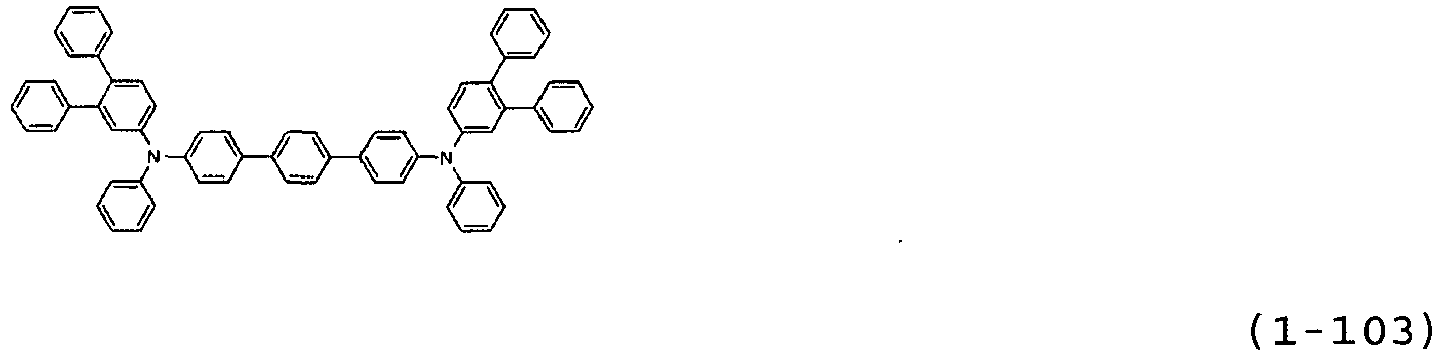
- The structure of the obtained white powder was identified by NMR.
1H-NMR (CDCl3) detected 48 hydrogen signals, as follows.
δ (ppm) = 7.68(4H), 7.62-7.55(4H), 7.39-7.06(40H). - The reaction was carried out under the same conditions as those of Example 19, except that 4,4"-dibromo-1,1':3',1"-terphenyl was replaced with 4,4"-dibromo-1,1':2',1"-terphenyl, and (triphenylen-2-yl)phenylamine was replaced with N-phenyl-N-(2-phenyl-biphenyl-4-yl)amine. As a result, 4.3 g of white powder of 4,4"-bis{N-phenyl-N-(2-phenyl-biphenyl-4-yl)amino}-1,1';2 ',1"-terphenyl (Compound 1-104) (yield: 42%) was obtained.


- The structure of the obtained pale yellow powder was identified by NMR.
1H-NMR (CDCl3) detected 48 hydrogen signals, as follows.
δ (ppm) = 7.50-7.39(4H), 7.31-6.97(44H). - The reaction was carried out under the same conditions as those of Example 19, except that (triphenylen-2-yl)phenylamine was replaced with N-phenyl-N-(2-phenyl-biphenyl-4-yl)amine. As a result, 7.7 g of white powder of 4,4"-bis{N-phenyl-N-(2-phenyl-biphenyl-4-yl)amino}-1,1';3 ',1"-terphenyl (Compound 1-105) (yield: 53%) was obtained.


- The structure of the obtained pale yellow powder was identified by NMR.
1H-NMR (CDCl3) detected 48 hydrogen signals, as follows.
δ (ppm) = 7.81(2H), 7.61-7.48(14H), 7.39-7.06(32H). - The melting points and the glass transition points of the arylamine compounds of the general formula (1) were measured using a high-sensitive differential scanning calorimeter (DSC3100SA produced by Bruker AXS).
Melting point Glass transition point Compound of Example 1 263°C 111°C Compound of Example 2 210°C 113°C Compound of Example 3 265°C 111°C Compound of Example 4 279°C 107°C Compound of Example 5 266°C 104°C Compound of Example 6 263°C 111°C Compound of Example 7 262°C 117°C Compound of Example 8 303°C 149°C Compound of Example 10 365°C 163°C Compound of Example 11 289°C 138°C Compound of Example 13 No melting point observed 125°C Compound of Example 14 252°C 108°C Compound of Example 15 252°C 108°C Compound of Example 16 No melting point observed 106°C Compound of Example 17 No melting point observed 135°C Compound of Example 18 No melting point observed 107°C Compound of Example 19 323°C 159°C Compound of Example 20 290°C 146°C Compound of Example 21 No melting point observed 119°C Compound of Example 22 No melting point observed 106°C Compound of Example 23 No melting point observed 118°C Compound of Example 24 No melting point observed 133°C Compound of Example 25 No melting point observed 136°C Compound of Example 26 286°C 124°C Compound of Example 27 No melting point observed 117°C Compound of Example 28 218°C 114°C Compound of Example 29 No melting point observed 127°C Compound of Example 31 No melting point observed 110°C Compound of Example 32 No melting point observed 122°C Compound of Example 33 269°C 117°C Compound of Example 34 277°C 122°C Compound of Example 35 No melting point observed 117°C Compound of Example 36 249°C 124°C Compound of Example 37 No melting point observed 115°C Compound of Example 38 No melting point observed 122°C - The arylamine compounds of the general formula (1) have glass transition points of 100°C or higher, demonstrating that the compounds have a stable thin-film state.
- A 100 nm-thick vapor-deposited film was fabricated on an ITO substrate using the arylamine compounds of the general formula (1), and a work function was measured using an ionization potential measuring device (PYS-202 produced by Sumitomo Heavy Industries, Ltd.).
Work function Compound of Example 1 5.65 eV Compound of Example 3 5.65 eV Compound of Example 4 5.67 eV Compound of Example 5 5.66 eV Compound of Example 6 5.69 eV Compound of Example 7 5.63 eV Compound of Example 8 5.70 eV Compound of Example 9 5.72 eV Compound of Example 10 5.62 eV Compound of Example 11 5.61 eV Compound of Example 12 5.62 eV Compound of Example 13 5.67 eV Compound of Example 14 5.75 eV Compound of Example 15 5.75 eV Compound of Example 16 5.79 eV Compound of Example 17 5.68 eV Compound of Example 18 5.76 eV Compound of Example 19 5.70 eV Compound of Example 20 5.79 eV Compound of Example 21 5.71 eV Compound of Example 22 5.79 eV Compound of Example 23 5.72 eV Compound of Example 24 5.70 eV Compound of Example 25 5.71 eV Compound of Example 26 5.65 eV Compound of Example 27 5.70 eV Compound of Example 28 5.67 eV Compound of Example 29 5.69 eV Compound of Example 30 5.75 eV Compound of Example 31 5.84 eV Compound of Example 32 5.76 eV Compound of Example 33 5.72 eV Compound of Example 34 5.67 eV Compound of Example 35 5.76 eV Compound of Example 36 5.67 eV Compound of Example 37 5.75 eV Compound of Example 38 5.76 eV - As the results show, the arylamine compounds of the general formula (1) have desirable energy levels compared to the work function 5.4 eV of common hole transport materials such as NPD and TPD, and thus possess desirable hole transportability.
- 5',9'-dibromospiro(fluorene-9,7'-fluoreno[4,3-b]benz ofuran) (5.0 g), bis{4-(tert-butyl)phenyl}amine (6.0 g), palladium acetate (0.08 g), sodium tert-butoxide (3.4 g), tri-tert-butylphosphine (0.07 g), and toluene (60 mL) were added into a nitrogen-substituted reaction vessel, and heated and refluxed for 2 hours while being stirred. After the mixture was cooled to a room temperature, dichloromethane and water were added, and an organic layer was collected by liquid separation. The organic layer was concentrated and then purified by column chromatography to obtain 3.1 g of powder of N5',N5',N9',N9'-tetrakis{4-(tert-butyl)phenyl}spiro(fluore ne-9,7'-fluoreno[4,3-b]benzofuran)-5',9'-diamine (Compound 8-1) (yield: 36%) .

- The reaction was carried out under the same conditions as those of Example 41, except that 5',9'-dibromospiro(fluorene-9,7'-fluoreno[4,3-b]benzofuran ) was replaced with 2,7-dibromospiro(dibenzo[5,6:7,8]fluoreno[4,3-b]benzofuran -5,9'-fluorene). As a result, 2.5 g of powder of N2,N2,N7,N7-tetrakisf4-(tert-butyl)phenyllspiro(dibenzo[5, 6:7,8]fluoreno[4,3-b]benzofuran-5,9'-fluorene)-2,7-diamine (Compound 8-2) (yield: 31%) was obtained.
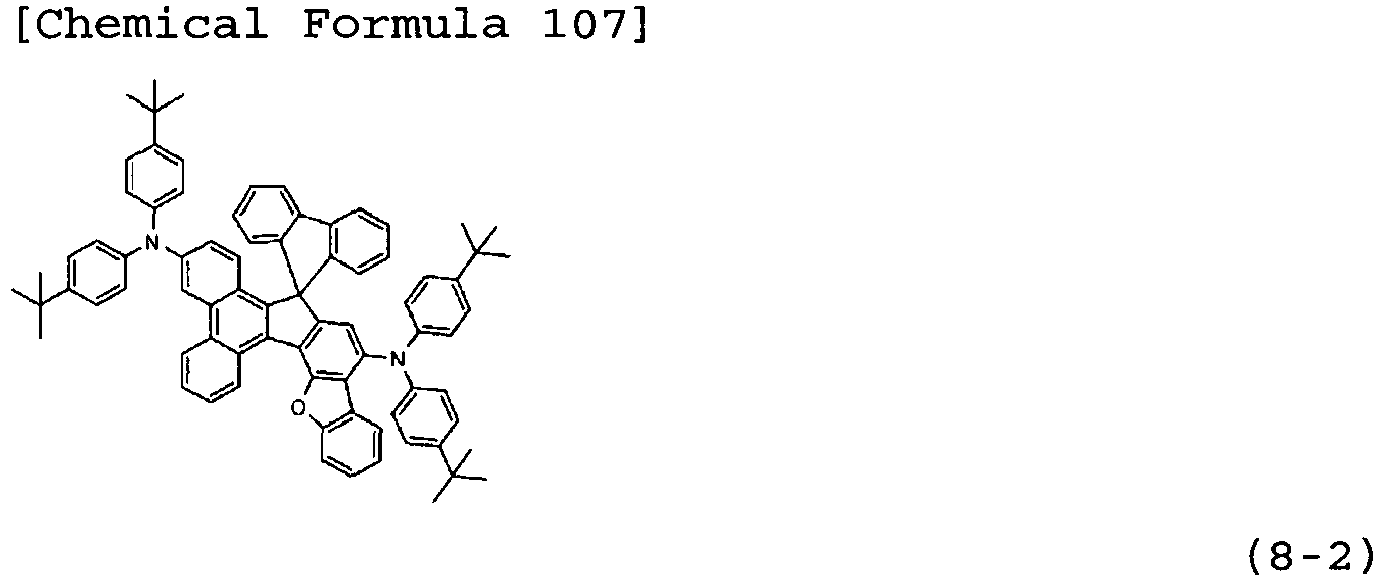
- The reaction was carried out under the same conditions as those of Example 41, except that 5',9'-dibromospiro(fluorene-9,7'-fluoreno[4,3-b]benzofuran ) was replaced with 5,9-dibromospiro(benzo[5,6]fluoreno[4,3-b]benzofuran-7,9'-fluorene). As a result, 3.0 g of powder of N5,N5,N9,N9-tetrakis{4-(tert-butyl)phenyl}spiro(benzo[5,6] fluoreno[4,3-b]benzofuran-7,9'-fluorene)-5,9-diamine (Compound 8-3) (yield: 36%) was obtained.

- The reaction was carried out under the same conditions as those of Example 41, except that 5',9'-dibromospiro(fluorene-9,7'-fluoreno[4,3-b]benzofuran ) was replaced with 6',10'-dibromospiro(fluorene-9,8'-fluoreno[4,3-b]benzofura n). As a result, 2.5 g of powder of N6',N6',N10',N10'-tetrakis{4-(tert-butyl)phenyl}spiro(fluo rene-9,8'-fluoreno[4,3-b]benzofuran)--6',10'-diamine (Compound 8-4) (yield: 34%) was obtained.

- The reaction was carried out under the same conditions as those of Example 41, except that 5',9'-dibromospiro(fluorene-9,7'-fluoreno[4,3-b]benzofuran ) was replaced with 5,9-dibromospiro(fluoreno[4,3-b]benzofuran-7,9'-xanthene). As a result, 2.4 g of powder of N5,N5,N9,N9-tetrakis{4-(tert-butyl)phenyl}spiro(fluoreno[4 ,3-b]benzofuran-7,9'-xanthene)-5,9-diamine (Compound 8-5) (yield: 28%) was obtained.

- The reaction was carried out under the same conditions as those of Example 41, except that 5',9'-dibromospiro(fluorene-9,7'-fluoreno[4,3-b]benzofuran ) was replaced with 5',9'-dibromo-2-fluorospiro(fluorene-9,7'-fluoreno[4,3-b]b enzofuran), and bis{4-(tert-butyl)phenyl}amine was replaced with (biphenyl-4-yl)-{4-(tert-butyl)phenyl}amine. As a result 2.4 g of powder of N5',N9'-bis(biphenyl-4-yl)-N5',N9'-bis{4-(tert-butyl)pheny l}-2-fluorospiro(fluorene-9,7'-fluoreno[4,3-b]benzofuran)-5',9'-diamine (Compound 8-6) (yield: 28%) was obtained.

- The reaction was carried out under the same conditions as those of Example 41, except that 5',9'-dibromospiro(fluorene-9,7'-fluoreno[4,3-b]benzofuran ) was replaced with 5,9-dibromospiro(benzo[5,6]fluoreno[4,3-b]benzofuran-7,9'-fluorene), and bis{4-(tert-butyl)phenyl}amine was replaced with {4-(tert-butyl)phenyl}-{4-(trimethylsilyl)phenyl}amine.
As a result, 3.0 g of powder of N5,N9-bis{4-(tert-butyl)phenyl}-N5,N9-bis{4-(trimethylsily l)phenyl}spiro(benzo[5,6]fluoreno[4,3-b]benzofuran-7,9'-fl uorene)-5,9-diamine (Compound 8-7) (yield: 35%) was obtained.
- The reaction was carried out under the same conditions as those of Example 41, except that 5',9'-dibromospiro(fluorene-9,7'-fluoreno[4,3-b]benzofuran ) was replaced with 5',9'-dibromospiro(fluorene-9,7'-fluoreno[4,3-b]benzothiop hene), and bis{4-(tert-butyl)phenyl}amine was replaced with {4-(tert-butyl)phenyl}-{4-(trimethylsilyl)phenyl}amine.
As a result, 3.2 g of powder of N5',N9'-bis{4-(tert-butyl)phenyl}-N5',N9'-bis{4-(trimethyl silyl)phenyl}spiro(fluorene-9,7'-fluoreno[4,3-b]benzothiop hene)-5',9'-diamine (Compound 8-8) (yield: 37%) was obtained.
- The reaction was carried out under the same conditions as those of Example 41, except that 5',9'-dibromospiro(fluorene-9,7'-fluoreno[4,3-b]benzofuran ) was replaced with 5,9-dibromospiro(benzo[4',5']thieno[2',3':5,6]fluoreno[4,3 -b]benzofuran-7,9'-fluorene), and bis{4-(tert-butyl)phenyl}amine was replaced with {4-(tert-butyl)phenyl}-{biphenyl-4-yl}amine. As a result, 2.8 g of powder of N5,N9-bis(biphenyl-4-yl)-N5,N9-bis{4-(tert-butyl)phenyl}sp iro(benzo[4',5']thieno[2',3':5,6]fluoreno[4,3-b]benzofuran -7,9'-fluorene)-5,9-diamine (Compound 8-9) (yield: 34%) was obtained.

- The reaction was carried out under the same conditions as those of Example 41, except that 5',9'-dibromospiro(fluorene-9,7'-fluoreno[4,3-b]benzofuran ) was replaced with 5',9'-dibromo-12',12'-dimethyl-12'H-spiro(fluorene-9,7'-in deno[1,2-a]fluorene). As a result, 1.8 g of powder of N5',N5',N9',N9'-tetrakis{4-(tert-butyl)phenyl}-12',12'-dim ethyl-12'H-spiro(fluorene-9,7'-indeno[1,2-a]fluorene)-5',9 '-diamine (Compound 8-10) (yield: 49%) was obtained.

- The reaction was carried out under the same conditions as those of Example 41, except that 5',9'-dibromospiro(fluorene-9,7'-fluoreno[4,3-b]benzofuran ) was replaced with 6',10'-dibromo-5'-methyl-5'H-spiro(fluorene-9,8'-indeno(2, 1-c]carbazole), and bis{4-(tert-butyl)phenyl}amine was replaced with {4-(tert-butyl)phenyl}-{biphenyl-4-yl}amine. As a result, 2.3 g of powder of N6',N10'-bis(biphenyl-4-yl)-N6',N10'-bis{4-(tert-butyl)phe nyl}-5'-methyl-5'H-spiro(fluorene-9,8'-indeno[2,1-c]carbaz ole)-6',10'-diamine (Compound 8-11) (yield: 41%) was obtained.

- The organic EL device, as shown in
FIG. 1 , was fabricated by vapor-depositing a hole injection layer 3, a hole transport layer 4, a light emitting layer 5, an electron transport layer 6, anelectron injection layer 7, and a cathode (aluminum electrode) 8 in this order on a glass substrate 1 on which an ITO electrode was formed as a transparent anode 2 beforehand. - Specifically, the glass substrate 1 having ITO having a film thickness of 150 nm formed thereon was subjected to ultrasonic washing in isopropyl alcohol for 20 minutes and then dried for 10 minutes on a hot plate heated to 200 °C . Thereafter, after performing an UV ozone treatment for 15 minutes, the glass substrate with ITO was installed in a vacuum vapor deposition apparatus, and the pressure was reduced to 0.001 Pa or lower. Subsequently, as the hole injection layer 3 covering the transparent anode 2, an electron acceptor (Acceptor-1) of the structural formula below and Compound (1-1) of Example 1 were formed in a film thickness of 30 nm by dual vapor deposition at a vapor deposition rate ratio of Acceptor-1/Compound (1-1) = 3/97. As the hole transport layer 4 on the hole injection layer 3, Compound 1-1 of Example 1 was formed in a film thickness of 40 nm. As the light emitting layer 5 on the hole transport layer 4, Compound EMD-1 of the structural formula below and Compound EMH-1 of the structural formula below were formed in a film thickness of 20 nm by dual vapor deposition at a vapor deposition rate ratio of EMD-1/EMH-1 = 5/95. As the electron transport layer 6 on the light emitting layer 5, Compound (5b-1) having an anthracene ring structure of the structural formula below and Compound ETM-1 of the structural formula below were formed in a film thickness of 30 nm by dual vapor deposition at a vapor deposition rate ratio of Compound (5b-1)/ETM-1 = 50/50. As the
electron injection layer 7 on the electron transport layer 6, lithium fluoride was formed in a film thickness of 1 nm. Finally, aluminum was vapor-deposited in a thickness of 100 nm to form thecathode 8. The characteristics of the thus fabricated organic EL device were measured in the atmosphere at an ordinary temperature. Table 1 summarizes the results of the measurement of emission characteristics performed by applying a direct current voltage to the fabricated organic EL device.

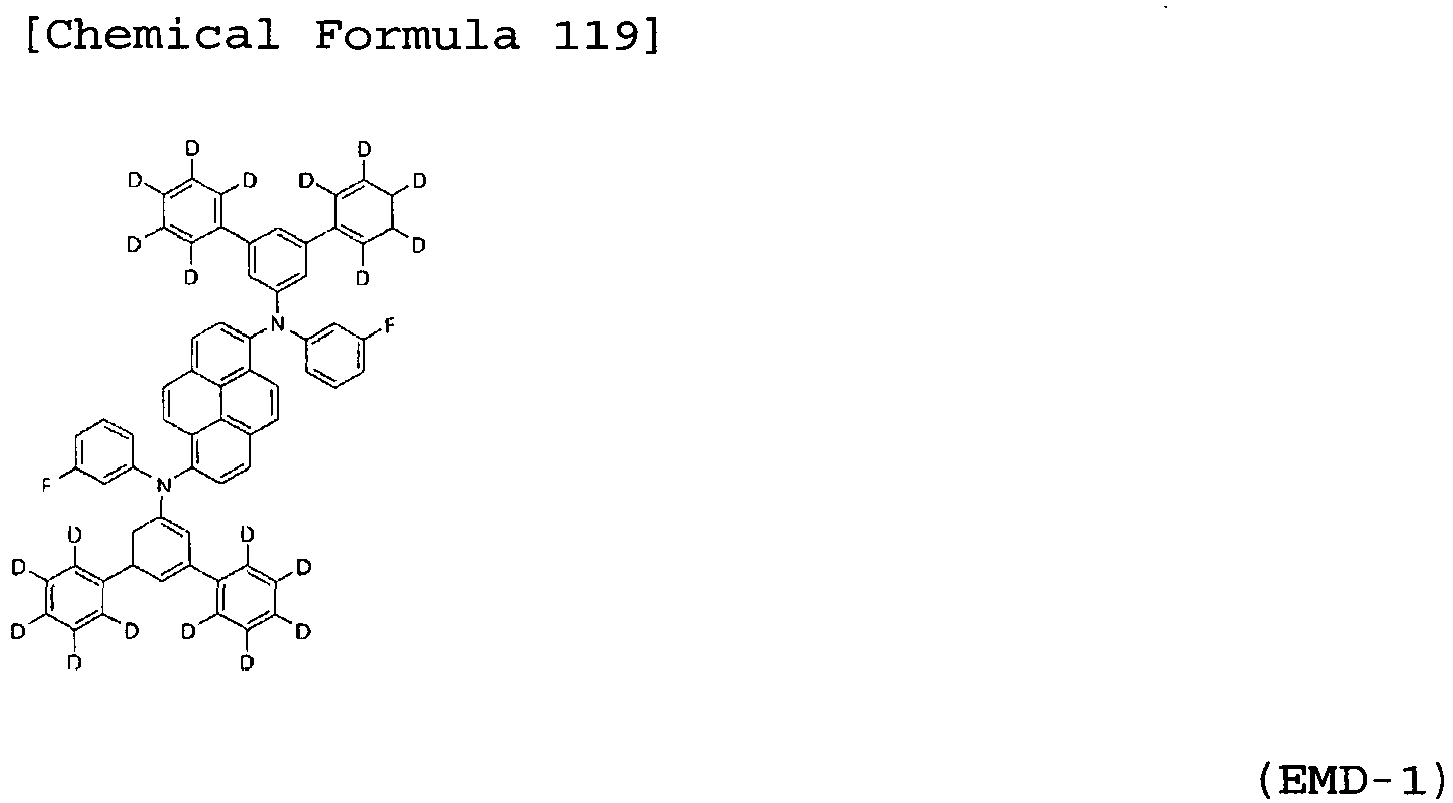


- An organic EL device was fabricated under the same conditions used in Example 52, except that Compound (6-125) having a pyrimidine ring structure was used as the material of the electron transport layer 6 instead of Compound (5b-1) having an anthracene ring structure, and Compound (6-125) and Compound ETM-1 of the above structural formula were formed in a film thickness of 30 nm by dual vapor deposition at a vapor deposition rate ratio of Compound (6-125)/ETM-1 = 50/50. The characteristics of the thus fabricated organic EL device were measured in the atmosphere at an ordinary temperature. Table 1 summarizes the results of the measurement of emission characteristics performed by applying a direct current voltage to the fabricated organic EL device.
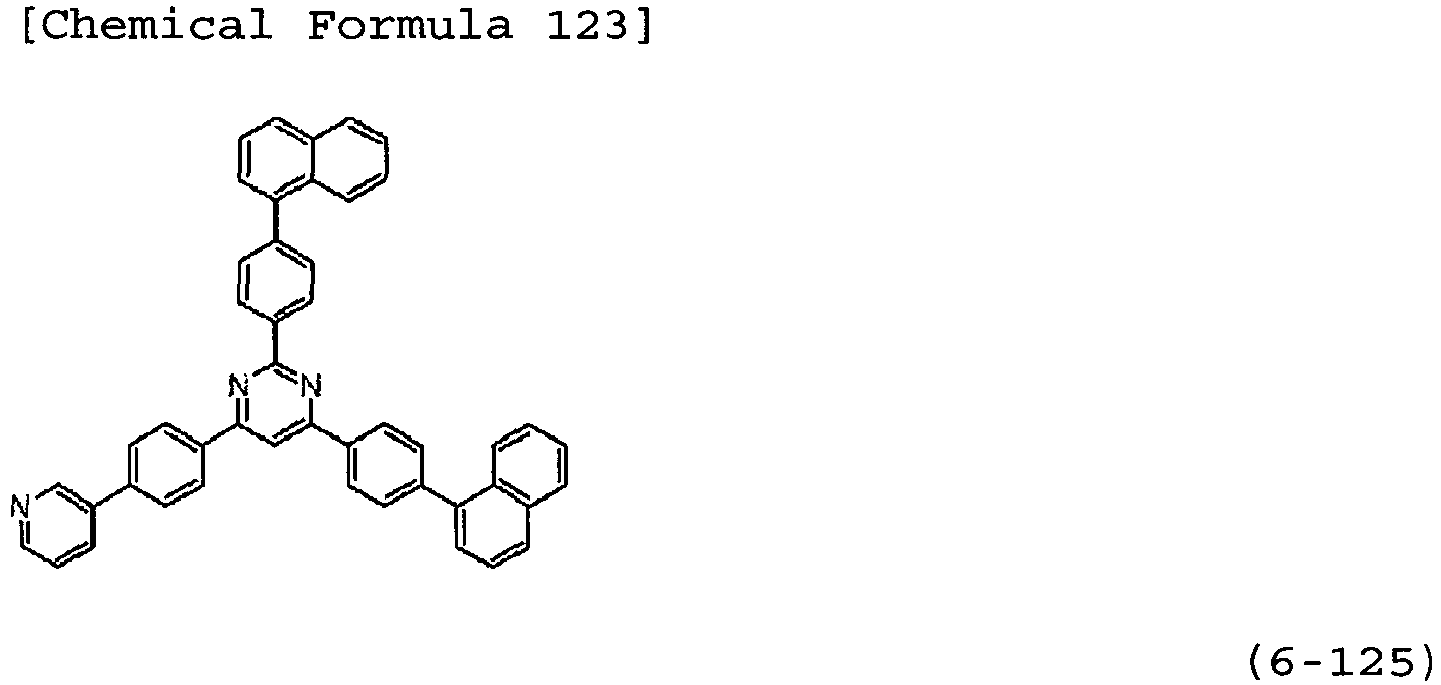
- An organic EL device was fabricated under the same conditions used in Example 52, except that the amine derivative (8-1) having a condensed ring structure was used as the material of the light emitting layer 5 instead of Compound EMD-1 of the above structural formula, and the amine derivative (8-1) having a condensed ring structure and Compound EMH-1 of the above structural formula were formed in a film thickness of 25 nm by dual vapor deposition at a vapor deposition rate ratio of amine derivative (8-1)/EMH-1 = 5/95. The characteristics of the thus fabricated organic EL device were measured in the atmosphere at an ordinary temperature. Table 1 summarizes the results of the measurement of emission characteristics performed by applying a direct current voltage to the fabricated organic EL device.

- An organic EL device was fabricated under the same conditions used in Example 53 , except that the amine derivative (8-1) having a condensed ring structure was used as the material of the light emitting layer 5 instead of Compound EMD-1 of the above structural formula, and the amine derivative (8-1) having a condensed ring structure and Compound EMH-1 of the above structural formula were formed in a film thickness of 25 nm by dual vapor deposition at a vapor deposition rate ratio of amine derivative (8-1)/EMH-1 = 5/95. The characteristics of the thus fabricated organic EL device were measured in the atmosphere at an ordinary temperature. Table 1 summarizes the results of the measurement of emission characteristics performed by applying a direct current voltage to the fabricated organic EL device.
- An organic EL device was fabricated under the same conditions used in Example 52, except that Compound (1-2) of Example 4 was used as the material of the hole injection layer 3 instead of Compound (1-1) of Example 1, and the electron acceptor (Acceptor-1) of the above structural formula and Compound (1-2) of Example 4 were formed in a film thickness of 30 nm by dual vapor deposition at a vapor deposition rate ratio of Acceptor-1/Compound (1-2) = 3/97, and Compound (1-2) of Example 4 was used as the material of the hole transport layer 4 instead of Compound (1-1) of Example 1, and formed in a film thickness of 40 nm. The characteristics of the thus fabricated organic EL device were measured in the atmosphere at an ordinary temperature. Table 1 summarizes the results of the measurement of emission characteristics performed by applying a direct current voltage to the fabricated organic EL device.

- An organic EL device was fabricated under the same conditions used in Example 53, except that Compound (1-2) of Example 4 was used as the material of the hole injection layer 3 instead of Compound (1-1) of Example 1, and the electron acceptor (Acceptor-1) of the above structural formula and Compound (1-2) of Example 4 were formed in a film thickness of 30 nm by dual vapor deposition at a vapor deposition rate ratio of Acceptor-1/Compound (1-2) = 3/97, and Compound (1-2) of Example 4 was used as the material of the hole transport layer 4 instead of Compound (1-1) of Example 1, and formed in a film thickness of 40 nm. The characteristics of the thus fabricated organic EL device were measured in the atmosphere at an ordinary temperature. Table 1 summarizes the results of the measurement of emission characteristics performed by applying a direct current voltage to the fabricated organic EL device.
- An organic EL device was fabricated under the same conditions used in Example 54, except that Compound (1-2) of Example 4 was used as the material of the hole injection layer 3 instead of Compound (1-1) of Example 1, and the electron acceptor (Acceptor-1) of the above structural formula and Compound (1-2) of Example 4 were formed in a film thickness of 30 nm by dual vapor deposition at a vapor deposition rate ratio of Acceptor-1/Compound (1-2) = 3/97, and Compound (1-2) of Example 4 was used as the material of the hole transport layer 4 instead of Compound (1-1) of Example 1, and formed in a film thickness of 40 nm. The characteristics of the thus fabricated organic EL device were measured in the atmosphere at an ordinary temperature. Table 1 summarizes the results of the measurement of emission characteristics performed by applying a direct current voltage to the fabricated organic EL device.
- An organic EL device was fabricated under the same conditions used in Example 55, except that Compound (1-2) of Example 4 was used as the material of the hole injection layer 3 instead of Compound (1-1) of Example 1, and the electron acceptor (Acceptor-1) of the above structural formula and Compound (1-2) of Example 4 were formed in a film thickness of 30 nm by dual vapor deposition at a vapor deposition rate ratio of Acceptor-1/Compound (1-2) = 3/97, and Compound (1-2) of Example 4 was used as the material of the hole transport layer 4 instead of Compound (1-1) of Example 1, and formed in a film thickness of 40 nm. The characteristics of the thus fabricated organic EL device were measured in the atmosphere at an ordinary temperature. Table 1 summarizes the results of the measurement of emission characteristics performed by applying a direct current voltage to the fabricated organic EL device.
- For comparison, an organic EL device was fabricated under the same conditions used in Example 52, except that HTM-1 of the structural formula below was used as the material of the hole injection layer 3 instead of Compound (1-1) of Example 1, and the electron acceptor (Acceptor-1) of the above structural formula and HTM-1 of the structural formula below were formed in a film thickness of 30 nm by dual vapor deposition at a vapor deposition rate ratio of Acceptor-1/HTM-1 = 3/97, and HTM-1 of the structural formula below was used as the material of the hole transport layer 4 instead of Compound (1-1) of Example 1, and formed in a film thickness of 40 nm. The characteristics of the thus fabricated organic EL device were measured in the atmosphere at an ordinary temperature. Table 1 summarizes the results of the measurement of emission characteristics performed by applying a direct current voltage to the fabricated organic EL device.

- For comparison, an organic EL device was fabricated under the same conditions used in Example 53, except that HTM-1 of the above structural formula was used as the material of the hole injection layer 3 instead of Compound (1-1) of Example 1, and the electron acceptor (Acceptor-1) of the above structural formula and HTM-1 of the above structural formula were formed in a film thickness of 3 0 nm by dual vapor deposition at a vapor deposition rate ratio of Acceptor-1/HTM-1 = 3/97, and HTM-1 of the above structural formula was used as the material of the hole transport layer 4 instead of Compound (1-1) of Example 1, and formed in a film thickness of 40 nm. The characteristics of the thus fabricated organic EL device were measured in the atmosphere at an ordinary temperature. Table 1 summarizes the results of the measurement of emission characteristics performed by applying a direct current voltage to the fabricated organic EL device.
- For comparison, an organic EL device was fabricated under the same conditions used in Example 54, except that HTM-1 of the above structural formula was used as the material of the hole injection layer 3 instead of Compound (1-1) of Example 1, and the electron acceptor (Acceptor-1) of the above structural formula and HTM-1 of the above structural formula were formed in a film thickness of 30 nm by dual vapor deposition at a vapor deposition rate ratio of Acceptor-1/HTM-1 = 3/97, and HTM-1 of the above structural formula was used as the material of the hole transport layer 4 instead of Compound (1-1) of Example 1, and formed in a film thickness of 40 nm. The characteristics of the thus fabricated organic EL device were measured in the atmosphere at an ordinary temperature. Table 1 summarizes the results of the measurement of emission characteristics performed by applying a direct current voltage to the fabricated organic EL device.
- For comparison, an organic EL device was fabricated under the same conditions used in Example 55, except that HTM-1 of the above structural formula was used as the material of the hole injection layer 3 instead of Compound (1-1) of Example 1, and the electron acceptor (Acceptor-1) of the above structural formula and HTM-1 of the above structural formula were formed in a film thickness of 30 nm by dual vapor deposition at a vapor deposition rate ratio of Acceptor-1/HTM-1 = 3/97, and HTM-1 of the above structural formula was used as the material of the hole transport layer 4 instead of Compound (1-1) of Example 1, and formed in a film thickness of 40 nm. The characteristics of the thus fabricated organic EL device were measured in the atmosphere at an ordinary temperature. Table 1 summarizes the results of the measurement of emission characteristics performed by applying a direct current voltage to the fabricated organic EL device.
- For comparison, an organic EL device was fabricated under the same conditions used in Example 53, except that the electron acceptor (Acceptor-1) of the above structural formula and Compound (1-1) of Example 1 were used as the material of the hole transport layer 4 instead of Compound (1-1) of Example 1, and the electron acceptor (Acceptor-1) of the above structural formula and Compound (1-1) of Example 1 were formed in a film thickness of 40 nm by dual vapor deposition at a vapor deposition rate ratio of Acceptor-1/Compound (1-1) = 3/97. The characteristics of the thus fabricated organic EL device were measured in the atmosphere at an ordinary temperature. Table 1 summarizes the results of the measurement of emission characteristics performed by applying a direct current voltage to the fabricated organic EL device.
- For comparison, an organic EL device was fabricated under the same conditions used in Example 55, except that the electron acceptor (Acceptor-1) of the above structural formula and Compound (1-1) of Example 1 were used as the material of the hole transport layer 4 instead of Compound (1-1) of Example 1, and the electron acceptor (Acceptor-1) of the above structural formula and Compound (1-1) of Example 1 were formed in a film thickness of 40 nm by dual vapor deposition at a vapor deposition rate ratio of Acceptor-1/Compound (1-1) = 3/97. The characteristics of the thus fabricated organic EL device were measured in the atmosphere at an ordinary temperature. Table 1 summarizes the results of the measurement of emission characteristics performed by applying a direct current voltage to the fabricated organic EL device.
- For comparison, an organic EL device was fabricated under the same conditions used in Example 57, except that the electron acceptor (Acceptor-1) of the above structural formula and Compound (1-2) of Example 4 were used as the material of the hole transport layer 4 instead of Compound (1-2) of Example 4, and the electron acceptor (Acceptor-1) of the above structural formula and Compound (1-2) of Example 4 were formed in a film thickness of 40 nm by dual vapor deposition at a vapor deposition rate ratio of Acceptor-1/Compound (1-2) = 3/97. The characteristics of the thus fabricated organic EL device were measured in the atmosphere at an ordinary temperature. Table 1 summarizes the results of the measurement of emission characteristics performed by applying a direct current voltage to the fabricated organic EL device.
- For comparison, an organic EL device was fabricated under the same conditions used in Example 59, except that the electron acceptor (Acceptor-1) of the above structural formula and Compound (1-2) of Example 4 were used as the material of the hole transport layer 4 instead of Compound (1-2) of Example 4, and the electron acceptor (Acceptor-1) of the above structural formula and Compound (1-2) of Example 4 were formed in a film thickness of 40 nm by dual vapor deposition at a vapor deposition rate ratio of Acceptor-1/Compound (1-2) = 3/97. The characteristics of the thus fabricated organic EL device were measured in the atmosphere at an ordinary temperature. Table 1 summarizes the results of the measurement of emission characteristics performed by applying a direct current voltage to the fabricated organic EL device.
- Table 1 summarizes the results of the measurement of device lifetime performed with organic EL devices fabricated in Examples 52 to 59 and Comparative Examples 1 to 8. The device lifetime was measured as the time elapsed until the emission luminance of 2,000 cd/m2 (initial luminance) at the start of emission was attenuated to 1,900 cd/m2 (corresponding to attenuation to 95% with respect to the initial luminance as 100%, 95% attenuation) when carrying out constant current driving.
[Table 1] Hole injection layer Hole transport layer Light emitting layer Electron transport layer Voltage [V] (@10mA/ cm2) Luminance [cd/m2] (@10mA/cm2) Current efficiency [cd/A] (@10mA/cm2) Power efficiency [1m/W] (@10mA/cm2) Device lifetime (Attenuati on to 95%) Ex. 52 Compound 1-1/ Acceptor-1 Compound 1-1 EMD-1/ EMH-1 Compound 5b-1/ ETM-1 3.90 657 6.57 5.30 116 h Ex. 53 Compound 1-1/ Acceptor-1 Compound 1-1 EMD-1/ EMH-1 Compound 6-125/ ETM-1 3.87 719 7.20 5.85 137 h Ex. 54 Compound 1-1/ Acceptor-1 Compound 1-1 Compound 8-1/ EMH-1 Compound 5b-1/ ETM-1 3.82 643 6.44 5.29 117 h Ex. 55 Compound 1-1/ Acceptor-1 Compound 1-1 Compound 8-1/ EMH-1 Compound 6-125/ ETM-1 3.85 691 6.92 5.65 135 h Ex. 56 Compound 1-2/ Acceptor-1 Compound 1-2 EMD-1/ EMH-1 Compound 5b-1/ ETM-1 3.93 626 6.27 5.01 120 h Ex. 57 Compound 1-2/ Acceptor-1 Compound 1-2 EMD-1/ EMH-1 Compound 6-125/ ETM-1 3.89 676 6.77 5.48 142 h Ex. 58 Compound 1-2/ Acceptor-1 Compound 1-2 Compound 8-1/ EMH-1 Compound 5b-1/ ETM-1 3.81 606 6.06 4.99 143 h Ex. 59 Compound 1-2/ Acceptor-1 Compound 1-2 Compound 8-1/ EMH-1 Compound 6-125/ ETM-1 3.82 662 6.63 5.45 128 h Com. Ex. 1 HTM-1/ Acceptor-1 HTM-1 EMD-1/ EMH-1 Compound 5b-1/ ETM-1 3.86 502 5.03 4.10 55 h Com. Ex. 2 HTM-1/ Acceptor-1 HTM-1 EMD-1/ EMH-1 Compound 6-125/ ETM-1 3.84 543 5.44 4.45 69 h Com. Ex. 3 HTM-1/ Acceptor-1 HTM-1 Compound 8-1/ EMH-1 Compound 5b-1/ ETM-1 3.75 483 4.84 4.07 6 h Com. Ex. 4 HTM-1/ Acceptor-1 HTM-1 Compound 8-1/ EMH-1 Compound 6-125/ ETM-1 3.77 520 5.21 4.35 58 h Com. Ex. 5 Compound 1-1/ Acceptor-1 Compound 1-1/ Acceptor-1 EMD-1/ EMH-1 Compound 6-125/ ETM-1 3.84 55 0.55 0.45 1 h Com. Ex. 6 Compound 1-1/ Acceptor-1 Compound 1-1/ Acceptor-1 Compound 8-1/ EMH-1 Compound 6-125/ ETM-1 3.86 62 0.62 0.50 1 h Com. Ex. 7 Compound 1-2/ Acceptor-1 Compound 1-2/ Acceptor-1 EMD-1/ EMH-1 Compound 6-125/ ETM-1 3.91 78 0.78 0.63 1 h Com. Ex. 8 Compound 1-2/ Acceptor-1 Compound 1-2/ Acceptor-1 Compound 8-1/ EMH-1 Compound 6-125/ ETM-1 3.91 81 0.80 0.64 1 h - As shown in Table 1, the luminous efficiency upon passing a current with a current density of 10 mA/cm2 was 0.55 to 0.80 cd/A for the organic EL devices in Comparative Examples 5 to 8 having the hole transport layer that was also doped with an electron acceptor, whereas was a high efficiency of 4.84 to 5.44 cd/A for the organic EL devices in Comparative Examples 1 to 4 having the hole transport layer that was not doped with an electron acceptor. The luminous efficiency was a further higher efficiency of 6.06 to 7.20 cd/A for the organic EL devices in Examples 52 to 59 using the arylamine derivative of the general formula (1) in the hole injection layer. The power efficiency was 0.45 to 0.64 1m/W for the organic EL devices in Comparative Examples 5 to 8 having the hole transport layer that was also doped with an electron acceptor, whereas was a high efficiency of 4.07 to 4.45 1m/W for the organic EL devices in Comparative Examples 1 to 4 having the hole transport layer that was not doped with an electron acceptor. The power efficiency was a further higher efficiency of 4.99 to 5. 85 1m/W for the organic EL devices in Examples 52 to 59 using the arylamine compound of the general formula (1) in the hole injection layer. The device lifetime (95% attenuation) was 1 hour for the organic EL devices in Comparative Examples 5 to 8 having the hole transport layer that was also doped with an electron acceptor, whereas was a long lifetime of 6 to 69 hours for the organic EL devices in Comparative Examples 1 to 4 having the hole transport layer that was not doped with an electron acceptor. The device lifetime was 116 to 143 hours, which showed large increase of lifetime, for the organic EL devices in Examples 52 to 59 using the arylamine compound of the general formula (1) in the hole injection layer.
- It has been found that in the organic EL devices of the present invention, holes can be efficiently injected and transported from the electrode to the hole transport layer by selecting the particular arylamine compound (having the particular structure) as the material of the hole injection layer, and subjecting to p-type doping with an electron acceptor, and the carrier balance in the organic EL device can be improved to achieve an organic EL device having a higher luminous efficiency and a longer lifetime than the conventional organic EL devices by selecting the particular arylamine compound (having the particular structure) without p-type doping as the material of the hole transport layer.
- The organic EL devices of the present invention with the combination of the particular arylamine compound (having the particular structure) and the electron acceptor that achieves excellent carrier balance in the organic EL device has an improved luminous efficiency and an improved durability of the organic EL device, and can be applied, for example, to home electric appliances and illuminations.
-
- 1
- Glass substrate
- 2
- Transparent anode
- 3
- Hole injection layer
- 4
- Hole transport layer
- 5
- Light emitting layer
- 6
- Electron transport layer
- 7
- Electron injection layer
- 8
- Cathode
Claims (14)
- An organic electroluminescent device comprising at least an anode, a hole injection layer, a hole transport layer, a light emitting layer, an electron transport layer, and a cathode, in this order, wherein the hole injection layer includes an arylamine compound represented by the following general formula (1) and an electron acceptor:

- The organic electroluminescent device according to claim 1, wherein the layers that are adjacent to the light emitting layer do not include an electron acceptor.
- The organic electroluminescent device according to claim 1 or 2, wherein the electron acceptor is an electron acceptor selected from trisbromophenylamine hexachloroantimony, tetracyanoquinodimethane (TCNQ), 2,3,5,6-tetrafluoro-tetracyano-1,4-benzoquinodimethane (F4TCNQ), and a radialene derivative.
- The organic electroluminescent device according to any one of claims 1 to 3, wherein the electron acceptor is a radialene derivative represented by the following general formula (2) :

- The organic electroluminescent device according to any one of claims 1 to 4, wherein the hole transport layer includes an arylamine compound having a structure in which two to six triphenylamine structures are joined within a molecule via a single bond or a divalent group that does not contain a heteroatom.
- The organic electroluminescent device according to claim 5, wherein the arylamine compound having a structure in which two to six triphenylamine structures are joined within a molecule via a single bond or a divalent group that does not contain a heteroatom is an arylamine compound represented by the following general formula (3):
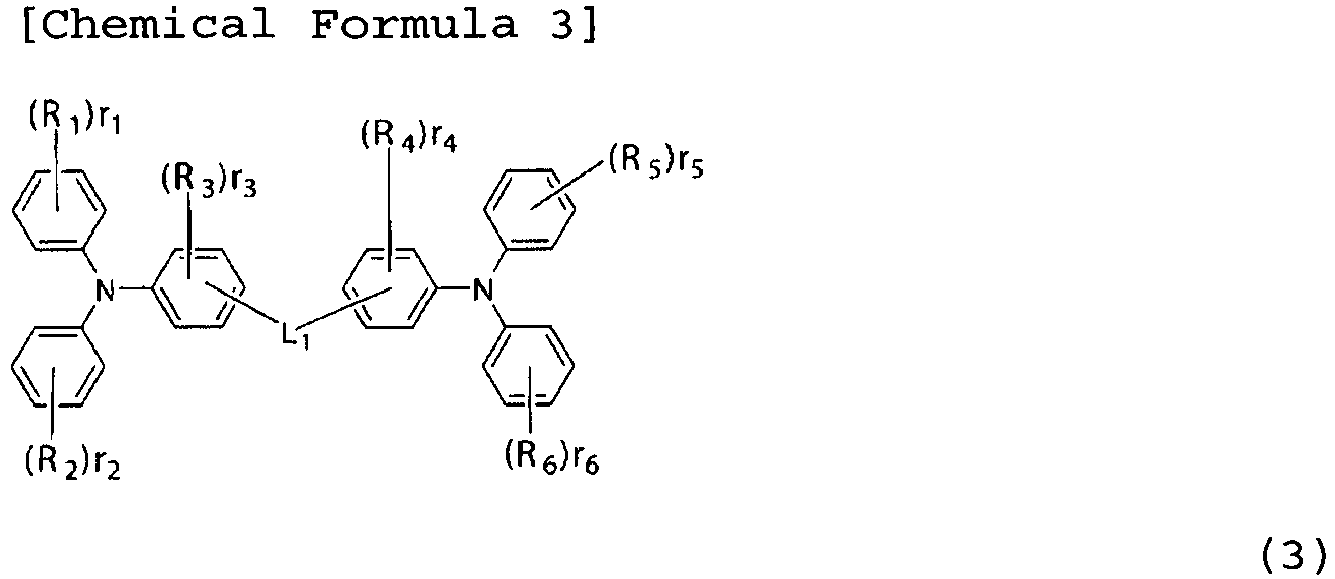
- The organic EL device according to claim 5, wherein the arylamine compound having a structure in which two to six triphenylamine structures are joined within a molecule via a single bond or a divalent group that does not contain a heteroatom is an arylamine compound of the following general formula (4) :
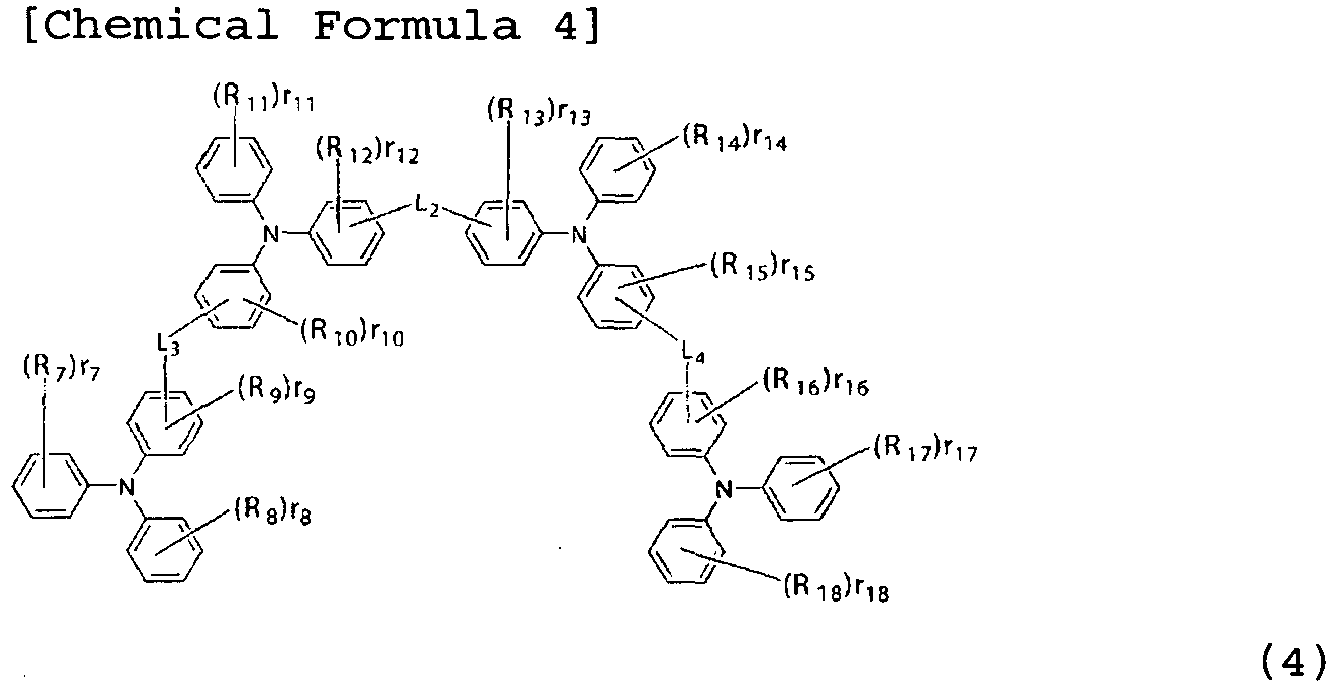
- The organic EL device according to any one of claims 1 to 7, wherein the electron transport layer includes a compound represented by the following general formula (5) having an anthracene ring structure:

- The organic EL device according to any one of claims 1 to 7, wherein the electron transport layer includes a compound represented by the following general formula (6) having a pyrimidine ring structure:
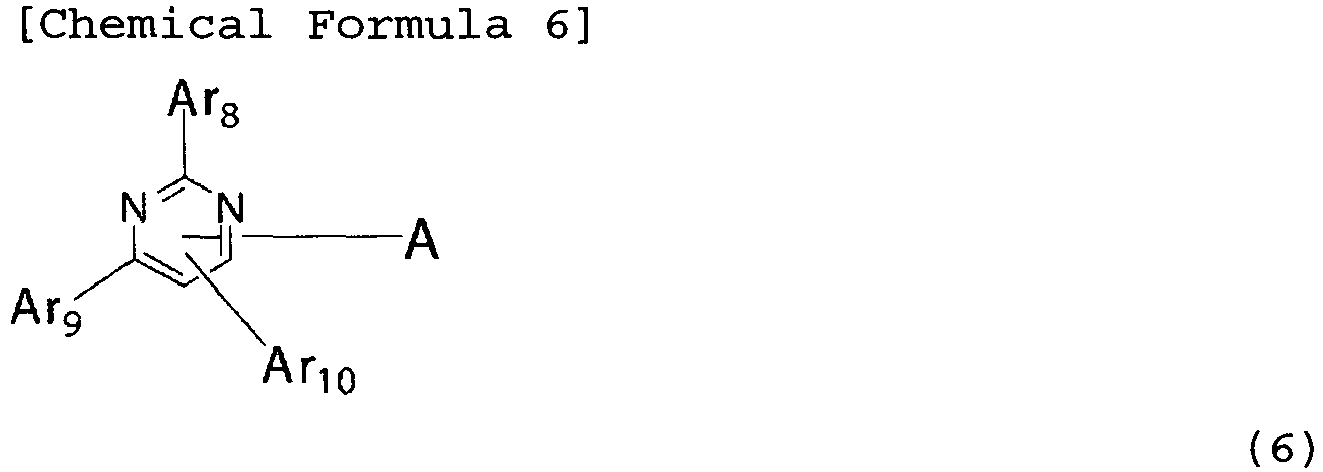

- The organic EL device according to any one of claims 1 to 9, wherein the light emitting layer includes a blue light emitting dopant.
- The organic EL device according to claim 10, wherein the light emitting layer includes a pyrene derivative as the blue light emitting dopant.
- The organic EL device according to claim 10, wherein the blue light emitting dopant includes a light emitting dopant which is an amine derivative having a condensed ring structure represented by the following general formula (8) :


- The organic EL device according to any one of claims 1 to 12, wherein the light emitting layer includes an anthracene derivative.
- The organic EL device according to claim 13, wherein the light emitting layer includes a host material which is the anthracene derivative.
Applications Claiming Priority (2)
| Application Number | Priority Date | Filing Date | Title |
|---|---|---|---|
| JP2014246681 | 2014-12-05 | ||
| PCT/JP2015/083776 WO2016088759A1 (en) | 2014-12-05 | 2015-12-01 | Organic electroluminescent element |
Publications (3)
| Publication Number | Publication Date |
|---|---|
| EP3229284A1 true EP3229284A1 (en) | 2017-10-11 |
| EP3229284A4 EP3229284A4 (en) | 2018-08-15 |
| EP3229284B1 EP3229284B1 (en) | 2022-08-31 |
Family
ID=56091701
Family Applications (1)
| Application Number | Title | Priority Date | Filing Date |
|---|---|---|---|
| EP15866092.8A Active EP3229284B1 (en) | 2014-12-05 | 2015-12-01 | Organic electroluminescent element |
Country Status (7)
| Country | Link |
|---|---|
| US (1) | US11158811B2 (en) |
| EP (1) | EP3229284B1 (en) |
| JP (1) | JP6675321B2 (en) |
| KR (1) | KR102493763B1 (en) |
| CN (1) | CN107004773A (en) |
| TW (1) | TWI683464B (en) |
| WO (1) | WO2016088759A1 (en) |
Cited By (3)
| Publication number | Priority date | Publication date | Assignee | Title |
|---|---|---|---|---|
| EP3282496A4 (en) * | 2015-04-10 | 2018-12-19 | Hodogaya Chemical Co., Ltd. | Organic electroluminescent element |
| EP3890042A4 (en) * | 2018-11-29 | 2022-08-17 | Hodogaya Chemical Co., Ltd. | ORGANIC ELECTROLUMINECENT ELEMENT |
| US11683980B2 (en) | 2014-07-28 | 2023-06-20 | Sfc Co., Ltd. | Condensed fluorene derivative comprising heterocyclic ring |
Families Citing this family (16)
| Publication number | Priority date | Publication date | Assignee | Title |
|---|---|---|---|---|
| EP3002797B1 (en) * | 2014-09-30 | 2020-04-29 | Novaled GmbH | A light emitting organic device and an active OLED display |
| KR102533039B1 (en) * | 2015-01-06 | 2023-05-15 | 호도가야 가가쿠 고교 가부시키가이샤 | organic electroluminescence device |
| KR102201104B1 (en) * | 2015-01-13 | 2021-01-11 | 에스에프씨주식회사 | organic light-emitting diode with High efficiency and long lifetime |
| KR102424977B1 (en) * | 2015-04-14 | 2022-07-26 | 삼성디스플레이 주식회사 | Condensed-cyclic compound and organic light emitting device comprising the same |
| US10367147B2 (en) | 2015-05-27 | 2019-07-30 | Samsung Display Co., Ltd. | Organic light-emitting device |
| US10312449B2 (en) | 2015-05-27 | 2019-06-04 | Samsung Display Co., Ltd. | Organic light-emitting device |
| KR102630644B1 (en) | 2015-12-17 | 2024-01-30 | 삼성디스플레이 주식회사 | Organic light emitting device |
| KR102719558B1 (en) * | 2016-02-12 | 2024-10-18 | 호도가야 가가쿠 고교 가부시키가이샤 | Organic electroluminescent devices |
| EP3544073A4 (en) * | 2016-11-16 | 2020-11-25 | Hodogaya Chemical Co., Ltd. | ORGANIC ELECTROLUMINESC ELEMENT |
| WO2018095888A1 (en) * | 2016-11-25 | 2018-05-31 | Merck Patent Gmbh | Bisbenzofuran-fused 2,8-diaminoindeno[1,2-b]fluorene derivatives and related compounds as materials for organic electroluminescent devices (oled) |
| WO2018101331A1 (en) * | 2016-11-30 | 2018-06-07 | 保土谷化学工業株式会社 | High molecular weight compound containing substituted triarylamine structural unit |
| EP3605638B1 (en) | 2017-03-28 | 2023-11-08 | Hodogaya Chemical Co., Ltd. | Organic electroluminescent device |
| KR20190009994A (en) * | 2017-07-20 | 2019-01-30 | 주식회사 두산 | Organic light-emitting compound and organic electroluminescent device using the same |
| WO2018101491A2 (en) * | 2018-03-19 | 2018-06-07 | 出光興産株式会社 | Organic electroluminescent element and electronic device |
| JP2020136517A (en) * | 2019-02-20 | 2020-08-31 | 保土谷化学工業株式会社 | Organic electroluminescent element |
| CN211654861U (en) * | 2019-12-13 | 2020-10-09 | 南京国兆光电科技有限公司 | Active matrix organic light emitting display |
Family Cites Families (26)
| Publication number | Priority date | Publication date | Assignee | Title |
|---|---|---|---|---|
| JPS4943840B1 (en) | 1970-12-25 | 1974-11-25 | ||
| JP3194657B2 (en) | 1993-11-01 | 2001-07-30 | 松下電器産業株式会社 | EL device |
| JP3828595B2 (en) | 1994-02-08 | 2006-10-04 | Tdk株式会社 | Organic EL device |
| US6998487B2 (en) * | 2001-04-27 | 2006-02-14 | Lg Chem, Ltd. | Double-spiro organic compounds and organic electroluminescent devices using the same |
| KR100691543B1 (en) | 2002-01-18 | 2007-03-09 | 주식회사 엘지화학 | New material for electron transport and organic light emitting device using the same |
| US20100026176A1 (en) * | 2002-03-28 | 2010-02-04 | Jan Blochwitz-Nomith | Transparent, Thermally Stable Light-Emitting Component Having Organic Layers |
| JP4487587B2 (en) | 2003-05-27 | 2010-06-23 | 株式会社デンソー | Organic EL device and method for manufacturing the same |
| KR100787425B1 (en) | 2004-11-29 | 2007-12-26 | 삼성에스디아이 주식회사 | Phenylcarbazole compound and organic electroluminescent device using same |
| CN1956945B (en) | 2004-05-25 | 2010-09-22 | 保土谷化学工业株式会社 | P-terphenyl compound and electrophotographic photoreceptor using the same |
| US8623522B2 (en) * | 2006-04-26 | 2014-01-07 | Idemitsu Kosan Co., Ltd. | Aromatic amine derivative and electroluminescence device using the same |
| KR20090040895A (en) * | 2006-08-23 | 2009-04-27 | 이데미쓰 고산 가부시키가이샤 | Aromatic amine derivatives and organic electroluminescent devices using them |
| JP5030534B2 (en) | 2006-11-01 | 2012-09-19 | 出光興産株式会社 | Aminodibenzofluorene derivative and organic electroluminescence device using the same |
| CN101535256B (en) | 2006-11-24 | 2013-05-22 | 出光兴产株式会社 | Aromatic amine derivative and organic electroluminescent element using same |
| KR20090048299A (en) * | 2007-11-08 | 2009-05-13 | 주식회사 엘지화학 | New organic light emitting device material and organic light emitting device using same |
| ES2370120T3 (en) * | 2008-10-23 | 2011-12-12 | Novaled Ag | RADIALENE COMPOUND AND ITS USE. |
| CN101694849B (en) * | 2009-09-22 | 2012-08-22 | 昆山维信诺显示技术有限公司 | Organic electroluminescence lamination device |
| KR101791276B1 (en) | 2009-11-12 | 2017-10-27 | 호도가야 가가쿠 고교 가부시키가이샤 | Compound having a substituted anthracene ring structure and pyridoindole ring structure, and organic electroluminescent element |
| KR101766709B1 (en) * | 2010-04-27 | 2017-08-09 | 노발레드 게엠베하 | Organic semiconducting material and electronic component |
| JP5977227B2 (en) * | 2011-02-28 | 2016-08-24 | 保土谷化学工業株式会社 | Organic electroluminescence device |
| KR102013399B1 (en) | 2011-11-29 | 2019-08-22 | 에스에프씨 주식회사 | Anthracene derivatives and organic light-emitting diode including the same |
| JP5110198B1 (en) * | 2011-12-02 | 2012-12-26 | 東洋インキScホールディングス株式会社 | Material for organic electroluminescence device and use thereof |
| KR101474798B1 (en) | 2011-12-23 | 2014-12-22 | 제일모직 주식회사 | Compound for organic OPTOELECTRONIC device, ORGANIC LIGHT EMITTING DIODE INCLUDING THE SAME and DISPLAY INCLUDING THE organic LIGHT EMITTING DIODE |
| EP2684932B8 (en) | 2012-07-09 | 2016-12-21 | Hodogaya Chemical Co., Ltd. | Diarylamino matrix material doped with a mesomeric radialene compound |
| WO2014088047A1 (en) * | 2012-12-05 | 2014-06-12 | 三星ディスプレイ株式▲会▼社 | Amine derivative, organic light-emitting material, and organic electroluminescence element using same |
| CN105074948B (en) | 2013-02-22 | 2017-12-26 | 保土谷化学工业株式会社 | Organic Electroluminescent Devices |
| KR102081605B1 (en) * | 2013-07-31 | 2020-02-27 | 엘지디스플레이 주식회사 | White organic light emitting diode device |
-
2015
- 2015-12-01 CN CN201580066266.9A patent/CN107004773A/en active Pending
- 2015-12-01 EP EP15866092.8A patent/EP3229284B1/en active Active
- 2015-12-01 WO PCT/JP2015/083776 patent/WO2016088759A1/en not_active Ceased
- 2015-12-01 US US15/532,701 patent/US11158811B2/en active Active
- 2015-12-01 KR KR1020177018521A patent/KR102493763B1/en active Active
- 2015-12-01 JP JP2016562638A patent/JP6675321B2/en active Active
- 2015-12-04 TW TW104140651A patent/TWI683464B/en active
Cited By (3)
| Publication number | Priority date | Publication date | Assignee | Title |
|---|---|---|---|---|
| US11683980B2 (en) | 2014-07-28 | 2023-06-20 | Sfc Co., Ltd. | Condensed fluorene derivative comprising heterocyclic ring |
| EP3282496A4 (en) * | 2015-04-10 | 2018-12-19 | Hodogaya Chemical Co., Ltd. | Organic electroluminescent element |
| EP3890042A4 (en) * | 2018-11-29 | 2022-08-17 | Hodogaya Chemical Co., Ltd. | ORGANIC ELECTROLUMINECENT ELEMENT |
Also Published As
| Publication number | Publication date |
|---|---|
| US20170346015A1 (en) | 2017-11-30 |
| EP3229284B1 (en) | 2022-08-31 |
| JP6675321B2 (en) | 2020-04-01 |
| JPWO2016088759A1 (en) | 2017-09-21 |
| KR102493763B1 (en) | 2023-01-30 |
| US11158811B2 (en) | 2021-10-26 |
| TW201626615A (en) | 2016-07-16 |
| KR20170095274A (en) | 2017-08-22 |
| WO2016088759A1 (en) | 2016-06-09 |
| TWI683464B (en) | 2020-01-21 |
| CN107004773A (en) | 2017-08-01 |
| EP3229284A4 (en) | 2018-08-15 |
Similar Documents
| Publication | Publication Date | Title |
|---|---|---|
| EP3229284B1 (en) | Organic electroluminescent element | |
| EP3282496B1 (en) | Organic electroluminescent element | |
| EP2960958B1 (en) | Organic electroluminescence element | |
| EP3671885B1 (en) | Organic electroluminescent device | |
| EP3244462B1 (en) | Organic electroluminescent element | |
| EP3240057B1 (en) | Organic electroluminescent element | |
| EP3255692B1 (en) | Organic electroluminescent element | |
| EP3223330B1 (en) | Organic electroluminescent device | |
| EP3291323B1 (en) | Organic electroluminescent element | |
| EP2530069B1 (en) | Compound with triphenylamine structure, and organic electroluminescent element | |
| EP2599773A1 (en) | Compound having indenocarbazole ring structure and organic electroluminescent element | |
| EP2578572A1 (en) | Compounds with acridan ring structures and organic electroluminescence elements | |
| EP3416207B1 (en) | Organic electroluminescent element | |
| EP3244464B1 (en) | Organic electroluminescent element | |
| EP3544073A1 (en) | Organic electroluminescence element | |
| EP3355376B1 (en) | Organic electroluminescent element | |
| EP4116393A1 (en) | Organic electroluminescent element | |
| EP4050083B1 (en) | Organic electroluminescent element | |
| EP4095216A1 (en) | Organic electroluminescent element | |
| EP3163644B1 (en) | Organic electroluminescent element |
Legal Events
| Date | Code | Title | Description |
|---|---|---|---|
| STAA | Information on the status of an ep patent application or granted ep patent |
Free format text: STATUS: THE INTERNATIONAL PUBLICATION HAS BEEN MADE |
|
| PUAI | Public reference made under article 153(3) epc to a published international application that has entered the european phase |
Free format text: ORIGINAL CODE: 0009012 |
|
| STAA | Information on the status of an ep patent application or granted ep patent |
Free format text: STATUS: REQUEST FOR EXAMINATION WAS MADE |
|
| 17P | Request for examination filed |
Effective date: 20170629 |
|
| AK | Designated contracting states |
Kind code of ref document: A1 Designated state(s): AL AT BE BG CH CY CZ DE DK EE ES FI FR GB GR HR HU IE IS IT LI LT LU LV MC MK MT NL NO PL PT RO RS SE SI SK SM TR |
|
| AX | Request for extension of the european patent |
Extension state: BA ME |
|
| DAV | Request for validation of the european patent (deleted) | ||
| DAX | Request for extension of the european patent (deleted) | ||
| A4 | Supplementary search report drawn up and despatched |
Effective date: 20180712 |
|
| RIC1 | Information provided on ipc code assigned before grant |
Ipc: H01L 51/52 20060101ALI20180706BHEP Ipc: C09K 11/06 20060101ALI20180706BHEP Ipc: H01L 51/50 20060101AFI20180706BHEP Ipc: C09K 11/02 20060101ALI20180706BHEP Ipc: H01L 51/00 20060101ALI20180706BHEP |
|
| STAA | Information on the status of an ep patent application or granted ep patent |
Free format text: STATUS: EXAMINATION IS IN PROGRESS |
|
| 17Q | First examination report despatched |
Effective date: 20190409 |
|
| GRAP | Despatch of communication of intention to grant a patent |
Free format text: ORIGINAL CODE: EPIDOSNIGR1 |
|
| STAA | Information on the status of an ep patent application or granted ep patent |
Free format text: STATUS: GRANT OF PATENT IS INTENDED |
|
| RIC1 | Information provided on ipc code assigned before grant |
Ipc: C09B 57/00 20060101ALI20220428BHEP Ipc: H01L 51/52 20060101ALI20220428BHEP Ipc: H01L 51/00 20060101ALI20220428BHEP Ipc: C09K 11/02 20060101ALI20220428BHEP Ipc: C09K 11/06 20060101ALI20220428BHEP Ipc: H01L 51/50 20060101AFI20220428BHEP |
|
| INTG | Intention to grant announced |
Effective date: 20220516 |
|
| GRAS | Grant fee paid |
Free format text: ORIGINAL CODE: EPIDOSNIGR3 |
|
| GRAA | (expected) grant |
Free format text: ORIGINAL CODE: 0009210 |
|
| STAA | Information on the status of an ep patent application or granted ep patent |
Free format text: STATUS: THE PATENT HAS BEEN GRANTED |
|
| AK | Designated contracting states |
Kind code of ref document: B1 Designated state(s): AL AT BE BG CH CY CZ DE DK EE ES FI FR GB GR HR HU IE IS IT LI LT LU LV MC MK MT NL NO PL PT RO RS SE SI SK SM TR |
|
| REG | Reference to a national code |
Ref country code: CH Ref legal event code: EP Ref country code: GB Ref legal event code: FG4D |
|
| REG | Reference to a national code |
Ref country code: AT Ref legal event code: REF Ref document number: 1515948 Country of ref document: AT Kind code of ref document: T Effective date: 20220915 |
|
| REG | Reference to a national code |
Ref country code: DE Ref legal event code: R096 Ref document number: 602015080619 Country of ref document: DE |
|
| REG | Reference to a national code |
Ref country code: IE Ref legal event code: FG4D |
|
| REG | Reference to a national code |
Ref country code: DE Ref legal event code: R079 Ref document number: 602015080619 Country of ref document: DE Free format text: PREVIOUS MAIN CLASS: H01L0051500000 Ipc: H10K0050000000 |
|
| REG | Reference to a national code |
Ref country code: LT Ref legal event code: MG9D |
|
| REG | Reference to a national code |
Ref country code: NL Ref legal event code: MP Effective date: 20220831 |
|
| PG25 | Lapsed in a contracting state [announced via postgrant information from national office to epo] |
Ref country code: SE Free format text: LAPSE BECAUSE OF FAILURE TO SUBMIT A TRANSLATION OF THE DESCRIPTION OR TO PAY THE FEE WITHIN THE PRESCRIBED TIME-LIMIT Effective date: 20220831 Ref country code: RS Free format text: LAPSE BECAUSE OF FAILURE TO SUBMIT A TRANSLATION OF THE DESCRIPTION OR TO PAY THE FEE WITHIN THE PRESCRIBED TIME-LIMIT Effective date: 20220831 Ref country code: NO Free format text: LAPSE BECAUSE OF FAILURE TO SUBMIT A TRANSLATION OF THE DESCRIPTION OR TO PAY THE FEE WITHIN THE PRESCRIBED TIME-LIMIT Effective date: 20221130 Ref country code: LV Free format text: LAPSE BECAUSE OF FAILURE TO SUBMIT A TRANSLATION OF THE DESCRIPTION OR TO PAY THE FEE WITHIN THE PRESCRIBED TIME-LIMIT Effective date: 20220831 Ref country code: LT Free format text: LAPSE BECAUSE OF FAILURE TO SUBMIT A TRANSLATION OF THE DESCRIPTION OR TO PAY THE FEE WITHIN THE PRESCRIBED TIME-LIMIT Effective date: 20220831 Ref country code: FI Free format text: LAPSE BECAUSE OF FAILURE TO SUBMIT A TRANSLATION OF THE DESCRIPTION OR TO PAY THE FEE WITHIN THE PRESCRIBED TIME-LIMIT Effective date: 20220831 |
|
| REG | Reference to a national code |
Ref country code: AT Ref legal event code: MK05 Ref document number: 1515948 Country of ref document: AT Kind code of ref document: T Effective date: 20220831 |
|
| PG25 | Lapsed in a contracting state [announced via postgrant information from national office to epo] |
Ref country code: PL Free format text: LAPSE BECAUSE OF FAILURE TO SUBMIT A TRANSLATION OF THE DESCRIPTION OR TO PAY THE FEE WITHIN THE PRESCRIBED TIME-LIMIT Effective date: 20220831 Ref country code: IS Free format text: LAPSE BECAUSE OF FAILURE TO SUBMIT A TRANSLATION OF THE DESCRIPTION OR TO PAY THE FEE WITHIN THE PRESCRIBED TIME-LIMIT Effective date: 20221231 Ref country code: HR Free format text: LAPSE BECAUSE OF FAILURE TO SUBMIT A TRANSLATION OF THE DESCRIPTION OR TO PAY THE FEE WITHIN THE PRESCRIBED TIME-LIMIT Effective date: 20220831 Ref country code: GR Free format text: LAPSE BECAUSE OF FAILURE TO SUBMIT A TRANSLATION OF THE DESCRIPTION OR TO PAY THE FEE WITHIN THE PRESCRIBED TIME-LIMIT Effective date: 20221201 |
|
| PG25 | Lapsed in a contracting state [announced via postgrant information from national office to epo] |
Ref country code: SM Free format text: LAPSE BECAUSE OF FAILURE TO SUBMIT A TRANSLATION OF THE DESCRIPTION OR TO PAY THE FEE WITHIN THE PRESCRIBED TIME-LIMIT Effective date: 20220831 Ref country code: RO Free format text: LAPSE BECAUSE OF FAILURE TO SUBMIT A TRANSLATION OF THE DESCRIPTION OR TO PAY THE FEE WITHIN THE PRESCRIBED TIME-LIMIT Effective date: 20220831 Ref country code: PT Free format text: LAPSE BECAUSE OF FAILURE TO SUBMIT A TRANSLATION OF THE DESCRIPTION OR TO PAY THE FEE WITHIN THE PRESCRIBED TIME-LIMIT Effective date: 20230102 Ref country code: ES Free format text: LAPSE BECAUSE OF FAILURE TO SUBMIT A TRANSLATION OF THE DESCRIPTION OR TO PAY THE FEE WITHIN THE PRESCRIBED TIME-LIMIT Effective date: 20220831 Ref country code: DK Free format text: LAPSE BECAUSE OF FAILURE TO SUBMIT A TRANSLATION OF THE DESCRIPTION OR TO PAY THE FEE WITHIN THE PRESCRIBED TIME-LIMIT Effective date: 20220831 Ref country code: CZ Free format text: LAPSE BECAUSE OF FAILURE TO SUBMIT A TRANSLATION OF THE DESCRIPTION OR TO PAY THE FEE WITHIN THE PRESCRIBED TIME-LIMIT Effective date: 20220831 Ref country code: AT Free format text: LAPSE BECAUSE OF FAILURE TO SUBMIT A TRANSLATION OF THE DESCRIPTION OR TO PAY THE FEE WITHIN THE PRESCRIBED TIME-LIMIT Effective date: 20220831 |
|
| PG25 | Lapsed in a contracting state [announced via postgrant information from national office to epo] |
Ref country code: SK Free format text: LAPSE BECAUSE OF FAILURE TO SUBMIT A TRANSLATION OF THE DESCRIPTION OR TO PAY THE FEE WITHIN THE PRESCRIBED TIME-LIMIT Effective date: 20220831 Ref country code: EE Free format text: LAPSE BECAUSE OF FAILURE TO SUBMIT A TRANSLATION OF THE DESCRIPTION OR TO PAY THE FEE WITHIN THE PRESCRIBED TIME-LIMIT Effective date: 20220831 |
|
| REG | Reference to a national code |
Ref country code: DE Ref legal event code: R097 Ref document number: 602015080619 Country of ref document: DE |
|
| PG25 | Lapsed in a contracting state [announced via postgrant information from national office to epo] |
Ref country code: NL Free format text: LAPSE BECAUSE OF FAILURE TO SUBMIT A TRANSLATION OF THE DESCRIPTION OR TO PAY THE FEE WITHIN THE PRESCRIBED TIME-LIMIT Effective date: 20220831 Ref country code: AL Free format text: LAPSE BECAUSE OF FAILURE TO SUBMIT A TRANSLATION OF THE DESCRIPTION OR TO PAY THE FEE WITHIN THE PRESCRIBED TIME-LIMIT Effective date: 20220831 |
|
| PLBE | No opposition filed within time limit |
Free format text: ORIGINAL CODE: 0009261 |
|
| STAA | Information on the status of an ep patent application or granted ep patent |
Free format text: STATUS: NO OPPOSITION FILED WITHIN TIME LIMIT |
|
| REG | Reference to a national code |
Ref country code: CH Ref legal event code: PL |
|
| 26N | No opposition filed |
Effective date: 20230601 |
|
| GBPC | Gb: european patent ceased through non-payment of renewal fee |
Effective date: 20221201 |
|
| REG | Reference to a national code |
Ref country code: BE Ref legal event code: MM Effective date: 20221231 |
|
| PG25 | Lapsed in a contracting state [announced via postgrant information from national office to epo] |
Ref country code: SI Free format text: LAPSE BECAUSE OF FAILURE TO SUBMIT A TRANSLATION OF THE DESCRIPTION OR TO PAY THE FEE WITHIN THE PRESCRIBED TIME-LIMIT Effective date: 20220831 Ref country code: LU Free format text: LAPSE BECAUSE OF NON-PAYMENT OF DUE FEES Effective date: 20221201 |
|
| PG25 | Lapsed in a contracting state [announced via postgrant information from national office to epo] |
Ref country code: LI Free format text: LAPSE BECAUSE OF NON-PAYMENT OF DUE FEES Effective date: 20221231 Ref country code: IE Free format text: LAPSE BECAUSE OF NON-PAYMENT OF DUE FEES Effective date: 20221201 Ref country code: GB Free format text: LAPSE BECAUSE OF NON-PAYMENT OF DUE FEES Effective date: 20221201 Ref country code: CH Free format text: LAPSE BECAUSE OF NON-PAYMENT OF DUE FEES Effective date: 20221231 |
|
| PG25 | Lapsed in a contracting state [announced via postgrant information from national office to epo] |
Ref country code: FR Free format text: LAPSE BECAUSE OF NON-PAYMENT OF DUE FEES Effective date: 20221231 Ref country code: BE Free format text: LAPSE BECAUSE OF NON-PAYMENT OF DUE FEES Effective date: 20221231 |
|
| PG25 | Lapsed in a contracting state [announced via postgrant information from national office to epo] |
Ref country code: HU Free format text: LAPSE BECAUSE OF FAILURE TO SUBMIT A TRANSLATION OF THE DESCRIPTION OR TO PAY THE FEE WITHIN THE PRESCRIBED TIME-LIMIT; INVALID AB INITIO Effective date: 20151201 |
|
| PG25 | Lapsed in a contracting state [announced via postgrant information from national office to epo] |
Ref country code: CY Free format text: LAPSE BECAUSE OF FAILURE TO SUBMIT A TRANSLATION OF THE DESCRIPTION OR TO PAY THE FEE WITHIN THE PRESCRIBED TIME-LIMIT Effective date: 20220831 |
|
| PG25 | Lapsed in a contracting state [announced via postgrant information from national office to epo] |
Ref country code: MK Free format text: LAPSE BECAUSE OF FAILURE TO SUBMIT A TRANSLATION OF THE DESCRIPTION OR TO PAY THE FEE WITHIN THE PRESCRIBED TIME-LIMIT Effective date: 20220831 Ref country code: IT Free format text: LAPSE BECAUSE OF FAILURE TO SUBMIT A TRANSLATION OF THE DESCRIPTION OR TO PAY THE FEE WITHIN THE PRESCRIBED TIME-LIMIT Effective date: 20220831 |
|
| PG25 | Lapsed in a contracting state [announced via postgrant information from national office to epo] |
Ref country code: MC Free format text: LAPSE BECAUSE OF FAILURE TO SUBMIT A TRANSLATION OF THE DESCRIPTION OR TO PAY THE FEE WITHIN THE PRESCRIBED TIME-LIMIT Effective date: 20220831 |
|
| PG25 | Lapsed in a contracting state [announced via postgrant information from national office to epo] |
Ref country code: TR Free format text: LAPSE BECAUSE OF FAILURE TO SUBMIT A TRANSLATION OF THE DESCRIPTION OR TO PAY THE FEE WITHIN THE PRESCRIBED TIME-LIMIT Effective date: 20220831 Ref country code: MC Free format text: LAPSE BECAUSE OF FAILURE TO SUBMIT A TRANSLATION OF THE DESCRIPTION OR TO PAY THE FEE WITHIN THE PRESCRIBED TIME-LIMIT Effective date: 20220831 |
|
| PG25 | Lapsed in a contracting state [announced via postgrant information from national office to epo] |
Ref country code: BG Free format text: LAPSE BECAUSE OF FAILURE TO SUBMIT A TRANSLATION OF THE DESCRIPTION OR TO PAY THE FEE WITHIN THE PRESCRIBED TIME-LIMIT Effective date: 20220831 |
|
| PG25 | Lapsed in a contracting state [announced via postgrant information from national office to epo] |
Ref country code: MT Free format text: LAPSE BECAUSE OF FAILURE TO SUBMIT A TRANSLATION OF THE DESCRIPTION OR TO PAY THE FEE WITHIN THE PRESCRIBED TIME-LIMIT Effective date: 20220831 |
|
| PGFP | Annual fee paid to national office [announced via postgrant information from national office to epo] |
Ref country code: DE Payment date: 20251211 Year of fee payment: 11 |