EP3228667A1 - Insulation material - Google Patents
Insulation material Download PDFInfo
- Publication number
- EP3228667A1 EP3228667A1 EP15864321.3A EP15864321A EP3228667A1 EP 3228667 A1 EP3228667 A1 EP 3228667A1 EP 15864321 A EP15864321 A EP 15864321A EP 3228667 A1 EP3228667 A1 EP 3228667A1
- Authority
- EP
- European Patent Office
- Prior art keywords
- ester
- insulation material
- phthalate
- resin
- mass
- Prior art date
- Legal status (The legal status is an assumption and is not a legal conclusion. Google has not performed a legal analysis and makes no representation as to the accuracy of the status listed.)
- Granted
Links
Classifications
-
- H—ELECTRICITY
- H01—ELECTRIC ELEMENTS
- H01B—CABLES; CONDUCTORS; INSULATORS; SELECTION OF MATERIALS FOR THEIR CONDUCTIVE, INSULATING OR DIELECTRIC PROPERTIES
- H01B3/00—Insulators or insulating bodies characterised by the insulating materials; Selection of materials for their insulating or dielectric properties
- H01B3/18—Insulators or insulating bodies characterised by the insulating materials; Selection of materials for their insulating or dielectric properties mainly consisting of organic substances
- H01B3/30—Insulators or insulating bodies characterised by the insulating materials; Selection of materials for their insulating or dielectric properties mainly consisting of organic substances plastics; resins; waxes
- H01B3/44—Insulators or insulating bodies characterised by the insulating materials; Selection of materials for their insulating or dielectric properties mainly consisting of organic substances plastics; resins; waxes vinyl resins; acrylic resins
- H01B3/443—Insulators or insulating bodies characterised by the insulating materials; Selection of materials for their insulating or dielectric properties mainly consisting of organic substances plastics; resins; waxes vinyl resins; acrylic resins from vinylhalogenides or other halogenoethylenic compounds
-
- C—CHEMISTRY; METALLURGY
- C08—ORGANIC MACROMOLECULAR COMPOUNDS; THEIR PREPARATION OR CHEMICAL WORKING-UP; COMPOSITIONS BASED THEREON
- C08K—Use of inorganic or non-macromolecular organic substances as compounding ingredients
- C08K3/00—Use of inorganic substances as compounding ingredients
- C08K3/18—Oxygen-containing compounds, e.g. metal carbonyls
- C08K3/20—Oxides; Hydroxides
- C08K3/22—Oxides; Hydroxides of metals
-
- C—CHEMISTRY; METALLURGY
- C08—ORGANIC MACROMOLECULAR COMPOUNDS; THEIR PREPARATION OR CHEMICAL WORKING-UP; COMPOSITIONS BASED THEREON
- C08K—Use of inorganic or non-macromolecular organic substances as compounding ingredients
- C08K5/00—Use of organic ingredients
- C08K5/0008—Organic ingredients according to more than one of the "one dot" groups of C08K5/01 - C08K5/59
- C08K5/0016—Plasticisers
-
- C—CHEMISTRY; METALLURGY
- C08—ORGANIC MACROMOLECULAR COMPOUNDS; THEIR PREPARATION OR CHEMICAL WORKING-UP; COMPOSITIONS BASED THEREON
- C08K—Use of inorganic or non-macromolecular organic substances as compounding ingredients
- C08K5/00—Use of organic ingredients
- C08K5/04—Oxygen-containing compounds
- C08K5/10—Esters; Ether-esters
-
- C—CHEMISTRY; METALLURGY
- C08—ORGANIC MACROMOLECULAR COMPOUNDS; THEIR PREPARATION OR CHEMICAL WORKING-UP; COMPOSITIONS BASED THEREON
- C08K—Use of inorganic or non-macromolecular organic substances as compounding ingredients
- C08K5/00—Use of organic ingredients
- C08K5/04—Oxygen-containing compounds
- C08K5/10—Esters; Ether-esters
- C08K5/11—Esters; Ether-esters of acyclic polycarboxylic acids
-
- C—CHEMISTRY; METALLURGY
- C08—ORGANIC MACROMOLECULAR COMPOUNDS; THEIR PREPARATION OR CHEMICAL WORKING-UP; COMPOSITIONS BASED THEREON
- C08L—COMPOSITIONS OF MACROMOLECULAR COMPOUNDS
- C08L101/00—Compositions of unspecified macromolecular compounds
-
- C—CHEMISTRY; METALLURGY
- C08—ORGANIC MACROMOLECULAR COMPOUNDS; THEIR PREPARATION OR CHEMICAL WORKING-UP; COMPOSITIONS BASED THEREON
- C08L—COMPOSITIONS OF MACROMOLECULAR COMPOUNDS
- C08L23/00—Compositions of homopolymers or copolymers of unsaturated aliphatic hydrocarbons having only one carbon-to-carbon double bond; Compositions of derivatives of such polymers
- C08L23/02—Compositions of homopolymers or copolymers of unsaturated aliphatic hydrocarbons having only one carbon-to-carbon double bond; Compositions of derivatives of such polymers not modified by chemical after-treatment
- C08L23/16—Ethylene-propylene or ethylene-propylene-diene copolymers
-
- C—CHEMISTRY; METALLURGY
- C08—ORGANIC MACROMOLECULAR COMPOUNDS; THEIR PREPARATION OR CHEMICAL WORKING-UP; COMPOSITIONS BASED THEREON
- C08L—COMPOSITIONS OF MACROMOLECULAR COMPOUNDS
- C08L27/00—Compositions of homopolymers or copolymers of compounds having one or more unsaturated aliphatic radicals, each having only one carbon-to-carbon double bond, and at least one being terminated by a halogen; Compositions of derivatives of such polymers
- C08L27/02—Compositions of homopolymers or copolymers of compounds having one or more unsaturated aliphatic radicals, each having only one carbon-to-carbon double bond, and at least one being terminated by a halogen; Compositions of derivatives of such polymers not modified by chemical after-treatment
- C08L27/04—Compositions of homopolymers or copolymers of compounds having one or more unsaturated aliphatic radicals, each having only one carbon-to-carbon double bond, and at least one being terminated by a halogen; Compositions of derivatives of such polymers not modified by chemical after-treatment containing chlorine atoms
- C08L27/06—Homopolymers or copolymers of vinyl chloride
-
- H—ELECTRICITY
- H01—ELECTRIC ELEMENTS
- H01B—CABLES; CONDUCTORS; INSULATORS; SELECTION OF MATERIALS FOR THEIR CONDUCTIVE, INSULATING OR DIELECTRIC PROPERTIES
- H01B3/00—Insulators or insulating bodies characterised by the insulating materials; Selection of materials for their insulating or dielectric properties
- H01B3/18—Insulators or insulating bodies characterised by the insulating materials; Selection of materials for their insulating or dielectric properties mainly consisting of organic substances
- H01B3/30—Insulators or insulating bodies characterised by the insulating materials; Selection of materials for their insulating or dielectric properties mainly consisting of organic substances plastics; resins; waxes
- H01B3/42—Insulators or insulating bodies characterised by the insulating materials; Selection of materials for their insulating or dielectric properties mainly consisting of organic substances plastics; resins; waxes polyesters; polyethers; polyacetals
- H01B3/421—Polyesters
- H01B3/422—Linear saturated polyesters derived from dicarboxylic acids and dihydroxy compounds
-
- H—ELECTRICITY
- H01—ELECTRIC ELEMENTS
- H01B—CABLES; CONDUCTORS; INSULATORS; SELECTION OF MATERIALS FOR THEIR CONDUCTIVE, INSULATING OR DIELECTRIC PROPERTIES
- H01B7/00—Insulated conductors or cables characterised by their form
- H01B7/02—Disposition of insulation
-
- C—CHEMISTRY; METALLURGY
- C08—ORGANIC MACROMOLECULAR COMPOUNDS; THEIR PREPARATION OR CHEMICAL WORKING-UP; COMPOSITIONS BASED THEREON
- C08K—Use of inorganic or non-macromolecular organic substances as compounding ingredients
- C08K3/00—Use of inorganic substances as compounding ingredients
- C08K3/18—Oxygen-containing compounds, e.g. metal carbonyls
- C08K3/20—Oxides; Hydroxides
- C08K3/22—Oxides; Hydroxides of metals
- C08K2003/2296—Oxides; Hydroxides of metals of zinc
-
- C—CHEMISTRY; METALLURGY
- C08—ORGANIC MACROMOLECULAR COMPOUNDS; THEIR PREPARATION OR CHEMICAL WORKING-UP; COMPOSITIONS BASED THEREON
- C08L—COMPOSITIONS OF MACROMOLECULAR COMPOUNDS
- C08L2201/00—Properties
- C08L2201/02—Flame or fire retardant/resistant
-
- C—CHEMISTRY; METALLURGY
- C08—ORGANIC MACROMOLECULAR COMPOUNDS; THEIR PREPARATION OR CHEMICAL WORKING-UP; COMPOSITIONS BASED THEREON
- C08L—COMPOSITIONS OF MACROMOLECULAR COMPOUNDS
- C08L2201/00—Properties
- C08L2201/04—Antistatic
-
- C—CHEMISTRY; METALLURGY
- C08—ORGANIC MACROMOLECULAR COMPOUNDS; THEIR PREPARATION OR CHEMICAL WORKING-UP; COMPOSITIONS BASED THEREON
- C08L—COMPOSITIONS OF MACROMOLECULAR COMPOUNDS
- C08L2201/00—Properties
- C08L2201/08—Stabilised against heat, light or radiation or oxydation
-
- C—CHEMISTRY; METALLURGY
- C08—ORGANIC MACROMOLECULAR COMPOUNDS; THEIR PREPARATION OR CHEMICAL WORKING-UP; COMPOSITIONS BASED THEREON
- C08L—COMPOSITIONS OF MACROMOLECULAR COMPOUNDS
- C08L2203/00—Applications
- C08L2203/20—Applications use in electrical or conductive gadgets
- C08L2203/202—Applications use in electrical or conductive gadgets use in electrical wires or wirecoating
-
- C—CHEMISTRY; METALLURGY
- C08—ORGANIC MACROMOLECULAR COMPOUNDS; THEIR PREPARATION OR CHEMICAL WORKING-UP; COMPOSITIONS BASED THEREON
- C08L—COMPOSITIONS OF MACROMOLECULAR COMPOUNDS
- C08L23/00—Compositions of homopolymers or copolymers of unsaturated aliphatic hydrocarbons having only one carbon-to-carbon double bond; Compositions of derivatives of such polymers
- C08L23/26—Compositions of homopolymers or copolymers of unsaturated aliphatic hydrocarbons having only one carbon-to-carbon double bond; Compositions of derivatives of such polymers modified by chemical after-treatment
- C08L23/28—Compositions of homopolymers or copolymers of unsaturated aliphatic hydrocarbons having only one carbon-to-carbon double bond; Compositions of derivatives of such polymers modified by chemical after-treatment by reaction with halogens or halogen-containing compounds
- C08L23/286—Chlorinated polyethylene
-
- C—CHEMISTRY; METALLURGY
- C08—ORGANIC MACROMOLECULAR COMPOUNDS; THEIR PREPARATION OR CHEMICAL WORKING-UP; COMPOSITIONS BASED THEREON
- C08L—COMPOSITIONS OF MACROMOLECULAR COMPOUNDS
- C08L2666/00—Composition of polymers characterized by a further compound in the blend, being organic macromolecular compounds, natural resins, waxes or and bituminous materials, non-macromolecular organic substances, inorganic substances or characterized by their function in the composition
- C08L2666/02—Organic macromolecular compounds, natural resins, waxes or and bituminous materials
- C08L2666/04—Macromolecular compounds according to groups C08L7/00 - C08L49/00, or C08L55/00 - C08L57/00; Derivatives thereof
Definitions
- the present invention relates to an insulation material. Specifically, the present invention relates to an insulation material containing a resin composition containing an ester, and an electric cable using the insulation material.
- a vinyl chloride resin (polyvinyl chloride, PVC) is one of representative plastics, and has been applied to a wide variety of purposes due to the inexpensiveness and the excellent properties thereof.
- a vinyl chloride resin has a hard and brittle nature due to the strong interaction among the high polarity molecular chains thereof, and is used after adding a plasticizer thereto since it is difficult to process the resin as it is.
- a plasticizer weakens the interaction among the molecular chains by entering among the molecular chains, thereby softening the vinyl chloride resin.
- ester compounds are used as a plasticizer, and an aromatic polybasic carboxylate ester, such as a phthalic acid series, a trimellitic acid series, and a pyromellitic acid series; an aliphatic polybasic carboxylate ester, such as an adipic acid series, an azelaic acid series, and a sebacic acid series; a polyester series, an epoxy series, and a phosphoric acid series are generally used.
- aromatic polybasic carboxylate ester such as a phthalic acid series, a trimellitic acid series, and a pyromellitic acid series
- an aliphatic polybasic carboxylate ester such as an adipic acid series, an azelaic acid series, and a sebacic acid series
- a polyester series, an epoxy series, and a phosphoric acid series are generally used.
- a vinyl chloride resin has hardness that is determined by the kind and the amount of the plasticizer added thereto, and is roughly classified into a hard one and a soft one.
- a soft vinyl chloride resin is excellent in various properties including water resistance, acid resistance, alkali resistance, solvent resistance, chemical stability, flame retardancy, and electric insulation property, and is widely applied to various films and sheets, ropes, agricultural materials, construction materials, automobile components, insulation materials and covering materials for electric cables, and the like.
- the range of applications of the soft vinyl chloride resin is being continuously enhanced, and there is a demand of further enhancement of the aforementioned properties.
- a higher volume resistivity is being demanded associated with thinning electric cables due to the reduction in size and weight of electric equipments and automobile components.
- the volume resistivity of the soft vinyl chloride resin varies depending on the kind and the molecular structure of the plasticizer used. According to NPL 1, the volume resistivity of the soft vinyl chloride resin becomes larger with a larger branching degree of the alcohol carbon chain constituting the plasticizer molecule.
- PTL 1 determines the parameter showing the topological characteristics of the branched structure for an aliphatic alcohol mixture having 10 carbon atoms and a phthalate diester mixture produced from the alcohol mixture, and describes that a soft vinyl chloride resin that uses the phthalate diester mixture within a particular range as a plasticizer is excellent in cold resistance, heat resistance, electric insulation property, and the like.
- PTL 2 describes that a soft vinyl chloride resin that uses an ester of an alcohol mixture having 10 carbon atoms having various branched structures (2-propyl-1-heptanol, 4-methyl-2-propyl-1-hexanol, 5-methyl-2-propyl-1-hexanol, and 2-isopropyl-1-heptanol) and a carboxylic acid, such as phthalic acid, adipic acid, azelaic acid, sebacic acid, trimellitic acid, and pyromellitic acid, as a plasticizer is excellent in electric insulation property.
- a soft vinyl chloride resin that uses an ester of an alcohol mixture having 10 carbon atoms having various branched structures (2-propyl-1-heptanol, 4-methyl-2-propyl-1-hexanol, 5-methyl-2-propyl-1-hexanol, and 2-isopropyl-1-heptanol) and a carboxylic acid, such as phthalic acid,
- PTL 3 describes a vinyl chloride resin composition for covering an electric cable excellent in electric insulation property that uses an aromatic polybasic carboxylate plasticizer, such as a trimellitate ester and a pyromellitate ester.
- NPL 1 " Kasozai, Sono Riron to Oyo" (Plasticizers, Their Fischs and Applications), edited and written by Koichi MURAI, Saiwai Shobo, 1973
- the volume resistivity of the soft vinyl chloride resin that uses the plasticizers described in the aforementioned literatures still has room for improvement in the achievement of the higher insulation property that is demanded associated with the reduction in thickness of insulation materials and covering materials for electric cables using the soft vinyl chloride resin.
- the alcohol moiety in the plasticizer molecule it is still unknown as to what specific type of the branched structure contributes to the enhancement of the volume resistivity of the soft vinyl chloride resin.
- an object of the present invention is to provide an insulation material that has an excellent volume resistivity while retaining the balance among various performances including the mechanical strength, heat resistance, oil resistance, bleed-out resistance, plasticizer migration resistance, and the like, which are equivalent to those of a resin composition containing an conventional phthalate ester.
- the present invention provides the following items [1] to [10].
- the insulation material of the present invention contains a resin composition containing an ester (which is hereinafter referred to as an ester (i)) having one or more constitutional unit represented by the following formula (A) (which is hereinafter referred to as a constitutional unit (A)) and a resin (ii).
- an ester which is hereinafter referred to as an ester (i)
- A constitutional unit
- a resin ii
- R 1 and R 2 each independently represent an alkyl group having from 1 to 4 carbon atoms.
- ester (i) examples include an aromatic monocarboxylate ester, such as a benzoate ester, a 2-methylbenzoate ester, a 3-methylbenzoate ester, a 4-methylbenzoate ester, a 1-naphthoate ester, a 2-naphthoate ester, a 2-furancarboxylate ester, and a 3-furancarboxylate ester; an aromatic polybasic carboxylate ester, such as a phthalate ester, an isophthalate ester, a terephthalate ester, a trimellitate ester, and a pyromellitate ester; an aliphatic monocarboxylate ester, such as a caprylate ester, a caprate ester, a laurate ester, a myristate ester, a palmitate ester, a stearate ester, an oleate ester; an aliphatic polybasic carboxylate ester, such as
- the production method of the ester (i) is not particularly limited, and the ester (i) can be produced by a known method.
- the ester can be produced in such a manner that a desired carboxylic acid or an anhydride thereof is subjected to esterification reaction with an alcohol (1) described later, and the reaction is performed while removing generated water through condensation reaction outside the system.
- the ester can be produced by subjecting an alcohol (1) described later to reaction with phosphoryl chloride in the presence of a catalyst, such as aluminum chloride, neutralizing, washing with water, and purifying the resultant by removing impurities such as by-produced hydrochloride.
- the ester (i) is preferably produced by condensing an alcohol represented by the following formula (1) (which is hereinafter referred to as an alcohol (1)) and an acid component.
- an alcohol represented by the following formula (1) which is hereinafter referred to as an alcohol (1)
- an acid component not only the ester (i) that is condensed only with the alcohol (1) as an alcohol, but also the ester (i) that is condensed with another alcohol along with the alcohol (1) can be produced.
- the ester (i) is preferably obtained by condensing only the alcohol (1) as an alcohol.
- R 1 and R 2 have the meanings defined above.
- the alkyl group having from 1 to 4 carbon atoms represented independently by each of R 1 and R 2 is preferably a methyl group, an ethyl group, a propyl group, or an isopropyl group, it is more preferred that R 1 is an ethyl group, a propyl group, or an isopropyl group, and R 2 is a methyl group or an ethyl group, and it is further preferred that R 1 is an isopropyl group, and R 2 is a methyl group.
- the alcohol (1) preferred are 2,5-dimethyl-1-hexanol, 2-ethyl-5-methyl-1-hexanol, 5-methyl-2-propyl-1-hexanol, 2-isopropyl-5-methyl-1-hexanol, 2,5-dimethyl-1-heptanol, 2-ethyl-5-methyl-1-heptanol, 2,5-dimethyl-1-octanol, and 2,5,6-trimethyl-1-heptanol, and particularly preferred are 2,5-dimethyl-1-hexanol, 2-ethyl-5-methyl-1-hexanol, 5-methyl-2-propyl-1-hexanol, and 2-isopropyl-5-methyl-1-hexanol.
- the production method of the alcohol (1) is not particularly limited, and examples thereof include known methods such as a method, in which an olefin having approximately from 6 to 12 carbon atoms, which is obtained through multimerization of a lower olefin having approximately from 2 to 6 carbon atoms, such as ethylene, is formed into an aldehyde through hydroformylation reaction, and then hydrogenated, and a method, in which an aldehyde having 5 carbon atoms, which is obtained through hydroformylation reaction of a butene compound, is dimerized through aldol condensation, and then hydrogenated.
- known methods such as a method, in which an olefin having approximately from 6 to 12 carbon atoms, which is obtained through multimerization of a lower olefin having approximately from 2 to 6 carbon atoms, such as ethylene, is formed into an aldehyde through hydroformylation reaction, and then hydrogenated, and a method, in which an aldehyde having 5 carbon atoms, which is obtained
- ester (i) the production method of the carboxylate ester will be described in detail below.
- the production of the carboxylate ester can be performed in the presence or absence of a solvent.
- the solvent is not particularly limited as far as the solvent does not inhibit the reaction, and examples thereof include an aromatic solvent, such as benzene, toluene, ethylbenzene, o-xylene, m-xylene, p-xylene, 1,2,3-trimethylbenzene, 1,2,4-trimethylbenzene, and mesitylene; and an ether solvent, such as tetrahydrofuran, 2-methyltetrahydrofuran, 3-methyltetrahydrofuran, tetrahydropyran, 2-methyltetrahydropyran, 3-methyltetrahydropyran, 4-methyltetrahydropyran, 1,4-dioxane, cyclopentyl methyl ether, 1,2-dimethoxyethane, diethylene glycol dimethyl ether, triethylene glycol dimethyl ether, tetraethylene glycol dimethyl ether
- the amount of the solvent used is preferably from 0.5 to 3 parts by mass, more preferably from 1 to 2.5 parts by mass, and further preferably from 1.5 to 2 parts by mass, on the basis of 1 part by mass of the carboxylic acid, from the standpoint of the volume efficiency and the water removal efficiency through azeotropy.
- the esterification reaction may be performed in the presence of a catalyst.
- the catalyst include various compounds that function as a Bronsted acid or a Lewis acid, such as sulfuric acid, methanesulfonic acid, p-toluenesulfonic acid, tetraisopropyl titanate, dibutyl tin oxide, and aluminum chloride.
- the catalysts may be used solely or as a combination of two or more kinds thereof. Among these, methanesulfonic acid and p-toluenesulfonic acid are preferably used from the standpoint of the compatibility with the solvent.
- the amount of the catalyst used is preferably from 0.01 to 0.05 part by mass, and more preferably from 0.02 to 0.03 part by mass, on the basis of 1 part by mass of the carboxylic acid, from the standpoint of the reaction rate and the cost.
- the reaction temperature for the esterification reaction is not particularly limited, and is generally set to a temperature that is the boiling point of the ester to be produced or less, from the standpoint of the thermal stability of the ester to be formed, and the like.
- the reaction temperature is preferably approximately from 60 to 250°C, and more preferably from 100 to 200°C, while the reaction temperature may vary depending on the kinds of the carboxylic acid or an anhydride thereof, the alcohol, and the solvent, and the like to be used.
- the reaction pressure for the esterification reaction is not particularly limited, and the reaction may be performed under ordinary pressure or under increased pressure.
- the reaction is preferably performed under the atmospheric pressure from the standpoint of the simplification of the reaction device and equipment.
- the reaction time for the esterification reaction may vary depending on the kinds of the carboxylic acid or an anhydride thereof, the alcohol, and the solvent, and the like to be used, and is generally preferably from 1 to 10 hours, and more preferably from 3 to 7 hours.
- the general post-processing steps including neutralization of the acid catalyst, washing with water, dehydration under reduced pressure, filtration, sublimation purification, vacuum distillation, steam distillation, and the like, are performed, so as to remove the unreacted carboxylic acid or an hydride thereof, the unreacted alcohol, the catalyst, and the like, remaining therein, thereby providing the target ester.
- additives that are generally used such as a decolorant, a deodorant, and an absorbent, may be added depending on necessity.
- the ester (i) may be used as, in addition to the purpose of a plasticizer constituting the insulation material of the present invention, a solvent, such as a solvent for producing an agricultural chemical and a solvent for a coating material; a resin modifier, such as a compatibility improver, a diluent, a processability improver, and a lubricant; a sealing material; a rubber modifier; a functional material and an intermediate thereof, such as a medical drug, a perfume, a surfactant, an agricultural chemical, a liquid crystal, and an electronic material; a raw material intermediate, such as an end capping agent for a polymer; a lubricant, such as a lubricating oil for an engine and a driving device of an automobile, a ship, an aircraft, and the like, a lubricating oil for a reduction gearbox mechanism, a compressor, and a vacuum pump, an industrial lubricating oil, e.g., a refrigerator oil, a metalworking oil, and a fiber
- the ester (i) may be used as a mixture with an additional plasticizer as needed in such a range that does not impair the effect of the present invention.
- the content of the ester (i) is not particularly limited, and the content of the ester (i) is preferably 20% by mass or more, more preferably 30% by mass or more, and further preferably 50% by mass or more, based on the plasticizer contained in the insulation material.
- a high volume resistivity may be exhibited when the content of the ester (i) is 20% by mass or more based on the plasticizer contained in the insulation material.
- the additional plasticizer examples include dimethyl phthalate, diethyl phthalate, dipropyl phthalate, diallyl phthalate, diisopropyl phthalate, dibutyl phthalate, di-sec-butyl phthalate, diisobutyl phthalate, di-tert-butyl phthalate, dipentyl phthalate, diisopentyl phthalate, dihexyl phthalate, diisohexyl phthalate, diheptyl phthalate, diisoheptyl phthalate, bisdibutylbenzyl phthalate, di(2-ethylhexyl) phthalate, di-n-octyl phthalate, diisooctyl phthalate, dinonyl phthalate, diisononyl phthalate, di(3,5,5-trimethylhexyl) phthalate, di-n-decyl phthalate, diisodecyl phthal
- the resin composition containing the ester (i) and the resin (ii) is excellent in various properties including flexibility and the like, and can be favorably applied to various purposes.
- the resin (ii) examples include a vinyl chloride-based resin, chlorinated polyethylene, chlorinated polyvinyl chloride, polyvinylidene chloride, isoprene rubber, butadiene rubber, nitrile rubber, styrene-butadiene rubber, chloroprene rubber, ethylene-propylene rubber, polytetrafluoroethylene, polyvinylidene fluoride, polyvinyl fluoride, polyethylene, polypropylene, polyvinyl alcohol, polylactic acid, a styrol resin, a cellulose resin, an acrylic resin, an acrylonitrile resin, a urethane resin, a vinyl acetate resin, a butyral resin, an ethylene-vinyl acetate copolymer resin, an ethylene-vinyl acetate-carbon monoxide copolymer resin, a styrene-acrylonitrile copolymer resin, an acrylonitrile-butadiene-st
- a vinyl chloride-based resin is preferred.
- the "vinyl chloride-based resin” herein means a resin containing vinyl chloride as a major constitutional unit, such as a copolymer containing vinyl chloride as a major component with other comonomers as well as an unmodified vinyl chloride resin containing only vinyl chloride as a monomer.
- the resin may be produced by a known method, such as a suspension polymerization method.
- Examples of the comonomer capable of being copolymerized with vinyl chloride include an ⁇ -olefin, such as ethylene, propylene, and 1-butene; a conjugated diene, such as butadiene and isoprene; vinyl alcohol, styrene, acrylonitrile, vinyl acetate, vinyl propionate, fumaric acid or an ester thereof, maleic acid or an ester or anhydride thereof, an acrylic acid or an ester thereof, methacrylic acid or an ester thereof, and isoprenol.
- an ⁇ -olefin such as ethylene, propylene, and 1-butene
- a conjugated diene such as butadiene and isoprene
- the compounding amount of the ester (i) to the resin (ii) may vary depending on the desired extents of the flexibility and the processability, in terms of the total amount of the ester (i) and the additional plasticizer, which may be mixed therewith depending on necessity, is generally from 1 to 200 parts by mass, preferably from 10 to 150 parts by mass, and more preferably from 30 to 70 parts by mass, on the basis of 100 parts by mass of the resin (ii).
- the amount thereof added is less than 1 part by mass, there may be a tendency that the flexibility and the processability of the resulting resin composition are insufficient, and when the amount thereof added exceeds 200 parts by mass, there may be a tendency that bleed-out of the ester (i) from the resin composition or gelation failure in processing are caused.
- the resin composition may contain, in addition to the resin (ii) and the ester (i), an additive in such a range that does not impair the object of the present invention.
- the additive include a filler, such as silica-based powder, clay, talc, aluminum hydroxide, and calcium carbonate; a lubricant, such as liquid paraffin, wax, a higher fatty acid or a salt thereof, a fatty acid ester, a fatty acid amide, a higher alcohol, and a metallic soap; a flame retardant, such as barium borate, zinc borate, antimony trioxide, zinc oxide, chlorinated polyethylene, a phosphoric acid-based flame retardant, and a halogen-based flame retardant; an antioxidant, such as a phenolic antioxidant, a sulfur-based antioxidant, and a phosphorus-based antioxidant; a colorant, such as an inorganic pigment and an organic pigment; an ultraviolet ray absorbent, such as a benzotriazole compound, a benzo
- the amount thereof mixed is generally from 0.1 to 10 parts by mass, and preferably from 1 to 5 parts by mass, on the basis of 100 parts by mass of the resin (ii).
- the resin composition can be prepared by mixing the ester (i), the resin (ii), the additional plasticizer, the additives, and the like under heating with the known method and equipment depending on the purpose, such as a blender, a planetary mixer, and a Banbury mixer, thereby providing the insulation material of the present invention.
- the insulation material may be processed and molded into a desired product form by a known molding method, for example, such a molding method as extrusion molding, calender molding, injection molding, heat molding, coating process, and dipping process.
- a molding method as extrusion molding, calender molding, injection molding, heat molding, coating process, and dipping process.
- the purpose of the insulation material of the present invention is not particularly limited, and may be applied to any purpose that requires electric insulation property.
- the purpose include an insulating tape, an insulating cloth, an insulating film, an insulating sheet, shoes, a shoe sole, clothing, gloves, a helmet, a capacitor, a battery material (such as a vessel and a separator), an insulating adhesive, an interior and exterior packages and a covering of an electric equipment, a resin product around an electric cable, a cabling connector, and a plug socket, a coating of an electric work tool, a screw, a bolt, a nut, a washer, an electronic circuit board, a printed board, grease for an electronic equipment, an insulating varnish, and an insulating paint.
- the resin composition constituting the insulation material of the present invention may also be applied to a purpose that does not necessarily require electric insulation property.
- the purpose include clothing, a rainwear, an umbrella, a bag, a rope, an insect screen (such as a net window), a packaging material, intravenous injection bag and tube, a bottle for cosmetics, shampoo, or detergent, a blood reservoir (such as a blood platelet reservoir), a tissue embedding material, a water pipe, a pipe joint, a hose pipe, a tank, an automobile underbody coating, a refrigerator gasket, a packing material, various kinds of artificial leather (such as ordinary artificial leather, sponge artificial leather having a foamed layer, and sandwich sponge artificial leather), various foamed materials, a construction material (such as wallpaper, a floor material, a cushion material, a heat insulation material, a soundproof material, a protective agent, a terrace, a skylight window, a carport, a blindfold board, a storeroom, an arcaded, and a watershoo
- a known extrusion covering machine having an extruder can be used.
- an electric cable can be produced at a rate of from around 300 to 450 m per minute under a condition of an extruder temperature of from 160 to 200°C and a crosshead temperature of 180°C.
- the form of the electric cable, to which the insulation material of the present invention is applied as a cable covering is not particularly limited, and the insulation material can be applied as an insulation material for known various electric cables, such as a solid wire, a flat wire, and a shielded wire.
- the utilization method of the electric cable of the present invention is not particularly limited, and the electric cable can be applied to automobile use, electric equipment use, communication use, electric power use, ship use, aircraft use, and the like.
- the solution was reacted for 5 hours by heating to an inner temperature of 120°C under stirring. Thereafter, the reaction system was depressurized to remove the solvent and unreacted 2-isopropyl-5-methyl-1-hexanol, and then neutralization, washing with water, and dehydration under reduced pressure were performed to provide 144 g (0.322 mol) of bis(2-isopropyl-5-methyl-1-hexyl) phthalate.
- TK-1000 a polyvinyl chloride resin having an average polymerization degree of 1,000
- 50 parts by mass of bis(2-isopropyl-5-methyl-1-hexyl) phthalate synthesized in the item (1) above and 5 parts by mass of tribasic lead sulfate as a stabilizer were mixed.
- the mixture was kneaded with a planetary mixer (produced by Toyo Seiki Co., Ltd.) at 120°C and a rotation number of 60 rpm.
- the completion of the dry-up i.e., the increase in flowability of the mixture due to absorption of the plasticizer to the polyvinyl chloride resin
- the mixture was rolled on a two-mill roll at 150°C for 10 minutes (roll width: 220 mm, roll gap: 1 mm) and then pressed to a thickness of 1 mm with a 26-ton hydraulic molding machine (produced by Toho Press Seisakusho Co., Ltd.) (preliminary press: 0.5 MPa at 170°C for 4 minutes, press: 5 MPa at 170°C for 1 minute, cooling: 0.5 MPa at 20°C for 10 minutes), thereby producing a soft vinyl chloride resin sheet.
- a soft vinyl chloride resin sheet was produced in the same manner as in the item (2) of Production Example 1 except that 25 parts by mass of tris(2-isopropyl-5-methyl-1-hexyl) trimellitate synthesized in the item (1) above and 25 parts by mass of dioctyl phthalate (Vinycizer 80, a trade name, produced by Kao Corporation) were used instead of 50 parts by mass of bis(2-isopropyl-5-methyl-1-hexyl) phthalate.
- a soft vinyl chloride resin sheet was produced in the same manner as in the item (2) of Production Example 1 except that 50 parts by mass of bis(2-isopropyl-5-methyl-1-hexyl) adipate synthesized in the item (1) above was used instead of 50 parts by mass of bis(2-isopropyl-5-methyl-1-hexyl) phthalate.
- a soft vinyl chloride resin sheet was produced in the same manner as in the item (2) of Production Example 1 except that 50 parts by mass of bis(2-isopropyl-5-methyl-1-hexyl) sebacate synthesized in the item (1) above was used instead of 50 parts by mass of bis(2-isopropyl-5-methyl-1-hexyl) phthalate.
- a soft vinyl chloride resin sheet was produced in the same manner as in the item (2) of Production Example 1 except that 50 parts by mass of dioctyl phthalate (Vinycizer 80, a trade name, produced by Kao Corporation) was used instead of 50 parts by mass of bis(2-isopropyl-5-methyl-1-hexyl) phthalate.
- a soft vinyl chloride resin sheet was produced in the same manner as in the item (2) of Production Example 1 except that 50 parts by mass of diisononyl phthalate (Vinycizer 90, a trade name, produced by Kao Corporation) was used instead of 50 parts by mass of bis(2-isopropyl-5-methyl-1-hexyl) phthalate.
- Diisononyl phthalate Vinycizer 90, a trade name, produced by Kao Corporation
- a soft vinyl chloride resin sheet was produced in the same manner as in the item (2) of Production Example 1 except that 50 parts by mass of diisodecyl phthalate (produced by J-Plus Co., Ltd.) was used instead of 50 parts by mass of bis(2-isopropyl-5-methyl-1-hexyl) phthalate.
- a soft vinyl chloride resin sheet was produced in the same manner as in the item (2) of Production Example 1 except that 50 parts by mass of bis(2-propyl-1-heptyl) phthalate was used instead of 50 parts by mass of bis(2-isopropyl-5-methyl-1-hexyl) phthalate.
- a soft vinyl chloride resin sheet was produced in the same manner as in the item (2) of Production Example 1 except that 50 parts by mass of bis(2-ethyl-1-octyl) phthalate was used instead of 50 parts by mass of bis(2-isopropyl-5-methyl-1-hexyl) phthalate.
- a soft vinyl chloride resin sheet was produced in the same manner as in the item (2) of Production Example 1 except that 50 parts by mass of bis(3,7-dimethyl-1-octyl) phthalate was used instead of 50 parts by mass of bis(2-isopropyl-5-methyl-1-hexyl) phthalate.
- a soft vinyl chloride resin sheet was produced in the same manner as in the item (2) of Production Example 1 except that 50 parts by mass of bis(2-methyl-1-nonyl) phthalate was used instead of 50 parts by mass of bis(2-isopropyl-5-methyl-1-hexyl) phthalate.
- a soft vinyl chloride resin sheet was produced in the same manner as in the item (2) of Production Example 1 except that 50 parts by mass of trioctyl trimellitate (Trimex T-08NB, a trade name, produced by Kao Corporation) was used instead of 50 parts by mass of bis(2-isopropyl-5-methyl-1-hexyl) phthalate.
- Trimex T-08NB a trade name, produced by Kao Corporation
- a soft vinyl chloride resin sheet was produced in the same manner as in the item (2) of Production Example 1 except that 50 parts by mass of diisodecyl adipate (Vinycizer 50, a trade name, produced by Kao Corporation) was used instead of 50 parts by mass of bis(2-isopropyl-5-methyl-1-hexyl) phthalate.
- trimellitate esters revealed that the soft vinyl chloride sheet of Example 2 obtained by molding the resin composition using the trimellitate ester having the constitutional unit (A) exhibited a high volume resistivity equivalent to the case of Comparative Example 8 using only trioctyl trimellitate, even though dioctyl phthalate having no constitutional unit (A) was used as a mixture.
- a trimellitate ester is a plasticizer capable of imparting various capabilities demanded for a soft vinyl chloride resin without impairing largely the volume resistivity inherent to the vinyl chloride resin.
- the use the trimellitate ester having the constitutional unit (A) provides the same effect only by replacing a part of used phthalate ester by the trimellitate ester, and thus can suppress the amount of expensive trimellitic acid used.
- Resin compositions are used for various purposes and are different in demanded capabilities depending on the purposes.
- the amounts of plasticizers added also vary depending on the purposes, and therefore the necessary values of the mechanical characteristics, the volume resistivity, the heat resistance, the oil resistance, and the plasticizer migration property of the resin composition cannot be determined unconditionally, but the values in the examples can be regarded as the certain reference values. It is understood from the results of the examples that assuming the same amount of the plasticizer added, an excellent volume resistivity can be exhibited while retaining the mechanical strength, the heat resistance, the oil resistance, and the plasticizer migration property of the resin composition, only in the case where the ester (i) having the particular structure having the constitutional unit (A) is used as the plasticizer.
- the resin compositions of Examples 1, 2, 3, and 4 each were extrusion-molded on a copper wire at a linear velocity of 400 m per minute by using a cable extruder having a screw diameter of 60 mm and L/D of 25 at a cylinder temperature of the extruder of 190°C and a crosshead temperature thereof of 180°C, thereby producing covered electric cables.
- the insulation material of the present invention has a high volume resistivity and can be advantageously applied to any purpose that requires electric insulation property.
Landscapes
- Chemical & Material Sciences (AREA)
- Health & Medical Sciences (AREA)
- Chemical Kinetics & Catalysis (AREA)
- Medicinal Chemistry (AREA)
- Polymers & Plastics (AREA)
- Organic Chemistry (AREA)
- Physics & Mathematics (AREA)
- Spectroscopy & Molecular Physics (AREA)
- Compositions Of Macromolecular Compounds (AREA)
- Organic Insulating Materials (AREA)
- Insulated Conductors (AREA)
- Organic Low-Molecular-Weight Compounds And Preparation Thereof (AREA)
Abstract
Description
- The present invention relates to an insulation material. Specifically, the present invention relates to an insulation material containing a resin composition containing an ester, and an electric cable using the insulation material.
- A vinyl chloride resin (polyvinyl chloride, PVC) is one of representative plastics, and has been applied to a wide variety of purposes due to the inexpensiveness and the excellent properties thereof. A vinyl chloride resin has a hard and brittle nature due to the strong interaction among the high polarity molecular chains thereof, and is used after adding a plasticizer thereto since it is difficult to process the resin as it is. A plasticizer weakens the interaction among the molecular chains by entering among the molecular chains, thereby softening the vinyl chloride resin. Various ester compounds are used as a plasticizer, and an aromatic polybasic carboxylate ester, such as a phthalic acid series, a trimellitic acid series, and a pyromellitic acid series; an aliphatic polybasic carboxylate ester, such as an adipic acid series, an azelaic acid series, and a sebacic acid series; a polyester series, an epoxy series, and a phosphoric acid series are generally used. These plasticizers exhibit various performance depending on the kinds thereof, and are frequently used solely or as a combination of plural kinds thereof corresponding to the purposes.
- Among these plasticizers, a phthalic acid series, particularly dioctyl phthalate, is frequently used due to high plasticizing performance, the excellent heat resistance and cold resistance, and the inexpensiveness thereof. A vinyl chloride resin has hardness that is determined by the kind and the amount of the plasticizer added thereto, and is roughly classified into a hard one and a soft one.
- A soft vinyl chloride resin is excellent in various properties including water resistance, acid resistance, alkali resistance, solvent resistance, chemical stability, flame retardancy, and electric insulation property, and is widely applied to various films and sheets, ropes, agricultural materials, construction materials, automobile components, insulation materials and covering materials for electric cables, and the like.
- The range of applications of the soft vinyl chloride resin is being continuously enhanced, and there is a demand of further enhancement of the aforementioned properties. In the field of insulation materials and covering materials for electric cables, in particular, a higher volume resistivity is being demanded associated with thinning electric cables due to the reduction in size and weight of electric equipments and automobile components.
- It has been known that the volume resistivity of the soft vinyl chloride resin varies depending on the kind and the molecular structure of the plasticizer used. According to NPL 1, the volume resistivity of the soft vinyl chloride resin becomes larger with a larger branching degree of the alcohol carbon chain constituting the plasticizer molecule. PTL 1 determines the parameter showing the topological characteristics of the branched structure for an aliphatic alcohol mixture having 10 carbon atoms and a phthalate diester mixture produced from the alcohol mixture, and describes that a soft vinyl chloride resin that uses the phthalate diester mixture within a particular range as a plasticizer is excellent in cold resistance, heat resistance, electric insulation property, and the like. PTL 2 describes that a soft vinyl chloride resin that uses an ester of an alcohol mixture having 10 carbon atoms having various branched structures (2-propyl-1-heptanol, 4-methyl-2-propyl-1-hexanol, 5-methyl-2-propyl-1-hexanol, and 2-isopropyl-1-heptanol) and a carboxylic acid, such as phthalic acid, adipic acid, azelaic acid, sebacic acid, trimellitic acid, and pyromellitic acid, as a plasticizer is excellent in electric insulation property.
- As a plasticizer that imparts an excellent volume resistivity, a trimellitate ester and a pyromellitate ester have been known, and PTL 3 describes a vinyl chloride resin composition for covering an electric cable excellent in electric insulation property that uses an aromatic polybasic carboxylate plasticizer, such as a trimellitate ester and a pyromellitate ester.
- NPL 1: "Kasozai, Sono Riron to Oyo" (Plasticizers, Their Theories and Applications), edited and written by Koichi MURAI, Saiwai Shobo, 1973
-
- PTL 1:
JP-A 2001-2829 - PTL 2:
JP-A 6-166644 - PTL 3:
JP-A 2004-158465 - However, the volume resistivity of the soft vinyl chloride resin that uses the plasticizers described in the aforementioned literatures still has room for improvement in the achievement of the higher insulation property that is demanded associated with the reduction in thickness of insulation materials and covering materials for electric cables using the soft vinyl chloride resin. Furthermore, for the alcohol moiety in the plasticizer molecule, it is still unknown as to what specific type of the branched structure contributes to the enhancement of the volume resistivity of the soft vinyl chloride resin.
- Accordingly, an object of the present invention is to provide an insulation material that has an excellent volume resistivity while retaining the balance among various performances including the mechanical strength, heat resistance, oil resistance, bleed-out resistance, plasticizer migration resistance, and the like, which are equivalent to those of a resin composition containing an conventional phthalate ester.
- As a result of extensive and intensive researches, the present inventors have found that by providing a particular branched structure to a unit constituting an ester moiety in a molecule used as a plasticizer, a resin composition containing the plasticizer has an excellent volume resistivity. The present invention has been accomplished on the basis of the above finding.
- Accordingly, the present invention provides the following items [1] to [10].
- [1] An insulation material containing a resin composition containing:
- an ester (i) having one or more constitutional unit represented by the following formula (A):

- wherein R1 and R2 each independently represent an alkyl group having from 1 to 4 carbon atoms; and
- a resin (ii).
- an ester (i) having one or more constitutional unit represented by the following formula (A):
- [2] The insulation material according to the item [1], wherein the ester (i) is an ester that is obtained through condensation of an alcohol represented by the following formula (1):

- [3] The insulation material according to the item [2], wherein the acid component is one selected from the group consisting of an aromatic polybasic carboxylic acid, an aromatic polybasic carboxylic anhydride, an aliphatic polybasic carboxylic acid, and an aliphatic polybasic carboxylic anhydride.
- [4] The insulation material according to any one of the items [1] to [3], wherein R1 and R2 each independently represent a methyl group, an ethyl group, a propyl group, or an isopropyl group.
- [5] The insulation material according to any one of the items [1] to [4], wherein a content of the ester (i) is 20% by mass or more based on a plasticizer contained in the insulation material.
- [6] The insulation material according to any one of the items [1] to [5], wherein the resin (ii) is a vinyl chloride resin.
- [7] A method for insulation, containing using the insulation material according to any one of the items [1] to [6].
- [8] Use of the insulation material according to any one of the items [1] to [6] for insulation.
- [9] The insulation material according to any one of the items [1] to [6], which is for covering an electric cable.
- [10] An electric cable containing the insulation material according to the item [9].
- According to the present invention, it is possible to provide an insulation material having an excellent volume resistivity and an electric cable using the insulation material.
- The insulation material of the present invention contains a resin composition containing an ester (which is hereinafter referred to as an ester (i)) having one or more constitutional unit represented by the following formula (A) (which is hereinafter referred to as a constitutional unit (A)) and a resin (ii). The components will be described below.
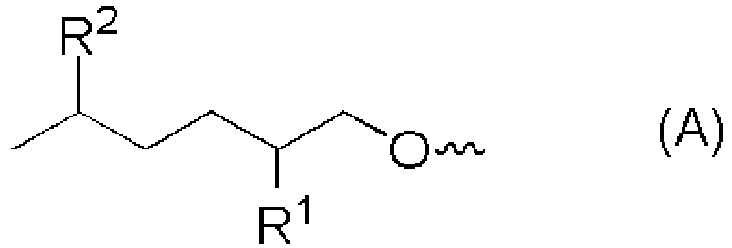
- In the formula, R1 and R2 each independently represent an alkyl group having from 1 to 4 carbon atoms.
- Examples of the ester (i) include an aromatic monocarboxylate ester, such as a benzoate ester, a 2-methylbenzoate ester, a 3-methylbenzoate ester, a 4-methylbenzoate ester, a 1-naphthoate ester, a 2-naphthoate ester, a 2-furancarboxylate ester, and a 3-furancarboxylate ester; an aromatic polybasic carboxylate ester, such as a phthalate ester, an isophthalate ester, a terephthalate ester, a trimellitate ester, and a pyromellitate ester; an aliphatic monocarboxylate ester, such as a caprylate ester, a caprate ester, a laurate ester, a myristate ester, a palmitate ester, a stearate ester, an oleate ester; an aliphatic polybasic carboxylate ester, such as an oxalate ester, a malonate ester, a succinate ester, a glutarate ester, an adipate ester, a pimelate ester, a suberate ester, an azelate ester, a sebacate ester, a fumarate ester, and a maleate ester; an alicyclic monocarboxylate ester, such as a cyclobutanecarboxylate ester, a cyclopentanecarboxylate ester, a cyclohexanecarboxylate ester, a cycloheptanecarboxylate ester, and a cyclooctanecarboxylate ester; an alicyclic polybasic carboxylate ester, such as a 1,2-cyclohexanedicarboxylate ester, a 1,3-cyclohexanedicarboxylate ester, and a 1,4-cyclohexanedicarboxylate ester; and a phosphate ester.
- Among these esters, a phthalate ester, an isophthalate ester, a terephthalate ester, a trimellitate ester, a pyromellitate ester, an adipate ester, a pimelate ester, a suberate ester, an azelate ester, a sebacate ester, a 1,2-cyclohexanedicarboxylate ester, a 1,3-cyclohexanedicarboxylate ester, and a 1,4-cyclohexanedicarboxylate ester are preferred, and a phthalate ester, a trimellitate ester, an adipate ester, an azelate ester, a sebacate ester, and a 1,2-cyclohexanedicarboxylate ester are particularly preferred.
- The production method of the ester (i) is not particularly limited, and the ester (i) can be produced by a known method. In the case of a carboxylate ester, for example, the ester can be produced in such a manner that a desired carboxylic acid or an anhydride thereof is subjected to esterification reaction with an alcohol (1) described later, and the reaction is performed while removing generated water through condensation reaction outside the system. In the case of a phosphate ester, for example, the ester can be produced by subjecting an alcohol (1) described later to reaction with phosphoryl chloride in the presence of a catalyst, such as aluminum chloride, neutralizing, washing with water, and purifying the resultant by removing impurities such as by-produced hydrochloride.
- The ester (i) is preferably produced by condensing an alcohol represented by the following formula (1) (which is hereinafter referred to as an alcohol (1)) and an acid component. In the case where a polybasic carboxylic acid is used as the acid component, not only the ester (i) that is condensed only with the alcohol (1) as an alcohol, but also the ester (i) that is condensed with another alcohol along with the alcohol (1) can be produced. Among these esters, the ester (i) is preferably obtained by condensing only the alcohol (1) as an alcohol.

- In the formula, R1 and R2 have the meanings defined above.
- In the constitutional unit (A) and the alcohol (1), the alkyl group having from 1 to 4 carbon atoms represented independently by each of R1 and R2 is preferably a methyl group, an ethyl group, a propyl group, or an isopropyl group, it is more preferred that R1 is an ethyl group, a propyl group, or an isopropyl group, and R2 is a methyl group or an ethyl group, and it is further preferred that R1 is an isopropyl group, and R2 is a methyl group.
- Specifically, as the alcohol (1), preferred are 2,5-dimethyl-1-hexanol, 2-ethyl-5-methyl-1-hexanol, 5-methyl-2-propyl-1-hexanol, 2-isopropyl-5-methyl-1-hexanol, 2,5-dimethyl-1-heptanol, 2-ethyl-5-methyl-1-heptanol, 2,5-dimethyl-1-octanol, and 2,5,6-trimethyl-1-heptanol, and particularly preferred are 2,5-dimethyl-1-hexanol, 2-ethyl-5-methyl-1-hexanol, 5-methyl-2-propyl-1-hexanol, and 2-isopropyl-5-methyl-1-hexanol.
- The production method of the alcohol (1) is not particularly limited, and examples thereof include known methods such as a method, in which an olefin having approximately from 6 to 12 carbon atoms, which is obtained through multimerization of a lower olefin having approximately from 2 to 6 carbon atoms, such as ethylene, is formed into an aldehyde through hydroformylation reaction, and then hydrogenated, and a method, in which an aldehyde having 5 carbon atoms, which is obtained through hydroformylation reaction of a butene compound, is dimerized through aldol condensation, and then hydrogenated.
- As for the ester (i), the production method of the carboxylate ester will be described in detail below.
- The production of the carboxylate ester can be performed in the presence or absence of a solvent. The solvent is not particularly limited as far as the solvent does not inhibit the reaction, and examples thereof include an aromatic solvent, such as benzene, toluene, ethylbenzene, o-xylene, m-xylene, p-xylene, 1,2,3-trimethylbenzene, 1,2,4-trimethylbenzene, and mesitylene; and an ether solvent, such as tetrahydrofuran, 2-methyltetrahydrofuran, 3-methyltetrahydrofuran, tetrahydropyran, 2-methyltetrahydropyran, 3-methyltetrahydropyran, 4-methyltetrahydropyran, 1,4-dioxane, cyclopentyl methyl ether, 1,2-dimethoxyethane, diethylene glycol dimethyl ether, triethylene glycol dimethyl ether, tetraethylene glycol dimethyl ether, propylene glycol dimethyl ether, dipropylene glycol dimethyl ether, and tripropylene glycol dimethyl ether. These solvents may be used solely or as a combination of two or more kinds thereof. Among these, toluene is preferably used since water formed can be efficiently removed through azeotropy.
- In the case where the reaction is performed in the presence of a solvent, the amount of the solvent used is preferably from 0.5 to 3 parts by mass, more preferably from 1 to 2.5 parts by mass, and further preferably from 1.5 to 2 parts by mass, on the basis of 1 part by mass of the carboxylic acid, from the standpoint of the volume efficiency and the water removal efficiency through azeotropy.
- The esterification reaction may be performed in the presence of a catalyst. Examples of the catalyst include various compounds that function as a Bronsted acid or a Lewis acid, such as sulfuric acid, methanesulfonic acid, p-toluenesulfonic acid, tetraisopropyl titanate, dibutyl tin oxide, and aluminum chloride. The catalysts may be used solely or as a combination of two or more kinds thereof. Among these, methanesulfonic acid and p-toluenesulfonic acid are preferably used from the standpoint of the compatibility with the solvent.
- In the case where the reaction is performed in the presence of a catalyst, the amount of the catalyst used is preferably from 0.01 to 0.05 part by mass, and more preferably from 0.02 to 0.03 part by mass, on the basis of 1 part by mass of the carboxylic acid, from the standpoint of the reaction rate and the cost.
- The reaction temperature for the esterification reaction is not particularly limited, and is generally set to a temperature that is the boiling point of the ester to be produced or less, from the standpoint of the thermal stability of the ester to be formed, and the like. The reaction temperature is preferably approximately from 60 to 250°C, and more preferably from 100 to 200°C, while the reaction temperature may vary depending on the kinds of the carboxylic acid or an anhydride thereof, the alcohol, and the solvent, and the like to be used.
- The reaction pressure for the esterification reaction is not particularly limited, and the reaction may be performed under ordinary pressure or under increased pressure. The reaction is preferably performed under the atmospheric pressure from the standpoint of the simplification of the reaction device and equipment.
- The reaction time for the esterification reaction may vary depending on the kinds of the carboxylic acid or an anhydride thereof, the alcohol, and the solvent, and the like to be used, and is generally preferably from 1 to 10 hours, and more preferably from 3 to 7 hours.
- After completing the esterification reaction, the general post-processing steps including neutralization of the acid catalyst, washing with water, dehydration under reduced pressure, filtration, sublimation purification, vacuum distillation, steam distillation, and the like, are performed, so as to remove the unreacted carboxylic acid or an hydride thereof, the unreacted alcohol, the catalyst, and the like, remaining therein, thereby providing the target ester. At this time, additives that are generally used, such as a decolorant, a deodorant, and an absorbent, may be added depending on necessity.
- The ester (i) may be used as, in addition to the purpose of a plasticizer constituting the insulation material of the present invention, a solvent, such as a solvent for producing an agricultural chemical and a solvent for a coating material; a resin modifier, such as a compatibility improver, a diluent, a processability improver, and a lubricant; a sealing material; a rubber modifier; a functional material and an intermediate thereof, such as a medical drug, a perfume, a surfactant, an agricultural chemical, a liquid crystal, and an electronic material; a raw material intermediate, such as an end capping agent for a polymer; a lubricant, such as a lubricating oil for an engine and a driving device of an automobile, a ship, an aircraft, and the like, a lubricating oil for a reduction gearbox mechanism, a compressor, and a vacuum pump, an industrial lubricating oil, e.g., a refrigerator oil, a metalworking oil, and a fiber processing oil, and a grease; a constitutional component of a polymerization catalyst for an olefin (for example, an electron donor); and a gasoline additive.
- The ester (i) may be used as a mixture with an additional plasticizer as needed in such a range that does not impair the effect of the present invention. The content of the ester (i) is not particularly limited, and the content of the ester (i) is preferably 20% by mass or more, more preferably 30% by mass or more, and further preferably 50% by mass or more, based on the plasticizer contained in the insulation material. A high volume resistivity may be exhibited when the content of the ester (i) is 20% by mass or more based on the plasticizer contained in the insulation material.
- Examples of the additional plasticizer include dimethyl phthalate, diethyl phthalate, dipropyl phthalate, diallyl phthalate, diisopropyl phthalate, dibutyl phthalate, di-sec-butyl phthalate, diisobutyl phthalate, di-tert-butyl phthalate, dipentyl phthalate, diisopentyl phthalate, dihexyl phthalate, diisohexyl phthalate, diheptyl phthalate, diisoheptyl phthalate, bisdibutylbenzyl phthalate, di(2-ethylhexyl) phthalate, di-n-octyl phthalate, diisooctyl phthalate, dinonyl phthalate, diisononyl phthalate, di(3,5,5-trimethylhexyl) phthalate, di-n-decyl phthalate, diisodecyl phthalate, diundecyl phthalate, didodecyl phthalate, ditridecyl phthalate, ditetradecyl phthalate, di(2-ethylhexyl) isophthalate, di-n-octyl isophthalate, diisooctyl isophthalate, dinonyl isophthalate, diisononyl isophthalate, di-n-decyl isophthalate, diisodecyl isophthalate, diundecyl isophthalate, didodecyl isophthalate, ditridecyl isophthalate, ditetradecyl isophthalate, di(2-ethylhexyl) terephthalate, di-n-octyl terephthalate, diisooctyl terephthalate, dinonyl terephthalate, diisononyl terephthalate, di-n-decyl terephthalate, diisodecyl terephthalate, diundecyl terephthalate, didodecyl terephthalate, ditridecyl terephthalate, ditetradecyl terephthalate, tri(2-ethylhexyl) trimellitate, tri-n-octyl trimellitate, triisooctyl trimellitate, trinonyl trimellitate, triisononyl trimellitate, tri-n-decyl trimellitate, triisodecyl trimellitate, triundecyl trimellitate, tridodecyl trimellitate, tri(tridecyl) trimellitate, tritetradecyl trimellitate, tetra(2-ethylhexyl) pyromellitate, tetra-n-octyl pyromellitate, tetraisooctyl pyromellitate, tetranonyl pyromellitate, tetraisononyl pyromellitate, tetra-n-decyl pyromellitate, tetraisodecyl pyromellitate, tetraundecyl pyromellitate, tetradodecyl pyromellitate, tetratridecyl pyromellitate, tetra(tetradecyl) pyromellitate, isobutyl oleate, diethyl succinate, dibutyl adipate, diisobutyl adipate, bis[2-(2-butoxyethoxy)ethyl] adipate, di(2-ethylhexyl) adipate, di-n-octyl adipate, diisooctyl adipate, dinonyl adipate, diisononyl adipate, di-n-decyl adipate, diisodecyl adipate, diundecyl adipate, didodecyl adipate, ditridecyl adipate, ditetradecyl adipate, di(2-ethylhexyl) pimelate, di-n-octyl pimelate, diisooctyl pimelate, dinonyl pimelate, diisononyl pimelate, di-n-decyl pimelate, diisodecyl pimelate, diundecyl pimelate, didodecyl pimelate, ditridecyl pimelate, ditetradecyl pimelate, di(2-ethylhexyl) suberate, di-n-octyl suberate, diisooctyl suberate, dinonyl suberate, diisononyl suberate, di-n-decyl suberate, diisodecyl suberate, diundecyl suberate, didodecyl suberate, ditridecyl suberate, ditetradecyl suberate, di(2-ethylhexyl) azelate, di-n-octyl azelate, diisooctyl azelate, dinonyl azelate, diisononyl azelate, di-n-decyl azelate, diisodecyl azelate, diundecyl azelate, didodecyl azelate, ditridecyl azelate, ditetradecyl azelate, dibutyl sebacate, di(2-ethylhexyl) sebacate, di-n-octyl sebacate, diisooctyl sebacate, dinonyl sebacate, diisononyl sebacate, di-n-decyl sebacate, diisodecyl sebacate, diundecyl sebacate, didodecyl sebacate, ditridecyl sebacate, ditetradecyl sebacate, dibutyl fumarate, dibutyl maleate, di(2-ethylhexyl) 1,2-cyclohexanedicarboxylate, di-n-octyl 1,2-cyclohexanedicarboxylate, diisooctyl 1,2-cyclohexanedicarboxylate, dinonyl 1,2-cyclohexanedicarboxylate, diisononyl 1,2-cyclohexanedicarboxylate, di-n-decyl 1,2-cyclohexanedicarboxylate, diisodecyl 1,2-cyclohexanedicarboxylate, diundecyl 1,2-cyclohexanedicarboxylate, didodecyl 1,2-cyclohexanedicarboxylate, ditridecyl 1,2-cyclohexanedicarboxylate, ditetradecyl 1,2-cyclohexanedicarboxylate, di(2-ethylhexyl) 1,3-cyclohexanedicarboxylate, di-n-octyl 1,3-cyclohexanedicarboxylate, diisooctyl 1,3-cyclohexanedicarboxylate, dinonyl 1,3-cyclohexanedicarboxylate, diisononyl 1,3-cyclohexanedicarboxylate, di-n-decyl 1,3-cyclohexanedicarboxylate, diisodecyl 1,3-cyclohexanedicarboxylate, diundecyl 1,3-cyclohexanedicarboxylate, didodecyl 1,3-cyclohexanedicarboxylate, ditridecyl 1,3-cyclohexanedicarboxylate, ditetradecyl 1,3-cyclohexanedicarboxylate, di(2-ethylhexyl) 1,4-cyclohexanedicarboxylate, di-n-octyl 1,4-cyclohexanedicarboxylate, diisooctyl 1,4-cyclohexanedicarboxylate, dinonyl 1,4-cyclohexanedicarboxylate, diisononyl 1,4-cyclohexanedicarboxylate, di-n-decyl 1,4-cyclohexanedicarboxylate, diisodecyl 1,4-cyclohexanedicarboxylate, diundecyl 1,4-cyclohexanedicarboxylate, didodecyl 1,4-cyclohexanedicarboxylate, ditridecyl 1,4-cyclohexanedicarboxylate, ditetradecyl 1,4-cyclohexanedicarboxylate, an adipic acid/glycol polyester-based plasticizer, a pimelic acid/glycol polyester-based plasticizer, a suberic acid/glycol polyester-based plasticizer, an azelaic acid/glycol polyester-based plasticizer, a sebacic acid/glycol polyester-based plasticizer, an epoxidized soybean oil, an epoxidized linseed oil, an epoxidized fatty acid octyl ester, an epoxidized fatty acid alkyl ester, a dipentaerythritol ester, tributyl acetylcitrate, ethylphthalyl ethylglycolate, trimethyl phosphate, triethyl phosphate, tributyl phosphate, tris(2-ethylhexyl) phosphate, triphenyl phosphate, trixylenyl phosphate, cresyl diphenyl phosphate, (2-ethylhexyl) diphenyl phosphate, tricresyl phosphate, methyl acetyl ricinoleate, glyceryl triacetate, and N-butylbenzenesulfonamide.
- The resin composition containing the ester (i) and the resin (ii) is excellent in various properties including flexibility and the like, and can be favorably applied to various purposes.
- Examples of the resin (ii) include a vinyl chloride-based resin, chlorinated polyethylene, chlorinated polyvinyl chloride, polyvinylidene chloride, isoprene rubber, butadiene rubber, nitrile rubber, styrene-butadiene rubber, chloroprene rubber, ethylene-propylene rubber, polytetrafluoroethylene, polyvinylidene fluoride, polyvinyl fluoride, polyethylene, polypropylene, polyvinyl alcohol, polylactic acid, a styrol resin, a cellulose resin, an acrylic resin, an acrylonitrile resin, a urethane resin, a vinyl acetate resin, a butyral resin, an ethylene-vinyl acetate copolymer resin, an ethylene-vinyl acetate-carbon monoxide copolymer resin, a styrene-acrylonitrile copolymer resin, an acrylonitrile-butadiene-styrene resin, and an acrylate-styrene-acrylonitrile copolymer resin. These may be used solely or as a combination of two or more kinds thereof.
- Among these, a vinyl chloride-based resin is preferred.
- The "vinyl chloride-based resin" herein means a resin containing vinyl chloride as a major constitutional unit, such as a copolymer containing vinyl chloride as a major component with other comonomers as well as an unmodified vinyl chloride resin containing only vinyl chloride as a monomer. The resin may be produced by a known method, such as a suspension polymerization method. Examples of the comonomer capable of being copolymerized with vinyl chloride include an α-olefin, such as ethylene, propylene, and 1-butene; a conjugated diene, such as butadiene and isoprene; vinyl alcohol, styrene, acrylonitrile, vinyl acetate, vinyl propionate, fumaric acid or an ester thereof, maleic acid or an ester or anhydride thereof, an acrylic acid or an ester thereof, methacrylic acid or an ester thereof, and isoprenol.
- The compounding amount of the ester (i) to the resin (ii) may vary depending on the desired extents of the flexibility and the processability, in terms of the total amount of the ester (i) and the additional plasticizer, which may be mixed therewith depending on necessity, is generally from 1 to 200 parts by mass, preferably from 10 to 150 parts by mass, and more preferably from 30 to 70 parts by mass, on the basis of 100 parts by mass of the resin (ii). When the amount thereof added is less than 1 part by mass, there may be a tendency that the flexibility and the processability of the resulting resin composition are insufficient, and when the amount thereof added exceeds 200 parts by mass, there may be a tendency that bleed-out of the ester (i) from the resin composition or gelation failure in processing are caused.
- The resin composition may contain, in addition to the resin (ii) and the ester (i), an additive in such a range that does not impair the object of the present invention. Examples of the additive include a filler, such as silica-based powder, clay, talc, aluminum hydroxide, and calcium carbonate; a lubricant, such as liquid paraffin, wax, a higher fatty acid or a salt thereof, a fatty acid ester, a fatty acid amide, a higher alcohol, and a metallic soap; a flame retardant, such as barium borate, zinc borate, antimony trioxide, zinc oxide, chlorinated polyethylene, a phosphoric acid-based flame retardant, and a halogen-based flame retardant; an antioxidant, such as a phenolic antioxidant, a sulfur-based antioxidant, and a phosphorus-based antioxidant; a colorant, such as an inorganic pigment and an organic pigment; an ultraviolet ray absorbent, such as a benzotriazole compound, a benzophenone compound, and a hindered amine compound; a foaming agent, such as oxybisbenzylhydrazide and azodicarbonamide; a lead-based stabilizer, such as tribasic lead sulfate, a lead orthosilicate-silica gel coprecipitate, dibasic lead stearate, and dibasic lead phthalate; a stabilizer, such as a barium/zinc-based stabilizer, a barium/cadmium-based stabilizer, a calcium/zinc-based stabilizer, an aluminum-based stabilizer, a silicon-based stabilizer, a tin-based stabilizer, and a magnesium-based stabilizer; a surfactant; and an antistatic agent.
- In the case where the additives are mixed with the resin composition depending on necessity, the amount thereof mixed is generally from 0.1 to 10 parts by mass, and preferably from 1 to 5 parts by mass, on the basis of 100 parts by mass of the resin (ii).
- The resin composition can be prepared by mixing the ester (i), the resin (ii), the additional plasticizer, the additives, and the like under heating with the known method and equipment depending on the purpose, such as a blender, a planetary mixer, and a Banbury mixer, thereby providing the insulation material of the present invention.
- Thereafter, the insulation material may be processed and molded into a desired product form by a known molding method, for example, such a molding method as extrusion molding, calender molding, injection molding, heat molding, coating process, and dipping process.
- The purpose of the insulation material of the present invention is not particularly limited, and may be applied to any purpose that requires electric insulation property. Examples the purpose include an insulating tape, an insulating cloth, an insulating film, an insulating sheet, shoes, a shoe sole, clothing, gloves, a helmet, a capacitor, a battery material (such as a vessel and a separator), an insulating adhesive, an interior and exterior packages and a covering of an electric equipment, a resin product around an electric cable, a cabling connector, and a plug socket, a coating of an electric work tool, a screw, a bolt, a nut, a washer, an electronic circuit board, a printed board, grease for an electronic equipment, an insulating varnish, and an insulating paint.
- The resin composition constituting the insulation material of the present invention may also be applied to a purpose that does not necessarily require electric insulation property. Examples the purpose include clothing, a rainwear, an umbrella, a bag, a rope, an insect screen (such as a net window), a packaging material, intravenous injection bag and tube, a bottle for cosmetics, shampoo, or detergent, a blood reservoir (such as a blood platelet reservoir), a tissue embedding material, a water pipe, a pipe joint, a hose pipe, a tank, an automobile underbody coating, a refrigerator gasket, a packing material, various kinds of artificial leather (such as ordinary artificial leather, sponge artificial leather having a foamed layer, and sandwich sponge artificial leather), various foamed materials, a construction material (such as wallpaper, a floor material, a cushion material, a heat insulation material, a soundproof material, a protective agent, a terrace, a skylight window, a carport, a blindfold board, a storeroom, an arcaded, and a watershoot), a signboard, a stationery product, an eraser, a card, a sticker, a toy, an adhesive, an adhesive plaster, an agricultural film, a fishing net, a brush, a hairpiece, and a phonograph record.
- For covering a conductor (for example, a metal, such as copper) with the insulation material of the present invention, a known extrusion covering machine having an extruder can be used. For example, an electric cable can be produced at a rate of from around 300 to 450 m per minute under a condition of an extruder temperature of from 160 to 200°C and a crosshead temperature of 180°C.
- The form of the electric cable, to which the insulation material of the present invention is applied as a cable covering, is not particularly limited, and the insulation material can be applied as an insulation material for known various electric cables, such as a solid wire, a flat wire, and a shielded wire.
- The utilization method of the electric cable of the present invention is not particularly limited, and the electric cable can be applied to automobile use, electric equipment use, communication use, electric power use, ship use, aircraft use, and the like.
- The present invention will be specifically described with reference to examples and the like below, but the present invention is not limited to the examples.
- To a glass three-neck flask having a capacity of 500 mL equipped with a magnetic stirrer, a thermometer, a nitrogen introducing pipe, a Dean-Stark trap, and a reflux condenser, 123 g (0.777 mol) of 2-isopropyl-5-methyl-1-hexanol (produced by Tokyo Chemical Industry Co., Ltd.), 57.5 g (0.388 mol) of phthalic anhydride (produced by Wako Pure Chemical Industries, Ltd.), 100 g of toluene (produced by Wako Pure Chemical Industries, Ltd.), and 1.52 g (15.8 mmol) of methanesulfonic acid (produced by Wako Pure Chemical Industries, Ltd.) as an acid catalyst were charged under a nitrogen atmosphere. The solution was reacted for 5 hours by heating to an inner temperature of 120°C under stirring. Thereafter, the reaction system was depressurized to remove the solvent and unreacted 2-isopropyl-5-methyl-1-hexanol, and then neutralization, washing with water, and dehydration under reduced pressure were performed to provide 144 g (0.322 mol) of bis(2-isopropyl-5-methyl-1-hexyl) phthalate.
1H-NMR (400 MHz, CDCl3, tetramethylsilane (TMS), ppm): δ 0.87 (d, CH3, 6H), 0.88 (d, CH3, 6H), 0.92 (d, CH3, 12H), 1.14-1.61, 1.80-1.88 (m, 14H), 4.26 (dd, -O-CH2-, 4H), 7.52 (dd, ArH, 2H), 7.69 (dd, ArH, 2H) - With 100 parts by mass of a polyvinyl chloride resin having an average polymerization degree of 1,000 (TK-1000, a trade name, produced by Shin-Etsu Chemical Co., Ltd.), 50 parts by mass of bis(2-isopropyl-5-methyl-1-hexyl) phthalate synthesized in the item (1) above and 5 parts by mass of tribasic lead sulfate as a stabilizer were mixed. The mixture was kneaded with a planetary mixer (produced by Toyo Seiki Co., Ltd.) at 120°C and a rotation number of 60 rpm. The completion of the dry-up (i.e., the increase in flowability of the mixture due to absorption of the plasticizer to the polyvinyl chloride resin) was determined by the decline of torque of the mixer. The mixture was rolled on a two-mill roll at 150°C for 10 minutes (roll width: 220 mm, roll gap: 1 mm) and then pressed to a thickness of 1 mm with a 26-ton hydraulic molding machine (produced by Toho Press Seisakusho Co., Ltd.) (preliminary press: 0.5 MPa at 170°C for 4 minutes, press: 5 MPa at 170°C for 1 minute, cooling: 0.5 MPa at 20°C for 10 minutes), thereby producing a soft vinyl chloride resin sheet.
- The reaction and the post process were performed in the same manner as in Production Example 1 except that 49.8 g (0.259 mol) of trimellitic anhydride (produced by Wako Pure Chemical Industries, Ltd.) was used instead of phthalic anhydride to provide 131 g (0.208 mol) of tris(2-isopropyl-5-methyl-1-hexyl) trimellitate.
1H-NMR analysis (400 MHz, CDCl3, TMS, ppm) δ 0.87-0.97 (m, CH3, 36H), 1.15-1.65, 1.79-1.90 (m, 21H), 4.25-4.36 (m, -O-CH2-, 6H), 7.72 (d, ArH, 1H), 8.17 (dd, ArH, 1H), 8.37 (d, ArH, 1H) - A soft vinyl chloride resin sheet was produced in the same manner as in the item (2) of Production Example 1 except that 25 parts by mass of tris(2-isopropyl-5-methyl-1-hexyl) trimellitate synthesized in the item (1) above and 25 parts by mass of dioctyl phthalate (Vinycizer 80, a trade name, produced by Kao Corporation) were used instead of 50 parts by mass of bis(2-isopropyl-5-methyl-1-hexyl) phthalate.
- The reaction and the post process were performed in the same manner as in Production Example 1 except that 56.8 g (0.389 mol) of adipic acid (produced by Wako Pure Chemical Industries, Ltd.) was used instead of phthalic anhydride to provide 129 g (0.302 mol) of bis(2-isopropyl-5-methyl-1-hexyl) adipate.
1H-NMR (400 MHz, CDCl3, TMS, ppm) δ 0.86-0.90 (m, CH3, 24H), 1.10-1.55, 1.62-1.82 (m, 18H), 2.29-2.34 (m, -CH2-COO, 4H), 3.98-4.07 (m, -O-CH2-, 4H) - A soft vinyl chloride resin sheet was produced in the same manner as in the item (2) of Production Example 1 except that 50 parts by mass of bis(2-isopropyl-5-methyl-1-hexyl) adipate synthesized in the item (1) above was used instead of 50 parts by mass of bis(2-isopropyl-5-methyl-1-hexyl) phthalate.
- The reaction and the post process were performed in the same manner as in Production Example 1 except that 78.5 g (0.388 mol) of sebacic acid (produced by Wako Pure Chemical Industries, Ltd.) was used instead of phthalic anhydride to provide 161 g (0.333 mol) of bis(2-isopropyl-5-methyl-1-hexyl) sebacate.
1H-NMR analysis (400 MHz, CDCl3, TMS, ppm) δ 0.86∼0.90 (m, CH3, 24H), 1.10-1.83 (m, 26H), 2.28 (t, -CH2-COO, 4H), 3.97-4.06 (m, -O-CH2-, 4H) - A soft vinyl chloride resin sheet was produced in the same manner as in the item (2) of Production Example 1 except that 50 parts by mass of bis(2-isopropyl-5-methyl-1-hexyl) sebacate synthesized in the item (1) above was used instead of 50 parts by mass of bis(2-isopropyl-5-methyl-1-hexyl) phthalate.
- A soft vinyl chloride resin sheet was produced in the same manner as in the item (2) of Production Example 1 except that 50 parts by mass of dioctyl phthalate (Vinycizer 80, a trade name, produced by Kao Corporation) was used instead of 50 parts by mass of bis(2-isopropyl-5-methyl-1-hexyl) phthalate.
- A soft vinyl chloride resin sheet was produced in the same manner as in the item (2) of Production Example 1 except that 50 parts by mass of diisononyl phthalate (Vinycizer 90, a trade name, produced by Kao Corporation) was used instead of 50 parts by mass of bis(2-isopropyl-5-methyl-1-hexyl) phthalate.
- A soft vinyl chloride resin sheet was produced in the same manner as in the item (2) of Production Example 1 except that 50 parts by mass of diisodecyl phthalate (produced by J-Plus Co., Ltd.) was used instead of 50 parts by mass of bis(2-isopropyl-5-methyl-1-hexyl) phthalate.
- A soft vinyl chloride resin sheet was produced in the same manner as in the item (2) of Production Example 1 except that 50 parts by mass of bis(2-propyl-1-heptyl) phthalate was used instead of 50 parts by mass of bis(2-isopropyl-5-methyl-1-hexyl) phthalate.
- A soft vinyl chloride resin sheet was produced in the same manner as in the item (2) of Production Example 1 except that 50 parts by mass of bis(2-ethyl-1-octyl) phthalate was used instead of 50 parts by mass of bis(2-isopropyl-5-methyl-1-hexyl) phthalate.
- A soft vinyl chloride resin sheet was produced in the same manner as in the item (2) of Production Example 1 except that 50 parts by mass of bis(3,7-dimethyl-1-octyl) phthalate was used instead of 50 parts by mass of bis(2-isopropyl-5-methyl-1-hexyl) phthalate.
- A soft vinyl chloride resin sheet was produced in the same manner as in the item (2) of Production Example 1 except that 50 parts by mass of bis(2-methyl-1-nonyl) phthalate was used instead of 50 parts by mass of bis(2-isopropyl-5-methyl-1-hexyl) phthalate.
- A soft vinyl chloride resin sheet was produced in the same manner as in the item (2) of Production Example 1 except that 50 parts by mass of trioctyl trimellitate (Trimex T-08NB, a trade name, produced by Kao Corporation) was used instead of 50 parts by mass of bis(2-isopropyl-5-methyl-1-hexyl) phthalate.
- A soft vinyl chloride resin sheet was produced in the same manner as in the item (2) of Production Example 1 except that 50 parts by mass of diisodecyl adipate (Vinycizer 50, a trade name, produced by Kao Corporation) was used instead of 50 parts by mass of bis(2-isopropyl-5-methyl-1-hexyl) phthalate.
- The soft vinyl chloride resin sheets obtained in Production Examples 1 to 4 each were measured and evaluated for properties in the following manners. The results are shown in Table 1.
- (1) Tensile test: The test was performed according to JIS K6723.
- (2) Volume resistivity test: The test was performed according to JIS K6723 at 30°C.
- (3) Tensile test after heating: The test was performed according to JIS K6723 after heating at 100°C or 120°C for 120 hours.
- (4) Oil resistance test: The test was performed according to JIS K6723 after immersing in a test oil at 70°C for 4 hours.
- (5) Bleed-out test: Test pieces (n = 3) molded in a size of 100 mm x 100 mm x 1 mm were heated in an oven at 70°C for 20 days, and the presence of bleed-out of the plasticizer (exuding from the PVC sheet) was visually evaluated (n = 3).
- (6) Migration test: One test piece molded in a size of 20 mm x 50 mm x 1 mm was overlapped one ABS resin plate having the same dimension as the test piece, which were heated in an oven at 80°C for 72 hours, and the presence of migration of the plasticizer from the PVC sheet to the ABS resin plate was visually evaluated (n = 6). The same test was also performed by using a polyethylene resin plate instead of the ABS resin plate.
- The soft vinyl chloride resin sheets obtained in Comparative Production Examples 1 to 9 were measured and evaluated for properties in the same manners as in Examples 1 to 4. The results are shown in Table 1.
Table 1 Example Comparative Example 1 2 3 4 1 2 3 4 5 6 7 8 9 Tensile test Tensile strength (MPa) 23.4 23.0 18.5 15.4 21.3 22.1 26.0 26.5 27.0 27.0 27.4 23.3 18.6 Elongation (%) 324 315 300 220 304 332 400 375 410 405 395 320 310 100% Modulus (MPa) 13.4 12.7 11.0 10.4 10.6 10.3 13.5 13.9 13.8 14.1 13.5 13.4 11.3 Tensile test after heating (100°C) Retention of Tensile strength (%) 93 96 93 98 Retention of Elongation (%) 99 101 100 109 100% Modulus (MPa) 14.0 11.5 11.0 13.9 Tensile test after heating (120°C) Retention of Tensile strength (%) 102 109 98 90 96 95 90 93 Retention of Elongation (%) 99 88 94 70 75 80 80 110 100% Modulus (MPa) 16.2 17.3 12.6 18.4 18.3 18.5 17.0 13.1 Oil resistance test (70°C) Retention of Tensile strength (%) 93 93 92 92 Retention of Elongation (%) 88 91 84 88 100% Modulus (MPa) 14.4 11.3 11.6 14.0 Bleed-out test (70°C) *1 *1 *1 Migration test (80°C) ABS resin plate *2 *2 *2 Polyethylene resin plate *2 *2 *2 Volume resistivity (× 1013 Ω·cm) 155.1 130.7 0.53 0.73 8.5 6.0 15.6 6.8 6.4 5.9 3.9 131.5 0.04 (*1: slightly discolored with no other particular change)
(*2: no particular change) - The following points were found from Examples and Comparative Examples for the insulation material of the present invention.
- The comparison among the phthalate esters revealed that the soft vinyl chloride sheets of Comparative Examples 1 to 7 obtained by molding the resin compositions using the phthalate esters having no constitutional unit (A) each had a low volume resistivity, whereas the soft vinyl chloride sheet of Example 1 obtained by molding the resin composition using the ester (i) having the constitutional unit (A) exhibited a high volume resistivity.
- The comparison between the trimellitate esters revealed that the soft vinyl chloride sheet of Example 2 obtained by molding the resin composition using the trimellitate ester having the constitutional unit (A) exhibited a high volume resistivity equivalent to the case of Comparative Example 8 using only trioctyl trimellitate, even though dioctyl phthalate having no constitutional unit (A) was used as a mixture. It has been known that as compared to a phthalate ester and the like, a trimellitate ester is a plasticizer capable of imparting various capabilities demanded for a soft vinyl chloride resin without impairing largely the volume resistivity inherent to the vinyl chloride resin. The use the trimellitate ester having the constitutional unit (A) provides the same effect only by replacing a part of used phthalate ester by the trimellitate ester, and thus can suppress the amount of expensive trimellitic acid used.
- The comparison between the aliphatic ester, such as the adipate esters and the sebacate esters, provided the similar tendency, and the soft vinyl chloride sheets of Examples 3 and 4 obtained by molding the resin compositions using the esters (i) having the constitutional unit (A) each exhibited a high volume resistivity, as compared to the soft vinyl chloride sheets of Comparative Example 9 obtained by molding the resin composition using the ester having no constitutional unit (A).
- Resin compositions are used for various purposes and are different in demanded capabilities depending on the purposes. The amounts of plasticizers added also vary depending on the purposes, and therefore the necessary values of the mechanical characteristics, the volume resistivity, the heat resistance, the oil resistance, and the plasticizer migration property of the resin composition cannot be determined unconditionally, but the values in the examples can be regarded as the certain reference values. It is understood from the results of the examples that assuming the same amount of the plasticizer added, an excellent volume resistivity can be exhibited while retaining the mechanical strength, the heat resistance, the oil resistance, and the plasticizer migration property of the resin composition, only in the case where the ester (i) having the particular structure having the constitutional unit (A) is used as the plasticizer.
- The resin compositions of Examples 1, 2, 3, and 4 each were extrusion-molded on a copper wire at a linear velocity of 400 m per minute by using a cable extruder having a screw diameter of 60 mm and L/D of 25 at a cylinder temperature of the extruder of 190°C and a crosshead temperature thereof of 180°C, thereby producing covered electric cables.
- The insulation material of the present invention has a high volume resistivity and can be advantageously applied to any purpose that requires electric insulation property.
Claims (10)
- An insulation material comprising a resin composition containing:an ester (i) having one or more constitutional unit represented by the following formula (A):
 wherein R1 and R2 each independently represent an alkyl group having from 1 to 4 carbon atoms; anda resin (ii).
 - The insulation material according to claim 1, wherein the ester (i) is an ester that is obtained through condensation of an alcohol represented by the following formula (1):

- The insulation material according to claim 2, wherein the acid component is one selected from the group consisting of an aromatic polybasic carboxylic acid, an aromatic polybasic carboxylic anhydride, an aliphatic polybasic carboxylic acid, and an aliphatic polybasic carboxylic anhydride.
- The insulation material according to any one of claims 1 to 3, wherein R1 and R2 each independently represent a methyl group, an ethyl group, a propyl group, or an isopropyl group.
- The insulation material according to any one of claims 1 to 4, wherein a content of the ester (i) is 20% by mass or more based on a plasticizer contained in the insulation material.
- The insulation material according to any one of claims 1 to 5, wherein the resin (ii) is a vinyl chloride resin.
- A method for insulation, comprising using the insulation material according to any one of claims 1 to 6.
- Use of the insulation material according to any one of claims 1 to 6 for insulation.
- The insulation material according to any one of claims 1 to 6, which is for covering an electric cable.
- An electric cable comprising the insulation material according to claim 9.
Applications Claiming Priority (2)
| Application Number | Priority Date | Filing Date | Title |
|---|---|---|---|
| JP2014246625 | 2014-12-05 | ||
| PCT/JP2015/084033 WO2016088841A1 (en) | 2014-12-05 | 2015-12-03 | Insulation material |
Publications (3)
| Publication Number | Publication Date |
|---|---|
| EP3228667A1 true EP3228667A1 (en) | 2017-10-11 |
| EP3228667A4 EP3228667A4 (en) | 2018-08-01 |
| EP3228667B1 EP3228667B1 (en) | 2025-02-05 |
Family
ID=56091781
Family Applications (1)
| Application Number | Title | Priority Date | Filing Date |
|---|---|---|---|
| EP15864321.3A Active EP3228667B1 (en) | 2014-12-05 | 2015-12-03 | Insulation material |
Country Status (5)
| Country | Link |
|---|---|
| US (1) | US10811165B2 (en) |
| EP (1) | EP3228667B1 (en) |
| JP (1) | JP6725114B2 (en) |
| CN (1) | CN107001805B (en) |
| WO (1) | WO2016088841A1 (en) |
Families Citing this family (9)
| Publication number | Priority date | Publication date | Assignee | Title |
|---|---|---|---|---|
| CN106700345A (en) * | 2017-01-12 | 2017-05-24 | 芜湖航天特种电缆厂股份有限公司 | Cold-resistant cable sheath material and preparation method thereof |
| CN106674821A (en) * | 2017-01-12 | 2017-05-17 | 芜湖航天特种电缆厂股份有限公司 | High-temperature resistant cable sheathing compound and preparation method thereof |
| CN106751224A (en) * | 2017-01-12 | 2017-05-31 | 芜湖航天特种电缆厂股份有限公司 | Wear-resistant cable sheath material and preparation method thereof |
| CN106751225A (en) * | 2017-01-12 | 2017-05-31 | 芜湖航天特种电缆厂股份有限公司 | Wear-resistant cable sheath material and preparation method thereof |
| CN106700346A (en) * | 2017-01-12 | 2017-05-24 | 芜湖航天特种电缆厂股份有限公司 | High temperature resistant sheathing material for cables and preparation method of high temperature resistant sheathing material |
| JP7147839B2 (en) * | 2018-03-28 | 2022-10-05 | 株式会社オートネットワーク技術研究所 | Wire harness and method for manufacturing wire harness |
| JPWO2021060149A1 (en) * | 2019-09-26 | 2021-04-01 | ||
| KR102665699B1 (en) * | 2023-12-21 | 2024-05-20 | 주식회사 퍼시픽인터켐코포레이션 | Additive composition |
| KR102691283B1 (en) * | 2024-04-12 | 2024-08-05 | 주식회사 퍼시픽인터켐코포레이션 | Resin additive composition having multi-function |
Family Cites Families (17)
| Publication number | Priority date | Publication date | Assignee | Title |
|---|---|---|---|---|
| US2311260A (en) * | 1941-10-18 | 1943-02-16 | Carbide & Carbon Chem Corp | Esters of endo-methylene hydrophthalic acids with glycol and polyglycol monoethers |
| NL73635C (en) * | 1950-03-29 | |||
| BE517204A (en) * | 1952-01-30 | |||
| US4277388A (en) * | 1979-03-28 | 1981-07-07 | Denki Kagaku Kogyo Kabushiki Kaisha | Thermoplastic resin of hydrolyzed product of vinyl chloride copolymer for use in coating resin and process for preparing such resin |
| JPS58220874A (en) * | 1982-06-09 | 1983-12-22 | 松本油脂製薬株式会社 | Lubricant for thermoplastic synthetic fiber bulky processed yarn |
| JPH06166644A (en) | 1992-12-01 | 1994-06-14 | Chisso Corp | Mixed alcohol for plasticizer and plasticizer production by using the alcohol |
| JPH07102141A (en) * | 1993-10-04 | 1995-04-18 | Chisso Corp | Vinyl chloride resin composition for electric wire |
| JP3706208B2 (en) * | 1995-09-05 | 2005-10-12 | プラス・テク株式会社 | Vinyl chloride resin composition |
| JP2004158465A (en) | 1995-09-05 | 2004-06-03 | Mitsui Chemicals Inc | Vinyl chloride based resin sheathed wire |
| JP3553224B2 (en) * | 1995-09-22 | 2004-08-11 | 旭電化工業株式会社 | Polyolefin polymer composition |
| JP3760679B2 (en) * | 1998-06-03 | 2006-03-29 | 三菱化学株式会社 | C9 alcohol composition for plasticizer and phthalic acid diester plasticizer composition using the same |
| JP3832143B2 (en) * | 1999-06-24 | 2006-10-11 | 三菱化学株式会社 | C10 alcohol composition for plasticizer and phthalic acid diester plasticizer composition using the same |
| JP4314711B2 (en) * | 2000-01-27 | 2009-08-19 | 新日本理化株式会社 | Cyclohexanedicarboxylic acid diester plasticizer, vinyl chloride resin composition, and vinyl chloride resin molded article using the same |
| DE10249912A1 (en) * | 2002-10-26 | 2004-05-06 | Oxeno Olefinchemie Gmbh | Benzoic acid isodecyclester mixtures, preparation and their use |
| US20090036581A1 (en) * | 2007-07-30 | 2009-02-05 | Velsicol Chemical Corporation | Novel High Viscosity Liquid Benzoate Ester Compositions And Polymer Compositions Containing Said Ester Compositions |
| KR20110008631A (en) * | 2009-07-20 | 2011-01-27 | 에스케이이노베이션 주식회사 | Ester plasticizer |
| WO2011051102A1 (en) * | 2009-10-26 | 2011-05-05 | Exxonmobil Chemical Patents Inc. | Improved phthalic anhydride process |
-
2015
- 2015-12-03 EP EP15864321.3A patent/EP3228667B1/en active Active
- 2015-12-03 CN CN201580065749.7A patent/CN107001805B/en active Active
- 2015-12-03 JP JP2016562676A patent/JP6725114B2/en active Active
- 2015-12-03 US US15/532,007 patent/US10811165B2/en active Active
- 2015-12-03 WO PCT/JP2015/084033 patent/WO2016088841A1/en not_active Ceased
Also Published As
| Publication number | Publication date |
|---|---|
| JPWO2016088841A1 (en) | 2017-09-14 |
| CN107001805A (en) | 2017-08-01 |
| EP3228667B1 (en) | 2025-02-05 |
| CN107001805B (en) | 2020-10-02 |
| EP3228667A4 (en) | 2018-08-01 |
| US20170271042A1 (en) | 2017-09-21 |
| US10811165B2 (en) | 2020-10-20 |
| WO2016088841A1 (en) | 2016-06-09 |
| JP6725114B2 (en) | 2020-07-15 |
Similar Documents
| Publication | Publication Date | Title |
|---|---|---|
| EP3228667B1 (en) | Insulation material | |
| CN101878260B (en) | C7-C12 secondary alcohol esters of cyclohexanoic acid | |
| CN108026322B (en) | Plasticizer composition and resin composition comprising the same | |
| TWI725196B (en) | Plasticizer composition, resin composition and method of preparing the same | |
| WO2014195056A1 (en) | Dialkyl esters of 1,4-cyclohexane di-carboxylic acids and their use as plasticisers | |
| CN108350216B (en) | Plasticizer composition, resin composition and method for producing the same | |
| CN110536920B (en) | Citric acid ester plasticizer and resin composition containing same | |
| JP6659740B2 (en) | Plasticizer composition | |
| CN108350220A (en) | Plasticizer composition, resin composition and preparation method thereof | |
| KR20190049611A (en) | Plasticizer composition and resin composition comprising the same | |
| US4620026A (en) | Monomeric plasticizers for halogen-containing resins | |
| EP3530690B1 (en) | Plasticizer composition comprising cyclohexane 1,4-diester-based compound, and resin composition comprising same | |
| JP2016074876A (en) | Plasticizer for vinyl chloride resin comprising 1,4-cyclohexanedicarboxylic acid diester | |
| CN107207775A (en) | Compound based on ester, the composition comprising it, its preparation method and the resin combination comprising it | |
| KR20170049446A (en) | Plasticizer, resin composition and method for preparing them | |
| US7291748B2 (en) | C10/C7 ester mixtures based on 2-propylheptanol | |
| EP1781585B1 (en) | Mixtures of c8-c10 alcohols and derived plasticisers | |
| EP3763778B1 (en) | Plasticizer for halogen resins | |
| HK1238273A1 (en) | Insulation material | |
| HK1238273B (en) | Insulation material | |
| KR101123504B1 (en) | Vinyl chloride based resin composition containing dioctyl terephthalate for covering of electric wire | |
| KR100768744B1 (en) | 2,2,4-trimethyl-1,3-pentanediol diester plasticizer composition and PPC-based polymer resin composition comprising the same | |
| CN107250099A (en) | Compound based on ester, the composition comprising it, its preparation method and the resin combination comprising it | |
| CN118647662A (en) | Plasticizer composition and resin composition containing the same |
Legal Events
| Date | Code | Title | Description |
|---|---|---|---|
| STAA | Information on the status of an ep patent application or granted ep patent |
Free format text: STATUS: THE INTERNATIONAL PUBLICATION HAS BEEN MADE |
|
| PUAI | Public reference made under article 153(3) epc to a published international application that has entered the european phase |
Free format text: ORIGINAL CODE: 0009012 |
|
| STAA | Information on the status of an ep patent application or granted ep patent |
Free format text: STATUS: REQUEST FOR EXAMINATION WAS MADE |
|
| 17P | Request for examination filed |
Effective date: 20170530 |
|
| AK | Designated contracting states |
Kind code of ref document: A1 Designated state(s): AL AT BE BG CH CY CZ DE DK EE ES FI FR GB GR HR HU IE IS IT LI LT LU LV MC MK MT NL NO PL PT RO RS SE SI SK SM TR |
|
| AX | Request for extension of the european patent |
Extension state: BA ME |
|
| DAV | Request for validation of the european patent (deleted) | ||
| DAX | Request for extension of the european patent (deleted) | ||
| A4 | Supplementary search report drawn up and despatched |
Effective date: 20180704 |
|
| RIC1 | Information provided on ipc code assigned before grant |
Ipc: H01B 7/02 20060101ALI20180627BHEP Ipc: C08L 27/06 20060101ALI20180627BHEP Ipc: C08L 101/00 20060101AFI20180627BHEP Ipc: H01B 3/44 20060101ALI20180627BHEP Ipc: C08K 5/10 20060101ALI20180627BHEP |
|
| STAA | Information on the status of an ep patent application or granted ep patent |
Free format text: STATUS: EXAMINATION IS IN PROGRESS |
|
| 17Q | First examination report despatched |
Effective date: 20220216 |
|
| GRAP | Despatch of communication of intention to grant a patent |
Free format text: ORIGINAL CODE: EPIDOSNIGR1 |
|
| STAA | Information on the status of an ep patent application or granted ep patent |
Free format text: STATUS: GRANT OF PATENT IS INTENDED |
|
| INTG | Intention to grant announced |
Effective date: 20240816 |
|
| GRAS | Grant fee paid |
Free format text: ORIGINAL CODE: EPIDOSNIGR3 |
|
| GRAA | (expected) grant |
Free format text: ORIGINAL CODE: 0009210 |
|
| STAA | Information on the status of an ep patent application or granted ep patent |
Free format text: STATUS: THE PATENT HAS BEEN GRANTED |
|
| P01 | Opt-out of the competence of the unified patent court (upc) registered |
Free format text: CASE NUMBER: APP_64501/2024 Effective date: 20241205 |
|
| AK | Designated contracting states |
Kind code of ref document: B1 Designated state(s): AL AT BE BG CH CY CZ DE DK EE ES FI FR GB GR HR HU IE IS IT LI LT LU LV MC MK MT NL NO PL PT RO RS SE SI SK SM TR |
|
| REG | Reference to a national code |
Ref country code: GB Ref legal event code: FG4D |
|
| REG | Reference to a national code |
Ref country code: CH Ref legal event code: EP |
|
| REG | Reference to a national code |
Ref country code: IE Ref legal event code: FG4D |
|
| REG | Reference to a national code |
Ref country code: DE Ref legal event code: R096 Ref document number: 602015090966 Country of ref document: DE |
|
| REG | Reference to a national code |
Ref country code: NL Ref legal event code: MP Effective date: 20250205 |
|
| PG25 | Lapsed in a contracting state [announced via postgrant information from national office to epo] |
Ref country code: RS Free format text: LAPSE BECAUSE OF FAILURE TO SUBMIT A TRANSLATION OF THE DESCRIPTION OR TO PAY THE FEE WITHIN THE PRESCRIBED TIME-LIMIT Effective date: 20250505 |
|
| PG25 | Lapsed in a contracting state [announced via postgrant information from national office to epo] |
Ref country code: FI Free format text: LAPSE BECAUSE OF FAILURE TO SUBMIT A TRANSLATION OF THE DESCRIPTION OR TO PAY THE FEE WITHIN THE PRESCRIBED TIME-LIMIT Effective date: 20250205 |
|
| PG25 | Lapsed in a contracting state [announced via postgrant information from national office to epo] |
Ref country code: PL Free format text: LAPSE BECAUSE OF FAILURE TO SUBMIT A TRANSLATION OF THE DESCRIPTION OR TO PAY THE FEE WITHIN THE PRESCRIBED TIME-LIMIT Effective date: 20250205 |
|
| PG25 | Lapsed in a contracting state [announced via postgrant information from national office to epo] |
Ref country code: ES Free format text: LAPSE BECAUSE OF FAILURE TO SUBMIT A TRANSLATION OF THE DESCRIPTION OR TO PAY THE FEE WITHIN THE PRESCRIBED TIME-LIMIT Effective date: 20250205 |
|
| REG | Reference to a national code |
Ref country code: LT Ref legal event code: MG9D |
|
| PG25 | Lapsed in a contracting state [announced via postgrant information from national office to epo] |
Ref country code: NO Free format text: LAPSE BECAUSE OF FAILURE TO SUBMIT A TRANSLATION OF THE DESCRIPTION OR TO PAY THE FEE WITHIN THE PRESCRIBED TIME-LIMIT Effective date: 20250505 Ref country code: IS Free format text: LAPSE BECAUSE OF FAILURE TO SUBMIT A TRANSLATION OF THE DESCRIPTION OR TO PAY THE FEE WITHIN THE PRESCRIBED TIME-LIMIT Effective date: 20250605 |
|
| PG25 | Lapsed in a contracting state [announced via postgrant information from national office to epo] |
Ref country code: NL Free format text: LAPSE BECAUSE OF FAILURE TO SUBMIT A TRANSLATION OF THE DESCRIPTION OR TO PAY THE FEE WITHIN THE PRESCRIBED TIME-LIMIT Effective date: 20250205 |
|
| PG25 | Lapsed in a contracting state [announced via postgrant information from national office to epo] |
Ref country code: HR Free format text: LAPSE BECAUSE OF FAILURE TO SUBMIT A TRANSLATION OF THE DESCRIPTION OR TO PAY THE FEE WITHIN THE PRESCRIBED TIME-LIMIT Effective date: 20250205 |
|
| PG25 | Lapsed in a contracting state [announced via postgrant information from national office to epo] |
Ref country code: PT Free format text: LAPSE BECAUSE OF FAILURE TO SUBMIT A TRANSLATION OF THE DESCRIPTION OR TO PAY THE FEE WITHIN THE PRESCRIBED TIME-LIMIT Effective date: 20250605 Ref country code: LV Free format text: LAPSE BECAUSE OF FAILURE TO SUBMIT A TRANSLATION OF THE DESCRIPTION OR TO PAY THE FEE WITHIN THE PRESCRIBED TIME-LIMIT Effective date: 20250205 |
|
| PG25 | Lapsed in a contracting state [announced via postgrant information from national office to epo] |
Ref country code: BG Free format text: LAPSE BECAUSE OF FAILURE TO SUBMIT A TRANSLATION OF THE DESCRIPTION OR TO PAY THE FEE WITHIN THE PRESCRIBED TIME-LIMIT Effective date: 20250205 Ref country code: GR Free format text: LAPSE BECAUSE OF FAILURE TO SUBMIT A TRANSLATION OF THE DESCRIPTION OR TO PAY THE FEE WITHIN THE PRESCRIBED TIME-LIMIT Effective date: 20250506 |
|
| REG | Reference to a national code |
Ref country code: AT Ref legal event code: MK05 Ref document number: 1764888 Country of ref document: AT Kind code of ref document: T Effective date: 20250205 |
|
| PG25 | Lapsed in a contracting state [announced via postgrant information from national office to epo] |
Ref country code: SE Free format text: LAPSE BECAUSE OF FAILURE TO SUBMIT A TRANSLATION OF THE DESCRIPTION OR TO PAY THE FEE WITHIN THE PRESCRIBED TIME-LIMIT Effective date: 20250205 |
|
| PG25 | Lapsed in a contracting state [announced via postgrant information from national office to epo] |
Ref country code: SM Free format text: LAPSE BECAUSE OF FAILURE TO SUBMIT A TRANSLATION OF THE DESCRIPTION OR TO PAY THE FEE WITHIN THE PRESCRIBED TIME-LIMIT Effective date: 20250205 |
|
| PG25 | Lapsed in a contracting state [announced via postgrant information from national office to epo] |
Ref country code: DK Free format text: LAPSE BECAUSE OF FAILURE TO SUBMIT A TRANSLATION OF THE DESCRIPTION OR TO PAY THE FEE WITHIN THE PRESCRIBED TIME-LIMIT Effective date: 20250205 |
|
| PG25 | Lapsed in a contracting state [announced via postgrant information from national office to epo] |
Ref country code: IT Free format text: LAPSE BECAUSE OF FAILURE TO SUBMIT A TRANSLATION OF THE DESCRIPTION OR TO PAY THE FEE WITHIN THE PRESCRIBED TIME-LIMIT Effective date: 20250205 |
|
| PG25 | Lapsed in a contracting state [announced via postgrant information from national office to epo] |
Ref country code: AT Free format text: LAPSE BECAUSE OF FAILURE TO SUBMIT A TRANSLATION OF THE DESCRIPTION OR TO PAY THE FEE WITHIN THE PRESCRIBED TIME-LIMIT Effective date: 20250205 |
|
| PG25 | Lapsed in a contracting state [announced via postgrant information from national office to epo] |
Ref country code: EE Free format text: LAPSE BECAUSE OF FAILURE TO SUBMIT A TRANSLATION OF THE DESCRIPTION OR TO PAY THE FEE WITHIN THE PRESCRIBED TIME-LIMIT Effective date: 20250205 Ref country code: CZ Free format text: LAPSE BECAUSE OF FAILURE TO SUBMIT A TRANSLATION OF THE DESCRIPTION OR TO PAY THE FEE WITHIN THE PRESCRIBED TIME-LIMIT Effective date: 20250205 |
|
| PG25 | Lapsed in a contracting state [announced via postgrant information from national office to epo] |
Ref country code: RO Free format text: LAPSE BECAUSE OF FAILURE TO SUBMIT A TRANSLATION OF THE DESCRIPTION OR TO PAY THE FEE WITHIN THE PRESCRIBED TIME-LIMIT Effective date: 20250205 |
|
| PG25 | Lapsed in a contracting state [announced via postgrant information from national office to epo] |
Ref country code: SK Free format text: LAPSE BECAUSE OF FAILURE TO SUBMIT A TRANSLATION OF THE DESCRIPTION OR TO PAY THE FEE WITHIN THE PRESCRIBED TIME-LIMIT Effective date: 20250205 |
|
| REG | Reference to a national code |
Ref country code: DE Ref legal event code: R097 Ref document number: 602015090966 Country of ref document: DE |
|
| PLBE | No opposition filed within time limit |
Free format text: ORIGINAL CODE: 0009261 |
|
| STAA | Information on the status of an ep patent application or granted ep patent |
Free format text: STATUS: NO OPPOSITION FILED WITHIN TIME LIMIT |
|
| PGFP | Annual fee paid to national office [announced via postgrant information from national office to epo] |
Ref country code: DE Payment date: 20251028 Year of fee payment: 11 |
|
| 26N | No opposition filed |
Effective date: 20251106 |
|
| PGFP | Annual fee paid to national office [announced via postgrant information from national office to epo] |
Ref country code: FR Payment date: 20251110 Year of fee payment: 11 |
|
| PGFP | Annual fee paid to national office [announced via postgrant information from national office to epo] |
Ref country code: BE Payment date: 20251117 Year of fee payment: 11 |