EP3226340B1 - Magnesium-containing electrolytic solution - Google Patents
Magnesium-containing electrolytic solution Download PDFInfo
- Publication number
- EP3226340B1 EP3226340B1 EP15864065.6A EP15864065A EP3226340B1 EP 3226340 B1 EP3226340 B1 EP 3226340B1 EP 15864065 A EP15864065 A EP 15864065A EP 3226340 B1 EP3226340 B1 EP 3226340B1
- Authority
- EP
- European Patent Office
- Prior art keywords
- group
- magnesium
- siloxide
- electrolytic solution
- carbon atoms
- Prior art date
- Legal status (The legal status is an assumption and is not a legal conclusion. Google has not performed a legal analysis and makes no representation as to the accuracy of the status listed.)
- Not-in-force
Links
- 239000008151 electrolyte solution Substances 0.000 title claims description 135
- 239000011777 magnesium Substances 0.000 title claims description 49
- FYYHWMGAXLPEAU-UHFFFAOYSA-N Magnesium Chemical compound [Mg] FYYHWMGAXLPEAU-UHFFFAOYSA-N 0.000 title claims description 42
- 229910052749 magnesium Inorganic materials 0.000 title claims description 42
- TWRXJAOTZQYOKJ-UHFFFAOYSA-L magnesium chloride Substances [Mg+2].[Cl-].[Cl-] TWRXJAOTZQYOKJ-UHFFFAOYSA-L 0.000 claims description 305
- 229910001629 magnesium chloride Inorganic materials 0.000 claims description 170
- 229910001623 magnesium bromide Inorganic materials 0.000 claims description 123
- VSCWAEJMTAWNJL-UHFFFAOYSA-K aluminium trichloride Chemical compound Cl[Al](Cl)Cl VSCWAEJMTAWNJL-UHFFFAOYSA-K 0.000 claims description 118
- 125000004432 carbon atom Chemical group C* 0.000 claims description 74
- 150000001875 compounds Chemical class 0.000 claims description 58
- 239000000203 mixture Substances 0.000 claims description 57
- 125000000217 alkyl group Chemical group 0.000 claims description 53
- 239000002904 solvent Substances 0.000 claims description 42
- 125000001424 substituent group Chemical group 0.000 claims description 41
- 125000003545 alkoxy group Chemical group 0.000 claims description 33
- 125000005843 halogen group Chemical group 0.000 claims description 33
- 125000003118 aryl group Chemical group 0.000 claims description 31
- 125000001188 haloalkyl group Chemical group 0.000 claims description 23
- 125000003342 alkenyl group Chemical group 0.000 claims description 16
- 239000002841 Lewis acid Substances 0.000 claims description 14
- 150000007517 lewis acids Chemical class 0.000 claims description 14
- 125000001309 chloro group Chemical group Cl* 0.000 claims description 13
- 229910052801 chlorine Inorganic materials 0.000 claims description 12
- 125000001997 phenyl group Chemical group [H]C1=C([H])C([H])=C(*)C([H])=C1[H] 0.000 claims description 12
- XUIMIQQOPSSXEZ-UHFFFAOYSA-N Silicon Chemical group [Si] XUIMIQQOPSSXEZ-UHFFFAOYSA-N 0.000 claims description 9
- 229910052710 silicon Inorganic materials 0.000 claims description 9
- 229910052782 aluminium Inorganic materials 0.000 claims description 8
- WKBOTKDWSSQWDR-UHFFFAOYSA-N Bromine atom Chemical group [Br] WKBOTKDWSSQWDR-UHFFFAOYSA-N 0.000 claims description 7
- 229910052799 carbon Inorganic materials 0.000 claims description 7
- XEEYBQQBJWHFJM-UHFFFAOYSA-N Iron Chemical compound [Fe] XEEYBQQBJWHFJM-UHFFFAOYSA-N 0.000 claims description 5
- XAGFODPZIPBFFR-UHFFFAOYSA-N aluminium Chemical compound [Al] XAGFODPZIPBFFR-UHFFFAOYSA-N 0.000 claims description 5
- 229910052790 beryllium Inorganic materials 0.000 claims description 5
- ATBAMAFKBVZNFJ-UHFFFAOYSA-N beryllium atom Chemical compound [Be] ATBAMAFKBVZNFJ-UHFFFAOYSA-N 0.000 claims description 5
- 239000010936 titanium Substances 0.000 claims description 4
- RTAQQCXQSZGOHL-UHFFFAOYSA-N Titanium Chemical compound [Ti] RTAQQCXQSZGOHL-UHFFFAOYSA-N 0.000 claims description 3
- 239000011651 chromium Substances 0.000 claims description 3
- 239000010941 cobalt Substances 0.000 claims description 3
- 229910017052 cobalt Inorganic materials 0.000 claims description 3
- GUTLYIVDDKVIGB-UHFFFAOYSA-N cobalt atom Chemical compound [Co] GUTLYIVDDKVIGB-UHFFFAOYSA-N 0.000 claims description 3
- 239000010703 silicon Substances 0.000 claims description 3
- 239000011135 tin Substances 0.000 claims description 3
- 229910052719 titanium Inorganic materials 0.000 claims description 3
- ZOXJGFHDIHLPTG-UHFFFAOYSA-N Boron Chemical compound [B] ZOXJGFHDIHLPTG-UHFFFAOYSA-N 0.000 claims description 2
- VYZAMTAEIAYCRO-UHFFFAOYSA-N Chromium Chemical compound [Cr] VYZAMTAEIAYCRO-UHFFFAOYSA-N 0.000 claims description 2
- ATJFFYVFTNAWJD-UHFFFAOYSA-N Tin Chemical compound [Sn] ATJFFYVFTNAWJD-UHFFFAOYSA-N 0.000 claims description 2
- 229910052796 boron Inorganic materials 0.000 claims description 2
- 229910052804 chromium Inorganic materials 0.000 claims description 2
- 229910052742 iron Inorganic materials 0.000 claims description 2
- 229910052718 tin Inorganic materials 0.000 claims description 2
- -1 sec-hexyl group Chemical group 0.000 description 583
- WYURNTSHIVDZCO-UHFFFAOYSA-N Tetrahydrofuran Chemical compound C1CCOC1 WYURNTSHIVDZCO-UHFFFAOYSA-N 0.000 description 214
- 125000005374 siloxide group Chemical group 0.000 description 196
- YLQBMQCUIZJEEH-UHFFFAOYSA-N tetrahydrofuran Natural products C=1C=COC=1 YLQBMQCUIZJEEH-UHFFFAOYSA-N 0.000 description 107
- 239000000126 substance Substances 0.000 description 100
- 239000000243 solution Substances 0.000 description 99
- 239000007983 Tris buffer Substances 0.000 description 97
- OTCKOJUMXQWKQG-UHFFFAOYSA-L magnesium bromide Chemical compound [Mg+2].[Br-].[Br-] OTCKOJUMXQWKQG-UHFFFAOYSA-L 0.000 description 96
- XKRFYHLGVUSROY-UHFFFAOYSA-N Argon Chemical compound [Ar] XKRFYHLGVUSROY-UHFFFAOYSA-N 0.000 description 58
- 229910052786 argon Inorganic materials 0.000 description 29
- 239000012298 atmosphere Substances 0.000 description 29
- 230000000052 comparative effect Effects 0.000 description 28
- 239000007789 gas Substances 0.000 description 28
- 238000002360 preparation method Methods 0.000 description 27
- HEDRZPFGACZZDS-MICDWDOJSA-N Trichloro(2H)methane Chemical compound [2H]C(Cl)(Cl)Cl HEDRZPFGACZZDS-MICDWDOJSA-N 0.000 description 24
- 239000007787 solid Substances 0.000 description 22
- VLKZOEOYAKHREP-UHFFFAOYSA-N n-Hexane Chemical compound CCCCCC VLKZOEOYAKHREP-UHFFFAOYSA-N 0.000 description 21
- 238000005160 1H NMR spectroscopy Methods 0.000 description 20
- 238000006243 chemical reaction Methods 0.000 description 19
- IWCVDCOJSPWGRW-UHFFFAOYSA-M magnesium;benzene;chloride Chemical compound [Mg+2].[Cl-].C1=CC=[C-]C=C1 IWCVDCOJSPWGRW-UHFFFAOYSA-M 0.000 description 19
- 238000002484 cyclic voltammetry Methods 0.000 description 17
- ZAFNJMIOTHYJRJ-UHFFFAOYSA-N Diisopropyl ether Chemical compound CC(C)OC(C)C ZAFNJMIOTHYJRJ-UHFFFAOYSA-N 0.000 description 15
- 159000000003 magnesium salts Chemical class 0.000 description 15
- 238000005259 measurement Methods 0.000 description 14
- 239000000843 powder Substances 0.000 description 14
- YFNKIDBQEZZDLK-UHFFFAOYSA-N triglyme Chemical compound COCCOCCOCCOC YFNKIDBQEZZDLK-UHFFFAOYSA-N 0.000 description 14
- 238000007254 oxidation reaction Methods 0.000 description 13
- VEXZGXHMUGYJMC-UHFFFAOYSA-N Hydrochloric acid Chemical compound Cl VEXZGXHMUGYJMC-UHFFFAOYSA-N 0.000 description 12
- CSNNHWWHGAXBCP-UHFFFAOYSA-L Magnesium sulfate Chemical compound [Mg+2].[O-][S+2]([O-])([O-])[O-] CSNNHWWHGAXBCP-UHFFFAOYSA-L 0.000 description 12
- 230000003647 oxidation Effects 0.000 description 12
- YMWUJEATGCHHMB-UHFFFAOYSA-N Dichloromethane Chemical compound ClCCl YMWUJEATGCHHMB-UHFFFAOYSA-N 0.000 description 11
- 239000012043 crude product Substances 0.000 description 11
- 238000000354 decomposition reaction Methods 0.000 description 11
- 239000011541 reaction mixture Substances 0.000 description 11
- LFQSCWFLJHTTHZ-UHFFFAOYSA-N Ethanol Chemical compound CCO LFQSCWFLJHTTHZ-UHFFFAOYSA-N 0.000 description 10
- 230000015572 biosynthetic process Effects 0.000 description 10
- 238000000151 deposition Methods 0.000 description 10
- 238000003786 synthesis reaction Methods 0.000 description 10
- 238000001035 drying Methods 0.000 description 9
- 239000000706 filtrate Substances 0.000 description 9
- 239000007818 Grignard reagent Substances 0.000 description 8
- JLVVSXFLKOJNIY-UHFFFAOYSA-N Magnesium ion Chemical compound [Mg+2] JLVVSXFLKOJNIY-UHFFFAOYSA-N 0.000 description 8
- 230000008021 deposition Effects 0.000 description 8
- 150000004795 grignard reagents Chemical class 0.000 description 8
- 229910001425 magnesium ion Inorganic materials 0.000 description 8
- 125000002496 methyl group Chemical group [H]C([H])([H])* 0.000 description 8
- 125000001495 ethyl group Chemical group [H]C([H])([H])C([H])([H])* 0.000 description 7
- 238000001914 filtration Methods 0.000 description 7
- 125000004108 n-butyl group Chemical group [H]C([H])([H])C([H])([H])C([H])([H])C([H])([H])* 0.000 description 7
- 125000004123 n-propyl group Chemical group [H]C([H])([H])C([H])([H])C([H])([H])* 0.000 description 7
- RTZKZFJDLAIYFH-UHFFFAOYSA-N Diethyl ether Chemical compound CCOCC RTZKZFJDLAIYFH-UHFFFAOYSA-N 0.000 description 6
- XTHFKEDIFFGKHM-UHFFFAOYSA-N Dimethoxyethane Chemical compound COCCOC XTHFKEDIFFGKHM-UHFFFAOYSA-N 0.000 description 6
- XEKOWRVHYACXOJ-UHFFFAOYSA-N Ethyl acetate Chemical compound CCOC(C)=O XEKOWRVHYACXOJ-UHFFFAOYSA-N 0.000 description 6
- SBZXBUIDTXKZTM-UHFFFAOYSA-N diglyme Chemical compound COCCOCCOC SBZXBUIDTXKZTM-UHFFFAOYSA-N 0.000 description 6
- 238000004090 dissolution Methods 0.000 description 6
- AMWRITDGCCNYAT-UHFFFAOYSA-L hydroxy(oxo)manganese;manganese Chemical compound [Mn].O[Mn]=O.O[Mn]=O AMWRITDGCCNYAT-UHFFFAOYSA-L 0.000 description 6
- 125000000555 isopropenyl group Chemical group [H]\C([H])=C(\*)C([H])([H])[H] 0.000 description 6
- 239000007788 liquid Substances 0.000 description 6
- 229910052943 magnesium sulfate Inorganic materials 0.000 description 6
- 235000019341 magnesium sulphate Nutrition 0.000 description 6
- 125000000956 methoxy group Chemical group [H]C([H])([H])O* 0.000 description 6
- 238000002156 mixing Methods 0.000 description 6
- 239000012299 nitrogen atmosphere Substances 0.000 description 6
- 239000012044 organic layer Substances 0.000 description 6
- 238000000926 separation method Methods 0.000 description 6
- 125000003903 2-propenyl group Chemical group [H]C([*])([H])C([H])=C([H])[H] 0.000 description 5
- RYGMFSIKBFXOCR-UHFFFAOYSA-N Copper Chemical compound [Cu] RYGMFSIKBFXOCR-UHFFFAOYSA-N 0.000 description 5
- UUUGCQYMYKNIDC-UHFFFAOYSA-J [Al](Cl)(Cl)Cl.C1(=CC=CC=C1)C(O[Mg]Cl)(C1=CC=CC=C1)C1=CC=CC=C1 Chemical compound [Al](Cl)(Cl)Cl.C1(=CC=CC=C1)C(O[Mg]Cl)(C1=CC=CC=C1)C1=CC=CC=C1 UUUGCQYMYKNIDC-UHFFFAOYSA-J 0.000 description 5
- 229910052802 copper Inorganic materials 0.000 description 5
- 239000010949 copper Substances 0.000 description 5
- 150000002500 ions Chemical class 0.000 description 5
- 230000000269 nucleophilic effect Effects 0.000 description 5
- 125000005004 perfluoroethyl group Chemical group FC(F)(F)C(F)(F)* 0.000 description 5
- 125000000999 tert-butyl group Chemical group [H]C([H])([H])C(*)(C([H])([H])[H])C([H])([H])[H] 0.000 description 5
- 125000003944 tolyl group Chemical group 0.000 description 5
- FAQYAMRNWDIXMY-UHFFFAOYSA-N trichloroborane Chemical compound ClB(Cl)Cl FAQYAMRNWDIXMY-UHFFFAOYSA-N 0.000 description 5
- 125000002023 trifluoromethyl group Chemical group FC(F)(F)* 0.000 description 5
- 125000006017 1-propenyl group Chemical group 0.000 description 4
- OKTJSMMVPCPJKN-UHFFFAOYSA-N Carbon Chemical compound [C] OKTJSMMVPCPJKN-UHFFFAOYSA-N 0.000 description 4
- 229910020175 SiOH Inorganic materials 0.000 description 4
- 238000002425 crystallisation Methods 0.000 description 4
- 230000008025 crystallization Effects 0.000 description 4
- 125000004122 cyclic group Chemical group 0.000 description 4
- JGHYBJVUQGTEEB-UHFFFAOYSA-M dimethylalumanylium;chloride Chemical compound C[Al](C)Cl JGHYBJVUQGTEEB-UHFFFAOYSA-M 0.000 description 4
- 125000001301 ethoxy group Chemical group [H]C([H])([H])C([H])([H])O* 0.000 description 4
- 125000001153 fluoro group Chemical group F* 0.000 description 4
- FGVRVIQOADVJOL-UHFFFAOYSA-N hydroxy-tris(4-methylphenyl)silane Chemical compound C1=CC(C)=CC=C1[Si](O)(C=1C=CC(C)=CC=1)C1=CC=C(C)C=C1 FGVRVIQOADVJOL-UHFFFAOYSA-N 0.000 description 4
- 125000003253 isopropoxy group Chemical group [H]C([H])([H])C([H])(O*)C([H])([H])[H] 0.000 description 4
- NHIZYNORFMJTFC-UHFFFAOYSA-M magnesium triphenylmethanolate chloride Chemical compound C1(=CC=CC=C1)C(O[Mg]Cl)(C1=CC=CC=C1)C1=CC=CC=C1 NHIZYNORFMJTFC-UHFFFAOYSA-M 0.000 description 4
- YCCXQARVHOPWFJ-UHFFFAOYSA-M magnesium;ethane;chloride Chemical compound [Mg+2].[Cl-].[CH2-]C YCCXQARVHOPWFJ-UHFFFAOYSA-M 0.000 description 4
- 229910052751 metal Inorganic materials 0.000 description 4
- 239000002184 metal Substances 0.000 description 4
- 125000003506 n-propoxy group Chemical group [H]C([H])([H])C([H])([H])C([H])([H])O* 0.000 description 4
- 239000003921 oil Substances 0.000 description 4
- 238000003860 storage Methods 0.000 description 4
- ZUHZGEOKBKGPSW-UHFFFAOYSA-N tetraglyme Chemical compound COCCOCCOCCOCCOC ZUHZGEOKBKGPSW-UHFFFAOYSA-N 0.000 description 4
- TXTPQEASYOKXLQ-UHFFFAOYSA-N tris(3,5-dimethoxyphenyl)-hydroxysilane Chemical compound COC=1C=C(C=C(C=1)OC)[Si](O)(C1=CC(=CC(=C1)OC)OC)C1=CC(=CC(=C1)OC)OC TXTPQEASYOKXLQ-UHFFFAOYSA-N 0.000 description 4
- 125000000391 vinyl group Chemical group [H]C([*])=C([H])[H] 0.000 description 4
- 125000005918 1,2-dimethylbutyl group Chemical group 0.000 description 3
- 125000005916 2-methylpentyl group Chemical group 0.000 description 3
- 125000005917 3-methylpentyl group Chemical group 0.000 description 3
- WEVYAHXRMPXWCK-UHFFFAOYSA-N Acetonitrile Chemical compound CC#N WEVYAHXRMPXWCK-UHFFFAOYSA-N 0.000 description 3
- BZLVMXJERCGZMT-UHFFFAOYSA-N Methyl tert-butyl ether Chemical compound COC(C)(C)C BZLVMXJERCGZMT-UHFFFAOYSA-N 0.000 description 3
- VYPSYNLAJGMNEJ-UHFFFAOYSA-N Silicium dioxide Chemical compound O=[Si]=O VYPSYNLAJGMNEJ-UHFFFAOYSA-N 0.000 description 3
- 239000011149 active material Substances 0.000 description 3
- 239000006227 byproduct Substances 0.000 description 3
- 150000001721 carbon Chemical group 0.000 description 3
- 125000000113 cyclohexyl group Chemical group [H]C1([H])C([H])([H])C([H])([H])C([H])(*)C([H])([H])C1([H])[H] 0.000 description 3
- 125000001511 cyclopentyl group Chemical group [H]C1([H])C([H])([H])C([H])([H])C([H])(*)C1([H])[H] 0.000 description 3
- 230000000694 effects Effects 0.000 description 3
- 125000000959 isobutyl group Chemical group [H]C([H])([H])C([H])(C([H])([H])[H])C([H])([H])* 0.000 description 3
- 125000004491 isohexyl group Chemical group C(CCC(C)C)* 0.000 description 3
- 125000001972 isopentyl group Chemical group [H]C([H])([H])C([H])(C([H])([H])[H])C([H])([H])C([H])([H])* 0.000 description 3
- 125000001449 isopropyl group Chemical group [H]C([H])([H])C([H])(*)C([H])([H])[H] 0.000 description 3
- 238000000034 method Methods 0.000 description 3
- 125000001280 n-hexyl group Chemical group C(CCCCC)* 0.000 description 3
- 125000000740 n-pentyl group Chemical group [H]C([H])([H])C([H])([H])C([H])([H])C([H])([H])C([H])([H])* 0.000 description 3
- 125000001971 neopentyl group Chemical group [H]C([*])([H])C(C([H])([H])[H])(C([H])([H])[H])C([H])([H])[H] 0.000 description 3
- 238000006386 neutralization reaction Methods 0.000 description 3
- 229920000098 polyolefin Polymers 0.000 description 3
- 239000012286 potassium permanganate Substances 0.000 description 3
- 125000002914 sec-butyl group Chemical group [H]C([H])([H])C([H])([H])C([H])(*)C([H])([H])[H] 0.000 description 3
- 125000003548 sec-pentyl group Chemical group [H]C([H])([H])C([H])([H])C([H])([H])C([H])(*)C([H])([H])[H] 0.000 description 3
- 239000000741 silica gel Substances 0.000 description 3
- 229910002027 silica gel Inorganic materials 0.000 description 3
- 125000004213 tert-butoxy group Chemical group [H]C([H])([H])C(O*)(C([H])([H])[H])C([H])([H])[H] 0.000 description 3
- 125000001973 tert-pentyl group Chemical group [H]C([H])([H])C([H])([H])C(*)(C([H])([H])[H])C([H])([H])[H] 0.000 description 3
- NHGXDBSUJJNIRV-UHFFFAOYSA-M tetrabutylammonium chloride Chemical compound [Cl-].CCCC[N+](CCCC)(CCCC)CCCC NHGXDBSUJJNIRV-UHFFFAOYSA-M 0.000 description 3
- ZDHXKXAHOVTTAH-UHFFFAOYSA-N trichlorosilane Chemical compound Cl[SiH](Cl)Cl ZDHXKXAHOVTTAH-UHFFFAOYSA-N 0.000 description 3
- 239000005052 trichlorosilane Substances 0.000 description 3
- UCAFGQNHORAUIS-UHFFFAOYSA-N tris(3,5-dimethoxyphenyl)silane Chemical compound COC=1C=C(C=C(C=1)OC)[SiH](C1=CC(=CC(=C1)OC)OC)C1=CC(=CC(=C1)OC)OC UCAFGQNHORAUIS-UHFFFAOYSA-N 0.000 description 3
- KATYCWCEYHXSPW-UHFFFAOYSA-N tris(4-fluorophenyl)-hydroxysilane Chemical compound C=1C=C(F)C=CC=1[Si](C=1C=CC(F)=CC=1)(O)C1=CC=C(F)C=C1 KATYCWCEYHXSPW-UHFFFAOYSA-N 0.000 description 3
- DDTDPFGXCDCFOF-UHFFFAOYSA-N tris(4-fluorophenyl)silane Chemical compound C1=CC(F)=CC=C1[SiH](C=1C=CC(F)=CC=1)C1=CC=C(F)C=C1 DDTDPFGXCDCFOF-UHFFFAOYSA-N 0.000 description 3
- ALKQPTICPBGBJJ-UHFFFAOYSA-N tris(4-methylphenyl)silane Chemical compound C1=CC(C)=CC=C1[SiH](C=1C=CC(C)=CC=1)C1=CC=C(C)C=C1 ALKQPTICPBGBJJ-UHFFFAOYSA-N 0.000 description 3
- 238000005406 washing Methods 0.000 description 3
- XLYOFNOQVPJJNP-UHFFFAOYSA-N water Substances O XLYOFNOQVPJJNP-UHFFFAOYSA-N 0.000 description 3
- RYHBNJHYFVUHQT-UHFFFAOYSA-N 1,4-Dioxane Chemical compound C1COCCO1 RYHBNJHYFVUHQT-UHFFFAOYSA-N 0.000 description 2
- JWUJQDFVADABEY-UHFFFAOYSA-N 2-methyltetrahydrofuran Chemical compound CC1CCCO1 JWUJQDFVADABEY-UHFFFAOYSA-N 0.000 description 2
- CSCPPACGZOOCGX-UHFFFAOYSA-N Acetone Chemical compound CC(C)=O CSCPPACGZOOCGX-UHFFFAOYSA-N 0.000 description 2
- IJGRMHOSHXDMSA-UHFFFAOYSA-N Atomic nitrogen Chemical compound N#N IJGRMHOSHXDMSA-UHFFFAOYSA-N 0.000 description 2
- HEDRZPFGACZZDS-UHFFFAOYSA-N Chloroform Chemical compound ClC(Cl)Cl HEDRZPFGACZZDS-UHFFFAOYSA-N 0.000 description 2
- PXHVJJICTQNCMI-UHFFFAOYSA-N Nickel Chemical compound [Ni] PXHVJJICTQNCMI-UHFFFAOYSA-N 0.000 description 2
- OFBQJSOFQDEBGM-UHFFFAOYSA-N Pentane Chemical compound CCCCC OFBQJSOFQDEBGM-UHFFFAOYSA-N 0.000 description 2
- NINIDFKCEFEMDL-UHFFFAOYSA-N Sulfur Chemical compound [S] NINIDFKCEFEMDL-UHFFFAOYSA-N 0.000 description 2
- DKGAVHZHDRPRBM-UHFFFAOYSA-N Tert-Butanol Chemical compound CC(C)(C)O DKGAVHZHDRPRBM-UHFFFAOYSA-N 0.000 description 2
- 239000000654 additive Substances 0.000 description 2
- UHOVQNZJYSORNB-MZWXYZOWSA-N benzene-d6 Chemical compound [2H]C1=C([2H])C([2H])=C([2H])C([2H])=C1[2H] UHOVQNZJYSORNB-MZWXYZOWSA-N 0.000 description 2
- RWCCWEUUXYIKHB-UHFFFAOYSA-N benzophenone Chemical compound C=1C=CC=CC=1C(=O)C1=CC=CC=C1 RWCCWEUUXYIKHB-UHFFFAOYSA-N 0.000 description 2
- 239000012965 benzophenone Substances 0.000 description 2
- 150000001639 boron compounds Chemical class 0.000 description 2
- 125000001246 bromo group Chemical group Br* 0.000 description 2
- 125000005998 bromoethyl group Chemical group 0.000 description 2
- 125000005997 bromomethyl group Chemical group 0.000 description 2
- 239000003990 capacitor Substances 0.000 description 2
- 239000000460 chlorine Substances 0.000 description 2
- 125000002603 chloroethyl group Chemical group [H]C([*])([H])C([H])([H])Cl 0.000 description 2
- 125000004218 chloromethyl group Chemical group [H]C([H])(Cl)* 0.000 description 2
- 238000007796 conventional method Methods 0.000 description 2
- 239000013078 crystal Substances 0.000 description 2
- 238000002848 electrochemical method Methods 0.000 description 2
- 239000003792 electrolyte Substances 0.000 description 2
- 125000005448 ethoxyethyl group Chemical group [H]C([H])([H])C([H])([H])OC([H])([H])C([H])([H])* 0.000 description 2
- 125000005745 ethoxymethyl group Chemical group [H]C([H])([H])C([H])([H])OC([H])([H])* 0.000 description 2
- UAIZDWNSWGTKFZ-UHFFFAOYSA-L ethylaluminum(2+);dichloride Chemical compound CC[Al](Cl)Cl UAIZDWNSWGTKFZ-UHFFFAOYSA-L 0.000 description 2
- 125000003709 fluoroalkyl group Chemical group 0.000 description 2
- 125000003784 fluoroethyl group Chemical group [H]C([H])(F)C([H])([H])* 0.000 description 2
- 125000004216 fluoromethyl group Chemical group [H]C([H])(F)* 0.000 description 2
- 125000002346 iodo group Chemical group I* 0.000 description 2
- RBTARNINKXHZNM-UHFFFAOYSA-K iron trichloride Chemical compound Cl[Fe](Cl)Cl RBTARNINKXHZNM-UHFFFAOYSA-K 0.000 description 2
- 125000002510 isobutoxy group Chemical group [H]C([H])([H])C([H])(C([H])([H])[H])C([H])([H])O* 0.000 description 2
- 239000010410 layer Substances 0.000 description 2
- ZYHYGUIHHMPICK-UHFFFAOYSA-M magnesium 2-phenylpropan-2-olate chloride Chemical compound CC(O[Mg]Cl)(C1=CC=CC=C1)C ZYHYGUIHHMPICK-UHFFFAOYSA-M 0.000 description 2
- 239000000463 material Substances 0.000 description 2
- SKTCDJAMAYNROS-UHFFFAOYSA-N methoxycyclopentane Chemical compound COC1CCCC1 SKTCDJAMAYNROS-UHFFFAOYSA-N 0.000 description 2
- 125000004184 methoxymethyl group Chemical group [H]C([H])([H])OC([H])([H])* 0.000 description 2
- YSTQWZZQKCCBAY-UHFFFAOYSA-L methylaluminum(2+);dichloride Chemical compound C[Al](Cl)Cl YSTQWZZQKCCBAY-UHFFFAOYSA-L 0.000 description 2
- 125000006606 n-butoxy group Chemical group 0.000 description 2
- 125000001298 n-hexoxy group Chemical group [H]C([H])([H])C([H])([H])C([H])([H])C([H])([H])C([H])([H])C([H])([H])O* 0.000 description 2
- 125000003935 n-pentoxy group Chemical group [H]C([H])([H])C([H])([H])C([H])([H])C([H])([H])C([H])([H])O* 0.000 description 2
- 125000001624 naphthyl group Chemical group 0.000 description 2
- ANRQGKOBLBYXFM-UHFFFAOYSA-M phenylmagnesium bromide Chemical compound Br[Mg]C1=CC=CC=C1 ANRQGKOBLBYXFM-UHFFFAOYSA-M 0.000 description 2
- BASFCYQUMIYNBI-UHFFFAOYSA-N platinum Chemical compound [Pt] BASFCYQUMIYNBI-UHFFFAOYSA-N 0.000 description 2
- 230000002441 reversible effect Effects 0.000 description 2
- 125000005920 sec-butoxy group Chemical group 0.000 description 2
- 238000003756 stirring Methods 0.000 description 2
- HXJUTPCZVOIRIF-UHFFFAOYSA-N sulfolane Chemical compound O=S1(=O)CCCC1 HXJUTPCZVOIRIF-UHFFFAOYSA-N 0.000 description 2
- HHVIBTZHLRERCL-UHFFFAOYSA-N sulfonyldimethane Chemical compound CS(C)(=O)=O HHVIBTZHLRERCL-UHFFFAOYSA-N 0.000 description 2
- 229910052717 sulfur Inorganic materials 0.000 description 2
- 239000011593 sulfur Substances 0.000 description 2
- VZGDMQKNWNREIO-UHFFFAOYSA-N tetrachloromethane Chemical compound ClC(Cl)(Cl)Cl VZGDMQKNWNREIO-UHFFFAOYSA-N 0.000 description 2
- CSRZQMIRAZTJOY-UHFFFAOYSA-N trimethylsilyl iodide Chemical compound C[Si](C)(C)I CSRZQMIRAZTJOY-UHFFFAOYSA-N 0.000 description 2
- NLSXASIDNWDYMI-UHFFFAOYSA-N triphenylsilanol Chemical compound C=1C=CC=CC=1[Si](C=1C=CC=CC=1)(O)C1=CC=CC=C1 NLSXASIDNWDYMI-UHFFFAOYSA-N 0.000 description 2
- HKCNCNXZAZPKDZ-UHFFFAOYSA-N (4,4-difluorocyclohexa-1,5-dien-1-yl)-phenylmethanone Chemical compound C1=CC(F)(F)CC=C1C(=O)C1=CC=CC=C1 HKCNCNXZAZPKDZ-UHFFFAOYSA-N 0.000 description 1
- WSLDOOZREJYCGB-UHFFFAOYSA-N 1,2-Dichloroethane Chemical compound ClCCCl WSLDOOZREJYCGB-UHFFFAOYSA-N 0.000 description 1
- KRWRFIMBWRVMKE-UHFFFAOYSA-N 1-bromo-3,5-dimethoxybenzene Chemical compound COC1=CC(Br)=CC(OC)=C1 KRWRFIMBWRVMKE-UHFFFAOYSA-N 0.000 description 1
- 125000004973 1-butenyl group Chemical group C(=CCC)* 0.000 description 1
- AIDFJGKWTOULTC-UHFFFAOYSA-N 1-butylsulfonylbutane Chemical compound CCCCS(=O)(=O)CCCC AIDFJGKWTOULTC-UHFFFAOYSA-N 0.000 description 1
- NJAKRNRJVHIIDT-UHFFFAOYSA-N 1-ethylsulfonyl-2-methylpropane Chemical compound CCS(=O)(=O)CC(C)C NJAKRNRJVHIIDT-UHFFFAOYSA-N 0.000 description 1
- PVSJGAIWOIMZFG-UHFFFAOYSA-N 1-ethylsulfonylbutane Chemical compound CCCCS(=O)(=O)CC PVSJGAIWOIMZFG-UHFFFAOYSA-N 0.000 description 1
- MBDUIEKYVPVZJH-UHFFFAOYSA-N 1-ethylsulfonylethane Chemical compound CCS(=O)(=O)CC MBDUIEKYVPVZJH-UHFFFAOYSA-N 0.000 description 1
- URDYJNJREUFXGD-UHFFFAOYSA-N 1-ethylsulfonylpropane Chemical compound CCCS(=O)(=O)CC URDYJNJREUFXGD-UHFFFAOYSA-N 0.000 description 1
- 125000006039 1-hexenyl group Chemical group 0.000 description 1
- 125000006025 1-methyl-1-butenyl group Chemical group 0.000 description 1
- QRXUXNUNFHPWLQ-UHFFFAOYSA-N 1-methylsulfonylbutane Chemical compound CCCCS(C)(=O)=O QRXUXNUNFHPWLQ-UHFFFAOYSA-N 0.000 description 1
- YBJCDTIWNDBNTM-UHFFFAOYSA-N 1-methylsulfonylethane Chemical compound CCS(C)(=O)=O YBJCDTIWNDBNTM-UHFFFAOYSA-N 0.000 description 1
- QAPSIUMUNHNUPW-UHFFFAOYSA-N 1-methylsulfonylpropane Chemical compound CCCS(C)(=O)=O QAPSIUMUNHNUPW-UHFFFAOYSA-N 0.000 description 1
- 125000006023 1-pentenyl group Chemical group 0.000 description 1
- ZISIYXSNWSSCRY-UHFFFAOYSA-N 1-propylsulfonylbutane Chemical compound CCCCS(=O)(=O)CCC ZISIYXSNWSSCRY-UHFFFAOYSA-N 0.000 description 1
- JEXYCADTAFPULN-UHFFFAOYSA-N 1-propylsulfonylpropane Chemical compound CCCS(=O)(=O)CCC JEXYCADTAFPULN-UHFFFAOYSA-N 0.000 description 1
- RNFJDJUURJAICM-UHFFFAOYSA-N 2,2,4,4,6,6-hexaphenoxy-1,3,5-triaza-2$l^{5},4$l^{5},6$l^{5}-triphosphacyclohexa-1,3,5-triene Chemical compound N=1P(OC=2C=CC=CC=2)(OC=2C=CC=CC=2)=NP(OC=2C=CC=CC=2)(OC=2C=CC=CC=2)=NP=1(OC=1C=CC=CC=1)OC1=CC=CC=C1 RNFJDJUURJAICM-UHFFFAOYSA-N 0.000 description 1
- 125000004974 2-butenyl group Chemical group C(C=CC)* 0.000 description 1
- INLAPHKWYICSSF-UHFFFAOYSA-N 2-ethylsulfonyl-2-methylpropane Chemical compound CCS(=O)(=O)C(C)(C)C INLAPHKWYICSSF-UHFFFAOYSA-N 0.000 description 1
- QNLFYPNWULMHEA-UHFFFAOYSA-N 2-ethylsulfonylbutane Chemical compound CCC(C)S(=O)(=O)CC QNLFYPNWULMHEA-UHFFFAOYSA-N 0.000 description 1
- RDKKQZIFDSEMNU-UHFFFAOYSA-N 2-ethylsulfonylpropane Chemical compound CCS(=O)(=O)C(C)C RDKKQZIFDSEMNU-UHFFFAOYSA-N 0.000 description 1
- 125000006040 2-hexenyl group Chemical group 0.000 description 1
- SFPQDYSOPQHZAQ-UHFFFAOYSA-N 2-methoxypropanenitrile Chemical compound COC(C)C#N SFPQDYSOPQHZAQ-UHFFFAOYSA-N 0.000 description 1
- ATDYVUAGTYSTHS-UHFFFAOYSA-N 2-methyl-1-methylsulfonylpropane Chemical compound CC(C)CS(C)(=O)=O ATDYVUAGTYSTHS-UHFFFAOYSA-N 0.000 description 1
- HLEIMSOLPXIGIS-UHFFFAOYSA-N 2-methyl-2-methylsulfonylpropane Chemical compound CC(C)(C)S(C)(=O)=O HLEIMSOLPXIGIS-UHFFFAOYSA-N 0.000 description 1
- QTKFGJSWCIAGNC-UHFFFAOYSA-N 2-methylsulfonylbutane Chemical compound CCC(C)S(C)(=O)=O QTKFGJSWCIAGNC-UHFFFAOYSA-N 0.000 description 1
- VTWYQAQIXXAXOR-UHFFFAOYSA-N 2-methylsulfonylpropane Chemical compound CC(C)S(C)(=O)=O VTWYQAQIXXAXOR-UHFFFAOYSA-N 0.000 description 1
- 125000006024 2-pentenyl group Chemical group 0.000 description 1
- ZDULHUHNYHJYKA-UHFFFAOYSA-N 2-propan-2-ylsulfonylpropane Chemical compound CC(C)S(=O)(=O)C(C)C ZDULHUHNYHJYKA-UHFFFAOYSA-N 0.000 description 1
- 125000004975 3-butenyl group Chemical group C(CC=C)* 0.000 description 1
- 125000006041 3-hexenyl group Chemical group 0.000 description 1
- 125000006042 4-hexenyl group Chemical group 0.000 description 1
- 125000006043 5-hexenyl group Chemical group 0.000 description 1
- ZCYVEMRRCGMTRW-UHFFFAOYSA-N 7553-56-2 Chemical compound [I] ZCYVEMRRCGMTRW-UHFFFAOYSA-N 0.000 description 1
- CPELXLSAUQHCOX-UHFFFAOYSA-M Bromide Chemical compound [Br-] CPELXLSAUQHCOX-UHFFFAOYSA-M 0.000 description 1
- GTHSYHCVNKEVHV-UHFFFAOYSA-N C=[U]NN(c1ccccc1)N[U]=C Chemical compound C=[U]NN(c1ccccc1)N[U]=C GTHSYHCVNKEVHV-UHFFFAOYSA-N 0.000 description 1
- YLKHIIOXQIWBQU-UHFFFAOYSA-L C[Al](C)Cl.C1(=CC=CC=C1)C(O[Mg]Cl)(C1=CC=CC=C1)C1=CC=CC=C1 Chemical compound C[Al](C)Cl.C1(=CC=CC=C1)C(O[Mg]Cl)(C1=CC=CC=C1)C1=CC=CC=C1 YLKHIIOXQIWBQU-UHFFFAOYSA-L 0.000 description 1
- VEXZGXHMUGYJMC-UHFFFAOYSA-M Chloride anion Chemical compound [Cl-] VEXZGXHMUGYJMC-UHFFFAOYSA-M 0.000 description 1
- ZAMOUSCENKQFHK-UHFFFAOYSA-N Chlorine atom Chemical compound [Cl] ZAMOUSCENKQFHK-UHFFFAOYSA-N 0.000 description 1
- 229910021559 Chromium(II) bromide Inorganic materials 0.000 description 1
- 229910021554 Chromium(II) chloride Inorganic materials 0.000 description 1
- 229910021562 Chromium(II) fluoride Inorganic materials 0.000 description 1
- 229910021560 Chromium(III) bromide Inorganic materials 0.000 description 1
- 229910021556 Chromium(III) chloride Inorganic materials 0.000 description 1
- 229910021564 Chromium(III) fluoride Inorganic materials 0.000 description 1
- 229910021580 Cobalt(II) chloride Inorganic materials 0.000 description 1
- 229910021582 Cobalt(II) fluoride Inorganic materials 0.000 description 1
- 229910021584 Cobalt(II) iodide Inorganic materials 0.000 description 1
- OIFBSDVPJOWBCH-UHFFFAOYSA-N Diethyl carbonate Chemical compound CCOC(=O)OCC OIFBSDVPJOWBCH-UHFFFAOYSA-N 0.000 description 1
- KRHYYFGTRYWZRS-UHFFFAOYSA-M Fluoride anion Chemical compound [F-] KRHYYFGTRYWZRS-UHFFFAOYSA-M 0.000 description 1
- 229910021575 Iron(II) bromide Inorganic materials 0.000 description 1
- 229910021577 Iron(II) chloride Inorganic materials 0.000 description 1
- 229910021579 Iron(II) iodide Inorganic materials 0.000 description 1
- 229910021578 Iron(III) chloride Inorganic materials 0.000 description 1
- WHXSMMKQMYFTQS-UHFFFAOYSA-N Lithium Chemical compound [Li] WHXSMMKQMYFTQS-UHFFFAOYSA-N 0.000 description 1
- HBBGRARXTFLTSG-UHFFFAOYSA-N Lithium ion Chemical compound [Li+] HBBGRARXTFLTSG-UHFFFAOYSA-N 0.000 description 1
- 229910000861 Mg alloy Inorganic materials 0.000 description 1
- ZOKXTWBITQBERF-UHFFFAOYSA-N Molybdenum Chemical compound [Mo] ZOKXTWBITQBERF-UHFFFAOYSA-N 0.000 description 1
- 229940123973 Oxygen scavenger Drugs 0.000 description 1
- 239000004698 Polyethylene Substances 0.000 description 1
- 239000004743 Polypropylene Substances 0.000 description 1
- UCKMPCXJQFINFW-UHFFFAOYSA-N Sulphide Chemical compound [S-2] UCKMPCXJQFINFW-UHFFFAOYSA-N 0.000 description 1
- 229910021626 Tin(II) chloride Inorganic materials 0.000 description 1
- 229910021623 Tin(IV) bromide Inorganic materials 0.000 description 1
- 229910021627 Tin(IV) chloride Inorganic materials 0.000 description 1
- XCEJOAJPEBMWOS-UHFFFAOYSA-J [Al](Cl)(Cl)Cl.C1(=CC=CC=C1)C([O-])(CC=C)C1=CC=CC=C1.[Cl-].[Mg+2] Chemical compound [Al](Cl)(Cl)Cl.C1(=CC=CC=C1)C([O-])(CC=C)C1=CC=CC=C1.[Cl-].[Mg+2] XCEJOAJPEBMWOS-UHFFFAOYSA-J 0.000 description 1
- JWNWFHRFAKZUAK-UHFFFAOYSA-J [Al](Cl)(Cl)Cl.CC([O-])(C1=CC=CC=C1)C.[Cl-].[Mg+2] Chemical compound [Al](Cl)(Cl)Cl.CC([O-])(C1=CC=CC=C1)C.[Cl-].[Mg+2] JWNWFHRFAKZUAK-UHFFFAOYSA-J 0.000 description 1
- XYTBHXQYKXCXSF-UHFFFAOYSA-J [Al](Cl)(Cl)Cl.FC1=CC=C(C=C1)C([O-])(C1=CC=CC=C1)C1=CC=C(C=C1)F.[Cl-].[Mg+2] Chemical compound [Al](Cl)(Cl)Cl.FC1=CC=C(C=C1)C([O-])(C1=CC=CC=C1)C1=CC=C(C=C1)F.[Cl-].[Mg+2] XYTBHXQYKXCXSF-UHFFFAOYSA-J 0.000 description 1
- WLLIXJBWWFGEHT-UHFFFAOYSA-N [tert-butyl(dimethyl)silyl] trifluoromethanesulfonate Chemical compound CC(C)(C)[Si](C)(C)OS(=O)(=O)C(F)(F)F WLLIXJBWWFGEHT-UHFFFAOYSA-N 0.000 description 1
- PQLAYKMGZDUDLQ-UHFFFAOYSA-K aluminium bromide Chemical compound Br[Al](Br)Br PQLAYKMGZDUDLQ-UHFFFAOYSA-K 0.000 description 1
- CECABOMBVQNBEC-UHFFFAOYSA-K aluminium iodide Chemical compound I[Al](I)I CECABOMBVQNBEC-UHFFFAOYSA-K 0.000 description 1
- 239000012300 argon atmosphere Substances 0.000 description 1
- QVGXLLKOCUKJST-UHFFFAOYSA-N atomic oxygen Chemical compound [O] QVGXLLKOCUKJST-UHFFFAOYSA-N 0.000 description 1
- 150000001573 beryllium compounds Chemical class 0.000 description 1
- RBGLVWCAGPITBS-UHFFFAOYSA-L bis(trifluoromethylsulfonyloxy)tin Chemical compound [Sn+2].[O-]S(=O)(=O)C(F)(F)F.[O-]S(=O)(=O)C(F)(F)F RBGLVWCAGPITBS-UHFFFAOYSA-L 0.000 description 1
- ILAHWRKJUDSMFH-UHFFFAOYSA-N boron tribromide Chemical compound BrB(Br)Br ILAHWRKJUDSMFH-UHFFFAOYSA-N 0.000 description 1
- WTEOIRVLGSZEPR-UHFFFAOYSA-N boron trifluoride Chemical compound FB(F)F WTEOIRVLGSZEPR-UHFFFAOYSA-N 0.000 description 1
- GDTBXPJZTBHREO-UHFFFAOYSA-N bromine Chemical group BrBr GDTBXPJZTBHREO-UHFFFAOYSA-N 0.000 description 1
- 229910052794 bromium Chemical group 0.000 description 1
- 125000004799 bromophenyl group Chemical group 0.000 description 1
- KVNRLNFWIYMESJ-UHFFFAOYSA-N butyronitrile Chemical compound CCCC#N KVNRLNFWIYMESJ-UHFFFAOYSA-N 0.000 description 1
- 239000003575 carbonaceous material Substances 0.000 description 1
- 239000007795 chemical reaction product Substances 0.000 description 1
- 239000003153 chemical reaction reagent Substances 0.000 description 1
- 125000004965 chloroalkyl group Chemical group 0.000 description 1
- 125000000068 chlorophenyl group Chemical group 0.000 description 1
- 150000001845 chromium compounds Chemical class 0.000 description 1
- QSWDMMVNRMROPK-UHFFFAOYSA-K chromium(3+) trichloride Chemical compound [Cl-].[Cl-].[Cl-].[Cr+3] QSWDMMVNRMROPK-UHFFFAOYSA-K 0.000 description 1
- PPUZYFWVBLIDMP-UHFFFAOYSA-K chromium(3+);triiodide Chemical compound I[Cr](I)I PPUZYFWVBLIDMP-UHFFFAOYSA-K 0.000 description 1
- 239000011636 chromium(III) chloride Substances 0.000 description 1
- 235000007831 chromium(III) chloride Nutrition 0.000 description 1
- XZQOHYZUWTWZBL-UHFFFAOYSA-L chromium(ii) bromide Chemical compound [Cr+2].[Br-].[Br-] XZQOHYZUWTWZBL-UHFFFAOYSA-L 0.000 description 1
- XBWRJSSJWDOUSJ-UHFFFAOYSA-L chromium(ii) chloride Chemical compound Cl[Cr]Cl XBWRJSSJWDOUSJ-UHFFFAOYSA-L 0.000 description 1
- RNFYGEKNFJULJY-UHFFFAOYSA-L chromium(ii) fluoride Chemical compound [F-].[F-].[Cr+2] RNFYGEKNFJULJY-UHFFFAOYSA-L 0.000 description 1
- UZDWIWGMKWZEPE-UHFFFAOYSA-K chromium(iii) bromide Chemical compound [Cr+3].[Br-].[Br-].[Br-] UZDWIWGMKWZEPE-UHFFFAOYSA-K 0.000 description 1
- 150000001869 cobalt compounds Chemical class 0.000 description 1
- GVPFVAHMJGGAJG-UHFFFAOYSA-L cobalt dichloride Chemical compound [Cl-].[Cl-].[Co+2] GVPFVAHMJGGAJG-UHFFFAOYSA-L 0.000 description 1
- AVWLPUQJODERGA-UHFFFAOYSA-L cobalt(2+);diiodide Chemical compound [Co+2].[I-].[I-] AVWLPUQJODERGA-UHFFFAOYSA-L 0.000 description 1
- BZRRQSJJPUGBAA-UHFFFAOYSA-L cobalt(ii) bromide Chemical compound Br[Co]Br BZRRQSJJPUGBAA-UHFFFAOYSA-L 0.000 description 1
- YCYBZKSMUPTWEE-UHFFFAOYSA-L cobalt(ii) fluoride Chemical compound F[Co]F YCYBZKSMUPTWEE-UHFFFAOYSA-L 0.000 description 1
- 239000013065 commercial product Substances 0.000 description 1
- 150000003983 crown ethers Chemical class 0.000 description 1
- 239000012024 dehydrating agents Substances 0.000 description 1
- 230000006866 deterioration Effects 0.000 description 1
- NCQDQONETMHUMY-UHFFFAOYSA-N dichloro(phenyl)borane Chemical compound ClB(Cl)C1=CC=CC=C1 NCQDQONETMHUMY-UHFFFAOYSA-N 0.000 description 1
- YNLAOSYQHBDIKW-UHFFFAOYSA-M diethylaluminium chloride Chemical compound CC[Al](Cl)CC YNLAOSYQHBDIKW-UHFFFAOYSA-M 0.000 description 1
- OLLFKUHHDPMQFR-UHFFFAOYSA-N dihydroxy(diphenyl)silane Chemical compound C=1C=CC=CC=1[Si](O)(O)C1=CC=CC=C1 OLLFKUHHDPMQFR-UHFFFAOYSA-N 0.000 description 1
- BMSDTRMGXCBBBH-UHFFFAOYSA-L diiodochromium Chemical compound [Cr+2].[I-].[I-] BMSDTRMGXCBBBH-UHFFFAOYSA-L 0.000 description 1
- 239000000539 dimer Substances 0.000 description 1
- IEJIGPNLZYLLBP-UHFFFAOYSA-N dimethyl carbonate Chemical compound COC(=O)OC IEJIGPNLZYLLBP-UHFFFAOYSA-N 0.000 description 1
- JBVOSZYUSFDYIN-UHFFFAOYSA-N dimethyl cyclopropane-1,2-dicarboxylate Chemical compound COC(=O)C1CC1C(=O)OC JBVOSZYUSFDYIN-UHFFFAOYSA-N 0.000 description 1
- 238000009826 distribution Methods 0.000 description 1
- 238000003411 electrode reaction Methods 0.000 description 1
- 238000000921 elemental analysis Methods 0.000 description 1
- 239000003480 eluent Substances 0.000 description 1
- 238000002149 energy-dispersive X-ray emission spectroscopy Methods 0.000 description 1
- 238000005516 engineering process Methods 0.000 description 1
- JBTWLSYIZRCDFO-UHFFFAOYSA-N ethyl methyl carbonate Chemical compound CCOC(=O)OC JBTWLSYIZRCDFO-UHFFFAOYSA-N 0.000 description 1
- 238000002474 experimental method Methods 0.000 description 1
- 239000003063 flame retardant Substances 0.000 description 1
- 125000001207 fluorophenyl group Chemical group 0.000 description 1
- 150000004820 halides Chemical group 0.000 description 1
- 238000010438 heat treatment Methods 0.000 description 1
- LLEVMYXEJUDBTA-UHFFFAOYSA-N heptanedinitrile Chemical compound N#CCCCCCC#N LLEVMYXEJUDBTA-UHFFFAOYSA-N 0.000 description 1
- BHEPBYXIRTUNPN-UHFFFAOYSA-N hydridophosphorus(.) (triplet) Chemical compound [PH] BHEPBYXIRTUNPN-UHFFFAOYSA-N 0.000 description 1
- 150000002430 hydrocarbons Chemical group 0.000 description 1
- 125000004435 hydrogen atom Chemical group [H]* 0.000 description 1
- FDTBETCIPGWBHK-UHFFFAOYSA-N hydroxy-dimethyl-phenylsilane Chemical compound C[Si](C)(O)C1=CC=CC=C1 FDTBETCIPGWBHK-UHFFFAOYSA-N 0.000 description 1
- 239000011261 inert gas Substances 0.000 description 1
- 239000004615 ingredient Substances 0.000 description 1
- 239000003112 inhibitor Substances 0.000 description 1
- 238000009830 intercalation Methods 0.000 description 1
- 239000011630 iodine Substances 0.000 description 1
- 229910052740 iodine Inorganic materials 0.000 description 1
- 125000006303 iodophenyl group Chemical group 0.000 description 1
- 150000002506 iron compounds Chemical class 0.000 description 1
- NMCUIPGRVMDVDB-UHFFFAOYSA-L iron dichloride Chemical compound Cl[Fe]Cl NMCUIPGRVMDVDB-UHFFFAOYSA-L 0.000 description 1
- GYCHYNMREWYSKH-UHFFFAOYSA-L iron(ii) bromide Chemical compound [Fe+2].[Br-].[Br-] GYCHYNMREWYSKH-UHFFFAOYSA-L 0.000 description 1
- FZGIHSNZYGFUGM-UHFFFAOYSA-L iron(ii) fluoride Chemical compound [F-].[F-].[Fe+2] FZGIHSNZYGFUGM-UHFFFAOYSA-L 0.000 description 1
- BQZGVMWPHXIKEQ-UHFFFAOYSA-L iron(ii) iodide Chemical compound [Fe+2].[I-].[I-] BQZGVMWPHXIKEQ-UHFFFAOYSA-L 0.000 description 1
- 125000006229 isopropoxyethyl group Chemical group [H]C([H])([H])C([H])(OC([H])([H])C([H])([H])*)C([H])([H])[H] 0.000 description 1
- 229910052744 lithium Inorganic materials 0.000 description 1
- 229910001416 lithium ion Inorganic materials 0.000 description 1
- KJJBSBKRXUVBMX-UHFFFAOYSA-N magnesium;butane Chemical compound [Mg+2].CCC[CH2-].CCC[CH2-] KJJBSBKRXUVBMX-UHFFFAOYSA-N 0.000 description 1
- BRKADVNLTRCLOW-UHFFFAOYSA-M magnesium;fluorobenzene;bromide Chemical compound [Mg+2].[Br-].FC1=CC=[C-]C=C1 BRKADVNLTRCLOW-UHFFFAOYSA-M 0.000 description 1
- BVUQKCCKUOSAEV-UHFFFAOYSA-M magnesium;methylbenzene;bromide Chemical compound [Mg+2].[Br-].CC1=CC=[C-]C=C1 BVUQKCCKUOSAEV-UHFFFAOYSA-M 0.000 description 1
- CYSFUFRXDOAOMP-UHFFFAOYSA-M magnesium;prop-1-ene;chloride Chemical compound [Mg+2].[Cl-].[CH2-]C=C CYSFUFRXDOAOMP-UHFFFAOYSA-M 0.000 description 1
- WPBNNNQJVZRUHP-UHFFFAOYSA-L manganese(2+);methyl n-[[2-(methoxycarbonylcarbamothioylamino)phenyl]carbamothioyl]carbamate;n-[2-(sulfidocarbothioylamino)ethyl]carbamodithioate Chemical compound [Mn+2].[S-]C(=S)NCCNC([S-])=S.COC(=O)NC(=S)NC1=CC=CC=C1NC(=S)NC(=O)OC WPBNNNQJVZRUHP-UHFFFAOYSA-L 0.000 description 1
- 238000004519 manufacturing process Methods 0.000 description 1
- 238000002844 melting Methods 0.000 description 1
- 230000008018 melting Effects 0.000 description 1
- 229910052750 molybdenum Inorganic materials 0.000 description 1
- 239000011733 molybdenum Substances 0.000 description 1
- 229910052759 nickel Inorganic materials 0.000 description 1
- 229910052757 nitrogen Inorganic materials 0.000 description 1
- 125000001820 oxy group Chemical group [*:1]O[*:2] 0.000 description 1
- 229910052760 oxygen Inorganic materials 0.000 description 1
- 239000001301 oxygen Substances 0.000 description 1
- 125000005010 perfluoroalkyl group Chemical group 0.000 description 1
- 125000005459 perfluorocyclohexyl group Chemical group 0.000 description 1
- 125000005062 perfluorophenyl group Chemical group FC1=C(C(=C(C(=C1F)F)F)F)* 0.000 description 1
- 229910052697 platinum Inorganic materials 0.000 description 1
- 229920000573 polyethylene Polymers 0.000 description 1
- 229920001155 polypropylene Polymers 0.000 description 1
- FVSKHRXBFJPNKK-UHFFFAOYSA-N propionitrile Chemical compound CCC#N FVSKHRXBFJPNKK-UHFFFAOYSA-N 0.000 description 1
- RUOJZAUFBMNUDX-UHFFFAOYSA-N propylene carbonate Chemical compound CC1COC(=O)O1 RUOJZAUFBMNUDX-UHFFFAOYSA-N 0.000 description 1
- 238000000746 purification Methods 0.000 description 1
- 230000035484 reaction time Effects 0.000 description 1
- 229920006395 saturated elastomer Polymers 0.000 description 1
- 229930195734 saturated hydrocarbon Natural products 0.000 description 1
- SCPYDCQAZCOKTP-UHFFFAOYSA-N silanol Chemical compound [SiH3]O SCPYDCQAZCOKTP-UHFFFAOYSA-N 0.000 description 1
- 238000010898 silica gel chromatography Methods 0.000 description 1
- 235000011150 stannous chloride Nutrition 0.000 description 1
- IAHFWCOBPZCAEA-UHFFFAOYSA-N succinonitrile Chemical compound N#CCCC#N IAHFWCOBPZCAEA-UHFFFAOYSA-N 0.000 description 1
- 150000003606 tin compounds Chemical class 0.000 description 1
- AXZWODMDQAVCJE-UHFFFAOYSA-L tin(II) chloride (anhydrous) Chemical compound [Cl-].[Cl-].[Sn+2] AXZWODMDQAVCJE-UHFFFAOYSA-L 0.000 description 1
- HPGGPRDJHPYFRM-UHFFFAOYSA-J tin(iv) chloride Chemical compound Cl[Sn](Cl)(Cl)Cl HPGGPRDJHPYFRM-UHFFFAOYSA-J 0.000 description 1
- 150000003609 titanium compounds Chemical class 0.000 description 1
- UBZYKBZMAMTNKW-UHFFFAOYSA-J titanium tetrabromide Chemical compound Br[Ti](Br)(Br)Br UBZYKBZMAMTNKW-UHFFFAOYSA-J 0.000 description 1
- XJDNKRIXUMDJCW-UHFFFAOYSA-J titanium tetrachloride Chemical compound Cl[Ti](Cl)(Cl)Cl XJDNKRIXUMDJCW-UHFFFAOYSA-J 0.000 description 1
- XROWMBWRMNHXMF-UHFFFAOYSA-J titanium tetrafluoride Chemical compound [F-].[F-].[F-].[F-].[Ti+4] XROWMBWRMNHXMF-UHFFFAOYSA-J 0.000 description 1
- NLLZTRMHNHVXJJ-UHFFFAOYSA-J titanium tetraiodide Chemical compound I[Ti](I)(I)I NLLZTRMHNHVXJJ-UHFFFAOYSA-J 0.000 description 1
- LHJCZOXMCGQVDQ-UHFFFAOYSA-N tri(propan-2-yl)silyl trifluoromethanesulfonate Chemical compound CC(C)[Si](C(C)C)(C(C)C)OS(=O)(=O)C(F)(F)F LHJCZOXMCGQVDQ-UHFFFAOYSA-N 0.000 description 1
- VOITXYVAKOUIBA-UHFFFAOYSA-N triethylaluminium Chemical compound CC[Al](CC)CC VOITXYVAKOUIBA-UHFFFAOYSA-N 0.000 description 1
- FTBATIJJKIIOTP-UHFFFAOYSA-K trifluorochromium Chemical compound F[Cr](F)F FTBATIJJKIIOTP-UHFFFAOYSA-K 0.000 description 1
- JLTRXTDYQLMHGR-UHFFFAOYSA-N trimethylaluminium Chemical compound C[Al](C)C JLTRXTDYQLMHGR-UHFFFAOYSA-N 0.000 description 1
- AAPLIUHOKVUFCC-UHFFFAOYSA-N trimethylsilanol Chemical compound C[Si](C)(C)O AAPLIUHOKVUFCC-UHFFFAOYSA-N 0.000 description 1
- FTVLMFQEYACZNP-UHFFFAOYSA-N trimethylsilyl trifluoromethanesulfonate Chemical compound C[Si](C)(C)OS(=O)(=O)C(F)(F)F FTVLMFQEYACZNP-UHFFFAOYSA-N 0.000 description 1
- MDCWDBMBZLORER-UHFFFAOYSA-N triphenyl borate Chemical compound C=1C=CC=CC=1OB(OC=1C=CC=CC=1)OC1=CC=CC=C1 MDCWDBMBZLORER-UHFFFAOYSA-N 0.000 description 1
- MXSVLWZRHLXFKH-UHFFFAOYSA-N triphenylborane Chemical compound C1=CC=CC=C1B(C=1C=CC=CC=1)C1=CC=CC=C1 MXSVLWZRHLXFKH-UHFFFAOYSA-N 0.000 description 1
- 229930195735 unsaturated hydrocarbon Natural products 0.000 description 1
- 229910052720 vanadium Inorganic materials 0.000 description 1
- GPPXJZIENCGNKB-UHFFFAOYSA-N vanadium Chemical compound [V]#[V] GPPXJZIENCGNKB-UHFFFAOYSA-N 0.000 description 1
Images


Classifications
-
- H—ELECTRICITY
- H01—ELECTRIC ELEMENTS
- H01M—PROCESSES OR MEANS, e.g. BATTERIES, FOR THE DIRECT CONVERSION OF CHEMICAL ENERGY INTO ELECTRICAL ENERGY
- H01M10/00—Secondary cells; Manufacture thereof
- H01M10/05—Accumulators with non-aqueous electrolyte
- H01M10/056—Accumulators with non-aqueous electrolyte characterised by the materials used as electrolytes, e.g. mixed inorganic/organic electrolytes
- H01M10/0564—Accumulators with non-aqueous electrolyte characterised by the materials used as electrolytes, e.g. mixed inorganic/organic electrolytes the electrolyte being constituted of organic materials only
- H01M10/0566—Liquid materials
- H01M10/0568—Liquid materials characterised by the solutes
-
- C—CHEMISTRY; METALLURGY
- C07—ORGANIC CHEMISTRY
- C07F—ACYCLIC, CARBOCYCLIC OR HETEROCYCLIC COMPOUNDS CONTAINING ELEMENTS OTHER THAN CARBON, HYDROGEN, HALOGEN, OXYGEN, NITROGEN, SULFUR, SELENIUM OR TELLURIUM
- C07F19/00—Metal compounds according to more than one of main groups C07F1/00 - C07F17/00
- C07F19/005—Metal compounds according to more than one of main groups C07F1/00 - C07F17/00 without metal-C linkages
-
- C—CHEMISTRY; METALLURGY
- C07—ORGANIC CHEMISTRY
- C07F—ACYCLIC, CARBOCYCLIC OR HETEROCYCLIC COMPOUNDS CONTAINING ELEMENTS OTHER THAN CARBON, HYDROGEN, HALOGEN, OXYGEN, NITROGEN, SULFUR, SELENIUM OR TELLURIUM
- C07F3/00—Compounds containing elements of Groups 2 or 12 of the Periodic Table
- C07F3/02—Magnesium compounds
-
- C—CHEMISTRY; METALLURGY
- C07—ORGANIC CHEMISTRY
- C07F—ACYCLIC, CARBOCYCLIC OR HETEROCYCLIC COMPOUNDS CONTAINING ELEMENTS OTHER THAN CARBON, HYDROGEN, HALOGEN, OXYGEN, NITROGEN, SULFUR, SELENIUM OR TELLURIUM
- C07F5/00—Compounds containing elements of Groups 3 or 13 of the Periodic Table
- C07F5/06—Aluminium compounds
- C07F5/061—Aluminium compounds with C-aluminium linkage
- C07F5/064—Aluminium compounds with C-aluminium linkage compounds with an Al-Halogen linkage
-
- C—CHEMISTRY; METALLURGY
- C07—ORGANIC CHEMISTRY
- C07F—ACYCLIC, CARBOCYCLIC OR HETEROCYCLIC COMPOUNDS CONTAINING ELEMENTS OTHER THAN CARBON, HYDROGEN, HALOGEN, OXYGEN, NITROGEN, SULFUR, SELENIUM OR TELLURIUM
- C07F7/00—Compounds containing elements of Groups 4 or 14 of the Periodic Table
- C07F7/02—Silicon compounds
- C07F7/08—Compounds having one or more C—Si linkages
- C07F7/0834—Compounds having one or more O-Si linkage
- C07F7/0836—Compounds with one or more Si-OH or Si-O-metal linkage
-
- H—ELECTRICITY
- H01—ELECTRIC ELEMENTS
- H01G—CAPACITORS; CAPACITORS, RECTIFIERS, DETECTORS, SWITCHING DEVICES, LIGHT-SENSITIVE OR TEMPERATURE-SENSITIVE DEVICES OF THE ELECTROLYTIC TYPE
- H01G11/00—Hybrid capacitors, i.e. capacitors having different positive and negative electrodes; Electric double-layer [EDL] capacitors; Processes for the manufacture thereof or of parts thereof
- H01G11/54—Electrolytes
- H01G11/58—Liquid electrolytes
- H01G11/62—Liquid electrolytes characterised by the solute, e.g. salts, anions or cations therein
-
- H—ELECTRICITY
- H01—ELECTRIC ELEMENTS
- H01M—PROCESSES OR MEANS, e.g. BATTERIES, FOR THE DIRECT CONVERSION OF CHEMICAL ENERGY INTO ELECTRICAL ENERGY
- H01M10/00—Secondary cells; Manufacture thereof
- H01M10/05—Accumulators with non-aqueous electrolyte
- H01M10/054—Accumulators with insertion or intercalation of metals other than lithium, e.g. with magnesium or aluminium
-
- H—ELECTRICITY
- H01—ELECTRIC ELEMENTS
- H01M—PROCESSES OR MEANS, e.g. BATTERIES, FOR THE DIRECT CONVERSION OF CHEMICAL ENERGY INTO ELECTRICAL ENERGY
- H01M10/00—Secondary cells; Manufacture thereof
- H01M10/05—Accumulators with non-aqueous electrolyte
- H01M10/056—Accumulators with non-aqueous electrolyte characterised by the materials used as electrolytes, e.g. mixed inorganic/organic electrolytes
-
- H—ELECTRICITY
- H01—ELECTRIC ELEMENTS
- H01M—PROCESSES OR MEANS, e.g. BATTERIES, FOR THE DIRECT CONVERSION OF CHEMICAL ENERGY INTO ELECTRICAL ENERGY
- H01M10/00—Secondary cells; Manufacture thereof
- H01M10/05—Accumulators with non-aqueous electrolyte
- H01M10/056—Accumulators with non-aqueous electrolyte characterised by the materials used as electrolytes, e.g. mixed inorganic/organic electrolytes
- H01M10/0564—Accumulators with non-aqueous electrolyte characterised by the materials used as electrolytes, e.g. mixed inorganic/organic electrolytes the electrolyte being constituted of organic materials only
- H01M10/0566—Liquid materials
- H01M10/0569—Liquid materials characterised by the solvents
-
- H—ELECTRICITY
- H01—ELECTRIC ELEMENTS
- H01M—PROCESSES OR MEANS, e.g. BATTERIES, FOR THE DIRECT CONVERSION OF CHEMICAL ENERGY INTO ELECTRICAL ENERGY
- H01M10/00—Secondary cells; Manufacture thereof
- H01M10/36—Accumulators not provided for in groups H01M10/05-H01M10/34
- H01M10/365—Zinc-halogen accumulators
-
- H—ELECTRICITY
- H01—ELECTRIC ELEMENTS
- H01M—PROCESSES OR MEANS, e.g. BATTERIES, FOR THE DIRECT CONVERSION OF CHEMICAL ENERGY INTO ELECTRICAL ENERGY
- H01M4/00—Electrodes
- H01M4/02—Electrodes composed of, or comprising, active material
- H01M4/36—Selection of substances as active materials, active masses, active liquids
- H01M4/38—Selection of substances as active materials, active masses, active liquids of elements or alloys
- H01M4/381—Alkaline or alkaline earth metals elements
-
- H—ELECTRICITY
- H01—ELECTRIC ELEMENTS
- H01M—PROCESSES OR MEANS, e.g. BATTERIES, FOR THE DIRECT CONVERSION OF CHEMICAL ENERGY INTO ELECTRICAL ENERGY
- H01M10/00—Secondary cells; Manufacture thereof
- H01M10/05—Accumulators with non-aqueous electrolyte
- H01M10/056—Accumulators with non-aqueous electrolyte characterised by the materials used as electrolytes, e.g. mixed inorganic/organic electrolytes
- H01M10/0564—Accumulators with non-aqueous electrolyte characterised by the materials used as electrolytes, e.g. mixed inorganic/organic electrolytes the electrolyte being constituted of organic materials only
- H01M10/0566—Liquid materials
- H01M10/0567—Liquid materials characterised by the additives
-
- H—ELECTRICITY
- H01—ELECTRIC ELEMENTS
- H01M—PROCESSES OR MEANS, e.g. BATTERIES, FOR THE DIRECT CONVERSION OF CHEMICAL ENERGY INTO ELECTRICAL ENERGY
- H01M2300/00—Electrolytes
- H01M2300/0017—Non-aqueous electrolytes
- H01M2300/0025—Organic electrolyte
-
- H—ELECTRICITY
- H01—ELECTRIC ELEMENTS
- H01M—PROCESSES OR MEANS, e.g. BATTERIES, FOR THE DIRECT CONVERSION OF CHEMICAL ENERGY INTO ELECTRICAL ENERGY
- H01M2300/00—Electrolytes
- H01M2300/0017—Non-aqueous electrolytes
- H01M2300/0025—Organic electrolyte
- H01M2300/0028—Organic electrolyte characterised by the solvent
-
- Y—GENERAL TAGGING OF NEW TECHNOLOGICAL DEVELOPMENTS; GENERAL TAGGING OF CROSS-SECTIONAL TECHNOLOGIES SPANNING OVER SEVERAL SECTIONS OF THE IPC; TECHNICAL SUBJECTS COVERED BY FORMER USPC CROSS-REFERENCE ART COLLECTIONS [XRACs] AND DIGESTS
- Y02—TECHNOLOGIES OR APPLICATIONS FOR MITIGATION OR ADAPTATION AGAINST CLIMATE CHANGE
- Y02E—REDUCTION OF GREENHOUSE GAS [GHG] EMISSIONS, RELATED TO ENERGY GENERATION, TRANSMISSION OR DISTRIBUTION
- Y02E60/00—Enabling technologies; Technologies with a potential or indirect contribution to GHG emissions mitigation
- Y02E60/10—Energy storage using batteries
-
- Y—GENERAL TAGGING OF NEW TECHNOLOGICAL DEVELOPMENTS; GENERAL TAGGING OF CROSS-SECTIONAL TECHNOLOGIES SPANNING OVER SEVERAL SECTIONS OF THE IPC; TECHNICAL SUBJECTS COVERED BY FORMER USPC CROSS-REFERENCE ART COLLECTIONS [XRACs] AND DIGESTS
- Y02—TECHNOLOGIES OR APPLICATIONS FOR MITIGATION OR ADAPTATION AGAINST CLIMATE CHANGE
- Y02E—REDUCTION OF GREENHOUSE GAS [GHG] EMISSIONS, RELATED TO ENERGY GENERATION, TRANSMISSION OR DISTRIBUTION
- Y02E60/00—Enabling technologies; Technologies with a potential or indirect contribution to GHG emissions mitigation
- Y02E60/13—Energy storage using capacitors
Definitions
- the present invention relates to a magnesium ion containing electrolytic solution and an electrochemical device comprising the electrolytic solution.
- the present invention relates to an electrolytic solution for a magnesium battery comprising a mixture of a compound represented by the following general formula (I), a Lewis acid and a solvent:
- Y represents a carbon atom or a silicon atom
- X represents a chlorine atom or a bromine atom
- R 1 represents an aryl group having 6 to 10 carbon atoms, which may have a halogeno group, an alkyl group, a halogenoalkyl group or an alkoxy group, as a substituent
- R 2 and R 3 each independently represent a magnesium chloride oxy group (-OMgCI); a magnesium bromide oxy group (-OMgBr); an alkenyl group having 1 to 6 carbon atoms; an alkyl group having 1 to 6 carbon atoms, which may have a halogeno group or an alkoxy group, as a substituent; or an aryl group having 6 to 10 carbon atoms, which may have a halogeno group, an alky
- the electrolytic solution of the present invention can be used as an electrolytic solution of a high voltage magnesium battery, because of having high oxidation decomposition potential, as compared with a conventional electrolytic solution.
- the electrolytic solution of the present invention exerts such effect as dissolution and deposition of magnesium proceed repeatedly and stably, when used as an electrolytic solution for a magnesium secondary battery. Still more, the electrolytic solution of the present invention also has superior storage stability.
- Y of the compound represented by the general formula (I) represents a carbon atom or a silicon atom, and a silicon atom is preferable.
- the compound represented by the general formula (I), wherein Y is a silicon atom exhibits still more superior storage stability, as compared with the case wherein Y is a carbon atom.
- X of the compound represented by the general formula (I) represents a chlorine atom or a bromine atom, and a chlorine atom is preferable.
- a halogeno group as a substituent of the aryl group having 6 to 10 carbon atoms in R 1 to R 3 , includes a fluoro group, a chloro group, a bromo group, an iodo group or the like, and a fluoro group is preferable.
- An alkyl group as a substituent of the aryl group having 6 to 10 carbon atoms in R 1 to R 3 is usually an alkyl group having 1 to 6 carbon atoms, and is preferably an alkyl group having 1 to 4 carbon atoms, and may be any of a linear, branched or cyclic group.
- a halogenoalkyl group as a substituent of the aryl group having 6 to 10 carbon atoms in R 1 to R 3 may be any of a linear, branched or cyclic group, and a linear group is preferable, and is usually a group having 1 to 6 carbon atoms, and is preferably a group having 1 to 3 carbon atoms. It specifically includes a fluoroalkyl group, a chloroalkyl group, a bromoalkyl group or the like, a fluoroalkyl group is preferable, and among them, a perfluoroalkyl group is particularly preferable.
- a fluoromethyl group includes, for example, a fluoromethyl group, a perfluoromethyl group, a fluoroethyl group, a perfluoroethyl group, a fluoro-n-propyl group, a perfluoro-n-propyl group, a fluoro-n-butyl group, a perfluoro-n-butyl group, a fluoro-n-pentyl group, a perfluoro-n-pentyl group, a fluoro-n-hexyl group, a perfluoro-n-hexyl group, a chloromethyl group, a perchloromethyl group, a chloroethyl group, a perchloroethyl group, a chloro-n-propyl group, a perchloro-n-propyl group, a chloro-n-butyl group, a perchloro-n-butyl group,
- An alkoxy group as a substituent of the aryl group having 6 to 10 carbon atoms in R 1 to R 3 is usually a group having 1 to 6 carbon atoms, and is preferably a group having 1 to 4 carbon atoms, and specifically includes, for example, a methoxy group, an ethoxy group, a n-propoxy group, an isopropoxy group, a n-butoxy group, an isobutoxy group, a sec-butoxy group, a tert-butoxy group, a n-pentyloxy group, a n-hexyloxy group or the like, and a methoxy group, an ethoxy group, a n-propoxy group, an isopropoxy group, a tert-butoxy group or the like, is preferable.
- An aryl group having 6 to 10 carbon atoms which may have a halogeno group, an alkyl group, a halogenoalkyl group or an alkoxy group, as a substituent in R 1 to R 3 is preferably an aryl group which has a halogeno group, as a substituent, an aryl group which has an alkyl group as a substituent, an aryl group which has an alkoxy group as a substituent, an unsubstituted aryl group or the like.
- number of the substituents in the aryl group having 6 to 10 carbon atoms, which has the halogeno group, the alkyl group, the halogenoalkyl group or the alkoxy group, as a substituent in R 1 to R 3 is usually 1 to 7 pieces, preferably 1 to 5 pieces, and more preferably 1 to 2 pieces.
- the aryl group having 6 to 10 carbon atoms which may have a halogeno group, an alkyl group, a halogenoalkyl group or an alkoxy group, as a substituent in R 1 to R 3 specifically includes, for example, a phenyl group, a naphthyl group; a fluorophenyl group, a chlorophenyl group, a bromophenyl group, an iodophenyl group, a perfluorophenyl group, a perchlorophenyl group, a perbromophenyl group, a periodophenyl group; a methylphenyl group, an ethylphenyl group, a n-propylphenyl group, an isopropylphenyl group, a n-butylphenyl group, an isobutylphenyl group, a sec-butylphenyl group, a tert-butylpheny
- a phenyl group a methylphenyl group, an ethylphenyl group, a n-propylphenyl group, an isopropylphenyl group, a n-butylphenyl group, an isobutylphenyl group, a sec-butylphenyl group, a tert-butylphenyl group, a n-pentylphenyl group, an isopentylphenyl group, a sec-pentylphenyl group, a tert-pentylphenyl group, a neopentylphenyl group, a n-hexylphenyl group, an isohexylphenyl group, a sec-hexylphenyl group, a tert-hexylphenyl group, a 3-methylpentylphenyl group, a 2-methylpentylphen
- An alkenyl group having 1 to 6 carbon atoms, in R 2 and R 3 of the compound represented by the general formula (I), may be any of a linear, branched or cyclic group, and the group having 1 to 3 carbon atoms is preferable.
- a vinyl group an allyl group, a 1-propenyl group, an isopropenyl group, a 3-butenyl group, a 2-butenyl group, a 1-butenyl group, a 1,3-butadienyl group, a 4-pentenyl group, a 3-pentenyl group, a 2-pentenyl group, a 1-pentenyl group, a 1-methyl-1-butenyl group, a 5-hexenyl group, a 4-hexenyl group, a 3-hexenyl group, a 2-hexenyl group, a 1-hexenyl group or the like, and among them, a vinyl group, an allyl group, a 1-propenyl group and an isopropenyl group are preferable, and an allyl group is more preferable.
- An alkyl group having 1 to 6 carbon atoms, in R 2 and R 3 of the compound represented by the general formula (I), is preferably a group having 1 to 4 carbon atoms, and may be any of a linear, branched or cyclic group, and specifically includes, for example, a methyl group, an ethyl group, a n-propyl group, an isopropyl group, a n-butyl group, an isobutyl group, a sec-butyl group, a tert-butyl group, a n-pentyl group, an isopentyl group, a sec-pentyl group, a tert-pentyl group, a neopentyl group, a n-hexyl group, an isohexyl group, a sec-hexyl group, a tert-hexyl group, a 3-methylpentyl group, a 2-methylpentyl group
- a halogeno group as a substituent of the alkyl group, having 1 to 6 carbon atoms, in R 2 and R 3 includes, a fluoro group, a chloro group, a bromo group, an iodo group or the like, and a fluoro group is preferable.
- An alkoxy group as a substituent of the alkyl group having 1 to 6 carbon atoms, in R 1 to R 3 is usually a group having 1 to 6 carbon atoms, and is preferably a group having 1 to 3 carbon atoms, and specifically includes, for example, a methoxy group, an ethoxy group, a n-propoxy group, an isopropoxy group, a n-butoxy group, an isobutoxy group, a sec-butoxy group, a tert-butoxy group, a n-pentyloxy group, a n-hexyloxy group or the like, and a methoxy group, an ethoxy group, a n-propoxy group, an isopropoxy group or the like is preferable.
- the alkyl group having 1 to 6 carbon atoms which may have a halogeno group or an alkoxy group, as a substituent, in R 1 to R 3 , specifically includes, for example, a methyl group, an ethyl group, a n-propyl group, an isopropyl group, a n-butyl group, an isobutyl group, a sec-butyl group, a tert-butyl group, a n-pentyl group, an isopentyl group, a sec-pentyl group, a tert-pentyl group, a neopentyl group, a n-hexyl group, an isohexyl group, a sec-hexyl group, a tert-hexyl group, a 3-methylpentyl group, a 2-methylpentyl group, a 1,2-dimethylbutyl group, a cyclopentyl
- R 2 and R 3 in the compound represented by the general formula (I) is preferably a magnesium chloride oxy group (-OMgCI); an alkenyl group having 1 to 6 carbon atoms; an alkyl group having 1 to 6 carbon atoms; or an aryl group having 6 to 10 carbon atoms, which may have a halogeno group, an alkyl group, a halogenoalkyl group or an alkoxy group, as a substituent, and more preferably, a magnesium chloride oxy group (-OMgCI); an alkenyl group having 1 to 6 carbon atoms; an alkyl group having 1 to 6 carbon atoms; or an aryl group having 6 to 10 carbon atoms, which may have an alkyl group, as a substituent.
- a magnesium chloride oxy group (-OMgCI)
- an alkenyl group having 1 to 6 carbon atoms an alkyl group having 1 to 6 carbon atoms; or an aryl group having 6 to 10 carbon atom
- a magnesium chloride oxy group (-OMgCI), a vinyl group, an allyl group, a 1-propenyl group, an isopropenyl group, a methyl group, an ethyl group, a n-propyl group, a n-butyl group, a phenyl group, a methylphenyl group, an ethylphenyl group, a n-propylphenyl group, an isopropylphenyl group; a fluoromethylphenyl group, a chloromethylphenyl group, a bromomethylphenyl group, an iodomethylphenyl group; a methoxyphenyl group, an ethoxyphenyl group, a n-propoxyphenyl group, an isopropoxyphenyl group, a tert-butoxyphenyl group or the like, and a magnesium chloride oxy group (-OMgCl),
- the compound represented by the general formula (I) include compounds represented by the following general formulae (I-I), (I-II) or (I-III).
- R 4 , R 5 and R 6 each independently represent a halogeno group, an alkyl group, a halogenoalkyl group or an alkoxy group
- n4, n5 and n6 each independently represent an integer of 0 to 5
- X and Y are the same as described above.
- R 7 represents a magnesium chloride oxy group (-OMgCI), an alkenyl group having 1 to 6 carbon atoms or an alkyl group having 1 to 6 carbon atoms
- R 4 , R 6 , n4, n6, X and Y are the same as described above
- two pieces of R 8 each independently represent a magnesium chloride oxy group (-OMgCl), an alkenyl group having 1 to 6 carbon atoms or an alkyl group having 1 to 6 carbon atoms, and R 4 , n4, X and Y are the same as described above.
- Y is preferably a silicon atom.
- X is preferably a chlorine atom.
- a halogeno group an alkyl group, a halogenoalkyl group or an alkoxy group in the above-described R 4 , R 5 , and R 6
- a halogeno group, an alkyl group or an alkoxy group is preferable.
- Specific examples thereof include a same group as described as a substituent of the aryl group having 6 to 10 carbon atoms in the above-described R 1 to R 3 , and a preferable group is also the same.
- n4 n5, and n6, 0 to 2 is preferable.
- an alkenyl group having 1 to 6 carbon atoms and an alkyl group having 1 to 6 carbon atoms in the above-described R 7 and R 8 include a same group as the alkenyl group having 1 to 6 carbon atoms and the alkyl group having 1 to 6 carbon atoms in the R 2 and R 3 , respectively, and a preferable group is also the same.
- R 7 a magnesium chloride oxy group (-OMgCl) or an alkenyl group having 1 to 6 carbon atoms is preferable.
- R 8 an alkyl group having 1 to 6 carbon atoms is preferable.
- Lewis acid relating to the present invention is Lewis acid which contains beryllium (Be), boron (B), aluminum (Al), silicon (Si), tin (Sn), titanium (Ti), chromium (Cr), iron (Fe), cobalt (Co), as an element.
- beryllium compound such as beryllium (II) fluoride, beryllium (II) chloride, beryllium (II) bromide or the like
- a boron compound such as boron (III) chloride, boron (III) fluoride, boron (III) bromide, triphenoxyborane, phenyldichloroborane, triphenylborane or the like
- an aluminum compound such as aluminum (III) chloride, aluminum (III) bromide, aluminum (III) iodide, dimethylaluminum chloride, diethylaluminum chloride, methylaluminum dichloride, ethylaluminum dichloride, trimethylaluminum, triethylaluminum or the like
- a silyl compound such as trimethylsilyl triflate, trimethylsilyl iodide, tert-butyldimethylsilyl triflat
- a boron compound or an aluminum compound is preferable, and an aluminum compound is more preferable.
- aluminum (III) chloride, methylaluminum dichloride, dimethylaluminum chloride, boron (III) chloride or the like is preferable, and aluminum (III) chloride is particularly preferable.
- a solvent relating to the present invention is preferably a solvent which is capable of dissolving the compound represented by the general formula (I) relating to the present invention.
- a solvent includes, for example, an ether-type solvent, a halogenated hydrocarbon-type solvent, a carbonate-type solvent, a nitrile-type solvent, a sulfone-type solvent or the like.
- the ether-type solvent includes, for example, diethyl ether, diglyme, triglyme, tetraglyme, tetrahydrofuran, 2-methyltetrahydrofuran, diisopropyl ether, 1,2-dimethoxyethane, diethylene glycol dimethyl ether, triethylene glycol dimethyl ether, cyclopentyl methyl ether, t-butyl methyl ether, 1,4-dioxane or the like;
- the halogenated hydrocarbon-type solvent includes, for example, dichloromethane, chloroform, carbon tetrachloride, 1,2-dichloroethane or the like;
- the carbonate-type solvent includes, for example, dimethyl carbonate, diethyl carbonate, ethyl methyl carbonate, propylene carbonate or the like;
- the nitrile-type solvent includes, for example, acetonitrile, propionitrile, butyronitrile, succin
- the ether-type solvent, the sulfone-type solvent or the like is preferable, and specifically, 1,2-dimethoxyethane, diglyme, triglyme, tetraglyme, tetrahydrofuran and sulfolane are particularly preferable, and diglyme, triglyme, tetraglyme and tetrahydrofuran are particularly preferable.
- the solvent relating to the present invention may be solvents in which two or more kinds of the solvent are mixed.
- the electrolytic solution of the present invention comprises a mixture obtained by mixing the compound represented by the general formula (I) relating to the present invention and the Lewis acid relating to the present invention, in the solvent relating to the present invention.
- Concentration of the compound represented by the general formula (I) in the electrolytic solution is usually 0.1 to 5 mol/mL, preferably 0.1 to 3 mol/mL and more preferably 0.2 to 2 mol/mL.
- Amount of the Lewis acid to be used in the electrolytic solution of the present invention is usually 0.1 to 5 times mol and preferably 0.1 to 3 times mol, relative to the compound represented by the general formula (I) relating to the present invention.
- the electrolytic solution of the present invention may contain additives, such as a film-forming ingredient, an overcharge inhibitor, an oxygen scavenger, a dehydrating agent, a flame retardant and the like, usually used in this field, and additives having coordinating property, such as a crown ether and the like.
- additives such as a film-forming ingredient, an overcharge inhibitor, an oxygen scavenger, a dehydrating agent, a flame retardant and the like, usually used in this field, and additives having coordinating property, such as a crown ether and the like.
- Such an electrolytic solution of the present invention can be used in a magnesium battery, and in the case of a magnesium secondary battery, exhibits high oxidation decomposition potential, and can be used repeatedly and stably.
- the electrolytic solution of the present invention is produced by dissolving (mixing) the compound represented by the general formula (I) relating to the present invention and the Lewis acid relating to the present invention, in the solvent pertaining to the present invention.
- it is produced by using 0.1 to 5 mol of the Lewis acid relating to the present invention, relative to 1 mol of the compound represented by the general formula (I) relating to the present invention, and by the addition and mixing of these into the solvent relating to the present invention to attain the concentration.
- it may be heated or cooled in a range of -78 to 300 °C, and preferably 0 to 70 °C, as needed.
- the electrochemical device of the present invention comprises a positive electrode, a negative electrode and the electrolytic solution of the present invention. Specifically, it includes a primary battery, a secondary battery, an electric double layer capacitor or the like, and among them, a secondary battery is preferable.
- the positive electrode in the electrochemical device of the present invention is not especially limited, if it is an electrode capable of containing magnesium or a magnesium ion inside thereof, or on the surface and at the vicinity thereof. Specifically, for example, it includes an electrode containing an oxide, or a sulfide containing cobalt, manganese, vanadium, aluminum, iron, silicon, phosphorous, nickel, molybdenum, titanium or the like, as an active material.
- such materials may be contained as an active material which is capable of adsorbing and storing magnesium or the magnesium ion, such as sulfur or the like; organic chemicals having high oxidizability; a material forming an electric double layer capacitor, such as porous carbon, an activated carbon or the like, and magnesium may be contained in an oxidized form.
- the negative electrode in the electrochemical device of the present invention is not especially limited, if it is an electrode capable of containing magnesium or the magnesium ion inside thereof, or on the surface and at the vicinity thereof.
- it includes metal magnesium or magnesium alloys, which is capable of dissolving and depositing magnesium; metal which can be alloyed with magnesium which is capable of dissolving and depositing magnesium; a carbon material which is capable of intercalating magnesium or a magnesium ion; or the like.
- the electrochemical device of the present invention may further have a separator, other than the positive electrode, the negative electrode and the electrolytic solution of the present invention.
- the separator may be any one if it electrically insulates the positive electrode and the negative electrode, and is capable of permeating a magnesium ion; and includes, for example, a microporous polymeric film, such as a porous polyolefin film or the like.
- a microporous polymeric film such as a porous polyolefin film or the like.
- the porous polyolefin film include, for example, a single-layered porous polyolefin film, or a multi-layered film, where a porous polyethylene film and a porous polypropylene film are laminated.
- X of the compound represented by the general formula (I') represents a chlorine atom or a bromine atom, and a chlorine atom is preferable.
- R' 1 in the compound represented by the general formula (I') represents an aryl group having 6 to 10 carbon atoms, which may have a halogeno group, an alkyl group, a halogenoalkyl group or an alkoxy group, as a substituent, and specific examples and preferable examples of the aryl group having 6 to 10 carbon atoms, which may have a halogeno group, an alkyl group, a halogenoalkyl group or an alkoxy group, as a substituent, include the same examples of R 1 in the compound represented by the general formula (I).
- R' 2 and R' 3 in the compound represented by the general formula (I') each independently represent a magnesium chloride oxy group (-OMgCI); an alkenyl group having 1 to 6 carbon atoms; an alkyl group having 1 to 6 carbon atoms, which may have a halogeno group or an alkoxy group, as a substituent; or an aryl group having 6 to 10 carbon atoms, which may have a halogeno group, an alkyl group, a halogenoalkyl group or an alkoxy group, as a substituent.
- -OMgCI magnesium chloride oxy group
- alkenyl group having 1 to 6 carbon atoms the alkyl group having 1 to 6 carbon atoms, which may have a halogeno group or an alkoxy group, as a substituent, as well as the aryl group having 6 to 10 carbon atoms, which may have a halogeno group, an alkyl group, a halogenoalkyl group or an alkoxy group, as a substituent, include the same examples of R 2 and R 3 in the compound represented by the general formula (I).
- R' 2 and R' 3 include the same examples of R 2 and R 3 in the compound represented by the general formula (I).
- Specific examples of the compound represented by the general formula (I') include, for example, a magnesium bromide compound, and specifically include magnesium bromide triphenylsiloxide; magnesium bromide tris(2-methylphenyl)siloxide, magnesium bromide tris(3-methylphenyl)siloxide, magnesium bromide tris(4-methylphenyl)siloxide, magnesium bromide tris(2,2-dimethylphenyl)siloxide, magnesium bromide tris(3,3-dimethylphenyl)siloxide, magnesium bromide tris(2,3-dimethylphenyl)siloxide, magnesium bromide tris(2,4-dimethylphenyl)siloxide, magnesium bromide tris(3,4-dimethylphenyl)siloxide, magnesium bromide tris(2,4,6-trimethylphenyl)siloxide, magnesium bromide tris(2,3,4,5-tetramethylphenyl)siloxide,
- the compound represented by the general formula (I') is preferably the magnesium chloride compounds, and among them, magnesium chloride triphenylsiloxide, magnesium chloride tris(2-methylphenyl)siloxide, magnesium chloride tris(3-methylphenyl)siloxide, magnesium chloride tris(4-methylphenyl)siloxide, magnesium chloride tris(2-fluorophenyl)siloxide, magnesium chloride tris(3-fluorophenyl)siloxide, magnesium chloride tris(4-fluorophenyl)siloxide, magnesium chloride tris(2-methoxyphenyl)siloxide, magnesium chloride tris(3-methoxyphenyl)siloxide, magnesium chloride tris(4-methoxyphenyl)siloxide, magnesium chloride dimethylphenylsiloxide, diphenylsilanedioxy bis(magnesium chloride) and the like, are preferable.
- the compound represented by the general formula (I') may be a coordinated compound, and may be, for example, a coordinated compound formed with the solvent relating to the present invention.
- a coordinated compound formed with the solvent relating to the present invention For example, when the compound represented by the general formula (I') is coordinated with THF, it is estimated to form a coordinated compound of the following dimer. wherein X, R' 1 , R' 2 and R' 3 are the same as described above.
- the compound represented by the general formula (I') can be obtained, for example, by reacting a silanol compound represented by the following general formula (II') and the Grignard reagent, in a suitable solvent. wherein R' 1 to R' 3 are the same as described above.
- Specific examples of the compound represented by the general formula (II') include those corresponding to specific examples of the compound represented by the general formula (I'), and preferable examples also include those corresponding to preferable examples of the compound represented by the general formula (I').
- the compound represented by the general formula (II') a commercial product may be used, or the compound produced by a method known per se may be used.
- the method known per se may be carried out by producing a compound represented by the following general formula (III') according to a method described, for example, in Paul D. Price et al., Dalton Tarnsactions, (2), 271-282, 2008, and then subjecting the compound to an oxidation reaction known per se. wherein R' 1 to R' 3 are the same as described above.
- Specific examples of the compound represented by the general formula (III') include those corresponding to specific examples of the compound represented by the general formula (I'), and preferable examples also include those corresponding to preferable examples of the compound represented by the general formula (I').
- the Grignard reagent includes, for example, a compound represented by RMgX, wherein R represents an alkyl group having 1 to 6 carbon atoms, which has a substituent, or a phenyl group which has a substituent, and X is the same as described above.
- the alkyl group having 1 to 6 carbon atoms in R includes the same group as the alkyl group having 1 to 6 carbon atoms in R 2 and R 3 .
- the substituent of the alkyl group and the phenyl group in R includes, for example, a halogeno group, an alkyl group, a halogenoalkyl group, an alkoxy group or the like, and the specific examples include the same examples as explained in a paragraph of the substituent of the aryl group in R 1 .
- Use amount of the Grignard reagent in a reaction of the silanol compound represented by the general formula (II') and the Grignard reagent is usually 0.5 to 2 mol, and preferably 0.5 to 1 mol, relative to 1 mol of the compound represented by the general formula (II').
- Reaction temperature of the silanol compound represented by the general formula (II') and the Grignard reagent is usually -78 to 80 °C, and reaction time is usually 5 seconds to 5 hours.
- the reaction is preferably carried out in inert gas atmosphere, such as argon, nitrogen or the like, and more preferably in argon atmosphere.
- a solvent to be used here may be any solvent, if at least one of the silanol compound represented by the general formula (II') or the Grignard reagent is soluble, and the solvent dissolving both compounds (reagents) is preferable.
- ether-type solvent such as diethyl ether, diglyme, triglyme, tetraglyme, tetrahydrofuran, 2-methyltetrahydrofuran, diisopropyl ether, 1,2-dimethoxyethane, diethylene glycol dimethyl ether, triethylene glycol dimethyl ether, cyclopentyl methyl ether, t-butyl methyl ether, 1,4-dioxane or the like, and preferably tetrahydrofuran.
- a resulting reaction product may be washed with a solvent, such as diisopropyl ether or the like, after concentration and drying, as needed.
- the compound represented by the general formula (I') is produced specifically, for example, as follows.
- the silanol compound represented by the general formula (II') is dissolved in a solvent, such as tetrahydrofuran or the like, in argon gas atmosphere. Still more, a tetrahydrofuran solution or the like, dissolved with 0.1 to 2 mol of phenyl magnesium chloride, relative to 1 mol of the silanol compound, is dropped, and is subjected to a reaction for 5 seconds to 5 hours. An operation to obtain a solid, such as by concentration and drying of a reaction solution, is carried out, as needed, and a resulting solid is washed with a solvent, such as diisopropyl ether or the like, and dried to produce the compound represented by the general formula (I').
- a solvent such as tetrahydrofuran or the like
- magnesium chloride triphenylmethoxide (Ph 3 COMgCl) (1.60 g, 5 mmol) was added to THF (20 mL). The mixture was heated to 50 °C, and then aluminum chloride (AlCl 3 ) (0.67 g, 5 mmol) was added to the mixture. After maintaining the resulting mixture at 50 °C for 5 minutes, it was cooled and filtrated to obtain the electrolytic solution 1, "a solution of magnesium chloride triphenylmethoxide - aluminum chloride / THF".
- magnesium chloride triphenylmethoxide (Ph 3 COMgCl) (1.60 g, 5 mmol), obtained in (1) of Example 1, was added to triglyme (20 mL). The mixture was heated to 50 °C, and then aluminum chloride (AlCl 3 ) (0.17 g, 1.25 mmol) was added to the mixture. After maintaining the resulting mixture at 50 °C for 5 minutes, it was cooled and filtrated to obtain the electrolytic solution 2, "a solution of magnesium chloride triphenylmethoxide - aluminum chloride / triglyme".
- magnesium chloride triphenylmethoxide (Ph 3 COMgCl) (1.60 g, 5 mmol), obtained in (1) of Example 1, was added to THF (20 mL). The mixture was heated to 35 °C, and then dimethylaluminum chloride (Me 2 AlCl) (0.48 g, 5 mmol) (concentrated from a hexane solution, purchased from Kanto Chemical Co., Inc.) was added dropwise to the mixture. After maintaining the resulting mixture at 50 °C for 5 minutes, it was cooled to obtain the electrolytic solution 3, "a solution of magnesium chloride triphenylmethoxide - dimethylaluminum chloride / THF".
- Aluminum chloride (AlCl 3 ) (0.17 g, 2 mmol) was added relative to the solution (12 mL, 8 mmol) at room temperature, and the resulting mixture was stirred for 1 hour to obtain the electrolytic solution 5, "a solution of magnesium chloride 1,1-diphenyl-1-(2-propenyl)methoxide - aluminum chloride /THF".
- Comparative Example 1 Preparation of a comparative electrolytic solution 1
- Comparative Example 2 Preparation of a comparative electrolytic solution 2
- magnesium chloride 0.5 g, 5.3 mmol (Wako Pure Chemical Industries, Ltd.) was dissolved in THF (21 mL) (Wako Pure Chemical Industries, Ltd.), and dimethylaluminum chloride (Me 2 AlCl) (0.97 g, 10.5 mmol) (concentrated from a THF solution, purchased from Kanto Chemical Co., Inc.) was added dropwise, and then tetrabutylammonium chloride (Bu 4 NCl) (1.46 g, 5.3 mmol) (Tokyo Chemical Industry Co., Ltd.) was added. The resulting mixture was stirred at 60 °C for 2 days, and cooled to obtain the comparative electrolytic solution 2, "a solution of MgCl 2 - Me 2 AlCl - Bu 4 NCl / THF".
- Example 7 Comparative Example 3: Cyclic voltammetry (CV) measurement of various electrolytic solutions
- CV measurement was carried out specifically as follows. That is, using a 3-electrode beaker cell, a platinum electrode (diameter: 3 mm; BAS Co. Ltd.), an Mg rod (diameter: 1.6 mm; The Nilaco Corp.), and an Mg rod (diameter: 1.6 mm; The Nilaco Corp.) were used as a working electrode, a counter electrode and a reference electrode, respectively.
- 2 mL of the electrolytic solution was added to carry out the measurement at room temperature (25 °C), with a sweep rate of 5 mV/s, and within a range of -1.5 V to 3.5 V.
- An electrochemical measurement system (BioLogic Co., Ltd.) was used for this measurement.
- Electrolytic Solution Magnesium salt Solvent Lewis acid Oxidation decomposition potential Electrolytic Solution 1 Ph 3 COMgCl THF AlCl 3 +3.4 V Electrolytic Solution 2 Ph 3 COMgCl Triglyme AlCl 3 +3.2 V Electrolytic Solution 3 Ph 3 COMgCl THF Me 2 AlCl +2.8 V Electrolytic Solution 4 Me 2 PhCOMgCl THF AlCl 3 +3.1 V Electrolytic Solution 5 (C 3 H 5 )Ph 2 COMgCl THF AlCl 3 +3.4 V Electrolytic Solution 6 (C 6 H 4 F) 2 PhCOMgCl THF AlCl 3 +2.8 V Comparative Electrolytic Solution 1 t-BuOMgCl THF AlCl 3 +2.4 V Comparative Electrolytic Solution 2 MgCl 2 THF Me 2 AlCl +2.8 V
- the electrolytic solution of the present invention indicates oxidation decomposition potential of +2.8 V to +3.4 V, and can be used in equivalent or higher voltage as compared with a conventional method. Still more, from the results of Figure 3 , it has been revealed that the electrolytic solution 2 can be used stably without deterioration, even by repeating dissolution and deposition of magnesium 40 times.
- the comparative electrolytic solution 2 "a solution of (t-BuOMgCl) 6 - AlCl 3 / THF”, is an electrolytic solution described in J. Mater. Chem. A, 2014, 2, 581-584 (NON-PATENT LITERATURE 3).
- oxidation decomposition potential thereof is +2.4 V, nearly as described in the LITERATURE.
- a copper plate (thickness: 0.1 mm; The Nilaco Corp.), an Mg rod (diameter: 1.6 mm; The Nilaco Corp.), and an Mg rod (diameter: 1.6 mm; produced by The Nilako Corp.) were used as a working electrode, a counter electrode and a reference electrode, respectively.
- Into the beaker cell 2 mL of the electrolytic solution of Example 1 was added to deposit magnesium on the copper plate at room temperature (25 °C), under a current value of 0.1 mA for 5 hours.
- An electrochemical measurement system (BioLogic Co., Ltd) was used in the experiment.
- triphenylsilanol (11.1 g, 40 mmol) (Tokyo Chemical Industry Co., Ltd.) was dissolved in tetrahydrofuran (THF) (20 mL) (Wako Pure Chemical Industries, Ltd.), and then a THF solution of phenylmagnesium chloride (PhMgCl) (20 mL, 40 mmol) (Tokyo Chemical Industry Co., Ltd., 2 M) was added dropwise to the solution, and the solution was stirred for 1 hour. After that, powder generated by concentration and drying of the solution, was washed with diisopropyl ether (70 mL) (Wako Pure Chemical Industries, Ltd.).
- THF tetrahydrofuran
- PhMgCl phenylmagnesium chloride
- Example 8 Under argon gas atmosphere, into magnesium chloride triphenylsiloxide (Ph 3 SiOMgCl) (0.84 g, 2.5 mmol), obtained in Example 8 (1), THF (10 mL) (Wako Pure Chemical Industries, Ltd.) was mixed, and then a solution of boron trichloride (0.5 mL, 0.5 mmol) (BCl 3 ) (Wako Pure Chemical Industries, Ltd., 1 M solution in CH 2 Cl2) was added dropwise to the solution at room temperature. The resulting mixture was maintained at 50 °C for 10 minutes, and then it was concentrated, and tetrahydrofuran (THF) (10 mL) (Wako Pure Chemical Industries, Ltd.) was added.
- THF boron trichloride
- the resulting solution (8 mL, 2 mmol) was heated to 50 °C, and then aluminum chloride (AlCl 3 ) (0.21 g, 1.6 mmol) (Wako Pure Chemical Industries, Ltd.) was added to the solution. After maintaining the resulting mixture at 50 °C for 10 minutes, it was cooled to obtain the electrolytic solution 8, "a solution of magnesium chloride triphenylsiloxide - aluminum chloride / THF".
- the crude product was dissolved in diisopropyl ether (50 mL) and ethanol (50 mL), and the solution was subjected crystallization by concentrating under reduced pressure. After filtration of a deposited white solid, the solid was washed with ethanol (60 mL). The resulting solid was dried under reduced pressure to obtain tris(4-methylphenyl)silane (20.44 g, 67.6 mmol, yield: 75%, white solid).
- the resulting tris(4-methylphenyl)silane (6.05 g, 20 mmol) and THF (375 mL) were added into the 1000 mL flask. Still more, potassium permanganate (3.32 g, 21 mmol) (Wako Pure Chemical Industries, Ltd.) and ion exchanged water (3.8 mL) were added to the solution. The mixture was stirred and subjected to a reaction at 60 °C for 13 hours, while applying ultrasonic wave to the flask, using an ultrasonic washing machine (US-2, AS ONE Corp.).
- the reaction mixture was passed through silica gel (60 g) (C-200, Wako Pure Chemical Industries, Ltd.) to filtrate a byproduct, manganese oxide.
- the filtrate was concentrated under reduced pressure to obtain a crude product of tris(4-methylphenyl)silanol.
- the crude product was dissolved in dichloromethane (30 mL) (Wako Pure Chemical Industries, Ltd.) and n-hexane (60 mL) (Wako Pure Chemical Industries, Ltd.), and the solution was subjected crystallization by concentration under reduced pressure. After filtration of a deposited white solid, the solid was washed with n-hexane (10 mL).
- n-pentane (30 mL) (Wako Pure Chemical Industries, Ltd.) was added to the crude product to eliminate only oil out colored component by using a dropping pipet. The remained solution was concentrated under reduced pressure, and then a deposited solid was filtrated and washed with ethanol (30 mL). The resulting white solid was dried under reduced pressure to obtain tris(4-fluorophenyl)silane (22.68 g, 72.1 mmol, yield: 80%, white solid).
- 1 H-NMR 400 MHz, CDCl 3 ) 5.44 (s, 1H, SiH), 7.05-7.11 (m, 6H, Ar), 7.47-7.52 (m, 6H, Ar)
- the resulting tris(4-fluorophenyl)silane (6.29 g, 20 mmol) and THF (375 mL) were added into the 1000 mL flask. Still more, potassium permanganate (3.32 g, 21 mmol) (Wako Pure Chemical Industries, Ltd.) and ion exchanged water (3.8 mL) were added to the solution. The mixture was stirred and subjected to a reaction for 4 hours by maintaining the mixture below room temperature, while applying ultrasonic wave to the flask, using an ultrasonic washing machine (US-2, AS ONE Corp.).
- reaction mixture was passed through silica gel (60 g) (C-200, Wako Pure Chemical Industries, Ltd.) to filtrate a byproduct, manganese oxide.
- the filtrate was concentrated under reduced pressure to obtain a crude product of tris(4-fluorophenyl)silanol.
- hydrochloric acid solution 45 mL, 1.0 M (Wako Pure Chemical Industries, Ltd.) was dropped for neutralization, and then diisopropyl ether (450 mL) (Wako Pure Chemical Industries, Ltd.) was added to the reaction mixture, and the reaction mixture was subjected to a liquid separation. Still more, an organic layer was washed with hydrochloric acid solution (45 mL, 1.0 M) (Wako Pure Chemical Industries, Ltd.), and a mixture was subjected to a liquid separation. An organic layer was dried by magnesium sulfate (30 g) (Wako Pure Chemical Industries, Ltd.).
- the resulting tris(3,5-dimethoxyphenyl)silane (8.81 g, 20 mmol) and THF (375 mL) were added into a 1000 mL flask. Still more, potassium permanganate (3.32 g, 21 mmol) (Wako Pure Chemical Industries, Ltd.) and ion exchanged water (3.8 mL) were added to the solution. The mixture was stirred and subjected to a reaction for 1 hour by maintaining the mixture below room temperature, while applying ultrasonic wave to the flask, using an ultrasonic washing machine (US-2, AS ONE Corp.).
- reaction mixture was passed through silica gel (60 g) (C-200, Wako Pure Chemical Industries, Ltd.) to filtrate a byproduct, manganese oxide.
- the filtrate was concentrated under reduced pressure to obtain a crude product of tris(3,5-dimethoxyphenyl)silanol.
- the resulting crude product was dissolved in dichloromethane (20 mL) (Wako Pure Chemical Industries, Ltd.) and n-hexane (30 mL) (Wako Pure Chemical Industries, Ltd.), and the solution was subjected to crystallization by concentration under reduced pressure. After filtration of a deposited white solid, the solid was washed with n-hexane (30 mL).
- diphenylsilanediol (8.65 g, 40 mmol) (Tokyo Chemical Industry Co., Ltd.) was dissolved in tetrahydrofuran (THF) (20 mL) (Wako Pure Chemical Industries, Ltd.), and then a THF solution of phenylmagnesium chloride (PhMgCl) (40 mL, 80 mmol) (Tokyo Chemical Industry Co., Ltd., 2 M) was added dropwise, and the solution was stirred for 1 hour. After that, powder generated by concentration and drying of the solution, was washed with diisopropyl ether (50 mL) (Wako Pure Chemical Industries, Ltd.).
- THF tetrahydrofuran
- PhMgCl phenylmagnesium chloride
- triphenylsilanol (5.53 g, 20 mmol) (Tokyo Chemical Industry Co., Ltd.) was dissolved in tetrahydrofuran (THF) (20 mL) (Wako Pure Chemical Industries, Ltd.), and then a THF solution of phenylmagnesium bromide (PhMgBr) (10 mL, 10 mmol) (Tokyo Chemical Industry Co., Ltd., 1 M) was added dropwise, and subjected to a reaction for 1 hour. After that, to an oil component generated by concentration and drying of the solution, diisopropyl ether (40 mL) (Wako Pure Chemical Industries, Ltd.) was added to generate powder.
- THF tetrahydrofuran
- PhMgBr phenylmagnesium bromide
- Example 17 Comparative Example 5: Cyclic voltammetry (CV) measurement of various electrolytic solutions
- Electrolytic Solution Magnesium salt Solvent Lewis acid Oxidation decomposition potential Electrolytic Solution 7 Ph 3 SiOMgCl THF AlCl 3 +3.2 V Electrolytic Solution 8 Ph 3 SiOMgCl THF AlCl 3 /BCl 3 +3.0 V Electrolytic Solution 9 Ph 3 SiOMgCl Triglyme AlCl 3 +3.1 V Electrolytic Solution 10 (4-Me-C 6 H 4 ) 3 SiOMgCl THF AlCl 3 +3.1 V Electrolytic Solution 11 (4-F-C 6 H 4 ) 3 SiOMgCl THF AlCl 3 +3.0 V Electrolytic Solution 12 (3,5-(MeO) 2 -C 6 H 3 ) 3 SiOMgCl THF AlCl 3 +2.9 V Electrolytic Solution 13 Me 2 PhSiOMgCl THF AlCl 3 +3.1 V Electrolytic Solution 14 Ph 2 Si(OMgCl) 2 THF AlCl 3 +2.9 V Electrolytic Solution 15 Ph 3 SiOMgBr THF AlCl 3 +2.8 V Compar
Landscapes
- Chemical & Material Sciences (AREA)
- Engineering & Computer Science (AREA)
- Chemical Kinetics & Catalysis (AREA)
- Electrochemistry (AREA)
- General Chemical & Material Sciences (AREA)
- Organic Chemistry (AREA)
- Manufacturing & Machinery (AREA)
- Inorganic Chemistry (AREA)
- Condensed Matter Physics & Semiconductors (AREA)
- General Physics & Mathematics (AREA)
- Physics & Mathematics (AREA)
- Materials Engineering (AREA)
- Power Engineering (AREA)
- Microelectronics & Electronic Packaging (AREA)
- Secondary Cells (AREA)
- Electric Double-Layer Capacitors Or The Like (AREA)
Description
- The present invention relates to a magnesium ion containing electrolytic solution and an electrochemical device comprising the electrolytic solution.
- Magnesium has large electric capacity per unit volume, because an ion thereof is a polyvalent ion. In addition, magnesium has advantages of having not only higher melting point and being safer, as compared with lithium, but also small deviation of resource distribution on the earth, and source amount is abundant and is thus cheap. Therefore, a magnesium ion battery adopting metal magnesium as a negative electrode has been noticed as the next generation battery, to replace a lithium ion battery.
- However, in the magnesium ion battery adopting metal magnesium as a negative electrode, a passive film is formed on the electrode surface, by a reaction with an electrolytic solution, caused by high reducing performance of magnesium itself. Thus, it hinders reversible dissolution and deposition of magnesium, which makes a negative electrode reaction difficult.
- As an electrolytic solution not forming such a passive film, there has been known an electrolytic solution, where a Grignard reagent, RMgX, (wherein R is an alkyl group or an aryl group and X is chlorine or bromine) is dissolved in tetrahydrofuran, where reversible dissolution and deposition of magnesium has been confirmed.
- On the other hand, Aurbach et al. have reported that a THF solution of Mg(AlCl2BuEt)2 was prepared, using dibutyl magnesium, Bu2Mg, and ethylaluminum dichloride, EtAlCl2, and it can be used up to potential of about 2.4 V, relative to magnesium (NON-PATENT LITERATURE 1).
- However, because these electrolytic solutions using the Grignard reagent or alkylmagnesium have nucleophilic property, there is concern of a direct reaction with an active material having high chemical activity or sulfur, which is used at the positive electrode, therefore, there has been limitation in use as a practical battery.
- On the other hand, Wang et al. have reported an electrolytic solution which can be used up to about 2.6 V, relative to magnesium, by mixing a non-nucleophilic phenoxide-type magnesium salt and aluminum chloride (NON-PATENT LITERATURE 2).
- In addition, Liao et al. have reported an oxidation resistant electrolytic solution of about 2.5 V, relative to magnesium, by mixing a non-nucleophilic alkoxide-type magnesium salt and aluminum chloride (NON-PATENT LITERATURE 3). Electrolyte compositions comprising alkoxide-type magnesium salts of the general formula R-O-Mg-X, with R being an optionally substituted phenyl group and X being CI or Br, are also described in NON-PATENT
LITERATURE 4 &PATENT LITERATURE 1. - Besides,
PATENT LITERATURE 2 discloses an electrolyte for magnesium battery, comprising a compound of the formula R1R2R3 CO-Mg-X or R4 R5 R6 SiO-Mg-X, wherein R1-R6 are saturated or unsaturated hydrocarbon groups and X is a halide atom. -
- PATENT LITERATURE 1 :
WO 2013/185562 A1 - PATENT LITERATURE 2 :
US 2015/056499 A1 -
- NON-PATENT LITERATURE 1: Nature, 407, p 724-727 (2000).
- NON-PATENT LITERATURE 2: Chem. Commun., 2012, 48, 10763-10765.
- NON-PATENT LITERATURE 3: J. Mater. Chem. A, 2014, 2, 581-584.
- NON-PATENT LITERATURE 4 : Chem. Commun., 2013, 50, 5193-5195.
- The electrolytic solution described in NON-PATENT
LITERATURE 2 or NON-PATENTLITERATURE 3 has been reported to have a wide potential window, using the non-nucleophilic magnesium salt as described above, however, the electrolytic solution operable in higher potential has been requested. - That is, it is an object of the present invention to provide the electrolytic solution having high oxidation decomposition potential, where dissolution and deposition of magnesium proceed repeatedly and stably, using a non-nucleophilic alkoxide-type magnesium salt.
- The present invention relates to an electrolytic solution for a magnesium battery comprising a mixture of a compound represented by the following general formula (I), a Lewis acid and a solvent:


- The electrolytic solution of the present invention can be used as an electrolytic solution of a high voltage magnesium battery, because of having high oxidation decomposition potential, as compared with a conventional electrolytic solution. In addition, the electrolytic solution of the present invention exerts such effect as dissolution and deposition of magnesium proceed repeatedly and stably, when used as an electrolytic solution for a magnesium secondary battery. Still more, the electrolytic solution of the present invention also has superior storage stability.
-
- [
Fig. 1 ]
Figure 1 represents a graph showing result after 10 cycles in CV measurement using anelectrolytic solution 1, "a magnesium chloride triphenylmethoxide - aluminum chloride / tetrahydrofuran (THF) solution", in Example 7. - [
Fig. 2 ]
Figure 2 represents a graph showing result after 10 cycles in CV measurement using anelectrolytic solution 2, "a magnesium chloride triphenylmethoxide - aluminum chloride / triglyme solution", in Example 7. - [
Fig. 3 ]
Figure 3 represents a graph showing result after 40 cycles in CV measurement using anelectrolytic solution 2, "a magnesium chloride triphenylmethoxide - aluminum chloride / triglyme solution", in Example 7. - [
Fig. 4 ]
Figure 4 represents a graph showing result after 10 cycles in CV measurement using a comparativeelectrolytic solution 1, "a (tert-BuOMgCl)6 - AlCl3 / THF solution", in Comparative Example 3. - [
Fig. 5 ]
Figure 5 represents a graph showing result after 10 cycles in CV measurement using a comparativeelectrolytic solution 2, "a MgCl2 - Me2AlCl - Bu4NCl / THF solution", in Comparative Example 3. - [
Fig. 6 ]
Figure 6 represents a graph showing result after 10 cycles in CV measurement using an electrolytic solution 7, "a magnesium chloride triphenylsiloxide - aluminum chloride /THF solution", in Example 16. - [
Fig. 7 ]
Figure 7 represents a graph showing result after 10 cycles in CV measurement using a comparativeelectrolytic solution 3, "a (Me3SiOMgCl)6 - AlCl3 / THF solution", in Comparative Example 5. - Y of the compound represented by the general formula (I) represents a carbon atom or a silicon atom, and a silicon atom is preferable. The compound represented by the general formula (I), wherein Y is a silicon atom, exhibits still more superior storage stability, as compared with the case wherein Y is a carbon atom.
- X of the compound represented by the general formula (I) represents a chlorine atom or a bromine atom, and a chlorine atom is preferable.
- An aryl group having 6 to 10 carbon atoms, in R1 to R3 of the compound represented by the general formula (I), includes a phenyl group or a naphthyl group, and a phenyl group is preferable.
- A halogeno group, as a substituent of the aryl group having 6 to 10 carbon atoms in R1 to R3, includes a fluoro group, a chloro group, a bromo group, an iodo group or the like, and a fluoro group is preferable.
- An alkyl group as a substituent of the aryl group having 6 to 10 carbon atoms in R1 to R3 is usually an alkyl group having 1 to 6 carbon atoms, and is preferably an alkyl group having 1 to 4 carbon atoms, and may be any of a linear, branched or cyclic group. It specifically includes, for example, a methyl group, an ethyl group, a n-propyl group, an isopropyl group, a n-butyl group, an isobutyl group, a sec-butyl group, a tert-butyl group, a n-pentyl group, an isopentyl group, a sec-pentyl group, a tert-pentyl group, a neopentyl group, a n-hexyl group, an isohexyl group, a sec-hexyl group, a tert-hexyl group, a 3-methylpentyl group, a 2-methylpentyl group, a 1,2-dimethylbutyl group, a cyclopentyl group, a cyclohexyl group or the like, and a methyl group, an ethyl group, a n-propyl group and a n-butyl group are preferable, and a methyl group is more preferable.
- A halogenoalkyl group as a substituent of the aryl group having 6 to 10 carbon atoms in R1 to R3 may be any of a linear, branched or cyclic group, and a linear group is preferable, and is usually a group having 1 to 6 carbon atoms, and is preferably a group having 1 to 3 carbon atoms. It specifically includes a fluoroalkyl group, a chloroalkyl group, a bromoalkyl group or the like, a fluoroalkyl group is preferable, and among them, a perfluoroalkyl group is particularly preferable. More specifically, it includes, for example, a fluoromethyl group, a perfluoromethyl group, a fluoroethyl group, a perfluoroethyl group, a fluoro-n-propyl group, a perfluoro-n-propyl group, a fluoro-n-butyl group, a perfluoro-n-butyl group, a fluoro-n-pentyl group, a perfluoro-n-pentyl group, a fluoro-n-hexyl group, a perfluoro-n-hexyl group, a chloromethyl group, a perchloromethyl group, a chloroethyl group, a perchloroethyl group, a chloro-n-propyl group, a perchloro-n-propyl group, a chloro-n-butyl group, a perchloro-n-butyl group, a chloro-n-pentyl group, a perchloro-n-pentyl group, a chloro-n-hexyl group, a perchloro-n-hexyl group, a bromomethyl group, a perbromomethyl group, a bromoethyl group, a perbromoethyl group, a bromo-n-propyl group, a perbromo-n-propyl group, a bromo-n-butyl group, a perbromo-n-butyl group, a bromo-n-pentyl group, a perbromo-n-pentyl group, a bromo-n-hexyl group, a perbromo-n-hexyl group or the like, and among them, a perfluoromethyl group, a perfluoroethyl group, a perfluoro-n-propyl group, a perfluoro-n-butyl group, a perfluoro-n-pentyl group and a perfluoro-n-hexyl group are preferable, and a perfluoromethyl group, a perfluoroethyl group and a perfluoro-n-propyl group are more preferable.
- An alkoxy group as a substituent of the aryl group having 6 to 10 carbon atoms in R1 to R3 is usually a group having 1 to 6 carbon atoms, and is preferably a group having 1 to 4 carbon atoms, and specifically includes, for example, a methoxy group, an ethoxy group, a n-propoxy group, an isopropoxy group, a n-butoxy group, an isobutoxy group, a sec-butoxy group, a tert-butoxy group, a n-pentyloxy group, a n-hexyloxy group or the like, and a methoxy group, an ethoxy group, a n-propoxy group, an isopropoxy group, a tert-butoxy group or the like, is preferable.
- An aryl group having 6 to 10 carbon atoms, which may have a halogeno group, an alkyl group, a halogenoalkyl group or an alkoxy group, as a substituent in R1 to R3 is preferably an aryl group which has a halogeno group, as a substituent, an aryl group which has an alkyl group as a substituent, an aryl group which has an alkoxy group as a substituent, an unsubstituted aryl group or the like. In addition, number of the substituents in the aryl group having 6 to 10 carbon atoms, which has the halogeno group, the alkyl group, the halogenoalkyl group or the alkoxy group, as a substituent in R1 to R3 is usually 1 to 7 pieces, preferably 1 to 5 pieces, and more preferably 1 to 2 pieces.
- The aryl group having 6 to 10 carbon atoms, which may have a halogeno group, an alkyl group, a halogenoalkyl group or an alkoxy group, as a substituent in R1 to R3 specifically includes, for example, a phenyl group, a naphthyl group; a fluorophenyl group, a chlorophenyl group, a bromophenyl group, an iodophenyl group, a perfluorophenyl group, a perchlorophenyl group, a perbromophenyl group, a periodophenyl group; a methylphenyl group, an ethylphenyl group, a n-propylphenyl group, an isopropylphenyl group, a n-butylphenyl group, an isobutylphenyl group, a sec-butylphenyl group, a tert-butylphenyl group, a n-pentylphenyl group, an isopentylphenyl group, a sec-pentylphenyl group, a tert-pentylphenyl group, a neopentylphenyl group, a n-hexylphenyl group, an isohexylphenyl group, a sec-hexylphenyl group, a tert-hexylphenyl group, a 3-methylpentylphenyl group, a 2-methylpentylphenyl group, a 1,2-dimethylbutylphenyl group, a cyclopropylphenyl group, a cyclopentylphenyl group, a cyclohexylphenyl group; a fluoromethylphenyl group, a perfluoromethylphenyl group, a fluoroethylphenyl group, a perfluoroethylphenyl group, a fluoro-n-propylphenyl group, a perfluoro-n-propylphenyl group, a fluoroisopropylphenyl group, a perfluoroisopropylphenyl group, a fluoro-n-butylphenyl group, a perfluoro-n-butylphenyl group, a fluoroisobutylphenyl group, a perfluoroisobutylphenyl group, a fluoro-sec-butylphenyl group, a perfluoro-sec-butylphenyl group, a fluoro-tert-butylphenyl group, a perfluoro-tert-butylphenyl group, a fluoro-n-pentylphenyl group, a perfluoro-n-pentylphenyl group, a fluoroisopentylphenyl group, a perfluoroisopentylphenyl group, a fluoro-sec-pentylphenyl group, a perfluoro-sec-pentylphenyl group, a fluoro-tert-pentylphenyl group, a perfluoro-tert-butylphenyl group, a fluoroneopentylphenyl group, a perfluoroneopentylphenyl group, a fluoro-n-hexylphenyl group, a perfluoro-n-hexylphenyl group, a fluoroisohexylphenyl group, a perfluoroisohexylphenyl group, a fluoro-sec-hexylphenyl group, a perfluoro-sec-hexylphenyl group, a fluoro-tert-hexylphenyl group, a perfluoro-tert-hexylphenyl group, a fluoro-3-methylpentylphenyl group, a perfluoro-3-methylpentylphenyl group, a fluoro-2-methylpentylphenyl group, a perfluoro-2-methylpentylphenyl group, a fluoro-1,2-dimethylbutylphenyl group, a perfluoro-1,2-dimethylbutylphenyl group, a fluorocyclopropylphenyl group, a perfluorocyclopropylphenyl group, a fluorocyclobutylphenyl group, a perfluorocyclobutylphenyl group, a fluorocyclopentylphenyl group, a perfluorocyclopentylphenyl group, a fluorocyclohexylphenyl group, a perfluorocyclohexylphenyl group, a chloromethylphenyl group, a perchloromethylphenyl group, a chloroethylphenyl group, a perchloroethylphenyl group, a chloro-n-propylphenyl group, a perchloro-n-propylphenyl group, a chloroisopropylphenyl group, a perchloroisopropylphenyl group, a chloro-n-butylphenyl group, a perchloro-n-butylphenyl group, a chloroisobutylphenyl group, a perchloroisobutylphenyl group, a chloro-sec-butylphenyl group, a perchloro-sec-butylphenyl group, a chloro-tert-butylphenyl group, a perchloro-tert-butylphenyl group, a chloro-n-pentylphenyl group, a perchloro-n-pentylphenyl group, a chloroisopentylphenyl group, a perchloroisopentylphenyl group, a chloro-sec-pentylphenyl group, a perchloro-sec-pentylphenyl group, a chloro-tert-pentylphenyl group, a perchloro-tert-butylphenyl group, a chloroneopentylphenyl group, a perchloroneopentylphenyl group, a chloro-n-hexylphenyl group, a perchloro-n-hexylphenyl group, a chloroisohexylphenyl group, a perchloroisohexylphenyl group, a chloro-sec-hexylphenyl group, a perchloro-sec-hexylphenyl group, a chloro-tert-hexylphenyl group, a perchloro-tert-hexylphenyl group, a chloro-3-methylpentylphenyl group, a perchloro-3-methylpentylphenyl group, a chloro-2-methylpentylphenyl group, a perchloro-2-methylpentylphenyl group, a chloro-1,2-dimethylbutylphenyl group, a perchloro-1,2-dimethylbutylphenyl group, a chlorocyclopropylphenyl group, a perchlorocyclopropylphenyl group, a chlorocyclobutylphenyl group, a perchlorocyclobutylphenyl group, a chlorocyclopentylphenyl group, a perchlorocyclopentylphenyl group, a chlorocyclohexylphenyl group, a perchlorocyclohexylphenyl group, a bromomethylphenyl group, a perbromomethylphenyl group, a bromoethylphenyl group, a perbromoethylphenyl group, a bromo-n-propylphenyl group, a perbromo-n-propylphenyl group, a bromoisopropylphenyl group, a perbromoisopropylphenyl group, a bromo-n-butylphenyl group, a perbromo-n-butylphenyl group, bromoisobutylphenyl group, a perbromoisobutylphenyl group, a bromo-sec-butylphenyl group, a perbromo-sec-butylphenyl group, a bromo-tert-butylphenyl group, a perbromo-tert-butylphenyl group, a bromo-n-pentylphenyl group, a perbromo-n-pentylphenyl group, a bromoisopentylphenyl group, a perbromoisopentylphenyl group, a bromo-sec-pentylphenyl group, a perbromo-sec-pentylphenyl group, a bromo-tert-pentylphenyl group, a perbromo-tert-butylphenyl group, a bromoneopentylphenyl group, a perbromoneopentylphenyl group, a bromo-n-hexylphenyl group, a perbromo-n-hexylphenyl group, a bromoisohexylphenyl group, a perbromoisohexylphenyl group, a bromo-sec-hexylphenyl group, a perbromo-sec-hexylphenyl group, a bromo-tert-hexylphenyl group, a perbromo-tert-hexylphenyl group, a bromo-3-methylpentylphenyl group, a perbromo-3-methylpentylphenyl group, a bromo-2-methylpentylphenyl group, a perbromo-2-methylpentylphenyl group, a bromo-1,2-dimethylbutylphenyl group, a perbromo-1,2-dimethylbutylphenyl group, a bromocyclopropylphenyl group, a perbromocyclopropylphenyl group, a bromocyclobutylphenyl group, a perbromocyclobutylphenyl group, a bromocyclopentylphenyl group, a perbromocyclopentylphenyl group, a bromocyclohexylphenyl group, a perbromocyclohexylphenyl group; a methoxyphenyl group, an ethoxyphenyl group, a n-propoxyphenyl group, an isopropoxyphenyl group, a n-butoxyphenyl group, an isobutoxyphenyl group, a sec-butoxyphenyl group, a tert-butoxyphenyl group, a n-pentyloxyphenyl group, an isopentyloxyphenyl group, a sec-pentyloxyphenyl group, a tert-pentyloxyphenyl group, a neopentyloxyphenyl group, a n-hexyloxyphenyl group, an isohexyloxyphenyl group, a sec-hexyloxyphenyl group, a tert-hexyloxyphenyl group, a 3-methylpentyloxyphenyl group, a 2-methylpentyloxyphenyl group, a 1,2-dimethylbutoxyphenyl group, a cyclopropyloxyphenyl group, a cyclobutyloxyphenyl group, a cyclopentyloxyphenyl group, a cyclohexyloxyphenyl group or the like.
- Among the above-described specific examples, a phenyl group, a methylphenyl group, an ethylphenyl group, a n-propylphenyl group, an isopropylphenyl group, a n-butylphenyl group, an isobutylphenyl group, a sec-butylphenyl group, a tert-butylphenyl group, a n-pentylphenyl group, an isopentylphenyl group, a sec-pentylphenyl group, a tert-pentylphenyl group, a neopentylphenyl group, a n-hexylphenyl group, an isohexylphenyl group, a sec-hexylphenyl group, a tert-hexylphenyl group, a 3-methylpentylphenyl group, a 2-methylpentylphenyl group, a 1,2-dimethylbutylphenyl group, a cyclopropylphenyl group, a cyclopentylphenyl group, a cyclohexylphenyl group; a fluoromethylphenyl group, a perfluoromethylphenyl group, a fluoroethylphenyl group, a perfluoroethylphenyl group, a fluoro-n-propylphenyl group, a perfluoro-n-propylphenyl group, a fluoro-n-butylphenyl group, a perfluoro-n-butylphenyl group, a fluoro-n-pentylphenyl group, a perfluoro-n-pentylphenyl group, a fluoro-n-hexylphenyl group, a perfluoro-n-hexylphenyl group, a chloromethylphenyl group, a perchloromethylphenyl group, a chloroethylphenyl group, a perchloroethylphenyl group, a chloro-n-propylphenyl group, a perchloro-n-propylphenyl group, a chloro-n-butylphenyl group, a perchloro-n-butylphenyl group, a chloro-n-pentylphenyl group, a perchloro-n-pentylphenyl group, a chloro-n-hexylphenyl group, a perchloro-n-hexylphenyl group, a bromomethylphenyl group, a perbromomethylphenyl group, a bromoethylphenyl group, a perbromoethylphenyl group, a bromo-n-propylphenyl group, a perbromo-n-propylphenyl group, a bromo-n-butylphenyl group, a perbromo-n-butylphenyl group, a bromo-n-pentylphenyl group, a perbromo-n-pentylphenyl group, a bromo-n-hexylphenyl group, a perbromo-n-hexylphenyl group; a methoxyphenyl group, an ethoxyphenyl group, a n-propoxyphenyl group, an isopropoxyphenyl group, a n-butoxyphenyl group, an isobutoxyphenyl group, a sec-butoxyphenyl group, a tert-butoxyphenyl group, a n-pentyloxyphenyl group, a n-hexyloxyphenyl group and the like are preferable, and a phenyl group, a methylphenyl group, an ethylphenyl group, a n-propylphenyl group, an isopropylphenyl group; a fluoromethylphenyl group, a chloromethylphenyl group, a bromomethylphenyl group, an iodomethylphenyl group; a methoxyphenyl group, an ethoxyphenyl group, a n-propoxyphenyl group, an isopropoxyphenyl group, a tert-butoxyphenyl group and the like, are more preferable.
- An alkenyl group having 1 to 6 carbon atoms, in R2 and R3 of the compound represented by the general formula (I), may be any of a linear, branched or cyclic group, and the group having 1 to 3 carbon atoms is preferable. It specifically includes, for example, a vinyl group, an allyl group, a 1-propenyl group, an isopropenyl group, a 3-butenyl group, a 2-butenyl group, a 1-butenyl group, a 1,3-butadienyl group, a 4-pentenyl group, a 3-pentenyl group, a 2-pentenyl group, a 1-pentenyl group, a 1-methyl-1-butenyl group, a 5-hexenyl group, a 4-hexenyl group, a 3-hexenyl group, a 2-hexenyl group, a 1-hexenyl group or the like, and among them, a vinyl group, an allyl group, a 1-propenyl group and an isopropenyl group are preferable, and an allyl group is more preferable.
- An alkyl group having 1 to 6 carbon atoms, in R2 and R3 of the compound represented by the general formula (I), is preferably a group having 1 to 4 carbon atoms, and may be any of a linear, branched or cyclic group, and specifically includes, for example, a methyl group, an ethyl group, a n-propyl group, an isopropyl group, a n-butyl group, an isobutyl group, a sec-butyl group, a tert-butyl group, a n-pentyl group, an isopentyl group, a sec-pentyl group, a tert-pentyl group, a neopentyl group, a n-hexyl group, an isohexyl group, a sec-hexyl group, a tert-hexyl group, a 3-methylpentyl group, a 2-methylpentyl group, a 1,2-dimethylbutyl group, a cyclopentyl group, a cyclohexyl group or the like, and a methyl group, an ethyl group, a n-propyl group and a n-butyl group are preferable.
- A halogeno group as a substituent of the alkyl group, having 1 to 6 carbon atoms, in R2 and R3 includes, a fluoro group, a chloro group, a bromo group, an iodo group or the like, and a fluoro group is preferable.
- An alkoxy group as a substituent of the alkyl group having 1 to 6 carbon atoms, in R1 to R3, is usually a group having 1 to 6 carbon atoms, and is preferably a group having 1 to 3 carbon atoms, and specifically includes, for example, a methoxy group, an ethoxy group, a n-propoxy group, an isopropoxy group, a n-butoxy group, an isobutoxy group, a sec-butoxy group, a tert-butoxy group, a n-pentyloxy group, a n-hexyloxy group or the like, and a methoxy group, an ethoxy group, a n-propoxy group, an isopropoxy group or the like is preferable.
- The alkyl group having 1 to 6 carbon atoms, which may have a halogeno group or an alkoxy group, as a substituent, in R1 to R3, specifically includes, for example, a methyl group, an ethyl group, a n-propyl group, an isopropyl group, a n-butyl group, an isobutyl group, a sec-butyl group, a tert-butyl group, a n-pentyl group, an isopentyl group, a sec-pentyl group, a tert-pentyl group, a neopentyl group, a n-hexyl group, an isohexyl group, a sec-hexyl group, a tert-hexyl group, a 3-methylpentyl group, a 2-methylpentyl group, a 1,2-dimethylbutyl group, a cyclopentyl group, a cyclohexyl group; a perfluoromethyl group, a perfluoroethyl group, a perfluoro-n-propyl group, a perfluoroisopropyl group, a perfluoro-n-butyl group, a perfluoroisobutyl group, a perfluoro-sec-butyl group, a perfluoro-tert-butyl group, a perfluoro-n-pentyl group, a perfluoroisopentyl group, a perfluoro-sec-pentyl group, a perfluoro-tert-pentyl group, a perfluoroneopentyl group, a perfluoro-n-hexyl group, a perfluoroisohexyl group, a perfluoro-sec-hexyl group, a perfluoro-tert-hexyl group, a perfluoro-3-methylpentyl group, a perfluoro-2-methylpentyl group, a perfluoro-1,2-dimethylbutyl group, a perfluorocyclopentyl group, a perfluorocyclohexyl group, a fluoromethyl group, a fluoroethyl group, a fluoro-n-propyl group, a fluoroisopropyl group, a fluoro-n-butyl group, a fluoroisobutyl group, a fluoro-sec-butyl group, a fluoro-tert-butyl group, a fluoro-n-pentyl group, a fluoroisopentyl group, a fluoro-sec-pentyl group, a fluoro-tert-pentyl group, a fluoroneopentyl group, a fluoro-n-hexyl group, a fluoroisohexyl group, a fluoro-sec-hexyl group, a fluoro-tert-hexyl group, a fluoro-3-methylpentyl group, a fluoro-2-methylpentyl group, a fluoro-1,2-dimethylbutyl group, a fluorocyclopentyl group, a fluorocyclohexyl group; a perchloromethyl group, a perchloroethyl group, a perchloro-n-propyl group, a perchloroisopropyl group, a perchloro-n-butyl group, a perchloro-sec-butyl group, a perchloro-tert-butyl group, a perchloro-n-pentyl group, a perchloroisopentyl group, a perchloro-sec-pentyl group, a perchloro-tert-pentyl group, a perchloroneopentyl group, a perchloro-n-hexyl group, a perchloroisohexyl group, a perchloro-sec-hexyl group, a perchloro-tert-hexyl group, a perchloro-3-methylpentyl group, a perchloro-2-methylpentyl group, a perchloro-1,2-dimethylbutyl group, a perchlorocyclopentyl group, a perchlorocyclohexyl group, a chloromethyl group, a chloroethyl group, a chloro-n-propyl group, a chloroisopropyl group, a chloro-n-butyl group, a chloroisobutyl group, a chloro-sec-butyl group, a chloro-tert-butyl group, a chloro-n-pentyl group, a chloroisopentyl group, a chloro-sec-pentyl group, a chloro-tert-pentyl group, a chloroneopentyl group, a chloro-n-hexyl group, a chloroisohexyl group, a chloro-sec-hexyl group, a chloro-tert-hexyl group, a chloro-3-methylpentyl group, a chloro-2-methylpentyl group, a chloro-1,2-dimethylbutyl group, a chlorocyclopentyl group, a chlorocyclohexyl group; a perbromomethyl group, a perbromoethyl group, a perbromo-n-propyl group, a perbromoisopropyl group, a perbromo-n-butyl group, a perbromo-sec-butyl group, a perbromo-tert-butyl group, a perbromo-n-pentyl group, a perbromoisopentyl group, a perbromo-sec-pentyl group, a perbromo-tert-pentyl group, a perbromoneopentyl group, a perbromo-n-hexyl group, a perbromoisohexyl group, a perbromo-sec-hexyl group, a perbromo-tert-hexyl group, a perbromo-3-methylpentyl group, a perbromo-2-methylpentyl group, a perbromo-1,2-dimethylbutyl group, a perbromocyclopentyl group, a perbromocyclohexyl group, a bromomethyl group, a bromoethyl group, a bromo-n-propyl group, a bromoisopropyl group, a bromo-n-butyl group, a bromoisobutyl group, a bromo-sec-butyl group, a bromo-tert-butyl group, a bromo-n-pentyl group, a bromoisopentyl group, a bromo-sec-pentyl group, a bromo-tert-pentyl group, a bromoneopentyl group, a bromo-n-hexyl group, a bromoisohexyl group, a bromo-sec-hexyl group, a bromo-tert-hexyl group, a bromo-3-methylpentyl group, a bromo-2-methylpentyl group, a bromo-1,2-dimethylbutyl group, a bromocyclopentyl group, a bromocyclohexyl group; a periodomethyl group, a periodoethyl group, a periodo-n-propyl group, a periodoisopropyl group, a periodo-n-butyl group, a periodo-sec-butyl group, a periodo-tert-butyl group, a periodo-n-pentyl group, a periodoisopentyl group, a periodo-sec-pentyl group, a periodo-tert-pentyl group, a periodoneopentyl group, a periodo-n-hexyl group, a periodoisohexyl group, a periodo-sec-hexyl group, a periodo-tert-hexyl group, a periodo-3-methylpentyl group, a periodo-2-methylpentyl group, a periodo-1,2-dimethylbutyl group, a periodocyclopentyl group, a periodocyclohexyl group, an iodomethyl group, an iodoethyl group, an iodo-n-propyl group, an iodoisopropyl group, an iodo-n-butyl group, an iodoisobutyl group, an iodo-sec-butyl group, an iodo-tert-butyl group, an iodo-n-pentyl group an iodoisopentyl group, an iodo-sec-pentyl group, an iodo-tert-pentyl group, an iodoneopentyl group, an iodo-n-hexyl group, an iodoisohexyl group, an iodo-sec-hexyl group, an iodo-tert-hexyl group, an iodo-3-methylpentyl group, an iodo-2-methylpentyl group, an iodo-1,2-dimethylbutyl group, an iodocyclopentyl group, an iodocyclohexyl group; a methoxymethyl group, an ethoxymethyl group, a n-propoxymethyl group, an isopropoxymethyl group, a n-butoxymethyl group, an isobutoxymethyl group, a sec-butoxymethyl group, a tert-butoxymethyl group, a n-pentyloxymethyl group, a neopentyloxymethyl group, a n-hexyloxymethyl group, a methoxyethyl group, an ethoxyethyl group, a n-propoxyethyl group, an isopropoxyethyl group, a n-butoxyethyl group, an isobutoxyethyl group, a sec-butoxyethyl group, a tert-butoxyethyl group, a n-pentyloxyethyl group, a neopentyloxyethyl group, a n-hexyloxyethyl group, a methoxy-n-propyl group, an ethoxy-n-propyl group, a n-propoxy-n-propyl group, an isopropoxy-n-propyl group, a n-butoxy-n-propyl group, an isobutoxy-n-propyl group, a sec-butoxy-n-propyl group, a tert-butoxy-n-propyl group, a n-pentyloxy-n-propyl group, a neopentyloxy-n-propyl group, a n-hexyloxy-n-propyl group, a methoxy-n-butyl group, an ethoxy-n-butyl group, a n-propoxy-n-butyl group, an isopropoxy-n-butyl group, a n-butoxy-n-butyl group, an isobutoxy-n-butyl group, a sec-butoxy-n-butyl group, a tert-butoxy-n-butyl group, a n-pentyloxy-n-butyl group, a neopentyloxy-n-butyl group, a n-hexyloxy-n-butyl group or the like.
- Among these, a perfluoromethyl group, a perfluoroethyl group, a perfluoro-n-propyl group, a perfluoroisopropyl group, a perfluoro-n-butyl group, a perfluoro-sec-butyl group, a perfluoro-tert-butyl group, a methoxymethyl group, an ethoxymethyl group, a methoxyethyl group, an ethoxyethyl group or the like, is preferable.
- R2 and R3 in the compound represented by the general formula (I) is preferably a magnesium chloride oxy group (-OMgCI); an alkenyl group having 1 to 6 carbon atoms; an alkyl group having 1 to 6 carbon atoms; or an aryl group having 6 to 10 carbon atoms, which may have a halogeno group, an alkyl group, a halogenoalkyl group or an alkoxy group, as a substituent, and more preferably, a magnesium chloride oxy group (-OMgCI); an alkenyl group having 1 to 6 carbon atoms; an alkyl group having 1 to 6 carbon atoms; or an aryl group having 6 to 10 carbon atoms, which may have an alkyl group, as a substituent. Preferable specific examples thereof include a magnesium chloride oxy group (-OMgCI), a vinyl group, an allyl group, a 1-propenyl group, an isopropenyl group, a methyl group, an ethyl group, a n-propyl group, a n-butyl group, a phenyl group, a methylphenyl group, an ethylphenyl group, a n-propylphenyl group, an isopropylphenyl group; a fluoromethylphenyl group, a chloromethylphenyl group, a bromomethylphenyl group, an iodomethylphenyl group; a methoxyphenyl group, an ethoxyphenyl group, a n-propoxyphenyl group, an isopropoxyphenyl group, a tert-butoxyphenyl group or the like, and a magnesium chloride oxy group (-OMgCl), a vinyl group, an allyl group, a 1-propenyl group, an isopropenyl group, a methyl group, an ethyl group, a n-propyl group, a n-butyl group, a phenyl group, a methylphenyl group, an ethylphenyl group, a n-propylphenyl group, an isopropylphenyl group or the like, is more preferable.
- Preferable specific examples of the compound represented by the general formula (I) include compounds represented by the following general formulae (I-I), (I-II) or (I-III).


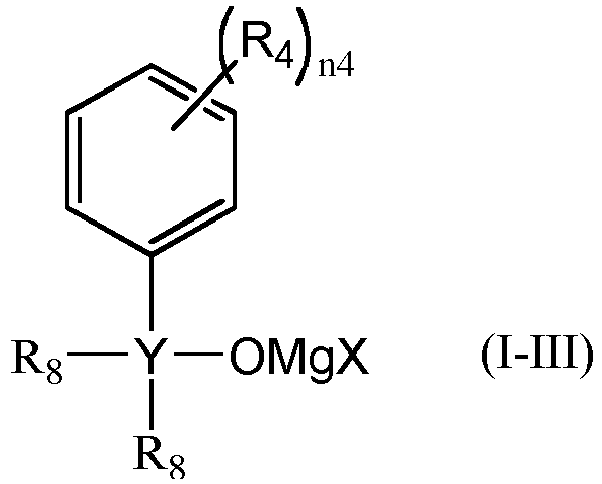
- In the compounds represented by (I-I), (I-II) or (I-III), Y is preferably a silicon atom. In addition, X is preferably a chlorine atom.
- As a halogeno group, an alkyl group, a halogenoalkyl group or an alkoxy group in the above-described R4, R5, and R6, a halogeno group, an alkyl group or an alkoxy group is preferable. Specific examples thereof include a same group as described as a substituent of the aryl group having 6 to 10 carbon atoms in the above-described R1 to R3, and a preferable group is also the same.
- As the above-described n4, n5, and n6, 0 to 2 is preferable.
- Specific examples of an alkenyl group having 1 to 6 carbon atoms and an alkyl group having 1 to 6 carbon atoms in the above-described R7 and R8 include a same group as the alkenyl group having 1 to 6 carbon atoms and the alkyl group having 1 to 6 carbon atoms in the R2 and R3, respectively, and a preferable group is also the same.
- As R7, a magnesium chloride oxy group (-OMgCl) or an alkenyl group having 1 to 6 carbon atoms is preferable. As R8, an alkyl group having 1 to 6 carbon atoms is preferable.
- Lewis acid relating to the present invention is Lewis acid which contains beryllium (Be), boron (B), aluminum (Al), silicon (Si), tin (Sn), titanium (Ti), chromium (Cr), iron (Fe), cobalt (Co), as an element. It specifically includes, a beryllium compound, such as beryllium (II) fluoride, beryllium (II) chloride, beryllium (II) bromide or the like; a boron compound, such as boron (III) chloride, boron (III) fluoride, boron (III) bromide, triphenoxyborane, phenyldichloroborane, triphenylborane or the like; an aluminum compound, such as aluminum (III) chloride, aluminum (III) bromide, aluminum (III) iodide, dimethylaluminum chloride, diethylaluminum chloride, methylaluminum dichloride, ethylaluminum dichloride, trimethylaluminum, triethylaluminum or the like; a silyl compound, such as trimethylsilyl triflate, trimethylsilyl iodide, tert-butyldimethylsilyl triflate or triisopropylsilyl triflate or the like; a tin compound, such as tin (IV) chloride, tin (IV) bromide, tin (II) chloride, tin (II) triflate or the like; a titanium compound, such as titanium (IV) chloride, titanium (IV) fluoride, titanium (IV) bromide, titanium (IV) iodide or the like; a chromium compound, such as chromium (II) fluoride, chromium (III) fluoride, chromium (II) chloride, chromium (III) chloride, chromium (II) bromide, chromium (III) bromide, chromium (II) iodide, chromium (III) iodide or the like; an iron compound, such as iron (II) fluoride, iron (II) chloride, iron (III) chloride, iron (II) bromide, iron (II) iodide or the like; or a cobalt compound, such as cobalt (II) fluoride, cobalt (II) chloride, cobalt (II) bromide, cobalt (II) iodide or the like.
- Among them, a boron compound or an aluminum compound is preferable, and an aluminum compound is more preferable. Specifically, aluminum (III) chloride, methylaluminum dichloride, dimethylaluminum chloride, boron (III) chloride or the like, is preferable, and aluminum (III) chloride is particularly preferable.
- A solvent relating to the present invention is preferably a solvent which is capable of dissolving the compound represented by the general formula (I) relating to the present invention. Such a solvent includes, for example, an ether-type solvent, a halogenated hydrocarbon-type solvent, a carbonate-type solvent, a nitrile-type solvent, a sulfone-type solvent or the like.
- The ether-type solvent includes, for example, diethyl ether, diglyme, triglyme, tetraglyme, tetrahydrofuran, 2-methyltetrahydrofuran, diisopropyl ether, 1,2-dimethoxyethane, diethylene glycol dimethyl ether, triethylene glycol dimethyl ether, cyclopentyl methyl ether, t-butyl methyl ether, 1,4-dioxane or the like; the halogenated hydrocarbon-type solvent includes, for example, dichloromethane, chloroform, carbon tetrachloride, 1,2-dichloroethane or the like; the carbonate-type solvent includes, for example, dimethyl carbonate, diethyl carbonate, ethyl methyl carbonate, propylene carbonate or the like; the nitrile-type solvent includes, for example, acetonitrile, propionitrile, butyronitrile, succinonitrile, pimelonitrile, methoxypropionitrile or the like; and the sulfone-type solvent includes, for example, sulfolane, dimethyl sulfone, ethyl methyl sulfone, methyl n-propyl sulfone, methyl isopropyl sulfone, n-butyl methyl sulfone, isobutyl methyl sulfone, sec-butyl methyl sulfone, tert-butyl methyl sulfone, diethyl sulfone, ethyl n-propyl sulfone, ethyl isopropyl sulfone, n-butyl ethyl sulfone, isobutyl ethyl sulfone, sec-butyl ethyl sulfone, tert-butyl ethyl sulfone, di-n-propyl sulfone, diisopropyl sulfone, n-butyl n-propyl sulfone, di-n-butyl sulfone or the like.
- Among the specific examples, the ether-type solvent, the sulfone-type solvent or the like, is preferable, and specifically, 1,2-dimethoxyethane, diglyme, triglyme, tetraglyme, tetrahydrofuran and sulfolane are particularly preferable, and diglyme, triglyme, tetraglyme and tetrahydrofuran are particularly preferable.
- The solvent relating to the present invention may be solvents in which two or more kinds of the solvent are mixed.
- The electrolytic solution of the present invention comprises a mixture obtained by mixing the compound represented by the general formula (I) relating to the present invention and the Lewis acid relating to the present invention, in the solvent relating to the present invention.
- Concentration of the compound represented by the general formula (I) in the electrolytic solution is usually 0.1 to 5 mol/mL, preferably 0.1 to 3 mol/mL and more preferably 0.2 to 2 mol/mL.
- Amount of the Lewis acid to be used in the electrolytic solution of the present invention is usually 0.1 to 5 times mol and preferably 0.1 to 3 times mol, relative to the compound represented by the general formula (I) relating to the present invention.
- The electrolytic solution of the present invention may contain additives, such as a film-forming ingredient, an overcharge inhibitor, an oxygen scavenger, a dehydrating agent, a flame retardant and the like, usually used in this field, and additives having coordinating property, such as a crown ether and the like.
- Such an electrolytic solution of the present invention can be used in a magnesium battery, and in the case of a magnesium secondary battery, exhibits high oxidation decomposition potential, and can be used repeatedly and stably.
- The electrolytic solution of the present invention is produced by dissolving (mixing) the compound represented by the general formula (I) relating to the present invention and the Lewis acid relating to the present invention, in the solvent pertaining to the present invention. In more specifically, it is produced by using 0.1 to 5 mol of the Lewis acid relating to the present invention, relative to 1 mol of the compound represented by the general formula (I) relating to the present invention, and by the addition and mixing of these into the solvent relating to the present invention to attain the concentration. It should be noted that, in mixing, it may be heated or cooled in a range of -78 to 300 °C, and preferably 0 to 70 °C, as needed.
- The electrochemical device of the present invention comprises a positive electrode, a negative electrode and the electrolytic solution of the present invention. Specifically, it includes a primary battery, a secondary battery, an electric double layer capacitor or the like, and among them, a secondary battery is preferable.
- The positive electrode in the electrochemical device of the present invention is not especially limited, if it is an electrode capable of containing magnesium or a magnesium ion inside thereof, or on the surface and at the vicinity thereof. Specifically, for example, it includes an electrode containing an oxide, or a sulfide containing cobalt, manganese, vanadium, aluminum, iron, silicon, phosphorous, nickel, molybdenum, titanium or the like, as an active material.
- In addition, in the positive electrode, such materials may be contained as an active material which is capable of adsorbing and storing magnesium or the magnesium ion, such as sulfur or the like; organic chemicals having high oxidizability; a material forming an electric double layer capacitor, such as porous carbon, an activated carbon or the like, and magnesium may be contained in an oxidized form.
- The negative electrode in the electrochemical device of the present invention is not especially limited, if it is an electrode capable of containing magnesium or the magnesium ion inside thereof, or on the surface and at the vicinity thereof. Specifically, for example, it includes metal magnesium or magnesium alloys, which is capable of dissolving and depositing magnesium; metal which can be alloyed with magnesium which is capable of dissolving and depositing magnesium; a carbon material which is capable of intercalating magnesium or a magnesium ion; or the like.
- In addition, the electrochemical device of the present invention may further have a separator, other than the positive electrode, the negative electrode and the electrolytic solution of the present invention. The separator may be any one if it electrically insulates the positive electrode and the negative electrode, and is capable of permeating a magnesium ion; and includes, for example, a microporous polymeric film, such as a porous polyolefin film or the like. Specific examples of the porous polyolefin film include, for example, a single-layered porous polyolefin film, or a multi-layered film, where a porous polyethylene film and a porous polypropylene film are laminated.
- X of the compound represented by the general formula (I') represents a chlorine atom or a bromine atom, and a chlorine atom is preferable.
- R'1 in the compound represented by the general formula (I') represents an aryl group having 6 to 10 carbon atoms, which may have a halogeno group, an alkyl group, a halogenoalkyl group or an alkoxy group, as a substituent, and specific examples and preferable examples of the aryl group having 6 to 10 carbon atoms, which may have a halogeno group, an alkyl group, a halogenoalkyl group or an alkoxy group, as a substituent, include the same examples of R1 in the compound represented by the general formula (I).
- R'2 and R'3 in the compound represented by the general formula (I') each independently represent a magnesium chloride oxy group (-OMgCI); an alkenyl group having 1 to 6 carbon atoms; an alkyl group having 1 to 6 carbon atoms, which may have a halogeno group or an alkoxy group, as a substituent; or an aryl group having 6 to 10 carbon atoms, which may have a halogeno group, an alkyl group, a halogenoalkyl group or an alkoxy group, as a substituent. Specific examples and preferable examples of the alkenyl group having 1 to 6 carbon atoms, the alkyl group having 1 to 6 carbon atoms, which may have a halogeno group or an alkoxy group, as a substituent, as well as the aryl group having 6 to 10 carbon atoms, which may have a halogeno group, an alkyl group, a halogenoalkyl group or an alkoxy group, as a substituent, include the same examples of R2 and R3 in the compound represented by the general formula (I).
- Preferable specific examples of R'2 and R'3 include the same examples of R2 and R3 in the compound represented by the general formula (I).
- Specific examples of the compound represented by the general formula (I') include, for example, a magnesium bromide compound, and specifically include magnesium bromide triphenylsiloxide; magnesium bromide tris(2-methylphenyl)siloxide, magnesium bromide tris(3-methylphenyl)siloxide, magnesium bromide tris(4-methylphenyl)siloxide, magnesium bromide tris(2,2-dimethylphenyl)siloxide, magnesium bromide tris(3,3-dimethylphenyl)siloxide, magnesium bromide tris(2,3-dimethylphenyl)siloxide, magnesium bromide tris(2,4-dimethylphenyl)siloxide, magnesium bromide tris(3,4-dimethylphenyl)siloxide, magnesium bromide tris(2,4,6-trimethylphenyl)siloxide, magnesium bromide tris(2,3,4,5-tetramethylphenyl)siloxide, magnesium bromide tris(2,3,4,6-tetramethylphenyl)siloxide, magnesium bromide tris(2,3,5,6-tetramethylphenyl)siloxide, magnesium bromide tris(2,3,4,5,6-pentamethylphenyl)siloxide; magnesium bromide tris(2-fluorophenyl)siloxide, magnesium bromide tris(3-fluorophenyl)siloxide, magnesium bromide tris(4-fluorophenyl)siloxide, magnesium bromide tris(2,2-difluorophenyl)siloxide, magnesium bromide tris(3,3-difluorophenyl)siloxide, magnesium bromide tris(2,3-difluorophenyl)siloxide, magnesium bromide tris(2,4-difluorophenyl)siloxide, magnesium bromide tris(3,4-difluorophenyl)siloxide, magnesium bromide tris(2,4,6-trifluorophenyl)siloxide, magnesium bromide tris(2,3,4,5-tetrafluorophenyl)siloxide, magnesium bromide tris(2,3,4,6-tetrafluorophenyl)siloxide, magnesium bromide tris(2,3,5,6-tetrafluorophenyl)siloxide, magnesium bromide tris(2,3,4,5,6-pentafluorophenyl)siloxide; magnesium bromide tris(2-methoxyphenyl)siloxide, magnesium bromide tris(3-methoxyphenyl)siloxide, magnesium bromide tris(4-methoxyphenyl)siloxide, magnesium bromide tris(2,2-dimethoxyphenyl)siloxide, magnesium bromide tris(3,3-dimethoxyphenyl)siloxide, magnesium bromide tris(2,3-dimethoxyphenyl)siloxide, magnesium bromide tris(2,4-dimethoxyphenyl)siloxide, magnesium bromide tris(3,4-dimethoxyphenyl)siloxide, magnesium bromide tris(2,4,6-trimethoxyphenyl)siloxide, magnesium bromide tris(2,3,4,5-tetramethoxyphenyl)siloxide, magnesium bromide tris(2,3,4,6-tetramethoxyphenyl)siloxide, magnesium bromide tris(2,3,5,6-tetramethoxyphenyl)siloxide, magnesium bromide tris(2,3,4,5,6-pentamethoxyphenyl)siloxide; magnesium bromide dimethylphenylsiloxide, magnesium bromide methyldiphenylsiloxide, magnesium bromide diethylphenylsiloxide, magnesium bromide ethyldiphenylsiloxide, magnesium bromide di(tert-butyl)phenylsiloxide, magnesium bromide tert-butyldiphenylsiloxide; magnesium bromide dimethyl(methylphenyl)siloxide, magnesium bromide methyldi(methylphenyl)siloxide, magnesium bromide dimethyl(dimethylphenyl)siloxide, magnesium bromide methyldi(dimethylphenyl)siloxide, magnesium bromide dimethyl(trimethylphenyl)siloxide, magnesium bromide methyldi(trimethylphenyl)siloxide, magnesium bromide dimethyl(tetramethylphenyl)siloxide, magnesium bromide methyldi(tetramethylphenyl)siloxide, magnesium bromide dimethyl(pentamethylphenyl)siloxide, magnesium bromide methyldi(pentamethylphenyl)siloxide; magnesium bromide dimethyl(fluorophenyl)siloxide, magnesium bromide methyldi(fluorophenyl)siloxide, magnesium bromide dimethyl(difluorophenyl)siloxide, magnesium bromide methyldi(difluorophenyl)siloxide, magnesium bromide dimethyl(trifluorophenyl)siloxide, magnesium bromide methyldi(trifluorophenyl)siloxide, magnesium bromide dimethyl(tetrafluorophenyl)siloxide, magnesium bromide methyldi(tetrafluorophenyl)siloxide, magnesium bromide dimethyl(pentafluorophenyl)siloxide, magnesium bromide methyldi(pentafluorophenyl)siloxide; magnesium bromide dimethyl(methoxyphenyl)siloxide, magnesium bromide methyldi(methoxyphenyl)siloxide, magnesium bromide dimethyl(dimethoxyphenyl)siloxide, magnesium bromide methyldi(dimethoxyphenyl)siloxide, magnesium bromide dimethyl(trimethoxyphenyl)siloxide, magnesium bromide methyldi(trimethoxyphenyl)siloxide, magnesium bromide dimethyl(tetramethoxyphenyl)siloxide, magnesium bromide methyldi(tetramethoxyphenyl)siloxide, magnesium bromide dimethyl(pentamethoxyphenyl)siloxide, magnesium bromide methyldi(pentamethoxyphenyl)siloxide; magnesium bromide dimethyl(trifluoromethylphenyl)siloxide, magnesium bromide methyldi(trifluoromethylphenyl)siloxide, magnesium bromide dimethyl(di(trifluoromethyl)phenyl)siloxide, magnesium bromide methyldi(di(trifluoromethyl)phenyl)siloxide, magnesium bromide dimethyl(tri(trifluoromethyl)phenyl)siloxide, magnesium bromide methyldi(tri(trifluoromethyl)phenyl)siloxide, magnesium chloride dimethyl(tetra(trifluoromethyl)phenyl)siloxide, magnesium bromide methyldi(tetra(trifluoromethyl)phenyl)siloxide, magnesium bromide dimethyl(penta(trifluoromethyl)phenyl)siloxide, magnesium bromide methyldi(penta(trifluoromethyl)phenyl)siloxide, magnesium bromide di(tert-butyl)(trifluoromethylphenyl)siloxide, magnesium bromide methyldi(trifluoromethylphenyl)siloxide, magnesium bromide dimethyl(di(trifluoromethyl)phenyl)siloxide, magnesium bromide methyldi(di(trifluoromethyl)phenyl)siloxide, magnesium bromide dimethyl(tri(trifluoromethyl)phenyl)siloxide, magnesium bromide methyldi(tri(trifluoromethyl)phenyl)siloxide, magnesium bromide dimethyl(tetra(trifluoromethyl)phenyl)siloxide, magnesium bromide methyldi(tetra(trifluoromethyl)phenyl)siloxide, magnesium bromide dimethyl(penta(trifluoromethyl)phenyl)siloxide, magnesium bromide methyldi(penta(trifluoromethyl)phenyl)siloxide; diphenylsilanedioxy bis(magnesium bromide), di(methylphenyl)silanedioxy bis(magnesium bromide), di(dimethylphenyl)silanedioxy bis(magnesium bromide), di(trimethylphenyl)silanedioxy bis(magnesium bromide), di(tetramethylphenyl)silanedioxy bis(magnesium bromide), di(pentamethylphenyl)silanedioxy bis(magnesium bromide); di(fluorophenyl)silanedioxy bis(magnesium bromide), di(difluorophenyl)silanedioxy bis(magnesium bromide), di(trifluorophenyl)silanedioxy bis(magnesium bromide), di(tetrafluorophenyl)silanedioxy bis(magnesium bromide), di(pentafluorophenyl)silanedioxy bis(magnesium bromide); di(methoxyphenyl)silanedioxy bis(magnesium bromide), di(dimethoxyphenyl)silanedioxy bis(magnesium bromide), di(trimethoxyphenyl)silanedioxy bis(magnesium bromide), di(tetramethoxyphenyl)silanedioxy bis(magnesium bromide), di(pentamethoxyphenyl)silanedioxy bis(magnesium bromide); di(trifluoromethylphenyl)silanedioxy bis(magnesium bromide), di(di(trifluoromethyl)phenyl)silanedioxy bis(magnesium bromide), di(tri(trifluoromethyl)phenyl)silanedioxy bis(magnesium bromide), di(tetra(trifluoromethyl)phenyl)silanedioxy bis(magnesium bromide), di(penta(trifluoromethyl)phenyl)silanedioxy bis(magnesium bromide) or the like.
- In addition, specific examples of the compound represented by the general formula (I') include, for example, a magnesium chloride compound, and specifically include magnesium chloride triphenylsiloxide; magnesium chloride tris(2-methylphenyl)siloxide, magnesium chloride tris(3-methylphenyl)siloxide, magnesium chloride tris(4-methylphenyl)siloxide, magnesium chloride tris(2,2-dimethylphenyl)siloxide, magnesium chloride tris(3,3-dimethylphenyl)siloxide, magnesium chloride tris(2,3-dimethylphenyl)siloxide, magnesium chloride tris(2,4-dimethylphenyl)siloxide, magnesium chloride tris(3,4-dimethylphenyl)siloxide, magnesium chloride tris(2,4,6-trimethylphenyl)siloxide, magnesium chloride tris(2,3,4,5-tetramethylphenyl)siloxide, magnesium chloride tris(2,3,4,6-tetramethylphenyl)siloxide, magnesium chloride tris(2,3,5,6-tetramethylphenyl)siloxide, magnesium chloride tris(2,3,4,5,6-pentamethylphenyl)siloxide; magnesium chloride tris(2-fluorophenyl)siloxide, magnesium chloride tris(3-fluorophenyl)siloxide, magnesium chloride tris(4-fluorophenyl)siloxide, magnesium chloride tris(2,2-difluorophenyl)siloxide, magnesium chloride tris(3,3-difluorophenyl)siloxide, magnesium chloride tris(2,3-difluorophenyl)siloxide, magnesium chloride tris(2,4-difluorophenyl)siloxide, magnesium chloride tris(3,4-difluorophenyl)siloxide, magnesium chloride tris(2,4,6-trifluorophenyl)siloxide, magnesium chloride tris(2,3,4,5-tetrafluorophenyl)siloxide, magnesium chloride tris(2,3,4,6-tetrafluorophenyl)siloxide, magnesium chloride tris(2,3,5,6-tetrafluorophenyl)siloxide, magnesium chloride tris(2,3,4,5,6-pentafluorophenyl)siloxide; magnesium chloride tris(2-methoxyphenyl)siloxide, magnesium chloride tris(3-methoxyphenyl)siloxide, magnesium chloride tris(4-methoxyphenyl)siloxide, magnesium chloride tris(2,2-dimethoxyphenyl)siloxide, magnesium chloride tris(3,3-dimethoxyphenyl)siloxide, magnesium chloride tris(2,3-dimethoxyphenyl)siloxide, magnesium chloride tris(2,4-dimethoxyphenyl)siloxide, magnesium chloride tris(3,4-dimethoxyphenyl)siloxide, magnesium chloride tris(2,4,6-trimethoxyphenyl)siloxide, magnesium chloride tris(2,3,4,5-tetramethoxyphenyl)siloxide, magnesium chloride tris(2,3,4,6-tetramethoxyphenyl)siloxide, magnesium chloride tris(2,3,5,6-tetramethoxyphenyl)siloxide, magnesium chloride tris(2,3,4,5,6-pentamethoxyphenyl)siloxide; magnesium chloride dimethylphenylsiloxide, magnesium chloride methyldiphenylsiloxide, magnesium chloride diethylphenylsiloxide, magnesium chloride ethyldiphenylsiloxide, magnesium chloride di(tert-butyl)phenylsiloxide, magnesium chloride tert-butyldiphenylsiloxide; magnesium chloride dimethyl(methylphenyl)siloxide, magnesium chloride methyldi(methylphenyl)siloxide, magnesium chloride dimethyl(dimethylphenyl)siloxide, magnesium chloride methyldi(dimethylphenyl)siloxide, magnesium chloride dimethyl(trimethylphenyl)siloxide, magnesium chloride methyldi(trimethylphenyl)siloxide, magnesium chloride dimethyl(tetramethylphenyl)siloxide, magnesium chloride methyldi(tetramethylphenyl)siloxide, magnesium chloride dimethyl(pentamethylphenyl)siloxide, magnesium chloride methyldi(pentamethylphenyl)siloxide; magnesium chloride dimethyl(fluorophenyl)siloxide, magnesium chloride methyldi(fluorophenyl)siloxide, magnesium chloride dimethyl(difluorophenyl)siloxide, magnesium chloride methyldi(difluorophenyl)siloxide, magnesium chloride dimethyl(trifluorophenyl)siloxide, magnesium chloride methyldi(trifluorophenyl)siloxide, magnesium chloride dimethyl(tetrafluorophenyl)siloxide, magnesium chloride methyldi(tetrafluorophenyl)siloxide, magnesium chloride dimethyl(pentafluorophenyl)siloxide, magnesium chloride methyldi(pentafluorophenyl)siloxide; magnesium chloride dimethyl(methoxyphenyl)siloxide, magnesium chloride methyldi(methoxyphenyl)siloxide, magnesium chloride dimethyl(dimethoxyphenyl)siloxide, magnesium chloride methyldi(dimethoxyphenyl)siloxide, magnesium chloride dimethyl(trimethoxyphenyl)siloxide, magnesium chloride methyldi(trimethoxyphenyl)siloxide, magnesium chloride dimethyl(tetramethoxyphenyl)siloxide, magnesium chloride methyldi(tetramethoxyphenyl)siloxide, magnesium chloride dimethyl(pentamethoxyphenyl)siloxide, magnesium chloride methyldi(pentamethoxyphenyl)siloxide; magnesium chloride dimethyl(trifluoromethylphenyl)siloxide, magnesium chloride methyldi(trifluoromethylphenyl)siloxide, magnesium chloride dimethyl(di(trifluoromethyl)phenyl)siloxide, magnesium chloride methyldi(di(trifluoromethyl)phenyl)siloxide, magnesium chloride dimethyl(tri(trifluoromethyl)phenyl)siloxide, magnesium chloride methyldi(tri(trifluoromethyl)phenyl)siloxide, magnesium chloride dimethyl(tetra(trifluoromethyl)phenyl)siloxide, magnesium chloride methyldi(tetra(trifluoromethyl)phenyl)siloxide, magnesium chloride dimethyl(penta(trifluoromethyl)phenyl)siloxide, magnesium chloride methyldi(penta(trifluoromethyl)phenyl)siloxide, magnesium chloride di(tert-butyl)(trifluoromethylphenyl)siloxide, magnesium chloride methyldi(trifluoromethylphenyl)siloxide, magnesium chloride dimethyl(di(trifluoromethyl)phenyl)siloxide, magnesium chloride methyldi(di(trifluoromethyl)phenyl)siloxide, magnesium chloride dimethyl(tri(trifluoromethyl)phenyl)siloxide, magnesium chloride methyldi(tri(trifluoromethyl)phenyl)siloxide, magnesium chloride dimethyl(tetra(trifluoromethyl)phenyl)siloxide, magnesium chloride methyldi(tetra(trifluoromethyl)phenyl)siloxide, magnesium chloride dimethyl(penta(trifluoromethyl)phenyl)siloxide, magnesium chloride methyldi(penta(trifluoromethyl)phenyl)siloxide; diphenylsilanedioxy bis(magnesium chloride), di(methylphenyl)silanedioxy bis(magnesium chloride), di(dimethylphenyl)silanedioxy bis(magnesium chloride), di(trimethylphenyl)silanedioxy bis(magnesium chloride), di(tetramethylphenyl)silanedioxy bis(magnesium chloride), di(pentamethylphenyl)silanedioxy bis(magnesium chloride); di(fluorophenyl)silanedioxy bis(magnesium chloride), di(difluorophenyl)silanedioxy bis(magnesium chloride), di(trifluorophenyl)silanedioxy bis(magnesium chloride), di(tetrafluorophenyl)silanedioxy bis(magnesium chloride), di(pentafluorophenyl)silanedioxy bis(magnesium chloride); di(methoxyphenyl)silanedioxy bis(magnesium chloride), di(dimethoxyphenyl)silanedioxy bis(magnesium chloride), di(trimethoxyphenyl)silanedioxy bis(magnesium chloride), di(tetramethoxyphenyl)silanedioxy bis(magnesium chloride), di(pentamethoxyphenyl)silanedioxy bis(magnesium chloride); di(trifluoromethylphenyl)silanedioxy bis(magnesium chloride), di(di(trifluoromethyl)phenyl)silanedioxy bis(magnesium chloride), di(tri(trifluoromethyl)phenyl)silanedioxy bis(magnesium chloride), di(tetra(trifluoromethyl)phenyl)silanedioxy bis(magnesium chloride), di(penta(trifluoromethyl)phenyl)silanedioxy bis(magnesium chloride) or the like.
- The compound represented by the general formula (I') is preferably the magnesium chloride compounds, and among them, magnesium chloride triphenylsiloxide, magnesium chloride tris(2-methylphenyl)siloxide, magnesium chloride tris(3-methylphenyl)siloxide, magnesium chloride tris(4-methylphenyl)siloxide, magnesium chloride tris(2-fluorophenyl)siloxide, magnesium chloride tris(3-fluorophenyl)siloxide, magnesium chloride tris(4-fluorophenyl)siloxide, magnesium chloride tris(2-methoxyphenyl)siloxide, magnesium chloride tris(3-methoxyphenyl)siloxide, magnesium chloride tris(4-methoxyphenyl)siloxide, magnesium chloride dimethylphenylsiloxide, diphenylsilanedioxy bis(magnesium chloride) and the like, are preferable.
- The compound represented by the general formula (I') may be a coordinated compound, and may be, for example, a coordinated compound formed with the solvent relating to the present invention. For example, when the compound represented by the general formula (I') is coordinated with THF, it is estimated to form a coordinated compound of the following dimer.

- The compound represented by the general formula (I') can be obtained, for example, by reacting a silanol compound represented by the following general formula (II') and the Grignard reagent, in a suitable solvent.

- Specific examples of the compound represented by the general formula (II') include those corresponding to specific examples of the compound represented by the general formula (I'), and preferable examples also include those corresponding to preferable examples of the compound represented by the general formula (I').
- As the compound represented by the general formula (II'), a commercial product may be used, or the compound produced by a method known per se may be used. The method known per se may be carried out by producing a compound represented by the following general formula (III') according to a method described, for example, in Paul D. Price et al., Dalton Tarnsactions, (2), 271-282, 2008, and then subjecting the compound to an oxidation reaction known per se.

- Specific examples of the compound represented by the general formula (III') include those corresponding to specific examples of the compound represented by the general formula (I'), and preferable examples also include those corresponding to preferable examples of the compound represented by the general formula (I').
- The Grignard reagent includes, for example, a compound represented by RMgX, wherein R represents an alkyl group having 1 to 6 carbon atoms, which has a substituent, or a phenyl group which has a substituent, and X is the same as described above.
- The alkyl group having 1 to 6 carbon atoms in R includes the same group as the alkyl group having 1 to 6 carbon atoms in R2 and R3. The substituent of the alkyl group and the phenyl group in R includes, for example, a halogeno group, an alkyl group, a halogenoalkyl group, an alkoxy group or the like, and the specific examples include the same examples as explained in a paragraph of the substituent of the aryl group in R1.
- Use amount of the Grignard reagent in a reaction of the silanol compound represented by the general formula (II') and the Grignard reagent is usually 0.5 to 2 mol, and preferably 0.5 to 1 mol, relative to 1 mol of the compound represented by the general formula (II').
- Reaction temperature of the silanol compound represented by the general formula (II') and the Grignard reagent is usually -78 to 80 °C, and reaction time is usually 5 seconds to 5 hours. In addition, the reaction is preferably carried out in inert gas atmosphere, such as argon, nitrogen or the like, and more preferably in argon atmosphere. A solvent to be used here may be any solvent, if at least one of the silanol compound represented by the general formula (II') or the Grignard reagent is soluble, and the solvent dissolving both compounds (reagents) is preferable. It specifically includes, for example, the same solvent as the solvent relating to the present invention, among them, an ether-type solvent, such as diethyl ether, diglyme, triglyme, tetraglyme, tetrahydrofuran, 2-methyltetrahydrofuran, diisopropyl ether, 1,2-dimethoxyethane, diethylene glycol dimethyl ether, triethylene glycol dimethyl ether, cyclopentyl methyl ether, t-butyl methyl ether, 1,4-dioxane or the like, and preferably tetrahydrofuran. It should be noted that a resulting reaction product may be washed with a solvent, such as diisopropyl ether or the like, after concentration and drying, as needed.
- The compound represented by the general formula (I') is produced specifically, for example, as follows.
- That is, the silanol compound represented by the general formula (II') is dissolved in a solvent, such as tetrahydrofuran or the like, in argon gas atmosphere. Still more, a tetrahydrofuran solution or the like, dissolved with 0.1 to 2 mol of phenyl magnesium chloride, relative to 1 mol of the silanol compound, is dropped, and is subjected to a reaction for 5 seconds to 5 hours. An operation to obtain a solid, such as by concentration and drying of a reaction solution, is carried out, as needed, and a resulting solid is washed with a solvent, such as diisopropyl ether or the like, and dried to produce the compound represented by the general formula (I').
- Explanation on the present invention is given further specifically below, with reference to Examples and Comparative Examples, and the present invention should not be limited to these Examples.
- Under argon gas atmosphere, benzophenone (7.29 g, 40 mmol) (Wako Pure Chemical Industries, Ltd.) was dissolved in tetrahydrofuran (THF) (20 mL) (Wako Pure Chemical Industries, Ltd.), and a THF solution of phenylmagnesium chloride (PhMgCl) (20 mL, 40 mmol) (Tokyo Chemical Industry Co., Ltd., 2 M) was added dropwise to the solution. After stirring for 4 hours, crystal was filtered off and dried to obtain magnesium chloride triphenylmethoxide (Ph3COMgCl).

- Under argon gas atmosphere, magnesium chloride triphenylmethoxide (Ph3COMgCl) (1.60 g, 5 mmol) was added to THF (20 mL). The mixture was heated to 50 °C, and then aluminum chloride (AlCl3) (0.67 g, 5 mmol) was added to the mixture. After maintaining the resulting mixture at 50 °C for 5 minutes, it was cooled and filtrated to obtain the
electrolytic solution 1, "a solution of magnesium chloride triphenylmethoxide - aluminum chloride / THF". - Under argon gas atmosphere, magnesium chloride triphenylmethoxide (Ph3COMgCl) (1.60 g, 5 mmol), obtained in (1) of Example 1, was added to triglyme (20 mL). The mixture was heated to 50 °C, and then aluminum chloride (AlCl3) (0.17 g, 1.25 mmol) was added to the mixture. After maintaining the resulting mixture at 50 °C for 5 minutes, it was cooled and filtrated to obtain the
electrolytic solution 2, "a solution of magnesium chloride triphenylmethoxide - aluminum chloride / triglyme". - Under argon gas atmosphere, magnesium chloride triphenylmethoxide (Ph3COMgCl) (1.60 g, 5 mmol), obtained in (1) of Example 1, was added to THF (20 mL). The mixture was heated to 35 °C, and then dimethylaluminum chloride (Me2AlCl) (0.48 g, 5 mmol) (concentrated from a hexane solution, purchased from Kanto Chemical Co., Inc.) was added dropwise to the mixture. After maintaining the resulting mixture at 50 °C for 5 minutes, it was cooled to obtain the
electrolytic solution 3, "a solution of magnesium chloride triphenylmethoxide - dimethylaluminum chloride / THF". - Under argon gas atmosphere, into a THF solution of phenylmagnesium chloride (PhMgCl) (10 mL, 20 mmol) (Tokyo Chemical Industry Co., Ltd., 2 M), THF (30 mL) (Wako Pure Chemical Industries, Ltd.) was added, and then acetone (1.28 g, 22 mmol) (Wako Pure Chemical Industries, Ltd.) was added dropwise to the diluted solution. After stirring the solution for 2 hours, crystal was filtered off and dried to obtain magnesium chloride dimethylphenylmethoxide (Me2PhCOMgCl).
- Under argon gas atmosphere, into magnesium chloride dimethylphenylmethoxide (Me2PhCOMgCl) (0.97 g, 5 mmol), THF was mixed. The mixture was heated to 50 °C, and then aluminum chloride (AlCl3) (0.17 g, 1.25 mmol) was added to the mixture. After maintaining the resulting mixture at 50 °C for 5 minutes, it was cooled to obtain the
electrolytic solution 4, "a solution of magnesium chloride dimethylphenylmethoxide - aluminum chloride / THF". - Under argon gas atmosphere, benzophenone (7.29 g, 40 mmol) (Wako Pure Chemical Industries, Ltd.) was dissolved in THF (20 mL) (Wako Pure Chemical Industries, Ltd.), and then a THF solution of allylmagnesium chloride ((C3H5)MgCl) (40 mL, 40 mmol) (Tokyo Chemical Industry Co., Ltd., 1 M) was added dropwise, and the solution was stirred for 4 hours. Aluminum chloride (AlCl3) (0.17 g, 2 mmol) was added relative to the solution (12 mL, 8 mmol) at room temperature, and the resulting mixture was stirred for 1 hour to obtain the
electrolytic solution 5, "a solution ofmagnesium chloride 1,1-diphenyl-1-(2-propenyl)methoxide - aluminum chloride /THF". - Under argon gas atmosphere, 4,4-difluorobenzophenone (4.36 g, 20 mmol) (by Wako Pure Chemical Industries, Ltd.) was dissolved in tetrahydrofuran (THF) (15 mL) (Wako Pure Chemical Industries, Ltd.), and then a THF solution of phenylmagnesium chloride (PhMgCl) (10 mL, 20 mmol) (Tokyo Chemical Industry Co., Ltd., 2 M) was added dropwise, and the solution was stirred for 4 hours. After heating the resulting solution (6.8 m, 5 mmol) to 40 °C, aluminum chloride (AlCl3) (0.67 g, 5 mmol) was added to the solution and the resulting mixture was cooled to obtain the electrolytic solution 6, "a solution of
magnesium chloride 1,1-di(4-fluorophenyl)-1-phenylmethoxide - aluminum chloride / THF". - Under argon gas atmosphere, a THF solution of ethyl magnesium chloride (EtMgCI) (10 mL, 20 mmol) (Tokyo Chemical Industry Co., Ltd., 2 M) and THF (10 mL) (Wako Pure Chemical Industries, Ltd.) were combined, and then tert-butanol (1.48 g, 20 mmol) (Wako Pure Chemical Industries, Ltd.) was added dropwise to the diluted solution. Then, aluminum chloride (0.44 g, 3.3 mmol) (Wako Pure Chemical Industries, Ltd.) was added to the solution and the resulting mixture was stirred to obtain the comparative
electrolytic solution 1, "a solution of (tert-BuOMgCl)6- AlCl3 / THF". - Under argon gas atmosphere, magnesium chloride (0.5 g, 5.3 mmol) (Wako Pure Chemical Industries, Ltd.) was dissolved in THF (21 mL) (Wako Pure Chemical Industries, Ltd.), and dimethylaluminum chloride (Me2AlCl) (0.97 g, 10.5 mmol) (concentrated from a THF solution, purchased from Kanto Chemical Co., Inc.) was added dropwise, and then tetrabutylammonium chloride (Bu4NCl) (1.46 g, 5.3 mmol) (Tokyo Chemical Industry Co., Ltd.) was added. The resulting mixture was stirred at 60 °C for 2 days, and cooled to obtain the comparative
electrolytic solution 2, "a solution of MgCl2 - Me2AlCl - Bu4NCl / THF". - Cyclic voltammetry (CV) measurement for the
electrolytic solutions 1 to 6 (Example 7) was carried out. In addition, CV measurement for the comparativeelectrolytic solutions 1 and 2 (Comparative Example 3) was carried out similarly. - CV measurement was carried out specifically as follows. That is, using a 3-electrode beaker cell, a platinum electrode (diameter: 3 mm; BAS Co. Ltd.), an Mg rod (diameter: 1.6 mm; The Nilaco Corp.), and an Mg rod (diameter: 1.6 mm; The Nilaco Corp.) were used as a working electrode, a counter electrode and a reference electrode, respectively. Into the beaker cell, 2 mL of the electrolytic solution was added to carry out the measurement at room temperature (25 °C), with a sweep rate of 5 mV/s, and within a range of -1.5 V to 3.5 V. An electrochemical measurement system (BioLogic Co., Ltd.) was used for this measurement.
- Results of oxidation decomposition potential (after 10 cycles) of each electrolytic solution are shown in the following Table 1.
- In addition, result of the
electrolytic solution 1 after 10 cycles is shown inFigure 1 , and results of theelectrolytic solution 2 after 10 cycles and 40 cycles, are shown inFigure 2 and Figure 3 , respectively. Results of the comparativeelectrolytic solutions Figures 4 and5 . It should be noted that the horizontal axis in these Figures represents potential of the working electrode, based on potential of the reference electrode, and the vertical axis (mA/cm2) represents current density obtained by dividing current value observed at each potential with surface area of the working electrode.[Table 1] Electrolytic Solution Magnesium salt Solvent Lewis acid Oxidation decomposition potential Electrolytic Solution 1Ph3COMgCl THF AlCl3 +3.4 V Electrolytic Solution 2Ph3COMgCl Triglyme AlCl3 +3.2 V Electrolytic Solution 3Ph3COMgCl THF Me2AlCl +2.8 V Electrolytic Solution 4Me2PhCOMgCl THF AlCl3 +3.1 V Electrolytic Solution 5 (C3H5)Ph2COMgCl THF AlCl3 +3.4 V Electrolytic Solution 6 (C6H4F)2PhCOMgCl THF AlCl3 +2.8 V Comparative Electrolytic Solution 1 t-BuOMgCl THF AlCl3 +2.4 V Comparative Electrolytic Solution 2MgCl2 THF Me2AlCl +2.8 V - From the results of Table 1, it has been revealed that the electrolytic solution of the present invention indicates oxidation decomposition potential of +2.8 V to +3.4 V, and can be used in equivalent or higher voltage as compared with a conventional method. Still more, from the results of
Figure 3 , it has been revealed that theelectrolytic solution 2 can be used stably without deterioration, even by repeating dissolution and deposition of magnesium 40 times. - On the other hand, the comparative
electrolytic solution 2, "a solution of (t-BuOMgCl)6 - AlCl3 / THF", is an electrolytic solution described in J. Mater. Chem. A, 2014, 2, 581-584 (NON-PATENT LITERATURE 3). As a result of carrying out CV measurement using the electrolytic solution, it has been observed that oxidation decomposition potential thereof is +2.4 V, nearly as described in the LITERATURE. - It has been observed whether current in cyclic voltammetry (CV) measurement of the
electrolytic solution 1 is the result associated with dissolution and deposition of Mg, using SEM (Hitachi High-Technologies Corp.). - Specifically, using a 3-electrode beaker cell, a copper plate (thickness: 0.1 mm; The Nilaco Corp.), an Mg rod (diameter: 1.6 mm; The Nilaco Corp.), and an Mg rod (diameter: 1.6 mm; produced by The Nilako Corp.) were used as a working electrode, a counter electrode and a reference electrode, respectively. Into the beaker cell, 2 mL of the electrolytic solution of Example 1 was added to deposit magnesium on the copper plate at room temperature (25 °C), under a current value of 0.1 mA for 5 hours. An electrochemical measurement system (BioLogic Co., Ltd) was used in the experiment.
- As a result of observation of the copper plate surface after the deposition, deposition of magnesium has been observed by using the SEM. In addition, elemental analysis of magnesium, aluminum, copper, chlorine, carbon or oxygen was carried out using EDS (energy dispersive X-ray analysis), and it has also been observed that the deposited element was magnesium.
- Under argon gas atmosphere, triphenylsilanol (11.1 g, 40 mmol) (Tokyo Chemical Industry Co., Ltd.) was dissolved in tetrahydrofuran (THF) (20 mL) (Wako Pure Chemical Industries, Ltd.), and then a THF solution of phenylmagnesium chloride (PhMgCl) (20 mL, 40 mmol) (Tokyo Chemical Industry Co., Ltd., 2 M) was added dropwise to the solution, and the solution was stirred for 1 hour. After that, powder generated by concentration and drying of the solution, was washed with diisopropyl ether (70 mL) (Wako Pure Chemical Industries, Ltd.). The powder was filtered off and dried to obtain magnesium chloride triphenylsiloxide (Ph3SiOMgCl).
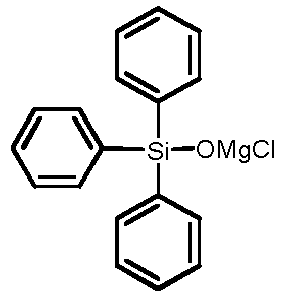
1H-NMR (400MHz, CDCl3) δ (ppm): 7.25-7.80 (m, 15H) - Under argon gas atmosphere, into magnesium chloride triphenylsiloxide (Ph3SiOMgCl) (3.35 g, 10 mmol) was added to THF (40 mL) (Wako Pure Chemical Industries, Ltd.) was mixed. The mixture was heated to 50 °C, and then aluminum chloride (AlCl3) (1.33 g, 10 mmol) (Wako Pure Chemical Industries, Ltd.) was added to the mixture. After maintaining the resulting mixture at 50 °C for 10 minutes, it was cooled and filtrated after 1 week to obtain the electrolytic solution 7, "a solution of magnesium chloride triphenylsiloxide - aluminum chloride / THF".
- Under argon gas atmosphere, into magnesium chloride triphenylsiloxide (Ph3SiOMgCl) (0.84 g, 2.5 mmol), obtained in Example 8 (1), THF (10 mL) (Wako Pure Chemical Industries, Ltd.) was mixed, and then a solution of boron trichloride (0.5 mL, 0.5 mmol) (BCl3) (Wako Pure Chemical Industries, Ltd., 1 M solution in CH2Cl2) was added dropwise to the solution at room temperature. The resulting mixture was maintained at 50 °C for 10 minutes, and then it was concentrated, and tetrahydrofuran (THF) (10 mL) (Wako Pure Chemical Industries, Ltd.) was added. The resulting solution (8 mL, 2 mmol) was heated to 50 °C, and then aluminum chloride (AlCl3) (0.21 g, 1.6 mmol) (Wako Pure Chemical Industries, Ltd.) was added to the solution. After maintaining the resulting mixture at 50 °C for 10 minutes, it was cooled to obtain the electrolytic solution 8, "a solution of magnesium chloride triphenylsiloxide - aluminum chloride / THF".
- Under argon gas atmosphere, into magnesium chloride triphenylsiloxide (Ph3SiOMgCl) (0.84 g, 2.5 mmol), obtained in Example 8 (1), triglyme (10 mL) (Wako Pure Chemical Industries, Ltd.) was mixed. The mixture was heated to 50 °C, and then aluminum chloride (AlCl3) (0.33 g, 2.5 mmol) (Wako Pure Chemical Industries, Ltd.) was added to the mixture. After maintaining the resulting mixture at 50 °C for 10 minutes, it was cooled and filtrated after 1 week to obtain the electrolytic solution 9, "a solution of magnesium chloride triphenylsiloxide - aluminum chloride / triglyme".
- Under nitrogen atmosphere, a THF solution of 4-methylphenylmagnesium bromide (288 mL, 288 mmol) (Tokyo Chemical Industry Co., Ltd., 1.0 M) was added into a 1000 mL flask. After that, a solution of trichlorosilane (12.2 g, 90 mmol) (Tokyo Chemical Industry Co., Ltd.) dissolved in THF (302 mL) was added dropwise for 1 hour, while keeping temperature of the solution in the flask below 35 °C. After adding dropwise, the reaction mixture was further stirred at room temperature for 2 hours and subject to a reaction. After completion of the reaction, hydrochloric acid solution (45 mL, 1.0 M) was dropped for neutralization, and then diisopropyl ether (450 mL) (Wako Pure Chemical Industries, Ltd.) was added to the reaction mixture, and a mixture was subjected to a liquid separation. Still more, an organic layer was washed with hydrochloric acid solution (45 mL, 1.0 M), and a mixture was subjected to a liquid separation. An organic layer was dried by magnesium sulfate (30 g) (Wako Pure Chemical Industries, Ltd.). After filtration of magnesium sulfate, a filtrate was concentrated under reduced pressure to obtain a crude product of tris(4-methylphenyl)silane. Still more, the crude product was dissolved in diisopropyl ether (50 mL) and ethanol (50 mL), and the solution was subjected crystallization by concentrating under reduced pressure. After filtration of a deposited white solid, the solid was washed with ethanol (60 mL). The resulting solid was dried under reduced pressure to obtain tris(4-methylphenyl)silane (20.44 g, 67.6 mmol, yield: 75%, white solid).
1H-NMR (400 MHz, CDCl3) 2.36 (s, 9H, Me), 5.41 (s, 1H, SiH), 7.18 (d, 6H, J = 8.2 Hz, Ar), 7.46 (d, 6H, J = 8.2 Hz, Ar)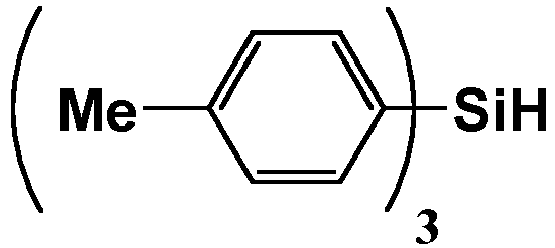
- Next, under nitrogen atmosphere, the resulting tris(4-methylphenyl)silane (6.05 g, 20 mmol) and THF (375 mL) were added into the 1000 mL flask. Still more, potassium permanganate (3.32 g, 21 mmol) (Wako Pure Chemical Industries, Ltd.) and ion exchanged water (3.8 mL) were added to the solution. The mixture was stirred and subjected to a reaction at 60 °C for 13 hours, while applying ultrasonic wave to the flask, using an ultrasonic washing machine (US-2, AS ONE Corp.). After completion of the reaction, the reaction mixture was passed through silica gel (60 g) (C-200, Wako Pure Chemical Industries, Ltd.) to filtrate a byproduct, manganese oxide. The filtrate was concentrated under reduced pressure to obtain a crude product of tris(4-methylphenyl)silanol. The crude product was dissolved in dichloromethane (30 mL) (Wako Pure Chemical Industries, Ltd.) and n-hexane (60 mL) (Wako Pure Chemical Industries, Ltd.), and the solution was subjected crystallization by concentration under reduced pressure. After filtration of a deposited white solid, the solid was washed with n-hexane (10 mL). The resulting solid was dried under reduced pressure to obtain tris(4-methylphenyl)silanol (3.1 g, 9.58 mmol, yield: 48%, white solid).
1H-NMR (400 MHz, C6D6) (ppm): 1.89 (s, 1H, SiOH), 2.10 (s, 9H, Me), 7.06 (d, 6H, J = 8.2 Hz, Ar), 7.68 (d, 6H, J = 8.2 Hz, Ar)
- Under argon gas atmosphere, the resulting tris(4-methylphenyl)silanol (2.55 g, 8 mmol) was dissolved in tetrahydrofuran (THF) (12 mL) (Wako Pure Chemical Industries, Ltd.), and then a THF solution of phenylmagnesium chloride (PhMgCl) (3.8 mL, 7.6 mmol) (Tokyo Chemical Industry Co., Ltd., 2 M) was added dropwise, and the solution was stirred for 1 hour. After that, powder generated by concentration and drying of the solution, was washed with diisopropyl ether (30 mL) (Wako Pure Chemical Industries, Ltd.). The powder was filtered off and dried to obtain magnesium chloride tris(4-methylphenyl)siloxide((4-Me-C6H4)3SiOMgCl).

1H-NMR (400MHz, CDCl3) δ (ppm): 2.33 (s, 9H), 7.14-7.17 (d, 6H, J = 7.0 Hz), 7.58-7.61 (d, 6H, J = 7.0 Hz) - Under argon gas atmosphere, into magnesium chloride tris(4-methylphenyl)siloxide ((4-Me-C6H4)3SiOMgCl) (0.94 g, 2.5 mmol), THF (10 mL) (Wako Pure Chemical Industries, Ltd.) was mixed. The mixture was heated to 50 °C, and then aluminum chloride (AlCl3) (0.33 g, 2.5 mmol) (Wako Pure Chemical Industries, Ltd.) was added to the mixture. After maintaining the resulting mixture at 50 °C for 10 minutes, it was cooled to obtain the
electrolytic solution 10, "a solution of magnesium chloride tris(4-methylphenyl)siloxide - aluminum chloride / THF". - Under nitrogen atmosphere, a THF solution of 4-fluorophenylmagnesium bromide (288 mL, 288 mmol) (Tokyo Chemical Industry Co., Ltd., 1.0 M) was added into a 1000 mL flask. After that, a solution of trichlorosilane (12.2 g, 90 mmol) (Tokyo Chemical Industry Co., Ltd.) dissolved in THF (302 mL) was added dropwise for 1 hour, while keeping temperature of the solution in the flask below 35 °C. After adding dropwise, the reaction mixture was further stirred at room temperature for 2 hours and subjected to a reaction. After completion of the reaction, hydrochloric acid solution (45 mL, 1.0 M) was dropped for neutralization, and then diisopropyl ether (450 mL) was added to the reaction mixture, and the reaction mixture, and a mixture was subjected to a liquid separation. Still more, an organic layer was washed with hydrochloric acid solution (45 mL, 1.0 M), and a mixture was subjected to a liquid separation. A resulting organic layer was dried by magnesium sulfate (30 g) (Wako Pure Chemical Industries, Ltd.). After filtration of magnesium sulfate, a filtrate was concentrated under reduced pressure to obtain a crude product of tris(4-fluorophenyl)silane. Still more, n-pentane (30 mL) (Wako Pure Chemical Industries, Ltd.) was added to the crude product to eliminate only oil out colored component by using a dropping pipet. The remained solution was concentrated under reduced pressure, and then a deposited solid was filtrated and washed with ethanol (30 mL). The resulting white solid was dried under reduced pressure to obtain tris(4-fluorophenyl)silane (22.68 g, 72.1 mmol, yield: 80%, white solid).
1H-NMR (400 MHz, CDCl3) 5.44 (s, 1H, SiH), 7.05-7.11 (m, 6H, Ar), 7.47-7.52 (m, 6H, Ar)
- Next, under nitrogen atmosphere, the resulting tris(4-fluorophenyl)silane (6.29 g, 20 mmol) and THF (375 mL) were added into the 1000 mL flask. Still more, potassium permanganate (3.32 g, 21 mmol) (Wako Pure Chemical Industries, Ltd.) and ion exchanged water (3.8 mL) were added to the solution. The mixture was stirred and subjected to a reaction for 4 hours by maintaining the mixture below room temperature, while applying ultrasonic wave to the flask, using an ultrasonic washing machine (US-2, AS ONE Corp.). After completion of the reaction, the reaction mixture was passed through silica gel (60 g) (C-200, Wako Pure Chemical Industries, Ltd.) to filtrate a byproduct, manganese oxide. The filtrate was concentrated under reduced pressure to obtain a crude product of tris(4-fluorophenyl)silanol. After purification by silica gel column chromatography (eluent: ethyl acetate / n-hexane = 1 / 9; ethyl acetate and n-hexane are both purchased from Wako Pure Chemical Industries, Ltd.), it was dried under reduced pressure to obtain tris(4-fluorophenyl)silanol (2.55 g, 7.72 mmol, yield: 39%, white solid).
1H-NMR (400 MHz, CDCl3) δ: 2.50 (s, 1H, SiOH), 7.07-7.14 (m, 6H, Ar), 7.54-7.60 (m, 6H, Ar)
- Under argon gas atmosphere, the resulting tris(4-fluorophenyl)silanol (2.15 g, 6.5 mmol) was dissolved in tetrahydrofuran (THF) (19.5 mL) (Wako Pure Chemical Industries, Ltd.), and then a THF solution of phenylmagnesium chloride (PhMgCl) (3.1 mL, 6.2 mmol) (Tokyo Chemical Industry Co., Ltd., 2 M) was added dropwise at -78 °C, and the solution was stirred for 1 hour. To an oil component generated by concentration and drying of the solution, hexane (50 mL) (Wako Pure Chemical Industries, Ltd.) and diisopropyl ether (30 mL) (Wako Pure Chemical Industries, Ltd.) were added to generate powder. The powder was filtered off and dried to obtain magnesium chloride tris(4-fluorophenyl)siloxide ((4-F-C6H4)3SiOMgCl).

1H-NMR (400 MHz, CDCl3) δ (ppm): 7.06-7.11 (t, 6H, J = 8.8 Hz), 7.64-7.68 (t, 6H, J = 7.0 Hz) - Under argon gas atmosphere, into magnesium chloride tris(4-fluorophenyl)siloxide ((4-F-C6H4)3SiOMgCl) (0.86 g, 2.2 mmol), THF (8.8 mL) (Wako Pure Chemical Industries, Ltd.) was mixed. The mixture was heated to 50 °C, and then aluminum chloride (AlCl3) (0.29 g, 2.2 mmol) (Wako Pure Chemical Industries, Ltd.) was added to the mixture. After maintaining the resulting mixture at 50 °C for 10 minutes, it was cooled to obtain the electrolytic solution 11, "a solution of magnesium chloride tris(4-fluorophenyl)siloxide - aluminum chloride / THF".
- Magnesium flake (6.36 g, 0.262 mmol) (Wako Pure Chemical Industries, Ltd.) and iodine (10 mg) (Wako Pure Chemical Industries, Ltd.) were added into a 2000 mL flask, and dried under reduced pressure for 1 hour. Still more, under nitrogen atmosphere, tetrahydrofuran (222 mL) (Wako Pure Chemical Industries, Ltd.) was added to the flask. Next, a solution of 1-bromo-3,5-dimethoxybenzene (52.1 g, 0.240 mmol) (Tokyo Chemical Industry Co., Ltd.) dissolved in tetrahydrofuran (274 mL) (Wako Pure Chemical Industries, Ltd.) was added dropwise for 1.5 hour. After adding dropwise, the reaction mixture was stirred at room temperature for 1 hour. Then, a solution of trichlorosilane (10.2 g, 0.075 mmol) (Tokyo Chemical Industry Co., Ltd.) dissolved in tetrahydrofuran (252 mL) (Wako Pure Chemical Industries, Ltd.) was added dropwise for 1 hour, while keeping temperature inside the flask below 35 °C. After adding dropwise, the mixture was stirred at room temperature for 1 hour. After completion of the reaction, hydrochloric acid solution (45 mL, 1.0 M) (Wako Pure Chemical Industries, Ltd.) was dropped for neutralization, and then diisopropyl ether (450 mL) (Wako Pure Chemical Industries, Ltd.) was added to the reaction mixture, and the reaction mixture was subjected to a liquid separation. Still more, an organic layer was washed with hydrochloric acid solution (45 mL, 1.0 M) (Wako Pure Chemical Industries, Ltd.), and a mixture was subjected to a liquid separation. An organic layer was dried by magnesium sulfate (30 g) (Wako Pure Chemical Industries, Ltd.). After filtration of magnesium sulfate, a filtrate was concentrated under reduced pressure to obtain a crude product of tris(3,5-dimethoxyphenyl)silane. The resulting crude product was dissolved in diisopropyl ether (50 mL) (Wako Pure Chemical Industries, Ltd.) and ethanol (30 mL) (Wako Pure Chemical Industries, Ltd.), and the solution was subjected to crystallization by concentration under reduced pressure. After filtration of a deposited white solid, the solid was washed with ethanol (30 mL). The resulting solid was dried under reduced pressure to obtain tris(3,5-dimethoxyphenyl)silane (28.7 g, 65.0 mmol, yield: 87%, white solid).
1H-NMR (400 MHz, CDCl3) δ (ppm): 3.75 (s, 18H, OMe), 5.34 (s, 1H, SiH), 6.50 (t, 3H, J = 2.4 Hz, Ar), 6.71 (d, 6H, J = 2.4 Hz, Ar)
- Next, under nitrogen atmosphere, the resulting tris(3,5-dimethoxyphenyl)silane (8.81 g, 20 mmol) and THF (375 mL) were added into a 1000 mL flask. Still more, potassium permanganate (3.32 g, 21 mmol) (Wako Pure Chemical Industries, Ltd.) and ion exchanged water (3.8 mL) were added to the solution. The mixture was stirred and subjected to a reaction for 1 hour by maintaining the mixture below room temperature, while applying ultrasonic wave to the flask, using an ultrasonic washing machine (US-2, AS ONE Corp.). After completion of the reaction, the reaction mixture was passed through silica gel (60 g) (C-200, Wako Pure Chemical Industries, Ltd.) to filtrate a byproduct, manganese oxide. The filtrate was concentrated under reduced pressure to obtain a crude product of tris(3,5-dimethoxyphenyl)silanol. The resulting crude product was dissolved in dichloromethane (20 mL) (Wako Pure Chemical Industries, Ltd.) and n-hexane (30 mL) (Wako Pure Chemical Industries, Ltd.), and the solution was subjected to crystallization by concentration under reduced pressure. After filtration of a deposited white solid, the solid was washed with n-hexane (30 mL). The resulting solid was dried under reduced pressure to obtain tris(3,5-dimethoxyphenyl)silanol (7.68 g, 16.8 mmol, yield: 84%, white solid).
1H-NMR (400 MHz, CDCl3) δ (ppm): 2.46 (s, 1H, SiOH), 3.75 (s, 18H, OMe), 6.52 (t, 3H, J = 2.4 Hz, Ar), 6.76 (d, 6H, J = 2.4 Hz, Ar)
- Under argon gas atmosphere, the resulting tris(3,5-dimethoxyphenyl)silanol (3.65 g, 8 mmol) was dissolved in THF (30 mL), and then a THF solution of phenylmagnesium chloride (PhMgCl) (3.8 mL, 7.6 mmol) (Tokyo Chemical Industry Co., Ltd., 2 M) was added dropwise, and the solution was stirred for 1 hour. After that, powder generated by concentration and drying of the solution, was washed with diisopropyl ether (36.5 mL) (Wako Pure Chemical Industries, Ltd.). The powder was filtered off and dried to obtain magnesium chloride tris(3,5-dimethoxyphenyl)siloxide ((3,5-(MeO)2-C6H3)3SiOMgCl).

1H-NMR (400MHz, CDCl3) δ (ppm): 3.75 (s, 18H), 6.44-6.48 (t, 3H, J = 2.4 Hz), 6.80-6.91 (d, 6H, J = 2.4 Hz) - Under argon gas atmosphere, into magnesium chloride tris(3,5-dimethoxyphenyl)siloxide ((3,5-(MeO)2-C6H3)3SiOMgCl) (1.29 g, 2.5 mmol), THF (10 mL) was mixed. The mixture was heated to 50 °C, and then aluminum chloride (AlCl3) (0.33 g, 2.5 mmol) (Wako Pure Chemical Industries, Ltd.) was added to the mixture. After maintaining the resulting mixture at 50 °C for 10 minutes, it was cooled to obtain the electrolytic solution 12, "a solution of magnesium chloride tris(3,5-dimethoxyphenyl)siloxide - aluminum chloride / THF".
- Under argon gas atmosphere, dimethylphenylsilanol (4.57 g, 30 mmol) (Wako Pure Chemical Industries, Ltd.) was dissolved in tetrahydrofuran (THF) (15 mL) (Wako Pure Chemical Industries, Ltd.), and then a THF solution of phenylmagnesium chloride (PhMgCl) (15 mL, 30 mmol) (Tokyo Chemical Industry Co., Ltd., 2 M) was added dropwise, and the solution was stirred for 1 hour. To an oil component generated by concentration and drying of the solution, hexane (30 mL) (Wako Pure Chemical Industries, Ltd.) and tert-butyl methyl ether (85 mL) (Wako Pure Chemical Industries, Ltd.) were added to generate powder. The powder was filtered off and dried to obtain magnesium chloride dimethylphenylsiloxide (Me2PhSiOMgCl).

1H-NMR (400 MHz, CDCl3) δ (ppm): 0.20-0.60 (m, 6H), 7.20-7.40 (m, 3H), 7.50-7.70 (m, 2H) - Under argon gas atmosphere, into magnesium chloride dimethylphenylsiloxide (Me2PhSiOMgCl) (1.06 g, 5 mmol), THF (20 mL) (Wako Pure Chemical Industries, Ltd.) was mixed. The mixture was heated to 50 °C, and then aluminum chloride (AlCl3) (0.67 g, 5 mmol) (Wako Pure Chemical Industries, Ltd.) was added to the mixture. After maintaining the resulting mixture at 50 °C for 10 minutes, it was cooled to obtain the electrolytic solution 13, "a solution of magnesium chloride dimethylphenylsiloxide - aluminum chloride / THF".
- Under argon gas atmosphere, diphenylsilanediol (8.65 g, 40 mmol) (Tokyo Chemical Industry Co., Ltd.) was dissolved in tetrahydrofuran (THF) (20 mL) (Wako Pure Chemical Industries, Ltd.), and then a THF solution of phenylmagnesium chloride (PhMgCl) (40 mL, 80 mmol) (Tokyo Chemical Industry Co., Ltd., 2 M) was added dropwise, and the solution was stirred for 1 hour. After that, powder generated by concentration and drying of the solution, was washed with diisopropyl ether (50 mL) (Wako Pure Chemical Industries, Ltd.). The powder was filtered off and dried to obtain diphenylsilanedioxy bis(magnesium chloride), (Ph2Si(OMgCl)2).

1H-NMR (400 MHz, CDCl3) δ (ppm): 6.90-8.00 (m, 10H) - Under argon gas atmosphere, into diphenylsilanedioxy bis(magnesium chloride) (Ph2Si(OMgCl)2) (0.83 g, 2.5 mmol), THF (20 mL) (Wako Pure Chemical Industries, Ltd.) was mixed. The mixture was heated to 50 °C, and then aluminum chloride (AlCl3) (0.67 g, 5 mmol) (Wako Pure Chemical Industries, Ltd.) was added to the mixture. After maintaining the resulting mixture at 50 °C for 10 minutes, it was cooled to obtain the electrolytic solution 14, "a solution of diphenylsilanedioxy bis(magnesium chloride) - aluminum chloride / THF".
- Under argon gas atmosphere, trimethylsilanol (Me3SiOH) (0.90 g, 10 mmol) (Sigma-Aldrich Co., LLC.) was added dropwise to a THF solution of ethylmagnesium chloride (EtMgCI) (5 mL, 10 mmol) (Tokyo Chemical Industry Co., Ltd., 2 M), and the solution was air-cooled. At room temperature, aluminum chloride (AlCl3) (0.22 g, 1.67 mmol) (Wako Pure Chemical Industries, Ltd.) was added to the solution, and the solution was stirred for 1 hour to obtain the comparative
electrolytic solution 3, "a solution of (Me3SiOMgCl)6 - AlCl3 / THF". - Under argon gas atmosphere, triphenylsilanol (5.53 g, 20 mmol) (Tokyo Chemical Industry Co., Ltd.) was dissolved in tetrahydrofuran (THF) (20 mL) (Wako Pure Chemical Industries, Ltd.), and then a THF solution of phenylmagnesium bromide (PhMgBr) (10 mL, 10 mmol) (Tokyo Chemical Industry Co., Ltd., 1 M) was added dropwise, and subjected to a reaction for 1 hour. After that, to an oil component generated by concentration and drying of the solution, diisopropyl ether (40 mL) (Wako Pure Chemical Industries, Ltd.) was added to generate powder. The powder was filtered off and dried to obtain magnesium bromide triphenylsiloxide (Ph3SiOMgBr).

1H-NMR (400MHz, CDCl3) δ (ppm): 6.95-7.90 (m, 15H) - Under argon gas atmosphere, into magnesium bromide triphenylsiloxide (Ph3SiOMgBr) (0.95 g), THF (10 mL) (Wako Pure Chemical Industries, Ltd.) was mixed. The mixture was heated to 50 °C, and then aluminum chloride (AlCl3) (0.33 g, 2.5 mmol) (Wako Pure Chemical Industries, Ltd.) was added to the mixture. After maintaining the resulting mixture at 50 °C for 10 minutes, it was cooled and filtrated to obtain the electrolytic solution 15, "a solution of magnesium bromide triphenylsiloxide - aluminum chloride / THF".
- Cyclic voltammetry (CV) measurement for the electrolytic solutions 7 to 15 (Example 17) was carried out similarly as in Example 7. In addition, CV measurement for the comparative electrolytic solution 3 (Comparative Example
- Results of oxidation decomposition potential of each electrolytic solution are shown in the following Table 2.
- In addition, result of the electrolytic solution 7 after 10 cycles is shown in
Figure 6 , and result of the comparativeelectrolytic solution 3 after 10 cycles is shown inFigure 7 . It should be noted that the horizontal axis in these Figures represents potential of the working electrode, based on potential of the reference electrode, and the vertical axis (mA/cm2) represents current density obtained by dividing current value observed at each potential with surface area of the working electrode.[Table 2] Electrolytic Solution Magnesium salt Solvent Lewis acid Oxidation decomposition potential Electrolytic Solution 7 Ph3SiOMgCl THF AlCl3 +3.2 V Electrolytic Solution 8 Ph3SiOMgCl THF AlCl3/BCl3 +3.0 V Electrolytic Solution 9 Ph3SiOMgCl Triglyme AlCl3 +3.1 V Electrolytic Solution 10 (4-Me-C6H4)3SiOMgCl THF AlCl3 +3.1 V Electrolytic Solution 11 (4-F-C6H4)3SiOMgCl THF AlCl3 +3.0 V Electrolytic Solution 12 (3,5-(MeO)2-C6H3)3SiOMgCl THF AlCl3 +2.9 V Electrolytic Solution 13 Me2PhSiOMgCl THF AlCl3 +3.1 V Electrolytic Solution 14 Ph2Si(OMgCl)2 THF AlCl3 +2.9 V Electrolytic Solution 15 Ph3SiOMgBr THF AlCl3 +2.8 V Comparative Electrolytic Solution 3Me3SiOMgCl THF AlCl3 +2.5 V - From the results of Table 2, it has been revealed that the electrolytic solution of the present invention using a silicon-type compound indicates oxidation decomposition potential of +2.8 V to +3.2 V, and exhibits higher value as compared with a conventional method, thus can be used in high voltage.
- In addition, as for the electrolytic solution 7, it has also been observed to exhibit oxidation decomposition potential of +3.2 V, by carrying out CV measurement, using the electrolytic solution after storage for 1 month. Therefore, it has also been revealed that the electrolytic solution of the present invention is superior in storage stability.
Claims (10)
- An electrolytic solution for a magnesium battery comprising a mixture of a compound represented by the following general formula (I), a Lewis acid and a solvent:

- The electrolytic solution for a magnesium battery according to claim 1, wherein the Lewis acid contains beryllium, boron, aluminum, silicon, tin, titanium, chromium, iron, or cobalt, as an element.
- The electrolytic solution for a magnesium battery according to claim 1, wherein the Lewis acid contains aluminum, as an element.
- The electrolytic solution for a magnesium battery according to claim 1, wherein the Lewis acid is aluminum chloride.
- The electrolytic solution for a magnesium battery according to claim 1, wherein R1 in the compound is an aryl group having 6 to 10 carbon atoms, which may have a halogeno group, an alkyl group, a halogenoalkyl group or an alkoxy group, as a substituent, R2 and R3 each independently represent a magnesium chloride oxy group (-OMgCI); an alkenyl group having 1 to 6 carbon atoms; an alkyl group having 1 to 6 carbon atoms; or an aryl group having 6 to 10 carbon atoms, which may have a halogeno group, an alkyl group, a halogenoalkyl group or an alkoxy group, as a substituent.
- The electrolytic solution for a magnesium battery according to claim 1, wherein R1 in the compound is a phenyl group which may have a halogeno group, an alkyl group, a halogenoalkyl group or an alkoxy group, as a substituent, R2 and R3 each independently represent -OMgCl; an alkenyl group having 1 to 6 carbon atoms; an alkyl group having 1 to 6 carbon atoms; or a phenyl group having an alkyl group as a substituent.
- The electrolytic solution for a magnesium battery according to claim 1, wherein X in the compound is a chlorine atom.
- The electrolytic solution for a magnesium battery according to claim 1, wherein the solvent is an ether-type solvent, a halogenated hydrocarbon-type solvent, a carbonate-type solvent or a nitrile-type solvent.
- An electrochemical device comprising the electrolytic solution according to any of claims 1 to 8, a positive electrode and a negative electrode.
- A compound represented by the following general formula (I'):

Priority Applications (1)
| Application Number | Priority Date | Filing Date | Title |
|---|---|---|---|
| PL15864065T PL3226340T3 (en) | 2014-11-28 | 2015-11-27 | Magnesium-containing electrolytic solution |
Applications Claiming Priority (2)
| Application Number | Priority Date | Filing Date | Title |
|---|---|---|---|
| JP2014240753 | 2014-11-28 | ||
| PCT/JP2015/083325 WO2016084924A1 (en) | 2014-11-28 | 2015-11-27 | Magnesium-containing electrolytic solution |
Publications (3)
| Publication Number | Publication Date |
|---|---|
| EP3226340A1 EP3226340A1 (en) | 2017-10-04 |
| EP3226340A4 EP3226340A4 (en) | 2017-10-11 |
| EP3226340B1 true EP3226340B1 (en) | 2018-11-07 |
Family
ID=56074471
Family Applications (1)
| Application Number | Title | Priority Date | Filing Date |
|---|---|---|---|
| EP15864065.6A Not-in-force EP3226340B1 (en) | 2014-11-28 | 2015-11-27 | Magnesium-containing electrolytic solution |
Country Status (8)
| Country | Link |
|---|---|
| US (1) | US10367231B2 (en) |
| EP (1) | EP3226340B1 (en) |
| JP (1) | JP6575531B2 (en) |
| KR (1) | KR20170089890A (en) |
| CN (1) | CN107004906B (en) |
| PL (1) | PL3226340T3 (en) |
| TW (1) | TWI674692B (en) |
| WO (1) | WO2016084924A1 (en) |
Families Citing this family (11)
| Publication number | Priority date | Publication date | Assignee | Title |
|---|---|---|---|---|
| US20160294010A1 (en) * | 2015-03-31 | 2016-10-06 | The Trustees Of Princeton University | Electrolytes for magnesium-ion batteries |
| PL3399583T3 (en) * | 2015-12-28 | 2021-11-22 | Suzhou Institute of Nano-tech and Nano-bionics, Chinese Academy of Sciences | Mononuclear magnesium cationized salt, preparation method and use thereof |
| TWI735558B (en) * | 2016-04-01 | 2021-08-11 | 日商富士軟片和光純藥股份有限公司 | Magnesium ion-containing electrolytic solution |
| JP7112084B2 (en) * | 2017-01-31 | 2022-08-03 | 学校法人 関西大学 | Electrolyte, secondary battery, and method for producing electrolyte |
| GB2566473B (en) * | 2017-09-14 | 2020-03-04 | Dyson Technology Ltd | Magnesium salts |
| CN112236887A (en) * | 2018-07-31 | 2021-01-15 | 富士胶片和光纯药株式会社 | Positive electrode active material for magnesium battery |
| WO2020138377A1 (en) | 2018-12-27 | 2020-07-02 | 富士フイルム和光純薬株式会社 | Sulfur-based electrolyte solution for magnesium cell |
| CN109755647A (en) * | 2019-01-15 | 2019-05-14 | 麻城市天力科技有限公司 | A kind of magnesium battery electrolyte |
| CN111934029B (en) * | 2020-07-01 | 2022-02-08 | 中山大学 | High-rate and low-self-discharge zinc-organic battery and application thereof |
| CN112271334B (en) * | 2020-10-26 | 2022-01-25 | 哈尔滨工业大学 | Cathode film-forming additive for magnesium metal battery with metal magnesium as cathode material and application thereof |
| US12604696B2 (en) | 2022-01-07 | 2026-04-14 | Tokyo Electron Limited | Liquid processing method, liquid processing apparatus, and storage medium |
Family Cites Families (26)
| Publication number | Priority date | Publication date | Assignee | Title |
|---|---|---|---|---|
| US4727172A (en) * | 1985-09-12 | 1988-02-23 | Shin-Etsu Chemical Co., Ltd. | Method for the preparation of an organosiloxane oligomer and a novel organosiloxane oligomer thereby |
| JP4010073B2 (en) * | 1998-03-13 | 2007-11-21 | 住友化学株式会社 | Transition metal compound, catalyst component for olefin polymerization, olefin polymerization catalyst, and method for producing olefin polymer |
| US6242377B1 (en) | 1998-03-13 | 2001-06-05 | Sumitomo Chemical Company, Limited | Transition metal compound, catalyst component for olefin polymerization, catalyst for olefin polymerization, and process for producing olefinic polymer |
| EP1553117B1 (en) | 2002-07-23 | 2007-01-17 | Nippon Soda Co., Ltd. | Solid polymer electrolyte |
| JP2004213991A (en) * | 2002-12-27 | 2004-07-29 | Sanyo Electric Co Ltd | Electrolyte for nonaqueous battery, its manufacturing method and electrolytic solution for nonaqueous battery |
| US20040137324A1 (en) | 2002-12-27 | 2004-07-15 | Masaharu Itaya | Electrolyte for nanaqueous battery, method for producing the same, and electrolytic solution for nonaqueous battery |
| JP2004259650A (en) * | 2003-02-27 | 2004-09-16 | Kanegafuchi Chem Ind Co Ltd | Magnesium secondary battery |
| JP2004265676A (en) * | 2003-02-28 | 2004-09-24 | Sanyo Electric Co Ltd | Non-aqueous electrolyte battery |
| US20070048605A1 (en) | 2005-08-23 | 2007-03-01 | Pez Guido P | Stable electrolyte counteranions for electrochemical devices |
| JP5162822B2 (en) * | 2005-12-02 | 2013-03-13 | ソニー株式会社 | Electrochemical devices |
| SG153724A1 (en) | 2007-12-27 | 2009-07-29 | Sumitomo Chemical Co | Production process of olefin polymerization catalyst component, of olefin polymerization catalyst, and of olefin polymer |
| US8187746B2 (en) * | 2008-05-16 | 2012-05-29 | Uchicago Argonne, Llc | Surface modification agents for lithium batteries |
| JP5471036B2 (en) | 2008-06-05 | 2014-04-16 | ソニー株式会社 | Magnesium ion-containing non-aqueous electrolyte and electrochemical device using the same |
| CN102651485B (en) | 2011-02-28 | 2016-03-30 | 丰田自动车株式会社 | The application in rechargeable magnesium cell of rechargeable magnesium cell, electrolyte and the electrolyte for rechargeable magnesium cell |
| WO2012160587A1 (en) * | 2011-05-20 | 2012-11-29 | 株式会社 日立製作所 | Magnesium secondary battery, and battery system equipped therewith |
| KR101958181B1 (en) * | 2011-07-28 | 2019-03-14 | 후지필름 와코 준야꾸 가부시키가이샤 | Electrolyte solution for electrochemical devices |
| CN103490094B (en) | 2012-06-11 | 2016-02-10 | 丰田自动车株式会社 | Electrolyte for magnesium cell and the magnesium cell containing this electrolyte |
| JP5861606B2 (en) * | 2012-09-28 | 2016-02-16 | ソニー株式会社 | Electrolytic solution, method for producing electrolytic solution, and electrochemical device |
| KR101401062B1 (en) * | 2012-11-22 | 2014-05-29 | 한국과학기술연구원 | Electrolyte for magnesium secondary battery and preparation method thereof |
| JP5924251B2 (en) * | 2012-12-03 | 2016-05-25 | 大日本印刷株式会社 | Magnesium ion secondary battery and battery pack using the same |
| CN103066326B (en) * | 2013-01-18 | 2015-07-15 | 上海交通大学 | Electrolyte for chargeable magnesium battery |
| JP6358097B2 (en) * | 2013-01-25 | 2018-07-18 | 富士フイルム和光純薬株式会社 | Electrolytic solution for electrochemical device and electrochemical device |
| KR20140122033A (en) * | 2013-04-09 | 2014-10-17 | 한국과학기술연구원 | Electrolyte for magnesium secondary battery and preparation method thereof |
| CN103367735B (en) * | 2013-07-15 | 2015-10-21 | 中国科学院化学研究所 | A kind of magnesium secondary battery anode material and application thereof |
| US9882245B2 (en) * | 2013-08-23 | 2018-01-30 | Ut-Battelle, Llc | Alkoxide-based magnesium electrolyte compositions for magnesium batteries |
| CN103794815A (en) * | 2014-02-18 | 2014-05-14 | 上海交通大学 | Electrolytic solution of rechargeable magnesium cell and application method thereof |
-
2015
- 2015-11-27 JP JP2016561954A patent/JP6575531B2/en not_active Expired - Fee Related
- 2015-11-27 EP EP15864065.6A patent/EP3226340B1/en not_active Not-in-force
- 2015-11-27 TW TW104139634A patent/TWI674692B/en not_active IP Right Cessation
- 2015-11-27 KR KR1020177016886A patent/KR20170089890A/en not_active Abandoned
- 2015-11-27 US US15/529,902 patent/US10367231B2/en not_active Expired - Fee Related
- 2015-11-27 WO PCT/JP2015/083325 patent/WO2016084924A1/en not_active Ceased
- 2015-11-27 CN CN201580064216.7A patent/CN107004906B/en not_active Expired - Fee Related
- 2015-11-27 PL PL15864065T patent/PL3226340T3/en unknown
Non-Patent Citations (1)
| Title |
|---|
| None * |
Also Published As
| Publication number | Publication date |
|---|---|
| TW201628251A (en) | 2016-08-01 |
| KR20170089890A (en) | 2017-08-04 |
| TWI674692B (en) | 2019-10-11 |
| CN107004906B (en) | 2020-04-21 |
| US10367231B2 (en) | 2019-07-30 |
| EP3226340A4 (en) | 2017-10-11 |
| US20170331154A1 (en) | 2017-11-16 |
| WO2016084924A1 (en) | 2016-06-02 |
| EP3226340A1 (en) | 2017-10-04 |
| JP6575531B2 (en) | 2019-09-18 |
| PL3226340T3 (en) | 2019-05-31 |
| CN107004906A (en) | 2017-08-01 |
| JPWO2016084924A1 (en) | 2017-11-02 |
Similar Documents
| Publication | Publication Date | Title |
|---|---|---|
| EP3226340A1 (en) | Magnesium-containing electrolytic solution | |
| Forero‐Saboya et al. | Interfaces and interphases in Ca and Mg batteries | |
| Zhao-Karger et al. | Bisamide based non-nucleophilic electrolytes for rechargeable magnesium batteries | |
| EP2712367B1 (en) | Direct trifluoromethylations using trifluoromethane | |
| US9882245B2 (en) | Alkoxide-based magnesium electrolyte compositions for magnesium batteries | |
| EP2276772A2 (en) | Boron or aluminum complexes | |
| KR20190021498A (en) | Magnesium borohydride and its derivatives as magnesium ion transfer media | |
| Kaur et al. | Synthesis, characterisation and reactions of bis [2-(dimethylaminomethyl)-phenyl] diselenide: its structure and that of [2-(dimethylaminomethyl) phenyl]-selenium bromide | |
| JP5583899B2 (en) | Process for producing ionic compounds | |
| Tedoradze | Electrochemical synthesis of organometallic compounds | |
| TWI637961B (en) | Cyclic decane neutral complex, method for producing the same, and method for producing cyclic hydrogenated decane or cyclic organic decane | |
| EP2824751B1 (en) | Bisamide-based electrolyte for magnesium battery | |
| Amoroso et al. | Functionalisation of terpyridine complexes containing the Re (CO) 3+ moiety | |
| JP6349246B2 (en) | Method for producing neutral complex of cyclic silane and method for producing cyclic hydrogenated silane or cyclic organosilane | |
| Zhang et al. | Enabling Al sacrificial anodes in tetrahydrofuran electrolytes for reductive electrosynthesis | |
| JP6671709B2 (en) | Manufacturing method of electrolyte | |
| Caputo et al. | Chloro-and phenoxy-phosphines in frustrated Lewis pair additions to alkynes | |
| Orto et al. | Cluster carbonyls of the [Re 6 (μ 3-Se) 8] 2+ core: synthesis, structural characterization, and computational analysis | |
| Mohapatra et al. | Synthesis, crystal structures, and redox behavior of some pentamethylcyclopentadienyl arene ruthenium salts | |
| Amadi et al. | Synthesis and theoretical study of a mixed-ligand indium (iii) complex for fabrication of β-In 2 S 3 thin films via chemical vapor deposition | |
| Nikonova et al. | Electrochemical synthesis, structural characterization, and decomposition of rhenium oxoethoxide, Re4O4 (OEt) 12. Ligand influence on the structure and bonding in the high-valent tetranuclear planar rhenium alkoxide clusters | |
| Piskunov et al. | Syntheses, structures, and electrochemical properties of the tin (IV) complexes based on the 2-hydroxy-4-N-(phenyl)-3, 6-di-tert-butyl-p-iminobenzoquinone ligand | |
| Kuduva et al. | Sb⋯ S and S⋯ S interactions in the first neutral and oxidized diphenylstibino (Ph 2 Sb–) derivatives of the redox active tetrathiafulvalene (TTF) core | |
| WO2026078131A1 (en) | Process for preparing hydrosilanes from (pseudo-)halosilanes by electrochemical means | |
| Sasaki et al. | Reaction of lithium (2, 4, 6-tri-tert-butylphenyl) silylphosphides with haloforms. |
Legal Events
| Date | Code | Title | Description |
|---|---|---|---|
| STAA | Information on the status of an ep patent application or granted ep patent |
Free format text: STATUS: THE INTERNATIONAL PUBLICATION HAS BEEN MADE |
|
| PUAI | Public reference made under article 153(3) epc to a published international application that has entered the european phase |
Free format text: ORIGINAL CODE: 0009012 |
|
| STAA | Information on the status of an ep patent application or granted ep patent |
Free format text: STATUS: REQUEST FOR EXAMINATION WAS MADE |
|
| 17P | Request for examination filed |
Effective date: 20170529 |
|
| AK | Designated contracting states |
Kind code of ref document: A1 Designated state(s): AL AT BE BG CH CY CZ DE DK EE ES FI FR GB GR HR HU IE IS IT LI LT LU LV MC MK MT NL NO PL PT RO RS SE SI SK SM TR |
|
| AX | Request for extension of the european patent |
Extension state: BA ME |
|
| A4 | Supplementary search report drawn up and despatched |
Effective date: 20170907 |
|
| DAV | Request for validation of the european patent (deleted) | ||
| DAX | Request for extension of the european patent (deleted) | ||
| GRAP | Despatch of communication of intention to grant a patent |
Free format text: ORIGINAL CODE: EPIDOSNIGR1 |
|
| STAA | Information on the status of an ep patent application or granted ep patent |
Free format text: STATUS: GRANT OF PATENT IS INTENDED |
|
| RIC1 | Information provided on ipc code assigned before grant |
Ipc: C07F 19/00 20060101ALI20180413BHEP Ipc: C07F 7/08 20060101ALI20180413BHEP Ipc: H01M 10/0568 20100101AFI20180413BHEP Ipc: H01M 10/0567 20100101ALN20180413BHEP Ipc: H01M 10/054 20100101ALI20180413BHEP |
|
| INTG | Intention to grant announced |
Effective date: 20180515 |
|
| RAP1 | Party data changed (applicant data changed or rights of an application transferred) |
Owner name: FUJIFILM WAKO PURE CHEMICAL CORPORATION |
|
| GRAS | Grant fee paid |
Free format text: ORIGINAL CODE: EPIDOSNIGR3 |
|
| GRAA | (expected) grant |
Free format text: ORIGINAL CODE: 0009210 |
|
| STAA | Information on the status of an ep patent application or granted ep patent |
Free format text: STATUS: THE PATENT HAS BEEN GRANTED |
|
| AK | Designated contracting states |
Kind code of ref document: B1 Designated state(s): AL AT BE BG CH CY CZ DE DK EE ES FI FR GB GR HR HU IE IS IT LI LT LU LV MC MK MT NL NO PL PT RO RS SE SI SK SM TR |
|
| REG | Reference to a national code |
Ref country code: GB Ref legal event code: FG4D |
|
| REG | Reference to a national code |
Ref country code: CH Ref legal event code: EP Ref country code: AT Ref legal event code: REF Ref document number: 1063182 Country of ref document: AT Kind code of ref document: T Effective date: 20181115 |
|
| REG | Reference to a national code |
Ref country code: DE Ref legal event code: R096 Ref document number: 602015019673 Country of ref document: DE |
|
| REG | Reference to a national code |
Ref country code: IE Ref legal event code: FG4D |
|
| REG | Reference to a national code |
Ref country code: NL Ref legal event code: MP Effective date: 20181107 |
|
| REG | Reference to a national code |
Ref country code: LT Ref legal event code: MG4D |
|
| REG | Reference to a national code |
Ref country code: AT Ref legal event code: MK05 Ref document number: 1063182 Country of ref document: AT Kind code of ref document: T Effective date: 20181107 |
|
| PG25 | Lapsed in a contracting state [announced via postgrant information from national office to epo] |
Ref country code: LT Free format text: LAPSE BECAUSE OF FAILURE TO SUBMIT A TRANSLATION OF THE DESCRIPTION OR TO PAY THE FEE WITHIN THE PRESCRIBED TIME-LIMIT Effective date: 20181107 Ref country code: AT Free format text: LAPSE BECAUSE OF FAILURE TO SUBMIT A TRANSLATION OF THE DESCRIPTION OR TO PAY THE FEE WITHIN THE PRESCRIBED TIME-LIMIT Effective date: 20181107 Ref country code: NO Free format text: LAPSE BECAUSE OF FAILURE TO SUBMIT A TRANSLATION OF THE DESCRIPTION OR TO PAY THE FEE WITHIN THE PRESCRIBED TIME-LIMIT Effective date: 20190207 Ref country code: FI Free format text: LAPSE BECAUSE OF FAILURE TO SUBMIT A TRANSLATION OF THE DESCRIPTION OR TO PAY THE FEE WITHIN THE PRESCRIBED TIME-LIMIT Effective date: 20181107 Ref country code: IS Free format text: LAPSE BECAUSE OF FAILURE TO SUBMIT A TRANSLATION OF THE DESCRIPTION OR TO PAY THE FEE WITHIN THE PRESCRIBED TIME-LIMIT Effective date: 20190307 Ref country code: BG Free format text: LAPSE BECAUSE OF FAILURE TO SUBMIT A TRANSLATION OF THE DESCRIPTION OR TO PAY THE FEE WITHIN THE PRESCRIBED TIME-LIMIT Effective date: 20190207 Ref country code: HR Free format text: LAPSE BECAUSE OF FAILURE TO SUBMIT A TRANSLATION OF THE DESCRIPTION OR TO PAY THE FEE WITHIN THE PRESCRIBED TIME-LIMIT Effective date: 20181107 Ref country code: LV Free format text: LAPSE BECAUSE OF FAILURE TO SUBMIT A TRANSLATION OF THE DESCRIPTION OR TO PAY THE FEE WITHIN THE PRESCRIBED TIME-LIMIT Effective date: 20181107 |
|
| PG25 | Lapsed in a contracting state [announced via postgrant information from national office to epo] |
Ref country code: NL Free format text: LAPSE BECAUSE OF FAILURE TO SUBMIT A TRANSLATION OF THE DESCRIPTION OR TO PAY THE FEE WITHIN THE PRESCRIBED TIME-LIMIT Effective date: 20181107 Ref country code: RS Free format text: LAPSE BECAUSE OF FAILURE TO SUBMIT A TRANSLATION OF THE DESCRIPTION OR TO PAY THE FEE WITHIN THE PRESCRIBED TIME-LIMIT Effective date: 20181107 Ref country code: AL Free format text: LAPSE BECAUSE OF FAILURE TO SUBMIT A TRANSLATION OF THE DESCRIPTION OR TO PAY THE FEE WITHIN THE PRESCRIBED TIME-LIMIT Effective date: 20181107 Ref country code: SE Free format text: LAPSE BECAUSE OF FAILURE TO SUBMIT A TRANSLATION OF THE DESCRIPTION OR TO PAY THE FEE WITHIN THE PRESCRIBED TIME-LIMIT Effective date: 20181107 Ref country code: PT Free format text: LAPSE BECAUSE OF FAILURE TO SUBMIT A TRANSLATION OF THE DESCRIPTION OR TO PAY THE FEE WITHIN THE PRESCRIBED TIME-LIMIT Effective date: 20190307 Ref country code: GR Free format text: LAPSE BECAUSE OF FAILURE TO SUBMIT A TRANSLATION OF THE DESCRIPTION OR TO PAY THE FEE WITHIN THE PRESCRIBED TIME-LIMIT Effective date: 20190208 |
|
| REG | Reference to a national code |
Ref country code: CH Ref legal event code: PL |
|
| PG25 | Lapsed in a contracting state [announced via postgrant information from national office to epo] |
Ref country code: LU Free format text: LAPSE BECAUSE OF NON-PAYMENT OF DUE FEES Effective date: 20181127 Ref country code: ES Free format text: LAPSE BECAUSE OF FAILURE TO SUBMIT A TRANSLATION OF THE DESCRIPTION OR TO PAY THE FEE WITHIN THE PRESCRIBED TIME-LIMIT Effective date: 20181107 Ref country code: DK Free format text: LAPSE BECAUSE OF FAILURE TO SUBMIT A TRANSLATION OF THE DESCRIPTION OR TO PAY THE FEE WITHIN THE PRESCRIBED TIME-LIMIT Effective date: 20181107 Ref country code: IT Free format text: LAPSE BECAUSE OF FAILURE TO SUBMIT A TRANSLATION OF THE DESCRIPTION OR TO PAY THE FEE WITHIN THE PRESCRIBED TIME-LIMIT Effective date: 20181107 Ref country code: CZ Free format text: LAPSE BECAUSE OF FAILURE TO SUBMIT A TRANSLATION OF THE DESCRIPTION OR TO PAY THE FEE WITHIN THE PRESCRIBED TIME-LIMIT Effective date: 20181107 |
|
| REG | Reference to a national code |
Ref country code: DE Ref legal event code: R097 Ref document number: 602015019673 Country of ref document: DE |
|
| REG | Reference to a national code |
Ref country code: BE Ref legal event code: MM Effective date: 20181130 |
|
| REG | Reference to a national code |
Ref country code: IE Ref legal event code: MM4A |
|
| PG25 | Lapsed in a contracting state [announced via postgrant information from national office to epo] |
Ref country code: RO Free format text: LAPSE BECAUSE OF FAILURE TO SUBMIT A TRANSLATION OF THE DESCRIPTION OR TO PAY THE FEE WITHIN THE PRESCRIBED TIME-LIMIT Effective date: 20181107 Ref country code: SM Free format text: LAPSE BECAUSE OF FAILURE TO SUBMIT A TRANSLATION OF THE DESCRIPTION OR TO PAY THE FEE WITHIN THE PRESCRIBED TIME-LIMIT Effective date: 20181107 Ref country code: EE Free format text: LAPSE BECAUSE OF FAILURE TO SUBMIT A TRANSLATION OF THE DESCRIPTION OR TO PAY THE FEE WITHIN THE PRESCRIBED TIME-LIMIT Effective date: 20181107 Ref country code: CH Free format text: LAPSE BECAUSE OF NON-PAYMENT OF DUE FEES Effective date: 20181130 Ref country code: LI Free format text: LAPSE BECAUSE OF NON-PAYMENT OF DUE FEES Effective date: 20181130 Ref country code: MC Free format text: LAPSE BECAUSE OF FAILURE TO SUBMIT A TRANSLATION OF THE DESCRIPTION OR TO PAY THE FEE WITHIN THE PRESCRIBED TIME-LIMIT Effective date: 20181107 Ref country code: SK Free format text: LAPSE BECAUSE OF FAILURE TO SUBMIT A TRANSLATION OF THE DESCRIPTION OR TO PAY THE FEE WITHIN THE PRESCRIBED TIME-LIMIT Effective date: 20181107 |
|
| PLBE | No opposition filed within time limit |
Free format text: ORIGINAL CODE: 0009261 |
|
| STAA | Information on the status of an ep patent application or granted ep patent |
Free format text: STATUS: NO OPPOSITION FILED WITHIN TIME LIMIT |
|
| 26N | No opposition filed |
Effective date: 20190808 |
|
| PG25 | Lapsed in a contracting state [announced via postgrant information from national office to epo] |
Ref country code: SI Free format text: LAPSE BECAUSE OF FAILURE TO SUBMIT A TRANSLATION OF THE DESCRIPTION OR TO PAY THE FEE WITHIN THE PRESCRIBED TIME-LIMIT Effective date: 20181107 Ref country code: IE Free format text: LAPSE BECAUSE OF NON-PAYMENT OF DUE FEES Effective date: 20181127 |
|
| PG25 | Lapsed in a contracting state [announced via postgrant information from national office to epo] |
Ref country code: BE Free format text: LAPSE BECAUSE OF NON-PAYMENT OF DUE FEES Effective date: 20181130 |
|
| PG25 | Lapsed in a contracting state [announced via postgrant information from national office to epo] |
Ref country code: MT Free format text: LAPSE BECAUSE OF NON-PAYMENT OF DUE FEES Effective date: 20181127 |
|
| PG25 | Lapsed in a contracting state [announced via postgrant information from national office to epo] |
Ref country code: TR Free format text: LAPSE BECAUSE OF FAILURE TO SUBMIT A TRANSLATION OF THE DESCRIPTION OR TO PAY THE FEE WITHIN THE PRESCRIBED TIME-LIMIT Effective date: 20181107 |
|
| PG25 | Lapsed in a contracting state [announced via postgrant information from national office to epo] |
Ref country code: MK Free format text: LAPSE BECAUSE OF NON-PAYMENT OF DUE FEES Effective date: 20181107 Ref country code: CY Free format text: LAPSE BECAUSE OF FAILURE TO SUBMIT A TRANSLATION OF THE DESCRIPTION OR TO PAY THE FEE WITHIN THE PRESCRIBED TIME-LIMIT Effective date: 20181107 |
|
| PGFP | Annual fee paid to national office [announced via postgrant information from national office to epo] |
Ref country code: PL Payment date: 20210930 Year of fee payment: 7 |
|
| PGFP | Annual fee paid to national office [announced via postgrant information from national office to epo] |
Ref country code: DE Payment date: 20211005 Year of fee payment: 7 Ref country code: GB Payment date: 20211007 Year of fee payment: 7 Ref country code: FR Payment date: 20211109 Year of fee payment: 7 |
|
| PGFP | Annual fee paid to national office [announced via postgrant information from national office to epo] |
Ref country code: HU Payment date: 20211013 Year of fee payment: 7 |
|
| REG | Reference to a national code |
Ref country code: DE Ref legal event code: R119 Ref document number: 602015019673 Country of ref document: DE |
|
| GBPC | Gb: european patent ceased through non-payment of renewal fee |
Effective date: 20221127 |
|
| PG25 | Lapsed in a contracting state [announced via postgrant information from national office to epo] |
Ref country code: HU Free format text: LAPSE BECAUSE OF NON-PAYMENT OF DUE FEES Effective date: 20221128 |
|
| PG25 | Lapsed in a contracting state [announced via postgrant information from national office to epo] |
Ref country code: GB Free format text: LAPSE BECAUSE OF NON-PAYMENT OF DUE FEES Effective date: 20221127 Ref country code: DE Free format text: LAPSE BECAUSE OF NON-PAYMENT OF DUE FEES Effective date: 20230601 |
|
| PG25 | Lapsed in a contracting state [announced via postgrant information from national office to epo] |
Ref country code: FR Free format text: LAPSE BECAUSE OF NON-PAYMENT OF DUE FEES Effective date: 20221130 |
|
| PG25 | Lapsed in a contracting state [announced via postgrant information from national office to epo] |
Ref country code: PL Free format text: LAPSE BECAUSE OF NON-PAYMENT OF DUE FEES Effective date: 20221127 |