EP3223584A1 - Elektrischer heizschaltkreis und heizelement für scheibenwischer, herstellungsverfahren eines heizelements, und scheibenwischer - Google Patents
Elektrischer heizschaltkreis und heizelement für scheibenwischer, herstellungsverfahren eines heizelements, und scheibenwischer Download PDFInfo
- Publication number
- EP3223584A1 EP3223584A1 EP17160961.3A EP17160961A EP3223584A1 EP 3223584 A1 EP3223584 A1 EP 3223584A1 EP 17160961 A EP17160961 A EP 17160961A EP 3223584 A1 EP3223584 A1 EP 3223584A1
- Authority
- EP
- European Patent Office
- Prior art keywords
- heating element
- heating
- wiper blade
- resistive
- support
- Prior art date
- Legal status (The legal status is an assumption and is not a legal conclusion. Google has not performed a legal analysis and makes no representation as to the accuracy of the status listed.)
- Withdrawn
Links
- 238000010438 heat treatment Methods 0.000 title claims abstract description 132
- 238000005485 electric heating Methods 0.000 title claims abstract description 28
- 238000000034 method Methods 0.000 title claims description 11
- 238000004519 manufacturing process Methods 0.000 title claims description 5
- 239000004020 conductor Substances 0.000 claims description 20
- 238000000151 deposition Methods 0.000 claims description 20
- 238000005452 bending Methods 0.000 claims description 13
- 239000000758 substrate Substances 0.000 claims description 11
- 230000008021 deposition Effects 0.000 claims description 9
- 239000010410 layer Substances 0.000 claims description 9
- 238000007650 screen-printing Methods 0.000 claims description 5
- 230000008569 process Effects 0.000 claims description 3
- 239000011241 protective layer Substances 0.000 claims description 3
- 230000001105 regulatory effect Effects 0.000 claims description 3
- 239000000976 ink Substances 0.000 description 20
- 230000005611 electricity Effects 0.000 description 4
- 244000007853 Sarothamnus scoparius Species 0.000 description 3
- 239000000853 adhesive Substances 0.000 description 3
- 230000001070 adhesive effect Effects 0.000 description 3
- 230000000694 effects Effects 0.000 description 3
- 230000010354 integration Effects 0.000 description 3
- XLYOFNOQVPJJNP-UHFFFAOYSA-N water Substances O XLYOFNOQVPJJNP-UHFFFAOYSA-N 0.000 description 3
- 239000004698 Polyethylene Substances 0.000 description 2
- 230000008901 benefit Effects 0.000 description 2
- 230000015556 catabolic process Effects 0.000 description 2
- 239000011248 coating agent Substances 0.000 description 2
- 238000000576 coating method Methods 0.000 description 2
- 238000006731 degradation reaction Methods 0.000 description 2
- 238000009826 distribution Methods 0.000 description 2
- 239000012530 fluid Substances 0.000 description 2
- 229920000573 polyethylene Polymers 0.000 description 2
- 238000010257 thawing Methods 0.000 description 2
- BQCADISMDOOEFD-UHFFFAOYSA-N Silver Chemical compound [Ag] BQCADISMDOOEFD-UHFFFAOYSA-N 0.000 description 1
- 230000006978 adaptation Effects 0.000 description 1
- 230000033228 biological regulation Effects 0.000 description 1
- 230000015572 biosynthetic process Effects 0.000 description 1
- 238000004140 cleaning Methods 0.000 description 1
- 230000001276 controlling effect Effects 0.000 description 1
- 239000005357 flat glass Substances 0.000 description 1
- 229920002457 flexible plastic Polymers 0.000 description 1
- 239000000463 material Substances 0.000 description 1
- 229910052751 metal Inorganic materials 0.000 description 1
- 239000002184 metal Substances 0.000 description 1
- 229920003052 natural elastomer Polymers 0.000 description 1
- 229920001194 natural rubber Polymers 0.000 description 1
- 239000012811 non-conductive material Substances 0.000 description 1
- 238000013021 overheating Methods 0.000 description 1
- 238000007747 plating Methods 0.000 description 1
- -1 polyethylene Polymers 0.000 description 1
- 230000009467 reduction Effects 0.000 description 1
- 230000006903 response to temperature Effects 0.000 description 1
- 229910052709 silver Inorganic materials 0.000 description 1
- 239000004332 silver Substances 0.000 description 1
- 238000005507 spraying Methods 0.000 description 1
- 229920003051 synthetic elastomer Polymers 0.000 description 1
- 229920002994 synthetic fiber Polymers 0.000 description 1
- 239000005061 synthetic rubber Substances 0.000 description 1
- 230000001960 triggered effect Effects 0.000 description 1
Images
Classifications
-
- H—ELECTRICITY
- H05—ELECTRIC TECHNIQUES NOT OTHERWISE PROVIDED FOR
- H05B—ELECTRIC HEATING; ELECTRIC LIGHT SOURCES NOT OTHERWISE PROVIDED FOR; CIRCUIT ARRANGEMENTS FOR ELECTRIC LIGHT SOURCES, IN GENERAL
- H05B3/00—Ohmic-resistance heating
- H05B3/10—Heating elements characterised by the composition or nature of the materials or by the arrangement of the conductor
- H05B3/12—Heating elements characterised by the composition or nature of the materials or by the arrangement of the conductor characterised by the composition or nature of the conductive material
- H05B3/14—Heating elements characterised by the composition or nature of the materials or by the arrangement of the conductor characterised by the composition or nature of the conductive material the material being non-metallic
- H05B3/146—Conductive polymers, e.g. polyethylene, thermoplastics
-
- B—PERFORMING OPERATIONS; TRANSPORTING
- B60—VEHICLES IN GENERAL
- B60S—SERVICING, CLEANING, REPAIRING, SUPPORTING, LIFTING, OR MANOEUVRING OF VEHICLES, NOT OTHERWISE PROVIDED FOR
- B60S1/00—Cleaning of vehicles
- B60S1/02—Cleaning windscreens, windows or optical devices
- B60S1/023—Cleaning windscreens, windows or optical devices including defroster or demisting means
- B60S1/026—Cleaning windscreens, windows or optical devices including defroster or demisting means using electrical means
-
- B—PERFORMING OPERATIONS; TRANSPORTING
- B60—VEHICLES IN GENERAL
- B60S—SERVICING, CLEANING, REPAIRING, SUPPORTING, LIFTING, OR MANOEUVRING OF VEHICLES, NOT OTHERWISE PROVIDED FOR
- B60S1/00—Cleaning of vehicles
- B60S1/02—Cleaning windscreens, windows or optical devices
- B60S1/04—Wipers or the like, e.g. scrapers
- B60S1/32—Wipers or the like, e.g. scrapers characterised by constructional features of wiper blade arms or blades
- B60S1/38—Wiper blades
- B60S1/3803—Wiper blades heated wiper blades
- B60S1/3805—Wiper blades heated wiper blades electrically
-
- H—ELECTRICITY
- H05—ELECTRIC TECHNIQUES NOT OTHERWISE PROVIDED FOR
- H05B—ELECTRIC HEATING; ELECTRIC LIGHT SOURCES NOT OTHERWISE PROVIDED FOR; CIRCUIT ARRANGEMENTS FOR ELECTRIC LIGHT SOURCES, IN GENERAL
- H05B1/00—Details of electric heating devices
- H05B1/02—Automatic switching arrangements specially adapted to apparatus ; Control of heating devices
- H05B1/0227—Applications
- H05B1/023—Industrial applications
- H05B1/0236—Industrial applications for vehicles
-
- H—ELECTRICITY
- H05—ELECTRIC TECHNIQUES NOT OTHERWISE PROVIDED FOR
- H05B—ELECTRIC HEATING; ELECTRIC LIGHT SOURCES NOT OTHERWISE PROVIDED FOR; CIRCUIT ARRANGEMENTS FOR ELECTRIC LIGHT SOURCES, IN GENERAL
- H05B3/00—Ohmic-resistance heating
- H05B3/40—Heating elements having the shape of rods or tubes
- H05B3/54—Heating elements having the shape of rods or tubes flexible
-
- H—ELECTRICITY
- H05—ELECTRIC TECHNIQUES NOT OTHERWISE PROVIDED FOR
- H05B—ELECTRIC HEATING; ELECTRIC LIGHT SOURCES NOT OTHERWISE PROVIDED FOR; CIRCUIT ARRANGEMENTS FOR ELECTRIC LIGHT SOURCES, IN GENERAL
- H05B3/00—Ohmic-resistance heating
- H05B3/84—Heating arrangements specially adapted for transparent or reflecting areas, e.g. for demisting or de-icing windows, mirrors or vehicle windshields
-
- B—PERFORMING OPERATIONS; TRANSPORTING
- B60—VEHICLES IN GENERAL
- B60S—SERVICING, CLEANING, REPAIRING, SUPPORTING, LIFTING, OR MANOEUVRING OF VEHICLES, NOT OTHERWISE PROVIDED FOR
- B60S1/00—Cleaning of vehicles
- B60S1/02—Cleaning windscreens, windows or optical devices
- B60S1/04—Wipers or the like, e.g. scrapers
- B60S1/32—Wipers or the like, e.g. scrapers characterised by constructional features of wiper blade arms or blades
- B60S1/38—Wiper blades
- B60S2001/3812—Means of supporting or holding the squeegee or blade rubber
- B60S2001/3817—Means of supporting or holding the squeegee or blade rubber chacterised by a backing strip to aid mounting of squeegee in support
- B60S2001/382—Means of supporting or holding the squeegee or blade rubber chacterised by a backing strip to aid mounting of squeegee in support the backing strip being an essentially planar reinforcing strip, e.g. vertebra
-
- H—ELECTRICITY
- H05—ELECTRIC TECHNIQUES NOT OTHERWISE PROVIDED FOR
- H05B—ELECTRIC HEATING; ELECTRIC LIGHT SOURCES NOT OTHERWISE PROVIDED FOR; CIRCUIT ARRANGEMENTS FOR ELECTRIC LIGHT SOURCES, IN GENERAL
- H05B2203/00—Aspects relating to Ohmic resistive heating covered by group H05B3/00
- H05B2203/002—Heaters using a particular layout for the resistive material or resistive elements
- H05B2203/005—Heaters using a particular layout for the resistive material or resistive elements using multiple resistive elements or resistive zones isolated from each other
-
- H—ELECTRICITY
- H05—ELECTRIC TECHNIQUES NOT OTHERWISE PROVIDED FOR
- H05B—ELECTRIC HEATING; ELECTRIC LIGHT SOURCES NOT OTHERWISE PROVIDED FOR; CIRCUIT ARRANGEMENTS FOR ELECTRIC LIGHT SOURCES, IN GENERAL
- H05B2203/00—Aspects relating to Ohmic resistive heating covered by group H05B3/00
- H05B2203/013—Heaters using resistive films or coatings
-
- H—ELECTRICITY
- H05—ELECTRIC TECHNIQUES NOT OTHERWISE PROVIDED FOR
- H05B—ELECTRIC HEATING; ELECTRIC LIGHT SOURCES NOT OTHERWISE PROVIDED FOR; CIRCUIT ARRANGEMENTS FOR ELECTRIC LIGHT SOURCES, IN GENERAL
- H05B2203/00—Aspects relating to Ohmic resistive heating covered by group H05B3/00
- H05B2203/017—Manufacturing methods or apparatus for heaters
-
- H—ELECTRICITY
- H05—ELECTRIC TECHNIQUES NOT OTHERWISE PROVIDED FOR
- H05B—ELECTRIC HEATING; ELECTRIC LIGHT SOURCES NOT OTHERWISE PROVIDED FOR; CIRCUIT ARRANGEMENTS FOR ELECTRIC LIGHT SOURCES, IN GENERAL
- H05B2203/00—Aspects relating to Ohmic resistive heating covered by group H05B3/00
- H05B2203/02—Heaters using heating elements having a positive temperature coefficient
-
- H—ELECTRICITY
- H05—ELECTRIC TECHNIQUES NOT OTHERWISE PROVIDED FOR
- H05B—ELECTRIC HEATING; ELECTRIC LIGHT SOURCES NOT OTHERWISE PROVIDED FOR; CIRCUIT ARRANGEMENTS FOR ELECTRIC LIGHT SOURCES, IN GENERAL
- H05B2214/00—Aspects relating to resistive heating, induction heating and heating using microwaves, covered by groups H05B3/00, H05B6/00
- H05B2214/02—Heaters specially designed for de-icing or protection against icing
Definitions
- the invention relates to an electric heating circuit for a wiper blade of a vehicle.
- the invention also relates to an electric heating element comprising an electric heating circuit, a wiper blade comprising a heating element, and a method of manufacturing an electric heating element.
- heating the wiper blade may further heat the windshield washer fluid prior to spraying or projecting the outer surface of the window, which also facilitates defrosting operations of the window and may possibly prevent the use of a squeegee for manual use.
- a wiper blade of the "flat blade” type comprises a longitudinal orientation body which carries a wiper blade, generally made of natural or synthetic rubber, which is intended to rub against the outer surface the window to be wiped, for example a vehicle windshield, to evacuate water by bringing this water out of the driver's field of vision.
- Such a type of wiper blade also has at least one longitudinal vertebra which gives the wiper blade bending so as to promote the application of the wiper blade on the outer surface of the window.
- the wiper blade is carried by a wiper arm or drive arm which is reciprocated by an electric drive motor.
- connection means of the wiper blade to the drive arm may comprise a connector which is secured to the longitudinal body, and an adapter which is mounted articulated on the longitudinal body and which is fixed to a free end of the arm.
- the heating means use an electric heating circuit which comprises at least one electrical heating resistor which, when supplied with electric current, produces heat which is dissipated in its environment.
- the bending vertebra of a wiper blade with heating means in the form of an attached film which is bonded to at least one of the two opposing flat faces. of the vertebra, and which has a heating circuit.
- the electric heating circuit is for example a loop of an electrical conductor of electricity whose ends are connected to power supply terminals.
- the heating control function in this case requires integration in the general definition of the electrical architecture of the vehicle and it generates a certain cost.
- the manufacturer may not wish to modify the vehicle architecture and he then asks for a possibility of integrating the steering and protection function directly into the broom. heated wipers.
- the other functions of the vehicle are not affected in degraded mode of the function, for example in the case of supply of incorrect information by an outdoor temperature sensor or the speed of movement of the vehicle, or in case of failure of such a sensor.
- the heating function is triggered in general for an outside temperature of less than 5 ° C, to ensure global deicing of the windscreen wiper blade, whether it is the defrosting of the distribution channels, the connection means of the broom windscreen wiper arm or wiper blade in contact with the outer surface of the window.
- the risk is permanent heating of the wiper blade beyond a temperature of 5 ° C, for example in summer with ambient temperatures above 30 ° C.
- the invention aims to provide a simple, effective and economical solution to such problems inherent to the designs according to the state of the art, without having to resort to dedicated means to provide thermal protection of the wiper blade .
- the invention proposes an electric heating circuit for a wiper blade of a vehicle, in particular an automobile, comprising at least one heating resistive element which is connected to the power supply terminals of the element, characterized in that at least one resistive heating element is a resistive element PTC produced by means of a resistive ink with a positive temperature coefficient.
- CTP Positive Temperature Coefficient to designate an intrinsic characteristic of the selected material which is here an so-called CTP ink with a positive temperature coefficient.
- PTC Positive Temperature Coefficient
- a resistive heating element CTP has an electrical resistance which increases with increasing temperature.
- Such a resistive heating element PTC is distinguished from other heating elements whose electrical resistance is substantially constant, a resistive heating element PTC having the ability to control the temperature itself by regulating its heating power via its electrical resistance in response to temperature.
- the heating power of the resistive heating element CTP may decrease to a point where it simply compensates for the energy loss of the system, maintaining a constant.
- an electric heating circuit according to the invention into one of the components of the Wiper blade ensures self-regulation of the heating function and safety in particular to prevent degradation of the wiper blade.
- the design according to the invention using PTC resistive heating elements made by depositing a CTP ink, is advantageous because of its compactness, ease of integration and ease of use.
- the invention also proposes a heating element for a wiper blade of a vehicle, in particular an automobile, characterized in that it comprises a support and at least one electric heating circuit according to the invention which is carried by the support.
- the invention also proposes a wiper blade for a motor vehicle, characterized in that it comprises at least one heating element according to the invention.
- the wiper blade comprises means for connecting or adapting to a drive arm of the wiper blade, it is connecting means comprising means for electrical connection to said terminals power supply.
- the orientation or longitudinal direction corresponds to the main axis of the wiper blade.
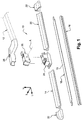
- FIG. 1 a wiper blade 10, for example for wiping the outer surface of a windshield of a motor vehicle.
- a drive arm 12 of the wiper blade 10 which is itself intended to be driven by an electric motor (not shown) for the wiper blade to follow an alternating angular movement. back and forth to evacuate water, and possibly other undesirable elements present on the outer surface of the windshield.
- the wiper blade 10 comprises a longitudinal body 14, a wiper blade 16 and at least one vertebra 18 whose function is to give the wiper blade 16 bending so as to promote the application of the wiper blade. wiper blade 16 on the outer surface of the windshield according to the geometric conformation in three dimensions in the space of this outer surface.
- the longitudinal body 14 of the wiper blade 10 here comprises an upper deflector 20 which is intended to improve the operation of the wiper blade, the deflector 20 having the function of improving the plating of the wiper blade. 16 on the outer surface of the windshield and thus improve the aerodynamic performance of the entire windshield wiper system.
- the windscreen wiper blade 10 also has hooks or staples 22 for hooking the wiper blade 16 and the vertebra 18 on the longitudinal body 14, the staples 22 being here located at each of the two opposite longitudinal ends. longitudinal body 14.
- the longitudinal body 14 of the wiper blade 10 is here made in two independent parts which are arranged relative to each other substantially end-to-end and which are connected to one another by a intermediate connector 24.
- the wiper 10 comprises an adapter 26 which is mounted on the intermediate connector 24 and which allows an articulation of the wiper blade 10 relative to the arm 12.
- the articulation of the wiper blade 10 with respect to the wiper arm 12 is an articulation in a pivoting movement about a pivot axis A of transverse orientation orthogonal to the longitudinal axis of the wiper blade. wiper 10.
- the wiper blade 10 must have at least one degree of freedom in rotation or pivoting relative to the wiper arm 12, and more precisely with respect to a terminal or distal piece 28 fitted to the end free drive arm 12, to allow the wiper blade 10 to follow the curvature in the space of the outer surface of the windshield.
- the wiper blade 10 is equipped with a heating element, or heating element, which essentially consists of a support and components providing a heating electrical resistance function which are carried by the support, the heating element being integrated with the wiper blade 10 and, in the design illustrated in the figures, intended to equip a face of a vertebra 18, and for example the upper face 19.
- a heating element or heating element, which essentially consists of a support and components providing a heating electrical resistance function which are carried by the support, the heating element being integrated with the wiper blade 10 and, in the design illustrated in the figures, intended to equip a face of a vertebra 18, and for example the upper face 19.
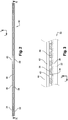
- the heating element 30 according to the invention is here in the form of a heating film intended to be attached to a face 19 of the bending vertebra 18.
- the heating film 30 comprises a lower substrate 32 made of an electrically non-conductive material which is here of generally rectangular shape, the dimensions, length and width of which are such that they allow the adaptation and assembly of the heating film 30 on the bending vertebra 18 of determined dimensions.
- the substrate 32 is thus for example a sheet of flexible plastic or synthetic material whose constitution will be specified later.
- the substrate 32 may comprise, on its underside intended to cooperate with an element of the wiper blade (for example with the upper face 19 of the vertebra 18), an adhesive coating so as to allow the fixing of the heating film 30 by bonding this adhesive coating, for example on the vertebra 18.
- the substrate 32 has a free upper surface 34 on which is formed an electric heating circuit according to the teachings of the invention which, in this embodiment, is composed solely of resistive heating elements CTP.
- Each resistive heating element CTP is here a block 36 of ink with a positive temperature coefficient.
- Each CTP block 36 is of rectangular contour and the pavers 36 are eighteen aligned longitudinally and juxtaposed in a similar manner, with the exception of the central or middle portion of the length of the heating element 30 which is here a zone devoid of resistive heating elements CTP. So, in the example shown in the figure 2 , the electric heating circuit comprises two groups each comprising nine heating resistive elements 36.
- the number of heating resistive elements can of course vary, especially as a function of the length of the wiper blade and therefore for example the length of the vertebra, and be evenly distributed or not on this length.
- the heating element 30 comprises, by way of example, two parallel electrical conductors 38 each in the form of a longitudinal strip which extends substantially over the entire length of the heating element 30.
- each electrically conductive strip 38 is formed by depositing on the upper surface 34 of the substrate 32 a conductive ink, for example based on silver (Ag).
- each electrically conductive strip 38 has a transversely widened central portion 40 which constitutes a electrical connection terminal of the corresponding band 38.
- connection terminals 40 may for example correspond to the longitudinal position of the wiper blade connector 26 on the bending vertebra 18.
- the connector 26 may comprise electrical connection means (not shown) which are intended to come into contact with the electrical connection terminals 40 of the heating element 30 fitted to the bending vertebra 18.
- the electrical connection or connection between the electrical connection terminals 40 and a source of electrical power supply (not shown) of the vehicle is then ensured, in known manner, for example through the adapter 26 and then the control arm. wiper 30.
- All heating resistive elements or blocks 36 are connected to the same power supply terminals 40, here in a parallel connection.
- each heating resistive element 36 is arranged to extend transversely astride each of the electrically conductive strips 38.
- Each conductive strip 38 thus constitutes an “electrical connection bar” also called “busbar”.
- the realization of a portion of conductive ink conductive electricity conductive strips 38, and CTP based resistive heating elements 36, based on a CTP ink is for example performed by screen printing deposition.
- This method of producing by deposition of successive layers of ink is carried out for example by proceeding first to a deposition step of the electrically conductive strips 38, then proceeding to a deposition step of the resistive heating elements CTP. 36.
- the lower substrate 32 is for example made of polyethylene (PET).
- this assembly can be covered successively with a protective layer 41, then with a layer 42 of laminated adhesive, and finally, again for for example, an "upper" substrate 44 of similar design to that of the lower substrate 32.
- the CTP heating resistive elements 36 may be made by screen-printing a positive temperature coefficient ink as sold by the company "Henkel” (registered trademark) under the reference LOCTITE ECI 8000 (registered trademark ), or by the company “Du Pont” (registered trademark) under the reference "7292".
- the PTC type heater 30 may be considered a "smart" heating element, its initial resistance R0 being expressed in Ohm / area unit (area).
- the effective electrical resistance W of a heating element 30 can be obtained by determining a number of heating resistive elements 36 and arranging them in a predetermined pattern. electrical connection (s).
- N is the number of CTP elements 36
- the total heating power is a function of N * U 2 / R0 and it can easily be adapted by selecting any parameter such as the applied voltage, the total number of CTP blocks 36 in parallel. , as well as their initial resistor (s) R0.
- the heating element can be made "directly" on the bending vertebra 18, which then constitutes, in the sense of the invention, the support of the electric heating circuit.
- the upper face 19 then plays the role of the upper face 34 of the substrate 32.
- the bending vertebra 18 is made of metal so as to advantageously benefit from an important effect of thermal radiator, it is then necessary - especially prior to the deposition of an electrically conductive ink to make the electrically conductive strips 38 - to coat the upper face 19 with a non-conductive layer of electricity.
- the bending vertebra 18 is itself made of a non-electrically conductive material, then it may not be necessary to provide for the deposition of a layer of non-electrically conductive material between the face upper 19 and electrically conductive strips 38.
- the support may consist of a surface portion of the wiper blade 16 or the aerodynamic deflector 20.
- the heating element when the heating element is embodied as a self-heating film which can be attached to a wiper blade element or component, the heating element can then be bonded to a portion of the wiper blade. surface of the wiper blade 16 or on a surface portion of the aerodynamic deflector 20.
- a heating circuit according to the invention is not necessarily entirely constituted by heating resistive elements of the CTP type.
- the electric heating circuit may comprise a first portion, or first section, comprising a plurality of resistive heating elements CTP 36 as explained above - which then form a first heating resistor and regulation value R1 - and include a second portion, or second section, which is for example a "conventional" heating electrical resistance which is connected in series with the first portion and whose value is R2.
- the total heating power is then equal to U 2 / (R1 + R2).
- the resistance R1 of the first portion of the electric heating circuit will increase rapidly and therefore the power, and therefore the heating will decrease or stabilize.
- This variant also allows self-regulation of the heating element around a defined threshold value.
Landscapes
- Engineering & Computer Science (AREA)
- Mechanical Engineering (AREA)
- Resistance Heating (AREA)
- Surface Heating Bodies (AREA)
Applications Claiming Priority (1)
| Application Number | Priority Date | Filing Date | Title |
|---|---|---|---|
| FR1652400A FR3049153B1 (fr) | 2016-03-21 | 2016-03-21 | Circuit electrique chauffant et element chauffant pour balai d’essuie-glace, procede de realisation d’un element chauffant, et balai d’essuie-glace |
Publications (1)
| Publication Number | Publication Date |
|---|---|
| EP3223584A1 true EP3223584A1 (de) | 2017-09-27 |
Family
ID=56087368
Family Applications (1)
| Application Number | Title | Priority Date | Filing Date |
|---|---|---|---|
| EP17160961.3A Withdrawn EP3223584A1 (de) | 2016-03-21 | 2017-03-14 | Elektrischer heizschaltkreis und heizelement für scheibenwischer, herstellungsverfahren eines heizelements, und scheibenwischer |
Country Status (7)
| Country | Link |
|---|---|
| US (1) | US20170273144A1 (de) |
| EP (1) | EP3223584A1 (de) |
| JP (1) | JP2017206234A (de) |
| CN (1) | CN107215311A (de) |
| CA (1) | CA2961316A1 (de) |
| FR (1) | FR3049153B1 (de) |
| RU (1) | RU2017109090A (de) |
Families Citing this family (8)
| Publication number | Priority date | Publication date | Assignee | Title |
|---|---|---|---|---|
| FR3057836B1 (fr) * | 2016-10-20 | 2019-05-10 | Valeo Systemes D'essuyage | Module de connexion pour un dispositif d'essuyage d'un vehicule automobile |
| EP3351439B1 (de) | 2017-01-24 | 2019-11-20 | Valeo Systèmes d'Essuyage | Wischerblatt mit einer elektrischen erwärmungsschaltung und einer ptc-sicherung |
| US11181545B2 (en) | 2017-08-17 | 2021-11-23 | Rosemount Aerospace Inc. | Angle of attack sensor with thermal enhancement |
| JP2020019294A (ja) * | 2018-07-30 | 2020-02-06 | 株式会社ミツバ | ワイパアームの連結構造 |
| US11084593B2 (en) | 2018-10-11 | 2021-08-10 | Goodrich Corporation | Additive manufactured heater elements for propeller ice protection |
| US11162970B2 (en) | 2019-06-17 | 2021-11-02 | Rosemount Aerospace Inc. | Angle of attack sensor |
| JP2021009036A (ja) * | 2019-06-28 | 2021-01-28 | 株式会社デンソー | 測距装置 |
| US11649057B2 (en) * | 2019-12-13 | 2023-05-16 | Rosemount Aerospace Inc. | Static plate heating arrangement |
Citations (4)
| Publication number | Priority date | Publication date | Assignee | Title |
|---|---|---|---|---|
| JPS62460U (de) * | 1985-06-19 | 1987-01-06 | ||
| WO2003105530A1 (en) * | 2002-06-05 | 2003-12-18 | Suntech S.R.L | Method for producing thermoresistors on a support, and thermoresistors obtained thereby |
| US20130193129A1 (en) * | 2010-07-06 | 2013-08-01 | Hwb, Llc | Heated wiper blade for motor vehicles and the like |
| FR3014388A1 (fr) * | 2013-12-05 | 2015-06-12 | Valeo Systemes Dessuyage | Procede de fabrication d'un element chauffant pour balai d'essuie-glace d'un vehicule |
Family Cites Families (4)
| Publication number | Priority date | Publication date | Assignee | Title |
|---|---|---|---|---|
| US6229123B1 (en) * | 1998-09-25 | 2001-05-08 | Thermosoft International Corporation | Soft electrical textile heater and method of assembly |
| CN201124817Y (zh) * | 2007-09-19 | 2008-10-01 | 阮胜 | 一种汽车的双刮胶条电加热的雨刮器 |
| DE102008027566A1 (de) * | 2008-06-10 | 2009-12-17 | Valeo Systèmes d'Essuyage | Wischblatt sowie Wischarm |
| GB0918228D0 (en) * | 2009-10-19 | 2009-12-02 | Pilkington Group Ltd | Heatable glazing |
-
2016
- 2016-03-21 FR FR1652400A patent/FR3049153B1/fr not_active Expired - Fee Related
-
2017
- 2017-03-14 EP EP17160961.3A patent/EP3223584A1/de not_active Withdrawn
- 2017-03-16 CA CA2961316A patent/CA2961316A1/en not_active Abandoned
- 2017-03-17 JP JP2017052286A patent/JP2017206234A/ja active Pending
- 2017-03-20 RU RU2017109090A patent/RU2017109090A/ru not_active Application Discontinuation
- 2017-03-21 CN CN201710169234.2A patent/CN107215311A/zh active Pending
- 2017-03-21 US US15/464,477 patent/US20170273144A1/en not_active Abandoned
Patent Citations (4)
| Publication number | Priority date | Publication date | Assignee | Title |
|---|---|---|---|---|
| JPS62460U (de) * | 1985-06-19 | 1987-01-06 | ||
| WO2003105530A1 (en) * | 2002-06-05 | 2003-12-18 | Suntech S.R.L | Method for producing thermoresistors on a support, and thermoresistors obtained thereby |
| US20130193129A1 (en) * | 2010-07-06 | 2013-08-01 | Hwb, Llc | Heated wiper blade for motor vehicles and the like |
| FR3014388A1 (fr) * | 2013-12-05 | 2015-06-12 | Valeo Systemes Dessuyage | Procede de fabrication d'un element chauffant pour balai d'essuie-glace d'un vehicule |
Also Published As
| Publication number | Publication date |
|---|---|
| FR3049153B1 (fr) | 2018-04-06 |
| CN107215311A (zh) | 2017-09-29 |
| JP2017206234A (ja) | 2017-11-24 |
| US20170273144A1 (en) | 2017-09-21 |
| FR3049153A1 (fr) | 2017-09-22 |
| CA2961316A1 (en) | 2017-09-21 |
| RU2017109090A (ru) | 2018-09-20 |
Similar Documents
| Publication | Publication Date | Title |
|---|---|---|
| EP3223584A1 (de) | Elektrischer heizschaltkreis und heizelement für scheibenwischer, herstellungsverfahren eines heizelements, und scheibenwischer | |
| CA2740384C (en) | Frameless, heated wiper assembly and system utilizing same | |
| US7721382B2 (en) | Frameless, heated wiper assembly and system utilizing same | |
| CA2222469C (fr) | Dispositif de chauffage d'un profil aerodynamique | |
| US10046738B2 (en) | Heated wiper blade for motor vehicles and the like | |
| EP2821299B1 (de) | Heizvorrichtung für Scheibenwischerarm eines Fahrzeugs, und diese umfassender Scheibenwischerarm | |
| EP0914213B1 (de) | Vorrichtung zum beheizen einer sprühdüse | |
| JP6643345B2 (ja) | フロントガラスワイパーの停止位置用のヒーター | |
| EP3223581A1 (de) | Scheibenwischer für fahrzeug | |
| WO2014176201A1 (en) | Heated wiper assembly | |
| EP2876005A1 (de) | Heizelement für ein Scheibenwischerblatt eines Fahrzeugs | |
| EP2799294B1 (de) | Heizvorichtung für Wischerblatt und Wischerblatt mit einer derartigen Heizvorrichtung | |
| EP2887765B1 (de) | Aufheizendes leitendes Drahtelement für die Herstellung einer Heiz- und Transportleitung einer Scheibenwaschflüssigkeit mit kontrollierter linearer Heizleistung, entsprechende Heizleitung und entsprechende Scheibenwischvorrichtung | |
| EP3329738B1 (de) | Vorrichtung zum beheizen eines systems zur verteilung von scheibenwaschflüssigkeit eines kraftfahrzeugs, hydraulische kupplung mit solch einer vorrichtung und zugehöriges montageverfahren | |
| CN108340881A (zh) | 包括加热电路和ptc熔断器的擦拭器刮片 | |
| EP3223583B1 (de) | Heizelement für scheibenwischer eines fahrzeugs | |
| CN209955946U (zh) | 用于机动车辆的雨刮器 | |
| WO2017008859A1 (fr) | Circuit électrique de chauffage pour un balai d'essuie-glace | |
| EP3335947B1 (de) | Wischersystem für kraftfahrzeug | |
| FR3014388A1 (fr) | Procede de fabrication d'un element chauffant pour balai d'essuie-glace d'un vehicule | |
| WO2020064461A1 (fr) | Bras déformable pour système d'essuyage | |
| WO2018077757A1 (fr) | Dispositif d'essuyage pour vitre de vehicule automobile comprenant un balai d'essuie-glace et un film piezo-electrique | |
| WO2024089222A1 (fr) | Système d'essuyage avec élément chauffant dans une zone d'extrémité longitudinale du balai d'essuyage | |
| FR3023521A1 (fr) | Circuit electrique de chauffage pour un balai d'essuie-glace | |
| EP3315368B1 (de) | Einheit für kraftfahrzeug, die eine kraftfahrzeugausrüstung und ein piezoelektrisches element umfasst |
Legal Events
| Date | Code | Title | Description |
|---|---|---|---|
| PUAI | Public reference made under article 153(3) epc to a published international application that has entered the european phase |
Free format text: ORIGINAL CODE: 0009012 |
|
| STAA | Information on the status of an ep patent application or granted ep patent |
Free format text: STATUS: REQUEST FOR EXAMINATION WAS MADE |
|
| 17P | Request for examination filed |
Effective date: 20170314 |
|
| AK | Designated contracting states |
Kind code of ref document: A1 Designated state(s): AL AT BE BG CH CY CZ DE DK EE ES FI FR GB GR HR HU IE IS IT LI LT LU LV MC MK MT NL NO PL PT RO RS SE SI SK SM TR |
|
| AX | Request for extension of the european patent |
Extension state: BA ME |
|
| STAA | Information on the status of an ep patent application or granted ep patent |
Free format text: STATUS: EXAMINATION IS IN PROGRESS |
|
| 17Q | First examination report despatched |
Effective date: 20190709 |
|
| STAA | Information on the status of an ep patent application or granted ep patent |
Free format text: STATUS: THE APPLICATION IS DEEMED TO BE WITHDRAWN |
|
| 18D | Application deemed to be withdrawn |
Effective date: 20200121 |