EP3222019B2 - Autorisierung des zugriffs einer tragbaren kommunikationsvorrichtung auf eine pumpeinheit - Google Patents
Autorisierung des zugriffs einer tragbaren kommunikationsvorrichtung auf eine pumpeinheit Download PDFInfo
- Publication number
- EP3222019B2 EP3222019B2 EP14811782.3A EP14811782A EP3222019B2 EP 3222019 B2 EP3222019 B2 EP 3222019B2 EP 14811782 A EP14811782 A EP 14811782A EP 3222019 B2 EP3222019 B2 EP 3222019B2
- Authority
- EP
- European Patent Office
- Prior art keywords
- communication device
- handheld communication
- pump
- authorisation
- validation server
- Prior art date
- Legal status (The legal status is an assumption and is not a legal conclusion. Google has not performed a legal analysis and makes no representation as to the accuracy of the status listed.)
- Active
Links
Images


Classifications
-
- H—ELECTRICITY
- H04—ELECTRIC COMMUNICATION TECHNIQUE
- H04L—TRANSMISSION OF DIGITAL INFORMATION, e.g. TELEGRAPHIC COMMUNICATION
- H04L63/00—Network architectures or network communication protocols for network security
- H04L63/18—Network architectures or network communication protocols for network security using different networks or channels, e.g. using out of band channels
-
- F—MECHANICAL ENGINEERING; LIGHTING; HEATING; WEAPONS; BLASTING
- F04—POSITIVE - DISPLACEMENT MACHINES FOR LIQUIDS; PUMPS FOR LIQUIDS OR ELASTIC FLUIDS
- F04B—POSITIVE-DISPLACEMENT MACHINES FOR LIQUIDS; PUMPS
- F04B49/00—Control, e.g. of pump delivery, or pump pressure of, or safety measures for, machines, pumps, or pumping installations, not otherwise provided for, or of interest apart from, groups F04B1/00 - F04B47/00
- F04B49/06—Control using electricity
- F04B49/065—Control using electricity and making use of computers
-
- F—MECHANICAL ENGINEERING; LIGHTING; HEATING; WEAPONS; BLASTING
- F04—POSITIVE - DISPLACEMENT MACHINES FOR LIQUIDS; PUMPS FOR LIQUIDS OR ELASTIC FLUIDS
- F04D—NON-POSITIVE-DISPLACEMENT PUMPS
- F04D15/00—Control, e.g. regulation, of pumps, pumping installations or systems
-
- G—PHYSICS
- G06—COMPUTING OR CALCULATING; COUNTING
- G06F—ELECTRIC DIGITAL DATA PROCESSING
- G06F21/00—Security arrangements for protecting computers, components thereof, programs or data against unauthorised activity
- G06F21/30—Authentication, i.e. establishing the identity or authorisation of security principals
- G06F21/305—Authentication, i.e. establishing the identity or authorisation of security principals by remotely controlling device operation
-
- G—PHYSICS
- G06—COMPUTING OR CALCULATING; COUNTING
- G06F—ELECTRIC DIGITAL DATA PROCESSING
- G06F21/00—Security arrangements for protecting computers, components thereof, programs or data against unauthorised activity
- G06F21/30—Authentication, i.e. establishing the identity or authorisation of security principals
- G06F21/31—User authentication
- G06F21/34—User authentication involving the use of external additional devices, e.g. dongles or smart cards
- G06F21/35—User authentication involving the use of external additional devices, e.g. dongles or smart cards communicating wirelessly
-
- G—PHYSICS
- G06—COMPUTING OR CALCULATING; COUNTING
- G06F—ELECTRIC DIGITAL DATA PROCESSING
- G06F21/00—Security arrangements for protecting computers, components thereof, programs or data against unauthorised activity
- G06F21/60—Protecting data
- G06F21/606—Protecting data by securing the transmission between two devices or processes
-
- H—ELECTRICITY
- H04—ELECTRIC COMMUNICATION TECHNIQUE
- H04W—WIRELESS COMMUNICATION NETWORKS
- H04W12/00—Security arrangements; Authentication; Protecting privacy or anonymity
- H04W12/08—Access security
- H04W12/084—Access security using delegated authorisation, e.g. open authorisation [OAuth] protocol
-
- G—PHYSICS
- G06—COMPUTING OR CALCULATING; COUNTING
- G06F—ELECTRIC DIGITAL DATA PROCESSING
- G06F2221/00—Indexing scheme relating to security arrangements for protecting computers, components thereof, programs or data against unauthorised activity
- G06F2221/21—Indexing scheme relating to G06F21/00 and subgroups addressing additional information or applications relating to security arrangements for protecting computers, components thereof, programs or data against unauthorised activity
- G06F2221/2141—Access rights, e.g. capability lists, access control lists, access tables, access matrices
-
- H—ELECTRICITY
- H04—ELECTRIC COMMUNICATION TECHNIQUE
- H04L—TRANSMISSION OF DIGITAL INFORMATION, e.g. TELEGRAPHIC COMMUNICATION
- H04L63/00—Network architectures or network communication protocols for network security
- H04L63/04—Network architectures or network communication protocols for network security for providing a confidential data exchange among entities communicating through data packet networks
- H04L63/0428—Network architectures or network communication protocols for network security for providing a confidential data exchange among entities communicating through data packet networks wherein the data content is protected, e.g. by encrypting or encapsulating the payload
- H04L63/0492—Network architectures or network communication protocols for network security for providing a confidential data exchange among entities communicating through data packet networks wherein the data content is protected, e.g. by encrypting or encapsulating the payload by using a location-limited connection, e.g. near-field communication or limited proximity of entities
-
- H—ELECTRICITY
- H04—ELECTRIC COMMUNICATION TECHNIQUE
- H04L—TRANSMISSION OF DIGITAL INFORMATION, e.g. TELEGRAPHIC COMMUNICATION
- H04L63/00—Network architectures or network communication protocols for network security
- H04L63/08—Network architectures or network communication protocols for network security for authentication of entities
- H04L63/083—Network architectures or network communication protocols for network security for authentication of entities using passwords
-
- H—ELECTRICITY
- H04—ELECTRIC COMMUNICATION TECHNIQUE
- H04L—TRANSMISSION OF DIGITAL INFORMATION, e.g. TELEGRAPHIC COMMUNICATION
- H04L67/00—Network arrangements or protocols for supporting network services or applications
- H04L67/01—Protocols
- H04L67/12—Protocols specially adapted for proprietary or special-purpose networking environments, e.g. medical networks, sensor networks, networks in vehicles or remote metering networks
- H04L67/125—Protocols specially adapted for proprietary or special-purpose networking environments, e.g. medical networks, sensor networks, networks in vehicles or remote metering networks involving control of end-device applications over a network
-
- H—ELECTRICITY
- H04—ELECTRIC COMMUNICATION TECHNIQUE
- H04W—WIRELESS COMMUNICATION NETWORKS
- H04W12/00—Security arrangements; Authentication; Protecting privacy or anonymity
- H04W12/60—Context-dependent security
- H04W12/69—Identity-dependent
- H04W12/77—Graphical identity
-
- H—ELECTRICITY
- H04—ELECTRIC COMMUNICATION TECHNIQUE
- H04W—WIRELESS COMMUNICATION NETWORKS
- H04W4/00—Services specially adapted for wireless communication networks; Facilities therefor
- H04W4/80—Services using short range communication, e.g. near-field communication [NFC], radio-frequency identification [RFID] or low energy communication
Definitions
- the present invention relates to a method for authorising a handheld communication device to interact with an installation control system and in particular a pump control system.
- the invention also relates to an installation control system comprising an installation and a handheld communication device.
- Circulation pumps are often intended to deliver a specific head and flow rate at given circumstances in order to meet particular requirements.
- the pump units may be controlled according to different control patterns by changing one or more drive parameters. This may done by the user of the pump by use of input means provided at the pump itself, e.g. via an interface, such as a touch screen, at the pump unit.
- input means provided at the pump itself, e.g. via an interface, such as a touch screen, at the pump unit.
- providing a pump unit with a display or a touch screen adds costs to the production price of the pump unit and thus also to the purchase price of the end consumer. Further, it entails a security risk, if everybody can gain access to the control system and to control the system to drive the pump unit at erroneous drive conditions.
- EP 1 321 912 discloses a pump unit with a control or regulating device for controlling or regulating a drive of the pump, wherein the device has a light source for emitting light, which can be used for the transmission of data to a reader device.
- WO 2013/041616 discloses a pump unit having an electrical drive motor and a control device for controlling the drive motor.
- WO 2013/117401 discloses an electric motor, which is provided with a signal device for indicating at least two different operating states.
- the signal device has six light-emitting diodes, which are connected to flash mutually offset in time from one another, when the motor is running, so that they represent the rotary motion of the motor.
- US 2013/243614 discloses controlling a pump using a smart phone application.
- this is obtained by method according to claim 1 for wirelessly authorising a handheld communication device to interact with a pump control system.
- a user or service worker having a handheld communication device may verify his or her physical presence in front of the installation and that the user or service worker is allowed to gain access to the device settings of the installation. Accordingly, the method and system provides a highly secure system, where only authorised users are allowed to control the installation.
- the term "handheld communication device” may cover a number of portable devices of a limited size and may for instance be chosen from the group consisting of: a smart phone, a tablet, a PDA, and a wearable device, such as a smart watch.
- the authorisation signal sequence may be a plurality of signals or only a single signal.
- the installation control system is a pump control system comprising a pump unit.
- the installation control system could also be a water quality sensor control system comprising a water quality sensor.
- the authorisation signal sequence is generated by a random signal generator.
- a random authorisation signal sequence may be generated, whereby the security of the system is increased even further.
- the signal generator comprises one or more light sources, such as diodes, and wherein the authorisation signal sequence is a light sequence.
- the handheld communication device may comprise a photo detector, such as a CMOS array, and wherein the handheld communication device detects the authorisation signal sequence via the photo detector.
- the handheld communication device such as a smart phone, may for instance measure the signal sequence via an internal camera.
- the authorisation signal sequence may be based on a temporal sequence, a spatial sequence (e.g. images), or a combination thereof.
- Some high end pump types have an LCD screen on the user interface, and the authorisation signal sequence can be generated by stationary or moving graphics or by displaying a code word.
- the pump unit is preferably only provided with a few diodes, in which case the authorisation signal sequence is preferably temporal based, e.g. based on Morse code.
- the authorisation signal sequence may additionally be based on varying the displayed colour from the diode(s), in which case the authorisation signal sequence may be made even more secure.
- the installation or pump unit may utilise a design similar to those in WO 2013/117401 or EP 1 321 912 , and that the light-emitting diodes may be brought to an operating state emitting the authorisation signal sequence.
- the optical generators or light diodes are preferably mounted on the electronic printed circuit board placed in the control box of the pump and situated within the confines of the user interface.
- the pump unit may also be provided with a sound generator, such as a loud speaker, so that the authorisation signal sequence may be based on a sound or tone sequence, again e.g. Morse code.
- the handheld communication device may be provided with a sound detector, such as a microphone, so as to detect the authorisation signal sequence.
- Step a) is initiated by the validation server sending a code to the installation in order for the installation to generate the authorisation signal sequence.
- the authorisation process is initiated from the handheld communication device. Thereby, the user may initiate the process from the handheld communication device in order to indicate his or her physical presence in front of the installation. The handheld communication device then transmits a signal to the validation server in order for it to initiate the authorisation process.
- the validation server may also function as an interaction server in the installation control system. Accordingly, when the user has to interact with the installation, this may be carried out by sending instructions to the installation via the server, and the installation may provide feedback regarding the drive conditions of the installation via the server.
- the validation server and interaction server may be a single server or cloud.
- the handheld communication device may interact with the installation directly, once the handheld communication device has been authorised to interact with the installation.
- the handheld communication device in step c) transmits the handshake signal to the server for verification.
- the validation server carries out step d). Thereby, the server handles the authorisation process and upon receipt of a valid handshake signal, the server may instruct the installation to allow the handheld communication device to interact with the installation. This may for instance be carried out by the validation server after step d) transmitting an authorisation signal to the installation so as to authorise the handheld communication device to interact with the installation.
- the handheld communication device records a video sequence, and where an app in the handheld communication device extracts the authorisation signal sequence from the video sequence.
- step d) only a part of a software and/or user interface is opened for access from the handheld communication device, for example access is allowed to monitoring status parameters, but access is denied to adjustment parameters, such as for example pump speed.
- the invention provides an pump control system according to claim 8.
- the invention provides an installation control system, where a user or service worker having a handheld communication device, such as a smart phone, may verify his or her physical presence in front of the installation and that the user or service worker is allowed to gain access to the device settings of the installation. Accordingly, the method and system provides a highly secure system, where only authorised users are allowed to control the installation.
- the handheld communication device such as a smart phone, may for instance be able to interact with the installation via a software application installed on the handheld communication device.
- the authorisation sequence may be initiated from a module of the software application.
- the installation control system is a pump control system, and wherein the installation is a pump unit.
- the pump unit may have an electrical drive motor and a control module for controlling the drive motor.
- the control module may comprise at least one microprocessor and storage module, which is able to store at least one control program executable by the microprocessor.
- the signal generator comprises one or more light sources, such as diodes, and wherein the authorisation signal sequence is a light sequence from the light sources.
- the detector unit of the handheld communication device may comprise a photo detector, such as a CMOS array, and the handheld communication device detects the authorisation signal sequence via the photo detector.
- the handheld communication device may cover a number of portable devices of a limited size and may for instance be chosen from the group consisting of: a smart phone, a tablet, a PDA, and a wearable device, such as a smart watch.
- the installation control system further comprises a validation server.
- the validation server is preferably adapted to communicate with the handheld communication device and the installation.
- the validation server may facilitate the authorisation sequence and/or general communication between the handheld communication device and the installation.
- the authorisation unit is integrated in the validation server. In another embodiment, the authorisation unit is integrated in the installation.
- a user interface of the installation has means for initiating the authorisation signal sequence, e.g. a button on the user interface of the pump or an unlocked and accessible part of a graphical user menu in an LED display.
- the data communication between the handheld communication device and the validation server and between the validation server and the installation is based on bi-directional communication protocols, and the communication between the installation and the handheld communication device is based on a unidirectional communication protocol.
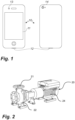
- Fig. 1 shows a handheld communication device in form of a smart phone 10 illustrated in a front view and a rear view.
- the smart phone 10 comprises a display 11, and a microphone 12, a front camera 13 and a rear camera 14.
- Fig. 2 shows a perspective view of a pump unit 20 or pump assembly, wherein the pump unit 20 is separated into a pump with a pump housing 22, which is connected to a pipe system 21 (pipes not shown), and an electrical motor in an electrical motor housing 24.
- the pump unit 20 is illustrated in an embodiment, where the pump and electrical motor are separated in separate housings. However, they may also be implemented in a common housing.
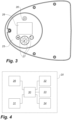
- Fig. 3 illustrates a frontend of the pump unit 20, the terminal box comprising a control panel 25.
- the terminal box shown in Fig. 3 differs from the one shown in Fig. 2 .
- the terminal box 29 comprises display diodes 26, which may for instance provide an indication of the operating state of the pump unit 20. In this sense, the display diodes 26 function as a signal generator by emitting light from the diodes to indicate the operating state.
- the control panel 25 further comprises an LED display 28 or touch screen and a number of control keys 27, which can be used to receive further information about the status and control settings of the pump unit.
- the control keys 27 may further be used for programming the control settings of the pump unit 20.
- the present invention alleviates the necessity of providing the terminal box with a display and control keys.
- this may be achieved by installing a software application, for example an app, on the handheld communication device, which is programmed to interact with the pump unit.
- a software application for example an app
- the production price and the purchase price for the end consumer may be lowered.
- the security of the system is improved and ensures that the pump unit cannot be tampered with or reprogrammed without proper permission.
- Fig. 4 shows a schematic view of modules in the pump unit 20.
- the pump unit 20 comprises a microprocessor 30, which controls the pump unit 20.
- the pump unit further comprises the signal generator 26, e.g. in form of the display diodes, a storage module 31, a control program 32, a transmitter 33, and a receiver 34.
- the control program 32 allows a user to modify or generate a user application, which may control and modify at least one drive parameter of the pump unit 20, and the storage module 31 allows the user application to be stored in the pump unit 20.
- the transmitter 33 and receiver 34 allow the pump unit 20 to communicate with an external server or cloud and/or the handheld communication device.
- the communication may comprise a number of different communication types, such as but not limited to GSM, CDMA, 3G, 4G, infrared, and Bluetooth ® .
- Figs. 5a-e show illustrate different steps in an authorisation process according to the invention
- Fig. 6 show a flow chart of the different steps in an authorisation sequence according to the invention.
- the authorisation sequence allows the handheld communication device 10 to interact with a pump control system, which comprises the pump unit 20 and an external server 40 or the internet cloud.
- the two figures illustrate a preferred embodiment for realising the authorisation sequence, which allows a user to interact and if need be change the settings of the pump unit 20.
- a first step 50 the user initialises an authorisation process. This may be achieved by the user initialising the authorisation process by choosing such an option via the software application installed on the handheld communication device 10.
- the handheld communication device 10 then as illustrated in Fig. 5a initialises the authorisation sequence by sending an initialisation signal to the server 40, which relays the initialisation signal to the pump unit 20.
- the pump unit 20 is as illustrated in Fig. 5b instructed by the server 40 in a second step 51 to generate or retrieve from storage 31 and transmit an authorisation signal sequence 42, which is transmitted via the signal generator or display diodes 26, and which in a third step 52 is detected by the handheld communication device 10 as illustrated in Fig. 5c , e.g. via the rear camera 14.
- the authorisation signal sequence 42 may be based on both a temporal and a spatial sequence or pattern.
- the display diodes for instance comprise a plurality of diodes
- the authorisation signal sequence may be based on different combinations of light emitted from the diodes.
- the authorisation signal sequence 42 may be based on a random signal sequence generated by the server 40.
- the detected signal is then in an optional fourth step 53 converted to another format.
- the different possible combinations for emitting light may for instance correspond to an ascii-code or Morse code or the like, whereby the detected signal may be converted to for instance a password.
- the detected signal or converted signal is sent as a handshake signal 44 to the server 40 as illustrated in Fig. 5d .
- the handheld communication device via the built-in camera captures a video sequence of the authorisation signal sequence from the pump and sends the full video file to the validation server.
- the validation server then performs the image processing.
- an app in the handheld communication device performs an image processing of the video file and extracts the authorisation signal sequence from the video file and sends the authorisation signal sequence to the validation server.
- the server 40 then in a sixth step 55 via an integrated authorisation unit compares the handshake signal 44 with a handshake pattern, which is associated with the authorisation signal sequence, e.g. a password associated with the authorisation signal sequence 42. If the handshake signal 44 matches the handshake pattern, the server 40 instructs the pump unit 20 to allow the handheld communication device 10 to interact with the pump unit, and the pump unit then in a seventh step 56 and as illustrated in Fig. 5e sends an authorisation to the handheld communication device 10, e.g. via the server 40, whereby communication is established between the handheld communication device 10 and the pump unit 20. Thereby the handheld communication device may interact with the pump unit so as to read out an operating state of the pump unit 20 and possibly alter the control settings of the pump unit 20.
- a handshake pattern which is associated with the authorisation signal sequence, e.g. a password associated with the authorisation signal sequence 42. If the handshake signal 44 matches the handshake pattern, the server 40 instructs the pump unit 20 to allow the handheld communication device 10 to interact with the pump
- step 56 which corresponds to Fig.5e , can be omitted because the pump 20 might be unlocked and opened for interaction with the handheld communication device already after step 55 when it received the ok signal from the validation server.
- the interaction may be facilitated via the server 40, or the interaction may be achieved by a direct communication between the handheld communication device 10 and the pump unit.
- the authorisation sequence is aborted in an eighth step 57.
- the user can after an unsuccessful attempt re-initiate the authorisation process.
- the pump unit 20 may as a security measure disable the possibility of being authorised to interact with the control settings of the pump unit, e.g. by disabling the receiver 34, for a pre-determined time period. This provides an extra security measure, which ensures that the device settings may not be tampered with.
- the pump unit 20 may also send a warning signal to the server, whereby a provider may be informed of unauthorised attempts to gain access to the control settings of the pump unit 20.
- the preferred embodiment utilises an external server 40 acting as a validation server and control/interaction server.
- the signal generator of the pump unit comprises one or more light sources, and the detector unit is a camera.
- the authorisation process could also be based on other types of signals and detectors.
- the signal generator could for instance be a sound generator, such as a loudspeaker, and the detector of the handheld communication device be a microphone. In such a case, the signal generated could still be based on for instance Morse code, and the handheld communication device could convert the detected sound signals to a password for the handshake signal.
- the preferred embodiment is illustrated for a pump unit and a pump control system.
- the authorisation sequence according to the invention could also be used for other installations, such as a water quality sensor, in an installation control system.
- the service technician is standing in front of the pump.
- the pump is by default locked to prevent software manipulation. It can be locked ab factory or by the last person installing the pump or making maintenance on it. Either the software of the pump is fully locked, or only a part of the software is open in order to initiate the authorization process by the service technician on the pump itself. In the following case the pump is fully locked.
- the service technician sends a signal to the validation server in the cloud using the handheld communication device using GSM protocol and/or Internet protocol.
- the validation server then sends a signal to the pump, asking it to generate an authorization signal sequence.
- the pump generates the sequence e.g. by table look-up in its memory. A corresponding table is placed in the validation server.
- the pump generates the sequence and sends it to the handheld device, either in a point-to-point communication mode, where the parties have a bi-directional communication using an agreed communication protocol (e.g. Bluetooth), or in a unidirectional communication mode (e.g. light emitting diodes), where the pump sends out the authorization signal sequence without receiving feedback from the handheld communication device.
- the handheld communication device records the signals with the camera inside the handheld device.
- the device can then, via an app, send the video footage directly to the validation server, or alternatively let the app decode the video footage by digital image processing techniques, and extract the authorization signal sequence. This sequence is then sent to the validation server. If the sequence matches the stored pattern or sequence in the validation server, then a signal is sent to the pump.
- the signal can instruct the pump to unlock (open up) its software and/or user interface fully, so that it can be set and adjusted by the service technician, or it can be instructed to only unlock a part of the software and/or user interface.
- the signal may only enable the user to stop or start the pump.
Landscapes
- Engineering & Computer Science (AREA)
- Computer Security & Cryptography (AREA)
- General Engineering & Computer Science (AREA)
- Theoretical Computer Science (AREA)
- Computer Hardware Design (AREA)
- Computer Networks & Wireless Communication (AREA)
- Signal Processing (AREA)
- Software Systems (AREA)
- General Physics & Mathematics (AREA)
- Physics & Mathematics (AREA)
- Mechanical Engineering (AREA)
- Computing Systems (AREA)
- Health & Medical Sciences (AREA)
- Bioethics (AREA)
- General Health & Medical Sciences (AREA)
- Infusion, Injection, And Reservoir Apparatuses (AREA)
- Telephonic Communication Services (AREA)
- Telephone Function (AREA)
Claims (13)
- Verfahren zum drahtlosen Autorisieren einer tragbaren Kommunikationsvorrichtung (10), um mit einem Pumpensteuerungssystem, das eine Pumpeneinheit (20) umfasst, zu interagieren, wobei die Pumpeneinheit (20) einen Signalgenerator (26) und einen Validierungsserver (40) umfasst und wobei die tragbare Kommunikationsvorrichtung (10) mit einer Erfassungseinheit (12, 13, 14) zum Erfassen von Signalen vom Signalgenerator (26) bereitgestellt ist, wobei das Verfahren die folgenden Schritte umfasst:a) das Pumpensteuerungssystem erzeugt und sendet eine Autorisierungssignalsequenz (42),b) die tragbare Kommunikationsvorrichtung (10) erfasst die Autorisierungssignalsequenz (42),c) die tragbare Kommunikationsvorrichtung (10) überträgt ein Handshake-Signal (44) basierend auf der erfassten Autorisierungssignalsequenz (42) an den Validierungsserver (40), der in kommunikativem Kontakt mit der Pumpeneinheit (20) steht, undd) das Pumpensteuerungssystem autorisiert die tragbare Kommunikationsvorrichtung (10), um mit dem Pumpensteuerungssystem zu interagieren, wenn das Handshake-Signal mit einem Handshake-Muster übereinstimmt, das der Autorisierungssignalsequenz (42) zugeordnet ist,wobei Schritt a) durch den Validierungsserver (40) initiiert wird, der einen Code an das Pumpensteuerungssystem sendet, damit die Pumpeneinheit (20) die Authorisierungssignalsequenz erzeugt,wobei die tragbare Kommunikationsvorrichtung (10) dazu konfiguriert ist, ein Signal an den Validierungsserver (40) zu senden, damit der Validierungsserver (40) Schritt a) einleitet.
- Verfahren nach Anspruch 1, wobei die Autorisierungssignalsequenz durch einen Zufallssignalgenerator erzeugt wird.
- Verfahren nach einem der Ansprüche 1-2, wobei der Signalgenerator eine oder mehrere Lichtquellen, wie Dioden oder eine LED-Anzeige, umfasst und wobei die Autorisierungssignalsequenz z. B. eine Lichtsequenz ist,
wobei die tragbare Kommunikationsvorrichtung einen Photodetektor, wie eine CMOS-Anordnung, umfasst und wobei die tragbare Kommunikationsvorrichtung die Autorisierungssignalsequenz über den Photodetektor erfasst. - Verfahren nach einem der vorstehenden Ansprüche, wobei die tragbare Kommunikationsvorrichtung in Schritt c) das Handshake-Signal an den Validierungsserver zur Verifizierung sendet.
- Verfahren nach einem der vorstehenden Ansprüche, wobei der Validierungsserver Schritt d) ausführt, z.B. wobei der Validierungsserver nach Schritt d) ein Autorisierungssignal an die Pumpeneinheit überträgt, um die tragbare Kommunikationsvorrichtung zu autorisieren, um mit der Installation zu interagieren.
- Verfahren nach einem der vorstehenden Ansprüche, wobei die tragbare Kommunikationsvorrichtung eine Videosequenz aufzeichnet und wobei eine Anwendung in der tragbaren Kommunikationsvorrichtung die Autorisierungssignalsequenz aus der Videosequenz extrahiert.
- Verfahren nach einem der vorstehenden Ansprüche, wobei nach Schritt d) nur ein Teil einer Software und/oder Benutzerschnittstelle zum Zugriff von der tragbaren Kommunikationsvorrichtung geöffnet wird, zum Beispiel Zugriff auf Überwachungsstatusparameter erlaubt wird, aber Zugriff auf Anpassungsparameter, wie zum Beispiel Pumpendrehzahl, verweigert wird.
- Pumpensteuerungssystem zum drahtlosen Autorisieren einer tragbaren Kommunikationsvorrichtung (10), um mit einer Pumpeneinheit (20) zu interagieren, wobei das Pumpensteuerungssystem einen Validierungsserver (40) und eine Pumpeneinheit (20) umfasst, wobei- die Pumpeneinheit (20) einen Signalgenerator (26) umfasst, der dafür angepasst ist, eine Autorisierungssignalsequenz (42) zu erzeugen,
und- die tragbare Kommunikationsvorrichtung (10) mit einer Erfassungseinheit (12, 13, 14) zum Erfassen von Signalen vom Signalgenerator (26) bereitgestellt ist und die dafür angepasst ist, ein Handshake-Signal (44) basierend auf der Autorisierungssignalsequenz (42) zu erzeugen und zu übertragen, und wobei das Pumpensteuerungssystem weiter umfasst:- eine in den Validierungsserver (40) integrierte Autorisierungseinheit, die dafür angepasst ist, das Handshake-Signal (44) mit einem Handshake-Muster zu vergleichen, das der Autorisierungssignalsequenz (42) zugeordnet ist, und dafür angepasst ist, die tragbare Kommunikationsvorrichtung (10) zu autorisieren, um mit Einstellungen der Pumpeneinheit (20) zu interagieren, wenn das Handshake-Signal (44) mit dem Handshake-Muster übereinstimmt,wobei die Autorisierung der tragbaren Kommunikationsvorrichtung (10), um mit der Pumpeneinheit (20) zu interagieren, durch den Validierungsserver (40) initiiert wird, der einen Code an das Pumpensteuerungssystem sendet, damit die Pumpeneinheit (20) die Autorisierungssignalsequenz erzeugt,wobei die tragbare Kommunikationsvorrichtung (10) dazu konfiguriert ist, ein Signal an den Validierungsserver (40) zu senden, damit der Validierungsserver (40) die Autorisierung initiiert. - Pumpensteuerungssystem nach Anspruch 8, wobei die Pumpeneinheit (20) einen elektrischen Antriebsmotor und ein Steuerungsmodul zum Steuern des Antriebsmotors aufweist, z.B. wobei das Steuerungsmodul mindestens einen Mikroprozessor (30) und ein Speichermodul (31) umfasst, das in der Lage ist, z.B. mindestens ein durch den Mikroprozessor (30) ausführbares Steuerprogramm zu speichern.
- Pumpensteuerungssystem nach einem der Ansprüche 8-9, wobei der Signalgenerator (26) eine oder mehrere Lichtquellen, wie Dioden, umfasst und wobei die Autorisierungssignalsequenz (42) z.B. eine Lichtsequenz von den Lichtquellen ist, wobei die Detektoreinheit (13, 14) einen Photodetektor, wie eine CMOS-Anordnung, umfasst und wobei die tragbare Kommunikationsvorrichtung (10) die Autorisierungssignalsequenz (42) über den Photodetektor (13, 14) erfasst.
- Pumpensteuerungssystem nach einem der Ansprüche 8-10, wobei die tragbare Kommunikationsvorrichtung (10) eine portable Vorrichtung von einer begrenzten Größe ist und beispielsweise aus der Gruppe ausgewählt sein kann bestehend aus: einem Smartphone, einem Tablet, einem PDA und einer am Körper tragbaren Vorrichtung, wie einer Smartwatch.
- Pumpensteuerungssystem nach einem der Ansprüche 8-11, wobei der Validierungsserver (40) dafür angepasst ist, um mit der tragbaren Kommunikationsvorrichtung (10) und der Installation (20) zu kommunizieren, wobei die Datenkommunikation zwischen der tragbaren Kommunikationsvorrichtung (10) und dem Validierungsserver (40) und zwischen dem Validierungsserver (40) und der Installation (20) auf bidirektionalen Kommunikationsprotokollen basiert und die Kommunikation zwischen der Installation (20) und der tragbaren Kommunikationsvorrichtung (10) auf einem unidirektionalen Kommunikationsprotokoll basiert.
- Pumpensteuerungssystem nach einem der Ansprüche 8-12, wobei eine Benutzerschnittstelle der Installation (20) Mittel zum Initiieren der Autorisierungssignalsequenz (42) aufweist, z. B. eine Taste auf der Benutzerschnittstelle der Pumpe oder einen entsperrten und zugreifbaren Teil eines grafischen Benutzermenüs in einer LED-Anzeige.
Applications Claiming Priority (1)
| Application Number | Priority Date | Filing Date | Title |
|---|---|---|---|
| PCT/EP2014/074753 WO2016078686A1 (en) | 2014-11-17 | 2014-11-17 | Method for authorising a handheld communication device access to a pump unit |
Publications (3)
| Publication Number | Publication Date |
|---|---|
| EP3222019A1 EP3222019A1 (de) | 2017-09-27 |
| EP3222019B1 EP3222019B1 (de) | 2020-07-15 |
| EP3222019B2 true EP3222019B2 (de) | 2024-04-03 |
Family
ID=52023464
Family Applications (1)
| Application Number | Title | Priority Date | Filing Date |
|---|---|---|---|
| EP14811782.3A Active EP3222019B2 (de) | 2014-11-17 | 2014-11-17 | Autorisierung des zugriffs einer tragbaren kommunikationsvorrichtung auf eine pumpeinheit |
Country Status (2)
| Country | Link |
|---|---|
| EP (1) | EP3222019B2 (de) |
| WO (1) | WO2016078686A1 (de) |
Families Citing this family (3)
| Publication number | Priority date | Publication date | Assignee | Title |
|---|---|---|---|---|
| EP3244641A1 (de) | 2016-12-20 | 2017-11-15 | Grundfos Holding A/S | Autorisieren einer datenkommunikation mit einem elektronisch gesteuerten pumpenaggregat |
| EP3751381B1 (de) * | 2019-06-13 | 2022-07-27 | Grundfos Holding A/S | Flusssteuerungsmodul und verfahren zur steuerung des flusses in einem hydronischen system |
| DE102024106591A1 (de) * | 2024-03-07 | 2025-09-11 | KSB SE & Co. KGaA | Verfahren zur Ansteuerung einer Pumpe mittels eines mobilen Nutzerendgerätes |
Family Cites Families (11)
| Publication number | Priority date | Publication date | Assignee | Title |
|---|---|---|---|---|
| DE3828207A1 (de) | 1988-08-19 | 1990-02-22 | Oplaender Wilo Werk Gmbh | Diagnosestecker |
| EP1321912B1 (de) | 2001-12-22 | 2008-10-29 | Grundfos a/s | Elektrische Einrichtung zur Datenübertragung |
| US8117452B2 (en) * | 2004-11-03 | 2012-02-14 | Cisco Technology, Inc. | System and method for establishing a secure association between a dedicated appliance and a computing platform |
| US20130214902A1 (en) | 2010-12-02 | 2013-08-22 | Viscount Systems Inc. | Systems and methods for networks using token based location |
| EP2573403B1 (de) | 2011-09-20 | 2017-12-06 | Grundfos Holding A/S | Pumpe |
| EP2626986A1 (de) | 2012-02-08 | 2013-08-14 | Grundfos Holding A/S | Elektromotor mit einer Signaleinrichtung |
| EP3910121A1 (de) * | 2012-03-14 | 2021-11-17 | South East Water Corporation | Überwachungs- und steuerungsvorrichtung eines pneumatischen abwassersystems |
| KR101579603B1 (ko) * | 2012-06-27 | 2016-01-04 | 네이버 주식회사 | 이미지 인증키를 이용한 tv와 스마트폰의 연동 시스템, 방법 및 컴퓨터 판독 가능한 기록 매체 |
| US20140006188A1 (en) | 2012-06-27 | 2014-01-02 | Bank Of America Corporation | Mobile device for fuel purchase |
| DE102012214018B3 (de) | 2012-08-07 | 2014-02-13 | Siemens Aktiengesellschaft | Autorisierung eines Nutzers durch ein tragbares Kommunikationsgerät |
| DK177709B1 (en) | 2012-09-10 | 2014-03-31 | Ninki Holding Aps | System for communicating with a washing facility |
-
2014
- 2014-11-17 EP EP14811782.3A patent/EP3222019B2/de active Active
- 2014-11-17 WO PCT/EP2014/074753 patent/WO2016078686A1/en not_active Ceased
Also Published As
| Publication number | Publication date |
|---|---|
| WO2016078686A1 (en) | 2016-05-26 |
| EP3222019A1 (de) | 2017-09-27 |
| EP3222019B1 (de) | 2020-07-15 |
Similar Documents
| Publication | Publication Date | Title |
|---|---|---|
| US11227454B2 (en) | Smart lock system | |
| US7885681B2 (en) | Method of using mobile communications devices for monitoring purposes and a system for implementation thereof | |
| US10002525B2 (en) | Method and device for the remote control of a function of a vehicle | |
| TWI761843B (zh) | 門禁控制方法及裝置、電子設備和儲存介質 | |
| KR101461353B1 (ko) | 대화형 디스플레이 시스템에서의 시각적 페어링 | |
| HK1216209A1 (zh) | 具有遠程監視的電子鎖 | |
| US20160065828A1 (en) | Method for controlling electronic device using ip camera having function of wireless remote controller | |
| KR20170021761A (ko) | 지능형 디바이스의 제어 방법 및 제어 장치 | |
| CN104158659B (zh) | 防伪验证方法、装置和系统 | |
| EP3222019B2 (de) | Autorisierung des zugriffs einer tragbaren kommunikationsvorrichtung auf eine pumpeinheit | |
| US20150109097A1 (en) | Electronically Controlled Locking System and Electronic Key for Controlling the Locking System | |
| FR3000984A3 (fr) | Portail d'un dispositif d'entrainement de fermeture d'un batiment ou d'une cloture et son application | |
| CN104244102A (zh) | 智能型电视的信息显示方法 | |
| CN109788188B (zh) | 用于控制监控摄像机的方法 | |
| KR101528526B1 (ko) | 출입문용 감시 카메라 시스템 | |
| KR101261293B1 (ko) | 스마트폰을 이용한 영상보안장치 제어 시스템 | |
| CN106471515A (zh) | 用于建立传感器系统的方法 | |
| US20150199542A1 (en) | Communication device and anti-loss method | |
| KR101632924B1 (ko) | 중고 스마트 기기를 활용한 스마트 허브 장치 | |
| JP7008889B2 (ja) | 防犯カメラ装置および防犯カメラ装置制御プログラム | |
| KR20140056647A (ko) | 도어카메라를 이용한 도어잠금 해제시스템 | |
| JP7567119B2 (ja) | 画像表示装置 | |
| CN105915538A (zh) | 基于短距离可见光双向通信的物联网控制器及控制方法 | |
| TWI609355B (zh) | 擴增實境之認證保全系統與方法 | |
| CN110263521A (zh) | 登入保护方法及装置、系统、电子设备和存储介质 |
Legal Events
| Date | Code | Title | Description |
|---|---|---|---|
| STAA | Information on the status of an ep patent application or granted ep patent |
Free format text: STATUS: THE INTERNATIONAL PUBLICATION HAS BEEN MADE |
|
| PUAI | Public reference made under article 153(3) epc to a published international application that has entered the european phase |
Free format text: ORIGINAL CODE: 0009012 |
|
| STAA | Information on the status of an ep patent application or granted ep patent |
Free format text: STATUS: REQUEST FOR EXAMINATION WAS MADE |
|
| 17P | Request for examination filed |
Effective date: 20170613 |
|
| AK | Designated contracting states |
Kind code of ref document: A1 Designated state(s): AL AT BE BG CH CY CZ DE DK EE ES FI FR GB GR HR HU IE IS IT LI LT LU LV MC MK MT NL NO PL PT RO RS SE SI SK SM TR |
|
| AX | Request for extension of the european patent |
Extension state: BA ME |
|
| DAX | Request for extension of the european patent (deleted) | ||
| STAA | Information on the status of an ep patent application or granted ep patent |
Free format text: STATUS: EXAMINATION IS IN PROGRESS |
|
| 17Q | First examination report despatched |
Effective date: 20180614 |
|
| REG | Reference to a national code |
Ref country code: DE Ref legal event code: R079 Ref document number: 602014067808 Country of ref document: DE Free format text: PREVIOUS MAIN CLASS: H04L0029060000 Ipc: F04B0049060000 |
|
| GRAP | Despatch of communication of intention to grant a patent |
Free format text: ORIGINAL CODE: EPIDOSNIGR1 |
|
| STAA | Information on the status of an ep patent application or granted ep patent |
Free format text: STATUS: GRANT OF PATENT IS INTENDED |
|
| RIC1 | Information provided on ipc code assigned before grant |
Ipc: G06F 21/30 20130101ALI20200130BHEP Ipc: H04L 29/08 20060101ALN20200130BHEP Ipc: H04W 4/80 20180101ALN20200130BHEP Ipc: F04D 15/00 20060101ALI20200130BHEP Ipc: G06F 21/35 20130101ALI20200130BHEP Ipc: H04W 12/08 20090101ALI20200130BHEP Ipc: F04B 49/06 20060101AFI20200130BHEP Ipc: H04L 29/06 20060101ALI20200130BHEP Ipc: G06F 21/60 20130101ALI20200130BHEP |
|
| INTG | Intention to grant announced |
Effective date: 20200218 |
|
| GRAS | Grant fee paid |
Free format text: ORIGINAL CODE: EPIDOSNIGR3 |
|
| GRAA | (expected) grant |
Free format text: ORIGINAL CODE: 0009210 |
|
| STAA | Information on the status of an ep patent application or granted ep patent |
Free format text: STATUS: THE PATENT HAS BEEN GRANTED |
|
| AK | Designated contracting states |
Kind code of ref document: B1 Designated state(s): AL AT BE BG CH CY CZ DE DK EE ES FI FR GB GR HR HU IE IS IT LI LT LU LV MC MK MT NL NO PL PT RO RS SE SI SK SM TR |
|
| REG | Reference to a national code |
Ref country code: CH Ref legal event code: EP Ref country code: GB Ref legal event code: FG4D |
|
| REG | Reference to a national code |
Ref country code: IE Ref legal event code: FG4D |
|
| REG | Reference to a national code |
Ref country code: DE Ref legal event code: R096 Ref document number: 602014067808 Country of ref document: DE |
|
| REG | Reference to a national code |
Ref country code: AT Ref legal event code: REF Ref document number: 1291319 Country of ref document: AT Kind code of ref document: T Effective date: 20200815 |
|
| REG | Reference to a national code |
Ref country code: LT Ref legal event code: MG4D |
|
| REG | Reference to a national code |
Ref country code: AT Ref legal event code: MK05 Ref document number: 1291319 Country of ref document: AT Kind code of ref document: T Effective date: 20200715 |
|
| REG | Reference to a national code |
Ref country code: NL Ref legal event code: MP Effective date: 20200715 |
|
| PG25 | Lapsed in a contracting state [announced via postgrant information from national office to epo] |
Ref country code: GR Free format text: LAPSE BECAUSE OF FAILURE TO SUBMIT A TRANSLATION OF THE DESCRIPTION OR TO PAY THE FEE WITHIN THE PRESCRIBED TIME-LIMIT Effective date: 20201016 Ref country code: ES Free format text: LAPSE BECAUSE OF FAILURE TO SUBMIT A TRANSLATION OF THE DESCRIPTION OR TO PAY THE FEE WITHIN THE PRESCRIBED TIME-LIMIT Effective date: 20200715 Ref country code: NO Free format text: LAPSE BECAUSE OF FAILURE TO SUBMIT A TRANSLATION OF THE DESCRIPTION OR TO PAY THE FEE WITHIN THE PRESCRIBED TIME-LIMIT Effective date: 20201015 Ref country code: SE Free format text: LAPSE BECAUSE OF FAILURE TO SUBMIT A TRANSLATION OF THE DESCRIPTION OR TO PAY THE FEE WITHIN THE PRESCRIBED TIME-LIMIT Effective date: 20200715 Ref country code: BG Free format text: LAPSE BECAUSE OF FAILURE TO SUBMIT A TRANSLATION OF THE DESCRIPTION OR TO PAY THE FEE WITHIN THE PRESCRIBED TIME-LIMIT Effective date: 20201015 Ref country code: PT Free format text: LAPSE BECAUSE OF FAILURE TO SUBMIT A TRANSLATION OF THE DESCRIPTION OR TO PAY THE FEE WITHIN THE PRESCRIBED TIME-LIMIT Effective date: 20201116 Ref country code: LT Free format text: LAPSE BECAUSE OF FAILURE TO SUBMIT A TRANSLATION OF THE DESCRIPTION OR TO PAY THE FEE WITHIN THE PRESCRIBED TIME-LIMIT Effective date: 20200715 Ref country code: HR Free format text: LAPSE BECAUSE OF FAILURE TO SUBMIT A TRANSLATION OF THE DESCRIPTION OR TO PAY THE FEE WITHIN THE PRESCRIBED TIME-LIMIT Effective date: 20200715 Ref country code: FI Free format text: LAPSE BECAUSE OF FAILURE TO SUBMIT A TRANSLATION OF THE DESCRIPTION OR TO PAY THE FEE WITHIN THE PRESCRIBED TIME-LIMIT Effective date: 20200715 Ref country code: AT Free format text: LAPSE BECAUSE OF FAILURE TO SUBMIT A TRANSLATION OF THE DESCRIPTION OR TO PAY THE FEE WITHIN THE PRESCRIBED TIME-LIMIT Effective date: 20200715 |
|
| PG25 | Lapsed in a contracting state [announced via postgrant information from national office to epo] |
Ref country code: RS Free format text: LAPSE BECAUSE OF FAILURE TO SUBMIT A TRANSLATION OF THE DESCRIPTION OR TO PAY THE FEE WITHIN THE PRESCRIBED TIME-LIMIT Effective date: 20200715 Ref country code: PL Free format text: LAPSE BECAUSE OF FAILURE TO SUBMIT A TRANSLATION OF THE DESCRIPTION OR TO PAY THE FEE WITHIN THE PRESCRIBED TIME-LIMIT Effective date: 20200715 Ref country code: LV Free format text: LAPSE BECAUSE OF FAILURE TO SUBMIT A TRANSLATION OF THE DESCRIPTION OR TO PAY THE FEE WITHIN THE PRESCRIBED TIME-LIMIT Effective date: 20200715 Ref country code: IS Free format text: LAPSE BECAUSE OF FAILURE TO SUBMIT A TRANSLATION OF THE DESCRIPTION OR TO PAY THE FEE WITHIN THE PRESCRIBED TIME-LIMIT Effective date: 20201115 |
|
| PG25 | Lapsed in a contracting state [announced via postgrant information from national office to epo] |
Ref country code: NL Free format text: LAPSE BECAUSE OF FAILURE TO SUBMIT A TRANSLATION OF THE DESCRIPTION OR TO PAY THE FEE WITHIN THE PRESCRIBED TIME-LIMIT Effective date: 20200715 |
|
| REG | Reference to a national code |
Ref country code: DE Ref legal event code: R026 Ref document number: 602014067808 Country of ref document: DE |
|
| PLBI | Opposition filed |
Free format text: ORIGINAL CODE: 0009260 |
|
| PLAX | Notice of opposition and request to file observation + time limit sent |
Free format text: ORIGINAL CODE: EPIDOSNOBS2 |
|
| PG25 | Lapsed in a contracting state [announced via postgrant information from national office to epo] |
Ref country code: EE Free format text: LAPSE BECAUSE OF FAILURE TO SUBMIT A TRANSLATION OF THE DESCRIPTION OR TO PAY THE FEE WITHIN THE PRESCRIBED TIME-LIMIT Effective date: 20200715 Ref country code: RO Free format text: LAPSE BECAUSE OF FAILURE TO SUBMIT A TRANSLATION OF THE DESCRIPTION OR TO PAY THE FEE WITHIN THE PRESCRIBED TIME-LIMIT Effective date: 20200715 Ref country code: SM Free format text: LAPSE BECAUSE OF FAILURE TO SUBMIT A TRANSLATION OF THE DESCRIPTION OR TO PAY THE FEE WITHIN THE PRESCRIBED TIME-LIMIT Effective date: 20200715 Ref country code: CZ Free format text: LAPSE BECAUSE OF FAILURE TO SUBMIT A TRANSLATION OF THE DESCRIPTION OR TO PAY THE FEE WITHIN THE PRESCRIBED TIME-LIMIT Effective date: 20200715 Ref country code: DK Free format text: LAPSE BECAUSE OF FAILURE TO SUBMIT A TRANSLATION OF THE DESCRIPTION OR TO PAY THE FEE WITHIN THE PRESCRIBED TIME-LIMIT Effective date: 20200715 |
|
| 26 | Opposition filed |
Opponent name: WILO SE Effective date: 20210414 |
|
| PG25 | Lapsed in a contracting state [announced via postgrant information from national office to epo] |
Ref country code: AL Free format text: LAPSE BECAUSE OF FAILURE TO SUBMIT A TRANSLATION OF THE DESCRIPTION OR TO PAY THE FEE WITHIN THE PRESCRIBED TIME-LIMIT Effective date: 20200715 |
|
| PG25 | Lapsed in a contracting state [announced via postgrant information from national office to epo] |
Ref country code: SK Free format text: LAPSE BECAUSE OF FAILURE TO SUBMIT A TRANSLATION OF THE DESCRIPTION OR TO PAY THE FEE WITHIN THE PRESCRIBED TIME-LIMIT Effective date: 20200715 Ref country code: MC Free format text: LAPSE BECAUSE OF FAILURE TO SUBMIT A TRANSLATION OF THE DESCRIPTION OR TO PAY THE FEE WITHIN THE PRESCRIBED TIME-LIMIT Effective date: 20200715 |
|
| REG | Reference to a national code |
Ref country code: CH Ref legal event code: PL |
|
| PLBB | Reply of patent proprietor to notice(s) of opposition received |
Free format text: ORIGINAL CODE: EPIDOSNOBS3 |
|
| PG25 | Lapsed in a contracting state [announced via postgrant information from national office to epo] |
Ref country code: LU Free format text: LAPSE BECAUSE OF NON-PAYMENT OF DUE FEES Effective date: 20201117 |
|
| REG | Reference to a national code |
Ref country code: BE Ref legal event code: MM Effective date: 20201130 |
|
| PG25 | Lapsed in a contracting state [announced via postgrant information from national office to epo] |
Ref country code: CH Free format text: LAPSE BECAUSE OF NON-PAYMENT OF DUE FEES Effective date: 20201130 Ref country code: SI Free format text: LAPSE BECAUSE OF FAILURE TO SUBMIT A TRANSLATION OF THE DESCRIPTION OR TO PAY THE FEE WITHIN THE PRESCRIBED TIME-LIMIT Effective date: 20200715 Ref country code: LI Free format text: LAPSE BECAUSE OF NON-PAYMENT OF DUE FEES Effective date: 20201130 |
|
| PG25 | Lapsed in a contracting state [announced via postgrant information from national office to epo] |
Ref country code: IE Free format text: LAPSE BECAUSE OF NON-PAYMENT OF DUE FEES Effective date: 20201117 |
|
| PG25 | Lapsed in a contracting state [announced via postgrant information from national office to epo] |
Ref country code: TR Free format text: LAPSE BECAUSE OF FAILURE TO SUBMIT A TRANSLATION OF THE DESCRIPTION OR TO PAY THE FEE WITHIN THE PRESCRIBED TIME-LIMIT Effective date: 20200715 Ref country code: MT Free format text: LAPSE BECAUSE OF FAILURE TO SUBMIT A TRANSLATION OF THE DESCRIPTION OR TO PAY THE FEE WITHIN THE PRESCRIBED TIME-LIMIT Effective date: 20200715 Ref country code: CY Free format text: LAPSE BECAUSE OF FAILURE TO SUBMIT A TRANSLATION OF THE DESCRIPTION OR TO PAY THE FEE WITHIN THE PRESCRIBED TIME-LIMIT Effective date: 20200715 |
|
| REG | Reference to a national code |
Ref country code: CH Ref legal event code: PK Free format text: BERICHTIGUNGEN |
|
| RIC2 | Information provided on ipc code assigned after grant |
Ipc: F04D 15/00 20060101ALI20220523BHEP Ipc: G06F 21/60 20130101ALI20220523BHEP Ipc: G06F 21/35 20130101ALI20220523BHEP Ipc: G06F 21/30 20130101ALI20220523BHEP Ipc: H04W 12/084 20210101ALI20220523BHEP Ipc: H04L 9/40 20220101ALI20220523BHEP Ipc: F04B 49/06 20060101AFI20220523BHEP |
|
| PG25 | Lapsed in a contracting state [announced via postgrant information from national office to epo] |
Ref country code: MK Free format text: LAPSE BECAUSE OF FAILURE TO SUBMIT A TRANSLATION OF THE DESCRIPTION OR TO PAY THE FEE WITHIN THE PRESCRIBED TIME-LIMIT Effective date: 20200715 |
|
| PG25 | Lapsed in a contracting state [announced via postgrant information from national office to epo] |
Ref country code: BE Free format text: LAPSE BECAUSE OF NON-PAYMENT OF DUE FEES Effective date: 20201130 |
|
| APBM | Appeal reference recorded |
Free format text: ORIGINAL CODE: EPIDOSNREFNO |
|
| APBP | Date of receipt of notice of appeal recorded |
Free format text: ORIGINAL CODE: EPIDOSNNOA2O |
|
| APAH | Appeal reference modified |
Free format text: ORIGINAL CODE: EPIDOSCREFNO |
|
| APBM | Appeal reference recorded |
Free format text: ORIGINAL CODE: EPIDOSNREFNO |
|
| APBP | Date of receipt of notice of appeal recorded |
Free format text: ORIGINAL CODE: EPIDOSNNOA2O |
|
| APBQ | Date of receipt of statement of grounds of appeal recorded |
Free format text: ORIGINAL CODE: EPIDOSNNOA3O |
|
| APBU | Appeal procedure closed |
Free format text: ORIGINAL CODE: EPIDOSNNOA9O |
|
| PUAH | Patent maintained in amended form |
Free format text: ORIGINAL CODE: 0009272 |
|
| STAA | Information on the status of an ep patent application or granted ep patent |
Free format text: STATUS: PATENT MAINTAINED AS AMENDED |
|
| 27A | Patent maintained in amended form |
Effective date: 20240403 |
|
| AK | Designated contracting states |
Kind code of ref document: B2 Designated state(s): AL AT BE BG CH CY CZ DE DK EE ES FI FR GB GR HR HU IE IS IT LI LT LU LV MC MK MT NL NO PL PT RO RS SE SI SK SM TR |
|
| REG | Reference to a national code |
Ref country code: DE Ref legal event code: R102 Ref document number: 602014067808 Country of ref document: DE |
|
| PGFP | Annual fee paid to national office [announced via postgrant information from national office to epo] |
Ref country code: DE Payment date: 20251119 Year of fee payment: 12 |
|
| PGFP | Annual fee paid to national office [announced via postgrant information from national office to epo] |
Ref country code: GB Payment date: 20251121 Year of fee payment: 12 |
|
| PGFP | Annual fee paid to national office [announced via postgrant information from national office to epo] |
Ref country code: IT Payment date: 20251125 Year of fee payment: 12 |
|
| PGFP | Annual fee paid to national office [announced via postgrant information from national office to epo] |
Ref country code: FR Payment date: 20251126 Year of fee payment: 12 |