EP3210799A1 - Tire wear estimation system and method - Google Patents
Tire wear estimation system and method Download PDFInfo
- Publication number
- EP3210799A1 EP3210799A1 EP17157807.3A EP17157807A EP3210799A1 EP 3210799 A1 EP3210799 A1 EP 3210799A1 EP 17157807 A EP17157807 A EP 17157807A EP 3210799 A1 EP3210799 A1 EP 3210799A1
- Authority
- EP
- European Patent Office
- Prior art keywords
- tire
- vertical mode
- tri
- wear state
- data
- Prior art date
- Legal status (The legal status is an assumption and is not a legal conclusion. Google has not performed a legal analysis and makes no representation as to the accuracy of the status listed.)
- Withdrawn
Links
Images



Classifications
-
- B—PERFORMING OPERATIONS; TRANSPORTING
- B60—VEHICLES IN GENERAL
- B60C—VEHICLE TYRES; TYRE INFLATION; TYRE CHANGING; CONNECTING VALVES TO INFLATABLE ELASTIC BODIES IN GENERAL; DEVICES OR ARRANGEMENTS RELATED TO TYRES
- B60C23/00—Devices for measuring, signalling, controlling, or distributing tyre pressure or temperature, specially adapted for mounting on vehicles; Arrangement of tyre inflating devices on vehicles, e.g. of pumps or of tanks; Tyre cooling arrangements
-
- B—PERFORMING OPERATIONS; TRANSPORTING
- B60—VEHICLES IN GENERAL
- B60C—VEHICLE TYRES; TYRE INFLATION; TYRE CHANGING; CONNECTING VALVES TO INFLATABLE ELASTIC BODIES IN GENERAL; DEVICES OR ARRANGEMENTS RELATED TO TYRES
- B60C11/00—Tyre tread bands; Tread patterns; Anti-skid inserts
- B60C11/24—Wear-indicating arrangements
- B60C11/246—Tread wear monitoring systems
-
- B—PERFORMING OPERATIONS; TRANSPORTING
- B60—VEHICLES IN GENERAL
- B60C—VEHICLE TYRES; TYRE INFLATION; TYRE CHANGING; CONNECTING VALVES TO INFLATABLE ELASTIC BODIES IN GENERAL; DEVICES OR ARRANGEMENTS RELATED TO TYRES
- B60C23/00—Devices for measuring, signalling, controlling, or distributing tyre pressure or temperature, specially adapted for mounting on vehicles; Arrangement of tyre inflating devices on vehicles, e.g. of pumps or of tanks; Tyre cooling arrangements
- B60C23/02—Signalling devices actuated by tyre pressure
- B60C23/04—Signalling devices actuated by tyre pressure mounted on the wheel or tyre
-
- B—PERFORMING OPERATIONS; TRANSPORTING
- B60—VEHICLES IN GENERAL
- B60C—VEHICLE TYRES; TYRE INFLATION; TYRE CHANGING; CONNECTING VALVES TO INFLATABLE ELASTIC BODIES IN GENERAL; DEVICES OR ARRANGEMENTS RELATED TO TYRES
- B60C23/00—Devices for measuring, signalling, controlling, or distributing tyre pressure or temperature, specially adapted for mounting on vehicles; Arrangement of tyre inflating devices on vehicles, e.g. of pumps or of tanks; Tyre cooling arrangements
- B60C23/02—Signalling devices actuated by tyre pressure
- B60C23/04—Signalling devices actuated by tyre pressure mounted on the wheel or tyre
- B60C23/0408—Signalling devices actuated by tyre pressure mounted on the wheel or tyre transmitting the signals by non-mechanical means from the wheel or tyre to a vehicle body mounted receiver
- B60C23/0415—Automatically identifying wheel mounted units, e.g. after replacement or exchange of wheels
-
- B—PERFORMING OPERATIONS; TRANSPORTING
- B60—VEHICLES IN GENERAL
- B60C—VEHICLE TYRES; TYRE INFLATION; TYRE CHANGING; CONNECTING VALVES TO INFLATABLE ELASTIC BODIES IN GENERAL; DEVICES OR ARRANGEMENTS RELATED TO TYRES
- B60C23/00—Devices for measuring, signalling, controlling, or distributing tyre pressure or temperature, specially adapted for mounting on vehicles; Arrangement of tyre inflating devices on vehicles, e.g. of pumps or of tanks; Tyre cooling arrangements
- B60C23/02—Signalling devices actuated by tyre pressure
- B60C23/04—Signalling devices actuated by tyre pressure mounted on the wheel or tyre
- B60C23/0486—Signalling devices actuated by tyre pressure mounted on the wheel or tyre comprising additional sensors in the wheel or tyre mounted monitoring device, e.g. movement sensors, microphones or earth magnetic field sensors
- B60C23/0488—Movement sensor, e.g. for sensing angular speed, acceleration or centripetal force
-
- G—PHYSICS
- G01—MEASURING; TESTING
- G01M—TESTING STATIC OR DYNAMIC BALANCE OF MACHINES OR STRUCTURES; TESTING OF STRUCTURES OR APPARATUS, NOT OTHERWISE PROVIDED FOR
- G01M17/00—Testing of vehicles
- G01M17/007—Wheeled or endless-tracked vehicles
- G01M17/02—Tyres
-
- G—PHYSICS
- G01—MEASURING; TESTING
- G01N—INVESTIGATING OR ANALYSING MATERIALS BY DETERMINING THEIR CHEMICAL OR PHYSICAL PROPERTIES
- G01N3/00—Investigating strength properties of solid materials by application of mechanical stress
- G01N3/56—Investigating resistance to wear or abrasion
-
- G—PHYSICS
- G06—COMPUTING OR CALCULATING; COUNTING
- G06F—ELECTRIC DIGITAL DATA PROCESSING
- G06F17/00—Digital computing or data processing equipment or methods, specially adapted for specific functions
- G06F17/10—Complex mathematical operations
- G06F17/17—Function evaluation by approximation methods, e.g. inter- or extrapolation, smoothing, least mean square method
-
- G—PHYSICS
- G07—CHECKING-DEVICES
- G07C—TIME OR ATTENDANCE REGISTERS; REGISTERING OR INDICATING THE WORKING OF MACHINES; GENERATING RANDOM NUMBERS; VOTING OR LOTTERY APPARATUS; ARRANGEMENTS, SYSTEMS OR APPARATUS FOR CHECKING NOT PROVIDED FOR ELSEWHERE
- G07C5/00—Registering or indicating the working of vehicles
- G07C5/08—Registering or indicating performance data other than driving, working, idle, or waiting time, with or without registering driving, working, idle or waiting time
-
- B—PERFORMING OPERATIONS; TRANSPORTING
- B60—VEHICLES IN GENERAL
- B60C—VEHICLE TYRES; TYRE INFLATION; TYRE CHANGING; CONNECTING VALVES TO INFLATABLE ELASTIC BODIES IN GENERAL; DEVICES OR ARRANGEMENTS RELATED TO TYRES
- B60C19/00—Tyre parts or constructions not otherwise provided for
- B60C2019/004—Tyre sensors other than for detecting tyre pressure
Definitions
- the present invention generally relates to tire sensors. More particularly, the present invention directed to tire monitoring systems for collecting measured tire parameter data during vehicle operation.
- Tire electronics may include sensors and other components for obtaining information regarding various physical parameters of a tire, such as temperature, pressure, number of tire revolutions, vehicle speed, etc. Such performance information may be useful in tire monitoring and warning systems, and may have potential use as a part of a feedback system to regulate or control certain tire and/or vehicle related systems.
- Another potential capability offered by electronics systems integrated with tire structures corresponds to asset tracking and performance characterization for commercial vehicular applications.
- Commercial truck fleets, aviation crafts, and earthmover/mining vehicles are all viable industries that could utilize the benefits of tire electronic systems and related information transmission.
- Tire sensors may determine the distance each tire in a vehicle has traveled and thus aid in maintenance planning for such commercial systems. Vehicle location and performance may be optimized for costly applications, such as earth-mining.
- the invention relates to a system in accordance with claims 1 or 2 respectively, to a method in accordance with claim 9 and to an assembly in accordance with claim 14.
- An assembly in accordance with one aspect of the present invention determines operating parameters of a tire.
- the assembly includes a tripod sensor mounted within an inner cavity of the tire underneath a crown portion and an innerliner on which the tripod sensor is mounted.
- the tripod sensor preferably includes a tri-axial accelerometer for creating a circumferential signal for determining slip ratio, a lateral signal for determining a slip angle, and a radial signal for determining load on the tire.
- a tire wear state estimation system in accordance with a preferred aspect of the present invention includes at least one tire supporting a vehicle and a tri-axial sensor mounted to the tire.
- the tri-axial sensor preferably together with the respective system measures tire inflation pressure and generates tire inflation pressure data, measures tire vertical mode frequency and generates tire vertical mode frequency data, generates tire-specific frequency mode coefficients using tire-specific identification data, and calculates an estimation of a tire wear state based upon the tire inflation pressure data, the vertical mode frequency data, and the tire-specific frequency mode coefficients.
- the tri-axial sensor comprises a tire-mounted pressure measuring device operative to measure a tire cavity pressure and transmit the tire inflation pressure data derived from the tire cavity pressure measurement.
- the tri-axial sensor comprises tire-specific identification data stored therein.
- tire-specific frequency mode coefficients are generated by the tri-axial sensor using on-vehicle or in-tire measurement of a tire vertical mode frequency.
- measurement of tire vertical mode frequency performed by a wheel-mounted accelerometer or a tire crown-mounted accelerometer.
- the tri-axial sensor comprises a correlation model between a tire wear state and a tire vertical mode frequency.
- the correlation model comprises a recursive least squares algorithm based on a polynomial model capturing a dependency between a wear state of the tire, tire inflation pressure data, and tire vertical mode frequency of the tire.
- a second tire wear state estimation system in accordance with a preferred aspect of the invention includes at least one tire supporting a vehicle, a tri-axial sensor affixed to the tire operative to measure a tire cavity pressure and transmit tire inflation pressure data, and tire-specific identification data stored within, and accessible from, the tri-axial sensor.
- the tri-axial sensor measures tire vertical mode frequency and generates tire vertical mode frequency data, generates tire-specific frequency mode coefficients using the tire-specific identification data and on-vehicle or in-tire measurement of a tire vertical mode frequency, and calculates an estimation of a tire wear state based upon tire inflation pressure data, tire vertical mode frequency data, and tire-specific frequency mode coefficients.
- measurement of the tire vertical mode frequency is from a wheel-mounted accelerometer or a tire crown-mounted accelerometer.
- the tri-axial sensor comprises a correlation model between tire wear state and tire vertical mode frequency.
- the correlation model comprises a recursive least squares algorithm based on a polynomial model capturing a dependency between a wear state of the tire, tire inflation pressure data, and tire vertical mode frequency.
- a method of tire wear state estimation in accordance with the present invention includes the steps of affixing a tri-axial sensor to a vehicle-supporting tire, the tri-axial sensor measuring a tire cavity inflation pressure and generating tire inflation pressure data; measuring tire vertical mode frequency and generating tire vertical mode frequency data; generating tire-specific frequency mode coefficients using tire-specific identification data; and calculating an estimation of a tire wear state based upon the tire inflation pressure data, vertical mode frequency data, and tire-specific frequency mode coefficients.
- the method generates tire-specific frequency mode coefficients using on-vehicle or in-tire measurement of a tire vertical mode frequency.
- the method measures the tire vertical mode frequency from a wheel-mounted accelerometer or a tire crown-mounted accelerometer.
- the method calculates an estimation of the tire wear state and employs a correlation model between tire wear state and tire vertical mode frequency.
- the method configures the correlation model to comprise a recursive least squares algorithm based on a polynomial model capturing a dependency between tire wear state, tire inflation pressure data, and tire vertical mode frequency.
- an assembly in accordance with the present invention generates tire related signals for determining tire related characteristics, as disclosed in USB-8,166,809 and US-B9,050,864 , incorporated herein by reference in their entirety.
- an example in-tire multi-element piezoelectric sensor 100 employs a pair of relatively narrow strip piezoelectric sensors 110, 112 mounted in parallel relationship to each other on either end of a substrate 102.
- the substrate 102 may be a fiberglass backing board similar to those as printed circuit boards in electronic devices.
- Exemplary piezoelectric materials may include quartz, barium titanate, cadmium sulfide, lead zirconate titanate (PZT), polyvinylidene fluoride (PVDF), and polyvinyl chloride (PVC).
- the piezoelectric sensors 110, 112 are mounted at a predetermined distance apart, as described below. In the area between the piezoelectric sensors 110, 112, a power harvesting piezoelectric element 120 may be mounted.
- the power harvesting piezoelectric element 120 may or should occupy the maximum possible remaining surface area between the piezoelectric sensors 110, 112 and may also have mounted therewith circuitry for conditioning and storing energy harvested by the power harvesting piezoelectric element 120.
- Each of the piezoelectric elements 110, 112, 120 is preferably electrically isolated from the other piezoelectric elements.
- Suitable piezoelectric materials for use as the power harvesting piezoelectric element 120 may include the same materials described above.
- the optional energy conditioning and storage circuitry may be similar to that disclosed in US-B-6,725,713 , incorporated herein by reference in its entirety.
- the piezoelectric elements 110, 112 may exclusively be signal generators providing tire related signals for later analysis.
- the power harvesting piezoelectric element 120 may generate similar signals, but such signals may be altered by the electrical load across the element and thus must be taken into consideration.
- the multi-element piezoelectric sensor 100 may be center mounted on the circumferential centerline of a tire under the crown on the surface of the inner liner and oriented in the rotational direction of the tire, as indicated by arrow 130.
- This configuration may provide a time-separable pair of signals such that, by knowing their orientation and precise separation distance, both direction of rolling and surface speed of the tire belt package may be determined by analysis of the sequence of signals generated between the pair of sensors 110, 112 and the lag time between the generated signals. In addition, the time required for one revolution of the rolling tire may be determined from either of the individual piezoelectric sensors 110, 112.
- either individual signal piezoelectric sensor 110, 112 may measure the time duration of the contact patch length in either absolute terms or as a ratio of total tire belt length. Tire deflection may then also be calculated. Using the contained tire air pressure amount, the calculated deflection may be analyzed to determine whether the tire is overloaded.
- a tire related "black box” the parameters hereinabove described may be written periodically into a permanent or rewritable memory device in the tire.
- a recording of long term tire history, as well as a record of most recent tire history may be stored and retrieved or even transmitted to a central processor on the vehicle or to a remote location.
- Such accumulated "black box” data may be used in retread decision making for individual tires by examining total miles run, maximum temperature, minimum pressure, maximum deflection, maximum speed, and/or time or miles spent at a set of running conditions.
- any pair of tires mounted dual would have identical angular velocity all the time and therefore steering tires could be identified as the only tires not having a dual partner.
- all tires on one side of the vehicle could see a general increase in load and angular velocity while all tires on the other side of the vehicle would see a general decrease in load and angular velocity.
- a comparison of axle speeds should show a general decrease in angular velocity as one progresses from steer axle to the rear of the vehicle due to decreasing turn radius. In very tight turns, inside trailer tires may actually rotate backward.
- the lead axle tires of a tandem would see an increase in load.
- Other possibilities include selective braking axles through the anti-lock braking system (ABS) and knowing which axle is braking or sorting tires on the basis of presence or absence of drive torque.
- ABS anti-lock braking system
- the relative tire data may be seen by the processor as changes or evolutions in time compared to immediate history or to accumulated history. Such data may be time averaged to improve confidence in position decisions or to confirm prior decisions.
- a multi-element piezoelectric sensor 200 may include four pairs of piezoelectric sensors 212, 222, 214, 224, 216, 226, 218, 228 mounted in a parallel relationship to respective paired piezoelectric sensors and generally in an octagonal configuration around a central axis on a substrate 202.
- the substrate 202 may be similar to the substrate 102 of FIG. 2
- the paired piezoelectric sensors 212, 222, 214, 224, 216, 226, 218, 228 may be constructed of materials similar to that described with respect to the piezoelectric sensors 110, 112.
- each of the four opposing pairs of sensors may be interpreted longitudinally, as previously described, with respect to FIG. 2 .
- the pair most nearly longitudinally aligned may be determined by determining the piezoelectric pair having the greatest phase difference or time separation between sense signals.
- the pair orthogonal to the identified longitudinal pair may be identified and used to expand the position identification data to include steering response of the tire in combination with the assessed direction of rolling.
- the example multi-element piezoelectric sensor 200 of FIG. 3 installed in each tire of a vehicle and, assuming that a communication system exists such that all tires on the vehicle send various data to a central processing unit on the vehicle, a number of possibilities exist for vehicle control.
- data from the multi-element piezoelectric sensor 200 is combined with inflation pressure and temperature signals and sent to a central processor connected to the vehicle's electronic control module (ECM)
- ECM electronic control module
- Such control may include, but are not limited to, limitations of combined speed, deflection, load, low inflation pressure.
- a vehicle driver may be given an audible or visible warning and/or the actual vehicle speed may be limited through the EMC in a manner similar to current systems that may limit engine speed based on engine temperature.
- another example system may include a multi-element piezoelectric sensor 328 mounted within a tire 300.
- the tire 300 may include a crown portion 316 having an exterior tread portion, inner and outer sidewall portions 322, 320, respectively, and an inner liner 315 under the crown area 316 on which a multi-element piezoelectric sensor 328 may be mounted.
- a sensor may be combined with a non-pneumatic device.
- the present technology while requiring the presence of at least one pair of sensors to obtain presently preferred capabilities, is not limited to only a single pair of piezoelectric sensors as illustrated in FIG. 2 or to four pairs of piezoelectric sensors as illustrated in FIG. 3 .
- the sensors may be arranged in a triangular configuration as illustrated in FIG. 5 .
- the present technology may be applied using sensors other than the described piezoelectric sensors so long as the physical relationship of paired motion sensitive sensors is maintained.
- a multi-element piezoelectric sensor 400 may employ a group of three piezoelectric sensors 410, 412, 414 mounted on a substrate 402 in a generally triangular configuration. Two pairs of sensors may be created by including a sensor 412 as an element in both of the pairs. In this manner, the sensors 410, 412 may form a first pair of sensors 420, while the sensors 412, 414 combine to form a second pair of sensors 422. Mounting orientation of the sensor 400 may be determined by analysis of signals from the various sensors 410, 412, 414.
- a multi-element piezoelectric sensor 500 may employ a pair of piezoelectric sensors 502, 504. As with the above examples, specific knowledge of the orientation of sensor 500 may be required. If the sensor 500 is positioned at an angle to the centerline 510 of the tire with which the sensor is associated, certain movement generated characteristics may be determined. With the sensor 500 mounted at an angle relative to the tire centerline 510, the difference 520 between the phases of signals produced by the sensors 502, 504 may be used to determine speed and rolling direction of the vehicle. Similarly, the difference 522 in the wavelength produced between the sensors 502, 504 may be employed to determine steer direction and magnitude.
- the present invention also contemplates, as previously mentioned, not only the incorporation on the same substrate a power generating and harvesting arrangement, but also the incorporation of other tire electronics elements and sensors.
- Such elements and sensors may include, but are not limited to, temperature and pressure sensors, surface acoustic wave (SAW) devices, radio frequency identification (RFID) devices, signal and data storage and transmission components, signal reception components, and/or data processing components including microprocessors and microcontrollers.
- an assembly 10 in accordance with the present invention may support vehicle control systems, including control systems of autonomous vehicles, with its advanced sensor technology.
- vehicle control systems including control systems of autonomous vehicles, with its advanced sensor technology.
- autonomous vehicles rely on data from other vehicles, drivers, pedestrians, and/or "smart cities”
- the assembly 10 may exchange information with the vehicle.
- Such "intelligent" tires 30 or assemblies 10 may meaningfully contribute to consistent and safe driving in all circumstances, even without human interaction, correction, or control.
- the assembly 10 may support autonomous vehicle control systems with its advanced sensor technology.
- autonomous vehicles may rely on data from other vehicles, other drivers, and possibly from pedestrians and from "smart cities”. The assembly 10 may thus optimize this this exchange of information with the vehicle.
- an assembly in accordance with the present invention may include a sensor 328 mounted within a tire 30.
- the tire 30 may include a crown portion 16 having an exterior tread portion, inner and outer sidewall portions 20, 22, respectively, and an inner liner 15 under the crown portion on which the sensor 328 may be mounted.
- the sensor 328 may provide data for determination of weather/road roughness/slipperiness conditions as well as wear condition of the tire 30.
- the enhanced sensitivity of the sensor 328 may utilize tread and road texture parameters to enhance road sensing capability.
- data from the sensor 328 may be utilized to optimize speed and braking performance.
- the assembly 10 may sense road conditions, including both surface and weather conditions, through a microchip inside the tire 30, as well as a specially designed tread.
- detection of aquaplaning and friction becomes particularly useful.
- the driver typically determines road conditions. If the tire tread is worn, if the road surface is slippery, and/or if the wrong season tires are on the vehicle, vehicle safety systems may be less effective.
- Autonomous vehicles thus may undertake the functions of the driver. Such vehicle may be required to derive tire/road friction automatically. Autonomous cars' central computer system may take into account tire operating conditions and be able to automatically refine the vehicle's control algorithms to deliver an improved driving performance.
- the sensor may have a tripod shape with multiple arms and a multiple arm chip. The tripod shape may enhance the fixation of the sensor 328 to the tire 30.
- the tripod sensor 328 may integrate a plurality of sensors up to the terminal end of the arms to enhance road sensing feel on a full tire width, instead of just a single point.
- the sensor 328 may be a tri-axial accelerometer for creating a circumferential signal, a lateral signal, and a radial signal.
- the circumferential signal may determine a slip ratio for the tire 30.
- the lateral signal may determine a slip angle for the tire 30.
- the radial signal may determine a load on the tire 30.
- Wear estimation methods may use the sensor data for utilizing vibration mode frequency shift as an indicator of the tire wear.
- Tire wear state may be recursively estimated by using a recursive least squares (RLS) algorithm formulated based on a polynomial model, capturing the dependencies between the tire wear state, inflation pressure, and/or the tire vertical mode frequency.
- Inputs for the RLS algorithm may include tire inflation pressure, tire ID (required for using tire specific model coefficients), and the tire vertical mode frequency.
- Tire inflation pressure and tire ID information may available from other sensors.
- Tire vertical mode frequency data may be obtained by extracting vertical mode frequency from the vertical acceleration signal of a crown mounted accelerometer.
Landscapes
- Engineering & Computer Science (AREA)
- Mechanical Engineering (AREA)
- Physics & Mathematics (AREA)
- General Physics & Mathematics (AREA)
- Theoretical Computer Science (AREA)
- Computational Mathematics (AREA)
- Mathematical Analysis (AREA)
- Mathematical Optimization (AREA)
- Pure & Applied Mathematics (AREA)
- Data Mining & Analysis (AREA)
- Mathematical Physics (AREA)
- Analytical Chemistry (AREA)
- Immunology (AREA)
- Pathology (AREA)
- General Health & Medical Sciences (AREA)
- Health & Medical Sciences (AREA)
- Life Sciences & Earth Sciences (AREA)
- Chemical & Material Sciences (AREA)
- Biochemistry (AREA)
- Algebra (AREA)
- Databases & Information Systems (AREA)
- General Engineering & Computer Science (AREA)
- Software Systems (AREA)
- Tires In General (AREA)
- Measuring Fluid Pressure (AREA)
Abstract
Description
- The present invention generally relates to tire sensors. More particularly, the present invention directed to tire monitoring systems for collecting measured tire parameter data during vehicle operation.
- The incorporation of electronic devices with pneumatic tire structures yields many practical advantages. Tire electronics may include sensors and other components for obtaining information regarding various physical parameters of a tire, such as temperature, pressure, number of tire revolutions, vehicle speed, etc. Such performance information may be useful in tire monitoring and warning systems, and may have potential use as a part of a feedback system to regulate or control certain tire and/or vehicle related systems.
- Another potential capability offered by electronics systems integrated with tire structures corresponds to asset tracking and performance characterization for commercial vehicular applications. Commercial truck fleets, aviation crafts, and earthmover/mining vehicles are all viable industries that could utilize the benefits of tire electronic systems and related information transmission. Tire sensors may determine the distance each tire in a vehicle has traveled and thus aid in maintenance planning for such commercial systems. Vehicle location and performance may be optimized for costly applications, such as earth-mining.
- The invention relates to a system in accordance with claims 1 or 2 respectively, to a method in accordance with claim 9 and to an assembly in accordance with claim 14.
- Dependent claims refer to preferred embodiments of the invention.
- An assembly in accordance with one aspect of the present invention determines operating parameters of a tire. The assembly includes a tripod sensor mounted within an inner cavity of the tire underneath a crown portion and an innerliner on which the tripod sensor is mounted. The tripod sensor preferably includes a tri-axial accelerometer for creating a circumferential signal for determining slip ratio, a lateral signal for determining a slip angle, and a radial signal for determining load on the tire.
- A tire wear state estimation system in accordance with a preferred aspect of the present invention includes at least one tire supporting a vehicle and a tri-axial sensor mounted to the tire. The tri-axial sensor preferably together with the respective system measures tire inflation pressure and generates tire inflation pressure data, measures tire vertical mode frequency and generates tire vertical mode frequency data, generates tire-specific frequency mode coefficients using tire-specific identification data, and calculates an estimation of a tire wear state based upon the tire inflation pressure data, the vertical mode frequency data, and the tire-specific frequency mode coefficients.
- According to another preferred aspect of the system, the tri-axial sensor comprises a tire-mounted pressure measuring device operative to measure a tire cavity pressure and transmit the tire inflation pressure data derived from the tire cavity pressure measurement.
- According to still another preferred aspect of the system, the tri-axial sensor comprises tire-specific identification data stored therein.
- According to yet another preferred aspect of the system, tire-specific frequency mode coefficients are generated by the tri-axial sensor using on-vehicle or in-tire measurement of a tire vertical mode frequency.
- According to still another preferred aspect of the system, measurement of tire vertical mode frequency performed by a wheel-mounted accelerometer or a tire crown-mounted accelerometer.
- According to yet another preferred aspect of the system, the tri-axial sensor comprises a correlation model between a tire wear state and a tire vertical mode frequency.
- According to yet another preferred aspect of the system, the correlation model comprises a recursive least squares algorithm based on a polynomial model capturing a dependency between a wear state of the tire, tire inflation pressure data, and tire vertical mode frequency of the tire.
- A second tire wear state estimation system in accordance with a preferred aspect of the invention includes at least one tire supporting a vehicle, a tri-axial sensor affixed to the tire operative to measure a tire cavity pressure and transmit tire inflation pressure data, and tire-specific identification data stored within, and accessible from, the tri-axial sensor. The tri-axial sensor measures tire vertical mode frequency and generates tire vertical mode frequency data, generates tire-specific frequency mode coefficients using the tire-specific identification data and on-vehicle or in-tire measurement of a tire vertical mode frequency, and calculates an estimation of a tire wear state based upon tire inflation pressure data, tire vertical mode frequency data, and tire-specific frequency mode coefficients.
- According to another preferred aspect of the second system, measurement of the tire vertical mode frequency is from a wheel-mounted accelerometer or a tire crown-mounted accelerometer.
- According to still another preferred aspect of the second system, the tri-axial sensor comprises a correlation model between tire wear state and tire vertical mode frequency.
- According to yet another preferred aspect of the second system, the correlation model comprises a recursive least squares algorithm based on a polynomial model capturing a dependency between a wear state of the tire, tire inflation pressure data, and tire vertical mode frequency.
- A method of tire wear state estimation in accordance with the present invention includes the steps of affixing a tri-axial sensor to a vehicle-supporting tire, the tri-axial sensor measuring a tire cavity inflation pressure and generating tire inflation pressure data; measuring tire vertical mode frequency and generating tire vertical mode frequency data; generating tire-specific frequency mode coefficients using tire-specific identification data; and calculating an estimation of a tire wear state based upon the tire inflation pressure data, vertical mode frequency data, and tire-specific frequency mode coefficients.
- According to a preferred aspect of the method, the method generates tire-specific frequency mode coefficients using on-vehicle or in-tire measurement of a tire vertical mode frequency.
- According to still another preferred aspect of the method, the method measures the tire vertical mode frequency from a wheel-mounted accelerometer or a tire crown-mounted accelerometer.
- According to yet another preferred aspect of the method, the method calculates an estimation of the tire wear state and employs a correlation model between tire wear state and tire vertical mode frequency.
- According to still another preferred aspect of the method, the method configures the correlation model to comprise a recursive least squares algorithm based on a polynomial model capturing a dependency between tire wear state, tire inflation pressure data, and tire vertical mode frequency.
- A full and enabling disclosure of the present invention, including the best mode thereof, directed to one of ordinary skill in the art, is set forth in the specification, which makes reference to the appended figures, in which:
-
FIG. 1 schematically displays an isometric view of an exemplary tire assembly in accordance with the present invention; -
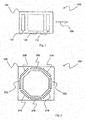
FIG. 2 schematically illustrates an example system employing a pair of piezoelectric sensors; -
FIG. 3 schematically illustrates another example system employing plural pairs of piezoelectric sensors; -
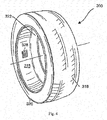
FIG. 4 schematically displays an isometric view of another example system orienting a piezoelectric sensor within a pneumatic tire structure; -
FIG. 5 schematically illustrates another example system employing a shared sensor forming two pairs of sensors from three individual sensors; and -
FIG. 6 schematically illustrates another example system employing two pairs of sensors effectively created from a single pair of sensors. - Repeat use of reference characters throughout the present specification and appended drawings is intended to represent same or analogous features or elements of the invention.
- An assembly in accordance with the present invention generates tire related signals for determining tire related characteristics, as disclosed in USB-8,166,809 and
US-B9,050,864 , incorporated herein by reference in their entirety. Referring toFIG. 2 , an example in-tire multi-elementpiezoelectric sensor 100 employs a pair of relatively narrow strippiezoelectric sensors substrate 102. Thesubstrate 102 may be a fiberglass backing board similar to those as printed circuit boards in electronic devices. Exemplary piezoelectric materials may include quartz, barium titanate, cadmium sulfide, lead zirconate titanate (PZT), polyvinylidene fluoride (PVDF), and polyvinyl chloride (PVC). - The
piezoelectric sensors piezoelectric sensors piezoelectric element 120 may be mounted. The power harvestingpiezoelectric element 120 may or should occupy the maximum possible remaining surface area between thepiezoelectric sensors piezoelectric element 120. Each of thepiezoelectric elements piezoelectric element 120 may include the same materials described above. The optional energy conditioning and storage circuitry may be similar to that disclosed inUS-B-6,725,713 , incorporated herein by reference in its entirety. - The
piezoelectric elements piezoelectric element 120 may generate similar signals, but such signals may be altered by the electrical load across the element and thus must be taken into consideration. The multi-elementpiezoelectric sensor 100 may be center mounted on the circumferential centerline of a tire under the crown on the surface of the inner liner and oriented in the rotational direction of the tire, as indicated byarrow 130. - This configuration may provide a time-separable pair of signals such that, by knowing their orientation and precise separation distance, both direction of rolling and surface speed of the tire belt package may be determined by analysis of the sequence of signals generated between the pair of
sensors piezoelectric sensors - Further, either individual signal
piezoelectric sensor - In order to create a tire related "black box", the parameters hereinabove described may be written periodically into a permanent or rewritable memory device in the tire. Thus, a recording of long term tire history, as well as a record of most recent tire history, may be stored and retrieved or even transmitted to a central processor on the vehicle or to a remote location. Such accumulated "black box" data may be used in retread decision making for individual tires by examining total miles run, maximum temperature, minimum pressure, maximum deflection, maximum speed, and/or time or miles spent at a set of running conditions.
- If one knows for each tire identification (ID) on the vehicle and, in the same time frame, the inflation pressure, the belt speed, tire angular velocity, and/or contact patch length or deflection or load, one can deduce a combination of relative tire positions sufficiently to identify each tire ID with a specific position on the vehicle. For example, in the case of an eighteen-wheeled truck, any pair of tires mounted dual would have identical angular velocity all the time and therefore steering tires could be identified as the only tires not having a dual partner. During a turn, all tires on one side of the vehicle could see a general increase in load and angular velocity while all tires on the other side of the vehicle would see a general decrease in load and angular velocity. Also during a turn, a comparison of axle speeds should show a general decrease in angular velocity as one progresses from steer axle to the rear of the vehicle due to decreasing turn radius. In very tight turns, inside trailer tires may actually rotate backward.
- During braking, the lead axle tires of a tandem would see an increase in load. Other possibilities include selective braking axles through the anti-lock braking system (ABS) and knowing which axle is braking or sorting tires on the basis of presence or absence of drive torque. The relative tire data may be seen by the processor as changes or evolutions in time compared to immediate history or to accumulated history. Such data may be time averaged to improve confidence in position decisions or to confirm prior decisions.
- The combination of relative data may be enhanced by a different piezoelectric sensor structure, if it is not possible to control the installation orientation of the multi-element piezoelectric sensor in the tire. Such enhancement may be achieved through use of a second example system, as illustrated in
FIG. 3 . A multi-elementpiezoelectric sensor 200 may include four pairs ofpiezoelectric sensors substrate 202. Thesubstrate 202 may be similar to thesubstrate 102 ofFIG. 2 , while the pairedpiezoelectric sensors piezoelectric sensors - With the arrangement of
FIG. 3 , each of the four opposing pairs of sensors may be interpreted longitudinally, as previously described, with respect toFIG. 2 . The pair most nearly longitudinally aligned may be determined by determining the piezoelectric pair having the greatest phase difference or time separation between sense signals. Thus, the pair orthogonal to the identified longitudinal pair may be identified and used to expand the position identification data to include steering response of the tire in combination with the assessed direction of rolling. - With the example multi-element
piezoelectric sensor 200 ofFIG. 3 installed in each tire of a vehicle and, assuming that a communication system exists such that all tires on the vehicle send various data to a central processing unit on the vehicle, a number of possibilities exist for vehicle control. For example, if data from the multi-elementpiezoelectric sensor 200 is combined with inflation pressure and temperature signals and sent to a central processor connected to the vehicle's electronic control module (ECM), the data may contribute to the vehicle tire position learning described previously and may also be used to control vehicle operation. Such control may include, but are not limited to, limitations of combined speed, deflection, load, low inflation pressure. A vehicle driver may be given an audible or visible warning and/or the actual vehicle speed may be limited through the EMC in a manner similar to current systems that may limit engine speed based on engine temperature. - Referring now to
FIG. 4 , another example system may include a multi-elementpiezoelectric sensor 328 mounted within atire 300. Thetire 300 may include acrown portion 316 having an exterior tread portion, inner andouter sidewall portions inner liner 315 under thecrown area 316 on which a multi-elementpiezoelectric sensor 328 may be mounted. - It should be appreciated by those of ordinary skill in the art that while the present subject matter has been illustrated and described with reference to a sensor combination with a pneumatic tire, other configurations are envisioned. For example, a sensor may be combined with a non-pneumatic device. It should further be appreciated that the present technology, while requiring the presence of at least one pair of sensors to obtain presently preferred capabilities, is not limited to only a single pair of piezoelectric sensors as illustrated in
FIG. 2 or to four pairs of piezoelectric sensors as illustrated inFIG. 3 . For example, the sensors may be arranged in a triangular configuration as illustrated inFIG. 5 . Moreover, the present technology may be applied using sensors other than the described piezoelectric sensors so long as the physical relationship of paired motion sensitive sensors is maintained. - With reference to
FIG. 5 , a multi-elementpiezoelectric sensor 400 may employ a group of threepiezoelectric sensors substrate 402 in a generally triangular configuration. Two pairs of sensors may be created by including asensor 412 as an element in both of the pairs. In this manner, thesensors sensors 420, while thesensors sensors 422. Mounting orientation of thesensor 400 may be determined by analysis of signals from thevarious sensors - The concept of sharing sensor identification to define plural pairs may be further expanded as illustrated in
FIG. 6 so that similar results may be obtained by providing only two sensors. A multi-elementpiezoelectric sensor 500 may employ a pair ofpiezoelectric sensors 502, 504. As with the above examples, specific knowledge of the orientation ofsensor 500 may be required. If thesensor 500 is positioned at an angle to thecenterline 510 of the tire with which the sensor is associated, certain movement generated characteristics may be determined. With thesensor 500 mounted at an angle relative to thetire centerline 510, the difference 520 between the phases of signals produced by thesensors 502, 504 may be used to determine speed and rolling direction of the vehicle. Similarly, thedifference 522 in the wavelength produced between thesensors 502, 504 may be employed to determine steer direction and magnitude. - The present invention also contemplates, as previously mentioned, not only the incorporation on the same substrate a power generating and harvesting arrangement, but also the incorporation of other tire electronics elements and sensors. Such elements and sensors may include, but are not limited to, temperature and pressure sensors, surface acoustic wave (SAW) devices, radio frequency identification (RFID) devices, signal and data storage and transmission components, signal reception components, and/or data processing components including microprocessors and microcontrollers.
- As shown in
FIG. 1 , anassembly 10 in accordance with the present invention may support vehicle control systems, including control systems of autonomous vehicles, with its advanced sensor technology. As autonomous vehicles rely on data from other vehicles, drivers, pedestrians, and/or "smart cities", theassembly 10 may exchange information with the vehicle. Such "intelligent"tires 30 orassemblies 10 may meaningfully contribute to consistent and safe driving in all circumstances, even without human interaction, correction, or control. Theassembly 10 may support autonomous vehicle control systems with its advanced sensor technology. As described above, autonomous vehicles may rely on data from other vehicles, other drivers, and possibly from pedestrians and from "smart cities". Theassembly 10 may thus optimize this this exchange of information with the vehicle. - As shown in
FIG. 1 , an assembly in accordance with the present invention may include asensor 328 mounted within atire 30. Thetire 30 may include acrown portion 16 having an exterior tread portion, inner andouter sidewall portions sensor 328 may be mounted. - The
sensor 328 may provide data for determination of weather/road roughness/slipperiness conditions as well as wear condition of thetire 30. The enhanced sensitivity of thesensor 328 may utilize tread and road texture parameters to enhance road sensing capability. For example, data from thesensor 328 may be utilized to optimize speed and braking performance. Theassembly 10 may sense road conditions, including both surface and weather conditions, through a microchip inside thetire 30, as well as a specially designed tread. For autonomous vehicles, detection of aquaplaning and friction becomes particularly useful. For manual vehicles, the driver typically determines road conditions. If the tire tread is worn, if the road surface is slippery, and/or if the wrong season tires are on the vehicle, vehicle safety systems may be less effective. - Autonomous vehicles thus may undertake the functions of the driver. Such vehicle may be required to derive tire/road friction automatically. Autonomous cars' central computer system may take into account tire operating conditions and be able to automatically refine the vehicle's control algorithms to deliver an improved driving performance. The sensor may have a tripod shape with multiple arms and a multiple arm chip. The tripod shape may enhance the fixation of the
sensor 328 to thetire 30. Thetripod sensor 328 may integrate a plurality of sensors up to the terminal end of the arms to enhance road sensing feel on a full tire width, instead of just a single point. Thesensor 328 may be a tri-axial accelerometer for creating a circumferential signal, a lateral signal, and a radial signal. The circumferential signal may determine a slip ratio for thetire 30. The lateral signal may determine a slip angle for thetire 30. The radial signal may determine a load on thetire 30. - Wear estimation methods may use the sensor data for utilizing vibration mode frequency shift as an indicator of the tire wear. Tire wear state may be recursively estimated by using a recursive least squares (RLS) algorithm formulated based on a polynomial model, capturing the dependencies between the tire wear state, inflation pressure, and/or the tire vertical mode frequency. Inputs for the RLS algorithm may include tire inflation pressure, tire ID (required for using tire specific model coefficients), and the tire vertical mode frequency. Tire inflation pressure and tire ID information may available from other sensors. Tire vertical mode frequency data may be obtained by extracting vertical mode frequency from the vertical acceleration signal of a crown mounted accelerometer.
Claims (15)
- A tire wear state estimation system, the system comprising at least one tire (30) for supporting a vehicle and an at least tri-axial sensor (328) mounted to the tire (30), the tri-axial sensor (328) and the system being configured for measuring tire inflation pressure and generating tire inflation pressure data, measuring a tire vertical mode frequency and generating tire vertical mode frequency data, generating tire-specific frequency mode coefficients using tire-specific identification data, and calculating an estimation of a tire wear state based upon the tire inflation pressure data, the vertical mode frequency data, and the tire-specific frequency mode coefficients.
- A tire wear state estimation system comprising at least one tire (30) for supporting a vehicle; an at least a tri-axial sensor (328) affixed to the tire (30) and being operative to measure a tire cavity pressure and transmit tire inflation pressure data; and tire-specific identification data stored within, and accessible from, the at least tri-axial sensor (328), the at least tri-axial sensor and the system being configured for measuring tire vertical mode frequency and generating tire vertical mode frequency data, generating tire-specific frequency mode coefficients using the tire-specific identification data and on-vehicle or in-tire measurement of a tire vertical mode frequency, and calculating an estimation of a tire wear state based upon tire inflation pressure data, tire vertical mode frequency data, and tire-specific frequency mode coefficients.
- The tire wear state estimation system of claim 1 or 2 wherein the at least tri-axial sensor (328) comprises a tire-mounted pressure measuring device operative to measure a tire cavity pressure and to transmit tire inflation pressure data derived from the tire cavity pressure measurement.
- The tire wear state estimation system of claim 1, 2 or 3 wherein the at least tri-axial sensor (328) comprises tire-specific identification data stored therein.
- The tire wear state estimation system of at least one of the previous claims wherein tire-specific frequency mode coefficients are generated by the tri-axial sensor (328) and the system using on-vehicle and/or in-tire measurement of a tire vertical mode frequency.
- The tire wear state estimation system of at least one of the previous claims wherein the system comprises a wheel-mounted accelerometer and/or a tire crown-mounted accelerometer operative to perform measurement of a tire vertical mode frequency.
- The tire wear state estimation system of at least one of the previous claims wherein the at least tri-axial sensor (328) or the system comprises a correlation model between a tire wear state and a tire vertical mode frequency.
- The tire wear state estimation system of claim 7 wherein the correlation model comprises a recursive least squares algorithm based on a polynomial model capturing a dependency between a wear state of the tire, tire inflation pressure data, and tire vertical mode frequency of the tire.
- A method of tire wear state estimation comprising:affixing an at least tri-axial sensor (328) to a tire (30) which supports or is configured to support a vehicle, the at least tri-axial sensor (328) measuring a tire cavity inflation pressure and generating tire inflation pressure data;measuring tire vertical mode frequency and generating tire vertical mode frequency data;generating tire-specific frequency mode coefficients using tire-specific identification data; andcalculating an estimation of a tire wear state based upon the tire inflation pressure data, vertical mode frequency data, and tire-specific frequency mode coefficients.
- The method of claim 9 further comprising generating tire-specific frequency mode coefficients using on-vehicle and/or in-tire measurement of a tire vertical mode frequency.
- The method of claim 9 or 10 further comprising measuring the tire vertical mode frequency from a wheel-mounted accelerometer and/or a tire crown-mounted accelerometer.
- The method of at least one of the previous claims 9 to 11 further comprising calculating an estimation of the tire wear state includes employing a correlation model between tire wear state and tire vertical mode frequency.
- The method of claim 12 further comprising configuring the correlation model to comprise a recursive least squares algorithm based on a polynomial model capturing a dependency between tire wear state, tire inflation pressure data, and tire vertical mode frequency.
- An assembly for determining operating parameters of a tire, the assembly comprising a tire (30) and a tripod sensor (328) mounted within an inner cavity of the tire underneath a crown portion (16) of the tire (30) and an innerliner (315) on which the tripod sensor (328) is mounted, the tripod sensor (328) including an at least tri-axial sensor.
- The assembly of claim 14 wherein the tripod sensor (328) includes the tri-axial accelerometer as the tri-axial sensor for creating a circumferential signal for determining a slip ratio, a lateral signal for determining a slip angle, and a radial signal for determining load on the tire (30).
Applications Claiming Priority (1)
| Application Number | Priority Date | Filing Date | Title |
|---|---|---|---|
| US201662300194P | 2016-02-26 | 2016-02-26 |
Publications (1)
| Publication Number | Publication Date |
|---|---|
| EP3210799A1 true EP3210799A1 (en) | 2017-08-30 |
Family
ID=58158974
Family Applications (1)
| Application Number | Title | Priority Date | Filing Date |
|---|---|---|---|
| EP17157807.3A Withdrawn EP3210799A1 (en) | 2016-02-26 | 2017-02-24 | Tire wear estimation system and method |
Country Status (5)
| Country | Link |
|---|---|
| US (1) | US10406866B2 (en) |
| EP (1) | EP3210799A1 (en) |
| JP (1) | JP2017149414A (en) |
| KR (1) | KR20170101139A (en) |
| CN (1) | CN107128132A (en) |
Cited By (7)
| Publication number | Priority date | Publication date | Assignee | Title |
|---|---|---|---|---|
| EP3495169A1 (en) * | 2017-12-11 | 2019-06-12 | Kawasaki Jukogyo Kabushiki Kaisha | Traveling information storing method of lean vehicle, traveling information processing program, and traveling information storing device |
| CN114407583A (en) * | 2022-01-20 | 2022-04-29 | 东风汽车集团股份有限公司 | Tire state monitoring method and system |
| US11498371B2 (en) * | 2018-12-12 | 2022-11-15 | The Goodyear Tire & Rubber Company | Tire data information system |
| EP4434771A3 (en) * | 2019-04-01 | 2024-12-11 | Bridgestone Americas Tire Operations, LLC | System and method for predicting wear progression for vehicle tires |
| WO2026133381A1 (en) | 2024-12-16 | 2026-06-25 | Pirelli Tyre S.P.A. | Method and system for monitoring a status of a tyre |
| US12680916B2 (en) | 2020-12-30 | 2026-07-14 | Pirelli Tyre S.P.A. | Method and system for monitoring a status of a tyre |
| US12679148B2 (en) | 2020-12-30 | 2026-07-14 | Pirelli Tyre S.P.A. | Method for monitoring a status of a tyre |
Families Citing this family (19)
| Publication number | Priority date | Publication date | Assignee | Title |
|---|---|---|---|---|
| JP6682369B2 (en) * | 2016-06-09 | 2020-04-15 | 株式会社ブリヂストン | Tire deterioration condition prediction method |
| US10243136B2 (en) * | 2016-08-22 | 2019-03-26 | Masoud Ghanbari | Piezoelectric energy harvesting system from vehicle's tires |
| US10809742B2 (en) | 2017-03-06 | 2020-10-20 | The Goodyear Tire & Rubber Company | System and method for tire sensor-based autonomous vehicle fleet management |
| EP3682417B1 (en) * | 2017-09-10 | 2024-01-10 | Tactile Mobility Ltd. | Method and apparatus for evaluating a weight of the vehicle |
| CN111094022B (en) * | 2017-09-12 | 2022-01-14 | 住友橡胶工业株式会社 | Pneumatic tire |
| CN109843609B (en) * | 2017-12-29 | 2022-04-15 | 深圳配天智能技术研究院有限公司 | Tire monitoring method, deformation rate calculation device, system, vehicle, and storage device |
| WO2019127505A1 (en) * | 2017-12-29 | 2019-07-04 | 深圳配天智能技术研究院有限公司 | Tyre and vehicle |
| FR3083005B1 (en) | 2018-06-21 | 2020-11-20 | Michelin & Cie | ELASTOMERIC MATRIX DEVICE INCLUDING PIEZOELECTRIC CHARGES AND ELECTRODES |
| FR3082781B1 (en) * | 2018-06-21 | 2022-12-02 | Michelin & Cie | PNEUMATICS INCLUDING A PIEZOELECTRIC COMPOSITE |
| CN112566798A (en) * | 2018-08-02 | 2021-03-26 | 倍耐力轮胎股份公司 | Tyre comprising a monitoring device |
| US20200101802A1 (en) * | 2018-09-27 | 2020-04-02 | GM Global Technology Operations LLC | Advanced tire pressure monitoring system with software autolearn |
| FR3090103A3 (en) * | 2018-12-14 | 2020-06-19 | Michelin & Cie | Prediction model for tire wear and end of life |
| EP3741589B1 (en) * | 2019-05-23 | 2023-03-01 | Melexis Technologies SA | Tire wear estimation |
| KR20240056658A (en) * | 2021-04-13 | 2024-04-30 | 김덕중 | Apparatus and method for detecting abnormality of air pocket using pneumatic pressure measurement |
| EP4330057A4 (en) | 2021-04-30 | 2025-04-02 | Tekscan, Inc. | CONTACT SENSOR |
| EP4190651B1 (en) | 2021-12-02 | 2025-05-07 | Volvo Truck Corporation | Redundant vehicle control systems based on tyre sensors |
| EP4190598B1 (en) | 2021-12-02 | 2024-11-20 | Volvo Truck Corporation | Redundant vehicle control systems based on tyre sensors - load estimation |
| US20250187382A1 (en) * | 2023-12-06 | 2025-06-12 | The Goodyear Tire & Rubber Company | Automated detection of tire sensor positions |
| CN117824744A (en) * | 2023-12-14 | 2024-04-05 | 中国科学院声学研究所 | A multi-point physical state information collection system and method for smart tires |
Citations (5)
| Publication number | Priority date | Publication date | Assignee | Title |
|---|---|---|---|---|
| US20020188392A1 (en) * | 1992-05-05 | 2002-12-12 | Breed David S. | Telematics system |
| US6725713B2 (en) | 2002-05-10 | 2004-04-27 | Michelin & Recherche Et Technique S.A. | System for generating electric power from a rotating tire's mechanical energy using reinforced piezoelectric materials |
| WO2012023379A1 (en) * | 2010-08-18 | 2012-02-23 | 株式会社東海理化電機製作所 | Sensor unit and method for registering sensor unit for tire air pressure monitoring system |
| US8166809B2 (en) | 2006-09-20 | 2012-05-01 | Michelin Recherche et Techinque | In-tire multi-element piezoelectric sensor |
| EP2813378A1 (en) * | 2013-06-14 | 2014-12-17 | The Goodyear Tire & Rubber Company | Tire wear state estimation system and method |
Family Cites Families (21)
| Publication number | Priority date | Publication date | Assignee | Title |
|---|---|---|---|---|
| JPH045175A (en) * | 1990-04-23 | 1992-01-09 | Toyota Central Res & Dev Lab Inc | Integrated control device for vehicle |
| US5483827A (en) | 1994-06-03 | 1996-01-16 | Computer Methods Corporation | Active integrated circuit transponder and sensor apparatus for sensing and transmitting vehicle tire parameter data |
| US6278361B1 (en) * | 1999-12-03 | 2001-08-21 | Trw Inc. | System and method for monitoring vehicle conditions affecting tires |
| FR2807363B1 (en) | 2000-04-07 | 2003-02-07 | Trw France | TIRE PARAMETER MEASUREMENT SENSOR AND MEASUREMENT SYSTEM COMPRISING THE SAME |
| US6441728B1 (en) | 2001-01-02 | 2002-08-27 | Trw Inc. | Tire condition sensor communication with tire location provided via vehicle-mounted identification units |
| US6631637B2 (en) | 2001-04-12 | 2003-10-14 | Siemens Vdo Automotive Corporation | Sensor mounting assembly for a vehicle tire |
| EP1275949B1 (en) | 2001-07-10 | 2008-09-24 | Société de Technologie Michelin | Tyre incorporating a measuring device |
| WO2003031990A1 (en) * | 2001-10-05 | 2003-04-17 | Continental Teves Ag & Co. Ohg | Device for combined detection of axle acceleration and wheel rotational speed, and method for determining pressure |
| EP1457388B1 (en) * | 2001-12-21 | 2015-01-21 | Kabushiki Kaisha Bridgestone | Method and apparatus for estimating road surface state and tire running state |
| DE10218781A1 (en) * | 2002-04-26 | 2003-11-13 | Tuev Automotive Gmbh | Pneumatic tire mountable on a rim, sensor network, revolution measuring unit and vehicle monitoring system |
| FR2839470B1 (en) | 2002-05-07 | 2005-02-11 | Siemens Vdo Automotive | DEVICE FOR FASTENING A PRESSURE SENSOR FOR MOUNTING IN A TIRE |
| US7249498B2 (en) | 2003-10-27 | 2007-07-31 | Sumitomo Rubber Industries, Ltd. | System and method for determining tire force |
| US8116809B2 (en) * | 2005-08-29 | 2012-02-14 | Intel Corporation | Method and apparatus of multiple entity wireless communication adapter |
| JP5173854B2 (en) * | 2008-04-21 | 2013-04-03 | 株式会社豊田中央研究所 | Sensor drift estimation device |
| US8707756B2 (en) | 2008-10-29 | 2014-04-29 | Nissan Motor Co., Ltd. | Device and method for estimating frictional condition of ground surface with which vehicle is in contact |
| DE102009005904A1 (en) * | 2009-01-23 | 2010-07-29 | Continental Automotive Gmbh | Method and device for continuously determining wheel state variables of a wheel |
| CN101498621B (en) | 2009-02-24 | 2011-01-05 | 华南理工大学 | Wheel motion attitude monitoring method based on wheel-loaded intelligent sensor |
| WO2010131161A1 (en) | 2009-05-11 | 2010-11-18 | Koninklijke Philips Electronics N.V. | Inductive power transfer for wireless sensor systems inside a tyre |
| CN103057361A (en) | 2013-01-04 | 2013-04-24 | 毕雪松 | System for detecting wearing of tire based on electronic tag, and detection method thereof |
| CN104057790A (en) | 2014-07-03 | 2014-09-24 | 上海纵目科技有限公司 | Method and system for automatically recognizing positions of left wheel and right wheel |
| JP6528676B2 (en) * | 2015-12-25 | 2019-06-12 | 株式会社デンソー | Tire mount sensor |
-
2016
- 2016-03-29 US US15/083,356 patent/US10406866B2/en active Active
-
2017
- 2017-02-23 JP JP2017031989A patent/JP2017149414A/en active Pending
- 2017-02-23 KR KR1020170024269A patent/KR20170101139A/en not_active Withdrawn
- 2017-02-24 EP EP17157807.3A patent/EP3210799A1/en not_active Withdrawn
- 2017-02-24 CN CN201710102854.4A patent/CN107128132A/en active Pending
Patent Citations (6)
| Publication number | Priority date | Publication date | Assignee | Title |
|---|---|---|---|---|
| US20020188392A1 (en) * | 1992-05-05 | 2002-12-12 | Breed David S. | Telematics system |
| US6725713B2 (en) | 2002-05-10 | 2004-04-27 | Michelin & Recherche Et Technique S.A. | System for generating electric power from a rotating tire's mechanical energy using reinforced piezoelectric materials |
| US8166809B2 (en) | 2006-09-20 | 2012-05-01 | Michelin Recherche et Techinque | In-tire multi-element piezoelectric sensor |
| WO2012023379A1 (en) * | 2010-08-18 | 2012-02-23 | 株式会社東海理化電機製作所 | Sensor unit and method for registering sensor unit for tire air pressure monitoring system |
| EP2813378A1 (en) * | 2013-06-14 | 2014-12-17 | The Goodyear Tire & Rubber Company | Tire wear state estimation system and method |
| US9050864B2 (en) | 2013-06-14 | 2015-06-09 | The Goodyear Tire & Rubber Company | Tire wear state estimation system and method |
Cited By (8)
| Publication number | Priority date | Publication date | Assignee | Title |
|---|---|---|---|---|
| EP3495169A1 (en) * | 2017-12-11 | 2019-06-12 | Kawasaki Jukogyo Kabushiki Kaisha | Traveling information storing method of lean vehicle, traveling information processing program, and traveling information storing device |
| US11498371B2 (en) * | 2018-12-12 | 2022-11-15 | The Goodyear Tire & Rubber Company | Tire data information system |
| EP4434771A3 (en) * | 2019-04-01 | 2024-12-11 | Bridgestone Americas Tire Operations, LLC | System and method for predicting wear progression for vehicle tires |
| US12680916B2 (en) | 2020-12-30 | 2026-07-14 | Pirelli Tyre S.P.A. | Method and system for monitoring a status of a tyre |
| US12679148B2 (en) | 2020-12-30 | 2026-07-14 | Pirelli Tyre S.P.A. | Method for monitoring a status of a tyre |
| CN114407583A (en) * | 2022-01-20 | 2022-04-29 | 东风汽车集团股份有限公司 | Tire state monitoring method and system |
| CN114407583B (en) * | 2022-01-20 | 2023-04-21 | 东风汽车集团股份有限公司 | Tire state monitoring method and monitoring system |
| WO2026133381A1 (en) | 2024-12-16 | 2026-06-25 | Pirelli Tyre S.P.A. | Method and system for monitoring a status of a tyre |
Also Published As
| Publication number | Publication date |
|---|---|
| CN107128132A (en) | 2017-09-05 |
| US10406866B2 (en) | 2019-09-10 |
| JP2017149414A (en) | 2017-08-31 |
| US20170246915A1 (en) | 2017-08-31 |
| KR20170101139A (en) | 2017-09-05 |
Similar Documents
| Publication | Publication Date | Title |
|---|---|---|
| US10406866B2 (en) | Tire sensor for a tire monitoring system | |
| CN101505978B (en) | In-tire multi-element piezoelectric sensor | |
| US8204645B2 (en) | Self-learning autolocation of all tire ID's on a multi-axle vehicle | |
| US10809742B2 (en) | System and method for tire sensor-based autonomous vehicle fleet management | |
| EP2158467B1 (en) | Autolocation of all tires on a multi-axle vehicle | |
| EP1856499B1 (en) | Flex signature for tire condition | |
| US7023334B2 (en) | Method for assigning tire pressure measurement devices in a motor vehicle to wheel positions and device for measuring the tire pressure | |
| CN111433054B (en) | Method and system for monitoring tire-related parameters during vehicle operation | |
| JP4817753B2 (en) | Road surface state estimation method, road surface state estimation device, and vehicle control device | |
| US9126459B2 (en) | Apparatus and methods for determining the position and/or orientation of a tire mounted unit in a wheel monitoring system | |
| JP2003182476A (en) | Road surface state and tire running state estimation device and vehicle control device | |
| US11267298B2 (en) | Device for evaluating the deformation of a pneumatic tire casing | |
| US20190225227A1 (en) | Tire-mounted sensor and road surface condition estimation device including same | |
| US20030010107A1 (en) | Tire status detection system | |
| EP1815212A1 (en) | Determining travel surface characteristics by analyzing sensor waveforms | |
| JP5562464B2 (en) | In-tire multi-element piezoelectric sensor | |
| JP2006107253A (en) | Vehicle information processing apparatus and vehicle information processing method | |
| JP2025518564A (en) | Vehicle tire location system and method using tire and/or wheel sensors and directional antennas - Patents.com |
Legal Events
| Date | Code | Title | Description |
|---|---|---|---|
| PUAI | Public reference made under article 153(3) epc to a published international application that has entered the european phase |
Free format text: ORIGINAL CODE: 0009012 |
|
| AK | Designated contracting states |
Kind code of ref document: A1 Designated state(s): AL AT BE BG CH CY CZ DE DK EE ES FI FR GB GR HR HU IE IS IT LI LT LU LV MC MK MT NL NO PL PT RO RS SE SI SK SM TR |
|
| AX | Request for extension of the european patent |
Extension state: BA ME |
|
| 17P | Request for examination filed |
Effective date: 20180228 |
|
| RBV | Designated contracting states (corrected) |
Designated state(s): AL AT BE BG CH CY CZ DE DK EE ES FI FR GB GR HR HU IE IS IT LI LT LU LV MC MK MT NL NO PL PT RO RS SE SI SK SM TR |
|
| RIC1 | Information provided on ipc code assigned before grant |
Ipc: B60C 23/04 20060101ALI20180815BHEP Ipc: B60C 11/24 20060101AFI20180815BHEP |
|
| GRAP | Despatch of communication of intention to grant a patent |
Free format text: ORIGINAL CODE: EPIDOSNIGR1 |
|
| INTG | Intention to grant announced |
Effective date: 20181107 |
|
| STAA | Information on the status of an ep patent application or granted ep patent |
Free format text: STATUS: THE APPLICATION IS DEEMED TO BE WITHDRAWN |
|
| 18D | Application deemed to be withdrawn |
Effective date: 20190319 |