EP3209571B2 - Machine and method for orienting containers - Google Patents
Machine and method for orienting containers Download PDFInfo
- Publication number
- EP3209571B2 EP3209571B2 EP15805276.1A EP15805276A EP3209571B2 EP 3209571 B2 EP3209571 B2 EP 3209571B2 EP 15805276 A EP15805276 A EP 15805276A EP 3209571 B2 EP3209571 B2 EP 3209571B2
- Authority
- EP
- European Patent Office
- Prior art keywords
- container
- carousel
- detector
- station
- infeed
- Prior art date
- Legal status (The legal status is an assumption and is not a legal conclusion. Google has not performed a legal analysis and makes no representation as to the accuracy of the status listed.)
- Active
Links
Images









Classifications
-
- B—PERFORMING OPERATIONS; TRANSPORTING
- B65—CONVEYING; PACKING; STORING; HANDLING THIN OR FILAMENTARY MATERIAL
- B65B—MACHINES, APPARATUS OR DEVICES FOR, OR METHODS OF, PACKAGING ARTICLES OR MATERIALS; UNPACKING
- B65B35/00—Supplying, feeding, arranging or orientating articles to be packaged
- B65B35/56—Orientating, i.e. changing the attitude of, articles, e.g. of non-uniform cross-section
- B65B35/58—Turning articles by positively-acting means, e.g. to present labelled portions in uppermost position
-
- B—PERFORMING OPERATIONS; TRANSPORTING
- B65—CONVEYING; PACKING; STORING; HANDLING THIN OR FILAMENTARY MATERIAL
- B65C—LABELLING OR TAGGING MACHINES, APPARATUS, OR PROCESSES
- B65C9/00—Details of labelling machines or apparatus
- B65C9/06—Devices for presenting articles in predetermined attitude or position at labelling station
- B65C9/067—Devices for presenting articles in predetermined attitude or position at labelling station for orienting articles having irregularities, e.g. holes, spots or markings, e.g. labels or imprints, the irregularities or markings being detected
-
- B—PERFORMING OPERATIONS; TRANSPORTING
- B67—OPENING, CLOSING OR CLEANING BOTTLES, JARS OR SIMILAR CONTAINERS; LIQUID HANDLING
- B67B—APPLYING CLOSURE MEMBERS TO BOTTLES JARS, OR SIMILAR CONTAINERS; OPENING CLOSED CONTAINERS
- B67B3/00—Closing bottles, jars or similar containers by applying caps
- B67B3/26—Applications of control, warning, or safety devices in capping machinery
-
- B—PERFORMING OPERATIONS; TRANSPORTING
- B67—OPENING, CLOSING OR CLEANING BOTTLES, JARS OR SIMILAR CONTAINERS; LIQUID HANDLING
- B67C—CLEANING, FILLING WITH LIQUIDS OR SEMILIQUIDS, OR EMPTYING, OF BOTTLES, JARS, CANS, CASKS, BARRELS, OR SIMILAR CONTAINERS, NOT OTHERWISE PROVIDED FOR; FUNNELS
- B67C3/00—Bottling liquids or semiliquids; Filling jars or cans with liquids or semiliquids using bottling or like apparatus; Filling casks or barrels with liquids or semiliquids
- B67C3/007—Applications of control, warning or safety devices in filling machinery
-
- B—PERFORMING OPERATIONS; TRANSPORTING
- B65—CONVEYING; PACKING; STORING; HANDLING THIN OR FILAMENTARY MATERIAL
- B65G—TRANSPORT OR STORAGE DEVICES, e.g. CONVEYORS FOR LOADING OR TIPPING, SHOP CONVEYOR SYSTEMS OR PNEUMATIC TUBE CONVEYORS
- B65G47/00—Article or material-handling devices associated with conveyors; Methods employing such devices
- B65G47/22—Devices influencing the relative position or the attitude of articles during transit by conveyors
- B65G47/24—Devices influencing the relative position or the attitude of articles during transit by conveyors orientating the articles
Definitions
- This invention relates to a machine and a method for moving containers to be processed along a feed path.
- the machine according to this invention falls within the sector of processing containers (bottling, labelling, capping, .). These containers may consist of bottles, cans or other containers not expressly indicated.
- a machine for moving containers comprises an infeed conveyor belt for feeding the containers to an infeed station, an infeed transfer starwheel positioned at the infeed station for picking up one container at a time and carrying it to a loading station, and a rotary carrousel at the outer periphery of which there are stations for processing the containers.
- An example of this structure is described in patent application EP2382146 in the name of the same applicant as this invention.
- the carousel comprises a plurality of rotatable plates, located along the relative periphery, and on which are positioned the containers (a container for each plate) once unloaded from the transfer starwheel.
- the containers are loaded on a rotary carousel to which are associated various processing stations, which operate on the containers.
- processing stations may be, for example, stations for applying labels, or filling stations, or stations for closing the bottles, etc.
- a plurality of sensors are mounted on the carousel, each located at a plate. More specifically, again according to the prior art, each sensor detects, during rotation of the container on the relative plate, a distinctive mark on the bottle (commonly know as "spot") which may be, if, for example, it is a glass bottle, the glass seam, a logo prepared on the glass (on which, for example, a label is to be applied), or yet other marks.
- spot a distinctive mark on the bottle
- a control unit connected to the sensor processes the signal and associates it with the corner in which the plate is positioned at that precise moment. In this way the initial orientation of the bottle on the plate is known.
- each sensor is connected to the carousel (at a plate) using a bracket and it rotates integrally with the carousel so as to follow each container during rotation of the carousel.
- Each bracket is normally connected to an upper part of the carousel and it extends mainly in a vertical direction towards the plates.
- the carousel normally has a plurality of vertical rods distributed along the perimeter of the carousel.
- a first disadvantage is linked to the fact that the presence of a plurality of rods and a plurality of sensors further complicates the structure of the carousel and increases the dimensions of the carousel.
- the carousel comprises a single sensor movable along the outer perimeter of the carousel over a predetermined arc to detect the orientation of each container and then return to the starting position in order to detect the orientation of the new container and so on ....
- the sensor is connected to the carousel through an arm which protrudes outside of it up to the height of the container.
- a detector positioned upstream of the carousel and configured for detecting a text present on the cap of the container before the latter is transferred on the carrousel. Following the transfer of the container into the carousel, the plate is rotated by a predetermined angle already calculated as a function the position of the text detected on the cap in order to apply the label.
- this prior art technique has several of disadvantages due to the fact that the text present on the cap is never correlated with the area of the lateral surface on which the label is to be applied. For this reason, it is not possible to have control over the position for application of the label.
- this prior art technique it is possible to operate only with containers which have a cap (sometimes the capping step occurs subsequently) and having a text (not all the caps have a text). In this situation, the aim of this invention is to provide a machine for moving containers which overcomes the above-mentioned disadvantages.
- the aim of this invention to provide a machine and a method for moving containers which reduces the dimensions for supporting the sensor along the edge of the carousel.
- Another aim of this invention to provide a machine for moving containers which allows the timing and the spaces for detecting orientation of the container to be optimised.
- the aim of this invention to provide a machine for moving containers which allows the containers to be oriented according to a "spot" present on their lateral surface.
- the numeral 1 denotes in its entirety a machine for moving containers 2 according to this invention.
- the containers 2 in question may comprise bottles ( Figures 1 to 8 ), cans ( Figures 9 to 16 ) or other containers not expressly indicated.
- the machine 1 moves the containers 2 according to a predetermined feed path which will be described in more detail below.
- the machine 1 comprises infeed means (3) for feeding the containers 2 to an infeed station 4.
- the infeed means 3 carry each container 2 to the infeed station 4.
- each container 2 is preferably positioned "standing up” on the infeed means 3.
- These infeed means 3 preferably comprise a conveyor belt (see accompanying drawings).
- the machine 1 comprises an infeed transfer unit 5 located at the infeed station 4 and configured to take the containers 2 in one at a time and carry them to a loading station 6 along the feed path.
- the movement of the transfer unit 5 is synchronised with the infeed means 3 so that when a container 2 reaches the infeed station 4 it is collected by the transfer unit 5 and moved to the loading station 6.
- the transfer unit 5 comprises retaining means 7 for keeping the position of the containers 2 relative to the transfer unit 5 itself so the orientation of each container 2 referred to its own main axis of extension is maintained as it is carried from the infeed station 4 to the loading station 6.
- the retaining means 7 are configured to maintain the orientation of the container 2 relative to its main axis of extension 28 (usually vertical) in such a way that the container 2 does not rotate about itself during this transfer.
- the transfer unit 5 preferably comprises a transfer starwheel, but it could be also defined by a robotized and movable arm for picking up the container 2 from the infeed station 4 and carrying it to the loading station 6.
- the transfer unit comprises the transfer starwheel which is mounted on a relative supporting shaft 8 and is rotatable about the axis of rotation 9 defined by it. Moreover, the starwheel is operatively associated and synchronised with the infeed means 3.
- the star wheel is defined by at least one disc centred on the axis of rotation; if there is more than one disc, these are positioned vertically along the axis of rotation and spaced at a predetermined distance.
- the star wheel is provided along its periphery with a plurality of housings 10, which are partly open, evenly distributed and designed to each house a single container 2.
- Each housing 10 is preferably formed on the body of the disc or, alternatively, it may be defined outside the disc by protruding parts (for example defined by the retaining means 7).
- each housing 10 is positioned at a lower part of the container 2 in such a way as to leave free most of the side wall (so that the transfer unit 5 does not overlap the side wall) of the container 2 according to its main axis of extension 28 from the lower part up to the top of the container 2.
- the feeding speed of the infeed means 3 is synchronised with the speed of rotation of the infeed transfer starwheel in such a way that the difference between the feed speed of a container 2 along the infeed means 3 and the tangential speed of the relative starwheel at the infeed station 4 is practically zero. In this way, differences in speed are avoided which could result in damage to some containers 2.
- the retaining means 7 comprise a plurality of grippers each associated with a respective housing 10 and each having two portions 11 movable towards and away from each other in such a way as to define the locking of the container 2 (when the movable portions 11 are close together) or the releasing of the container (when the movable portions 11 are spaced apart). More specifically, the movable portions 11 of the gripper are positioned at the side walls of a container 2 to be held.
- each gripper is positioned at least partly inside the respective housing 10 and move along a horizontal plane for blocking or releasing the container 2.
- the retaining means 7 comprise relative means (not illustrated in the accompanying drawings) for movement of the grippers configured for moving the gripping portions in synchrony with the movement of the infeed means 3.
- the means for moving the retaining means 7 are configured to close the grippers at the infeed station 4 following the insertion of a container 2 in a relative housing 10, and to open the grippers at the loading station 6 to release the container 2.
- the means for moving the retaining means 7 may comprise a system for transmitting the movement (for example, a cam system) operatively connected to the rotation of the starwheel on itself.
- a system for transmitting the movement for example, a cam system
- the retaining means 7 comprise of the inserts made of gripping material (for example, rubber) inserted in each housing 10 and designed to enter into contact with the respective container 2 to hold it.
- gripping material for example, rubber
- infeed transfer starwheel comprises the housings 10 into which the gripping material inserts are positioned.
- the inserts made of gripping material are preferably positioned at an inner side wall of the housing 10.
- the transfer starwheel might be made of plastic material which is best suited to the construction of the gripping material inserts.
- the movement of the container 2 from the infeed station 4 to the loading station 6 defines a part of the feed path.
- the machine 1 comprises a carousel 12 rotatable about a respective rotation shaft 13 and comprising a plurality of rotatable supports 14 positioned along the periphery of the carousel 12 for supporting the respective containers 2 once loaded on it.
- the carousel 12 extends at the loading station 6 and is synchronized in movement with the infeed transfer unit 5 in such a way that each container 2 unloaded by the unit is placed on a respective support 14 of the carousel 12.
- the rotation of infeed transfer starwheel is synchronised with the rotation of the carousel 12 in such a way that each housing 10 of the starwheel is located at a respective support 14 of the carousel 12 in the loading station 6.
- the speed of the starwheel is controlled in such a way that the tangential speed of the housings 10 is equal to the tangential speed of the carousel 12.
- Each carousel is also positioned substantially tangential to the infeed means 3 in such a way that a product carried by them can enter or leave a housing 10.
- the time necessary to travel along the arc between two consecutive supports 14 of the carousel 12 must be equal to the time necessary to travel along the arc between two consecutive housings 10 of the infeed transfer starwheel.
- the infeed transfer starwheel is partly superposed on a peripheral part of the carousel 12 in such a way that each container 2 transported by the starwheel is unloaded on a support 14.
- the infeed transfer starwheel is interposed between the carousel 12 and the infeed station 4.
- the machine 1 comprises means for moving each support 14 (not illustrated in the accompanying drawings) configured to make the latter rotate on itself through an angle of rotation during the movement of the carousel 12 following the loading of the container 2 on it.
- the carousel 12 comprises an upper portion 15 also rotating together with the supports 14 and spaced vertically from them at which there are a plurality of units 16 for holding the containers 2 (commonly defined as cap-pressing heads 31).
- Each holding unit 16 is movable from a raised position to a lowered position relative to the container 2.
- the holding element 16 comes into contact with the top of the container 2 and holds it pressed against the support 14 following the loading of the container 2 on the latter. In this way, the container 2 is prevented from moving (or possibly falling) from the support 14 and it is possible to operate on the container 2 (for example, for applying a label).
- the machine 1 also comprises spacing means 17 which are operatively coupled to the infeed means 3 in such a way that the containers 2 arrive at the infeed station 4 spaced apart from each other.
- the spacing means 17 are coupled to a part of the infeed means 3 close to the infeed station 4.
- the spacing means 17 comprise a screw feeder 18 rotatable about a respective axis of rotation 19 substantially parallel to the feed path and transversal.
- the screw feeder 18 comprises a helical channel having a relative pitch and a channel width and depth.
- the screw feeder 18 has a helical channel with a shape such that it can operate on containers 2 belonging to various types and therefore having different dimensions and shapes. More specifically, the width of channel decreases from the outer surface towards the inside in such a way that any type of container 2 which falls within a certain range of predetermined dimensions comes into contact with the screw feeder 18 entering to a greater extent (in the case of a smaller container 2) or a lesser extent (in the case of a larger container 2) in the helical channel.
- the machine 1 comprises motor-driven means 28 associated with the carousel 12 to rotate it around its own rotation shaft.
- the motor-driven means 28 can also be associated with the infeed transfer starwheel to rotate it about itself using a suitable drive mechanism.
- the infeed transfer starwheel might be motor-driven in an automatic manner for its relative rotation on itself.
- the machine 1 comprises a detector 19 configured to detect an initial orientation of each container 2 relative to the central axis of extension thereof at a position where the container 2 is upstream of the loading station 6 in the carousel 12 along the feed path. More specifically, the detector 19 is positioned between the infeed station 4 and the loading station 6. In a first embodiment illustrated in the accompanying drawings, the detector 19 is positioned at the infeed station 4. In other words, the detector 19 is positioned between the infeed transfer starwheel and the infeed means 3.
- the detector 19 is positioned at an intermediate station between the infeed station 4 and the loading station 6. In other words, the detector 19 is positioned at the part of the feed path of the container 2 in which the container 2 is inserted in a housing 10 of the transfer unit 5. Even more in detail, the detector 19 is positioned at the feed path arc defined by the infeed transfer starwheel.
- each housing 10 is positioned at a lower part of the container 2 as previously defined, most of the side wall of the starwheel is left free in such a way that the detector is also be able to detect most of the side wall.
- the detector 19 is fixed in position relative to movement of the containers 2 along the feed path.
- the detector 19 is connected to a fixed frame 27 of the carousel 12 (not rotary).
- the detector 19 might be supported by a relative dedicated frame or frames supporting other components of the machine 1.
- the detector 19 is configured for measuring a "spot 20" of the container 2 by detecting an image and a subsequent electronic processing of the latter (preferably by software of known type).
- the machine 1 comprises a control unit operatively connected to the detector 19 and to the means for moving each support 14 of the carousel 12 and configured to:
- control unit is programmed to scan the image of the container 2 detected from above eliminating the central zone of the image corresponding to the top/mouth/cap 31 of the container 2 so that it analyses the circular crown which is around the central zone and which corresponds to the lateral surface of the container 2 (see Figure 18 wherein the zone of the image corresponding to the cap 31 is obscured).
- the detector 19 is synchronised with the infeed means 3 and with the infeed transfer starwheel so as to perform the detecting of the container 2 when the latter reaches a detection zone.
- the detecting zone extends from the infeed station 4 to the loading station 6.
- the detection of the initial orientation of the container 2 consists in a recognition of a "spot 20" of the container 2 on the basis of which the control unit calculates (by electronic processing of the image) the initial orientation of the container 2.
- the control unit is configured to calculate the angle of rotation of the support 14 as a function of the rotation performed by the starwheel for carrying the container 2 from a detection zone (wherein the detector 19 detects the initial orientation of the container 2) to the loading station 6.
- Figures 3 and 4 show that the container 2 has undergone a rotation of approximately 180° around the axis of rotation of the transfer starwheel.
- the control unit will take into consideration that from the infeed station 4 (where the detection preferably occurs) to the loading station 6, the container 2 has undergone a rotation of approximately 180°.
- control unit is configured to detect orientation of the container 2 by analysing the image detected in which it is possible to identify a recognition mark of the container 2 or a predetermined "spot 20".
- Figures 1 to 8 show, for example, the recognition mark, defined aa a tab of the can, whilst Figures 9 to 16 show the recognition mark as a "spot 20" made on the neck of the bottle.
- the identification mark could be a "spot” made on the lateral surface of the container 2.
- the detector 19 is configured for detecting from above also the lateral surface of the container (according to a perspective view from above) which is then analysed.
- the detector 19 is an image detector 19, preferably a still camera or a video camera.
- the detector 19 is positioned outside the outer horizontal edge of the carousel 12 in such a way as to eliminate protrusions, along the perimeter of the carousel 12, linked to the supporting structure 14 of the one or more detectors (as described in prior art).
- the detector 19 is positioned above the containers 2 and is configured to detect the orientation of the container 2 from the top down.
- the detector 19 is positioned above the infeed means 3 and the transfer unit 5 and is spaced from the latter by a predetermined distance which is greater than the height of the containers 2 to be processed.
- the detector 19 again faces the top of the container 2 and is configured to perform a detection from above.
- the detector 19 may detect an image of a top surface of the container 2 (for example, cap 31 or tab of the can); this operation not being possible in the carousel 12 due to the presence of the units 16 for holding the containers 2 which cover the top surface.
- this invention makes it possible to detect a "spot 20" of a container 2 positioned at its top or lateral surface (for example the tab of the can).
- the detector 19 is preferably configured to receive rays for detecting (light rays reflected by the container 2) the framed image of the container 2. In this way, the detector 19 detects the image of the framed part of the container 2.
- the detector 19 since the detector 19 is configured to perform a detection from above, the rays for detecting propagate along a path substantially parallel to the main axis of extension of the container 2.
- the detector 19 preferably comprises a deflection system 21 for deflecting the rays of the framed image configured to detect an image also of the side walls of the framed container 2.
- the system 21 for deflection from above is configured for deflecting the rays coming from the lateral surfaces of the container 2.
- the deflection system 21 is preferably interposed between a snap-on shutter of the image of the detector 19 and an underlying container 2.
- the deflection system 21 comprises a telecentric lens and/or one or more Fresnel lenses and/or one or more hypercentric lenses and/or a system of hypercentric lenses and/or a cylinder 32 having a reflecting inside lateral surface.
- the deflection system 21 comprises a telecentric lens and/or one or more Fresnel lenses and/or one or more hypercentric lenses and/or a system of hypercentric lenses and/or a cylinder 32 having a reflecting inside lateral surface.
- Figure 18 shows an example of the image of the lateral surface of a container 2 reflected from the mirror as it is detected from above by the detector 19. More specifically, in the image the "spot" 20 is represented by the text in relief (spot 20) beneath which the label will be applied.
- the central image represents the direct image of the container 2 (not reflected) in which it is possible to see the text in relief (spot 20) beneath which the label will be applied.
- control unit is configured to rotate the support 14 of the carousel 12 on which the detected container 2 is loaded by the angle calculated during the movement of the carousel 12 in such a way that in the first stretch of movement of the carousel 12 starting from loading station 6, the container 2 is oriented directly in the final orientation without carrying out any complete revolutions on itself for the detection of the entire lateral surface.
- the machine 1 comprises a further detector 30 positioned along the perimeter of the carousel and downstream of the loading station 6. More specifically, the further detector 30 is configured to detect an image of the container 2 once the latter has rotated about itself by the angle calculated by the support 14. In other words, the further detector 30 is configured for detecting the final orientation of the container 2 in such a way as to check for any deviations to the final orientation of the container 2 relative to a final pre-calculated theoretical orientation (for example in order obtain a correct labelling).
- control unit is connected to the further detector 30 and is configured for:
- the further detector 30 is physically located in a position spaced from the loading station 6 along the periphery of the carousel 12.
- the further detector 30 is a detector of images (stills camera) and/or videos (video camera) of known type.
- the machine 1 also comprises an outfeed transfer unit 22 synchronized in movement with the carousel 12 and configured to remove the containers 2 one at a time from the supports 14 of the carousel 12 at an unloading station 23 spaced from the loading station 6 along the feed path.
- the outfeed transfer unit 22 is configured to carry each container 2 picked up to an outfeed station 24.
- the infeed transfer unit 22 comprises an infeed transfer starwheel rotatable about a respective axis of rotation 29.
- the outfeed transfer starwheel comprises a plurality of housings 10, in which each container 2 is inserted during the transfer from the unloading station 23 to the outfeed station 24.
- each housing 10 comprises retaining means 7 in a position similar to those defined for the infeed transfer starwheel.
- the means 7 for holding in position are not present, but there is a semi-circular contact panel 25 located along a peripheral stretch of the transfer starwheel from the unloading station 23 to the outfeed station 24 to prevent the containers 2 from escaping from the respective housings 10.
- the machine 1 comprises outfeed means 26 extending away from the outfeed station 24 and configured to carry each container 2 away from the carousel 12.
- the outfeed means 26 comprise a conveyor belt and, even more preferably, the conveyor belt is a part of the conveyor belt of the infeed means 3.
- This invention also relates to a method for moving the containers 2 to be processed along the feed path.
- the method is derived directly from what described above relative to the machine 1 for moving containers 2 which is incorporated here in its entirety.
- the method comprises a step of feeding the containers 2 to an infeed station 4 along the feed path ( Figures 2 and 10 ). Subsequently, the method comprises transferring one container 2 at a time from the infeed station 4 to the loading station 6 using the transfer unit 5 ( Figures 3 , 4 , 11 , 12 ).
- the transferring step is accomplished by keeping the orientation of each container 2 fixed relative to the transfer unit itself during travel from the infeed station 4 to the loading station 6. Moreover, the transfer step comprises loading the container 2 onto a support 14 of the carousel 12 when the support 14 is positioned at the loading station 6.
- the method comprises detecting the initial orientation of each container 2, relative to the central axis of extension thereof, at a position of the container 2 upstream of the loading station 6 in the carousel 12 along the feed path. Moreover, the method comprises calculating the angle of rotation of the support 14 in order to turn the container 2 loaded thereon to a predetermined final orientation as a function of the initial orientation detected and of the movement imparted by the transfer unit. Lastly, the method comprises a step of rotating the support 14 by the calculated angle of rotation after the container 2 has been placed on the support 14 so as to turn the container 2 to the predetermined final orientation.
- the detecting step occurs at the infeed station 4.
- the detecting step occurs outside the horizontal edge of the carousel 12.
- the detecting step occurs from above relative to each container 2 in such a way that the detector 19 is positioned above the container 2 and facing a top of the latter.
- Figures 1a , 5 , 9a and 13 shows the step wherein the support 14 of the carousel 12 rotates by the calculated angle in such a way as to reach the predetermined final orientation.
- the step of detecting the initial orientation of the container comprises a sub-step of processing the image captured by the detector 19 scanning the peripheral area around the top or mouth or cap 31 of the container 2 present in the image and corresponding to the lateral surface of the container 2. In that way, it is possible to determine the initial orientation of the container 2 as a function of a "spot" 20 located on the lateral surface.
- the invention achieves the preset aims.
- the machine 1 for moving the containers 2 reduces the dimensions for the support 14 of the sensor along the edge of the carousel 12 since no support 14 is present for the sensor along the carousel 12 as the sensor is located upstream of the loading station 6.
- this invention allows the timing and the spaces for detecting the orientation of the container 2 to be optimized.
- the relative orientation is recognised and also the angle of rotation necessary to carry it to the final predetermined orientation.
- the container 2 is rotated only by the angle necessary to carry it to a final position and does not need a complete initial rotation for the scanning of the lateral surface (as in the prior art). Consequently, the complete operation for positioning the container 2 in the final orientation occupies an angle of carousel 12 less than that of the prior art.
- the detector 19 is applied upstream of the loading station 6 and outside of the carousel 12, it is possible to detect the container 2 from the top downwards in such a way as to detect a "spot 20" of the container 2 present at a relative top or lateral surface.
Landscapes
- Engineering & Computer Science (AREA)
- Mechanical Engineering (AREA)
- Labeling Devices (AREA)
- Specific Conveyance Elements (AREA)
- Control Of Conveyors (AREA)
Description
- This invention relates to a machine and a method for moving containers to be processed along a feed path.
- More specifically, the machine according to this invention falls within the sector of processing containers (bottling, labelling, capping, ....). These containers may consist of bottles, cans or other containers not expressly indicated.
- Usually, a machine for moving containers comprises an infeed conveyor belt for feeding the containers to an infeed station, an infeed transfer starwheel positioned at the infeed station for picking up one container at a time and carrying it to a loading station, and a rotary carrousel at the outer periphery of which there are stations for processing the containers. An example of this structure is described in patent application
EP2382146 in the name of the same applicant as this invention. - In detail, the carousel comprises a plurality of rotatable plates, located along the relative periphery, and on which are positioned the containers (a container for each plate) once unloaded from the transfer starwheel.
- As already mentioned, in effect, in the container processing field, the containers are loaded on a rotary carousel to which are associated various processing stations, which operate on the containers. These processing stations may be, for example, stations for applying labels, or filling stations, or stations for closing the bottles, etc.
- According to first solution of the prior art, a plurality of sensors are mounted on the carousel, each located at a plate. More specifically, again according to the prior art, each sensor detects, during rotation of the container on the relative plate, a distinctive mark on the bottle (commonly know as "spot") which may be, if, for example, it is a glass bottle, the glass seam, a logo prepared on the glass (on which, for example, a label is to be applied), or yet other marks.
- Once the sensor has detected the bottle "spot", a control unit connected to the sensor processes the signal and associates it with the corner in which the plate is positioned at that precise moment. In this way the initial orientation of the bottle on the plate is known.
- The knowledge of the initial orientation of the container is important because, in that way, it is possible to rotate the plate by a predetermined angle in such a way as to bring a predetermined part of the lateral surface of the bottle on which, for example, to apply a label at the labelling station. Normally, each sensor is connected to the carousel (at a plate) using a bracket and it rotates integrally with the carousel so as to follow each container during rotation of the carousel.
- Each bracket is normally connected to an upper part of the carousel and it extends mainly in a vertical direction towards the plates. In other words, the carousel normally has a plurality of vertical rods distributed along the perimeter of the carousel.
- However, this first prior art technique has several disadvantage.
- More specifically, a first disadvantage is linked to the fact that the presence of a plurality of rods and a plurality of sensors further complicates the structure of the carousel and increases the dimensions of the carousel.
- In addition, the presence of a plurality of brackets distributed around the carousel hinders access to the internal components of the carousel, such as when, for example, it is necessary to carry out the maintenance or replacement of components.
- Moreover, a further disadvantage is linked to the fact that it is necessary to have as many sensors as there are plates of the carousel. Therefore, in the case of large carousels with many stations, it is necessary to have a large number of detection sensors. Consequently, the presence of many sensors increases the final cost of the carousel due both to the costs of the sensors themselves and the costs of the structures which support them.
- In a second prior art technique described in patent documents
EP2658783 andDE1805010 the carousel comprises a single sensor movable along the outer perimeter of the carousel over a predetermined arc to detect the orientation of each container and then return to the starting position in order to detect the orientation of the new container and so on .... The sensor is connected to the carousel through an arm which protrudes outside of it up to the height of the container. - However, this second known technology has certain disadvantages.
- More specifically, in this case it is necessary to wait for the container to carry out a complete rotation about itself in such a way as to detect the spot for identifying the respective orientation. During the rotation of the container (and therefore of the plate) the carousel rotates and therefore a part of the angle of rotation of the carousel is lost for detecting the orientation of the container. Consequently, it is necessary to dimension the radius of the carousel both as a function of the number of work stations to be connected to it, and as a function of the space necessary for the initial detection of the orientation of the container.
- In addition, a dedicated structure is necessary for moving the arm which supports the sensor along the predetermined angle. This movement of the arm must also be synchronised with the movement of the carousel in such a way that the sensor can follow a corresponding container.
- Lastly, since above each plate there is a cap-pressing head to hold the container stationary in position, the known detection systems do not allow a "spot" located on the cap of a bottle or on the top surface of the container to be detected since it is masked by the cap-pressing head.
- In a third prior art technique illustrated in patent document
WO/03024808 - However, this prior art technique has several of disadvantages due to the fact that the text present on the cap is never correlated with the area of the lateral surface on which the label is to be applied. For this reason, it is not possible to have control over the position for application of the label. In addition, by using this prior art technique it is possible to operate only with containers which have a cap (sometimes the capping step occurs subsequently) and having a text (not all the caps have a text). In this situation, the aim of this invention is to provide a machine for moving containers which overcomes the above-mentioned disadvantages.
- More specifically, the aim of this invention to provide a machine and a method for moving containers which reduces the dimensions for supporting the sensor along the edge of the carousel.
- Another aim of this invention to provide a machine for moving containers which allows the timing and the spaces for detecting orientation of the container to be optimised.
- Lastly, the aim of this invention to provide a machine for moving containers which allows the containers to be oriented according to a "spot" present on their lateral surface.
- The aims indicated are substantially achieved by a machine for moving containers as described in the appended claims.
- Further characteristic features and advantages of this invention will emerge more clearly from the detailed description of several preferred, but not exclusive embodiments of a machine for moving containers illustrated in the accompanying drawings, in which:
-
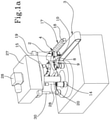
Figure 1 shows an axonometric side view of a machine for moving cans according to this invention; -
Figure 1 shows an axonometric side view of a machine for moving cans ofFigure 1 ; -
Figure 2 shows an axonometric close-up side view of the machine ofFigure 1 with some parts cut away in order to better illustrate others; -
Figure 3 shows an axonometric close-up side view of the machine ofFigure 2 in a first operating position; -
Figure 4 shows an axonometric close-up side view of the machine ofFigure 2 in a second operating position; -
Figure 5 shows an axonometric close-up side view of the machine ofFigure 2 in a third operating position; -
Figure 6 shows an axonometric close-up side view of the machine ofFigure 2 in a fourth operating position; -
Figure 7 shows an axonometric close-up side view of the machine ofFigure 2 in a fifth operating position; -
Figure 8 shows an axonometric close-up side view of the machine ofFigure 2 in a sixth operating position; -
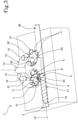
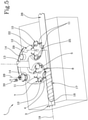
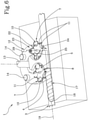
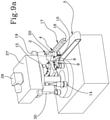
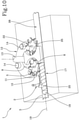
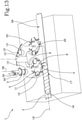
Figures 9 ,9a and10 to 16 show views corresponding toFigures 1 ,1a and2 to 8 wherein the machine according to this invention is applied to a bottle; -
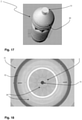
Figure 17 shows an axonometric view of a container to be processed according to this invention; and -
Figure 18 shows a schematic top view of the image from above detected by the detector of the container ofFigure 17 . - With reference to the said figures, the
numeral 1 denotes in its entirety a machine for movingcontainers 2 according to this invention. - As already mentioned, the
containers 2 in question may comprise bottles (Figures 1 to 8 ), cans (Figures 9 to 16 ) or other containers not expressly indicated. - More specifically, the
machine 1 moves thecontainers 2 according to a predetermined feed path which will be described in more detail below. Themachine 1 comprises infeed means (3) for feeding thecontainers 2 to an infeedstation 4. In that way, the infeed means 3 carry eachcontainer 2 to the infeedstation 4. It should be noted that eachcontainer 2 is preferably positioned "standing up" on the infeedmeans 3. These infeed means 3 preferably comprise a conveyor belt (see accompanying drawings). - Moreover, the
machine 1 comprises aninfeed transfer unit 5 located at theinfeed station 4 and configured to take thecontainers 2 in one at a time and carry them to aloading station 6 along the feed path. - The movement of the
transfer unit 5 is synchronised with the infeed means 3 so that when acontainer 2 reaches theinfeed station 4 it is collected by thetransfer unit 5 and moved to theloading station 6. - The
transfer unit 5 comprises retaining means 7 for keeping the position of thecontainers 2 relative to thetransfer unit 5 itself so the orientation of eachcontainer 2 referred to its own main axis of extension is maintained as it is carried from theinfeed station 4 to theloading station 6. In other words, the retaining means 7 are configured to maintain the orientation of thecontainer 2 relative to its main axis of extension 28 (usually vertical) in such a way that thecontainer 2 does not rotate about itself during this transfer. - The
transfer unit 5 preferably comprises a transfer starwheel, but it could be also defined by a robotized and movable arm for picking up thecontainer 2 from theinfeed station 4 and carrying it to theloading station 6. - In the preferred case illustrated in the accompanying drawings, the transfer unit comprises the transfer starwheel which is mounted on a relative supporting
shaft 8 and is rotatable about the axis ofrotation 9 defined by it. Moreover, the starwheel is operatively associated and synchronised with the infeed means 3. Usually, the star wheel is defined by at least one disc centred on the axis of rotation; if there is more than one disc, these are positioned vertically along the axis of rotation and spaced at a predetermined distance. - Moreover, the star wheel is provided along its periphery with a plurality of
housings 10, which are partly open, evenly distributed and designed to each house asingle container 2. Eachhousing 10 is preferably formed on the body of the disc or, alternatively, it may be defined outside the disc by protruding parts (for example defined by the retaining means 7). Preferably, eachhousing 10 is positioned at a lower part of thecontainer 2 in such a way as to leave free most of the side wall (so that thetransfer unit 5 does not overlap the side wall) of thecontainer 2 according to its main axis ofextension 28 from the lower part up to the top of thecontainer 2. - At the same time, the feeding speed of the infeed means 3 is synchronised with the speed of rotation of the infeed transfer starwheel in such a way that the difference between the feed speed of a
container 2 along the infeed means 3 and the tangential speed of the relative starwheel at theinfeed station 4 is practically zero. In this way, differences in speed are avoided which could result in damage to somecontainers 2. In the accompanying drawings, the retaining means 7 comprise a plurality of grippers each associated with arespective housing 10 and each having twoportions 11 movable towards and away from each other in such a way as to define the locking of the container 2 (when themovable portions 11 are close together) or the releasing of the container (when themovable portions 11 are spaced apart). More specifically, themovable portions 11 of the gripper are positioned at the side walls of acontainer 2 to be held. - In the preferred embodiment illustrated in the accompanying drawings, the
movable portions 11 of each gripper are positioned at least partly inside therespective housing 10 and move along a horizontal plane for blocking or releasing thecontainer 2. - It should be noted that the retaining means 7 comprise relative means (not illustrated in the accompanying drawings) for movement of the grippers configured for moving the gripping portions in synchrony with the movement of the infeed means 3.
- More in detail, the means for moving the retaining means 7 are configured to close the grippers at the
infeed station 4 following the insertion of acontainer 2 in arelative housing 10, and to open the grippers at theloading station 6 to release thecontainer 2. - The means for moving the retaining means 7 may comprise a system for transmitting the movement (for example, a cam system) operatively connected to the rotation of the starwheel on itself.
- In an alternative embodiment not illustrated in the accompanying drawings, the retaining means 7 comprise of the inserts made of gripping material (for example, rubber) inserted in each
housing 10 and designed to enter into contact with therespective container 2 to hold it. - In this specific case, infeed transfer starwheel comprises the
housings 10 into which the gripping material inserts are positioned. The inserts made of gripping material are preferably positioned at an inner side wall of thehousing 10. In an example the alternative embodiment, the transfer starwheel might be made of plastic material which is best suited to the construction of the gripping material inserts. - The movement of the
container 2 from theinfeed station 4 to theloading station 6 defines a part of the feed path. - Moreover, the
machine 1 comprises acarousel 12 rotatable about arespective rotation shaft 13 and comprising a plurality ofrotatable supports 14 positioned along the periphery of thecarousel 12 for supporting therespective containers 2 once loaded on it. - The
carousel 12 extends at theloading station 6 and is synchronized in movement with theinfeed transfer unit 5 in such a way that eachcontainer 2 unloaded by the unit is placed on arespective support 14 of thecarousel 12. - Preferably, the rotation of infeed transfer starwheel is synchronised with the rotation of the
carousel 12 in such a way that eachhousing 10 of the starwheel is located at arespective support 14 of thecarousel 12 in theloading station 6. - Moreover, the speed of the starwheel is controlled in such a way that the tangential speed of the
housings 10 is equal to the tangential speed of thecarousel 12. Each carousel is also positioned substantially tangential to the infeed means 3 in such a way that a product carried by them can enter or leave ahousing 10. - Therefore, in use, the time necessary to travel along the arc between two
consecutive supports 14 of thecarousel 12 must be equal to the time necessary to travel along the arc between twoconsecutive housings 10 of the infeed transfer starwheel. - In the preferred embodiment, the infeed transfer starwheel is partly superposed on a peripheral part of the
carousel 12 in such a way that eachcontainer 2 transported by the starwheel is unloaded on asupport 14. - More specifically, the infeed transfer starwheel is interposed between the
carousel 12 and theinfeed station 4. - Moreover, it should be noted that the
machine 1 comprises means for moving each support 14 (not illustrated in the accompanying drawings) configured to make the latter rotate on itself through an angle of rotation during the movement of thecarousel 12 following the loading of thecontainer 2 on it. - In addition, the
carousel 12 comprises anupper portion 15 also rotating together with thesupports 14 and spaced vertically from them at which there are a plurality ofunits 16 for holding the containers 2 (commonly defined as cap-pressing heads 31). Each holdingunit 16 is movable from a raised position to a lowered position relative to thecontainer 2. At the lowered position the holdingelement 16 comes into contact with the top of thecontainer 2 and holds it pressed against thesupport 14 following the loading of thecontainer 2 on the latter. In this way, thecontainer 2 is prevented from moving (or possibly falling) from thesupport 14 and it is possible to operate on the container 2 (for example, for applying a label). Themachine 1 also comprises spacing means 17 which are operatively coupled to the infeed means 3 in such a way that thecontainers 2 arrive at theinfeed station 4 spaced apart from each other. In the embodiment illustrated in the accompanying drawings, the spacing means 17 are coupled to a part of the infeed means 3 close to theinfeed station 4. - In the preferred embodiment illustrated in the accompanying drawings, the spacing means 17 comprise a
screw feeder 18 rotatable about a respective axis ofrotation 19 substantially parallel to the feed path and transversal. Thescrew feeder 18 comprises a helical channel having a relative pitch and a channel width and depth. - In some embodiments, the
screw feeder 18 has a helical channel with a shape such that it can operate oncontainers 2 belonging to various types and therefore having different dimensions and shapes. More specifically, the width of channel decreases from the outer surface towards the inside in such a way that any type ofcontainer 2 which falls within a certain range of predetermined dimensions comes into contact with thescrew feeder 18 entering to a greater extent (in the case of a smaller container 2) or a lesser extent (in the case of a larger container 2) in the helical channel. - In addition, the
machine 1 comprises motor-drivenmeans 28 associated with thecarousel 12 to rotate it around its own rotation shaft. The motor-drivenmeans 28 can also be associated with the infeed transfer starwheel to rotate it about itself using a suitable drive mechanism. Alternatively, the infeed transfer starwheel might be motor-driven in an automatic manner for its relative rotation on itself. - According to this invention, the
machine 1 comprises adetector 19 configured to detect an initial orientation of eachcontainer 2 relative to the central axis of extension thereof at a position where thecontainer 2 is upstream of theloading station 6 in thecarousel 12 along the feed path. More specifically, thedetector 19 is positioned between theinfeed station 4 and theloading station 6. In a first embodiment illustrated in the accompanying drawings, thedetector 19 is positioned at theinfeed station 4. In other words, thedetector 19 is positioned between the infeed transfer starwheel and the infeed means 3. - In a second embodiment not illustrated in the accompanying drawings, the
detector 19 is positioned at an intermediate station between theinfeed station 4 and theloading station 6. In other words, thedetector 19 is positioned at the part of the feed path of thecontainer 2 in which thecontainer 2 is inserted in ahousing 10 of thetransfer unit 5. Even more in detail, thedetector 19 is positioned at the feed path arc defined by the infeed transfer starwheel. - In that way, in effect, since each
housing 10 is positioned at a lower part of thecontainer 2 as previously defined, most of the side wall of the starwheel is left free in such a way that the detector is also be able to detect most of the side wall. - It should be noted that the
detector 19 is fixed in position relative to movement of thecontainers 2 along the feed path. By way of example, in the accompanying drawings thedetector 19 is connected to a fixedframe 27 of the carousel 12 (not rotary). However, in other embodiments not illustrated in the accompanying drawings, thedetector 19 might be supported by a relative dedicated frame or frames supporting other components of themachine 1. - Moreover, the
detector 19 is configured for measuring a "spot 20" of thecontainer 2 by detecting an image and a subsequent electronic processing of the latter (preferably by software of known type). - More specifically, the
machine 1 comprises a control unit operatively connected to thedetector 19 and to the means for moving eachsupport 14 of thecarousel 12 and configured to: - receive the information contained in the image detected by the
detector 19; - processing the image captured by the
detector 19 scanning the peripheral area around the top or mouth or cap 31 of thecontainer 2 present in the image and corresponding to the lateral surface of thecontainer 2. In that way, it is possible to determine the initial orientation of thecontainer 2 as a function of a "spot" 20 located on the lateral surface; - calculating the angle of rotation of the
support 14 in order to orient thecontainer 2 loaded thereon to a predetermined final orientation (for example, the one suitable for applying a label on a predetermined side wall of the container 2) as a function of the initial orientation detected and of the movement imparted by the transfer unit; - drive the movement means so as to rotate the
support 14 by the calculated angle of rotation after thecontainer 2 has been placed on thesupport 14 so as to turn thecontainer 2 to the predetermined final orientation. - More in detail, the control unit is programmed to scan the image of the
container 2 detected from above eliminating the central zone of the image corresponding to the top/mouth/cap 31 of thecontainer 2 so that it analyses the circular crown which is around the central zone and which corresponds to the lateral surface of the container 2 (seeFigure 18 wherein the zone of the image corresponding to thecap 31 is obscured). - It should be noted that the
detector 19 is synchronised with the infeed means 3 and with the infeed transfer starwheel so as to perform the detecting of thecontainer 2 when the latter reaches a detection zone. The detecting zone extends from theinfeed station 4 to theloading station 6. The detection of the initial orientation of thecontainer 2 consists in a recognition of a "spot 20" of thecontainer 2 on the basis of which the control unit calculates (by electronic processing of the image) the initial orientation of thecontainer 2. - More specifically, in the preferred case wherein the transfer unit is the transfer starwheel, the control unit is configured to calculate the angle of rotation of the
support 14 as a function of the rotation performed by the starwheel for carrying thecontainer 2 from a detection zone (wherein thedetector 19 detects the initial orientation of the container 2) to theloading station 6. For example,Figures 3 and4 show that thecontainer 2 has undergone a rotation of approximately 180° around the axis of rotation of the transfer starwheel. In that case, the control unit will take into consideration that from the infeed station 4 (where the detection preferably occurs) to theloading station 6, thecontainer 2 has undergone a rotation of approximately 180°. - As already mentioned, the control unit is configured to detect orientation of the
container 2 by analysing the image detected in which it is possible to identify a recognition mark of thecontainer 2 or a predetermined "spot 20". -
Figures 1 to 8 show, for example, the recognition mark, defined aa a tab of the can, whilstFigures 9 to 16 show the recognition mark as a "spot 20" made on the neck of the bottle. In any case, the identification mark could be a "spot" made on the lateral surface of thecontainer 2. In effect, thedetector 19 is configured for detecting from above also the lateral surface of the container (according to a perspective view from above) which is then analysed. - Preferably, the
detector 19 is animage detector 19, preferably a still camera or a video camera. - It should also be noted that the
detector 19 is positioned outside the outer horizontal edge of thecarousel 12 in such a way as to eliminate protrusions, along the perimeter of thecarousel 12, linked to the supportingstructure 14 of the one or more detectors (as described in prior art). - In the preferred embodiment, the
detector 19 is positioned above thecontainers 2 and is configured to detect the orientation of thecontainer 2 from the top down. In other words, thedetector 19 is positioned above the infeed means 3 and thetransfer unit 5 and is spaced from the latter by a predetermined distance which is greater than the height of thecontainers 2 to be processed. In other words, thedetector 19 again faces the top of thecontainer 2 and is configured to perform a detection from above. - In addition, the
detector 19 may detect an image of a top surface of the container 2 (for example, cap 31 or tab of the can); this operation not being possible in thecarousel 12 due to the presence of theunits 16 for holding thecontainers 2 which cover the top surface. - Consequently, this invention makes it possible to detect a "
spot 20" of acontainer 2 positioned at its top or lateral surface (for example the tab of the can). - In any case, the
detector 19 is preferably configured to receive rays for detecting (light rays reflected by the container 2) the framed image of thecontainer 2. In this way, thedetector 19 detects the image of the framed part of thecontainer 2. - In detail, since the
detector 19 is configured to perform a detection from above, the rays for detecting propagate along a path substantially parallel to the main axis of extension of thecontainer 2. In order to improve the detecting of the lateral surface of thecontainer 2, thedetector 19 preferably comprises adeflection system 21 for deflecting the rays of the framed image configured to detect an image also of the side walls of the framedcontainer 2. - In other words, the
system 21 for deflection from above is configured for deflecting the rays coming from the lateral surfaces of thecontainer 2. Thedeflection system 21 is preferably interposed between a snap-on shutter of the image of thedetector 19 and anunderlying container 2. Preferably, thedeflection system 21 comprises a telecentric lens and/or one or more Fresnel lenses and/or one or more hypercentric lenses and/or a system of hypercentric lenses and/or acylinder 32 having a reflecting inside lateral surface. Advantageously, in this way it is possible to improve the detection of the lateral surfaces (the "spot 20" is present on them). - As regards the last alternative mentioned above (
cylinder 32 with lateral inner surface having a mirror finish),Figure 18 shows an example of the image of the lateral surface of acontainer 2 reflected from the mirror as it is detected from above by thedetector 19. More specifically, in the image the "spot" 20 is represented by the text in relief (spot 20) beneath which the label will be applied. - In addition, again in
Figure 18 , it is possible to see that the central image represents the direct image of the container 2 (not reflected) in which it is possible to see the text in relief (spot 20) beneath which the label will be applied. - More specifically, the control unit is configured to rotate the
support 14 of thecarousel 12 on which the detectedcontainer 2 is loaded by the angle calculated during the movement of thecarousel 12 in such a way that in the first stretch of movement of thecarousel 12 starting from loadingstation 6, thecontainer 2 is oriented directly in the final orientation without carrying out any complete revolutions on itself for the detection of the entire lateral surface. - In addition, as can be seen in
Figures 1a ,5 ,9a and13 , themachine 1 comprises afurther detector 30 positioned along the perimeter of the carousel and downstream of theloading station 6. More specifically, thefurther detector 30 is configured to detect an image of thecontainer 2 once the latter has rotated about itself by the angle calculated by thesupport 14. In other words, thefurther detector 30 is configured for detecting the final orientation of thecontainer 2 in such a way as to check for any deviations to the final orientation of thecontainer 2 relative to a final pre-calculated theoretical orientation (for example in order obtain a correct labelling). - For this reason, the control unit is connected to the
further detector 30 and is configured for: - receiving the information relative to the final orientation of the
container 2 from thefurther detector 30; - processing the detection information and calculate the angular deviation of the
container 2 between the final orientation and the theoretical final orientation; - driving the movement means so as to rotate the
support 14 by an angle corresponding to the calculated angular deviation in such a way as to turn thecontainer 2 to the theoretical final orientation. - Preferably, the
further detector 30 is physically located in a position spaced from theloading station 6 along the periphery of thecarousel 12. Preferably, thefurther detector 30 is a detector of images (stills camera) and/or videos (video camera) of known type. - It should also be noted that the
machine 1 also comprises anoutfeed transfer unit 22 synchronized in movement with thecarousel 12 and configured to remove thecontainers 2 one at a time from thesupports 14 of thecarousel 12 at an unloadingstation 23 spaced from theloading station 6 along the feed path. Theoutfeed transfer unit 22 is configured to carry eachcontainer 2 picked up to anoutfeed station 24. - Preferably, the
infeed transfer unit 22 comprises an infeed transfer starwheel rotatable about a respective axis ofrotation 29. The outfeed transfer starwheel comprises a plurality ofhousings 10, in which eachcontainer 2 is inserted during the transfer from the unloadingstation 23 to theoutfeed station 24. - In a first embodiment, each
housing 10 comprises retaining means 7 in a position similar to those defined for the infeed transfer starwheel. - In a second embodiment, the
means 7 for holding in position are not present, but there is asemi-circular contact panel 25 located along a peripheral stretch of the transfer starwheel from the unloadingstation 23 to theoutfeed station 24 to prevent thecontainers 2 from escaping from therespective housings 10. - Moreover, the
machine 1 comprises outfeed means 26 extending away from theoutfeed station 24 and configured to carry eachcontainer 2 away from thecarousel 12. Preferably, the outfeed means 26 comprise a conveyor belt and, even more preferably, the conveyor belt is a part of the conveyor belt of the infeed means 3. - This invention also relates to a method for moving the
containers 2 to be processed along the feed path. The method is derived directly from what described above relative to themachine 1 for movingcontainers 2 which is incorporated here in its entirety. - More specifically, the method comprises a step of feeding the
containers 2 to aninfeed station 4 along the feed path (Figures 2 and10 ). Subsequently, the method comprises transferring onecontainer 2 at a time from theinfeed station 4 to theloading station 6 using the transfer unit 5 (Figures 3 ,4 ,11 ,12 ). - The transferring step is accomplished by keeping the orientation of each
container 2 fixed relative to the transfer unit itself during travel from theinfeed station 4 to theloading station 6. Moreover, the transfer step comprises loading thecontainer 2 onto asupport 14 of thecarousel 12 when thesupport 14 is positioned at theloading station 6. - According to this invention, the method comprises detecting the initial orientation of each
container 2, relative to the central axis of extension thereof, at a position of thecontainer 2 upstream of theloading station 6 in thecarousel 12 along the feed path. Moreover, the method comprises calculating the angle of rotation of thesupport 14 in order to turn thecontainer 2 loaded thereon to a predetermined final orientation as a function of the initial orientation detected and of the movement imparted by the transfer unit. Lastly, the method comprises a step of rotating thesupport 14 by the calculated angle of rotation after thecontainer 2 has been placed on thesupport 14 so as to turn thecontainer 2 to the predetermined final orientation. - Preferably, the detecting step occurs at the
infeed station 4. In detail, the detecting step occurs outside the horizontal edge of thecarousel 12. Even more preferably, the detecting step occurs from above relative to eachcontainer 2 in such a way that thedetector 19 is positioned above thecontainer 2 and facing a top of the latter. -
Figures 1a ,5 ,9a and13 shows the step wherein thesupport 14 of thecarousel 12 rotates by the calculated angle in such a way as to reach the predetermined final orientation. - More specifically, the step of detecting the initial orientation of the container comprises a sub-step of processing the image captured by the
detector 19 scanning the peripheral area around the top or mouth or cap 31 of thecontainer 2 present in the image and corresponding to the lateral surface of thecontainer 2. In that way, it is possible to determine the initial orientation of thecontainer 2 as a function of a "spot" 20 located on the lateral surface. - The invention achieves the preset aims.
- More specifically, the
machine 1 for moving thecontainers 2 reduces the dimensions for thesupport 14 of the sensor along the edge of thecarousel 12 since nosupport 14 is present for the sensor along thecarousel 12 as the sensor is located upstream of theloading station 6. - Moreover, this invention allows the timing and the spaces for detecting the orientation of the
container 2 to be optimized. In effect, when thecontainer 2 is introduced into thecarousel 12 the relative orientation is recognised and also the angle of rotation necessary to carry it to the final predetermined orientation. In addition, once thecontainer 2 has been loaded on asupport 14, the latter is rotated only by the angle necessary to carry it to a final position and does not need a complete initial rotation for the scanning of the lateral surface (as in the prior art). Consequently, the complete operation for positioning thecontainer 2 in the final orientation occupies an angle ofcarousel 12 less than that of the prior art. - Lastly, since the
detector 19 is applied upstream of theloading station 6 and outside of thecarousel 12, it is possible to detect thecontainer 2 from the top downwards in such a way as to detect a "spot 20" of thecontainer 2 present at a relative top or lateral surface.
Claims (12)
- A machine (1) for moving containers (2) to be processed along a feed path, comprising:- infeed means (3) for feeding the containers (2) to an infeed station (4);- an infeed transfer unit (5) located at the infeed station (4) and configured to take the containers (2) in one at a time and carry them to a loading station (6) along the feed path;- a carousel (12) rotatable about its rotation shaft and comprising a plurality of rotatable supports (14) arranged around its periphery to support the respective containers (2); the carousel (12) being mounted at the loading station (6) and being synchronized in movement with the infeed transfer unit (5) in such a way that each container (2) unloaded by the transfer unit (5) is placed on a respective support (14) of the carousel (12);- means for moving each support (14) and configured to make the latter rotate around its own axis through an angle of rotation during the movement of the carousel (12);- a detector (19) configured to detect an image of each container (2) and positioned upstream of the loading station (6) in the carousel (12) along the feed path; the detector (19) being positioned above the containers (2) and being configured to detect an image of each container (2) from the top downwards;- a control unit operatively connected to the detector (19) and to the means for moving each support (14) of the carousel (12) and configured to:characterised in that the transfer unit (5) comprises retaining means (7) for keeping the position of the containers (2) relative to the transfer unit itself so that the orientation of each container (2) referred to its own main axis of extension (28) is maintained as it is carried from the infeed station (4) to the loading station (6)- receive the image of the container (2) detected by the detector (19);- determine the orientation of each container (2) relative to the central axis of extension thereof;- calculate the angle of rotation of the support (14) in order to turn the container (2) loaded thereon to a predetermined final orientation as a function of the initial orientation detected;- drive said means for moving so as to rotate the support (14) by the calculated angle of rotation after the container (2) has been placed on the support (14) so as to turn the container (2) to the predetermined final orientation;- scan the peripheral area around the top or mouth or cap (31) of the container (2) present in the image detected by the detector (19) corresponding to the lateral surface of the container (2) so as to determine the initial orientation of the container (2) as a function of a distinctive mark (20) positioned on the lateral surface;
and in that the control unit is configured to calculate the angle of rotation of the support (14) also as a function of the movement imparted by the transfer unit (5) for carrying the container (2) from a detection zone, wherein the detector (19) detects the initial orientation of the container (2), to the loading station (6). - The machine (1) according to claim 1, characterised in that the detector (19) is positioned between the infeed station (4) and the loading station (6) along a stretch of path for feeding the container (2) positioned at the transfer unit (5); the transfer unit (5) comprising a plurality of housings (10) for housing respective containers wherein each housing (10) is positioned at a lower part of the container (2) in such a way as to leave free most of the side wall of the container (2) for the detection.
- The machine (1) according to claim 1, characterized in that the detector (19) is located at the infeed station (4).
- The machine (1) according to any one of the preceding claims, characterised in that the detector (19) is configured to receive rays for detecting the framed image of the container (2); the detector (19) comprising a deflection system (21) for deflecting the rays of the framed image and configured to detect an image of the side walls of the framed container (2).
- The machine (1) according to claim 4, characterized in that the deflection system (21) comprises a telecentric lens and/or one or more Fresnel lenses and/or one or more hypercentric lenses and/or a system of hypercentric lenses and/or a cylinder (32) having a reflecting inside lateral surface.
- The machine (1) according to any one of the preceding claims, characterized in that the detector (19) is an image detector (19), preferably a still camera or a video camera.
- The machine (1) according to any one of the preceding claims, characterized in that the transfer unit (5) comprises a star wheel rotating about its axis of rotation and having a plurality of housings (10) arranged around its periphery to house the containers (2) to be transferred; the retaining means (7) being positioned at each housing (10) in such a way as to keep the container (2) in a position inside the housing (10); the rotary starwheel being synchronised with the movement of the carousel (12) in such a way as carry one container (2) at a time to respective supports (14) of the carousel (12).
- The machine (1) according to any one of the preceding claims, characterized in that it comprises spacing means (17) for spacing the containers (2), operatively connected to the infeed means (3) and extending along at least part of the infeed means (3) as far as the infeed station (4) in order to space one container (2) from another before it reaches the infeed station (4).
- The machine (1) according to any one of the preceding claims, characterized in that it comprises an outfeed transfer unit (22) synchronized in movement with the carousel (12) and configured to remove the containers (2) one at a time from the supports (14) of the carousel (12) at an unloading station (23) spaced from the loading station along the feed path; the outfeed transfer unit (22) being configured to carry each container (2) picked up to an outfeed station (24); the machine (1) comprising outfeed feeding means (26) extending away from the outfeed station (24) and configured to carry each container (2) away from the carousel (12).
- The machine (1) according to any one of the preceding claims, characterized in that the carousel (12) comprises a plurality of holding units (16) for holding the containers (2) and positioned above and at the supports (14) of the carousel (12); each holding unit (16) being movable from a raised position to a lowered position relative to the container (2) in such a way as to keep it pressed against the support (14) following the loading of the container (2) on the latter.
- The machine (1) according to any one of the preceding claims, characterized in that it comprises a further detector (30) located along the perimeter of the carousel (12) and downstream of the loading station (6) to detect the final orientation of the container (2) following its rotation on itself through the calculated angle; the control unit being connected to the further detector (30) and being configured to:- receive the information on the final orientation of the container (2) from the further detector (30);- process the information and calculate the angular deviation of the container (2) between the final orientation detected and a predetermined theoretical final orientation;- drive the movement means so as to rotate the support (14) by an angle corresponding to the calculated angular deviation in such a way as to turn the container (2) to the theoretical final orientation.
- A method for moving containers (2) to be processed along a feed path, comprising the following steps:- feeding the containers (2) to an infeed station (4) along the feed path;- transferring one container (2) at a time from the infeed station (4) to a loading station (6) transfer using a transfer unit (5);- the transferring step comprising loading the container (2) onto a support (14) of a carousel (12) rotatable about its rotation shaft when the support (14) is positioned at the loading station (6);
detecting an image of each container (2) relative to the central axis of extension thereof at a position where the container (2) is upstream of the loading station (6) in the carousel (12) along the feed path; said detecting step occurs from above relative to each container (2) through a detector (19) positioned above the container (2) and facing a top of the latter;- determine the orientation of each container (2) relative to the central axis of extension thereof;- calculating the angle of rotation of the support (14) in order to turn the container (2) loaded thereon to a predetermined final orientation as a function of the initial orientation detected;- rotating the support (14) by the calculated angle of rotation after the container (2) has been placed on the support (14) so as to turn the container (2) to the predetermined final orientation;characterized in that the transferring step being accomplished by keeping the orientation of each container (2) fixed relative to the transfer unit itself during travel from the infeed station (4) to the loading station (6); and in that the step of calculating the angle of rotation of the support (14) is performed taking into account the movement imparted by the transfer unit (5) for carrying the container (2) from a detection zone, wherein the detector (19) detects the initial orientation of the container (2), to the loading station (6).
said step of determining the initial orientation of the container (2) comprises a sub-step of processing the image captured by the detector (19) scanning the peripheral area around the top or mouth or cap (31) of the container (2) present in the image and corresponding to the lateral surface of the container (2) so as to determine the initial orientation of the container (2) as a function of a recognition mark (20) positioned on the lateral surface;
Applications Claiming Priority (2)
| Application Number | Priority Date | Filing Date | Title |
|---|---|---|---|
| ITVR20140292 | 2014-11-27 | ||
| PCT/IB2015/058364 WO2016083920A2 (en) | 2014-11-27 | 2015-10-29 | Machine for moving containers to be processed |
Publications (3)
| Publication Number | Publication Date |
|---|---|
| EP3209571A2 EP3209571A2 (en) | 2017-08-30 |
| EP3209571B1 EP3209571B1 (en) | 2018-08-01 |
| EP3209571B2 true EP3209571B2 (en) | 2022-02-23 |
Family
ID=52293099
Family Applications (1)
| Application Number | Title | Priority Date | Filing Date |
|---|---|---|---|
| EP15805276.1A Active EP3209571B2 (en) | 2014-11-27 | 2015-10-29 | Machine and method for orienting containers |
Country Status (6)
| Country | Link |
|---|---|
| US (1) | US10183772B2 (en) |
| EP (1) | EP3209571B2 (en) |
| AU (1) | AU2015352059B2 (en) |
| CA (1) | CA2968028A1 (en) |
| ES (1) | ES2694038T5 (en) |
| WO (1) | WO2016083920A2 (en) |
Families Citing this family (22)
| Publication number | Priority date | Publication date | Assignee | Title |
|---|---|---|---|---|
| NL2017196B1 (en) * | 2016-07-20 | 2018-01-26 | Sluis Cigar Machinery Bv | Simulated cigarette parts reorienting apparatus |
| CN109661366B (en) | 2016-09-09 | 2022-01-14 | 宝洁公司 | System and method for independently guiding a carrier and delivering containers and closures to a unit operation station |
| US10558201B2 (en) | 2016-09-09 | 2020-02-11 | The Procter & Gamble Company | System and method for producing products based upon demand |
| CN106395033B (en) * | 2016-09-14 | 2019-06-11 | 青岛亚坦文具有限公司 | An automatic correction fluid filling device |
| IT201700055395A1 (en) * | 2017-05-22 | 2018-11-22 | Telerobot S P A | MOUNTING DEVICE FOR PLASTIC OBJECTS |
| IT201800001387A1 (en) * | 2018-01-19 | 2019-07-19 | Gd Spa | Machine and method for filling cartridges for aerosol generators |
| US20190300288A1 (en) * | 2018-03-29 | 2019-10-03 | Philip K. Morin | Alignment and dispensing apparatus for linear parts |
| IT201800005482A1 (en) * | 2018-05-17 | 2019-11-17 | APPARATUS FOR THE INSPECTION OF CONTAINERS | |
| CN110759040A (en) * | 2019-10-25 | 2020-02-07 | 东莞理工学院 | A conveying and capping equipment applying high-dimensional data detection |
| US20210188473A1 (en) * | 2019-12-19 | 2021-06-24 | Eliqs Llc | Pre-Filled and Pre-Sealed Beverage Container Sleeve Applicator |
| FR3105753B1 (en) | 2019-12-26 | 2022-01-07 | Sidel Participations | "Process for angular orientation of hollow bodies in a container manufacturing facility" |
| CA3155813C (en) | 2019-12-30 | 2022-11-22 | Accraply, LLC, A Barry-Wehmiller Packaging Company | Machine for applying labels or other markings to containers |
| CN116046795B (en) * | 2020-03-03 | 2026-03-27 | 桂林电子科技大学 | An online visual detection method for foreign objects in powder inside a bottle |
| EP3943428A1 (en) | 2020-07-24 | 2022-01-26 | WestRock Packaging Systems, LLC | Orientation module |
| CN114684601B (en) * | 2020-12-31 | 2025-09-30 | 安徽文王酿酒股份有限公司 | Rotating mechanism and device for rotating bottle |
| IT202100003524A1 (en) * | 2021-02-16 | 2022-08-16 | Ecocaps S R L | CAN ORIENTATION SYSTEM INSIDE A CAN PROCESSING MACHINE AND RELATED MACHINE |
| IT202100017858A1 (en) * | 2021-07-07 | 2023-01-07 | Smi Spa | MACHINE FOR PRINTING INFORMATION ON A CONTAINER |
| DE102022122377A1 (en) | 2022-09-05 | 2024-03-07 | Krones Aktiengesellschaft | Container transport system and method for transporting containers |
| CN117105149B (en) * | 2023-08-02 | 2025-07-25 | 上海和熠实业有限公司 | Automatic charging device for penicillin bottles |
| CN117023091B (en) * | 2023-10-09 | 2023-12-12 | 南京比逊弥特智能科技有限公司 | Automatic circulation high-speed bottle arranging system and method with full-automatic bottle removing and reversing function |
| WO2025117647A1 (en) * | 2023-11-27 | 2025-06-05 | Westrock Packaging Systems, Llc | Orientation module with turning members for turning articles having different dimensions |
| CN120171893A (en) * | 2025-04-02 | 2025-06-20 | 江苏新美星包装机械股份有限公司 | A capping and labeling integrated machine |
Family Cites Families (21)
| Publication number | Priority date | Publication date | Assignee | Title |
|---|---|---|---|---|
| DE1949135U (en) | 1966-08-27 | 1966-11-03 | Anker Maschb G M B H | DEVICE FOR ALIGNING BOTTLES OR SIMILAR VESSELS BEFORE LABELING BY ROTATING AROUND ITS AXIS. |
| DE1805010B1 (en) | 1968-10-24 | 1970-04-30 | Otto Sick Metallwarenfabrik Fa | Device for aligning bottles in encapsulation machines |
| DE7512621U (en) | 1975-04-19 | 1976-10-21 | Jagenberg-Werke Ag, 4000 Duesseldorf | DEVICE FOR ALIGNING ROTATIONAL SYMMETRIC BODIES, IN PARTICULAR BOTTLES, IN A BOTTLE TREATMENT MACHINE, IN PARTICULAR LABELING MACHINE |
| US4124112A (en) * | 1977-05-23 | 1978-11-07 | Owens-Illinois, Inc. | Odd-shaped container indexing starwheel |
| DE2740220C2 (en) | 1977-09-07 | 1982-10-28 | Kronseder, Hermann, 8404 Wörth | Device for aligning bottles before labeling |
| JPS571041A (en) * | 1980-06-02 | 1982-01-06 | Shibuya Kogyo Co Ltd | Labeller |
| DE3022343C2 (en) * | 1980-06-14 | 1983-10-20 | Kronseder, Hermann, 8404 Wörth | Device for aligning bottles or the like., In particular in labeling machines |
| US5058724A (en) | 1990-11-08 | 1991-10-22 | Hinton Gaylen R | Apparatus and method for orienting articles and containers |
| US5243400A (en) | 1992-04-27 | 1993-09-07 | Owens-Brockway Glass Container Inc. | Inspection of transparent containers |
| US5233186A (en) | 1992-06-19 | 1993-08-03 | Owens-Brockway Glass Container Inc. | Inspection of transparent containers with opposing reflection means |
| US5369713A (en) | 1992-07-09 | 1994-11-29 | Schwartz; Nira | Inspection method using area of interest (AOI) analysis |
| US5478422A (en) * | 1993-09-16 | 1995-12-26 | B & H Manufacturing Company, Inc. | Computer controlled turret type labeling machine |
| IT1307230B1 (en) * | 1999-03-31 | 2001-10-30 | Robino & Galandrino Spa | PROCESS AND EQUIPMENT FOR THE CENTERING AND ORIENTATION OF SEAL CAPSULES OF SPARKLING WINE BOTTLES AND SIMILAR. |
| US6793755B2 (en) * | 2001-06-01 | 2004-09-21 | Interactive Packaging Group, Ltd. | Method and machine for placement of multiple labels |
| DE10145455A1 (en) * | 2001-09-14 | 2003-04-24 | Krones Ag | Machine for furnishing articles |
| DE20115480U1 (en) | 2001-09-19 | 2002-05-16 | Heuft Systemtechnik Gmbh, 56659 Burgbrohl | Device for applying labels to containers |
| DE102006026618A1 (en) | 2006-09-02 | 2008-03-13 | Khs Ag | Method for the accurate application of labels and labeling machine |
| DE102009005180A1 (en) | 2009-01-15 | 2010-07-22 | Khs Ag | Container handling machine |
| DE102009014663B4 (en) * | 2009-03-27 | 2013-03-14 | Khs Gmbh | Device and method for detecting the rotational position of at least one intended for receiving a container rotating device |
| IT1396099B1 (en) | 2009-10-20 | 2012-11-09 | Makro Labelling Srl | CONVEYOR FOR CONTAINERS, WHICH BOTTLES, TO BE TREATED AND FOR CONTAINERS TREATED FOR OPERATING MACHINES OF THE ROTARY GIOSTRA TYPE. |
| IT1403497B1 (en) | 2010-12-27 | 2013-10-17 | Makro Labelling Srl | "DETECTION DEVICE FOR MOVING CONTAINERS" |
-
2015
- 2015-10-29 AU AU2015352059A patent/AU2015352059B2/en active Active
- 2015-10-29 CA CA2968028A patent/CA2968028A1/en not_active Abandoned
- 2015-10-29 WO PCT/IB2015/058364 patent/WO2016083920A2/en not_active Ceased
- 2015-10-29 EP EP15805276.1A patent/EP3209571B2/en active Active
- 2015-10-29 US US15/529,909 patent/US10183772B2/en active Active
- 2015-10-29 ES ES15805276T patent/ES2694038T5/en active Active
Also Published As
| Publication number | Publication date |
|---|---|
| US20180170596A1 (en) | 2018-06-21 |
| WO2016083920A2 (en) | 2016-06-02 |
| EP3209571B1 (en) | 2018-08-01 |
| AU2015352059A1 (en) | 2017-06-15 |
| EP3209571A2 (en) | 2017-08-30 |
| ES2694038T5 (en) | 2022-05-18 |
| ES2694038T3 (en) | 2018-12-17 |
| WO2016083920A3 (en) | 2016-08-18 |
| AU2015352059B2 (en) | 2019-11-21 |
| CA2968028A1 (en) | 2016-06-02 |
| US10183772B2 (en) | 2019-01-22 |
Similar Documents
| Publication | Publication Date | Title |
|---|---|---|
| EP3209571B1 (en) | Machine and method for orienting containers | |
| US9623990B2 (en) | Machine for applying threaded caps to containers | |
| US8477185B2 (en) | System for the angular orientation and detection of containers in labelling machines | |
| RU2453493C1 (en) | Corking unit and method of fitting on vessel | |
| US20160137326A1 (en) | Apparatus and method for handling articles | |
| CN101511681A (en) | Method for the positionally accurate application of labels, and labelling machine | |
| US7478660B2 (en) | Labelling and/or marking machine | |
| CN107107628A (en) | Labelling machine | |
| US12600518B2 (en) | Container transport system and method for transporting containers | |
| US20070127018A1 (en) | Inspection machine | |
| EP3286553B1 (en) | Apparatus and method for optical inspection of parisons | |
| JP7168845B2 (en) | Cap inspection device and cap inspection method | |
| CN114174177A (en) | Apparatus and method for orienting containers | |
| EP3593272B1 (en) | Device and method of reading a mark printed on containers moving along a conveyor | |
| JP5293003B2 (en) | Capper | |
| US20260131524A1 (en) | Apparatus and method for continuous processing of caps | |
| JP7208462B2 (en) | Container orientation determination device and container transfer device | |
| WO2024104745A1 (en) | A system and method for the inspection of cylindrical containers | |
| CN115991451A (en) | Closing the container with a container closure | |
| JP7860394B2 (en) | Container transport device | |
| WO2022214932A1 (en) | Apparatus and method for capping containers | |
| JP2006007227A (en) | Lid mounting device and container marking method | |
| IT201800002921A1 (en) | DEVICE AND METHOD OF INSPECTION |
Legal Events
| Date | Code | Title | Description |
|---|---|---|---|
| STAA | Information on the status of an ep patent application or granted ep patent |
Free format text: STATUS: THE INTERNATIONAL PUBLICATION HAS BEEN MADE |
|
| PUAI | Public reference made under article 153(3) epc to a published international application that has entered the european phase |
Free format text: ORIGINAL CODE: 0009012 |
|
| STAA | Information on the status of an ep patent application or granted ep patent |
Free format text: STATUS: REQUEST FOR EXAMINATION WAS MADE |
|
| STAA | Information on the status of an ep patent application or granted ep patent |
Free format text: STATUS: EXAMINATION IS IN PROGRESS |
|
| 17P | Request for examination filed |
Effective date: 20170525 |
|
| AK | Designated contracting states |
Kind code of ref document: A2 Designated state(s): AL AT BE BG CH CY CZ DE DK EE ES FI FR GB GR HR HU IE IS IT LI LT LU LV MC MK MT NL NO PL PT RO RS SE SI SK SM TR |
|
| AX | Request for extension of the european patent |
Extension state: BA ME |
|
| 17Q | First examination report despatched |
Effective date: 20170808 |
|
| DAV | Request for validation of the european patent (deleted) | ||
| DAX | Request for extension of the european patent (deleted) | ||
| GRAP | Despatch of communication of intention to grant a patent |
Free format text: ORIGINAL CODE: EPIDOSNIGR1 |
|
| STAA | Information on the status of an ep patent application or granted ep patent |
Free format text: STATUS: GRANT OF PATENT IS INTENDED |
|
| INTG | Intention to grant announced |
Effective date: 20180410 |
|
| GRAS | Grant fee paid |
Free format text: ORIGINAL CODE: EPIDOSNIGR3 |
|
| GRAA | (expected) grant |
Free format text: ORIGINAL CODE: 0009210 |
|
| STAA | Information on the status of an ep patent application or granted ep patent |
Free format text: STATUS: THE PATENT HAS BEEN GRANTED |
|
| AK | Designated contracting states |
Kind code of ref document: B1 Designated state(s): AL AT BE BG CH CY CZ DE DK EE ES FI FR GB GR HR HU IE IS IT LI LT LU LV MC MK MT NL NO PL PT RO RS SE SI SK SM TR |
|
| REG | Reference to a national code |
Ref country code: GB Ref legal event code: FG4D |
|
| REG | Reference to a national code |
Ref country code: CH Ref legal event code: EP Ref country code: AT Ref legal event code: REF Ref document number: 1024000 Country of ref document: AT Kind code of ref document: T Effective date: 20180815 |
|
| REG | Reference to a national code |
Ref country code: IE Ref legal event code: FG4D |
|
| REG | Reference to a national code |
Ref country code: DE Ref legal event code: R096 Ref document number: 602015014442 Country of ref document: DE |
|
| REG | Reference to a national code |
Ref country code: FR Ref legal event code: PLFP Year of fee payment: 4 |
|
| REG | Reference to a national code |
Ref country code: NL Ref legal event code: MP Effective date: 20180801 |
|
| REG | Reference to a national code |
Ref country code: ES Ref legal event code: FG2A Ref document number: 2694038 Country of ref document: ES Kind code of ref document: T3 Effective date: 20181217 |
|
| REG | Reference to a national code |
Ref country code: LT Ref legal event code: MG4D |
|
| REG | Reference to a national code |
Ref country code: AT Ref legal event code: MK05 Ref document number: 1024000 Country of ref document: AT Kind code of ref document: T Effective date: 20180801 |
|
| PG25 | Lapsed in a contracting state [announced via postgrant information from national office to epo] |
Ref country code: NO Free format text: LAPSE BECAUSE OF FAILURE TO SUBMIT A TRANSLATION OF THE DESCRIPTION OR TO PAY THE FEE WITHIN THE PRESCRIBED TIME-LIMIT Effective date: 20181101 Ref country code: BG Free format text: LAPSE BECAUSE OF FAILURE TO SUBMIT A TRANSLATION OF THE DESCRIPTION OR TO PAY THE FEE WITHIN THE PRESCRIBED TIME-LIMIT Effective date: 20181101 Ref country code: PL Free format text: LAPSE BECAUSE OF FAILURE TO SUBMIT A TRANSLATION OF THE DESCRIPTION OR TO PAY THE FEE WITHIN THE PRESCRIBED TIME-LIMIT Effective date: 20180801 Ref country code: NL Free format text: LAPSE BECAUSE OF FAILURE TO SUBMIT A TRANSLATION OF THE DESCRIPTION OR TO PAY THE FEE WITHIN THE PRESCRIBED TIME-LIMIT Effective date: 20180801 Ref country code: AT Free format text: LAPSE BECAUSE OF FAILURE TO SUBMIT A TRANSLATION OF THE DESCRIPTION OR TO PAY THE FEE WITHIN THE PRESCRIBED TIME-LIMIT Effective date: 20180801 Ref country code: IS Free format text: LAPSE BECAUSE OF FAILURE TO SUBMIT A TRANSLATION OF THE DESCRIPTION OR TO PAY THE FEE WITHIN THE PRESCRIBED TIME-LIMIT Effective date: 20181201 Ref country code: GR Free format text: LAPSE BECAUSE OF FAILURE TO SUBMIT A TRANSLATION OF THE DESCRIPTION OR TO PAY THE FEE WITHIN THE PRESCRIBED TIME-LIMIT Effective date: 20181102 Ref country code: LT Free format text: LAPSE BECAUSE OF FAILURE TO SUBMIT A TRANSLATION OF THE DESCRIPTION OR TO PAY THE FEE WITHIN THE PRESCRIBED TIME-LIMIT Effective date: 20180801 Ref country code: RS Free format text: LAPSE BECAUSE OF FAILURE TO SUBMIT A TRANSLATION OF THE DESCRIPTION OR TO PAY THE FEE WITHIN THE PRESCRIBED TIME-LIMIT Effective date: 20180801 Ref country code: FI Free format text: LAPSE BECAUSE OF FAILURE TO SUBMIT A TRANSLATION OF THE DESCRIPTION OR TO PAY THE FEE WITHIN THE PRESCRIBED TIME-LIMIT Effective date: 20180801 Ref country code: SE Free format text: LAPSE BECAUSE OF FAILURE TO SUBMIT A TRANSLATION OF THE DESCRIPTION OR TO PAY THE FEE WITHIN THE PRESCRIBED TIME-LIMIT Effective date: 20180801 |
|
| PG25 | Lapsed in a contracting state [announced via postgrant information from national office to epo] |
Ref country code: AL Free format text: LAPSE BECAUSE OF FAILURE TO SUBMIT A TRANSLATION OF THE DESCRIPTION OR TO PAY THE FEE WITHIN THE PRESCRIBED TIME-LIMIT Effective date: 20180801 Ref country code: HR Free format text: LAPSE BECAUSE OF FAILURE TO SUBMIT A TRANSLATION OF THE DESCRIPTION OR TO PAY THE FEE WITHIN THE PRESCRIBED TIME-LIMIT Effective date: 20180801 Ref country code: LV Free format text: LAPSE BECAUSE OF FAILURE TO SUBMIT A TRANSLATION OF THE DESCRIPTION OR TO PAY THE FEE WITHIN THE PRESCRIBED TIME-LIMIT Effective date: 20180801 |
|
| PG25 | Lapsed in a contracting state [announced via postgrant information from national office to epo] |
Ref country code: RO Free format text: LAPSE BECAUSE OF FAILURE TO SUBMIT A TRANSLATION OF THE DESCRIPTION OR TO PAY THE FEE WITHIN THE PRESCRIBED TIME-LIMIT Effective date: 20180801 Ref country code: EE Free format text: LAPSE BECAUSE OF FAILURE TO SUBMIT A TRANSLATION OF THE DESCRIPTION OR TO PAY THE FEE WITHIN THE PRESCRIBED TIME-LIMIT Effective date: 20180801 Ref country code: CZ Free format text: LAPSE BECAUSE OF FAILURE TO SUBMIT A TRANSLATION OF THE DESCRIPTION OR TO PAY THE FEE WITHIN THE PRESCRIBED TIME-LIMIT Effective date: 20180801 |
|
| REG | Reference to a national code |
Ref country code: DE Ref legal event code: R026 Ref document number: 602015014442 Country of ref document: DE |
|
| PLBI | Opposition filed |
Free format text: ORIGINAL CODE: 0009260 |
|
| PLAX | Notice of opposition and request to file observation + time limit sent |
Free format text: ORIGINAL CODE: EPIDOSNOBS2 |
|
| PG25 | Lapsed in a contracting state [announced via postgrant information from national office to epo] |
Ref country code: SM Free format text: LAPSE BECAUSE OF FAILURE TO SUBMIT A TRANSLATION OF THE DESCRIPTION OR TO PAY THE FEE WITHIN THE PRESCRIBED TIME-LIMIT Effective date: 20180801 Ref country code: DK Free format text: LAPSE BECAUSE OF FAILURE TO SUBMIT A TRANSLATION OF THE DESCRIPTION OR TO PAY THE FEE WITHIN THE PRESCRIBED TIME-LIMIT Effective date: 20180801 Ref country code: SK Free format text: LAPSE BECAUSE OF FAILURE TO SUBMIT A TRANSLATION OF THE DESCRIPTION OR TO PAY THE FEE WITHIN THE PRESCRIBED TIME-LIMIT Effective date: 20180801 |
|
| REG | Reference to a national code |
Ref country code: CH Ref legal event code: PL |
|
| 26 | Opposition filed |
Opponent name: P.E. LABELLERS S.P.A. Effective date: 20190502 |
|
| PLAF | Information modified related to communication of a notice of opposition and request to file observations + time limit |
Free format text: ORIGINAL CODE: EPIDOSCOBS2 |
|
| REG | Reference to a national code |
Ref country code: BE Ref legal event code: MM Effective date: 20181031 |
|
| PG25 | Lapsed in a contracting state [announced via postgrant information from national office to epo] |
Ref country code: LU Free format text: LAPSE BECAUSE OF NON-PAYMENT OF DUE FEES Effective date: 20181029 Ref country code: MC Free format text: LAPSE BECAUSE OF FAILURE TO SUBMIT A TRANSLATION OF THE DESCRIPTION OR TO PAY THE FEE WITHIN THE PRESCRIBED TIME-LIMIT Effective date: 20180801 |
|
| PG25 | Lapsed in a contracting state [announced via postgrant information from national office to epo] |
Ref country code: LI Free format text: LAPSE BECAUSE OF NON-PAYMENT OF DUE FEES Effective date: 20181031 Ref country code: SI Free format text: LAPSE BECAUSE OF FAILURE TO SUBMIT A TRANSLATION OF THE DESCRIPTION OR TO PAY THE FEE WITHIN THE PRESCRIBED TIME-LIMIT Effective date: 20180801 Ref country code: CH Free format text: LAPSE BECAUSE OF NON-PAYMENT OF DUE FEES Effective date: 20181031 Ref country code: BE Free format text: LAPSE BECAUSE OF NON-PAYMENT OF DUE FEES Effective date: 20181031 |
|
| PLBB | Reply of patent proprietor to notice(s) of opposition received |
Free format text: ORIGINAL CODE: EPIDOSNOBS3 |
|
| PG25 | Lapsed in a contracting state [announced via postgrant information from national office to epo] |
Ref country code: MT Free format text: LAPSE BECAUSE OF NON-PAYMENT OF DUE FEES Effective date: 20181029 |
|
| PG25 | Lapsed in a contracting state [announced via postgrant information from national office to epo] |
Ref country code: TR Free format text: LAPSE BECAUSE OF FAILURE TO SUBMIT A TRANSLATION OF THE DESCRIPTION OR TO PAY THE FEE WITHIN THE PRESCRIBED TIME-LIMIT Effective date: 20180801 |
|
| PG25 | Lapsed in a contracting state [announced via postgrant information from national office to epo] |
Ref country code: PT Free format text: LAPSE BECAUSE OF FAILURE TO SUBMIT A TRANSLATION OF THE DESCRIPTION OR TO PAY THE FEE WITHIN THE PRESCRIBED TIME-LIMIT Effective date: 20180801 |
|
| PG25 | Lapsed in a contracting state [announced via postgrant information from national office to epo] |
Ref country code: CY Free format text: LAPSE BECAUSE OF FAILURE TO SUBMIT A TRANSLATION OF THE DESCRIPTION OR TO PAY THE FEE WITHIN THE PRESCRIBED TIME-LIMIT Effective date: 20180801 Ref country code: HU Free format text: LAPSE BECAUSE OF FAILURE TO SUBMIT A TRANSLATION OF THE DESCRIPTION OR TO PAY THE FEE WITHIN THE PRESCRIBED TIME-LIMIT; INVALID AB INITIO Effective date: 20151029 Ref country code: MK Free format text: LAPSE BECAUSE OF NON-PAYMENT OF DUE FEES Effective date: 20180801 |
|
| PLBP | Opposition withdrawn |
Free format text: ORIGINAL CODE: 0009264 |
|
| PUAH | Patent maintained in amended form |
Free format text: ORIGINAL CODE: 0009272 |
|
| STAA | Information on the status of an ep patent application or granted ep patent |
Free format text: STATUS: PATENT MAINTAINED AS AMENDED |
|
| 27A | Patent maintained in amended form |
Effective date: 20220223 |
|
| AK | Designated contracting states |
Kind code of ref document: B2 Designated state(s): AL AT BE BG CH CY CZ DE DK EE ES FI FR GB GR HR HU IE IS IT LI LT LU LV MC MK MT NL NO PL PT RO RS SE SI SK SM TR |
|
| REG | Reference to a national code |
Ref country code: DE Ref legal event code: R102 Ref document number: 602015014442 Country of ref document: DE |
|
| REG | Reference to a national code |
Ref country code: ES Ref legal event code: DC2A Ref document number: 2694038 Country of ref document: ES Kind code of ref document: T5 Effective date: 20220518 |
|
| P01 | Opt-out of the competence of the unified patent court (upc) registered |
Effective date: 20230623 |
|
| PGFP | Annual fee paid to national office [announced via postgrant information from national office to epo] |
Ref country code: IE Payment date: 20250924 Year of fee payment: 11 |
|
| PGFP | Annual fee paid to national office [announced via postgrant information from national office to epo] |
Ref country code: DE Payment date: 20251028 Year of fee payment: 11 |
|
| PGFP | Annual fee paid to national office [announced via postgrant information from national office to epo] |
Ref country code: GB Payment date: 20251023 Year of fee payment: 11 |
|
| PGFP | Annual fee paid to national office [announced via postgrant information from national office to epo] |
Ref country code: IT Payment date: 20251028 Year of fee payment: 11 |
|
| PGFP | Annual fee paid to national office [announced via postgrant information from national office to epo] |
Ref country code: FR Payment date: 20251027 Year of fee payment: 11 |
|
| PGFP | Annual fee paid to national office [announced via postgrant information from national office to epo] |
Ref country code: ES Payment date: 20251118 Year of fee payment: 11 |