EP3208706A1 - Printing apparatus and control method for printing apparatus - Google Patents
Printing apparatus and control method for printing apparatus Download PDFInfo
- Publication number
- EP3208706A1 EP3208706A1 EP17156282.0A EP17156282A EP3208706A1 EP 3208706 A1 EP3208706 A1 EP 3208706A1 EP 17156282 A EP17156282 A EP 17156282A EP 3208706 A1 EP3208706 A1 EP 3208706A1
- Authority
- EP
- European Patent Office
- Prior art keywords
- posture
- printing
- unit
- mode
- printing apparatus
- Prior art date
- Legal status (The legal status is an assumption and is not a legal conclusion. Google has not performed a legal analysis and makes no representation as to the accuracy of the status listed.)
- Withdrawn
Links
Images



Classifications
-
- G—PHYSICS
- G06—COMPUTING OR CALCULATING; COUNTING
- G06K—GRAPHICAL DATA READING; PRESENTATION OF DATA; RECORD CARRIERS; HANDLING RECORD CARRIERS
- G06K15/00—Arrangements for producing a permanent visual presentation of the output data, e.g. computer output printers
- G06K15/40—Details not directly involved in printing, e.g. machine management, management of the arrangement as a whole or of its constitutive parts
- G06K15/4045—Managing the interface to the data source, e.g. choosing an interface for data reception
-
- B—PERFORMING OPERATIONS; TRANSPORTING
- B41—PRINTING; LINING MACHINES; TYPEWRITERS; STAMPS
- B41J—TYPEWRITERS; SELECTIVE PRINTING MECHANISMS, i.e. MECHANISMS PRINTING OTHERWISE THAN FROM A FORME; CORRECTION OF TYPOGRAPHICAL ERRORS
- B41J29/00—Details of, or accessories for, typewriters or selective printing mechanisms not otherwise provided for
- B41J29/38—Drives, motors, controls or automatic cut-off devices for the entire printing mechanism
- B41J29/393—Devices for controlling or analysing the entire machine ; Controlling or analysing mechanical parameters involving printing of test patterns
-
- B—PERFORMING OPERATIONS; TRANSPORTING
- B41—PRINTING; LINING MACHINES; TYPEWRITERS; STAMPS
- B41J—TYPEWRITERS; SELECTIVE PRINTING MECHANISMS, i.e. MECHANISMS PRINTING OTHERWISE THAN FROM A FORME; CORRECTION OF TYPOGRAPHICAL ERRORS
- B41J3/00—Typewriters or selective printing or marking mechanisms characterised by the purpose for which they are constructed
- B41J3/407—Typewriters or selective printing or marking mechanisms characterised by the purpose for which they are constructed for marking on special material
- B41J3/4075—Tape printers; Label printers
-
- G—PHYSICS
- G06—COMPUTING OR CALCULATING; COUNTING
- G06F—ELECTRIC DIGITAL DATA PROCESSING
- G06F3/00—Input arrangements for transferring data to be processed into a form capable of being handled by the computer; Output arrangements for transferring data from processing unit to output unit, e.g. interface arrangements
- G06F3/12—Digital output to print unit, e.g. line printer, chain printer
- G06F3/1201—Dedicated interfaces to print systems
- G06F3/1202—Dedicated interfaces to print systems specifically adapted to achieve a particular effect
- G06F3/1203—Improving or facilitating administration, e.g. print management
- G06F3/1204—Improving or facilitating administration, e.g. print management resulting in reduced user or operator actions, e.g. presetting, automatic actions, using hardware token storing data
-
- G—PHYSICS
- G06—COMPUTING OR CALCULATING; COUNTING
- G06F—ELECTRIC DIGITAL DATA PROCESSING
- G06F3/00—Input arrangements for transferring data to be processed into a form capable of being handled by the computer; Output arrangements for transferring data from processing unit to output unit, e.g. interface arrangements
- G06F3/12—Digital output to print unit, e.g. line printer, chain printer
- G06F3/1201—Dedicated interfaces to print systems
- G06F3/1223—Dedicated interfaces to print systems specifically adapted to use a particular technique
- G06F3/1237—Print job management
- G06F3/1253—Configuration of print job parameters, e.g. using UI at the client
- G06F3/1258—Configuration of print job parameters, e.g. using UI at the client by updating job settings at the printer
-
- G—PHYSICS
- G06—COMPUTING OR CALCULATING; COUNTING
- G06F—ELECTRIC DIGITAL DATA PROCESSING
- G06F3/00—Input arrangements for transferring data to be processed into a form capable of being handled by the computer; Output arrangements for transferring data from processing unit to output unit, e.g. interface arrangements
- G06F3/12—Digital output to print unit, e.g. line printer, chain printer
- G06F3/1201—Dedicated interfaces to print systems
- G06F3/1278—Dedicated interfaces to print systems specifically adapted to adopt a particular infrastructure
- G06F3/1285—Remote printer device, e.g. being remote from client or server
-
- G—PHYSICS
- G06—COMPUTING OR CALCULATING; COUNTING
- G06F—ELECTRIC DIGITAL DATA PROCESSING
- G06F3/00—Input arrangements for transferring data to be processed into a form capable of being handled by the computer; Output arrangements for transferring data from processing unit to output unit, e.g. interface arrangements
- G06F3/12—Digital output to print unit, e.g. line printer, chain printer
- G06F3/1201—Dedicated interfaces to print systems
- G06F3/1278—Dedicated interfaces to print systems specifically adapted to adopt a particular infrastructure
- G06F3/1292—Mobile client, e.g. wireless printing
-
- G—PHYSICS
- G06—COMPUTING OR CALCULATING; COUNTING
- G06K—GRAPHICAL DATA READING; PRESENTATION OF DATA; RECORD CARRIERS; HANDLING RECORD CARRIERS
- G06K15/00—Arrangements for producing a permanent visual presentation of the output data, e.g. computer output printers
- G06K15/02—Arrangements for producing a permanent visual presentation of the output data, e.g. computer output printers using printers
- G06K15/021—Adaptations for printing on specific media
- G06K15/022—Adaptations for printing on specific media for printing on continuous media, e.g. tapes
-
- G—PHYSICS
- G06—COMPUTING OR CALCULATING; COUNTING
- G06K—GRAPHICAL DATA READING; PRESENTATION OF DATA; RECORD CARRIERS; HANDLING RECORD CARRIERS
- G06K15/00—Arrangements for producing a permanent visual presentation of the output data, e.g. computer output printers
- G06K15/02—Arrangements for producing a permanent visual presentation of the output data, e.g. computer output printers using printers
- G06K15/028—Arrangements for producing a permanent visual presentation of the output data, e.g. computer output printers using printers by thermal printers
-
- G—PHYSICS
- G06—COMPUTING OR CALCULATING; COUNTING
- G06K—GRAPHICAL DATA READING; PRESENTATION OF DATA; RECORD CARRIERS; HANDLING RECORD CARRIERS
- G06K2215/00—Arrangements for producing a permanent visual presentation of the output data
- G06K2215/0082—Architecture adapted for a particular function
- G06K2215/0097—Printing on special media, e.g. labels, envelopes
-
- Y—GENERAL TAGGING OF NEW TECHNOLOGICAL DEVELOPMENTS; GENERAL TAGGING OF CROSS-SECTIONAL TECHNOLOGIES SPANNING OVER SEVERAL SECTIONS OF THE IPC; TECHNICAL SUBJECTS COVERED BY FORMER USPC CROSS-REFERENCE ART COLLECTIONS [XRACs] AND DIGESTS
- Y02—TECHNOLOGIES OR APPLICATIONS FOR MITIGATION OR ADAPTATION AGAINST CLIMATE CHANGE
- Y02D—CLIMATE CHANGE MITIGATION TECHNOLOGIES IN INFORMATION AND COMMUNICATION TECHNOLOGIES [ICT], I.E. INFORMATION AND COMMUNICATION TECHNOLOGIES AIMING AT THE REDUCTION OF THEIR OWN ENERGY USE
- Y02D10/00—Energy efficient computing, e.g. low power processors, power management or thermal management
Definitions
- the present invention relates to a printing apparatus capable of switching an operation mode and a control method for the printing apparatus.
- Non Patent Literature 1 discloses a technique for switching, with pressing of a dedicated button, an external communication mode (a personal computer link mode) for creating a label on the basis of printing data transmitted from a personal computer and a standalone mode for creating a label on the basis of an input to a keyboard mounted on the tape printing apparatus.
- an external communication mode a personal computer link mode
- An advantage of some aspects of the invention is to provide a printing apparatus capable of easily performing switching of an operation mode and a control method for the printing apparatus.
- a printing apparatus includes: an input unit for inputting information; a posture determining unit configured to determine an apparatus posture; and an operation-mode setting unit configured to set an operation mode in one of a first mode for receiving printing data from an external apparatus and a second mode for generating printing data on the basis of the information input from the input unit without receiving the printing data from the external apparatus.
- the operation-mode setting unit sets the operation mode according to the apparatus posture determined by the posture determining unit.
- a control method for a printing apparatus is a control method for a printing apparatus including an input unit for inputting information, the control method for the printing apparatus including: determining an apparatus posture; and setting an operation mode in one of a first mode for receiving printing data from an external apparatus and a second mode for generating printing data on the basis of the information input from the input unit without receiving the printing data from the external apparatus.
- the operation mode is set according to the determined apparatus posture.
- the operation mode is set according to the apparatus posture, it is possible to easily switch the operation mode simply by changing the apparatus posture.
- the first mode an external communication mode
- the printing apparatus is often set in a specific posture in which a setting area of the printing apparatus is small. Therefore, when it is determined that the printing apparatus is in the posture, by setting the operation mode in the first mode, it is possible to switch the operation mode to an appropriate operation mode without causing a user to be aware of the switching of the operation mode.
- the first mode may be a mode for disabling the information input from the input unit.
- the posture determining unit may always determine the apparatus posture in a power-on state of the printing apparatus.
- the posture determining unit may determine the apparatus posture during power-on of the printing apparatus and not determine the apparatus posture after the power-on.
- the posture determining unit may determine whether the apparatus posture is a predetermined first posture.
- the operation-mode setting unit sets the operation mode in the first mode when the posture determining unit determines that the apparatus posture is the first posture and sets the operation mode in the second mode when the posture determining unit determines that the apparatus posture is a posture other than the first posture.
- the printing apparatus may further include: a display unit; and a display control unit configured to hide display of the display unit and/or extinguish a light of the display unit when the apparatus posture changes from the posture other than the first posture to the first posture.
- the display unit is unnecessary during the first mode, it is possible to prevent unnecessary power consumption by hiding the display and/or extinguishing the light.
- the printing apparatus may further include: a detecting unit configured to detect information of a printing medium; and a transmitting unit configured to transmit a detection result of the detecting unit to the external apparatus when the apparatus posture changes from the posture other than the first posture to the first posture.
- the printing apparatus may further include a connection-establishment processing unit configured to spontaneously perform connection establishment processing for establishing connection to the external apparatus when the apparatus posture changes from the posture other than the first posture to the first posture.
- a connection-establishment processing unit configured to spontaneously perform connection establishment processing for establishing connection to the external apparatus when the apparatus posture changes from the posture other than the first posture to the first posture.
- connection establishment processing for establishing connection to the external apparatus is performed during the first mode switching, it is possible to save labor and time of the user for performing the connection establishment processing.
- the printing apparatus may further include: a printing unit configured to perform printing on the basis of printing data; and a discharge port for discharging a printed printing medium.
- the printing unit may prohibit printing execution when the posture determining unit determines that the apparatus posture is an apparatus posture in which the discharge port faces down.
- the printing execution is prohibited when it is determined that the apparatus posture is an apparatus posture in which the discharge port faces down, it is possible to prevent a deficiency due to a discharge failure of the printing medium.
- a printing apparatus and a control method for the printing apparatus according to the invention are explained with reference to the accompanying drawings.
- an example is explained in which the printing apparatus according to the invention is applied to a tape printing apparatus.
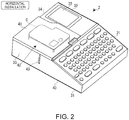
- a tape printing apparatus 2 in this embodiment can be used in a posture of "vertical installation” (a first posture) shown in Fig. 1 and a posture of "horizontal installation” shown in Fig. 2 .
- the "vertical installation” means a posture in which a bottom surface 31 of the tape printing apparatus 2 is perpendicular to a setting table (not shown in the figure) (substantially parallel to the earth's axis), that is, a posture in which a rear surface 34 is a setting surface.
- the "horizontal installation” means a posture in which the bottom surface 31 of the tape printing apparatus 2 is horizontal to the setting table, that is, a posture in which the bottom surface 31 is the setting surface.
- the tape printing apparatus 2 when the tape printing apparatus 2 is set in the posture of the "vertical installation", the tape printing apparatus 2 operates in an external communication mode (a first mode).
- the external communication mode is a mode for receiving printing data from a portable apparatus 1 (an external apparatus).
- the tape printing apparatus 2 when the tape printing apparatus 2 is set in the posture of the "horizontal installation", the tape printing apparatus 2 operates in a standalone mode (a second mode).
- the standalone mode is a mode for generating printing data on the basis of information input from a keyboard 21 of the tape printing apparatus 2.
- Fig. 1 shows a printing system SY including the portable terminal 1 and the tape printing apparatus 2.
- the portable terminal 1 is realized by an information processing apparatus such as anyone of various tablet terminals (a smartphone, etc.) a notebook personal computer.
- an example is shown in which a smartphone mounted with a touch panel 11 is used as the portable terminal 1.
- the portable terminal 1 communicates with the tape printing apparatus 2 according to wireless communication such as the Bluetooth (registered trademark).
- wireless communication such as the Bluetooth (registered trademark).
- a wired communication standard such as the USB communication or the Ethernet (registered trademark) may be used.
- the exterior of the tape printing apparatus 2 is formed by an apparatus case 40.
- the keyboard 21 including various input keys and buttons is disposed on the front upper surface of the apparatus case 40.
- An openable lid 41 is attached to a left part of the rear upper surface of the apparatus case 40.
- a display screen 22 is disposed on a right part of the rear upper surface.
- a cartridge loading section 42 for loading a tape cartridge C is recessed and formed on the inner side of the openable lid 41. The tape cartridge C is loaded in the cartridge loading section 42 in a state in which the openable lid 41 is opened.
- a printing head 27a of a thermal system, a tape feeding motor 27b functioning as a tape conveying mechanism, a cutter motor 27c that drives a tape cutter 27d explained below, and the like are incorporated in the cartridge loading section 42.
- the tape cartridge C houses a tape reel on which a printing tape, which is a long printing medium, is wound and a ribbon reel on which an ink ribbon is wound (none of the tape reel and the ribbon reel are shown in the figure).
- a tape discharge port 43 which causes the cartridge loading section 42 and the outside to communicate, is formed.
- the tape cutter 27d for cutting the printing tape reeled out from the tape cartridge C faces the tape discharge port 43.
- the printing tape is cut by the tape cutter 27d in a state in which the feeding of the printing tape is once stopped. A strip-like label is created.
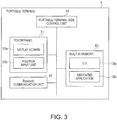
- Fig. 3 is a block diagram of the portable terminal 1.
- the portable terminal 1 includes, as hardware components, the touch panel 11, a Bluetooth communication unit 12, a built-in memory 13, and a portable-terminal-side control unit 14.
- the touch panel 11 includes a display screen 11a and a position input unit 11b.
- the display screen 11a is realized by a liquid crystal panel or the like.
- the display screen 11a displays various kinds of information such as an editing screen (not shown in the figure) for performing editing of a label.
- the position input unit 11b detects an operation position of a user according to a resistance film system or a capacitance system.
- the Bluetooth communication unit 12 performs wireless communication after performing pairing processing with the tape printing apparatus 2 to establish connection on the basis of the Bluetooth communication standard.
- the built-in memory 13 is realized by, for example, a flash ROM (registered trademark).
- the built-in memory 13 stores an OS (Operating System) 13a and a dedicated application 13b.
- the dedicated application 13b is a smartphone application for controlling the tape printing apparatus 2.
- the portable-terminal-side control unit 14 is realized by a CPU (Central Processing Unit), a RAM (Random Access Memory), and the like.
- the portable-terminal-side control unit 14 performs generation processing for printing data supplied to the tape printing apparatus 2 and communication control for communication with the tape printing apparatus 2 in cooperation with the units 11 to 13 explained above.
- Fig. 4 is a block diagram of the tape printing apparatus 2.
- the tape printing apparatus 2 includes, as hardware components, the keyboard 21, the display screen 22, a setting sensor 23, a tape detection sensor 24, a Bluetooth communication unit 25, a built-in memory 26, a printing mechanism 27, and a printing-apparatus-side control unit 28.
- the keyboard 21 is used to perform input of a text and selection of an image for generating printing data.
- the display screen 22 displays an input result (an editing result of a label) of the keyboard 21, a detection result of the tape detection sensor 24, and the like. Besides, the display screen 22 may display a set operation mode on the basis of a detection result of the setting sensor 23.
- the display screen 22 in this embodiment is realized by, for example, a liquid crystal screen.
- a backlight (a lighting mechanism) is provided on the display screen 22.
- the setting sensor 23 is realized by, for example, a gravitational acceleration sensor and detects an apparatus posture (a setting posture) of the tape printing apparatus 2.
- the tape detection sensor 24 detects tape information concerning the printing tape stored in the tape cartridge C.
- the tape detection sensor 24 detects, as the tape information, a tape width, a tape material, a tape color, and the like of the printing tape.
- a detection method a method of reading an image (a barcode, a two-dimensional code, etc.) or RFID (Radio Frequency Identification) stuck or printed on the tape cartridge C, a method of detecting presence or absence of one or more holes formed in the tape cartridge C, and the like are conceivable.
- detection timing time when the tape printing apparatus 2 is turned on, time when the tape cartridge C is loaded, time when it is determined that the apparatus posture changes, time when setting of the operation mode is changed, and the like are conceivable.
- the Bluetooth communication unit 25 performs communication with the portable terminal 1 on the basis of the Bluetooth communication standard.
- the built-in memory 26 is realized by, for example, a flash ROM (registered trademark).
- the built-in memory 26 stores firmware 26a of the tape printing apparatus 2.
- the printing mechanism 27 includes the printing head 27a, the tape feeding motor 27b, the cutter motor 27c, and the tape cutter 27d.
- the printing-apparatus-side control unit 28 is realized by a CPU, a RAM, and the like.
- the printing-apparatus-side control unit 28 performs communication control for communication with the portable terminal 1 and printing control in cooperation with the units 21 to 27.
- the printing-apparatus-side control unit 28 determines an apparatus posture on the basis of the detection result of the setting sensor 23 and sets the operation mode (the external communication mode or the standalone mode) according to the determined apparatus posture.
- the portable terminal 1 includes, as functional components, a receiving unit 51, a display unit 52, an input unit 53, a printing-data generating unit 54, and a transmitting unit 55.
- the receiving unit 51 receives tape information from the tape printing apparatus 2 in a state in which the receiving unit 51 is capable of communicating with the tape printing apparatus 2 (when the operation mode of the tape printing apparatus 2 is set in the external communication mode).
- the input unit 53 is used to input information for generating printing data.
- the display unit 52 displays the received tape information and an input result of the input unit 53.
- the printing-data generating unit 54 generates printing data on the basis of the tape information and the input result of the input unit 53.
- the printing data includes various commands such as a command for printing a text and an image and a command for cutting the printing tape.
- the transmitting unit 55 transmits the generated printing data to the tape printing apparatus 2 in a state in which the transmitting unit 55 is capable of communicating with the tape printing apparatus 2.
- the tape printing apparatus 2 includes, as functional components, a transmitting unit 61, a tape-information detecting unit 62 (a detecting unit), a posture determining unit 63, an operation-mode setting unit 64, a display control unit 65, a display unit 66, an input unit 67, a receiving unit 68, and a printing unit 69.
- the tape-information detecting unit 62 is equivalent to the tape detection sensor 24 and detects tape information of the printing tape stored in the tape cartridge C.
- the posture determining unit 63 determines an apparatus posture of the tape printing apparatus 2 on the basis of the detection result of the setting sensor 23 (a posture determining step). Specifically, the posture determining unit 63 determines whether the tape printing apparatus 2 is in the posture of the "vertical installation" (see Fig. 1 ) or a posture other than the "vertical installation”. When the posture determining unit 63 determines that the apparatus posture of the tape printing apparatus 2 is changed from the posture other than the "vertical installation" to the "vertical installation", the transmitting unit 61 transmits the tape information detected by the tape-information detecting unit 62 to the portable terminal 1.
- the operation-mode setting unit 64 sets the operation mode in the external communication mode (an operation mode setting step).
- the external communication mode is a mode for receiving printing data from the portable terminal 1 and disabling an information input from the input unit 67 (the keyboard 21).
- the tape printing apparatus 2 is capable of receiving various setting data such as file data from the portable terminal 1.
- the tape printing apparatus 2 stores the file data in a predetermined storage region in the built-in memory 26.
- the tape printing apparatus 2 reads out the file data designated by the printing command from the predetermined storage region and prints the file data.
- the "vertical installation” is a posture in which the setting area of the tape printing apparatus 2 is as small as possible and is a posture in which the tape printing apparatus 2 is self-sustainable (see Fig. 1 ).
- the operation-mode setting unit 64 sets the operation mode in the standalone mode.
- the standalone mode is a mode for generating printing data on the basis of information input from the input unit 67 without receiving printing data from the portable terminal 1. That is, the standalone mode is an operation mode for using the tape printing apparatus 2 alone. Note that, in this embodiment, as shown in Fig. 2 , the operation mode is set in the standalone mode not only when the apparatus posture of the tape printing apparatus 2 is the "horizontal installation" but also when the apparatus posture is a posture in which a right side surface 32 of the tape printing apparatus 2 faces down.
- the display unit 66 is equivalent to the display screen 22 and displays various kinds of information such as an editing result of a label during the standalone setting.
- the posture determining unit 63 determines that the apparatus posture of the tape printing apparatus 2 is changed from the posture other than the "vertical installation” to the “vertical installation”
- the display control unit 65 hides the display of the display unit 66 and extinguishes the light (the backlight) of the display unit 66.
- a part of a display form of the display unit 66 only has to be changed to, for example, hide only a part of information displayed on the display unit 66 or reduce the illuminance of the backlight.
- the input unit 67 is equivalent to the keyboard 21 and is used to input various kinds of information for generating printing data.
- the receiving unit 68 receives printing data from the portable terminal 1 during the external communication mode setting.
- the printing unit 69 prints printing data generated on the basis of the information input from the input unit 67.
- the printing unit 69 prints the printing data received from the portable terminal 1.
- the posture determining unit 63 determines that the apparatus posture is an apparatus posture in which the tape discharge port 43 (a discharge port) faces down
- the printing unit 69 prohibits printing execution. By prohibiting the printing execution in the case of the posture in which a left side surface 33 (see Fig. 2 ) of the tape printing apparatus 2 faces down in this way, it is possible to prevent a situation in which the printing tape is not discharged from the tape discharge port 43 and paper jam is caused.
- a flow of operation mode setting processing of the tape printing apparatus 2 is explained with reference to a flowchart of Fig. 6 . Note that the flowchart shown in the figure is periodically repeated after the power-on of the tape printing apparatus 2.
- the tape printing apparatus 2 determines whether the apparatus posture is the "vertical installation" (S01). When determining that the apparatus posture is the "vertical installation" (Yes in S01), the tape printing apparatus 2 broadcasts identification information of the tape printing apparatus 2 (S02) and establishes connection to the portable terminal 1 having identification information coinciding with the identification information of the tape printing apparatus 2 (S03). S02 and S03 are equivalent to "connection establishment processing" in the appended claims.
- the tape printing apparatus 2 disables key detection of the keyboard 21 (S04).
- the tape printing apparatus 2 hides the display of the display screen 22 and extinguishes the backlight (S05).
- the tape printing apparatus 2 disables an auto power-off function (a function of automatically turning off the power supply when a key input of the keyboard 21 is not detected for a predetermined time) (S06).
- the tape printing apparatus 2 transmits tape information detected by the tape detection sensor 24 to the portable terminal 1 (S07) and thereafter sets the operation mode in the external communication mode (S08).
- the tape printing apparatus 2 sets the operation mode in the standalone mode (S09).
- the tape printing apparatus 2 in this embodiment determines the apparatus posture of the tape printing apparatus 2 and sets the operation mode according to the determined apparatus posture. Therefore, when the user desires to change the operation mode, the user only has to change the apparatus posture of the tape printing apparatus 2. Operation of a button exclusive for operation mode switching or the like can be omitted. Since the operation mode is set in the external communication mode when the apparatus posture is the "vertical installation", it is possible to reduce the setting area and effectively use a work space on a desk.
- the tape printing apparatus 2 in this embodiment always determines the apparatus posture in the power-on state. Therefore, the user can easily switch the operation mode without being required to perform operation of a power button and operation for determining the apparatus posture.
- the determination of the apparatus posture is simple determination concerning whether the apparatus posture is the "vertical installation". Therefore, it is possible to prevent erroneous determination as much as possible.
- the tape printing apparatus 2 does not change to a power-off state against an intention of the user. Further, the printing execution is prohibited when it is determined that the apparatus posture is the apparatus posture in which the tape discharge port 43 faces down. Therefore, it is possible to prevent a deficiency due to discharge failure of the printing tape.
- the posture determining unit 63 in the embodiment explained above always determines the apparatus posture in the power-on state.
- the posture determining unit 63 may be configured to determine the apparatus posture only during the power-on and not determine the apparatus posture after the power-on. With this configuration, it is possible to prevent a malfunction in which the operation mode is switched against an intention of the user according to a change of the apparatus posture due to some cause.
- the operation mode setting processing shown in Fig. 6 may be executed only when the apparatus posture changes. After the apparatus posture changes, the operation mode setting processing may be executed on condition that the same posture continues for a predetermined time.
- the printing unit 69 prohibits the printing execution in the case of the apparatus posture in which the tape discharge port 43 faces down.
- the input itself of the input unit 67 may be prohibited.
- the posture determining unit 63 in the embodiment explained above determines whether the apparatus posture is the "vertical installation". However, the posture determining unit 63 may determine whether the apparatus posture is the "vertical installation” or the "horizontal installation". In this case, when the posture determining unit 63 determines that the apparatus posture is the "vertical installation", the operation-mode setting unit 64 sets the operation mode in the external communication mode. When the posture determining unit 63 determines that the apparatus posture is the "horizontal installation”, the operation-mode setting unit 64 sets the operation mode in the standalone mode. When the posture determining unit 63 determines that the apparatus posture is a posture other than the "vertical installation” and the "horizontal installation", the operation-mode setting unit 64 does not have to set the operation mode. That is, in the case of the posture other than the "vertical installation” and the "horizontal installation", the operation-mode setting unit 64 may set the operation mode in a third mode for disabling an information input from the input unit 67 without receiving printing data from the portable terminal 1.
- the operation-mode setting unit 64 may be configured to set the operation mode in the external communication mode when the tape printing apparatus 2 is in the "vertical installation", set the operation mode in the third mode in the case of the posture in which the tape discharge port 43 of the tape printing apparatus 2 faces down, and set the operation mode in the standalone mode in the case of a posture other than the these postures.
- the operation-mode setting unit 64 may be configured to set the operation mode in the standalone mode when the tape printing apparatus 2 is in the "horizontal installation", set the operation mode in the third mode in the case of the posture in which the tape discharge port 43 of the tape printing apparatus 2 faces down, and set the operation mode in the external communication mode in the case of a posture other than the these postures.
- the display control unit 65 When the apparatus posture is changed from the posture other than the "vertical installation” to the “vertical installation", the display control unit 65 in the embodiment explained above hides the display of the display unit 66 (the liquid crystal screen) and extinguishes the light (the backlight) of the display unit 66.
- the display control unit 65 may perform the control on an LED or a button with an illumination function mounted on the tape printing apparatus 2.
- an illumination function is mounted on the input unit 67 (the keyboard 21)
- the display control unit 65 may extinguish the illumination according to the change of the apparatus posture to the "vertical installation".
- the components in the printing system SY may be provided as a computer program.
- the computer program may be stored in various recording media (a CD-ROM, a flash memory, etc.) and provided. That is, a computer program for causing a computer to function as the components of the printing system SY and a recording medium having the computer program recorded therein are also included in the scope of the right of the invention.
- the example is explained in which the printing apparatus according to the invention is applied to the tape printing apparatus.
- the invention is also applicable to a printing apparatus (including a printing apparatus not including a cutting function) other than the tape printing apparatus.
- changes are possible as appropriate without departing from the scope of protection as defined by the claims, for example, realize the portable terminal 1 with another information processing apparatus.
Landscapes
- Engineering & Computer Science (AREA)
- Theoretical Computer Science (AREA)
- General Engineering & Computer Science (AREA)
- Physics & Mathematics (AREA)
- General Physics & Mathematics (AREA)
- Human Computer Interaction (AREA)
- Computer Networks & Wireless Communication (AREA)
- Printers Characterized By Their Purpose (AREA)
- Accessory Devices And Overall Control Thereof (AREA)
- Facsimiles In General (AREA)
Abstract
Description
- The present invention relates to a printing apparatus capable of switching an operation mode and a control method for the printing apparatus.
- A tape printing apparatus described in "TEPRA" PRO SR550 user's manual, (Non Patent Literature 1) has been known as a technique of this type. Non Patent Literature 1 discloses a technique for switching, with pressing of a dedicated button, an external communication mode (a personal computer link mode) for creating a label on the basis of printing data transmitted from a personal computer and a standalone mode for creating a label on the basis of an input to a keyboard mounted on the tape printing apparatus.
- On the other hand, among tape printing apparatuses capable of communicating with a personal computer via a dedicated cable, there is a model that detects cable connection and switches the standalone mode to the external communication mode.
- In recent years, a tape printing apparatus capable of receiving printing data from a smartphone, a personal computer adapted to wireless communication, and the like via the wireless communication has been widely used. When the tape printing apparatus is connected to a host apparatus via the wireless communication in this way, a method of detecting cable connection and switching an operation mode cannot be adopted. Therefore, it is conceivable to adopt a method of detecting pressing of a dedicated button and switching the operation mode. However, when the tape printing apparatus is used in the external communication mode, the tape printing apparatus is often used in "vertical installation (see
Fig. 1 )" in order to reduce a setting area as much as possible. In this state, there is a problem in that it is difficult to operate buttons. A user has a demand for saving labor and time for button operation for switching the operation mode. - An advantage of some aspects of the invention is to provide a printing apparatus capable of easily performing switching of an operation mode and a control method for the printing apparatus.
- A printing apparatus according to an aspect of the invention includes: an input unit for inputting information; a posture determining unit configured to determine an apparatus posture; and an operation-mode setting unit configured to set an operation mode in one of a first mode for receiving printing data from an external apparatus and a second mode for generating printing data on the basis of the information input from the input unit without receiving the printing data from the external apparatus. The operation-mode setting unit sets the operation mode according to the apparatus posture determined by the posture determining unit.
- A control method for a printing apparatus according to an aspect of the invention is a control method for a printing apparatus including an input unit for inputting information, the control method for the printing apparatus including: determining an apparatus posture; and setting an operation mode in one of a first mode for receiving printing data from an external apparatus and a second mode for generating printing data on the basis of the information input from the input unit without receiving the printing data from the external apparatus. In setting the operation mode, the operation mode is set according to the determined apparatus posture.
- With the configuration according to this aspect of the invention, because the operation mode is set according to the apparatus posture, it is possible to easily switch the operation mode simply by changing the apparatus posture. When the first mode (an external communication mode) is used, the printing apparatus is often set in a specific posture in which a setting area of the printing apparatus is small. Therefore, when it is determined that the printing apparatus is in the posture, by setting the operation mode in the first mode, it is possible to switch the operation mode to an appropriate operation mode without causing a user to be aware of the switching of the operation mode.
- In the printing apparatus, the first mode may be a mode for disabling the information input from the input unit.
- With the configuration according to this aspect of the invention, it is possible to prevent wrong operation of the input unit during the first mode setting.
- In the printing apparatus, the posture determining unit may always determine the apparatus posture in a power-on state of the printing apparatus.
- With the configuration according to this aspect of the invention, it is possible to switch the operation mode simply by changing the apparatus posture (without requiring operation of a power supply button).
- In the printing apparatus, the posture determining unit may determine the apparatus posture during power-on of the printing apparatus and not determine the apparatus posture after the power-on.
- With the configuration according to this aspect of the invention, it is possible to prevent a deficiency in which the operation mode is switched against an intention of the user according to a change of the apparatus posture during normal use.
- In the printing apparatus, the posture determining unit may determine whether the apparatus posture is a predetermined first posture. The operation-mode setting unit sets the operation mode in the first mode when the posture determining unit determines that the apparatus posture is the first posture and sets the operation mode in the second mode when the posture determining unit determines that the apparatus posture is a posture other than the first posture.
- With the configuration according to this aspect of the invention, it is possible to switch the operation mode according to simple determination for determining whether the apparatus posture is the first posture.
- The printing apparatus may further include: a display unit; and a display control unit configured to hide display of the display unit and/or extinguish a light of the display unit when the apparatus posture changes from the posture other than the first posture to the first posture.
- With the configuration according to this aspect of the invention, since the display unit is unnecessary during the first mode, it is possible to prevent unnecessary power consumption by hiding the display and/or extinguishing the light.
- The printing apparatus may further include: a detecting unit configured to detect information of a printing medium; and a transmitting unit configured to transmit a detection result of the detecting unit to the external apparatus when the apparatus posture changes from the posture other than the first posture to the first posture.
- With the configuration according to this aspect of the invention, during the first mode switching, since the detection result of the detecting unit necessary during the first mode is automatically transmitted, it is possible to save labor and time of the user for setting the information of the printing medium.
- The printing apparatus may further include a connection-establishment processing unit configured to spontaneously perform connection establishment processing for establishing connection to the external apparatus when the apparatus posture changes from the posture other than the first posture to the first posture.
- With the configuration according to this aspect of the invention, since the connection establishment processing for establishing connection to the external apparatus is performed during the first mode switching, it is possible to save labor and time of the user for performing the connection establishment processing.
- The printing apparatus may further include: a printing unit configured to perform printing on the basis of printing data; and a discharge port for discharging a printed printing medium. The printing unit may prohibit printing execution when the posture determining unit determines that the apparatus posture is an apparatus posture in which the discharge port faces down.
- With the configuration according to this aspect of the invention, since the printing execution is prohibited when it is determined that the apparatus posture is an apparatus posture in which the discharge port faces down, it is possible to prevent a deficiency due to a discharge failure of the printing medium.
- The invention will be described with reference to the accompanying drawings, wherein like numbers reference like elements.
-
Fig. 1 is an external perspective view of a portable terminal and a tape printing apparatus in a vertical installation state. -
Fig. 2 is an external perspective view of the tape printing apparatus in a horizontal installation state. -
Fig. 3 is a block diagram showing a hardware configuration of the portable terminal. -
Fig. 4 is a block diagram showing a hardware configuration of the tape printing apparatus. -
Fig. 5 is a block diagram showing a functional configuration of a printing system. -
Fig. 6 is a flowchart for explaining a flow of operation mode setting processing of the tape printing apparatus. - A printing apparatus and a control method for the printing apparatus according to the invention are explained with reference to the accompanying drawings. In an embodiment of the invention, an example is explained in which the printing apparatus according to the invention is applied to a tape printing apparatus.
- A
tape printing apparatus 2 in this embodiment can be used in a posture of "vertical installation" (a first posture) shown inFig. 1 and a posture of "horizontal installation" shown inFig. 2 . The "vertical installation" means a posture in which abottom surface 31 of thetape printing apparatus 2 is perpendicular to a setting table (not shown in the figure) (substantially parallel to the earth's axis), that is, a posture in which arear surface 34 is a setting surface. The "horizontal installation" means a posture in which thebottom surface 31 of thetape printing apparatus 2 is horizontal to the setting table, that is, a posture in which thebottom surface 31 is the setting surface. - As explained in detail below, when the
tape printing apparatus 2 is set in the posture of the "vertical installation", thetape printing apparatus 2 operates in an external communication mode (a first mode). The external communication mode is a mode for receiving printing data from a portable apparatus 1 (an external apparatus). On the other hand, when thetape printing apparatus 2 is set in the posture of the "horizontal installation", thetape printing apparatus 2 operates in a standalone mode (a second mode). The standalone mode is a mode for generating printing data on the basis of information input from akeyboard 21 of thetape printing apparatus 2. -
Fig. 1 shows a printing system SY including the portable terminal 1 and thetape printing apparatus 2. The portable terminal 1 is realized by an information processing apparatus such as anyone of various tablet terminals (a smartphone, etc.) a notebook personal computer. In the figure, an example is shown in which a smartphone mounted with atouch panel 11 is used as the portable terminal 1. The portable terminal 1 communicates with thetape printing apparatus 2 according to wireless communication such as the Bluetooth (registered trademark). Note that, for the communication between the portable terminal 1 and thetape printing apparatus 2, a wired communication standard such as the USB communication or the Ethernet (registered trademark) may be used. - On the other hand, as shown in
Figs. 1 and2 , the exterior of thetape printing apparatus 2 is formed by anapparatus case 40. Thekeyboard 21 including various input keys and buttons is disposed on the front upper surface of theapparatus case 40. Anopenable lid 41 is attached to a left part of the rear upper surface of theapparatus case 40. Adisplay screen 22 is disposed on a right part of the rear upper surface. Acartridge loading section 42 for loading a tape cartridge C is recessed and formed on the inner side of theopenable lid 41. The tape cartridge C is loaded in thecartridge loading section 42 in a state in which theopenable lid 41 is opened. Aprinting head 27a of a thermal system, atape feeding motor 27b functioning as a tape conveying mechanism, acutter motor 27c that drives atape cutter 27d explained below, and the like are incorporated in thecartridge loading section 42. Note that the tape cartridge C houses a tape reel on which a printing tape, which is a long printing medium, is wound and a ribbon reel on which an ink ribbon is wound (none of the tape reel and the ribbon reel are shown in the figure). - In the left side part of the
apparatus case 40, atape discharge port 43, which causes thecartridge loading section 42 and the outside to communicate, is formed. Thetape cutter 27d for cutting the printing tape reeled out from the tape cartridge C faces thetape discharge port 43. When the printed printing tape is fed out from thetape discharge port 43, the printing tape is cut by thetape cutter 27d in a state in which the feeding of the printing tape is once stopped. A strip-like label is created. - Hardware configurations of the portable terminal 1 and the
tape printing apparatus 2 are explained with reference toFigs. 3 and4 .Fig. 3 is a block diagram of the portable terminal 1. The portable terminal 1 includes, as hardware components, thetouch panel 11, aBluetooth communication unit 12, a built-inmemory 13, and a portable-terminal-side control unit 14. - The
touch panel 11 includes adisplay screen 11a and aposition input unit 11b. Thedisplay screen 11a is realized by a liquid crystal panel or the like. Thedisplay screen 11a displays various kinds of information such as an editing screen (not shown in the figure) for performing editing of a label. On the other hand, theposition input unit 11b detects an operation position of a user according to a resistance film system or a capacitance system. TheBluetooth communication unit 12 performs wireless communication after performing pairing processing with thetape printing apparatus 2 to establish connection on the basis of the Bluetooth communication standard. - The built-in
memory 13 is realized by, for example, a flash ROM (registered trademark). The built-inmemory 13 stores an OS (Operating System) 13a and adedicated application 13b. Thededicated application 13b is a smartphone application for controlling thetape printing apparatus 2. - The portable-terminal-
side control unit 14 is realized by a CPU (Central Processing Unit), a RAM (Random Access Memory), and the like. The portable-terminal-side control unit 14 performs generation processing for printing data supplied to thetape printing apparatus 2 and communication control for communication with thetape printing apparatus 2 in cooperation with theunits 11 to 13 explained above. -
Fig. 4 is a block diagram of thetape printing apparatus 2. Thetape printing apparatus 2 includes, as hardware components, thekeyboard 21, thedisplay screen 22, a settingsensor 23, atape detection sensor 24, aBluetooth communication unit 25, a built-inmemory 26, aprinting mechanism 27, and a printing-apparatus-side control unit 28. - The
keyboard 21 is used to perform input of a text and selection of an image for generating printing data. Thedisplay screen 22 displays an input result (an editing result of a label) of thekeyboard 21, a detection result of thetape detection sensor 24, and the like. Besides, thedisplay screen 22 may display a set operation mode on the basis of a detection result of the settingsensor 23. Thedisplay screen 22 in this embodiment is realized by, for example, a liquid crystal screen. A backlight (a lighting mechanism) is provided on thedisplay screen 22. The settingsensor 23 is realized by, for example, a gravitational acceleration sensor and detects an apparatus posture (a setting posture) of thetape printing apparatus 2. - The
tape detection sensor 24 detects tape information concerning the printing tape stored in the tape cartridge C. Thetape detection sensor 24 detects, as the tape information, a tape width, a tape material, a tape color, and the like of the printing tape. Note that, as a detection method, a method of reading an image (a barcode, a two-dimensional code, etc.) or RFID (Radio Frequency Identification) stuck or printed on the tape cartridge C, a method of detecting presence or absence of one or more holes formed in the tape cartridge C, and the like are conceivable. As detection timing, time when thetape printing apparatus 2 is turned on, time when the tape cartridge C is loaded, time when it is determined that the apparatus posture changes, time when setting of the operation mode is changed, and the like are conceivable. TheBluetooth communication unit 25 performs communication with the portable terminal 1 on the basis of the Bluetooth communication standard. - The built-in
memory 26 is realized by, for example, a flash ROM (registered trademark). The built-inmemory 26stores firmware 26a of thetape printing apparatus 2. Theprinting mechanism 27 includes theprinting head 27a, thetape feeding motor 27b, thecutter motor 27c, and thetape cutter 27d. The printing-apparatus-side control unit 28 is realized by a CPU, a RAM, and the like. The printing-apparatus-side control unit 28 performs communication control for communication with the portable terminal 1 and printing control in cooperation with theunits 21 to 27. The printing-apparatus-side control unit 28 determines an apparatus posture on the basis of the detection result of the settingsensor 23 and sets the operation mode (the external communication mode or the standalone mode) according to the determined apparatus posture. - A functional configuration of the printing system SY is explained with reference to
Fig. 5 . The portable terminal 1 includes, as functional components, a receivingunit 51, adisplay unit 52, aninput unit 53, a printing-data generating unit 54, and a transmittingunit 55. - The receiving
unit 51 receives tape information from thetape printing apparatus 2 in a state in which the receivingunit 51 is capable of communicating with the tape printing apparatus 2 (when the operation mode of thetape printing apparatus 2 is set in the external communication mode). Theinput unit 53 is used to input information for generating printing data. Thedisplay unit 52 displays the received tape information and an input result of theinput unit 53. The printing-data generating unit 54 generates printing data on the basis of the tape information and the input result of theinput unit 53. The printing data includes various commands such as a command for printing a text and an image and a command for cutting the printing tape. The transmittingunit 55 transmits the generated printing data to thetape printing apparatus 2 in a state in which the transmittingunit 55 is capable of communicating with thetape printing apparatus 2. - On the other hand, the
tape printing apparatus 2 includes, as functional components, a transmittingunit 61, a tape-information detecting unit 62 (a detecting unit), aposture determining unit 63, an operation-mode setting unit 64, adisplay control unit 65, adisplay unit 66, aninput unit 67, a receivingunit 68, and aprinting unit 69. - The tape-
information detecting unit 62 is equivalent to thetape detection sensor 24 and detects tape information of the printing tape stored in the tape cartridge C. Theposture determining unit 63 determines an apparatus posture of thetape printing apparatus 2 on the basis of the detection result of the setting sensor 23 (a posture determining step). Specifically, theposture determining unit 63 determines whether thetape printing apparatus 2 is in the posture of the "vertical installation" (seeFig. 1 ) or a posture other than the "vertical installation". When theposture determining unit 63 determines that the apparatus posture of thetape printing apparatus 2 is changed from the posture other than the "vertical installation" to the "vertical installation", the transmittingunit 61 transmits the tape information detected by the tape-information detecting unit 62 to the portable terminal 1. - When the
posture determining unit 63 determines that the apparatus posture of thetape printing apparatus 2 is the "vertical installation", the operation-mode setting unit 64 sets the operation mode in the external communication mode (an operation mode setting step). The external communication mode is a mode for receiving printing data from the portable terminal 1 and disabling an information input from the input unit 67 (the keyboard 21). In the external communication mode, thetape printing apparatus 2 is capable of receiving various setting data such as file data from the portable terminal 1. When receiving the file data, thetape printing apparatus 2 stores the file data in a predetermined storage region in the built-inmemory 26. Thereafter, when receiving a printing command for the file data from the portable terminal 1 during the external communication mode, thetape printing apparatus 2 reads out the file data designated by the printing command from the predetermined storage region and prints the file data. Note that the "vertical installation" is a posture in which the setting area of thetape printing apparatus 2 is as small as possible and is a posture in which thetape printing apparatus 2 is self-sustainable (seeFig. 1 ). - On the other hand, when the
posture determining unit 63 determines that the apparatus posture of thetape printing apparatus 2 is the posture other than the "vertical installation", the operation-mode setting unit 64 sets the operation mode in the standalone mode. The standalone mode is a mode for generating printing data on the basis of information input from theinput unit 67 without receiving printing data from the portable terminal 1. That is, the standalone mode is an operation mode for using thetape printing apparatus 2 alone. Note that, in this embodiment, as shown inFig. 2 , the operation mode is set in the standalone mode not only when the apparatus posture of thetape printing apparatus 2 is the "horizontal installation" but also when the apparatus posture is a posture in which aright side surface 32 of thetape printing apparatus 2 faces down. - The
display unit 66 is equivalent to thedisplay screen 22 and displays various kinds of information such as an editing result of a label during the standalone setting. When theposture determining unit 63 determines that the apparatus posture of thetape printing apparatus 2 is changed from the posture other than the "vertical installation" to the "vertical installation", thedisplay control unit 65 hides the display of thedisplay unit 66 and extinguishes the light (the backlight) of thedisplay unit 66. Note that, when the apparatus posture is changed from the posture other than the "vertical installation" to the "vertical installation", a part of a display form of thedisplay unit 66 only has to be changed to, for example, hide only a part of information displayed on thedisplay unit 66 or reduce the illuminance of the backlight. - The
input unit 67 is equivalent to thekeyboard 21 and is used to input various kinds of information for generating printing data. The receivingunit 68 receives printing data from the portable terminal 1 during the external communication mode setting. During the standalone mode setting, theprinting unit 69 prints printing data generated on the basis of the information input from theinput unit 67. During the external communication mode setting, theprinting unit 69 prints the printing data received from the portable terminal 1. When theposture determining unit 63 determines that the apparatus posture is an apparatus posture in which the tape discharge port 43 (a discharge port) faces down, theprinting unit 69 prohibits printing execution. By prohibiting the printing execution in the case of the posture in which a left side surface 33 (seeFig. 2 ) of thetape printing apparatus 2 faces down in this way, it is possible to prevent a situation in which the printing tape is not discharged from thetape discharge port 43 and paper jam is caused. - A flow of operation mode setting processing of the
tape printing apparatus 2 is explained with reference to a flowchart ofFig. 6 . Note that the flowchart shown in the figure is periodically repeated after the power-on of thetape printing apparatus 2. Thetape printing apparatus 2 determines whether the apparatus posture is the "vertical installation" (S01). When determining that the apparatus posture is the "vertical installation" (Yes in S01), thetape printing apparatus 2 broadcasts identification information of the tape printing apparatus 2 (S02) and establishes connection to the portable terminal 1 having identification information coinciding with the identification information of the tape printing apparatus 2 (S03). S02 and S03 are equivalent to "connection establishment processing" in the appended claims. - When the connection is established, first, the
tape printing apparatus 2 disables key detection of the keyboard 21 (S04). Thetape printing apparatus 2 hides the display of thedisplay screen 22 and extinguishes the backlight (S05). Thetape printing apparatus 2 disables an auto power-off function (a function of automatically turning off the power supply when a key input of thekeyboard 21 is not detected for a predetermined time) (S06). Further, thetape printing apparatus 2 transmits tape information detected by thetape detection sensor 24 to the portable terminal 1 (S07) and thereafter sets the operation mode in the external communication mode (S08). On the other hand, when determining in S01 that the apparatus posture is the posture other than the "vertical installation" (No in S01), thetape printing apparatus 2 sets the operation mode in the standalone mode (S09). - As explained above, the
tape printing apparatus 2 in this embodiment determines the apparatus posture of thetape printing apparatus 2 and sets the operation mode according to the determined apparatus posture. Therefore, when the user desires to change the operation mode, the user only has to change the apparatus posture of thetape printing apparatus 2. Operation of a button exclusive for operation mode switching or the like can be omitted. Since the operation mode is set in the external communication mode when the apparatus posture is the "vertical installation", it is possible to reduce the setting area and effectively use a work space on a desk. - The
tape printing apparatus 2 in this embodiment always determines the apparatus posture in the power-on state. Therefore, the user can easily switch the operation mode without being required to perform operation of a power button and operation for determining the apparatus posture. The determination of the apparatus posture is simple determination concerning whether the apparatus posture is the "vertical installation". Therefore, it is possible to prevent erroneous determination as much as possible. - When the apparatus posture changes from the posture other than the "vertical installation" to the "vertical installation", the display of the
display screen 22 is hidden and the backlight is extinguished. Therefore, it is possible to prevent useless power consumption during the external communication mode. Similarly, when the apparatus posture changes to the "vertical installation", the connection establishment processing is spontaneously performed or a detection result of thetape detection sensor 24 necessary during the external communication mode is transmitted to the portable terminal 1. Therefore, it is possible to save labor and time of the user for performing those kinds of operation after the switching to the external communication mode. The key detection of thekeyboard 21 is disabled according to the posture change to the "vertical installation". Therefore, it is possible to prevent wrong operation of thekeyboard 21 during the external communication mode. The auto power-off is disabled according to the posture change to the "vertical installation". Therefore, thetape printing apparatus 2 does not change to a power-off state against an intention of the user. Further, the printing execution is prohibited when it is determined that the apparatus posture is the apparatus posture in which thetape discharge port 43 faces down. Therefore, it is possible to prevent a deficiency due to discharge failure of the printing tape. - Note that modifications explained below are adoptable irrespective of the embodiment explained above.
- The
posture determining unit 63 in the embodiment explained above always determines the apparatus posture in the power-on state. However, theposture determining unit 63 may be configured to determine the apparatus posture only during the power-on and not determine the apparatus posture after the power-on. With this configuration, it is possible to prevent a malfunction in which the operation mode is switched against an intention of the user according to a change of the apparatus posture due to some cause. - As still another modification, the operation mode setting processing shown in
Fig. 6 may be executed only when the apparatus posture changes. After the apparatus posture changes, the operation mode setting processing may be executed on condition that the same posture continues for a predetermined time. - In the embodiment explained above, the
printing unit 69 prohibits the printing execution in the case of the apparatus posture in which thetape discharge port 43 faces down. However, the input itself of theinput unit 67 may be prohibited. - The
posture determining unit 63 in the embodiment explained above determines whether the apparatus posture is the "vertical installation". However, theposture determining unit 63 may determine whether the apparatus posture is the "vertical installation" or the "horizontal installation". In this case, when theposture determining unit 63 determines that the apparatus posture is the "vertical installation", the operation-mode setting unit 64 sets the operation mode in the external communication mode. When theposture determining unit 63 determines that the apparatus posture is the "horizontal installation", the operation-mode setting unit 64 sets the operation mode in the standalone mode. When theposture determining unit 63 determines that the apparatus posture is a posture other than the "vertical installation" and the "horizontal installation", the operation-mode setting unit 64 does not have to set the operation mode. That is, in the case of the posture other than the "vertical installation" and the "horizontal installation", the operation-mode setting unit 64 may set the operation mode in a third mode for disabling an information input from theinput unit 67 without receiving printing data from the portable terminal 1. - As still another modification, the operation-
mode setting unit 64 may be configured to set the operation mode in the external communication mode when thetape printing apparatus 2 is in the "vertical installation", set the operation mode in the third mode in the case of the posture in which thetape discharge port 43 of thetape printing apparatus 2 faces down, and set the operation mode in the standalone mode in the case of a posture other than the these postures. - As still another modification, the operation-
mode setting unit 64 may be configured to set the operation mode in the standalone mode when thetape printing apparatus 2 is in the "horizontal installation", set the operation mode in the third mode in the case of the posture in which thetape discharge port 43 of thetape printing apparatus 2 faces down, and set the operation mode in the external communication mode in the case of a posture other than the these postures. - When the apparatus posture is changed from the posture other than the "vertical installation" to the "vertical installation", the
display control unit 65 in the embodiment explained above hides the display of the display unit 66 (the liquid crystal screen) and extinguishes the light (the backlight) of thedisplay unit 66. However, thedisplay control unit 65 may perform the control on an LED or a button with an illumination function mounted on thetape printing apparatus 2. When an illumination function is mounted on the input unit 67 (the keyboard 21), thedisplay control unit 65 may extinguish the illumination according to the change of the apparatus posture to the "vertical installation". - The components in the printing system SY (the portable terminal 1 and the tape printing apparatus 2) explained in the embodiments and the modifications may be provided as a computer program. The computer program may be stored in various recording media (a CD-ROM, a flash memory, etc.) and provided. That is, a computer program for causing a computer to function as the components of the printing system SY and a recording medium having the computer program recorded therein are also included in the scope of the right of the invention. In the embodiment, the example is explained in which the printing apparatus according to the invention is applied to the tape printing apparatus. However, the invention is also applicable to a printing apparatus (including a printing apparatus not including a cutting function) other than the tape printing apparatus. Besides, changes are possible as appropriate without departing from the scope of protection as defined by the claims, for example, realize the portable terminal 1 with another information processing apparatus.
Claims (10)
- A printing apparatus (2) comprising:an input unit (67) for inputting information;a posture determining unit (63) configured to determine an apparatus posture; andan operation-mode setting unit (64) configured to set an operation mode in one of a first mode for receiving printing data from an external apparatus and a second mode for generating printing data on the basis of the information input from the input unit (67) without receiving the printing data from the external apparatus, whereinthe operation-mode setting unit (64) sets the operation mode according to the apparatus posture determined by the posture determining unit (63).
- The printing apparatus (2) according to claim 1, wherein the first mode is a mode for disabling the information input from the input unit (67).
- The printing apparatus (2) according to claim 1 or 2, wherein the posture determining unit always determines the apparatus posture in a power-on state of the printing apparatus (2).
- The printing apparatus (2) according to one of claims 1-3, wherein the posture determining unit (63) determines the apparatus posture during power-on of the printing apparatus (2) and does not determine the apparatus posture after the power-on.
- The printing apparatus (2) according to one of claims 1-4, wherein
the posture determining unit (63) determines whether the apparatus posture is a predetermined first posture, and
the operation-mode setting unit sets the operation mode in the first mode when the posture determining unit (63) determines that the apparatus posture is the first posture and sets the operation mode in the second mode when the posture determining unit (63) determines that the apparatus posture is a posture other than the first posture. - The printing apparatus (2) according to one of claims 1-5, further comprising:a display unit (66); anda display control unit (65) configured to hide display of the display unit and/or extinguish a light of the display unit when the apparatus posture changes from the posture other than the first posture to the first posture.
- The printing apparatus (2) according to one of claims 1-6, further comprising:a detecting unit (62) configured to detect information of a printing medium; anda transmitting unit (61) configured to transmit a detection result of the detecting unit (62) to the external apparatus when the apparatus posture changes from the posture other than the first posture to the first posture.
- The printing apparatus (2) according to one of claims 1-7, further comprising a connection-establishment processing unit configured to spontaneously perform connection establishment processing for establishing connection to the external apparatus when the apparatus posture changes from the posture other than the first posture to the first posture.
- The printing apparatus (2) according to one of claims 1-8, further comprising:a printing unit configured to perform printing on the basis of printing data; anda discharge port for discharging a printed printing medium, whereinthe printing unit prohibits printing execution when the posture determining unit determines that the apparatus posture is an apparatus posture in which the discharge port faces down.
- A control method for a printing apparatus (2) including an input unit (67) for inputting information, the control method for the printing apparatus (2) comprising:determining an apparatus posture; andsetting an operation mode in one of a first mode for receiving printing data from an external apparatus and a second mode for generating printing data on the basis of the information input from the input unit (67) without receiving the printing data from the external apparatus, whereinin the setting the operation mode, the operation mode is set according to the determined apparatus posture.
Applications Claiming Priority (1)
| Application Number | Priority Date | Filing Date | Title |
|---|---|---|---|
| JP2016029377A JP6672869B2 (en) | 2016-02-18 | 2016-02-18 | PRINTING APPARATUS AND CONTROL METHOD OF PRINTING APPARATUS |
Publications (1)
| Publication Number | Publication Date |
|---|---|
| EP3208706A1 true EP3208706A1 (en) | 2017-08-23 |
Family
ID=58098458
Family Applications (1)
| Application Number | Title | Priority Date | Filing Date |
|---|---|---|---|
| EP17156282.0A Withdrawn EP3208706A1 (en) | 2016-02-18 | 2017-02-15 | Printing apparatus and control method for printing apparatus |
Country Status (4)
| Country | Link |
|---|---|
| US (1) | US10185905B2 (en) |
| EP (1) | EP3208706A1 (en) |
| JP (1) | JP6672869B2 (en) |
| CN (1) | CN107089063B (en) |
Families Citing this family (4)
| Publication number | Priority date | Publication date | Assignee | Title |
|---|---|---|---|---|
| JP6823832B2 (en) * | 2018-01-09 | 2021-02-03 | ブラザー工業株式会社 | Communication processing program of label making device and label making device |
| JP7149215B2 (en) * | 2019-03-27 | 2022-10-06 | 富士フイルム株式会社 | Printing systems, printers and terminals |
| JP2021068100A (en) * | 2019-10-21 | 2021-04-30 | レノボ・シンガポール・プライベート・リミテッド | Information processing system, keyboard, information processing apparatus, and control method |
| CN118018637A (en) * | 2022-11-09 | 2024-05-10 | 北京众清科技有限公司 | Bluetooth communication method, mobile terminal and nonvolatile storage medium |
Citations (4)
| Publication number | Priority date | Publication date | Assignee | Title |
|---|---|---|---|---|
| US20060198679A1 (en) * | 2005-03-03 | 2006-09-07 | Seiko Epson Corporation | Braille layout creation method, braille layout creation system, program, and recording medium |
| EP1942444A2 (en) * | 2006-11-28 | 2008-07-09 | Brother Kogyo Kabushiki Kaisha | RFID tag information communicating apparatus |
| JP2008168580A (en) * | 2007-01-15 | 2008-07-24 | Seiko Epson Corp | Printing apparatus, operating environment setting method of printing apparatus, and program |
| JP2016016631A (en) * | 2014-07-10 | 2016-02-01 | セイコーエプソン株式会社 | Recording apparatus control method, recording apparatus, and control program |
Family Cites Families (22)
| Publication number | Priority date | Publication date | Assignee | Title |
|---|---|---|---|---|
| US7126716B1 (en) * | 1999-08-20 | 2006-10-24 | Zih Corp. | Printer for printing labels, tags or the like |
| JP4574089B2 (en) * | 2001-09-19 | 2010-11-04 | キヤノン株式会社 | Cradle for portable terminal, control method thereof, and storage medium |
| JP2004025468A (en) | 2002-06-21 | 2004-01-29 | Seiko Epson Corp | Tape printer |
| JP2005078128A (en) * | 2003-08-28 | 2005-03-24 | Seiko Epson Corp | Printing system, printing system data processing method, program, and storage medium |
| JP2005349746A (en) * | 2004-06-11 | 2005-12-22 | Seiko Epson Corp | Printer and control method thereof |
| JP2007326223A (en) * | 2004-09-16 | 2007-12-20 | Brother Ind Ltd | Printing device |
| EP1931115A4 (en) | 2005-09-26 | 2013-04-24 | Nec Corp | Mobile telephone terminal, data process starting method and data transmitting method |
| JP4933292B2 (en) | 2006-02-28 | 2012-05-16 | キヤノン株式会社 | Information processing apparatus, wireless communication method, storage medium, program |
| JP4933304B2 (en) * | 2006-10-16 | 2012-05-16 | キヤノン株式会社 | Image processing apparatus, control method thereof, and program |
| JP4915323B2 (en) * | 2006-11-28 | 2012-04-11 | ブラザー工業株式会社 | Wireless tag information communication device |
| JP4924323B2 (en) | 2007-09-21 | 2012-04-25 | 村田機械株式会社 | Image forming apparatus |
| US8294911B2 (en) * | 2008-02-14 | 2012-10-23 | Seiko Epson Corporation | Print control method for a printer and a printer configured with a normal print mode and an inverted print mode |
| JP5142796B2 (en) | 2008-04-11 | 2013-02-13 | キヤノン株式会社 | Image processing system, image processing method, and program |
| JP5909867B2 (en) * | 2011-04-22 | 2016-04-27 | セイコーエプソン株式会社 | Label data processing apparatus and label data processing method |
| JP5805519B2 (en) | 2011-12-21 | 2015-11-04 | シャープ株式会社 | Image processing system, image receiving apparatus, image processing apparatus, and image processing method |
| JP5874918B2 (en) | 2012-03-29 | 2016-03-02 | カシオ計算機株式会社 | Data printing system, portable terminal device and program |
| JP5949261B2 (en) | 2012-07-20 | 2016-07-06 | セイコーエプソン株式会社 | Label production system, label production method, printing apparatus and program |
| JP6024462B2 (en) | 2013-01-11 | 2016-11-16 | セイコーエプソン株式会社 | Printing apparatus, tape printing apparatus, and printing apparatus control method |
| JP5836556B2 (en) * | 2013-11-27 | 2015-12-24 | シャープ株式会社 | Information processing system |
| JP2015142272A (en) * | 2014-01-29 | 2015-08-03 | 京セラドキュメントソリューションズ株式会社 | Image processing device, image forming apparatus, portable terminal device, and image processing system |
| JP6387698B2 (en) | 2014-06-16 | 2018-09-12 | ブラザー工業株式会社 | Communication device |
| JP6269598B2 (en) | 2015-06-30 | 2018-01-31 | コニカミノルタ株式会社 | Image forming apparatus, terminal apparatus, data providing method, and computer program |
-
2016
- 2016-02-18 JP JP2016029377A patent/JP6672869B2/en active Active
-
2017
- 2017-02-09 CN CN201710070982.5A patent/CN107089063B/en active Active
- 2017-02-15 EP EP17156282.0A patent/EP3208706A1/en not_active Withdrawn
- 2017-02-15 US US15/433,530 patent/US10185905B2/en active Active
Patent Citations (4)
| Publication number | Priority date | Publication date | Assignee | Title |
|---|---|---|---|---|
| US20060198679A1 (en) * | 2005-03-03 | 2006-09-07 | Seiko Epson Corporation | Braille layout creation method, braille layout creation system, program, and recording medium |
| EP1942444A2 (en) * | 2006-11-28 | 2008-07-09 | Brother Kogyo Kabushiki Kaisha | RFID tag information communicating apparatus |
| JP2008168580A (en) * | 2007-01-15 | 2008-07-24 | Seiko Epson Corp | Printing apparatus, operating environment setting method of printing apparatus, and program |
| JP2016016631A (en) * | 2014-07-10 | 2016-02-01 | セイコーエプソン株式会社 | Recording apparatus control method, recording apparatus, and control program |
Non-Patent Citations (1)
| Title |
|---|
| "TEPRA'' PRO SR550 user's manual", 14 October 2013, KING JIM CO., LTD. |
Also Published As
| Publication number | Publication date |
|---|---|
| JP6672869B2 (en) | 2020-03-25 |
| US20170243094A1 (en) | 2017-08-24 |
| CN107089063A (en) | 2017-08-25 |
| JP2017144668A (en) | 2017-08-24 |
| US10185905B2 (en) | 2019-01-22 |
| CN107089063B (en) | 2019-09-24 |
Similar Documents
| Publication | Publication Date | Title |
|---|---|---|
| US10185905B2 (en) | Printing apparatus and control method for printing apparatus | |
| JP5304829B2 (en) | Image recording apparatus, portable terminal, image recording system, and program | |
| US9661185B2 (en) | Apparatus that produces guidance display for login, control method of the apparatus, and storage medium | |
| JP6590754B2 (en) | Communication device, control method, and program | |
| US20130003122A1 (en) | Portable terminal, printing system, control method for portable terminal, and computer program product | |
| US20110199630A1 (en) | Printer and printing method using the same | |
| JP2008168580A (en) | Printing apparatus, operating environment setting method of printing apparatus, and program | |
| WO2017043051A1 (en) | Information processing apparatus, tape printing apparatus, and editing method of information processing apparatus | |
| US9898239B2 (en) | Print control device and control method for print control device for communicating with host devices by multiple communication standards | |
| US9350884B2 (en) | Communication apparatus for controlling a display menu dependent upon a write inhibit state of a recording medium | |
| US10326901B2 (en) | Determining a sheet size of a sheet on a sheet size determining apparatus and printing apparatus | |
| US10268935B2 (en) | Tape printing apparatus and control method for tape printing apparatus | |
| US8411315B2 (en) | Information processing device, information processing method, and program | |
| JP2008290319A (en) | Printing device | |
| JP2012176565A (en) | Printing apparatus | |
| JP7384100B2 (en) | Tape printer, information processing device, tape printer control method, and program | |
| JP2014215893A (en) | Mobile printer | |
| JP6167711B2 (en) | Print processing program | |
| US11422757B2 (en) | Image forming apparatus including wireless operation unit | |
| US20180131817A1 (en) | Information processing apparatus and non-transitory computer readable medium | |
| JP2024062163A (en) | Printing device, control method and program | |
| JP4862365B2 (en) | Printing apparatus and status output method thereof | |
| CN120588655A (en) | Printing device | |
| US20210364966A1 (en) | Iconographic control panel of an image forming apparatus | |
| JP2009116724A (en) | Data processing apparatus and electronic device control method |
Legal Events
| Date | Code | Title | Description |
|---|---|---|---|
| PUAI | Public reference made under article 153(3) epc to a published international application that has entered the european phase |
Free format text: ORIGINAL CODE: 0009012 |
|
| STAA | Information on the status of an ep patent application or granted ep patent |
Free format text: STATUS: THE APPLICATION HAS BEEN PUBLISHED |
|
| AK | Designated contracting states |
Kind code of ref document: A1 Designated state(s): AL AT BE BG CH CY CZ DE DK EE ES FI FR GB GR HR HU IE IS IT LI LT LU LV MC MK MT NL NO PL PT RO RS SE SI SK SM TR |
|
| AX | Request for extension of the european patent |
Extension state: BA ME |
|
| STAA | Information on the status of an ep patent application or granted ep patent |
Free format text: STATUS: REQUEST FOR EXAMINATION WAS MADE |
|
| 17P | Request for examination filed |
Effective date: 20180223 |
|
| RBV | Designated contracting states (corrected) |
Designated state(s): AL AT BE BG CH CY CZ DE DK EE ES FI FR GB GR HR HU IE IS IT LI LT LU LV MC MK MT NL NO PL PT RO RS SE SI SK SM TR |
|
| STAA | Information on the status of an ep patent application or granted ep patent |
Free format text: STATUS: EXAMINATION IS IN PROGRESS |
|
| 17Q | First examination report despatched |
Effective date: 20200901 |
|
| STAA | Information on the status of an ep patent application or granted ep patent |
Free format text: STATUS: THE APPLICATION HAS BEEN WITHDRAWN |
|
| 18W | Application withdrawn |
Effective date: 20201218 |