EP3207974B1 - Verfahren zur abtrennung von sauerstoff aus einem fluidstrom mit einem chabasit-adsorbenz - Google Patents
Verfahren zur abtrennung von sauerstoff aus einem fluidstrom mit einem chabasit-adsorbenz Download PDFInfo
- Publication number
- EP3207974B1 EP3207974B1 EP17156347.1A EP17156347A EP3207974B1 EP 3207974 B1 EP3207974 B1 EP 3207974B1 EP 17156347 A EP17156347 A EP 17156347A EP 3207974 B1 EP3207974 B1 EP 3207974B1
- Authority
- EP
- European Patent Office
- Prior art keywords
- nacha
- chabazite
- cha
- oxygen
- compositions
- Prior art date
- Legal status (The legal status is an assumption and is not a legal conclusion. Google has not performed a legal analysis and makes no representation as to the accuracy of the status listed.)
- Active
Links
Images







Classifications
-
- B—PERFORMING OPERATIONS; TRANSPORTING
- B01—PHYSICAL OR CHEMICAL PROCESSES OR APPARATUS IN GENERAL
- B01D—SEPARATION
- B01D53/00—Separation of gases or vapours; Recovering vapours of volatile solvents from gases; Chemical or biological purification of waste gases, e.g. engine exhaust gases, smoke, fumes, flue gases, aerosols
- B01D53/02—Separation of gases or vapours; Recovering vapours of volatile solvents from gases; Chemical or biological purification of waste gases, e.g. engine exhaust gases, smoke, fumes, flue gases, aerosols by adsorption, e.g. preparative gas chromatography
- B01D53/04—Separation of gases or vapours; Recovering vapours of volatile solvents from gases; Chemical or biological purification of waste gases, e.g. engine exhaust gases, smoke, fumes, flue gases, aerosols by adsorption, e.g. preparative gas chromatography with stationary adsorbents
-
- B—PERFORMING OPERATIONS; TRANSPORTING
- B01—PHYSICAL OR CHEMICAL PROCESSES OR APPARATUS IN GENERAL
- B01D—SEPARATION
- B01D53/00—Separation of gases or vapours; Recovering vapours of volatile solvents from gases; Chemical or biological purification of waste gases, e.g. engine exhaust gases, smoke, fumes, flue gases, aerosols
- B01D53/02—Separation of gases or vapours; Recovering vapours of volatile solvents from gases; Chemical or biological purification of waste gases, e.g. engine exhaust gases, smoke, fumes, flue gases, aerosols by adsorption, e.g. preparative gas chromatography
- B01D53/04—Separation of gases or vapours; Recovering vapours of volatile solvents from gases; Chemical or biological purification of waste gases, e.g. engine exhaust gases, smoke, fumes, flue gases, aerosols by adsorption, e.g. preparative gas chromatography with stationary adsorbents
- B01D53/047—Pressure swing adsorption
-
- B—PERFORMING OPERATIONS; TRANSPORTING
- B01—PHYSICAL OR CHEMICAL PROCESSES OR APPARATUS IN GENERAL
- B01D—SEPARATION
- B01D53/00—Separation of gases or vapours; Recovering vapours of volatile solvents from gases; Chemical or biological purification of waste gases, e.g. engine exhaust gases, smoke, fumes, flue gases, aerosols
- B01D53/02—Separation of gases or vapours; Recovering vapours of volatile solvents from gases; Chemical or biological purification of waste gases, e.g. engine exhaust gases, smoke, fumes, flue gases, aerosols by adsorption, e.g. preparative gas chromatography
-
- B—PERFORMING OPERATIONS; TRANSPORTING
- B01—PHYSICAL OR CHEMICAL PROCESSES OR APPARATUS IN GENERAL
- B01J—CHEMICAL OR PHYSICAL PROCESSES, e.g. CATALYSIS OR COLLOID CHEMISTRY; THEIR RELEVANT APPARATUS
- B01J20/00—Solid sorbent compositions or filter aid compositions; Sorbents for chromatography; Processes for preparing, regenerating or reactivating thereof
- B01J20/02—Solid sorbent compositions or filter aid compositions; Sorbents for chromatography; Processes for preparing, regenerating or reactivating thereof comprising inorganic material
- B01J20/04—Solid sorbent compositions or filter aid compositions; Sorbents for chromatography; Processes for preparing, regenerating or reactivating thereof comprising inorganic material comprising compounds of alkali metals, alkaline earth metals or magnesium
-
- B—PERFORMING OPERATIONS; TRANSPORTING
- B01—PHYSICAL OR CHEMICAL PROCESSES OR APPARATUS IN GENERAL
- B01J—CHEMICAL OR PHYSICAL PROCESSES, e.g. CATALYSIS OR COLLOID CHEMISTRY; THEIR RELEVANT APPARATUS
- B01J20/00—Solid sorbent compositions or filter aid compositions; Sorbents for chromatography; Processes for preparing, regenerating or reactivating thereof
- B01J20/02—Solid sorbent compositions or filter aid compositions; Sorbents for chromatography; Processes for preparing, regenerating or reactivating thereof comprising inorganic material
- B01J20/10—Solid sorbent compositions or filter aid compositions; Sorbents for chromatography; Processes for preparing, regenerating or reactivating thereof comprising inorganic material comprising silica or silicate
- B01J20/16—Alumino-silicates
- B01J20/18—Synthetic zeolitic molecular sieves
-
- C—CHEMISTRY; METALLURGY
- C01—INORGANIC CHEMISTRY
- C01B—NON-METALLIC ELEMENTS; COMPOUNDS THEREOF; METALLOIDS OR COMPOUNDS THEREOF NOT COVERED BY SUBCLASS C01C
- C01B13/00—Oxygen; Ozone; Oxides or hydroxides in general
- C01B13/02—Preparation of oxygen
- C01B13/0229—Purification or separation processes
- C01B13/0248—Physical processing only
- C01B13/0259—Physical processing only by adsorption on solids
- C01B13/0262—Physical processing only by adsorption on solids characterised by the adsorbent
- C01B13/027—Zeolites
-
- B—PERFORMING OPERATIONS; TRANSPORTING
- B01—PHYSICAL OR CHEMICAL PROCESSES OR APPARATUS IN GENERAL
- B01D—SEPARATION
- B01D2253/00—Adsorbents used in seperation treatment of gases and vapours
- B01D2253/10—Inorganic adsorbents
- B01D2253/106—Silica or silicates
- B01D2253/108—Zeolites
-
- B—PERFORMING OPERATIONS; TRANSPORTING
- B01—PHYSICAL OR CHEMICAL PROCESSES OR APPARATUS IN GENERAL
- B01D—SEPARATION
- B01D2253/00—Adsorbents used in seperation treatment of gases and vapours
- B01D2253/10—Inorganic adsorbents
- B01D2253/106—Silica or silicates
- B01D2253/108—Zeolites
- B01D2253/1085—Zeolites characterized by a silicon-aluminium ratio
-
- B—PERFORMING OPERATIONS; TRANSPORTING
- B01—PHYSICAL OR CHEMICAL PROCESSES OR APPARATUS IN GENERAL
- B01D—SEPARATION
- B01D2256/00—Main component in the product gas stream after treatment
- B01D2256/12—Oxygen
-
- B—PERFORMING OPERATIONS; TRANSPORTING
- B01—PHYSICAL OR CHEMICAL PROCESSES OR APPARATUS IN GENERAL
- B01D—SEPARATION
- B01D2256/00—Main component in the product gas stream after treatment
- B01D2256/18—Noble gases
-
- B—PERFORMING OPERATIONS; TRANSPORTING
- B01—PHYSICAL OR CHEMICAL PROCESSES OR APPARATUS IN GENERAL
- B01D—SEPARATION
- B01D2257/00—Components to be removed
- B01D2257/10—Single element gases other than halogens
- B01D2257/102—Nitrogen
-
- B—PERFORMING OPERATIONS; TRANSPORTING
- B01—PHYSICAL OR CHEMICAL PROCESSES OR APPARATUS IN GENERAL
- B01D—SEPARATION
- B01D2257/00—Components to be removed
- B01D2257/10—Single element gases other than halogens
- B01D2257/104—Oxygen
-
- B—PERFORMING OPERATIONS; TRANSPORTING
- B01—PHYSICAL OR CHEMICAL PROCESSES OR APPARATUS IN GENERAL
- B01D—SEPARATION
- B01D2257/00—Components to be removed
- B01D2257/10—Single element gases other than halogens
- B01D2257/11—Noble gases
-
- B—PERFORMING OPERATIONS; TRANSPORTING
- B01—PHYSICAL OR CHEMICAL PROCESSES OR APPARATUS IN GENERAL
- B01D—SEPARATION
- B01D53/00—Separation of gases or vapours; Recovering vapours of volatile solvents from gases; Chemical or biological purification of waste gases, e.g. engine exhaust gases, smoke, fumes, flue gases, aerosols
- B01D53/02—Separation of gases or vapours; Recovering vapours of volatile solvents from gases; Chemical or biological purification of waste gases, e.g. engine exhaust gases, smoke, fumes, flue gases, aerosols by adsorption, e.g. preparative gas chromatography
- B01D53/04—Separation of gases or vapours; Recovering vapours of volatile solvents from gases; Chemical or biological purification of waste gases, e.g. engine exhaust gases, smoke, fumes, flue gases, aerosols by adsorption, e.g. preparative gas chromatography with stationary adsorbents
- B01D53/047—Pressure swing adsorption
- B01D53/0473—Rapid pressure swing adsorption
-
- C—CHEMISTRY; METALLURGY
- C01—INORGANIC CHEMISTRY
- C01B—NON-METALLIC ELEMENTS; COMPOUNDS THEREOF; METALLOIDS OR COMPOUNDS THEREOF NOT COVERED BY SUBCLASS C01C
- C01B2210/00—Purification or separation of specific gases
- C01B2210/0001—Separation or purification processing
- C01B2210/0009—Physical processing
- C01B2210/0014—Physical processing by adsorption in solids
- C01B2210/0015—Physical processing by adsorption in solids characterised by the adsorbent
- C01B2210/0018—Zeolites
Definitions
- This disclosure relates to adsorbent compositions, methods of making and using them. More specifically, this disclosure relates to adsorbent compositions particularly useful for kinetically separating oxygen from oxygen-containing streams such as for purifying crude argon, or nitrogen from air.
- the adsorbents are kinetically selective zeolite adsorbents for oxygen, effective at ambient or sub-ambient temperatures. More particularly, the adsorbents are modified chabazite-type zeolites.
- nitrogen (N 2 ), oxygen (O 2 ), and argon (Ar) are separated based on their boiling points and relative volatilities.
- a first cryogenic column is responsible for a rough separation of the three main components of air: nitrogen (78%); oxygen (21%); and argon (1%).
- a side stream is removed and sent to a second column known as the side arm column or crude argon column. This stream is called “crude” because it exits this side arm column at only about 95% argon.
- the conventional methods of further purifying this crude argon are limited to: “Deoxo" purification; getter bed technologies; and additional distillation.
- the Deoxo process reacts controlled amounts of hydrogen with the oxygen in the argon stream to remove the oxygen.
- an adsorbent structure must be developed with very specific pore dimensions.
- Lennard-Jones 6-12 kinetic diameter of Ar (3.40 ⁇ ) is smaller than that of O 2 (3.46 ⁇ )
- O 2 is not a spherical molecule and has a minimum molecular dimension that could be exploited. Adsorption mechanisms suggest that the minimum molecular dimension is the limiting factor for kinetic exclusion.
- O 2 should diffuse into a pore with an effective diameter of 2.8 ⁇ .
- Ar, a spherical molecule will have a constant diameter of 3.4 ⁇ .
- This 0.6 ⁇ difference in diameters is the sensitivity that an O 2 selective adsorbent must demonstrate.
- a process could be contrived that purifies crude argon from the cryogenic air separation process in a safer and more economical manner and purifies N 2 from O 2 much more rapidly and efficiently.
- Carbon molecular sieves have been developed that selectively adsorb O 2 over N 2 based on the smaller kinetic diameter of the O 2 molecule, see e.g. Yang, R.T. (Gas Separation by Adsorption Processes, Butterworths, Boston, 1987 ). More recently, in S. U. Rege and R. T. Yang (Adsorption, 2000, Vol. 6, 15-22 ), and U.S. Patent No. 7,501,009 to Graham, et al. , carbon molecular sieves are proposed for removal of O 2 from Ar by kinetic separation.
- a chabazite-type zeolite has a three-dimensional pore structure containing channels with 8-membered oxygen ring openings of 3.8 angstroms. This ring diameter is close to the target pore dimension discussed for the kinetic separation of O 2 from Ar and N 2 vide supra.
- Naturally occurring chabazite-type zeolites are known, which have a variety of compositions and cations to balance the AlO 2 unit charges of the aluminosilicate.
- Typical natural chabazite compositions are M x (Si 25.5 Al 10.5 O 72 ), where M is a mixture of cations and x is chosen to balance the charge of the AlO 2 groups.
- Synthetic chabazites have been prepared by several methods including crystallization from Y-type zeolite as a raw material under hydrothermal conditions.
- Chabazite zeolites are often described in terms of the ratio of Si to Al atoms in the framework of the zeolite composition.
- ratios with respect to silicon and aluminum atoms refer to atoms in the zeolite framework.
- Chabazite zeolites are often referred to in shorthand.
- chabazite is often abbreviated as CHA.
- a chabazite composition with a specific Si/Al ratio will be defined by specifying the Si/Al ratio in parenthesis.
- chabazite with Si/Al of 1.6 will be specified by CHA (1.6).
- Natural chabazites typically have Si/Al ratios ranging from 2.2 to 3.5. Compositions isostructural to chabazite (CHA) with an Si/Al ratio as low as 1.4 and containing iron in their zeolite framework have been observed in nature ( E. Passaglia in Natural Zeolites: Occurrence, Properties, Use, Pergamom Press, 1978, pp. 45-52 .) Large quantities of pure natural chabazites are not readily available.
- CHA isostructural to chabazite
- Coe and Gaffney teach the use of Ca exchanged chabazites with Si/Al of 1.8 to 2.7 for the purification of bulk gases from impurity gases wherein the bulk gas is largely excluded from zeolite.
- the bulk gases include gases that bind less strongly to the chabazite than nitrogen as well as those that are excluded because of their larger size than nitrogen. These include argon, hydrogen, helium, krypton, neon, and tetrafluoromethane among others.
- N 2 capacity data is shown for lower Si/Al calcium chabazite compositions including those with Si/Al of 1, 1.3, 1.6, and 1.72.
- a single, single phase composition is not derived by this method and so the mixed cation chabazite compositions reported by Webley, differ from the low Si compositions of this invention.
- the compositions of this invention are essentially of a single phase and therefore are expected to have a single pore structure and dimension, and unique adsorption properties.
- single phase it is meant that the composition is at least 90% of one type of CHA with a specific Si/Al ratio, e.g. CHA (1.6), as opposed to blends of chabazites with two different Si/Al ratios.
- zeolite compositions particularly chabazite compositions that meet these and other goals.
- the Webley group ( Adsorption, 11,173-177 (2005 )) describes the use of potassium chabazite with Si/Al ratios of 2.4 to demonstrate selective adsorption of O 2 over Ar at a range of temperatures from 0° to 50°C, however such equilibrium based materials have been observed to exhibit very slow uptake of O 2 .
- zeolite adsorbents that are useful in the separation of O 2 , N 2 , and Ar.
- Such adsorbents themselves can have any of the following properties: greater selectivity, faster adsorption and desorption, increased O 2 capacity, increased productivity and easier regeneration (e.g. heat-free, or vacuum-free), and other qualities.
- the present invention is a method of separating oxygen from an oxygen-containing fluid stream, the method comprising: contacting the oxygen-containing fluid stream with an oxygen-selective zeolite adsorbent comprising at least 90% chabazite, wherein the chabazite is a single phase chabazite having an Si/Al ratio of 1.2 to 1.8 and is selected from K,NaCHA and Li,NaCHA.
- each of the at least two types of cations are in a molar ratio relative to Al of at least 0.05.
- the contacting comprises a pressure swing adsorption (PSA) process.
- PSA pressure swing adsorption
- the PSA process is operated at a temperature from -20 °C to 40 °C, -186 °C to -20 °C, -150 °C to -50 °C, or -130 °C to -80 °C.
- the PSA process is operated at a feed pressure from 2 bara to 20 bara, or from 2 bara to 8 bara.
- the oxygen-containing fluid stream may comprise from 0.5 mole% oxygen to 49.5 mole% oxygen, or from 2.5 mole% oxygen to 29.5 mole% oxygen.
- the single phase chabazite in some embodiments, may have an Si/Al ratio from 1.35 to 1.6.
- a further method of separating oxygen from an oxygen-containing fluid stream comprising: contacting the oxygen-containing fluid stream with an oxygen-selective zeolite adsorbent comprising a single phase composition having at least 90% chabazite, having an Si/Al ratio of 1.2 to 1.8 and being selected from K,NaCHA and Li,NaCHA, wherein the contacting comprises a pressure swing adsorption (PSA) process.
- PSA pressure swing adsorption
- the single phase composition may comprise a mixture of at least two types of cations.
- Each of the at least two types of cations may be in a molar ratio relative to Al of at least 0.05.
- the single phase chabazite has a Si/Al ratio from 1.35 to 1.6.
- the chabazite is selected from 3K,NaCHA(1.6), 4K,NaCHA(1.6), 6K,NaCHA(1.6), 2K,NaCHA(1.4), 1K,NaCHA(1.35).
- This disclosure focuses on adsorbents which can remove oxygen from crude argon or crude nitrogen streams by a kinetic separation, but recognizes that any oxygen-containing stream from any source may be used.
- the oxygen containing fluid streams comprise from 0.5 mole% oxygen to 49.5 mole% oxygen, or from 2.5 mole% oxygen to 29.5 mole% oxygen.
- This disclosure also relates to methods of making such adsorbents and methods of separating oxygen from oxygen-containing fluids using such adsorbents.
- U.S. Patent Application Serial No. 15/049704 entitled Method for Argon Production Via Cold Pressure Swing Adsorption (Docket number 07941), filed concurrently herewith, details apparatus and methods for the purification of argon via cold vapor pressure swing adsorption (PSA). Additionally, U.S. Patent Applications Serial Numbers 15/049610 and 15/049659 , entitled Modified Chabazite Adsorbent Compositions, Methods of Making and Using Them (Docket numbers 07939 and 07952, filed concurrently herewith further describe modified chabazites that are well-suited to use in the systems and methods described herein. As noted in that application, adsorbents perform differently under different operating conditions.
- This disclosure relates to single phase chabazite zeolite compositions with a Si/Al ratio from 1.2 to 1.8 and selected from K,NaCHA and Li,NaCHA. These chabazite compositions demonstrate improved productivity, capacity, and/or regenerative properties at ambient (0 to 40°C) and sub-ambient ( ⁇ 0°C) temperatures that make them suitable for Ar or N 2 PSA applications.
- compositions of this invention provide high kinetic selectivity for O 2 vs. Ar and O 2 vs. N 2 adsorption at both ambient and sub-ambient temperatures.
- Effective equilibrium selectivity for O 2 vs. N 2 and O 2 vs. Ar are observed at sub-ambient temperatures, because N 2 and Ar uptake become extremely slow for the compositions of this invention. Thus, O 2 is readily separated.
- compositions include single phase chabazite zeolite compositions with a Si/Al ratio from 1.2 to 1.8 selected from K,NaCHA and Li,NaCHA.
- single phase it is meant that the composition is at least 90% of one type of CHA with a specific Si/Al ratio (e.g. CHA (1.6) is at least 90% CHA having a Si/Al ratio of 1.6).
- Chabazites with more than 10% impurities can be found in nature; limiting impurities to less than 10% improves performance of the chabazite.
- compositions formed with nominal Si/Al ratios between 1 and 1.8 are, in fact, mixtures of CHA (1) and CHA (2.5), rather than the single phase compositions described herein.
- Webley presents adsorption data for natural CHA (2.4) and shows that potassium chabazite with an Si/Al ratio of 2.4 demonstrates selective adsorption of O 2 over Ar at a range of temperatures from 0°C to 50°C; however, such equilibrium based materials have been observed to exhibit very slow uptake of O 2 at ambient temperatures, i.e. ⁇ 23°C.
- Barrer has shown adsorption of O 2 , N 2 , and Ar for CHA (2.4) when substituted with cations smaller than potassium.
- the Si/Al ratio and type of cation exchange affect the nominal chabazite 3.8 ⁇ pore dimension sufficiently that CHA zeolites can go from excluding N 2 , Ar, and O 2 to adsorbing them upon increasing its Si/Al ratio from 1 to 2.4.
- the performance of a CHA at a Si/Al ratio of 1.6 is preferred over either CHA (1) or CHA (2.5).
- a blend of CHA (1) and CHA (2.5) averaging out to CHA (1.6) is not the same as a single phase CHA (1.6) composition.
- zeolite synthesis should realize that a wide range of silica and alumina containing reagents may be used in the proper molar ratios with the appropriate structure directing agents to achieve chabazites of this invention.
- This invention also describes a convenient method of preparing the compositions of this invention using zeolite NaY as a readily available source of silica and alumina, particularly when combined with hydrated aluminum hydroxide and potassium hydroxide.
- single and mixed cation chabazite zeolite compositions described herein and within the Si/Al range of this invention have unexpected gas adsorption properties, making them useful for gas separation applications.
- Mixed cation chabazite zeolites include at least two cation types in various molar ratios and having at least one cation of each type in the unit cell structure.
- potassium and sodium mixed cation chabazites can be made in K:Na molar ratios of a :( b-a ), particularly 1:( b-1 ), 2:( b-2 ), and 3:( b-3 ), 4:( b-4 ) or 6:( b-6 ), where b is the number of Na cations per unit cell of the original CHA structure; i.e. b is the total number of cations per unit cell, some of which are replaced by a potassium ions.
- the range of b is dictated by the Si/Al ratios of the compositions of this invention and, so b ranges from 11.25 to 18, and in some embodiments from 12.8 to 15.3 for the compositions of this invention.
- the number of potassium cations, a ranges from 1 to 7.
- the ratio a :( b-a ) (K:Na) may be about 0.05 to about 1.25.
- the CHA compositions of this invention can be tuned to provide very high kinetic selectivity for the adsorption of O 2 compared with N 2 or Ar even at ambient temperatures.
- fully Na exchanged CHA (1.6) was observed to show moderate kinetic O 2 selectivity over Ar and N 2 at relatively low O 2 uptake rate.
- Fully exchanging CHA (1.6) with the larger potassium cations led to O 2 , Ar, and N 2 essentially being excluded from the zeolite, presumably due to the smaller pore dimension compared with NaCHA (1.6).
- mixed K,NaCHA (1.6) compositions in particular K 3 Na 11 Al 14 Si 22 O 72 (3K,NaCHA (1.6)), K 4 Na 10 Al 14 Si 22 O 72 (4K,NaCHA (1.6)), or K 6 Na 8 Al 14 Si 22 O 72 (6K,NaCHA (1.6)) showed not only better kinetic selectivity for O 2 vs. Ar and N 2 than fully NaCHA (1.6), presumably due to better tuned pore dimension, but also much faster O 2 uptake rate under ambient temperature conditions.
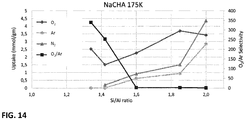
- the O 2 capacity of the NaCHA adsorbents remains high even below an Si/Al of 1.5, while Ar is effectively excluded.
- Each of the chabazite compositions described herein is an adsorbent composition particularly well-suited to remove oxygen from oxygen-rich streams, such as for the separation of oxygen in the purification of argon or nitrogen.
- the compositions are well suited for use in pressure swing adsorption techniques at ambient (-20°C to 40°C) and sub-ambient temperatures as low as -186°C. In some embodiments, temperatures of -150°C to -50°C are employed.
- the adsorbent compositions of this invention are particularly well-suited for PSA at about -130°C to -80°C.
- Separation of oxygen involves contacting the oxygen-containing fluid stream with a specific composition having Si/Al ratio from 1.2 to 1.8 at ambient or sub-ambient temperatures, wherein said composition comprises a single phase, cation exchanged CHA composition.
- compositions are readily prepared from zeolite NaY, hydrated aluminum hydroxide and potassium hydroxide.
- An adsorbent chabazite composition as described herein can be prepared relatively simply, by mixing NaY zeolite, aqueous Al(OH) 3 , and aqueous KOH; and heating for an allotted amount of time to achieve a single phase KCHA composition having the desired Si/Al ratio of from 1 to 2.2.
- the ratio of hydrated aluminum hydroxide to NaY is adjusted in the presence of potassium hydroxide. Heating is typically conducted at about 70°C to about 120°C for 1-8 days as set out in Example 1.
- heating is conducted at about 90°C to about 100°C and held at about 90°C to about 100°C for 1-8 days.
- the resultant composition is a single phase potassium-exchanged chabazite (KCHA) having a Si/Al ratio of 1 to 2.2 and wherein the K/Al molar ratio is greater than 0.90. (e.g. > 90% of the CHA unit cell cations are potassium, the remaining unit cell cations being sodium).
- the K/Al molar ratio is >0.90, >0.95, >0.97, >0.99, or any value or range of values between any two of these numbers.
- Variants of the chabazite composition can be made.
- a sodium exchanged chabazite composition can be made via an ion exchange of the single phase potassium chabazite to yield a single phase NaCHA composition having an Si/Al ratio of 1 to 2.2, wherein the Na/Al molar ratio is greater than 0.95.
- the ion exchange may include mixing single phase KCHA having a Si/Al ratio of 1 to 2.2 with an excess of aqueous sodium ions to fully exchange the potassium ions for the sodium ions to yield a single phase NaCHA having a Si/Al ratio of 1 to 2.2. The exchange may be repeated several times to ensure full ion exchange.
- the ion exchange comprises mixing single phase potassium chabazite having an Si/Al ratio of 1 to 2.2 with a 1M aqueous solution of NaCl having a 10-fold excess, by mole % of NaCl relative to the moles of cations of the single phase potassium chabazite composition, until the K is fully exchanged by Na to yield a single phase NaCHA composition. (See Example 2a.)
- Single phase mixed cation exchanged chabazite compositions having Si/Al ratio of at least 1 but less than 2.2 can be made from a single phase NaCHA composition having Si/Al ratio of at least 1 but less than 2.2 via ion exchange to yield a single phase mixed cation CHA including at least two types of cations.
- a single phase NaCHA composition having Si/Al ratio of at least 1 but less than 2.2 is mixed with an aqueous solution of one or more desired cations to yield the desired mixed cation chabazite.
- the mixed cation CHA comprises at least two types of cations where each is present in a molar ratio relative to Al of at least 0.05.
- Suitable types of cations include Li, Ag, Na, K, Ca, Mg, Zn, Cu, Ba, and Sr cations.
- the types of cations are selected from Li cations, K cations, and combinations thereof.
- Each of the at least two types of cations are in a molar ratio relative to Al of at least 0.05.
- one equivalent of the NaCHA composition is ion exchanged with excess equivalents of the desired types of cations (M) in aqueous solution to yield a mixed M, NaCHA.
- one equivalent of the NaCHA composition is ion exchanged with a equivalents of K cations in aqueous solution to yield an a K,NaCHA having a K:Na ratio of a :( b-a ), where a is the desired number of potassium cations and b is the total number of cations per unit CHA, where the range of b is dictated by the Si/Al ratios of 1.0 to 2.2.
- b is 11.25 to 18 and a is 1 to 7.
- b is about 12.8 to 15.3 and a is 1 to 7.
- each of the two types of cations of the K,NaCHA composition are in a molar ratio relative to Al of at least 0.05.
- the mixed cation exchanged chabazite is a potassium, sodium exchanged chabazite (e.g. K a Na (b-a) AlbSi( 36-b )O 72 ) having a K:Na ratio of a :( b-a ), where b is the total number of cations per unit cell of the CHA structure, a is the number of potassium cations per unit cell of the CHA structure and (b-a) is the number of sodium cations per unit cell of the CHA structure after the ion exchange and wherein the mixing further comprises mixing Na b Al b Si (36-b) O 72 with 1M KCl in accordance with reaction equation: Na b Al b Si (36- b ) O 72 + a KCl (1M) ⁇ K a Na ( b-a ) Al b Si (36- b ) O 72 + a NaCl
- the mixed cation exchanged chabazite is KNa( b-1 )Al b Si( 36-b )O 72 (1K,NaCHA), K 2 Na( b-2 )Al b Si( 36-b )O 72 (2K,NaCHA), K 3 Na( b-3 )Al b Si( 36-b )O 72 (3K,NaCHA), K 4 Na (b-4) Al b Si (36-b) O 72 (4K,NaCHA), or K 6 Na (b-6) Al b Si (36-b) O 72 (6K,NaCHA).
- the range of b is dictated by the Si/Al ratios of the compositions of this invention.
- b ranges from 11.25 to 18 and preferably from 12.8 to 15.3 for the compositions of this invention.
- the number of potassium cations, a ranges from 1 to 7. Table 1, above, sets out some relevant values for a and b. See Example 2b for methods of making mixed potassium, sodium chabazite compositions.
- a mixed cation chabazite can be made by mixing a single phase NaCHA composition having a Si/Al ratio of 1 to 2.2, as described above, with an aqueous solution having a 10-fold excess by mole percent of the desired cation type relative to the moles of sodium cations to yield a mixed cation chabazite.
- the types of cations are those described above.
- the amount of exchange can be adjusted by repeating the reaction.
- a single phase NaCHA composition having a Si/Al ratio of 1 to 2.2, as described above is mixed with a single, 10-fold excess, by mole percent, of a 1M aqueous solution of LiCl to yield a Li,NaCHA composition. (See Example 2c.)
- compositions described herein have been characterized in the following manner. It is noted that examples 1, 2a and 5 are not according to the invention.
- novel zeolite compositions were characterized by X-ray diffraction, 29 Si NMR and by elemental analysis using ICP-OES.
- Powder X-ray diffraction (XRD) patterns were generated for the examples using a Rigaku Miniflex X-ray diffractometer. The instrument is equipped with a Toshiba A-20 Cu X-ray tube.
- Silicon Nuclear magnetic resonance ( 29 Si NMR) was carried out by Spectral Data Services, Inc.
- the spectrometer used was a 270 NMR system, operating at an H-1 Larmor frequency of 270.620 MHz, using a 7mm CPMAS Doty probe. Spectra were obtained using a 45° pulse with an 85 second delay between pulses. The deconvolution of the peaks in the spectra was also done by Spectral Data Services, Inc. From the relative peak areas, the Si/Al ratio was calculated using Equation 1.
- the cation exchange level was determined by elemental analysis using established methods, which involved dissolution of the solid and subsequent analysis of the solution using inductively coupled plasma optical emission spectroscopy (ICP-OES).
- ICP-OES inductively coupled plasma optical emission spectroscopy
- Example compositions 1a through 1d having the Si/Al ratio shown were made in accordance with Table 2 according to the following procedure:
- the jar was shaken vigorously for one minute and sealed.
- the jar was placed in the oven at 95°C for the allotted amount of time.
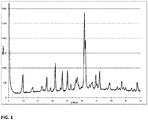
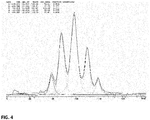
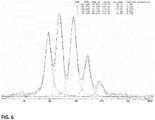
- the resultant samples were characterized by powder XRD, 29 Si NMR and ICP-OES analyses to be essentially pure, single phase chabazites, predominantly in the potassium form, as shown in FIGS. 1-8 .
- the data in the crystallization curve show that the nominally CHA 1.6 composition begins to crystallize in as little as 0.3 day and remains the predominant phase for over 2 weeks under crystallization conditions.
- Table 3 Crystallization Curve Days CHA Si/Al ratio 0.3 CHA and NaY 1 1.6 2 1.71 4 1.59 6 1.63 9 1.67 13 1.69 15 1.71 17 1.14
- the trace shows an anomalously large peak for Si coordinated to 4 Al atoms, which is indicative of CHA (1.0) and a smaller statistical distribution of peaks around Si coordinated to 2 Al atoms, indicative of CHA (2.0).
- the results are similar to those shown by Kuznicki.
- Gas uptake data for this sample are included vide infra in Tables 4 and 5 and FIGS. 10 and 11 .
- the mixed chabazite adsorbent having two different Si/Al ratios shows a relatively high O 2 uptake rate and moderate selectivity, but for all O 2 , N 2 , and Ar uptakes this sample shows a very fast unselective region of gas uptake and a slower more selective region of uptake indicative of the 2 separate pore dimensions for the mixed material.
- the chabazite phases of the chabazites are predominantly in their potassium cation form.
- Other cation forms, including mixed cation forms, can be prepared, as exemplified in the following examples.
- the KCHA form of the chabazite such as prepared in Example 1, was mixed with a 10-fold excess (mole% basis) of 1M sodium chloride solution at 90°C for at least 4 hrs. After mixing, the material was filtered. The NaCl mixing (exchange) was repeated 9 times to fully convert the material to a NaCHA. After filtering, the material was rinsed 3 times with a 3-fold excess (wt.% basis) of DI water and was dried overnight at 90°C. The extent of ion exchange was confirmed by inductively coupled plasma optical emission spectroscopy (ICP-OES).
- ICP-OES inductively coupled plasma optical emission spectroscopy
- Example 2b Mixed K,NaCHA:
- K 2 Na (b-2 )Al b Si (36-b) O 72 (2K,NaCHA) 1 equivalent of NaCHA is mixed with 2 equivalents of KCl to yield K 2 Na (b-2) Al b Si (36-b) O 72 .
- K 3 Na (b-3) Al b Si (36-b) O 72 (3K,NaCHA) 1 equivalent of NaCHA is mixed with 3 equivalents of KCl to yield K 3 Na (b-3) Al b Si (36-b) O 72 .
- Additional levels of potassium can be similarly obtained.
- the range of b is dictated by the Si/Al ratios of the compositions of this invention and, so b ranges from 11.25 to 18 and preferably from 12.8 to 15.3 for the compositions of this invention.
- Example 2c Mixed Li,NaCHA:
- the NaCHA form of the chabazite was exchanged once with a 10-fold excess (mole % basis) of 1M lithium chloride solution at 90°C for at least 6 hrs. After exchange, the material was filtered. The LiCl exchange was repeated 2 times to partially convert the material to a mixed Li,NaCHA. After filtering, the material was rinsed 3 times with a 3-fold excess (wt.%) of DI water and was dried overnight at 90°C.
- the mass transfer properties of the adsorbents were evaluated using a standard volumetric adsorption apparatus.
- the experiment consisted of exposing an adsorbent sample, which is initially at vacuum and 30°C, to a measured amount of O 2 , N 2 , or Ar at 760 Torr (101 kPa). The change in pressure was then followed as a function of time. A similar pressure history using the same weight of quartz beads in the place of the adsorbent sample is then subtracted from the pressure time data to obtain a plot of the amount of gas adsorbed as a function of time. From the initial slope of the uptake curve, a diffusion parameter for the test gas in units of inverse time (sec -1 ) can be obtained.
- a pseudo-equilibrium capacity can be defined for a given adsorbent sample over the timeframe of the experiment as follows. The pressure drop of a gas over an adsorbent sample weighing 2.2 g is measured starting at 760 Torr (101 kPa) until the rate of pressure drop is ⁇ 1 Torr/min. A Pmax defines the total pressure drop or gas uptake over a 2.2 g sample of adsorbent after subtraction of the pressure drop of the glass bead blank. The Pmax together with the system volume, thus defines a pseudo-equilibrium capacity, and these values are given for various adsorbents in Table 5.
- f ( t ) is the fractional uptake
- D c is the intra-crystalline diffusivity
- r c crystal radius (diffusional length scale)
- t is the time
- ⁇ is the fraction of adsorbate ultimately adsorbed by the adsorbent
- compositions in parentheticals represent the short-hand nomenclature for of the chemical formulas listed previously.
- the ambient temperature data in Table 5 and FIGs. 9 and 10 show that the homogenous CHA phases with Si/Al ⁇ 1.6 and containing mixtures of sodium and potassium ions as extra-framework cations are unique among all the materials reported and tested in terms of their high O 2 /N 2 and O 2 /Ar selectivity.
- the 3K,NaCHA (1.6); 4K,NaCHA (1.6); and 6K,NaCHA (1.6) compositions show the highest kinetic selectivity of any of the tested materials and higher O 2 uptake rates than all but the 4A zeolite.
- the single cation NaCHA (1.6) shows much poorer selectivity at an O 2 uptake rate, approximately 30 times slower than the 3K,NaCHA (1.6) material.
- KCHA (1.6) is much slower still and effectively excludes O 2 , N 2 , and Ar.
- This surprising optimization of both kinetic selectivities and oxygen uptake rates is even more clearly seen in FIGS. 12 and 13 , where O 2 /Ar and O 2 /N 2 kinetic selectivity and O 2 uptake rate are plotted against the potassium exchange level or number of potassium ions in NaCHA (1.6). Again maximum values for kinetic selectivity and rate are observed for the mixed K,NaCHA (1.6) compositions. Without intending to be bound by theory, it is believed that these mixed compositions create regular pore dimensions which are finely tuned for O 2 allowing it to migrate through the pore more rapidly while limiting the rate of N 2 and Ar uptake.
- the total O 2 uptake was approximately equivalent to the N 2 uptake.
- the higher Si/Al CHA materials typically adsorb twice as much N 2 as O 2 .
- the uptake measurements suggest that the addition of two potassium cations to the unit cell leads to new sites in the CHA structure becoming accessible to O 2 and not N 2 , which may help explain why the O 2 capacities of 3K,NaCHA (1.6) is also about 30% higher than NaCHA (1.6) at ambient temperatures.
- the adsorption unit records the pseudo-equilibrium capacities when the sample pressure changes less than 0.01% in 30 seconds.
- the feed gas mixture containing 94.95 mole% Ar, 5 mole% O 2 and remainder N 2 is introduced to the inlet end of bed and the un-adsorbed gas (mostly Ar) is discharged from the outlet end of bed.
- the feed step is continued until the mass transfer zone of preferentially adsorbed component (O 2 ) reaches the exit end of the bed without substantially breaking through it.
- the flow rate during the feed step (Step 1) is maintained at 32.77 Nm 3 /h and the effluent gas containing 2.0 ppm O 2 at nearly feed pressure and temperature is withdrawn from the product tank (Tank A) as stream 11 ( FIG.
- Step 15 the bed is connected with the 2 nd bed undergoing pressure equalization re-pressurization step (Step 6) and a portion of the void as well as desorbed gas is transferred from the product end of the 1 st bed to the product end of the 2 nd bed, thus lowering the 1 st bed pressure to approximately 4.36 bara at the end of this step (Step 2).
- Step 3 a dual end equalization depressurization step (Step 3 in FIG.
- Step 15 is introduced to transfer more co-adsorbed as well as void gases from the 1 st bed to the 2 nd bed from both ends of the bed and therefore, the pressure of the 1 st bed goes down to approximately 3.12 bara.
- the dual end re-pressurization can be performed by connecting top ends of the columns and the middle or bottom end of the first bed to the bottom end of the second bed.
- the column is then counter-currently depressurized (Step 4) and thereafter purged (Step 5) counter-currently with primary product gas at 1.32 bara (where the ambient pressure is 1.013 bara).
- the column is subsequently pressurized through pressure equalization (Steps 6 and 7) and pressurization (Step 8) steps to bring back the pressure level for initiation and repetition of the aforementioned cycle.
- Steps 6 and 7 The net O 2 -free (mostly) Argon recovery from the feed gas is 49.97% and the productivity is 43.74 Nm 3 /h/m 3 bed ( FIG. 16 ).
- the 2-bed, 8-step PSA process discussed above is used for process performance evaluation using 3K,NaCHA (1.6) and CMS at 30°C.
- 3K,NaCHA (1.6) the highest and the lowest pressure levels are maintained at approximately 5.07 bara and 1.09 bara, respectively.
- CMS the highest and the lowest pressure levels are maintained at approximately 7.22 bara and 1.15 bara, respectively.
- Table 4 Adsorbent Argon Recovery % Productivity Nm 3 /h/m 3 bed 3K,NaCHA (1.6) 32.27 67.06 CMS 31.20 30.97
Landscapes
- Chemical & Material Sciences (AREA)
- Analytical Chemistry (AREA)
- Chemical Kinetics & Catalysis (AREA)
- Organic Chemistry (AREA)
- Inorganic Chemistry (AREA)
- General Chemical & Material Sciences (AREA)
- Oil, Petroleum & Natural Gas (AREA)
- Engineering & Computer Science (AREA)
- Life Sciences & Earth Sciences (AREA)
- General Life Sciences & Earth Sciences (AREA)
- Geology (AREA)
- Silicates, Zeolites, And Molecular Sieves (AREA)
- Solid-Sorbent Or Filter-Aiding Compositions (AREA)
- Separation Of Gases By Adsorption (AREA)
- Oxygen, Ozone, And Oxides In General (AREA)
Claims (11)
- Verfahren zur Abtrennung von Sauerstoff aus einem sauerstoffhaltigen Fluidstrom, wobei das Verfahren umfasst:
Inkontaktbringen des sauerstoffhaltigen Fluidstroms mit einem sauerstoffselektiven Zeolith-Adsorptionsmittel, das zumindest 90% Chabasit umfasst, wobei der Chabasit ein einphasiger Chabasit ist, der ein Si/Al-Verhältnis von 1,2 bis 1,8 aufweist und aus K,NaCHA und Li,NaCHA ausgewählt ist. - Verfahren nach Anspruch 1, wobei das Inkontaktbringen ein Druckwechseladsorptionsverfahren (PSA) umfasst.
- Verfahren nach Anspruch 2, wobei das PSA-Verfahren bei einer Temperatur von - 20 °C bis 40 °C durchgeführt wird.
- Verfahren nach Anspruch 2, wobei das PSA-Verfahren bei einer Temperatur von - 186 °C bis - 20 °C durchgeführt wird.
- Verfahren nach einem der Ansprüche 2 bis 4, wobei das PSA-Verfahren bei einem Beschickungsdruck von 2 bara bis 20 bara durchgeführt wird.
- Verfahren nach Anspruch 5, wobei das PSA-Verfahren bei einem Beschickungsdruck von 2 bara bis 8 bara durchgeführt wird.
- Verfahren nach einem der Ansprüche 2 bis 6, wobei der sauerstoffhaltige Fluidstrom von 0,5 Mol-% Sauerstoff bis 49,5 Mol-% Sauerstoff umfasst.
- Verfahren nach einem der Ansprüche 7, wobei der sauerstoffhaltige Fluidstrom von 2,5 Mol-% Sauerstoff bis 29,5 Mol-% Sauerstoff umfasst.
- Verfahren nach einem der vorangegangenen Ansprüche, wobei der einphasige Chabasit ein Si/Al-Verhältnis von 1,35 bis 1,6 aufweist.
- Verfahren nach einem der vorangegangenen Ansprüche, wobei jede der zumindest zwei Arten von Kationen in einem molaren Verhältnis relativ zu Al von zumindest 0,05 vorliegt.
- Verfahren nach einem der vorangegangenen Ansprüche, wobei der Chabasit ausgewählt ist aus 3K,NaCHA(1,6); 4K,NaCHA(1,6); 6K,NaCHA(1,6); 2K,NaCHA(1,4); und 1 K,NaCHA(1,35).
Priority Applications (1)
| Application Number | Priority Date | Filing Date | Title |
|---|---|---|---|
| PL17156347T PL3207974T3 (pl) | 2016-02-22 | 2017-02-15 | Sposób oddzielania tlenu z e strumienia płynu z wykorzystaniem adsorbentu chabazytowego |
Applications Claiming Priority (1)
| Application Number | Priority Date | Filing Date | Title |
|---|---|---|---|
| US15/049,634 US9669349B1 (en) | 2016-02-22 | 2016-02-22 | Modified chabazite adsorbent compositions, methods of making and using them |
Publications (2)
| Publication Number | Publication Date |
|---|---|
| EP3207974A1 EP3207974A1 (de) | 2017-08-23 |
| EP3207974B1 true EP3207974B1 (de) | 2021-05-26 |
Family
ID=58192076
Family Applications (1)
| Application Number | Title | Priority Date | Filing Date |
|---|---|---|---|
| EP17156347.1A Active EP3207974B1 (de) | 2016-02-22 | 2017-02-15 | Verfahren zur abtrennung von sauerstoff aus einem fluidstrom mit einem chabasit-adsorbenz |
Country Status (11)
| Country | Link |
|---|---|
| US (1) | US9669349B1 (de) |
| EP (1) | EP3207974B1 (de) |
| KR (1) | KR102068394B1 (de) |
| CN (1) | CN107096351B (de) |
| ES (1) | ES2880341T3 (de) |
| MY (1) | MY176243A (de) |
| PL (1) | PL3207974T3 (de) |
| SA (1) | SA117380428B1 (de) |
| SG (1) | SG10201701233YA (de) |
| TW (1) | TWI629235B (de) |
| ZA (1) | ZA201701186B (de) |
Families Citing this family (6)
| Publication number | Priority date | Publication date | Assignee | Title |
|---|---|---|---|---|
| US7954490B2 (en) | 2005-02-09 | 2011-06-07 | Vbox, Incorporated | Method of providing ambulatory oxygen |
| US9708188B1 (en) * | 2016-02-22 | 2017-07-18 | Air Products And Chemicals, Inc. | Method for argon production via cold pressure swing adsorption |
| US10835856B2 (en) | 2018-08-14 | 2020-11-17 | Air Products And Chemicals, Inc. | Carbon molecular sieve adsorbent |
| US10730006B2 (en) | 2018-08-14 | 2020-08-04 | Air Products And Chemicals, Inc. | Port separation for rotary bed PSA |
| US10744450B2 (en) | 2018-08-14 | 2020-08-18 | Air Products And Chemicals, Inc. | Multi-bed rapid cycle kinetic PSA |
| CN112844307A (zh) * | 2020-12-29 | 2021-05-28 | 复榆(张家港)新材料科技有限公司 | 用于变压吸附分离二元溶剂共沸物的小孔脱水吸附剂 |
Family Cites Families (22)
| Publication number | Priority date | Publication date | Assignee | Title |
|---|---|---|---|---|
| US2810454A (en) | 1953-12-24 | 1957-10-22 | Union Carbide Corp | Argon purification |
| GB1446201A (en) | 1973-01-08 | 1976-08-18 | Air Prod & Chem | Purification of inert gases |
| SU516410A1 (ru) | 1973-12-06 | 1976-06-05 | Ленинградский технологический институт холодильной промышленности | Способ очистки аргона |
| US4732584A (en) * | 1986-05-22 | 1988-03-22 | Air Products And Chemicals, Inc. | Process for the purification of permanent gases using chabazite adsorbents |
| US4943304A (en) * | 1989-04-06 | 1990-07-24 | Air Products And Chemicals, Inc. | Process for the purification of bulk gases using chabazite adsorbents |
| US5026532A (en) * | 1989-04-06 | 1991-06-25 | Air Products And Chemicals, Inc. | Process for the preparation of an improved chabazite for the purification of bulk gases |
| US5159816A (en) | 1991-05-14 | 1992-11-03 | Air Products And Chemicals, Inc. | Method of purifying argon through cryogenic adsorption |
| US5266102A (en) * | 1992-09-23 | 1993-11-30 | Air Products And Chemicals, Inc. | O2 VSA process with low O2 capacity adsorbents |
| US5313800A (en) | 1993-02-01 | 1994-05-24 | Praxair Technology, Inc. | Process for maximizing the recovery of argon from an air separation system at high argon recovery rates |
| US5730003A (en) | 1997-03-26 | 1998-03-24 | Praxair Technology, Inc. | Cryogenic hybrid system for producing high purity argon |
| FR2771943B1 (fr) | 1997-12-05 | 2000-01-14 | Air Liquide | Procede de purification de fluides inertes par adsorption sur zeolite lsx |
| FR2782461B1 (fr) * | 1998-08-21 | 2000-09-22 | Air Liquide | Procede psa utilisant une zeolithe faujasite contenant des cations metalliques en tant qu'adsorbant |
| US6240744B1 (en) | 1999-12-13 | 2001-06-05 | Air Products And Chemicals, Inc. | Process for distillation of multicomponent fluid and production of an argon-enriched stream from a cryogenic air separation process |
| MY136131A (en) * | 2000-09-14 | 2008-08-29 | Boc Group Inc | Adsorbent compositions |
| US6527831B2 (en) | 2000-12-29 | 2003-03-04 | Praxair Technology, Inc. | Argon purification process |
| US6500235B2 (en) | 2000-12-29 | 2002-12-31 | Praxair Technology, Inc. | Pressure swing adsorption process for high recovery of high purity gas |
| US7501009B2 (en) | 2006-03-10 | 2009-03-10 | Air Products And Chemicals, Inc. | Combined cryogenic distillation and PSA for argon production |
| US20090071333A1 (en) * | 2006-10-04 | 2009-03-19 | Air Products And Chemicals, Inc. | Performance Stability in Shallow Beds in Pressure Swing Adsorption Systems |
| CN102285666B (zh) * | 2010-06-18 | 2015-02-04 | 江西师范大学 | 一种菱沸石及菱沸石膜的制备方法 |
| KR20140111549A (ko) * | 2013-03-11 | 2014-09-19 | 삼성전자주식회사 | 제올라이트 포함 이산화탄소 흡착제 및 그 제조 방법 |
| KR102194141B1 (ko) * | 2013-11-06 | 2020-12-22 | 삼성전자주식회사 | 메조다공성 차바자이트 제올라이트 포함 이산화탄소 흡착제 및 그 제조 방법 |
| JP5740040B1 (ja) | 2014-07-07 | 2015-06-24 | イビデン株式会社 | ゼオライト、ハニカム触媒及び排ガス浄化装置 |
-
2016
- 2016-02-22 US US15/049,634 patent/US9669349B1/en active Active
-
2017
- 2017-02-15 ES ES17156347T patent/ES2880341T3/es active Active
- 2017-02-15 PL PL17156347T patent/PL3207974T3/pl unknown
- 2017-02-15 EP EP17156347.1A patent/EP3207974B1/de active Active
- 2017-02-16 SG SG10201701233YA patent/SG10201701233YA/en unknown
- 2017-02-16 ZA ZA2017/01186A patent/ZA201701186B/en unknown
- 2017-02-18 TW TW106105487A patent/TWI629235B/zh active
- 2017-02-20 SA SA117380428A patent/SA117380428B1/ar unknown
- 2017-02-20 MY MYPI2017700554A patent/MY176243A/en unknown
- 2017-02-21 CN CN201710092875.2A patent/CN107096351B/zh active Active
- 2017-02-22 KR KR1020170023721A patent/KR102068394B1/ko active Active
Non-Patent Citations (1)
| Title |
|---|
| None * |
Also Published As
| Publication number | Publication date |
|---|---|
| CN107096351B (zh) | 2020-10-16 |
| CN107096351A (zh) | 2017-08-29 |
| KR20170098726A (ko) | 2017-08-30 |
| EP3207974A1 (de) | 2017-08-23 |
| KR102068394B1 (ko) | 2020-01-20 |
| US9669349B1 (en) | 2017-06-06 |
| ES2880341T3 (es) | 2021-11-24 |
| TWI629235B (zh) | 2018-07-11 |
| MY176243A (en) | 2020-07-24 |
| ZA201701186B (en) | 2018-11-28 |
| TW201730101A (zh) | 2017-09-01 |
| SG10201701233YA (en) | 2017-09-28 |
| SA117380428B1 (ar) | 2020-05-21 |
| PL3207974T3 (pl) | 2021-11-15 |
Similar Documents
| Publication | Publication Date | Title |
|---|---|---|
| EP3207983B1 (de) | Zeolitische zusammensetzungen enthaltend modifizierte chabasit | |
| EP3207974B1 (de) | Verfahren zur abtrennung von sauerstoff aus einem fluidstrom mit einem chabasit-adsorbenz | |
| US7935177B2 (en) | Method of purifying a gas stream contaminated by CO2 and one or more hydrocarbons and/or nitrogen oxides by adsorption on an aggregated zeolitic adsorbent | |
| EP3461555B1 (de) | Verbesserte, rho-absorbierende zusammensetzungen und verwendung davon | |
| US10343139B2 (en) | Processes using improved RHO adsorbent compositions | |
| EP3207984B1 (de) | Herstellungsverfahren für zeolithische zusammensetzungen enthaltend modifizierte chabasit |
Legal Events
| Date | Code | Title | Description |
|---|---|---|---|
| PUAI | Public reference made under article 153(3) epc to a published international application that has entered the european phase |
Free format text: ORIGINAL CODE: 0009012 |
|
| STAA | Information on the status of an ep patent application or granted ep patent |
Free format text: STATUS: THE APPLICATION HAS BEEN PUBLISHED |
|
| AK | Designated contracting states |
Kind code of ref document: A1 Designated state(s): AL AT BE BG CH CY CZ DE DK EE ES FI FR GB GR HR HU IE IS IT LI LT LU LV MC MK MT NL NO PL PT RO RS SE SI SK SM TR |
|
| AX | Request for extension of the european patent |
Extension state: BA ME |
|
| STAA | Information on the status of an ep patent application or granted ep patent |
Free format text: STATUS: REQUEST FOR EXAMINATION WAS MADE |
|
| 17P | Request for examination filed |
Effective date: 20180220 |
|
| RBV | Designated contracting states (corrected) |
Designated state(s): AL AT BE BG CH CY CZ DE DK EE ES FI FR GB GR HR HU IE IS IT LI LT LU LV MC MK MT NL NO PL PT RO RS SE SI SK SM TR |
|
| STAA | Information on the status of an ep patent application or granted ep patent |
Free format text: STATUS: EXAMINATION IS IN PROGRESS |
|
| 17Q | First examination report despatched |
Effective date: 20191122 |
|
| GRAP | Despatch of communication of intention to grant a patent |
Free format text: ORIGINAL CODE: EPIDOSNIGR1 |
|
| STAA | Information on the status of an ep patent application or granted ep patent |
Free format text: STATUS: GRANT OF PATENT IS INTENDED |
|
| INTG | Intention to grant announced |
Effective date: 20201104 |
|
| GRAJ | Information related to disapproval of communication of intention to grant by the applicant or resumption of examination proceedings by the epo deleted |
Free format text: ORIGINAL CODE: EPIDOSDIGR1 |
|
| STAA | Information on the status of an ep patent application or granted ep patent |
Free format text: STATUS: EXAMINATION IS IN PROGRESS |
|
| GRAS | Grant fee paid |
Free format text: ORIGINAL CODE: EPIDOSNIGR3 |
|
| STAA | Information on the status of an ep patent application or granted ep patent |
Free format text: STATUS: GRANT OF PATENT IS INTENDED |
|
| GRAP | Despatch of communication of intention to grant a patent |
Free format text: ORIGINAL CODE: EPIDOSNIGR1 |
|
| INTC | Intention to grant announced (deleted) | ||
| INTG | Intention to grant announced |
Effective date: 20210211 |
|
| GRAA | (expected) grant |
Free format text: ORIGINAL CODE: 0009210 |
|
| STAA | Information on the status of an ep patent application or granted ep patent |
Free format text: STATUS: THE PATENT HAS BEEN GRANTED |
|
| AK | Designated contracting states |
Kind code of ref document: B1 Designated state(s): AL AT BE BG CH CY CZ DE DK EE ES FI FR GB GR HR HU IE IS IT LI LT LU LV MC MK MT NL NO PL PT RO RS SE SI SK SM TR |
|
| REG | Reference to a national code |
Ref country code: GB Ref legal event code: FG4D |
|
| REG | Reference to a national code |
Ref country code: CH Ref legal event code: EP |
|
| REG | Reference to a national code |
Ref country code: AT Ref legal event code: REF Ref document number: 1395649 Country of ref document: AT Kind code of ref document: T Effective date: 20210615 |
|
| REG | Reference to a national code |
Ref country code: DE Ref legal event code: R096 Ref document number: 602017039099 Country of ref document: DE |
|
| REG | Reference to a national code |
Ref country code: IE Ref legal event code: FG4D |
|
| REG | Reference to a national code |
Ref country code: NL Ref legal event code: FP |
|
| REG | Reference to a national code |
Ref country code: LT Ref legal event code: MG9D |
|
| REG | Reference to a national code |
Ref country code: AT Ref legal event code: MK05 Ref document number: 1395649 Country of ref document: AT Kind code of ref document: T Effective date: 20210526 |
|
| PG25 | Lapsed in a contracting state [announced via postgrant information from national office to epo] |
Ref country code: FI Free format text: LAPSE BECAUSE OF FAILURE TO SUBMIT A TRANSLATION OF THE DESCRIPTION OR TO PAY THE FEE WITHIN THE PRESCRIBED TIME-LIMIT Effective date: 20210526 Ref country code: LT Free format text: LAPSE BECAUSE OF FAILURE TO SUBMIT A TRANSLATION OF THE DESCRIPTION OR TO PAY THE FEE WITHIN THE PRESCRIBED TIME-LIMIT Effective date: 20210526 Ref country code: HR Free format text: LAPSE BECAUSE OF FAILURE TO SUBMIT A TRANSLATION OF THE DESCRIPTION OR TO PAY THE FEE WITHIN THE PRESCRIBED TIME-LIMIT Effective date: 20210526 Ref country code: BG Free format text: LAPSE BECAUSE OF FAILURE TO SUBMIT A TRANSLATION OF THE DESCRIPTION OR TO PAY THE FEE WITHIN THE PRESCRIBED TIME-LIMIT Effective date: 20210826 Ref country code: AT Free format text: LAPSE BECAUSE OF FAILURE TO SUBMIT A TRANSLATION OF THE DESCRIPTION OR TO PAY THE FEE WITHIN THE PRESCRIBED TIME-LIMIT Effective date: 20210526 |
|
| REG | Reference to a national code |
Ref country code: ES Ref legal event code: FG2A Ref document number: 2880341 Country of ref document: ES Kind code of ref document: T3 Effective date: 20211124 |
|
| PG25 | Lapsed in a contracting state [announced via postgrant information from national office to epo] |
Ref country code: NO Free format text: LAPSE BECAUSE OF FAILURE TO SUBMIT A TRANSLATION OF THE DESCRIPTION OR TO PAY THE FEE WITHIN THE PRESCRIBED TIME-LIMIT Effective date: 20210826 Ref country code: PT Free format text: LAPSE BECAUSE OF FAILURE TO SUBMIT A TRANSLATION OF THE DESCRIPTION OR TO PAY THE FEE WITHIN THE PRESCRIBED TIME-LIMIT Effective date: 20210927 Ref country code: SE Free format text: LAPSE BECAUSE OF FAILURE TO SUBMIT A TRANSLATION OF THE DESCRIPTION OR TO PAY THE FEE WITHIN THE PRESCRIBED TIME-LIMIT Effective date: 20210526 Ref country code: RS Free format text: LAPSE BECAUSE OF FAILURE TO SUBMIT A TRANSLATION OF THE DESCRIPTION OR TO PAY THE FEE WITHIN THE PRESCRIBED TIME-LIMIT Effective date: 20210526 Ref country code: GR Free format text: LAPSE BECAUSE OF FAILURE TO SUBMIT A TRANSLATION OF THE DESCRIPTION OR TO PAY THE FEE WITHIN THE PRESCRIBED TIME-LIMIT Effective date: 20210827 Ref country code: IS Free format text: LAPSE BECAUSE OF FAILURE TO SUBMIT A TRANSLATION OF THE DESCRIPTION OR TO PAY THE FEE WITHIN THE PRESCRIBED TIME-LIMIT Effective date: 20210926 Ref country code: LV Free format text: LAPSE BECAUSE OF FAILURE TO SUBMIT A TRANSLATION OF THE DESCRIPTION OR TO PAY THE FEE WITHIN THE PRESCRIBED TIME-LIMIT Effective date: 20210526 |
|
| PG25 | Lapsed in a contracting state [announced via postgrant information from national office to epo] |
Ref country code: SK Free format text: LAPSE BECAUSE OF FAILURE TO SUBMIT A TRANSLATION OF THE DESCRIPTION OR TO PAY THE FEE WITHIN THE PRESCRIBED TIME-LIMIT Effective date: 20210526 Ref country code: SM Free format text: LAPSE BECAUSE OF FAILURE TO SUBMIT A TRANSLATION OF THE DESCRIPTION OR TO PAY THE FEE WITHIN THE PRESCRIBED TIME-LIMIT Effective date: 20210526 Ref country code: DK Free format text: LAPSE BECAUSE OF FAILURE TO SUBMIT A TRANSLATION OF THE DESCRIPTION OR TO PAY THE FEE WITHIN THE PRESCRIBED TIME-LIMIT Effective date: 20210526 Ref country code: EE Free format text: LAPSE BECAUSE OF FAILURE TO SUBMIT A TRANSLATION OF THE DESCRIPTION OR TO PAY THE FEE WITHIN THE PRESCRIBED TIME-LIMIT Effective date: 20210526 Ref country code: RO Free format text: LAPSE BECAUSE OF FAILURE TO SUBMIT A TRANSLATION OF THE DESCRIPTION OR TO PAY THE FEE WITHIN THE PRESCRIBED TIME-LIMIT Effective date: 20210526 |
|
| REG | Reference to a national code |
Ref country code: DE Ref legal event code: R097 Ref document number: 602017039099 Country of ref document: DE |
|
| PLBE | No opposition filed within time limit |
Free format text: ORIGINAL CODE: 0009261 |
|
| STAA | Information on the status of an ep patent application or granted ep patent |
Free format text: STATUS: NO OPPOSITION FILED WITHIN TIME LIMIT |
|
| 26N | No opposition filed |
Effective date: 20220301 |
|
| PG25 | Lapsed in a contracting state [announced via postgrant information from national office to epo] |
Ref country code: IS Free format text: LAPSE BECAUSE OF FAILURE TO SUBMIT A TRANSLATION OF THE DESCRIPTION OR TO PAY THE FEE WITHIN THE PRESCRIBED TIME-LIMIT Effective date: 20210926 Ref country code: AL Free format text: LAPSE BECAUSE OF FAILURE TO SUBMIT A TRANSLATION OF THE DESCRIPTION OR TO PAY THE FEE WITHIN THE PRESCRIBED TIME-LIMIT Effective date: 20210526 |
|
| PG25 | Lapsed in a contracting state [announced via postgrant information from national office to epo] |
Ref country code: MC Free format text: LAPSE BECAUSE OF FAILURE TO SUBMIT A TRANSLATION OF THE DESCRIPTION OR TO PAY THE FEE WITHIN THE PRESCRIBED TIME-LIMIT Effective date: 20210526 |
|
| REG | Reference to a national code |
Ref country code: CH Ref legal event code: PL |
|
| PG25 | Lapsed in a contracting state [announced via postgrant information from national office to epo] |
Ref country code: LU Free format text: LAPSE BECAUSE OF NON-PAYMENT OF DUE FEES Effective date: 20220215 |
|
| PG25 | Lapsed in a contracting state [announced via postgrant information from national office to epo] |
Ref country code: LI Free format text: LAPSE BECAUSE OF NON-PAYMENT OF DUE FEES Effective date: 20220228 Ref country code: IE Free format text: LAPSE BECAUSE OF NON-PAYMENT OF DUE FEES Effective date: 20220215 Ref country code: CH Free format text: LAPSE BECAUSE OF NON-PAYMENT OF DUE FEES Effective date: 20220228 |
|
| P01 | Opt-out of the competence of the unified patent court (upc) registered |
Effective date: 20230510 |
|
| PG25 | Lapsed in a contracting state [announced via postgrant information from national office to epo] |
Ref country code: HU Free format text: LAPSE BECAUSE OF FAILURE TO SUBMIT A TRANSLATION OF THE DESCRIPTION OR TO PAY THE FEE WITHIN THE PRESCRIBED TIME-LIMIT; INVALID AB INITIO Effective date: 20170215 |
|
| PG25 | Lapsed in a contracting state [announced via postgrant information from national office to epo] |
Ref country code: MK Free format text: LAPSE BECAUSE OF FAILURE TO SUBMIT A TRANSLATION OF THE DESCRIPTION OR TO PAY THE FEE WITHIN THE PRESCRIBED TIME-LIMIT Effective date: 20210526 Ref country code: CY Free format text: LAPSE BECAUSE OF FAILURE TO SUBMIT A TRANSLATION OF THE DESCRIPTION OR TO PAY THE FEE WITHIN THE PRESCRIBED TIME-LIMIT Effective date: 20210526 |
|
| PG25 | Lapsed in a contracting state [announced via postgrant information from national office to epo] |
Ref country code: MT Free format text: LAPSE BECAUSE OF FAILURE TO SUBMIT A TRANSLATION OF THE DESCRIPTION OR TO PAY THE FEE WITHIN THE PRESCRIBED TIME-LIMIT Effective date: 20210526 |
|
| PG25 | Lapsed in a contracting state [announced via postgrant information from national office to epo] |
Ref country code: TR Free format text: LAPSE BECAUSE OF FAILURE TO SUBMIT A TRANSLATION OF THE DESCRIPTION OR TO PAY THE FEE WITHIN THE PRESCRIBED TIME-LIMIT Effective date: 20210526 |
|
| PGFP | Annual fee paid to national office [announced via postgrant information from national office to epo] |
Ref country code: FR Payment date: 20251208 Year of fee payment: 10 Ref country code: NL Payment date: 20251215 Year of fee payment: 10 |
|
| PGFP | Annual fee paid to national office [announced via postgrant information from national office to epo] |
Ref country code: PL Payment date: 20251128 Year of fee payment: 10 |
|
| PGFP | Annual fee paid to national office [announced via postgrant information from national office to epo] |
Ref country code: GB Payment date: 20260106 Year of fee payment: 10 |
|
| PGFP | Annual fee paid to national office [announced via postgrant information from national office to epo] |
Ref country code: ES Payment date: 20260305 Year of fee payment: 10 |
|
| PGFP | Annual fee paid to national office [announced via postgrant information from national office to epo] |
Ref country code: DE Payment date: 20251224 Year of fee payment: 10 |
|
| PGFP | Annual fee paid to national office [announced via postgrant information from national office to epo] |
Ref country code: BE Payment date: 20260105 Year of fee payment: 10 Ref country code: IT Payment date: 20260122 Year of fee payment: 10 |
|
| PGFP | Annual fee paid to national office [announced via postgrant information from national office to epo] |
Ref country code: CZ Payment date: 20260130 Year of fee payment: 10 |