EP3207374B1 - Method and system for determining the concentration of an analyte in a fluid sample - Google Patents
Method and system for determining the concentration of an analyte in a fluid sample Download PDFInfo
- Publication number
- EP3207374B1 EP3207374B1 EP15850361.5A EP15850361A EP3207374B1 EP 3207374 B1 EP3207374 B1 EP 3207374B1 EP 15850361 A EP15850361 A EP 15850361A EP 3207374 B1 EP3207374 B1 EP 3207374B1
- Authority
- EP
- European Patent Office
- Prior art keywords
- analyte
- fluid sample
- volatile
- signal
- reaction
- Prior art date
- Legal status (The legal status is an assumption and is not a legal conclusion. Google has not performed a legal analysis and makes no representation as to the accuracy of the status listed.)
- Active
Links
- TWOGCVGGIOZDQQ-UHFFFAOYSA-N CC(c(cccc1)c1[N+]([O-])=O)OC Chemical compound CC(c(cccc1)c1[N+]([O-])=O)OC TWOGCVGGIOZDQQ-UHFFFAOYSA-N 0.000 description 1
- BHHJOMHRIUZSAW-UHFFFAOYSA-N NC1C=CC=CC1C(O)=O Chemical compound NC1C=CC=CC1C(O)=O BHHJOMHRIUZSAW-UHFFFAOYSA-N 0.000 description 1
Images




Classifications
-
- G—PHYSICS
- G01—MEASURING; TESTING
- G01N—INVESTIGATING OR ANALYSING MATERIALS BY DETERMINING THEIR CHEMICAL OR PHYSICAL PROPERTIES
- G01N1/00—Sampling; Preparing specimens for investigation
- G01N1/28—Preparing specimens for investigation including physical details of (bio-)chemical methods covered elsewhere, e.g. G01N33/50, C12Q
-
- H—ELECTRICITY
- H01—ELECTRIC ELEMENTS
- H01J—ELECTRIC DISCHARGE TUBES OR DISCHARGE LAMPS
- H01J49/00—Particle spectrometers or separator tubes
- H01J49/02—Details
- H01J49/04—Arrangements for introducing or extracting samples to be analysed, e.g. vacuum locks; Arrangements for external adjustment of electron- or ion-optical components
-
- H—ELECTRICITY
- H01—ELECTRIC ELEMENTS
- H01J—ELECTRIC DISCHARGE TUBES OR DISCHARGE LAMPS
- H01J49/00—Particle spectrometers or separator tubes
- H01J49/02—Details
- H01J49/04—Arrangements for introducing or extracting samples to be analysed, e.g. vacuum locks; Arrangements for external adjustment of electron- or ion-optical components
- H01J49/0431—Arrangements for introducing or extracting samples to be analysed, e.g. vacuum locks; Arrangements for external adjustment of electron- or ion-optical components for liquid samples
-
- C—CHEMISTRY; METALLURGY
- C12—BIOCHEMISTRY; BEER; SPIRITS; WINE; VINEGAR; MICROBIOLOGY; ENZYMOLOGY; MUTATION OR GENETIC ENGINEERING
- C12Q—MEASURING OR TESTING PROCESSES INVOLVING ENZYMES, NUCLEIC ACIDS OR MICROORGANISMS; COMPOSITIONS OR TEST PAPERS THEREFOR; PROCESSES OF PREPARING SUCH COMPOSITIONS; CONDITION-RESPONSIVE CONTROL IN MICROBIOLOGICAL OR ENZYMOLOGICAL PROCESSES
- C12Q1/00—Measuring or testing processes involving enzymes, nucleic acids or microorganisms; Compositions therefor; Processes of preparing such compositions
- C12Q1/68—Measuring or testing processes involving enzymes, nucleic acids or microorganisms; Compositions therefor; Processes of preparing such compositions involving nucleic acids
-
- G—PHYSICS
- G01—MEASURING; TESTING
- G01N—INVESTIGATING OR ANALYSING MATERIALS BY DETERMINING THEIR CHEMICAL OR PHYSICAL PROPERTIES
- G01N33/00—Investigating or analysing materials by specific methods not covered by groups G01N1/00 - G01N31/00
- G01N33/48—Biological material, e.g. blood, urine; Haemocytometers
- G01N33/50—Chemical analysis of biological material, e.g. blood, urine; Testing involving biospecific ligand binding methods; Immunological testing
- G01N33/68—Chemical analysis of biological material, e.g. blood, urine; Testing involving biospecific ligand binding methods; Immunological testing involving proteins, peptides or amino acids
- G01N33/6803—General methods of protein analysis not limited to specific proteins or families of proteins
- G01N33/6848—Methods of protein analysis involving mass spectrometry
-
- G—PHYSICS
- G01—MEASURING; TESTING
- G01N—INVESTIGATING OR ANALYSING MATERIALS BY DETERMINING THEIR CHEMICAL OR PHYSICAL PROPERTIES
- G01N33/00—Investigating or analysing materials by specific methods not covered by groups G01N1/00 - G01N31/00
- G01N33/48—Biological material, e.g. blood, urine; Haemocytometers
- G01N33/50—Chemical analysis of biological material, e.g. blood, urine; Testing involving biospecific ligand binding methods; Immunological testing
- G01N33/68—Chemical analysis of biological material, e.g. blood, urine; Testing involving biospecific ligand binding methods; Immunological testing involving proteins, peptides or amino acids
- G01N33/6803—General methods of protein analysis not limited to specific proteins or families of proteins
- G01N33/6848—Methods of protein analysis involving mass spectrometry
- G01N33/6851—Methods of protein analysis involving laser desorption ionisation mass spectrometry
-
- H—ELECTRICITY
- H01—ELECTRIC ELEMENTS
- H01J—ELECTRIC DISCHARGE TUBES OR DISCHARGE LAMPS
- H01J49/00—Particle spectrometers or separator tubes
- H01J49/02—Details
- H01J49/04—Arrangements for introducing or extracting samples to be analysed, e.g. vacuum locks; Arrangements for external adjustment of electron- or ion-optical components
- H01J49/0422—Arrangements for introducing or extracting samples to be analysed, e.g. vacuum locks; Arrangements for external adjustment of electron- or ion-optical components for gaseous samples
-
- Y—GENERAL TAGGING OF NEW TECHNOLOGICAL DEVELOPMENTS; GENERAL TAGGING OF CROSS-SECTIONAL TECHNOLOGIES SPANNING OVER SEVERAL SECTIONS OF THE IPC; TECHNICAL SUBJECTS COVERED BY FORMER USPC CROSS-REFERENCE ART COLLECTIONS [XRACs] AND DIGESTS
- Y10—TECHNICAL SUBJECTS COVERED BY FORMER USPC
- Y10T—TECHNICAL SUBJECTS COVERED BY FORMER US CLASSIFICATION
- Y10T436/00—Chemistry: analytical and immunological testing
- Y10T436/24—Nuclear magnetic resonance, electron spin resonance or other spin effects or mass spectrometry
-
- Y—GENERAL TAGGING OF NEW TECHNOLOGICAL DEVELOPMENTS; GENERAL TAGGING OF CROSS-SECTIONAL TECHNOLOGIES SPANNING OVER SEVERAL SECTIONS OF THE IPC; TECHNICAL SUBJECTS COVERED BY FORMER USPC CROSS-REFERENCE ART COLLECTIONS [XRACs] AND DIGESTS
- Y10—TECHNICAL SUBJECTS COVERED BY FORMER USPC
- Y10T—TECHNICAL SUBJECTS COVERED BY FORMER US CLASSIFICATION
- Y10T436/00—Chemistry: analytical and immunological testing
- Y10T436/25—Chemistry: analytical and immunological testing including sample preparation
- Y10T436/25875—Gaseous sample or with change of physical state
Definitions
- the present invention relates generally to improved methods for detecting the presence or quantity of an analyte in a fluid sample, and more particularly relates to improvements in such methods where nanoliter-sized fluid droplets are generated and the sample accurately analyzed.
- the invention finds utility in the fields of analytical chemistry, biological research, pharmaceuticals, and medicine.
- Accurate determination of the presence, identity, concentration, and/or quantity of an ionized species in a sample is critically important in many fields.
- Most techniques used in such analyses involve ionization of species in a fluid sample prior to introduction into the analytical equipment employed.
- a well-known example of such a method involves the use of a combined system in which electrophoresis is coupled with mass spectrometry, whereby analytes that are ionized or associated with ionic species are separated electrophoretically and then analyzed in the mass spectrometer. See, e.g., U.S. Patent Publication No. 2011/0005930 A1 to Weber et al.
- Contaminants might cause interference with the analytical procedure, chemically or physically altering the sample or the analyte itself. Contaminants may also be mistaken for analyte or vice versa, such that the concentration measured concentration of analyte may be significantly higher or lower than the actual concentration.
- the same problem can be caused by necessary components of the fluid sample, such as buffer salts, surfactants, and other species that may be essential for biochemical steps preceding the analysis.
- Mass spectrometry is a well-established technique that involves the detection of an analyte in ionized form.
- sample molecules are ionized and the resulting ions are sorted by mass-to-charge ratio.
- the sample is typically converted to an aerosol that undergoes desolvation, vaporization, and ionization in order to form fluid ions.
- the main cause of ion suppression is a change in the spray droplet solution properties caused by the presence of nonvolatile or less volatile solutes," i.e., solutes that are nonvolatile or less volatile than the analyte; see Annesley (2003) “Ion Suppression in Mass Spectrometry,” in Clinical Chemistry 49(7):1041-1044 , citing King et al. (2000) J. Am. Soc. Mass Spectrom. 11:942-50 .
- the reference explains that the nonvolatile or less volatile contaminants and components change the efficiency of droplet formation or droplet volatilization, which in turn affects the quantity of charged analyte in the gas phase that ultimately reaches the detector.
- Annesley cites studies showing that molecules of higher mass tend to suppress the signal of smaller molecules and that more polar analytes are susceptible to ion suppression.
- Annesley at 1042, citing Sterner et al. (2000) J. Mass Spectrom. 35:385-91 and Bonfiglio et al. (1999) Rapid Commun. Mass Spectrom. 13:1175-85 .
- ESI electrospray ionization
- electrospray ionization has a relatively complex ionization mechanism, relying heavily on droplet charge excess, there are additional factors to consider when exploring the cause of ion suppression and potential solutions. It has been widely observed that for many analytes, at high concentrations, ESI exhibits a loss of detector response linearity, perhaps due to reduced charge excess caused by analyte saturation at the droplet surface, inhibiting subsequent ejection of gas phase ions from further inside the droplet. Thus, competition for space and/or charge may be considered as a source of ion suppression in ESI.
- Both physical and chemical properties of analytes e.g. basicity and surface activity determine their inherent ionization efficiency. Biological sample matrices naturally tend to contain many endogenous species with high basicity and surface activity, and the total concentration of these species in the sample will thus quickly reach levels at which ion suppression can be expected.
- ion suppression in ESI relates to the presence of non-volatile species that can either cause co-precipitation of analyte in the droplet (thus preventing ionization) or prevent the contraction of droplet size to the critical radius required for ion evaporation and/or charge residue mechanisms to form gas phase ions efficiently. It should also be pointed out that the degree of ion suppression may be dependent on the concentration of the analyte being monitored, and with the ever-increasing demand to lower detection threshold, ion suppression may become a more and more serious problem.
- Ion suppression has primarily been addressed by de-salting the fluid sample using dialysis, liquid chromatography, solid-phase extraction, or ion exchange. These processes require time, materials, and equipment, and can reduce the available quantity of an already small sample.
- certain ionic or ionizable species may be essential to maintain in the sample, such as buffer systems.
- An ideal method to address ion suppression would: Eliminate the need for additional process steps and materials, including clean-up and de-salting; Eliminate the need for additional processing time; Be adaptable to use with very small sample sizes, consume a small portion of the small sample size, allow for detection of low analyte concentrations, and be composed of very small droplets; and Be capable of implementation in a high speed analytical system such as high throughput mass spectrometry, optimally enabling analysis of up to at least 50,000 samples per day or more; and Eliminate the need for pre-analysis "clean-up" of the sample to remove contaminants and interfering components.
- the present invention addresses the aforementioned need in the art by providing an improved method for accurately determining the concentration of an analyte in a fluid sample, as defined in the claims.
- an improved method for determining the concentration of an analyte in a fluid sample that also contains a necessary non-analyte component, where the method comprises volatilizing and ionizing the fluid sample, and introducing the ionized, volatilized sample into an ionic analyte detection device that provides an analyte signal proportional in intensity to the quantity of analyte detected, e.g., a mass spectrometer, wherein the improvement comprises replacing the necessary non-analyte original component with a substitute component that (a) functions as the necessary non-analyte component in the fluid sample, i.e., serves the same purpose with respect to the fluid sample, (b) is more volatile than the original component and/or the analyte, and/or undergoes a chemical reaction to yield at least one reaction product that is more volatile than the original component and/or the analyte, and (c) results in an increase in the intensity of the analyte
- acoustic ejection is used to generate nanoliter-sized droplets that are then volatilized, ionized, and analyzed, wherein "nanoliter-sized" droplets are defined herein as droplets of 5 n1 or less.
- an acoustic ejector directs focused acoustic energy into a reservoir containing the fluid sample in a manner that results in the ejection of fluid droplets from the surface of the fluid sample.
- Acoustic ejection provides many advantages over other droplet generation methodologies; for instance, acoustic fluid ejection devices are not subject to clogging, misdirected fluid or improperly sized droplets, and acoustic technology does not require the use of tubing or any invasive mechanical action. Acoustic ejection technology as described, for example, in U.S. Patent No. 6,802,593 to Ellson et al. , enables rapid sample processing and generation of droplets in the nanoliter or even picoliter range. In addition, acoustic ejection enables control over droplet size as well as repeated generation of consistently sized droplets. See U.S. Patent No. 6,416,164 B1 to Stearns et al.
- the size of acoustically ejected droplets from a fluid surface can be carefully controlled by varying the acoustic power, the acoustic frequency, the toneburst duration, and/or the F-number of the focusing lens.
- a zwitterionic compound is used as the substitute non-analyte (i.e. buffer salt) in the method of the invention. Upon volatilization, the zwitterionic compound undergoes a chemical reaction to yield at least one reaction product that is more volatile than the original non-analyte component and/or the analyte.
- a method for determining the concentration of an analyte in a fluid sample that also contains a necessary non-analyte component, where the method comprises volatilizing and ionizing the fluid sample, and introducing the ionized, volatilized sample into an ionic analyte detection device that provides an analyte signal proportional in intensity to the quantity of analyte detected, where a substitute component is selected to replace the necessary non-analyte component and, upon volatilizing the fluid sample, undergoes a reaction to yield at least one reaction product that is more volatile than the necessary original component and/or the analyte.
- a method is provided as above wherein the aforementioned reaction is a decomposition reaction.
- a method is provided as above wherein the reaction involves chemical, photolytic, or thermal cleavage of a linkage in the substitute component that provides lower molecular weight reaction products that do not cause any significant ion suppression and/or are more volatile than the original component.
- a system for determining the concentration of an analyte in a fluid sample that comprises a mass spectrometer, an acoustic ejector to generate droplets of fluid sample, and a means for volatilizing and ionizing the droplets prior to introduction into the mass spectrometer, the improvement which comprises replacing at least one necessary component in the fluid sample with a substitute component that serves the same function as the original component but results in an increase in intensity of analyte signal and/or an increase in signal-to-noise ratio relative to the intensity of the analyte signal and/or signal-to-noise ratio, respectively, obtained using the original component.
- the substitute component of the system contains a linkage that can be chemically, thermally, or photolytically cleaved to provide lower molecular weight reaction products that do not cause any significant ion suppression and/or are more volatile than the original component.
- the substitute component contains a photolytically cleavable linkage
- the system further includes a source of radiation effective to cleave the linkage.
- the method of the invention generally provides for an increase in the intensity of analyte signal and/or a greater signal-to-noise ratio that is at least 10% and preferably at least 25% relative to the intensity of the analyte signal and the signal-to-noise ratio obtained without the substitute component.
- analyte refers not only to a single analyte but also to a combination of two or more different analytes
- a substitute component refers to a single such component or to a plurality (e.g., a mixture) of components, and the like.
- ionizable refers to a species that is capable of undergoing ionization.
- an "ionizable” species herein may be in electronically neutral form or in ionized (or “ionic") form, as an individual ion or as a component of a salt.
- the ionizable species may also be present in both electrically neutral and ionized forms, such as will be the case in a buffer system.
- acetic acid is an ionizable compound that may be present in electronically neutral form, with a protonated carboxyl group, or it may be present in ionized form, with the proton removed to give the acetate ion (CH 3 COO - ), or it may be present as a combination of the electronically neutral and ionized forms.
- a zwitterion containing a carboxylic acid group and an amino group may be in electrically neutral form or in ionized form in which the carboxylic acid group is ionized to carboxylate and the amino group is protonated to give a cationic nitrogen-containing substituent.
- volatile is used herein to refer to the relative tendency of an ion, salt, or compound to leave the surface of a fluid droplet and enter the vapor phase under the vaporization conditions and using the vaporization methods discussed herein.
- the term is used in a comparative sense herein, such that the substitute species is "volatile" insofar as it is more likely than either the original non-analyte component or the analyte to volatilize under the volatilization conditions employed in conjunction with described method.
- contaminant and “component” are used to refer to species in the fluid sample that cause ion suppression.
- acoustic radiation and “acoustic energy” are used interchangeably herein and refer to the emission and propagation of energy in the form of sound waves. As with other waveforms, acoustic radiation may be focused using a focusing means, as discussed below.
- focusing means and "acoustic focusing means” refer to a means for causing acoustic waves to converge at a focal point, either by a device separate from the acoustic energy source that acts like a lens, or by the spatial arrangement of acoustic energy sources to effect convergence of acoustic energy at a focal point by constructive and destructive interference.
- a focusing means may be as simple as a solid member having a curved surface, or it may include complex structures such as those found in Fresnel lenses, which employ diffraction in order to direct acoustic radiation.
- Suitable focusing means also include phased array methods as are known in the art and described, for example, in U.S. Patent No. 5,798,779 to Nakayasu et al. and Amemiya et al. (1997) Proceedings of the 1997 IS&T NIP13 International Conference on Digital Printing Technologies, pp. 698-702 .
- acoustic coupling and "acoustically coupled” used herein refer to a state wherein an object is placed in direct or indirect contact with another object so as to allow acoustic radiation to be transferred between the objects without substantial loss of acoustic energy.
- an "acoustic coupling medium” is needed to provide an intermediary through which acoustic radiation may be transmitted.
- an ejector may be acoustically coupled to a fluid, e.g., by immersing the ejector in the fluid or by interposing an acoustic coupling medium between the ejector and the fluid to transfer acoustic radiation generated by the ejector through the acoustic coupling medium and into the fluid.
- a fluid in a reservoir necessarily has a free surface, i.e., a surface that allows a droplet to be ejected therefrom.
- a reservoir consists of a solid surface having sufficient wetting properties to hold a fluid merely due to contact between the fluid and the surface.
- fluid refers to matter that is nonsolid or at least partially gaseous and/or liquid.
- a fluid may contain a solid that is minimally, partially or fully solvated, dispersed or suspended.
- examples of fluids include, without limitation, aqueous liquids (including water per se and salt water) and nonaqueous liquids such as organic solvents and the like.
- the invention accordingly provides an improved method for determining the concentration of an analyte in a fluid sample as defined in the claims, where the fluid sample contains, in addition to the analyte, a necessary non-analyte component, i.e. a buffer system including a buffer salt for maintaining pH or a salt for maintaining ionic strength, and wherein the method involves volatilizing and ionizing the fluid sample and introducing the ionized, volatilized sample into an ionic analyte detection device, such as a mass spectrometer, that generates an analyte signal proportional in intensity to the quantity of ionized analyte detected.
- a necessary non-analyte component i.e. a buffer system including a buffer salt for maintaining pH or a salt for maintaining ionic strength
- the method involves volatilizing and ionizing the fluid sample and introducing the ionized, volatilized sample into an ionic analyte detection device,
- the improvement provided by the invention involves employing a buffer salt as substitute component for the original non-analyte component that will serve the same purpose as the original component but is more volatile than the original component and/or the analyte or undergoes a chemical reaction upon volatilization to yield a reaction product that is more volatile than the original component and/or the analyte.
- the substitute component results in a stronger analyte signal and/or an increased signal-to-noise ratio relative to the analyte signal and signal-to-noise ratio obtained with the original non-analyte component.
- Preferred substitute components at least in part because of volatility considerations, increase the signal-to-noise ratio by at least 20%, and particularly preferred such components increase the signal-to-noise ratio by 50% or more.
- the purpose of the necessary non-analyte component may be, as noted, maintaining a pre-determined pH or a required ionic strength.
- the analyte in the fluid sample may be any analyte of interest.
- analytes include, without limitation, drugs, metabolites, inhibitors, ligands, receptors, catalysts, synthetic polymers, and allosteric effectors.
- the analyte is a "biomolecule," i.e., any organic molecule, whether naturally occurring, recombinantly produced, chemically synthesized in whole or in part, or chemically or biologically modified, that is, was or can be a part of a living organism.
- the term encompasses, for example, nucleotidic analytes, peptidic analytes, and saccharidic analytes.
- Nucleotidic analytes may be nucleosides or nucleotides per se, but may also comprise nucleosides and nucleotides containing not only the conventional purine and pyrimidine bases, i.e., adenine (A), thymine (T), cytosine (C), guanine (G) and uracil (U), but also protected forms thereof, e.g., wherein the base is protected with a protecting group such as acetyl, difluoroacetyl, trifluoroacetyl, isobutyryl or benzoyl, and purine and pyrimidine analogs. Suitable analogs will be known to those skilled in the art and are described in the pertinent texts and literature.
- Common analogs include, but are not limited to, 1-methyladenine, 2-methyladenine, N 6 -methyladenine, N 6 --isopentyl-adenine, 2-methylthio-N.sup.6 - isopentyladenine, N,N-dimethyladenine, 8-bromoadenine, 2-thiocytosine, 3-methylcytosine, 5-methylcytosine, 5-ethylcytosine, 4-acetylcytosine, 1-methylguanine, 2-methylguanine, 7-methylguanine, 2,2-dimethylguanine, 8-bromo-guanine, 8-chloroguanine, 8-aminoguanine, 8-methylguanine, 8-thioguanine, 5-fluoro-uracil, 5-bromouracil, 5-chlorouracil, 5-iodouracil, 5-ethyluracil, 5-propyluracil, 5-methoxyuracil, 5-hydroxymethylurac
- nucleoside and nucleotide include those moieties that contain not only conventional ribose and deoxyribose sugars, but other sugars as well. Modified nucleosides or nucleotides also include modifications on the sugar moiety, e.g., wherein one or more of the hydroxyl groups are replaced with halogen atoms or aliphatic groups, or are functionalized as ethers, amines, or the like.
- Nucleotidic analytes also include oligonucleotides, wherein the term "oligonucleotide,” for purposes of the present invention, is generic to polydeoxyribo-nucleotides (containing 2-deoxy-D-ribose), to polyribonucleotides (containing D-ribose), to any other type of polynucleotide which is an N-glycoside of a purine or pyrimidine base, and to other polymers containing nonnucleotidic backbones.
- oligonucleotide for purposes of the present invention, is generic to polydeoxyribo-nucleotides (containing 2-deoxy-D-ribose), to polyribonucleotides (containing D-ribose), to any other type of polynucleotide which is an N-glycoside of a purine or pyrimidine base, and to other polymers containing nonnucleotidic backbones.
- an oligonucleotide analyte herein may include oligonucleotide modifications, for example, substitution of one or more of the naturally occurring nucleotides with an analog, internucleotide modifications such as, for example, those with uncharged linkages (e.g., methyl phosphonates, phosphotriesters, phosphoramidates, carbamates, etc.), with negatively charged linkages (e.g., phosphorothioates, phosphorodithioates, etc.), and with positively charged linkages (e.g., aminoalklyphosphoramidates, aminoalkylphosphotriesters), those containing pendant moieties, such as, for example, proteins (including nucleases, toxins, antibodies, signal peptides, poly-L-lysine, etc.), those with intercalators (e.g., acridine, psoralen, etc.), those containing chelators (e.g., metals, radioactive metals, boron
- nucleotide and oligonucleotide
- oligonucleotide are used interchangeably. These terms refer only to the primary structure of the molecule. As used herein the symbols for nucleotides and polynucleotides are according to the IUPAC-IUB Commission of Biochemical Nomenclature recommendations ( Biochemistry 9:4022, 1970 ).
- Protein analytes are intended to include any structure comprised of one or more amino acids, and thus include peptides, dipeptides, oligopeptides, polypeptides, and proteins.
- the amino acids forming all or a part of a peptidic analyte may be any of the twenty conventional, naturally occurring amino acids, i.e., alanine (A), cysteine (C), aspartic acid (D), glutamic acid (E), phenylalanine (F), glycine (G), histidine (H), isoleucine (I), lysine (K), leucine (L), methionine (M), asparagine (N), proline (P), glutamine (Q), arginine (R), serine (S), threonine (T), valine (V), tryptophan (W), and tyrosine (Y), as well as non-conventional amino acids such as isomers and modifications of the conventional amino acids, e.g
- Peptidic analytes may also contain nonpeptidic backbone linkages, wherein the naturally occurring amide -CONH- linkage is replaced at one or more sites within the peptide backbone with a non-conventional linkage such as N-substituted amide, ester, thioamide, retropeptide (-NHCO-), retrothioamide (-NHCS-), sulfonamido (-SO 2 NH-), and/or peptoid (N-substituted glycine) linkages.
- peptide analytes can include pseudopeptides and peptidomimetics.
- Peptide analytes can be (a) naturally occurring, (b) produced by chemical synthesis, (c) produced by recombinant DNA technology, (d) produced by biochemical or enzymatic fragmentation of larger molecules, (e) produced by methods resulting from a combination of methods (a) through (d) listed above, or (f) produced by any other means for producing peptides.
- Saccharidic analytes include, without limitation, monosaccharides, disaccharides, oligosaccharides, polysaccharides, mucopolysaccharides or peptidoglycans (peptidopolysaccharides) and the like.
- the invention involves replacement of a standard, relatively nonvolatile buffer salt associated with ion suppression by a substitute buffer salt that is more volatile than the standard buffer salt and provides for reduced ion suppression as evidenced by an increased analyte signal and/or an increased signal-to-noise ratio. It is established that relatively nonvolatile salts in fluid samples are frequent contaminants that can cause ion suppression and thus imprecise or incorrect results.
- the necessary non-analyte component is the salt component of a standard buffer system
- the substitute component is a more volatile salt that serves the same purpose, i.e., maintains the same pH, and that reduces or eliminates the ion suppression seen with the standard buffer salt.
- salts of strong acids or bases are not sufficiently volatile for the present purpose. For instance, sodium cations, potassium cations, calcium cations, and tetrabutylammonium cations should be avoided, as should anions such as sulfates and nitrates.
- hydrochloric acid which although a strong acid in water, is a relatively weak acid in the gas phase.
- ions bearing multiple charges such as sulfates, citrates and phosphates, are not likely to be volatile.
- higher molecular weight salts such as fatty acid salts are not likely to be volatile except at very high temperatures.
- Examples of relatively volatile buffer salts that may replace the conventional buffer salts, or original non-analyte component include, without limitation, the following:
- preferred volatile buffer salts include the following:
- Candidate salts may be readily tested for volatility using methods well known to those of ordinary skill in the art. Such methods include, for example, a dry residue analysis, in which the candidate salt or buffer composition is placed in a volatile solvent and then heated to dryness. The presence of any dry residue suggests that the salt is not sufficiently volatile for use in the present purpose. Those candidate salts established as sufficiently volatile are then tested for their capability to reduce ion suppression, by conducting a comparison of the candidate salt with the necessary non-analyte component the candidate salt is intended to replace. Volatility may also be evaluated using butyl acetate number, a measure of relative evaporation rates, as will be appreciated by those in the field.
- the ionic detection device is a mass spectrometer. It will be appreciated that various volatilization techniques are available in connection with mass spectrometry, including thermal methods and electrospray, and any effective volatilization technique may be used in conjunction with the present method. Any of a number of known ionization means may also be used, including chemical ionization, field desorption ionization, electrospray ionization, atmospheric pressure chemical ionization, matrix-assisted laser desorption ionization, and inductively coupled plasma ionization, and, again, any effective ionization technique may be advantageously employed herein.
- mass spectrometric measurements can be performed in negative or positive mode, with acidic analytes preferentially ionizing in the negative mode and basic analytes preferentially ionizing in the positive mode.
- the improved method of the invention employs acoustic ejection to produce very small droplets that are then volatilized, ionized, and analyzed.
- These small droplets are nanoliter-sized droplets, defined herein as a droplets containing at most about 5 nl of fluid sample, preferably not more than about 2.5 nl, more preferably less than 1 nl, most preferably smaller than about 50 p1, and optimally less than about 1 p1.
- Acoustic ejection of droplets from the surface of a fluid sample is effected using an acoustic ejector as will be described in detail below.
- HTMS high-throughput mass spectrometry
- the present method has proved to be unexpectedly effective with nanoliter-sized droplets, as seen in the Examples herein. It is well understood that fundamental fluid physics changes as the size scale is decreased, i.e., as fluid droplets become smaller and smaller. Otherwise applicable principles of diffusion and mixing tend not to apply to nanoliter-sized droplets, nor are conventional analyses workable when attempting to predict the flow dynamics of an element, ion, or compound moving from the interior of a nanoliter-sized droplet to the droplet surface, e.g., for purposes of volatilization.
- acoustic ejection eliminates the need for liquid phase or solid phase "clean up" of a fluid sample to remove interfering components that cause ion suppression. This significantly increases the number of samples that can be analyzed using mass spectrometry or the like in a given period of time.
- the need for an additional step to remove buffer, other salts, detergents, and any other non-analyte species results in a processing time in the range of 7-20 seconds per sample, while the present invention enables processing time of well under I second per sample, typically on the order of about 0.3 seconds per sample.
- the present process can be carried out using far smaller sample sizes and with the fact that the analyte signal obtained is increased by virtue of the gas phase extraction step means that the invention enables a far more rapid, economical, and accurate method for analyzing fluid samples using mass spectrometry or other ionic detection devices.
- Acoustic ejection as noted above, enables rapid sample processing as well as generation of nanoliter-sized droplets of predetermined and consistent size; see U.S. Patent No. 6,416,164 to Stearns et al. , cited.
- the aforementioned patent describes how the size of acoustically ejected droplets from a fluid surface can be carefully controlled by varying the acoustic power, the acoustic frequency, the toneburst duration, and/or the F-number of the focusing lens.
- An additional advantage of using acoustic ejection in conjunction with the present invention is that droplets can be ejected from a very small sample size, on the order of 5 UI or less.
- the improved method of the invention makes use of an acoustic ejector as a fluid sample droplet generation device, the device including at least one reservoir to contain the fluid sample, an acoustic ejector, and a means for positioning the acoustic ejector in acoustic coupling relationship with the reservoir.
- a single ejector is used that is composed of an acoustic radiation generator and a focusing means for focusing the acoustic radiation generated by the acoustic radiation generator.
- a plurality of ejectors may be advantageously used as well.
- the device typically includes a plurality of reservoirs.
- an acoustic ejection device may be constructed to include multiple reservoirs as an integrated or permanently attached component of the device. However, to provide modularity and interchangeability of components, it is preferred that device be constructed with removable reservoirs. Generally, the reservoirs are arranged in a pattern or an array to provide each reservoir with individual systematic addressability.
- each of the reservoirs may be provided as a discrete or stand-alone item, in circumstances that require a large number of reservoirs, it is preferred that the reservoirs be attached to each other or represent integrated portions of a single reservoir unit.
- the reservoirs may represent individual wells in a well plate.
- Many well plates suitable for use with the device are commercially available and may contain, for example, 96, 384, 1536, or 3456 wells per well plate, having a full skirt, half skirt, or no skirt.
- Well plates or microtiter plates have become commonly used laboratory items.
- the Society for Laboratory Automation and Screening (SLAS) has established and maintains standards for microtiter plates in conjunction with the American National Standards Institute, including the footprint and dimension standards ANSI/SLAS 1-2004.
- the wells of such well plates typically form rectilinear arrays.
- reservoirs or wells intended to contain DMSO must be compatible with DMSO.
- a number of materials are suitable for the construction of reservoirs and include, but are not limited to, ceramics such as silicon oxide and aluminum oxide, metals such as stainless steel and platinum, and polymers such as polyester, polypropylene, cyclic olefin copolymers (e.g., those available commercially as Zeonex® from Nippon Zeon and Topas® from Ticona), polystyrene, and polytetrafluoroethylene.
- the reservoirs may be constructed from an optically opaque material that has sufficient acoustic transparency for substantially unimpaired functioning of the device.
- the center of each reservoir be located not more than about 1 centimeter, more preferably not more than about 1.5 millimeters, still more preferably not more than about 1 millimeter and optimally not more than about 0.5 millimeter, from a neighboring reservoir center. These dimensions tend to limit the size of the reservoirs to a maximum volume.
- the reservoirs are constructed to contain typically no more than about 1 mL, preferably no more than about 1 ⁇ L, and optimally no more than about 1 nL, of fluid. To facilitate handling of multiple reservoirs, it is also preferred that the reservoirs be substantially acoustically indistinguishable.
- a vibrational element or transducer is used to generate acoustic radiation.
- the acoustic radiation generator is comprised of a single transducer.
- the transducer may use a piezoelectric element to convert electrical energy into mechanical energy associated with acoustic radiation.
- multiple element acoustic radiation generators such as transducer assemblies may be used.
- linear acoustic arrays, curvilinear acoustic arrays or phased acoustic arrays may be advantageously used to generate acoustic radiation that is transmitted simultaneous to a plurality of reservoirs.
- An added element in the form of a gas phase extraction device thermally volatilizes droplets ejected using an acoustic radiation generator as just described, and extracts unwanted species from the droplets prior to analysis using, e.g., a mass spectrometer.
- Replacement of conventionally used components with more volatile substitutes (e.g., buffer salts) or substitutes that undergo a chemical reaction to provide volatile species facilitates ready gas phase extraction of these components, thus eliminating or at least substantially reducing ion suppression or other types of interference seen with the conventional compounds.
- the method of the invention employs a buffer salt as a substitute component for the original non-analyte component that serves the same purpose as the original component but is either (1) more volatile than the original component and/or the analyte or (2) undergoes a chemical reaction upon volatilization to yield a reaction product that is more volatile than the original component and/or the analyte.
- a buffer salt as a substitute component for the original non-analyte component that serves the same purpose as the original component but is either (1) more volatile than the original component and/or the analyte or (2) undergoes a chemical reaction upon volatilization to yield a reaction product that is more volatile than the original component and/or the analyte.
- the substitute component may be a zwitterionic compound that undergoes an intramolecular conversion, as will be discussed in detail below, or the substitute component may be a nonzwitterionic compound that can be chemically cleaved to yield a volatile reaction product.
- the substitute component may be a compound that undergoes a thermally induced reaction to give rise to at least one volatile reaction product.
- the compound may also be selected to undergo a photocatalytic reaction that results in at least one volatile reaction product, where, it is to be understood, the term "volatile reaction product” refers to a reaction product that is more volatile than the original component and/or the analyte.
- a zwitterionic compound When a zwitterionic compound is used as the substitute component, e.g., as a buffer salt in a fluid sample requiring a buffer system, the zwitterionic compound is selected so as to undergo a chemical reaction at elevated temperature and/or under reduced pressure during the volatilization process, to provide at least one reaction product that is more volatile than the original non-analyte component and/or the analyte.
- the zwitterionic compounds described infra are useful in other methods as well, e.g., in any method that involves ionization and volatilization of a buffered fluid sample followed by detection of the analyte in the ionized and volatilized sample.
- zwitterion or a “zwitterionic” compound as those terms are used herein is meant a compound that contains a pair of ionizable groups, one that ionizes to form a positively charged species and the other that ionizes to form a negatively charged species.
- the former is typically a nitrogen atom-containing group such as a substituted or unsubstituted amine or a diazo substituent, and the latter is generally although not necessarily a carboxyl (COOH) substituent.
- COOH carboxyl
- the zwitterionic compound is a partially unsaturated compound, i.e., a compound that contains at least one unsaturated bond, such as a double bond, and is "pre-aromatic" in the sense that the intramolecular decomposition results in the generation of a volatile aromatic compound.
- the partially unsaturated, pre-aromatic zwitterionic compound may comprise a partially unsaturated, pre-aromatic core to which a carboxylic acid group (-COOH) and a nitrogen-containing substituent are covalently bound, wherein the nitrogen-containing substituent may be selected from amino, primary amino, secondary amino, tertiary amino, and diazo.
- the carboxylic acid group and the nitrogen-containing substituent are positioned with respect to each other so that the intramolecular decomposition yields a volatile aromatic compound (i.e., an aromatic compound that is more volatile than the original component and/or the analyte), releases carbon dioxide, and generates a nitrogen-containing compound such as ammonia, a substituted or unsubstituted amine (generally gaseous), or nitrogen gas.
- the pre-aromatic core is generally cyclic, although an acyclic core is suitable provided that the aforementioned intramolecular decomposition reaction results in a volatile compound, preferably a volatile aromatic compound, in addition to release of carbon dioxide and a nitrogen-containing compound.
- This pre-aromatic zwitterionic compound containing pre-aromatic core Q and the nitrogen-containing substituent N* may be represented by structure (1)
- transformation from the pre-aromatic compound can occur according to the following scheme (I) when the carboxylate group and the N* substituent are bound to adjacent carbon atoms in a ring:
- Ar represents the volatile aromatic reaction product
- each N** reaction product corresponds to each N* substituent.
- This reaction may be illustrated using a more specific example in which, solely for purposes of illustration, the core Q comprises a cyclohexa-1,3-diene ring, such that, as shown in Scheme (II), the volatile aromatic reaction product is benzene:
- the N* substituent in cationic form, may be, for instance, -(NH 3 ), -(NHR 1 ) + , (NR 2 R 3 ) + , (NR 4 R 5 R 6 ) + , or diazo, such that the N** will be, respectively, ammonia (NH 3 ), NH 2 R 1 , NHR 2 R 3 , NR 4 R 5 R 6 , or nitrogen gas
- R 1 through R 6 are non-hydrogen substituents such as lower alkyl, i.e., a C 1 -C 6 alkyl group, preferably a C 1 -C 3 alkyl group, that may or may not be substituted with substituents that will not interfere in the detection process or interact with any of the components of the sample in a deleterious manner.
- the decomposition reaction thus results in two products that will not be detected, i.e., the volatile aromatic compound and carbon dioxide, and to the nitrogenous species N** which, is unlikely to cause ion suppression (aromatization reactions are generally known; see, e.g., U.S. Patent No. 2,280,828 to Inhoffen ).
- the cyclohexa-1,3-diene reactant may or may not be substituted with one or more ring substituents that do not interfere with the chemical reaction shown or with any other compounds that are present, and are generally selected from the same group of substituents as R 1 through R 6 , and the carboxylate and cationic nitrogen-containing substituent that are shown as ortho to each other may be in either cis or trans relationship (compound (2)) but are preferably in the trans configuration (compound (3)):
- the optionally present substituents are illustrated in structure (4) in which, as shown, there are i substituents where i is in the range of zero to 6 inclusive, wherein the substituents, represented as R, may be the same or different.
- N* is diazo
- the carboxylate and diazo substituent are in the trans position with a substituent attached to the same carbon as the diazo group, where that substituent, shown as R 7 in compound (5), is C 1 -C 6 alkyl, preferably C 1 -C 3 alkyl (omission of R 7 results in a compound that is too unstable for the present purpose):
- the zwitterionic compound is an aromatic compound substituted with a carboxylate group and a diazo group, such as ortho -diazo benzoic acid, in which case the intramolecular reaction results in the N** reaction product benzyne (Scheme (III):
- Benzyne is a very reactive compound that will serve as an intermediate to further reaction.
- a second reactant e.g., water, or a diene
- Water will result in reaction to give phenol, while proper selection of the diene, as will be understood by a skilled practitioner, will yield a volatile reaction product.
- furan may serve as the diene, in which case reaction with benzyne gives the volatile product 1,2,3,4-tetrahydro-1,4-epoxynaphthalene.
- anthracene may serve as the diene, resulting in the volatile reaction product triptycene.
- the zwitterionic compound may be cyclic or acyclic, and, if cyclic, it may be monocyclic, bicyclic, or polycyclic, and may contain aromatic rings as well as a molecular segment that is only partially unsaturated.
- a volatile aromatic compound as a reaction product, this is generally, although not necessarily, by addition of a double bond to a ring structure to generate 4n+2 aromaticity.
- Examples include addition of a double bond to a substituted or unsubstituted cyclohexyl-1,3-dienyl ring to generate a benzene ring, or addition of a double bond to a substituted or unsubstituted dihydrofuran ring to generate furan, an aromatic.
- the zwitterionic compound may, in one instance, comprise a cyclohexyl-1,3-dienyl core that is substituted with the -COOH and -N* moieties at adjacent carbon atoms, such that the compound comprises 5-carboxyl-6-N*-cyclohexa-1,3-diene, e.g., 5-carboxyl-6-amino-cyclohexa-1,3-diene, which may be further substituted as indicated above, and which converts to a substituted or unsubstituted benzene ring following reaction.
- 5-carboxyl-6-N*-cyclohexa-1,3-diene e.g., 5-carboxyl-6-amino-cyclohexa-1,3-diene
- a further zwitterionic compound may comprise a cyclohexa-1,4-diene core substituted with -COOH and -N* in the para configuration, such that the compound is or contains 3-carboxyl-6-N*-cyclohexa-1,4-diene, either unsubstituted or substituted as above, which converts via the decomposition reaction to a substituted or unsubstituted benzene ring.
- Another zwitterionic compound may comprise, for instance, dihydrofuran substituted at the 2-position and 3-position with the -COOH and -N* moieties, such that the compound comprises 2-carboxyl-3-N*-2,3-dihydrofuran or 2-N*-3-carboxyl-2,3-dihydrofuran, either unsubstituted or unsubstituted as described earlier herein, which, upon reaction, converts to substituted or unsubstituted furan, an aromatic molecule.
- zwitterionic compounds include, without limitation, the following (for simplicity, the compounds are shown in uncharged form; it will be understood, however, that at intermediate pH values each compound will contain both an anionic species and a cationic species, i.e., a carboxylate group -COO - and a positively charged nitrogen atom):
- zwitterionic compounds may be obtained commercially or synthesized using methods known in the art and described in the pertinent literature.
- Carboxylate-containing zwitterions can be synthesized using any of a variety of techniques for combining a carboxyl-containing compound with an amine or other nitrogenous compound.
- Zwitterionic sulfonic acid-containing compounds such as zwitterionic detergents and buffers can generally be synthesized from substituted or unsubstituted 1,2-oxathiolane-2,2-dioxide and a substituted or unsubstituted amine, according to Scheme (IV):
- a chemically cleavable nonzwitterionic compound can be selected to serve as the substitute component, wherein the chemically cleavable compound contains at least one linkage that can be cleaved with an acid, base, or other reagent.
- cleavable linkages include, without limitation: the hydroxylamine-cleavable linkage -(CO)-O-CH 2 -CH 2 -O-(CO)-; the thiol-cleavable linkage -S-S, also cleavable upon treatment with trisubstituted phosphines such as triphenylphoephine; periodate cleavable cis-diols -CH(OH)-CH)OH-; and the fluoride-cleavable linkage -(O)-NH-(CH 2 ) 2 -O-(CH 2 ) 2 -O-(CH 2 ) 2 -(NH)-(CO)-.
- Substitute components can also contain linkages that are cleavable with heat, such that they serve the same purpose as the original component in the fluid sample but cleave into smaller compounds upon volatilization of the sample, where those smaller compounds are either volatile or unlikely to cause ion suppression.
- Thermally cleavable linkages include ester linkages, carbamate linkages, carbonate linkages, urethane-type linkages (-O-(CO)-NH-) and N-substituted urethane linkages (-O-(CO)-NR-) in which the nitrogen atom of the linkage is substituted with a non-hydrogen substituent such as lower alkyl.
- thermally cleavable linkages include furan-maleimide Diels-Alder adducts (see Szalal et al. (2007) Macromolecules 40(4): 818-823 ), oxirane and thiirane-based linkages, and ester-substituted sulfones that thermally decompose to an ester and gaseous SO 2 according to the following scheme wherein R is a nonhydrogen substituent, generally an alkyl group (e.g., piperylene, as described by Eckert and Liotta, "Designing Smart Surfactants" printed from www.chbe.gatech.edu/eckert/pdf/-surfactant.pdf, Internet site accessed on Oct. 19, 2015 ).
- R is a nonhydrogen substituent, generally an alkyl group (e.g., piperylene, as described by Eckert and Liotta, "Designing Smart Surfactants" printed from www.chbe.gatech.edu/
- sample fluid or fluids can be irradiated in the gas phase, i.e., after fluid droplet ejection but prior to entry into the mass spectrometer, or they may be irradiated in the liquid phase, e.g., in a well plate or other container or group of containers. Irradiation in the gas phase enables real-time conversion to the cleavage products, while irradiation in the liquid phase, where sample fluid is present in a multiplicity of containers or wells, does not.
- Photolytically cleavable sites can be readily incorporated into the substitute component, e.g., the buffer, surfactant, or the like, using synthetic organic techniques known to those of ordinary skill in the art and/or described in the pertinent texts and literature.
- One type of photolytically cleavable linkage is composed of an ortho-nitrobenzyl group as in the following representative structure where R* is generally a nitrogen atom or oxygen atom bound to the rest of the molecule.
- R* is generally a nitrogen atom or oxygen atom bound to the rest of the molecule.
- Such structures thus include and as well as the N-substituted analog in which R, again, is a non-hydrogen substituent such as lower alkyl, and the symbol represents attachment to the remainder of the molecule.
- photolytically cleavable linkage includes, by way of example, the cinnamic acid-type linkage described, for example, by Sakai et al. (15 June 2012) J. Colloid and Interface Sci. 376(1):160-164 , with respect to the photocleavable surfactant
- Other photolytically cleavable linkages include benzyl ethers (which cleave to form alcohols), carbamate linkages (which cleave to form amines), 1,3-dithiane linkages (which cleave to form carbonyl groups); ortho -nitroanilide linkages (which cleave to form carboxyl groups), benzoin-type linkages (which cleave to form phosphate groups), and the like.
- buffer of interest is the acetal-containing compound (25) which decomposes photolytically and/or in the presence of acid as follows to give 2-aminoethanol and 2-formylbenzoic acid.
- Another buffer of interest is compound (26) which can be photolytically cleaved to give methamine (CH 3 -NH 2 ) and 4-formyl-3-nitrosobenzoic acid.
- L 1 and L 2 are C 1 -C 6 hydrocarbyl linkages, generally C 2 -C 4 hydrocarbyl
- R 8 , R 9 , R 10 , and R 11 are independently selected from H and C 1 -C 16 hydrocarbyl (e.g., alkyl, cycloalkyl, alkenyl, etc., particularly lower alkyl)
- R 12 is lower alkyl
- R 13 is either -COOH or -CH 2 OSO 3 H.
- R 13 When R 13 is -COOH, the compound may be represented as (28), while when R 13 is -CH 2 OSO 3 H, the compound may be represented as (29):
- R 8 , R 9 , R 10 , and R 11 are H, L 1 and L 2 are -CH 2 CH 2 -, and R 12 is methyl, such that generic compounds (28) and (29) have the structures (30) and (31), respectively:
- Both compounds can be synthesized from methyl pyruvate.
- Compound (30) has a pI of approximately 9.44 and is optimally employed as a buffer at a pH in the range of approximately 7.5 to 10.5.
- Compound (31) has a pI of approximately 9.44 and is optimally employed as a buffer at a pH in the range of approximately 8.0 to 11.0.
- FIG. 4 schematically illustrates the synthesis of compound (30)
- FIG. 5 schematically illustrates the synthesis of compound (31). Implementation of the individual reaction steps shown therein will be within the purview of those skilled in the art and/or will become apparent upon reference to an analogous reaction in the texts or literature.
- the instrument was modified to move the transducer assembly to the exterior of the instrument underneath a nozzle to allow the droplet stream to be exposed to 195°C heat, thus enabling gas phase extraction of volatile salt, and pulled into a beta version of the SQ Detector II mass spectrometer (Waters Micromass).
- 1M stock solutions were prepared for each of the salts using HPLC grade water and a caffeine stock solution of 2 mg/ml, again in HPLC grade water. Serial dilutions were performed on each of the salt stock solutions to generate 1 mM, 5 mM, 25 mM and 50 mM working solutions. To 1ml of each of these working solutions 50 ⁇ l of the caffeine stock solution was added to produce a 10 ug/ml caffeine solution for analysis. For each sample a syringe infusion was performed and the absolute ion signal heights for the M+H and M+Na peaks of caffeine (at 195 Da and 217 Da) were summed and plotted. Between each sample, the syringe and probe were flushed with water to remove any salt residues.
- This example describes an additional evaluation of the impact of buffer volatility on the mass spectrometric determination of caffeine, with magnesium acetate used as a volatile buffer salt and magnesium chloride as a nonvolatile buffer salt.
- the signal intensity of caffeine and its sodium adduct was evaluated in four concentrations of six salt systems.
- the data, plotted in FIG. 2 shows that standard ESI system sensitivity is heavily impacted by non-volatile salts and less impacted by a volatile salt, at similar concentrations. That is, the uppermost data points in the plot correspond to the signal obtained with fluid samples containing caffeine and ammonium acetate as a buffer salt.
- the experiment may be repeated to carry out mass spectrometric determinations of other analytes with substantially the same results.
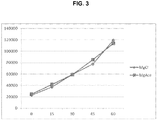
- a kinase assay was conducted in which magnesium is required by the enzyme used, and the assay measures the increase in concentration of a phosphorylated peptide substrate with time.
- One set of samples was formulated with magnesium chloride, a relatively nonvolatile compound, and a second set of samples was formulated with magnesium acetate, a more volatile compound.
- the assay results using each type of magnesium salt are illustrated in FIG. 3 , in which time, in minutes, is represented on the X-axis, and luminescence is represented on the Y-axis.
- the graph comparing results obtained for the assay employing magnesium chloride ( ⁇ ) with those obtained for the assay employing magnesium acetate ( ⁇ ) show that the assay was not hindered or biased by the source of magnesium ions.
- non-volatile and/or highly electronegative buffer components are used; however, these components are not unique creating the biological or chemical outcome of the desired assay.
- the switch does not show any significant change in results for the range of up to 60 as this is within the noise of the measurement. From the previous examples for measurement of analyte with the absence of the non-volatile analyte, this assay system would provide improved results with gas phase extraction prior to MS loading due to reduce ion suppression in the analyte.
Landscapes
- Chemical & Material Sciences (AREA)
- Analytical Chemistry (AREA)
- Physics & Mathematics (AREA)
- Health & Medical Sciences (AREA)
- Life Sciences & Earth Sciences (AREA)
- Biochemistry (AREA)
- General Health & Medical Sciences (AREA)
- General Physics & Mathematics (AREA)
- Immunology (AREA)
- Pathology (AREA)
- Other Investigation Or Analysis Of Materials By Electrical Means (AREA)
Applications Claiming Priority (2)
| Application Number | Priority Date | Filing Date | Title |
|---|---|---|---|
| US201462065600P | 2014-10-17 | 2014-10-17 | |
| PCT/US2015/056288 WO2016061592A1 (en) | 2014-10-17 | 2015-10-19 | Method and system for determining the concentration of an analyte in a fluid sample |
Publications (3)
| Publication Number | Publication Date |
|---|---|
| EP3207374A1 EP3207374A1 (en) | 2017-08-23 |
| EP3207374A4 EP3207374A4 (en) | 2018-06-06 |
| EP3207374B1 true EP3207374B1 (en) | 2021-05-12 |
Family
ID=55747494
Family Applications (1)
| Application Number | Title | Priority Date | Filing Date |
|---|---|---|---|
| EP15850361.5A Active EP3207374B1 (en) | 2014-10-17 | 2015-10-19 | Method and system for determining the concentration of an analyte in a fluid sample |
Country Status (6)
| Country | Link |
|---|---|
| US (2) | US9939352B2 (da) |
| EP (1) | EP3207374B1 (da) |
| JP (1) | JP6916734B2 (da) |
| DK (1) | DK3207374T3 (da) |
| ES (1) | ES2873324T3 (da) |
| WO (1) | WO2016061592A1 (da) |
Families Citing this family (5)
| Publication number | Priority date | Publication date | Assignee | Title |
|---|---|---|---|---|
| DK3207374T3 (da) * | 2014-10-17 | 2021-05-25 | Labcyte Inc | Fremgangsmåde og system til bestemmelse af koncentrationen af en analyt i en fluidprøve |
| US11056215B2 (en) * | 2016-08-15 | 2021-07-06 | International Business Machines Corporation | Performing chemical textual analysis to discover dangerous chemical pathways |
| CN108802027B (zh) * | 2017-04-28 | 2021-05-11 | 利多(香港)有限公司 | 一种检测装置 |
| US11506581B2 (en) * | 2018-03-20 | 2022-11-22 | Agilent Technologies, Inc. | Mass spectrometry compatible salt formation for ionic liquid sample preparation |
| WO2022047327A1 (en) * | 2020-08-31 | 2022-03-03 | Labcyte Inc. | Thermal adapter for automated thermal cycling |
Citations (1)
| Publication number | Priority date | Publication date | Assignee | Title |
|---|---|---|---|---|
| US20060024660A1 (en) * | 2004-07-27 | 2006-02-02 | Patrick Jouin | Method for relative quantification of proteins |
Family Cites Families (22)
| Publication number | Priority date | Publication date | Assignee | Title |
|---|---|---|---|---|
| US2280828A (en) | 1936-09-29 | 1942-04-28 | Schering Corp | Process for the manufacture of compounds of the cyclopentanopolyhydrophenanthrene series |
| WO2001065348A1 (en) * | 2000-03-02 | 2001-09-07 | Wind River Systems, Inc. | System and method for a command structure representation |
| US6666541B2 (en) | 2000-09-25 | 2003-12-23 | Picoliter Inc. | Acoustic ejection of fluids from a plurality of reservoirs |
| US6893836B2 (en) | 2000-11-29 | 2005-05-17 | Picoliter Inc. | Spatially directed ejection of cells from a carrier fluid |
| US6849423B2 (en) | 2000-11-29 | 2005-02-01 | Picoliter Inc | Focused acoustics for detection and sorting of fluid volumes |
| US6603118B2 (en) | 2001-02-14 | 2003-08-05 | Picoliter Inc. | Acoustic sample introduction for mass spectrometric analysis |
| US6855925B2 (en) * | 2001-02-14 | 2005-02-15 | Picoliter Inc. | Methods, devices, and systems using acoustic ejection for depositing fluid droplets on a sample surface for analysis |
| US8414774B2 (en) | 2001-04-25 | 2013-04-09 | Agilent Technologies, Inc. | Systems and methods for high-throughput screening of fluidic samples |
| US20030119193A1 (en) * | 2001-04-25 | 2003-06-26 | Robert Hess | System and method for high throughput screening of droplets |
| US6416164B1 (en) | 2001-07-20 | 2002-07-09 | Picoliter Inc. | Acoustic ejection of fluids using large F-number focusing elements |
| US20030101819A1 (en) | 2001-12-04 | 2003-06-05 | Mutz Mitchell W. | Acoustic assessment of fluids in a plurality of reservoirs |
| EP1367133A1 (en) * | 2002-05-31 | 2003-12-03 | Kiadis B.V. | Continuous-flow enzyme assay with mass spectrometry detection |
| US6827287B2 (en) * | 2002-12-24 | 2004-12-07 | Palo Alto Research Center, Incorporated | High throughput method and apparatus for introducing biological samples into analytical instruments |
| JP2006514299A (ja) * | 2003-10-27 | 2006-04-27 | センス プロテオミック リミテッド | 酵素アレイ及びアッセイ |
| JP2005221263A (ja) * | 2004-02-03 | 2005-08-18 | Yokohama City | タンパク質とdnaとの複合体の結合の強さを定量的に解析する方法及び装置 |
| US20060023808A1 (en) * | 2004-05-17 | 2006-02-02 | Hajivandi Mahbod R | Compositions, kits, and methods for calibration in mass spectrometry |
| KR20050114751A (ko) * | 2004-06-01 | 2005-12-06 | 경희대학교 산학협력단 | 예측 부호화/복호화 장치 및 예측 부호화/복호화 방법 |
| ES2396172T3 (es) | 2007-06-20 | 2013-02-19 | Becton, Dickinson And Company | Medios de FFE y procedimientos de FFE que comprenden medios de separación volátiles |
| US8415619B2 (en) * | 2009-11-13 | 2013-04-09 | University of Glascgow | Methods and systems for mass spectrometry |
| GB2512309B (en) * | 2013-03-25 | 2024-12-11 | Thermo Electron Mfg Ltd | Apparatus and method for liquid sample introduction |
| GB2512308B (en) * | 2013-03-25 | 2016-07-06 | Thermo Electron Mfg Ltd | Apparatus and method for liquid sample introduction using acoustic droplet generator |
| DK3207374T3 (da) * | 2014-10-17 | 2021-05-25 | Labcyte Inc | Fremgangsmåde og system til bestemmelse af koncentrationen af en analyt i en fluidprøve |
-
2015
- 2015-10-19 DK DK15850361.5T patent/DK3207374T3/da active
- 2015-10-19 EP EP15850361.5A patent/EP3207374B1/en active Active
- 2015-10-19 US US14/887,320 patent/US9939352B2/en active Active
- 2015-10-19 JP JP2017519888A patent/JP6916734B2/ja active Active
- 2015-10-19 WO PCT/US2015/056288 patent/WO2016061592A1/en not_active Ceased
- 2015-10-19 ES ES15850361T patent/ES2873324T3/es active Active
-
2018
- 2018-04-09 US US15/948,944 patent/US20180231442A1/en not_active Abandoned
Patent Citations (1)
| Publication number | Priority date | Publication date | Assignee | Title |
|---|---|---|---|---|
| US20060024660A1 (en) * | 2004-07-27 | 2006-02-02 | Patrick Jouin | Method for relative quantification of proteins |
Also Published As
| Publication number | Publication date |
|---|---|
| ES2873324T3 (es) | 2021-11-03 |
| JP2017532558A (ja) | 2017-11-02 |
| EP3207374A4 (en) | 2018-06-06 |
| US9939352B2 (en) | 2018-04-10 |
| WO2016061592A1 (en) | 2016-04-21 |
| US20160109336A1 (en) | 2016-04-21 |
| JP6916734B2 (ja) | 2021-08-11 |
| EP3207374A1 (en) | 2017-08-23 |
| DK3207374T3 (da) | 2021-05-25 |
| US20180231442A1 (en) | 2018-08-16 |
Similar Documents
| Publication | Publication Date | Title |
|---|---|---|
| EP3207374B1 (en) | Method and system for determining the concentration of an analyte in a fluid sample | |
| US12154776B2 (en) | System and method for the acoustic loading of an analytical instrument using a continuous flow sampling probe | |
| US6603118B2 (en) | Acoustic sample introduction for mass spectrometric analysis | |
| US8203117B2 (en) | Method and apparatus for embedded heater for desorption and ionization of analytes | |
| AU2002240423B2 (en) | Acoustic sample introduction for analysis and/or processing | |
| AU2002240423A1 (en) | Acoustic sample introduction for analysis and/or processing | |
| US11237086B2 (en) | System and method for extracting a target moiety from a sample using acoustic droplet ejection | |
| US20150155132A1 (en) | Mass spectrometer and mass image analyzing system | |
| Sauer | The essence of DNA sample preparation for MALDI mass spectrometry | |
| JP2004085546A (ja) | 飛行時間型二次イオン質量分析法による素子の情報取得方法、および、情報取得装置 | |
| US9651521B2 (en) | Microsecond time-resolved mass spectrometry | |
| JP2004205510A (ja) | 分析装置の注入口に流体試料を供給するシステム | |
| US20050186579A1 (en) | MALDI-MS analysis of nucleic acids bound to a surface | |
| Dauletyarov et al. | Vaporization of intact neutral biomolecules using laser-based thermal desorption | |
| JP2005208037A (ja) | 検定試料およびその製造方法 | |
| US10304667B1 (en) | Apparatus and method for cleaning an inlet of a mass spectrometer | |
| Li | Spray Generated Ions: Principles, Processes, Pathways for Applications | |
| HK40035032A (en) | System and method for the acoustic loading of an analytical instrument using a continuous flow sampling probe | |
| Douglass et al. | DECONSTRUCTING DESORPTION ELECTROSPRAY IONIZATION |
Legal Events
| Date | Code | Title | Description |
|---|---|---|---|
| STAA | Information on the status of an ep patent application or granted ep patent |
Free format text: STATUS: THE INTERNATIONAL PUBLICATION HAS BEEN MADE |
|
| PUAI | Public reference made under article 153(3) epc to a published international application that has entered the european phase |
Free format text: ORIGINAL CODE: 0009012 |
|
| STAA | Information on the status of an ep patent application or granted ep patent |
Free format text: STATUS: REQUEST FOR EXAMINATION WAS MADE |
|
| 17P | Request for examination filed |
Effective date: 20170517 |
|
| AK | Designated contracting states |
Kind code of ref document: A1 Designated state(s): AL AT BE BG CH CY CZ DE DK EE ES FI FR GB GR HR HU IE IS IT LI LT LU LV MC MK MT NL NO PL PT RO RS SE SI SK SM TR |
|
| AX | Request for extension of the european patent |
Extension state: BA ME |
|
| DAV | Request for validation of the european patent (deleted) | ||
| DAX | Request for extension of the european patent (deleted) | ||
| REG | Reference to a national code |
Ref country code: DE Ref legal event code: R079 Ref document number: 602015069311 Country of ref document: DE Free format text: PREVIOUS MAIN CLASS: G01N0033543000 Ipc: G01N0033680000 |
|
| A4 | Supplementary search report drawn up and despatched |
Effective date: 20180509 |
|
| RIC1 | Information provided on ipc code assigned before grant |
Ipc: G01N 33/68 20060101AFI20180503BHEP Ipc: G01N 1/28 20060101ALI20180503BHEP Ipc: H01J 49/04 20060101ALI20180503BHEP |
|
| STAA | Information on the status of an ep patent application or granted ep patent |
Free format text: STATUS: EXAMINATION IS IN PROGRESS |
|
| 17Q | First examination report despatched |
Effective date: 20190306 |
|
| GRAP | Despatch of communication of intention to grant a patent |
Free format text: ORIGINAL CODE: EPIDOSNIGR1 |
|
| STAA | Information on the status of an ep patent application or granted ep patent |
Free format text: STATUS: GRANT OF PATENT IS INTENDED |
|
| INTG | Intention to grant announced |
Effective date: 20200916 |
|
| GRAJ | Information related to disapproval of communication of intention to grant by the applicant or resumption of examination proceedings by the epo deleted |
Free format text: ORIGINAL CODE: EPIDOSDIGR1 |
|
| STAA | Information on the status of an ep patent application or granted ep patent |
Free format text: STATUS: EXAMINATION IS IN PROGRESS |
|
| GRAP | Despatch of communication of intention to grant a patent |
Free format text: ORIGINAL CODE: EPIDOSNIGR1 |
|
| STAA | Information on the status of an ep patent application or granted ep patent |
Free format text: STATUS: GRANT OF PATENT IS INTENDED |
|
| INTC | Intention to grant announced (deleted) | ||
| INTG | Intention to grant announced |
Effective date: 20201203 |
|
| GRAS | Grant fee paid |
Free format text: ORIGINAL CODE: EPIDOSNIGR3 |
|
| GRAA | (expected) grant |
Free format text: ORIGINAL CODE: 0009210 |
|
| STAA | Information on the status of an ep patent application or granted ep patent |
Free format text: STATUS: THE PATENT HAS BEEN GRANTED |
|
| AK | Designated contracting states |
Kind code of ref document: B1 Designated state(s): AL AT BE BG CH CY CZ DE DK EE ES FI FR GB GR HR HU IE IS IT LI LT LU LV MC MK MT NL NO PL PT RO RS SE SI SK SM TR |
|
| REG | Reference to a national code |
Ref country code: GB Ref legal event code: FG4D |
|
| REG | Reference to a national code |
Ref country code: CH Ref legal event code: EP |
|
| REG | Reference to a national code |
Ref country code: DK Ref legal event code: T3 Effective date: 20210520 |
|
| REG | Reference to a national code |
Ref country code: NL Ref legal event code: FP |
|
| REG | Reference to a national code |
Ref country code: DE Ref legal event code: R096 Ref document number: 602015069311 Country of ref document: DE |
|
| REG | Reference to a national code |
Ref country code: IE Ref legal event code: FG4D |
|
| REG | Reference to a national code |
Ref country code: AT Ref legal event code: REF Ref document number: 1392518 Country of ref document: AT Kind code of ref document: T Effective date: 20210615 |
|
| REG | Reference to a national code |
Ref country code: SE Ref legal event code: TRGR |
|
| REG | Reference to a national code |
Ref country code: NO Ref legal event code: T2 Effective date: 20210512 |
|
| REG | Reference to a national code |
Ref country code: LT Ref legal event code: MG9D |
|
| REG | Reference to a national code |
Ref country code: AT Ref legal event code: MK05 Ref document number: 1392518 Country of ref document: AT Kind code of ref document: T Effective date: 20210512 |
|
| PG25 | Lapsed in a contracting state [announced via postgrant information from national office to epo] |
Ref country code: LT Free format text: LAPSE BECAUSE OF FAILURE TO SUBMIT A TRANSLATION OF THE DESCRIPTION OR TO PAY THE FEE WITHIN THE PRESCRIBED TIME-LIMIT Effective date: 20210512 Ref country code: FI Free format text: LAPSE BECAUSE OF FAILURE TO SUBMIT A TRANSLATION OF THE DESCRIPTION OR TO PAY THE FEE WITHIN THE PRESCRIBED TIME-LIMIT Effective date: 20210512 Ref country code: AT Free format text: LAPSE BECAUSE OF FAILURE TO SUBMIT A TRANSLATION OF THE DESCRIPTION OR TO PAY THE FEE WITHIN THE PRESCRIBED TIME-LIMIT Effective date: 20210512 Ref country code: BG Free format text: LAPSE BECAUSE OF FAILURE TO SUBMIT A TRANSLATION OF THE DESCRIPTION OR TO PAY THE FEE WITHIN THE PRESCRIBED TIME-LIMIT Effective date: 20210812 Ref country code: HR Free format text: LAPSE BECAUSE OF FAILURE TO SUBMIT A TRANSLATION OF THE DESCRIPTION OR TO PAY THE FEE WITHIN THE PRESCRIBED TIME-LIMIT Effective date: 20210512 |
|
| REG | Reference to a national code |
Ref country code: ES Ref legal event code: FG2A Ref document number: 2873324 Country of ref document: ES Kind code of ref document: T3 Effective date: 20211103 |
|
| PG25 | Lapsed in a contracting state [announced via postgrant information from national office to epo] |
Ref country code: PL Free format text: LAPSE BECAUSE OF FAILURE TO SUBMIT A TRANSLATION OF THE DESCRIPTION OR TO PAY THE FEE WITHIN THE PRESCRIBED TIME-LIMIT Effective date: 20210512 Ref country code: PT Free format text: LAPSE BECAUSE OF FAILURE TO SUBMIT A TRANSLATION OF THE DESCRIPTION OR TO PAY THE FEE WITHIN THE PRESCRIBED TIME-LIMIT Effective date: 20210913 Ref country code: RS Free format text: LAPSE BECAUSE OF FAILURE TO SUBMIT A TRANSLATION OF THE DESCRIPTION OR TO PAY THE FEE WITHIN THE PRESCRIBED TIME-LIMIT Effective date: 20210512 Ref country code: LV Free format text: LAPSE BECAUSE OF FAILURE TO SUBMIT A TRANSLATION OF THE DESCRIPTION OR TO PAY THE FEE WITHIN THE PRESCRIBED TIME-LIMIT Effective date: 20210512 Ref country code: IS Free format text: LAPSE BECAUSE OF FAILURE TO SUBMIT A TRANSLATION OF THE DESCRIPTION OR TO PAY THE FEE WITHIN THE PRESCRIBED TIME-LIMIT Effective date: 20210912 Ref country code: GR Free format text: LAPSE BECAUSE OF FAILURE TO SUBMIT A TRANSLATION OF THE DESCRIPTION OR TO PAY THE FEE WITHIN THE PRESCRIBED TIME-LIMIT Effective date: 20210813 |
|
| PG25 | Lapsed in a contracting state [announced via postgrant information from national office to epo] |
Ref country code: RO Free format text: LAPSE BECAUSE OF FAILURE TO SUBMIT A TRANSLATION OF THE DESCRIPTION OR TO PAY THE FEE WITHIN THE PRESCRIBED TIME-LIMIT Effective date: 20210512 Ref country code: SK Free format text: LAPSE BECAUSE OF FAILURE TO SUBMIT A TRANSLATION OF THE DESCRIPTION OR TO PAY THE FEE WITHIN THE PRESCRIBED TIME-LIMIT Effective date: 20210512 Ref country code: SM Free format text: LAPSE BECAUSE OF FAILURE TO SUBMIT A TRANSLATION OF THE DESCRIPTION OR TO PAY THE FEE WITHIN THE PRESCRIBED TIME-LIMIT Effective date: 20210512 Ref country code: EE Free format text: LAPSE BECAUSE OF FAILURE TO SUBMIT A TRANSLATION OF THE DESCRIPTION OR TO PAY THE FEE WITHIN THE PRESCRIBED TIME-LIMIT Effective date: 20210512 Ref country code: CZ Free format text: LAPSE BECAUSE OF FAILURE TO SUBMIT A TRANSLATION OF THE DESCRIPTION OR TO PAY THE FEE WITHIN THE PRESCRIBED TIME-LIMIT Effective date: 20210512 |
|
| REG | Reference to a national code |
Ref country code: DE Ref legal event code: R097 Ref document number: 602015069311 Country of ref document: DE |
|
| RAP4 | Party data changed (patent owner data changed or rights of a patent transferred) |
Owner name: LABCYTE INC. |
|
| PLBE | No opposition filed within time limit |
Free format text: ORIGINAL CODE: 0009261 |
|
| STAA | Information on the status of an ep patent application or granted ep patent |
Free format text: STATUS: NO OPPOSITION FILED WITHIN TIME LIMIT |
|
| 26N | No opposition filed |
Effective date: 20220215 |
|
| PG25 | Lapsed in a contracting state [announced via postgrant information from national office to epo] |
Ref country code: IS Free format text: LAPSE BECAUSE OF FAILURE TO SUBMIT A TRANSLATION OF THE DESCRIPTION OR TO PAY THE FEE WITHIN THE PRESCRIBED TIME-LIMIT Effective date: 20210912 Ref country code: AL Free format text: LAPSE BECAUSE OF FAILURE TO SUBMIT A TRANSLATION OF THE DESCRIPTION OR TO PAY THE FEE WITHIN THE PRESCRIBED TIME-LIMIT Effective date: 20210512 |
|
| PG25 | Lapsed in a contracting state [announced via postgrant information from national office to epo] |
Ref country code: MC Free format text: LAPSE BECAUSE OF FAILURE TO SUBMIT A TRANSLATION OF THE DESCRIPTION OR TO PAY THE FEE WITHIN THE PRESCRIBED TIME-LIMIT Effective date: 20210512 |
|
| PG25 | Lapsed in a contracting state [announced via postgrant information from national office to epo] |
Ref country code: LU Free format text: LAPSE BECAUSE OF NON-PAYMENT OF DUE FEES Effective date: 20211019 Ref country code: IT Free format text: LAPSE BECAUSE OF FAILURE TO SUBMIT A TRANSLATION OF THE DESCRIPTION OR TO PAY THE FEE WITHIN THE PRESCRIBED TIME-LIMIT Effective date: 20210512 |
|
| PG25 | Lapsed in a contracting state [announced via postgrant information from national office to epo] |
Ref country code: IE Free format text: LAPSE BECAUSE OF NON-PAYMENT OF DUE FEES Effective date: 20211019 |
|
| REG | Reference to a national code |
Ref country code: NO Ref legal event code: CHAD Owner name: LABCYTE INC., US |
|
| REG | Reference to a national code |
Ref country code: DE Ref legal event code: R081 Ref document number: 602015069311 Country of ref document: DE Owner name: LABCYTE INC., SAN JOSE, US Free format text: FORMER OWNER: LABCYTE INC., SUNNYVALE, CALIF., US |
|
| PG25 | Lapsed in a contracting state [announced via postgrant information from national office to epo] |
Ref country code: HU Free format text: LAPSE BECAUSE OF FAILURE TO SUBMIT A TRANSLATION OF THE DESCRIPTION OR TO PAY THE FEE WITHIN THE PRESCRIBED TIME-LIMIT; INVALID AB INITIO Effective date: 20151019 |
|
| PG25 | Lapsed in a contracting state [announced via postgrant information from national office to epo] |
Ref country code: CY Free format text: LAPSE BECAUSE OF FAILURE TO SUBMIT A TRANSLATION OF THE DESCRIPTION OR TO PAY THE FEE WITHIN THE PRESCRIBED TIME-LIMIT Effective date: 20210512 |
|
| PG25 | Lapsed in a contracting state [announced via postgrant information from national office to epo] |
Ref country code: MK Free format text: LAPSE BECAUSE OF FAILURE TO SUBMIT A TRANSLATION OF THE DESCRIPTION OR TO PAY THE FEE WITHIN THE PRESCRIBED TIME-LIMIT Effective date: 20210512 |
|
| PG25 | Lapsed in a contracting state [announced via postgrant information from national office to epo] |
Ref country code: TR Free format text: LAPSE BECAUSE OF FAILURE TO SUBMIT A TRANSLATION OF THE DESCRIPTION OR TO PAY THE FEE WITHIN THE PRESCRIBED TIME-LIMIT Effective date: 20210512 |
|
| PG25 | Lapsed in a contracting state [announced via postgrant information from national office to epo] |
Ref country code: MT Free format text: LAPSE BECAUSE OF FAILURE TO SUBMIT A TRANSLATION OF THE DESCRIPTION OR TO PAY THE FEE WITHIN THE PRESCRIBED TIME-LIMIT Effective date: 20210512 |
|
| REG | Reference to a national code |
Ref country code: CH Ref legal event code: U11 Free format text: ST27 STATUS EVENT CODE: U-0-0-U10-U11 (AS PROVIDED BY THE NATIONAL OFFICE) Effective date: 20251101 |
|
| PGFP | Annual fee paid to national office [announced via postgrant information from national office to epo] |
Ref country code: NL Payment date: 20251024 Year of fee payment: 11 |
|
| PGFP | Annual fee paid to national office [announced via postgrant information from national office to epo] |
Ref country code: DE Payment date: 20251028 Year of fee payment: 11 |
|
| PGFP | Annual fee paid to national office [announced via postgrant information from national office to epo] |
Ref country code: GB Payment date: 20251023 Year of fee payment: 11 |
|
| PGFP | Annual fee paid to national office [announced via postgrant information from national office to epo] |
Ref country code: NO Payment date: 20251022 Year of fee payment: 11 |
|
| PGFP | Annual fee paid to national office [announced via postgrant information from national office to epo] |
Ref country code: DK Payment date: 20251024 Year of fee payment: 11 |
|
| PGFP | Annual fee paid to national office [announced via postgrant information from national office to epo] |
Ref country code: FR Payment date: 20251027 Year of fee payment: 11 |
|
| PGFP | Annual fee paid to national office [announced via postgrant information from national office to epo] |
Ref country code: BE Payment date: 20251024 Year of fee payment: 11 |
|
| PGFP | Annual fee paid to national office [announced via postgrant information from national office to epo] |
Ref country code: CH Payment date: 20251101 Year of fee payment: 11 Ref country code: SE Payment date: 20251024 Year of fee payment: 11 |
|
| PGFP | Annual fee paid to national office [announced via postgrant information from national office to epo] |
Ref country code: ES Payment date: 20251118 Year of fee payment: 11 |