EP3205155B1 - Method and apparatus for prach transmission power adjustment - Google Patents
Method and apparatus for prach transmission power adjustment Download PDFInfo
- Publication number
- EP3205155B1 EP3205155B1 EP15777791.3A EP15777791A EP3205155B1 EP 3205155 B1 EP3205155 B1 EP 3205155B1 EP 15777791 A EP15777791 A EP 15777791A EP 3205155 B1 EP3205155 B1 EP 3205155B1
- Authority
- EP
- European Patent Office
- Prior art keywords
- transmission
- power
- prach
- prach transmission
- determining
- Prior art date
- Legal status (The legal status is an assumption and is not a legal conclusion. Google has not performed a legal analysis and makes no representation as to the accuracy of the status listed.)
- Active
Links
Images






Classifications
-
- H—ELECTRICITY
- H04—ELECTRIC COMMUNICATION TECHNIQUE
- H04W—WIRELESS COMMUNICATION NETWORKS
- H04W52/00—Power management, e.g. Transmission Power Control [TPC] or power classes
- H04W52/04—Transmission power control [TPC]
- H04W52/30—Transmission power control [TPC] using constraints in the total amount of available transmission power
- H04W52/36—Transmission power control [TPC] using constraints in the total amount of available transmission power with a discrete range or set of values, e.g. step size, ramping or offsets
- H04W52/362—Aspects of the step size
-
- H—ELECTRICITY
- H04—ELECTRIC COMMUNICATION TECHNIQUE
- H04W—WIRELESS COMMUNICATION NETWORKS
- H04W52/00—Power management, e.g. Transmission Power Control [TPC] or power classes
- H04W52/04—Transmission power control [TPC]
- H04W52/06—TPC algorithms
- H04W52/14—Separate analysis of uplink or downlink
- H04W52/146—Uplink power control
-
- H—ELECTRICITY
- H04—ELECTRIC COMMUNICATION TECHNIQUE
- H04W—WIRELESS COMMUNICATION NETWORKS
- H04W52/00—Power management, e.g. Transmission Power Control [TPC] or power classes
- H04W52/04—Transmission power control [TPC]
- H04W52/38—TPC being performed in particular situations
- H04W52/50—TPC being performed in particular situations at the moment of starting communication in a multiple access environment
-
- H—ELECTRICITY
- H04—ELECTRIC COMMUNICATION TECHNIQUE
- H04W—WIRELESS COMMUNICATION NETWORKS
- H04W74/00—Wireless channel access
- H04W74/08—Non-scheduled access, e.g. ALOHA
- H04W74/0866—Non-scheduled access, e.g. ALOHA using a dedicated channel for access
-
- H—ELECTRICITY
- H04—ELECTRIC COMMUNICATION TECHNIQUE
- H04W—WIRELESS COMMUNICATION NETWORKS
- H04W52/00—Power management, e.g. Transmission Power Control [TPC] or power classes
- H04W52/04—Transmission power control [TPC]
- H04W52/18—TPC being performed according to specific parameters
- H04W52/22—TPC being performed according to specific parameters taking into account previous information or commands
- H04W52/228—TPC being performed according to specific parameters taking into account previous information or commands using past power values or information
-
- H—ELECTRICITY
- H04—ELECTRIC COMMUNICATION TECHNIQUE
- H04W—WIRELESS COMMUNICATION NETWORKS
- H04W52/00—Power management, e.g. Transmission Power Control [TPC] or power classes
- H04W52/04—Transmission power control [TPC]
- H04W52/30—Transmission power control [TPC] using constraints in the total amount of available transmission power
- H04W52/32—TPC of broadcast or control channels
- H04W52/325—Power control of control or pilot channels
Definitions
- the present disclosure relates generally to communication systems, and more particularly, to physical random access channel (PRACH) transmission handling in Long Term Evolution (LTE).
- PRACH physical random access channel
- Wireless communication systems are widely deployed to provide various telecommunication services such as telephony, video, data, messaging, and broadcasts.
- Typical wireless communication systems may employ multiple-access technologies capable of supporting communication with multiple users by sharing available system resources (e.g., bandwidth, transmit power).
- multiple-access technologies include code division multiple access (CDMA) systems, time division multiple access (TDMA) systems, frequency division multiple access (FDMA) systems, orthogonal frequency division multiple access (OFDMA) systems, single-carrier frequency division multiple access (SC-FDMA) systems, and time division synchronous code division multiple access (TD-SCDMA) systems.
- CDMA code division multiple access
- TDMA time division multiple access
- FDMA frequency division multiple access
- OFDMA orthogonal frequency division multiple access
- SC-FDMA single-carrier frequency division multiple access
- TD-SCDMA time division synchronous code division multiple access
- LTE is a set of enhancements to the Universal Mobile Telecommunications System (UMTS) mobile standard promulgated by Third Generation Partnership Project (3GPP).
- UMTS Universal Mobile Telecommunications System
- 3GPP Third Generation Partnership Project
- LTE is designed to better support mobile broadband Internet access by improving spectral efficiency, lowering costs, improving services, making use of new spectrum, and better integrating with other open standards using OFDMA on the downlink (DL), SC-FDMA on the uplink (UL), and multiple-input multiple-output (MIMO) antenna technology, as for example described in WO 2010/ 107354 A1 .
- OFDMA on the downlink
- SC-FDMA on the uplink
- MIMO multiple-input multiple-output
- a user equipment may determine a PRACH power ramp-up P ramp-up for the PRACH with respect to a previously unsuccessful PRACH transmission (e.g., a previously unsuccessful PRACH transmission with a highest transmission power).
- a previously unsuccessful PRACH transmission e.g., a previously unsuccessful PRACH transmission with a highest transmission power.
- the UE drops / refrains from transmitting the PRACH transmission if P ramp-up - P scal ⁇ P drop , and transmits the PRACH otherwise, where P scal is the power scaling value, P ramp-up is the configured ramp-up power value, and P drop is a threshold.
- the UE determines whether to increment a Preamble_Transmission _Counter.
- the UE increments the Preamble_Transmission _Counter when the PRACH transmission takes place (i.e., the PRACH is not dropped), and refrains from incrementing the Preamble _Transmission _Counter when the PRACH transmission does not take place (i.e., the PRACH is dropped).
- the UE increments the Preamble_Transmission_Counter when the PRACH transmission takes place and P ramp-up - P scal ⁇ P count , where P count is a threshold, and refrains from incrementing the Preamble_Transmission_Counter otherwise.
- the apparatus may be a UE.
- the UE determines to scale a transmission power for a PRACH transmission of a plurality of concurrent PRACH transmissions.
- the UE determines whether to send the PRACH transmission based on the scaled transmission power.
- the UE sends the PRACH transmission at the scaled transmission power upon determining to send the PRACH transmission.
- the apparatus may be a UE.
- the UE determines a transmission power for a PRACH transmission based at least on a power ramping stepsize and a previously determined transmission power of a previously sent unsuccessful PRACH transmission.
- the UE sends the PRACH transmission at the determined transmission power.
- the apparatus may be a UE.
- the UE determines to scale power by a power scaling factor for a PRACH transmission of a plurality of concurrent PRACH transmissions.
- a transmission power for the PRACH transmission is based at least on a power ramping stepsize and the power scaling factor.
- the UE determines whether to send the PRACH transmission.
- the UE determines whether to increment a preamble transmission counter based at least on the determination of whether to send the PRACH transmission. In one configuration, the determination whether to increment the preamble transmission counter is further based on both the power ramping stepsize and the power scaling factor.
- the determination whether to increment the preamble transmission counter is further based on a difference between the power ramping stepsize and the power scaling factor. In one configuration, the determining whether to increment the preamble transmission counter includes determining to refrain from incrementing the preamble transmission counter when the difference between the power ramping stepsize and the power scaling factor is less than a threshold or the PRACH transmission is determined not to be sent. In one configuration, the determining whether to increment the preamble transmission counter includes determining to increment the preamble transmission counter when the difference between the power ramping stepsize and the power scaling factor is greater than or equal to a threshold and the PRACH transmission is determined to be sent.
- processors include microprocessors, microcontrollers, digital signal processors (DSPs), field programmable gate arrays (FPGAs), programmable logic devices (PLDs), state machines, gated logic, discrete hardware circuits, and other suitable hardware configured to perform the various functionality described throughout this disclosure.
- DSPs digital signal processors
- FPGAs field programmable gate arrays
- PLDs programmable logic devices
- state machines gated logic, discrete hardware circuits, and other suitable hardware configured to perform the various functionality described throughout this disclosure.
- One or more processors in the processing system may execute software.
- Software shall be construed broadly to mean instructions, instruction sets, code, code segments, program code, programs, subprograms, software components, applications, software applications, software packages, routines, subroutines, objects, executables, threads of execution, procedures, functions, etc., whether referred to as software, firmware, middleware, microcode, hardware description language, or otherwise.
- the functions described may be implemented in hardware, software, firmware, or any combination thereof. If implemented in software, the functions may be stored on or encoded as one or more instructions or code on a computer-readable medium.
- Computer-readable media includes computer storage media. Storage media may be any available media that can be accessed by a computer.
- such computer-readable media can comprise a random-access memory (RAM), a read-only memory (ROM), an electrically erasable programmable ROM (EEPROM), optical disk storage, magnetic disk storage or other magnetic storage devices, combinations of the aforementioned types of computer-readable media, or any other medium that can be used to store computer executable code in the form of instructions or data structures that can be accessed by a computer.
- RAM random-access memory
- ROM read-only memory
- EEPROM electrically erasable programmable ROM
- optical disk storage magnetic disk storage or other magnetic storage devices, combinations of the aforementioned types of computer-readable media, or any other medium that can be used to store computer executable code in the form of instructions or data structures that can be accessed by a computer.
- FIG. 1 is a diagram illustrating an LTE network architecture 100.
- the LTE network architecture 100 may be referred to as an Evolved Packet System (EPS) 100.
- the EPS 100 may include one or more user equipment (UE) 102, an Evolved UMTS Terrestrial Radio Access Network (E-UTRAN) 104, an Evolved Packet Core (EPC) 110, and an Operator's Internet Protocol (IP) Services 122.
- the EPS can interconnect with other access networks, but for simplicity those entities/interfaces are not shown.
- the EPS provides packet-switched services, however, as those skilled in the art will readily appreciate, the various concepts presented throughout this disclosure may be extended to networks providing circuit-switched services.
- the E-UTRAN includes the evolved Node B (eNB) 106 and other eNBs 108, and may include a Multicast Coordination Entity (MCE) 128.
- the eNB 106 provides user and control planes protocol terminations toward the UE 102.
- the eNB 106 may be connected to the other eNBs 108 via a backhaul (e.g., an X2 interface).
- the MCE 128 allocates time/frequency radio resources for evolved Multimedia Broadcast Multicast Service (MBMS) (eMBMS), and determines the radio configuration (e.g., a modulation and coding scheme (MCS)) for the eMBMS.
- MBMS evolved Multimedia Broadcast Multicast Service
- MCS modulation and coding scheme
- the MCE 128 may be a separate entity or part of the eNB 106.
- the eNB 106 may also be referred to as a base station, a Node B, an access point, a base transceiver station, a radio base station, a radio transceiver, a transceiver function, a basic service set (BSS), an extended service set (ESS), or some other suitable terminology.
- the eNB 106 provides an access point to the EPC 110 for a UE 102.
- Examples of UEs 102 include a cellular phone, a smart phone, a session initiation protocol (SIP) phone, a laptop, a personal digital assistant (PDA), a satellite radio, a global positioning system, a multimedia device, a video device, a digital audio player (e.g., MP3 player), a camera, a game console, a tablet, or any other similar functioning device.
- SIP session initiation protocol
- PDA personal digital assistant
- satellite radio a global positioning system
- multimedia device e.g., a digital audio player (e.g., MP3 player), a camera, a game console, a tablet, or any other similar functioning device.
- MP3 player digital audio player
- the UE 102 may also be referred to by those skilled in the art as a mobile station, a subscriber station, a mobile unit, a subscriber unit, a wireless unit, a remote unit, a mobile device, a wireless device, a wireless communications device, a remote device, a mobile subscriber station, an access terminal, a mobile terminal, a wireless terminal, a remote terminal, a handset, a user agent, a mobile client, a client, or some other suitable terminology.
- the eNB 106 is connected to the EPC 110.
- the EPC 110 may include a Mobility Management Entity (MME) 112, a Home Subscriber Server (HSS) 120, other MMEs 114, a Serving Gateway 116, a Multimedia Broadcast Multicast Service (MBMS) Gateway 124, a Broadcast Multicast Service Center (BM-SC) 126, and a Packet Data Network (PDN) Gateway 118.
- MME Mobility Management Entity
- HSS Home Subscriber Server
- MBMS Multimedia Broadcast Multicast Service
- BM-SC Broadcast Multicast Service Center
- PDN Packet Data Network
- the PDN Gateway 118 provides UE IP address allocation as well as other functions.
- the PDN Gateway 118 and the BM-SC 126 are connected to the IP Services 122.
- the IP Services 122 may include the Internet, an intranet, an IP Multimedia Subsystem (IMS), a PS Streaming Service (PSS), and/or other IP services.
- the BM-SC 126 may provide functions for MBMS user service provisioning and delivery.
- the BM-SC 126 may serve as an entry point for content provider MBMS transmission, may be used to authorize and initiate MBMS Bearer Services within a public land mobile network (PLMN), and may be used to schedule and deliver MBMS transmissions.
- PLMN public land mobile network
- the MBMS Gateway 124 may be used to distribute MBMS traffic to the eNBs (e.g., 106, 108) belonging to a Multicast Broadcast Single Frequency Network (MBSFN) area broadcasting a particular service, and may be responsible for session management (start/stop) and for collecting eMBMS related charging information.
- MMSFN Multicast Broadcast Single Frequency Network
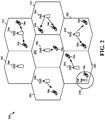
- FIG. 2 is a diagram illustrating an example of an access network 200 in an LTE network architecture.
- the access network 200 is divided into a number of cellular regions (cells) 202.
- One or more lower power class eNBs 208 may have cellular regions 210 that overlap with one or more of the cells 202.
- the lower power class eNB 208 may be a femto cell (e.g., home eNB (HeNB)), pico cell, micro cell, or remote radio head (RRH).
- HeNB home eNB
- RRH remote radio head
- the macro eNBs 204 are each assigned to a respective cell 202 and are configured to provide an access point to the EPC 110 for all the UEs 206 in the cells 202.
- the eNBs 204 are responsible for all radio related functions including radio bearer control, admission control, mobility control, scheduling, security, and connectivity to the serving gateway 116.
- An eNB may support one or multiple (e.g., three) cells (also referred to as a sectors).
- the term "cell” can refer to the smallest coverage area of an eNB and/or an eNB subsystem serving a particular coverage area. Further, the terms “eNB,” “base station,” and “cell” may be used interchangeably herein.
- the modulation and multiple access scheme employed by the access network 200 may vary depending on the particular telecommunications standard being deployed.
- OFDM is used on the DL
- SC-FDMA is used on the UL to support both frequency division duplex (FDD) and time division duplex (TDD).
- FDD frequency division duplex
- TDD time division duplex
- FDD frequency division duplex
- TDD time division duplex
- EV-DO Evolution-Data Optimized
- UMB Ultra Mobile Broadband
- EV-DO and UMB are air interface standards promulgated by the 3rd Generation Partnership Project 2 (3GPP2) as part of the CDMA2000 family of standards and employs CDMA to provide broadband Internet access to mobile stations. These concepts may also be extended to Universal Terrestrial Radio Access (UTRA) employing Wideband-CDMA (W-CDMA) and other variants of CDMA, such as TD-SCDMA; Global System for Mobile Communications (GSM) employing TDMA; and Evolved UTRA (E-UTRA), IEEE 802.11 (Wi-Fi), IEEE 802.16 (WiMAX), IEEE 802.20, and Flash-OFDM employing OFDMA.
- UTRA, E-UTRA, UMTS, LTE and GSM are described in documents from the 3GPP organization.
- CDMA2000 and UMB are described in documents from the 3GPP2 organization. The actual wireless communication standard and the multiple access technology employed will depend on the specific application and the overall design constraints imposed on the system.
- the eNBs 204 may have multiple antennas supporting MIMO technology.
- MIMO technology enables the eNBs 204 to exploit the spatial domain to support spatial multiplexing, beamforming, and transmit diversity.
- Spatial multiplexing may be used to transmit different streams of data simultaneously on the same frequency.
- the data streams may be transmitted to a single UE 206 to increase the data rate or to multiple UEs 206 to increase the overall system capacity. This is achieved by spatially precoding each data stream (i.e., applying a scaling of an amplitude and a phase) and then transmitting each spatially precoded stream through multiple transmit antennas on the DL.
- the spatially precoded data streams arrive at the UE(s) 206 with different spatial signatures, which enables each of the UE(s) 206 to recover the one or more data streams destined for that UE 206.
- each UE 206 transmits a spatially precoded data stream, which enables the eNB 204 to identify the source of each spatially precoded data stream.
- Beamforming may be used to focus the transmission energy in one or more directions. This may be achieved by spatially precoding the data for transmission through multiple antennas. To achieve good coverage at the edges of the cell, a single stream beamforming transmission may be used in combination with transmit diversity.
- OFDM is a spread-spectrum technique that modulates data over a number of subcarriers within an OFDM symbol.
- the subcarriers are spaced apart at precise frequencies. The spacing provides "orthogonality" that enables a receiver to recover the data from the subcarriers.
- a guard interval e.g., cyclic prefix
- the UL may use SC-FDMA in the form of a DFT-spread OFDM signal to compensate for high peak-to-average power ratio (PAPR).
- PAPR peak-to-average power ratio
- FIG. 3 is a diagram 300 illustrating an example of a DL frame structure in LTE.
- a frame (10 ms) may be divided into 10 equally sized subframes. Each subframe may include two consecutive time slots.
- a resource grid may be used to represent two time slots, each time slot including a resource block.
- the resource grid is divided into multiple resource elements.
- a resource block contains 12 consecutive subcarriers in the frequency domain and 7 consecutive OFDM symbols in the time domain, for a total of 84 resource elements.
- For an extended cyclic prefix a resource block contains 12 consecutive subcarriers in the frequency domain and 6 consecutive OFDM symbols in the time domain, for a total of 72 resource elements.
- the DL-RS include channel state information (CSI) RS (CSI-RS), Cell-specific RS (CRS) (also sometimes called common RS) 302, and UE-specific RS (UE-RS) 304.
- CSI-RS channel state information
- CRS Cell-specific RS
- UE-RS UE-specific RS
- UE-RS 304 are transmitted on the resource blocks upon which the corresponding physical DL shared channel (PDSCH) is mapped.
- the number of bits carried by each resource element depends on the modulation scheme. Thus, the more resource blocks that a UE receives and the higher the modulation scheme, the higher the data rate for the UE.
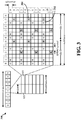
- FIG. 4 is a diagram 400 illustrating an example of an UL frame structure in LTE.
- the available resource blocks for the UL may be partitioned into a data section and a control section.
- the control section may be formed at the two edges of the system bandwidth and may have a configurable size.
- the resource blocks in the control section may be assigned to UEs for transmission of control information.
- the data section may include all resource blocks not included in the control section.
- the UL frame structure results in the data section including contiguous subcarriers, which may allow a single UE to be assigned all of the contiguous subcarriers in the data section.
- a UE may be assigned resource blocks 410a, 410b in the control section to transmit control information to an eNB.
- the UE may also be assigned resource blocks 420a, 420b in the data section to transmit data to the eNB.
- the UE may transmit control information in a physical UL control channel (PUCCH) on the assigned resource blocks in the control section.
- the UE may transmit data or both data and control information in a physical UL shared channel (PUSCH) on the assigned resource blocks in the data section.
- a UL transmission may span both slots of a subframe and may hop across frequency.
- a set of resource blocks may be used to perform initial system access and achieve UL synchronization in a physical random access channel (PRACH) 430.
- the PRACH 430 carries a random sequence and cannot carry any UL data/signaling.
- Each random access preamble occupies a bandwidth corresponding to six consecutive resource blocks.
- the starting frequency is specified by the network. That is, the transmission of the random access preamble is restricted to certain time and frequency resources. There is no frequency hopping for the PRACH.
- the PRACH attempt is carried in a single subframe (1 ms) or in a sequence of few contiguous subframes and a UE can make a single PRACH attempt per frame (10 ms).
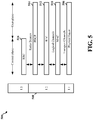
- FIG. 5 is a diagram 500 illustrating an example of a radio protocol architecture for the user and control planes in LTE.
- the radio protocol architecture for the UE and the eNB is shown with three layers: Layer 1, Layer 2, and Layer 3.
- Layer 1 (L1 layer) is the lowest layer and implements various physical layer signal processing functions.
- the L1 layer will be referred to herein as the physical layer 506.
- Layer 2 (L2 layer) 508 is above the physical layer 506 and is responsible for the link between the UE and eNB over the physical layer 506.
- the L2 layer 508 includes a media access control (MAC) sublayer 510, a radio link control (RLC) sublayer 512, and a packet data convergence protocol (PDCP) 514 sublayer, which are terminated at the eNB on the network side.
- MAC media access control
- RLC radio link control
- PDCP packet data convergence protocol
- the UE may have several upper layers above the L2 layer 508 including a network layer (e.g., IP layer) that is terminated at the PDN gateway 118 on the network side, and an application layer that is terminated at the other end of the connection (e.g., far end UE, server, etc.).
- IP layer e.g., IP layer
- the PDCP sublayer 514 provides multiplexing between different radio bearers and logical channels.
- the PDCP sublayer 514 also provides header compression for upper layer data packets to reduce radio transmission overhead, security by ciphering the data packets, and handover support for UEs between eNBs.
- the RLC sublayer 512 provides segmentation and reassembly of upper layer data packets, retransmission of lost data packets, and reordering of data packets to compensate for out-of-order reception due to hybrid automatic repeat request (HARQ).
- HARQ hybrid automatic repeat request
- the MAC sublayer 510 provides multiplexing between logical and transport channels.
- the MAC sublayer 510 is also responsible for allocating the various radio resources (e.g., resource blocks) in one cell among the UEs.
- the MAC sublayer 510 is also responsible for HARQ operations.
- the radio protocol architecture for the UE and eNB is substantially the same for the physical layer 506 and the L2 layer 508 with the exception that there is no header compression function for the control plane.
- the control plane also includes a radio resource control (RRC) sublayer 516 in Layer 3 (L3 layer).
- RRC sublayer 516 is responsible for obtaining radio resources (e.g., radio bearers) and for configuring the lower layers using RRC signaling between the eNB and the UE.
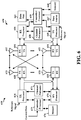
- FIG. 6 is a block diagram of an eNB 610 in communication with a UE 650 in an access network.
- upper layer packets from the core network are provided to a controller/processor 675.
- the controller/processor 675 implements the functionality of the L2 layer.
- the controller/processor 675 provides header compression, ciphering, packet segmentation and reordering, multiplexing between logical and transport channels, and radio resource allocations to the UE 650 based on various priority metrics.
- the controller/processor 675 is also responsible for HARQ operations, retransmission of lost packets, and signaling to the UE 650.
- the transmit (TX) processor 616 implements various signal processing functions for the L1 layer (i.e., physical layer).
- the signal processing functions include coding and interleaving to facilitate forward error correction (FEC) at the UE 650 and mapping to signal constellations based on various modulation schemes (e.g., binary phase-shift keying (BPSK), quadrature phase-shift keying (QPSK), M-phase-shift keying (M-PSK), M-quadrature amplitude modulation (M-QAM)).
- FEC forward error correction
- BPSK binary phase-shift keying
- QPSK quadrature phase-shift keying
- M-PSK M-phase-shift keying
- M-QAM M-quadrature amplitude modulation
- Each stream is then mapped to an OFDM subcarrier, multiplexed with a reference signal (e.g., pilot) in the time and/or frequency domain, and then combined together using an Inverse Fast Fourier Transform (IFFT) to produce a physical channel carrying a time domain OFDM symbol stream.
- the OFDM stream is spatially precoded to produce multiple spatial streams.
- Channel estimates from a channel estimator 674 may be used to determine the coding and modulation scheme, as well as for spatial processing.
- the channel estimate may be derived from a reference signal and/or channel condition feedback transmitted by the UE 650.
- Each spatial stream may then be provided to a different antenna 620 via a separate transmitter 618TX.
- Each transmitter 618TX may modulate an RF carrier with a respective spatial stream for transmission.
- each receiver 654RX receives a signal through its respective antenna 652.
- Each receiver 654RX recovers information modulated onto an RF carrier and provides the information to the receive (RX) processor 656.
- the RX processor 656 implements various signal processing functions of the L1 layer.
- the RX processor 656 may perform spatial processing on the information to recover any spatial streams destined for the UE 650. If multiple spatial streams are destined for the UE 650, they may be combined by the RX processor 656 into a single OFDM symbol stream.
- the RX processor 656 then converts the OFDM symbol stream from the time-domain to the frequency domain using a Fast Fourier Transform (FFT).
- FFT Fast Fourier Transform
- the symbols on each subcarrier, and the reference signal, are recovered and demodulated by determining the most likely signal constellation points transmitted by the eNB 610. These soft decisions may be based on channel estimates computed by the channel estimator 658. The soft decisions are then decoded and deinterleaved to recover the data and control signals that were originally transmitted by the eNB 610 on the physical channel. The data and control signals are then provided to the controller/processor 659.
- the controller/processor 659 implements the L2 layer.
- the controller/processor 659 can be associated with a memory 660 that stores program codes and data.
- the memory 660 may be referred to as a computer-readable medium.
- the controller/processor 659 provides demultiplexing between transport and logical channels, packet reassembly, deciphering, header decompression, control signal processing to recover upper layer packets from the core network.
- the upper layer packets are then provided to a data sink 662, which represents all the protocol layers above the L2 layer.
- Various control signals may also be provided to the data sink 662 for L3 processing.
- the controller/processor 659 is also responsible for error detection using an acknowledgement (ACK) and/or negative acknowledgement (NACK) protocol to support HARQ operations.
- ACK acknowledgement
- NACK negative acknowledgement
- a data source 667 is used to provide upper layer packets to the controller/processor 659.
- the data source 667 represents all protocol layers above the L2 layer.
- the controller/processor 659 implements the L2 layer for the user plane and the control plane by providing header compression, ciphering, packet segmentation and reordering, and multiplexing between logical and transport channels based on radio resource allocations by the eNB 610.
- the controller/processor 659 is also responsible for HARQ operations, retransmission of lost packets, and signaling to the eNB 610.
- Channel estimates derived by a channel estimator 658 from a reference signal or feedback transmitted by the eNB 610 may be used by the TX processor 668 to select the appropriate coding and modulation schemes, and to facilitate spatial processing.
- the spatial streams generated by the TX processor 668 may be provided to different antenna 652 via separate transmitters 654TX. Each transmitter 654TX may modulate an RF carrier with a respective spatial stream for transmission.
- the UL transmission is processed at the eNB 610 in a manner similar to that described in connection with the receiver function at the UE 650.
- Each receiver 618RX receives a signal through its respective antenna 620.
- Each receiver 618RX recovers information modulated onto an RF carrier and provides the information to a RX processor 670.
- the RX processor 670 may implement the L1 layer.
- the controller/processor 675 implements the L2 layer.
- the controller/processor 675 can be associated with a memory 676 that stores program codes and data.
- the memory 676 may be referred to as a computer-readable medium.
- the controller/processor 675 provides demultiplexing between transport and logical channels, packet reassembly, deciphering, header decompression, control signal processing to recover upper layer packets from the UE 650.
- Upper layer packets from the controller/processor 675 may be provided to the core network.
- the controller/processor 675 is also responsible for error detection using an ACK and/or NACK protocol to support HARQ operations.
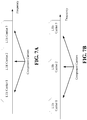
- FIG. 7A discloses a continuous carrier aggregation type.
- FIG. 7B discloses a non-continuous carrier aggregation type.
- UEs may use spectrum up to 20 MHz bandwidths per carrier, which can be allocated in a carrier aggregation of up to a total of 100 MHz (5 component carriers) used for transmission in each direction.
- the uplink spectrum allocation may be smaller than the downlink allocation.
- the downlink may be assigned 100 Mhz.
- Non-continuous CA occurs when multiple available component carriers are separated along the frequency band ( FIG. 7B ).
- continuous CA occurs when multiple available component carriers are adjacent to each other ( FIG. 7A ).
- Both non-continuous and continuous CA aggregates multiple LTE/component carriers to serve a single UE.
- the component carriers may include a primary component carrier and one or more secondary component carriers.
- a primary component carrier may be referred to as a primary cell (Pcell) and a secondary component carrier may be referred to as a secondary cell (SCell).
- FIG. 8 is a diagram 800 illustrating dual connectivity.
- UEs on a cell edge may experience high inter-cell interference, which may limit data rates.
- the UE 820 has dual connectivity (DC) with the eNB 810a and the eNB 810b.
- the UE 820 may have DC with the eNBs 810a, 810b when the UE 820 is within the range of both of the eNBs 810a, 810b (in the cells 802a, 802b).
- a UE 820 with DC may send data to and receive data from the eNBs 810a, 810b simultaneously in independent data streams.
- the independent data streams improve cell edge user experience and increase throughput data speeds for the UE 820.
- a UE may be scheduled for an uplink transmission if the uplink transmission timing of the UE is synchronized.
- the PRACH is used to achieve uplink time synchronization for a UE that has lost or not yet acquired uplink time synchronization.
- the PRACH is also used for initial network access.
- PRACH may be given higher priority, but if there are two or more PRACHs in a subframe, power prioritization between the two or more PRACHs may be left to UE implementation.
- DC if the UE is UL power limited, the primary cell PRACH may be given the highest priority. Power prioritization between all other PRACHs (including the primary / secondary cell PRACH in the secondary group) may be unspecified, although these PRACHs may still be given a higher priority than other UL channels (e.g., PUCCH, PUSCH, SRS, etc.). However, because the primary cell PRACH is given the highest priority, other PRACHs are subject to power scaling, and the original intended power ramp-up for PRACH is impacted. The impact depends on the amount of power scaling.
- the PRACH may not be counted as part of the Preamble_Transmission_Counter such that PRACH transmit power ramp-up is suspended for the transmission and the transmission is not counted as the overall max number of PRACH transmission attempts. That is, to mitigate the impact of power scaling on PRACH power ramp-up, the Preamble_Transmission_Counter may be suspended when the UE performs power scaling for PRACH. Suspending the Preamble_Transmission_Counter may cause issues. Power scaling for PRACH can be large or small. To suspend Preamble_Transmission_Counter update blindly is problematic.
- the scaling is large (e.g., PRACH is scaled down by 10 dB but the power ramp-up stepsize is 2 dB), there will be huge power ramp-up comparing the current PRACH transmission and the next PRACH transmission (e.g., if power scaling is 10 dB down, and power ramp-up is 2 dB, there may be 12 dB power difference between current and the next PRACH transmissions (contrary to the intended 2 dB power ramp-up)). In such an example, suspending the counter is beneficial. However, if the scaling is small (e.g., PRACH is scaled down by 0.5 dB but the power ramp-up stepsize is 4 dB), suspending the counter may not be beneficial.
- the PRACH handling may be left to UE implementation. Because the lower priority PRACHs are subject to power scaling/dropping, the current intended power ramp-up for PRACH is impacted. To mitigate the impact of power scaling/dropping on PRACH power ramp-up, once a UE performs power scaling for the PRACH, the PRACH may be dropped and not counted by the Preamble _Transmission _Counter toward the maximum number of allowed PRACH attempts. However, the power scaling for PRACH can vary, and be large or small. Blindly dropping and omitting the Preamble_Transmission_Counter update may not be desirable. Even more importantly, power ramp-up based on the unscaled power level after an unsuccessful PRACH transmission that was power scaled may lead to a significant increase in the PRACH transmission power in cases when power scaling is not needed (UE is not power limited anymore).
- the power ramp-up reference value and a decision on whether the PRACH transmission is dropped or transmitted with the scaled power may be based on the power scaling value and the configured ramp-up value. For example, if the scaled power available for consecutive PRACH transmissions is smaller than the power ramp-up (i.e., less than the previous unsuccessful PRACH transmission), the new PRACH transmission may be dropped. In other cases where the scaling is insignificant with respect to the intended ramp-up, the PRACH transmission may not be dropped.
- the power ramp-up may be determined with respect to the power of the previous actual PRACH transmission that had highest transmission power among the unsuccessful PRACH attempts in an ongoing PRACH procedure.
- the increment in the PRACH power may be more gradual and in line with the behavior intended by the original power ramp-up procedure. Otherwise, large variations in the PRACH transmission power could occur, which may not be desirable for UL operation.
- the decision of whether to count the PRACH toward the maximum number of allowed transmissions can also be based on the difference between the ramp-up value and the power scaling value. In a simple case, that could mean that if the PRACH transmission is dropped, the Preamble_Transmission _Counter is not incremented, and is incremented otherwise (when PRACH scaled transmission takes place).
- FIG. 9A is a diagram 900 for illustrating exemplary methods/apparatuses for PRACH transmission handling.
- the UE 902 with DC determines 906 that PRACHs 908, 910 are to be transmitted concurrently in the same subframe to the eNBs 904, 914.
- the UE 902 determines a PRACH power ramp-up for the PRACH 910 with respect to the highest power level of previously unsuccessful PRACH transmissions.
- the UE 902 drops / refrains from transmitting the PRACH transmission 910 if the power ramp-up (P ramp-up ) minus a power scaling factor (P scal ) is less than a threshold P drop (i.e., P ramp-up - P scal ⁇ P drop ), and transmits the PRACH 910 otherwise (i.e., P ramp-up - P scal ⁇ P drop ), where P scal is the power scaling factor, P ramp-up is the configured ramp-up power value (i.e., powerRampingStep), and P drop is a threshold.
- the threshold P drop may be greater than or equal to zero. In another sub-configuration, the threshold P drop may be equal to zero.
- the UE 902 determines 906 whether to increment the Preamble_Transmission_Counter. In one sub-configuration, the UE 902 increments the Preamble _Transmission _Counter when the PRACH transmission 910 takes place (i.e., the PRACH is not dropped), and refrains from incrementing the Preamble_Transmission _Counter when the PRACH transmission 910 does not take place (i.e., the PRACH is dropped).
- the UE 902 increments the Preamble -Transmission _Counter when the PRACH transmission 910 takes place and the power ramp-up (P ramp-up ) minus a power scaling factor (P scal ) is greater than or equal to a threshold P count (i.e., P ramp-up - P scal ⁇ P count ), where P count is a threshold.
- P count i.e., P ramp-up - P scal ⁇ P count
- the UE 902 refrains from incrementing the Preamble_Transmission _Counter when the PRACH transmission 910 does not take place or the power ramp-up (P ramp-up ) minus a power scaling factor (P scal ) is less than the threshold P count (i.e., P ramp-up - P scal ⁇ P count ).
- P count i.e., P ramp-up - P scal ⁇ P count
- FIGs. 9B, 9C, 9D are diagram 930, 960, 990 for illustrating exemplary methods/apparatuses for PRACH transmission handling.
- FIG. 9B depicts a scenario 930 where power ramp-up is P ramp-up and the power scaling due to the power limitation is P scal , where power ramp-up P ramp-up minus the power scaling factor P scal is assumed to be greater than or equal to the threshold P drop (i.e., P ramp-up - P scal ⁇ P drop ).
- a UE transmits the power scaled second PRACH (P 2ndTx ) (the power for P 2ndTx is determined based on the power of the first successful PRACH transmission P1 stTx plus the power ramp-up P ramp-up minus the power scaling factor P scal ) and if P ramp-up - P scal ⁇ P count , the Preamble_Transmission_Counter is incremented. If the second PRACH transmission is unsuccessful (P 2ndTx ), the next PRACH transmission (P 3rdTx ) (assumed not scaled here) is performed with the power ramp-up of P ramp-up with respect to the previous (scaled) PRACH transmission (P 2ndTx ).
- FIG. 9C is an example 960 where the power scaling factor P scal is larger than the power ramp-up P ramp-up for a second PRACH transmission attempt (shown by the X), so the resulting available power would be less than the power for the previous unsuccessful PRACH transmission (P 1stTx ).
- the power ramp-up P ramp-up minus the power scaling factor P scal is assumed to be less than the threshold P drop (i.e., P ramp-up - P scal ⁇ P drop ).
- the PRACH is dropped, as it may be unreasonable to transmit at the power level lower than the PRACH which was already unsuccessful.
- the Preamble_Transmission_Counter is not incremented.
- the second actual PRACH transmission (P 2ndTx ) is performed at the next PRACH opportunity with the power ramp-up of P ramp-up (assuming no power scaling is necessary) with respect to the previous unsuccessful PRACH transmission (P1 stTx ) with a highest power level (which is the first transmission in this example).
- the power ramp-up P ramp-up would be based on the highest previous transmission level, which would be the transmission power of the first attempt (at P 1stTx ) in this example (and not at the second attempt at the X).
- FIG. 9D is an example 980 that presents both PRACH attempt results following conventional PRACH power handling rules (P 4thTx ( a ) 988) and PRACH attempt results following exemplary PRACH behavior (P 4thTx ( b ) 990).
- P 4thTx ( a ) 988 Following conventional PRACH handling rules results in a power spike in the PRACH transmission P 4thTx ( a ) 988, which may be much higher after several unsuccessful PRACH attempts at 982, 984, 986 (P 1stTx to P 3rdTx ) that involved power scaling.
- the Preamble_Transmission_Counter is incremented after the unsuccessful first PRACH transmission P 1stTx 982; the transmission power of the second PRACH transmission P 2ndTx 984 is determined based on the transmission power of the first PRACH transmission P1 stTx 982 plus the power ramp-up P ramp-up minus the power scaling factor P scal1 ; the Preamble_Transmission_Counter is again incremented after the unsuccessful second PRACH transmission P 2ndTx 984; the transmission power of the third PRACH transmission P 3rdTx 986 is determined based on the transmission power of the first PRACH transmission P1 stTx 982 plus two times (see equation supra for determining PREAMBLE_RECEIVED_TARGET_POWER) the power ramp-up P ramp-up minus the power scaling factor P scal2(a); the Preamble_Transmission_Counter is again incremented after the unsuccessful third PRACH transmission P 3rdTx 986; and the transmission power of the
- the fourth attempt P 4thTx ( a ) 988 would be at an unnecessarily high power level (P 4thTx(a) , which is 3*P ramp-up higher than the previous transmission attempt P 1stTx ) if based on the power rump-up P ramp-up without taking into account the power scaling/dropping of the previous unsuccessful attempts.
- the conventional PRACH handling rules result in an unnecessarily high PRACH transmission power at the fourth PRACH transmission P 4thTx ( a ) 988.
- the transmission power of the fourth PRACH transmission P 4thTx ( a ) 988 is unnecessarily high because a lower PRACH transmission power may be successful.
- the Preamble_Transmission_Counter is incremented after the unsuccessful first PRACH transmission P 1stTx 982; the transmission power of the second PRACH transmission P 2ndTx 984 is determined based on the transmission power of the first PRACH transmission P 1stTx 982 plus the power ramp-up P ramp-up minus the power scaling factor P scal1 ; assuming P ramp-up - P scal1 ⁇ P drop , the second PRACH transmission P 2ndTx 984 is dropped and the Preamble_Transmission_Counter is not incremented; the transmission power of the third PRACH transmission P 3rdTx 986 is determined based on the transmission power of the first PRACH transmission P 1stTx 982 plus the power ramp-up P ramp-up minus the power scaling factor P scal2 ( b ) ; assuming P ramp-up - P scal2 ( b ) ⁇ P drop , the third PRACH transmission P 3rdTx
- the transmission power for the fourth PRACH transmission P 4thTx ( b ) 990 is determined based on the transmission power of the first PRACH transmission P 1stTx 982 plus the power ramp-up P ramp-up , irrespective of the incremented Preamble_Transmission_Counter.
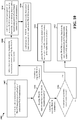
- FIG. 10 is a flow chart 1000 of a method of wireless communication.
- the method may be performed by a UE, such as the UE 902.
- the PCell PRACH has higher priority than (e.g., is allocated before) other PRACHs of other CCs, and other PRACHs have higher priority than (e.g., is allocated before) other channels (e.g., PUSCH, PUCCH, etc.).
- Priority among other PRACHs may be up to UE implementation. Whether a lower prioritized PRACH is power scaled or dropped may also be up to UE implementation. If PRACH is dropped, the UE may refrain from incrementing the preamble transmission counter. If the PRACH is power scaled, the UE may determine whether or not to increment the preamble transmission counter. Further details are described with respect to FIG. 10 .
- a UE determines to scale a transmission power for a PRACH transmission of a plurality of concurrent (e.g., completely or partially overlapping in time) PRACH transmissions. For example, referring to FIG. 9A , a UE with DC may determine to scale a transmission power for a PRACH transmission 910 of a plurality of concurrent PRACH transmissions 908, 910.
- the UE determines whether to send the PRACH transmission based on the scaled transmission power.
- the UE may determine to scale the transmission power for the PRACH transmission based on a power scaling factor P scal .
- the transmission power for the PRACH transmission may be based on a power ramping stepsize P ramp-up and the power scaling factor P scal .
- the UE may determine whether to send the PRACH transmission based on the power ramping stepsize P ramp-up and the power scaling factor P scal .
- the UE may determine whether to send the PRACH transmission based on a difference between the power ramping stepsize P ramp-up and the power scaling factor P scal .
- the UE may determine whether to send the PRACH transmission based on whether the difference between the power ramping stepsize P ramp-up and the power scaling factor P scal is greater than or equal to a threshold P drop . For example, the UE may determine to send the PRACH transmission when the difference between the power ramping stepsize P ramp-up and the power scaling factor P scal is greater than or equal to the threshold P drop. Conversely, the UE may refrain from sending the PRACH transmission when the difference between the power ramping stepsize P ramp-up and the power scaling factor P scal is less than the threshold P drop . Referring to the example in FIG.
- the UE upon determining to scale the PRACH transmission power, the UE determines to send the PRACH transmission because P ramp-up - P scal ⁇ P drop.
- the UE upon determining to scale the PRACH transmission power, the UE determines not to send the PRACH transmission because P ramp-up - P scal ⁇ P drop.
- the UE may determine whether to increment a preamble transmission counter based at least on the determination of whether to send the PRACH transmission.
- the UE determines to increment the preamble transmission counter, at 1010, the UE sends the PRACH transmission (based on the incremented preamble transmission counter) at the scaled transmission power.
- the UE determines not to increment the preamble transmission counter, at 1012, the UE sends the PRACH transmission (based on the non-incremented preamble transmission counter) at the scaled transmission power.
- the UE Upon determining not to send the PRACH transmission at 1004, at 1008, the UE refrains from incrementing the preamble transmission counter and drops the PRACH transmission.
- the UE may determine whether to increment a preamble transmission counter based on the power ramping stepsize P ramp-up and the power scaling factor P scal . In one configuration, the determination whether to increment the preamble transmission counter is based on a difference between the power ramping stepsize P ramp-up and the power scaling factor P scal . In one configuration, when determining whether to increment the preamble transmission counter at 1006, the UE determines to increment the preamble transmission counter when the PRACH transmission is determined to be sent and the difference between the power ramping stepsize P ramp-up and the power scaling factor P scal is greater than or equal to a threshold P count (P ramp-up - P scal ⁇ P count ).
- the UE when determining whether to increment the preamble transmission counter, determines to refrain from incrementing the preamble transmission counter upon determining not to send the PRACH transmission or when the difference between the power ramping stepsize P ramp-up and the power scaling factor P scal is less than a threshold P count (P ramp-up - P scal ⁇ P count ).
- the UE may determine a transmission power for another PRACH transmission based at least on the power ramping stepsize P ramp-up and a transmission power of a previously unsuccessful PRACH transmission.
- the UE may send the another PRACH transmission at the determined transmission power for the another PRACH transmission.
- the transmission power of the previously unsuccessful PRACH transmission is a highest transmission power of previously sent unsuccessful PRACH transmissions.
- the transmission power of the previously unsuccessful PRACH transmission is a transmission power of an immediately previous sent unsuccessful PRACH transmission. For examples, see FIGs. 9B, 9C, and 9D .
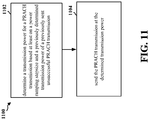
- FIG. 11 is a flow chart 1100 of a method of wireless communication. The method may be performed by a UE, such as the UE 902.
- the UE determines a transmission power for a PRACH transmission based at least on a power ramping stepsize P ramp-up and a previously determined transmission power of a previously sent unsuccessful PRACH transmission.
- Block 1102 may correspond to 1014 of FIG. 10 .
- Block 1104 may correspond to 1016 of FIG. 10 .
- the transmission power of the previously sent unsuccessful PRACH transmission is a highest transmission power of previously sent unsuccessful PRACH transmissions.
- the transmission power of the previously sent unsuccessful PRACH transmission is a transmission power of an immediately previous sent unsuccessful PRACH transmission.
- the UE may perform one or more additional blocks as indicated in FIG. 10 .
- FIG. 12 is a flow chart 1200 of a method of wireless communication. The method may be performed by a UE, such as the UE 902.
- a UE determines to scale power by a power scaling factor P scal for a PRACH transmission of a plurality of concurrent PRACH transmissions.
- a transmission power for the PRACH transmission is based at least on a power ramping stepsize P ramp-up and the power scaling factor P scal .
- the UE determines whether to send the PRACH transmission.
- the UE determines whether to increment a preamble transmission counter based at least on the determination of whether to send the PRACH transmission.
- the determination whether to increment the preamble transmission counter is further based on both the power ramping stepsize P ramp-up and the power scaling factor P scal . In one configuration, the determination whether to increment the preamble transmission counter is further based on a difference between the power ramping stepsize P ramp-up and the power scaling factor P scal . In one configuration, the UE determines whether to increment the preamble transmission counter by determining to refrain from incrementing the preamble transmission counter when the difference between the power ramping stepsize P ramp-up and the power scaling factor P scal is less than a threshold P count or the PRACH transmission is determined not to be sent.
- the UE determines whether to increment the preamble transmission counter by determining to increment the preamble transmission counter when the difference between the power ramping stepsize P ramp-up and the power scaling factor P scal is greater than or equal to a threshold P count and the PRACH transmission is determined to be sent.
- FIG. 13 is a conceptual data flow diagram 1300 illustrating the data flow between different means/components in an exemplary apparatus 1302.
- the apparatus may be a UE, such as the UE 902.
- the apparatus includes a PRACH transmission power component 1304 that is configured to determine to scale a transmission power for a PRACH transmission of a plurality of concurrent PRACH transmissions.
- the apparatus further includes a PRACH transmission determination component 1308 that is configured to determine whether to send the PRACH transmission based on the scaled transmission power.
- the apparatus further includes a transmission component 1310 that is configured to send the PRACH transmission at the scaled transmission power upon determining to send the PRACH transmission.
- the apparatus may further include a preamble transmission counter component 1306 that is configured to determine whether to increment a preamble transmission counter based at least on the determination of whether to send the PRACH transmission by the PRACH transmission determination component 1308.
- the preamble transmission counter component 1306 may be configured to increment a preamble transmission counter upon the PRACH transmission determination component 1308 determining to send the PRACH transmission, and to refrain from incrementing the preamble transmission counter upon the PRACH transmission determination component 1308 determining not to send the PRACH transmission.
- the preamble transmission counter component 1306 may be configured to determine whether to increment a preamble transmission counter based on the power ramping stepsize P ramp-up and the power scaling factor P scal .
- the power ramping stepsize P ramp-up and the power scaling factor P scal may be configured by the eNB 1350 via a cell-specific configuration (e.g., system information block (SIB) 1) and/or UE-specific configuration (e.g., RRC signaling).
- SIB system information block
- the preamble transmission counter component 1306 may receive values of the power ramping stepsize P ramp-up and the power scaling factor P scal from the PRACH transmission power component 1304 or another component.
- the preamble transmission counter component 1306 may be configured to determine whether to increment the preamble transmission counter based on a difference between the power ramping stepsize P ramp-up and the power scaling factor P scal .
- the preamble transmission counter component 1306 may be configured to determine to increment the preamble transmission counter when the PRACH transmission is determined to be sent (based on information received from the PRACH transmission determination component 1308) and the difference between the power ramping stepsize P ramp-up and the power scaling factor P scal is greater than or equal to a threshold P count .
- the preamble transmission counter component 1306 may receive a value of the threshold P count from the PRACH transmission power component 1304 or another component.
- the preamble transmission counter component 1306 may be configured to determine to refrain from incrementing the preamble transmission counter upon determining not to send the PRACH transmission or when the difference between the power ramping stepsize P ramp-up and the power scaling factor P scal is less than a threshold P count .
- the PRACH transmission power component 1304 may be configured to determine to scale the transmission power for the PRACH transmission based on a power scaling factor P scal .
- the transmission power for the PRACH transmission may be based on a power ramping stepsize P ramp-up and the power scaling factor P scal .
- the PRACH transmission determination component 1308 may be configured to determine whether to send the PRACH transmission based on the power ramping stepsize P ramp-up and the power scaling factor P scal , both values of which may be received from the PRACH transmission power component 1304 or another component.
- the power ramping stepsize P ramp-up and the power scaling factor P scal may be configured by the eNB 1350 via a cell-specific configuration (e.g., SIB 1) and/or UE-specific configuration (e.g., RRC signaling).
- the PRACH transmission determination component 1308 may be configured to determine whether to send the PRACH transmission based on a difference between the power ramping stepsize P ramp-up and the power scaling factor P scal .
- the PRACH transmission determination component 1308 is configured to determine whether to send the PRACH transmission based on whether the difference between the power ramping stepsize P ramp-up and the power scaling factor P scal is greater than or equal to a threshold P drop.
- the PRACH transmission determination component 1308 may receive the value for the threshold P drop from the PRACH transmission power component 1304 or another component. In one configuration, when determining whether to send the PRACH transmission, the PRACH transmission determination component 1308 is configured to determine to send the PRACH transmission when the difference between the power ramping stepsize P ramp-up and the power scaling factor P scal is greater than or equal to the threshold P drop. In one configuration, when determining whether to send the PRACH transmission, the PRACH transmission determination component 1308 is configured to refrain from sending the PRACH transmission when the difference between the power ramping stepsize P ramp-up and the power scaling factor P scal is less than the threshold P drop .
- the PRACH transmission determination component 1308 is configured to inform the transmission component 1310 of the decision to send the PRACH transmission.
- the transmission component 1310 is configured to receive information from the PRACH transmission power component 1304 indicating the scaled transmission power at which to send the PRACH transmission.
- the PRACH transmission power component 1304 is configured to determine a transmission power for another PRACH transmission based at least on the power ramping stepsize P ramp-up and a transmission power of a previously unsuccessful PRACH transmission.
- the transmission component 1310 is configured to send the another PRACH transmission at the determined transmission power for the another PRACH transmission.
- the transmission power of the previously unsuccessful PRACH transmission is a highest transmission power of previously sent unsuccessful PRACH transmissions.
- the transmission power of the previously unsuccessful PRACH transmission is a transmission power of an immediately previous sent unsuccessful PRACH transmission.
- the PRACH transmission power component 1304 is configured to determine a transmission power for a PRACH transmission based at least on a power ramping stepsize P ramp-up and a previously determined transmission power of a previously sent unsuccessful PRACH transmission.
- the transmission component 1310 is configured to send the PRACH transmission at the determined transmission power.
- the transmission power of the previously sent unsuccessful PRACH transmission is a highest transmission power of previously sent unsuccessful PRACH transmissions.
- the transmission power of the previously sent unsuccessful PRACH transmission is a transmission power of an immediately previous sent unsuccessful PRACH transmission.
- the apparatus may include additional components that perform each of the blocks of the algorithm in the aforementioned flowcharts of FIGs. 10-12 .
- each block in the aforementioned flowcharts of FIGs. 10-12 may be performed by a component and the apparatus may include one or more of those components.
- the components may be one or more hardware components specifically configured to carry out the stated processes/algorithm, implemented by a processor configured to perform the stated processes/algorithm, stored within a computer-readable medium for implementation by a processor, or some combination thereof.
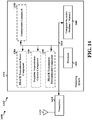
- FIG. 14 is a diagram 1400 illustrating an example of a hardware implementation for an apparatus 1302' employing a processing system 1414.
- the processing system 1414 may be implemented with a bus architecture, represented generally by the bus 1424.
- the bus 1424 may include any number of interconnecting buses and bridges depending on the specific application of the processing system 1414 and the overall design constraints.
- the bus 1424 links together various circuits including one or more processors and/or hardware components, represented by the processor 1404, the components 1304, 1306, 1308, 1310, and the computer-readable medium / memory 1406.
- the bus 1424 may also link various other circuits such as timing sources, peripherals, voltage regulators, and power management circuits, which are well known in the art, and therefore, will not be described any further.
- the processing system 1414 may be coupled to a transceiver 1410.
- the transceiver 1410 is coupled to one or more antennas 1420.
- the transceiver 1410 provides a means for communicating with various other apparatus over a transmission medium.
- the transceiver 1410 receives a signal from the one or more antennas 1420, extracts information from the received signal, and provides the extracted information to the processing system 1414.
- the transceiver 1410 receives information from the processing system 1414, specifically the transmission component 1310, and based on the received information, generates a signal to be applied to the one or more antennas 1420.
- the processing system 1414 includes a processor 1404 coupled to a computer-readable medium / memory 1406.
- the processor 1404 is responsible for general processing, including the execution of software stored on the computer-readable medium / memory 1406.
- the software when executed by the processor 1404, causes the processing system 1414 to perform the various functions described supra for any particular apparatus.
- the computer-readable medium / memory 1406 may also be used for storing data that is manipulated by the processor 1404 when executing software.
- the processing system 1414 further includes at least one of the components 1304, 1306, 1308, 1310.
- the components may be software components running in the processor 1404, resident/stored in the computer readable medium / memory 1406, one or more hardware components coupled to the processor 1404, or some combination thereof.
- the processing system 1414 may be a component of the UE 650 and may include the memory 660 and/or at least one of the TX processor 668, the RX processor 656, and the controller/processor 659.
- the apparatus 1302/1302' for wireless communication includes means for determining to scale a transmission power for a PRACH transmission of a plurality of concurrent PRACH transmissions.
- the apparatus includes means for determining whether to send the PRACH transmission based on the scaled transmission power.
- the apparatus includes means for sending the PRACH transmission at the scaled transmission power upon determining to send the PRACH transmission.
- the apparatus may further include means for determining whether to increment a preamble transmission counter based at least on the determination of whether to send the PRACH transmission.
- the apparatus may further include means for incrementing a preamble transmission counter upon determining to send the PRACH transmission, and means for refraining from incrementing the preamble transmission counter upon determining not to send the PRACH transmission.
- the apparatus may further include means for determining whether to increment a preamble transmission counter based on the power ramping stepsize and the power scaling factor.
- the means for determining whether to increment the preamble transmission counter makes the determination based on a difference between the power ramping stepsize and the power scaling factor.
- the means for determining whether to increment the preamble transmission counter is configure to determine to increment the preamble transmission counter when the PRACH transmission is determined to be sent and the difference between the power ramping stepsize and the power scaling factor is greater than or equal to a threshold.
- the means for determining whether to increment the preamble transmission counter is configured to determine to refrain from incrementing the preamble transmission counter upon determining not to send the PRACH transmission or when the difference between the power ramping stepsize and the power scaling factor is less than a threshold.
- the means for determining to scale the transmission power for the PRACH transmission makes the determination based on a power scaling factor.
- the transmission power for the PRACH transmission may be based on a power ramping stepsize and the power scaling factor.
- the means for determining whether to send the PRACH transmission makes the determination based on the power ramping stepsize and the power scaling factor.
- the means for determining whether to send the PRACH transmission makes the determination based on a difference between the power ramping stepsize and the power scaling factor. In one configuration, the means for determining whether to send the PRACH transmission makes the determination based on whether the difference between the power ramping stepsize and the power scaling factor is greater than or equal to a threshold. In one configuration, the means for determining whether to send the PRACH transmission is configured to determine to send the PRACH transmission when the difference between the power ramping stepsize and the power scaling factor is greater than or equal to the threshold. In one configuration, the means for determining whether to send the PRACH transmission is configured to refraining from sending the PRACH transmission when the difference between the power ramping stepsize and the power scaling factor is less than the threshold.
- the apparatus further includes means for determining a transmission power for another PRACH transmission based at least on the power ramping stepsize and a transmission power of a previously unsuccessful PRACH transmission, and means for sending the another PRACH transmission at the determined transmission power for the another PRACH transmission.
- the transmission power of the previously unsuccessful PRACH transmission is a highest transmission power of previously sent unsuccessful PRACH transmissions.
- the transmission power of the previously unsuccessful PRACH transmission is a transmission power of an immediately previous sent unsuccessful PRACH transmission.
- the apparatus 1302/1302' for wireless communication includes means for determining a transmission power for a PRACH transmission based at least on a power ramping stepsize and a previously determined transmission power of a previously sent unsuccessful PRACH transmission, and means for sending the PRACH transmission at the determined transmission power.
- the transmission power of the previously sent unsuccessful PRACH transmission is a highest transmission power of previously sent unsuccessful PRACH transmissions.
- the transmission power of the previously sent unsuccessful PRACH transmission is a transmission power of an immediately previous sent unsuccessful PRACH transmission.
- the apparatus may include further means as discussed supra.
- the aforementioned means may be one or more of the aforementioned components of the apparatus 1302 and/or the processing system 1414 of the apparatus 1302' configured to perform the functions recited by the aforementioned means.
- the processing system 1414 may include the TX Processor 668, the RX Processor 656, and the controller/processor 659.
- the aforementioned means may be the TX Processor 668, the RX Processor 656, and the controller/processor 659 configured to perform the functions recited by the aforementioned means.
- Combinations such as "at least one of A, B, or C,” “at least one of A, B, and C,” and “A, B, C, or any combination thereof' include any combination of A, B, and/or C, and may include multiples of A, multiples of B, or multiples of C.
- combinations such as “at least one of A, B, or C,” “at least one of A, B, and C,” and “A, B, C, or any combination thereof' may be A only, B only, C only, A and B, A and C, B and C, or A and B and C, where any such combinations may contain one or more member or members of A, B, or C.
- a method of wireless communication comprising determining to scale a transmission power for a physical random access channel (PRACH) transmission of a plurality of concurrent PRACH transmissions, determining whether to send the PRACH transmission based on the scaled transmission power and sending the PRACH transmission at the scaled transmission power upon determining to send the PRACH transmission. Also, the method may comprise determining whether to increment a preamble transmission counter based at least on the determination of whether to send the PRACH transmission. Further, the method may comprise incrementing a preamble transmission counter upon determining to send the PRACH transmission and refraining from incrementing the preamble transmission counter upon determining not to send the PRACH transmission.
- PRACH physical random access channel
- the method may further comprise determining whether to increment a preamble transmission counter based on the power ramping stepsize and the power scaling factor.
- the determining whether to increment the preamble transmission counter may be based on a difference between the power ramping stepsize and the power scaling factor.
- the determining whether to increment the preamble transmission counter may comprise determining to increment the preamble transmission counter when the PRACH transmission is determined to be sent and the difference between the power ramping stepsize and the power scaling factor is greater than or equal to a threshold.
- the determining whether to increment the preamble transmission counter may comprise determining to refrain from incrementing the preamble transmission counter upon determining not to send the PRACH transmission or when the difference between the power ramping stepsize and the power scaling factor is less than a threshold.
- the determining to scale the transmission power for the PRACH transmission may be based on a power scaling factor
- the transmission power for the PRACH transmission may be based on a power ramping stepsize and the power scaling factor
- the determining whether to send the PRACH transmission may be based on the power ramping stepsize and the power scaling factor.
- the determining whether to send the PRACH transmission may be based on a difference between the power ramping stepsize and the power scaling factor.
- the determining whether to send the PRACH transmission may be based on whether the difference between the power ramping stepsize and the power scaling factor is greater than or equal to a threshold.
- the determining whether to send the PRACH transmission may comprise determining to send the PRACH transmission when the difference between the power ramping stepsize and the power scaling factor is greater than or equal to the threshold. Also, the determining whether to send the PRACH transmission may comprise refraining from sending the PRACH transmission when the difference between the power ramping stepsize and the power scaling factor is less than the threshold.
- the method may further comprise determining a transmission power for another PRACH transmission based at least on the power ramping stepsize and a transmission power of a previously unsuccessful PRACH transmission and sending said another PRACH transmission at the determined transmission power for said another PRACH transmission. Further, the transmission power of the previously unsuccessful PRACH transmission may be a highest transmission power of previously sent unsuccessful PRACH transmissions. The transmission power of the previously unsuccessful PRACH transmission may be a transmission power of an immediately previous sent unsuccessful PRACH transmission.
- a method of wireless communication comprising determining a transmission power for a physical random access channel (PRACH) transmission based at least on a power ramping stepsize and a previously determined transmission power of a previously sent unsuccessful PRACH transmission and sending the PRACH transmission at the determined transmission power.
- the transmission power of the previously sent unsuccessful PRACH transmission may be a highest transmission power of previously sent unsuccessful PRACH transmissions.
- the transmission power of the previously sent unsuccessful PRACH transmission may be a transmission power of an immediately previous sent unsuccessful PRACH transmission.
- an apparatus for wireless communication comprising a memory and at least one processor coupled to the memory and configured to determine to scale a transmission power for a physical random access channel (PRACH) transmission of a plurality of concurrent PRACH transmissions, determine whether to send the PRACH transmission based on the scaled transmission power and send the PRACH transmission at the scaled transmission power upon determining to send the PRACH transmission.
- the at least one processor may be further configured to determine whether to increment a preamble transmission counter based at least on the determination of whether to send the PRACH transmission. Further, the at least one processor may be configured to increment a preamble transmission counter upon determining to send the PRACH transmission and refrain from incrementing the preamble transmission counter upon determining not to send the PRACH transmission.
- PRACH physical random access channel
- the at least one processor may be further configured to determine whether to increment a preamble transmission counter based on the power ramping stepsize and the power scaling factor. Also, he at least one processor may be configured to determine whether to increment the preamble transmission counter based on a difference between the power ramping stepsize and the power scaling factor. The at least one processor may be configured to determine whether to increment the preamble transmission counter by determining to increment the preamble transmission counter when the PRACH transmission is determined to be sent and the difference between the power ramping stepsize and the power scaling factor is greater than or equal to a threshold.
- the at least one processor may be further configured to determine whether to increment the preamble transmission counter by determining to refrain from incrementing the preamble transmission counter upon determining not to send the PRACH transmission or when the difference between the power ramping stepsize and the power scaling factor is less than a threshold.
- the at least one processor may also be configured to determine to scale the transmission power for the PRACH transmission based on a power scaling factor, the transmission power for the PRACH transmission being based on a power ramping stepsize and the power scaling factor, and wherein the at least one processor may be configured to determine whether to send the PRACH transmission based on the power ramping stepsize and the power scaling factor.
- the at least one processor may be configured to determine whether to send the PRACH transmission based on a difference between the power ramping stepsize and the power scaling factor. Further, the at least one processor may be configured to determine whether to send the PRACH transmission based on whether the difference between the power ramping stepsize and the power scaling factor is greater than or equal to a threshold. The at least one processor may be configured to determine whether to send the PRACH transmission by determining to send the PRACH transmission when the difference between the power ramping stepsize and the power scaling factor is greater than or equal to the threshold. The at least one processor may be configured to determine whether to send the PRACH transmission by refraining from sending the PRACH transmission when the difference between the power ramping stepsize and the power scaling factor is less than the threshold.
- the at least one processor may be configured to determine a transmission power for another PRACH transmission based at least on the power ramping stepsize and a transmission power of a previously unsuccessful PRACH transmission and send said another PRACH transmission at the determined transmission power for said another PRACH transmission.
- the transmission power of the previously unsuccessful PRACH transmission may be a highest transmission power of previously sent unsuccessful PRACH transmissions.
- the transmission power of the previously unsuccessful PRACH transmission may be a transmission power of an immediately previous sent unsuccessful PRACH transmission.
- an apparatus for wireless communication comprising a memory and at least one processor coupled to the memory and configured to determine a transmission power for a physical random access channel (PRACH) transmission based at least on a power ramping stepsize and a previously determined transmission power of a previously sent unsuccessful PRACH transmission and send the PRACH transmission at the determined transmission power.
- the transmission power of the previously sent unsuccessful PRACH transmission may be a highest transmission power of previously sent unsuccessful PRACH transmissions. Further, the transmission power of the previously sent unsuccessful PRACH transmission may be a transmission power of an immediately previous sent unsuccessful PRACH transmission.
- an apparatus for wireless communication comprising means for determining to scale a transmission power for a physical random access channel (PRACH) transmission of a plurality of concurrent PRACH transmissions, means for determining whether to send the PRACH transmission based on the scaled transmission power and means for sending the PRACH transmission at the scaled transmission power upon determining to send the PRACH transmission.
- the apparatus may comprise means for determining whether to increment a preamble transmission counter based at least on the determination of whether to send the PRACH transmission.
- the apparatus may comprise means for incrementing a preamble transmission counter upon determining to send the PRACH transmission and means for refraining from incrementing the preamble transmission counter upon determining not to send the PRACH transmission.
- the apparatus may comprise means for determining whether to increment a preamble transmission counter based on the power ramping stepsize and the power scaling factor. Further, the means for determining whether to increment the preamble transmission counter may be configured to perform the determination based on a difference between the power ramping stepsize and the power scaling factor. Also, the means for determining whether to increment the preamble transmission counter may be configure to determine to increment the preamble transmission counter when the PRACH transmission is determined to be sent and the difference between the power ramping stepsize and the power scaling factor is greater than or equal to a threshold.
- the means for determining whether to increment the preamble transmission counter may be configured to determine to refrain from incrementing the preamble transmission counter upon determining not to send the PRACH transmission or when the difference between the power ramping stepsize and the power scaling factor is less than a threshold. Further, the determining to scale the transmission power for the PRACH transmission may be based on a power scaling factor, the transmission power for the PRACH transmission may be based on a power ramping stepsize and the power scaling factor, and the determining whether to send the PRACH transmission may be based on the power ramping stepsize and the power scaling factor. The means for determining whether to send the PRACH transmission may be configured to make the determination based on a difference between the power ramping stepsize and the power scaling factor.
- the means for determining whether to send the PRACH transmission may be configured to make the determination based on whether the difference between the power ramping stepsize and the power scaling factor is greater than or equal to a threshold. Also, the means for determining whether to send the PRACH transmission may be configured to determine to send the PRACH transmission when the difference between the power ramping stepsize and the power scaling factor is greater than or equal to the threshold. Further, the means for determining whether to send the PRACH transmission may be configured to refrain from sending the PRACH transmission when the difference between the power ramping stepsize and the power scaling factor is less than the threshold.
- the apparatus may comprise means for determining a transmission power for another PRACH transmission based at least on the power ramping stepsize and a transmission power of a previously unsuccessful PRACH transmission and means for sending said another PRACH transmission at the determined transmission power for said another PRACH transmission.
- the transmission power of the previously unsuccessful PRACH transmission may be a highest transmission power of previously sent unsuccessful PRACH transmissions. Further, the transmission power of the previously unsuccessful PRACH transmission may be a transmission power of an immediately previous sent unsuccessful PRACH transmission.
- an apparatus for wireless communication comprising means for determining a transmission power for a physical random access channel (PRACH) transmission based at least on a power ramping stepsize and a previously determined transmission power of a previously sent unsuccessful PRACH transmission and means for sending the PRACH transmission at the determined transmission power.
- the transmission power of the previously sent unsuccessful PRACH transmission may be a highest transmission power of previously sent unsuccessful PRACH transmissions. Further, the transmission power of the previously sent unsuccessful PRACH transmission may be a transmission power of an immediately previous sent unsuccessful PRACH transmission.
- a computer-readable medium storing computer executable code for wireless communication
- the computer-readable medium comprising code for determining to scale a transmission power for a physical random access channel (PRACH) transmission of a plurality of concurrent PRACH transmissions, determining whether to send the PRACH transmission based on the scaled transmission power and sending the PRACH transmission at the scaled transmission power upon determining to send the PRACH transmission.
- PRACH physical random access channel
- a computer-readable medium storing computer executable code for wireless communication
- the computer-readable medium comprising code for determining a transmission power for a physical random access channel (PRACH) transmission based at least on a power ramping stepsize and a previously determined transmission power of a previously sent unsuccessful PRACH transmission and sending the PRACH transmission at the determined transmission power.
- PRACH physical random access channel
Landscapes
- Engineering & Computer Science (AREA)
- Computer Networks & Wireless Communication (AREA)
- Signal Processing (AREA)
- Mobile Radio Communication Systems (AREA)
Applications Claiming Priority (4)
| Application Number | Priority Date | Filing Date | Title |
|---|---|---|---|
| US201462060528P | 2014-10-06 | 2014-10-06 | |
| US201462075786P | 2014-11-05 | 2014-11-05 | |
| US14/861,749 US10129910B2 (en) | 2014-10-06 | 2015-09-22 | PRACH transmission power adjustment |
| PCT/US2015/051822 WO2016057224A1 (en) | 2014-10-06 | 2015-09-24 | Method and apparatus for prach transmission power adjustment |
Publications (2)
| Publication Number | Publication Date |
|---|---|
| EP3205155A1 EP3205155A1 (en) | 2017-08-16 |
| EP3205155B1 true EP3205155B1 (en) | 2018-10-24 |
Family
ID=55633828
Family Applications (1)
| Application Number | Title | Priority Date | Filing Date |
|---|---|---|---|
| EP15777791.3A Active EP3205155B1 (en) | 2014-10-06 | 2015-09-24 | Method and apparatus for prach transmission power adjustment |
Country Status (6)
| Country | Link |
|---|---|
| US (1) | US10129910B2 (enExample) |
| EP (1) | EP3205155B1 (enExample) |
| JP (1) | JP6487040B2 (enExample) |
| KR (1) | KR101987871B1 (enExample) |
| CN (1) | CN106797619B (enExample) |
| WO (1) | WO2016057224A1 (enExample) |
Families Citing this family (18)
| Publication number | Priority date | Publication date | Assignee | Title |
|---|---|---|---|---|
| HUE048472T2 (hu) * | 2014-07-11 | 2020-08-28 | Ntt Docomo Inc | Felhasználói végberendezés és vezeték nélküli kommunikációs eljárás |
| JP5878594B2 (ja) * | 2014-07-11 | 2016-03-08 | 株式会社Nttドコモ | ユーザ端末、無線通信方法及び無線通信システム |
| JP2019216293A (ja) * | 2016-10-11 | 2019-12-19 | シャープ株式会社 | 端末装置、通信方法、および、集積回路 |
| CN108282276B (zh) * | 2017-01-06 | 2022-10-04 | 北京三星通信技术研究有限公司 | 前导序列重传的方法、用户设备及基站 |
| US10873911B2 (en) * | 2017-03-23 | 2020-12-22 | Ofinno, LCC | Uplink transmission power adjustment |
| EP3527009B1 (en) * | 2017-05-04 | 2020-04-29 | Ofinno, LLC | Rach power offset |
| CN109039564B (zh) * | 2017-05-17 | 2020-02-14 | 华为技术有限公司 | 一种发送和接收指示信息的方法、设备和系统 |
| US20200373989A1 (en) * | 2017-08-11 | 2020-11-26 | Intel Ip Corp | Method and apparatus for beam recovery |
| EP4475625A3 (en) * | 2018-02-15 | 2025-03-05 | Ntt Docomo, Inc. | Terminal and communication method |
| EP3796736A4 (en) * | 2018-05-18 | 2021-12-22 | Ntt Docomo, Inc. | USER DEVICE AND BASE DEVICE |
| US11259288B2 (en) * | 2018-07-02 | 2022-02-22 | Qualcomm Incorporated | Contention-free concurrent physical random access channel transmissions |
| CN109862611B (zh) * | 2019-03-18 | 2022-02-18 | 中国联合网络通信集团有限公司 | 终端功率控制方法及装置 |
| EP3952575A4 (en) | 2019-03-28 | 2022-09-07 | Ntt Docomo, Inc. | USER DEVICE AND COMMUNICATION METHOD |
| CN115696427B (zh) * | 2021-07-29 | 2026-06-19 | 大唐移动通信设备有限公司 | 一种调度信息的处理方法和装置 |
| US20240056226A1 (en) * | 2022-08-09 | 2024-02-15 | Cisco Technology, Inc. | Adaptive harq selection in high density environments |
| CN118828894A (zh) * | 2023-05-13 | 2024-10-22 | 上海移远通信技术股份有限公司 | 被用于无线通信的节点中的方法和装置 |
| WO2025010532A1 (en) * | 2023-07-07 | 2025-01-16 | Qualcomm Incorporated | Timing advance management and uplink transmit power prioritization for candidate cells |
| WO2025029817A1 (en) * | 2023-08-03 | 2025-02-06 | Apple Inc. | Random access in lower-layer triggered mobility procedure |
Family Cites Families (19)
| Publication number | Priority date | Publication date | Assignee | Title |
|---|---|---|---|---|
| EP1198076A1 (en) | 2000-10-10 | 2002-04-17 | Siemens Aktiengesellschaft | Method and apparatus for the initiation of communication |
| BRPI0721302A2 (pt) * | 2007-02-12 | 2014-03-25 | Lg Electronics Inc. | Métodos e procedimentos para acesso de ue de alta velocidade |
| US8494572B2 (en) | 2008-06-24 | 2013-07-23 | Qualcomm Incorporated | Method and apparatus for power control of first data transmission in random access procedure of FDMA communication system |
| WO2010107354A1 (en) | 2009-03-17 | 2010-09-23 | Telefonaktiebolaget L M Ericsson (Publ) | High priority random access |
| EP2244515A1 (en) * | 2009-04-23 | 2010-10-27 | Panasonic Corporation | Logical channel prioritization procedure for generating multiple uplink transport blocks |
| US8149776B2 (en) | 2009-05-12 | 2012-04-03 | Nokia Corporation | Method, apparatus and computer program for user equipment access channel procedures |
| SMT201800459T1 (it) | 2010-04-01 | 2018-11-09 | Sun Patent Trust | Controllo della potenza di trasmissione per canali fisici di accesso causale |
| US9144035B2 (en) * | 2011-07-29 | 2015-09-22 | Lg Electronics Inc. | Terminal equipment and method for controlling uplink transmission power |
| JP5990815B2 (ja) * | 2011-11-07 | 2016-09-14 | シャープ株式会社 | 基地局、端末、通信システムおよび通信方法 |
| CN103200663B (zh) * | 2012-01-09 | 2016-03-09 | 华为技术有限公司 | 上行信道功率控制方法、装置及系统 |
| CN103327596B (zh) * | 2012-03-20 | 2018-03-13 | 华为技术有限公司 | 一种功率控制方法和装置 |
| US9609499B2 (en) * | 2013-05-22 | 2017-03-28 | Avago Technologies General Ip (Singapore) Pte. Ltd. | Apparatus and method to prioritize a random access procedure for emergency access |
| JP5913255B2 (ja) * | 2013-10-31 | 2016-04-27 | 株式会社Nttドコモ | 移動局及び移動通信方法 |
| JP6509853B2 (ja) * | 2013-11-19 | 2019-05-08 | エルジー エレクトロニクス インコーポレイティド | ランダムアクセス手順を実行する方法 |
| EP3493641B1 (en) * | 2014-01-28 | 2022-03-23 | Huawei Technologies Co., Ltd. | Physical random access channel enhanced transmission method, apparatus and computer-readable storage medium |
| KR102382363B1 (ko) * | 2014-01-29 | 2022-04-05 | 인터디지탈 패튼 홀딩스, 인크 | 무선 통신에서의 업링크 송신 |
| JP5878595B2 (ja) * | 2014-07-11 | 2016-03-08 | 株式会社Nttドコモ | ユーザ端末、無線通信システムおよび無線通信方法 |
| US9867146B2 (en) * | 2014-08-06 | 2018-01-09 | Sharp Kabushiki Kaisha | Systems and methods for dual-connectivity operation |
| JP5864691B1 (ja) * | 2014-09-25 | 2016-02-17 | 株式会社Nttドコモ | ユーザ端末、無線通信方法及び無線通信システム |
-
2015
- 2015-09-22 US US14/861,749 patent/US10129910B2/en active Active
- 2015-09-24 JP JP2017518216A patent/JP6487040B2/ja active Active
- 2015-09-24 WO PCT/US2015/051822 patent/WO2016057224A1/en not_active Ceased
- 2015-09-24 EP EP15777791.3A patent/EP3205155B1/en active Active
- 2015-09-24 KR KR1020177009082A patent/KR101987871B1/ko active Active
- 2015-09-24 CN CN201580053862.3A patent/CN106797619B/zh active Active
Also Published As
| Publication number | Publication date |
|---|---|
| EP3205155A1 (en) | 2017-08-16 |
| WO2016057224A1 (en) | 2016-04-14 |
| KR101987871B1 (ko) | 2019-06-11 |
| JP6487040B2 (ja) | 2019-03-20 |
| CN106797619B (zh) | 2020-06-30 |
| JP2017530654A (ja) | 2017-10-12 |
| WO2016057224A9 (en) | 2016-06-02 |
| CN106797619A (zh) | 2017-05-31 |
| US20160100434A1 (en) | 2016-04-07 |
| US10129910B2 (en) | 2018-11-13 |
| KR20170063672A (ko) | 2017-06-08 |
Similar Documents
| Publication | Publication Date | Title |
|---|---|---|
| US10129910B2 (en) | PRACH transmission power adjustment | |
| CN110915160B (zh) | 一种用于无线通信的方法及设备 | |
| AU2016317140B2 (en) | Method and apparatus for power control in D2D/WAN coexistence networks | |
| CN105637945B (zh) | Lte中的探通参考信号和邻近性检测 | |
| EP3155831B1 (en) | Feedback control for d2d communications | |
| EP3681092A1 (en) | Methods and apparatus for ul dm-rs overhead reduction | |
| WO2018152029A1 (en) | Narrowband time-division duplex frame structure for narrowband communications | |
| US9860888B2 (en) | UE category handling | |
| EP3175656B1 (en) | Power control performance for user equipment | |
| US9775071B2 (en) | TDD configurations and eIMTA in LTE | |
| US20160037414A1 (en) | Transmission control for user equipment | |
| HK40024996A (en) | Techniques and apparatuses for time division duplex coexistence configuration |
Legal Events
| Date | Code | Title | Description |
|---|---|---|---|
| STAA | Information on the status of an ep patent application or granted ep patent |
Free format text: STATUS: THE INTERNATIONAL PUBLICATION HAS BEEN MADE |
|
| PUAI | Public reference made under article 153(3) epc to a published international application that has entered the european phase |
Free format text: ORIGINAL CODE: 0009012 |
|
| STAA | Information on the status of an ep patent application or granted ep patent |
Free format text: STATUS: REQUEST FOR EXAMINATION WAS MADE |
|
| 17P | Request for examination filed |
Effective date: 20170302 |
|
| AK | Designated contracting states |
Kind code of ref document: A1 Designated state(s): AL AT BE BG CH CY CZ DE DK EE ES FI FR GB GR HR HU IE IS IT LI LT LU LV MC MK MT NL NO PL PT RO RS SE SI SK SM TR |
|
| AX | Request for extension of the european patent |
Extension state: BA ME |
|
| DAV | Request for validation of the european patent (deleted) | ||
| DAX | Request for extension of the european patent (deleted) | ||
| STAA | Information on the status of an ep patent application or granted ep patent |
Free format text: STATUS: EXAMINATION IS IN PROGRESS |
|
| 17Q | First examination report despatched |
Effective date: 20180126 |
|
| GRAP | Despatch of communication of intention to grant a patent |
Free format text: ORIGINAL CODE: EPIDOSNIGR1 |
|
| STAA | Information on the status of an ep patent application or granted ep patent |
Free format text: STATUS: GRANT OF PATENT IS INTENDED |
|
| INTG | Intention to grant announced |
Effective date: 20180511 |
|
| GRAS | Grant fee paid |
Free format text: ORIGINAL CODE: EPIDOSNIGR3 |
|
| GRAA | (expected) grant |
Free format text: ORIGINAL CODE: 0009210 |
|
| STAA | Information on the status of an ep patent application or granted ep patent |
Free format text: STATUS: THE PATENT HAS BEEN GRANTED |
|
| AK | Designated contracting states |
Kind code of ref document: B1 Designated state(s): AL AT BE BG CH CY CZ DE DK EE ES FI FR GB GR HR HU IE IS IT LI LT LU LV MC MK MT NL NO PL PT RO RS SE SI SK SM TR |
|
| REG | Reference to a national code |
Ref country code: CH Ref legal event code: EP |
|
| REG | Reference to a national code |
Ref country code: IE Ref legal event code: FG4D |
|
| REG | Reference to a national code |
Ref country code: AT Ref legal event code: REF Ref document number: 1058188 Country of ref document: AT Kind code of ref document: T Effective date: 20181115 |
|
| REG | Reference to a national code |
Ref country code: DE Ref legal event code: R096 Ref document number: 602015018795 Country of ref document: DE |
|
| REG | Reference to a national code |
Ref country code: NL Ref legal event code: MP Effective date: 20181024 |
|
| REG | Reference to a national code |
Ref country code: LT Ref legal event code: MG4D |
|
| REG | Reference to a national code |
Ref country code: AT Ref legal event code: MK05 Ref document number: 1058188 Country of ref document: AT Kind code of ref document: T Effective date: 20181024 |
|
| PG25 | Lapsed in a contracting state [announced via postgrant information from national office to epo] |
Ref country code: NL Free format text: LAPSE BECAUSE OF FAILURE TO SUBMIT A TRANSLATION OF THE DESCRIPTION OR TO PAY THE FEE WITHIN THE PRESCRIBED TIME-LIMIT Effective date: 20181024 |
|
| PG25 | Lapsed in a contracting state [announced via postgrant information from national office to epo] |
Ref country code: PL Free format text: LAPSE BECAUSE OF FAILURE TO SUBMIT A TRANSLATION OF THE DESCRIPTION OR TO PAY THE FEE WITHIN THE PRESCRIBED TIME-LIMIT Effective date: 20181024 Ref country code: LT Free format text: LAPSE BECAUSE OF FAILURE TO SUBMIT A TRANSLATION OF THE DESCRIPTION OR TO PAY THE FEE WITHIN THE PRESCRIBED TIME-LIMIT Effective date: 20181024 Ref country code: NO Free format text: LAPSE BECAUSE OF FAILURE TO SUBMIT A TRANSLATION OF THE DESCRIPTION OR TO PAY THE FEE WITHIN THE PRESCRIBED TIME-LIMIT Effective date: 20190124 Ref country code: BG Free format text: LAPSE BECAUSE OF FAILURE TO SUBMIT A TRANSLATION OF THE DESCRIPTION OR TO PAY THE FEE WITHIN THE PRESCRIBED TIME-LIMIT Effective date: 20190124 Ref country code: HR Free format text: LAPSE BECAUSE OF FAILURE TO SUBMIT A TRANSLATION OF THE DESCRIPTION OR TO PAY THE FEE WITHIN THE PRESCRIBED TIME-LIMIT Effective date: 20181024 Ref country code: AT Free format text: LAPSE BECAUSE OF FAILURE TO SUBMIT A TRANSLATION OF THE DESCRIPTION OR TO PAY THE FEE WITHIN THE PRESCRIBED TIME-LIMIT Effective date: 20181024 Ref country code: IS Free format text: LAPSE BECAUSE OF FAILURE TO SUBMIT A TRANSLATION OF THE DESCRIPTION OR TO PAY THE FEE WITHIN THE PRESCRIBED TIME-LIMIT Effective date: 20190224 Ref country code: ES Free format text: LAPSE BECAUSE OF FAILURE TO SUBMIT A TRANSLATION OF THE DESCRIPTION OR TO PAY THE FEE WITHIN THE PRESCRIBED TIME-LIMIT Effective date: 20181024 Ref country code: FI Free format text: LAPSE BECAUSE OF FAILURE TO SUBMIT A TRANSLATION OF THE DESCRIPTION OR TO PAY THE FEE WITHIN THE PRESCRIBED TIME-LIMIT Effective date: 20181024 Ref country code: LV Free format text: LAPSE BECAUSE OF FAILURE TO SUBMIT A TRANSLATION OF THE DESCRIPTION OR TO PAY THE FEE WITHIN THE PRESCRIBED TIME-LIMIT Effective date: 20181024 |
|
| PG25 | Lapsed in a contracting state [announced via postgrant information from national office to epo] |
Ref country code: RS Free format text: LAPSE BECAUSE OF FAILURE TO SUBMIT A TRANSLATION OF THE DESCRIPTION OR TO PAY THE FEE WITHIN THE PRESCRIBED TIME-LIMIT Effective date: 20181024 Ref country code: SE Free format text: LAPSE BECAUSE OF FAILURE TO SUBMIT A TRANSLATION OF THE DESCRIPTION OR TO PAY THE FEE WITHIN THE PRESCRIBED TIME-LIMIT Effective date: 20181024 Ref country code: AL Free format text: LAPSE BECAUSE OF FAILURE TO SUBMIT A TRANSLATION OF THE DESCRIPTION OR TO PAY THE FEE WITHIN THE PRESCRIBED TIME-LIMIT Effective date: 20181024 Ref country code: GR Free format text: LAPSE BECAUSE OF FAILURE TO SUBMIT A TRANSLATION OF THE DESCRIPTION OR TO PAY THE FEE WITHIN THE PRESCRIBED TIME-LIMIT Effective date: 20190125 Ref country code: PT Free format text: LAPSE BECAUSE OF FAILURE TO SUBMIT A TRANSLATION OF THE DESCRIPTION OR TO PAY THE FEE WITHIN THE PRESCRIBED TIME-LIMIT Effective date: 20190224 |
|
| REG | Reference to a national code |
Ref country code: DE Ref legal event code: R097 Ref document number: 602015018795 Country of ref document: DE |
|
| PG25 | Lapsed in a contracting state [announced via postgrant information from national office to epo] |
Ref country code: DK Free format text: LAPSE BECAUSE OF FAILURE TO SUBMIT A TRANSLATION OF THE DESCRIPTION OR TO PAY THE FEE WITHIN THE PRESCRIBED TIME-LIMIT Effective date: 20181024 Ref country code: IT Free format text: LAPSE BECAUSE OF FAILURE TO SUBMIT A TRANSLATION OF THE DESCRIPTION OR TO PAY THE FEE WITHIN THE PRESCRIBED TIME-LIMIT Effective date: 20181024 Ref country code: CZ Free format text: LAPSE BECAUSE OF FAILURE TO SUBMIT A TRANSLATION OF THE DESCRIPTION OR TO PAY THE FEE WITHIN THE PRESCRIBED TIME-LIMIT Effective date: 20181024 |
|
| PG25 | Lapsed in a contracting state [announced via postgrant information from national office to epo] |
Ref country code: RO Free format text: LAPSE BECAUSE OF FAILURE TO SUBMIT A TRANSLATION OF THE DESCRIPTION OR TO PAY THE FEE WITHIN THE PRESCRIBED TIME-LIMIT Effective date: 20181024 Ref country code: SM Free format text: LAPSE BECAUSE OF FAILURE TO SUBMIT A TRANSLATION OF THE DESCRIPTION OR TO PAY THE FEE WITHIN THE PRESCRIBED TIME-LIMIT Effective date: 20181024 Ref country code: EE Free format text: LAPSE BECAUSE OF FAILURE TO SUBMIT A TRANSLATION OF THE DESCRIPTION OR TO PAY THE FEE WITHIN THE PRESCRIBED TIME-LIMIT Effective date: 20181024 Ref country code: SK Free format text: LAPSE BECAUSE OF FAILURE TO SUBMIT A TRANSLATION OF THE DESCRIPTION OR TO PAY THE FEE WITHIN THE PRESCRIBED TIME-LIMIT Effective date: 20181024 |
|
| PLBE | No opposition filed within time limit |
Free format text: ORIGINAL CODE: 0009261 |
|
| STAA | Information on the status of an ep patent application or granted ep patent |
Free format text: STATUS: NO OPPOSITION FILED WITHIN TIME LIMIT |
|
| 26N | No opposition filed |
Effective date: 20190725 |
|
| PG25 | Lapsed in a contracting state [announced via postgrant information from national office to epo] |
Ref country code: SI Free format text: LAPSE BECAUSE OF FAILURE TO SUBMIT A TRANSLATION OF THE DESCRIPTION OR TO PAY THE FEE WITHIN THE PRESCRIBED TIME-LIMIT Effective date: 20181024 |
|
| PG25 | Lapsed in a contracting state [announced via postgrant information from national office to epo] |
Ref country code: TR Free format text: LAPSE BECAUSE OF FAILURE TO SUBMIT A TRANSLATION OF THE DESCRIPTION OR TO PAY THE FEE WITHIN THE PRESCRIBED TIME-LIMIT Effective date: 20181024 |
|
| PG25 | Lapsed in a contracting state [announced via postgrant information from national office to epo] |
Ref country code: MC Free format text: LAPSE BECAUSE OF FAILURE TO SUBMIT A TRANSLATION OF THE DESCRIPTION OR TO PAY THE FEE WITHIN THE PRESCRIBED TIME-LIMIT Effective date: 20181024 |
|
| REG | Reference to a national code |
Ref country code: CH Ref legal event code: PL |
|
| PG25 | Lapsed in a contracting state [announced via postgrant information from national office to epo] |
Ref country code: CH Free format text: LAPSE BECAUSE OF NON-PAYMENT OF DUE FEES Effective date: 20190930 Ref country code: LI Free format text: LAPSE BECAUSE OF NON-PAYMENT OF DUE FEES Effective date: 20190930 Ref country code: LU Free format text: LAPSE BECAUSE OF NON-PAYMENT OF DUE FEES Effective date: 20190924 Ref country code: IE Free format text: LAPSE BECAUSE OF NON-PAYMENT OF DUE FEES Effective date: 20190924 |
|
| REG | Reference to a national code |
Ref country code: BE Ref legal event code: MM Effective date: 20190930 |
|
| PG25 | Lapsed in a contracting state [announced via postgrant information from national office to epo] |
Ref country code: BE Free format text: LAPSE BECAUSE OF NON-PAYMENT OF DUE FEES Effective date: 20190930 |
|
| PG25 | Lapsed in a contracting state [announced via postgrant information from national office to epo] |
Ref country code: CY Free format text: LAPSE BECAUSE OF FAILURE TO SUBMIT A TRANSLATION OF THE DESCRIPTION OR TO PAY THE FEE WITHIN THE PRESCRIBED TIME-LIMIT Effective date: 20181024 |
|
| PG25 | Lapsed in a contracting state [announced via postgrant information from national office to epo] |
Ref country code: HU Free format text: LAPSE BECAUSE OF FAILURE TO SUBMIT A TRANSLATION OF THE DESCRIPTION OR TO PAY THE FEE WITHIN THE PRESCRIBED TIME-LIMIT; INVALID AB INITIO Effective date: 20150924 Ref country code: MT Free format text: LAPSE BECAUSE OF FAILURE TO SUBMIT A TRANSLATION OF THE DESCRIPTION OR TO PAY THE FEE WITHIN THE PRESCRIBED TIME-LIMIT Effective date: 20181024 |
|
| PG25 | Lapsed in a contracting state [announced via postgrant information from national office to epo] |
Ref country code: MK Free format text: LAPSE BECAUSE OF FAILURE TO SUBMIT A TRANSLATION OF THE DESCRIPTION OR TO PAY THE FEE WITHIN THE PRESCRIBED TIME-LIMIT Effective date: 20181024 |
|
| PGFP | Annual fee paid to national office [announced via postgrant information from national office to epo] |
Ref country code: DE Payment date: 20250808 Year of fee payment: 11 |
|
| PGFP | Annual fee paid to national office [announced via postgrant information from national office to epo] |
Ref country code: GB Payment date: 20250814 Year of fee payment: 11 |
|
| PGFP | Annual fee paid to national office [announced via postgrant information from national office to epo] |
Ref country code: FR Payment date: 20250808 Year of fee payment: 11 |