EP3202824A1 - Polymer powder and method for preparing same - Google Patents
Polymer powder and method for preparing same Download PDFInfo
- Publication number
- EP3202824A1 EP3202824A1 EP15845673.1A EP15845673A EP3202824A1 EP 3202824 A1 EP3202824 A1 EP 3202824A1 EP 15845673 A EP15845673 A EP 15845673A EP 3202824 A1 EP3202824 A1 EP 3202824A1
- Authority
- EP
- European Patent Office
- Prior art keywords
- polymer
- polymer powder
- mixed composition
- melt
- supercritical fluid
- Prior art date
- Legal status (The legal status is an assumption and is not a legal conclusion. Google has not performed a legal analysis and makes no representation as to the accuracy of the status listed.)
- Granted
Links
- 229920000642 polymer Polymers 0.000 title claims abstract description 141
- 239000000843 powder Substances 0.000 title claims abstract description 92
- 238000000034 method Methods 0.000 title claims abstract description 37
- 239000002245 particle Substances 0.000 claims abstract description 72
- 239000000203 mixture Substances 0.000 claims abstract description 53
- 239000012530 fluid Substances 0.000 claims abstract description 41
- 239000000155 melt Substances 0.000 claims abstract description 41
- 238000005507 spraying Methods 0.000 claims abstract description 18
- 239000004626 polylactic acid Substances 0.000 claims description 26
- -1 polypropylene Polymers 0.000 claims description 12
- 238000005979 thermal decomposition reaction Methods 0.000 claims description 12
- CURLTUGMZLYLDI-UHFFFAOYSA-N Carbon dioxide Chemical compound O=C=O CURLTUGMZLYLDI-UHFFFAOYSA-N 0.000 claims description 10
- IJGRMHOSHXDMSA-UHFFFAOYSA-N Atomic nitrogen Chemical compound N#N IJGRMHOSHXDMSA-UHFFFAOYSA-N 0.000 claims description 8
- 229920003171 Poly (ethylene oxide) Polymers 0.000 claims description 6
- 239000002202 Polyethylene glycol Substances 0.000 claims description 6
- 229920000331 Polyhydroxybutyrate Polymers 0.000 claims description 6
- ATUOYWHBWRKTHZ-UHFFFAOYSA-N Propane Chemical compound CCC ATUOYWHBWRKTHZ-UHFFFAOYSA-N 0.000 claims description 6
- 239000004433 Thermoplastic polyurethane Substances 0.000 claims description 6
- 239000004205 dimethyl polysiloxane Substances 0.000 claims description 6
- 229920001903 high density polyethylene Polymers 0.000 claims description 6
- 229920005669 high impact polystyrene Polymers 0.000 claims description 6
- 239000004700 high-density polyethylene Substances 0.000 claims description 6
- 239000004797 high-impact polystyrene Substances 0.000 claims description 6
- 229920001684 low density polyethylene Polymers 0.000 claims description 6
- 239000004702 low-density polyethylene Substances 0.000 claims description 6
- VNWKTOKETHGBQD-UHFFFAOYSA-N methane Chemical compound C VNWKTOKETHGBQD-UHFFFAOYSA-N 0.000 claims description 6
- 229920000435 poly(dimethylsiloxane) Polymers 0.000 claims description 6
- 239000005015 poly(hydroxybutyrate) Substances 0.000 claims description 6
- 229920003229 poly(methyl methacrylate) Polymers 0.000 claims description 6
- 229920001223 polyethylene glycol Polymers 0.000 claims description 6
- 239000004926 polymethyl methacrylate Substances 0.000 claims description 6
- 229920002803 thermoplastic polyurethane Polymers 0.000 claims description 6
- 239000001569 carbon dioxide Substances 0.000 claims description 5
- 229910002092 carbon dioxide Inorganic materials 0.000 claims description 5
- 238000002844 melting Methods 0.000 claims description 5
- 230000008018 melting Effects 0.000 claims description 5
- 229910052757 nitrogen Inorganic materials 0.000 claims description 4
- OTMSDBZUPAUEDD-UHFFFAOYSA-N Ethane Chemical compound CC OTMSDBZUPAUEDD-UHFFFAOYSA-N 0.000 claims description 3
- 239000004743 Polypropylene Substances 0.000 claims description 3
- 239000004793 Polystyrene Substances 0.000 claims description 3
- 239000004676 acrylonitrile butadiene styrene Substances 0.000 claims description 3
- 238000001816 cooling Methods 0.000 claims description 3
- 229910052734 helium Inorganic materials 0.000 claims description 3
- 239000001307 helium Substances 0.000 claims description 3
- SWQJXJOGLNCZEY-UHFFFAOYSA-N helium atom Chemical compound [He] SWQJXJOGLNCZEY-UHFFFAOYSA-N 0.000 claims description 3
- 239000005014 poly(hydroxyalkanoate) Substances 0.000 claims description 3
- 229920001155 polypropylene Polymers 0.000 claims description 3
- 229920002223 polystyrene Polymers 0.000 claims description 3
- 239000001294 propane Substances 0.000 claims description 3
- 229920000747 poly(lactic acid) Polymers 0.000 description 23
- 238000009826 distribution Methods 0.000 description 21
- 230000000704 physical effect Effects 0.000 description 15
- 239000002994 raw material Substances 0.000 description 12
- 239000000463 material Substances 0.000 description 9
- 230000000052 comparative effect Effects 0.000 description 8
- 238000000227 grinding Methods 0.000 description 8
- 238000004519 manufacturing process Methods 0.000 description 7
- 239000011347 resin Substances 0.000 description 6
- 229920005989 resin Polymers 0.000 description 6
- 238000002347 injection Methods 0.000 description 5
- 239000007924 injection Substances 0.000 description 5
- 238000002360 preparation method Methods 0.000 description 4
- 238000002411 thermogravimetry Methods 0.000 description 4
- 238000000498 ball milling Methods 0.000 description 2
- 239000002131 composite material Substances 0.000 description 2
- 239000004035 construction material Substances 0.000 description 2
- 230000000694 effects Effects 0.000 description 2
- 230000001747 exhibiting effect Effects 0.000 description 2
- 230000002349 favourable effect Effects 0.000 description 2
- 238000005259 measurement Methods 0.000 description 2
- 238000000691 measurement method Methods 0.000 description 2
- 239000008188 pellet Substances 0.000 description 2
- 238000001878 scanning electron micrograph Methods 0.000 description 2
- 239000000654 additive Substances 0.000 description 1
- 230000000996 additive effect Effects 0.000 description 1
- 238000005345 coagulation Methods 0.000 description 1
- 230000015271 coagulation Effects 0.000 description 1
- 238000010276 construction Methods 0.000 description 1
- 230000002542 deteriorative effect Effects 0.000 description 1
- 238000007599 discharging Methods 0.000 description 1
- 238000011156 evaluation Methods 0.000 description 1
- 239000000835 fiber Substances 0.000 description 1
- 239000010419 fine particle Substances 0.000 description 1
- 239000008187 granular material Substances 0.000 description 1
- 238000002156 mixing Methods 0.000 description 1
- 238000005191 phase separation Methods 0.000 description 1
- 230000000717 retained effect Effects 0.000 description 1
- 239000000243 solution Substances 0.000 description 1
- 239000002904 solvent Substances 0.000 description 1
- 239000012798 spherical particle Substances 0.000 description 1
- 239000007921 spray Substances 0.000 description 1
- 229920001169 thermoplastic Polymers 0.000 description 1
- 239000004416 thermosoftening plastic Substances 0.000 description 1
Images

Classifications
-
- C—CHEMISTRY; METALLURGY
- C08—ORGANIC MACROMOLECULAR COMPOUNDS; THEIR PREPARATION OR CHEMICAL WORKING-UP; COMPOSITIONS BASED THEREON
- C08G—MACROMOLECULAR COMPOUNDS OBTAINED OTHERWISE THAN BY REACTIONS ONLY INVOLVING UNSATURATED CARBON-TO-CARBON BONDS
- C08G63/00—Macromolecular compounds obtained by reactions forming a carboxylic ester link in the main chain of the macromolecule
- C08G63/02—Polyesters derived from hydroxycarboxylic acids or from polycarboxylic acids and polyhydroxy compounds
- C08G63/06—Polyesters derived from hydroxycarboxylic acids or from polycarboxylic acids and polyhydroxy compounds derived from hydroxycarboxylic acids
- C08G63/08—Lactones or lactides
-
- B—PERFORMING OPERATIONS; TRANSPORTING
- B05—SPRAYING OR ATOMISING IN GENERAL; APPLYING FLUENT MATERIALS TO SURFACES, IN GENERAL
- B05D—PROCESSES FOR APPLYING FLUENT MATERIALS TO SURFACES, IN GENERAL
- B05D1/00—Processes for applying liquids or other fluent materials
- B05D1/02—Processes for applying liquids or other fluent materials performed by spraying
-
- C—CHEMISTRY; METALLURGY
- C08—ORGANIC MACROMOLECULAR COMPOUNDS; THEIR PREPARATION OR CHEMICAL WORKING-UP; COMPOSITIONS BASED THEREON
- C08G—MACROMOLECULAR COMPOUNDS OBTAINED OTHERWISE THAN BY REACTIONS ONLY INVOLVING UNSATURATED CARBON-TO-CARBON BONDS
- C08G63/00—Macromolecular compounds obtained by reactions forming a carboxylic ester link in the main chain of the macromolecule
- C08G63/88—Post-polymerisation treatment
-
- C—CHEMISTRY; METALLURGY
- C08—ORGANIC MACROMOLECULAR COMPOUNDS; THEIR PREPARATION OR CHEMICAL WORKING-UP; COMPOSITIONS BASED THEREON
- C08J—WORKING-UP; GENERAL PROCESSES OF COMPOUNDING; AFTER-TREATMENT NOT COVERED BY SUBCLASSES C08B, C08C, C08F, C08G or C08H
- C08J3/00—Processes of treating or compounding macromolecular substances
- C08J3/12—Powdering or granulating
- C08J3/122—Pulverisation by spraying
-
- C—CHEMISTRY; METALLURGY
- C08—ORGANIC MACROMOLECULAR COMPOUNDS; THEIR PREPARATION OR CHEMICAL WORKING-UP; COMPOSITIONS BASED THEREON
- C08L—COMPOSITIONS OF MACROMOLECULAR COMPOUNDS
- C08L101/00—Compositions of unspecified macromolecular compounds
-
- C—CHEMISTRY; METALLURGY
- C08—ORGANIC MACROMOLECULAR COMPOUNDS; THEIR PREPARATION OR CHEMICAL WORKING-UP; COMPOSITIONS BASED THEREON
- C08J—WORKING-UP; GENERAL PROCESSES OF COMPOUNDING; AFTER-TREATMENT NOT COVERED BY SUBCLASSES C08B, C08C, C08F, C08G or C08H
- C08J2300/00—Characterised by the use of unspecified polymers
-
- C—CHEMISTRY; METALLURGY
- C08—ORGANIC MACROMOLECULAR COMPOUNDS; THEIR PREPARATION OR CHEMICAL WORKING-UP; COMPOSITIONS BASED THEREON
- C08J—WORKING-UP; GENERAL PROCESSES OF COMPOUNDING; AFTER-TREATMENT NOT COVERED BY SUBCLASSES C08B, C08C, C08F, C08G or C08H
- C08J2300/00—Characterised by the use of unspecified polymers
- C08J2300/22—Thermoplastic resins
-
- C—CHEMISTRY; METALLURGY
- C08—ORGANIC MACROMOLECULAR COMPOUNDS; THEIR PREPARATION OR CHEMICAL WORKING-UP; COMPOSITIONS BASED THEREON
- C08J—WORKING-UP; GENERAL PROCESSES OF COMPOUNDING; AFTER-TREATMENT NOT COVERED BY SUBCLASSES C08B, C08C, C08F, C08G or C08H
- C08J2367/00—Characterised by the use of polyesters obtained by reactions forming a carboxylic ester link in the main chain; Derivatives of such polymers
- C08J2367/04—Polyesters derived from hydroxy carboxylic acids, e.g. lactones
-
- Y—GENERAL TAGGING OF NEW TECHNOLOGICAL DEVELOPMENTS; GENERAL TAGGING OF CROSS-SECTIONAL TECHNOLOGIES SPANNING OVER SEVERAL SECTIONS OF THE IPC; TECHNICAL SUBJECTS COVERED BY FORMER USPC CROSS-REFERENCE ART COLLECTIONS [XRACs] AND DIGESTS
- Y02—TECHNOLOGIES OR APPLICATIONS FOR MITIGATION OR ADAPTATION AGAINST CLIMATE CHANGE
- Y02P—CLIMATE CHANGE MITIGATION TECHNOLOGIES IN THE PRODUCTION OR PROCESSING OF GOODS
- Y02P20/00—Technologies relating to chemical industry
- Y02P20/50—Improvements relating to the production of bulk chemicals
- Y02P20/54—Improvements relating to the production of bulk chemicals using solvents, e.g. supercritical solvents or ionic liquids
Definitions
- the present disclosure relates to a polymer powder and a method for preparing the same.
- Thermoplastic composites applied to interior materials or parts used in construction, vehicles, filters, etc. may contain polymer powder due to various purposes.
- the composites may comprise a structure in which the powder is impregnated into fibers.
- spherical fine particles were produced at low cost by using a ball mill grinding method or a freeze grinding method.
- problems may arise in terms of cost and time since it uses expensive nitrogen to reduce the size of the particles and requires a multi-step grinding process.
- the shape of the final particles produced by the freeze grinding method has a relatively sharp crushed shape, there is a disadvantage in terms of fluidity and various applicability requirements cannot be secured.
- the shape of particles is more spherical than those produced by the freeze grinding method.
- a separate step of dispersing the particles in a solvent and then recovering them is required. Therefore, this is also disadvantageous in terms of cost and time, and there is a problem in that the particle diameter distribution of the produced particles is wide and uneven, and coagulation occurs easily.
- a polymer powder having an average particle diameter of about 20 ⁇ m to about 300 ⁇ m, with a particle diameter of less than about 10 ⁇ m of about 10 mass% or less, and a particle diameter of greater than about 300 ⁇ m of about 10 mass% or less is provided.
- the polymer powder may include at least one selected from the group consisting of polylactic acid (PLA), polypropylene, polystyrene, acrylonitrile-butadiene-styrene (ABS), polymethylmethacrylate (PMMA), polyethylene glycol (PEG), thermoplastic polyurethane (TPU), polydimethylsiloxane (PDMS), high density polyethylene (HDPE), low density polyethylene (LDPE), high impact polystyrene (HIPS), polyethylene oxide (PEO), polyethylene carbonate (PEC), polyhydroxyalkanoate (PHA), polyhydroxybutyrate (PHB), and combinations thereof.
- PVA polylactic acid
- ABS acrylonitrile-butadiene-styrene
- PMMA polymethylmethacrylate
- PEG polyethylene glycol
- TPU thermoplastic polyurethane
- PDMS polydimethylsiloxane
- HDPE high density polyethylene
- LDPE low density polyethylene
- HIPS high impact poly
- the polymer powder may have a weight average molecular weight (Mw) of from about 10,000 to about 300,000.
- the polymer powder may have an angle of repose of less than about 45 degrees.
- a method for preparing a polymer powder including: forming a melt of a polymer; introducing a supercritical fluid into the melt of the polymer to form a mixed composition; and spraying the mixed composition to prepare the polymer powder.
- the melt of the polymer may be formed by melting the polymer at about 100°C to about 290°C.
- the step of forming the mixed composition may include introducing the supercritical fluid into the melt of the polymer and then pressurizing to disperse the supercritical fluid in the melt of the polymer.
- the step of forming the mixed composition may include introducing the supercritical fluid into the melt of the polymer and then pressurizing to a pressure of about 50 bars to about 500 bars.
- the mixed composition may be formed by introducing about 5 to about 15 parts by weight of the supercritical fluid based on 100 parts by weight of the melt of the polymer.
- the supercritical fluid may include at least one selected from the group consisting of carbon dioxide, helium, nitrogen, methane, ethane, propane, ethylene, propylene, methylene, and combinations thereof.
- the mixed composition may have a viscosity of about 10-3 Pa ⁇ s to about 103 Pa ⁇ s.
- the step of spraying the mixed composition to prepare a polymer powder may include spraying the mixed composition through a nozzle having an average diameter of about 0.01 to about 3.0 mm.
- the step of spraying the mixed composition to prepare a polymer powder may include cooling the mixed composition at about -30°C to about 30°C concurrently with spraying.
- the difference in weight average molecular weight (Mw) between the polymer and the polymer powder may be about 200,000 or less.
- the difference in thermal decomposition temperature between the polymer and the polymer powder may be about 50°C or less.
- the polymer powder has a narrow particle diameter distribution and a small and uniform particle diameter, and thus excellent fluidity and applicability can be secured.
- the method of preparing a polymer powder is advantageous in terms of cost and time, and minimizes changes in physical properties depending on the temperatures and the like, so that the polymer powder having excellent physical properties can be obtained.
- One aspect of the present disclosure provides a polymer powder having an average particle diameter of about 20 ⁇ m to about 300 ⁇ m, with a particle diameter of less than about 10 ⁇ m of about 10 mass% or less, and a particle diameter of greater than about 300 ⁇ m of about 10 mass% or less.
- the polymer powder has an average particle diameter of about 20 ⁇ m to about 300 ⁇ m.
- the polymer powder has an average particle diameter within the above range, and thus excellent workability can be secured when applied to interior construction materials and interior decorative materials based on the particle sizes.
- the polymer powder may have particles having a particle diameter of less than about 10 ⁇ m and particles having a particle diameter of more than about 300 ⁇ m, of 10 mass% or less, respectively, and, for example, about 5 mass% or less, respectively.
- the particles having a particle diameter of less than about 10 ⁇ m may be about 5% by mass or less
- the particles having a particle diameter exceeding about 300 ⁇ m may be about 1% by mass or less. Since the polymer powder has such a particle size distribution, excellent fluidity and moldability can be secured when applied to interior construction materials and interior decorative materials.
- the polymer powder may include at least one selected from the group consisting of polylactic acid (PLA), polypropylene, polystyrene, acrylonitrile-butadiene-styrene (ABS), polymethylmethacrylate (PMMA), polyethylene glycol (PEG), thermoplastic polyurethane (TPU), polydimethylsiloxane (PDMS), high density polyethylene (HDPE), low density polyethylene (LDPE), high impact polystyrene (HIPS), polyethylene oxide (PEO), polyethylene carbonate (PEC), polyhydroxyalkanoate (PHA), polyhydroxybutyrate (PHB), and combinations thereof.
- PVA polylactic acid
- ABS polypropylene
- PMMA polymethylmethacrylate
- PEG polyethylene glycol
- TPU thermoplastic polyurethane
- PDMS polydimethylsiloxane
- HDPE high density polyethylene
- LDPE low density polyethylene
- HIPS high impact polystyrene
- PEO polyethylene oxide
- the polymer powder may include polylactic acid, and in this case, it may be easy to produce a polymer powder having an average particle size and a particle size distribution within the above range by the preparation method described below.
- the average particle size and the particle size distribution in the above-mentioned range not only an excellent fluidity and processability can be secured by the average particle size and the particle size distribution in the above-mentioned range, but also an environment-friendly effect due to the polylactic acid itself can be obtained.
- the polymer powder may have a weight average molecular weight (Mw) of from about 10,000 to about 300,000, for example from about 50,000 to about 200,000.
- Mw weight average molecular weight
- the polymer powder satisfies the weight average molecular weight (Mw) in the above range together with the average particle size and the particle size distribution within the above range, so that it can have excellent fluidity and moldability, and at the same time, an interior material to which the polymer powder is applied can have excellent strength.
- the polymer powder may have an angle of repose of less than about 45 degrees, for example, less than about 40 degrees.
- angle of repose indicates a maximum inclination angle at which the inclination can be maintained when granulated materials are naturally stacked on a plane.
- the angle of repose can be determined by an injection stability angle measurement method for measuring an angle between a slope of stack and a flat horizontal plane with respect to the stack formed by pouring granulated materials on the flat horizontal surface.
- the angle of repose can be determined by a discharge stability angle measurement method for measuring an angle between a plane of curved surface and a planar bottom surface with respect to the curved shape formed by discharging the material through a hole made in a container having a flat bottom.
- the polymer powder exhibits an angle of repose within the above range, so that excellent fluidity can be obtained and applicability in various fields can be ensured.
- Another aspect of the present disclosure provides a method for preparing a polymer powder, including: forming a melt of a polymer; introducing a supercritical fluid into the melt of the polymer to form a mixed composition; and spraying the mixed composition to prepare the polymer powder.
- the method for preparing a polymer powder uses a supercritical fluid (SCF). Specifically, the supercritical fluid may be used as an additive.
- SCF supercritical fluid
- the polymer powder can be produced at a relatively low temperature, the loss of raw material can be prevented, and the polymer powder produced by the above-described preparation method can provide excellent physical properties in terms of thermal decomposition characteristics, particle size distribution, and molecular weight.
- the method may include forming a melt of a polymer.
- the melt of the polymer is formed by melting a raw material composed of a polymer at a predetermined temperature, and the raw material composed of the polymer may be a pellet-shaped granule.
- the melt of the polymer may be formed by melting the polymer at about 100°C to about 290°C.
- the polymer may be melted so as to have an appropriate viscosity without deteriorating the physical properties of the polymer itself by melting at the above range of temperatures.
- the melt of the polymer may have a viscosity of about 10 -3 Pa ⁇ s to about 10 3 Pa ⁇ s.
- the melt of the polymer having a viscosity in this range can be well mixed with a supercritical fluid in subsequent steps and ensures good processability.
- the method may include introducing a supercritical fluid into the melt of the polymer to form a mixed composition.
- the supercritical fluid is introduced after the melt of the polymer is formed, thereby forming a mixed composition having a suitable viscosity at a relatively low temperature.
- the step of forming a mixed composition may include introducing the supercritical fluid into the melt of the polymer and then pressurizing to disperse the supercritical fluid in the melt of the polymer. That is, the mixed composition may be a composition in which the supercritical fluid is dispersed in the melt of the polymer.
- the step of forming a mixed composition may include introducing the supercritical fluid into the melt of the polymer and then pressurizing the mixture to a pressure of about 50 bars to about 500 bars, such as from about 50 bars to about 300 bars.
- a pressure of about 50 bars to about 500 bars such as from about 50 bars to about 300 bars.
- the step of forming a mixed composition may be performed at about 100°C to about 290°C.
- the viscosity of the melt was controlled by raising a temperature to about 300°C or higher.
- the preparation process proceeds at such a high temperature, there are problems that the loss of raw material is increased, the production cost is increased, and the resulting product is poor in the thermal characteristics.
- a mixed composition having an appropriate viscosity can be formed by uniformly mixing with a supercritical fluid without impairing the physical properties of the polymer melt, and the resultant polymer powder can exhibit excellent thermal properties.
- the step of forming a mixed composition may include introducing the melt of the polymer and simultaneously introducing a supercritical fluid into the melt of the polymer.
- the melt of the polymer may be introduced at a rate of from about 2 to about 100 rpm and the supercritical fluid may be injected into the melt of the polymer at a flow rate of from about 0.01 to about 40 g/L.
- the mixed composition may be formed by adding about 5 to about 15 parts by weight of the supercritical fluid based on 100 parts by weight of the melt of the polymer.
- the supercritical fluid is added in a small amount relative to the polymer melt, so that the polymer melt can be easily mixed with the fluid at a relatively low temperature, thereby making possible to easily produce a mixed composition having advantageous viscosities in processing without denaturing the thermal properties.
- the supercritical fluid When the supercritical fluid is contained in an amount of less than about 5 parts by weight based on 100 parts by weight of the melt of the polymer, it may be difficult to secure a viscosity favorable for the processing of the mixed composition. When the supercritical fluid is contained more than about 15 parts by weight, a phase separation of the supercritical fluid may occur.
- the term "supercritical fluid” indicates a fluid which exists in a state of exceeding a critical temperature and a critical pressure inherent to a material and exhibits both gaseous and liquidus properties.
- the supercritical fluid may include at least one selected from the group consisting of carbon dioxide, helium, nitrogen, methane, ethane, propane, ethylene, propylene, methylene, and combinations thereof.
- the supercritical fluid may include carbon dioxide, which is relatively inexpensive and can be mixed well with the melt of the polymer.
- the mixed composition prepared by introducing the supercritical fluid into the melt of the polymer may have a viscosity of about 10 -3 Pa ⁇ s to about 10 3 Pa ⁇ s.
- the mixed composition has a viscosity within the above-mentioned range, it is easy to spray it, so that excellent processability can be secured in the production of a polymer powder, and the polymer powder thus produced can have a uniform size and a narrow particle size distribution.
- the method may include spraying the mixed composition to prepare a polymer powder.
- the mixed composition may be sprayed through a nozzle, and more particularly, the average diameter of the nozzle may be about 0.01 to about 3.0 mm.
- the mixed composition can be introduced favorably, and a polymer powder having an appropriate size and narrow particle size distribution can be produced therefrom.
- the mixed composition may be sprayed after being injected into the nozzle with air, wherein the temperature of the injected air may be from about 200°C to about 500°C, and the pressure thereof may be from about 100 psi to about 1000 psi.
- the rate of air injection may be from about 10 m/s to about 50 m/s.
- the step of spraying the mixed composition to prepare a polymer powder may include cooling the mixed composition at a temperature of about -30°C to about 30°C simultaneously with spraying.
- the uniformity of the polymer powder size can be improved and a narrow particle size distribution can be obtained.
- the polymer powders are not agglomerated, and excellent fluidity can be secured, and a spherical shape can be sufficiently retained.
- the method of preparing a polymer powder can provide an appropriate viscosity at a relatively low temperature by using a supercritical fluid.
- the method can minimize the loss of raw material by heat, and the changes in physical properties such as the thermal property and the molecular weight of the polymer powder relative to the raw material can be minimized, which is advantageous in terms of securing costs and excellent physical properties.
- the raw material for producing the polymer powder is a polymer
- the polymer means a state prior to forming a melt of the polymer.
- the difference in weight average molecular weight (Mw) between the polymer and the polymer powder may be about 200,000 or less, and, for example, about 150,000 or less, such as, about 5,000 to 150,000.
- the difference in the thermal decomposition temperature between the polymer and the polymer powder may be about 50°C or less, and, for example, about 20°C or less, such as, about 2°C to 20°C.
- the term "thermal decomposition temperature” indicates a temperature at which the polymer is decomposed by applying a heat thereto. Specifically, the thermal decomposition temperature can be measured using a thermogravimetric analysis (TGA). The smaller the difference in the thermal decomposition temperature, the smaller the change in the physical properties of the raw material during the production of the polymer powder, and when the difference in the thermal decomposition temperature between the polymer and the polymer powder satisfies the above range, the polymer powder can easily ensure excellent physical properties.
- TGA thermogravimetric analysis
- a pellet-shaped polylactic acid resin was introduced into an extruder, and the polylactic acid resin was melted at a temperature of 250°C to prepare a polylactic acid melt. Then, 5 parts by weight of supercritical fluid carbon dioxide was added based on 100 parts by weight of the polylactic acid melt, followed by pressurization to mix and disperse to prepare a mixed composition. Then, the mixed composition was injected into an injection nozzle, and sprayed into a chamber having a temperature of 20°C and cooled to prepare a polylactic acid powder.
- a pellet-shaped polylactic acid resin was frozen and pulverized, and subjected to a ball-milling process to prepare a polylactic acid powder.
- a pellet-shaped polylactic acid resin was introduced into an extruder, and the polylactic acid resin was melted at a temperature of 250°C to prepare a polylactic acid melt.
- the polylactic acid melt was elevated to 400°C, and injected into an injection nozzle, and sprayed into a chamber having a temperature of 20°C and cooled to prepare a polylactic acid powder.
- Example 1 With respect to Example 1 and Comparative Example 1, average particle diameter and particle size distribution were measured using a laser diffraction particle size distribution analyzer (Microtrac, S3500 Series). The results are shown in Table 1 below.
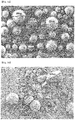
- Fig. 1a shows a photograph of the polylactic acid powder prepared in Example 1
- Fig. 1b shows a photograph of the polylactic acid powder prepared in Comparative Example 1.
- Fig. 2 shows a graph of particle size distribution according to the particle size of the polymer powder prepared in Example 1.
- Table 1 Average particle diameter( ⁇ m) Particles having a particle diameter of less than 10 ⁇ m (mass %) Particles having a particle diameter exceeding 300 ⁇ m (mass %)
- Ex. 1 40 5 20 Average particle diameter( ⁇ m) Particles having a particle diameter of less than 10 ⁇ m (mass %) Particles having a particle diameter exceeding 300 ⁇ m (mass %)
- Example 1 and Comparative Example 2 the weight average molecular weights (Mw) of each of the pellet-shaped polylactic acid resins as raw materials and the prepared polylactic acid powders were measured and the differences were calculated, and the respective thermal decomposition temperatures (T dec ) were measured by thermogravimetric analysis (TGA) and the differences were calculated.
- TGA thermogravimetric analysis
- Table 2 Weight average molecular weight (Mw) Thermal decomposition temperature (°C) pellet powder ⁇ Mw pellet powder ⁇ T dec Ex. 1 200,000 100,000 100,000 347.54 345.20 2.34 C.Ex.2 200,000 30,000 170,000 347.54 310.20 37.34
- the polylactic acid powder of Example 1 prepared according to one embodiment of the present disclosure has an average particle diameter of 20 ⁇ m to 300 ⁇ m, with a particle size distribution in which particles smaller than 10 ⁇ m in particle size and particles larger than 300 ⁇ m in particle size are both present in a content of 10 mass% or less.
- the polylactic acid powder of Example 1 was produced in accordance with the method for producing a polymer powder according to one embodiment of the present disclosure, thereby exhibiting a spherical shape and exhibiting an average particle diameter within the above range.
- the polylactic acid powder of Example 1 prepared according to one embodiment of the present disclosure showed a decrease in the weight average molecular weight and a little change in the thermal decomposition temperature with respect to the pellet-shaped raw material in the production process, thereby realizing better physical properties due to the polylactic acid itself.
Landscapes
- Chemical & Material Sciences (AREA)
- Health & Medical Sciences (AREA)
- Chemical Kinetics & Catalysis (AREA)
- Medicinal Chemistry (AREA)
- Polymers & Plastics (AREA)
- Organic Chemistry (AREA)
- Processes Of Treating Macromolecular Substances (AREA)
Abstract
Description
- The present disclosure relates to a polymer powder and a method for preparing the same.
- Thermoplastic composites applied to interior materials or parts used in construction, vehicles, filters, etc. may contain polymer powder due to various purposes. For example, the composites may comprise a structure in which the powder is impregnated into fibers. In the case of such a polymer powder, the smaller the particle diameter, the more favorable the subsequent process, and the narrower the particle diameter distribution and the uniform size, the more various applications can be obtained.
- Conventionally, spherical fine particles were produced at low cost by using a ball mill grinding method or a freeze grinding method. However, in the freeze grinding method, problems may arise in terms of cost and time since it uses expensive nitrogen to reduce the size of the particles and requires a multi-step grinding process. In addition, since the shape of the final particles produced by the freeze grinding method has a relatively sharp crushed shape, there is a disadvantage in terms of fluidity and various applicability requirements cannot be secured. In the case of the ball mill grinding method, the shape of particles is more spherical than those produced by the freeze grinding method. However, in order to obtain such spherical particles, a separate step of dispersing the particles in a solvent and then recovering them is required. Therefore, this is also disadvantageous in terms of cost and time, and there is a problem in that the particle diameter distribution of the produced particles is wide and uneven, and coagulation occurs easily.
- Therefore, there is a need for a method for preparing a spherical powder which is advantageous in terms of cost and time, has little change in physical properties due to temperatures during production, and exhibits excellent physical properties with a narrow particle diameter distribution.
- It is an aspect of the present disclosure to provide a polymer powder having a narrow particle diameter distribution and a uniform particle diameter in a certain range to ensure excellent fluidity and applicability.
- It is another aspect of the present disclosure to provide a method for preparing the polymer powder which is advantageous in terms of cost and time and can minimize the change in physical properties depending on the temperatures and the like.
- In accordance with one aspect of the present disclosure, a polymer powder having an average particle diameter of about 20 µm to about 300 µm, with a particle diameter of less than about 10 µm of about 10 mass% or less, and a particle diameter of greater than about 300 µm of about 10 mass% or less is provided.
- The polymer powder may include at least one selected from the group consisting of polylactic acid (PLA), polypropylene, polystyrene, acrylonitrile-butadiene-styrene (ABS), polymethylmethacrylate (PMMA), polyethylene glycol (PEG), thermoplastic polyurethane (TPU), polydimethylsiloxane (PDMS), high density polyethylene (HDPE), low density polyethylene (LDPE), high impact polystyrene (HIPS), polyethylene oxide (PEO), polyethylene carbonate (PEC), polyhydroxyalkanoate (PHA), polyhydroxybutyrate (PHB), and combinations thereof.
- The polymer powder may have a weight average molecular weight (Mw) of from about 10,000 to about 300,000.
- The polymer powder may have an angle of repose of less than about 45 degrees.
- In accordance with another aspect of the present disclosure, there is provided a method for preparing a polymer powder, including: forming a melt of a polymer; introducing a supercritical fluid into the melt of the polymer to form a mixed composition; and spraying the mixed composition to prepare the polymer powder.
- The melt of the polymer may be formed by melting the polymer at about 100°C to about 290°C.
- The step of forming the mixed composition may include introducing the supercritical fluid into the melt of the polymer and then pressurizing to disperse the supercritical fluid in the melt of the polymer.
- The step of forming the mixed composition may include introducing the supercritical fluid into the melt of the polymer and then pressurizing to a pressure of about 50 bars to about 500 bars.
- The mixed composition may be formed by introducing about 5 to about 15 parts by weight of the supercritical fluid based on 100 parts by weight of the melt of the polymer.
- The supercritical fluid may include at least one selected from the group consisting of carbon dioxide, helium, nitrogen, methane, ethane, propane, ethylene, propylene, methylene, and combinations thereof.
- The mixed composition may have a viscosity of about 10-3 Pa · s to about 103 Pa · s.
- The step of spraying the mixed composition to prepare a polymer powder may include spraying the mixed composition through a nozzle having an average diameter of about 0.01 to about 3.0 mm.
- The step of spraying the mixed composition to prepare a polymer powder may include cooling the mixed composition at about -30°C to about 30°C concurrently with spraying.
- The difference in weight average molecular weight (Mw) between the polymer and the polymer powder may be about 200,000 or less.
- The difference in thermal decomposition temperature between the polymer and the polymer powder may be about 50°C or less.
- The polymer powder has a narrow particle diameter distribution and a small and uniform particle diameter, and thus excellent fluidity and applicability can be secured.
- The method of preparing a polymer powder is advantageous in terms of cost and time, and minimizes changes in physical properties depending on the temperatures and the like, so that the polymer powder having excellent physical properties can be obtained.
-
-
Fig. 1a is a SEM image of a polymer powder produced according to an embodiment of the present disclosure, andFig. 1b is a SEM image of a polymer powder produced according to a conventional preparation method. -
Fig. 2 shows a graph of particle diameter distribution according to a particle diameter of the polymer powder produced according to an embodiment of the present disclosure. - Hereinafter, the present disclosure will be described in detail by way of certain embodiments. However, it is to be understood that these embodiments are provided by way of illustrative purposes only, and the present disclosure is not limited thereto, but is only defined by the scope of the following claims and its equivalent.
- One aspect of the present disclosure provides a polymer powder having an average particle diameter of about 20 µm to about 300 µm, with a particle diameter of less than about 10 µm of about 10 mass% or less, and a particle diameter of greater than about 300 µm of about 10 mass% or less.
- The polymer powder has an average particle diameter of about 20 µm to about 300 µm. The polymer powder has an average particle diameter within the above range, and thus excellent workability can be secured when applied to interior construction materials and interior decorative materials based on the particle sizes.
- In addition, the polymer powder may have particles having a particle diameter of less than about 10 µm and particles having a particle diameter of more than about 300 µm, of 10 mass% or less, respectively, and, for example, about 5 mass% or less, respectively. Specifically, the particles having a particle diameter of less than about 10 µm may be about 5% by mass or less, and the particles having a particle diameter exceeding about 300 µm may be about 1% by mass or less. Since the polymer powder has such a particle size distribution, excellent fluidity and moldability can be secured when applied to interior construction materials and interior decorative materials.
- Specifically, the polymer powder may include at least one selected from the group consisting of polylactic acid (PLA), polypropylene, polystyrene, acrylonitrile-butadiene-styrene (ABS), polymethylmethacrylate (PMMA), polyethylene glycol (PEG), thermoplastic polyurethane (TPU), polydimethylsiloxane (PDMS), high density polyethylene (HDPE), low density polyethylene (LDPE), high impact polystyrene (HIPS), polyethylene oxide (PEO), polyethylene carbonate (PEC), polyhydroxyalkanoate (PHA), polyhydroxybutyrate (PHB), and combinations thereof.
- For example, the polymer powder may include polylactic acid, and in this case, it may be easy to produce a polymer powder having an average particle size and a particle size distribution within the above range by the preparation method described below. In addition, not only an excellent fluidity and processability can be secured by the average particle size and the particle size distribution in the above-mentioned range, but also an environment-friendly effect due to the polylactic acid itself can be obtained.
- The polymer powder may have a weight average molecular weight (Mw) of from about 10,000 to about 300,000, for example from about 50,000 to about 200,000. The polymer powder satisfies the weight average molecular weight (Mw) in the above range together with the average particle size and the particle size distribution within the above range, so that it can have excellent fluidity and moldability, and at the same time, an interior material to which the polymer powder is applied can have excellent strength.
- The polymer powder may have an angle of repose of less than about 45 degrees, for example, less than about 40 degrees. As used herein, the term "angle of repose" indicates a maximum inclination angle at which the inclination can be maintained when granulated materials are naturally stacked on a plane. Specifically, the angle of repose can be determined by an injection stability angle measurement method for measuring an angle between a slope of stack and a flat horizontal plane with respect to the stack formed by pouring granulated materials on the flat horizontal surface. Alternatively, the angle of repose can be determined by a discharge stability angle measurement method for measuring an angle between a plane of curved surface and a planar bottom surface with respect to the curved shape formed by discharging the material through a hole made in a container having a flat bottom. As such, the polymer powder exhibits an angle of repose within the above range, so that excellent fluidity can be obtained and applicability in various fields can be ensured.
- Another aspect of the present disclosure provides a method for preparing a polymer powder, including: forming a melt of a polymer; introducing a supercritical fluid into the melt of the polymer to form a mixed composition; and spraying the mixed composition to prepare the polymer powder.
- The method for preparing a polymer powder uses a supercritical fluid (SCF). Specifically, the supercritical fluid may be used as an additive. Thus, since the polymer powder can be produced at a relatively low temperature, the loss of raw material can be prevented, and the polymer powder produced by the above-described preparation method can provide excellent physical properties in terms of thermal decomposition characteristics, particle size distribution, and molecular weight.
- Specifically, the method may include forming a melt of a polymer. The melt of the polymer is formed by melting a raw material composed of a polymer at a predetermined temperature, and the raw material composed of the polymer may be a pellet-shaped granule.
- The melt of the polymer may be formed by melting the polymer at about 100°C to about 290°C. The polymer may be melted so as to have an appropriate viscosity without deteriorating the physical properties of the polymer itself by melting at the above range of temperatures.
- The melt of the polymer may have a viscosity of about 10-3 Pa·s to about 103 Pa·s. The melt of the polymer having a viscosity in this range can be well mixed with a supercritical fluid in subsequent steps and ensures good processability.
- The method may include introducing a supercritical fluid into the melt of the polymer to form a mixed composition. The supercritical fluid is introduced after the melt of the polymer is formed, thereby forming a mixed composition having a suitable viscosity at a relatively low temperature.
- Specifically, the step of forming a mixed composition may include introducing the supercritical fluid into the melt of the polymer and then pressurizing to disperse the supercritical fluid in the melt of the polymer. That is, the mixed composition may be a composition in which the supercritical fluid is dispersed in the melt of the polymer.
- The step of forming a mixed composition may include introducing the supercritical fluid into the melt of the polymer and then pressurizing the mixture to a pressure of about 50 bars to about 500 bars, such as from about 50 bars to about 300 bars. In this step, when the pressure is maintained in the above range, the supercritical fluid can be uniformly dispersed in the melt of the polymer, and a mixed composition having a viscosity advantageous to processing can be formed.
- Further, the step of forming a mixed composition may be performed at about 100°C to about 290°C. Conventionally, when polymers or polymeric materials were melted and particles were formed by a method such as spraying, the viscosity of the melt was controlled by raising a temperature to about 300°C or higher. When the preparation process proceeds at such a high temperature, there are problems that the loss of raw material is increased, the production cost is increased, and the resulting product is poor in the thermal characteristics. In this regard, when the step of forming a mixed composition in the above method is performed at a temperature within the above-mentioned range, a mixed composition having an appropriate viscosity can be formed by uniformly mixing with a supercritical fluid without impairing the physical properties of the polymer melt, and the resultant polymer powder can exhibit excellent thermal properties.
- The step of forming a mixed composition may include introducing the melt of the polymer and simultaneously introducing a supercritical fluid into the melt of the polymer. In this embodiment, the melt of the polymer may be introduced at a rate of from about 2 to about 100 rpm and the supercritical fluid may be injected into the melt of the polymer at a flow rate of from about 0.01 to about 40 g/L. When the melt of the polymer and the supercritical fluid are injected at the speed and the flow rate within the above ranges, they can be mixed and dispersed evenly, and the viscosity of the mixed composition thus produced can be easily obtained.
- The mixed composition may be formed by adding about 5 to about 15 parts by weight of the supercritical fluid based on 100 parts by weight of the melt of the polymer. The supercritical fluid is added in a small amount relative to the polymer melt, so that the polymer melt can be easily mixed with the fluid at a relatively low temperature, thereby making possible to easily produce a mixed composition having advantageous viscosities in processing without denaturing the thermal properties.
- When the supercritical fluid is contained in an amount of less than about 5 parts by weight based on 100 parts by weight of the melt of the polymer, it may be difficult to secure a viscosity favorable for the processing of the mixed composition. When the supercritical fluid is contained more than about 15 parts by weight, a phase separation of the supercritical fluid may occur.
- As used herein, the term "supercritical fluid" indicates a fluid which exists in a state of exceeding a critical temperature and a critical pressure inherent to a material and exhibits both gaseous and liquidus properties. Specifically, the supercritical fluid may include at least one selected from the group consisting of carbon dioxide, helium, nitrogen, methane, ethane, propane, ethylene, propylene, methylene, and combinations thereof. For example, the supercritical fluid may include carbon dioxide, which is relatively inexpensive and can be mixed well with the melt of the polymer.
- The mixed composition prepared by introducing the supercritical fluid into the melt of the polymer may have a viscosity of about 10-3 Pa·s to about 103 Pa·s. When the mixed composition has a viscosity within the above-mentioned range, it is easy to spray it, so that excellent processability can be secured in the production of a polymer powder, and the polymer powder thus produced can have a uniform size and a narrow particle size distribution.
- The method may include spraying the mixed composition to prepare a polymer powder. In particular, the mixed composition may be sprayed through a nozzle, and more particularly, the average diameter of the nozzle may be about 0.01 to about 3.0 mm. When the average diameter of the nozzle satisfies the above range, the mixed composition can be introduced favorably, and a polymer powder having an appropriate size and narrow particle size distribution can be produced therefrom.
- Specifically, the mixed composition may be sprayed after being injected into the nozzle with air, wherein the temperature of the injected air may be from about 200°C to about 500°C, and the pressure thereof may be from about 100 psi to about 1000 psi. In addition, the rate of air injection may be from about 10 m/s to about 50 m/s. When the mixed composition is injected into a nozzle having a diameter within the above range together with air satisfying the temperature, pressure and injection rate in the above range, the polymer powder produced by spraying the mixed composition may easily secure an appropriate size and narrow particle size distribution, and may not impair the physical properties of the polymer itself.
- In addition, the step of spraying the mixed composition to prepare a polymer powder may include cooling the mixed composition at a temperature of about -30°C to about 30°C simultaneously with spraying. When the mixed composition is cooled at the above range of temperature concurrently with spraying, the uniformity of the polymer powder size can be improved and a narrow particle size distribution can be obtained. Further, the polymer powders are not agglomerated, and excellent fluidity can be secured, and a spherical shape can be sufficiently retained.
- The method of preparing a polymer powder can provide an appropriate viscosity at a relatively low temperature by using a supercritical fluid. Thus, the method can minimize the loss of raw material by heat, and the changes in physical properties such as the thermal property and the molecular weight of the polymer powder relative to the raw material can be minimized, which is advantageous in terms of securing costs and excellent physical properties.
- Specifically, the raw material for producing the polymer powder is a polymer, and the polymer means a state prior to forming a melt of the polymer. The difference in weight average molecular weight (Mw) between the polymer and the polymer powder may be about 200,000 or less, and, for example, about 150,000 or less, such as, about 5,000 to 150,000. The smaller the difference in the weight average molecular weight (Mw), the smaller the loss of the raw material during the production of the polymer powder, and when the change in the weight average molecular weight (Mw) of the polymer powder relative to the raw material is within the above range, the polymer powder can easily secure excellent physical properties caused by the characteristics of the polymer itself.
- In addition, the difference in the thermal decomposition temperature between the polymer and the polymer powder may be about 50°C or less, and, for example, about 20°C or less, such as, about 2°C to 20°C. As used herein, the term "thermal decomposition temperature" indicates a temperature at which the polymer is decomposed by applying a heat thereto. Specifically, the thermal decomposition temperature can be measured using a thermogravimetric analysis (TGA). The smaller the difference in the thermal decomposition temperature, the smaller the change in the physical properties of the raw material during the production of the polymer powder, and when the difference in the thermal decomposition temperature between the polymer and the polymer powder satisfies the above range, the polymer powder can easily ensure excellent physical properties.
- Hereinafter, specific examples of the present disclosure will be described. However, it is to be understood that these examples described below are only intended to illustrate or describe the present disclosure in more detail, and thus the present disclosure is not limited thereto.
- A pellet-shaped polylactic acid resin was introduced into an extruder, and the polylactic acid resin was melted at a temperature of 250°C to prepare a polylactic acid melt. Then, 5 parts by weight of supercritical fluid carbon dioxide was added based on 100 parts by weight of the polylactic acid melt, followed by pressurization to mix and disperse to prepare a mixed composition. Then, the mixed composition was injected into an injection nozzle, and sprayed into a chamber having a temperature of 20°C and cooled to prepare a polylactic acid powder.
- A pellet-shaped polylactic acid resin was frozen and pulverized, and subjected to a ball-milling process to prepare a polylactic acid powder.
- A pellet-shaped polylactic acid resin was introduced into an extruder, and the polylactic acid resin was melted at a temperature of 250°C to prepare a polylactic acid melt. The polylactic acid melt was elevated to 400°C, and injected into an injection nozzle, and sprayed into a chamber having a temperature of 20°C and cooled to prepare a polylactic acid powder.
- With respect to Example 1 and Comparative Example 1, average particle diameter and particle size distribution were measured using a laser diffraction particle size distribution analyzer (Microtrac, S3500 Series). The results are shown in Table 1 below.
Fig. 1a shows a photograph of the polylactic acid powder prepared in Example 1, andFig. 1b shows a photograph of the polylactic acid powder prepared in Comparative Example 1. Further,Fig. 2 shows a graph of particle size distribution according to the particle size of the polymer powder prepared in Example 1.Table 1 Average particle diameter(µm) Particles having a particle diameter of less than 10 µm (mass %) Particles having a particle diameter exceeding 300 µm (mass %) Ex. 1 70 4 0.45 C. Ex. 1 40 5 20 - With respect to Example 1 and Comparative Example 2, the weight average molecular weights (Mw) of each of the pellet-shaped polylactic acid resins as raw materials and the prepared polylactic acid powders were measured and the differences were calculated, and the respective thermal decomposition temperatures (Tdec) were measured by thermogravimetric analysis (TGA) and the differences were calculated. The results are shown in Table 2 below.
Table 2 Weight average molecular weight (Mw) Thermal decomposition temperature (°C) pellet powder ΔMw pellet powder ΔTdec Ex. 1 200,000 100,000 100,000 347.54 345.20 2.34 C.Ex.2 200,000 30,000 170,000 347.54 310.20 37.34 - Referring to the results of Table 1 and
Fig. 2 , it can be seen that the polylactic acid powder of Example 1 prepared according to one embodiment of the present disclosure has an average particle diameter of 20 µm to 300 µm, with a particle size distribution in which particles smaller than 10 µm in particle size and particles larger than 300 µm in particle size are both present in a content of 10 mass% or less. - Further, through the results of
Fig. 1a and Fig. 1b , it can be confirmed that the polylactic acid powder of Example 1 was produced in accordance with the method for producing a polymer powder according to one embodiment of the present disclosure, thereby exhibiting a spherical shape and exhibiting an average particle diameter within the above range. - Meanwhile, it was found that the polylactic acid powder of Comparative Example 1 prepared through the freeze-grinding and ball-milling process had a larger average particle size and an uneven particle size distribution as compared with Example 1.
- In addition, referring to the results of Table 2 above, it can be seen that, as compared with Comparative Example 2, the polylactic acid powder of Example 1 prepared according to one embodiment of the present disclosure showed a decrease in the weight average molecular weight and a little change in the thermal decomposition temperature with respect to the pellet-shaped raw material in the production process, thereby realizing better physical properties due to the polylactic acid itself.
Claims (15)
- A polymer powder having an average particle diameter of 20 µm to 300 µm, with a particle diameter of less than 10 µm of 10 mass% or less, and a particle diameter of greater than 300 µm of 10 mass% or less.
- The polymer powder of claim 1, wherein the polymer powder comprises at least one selected from the group consisting of polylactic acid (PLA), polypropylene, polystyrene, acrylonitrile-butadiene-styrene (ABS), polymethylmethacrylate (PMMA), polyethylene glycol (PEG), thermoplastic polyurethane (TPU), polydimethylsiloxane (PDMS), high density polyethylene (HDPE), low density polyethylene (LDPE), high impact polystyrene (HIPS), polyethylene oxide (PEO), polyethylene carbonate (PEC), polyhydroxyalkanoate (PHA), polyhydroxybutyrate (PHB), and combinations thereof.
- The polymer powder of claim 1, wherein the polymer powder has a weight average molecular weight (Mw) of from 10,000 to 300,000.
- The polymer powder of claim 1, wherein the polymer powder has an angle of repose of less than 45 degrees.
- A method for preparing a polymer powder, comprising:forming a melt of a polymer;introducing a supercritical fluid into the melt of the polymer to form a mixed composition; andspraying the mixed composition to prepare the polymer powder.
- The method of claim 5, wherein the melt of the polymer is formed by melting the polymer at 100°C to 290°C.
- The method of claim 5, wherein the step of forming the mixed composition comprises introducing the supercritical fluid into the melt of the polymer and then pressurizing to disperse the supercritical fluid in the melt of the polymer.
- The method of claim 7, wherein the step of forming the mixed composition comprises introducing the supercritical fluid into the melt of the polymer and then pressurizing to a pressure of 50 bars to 500 bars.
- The method of claim 5, wherein the mixed composition is formed by introducing 5 to 15 parts by weight of the supercritical fluid based on 100 parts by weight of the melt of the polymer.
- The method of claim 5, wherein the supercritical fluid comprises at least one selected from the group consisting of carbon dioxide, helium, nitrogen, methane, ethane, propane, ethylene, propylene, methylene, and combinations thereof.
- The method of claim 5, wherein the mixed composition has a viscosity of 10-3 Pa · s to 103 Pa · s.
- The method of claim 5, wherein the step of spraying the mixed composition to prepare a polymer powder comprises spraying the mixed composition through a nozzle having an average diameter of 0.01 to 3.0 mm.
- The method of claim 5, wherein the step of spraying the mixed composition to prepare a polymer powder comprises cooling the mixed composition at -30°C to 30°C simultaneously with spraying.
- The method of claim 5, wherein the difference in weight average molecular weight (Mw) between the polymer and the polymer powder is 200,000 or less.
- The method of claim 5, wherein the difference in thermal decomposition temperature between the polymer and the polymer powder is 50°C or less.
Applications Claiming Priority (2)
| Application Number | Priority Date | Filing Date | Title |
|---|---|---|---|
| KR20140130551 | 2014-09-29 | ||
| PCT/KR2015/010225 WO2016052958A1 (en) | 2014-09-29 | 2015-09-25 | Polymer powder and method for preparing same |
Publications (3)
| Publication Number | Publication Date |
|---|---|
| EP3202824A1 true EP3202824A1 (en) | 2017-08-09 |
| EP3202824A4 EP3202824A4 (en) | 2017-10-04 |
| EP3202824B1 EP3202824B1 (en) | 2021-02-17 |
Family
ID=55789845
Family Applications (1)
| Application Number | Title | Priority Date | Filing Date |
|---|---|---|---|
| EP15845673.1A Not-in-force EP3202824B1 (en) | 2014-09-29 | 2015-09-25 | Polymer powder and method for preparing same |
Country Status (5)
| Country | Link |
|---|---|
| US (1) | US10450409B2 (en) |
| EP (1) | EP3202824B1 (en) |
| JP (1) | JP6476286B2 (en) |
| KR (2) | KR20160038801A (en) |
| CN (1) | CN106715583B (en) |
Cited By (1)
| Publication number | Priority date | Publication date | Assignee | Title |
|---|---|---|---|---|
| EP3594270A4 (en) * | 2017-03-09 | 2021-01-13 | LG Hausys, Ltd. | Thermoplastic polyurethane particles and manufacturing method therefor |
Families Citing this family (4)
| Publication number | Priority date | Publication date | Assignee | Title |
|---|---|---|---|---|
| CN109021260A (en) * | 2018-07-28 | 2018-12-18 | 博爱新开源医疗科技集团股份有限公司 | A kind of drying means and polymer powder of high-k polymer solution |
| EP3812416A1 (en) | 2019-10-23 | 2021-04-28 | Acondicionamiento Tarrasense | Process for producing polymers in powder form |
| JP7209434B2 (en) * | 2019-10-31 | 2023-01-20 | 株式会社カネカ | Method for producing polyhydroxyalkanoic acid and use thereof |
| CN113024850B (en) * | 2021-03-23 | 2022-05-20 | 江南大学 | Method for preparing polylactic acid microspheres by free radical polymerization without solvent |
Family Cites Families (15)
| Publication number | Priority date | Publication date | Assignee | Title |
|---|---|---|---|---|
| CA1326154C (en) * | 1988-02-29 | 1994-01-18 | Koichi Tomiyama | Magnetic toner for developing electrostatic images |
| US6356729B1 (en) * | 1999-04-07 | 2002-03-12 | Ricoh Company, Ltd. | Electrophotographic toner, toner container containing the toner, image forming apparatus using the toner container and method for supplying the toner from the toner container |
| JP4083029B2 (en) * | 2003-02-04 | 2008-04-30 | 株式会社クラレ | Acrylic polymer powder, acrylic sol and molded product |
| JP2005036076A (en) * | 2003-07-18 | 2005-02-10 | Toyo Kasei Kogyo Co Ltd | High molecular weight polyolefin aqueous emulsion composition |
| JP4931603B2 (en) | 2004-01-28 | 2012-05-16 | シーエスアイアール | Enzyme stabilization |
| AU2005209541B2 (en) | 2004-01-28 | 2007-07-12 | Japan Science And Technology Agency | A method for producing fine particles using method of rapid expansion into poor solvent from supercritical fluid |
| JP2010018640A (en) | 2005-10-31 | 2010-01-28 | Kansai Paint Co Ltd | Peelable film-forming composition |
| US8585943B2 (en) | 2007-12-07 | 2013-11-19 | Xspray Microparticles Ab | Method and arrangement for the production of particles |
| GB0812740D0 (en) | 2008-07-11 | 2008-08-20 | Critical Pharmaceuticals Ltd | Composition |
| JP2010070670A (en) | 2008-09-19 | 2010-04-02 | Nippon Polyurethane Ind Co Ltd | Powdery thermoplastic polyurethane resin composition, sheet-formed polyurethane resin formed article produced by using the same and method for producing the article |
| KR101105292B1 (en) | 2009-06-05 | 2012-01-17 | 주식회사 리젠 바이오텍 | Biodegradable polymer microparticles and preparation method thereof |
| KR100924236B1 (en) | 2009-06-23 | 2009-10-29 | 충남대학교산학협력단 | Novel manufacturing method and device for ultrafine particles having uniform particle size distribution |
| JP5110225B2 (en) * | 2011-01-31 | 2012-12-26 | 東レ株式会社 | Method for producing polylactic acid resin fine particles, polylactic acid resin fine particles, and cosmetics using the same |
| JP2013133355A (en) | 2011-12-26 | 2013-07-08 | Univ Of Tokyo | Production method of regenerated cellulose spherical particle |
| JP6089258B2 (en) * | 2012-11-13 | 2017-03-08 | 株式会社リコー | Particle manufacturing method and particle manufacturing apparatus |
-
2015
- 2015-09-25 US US15/515,583 patent/US10450409B2/en not_active Expired - Fee Related
- 2015-09-25 JP JP2017517009A patent/JP6476286B2/en not_active Expired - Fee Related
- 2015-09-25 KR KR1020150136095A patent/KR20160038801A/en not_active Ceased
- 2015-09-25 EP EP15845673.1A patent/EP3202824B1/en not_active Not-in-force
- 2015-09-25 CN CN201580052931.9A patent/CN106715583B/en not_active Expired - Fee Related
-
2019
- 2019-05-21 KR KR1020190059248A patent/KR102034425B1/en not_active Expired - Fee Related
Cited By (6)
| Publication number | Priority date | Publication date | Assignee | Title |
|---|---|---|---|---|
| EP3594270A4 (en) * | 2017-03-09 | 2021-01-13 | LG Hausys, Ltd. | Thermoplastic polyurethane particles and manufacturing method therefor |
| EP3594269A4 (en) * | 2017-03-09 | 2021-01-20 | LG Hausys, Ltd. | Polylactic acid particles and manufacturing method therefor |
| US11066527B2 (en) | 2017-03-09 | 2021-07-20 | Lg Hausys, Ltd. | Polylactic acid particles and manufacturing method therefor |
| US11118019B2 (en) | 2017-03-09 | 2021-09-14 | Lg Hausys, Ltd. | Thermoplastic polyurethane particles having low impurity content and manufacturing method therefor |
| US11149120B2 (en) | 2017-03-09 | 2021-10-19 | Lg Hausys, Ltd. | Method for manufacturing thermoplastic polymer particles |
| US11542372B2 (en) | 2017-03-09 | 2023-01-03 | Lg Hausys, Ltd. | Thermoplastic polymer particles having a peak of cold crystallization temperature |
Also Published As
| Publication number | Publication date |
|---|---|
| EP3202824B1 (en) | 2021-02-17 |
| CN106715583A (en) | 2017-05-24 |
| KR20160038801A (en) | 2016-04-07 |
| KR20190058414A (en) | 2019-05-29 |
| JP6476286B2 (en) | 2019-02-27 |
| US10450409B2 (en) | 2019-10-22 |
| CN106715583B (en) | 2020-07-14 |
| JP2017530232A (en) | 2017-10-12 |
| EP3202824A4 (en) | 2017-10-04 |
| KR102034425B1 (en) | 2019-10-18 |
| US20170291986A1 (en) | 2017-10-12 |
Similar Documents
| Publication | Publication Date | Title |
|---|---|---|
| KR102034425B1 (en) | Polymer powder and the preparing method for the same | |
| CN106795294B (en) | Thermoplastic elastomer resin powder and preparation method of thermoplastic elastomer resin powder | |
| Pilla et al. | Microcellular extrusion‐foaming of polylactide with chain‐extender | |
| US11542372B2 (en) | Thermoplastic polymer particles having a peak of cold crystallization temperature | |
| CN1800242A (en) | Fine granul polyarylidenetherketone powder | |
| JP3771008B2 (en) | Process for producing branched or cross-linked polyacetal resin | |
| Kulikov et al. | Novel processing additives for rotational molding of polyethylene | |
| KR20040040663A (en) | Crystallizing method of polycarbonate and preparation method of high molecular weight polycarbonate resin using the same | |
| KR20180103751A (en) | Method for preparing thermoplastic polymer particle | |
| CN112898832A (en) | Polypropylene powder coating and preparation method thereof | |
| EP3040378B1 (en) | Foam sheet, method for producing particulate polylactic acid resin, and method for manufacturing foam sheet | |
| KR102673974B1 (en) | Manufacturing method for pellet type polypropylene resin, pellet type polypropylene resin and molded article comprising same | |
| CN121159890A (en) | High sphericity polyaryletherketone powder and preparation method and application thereof | |
| WO2016052958A1 (en) | Polymer powder and method for preparing same | |
| US11066532B2 (en) | Process for the production of expanded material based on sulfone polymers | |
| CN108026342A (en) | For rotational moulding application can non-frozen grinding based on polyacrylic compound | |
| KR102259633B1 (en) | Thermoplastic polyurethane particles and method for preparing the same | |
| US20220332903A1 (en) | Thermoplastic Polymer Particles and Method for Manufacturing Same |
Legal Events
| Date | Code | Title | Description |
|---|---|---|---|
| STAA | Information on the status of an ep patent application or granted ep patent |
Free format text: STATUS: THE INTERNATIONAL PUBLICATION HAS BEEN MADE |
|
| PUAI | Public reference made under article 153(3) epc to a published international application that has entered the european phase |
Free format text: ORIGINAL CODE: 0009012 |
|
| STAA | Information on the status of an ep patent application or granted ep patent |
Free format text: STATUS: REQUEST FOR EXAMINATION WAS MADE |
|
| 17P | Request for examination filed |
Effective date: 20170404 |
|
| AK | Designated contracting states |
Kind code of ref document: A1 Designated state(s): AL AT BE BG CH CY CZ DE DK EE ES FI FR GB GR HR HU IE IS IT LI LT LU LV MC MK MT NL NO PL PT RO RS SE SI SK SM TR |
|
| AX | Request for extension of the european patent |
Extension state: BA ME |
|
| A4 | Supplementary search report drawn up and despatched |
Effective date: 20170901 |
|
| RIC1 | Information provided on ipc code assigned before grant |
Ipc: C08J 3/12 20060101AFI20170828BHEP Ipc: C08L 101/00 20060101ALI20170828BHEP |
|
| DAV | Request for validation of the european patent (deleted) | ||
| DAX | Request for extension of the european patent (deleted) | ||
| STAA | Information on the status of an ep patent application or granted ep patent |
Free format text: STATUS: EXAMINATION IS IN PROGRESS |
|
| 17Q | First examination report despatched |
Effective date: 20191001 |
|
| RIC1 | Information provided on ipc code assigned before grant |
Ipc: C08J 3/12 20060101AFI20200721BHEP |
|
| GRAP | Despatch of communication of intention to grant a patent |
Free format text: ORIGINAL CODE: EPIDOSNIGR1 |
|
| STAA | Information on the status of an ep patent application or granted ep patent |
Free format text: STATUS: GRANT OF PATENT IS INTENDED |
|
| INTG | Intention to grant announced |
Effective date: 20200901 |
|
| GRAS | Grant fee paid |
Free format text: ORIGINAL CODE: EPIDOSNIGR3 |
|
| GRAA | (expected) grant |
Free format text: ORIGINAL CODE: 0009210 |
|
| STAA | Information on the status of an ep patent application or granted ep patent |
Free format text: STATUS: THE PATENT HAS BEEN GRANTED |
|
| AK | Designated contracting states |
Kind code of ref document: B1 Designated state(s): AL AT BE BG CH CY CZ DE DK EE ES FI FR GB GR HR HU IE IS IT LI LT LU LV MC MK MT NL NO PL PT RO RS SE SI SK SM TR |
|
| REG | Reference to a national code |
Ref country code: GB Ref legal event code: FG4D |
|
| REG | Reference to a national code |
Ref country code: CH Ref legal event code: EP |
|
| REG | Reference to a national code |
Ref country code: DE Ref legal event code: R096 Ref document number: 602015065774 Country of ref document: DE |
|
| REG | Reference to a national code |
Ref country code: AT Ref legal event code: REF Ref document number: 1361396 Country of ref document: AT Kind code of ref document: T Effective date: 20210315 |
|
| REG | Reference to a national code |
Ref country code: IE Ref legal event code: FG4D |
|
| REG | Reference to a national code |
Ref country code: LT Ref legal event code: MG9D |
|
| REG | Reference to a national code |
Ref country code: NL Ref legal event code: MP Effective date: 20210217 |
|
| PG25 | Lapsed in a contracting state [announced via postgrant information from national office to epo] |
Ref country code: BG Free format text: LAPSE BECAUSE OF FAILURE TO SUBMIT A TRANSLATION OF THE DESCRIPTION OR TO PAY THE FEE WITHIN THE PRESCRIBED TIME-LIMIT Effective date: 20210517 Ref country code: HR Free format text: LAPSE BECAUSE OF FAILURE TO SUBMIT A TRANSLATION OF THE DESCRIPTION OR TO PAY THE FEE WITHIN THE PRESCRIBED TIME-LIMIT Effective date: 20210217 Ref country code: FI Free format text: LAPSE BECAUSE OF FAILURE TO SUBMIT A TRANSLATION OF THE DESCRIPTION OR TO PAY THE FEE WITHIN THE PRESCRIBED TIME-LIMIT Effective date: 20210217 Ref country code: GR Free format text: LAPSE BECAUSE OF FAILURE TO SUBMIT A TRANSLATION OF THE DESCRIPTION OR TO PAY THE FEE WITHIN THE PRESCRIBED TIME-LIMIT Effective date: 20210518 Ref country code: LT Free format text: LAPSE BECAUSE OF FAILURE TO SUBMIT A TRANSLATION OF THE DESCRIPTION OR TO PAY THE FEE WITHIN THE PRESCRIBED TIME-LIMIT Effective date: 20210217 Ref country code: NO Free format text: LAPSE BECAUSE OF FAILURE TO SUBMIT A TRANSLATION OF THE DESCRIPTION OR TO PAY THE FEE WITHIN THE PRESCRIBED TIME-LIMIT Effective date: 20210517 Ref country code: PT Free format text: LAPSE BECAUSE OF FAILURE TO SUBMIT A TRANSLATION OF THE DESCRIPTION OR TO PAY THE FEE WITHIN THE PRESCRIBED TIME-LIMIT Effective date: 20210617 |
|
| REG | Reference to a national code |
Ref country code: AT Ref legal event code: MK05 Ref document number: 1361396 Country of ref document: AT Kind code of ref document: T Effective date: 20210217 |
|
| PG25 | Lapsed in a contracting state [announced via postgrant information from national office to epo] |
Ref country code: RS Free format text: LAPSE BECAUSE OF FAILURE TO SUBMIT A TRANSLATION OF THE DESCRIPTION OR TO PAY THE FEE WITHIN THE PRESCRIBED TIME-LIMIT Effective date: 20210217 Ref country code: LV Free format text: LAPSE BECAUSE OF FAILURE TO SUBMIT A TRANSLATION OF THE DESCRIPTION OR TO PAY THE FEE WITHIN THE PRESCRIBED TIME-LIMIT Effective date: 20210217 Ref country code: NL Free format text: LAPSE BECAUSE OF FAILURE TO SUBMIT A TRANSLATION OF THE DESCRIPTION OR TO PAY THE FEE WITHIN THE PRESCRIBED TIME-LIMIT Effective date: 20210217 Ref country code: PL Free format text: LAPSE BECAUSE OF FAILURE TO SUBMIT A TRANSLATION OF THE DESCRIPTION OR TO PAY THE FEE WITHIN THE PRESCRIBED TIME-LIMIT Effective date: 20210217 Ref country code: SE Free format text: LAPSE BECAUSE OF FAILURE TO SUBMIT A TRANSLATION OF THE DESCRIPTION OR TO PAY THE FEE WITHIN THE PRESCRIBED TIME-LIMIT Effective date: 20210217 |
|
| PG25 | Lapsed in a contracting state [announced via postgrant information from national office to epo] |
Ref country code: IS Free format text: LAPSE BECAUSE OF FAILURE TO SUBMIT A TRANSLATION OF THE DESCRIPTION OR TO PAY THE FEE WITHIN THE PRESCRIBED TIME-LIMIT Effective date: 20210617 |
|
| PG25 | Lapsed in a contracting state [announced via postgrant information from national office to epo] |
Ref country code: CZ Free format text: LAPSE BECAUSE OF FAILURE TO SUBMIT A TRANSLATION OF THE DESCRIPTION OR TO PAY THE FEE WITHIN THE PRESCRIBED TIME-LIMIT Effective date: 20210217 Ref country code: EE Free format text: LAPSE BECAUSE OF FAILURE TO SUBMIT A TRANSLATION OF THE DESCRIPTION OR TO PAY THE FEE WITHIN THE PRESCRIBED TIME-LIMIT Effective date: 20210217 Ref country code: AT Free format text: LAPSE BECAUSE OF FAILURE TO SUBMIT A TRANSLATION OF THE DESCRIPTION OR TO PAY THE FEE WITHIN THE PRESCRIBED TIME-LIMIT Effective date: 20210217 Ref country code: SM Free format text: LAPSE BECAUSE OF FAILURE TO SUBMIT A TRANSLATION OF THE DESCRIPTION OR TO PAY THE FEE WITHIN THE PRESCRIBED TIME-LIMIT Effective date: 20210217 |
|
| REG | Reference to a national code |
Ref country code: DE Ref legal event code: R097 Ref document number: 602015065774 Country of ref document: DE |
|
| PG25 | Lapsed in a contracting state [announced via postgrant information from national office to epo] |
Ref country code: DK Free format text: LAPSE BECAUSE OF FAILURE TO SUBMIT A TRANSLATION OF THE DESCRIPTION OR TO PAY THE FEE WITHIN THE PRESCRIBED TIME-LIMIT Effective date: 20210217 Ref country code: RO Free format text: LAPSE BECAUSE OF FAILURE TO SUBMIT A TRANSLATION OF THE DESCRIPTION OR TO PAY THE FEE WITHIN THE PRESCRIBED TIME-LIMIT Effective date: 20210217 Ref country code: SK Free format text: LAPSE BECAUSE OF FAILURE TO SUBMIT A TRANSLATION OF THE DESCRIPTION OR TO PAY THE FEE WITHIN THE PRESCRIBED TIME-LIMIT Effective date: 20210217 |
|
| PLBE | No opposition filed within time limit |
Free format text: ORIGINAL CODE: 0009261 |
|
| STAA | Information on the status of an ep patent application or granted ep patent |
Free format text: STATUS: NO OPPOSITION FILED WITHIN TIME LIMIT |
|
| 26N | No opposition filed |
Effective date: 20211118 |
|
| PG25 | Lapsed in a contracting state [announced via postgrant information from national office to epo] |
Ref country code: AL Free format text: LAPSE BECAUSE OF FAILURE TO SUBMIT A TRANSLATION OF THE DESCRIPTION OR TO PAY THE FEE WITHIN THE PRESCRIBED TIME-LIMIT Effective date: 20210217 Ref country code: ES Free format text: LAPSE BECAUSE OF FAILURE TO SUBMIT A TRANSLATION OF THE DESCRIPTION OR TO PAY THE FEE WITHIN THE PRESCRIBED TIME-LIMIT Effective date: 20210217 |
|
| PG25 | Lapsed in a contracting state [announced via postgrant information from national office to epo] |
Ref country code: SI Free format text: LAPSE BECAUSE OF FAILURE TO SUBMIT A TRANSLATION OF THE DESCRIPTION OR TO PAY THE FEE WITHIN THE PRESCRIBED TIME-LIMIT Effective date: 20210217 |
|
| PG25 | Lapsed in a contracting state [announced via postgrant information from national office to epo] |
Ref country code: IT Free format text: LAPSE BECAUSE OF FAILURE TO SUBMIT A TRANSLATION OF THE DESCRIPTION OR TO PAY THE FEE WITHIN THE PRESCRIBED TIME-LIMIT Effective date: 20210217 |
|
| REG | Reference to a national code |
Ref country code: CH Ref legal event code: PL |
|
| REG | Reference to a national code |
Ref country code: BE Ref legal event code: MM Effective date: 20210930 |
|
| GBPC | Gb: european patent ceased through non-payment of renewal fee |
Effective date: 20210925 |
|
| PG25 | Lapsed in a contracting state [announced via postgrant information from national office to epo] |
Ref country code: IS Free format text: LAPSE BECAUSE OF FAILURE TO SUBMIT A TRANSLATION OF THE DESCRIPTION OR TO PAY THE FEE WITHIN THE PRESCRIBED TIME-LIMIT Effective date: 20210617 Ref country code: MC Free format text: LAPSE BECAUSE OF FAILURE TO SUBMIT A TRANSLATION OF THE DESCRIPTION OR TO PAY THE FEE WITHIN THE PRESCRIBED TIME-LIMIT Effective date: 20210217 |
|
| PG25 | Lapsed in a contracting state [announced via postgrant information from national office to epo] |
Ref country code: LU Free format text: LAPSE BECAUSE OF NON-PAYMENT OF DUE FEES Effective date: 20210925 Ref country code: IE Free format text: LAPSE BECAUSE OF NON-PAYMENT OF DUE FEES Effective date: 20210925 Ref country code: GB Free format text: LAPSE BECAUSE OF NON-PAYMENT OF DUE FEES Effective date: 20210925 Ref country code: FR Free format text: LAPSE BECAUSE OF NON-PAYMENT OF DUE FEES Effective date: 20210930 Ref country code: BE Free format text: LAPSE BECAUSE OF NON-PAYMENT OF DUE FEES Effective date: 20210930 |
|
| PG25 | Lapsed in a contracting state [announced via postgrant information from national office to epo] |
Ref country code: LI Free format text: LAPSE BECAUSE OF NON-PAYMENT OF DUE FEES Effective date: 20210930 Ref country code: CH Free format text: LAPSE BECAUSE OF NON-PAYMENT OF DUE FEES Effective date: 20210930 |
|
| PGFP | Annual fee paid to national office [announced via postgrant information from national office to epo] |
Ref country code: DE Payment date: 20220603 Year of fee payment: 8 |
|
| PG25 | Lapsed in a contracting state [announced via postgrant information from national office to epo] |
Ref country code: HU Free format text: LAPSE BECAUSE OF FAILURE TO SUBMIT A TRANSLATION OF THE DESCRIPTION OR TO PAY THE FEE WITHIN THE PRESCRIBED TIME-LIMIT; INVALID AB INITIO Effective date: 20150925 |
|
| PG25 | Lapsed in a contracting state [announced via postgrant information from national office to epo] |
Ref country code: CY Free format text: LAPSE BECAUSE OF FAILURE TO SUBMIT A TRANSLATION OF THE DESCRIPTION OR TO PAY THE FEE WITHIN THE PRESCRIBED TIME-LIMIT Effective date: 20210217 |
|
| REG | Reference to a national code |
Ref country code: DE Ref legal event code: R119 Ref document number: 602015065774 Country of ref document: DE |
|
| PG25 | Lapsed in a contracting state [announced via postgrant information from national office to epo] |
Ref country code: MK Free format text: LAPSE BECAUSE OF FAILURE TO SUBMIT A TRANSLATION OF THE DESCRIPTION OR TO PAY THE FEE WITHIN THE PRESCRIBED TIME-LIMIT Effective date: 20210217 |
|
| PG25 | Lapsed in a contracting state [announced via postgrant information from national office to epo] |
Ref country code: TR Free format text: LAPSE BECAUSE OF FAILURE TO SUBMIT A TRANSLATION OF THE DESCRIPTION OR TO PAY THE FEE WITHIN THE PRESCRIBED TIME-LIMIT Effective date: 20210217 |
|
| PG25 | Lapsed in a contracting state [announced via postgrant information from national office to epo] |
Ref country code: DE Free format text: LAPSE BECAUSE OF NON-PAYMENT OF DUE FEES Effective date: 20240403 |
|
| PG25 | Lapsed in a contracting state [announced via postgrant information from national office to epo] |
Ref country code: MT Free format text: LAPSE BECAUSE OF FAILURE TO SUBMIT A TRANSLATION OF THE DESCRIPTION OR TO PAY THE FEE WITHIN THE PRESCRIBED TIME-LIMIT Effective date: 20210217 |