EP3201552B1 - Système compact d'échange de chaleur et procédé de refroidissement - Google Patents
Système compact d'échange de chaleur et procédé de refroidissement Download PDFInfo
- Publication number
- EP3201552B1 EP3201552B1 EP15846658.1A EP15846658A EP3201552B1 EP 3201552 B1 EP3201552 B1 EP 3201552B1 EP 15846658 A EP15846658 A EP 15846658A EP 3201552 B1 EP3201552 B1 EP 3201552B1
- Authority
- EP
- European Patent Office
- Prior art keywords
- plenum
- coil
- air
- heat exchange
- conduit
- Prior art date
- Legal status (The legal status is an assumption and is not a legal conclusion. Google has not performed a legal analysis and makes no representation as to the accuracy of the status listed.)
- Not-in-force
Links
Images







Classifications
-
- F—MECHANICAL ENGINEERING; LIGHTING; HEATING; WEAPONS; BLASTING
- F28—HEAT EXCHANGE IN GENERAL
- F28D—HEAT-EXCHANGE APPARATUS, NOT PROVIDED FOR IN ANOTHER SUBCLASS, IN WHICH THE HEAT-EXCHANGE MEDIA DO NOT COME INTO DIRECT CONTACT
- F28D5/00—Heat-exchange apparatus having stationary conduit assemblies for one heat-exchange medium only, the media being in contact with different sides of the conduit wall, using the cooling effect of natural or forced evaporation
- F28D5/02—Heat-exchange apparatus having stationary conduit assemblies for one heat-exchange medium only, the media being in contact with different sides of the conduit wall, using the cooling effect of natural or forced evaporation in which the evaporating medium flows in a continuous film or trickles freely over the conduits
-
- F—MECHANICAL ENGINEERING; LIGHTING; HEATING; WEAPONS; BLASTING
- F28—HEAT EXCHANGE IN GENERAL
- F28B—STEAM OR VAPOUR CONDENSERS
- F28B1/00—Condensers in which the steam or vapour is separate from the cooling medium by walls, e.g. surface condenser
- F28B1/02—Condensers in which the steam or vapour is separate from the cooling medium by walls, e.g. surface condenser using water or other liquid as the cooling medium
-
- F—MECHANICAL ENGINEERING; LIGHTING; HEATING; WEAPONS; BLASTING
- F28—HEAT EXCHANGE IN GENERAL
- F28B—STEAM OR VAPOUR CONDENSERS
- F28B1/00—Condensers in which the steam or vapour is separate from the cooling medium by walls, e.g. surface condenser
- F28B1/06—Condensers in which the steam or vapour is separate from the cooling medium by walls, e.g. surface condenser using air or other gas as the cooling medium
-
- F—MECHANICAL ENGINEERING; LIGHTING; HEATING; WEAPONS; BLASTING
- F28—HEAT EXCHANGE IN GENERAL
- F28B—STEAM OR VAPOUR CONDENSERS
- F28B9/00—Auxiliary systems, arrangements, or devices
- F28B9/04—Auxiliary systems, arrangements, or devices for feeding, collecting, and storing cooling water or other cooling liquid
- F28B9/06—Auxiliary systems, arrangements, or devices for feeding, collecting, and storing cooling water or other cooling liquid with provision for re-cooling the cooling water or other cooling liquid
-
- F—MECHANICAL ENGINEERING; LIGHTING; HEATING; WEAPONS; BLASTING
- F28—HEAT EXCHANGE IN GENERAL
- F28C—HEAT-EXCHANGE APPARATUS, NOT PROVIDED FOR IN ANOTHER SUBCLASS, IN WHICH THE HEAT-EXCHANGE MEDIA COME INTO DIRECT CONTACT WITHOUT CHEMICAL INTERACTION
- F28C1/00—Direct-contact trickle coolers, e.g. cooling towers
- F28C1/14—Direct-contact trickle coolers, e.g. cooling towers comprising also a non-direct contact heat exchange
-
- F—MECHANICAL ENGINEERING; LIGHTING; HEATING; WEAPONS; BLASTING
- F28—HEAT EXCHANGE IN GENERAL
- F28C—HEAT-EXCHANGE APPARATUS, NOT PROVIDED FOR IN ANOTHER SUBCLASS, IN WHICH THE HEAT-EXCHANGE MEDIA COME INTO DIRECT CONTACT WITHOUT CHEMICAL INTERACTION
- F28C1/00—Direct-contact trickle coolers, e.g. cooling towers
- F28C1/16—Arrangements for preventing condensation, precipitation or mist formation, outside the cooler
-
- F—MECHANICAL ENGINEERING; LIGHTING; HEATING; WEAPONS; BLASTING
- F28—HEAT EXCHANGE IN GENERAL
- F28D—HEAT-EXCHANGE APPARATUS, NOT PROVIDED FOR IN ANOTHER SUBCLASS, IN WHICH THE HEAT-EXCHANGE MEDIA DO NOT COME INTO DIRECT CONTACT
- F28D1/00—Heat-exchange apparatus having stationary conduit assemblies for one heat-exchange medium only, the media being in contact with different sides of the conduit wall, in which the other heat-exchange medium is a large body of fluid, e.g. domestic or motor car radiators
- F28D1/02—Heat-exchange apparatus having stationary conduit assemblies for one heat-exchange medium only, the media being in contact with different sides of the conduit wall, in which the other heat-exchange medium is a large body of fluid, e.g. domestic or motor car radiators with heat-exchange conduits immersed in the body of fluid
-
- F—MECHANICAL ENGINEERING; LIGHTING; HEATING; WEAPONS; BLASTING
- F28—HEAT EXCHANGE IN GENERAL
- F28D—HEAT-EXCHANGE APPARATUS, NOT PROVIDED FOR IN ANOTHER SUBCLASS, IN WHICH THE HEAT-EXCHANGE MEDIA DO NOT COME INTO DIRECT CONTACT
- F28D1/00—Heat-exchange apparatus having stationary conduit assemblies for one heat-exchange medium only, the media being in contact with different sides of the conduit wall, in which the other heat-exchange medium is a large body of fluid, e.g. domestic or motor car radiators
- F28D1/02—Heat-exchange apparatus having stationary conduit assemblies for one heat-exchange medium only, the media being in contact with different sides of the conduit wall, in which the other heat-exchange medium is a large body of fluid, e.g. domestic or motor car radiators with heat-exchange conduits immersed in the body of fluid
- F28D1/04—Heat-exchange apparatus having stationary conduit assemblies for one heat-exchange medium only, the media being in contact with different sides of the conduit wall, in which the other heat-exchange medium is a large body of fluid, e.g. domestic or motor car radiators with heat-exchange conduits immersed in the body of fluid with tubular conduits
- F28D1/047—Heat-exchange apparatus having stationary conduit assemblies for one heat-exchange medium only, the media being in contact with different sides of the conduit wall, in which the other heat-exchange medium is a large body of fluid, e.g. domestic or motor car radiators with heat-exchange conduits immersed in the body of fluid with tubular conduits the conduits being bent, e.g. in a serpentine or zig-zag
- F28D1/0472—Heat-exchange apparatus having stationary conduit assemblies for one heat-exchange medium only, the media being in contact with different sides of the conduit wall, in which the other heat-exchange medium is a large body of fluid, e.g. domestic or motor car radiators with heat-exchange conduits immersed in the body of fluid with tubular conduits the conduits being bent, e.g. in a serpentine or zig-zag the conduits being helically or spirally coiled
-
- F—MECHANICAL ENGINEERING; LIGHTING; HEATING; WEAPONS; BLASTING
- F28—HEAT EXCHANGE IN GENERAL
- F28F—DETAILS OF HEAT-EXCHANGE AND HEAT-TRANSFER APPARATUS, OF GENERAL APPLICATION
- F28F25/00—Component parts of trickle coolers
- F28F25/02—Component parts of trickle coolers for distributing, circulating, and accumulating liquid
- F28F25/04—Distributing or accumulator troughs
-
- F—MECHANICAL ENGINEERING; LIGHTING; HEATING; WEAPONS; BLASTING
- F28—HEAT EXCHANGE IN GENERAL
- F28F—DETAILS OF HEAT-EXCHANGE AND HEAT-TRANSFER APPARATUS, OF GENERAL APPLICATION
- F28F25/00—Component parts of trickle coolers
- F28F25/02—Component parts of trickle coolers for distributing, circulating, and accumulating liquid
- F28F25/06—Spray nozzles or spray pipes
-
- F—MECHANICAL ENGINEERING; LIGHTING; HEATING; WEAPONS; BLASTING
- F28—HEAT EXCHANGE IN GENERAL
- F28F—DETAILS OF HEAT-EXCHANGE AND HEAT-TRANSFER APPARATUS, OF GENERAL APPLICATION
- F28F25/00—Component parts of trickle coolers
- F28F25/10—Component parts of trickle coolers for feeding gas or vapour
- F28F25/12—Ducts; Guide vanes, e.g. for carrying currents to distinct zones
-
- Y—GENERAL TAGGING OF NEW TECHNOLOGICAL DEVELOPMENTS; GENERAL TAGGING OF CROSS-SECTIONAL TECHNOLOGIES SPANNING OVER SEVERAL SECTIONS OF THE IPC; TECHNICAL SUBJECTS COVERED BY FORMER USPC CROSS-REFERENCE ART COLLECTIONS [XRACs] AND DIGESTS
- Y02—TECHNOLOGIES OR APPLICATIONS FOR MITIGATION OR ADAPTATION AGAINST CLIMATE CHANGE
- Y02B—CLIMATE CHANGE MITIGATION TECHNOLOGIES RELATED TO BUILDINGS, e.g. HOUSING, HOUSE APPLIANCES OR RELATED END-USER APPLICATIONS
- Y02B30/00—Energy efficient heating, ventilation or air conditioning [HVAC]
- Y02B30/70—Efficient control or regulation technologies, e.g. for control of refrigerant flow, motor or heating
Definitions
- the invention relates generally to the field of process fluid cooling. More particularly, the invention refers to heat exchange systems and methods for cooling fluids using a compact cabinet using less space, height, and weight than other heat exchange systems known in the art.
- the air comes into the cabinet through inlet louvers located below the heat exchanger.
- the air is drawn up first through the heat exchanger, then the water spray, and finally across mist eliminators before being discharged through the fans.
- inlet air louvers are located below the heat exchanger coil and in the wet air stream, it is possible for water to splash out, or during windy periods to be blown out. This arrangement also requires more unit height to stack all of the areas one over the other.
- U.S. Pat. No. 5,501,269 to Jenkens discloses a condenser unit configuration having double wall sidewalls wherein outside air is drawn into the cabinet above the sprayers. This configuration does prevent sunlight reaching the sump water as well as sump water splashing out the inlet louvers by using the double side walls to bring in the outside air through inlets near the top of the walls. Air enters at top of wall and travels downward through double wall void to bottom opening cut in inside wall. The air then travels up through the heat exchanger coil similar to conventional closed circuit fluid coolers.
- One object of the invention is to provide a compact heat exchange system that minimizes loss of spray water, is efficient, and has a compact height, compact footprint, and provides less weight loading to a roof or other structure supporting the system.
- the invention is directed to a heat exchange system for cooling heated fluid circulated from a heat source according to claim 1.
- heated fluid could be, but is not limited to water, glycol, oil, or refrigerant.
- a vertically oriented central plenum is housed within a base structure, a plurality of upright side panels, and a top.
- the central plenum and the plurality of side panels define boundaries of a coil-air interface that houses a heat exchange coil.
- sprayers that spray / distribute water downwardly over the heat exchange coil into the base structure, where the water is collected and pumped back to the sprayers.
- the plurality of side panels have air intakes that communicate outside air into the coil-air interface at a location above the sprayers and the heat exchange coil.
- a fan connected to the plenum draws air through the air intake, downwardly over the heat exchange coil located in the coil-air interface, generally horizontally into the plenum at an intake conduit, and then vertically to a central exhaust exit of the plenum.
- the plenum can be described as including at least one horizontally-disposed lower located intake conduit that transitions to a vertically oriented exhaust conduit.
- the at least one intake conduit is for drawing air into the plenum.
- the at least one intake conduit is defined by at least one wall extending from a face opening, in a generally horizontal direction, to an intake transition end.
- the exhaust conduit conveys air from the at least one intake conduit.
- the exhaust conduit is defined by at least one central exhaust wall that extends generally vertically from a central exhaust transition end to a central exhaust exit.
- the transition is defined by at least one transition wall that extends from generally horizontal at the intake transition end to generally vertical at the central exhaust transition end.
- mist eliminators are disposed within the at least one intake conduit of the plenum.
- the mist eliminators are defined as a plurality of surfaces that are oriented to create a flowpath by which mist-entrained air travels as the mist-entrained air is drawn through the at least one intake conduit of the plenum.
- the plurality of surfaces are generally parallel and have angular bends that vary the flowpath in a directional manner causing the mist-entrained air to impinge on the surfaces as the mist-entrained air travels through the flowpath, causing a mist to collect (or transfer) onto the surfaces.
- the surfaces have a pitch that causes the mist to drain in a direction away from the centrally located exhaust conduit.
- the surfaces are generally higher in elevation at a central end than elevation at an intake end.
- the plenum includes a coil support surface for providing structural support to heat exchange coil equipment.
- the coil support surface is defined by a flange that protrudes outwardly from the centrally located exhaust conduit.
- the flange preferably, is integral to the at least one wall forming the at least one intake conduit.
- the plenum includes a coalescing structure located within the centrally located exhaust conduit for removing fluid that is entrained within air passing through the exhaust conduit.
- the coalescing structure comprises a helical strip.
- a base structure is disclosed.
- the base structure is for aiding in the collection and redistribution of the spray water, and for supporting the side panels and the plenum.
- the base structure comprises a floor existing at a first average floor elevation and a plurality of upturned edges extending upwardly from the periphery of the floor and creating a catchment area.
- a raised plateau structure (RPS) (formed into or with or as a part of the floor) extends upwardly from the floor.
- the RPS forms a plenum support surface.
- the plenum support surface exists at a PSS elevation that is above the first average floor elevation.
- the RPS is located central to the base and occupies a RPS area less than the catchment area.
- a sump recess is located within the catchment.
- the sump recess has a SR floor existing at a sump average elevation that is lower than the first average floor elevation.
- the sump recess has at least one SR wall for communicating fluid from the floor to the SR floor.
- the drain conduit communicates fluid from the SR floor to a drain.
- the base structure includes a standpipe.
- the standpipe comprises a conduit extending generally upwardly through the base structure to a top.
- the conduit has an aperture at an overflow elevation for communicating fluid into the conduit to the drain when the fluid reaches the overflow elevation.
- the base structure includes a bleed off catchment defined by an expandable structure in fluidic communication with a waste conduit.
- the expandable structure is disposed to intercept (catch / receive /collect) a portion of the spray water falling to the floor of the base structure and convey the portion to the waste conduit.
- the expandable structure of the bleed off catchment includes a manual setting structure to enable selective adjustment of the amount by which the plurality of surfaces overlap each other.
- the base structure includes fork lift fork receiving channels.
- Said receiving channels are preferably located at a fork channel elevation below the drain recess. This is to minimize or eliminate any additional catch basin volume created by having the receiving channels above the drain recess.
- a side panel In accordance with an embodiment of the present invention heat exchange system, a side panel is disclosed.
- the side panel comprises an outer surface extending between side edges from a bottom outer edge to a top outer edge, an inner surface extending between side edges from a bottom inner edge to a top inner edge, and an air intake connecting the outer surface to the inner surface for communicating outside air through the side panel into a coil-air interface space.
- the inner surface forms a protrusion that extends inwardly to define a cavity forming face and at least one adjoining face.
- the cavity forming face forms the outer boundary of the coil-air interface space when a plurality of side panels are positioned together on the base structure.
- the adjoining face is for abutting (or near abutting) another adjoining face of another side panel to minimize openings where spray water can leak outside the cabinet.
- a method for cooling hot fluid circulated in a heat exchange coil comprises drawing air with a fan coupled to (or contained in or formed as) the plenum from a location outside of the cabinet.
- the air flowing into an air intake located on an upper portion a side panel of the plurality, into the coil-air interface containing the heat exchange coil i.) downwardly from the air intake over (through) the heat exchange coil, ii.) generally horizontally-inwardly through at least one intake conduit of the plenum from a face opening to an intake transition end, and iii.) vertically through a centrally located exhaust conduit for from a central exhaust transition end to a central exhaust exit.
- the method further includes, in the heat exchange cabinet, spraying water downwardly into the coil-air interface and on the heat exchange coil.
- the method further includes, in the heat exchange cabinet, collecting water sprayed on the heat exchange coil in a base structure, and returning water to the sprayers.
- a method for cooling hot fluid (water, glycol, oil or refrigerant) circulated in a heat exchange coil is disclosed.
- a coalesced stream of spray water and air is drawn downwardly over a heat exchange coil that surrounds a central exhaust plenum.
- the plenum is defined by a central exhaust wall that physically separates a plenum flowpath from the heat exchange coil.
- a portion of the spray water is separated from the air by drawing the air generally horizontally inward from a face opening through an intake conduit, to an intake transition end, while allowing a portion of the spray water to fall by gravity below the face opening of the intake conduit.
- the air is then drawn upwardly within the plenum from the intake transition end to an exhaust external to the enclosure.
- the spray water is then collected in a base structure and recirculated to the sprayers with a pump.
- a heat exchange system comprises a heat exchange cabinet.
- the heat exchange cabinet is defined by a vertically oriented central plenum housed within a base structure, a plurality of upright side panels, and a top.
- the central plenum and the plurality of side panels define boundaries of an coil-air interface that exists within the cabinet external to the plenum.
- a plenum coil-air interface is defined within the central plenum.
- a first HX coil is located in the plenum coil-air interface.
- the first HX coil is adapted to convey fluid from a HX1 inlet through a plurality of tubes to a HX1 outlet.
- a second HX coil is located in the coil-air interface.
- the second HX coil is adapted to convey fluid from a HX2 inlet through a plurality of tubes to a HX2 outlet.
- a third HX coil is located in the coil-air interface.
- the third HX coil is located above or below the second HX coil and is adapted to convey fluid from a HX3 inlet through a plurality of tubes to a HX3 outlet.
- Plumbing is provided and adapted to convey the heated fluid from a cabinet inlet to the first HX coil at a HX1 inlet, then from the HX1 outlet to the HX2 inlet, then from the HX2 outlet to the HX3 inlet, then from the HX3 outlet to a cabinet outlet.
- a plurality of sprayers spray water into the coil-air interface; a fan connected to the plenum causes air to be drawn from outside the cabinet downwardly with water from the sprayers through the coil-air interface over the second and third HX coils, into the plenum at an intake conduit, and then upwardly the plenum coil-air interface over the first HX coil to a central exhaust exit of the plenum at the top; and the heated fluid is circulited via the plumbing from a cabinet inlet to the first HX coil at a HX1 inlet, then from the HX1 outlet to the HX2 inlet, then from the HX2 outlet to the HX3 inlet, then from the HX3 outlet to a cabinet outlet.
- a method for cooling hot fluid (water, glycol, oil or refrigerant) circulated in a heat exchange coil comprises the steps of providing a heat exchange cabinet, drawing a coalesced stream of spray water and air downwardly through the coil-air interface, over a second HX coil and third HX coil contained within the coil-air interface. After passing downwardly through the coil-air interface, a portion of the spray water is separated from the air by drawing the air generally horizontally inward from a face opening through an intake conduit, to an intake transition end, while allowing a portion of the spray water to fall by gravity below the face opening of the intake conduit.
- Air is drawn upwardly through the plenum coil-air interface, over the first HX coil, from the intake transition end to an exhaust external to the enclosure.
- a hot fluid from a heat source is conveyed to the first HX coil, then to the second HX coil, then to the third HX coil, then back to the heat source.
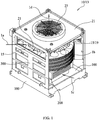
- FIG. 1 - Fig. 3 embodiments of the present invention are directed to a compact heat exchange system 10.
- the heat exchange system 10 for cooling heated fluid circulated from a heat source 11.
- a vertically oriented central plenum 200 is housed within a base structure 100, a plurality of upright side panels 300, and a top 400.
- the central plenum 200 and the plurality of side panels 300 define boundaries of a coil-air interface 15 that houses a heat exchange coil 19.
- Above the heat exchange coil 19 are sprayers 21 that spray / distribute water downwardly over the heat exchange coil 19 into the base structure 100, where the water is collected and pumped back to the sprayers 21.
- the plurality of side panels 300 have air intakes 315 that communicate outside air into the coil-air interface 15 at a location above the sprayers 21 and heat exchange coil 19.
- a fan 23 connected to the plenum 200 draws air through the air intake 313, downwardly over the heat exchange coil 19 located in the coil-air interface 15, generally horizontally into the plenum 200 at an intake conduit 205, and then vertically to a central exhaust exit 219 of the plenum 200.
- Fig. 1 shows the heat exchange system 10, cabinet 13 having one side panel 300 removed, and includes arrows showing flow of air through the system 10.
- Arrow 1a shows outside air flowing into the air intake 315 of a side wall.
- Arrow 1b shows the downward flow of air and water from the sprayers 21 through the heat exchange coil 19 located within the coil-air interface 15.
- the arrow 1b shows a combined flow of air and spray water, and the arrow 1b is shown relative to a removed side panel 300 for clarity.
- the arrow 1c shows airflow into the plenum 200.
- Arrow 1d shows airflow out of the plenum 200.
- Fig 2 shows the heat exchange system 10, cabinet 13 having the fan 23 and two side panels 300 removed, and having a helical type heat exchange coil 19 in the coil-air interface 15.
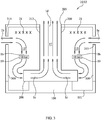
- Fig. 3 is a schematic representation of the heat exchange system 10 according to an embodiment of the present invention.
- Fig. 3 shows the airflow in the form of arrows.
- Arrows 1a show outside air flowing into the air intake 315 of a side wall.
- Arrows 1b show the downward flow of air and water from the sprayers 21 through the heat exchange coil 19 located within the coil-air interface 15.
- the arrows 1c show airflow into the plenum 200.
- Arrows 1d show airflow out of the plenum 200.
- the plenum 200 can be described as including at least one horizontally-disposed lower located intake conduit 205 that transitions to a vertically oriented exhaust conduit 213.
- the at least one intake conduit 205 is for drawing air into the plenum 200.
- the at least one intake conduit 205 is defined by at least one wall 207 extending from a face opening 209, in a generally horizontal direction, to an intake transition end 211.
- the exhaust conduit 213 conveys air from the at least one intake conduit 205, and the exhaust conduit 213 is defined by at least one central exhaust wall 215 that extends generally vertically from a central exhaust transition end 217 to a central exhaust exit 219.
- the transition 221 is defined by at least one transition wall 223 that extends from generally horizontal at the intake transition end 211 to generally vertical at the central exhaust transition end 217.
- the central plenum 200 has an exhaust plenum face area defined as the cross sectional area within exhaust conduit 213 formed by the at least one central exhaust wall 215.
- the plenum 200 having an intake conduit 205 total face area defined by the sum of the area of the face opening(s) 209 of the at least one intake conduit 205 and one or more additional areas of additional face openings 209 of additional intake conduits 205 of the plenum 200.
- the total face area of the intake conduit(s) 205 should be maximized to slow the velocity of the mist-entrained air that enters the plenum 200 at the intake conduit(s). Decreased air velocities into the intake conduit(s) will result in improving separation of water/mist from the airflow / airstream as it enters the plenum 200. Also, smaller areas result in higher air velocities, which contribute to noise.
- the plenum has a total face area defined summing the area of the face opening 209 of the at least one intake conduit 205, and also summing one or more additional areas of additional face openings 209.
- the total face area for a given unit height is larger than a surface area of the central exhaust conduit 213 for the same given unit height. This is to minimize a face opening air velocity, that is dependent on said total face area for a given height, to promote the de-entrainment of spray water from the air entering the plenum.
- the coil-air interface 15 has a coil face area defined as the area between the central plenum 200 and the plurality of side panels 300. According to known principles of heat transfer theory, this area is important for determining overall heat exchange from the size of the heat exchange coil 19 that can fit within the coil-air interface 15.
- the fan 23 draws air through the coil-air interface 15 at a coil velocity range between about 400-800 fpm.
- the ratio of coil face area to exhaust plenum face area is in the range from about 2 to 1 - 3.5 to 1.
- the intake conduit 205 total face area of the plenum 200 is large enough to pass the air through the intake conduit 205 total face area at a velocity of 1,500 fpm or less, and optimally at 850 fpm or lower. Further, the intake conduit 205 total face area is no less than about 43% of the coil face area, and optimally about 77% of the coil face area.
- the plenum 200 optimally has the ratio of exhaust plenum face area to the intake conduit total face area within the range of about 1 to 2, or 40%-60%.
- mist eliminators 225 are disposed within the at least one intake conduit 205 of the plenum 200.
- the mist eliminators 225 are defined as a plurality of surfaces 227 that are oriented to create a flowpath by which mist-entrained air travels as the mist-entrained air is drawn through the at least one intake conduit 205 of the plenum 200.
- the plurality of surfaces 227 are generally parallel and have angular or radial bends 227 that vary the flowpath in a directional manner causing the mist-entrained air to impinge on the surfaces 227 as the mist-entrained air travels through the flowpath.
- the surfaces 227 have a pitch that causes the mist to drain in a direction away from the centrally located exhaust conduit 213.
- the surfaces 227 are generally higher in elevation at a central end than elevation at an intake end. This allows water to drain outwardly into the sump.
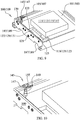
- the plenum 200 includes an air inlet frame 229 ( Figs. 4-6 ) for directing falling water away from the face opening 209 of the at least one intake conduit 205.
- the air inlet frame 229 defined by a lip 231 or protrusion 231 that extends outwardly at a portion of a periphery 233 of the face opening 209 of the at least one intake conduit 205, wherein the portion of the periphery 233 is a top portion 235 and /or one or more side portions 237.
- the plenum 200 further includes a plenum base 239 ( Fig. 5 ) that is defined by at least one plenum base wall 241 existing lowermost that forms part of the at least one intake conduit 205.
- the plenum base 239 is for supporting the plenum 200, isolating airflow through the plenum 200, and /or providing a coupling mechanism 243 for attaching to and being supported by a base structure 100.
- the plenum base 239 may have one ore more drain apertures (holes) 245 for allowing fluid to drain from the plenum 200 to a base structure 100.
- the plenum 200 includes a coil support surface 261 ( Fig. 4 ) for providing structural support to heat exchange coil equipment, such as the heat exchange coil, manifolds, and piping.
- the coil support surface 261 is defined by a flange 261 that protrudes outwardly from the centrally located exhaust conduit 213.
- the flange 261, preferably, is integral to the at least one wall 207 forming the at least one intake conduit 205.
- the plenum 200 includes a coalescing structure 263 ( Figs. 7-8 ) located within the centrally located exhaust conduit 213 for removing fluid that is entrained within air passing through the exhaust conduit 213.
- the coalescing structure comprising a helical strip 265.
- the helical strip 265 provides a surface upon which mist-entrained air contacts and water / mist deposits on the strip 265.
- a base structure 100 is disclosed.
- the base structure 100 is for aiding in the collection and redistribution of the spray water, and for supporting the side panels 300 and the plenum 200.
- the base structure 100 comprises a floor 101 existing at a first average floor elevation 103, and a plurality of upturned edges 105 extending upwardly from the periphery 107 of the floor 101 and creating a catchment area 109.
- a raised plateau structure 111 (RPS), (formed into or with or as a part of the floor) extends upwardly from the floor 101.
- the RPS 111 forms a plenum support surface 113.
- the plenum support surface 113 exists at a PSS elevation 115 that is above the first average floor elevation 103.
- the RPS 111 is located central to the base 100 and occupies a RPS area 117 less than the catchment area 109.
- the RPS area may also have cooperating structures such as keys, keyways, holes, tabs, recesses, protrusions, or the like, that are adapted to fitably mate with the same of a plenum 20 for an ideal inter-fitment.
- a sump recess 119 is located within the catchment 109.
- the sump recess 119 is located inside or outside the RPS area 117.
- the sump recess 119 has a SR floor 121 existing at a sump average elevation 123 that is lower than the first average floor elevation 103.
- the sump recess 119 has at least one SR wall 125 for communicating fluid from the floor 1012 to the SR floor 121.
- SR wall 125 includes, within the understanding of this description, a conduit or open channel that conveys fluid.
- the drain conduit 135 communicates fluid from the SR floor 121 to a drain.
- the drain conduit 135 includes, within the meaning of this description, a conduit or open channel that conveys fluid.
- the base structure 100 includes a standpipe 139.
- the standpipe 139 comprises a conduit 139a that extends generally upwardly through the base structure 100 to a top 139b / 400.
- the conduit 139a has an aperture 141 at the overflow elevation 143 for communicating fluid into the conduit 139a to the drain 137 (not shown) when the fluid reaches an overflow elevation 143.
- the base structure 100 includes a bleed off catchment 145 defined by an expandable structure 147 in fluidic communication with a waste conduit 149.
- the expandable structure 147 is disposed to intercept (catch / receive /collect) a portion of the spray water falling to the floor 101 of the base structure 100 and convey the portion to the waste conduit 149.
- the expandable structure 147 of the bleed off catchment 145 is defined by a plurality of overlapping part surfaces 151.
- a total surface area of the expandable structure 147 exposed to intercept the portion of the spray water is inversely proportional to the an amount by which the plurality of surfaces 151 overlap each other of the plurality of surfaces 151.
- the expandable structure 147 of the bleed off catchment 145 includes a manual setting structure 153 to enable selective adjustment of the amount by which the plurality of surfaces 151 overlap each other.
- the manual setting structure 153 includes: a slot 155 formed into at least one surface 151 of the plurality of overlapping part surfaces 151; a threaded member 157 passing through the slot 155; and one or more thread cooperating members 159 for fixing the at least one surface 151 of the plurality of overlapping part surfaces 151 to an other surface 151 of the plurality of overlapping part surfaces 151.
- the expandable structure 147 of the bleed off catchment 145 includes: a first partial box surface 163, and a second partial box surface 173.
- the first partial box surface 163 includes a bottom 163a and three sides 163b extending upwardly from the bottom 163a, thereby leaving an open top 163c and an open end 163d.
- the second partial box surface 173 includes a bottom 173a and three sides 173b extending upwardly from the bottom 173a, thereby leaving an open top 173c and an open end 173d.
- One of the first partial box surface 163 and second partial box surface 173 has a open end width 175 that is larger than an other open end width 177 to enable one of the first partial box 163 and second partial box 173 to slide within an other of the first partial box 163 and second partial box 173.
- One of the first partial box surface 163 and second partial box surface 173 has a waste conduit fitting 179 in the bottom 163 a/173 a to fluidically couple with the waste conduit 149.
- the bleed off catchment further includes a waste conduit fitting 179 and an aperture 141.
- the waste conduit fitting 179 formed into (connected to or formed part of) the expandable structure 147.
- the waste conduit fitting 179 having at least one wall 181 communicating an expandable structure top surface 183 to a waste conduit fitting outlet 185.
- the aperture 141 is for communicating fluid into the waste conduit fitting to the waste conduit fitting outlet 185 when the fluid reaches the aperture 141.
- the aperture 141 is located below the expandable structure 147.
- the base structure 100 includes fork lift fork receiving channels 187 ( Fig. 9 ).
- Said receiving channels 187 are preferably located at a fork channel elevation 189 below the drain recess 127 so that the receiving channels 187 do not contribute to the overall volume of the catchment area 109.
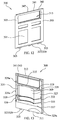
- a side panel 300 is disclosed.
- the side panel 300 comprises an outer surface 301 extending between side edges 303 from a bottom outer edge 305 to a top outer edge 307, an inner surface 309 extending between side edges 303 from a bottom inner edge 311 to a top inner edge 313.
- An air intake 315 connects the outer surface 301 to the inner surface 309 for communicating outside air through the side panel 300 into a coil-air interface space 15.
- the inner surface 309 forms a protrusion 319 that extends inwardly to define a cavity forming face 321 and at least one adjoining face 323.
- the cavity forming face 321 forms the outer boundary of the coil-air interface 15 space when a plurality of side panels 300 are positioned together on the base structure 100.
- the adjoining face 323 is for abutting (or near abutting) another adjoining face 323 of another side panel 300 to minimize openings where spray water can leak outside the cabinet 13.
- the side panel of claim 28 the outer surface, inner surface, and air intake formed by a single wall utilizing rotational molding.
- the side panel 300 further includes a base coupling interface 325 for coupling the side panel 300 to the base structure 100, or a sill 326 that connects with the base structure 100.
- the base coupling interface 325 is defined by or comprises one or more of a bottom outer edge 305 that is offset vertically from the bottom inner edge 311 by one or more base lip surfaces 327.
- the base coupling interface 325 includes one or more of tabs, recesses, keys, or keyways 329; one or more lap joints 329; and one or more threaded nut inserts 329a molded into the side panel 300.
- the side panel 300 further includes one or more races, chases and/or recesses 331 extending vertically through the protrusion 319 for providing a pathway for piping, tubing or electrical cabling.
- the one or more races, chases and/or recesses 331 are formed integral to the panel 300 by means of rotational molding.
- the side panel 300 further has an inner side edge 333 and an outer side edge 335, wherein the inner side edge 333 is offset from the outer side edge 335 by one or more side lip surfaces 337 to enable overlapping and secure inter-fitment among adjoining side panels 300 or other structures.
- the protrusion 319 has a portional cross-sectional shape of an arc, a partial arc, and/or a semicircle to encompass a circular heat exchange coil.
- the protrusion 319 may have a support abutment, notch groove, recess, or ledge 339 for providing vertical load bearing support to one or more support structures that span inwardly from one side panel to another side panel.
- the side panel 300 preferably includes a top coupling interface 341 for coupling the side panel 300 to a top 400.
- the top coupling interface 341 is defined by or comprises one or more of:
- a method for cooling hot fluid (water, glycol, oil or refrigerant) circulated in a heat exchange coil comprises providing a heat exchange system 10 / cabinet 13 as disclosed herein. Then, drawing air with a fan 23 coupled to (or contained in or formed as) the plenum 200 from a location outside of the cabinet 13, into an air intake 315 located on an upper portion a side panel 300 of the plurality of side panels 300, into the coil-air interface 15 containing the heat exchange coil 319 i.) downwardly from the air intake 315 over (through) the heat exchange coil 19, ii.) generally horizontally-inwardly through at least one intake conduit 205 of the plenum 200 from a face opening 209 to an intake transition end 311, and iii.) vertically through a centrally located exhaust conduit 213 for from a central exhaust transition end 317 to a central exhaust exit 319.
- the method further includes, in the heat exchange cabinet 13, spraying water downwardly into the coil-air interface 15 and on the heat exchange coil 19.
- the method further includes, in the heat exchange cabinet 13, collecting water sprayed on the heat exchange coil 19 in a base structure 100, and returning water to the sprayers 21.
- a method for cooling hot fluid (water, glycol, oil or refrigerant) circulated in a heat exchange coil 19 is disclosed.
- a coalesced stream of spray water and air is drawn downwardly over a heat exchange coil 19 that surrounds a central exhaust plenum 200.
- the plenum 200 is defined by a central exhaust wall 215 that physically separates a plenum flowpath from the heat exchange coil 19.
- a portion of the spray water is separated from the air by drawing the air generally horizontally inward from a face opening 209 through an intake conduit 205, to an intake transition end 211, while allowing a portion of the spray water to fall by gravity below the face opening 209 of the intake conduit 205.
- the air is then drawn upwardly within the plenum 200 from the intake transition end 211 to an exhaust 203 external to the enclosure 13.
- the spray water is then collected in a base structure 100 and recirculated to the sprayers 21 with a pump.
- the heat exchange system 10 comprises a heat exchange cabinet 13.
- the heat exchange cabinet 13 is defined by a vertically oriented central plenum 200 housed within a base structure 100, a plurality of upright side panels 300, and a top 400.
- the central plenum 200 and the plurality of side panels 200 define boundaries of a coil-air interface 15 that exists within the cabinet 13 external to the plenum 200.
- a plenum coil-air interface 17 is defined within the central plenum 200.
- a first HX coil 25 is located in the plenum coil-air interface 17.
- the first HX coil 25 is adapted to convey fluid from a HX1 inlet 25a through a plurality of tubes 41 to a HX1 outlet 25b.
- a second HX coil 27 is located in the coil-air interface 15.
- the second HX coil 27 is adapted to convey fluid from a HX2 inlet 27a through a plurality of tubes 41 to a HX2 27b outlet.
- a third HX coil 29 is located in the coil-air interface 15.
- the third HX coil 29 is located above or below the second HX coil 27 and is adapted to convey fluid from a HX3 inlet 29a through a plurality of tubes 41 to a HX3 outlet 29b.
- slab type coils, or other type coils in the art can be used in place of the HX coils.
- An advantage of such a configuration disclosed herein is that it allows the hottest fluid to reach the air in the plenum 200 first, after the air has been wetted.
- the hot coil (first HX coil 25) helps to heat the wet air stream well above its saturation temperature and thus mitigates plume formation above the exhaust exit 219 of the cabinet 13 on cold winter days.
- the air is better utilized in the cabinet 13, allowing the air stream to carry off the hottest air last, rather than through the cabinet.
- the liquid from the heat source 10, after exiting the first HX coil 25, is cooled some before entering the second HX coil 27 and third HX coil 29 located in the wetted coil-air interface 19 reducing the tendency to build scale on the second HX coil 27 and third HX coil 29.
- drier air is exhausted from the plenum 200 past the fan 53 motor, which results in lower fan motor bearing and winding dedregation.
- Plumbing 31 is provided and adapted to convey the heated fluid from a cabinet inlet 33 to the first HX coil 25 at a HX1 inlet 25a, then from the HX1 outlet 25b to the HX2 inlet 27a, then from the HX2 outlet 27b to the HX3 inlet 29a, then from the HX3 outlet 29b to a cabinet outlet 35.
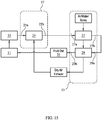
- Figures 15 and 16 are refrigerant (cooling liquid) airflow diagrams that show how the refrigerant passes through the various HX coils 25, 27, and 29 and interacts with air passing through the cabinet 13 in the coil-air interface 15 and the plenum coil-air interface 19.
- a plurality of sprayers 21 spray water into the coil-air interface 15; a fan 53 connected to the plenum 200 causes air to be drawn from outside the cabinet 13 downwardly with water from the sprayers 21 through the coil-air interface 15 over the second and third HX coils 27, 29, into the plenum 200 at an intake conduit 205, and then upwardly through the plenum coil-air interface 17 over the first HX coil 25 to a central exhaust exit 219 of the plenum 200 at the top 400.
- the heated fluid is circulited via the plumbing 31 from a cabinet inlet 33 to the first HX coil 25 at a HX1 inlet 25a, then from the HX1 outlet 25b to the HX2 inlet 27a, then from the HX2 outlet 27b to the HX3 inlet 29a, then from the HX3 29b outlet to a cabinet outlet 35.
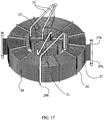
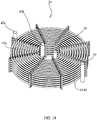
- one or more of the first, second, and third HX coils 25, 27, 29 are defined by an entrance manifold 37 that distributes fluid to the plurality of tubes 41 that are wound in a spiral manner to an exit manifold 39 that collects fluid from the plurality of tubes 41.
- the tubes 41 form an array 42.
- the array 42 defined by a single column 43a and a plurality of rows 43b.
- the tubes 41 are wound in a spiral manner creating a plurality of layers 45 of tubes 41, namely a plurality horizontal layers 45a and a plurality of vertical layers 45b of tubes 41 wound proximate to each other.
- Helical coil configurations of arrays of tubes, and type heat exchangers may also be utilized in place of spiral arrays as discussed herein.
- a plurality of stackable tube spacers 49 are utilized to fixing a locational arrangement of the vertical layers 45b and horizontal layers 45a relative to each other.
- the stackable tube spacers 49 are defined by a spine 51 having a plurality of pop fit tines 53 extending from the spine 51 that are adapted to receive and hold a (horizontal) layer 45 of tubes 41.
- the spine 51 and /or the tines 53 have attachments (pins 55 and holes 57) for attaching to another tube spacer 49 located above and/or below the tube spacer 49 to enable an offset of one tube 41 of the array 43 from another tube 41 located above and/or below the one tube 41.
- a method for cooling hot fluid (water, glycol, oil or refrigerant) circulated in a heat exchange coil 19 is disclosed.
- the method comprises the steps of providing a heat exchange cabinet 13 as disclosed herein.
- a coalesced stream of spray water and air is drawn downwardly through the coil-air interface 15, over a second HX coil 27 and third HX coil 29 contained within the coil-air interface 15.
- a portion of the spray water is separated from the air by drawing the air generally horizontally inward from a face opening 209 through an intake conduit 205, to an intake transition end 211, while allowing a portion of the spray water to fall by gravity below the face opening 209 of the intake conduit 205.
- the air is then drawn upwardly through the plenum coil-air interface 17, over the first HX coil 25, from the intake transition end 11 to an exhaust 219 external to the enclosure 13.
- a hot fluid from a heat source is conveyed to the first HX coil 25, then to the second HX coil 27, then to the third HX coil 29, then back to the heat source.
- the tubes 41 may be polymer type or metal, such as stainless steel or copper.
- the plenum 200, base 100, walls 300 and top 400 are polymer.
- the heat exchange medium may be a heat exchange coil, or slab, tubes, or tower fill located in the coil-air interface 15.
- a portion of the fluid spray is separated from the air by drawing the air generally horizontally inward from a face opening through an intake conduit, to an intake transition end, while allowing a portion of the fluid spray to fall by gravity below the face opening 209 of the intake conduit 213.
- Air is drawn upwardly within the plenum 200 to an exhaust 203 external to the enclosure 13.
- the fluid is then collected in a base structure 100 and returned the fluid to the heat source 10.
Landscapes
- Engineering & Computer Science (AREA)
- Mechanical Engineering (AREA)
- General Engineering & Computer Science (AREA)
- Physics & Mathematics (AREA)
- Thermal Sciences (AREA)
- Heat-Exchange Devices With Radiators And Conduit Assemblies (AREA)
Claims (7)
- Système d'échange de chaleur (10) pour refroidir un fluide chauffé mis en circulation depuis une source de chaleur (11) comprenant :un plénum (200) central orienté à la verticale logé dans une structure de base (100), une pluralité de panneaux latéraux montants (300), et un dessus (400) ;le plénum (200) comprend :a. au moins un conduit d'admission (205) pour aspirer de l'air dans le plénum (200),b. un conduit d'échappement (213) pour acheminer l'air depuis l'au moins un conduit d'admission (205), le conduit d'échappement (213) étant défini par au moins une paroi d'échappement centrale (215) qui s'étend de manière généralement verticale d'une extrémité de transition d'échappement centrale (217) à une sortie d'échappement centrale (219),c. une surface de face de plénum d'échappement définie en tant que la section transversale dans le conduit d'échappement (213) formé par l'au moins une paroi d'échappement centrale (215), etd. une surface de face totale de conduit d'admission (205) définie par la somme de la surface de l'ouverture de face (209) de l'au moins un conduit d'admission (205) et d'une ou plusieurs surfaces supplémentaires d'ouvertures de face (209) supplémentaires de conduits d'admission (205) supplémentaires du plénum (200) ;le plénum (200) central et la pluralité de panneaux latéraux (300) définissent des limites d'une interface bobine-air (15) qui loge une bobine d'échange de chaleur (19), l'interface bobine-air (15) ayant une surface de face de bobine définie en tant que la surface entre le plénum (200) et la pluralité de panneaux latéraux (300) ;au-dessus de la bobine d'échange de chaleur (19) se trouvent des pulvérisateurs (21) qui pulvérisent/distribuent de l'eau vers le bas par-dessus la bobine d'échange de chaleur (19) dans la structure de base (100), où l'eau est collectée et repompée vers les pulvérisateurs (21) ;la pluralité de panneaux latéraux (300) ont des admissions d'air (313) qui communiquent l'air extérieur dans l'interface bobine-air (15) au niveau d'un emplacement au-dessus de la bobine d'échange de chaleur (19) ; etun ventilateur (23) relié au plénum (200) aspire de l'air par l'admission d'air (313), vers le bas par-dessus la bobine d'échange de chaleur (19) située dans l'interface bobine-air (15), de manière généralement horizontale dans le plénum (200) au niveau d'un conduit d'admission (205), puis à la verticale vers une sortie d'échappement centrale (219) du plénum (200) ;caractérisé en ce quel'au moins un conduit d'admission (205) est défini par au moins une paroi (207) s'étendant d'une ouverture de face (209), dans une direction généralement horizontale, à une extrémité de transition d'admission (211)le plénum comprend une transition (221) définie par au moins une paroi de transition (223) qui s'étend d'une manière généralement horizontale au niveau de l'extrémité de transition d'admission (211) à une manière généralement verticale au niveau de l'extrémité de transition d'échappement centrale (217), etle système d'échange de chaleur comprend une ou plusieurs des propriétés suivantes :a. le ventilateur (23) aspire de l'air par le biais de l'interface bobine-air (15) à une plage de vitesse de bobine entre environ 2,03-4,06 m/s (400-800 fpm), et un rapport de surface de face de bobine sur la surface de face de plénum d'échappement est dans la plage d'environ 2 à 1 - 3,5 à 1,b. la surface de face totale de conduit d'admission est suffisamment grande pour faire passer l'air à travers la surface de face totale de conduit d'admission à une vitesse de 7,62 m/s (1 500 fpm) ou moins, et de façon optimale à 4,32 m/s (850 fpm) ou moins,c. la surface de face totale de conduit d'admission ne fait pas moins d'environ 43 % de la surface de face de bobine, et de façon optimale environ 77 % de la surface de face de bobine,d. le plénum (200) ayant le rapport de surface de face de plénum d'échappement sur la surface de face totale de conduit d'admission dans la plage d'environ 1 à 2, ou 40 %-60 %, ete. le plénum (200) ayant la surface de face totale définie en additionnant la surface de l'ouverture de face (209) de l'au moins un conduit d'admission (205), et en additionnant également une ou plusieurs surfaces supplémentaires d'ouvertures de face (209) supplémentaires, dans lequel la surface de face totale pour une hauteur unitaire donnée est plus grande qu'une superficie du conduit d'échappement central (213) pour la même hauteur unitaire donnée, pour minimiser une vitesse d'air d'ouverture de face, qui dépend de ladite surface de face totale pour une hauteur donnée, pour favoriser le désentraînement d'eau de pulvérisation de l'air entrant dans le plénum (200).
- Système d'échange de chaleur (10) selon la revendication 1, dans lequel le plénum (200) comporte en outre un cadre d'entrée d'air (229) pour diriger de l'eau qui tombe loin de l'ouverture de face (209) de l'au moins un conduit d'admission (205), le cadre d'entrée d'air (229) étant défini par un rebord ou une saillie (231) qui s'étend vers l'extérieur au niveau d'une portion d'une périphérie (233) de l'ouverture de face (209) de l'au moins un conduit d'admission (205), dans lequel la portion de la périphérie (233) est une portion supérieure (235) et/ou une ou plusieurs portions latérales (237).
- Système d'échange de chaleur (10) selon la revendication 1, dans lequel le plénum (200) comporte en outre une base (239) de plénum qui est définie par au moins une paroi (241) de base de plénum existant le plus en bas qui forme une partie de l'au moins un conduit d'admission (205), la base (239) de plénum servant à supporter le plénum (200), à isoler l'écoulement d'air à travers le plénum (200) et/ou à fournir un mécanisme d'accouplement (243) pour se fixer à une structure de base (100) et être supporté par celle-ci.
- Système d'échange de chaleur (10) selon la revendication 3, dans lequel la base (239) de plénum a une ou plusieurs ouvertures de drainage (245) pour permettre au fluide d'être drainé du plénum (200) vers une structure de base (100).
- Système d'échange de chaleur (10) selon la revendication 1, dans lequel le plénum (200) comporte en outre une surface de support (261) de bobine pour fournir un support structural à un équipement de bobine d'échange de chaleur, la surface de support (261) de bobine étant définie par une bride (261) qui fait saillie vers l'extérieur depuis le conduit d'échappement (213) situé au centre, et peut faire corps avec l'au moins une paroi (207) formant l'au moins un conduit d'admission (205).
- Système d'échange de chaleur (10) selon la revendication 1, comportant en outre une structure coalescente (263) située dans le conduit d'échappement situé au centre (213) pour retirer du fluide qui est entraîné dans de l'air passant à travers le conduit d'échappement (213), la structure coalescente (263) comprenant un ruban hélicoïdal (265).
- Procédé pour refroidir un fluide chaud mis en circulation dans une bobine d'échange de chaleur comprenant les étapes :a. de fourniture d'un caisson d'échange de chaleur (13) ayant un plénum (200) le plus au centre orienté à la verticale entouré par la bobine d'échange de chaleur (19) et logé dans une pluralité de panneaux latéraux (300), les panneaux latéraux (300) et le plénum (200) créant un espace d'interface bobine-air qui contient la bobine d'échange de chaleur (19), l'interface bobine-air (15) ayant une surface de face de bobine définie en tant que la surface entre le plénum (200) et la pluralité de panneaux latéraux (300), le plénum (200) comprenant :i. au moins un conduit d'admission (205) pour aspirer de l'air dans le plénum (200),ii. un conduit d'échappement (213) pour acheminer l'air depuis l'au moins un conduit d'admission (205), le conduit d'échappement (213) étant défini par au moins une paroi d'échappement centrale (215) qui s'étend de manière généralement verticale d'une extrémité de transition d'échappement centrale (217) à une sortie d'échappement centrale (219),iii. une surface de face de plénum d'échappement définie en tant que la section transversale dans le conduit d'échappement (213) formé par l'au moins une paroi d'échappement centrale (215), etiv. une surface de face totale de conduit d'admission définie par la somme de la surface de l'ouverture de face (209) de l'au moins un conduit d'admission (205) et d'une ou plusieurs surfaces supplémentaires d'ouvertures de face (209) supplémentaires de conduits d'admission (205) supplémentaires du plénum (209) ;b. d'aspiration d'air avec un ventilateur (23) accouplé au plénum (200) :i. depuis un emplacement à l'extérieur du caisson (13), dans une admission d'air (315) située sur une portion supérieure d'un panneau latéral de la pluralité (300), dans l'interface bobine-air (15) contenant la bobine d'échange de chaleur (319),ii. vers le bas depuis l'admission d'air (315) par-dessus ou à travers la bobine d'échange de chaleur (19),iii. généralement horizontalement vers l'intérieur à travers au moins un conduit d'admission (205) du plénum (200) d'une ouverture de face (209) à une extrémité de transition d'admission (211), etiv. verticalement à travers un conduit d'échappement situé au centre (213) d'une extrémité de transition d'échappement centrale (317) à une sortie d'échappement centrale (319) ;c. dans le caisson d'échange de chaleur (13), de pulvérisation d'eau avec des pulvérisateurs vers le bas dans l'interface bobine-air (15) et sur la bobine d'échange de chaleur (19),d. dans le caisson d'échange de chaleur (13), de collecte d'eau pulvérisée sur la bobine d'échange de chaleur (19) dans une structure de base (100),e. de retour d'eau aux pulvérisateurs (21),caractérisé en ce que
l'au moins un conduit d'admission (205) est défini par au moins une paroi (207) s'étendant d'une ouverture de face (209), dans une direction généralement horizontale, à une extrémité de transition d'admission (211),
le plénum comprend une transition (221) définie par au moins une paroi de transition (223) qui s'étend d'une manière généralement horizontale au niveau de l'extrémité de transition d'admission (211) à une manière généralement verticale au niveau de l'extrémité de transition d'échappement centrale (217), et
le procédé comprend en outre une ou plusieurs des propriétés suivantes :i. le ventilateur (23) aspire de l'air par le biais de l'interface bobine-air (15) à une plage de vitesse de bobine entre environ 2,03-4,06 m/s (400-800 fpm), et un rapport de surface de face de bobine sur la surface de face de plénum d'échappement est dans la plage d'environ 2 à 1 - 3,5 à 1,ii. la surface de face totale de conduit d'admission est suffisamment grande pour faire passer l'air à travers la surface de face totale de conduit d'admission à une vitesse de 7,62 m/s (1 500 fpm) ou moins, et de façon optimale à 4,32 m/s (850 fpm) ou moins,iii. la surface de face totale de conduit d'admission ne fait pas moins d'environ 43 % de la surface de face de bobine, et de façon optimale environ 77 % de la surface de face de bobine,iv. le plénum (200) ayant le rapport de surface de face de plénum d'échappement sur la surface de face totale de conduit d'admission dans la plage d'environ 1 à 2, ou 40 % - 60 %,v. le plénum (200) ayant en outre la surface de face totale définie en additionnant la surface de l'ouverture de face (209) de l'au moins un conduit d'admission (205), et en additionnant également une ou plusieurs surfaces supplémentaires d'ouvertures de face (209) supplémentaires, dans lequel la surface de face totale pour une hauteur unitaire donnée est plus grande qu'une superficie du conduit d'échappement central (213) pour la même hauteur unitaire donnée, pour minimiser une vitesse d'air d'ouverture de face, qui dépend de ladite surface de face totale pour une hauteur donnée, pour favoriser le désentraînement d'eau de pulvérisation de l'air entrant dans le plénum (200),vi. le plénum (200) comportant en outre des suppresseurs de buée (225) disposés dans l'au moins un conduit d'admission (205) du plénum (200), les suppresseurs de buée (225) étant définis en tant qu'une pluralité de surfaces (227) orientées pour créer un chemin d'écoulement par lequel de l'air entraîné dans la buée se déplace quand l'air entraîné dans la buée est aspiré à travers l'au moins un conduit d'admission (205) du plénum (200),vii. le plénum (200) comportant en outre une base (239) de plénum, la base (239) de plénum ayant une ou plusieurs ouvertures de drainage (245) pour permettre à du fluide d'être drainé du plénum (200) à la structure de base (100), etviii. le plénum (200) comportant en outre une structure coalescente (263) située dans le conduit d'échappement situé au centre (213) pour retirer du fluide qui est entraîné dans l'air passant à travers le conduit d'échappement (213), la structure coalescente (263) comprenant un ruban hélicoïdal (265).
Applications Claiming Priority (4)
| Application Number | Priority Date | Filing Date | Title |
|---|---|---|---|
| US201462058174P | 2014-10-01 | 2014-10-01 | |
| US201462064609P | 2014-10-16 | 2014-10-16 | |
| US201562194558P | 2015-07-20 | 2015-07-20 | |
| PCT/US2015/053602 WO2016054444A1 (fr) | 2014-10-01 | 2015-10-01 | Système compact d'échange de chaleur et procédé de refroidissement |
Publications (3)
| Publication Number | Publication Date |
|---|---|
| EP3201552A1 EP3201552A1 (fr) | 2017-08-09 |
| EP3201552A4 EP3201552A4 (fr) | 2018-08-08 |
| EP3201552B1 true EP3201552B1 (fr) | 2020-12-02 |
Family
ID=55631562
Family Applications (1)
| Application Number | Title | Priority Date | Filing Date |
|---|---|---|---|
| EP15846658.1A Not-in-force EP3201552B1 (fr) | 2014-10-01 | 2015-10-01 | Système compact d'échange de chaleur et procédé de refroidissement |
Country Status (3)
| Country | Link |
|---|---|
| US (1) | US10260816B2 (fr) |
| EP (1) | EP3201552B1 (fr) |
| WO (1) | WO2016054444A1 (fr) |
Families Citing this family (6)
| Publication number | Priority date | Publication date | Assignee | Title |
|---|---|---|---|---|
| CN108645245A (zh) * | 2018-05-14 | 2018-10-12 | 广州航海学院 | 一种换热器 |
| CN109404318A (zh) * | 2018-12-18 | 2019-03-01 | 南京磁谷科技有限公司 | 一种磁悬浮离心式鼓风机机柜 |
| CN112414161B (zh) * | 2020-11-12 | 2023-04-21 | 国家电投集团远达环保工程有限公司重庆科技分公司 | 湿式冷却塔 |
| US11761707B2 (en) * | 2020-12-23 | 2023-09-19 | Alfa Laval Corporate Ab | Evaporative wet surface air cooler |
| KR102928801B1 (ko) * | 2020-12-23 | 2026-02-23 | 알파 라발 코포레이트 에이비 | 증발식 습식 표면 공기 냉각기 |
| CN114608344B (zh) * | 2022-04-06 | 2022-09-16 | 安徽科卓冷却设备有限公司 | 一种冷却塔降温冷却装置 |
Family Cites Families (12)
| Publication number | Priority date | Publication date | Assignee | Title |
|---|---|---|---|---|
| US2890864A (en) * | 1956-04-18 | 1959-06-16 | Niagara Blower Co | Heat exchanger |
| US3212288A (en) * | 1961-03-24 | 1965-10-19 | Heil Quaker Corp | Heat exchanger with condensate collector |
| US3442492A (en) * | 1967-07-03 | 1969-05-06 | Evan G Sullivan | Fluid current motor |
| US3437319A (en) * | 1968-05-20 | 1969-04-08 | Baltimore Aircoil Co Inc | Evaporative heat exchanger with airflow reversal baffle |
| US3677029A (en) * | 1970-12-03 | 1972-07-18 | Frick Co | Evaporative condenser |
| US3907942A (en) * | 1971-05-19 | 1975-09-23 | Baltimore Aircoil Co Inc | Control system for injection cooling towers |
| US3903213A (en) * | 1974-01-02 | 1975-09-02 | Randall S Stover | Counter flow, forced draft, blow-through heat exchangers |
| SE441783B (sv) * | 1980-12-19 | 1985-11-04 | Flaekt Ab | Hinder for luftstrom vid kontaktkropp |
| AU2003256860A1 (en) * | 2002-08-02 | 2004-02-23 | Powercold Corporation | Coil type evaporative heat exchanger |
| KR100521104B1 (ko) * | 2003-12-10 | 2005-10-17 | 주식회사 경인기계 | 냉각탑용 팬 실린더 |
| US7779898B2 (en) * | 2006-04-14 | 2010-08-24 | Baltimore Aircoil Company, Inc. | Heat transfer tube assembly with serpentine circuits |
| MX2011009109A (es) * | 2009-03-03 | 2011-10-19 | Harol Dean Curtis | Enfriador/torre de enfriamiento de fluido de tiro forzado directo y colector de liquido para el mismo. |
-
2015
- 2015-10-01 EP EP15846658.1A patent/EP3201552B1/fr not_active Not-in-force
- 2015-10-01 US US15/514,523 patent/US10260816B2/en not_active Expired - Fee Related
- 2015-10-01 WO PCT/US2015/053602 patent/WO2016054444A1/fr not_active Ceased
Non-Patent Citations (1)
| Title |
|---|
| None * |
Also Published As
| Publication number | Publication date |
|---|---|
| EP3201552A1 (fr) | 2017-08-09 |
| WO2016054444A1 (fr) | 2016-04-07 |
| US20170227292A1 (en) | 2017-08-10 |
| US10260816B2 (en) | 2019-04-16 |
| EP3201552A4 (fr) | 2018-08-08 |
Similar Documents
| Publication | Publication Date | Title |
|---|---|---|
| US10260816B2 (en) | Compact heat exchange system and method of cooling | |
| EP2972038B1 (fr) | Tour de refroidissement avec échangeur de chaleur indirect | |
| US9587885B2 (en) | Cooling tower with indirect heat exchanger | |
| US10288351B2 (en) | Cooling tower with indirect heat exchanger | |
| US4683101A (en) | Cross flow evaporative coil fluid cooling apparatus and method of cooling | |
| US9995533B2 (en) | Cooling tower with indirect heat exchanger | |
| EP1818640B1 (fr) | Tour de réfrigération dotée de sections de réfrigération directe et indirecte | |
| EP0738861B1 (fr) | Procédé d'échange de chaleur et échangeur de chaleur avec section d'échange de chaleur direct et section d'échange de chaleur indirect | |
| US11255620B2 (en) | Water collection/deflection arrangement | |
| EP1962045B1 (fr) | Tour de refroidissement dotée d'un bac de récupération | |
| EP1617161B1 (fr) | Evaporateur et procédé d'utilisation | |
| US3784171A (en) | Evaporative heat exchange apparatus | |
| WO2004013555A1 (fr) | Echangeur de chaleur a evaporation du type a serpentins | |
| US2760764A (en) | Cooling towers | |
| JPH0612424Y2 (ja) | 空気調和機 |
Legal Events
| Date | Code | Title | Description |
|---|---|---|---|
| STAA | Information on the status of an ep patent application or granted ep patent |
Free format text: STATUS: THE INTERNATIONAL PUBLICATION HAS BEEN MADE |
|
| PUAI | Public reference made under article 153(3) epc to a published international application that has entered the european phase |
Free format text: ORIGINAL CODE: 0009012 |
|
| STAA | Information on the status of an ep patent application or granted ep patent |
Free format text: STATUS: REQUEST FOR EXAMINATION WAS MADE |
|
| 17P | Request for examination filed |
Effective date: 20170426 |
|
| AK | Designated contracting states |
Kind code of ref document: A1 Designated state(s): AL AT BE BG CH CY CZ DE DK EE ES FI FR GB GR HR HU IE IS IT LI LT LU LV MC MK MT NL NO PL PT RO RS SE SI SK SM TR |
|
| AX | Request for extension of the european patent |
Extension state: BA ME |
|
| DAV | Request for validation of the european patent (deleted) | ||
| DAX | Request for extension of the european patent (deleted) | ||
| A4 | Supplementary search report drawn up and despatched |
Effective date: 20180705 |
|
| RIC1 | Information provided on ipc code assigned before grant |
Ipc: F28F 25/04 20060101ALI20180629BHEP Ipc: F28D 1/047 20060101ALI20180629BHEP Ipc: F28B 1/06 20060101ALI20180629BHEP Ipc: F28D 5/02 20060101AFI20180629BHEP Ipc: F28F 25/06 20060101ALI20180629BHEP Ipc: F28B 9/06 20060101ALI20180629BHEP Ipc: F28C 1/16 20060101ALI20180629BHEP Ipc: F28C 1/14 20060101ALI20180629BHEP |
|
| RIC1 | Information provided on ipc code assigned before grant |
Ipc: F28D 1/047 20060101ALI20200422BHEP Ipc: F28D 5/02 20060101AFI20200422BHEP Ipc: F28B 9/06 20060101ALI20200422BHEP Ipc: F28C 1/14 20060101ALI20200422BHEP Ipc: F28F 25/06 20060101ALI20200422BHEP Ipc: F28B 1/06 20060101ALI20200422BHEP Ipc: F28F 25/04 20060101ALI20200422BHEP Ipc: F28C 1/16 20060101ALI20200422BHEP |
|
| GRAP | Despatch of communication of intention to grant a patent |
Free format text: ORIGINAL CODE: EPIDOSNIGR1 |
|
| STAA | Information on the status of an ep patent application or granted ep patent |
Free format text: STATUS: GRANT OF PATENT IS INTENDED |
|
| INTG | Intention to grant announced |
Effective date: 20200604 |
|
| GRAS | Grant fee paid |
Free format text: ORIGINAL CODE: EPIDOSNIGR3 |
|
| GRAA | (expected) grant |
Free format text: ORIGINAL CODE: 0009210 |
|
| STAA | Information on the status of an ep patent application or granted ep patent |
Free format text: STATUS: THE PATENT HAS BEEN GRANTED |
|
| AK | Designated contracting states |
Kind code of ref document: B1 Designated state(s): AL AT BE BG CH CY CZ DE DK EE ES FI FR GB GR HR HU IE IS IT LI LT LU LV MC MK MT NL NO PL PT RO RS SE SI SK SM TR |
|
| REG | Reference to a national code |
Ref country code: GB Ref legal event code: FG4D |
|
| REG | Reference to a national code |
Ref country code: AT Ref legal event code: REF Ref document number: 1341395 Country of ref document: AT Kind code of ref document: T Effective date: 20201215 Ref country code: CH Ref legal event code: EP |
|
| REG | Reference to a national code |
Ref country code: IE Ref legal event code: FG4D |
|
| REG | Reference to a national code |
Ref country code: DE Ref legal event code: R096 Ref document number: 602015063026 Country of ref document: DE |
|
| PG25 | Lapsed in a contracting state [announced via postgrant information from national office to epo] |
Ref country code: GR Free format text: LAPSE BECAUSE OF FAILURE TO SUBMIT A TRANSLATION OF THE DESCRIPTION OR TO PAY THE FEE WITHIN THE PRESCRIBED TIME-LIMIT Effective date: 20210303 Ref country code: FI Free format text: LAPSE BECAUSE OF FAILURE TO SUBMIT A TRANSLATION OF THE DESCRIPTION OR TO PAY THE FEE WITHIN THE PRESCRIBED TIME-LIMIT Effective date: 20201202 Ref country code: RS Free format text: LAPSE BECAUSE OF FAILURE TO SUBMIT A TRANSLATION OF THE DESCRIPTION OR TO PAY THE FEE WITHIN THE PRESCRIBED TIME-LIMIT Effective date: 20201202 Ref country code: NO Free format text: LAPSE BECAUSE OF FAILURE TO SUBMIT A TRANSLATION OF THE DESCRIPTION OR TO PAY THE FEE WITHIN THE PRESCRIBED TIME-LIMIT Effective date: 20210302 |
|
| REG | Reference to a national code |
Ref country code: NL Ref legal event code: MP Effective date: 20201202 |
|
| REG | Reference to a national code |
Ref country code: AT Ref legal event code: MK05 Ref document number: 1341395 Country of ref document: AT Kind code of ref document: T Effective date: 20201202 |
|
| PG25 | Lapsed in a contracting state [announced via postgrant information from national office to epo] |
Ref country code: LV Free format text: LAPSE BECAUSE OF FAILURE TO SUBMIT A TRANSLATION OF THE DESCRIPTION OR TO PAY THE FEE WITHIN THE PRESCRIBED TIME-LIMIT Effective date: 20201202 Ref country code: SE Free format text: LAPSE BECAUSE OF FAILURE TO SUBMIT A TRANSLATION OF THE DESCRIPTION OR TO PAY THE FEE WITHIN THE PRESCRIBED TIME-LIMIT Effective date: 20201202 Ref country code: PL Free format text: LAPSE BECAUSE OF FAILURE TO SUBMIT A TRANSLATION OF THE DESCRIPTION OR TO PAY THE FEE WITHIN THE PRESCRIBED TIME-LIMIT Effective date: 20201202 Ref country code: BG Free format text: LAPSE BECAUSE OF FAILURE TO SUBMIT A TRANSLATION OF THE DESCRIPTION OR TO PAY THE FEE WITHIN THE PRESCRIBED TIME-LIMIT Effective date: 20210302 |
|
| PG25 | Lapsed in a contracting state [announced via postgrant information from national office to epo] |
Ref country code: NL Free format text: LAPSE BECAUSE OF FAILURE TO SUBMIT A TRANSLATION OF THE DESCRIPTION OR TO PAY THE FEE WITHIN THE PRESCRIBED TIME-LIMIT Effective date: 20201202 Ref country code: HR Free format text: LAPSE BECAUSE OF FAILURE TO SUBMIT A TRANSLATION OF THE DESCRIPTION OR TO PAY THE FEE WITHIN THE PRESCRIBED TIME-LIMIT Effective date: 20201202 |
|
| REG | Reference to a national code |
Ref country code: LT Ref legal event code: MG9D |
|
| PG25 | Lapsed in a contracting state [announced via postgrant information from national office to epo] |
Ref country code: SM Free format text: LAPSE BECAUSE OF FAILURE TO SUBMIT A TRANSLATION OF THE DESCRIPTION OR TO PAY THE FEE WITHIN THE PRESCRIBED TIME-LIMIT Effective date: 20201202 Ref country code: EE Free format text: LAPSE BECAUSE OF FAILURE TO SUBMIT A TRANSLATION OF THE DESCRIPTION OR TO PAY THE FEE WITHIN THE PRESCRIBED TIME-LIMIT Effective date: 20201202 Ref country code: CZ Free format text: LAPSE BECAUSE OF FAILURE TO SUBMIT A TRANSLATION OF THE DESCRIPTION OR TO PAY THE FEE WITHIN THE PRESCRIBED TIME-LIMIT Effective date: 20201202 Ref country code: PT Free format text: LAPSE BECAUSE OF FAILURE TO SUBMIT A TRANSLATION OF THE DESCRIPTION OR TO PAY THE FEE WITHIN THE PRESCRIBED TIME-LIMIT Effective date: 20210405 Ref country code: RO Free format text: LAPSE BECAUSE OF FAILURE TO SUBMIT A TRANSLATION OF THE DESCRIPTION OR TO PAY THE FEE WITHIN THE PRESCRIBED TIME-LIMIT Effective date: 20201202 Ref country code: SK Free format text: LAPSE BECAUSE OF FAILURE TO SUBMIT A TRANSLATION OF THE DESCRIPTION OR TO PAY THE FEE WITHIN THE PRESCRIBED TIME-LIMIT Effective date: 20201202 Ref country code: LT Free format text: LAPSE BECAUSE OF FAILURE TO SUBMIT A TRANSLATION OF THE DESCRIPTION OR TO PAY THE FEE WITHIN THE PRESCRIBED TIME-LIMIT Effective date: 20201202 |
|
| PG25 | Lapsed in a contracting state [announced via postgrant information from national office to epo] |
Ref country code: AT Free format text: LAPSE BECAUSE OF FAILURE TO SUBMIT A TRANSLATION OF THE DESCRIPTION OR TO PAY THE FEE WITHIN THE PRESCRIBED TIME-LIMIT Effective date: 20201202 |
|
| REG | Reference to a national code |
Ref country code: DE Ref legal event code: R097 Ref document number: 602015063026 Country of ref document: DE |
|
| PG25 | Lapsed in a contracting state [announced via postgrant information from national office to epo] |
Ref country code: IS Free format text: LAPSE BECAUSE OF FAILURE TO SUBMIT A TRANSLATION OF THE DESCRIPTION OR TO PAY THE FEE WITHIN THE PRESCRIBED TIME-LIMIT Effective date: 20210402 |
|
| PLBE | No opposition filed within time limit |
Free format text: ORIGINAL CODE: 0009261 |
|
| STAA | Information on the status of an ep patent application or granted ep patent |
Free format text: STATUS: NO OPPOSITION FILED WITHIN TIME LIMIT |
|
| PG25 | Lapsed in a contracting state [announced via postgrant information from national office to epo] |
Ref country code: AL Free format text: LAPSE BECAUSE OF FAILURE TO SUBMIT A TRANSLATION OF THE DESCRIPTION OR TO PAY THE FEE WITHIN THE PRESCRIBED TIME-LIMIT Effective date: 20201202 Ref country code: IT Free format text: LAPSE BECAUSE OF FAILURE TO SUBMIT A TRANSLATION OF THE DESCRIPTION OR TO PAY THE FEE WITHIN THE PRESCRIBED TIME-LIMIT Effective date: 20201202 |
|
| 26N | No opposition filed |
Effective date: 20210903 |
|
| PG25 | Lapsed in a contracting state [announced via postgrant information from national office to epo] |
Ref country code: DK Free format text: LAPSE BECAUSE OF FAILURE TO SUBMIT A TRANSLATION OF THE DESCRIPTION OR TO PAY THE FEE WITHIN THE PRESCRIBED TIME-LIMIT Effective date: 20201202 Ref country code: SI Free format text: LAPSE BECAUSE OF FAILURE TO SUBMIT A TRANSLATION OF THE DESCRIPTION OR TO PAY THE FEE WITHIN THE PRESCRIBED TIME-LIMIT Effective date: 20201202 |
|
| PG25 | Lapsed in a contracting state [announced via postgrant information from national office to epo] |
Ref country code: ES Free format text: LAPSE BECAUSE OF FAILURE TO SUBMIT A TRANSLATION OF THE DESCRIPTION OR TO PAY THE FEE WITHIN THE PRESCRIBED TIME-LIMIT Effective date: 20201202 |
|
| PGFP | Annual fee paid to national office [announced via postgrant information from national office to epo] |
Ref country code: GB Payment date: 20211022 Year of fee payment: 7 Ref country code: DE Payment date: 20211020 Year of fee payment: 7 |
|
| PGFP | Annual fee paid to national office [announced via postgrant information from national office to epo] |
Ref country code: FR Payment date: 20211022 Year of fee payment: 7 |
|
| REG | Reference to a national code |
Ref country code: CH Ref legal event code: PL |
|
| PG25 | Lapsed in a contracting state [announced via postgrant information from national office to epo] |
Ref country code: IS Free format text: LAPSE BECAUSE OF FAILURE TO SUBMIT A TRANSLATION OF THE DESCRIPTION OR TO PAY THE FEE WITHIN THE PRESCRIBED TIME-LIMIT Effective date: 20210402 |
|
| REG | Reference to a national code |
Ref country code: BE Ref legal event code: MM Effective date: 20211031 |
|
| PG25 | Lapsed in a contracting state [announced via postgrant information from national office to epo] |
Ref country code: MC Free format text: LAPSE BECAUSE OF FAILURE TO SUBMIT A TRANSLATION OF THE DESCRIPTION OR TO PAY THE FEE WITHIN THE PRESCRIBED TIME-LIMIT Effective date: 20201202 |
|
| PG25 | Lapsed in a contracting state [announced via postgrant information from national office to epo] |
Ref country code: LU Free format text: LAPSE BECAUSE OF NON-PAYMENT OF DUE FEES Effective date: 20211001 Ref country code: BE Free format text: LAPSE BECAUSE OF NON-PAYMENT OF DUE FEES Effective date: 20211031 |
|
| PG25 | Lapsed in a contracting state [announced via postgrant information from national office to epo] |
Ref country code: LI Free format text: LAPSE BECAUSE OF NON-PAYMENT OF DUE FEES Effective date: 20211031 Ref country code: CH Free format text: LAPSE BECAUSE OF NON-PAYMENT OF DUE FEES Effective date: 20211031 |
|
| PG25 | Lapsed in a contracting state [announced via postgrant information from national office to epo] |
Ref country code: IE Free format text: LAPSE BECAUSE OF NON-PAYMENT OF DUE FEES Effective date: 20211001 |
|
| REG | Reference to a national code |
Ref country code: DE Ref legal event code: R119 Ref document number: 602015063026 Country of ref document: DE |
|
| PG25 | Lapsed in a contracting state [announced via postgrant information from national office to epo] |
Ref country code: HU Free format text: LAPSE BECAUSE OF FAILURE TO SUBMIT A TRANSLATION OF THE DESCRIPTION OR TO PAY THE FEE WITHIN THE PRESCRIBED TIME-LIMIT; INVALID AB INITIO Effective date: 20151001 |
|
| GBPC | Gb: european patent ceased through non-payment of renewal fee |
Effective date: 20221001 |
|
| PG25 | Lapsed in a contracting state [announced via postgrant information from national office to epo] |
Ref country code: CY Free format text: LAPSE BECAUSE OF FAILURE TO SUBMIT A TRANSLATION OF THE DESCRIPTION OR TO PAY THE FEE WITHIN THE PRESCRIBED TIME-LIMIT Effective date: 20201202 |
|
| PG25 | Lapsed in a contracting state [announced via postgrant information from national office to epo] |
Ref country code: FR Free format text: LAPSE BECAUSE OF NON-PAYMENT OF DUE FEES Effective date: 20221031 Ref country code: DE Free format text: LAPSE BECAUSE OF NON-PAYMENT OF DUE FEES Effective date: 20230503 |
|
| PG25 | Lapsed in a contracting state [announced via postgrant information from national office to epo] |
Ref country code: GB Free format text: LAPSE BECAUSE OF NON-PAYMENT OF DUE FEES Effective date: 20221001 |
|
| PG25 | Lapsed in a contracting state [announced via postgrant information from national office to epo] |
Ref country code: MK Free format text: LAPSE BECAUSE OF FAILURE TO SUBMIT A TRANSLATION OF THE DESCRIPTION OR TO PAY THE FEE WITHIN THE PRESCRIBED TIME-LIMIT Effective date: 20201202 |
|
| PG25 | Lapsed in a contracting state [announced via postgrant information from national office to epo] |
Ref country code: MT Free format text: LAPSE BECAUSE OF FAILURE TO SUBMIT A TRANSLATION OF THE DESCRIPTION OR TO PAY THE FEE WITHIN THE PRESCRIBED TIME-LIMIT Effective date: 20201202 |
|
| PG25 | Lapsed in a contracting state [announced via postgrant information from national office to epo] |
Ref country code: TR Free format text: LAPSE BECAUSE OF FAILURE TO SUBMIT A TRANSLATION OF THE DESCRIPTION OR TO PAY THE FEE WITHIN THE PRESCRIBED TIME-LIMIT Effective date: 20201202 |