EP3200330B1 - Reduced harmonics drawn by a rectifier unit in an aircraft electrical powering system - Google Patents
Reduced harmonics drawn by a rectifier unit in an aircraft electrical powering system Download PDFInfo
- Publication number
- EP3200330B1 EP3200330B1 EP16153595.0A EP16153595A EP3200330B1 EP 3200330 B1 EP3200330 B1 EP 3200330B1 EP 16153595 A EP16153595 A EP 16153595A EP 3200330 B1 EP3200330 B1 EP 3200330B1
- Authority
- EP
- European Patent Office
- Prior art keywords
- power
- adaptive
- input
- frequency
- filter
- Prior art date
- Legal status (The legal status is an assumption and is not a legal conclusion. Google has not performed a legal analysis and makes no representation as to the accuracy of the status listed.)
- Active
Links
Images




Classifications
-
- H—ELECTRICITY
- H02—GENERATION; CONVERSION OR DISTRIBUTION OF ELECTRIC POWER
- H02J—CIRCUIT ARRANGEMENTS OR SYSTEMS FOR SUPPLYING OR DISTRIBUTING ELECTRIC POWER; SYSTEMS FOR STORING ELECTRIC ENERGY
- H02J3/00—Circuit arrangements for AC mains or AC distribution networks
- H02J3/01—Arrangements for reducing harmonics or ripples
-
- H—ELECTRICITY
- H02—GENERATION; CONVERSION OR DISTRIBUTION OF ELECTRIC POWER
- H02M—APPARATUS FOR CONVERSION BETWEEN AC AND AC, BETWEEN AC AND DC, OR BETWEEN DC AND DC, AND FOR USE WITH MAINS OR SIMILAR POWER SUPPLY SYSTEMS; CONVERSION OF DC OR AC INPUT POWER INTO SURGE OUTPUT POWER; CONTROL OR REGULATION THEREOF
- H02M7/00—Conversion of AC power input into DC power output; Conversion of DC power input into AC power output
- H02M7/02—Conversion of AC power input into DC power output without possibility of reversal
- H02M7/04—Conversion of AC power input into DC power output without possibility of reversal by static converters
- H02M7/06—Conversion of AC power input into DC power output without possibility of reversal by static converters using discharge tubes without control electrode or semiconductor devices without control electrode
-
- H—ELECTRICITY
- H02—GENERATION; CONVERSION OR DISTRIBUTION OF ELECTRIC POWER
- H02M—APPARATUS FOR CONVERSION BETWEEN AC AND AC, BETWEEN AC AND DC, OR BETWEEN DC AND DC, AND FOR USE WITH MAINS OR SIMILAR POWER SUPPLY SYSTEMS; CONVERSION OF DC OR AC INPUT POWER INTO SURGE OUTPUT POWER; CONTROL OR REGULATION THEREOF
- H02M1/00—Details of apparatus for conversion
- H02M1/08—Circuits specially adapted for the generation of control voltages for semiconductor devices incorporated in static converters
-
- H—ELECTRICITY
- H02—GENERATION; CONVERSION OR DISTRIBUTION OF ELECTRIC POWER
- H02M—APPARATUS FOR CONVERSION BETWEEN AC AND AC, BETWEEN AC AND DC, OR BETWEEN DC AND DC, AND FOR USE WITH MAINS OR SIMILAR POWER SUPPLY SYSTEMS; CONVERSION OF DC OR AC INPUT POWER INTO SURGE OUTPUT POWER; CONTROL OR REGULATION THEREOF
- H02M1/00—Details of apparatus for conversion
- H02M1/12—Arrangements for reducing harmonics from AC input or output
-
- H—ELECTRICITY
- H02—GENERATION; CONVERSION OR DISTRIBUTION OF ELECTRIC POWER
- H02M—APPARATUS FOR CONVERSION BETWEEN AC AND AC, BETWEEN AC AND DC, OR BETWEEN DC AND DC, AND FOR USE WITH MAINS OR SIMILAR POWER SUPPLY SYSTEMS; CONVERSION OF DC OR AC INPUT POWER INTO SURGE OUTPUT POWER; CONTROL OR REGULATION THEREOF
- H02M1/00—Details of apparatus for conversion
- H02M1/14—Arrangements for reducing ripples from DC input or output
- H02M1/15—Arrangements for reducing ripples from DC input or output using active elements
-
- H—ELECTRICITY
- H02—GENERATION; CONVERSION OR DISTRIBUTION OF ELECTRIC POWER
- H02M—APPARATUS FOR CONVERSION BETWEEN AC AND AC, BETWEEN AC AND DC, OR BETWEEN DC AND DC, AND FOR USE WITH MAINS OR SIMILAR POWER SUPPLY SYSTEMS; CONVERSION OF DC OR AC INPUT POWER INTO SURGE OUTPUT POWER; CONTROL OR REGULATION THEREOF
- H02M1/00—Details of apparatus for conversion
- H02M1/0003—Details of control, feedback or regulation circuits
- H02M1/0009—Devices or circuits for detecting current in a converter
-
- Y—GENERAL TAGGING OF NEW TECHNOLOGICAL DEVELOPMENTS; GENERAL TAGGING OF CROSS-SECTIONAL TECHNOLOGIES SPANNING OVER SEVERAL SECTIONS OF THE IPC; TECHNICAL SUBJECTS COVERED BY FORMER USPC CROSS-REFERENCE ART COLLECTIONS [XRACs] AND DIGESTS
- Y02—TECHNOLOGIES OR APPLICATIONS FOR MITIGATION OR ADAPTATION AGAINST CLIMATE CHANGE
- Y02E—REDUCTION OF GREENHOUSE GAS [GHG] EMISSIONS, RELATED TO ENERGY GENERATION, TRANSMISSION OR DISTRIBUTION
- Y02E40/00—Technologies for an efficient electrical power generation, transmission or distribution
- Y02E40/20—Active power filtering [APF]
-
- Y—GENERAL TAGGING OF NEW TECHNOLOGICAL DEVELOPMENTS; GENERAL TAGGING OF CROSS-SECTIONAL TECHNOLOGIES SPANNING OVER SEVERAL SECTIONS OF THE IPC; TECHNICAL SUBJECTS COVERED BY FORMER USPC CROSS-REFERENCE ART COLLECTIONS [XRACs] AND DIGESTS
- Y02—TECHNOLOGIES OR APPLICATIONS FOR MITIGATION OR ADAPTATION AGAINST CLIMATE CHANGE
- Y02T—CLIMATE CHANGE MITIGATION TECHNOLOGIES RELATED TO TRANSPORTATION
- Y02T50/00—Aeronautics or air transport
- Y02T50/50—On board measures aiming to increase energy efficiency
Definitions
- the present disclosure is related generally to aircraft electrical power systems and more specifically to a rectifier unit for an AC to DC power converter.
- Multipulse power conversion is one of several technologies capable of AC-DC power conversion with low distortion levels that meet aerospace power quality standards.
- a typical autotransformer-based multipulse converter contains two major functional blocks - a multipulse autotransformer and a rectifier.
- Autotransformer rectifier units (ATRU) have a low part count and are highly reliable. They have only few low frequency switching components, so EMI emissions are low. However the ATRU adds considerable weight and cost to an aircraft system equipped that way.
- a multiphase converter performs a phase shifting process through transformers to convert from an original three-phase ac supply to multiphase ac supply to result in a higher number of pulses in dc output to result in a close to sinusoidal current draw with reduced harmonic distortion at the ATRU input.
- An n-pulse ATRU is composed of n/6 6-pulse diode bridges (n/2 diode pairs) and uses phase-shifting of the secondary voltages in the autotransformer.
- a three phase fixed or variable frequency - constant amplitude voltage source supplies power to the ATRU, thus providing three different phase shifted sinusoidal 3 phase voltages
- ATRUs used in aircraft are typically 18-pulse converters, but others, e.g. 12-pulse, 24-pulse, etc. may be used.
- a 12-pulse ATRU for example, is described in " Polyphase Transformer Arrangements with Reduced kVA Capacities for Harmonic Current Reduction in Rectifier-Type Utility Interface", S. Choi, P.N. Enjeti and I.J. Pitel. IEEE Transactions on Power Electronics, vol. 11, pp 680-690, 1996 .
- An overview of multipulse AC-DC converters can be found in " Multipulse AC-DC Converters for improving Power Quality: A Review", B. Singh, S. Gairola, B.N. Singh, A. Chandra; K. AI-Haddad.
- Fig. 1 shows a block diagram of a typical 18-pulse rectifier unit including the Autotransformer Rectifier Unit (ATRU), diode bridges and Interphase Transformers (IPTs).
- ATRU Autotransformer Rectifier Unit
- IPTs Interphase Transformers
- the output voltage of the multi-phase winding is rectified by a number of basic 6-pulse rectifier cells 2, thus improving the input current total harmonic distortion.
- the input current quality is limited by the number of 6-pulse stages. If additional 6-pulse cells are added to achieve a lower distortion, this results in an undesirable increase in the weight of the rectifier unit.
- the aim of the present disclosure is to provide a power converter that mitigates harmonic distortion and adds redundancy to the rectification stage with either fixed frequency or variable frequency AC power source, while avoiding the use of the autotransformer unit and the IPT, thus reducing the rectifier unit weight compared with the existing ATRU solution.
- the invention provides an aircraft electrical power system according to claim 1. Preferred embodiments are defined in the dependent claims.
- n/6 6-pulse diode bridges where n is an integer
- the ATRU and the use of n/6 6-pulse diode bridges is substituted by a single 6-pulse rectifier cell connected directly to the AC power distribution system (which can be fixed or variable frequency) and an active power filter (APF) connected in parallel to the rectifier cell, as a shunt APF.
- AC power distribution system which can be fixed or variable frequency
- APF active power filter
- the shunt APF is designed to locally compensate for the non-linear current harmonics, thus allowing the harmonics content of the current drawn by the power distribution system to be below the permitted maximum.
- the shunt APF control includes an adaptive control algorithm able to assure proper current harmonics compensation within a predefined frequency variation range, typically 350 - 800 Hz.
- the active filter is arranged to modify the amplitude and/or phase characteristics of the current provided by the AC power signal so as to compensate for harmonic currents drawn by the load.
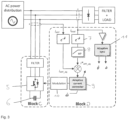
- the proposed power converter unit is shown in Figure 2 , where block A and block B represent the main parts of the unit. Both block A and block B are connected to the AC power distribution system.
- Block A is a rectifier composed of a 3-phase diode bridge 3, a filter 4 and the load.
- the current drawn by the block A contains harmonics from the fundamental AC power distribution frequency that need to be filtered out to meet power quality requirements.
- the current solution is to use an ATRU to eliminate or minimise harmonics.
- the present disclosure presents an alternative solution.
- a shunt active power filter or APF depicted in block B is proposed in this disclosure.
- the APF is composed by at least six semiconductors 5 operated in switching mode and a storage element 6, which could be a capacitor.
- the APF is controlled so that it locally injects the harmonics other than the fundamental frequency drawn by the block A, so that a cancelling-out effect occurs and the current provided by the AC power distribution contains only the fundamental frequency.
- the APF shown in block B includes an adaptive control algorithm which is able to compensate the undesired harmonics drawn by block A no matter what the variation in the frequency of the AC power distribution main harmonic is, which typically varies from 350 - 800 Hz in a variable frequency AC power supply system.
- Block C represents the power stage comprising the semiconductors 5 and storage element 6 explained in the previous section
- block D represents the control architecture of the control algorithm to achieve the harmonics compensation regardless of frequency variations of the AC power distribution system.
- the preferred control algorithm is composed by:
- the adaptive features of block D are provided by the adaptive grid synchronization algorithm 11 and the adaptive current controller 9 as described further below.
- the adaptive grid synchronization algorithm 11 is responsible for synchronising the shunt APF with the AC power distribution system. This algorithm is based on the standard Synchronous Reference Frame Phase Locked Loop (SRF-PLL) and adds adaptive filtering features to cope with the lack of synchronization accuracy that occurs when the AC power distribution voltage is polluted with voltage harmonics and its frequency is not fixed.
- SRF-PLL Synchronous Reference Frame Phase Locked Loop
- ALSRF-PLL Adaptive Lattice Synchronous Reference Frame Phase Locked Loop
- Figure 4 The ALSRF-PLL has been described in " An adaptive synchronous-Reference-Frame Phase-Locked-Loop for Power Quality Improvement in a Polluted Utility Grid.”
- F. Gonzalez-Espin, E. Figueres, and G. Garcera IEEE Transactions on Industrial Electronics, vol. 59, pp. 2718-2731, 2012 , and is composed of three main blocks:
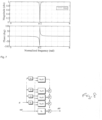
- the adaptive notch filters 12 are preferably implemented by using the Schur-lattice IIR structure shown in Figure 5 , which carries out the rotation over the transfer function involving the filtering process shown in Figure 6 .
- the transfer function of the notch filter is shown in equation (1), and can be derived from Block H, where the normalized center frequency, ⁇ 0 , and the bandwidth, BW , can be adjusted by equation (2) and (3), respectively.
- the Gradient Adaptive Lattice (GAL) recursive algorithm can be used to automatically adjust in real-time the parameter ⁇ 1 , so that the center frequency of the filters are able to filter out the undesired variable frequency harmonics.
- GAL Gradient Adaptive Lattice
- An important feature of the Schur Lattice filter with GAL recursive algorithm is that the filter does not need a reference to adaptively tune its center frequency, which is of great importance when filtering out the ALSRF-PLL harmonics.
- Block I in Figure 5 implements the GAL algorithms expressed in equation (4), where ⁇ is the adaptation gain.
- the adaptive current controller is preferably based on the control architecture shown in Figure 8 .
- the Proportional+Lattice controller is composed of a gain, K D , in parallel with harmonic compensators, H hn (z).
- the harmonic compensators are band-pass filters tuned at the corresponding harmonics (h1 to hn in the figure).
- the band-pass filters offer a high gain in the control loop, so the shunt APF is able to accurately compensate for the harmonics drawn by the non-linear load.
- the information about the frequency of the AC voltage estimated by the Adaptive grid synchronization algorithm 11 (ALSRF-PLL) is used to adjust in real time the band-pass filter center frequency, so that the tracking of the harmonics is accurate through all of the frequency range of operation, typically 350 - 800 Hz.
- Schur Lattice IIR band-pass Filter structure shown in Figure 9 is preferably used in this disclosure and allows implementing an inherently stable IIR filter, which is of paramount importance when adjusting coefficients in real-time, so that the stability of the closed loop APF current control is not compromised by the coefficient adaptation process.
- the system of this disclosure by doing away with the ATRU, reduces the weight of the rectifier unit.
- the shunt APF is digitally controlled and can use high frequency pulse with modulation (PWM) or other switching modulation techniques and an adaptive control algorithm, which allows very accurate fixed or variable frequency harmonics compensation.
- PWM pulse with modulation
- the provision of the shunt APF in parallel with the rectifier also provides redundancy - i.e. if the APF fails, the rectifier will continue to operate, albeit in a degraded mode, so that the load will still receive power even though the current provided by the AC power system will be of a lower quality with more harmonic distortion.
Landscapes
- Engineering & Computer Science (AREA)
- Power Engineering (AREA)
- Supply And Distribution Of Alternating Current (AREA)
- Rectifiers (AREA)
- Power Conversion In General (AREA)
Description
- The present disclosure is related generally to aircraft electrical power systems and more specifically to a rectifier unit for an AC to DC power converter.
- In aircraft, there is now a move to greater use of electrical power and electronic systems rather than hydraulic and pneumatic systems as this has the potential of leading to lighter aircraft. This trend to more electric aircraft (MEA) means that modern aircraft include large generators that generate more electrical power during flight than today and this generated power is used to supply power to more and different on-board aircraft electric power systems. The generators use rotation of the engine to generate AC power using known techniques. The electric frequency on more recent aircrafts may range from 350 - 800 Hz, while the AC voltage is usually regulated at a fixed value such as 115Vac or 230Vac. While the aircraft engines are not running, the on-board electric systems are generally powered by ac power from a ground cart. Such power is typically 115V/230V 400 Hz AC power. While aircraft electrical power is generated in the form of three-phase alternating current, most electrical loads require DC power to operate, and so conversion of AC to DC power is required. The direct rectification of 3-phase AC power into DC power is simple and straightforward, e.g. using 3 pairs of diodes, however this creates unacceptable levels of current distortion or harmonics. These distortions cause power quality issues which are difficult to address, especially since, in modern aircraft, the fundamental frequency may vary over a wide range. Regulating bodies have imposed stringent power quality requirements including limitations on harmonic currents that can be drawn from an aircraft ac power system.
- Multipulse power conversion is one of several technologies capable of AC-DC power conversion with low distortion levels that meet aerospace power quality standards.
- A typical autotransformer-based multipulse converter contains two major functional blocks - a multipulse autotransformer and a rectifier. Autotransformer rectifier units (ATRU) have a low part count and are highly reliable. They have only few low frequency switching components, so EMI emissions are low. However the ATRU adds considerable weight and cost to an aircraft system equipped that way.
- A multiphase converter performs a phase shifting process through transformers to convert from an original three-phase ac supply to multiphase ac supply to result in a higher number of pulses in dc output to result in a close to sinusoidal current draw with reduced harmonic distortion at the ATRU input.
- An n-pulse ATRU is composed of n/6 6-pulse diode bridges (n/2 diode pairs) and uses phase-shifting of the secondary voltages in the autotransformer. A three phase fixed or variable frequency - constant amplitude voltage source supplies power to the ATRU, thus providing three different phase shifted sinusoidal 3 phase voltages
- ATRUs used in aircraft are typically 18-pulse converters, but others, e.g. 12-pulse, 24-pulse, etc. may be used. A 12-pulse ATRU, for example, is described in "Polyphase Transformer Arrangements with Reduced kVA Capacities for Harmonic Current Reduction in Rectifier-Type Utility Interface", S. Choi, P.N. Enjeti and I.J. Pitel. IEEE Transactions on Power Electronics, vol. 11, pp 680-690, 1996. An overview of multipulse AC-DC converters can be found in "Multipulse AC-DC Converters for improving Power Quality: A Review", B. Singh, S. Gairola, B.N. Singh, A. Chandra; K. AI-Haddad. IEEE Transactions on Power Electronics, vol. 23, No. 1, January 2008, pp. 260 ff. Power converters are also described in HOGAN DIARMAID J Et AL: "Adaptive resonant current- control for active power filtering within a microgrid", 2014 IEEE ENERGY CONVERSION CONGRESS AND EXPOSITION (ECCE), IEEE, 14 September 2014 (2014-09-14), pages 3468-3475, XP032680654, DOI: 10.119/ECCE.2014.6953872,
GB 2 519 590 A (TAHA MOHAMAD HUSSEIN [LB]) 29 April 2015 -
Fig. 1 shows a block diagram of a typical 18-pulse rectifier unit including the Autotransformer Rectifier Unit (ATRU), diode bridges and Interphase Transformers (IPTs). This shows theATRU 1 comprising an isolated or non-isolated multi-winding transformer that displaces the AC input voltage a number of degrees dependent on the number of secondary windings. - The output voltage of the multi-phase winding is rectified by a number of basic 6-
pulse rectifier cells 2, thus improving the input current total harmonic distortion. The input current quality, however, is limited by the number of 6-pulse stages. If additional 6-pulse cells are added to achieve a lower distortion, this results in an undesirable increase in the weight of the rectifier unit. - The aim of the present disclosure is to provide a power converter that mitigates harmonic distortion and adds redundancy to the rectification stage with either fixed frequency or variable frequency AC power source, while avoiding the use of the autotransformer unit and the IPT, thus reducing the rectifier unit weight compared with the existing ATRU solution.
- The invention provides an aircraft electrical power system according to
claim 1. Preferred embodiments are defined in the dependent claims. - Preferred embodiments will now be described, by way of example only, with reference to the drawings.
-
Fig. 1 is a block diagram of a typical multipulse rectifier system using an ATRU to reduce harmonic distortions; -
Fig. 2 is a block diagram of a rectifier unit according to this disclosure; -
Fig. 3 is a block diagram showing the APF in more detail; -
Fig. 4 shows an adaptive lattice SRF-PLL; -
Fig. 5 shows an adaptive band-stop lattice filter; -
Fig. 6 shows Schur recursion; -
Fig. 7 shows the frequency response of the Schur Lattice notch filter; -
Fig. 8 shows an adaptive shunt APF current controller; -
Fig. 9 shows an adaptive band-pass lattice filter; -
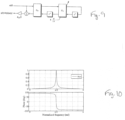
Fig. 10 shows the frequency response of the Schur Lattice band-pass filter. - The conventional rectifier unit has been described above in the Background section with reference to
Fig. 1 . - In contrast, in the present disclosure, the ATRU and the use of n/6 6-pulse diode bridges (where n is an integer) is substituted by a single 6-pulse rectifier cell connected directly to the AC power distribution system (which can be fixed or variable frequency) and an active power filter (APF) connected in parallel to the rectifier cell, as a shunt APF.
- The shunt APF is designed to locally compensate for the non-linear current harmonics, thus allowing the harmonics content of the current drawn by the power distribution system to be below the permitted maximum.
- The shunt APF control includes an adaptive control algorithm able to assure proper current harmonics compensation within a predefined frequency variation range, typically 350 - 800 Hz.
- The active filter is arranged to modify the amplitude and/or phase characteristics of the current provided by the AC power signal so as to compensate for harmonic currents drawn by the load.
- The proposed power converter unit is shown in
Figure 2 , where block A and block B represent the main parts of the unit. Both block A and block B are connected to the AC power distribution system. Block A is a rectifier composed of a 3-phase diode bridge 3, afilter 4 and the load. The current drawn by the block A contains harmonics from the fundamental AC power distribution frequency that need to be filtered out to meet power quality requirements. As discussed above, the current solution is to use an ATRU to eliminate or minimise harmonics. The present disclosure presents an alternative solution. In order to achieve the aforementioned power quality requirements, a shunt active power filter or APF depicted in block B is proposed in this disclosure. The APF is composed by at least sixsemiconductors 5 operated in switching mode and astorage element 6, which could be a capacitor. The APF is controlled so that it locally injects the harmonics other than the fundamental frequency drawn by the block A, so that a cancelling-out effect occurs and the current provided by the AC power distribution contains only the fundamental frequency. The APF shown in block B includes an adaptive control algorithm which is able to compensate the undesired harmonics drawn by block A no matter what the variation in the frequency of the AC power distribution main harmonic is, which typically varies from 350 - 800 Hz in a variable frequency AC power supply system. - The preferred shunt active power filter is shown in more detail in
Figure 3 . Block C represents the power stage comprising thesemiconductors 5 andstorage element 6 explained in the previous section, while block D represents the control architecture of the control algorithm to achieve the harmonics compensation regardless of frequency variations of the AC power distribution system. - The preferred control algorithm is composed by:
- A transformation stage, e~j θ̂ , 7 which rotates the sensed currents from the natural reference frame to the synchronous reference frame.
- A high pass filter, HP, 8 which rejects the fundamental harmonic information from the sensed load current. The output of the HP block is used as the reference for the current to be injected by the shunt APF.
- An Adaptive
current controller 9, which is responsible for offering a high control loop gain at the frequency of the harmonics to be injected by the shunt APF, regardless the AC power system main frequency - A
Modulation block 10, which is typically deployed through pulse width modulation PWM or space vector modulation SVM modulation techniques, and that may include a transformation stage as well, - An Adaptive
grid synchronization algorithm 11 which extracts AC power distribution voltage frequency and phase angle information. - The adaptive features of block D are provided by the adaptive
grid synchronization algorithm 11 and the adaptivecurrent controller 9 as described further below. - The adaptive
grid synchronization algorithm 11 is responsible for synchronising the shunt APF with the AC power distribution system. This algorithm is based on the standard Synchronous Reference Frame Phase Locked Loop (SRF-PLL) and adds adaptive filtering features to cope with the lack of synchronization accuracy that occurs when the AC power distribution voltage is polluted with voltage harmonics and its frequency is not fixed. - The preferred adaptive grid synchronization algorithm proposed in this disclosure is called Adaptive Lattice Synchronous Reference Frame Phase Locked Loop (ALSRF-PLL) and is shown in
Figure 4 . The ALSRF-PLL has been described in "An adaptive synchronous-Reference-Frame Phase-Locked-Loop for Power Quality Improvement in a Polluted Utility Grid." F. Gonzalez-Espin, E. Figueres, and G. Garcera, IEEE Transactions on Industrial Electronics, vol. 59, pp. 2718-2731, 2012, and is composed of three main blocks: - Block E represents the Park transformation, and is responsible for rotating the AC voltage vector from the natural reference frame to the synchronous reference frame.
- Block F includes the regulator HPl(z), which is usually a Proportional + Integral controller, and the block Int(z), which is an integrator. The output of those blocks are the AC voltage frequency, ω̂, and phase angle, θ̂, respectively.
- Block G adds the adaptive feature to the ALSRF-PLL and is composed of n adaptive narrow band-stop (notch) filters, Ghn (z), that reject the undesired variable frequency harmonic content from the sensed AC voltage, thus assuring an accurate estimate of voltage frequency and phase angle.
- The
adaptive notch filters 12 are preferably implemented by using the Schur-lattice IIR structure shown inFigure 5 , which carries out the rotation over the transfer function involving the filtering process shown inFigure 6 . The transfer function of the notch filter is shown in equation (1), and can be derived from Block H, where the normalized center frequency, ω0, and the bandwidth, BW, can be adjusted by equation (2) and (3), respectively. The Bode plot of G(z) is depicted inFigure 7 for θ1=0 rad and θ2=1.414 rad.


- The main advantages of using the Schur-lattice IIR structure are as follows:
- i. The structure is inherently limited to realize stable and causal filters. This makes it very appealing to use adaptive algorithms to adjust its center frequency in real time.
- ii. As will be explained below, a band-stop as well as a band-pass filter can be obtained by using the same topology.
- iii. All the internal nodes are inherently scaled in the Euclidean norm. In this regard, the precision can be kept constant during the filtering process.
- iv. The mapping of the poles and zeros is more precise regardless of the position of the poles and zeros, because the round-off noise accumulation in the state vector loop is inherently low.
- v. Quantization limit cycles can be easily suppressed.
- The Gradient Adaptive Lattice (GAL) recursive algorithm can be used to automatically adjust in real-time the parameter θ 1, so that the center frequency of the filters are able to filter out the undesired variable frequency harmonics. An important feature of the Schur Lattice filter with GAL recursive algorithm is that the filter does not need a reference to adaptively tune its center frequency, which is of great importance when filtering out the ALSRF-PLL harmonics. Block I in
Figure 5 implements the GAL algorithms expressed in equation (4), where µ is the adaptation gain.
TABLE I GAL ALGORITHM APPLIED TO THE SCHUR-LATTICE IIR NOTCH FILTER Filter Parameters Computing 

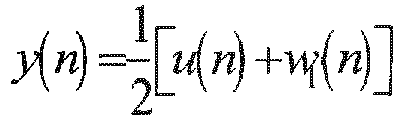
Filter Parameters Adaptation 
- The adaptive current controller is preferably based on the control architecture shown in
Figure 8 . The Proportional+Lattice controller is composed of a gain, KD , in parallel with harmonic compensators, Hhn(z). The harmonic compensators are band-pass filters tuned at the corresponding harmonics (h1 to hn in the figure). The band-pass filters offer a high gain in the control loop, so the shunt APF is able to accurately compensate for the harmonics drawn by the non-linear load. The information about the frequency of the AC voltage estimated by the Adaptive grid synchronization algorithm 11 (ALSRF-PLL) is used to adjust in real time the band-pass filter center frequency, so that the tracking of the harmonics is accurate through all of the frequency range of operation, typically 350 - 800 Hz. - Schur Lattice IIR band-pass Filter structure shown in
Figure 9 is preferably used in this disclosure and allows implementing an inherently stable IIR filter, which is of paramount importance when adjusting coefficients in real-time, so that the stability of the closed loop APF current control is not compromised by the coefficient adaptation process. - The transfer function of the Proportional+Lattice controller is depicted in equation (5), where (2) and (3) applies.

- The Bode plot of HPL(z) is depicted in
Figure 10 for θ1=0 rad, θ 2=1.414 rad and KL = 1 - The system of this disclosure, by doing away with the ATRU, reduces the weight of the rectifier unit. Further, the shunt APF is digitally controlled and can use high frequency pulse with modulation (PWM) or other switching modulation techniques and an adaptive control algorithm, which allows very accurate fixed or variable frequency harmonics compensation. This significantly decreases weight and size of the rectifier unit compared to known multipulse rectifiers while obtaining comparable or better power quality of the current injected by the electric power system, regardless of frequency variations. The provision of the shunt APF in parallel with the rectifier also provides redundancy - i.e. if the APF fails, the rectifier will continue to operate, albeit in a degraded mode, so that the load will still receive power even though the current provided by the AC power system will be of a lower quality with more harmonic distortion.
Claims (8)
- An aircraft electrical power system comprising a power converter unit (Blocks A-F)comprising a single 6-pulse rectifier cell (3) configured to receive an AC input in the range of 350-800 Hz from a 115V or 230V AC power source and an active power filter (Block B, C) connected as a shunt between the AC input and the 6-pulse rectifier cell (3);wherein the active power filter comprises a control algorithm configured to cause removal of current harmonic frequencies from the AC input but not of a current fundamental frequency of the AC input;wherein the control algorithm comprises:- a transformation stage (7) configured to rotate sensed AC input currents from a natural reference frame to a synchronous reference frame;- a high pass filter (8) configured to filter out a fundamental harmonic from a sensed load current and to provide only harmonics of the fundamental at an output;- adaptive current control means (9) configured to provide a high control loop gain at the frequency of the harmonics from the output of the high pass filter (8) regardless of AC power source fundamental frequency;a pulse width modulator or a space vector modulator (10) configured to modulate the output of the adaptive current control means (9); anda synchronising algorithm configured to use Adaptive Lattice Synchronous Reference Frame Phase Locked Loop, ALSRF-PLL, synchronisation (11) for synchronising the active power filter (Block B, C) with the AC power source
- The power system of claim 1 where the 6-pulse rectifier cell (3) is configured to receive the AC input from a fixed or variable frequency AC power source.
- The power system of claim 1 or 2, wherein the 6-pulse rectifier cell (3) comprises a 3-phase diode bridge.
- The power system of any preceding claim, wherein the active power filter (Block B, C) comprises a plurality of semiconductor switches (5) and a storage element (6).
- The power system of any preceding claim, wherein the adaptive current control means (9) includes adaptive band-pass filters configured to use a Schur-Lattice IIR structure.
- The power system of claim 1, wherein the synchronising algorithm (11) comprises- means for transforming an AC voltage vector of the AC input to a synchronous reference phase;- a regulator and an integrator connected in series configured to provide an input to themeans for transforming;- a plurality of adaptive band-stop filters (12) configured to reject undesired variable frequency harmonic content from the sensed AC input voltage, regardless of the AC power source fundamental frequency
- The power system of claim 6, wherein the plurality of adaptive band-stop filters (12) are configured to use a Schur-Lattice IIR structure.
- The power system of claim 7, wherein centre frequencies of the plurality of band-stop filters (12) are configured to be adapted in real-time to track AC power source frequency variations using a Gradient Lattice Algorithm.
Priority Applications (2)
| Application Number | Priority Date | Filing Date | Title |
|---|---|---|---|
| EP16153595.0A EP3200330B1 (en) | 2016-02-01 | 2016-02-01 | Reduced harmonics drawn by a rectifier unit in an aircraft electrical powering system |
| US15/421,766 US10050549B2 (en) | 2016-02-01 | 2017-02-01 | Power converter unit including a rectifier and an active power filter |
Applications Claiming Priority (1)
| Application Number | Priority Date | Filing Date | Title |
|---|---|---|---|
| EP16153595.0A EP3200330B1 (en) | 2016-02-01 | 2016-02-01 | Reduced harmonics drawn by a rectifier unit in an aircraft electrical powering system |
Publications (2)
| Publication Number | Publication Date |
|---|---|
| EP3200330A1 EP3200330A1 (en) | 2017-08-02 |
| EP3200330B1 true EP3200330B1 (en) | 2024-12-25 |
Family
ID=55272395
Family Applications (1)
| Application Number | Title | Priority Date | Filing Date |
|---|---|---|---|
| EP16153595.0A Active EP3200330B1 (en) | 2016-02-01 | 2016-02-01 | Reduced harmonics drawn by a rectifier unit in an aircraft electrical powering system |
Country Status (2)
| Country | Link |
|---|---|
| US (1) | US10050549B2 (en) |
| EP (1) | EP3200330B1 (en) |
Families Citing this family (11)
| Publication number | Priority date | Publication date | Assignee | Title |
|---|---|---|---|---|
| CN107332245A (en) * | 2017-08-29 | 2017-11-07 | 云南电力试验研究院(集团)有限公司 | A kind of harmonic wave and idle administering method |
| US10541601B2 (en) * | 2017-10-30 | 2020-01-21 | University Of Florida Research Foundation, Inc. | EMI energy mitigation |
| US10998899B2 (en) | 2017-10-30 | 2021-05-04 | University Of Florida Research Foundation, Inc. | EMI energy mitigation |
| US20190326828A1 (en) * | 2018-04-19 | 2019-10-24 | Hamilton Sundstrand Corporation | Fault tolerant ac rectification |
| US10901026B2 (en) * | 2018-09-18 | 2021-01-26 | Tci, Llc | Passive harmonic filter power quality monitor and communications device |
| CN109193658B (en) * | 2018-10-31 | 2019-07-09 | 国网江苏省电力有限公司苏州供电分公司 | A method of harmonic current compensation is carried out using Active Power Filter-APF |
| CN109599868B (en) * | 2018-11-28 | 2022-05-20 | 广州锐翔电力科技有限公司 | Control system and method for output current of active filter |
| EP4160891A1 (en) * | 2021-10-04 | 2023-04-05 | Hamilton Sundstrand Corporation | Active rectifier harmonics compensator |
| EP4212891A1 (en) | 2022-01-08 | 2023-07-19 | Goodrich Aerospace Services Private Limited | Fault detection methods and systems therefor |
| JP2024045981A (en) * | 2022-09-22 | 2024-04-03 | 東芝キヤリア株式会社 | Harmonic suppression device |
| US20240405572A1 (en) * | 2023-05-31 | 2024-12-05 | Hamilton Sundstrand Corporation | Reactive Current Injenction for Active Aerospace Rectification |
Citations (1)
| Publication number | Priority date | Publication date | Assignee | Title |
|---|---|---|---|---|
| GB2519590A (en) * | 2013-10-28 | 2015-04-29 | Mohamad Hussein Taha | Single phase parallel active filter for aircraft applications |
Family Cites Families (2)
| Publication number | Priority date | Publication date | Assignee | Title |
|---|---|---|---|---|
| CA2838384C (en) * | 2013-01-02 | 2022-11-22 | Tci, Llc | Paralleling of active filters with independent controls |
| US9584039B2 (en) * | 2014-05-27 | 2017-02-28 | Hamilton Sundstrand Corporation | Regulated AC-DC hybrid rectifier |
-
2016
- 2016-02-01 EP EP16153595.0A patent/EP3200330B1/en active Active
-
2017
- 2017-02-01 US US15/421,766 patent/US10050549B2/en active Active
Patent Citations (1)
| Publication number | Priority date | Publication date | Assignee | Title |
|---|---|---|---|---|
| GB2519590A (en) * | 2013-10-28 | 2015-04-29 | Mohamad Hussein Taha | Single phase parallel active filter for aircraft applications |
Non-Patent Citations (1)
| Title |
|---|
| VENTURINI R P ET AL: "Adaptive Selective Compensation for Variable Frequency Active Power Filters in More Electrical Aircraft", IEEE TRANSACTIONS ON AEROSPACE AND ELECTRONIC SYSTEMS, IEEE SERVICE CENTER, PISCATAWAY, NJ, US, vol. 48, no. 2, 1 April 2012 (2012-04-01), pages 1319 - 1328, XP011440815, ISSN: 0018-9251, DOI: 10.1109/TAES.2012.6178064 * |
Also Published As
| Publication number | Publication date |
|---|---|
| US10050549B2 (en) | 2018-08-14 |
| EP3200330A1 (en) | 2017-08-02 |
| US20170222571A1 (en) | 2017-08-03 |
Similar Documents
| Publication | Publication Date | Title |
|---|---|---|
| EP3200330B1 (en) | Reduced harmonics drawn by a rectifier unit in an aircraft electrical powering system | |
| US6950322B2 (en) | Regulated AC to DC converter for aerospace applications | |
| US6650557B2 (en) | 18-pulse rectification system using a wye-connected autotransformer | |
| Jensen et al. | A new control method for 400 Hz ground power units for airplanes | |
| Thomas et al. | Design and performance of active power filters | |
| Hu et al. | Design considerations for DSP-controlled 400 Hz shunt active power filter in an aircraft power system | |
| EP3497782B1 (en) | Two stage control of converter system with floating cells | |
| Chen et al. | A novel parallel configured 48-pulse autotransformer rectifier for aviation application | |
| Mihalache | DSP control of 400 Hz inverters for aircraft applications | |
| Liang et al. | A solid state variable capacitor with minimum DC capacitance | |
| Heo et al. | Robust predictive current control of a grid-connected inverter with harmonics compensation | |
| US20230170818A1 (en) | Power conversion system | |
| US12230964B2 (en) | DC power supply device and railway substation incorporating it | |
| Peng et al. | A study of active power filters using quad-series voltage-source PWM converters for harmonic compensation | |
| JP2002359927A (en) | Filter device | |
| Cho et al. | LCL filter design and control for grid-connected PWM converter | |
| US6208540B1 (en) | Combined power inverter and auxilliary power supply using null vector modulation | |
| Rajesh et al. | A shunt active power filter for 12 pulse converter using source current detection approach | |
| KR20130092539A (en) | Control device and method for controlling an ac motor | |
| JP3128742B2 (en) | Power supply | |
| Taha | Power electronics application for more electric aircraft | |
| Liu et al. | LCL+ L filter for three-phase four-wire high power density converter | |
| Taha | Active rectifier using DQ vector control for aircraft power system | |
| Akihiro et al. | Unbalanced load compensation for solid-state transformer using smoothing capacitors of cascaded h-bridges as energy buffer | |
| Frangopol et al. | A Solution for Reducing Harmonic Regime and Reactive Power Absorbed by a Cycloconverter |
Legal Events
| Date | Code | Title | Description |
|---|---|---|---|
| PUAI | Public reference made under article 153(3) epc to a published international application that has entered the european phase |
Free format text: ORIGINAL CODE: 0009012 |
|
| STAA | Information on the status of an ep patent application or granted ep patent |
Free format text: STATUS: THE APPLICATION HAS BEEN PUBLISHED |
|
| AK | Designated contracting states |
Kind code of ref document: A1 Designated state(s): AL AT BE BG CH CY CZ DE DK EE ES FI FR GB GR HR HU IE IS IT LI LT LU LV MC MK MT NL NO PL PT RO RS SE SI SK SM TR |
|
| AX | Request for extension of the european patent |
Extension state: BA ME |
|
| STAA | Information on the status of an ep patent application or granted ep patent |
Free format text: STATUS: REQUEST FOR EXAMINATION WAS MADE |
|
| 17P | Request for examination filed |
Effective date: 20180202 |
|
| RBV | Designated contracting states (corrected) |
Designated state(s): AL AT BE BG CH CY CZ DE DK EE ES FI FR GB GR HR HU IE IS IT LI LT LU LV MC MK MT NL NO PL PT RO RS SE SI SK SM TR |
|
| STAA | Information on the status of an ep patent application or granted ep patent |
Free format text: STATUS: EXAMINATION IS IN PROGRESS |
|
| 17Q | First examination report despatched |
Effective date: 20200706 |
|
| RAP1 | Party data changed (applicant data changed or rights of an application transferred) |
Owner name: HAMILTON SUNDSTRAND CORPORATION |
|
| GRAP | Despatch of communication of intention to grant a patent |
Free format text: ORIGINAL CODE: EPIDOSNIGR1 |
|
| STAA | Information on the status of an ep patent application or granted ep patent |
Free format text: STATUS: GRANT OF PATENT IS INTENDED |
|
| RIC1 | Information provided on ipc code assigned before grant |
Ipc: H02M 1/00 20060101ALI20240710BHEP Ipc: H02M 1/15 20060101ALI20240710BHEP Ipc: H02J 3/01 20060101ALI20240710BHEP Ipc: H02M 1/12 20060101AFI20240710BHEP |
|
| INTG | Intention to grant announced |
Effective date: 20240808 |
|
| GRAS | Grant fee paid |
Free format text: ORIGINAL CODE: EPIDOSNIGR3 |
|
| GRAA | (expected) grant |
Free format text: ORIGINAL CODE: 0009210 |
|
| STAA | Information on the status of an ep patent application or granted ep patent |
Free format text: STATUS: THE PATENT HAS BEEN GRANTED |
|
| AK | Designated contracting states |
Kind code of ref document: B1 Designated state(s): AL AT BE BG CH CY CZ DE DK EE ES FI FR GB GR HR HU IE IS IT LI LT LU LV MC MK MT NL NO PL PT RO RS SE SI SK SM TR |
|
| REG | Reference to a national code |
Ref country code: GB Ref legal event code: FG4D |
|
| REG | Reference to a national code |
Ref country code: CH Ref legal event code: EP |
|
| REG | Reference to a national code |
Ref country code: DE Ref legal event code: R096 Ref document number: 602016090710 Country of ref document: DE |
|
| REG | Reference to a national code |
Ref country code: IE Ref legal event code: FG4D |
|
| REG | Reference to a national code |
Ref country code: LT Ref legal event code: MG9D |
|
| PG25 | Lapsed in a contracting state [announced via postgrant information from national office to epo] |
Ref country code: HR Free format text: LAPSE BECAUSE OF FAILURE TO SUBMIT A TRANSLATION OF THE DESCRIPTION OR TO PAY THE FEE WITHIN THE PRESCRIBED TIME-LIMIT Effective date: 20241225 |
|
| PGFP | Annual fee paid to national office [announced via postgrant information from national office to epo] |
Ref country code: DE Payment date: 20250122 Year of fee payment: 10 |
|
| PG25 | Lapsed in a contracting state [announced via postgrant information from national office to epo] |
Ref country code: FI Free format text: LAPSE BECAUSE OF FAILURE TO SUBMIT A TRANSLATION OF THE DESCRIPTION OR TO PAY THE FEE WITHIN THE PRESCRIBED TIME-LIMIT Effective date: 20241225 |
|
| PG25 | Lapsed in a contracting state [announced via postgrant information from national office to epo] |
Ref country code: BG Free format text: LAPSE BECAUSE OF FAILURE TO SUBMIT A TRANSLATION OF THE DESCRIPTION OR TO PAY THE FEE WITHIN THE PRESCRIBED TIME-LIMIT Effective date: 20241225 |
|
| PG25 | Lapsed in a contracting state [announced via postgrant information from national office to epo] |
Ref country code: NO Free format text: LAPSE BECAUSE OF FAILURE TO SUBMIT A TRANSLATION OF THE DESCRIPTION OR TO PAY THE FEE WITHIN THE PRESCRIBED TIME-LIMIT Effective date: 20250325 |
|
| PG25 | Lapsed in a contracting state [announced via postgrant information from national office to epo] |
Ref country code: GR Free format text: LAPSE BECAUSE OF FAILURE TO SUBMIT A TRANSLATION OF THE DESCRIPTION OR TO PAY THE FEE WITHIN THE PRESCRIBED TIME-LIMIT Effective date: 20250326 Ref country code: LV Free format text: LAPSE BECAUSE OF FAILURE TO SUBMIT A TRANSLATION OF THE DESCRIPTION OR TO PAY THE FEE WITHIN THE PRESCRIBED TIME-LIMIT Effective date: 20241225 |
|
| PGFP | Annual fee paid to national office [announced via postgrant information from national office to epo] |
Ref country code: FR Payment date: 20250122 Year of fee payment: 10 |
|
| PGFP | Annual fee paid to national office [announced via postgrant information from national office to epo] |
Ref country code: GB Payment date: 20250123 Year of fee payment: 10 |
|
| PG25 | Lapsed in a contracting state [announced via postgrant information from national office to epo] |
Ref country code: RS Free format text: LAPSE BECAUSE OF FAILURE TO SUBMIT A TRANSLATION OF THE DESCRIPTION OR TO PAY THE FEE WITHIN THE PRESCRIBED TIME-LIMIT Effective date: 20250325 |
|
| REG | Reference to a national code |
Ref country code: NL Ref legal event code: MP Effective date: 20241225 |
|
| PG25 | Lapsed in a contracting state [announced via postgrant information from national office to epo] |
Ref country code: NL Free format text: LAPSE BECAUSE OF FAILURE TO SUBMIT A TRANSLATION OF THE DESCRIPTION OR TO PAY THE FEE WITHIN THE PRESCRIBED TIME-LIMIT Effective date: 20241225 |
|
| REG | Reference to a national code |
Ref country code: AT Ref legal event code: MK05 Ref document number: 1755021 Country of ref document: AT Kind code of ref document: T Effective date: 20241225 |
|
| PG25 | Lapsed in a contracting state [announced via postgrant information from national office to epo] |
Ref country code: SM Free format text: LAPSE BECAUSE OF FAILURE TO SUBMIT A TRANSLATION OF THE DESCRIPTION OR TO PAY THE FEE WITHIN THE PRESCRIBED TIME-LIMIT Effective date: 20241225 |
|
| PG25 | Lapsed in a contracting state [announced via postgrant information from national office to epo] |
Ref country code: PL Free format text: LAPSE BECAUSE OF FAILURE TO SUBMIT A TRANSLATION OF THE DESCRIPTION OR TO PAY THE FEE WITHIN THE PRESCRIBED TIME-LIMIT Effective date: 20241225 |
|
| PG25 | Lapsed in a contracting state [announced via postgrant information from national office to epo] |
Ref country code: ES Free format text: LAPSE BECAUSE OF FAILURE TO SUBMIT A TRANSLATION OF THE DESCRIPTION OR TO PAY THE FEE WITHIN THE PRESCRIBED TIME-LIMIT Effective date: 20241225 |
|
| PG25 | Lapsed in a contracting state [announced via postgrant information from national office to epo] |
Ref country code: IS Free format text: LAPSE BECAUSE OF FAILURE TO SUBMIT A TRANSLATION OF THE DESCRIPTION OR TO PAY THE FEE WITHIN THE PRESCRIBED TIME-LIMIT Effective date: 20250425 |
|
| PG25 | Lapsed in a contracting state [announced via postgrant information from national office to epo] |
Ref country code: PT Free format text: LAPSE BECAUSE OF FAILURE TO SUBMIT A TRANSLATION OF THE DESCRIPTION OR TO PAY THE FEE WITHIN THE PRESCRIBED TIME-LIMIT Effective date: 20250428 |
|
| PG25 | Lapsed in a contracting state [announced via postgrant information from national office to epo] |
Ref country code: EE Free format text: LAPSE BECAUSE OF FAILURE TO SUBMIT A TRANSLATION OF THE DESCRIPTION OR TO PAY THE FEE WITHIN THE PRESCRIBED TIME-LIMIT Effective date: 20241225 |
|
| PG25 | Lapsed in a contracting state [announced via postgrant information from national office to epo] |
Ref country code: RO Free format text: LAPSE BECAUSE OF FAILURE TO SUBMIT A TRANSLATION OF THE DESCRIPTION OR TO PAY THE FEE WITHIN THE PRESCRIBED TIME-LIMIT Effective date: 20241225 Ref country code: AT Free format text: LAPSE BECAUSE OF FAILURE TO SUBMIT A TRANSLATION OF THE DESCRIPTION OR TO PAY THE FEE WITHIN THE PRESCRIBED TIME-LIMIT Effective date: 20241225 |
|
| PG25 | Lapsed in a contracting state [announced via postgrant information from national office to epo] |
Ref country code: SK Free format text: LAPSE BECAUSE OF FAILURE TO SUBMIT A TRANSLATION OF THE DESCRIPTION OR TO PAY THE FEE WITHIN THE PRESCRIBED TIME-LIMIT Effective date: 20241225 |
|
| PG25 | Lapsed in a contracting state [announced via postgrant information from national office to epo] |
Ref country code: CZ Free format text: LAPSE BECAUSE OF FAILURE TO SUBMIT A TRANSLATION OF THE DESCRIPTION OR TO PAY THE FEE WITHIN THE PRESCRIBED TIME-LIMIT Effective date: 20241225 |
|
| PG25 | Lapsed in a contracting state [announced via postgrant information from national office to epo] |
Ref country code: IT Free format text: LAPSE BECAUSE OF FAILURE TO SUBMIT A TRANSLATION OF THE DESCRIPTION OR TO PAY THE FEE WITHIN THE PRESCRIBED TIME-LIMIT Effective date: 20241225 |
|
| PG25 | Lapsed in a contracting state [announced via postgrant information from national office to epo] |
Ref country code: SE Free format text: LAPSE BECAUSE OF FAILURE TO SUBMIT A TRANSLATION OF THE DESCRIPTION OR TO PAY THE FEE WITHIN THE PRESCRIBED TIME-LIMIT Effective date: 20241225 |
|
| PG25 | Lapsed in a contracting state [announced via postgrant information from national office to epo] |
Ref country code: MC Free format text: LAPSE BECAUSE OF FAILURE TO SUBMIT A TRANSLATION OF THE DESCRIPTION OR TO PAY THE FEE WITHIN THE PRESCRIBED TIME-LIMIT Effective date: 20241225 |
|
| REG | Reference to a national code |
Ref country code: DE Ref legal event code: R097 Ref document number: 602016090710 Country of ref document: DE |
|
| REG | Reference to a national code |
Ref country code: CH Ref legal event code: PL |
|
| PG25 | Lapsed in a contracting state [announced via postgrant information from national office to epo] |
Ref country code: DK Free format text: LAPSE BECAUSE OF FAILURE TO SUBMIT A TRANSLATION OF THE DESCRIPTION OR TO PAY THE FEE WITHIN THE PRESCRIBED TIME-LIMIT Effective date: 20241225 |
|
| PG25 | Lapsed in a contracting state [announced via postgrant information from national office to epo] |
Ref country code: LU Free format text: LAPSE BECAUSE OF NON-PAYMENT OF DUE FEES Effective date: 20250201 |
|
| PG25 | Lapsed in a contracting state [announced via postgrant information from national office to epo] |
Ref country code: CH Free format text: LAPSE BECAUSE OF NON-PAYMENT OF DUE FEES Effective date: 20250228 |
|
| PLBE | No opposition filed within time limit |
Free format text: ORIGINAL CODE: 0009261 |
|
| STAA | Information on the status of an ep patent application or granted ep patent |
Free format text: STATUS: NO OPPOSITION FILED WITHIN TIME LIMIT |
|
| 26N | No opposition filed |
Effective date: 20250926 |
|
| REG | Reference to a national code |
Ref country code: BE Ref legal event code: MM Effective date: 20250228 |
|
| PG25 | Lapsed in a contracting state [announced via postgrant information from national office to epo] |
Ref country code: BE Free format text: LAPSE BECAUSE OF NON-PAYMENT OF DUE FEES Effective date: 20250228 |
|
| PG25 | Lapsed in a contracting state [announced via postgrant information from national office to epo] |
Ref country code: IE Free format text: LAPSE BECAUSE OF NON-PAYMENT OF DUE FEES Effective date: 20250201 |