EP3194331B1 - Verfahren zur wasserstoffsynthese - Google Patents
Verfahren zur wasserstoffsynthese Download PDFInfo
- Publication number
- EP3194331B1 EP3194331B1 EP15748206.8A EP15748206A EP3194331B1 EP 3194331 B1 EP3194331 B1 EP 3194331B1 EP 15748206 A EP15748206 A EP 15748206A EP 3194331 B1 EP3194331 B1 EP 3194331B1
- Authority
- EP
- European Patent Office
- Prior art keywords
- reaction
- aqueous composition
- carbonate
- carbon dioxide
- bar
- Prior art date
- Legal status (The legal status is an assumption and is not a legal conclusion. Google has not performed a legal analysis and makes no representation as to the accuracy of the status listed.)
- Active
Links
Images


Classifications
-
- C—CHEMISTRY; METALLURGY
- C01—INORGANIC CHEMISTRY
- C01B—NON-METALLIC ELEMENTS; COMPOUNDS THEREOF; METALLOIDS OR COMPOUNDS THEREOF NOT COVERED BY SUBCLASS C01C
- C01B3/00—Hydrogen; Gaseous mixtures containing hydrogen; Separation of hydrogen from mixtures containing it; Purification of hydrogen; Reversible storage of hydrogen
- C01B3/02—Production of hydrogen; Production of gaseous mixtures containing hydrogen
- C01B3/06—Production of hydrogen; Production of gaseous mixtures containing hydrogen by reaction of inorganic compounds containing electro-positively bound hydrogen with inorganic reducing agents
- C01B3/08—Production of hydrogen; Production of gaseous mixtures containing hydrogen by reaction of inorganic compounds containing electro-positively bound hydrogen with inorganic reducing agents by reaction of inorganic compounds with metals
-
- C—CHEMISTRY; METALLURGY
- C01—INORGANIC CHEMISTRY
- C01B—NON-METALLIC ELEMENTS; COMPOUNDS THEREOF; METALLOIDS OR COMPOUNDS THEREOF NOT COVERED BY SUBCLASS C01C
- C01B3/00—Hydrogen; Gaseous mixtures containing hydrogen; Separation of hydrogen from mixtures containing it; Purification of hydrogen; Reversible storage of hydrogen
- C01B3/02—Production of hydrogen; Production of gaseous mixtures containing hydrogen
- C01B3/06—Production of hydrogen; Production of gaseous mixtures containing hydrogen by reaction of inorganic compounds containing electro-positively bound hydrogen with inorganic reducing agents
- C01B3/061—Production of hydrogen; Production of gaseous mixtures containing hydrogen by reaction of inorganic compounds containing electro-positively bound hydrogen with inorganic reducing agents by reaction of water with metal oxides
-
- Y—GENERAL TAGGING OF NEW TECHNOLOGICAL DEVELOPMENTS; GENERAL TAGGING OF CROSS-SECTIONAL TECHNOLOGIES SPANNING OVER SEVERAL SECTIONS OF THE IPC; TECHNICAL SUBJECTS COVERED BY FORMER USPC CROSS-REFERENCE ART COLLECTIONS [XRACs] AND DIGESTS
- Y02—TECHNOLOGIES OR APPLICATIONS FOR MITIGATION OR ADAPTATION AGAINST CLIMATE CHANGE
- Y02E—REDUCTION OF GREENHOUSE GAS [GHG] EMISSIONS, RELATED TO ENERGY GENERATION, TRANSMISSION OR DISTRIBUTION
- Y02E60/00—Enabling technologies; Technologies with a potential or indirect contribution to GHG emissions mitigation
- Y02E60/30—Hydrogen technology
- Y02E60/36—Hydrogen production from non-carbon containing sources, e.g. by water electrolysis
Definitions
- the present invention relates to methods for the synthesis of hydrogen gas (H 2 ) under mild hydrothermal conditions.
- the processes described herein may further be used for the treatment of iron-containing waste streams.
- Hydrogen gas is a commonly applied gas in diverse industries. For example, it is used as a raw material for the production of different chemicals (such as ammonia via the Haber-Bosch process), and as a key reagent in refineries, for example in desulfurization and hydrocracking. Moreover, hydrogen gas is considered to be a promising alternative for fossil fuels, because hydrogen fuel cells do not emit air pollutants such as CO 2 , NO x and SO x , while providing an energy efficiency which can be three times higher than a typical internal combustion engine used in cars.
- the steam-iron process is a cyclic process for water cleavage which is typically carried out at high temperature (750-850 °C) and high pressure (above 70 bar).
- the process mainly involves in a first reaction (R. 1) the exothermic oxidation of metallic iron Fe 0 in the presence of steam to form magnetite (Fe 3 O 4 ) and hydrogen gas; and in a second reaction (R. 2) the endothermic reduction of magnetite by a reducing gas such as carbon monoxide to obtain metallic iron (or FeO), resulting in an overall conversion of water and the reducing gas such as carbon monoxide into hydrogen gas and carbon dioxide (R. 3): 3Fe° + 4H 2 O ⁇ Fe 3 O 4 + 4H 2 R. 1 Fe 3 O 4 + 4CO ⁇ 3Fe° + 4CO 2 R. 2 CO + H 2 O ⁇ CO 2 + H 2 R. 3
- the theoretical maximum yield of hydrogen gas equals 4.81w% of the consumed metallic iron, which corresponds to 537 L of hydrogen gas (standard temperature and pressure) per kg of metallic iron.
- the steam-iron process was developed and operational in the early 20th century, but was later replaced by the more efficient fossil fuel-based reforming processes. It recently gained interest due to its simplicity, its feedstock flexibility, its amenability to use renewable energy sources, and the high purity of the obtained hydrogen. However, an important drawback of the steam-iron process remains its limited efficiency, high energy consumption and the generation of significant amounts of carbon dioxide. Accordingly, there is a need of improved methods for the synthesis of hydrogen gas.
- the inventors have identified a method for carrying out the oxidation of an iron-containing compound such as metallic iron Fe 0 using water to form magnetite (Fe 3 O 4 ) and hydrogen gas (R. 1) under more favorable conditions than currently used. Indeed, the present inventors have found that by using a hydrothermal process in the presence of carbonate ions, it is possible to produce hydrogen with high purities and yield, under surprisingly mild conditions.
- the present invention thus provides a process for the synthesis of hydrogen gas (H 2 ) in a reactor under hydrothermal conditions, comprising (a) contacting metallic iron (Fe 0 ) and/or a Fe(II)-comprising compound with an aqueous composition, the aqueous having a pH of 6.5 or higher and comprising carbonate and bicarbonate ions in a total concentration of at least 0.01 M thereby obtaining a reaction mixture; and subjecting said reaction mixture to hydrothermal conditions; (b) reacting said reaction mixture at a reaction temperature above 120 °C and not exceeding 240 °C and a pressure between 1 bar and 70 bar; thereby obtaining magnetite and hydrogen gas.
- the total amount of carbon dioxide, carbonic acid, bicarbonate, and carbonate inside said reactor is below 0.75 mole per liter of said aqueous composition.
- said aqueous composition is obtained by dissolving an appropriate amount of a carbonate and/or bicarbonate in an aqueous liquid, and optionally, i.e. if said aqueous composition has a pH of 6.5 or lower, adjusting the pH of said liquid.
- said aqueous composition is obtained by dissolving an appropriate amount of carbon dioxide in an aqueous liquid.
- the initial atmosphere within said reactor comprises at least 90 w% of carbon dioxide and/or water vapor.
- said reaction is carried out at a temperature above 130°C and not exceeding 180°C.
- said reaction is carried out at a pressure between 5 bar and 30 bar
- said metallic iron and/or Fe(ll) containing compound is provided as a powder.
- said reaction is performed in a closed reactor wherein said aqueous composition occupies between 20% and 60% of the internal reactor volume.
- said reaction is performed under an atmosphere comprising less than 1 w% of oxygen.
- the present process for the synthesis of hydrogen gas comprises contacting metallic iron and/or a Fe(ll) containing compound with an aqueous composition having a pH of 10 or higher and comprising carbonate ions in a concentration of at least 0.01 M, at a temperature above 130°C and not exceeding 180°C and a pressure between 1 bar and 30 bar; thereby obtaining magnetite and hydrogen gas; wherein the total amount of carbon dioxide, carbonic acid, bicarbonate, and carbonate inside said reactor is below 0.50 mole per liter of said aqueous composition.
- a process for treating a waste stream comprising metallic iron and/or a Fe(ll) comprising compound comprising the steps of contacting said waste stream with an aqueous composition comprising a total concentration of carbonate and bicarbonate ions of at least 0.01 M, optionally, where the aqueous composition has a pH of 6.5 or lower, adjusting the pH of said aqueous composition to a pH above 6.5, and heating said aqueous composition at a temperature above 100° and not exceeding 240° and a pressure between 1 bar and 50 bar; thereby obtaining magnetite and hydrogen gas.
- the Fe(II) comprising compound is selected from the list consisting of iron carbonate, wustite, troilite, pyrrhotite, and pyrite.
- said aqueous composition has a pH of 7 or higher and comprises at least 0.05 M of carbonate ions.
- said aqueous composition has a pH between 6.5 and 12.
- the present processes allow for the synthesis of hydrogen gas at relatively low temperature and pressure. Hydrogen gas of high purity can be obtained, such that no further purification of the hydrogen gas is needed. Moreover, the present processes can waste streams comprising metallic iron or iron-containing compounds. The above and other provide a high hydrogen yield.
- hydrophilmal conditions refers to reaction carried out in an aqueous medium, wherein the reaction temperature is above the boiling temperature of said medium at atmospheric pressure.
- H 2 hydrogen gas
- H 2 hydrogen gas
- the present inventors have found that hydrogen can be produced with high purity and yield under mild hydrothermal conditions, which is less energy-consuming compared to conventional hydrogen synthesis methods.
- the processes described herein may involve the oxidation of metallic iron (Fe 0 ) using water, to form magnetite (Fe 3 O 4 ) and hydrogen (R. 1).
- this reaction is believed to involve the formation of an iron carbonate intermediate, which reacts further into magnetite: Fe 0 + CO 2 + H 2 O ⁇ FeCO 3 + H 2 R. 4 3FeCO 3 + H 2 O ⁇ Fe 3 O 4 + H 2 + 3CO 2 R. 5 3Fe 0 + 4H 2 O ⁇ Fe 3 O 4 + 4H 2 R. 1
- Reaction equations R. 4 and R. 5 suggest that carbon dioxide performs a catalytic role for the overall reaction R. 1.
- the present inventors have found that in particular the presence of carbonate ions (CO 3 2- ) in the reaction medium is important for hydrogen synthesis under mild hydrothermal conditions.
- the carbonate ions need not necessarily be present in the reaction medium through the dissolution of carbon dioxide gas.
- the term "the reaction” refers to the overall reaction R. 1, and thus includes R. 4 and R. 5, unless explicitly specified otherwise. It is noted that in some cases, magnetite may react further to form hematite (Fe 2 O 3 ) with the formation of additional hydrogen gas.
- the processes described herein may comprise contacting metallic iron with an aqueous composition comprising carbonate ions under hydrothermal conditions.
- the present processes may also involve the use of Fe(II) comprising compounds instead of metallic iron, which can also lead to the formation of hydrogen and magnetite (and/or other Fe(II) containing compounds) under hydrothermal conditions.
- the processes described herein generally comprise contacting an iron-containing compound with an aqueous composition comprising carbonate ions under hydrothermal conditions.
- the term "iron-containing" compound as used herein refers to metallic iron or a compound comprising Fe(II).
- Non-limiting examples of suitable Fe(II) containing compounds include iron carbonate (FeCO 3 ), wustite (FeO), troilite (FeS), pyrrhotite (Fe 1-x S; wherein x is between 0 and 0.2), and pyrite (FeS 2 ). Indeed, in the presence of carbon dioxide or carbonate ions these compounds may form iron carbonate intermediates, which can react further to form magnetite.
- Preferred iron-containing compounds are metallic iron and iron carbonate.
- the iron-containing compound is or comprises metallic iron.
- hydrothermal conditions give rise to a pressure above atmospheric pressure.
- the reaction is then preferably performed under autogenic pressure, i.e. without applying additional pressure.
- hydrothermal conditions imply a pressure higher than 1 bar and a temperature higher than 100°C.
- the reaction is carried out as a batch reaction in a closed reactor.
- the reaction may be carried out as a continuous reaction.
- Reactors compatible with the reagents and reaction conditions according to the present processes are well known in the art. Indeed, the present processes allow for hydrogen synthesis under mild hydrothermal conditions, and therefore does not require highly specialized reactors.
- the skilled person will understand that the iron-containing compound can be contacted with the aqueous composition before or after entering the
- the reactor will typically contain three different phases at any stage of the reaction:
- the composition of the liquid phase may change slightly as the reaction proceeds, e.g. due to changes in pressure in the reactor, the liquid phase essentially corresponds to the aqueous composition comprising carbonate ions, which is contacted with the iron-containing compound(s). Accordingly, the features of the liquid phase as described herein typically also apply to the aqueous composition, and vice versa. It is noted that in certain embodiments, the solid phase may (initially) not be present, more particularly if the iron-containing compound is water-soluble. Typically, a solid phase will then be obtained upon the formation of magnetite.
- the aqueous composition will occupy between 20% and 60% of the reactor volume. Accordingly, the gaseous phase will typically occupy between 40% and 80% of the reactor volume.
- the volume of iron-containing compound is typically below 5% of the reactor volume. In certain embodiments, the volume of iron-containing compound is below 3% of the reactor volume, preferably below 1% of the reactor volume. It is not excluded however, that in certain embodiments the volume of iron-containing compounds is above 5% of the reactor volume.
- aqueous solution or "aqueous composition” as used herein, respectively refers to a solution or composition wherein the solvent comprises at least 50 w% (percent by weight) water.
- Possible co-solvents include but are not limited to alcohols such as ethanol or propanol.
- the solvent used for preparing the aqueous carbonate-comprising composition comprises at least 95% water, preferably at least 99% water. Most preferably, the aqueous solution or composition is essentially free from solvents other than water.
- the term "aqueous composition” includes aqueous solutions. In preferred embodiments, the aqueous composition referred to herein is an aqueous solution.
- an iron-containing compound is contacted with an aqueous composition comprising carbonate ions.
- carbonate ions typically form an equilibrium with bicarbonate ions (HCO 3 - ) and carbonic acid (H 2 CO 3 ): CO 3 2- (aq) + H + (aq) ⁇ HCO 3 - (aq) R. 6 HCO 3 - (aq) + H + (aq) ⁇ H 2 CO 3 (aq) R. 7
- the liquid phase typically not only comprises carbonate ions, but also bicarbonate ions and carbonic acid.
- the liquid phase has a pH of above 6.5, at which the relative concentration of carbonic acid is negligible with respect to the amounts of bicarbonate and carbonate ions.
- the relative amount of carbonate ions increases with increasing pH of the solution.
- the concentration of carbonate ions becomes larger than the concentrations of bicarbonate, and at a pH above about 11.5 the relative concentration of bicarbonate ions becomes negligible.
- increasing the pH to about 10 or more may render the formation of iron carbonate being less favorable.
- the pH of the aqueous composition will typically be kept below 14, preferably below 13.
- the process as envisaged herein will thus comprise contacting one or more iron-containing compounds with an aqueous composition comprising carbonate ions having a pH of 6.5 or higher, but preferably below 13.
- the aqueous composition comprising carbonate ions has a pH ranging from 6.5 to 12; more particularly ranging from 7 to 11.
- the aqueous composition comprising carbonate ions may have a pH ranging from 6.5 to 9.5.
- the pH of an aqueous solution or composition can be increased by adding an appropriate amount of one or more bases to the solution.
- Suitable bases include, but are not limited to sodium hydroxide and/or potassium hydroxide.
- the aqueous composition comprises sodium hydroxide and/or potassium hydroxide.
- the concentration of sodium hydroxide and/or potassium hydroxide is between 0.05 and 5M, such as about 1M.
- the aqueous composition used in the present process is not buffered.
- the carbonate/bicarbonate ions can provide a buffer around a pH of about 10.3, but this is not required for the present processes.
- the present processes involve contacting an iron-containing compound with an aqueous composition comprising carbonate ions.
- the presence of carbonate ions in the liquid phase is required to allow for the formation of hydrogen gas under the mild conditions described herein (see further).
- contact can be established in various ways. For example, this may involve first contacting the iron-containing compound(s) with water, followed by addition of carbonate ions; or by contacting the iron-containing compound(s) with an aqueous composition which already comprises carbonate ions.
- the pH of the aqueous composition may be adjusted before and/or after contacting the aqueous composition with the iron-containing compound. If the present processes involve the use of water soluble Fe(ll) containing compounds, then the iron may be present as Fe 2+ ions in solution. Again, the Fe(II) containing compounds may be added prior to the carbonate ions, or vice versa.
- carbonate ions in aqueous solutions and compositions are in equilibrium with bicarbonate ions.
- the liquid phase in the processes described herein comprises carbonate and bicarbonate in a total concentration (i.e. the sum of the respective concentrations of carbonate and bicarbonate) of at least 0.01 M, preferably at least 0.05 M, most preferably at least 0.1 M.
- the present processes involve contacting an iron-containing compound with an aqueous composition comprising a total concentration of carbonate and bicarbonate of at least 0.01 M, preferably at least 0.05 M, even more preferably at least 0.1 M. It is further preferred that the molar ratio carbonate/bicarbonate in the aqueous composition is at least 1, at least 5, or even at least 10.
- the aqueous composition has a pH of 9 or higher and comprises at least 0.025 M of carbonate ions. In further embodiments, the aqueous composition has a pH of 10 or higher and comprises at least 0.050 M of carbonate ions.
- aqueous composition comprising carbonate ions as used in the present processes can be prepared in various ways. More particularly, a carbonate-containing solution can be obtained by direct dissolution of a carbonate or bicarbonate, or "in situ" by dissolution of carbon dioxide from the gaseous phase within the reactor.
- the aqueous composition which forms the liquid phase may be obtained by dissolving an appropriate amount of a carbonate and/or bicarbonate into water or an aqueous liquid, to obtain a carbonate solution of the desired concentration for the reaction.
- Suitable carbonates include but are not limited to carbonate salts such as sodium carbonate, potassium carbonate, and lithium carbonate.
- Suitable bicarbonates include but are not limited to bicarbonate salts such as sodium bicarbonate, potassium bicarbonate, and lithium bicarbonate.
- the preparation of the aqueous composition may further comprise adjusting the pH through the addition of one or more bases, as described above.
- the pH adjustment may be done prior to or after dissolution of the carbonate and/or bicarbonate.
- the aqueous composition may be obtained by dissolving an appropriate amount of carbon dioxide gas into water or an aqueous liquid, to obtain a carbonate solution of the desired concentration.
- carbon dioxide gas is known to dissolve in water, thereby forming carbonic acid: CO 2 (aq) + H 2 O ⁇ H 2 CO 3 (aq) R. 8
- the dissolution of carbon dioxide can be facilitated by increasing the pH of the solution. Indeed, an increased pH will favor the transformation of carbonic acid to bicarbonate and/or carbonate ions, thereby increasing the solubility of carbon dioxide according to equation R. 8.
- the first step includes the dissolution in and reaction with water of carbon dioxide, leading to the formation of carbonic acid and in the second step this carbonic acid is converted into potassium carbonate with the aid of potassium hydroxide.
- the aqueous composition may be obtained by dissolving an appropriate amount of carbon dioxide in an aqueous liquid at a pH of at least 8, preferably at least 10, more preferably at least 12. It is clear that as the dissolution of carbon dioxide results in the formation of an acid, the pH of the solution will decrease as more carbon dioxide dissolves. If desired, a subsequent adjustment of the pH to a higher pH can be done by adding one or more bases as described above.
- the dissolution of carbon dioxide is typically carried out by contacting an aqueous liquid with carbon dioxide gas, having a (partial) pressure between 1 and 20 bar. This may be performed inside or outside of the reactor. If performed within a closed reactor, the pressure is preferably chosen such that all or most the carbon dioxide can dissolve in the liquid phase. The inventors have found that a carbon dioxide pressure between 3 and 10 bar may provide particularly good results. However, the optimal pressure may depend on the ratio of the volume of the liquid and gaseous phase in the reactor, and may be higher when the gas/liquid volume ratio is low and lower when this ratio is high.
- the sum of the amounts of carbon dioxide, carbonate ions, bicarbonate ions, and carbonic acid is below 0.75 moles per liter of the aqueous solution. In this way, it can be ensured that most of these components will be present in solution, thus leaving a gaseous phase which contains a minimal amount of carbon dioxide after reaction.
- the inventors have found that this not only allows for producing hydrogen gas of high purity, but may also increase the hydrogen yield of the process.
- the sum of the amounts of carbon dioxide, carbonate ions, bicarbonate ions, and carbonic acid is below 0.50 moles per liter of the liquid phase.
- the processes described herein allow for the synthesis of hydrogen gas under mild hydrothermal conditions.
- the reaction is carried out at a temperature between 120°C and 240°C, and at a pressure between 1 bar and 70 bar. These conditions require much less energy to maintain than the conditions required for the conventional steam-iron process (temperature of 750-850 °C, pressure above 70 bar).
- the reaction is carried out at a temperature which is a temperature between 120°C and 240°C (i.e. a temperature which is above 120°C and not exceeding 240°C), and at a pressure between 1 bar and 50 bar.
- the reaction is carried out at a pressure between 1 bar and 30 bar, more particularly between 5 and 30 bar, even more particularly between 5 and 25 bar.
- the pressure typically is not constant and can change as the reaction proceeds, particularly in a closed reactor. Indeed, in a closed reactor, the pressure will increase as hydrogen gas is generated.
- the reaction may start at a pressure between 1 and 5 bar (at a temperature of about 25°C), and may be terminated at a pressure between 20 and 30 bar (at the reaction temperature) (see further, Fig. 6 ).
- the reaction proceeds and more hydrogen gas is generated, the partial pressure of hydrogen gas in the reactor will increase.
- the reaction will typically be terminated as soon as a certain (total) pressure is reached within the reactor, or when the reaction speed (i.e. the amount of hydrogen gas generated per unit of time) drops below a certain threshold level.
- the present processes may involve monitoring the total pressure within the reactor and/or the partial pressure of hydrogen gas within the reactor.
- the atmosphere within the reactor may comprise other gases than the hydrogen gas generated during the reaction. Typically, such other gases (if present) were also initially present in the reactor, and their presence in the final product may be desirable or not.
- certain applications do not require pure hydrogen gas but a mixture of hydrogen and one or more other gases.
- mixtures of nitrogen gas (N 2 ) and hydrogen gas are used for welding.
- the reaction may be carried out in the presence of nitrogen gas.
- the hydrogen gas obtained via the present processes is as pure as possible.
- most of the gaseous phase present in the reactor is hydrogen gas.
- the gaseous phase is cooled first, in order to condensate most water vapor present in the gaseous phase.
- the gaseous phase upon cooling the reactor to a temperature below 30°C, the gaseous phase comprises at least 95 mol% of hydrogen gas, preferably at least 97 mol%, more preferably at least 99 mol%.
- the initial atmosphere within the reactor i.e. the atmosphere before any significant amount of hydrogen has been formed - either at room temperature or at the reaction temperature, comprises at least 75 mol% of carbon dioxide and/or water vapor; preferably at least 90 mol%, more preferably at least 95 mol%, and most preferably at least 99 mol%.
- the sum of the amounts of carbon dioxide, carbonate ions, bicarbonate ions, and carbonic acid is below 0.75 moles per liter of the liquid phase, as described above.
- the atmosphere within the reaction is free from other oxidizing agents, in particular oxygen gas (O 2 ).
- oxygen gas O 2
- any oxygen present in the reactor can lead to oxidation of metallic iron, which is then no longer available for reaction with water according to equation R. 1.
- any hydrogen formed according to equation R. 4 or R. 5 will react with oxygen to form water. Accordingly, the presence of oxygen may significantly reduce the yield of the process.
- an initial presence of oxygen in the reactor does not prevent the synthesis of hydrogen altogether, as long as an excess of iron is used compared to the amount of oxygen in the reactor.
- the initial atmosphere within the reactor comprises less than 1 mol% of oxygen, more preferably less than 0.1 mol%.
- the reaction is typically carried out under stirring of the liquid phase, in order to ensure an optimal contact between the liquid and solid phase.
- the iron-containing compound used in the present processes is provided as a powder. This provides a large surface-to-volume ratio, and allows for speeding up reaction. Preferably, this ratio is as high as possible. This helps speeding up the reaction, and can ensure that most or all of the iron reacts.
- the iron-containing compound is provided as a powder having an average grain size below 25 ⁇ m. In further embodiments, the powder has an average grain size below 10 ⁇ m, for example about 5 ⁇ m.
- the average particle size values referred to herein are weight averages, as determined using laser diffraction of the (dispersed) dry powder. Preferably, the span of the size distribution is in the range from 1 to 3.
- the present processes may comprise contacting an iron-containing compound with an aqueous composition having a pH of 10 or higher and comprising at least 0.01 M carbonate ions, at a temperature between 130°C and 180°C and a pressure between 1 bar and 30 bar; thereby obtaining magnetite and hydrogen gas; wherein the total amount of carbon dioxide, carbonic acid, bicarbonate, and carbonate inside said reactor is below 0.50 mole per liter of said aqueous composition.
- the present inventors have found that under such conditions, particularly high hydrogen yields can be obtained.
- the present processes provide an alternative for equation R. 1 of the steam-iron process as described above, and allows for converting metallic iron and/or other iron-containing compounds to magnetite under mild hydrothermal conditions.
- the present processes can be implemented in a cyclic process, wherein the magnetite is converted back to metallic iron, for example according to equation R. 2.
- the present processes may be used for the treatment of iron-containing (solid) waste streams, more particularly waste streams comprising iron-containing compounds as described above.
- Such waste streams may be produced in plating shops, steel mills, foundries, ironworks, chemical milling, wire drawing operations, grinding and cutting of ironwork and the like.
- the present processes provide an added value to such waste materials by using them for the synthesis of hydrogen gas.
- the present processes may be used of the treatment of waste materials comprising one or more iron-containing compounds.
- the pre-treatment of the waste materials for the present processes is limited: the waste stream may be mixed as such with water comprising an appropriate amount of carbonate ions as described above, and bases may be added to provide a suitable pH.
- the waste stream may be subject to one or more processing steps selected from:
- a process for treating a waste composition comprising iron-containing compounds comprising:
- the aqueous composition which is contacted with the iron-containing waste composition is also a waste composition, for example a basic aqueous waste solution having a pH above 10 (which allows for the dissolution of carbon dioxide); and/or aqueous waste solutions comprising carbonate ions.
- Hydrothermal reactions were performed in closed 100 mL premex reactor ag® autoclaves.
- the temperature, pressure and stirring speed were adjusted and logged online, using a digital control unit and logging unit.
- the heating time defined as the time to increase the temperature to the set point, is dependent on the desired reaction temperature. Inherent to the applied heating system, a short-time temperature overshoot of maximum 5 °C was observed. However, in all cases the set point was reached in less than 30 minutes.
- the gas phase constituents in the reactor were identified and quantified after reaction by coupling the autoclave, at a temperature of approximately 30°C,, to a Bruker 450-GC gas chromatograph of which the thermal conductivity detector (TCD) channel was calibrated for carbon dioxide and hydrogen with the aid of calibration gas mixtures provided by Air Products.
- TCD thermal conductivity detector
- the percentage hydrogen yields were calculated based on R. 1 and the ideal gas law with the measured end pressure at 30 °C, the measured molar percentage of hydrogen gas and the estimated gas volume as parameters.
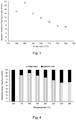
- Fig. 3 shows the absolute amounts of produced hydrogen in mmol for each experiment. These amounts were calculated by applying the measured total amounts of gas and the mass fractions of hydrogen gas. At an initial carbon dioxide overpressure of 5 bar, a maximum of approximately 7 bar hydrogen gas at a reaction temperature of 160 °C is found.
- the X-ray powder diffraction results clearly point out the influence of the amounts of carbon dioxide used on the final solid product compositions. Indeed, the results reveal that metallic iron is converted into magnetite at all applied temperatures, except at 120 °C. Moreover, the highest amount of magnetite is found at a reaction temperature of 160 °C, which is in agreement with the maximal amount of hydrogen gas produced.
- reaction towards magnetite may be induced by altered kinetics.
- a higher reaction temperature may also have a negative influence on the reaction, since the overall reaction R. 1 is exothermic.
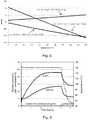
- Fig. 5 suggest that R. 4, which is the conversion of metallic iron in iron(II) carbonate, becomes thermodynamically more difficult as temperature increases due to a less negative difference in the Gibbs free energy.
- the conversion of iron(II) carbonate in iron(II,III) oxide (R. 5) preferably takes place at higher temperatures because of a decrease of the difference in the Gibbs free energy as a function of temperature.
- R. 4 and R. 5 have opposite optimum temperature conditions.
- This observation suggests that an optimum reaction temperature for R. 1 can be expected, probably at lower temperatures, in order to obtain the highest percentage yield of hydrogen gas.
- the presumption is reinforced by the observation that no siderite is observed in the solid phase after hydrothermal treatment, indicating that R.
- the reactor pressure changes as follows: firstly, during the first 10 minutes, the reaction pressure decreases due to carbon dioxide dissolution and the non-existing or weak autogeneous pressure effect of water ( ⁇ 130 °C). Secondly, the autogeneous pressure of water increases in a time span of 20 minutes as a result of the rising temperature (130 - 160 °C). Thirdly, after a small temperature overshoot, the reaction temperature settles to 160 °C and the reaction pressure increases further what can be explained by the formation of hydrogen gas (160 °C). Finally, after a reaction time of 16 hours, the reactor is cooled. Hence, the reactor pressure decreases due to the attenuation and eventually the disappearance of the autogeneous pressure effect of water.
- the reactor pressure present after reaction at 30 °C which is defined as the end pressure, is mainly derived from the formed hydrogen gas, as described above.
- Fig. 6 further shows that a steeper rise in pressure is obtained for 5 ⁇ m iron powder, with respect to the same amount of coarser 100 ⁇ m powder, thus indicating that the reactivity (i.e. reaction kinetics) is correlated to the available specific surface area.
- the reaction rate can be calculated to be approximately 2.5 times higher for 5 ⁇ m iron powder compared to 100 ⁇ m iron powder.
- the derivatives of the smoothed pressure-time curves suggest that the effective reaction time, defined as the time span after which the reactor pressure becomes constant, is approximately 12 hours in case of 5 ⁇ m grains and at least 16 hours for 100 ⁇ m grains.
- the difference in end pressure which is an indicator for the amount of hydrogen produced, proves that the conversion of metallic iron into magnetite is more complete for finer iron grain sizes.
- the percentage hydrogen yields of the hydrothermal treatments of the two metallic iron powder were calculated based on R. 1 and the ideal gas law with the measured end pressure at 30 °C, the measured mass fraction of hydrogen gas and the estimated gas volume as parameters.
- the percentage hydrogen yields are 81% for the 5 ⁇ m powder and 38% for the 100 ⁇ m powder.
- the percentage magnetite yields were similarly evaluated at respectively 78% and 36%.
- pi(CO2) 5 bar is equal to 15 mmol carbon dioxide (calculated by applying the ideal gas law with 25 °C and 60 mL as parameters). This amount of carbon dioxide is able to dissolve into 40 mL of a 1 M potassium hydroxide solution (i.e. 40 mmol KOH) of which the pH is (initially) approximately 14 (see Fig. 2 ). As experimentally observed, the absence of a buffering system and the occurrence of chemical equilibria of carbon dioxide in the liquid phase cause a decrease of pH to approximately 11. At this pH, carbon dioxide is in the liquid phase mainly present in the form of carbonate ions (CO 3 2- ).
- the first hydrothermal reference test applied a 40 mL 0.375 M potassium carbonate (J.T. Baker Chemical, 99.9%) aqueous solution (i.e. 15 mmol K2CO3), of which the pH amounted approximately 11,. This experiment was performed for 16 hours at 160 °C with 40 mmol of metallic iron powder with grain size of 5 ⁇ m in the presence of an anoxic (carbon dioxide flushed) atmosphere, without pi(CO2).
- the second hydrothermal reference experiment aimed to investigate the absence of KOH in the reaction system and applied 40 mL Milli-Q water.
- R. 9 is known as hydrogen corrosion, a metal corrosion reaction which occurs in the presence of anoxic water.
- R. 10 is known as the "Schikorr reaction”. These partial reactions are based on iron(II) hydroxide as intermediate.
- Fig. 7 shows the obtained results of the second series of reference experiments with nitrogen gas compared with similar experiments with carbon dioxide gas.
- a reference experiment was conducted to assess the effect of the pH of the reaction medium on the hydrogen yield.
- the experiment was carried out at 160 °C for 16 hours with the following loading conditions: 4.10 -2 mol metallic iron powder with average grain size of approximately 10 ⁇ m, 40 mL of degassed ultrapure water (Milli-QTM water) and 5 bar carbon dioxide gas (overpressure). Hence, no base was added to the reaction medium.
- the initial pH of the ultrapure water which was contacted with the metallic iron was between 6.5 and 7.
- the reactor content was cooled to room temperature.
- the obtained end pressure at room temperature was approximately 10.5 bar (absolute).
- the gas phase within the reactor at the end of the process comprised 70 to 75mol% hydrogen gas and 30-25mol% carbon dioxide gas.
- the analysis of the obtained solid phase by x-ray powder diffraction showed the presence of minimum three crystalline phases: besides Fe 0 and Fe 3 O 4 also FeCO 3 was found.
- the pH of the reaction medium after reaction was approximately 6.
- the final gas composition and reaction medium pH indicate an incomplete dissolution and conversion of carbon dioxide gas to carbonate ions.
- a base e.g. KOH
- the formation of (stable) FeCO 3 may be explained according to the proposed occurring reaction R. 5: following Le Culier's principle the conversion of FeCO 3 into Fe 3 O 4 , which is directly related with the formation of hydrogen gas, occurs preferably at low to negligible carbon dioxide concentrations.
- Le Culier's principle the conversion of FeCO 3 into Fe 3 O 4 , which is directly related with the formation of hydrogen gas, occurs preferably at low to negligible carbon dioxide concentrations.
Landscapes
- Chemical & Material Sciences (AREA)
- Organic Chemistry (AREA)
- Health & Medical Sciences (AREA)
- Chemical Kinetics & Catalysis (AREA)
- General Health & Medical Sciences (AREA)
- Engineering & Computer Science (AREA)
- Combustion & Propulsion (AREA)
- Inorganic Chemistry (AREA)
- Compounds Of Iron (AREA)
Claims (15)
- Verfahren zur Synthese von Wasserstoffgas (H2) in einem Reaktor unter hydrothermischen Bedingungen, umfassend:(a) Inkontaktbringen von metallischem Eisen (Fe0) und/oder einer Fe(II)-umfassenden Verbindung mit einer wässrigen Zusammensetzung, die einen pH-Wert von 6,5 oder höher aufweist und die Carbonat- und Bicarbonationen in einer Gesamtkonzentration von zumindest 0,01 M umfasst, wodurch eine Reaktionsmischung erhalten wird; und Aussetzen der besagten Reaktionsmischung gegenüber hydrothermischen Bedingungen;(b) Reagieren der besagten Reaktionsmischung bei einer Reaktionstemperatur von mehr als 120 °C und nicht mehr als 240 °C und einem Druck zwischen 1 Bar und 70 Bar; wodurch Magnetit und Wasserstoffgas erhalten wird.
- Das Verfahren nach Anspruch 1, wobei die Gesamtmenge an Kohlendioxid, Carbonsäure, Bicarbonat und Carbonat im besagten Reaktor unter 0,75 Mol pro Liter der wässrigen Zusammensetzung liegt.
- Das Verfahren nach Anspruch 1 oder 2, wobei die besagte Fe(II)-umfassende Verbindung aus der Liste ausgewählt ist, bestehend aus Eisencarbonat, Wüstit, Troilit, Pyrrhotit und Pyrit.
- Das Verfahren nach einem der Ansprüche 1 bis 3, wobei die besagte wässrige Zusammensetzung einen pH-Wert von 7 oder höher aufweist und zumindest 0,05 M Carbonationen umfasst.
- Das Verfahren nach einem der Ansprüche 1 bis 4, wobei die besagte wässrige Zusammensetzung durch Auflösen einer geeigneten Menge eines Carbonats und/oder Bicarbonats in einer wässrigen Flüssigkeit und optional Einstellen des pH-Werts der besagten Flüssigkeit erhalten wird.
- Das Verfahren nach einem der Ansprüche 1 bis 5, wobei die besagte wässrige Zusammensetzung durch Auflösen einer geeigneten Menge an Kohlendioxid in einer wässrigen Flüssigkeit erhalten wird.
- Das Verfahren nach einem der Ansprüche 1 bis 6, wobei die Ausgangsatmosphäre im besagten Reaktor zumindest 90 Gew.-% Kohlendioxid und/oder Wasserdampf umfasst.
- Das Verfahren nach einem der Ansprüche 1 bis 7, wobei die besagte Reaktion bei einer Temperatur von mehr als 130 °C und nicht mehr als 180 °C durchgeführt wird.
- Das Verfahren nach einem der Ansprüche 1 bis 8, wobei die besagte Reaktion bei einem Druck zwischen 5 Bar und 30 Bar durchgeführt wird.
- Das Verfahren nach einem der Ansprüche 1 bis 9, wobei die besagte wässrige Zusammensetzung einen pH-Wert zwischen 6,5 und 12 aufweist.
- Das Verfahren nach einem der Ansprüche 1 bis 10, wobei das besagte metallische Eisen und/oder die Fe(II)-haltige Verbindung als Pulver bereitgestellt wird.
- Das Verfahren nach einem der Ansprüche 1 bis 11, wobei die besagte Reaktion in einem geschlossenen Reaktor durchgeführt wird, wobei die besagte wässrige Zusammensetzung zwischen 20 % und 60 % des internen Reaktorvolumens einnimmt.
- Das Verfahren nach einem der Ansprüche 1 bis 12, wobei die besagte Reaktion in einer Atmosphäre durchgeführt wird, die weniger als 1 Gew.-% Sauerstoff umfasst.
- Das Verfahren nach einem der Ansprüche 1 bis 13, umfassend das Inkontaktbringen von metallischem Eisen und/oder einer Fe(II) enthaltenden Verbindung mit einer wässrigen Zusammensetzung, die einen pH-Wert von 10 oder höher aufweist und die Carbonationen in einer Konzentration von zumindest 0,01 M umfasst, bei einer Temperatur von mehr als 130 °C und nicht mehr als 180 °C und einem Druck zwischen 1 Bar und 30 Bar; wodurch Magnetit und Wasserstoffgas erhalten wird;
wobei die Gesamtmenge an Kohlendioxid, Carbonsäure, Bicarbonat und Carbonat im besagten Reaktor unter 0,50 Mol pro Liter der wässrigen Zusammensetzung liegt. - Verfahren zum Behandeln eines Abfallstroms, der metallisches Eisen und/oder eine Fe(II) umfassende Verbindung umfasst, das umfasst:- Inkontaktbringen des besagten Abfallstroms mit einer wässrigen Zusammensetzung, die eine Gesamtkonzentration von Carbonat- und Bicarbonationen von zumindest 0,01 M umfasst;- wenn die besagte wässrige Zusammensetzung einen pH-Wert von 6,5 oder weniger aufweist, Einstellen des pH-Werts der besagten wässrigen Zusammensetzung auf einen pH-Wert von mehr als 6,5; und- Erhitzen der besagten wässrigen Zusammensetzung bei einer Temperatur von mehr als 100 ° und nicht mehr als 240 ° und einem Druck zwischen 1 Bar und 50 Bar; wodurch Magnetit und Wasserstoffgas erhalten wird.
Priority Applications (1)
| Application Number | Priority Date | Filing Date | Title |
|---|---|---|---|
| PL15748206T PL3194331T3 (pl) | 2014-09-19 | 2015-07-27 | Sposób syntezy wodoru |
Applications Claiming Priority (2)
| Application Number | Priority Date | Filing Date | Title |
|---|---|---|---|
| EP14185630 | 2014-09-19 | ||
| PCT/EP2015/067143 WO2016041672A1 (en) | 2014-09-19 | 2015-07-27 | Process for hydrogen synthesis |
Publications (2)
| Publication Number | Publication Date |
|---|---|
| EP3194331A1 EP3194331A1 (de) | 2017-07-26 |
| EP3194331B1 true EP3194331B1 (de) | 2018-09-12 |
Family
ID=51570391
Family Applications (1)
| Application Number | Title | Priority Date | Filing Date |
|---|---|---|---|
| EP15748206.8A Active EP3194331B1 (de) | 2014-09-19 | 2015-07-27 | Verfahren zur wasserstoffsynthese |
Country Status (4)
| Country | Link |
|---|---|
| EP (1) | EP3194331B1 (de) |
| ES (1) | ES2701072T3 (de) |
| PL (1) | PL3194331T3 (de) |
| WO (1) | WO2016041672A1 (de) |
Cited By (5)
| Publication number | Priority date | Publication date | Assignee | Title |
|---|---|---|---|---|
| WO2025008146A1 (de) * | 2023-07-04 | 2025-01-09 | Ks Ipr Ug | Verfahren zur herstellung von wasserstoff und magnetit aus wasser und eisen |
| US20250059033A1 (en) * | 2023-08-14 | 2025-02-20 | Saudi Arabian Oil Company | Systems and methods for producing hydrogen gas from methane and carbon dioxide |
| WO2025038466A1 (en) * | 2023-08-14 | 2025-02-20 | Saudi Arabian Oil Company | Systems and methods for producing hydrogen gas from methane and oxygen |
| WO2025038465A1 (en) * | 2023-08-14 | 2025-02-20 | Saudi Arabian Oil Company | Systems and methods for producing hydrogen gas from water and methane |
| IT202400002082A1 (it) * | 2024-02-01 | 2025-08-01 | Nexh2Gen S R L | Procedimento di produzione di idrogeno |
Families Citing this family (4)
| Publication number | Priority date | Publication date | Assignee | Title |
|---|---|---|---|---|
| CN111252735B (zh) * | 2020-03-19 | 2023-04-07 | 上海交通大学 | 复合金属协同水热分解水制备氢气的方法 |
| WO2022084996A1 (en) * | 2020-10-20 | 2022-04-28 | Tykhe Tech Pte. Ltd. | A method for the production of ammonia |
| WO2022084995A1 (en) * | 2020-10-20 | 2022-04-28 | Tykhe Tech Pte. Ltd. | A method for the production of hydrogen |
| US20240293772A1 (en) * | 2021-06-09 | 2024-09-05 | Cyprus University Of Technology | System and method for carbon capture and utilization |
Family Cites Families (3)
| Publication number | Priority date | Publication date | Assignee | Title |
|---|---|---|---|---|
| DE266863C (de) | ||||
| WO2013151973A1 (en) * | 2012-04-06 | 2013-10-10 | California Institute Of Technology | New methods and materials for the thermochemical production of hydrogen from water |
| KR101356067B1 (ko) * | 2012-08-21 | 2014-01-28 | 주식회사 포스코 | 이산화탄소 고정방법 및 장치 |
-
2015
- 2015-07-27 EP EP15748206.8A patent/EP3194331B1/de active Active
- 2015-07-27 ES ES15748206T patent/ES2701072T3/es active Active
- 2015-07-27 WO PCT/EP2015/067143 patent/WO2016041672A1/en not_active Ceased
- 2015-07-27 PL PL15748206T patent/PL3194331T3/pl unknown
Non-Patent Citations (1)
| Title |
|---|
| None * |
Cited By (8)
| Publication number | Priority date | Publication date | Assignee | Title |
|---|---|---|---|---|
| WO2025008146A1 (de) * | 2023-07-04 | 2025-01-09 | Ks Ipr Ug | Verfahren zur herstellung von wasserstoff und magnetit aus wasser und eisen |
| US20250059033A1 (en) * | 2023-08-14 | 2025-02-20 | Saudi Arabian Oil Company | Systems and methods for producing hydrogen gas from methane and carbon dioxide |
| WO2025038466A1 (en) * | 2023-08-14 | 2025-02-20 | Saudi Arabian Oil Company | Systems and methods for producing hydrogen gas from methane and oxygen |
| WO2025038463A1 (en) * | 2023-08-14 | 2025-02-20 | Saudi Arabian Oil Company | Systems and methods for producing hydrogen gas from methane and carbon dioxide |
| WO2025038465A1 (en) * | 2023-08-14 | 2025-02-20 | Saudi Arabian Oil Company | Systems and methods for producing hydrogen gas from water and methane |
| US20250059028A1 (en) * | 2023-08-14 | 2025-02-20 | Saudi Arabian Oil Company | Systems and methods for producing hydrogen gas from methane and oxygen |
| IT202400002082A1 (it) * | 2024-02-01 | 2025-08-01 | Nexh2Gen S R L | Procedimento di produzione di idrogeno |
| WO2025163688A1 (en) * | 2024-02-01 | 2025-08-07 | Nexh2Gen S.R.L. | Hydrogen production method |
Also Published As
| Publication number | Publication date |
|---|---|
| WO2016041672A1 (en) | 2016-03-24 |
| PL3194331T3 (pl) | 2019-03-29 |
| ES2701072T3 (es) | 2019-02-20 |
| EP3194331A1 (de) | 2017-07-26 |
Similar Documents
| Publication | Publication Date | Title |
|---|---|---|
| EP3194331A1 (de) | Verfahren zur wasserstoffsynthese | |
| Sun et al. | Dual active sites over Cu-ZnO-ZrO2 catalysts for carbon dioxide hydrogenation to methanol | |
| Michiels et al. | Production of hydrogen gas from water by the oxidation of metallic iron under mild hydrothermal conditions, assisted by in situ formed carbonate ions | |
| US7682589B2 (en) | Method for industrial manufacture of pure MgCO3 from an olivine containing species of rock | |
| Meyer et al. | Mineral carbonation of PGM mine tailings for CO2 storage in South Africa: A case study | |
| US20080317665A1 (en) | Compositions and methods for generating hydrogen from water | |
| US20040208820A1 (en) | Method for producing hydrogen gas utilizing mechano-corrosive reaction | |
| FR2480308A1 (fr) | Procede de recuperation de metaux refractaires | |
| Zhang et al. | Enhanced activity and stability of copper oxide/γ-alumina catalyst in catalytic wet-air oxidation: Critical roles of cerium incorporation | |
| KR20110098513A (ko) | 금속 나노입자의 세정방법 | |
| FR3009828A1 (fr) | Procede pour recuperer des metaux de valeur a partir d'oxydes de materiaux contenant du manganese | |
| Qu et al. | Pre-extraction of Li from spent lithium-ion batteries through an Ethanol-Water vapor thermal reduction approach | |
| del Rio et al. | Catalytic hydrothermal conversion of CO2 captured by ammonia into formate using aluminum-sourced hydrogen at mild reaction conditions | |
| Yang et al. | Effect of KMnO4 on the migration and transformation of Mn2+ and NH4+-N in electrolytic manganese residue: Autocatalytic system of manganese (Mn2+-MnO2-Mn2+) | |
| Cheng et al. | Acidic leaching kinetics study on vanadium from magnesiation-roasted vanadium slag | |
| Hu et al. | Mechanism of catalytic subcritical water oxidation of m-nitroaniline and nitrogen conversion by CuCo2O4 catalyst | |
| Zoppas et al. | Maximizing selectivity and activity in the catalytic reduction of nitrates with formic acid under optimal pH conditions | |
| Ceyssens et al. | Mechanochemical Activation of Argon Oxygen Decarburization Slags for Improved Mineral Carbonation | |
| Eba et al. | Progress of hydrogen gas generation by reaction between iron and steel powder and carbonate water in the temperature range near room temperature | |
| FR3052160A1 (fr) | Procede de preparation de nanomagnetite | |
| Kesavan et al. | Conversion of steel mill waste into nanoscale zerovalent iron (nZVI) particles for hydrogen generation via metal-steam reforming | |
| US11305989B2 (en) | Catalytic hydrogen production | |
| Zeng et al. | Unlocking the potential of pyrite by mechanochemistry ball mill for efficient heterogeneous Fenton degradation of florfenicol | |
| EP4351764B1 (de) | System und verfahren zur kohlenstoffabscheidung und -verwendung | |
| JP2011168568A (ja) | 二酸化炭素を酢酸に変換する方法、およびそれに用いられる触媒 |
Legal Events
| Date | Code | Title | Description |
|---|---|---|---|
| STAA | Information on the status of an ep patent application or granted ep patent |
Free format text: STATUS: THE INTERNATIONAL PUBLICATION HAS BEEN MADE |
|
| PUAI | Public reference made under article 153(3) epc to a published international application that has entered the european phase |
Free format text: ORIGINAL CODE: 0009012 |
|
| STAA | Information on the status of an ep patent application or granted ep patent |
Free format text: STATUS: REQUEST FOR EXAMINATION WAS MADE |
|
| 17P | Request for examination filed |
Effective date: 20170310 |
|
| AK | Designated contracting states |
Kind code of ref document: A1 Designated state(s): AL AT BE BG CH CY CZ DE DK EE ES FI FR GB GR HR HU IE IS IT LI LT LU LV MC MK MT NL NO PL PT RO RS SE SI SK SM TR |
|
| AX | Request for extension of the european patent |
Extension state: BA ME |
|
| DAV | Request for validation of the european patent (deleted) | ||
| DAX | Request for extension of the european patent (deleted) | ||
| GRAP | Despatch of communication of intention to grant a patent |
Free format text: ORIGINAL CODE: EPIDOSNIGR1 |
|
| STAA | Information on the status of an ep patent application or granted ep patent |
Free format text: STATUS: GRANT OF PATENT IS INTENDED |
|
| INTG | Intention to grant announced |
Effective date: 20180326 |
|
| GRAS | Grant fee paid |
Free format text: ORIGINAL CODE: EPIDOSNIGR3 |
|
| GRAA | (expected) grant |
Free format text: ORIGINAL CODE: 0009210 |
|
| STAA | Information on the status of an ep patent application or granted ep patent |
Free format text: STATUS: THE PATENT HAS BEEN GRANTED |
|
| AK | Designated contracting states |
Kind code of ref document: B1 Designated state(s): AL AT BE BG CH CY CZ DE DK EE ES FI FR GB GR HR HU IE IS IT LI LT LU LV MC MK MT NL NO PL PT RO RS SE SI SK SM TR |
|
| REG | Reference to a national code |
Ref country code: GB Ref legal event code: FG4D |
|
| REG | Reference to a national code |
Ref country code: CH Ref legal event code: EP |
|
| REG | Reference to a national code |
Ref country code: IE Ref legal event code: FG4D |
|
| REG | Reference to a national code |
Ref country code: DE Ref legal event code: R096 Ref document number: 602015016187 Country of ref document: DE |
|
| REG | Reference to a national code |
Ref country code: AT Ref legal event code: REF Ref document number: 1040329 Country of ref document: AT Kind code of ref document: T Effective date: 20181015 |
|
| REG | Reference to a national code |
Ref country code: CH Ref legal event code: NV Representative=s name: PRONOVEM SWISS LTD., CH |
|
| REG | Reference to a national code |
Ref country code: SE Ref legal event code: TRGR |
|
| REG | Reference to a national code |
Ref country code: NL Ref legal event code: FP |
|
| REG | Reference to a national code |
Ref country code: LT Ref legal event code: MG4D |
|
| PG25 | Lapsed in a contracting state [announced via postgrant information from national office to epo] |
Ref country code: NO Free format text: LAPSE BECAUSE OF FAILURE TO SUBMIT A TRANSLATION OF THE DESCRIPTION OR TO PAY THE FEE WITHIN THE PRESCRIBED TIME-LIMIT Effective date: 20181212 Ref country code: RS Free format text: LAPSE BECAUSE OF FAILURE TO SUBMIT A TRANSLATION OF THE DESCRIPTION OR TO PAY THE FEE WITHIN THE PRESCRIBED TIME-LIMIT Effective date: 20180912 Ref country code: GR Free format text: LAPSE BECAUSE OF FAILURE TO SUBMIT A TRANSLATION OF THE DESCRIPTION OR TO PAY THE FEE WITHIN THE PRESCRIBED TIME-LIMIT Effective date: 20181213 Ref country code: FI Free format text: LAPSE BECAUSE OF FAILURE TO SUBMIT A TRANSLATION OF THE DESCRIPTION OR TO PAY THE FEE WITHIN THE PRESCRIBED TIME-LIMIT Effective date: 20180912 Ref country code: BG Free format text: LAPSE BECAUSE OF FAILURE TO SUBMIT A TRANSLATION OF THE DESCRIPTION OR TO PAY THE FEE WITHIN THE PRESCRIBED TIME-LIMIT Effective date: 20181212 Ref country code: LT Free format text: LAPSE BECAUSE OF FAILURE TO SUBMIT A TRANSLATION OF THE DESCRIPTION OR TO PAY THE FEE WITHIN THE PRESCRIBED TIME-LIMIT Effective date: 20180912 |
|
| REG | Reference to a national code |
Ref country code: ES Ref legal event code: FG2A Ref document number: 2701072 Country of ref document: ES Kind code of ref document: T3 Effective date: 20190220 |
|
| PG25 | Lapsed in a contracting state [announced via postgrant information from national office to epo] |
Ref country code: HR Free format text: LAPSE BECAUSE OF FAILURE TO SUBMIT A TRANSLATION OF THE DESCRIPTION OR TO PAY THE FEE WITHIN THE PRESCRIBED TIME-LIMIT Effective date: 20180912 Ref country code: LV Free format text: LAPSE BECAUSE OF FAILURE TO SUBMIT A TRANSLATION OF THE DESCRIPTION OR TO PAY THE FEE WITHIN THE PRESCRIBED TIME-LIMIT Effective date: 20180912 Ref country code: AL Free format text: LAPSE BECAUSE OF FAILURE TO SUBMIT A TRANSLATION OF THE DESCRIPTION OR TO PAY THE FEE WITHIN THE PRESCRIBED TIME-LIMIT Effective date: 20180912 |
|
| REG | Reference to a national code |
Ref country code: AT Ref legal event code: MK05 Ref document number: 1040329 Country of ref document: AT Kind code of ref document: T Effective date: 20180912 |
|
| PG25 | Lapsed in a contracting state [announced via postgrant information from national office to epo] |
Ref country code: CZ Free format text: LAPSE BECAUSE OF FAILURE TO SUBMIT A TRANSLATION OF THE DESCRIPTION OR TO PAY THE FEE WITHIN THE PRESCRIBED TIME-LIMIT Effective date: 20180912 Ref country code: RO Free format text: LAPSE BECAUSE OF FAILURE TO SUBMIT A TRANSLATION OF THE DESCRIPTION OR TO PAY THE FEE WITHIN THE PRESCRIBED TIME-LIMIT Effective date: 20180912 Ref country code: IS Free format text: LAPSE BECAUSE OF FAILURE TO SUBMIT A TRANSLATION OF THE DESCRIPTION OR TO PAY THE FEE WITHIN THE PRESCRIBED TIME-LIMIT Effective date: 20190112 Ref country code: EE Free format text: LAPSE BECAUSE OF FAILURE TO SUBMIT A TRANSLATION OF THE DESCRIPTION OR TO PAY THE FEE WITHIN THE PRESCRIBED TIME-LIMIT Effective date: 20180912 Ref country code: AT Free format text: LAPSE BECAUSE OF FAILURE TO SUBMIT A TRANSLATION OF THE DESCRIPTION OR TO PAY THE FEE WITHIN THE PRESCRIBED TIME-LIMIT Effective date: 20180912 |
|
| PG25 | Lapsed in a contracting state [announced via postgrant information from national office to epo] |
Ref country code: PT Free format text: LAPSE BECAUSE OF FAILURE TO SUBMIT A TRANSLATION OF THE DESCRIPTION OR TO PAY THE FEE WITHIN THE PRESCRIBED TIME-LIMIT Effective date: 20190112 Ref country code: SM Free format text: LAPSE BECAUSE OF FAILURE TO SUBMIT A TRANSLATION OF THE DESCRIPTION OR TO PAY THE FEE WITHIN THE PRESCRIBED TIME-LIMIT Effective date: 20180912 Ref country code: SK Free format text: LAPSE BECAUSE OF FAILURE TO SUBMIT A TRANSLATION OF THE DESCRIPTION OR TO PAY THE FEE WITHIN THE PRESCRIBED TIME-LIMIT Effective date: 20180912 |
|
| REG | Reference to a national code |
Ref country code: DE Ref legal event code: R097 Ref document number: 602015016187 Country of ref document: DE |
|
| PLBE | No opposition filed within time limit |
Free format text: ORIGINAL CODE: 0009261 |
|
| STAA | Information on the status of an ep patent application or granted ep patent |
Free format text: STATUS: NO OPPOSITION FILED WITHIN TIME LIMIT |
|
| PG25 | Lapsed in a contracting state [announced via postgrant information from national office to epo] |
Ref country code: DK Free format text: LAPSE BECAUSE OF FAILURE TO SUBMIT A TRANSLATION OF THE DESCRIPTION OR TO PAY THE FEE WITHIN THE PRESCRIBED TIME-LIMIT Effective date: 20180912 |
|
| PGFP | Annual fee paid to national office [announced via postgrant information from national office to epo] |
Ref country code: PL Payment date: 20190625 Year of fee payment: 5 |
|
| 26N | No opposition filed |
Effective date: 20190613 |
|
| PG25 | Lapsed in a contracting state [announced via postgrant information from national office to epo] |
Ref country code: SI Free format text: LAPSE BECAUSE OF FAILURE TO SUBMIT A TRANSLATION OF THE DESCRIPTION OR TO PAY THE FEE WITHIN THE PRESCRIBED TIME-LIMIT Effective date: 20180912 |
|
| PGFP | Annual fee paid to national office [announced via postgrant information from national office to epo] |
Ref country code: CH Payment date: 20190624 Year of fee payment: 5 |
|
| PGFP | Annual fee paid to national office [announced via postgrant information from national office to epo] |
Ref country code: TR Payment date: 20190709 Year of fee payment: 5 |
|
| PG25 | Lapsed in a contracting state [announced via postgrant information from national office to epo] |
Ref country code: MC Free format text: LAPSE BECAUSE OF FAILURE TO SUBMIT A TRANSLATION OF THE DESCRIPTION OR TO PAY THE FEE WITHIN THE PRESCRIBED TIME-LIMIT Effective date: 20180912 |
|
| PG25 | Lapsed in a contracting state [announced via postgrant information from national office to epo] |
Ref country code: LU Free format text: LAPSE BECAUSE OF NON-PAYMENT OF DUE FEES Effective date: 20190727 |
|
| PG25 | Lapsed in a contracting state [announced via postgrant information from national office to epo] |
Ref country code: IE Free format text: LAPSE BECAUSE OF NON-PAYMENT OF DUE FEES Effective date: 20190727 |
|
| REG | Reference to a national code |
Ref country code: CH Ref legal event code: PL |
|
| PG25 | Lapsed in a contracting state [announced via postgrant information from national office to epo] |
Ref country code: CH Free format text: LAPSE BECAUSE OF NON-PAYMENT OF DUE FEES Effective date: 20200731 Ref country code: LI Free format text: LAPSE BECAUSE OF NON-PAYMENT OF DUE FEES Effective date: 20200731 |
|
| PG25 | Lapsed in a contracting state [announced via postgrant information from national office to epo] |
Ref country code: CY Free format text: LAPSE BECAUSE OF FAILURE TO SUBMIT A TRANSLATION OF THE DESCRIPTION OR TO PAY THE FEE WITHIN THE PRESCRIBED TIME-LIMIT Effective date: 20180912 |
|
| PG25 | Lapsed in a contracting state [announced via postgrant information from national office to epo] |
Ref country code: MT Free format text: LAPSE BECAUSE OF FAILURE TO SUBMIT A TRANSLATION OF THE DESCRIPTION OR TO PAY THE FEE WITHIN THE PRESCRIBED TIME-LIMIT Effective date: 20180912 Ref country code: HU Free format text: LAPSE BECAUSE OF FAILURE TO SUBMIT A TRANSLATION OF THE DESCRIPTION OR TO PAY THE FEE WITHIN THE PRESCRIBED TIME-LIMIT; INVALID AB INITIO Effective date: 20150727 |
|
| PG25 | Lapsed in a contracting state [announced via postgrant information from national office to epo] |
Ref country code: TR Free format text: LAPSE BECAUSE OF NON-PAYMENT OF DUE FEES Effective date: 20200727 Ref country code: MK Free format text: LAPSE BECAUSE OF FAILURE TO SUBMIT A TRANSLATION OF THE DESCRIPTION OR TO PAY THE FEE WITHIN THE PRESCRIBED TIME-LIMIT Effective date: 20180912 |
|
| PG25 | Lapsed in a contracting state [announced via postgrant information from national office to epo] |
Ref country code: PL Free format text: LAPSE BECAUSE OF NON-PAYMENT OF DUE FEES Effective date: 20200727 |
|
| P01 | Opt-out of the competence of the unified patent court (upc) registered |
Effective date: 20230524 |
|
| PGFP | Annual fee paid to national office [announced via postgrant information from national office to epo] |
Ref country code: GB Payment date: 20250619 Year of fee payment: 11 |
|
| PGFP | Annual fee paid to national office [announced via postgrant information from national office to epo] |
Ref country code: NL Payment date: 20250620 Year of fee payment: 11 Ref country code: BE Payment date: 20250619 Year of fee payment: 11 |
|
| PGFP | Annual fee paid to national office [announced via postgrant information from national office to epo] |
Ref country code: FR Payment date: 20250620 Year of fee payment: 11 |
|
| PGFP | Annual fee paid to national office [announced via postgrant information from national office to epo] |
Ref country code: SE Payment date: 20250619 Year of fee payment: 11 |
|
| PGFP | Annual fee paid to national office [announced via postgrant information from national office to epo] |
Ref country code: ES Payment date: 20250801 Year of fee payment: 11 |
|
| PGFP | Annual fee paid to national office [announced via postgrant information from national office to epo] |
Ref country code: DE Payment date: 20250620 Year of fee payment: 11 |
|
| PGFP | Annual fee paid to national office [announced via postgrant information from national office to epo] |
Ref country code: IT Payment date: 20250619 Year of fee payment: 11 |