EP3193068A1 - Heat insulation material and method for producing same - Google Patents
Heat insulation material and method for producing same Download PDFInfo
- Publication number
- EP3193068A1 EP3193068A1 EP15840444.2A EP15840444A EP3193068A1 EP 3193068 A1 EP3193068 A1 EP 3193068A1 EP 15840444 A EP15840444 A EP 15840444A EP 3193068 A1 EP3193068 A1 EP 3193068A1
- Authority
- EP
- European Patent Office
- Prior art keywords
- heat
- insulation material
- heat insulation
- resin
- thermoplastic resin
- Prior art date
- Legal status (The legal status is an assumption and is not a legal conclusion. Google has not performed a legal analysis and makes no representation as to the accuracy of the status listed.)
- Withdrawn
Links
Images


Classifications
-
- F—MECHANICAL ENGINEERING; LIGHTING; HEATING; WEAPONS; BLASTING
- F16—ENGINEERING ELEMENTS AND UNITS; GENERAL MEASURES FOR PRODUCING AND MAINTAINING EFFECTIVE FUNCTIONING OF MACHINES OR INSTALLATIONS; THERMAL INSULATION IN GENERAL
- F16L—PIPES; JOINTS OR FITTINGS FOR PIPES; SUPPORTS FOR PIPES, CABLES OR PROTECTIVE TUBING; MEANS FOR THERMAL INSULATION IN GENERAL
- F16L59/00—Thermal insulation in general
- F16L59/02—Shape or form of insulating materials, with or without coverings integral with the insulating materials
- F16L59/029—Shape or form of insulating materials, with or without coverings integral with the insulating materials layered
-
- B—PERFORMING OPERATIONS; TRANSPORTING
- B32—LAYERED PRODUCTS
- B32B—LAYERED PRODUCTS, i.e. PRODUCTS BUILT-UP OF STRATA OF FLAT OR NON-FLAT, e.g. CELLULAR OR HONEYCOMB, FORM
- B32B5/00—Layered products characterised by the non- homogeneity or physical structure, i.e. comprising a fibrous, filamentary, particulate or foam layer; Layered products characterised by having a layer differing constitutionally or physically in different parts
- B32B5/22—Layered products characterised by the non- homogeneity or physical structure, i.e. comprising a fibrous, filamentary, particulate or foam layer; Layered products characterised by having a layer differing constitutionally or physically in different parts characterised by the presence of two or more layers which are next to each other and are fibrous, filamentary, formed of particles or foamed
- B32B5/24—Layered products characterised by the non- homogeneity or physical structure, i.e. comprising a fibrous, filamentary, particulate or foam layer; Layered products characterised by having a layer differing constitutionally or physically in different parts characterised by the presence of two or more layers which are next to each other and are fibrous, filamentary, formed of particles or foamed one layer being a fibrous or filamentary layer
- B32B5/26—Layered products characterised by the non- homogeneity or physical structure, i.e. comprising a fibrous, filamentary, particulate or foam layer; Layered products characterised by having a layer differing constitutionally or physically in different parts characterised by the presence of two or more layers which are next to each other and are fibrous, filamentary, formed of particles or foamed one layer being a fibrous or filamentary layer another layer next to it also being fibrous or filamentary
-
- B—PERFORMING OPERATIONS; TRANSPORTING
- B32—LAYERED PRODUCTS
- B32B—LAYERED PRODUCTS, i.e. PRODUCTS BUILT-UP OF STRATA OF FLAT OR NON-FLAT, e.g. CELLULAR OR HONEYCOMB, FORM
- B32B27/00—Layered products comprising a layer of synthetic resin
- B32B27/18—Layered products comprising a layer of synthetic resin characterised by the use of special additives
-
- B—PERFORMING OPERATIONS; TRANSPORTING
- B32—LAYERED PRODUCTS
- B32B—LAYERED PRODUCTS, i.e. PRODUCTS BUILT-UP OF STRATA OF FLAT OR NON-FLAT, e.g. CELLULAR OR HONEYCOMB, FORM
- B32B27/00—Layered products comprising a layer of synthetic resin
- B32B27/28—Layered products comprising a layer of synthetic resin comprising synthetic resins not wholly covered by any one of the sub-groups B32B27/30 - B32B27/42
- B32B27/281—Layered products comprising a layer of synthetic resin comprising synthetic resins not wholly covered by any one of the sub-groups B32B27/30 - B32B27/42 comprising polyimides
-
- B—PERFORMING OPERATIONS; TRANSPORTING
- B32—LAYERED PRODUCTS
- B32B—LAYERED PRODUCTS, i.e. PRODUCTS BUILT-UP OF STRATA OF FLAT OR NON-FLAT, e.g. CELLULAR OR HONEYCOMB, FORM
- B32B27/00—Layered products comprising a layer of synthetic resin
- B32B27/28—Layered products comprising a layer of synthetic resin comprising synthetic resins not wholly covered by any one of the sub-groups B32B27/30 - B32B27/42
- B32B27/283—Layered products comprising a layer of synthetic resin comprising synthetic resins not wholly covered by any one of the sub-groups B32B27/30 - B32B27/42 comprising polysiloxanes
-
- B—PERFORMING OPERATIONS; TRANSPORTING
- B32—LAYERED PRODUCTS
- B32B—LAYERED PRODUCTS, i.e. PRODUCTS BUILT-UP OF STRATA OF FLAT OR NON-FLAT, e.g. CELLULAR OR HONEYCOMB, FORM
- B32B27/00—Layered products comprising a layer of synthetic resin
- B32B27/30—Layered products comprising a layer of synthetic resin comprising vinyl (co)polymers; comprising acrylic (co)polymers
-
- B—PERFORMING OPERATIONS; TRANSPORTING
- B32—LAYERED PRODUCTS
- B32B—LAYERED PRODUCTS, i.e. PRODUCTS BUILT-UP OF STRATA OF FLAT OR NON-FLAT, e.g. CELLULAR OR HONEYCOMB, FORM
- B32B27/00—Layered products comprising a layer of synthetic resin
- B32B27/30—Layered products comprising a layer of synthetic resin comprising vinyl (co)polymers; comprising acrylic (co)polymers
- B32B27/302—Layered products comprising a layer of synthetic resin comprising vinyl (co)polymers; comprising acrylic (co)polymers comprising aromatic vinyl (co)polymers, e.g. styrenic (co)polymers
-
- B—PERFORMING OPERATIONS; TRANSPORTING
- B32—LAYERED PRODUCTS
- B32B—LAYERED PRODUCTS, i.e. PRODUCTS BUILT-UP OF STRATA OF FLAT OR NON-FLAT, e.g. CELLULAR OR HONEYCOMB, FORM
- B32B27/00—Layered products comprising a layer of synthetic resin
- B32B27/30—Layered products comprising a layer of synthetic resin comprising vinyl (co)polymers; comprising acrylic (co)polymers
- B32B27/304—Layered products comprising a layer of synthetic resin comprising vinyl (co)polymers; comprising acrylic (co)polymers comprising vinyl halide (co)polymers, e.g. PVC, PVDC, PVF, PVDF
-
- B—PERFORMING OPERATIONS; TRANSPORTING
- B32—LAYERED PRODUCTS
- B32B—LAYERED PRODUCTS, i.e. PRODUCTS BUILT-UP OF STRATA OF FLAT OR NON-FLAT, e.g. CELLULAR OR HONEYCOMB, FORM
- B32B27/00—Layered products comprising a layer of synthetic resin
- B32B27/30—Layered products comprising a layer of synthetic resin comprising vinyl (co)polymers; comprising acrylic (co)polymers
- B32B27/306—Layered products comprising a layer of synthetic resin comprising vinyl (co)polymers; comprising acrylic (co)polymers comprising vinyl acetate or vinyl alcohol (co)polymers
-
- B—PERFORMING OPERATIONS; TRANSPORTING
- B32—LAYERED PRODUCTS
- B32B—LAYERED PRODUCTS, i.e. PRODUCTS BUILT-UP OF STRATA OF FLAT OR NON-FLAT, e.g. CELLULAR OR HONEYCOMB, FORM
- B32B27/00—Layered products comprising a layer of synthetic resin
- B32B27/32—Layered products comprising a layer of synthetic resin comprising polyolefins
-
- B—PERFORMING OPERATIONS; TRANSPORTING
- B32—LAYERED PRODUCTS
- B32B—LAYERED PRODUCTS, i.e. PRODUCTS BUILT-UP OF STRATA OF FLAT OR NON-FLAT, e.g. CELLULAR OR HONEYCOMB, FORM
- B32B27/00—Layered products comprising a layer of synthetic resin
- B32B27/34—Layered products comprising a layer of synthetic resin comprising polyamides
-
- B—PERFORMING OPERATIONS; TRANSPORTING
- B32—LAYERED PRODUCTS
- B32B—LAYERED PRODUCTS, i.e. PRODUCTS BUILT-UP OF STRATA OF FLAT OR NON-FLAT, e.g. CELLULAR OR HONEYCOMB, FORM
- B32B27/00—Layered products comprising a layer of synthetic resin
- B32B27/36—Layered products comprising a layer of synthetic resin comprising polyesters
-
- B—PERFORMING OPERATIONS; TRANSPORTING
- B32—LAYERED PRODUCTS
- B32B—LAYERED PRODUCTS, i.e. PRODUCTS BUILT-UP OF STRATA OF FLAT OR NON-FLAT, e.g. CELLULAR OR HONEYCOMB, FORM
- B32B27/00—Layered products comprising a layer of synthetic resin
- B32B27/38—Layered products comprising a layer of synthetic resin comprising epoxy resins
-
- B—PERFORMING OPERATIONS; TRANSPORTING
- B32—LAYERED PRODUCTS
- B32B—LAYERED PRODUCTS, i.e. PRODUCTS BUILT-UP OF STRATA OF FLAT OR NON-FLAT, e.g. CELLULAR OR HONEYCOMB, FORM
- B32B27/00—Layered products comprising a layer of synthetic resin
- B32B27/40—Layered products comprising a layer of synthetic resin comprising polyurethanes
-
- B—PERFORMING OPERATIONS; TRANSPORTING
- B32—LAYERED PRODUCTS
- B32B—LAYERED PRODUCTS, i.e. PRODUCTS BUILT-UP OF STRATA OF FLAT OR NON-FLAT, e.g. CELLULAR OR HONEYCOMB, FORM
- B32B27/00—Layered products comprising a layer of synthetic resin
- B32B27/42—Layered products comprising a layer of synthetic resin comprising condensation resins of aldehydes, e.g. with phenols, ureas or melamines
-
- B—PERFORMING OPERATIONS; TRANSPORTING
- B32—LAYERED PRODUCTS
- B32B—LAYERED PRODUCTS, i.e. PRODUCTS BUILT-UP OF STRATA OF FLAT OR NON-FLAT, e.g. CELLULAR OR HONEYCOMB, FORM
- B32B37/00—Methods or apparatus for laminating, e.g. by curing or by ultrasonic bonding
-
- B—PERFORMING OPERATIONS; TRANSPORTING
- B32—LAYERED PRODUCTS
- B32B—LAYERED PRODUCTS, i.e. PRODUCTS BUILT-UP OF STRATA OF FLAT OR NON-FLAT, e.g. CELLULAR OR HONEYCOMB, FORM
- B32B37/00—Methods or apparatus for laminating, e.g. by curing or by ultrasonic bonding
- B32B37/10—Methods or apparatus for laminating, e.g. by curing or by ultrasonic bonding characterised by the pressing technique, e.g. using action of vacuum or fluid pressure
-
- B—PERFORMING OPERATIONS; TRANSPORTING
- B32—LAYERED PRODUCTS
- B32B—LAYERED PRODUCTS, i.e. PRODUCTS BUILT-UP OF STRATA OF FLAT OR NON-FLAT, e.g. CELLULAR OR HONEYCOMB, FORM
- B32B37/00—Methods or apparatus for laminating, e.g. by curing or by ultrasonic bonding
- B32B37/14—Methods or apparatus for laminating, e.g. by curing or by ultrasonic bonding characterised by the properties of the layers
-
- B—PERFORMING OPERATIONS; TRANSPORTING
- B32—LAYERED PRODUCTS
- B32B—LAYERED PRODUCTS, i.e. PRODUCTS BUILT-UP OF STRATA OF FLAT OR NON-FLAT, e.g. CELLULAR OR HONEYCOMB, FORM
- B32B37/00—Methods or apparatus for laminating, e.g. by curing or by ultrasonic bonding
- B32B37/14—Methods or apparatus for laminating, e.g. by curing or by ultrasonic bonding characterised by the properties of the layers
- B32B37/16—Methods or apparatus for laminating, e.g. by curing or by ultrasonic bonding characterised by the properties of the layers with all layers existing as coherent layers before laminating
- B32B37/18—Methods or apparatus for laminating, e.g. by curing or by ultrasonic bonding characterised by the properties of the layers with all layers existing as coherent layers before laminating involving the assembly of discrete sheets or panels only
-
- B—PERFORMING OPERATIONS; TRANSPORTING
- B32—LAYERED PRODUCTS
- B32B—LAYERED PRODUCTS, i.e. PRODUCTS BUILT-UP OF STRATA OF FLAT OR NON-FLAT, e.g. CELLULAR OR HONEYCOMB, FORM
- B32B38/00—Ancillary operations in connection with laminating processes
- B32B38/08—Impregnating
-
- B—PERFORMING OPERATIONS; TRANSPORTING
- B32—LAYERED PRODUCTS
- B32B—LAYERED PRODUCTS, i.e. PRODUCTS BUILT-UP OF STRATA OF FLAT OR NON-FLAT, e.g. CELLULAR OR HONEYCOMB, FORM
- B32B38/00—Ancillary operations in connection with laminating processes
- B32B38/18—Handling of layers or the laminate
- B32B38/1808—Handling of layers or the laminate characterised by the laying up of the layers
-
- B—PERFORMING OPERATIONS; TRANSPORTING
- B32—LAYERED PRODUCTS
- B32B—LAYERED PRODUCTS, i.e. PRODUCTS BUILT-UP OF STRATA OF FLAT OR NON-FLAT, e.g. CELLULAR OR HONEYCOMB, FORM
- B32B5/00—Layered products characterised by the non- homogeneity or physical structure, i.e. comprising a fibrous, filamentary, particulate or foam layer; Layered products characterised by having a layer differing constitutionally or physically in different parts
- B32B5/02—Layered products characterised by the non- homogeneity or physical structure, i.e. comprising a fibrous, filamentary, particulate or foam layer; Layered products characterised by having a layer differing constitutionally or physically in different parts characterised by structural features of a fibrous or filamentary layer
-
- B—PERFORMING OPERATIONS; TRANSPORTING
- B32—LAYERED PRODUCTS
- B32B—LAYERED PRODUCTS, i.e. PRODUCTS BUILT-UP OF STRATA OF FLAT OR NON-FLAT, e.g. CELLULAR OR HONEYCOMB, FORM
- B32B5/00—Layered products characterised by the non- homogeneity or physical structure, i.e. comprising a fibrous, filamentary, particulate or foam layer; Layered products characterised by having a layer differing constitutionally or physically in different parts
- B32B5/02—Layered products characterised by the non- homogeneity or physical structure, i.e. comprising a fibrous, filamentary, particulate or foam layer; Layered products characterised by having a layer differing constitutionally or physically in different parts characterised by structural features of a fibrous or filamentary layer
- B32B5/022—Non-woven fabric
-
- B—PERFORMING OPERATIONS; TRANSPORTING
- B32—LAYERED PRODUCTS
- B32B—LAYERED PRODUCTS, i.e. PRODUCTS BUILT-UP OF STRATA OF FLAT OR NON-FLAT, e.g. CELLULAR OR HONEYCOMB, FORM
- B32B5/00—Layered products characterised by the non- homogeneity or physical structure, i.e. comprising a fibrous, filamentary, particulate or foam layer; Layered products characterised by having a layer differing constitutionally or physically in different parts
- B32B5/22—Layered products characterised by the non- homogeneity or physical structure, i.e. comprising a fibrous, filamentary, particulate or foam layer; Layered products characterised by having a layer differing constitutionally or physically in different parts characterised by the presence of two or more layers which are next to each other and are fibrous, filamentary, formed of particles or foamed
- B32B5/24—Layered products characterised by the non- homogeneity or physical structure, i.e. comprising a fibrous, filamentary, particulate or foam layer; Layered products characterised by having a layer differing constitutionally or physically in different parts characterised by the presence of two or more layers which are next to each other and are fibrous, filamentary, formed of particles or foamed one layer being a fibrous or filamentary layer
- B32B5/28—Layered products characterised by the non- homogeneity or physical structure, i.e. comprising a fibrous, filamentary, particulate or foam layer; Layered products characterised by having a layer differing constitutionally or physically in different parts characterised by the presence of two or more layers which are next to each other and are fibrous, filamentary, formed of particles or foamed one layer being a fibrous or filamentary layer impregnated with or embedded in a plastic substance
-
- B—PERFORMING OPERATIONS; TRANSPORTING
- B32—LAYERED PRODUCTS
- B32B—LAYERED PRODUCTS, i.e. PRODUCTS BUILT-UP OF STRATA OF FLAT OR NON-FLAT, e.g. CELLULAR OR HONEYCOMB, FORM
- B32B7/00—Layered products characterised by the relation between layers; Layered products characterised by the relative orientation of features between layers, or by the relative values of a measurable parameter between layers, i.e. products comprising layers having different physical, chemical or physicochemical properties; Layered products characterised by the interconnection of layers
- B32B7/02—Physical, chemical or physicochemical properties
-
- F—MECHANICAL ENGINEERING; LIGHTING; HEATING; WEAPONS; BLASTING
- F16—ENGINEERING ELEMENTS AND UNITS; GENERAL MEASURES FOR PRODUCING AND MAINTAINING EFFECTIVE FUNCTIONING OF MACHINES OR INSTALLATIONS; THERMAL INSULATION IN GENERAL
- F16L—PIPES; JOINTS OR FITTINGS FOR PIPES; SUPPORTS FOR PIPES, CABLES OR PROTECTIVE TUBING; MEANS FOR THERMAL INSULATION IN GENERAL
- F16L59/00—Thermal insulation in general
- F16L59/02—Shape or form of insulating materials, with or without coverings integral with the insulating materials
-
- B—PERFORMING OPERATIONS; TRANSPORTING
- B32—LAYERED PRODUCTS
- B32B—LAYERED PRODUCTS, i.e. PRODUCTS BUILT-UP OF STRATA OF FLAT OR NON-FLAT, e.g. CELLULAR OR HONEYCOMB, FORM
- B32B2250/00—Layers arrangement
- B32B2250/20—All layers being fibrous or filamentary
-
- B—PERFORMING OPERATIONS; TRANSPORTING
- B32—LAYERED PRODUCTS
- B32B—LAYERED PRODUCTS, i.e. PRODUCTS BUILT-UP OF STRATA OF FLAT OR NON-FLAT, e.g. CELLULAR OR HONEYCOMB, FORM
- B32B2250/00—Layers arrangement
- B32B2250/24—All layers being polymeric
-
- B—PERFORMING OPERATIONS; TRANSPORTING
- B32—LAYERED PRODUCTS
- B32B—LAYERED PRODUCTS, i.e. PRODUCTS BUILT-UP OF STRATA OF FLAT OR NON-FLAT, e.g. CELLULAR OR HONEYCOMB, FORM
- B32B2260/00—Layered product comprising an impregnated, embedded, or bonded layer wherein the layer comprises an impregnation, embedding, or binder material
- B32B2260/02—Composition of the impregnated, bonded or embedded layer
- B32B2260/021—Fibrous or filamentary layer
- B32B2260/023—Two or more layers
-
- B—PERFORMING OPERATIONS; TRANSPORTING
- B32—LAYERED PRODUCTS
- B32B—LAYERED PRODUCTS, i.e. PRODUCTS BUILT-UP OF STRATA OF FLAT OR NON-FLAT, e.g. CELLULAR OR HONEYCOMB, FORM
- B32B2260/00—Layered product comprising an impregnated, embedded, or bonded layer wherein the layer comprises an impregnation, embedding, or binder material
- B32B2260/04—Impregnation, embedding, or binder material
- B32B2260/046—Synthetic resin
-
- B—PERFORMING OPERATIONS; TRANSPORTING
- B32—LAYERED PRODUCTS
- B32B—LAYERED PRODUCTS, i.e. PRODUCTS BUILT-UP OF STRATA OF FLAT OR NON-FLAT, e.g. CELLULAR OR HONEYCOMB, FORM
- B32B2262/00—Composition or structural features of fibres which form a fibrous or filamentary layer or are present as additives
- B32B2262/02—Synthetic macromolecular fibres
- B32B2262/0246—Acrylic resin fibres
-
- B—PERFORMING OPERATIONS; TRANSPORTING
- B32—LAYERED PRODUCTS
- B32B—LAYERED PRODUCTS, i.e. PRODUCTS BUILT-UP OF STRATA OF FLAT OR NON-FLAT, e.g. CELLULAR OR HONEYCOMB, FORM
- B32B2262/00—Composition or structural features of fibres which form a fibrous or filamentary layer or are present as additives
- B32B2262/02—Synthetic macromolecular fibres
- B32B2262/0253—Polyolefin fibres
-
- B—PERFORMING OPERATIONS; TRANSPORTING
- B32—LAYERED PRODUCTS
- B32B—LAYERED PRODUCTS, i.e. PRODUCTS BUILT-UP OF STRATA OF FLAT OR NON-FLAT, e.g. CELLULAR OR HONEYCOMB, FORM
- B32B2262/00—Composition or structural features of fibres which form a fibrous or filamentary layer or are present as additives
- B32B2262/02—Synthetic macromolecular fibres
- B32B2262/0261—Polyamide fibres
- B32B2262/0269—Aromatic polyamide fibres
-
- B—PERFORMING OPERATIONS; TRANSPORTING
- B32—LAYERED PRODUCTS
- B32B—LAYERED PRODUCTS, i.e. PRODUCTS BUILT-UP OF STRATA OF FLAT OR NON-FLAT, e.g. CELLULAR OR HONEYCOMB, FORM
- B32B2262/00—Composition or structural features of fibres which form a fibrous or filamentary layer or are present as additives
- B32B2262/02—Synthetic macromolecular fibres
- B32B2262/0276—Polyester fibres
-
- B—PERFORMING OPERATIONS; TRANSPORTING
- B32—LAYERED PRODUCTS
- B32B—LAYERED PRODUCTS, i.e. PRODUCTS BUILT-UP OF STRATA OF FLAT OR NON-FLAT, e.g. CELLULAR OR HONEYCOMB, FORM
- B32B2262/00—Composition or structural features of fibres which form a fibrous or filamentary layer or are present as additives
- B32B2262/04—Cellulosic plastic fibres, e.g. rayon
-
- B—PERFORMING OPERATIONS; TRANSPORTING
- B32—LAYERED PRODUCTS
- B32B—LAYERED PRODUCTS, i.e. PRODUCTS BUILT-UP OF STRATA OF FLAT OR NON-FLAT, e.g. CELLULAR OR HONEYCOMB, FORM
- B32B2262/00—Composition or structural features of fibres which form a fibrous or filamentary layer or are present as additives
- B32B2262/10—Inorganic fibres
-
- B—PERFORMING OPERATIONS; TRANSPORTING
- B32—LAYERED PRODUCTS
- B32B—LAYERED PRODUCTS, i.e. PRODUCTS BUILT-UP OF STRATA OF FLAT OR NON-FLAT, e.g. CELLULAR OR HONEYCOMB, FORM
- B32B2262/00—Composition or structural features of fibres which form a fibrous or filamentary layer or are present as additives
- B32B2262/10—Inorganic fibres
- B32B2262/101—Glass fibres
-
- B—PERFORMING OPERATIONS; TRANSPORTING
- B32—LAYERED PRODUCTS
- B32B—LAYERED PRODUCTS, i.e. PRODUCTS BUILT-UP OF STRATA OF FLAT OR NON-FLAT, e.g. CELLULAR OR HONEYCOMB, FORM
- B32B2262/00—Composition or structural features of fibres which form a fibrous or filamentary layer or are present as additives
- B32B2262/10—Inorganic fibres
- B32B2262/103—Metal fibres
-
- B—PERFORMING OPERATIONS; TRANSPORTING
- B32—LAYERED PRODUCTS
- B32B—LAYERED PRODUCTS, i.e. PRODUCTS BUILT-UP OF STRATA OF FLAT OR NON-FLAT, e.g. CELLULAR OR HONEYCOMB, FORM
- B32B2262/00—Composition or structural features of fibres which form a fibrous or filamentary layer or are present as additives
- B32B2262/10—Inorganic fibres
- B32B2262/106—Carbon fibres, e.g. graphite fibres
-
- B—PERFORMING OPERATIONS; TRANSPORTING
- B32—LAYERED PRODUCTS
- B32B—LAYERED PRODUCTS, i.e. PRODUCTS BUILT-UP OF STRATA OF FLAT OR NON-FLAT, e.g. CELLULAR OR HONEYCOMB, FORM
- B32B2262/00—Composition or structural features of fibres which form a fibrous or filamentary layer or are present as additives
- B32B2262/10—Inorganic fibres
- B32B2262/108—Rockwool fibres
-
- B—PERFORMING OPERATIONS; TRANSPORTING
- B32—LAYERED PRODUCTS
- B32B—LAYERED PRODUCTS, i.e. PRODUCTS BUILT-UP OF STRATA OF FLAT OR NON-FLAT, e.g. CELLULAR OR HONEYCOMB, FORM
- B32B2305/00—Condition, form or state of the layers or laminate
- B32B2305/07—Parts immersed or impregnated in a matrix
- B32B2305/076—Prepregs
-
- B—PERFORMING OPERATIONS; TRANSPORTING
- B32—LAYERED PRODUCTS
- B32B—LAYERED PRODUCTS, i.e. PRODUCTS BUILT-UP OF STRATA OF FLAT OR NON-FLAT, e.g. CELLULAR OR HONEYCOMB, FORM
- B32B2307/00—Properties of the layers or laminate
- B32B2307/30—Properties of the layers or laminate having particular thermal properties
-
- B—PERFORMING OPERATIONS; TRANSPORTING
- B32—LAYERED PRODUCTS
- B32B—LAYERED PRODUCTS, i.e. PRODUCTS BUILT-UP OF STRATA OF FLAT OR NON-FLAT, e.g. CELLULAR OR HONEYCOMB, FORM
- B32B2307/00—Properties of the layers or laminate
- B32B2307/30—Properties of the layers or laminate having particular thermal properties
- B32B2307/302—Conductive
-
- B—PERFORMING OPERATIONS; TRANSPORTING
- B32—LAYERED PRODUCTS
- B32B—LAYERED PRODUCTS, i.e. PRODUCTS BUILT-UP OF STRATA OF FLAT OR NON-FLAT, e.g. CELLULAR OR HONEYCOMB, FORM
- B32B2307/00—Properties of the layers or laminate
- B32B2307/30—Properties of the layers or laminate having particular thermal properties
- B32B2307/304—Insulating
-
- B—PERFORMING OPERATIONS; TRANSPORTING
- B32—LAYERED PRODUCTS
- B32B—LAYERED PRODUCTS, i.e. PRODUCTS BUILT-UP OF STRATA OF FLAT OR NON-FLAT, e.g. CELLULAR OR HONEYCOMB, FORM
- B32B2307/00—Properties of the layers or laminate
- B32B2307/30—Properties of the layers or laminate having particular thermal properties
- B32B2307/306—Resistant to heat
-
- B—PERFORMING OPERATIONS; TRANSPORTING
- B32—LAYERED PRODUCTS
- B32B—LAYERED PRODUCTS, i.e. PRODUCTS BUILT-UP OF STRATA OF FLAT OR NON-FLAT, e.g. CELLULAR OR HONEYCOMB, FORM
- B32B2307/00—Properties of the layers or laminate
- B32B2307/50—Properties of the layers or laminate having particular mechanical properties
- B32B2307/546—Flexural strength; Flexion stiffness
-
- B—PERFORMING OPERATIONS; TRANSPORTING
- B32—LAYERED PRODUCTS
- B32B—LAYERED PRODUCTS, i.e. PRODUCTS BUILT-UP OF STRATA OF FLAT OR NON-FLAT, e.g. CELLULAR OR HONEYCOMB, FORM
- B32B2307/00—Properties of the layers or laminate
- B32B2307/50—Properties of the layers or laminate having particular mechanical properties
- B32B2307/554—Wear resistance
-
- B—PERFORMING OPERATIONS; TRANSPORTING
- B32—LAYERED PRODUCTS
- B32B—LAYERED PRODUCTS, i.e. PRODUCTS BUILT-UP OF STRATA OF FLAT OR NON-FLAT, e.g. CELLULAR OR HONEYCOMB, FORM
- B32B2307/00—Properties of the layers or laminate
- B32B2307/50—Properties of the layers or laminate having particular mechanical properties
- B32B2307/558—Impact strength, toughness
-
- B—PERFORMING OPERATIONS; TRANSPORTING
- B32—LAYERED PRODUCTS
- B32B—LAYERED PRODUCTS, i.e. PRODUCTS BUILT-UP OF STRATA OF FLAT OR NON-FLAT, e.g. CELLULAR OR HONEYCOMB, FORM
- B32B2307/00—Properties of the layers or laminate
- B32B2307/50—Properties of the layers or laminate having particular mechanical properties
- B32B2307/58—Cuttability
-
- B—PERFORMING OPERATIONS; TRANSPORTING
- B32—LAYERED PRODUCTS
- B32B—LAYERED PRODUCTS, i.e. PRODUCTS BUILT-UP OF STRATA OF FLAT OR NON-FLAT, e.g. CELLULAR OR HONEYCOMB, FORM
- B32B2307/00—Properties of the layers or laminate
- B32B2307/50—Properties of the layers or laminate having particular mechanical properties
- B32B2307/584—Scratch resistance
-
- B—PERFORMING OPERATIONS; TRANSPORTING
- B32—LAYERED PRODUCTS
- B32B—LAYERED PRODUCTS, i.e. PRODUCTS BUILT-UP OF STRATA OF FLAT OR NON-FLAT, e.g. CELLULAR OR HONEYCOMB, FORM
- B32B2307/00—Properties of the layers or laminate
- B32B2307/70—Other properties
- B32B2307/72—Density
-
- B—PERFORMING OPERATIONS; TRANSPORTING
- B32—LAYERED PRODUCTS
- B32B—LAYERED PRODUCTS, i.e. PRODUCTS BUILT-UP OF STRATA OF FLAT OR NON-FLAT, e.g. CELLULAR OR HONEYCOMB, FORM
- B32B2307/00—Properties of the layers or laminate
- B32B2307/70—Other properties
- B32B2307/732—Dimensional properties
-
- B—PERFORMING OPERATIONS; TRANSPORTING
- B32—LAYERED PRODUCTS
- B32B—LAYERED PRODUCTS, i.e. PRODUCTS BUILT-UP OF STRATA OF FLAT OR NON-FLAT, e.g. CELLULAR OR HONEYCOMB, FORM
- B32B2307/00—Properties of the layers or laminate
- B32B2307/70—Other properties
- B32B2307/732—Dimensional properties
- B32B2307/734—Dimensional stability
-
- B—PERFORMING OPERATIONS; TRANSPORTING
- B32—LAYERED PRODUCTS
- B32B—LAYERED PRODUCTS, i.e. PRODUCTS BUILT-UP OF STRATA OF FLAT OR NON-FLAT, e.g. CELLULAR OR HONEYCOMB, FORM
- B32B2315/00—Other materials containing non-metallic inorganic compounds not provided for in groups B32B2311/00 - B32B2313/04
- B32B2315/08—Glass
- B32B2315/085—Glass fiber cloth or fabric
-
- B—PERFORMING OPERATIONS; TRANSPORTING
- B32—LAYERED PRODUCTS
- B32B—LAYERED PRODUCTS, i.e. PRODUCTS BUILT-UP OF STRATA OF FLAT OR NON-FLAT, e.g. CELLULAR OR HONEYCOMB, FORM
- B32B2386/00—Specific polymers obtained by polycondensation or polyaddition not provided for in a single one of index codes B32B2363/00 - B32B2383/00
Definitions
- the invention relates to a heat insulation material and a method for producing the same.
- a heat insulation material produced by binding a talcum powder and pulp using Portland cement, and the like are known as a heat insulation material that is cut before use so as to have a shape corresponding to the shape of a device or the like, and is required to exhibit high strength during use (e.g., a heat insulation material that is used for a hot press, a rubber vulcanizing machine, an injection molding machine, an induction furnace casing, or the like) (see Patent Literature 1).
- the above heat insulation material includes only pulp as reinforcing fibers, the above heat insulation material undergoes a significant decrease in mechanical strength and dimensional change due to heating. Moreover, since the above heat insulation material has insufficient toughness, cracks, breakage, and the like easily occur when a high load or an impact load is applied, although good cutting workability is obtained.
- Patent Literature 1 JP-A-S61-109205
- An object of the invention is to provide a heat insulation material that exhibits further improved heat resistance and abrasion resistance, and a method for producing the same.
- the inventors conducted extensive studies in order to solve the above technical problem. As a result, the inventors found that heat resistance and abrasion resistance can be improved by reducing the thermoplastic resin content in a heat insulation material. This finding has led to the completion of the invention.
- the invention provides the following heat insulation material and method for producing the same.
- the invention thus provides a heat insulation material that exhibits excellent heat resistance and excellent abrasion resistance, and a method for producing the same.
- the heat insulation material according to the invention includes a sack of fiber layers that include heat-resistant fibers, the fiber layers being bound with a thermosetting resin.
- the fiber layers included in the heat insulation material according to the invention do not include a thermoplastic resin that has a heat-resistant temperature lower than that of the thermosetting resin, or include only a small amount of a thermoplastic resin that has a heat-resistant temperature lower than that of the thermosetting resin.
- the content of the thermoplastic resin is preferably 7 mass% or less, more preferably 5 mass% or less, and still more preferably 3 mass% or less.
- heat-resistant temperature used herein in connection with a resin refers to the upper-limit temperature up to which the physical properties of the resin are maintained (e.g., a temperature at which a resin material is softened and deformed, or a temperature at which a resin material is thermally decomposed).
- heat-resistant temperature used herein refers to a softening temperature, a glass transition temperature, or the like from the viewpoint of physical heat resistance, and refers to a temperature at which a weight loss due to heating or the like occurs from the viewpoint of chemical heat resistance. More specifically, the heat-resistant temperature differs between the thermoplastic resin and the thermosetting resin.
- the heat-resistant temperature of the thermoplastic resin is a softening temperature at which the thermoplastic resin is softened under specific heating conditions (heating time and heating rate), or a thermal decomposition temperature at which the bonds between the components break, and the resin changes in properties or deteriorates (specifically, a specific (5% or 10%) weight reduction temperature, a deflection temperature under load, a specific (e.g., 2%) thickness change temperature, or a temperature based on determination of the outward appearance (shape (swelling, cracking, and bending) and color) of the resin material).
- specific heating conditions heating time and heating rate
- a thermal decomposition temperature at which the bonds between the components break, and the resin changes in properties or deteriorates specifically, a specific (5% or 10%) weight reduction temperature, a deflection temperature under load, a specific (e.g., 2%) thickness change temperature, or a temperature based on determination of the outward appearance (shape (swelling, cracking, and bending) and color) of the
- the heat-resistant temperature of the thermosetting resin is a curing temperature at which the thermosetting resin is cured under the specific heating conditions, or a thermal decomposition temperature at which the bonds between the components break, and the resin changes in properties or deteriorates (specifically, a specific (5% or 10%) weight reduction temperature, a deflection temperature under load, a specific (e.g., 2%) thickness change temperature, or a temperature based on determination of the outward appearance (shape (swelling, cracking, and bending) and color) of the resin material).
- the heat-resistant temperature of the thermoplastic resin and the thermosetting resin refers to a temperature at which the weight loss becomes 10% or less when the resin is heated for a specific time.
- the invention implements an improvement in heat resistance, abrasion resistance, and strength (flexural strength) by employing a configuration in which the heat insulation material does not include the thermoplastic resin, or includes only a small amount of the thermoplastic resin.
- the fiber layers included in the heat insulation material include a specific amount of a thermoplastic resin that has a heat-resistant temperature lower than that of the thermosetting resin as a sizing agent, a binder, or the like, creep (deformation of material) easily occurs at a high temperature due to the plasticity of the thermoplastic resin, and a decrease in structural strength occurs due to creep fatigue.
- the heat insulation material when used as a heat insulation plate of a mold assembly, a gap is formed between the heat insulation plate and the attachment structure of the mold assembly when the heat insulation plate has deformed due to heating and pressurization during pressing, and the pressure state of the mold assembly becomes unstable.
- thermoplastic resin When the thermoplastic resin has been thermally decomposed due to a high temperature, decomposition proceeds further due to the heat of decomposition. When the thermoplastic resin has increasingly disappeared due to thermal decomposition, the fiber layer exhibits decreased adhesion (i.e., the fiber layer is easily disentangled), whereby a decrease in heat resistance and abrasion resistance, and a further decrease in strength, occur.
- the invention can reduce or suppress a situation in which the thermoplastic resin decreases the heat resistance, the abrasion resistance, and the strength (flexural strength) of the heat insulation material, by employing a configuration in which the heat insulation material does not include the thermoplastic resin, or includes only a small amount of the thermoplastic resin.
- the invention can improve the heat resistance, the abrasion resistance, and the strength (flexural strength) of the heat insulation material by employing a configuration in which the heat insulation material does not include the thermoplastic resin, or includes only a small amount of the thermoplastic resin.
- the inorganic fibers may be one or more types of inorganic fibers selected from glass fibers, silica fibers, alumina fibers, mullite fibers, silicon carbide fibers, rock wool, and the like.
- the organic fibers may be one or more types of organic fibers selected from aramid fibers, polyester fibers, polyethylene fibers, acrylic fibers, rayon fibers, carbon fibers, and the like.
- the thermosetting resin may be one or more thermosetting resins selected from a thermosetting phenol resin, an epoxy resin, a melamine resin, a urea resin, an unsaturated polyester resin, an alkyd resin, a polyurethane resin, a thermosetting polyimide resin, a silicone resin, and the like.
- the thermoplastic resin may be one or more thermoplastic resins selected from an acrylic resin, polyvinyl alcohol, polyvinyl chloride, polystyrene, polyethylene, polypropylene, a polyethylene terephthalate (PET) resin, and a polybutylene terephthalate (PBT) resin, and the like. These thermoplastic resins have a heat-resistant temperature lower than that of the above thermosetting resins.
- the heat insulation material according to the invention may include a laminate obtained by stacking fiber layers that include heat-resistant fibers, the fiber layers being bound with a thermosetting resin, wherein the laminate does not include a thermoplastic resin, or includes only a small amount of a thermoplastic resin, the thermosetting resin is one or more thermosetting resins selected from a thermosetting phenol resin, an epoxy resin, a melamine resin, a urea resin, an unsaturated polyester resin, an alkyd resin, a polyurethane resin, a thermosetting polyimide resin, and a silicone resin, and the thermoplastic resin is one or more thermoplastic resins selected from an acrylic resin, polyvinyl alcohol, polyvinyl chloride, polystyrene, polyethylene, polypropylene, a PET resin, and a PBT resin.
- the thermosetting resin is one or more thermosetting resins selected from a thermosetting phenol resin, an epoxy resin, a melamine resin, a urea resin, an unsaturated polyester resin, an alkyd
- the ratio of the fibers and the thermosetting resin with respect to the heat insulation material may be 93 mass% or more, 95 mass% or more, 97 mass% or more, or 99 mass% or more, for example.
- the heat insulation material according to the invention may include a curing agent, a curing accelerator, an inorganic filler, a catalyst, and the like in addition to the fibers and the thermosetting resin.
- Examples of the curing agent include an amine such as hexamethylenetetramine, a peroxide such as an organic peroxide, and the like.
- the curing accelerator may be one or more curing accelerators selected from a phosphorus-based compound, a tertiary amine, imidazole, an organic acid metal salt, a Lewis acid, an amine complex salt, and the like.
- the inorganic filler may be one or more inorganic fillers selected from silica, calcium carbonate, and the like.
- the heat insulation material includes the inorganic filler, the heat insulation material can be reinforced, and the density, the thermal conductivity, and the creep properties can be easily controlled within the desired ranges.
- the heat insulation material may preferably include the inorganic filler in an amount of 0 to 32 mass%, more preferably 5 to 20 mass%, and still more preferably 7 to 15 mass%.
- the content of the heat-resistant fibers and the content of the thermosetting resin in the heat insulation material are not particularly limited.
- the heat insulation material may include the heat-resistant fibers in an amount of 10 to 90 mass%, 20 to 80 mass%, or 30 to 70 mass%.
- the heat insulation material may include the thermosetting resin in an amount of 10 to 90 mass%, 20 to 80 mass%, or 30 to 70 mass%.
- the heat insulation material according to the invention may be a laminate that includes a fiber layer and a non-fiber layer (e.g., metal-containing layer). It is preferable that the heat insulation material according to the invention is a laminate in which only fiber layers are stacked (i.e., a laminate that does not include a non-fiber layer).
- the non-fiber layer may be a layer that includes a material (e.g., reinforcing material, refractory material, or water-proof material) for protecting the heat insulation material (laminate), for example.
- the heat insulation material according to the invention may be produced without using a decorative sheet paper (e.g., titanium paper) that provides a good outward appearance.
- the fiber layers and the non-fiber layers included in the laminate may be identical or alsmost identical to or differ from each other as to the thickness.
- the heat insulation material according to the invention may be produced by impregnating a heat-resistant sheet (fiber sheet) with a thermosetting resin to produce a prepreg, stacking a plurality of the prepregs to produce a laminate, and pressing the laminate at a temperature equal to or higher than the curing temperature of the thermosetting resin.
- the thermoplastic resin may be included in the sheet, or the heat-resistant sheet (fiber sheet) may be impregnated with the thermosetting resin and the thermoplastic resin.
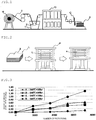
- FIG. 1 is a schematic view illustrating a production example of the prepreg that is used to produce the heat insulation material according to the invention.
- a heat-resistant sheet 1 is drawn from a holder H that holds the heat-resistant sheet 1 in a wound state using a roller or the like, immersed in a thermosetting resin 2 that is held in an impregnation tank T to be impregnated with a specific amount of thermosetting resin 2, dried using a drier D, and cut using a cutter C so as to have a specific size to produce the desired prepreg 3.
- Examples of the heat-resistant sheet 1 used in connection with the invention include a cloth, paper, a mat, and the like.
- the cloth may be produced by weaving glass fibers.
- the paper may be produced using a papermaking machine.
- Inorganic paper may be produced by appropriately adding a small amount of organic binder to bulk inorganic fibers, and subjecting the inorganic fibers to a papermaking process using a papermaking machine.
- a thermoplastic resin e.g., acrylic resin or polyvinyl alcohol
- a thermosetting resin may be used as the organic binder. It is preferable to use a thermosetting resin as the organic binder.
- the content of the inorganic fibers in the inorganic paper is preferably 45 to 100 mass%, more preferably 74 to 94 mass%, and still more preferably 82 to 88 mass%.
- the content of the organic binder in the inorganic paper is preferably 0 to 55 mass%, more preferably 6 to 26 mass%, and still more preferably 12 to 18 mass%.
- the average thickness of the paper is normally 0.2 to 6 mm.
- the term "average thickness” used herein refers to the arithmetic average value of thicknesses measured at eight points using calipers or a micrometer.
- the basis weight of the paper is normally 20 to 430 g/m 2 .
- the term "basis weight (g/m 2 )" used herein refers to a value calculated in accordance with JIS P 8124.
- the mat is produced by entangling fibers.
- the mat may be produced by entangling bulk fibers using a needle punching machine, and forming the interlaced fibers in the shape of a mat.
- the mat may be formed of only inorganic fibers (i.e., may have an inorganic fiber content of 100 mass%), and may not include a thermoplastic resin that is used as a sizing agent or the like.
- the inorganic fibers may be glass fibers, for example.
- the mat Since the mat has an irregular surface, the mats are interwined with each other with an improved strength when stacked. Since the mat can be produced without using a binder, it is possible to reduce cost.
- the average thickness of the mat is 2 to 20 mm, for example.
- the basis weight of the mat is 100 to 4,000 g/m 2 , for example.
- the heat-resistant sheet 1 may be impregnated with the thermosetting resin, the curing agent, and the curing accelerator.
- the heat-resistant sheet 1 may be impregnated with the thermosetting resin and the inorganic filler.
- the basis weight of the prepreg produced using the paper may be 30 to 690 g/m 2 , for example.
- the basis weight of the prepreg produced using the mat may be 150 to 10,000 g/m 2 , for example.
- Basis weight (g/m 2 ) used herein in connection with a prepreg refers to a value calculated from the mass (g) of a 100 ⁇ 100 cm square prepreg.
- FIG. 2 is a schematic view illustrating a production example in which the heat insulation material according to the invention is produced using a prepreg.
- the desired number of prepregs 3 produced by impregnating the heat-resistant sheet with the thermosetting resin are stacked to obtain five laminates L.
- the resulting five laminates L are stacked between the press plates of a press P in a state in which a spacer is provided between the laminates L, and hot-pressed at a temperature equal to or higher than the thermal curing temperature of the thermosetting resin that forms the prepreg such that each prepreg has a desired average thickness to obtain the desired heat insulation material 4.
- FIG. 2 illustrates an example in which the hot-pressing process is performed in a state in which five laminates L are stacked
- the hot-pressing process may normally be performed in a state in which about 1 to 20 laminates L are stacked.
- the number of prepregs to be stacked and subjected to the hot-pressing process is not particularly limited.
- the number of prepregs to be stacked is 3 to 200 per 10 mm thickness, for example.
- the number of prepregs to be stacked is 1 to 20 per 10 mm thickness, for example.
- the compression ratio of the prepreg before and after the hot-pressing process is 15 to 50%, 15 to 33%, or 21 to 29%, for example.
- the temperature of the hot-pressing process is set to be equal to or higher than the thermal curing temperature of the thermosetting resin included in the prepreg.
- the temperature is preferably set to 100 to 200°C, more preferably 130 to 180°C, and still more preferably 145 to 155°C.
- the pressing time of the hot-pressing process is not particularly limited as long as the thermosetting resin included in the prepreg is thermally cured.
- the pressing time is preferably 30 minutes or more, more preferably 60 minutes or more, and still more preferably 120 minutes or more.
- the hot-pressed product obtained by the hot-pressing process may optionally be machined, and may optionally be further cured by heating the hot-pressed product to a specific temperature.
- the heat insulation material obtained using the above method has a structure in which a plurality of prepregs that include the heat-resistant sheet as a base have been hot-pressed in a stacked state, it is considered that the prepregs in which the thermosetting resin is uniformly dispersed have been hot-pressed in a state in which the occurrence of uneven heating (i.e., a variation in heating temperature) is suppressed during the hot-pressing process.
- the heat insulation material exhibits highly accurate workability, and exhibits excellent flexural strength, excellent toughness, excellent thickness accuracy, and the like as compared with a heat insulation material that includes the same amounts of fibers and a thermosetting resin.
- the density of the heat insulation material according to the invention is not particularly limited.
- the density of the heat insulation material is preferably 400 to 2,000 kg/m 3 , more preferably 900 to 1,250 kg/m 3 , and still more preferably 1,000 to 1,100 kg/m 3 .
- the term "density" used herein in connection with the heat insulation material refers to a value calculated from the dimensions (m 3 ) and the weight (kg) of a specimen prepared by cutting the heat insulation material so as to have a length of 120 mm and a width of 40 mm. The thickness of the specimen is the same as that of the heat insulation material.
- the heat insulation material according to the invention have a heat resistance such that the heat insulation material does not produce cracks and breakage when heated at 200°C for 24 hours in air. It is more preferable that the heat insulation material according to the invention have a heat resistance such that the heat insulation material does not produce cracks and breakage when heated at 260°C for 24 hours in air.
- the heat insulation material according to the invention have a thermal conductivity of 0.25 W/(m ⁇ K) or less, more preferably 0.18 W/(m ⁇ K) or less, and still more preferably 0.12 W/(m ⁇ K) or less.
- thermal conductivity used herein in connection with the heat insulation material refers to a value measured in accordance with JIS A 1412-2:1999 (Test method for thermal resistance and related properties of thermal insulations - Part 2: Heat flow meter apparatus).
- the heat insulation material according to the invention have a flexural strength of 30 MPa or more, more preferably 45 MPa or more, and still more preferably 55 MPa or more.
- flexural strength used herein in connection with the heat insulation material refers to a value measured in accordance with the fiber-reinforced resin flexural test specified in JIS C 2210-1975.
- the heat insulation material according to the invention have a Charpy impact value measured in accordance with JIS K 6911 of 10 kJ/m 2 or more, more preferably 15 kJ/m 2 or more, and still more preferably 18 kJ/m 2 or more.
- the heat insulation material exhibits sufficient toughness.
- the heat insulation material according to the invention have a thickness accuracy that the difference in thickness when the thickness of the heat insulation material is measured at an arbitrary eight points using calipers, is within ⁇ 5 mm, more preferably within ⁇ 3 mm, and still more preferably within ⁇ 2.5 mm.
- a heat-resistant mat 1 (average thickness: 6 mm, average width: 1,050 mm, average length: 30 mm, density: 120 kg/m 3 ) that was wound around the holder H was drawn using a roller, and immersed in a resol-type phenol resin (thermal curing temperature: 150°C) (thermosetting resin 2) that was held in the impregnation tank T.
- the heat-resistant mat 1 was obtained by entangling glass fibers using a needle punching machine.
- the heat-resistant mat 1 was dried at 60 to 130°C using the drier D, and cut using the cutter C to produce a plurality of sheet-like (plate-like) prepregs 3 including fibers derived from the glass fiber mat (40 mass%) and the resol-type phenol resin (60 mass%).
- the heat insulation material 4 included 40 mass% of the fibers and 60 mass% of the resol-type phenol resin, had a density of 1,050 kg/m 3 , had a heat resistance that the heat insulation material did not produce cracks and breakage when heated at 200°C for 24 hours in air, had a thermal conductivity of 0.12 W/(m ⁇ K), had a flexural strength of 60 MPa, had a Charpy impact value measured in accordance with JIS K 6911 of 20 kJ/m 2 , had a thickness accuracy that the difference in thickness when the thickness of the heat insulation material was measured at an arbitrary eight points using calipers, was 2 mm or less, and exhibited excellent workability and excellent working accuracy, i.e., the heat insulation material 4 could be easily cut without producing cracks, breakage, and the like.
- a plurality of prepregs (average thickness: 0.84 mm, length: 2,110 mm, width: 1,050 mm) were produced in the same manner as in Example 1, except that glass fiber paper (average thickness: 0.78 mm, basis weight: 110 g/m 2 ) including a POVAL-based synthetic resin (thermoplastic resin, heat-resistant temperature: less than 150°C) and an acrylic-based synthetic resin (thermoplastic resin, heat-resistant temperature: less than 150°C) in an amount of 16 mass% was used instead of the heat-resistant mat 1.
- a heat insulation material B (length: 2,070 mm, width: 1,020 mm, thickness: 12 mm) was obtained in the same manner as in Example 1, except that fifty-seven prepregs were stacked to produce the laminate L.
- the heat insulation material B included the fibers (42 mass%), the resol-type phenol resin (50 mass%), and the thermoplastic resin (8 mass%).
- the heat-resistant temperature of the resin used to produce the heat insulation material was measured as described below.
- the resin material was heated for a specific heating time using a general-purpose heating device (e.g., oven) and a general-purpose gravimetric instrument.
- a temperature at which a 10% weight loss occurred was taken as the heat-resistant temperature. It is also possible to measure the heat-resistant temperature using a thermogravimeter (TG).
- TG thermogravimeter
- heat insulation material A The heat insulation material obtained in Example 1 is hereinafter referred to as "heat insulation material A”.
- the heat insulation materials A and B were heated at 240°C for 50 hours or 70 hours. After cooling the heat insulation material to room temperature, the amount of abrasion was measured. More specifically, the heat insulation material was brought into contact with the abrasive wheel of a Taber abrasion tester, and rotated with respect to the abrasive wheel. A heat insulation material was removed in an area in which the heat insulation material was brought into contact with the abrasive wheel. The amount (g) of abrasion was calculated from a change in the weight of the heat insulation material during the test. The results are illustrated in FIG. 3 .
- the heat insulation materials A and B were placed in an oven, and heated at 180°C under a pressure of 16 MPa, or heated at 200°C under a pressure of 15 MPa, and a change in thickness was measured. The results are illustrated in FIG. 4 .
- the heat insulation materials A and B were heated to 450°C to measure the weight loss (%). The results are illustrated in FIG. 5 .
- thermoplastic resin content in the heat insulation material was 8 mass% or more, the abrasion resistance and the heat resistance (weight loss and change in thickness) of the heat insulation material significantly decreased. Therefore, it is preferable that the thermoplastic resin content in the heat insulation material be 7 mass% or less.
- the heat insulation material according to the invention may be used as a heat insulation material for a hot press, a rubber vulcanizing machine, and an injection molding machine, an induction furnace casing, and the like.
Landscapes
- Engineering & Computer Science (AREA)
- General Engineering & Computer Science (AREA)
- Mechanical Engineering (AREA)
- Physics & Mathematics (AREA)
- Fluid Mechanics (AREA)
- Textile Engineering (AREA)
- Laminated Bodies (AREA)
- Reinforced Plastic Materials (AREA)
- Thermal Insulation (AREA)
Abstract
Description
- The invention relates to a heat insulation material and a method for producing the same.
- A heat insulation material produced by binding a talcum powder and pulp using Portland cement, and the like are known as a heat insulation material that is cut before use so as to have a shape corresponding to the shape of a device or the like, and is required to exhibit high strength during use (e.g., a heat insulation material that is used for a hot press, a rubber vulcanizing machine, an injection molding machine, an induction furnace casing, or the like) (see Patent Literature 1).
- However, since the above heat insulation material includes only pulp as reinforcing fibers, the above heat insulation material undergoes a significant decrease in mechanical strength and dimensional change due to heating. Moreover, since the above heat insulation material has insufficient toughness, cracks, breakage, and the like easily occur when a high load or an impact load is applied, although good cutting workability is obtained.
- Therefore, a heat insulation material that exhibits excellent toughness, higher strength, and excellent thickness accuracy has been desired.
- Patent Literature 1:
JP-A-S61-109205 - In view of the above technology, the inventors proposed a heat insulation material that exhibits excellent workability, exhibits excellent heat resistance, excellent mechanical strength, and excellent toughness, and also exhibits excellent working accuracy and excellent thickness accuracy (Japanese Patent Application No.
2013-117843 - The inventors conducted extensive studies in order to solve the above technical problem. As a result, the inventors found that heat resistance and abrasion resistance can be improved by reducing the thermoplastic resin content in a heat insulation material. This finding has led to the completion of the invention.
- Specifically, the invention provides the following heat insulation material and method for producing the same.
- 1. A heat insulation material including a laminate obtained by stacking fiber layers that include heat-resistant fibers, the fiber layers being bound with a thermosetting resin,
wherein the laminate does not include a thermoplastic resin that has a heat-resistant temperature lower than that of the thermosetting resin, or includes only a small amount of a thermoplastic resin that has a heat-resistant temperature lower than that of the thermosetting resin. - 2. The heat insulation material according to 1, wherein the laminate includes a small amount of the thermoplastic resin, and the content of the thermoplastic resin in the laminate is 7 mass% or less.
- 3. A method for producing a heat insulation material including:
- a prepreg production step that impregnates a sheet that includes heat-resistant fibers with a thermosetting resin to produce a prepreg, wherein the prepreg does not include a thermoplastic resin that has a heat-resistant temperature lower than that of the thermosetting resin, or includes only a small amount of a thermoplastic resin that has a heat-resistant temperature lower than that of the thermosetting resin;
- a laminate production step that stacks a plurality of the prepregs to produce a laminate; and
- a press step that presses the laminate at a temperature equal to or higher than the curing temperature of the thermosetting resin.
- 4. The method according to 3, wherein the prepreg includes a small amount of the thermoplastic resin, and the content of the thermoplastic resin in the prepreg is 7 mass% or less.
- 5. A heat insulation material comprising a laminate obtained by stacking fiber layers that comprise heat-resistant fibers, the fiber layers being bound with a thermosetting resin,
wherein the laminate does not comprise a thermoplastic resin, or comprises only a small amount of a thermoplastic resin,
the thermosetting resin is one or more thermosetting resins selected from thermosetting phenol resins, epoxy resins, melamine resins, urea resins, unsaturated polyester resins, alkyd resins, polyurethane resins, thermosetting polyimide resins, and silicone resins, and
the thermoplastic resin is one or more thermoplastic resins selected from acrylic resins, polyvinyl alcohol, polyvinyl chloride, polystyrene, polyethylene, polypropylene, PET resins, and PBT resins. - The invention thus provides a heat insulation material that exhibits excellent heat resistance and excellent abrasion resistance, and a method for producing the same.
-
-
FIG. 1 is a schematic view illustrating a production example of a prepreg that is used to produce the heat insulation material according to the invention. -
FIG. 2 is a schematic view illustrating a production example in which the heat insulation material according to the invention is produced using a prepreg. -
FIG. 3 is a view illustrating a difference in abrasion resistance due to a difference in thermoplastic resin content (Experimental Example 1). -
FIG. 4 is a view illustrating a change in thickness during heating due to a difference in thermoplastic resin content (Experimental Example 1). -
FIG. 5 is a view illustrating a change in weight during heating due to a difference in thermoplastic resin content (Experimental Example 1). - The heat insulation material according to the invention includes a sack of fiber layers that include heat-resistant fibers, the fiber layers being bound with a thermosetting resin. The fiber layers included in the heat insulation material according to the invention do not include a thermoplastic resin that has a heat-resistant temperature lower than that of the thermosetting resin, or include only a small amount of a thermoplastic resin that has a heat-resistant temperature lower than that of the thermosetting resin. When the fiber layers include the thermoplastic resin, the content of the thermoplastic resin is preferably 7 mass% or less, more preferably 5 mass% or less, and still more preferably 3 mass% or less.
- The term "heat-resistant temperature" used herein in connection with a resin refers to the upper-limit temperature up to which the physical properties of the resin are maintained (e.g., a temperature at which a resin material is softened and deformed, or a temperature at which a resin material is thermally decomposed). Specifically, the term "heat-resistant temperature" used herein refers to a softening temperature, a glass transition temperature, or the like from the viewpoint of physical heat resistance, and refers to a temperature at which a weight loss due to heating or the like occurs from the viewpoint of chemical heat resistance. More specifically, the heat-resistant temperature differs between the thermoplastic resin and the thermosetting resin. The heat-resistant temperature of the thermoplastic resin is a softening temperature at which the thermoplastic resin is softened under specific heating conditions (heating time and heating rate), or a thermal decomposition temperature at which the bonds between the components break, and the resin changes in properties or deteriorates (specifically, a specific (5% or 10%) weight reduction temperature, a deflection temperature under load, a specific (e.g., 2%) thickness change temperature, or a temperature based on determination of the outward appearance (shape (swelling, cracking, and bending) and color) of the resin material). The heat-resistant temperature of the thermosetting resin is a curing temperature at which the thermosetting resin is cured under the specific heating conditions, or a thermal decomposition temperature at which the bonds between the components break, and the resin changes in properties or deteriorates (specifically, a specific (5% or 10%) weight reduction temperature, a deflection temperature under load, a specific (e.g., 2%) thickness change temperature, or a temperature based on determination of the outward appearance (shape (swelling, cracking, and bending) and color) of the resin material). In particular, the heat-resistant temperature of the thermoplastic resin and the thermosetting resin refers to a temperature at which the weight loss becomes 10% or less when the resin is heated for a specific time.
- The invention implements an improvement in heat resistance, abrasion resistance, and strength (flexural strength) by employing a configuration in which the heat insulation material does not include the thermoplastic resin, or includes only a small amount of the thermoplastic resin.
- For example, when the fiber layers included in the heat insulation material include a specific amount of a thermoplastic resin that has a heat-resistant temperature lower than that of the thermosetting resin as a sizing agent, a binder, or the like, creep (deformation of material) easily occurs at a high temperature due to the plasticity of the thermoplastic resin, and a decrease in structural strength occurs due to creep fatigue.
- For example, when the heat insulation material is used as a heat insulation plate of a mold assembly, a gap is formed between the heat insulation plate and the attachment structure of the mold assembly when the heat insulation plate has deformed due to heating and pressurization during pressing, and the pressure state of the mold assembly becomes unstable.
- When the thermoplastic resin has been thermally decomposed due to a high temperature, decomposition proceeds further due to the heat of decomposition. When the thermoplastic resin has increasingly disappeared due to thermal decomposition, the fiber layer exhibits decreased adhesion (i.e., the fiber layer is easily disentangled), whereby a decrease in heat resistance and abrasion resistance, and a further decrease in strength, occur.
- The invention can reduce or suppress a situation in which the thermoplastic resin decreases the heat resistance, the abrasion resistance, and the strength (flexural strength) of the heat insulation material, by employing a configuration in which the heat insulation material does not include the thermoplastic resin, or includes only a small amount of the thermoplastic resin. In other words, the invention can improve the heat resistance, the abrasion resistance, and the strength (flexural strength) of the heat insulation material by employing a configuration in which the heat insulation material does not include the thermoplastic resin, or includes only a small amount of the thermoplastic resin.
- Either or both of inorganic fibers and organic fibers that exhibit heat resistance may be used as the heat-resistant fibers. The inorganic fibers may be one or more types of inorganic fibers selected from glass fibers, silica fibers, alumina fibers, mullite fibers, silicon carbide fibers, rock wool, and the like. The organic fibers may be one or more types of organic fibers selected from aramid fibers, polyester fibers, polyethylene fibers, acrylic fibers, rayon fibers, carbon fibers, and the like.
- The thermosetting resin may be one or more thermosetting resins selected from a thermosetting phenol resin, an epoxy resin, a melamine resin,
a urea resin, an unsaturated polyester resin, an alkyd resin, a polyurethane resin, a thermosetting polyimide resin, a silicone resin, and the like. - The thermoplastic resin may be one or more thermoplastic resins selected from an acrylic resin, polyvinyl alcohol, polyvinyl chloride, polystyrene, polyethylene, polypropylene, a polyethylene terephthalate (PET) resin, and
a polybutylene terephthalate (PBT) resin, and the like. These thermoplastic resins have a heat-resistant temperature lower than that of the above thermosetting resins. - In view of the thermoplastic resin and the thermosetting resin described above, the heat insulation material according to the invention may include
a laminate obtained by stacking fiber layers that include heat-resistant fibers, the fiber layers being bound with a thermosetting resin, wherein the laminate does not include a thermoplastic resin, or includes only a small amount of a thermoplastic resin, the thermosetting resin is one or more thermosetting resins selected from a thermosetting phenol resin, an epoxy resin, a melamine resin, a urea resin, an unsaturated polyester resin, an alkyd resin, a polyurethane resin,
a thermosetting polyimide resin, and a silicone resin, and the thermoplastic resin is one or more thermoplastic resins selected from an acrylic resin, polyvinyl alcohol, polyvinyl chloride, polystyrene, polyethylene, polypropylene, a PET resin, and a PBT resin. - The ratio of the fibers and the thermosetting resin with respect to the heat insulation material may be 93 mass% or more, 95 mass% or more, 97 mass% or more, or 99 mass% or more, for example.
- The heat insulation material according to the invention may include
a curing agent, a curing accelerator, an inorganic filler, a catalyst, and the like in addition to the fibers and the thermosetting resin. - Examples of the curing agent (excluding a thermosetting resin and
a thermoplastic resin) include an amine such as hexamethylenetetramine,
a peroxide such as an organic peroxide, and the like. - The curing accelerator may be one or more curing accelerators selected from a phosphorus-based compound, a tertiary amine, imidazole, an organic acid metal salt, a Lewis acid, an amine complex salt, and the like.
- The inorganic filler may be one or more inorganic fillers selected from silica, calcium carbonate, and the like. When the heat insulation material includes the inorganic filler, the heat insulation material can be reinforced, and the density, the thermal conductivity, and the creep properties can be easily controlled within the desired ranges. For example, the heat insulation material may preferably include the inorganic filler in an amount of 0 to 32 mass%, more preferably 5 to 20 mass%, and still more preferably 7 to 15 mass%.
- The content of the heat-resistant fibers and the content of the thermosetting resin in the heat insulation material are not particularly limited. For example, the heat insulation material may include the heat-resistant fibers in an amount of 10 to 90 mass%, 20 to 80 mass%, or 30 to 70 mass%. The heat insulation material may include the thermosetting resin in an amount of 10 to 90 mass%, 20 to 80 mass%, or 30 to 70 mass%.
- The heat insulation material according to the invention may be
a laminate that includes a fiber layer and a non-fiber layer (e.g., metal-containing layer). It is preferable that the heat insulation material according to the invention is a laminate in which only fiber layers are stacked (i.e., a laminate that does not include a non-fiber layer). The non-fiber layer may be a layer that includes a material (e.g., reinforcing material, refractory material, or water-proof material) for protecting the heat insulation material (laminate), for example. The heat insulation material according to the invention may be produced without using a decorative sheet paper (e.g., titanium paper) that provides a good outward appearance. The fiber layers and the non-fiber layers included in the laminate may be identical or alsmost identical to or differ from each other as to the thickness. - The heat insulation material according to the invention may be produced by impregnating a heat-resistant sheet (fiber sheet) with a thermosetting resin to produce a prepreg, stacking a plurality of the prepregs to produce a laminate, and pressing the laminate at a temperature equal to or higher than the curing temperature of the thermosetting resin. The thermoplastic resin may be included in the sheet, or the heat-resistant sheet (fiber sheet) may be impregnated with the thermosetting resin and the thermoplastic resin.
-
FIG. 1 is a schematic view illustrating a production example of the prepreg that is used to produce the heat insulation material according to the invention. - In the example illustrated in
FIG. 1 , a heat-resistant sheet 1 is drawn from a holder H that holds the heat-resistant sheet 1 in a wound state using a roller or the like, immersed in athermosetting resin 2 that is held in an impregnation tank T to be impregnated with a specific amount ofthermosetting resin 2, dried using a drier D, and cut using a cutter C so as to have a specific size to produce the desiredprepreg 3. - Examples of the heat-
resistant sheet 1 used in connection with the invention include a cloth, paper, a mat, and the like. The cloth may be produced by weaving glass fibers. - The paper may be produced using a papermaking machine. Inorganic paper may be produced by appropriately adding a small amount of organic binder to bulk inorganic fibers, and subjecting the inorganic fibers to a papermaking process using a papermaking machine. Either or both of a thermoplastic resin (e.g., acrylic resin or polyvinyl alcohol) and a thermosetting resin may be used as the organic binder. It is preferable to use a thermosetting resin as the organic binder.
- The content of the inorganic fibers in the inorganic paper is preferably 45 to 100 mass%, more preferably 74 to 94 mass%, and still more preferably 82 to 88 mass%. The content of the organic binder in the inorganic paper is preferably 0 to 55 mass%, more preferably 6 to 26 mass%, and still more preferably 12 to 18 mass%.
- The average thickness of the paper is normally 0.2 to 6 mm. The term "average thickness" used herein refers to the arithmetic average value of thicknesses measured at eight points using calipers or a micrometer.
- The basis weight of the paper is normally 20 to 430 g/m2. The term "basis weight (g/m2)" used herein refers to a value calculated in accordance with JIS P 8124.
- The mat is produced by entangling fibers. For example, the mat may be produced by entangling bulk fibers using a needle punching machine, and forming the interlaced fibers in the shape of a mat. For example, the mat may be formed of only inorganic fibers (i.e., may have an inorganic fiber content of 100 mass%), and may not include a thermoplastic resin that is used as a sizing agent or the like. The inorganic fibers may be glass fibers, for example.
- Since the mat has an irregular surface, the mats are interwined with each other with an improved strength when stacked. Since the mat can be produced without using a binder, it is possible to reduce cost.
- The average thickness of the mat is 2 to 20 mm, for example. The basis weight of the mat is 100 to 4,000 g/m2, for example.
- The heat-
resistant sheet 1 may be impregnated with the thermosetting resin, the curing agent, and the curing accelerator. The heat-resistant sheet 1 may be impregnated with the thermosetting resin and the inorganic filler. - When the heat-
resistant sheet 1 is paper, the basis weight of the prepreg produced using the paper may be 30 to 690 g/m2, for example. - When the heat-
resistant sheet 1 is a mat, the basis weight of the prepreg produced using the mat may be 150 to 10,000 g/m2, for example. - The term "basis weight (g/m2)" used herein in connection with a prepreg refers to a value calculated from the mass (g) of a 100×100 cm square prepreg.
-
FIG. 2 is a schematic view illustrating a production example in which the heat insulation material according to the invention is produced using a prepreg. - In the example illustrated in
FIG. 2 , the desired number ofprepregs 3 produced by impregnating the heat-resistant sheet with the thermosetting resin are stacked to obtain five laminates L. The resulting five laminates L are stacked between the press plates of a press P in a state in which a spacer is provided between the laminates L, and hot-pressed at a temperature equal to or higher than the thermal curing temperature of the thermosetting resin that forms the prepreg such that each prepreg has a desired average thickness to obtain the desiredheat insulation material 4. - Although
FIG. 2 illustrates an example in which the hot-pressing process is performed in a state in which five laminates L are stacked, the hot-pressing process may normally be performed in a state in which about 1 to 20 laminates L are stacked. - The number of prepregs to be stacked and subjected to the hot-pressing process is not particularly limited. When the sheet is paper, the number of prepregs to be stacked is 3 to 200 per 10 mm thickness, for example. When the sheet is a mat, the number of prepregs to be stacked is 1 to 20 per 10 mm thickness, for example.
- The compression ratio of the prepreg before and after the hot-pressing process is 15 to 50%, 15 to 33%, or 21 to 29%, for example. The compression ratio of the prepreg is calculated using the following expression.

- The temperature of the hot-pressing process is set to be equal to or higher than the thermal curing temperature of the thermosetting resin included in the prepreg. For example, the temperature is preferably set to 100 to 200°C, more preferably 130 to 180°C, and still more preferably 145 to 155°C.
- The pressing time of the hot-pressing process is not particularly limited as long as the thermosetting resin included in the prepreg is thermally cured. For example, the pressing time is preferably 30 minutes or more, more preferably 60 minutes or more, and still more preferably 120 minutes or more.
- The hot-pressed product obtained by the hot-pressing process may optionally be machined, and may optionally be further cured by heating the hot-pressed product to a specific temperature.
- Since the heat insulation material obtained using the above method has a structure in which a plurality of prepregs that include the heat-resistant sheet as a base have been hot-pressed in a stacked state, it is considered that the prepregs in which the thermosetting resin is uniformly dispersed have been hot-pressed in a state in which the occurrence of uneven heating (i.e., a variation in heating temperature) is suppressed during the hot-pressing process.
- Therefore, it is considered that the heat insulation material exhibits highly accurate workability, and exhibits excellent flexural strength, excellent toughness, excellent thickness accuracy, and the like as compared with a heat insulation material that includes the same amounts of fibers and a thermosetting resin.
- The density of the heat insulation material according to the invention is not particularly limited. For example, the density of the heat insulation material is preferably 400 to 2,000 kg/m3, more preferably 900 to 1,250 kg/m3, and still more preferably 1,000 to 1,100 kg/m3.
- The term "density" used herein in connection with the heat insulation material refers to a value calculated from the dimensions (m3) and the weight (kg) of a specimen prepared by cutting the heat insulation material so as to have a length of 120 mm and a width of 40 mm. The thickness of the specimen is the same as that of the heat insulation material.
- It is preferable that the heat insulation material according to the invention have a heat resistance such that the heat insulation material does not produce cracks and breakage when heated at 200°C for 24 hours in air. It is more preferable that the heat insulation material according to the invention have a heat resistance such that the heat insulation material does not produce cracks and breakage when heated at 260°C for 24 hours in air.
- It is preferable that the heat insulation material according to the invention have a thermal conductivity of 0.25 W/(m·K) or less, more preferably 0.18 W/(m·K) or less, and still more preferably 0.12 W/(m·K) or less.
- The term "thermal conductivity" used herein in connection with the heat insulation material refers to a value measured in accordance with JIS A 1412-2:1999 (Test method for thermal resistance and related properties of thermal insulations - Part 2: Heat flow meter apparatus).
- It is preferable that the heat insulation material according to the invention have a flexural strength of 30 MPa or more, more preferably 45 MPa or more, and still more preferably 55 MPa or more.
- The term "flexural strength" used herein in connection with the heat insulation material refers to a value measured in accordance with the fiber-reinforced resin flexural test specified in JIS C 2210-1975.
- It is preferable that the heat insulation material according to the invention have a Charpy impact value measured in accordance with JIS K 6911 of 10 kJ/m2 or more, more preferably 15 kJ/m2 or more, and still more preferably 18 kJ/m2 or more.
- When the Charpy impact value is within the above range, the heat insulation material exhibits sufficient toughness.
- It is preferable that the heat insulation material according to the invention have a thickness accuracy that the difference in thickness when the thickness of the heat insulation material is measured at an arbitrary eight points using calipers, is within ±5 mm, more preferably within ±3 mm, and still more preferably within ±2.5 mm.
- The invention is further described below by way of examples. The following examples are for illustration purposes only, and the invention is not limited to the following examples.
- The apparatus illustrated in
FIG. 1 was used. A heat-resistant mat 1 (average thickness: 6 mm, average width: 1,050 mm, average length: 30 mm, density: 120 kg/m3) that was wound around the holder H was drawn using a roller, and immersed in a resol-type phenol resin (thermal curing temperature: 150°C) (thermosetting resin 2) that was held in the impregnation tank T. The heat-resistant mat 1 was obtained by entangling glass fibers using a needle punching machine. The heat-resistant mat 1 was dried at 60 to 130°C using the drier D, and cut using the cutter C to produce a plurality of sheet-like (plate-like) prepregs 3 including fibers derived from the glass fiber mat (40 mass%) and the resol-type phenol resin (60 mass%). - Five laminates L in which thirteen
prepregs 3 obtained in the above (1) were stacked, were produced. As illustrated inFIG. 2 , the five laminates L were stacked between the press plates of the press P in a state in which a spacer was provided between the laminates L, and hot-pressed at 150°C for 2 hours (or at 200°C for 1 hour) to obtain a sheet-like or plate-like heat insulation material 4 (length: 2,000 mm, width: 1,000 mm, thickness: 22 mm, for example). Theheat insulation material 4 had a structure in which the glass fibers included in the mat were bound with the thermosetting resin, and did not include a thermoplastic resin. - The
heat insulation material 4 included 40 mass% of the fibers and 60 mass% of the resol-type phenol resin, had a density of 1,050 kg/m3, had a heat resistance that the heat insulation material did not produce cracks and breakage when heated at 200°C for 24 hours in air, had a thermal conductivity of 0.12 W/(m·K), had a flexural strength of 60 MPa, had a Charpy impact value measured in accordance with JIS K 6911 of 20 kJ/m2, had a thickness accuracy that the difference in thickness when the thickness of the heat insulation material was measured at an arbitrary eight points using calipers, was 2 mm or less, and exhibited excellent workability and excellent working accuracy, i.e., theheat insulation material 4 could be easily cut without producing cracks, breakage, and the like. - It was demonstrated by Experimental Example 1 that the heat insulation material according to the invention exhibits excellent abrasion resistance and excellent heat resistance due to a low thermoplastic resin content.
- A plurality of prepregs (average thickness: 0.84 mm, length: 2,110 mm, width: 1,050 mm) were produced in the same manner as in Example 1, except that glass fiber paper (average thickness: 0.78 mm, basis weight: 110 g/m2) including a POVAL-based synthetic resin (thermoplastic resin, heat-resistant temperature: less than 150°C) and an acrylic-based synthetic resin (thermoplastic resin, heat-resistant temperature: less than 150°C) in an amount of 16 mass% was used instead of the heat-
resistant mat 1. A heat insulation material B (length: 2,070 mm, width: 1,020 mm, thickness: 12 mm) was obtained in the same manner as in Example 1, except that fifty-seven prepregs were stacked to produce the laminate L. - The heat insulation material B included the fibers (42 mass%), the resol-type phenol resin (50 mass%), and the thermoplastic resin (8 mass%).
- The heat-resistant temperature of the resin used to produce the heat insulation material was measured as described below. The resin material was heated for a specific heating time using a general-purpose heating device (e.g., oven) and a general-purpose gravimetric instrument. A temperature at which a 10% weight loss occurred was taken as the heat-resistant temperature. It is also possible to measure the heat-resistant temperature using a thermogravimeter (TG).
- The heat insulation material obtained in Example 1 is hereinafter referred to as "heat insulation material A".
- The heat insulation materials A and B were heated at 240°C for 50 hours or 70 hours. After cooling the heat insulation material to room temperature, the amount of abrasion was measured. More specifically, the heat insulation material was brought into contact with the abrasive wheel of a Taber abrasion tester, and rotated with respect to the abrasive wheel. A heat insulation material was removed in an area in which the heat insulation material was brought into contact with the abrasive wheel. The amount (g) of abrasion was calculated from a change in the weight of the heat insulation material during the test. The results are illustrated in
FIG. 3 . - The heat insulation materials A and B were placed in an oven, and heated at 180°C under a pressure of 16 MPa, or heated at 200°C under a pressure of 15 MPa, and a change in thickness was measured. The results are illustrated in
FIG. 4 . - The heat insulation materials A and B were heated to 450°C to measure the weight loss (%). The results are illustrated in
FIG. 5 . - As illustrated in
FIGS. 3 to 5 , when the thermoplastic resin content in the heat insulation material was 8 mass% or more, the abrasion resistance and the heat resistance (weight loss and change in thickness) of the heat insulation material significantly decreased. Therefore, it is preferable that the thermoplastic resin content in the heat insulation material be 7 mass% or less. - The heat insulation material according to the invention may be used as a heat insulation material for a hot press, a rubber vulcanizing machine, and an injection molding machine, an induction furnace casing, and the like.
- Although only some exemplary embodiments and/or examples of the invention have been described in detail above, those skilled in the art will readily appreciate that many modifications are possible in the exemplary embodiments and/or examples without materially departing from the novel teachings and advantages of the invention. Accordingly, all such modifications are intended to be included within the scope of the invention.
- The documents described in the specification, and the specification of the Japanese patent application which the present application claims priority under the Paris Convention based on, are incorporated herein by reference in their entirety.
Claims (5)
- A heat insulation material comprising a laminate obtained by stacking fiber layers that comprise heat-resistant fibers, the fiber layers being bound with a thermosetting resin,
wherein the laminate does not comprise a thermoplastic resin that has a heat-resistant temperature lower than that of the thermosetting resin, or comprises only a small amount of a thermoplastic resin that has a heat-resistant temperature lower than that of the thermosetting resin. - The heat insulation material according to claim 1, wherein the laminate comprises a small amount of the thermoplastic resin, and the content of the thermoplastic resin in the laminate is 7 mass% or less.
- A method for producing a heat insulation material comprising:a prepreg production step that impregnates a sheet that comprises heat-resistant fibers with a thermosetting resin to produce a prepreg, wherein the prepreg does not comprise a thermoplastic resin that has a heat-resistant temperature lower than that of the thermosetting resin, or comprises only a small amount of a thermoplastic resin that has a heat-resistant temperature lower than that of the thermosetting resin;a laminate production step that stacks a plurality of the prepregs to produce a laminate; anda press step that presses the laminate at a temperature equal to or higher than a curing temperature of the thermosetting resin.
- The method according to claim 3, wherein the prepreg comprises a small amount of the thermoplastic resin, and the content of the thermoplastic resin in the prepreg is 7 mass% or less.
- A heat insulation material comprising a laminate obtained by stacking fiber layers that comprise heat-resistant fibers, the fiber layers being bound with a thermosetting resin,
wherein the laminate does not comprise a thermoplastic resin, or comprises only a small amount of a thermoplastic resin,
the thermosetting resin is one or more thermosetting resins selected from thermosetting phenol resins, epoxy resins, melamine resins, urea resins, unsaturated polyester resins, alkyd resins, polyurethane resins, thermosetting polyimide resins, and silicone resins, and
the thermoplastic resin is one or more thermoplastic resins selected from acrylic resins, polyvinyl alcohol, polyvinyl chloride, polystyrene, polyethylene, polypropylene, PET resins, and PBT resins.
Applications Claiming Priority (2)
| Application Number | Priority Date | Filing Date | Title |
|---|---|---|---|
| JP2014185213A JP6522912B2 (en) | 2014-09-11 | 2014-09-11 | Thermal insulation material and method of manufacturing the same |
| PCT/JP2015/004170 WO2016038806A1 (en) | 2014-09-11 | 2015-08-20 | Heat insulation material and method for producing same |
Publications (2)
| Publication Number | Publication Date |
|---|---|
| EP3193068A1 true EP3193068A1 (en) | 2017-07-19 |
| EP3193068A4 EP3193068A4 (en) | 2018-02-28 |
Family
ID=55458581
Family Applications (1)
| Application Number | Title | Priority Date | Filing Date |
|---|---|---|---|
| EP15840444.2A Withdrawn EP3193068A4 (en) | 2014-09-11 | 2015-08-20 | Heat insulation material and method for producing same |
Country Status (10)
| Country | Link |
|---|---|
| US (1) | US20170259525A1 (en) |
| EP (1) | EP3193068A4 (en) |
| JP (1) | JP6522912B2 (en) |
| KR (1) | KR20170047395A (en) |
| CN (1) | CN106715995B (en) |
| MX (1) | MX2017003141A (en) |
| PH (1) | PH12017500318A1 (en) |
| RU (1) | RU2659855C1 (en) |
| TW (1) | TWI627060B (en) |
| WO (1) | WO2016038806A1 (en) |
Families Citing this family (5)
| Publication number | Priority date | Publication date | Assignee | Title |
|---|---|---|---|---|
| JP2018040421A (en) * | 2016-09-07 | 2018-03-15 | 株式会社東芝 | Core material for vacuum heat insulation panel, vacuum heat insulation panel and refrigerator |
| JP7114621B2 (en) | 2017-03-15 | 2022-08-08 | サムソナイト アイピー ホールディングス エス.エー.アール.エル. | Biaxially oriented thermoplastic polymer laminate film for luggage articles and method of making same |
| CN107955356A (en) * | 2017-12-15 | 2018-04-24 | 常熟市金亿复合材料有限公司 | A kind of refractory glass fibre composite plate |
| KR102180781B1 (en) * | 2019-03-04 | 2020-11-19 | (주)한국신소재 | Heat resistant sheet with improved workabillity and manufacturing method of the same |
| CN117645760A (en) * | 2023-12-08 | 2024-03-05 | 湖北三江航天江河化工科技有限公司 | Low-heat-conduction scouring-resistant heat insulation material and preparation method thereof |
Family Cites Families (18)
| Publication number | Priority date | Publication date | Assignee | Title |
|---|---|---|---|---|
| JPS5231907B2 (en) * | 1972-02-12 | 1977-08-18 | ||
| JPS6018345A (en) * | 1983-07-11 | 1985-01-30 | 日東電工株式会社 | Manufacture of laminated board |
| JPH0543320A (en) * | 1991-08-01 | 1993-02-23 | Osaka Gas Co Ltd | Production of carbonaceous form |
| JPH06190962A (en) * | 1992-12-24 | 1994-07-12 | Mitsubishi Kasei Corp | Molded heat insulating material |
| RU2114740C1 (en) * | 1993-06-08 | 1998-07-10 | Акционерное общество открытого типа "Научно-исследовательский институт пластмасс им.Г.С.Петрова с Опытным московским заводом пластмасс" | Multifunctional polymer composite -variocomposite- and method of manufacture thereof |
| JPH0732532A (en) * | 1993-07-19 | 1995-02-03 | Mitsubishi Chem Corp | Carbon fiber molded insulation |
| JP2000001599A (en) * | 1998-03-10 | 2000-01-07 | Kashima Oil Co Ltd | Resin composition, molded product, fiber reinforced resin plate, friction material, foam, adhesive, anticorrosive paint and flame retardant using highly reactive modified phenol resin |
| JP2001171030A (en) * | 1999-12-21 | 2001-06-26 | Tokiwa Electric Co Ltd | Noncombustible fire-resistant heat insulating panel, frame material therefor, foamed non-combustible heat insulating material, and method for manufacturing foamed noncombustible heat insulating material |
| JP2006017169A (en) * | 2004-06-30 | 2006-01-19 | Asahi Fiber Glass Co Ltd | Vacuum heat insulating material, core material for vacuum heat insulating material, and manufacturing method thereof |
| RU2278027C1 (en) * | 2004-11-30 | 2006-06-20 | Александр Иванович Мелешко | Structural composite material and method for production thereof |
| DK2564931T3 (en) * | 2005-03-24 | 2014-08-25 | Xyleco Inc | Methods for making fibrous materials |
| EP2065109B1 (en) * | 2006-08-22 | 2018-12-05 | Kureha Corporation | Laminated molded article containing carbon fiber and method for production thereof |
| RU2482140C2 (en) * | 2007-01-22 | 2013-05-20 | Мобиус Текнолоджиз, Инк. | Composite panel containing polyurethane binder and method for production thereof |
| JP5319673B2 (en) * | 2008-06-25 | 2013-10-16 | 東邦テナックス株式会社 | Epoxy resin composition and prepreg using the same |
| JP2011174519A (en) * | 2010-02-24 | 2011-09-08 | Toray Ind Inc | Heat insulating material |
| JP5924893B2 (en) * | 2011-09-08 | 2016-05-25 | 日光化成株式会社 | Low specific gravity resin laminate and method for producing the same |
| CN103113713A (en) * | 2013-02-11 | 2013-05-22 | 中国能源建设集团山西省电力勘测设计院 | High-strength thermal insulating epoxy resin composition |
| JP6602523B2 (en) * | 2013-06-04 | 2019-11-06 | ニチアス株式会社 | Insulation material and method for producing insulation material |
-
2014
- 2014-09-11 JP JP2014185213A patent/JP6522912B2/en active Active
-
2015
- 2015-08-20 US US15/506,328 patent/US20170259525A1/en not_active Abandoned
- 2015-08-20 RU RU2017112025A patent/RU2659855C1/en not_active IP Right Cessation
- 2015-08-20 MX MX2017003141A patent/MX2017003141A/en unknown
- 2015-08-20 WO PCT/JP2015/004170 patent/WO2016038806A1/en not_active Ceased
- 2015-08-20 CN CN201580048785.2A patent/CN106715995B/en not_active Expired - Fee Related
- 2015-08-20 EP EP15840444.2A patent/EP3193068A4/en not_active Withdrawn
- 2015-08-20 KR KR1020177009238A patent/KR20170047395A/en not_active Ceased
- 2015-09-03 TW TW104129214A patent/TWI627060B/en not_active IP Right Cessation
-
2017
- 2017-02-21 PH PH12017500318A patent/PH12017500318A1/en unknown
Also Published As
| Publication number | Publication date |
|---|---|
| CN106715995A (en) | 2017-05-24 |
| US20170259525A1 (en) | 2017-09-14 |
| MX2017003141A (en) | 2017-12-15 |
| WO2016038806A1 (en) | 2016-03-17 |
| KR20170047395A (en) | 2017-05-04 |
| JP2016056914A (en) | 2016-04-21 |
| TW201630737A (en) | 2016-09-01 |
| PH12017500318A1 (en) | 2017-07-03 |
| EP3193068A4 (en) | 2018-02-28 |
| TWI627060B (en) | 2018-06-21 |
| CN106715995B (en) | 2019-12-17 |
| RU2659855C1 (en) | 2018-07-04 |
| JP6522912B2 (en) | 2019-05-29 |
Similar Documents
| Publication | Publication Date | Title |
|---|---|---|
| Carmisciano et al. | Basalt woven fiber reinforced vinylester composites: Flexural and electrical properties | |
| US20170259525A1 (en) | Heat insulation material and method for producing same | |
| Petrucci et al. | Mechanical characterisation of hybrid composite laminates based on basalt fibres in combination with flax, hemp and glass fibres manufactured by vacuum infusion | |
| Samivel et al. | Mechanical behavior of stacking sequence in kenaf and banana fiber reinforced-polyester laminate | |
| JP6700049B2 (en) | Carbon fiber sheet material, prepreg, laminated body, molded body and manufacturing method thereof | |
| WO2007020910A1 (en) | Isotopic fiber-reinforced thermoplastic resin sheet, and process for production and molded plate thereof | |
| CN110505958B (en) | Fiber-reinforced composite material molded article and method for producing same | |
| KR20170124545A (en) | Resin supply material, preform, and method for producing fiber-reinforced resin | |
| JP2018062641A5 (en) | ||
| EP3006806B1 (en) | Heat insulation material and method of manufacturing heat insulation material | |
| Chlup et al. | Influence of pyrolysis temperature on fracture response in SiOC based composites reinforced by basalt woven fabric | |
| CN114761191A (en) | Sheet molding compound and method for producing molded article | |
| VB et al. | Review on development of glass fiber/epoxy composite material and its characterizations | |
| US9999995B2 (en) | Method for producing molded article of fiber-reinforced plastic | |
| JP6477114B2 (en) | Fiber reinforced thermoplastic resin laminate and method for producing the same | |
| JP7473416B2 (en) | Method for producing fiber-reinforced composite material | |
| KR20200064759A (en) | Method for preparing fiber reinforced plastic composite material and fiber reinforced plastic composite material using the same | |
| Rudawski et al. | Comparative assessment of mechanical properties of glass and basalt fibers reinforced polyester resin with St3S steel | |
| Ait Ben Lahcen | Elaboration and characterization of a composite based on epoxy resin reinforced with glass fibers. | |
| Young | Poisson’s Ratio as Sensitive Indicator of Plastic Deformation in Fiber-Reinforced Composites | |
| JP2023142070A (en) | Fiber-reinforced composite material and manufacturing method | |
| Saunders | Compression and microstructure of glass fibre fabrics in the processing of polymer composites | |
| Naik et al. | EFFECT OF DEFECTS ON THE MECHANICAL PROPERTIES OF COMPOSITE | |
| Shahady | The Transmission of Pressure Forces Through Mixed Glass Reinforced Laminated Shells |
Legal Events
| Date | Code | Title | Description |
|---|---|---|---|
| PUAI | Public reference made under article 153(3) epc to a published international application that has entered the european phase |
Free format text: ORIGINAL CODE: 0009012 |
|
| 17P | Request for examination filed |
Effective date: 20170404 |
|
| AK | Designated contracting states |
Kind code of ref document: A1 Designated state(s): AL AT BE BG CH CY CZ DE DK EE ES FI FR GB GR HR HU IE IS IT LI LT LU LV MC MK MT NL NO PL PT RO RS SE SI SK SM TR |
|
| AX | Request for extension of the european patent |
Extension state: BA ME |
|
| DAV | Request for validation of the european patent (deleted) | ||
| DAX | Request for extension of the european patent (deleted) | ||
| A4 | Supplementary search report drawn up and despatched |
Effective date: 20180125 |
|
| RIC1 | Information provided on ipc code assigned before grant |
Ipc: B32B 27/42 20060101ALI20180119BHEP Ipc: B32B 37/10 20060101ALI20180119BHEP Ipc: F16L 59/02 20060101AFI20180119BHEP Ipc: B32B 27/32 20060101ALI20180119BHEP Ipc: B32B 27/30 20060101ALI20180119BHEP Ipc: B32B 27/34 20060101ALI20180119BHEP Ipc: B32B 5/28 20060101ALI20180119BHEP Ipc: B32B 27/18 20060101ALI20180119BHEP Ipc: B32B 27/40 20060101ALI20180119BHEP Ipc: B32B 27/28 20060101ALI20180119BHEP Ipc: B32B 27/38 20060101ALI20180119BHEP Ipc: B32B 7/02 20060101ALI20180119BHEP Ipc: B32B 5/02 20060101ALI20180119BHEP Ipc: B32B 27/36 20060101ALI20180119BHEP Ipc: B32B 37/00 20060101ALI20180119BHEP |
|
| 17Q | First examination report despatched |
Effective date: 20190910 |
|
| STAA | Information on the status of an ep patent application or granted ep patent |
Free format text: STATUS: THE APPLICATION IS DEEMED TO BE WITHDRAWN |
|
| 18D | Application deemed to be withdrawn |
Effective date: 20200121 |