EP3192820A1 - Conjugated diene polymer and conjugated diene polymer composition - Google Patents
Conjugated diene polymer and conjugated diene polymer composition Download PDFInfo
- Publication number
- EP3192820A1 EP3192820A1 EP15840815.3A EP15840815A EP3192820A1 EP 3192820 A1 EP3192820 A1 EP 3192820A1 EP 15840815 A EP15840815 A EP 15840815A EP 3192820 A1 EP3192820 A1 EP 3192820A1
- Authority
- EP
- European Patent Office
- Prior art keywords
- conjugated diene
- diene polymer
- mass
- parts
- polymerization
- Prior art date
- Legal status (The legal status is an assumption and is not a legal conclusion. Google has not performed a legal analysis and makes no representation as to the accuracy of the status listed.)
- Granted
Links
Classifications
-
- C—CHEMISTRY; METALLURGY
- C08—ORGANIC MACROMOLECULAR COMPOUNDS; THEIR PREPARATION OR CHEMICAL WORKING-UP; COMPOSITIONS BASED THEREON
- C08F—MACROMOLECULAR COMPOUNDS OBTAINED BY REACTIONS ONLY INVOLVING CARBON-TO-CARBON UNSATURATED BONDS
- C08F236/00—Copolymers of compounds having one or more unsaturated aliphatic radicals, at least one having two or more carbon-to-carbon double bonds
- C08F236/02—Copolymers of compounds having one or more unsaturated aliphatic radicals, at least one having two or more carbon-to-carbon double bonds the radical having only two carbon-to-carbon double bonds
- C08F236/04—Copolymers of compounds having one or more unsaturated aliphatic radicals, at least one having two or more carbon-to-carbon double bonds the radical having only two carbon-to-carbon double bonds conjugated
-
- C—CHEMISTRY; METALLURGY
- C08—ORGANIC MACROMOLECULAR COMPOUNDS; THEIR PREPARATION OR CHEMICAL WORKING-UP; COMPOSITIONS BASED THEREON
- C08F—MACROMOLECULAR COMPOUNDS OBTAINED BY REACTIONS ONLY INVOLVING CARBON-TO-CARBON UNSATURATED BONDS
- C08F236/00—Copolymers of compounds having one or more unsaturated aliphatic radicals, at least one having two or more carbon-to-carbon double bonds
- C08F236/02—Copolymers of compounds having one or more unsaturated aliphatic radicals, at least one having two or more carbon-to-carbon double bonds the radical having only two carbon-to-carbon double bonds
- C08F236/04—Copolymers of compounds having one or more unsaturated aliphatic radicals, at least one having two or more carbon-to-carbon double bonds the radical having only two carbon-to-carbon double bonds conjugated
- C08F236/10—Copolymers of compounds having one or more unsaturated aliphatic radicals, at least one having two or more carbon-to-carbon double bonds the radical having only two carbon-to-carbon double bonds conjugated with vinyl-aromatic monomers
-
- C—CHEMISTRY; METALLURGY
- C08—ORGANIC MACROMOLECULAR COMPOUNDS; THEIR PREPARATION OR CHEMICAL WORKING-UP; COMPOSITIONS BASED THEREON
- C08C—TREATMENT OR CHEMICAL MODIFICATION OF RUBBERS
- C08C19/00—Chemical modification of rubber
- C08C19/22—Incorporating nitrogen atoms into the molecule
-
- C—CHEMISTRY; METALLURGY
- C08—ORGANIC MACROMOLECULAR COMPOUNDS; THEIR PREPARATION OR CHEMICAL WORKING-UP; COMPOSITIONS BASED THEREON
- C08C—TREATMENT OR CHEMICAL MODIFICATION OF RUBBERS
- C08C19/00—Chemical modification of rubber
- C08C19/25—Incorporating silicon atoms into the molecule
-
- C—CHEMISTRY; METALLURGY
- C08—ORGANIC MACROMOLECULAR COMPOUNDS; THEIR PREPARATION OR CHEMICAL WORKING-UP; COMPOSITIONS BASED THEREON
- C08C—TREATMENT OR CHEMICAL MODIFICATION OF RUBBERS
- C08C19/00—Chemical modification of rubber
- C08C19/30—Addition of a reagent which reacts with a hetero atom or a group containing hetero atoms of the macromolecule
- C08C19/42—Addition of a reagent which reacts with a hetero atom or a group containing hetero atoms of the macromolecule reacting with metals or metal-containing groups
- C08C19/44—Addition of a reagent which reacts with a hetero atom or a group containing hetero atoms of the macromolecule reacting with metals or metal-containing groups of polymers containing metal atoms exclusively at one or both ends of the skeleton
-
- C—CHEMISTRY; METALLURGY
- C08—ORGANIC MACROMOLECULAR COMPOUNDS; THEIR PREPARATION OR CHEMICAL WORKING-UP; COMPOSITIONS BASED THEREON
- C08F—MACROMOLECULAR COMPOUNDS OBTAINED BY REACTIONS ONLY INVOLVING CARBON-TO-CARBON UNSATURATED BONDS
- C08F2/00—Processes of polymerisation
- C08F2/44—Polymerisation in the presence of compounding ingredients, e.g. plasticisers, dyestuffs, fillers
-
- C—CHEMISTRY; METALLURGY
- C08—ORGANIC MACROMOLECULAR COMPOUNDS; THEIR PREPARATION OR CHEMICAL WORKING-UP; COMPOSITIONS BASED THEREON
- C08F—MACROMOLECULAR COMPOUNDS OBTAINED BY REACTIONS ONLY INVOLVING CARBON-TO-CARBON UNSATURATED BONDS
- C08F236/00—Copolymers of compounds having one or more unsaturated aliphatic radicals, at least one having two or more carbon-to-carbon double bonds
- C08F236/02—Copolymers of compounds having one or more unsaturated aliphatic radicals, at least one having two or more carbon-to-carbon double bonds the radical having only two carbon-to-carbon double bonds
- C08F236/04—Copolymers of compounds having one or more unsaturated aliphatic radicals, at least one having two or more carbon-to-carbon double bonds the radical having only two carbon-to-carbon double bonds conjugated
- C08F236/06—Butadiene
-
- C—CHEMISTRY; METALLURGY
- C08—ORGANIC MACROMOLECULAR COMPOUNDS; THEIR PREPARATION OR CHEMICAL WORKING-UP; COMPOSITIONS BASED THEREON
- C08F—MACROMOLECULAR COMPOUNDS OBTAINED BY REACTIONS ONLY INVOLVING CARBON-TO-CARBON UNSATURATED BONDS
- C08F8/00—Chemical modification by after-treatment
-
- C—CHEMISTRY; METALLURGY
- C08—ORGANIC MACROMOLECULAR COMPOUNDS; THEIR PREPARATION OR CHEMICAL WORKING-UP; COMPOSITIONS BASED THEREON
- C08L—COMPOSITIONS OF MACROMOLECULAR COMPOUNDS
- C08L15/00—Compositions of rubber derivatives
-
- C—CHEMISTRY; METALLURGY
- C08—ORGANIC MACROMOLECULAR COMPOUNDS; THEIR PREPARATION OR CHEMICAL WORKING-UP; COMPOSITIONS BASED THEREON
- C08L—COMPOSITIONS OF MACROMOLECULAR COMPOUNDS
- C08L9/00—Compositions of homopolymers or copolymers of conjugated diene hydrocarbons
-
- C—CHEMISTRY; METALLURGY
- C08—ORGANIC MACROMOLECULAR COMPOUNDS; THEIR PREPARATION OR CHEMICAL WORKING-UP; COMPOSITIONS BASED THEREON
- C08L—COMPOSITIONS OF MACROMOLECULAR COMPOUNDS
- C08L9/00—Compositions of homopolymers or copolymers of conjugated diene hydrocarbons
- C08L9/06—Copolymers with styrene
Definitions
- the present invention relates to a conjugated diene polymer capable of providing a conjugated diene polymer composition having excellent durability, and a conjugated diene polymer composition containing the conjugated diene polymer.
- conjugated diene polymer compositions that contain a conjugated diene polymer such as polybutadiene or a styrene-butadiene copolymer, and a reinforcing agent.
- Patent Literature 1 proposes a polymer composition in which silica as a reinforcing agent is added to a polymer obtained by homopolymerizing butadiene or copolymerizing butadiene and styrene in a hydrocarbon solvent using n-butyllithium as a polymerization initiator.
- Patent Literature 2 proposes a polymer composition in which silica and carbon black as reinforcing agents are added to a polymer obtained by copolymerizing butadiene and styrene in a hydrocarbon solvent using n-butyllithium as a polymerization initiator.
- an object of the present invention is to provide a conjugated diene polymer capable of providing a conjugated diene polymer composition having excellent durability, and a conjugated diene polymer composition containing the conjugated diene polymer.
- One aspect of the present invention relates to a conjugated diene polymer obtained by a polymerization reaction in a polymerization solution comprising a conjugated diene, a compound represented by the following formula (1) or formula (2), and an organoalkali metal compound as a polymerization initiator.
- R 101 , R 103 , R 104 , R 105 , R 106 , R 107 , R 108 , R 109 , and R 110 each independently represent a hydrogen atom or a hydrocarbyl group having 1 or more and 10 or less carbon atoms
- R 102 represents an alkenyl group having 2 or more and 10 or less carbon atoms
- R 102 and R 103 may be bonded to each other to form an alkenylene group having 3 or more and 10 or less carbon atoms.
- R 201 , R 202 , R 203 , R 204 , R 205 , R 206 , R 207 , R 208 , R 209 , and R 210 each independently represent a hydrogen atom or a hydrocarbyl group having 1 or more and 10 or less carbon atoms.
- R 202 and R 203 may be bonded to each other to form a hydrocarbylene group having 2 or more and 10 or less carbon atoms.
- the conjugated diene polymer may be a polymer obtained by polymerizing a conjugated diene or copolymerizing a conjugated diene and a comonomer in a hydrocarbon solution comprising a compound represented by formula (1) or formula (2) using an organoalkali metal compound as a polymerization initiator.
- Another aspect of the present invention relates to a conjugated diene polymer composition
- a conjugated diene polymer composition comprising the above conjugated diene polymer and a reinforcing agent, a content of the reinforcing agent being 10 parts by mass or more and 150 parts by mass or less based on 100 parts by mass of the content of the conjugated diene polymer.
- a conjugated diene polymer capable of providing a conjugated diene polymer composition having excellent durability and a conjugated diene polymer composition containing the conjugated diene polymer can be obtained.
- the hydrocarbyl group means a monovalent group obtained by removing one hydrogen atom from a hydrocarbon.
- the hydrocarbylene group means a divalent group obtained by removing two hydrogen atoms from a hydrocarbon.
- the conjugated diene polymer contains a monomeric unit derived from a conjugated diene and may further contain a monomeric unit derived from a comonomer other than such a conjugated diene.
- the conjugated diene constituting the conjugated diene polymer may contain at least one selected from the group consisting of, for example, 1,3-butadiene, isoprene, 1,3-pentadiene, 2,3-dimethyl-1,3-butadiene, and 1,3-hexadiene.
- the conjugated diene may contain 1,3-butadiene and/or isoprene.
- the comonomer constituting the conjugated diene polymer may contain at least one selected from the group consisting of, for example, aromatic vinyl compounds such as styrene, ⁇ -methylstyrene, vinyltoluene, vinylnaphthalene, divinylbenzene, trivinylbenzene, and divinylnaphthalene.
- aromatic vinyl compounds such as styrene, ⁇ -methylstyrene, vinyltoluene, vinylnaphthalene, divinylbenzene, trivinylbenzene, and divinylnaphthalene.
- the comonomer may contain styrene.
- the conjugated diene polymer according to one embodiment can be obtained by a polymerization reaction in a polymerization solution containing a conjugated diene, a compound represented by the following formula (1) or formula (2), and an organoalkali metal compound as a polymerization initiator.
- the conjugated diene polymer obtained by a polymerization reaction in a polymerization solution containing a compound represented by formula (1) or formula (2) and an organoalkali metal compound is capable of providing a conjugated diene polymer composition having better durability than the conjugated diene polymer obtained by a polymerization reaction in a polymerization solution not containing the compound represented by formula (1) or formula (2).
- R 103 , R 104 , R 105 , R 106 , R 107 , R 108 , R 109 , and R 110 each independently represent a hydrogen atom or a hydrocarbyl group having 1 or more and 10 or less carbon atoms
- R 102 represents an alkenyl group having 2 or more and 10 or less carbon atoms.
- R 102 and R 103 may be bonded to each other to form an alkenylene group having 3 or more and 10 or less carbon atoms.
- R 201 , R 202 , R 203 , R 204 , R 205 , R 206 , R 207 , R 208 , R 209 , and R 210 each independently represent a hydrogen atom or a hydrocarbyl group having 1 or more and 10 or less carbon atoms.
- R 202 and R 203 may be bonded to each other to form a hydrocarbylene group having 2 or more and 10 or less carbon atoms.
- the hydrocarbyl group having 1 or more and 10 or less carbon atoms as R 101 , R 103 to R 110 , and R 201 to R 210 may be a methyl group, an ethyl group, a propyl group, a butyl group, a pentyl group, a hexyl group, a heptyl group, an octyl group, or the like, and may be a methyl group.
- the alkenyl group having 2 or more and 10 or less carbon atoms as R 102 may be a vinyl group, a 1-propenyl group, an allyl group, a butenyl group, a butadienyl group, a pentenyl group, a hexenyl group, a heptenyl group, an octenyl group, or the like, and may be a vinyl group.
- Examples of the alkenylene group having 3 or more and 10 or less carbon atoms formed by R 102 and R 103 bonded to each other include a propenylene group and a butenylene group.
- the hydrocarbyl group having 1 or more and 10 or less carbon atoms formed by R 202 and R 203 bonded to each other may be a methylene group, an ethylene group, a propylene group, a butylene group, a hexylene group, a heptylene group, or an octylene group, or the like, and may be an ethylene group.
- the compound represented by formula (1) or formula (2) include dicyclopentadiene, vinylnorbornene (5-vinyl-2-norbornene), and ethylidenenorbornene (5-ethylidene-2-norbornene). Two or more compounds represented by formula (1) or formula (2) may be used.
- the total content of the compound represented by formula (1) and the compound represented by formula (2) in a polymerization solution may be 0.5 mol or more and 40 mol or less, 0.6 mol or more and 37 mol or less, 0.8 mol or more and 35 mol or less, or 1 mol or more and 30 mol or less, per mol of the alkali metal of the organoalkali metal compound.
- the upper limits and the lower limits of these numerical ranges can be in any combination.
- the conjugated diene polymer according to some embodiments can contain a monomeric unit derived from the compound represented by formula (1) or (2).
- organoalkali metal compound examples include ethyllithium, n-propyllithium, iso-propyllithium, n-butyllithium, sec-butyllithium, tert-octyllithium, n-decyllithium, phenyllithium, 2-naphthyllithium, 2-butylphenyllithium, 4-phenylbutyllithium, cyclohexyllithium, 4-cyclopentyllithium, dimethylaminopropyllithium, diethylaminopropyllithium, tert-butyldimethylsilyloxypropyllithium, N-morpholinopropyllithium, lithium hexamethyleneimide, lithium pyrrolidide, lithium piperidide, lithium heptamethyleneimide, lithium dodecamethyleneimide, 1,4-dilithio-2-butene, sodium naphthalenide, sodium biphenylide,
- the organoalkali metal compound may be an organolithium compound and/or an organosodium compound, or may be an organolithium compound having 2 or more and 20 or less carbon atoms and/or an organosodium compound having 2 or more and 20 or less carbon atoms.
- the solvent contained in the polymerization solution (the hydrocarbon solution) above may be a solvent that does not substantially deactivate the organoalkali metal compound used as a polymerization initiator.
- the solvent include aliphatic hydrocarbons such as propane, butane, isobutane, pentane, isopentane, and hexane; aromatic hydrocarbons such as benzene, toluene, xylene, and ethylbenzene; and alicyclic hydrocarbons such as cyclopentane and cyclohexane. Two or more solvents selected from these may be used in combination.
- the polymerization solution may contain an agent that regulates the amount of vinyl bonds of the monomeric unit derived from the conjugated diene, and an agent that regulates the distribution of the monomeric unit derived from the conjugated diene in the conjugated diene polymer (hereinafter collectively referred to as a "regulator").
- Examples of the regulator include ether compounds, tertiary amines, phosphine compounds, alkali metal alkoxides, and alkali metal phenoxides.
- Examples of the ether compounds include:
- the content of monomeric component in the polymerization solution may be 1 mass% or more and 50 mass% or less, or 5 mass% or more and 30 mass% or less. Note that the total amount of the polymerization solution is 100 mass%.
- the content of monomeric component in the hydrocarbon solution is the content of the conjugated diene.
- the polymerization solution contains a conjugated diene and a comonomer as monomeric components
- the content of monomeric component in the polymerization solution is the sum of the contents of the conjugated diene and the comonomer.
- the compound represented by formula (1) or formula (2) can copolymerize with the conjugated diene, the amount thereof is not included in the content of monomeric component.
- the polymerization temperature (the temperature of the polymerization solution) may be 25°C or higher and 100°C or lower, 35°C or higher and 90°C or lower, or 50°C or higher and 80°C or lower.
- the polymerization time may be 10 minutes or longer and 5 hours or shorter.
- the polymerization active terminal of the conjugated diene polymer may be reacted with at least one compound selected from the group consisting of alkoxysilane compounds, halogen-containing silicon compounds, ketone compounds, and tin compounds to modify the conjugated diene polymer.
- This reaction provides a conjugated diene polymer having a modifying group that is bonded to the molecular chain terminal and derived from an alkoxysilane compound, a halogen-containing silicon compound, a ketone compound, or a tin compound.
- alkoxysilane compound examples include:
- halogen-containing silicon compound examples include silicon tetrachloride, methyltrichlorosilane, dimethyldichlorosilane, tetramethoxysilane, methyltrimethoxysilane, dimethoxydimethylsilane, methyltriethoxysilane, ethyltrimethoxysilane, dimethoxydiethylsilane, diethoxydimethylsilane, tetraethoxysilane, ethyltriethoxysilane, and diethoxydiethylsilane.
- ketone compound examples include:
- tin compound examples include tin tetrachloride, methyltrichlorotin, and dimethyldichlorotin.
- the polymerization active terminal of the conjugated diene polymer may be treated with alcohol such as methanol, isopropyl alcohol, or 1-butanol before recovering the conjugated diene polymer from the solution in which the conjugated diene polymer is dissolved. Thereby, the polymerization active terminal of the conjugated diene polymer can be partially deactivated to regulate the molecular weight distribution of the conjugated diene polymer.
- alcohol such as methanol, isopropyl alcohol, or 1-butanol
- the conjugated diene polymer can be recovered by a known method from the solution in which the conjugated diene polymer is dissolved.
- the method for recovering the conjugated diene polymer include (a) a method in which a coagulant is added to the solution containing the conjugated diene polymer, and (b) a method in which steam is blown into the solution containing the conjugated diene polymer.
- the recovered conjugated diene polymer may be dried with a known dryer such as a band dryer or an extrusion dryer.
- the conjugated diene polymer is a polymer obtained by copolymerizing a conjugated diene and a comonomer
- the content of the monomeric unit derived from the comonomer in the conjugated diene polymer may be 5 mass% or more or 10 mass% or more based on the total amount of the monomer derived from the conjugated diene and the monomer derived from the comonomer being 100 mass%.
- the content of the monomeric unit derived from the comonomer in the conjugated diene polymer may be 50 mass% or less or 45 mass% or less.
- the weight average molecular weight (Mw) of the conjugated diene polymer in terms of (standard) polystyrene by gel permeation chromatography may be 10000 or more, 50000 or more, or 100000 or more for increased tensile strength at break.
- the weight average molecular weight may be 2000000 or less, 1500000 or less, or 1300000 or less for increased processability.
- the ratio (molecular weight distribution, Mw/Mn) of the weight average molecular weights (Mw) to the number average molecular weight (Mn) of the conjugated diene polymer in terms of (standard) polystyrene by gel permeation chromatography may be 1.5 or less, 1.4 or less, or 1.3 or less for increased tensile strength at break. Mw/Mn is normally 1.0 or more.
- the amount of vinyl bonds in the conjugated diene polymer may be 80 mol% or less or 70 mol% or less based on the content of the monomeric unit derived from the conjugated diene being 100 mol%.
- the amount of vinyl bonds may be 10 mol% or more, 15 mol% or more, 20 mol% or more, or 30 mol% or more.
- the amount of vinyl bonds can be determined based on absorption intensity in the vicinity of 910 cm -1 , which is the absorption peak of a vinyl group, by infrared spectroscopy.
- a further polymeric component, an additive, and the like may be added to the conjugated diene polymer, and vulcanization treatment may be performed as necessary, to prepare a conjugated diene polymer composition that contains the conjugated diene polymer and that may contain a further polymer component and/or an additive.
- the conjugated diene polymer composition may contain two or more conjugated diene polymers according to the above-described embodiment.
- Examples of the further polymeric component include butyl rubber, natural rubber, ethylene-propylene copolymers, and ethylene-octene copolymers. Two or more selected from these polymeric components may be used in combination.
- the content of the conjugated diene polymer in the conjugated diene polymer composition may be 10 mass% or more and 99.9 mass% or less, or 20 mass% or more and 90 mass% or less, based on the sum of the contents of the conjugated diene polymer and the further polymeric component being 100 mass%, for increased tensile properties.
- the additive used can be a known additive.
- Examples of the additive include:
- the vulcanizing agent may be sulfur.
- sulfur include powdery sulfur, precipitated sulfur, colloidal sulfur, insoluble sulfur, and highly dispersive sulfur.
- the sulfur content may be 0.1 parts by mass or more and 15 parts by mass or less, 0.3 parts by mass or more and 10 parts by mass or less, or 0.5 parts by mass or more and 5 parts by mass or less, based on 100 parts by mass of the conjugated diene polymer.
- vulcanization accelerators examples include:
- the content of the vulcanization accelerator may be 0.1 parts by mass or more and 5 parts by mass or less, or 0.2 parts by mass or more and 3 parts by mass or less, based on 100 parts by mass of the conjugated diene polymer.
- the reinforcing agent may be at least one selected from the group consisting of, for example, silica, calcium silicate, aluminum silicate, and carbon black.
- silica examples include dry silica (anhydrous silicic acid), wet silica (hydrous silicic acid), colloidal silica, and precipitated silica. One or two or more types of silica selected from these can be used.
- the BET specific surface area of silica may be 50 m 2 /g or more and 250 m 2 /g or less.
- the BET specific surface area is measured in accordance with ASTM D1993-03.
- trade name Ultrasil VN3-G manufactured by Degussa trade names VN3, AQ, ER, and RS-150 manufactured by Tosoh Silica Corporation, and trade names Zeosil 1115 MP and 1165 MP manufactured by Rhodia, and the like can be used.
- Carbon blacks include furnace black, acetylene black, thermal black, channel black, graphite, and the like. Examples of the carbon black include:
- the nitrogen adsorption specific surface area (N 2 SA) of the carbon black may be 5 m 2 /g or more and 200 m 2 /g or less.
- the amount of dibutyl phthalate (DBP) absorption of the carbon black may be 5 ml/100 g or more and 300 ml/100 g or less.
- the nitrogen adsorption specific surface area is measured in accordance with ASTM D4820-93.
- the amount of DBP absorption is measured in accordance with ASTM D2414-93.
- the content of the reinforcing agent in the conjugated diene polymer composition may be 10 parts by mass or more, 20 parts by mass or more, or 30 parts by mass or more, based on 100 parts by mass of the conjugated diene polymer, for increased tensile strength at break.
- the content of the reinforcing agent may be 150 parts by mass or less, 120 parts by mass or less, or 100 parts by mass or less for increased tensile elongation at break.
- silane coupling agent examples include vinyltrichlorosilane, vinyltriethoxysilane, vinyltris( ⁇ -methoxyethoxy)silane, ⁇ -(3,4-epoxycyclohexyl)ethyltrimethoxysilane, ⁇ -glycidoxypropyltrimethoxysilane, ⁇ -methacryloxypropyltrimethoxysilane, N-( ⁇ -aminoethyl)- ⁇ -aminopropyltrimethoxysilane, N-( ⁇ -aminoethyl)- ⁇ -aminopropylmethyldimethoxysilane, N-phenyl- ⁇ -aminopropyltrimethoxysilane, ⁇ -chloropropyltrimethoxysilane, ⁇ -mercaptopropyltrimethoxysilane, ⁇ -aminopropyltriethoxysilane, bis(3-(triethoxysilyl
- the content of the silane coupling agent may be 1 part by mass or more and 20 parts by mass or less, 2 parts by mass or more and 15 parts by mass or less, or 5 parts by mass or more and 10 parts by mass or less, based on 100 parts by mass of silica.
- the extender oil examples include aromatic mineral oil (viscosity-gravity constant (V.G.C. value) 0.900 to 1.049), naphthenic mineral oil (viscosity-gravity constant (V.GC. value) 0.850 to 0.899), and paraffinic mineral oil (viscosity-gravity constant (V.G.C. value) 0.790 to 0.849).
- the content of the polycyclic aromatic in the extender oil may be less than 3 mass% or less than 1 mass% based on 100 mass% of the extender oil.
- the content of the polycyclic aromatic is measured in accordance with the UK Institute of Petroleum 346/92 method.
- the content of aromatic compound (CA) of the extender oil may be 20 mass% or more.
- One or two or more extender oils selected from these may be used.
- a method for manufacturing a conjugated diene polymer composition by adding a further polymeric component, an additive, and the like to the conjugated diene polymer of the present invention for example, a method in which the components are kneaded by a known mixer such as a roll or a Banbury mixer can be used.
- the kneading temperature is normally 50°C or higher and 200°C or lower, and may be 80°C or higher 190°C or lower, and the kneading time is normally 30 seconds or longer and 30 minutes or shorter, and may be 1 minute or longer and 30 minutes or shorter.
- the kneading temperature is normally 100°C or lower, and may be room temperature or higher and 80°C or lower.
- Vulcanization treatment such as press vulcanization is normally performed on the conjugated diene polymer composition containing a vulcanizing agent and a vulcanization accelerator.
- the vulcanization temperature is normally 120°C or higher and 200°C or lower, and may be 140°C or higher and 180°C or lower.
- the conjugated diene polymer composition of the present embodiment has excellent durability and good processability and is suitably used for tires.
- the Mooney viscosity of a polymer was measured at 100°C in accordance with JIS K 6300 (1994).
- the molecular weight distribution of a polymer was measured by gel permeation chromatography (GPC) under the following conditions (1) to (8).
- the amount of vinyl bonds in the monomer derived from 1,3-butadiene in a polymer was obtained based on absorption intensity in the vicinity of 910 cm -1 , which is the absorption peak of a vinyl group, by infrared spectroscopy.
- the content of the monomeric unit derived from styrene (the amount of styrene unit) in a polymer was obtained from a refractive index in accordance with JIS K 6383 (1995).
- a stainless-steel polymerization reactor having an inner volume of 5 liters and equipped with a stirrer was washed and dried, and gas inside the polymerization reactor was replaced with dry nitrogen.
- 2.55 kg of industrial hexane (density 680 kg/m 3 ), 137 g of 1,3-butadiene, 43 g of styrene, 6.07 g of 5-vinyl-2-norbornene, 1.5 ml of tetrahydrofuran, and 1.2 ml of ethylene glycol diethyl ether were introduced into the polymerization reactor.
- n-hexane solution of n-butyllithium (n-butyllithium content 2.57 mmol) was introduced into the polymerization solution in the polymerization reactor to initiate a polymerization reaction.
- the polymerization reaction was performed for 2 hours and 30 minutes. During the polymerization reaction, the temperature inside the polymerization reactor was regulated to 65°C, and the polymerization solution in the polymerization reactor was stirred at a stirring speed of 130 rpm. During the polymerization reaction, 205 g of 1,3-butadiene and 65 g of styrene were continuously supplied to the polymerization reactor.
- Second-stage kneading 2 parts by mass of zinc flower, 1.5 parts by mass of a vulcanization accelerator (trade name: Soxinol CZ, manufactured by Sumitomo Chemical Co., Ltd.), 1.5 parts by mass of a vulcanization accelerator (trade name: Soxinol D, manufactured by Sumitomo Chemical Co., Ltd.), and 1.4 parts by mass of sulfur were added to the polymer composition and kneaded with a 6-inch roll, and the kneaded product (the polymer composition) was formed into a sheet.
- a vulcanization accelerator trade name: Soxinol CZ, manufactured by Sumitomo Chemical Co., Ltd.
- Soxinol D manufactured by Sumitomo Chemical Co., Ltd.
- the sheet was heated at 160°C for 55 minutes to be vulcanized, and the physical properties of the resulting sheet were evaluated. Evaluation results of the physical properties of the sheet are shown in Table 1.
- a stainless-steel polymerization reactor having an inner volume of 5 liters and equipped with a stirrer was washed and dried, and gas inside the polymerization reactor was replaced with dry nitrogen.
- 2.55 kg of industrial hexane (density 680 kg/m 3 ), 137 g of 1,3-butadiene, 43 g of styrene, 5.95 g of 5-ethylidene-2-norbornene, 1.5 ml of tetrahydrofuran, and 1.2 ml of ethylene glycol diethyl ether were introduced into the polymerization reactor.
- n-hexane solution of n-butyllithium (n-butyllithium content 2.57 mmol) was introduced into the polymerization solution in the polymerization reactor to initiate a polymerization reaction.
- the polymerization reaction was performed for 2 hours and 30 minutes. During the polymerization reaction, the temperature inside the polymerization reactor was regulated to 65°C, the polymerization solution in the polymerization reactor was stirred at a stirring speed of 130 rpm, and 205 g of 1,3-butadiene and 65 g of styrene were continuously supplied to the polymerization reactor.
- Second-stage kneading 2 parts by mass of zinc flower, 1.5 parts by mass of a vulcanization accelerator (trade name: Soxinol CZ, manufactured by Sumitomo Chemical Co., Ltd.), 1.5 parts by mass of a vulcanization accelerator (trade name: Soxinol D, manufactured by Sumitomo Chemical Co., Ltd.), and 1.4 parts by mass of sulfur were added to the polymer composition and kneaded with a 6-inch roll, and the kneaded product (the polymer composition) was formed into a sheet.
- a vulcanization accelerator trade name: Soxinol CZ, manufactured by Sumitomo Chemical Co., Ltd.
- Soxinol D manufactured by Sumitomo Chemical Co., Ltd.
- the sheet was heated at 160°C for 55 minutes to be vulcanized, and the physical properties of the resulting sheet were evaluated. Evaluation results of the physical properties of the sheet are shown in Table 1.
- a stainless-steel polymerization reactor having an inner volume of 5 liters and equipped with a stirrer was washed and dried, and gas inside the polymerization reactor was replaced with dry nitrogen.
- 2.55 kg of industrial hexane (density 680 kg/m 3 ), 137 g of 1,3-butadiene, 43 g of styrene, 6.54 g of dicyclopentadiene, 1.5 ml of tetrahydrofuran, and 1.2 ml of ethylene glycol diethyl ether were introduced into the polymerization reactor.
- n-hexane solution of n-butyllithium (n-butyllithium content 2.57 mmol) was introduced into the polymerization solution in the polymerization reactor to initiate a polymerization reaction.
- the polymerization reaction was performed for 2 hours and 30 minutes. During the polymerization reaction, the temperature inside the polymerization reactor was regulated to 65°C, the polymerization solution in the polymerization reactor was stirred at a stirring speed of 130 rpm, and 205 g of 1,3-butadiene and 65 g of styrene were continuously supplied to the polymerization reactor.
- Second-stage kneading 2 parts by mass of zinc flower, 1.5 parts by mass of a vulcanization accelerator (trade name: Soxinol CZ, manufactured by Sumitomo Chemical Co., Ltd.), 1.5 parts by mass of a vulcanization accelerator (trade name: Soxinol D, manufactured by Sumitomo Chemical Co., Ltd.), and 1.4 parts by mass of sulfur were added to the polymer composition and kneaded with a 6-inch roll, and the kneaded product (the polymer composition) was formed into a sheet.
- a vulcanization accelerator trade name: Soxinol CZ, manufactured by Sumitomo Chemical Co., Ltd.
- Soxinol D manufactured by Sumitomo Chemical Co., Ltd.
- the sheet was heated at 160°C for 55 minutes to be vulcanized, and the physical properties of the resulting sheet were evaluated. Evaluation results of the physical properties of the sheet are shown in Table 1.
- a stainless-steel polymerization reactor having an inner volume of 5 liters and equipped with a stirrer was washed and dried, and gas inside the polymerization reactor was replaced with dry nitrogen.
- 2.55 kg of industrial hexane (density 680 kg/m 3 ), 137 g of 1,3-butadiene, 43 g of styrene, 1.5 ml of tetrahydrofuran, and 1.2 ml of ethylene glycol diethyl ether were introduced into the polymerization reactor.
- n-hexane solution of n-butyllithium (n-butyllithium content 2.57 mmol) was introduced into the polymerization solution in the polymerization reactor to initiate a polymerization reaction.
- the polymerization reaction was performed for 2 hours and 30 minutes. During the polymerization reaction, the temperature inside the polymerization reactor was regulated to 65°C, the polymerization solution in the polymerization reactor was stirred at a stirring speed of 130 rpm, and 205 g of 1,3-butadiene and 65 g of styrene were continuously supplied to the polymerization reactor.
- Second-stage kneading 2 parts by mass of zinc flower, 1.5 parts by mass of a vulcanization accelerator (trade name: Soxinol CZ, manufactured by Sumitomo Chemical Co., Ltd.), 1.5 parts by mass of a vulcanization accelerator (trade name: Soxinol D, manufactured by Sumitomo Chemical Co., Ltd.), and 1.4 parts by mass of sulfur were added to the polymer composition and kneaded with a 6-inch roll, and the kneaded product (the polymer composition) was formed into a sheet.
- a vulcanization accelerator trade name: Soxinol CZ, manufactured by Sumitomo Chemical Co., Ltd.
- Soxinol D manufactured by Sumitomo Chemical Co., Ltd.
- Example 1 Example 2
- Example 3 Comp.
- Example 1 Physical properties of polymer Mooney viscosity 52 55 53 45 Mw (10 -4 ) 29 30 30 28 Mw/Mn 1.08 1.09 1.08 1.07 Amount of vinyl bonds (mol%) 57 57 57 57 Amount of styrene unit (mass%) 24 24 24 24 Physical properties of sheet Tensile strength at break (MPa) 16.2 16.4 16.3 14.9 Tensile elongation at break (%) 360 370 370 340
- a stainless-steel polymerization reactor having an inner volume of 20 liters and equipped with a stirrer was washed and dried, and gas inside the polymerization reactor was replaced with dry nitrogen.
- 10.2 kg of industrial hexane (density 680 kg/m 3 ) 517 g of 1,3-butadiene, 163 g of styrene, 33.5 g of 5-vinyl-2-norbornene, 6.1 ml of tetrahydrofuran, and 4.6 ml of ethylene glycol diethyl ether were introduced into the polymerization reactor.
- n-hexane solution of n-butyllithium (n-butyllithium content 11.4 mmol) was introduced into the polymerization solution in the polymerization reactor to initiate a polymerization reaction.
- the polymerization reaction was performed for 3 hours. During the polymerization reaction, the temperature inside the polymerization reactor was regulated to 65°C, the polymerization solution in the polymerization reactor was stirred at a stirring speed of 130 rpm, and 775 g of 1,3-butadiene and 245 g of styrene were continuously supplied to the polymerization reactor.
- the resulting polymerization solution was stirred at a stirring speed of 130 rpm in the polymerization reactor, 13.0 mmol of [3-(diethylamino)propyl]trimethoxysilane was added to the polymerization solution, and stirring was performed for 15 minutes.
- Second-stage kneading 2 parts by mass of zinc flower, 1.5 parts by mass of a vulcanization accelerator (trade name: Soxinol CZ, manufactured by Sumitomo Chemical Co., Ltd.), 1.5 parts by mass of a vulcanization accelerator (trade name: Soxinol D, manufactured by Sumitomo Chemical Co., Ltd.), and 1.4 parts by mass of sulfur were added to the polymer composition and kneaded with a 6-inch roll, and the kneaded product (the polymer composition) was formed into a sheet.
- a vulcanization accelerator trade name: Soxinol CZ, manufactured by Sumitomo Chemical Co., Ltd.
- Soxinol D manufactured by Sumitomo Chemical Co., Ltd.
- the sheet was heated at 160°C for 55 minutes to be vulcanized, and the physical properties of the resulting sheet were evaluated. Evaluation results of the physical properties of the sheet are shown in Table 2.
- a stainless-steel polymerization reactor having an inner volume of 20 liters and equipped with a stirrer was washed and dried, and gas inside the polymerization reactor was replaced with dry nitrogen.
- 10.2 kg of industrial hexane (density 680 kg/m 3 ) 517 g of 1,3-butadiene, 163 g of styrene, 33.5 g of 5-ethylidene-2-norbornene, 6.1 ml of tetrahydrofuran, and 4.6 ml of ethylene glycol diethyl ether were introduced into the polymerization reactor.
- n-hexane solution of n-butyllithium (n-butyllithium content 11.4 mmol) was introduced into the polymerization solution in the polymerization reactor to initiate a polymerization reaction.
- the polymerization reaction was performed for 3 hours. During the polymerization reaction, the temperature inside the polymerization reactor was regulated to 65°C, the polymerization solution in the polymerization reactor was stirred at a stirring speed of 130 rpm, and 775 g of 1,3-butadiene and 245 g of styrene were continuously supplied to the polymerization reactor.
- the resulting polymerization solution was stirred at a stirring speed of 130 rpm in the polymerization reactor, 13.0 mmol of [3-(diethylamino)propyl]trimethoxysilane was added to the polymerization solution, and stirring was performed for 15 minutes.
- Second-stage kneading 2 parts by mass of zinc flower, 1.5 parts by mass of a vulcanization accelerator (trade name: Soxinol CZ, manufactured by Sumitomo Chemical Co., Ltd.), 1.5 parts by mass of a vulcanization accelerator (trade name: Soxinol D, manufactured by Sumitomo Chemical Co., Ltd.), and 1.4 parts by mass of sulfur were added to the polymer composition and kneaded with a 6-inch roll, and the kneaded product (the polymer composition) was formed into a sheet.
- a vulcanization accelerator trade name: Soxinol CZ, manufactured by Sumitomo Chemical Co., Ltd.
- Soxinol D manufactured by Sumitomo Chemical Co., Ltd.
- the sheet was heated at 160°C for 55 minutes to be vulcanized, and the physical properties of the resulting sheet were evaluated. Evaluation results of the physical properties of the sheet are shown in Table 2.
- a stainless-steel polymerization reactor having an inner volume of 20 liters and equipped with a stirrer was washed and dried, and gas inside the polymerization reactor was replaced with dry nitrogen.
- 10.2 kg of industrial hexane (density 680 kg/m 3 ) 517 g of 1,3-butadiene, 163 g of styrene, 36.8 g of dicyclopentadiene, 6.1 ml of tetrahydrofuran, and 4.6 ml of ethylene glycol diethyl ether were introduced into the polymerization reactor.
- n-hexane solution of n-butyllithium (n-butyllithium content 11.4 mmol) was introduced into the polymerization solution in the polymerization reactor to initiate a polymerization reaction.
- the polymerization reaction was performed for 3 hours. During the polymerization reaction, the temperature inside the polymerization reactor was regulated to 65°C, the polymerization solution in the polymerization reactor was stirred at a stirring speed of 130 rpm, and 775 g of 1,3-butadiene and 245 g of styrene were continuously supplied to the polymerization reactor.
- the resulting polymerization solution was stirred at a stirring speed of 130 rpm in the polymerization reactor, 13.0 mmol of [3-(diethylamino)propyl]trimethoxysilane was added to the polymerization solution, and stirring was performed for 15 minutes.
- Second-stage kneading 2 parts by mass of zinc flower, 1.5 parts by mass of a vulcanization accelerator (trade name: Soxinol CZ, manufactured by Sumitomo Chemical Co., Ltd.), 1.5 parts by mass of a vulcanization accelerator (trade name: Soxinol D, manufactured by Sumitomo Chemical Co., Ltd.), and 1.4 parts by mass of sulfur were added to the polymer composition and kneaded with a 6-inch roll, and the dough (the polymer composition) was formed into a sheet.
- a vulcanization accelerator trade name: Soxinol CZ, manufactured by Sumitomo Chemical Co., Ltd.
- Soxinol D manufactured by Sumitomo Chemical Co., Ltd.
- Example 4 Example 5
- Example 6 Physical properties of polymer Mooney viscosity 39 35 39 Mw(10 -4 ) 22 21 22 Mw/Mn 1.18 1.18 1.17 Amount of vinyl bonds (mol%) 57 59 58 Amount of styrene unit (mass%) 25 25 25
- Physical properties of sheet Tensile strength at break (MPa) 15.7 16.6 17.5
Landscapes
- Chemical & Material Sciences (AREA)
- Health & Medical Sciences (AREA)
- Chemical Kinetics & Catalysis (AREA)
- Medicinal Chemistry (AREA)
- Polymers & Plastics (AREA)
- Organic Chemistry (AREA)
- General Chemical & Material Sciences (AREA)
- Addition Polymer Or Copolymer, Post-Treatments, Or Chemical Modifications (AREA)
- Compositions Of Macromolecular Compounds (AREA)
- Oil, Petroleum & Natural Gas (AREA)
Abstract


Description
- The present invention relates to a conjugated diene polymer capable of providing a conjugated diene polymer composition having excellent durability, and a conjugated diene polymer composition containing the conjugated diene polymer.
- Required properties of automobile tires include fuel efficiency, durability, gription, and the like. As polymer compositions used for automobile tires to increase these properties, many conjugated diene polymer compositions have been proposed that contain a conjugated diene polymer such as polybutadiene or a styrene-butadiene copolymer, and a reinforcing agent.
- For example, Patent Literature 1 proposes a polymer composition in which silica as a reinforcing agent is added to a polymer obtained by homopolymerizing butadiene or copolymerizing butadiene and styrene in a hydrocarbon solvent using n-butyllithium as a polymerization initiator. Patent Literature 2 proposes a polymer composition in which silica and carbon black as reinforcing agents are added to a polymer obtained by copolymerizing butadiene and styrene in a hydrocarbon solvent using n-butyllithium as a polymerization initiator.
-
- Patent Literature 1:
Japanese Unexamined Patent Publication No. S62-50346 - Patent Literature 2:
Japanese Unexamined Patent Publication No. H7-292162 - However, even when the polymers obtained by copolymerizing butadiene and styrene described in these patent literatures are used, the durability of polymer compositions thereof is not necessarily satisfactory.
- Under this circumstance, an object of the present invention is to provide a conjugated diene polymer capable of providing a conjugated diene polymer composition having excellent durability, and a conjugated diene polymer composition containing the conjugated diene polymer.
- One aspect of the present invention relates to a conjugated diene polymer obtained by a polymerization reaction in a polymerization solution comprising a conjugated diene, a compound represented by the following formula (1) or formula (2), and an organoalkali metal compound as a polymerization initiator.

- In formula (1), R101, R103, R104, R105, R106, R107, R108, R109, and R110 each independently represent a hydrogen atom or a hydrocarbyl group having 1 or more and 10 or less carbon atoms, and R102 represents an alkenyl group having 2 or more and 10 or less carbon atoms. R102 and R103 may be bonded to each other to form an alkenylene group having 3 or more and 10 or less carbon atoms.

- In formula (2), R201, R202, R203, R204, R205, R206, R207, R208, R209, and R210 each independently represent a hydrogen atom or a hydrocarbyl group having 1 or more and 10 or less carbon atoms. R202 and R203 may be bonded to each other to form a hydrocarbylene group having 2 or more and 10 or less carbon atoms.
- The conjugated diene polymer may be a polymer obtained by polymerizing a conjugated diene or copolymerizing a conjugated diene and a comonomer in a hydrocarbon solution comprising a compound represented by formula (1) or formula (2) using an organoalkali metal compound as a polymerization initiator.
- Another aspect of the present invention relates to a conjugated diene polymer composition comprising the above conjugated diene polymer and a reinforcing agent, a content of the reinforcing agent being 10 parts by mass or more and 150 parts by mass or less based on 100 parts by mass of the content of the conjugated diene polymer.
- According to the present invention, a conjugated diene polymer capable of providing a conjugated diene polymer composition having excellent durability and a conjugated diene polymer composition containing the conjugated diene polymer can be obtained.
- Some embodiments of the present invention will be described in detail hereinafter. However, the present invention is not limited to the following embodiments.
- Herein, the hydrocarbyl group means a monovalent group obtained by removing one hydrogen atom from a hydrocarbon. The hydrocarbylene group means a divalent group obtained by removing two hydrogen atoms from a hydrocarbon.
- The conjugated diene polymer according to one embodiment contains a monomeric unit derived from a conjugated diene and may further contain a monomeric unit derived from a comonomer other than such a conjugated diene.
- The conjugated diene constituting the conjugated diene polymer may contain at least one selected from the group consisting of, for example, 1,3-butadiene, isoprene, 1,3-pentadiene, 2,3-dimethyl-1,3-butadiene, and 1,3-hexadiene. The conjugated diene may contain 1,3-butadiene and/or isoprene.
- The comonomer constituting the conjugated diene polymer may contain at least one selected from the group consisting of, for example, aromatic vinyl compounds such as styrene, α-methylstyrene, vinyltoluene, vinylnaphthalene, divinylbenzene, trivinylbenzene, and divinylnaphthalene. The comonomer may contain styrene.
- The conjugated diene polymer according to one embodiment can be obtained by a polymerization reaction in a polymerization solution containing a conjugated diene, a compound represented by the following formula (1) or formula (2), and an organoalkali metal compound as a polymerization initiator. According to the findings of the present inventors, the conjugated diene polymer obtained by a polymerization reaction in a polymerization solution containing a compound represented by formula (1) or formula (2) and an organoalkali metal compound is capable of providing a conjugated diene polymer composition having better durability than the conjugated diene polymer obtained by a polymerization reaction in a polymerization solution not containing the compound represented by formula (1) or formula (2).

- In formula (1), R103, R104, R105, R106, R107, R108, R109, and R110, each independently represent a hydrogen atom or a hydrocarbyl group having 1 or more and 10 or less carbon atoms, and R102 represents an alkenyl group having 2 or more and 10 or less carbon atoms. R102 and R103 may be bonded to each other to form an alkenylene group having 3 or more and 10 or less carbon atoms.
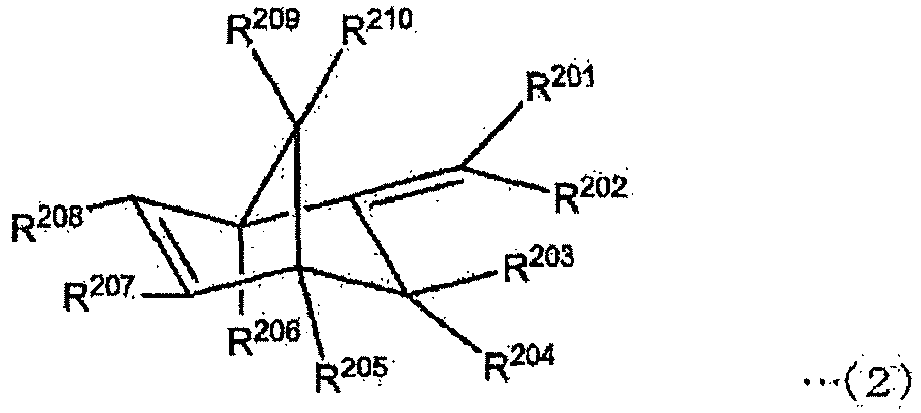
- In formula (2), R201, R202, R203, R204, R205, R206, R207, R208, R209, and R210 each independently represent a hydrogen atom or a hydrocarbyl group having 1 or more and 10 or less carbon atoms. R202 and R203 may be bonded to each other to form a hydrocarbylene group having 2 or more and 10 or less carbon atoms.
- The hydrocarbyl group having 1 or more and 10 or less carbon atoms as R101, R103 to R110, and R201 to R210 may be a methyl group, an ethyl group, a propyl group, a butyl group, a pentyl group, a hexyl group, a heptyl group, an octyl group, or the like, and may be a methyl group.
- The alkenyl group having 2 or more and 10 or less carbon atoms as R102 may be a vinyl group, a 1-propenyl group, an allyl group, a butenyl group, a butadienyl group, a pentenyl group, a hexenyl group, a heptenyl group, an octenyl group, or the like, and may be a vinyl group. Examples of the alkenylene group having 3 or more and 10 or less carbon atoms formed by R102 and R103 bonded to each other include a propenylene group and a butenylene group.
- The hydrocarbyl group having 1 or more and 10 or less carbon atoms formed by R202 and R203 bonded to each other may be a methylene group, an ethylene group, a propylene group, a butylene group, a hexylene group, a heptylene group, or an octylene group, or the like, and may be an ethylene group.
- Specific examples of the compound represented by formula (1) or formula (2) include dicyclopentadiene, vinylnorbornene (5-vinyl-2-norbornene), and ethylidenenorbornene (5-ethylidene-2-norbornene). Two or more compounds represented by formula (1) or formula (2) may be used.
- The total content of the compound represented by formula (1) and the compound represented by formula (2) in a polymerization solution (a hydrocarbon solution) may be 0.5 mol or more and 40 mol or less, 0.6 mol or more and 37 mol or less, 0.8 mol or more and 35 mol or less, or 1 mol or more and 30 mol or less, per mol of the alkali metal of the organoalkali metal compound. The upper limits and the lower limits of these numerical ranges can be in any combination. The conjugated diene polymer according to some embodiments can contain a monomeric unit derived from the compound represented by formula (1) or (2).
- Examples of the organoalkali metal compound include ethyllithium, n-propyllithium, iso-propyllithium, n-butyllithium, sec-butyllithium, tert-octyllithium, n-decyllithium, phenyllithium, 2-naphthyllithium, 2-butylphenyllithium, 4-phenylbutyllithium, cyclohexyllithium, 4-cyclopentyllithium, dimethylaminopropyllithium, diethylaminopropyllithium, tert-butyldimethylsilyloxypropyllithium, N-morpholinopropyllithium, lithium hexamethyleneimide, lithium pyrrolidide, lithium piperidide, lithium heptamethyleneimide, lithium dodecamethyleneimide, 1,4-dilithio-2-butene, sodium naphthalenide, sodium biphenylide, potassium naphthalenide, and a reaction product of 3-(dimethylamino)propyllithium and isoprene (a compound obtained by reacting 3-(dimethylamino)propyllithium and isoprene). The organoalkali metal compound may be an organolithium compound and/or an organosodium compound, or may be an organolithium compound having 2 or more and 20 or less carbon atoms and/or an organosodium compound having 2 or more and 20 or less carbon atoms.
- The solvent contained in the polymerization solution (the hydrocarbon solution) above may be a solvent that does not substantially deactivate the organoalkali metal compound used as a polymerization initiator. Examples of the solvent include aliphatic hydrocarbons such as propane, butane, isobutane, pentane, isopentane, and hexane; aromatic hydrocarbons such as benzene, toluene, xylene, and ethylbenzene; and alicyclic hydrocarbons such as cyclopentane and cyclohexane. Two or more solvents selected from these may be used in combination.
- The polymerization solution (the hydrocarbon solution) may contain an agent that regulates the amount of vinyl bonds of the monomeric unit derived from the conjugated diene, and an agent that regulates the distribution of the monomeric unit derived from the conjugated diene in the conjugated diene polymer (hereinafter collectively referred to as a "regulator").
- Examples of the regulator include ether compounds, tertiary amines, phosphine compounds, alkali metal alkoxides, and alkali metal phenoxides. Examples of the ether compounds include:
- cyclic ethers such as tetrahydrofuran, tetrahydropyran, and 1,4-dioxane; aliphatic monoethers such as diethyl ether and dibutyl ether;
- aliphatic diethers such as ethylene glycol dimethyl ether, ethylene glycol diethyl ether, and ethylene glycol dibutyl ether;
- aliphatic triethers such as diethylene glycol diethyl ether and diethylene glycol dibutyl ether; and
- aromatic ethers such as diphenyl ether and anisole. Examples of the tertiary amines include triethylamine, tripropylamine, tributylamine, 1,1,2,2-tetramethylethylenediamine, N,N-diethylaniline, pyridine, and quinoline. Examples of the phosphine compounds include trimethyl phosphine, triethyl phosphine, and triphenyl phosphine. Examples of the alkali metal alkoxides include sodium-tert-butoxide, potassium-tert-butoxide, sodium-tert-pentoxide, and potassium-tert-pentoxide. Examples of the alkali metal phenoxides include sodium phenoxide and potassium phenoxide. Two or more regulators selected from these may be used in combination.
- The content of monomeric component in the polymerization solution (the hydrocarbon solution) may be 1 mass% or more and 50 mass% or less, or 5 mass% or more and 30 mass% or less. Note that the total amount of the polymerization solution is 100 mass%. When the polymerization solution solely contains a conjugated diene as a monomeric component, the content of monomeric component in the hydrocarbon solution is the content of the conjugated diene. When the polymerization solution contains a conjugated diene and a comonomer as monomeric components, the content of monomeric component in the polymerization solution is the sum of the contents of the conjugated diene and the comonomer. Although the compound represented by formula (1) or formula (2) can copolymerize with the conjugated diene, the amount thereof is not included in the content of monomeric component.
- The polymerization temperature (the temperature of the polymerization solution) may be 25°C or higher and 100°C or lower, 35°C or higher and 90°C or lower, or 50°C or higher and 80°C or lower. The polymerization time may be 10 minutes or longer and 5 hours or shorter.
- During polymerization or after polymerization, the polymerization active terminal of the conjugated diene polymer may be reacted with at least one compound selected from the group consisting of alkoxysilane compounds, halogen-containing silicon compounds, ketone compounds, and tin compounds to modify the conjugated diene polymer. This reaction provides a conjugated diene polymer having a modifying group that is bonded to the molecular chain terminal and derived from an alkoxysilane compound, a halogen-containing silicon compound, a ketone compound, or a tin compound.
- Examples of the alkoxysilane compound include:
- [(dialkylamino)alkyl]alkoxysilane compounds such as
- [3-(dimethylamino)propyl]triethoxysilane,
- [3-(dimethylamino)propyl]trimethoxysilane,
- [3-(diethylamino)propyl]triethoxysilane,
- [3-(diethylamino)propyl]trimethoxysilane,
- [3-(dimethylamino)propyl]methyldiethoxysilane,
- [2-(dimethylamino)ethyl]triethoxysilane, and
- [2-(dimethylamino)ethyl]trimethoxysilane;
- cyclic aminoalkylalkoxysilane compounds such as
- (1-hexamethyleneiminomethyl)trimethoxysilane,
- [3-(1-hexamethyleneimino)propyl]triethoxysilane,
- N-(3-triethoxysilylpropyl)-4,5-dihydroimidazole, and
- N-(3-trimethoxysilylpropyl)-4,5-imidazole;
- {[di(tetrahydrofuranyl)amino]alkyl}alkoxysilane compounds such as
- {3-[di(tetrahydrofuranyl)amino]propyl}trimethoxysilane and
- {3-[di(tetrahydrofuranyl)amino]propyl}triethoxysilane; and
- [N,N-bis(trialkylsilyl)aminoalkyl]alkylalkoxysilane compounds such as
- {3-[N,N-bis(trimethylsilyl)amino]propyl}methyldimethoxysilane and
- {3-[N,N-bis(trimethylsilyl)amino]propyl}methyldiethoxysilane.
- Examples of the halogen-containing silicon compound include silicon tetrachloride, methyltrichlorosilane, dimethyldichlorosilane, tetramethoxysilane, methyltrimethoxysilane, dimethoxydimethylsilane, methyltriethoxysilane, ethyltrimethoxysilane, dimethoxydiethylsilane, diethoxydimethylsilane, tetraethoxysilane, ethyltriethoxysilane, and diethoxydiethylsilane.
- Examples of the ketone compound include:
- N,N-dihydrocarvylacetamides such as N,N-dimethylacetamide, N,N-diethylacetamide, and N-methyl-N-ethylacetamide;
- N,N-dihydrocarvylacrylamides such as N-dimethylacrylamide, N,N-diethylacrylamide, and N-methyl-N-ethylacrylamide;
- N,N-dihydrocarvylmethacrylamides such as N,N-dimethylmethacrylamide, N,N-diethylmethacrylamide, and N-methyl-N-ethylmethacrylamide;
- 4-(N,N-dihydrocarvylamino)acetophenones such as 4-(N,N-dimethylamino)acetophenone,
- 4-(N-methyl-N-ethylamino)acetophenone, and 4-(N,N-diethylamino)acetophenone;
- 4-cyclic aminoacetophenone compounds such as 4'-(imidazol-1-yl)acetophenone;
- bis(dihydrocarvylaminoalkyl)ketones such as 1,7-bis(methylethylamino)-4-heptanone and
- 1,3-bis(diphenylamino)-2-propanone;
- 4-(dihydrocarvylamino)benzophenones such as 4-N,N-dimethylaminobenzophenone,
- 4-N,N-diethylaminobenzophenone,
- 4-N,N-di-t-butylaminobenzophenone, and 4-N,N-diphenylaminobenzophenone; and
- 4,4'-bis(dihydrocarvylamino)benzophenones such as 4,4'-bis(dimethylamino)benzophenone,
- 4,4'-bis(diethylamino)benzophenone, and
- 4,4'-bis(diphenylamino)benzophenone.
- Examples of the tin compound include tin tetrachloride, methyltrichlorotin, and dimethyldichlorotin.
- After the polymerization reaction, the polymerization active terminal of the conjugated diene polymer may be treated with alcohol such as methanol, isopropyl alcohol, or 1-butanol before recovering the conjugated diene polymer from the solution in which the conjugated diene polymer is dissolved. Thereby, the polymerization active terminal of the conjugated diene polymer can be partially deactivated to regulate the molecular weight distribution of the conjugated diene polymer.
- After polymerization, the conjugated diene polymer can be recovered by a known method from the solution in which the conjugated diene polymer is dissolved. Examples of the method for recovering the conjugated diene polymer include (a) a method in which a coagulant is added to the solution containing the conjugated diene polymer, and (b) a method in which steam is blown into the solution containing the conjugated diene polymer. The recovered conjugated diene polymer may be dried with a known dryer such as a band dryer or an extrusion dryer.
- When the conjugated diene polymer is a polymer obtained by copolymerizing a conjugated diene and a comonomer, the content of the monomeric unit derived from the comonomer in the conjugated diene polymer may be 5 mass% or more or 10 mass% or more based on the total amount of the monomer derived from the conjugated diene and the monomer derived from the comonomer being 100 mass%. The content of the monomeric unit derived from the comonomer in the conjugated diene polymer may be 50 mass% or less or 45 mass% or less.
- The weight average molecular weight (Mw) of the conjugated diene polymer in terms of (standard) polystyrene by gel permeation chromatography may be 10000 or more, 50000 or more, or 100000 or more for increased tensile strength at break. The weight average molecular weight may be 2000000 or less, 1500000 or less, or 1300000 or less for increased processability.
- The ratio (molecular weight distribution, Mw/Mn) of the weight average molecular weights (Mw) to the number average molecular weight (Mn) of the conjugated diene polymer in terms of (standard) polystyrene by gel permeation chromatography may be 1.5 or less, 1.4 or less, or 1.3 or less for increased tensile strength at break. Mw/Mn is normally 1.0 or more.
- The amount of vinyl bonds in the conjugated diene polymer may be 80 mol% or less or 70 mol% or less based on the content of the monomeric unit derived from the conjugated diene being 100 mol%. The amount of vinyl bonds may be 10 mol% or more, 15 mol% or more, 20 mol% or more, or 30 mol% or more. The amount of vinyl bonds can be determined based on absorption intensity in the vicinity of 910 cm-1, which is the absorption peak of a vinyl group, by infrared spectroscopy.
- A further polymeric component, an additive, and the like may be added to the conjugated diene polymer, and vulcanization treatment may be performed as necessary, to prepare a conjugated diene polymer composition that contains the conjugated diene polymer and that may contain a further polymer component and/or an additive. The conjugated diene polymer composition may contain two or more conjugated diene polymers according to the above-described embodiment.
- Examples of the further polymeric component include butyl rubber, natural rubber, ethylene-propylene copolymers, and ethylene-octene copolymers. Two or more selected from these polymeric components may be used in combination.
- When the conjugated diene polymer composition contains a further polymeric component (when a further polymeric component is added to the conjugated diene polymer), the content of the conjugated diene polymer in the conjugated diene polymer composition may be 10 mass% or more and 99.9 mass% or less, or 20 mass% or more and 90 mass% or less, based on the sum of the contents of the conjugated diene polymer and the further polymeric component being 100 mass%, for increased tensile properties.
- The additive used can be a known additive. Examples of the additive include:
- vulcanizing agents such as sulfur;
- vulcanization accelerators such as thiazole vulcanization accelerators, thiuram vulcanization accelerators, sulfenamide vulcanization accelerators, and guanidine vulcanization accelerators;
- vulcanization activators such as stearic acid and zinc oxide;
- organic peroxides such as dicumyl peroxide and di-tertiary-butyl peroxide;
- reinforcing agents such as silica and carbon black;
- fillers such as calcium carbonate, talc, alumina, clay, aluminum hydroxide, and mica;
- silane coupling agents; extender oils; processing aids; antiaging agents; and lubricants.
- The vulcanizing agent may be sulfur. Examples of sulfur include powdery sulfur, precipitated sulfur, colloidal sulfur, insoluble sulfur, and highly dispersive sulfur. When the conjugated diene polymer composition contains sulfur (when sulfur is added to the conjugated diene polymer), the sulfur content may be 0.1 parts by mass or more and 15 parts by mass or less, 0.3 parts by mass or more and 10 parts by mass or less, or 0.5 parts by mass or more and 5 parts by mass or less, based on 100 parts by mass of the conjugated diene polymer.
- Examples of the vulcanization accelerators include:
- thiazole vulcanization accelerators such as 2-mercaptobenzothiazole, dibenzothiazyl disulfide, and N-cyclohexyl-2-benzothiazylsulfenamide;
- thiuram vulcanization accelerators such as tetramethylthiuram monosulfide and tetramethylthiuram disulfide;
- sulfenamide vulcanization accelerators such as N-cyclohexyl-2-benzothiazole sulfenamide, N-tert-butyl-2-benzothiazole sulfenamide, N-oxymethylene-2-benzothiazole sulfenamide, N-oxyethylene-2-benzothiazole sulfenamide, and N,N'-diisopropyl-2-benzothiazole sulfenamide; and
- guanidine vulcanization accelerators such as diphenylguanidine, di-ortho-tolylguanidine, and ortho-tolylbiguanidine.
- When the conjugated diene polymer composition contains a vulcanization accelerator (when a vulcanization accelerator is added to the conjugated diene polymer), the content of the vulcanization accelerator may be 0.1 parts by mass or more and 5 parts by mass or less, or 0.2 parts by mass or more and 3 parts by mass or less, based on 100 parts by mass of the conjugated diene polymer.
- The reinforcing agent may be at least one selected from the group consisting of, for example, silica, calcium silicate, aluminum silicate, and carbon black.
- Examples of silica include dry silica (anhydrous silicic acid), wet silica (hydrous silicic acid), colloidal silica, and precipitated silica. One or two or more types of silica selected from these can be used.
- The BET specific surface area of silica may be 50 m2/g or more and 250 m2/g or less. The BET specific surface area is measured in accordance with ASTM D1993-03. As for commercially available silica, trade name Ultrasil VN3-G manufactured by Degussa, trade names VN3, AQ, ER, and RS-150 manufactured by Tosoh Silica Corporation, and trade names Zeosil 1115 MP and 1165 MP manufactured by Rhodia, and the like can be used.
- Carbon blacks include furnace black, acetylene black, thermal black, channel black, graphite, and the like. Examples of the carbon black include:
- channel carbon black such as EPC, MPC, and CC;
- furnace carbon black such as SAF, ISAF, HAF, MAF, FEF, SRF, GPF, APF, FF, CF, SCF, and ECF;
- thermal carbon black such as FT and MT; and
- acetylene carbon black. Two or more carbon blacks selected from these may be used in combination.
- The nitrogen adsorption specific surface area (N2SA) of the carbon black may be 5 m2/g or more and 200 m2/g or less. The amount of dibutyl phthalate (DBP) absorption of the carbon black may be 5 ml/100 g or more and 300 ml/100 g or less. The nitrogen adsorption specific surface area is measured in accordance with ASTM D4820-93. The amount of DBP absorption is measured in accordance with ASTM D2414-93. As for commercially available carbon blacks, trade name Diablack N339 manufactured by Mitsubishi Chemical Corporation, trade names Seast 6, Seast 7HM, and Seast KH manufactured by Tokai Carbon Co., Ltd., and trade names CK3 and Special Black 4A manufactured by Degussa, and the like can be used.
- When the conjugated diene polymer composition contains a reinforcing agent (when a reinforcing agent is added to the conjugated diene polymer), the content of the reinforcing agent in the conjugated diene polymer composition may be 10 parts by mass or more, 20 parts by mass or more, or 30 parts by mass or more, based on 100 parts by mass of the conjugated diene polymer, for increased tensile strength at break. The content of the reinforcing agent may be 150 parts by mass or less, 120 parts by mass or less, or 100 parts by mass or less for increased tensile elongation at break.
- Examples of the silane coupling agent include vinyltrichlorosilane, vinyltriethoxysilane, vinyltris(β-methoxyethoxy)silane, β-(3,4-epoxycyclohexyl)ethyltrimethoxysilane, γ-glycidoxypropyltrimethoxysilane, γ-methacryloxypropyltrimethoxysilane, N-(β-aminoethyl)-γ-aminopropyltrimethoxysilane, N-(β-aminoethyl)-γ-aminopropylmethyldimethoxysilane, N-phenyl-γ-aminopropyltrimethoxysilane, γ-chloropropyltrimethoxysilane, γ-mercaptopropyltrimethoxysilane, γ-aminopropyltriethoxysilane, bis(3-(triethoxysilyl)propyl)disulfide, bis(3-(triethoxysilyl)propyl)tetrasulfide, γ-trimethoxysilylpropyldimethylthiocarbamyl tetrasulfide, and γ-trimethoxysilylpropylbenzothiazyl tetrasulfide. One or more selected from these can be used. As for commercially available silane coupling agents, trade names Si69 and Si75 manufactured by Degussa and the like can be used.
- When the conjugated diene polymer composition contains a silane coupling agent and silica (when a silane coupling agent and silica are added to the conjugated diene polymer), the content of the silane coupling agent may be 1 part by mass or more and 20 parts by mass or less, 2 parts by mass or more and 15 parts by mass or less, or 5 parts by mass or more and 10 parts by mass or less, based on 100 parts by mass of silica.
- Examples of the extender oil include aromatic mineral oil (viscosity-gravity constant (V.G.C. value) 0.900 to 1.049), naphthenic mineral oil (viscosity-gravity constant (V.GC. value) 0.850 to 0.899), and paraffinic mineral oil (viscosity-gravity constant (V.G.C. value) 0.790 to 0.849). The content of the polycyclic aromatic in the extender oil may be less than 3 mass% or less than 1 mass% based on 100 mass% of the extender oil. The content of the polycyclic aromatic is measured in accordance with the UK Institute of Petroleum 346/92 method. The content of aromatic compound (CA) of the extender oil may be 20 mass% or more. One or two or more extender oils selected from these may be used.
- As a method for manufacturing a conjugated diene polymer composition by adding a further polymeric component, an additive, and the like to the conjugated diene polymer of the present invention, for example, a method in which the components are kneaded by a known mixer such as a roll or a Banbury mixer can be used.
- When additives other than a vulcanizing agent and a vulcanization accelerator are added, the kneading temperature is normally 50°C or higher and 200°C or lower, and may be 80°C or higher 190°C or lower, and the kneading time is normally 30 seconds or longer and 30 minutes or shorter, and may be 1 minute or longer and 30 minutes or shorter. When a vulcanizing agent and a vulcanization accelerator are added, the kneading temperature is normally 100°C or lower, and may be room temperature or higher and 80°C or lower. Vulcanization treatment such as press vulcanization is normally performed on the conjugated diene polymer composition containing a vulcanizing agent and a vulcanization accelerator. The vulcanization temperature is normally 120°C or higher and 200°C or lower, and may be 140°C or higher and 180°C or lower.
- The conjugated diene polymer composition of the present embodiment has excellent durability and good processability and is suitably used for tires.
- Physical properties were evaluated by the following methods.
- The Mooney viscosity of a polymer was measured at 100°C in accordance with JIS K 6300 (1994).
- The molecular weight distribution of a polymer was measured by gel permeation chromatography (GPC) under the following conditions (1) to (8).
- (1) Apparatus: HLC-8020 manufactured by Tosoh Corporation
- (2) Separation columns: GMH-XL (two columns in series) manufactured by Tosoh Corporation
- (3) Measurement temperature: 40°C
- (4) Carrier: Tetrahydrofuran
- (5) Flow rate: 0.6 mL/min
- (6) Injection amount: 5 µL
- (7) Detector: Differential refractometer
- (8) Molecular weight standard: Standard polystyrene
- The amount of vinyl bonds in the monomer derived from 1,3-butadiene in a polymer was obtained based on absorption intensity in the vicinity of 910 cm-1, which is the absorption peak of a vinyl group, by infrared spectroscopy.
- The content of the monomeric unit derived from styrene (the amount of styrene unit) in a polymer was obtained from a refractive index in accordance with JIS K 6383 (1995).
- Using a #3 dumb-bell specimen, stress (tensile strength at break) and percentage elongation (tensile elongation at break) when the specimen broke were measured at a tensile rate of 500 mm/min in accordance with JIS K 6251. The higher the tensile strength at break is, and the larger the tensile elongation at break is, the better the durability of a polymer is.
- A stainless-steel polymerization reactor having an inner volume of 5 liters and equipped with a stirrer was washed and dried, and gas inside the polymerization reactor was replaced with dry nitrogen. Next, 2.55 kg of industrial hexane (density 680 kg/m3), 137 g of 1,3-butadiene, 43 g of styrene, 6.07 g of 5-vinyl-2-norbornene, 1.5 ml of tetrahydrofuran, and 1.2 ml of ethylene glycol diethyl ether were introduced into the polymerization reactor. Next, in order to detoxify impurities that function to deactivate the polymerization initiator in advance, a small amount of a hexane solution of n-butyllithium as a scavenger was introduced into the polymerization reactor.
- A n-hexane solution of n-butyllithium (n-butyllithium content 2.57 mmol) was introduced into the polymerization solution in the polymerization reactor to initiate a polymerization reaction.
- The polymerization reaction was performed for 2 hours and 30 minutes. During the polymerization reaction, the temperature inside the polymerization reactor was regulated to 65°C, and the polymerization solution in the polymerization reactor was stirred at a stirring speed of 130 rpm. During the polymerization reaction, 205 g of 1,3-butadiene and 65 g of styrene were continuously supplied to the polymerization reactor.
- 10 ml of a hexane solution containing 0.2 ml of methanol was introduced into the polymerization reactor, and the polymer solution was stirred for 5 minutes.
- 1.8 g of 2-tert-butyl-6-(3-tert-butyl-2-hydroxy-5-methylbenzyl)-4-methylphenyl acrylate (trade name: Sumilizer GM, manufactured by Sumitomo Chemical Co., Ltd.) and 0.9 g of pentaerythrityl tetrakis(3-laurylthiopropionate) (trade name: Sumilizer TP-D, manufactured by Sumitomo Chemical Co., Ltd.) were introduced into the polymerization reactor. Next, the polymer solution was evaporated at normal temperature for 24 hours and, further, dried under reduced pressure at 55°C for 12 hours, and a polymer was thus obtained. Evaluation results of the polymer are shown in Table 1.
- 100 parts by mass of the resulting polymer, 78.4 parts by mass of silica (trade name: Ultrasil VN3-G, manufactured by Degussa), 6.4 parts by mass of a silane coupling agent (trade name: Si69, manufactured by Degussa), 6.4 parts by mass of carbon black (trade name: Diablack N339, manufactured by Mitsubishi Chemical Corporation), 37.6 parts by mass of extender oil (trade name: JOMO Process NC-140, manufactured by Japan Energy Corporation), 1.5 parts by mass of an antiaging agent (trade name: Antigene 3C, manufactured by Sumitomo Chemical Co., Ltd.), 1.5 parts by mass of wax (trade name: Sunnoc N, manufactured by Ouchi Shinko Chemical Industrial Co., Ltd.), and 2 parts by mass of stearic acid were kneaded with a Labo Plastomill, and a polymer composition was thus obtained.
- Next, as second-stage kneading, 2 parts by mass of zinc flower, 1.5 parts by mass of a vulcanization accelerator (trade name: Soxinol CZ, manufactured by Sumitomo Chemical Co., Ltd.), 1.5 parts by mass of a vulcanization accelerator (trade name: Soxinol D, manufactured by Sumitomo Chemical Co., Ltd.), and 1.4 parts by mass of sulfur were added to the polymer composition and kneaded with a 6-inch roll, and the kneaded product (the polymer composition) was formed into a sheet.
- The sheet was heated at 160°C for 55 minutes to be vulcanized, and the physical properties of the resulting sheet were evaluated. Evaluation results of the physical properties of the sheet are shown in Table 1.
- A stainless-steel polymerization reactor having an inner volume of 5 liters and equipped with a stirrer was washed and dried, and gas inside the polymerization reactor was replaced with dry nitrogen. Next, 2.55 kg of industrial hexane (density 680 kg/m3), 137 g of 1,3-butadiene, 43 g of styrene, 5.95 g of 5-ethylidene-2-norbornene, 1.5 ml of tetrahydrofuran, and 1.2 ml of ethylene glycol diethyl ether were introduced into the polymerization reactor. Next, in order to detoxify impurities that function to deactivate the polymerization initiator in advance, a small amount of a hexane solution of n-butyllithium as a scavenger was introduced into the polymerization reactor.
- A n-hexane solution of n-butyllithium (n-butyllithium content 2.57 mmol) was introduced into the polymerization solution in the polymerization reactor to initiate a polymerization reaction.
- The polymerization reaction was performed for 2 hours and 30 minutes. During the polymerization reaction, the temperature inside the polymerization reactor was regulated to 65°C, the polymerization solution in the polymerization reactor was stirred at a stirring speed of 130 rpm, and 205 g of 1,3-butadiene and 65 g of styrene were continuously supplied to the polymerization reactor.
- 10 ml of a hexane solution containing 0.2 ml of methanol was introduced into the polymerization reactor, and the polymer solution was stirred for 5 minutes.
- 1.8 g of 2-tert-butyl-6-(3-tert-butyl-2-hydroxy-5-methylbenzyl)-4-methylphenyl acrylate (trade name: Sumilizer GM, manufactured by Sumitomo Chemical Co., Ltd.) and 0.9 g of pentaerythrityl tetrakis(3-laurylthiopropionate) (trade name: Sumilizer TP-D, manufactured by Sumitomo Chemical Co., Ltd.) were introduced into the polymerization reactor. Next, the polymer solution was evaporated at normal temperature for 24 hours and, further, dried under reduced pressure at 55°C for 12 hours, and a polymer was thus obtained. Evaluation results of the polymer are shown in Table 1.
- 100 parts by mass of the resulting polymer, 78.4 parts by mass of silica (trade name: Ultrasil VN3-G, manufactured by Degussa), 6.4 parts by mass of a silane coupling agent (trade name: Si69, manufactured by Degussa), 6.4 parts by mass of carbon black (trade name: Diablack N339, manufactured by Mitsubishi Chemical Corporation), 37.6 parts by mass of extender oil (trade name: JOMO Process NC-140, manufactured by Japan Energy Corporation), 1.5 parts by mass of an antiaging agent (trade name: Antigene 3C, manufactured by Sumitomo Chemical Co., Ltd.), 1.5 parts by mass of wax (trade name: Sunnoc N, manufactured by Ouchi Shinko Chemical Industrial Co., Ltd.), and 2 parts by mass of stearic acid were kneaded with a Labo Plastomill, and a polymer composition was thus obtained.
- Next, as second-stage kneading, 2 parts by mass of zinc flower, 1.5 parts by mass of a vulcanization accelerator (trade name: Soxinol CZ, manufactured by Sumitomo Chemical Co., Ltd.), 1.5 parts by mass of a vulcanization accelerator (trade name: Soxinol D, manufactured by Sumitomo Chemical Co., Ltd.), and 1.4 parts by mass of sulfur were added to the polymer composition and kneaded with a 6-inch roll, and the kneaded product (the polymer composition) was formed into a sheet.
- The sheet was heated at 160°C for 55 minutes to be vulcanized, and the physical properties of the resulting sheet were evaluated. Evaluation results of the physical properties of the sheet are shown in Table 1.
- A stainless-steel polymerization reactor having an inner volume of 5 liters and equipped with a stirrer was washed and dried, and gas inside the polymerization reactor was replaced with dry nitrogen. Next, 2.55 kg of industrial hexane (density 680 kg/m3), 137 g of 1,3-butadiene, 43 g of styrene, 6.54 g of dicyclopentadiene, 1.5 ml of tetrahydrofuran, and 1.2 ml of ethylene glycol diethyl ether were introduced into the polymerization reactor. Next, in order to detoxify impurities that function to deactivate the polymerization initiator in advance, a small amount of a hexane solution of n-butyllithium as a scavenger was introduced into the polymerization reactor.
- A n-hexane solution of n-butyllithium (n-butyllithium content 2.57 mmol) was introduced into the polymerization solution in the polymerization reactor to initiate a polymerization reaction.
- The polymerization reaction was performed for 2 hours and 30 minutes. During the polymerization reaction, the temperature inside the polymerization reactor was regulated to 65°C, the polymerization solution in the polymerization reactor was stirred at a stirring speed of 130 rpm, and 205 g of 1,3-butadiene and 65 g of styrene were continuously supplied to the polymerization reactor.
- 10 ml of a hexane solution containing 0.2 ml of methanol was introduced into the polymerization reactor, and the polymer solution was stirred for 5 minutes.
- 1.8 g of 2-tert-butyl-6-(3-tert-butyl-2-hydroxy-5-methylbenzyl)-4-methylphenyl acrylate (trade name: Sumilizer GM, manufactured by Sumitomo Chemical Co., Ltd.) and 0.9 g of pentaerythrityl tetrakis(3-laurylthiopropionate) (trade name: Sumilizer TP-D, manufactured by Sumitomo Chemical Co., Ltd.) were introduced into the polymerization reactor. Next, the polymer solution was evaporated at normal temperature for 24 hours and, further, dried under reduced pressure at 55°C for 12 hours, and a polymer was thus obtained. Evaluation results of the polymer are shown in Table 1.
- 100 parts by mass of the resulting polymer, 78.4 parts by mass of silica (trade name: Ultrasil VN3-G, manufactured by Degussa), 6.4 parts by mass of a silane coupling agent (trade name: Si69, manufactured by Degussa), 6.4 parts by mass of carbon black (trade name: Diablack N339, manufactured by Mitsubishi Chemical Corporation), 37.6 parts by mass of extender oil (trade name: JOMO Process NC-140, manufactured by Japan Energy Corporation), 1.5 parts by mass of an antiaging agent (trade name: Antigene 3C, manufactured by Sumitomo Chemical Co., Ltd.), 1.5 parts by mass of wax (trade name: Sunnoc N, manufactured by Ouchi Shinko Chemical Industrial Co., Ltd.), and 2 parts by mass of stearic acid were kneaded with a Labo Plastomill, and a polymer composition was thus obtained.
- Next, as second-stage kneading, 2 parts by mass of zinc flower, 1.5 parts by mass of a vulcanization accelerator (trade name: Soxinol CZ, manufactured by Sumitomo Chemical Co., Ltd.), 1.5 parts by mass of a vulcanization accelerator (trade name: Soxinol D, manufactured by Sumitomo Chemical Co., Ltd.), and 1.4 parts by mass of sulfur were added to the polymer composition and kneaded with a 6-inch roll, and the kneaded product (the polymer composition) was formed into a sheet.
- The sheet was heated at 160°C for 55 minutes to be vulcanized, and the physical properties of the resulting sheet were evaluated. Evaluation results of the physical properties of the sheet are shown in Table 1.
- A stainless-steel polymerization reactor having an inner volume of 5 liters and equipped with a stirrer was washed and dried, and gas inside the polymerization reactor was replaced with dry nitrogen. Next, 2.55 kg of industrial hexane (density 680 kg/m3), 137 g of 1,3-butadiene, 43 g of styrene, 1.5 ml of tetrahydrofuran, and 1.2 ml of ethylene glycol diethyl ether were introduced into the polymerization reactor. Next, in order to detoxify impurities that function to deactivate the polymerization initiator in advance, a small amount of a hexane solution of n-butyllithium as a scavenger was introduced into the polymerization reactor.
- A n-hexane solution of n-butyllithium (n-butyllithium content 2.57 mmol) was introduced into the polymerization solution in the polymerization reactor to initiate a polymerization reaction.
- The polymerization reaction was performed for 2 hours and 30 minutes. During the polymerization reaction, the temperature inside the polymerization reactor was regulated to 65°C, the polymerization solution in the polymerization reactor was stirred at a stirring speed of 130 rpm, and 205 g of 1,3-butadiene and 65 g of styrene were continuously supplied to the polymerization reactor.
- 10 ml of a hexane solution containing 0.2 ml of methanol was introduced into the polymerization reactor, and the polymer solution was stirred for 5 minutes.
- 1.8 g of 2-tert-butyl-6-(3-tert-butyl-2-hydroxy-5-methylbenzyl)-4-methylphenyl acrylate (trade name: Sumilizer GM, manufactured by Sumitomo Chemical Co., Ltd.) and 0.9 g of pentaerythrityl tetrakis(3-laurylthiopropionate) (trade name: Sumilizer TP-D, manufactured by Sumitomo Chemical Co., Ltd.) were introduced into the polymerization reactor. Next, the polymer solution was evaporated at normal temperature for 24 hours and, further, dried under reduced pressure at 55°C for 12 hours, and a polymer was thus obtained. Evaluation results of the polymer are shown in Table 1.
- 100 parts by mass of the resulting polymer, 78.4 parts by mass of silica (trade name: Ultrasil VN3-G, manufactured by Degussa), 6.4 parts by mass of a silane coupling agent (trade name: Si69, manufactured by Degussa), 6.4 parts by mass of carbon black (trade name: Diablack N339, manufactured by Mitsubishi Chemical Corporation), 37.6 parts by mass of extender oil (trade name: JOMO Process NC-140, manufactured by Japan Energy Corporation), 1.5 parts by mass of an antiaging agent (trade name: Antigene 3C, manufactured by Sumitomo Chemical Co., Ltd.), 1.5 parts by mass of wax (trade name: Sunnoc N, manufactured by Ouchi Shinko Chemical Industrial Co., Ltd.), and 2 parts by mass of stearic acid were kneaded with a Labo Plastomill, and a polymer composition was thus obtained.
- Next, as second-stage kneading, 2 parts by mass of zinc flower, 1.5 parts by mass of a vulcanization accelerator (trade name: Soxinol CZ, manufactured by Sumitomo Chemical Co., Ltd.), 1.5 parts by mass of a vulcanization accelerator (trade name: Soxinol D, manufactured by Sumitomo Chemical Co., Ltd.), and 1.4 parts by mass of sulfur were added to the polymer composition and kneaded with a 6-inch roll, and the kneaded product (the polymer composition) was formed into a sheet.
- The sheet was heated at 160°C for 55 minutes to be vulcanized, and the physical properties of the resulting sheet were evaluated. Evaluation results of the physical properties of the sheet are shown in Table 1.
[Table 1] Example 1 Example 2 Example 3 Comp. Example 1 Physical properties of polymer Mooney viscosity 52 55 53 45 Mw (10-4) 29 30 30 28 Mw/Mn 1.08 1.09 1.08 1.07 Amount of vinyl bonds (mol%) 57 57 57 57 Amount of styrene unit (mass%) 24 24 24 24 Physical properties of sheet Tensile strength at break (MPa) 16.2 16.4 16.3 14.9 Tensile elongation at break (%) 360 370 370 340 - A stainless-steel polymerization reactor having an inner volume of 20 liters and equipped with a stirrer was washed and dried, and gas inside the polymerization reactor was replaced with dry nitrogen. Next, 10.2 kg of industrial hexane (density 680 kg/m3), 517 g of 1,3-butadiene, 163 g of styrene, 33.5 g of 5-vinyl-2-norbornene, 6.1 ml of tetrahydrofuran, and 4.6 ml of ethylene glycol diethyl ether were introduced into the polymerization reactor. Next, in order to detoxify impurities that function to deactivate the polymerization initiator in advance, a small amount of a hexane solution of n-butyllithium as a scavenger was introduced into the polymerization reactor.
- A n-hexane solution of n-butyllithium (n-butyllithium content 11.4 mmol) was introduced into the polymerization solution in the polymerization reactor to initiate a polymerization reaction.
- The polymerization reaction was performed for 3 hours. During the polymerization reaction, the temperature inside the polymerization reactor was regulated to 65°C, the polymerization solution in the polymerization reactor was stirred at a stirring speed of 130 rpm, and 775 g of 1,3-butadiene and 245 g of styrene were continuously supplied to the polymerization reactor.
- Next, while maintaining the polymerization reactor temperature at 65°C, the resulting polymerization solution was stirred at a stirring speed of 130 rpm in the polymerization reactor, 13.0 mmol of [3-(diethylamino)propyl]trimethoxysilane was added to the polymerization solution, and stirring was performed for 15 minutes.
- 20 ml of a hexane solution containing 0.8 ml of methanol was introduced into the polymerization reactor, and the polymer solution was stirred for 5 minutes.
- 8.0 g of 2-tert-butyl-6-(3-tert-butyl-2-hydroxy-5-methylbenzyl)-4-methylphenyl acrylate (trade name: Sumilizer GM, manufactured by Sumitomo Chemical Co., Ltd.) and 4.0 g of pentaerythrityl tetrakis(3-laurylthiopropionate) (trade name: Sumilizer TP-D, manufactured by Sumitomo Chemical Co., Ltd.) were introduced into the polymerization reactor. Next, the polymer solution was evaporated at normal temperature for 24 hours and, further, dried under reduced pressure at 55°C for 12 hours, and a polymer was thus obtained. Evaluation results of the polymer are shown in Table 2.
- 100 parts by mass of the resulting polymer, 78.4 parts by mass of silica (trade name: Ultrasil VN3-G, manufactured by Degussa), 6.4 parts by mass of a silane coupling agent (trade name: Si69, manufactured by Degussa), 6.4 parts by mass of carbon black (trade name: Diablack N339, manufactured by Mitsubishi Chemical Corporation), 47.6 parts by mass of extender oil (trade name: JOMO Process NC-140, manufactured by Japan Energy Corporation), 1.5 parts by mass of an antiaging agent (trade name: Antigene 3C, manufactured by Sumitomo Chemical Co., Ltd.), 1.5 parts by mass of wax (trade name: Sunnoc N, manufactured by Ouchi Shinko Chemical Industrial Co., Ltd.), and 2 parts by mass of stearic acid were kneaded with a Labo Plastomill, and a polymer composition was thus obtained.
- Next, as second-stage kneading, 2 parts by mass of zinc flower, 1.5 parts by mass of a vulcanization accelerator (trade name: Soxinol CZ, manufactured by Sumitomo Chemical Co., Ltd.), 1.5 parts by mass of a vulcanization accelerator (trade name: Soxinol D, manufactured by Sumitomo Chemical Co., Ltd.), and 1.4 parts by mass of sulfur were added to the polymer composition and kneaded with a 6-inch roll, and the kneaded product (the polymer composition) was formed into a sheet.
- The sheet was heated at 160°C for 55 minutes to be vulcanized, and the physical properties of the resulting sheet were evaluated. Evaluation results of the physical properties of the sheet are shown in Table 2.
- A stainless-steel polymerization reactor having an inner volume of 20 liters and equipped with a stirrer was washed and dried, and gas inside the polymerization reactor was replaced with dry nitrogen. Next, 10.2 kg of industrial hexane (density 680 kg/m3), 517 g of 1,3-butadiene, 163 g of styrene, 33.5 g of 5-ethylidene-2-norbornene, 6.1 ml of tetrahydrofuran, and 4.6 ml of ethylene glycol diethyl ether were introduced into the polymerization reactor. Next, in order to detoxify impurities that function to deactivate the polymerization initiator in advance, a small amount of a hexane solution of n-butyllithium as a scavenger was introduced into the polymerization reactor.
- A n-hexane solution of n-butyllithium (n-butyllithium content 11.4 mmol) was introduced into the polymerization solution in the polymerization reactor to initiate a polymerization reaction.
- The polymerization reaction was performed for 3 hours. During the polymerization reaction, the temperature inside the polymerization reactor was regulated to 65°C, the polymerization solution in the polymerization reactor was stirred at a stirring speed of 130 rpm, and 775 g of 1,3-butadiene and 245 g of styrene were continuously supplied to the polymerization reactor.
- Next, while maintaining the polymerization reactor temperature at 65°C, the resulting polymerization solution was stirred at a stirring speed of 130 rpm in the polymerization reactor, 13.0 mmol of [3-(diethylamino)propyl]trimethoxysilane was added to the polymerization solution, and stirring was performed for 15 minutes.
- 20 ml of a hexane solution containing 0.8 ml of methanol was introduced into the polymerization reactor, and the polymer solution was stirred for 5 minutes.
- 8.0 g of 2-tert-butyl-6-(3-tert-butyl-2-hydroxy-5-methylbenzyl)-4-methylphenyl acrylate (trade name: Sumilizer GM, manufactured by Sumitomo Chemical Co., Ltd.) and 4.0 g of pentaerythrityl tetrakis(3-laurylthiopropionate) (trade name: Sumilizer TP-D, manufactured by Sumitomo Chemical Co., Ltd.) were introduced into the polymerization reactor. Next, the polymer solution was evaporated at normal temperature for 24 hours and, further, dried under reduced pressure at 55°C for 12 hours, and a polymer was thus obtained. Evaluation results of the polymer are shown in Table 2.
- 100 parts by mass of the resulting polymer, 78.4 parts by mass of silica (trade name: Ultrasil VN3-G, manufactured by Degussa), 6.4 parts by mass of a silane coupling agent (trade name: Si69, manufactured by Degussa), 6.4 parts by mass of carbon black (trade name: Diablack N339, manufactured by Mitsubishi Chemical Corporation), 47.6 parts by mass of extender oil (trade name: JOMO Process NC-140, manufactured by Japan Energy Corporation), 1.5 parts by mass of an antiaging agent (trade name: Antigene 3C, manufactured by Sumitomo Chemical Co., Ltd.), 1.5 parts by mass of wax (trade name: Sunnoc N, manufactured by Ouchi Shinko Chemical Industrial Co., Ltd.), and 2 parts by mass of stearic acid were kneaded with a Labo Plastomill, and a polymer composition was thus obtained.
- Next, as second-stage kneading, 2 parts by mass of zinc flower, 1.5 parts by mass of a vulcanization accelerator (trade name: Soxinol CZ, manufactured by Sumitomo Chemical Co., Ltd.), 1.5 parts by mass of a vulcanization accelerator (trade name: Soxinol D, manufactured by Sumitomo Chemical Co., Ltd.), and 1.4 parts by mass of sulfur were added to the polymer composition and kneaded with a 6-inch roll, and the kneaded product (the polymer composition) was formed into a sheet.
- The sheet was heated at 160°C for 55 minutes to be vulcanized, and the physical properties of the resulting sheet were evaluated. Evaluation results of the physical properties of the sheet are shown in Table 2.
- A stainless-steel polymerization reactor having an inner volume of 20 liters and equipped with a stirrer was washed and dried, and gas inside the polymerization reactor was replaced with dry nitrogen. Next, 10.2 kg of industrial hexane (density 680 kg/m3), 517 g of 1,3-butadiene, 163 g of styrene, 36.8 g of dicyclopentadiene, 6.1 ml of tetrahydrofuran, and 4.6 ml of ethylene glycol diethyl ether were introduced into the polymerization reactor. Next, in order to detoxify impurities that function to deactivate the polymerization initiator in advance, a small amount of a hexane solution of n-butyllithium as a scavenger was introduced into the polymerization reactor.
- A n-hexane solution of n-butyllithium (n-butyllithium content 11.4 mmol) was introduced into the polymerization solution in the polymerization reactor to initiate a polymerization reaction.
- The polymerization reaction was performed for 3 hours. During the polymerization reaction, the temperature inside the polymerization reactor was regulated to 65°C, the polymerization solution in the polymerization reactor was stirred at a stirring speed of 130 rpm, and 775 g of 1,3-butadiene and 245 g of styrene were continuously supplied to the polymerization reactor.
- Next, while maintaining the polymerization reactor temperature at 65°C, the resulting polymerization solution was stirred at a stirring speed of 130 rpm in the polymerization reactor, 13.0 mmol of [3-(diethylamino)propyl]trimethoxysilane was added to the polymerization solution, and stirring was performed for 15 minutes.
- 20 ml of a hexane solution containing 0.8 ml of methanol was introduced into the polymerization reactor, and the polymer solution was stirred for 5 minutes.
- 8.0 g of 2-tert-butyl-6-(3-tert-butyl-2-hydroxy-5-methylbenzyl)-4-methylphenyl acrylate (trade name: Sumilizer GM, manufactured by Sumitomo Chemical Co., Ltd.) and 4.0 g of pentaerythrityl tetrakis(3-laurylthiopropionate) (trade name: Sumilizer TP-D, manufactured by Sumitomo Chemical Co., Ltd.) were introduced into the polymerization reactor. Next, the polymer solution was evaporated at normal temperature for 24 hours and, further, dried under reduced pressure at 55°C for 12 hours, and a polymer was thus obtained. Evaluation results of the polymer are shown in Table 2.
- 100 parts by mass of the resulting polymer, 78.4 parts by mass of silica (trade name: Ultrasil VN3-G, manufactured by Degussa), 6.4 parts by mass of a silane coupling agent (trade name: Si69, manufactured by Degussa), 6.4 parts by mass of carbon black (trade name: Diablack N339, manufactured by Mitsubishi Chemical Corporation), 47.6 parts by mass of extender oil (trade name: JOMO Process NC-140, manufactured by Japan Energy Corporation), 1.5 parts by mass of an antiaging agent (trade name: Antigene 3C, manufactured by Sumitomo Chemical Co., Ltd.), 1.5 parts by mass of wax (trade name: Sunnoc N, manufactured by Ouchi Shinko Chemical Industrial Co., Ltd.), and 2 parts by mass of stearic acid were kneaded with a Labo Plastomill, and a polymer composition was thus obtained.
- Next, as second-stage kneading, 2 parts by mass of zinc flower, 1.5 parts by mass of a vulcanization accelerator (trade name: Soxinol CZ, manufactured by Sumitomo Chemical Co., Ltd.), 1.5 parts by mass of a vulcanization accelerator (trade name: Soxinol D, manufactured by Sumitomo Chemical Co., Ltd.), and 1.4 parts by mass of sulfur were added to the polymer composition and kneaded with a 6-inch roll, and the dough (the polymer composition) was formed into a sheet.
- The sheet was heated at 160°C for 55 minutes to be vulcanized, and the physical properties of the resulting sheet were evaluated. Evaluation results of the physical properties of the sheet are shown in Table 2.
[Table 2] Example 4 Example 5 Example 6 Physical properties of polymer Mooney viscosity 39 35 39 Mw(10-4) 22 21 22 Mw/Mn 1.18 1.18 1.17 Amount of vinyl bonds (mol%) 57 59 58 Amount of styrene unit (mass%) 25 25 25 Physical properties of sheet Tensile strength at break (MPa) 15.7 16.6 17.5 Tensile elongation at break (%) 355 365 400
Claims (9)
- A conjugated diene polymer obtained by a polymerization reaction in a polymerization solution comprising a conjugated diene; a compound represented by the following formula (1) or formula (2), and an organoalkali metal compound as a polymerization initiator:


- The conjugated diene polymer according to claim 1, wherein a total content of the compound represented by formula (1) and the compound represented by formula (2) in the polymerization solution is 0.5 mol or more and 40 mol or less per mol of an alkali metal of the organoalkali metal compound.
- The conjugated diene polymer according to claim 1 or 2, having a modifying group bonded to a molecular chain terminal of the conjugated diene polymer, the modifying group being derived from an alkoxysilane compound, a halogen-containing silicon compound, a ketone compound, or a tin compound.
- The conjugated diene polymer according to any one of claims 1 to 3, wherein, when Mw is a weight average molecular weight of the conjugated diene polymer, Mn is a number average molecular weight of the conjugated diene polymer, and the weight average molecular weight and the number average molecular weight are values in terms of polystyrene by gel permeation chromatography, Mw is 50000 or more and 2000000 or less, and Mw/Mn is 1.0 or more and 1.5 or less.
- A conjugated diene polymer composition comprising:the conjugated diene polymer according to any one of claims 1 to 4; anda reinforcing agent,a content of the reinforcing agent being 10 parts by mass or more and 150 parts by mass or less per 100 parts by mass of the conjugated diene polymer.
- A method for manufacturing a conjugated diene polymer, comprising:a step of producing the conjugated diene polymer by a polymerization reaction in a polymerization solution comprising a conjugated diene, a compound represented by the following formula (1) or formula (2), and an organoalkali metal compound as a polymerization initiator:


- The method according to claim 6, wherein a total content of the compound represented by formula (1) and the compound represented by formula (2) in the polymerization solution is 0.5 mol or more and 40 mol or less per mol of an alkali metal of the organoalkali metal compound.
- The method according to claim 6 or 7, further comprising a step of introducing a modifying group derived from an alkoxysilane compound, a halogen-containing silicon compound, a ketone compound, or a tin compound into a terminal of the polymer produced by the polymerization reaction.
- The method according to any one of claims 6 to 8, wherein, when Mw is a weight average molecular weight of the conjugated diene polymer, Mn is a number average molecular weight of the conjugated diene polymer, and the weight average molecular weight and the number average molecular weight are values in terms of polystyrene by gel permeation chromatography, Mw is 50000 or more and 2000000 or less, and Mw/Mn is 1.0 or more and 1.5 or less.
Applications Claiming Priority (2)
| Application Number | Priority Date | Filing Date | Title |
|---|---|---|---|
| JP2014183904 | 2014-09-10 | ||
| PCT/JP2015/075627 WO2016039386A1 (en) | 2014-09-10 | 2015-09-09 | Conjugated diene polymer and conjugated diene polymer composition |
Publications (3)
| Publication Number | Publication Date |
|---|---|
| EP3192820A1 true EP3192820A1 (en) | 2017-07-19 |
| EP3192820A4 EP3192820A4 (en) | 2018-07-11 |
| EP3192820B1 EP3192820B1 (en) | 2019-05-08 |
Family
ID=55459130
Family Applications (1)
| Application Number | Title | Priority Date | Filing Date |
|---|---|---|---|
| EP15840815.3A Active EP3192820B1 (en) | 2014-09-10 | 2015-09-09 | Conjugated diene polymer and conjugated diene polymer composition |
Country Status (6)
| Country | Link |
|---|---|
| US (1) | US10184020B2 (en) |
| EP (1) | EP3192820B1 (en) |
| JP (1) | JP6715771B2 (en) |
| KR (1) | KR102407303B1 (en) |
| CN (1) | CN106661169B (en) |
| WO (1) | WO2016039386A1 (en) |
Cited By (1)
| Publication number | Priority date | Publication date | Assignee | Title |
|---|---|---|---|---|
| EP4074773A4 (en) * | 2019-12-10 | 2022-12-28 | Bridgestone Corporation | COMPOSITION AND POLYMER MOLDED ARTICLE |
Family Cites Families (14)
| Publication number | Priority date | Publication date | Assignee | Title |
|---|---|---|---|---|
| DE3428496A1 (en) * | 1984-08-02 | 1986-02-13 | Bayer Ag, 5090 Leverkusen | MODIFIED EPDM RUBBER, THEIR PRODUCTION AND THEIR USE FOR THE PRODUCTION OF IMPACT RESISTANT VINYL POLYMERS AND THE VINYL POLYMERS THEREFORE OBTAINED |
| JPS6250346A (en) | 1985-08-30 | 1987-03-05 | Bridgestone Corp | Rubber composition |
| JP3438318B2 (en) | 1994-04-22 | 2003-08-18 | 旭化成株式会社 | Rubber composition for tire |
| JP4367590B2 (en) * | 1999-11-12 | 2009-11-18 | Jsr株式会社 | Process for producing conjugated diene polymer and rubber composition |
| US6197888B1 (en) | 1999-12-30 | 2001-03-06 | Bridgestone Corporation | Process for producing blends of syndiotactic 1, 2-polybutadiene and rubbery elastomers with an iron-based catalyst system |
| US6911507B2 (en) * | 2001-01-24 | 2005-06-28 | Jsr Corporation | Processes for producing cycloolefin addition polymer |
| JP4894986B2 (en) * | 2001-01-24 | 2012-03-14 | Jsr株式会社 | Method for producing norbornene-based cyclic olefin addition polymer |
| JP4389646B2 (en) * | 2003-04-28 | 2009-12-24 | 宇部興産株式会社 | Method for adjusting molecular weight of trans-1,4-polybutadiene |
| JP2005120313A (en) * | 2003-10-20 | 2005-05-12 | Ube Ind Ltd | Method for adjusting molecular weight of trans-1,4-polybutadiene |
| TWI385182B (en) * | 2004-03-15 | 2013-02-11 | Jsr Corp | Conjugated diene (co) poly rubber and method for producing the same |
| JP4405932B2 (en) | 2005-02-23 | 2010-01-27 | 住友ゴム工業株式会社 | Rubber composition and racing tire having a tread comprising the same |
| US7807763B2 (en) * | 2008-04-07 | 2010-10-05 | Bridgestone Corporation | Method for bulk polymerization |
| CN104011093A (en) * | 2011-12-23 | 2014-08-27 | Jsr株式会社 | Modified conjugated diene polymer and its production method |
| JP5962139B2 (en) * | 2012-03-30 | 2016-08-03 | 宇部興産株式会社 | Method for producing diene rubber |
-
2015
- 2015-09-09 CN CN201580048413.XA patent/CN106661169B/en active Active
- 2015-09-09 JP JP2016547480A patent/JP6715771B2/en active Active
- 2015-09-09 EP EP15840815.3A patent/EP3192820B1/en active Active
- 2015-09-09 KR KR1020177008226A patent/KR102407303B1/en active Active
- 2015-09-09 US US15/509,733 patent/US10184020B2/en active Active
- 2015-09-09 WO PCT/JP2015/075627 patent/WO2016039386A1/en not_active Ceased
Cited By (1)
| Publication number | Priority date | Publication date | Assignee | Title |
|---|---|---|---|---|
| EP4074773A4 (en) * | 2019-12-10 | 2022-12-28 | Bridgestone Corporation | COMPOSITION AND POLYMER MOLDED ARTICLE |
Also Published As
| Publication number | Publication date |
|---|---|
| EP3192820A4 (en) | 2018-07-11 |
| KR20170049543A (en) | 2017-05-10 |
| CN106661169B (en) | 2020-03-03 |
| CN106661169A (en) | 2017-05-10 |
| JPWO2016039386A1 (en) | 2017-06-29 |
| US20170260311A1 (en) | 2017-09-14 |
| JP6715771B2 (en) | 2020-07-01 |
| KR102407303B1 (en) | 2022-06-10 |
| EP3192820B1 (en) | 2019-05-08 |
| US10184020B2 (en) | 2019-01-22 |
| WO2016039386A1 (en) | 2016-03-17 |
Similar Documents
| Publication | Publication Date | Title |
|---|---|---|
| US8318858B2 (en) | Conjugated diene polymer, conjugated diene polymer composition, and method for producing conjugated diene polymer | |
| US8367765B2 (en) | Conjugated diene-based polymer, conjugated diene-based polymer composition, and process for producing conjugated diene-based polymer | |
| JP5177050B2 (en) | Conjugated diene polymer and conjugated diene polymer composition | |
| US8394894B2 (en) | Conjugated diene polymer, conjugated diene polymer composition, and method for producing conjugated diene polymer | |
| US8124704B2 (en) | Conjugated diene polymer, conjugated diene polymer composition, and process for producing conjugated diene polymer | |
| US8815977B2 (en) | Process for producing conjugated diene-based polymer, conjugated diene-based polymer, and conjugated diene-based polymer composition | |
| US20100056710A1 (en) | Conjugated diene polymer, conjugated diene polymer composition, and method for producing conjugated diene polymer | |
| US20110275756A1 (en) | Conjugated diene polymer, conjugated diene polymer composition, and method for producing conjugated diene polymer | |
| US8835564B2 (en) | Method for producing modified conjugated diene-based polymer, and method for producing polymer composition | |
| JP5316459B2 (en) | Conjugated diene polymer, conjugated diene polymer composition, and method for producing conjugated diene polymer | |
| EP3192819B1 (en) | Conjugated diene polymer and conjugated diene polymer composition | |
| US20120245275A1 (en) | Process for producing conjugated diene-based polymer, conjugated diene-based polymer, and conjugated diene-based polymer composition | |
| US20110207874A1 (en) | Conjugated diene polymer, conjugated diene polymer composition, and method for producing conjugated diene polymer | |
| US8933165B2 (en) | Method for producing modified conjugated diene-based polymer, and method for producing polymer composition | |
| EP3192820B1 (en) | Conjugated diene polymer and conjugated diene polymer composition | |
| WO2016039388A1 (en) | Conjugated diene polymer composition | |
| KR20090104728A (en) | Conjugated diene-based polymers, preparation methods thereof, and conjugated diene-based polymer compositions and vulcanizates |
Legal Events
| Date | Code | Title | Description |
|---|---|---|---|
| STAA | Information on the status of an ep patent application or granted ep patent |
Free format text: STATUS: THE INTERNATIONAL PUBLICATION HAS BEEN MADE |
|
| PUAI | Public reference made under article 153(3) epc to a published international application that has entered the european phase |
Free format text: ORIGINAL CODE: 0009012 |
|
| STAA | Information on the status of an ep patent application or granted ep patent |
Free format text: STATUS: REQUEST FOR EXAMINATION WAS MADE |
|
| 17P | Request for examination filed |
Effective date: 20170410 |
|
| AK | Designated contracting states |
Kind code of ref document: A1 Designated state(s): AL AT BE BG CH CY CZ DE DK EE ES FI FR GB GR HR HU IE IS IT LI LT LU LV MC MK MT NL NO PL PT RO RS SE SI SK SM TR |
|
| AX | Request for extension of the european patent |
Extension state: BA ME |
|
| DAV | Request for validation of the european patent (deleted) | ||
| DAX | Request for extension of the european patent (deleted) | ||
| REG | Reference to a national code |
Ref country code: DE Ref legal event code: R079 Ref document number: 602015030101 Country of ref document: DE Free format text: PREVIOUS MAIN CLASS: C08F0236040000 Ipc: C08F0008000000 |
|
| A4 | Supplementary search report drawn up and despatched |
Effective date: 20180608 |
|
| RIC1 | Information provided on ipc code assigned before grant |
Ipc: C08F 236/20 20060101ALI20180604BHEP Ipc: C08C 19/22 20060101ALI20180604BHEP Ipc: C08L 15/00 20060101ALI20180604BHEP Ipc: C08F 236/06 20060101ALI20180604BHEP Ipc: C08F 8/00 20060101AFI20180604BHEP Ipc: C08F 236/10 20060101ALI20180604BHEP Ipc: C08C 19/44 20060101ALI20180604BHEP Ipc: C08C 19/25 20060101ALI20180604BHEP Ipc: C08L 9/06 20060101ALI20180604BHEP |
|
| GRAP | Despatch of communication of intention to grant a patent |
Free format text: ORIGINAL CODE: EPIDOSNIGR1 |
|
| STAA | Information on the status of an ep patent application or granted ep patent |
Free format text: STATUS: GRANT OF PATENT IS INTENDED |
|
| INTG | Intention to grant announced |
Effective date: 20181207 |
|
| GRAS | Grant fee paid |
Free format text: ORIGINAL CODE: EPIDOSNIGR3 |
|
| GRAA | (expected) grant |
Free format text: ORIGINAL CODE: 0009210 |
|
| STAA | Information on the status of an ep patent application or granted ep patent |
Free format text: STATUS: THE PATENT HAS BEEN GRANTED |
|
| AK | Designated contracting states |
Kind code of ref document: B1 Designated state(s): AL AT BE BG CH CY CZ DE DK EE ES FI FR GB GR HR HU IE IS IT LI LT LU LV MC MK MT NL NO PL PT RO RS SE SI SK SM TR |
|
| REG | Reference to a national code |
Ref country code: GB Ref legal event code: FG4D |
|
| REG | Reference to a national code |
Ref country code: CH Ref legal event code: EP Ref country code: AT Ref legal event code: REF Ref document number: 1130020 Country of ref document: AT Kind code of ref document: T Effective date: 20190515 |
|
| REG | Reference to a national code |
Ref country code: DE Ref legal event code: R096 Ref document number: 602015030101 Country of ref document: DE |
|
| REG | Reference to a national code |
Ref country code: IE Ref legal event code: FG4D |
|
| REG | Reference to a national code |
Ref country code: NL Ref legal event code: MP Effective date: 20190508 |
|
| REG | Reference to a national code |
Ref country code: LT Ref legal event code: MG4D |
|
| PG25 | Lapsed in a contracting state [announced via postgrant information from national office to epo] |
Ref country code: AL Free format text: LAPSE BECAUSE OF FAILURE TO SUBMIT A TRANSLATION OF THE DESCRIPTION OR TO PAY THE FEE WITHIN THE PRESCRIBED TIME-LIMIT Effective date: 20190508 Ref country code: ES Free format text: LAPSE BECAUSE OF FAILURE TO SUBMIT A TRANSLATION OF THE DESCRIPTION OR TO PAY THE FEE WITHIN THE PRESCRIBED TIME-LIMIT Effective date: 20190508 Ref country code: PT Free format text: LAPSE BECAUSE OF FAILURE TO SUBMIT A TRANSLATION OF THE DESCRIPTION OR TO PAY THE FEE WITHIN THE PRESCRIBED TIME-LIMIT Effective date: 20190908 Ref country code: SE Free format text: LAPSE BECAUSE OF FAILURE TO SUBMIT A TRANSLATION OF THE DESCRIPTION OR TO PAY THE FEE WITHIN THE PRESCRIBED TIME-LIMIT Effective date: 20190508 Ref country code: NL Free format text: LAPSE BECAUSE OF FAILURE TO SUBMIT A TRANSLATION OF THE DESCRIPTION OR TO PAY THE FEE WITHIN THE PRESCRIBED TIME-LIMIT Effective date: 20190508 Ref country code: HR Free format text: LAPSE BECAUSE OF FAILURE TO SUBMIT A TRANSLATION OF THE DESCRIPTION OR TO PAY THE FEE WITHIN THE PRESCRIBED TIME-LIMIT Effective date: 20190508 Ref country code: LT Free format text: LAPSE BECAUSE OF FAILURE TO SUBMIT A TRANSLATION OF THE DESCRIPTION OR TO PAY THE FEE WITHIN THE PRESCRIBED TIME-LIMIT Effective date: 20190508 Ref country code: FI Free format text: LAPSE BECAUSE OF FAILURE TO SUBMIT A TRANSLATION OF THE DESCRIPTION OR TO PAY THE FEE WITHIN THE PRESCRIBED TIME-LIMIT Effective date: 20190508 Ref country code: NO Free format text: LAPSE BECAUSE OF FAILURE TO SUBMIT A TRANSLATION OF THE DESCRIPTION OR TO PAY THE FEE WITHIN THE PRESCRIBED TIME-LIMIT Effective date: 20190808 |
|
| PG25 | Lapsed in a contracting state [announced via postgrant information from national office to epo] |
Ref country code: RS Free format text: LAPSE BECAUSE OF FAILURE TO SUBMIT A TRANSLATION OF THE DESCRIPTION OR TO PAY THE FEE WITHIN THE PRESCRIBED TIME-LIMIT Effective date: 20190508 Ref country code: GR Free format text: LAPSE BECAUSE OF FAILURE TO SUBMIT A TRANSLATION OF THE DESCRIPTION OR TO PAY THE FEE WITHIN THE PRESCRIBED TIME-LIMIT Effective date: 20190809 Ref country code: BG Free format text: LAPSE BECAUSE OF FAILURE TO SUBMIT A TRANSLATION OF THE DESCRIPTION OR TO PAY THE FEE WITHIN THE PRESCRIBED TIME-LIMIT Effective date: 20190808 Ref country code: LV Free format text: LAPSE BECAUSE OF FAILURE TO SUBMIT A TRANSLATION OF THE DESCRIPTION OR TO PAY THE FEE WITHIN THE PRESCRIBED TIME-LIMIT Effective date: 20190508 |
|
| REG | Reference to a national code |
Ref country code: AT Ref legal event code: MK05 Ref document number: 1130020 Country of ref document: AT Kind code of ref document: T Effective date: 20190508 |
|
| PG25 | Lapsed in a contracting state [announced via postgrant information from national office to epo] |
Ref country code: DK Free format text: LAPSE BECAUSE OF FAILURE TO SUBMIT A TRANSLATION OF THE DESCRIPTION OR TO PAY THE FEE WITHIN THE PRESCRIBED TIME-LIMIT Effective date: 20190508 Ref country code: SK Free format text: LAPSE BECAUSE OF FAILURE TO SUBMIT A TRANSLATION OF THE DESCRIPTION OR TO PAY THE FEE WITHIN THE PRESCRIBED TIME-LIMIT Effective date: 20190508 Ref country code: CZ Free format text: LAPSE BECAUSE OF FAILURE TO SUBMIT A TRANSLATION OF THE DESCRIPTION OR TO PAY THE FEE WITHIN THE PRESCRIBED TIME-LIMIT Effective date: 20190508 Ref country code: EE Free format text: LAPSE BECAUSE OF FAILURE TO SUBMIT A TRANSLATION OF THE DESCRIPTION OR TO PAY THE FEE WITHIN THE PRESCRIBED TIME-LIMIT Effective date: 20190508 Ref country code: RO Free format text: LAPSE BECAUSE OF FAILURE TO SUBMIT A TRANSLATION OF THE DESCRIPTION OR TO PAY THE FEE WITHIN THE PRESCRIBED TIME-LIMIT Effective date: 20190508 Ref country code: AT Free format text: LAPSE BECAUSE OF FAILURE TO SUBMIT A TRANSLATION OF THE DESCRIPTION OR TO PAY THE FEE WITHIN THE PRESCRIBED TIME-LIMIT Effective date: 20190508 |
|
| REG | Reference to a national code |
Ref country code: DE Ref legal event code: R097 Ref document number: 602015030101 Country of ref document: DE |
|
| PG25 | Lapsed in a contracting state [announced via postgrant information from national office to epo] |
Ref country code: IT Free format text: LAPSE BECAUSE OF FAILURE TO SUBMIT A TRANSLATION OF THE DESCRIPTION OR TO PAY THE FEE WITHIN THE PRESCRIBED TIME-LIMIT Effective date: 20190508 Ref country code: SM Free format text: LAPSE BECAUSE OF FAILURE TO SUBMIT A TRANSLATION OF THE DESCRIPTION OR TO PAY THE FEE WITHIN THE PRESCRIBED TIME-LIMIT Effective date: 20190508 |
|
| PLBE | No opposition filed within time limit |
Free format text: ORIGINAL CODE: 0009261 |
|
| STAA | Information on the status of an ep patent application or granted ep patent |
Free format text: STATUS: NO OPPOSITION FILED WITHIN TIME LIMIT |
|
| PG25 | Lapsed in a contracting state [announced via postgrant information from national office to epo] |
Ref country code: TR Free format text: LAPSE BECAUSE OF FAILURE TO SUBMIT A TRANSLATION OF THE DESCRIPTION OR TO PAY THE FEE WITHIN THE PRESCRIBED TIME-LIMIT Effective date: 20190508 |
|
| 26N | No opposition filed |
Effective date: 20200211 |
|
| PG25 | Lapsed in a contracting state [announced via postgrant information from national office to epo] |
Ref country code: PL Free format text: LAPSE BECAUSE OF FAILURE TO SUBMIT A TRANSLATION OF THE DESCRIPTION OR TO PAY THE FEE WITHIN THE PRESCRIBED TIME-LIMIT Effective date: 20190508 |
|
| PG25 | Lapsed in a contracting state [announced via postgrant information from national office to epo] |
Ref country code: MC Free format text: LAPSE BECAUSE OF FAILURE TO SUBMIT A TRANSLATION OF THE DESCRIPTION OR TO PAY THE FEE WITHIN THE PRESCRIBED TIME-LIMIT Effective date: 20190508 Ref country code: SI Free format text: LAPSE BECAUSE OF FAILURE TO SUBMIT A TRANSLATION OF THE DESCRIPTION OR TO PAY THE FEE WITHIN THE PRESCRIBED TIME-LIMIT Effective date: 20190508 |
|
| REG | Reference to a national code |
Ref country code: CH Ref legal event code: PL |
|
| PG25 | Lapsed in a contracting state [announced via postgrant information from national office to epo] |
Ref country code: LU Free format text: LAPSE BECAUSE OF NON-PAYMENT OF DUE FEES Effective date: 20190909 Ref country code: LI Free format text: LAPSE BECAUSE OF NON-PAYMENT OF DUE FEES Effective date: 20190930 Ref country code: CH Free format text: LAPSE BECAUSE OF NON-PAYMENT OF DUE FEES Effective date: 20190930 Ref country code: IE Free format text: LAPSE BECAUSE OF NON-PAYMENT OF DUE FEES Effective date: 20190909 |
|
| REG | Reference to a national code |
Ref country code: BE Ref legal event code: MM Effective date: 20190930 |
|
| PG25 | Lapsed in a contracting state [announced via postgrant information from national office to epo] |
Ref country code: BE Free format text: LAPSE BECAUSE OF NON-PAYMENT OF DUE FEES Effective date: 20190930 |
|
| GBPC | Gb: european patent ceased through non-payment of renewal fee |
Effective date: 20190909 |
|
| PG25 | Lapsed in a contracting state [announced via postgrant information from national office to epo] |
Ref country code: GB Free format text: LAPSE BECAUSE OF NON-PAYMENT OF DUE FEES Effective date: 20190909 Ref country code: FR Free format text: LAPSE BECAUSE OF NON-PAYMENT OF DUE FEES Effective date: 20190930 |
|
| PG25 | Lapsed in a contracting state [announced via postgrant information from national office to epo] |
Ref country code: CY Free format text: LAPSE BECAUSE OF FAILURE TO SUBMIT A TRANSLATION OF THE DESCRIPTION OR TO PAY THE FEE WITHIN THE PRESCRIBED TIME-LIMIT Effective date: 20190508 |
|
| PG25 | Lapsed in a contracting state [announced via postgrant information from national office to epo] |
Ref country code: IS Free format text: LAPSE BECAUSE OF FAILURE TO SUBMIT A TRANSLATION OF THE DESCRIPTION OR TO PAY THE FEE WITHIN THE PRESCRIBED TIME-LIMIT Effective date: 20190908 |
|
| PG25 | Lapsed in a contracting state [announced via postgrant information from national office to epo] |
Ref country code: MT Free format text: LAPSE BECAUSE OF FAILURE TO SUBMIT A TRANSLATION OF THE DESCRIPTION OR TO PAY THE FEE WITHIN THE PRESCRIBED TIME-LIMIT Effective date: 20190508 Ref country code: HU Free format text: LAPSE BECAUSE OF FAILURE TO SUBMIT A TRANSLATION OF THE DESCRIPTION OR TO PAY THE FEE WITHIN THE PRESCRIBED TIME-LIMIT; INVALID AB INITIO Effective date: 20150909 |
|
| PG25 | Lapsed in a contracting state [announced via postgrant information from national office to epo] |
Ref country code: MK Free format text: LAPSE BECAUSE OF FAILURE TO SUBMIT A TRANSLATION OF THE DESCRIPTION OR TO PAY THE FEE WITHIN THE PRESCRIBED TIME-LIMIT Effective date: 20190508 |
|
| P01 | Opt-out of the competence of the unified patent court (upc) registered |
Effective date: 20230522 |
|
| REG | Reference to a national code |
Ref country code: DE Ref legal event code: R081 Ref document number: 602015030101 Country of ref document: DE Owner name: ZEON CORP., JP Free format text: FORMER OWNER: SUMITOMO CHEMICAL COMPANY, LTD., TOKYO, JP |
|
| PGFP | Annual fee paid to national office [announced via postgrant information from national office to epo] |
Ref country code: DE Payment date: 20250730 Year of fee payment: 11 |