EP3192816A1 - Composition for forming polymeric functional membrane, polymeric functional membrane and production process therefor, separation membrane module, and ion exchanger - Google Patents
Composition for forming polymeric functional membrane, polymeric functional membrane and production process therefor, separation membrane module, and ion exchanger Download PDFInfo
- Publication number
- EP3192816A1 EP3192816A1 EP15840155.4A EP15840155A EP3192816A1 EP 3192816 A1 EP3192816 A1 EP 3192816A1 EP 15840155 A EP15840155 A EP 15840155A EP 3192816 A1 EP3192816 A1 EP 3192816A1
- Authority
- EP
- European Patent Office
- Prior art keywords
- group
- component
- polymer membrane
- membrane
- functional polymer
- Prior art date
- Legal status (The legal status is an assumption and is not a legal conclusion. Google has not performed a legal analysis and makes no representation as to the accuracy of the status listed.)
- Granted
Links
- 239000012528 membrane Substances 0.000 title claims abstract description 217
- 239000000203 mixture Substances 0.000 title claims abstract description 92
- 238000004519 manufacturing process Methods 0.000 title claims description 10
- 238000000926 separation method Methods 0.000 title claims description 9
- 229920001002 functional polymer Polymers 0.000 claims abstract description 113
- 125000000524 functional group Chemical group 0.000 claims abstract description 87
- 239000000178 monomer Substances 0.000 claims abstract description 65
- 125000000129 anionic group Chemical group 0.000 claims abstract description 53
- 239000002253 acid Substances 0.000 claims abstract description 25
- 238000010494 dissociation reaction Methods 0.000 claims abstract description 23
- 230000005593 dissociations Effects 0.000 claims abstract description 23
- 239000003999 initiator Substances 0.000 claims abstract description 20
- 125000000217 alkyl group Chemical group 0.000 claims description 69
- 125000004435 hydrogen atom Chemical group [H]* 0.000 claims description 29
- 125000001424 substituent group Chemical group 0.000 claims description 24
- 125000003118 aryl group Chemical group 0.000 claims description 23
- 125000003545 alkoxy group Chemical group 0.000 claims description 20
- 238000000034 method Methods 0.000 claims description 20
- 125000004104 aryloxy group Chemical group 0.000 claims description 18
- 229920000642 polymer Polymers 0.000 claims description 16
- 125000000542 sulfonic acid group Chemical group 0.000 claims description 16
- 125000002496 methyl group Chemical group [H]C([H])([H])* 0.000 claims description 15
- 125000003342 alkenyl group Chemical group 0.000 claims description 14
- 125000002947 alkylene group Chemical group 0.000 claims description 14
- 238000005342 ion exchange Methods 0.000 claims description 14
- 239000003014 ion exchange membrane Substances 0.000 claims description 14
- 125000002252 acyl group Chemical group 0.000 claims description 10
- 125000004414 alkyl thio group Chemical group 0.000 claims description 10
- 125000005110 aryl thio group Chemical group 0.000 claims description 10
- HRPVXLWXLXDGHG-UHFFFAOYSA-N Acrylamide Chemical group NC(=O)C=C HRPVXLWXLXDGHG-UHFFFAOYSA-N 0.000 claims description 9
- 125000002843 carboxylic acid group Chemical group 0.000 claims description 8
- ABLZXFCXXLZCGV-UHFFFAOYSA-N phosphonic acid group Chemical group P(O)(O)=O ABLZXFCXXLZCGV-UHFFFAOYSA-N 0.000 claims description 8
- 125000004450 alkenylene group Chemical group 0.000 claims description 7
- 125000005843 halogen group Chemical group 0.000 claims description 7
- GPRLSGONYQIRFK-UHFFFAOYSA-N hydron Chemical compound [H+] GPRLSGONYQIRFK-UHFFFAOYSA-N 0.000 claims description 7
- 230000000379 polymerizing effect Effects 0.000 claims description 7
- NBIIXXVUZAFLBC-UHFFFAOYSA-N Phosphoric acid Chemical group OP(O)(O)=O NBIIXXVUZAFLBC-UHFFFAOYSA-N 0.000 claims description 6
- 125000000732 arylene group Chemical group 0.000 claims description 6
- 229910021645 metal ion Inorganic materials 0.000 claims description 6
- 125000005647 linker group Chemical group 0.000 claims description 5
- 125000004433 nitrogen atom Chemical group N* 0.000 claims description 4
- 229910052799 carbon Inorganic materials 0.000 abstract description 7
- -1 organic base ion Chemical class 0.000 description 68
- 125000004432 carbon atom Chemical group C* 0.000 description 64
- 150000001875 compounds Chemical class 0.000 description 57
- XLYOFNOQVPJJNP-UHFFFAOYSA-N water Substances O XLYOFNOQVPJJNP-UHFFFAOYSA-N 0.000 description 38
- 238000000576 coating method Methods 0.000 description 32
- 239000011248 coating agent Substances 0.000 description 31
- 239000000243 solution Substances 0.000 description 30
- 238000001723 curing Methods 0.000 description 28
- FAPWRFPIFSIZLT-UHFFFAOYSA-M Sodium chloride Chemical compound [Na+].[Cl-] FAPWRFPIFSIZLT-UHFFFAOYSA-M 0.000 description 24
- 238000006116 polymerization reaction Methods 0.000 description 21
- 239000000126 substance Substances 0.000 description 19
- 239000002904 solvent Substances 0.000 description 16
- KFZMGEQAYNKOFK-UHFFFAOYSA-N Isopropanol Chemical compound CC(C)O KFZMGEQAYNKOFK-UHFFFAOYSA-N 0.000 description 14
- 230000035699 permeability Effects 0.000 description 13
- 239000011148 porous material Substances 0.000 description 12
- 239000011780 sodium chloride Substances 0.000 description 12
- 238000006243 chemical reaction Methods 0.000 description 10
- 150000001339 alkali metal compounds Chemical class 0.000 description 9
- RTZKZFJDLAIYFH-UHFFFAOYSA-N ether Substances CCOCC RTZKZFJDLAIYFH-UHFFFAOYSA-N 0.000 description 9
- 239000003505 polymerization initiator Substances 0.000 description 9
- 125000004429 atom Chemical group 0.000 description 8
- 239000004744 fabric Substances 0.000 description 8
- 229920005989 resin Polymers 0.000 description 8
- 239000011347 resin Substances 0.000 description 8
- 239000007787 solid Substances 0.000 description 8
- 238000000909 electrodialysis Methods 0.000 description 7
- 239000012527 feed solution Substances 0.000 description 7
- 239000003112 inhibitor Substances 0.000 description 7
- CSCPPACGZOOCGX-UHFFFAOYSA-N Acetone Chemical compound CC(C)=O CSCPPACGZOOCGX-UHFFFAOYSA-N 0.000 description 6
- WEVYAHXRMPXWCK-UHFFFAOYSA-N Acetonitrile Chemical compound CC#N WEVYAHXRMPXWCK-UHFFFAOYSA-N 0.000 description 6
- 0 CC(*)*(N*c1ccccc1)O Chemical compound CC(*)*(N*c1ccccc1)O 0.000 description 6
- ZMXDDKWLCZADIW-UHFFFAOYSA-N N,N-Dimethylformamide Chemical compound CN(C)C=O ZMXDDKWLCZADIW-UHFFFAOYSA-N 0.000 description 6
- SECXISVLQFMRJM-UHFFFAOYSA-N N-Methylpyrrolidone Chemical compound CN1CCCC1=O SECXISVLQFMRJM-UHFFFAOYSA-N 0.000 description 6
- 239000004094 surface-active agent Substances 0.000 description 6
- LFQSCWFLJHTTHZ-UHFFFAOYSA-N Ethanol Chemical compound CCO LFQSCWFLJHTTHZ-UHFFFAOYSA-N 0.000 description 5
- 125000004122 cyclic group Chemical group 0.000 description 5
- 235000014113 dietary fatty acids Nutrition 0.000 description 5
- 238000009296 electrodeionization Methods 0.000 description 5
- 239000000194 fatty acid Substances 0.000 description 5
- 229930195729 fatty acid Natural products 0.000 description 5
- QSHDDOUJBYECFT-UHFFFAOYSA-N mercury Chemical compound [Hg] QSHDDOUJBYECFT-UHFFFAOYSA-N 0.000 description 5
- 230000005855 radiation Effects 0.000 description 5
- 230000002829 reductive effect Effects 0.000 description 5
- IAZDPXIOMUYVGZ-UHFFFAOYSA-N Dimethylsulphoxide Chemical compound CS(C)=O IAZDPXIOMUYVGZ-UHFFFAOYSA-N 0.000 description 4
- LYCAIKOWRPUZTN-UHFFFAOYSA-N Ethylene glycol Chemical compound OCCO LYCAIKOWRPUZTN-UHFFFAOYSA-N 0.000 description 4
- WHXSMMKQMYFTQS-UHFFFAOYSA-N Lithium Chemical compound [Li] WHXSMMKQMYFTQS-UHFFFAOYSA-N 0.000 description 4
- 229920003171 Poly (ethylene oxide) Polymers 0.000 description 4
- FKNQFGJONOIPTF-UHFFFAOYSA-N Sodium cation Chemical compound [Na+] FKNQFGJONOIPTF-UHFFFAOYSA-N 0.000 description 4
- WYURNTSHIVDZCO-UHFFFAOYSA-N Tetrahydrofuran Chemical compound C1CCOC1 WYURNTSHIVDZCO-UHFFFAOYSA-N 0.000 description 4
- 125000004423 acyloxy group Chemical group 0.000 description 4
- 229910052782 aluminium Inorganic materials 0.000 description 4
- XAGFODPZIPBFFR-UHFFFAOYSA-N aluminium Chemical compound [Al] XAGFODPZIPBFFR-UHFFFAOYSA-N 0.000 description 4
- 125000003178 carboxy group Chemical group [H]OC(*)=O 0.000 description 4
- 238000011437 continuous method Methods 0.000 description 4
- 125000002887 hydroxy group Chemical group [H]O* 0.000 description 4
- 229910052744 lithium Inorganic materials 0.000 description 4
- 239000000463 material Substances 0.000 description 4
- 238000005259 measurement Methods 0.000 description 4
- 229910052753 mercury Inorganic materials 0.000 description 4
- 125000000962 organic group Chemical group 0.000 description 4
- 229910052760 oxygen Inorganic materials 0.000 description 4
- 125000001997 phenyl group Chemical group [H]C1=C([H])C([H])=C(*)C([H])=C1[H] 0.000 description 4
- 238000000016 photochemical curing Methods 0.000 description 4
- 150000003839 salts Chemical class 0.000 description 4
- 229910001415 sodium ion Inorganic materials 0.000 description 4
- 238000002834 transmittance Methods 0.000 description 4
- 229920002554 vinyl polymer Polymers 0.000 description 4
- KWIUHFFTVRNATP-UHFFFAOYSA-N Betaine Natural products C[N+](C)(C)CC([O-])=O KWIUHFFTVRNATP-UHFFFAOYSA-N 0.000 description 3
- WMFOQBRAJBCJND-UHFFFAOYSA-M Lithium hydroxide Chemical compound [Li+].[OH-] WMFOQBRAJBCJND-UHFFFAOYSA-M 0.000 description 3
- HBBGRARXTFLTSG-UHFFFAOYSA-N Lithium ion Chemical compound [Li+] HBBGRARXTFLTSG-UHFFFAOYSA-N 0.000 description 3
- OKKJLVBELUTLKV-UHFFFAOYSA-N Methanol Chemical compound OC OKKJLVBELUTLKV-UHFFFAOYSA-N 0.000 description 3
- DNIAPMSPPWPWGF-UHFFFAOYSA-N Propylene glycol Chemical compound CC(O)CO DNIAPMSPPWPWGF-UHFFFAOYSA-N 0.000 description 3
- HEMHJVSKTPXQMS-UHFFFAOYSA-M Sodium hydroxide Chemical compound [OH-].[Na+] HEMHJVSKTPXQMS-UHFFFAOYSA-M 0.000 description 3
- 229910001413 alkali metal ion Inorganic materials 0.000 description 3
- 150000008365 aromatic ketones Chemical class 0.000 description 3
- 125000005129 aryl carbonyl group Chemical group 0.000 description 3
- 238000004364 calculation method Methods 0.000 description 3
- 125000002915 carbonyl group Chemical group [*:2]C([*:1])=O 0.000 description 3
- 238000005341 cation exchange Methods 0.000 description 3
- 239000002131 composite material Substances 0.000 description 3
- MTHSVFCYNBDYFN-UHFFFAOYSA-N diethylene glycol Chemical compound OCCOCCO MTHSVFCYNBDYFN-UHFFFAOYSA-N 0.000 description 3
- 238000009826 distribution Methods 0.000 description 3
- 230000000694 effects Effects 0.000 description 3
- 125000001495 ethyl group Chemical group [H]C([H])([H])C([H])([H])* 0.000 description 3
- 125000000623 heterocyclic group Chemical group 0.000 description 3
- 229910001416 lithium ion Inorganic materials 0.000 description 3
- 239000002736 nonionic surfactant Substances 0.000 description 3
- 125000004430 oxygen atom Chemical group O* 0.000 description 3
- NWVVVBRKAWDGAB-UHFFFAOYSA-N p-methoxyphenol Chemical compound COC1=CC=C(O)C=C1 NWVVVBRKAWDGAB-UHFFFAOYSA-N 0.000 description 3
- 125000000843 phenylene group Chemical group C1(=C(C=CC=C1)*)* 0.000 description 3
- 230000000704 physical effect Effects 0.000 description 3
- 239000002244 precipitate Substances 0.000 description 3
- 238000000746 purification Methods 0.000 description 3
- BDHFUVZGWQCTTF-UHFFFAOYSA-M sulfonate Chemical compound [O-]S(=O)=O BDHFUVZGWQCTTF-UHFFFAOYSA-M 0.000 description 3
- QAOWNCQODCNURD-UHFFFAOYSA-N sulfuric acid Substances OS(O)(=O)=O QAOWNCQODCNURD-UHFFFAOYSA-N 0.000 description 3
- 238000001308 synthesis method Methods 0.000 description 3
- 239000003021 water soluble solvent Substances 0.000 description 3
- CYSGHNMQYZDMIA-UHFFFAOYSA-N 1,3-Dimethyl-2-imidazolidinon Chemical compound CN1CCN(C)C1=O CYSGHNMQYZDMIA-UHFFFAOYSA-N 0.000 description 2
- YXIWHUQXZSMYRE-UHFFFAOYSA-N 1,3-benzothiazole-2-thiol Chemical compound C1=CC=C2SC(S)=NC2=C1 YXIWHUQXZSMYRE-UHFFFAOYSA-N 0.000 description 2
- QIGBRXMKCJKVMJ-UHFFFAOYSA-N 1,4-Benzenediol Natural products OC1=CC=C(O)C=C1 QIGBRXMKCJKVMJ-UHFFFAOYSA-N 0.000 description 2
- MCTWTZJPVLRJOU-UHFFFAOYSA-O 1-methylimidazole Chemical compound CN1C=C[NH+]=C1 MCTWTZJPVLRJOU-UHFFFAOYSA-O 0.000 description 2
- ZWEHNKRNPOVVGH-UHFFFAOYSA-N 2-Butanone Chemical compound CCC(C)=O ZWEHNKRNPOVVGH-UHFFFAOYSA-N 0.000 description 2
- YEJRWHAVMIAJKC-UHFFFAOYSA-N 4-Butyrolactone Chemical compound O=C1CCCO1 YEJRWHAVMIAJKC-UHFFFAOYSA-N 0.000 description 2
- NIXOWILDQLNWCW-UHFFFAOYSA-M Acrylate Chemical compound [O-]C(=O)C=C NIXOWILDQLNWCW-UHFFFAOYSA-M 0.000 description 2
- QGZKDVFQNNGYKY-UHFFFAOYSA-O Ammonium Chemical compound [NH4+] QGZKDVFQNNGYKY-UHFFFAOYSA-O 0.000 description 2
- BHPQYMZQTOCNFJ-UHFFFAOYSA-N Calcium cation Chemical compound [Ca+2] BHPQYMZQTOCNFJ-UHFFFAOYSA-N 0.000 description 2
- ROSDSFDQCJNGOL-UHFFFAOYSA-N Dimethylamine Chemical compound CNC ROSDSFDQCJNGOL-UHFFFAOYSA-N 0.000 description 2
- IAYPIBMASNFSPL-UHFFFAOYSA-N Ethylene oxide Chemical compound C1CO1 IAYPIBMASNFSPL-UHFFFAOYSA-N 0.000 description 2
- VZCYOOQTPOCHFL-OWOJBTEDSA-N Fumaric acid Chemical compound OC(=O)\C=C\C(O)=O VZCYOOQTPOCHFL-OWOJBTEDSA-N 0.000 description 2
- PEDCQBHIVMGVHV-UHFFFAOYSA-N Glycerine Chemical compound OCC(O)CO PEDCQBHIVMGVHV-UHFFFAOYSA-N 0.000 description 2
- JLVVSXFLKOJNIY-UHFFFAOYSA-N Magnesium ion Chemical compound [Mg+2] JLVVSXFLKOJNIY-UHFFFAOYSA-N 0.000 description 2
- LRHPLDYGYMQRHN-UHFFFAOYSA-N N-Butanol Chemical compound CCCCO LRHPLDYGYMQRHN-UHFFFAOYSA-N 0.000 description 2
- SJRJJKPEHAURKC-UHFFFAOYSA-N N-Methylmorpholine Chemical compound CN1CCOCC1 SJRJJKPEHAURKC-UHFFFAOYSA-N 0.000 description 2
- GRYLNZFGIOXLOG-UHFFFAOYSA-N Nitric acid Chemical group O[N+]([O-])=O GRYLNZFGIOXLOG-UHFFFAOYSA-N 0.000 description 2
- ISWSIDIOOBJBQZ-UHFFFAOYSA-N Phenol Chemical compound OC1=CC=CC=C1 ISWSIDIOOBJBQZ-UHFFFAOYSA-N 0.000 description 2
- GLUUGHFHXGJENI-UHFFFAOYSA-N Piperazine Chemical compound C1CNCCN1 GLUUGHFHXGJENI-UHFFFAOYSA-N 0.000 description 2
- 239000002202 Polyethylene glycol Substances 0.000 description 2
- NPYPAHLBTDXSSS-UHFFFAOYSA-N Potassium ion Chemical compound [K+] NPYPAHLBTDXSSS-UHFFFAOYSA-N 0.000 description 2
- JUJWROOIHBZHMG-UHFFFAOYSA-N Pyridine Chemical compound C1=CC=NC=C1 JUJWROOIHBZHMG-UHFFFAOYSA-N 0.000 description 2
- 229910006069 SO3H Inorganic materials 0.000 description 2
- UIIMBOGNXHQVGW-UHFFFAOYSA-M Sodium bicarbonate Chemical compound [Na+].OC([O-])=O UIIMBOGNXHQVGW-UHFFFAOYSA-M 0.000 description 2
- 125000003647 acryloyl group Chemical group O=C([*])C([H])=C([H])[H] 0.000 description 2
- 239000005456 alcohol based solvent Substances 0.000 description 2
- 125000004448 alkyl carbonyl group Chemical group 0.000 description 2
- 150000001408 amides Chemical class 0.000 description 2
- QVGXLLKOCUKJST-UHFFFAOYSA-N atomic oxygen Chemical compound [O] QVGXLLKOCUKJST-UHFFFAOYSA-N 0.000 description 2
- ISAOCJYIOMOJEB-UHFFFAOYSA-N benzoin Chemical class C=1C=CC=CC=1C(O)C(=O)C1=CC=CC=C1 ISAOCJYIOMOJEB-UHFFFAOYSA-N 0.000 description 2
- 229960003237 betaine Drugs 0.000 description 2
- 230000001588 bifunctional effect Effects 0.000 description 2
- 230000015572 biosynthetic process Effects 0.000 description 2
- 229910001424 calcium ion Inorganic materials 0.000 description 2
- 239000004202 carbamide Substances 0.000 description 2
- 239000003795 chemical substances by application Substances 0.000 description 2
- 230000000052 comparative effect Effects 0.000 description 2
- 238000003851 corona treatment Methods 0.000 description 2
- 238000007766 curtain coating Methods 0.000 description 2
- 125000002993 cycloalkylene group Chemical group 0.000 description 2
- JHIVVAPYMSGYDF-UHFFFAOYSA-N cyclohexanone Chemical compound O=C1CCCCC1 JHIVVAPYMSGYDF-UHFFFAOYSA-N 0.000 description 2
- 230000007423 decrease Effects 0.000 description 2
- 238000002242 deionisation method Methods 0.000 description 2
- 239000012153 distilled water Substances 0.000 description 2
- 239000003792 electrolyte Substances 0.000 description 2
- 238000005516 engineering process Methods 0.000 description 2
- 150000002148 esters Chemical class 0.000 description 2
- 238000007765 extrusion coating Methods 0.000 description 2
- 238000001914 filtration Methods 0.000 description 2
- 229910052731 fluorine Inorganic materials 0.000 description 2
- 239000000446 fuel Substances 0.000 description 2
- 229910052736 halogen Inorganic materials 0.000 description 2
- GNOIPBMMFNIUFM-UHFFFAOYSA-N hexamethylphosphoric triamide Chemical compound CN(C)P(=O)(N(C)C)N(C)C GNOIPBMMFNIUFM-UHFFFAOYSA-N 0.000 description 2
- 238000011835 investigation Methods 0.000 description 2
- 150000002500 ions Chemical class 0.000 description 2
- 230000001678 irradiating effect Effects 0.000 description 2
- 239000007788 liquid Substances 0.000 description 2
- AMXOYNBUYSYVKV-UHFFFAOYSA-M lithium bromide Chemical compound [Li+].[Br-] AMXOYNBUYSYVKV-UHFFFAOYSA-M 0.000 description 2
- KWGKDLIKAYFUFQ-UHFFFAOYSA-M lithium chloride Chemical compound [Li+].[Cl-] KWGKDLIKAYFUFQ-UHFFFAOYSA-M 0.000 description 2
- HSZCZNFXUDYRKD-UHFFFAOYSA-M lithium iodide Chemical compound [Li+].[I-] HSZCZNFXUDYRKD-UHFFFAOYSA-M 0.000 description 2
- IIPYXGDZVMZOAP-UHFFFAOYSA-N lithium nitrate Chemical compound [Li+].[O-][N+]([O-])=O IIPYXGDZVMZOAP-UHFFFAOYSA-N 0.000 description 2
- 229910001425 magnesium ion Inorganic materials 0.000 description 2
- 229910001507 metal halide Inorganic materials 0.000 description 2
- 150000005309 metal halides Chemical class 0.000 description 2
- FQPSGWSUVKBHSU-UHFFFAOYSA-N methacrylamide Chemical compound CC(=C)C(N)=O FQPSGWSUVKBHSU-UHFFFAOYSA-N 0.000 description 2
- 239000001301 oxygen Substances 0.000 description 2
- 238000005191 phase separation Methods 0.000 description 2
- 229910052698 phosphorus Inorganic materials 0.000 description 2
- 239000011574 phosphorus Substances 0.000 description 2
- 239000002798 polar solvent Substances 0.000 description 2
- 229920001223 polyethylene glycol Polymers 0.000 description 2
- 229920000098 polyolefin Polymers 0.000 description 2
- 229920000036 polyvinylpyrrolidone Polymers 0.000 description 2
- 239000001267 polyvinylpyrrolidone Substances 0.000 description 2
- 235000013855 polyvinylpyrrolidone Nutrition 0.000 description 2
- 229910001414 potassium ion Inorganic materials 0.000 description 2
- 230000008569 process Effects 0.000 description 2
- 239000000047 product Substances 0.000 description 2
- JUJWROOIHBZHMG-UHFFFAOYSA-O pyridinium Chemical compound C1=CC=[NH+]C=C1 JUJWROOIHBZHMG-UHFFFAOYSA-O 0.000 description 2
- 238000007767 slide coating Methods 0.000 description 2
- 125000006850 spacer group Chemical group 0.000 description 2
- 125000000020 sulfo group Chemical group O=S(=O)([*])O[H] 0.000 description 2
- HXJUTPCZVOIRIF-UHFFFAOYSA-N sulfolane Chemical compound O=S1(=O)CCCC1 HXJUTPCZVOIRIF-UHFFFAOYSA-N 0.000 description 2
- 238000003786 synthesis reaction Methods 0.000 description 2
- YLQBMQCUIZJEEH-UHFFFAOYSA-N tetrahydrofuran Natural products C=1C=COC=1 YLQBMQCUIZJEEH-UHFFFAOYSA-N 0.000 description 2
- 238000001029 thermal curing Methods 0.000 description 2
- 238000012719 thermal polymerization Methods 0.000 description 2
- VZCYOOQTPOCHFL-UHFFFAOYSA-N trans-butenedioic acid Natural products OC(=O)C=CC(O)=O VZCYOOQTPOCHFL-UHFFFAOYSA-N 0.000 description 2
- LDHQCZJRKDOVOX-UHFFFAOYSA-N trans-crotonic acid Natural products CC=CC(O)=O LDHQCZJRKDOVOX-UHFFFAOYSA-N 0.000 description 2
- 238000011144 upstream manufacturing Methods 0.000 description 2
- 125000000391 vinyl group Chemical group [H]C([*])=C([H])[H] 0.000 description 2
- AVQQQNCBBIEMEU-UHFFFAOYSA-N 1,1,3,3-tetramethylurea Chemical compound CN(C)C(=O)N(C)C AVQQQNCBBIEMEU-UHFFFAOYSA-N 0.000 description 1
- JYEUMXHLPRZUAT-UHFFFAOYSA-N 1,2,3-triazine Chemical group C1=CN=NN=C1 JYEUMXHLPRZUAT-UHFFFAOYSA-N 0.000 description 1
- BVOMRRWJQOJMPA-UHFFFAOYSA-N 1,2,3-trithiane Chemical compound C1CSSSC1 BVOMRRWJQOJMPA-UHFFFAOYSA-N 0.000 description 1
- YHMYGUUIMTVXNW-UHFFFAOYSA-N 1,3-dihydrobenzimidazole-2-thione Chemical compound C1=CC=C2NC(S)=NC2=C1 YHMYGUUIMTVXNW-UHFFFAOYSA-N 0.000 description 1
- RYHBNJHYFVUHQT-UHFFFAOYSA-N 1,4-Dioxane Chemical compound C1COCCO1 RYHBNJHYFVUHQT-UHFFFAOYSA-N 0.000 description 1
- FQUYSHZXSKYCSY-UHFFFAOYSA-N 1,4-diazepane Chemical compound C1CNCCNC1 FQUYSHZXSKYCSY-UHFFFAOYSA-N 0.000 description 1
- DZSVIVLGBJKQAP-UHFFFAOYSA-N 1-(2-methyl-5-propan-2-ylcyclohex-2-en-1-yl)propan-1-one Chemical compound CCC(=O)C1CC(C(C)C)CC=C1C DZSVIVLGBJKQAP-UHFFFAOYSA-N 0.000 description 1
- AFFLGGQVNFXPEV-UHFFFAOYSA-N 1-decene Chemical group CCCCCCCCC=C AFFLGGQVNFXPEV-UHFFFAOYSA-N 0.000 description 1
- KGRVJHAUYBGFFP-UHFFFAOYSA-N 2,2'-Methylenebis(4-methyl-6-tert-butylphenol) Chemical compound CC(C)(C)C1=CC(C)=CC(CC=2C(=C(C=C(C)C=2)C(C)(C)C)O)=C1O KGRVJHAUYBGFFP-UHFFFAOYSA-N 0.000 description 1
- SMZOUWXMTYCWNB-UHFFFAOYSA-N 2-(2-methoxy-5-methylphenyl)ethanamine Chemical compound COC1=CC=C(C)C=C1CCN SMZOUWXMTYCWNB-UHFFFAOYSA-N 0.000 description 1
- PRAMZQXXPOLCIY-UHFFFAOYSA-N 2-(2-methylprop-2-enoyloxy)ethanesulfonic acid Chemical compound CC(=C)C(=O)OCCS(O)(=O)=O PRAMZQXXPOLCIY-UHFFFAOYSA-N 0.000 description 1
- JAHNSTQSQJOJLO-UHFFFAOYSA-N 2-(3-fluorophenyl)-1h-imidazole Chemical compound FC1=CC=CC(C=2NC=CN=2)=C1 JAHNSTQSQJOJLO-UHFFFAOYSA-N 0.000 description 1
- RFCQDOVPMUSZMN-UHFFFAOYSA-N 2-Naphthalenethiol Chemical compound C1=CC=CC2=CC(S)=CC=C21 RFCQDOVPMUSZMN-UHFFFAOYSA-N 0.000 description 1
- NIXOWILDQLNWCW-UHFFFAOYSA-N 2-Propenoic acid Natural products OC(=O)C=C NIXOWILDQLNWCW-UHFFFAOYSA-N 0.000 description 1
- JTXMVXSTHSMVQF-UHFFFAOYSA-N 2-acetyloxyethyl acetate Chemical compound CC(=O)OCCOC(C)=O JTXMVXSTHSMVQF-UHFFFAOYSA-N 0.000 description 1
- XMLYCEVDHLAQEL-UHFFFAOYSA-N 2-hydroxy-2-methyl-1-phenylpropan-1-one Chemical compound CC(C)(O)C(=O)C1=CC=CC=C1 XMLYCEVDHLAQEL-UHFFFAOYSA-N 0.000 description 1
- FLFWJIBUZQARMD-UHFFFAOYSA-N 2-mercapto-1,3-benzoxazole Chemical compound C1=CC=C2OC(S)=NC2=C1 FLFWJIBUZQARMD-UHFFFAOYSA-N 0.000 description 1
- RIWRBSMFKVOJMN-UHFFFAOYSA-N 2-methyl-1-phenylpropan-2-ol Chemical compound CC(C)(O)CC1=CC=CC=C1 RIWRBSMFKVOJMN-UHFFFAOYSA-N 0.000 description 1
- MWDGNKGKLOBESZ-UHFFFAOYSA-N 2-oxooctanal Chemical compound CCCCCCC(=O)C=O MWDGNKGKLOBESZ-UHFFFAOYSA-N 0.000 description 1
- SEILKFZTLVMHRR-UHFFFAOYSA-N 2-phosphonooxyethyl 2-methylprop-2-enoate Chemical compound CC(=C)C(=O)OCCOP(O)(O)=O SEILKFZTLVMHRR-UHFFFAOYSA-N 0.000 description 1
- BXGAROYYMUHGNE-UHFFFAOYSA-N 3,5,6,7,8,8a-hexahydroimidazo[1,5-a]pyridine Chemical compound C1CCCN2CN=CC21 BXGAROYYMUHGNE-UHFFFAOYSA-N 0.000 description 1
- CYUZOYPRAQASLN-UHFFFAOYSA-N 3-prop-2-enoyloxypropanoic acid Chemical compound OC(=O)CCOC(=O)C=C CYUZOYPRAQASLN-UHFFFAOYSA-N 0.000 description 1
- BGNGWHSBYQYVRX-UHFFFAOYSA-N 4-(dimethylamino)benzaldehyde Chemical compound CN(C)C1=CC=C(C=O)C=C1 BGNGWHSBYQYVRX-UHFFFAOYSA-N 0.000 description 1
- UZDMJPAQQFSMMV-UHFFFAOYSA-N 4-oxo-4-(2-prop-2-enoyloxyethoxy)butanoic acid Chemical compound OC(=O)CCC(=O)OCCOC(=O)C=C UZDMJPAQQFSMMV-UHFFFAOYSA-N 0.000 description 1
- MBJAPGAZEWPEFB-UHFFFAOYSA-N 5-amino-2-(4-amino-2-sulfophenyl)benzenesulfonic acid Chemical compound OS(=O)(=O)C1=CC(N)=CC=C1C1=CC=C(N)C=C1S(O)(=O)=O MBJAPGAZEWPEFB-UHFFFAOYSA-N 0.000 description 1
- SAQWCPXBLNGTCC-UHFFFAOYSA-N 6-(prop-2-enoylamino)hexanoic acid Chemical compound OC(=O)CCCCCNC(=O)C=C SAQWCPXBLNGTCC-UHFFFAOYSA-N 0.000 description 1
- IKHGUXGNUITLKF-UHFFFAOYSA-N Acetaldehyde Chemical compound CC=O IKHGUXGNUITLKF-UHFFFAOYSA-N 0.000 description 1
- 229920000178 Acrylic resin Polymers 0.000 description 1
- 239000004925 Acrylic resin Substances 0.000 description 1
- NLHHRLWOUZZQLW-UHFFFAOYSA-N Acrylonitrile Chemical compound C=CC#N NLHHRLWOUZZQLW-UHFFFAOYSA-N 0.000 description 1
- 229930185605 Bisphenol Natural products 0.000 description 1
- NLZUEZXRPGMBCV-UHFFFAOYSA-N Butylhydroxytoluene Chemical compound CC1=CC(C(C)(C)C)=C(O)C(C(C)(C)C)=C1 NLZUEZXRPGMBCV-UHFFFAOYSA-N 0.000 description 1
- OKTJSMMVPCPJKN-UHFFFAOYSA-N Carbon Chemical compound [C] OKTJSMMVPCPJKN-UHFFFAOYSA-N 0.000 description 1
- BWLUMTFWVZZZND-UHFFFAOYSA-N Dibenzylamine Chemical compound C=1C=CC=CC=1CNCC1=CC=CC=C1 BWLUMTFWVZZZND-UHFFFAOYSA-N 0.000 description 1
- YCKRFDGAMUMZLT-UHFFFAOYSA-N Fluorine atom Chemical compound [F] YCKRFDGAMUMZLT-UHFFFAOYSA-N 0.000 description 1
- DGAQECJNVWCQMB-PUAWFVPOSA-M Ilexoside XXIX Chemical compound C[C@@H]1CC[C@@]2(CC[C@@]3(C(=CC[C@H]4[C@]3(CC[C@@H]5[C@@]4(CC[C@@H](C5(C)C)OS(=O)(=O)[O-])C)C)[C@@H]2[C@]1(C)O)C)C(=O)O[C@H]6[C@@H]([C@H]([C@@H]([C@H](O6)CO)O)O)O.[Na+] DGAQECJNVWCQMB-PUAWFVPOSA-M 0.000 description 1
- PEEHTFAAVSWFBL-UHFFFAOYSA-N Maleimide Chemical compound O=C1NC(=O)C=C1 PEEHTFAAVSWFBL-UHFFFAOYSA-N 0.000 description 1
- CERQOIWHTDAKMF-UHFFFAOYSA-M Methacrylate Chemical compound CC(=C)C([O-])=O CERQOIWHTDAKMF-UHFFFAOYSA-M 0.000 description 1
- CERQOIWHTDAKMF-UHFFFAOYSA-N Methacrylic acid Chemical compound CC(=C)C(O)=O CERQOIWHTDAKMF-UHFFFAOYSA-N 0.000 description 1
- BAVYZALUXZFZLV-UHFFFAOYSA-O Methylammonium ion Chemical compound [NH3+]C BAVYZALUXZFZLV-UHFFFAOYSA-O 0.000 description 1
- NPKSPKHJBVJUKB-UHFFFAOYSA-N N-phenylglycine Chemical compound OC(=O)CNC1=CC=CC=C1 NPKSPKHJBVJUKB-UHFFFAOYSA-N 0.000 description 1
- CBENFWSGALASAD-UHFFFAOYSA-N Ozone Chemical compound [O-][O+]=O CBENFWSGALASAD-UHFFFAOYSA-N 0.000 description 1
- 229910019142 PO4 Inorganic materials 0.000 description 1
- 239000002033 PVDF binder Substances 0.000 description 1
- OAICVXFJPJFONN-UHFFFAOYSA-N Phosphorus Chemical compound [P] OAICVXFJPJFONN-UHFFFAOYSA-N 0.000 description 1
- 239000004952 Polyamide Substances 0.000 description 1
- 239000004962 Polyamide-imide Substances 0.000 description 1
- 239000004695 Polyether sulfone Substances 0.000 description 1
- 239000004698 Polyethylene Substances 0.000 description 1
- 239000004642 Polyimide Substances 0.000 description 1
- 239000004734 Polyphenylene sulfide Substances 0.000 description 1
- 239000004743 Polypropylene Substances 0.000 description 1
- 229920001214 Polysorbate 60 Polymers 0.000 description 1
- 239000004793 Polystyrene Substances 0.000 description 1
- 239000004372 Polyvinyl alcohol Substances 0.000 description 1
- ZLMJMSJWJFRBEC-UHFFFAOYSA-N Potassium Chemical compound [K] ZLMJMSJWJFRBEC-UHFFFAOYSA-N 0.000 description 1
- OFOBLEOULBTSOW-UHFFFAOYSA-N Propanedioic acid Natural products OC(=O)CC(O)=O OFOBLEOULBTSOW-UHFFFAOYSA-N 0.000 description 1
- 229920001800 Shellac Polymers 0.000 description 1
- 239000006087 Silane Coupling Agent Substances 0.000 description 1
- XUIMIQQOPSSXEZ-UHFFFAOYSA-N Silicon Chemical compound [Si] XUIMIQQOPSSXEZ-UHFFFAOYSA-N 0.000 description 1
- 229910021607 Silver chloride Inorganic materials 0.000 description 1
- 244000028419 Styrax benzoin Species 0.000 description 1
- 235000000126 Styrax benzoin Nutrition 0.000 description 1
- UCKMPCXJQFINFW-UHFFFAOYSA-N Sulphide Chemical compound [S-2] UCKMPCXJQFINFW-UHFFFAOYSA-N 0.000 description 1
- 235000008411 Sumatra benzointree Nutrition 0.000 description 1
- DHXVGJBLRPWPCS-UHFFFAOYSA-N Tetrahydropyran Chemical compound C1CCOCC1 DHXVGJBLRPWPCS-UHFFFAOYSA-N 0.000 description 1
- GSEJCLTVZPLZKY-UHFFFAOYSA-N Triethanolamine Chemical compound OCCN(CCO)CCO GSEJCLTVZPLZKY-UHFFFAOYSA-N 0.000 description 1
- 241000700605 Viruses Species 0.000 description 1
- MAHXNHGMCSURBE-UHFFFAOYSA-N [4-[2-(dimethylamino)benzoyl]phenyl]-[2-(dimethylamino)phenyl]methanone Chemical compound CN(C)C1=CC=CC=C1C(=O)C1=CC=C(C(=O)C=2C(=CC=CC=2)N(C)C)C=C1 MAHXNHGMCSURBE-UHFFFAOYSA-N 0.000 description 1
- GUCYFKSBFREPBC-UHFFFAOYSA-N [phenyl-(2,4,6-trimethylbenzoyl)phosphoryl]-(2,4,6-trimethylphenyl)methanone Chemical compound CC1=CC(C)=CC(C)=C1C(=O)P(=O)(C=1C=CC=CC=1)C(=O)C1=C(C)C=C(C)C=C1C GUCYFKSBFREPBC-UHFFFAOYSA-N 0.000 description 1
- 238000010521 absorption reaction Methods 0.000 description 1
- 238000010306 acid treatment Methods 0.000 description 1
- 235000019647 acidic taste Nutrition 0.000 description 1
- 150000003926 acrylamides Chemical class 0.000 description 1
- 125000005396 acrylic acid ester group Chemical group 0.000 description 1
- HFBMWMNUJJDEQZ-UHFFFAOYSA-N acryloyl chloride Chemical compound ClC(=O)C=C HFBMWMNUJJDEQZ-UHFFFAOYSA-N 0.000 description 1
- 239000000654 additive Substances 0.000 description 1
- 230000000996 additive effect Effects 0.000 description 1
- 238000007754 air knife coating Methods 0.000 description 1
- 229910052783 alkali metal Inorganic materials 0.000 description 1
- 229910052784 alkaline earth metal Inorganic materials 0.000 description 1
- 229910001420 alkaline earth metal ion Inorganic materials 0.000 description 1
- 125000005599 alkyl carboxylate group Chemical group 0.000 description 1
- 150000005215 alkyl ethers Chemical class 0.000 description 1
- 125000005037 alkyl phenyl group Chemical group 0.000 description 1
- 125000004422 alkyl sulphonamide group Chemical group 0.000 description 1
- 125000005529 alkyleneoxy group Chemical group 0.000 description 1
- 125000000304 alkynyl group Chemical group 0.000 description 1
- 125000004419 alkynylene group Chemical group 0.000 description 1
- HSFWRNGVRCDJHI-UHFFFAOYSA-N alpha-acetylene Natural products C#C HSFWRNGVRCDJHI-UHFFFAOYSA-N 0.000 description 1
- 150000001412 amines Chemical class 0.000 description 1
- 239000002280 amphoteric surfactant Substances 0.000 description 1
- 239000003011 anion exchange membrane Substances 0.000 description 1
- 239000003945 anionic surfactant Substances 0.000 description 1
- 150000001450 anions Chemical class 0.000 description 1
- 239000012298 atmosphere Substances 0.000 description 1
- 238000010923 batch production Methods 0.000 description 1
- 239000011324 bead Substances 0.000 description 1
- KGQLBLGDIQNGSB-UHFFFAOYSA-N benzene-1,4-diol;methoxymethane Chemical compound COC.OC1=CC=C(O)C=C1 KGQLBLGDIQNGSB-UHFFFAOYSA-N 0.000 description 1
- ZYGHJZDHTFUPRJ-UHFFFAOYSA-N benzo-alpha-pyrone Natural products C1=CC=C2OC(=O)C=CC2=C1 ZYGHJZDHTFUPRJ-UHFFFAOYSA-N 0.000 description 1
- 229960002130 benzoin Drugs 0.000 description 1
- RWCCWEUUXYIKHB-UHFFFAOYSA-N benzophenone Chemical group C=1C=CC=CC=1C(=O)C1=CC=CC=C1 RWCCWEUUXYIKHB-UHFFFAOYSA-N 0.000 description 1
- 125000003236 benzoyl group Chemical group [H]C1=C([H])C([H])=C(C([H])=C1[H])C(*)=O 0.000 description 1
- 125000000649 benzylidene group Chemical group [H]C(=[*])C1=C([H])C([H])=C([H])C([H])=C1[H] 0.000 description 1
- 229910001423 beryllium ion Inorganic materials 0.000 description 1
- PWOSZCQLSAMRQW-UHFFFAOYSA-N beryllium(2+) Chemical compound [Be+2] PWOSZCQLSAMRQW-UHFFFAOYSA-N 0.000 description 1
- IISBACLAFKSPIT-UHFFFAOYSA-N bisphenol A Chemical compound C=1C=C(O)C=CC=1C(C)(C)C1=CC=C(O)C=C1 IISBACLAFKSPIT-UHFFFAOYSA-N 0.000 description 1
- 150000001721 carbon Chemical group 0.000 description 1
- 125000005586 carbonic acid group Chemical group 0.000 description 1
- 239000003093 cationic surfactant Substances 0.000 description 1
- 150000001768 cations Chemical class 0.000 description 1
- 229920002301 cellulose acetate Polymers 0.000 description 1
- 230000008859 change Effects 0.000 description 1
- 150000003841 chloride salts Chemical class 0.000 description 1
- 239000000470 constituent Substances 0.000 description 1
- 238000010924 continuous production Methods 0.000 description 1
- 238000001816 cooling Methods 0.000 description 1
- 229920001577 copolymer Polymers 0.000 description 1
- 238000007334 copolymerization reaction Methods 0.000 description 1
- 235000001671 coumarin Nutrition 0.000 description 1
- 125000000332 coumarinyl group Chemical class O1C(=O)C(=CC2=CC=CC=C12)* 0.000 description 1
- LDHQCZJRKDOVOX-NSCUHMNNSA-N crotonic acid Chemical compound C\C=C\C(O)=O LDHQCZJRKDOVOX-NSCUHMNNSA-N 0.000 description 1
- 239000013078 crystal Substances 0.000 description 1
- 125000004093 cyano group Chemical group *C#N 0.000 description 1
- 125000005724 cycloalkenylene group Chemical group 0.000 description 1
- 125000000113 cyclohexyl group Chemical group [H]C1([H])C([H])([H])C([H])([H])C([H])(*)C([H])([H])C1([H])[H] 0.000 description 1
- 125000001511 cyclopentyl group Chemical group [H]C1([H])C([H])([H])C([H])([H])C([H])(*)C1([H])[H] 0.000 description 1
- 230000002950 deficient Effects 0.000 description 1
- 239000008367 deionised water Substances 0.000 description 1
- 229910021641 deionized water Inorganic materials 0.000 description 1
- 238000001514 detection method Methods 0.000 description 1
- 125000004386 diacrylate group Chemical group 0.000 description 1
- LXCYSACZTOKNNS-UHFFFAOYSA-N diethoxy(oxo)phosphanium Chemical compound CCO[P+](=O)OCC LXCYSACZTOKNNS-UHFFFAOYSA-N 0.000 description 1
- HPNMFZURTQLUMO-UHFFFAOYSA-O diethylammonium Chemical compound CC[NH2+]CC HPNMFZURTQLUMO-UHFFFAOYSA-O 0.000 description 1
- 238000003618 dip coating Methods 0.000 description 1
- PODOEQVNFJSWIK-UHFFFAOYSA-N diphenylphosphoryl-(2,4,6-trimethoxyphenyl)methanone Chemical compound COC1=CC(OC)=CC(OC)=C1C(=O)P(=O)(C=1C=CC=CC=1)C1=CC=CC=C1 PODOEQVNFJSWIK-UHFFFAOYSA-N 0.000 description 1
- VFHVQBAGLAREND-UHFFFAOYSA-N diphenylphosphoryl-(2,4,6-trimethylphenyl)methanone Chemical compound CC1=CC(C)=CC(C)=C1C(=O)P(=O)(C=1C=CC=CC=1)C1=CC=CC=C1 VFHVQBAGLAREND-UHFFFAOYSA-N 0.000 description 1
- SZXQTJUDPRGNJN-UHFFFAOYSA-N dipropylene glycol Chemical compound OCCCOCCCO SZXQTJUDPRGNJN-UHFFFAOYSA-N 0.000 description 1
- 208000028659 discharge Diseases 0.000 description 1
- 239000002270 dispersing agent Substances 0.000 description 1
- 150000002019 disulfides Chemical class 0.000 description 1
- 229920001971 elastomer Polymers 0.000 description 1
- 238000000295 emission spectrum Methods 0.000 description 1
- 239000003623 enhancer Substances 0.000 description 1
- 239000003822 epoxy resin Substances 0.000 description 1
- 125000005678 ethenylene group Chemical group [H]C([*:1])=C([H])[*:2] 0.000 description 1
- 239000004210 ether based solvent Substances 0.000 description 1
- 125000001033 ether group Chemical group 0.000 description 1
- 125000000816 ethylene group Chemical group [H]C([H])([*:1])C([H])([H])[*:2] 0.000 description 1
- 238000011156 evaluation Methods 0.000 description 1
- 238000002474 experimental method Methods 0.000 description 1
- 239000000706 filtrate Substances 0.000 description 1
- 239000012530 fluid Substances 0.000 description 1
- 239000011737 fluorine Substances 0.000 description 1
- 125000001153 fluoro group Chemical group F* 0.000 description 1
- 239000001530 fumaric acid Substances 0.000 description 1
- 230000004927 fusion Effects 0.000 description 1
- 239000007789 gas Substances 0.000 description 1
- 235000011187 glycerol Nutrition 0.000 description 1
- 235000019382 gum benzoic Nutrition 0.000 description 1
- 150000002367 halogens Chemical class 0.000 description 1
- 238000010438 heat treatment Methods 0.000 description 1
- 125000001072 heteroaryl group Chemical group 0.000 description 1
- 125000005842 heteroatom Chemical group 0.000 description 1
- 239000012510 hollow fiber Substances 0.000 description 1
- 229910052739 hydrogen Inorganic materials 0.000 description 1
- 239000000852 hydrogen donor Substances 0.000 description 1
- 150000004679 hydroxides Chemical class 0.000 description 1
- WGCNASOHLSPBMP-UHFFFAOYSA-N hydroxyacetaldehyde Natural products OCC=O WGCNASOHLSPBMP-UHFFFAOYSA-N 0.000 description 1
- 238000005470 impregnation Methods 0.000 description 1
- 239000011261 inert gas Substances 0.000 description 1
- 230000002401 inhibitory effect Effects 0.000 description 1
- 230000010220 ion permeability Effects 0.000 description 1
- 230000037427 ion transport Effects 0.000 description 1
- LDHQCZJRKDOVOX-IHWYPQMZSA-N isocrotonic acid Chemical compound C\C=C/C(O)=O LDHQCZJRKDOVOX-IHWYPQMZSA-N 0.000 description 1
- 239000005453 ketone based solvent Substances 0.000 description 1
- 238000007759 kiss coating Methods 0.000 description 1
- 238000004811 liquid chromatography Methods 0.000 description 1
- XQHAGELNRSUUGU-UHFFFAOYSA-M lithium chlorate Chemical compound [Li+].[O-]Cl(=O)=O XQHAGELNRSUUGU-UHFFFAOYSA-M 0.000 description 1
- 150000002642 lithium compounds Chemical class 0.000 description 1
- MHCFAGZWMAWTNR-UHFFFAOYSA-M lithium perchlorate Chemical compound [Li+].[O-]Cl(=O)(=O)=O MHCFAGZWMAWTNR-UHFFFAOYSA-M 0.000 description 1
- 229910001486 lithium perchlorate Inorganic materials 0.000 description 1
- ZJZXSOKJEJFHCP-UHFFFAOYSA-M lithium;thiocyanate Chemical compound [Li+].[S-]C#N ZJZXSOKJEJFHCP-UHFFFAOYSA-M 0.000 description 1
- 238000011068 loading method Methods 0.000 description 1
- VZCYOOQTPOCHFL-UPHRSURJSA-N maleic acid Chemical compound OC(=O)\C=C/C(O)=O VZCYOOQTPOCHFL-UPHRSURJSA-N 0.000 description 1
- 239000011976 maleic acid Substances 0.000 description 1
- 230000010534 mechanism of action Effects 0.000 description 1
- AUHZEENZYGFFBQ-UHFFFAOYSA-N mesitylene Substances CC1=CC(C)=CC(C)=C1 AUHZEENZYGFFBQ-UHFFFAOYSA-N 0.000 description 1
- 125000001827 mesitylenyl group Chemical group [H]C1=C(C(*)=C(C([H])=C1C([H])([H])[H])C([H])([H])[H])C([H])([H])[H] 0.000 description 1
- 229910052751 metal Inorganic materials 0.000 description 1
- 239000002184 metal Substances 0.000 description 1
- 150000002736 metal compounds Chemical class 0.000 description 1
- 125000005641 methacryl group Chemical group 0.000 description 1
- 125000005397 methacrylic acid ester group Chemical group 0.000 description 1
- 125000000956 methoxy group Chemical group [H]C([H])([H])O* 0.000 description 1
- LVHBHZANLOWSRM-UHFFFAOYSA-N methylenebutanedioic acid Natural products OC(=O)CC(=C)C(O)=O LVHBHZANLOWSRM-UHFFFAOYSA-N 0.000 description 1
- 239000011259 mixed solution Substances 0.000 description 1
- ZIUHHBKFKCYYJD-UHFFFAOYSA-N n,n'-methylenebisacrylamide Chemical compound C=CC(=O)NCNC(=O)C=C ZIUHHBKFKCYYJD-UHFFFAOYSA-N 0.000 description 1
- BZFWSDQZPYVFHP-UHFFFAOYSA-N n,n-dimethyl-4-methylsulfanylaniline Chemical compound CSC1=CC=C(N(C)C)C=C1 BZFWSDQZPYVFHP-UHFFFAOYSA-N 0.000 description 1
- 239000000025 natural resin Substances 0.000 description 1
- 150000002825 nitriles Chemical class 0.000 description 1
- 229910052757 nitrogen Inorganic materials 0.000 description 1
- 150000002894 organic compounds Chemical class 0.000 description 1
- 150000001451 organic peroxides Chemical class 0.000 description 1
- 238000013021 overheating Methods 0.000 description 1
- 125000005702 oxyalkylene group Chemical group 0.000 description 1
- FZUGPQWGEGAKET-UHFFFAOYSA-N parbenate Chemical compound CCOC(=O)C1=CC=C(N(C)C)C=C1 FZUGPQWGEGAKET-UHFFFAOYSA-N 0.000 description 1
- 230000002572 peristaltic effect Effects 0.000 description 1
- 239000012466 permeate Substances 0.000 description 1
- 239000005011 phenolic resin Substances 0.000 description 1
- 239000010452 phosphate Substances 0.000 description 1
- ACVYVLVWPXVTIT-UHFFFAOYSA-N phosphinic acid Chemical group O[PH2]=O ACVYVLVWPXVTIT-UHFFFAOYSA-N 0.000 description 1
- DOIRQSBPFJWKBE-UHFFFAOYSA-N phthalic acid di-n-butyl ester Natural products CCCCOC(=O)C1=CC=CC=C1C(=O)OCCCC DOIRQSBPFJWKBE-UHFFFAOYSA-N 0.000 description 1
- 229920002493 poly(chlorotrifluoroethylene) Polymers 0.000 description 1
- 229920002492 poly(sulfone) Polymers 0.000 description 1
- 229920002037 poly(vinyl butyral) polymer Polymers 0.000 description 1
- 229920002432 poly(vinyl methyl ether) polymer Polymers 0.000 description 1
- 229920002401 polyacrylamide Polymers 0.000 description 1
- 229920000058 polyacrylate Polymers 0.000 description 1
- 229920002239 polyacrylonitrile Polymers 0.000 description 1
- 229920001281 polyalkylene Polymers 0.000 description 1
- 229920002647 polyamide Polymers 0.000 description 1
- 229920006122 polyamide resin Polymers 0.000 description 1
- 229920002312 polyamide-imide Polymers 0.000 description 1
- 239000004417 polycarbonate Substances 0.000 description 1
- 229920000515 polycarbonate Polymers 0.000 description 1
- 229920005668 polycarbonate resin Polymers 0.000 description 1
- 239000004431 polycarbonate resin Substances 0.000 description 1
- 239000005023 polychlorotrifluoroethylene (PCTFE) polymer Substances 0.000 description 1
- 229920000647 polyepoxide Polymers 0.000 description 1
- 229920000728 polyester Polymers 0.000 description 1
- 229920001225 polyester resin Polymers 0.000 description 1
- 239000004645 polyester resin Substances 0.000 description 1
- 229920006393 polyether sulfone Polymers 0.000 description 1
- 229920000573 polyethylene Polymers 0.000 description 1
- 229920001721 polyimide Polymers 0.000 description 1
- 229920005597 polymer membrane Polymers 0.000 description 1
- 229920000069 polyphenylene sulfide Polymers 0.000 description 1
- 229920012287 polyphenylene sulfone Polymers 0.000 description 1
- 229920001155 polypropylene Polymers 0.000 description 1
- 229920001451 polypropylene glycol Polymers 0.000 description 1
- 229920002223 polystyrene Polymers 0.000 description 1
- 229920001343 polytetrafluoroethylene Polymers 0.000 description 1
- 239000004810 polytetrafluoroethylene Substances 0.000 description 1
- 229920005749 polyurethane resin Polymers 0.000 description 1
- 229920002451 polyvinyl alcohol Polymers 0.000 description 1
- 239000004800 polyvinyl chloride Substances 0.000 description 1
- 229920000915 polyvinyl chloride Polymers 0.000 description 1
- 229920002981 polyvinylidene fluoride Polymers 0.000 description 1
- 229910052700 potassium Inorganic materials 0.000 description 1
- 239000011591 potassium Substances 0.000 description 1
- 238000002360 preparation method Methods 0.000 description 1
- 239000003755 preservative agent Substances 0.000 description 1
- 230000002335 preservative effect Effects 0.000 description 1
- 125000006410 propenylene group Chemical group 0.000 description 1
- FVSKHRXBFJPNKK-UHFFFAOYSA-N propionitrile Chemical compound CCC#N FVSKHRXBFJPNKK-UHFFFAOYSA-N 0.000 description 1
- 102000004169 proteins and genes Human genes 0.000 description 1
- 108090000623 proteins and genes Proteins 0.000 description 1
- UMJSCPRVCHMLSP-UHFFFAOYSA-N pyridine Natural products COC1=CC=CN=C1 UMJSCPRVCHMLSP-UHFFFAOYSA-N 0.000 description 1
- 239000010453 quartz Substances 0.000 description 1
- 150000003242 quaternary ammonium salts Chemical class 0.000 description 1
- 238000003847 radiation curing Methods 0.000 description 1
- 239000011541 reaction mixture Substances 0.000 description 1
- 230000009257 reactivity Effects 0.000 description 1
- 238000011160 research Methods 0.000 description 1
- 238000007763 reverse roll coating Methods 0.000 description 1
- 230000035945 sensitivity Effects 0.000 description 1
- 239000004208 shellac Substances 0.000 description 1
- ZLGIYFNHBLSMPS-ATJNOEHPSA-N shellac Chemical compound OCCCCCC(O)C(O)CCCCCCCC(O)=O.C1C23[C@H](C(O)=O)CCC2[C@](C)(CO)[C@@H]1C(C(O)=O)=C[C@@H]3O ZLGIYFNHBLSMPS-ATJNOEHPSA-N 0.000 description 1
- 229940113147 shellac Drugs 0.000 description 1
- 235000013874 shellac Nutrition 0.000 description 1
- 229910052710 silicon Inorganic materials 0.000 description 1
- 239000010703 silicon Substances 0.000 description 1
- VYPSYNLAJGMNEJ-UHFFFAOYSA-N silicon dioxide Inorganic materials O=[Si]=O VYPSYNLAJGMNEJ-UHFFFAOYSA-N 0.000 description 1
- HKZLPVFGJNLROG-UHFFFAOYSA-M silver monochloride Chemical compound [Cl-].[Ag+] HKZLPVFGJNLROG-UHFFFAOYSA-M 0.000 description 1
- 238000007764 slot die coating Methods 0.000 description 1
- 239000011734 sodium Substances 0.000 description 1
- 229910052708 sodium Inorganic materials 0.000 description 1
- 235000017557 sodium bicarbonate Nutrition 0.000 description 1
- 229910000030 sodium bicarbonate Inorganic materials 0.000 description 1
- 125000003003 spiro group Chemical group 0.000 description 1
- 238000005507 spraying Methods 0.000 description 1
- 229910001220 stainless steel Inorganic materials 0.000 description 1
- 239000010935 stainless steel Substances 0.000 description 1
- 125000003011 styrenyl group Chemical class [H]\C(*)=C(/[H])C1=C([H])C([H])=C([H])C([H])=C1[H] 0.000 description 1
- 125000000547 substituted alkyl group Chemical group 0.000 description 1
- 238000006467 substitution reaction Methods 0.000 description 1
- 150000003457 sulfones Chemical class 0.000 description 1
- 125000000472 sulfonyl group Chemical group *S(*)(=O)=O 0.000 description 1
- 150000003462 sulfoxides Chemical class 0.000 description 1
- 150000003464 sulfur compounds Chemical class 0.000 description 1
- 239000008399 tap water Substances 0.000 description 1
- 235000020679 tap water Nutrition 0.000 description 1
- 125000000999 tert-butyl group Chemical group [H]C([H])([H])C(*)(C([H])([H])[H])C([H])([H])[H] 0.000 description 1
- 238000012360 testing method Methods 0.000 description 1
- 125000000101 thioether group Chemical group 0.000 description 1
- 150000003568 thioethers Chemical class 0.000 description 1
- 125000003396 thiol group Chemical group [H]S* 0.000 description 1
- 150000003573 thiols Chemical class 0.000 description 1
- YRHRIQCWCFGUEQ-UHFFFAOYSA-N thioxanthen-9-one Chemical group C1=CC=C2C(=O)C3=CC=CC=C3SC2=C1 YRHRIQCWCFGUEQ-UHFFFAOYSA-N 0.000 description 1
- 125000005628 tolylene group Chemical group 0.000 description 1
- PWBHRVGYSMBMIO-UHFFFAOYSA-M tributylstannanylium;acetate Chemical compound CCCC[Sn](CCCC)(CCCC)OC(C)=O PWBHRVGYSMBMIO-UHFFFAOYSA-M 0.000 description 1
- ZMANZCXQSJIPKH-UHFFFAOYSA-O triethylammonium ion Chemical compound CC[NH+](CC)CC ZMANZCXQSJIPKH-UHFFFAOYSA-O 0.000 description 1
- GETQZCLCWQTVFV-UHFFFAOYSA-N trimethylamine Chemical compound CN(C)C GETQZCLCWQTVFV-UHFFFAOYSA-N 0.000 description 1
- WFKWXMTUELFFGS-UHFFFAOYSA-N tungsten Chemical compound [W] WFKWXMTUELFFGS-UHFFFAOYSA-N 0.000 description 1
- 229910052721 tungsten Inorganic materials 0.000 description 1
- 239000010937 tungsten Substances 0.000 description 1
- 229910021642 ultra pure water Inorganic materials 0.000 description 1
- 239000012498 ultrapure water Substances 0.000 description 1
- 150000004670 unsaturated fatty acids Chemical class 0.000 description 1
- 235000021122 unsaturated fatty acids Nutrition 0.000 description 1
- 229920001567 vinyl ester resin Polymers 0.000 description 1
- 239000001993 wax Substances 0.000 description 1
- 229910052724 xenon Inorganic materials 0.000 description 1
- FHNFHKCVQCLJFQ-UHFFFAOYSA-N xenon atom Chemical compound [Xe] FHNFHKCVQCLJFQ-UHFFFAOYSA-N 0.000 description 1
- 125000006839 xylylene group Chemical group 0.000 description 1
Images


Classifications
-
- C—CHEMISTRY; METALLURGY
- C08—ORGANIC MACROMOLECULAR COMPOUNDS; THEIR PREPARATION OR CHEMICAL WORKING-UP; COMPOSITIONS BASED THEREON
- C08J—WORKING-UP; GENERAL PROCESSES OF COMPOUNDING; AFTER-TREATMENT NOT COVERED BY SUBCLASSES C08B, C08C, C08F, C08G or C08H
- C08J5/00—Manufacture of articles or shaped materials containing macromolecular substances
- C08J5/20—Manufacture of shaped structures of ion-exchange resins
- C08J5/22—Films, membranes or diaphragms
- C08J5/2206—Films, membranes or diaphragms based on organic and/or inorganic macromolecular compounds
- C08J5/2218—Synthetic macromolecular compounds
- C08J5/2231—Synthetic macromolecular compounds based on macromolecular compounds obtained by reactions involving unsaturated carbon-to-carbon bonds
-
- C—CHEMISTRY; METALLURGY
- C08—ORGANIC MACROMOLECULAR COMPOUNDS; THEIR PREPARATION OR CHEMICAL WORKING-UP; COMPOSITIONS BASED THEREON
- C08J—WORKING-UP; GENERAL PROCESSES OF COMPOUNDING; AFTER-TREATMENT NOT COVERED BY SUBCLASSES C08B, C08C, C08F, C08G or C08H
- C08J2333/00—Characterised by the use of homopolymers or copolymers of compounds having one or more unsaturated aliphatic radicals, each having only one carbon-to-carbon double bond, and only one being terminated by only one carboxyl radical, or of salts, anhydrides, esters, amides, imides, or nitriles thereof; Derivatives of such polymers
- C08J2333/24—Homopolymers or copolymers of amides or imides
Definitions
- the present invention relates to a composition for forming a functional polymer membrane, a functional polymer membrane and a method for manufacturing the same, a separation membrane module, and an ion exchange device.
- a functional polymer membrane is used as an ion-exchange membrane for electrodeionization (EDI), continuous electrodeionization (CEDI), electrodialysis (ED), electrodialysis reversal (EDR), and the like.
- EDI electrodeionization
- CEDI continuous electrodeionization
- ED electrodialysis
- EDR electrodialysis reversal
- EDI is a water treatment process of removing ions from an aqueous liquid by using an ion-exchange membrane and potential for achieving ion transport. Unlike other water purification techniques such as ion exchange used in the related art, EDI does not need to use an acid or a chemical such as sodium hydroxide and can be used for producing ultrapure water. ED and EDR are electrochemical separation processes of removing ions and the like from water and other fluids.
- ion-exchange membranes of the related art for example, those described in JP2000-119420A and JP2003-82129A are known.
- An object of the present invention is to provide a composition for forming a functional polymer membrane from which a functional polymer membrane having a low volume fraction of pores is obtained, a functional polymer membrane using the composition, a method for manufacturing the functional polymer membrane, and a separation membrane module and an ion exchange device which use the functional polymer membrane.
- the present invention it is possible to provide a composition for forming a functional polymer membrane from which a functional polymer membrane having a low volume fraction of pores is obtained, a functional polymer membrane using the composition, a method for manufacturing the functional polymer membrane, and a separation membrane module and an ion exchange device which use the functional polymer membrane.
- an "alkyl group” includes not only an alkyl group not having a substituent (unsubstituted alkyl group) but also an alkyl group having a substituent (substituted alkyl group).
- (meth)acrylate represents acrylate and methacrylate
- (meth)acryl represents acryl and methacryl
- (meth)acryloyl represents acryloyl and methacryloyl
- (meth)acrylamide represents acrylamide and methacrylamide
- % by mass has the same definition as “% by weight”
- part by mass has the same definition as “part by weight”.
- a composition for forming a functional polymer membrane of the present invention (hereinafter, simply referred to as a "composition” or a “composition for forming a membrane” as well) contains a monomer, which has an anionic functional group with an acid dissociation constant pKa of a, as a component A, a monomer, which has an anionic functional group with an acid dissociation constant pKa of b greater than a, as a component B, and a photopolymerization initiator represented by the following Formula PI-1 or PI-2 as a component C, in which a difference between b and a is equal to or greater than 1.5 and equal to or less than 10, and a ratio between a molar equivalent of the anionic functional group the component A has and a molar equivalent of the anionic functional group the component B has is 90:10 to 50:50.
- R p1 represents an alkyl group, an alkenyl group, an alkoxy group, or an aryloxy group
- R p2 and R p3 each independently represent a hydrogen atom, an alkyl group, an alkenyl group, an alkoxy group, or an aryloxy group
- R p2 and R p3 may form a ring by being bonded to each other
- n represents an integer of 0 to 5.
- R p4 represents an alkyl group, an aryl group, an alkylthio group, or an arylthio group
- R p5 represents an alkyl group, an aryl group, an alkylthio group, an arylthio group, or an acyl group
- R p6 represents an alkyl group or an aryl group.
- the composition for forming a functional polymer membrane containing the components A to C has excellent photocuring properties, and a functional polymer membrane obtained by photocuring the composition for forming a membrane is suitable as an ion-exchange membrane and has a low volume fraction of pores, a low water permeability, a low electrical resistance, and excellent scaling resistance.
- the scaling resistance means a property of inhibiting the occurrence of such precipitates.
- the ion-exchange membranes described in JP2000-119420A and JP2003-82129A have a high water permeability and a high electrical resistance and require great energy for electrodialysis. Furthermore, if thermal curing is used for making a membrane, it takes at least several hours to make the membrane. As a result of conducting intensive investigation, the inventor of the present invention found that, by making a membrane by photopolymerizing a specific monomer, the time taken for making a membrane can be greatly reduced, and various characteristics described above are improved. The mechanism of action is unclear, but is assumed to be as below.
- a monomer having a small pKa In a case where a monomer having a small pKa is used singly, due to the electric repulsion of an anionic group, voids occur. If a monomer having a small pKa and a monomer having a great pKa are used in combination, the monomer having a great pKa plays a role of spacer and buries the aforementioned voids, and hence a volume fraction of pores is reduced.
- Component A monomer having anionic functional group with acid dissociation constant pKa of and component B: monomer having anionic functional group with acid dissociation constant pKa of b greater than a
- composition for forming a functional polymer membrane of the present invention contains a monomer, which has an anionic functional group with an acid dissociation constant pKa of a, as a component A, a monomer, which has an anionic functional group with an acid dissociation constant pKa of b greater than a, as a component B, in which a difference between b and a is equal to or greater than 1.5 and equal to or less than 10.
- the composition for forming a membrane of the present invention should contain plural kinds of monomers having anionic functional groups.
- the composition should contain two or more kinds of monomers in which a difference in pKa between the anionic functional groups is equal to or greater than 1.5 and equal to or less than 10, and may contain three or more kinds of monomers in which a difference in pKa between any two monomers is equal to or greater than 1.5 and equal to or less than 10.
- the acid dissociation constants of the anionic functional groups the components A and B have are calculated by the following method. Specifically, by using chemical structure drawing software "Marvin sketch” (manufactured by ChemAxon), the structures of the components having the anionic functional groups are drawn, and acid dissociation constants are calculated. When all the structures are selected, and then "pKa" is selected from a "Calculation” menu, the acid dissociation constant of the corresponding component is displayed. As the acid dissociation constant in the present invention, pKa of the portion of structure corresponding to the anionic functional group is used.
- a difference between the acid dissociation constant b the component B has and the acid dissociation constant a the component A has is equal to or greater than 1.5 and equal to or less than 10. If the difference between b and a is less than 1.5, the component B does not function as a spacer, a volume fraction of pores increases, and various characteristics deteriorates. It is undesirable that the difference is greater than 10, because then the ion permeability of the membrane decreases, and the electrical resistance markedly increases.
- the difference between b and a is preferably 1.5 to 8, more preferably 1.7 to 7, and even more preferably 2 to 6.
- a combination of a monomer as the component A having at least one anionic functional group selected from the group consisting of a sulfonic acid group, a phosphonic acid group, and a phosphoric acid group and a monomer as the component B having a carboxylic acid group is preferable, a combination of a monomer as the component A having a sulfonic acid group and/or a phosphonic acid group and a monomer as the component B having a carboxylic acid group is more preferable, and a combination of a monomer as the component A having a sulfonic acid group and a monomer as the component B having a carboxylic acid group is even more preferable.
- Each of the components A and B is preferably a radically polymerizable monomer, and more preferably a monomer having an ethylenically unsaturated group (ethylenically unsaturated double bond).
- a monomer means a compound having a molecular weight (in a case where the compound has a molecular weight distribution, a weight-average molecular weight) of equal to or less than 3,000.
- a molecular weight (in a case where the components A and B have a molecular weight distribution, a weight-average molecular weight) of the components A and B is preferably equal to or less than 2,000, and more preferably equal to or less than 1,000.
- the molecular weight of the components A and B is within the above range, excellent curing properties are obtained.
- a theoretical value is used as the molecular weight.
- a molecular weight measured by GPC and expressed in terms of standard polystyrene is used.
- any monomer can be preferably used without particular limitation, as long as it is a monomer having an anionic functional group and an ethylenically unsaturated group.
- Each of the components A and B is preferably any one of a monofunctional monomer having an anionic functional group and a polyfunctional monomer having an anionic functional group.
- a (meth)acryloyloxy group and a (meth)acrylamide group are preferable.
- the component A preferably has a (meth)acrylamide group and/or a (meth)acryloyloxy group.
- the component B preferably has a (meth)acrylamide group and/or a (meth)acryloyloxy group.
- the monofunctional monomer having an anionic functional group is preferably a compound represented by the following Formula a-1.
- R a1 represents a hydrogen atom or an alkyl group
- X a1 represents an oxygen atom or NR 2
- L a1 represents a divalent organic group
- Y a1 represents an anionic functional group
- R a2 represents a hydrogen atom or an alkyl group.
- R a1 represents a hydrogen atom or an alkyl group.
- the alkyl group is preferably an alkyl group having 1 to 6 carbon atoms, more preferably an alkyl group having 1 to 4 carbon atoms, even more preferably a methyl group or an ethyl group, and particularly preferably a methyl group.
- R a1 is most preferably a hydrogen atom or a methyl group.
- X a1 represents an oxygen atom or NR a2
- R a2 represents a hydrogen atom or an alkyl group.
- the alkyl group is preferably an alkyl group having 1 to 6 carbon atoms, more preferably an alkyl group having 1 to 3 carbon atoms, and even more preferably a methyl group or an ethyl group.
- X a1 is particularly preferably an oxygen atom or NH.
- L a1 represents an divalent organic group, and is preferably an alkylene group or a divalent organic group obtained by combining an alkylene group with at least one group selected from the group consisting of an ether bond, an ester bond, a carbonyl group, an amide bond, a thioether bond, a thioester bond, a thionoester bond, a urethane bond, and a urea bond.
- the number of carbon atoms of the alkylene group is preferably 1 to 18, more preferably 1 to 12, even more preferably 1 to 8, and particularly preferably 2 to 6.
- R represents
- a sulfonic acid group, a phosphonic acid group, a phosphoric acid group, and a carboxylic acid group are preferable.
- the component A preferably has at least one anionic functional group selected from the group consisting of a sulfonic acid group, a phosphonic acid group, and a phosphoric acid group, and the component B preferably has a carboxylic acid group.
- the component A more preferably has a sulfonic acid group and/or a phosphonic acid group, and particularly preferably has a sulfonic acid group.
- the aforementioned anionic group may form a salt or form a quaternary ammonium salt, an alkali metal salt, an alkaline earth metal salt, or the like.
- R represents a hydrogen atom or a methyl group.
- Examples of the component A preferably include a monomer represented by the following Formula I or II.
- R 11 and R 12 each independently represent a hydrogen atom or a methyl group
- R 13 and R 14 each independently represent a hydrogen atom or an alkyl group
- R 13 and R 14 may form a 6- or 7-membered ring together nitrogen atom, to which R 13 and R 14 are bonded
- Y represents an alkylene group or an arylene group and contains 1 to 4 sulfonic acid groups.
- R 21 and R 22 each independently represent a hydrogen atom or an alkyl group
- R 23 , R 24 , R 25 , and R 26 each independently represent a substituent
- k 21 , k 22 , k 23 , and k 24 each independently represent an integer of 0 to 4; in a case where there is a plurality of R 23 's, R 24 's, R 25 's, and R 26 's, the plurality of R 23 's, R 24 's, R 25 's, and R 26 's may be the same as or different from each other and may form a ring by being bonded to each other;
- a 21 , A 22 , A 23 , and A 24 each independently represent a single bond or a divalent linking group;
- M 21 each independently represents a hydrogen ion, an organic base ion, or a metal ion;
- n 21 and n 22 each independently represent an integer of 1 to 4;
- m 21 and m 22
- Examples of the polyfunctional monomer having an anionic functional group preferably include the monomer represented by Formula I or II in which q 21 is equal to or greater than 1.
- R 11 and R 12 each independently represent a hydrogen atom or a methyl group.
- R 13 and R 14 each independently represent represents a hydrogen atom or an alkyl group.
- the alkyl group is preferably an alkyl group having 1 to 8 carbon atoms, and more preferably an alkyl group having 1 to 4 carbon atoms.
- the formed ring is preferably a piperazine, homopiperazine, or triazine ring which may have a substituent.
- the above ring may be substituted with sulfonic acid or a salt thereof.
- Y in Formula I is an alkylene group
- Y is preferably C n H 2n-m (SO 3 H) m or a salt thereof.
- n is preferably 3 to 8 and more preferably 3 to 6, and m is preferably 1 to 4.
- the arylene group is preferably a phenylene group having 1 to 4 sulfonic acid groups as a substituent, and the phenylene group may be further substituted with an alkylene group having 1 to 4 carbon atoms and the like.
- a molecular weight of the compound represented by Formula I is MW, and the sum of sulfonic acid groups the compound has in a single molecule is ns, it is preferable that the following expression is satisfied.
- R 21 and R 22 each independently represent a hydrogen atom or an alkyl group.
- the alkyl group is preferably an alkyl group having 1 to 4 carbon atoms, more preferably a methyl group or an ethyl group, and even more preferably a methyl group.
- Each of R 21 and R 22 is particularly preferably a hydrogen atom or a methyl group.
- R 23 , R 24 , R 25 , and R 26 each independently represent a substituent, and examples of the substituent include an alkyl group (preferably having 1 to 24 carbon atoms, more preferably having 1 to 12 carbon atoms, and even more preferably having 1 to 4 carbon atoms), an aryl group (preferably having 3 to 20 carbon atoms, and more preferably having 6 to 10 carbon atoms), an alkenyl group (preferably having 2 to 20 carbon atoms, more preferably having 2 to 12 carbon atoms, and even more preferably having 2 to 4 carbon atoms), an alkynyl group (preferably having 2 to 20 carbon atoms, more preferably having 2 to 12 carbon atoms, and even more preferably having 2 to 4 carbon atoms), an alkoxy group (preferably having 1 to 24 carbon atoms, more preferably having 1 to 12 carbon atoms, and even more preferably having 1 to 4 carbon atoms), an aryloxy group (preferably having 3 to 20 carbon atoms, and more preferably
- the aforementioned alkyl group may be linear, branched, or cyclic.
- the aforementioned aryl group may be a heteroaryl group containing N, O, or S as a heteroatom.
- the above substituents may be further substituted with the above substituents.
- k 21 , k 22 , k 23 , and k 24 each represent an integer of 0 to 4. Each of these is preferably 0 or 1, and more preferably 0.
- a 21 , A 22 , A 23 , and A 24 each independently represent a single bond or a divalent linking group.
- the divalent linking group include a linear, branched, or cyclic alkylene group (preferably having 1 to 30 carbon atoms, more preferably having 1 to 12 carbon atoms, and even more preferably having 1 to 4 carbon atoms; examples thereof include methylene, ethylene, propylene, butylene, pentylene, hexylene, octylene, and decylene; in a case where the alkylene group is a cyclic alkylene group, that is, a cycloalkylene group, the cycloalkylene group preferably has 3 to 12 carbon atoms, more preferably has 3 to 8 carbon atoms, and even more preferably has 3 to 6 carbon atoms), a linear, branched, or cyclic alkynylene group (preferably having 2 to 30 carbon atoms, more preferably having 2 to 12 carbon atoms, and
- M 21 each independently represents a hydrogen ion, an organic base ion, or a metal ion.
- the organic base ion include organic base ions selected from an ammonium ion (for example, ammonium, methyl ammonium, dimethyl ammonium, trimethyl ammonium, diethyl ammonium, triethyl ammonium, or dibenzyl ammonium) and an organic heterocyclic ion (preferably a nitrogen-containing heterocyclic ion; the heterocyclic ring in the nitrogen-containing heterocyclic ion is preferably 5- or 6-membered ring and may be an aromatic ring or may be simply a heterocyclic ring; the heterocyclic ring may be fused with other rings such as a benzene ring or may form a spiro ring or a cross-linked ring; examples thereof include pyridinium, N-methylimidazolium, N-methylmorpholinium, 1,8-diazabicyclo[5.4.0]-7-
- the metal ion examples include metal ions selected from an alkali metal ion (for example, a lithium ion, a sodium ion, or a potassium ion) and an alkaline earth metal ion (for example, a beryllium ion, a magnesium ion, or a calcium ion), and among these, an alkali metal ion is preferable.
- an alkali metal ion for example, a lithium ion, a sodium ion, or a potassium ion
- an alkaline earth metal ion for example, a beryllium ion, a magnesium ion, or a calcium ion
- an alkali metal ion is preferable.
- the plurality of M 21 's may be the same as or different from each other.
- M 21 is preferably a hydrogen ion, an organic base ion, or an alkali metal ion, more preferably a hydrogen ion, an organic heterocyclic ion, a lithium ion, a sodium ion, or a potassium ion, even more preferably a hydrogen ion, pyridinium, N-alkylmorpholinium (preferably N-methylmorpholinium), or N-alkylimidazolium (preferably N-methylimidazolium), and particularly preferably a lithium ion or a sodium ion.
- n 21 and n 22 each independently represent an integer of 1 to 4, and m 21 and m 22 each represent 0 or 1.
- n 21 and n 22 preferably each independently represent 1 to 3, more preferably each independently represent 1 or 2, and particularly preferably each independently represent 1.
- m 21 and m 22 each represent 0 or 1, and preferably each represent 0.
- J 1 represents a single bond, -O-, -S-, -SO 2 -, -CO-, -CR 28 R 29 -, or an alkenylene group.
- R 28 and R 29 each independently represent a hydrogen atom, an alkyl group, or a halogen atom.
- J 1 is preferably a single bond, -O-, -SO 2 -, -CO-, -CR 28 R 29 -, or an alkenylene group (preferably an ethylene group), more preferably a single bond, -SO 2 -, -CR 28 R 29 -, or an alkenylene group, and particularly preferably a single bond.
- R 28 and R 29 preferably each independently represent an alkyl group or a halogen atom, and more preferably each independently represent a methyl group or a fluorine atom.
- p 21 represents an integer of equal to or greater than 1.
- p 21 is preferably 1 to 5, more preferably 1 to 3, and particularly preferably 1.
- q 21 represents an integer of 0 to 4.
- q 21 is preferably 0 to 3, more preferably 0 to 2, even more preferably 0 or 1, and particularly preferably 1.
- the monomer represented by Formula II is preferably a monomer represented by the following Formula III.
- R 21 , R 22 , R 23 , R 24 , R 25 , R 26 , k 21 , k 22 , k 23 , k 24 , A 21 , A 22 , A 23 , A 24 , M 21 , m 21 , m 22 , n 21 , and n 22 have the same definition as R 21 , R 22 , R 23 , R 24 , R 25 , R 26 , k 21 , k 22 , k 23 , k 24 , A 21 , A 22 , A 23 , A 24 , M 21 , M 21 , m 22 , n 21 , and n 22 in Formula II respectively, and preferred ranges thereof are also the same.
- M-1 to M-10 shown below are monofunctional monomers, and M-11 to M-22 are polyfunctional monomers.
- a carboxyl group-containing monofunctional monomer may be used, and for example, an unsaturated fatty acid may be used.
- unsaturated fatty acid examples thereof include acrylic acid, methacrylic acid, itaconic acid, maleic acid, fumaric acid, crotonic acid, isocrotonic acid, and the like.
- At least one compound selected from the group consisting of the component A, the component B, and other polymerizable compounds is a polyfunctional polymerizable compound. It is more preferable that the composition for forming a membrane contains a polyfunctional polymerizable monomer as the component A. It is preferable to use a polyfunctional polymerizable compound, because then a cross-link is introduced into the functional polymer membrane, and a volume fraction of pores is reduced.
- a content of the polyfunctional polymerizable compound is, with respect to a total solid content of the composition for forming a membrane, preferably 10% to 90% by mass, more preferably 20% to 85% by mass, and even more preferably 30% to 80% by mass.
- a content of the polyfunctional polymerizable compound with respect to a total mass of the polymerizable compound is preferably 10% to 95% by mass, more preferably 20% to 90% by mass, and even more preferably 30% to 85% by mass.
- one kind of component A and one kind of component B may be used singly, or two or more kinds of component A and two or more kinds of component B may be used in combination.
- a ratio between a molar equivalent of the anionic functional group the component A has and a molar equivalent of the anionic functional group the component B has is 90:10 to 50:50. If the content ratio is within the above range, an ion exchange ability becomes excellent, and a low volume fraction of pores is obtained.
- the ratio between a molar equivalent of the anionic functional group the component A has and a molar equivalent of the anionic functional group the component B has is preferably 85:15 to 60:40, and more preferably 85:15 to 70:30.
- a content of the component A is, with respect to a total solid content of the composition for forming a membrane of the present invention, preferably 40% to 90% by mass, more preferably 50% to 85% by mass, and even more preferably 55% to 80% by mass. It is preferable that the content of the component A is within the above range, because then excellent ion exchange properties are obtained.
- a content of the component B is, with respect to a total solid content of the composition for forming a membrane of the present invention, preferably 3% to 50% by mass, more preferably 5% to 45% by mass, and even more preferably 10% to 30% by mass. It is preferable that the content of the component B is within the above range, because then a functional polymer membrane having a low volume fraction of pores is obtained.
- a total content of polymerizable compounds including other polymerizable compounds which will be described later is, with respect to a total solid content of the composition for forming a membrane, preferably 80% to 99% by mass, more preferably 85% to 98% by mass, and even more preferably 90% to 97% by mass.
- a main chain-anionic functional group distance of the component A and a main chain-anionic functional group distance of the component B it is preferable that there is a difference between a main chain-anionic functional group distance of the component A and a main chain-anionic functional group distance of the component B, and the difference is more preferably equal to or greater than 4.
- the main chain-anionic functional group distance means the number of atoms from the main chain, which is established when a polymer is formed, to the anionic functional group.
- the atoms of N, O, C and the like are regarded as being the same as each other, and the number of these atoms is counted.
- atoms constituting the anionic functional group such as C of a carboxyl group and S of a sulfo group, are not counted.
- Figs. 2A to 2D are views illustrating the main chain-anionic functional group distance.
- the main chain-anionic functional group distance is the number of atoms from a carbon atom having an ethylenically unsaturated double bond forming the main chain, which is established when a polymer is formed, to the anionic functional group.
- MN-1 the number of atoms indicated with circles is counted, and the thus obtained main chain-anionic functional group distance is 4.
- a main chain-anionic functional group distance in MN-2 is 4.
- the main chain-anionic functional group distance a value obtained by calculating the average of number of atoms based on an equivalent of the anionic functional group is used. That is, the number of the main chain-anionic functional group distance is the average of the main chain-anionic functional group distances.
- a main chain-anionic functional group distance L of component A is calculated as below.
- the main chain-ionic group distance L equals 2.
- the main chain-anionic functional group distance L of the component A is calculated as below.
- the main chain-ionic group distance L equals 0.8.
- a difference between the main chain-anionic functional group distance of the component A and the main chain-anionic functional group distance of the component B is preferably equal to or greater than 4.
- the formed polymer may have a comb-like structure, and hence voids in the membrane may be reduced.
- the difference between the main chain-anionic functional group distance of the component A and the main chain-anionic functional group distance of the component B is equal to or greater than 4, the aforementioned effect may become strong.
- both of the effect obtained by using monomers with different acidities and the effect of further reducing voids by the comb-like structure may be exhibited, and hence a functional polymer membrane having better transparency and scaling resistance may be obtained.
- the difference between the main chain-anionic functional group distance of the component A and the main chain-anionic functional group distance of the component B is preferably equal to or greater than 4, more preferably 4 to 15, and even more preferably 6 to 15.
- the difference between the main chain-anionic functional group distance of the component A and the main chain-anionic functional group distance of the component B is equal to or less than 15, because then the molecular weights of the monomers become appropriate, a decrease in a charge density of the entire membrane is inhibited, and an increase in a membrane resistance is inhibited.
- the main chain-anionic functional group distance of the component B is greater than the main chain-anionic functional group distance of the component A.
- Component C photopolymerization initiator represented by Formula PI-1 or PI-2
- composition of the present invention contains a photopolymerization initiator represented by Formula PI-1 and/or a photopolymerization initiator represented by Formula PI-2.
- R p1 represents an alkyl group, an alkenyl group, an alkoxy group, or an aryloxy group
- R p2 and R p3 each independently represent a hydrogen atom, an alkyl group, an alkenyl group, an alkoxy group, or an aryloxy group
- R p2 and R p3 may form a ring by being bonded to each other
- n represents an integer of 0 to 5.
- R p4 represents an alkyl group, an aryl group, an alkylthio group, or an arylthio group
- R p5 represents an alkyl group, an aryl group, an alkylthio group, an arylthio group, or an acyl group
- R p6 represents an alkyl group or an aryl group.
- R p1 is preferably an alkyl group having 1 to 18 carbon atoms, an alkenyl group having 2 to 10 carbon atoms, an alkoxy group having 1 to 10 carbon atoms, or an aryloxy group having 6 to 12 carbon atoms.
- the alkyl group, alkenyl group, alkoxy group, and aryloxy group may have a substituent.
- the substituent is not particularly limited, and examples thereof include an alkyl group, an aryl group, an alkoxy group, an aryloxy group, an acyl group, an acyloxy group, a hydroxy group, and the like.
- the aryl group of the aryloxy group is preferably a phenyl group.
- R p1 is more preferably an alkyl group having 1 to 4 carbon atoms or an alkoxy group having 1 to 4 carbon atoms.
- R p1 is an alkoxy group
- a methoxy group and a 2-hydroxyethoxy group are preferable.
- R p1 is an alkyl group
- R p2 and R p3 preferably each independently represent an alkyl group, an alkenyl group, an alkoxy group, or an aryloxy group, more preferably each independently represent an alkyl group having 1 to 8 carbon atoms, an alkenyl group having 2 to 8 carbon atoms, an alkoxy group having 1 to 8 carbon atoms, or an aryloxy group having 6 to 10 carbon atoms, even more preferably each independently represent an alkyl group, and particularly preferably each independently represent methyl.
- the alkyl group, alkenyl group, alkoxy group, and aryloxy group may have a substituent.
- the substituent is not particularly limited, and examples thereof include an alkyl group, an aryl group, an alkoxy group, an aryloxy group, an acyl group, an acyloxy group, a hydroxy group, and the like.
- the ring formed by the bonding between R p2 and R p3 is preferably a 5- or 6-membered ring, and more preferably a cyclopentane ring or a cyclohexane ring.
- the alkyl group in R p4 to R p6 is preferably an alkyl group having 1 to 8 carbon atoms
- the aryl group in R p4 to R p6 is preferably an aryl group having 6 to 16 carbon atoms.
- the aryl group may have a substituent, and the substituent is not particularly limited. Examples of the substituent include an alkyl group, an aryl group, an alkoxy group, an aryloxy group, an acyl group, an acyloxy group, a hydroxy group, and the like, and among these, an alkyl group or an alkoxy group is preferable.
- the alkylthio group or the arylthio group in R p4 and R p5 is an alkylthio group having 1 to 12 carbon atoms or an arylthio group having 6 to 12 carbon atoms.
- the acyl group in R p5 is preferably an alkylcarbonyl group or an arylcarbonyl group, and more preferably an alkylcarbonyl group having 2 to 12 carbon atoms or an arylcarbonyl group having 7 to 17 carbon atoms.
- an arylcarbonyl group is preferable as R p5
- a phenylcarbonyl group which may have a substituent is particularly preferable.
- the acyl group may have a substituent.
- the polymerization initiator represented by Formula PI-1 is more preferable than the polymerization initiator represented by Formula PI-2.
- the photopolymerization initiator represented by Formula PI-1 and the photopolymerization initiator represented by Formula PI-2 are available from BASF Japan Ltd. and the like.
- a content of the component C is, with respect to 100 parts by mass as a total solid content of the composition for forming a membrane, preferably 0.1 to 10 parts by mass, more preferably 0.1 to 5 parts by mass, and particularly preferably 0.5 to 3 parts by mass. If the content is within the above range, the curing properties become excellent.
- the composition for forming a membrane of the present invention may contain other components in addition to the components A and C described above.
- other components include a component D: polymerizable compound other than the components A and B, a component E: a photopolymerization initiator other than the component C, a component F: a co-sensitizer, a component G: a polymerization inhibitor, a component H: a solvent, a component I: an alkali metal compound, and a component J: other components.
- Component D polymerizable compound other than components A and B
- the composition for forming a membrane of the present invention may contain, as a component D, a polymerizable compound other than the components A and B.
- the component D plays a role of adjusting the hydrophilicity and hydrophobicity as well as the cross-link density of the membrane such that the water permeability of the functional polymer membrane of the present invention or the electrical resistance of the membrane is adjusted.
- the aforementioned other polymerizable compounds may be any of monomers, oligomers, and polymers, and are preferably monomers.
- an oligomer means a compound having a weight-average molecular weight of greater than 3,000 and equal to or less than 10,000
- a polymer means a compound having a weight-average molecular weight of greater than 10,000.
- the "other monofunctional polymerizable compounds” are monofunctional polymerizable compounds that do not correspond to the components A and B, and examples of those other monofunctional polymerizable compounds include known monomers such as acrylic acid esters, methacrylic acid esters, acrylamides, methacrylamides, vinyl esters, styrenes, acrylonitrile, and maleic acid imide.
- monomers such as acrylic acid esters, methacrylic acid esters, acrylamides, methacrylamides, vinyl esters, styrenes, acrylonitrile, and maleic acid imide.
- the use of these monomers can improve various physical properties such as membrane formability, membrane strength, hydrophilicity, hydrophobicity, solubility, reactivity, and stability.
- a compound not having an ester bond, a (meth)acrylamide compound, a vinyl ether compound, an aromatic vinyl compound, an N-vinyl compound (polymerizable monomer having an amide bond), and an allyl compound are preferable, and a (meth)acrylamide compound is particularly preferable.
- Examples of the aforementioned other monofunctional polymerizable compounds include the compounds described in JP2008-208190A or JP2008-266561A .
- composition for forming a membrane of the present invention may contain, as the component D, a polyfunctional polymerizable compound having two or more functional groups.
- the component D is preferably a polyfunctional (meth)acrylamide compound.
- polyfunctional polymerizable compounds preferable as the component D will be shown below, but the present invention is not limited thereto.
- 1 in the compound (VII-10) represents an integer of equal to or greater than 1.
- a content of the component D is preferably smaller than a total content of the components A and B (a content of the component D is preferably less than the content of the components A and B).
- the content of the component D is preferably equal to or less than 90% and more preferably equal to or less than 75% of the total content of the components A and B.
- Component E photopolymerization initiator other than component C
- composition for forming a functional polymer membrane of the present invention may contain, as a component E, photopolymerization initiators other than the component C (hereinafter, referred to as other photopolymerization initiators as well) in addition to the component C.
- photopolymerization initiators include aromatic ketones excluding the compound represented by Formula PI-1, an acylphosphine compound excluding the compound represented by Formula PI-2, an aromatic onium salt compound, an organic peroxide, a thio compound, a hexaarylbiimidazole compound, a ketoxime ester compound, a borate compound, an azinium compound, a metallocene compound, an active ester compound, a compound having a carbon halogen bond, an alkylamine compound, and the like.
- aromatic ketones examples include compounds having a benzophenone skeleton or a thioxanthone skeleton described in " RADIATION CURING IN POLYMER SCIENCE AND TECHNOLOGY", p.
- polymerization initiators described in JP2008-105379A and JP2009-114290A are also preferable.
- the polymerization initiators described in " Ultraviolet Curing System", Kiyomi Kato, United Engineering Center, 1989, pp. 65 to 148 and the like can be exemplified.
- a water-soluble polymerization initiator is preferably used.
- the water-soluble polymerization initiator means a polymerization initiator having a property of dissolving in an amount of equal to or greater than 0.5% by mass in distilled water at 25°C.
- the water-soluble photopolymerization initiator more preferably dissolves in an amount of equal to or greater than 1% by mass and particularly preferably dissolves in an amount of equal to or greater than 3% by mass in distilled water at 25°C.
- a total content of photopolymerization initiators including other photopolymerization initiators is preferably, with respect to 100 parts by mass as a mass of a total solid content in the composition for forming a functional polymer membrane, preferably 0.1 to 10 parts by mass, more preferably 0.1 to 5 parts by mass, and even more preferably 0.3 to 2 parts by mass.
- a content of other photopolymerization initiators is preferably equal to or less than the content of the component C.
- the content of other photopolymerization initiators is, with respect to the content of the component C, more preferably equal to or less than 75% by mass, even more preferably equal to or less than 50% by mass, particularly preferably equal to or less than 25% by mass, and most preferably equal to or less than 10% by mass.
- Component F co-sensitizer
- a known compound which further improves sensitivity or functions to prevent polymerization from being hindered due to oxygen, may be added as a co-sensitizer to the composition for forming a functional polymer membrane of the present invention.
- co-sensitizer examples include amines such as the compounds described in M. R. Sander et al., "Journal of Polymer Society", Vol. 10, p. 3173 (1972 ), JP1969-20189B ( JP-S44-20189B ), JP1976-82102A ( JP-S51-82102A ), JP1977-134692A ( JP-S52-134692A ), JP1984-138205A ( JP-S59-138205A ), JP1985-84305A ( JP-S60-84305A ), JP1987-18537A ( JP-S62-18537A ), JP1989-33104A ( JP-S64-33104A ), and Research Disclosure, No. 33825. Specific examples thereof include triethanolamine, p-dimethylaminobenzoic acid ethyl ester, p-formyldimethylaniline, p-methylthiodimethylaniline, and
- the examples also include thiols and sulfides such as the thiol compounds described in JP1978-702A ( JP-S53-702A ), JP1980-500806B ( JP-S55-500806B ), and JP1993-142772A ( JP-H05-142772A ) and the disulfide compounds described in JP1981-75643A ( JP-S56-75643A ).
- Specific examples thereof include 2-mercaptobenzothiazole, 2-mercaptobenzoxazole, 2-mercaptobenzimidazole, 2-mercapto-4(3H)-quinazoline, ⁇ -mercaptonaphthalene, and the like.
- the examples also include an amino acid compound (for example, N-phenylglycine), the organic metal compound described in JP1973-42965B ( JP-S48-42965B ) (for example, tributyl tin acetate), the hydrogen donor described in JP1980-34414B ( JP-S55-34414B ), the sulfur compound described in JP1994-308727A ( JP-H06-308727A ) (for example, trithiane), the phosphorus compound described in JP1994-250387A ( JP-H06-250387A ) (diethyl phosphite or the like), the Si-H and Ge-H compounds described in JP1996-65779A ( JP-H08-65779A ), and the like.
- an amino acid compound for example, N-phenylglycine
- the organic metal compound described in JP1973-42965B JP-S48-42965B
- tributyl tin acetate
- Component G polymerization inhibitor
- the composition for forming a membrane preferably contains a polymerization inhibitor.
- polymerization inhibitor known polymerization inhibitors can be used, and examples thereof include a phenol compound, a hydroquinone compound, an amine compound, a mercapto compound, and the like.
- phenol compound examples include hindered phenol (phenol having a t-butyl group on the ortho-position, and typical examples thereof include 2,6-di-t-butyl-4-methyl phenol) and bisphenol.
- hydroquinone compound examples include monomethyl ether hydroquinone.
- One kind of these polymerization inhibitors may be used singly, and two or more kinds thereof may be used in combination.
- a content of the polymerization inhibitor is, with respect to 100 parts by mass as a mass of a total solid content in the composition for forming a functional polymer membrane, preferably 0.01 to 5 parts by mass, more preferably 0.01 to 1 part by mass, and even more preferably 0.01 to 0.5 parts by mass.
- the composition for forming a functional polymer membrane of the present invention may contain a solvent as a component H.
- a content of the solvent in the composition for forming a functional polymer membrane is, with respect to the total amount of the composition for forming a functional polymer membrane, preferably 5% to 50% by mass, more preferably 10% to 50% by mass, and even more preferably 10% to 40% by mass.
- the composition contains the solvent, the polymerization and curing reaction proceeds uniformly and smoothly. Furthermore, in a case where a porous support is impregnated with the composition for forming a functional polymer membrane, the impregnation smoothly proceeds.
- water and a solvent having a solubility of equal to or higher than 5% by mass in water are preferably used, and either or both of water and a solvent readily mixed with water are more preferably used. Therefore, water and a solvent selected from water-soluble solvents are preferable, and it is preferable to use water or a water-soluble solvent alone or use a mixture thereof.
- water-soluble solvent particularly, an alcohol-based solvent, an ether-based solvent which is an aprotic polar solvent, an amide-based solvent, a ketone-based solvent, a sulfoxide-based solvent, a sulfone-based solvent, a nitrile-based solvent, and an organic phosphorus-based solvent are particularly preferable.
- Examples of the alcohol-based solvent include methanol, ethanol, isopropanol, n-butanol, ethylene glycol, propylene glycol, diethylene glycol, dipropylene glycol, and the like. One kind of these can be used singly, or two or more kinds thereof can be used in combination.
- aprotic polar solvent examples include dimethyl sulfoxide, dimethyl imidazolidinone, sulfolane, N-methylpyrrolidone, dimethylformamide, acetonitrile, acetone, dioxane, tetramethylurea, hexamethylphosphoramide, hexamethylphosphorotriamide, pyridine, propionitrile, butanone, cyclohexanone, tetrahydrofuran, tetrahydropyran, ethylene glycol diacetate, ⁇ -butyrolactone, and the like are exemplified as preferred solvents.
- dimethyl sulfoxide N-methylpyrrolidone, dimethylformamide, dimethyl imidazolidinone, sulfolane, acetone, acetonitrile, or tetrahydrofuran is preferable.
- dimethyl sulfoxide N-methylpyrrolidone, dimethylformamide, dimethyl imidazolidinone, sulfolane, acetone, acetonitrile, or tetrahydrofuran is preferable.
- One kind of these can be used singly, or two or more kinds thereof can be used in combination.
- Component I alkali metal compound
- the composition for forming a functional polymer membrane of the present invention may contain an alkali metal compound, which is a monomer having an anionic functional group, such that the solubility of the component A and B is improved.
- an alkali metal compound a hydroxide salt, a chloride salt, a nitric acid salt, and the like of lithium, sodium, and potassium are preferable.
- a lithium compound is more preferable, and specific examples thereof include lithium hydroxide, lithium chloride, lithium bromide, lithium nitrate, lithium iodide, lithium chlorate, lithium thiocyanate, lithium perchlorate, lithium ⁇ tetrafluoroborate, lithium ⁇ hexafluorophosphate, and lithium ⁇ hexafluoroarsetate.
- the alkali metal compound such that the composition for forming a functional polymer membrane and a mixture of solutions of compositions for forming a functional polymer membrane are neutralized.
- the alkali metal compound may be a hydrate.
- One kind of alkali metal compound may be used singly, or two or more kinds thereof may be used in combination.
- an amount thereof added is, with respect to 100 parts by mass as a mass of a total solid content of the composition for forming a functional polymer membrane, preferably 0.1 to 20 parts by mass, more preferably 1 to 20 parts by mass, and even more preferably 5 to 20 parts by mass.
- various polymer compounds can be added to the composition for forming a functional polymer membrane of the present invention.
- the polymer compounds it is possible to use an acrylic polymer, a polyurethane resin, a polyamide resin, a polyester resin, an epoxy resin, a phenol resin, a polycarbonate resin, a polyvinyl butyral resin, a polyvinyl formal resin, shellac, a vinyl-based resin, an acrylic resin, a rubber-based resin, waxes, other natural resins, and the like. Two or more kinds of these may be used in combination.
- a nonionic surfactant for adjusting physical properties of the solution, a nonionic surfactant, a cationic surfactant, an organic fluoro compound, and the like can also be added.
- the surfactant include an anionic surfactant such as alkylbenzene sulfonate, alkylnaphthalene sulfonate, a higher fatty acid salt, sulfonate of a higher fatty acid ester, a sulfuric acid ester salt of higher alcohol ether, sulfonate of higher alcohol ether, alkyl carboxylate of higher alkyl sulfonamide, a nonionic surfactant such as alkyl phosphate, polyoxyethylene alkyl ether, polyoxyethylene alkyl phenyl ether, polyoxyethylene fatty acid ester, sorbitan fatty acid ester, an ethylene oxide adduct of acetylene glycol, ethylene oxide adduct of glycerine, a non-ionic surfactant such as polyoxyethylene sorbitan fatty acid ester, an amphoteric surfactant such as alkyl betaine or amide betaine, a silicon-based surfactant,
- polymer dispersant examples include polyvinyl pyrrolidone, polyvinyl alcohol, polyvinyl methyl ether, polyethylene oxide, polyethylene glycol, polypropylene glycol, polyacrylamide, and the like.
- polyvinyl pyrrolidone is preferably used.
- the composition may contain, for example, a surfactant, a viscosity enhancer, a surface tension adjuster, and a preservative, in addition to the aforementioned alkali metal compound.
- the functional polymer membrane of the present invention is a membrane obtained by polymerizing (curing) the composition for forming a functional polymer membrane of the present invention, and is preferably a membrane obtained by photopolymerization (photocuring).
- the functional polymer membrane of the present invention has an anionic functional group and can be used as an electrolyte membrane (ion-exchange membrane).
- the functional polymer membrane of the present invention can perform the exchange of Na + as a cation in water containing a salt such as NaCl.
- the composition of the present invention contains the components A to C, UV curability is imparted to the composition. Accordingly, a functional polymer membrane is obtained within a short period of time, and an electrolyte membrane can be prepared at low costs with excellent productivity.
- An ideal ion-exchange membrane has a low membrane resistance, a low water permeability, and a high degree of permselectivity (selectivity in exchanging and separating caton/anion).
- permselectivity in exchanging and separating caton/anion.
- the higher the charge density per molecular weight of a unit structure the lower the membrane resistance, and the higher the permselectivity.
- the higher the cross-link density the further the water permeability can be reduced.
- the functional polymer membrane of the present invention preferably has a support, and more preferably has a porous support.
- the support examples include a resin film, woven cloth, non-woven cloth, sponge, and the like. Among these, non-woven cloth is preferable.
- porous support examples include woven cloth, non-woven cloth, a sponge-like film, a film having fine through holes, and the like.
- Examples of materials forming the support include polyolefin (polyethylene, polypropylene, or the like), polyacrylonitrile, polyvinyl chloride, polyester, polyamide, polysulfone, polyether sulfone, polyphenylene sulfone, polyphenylene sulfide, polyimide, polyethermide, polyamide imide, polycarbonate, an acryl resin, cellulose acetate, polyolefin, polyvinylidene fluoride, polytetrafluoroethylene, polyhexafluoropropylene, polychlorotrifluoroethylene, and a copolymer of these.
- polyolefin polyethylene, polypropylene, or the like
- polyacrylonitrile polyvinyl chloride
- polyester polyamide
- polysulfone polyether sulfone
- polyphenylene sulfone polyphenylene sulfide
- polyimide polyethermide
- polyamide imide polyamide imide
- porous supports those marketed by Japan Vilene Company, Ltd, Freudenberg & Co. KG, Filtration Technologies, LLC, and Sefar AG are exemplified.
- the support is hydrophilic.
- a technique for making the support hydrophilic it is possible to use general treatment methods such as a corona treatment, an ozone treatment, a sulfuric acid treatment, and a silane coupling agent treatment.
- a thickness of the support is preferably 10 to 500 ⁇ m, more preferably 20 to 400 ⁇ m, even more preferably 50 to 300 ⁇ m, and particularly preferably 80 to 300 ⁇ m.
- the functional polymer membrane of the present invention is preferably a membrane having a resin, which has constitutional units derived from the components A and B, within the surface and/or the inside of the porous support.
- the functional polymer membrane of the present invention is preferably a water-containing membrane, and more preferably a membrane in which the resin, which has constitutional units derived from the components A and B, is in the form of gel containing water.
- the functional polymer membrane of the present invention is formed by coating the aforementioned support with the composition for forming a functional polymer membrane containing at least the components A to C, and irradiating the coated support with energy rays (referred to as actinic radiation as well) such that a polymerization reaction occurs.
- energy rays referred to as actinic radiation as well
- a method for manufacturing a functional polymer membrane of the present invention a method is exemplified in which a support is coated with the composition for forming a membrane of the present invention, and the coated support is irradiated with actinic radiation such that a membrane is formed.
- the conditions for forming the functional polymer membrane of the present invention are not particularly limited.
- the temperature is preferably -30°C to 100°C, more preferably -10°C to 80°C, and particularly preferably 5°C to 60°C.
- a gas such as air or oxygen may be allowed to coexist at the time of forming the membrane. It is preferable that the membrane is formed in an inert gas atmosphere.
- the functional polymer membrane of the present invention can be prepared by a batch process (batch method) by using a fixed support.
- the functional polymer membrane may also be prepared by a continuous process (continuous method) by using a moving support.
- the support may be in the form of a roll that is continuously rewound.
- a continuous method by loading a support on a belt that is being continuously moved, it is possible to continuously perform a step of continuously coating the support with a coating solution as a composition for forming a functional polymer membrane and a step of forming a membrane by polymerizing and curing the composition.
- only one of the coating step and the membrane forming step may be continuously performed.
- a temporary support may also be used in addition to the support (after the polymerization and curing reaction is finished, the membrane is peeled off from the temporary support).
- the permeation of a substance does not need to be considered, and for example, any material including a metal plate such as an aluminum plate can be used as long as the material can be fixed for forming a membrane.
- the porous support can be coated with or impregnated with the composition for forming a functional polymer membrane by various methods such as curtain coating, extrusion coating, air knife coating, slide coating, nip roll coating, forward roll coating, reverse roll coating, dip coating, kiss coating, rod bar coating, or spray coating.
- a plurality of layers can be simultaneously or continuously coated.
- curtain coating, slide coating, slot die coating, and extrusion coating are preferable.
- the functional polymer membrane is preferably continuously manufactured on a moving support by using the composition for forming a functional polymer membrane, more preferably by using manufacturing unit which includes a coating portion of the composition for forming a functional polymer membrane, an irradiation source for polymerizing and curing the composition for forming a functional polymer membrane, a membrane winding-up portion, and means for moving the support to the irradiation source and the membrane winding-up portion from the coating portion of the composition for forming a functional polymer membrane.
- the functional polymer membrane of the present invention is prepared through steps of (i) coating and impregnating a support with a coating solution as the composition for forming a functional polymer membrane or performing at least one of coating and impregnating of the support with the coating solution, (ii) irradiating the composition for forming a functional polymer membrane with light such that a polymerization and curing reaction occurs, and (iii) peeling off the membrane from the support as desired.
- the coating portion of the composition for forming a functional polymer membrane can be placed in a position in the upstream of the irradiation source, and the irradiation source is placed in a position in the upstream of a composite membrane winding-up portion.
- a viscosity at 35°C of the composition for forming a functional polymer membrane is preferably less than 4,000 mPa ⁇ s, more preferably 1 to 1,000 mPa ⁇ s, and most preferably 1 to 500 mPa ⁇ s.
- the viscosity at 35°C is preferably 1 to 100 mPa ⁇ s.
- coating of the moving support with the composition for forming a functional polymer membrane can be performed at a rate of higher than 15 m/sec and at up to a rate of higher than 400 m/min.
- the support in a case where the support is used for improving the mechanical strength of the membrane, before the surface of the support is coated with the composition for forming a functional polymer membrane, for example, in order to improve wettability and adhesion of the support, the support may be subjected to a corona discharge treatment, a glow discharge treatment, a flame treatment, an ultraviolet irradiation treatment, and the like.
- the polymerizable compounds such as the components A and B are polymerized, and hence a polymer is formed. It is preferable that the polymerization and curing reaction is performed by light irradiation under the conditions in which the polymerization and curing occur with rapidity sufficient for forming a membrane within 30 seconds.
- the polymerization and curing reaction of the composition for forming a functional polymer membrane is preferably initiated within 60 seconds, more preferably within 15 seconds, particularly preferably within 5 seconds, and most preferably within 3 seconds, after the support is coated with the composition for forming a functional polymer membrane.
- the composition for forming a functional polymer membrane is irradiated with light preferably for less than 10 seconds, more preferably for less than 5 seconds, particularly preferably for less than 3 seconds, and most preferably for less than 2 seconds.
- the time of the polymerization and curing reaction is determined.
- a lamp as a light source and the support coated with the composition for forming a functional polymer membrane or at least one of the lamp as a light source and the support coated with the composition for forming a functional polymer membrane is preferably cooled using cooling air.
- IR light infrared light
- the actinic radiation is preferably ultraviolet rays. It is preferable that the irradiation wavelength is matched with an absorption wavelength of any photopolymerization initiator contained in the composition for forming a functional polymer membrane.
- the irradiation wavelength is 400 to 320 nm for UV-A, 320 to 280 nm for UV-B, and 280 to 200 nm for UV-C.
- the source of ultraviolet rays include a mercury arc lamp, a carbon arc lamp, a low-pressure mercury lamp, a medium-pressure mercury lamp, a high-pressure mercury lamp, a swirl-flow plasma arc lamp, a metal halide lamp, a xenon lamp, a tungsten lamp, a halogen lamp, a laser, and an ultraviolet light emitting diode.
- a medium-pressure or high-pressure mercury vapor type ultraviolet light emitting diode is particularly preferable.
- an additive such as a metal halide may be present. In many cases, a lamp having emission maximum at 200 to 450 nm is particularly suitable.
- An energy output of the irradiation source of the actinic radiation is preferably 20 to 1,000 W/cm, and more preferably 40 to 500 W/cm. However, the energy output may be higher or lower than the above as long as a desired exposure dose is established. By changing an exposure intensity, a curing degree of the membrane can be adjusted.
- the exposure dose which is measured in a range of UV-B described above regarding the aforementioned device by using High Energy UV Radiometer (UV Power PuckTM manufactured by EIT-Instrument Markets, Inc.), is preferably at least equal to or greater than 40 mJ/cm 2 , more preferably 100 to 2,000 mJ/cm 2 , and even more preferably 150 to 1,500 mJ/cm 2 .
- the exposure time can be freely selected, but is preferably short and most preferably less than 2 seconds.
- a plurality of light sources may be used.
- the exposure intensities of the plurality of light sources may be the same as or different from each other.
- the functional polymer membrane of the present invention is preferably made into a composite membrane combined with a porous support. Furthermore, the functional polymer membrane is preferably made into a separation membrane module using the functional polymer membrane. In addition, by using the functional polymer membrane, the composite membrane, or the functional polymer membrane module of the present invention, it is possible to prepare an ion exchange device having means for ion exchange, deionization, or purification.
- the functional polymer membrane can also be suitably used as a fuel cell.
- the functional polymer membrane of the present invention can be suitably used by being made into a module.
- the module include a spiral type, a hollow fiber type, a pleats type, a tubular type, a plate-and-frame type, a stack type, and the like.
- the use of the polymer membrane of the present invention is mainly aimed at ion exchange in particular.
- the use of the functional polymer membrane of the present invention is not limited to ion exchange, and the functional polymer membrane is considered to be able to be suitably used as a proton conducting membrane for a fuel cell and for removing a protein and a virus.
- Acid dissociation constants of the anionic functional groups the components A and B had were calculated by the following method. Specifically, by using chemical structure drawing software "Marvin sketch” (manufactured by ChemAxon), the structures of the components having the anionic functional groups were drawn, and acid dissociation constants were calculated. When all the structures are selected, and then "pKa" is selected from a "Calculation” menu, the acid dissociation constant of the corresponding component is displayed. As the acid dissociation constant in the present invention, pKa of the portion of structure corresponding to the anionic functional group was used.
- a curing and polymerization reaction was caused on the non-woven cloth impregnated with the coating solution (support impregnated with coating solution), thereby preparing a cation-exchange membrane.
- the exposure amount was 1,000 to 5,000 J/cm 2 in the UV-A region.
- the obtained membrane was peeled off from the aluminum plate and stored for at least 12 hours in a 0.1 M NaCl solution.
- the time required for curing was determined as a curing time required for a quantity of a component, which was eluted when the prepared membrane was dipped into water, to become equal to or less than a detection limit in liquid chromatography.
- the ion-exchange membrane preferably has a low volume fraction of pores that is preferably equal to or less than 0.6%, more preferably equal to or less than 0.5%, and even more preferably equal to or less than 0.4%. Volume fraction of pores A ⁇ C / B
- the concentration of NaCl for measurement was set to be 0.5 M. Then, the membrane was removed such that the cell contains only the 0.5 M aqueous NaCl solution, an electrical resistance r2 between both of the electrodes was measured, and an electrical resistance r of the membrane was determined by r1 - r2. The smaller the value of the electrical resistance, the more the membrane is preferable as an ion-exchange membrane.
- FIG. 1 A water permeability of the membrane was measured using a device having a flow channel 10 shown in Fig. 1 .
- the reference 1 represents a membrane
- the references 3 and 4 represent flow channels of a feed solution (pure water) and a draw solution (4 M NaCl) respectively.
- the arrow indicated by the reference 2 represents the flow of water separated from the feed solution.
- a cation-exchange membrane of the present invention By combining a cation-exchange membrane of the present invention with a commercially available anion-exchange membrane (AMX, manufactured by ASTOM Corporation), a stack was prepared, and a deionization experiment was performed using an electrodialysis device (ACILYZER ED, manufactured by ASTOM Corporation). A 3% aqueous NaCl solution prepared using tap water was continuously deionized, and the membrane was taken out after 10 days. The membrane was thoroughly washed with water, the surface of the membrane was observed using a microscope, and a membrane in which a precipitate was observed was evaluated to be defective.
- ACILYZER ED electrodialysis device
- a visible light (1,000 nm) transmittance of the membrane was measured using a transmittance measurement device M-306 (manufactured by Asahi Spectra Co., Ltd.).
- a membrane having a visible light transmittance of equal to or greater than 25% was evaluated to be excellent, and a membrane having a visible light transmittance of less than 25% was evaluated to be turbid.
Landscapes
- Chemical & Material Sciences (AREA)
- Manufacturing & Machinery (AREA)
- Engineering & Computer Science (AREA)
- Chemical Kinetics & Catalysis (AREA)
- Materials Engineering (AREA)
- Health & Medical Sciences (AREA)
- Inorganic Chemistry (AREA)
- Medicinal Chemistry (AREA)
- Polymers & Plastics (AREA)
- Organic Chemistry (AREA)
- Separation Using Semi-Permeable Membranes (AREA)
- Addition Polymer Or Copolymer, Post-Treatments, Or Chemical Modifications (AREA)
- Treatment Of Water By Ion Exchange (AREA)
- Manufacture Of Macromolecular Shaped Articles (AREA)
- Polymerisation Methods In General (AREA)
Abstract
Description
- The present invention relates to a composition for forming a functional polymer membrane, a functional polymer membrane and a method for manufacturing the same, a separation membrane module, and an ion exchange device.
- A functional polymer membrane is used as an ion-exchange membrane for electrodeionization (EDI), continuous electrodeionization (CEDI), electrodialysis (ED), electrodialysis reversal (EDR), and the like.
- EDI is a water treatment process of removing ions from an aqueous liquid by using an ion-exchange membrane and potential for achieving ion transport. Unlike other water purification techniques such as ion exchange used in the related art, EDI does not need to use an acid or a chemical such as sodium hydroxide and can be used for producing ultrapure water. ED and EDR are electrochemical separation processes of removing ions and the like from water and other fluids.
- As ion-exchange membranes of the related art, for example, those described in
JP2000-119420A JP2003-82129A - An object of the present invention is to provide a composition for forming a functional polymer membrane from which a functional polymer membrane having a low volume fraction of pores is obtained, a functional polymer membrane using the composition, a method for manufacturing the functional polymer membrane, and a separation membrane module and an ion exchange device which use the functional polymer membrane.
- The aforementioned object of the present invention was achieved by means described in the following <1>, <7>, or <9> to <11>. Preferred embodiments are also described in the following <2> to <6> and <8>.
- <1> A composition for forming a functional polymer membrane, comprising a monomer, which has an anionic functional group with an acid dissociation constant pKa of a, as a component A, a monomer, which has an anionic functional group with an acid dissociation constant pKa of b greater than a, as a component B, and a photopolymerization initiator represented by the following Formula PI-1 or PI-2 as a component C, in which a difference between b and a is equal to or greater than 1.5 and equal to or less than 10, and a ratio between a molar equivalent of the anionic functional group the component A has and a molar equivalent of the anionic functional group the component B has is 90:10 to 50:50.

In Formula PI-1, Rp1 represents an alkyl group, an alkenyl group, an alkoxy group, or an aryloxy group, Rp2 and Rp3 each independently represent a hydrogen atom, an alkyl group, an alkenyl group, an alkoxy group, or an aryloxy group, Rp2 and Rp3 may form a ring by being bonded to each other, and n represents an integer of 0 to 5.
In Formula PI-2, Rp4 represents an alkyl group, an aryl group, an alkylthio group, or an arylthio group, Rp5 represents an alkyl group, an aryl group, an alkylthio group, an arylthio group, or an acyl group, and Rp6 represents an alkyl group or an aryl group. - <2> The composition for forming a functional polymer membrane according to <1>, in which the component A is a monomer having at least one anionic functional group selected from the group consisting of a sulfonic acid group, a phosphonic acid group, and a phosphoric acid group, and the component B is a monomer having a carboxylic acid group.
- <3> The composition for forming a functional polymer membrane according to <1> or <2>, in which the component A has a (meth)acrylamide group and/or a (meth)acryloyloxy group.
- <4> The composition for forming a functional polymer membrane according to any one of <1> to <3>, in which the component B has a (meth)acrylamide group and/or a (meth)acryloyloxy group.
- <5> The composition for forming a functional polymer membrane according to any one of <1> to <4>, in which the component A contains a monomer represented by the following Formula I and/or a monomer represented by the following Formula II.


In Formula I, R11 and R12 each independently represent a hydrogen atom or a methyl group, R13 and R14 each independently represent a hydrogen atom or an alkyl group, R13 and R14 may form a 6- or 7-membered ring together with nitrogen atoms, to which R13 and R14 are bonded, and Y, Y represents an alkylene group or an arylene group and contains 1 to 4 sulfonic acid groups.
In Formula II, R21 and R22 each independently represent a hydrogen atom or an alkyl group; R23, R24, R25, and R26 each independently represent a substituent; k21, k22, k23, and k24 each independently represent an integer of 0 to 4; in a case where there is a plurality of R23's, R24's, R25's, and R26's, the plurality of R23's, R24's, R25's, and R26's may be the same as or different from each other and may form a ring by being bonded to each other; A21, A22, A23, and A24 each independently represent a single bond or a divalent linking group; M21 each independently represents a hydrogen ion, an organic base ion, or a metal ion; n21 and n22 each independently represent an integer of 1 to 4; m21 and m22 each independently represent 0 or 1; J1 represents a single bond, -O-, -S-, -SO2-, -CO-, -CR28R29-, or an alkenylene group; R28 and R29 each independently represent a hydrogen atom, an alkyl group, or a halogen atom; p21 represents an integer of equal to or greater than 1; and q21 represents an integer of 0 to 4. - <6> The composition for forming a functional polymer membrane according to any one of <1> to <5>, in which when a polymer is formed, a main chain-anionic functional group distance of the component A is different from a main chain-anionic functional group distance of the component B, and a difference between the main chain-anionic functional group distance of the component A and the main chain-anionic functional group distance of the component B is equal to or greater than 4.
- <7> A functional polymer membrane obtained by polymerizing the composition for forming a functional polymer membrane according to any one of <1> to <6>.
- <8> The functional polymer membrane according to <7> that is an ion-exchange membrane.
- <9> A method for manufacturing the functional polymer membrane according to <7> or <8>, comprising a step of polymerizing the composition for forming a functional polymer membrane by energy ray irradiation.
- <10> A separation membrane module comprising the functional polymer membrane according to <8>.
- <11> An ion exchange device comprising the functional polymer membrane according to <8>.
- According to the present invention, it is possible to provide a composition for forming a functional polymer membrane from which a functional polymer membrane having a low volume fraction of pores is obtained, a functional polymer membrane using the composition, a method for manufacturing the functional polymer membrane, and a separation membrane module and an ion exchange device which use the functional polymer membrane.
-
-
Fig. 1 is a schematic view of a flow channel of a device for measuring a water permeability of a membrane. -
Figs. 2A to 2D are views illustrating a main chain-anionic functional group distance. - Hereinafter, the contents of the present invention will be specifically described. The following constituents will be described based on typical embodiments of the present invention in some cases, but the present invention is not limited to the embodiments. In the present specification, "to" is used to signify that numerical values listed before and after "to" are a lower limit and an upper limit respectively.
- In the present specification, in a case where there is no description regarding whether a group (atomic group) is substituted or unsubstituted, the group includes both of a group not having a substituent and a group having a substituent. For example, an "alkyl group" includes not only an alkyl group not having a substituent (unsubstituted alkyl group) but also an alkyl group having a substituent (substituted alkyl group).
- In the present specification, some chemical structural formulae will be described as simplified structural formulae in which a hydrogen atom is omitted.
- In the present specification, "(meth)acrylate" represents acrylate and methacrylate, "(meth)acryl" represents acryl and methacryl, "(meth)acryloyl" represents acryloyl and methacryloyl, and "(meth)acrylamide" represents acrylamide and methacrylamide.
- In the present invention, "% by mass" has the same definition as "% by weight", and "part by mass" has the same definition as "part by weight".
- In the present invention, a combination of preferred aspects is a more preferred aspect.
- A composition for forming a functional polymer membrane of the present invention (hereinafter, simply referred to as a "composition" or a "composition for forming a membrane" as well) contains a monomer, which has an anionic functional group with an acid dissociation constant pKa of a, as a component A, a monomer, which has an anionic functional group with an acid dissociation constant pKa of b greater than a, as a component B, and a photopolymerization initiator represented by the following Formula PI-1 or PI-2 as a component C, in which a difference between b and a is equal to or greater than 1.5 and equal to or less than 10, and a ratio between a molar equivalent of the anionic functional group the component A has and a molar equivalent of the anionic functional group the component B has is 90:10 to 50:50.

- In Formula PI-1, Rp1 represents an alkyl group, an alkenyl group, an alkoxy group, or an aryloxy group, Rp2 and Rp3 each independently represent a hydrogen atom, an alkyl group, an alkenyl group, an alkoxy group, or an aryloxy group, Rp2 and Rp3 may form a ring by being bonded to each other, and n represents an integer of 0 to 5.
- In Formula PI-2, Rp4 represents an alkyl group, an aryl group, an alkylthio group, or an arylthio group, Rp5 represents an alkyl group, an aryl group, an alkylthio group, an arylthio group, or an acyl group, and Rp6 represents an alkyl group or an aryl group.
- As a result of conducting intensive investigation, the inventor of the present invention found that, the composition for forming a functional polymer membrane containing the components A to C has excellent photocuring properties, and a functional polymer membrane obtained by photocuring the composition for forming a membrane is suitable as an ion-exchange membrane and has a low volume fraction of pores, a low water permeability, a low electrical resistance, and excellent scaling resistance.
- In a case where electrodialysis is performed using an ion-exchange membrane, sometimes precipitates based on calcium ions or magnesium ions that are poorly soluble in water occur. The scaling resistance means a property of inhibiting the occurrence of such precipitates.
- Unfortunately, the ion-exchange membranes described in
JP2000-119420A JP2003-82129A - During thermal curing, it takes a long time to perform curing. Therefore, the components of copolymerization undergo phase separation, and hence a uniform membrane is not easily formed. In contrast, in photocuring, the curing time is short. Accordingly, curing is finished before the components undergo phase separation, and hence a uniform membrane is formed. In a case where thermal polymerization is used, because water or the like used as a solvent volatilizes during curing, and voids occur. However, in the present invention, the occurrence of voids is inhibited.
- In a case where a monomer having a small pKa is used singly, due to the electric repulsion of an anionic group, voids occur. If a monomer having a small pKa and a monomer having a great pKa are used in combination, the monomer having a great pKa plays a role of spacer and buries the aforementioned voids, and hence a volume fraction of pores is reduced.
- Hereinafter, each of the components constituting the functional polymer membrane of the present invention will be described.
- Component A: monomer having anionic functional group with acid dissociation constant pKa of and component B: monomer having anionic functional group with acid dissociation constant pKa of b greater than a
- The composition for forming a functional polymer membrane of the present invention contains a monomer, which has an anionic functional group with an acid dissociation constant pKa of a, as a component A, a monomer, which has an anionic functional group with an acid dissociation constant pKa of b greater than a, as a component B, in which a difference between b and a is equal to or greater than 1.5 and equal to or less than 10.
- The composition for forming a membrane of the present invention should contain plural kinds of monomers having anionic functional groups. The composition should contain two or more kinds of monomers in which a difference in pKa between the anionic functional groups is equal to or greater than 1.5 and equal to or less than 10, and may contain three or more kinds of monomers in which a difference in pKa between any two monomers is equal to or greater than 1.5 and equal to or less than 10.
- The acid dissociation constants of the anionic functional groups the components A and B have are calculated by the following method. Specifically, by using chemical structure drawing software "Marvin sketch" (manufactured by ChemAxon), the structures of the components having the anionic functional groups are drawn, and acid dissociation constants are calculated. When all the structures are selected, and then "pKa" is selected from a "Calculation" menu, the acid dissociation constant of the corresponding component is displayed. As the acid dissociation constant in the present invention, pKa of the portion of structure corresponding to the anionic functional group is used.
- A difference between the acid dissociation constant b the component B has and the acid dissociation constant a the component A has (here, a < b) is equal to or greater than 1.5 and equal to or less than 10. If the difference between b and a is less than 1.5, the component B does not function as a spacer, a volume fraction of pores increases, and various characteristics deteriorates. It is undesirable that the difference is greater than 10, because then the ion permeability of the membrane decreases, and the electrical resistance markedly increases.
- The difference between b and a is preferably 1.5 to 8, more preferably 1.7 to 7, and even more preferably 2 to 6.
- In the present invention, among the combinations of monomers satisfying the aforementioned pKa, a combination of a monomer as the component A having at least one anionic functional group selected from the group consisting of a sulfonic acid group, a phosphonic acid group, and a phosphoric acid group and a monomer as the component B having a carboxylic acid group is preferable, a combination of a monomer as the component A having a sulfonic acid group and/or a phosphonic acid group and a monomer as the component B having a carboxylic acid group is more preferable, and a combination of a monomer as the component A having a sulfonic acid group and a monomer as the component B having a carboxylic acid group is even more preferable.
- Each of the components A and B is preferably a radically polymerizable monomer, and more preferably a monomer having an ethylenically unsaturated group (ethylenically unsaturated double bond). In the present invention, a monomer means a compound having a molecular weight (in a case where the compound has a molecular weight distribution, a weight-average molecular weight) of equal to or less than 3,000. A molecular weight (in a case where the components A and B have a molecular weight distribution, a weight-average molecular weight) of the components A and B is preferably equal to or less than 2,000, and more preferably equal to or less than 1,000. If the molecular weight of the components A and B is within the above range, excellent curing properties are obtained. In the present invention, in a case where the structural formula is known, a theoretical value is used as the molecular weight. In a case where the structural formula is unclear or the components have a molecular weight distribution, a molecular weight measured by GPC and expressed in terms of standard polystyrene is used.
- As each of the components A and B, any monomer can be preferably used without particular limitation, as long as it is a monomer having an anionic functional group and an ethylenically unsaturated group. Each of the components A and B is preferably any one of a monofunctional monomer having an anionic functional group and a polyfunctional monomer having an anionic functional group. As the ethylenically unsaturated group, a (meth)acryloyloxy group and a (meth)acrylamide group are preferable.
- That is, the component A preferably has a (meth)acrylamide group and/or a (meth)acryloyloxy group. Likewise, the component B preferably has a (meth)acrylamide group and/or a (meth)acryloyloxy group.
- The monofunctional monomer having an anionic functional group is preferably a compound represented by the following Formula a-1.

- In Formula a-1, Ra1 represents a hydrogen atom or an alkyl group. The alkyl group is preferably an alkyl group having 1 to 6 carbon atoms, more preferably an alkyl group having 1 to 4 carbon atoms, even more preferably a methyl group or an ethyl group, and particularly preferably a methyl group. Ra1 is most preferably a hydrogen atom or a methyl group.
- In Formula a-1, Xa1 represents an oxygen atom or NRa2, and Ra2 represents a hydrogen atom or an alkyl group. The alkyl group is preferably an alkyl group having 1 to 6 carbon atoms, more preferably an alkyl group having 1 to 3 carbon atoms, and even more preferably a methyl group or an ethyl group. Xa1 is particularly preferably an oxygen atom or NH.
- In Formula a-1, La1 represents an divalent organic group, and is preferably an alkylene group or a divalent organic group obtained by combining an alkylene group with at least one group selected from the group consisting of an ether bond, an ester bond, a carbonyl group, an amide bond, a thioether bond, a thioester bond, a thionoester bond, a urethane bond, and a urea bond.
- The number of carbon atoms of the alkylene group is preferably 1 to 18, more preferably 1 to 12, even more preferably 1 to 8, and particularly preferably 2 to 6.
- The divalent organic group, which is obtained by combining an alkylene group with at least one group selected from the group consisting of an ether bond (-O-), an ester bond (-C(=O)-O-), a carbonyl group (-C(=O)-), an amide bond (-C(=O)-NR-), a thioether bond (-S-), a thioester bond (-C(=O)-S-), a thionoester bond (-C(=S)-O-), a urethane bond (-NR-C(=O)-O-), and a urea bond (-NR-C(=O)-NR-) (herein, R represents a hydrogen atom or an alkyl group having 1 to 6 carbon atoms), is not particularly limited, and is preferably a divalent group obtained by combining an alkylene group with at least one group selected from the group consisting of an ether bond, an ester bond, and an amide bond. The aforementioned divalent group includes a polyalkylene oxyalkylene group obtained by combining a plurality of alkylene groups with a plurality of ether bonds, and the like.
- In Formula a-1, Ya1 represents an anionic functional group, and specific examples thereof include a carboxylic acid group (a carboxy group, -COOH), a sulfonic acid group (a sulfo group, -SO3H), a phosphonic acid group (-P(=O)(OH)2), a phosphinic acid group (-PH(=O)OH), a phosphoric acid group (-OP(=O)(OH)2), a nitric acid group (-NO3), a carbonic acid group (-HCO3), and a thiol group (-SH). Among these, a sulfonic acid group, a phosphonic acid group, a phosphoric acid group, and a carboxylic acid group are preferable. The component A preferably has at least one anionic functional group selected from the group consisting of a sulfonic acid group, a phosphonic acid group, and a phosphoric acid group, and the component B preferably has a carboxylic acid group. The component A more preferably has a sulfonic acid group and/or a phosphonic acid group, and particularly preferably has a sulfonic acid group.
- The aforementioned anionic group may form a salt or form a quaternary ammonium salt, an alkali metal salt, an alkaline earth metal salt, or the like.
- Examples of the monomer represented by Formula a-1 will be shown below, but the present invention is not limited to the example compounds. In the following chemical formulae, R represents a hydrogen atom or a methyl group.


- Examples of the component A preferably include a monomer represented by the following Formula I or II.


- In Formula I, R11 and R12 each independently represent a hydrogen atom or a methyl group, R13 and R14 each independently represent a hydrogen atom or an alkyl group, R13 and R14 may form a 6- or 7-membered ring together nitrogen atom, to which R13 and R14 are bonded, and Y, Y represents an alkylene group or an arylene group and contains 1 to 4 sulfonic acid groups.
- In Formula II, R21 and R22 each independently represent a hydrogen atom or an alkyl group; R23, R24, R25, and R26 each independently represent a substituent; k21, k22, k23, and k24 each independently represent an integer of 0 to 4; in a case where there is a plurality of R23's, R24's, R25's, and R26's, the plurality of R23's, R24's, R25's, and R26's may be the same as or different from each other and may form a ring by being bonded to each other; A21, A22, A23, and A24 each independently represent a single bond or a divalent linking group; M21 each independently represents a hydrogen ion, an organic base ion, or a metal ion; n21 and n22 each independently represent an integer of 1 to 4; m21 and m22 each independently represent 0 or 1; J1 represents a single bond, -O-, -S-, -SO2-, -CO-, -CR28R29-, or an alkenylene group; R28 and R29 each independently represent a hydrogen atom, an alkyl group, or a halogen atom; p21 represents an integer of equal to or greater than 1; and q21 represents an integer of 0 to 4.
- Examples of the polyfunctional monomer having an anionic functional group preferably include the monomer represented by Formula I or II in which q21 is equal to or greater than 1.
- In Formula I, R11 and R12 each independently represent a hydrogen atom or a methyl group.
- In Formula I, R13 and R14 each independently represent represents a hydrogen atom or an alkyl group. The alkyl group is preferably an alkyl group having 1 to 8 carbon atoms, and more preferably an alkyl group having 1 to 4 carbon atoms. In a case where R13 and R14 form a 6- or 7-membered ring together nitrogen atoms, to which R13 and R14 are bonded, and Y, the formed ring is preferably a piperazine, homopiperazine, or triazine ring which may have a substituent. The above ring may be substituted with sulfonic acid or a salt thereof.
- In a case where Y in Formula I is an alkylene group, Y is preferably CnH2n-m(SO3H)m or a salt thereof. n is preferably 3 to 8 and more preferably 3 to 6, and m is preferably 1 to 4. In a case where Y is an arylene group, the arylene group is preferably a phenylene group having 1 to 4 sulfonic acid groups as a substituent, and the phenylene group may be further substituted with an alkylene group having 1 to 4 carbon atoms and the like.
- Provided that a molecular weight of the compound represented by Formula I is MW, and the sum of sulfonic acid groups the compound has in a single molecule is ns, it is preferable that the following expression is satisfied.

- Specific examples of the compound represented by Formula I will be shown below, but the present invention is not limited to the specific examples.




- In Formula II, R21 and R22 each independently represent a hydrogen atom or an alkyl group. The alkyl group is preferably an alkyl group having 1 to 4 carbon atoms, more preferably a methyl group or an ethyl group, and even more preferably a methyl group. Each of R21 and R22 is particularly preferably a hydrogen atom or a methyl group.
- In Formula II, R23, R24, R25, and R26 each independently represent a substituent, and examples of the substituent include an alkyl group (preferably having 1 to 24 carbon atoms, more preferably having 1 to 12 carbon atoms, and even more preferably having 1 to 4 carbon atoms), an aryl group (preferably having 3 to 20 carbon atoms, and more preferably having 6 to 10 carbon atoms), an alkenyl group (preferably having 2 to 20 carbon atoms, more preferably having 2 to 12 carbon atoms, and even more preferably having 2 to 4 carbon atoms), an alkynyl group (preferably having 2 to 20 carbon atoms, more preferably having 2 to 12 carbon atoms, and even more preferably having 2 to 4 carbon atoms), an alkoxy group (preferably having 1 to 24 carbon atoms, more preferably having 1 to 12 carbon atoms, and even more preferably having 1 to 4 carbon atoms), an aryloxy group (preferably having 3 to 20 carbon atoms, and more preferably having 6 to 10 carbon atoms), a halogen atom, an acyl group (preferably having 2 to 20 carbon atoms, more preferably having 2 to 12 carbon atoms, and even more preferably having 2 to 4 carbon atoms), an acyloxy group (preferably having 2 to 20 carbon atoms, more preferably having 2 to 12 carbon atoms, and even more preferably having 2 to 4 carbon atoms), and a cyano group. The aforementioned alkyl group may be linear, branched, or cyclic. The aforementioned aryl group may be a heteroaryl group containing N, O, or S as a heteroatom. The above substituents may be further substituted with the above substituents.
- k21, k22, k23, and k24 each represent an integer of 0 to 4. Each of these is preferably 0 or 1, and more preferably 0.
- A21, A22, A23, and A24 each independently represent a single bond or a divalent linking group. Examples of the divalent linking group include a linear, branched, or cyclic alkylene group (preferably having 1 to 30 carbon atoms, more preferably having 1 to 12 carbon atoms, and even more preferably having 1 to 4 carbon atoms; examples thereof include methylene, ethylene, propylene, butylene, pentylene, hexylene, octylene, and decylene; in a case where the alkylene group is a cyclic alkylene group, that is, a cycloalkylene group, the cycloalkylene group preferably has 3 to 12 carbon atoms, more preferably has 3 to 8 carbon atoms, and even more preferably has 3 to 6 carbon atoms), a linear, branched, or cyclic alkynylene group (preferably having 2 to 30 carbon atoms, more preferably having 2 to 12 carbon atoms, and even more preferably having 2 to 4 carbon atoms; examples thereof include ethenylene and propenylene; a cyclic alkenylene group is preferably a 5- or 6-membered cycloalkenylene group), an alkyleneoxy group (preferably having 1 to 30 carbon atoms, more preferably having 1 to 12 carbon atoms, and even more preferably having 1 to 4 carbon atoms; examples thereof include methyleneoxy, ethyleneoxy, propyleneoxy, butyleneoxy, pentyleneoxy, hexyleneoxy, octyleneoxy, and decyleneoxy), an aralkylene group (preferably having 7 to 30 carbon atoms, and more preferably having 7 to 13 carbon atoms; examples thereof include benzylidene and cinnamylidene), an arylene group (preferably having 6 to 30 carbon atoms, and more preferably having 6 to 15 carbon atoms; examples thereof include phenylene, cumenylene, mesitylene, tolylene, and xylylene), an ether group (-O-), a thioether group (-S-), a sulfonyl group (-SO2-), and a carbonyl group (-C(=O)-). These may further have a substituent, and as the substituent, a hydroxy group or a halogen atom is preferable.
- M21 each independently represents a hydrogen ion, an organic base ion, or a metal ion. Examples of the organic base ion include organic base ions selected from an ammonium ion (for example, ammonium, methyl ammonium, dimethyl ammonium, trimethyl ammonium, diethyl ammonium, triethyl ammonium, or dibenzyl ammonium) and an organic heterocyclic ion (preferably a nitrogen-containing heterocyclic ion; the heterocyclic ring in the nitrogen-containing heterocyclic ion is preferably 5- or 6-membered ring and may be an aromatic ring or may be simply a heterocyclic ring; the heterocyclic ring may be fused with other rings such as a benzene ring or may form a spiro ring or a cross-linked ring; examples thereof include pyridinium, N-methylimidazolium, N-methylmorpholinium, 1,8-diazabicyclo[5.4.0]-7-undecanium, 1,8-diazabicyclo[4.3.0]-7-nonenium, and guanidium). Examples of the metal ion include metal ions selected from an alkali metal ion (for example, a lithium ion, a sodium ion, or a potassium ion) and an alkaline earth metal ion (for example, a beryllium ion, a magnesium ion, or a calcium ion), and among these, an alkali metal ion is preferable. In a case where there is a plurality of M21's, the plurality of M21's may be the same as or different from each other.
- M21 is preferably a hydrogen ion, an organic base ion, or an alkali metal ion, more preferably a hydrogen ion, an organic heterocyclic ion, a lithium ion, a sodium ion, or a potassium ion, even more preferably a hydrogen ion, pyridinium, N-alkylmorpholinium (preferably N-methylmorpholinium), or N-alkylimidazolium (preferably N-methylimidazolium), and particularly preferably a lithium ion or a sodium ion.
- n21 and n22 each independently represent an integer of 1 to 4, and m21 and m22 each represent 0 or 1.
- n21 and n22 preferably each independently represent 1 to 3, more preferably each independently represent 1 or 2, and particularly preferably each independently represent 1. m21 and m22 each represent 0 or 1, and preferably each represent 0.
- J1 represents a single bond, -O-, -S-, -SO2-, -CO-, -CR28R29-, or an alkenylene group. R28 and R29 each independently represent a hydrogen atom, an alkyl group, or a halogen atom.
- J1 is preferably a single bond, -O-, -SO2-, -CO-, -CR28R29-, or an alkenylene group (preferably an ethylene group), more preferably a single bond, -SO2-, -CR28R29-, or an alkenylene group, and particularly preferably a single bond.
- R28 and R29 preferably each independently represent an alkyl group or a halogen atom, and more preferably each independently represent a methyl group or a fluorine atom.
- p21 represents an integer of equal to or greater than 1. p21 is preferably 1 to 5, more preferably 1 to 3, and particularly preferably 1. q21 represents an integer of 0 to 4. q21 is preferably 0 to 3, more preferably 0 to 2, even more preferably 0 or 1, and particularly preferably 1.
- The monomer represented by Formula II is preferably a monomer represented by the following Formula III.

- In Formula III, R21, R22, R23, R24, R25, R26, k21, k22, k23, k24, A21, A22, A23, A24, M21, m21, m22, n21, and n22 have the same definition as R21, R22, R23, R24, R25, R26, k21, k22, k23, k24, A21, A22, A23, A24, M21, M21, m22, n21, and n22 in Formula II respectively, and preferred ranges thereof are also the same.
- Specific examples of the compound represented by Formula II will be shown below, but the present invention is not limited to the specific examples. M-1 to M-10 shown below are monofunctional monomers, and M-11 to M-22 are polyfunctional monomers.


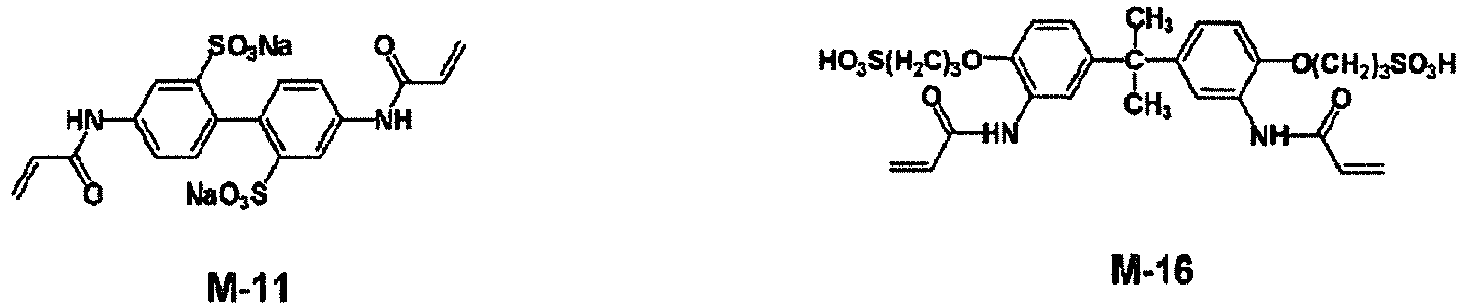


- As the component B, a carboxyl group-containing monofunctional monomer may be used, and for example, an unsaturated fatty acid may be used. Examples thereof include acrylic acid, methacrylic acid, itaconic acid, maleic acid, fumaric acid, crotonic acid, isocrotonic acid, and the like.
- In the present invention, it is preferable that at least one compound selected from the group consisting of the component A, the component B, and other polymerizable compounds is a polyfunctional polymerizable compound. It is more preferable that the composition for forming a membrane contains a polyfunctional polymerizable monomer as the component A. It is preferable to use a polyfunctional polymerizable compound, because then a cross-link is introduced into the functional polymer membrane, and a volume fraction of pores is reduced.
- A content of the polyfunctional polymerizable compound is, with respect to a total solid content of the composition for forming a membrane, preferably 10% to 90% by mass, more preferably 20% to 85% by mass, and even more preferably 30% to 80% by mass.
- A content of the polyfunctional polymerizable compound with respect to a total mass of the polymerizable compound is preferably 10% to 95% by mass, more preferably 20% to 90% by mass, and even more preferably 30% to 85% by mass.
- If the content of the polyfunctional polymerizable compound is within the above range, an appropriate cross-link is formed in the obtained functional polymer membrane.
- In the present invention, one kind of component A and one kind of component B may be used singly, or two or more kinds of component A and two or more kinds of component B may be used in combination.
- A ratio between a molar equivalent of the anionic functional group the component A has and a molar equivalent of the anionic functional group the component B has is 90:10 to 50:50. If the content ratio is within the above range, an ion exchange ability becomes excellent, and a low volume fraction of pores is obtained.
- The ratio between a molar equivalent of the anionic functional group the component A has and a molar equivalent of the anionic functional group the component B has is preferably 85:15 to 60:40, and more preferably 85:15 to 70:30.
- A content of the component A is, with respect to a total solid content of the composition for forming a membrane of the present invention, preferably 40% to 90% by mass, more preferably 50% to 85% by mass, and even more preferably 55% to 80% by mass. It is preferable that the content of the component A is within the above range, because then excellent ion exchange properties are obtained.
- A content of the component B is, with respect to a total solid content of the composition for forming a membrane of the present invention, preferably 3% to 50% by mass, more preferably 5% to 45% by mass, and even more preferably 10% to 30% by mass. It is preferable that the content of the component B is within the above range, because then a functional polymer membrane having a low volume fraction of pores is obtained.
- In the present invention, a total content of polymerizable compounds including other polymerizable compounds which will be described later is, with respect to a total solid content of the composition for forming a membrane, preferably 80% to 99% by mass, more preferably 85% to 98% by mass, and even more preferably 90% to 97% by mass.
- In the present invention, it is preferable that there is a difference between a main chain-anionic functional group distance of the component A and a main chain-anionic functional group distance of the component B, and the difference is more preferably equal to or greater than 4.
- Herein, the main chain-anionic functional group distance means the number of atoms from the main chain, which is established when a polymer is formed, to the anionic functional group. The atoms of N, O, C and the like are regarded as being the same as each other, and the number of these atoms is counted. Furthermore, atoms constituting the anionic functional group, such as C of a carboxyl group and S of a sulfo group, are not counted.
-
Figs. 2A to 2D are views illustrating the main chain-anionic functional group distance. - In
Fig. 2A , the main chain-anionic functional group distance is the number of atoms from a carbon atom having an ethylenically unsaturated double bond forming the main chain, which is established when a polymer is formed, to the anionic functional group. In MN-1, the number of atoms indicated with circles is counted, and the thus obtained main chain-anionic functional group distance is 4. Likewise, inFig. 2B , a main chain-anionic functional group distance in MN-2 is 4. - CL-1 in
Fig. 2C is a bifunctional polymerizable compound, and when a polymer is formed, two ethylenically unsaturated bonds and a portion therebetween form a main chain. Accordingly, as the atom indicated by a circle shows, the main chain-anionic functional group distance is 1. - CL-2 in
Fig. 2D is a bifunctional polymerizable compound just like the compound shown inFig. 2C , and when a polymer is formed, two ethylenically unsaturated bonds and a portion therebetween form a main chain. In CL-2, an anionic functional group is directly bonded to the main chain, and hence the main chain-anionic functional group distance is 0. - In a case where plural kinds of compounds are used as the component A or B, as the main chain-anionic functional group distance, a value obtained by calculating the average of number of atoms based on an equivalent of the anionic functional group is used. That is, the number of the main chain-anionic functional group distance is the average of the main chain-anionic functional group distances.
- Specifically, in a case where 0.1 mol of MN-1 and 0.2 mol of CL-1 are used as the component A, a main chain-anionic functional group distance L of component A is calculated as below.

- Accordingly, in the above case, the main chain-ionic group distance L equals 2.
- Furthermore, in a case where 0.1 mol of MN-1 described above and 0.2 mol of CL-2 are used as the component A, the main chain-anionic functional group distance L of the component A is calculated as below.

- Accordingly, in the above case, the main chain-ionic group distance L equals 0.8.
- As described above, a difference between the main chain-anionic functional group distance of the component A and the main chain-anionic functional group distance of the component B is preferably equal to or greater than 4. Presumably, by combining monomers whose side chains to which the anionic functional group is bonded have different lengths, the formed polymer may have a comb-like structure, and hence voids in the membrane may be reduced. Particularly, presumably, if the difference between the main chain-anionic functional group distance of the component A and the main chain-anionic functional group distance of the component B is equal to or greater than 4, the aforementioned effect may become strong. Presumably, as a result, both of the effect obtained by using monomers with different acidities and the effect of further reducing voids by the comb-like structure may be exhibited, and hence a functional polymer membrane having better transparency and scaling resistance may be obtained.
- The difference between the main chain-anionic functional group distance of the component A and the main chain-anionic functional group distance of the component B is preferably equal to or greater than 4, more preferably 4 to 15, and even more preferably 6 to 15.
- It is preferable that the difference between the main chain-anionic functional group distance of the component A and the main chain-anionic functional group distance of the component B is equal to or less than 15, because then the molecular weights of the monomers become appropriate, a decrease in a charge density of the entire membrane is inhibited, and an increase in a membrane resistance is inhibited.
- From the viewpoint of ease of availability of the compound, it is preferable that the main chain-anionic functional group distance of the component B is greater than the main chain-anionic functional group distance of the component A.
- The composition of the present invention contains a photopolymerization initiator represented by Formula PI-1 and/or a photopolymerization initiator represented by Formula PI-2.

- In Formula PI-1, Rp1 represents an alkyl group, an alkenyl group, an alkoxy group, or an aryloxy group, Rp2 and Rp3 each independently represent a hydrogen atom, an alkyl group, an alkenyl group, an alkoxy group, or an aryloxy group, Rp2 and Rp3 may form a ring by being bonded to each other, and n represents an integer of 0 to 5.
- In Formula PI-2, Rp4 represents an alkyl group, an aryl group, an alkylthio group, or an arylthio group, Rp5 represents an alkyl group, an aryl group, an alkylthio group, an arylthio group, or an acyl group, and Rp6 represents an alkyl group or an aryl group.
- Rp1 is preferably an alkyl group having 1 to 18 carbon atoms, an alkenyl group having 2 to 10 carbon atoms, an alkoxy group having 1 to 10 carbon atoms, or an aryloxy group having 6 to 12 carbon atoms. The alkyl group, alkenyl group, alkoxy group, and aryloxy group may have a substituent. The substituent is not particularly limited, and examples thereof include an alkyl group, an aryl group, an alkoxy group, an aryloxy group, an acyl group, an acyloxy group, a hydroxy group, and the like.
- The aryl group of the aryloxy group is preferably a phenyl group.
- Rp1 is more preferably an alkyl group having 1 to 4 carbon atoms or an alkoxy group having 1 to 4 carbon atoms. In a case where Rp1 is an alkoxy group, a methoxy group and a 2-hydroxyethoxy group are preferable. In a case where Rp1 is an alkyl group, a methyl group substituted with a phenyl group is preferable, and the molecule of the phenyl group preferably forms a methylenebis substance as a whole by the substitution of -C(=O)-C(Rp2)(Rp3)(OH).
- Rp2 and Rp3 preferably each independently represent an alkyl group, an alkenyl group, an alkoxy group, or an aryloxy group, more preferably each independently represent an alkyl group having 1 to 8 carbon atoms, an alkenyl group having 2 to 8 carbon atoms, an alkoxy group having 1 to 8 carbon atoms, or an aryloxy group having 6 to 10 carbon atoms, even more preferably each independently represent an alkyl group, and particularly preferably each independently represent methyl. The alkyl group, alkenyl group, alkoxy group, and aryloxy group may have a substituent. The substituent is not particularly limited, and examples thereof include an alkyl group, an aryl group, an alkoxy group, an aryloxy group, an acyl group, an acyloxy group, a hydroxy group, and the like.
- The ring formed by the bonding between Rp2 and Rp3 is preferably a 5- or 6-membered ring, and more preferably a cyclopentane ring or a cyclohexane ring.
- In Formula PI-2, the alkyl group in Rp4 to Rp6 is preferably an alkyl group having 1 to 8 carbon atoms, and the aryl group in Rp4 to Rp6 is preferably an aryl group having 6 to 16 carbon atoms. The aryl group may have a substituent, and the substituent is not particularly limited. Examples of the substituent include an alkyl group, an aryl group, an alkoxy group, an aryloxy group, an acyl group, an acyloxy group, a hydroxy group, and the like, and among these, an alkyl group or an alkoxy group is preferable.
- The alkylthio group or the arylthio group in Rp4 and Rp5 is an alkylthio group having 1 to 12 carbon atoms or an arylthio group having 6 to 12 carbon atoms. The acyl group in Rp5 is preferably an alkylcarbonyl group or an arylcarbonyl group, and more preferably an alkylcarbonyl group having 2 to 12 carbon atoms or an arylcarbonyl group having 7 to 17 carbon atoms. Among these, an arylcarbonyl group is preferable as Rp5, and a phenylcarbonyl group which may have a substituent is particularly preferable. The acyl group may have a substituent.
- In the present invention, as the component C, from the viewpoint of curing properties, the polymerization initiator represented by Formula PI-1 is more preferable than the polymerization initiator represented by Formula PI-2.
- Specific examples of the polymerization initiator represented by Formula PI-1 or PI-2 will be shown below, but the present invention is not limited thereto.


- The photopolymerization initiator represented by Formula PI-1 and the photopolymerization initiator represented by Formula PI-2 are available from BASF Japan Ltd. and the like.
- In the present invention, a content of the component C is, with respect to 100 parts by mass as a total solid content of the composition for forming a membrane, preferably 0.1 to 10 parts by mass, more preferably 0.1 to 5 parts by mass, and particularly preferably 0.5 to 3 parts by mass. If the content is within the above range, the curing properties become excellent.
- The composition for forming a membrane of the present invention may contain other components in addition to the components A and C described above. Examples of other components include a component D: polymerizable compound other than the components A and B, a component E: a photopolymerization initiator other than the component C, a component F: a co-sensitizer, a component G: a polymerization inhibitor, a component H: a solvent, a component I: an alkali metal compound, and a component J: other components. Each of these will be described below.
- The composition for forming a membrane of the present invention may contain, as a component D, a polymerizable compound other than the components A and B. Herein, it is preferable that the component D plays a role of adjusting the hydrophilicity and hydrophobicity as well as the cross-link density of the membrane such that the water permeability of the functional polymer membrane of the present invention or the electrical resistance of the membrane is adjusted.
- The aforementioned other polymerizable compounds may be any of monomers, oligomers, and polymers, and are preferably monomers. In the present invention, an oligomer means a compound having a weight-average molecular weight of greater than 3,000 and equal to or less than 10,000, and a polymer means a compound having a weight-average molecular weight of greater than 10,000.
- The "other monofunctional polymerizable compounds" are monofunctional polymerizable compounds that do not correspond to the components A and B, and examples of those other monofunctional polymerizable compounds include known monomers such as acrylic acid esters, methacrylic acid esters, acrylamides, methacrylamides, vinyl esters, styrenes, acrylonitrile, and maleic acid imide. The use of these monomers can improve various physical properties such as membrane formability, membrane strength, hydrophilicity, hydrophobicity, solubility, reactivity, and stability. Regarding synthesis methods of the monomers, for example, it is possible to refer to the section of ester synthesis in "The 5th Edition of The Course of Experimental Science 16, The Synthesis of Organic Compound (II-1)" edited by The Chemical Society of Japan or the section of handling and purification of monomers in "The 5th Edition of The Course of Experimental Science 26, Polymer Chemistry", and the like.
- Among these, from the viewpoint of the stability and pH resistance of the obtained functional polymer membrane, a compound not having an ester bond, a (meth)acrylamide compound, a vinyl ether compound, an aromatic vinyl compound, an N-vinyl compound (polymerizable monomer having an amide bond), and an allyl compound are preferable, and a (meth)acrylamide compound is particularly preferable.
- Examples of the aforementioned other monofunctional polymerizable compounds include the compounds described in
JP2008-208190A JP2008-266561A - Specific examples of the aforementioned other monofunctional polymerizable compounds will be shown below, but the present invention is not limited to the specific examples.


- These compounds are marketed by Kohjin Co., Ltd., KYOWA HAKKO CHEMICAL CO., LTD., Fluka, Sigma-Aldrich Co. LLC., TOAGOSEI CO., LTD., and the like, and can be easily synthesized by known methods.
- The composition for forming a membrane of the present invention may contain, as the component D, a polyfunctional polymerizable compound having two or more functional groups. The component D is preferably a polyfunctional (meth)acrylamide compound.
- Examples of polyfunctional polymerizable compounds preferable as the component D will be shown below, but the present invention is not limited thereto.


- Herein, 1 in the compound (VII-10) represents an integer of equal to or greater than 1.
- From the viewpoint of an ion exchange ability, a content of the component D is preferably smaller than a total content of the components A and B (a content of the component D is preferably less than the content of the components A and B). The content of the component D is preferably equal to or less than 90% and more preferably equal to or less than 75% of the total content of the components A and B.
- The composition for forming a functional polymer membrane of the present invention may contain, as a component E, photopolymerization initiators other than the component C (hereinafter, referred to as other photopolymerization initiators as well) in addition to the component C.
- Examples of the photopolymerization initiators include aromatic ketones excluding the compound represented by Formula PI-1, an acylphosphine compound excluding the compound represented by Formula PI-2, an aromatic onium salt compound, an organic peroxide, a thio compound, a hexaarylbiimidazole compound, a ketoxime ester compound, a borate compound, an azinium compound, a metallocene compound, an active ester compound, a compound having a carbon halogen bond, an alkylamine compound, and the like.
- Examples of the aromatic ketones, the acylphosphine oxide compound, and the thio compound preferably include compounds having a benzophenone skeleton or a thioxanthone skeleton described in "RADIATION CURING IN POLYMER SCIENCE AND TECHNOLOGY", p. 77 to 117 (1993), and the like, and more preferably include the α-thiobenzophenone compound described in
JP1972-6416B JP-S47-6416B JP1972-3981B JP-S47-3981B JP1972-22326B JP-S47-22326B JP1972-23664B JP-S47-23664B JP1982-30704A JP-S57-30704A JP1985-26483B JP-S60-26483B JP1985-26403B JP-S60-26403B JP1987-81345A JP-S62-81345A JP1989-34242B JP-H01-34242B US4318791A , andEP0284561A1 , the p-di(dimethylaminobenzoyl)benzene described inJP1990-211452A JP-H02-211452A JP1986-194062A JP-S61-194062A JP1990-9597B JP-H02-9597B JP1988-61950B JP-S63-61950B JP1984-42864B JP-S59-42864B JP2008-105379A JP2009-114290A - In the present invention, a water-soluble polymerization initiator is preferably used.
- Herein, the water-soluble polymerization initiator means a polymerization initiator having a property of dissolving in an amount of equal to or greater than 0.5% by mass in distilled water at 25°C. The water-soluble photopolymerization initiator more preferably dissolves in an amount of equal to or greater than 1% by mass and particularly preferably dissolves in an amount of equal to or greater than 3% by mass in distilled water at 25°C.
- In the present invention, a total content of photopolymerization initiators including other photopolymerization initiators is preferably, with respect to 100 parts by mass as a mass of a total solid content in the composition for forming a functional polymer membrane, preferably 0.1 to 10 parts by mass, more preferably 0.1 to 5 parts by mass, and even more preferably 0.3 to 2 parts by mass.
- A content of other photopolymerization initiators is preferably equal to or less than the content of the component C. The content of other photopolymerization initiators is, with respect to the content of the component C, more preferably equal to or less than 75% by mass, even more preferably equal to or less than 50% by mass, particularly preferably equal to or less than 25% by mass, and most preferably equal to or less than 10% by mass.
- A known compound, which further improves sensitivity or functions to prevent polymerization from being hindered due to oxygen, may be added as a co-sensitizer to the composition for forming a functional polymer membrane of the present invention.
- Examples of the co-sensitizer include amines such as the compounds described in M. R. Sander et al., "Journal of Polymer Society", Vol. 10, p. 3173 (1972),
JP1969-20189B JP-S44-20189B JP1976-82102A JP-S51-82102A JP1977-134692A JP-S52-134692A JP1984-138205A JP-S59-138205A JP1985-84305A JP-S60-84305A JP1987-18537A JP-S62-18537A JP1989-33104A JP-S64-33104A - The examples also include thiols and sulfides such as the thiol compounds described in
JP1978-702A JP-S53-702A JP1980-500806B JP-S55-500806B JP1993-142772A JP-H05-142772A JP1981-75643A JP-S56-75643A - The examples also include an amino acid compound (for example, N-phenylglycine), the organic metal compound described in
JP1973-42965B JP-S48-42965B JP1980-34414B JP-S55-34414B JP1994-308727A JP-H06-308727A JP1994-250387A JP-H06-250387A JP1996-65779A JP-H08-65779A - In the present invention, in order to impart stability to a coating solution, the composition for forming a membrane preferably contains a polymerization inhibitor.
- As the polymerization inhibitor, known polymerization inhibitors can be used, and examples thereof include a phenol compound, a hydroquinone compound, an amine compound, a mercapto compound, and the like.
- Specific examples of the phenol compound include hindered phenol (phenol having a t-butyl group on the ortho-position, and typical examples thereof include 2,6-di-t-butyl-4-methyl phenol) and bisphenol. Specific examples of the hydroquinone compound include monomethyl ether hydroquinone.
- One kind of these polymerization inhibitors may be used singly, and two or more kinds thereof may be used in combination.
- A content of the polymerization inhibitor is, with respect to 100 parts by mass as a mass of a total solid content in the composition for forming a functional polymer membrane, preferably 0.01 to 5 parts by mass, more preferably 0.01 to 1 part by mass, and even more preferably 0.01 to 0.5 parts by mass.
- The composition for forming a functional polymer membrane of the present invention may contain a solvent as a component H. A content of the solvent in the composition for forming a functional polymer membrane is, with respect to the total amount of the composition for forming a functional polymer membrane, preferably 5% to 50% by mass, more preferably 10% to 50% by mass, and even more preferably 10% to 40% by mass.
- If the composition contains the solvent, the polymerization and curing reaction proceeds uniformly and smoothly. Furthermore, in a case where a porous support is impregnated with the composition for forming a functional polymer membrane, the impregnation smoothly proceeds.
- As the solvent, either or both of water and a solvent having a solubility of equal to or higher than 5% by mass in water are preferably used, and either or both of water and a solvent readily mixed with water are more preferably used. Therefore, water and a solvent selected from water-soluble solvents are preferable, and it is preferable to use water or a water-soluble solvent alone or use a mixture thereof.
- As the water-soluble solvent, particularly, an alcohol-based solvent, an ether-based solvent which is an aprotic polar solvent, an amide-based solvent, a ketone-based solvent, a sulfoxide-based solvent, a sulfone-based solvent, a nitrile-based solvent, and an organic phosphorus-based solvent are particularly preferable.
- Examples of the alcohol-based solvent include methanol, ethanol, isopropanol, n-butanol, ethylene glycol, propylene glycol, diethylene glycol, dipropylene glycol, and the like. One kind of these can be used singly, or two or more kinds thereof can be used in combination.
- As the aprotic polar solvent include dimethyl sulfoxide, dimethyl imidazolidinone, sulfolane, N-methylpyrrolidone, dimethylformamide, acetonitrile, acetone, dioxane, tetramethylurea, hexamethylphosphoramide, hexamethylphosphorotriamide, pyridine, propionitrile, butanone, cyclohexanone, tetrahydrofuran, tetrahydropyran, ethylene glycol diacetate, γ-butyrolactone, and the like are exemplified as preferred solvents. Among these, dimethyl sulfoxide, N-methylpyrrolidone, dimethylformamide, dimethyl imidazolidinone, sulfolane, acetone, acetonitrile, or tetrahydrofuran is preferable. One kind of these can be used singly, or two or more kinds thereof can be used in combination.
- The composition for forming a functional polymer membrane of the present invention may contain an alkali metal compound, which is a monomer having an anionic functional group, such that the solubility of the component A and B is improved. As the alkali metal compound, a hydroxide salt, a chloride salt, a nitric acid salt, and the like of lithium, sodium, and potassium are preferable. Among these, a lithium compound is more preferable, and specific examples thereof include lithium hydroxide, lithium chloride, lithium bromide, lithium nitrate, lithium iodide, lithium chlorate, lithium thiocyanate, lithium perchlorate, lithium·tetrafluoroborate, lithium·hexafluorophosphate, and lithium·hexafluoroarsetate.
- Herein, it is also preferable to use the alkali metal compound such that the composition for forming a functional polymer membrane and a mixture of solutions of compositions for forming a functional polymer membrane are neutralized.
- The alkali metal compound may be a hydrate. One kind of alkali metal compound may be used singly, or two or more kinds thereof may be used in combination.
- In a case where the alkali metal compound is added, an amount thereof added is, with respect to 100 parts by mass as a mass of a total solid content of the composition for forming a functional polymer membrane, preferably 0.1 to 20 parts by mass, more preferably 1 to 20 parts by mass, and even more preferably 5 to 20 parts by mass.
- For adjusting physical properties of the membrane, various polymer compounds can be added to the composition for forming a functional polymer membrane of the present invention. As the polymer compounds, it is possible to use an acrylic polymer, a polyurethane resin, a polyamide resin, a polyester resin, an epoxy resin, a phenol resin, a polycarbonate resin, a polyvinyl butyral resin, a polyvinyl formal resin, shellac, a vinyl-based resin, an acrylic resin, a rubber-based resin, waxes, other natural resins, and the like. Two or more kinds of these may be used in combination.
- Furthermore, for adjusting physical properties of the solution, a nonionic surfactant, a cationic surfactant, an organic fluoro compound, and the like can also be added.
- Specific examples of the surfactant include an anionic surfactant such as alkylbenzene sulfonate, alkylnaphthalene sulfonate, a higher fatty acid salt, sulfonate of a higher fatty acid ester, a sulfuric acid ester salt of higher alcohol ether, sulfonate of higher alcohol ether, alkyl carboxylate of higher alkyl sulfonamide, a nonionic surfactant such as alkyl phosphate, polyoxyethylene alkyl ether, polyoxyethylene alkyl phenyl ether, polyoxyethylene fatty acid ester, sorbitan fatty acid ester, an ethylene oxide adduct of acetylene glycol, ethylene oxide adduct of glycerine, a non-ionic surfactant such as polyoxyethylene sorbitan fatty acid ester, an amphoteric surfactant such as alkyl betaine or amide betaine, a silicon-based surfactant, a fluorine-based surfactant, and the like. The surfactant can be appropriately selected from these, surfactants known in the related art, and derivatives thereof.
- Specific examples of a polymer dispersant include polyvinyl pyrrolidone, polyvinyl alcohol, polyvinyl methyl ether, polyethylene oxide, polyethylene glycol, polypropylene glycol, polyacrylamide, and the like. Among these, polyvinyl pyrrolidone is preferably used.
- If necessary, the composition may contain, for example, a surfactant, a viscosity enhancer, a surface tension adjuster, and a preservative, in addition to the aforementioned alkali metal compound.
- The functional polymer membrane of the present invention is a membrane obtained by polymerizing (curing) the composition for forming a functional polymer membrane of the present invention, and is preferably a membrane obtained by photopolymerization (photocuring).
- The functional polymer membrane of the present invention has an anionic functional group and can be used as an electrolyte membrane (ion-exchange membrane). The functional polymer membrane of the present invention can perform the exchange of Na+ as a cation in water containing a salt such as NaCl.
- In the present invention, particularly because the composition of the present invention contains the components A to C, UV curability is imparted to the composition. Accordingly, a functional polymer membrane is obtained within a short period of time, and an electrolyte membrane can be prepared at low costs with excellent productivity.
- An ideal ion-exchange membrane has a low membrane resistance, a low water permeability, and a high degree of permselectivity (selectivity in exchanging and separating caton/anion). Generally, the higher the charge density per molecular weight of a unit structure, the lower the membrane resistance, and the higher the permselectivity. Furthermore, the higher the cross-link density, the further the water permeability can be reduced.
- The functional polymer membrane of the present invention preferably has a support, and more preferably has a porous support.
- Examples of the support include a resin film, woven cloth, non-woven cloth, sponge, and the like. Among these, non-woven cloth is preferable.
- Examples of the porous support include woven cloth, non-woven cloth, a sponge-like film, a film having fine through holes, and the like.
- Examples of materials forming the support include polyolefin (polyethylene, polypropylene, or the like), polyacrylonitrile, polyvinyl chloride, polyester, polyamide, polysulfone, polyether sulfone, polyphenylene sulfone, polyphenylene sulfide, polyimide, polyethermide, polyamide imide, polycarbonate, an acryl resin, cellulose acetate, polyolefin, polyvinylidene fluoride, polytetrafluoroethylene, polyhexafluoropropylene, polychlorotrifluoroethylene, and a copolymer of these.
- As commercially available porous supports, those marketed by Japan Vilene Company, Ltd, Freudenberg & Co. KG, Filtration Technologies, LLC, and Sefar AG are exemplified.
- It is preferable that the support is hydrophilic. As a technique for making the support hydrophilic, it is possible to use general treatment methods such as a corona treatment, an ozone treatment, a sulfuric acid treatment, and a silane coupling agent treatment.
- A thickness of the support is preferably 10 to 500 µm, more preferably 20 to 400 µm, even more preferably 50 to 300 µm, and particularly preferably 80 to 300 µm.
- The functional polymer membrane of the present invention is preferably a membrane having a resin, which has constitutional units derived from the components A and B, within the surface and/or the inside of the porous support.
- Furthermore, the functional polymer membrane of the present invention is preferably a water-containing membrane, and more preferably a membrane in which the resin, which has constitutional units derived from the components A and B, is in the form of gel containing water.
- It is preferable that the functional polymer membrane of the present invention is formed by coating the aforementioned support with the composition for forming a functional polymer membrane containing at least the components A to C, and irradiating the coated support with energy rays (referred to as actinic radiation as well) such that a polymerization reaction occurs.
- As an example of the method for manufacturing a functional polymer membrane of the present invention, a method is exemplified in which a support is coated with the composition for forming a membrane of the present invention, and the coated support is irradiated with actinic radiation such that a membrane is formed.
- The conditions for forming the functional polymer membrane of the present invention are not particularly limited. The temperature is preferably -30°C to 100°C, more preferably -10°C to 80°C, and particularly preferably 5°C to 60°C.
- In the present invention, a gas such as air or oxygen may be allowed to coexist at the time of forming the membrane. It is preferable that the membrane is formed in an inert gas atmosphere.
- The functional polymer membrane of the present invention can be prepared by a batch process (batch method) by using a fixed support. The functional polymer membrane may also be prepared by a continuous process (continuous method) by using a moving support. The support may be in the form of a roll that is continuously rewound. In a case of a continuous method, by loading a support on a belt that is being continuously moved, it is possible to continuously perform a step of continuously coating the support with a coating solution as a composition for forming a functional polymer membrane and a step of forming a membrane by polymerizing and curing the composition. Here, only one of the coating step and the membrane forming step may be continuously performed.
- Until the polymerization and curing reaction is finished after the support is impregnated with the composition for forming a functional polymer membrane, a temporary support may also be used in addition to the support (after the polymerization and curing reaction is finished, the membrane is peeled off from the temporary support).
- For the temporary support, the permeation of a substance does not need to be considered, and for example, any material including a metal plate such as an aluminum plate can be used as long as the material can be fixed for forming a membrane.
- The porous support can be coated with or impregnated with the composition for forming a functional polymer membrane by various methods such as curtain coating, extrusion coating, air knife coating, slide coating, nip roll coating, forward roll coating, reverse roll coating, dip coating, kiss coating, rod bar coating, or spray coating. A plurality of layers can be simultaneously or continuously coated. For simultaneously coating multiple layers, curtain coating, slide coating, slot die coating, and extrusion coating are preferable.
- In the continuous method, the functional polymer membrane is preferably continuously manufactured on a moving support by using the composition for forming a functional polymer membrane, more preferably by using manufacturing unit which includes a coating portion of the composition for forming a functional polymer membrane, an irradiation source for polymerizing and curing the composition for forming a functional polymer membrane, a membrane winding-up portion, and means for moving the support to the irradiation source and the membrane winding-up portion from the coating portion of the composition for forming a functional polymer membrane.
- In the present invention, it is preferable that the functional polymer membrane of the present invention is prepared through steps of (i) coating and impregnating a support with a coating solution as the composition for forming a functional polymer membrane or performing at least one of coating and impregnating of the support with the coating solution, (ii) irradiating the composition for forming a functional polymer membrane with light such that a polymerization and curing reaction occurs, and (iii) peeling off the membrane from the support as desired.
- In the aforementioned manufacturing unit, the coating portion of the composition for forming a functional polymer membrane can be placed in a position in the upstream of the irradiation source, and the irradiation source is placed in a position in the upstream of a composite membrane winding-up portion. In order for the composition to have fluidity sufficient for coating performed in a high-speed coating machine, a viscosity at 35°C of the composition for forming a functional polymer membrane is preferably less than 4,000 mPa·s, more preferably 1 to 1,000 mPa·s, and most preferably 1 to 500 mPa·s. In a case where a coating method such as slide bead coating is used, the viscosity at 35°C is preferably 1 to 100 mPa·s.
- In a high-speed coating machine, coating of the moving support with the composition for forming a functional polymer membrane can be performed at a rate of higher than 15 m/sec and at up to a rate of higher than 400 m/min.
- Particularly, in a case where the support is used for improving the mechanical strength of the membrane, before the surface of the support is coated with the composition for forming a functional polymer membrane, for example, in order to improve wettability and adhesion of the support, the support may be subjected to a corona discharge treatment, a glow discharge treatment, a flame treatment, an ultraviolet irradiation treatment, and the like.
- During the polymerization and curing reaction, the polymerizable compounds such as the components A and B are polymerized, and hence a polymer is formed. It is preferable that the polymerization and curing reaction is performed by light irradiation under the conditions in which the polymerization and curing occur with rapidity sufficient for forming a membrane within 30 seconds.
- The polymerization and curing reaction of the composition for forming a functional polymer membrane is preferably initiated within 60 seconds, more preferably within 15 seconds, particularly preferably within 5 seconds, and most preferably within 3 seconds, after the support is coated with the composition for forming a functional polymer membrane.
- During the polymerization and curing reaction, the composition for forming a functional polymer membrane is irradiated with light preferably for less than 10 seconds, more preferably for less than 5 seconds, particularly preferably for less than 3 seconds, and most preferably for less than 2 seconds. In the continuous method, by the speed at which the composition for forming a functional polymer membrane continuously irradiated with light passes through the irradiation beam and moves, the time of the polymerization and curing reaction is determined.
- In a case where high-intensity ultraviolet rays (UV light) is used in the polymerization and curing reaction, a significant amount of heat is likely to be generated. Therefore, in order to prevent overheating, a lamp as a light source and the support coated with the composition for forming a functional polymer membrane or at least one of the lamp as a light source and the support coated with the composition for forming a functional polymer membrane is preferably cooled using cooling air. In a case where infrared light (IR light) at a significant dose is radiated together with UV beams, it is preferable to radiate UV light by using an IR reflective quartz plate as a filter.
- The actinic radiation is preferably ultraviolet rays. It is preferable that the irradiation wavelength is matched with an absorption wavelength of any photopolymerization initiator contained in the composition for forming a functional polymer membrane. For example, the irradiation wavelength is 400 to 320 nm for UV-A, 320 to 280 nm for UV-B, and 280 to 200 nm for UV-C.
- The source of ultraviolet rays include a mercury arc lamp, a carbon arc lamp, a low-pressure mercury lamp, a medium-pressure mercury lamp, a high-pressure mercury lamp, a swirl-flow plasma arc lamp, a metal halide lamp, a xenon lamp, a tungsten lamp, a halogen lamp, a laser, and an ultraviolet light emitting diode. As the source of ultraviolet rays, a medium-pressure or high-pressure mercury vapor type ultraviolet light emitting diode is particularly preferable. In addition, in order to change an emission spectrum of the lamp, an additive such as a metal halide may be present. In many cases, a lamp having emission maximum at 200 to 450 nm is particularly suitable.
- An energy output of the irradiation source of the actinic radiation is preferably 20 to 1,000 W/cm, and more preferably 40 to 500 W/cm. However, the energy output may be higher or lower than the above as long as a desired exposure dose is established. By changing an exposure intensity, a curing degree of the membrane can be adjusted. The exposure dose, which is measured in a range of UV-B described above regarding the aforementioned device by using High Energy UV Radiometer (UV Power PuckTM manufactured by EIT-Instrument Markets, Inc.), is preferably at least equal to or greater than 40 mJ/cm2, more preferably 100 to 2,000 mJ/cm2, and even more preferably 150 to 1,500 mJ/cm2. The exposure time can be freely selected, but is preferably short and most preferably less than 2 seconds.
- In a case where the coating rate is high, in order to obtain a necessary exposure dose, a plurality of light sources may be used. In this case, the exposure intensities of the plurality of light sources may be the same as or different from each other.
- The functional polymer membrane of the present invention is preferably made into a composite membrane combined with a porous support. Furthermore, the functional polymer membrane is preferably made into a separation membrane module using the functional polymer membrane. In addition, by using the functional polymer membrane, the composite membrane, or the functional polymer membrane module of the present invention, it is possible to prepare an ion exchange device having means for ion exchange, deionization, or purification. The functional polymer membrane can also be suitably used as a fuel cell.
- The functional polymer membrane of the present invention can be suitably used by being made into a module. Examples of the module include a spiral type, a hollow fiber type, a pleats type, a tubular type, a plate-and-frame type, a stack type, and the like.
- The use of the polymer membrane of the present invention is mainly aimed at ion exchange in particular. However, the use of the functional polymer membrane of the present invention is not limited to ion exchange, and the functional polymer membrane is considered to be able to be suitably used as a proton conducting membrane for a fuel cell and for removing a protein and a virus.
- Hereinafter, the present invention will be more specifically explained by describing examples. The materials and an amount and proportion thereof used, a treatment content, a treatment procedure, and the like shown in the following examples can be appropriately changed within a scope that does not depart from the gist of the present invention. Therefore, the scope of the present invention is not limited to the following specific examples. Herein, unless otherwise specified, "part" and "%" are based on mass.
- Acid dissociation constants of the anionic functional groups the components A and B had were calculated by the following method. Specifically, by using chemical structure drawing software "Marvin sketch" (manufactured by ChemAxon), the structures of the components having the anionic functional groups were drawn, and acid dissociation constants were calculated. When all the structures are selected, and then "pKa" is selected from a "Calculation" menu, the acid dissociation constant of the corresponding component is displayed. As the acid dissociation constant in the present invention, pKa of the portion of structure corresponding to the anionic functional group was used.
- By using a 150 µm wire-wound rod, an aluminum plate was manually coated with each composition composed as shown in the following Tables 1 and 2 at a rate of about 5 m/min, and then non-woven cloth (FO-2223-10 manufactured by Freudenberg & Co. KG, thickness: 100 µm) was loaded on the coating solution, with which the aluminum plate was coated, and impregnated with the coating solution. By using a rod around which a wire was not wound, the surplus coating solution was removed from the non-woven cloth. The temperature of the coating solution at the time of coating was about 25°C (room temperature). By using a UV exposure machine (manufactured by Fusion UV Systems Inc,
Light Hammer 10 model, D-bulb, conveyer speed: 1.0 to 8.0 m/min, 100% intensity), a curing and polymerization reaction was caused on the non-woven cloth impregnated with the coating solution (support impregnated with coating solution), thereby preparing a cation-exchange membrane. The exposure amount was 1,000 to 5,000 J/cm2 in the UV-A region. The obtained membrane was peeled off from the aluminum plate and stored for at least 12 hours in a 0.1 M NaCl solution. - In a case where the membrane was prepared by heating (Comparative Examples 5 and 6), the same process as described above was conducted until the step of removing the coating solution was performed, and then the support impregnated with the coating solution was thermally cured by being put into an oven with a temperature of 80°C.
- The time required for curing was determined as a curing time required for a quantity of a component, which was eluted when the prepared membrane was dipped into water, to become equal to or less than a detection limit in liquid chromatography.
- From an electrical resistance R of the membrane measured in 0.5 M, 0.7 M, 1.5 M, 3.5 M, and 4.5 M NaCl solutions, an electric conductivity A (S/cm2) of the membrane was calculated by the following equation a.

- Then, an electric conductivity of each of the NaCl solutions and the membrane thickness were measured, and an electric conductivity B (S/cm2) of each of the NaCl solutions per unit membrane thickness was calculated. A graph was plotted in which the y-axis showed the conductivity A of the membrane, and the x-axis showed the electric conductivity B (S/cm2) of each of the NaCl solutions with different concentrations per unit membrane thickness, and at this time, a y-intercept of an approximation curve (first-order approximation curve of a least-squares method) of the obtained five plots (electrical resistance corresponding to each concentration) was denoted by C, and a volume fraction of pores was calculated by the following equation b. The ion-exchange membrane preferably has a low volume fraction of pores that is preferably equal to or less than 0.6%, more preferably equal to or less than 0.5%, and even more preferably equal to or less than 0.4%.

- Both surfaces of the membrane impregnated with a 0.5 M aqueous NaCl solution for about 2 hours was wiped with dry filter paper, and the membrane was inserted into a double-chamber cell (effective membrane area: 1 cm2, a Ag/AgCl reference electrode (manufactured by Metrohm AG) was used as an electrode). Both chambers of the double-chamber cell were filled with 100 mL of NaCl at the same concentration, and the double-chamber cell was left in a thermostatic water tank with a temperature of 25°C until equilibrium was established. After the temperature of the solution in the cell exactly became 25°C, an electrical resistance r1 was measured using an alternating current bridge (frequency: 1,000 Hz). The concentration of NaCl for measurement was set to be 0.5 M. Then, the membrane was removed such that the cell contains only the 0.5 M aqueous NaCl solution, an electrical resistance r2 between both of the electrodes was measured, and an electrical resistance r of the membrane was determined by r1 - r2. The smaller the value of the electrical resistance, the more the membrane is preferable as an ion-exchange membrane.
- A water permeability of the membrane was measured using a device having a
flow channel 10 shown inFig. 1 . InFig. 1 , thereference 1 represents a membrane, and thereferences reference 2 represents the flow of water separated from the feed solution. - 400 mL of the feed solution and 400 mL of the draw solution were brought into contact with each other through the membrane (membrane contact area: 18 cm2). Each of the solutions was caused to flow at a flow rate of 0.11 cm/sec by using a peristaltic pump in a direction of the arrow indicated by the
reference 5. The speed at which water in the feed solution permeated the draw solution through the membrane was analyzed by measuring a mass of the feed solution and the draw solution in real time, thereby determining a water permeability. The smaller the value of water permeability, the more the membrane is preferable as an ion-exchange membrane. The values shown in the tables are values multiplied by 105. For example, the measurement value of Example 1 is 4.00 × 10⁻⁵ (mL/(m2·Pa·hr)). - The smaller the value of the product of the electrical resistance and the water permeability, the higher the performance of the membrane as an ion-exchange membrane. The product of the value of the electrical resistance and the value of the water permeability (multiplied by 105) was calculated.
- By combining a cation-exchange membrane of the present invention with a commercially available anion-exchange membrane (AMX, manufactured by ASTOM Corporation), a stack was prepared, and a deionization experiment was performed using an electrodialysis device (ACILYZER ED, manufactured by ASTOM Corporation). A 3% aqueous NaCl solution prepared using tap water was continuously deionized, and the membrane was taken out after 10 days. The membrane was thoroughly washed with water, the surface of the membrane was observed using a microscope, and a membrane in which a precipitate was observed was evaluated to be defective.
- A visible light (1,000 nm) transmittance of the membrane was measured using a transmittance measurement device M-306 (manufactured by Asahi Spectra Co., Ltd.). A membrane having a visible light transmittance of equal to or greater than 25% was evaluated to be excellent, and a membrane having a visible light transmittance of less than 25% was evaluated to be turbid.


- In Tables 1 and 2, the unit of numerical values in the column of each component of the composition for forming a membrane is part by mass of the active component. Furthermore,"-" in the tables means that the example does not contain the corresponding component. In Tables 1 and 2, the column of "Distance" represents a "main chain-anionic functional group distance".
- The details of the compounds or supports used in examples and comparative examples will be shown below.
- MN-1: 2-acrylamide-2-methylpropanesulfonic acid (manufactured by TOKYO CHEMICAL INDUSTRY CO., LTD.), molecular weight: 207.25
- MN-2: 2-Sulfoethyl methacrylate (manufactured by Polyscience), molecular weight: 194.1
- MN-3: Acid phosphoxy ethyl methacrylate (manufactured by Uni-Chemical Co., Ltd.), molecular weight: 210
- MN-4: 6-Acrylamidohexanoic acid (manufactured by Wako Pure Chemical Industries, Ltd.), molecular weight: 185.22
- MN-5: 2-Carboxyethyl acrylate (manufactured by Sigma-Aldrich Co. LLC.), molecular weight: 144.13
- MN-6: 2-(Acryloyloxy)ethyl Hydrogen Succinate (manufactured by TOKYO CHEMICAL INDUSTRY CO., LTD.), molecular weight: 216.19
- CL-1: compound having the following structure (synthesized according to the technique described in
US4034001 ), molecular weight: 293 - CL-2: compound having the following structure (synthesized according to the following synthesis method), molecular weight: 496
- 288.29 g (3.43 mol) of sodium hydrogen carbonate (manufactured by Wako Pure Chemical Industries, Ltd.) and 1,343 mL of deionized water were put into a 5 L three-neck flask and stirred a room temperature, and at the same time, 268.6 g (0.78 mol) of 4,4'-benzidine-2,2'-disulfonic acid (manufactured by TOKYO CHEMICAL INDUSTRY CO., LTD.) was added thereto little by little. After being stirred for 30 minutes at room temperature, the mixture was ice-cooled and continuously stirred. While the mixture was being ice-cooled, 138.7 mL (1.53 mol) of acryloyl chloride (manufactured by Wako Pure Chemical Industries, Ltd.) was little by little added dropwise thereto such that the internal temperature of the system was kept at a temperature of equal to or lower than 10°C. After the dropwise addition ended, the mixture was stirred for 1 hour while being ice-cooled and then for 3 hours at room temperature. 2,686 mL of isopropyl alcohol was added little by little to the reaction mixture, and the generated insoluble matter was removed by filtration. The obtained filtrate was moved to a 30 L stainless steel bucket and stirred at room temperature, and at the same time, 10,744 mL of isopropyl alcohol was added thereto little by little. The obtained crystals were filtered and then washed with 1,074 mL of a mixed solution of isopropyl alcohol:water (5:1), thereby obtaining 339 g of CL-2 as intended (yield: 87%).
- CL-3: N,N'-Methylenebisacrylamide (manufactured by Wako Pure Chemical Industries, Ltd.), molecular weight: 154.17
- CL-4: polyethylene glycol (200) diacrylate (manufactured by SHIN-NAKAMURA CHEMICAL CO., LTD.), molecular weight: 308
- MEHQ: 4-methoxyphenol (manufactured by TOKYO CHEMICAL INDUSTRY CO., LTD.)
- Darocur 1173: 2-hydroxy-2-methyl-1-phenylpropan-1-one (manufactured by BASF SE)
- Irgacure 819dw: bis(2,4,6-trimethylbenzoyl)phenylphosphine oxide (active component: 45%), (manufactured by BASF SE)
- Lucirin TPO: 2,4,6-trimethylbenzoyldiphenylphosphine oxide (manufactured by BASF SE)
- Irgacure OXE01: 1,2-octanedione, 1-[4-(phenylthio)-,2-(O-benzoyloxime)]
- Irgacure OXE02: ethanone,1-[9-ethyl-6-(2-methylbenzoyl)-9H-carbazol-3-yl]-,1-(0-acetyloxime) (manufactured by BASF SE)
- VA-67: the following structure (thermal polymerization initiator) (manufactured by Wako Pure Chemical Industries, Ltd.)
-
- IPA: isopropyl alcohol (manufactured by Wako Pure Chemical Industries, Ltd.)
- NMP: N-methyl-2-pyrrolidone (manufactured by Wako Pure Chemical Industries, Ltd.)
-
- 1: membrane
- 2: arrow showing the state where water in feed solution permeates draw solution through membrane
- 3: flow channel of feed solution
- 4: flow channel of draw solution
- 5: movement direction of liquid
- 10: flow channel of water permeability measurement device


Claims (11)
- A composition for forming a functional polymer membrane, comprising:a monomer, which has an anionic functional group with an acid dissociation constant pKa of a, as a component A;a monomer, which has an anionic functional group with an acid dissociation constant pKa of b greater than a, as a component B; anda photopolymerization initiator represented by the following Formula PI-1 or PI-2 as a component C,wherein a difference between b and a is equal to or greater than 1.5 and equal to or less than 10,a ratio between a molar equivalent of the anionic functional group the component A has and a molar equivalent of the anionic functional group the component B has is 90:10 to 50:50,
 in Formula PI-1, Rp1 represents an alkyl group, an alkenyl group, an alkoxy group, or an aryloxy group,Rp2 and Rp3 each independently represent a hydrogen atom, an alkyl group, an alkenyl group, an alkoxy group, or an aryloxy group,Rp2 and Rp3 may form a ring by being bonded to each other, andn represents an integer of 0 to 5,in Formula PI-2, Rp4 represents an alkyl group, an aryl group, an alkylthio group, or an arylthio group,Rp5 represents an alkyl group, an aryl group, an alkylthio group, an arylthio group, or an acyl group, andRp6 represents an alkyl group or an aryl group.
 - The composition for forming a functional polymer membrane according to claim 1,wherein the component A is a monomer having at least one anionic functional group selected from the group consisting of a sulfonic acid group, a phosphonic acid group, and a phosphoric acid group, andthe component B is a monomer having a carboxylic acid group.
- The composition for forming a functional polymer membrane according to claim 1 or 2,wherein the component A has a (meth)acrylamide group and/or a (meth)acryloyloxy group.
- The composition for forming a functional polymer membrane according to any one of claims 1 to 3,wherein the component B has a (meth)acrylamide group and/or a (meth)acryloyloxy group.
- The composition for forming a functional polymer membrane according to any one of claims 1 to 4,wherein the component A contains a monomer represented by the following Formula I and/or a monomer represented by the following Formula II,

 in Formula I, R11 and R12 each independently represent a hydrogen atom or a methyl group,R13 and R14 each independently represent a hydrogen atom or an alkyl group,R13 and R14 may form a 6- or 7-membered ring together with nitrogen atoms, to which R13 and R14 are bonded, and Y, andY represents an alkylene group or an arylene group and contains 1 to 4 sulfonic acid groups,in Formula II, R21 and R22 each independently represent a hydrogen atom or an alkyl group,R23, R24, R25, and R26 each independently represent a substituent,k21, k22, k23, and k24 each independently represent an integer of 0 to 4,in a case where there is a plurality of R23's, R24's, R25's, and R26's, the plurality of R23's, R24's, R25's, and R26's may be the same as or different from each other and may form a ring by being bonded to each other,A21, A22, A23, and A24 each independently represent a single bond or a divalent linking group,M21 each independently represents a hydrogen ion, an organic base ion, or a metal ion,n21 and n22 each independently represent an integer of 1 to 4,m21 and m22 each independently represent 0 or 1,J1 represents a single bond, -O-, -S-, -SO2-, -CO-, -CR28R29-, or an alkenylene group,R28 and R29 each independently represent a hydrogen atom, an alkyl group, or a halogen atom,p21 represents an integer of equal to or greater than 1, andq21 represents an integer of 0 to 4.
 - The composition for forming a functional polymer membrane according to any one of claims 1 to 5,wherein when a polymer is formed, a main chain-anionic functional group distance of the component A is different from a main chain-anionic functional group distance of the component B,and a difference between the main chain-anionic functional group distance of the component A and the main chain-anionic functional group distance of the component B is equal to or greater than 4.
- A functional polymer membrane obtained by polymerizing the composition for forming a functional polymer membrane according to any one of claims 1 to 6.
- The functional polymer membrane according to claim 7 that is an ion-exchange membrane.
- A method for manufacturing the functional polymer membrane according to claim 7 or 8, comprising:a step of polymerizing the composition for forming a functional polymer membrane by energy ray irradiation.
- A separation membrane module comprising:the functional polymer membrane according to claim 8.
- An ion exchange device comprising:the functional polymer membrane according to claim 8.
Applications Claiming Priority (3)
| Application Number | Priority Date | Filing Date | Title |
|---|---|---|---|
| JP2014185064 | 2014-09-11 | ||
| JP2015005674 | 2015-01-15 | ||
| PCT/JP2015/072616 WO2016039059A1 (en) | 2014-09-11 | 2015-08-10 | Composition for forming polymeric functional membrane, polymeric functional membrane and production process therefor, separation membrane module, and ion exchanger |
Publications (3)
| Publication Number | Publication Date |
|---|---|
| EP3192816A1 true EP3192816A1 (en) | 2017-07-19 |
| EP3192816A4 EP3192816A4 (en) | 2017-09-27 |
| EP3192816B1 EP3192816B1 (en) | 2020-01-08 |
Family
ID=55458817
Family Applications (1)
| Application Number | Title | Priority Date | Filing Date |
|---|---|---|---|
| EP15840155.4A Active EP3192816B1 (en) | 2014-09-11 | 2015-08-10 | Composition for forming polymeric functional membrane, polymeric functional membrane and production process therefor, separation membrane module, and ion exchanger |
Country Status (4)
| Country | Link |
|---|---|
| EP (1) | EP3192816B1 (en) |
| JP (1) | JP6271747B2 (en) |
| ES (1) | ES2772426T3 (en) |
| WO (1) | WO2016039059A1 (en) |
Families Citing this family (1)
| Publication number | Priority date | Publication date | Assignee | Title |
|---|---|---|---|---|
| WO2022210869A1 (en) * | 2021-03-31 | 2022-10-06 | デンカ株式会社 | Method for producing semi-cured product composite, method for producing cured product composite, and semi-cured product composite |
Family Cites Families (7)
| Publication number | Priority date | Publication date | Assignee | Title |
|---|---|---|---|---|
| JP3897686B2 (en) * | 2001-12-06 | 2007-03-28 | 株式会社日本触媒 | Acid type (meth) acrylic acid polymer, method for producing the same, and additive for excavating soil treatment agent or cataplasm |
| JP2004171994A (en) * | 2002-11-21 | 2004-06-17 | Ube Ind Ltd | Method for producing hybrid material based on porous membrane |
| JP4427291B2 (en) * | 2003-09-03 | 2010-03-03 | 東亞合成株式会社 | Continuous production method of functional membrane |
| JP4743680B2 (en) * | 2003-12-01 | 2011-08-10 | ユニケミカル株式会社 | Phosphoric acid group / fluorine group / sulfonic acid group-containing solid polymer electrolyte membrane and application |
| JP2006206671A (en) * | 2005-01-26 | 2006-08-10 | Toray Ind Inc | Polymer electrolyte material, polymer electrolyte component, membrane electrode composite, and polymer electrolyte fuel cell |
| JP5905371B2 (en) * | 2012-09-28 | 2016-04-20 | 富士フイルム株式会社 | Polymer functional membrane and method for producing the same |
| JP2015047538A (en) * | 2013-08-30 | 2015-03-16 | 富士フイルム株式会社 | Ion exchange membrane manufacturing method and ion exchange membrane obtained thereby |
-
2015
- 2015-08-10 WO PCT/JP2015/072616 patent/WO2016039059A1/en not_active Ceased
- 2015-08-10 JP JP2016547783A patent/JP6271747B2/en not_active Expired - Fee Related
- 2015-08-10 EP EP15840155.4A patent/EP3192816B1/en active Active
- 2015-08-10 ES ES15840155T patent/ES2772426T3/en active Active
Also Published As
| Publication number | Publication date |
|---|---|
| ES2772426T3 (en) | 2020-07-07 |
| JP6271747B2 (en) | 2018-01-31 |
| EP3192816B1 (en) | 2020-01-08 |
| EP3192816A4 (en) | 2017-09-27 |
| WO2016039059A1 (en) | 2016-03-17 |
| JPWO2016039059A1 (en) | 2017-04-27 |
Similar Documents
| Publication | Publication Date | Title |
|---|---|---|
| US10610833B2 (en) | Functional polymer membrane, method for manufacturing same, composition for forming functional polymer membrane, separation membrane module, and ion-exchange device | |
| EP3112401B1 (en) | Ion-exchange membrane and method for producing same | |
| EP2979748B1 (en) | Polymer functional film and method for producing same | |
| CN104684634B (en) | Polymer functional film and its manufacturing method | |
| CN105492508B (en) | The manufacture method of amberplex, amberplex formation composition and amberplex | |
| JP6313454B2 (en) | Polymer membrane-forming composition and method for producing the same, polymer membrane, separation membrane module, and ion exchange device | |
| JP6126498B2 (en) | Polymer functional membrane and method for producing the same | |
| EP2965803A1 (en) | Functional polymer membrane, manufacturing method therefor, ion exchange membrane and proton conducting membrane equipped with functional polymer membrane, and ion exchange device | |
| CN104703682A (en) | Functional polymer membrane, and method for producing same | |
| JP5893578B2 (en) | Functional composite membrane and method for producing the same, ion exchange membrane and proton conducting membrane provided with functional composite membrane | |
| WO2017038276A1 (en) | Photocurable composition, cured material, member, and device | |
| US20220041833A1 (en) | Membranes Suitable for Detecting, Filtering and/or Purifying Biomolecules | |
| CN116322951A (en) | Compounds, compositions and polymer films | |
| JP5972814B2 (en) | Polymer functional membrane and method for producing the same | |
| JP5897622B2 (en) | Polymer functional membrane, method for producing the same, and ion exchange device | |
| EP3192816B1 (en) | Composition for forming polymeric functional membrane, polymeric functional membrane and production process therefor, separation membrane module, and ion exchanger | |
| JP5905371B2 (en) | Polymer functional membrane and method for producing the same | |
| CN116234630A (en) | Composition and polymer film | |
| JP2018103062A (en) | Polymer functional membrane and method for producing the same, composition for polymer functional membrane formation, separation membrane module, and ion exchange device | |
| EP3181227A1 (en) | Polymeric functional membrane for removing nitrate ions, production method therefor, separation membrane module, and ion exchange device | |
| JP2018167134A (en) | Polymer functional membrane, module, and apparatus |
Legal Events
| Date | Code | Title | Description |
|---|---|---|---|
| STAA | Information on the status of an ep patent application or granted ep patent |
Free format text: STATUS: THE INTERNATIONAL PUBLICATION HAS BEEN MADE |
|
| PUAI | Public reference made under article 153(3) epc to a published international application that has entered the european phase |
Free format text: ORIGINAL CODE: 0009012 |
|
| STAA | Information on the status of an ep patent application or granted ep patent |
Free format text: STATUS: REQUEST FOR EXAMINATION WAS MADE |
|
| 17P | Request for examination filed |
Effective date: 20170223 |
|
| AK | Designated contracting states |
Kind code of ref document: A1 Designated state(s): AL AT BE BG CH CY CZ DE DK EE ES FI FR GB GR HR HU IE IS IT LI LT LU LV MC MK MT NL NO PL PT RO RS SE SI SK SM TR |
|
| AX | Request for extension of the european patent |
Extension state: BA ME |
|
| A4 | Supplementary search report drawn up and despatched |
Effective date: 20170828 |
|
| RIC1 | Information provided on ipc code assigned before grant |
Ipc: B01J 39/20 20060101ALI20170822BHEP Ipc: B01J 47/12 20170101ALI20170822BHEP Ipc: C08F 220/02 20060101ALI20170822BHEP Ipc: C08J 5/22 20060101ALI20170822BHEP Ipc: C08F 2/48 20060101AFI20170822BHEP |
|
| DAV | Request for validation of the european patent (deleted) | ||
| DAX | Request for extension of the european patent (deleted) | ||
| STAA | Information on the status of an ep patent application or granted ep patent |
Free format text: STATUS: EXAMINATION IS IN PROGRESS |
|
| 17Q | First examination report despatched |
Effective date: 20180621 |
|
| GRAP | Despatch of communication of intention to grant a patent |
Free format text: ORIGINAL CODE: EPIDOSNIGR1 |
|
| STAA | Information on the status of an ep patent application or granted ep patent |
Free format text: STATUS: GRANT OF PATENT IS INTENDED |
|
| INTG | Intention to grant announced |
Effective date: 20190904 |
|
| GRAS | Grant fee paid |
Free format text: ORIGINAL CODE: EPIDOSNIGR3 |
|
| GRAA | (expected) grant |
Free format text: ORIGINAL CODE: 0009210 |
|
| STAA | Information on the status of an ep patent application or granted ep patent |
Free format text: STATUS: THE PATENT HAS BEEN GRANTED |
|
| AK | Designated contracting states |
Kind code of ref document: B1 Designated state(s): AL AT BE BG CH CY CZ DE DK EE ES FI FR GB GR HR HU IE IS IT LI LT LU LV MC MK MT NL NO PL PT RO RS SE SI SK SM TR |
|
| REG | Reference to a national code |
Ref country code: GB Ref legal event code: FG4D |
|
| REG | Reference to a national code |
Ref country code: CH Ref legal event code: EP |
|
| REG | Reference to a national code |
Ref country code: DE Ref legal event code: R096 Ref document number: 602015045336 Country of ref document: DE |
|
| REG | Reference to a national code |
Ref country code: IE Ref legal event code: FG4D |
|
| REG | Reference to a national code |
Ref country code: AT Ref legal event code: REF Ref document number: 1222616 Country of ref document: AT Kind code of ref document: T Effective date: 20200215 |
|
| REG | Reference to a national code |
Ref country code: NL Ref legal event code: MP Effective date: 20200108 |
|
| REG | Reference to a national code |
Ref country code: ES Ref legal event code: FG2A Ref document number: 2772426 Country of ref document: ES Kind code of ref document: T3 Effective date: 20200707 |
|
| REG | Reference to a national code |
Ref country code: LT Ref legal event code: MG4D |
|
| PG25 | Lapsed in a contracting state [announced via postgrant information from national office to epo] |
Ref country code: NL Free format text: LAPSE BECAUSE OF FAILURE TO SUBMIT A TRANSLATION OF THE DESCRIPTION OR TO PAY THE FEE WITHIN THE PRESCRIBED TIME-LIMIT Effective date: 20200108 Ref country code: LT Free format text: LAPSE BECAUSE OF FAILURE TO SUBMIT A TRANSLATION OF THE DESCRIPTION OR TO PAY THE FEE WITHIN THE PRESCRIBED TIME-LIMIT Effective date: 20200108 Ref country code: RS Free format text: LAPSE BECAUSE OF FAILURE TO SUBMIT A TRANSLATION OF THE DESCRIPTION OR TO PAY THE FEE WITHIN THE PRESCRIBED TIME-LIMIT Effective date: 20200108 Ref country code: PT Free format text: LAPSE BECAUSE OF FAILURE TO SUBMIT A TRANSLATION OF THE DESCRIPTION OR TO PAY THE FEE WITHIN THE PRESCRIBED TIME-LIMIT Effective date: 20200531 Ref country code: FI Free format text: LAPSE BECAUSE OF FAILURE TO SUBMIT A TRANSLATION OF THE DESCRIPTION OR TO PAY THE FEE WITHIN THE PRESCRIBED TIME-LIMIT Effective date: 20200108 Ref country code: NO Free format text: LAPSE BECAUSE OF FAILURE TO SUBMIT A TRANSLATION OF THE DESCRIPTION OR TO PAY THE FEE WITHIN THE PRESCRIBED TIME-LIMIT Effective date: 20200408 |
|
| PG25 | Lapsed in a contracting state [announced via postgrant information from national office to epo] |
Ref country code: BG Free format text: LAPSE BECAUSE OF FAILURE TO SUBMIT A TRANSLATION OF THE DESCRIPTION OR TO PAY THE FEE WITHIN THE PRESCRIBED TIME-LIMIT Effective date: 20200408 Ref country code: HR Free format text: LAPSE BECAUSE OF FAILURE TO SUBMIT A TRANSLATION OF THE DESCRIPTION OR TO PAY THE FEE WITHIN THE PRESCRIBED TIME-LIMIT Effective date: 20200108 Ref country code: GR Free format text: LAPSE BECAUSE OF FAILURE TO SUBMIT A TRANSLATION OF THE DESCRIPTION OR TO PAY THE FEE WITHIN THE PRESCRIBED TIME-LIMIT Effective date: 20200409 Ref country code: IS Free format text: LAPSE BECAUSE OF FAILURE TO SUBMIT A TRANSLATION OF THE DESCRIPTION OR TO PAY THE FEE WITHIN THE PRESCRIBED TIME-LIMIT Effective date: 20200508 Ref country code: SE Free format text: LAPSE BECAUSE OF FAILURE TO SUBMIT A TRANSLATION OF THE DESCRIPTION OR TO PAY THE FEE WITHIN THE PRESCRIBED TIME-LIMIT Effective date: 20200108 Ref country code: LV Free format text: LAPSE BECAUSE OF FAILURE TO SUBMIT A TRANSLATION OF THE DESCRIPTION OR TO PAY THE FEE WITHIN THE PRESCRIBED TIME-LIMIT Effective date: 20200108 |
|
| REG | Reference to a national code |
Ref country code: DE Ref legal event code: R097 Ref document number: 602015045336 Country of ref document: DE |
|
| PG25 | Lapsed in a contracting state [announced via postgrant information from national office to epo] |
Ref country code: SK Free format text: LAPSE BECAUSE OF FAILURE TO SUBMIT A TRANSLATION OF THE DESCRIPTION OR TO PAY THE FEE WITHIN THE PRESCRIBED TIME-LIMIT Effective date: 20200108 Ref country code: CZ Free format text: LAPSE BECAUSE OF FAILURE TO SUBMIT A TRANSLATION OF THE DESCRIPTION OR TO PAY THE FEE WITHIN THE PRESCRIBED TIME-LIMIT Effective date: 20200108 Ref country code: RO Free format text: LAPSE BECAUSE OF FAILURE TO SUBMIT A TRANSLATION OF THE DESCRIPTION OR TO PAY THE FEE WITHIN THE PRESCRIBED TIME-LIMIT Effective date: 20200108 Ref country code: EE Free format text: LAPSE BECAUSE OF FAILURE TO SUBMIT A TRANSLATION OF THE DESCRIPTION OR TO PAY THE FEE WITHIN THE PRESCRIBED TIME-LIMIT Effective date: 20200108 Ref country code: DK Free format text: LAPSE BECAUSE OF FAILURE TO SUBMIT A TRANSLATION OF THE DESCRIPTION OR TO PAY THE FEE WITHIN THE PRESCRIBED TIME-LIMIT Effective date: 20200108 Ref country code: SM Free format text: LAPSE BECAUSE OF FAILURE TO SUBMIT A TRANSLATION OF THE DESCRIPTION OR TO PAY THE FEE WITHIN THE PRESCRIBED TIME-LIMIT Effective date: 20200108 |
|
| PLBE | No opposition filed within time limit |
Free format text: ORIGINAL CODE: 0009261 |
|
| STAA | Information on the status of an ep patent application or granted ep patent |
Free format text: STATUS: NO OPPOSITION FILED WITHIN TIME LIMIT |
|
| REG | Reference to a national code |
Ref country code: AT Ref legal event code: MK05 Ref document number: 1222616 Country of ref document: AT Kind code of ref document: T Effective date: 20200108 |
|
| 26N | No opposition filed |
Effective date: 20201009 |
|
| PG25 | Lapsed in a contracting state [announced via postgrant information from national office to epo] |
Ref country code: IT Free format text: LAPSE BECAUSE OF FAILURE TO SUBMIT A TRANSLATION OF THE DESCRIPTION OR TO PAY THE FEE WITHIN THE PRESCRIBED TIME-LIMIT Effective date: 20200108 Ref country code: AT Free format text: LAPSE BECAUSE OF FAILURE TO SUBMIT A TRANSLATION OF THE DESCRIPTION OR TO PAY THE FEE WITHIN THE PRESCRIBED TIME-LIMIT Effective date: 20200108 |
|
| PG25 | Lapsed in a contracting state [announced via postgrant information from national office to epo] |
Ref country code: PL Free format text: LAPSE BECAUSE OF FAILURE TO SUBMIT A TRANSLATION OF THE DESCRIPTION OR TO PAY THE FEE WITHIN THE PRESCRIBED TIME-LIMIT Effective date: 20200108 Ref country code: SI Free format text: LAPSE BECAUSE OF FAILURE TO SUBMIT A TRANSLATION OF THE DESCRIPTION OR TO PAY THE FEE WITHIN THE PRESCRIBED TIME-LIMIT Effective date: 20200108 |
|
| REG | Reference to a national code |
Ref country code: DE Ref legal event code: R119 Ref document number: 602015045336 Country of ref document: DE |
|
| PG25 | Lapsed in a contracting state [announced via postgrant information from national office to epo] |
Ref country code: MC Free format text: LAPSE BECAUSE OF FAILURE TO SUBMIT A TRANSLATION OF THE DESCRIPTION OR TO PAY THE FEE WITHIN THE PRESCRIBED TIME-LIMIT Effective date: 20200108 |
|
| REG | Reference to a national code |
Ref country code: CH Ref legal event code: PL |
|
| GBPC | Gb: european patent ceased through non-payment of renewal fee |
Effective date: 20200810 |
|
| PG25 | Lapsed in a contracting state [announced via postgrant information from national office to epo] |
Ref country code: CH Free format text: LAPSE BECAUSE OF NON-PAYMENT OF DUE FEES Effective date: 20200831 Ref country code: LU Free format text: LAPSE BECAUSE OF NON-PAYMENT OF DUE FEES Effective date: 20200810 Ref country code: LI Free format text: LAPSE BECAUSE OF NON-PAYMENT OF DUE FEES Effective date: 20200831 |
|
| REG | Reference to a national code |
Ref country code: BE Ref legal event code: MM Effective date: 20200831 |
|
| PG25 | Lapsed in a contracting state [announced via postgrant information from national office to epo] |
Ref country code: FR Free format text: LAPSE BECAUSE OF NON-PAYMENT OF DUE FEES Effective date: 20200831 Ref country code: DE Free format text: LAPSE BECAUSE OF NON-PAYMENT OF DUE FEES Effective date: 20210302 |
|
| PG25 | Lapsed in a contracting state [announced via postgrant information from national office to epo] |
Ref country code: IE Free format text: LAPSE BECAUSE OF NON-PAYMENT OF DUE FEES Effective date: 20200810 Ref country code: GB Free format text: LAPSE BECAUSE OF NON-PAYMENT OF DUE FEES Effective date: 20200810 Ref country code: BE Free format text: LAPSE BECAUSE OF NON-PAYMENT OF DUE FEES Effective date: 20200831 |
|
| PGFP | Annual fee paid to national office [announced via postgrant information from national office to epo] |
Ref country code: ES Payment date: 20210903 Year of fee payment: 7 |
|
| PG25 | Lapsed in a contracting state [announced via postgrant information from national office to epo] |
Ref country code: TR Free format text: LAPSE BECAUSE OF FAILURE TO SUBMIT A TRANSLATION OF THE DESCRIPTION OR TO PAY THE FEE WITHIN THE PRESCRIBED TIME-LIMIT Effective date: 20200108 Ref country code: MT Free format text: LAPSE BECAUSE OF FAILURE TO SUBMIT A TRANSLATION OF THE DESCRIPTION OR TO PAY THE FEE WITHIN THE PRESCRIBED TIME-LIMIT Effective date: 20200108 Ref country code: CY Free format text: LAPSE BECAUSE OF FAILURE TO SUBMIT A TRANSLATION OF THE DESCRIPTION OR TO PAY THE FEE WITHIN THE PRESCRIBED TIME-LIMIT Effective date: 20200108 |
|
| PG25 | Lapsed in a contracting state [announced via postgrant information from national office to epo] |
Ref country code: MK Free format text: LAPSE BECAUSE OF FAILURE TO SUBMIT A TRANSLATION OF THE DESCRIPTION OR TO PAY THE FEE WITHIN THE PRESCRIBED TIME-LIMIT Effective date: 20200108 Ref country code: AL Free format text: LAPSE BECAUSE OF FAILURE TO SUBMIT A TRANSLATION OF THE DESCRIPTION OR TO PAY THE FEE WITHIN THE PRESCRIBED TIME-LIMIT Effective date: 20200108 |
|
| REG | Reference to a national code |
Ref country code: ES Ref legal event code: FD2A Effective date: 20230927 |
|
| PG25 | Lapsed in a contracting state [announced via postgrant information from national office to epo] |
Ref country code: ES Free format text: LAPSE BECAUSE OF NON-PAYMENT OF DUE FEES Effective date: 20220811 |