EP3190515A1 - Task scheduling method and device on heterogeneous multi-core reconfigurable computing platform - Google Patents
Task scheduling method and device on heterogeneous multi-core reconfigurable computing platform Download PDFInfo
- Publication number
- EP3190515A1 EP3190515A1 EP15887288.7A EP15887288A EP3190515A1 EP 3190515 A1 EP3190515 A1 EP 3190515A1 EP 15887288 A EP15887288 A EP 15887288A EP 3190515 A1 EP3190515 A1 EP 3190515A1
- Authority
- EP
- European Patent Office
- Prior art keywords
- core
- task
- target task
- reconfigurable
- target
- Prior art date
- Legal status (The legal status is an assumption and is not a legal conclusion. Google has not performed a legal analysis and makes no representation as to the accuracy of the status listed.)
- Withdrawn
Links
Images




Classifications
-
- G—PHYSICS
- G06—COMPUTING OR CALCULATING; COUNTING
- G06F—ELECTRIC DIGITAL DATA PROCESSING
- G06F9/00—Arrangements for program control, e.g. control units
- G06F9/06—Arrangements for program control, e.g. control units using stored programs, i.e. using an internal store of processing equipment to receive or retain programs
- G06F9/46—Multiprogramming arrangements
- G06F9/50—Allocation of resources, e.g. of the central processing unit [CPU]
- G06F9/5005—Allocation of resources, e.g. of the central processing unit [CPU] to service a request
- G06F9/5027—Allocation of resources, e.g. of the central processing unit [CPU] to service a request the resource being a machine, e.g. CPUs, Servers, Terminals
- G06F9/505—Allocation of resources, e.g. of the central processing unit [CPU] to service a request the resource being a machine, e.g. CPUs, Servers, Terminals considering the load
-
- G—PHYSICS
- G06—COMPUTING OR CALCULATING; COUNTING
- G06F—ELECTRIC DIGITAL DATA PROCESSING
- G06F15/00—Digital computers in general; Data processing equipment in general
- G06F15/16—Combinations of two or more digital computers each having at least an arithmetic unit, a program unit and a register, e.g. for a simultaneous processing of several programs
- G06F15/177—Initialisation or configuration control
-
- G—PHYSICS
- G06—COMPUTING OR CALCULATING; COUNTING
- G06F—ELECTRIC DIGITAL DATA PROCESSING
- G06F9/00—Arrangements for program control, e.g. control units
- G06F9/06—Arrangements for program control, e.g. control units using stored programs, i.e. using an internal store of processing equipment to receive or retain programs
- G06F9/46—Multiprogramming arrangements
- G06F9/48—Program initiating; Program switching, e.g. by interrupt
-
- G—PHYSICS
- G06—COMPUTING OR CALCULATING; COUNTING
- G06F—ELECTRIC DIGITAL DATA PROCESSING
- G06F9/00—Arrangements for program control, e.g. control units
- G06F9/06—Arrangements for program control, e.g. control units using stored programs, i.e. using an internal store of processing equipment to receive or retain programs
- G06F9/46—Multiprogramming arrangements
- G06F9/48—Program initiating; Program switching, e.g. by interrupt
- G06F9/4806—Task transfer initiation or dispatching
- G06F9/4843—Task transfer initiation or dispatching by program, e.g. task dispatcher, supervisor, operating system
-
- G—PHYSICS
- G06—COMPUTING OR CALCULATING; COUNTING
- G06F—ELECTRIC DIGITAL DATA PROCESSING
- G06F9/00—Arrangements for program control, e.g. control units
- G06F9/06—Arrangements for program control, e.g. control units using stored programs, i.e. using an internal store of processing equipment to receive or retain programs
- G06F9/46—Multiprogramming arrangements
- G06F9/48—Program initiating; Program switching, e.g. by interrupt
- G06F9/4806—Task transfer initiation or dispatching
- G06F9/4843—Task transfer initiation or dispatching by program, e.g. task dispatcher, supervisor, operating system
- G06F9/4881—Scheduling strategies for dispatcher, e.g. round robin, multi-level priority queues
-
- G—PHYSICS
- G06—COMPUTING OR CALCULATING; COUNTING
- G06F—ELECTRIC DIGITAL DATA PROCESSING
- G06F9/00—Arrangements for program control, e.g. control units
- G06F9/06—Arrangements for program control, e.g. control units using stored programs, i.e. using an internal store of processing equipment to receive or retain programs
- G06F9/46—Multiprogramming arrangements
- G06F9/50—Allocation of resources, e.g. of the central processing unit [CPU]
- G06F9/5083—Techniques for rebalancing the load in a distributed system
-
- G—PHYSICS
- G06—COMPUTING OR CALCULATING; COUNTING
- G06F—ELECTRIC DIGITAL DATA PROCESSING
- G06F9/00—Arrangements for program control, e.g. control units
- G06F9/06—Arrangements for program control, e.g. control units using stored programs, i.e. using an internal store of processing equipment to receive or retain programs
- G06F9/46—Multiprogramming arrangements
- G06F9/50—Allocation of resources, e.g. of the central processing unit [CPU]
-
- G—PHYSICS
- G06—COMPUTING OR CALCULATING; COUNTING
- G06F—ELECTRIC DIGITAL DATA PROCESSING
- G06F9/00—Arrangements for program control, e.g. control units
- G06F9/06—Arrangements for program control, e.g. control units using stored programs, i.e. using an internal store of processing equipment to receive or retain programs
- G06F9/46—Multiprogramming arrangements
- G06F9/50—Allocation of resources, e.g. of the central processing unit [CPU]
- G06F9/5061—Partitioning or combining of resources
- G06F9/5066—Algorithms for mapping a plurality of inter-dependent sub-tasks onto a plurality of physical CPUs
Definitions
- the present invention relates to the computer field, and more specifically, to a method and an apparatus for task scheduling on a heterogeneous multi-core reconfigurable computing platform.
- a computational task on a general purpose processor (General Purpose Processor, GPP for short), the task is generally presented in a form of software code, which is referred to as a software task; while on an application-specific integrated circuit, the task is generally presented in a form of an application-specific hardware circuit, which is referred to as a hardware task.
- the software task has advantages of good flexibility and being easy to modify and debug, and has a disadvantage of unsatisfactory computation speed; while the hardware task has an advantage of high speed, and has disadvantages of being less flexible and not easy to debug.
- a heterogeneous multi-core reconfigurable computing platform is an effective means to balance a general purpose processor and an application-specific integrated circuit.
- the heterogeneous multi-core reconfigurable computing platform not only can achieve a quite high speedup ratio by using a reconfigurable logic component, but also can have good flexibility by using a reconfigurable technology or adding a general purpose processor.
- the heterogeneous multi-core reconfigurable computing platform can overcome deficiencies, such as high costs of the application-specific integrated circuit caused due to a complex design and manufacturing process at an early stage and non-reusability.
- Reconfigurable resources (namely, hardware logical resources) on the heterogeneous multi-core reconfigurable computing platform are usually quite limited, and it is required to perform reconfiguration on the reconfigurable resources, so as to implement hardware execution of a task.
- Hardware resource reconfiguration on the heterogeneous multi-core reconfigurable computing platform can be classified into static reconfiguration and dynamic reconfiguration.
- Static reconfiguration refers to static reconfiguration of hardware logical resources of a system. That is, online programming is performed in various manners during an idle period of the system, so as to perform configuration of logical functions of a reconfigurable hardware logic component.
- Dynamic reconfiguration refers to performing dynamic configuration of logical functions of a reconfigurable logic component in real time during a real-time operating period of a system.
- re-configuration can be performed only on a logical unit (namely, a reconfigurable resource) that needs to be modified in the system, which does not affect normal operation of an unmodified logical unit.
- a logical unit namely, a reconfigurable resource
- the dynamic reconfiguration shortens reconfiguration time, which on the one hand reduces overheads of the system, and on the other hand improves the operating efficiency of the system.
- a heterogeneous multi-core reconfigurable computing platform generally uses dynamic reconfiguration.
- a heterogeneous multi-core reconfigurable computing platform generally uses a window-based (Window) method for task migration to perform reconfiguration.
- a window is defined as a time interval between current reconfiguration and next reconfirmation.
- a window includes three phases: a hardware execution (Hardware Execution) time, a scheduling (Scheduling) time, and a reconfiguration (Reconfiguration) time, where the scheduling time is hidden in the hardware execution time.
- a size of a reconstruction window is fixed, and the size of the window affects system performance. For example, an excessively large window causes a reconfigurable resource to be in an idle state for a long period of time, which lowers resource usage and system performance. An excessively small window causes excessively frequent system reconfiguration, thereby introducing extra reconfiguration overheads and lowering system performance.
- Embodiments of the present invention provide a method and an apparatus for task scheduling on a heterogeneous multi-core reconfigurable computing platform, where an execution manner of a task is determined according to an execution status of the task and a usage status of a reconfigurable resource on the computing platform, so that usage of the reconfigurable resource on the heterogeneous multi-core reconfigurable computing platform can be effectively improved.
- a method for task scheduling on a heterogeneous multi-core reconfigurable computing platform includes:
- the determining an execution manner of a target task according to popularity of the target task and the usage of a reconfigurable resource of the heterogeneous multi-core reconfigurable computing platform includes:
- the determining the execution manner of the target task according to the weighted popularity C w of the target task and the usage E ave of the reconfigurable resource includes:
- the method further includes:
- the heterogeneous multi-core reconfigurable computing platform includes multiple reconfigurable resource packages, where when determining that the execution manner of the target task is the hardware manner, the executing the target task according to the determined execution manner includes:
- the reconfiguring at least one reconfigurable resource package in the multiple reconfigurable resource packages to be the target IP core that is capable of executing the target task includes:
- the method further includes:
- an apparatus for task scheduling on a heterogeneous multi-core reconfigurable computing platform includes:
- the first determining module is specifically configured to:
- the first determining module in terms of determining the execution manner of the target task according to the weighted popularity C w of the target task and the usage E ave of the reconfigurable resource, is specifically configured to:
- the apparatus further includes:
- the heterogeneous multi-core reconfigurable computing platform includes multiple reconfigurable resource packages, and in terms of executing the target task according to the determined execution manner, the execution module is specifically configured to:
- the execution module in terms of reconfiguring the at least one reconfigurable resource package in the multiple reconfigurable resource packages to be the target IP core that is capable of executing the target task, is specifically configured to:
- the apparatus further includes:
- an execution manner of the target task is determined according to popularity of the target task and usage of a reconfigurable resource of the heterogeneous multi-core reconfigurable computing platform.
- the execution manner of the task is determined dynamically according to an execution status of the task and a usage status of the reconfigurable resource of the computing platform, which can implement appropriate use of the reconfigurable resource.
- the method provided in the embodiments of the present invention can effectively improve usage of a reconfigurable resource on a heterogeneous multi-core reconfigurable computing platform, and therefore can improve overall performance of the computing platform.
- a heterogeneous multi-core reconfigurable computing platform refers to a computing system integrating both a general purpose processor (General Purpose Processor, "GPP” for short) such as a central processing unit (Central Processing Unit, “CPU” for short), and a field programmable gate array (Field Programmable Gate Arrays, "FPGA” for short) on a single physical chip, where the FPGA features hardware reconfigurability.
- GPP General Purpose Processor
- CPU Central Processing Unit
- FPGA Field Programmable Gate Arrays
- a multi-core feature of the computing platform is specifically: multiple computation modules are integrated on the single physical chip, where the multiple computation modules include but are not limited to multiple general purpose processors, multiple intellectual property (Intellectual Property, "IP" for short) cores, multiple specific-application processors, and the like, where an IP core refers to a logic circuit for implementing a specific function on the physical chip, and generally belongs to a hardware scope.
- IP Intellectual Property
- a heterogeneity feature of the computing platform is specifically: more than one type of computation modules is included in the multiple computation modules integrated on the single physical chip.
- a reconfigurability feature of the computing platform is specifically a dynamic change status of a functional unit of a computation module, for example, a first IP core, integrated on the physical chip, for implementing a first function is changed into a second IP core for implementing a second function, which is reconfigurability.
- a reconfigurable resource refers to a reconfigurable hardware resource on the heterogeneous multi-core reconfigurable computing platform, and specifically refers to a logical resource of the FPGA integrated on the physical chip, where the FPGA features hardware reconfigurability.
- the IP core refers to a hardware module, constructed by using the reconfigurable resource, for implementing a function, and specifically refers to a hardware module set up by using a basic gate circuit on the FPGA.
- executing a task in a software manner refers to executing the task on a general purpose processor GPP, that is, presenting the task in a form of software code, where the task may also be referred to as a software task;
- executing a task in a hardware manner refers to executing the task on a specific-application integrated circuit (namely, a circuit module for completing the task), that is, presenting the task in a form of a hardware circuit, where the task may also be referred to as a hardware task. That is, executing the task in the hardware manner refers to executing, based on a reconfigurable resource, the task on an IP core that is capable of executing the task. It should be understood that for executing a target task in the hardware manner, an IP core that is constructed based on a reconfigurable resource and that can complete the target task is required.
- the reconfigurable resource for example, a field programmable gate array, Field Programmable Gate Arrays, "FPGA" for short
- the reconfigurable resource packages can be divided into multiple reconfigurable resource packages with equal areas or unequal areas, where deployment of the reconfigurable resource packages is fixed after a system is started each time, and modification is not allowed.
- an IP core that may be deployed on each reconfigurable resource package can be changed dynamically, that is, a function that can be implemented by each reconfigurable resource package changes dynamically.
- Multiple IP cores with different functions may be deployed on one reconfigurable resource package, and one IP core may also be deployed on multiple reconfigurable resource packages. Further description is provided with reference to FIG. 6 in the following.
- an IP core is a hardware function module that is constructed based on a reconfigurable resource and for implementing a function; therefore, the IP core may be considered as a form of the reconfigurable resource, and usage of the IP core reflects usage of the reconfigurable resource, where the usage of the IP core refers to a frequency at which the IP core executes a task.
- a function of a hardware task refers to a function requested by the hardware task or a function that can be implemented when the hardware task is executed.
- the function may be logical operation, matrix operation, video processing, or the like.
- a hardware platform can provide, for a user program by using a marker bit, an interface for transmitting a hardware function, and determine a function of a hardware task according to the interface.
- each task that can be operated on the reconfigurable logical resource generally has a corresponding software version.
- the heterogeneous multi-core reconfigurable computing platform refers to a computer system that includes modules such as a computation module, a storage module, an interconnection module, a related periphery, and the like, which is not limited in the present invention, however.
- heterogeneous multi-core reconfigurable computing platform is referred to as a computing platform or a system for short.
- FIG. 1 shows a schematic flowchart of a method 100 for task scheduling on a heterogeneous multi-core reconfigurable computing platform according to an embodiment of the present invention, where the heterogeneous multi-core reconfigurable computing platform includes multiple reconfigurable resource packages, and the method 100 may be executed, for example, by the computing platform (for example, the computing platform may be a computer). As shown in FIG. 1 , the method 100 includes the following steps:
- the target task is a computational task to be executed at a current time point, where an IP core that is capable of executing the target task is not deployed on the computing platform. It should be understood that because an IP core that is capable of executing the target task is not deployed on the computing platform, before S110, the target task is executed in the software manner by a processor GPP (which is specifically a central processing unit CPU in this embodiment of the present invention).
- GPP which is specifically a central processing unit CPU in this embodiment of the present invention.
- the popularity of the target task represents CPU occupancy of the target task within a time period before the current time point, namely, a quantity of times for execution in the software manner.
- the mentioned time period before the current time point may be, for example, a time period from a time point at which IP core reconfiguration is performed on the reconfigurable resource last time to the current time point.
- the usage of the reconfigurable resource of the heterogeneous multi-core reconfigurable computing platform is specifically determined, for example, according to usage of all IP cores deployed on the computing platform (where these deployed IP cores are not used for executing the target task to be executed currently).
- Usage of one IP core is used to represent, during the time period from the time point at which the IP core reconfiguration is performed on the reconfigurable resource last time to the current time period, a quantity of times for which the IP core executes a task (a task that is corresponding to a function and can be executed by the IP core) corresponding to an i th IP core.
- the execution manner of the target task is determined according to the popularity of the target task and the usage of the reconfigurable resource of the heterogeneous multi-core reconfigurable computing platform. That is, the execution manner of the task is determined dynamically according to an execution status of the task and a usage status of the reconfigurable resource of the computing platform, which can implement appropriate use of the reconfigurable resource.
- the method provided in this embodiment of the present invention can effectively improve usage of a reconfigurable resource on a heterogeneous multi-core reconfigurable computing platform, and therefore can improve overall performance of the computing platform.
- S110 of determining the execution manner of the target task according to the popularity of the target task and the usage of the reconfigurable resource of the heterogeneous multi-core reconfigurable computing platform includes:
- the time point at which reconfiguration is performed on the reconfigurable resource last time refers to a time point that is before the current time point and at which latest IP core reconfiguration is performed, for example, a time point t1 that is before a current time point t2 and at which the latest IP core reconfiguration is performed on the reconfigurable resource of the heterogeneous multi-core reconfigurable computing platform. That is, within a time period T L from t1 to t2, reconfiguration is not performed on an IP core deployed on the computing platform.
- the popularity C of the target task represents CPU occupancy of the target task within the time length T L . It should be understood that higher popularity C of the target task represents a higher quantity of times for which the target task is executed on the computing platform.
- the popularity C of the target task may also be referred to as a priority of the target task.
- the hardware speedup ratio S of the target task is R1/R2. It should be understood that, it may be estimated, according to a ratio between a first time required for implementing the target task in the software manner and a second time required for implementing the target task in the hardware manner, the hardware speedup ratio S of the target task is R1/R2, which is not limited in this embodiment of the present invention.
- a target IP core for executing the target task is not deployed on the computing platform, an IP core for executing another computational task is deployed on the computing platform.
- usage E i N 2 i ⁇ T 2 i T L of each IP core reflects a usage status of each IP core.
- An average of usage of all IP cores deployed on the platform can reflect overall usage of the deployed IP cores on the whole, and also indirectly reflect the usage of the reconfigurable resource of the heterogeneous multi-core reconfigurable computing platform.
- the average of the usage of all the IP cores deployed on the platform is determined as the usage E ave of the reconfigurable resource of the heterogeneous multi-core reconfigurable computing platform, which can represent a usage status of the reconfigurable resource of the computing platform.
- the execution manner of the target task may be determined by comparing values of the weighted popularity C w of the target task and the usage E ave of the reconfigurable resource.
- S113 of determining the execution manner of the target task according to the weighted popularity C w of the target task and the usage E ave of the reconfigurable resource includes:
- the reconfiguration coefficient k of the heterogeneous multi-core reconfigurable computing platform reflects the reconfiguration overhead of the system, where a larger k indicates a lower reconfiguration frequency allowable by the system, and a smaller k indicates a higher reconfiguration frequency allowable by the system.
- the reconfiguration coefficient k may be set according to a reconfiguration speed of the reconfigurable resource of the computing platform and a size of a reconfigured IP core, where the size of the IP core refers to a quantity of reconfigurable resources occupied by the IP core.
- the weighted popularity C w of the target task may be considered as usage of the reconfigurable resource for the target task within the time length T L if the target task is executed in the hardware manner, where the target task has been executed in the software manner for multiple times.
- the product of E ave and k represents actual usage of the reconfigurable resource. Therefore, when C w is greater than or equal to the product of E ave and k , it indicates that the reconfigurable resource is not fully used at the current time point.
- an IP core deployed on the computing platform is not fully used currently; therefore, it is required to improve the usage of the reconfigurable resource, and IP core reconfiguration needs to be performed, for example, an IP core with lowest usage on the computing platform is reconfigured to be the target IP core for executing the target task.
- C w is less than the product of E ave and k , it indicates that the reconfigurable resource is used relatively fully at the current time point, that is, an IP core deployed on the computing platform is also used relatively fully. In this case, if a corresponding target IP core is deployed for the target task, the usage of the reconfigurable resource decreases instead.
- an execution status of a target task is determined according to an execution status (popularity) of the to-be-executed target task and a usage status (usage) of a reconfigurable resource of a computing platform. Therefore, usage of the reconfigurable resource can be effectively improved, and system performance can be improved.
- the heterogeneous multi-core reconfigurable computing platform includes multiple reconfigurable resource packages.
- S120 of executing the target task according to the determined execution manner includes:
- a reconfigurable resource 640 on the heterogeneous multi-core reconfigurable computing platform is managed in a manner of reconfigurable resource packages 641.
- an IP core that may be deployed on each reconfigurable resource package can be changed dynamically, that is, a function that can be implemented by each reconfigurable resource package changes dynamically.
- function replacement is implemented mainly by reorganizing a reconfigurable logical unit (such as a lookup table).
- Reconfigurable resource packages and functions meet a many-to-many mapping relationship.
- One reconfigurable resource package may be deployed as IP cores with different functions, and a same function may be deployed on different reconfigurable resource packages. Detailed description is provided with reference to FIG. 6 in the following.
- a deployment process of the target IP core is represented as: a process in which a hardware logical resource (namely, the reconfigurable resource) is organized into a functional module (which can execute the target task).
- the target task may also be referred to as a hardware task.
- the hardware task (for example, the target task) is executed by using the target IP core.
- a specific implementation process is that the heterogeneous multi-core reconfigurable computing platform controls the target IP core, provides input of the hardware task for the target IP core to drive a hardware circuit so as to achieve an objective of executing the hardware task, and generates output.
- S121 of reconfiguring the at least one reconfigurable resource package in the multiple reconfigurable resource packages to be the target IP core that is capable of executing the target task includes:
- the reconfigurable resource is organized in a manner of the reconfigurable resource packages, that is, all IP cores have a uniform external interface and all the IP cores can be replaced with each other.
- IP core replacement policy a least-recently-used replacement principle is used. Assuming that a time at which each IP core completes execution last time is T1 and a current time is T2, an idle time of the IP core is T2-T1. When IP core replacement is to be performed, an IP core with a longest idle time T2-T1 is selected to perform replacement.
- an idle time of the reconfigurable resource package K is defined as T2-T1.
- the reconfigurable resource package with the longest idle time is selected to perform reconfiguration of the target IP core.
- the method 100 further includes:
- the system includes an IP core deployment status information table, where the status information table records configuration information of a deployed IP core, and it can be determined, according to the configuration information, whether an IP core is deployed for the to-be-executed task. If configuration information of the IP core that is capable of executing the task is found in the IP core deployment status information table, it is considered that an IP core for executing the to-be-executed task is deployed on the heterogeneous multi-core reconfigurable computing platform. If configuration information of the IP core that is capable of executing the task is not found in the IP core deployment status information table, it is considered that an IP core for executing the to-be-executed task is not deployed on the heterogeneous multi-core reconfigurable computing platform.
- the to-be-executed task involved in S130 refers to a computational task that is to be executed at the current time point.
- the target task in this embodiment of the present invention may be the same as the to-be-executed task, which is not limited in this embodiment of the present invention.
- the method 100 further includes:
- FIG. 2 shows another schematic flowchart of a method for task scheduling on a heterogeneous multi-core reconfigurable computing platform according to an embodiment of the present invention.
- the method can be executed, for example, by a computing platform (for example, the computing platform may be a computer).
- a system is initialized, specifically, including initialization of a function library in the system, where the function library includes a hardware function as well as a software function.
- the system uses an IP core as a speedup ratio component, provides an interface for invoking the IP core, and encapsulates the software function and the hardware function into a library.
- System initialization information includes the following information: a set of IP cores that can be deployed in the system, an execution time for an IP core of each type, and a hardware speedup ratio of a task of each type.
- a task A to be executed currently is determined.
- weighted popularity Cw of the task A is greater than or equal to a product of usage E ave of a reconfigurable resource and a reconfiguration coefficient k . If yes, go to S26; or if no, go to S27.
- a corresponding IP core is deployed for the task A. That is, an IP core that is capable of executing the task A is reconstructed according to the reconfigurable resource.
- an execution manner of the task A is a hardware execution manner.
- an execution manner of the task A is a software execution manner.
- system involved in this embodiment of the present invention refers to a computing system corresponding to the heterogeneous multi-core reconfigurable computing platform.
- a hardware version of the task A is created by invoking a library function, hardware version data is sent to the IP core corresponding to the task A, and after completing the task A, the corresponding IP core returns the result in an interruption manner.
- the process, shown in FIG. 2 in which the execution manner of the task A is determined according to a historical execution status (popularity) of the task A and a usage status of the reconfigurable resource may be referred to as a process of task dynamic determining, and a specific process may be referred to as task dynamic binding.
- the dynamic task binding may be understood as dynamically determining, in an operating process of the system, an execution unit for implementing a task of a function.
- the execution unit may be a general purpose processor, or may be an IP core.
- S27 of determining that the execution manner of the task A is the software execution, that is, it is determined that the execution unit for completing the task A is the general purpose processor.
- S24 of determining that the execution manner of the task A is hardware execution, that is, it is determined that the execution unit for completing the task A is the IP core.
- the target task in this embodiment of the present invention may be specifically the task A in FIG. 2 .
- a current status of a system namely, a usage status of a reconfigurable resource
- an execution status of the target task are considered comprehensively, so that a problem existing in the prior art that a reconfigurable resource is used inappropriately is resolved, and therefore, overall performance of the system can be improved.
- a heterogeneous multi-core reconfigurable computing platform generally uses a window-based (Window) method for task migration to perform reconfiguration.
- a window is defined as a time interval between current reconfiguration and next reconfirmation.
- a window includes three phases: a hardware execution (Hardware Execution) time, a scheduling (Scheduling) time, and a reconfiguration (Reconfiguration) time, where the scheduling time is hidden in the hardware execution time.
- a size of a reconstruction window is fixed, and the size of the window affects system performance.
- an excessively large window causes a reconfigurable resource to be in an idle state for a long period of time, which lowers resource usage and system performance; while an excessively small window causes excessively frequent system reconfiguration, thereby introducing extra reconfiguration overheads and lowering system performance.
- an interface specified by a user is also provided. That is, for a to-be-executed computational task, whether the task is specifically executed in a software manner or executed in a hardware manner is determined according to an execution manner specified by the user for the task. Assuming that the user specifies that the task is to be executed in the hardware manner, if the task already exists on a reconfigurable resource in a form of a hardware module, the task is executed after the hardware module is idle; otherwise, a hardware module of the task is reconfigured according to a reconfigurable resource in a system. If there are insufficient reconfigurable resources for reconfiguration in the system currently, reconfiguration is performed only when there are sufficient reconfiguration resources.
- an execution manner of a target task is determined according to an execution status of the to-be-executed target task and a usage status of a reconfigurable resource on a heterogeneous multi-core reconfigurable computing platform, that is, a system dynamic determining manner is used to determine an execution manner of the target task relatively appropriately. Therefore, usage of the reconfigurable resource can be improved, and further overall system performance of the computing platform can be improved.
- an execution manner of a target task may be determined according to a user instruction.
- a related interface is provided for the user, and for the to-be-executed target task, the user may specify, by using related code, whether the target task is executed in a hardware manner or executed in a software manner.
- FIG. 3 shows another schematic flowchart of a method for task scheduling on a heterogeneous multi-core reconfigurable computing platform according to an embodiment of the present invention.
- the method can be executed, for example, by a computing platform (for example, the computing platform may be a computer).
- a computing platform for example, the computing platform may be a computer.
- S31 a system is initialized, which is similar to S21 in FIG. 2 specifically, and details are not described again.
- S32 an execution manner of a to-be-executed task A is determined.
- the execution manner is software execution that is specified by a user, go to S33; or if it is determined that the execution manner is hardware execution that is specified by a user, go to S34; or if it is determined that a manner of system dynamic determining (the method shown in FIG. 2 ) is used to determine the execution manner of the task A, go to S3 7.
- S33 when a user specifies that the execution manner of the task A is the software execution, a library function is invoked to create a software version of the task A, so as to execute the task A in the software manner.
- S34 it is determined whether an IP core for executing the task A is deployed on the computing platform.
- an IP core for executing the task A is deployed on the computing platform, go to S35; or if an IP core for executing the task A is not deployed on the computing platform, go to step S36.
- a corresponding IP core is deployed for the task A.
- at least one reconfigurable resource package in multiple reconfigurable resource packages on the heterogeneous multi-core reconfigurable computing platform is reconfigured to be the IP core that is capable of executing the task A.
- the corresponding IP core is used to execute the task A.
- the execution manner of the task A is determined in a manner of system dynamic determining. For specific steps, refer to description of S23 to S29 shown in FIG. 2 , and details are not described herein again.
- a hardware version of the task A is created by invoking a library function, hardware version data is sent to the IP core corresponding to the task A, and after completing the task A, the corresponding IP core returns a result in an interruption manner.
- the target task in this embodiment of the present invention may be specifically the task A in FIG. 3 .
- two options are provided.
- One option is that a user specifies the execution manner, where the user can autonomously select a hardware manner or a software manner to execute the target task.
- the other option is system dynamic determining, where the execution manner is determined according to a current status of a system.
- the execution manner of the target task is determined according to popularity of the task and usage of a reconfigurable resource. Therefore, the usage of the reconfigurable resource of the heterogeneous multi-core reconfigurable computing platform can be effectively improved, and further performance of the computing platform can be improved.
- the heterogeneous multi-core reconfigurable computing platform involved in this embodiment of the present invention is a heterogeneous and reconfigurable computer processor (platform).
- the processor in a broad sense, refers to a processor integrating a general purpose processor and an FPGA programmable logic array, where the FPGA features hardware reconfigurability.
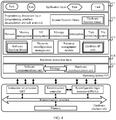
- FIG. 4 shows a diagram of a system architecture involved in an embodiment of the present invention. As shown in FIG. 4 , a system architecture 400 includes two parts: a software operating system 410 and a hardware platform 420.
- the operating system 410 from top down may be divided into an application layer 411, a programming abstraction layer 412, a middleware layer 413, a hardware abstraction layer 414, and a communication layer 415.
- the application layer 411 uses an encapsulation interface provided by the programming abstraction layer 412 to invoke an application program.
- the middleware layer 413 is responsible for work related to aspects, such as system virtualization, distribution, and flexibility, which covers core functions of the operating system 410.
- the operating system 410 can be responsible for processing a hardware task as well as a software task, where the hardware task and the software task are abstracted together by using the hardware abstraction layer, and interact with the hardware platform by using the communication layer.
- the hardware platform 420 includes components, such as a general purpose instruction set processor GPP, a reconfiguration controller, a reconfigurable logic resource, an interconnection structure, and a memory, where the interconnection structure connects a multi-core system and a peripheral device, for example a memory and a hard disk.
- GPP general purpose instruction set processor
- reconfiguration controller a reconfiguration controller
- reconfigurable logic resource a reconfigurable logic resource
- interconnection structure connects a multi-core system and a peripheral device, for example a memory and a hard disk.
- Application scenarios of the heterogeneous multi-core reconfigurable computing platform involved in this embodiment of the present invention include an embedded device, a server device, and the like.
- FIG. 5 shows a schematic block diagram of an apparatus 500 for task scheduling on a heterogeneous multi-core reconfigurable computing platform according to an embodiment of the present invention.
- a structure of the apparatus 500 for hardware task scheduling on the heterogeneous multi-core reconfigurable computing platform is divided into two main parts: a hardware part 600 and a software part 700.
- the hardware part 600 includes parts, such as a multi-core system-on-a-chip 610, a system bus 620, a reconfiguration controller 630, and a reconfigurable resource 640.
- the multi-core system-on-a-chip 610 includes on-chip interconnection 611 and a multi-core central processing unit (Central Processing Unit, "CPU” for short) 612, where the multi-core system-on-a-chip 610 is an execution carrier of a software task.
- CPU Central Processing Unit
- the system bus 620 connects the multi-core system and a peripheral device, for example, a memory and a hard disk.
- the reconfiguration controller 630 receives a reconfiguration control signal 723 and a reconfiguration data signal 724, and performs a reconfiguration operation on a reconfigurable resource according to the reconfiguration control signal 723 and the reconfiguration data signal 724, where the reconfiguration controller 630 is a device closely related to the reconfiguration platform.
- the reconfigurable resource 640 is divided into different reconfigurable resource packages 641, where each reconfigurable resource package 641 may be served as an independent device for use.
- the reconfigurable resource 640 is specifically an FPGA.
- the reconfigurable resource 640 is managed in a manner of reconfigurable resource packages, where deployment of the reconfigurable resource packages is fixed after the system is started each time, and modification is not allowed. After the system is started, an IP core that may be deployed on each reconfigurable resource package can be changed dynamically, that is, a function that can be implemented by each reconfigurable resource package changes dynamically. Reconfigurable resource packages and functions meet a many-to-many mapping relationship. One reconfigurable resource package may be deployed as IP cores with different functions, and a same function may be deployed on different reconfigurable resource packages.
- the software part 700 includes two parts: a programming model 710 and a scheduling and resource management module 720.
- the programming model 710 includes a programming interface 711 and a system function library 712, provides the programming interface 711 for a user, and creates a task by using the system function library 712.
- a hardware function library 713 in the system function library 712 is peculiar to the reconfigurable platform, where the hardware function library 713 defines an interface for invoking the reconfigurable resource packages 641 on the reconfigurable resource 640.
- the hardware function library 713 of the system includes only a functional interface.
- a mapping relationship between the reconfigurable resource packages 641 and functions is completely transparent to a programmer, and the scheduling and resource management module 720 in the system is responsible for dynamic management performed when the system is operating.
- the scheduling and resource management module 720 includes two sub-parts: a task scheduling module 721 and a resource management module 722.
- the task scheduling module 721 is configured to determine a task execution time, and determine an execution unit of a task.
- the resource management module 722 is configured to manage, according to a result determined by the task scheduling module 721, the reconfigurable resource 640 by using the reconfiguration control signal 723 and the reconfiguration data signal 724, where the reconfiguration control signal 723 refers to a trigger signal for controlling a reconfiguration status and a reconfiguration procedure, and the reconfiguration data signal 724 is a signal indicating a specific function required to be configured for the reconfigurable resource.
- Configuration information of an IP core that can be deployed on each reconfigurable resource package 641 in the reconfigurable resource 640 is stored in an IP core library 700, and its representation form is a netlist, a gate circuit, or the like.
- the IP core library 700 provides, for the reconfiguration controller 630 according to the received reconfiguration data signal 724, configuration information required for deploying an IP core.
- the task scheduling module 721 is configured to:
- the task scheduling module 721 is specifically configured to:
- the task scheduling module 721 is specifically configured to:
- the task scheduling module 721 is further configured to:
- the task scheduling module 721 is further configured to: when an IP core for indicating the to-be-executed task is deployed on the heterogeneous multi-core reconfigurable computing platform, determine that the execution manner of the to-be-executed task is hardware execution.
- the resource management module 722 is configured to manage, according to the result determined by the task scheduling module 721, the reconfigurable resource 640 by using the reconfiguration control signal 723 and the reconfiguration data signal 724. Specifically, the reconfiguration control signal 723 and the reconfiguration data signal 724 are sent to the reconfiguration controller 630.
- the reconfiguration controller 630 is configured to perform a reconfiguration operation on the reconfigurable resource 640 according to the received reconfiguration control signal 723 and reconfiguration data signal 724. Specifically, at least one reconfigurable resource package in the multiple reconfigurable resource packages 641 in the reconfigurable resource 640 is reconfigured to be the target IP core for executing the target task.
- the multi-core central processing unit 612 (for example, a microprocessor or a single-chip microcomputer) in the multi-core system-on-a-chip 610 sends related processing data of a target task to the target IP core, where the target IP core automatically starts to execute the target task (which may also be referred to as a hardware task). After completing execution of the target task, the target IP core returns a processing result to the processor.
- the reconfiguration controller 630 is specifically configured to: reconfigure a target reconfigurable resource package in the multiple reconfigurable resource packages to be the target IP core, where the target reconfigurable resource package is a reconfigurable resource package with a longest idle time in the multiple reconfigurable resource packages.
- the software part 700 is configured to enable, by means of programming, the processor (for example, a CPU) to have a corresponding processing function, so as to complete the target task by using software.
- the processor for example, a CPU
- the reconfigurable resource 640 is managed in a manner of the reconfigurable resource packages 641, where deployment of the reconfigurable resource packages 641 is fixed after the system is started each time, and modification is not allowed.
- an IP core that may be deployed on each reconfigurable resource package 641 can be changed dynamically, that is, a function that can be implemented by each reconfigurable resource package 641 changes dynamically.
- function replacement is implemented mainly by reorganizing a reconfigurable logical unit (such as a lookup table).
- the reconfigurable resource packages 641 and functions meet a many-to-many mapping relationship.
- One reconfigurable resource package 641 may be deployed as IP cores with different functions, and a same function may be deployed on different reconfigurable resource packages 641.
- the reconfigurable resource packages 641 shown in FIG. 5 may be deployed as the IP cores with different functions, and the same function may be deployed on different reconfigurable resource packages.
- the reconfigurable resource on the computing platform is divided into three reconfigurable resource packages, where numbers thereof are 0, 1, and 2 respectively.
- the computing platform can execute four functions: a function 1 (an add operation), a function 2 (a subtraction operation), a function 3 (a matrix operation), and a function 4 (video processing).
- a correspondence between the reconfigurable resource packages and the functions may be represented as: 0 may be corresponding to the function 1 and the function 2, 1 may be corresponding to the function 1 and the function 3, and 2 may be corresponding to the function 1, the function 3, and the function 4.
- a set of reconfigurable resource packages in the system may be set as BbSet, and each element in the set represents a number BbNum of a reconfigurable resource package.
- a set of functions is set as FunSet, and each element in the set represents a number FunNum of a function.
- Each function may be corresponding to multiple IP cores in the system.
- a mapping relationship between BbSet and FunSet is defined as f: BbSet ⁇ FunSet, where the mapping relationship f may be represented as a set of 2-tuples ⁇ BbNum, FunNum>.
- the 2-tuples actually represent a correspondence between the reconfigurable resource packages and the IP cores, where the set is defined as IPSet.
- IPSet determines a design of an IP core library.
- a set of configuration files in the IP core library is defined as ConfigSet, and each element in the set is one configuration file FileNum.
- IPset and ConfigSet meet a one-to-one mapping relationship, that is, each 2-tuple ⁇ BbNum, FunNum> is corresponding to one FileNum, which is not limited in the present invention, however.
- the foregoing mapping relationship between the reconfigurable resource packages and the functions is established.
- the foregoing mapping relationship between the reconfigurable resource packages and the functions is established, which is not limited in this embodiment of the present invention.
- a typical application scenario of a method for task scheduling on the heterogeneous multi-core reconfigurable computing platform provided in this embodiment of the present invention is: at an early operating stage of the system (an embedded system or a server), load or a task of the system is allocated, according to a user agreement or planning, to a general purpose processor and an FPGA accelerator, for execution.
- the system determines, according to a current hardware resource and task information, costs and benefits for executing the task by means of hardware execution, and determines whether the task is executed with an acceleration.
- an execution manner of the target task is determined according to popularity of the target task and usage of a reconfigurable resource of the heterogeneous multi-core reconfigurable computing platform. That is, the execution manner of the target task is determined according to an execution status of the target task and a usage status of the reconfigurable resource, which can implement appropriate use of the reconfigurable resource.
- the method provided in this embodiment of the present invention can effectively improve usage of a reconfigurable resource, and therefore can effectively improve the overall operating efficiency of a heterogeneous multi-core reconfigurable computing platform.
- execution of a software task and a hardware task is transparent to a user.
- the user only needs to create a task according to a preset rule without the need to concern about how the task is finally executed. Therefore, the method for task scheduling on a heterogeneous multi-core reconfigurable computing platform in this embodiment of the present invention improves usage of computing resources of the heterogeneous multi-core reconfigurable computing platform as well as improving user experience.
- FIG. 7 shows a schematic block diagram of an apparatus 800 for task scheduling on a heterogeneous multi-core reconfigurable computing platform according to an embodiment of the present invention.
- the apparatus 800 includes:
- an execution manner of the target task is determined according to popularity of the target task and usage of a reconfigurable resource of the heterogeneous multi-core reconfigurable computing platform. That is, the execution manner of the target task is determined according to an execution status of the target task and a usage status of the reconfigurable resource, which can implement appropriate use of the reconfigurable resource.
- the method provided in this embodiment of the present invention can effectively improve usage of a reconfigurable resource, and therefore can effectively improve the overall operating efficiency of a heterogeneous multi-core reconfigurable computing platform.
- the first determining module 810 is specifically configured to:
- the first determining module 810 is specifically configured to:
- the apparatus 800 further includes:
- the heterogeneous multi-core reconfigurable computing platform includes multiple reconfigurable resource packages, and in terms of executing the target task according to the determined execution manner, the execution module 820 is specifically configured to:
- the execution module 820 is specifically configured to:
- the apparatus 800 further includes:
- an execution manner of the target task is determined according to popularity of the target task and usage of a reconfigurable resource of the heterogeneous multi-core reconfigurable computing platform. That is, the execution manner of the target task is determined according to an execution status of the target task and a usage status of the reconfigurable resource, which can implement appropriate use of the reconfigurable resource.
- the method provided in this embodiment of the present invention can effectively improve usage of a reconfigurable resource, and therefore can effectively improve the overall operating efficiency of a heterogeneous multi-core reconfigurable computing platform.
- the apparatus 800 for task scheduling on a heterogeneous multi-core reconfigurable computing platform in this embodiment of the present invention may be corresponding to the apparatus 500 for task scheduling on a heterogeneous multi-core reconfigurable computing platform in the embodiment of the present invention, and the foregoing and other operations and/or functions of the modules of the apparatus 800 separately implement corresponding procedures of the methods of FIG. 1 to FIG. 3 .
- the foregoing and other operations and/or functions of the modules of the apparatus 800 separately implement corresponding procedures of the methods of FIG. 1 to FIG. 3 .
- details are not described herein again.
- this embodiment provides a hardware structure of an apparatus 900 for task scheduling on a heterogeneous multi-core reconfigurable computing platform.
- the hardware structure of the apparatus 900 may include:
- the transceiver component is a hardware circuit for implementing package receiving and sending.
- the hardware component may also be referred to as a "hardware processing module", or more simply, may be short for “hardware”.
- the hardware component mainly includes a hardware circuit that implements, based on an application-specific hardware circuit such as an FPGA and an ASIC (which may also coordinate with another matching component, for example, a storage), some specific functions, where a processing speed of the hardware component is usually much higher than that of a general-purpose processor, but it is difficult to change a function once the function is customized. Therefore, the hardware component is inflexible in implementation and is generally configured to implement some fixed functions.
- the hardware component may also include a processor such as an MCU (a microprocessor, for example, a single-chip microcomputer) or a CPU. However, a main function of these processors is not to complete big data processing, but is mainly to perform control. In this application scenario, a system including these components is a hardware component.
- the software component (or short for "software”) mainly includes a general purpose processor (for example, a CPU) and some matching components (for example, a storage device such as a memory or a hard disk) of the general purpose processor, where the processor may be enabled, by means of programming, to have a corresponding processing function.
- the software component can be configured flexibly according to a service requirement, but a speed thereof is usually lower than that of the hardware component.
- the hardware component may send processed data by using the transceiver component, or may send processed data to the transceiver component over an interface connected to the transceiver component.
- the software component is configured to perform system dynamic determining mentioned in the foregoing embodiment. That is, the software component is configured to:
- the software component is specifically configured to:
- the software component in terms of determining the execution manner of the target task according to the weighted popularity C w of the target task and the usage E ave of the reconfigurable resource, is specifically configured to:
- the heterogeneous multi-core reconfigurable computing platform includes multiple reconfigurable resource packages, where when determining that the execution manner of the target task is the hardware manner, the software component is configured to:
- a processor such as a microprocessor or a single-chip microcomputer included in the hardware component sends processed data, for example, input data and a starting signal, to the target IP core by using a transceiver component, and the target IP core automatically starts to execute the target task (which may also be referred to as a hardware task). After completing execution of the target task, the target IP core returns a processing result to the processor by using the transceiver component.
- the software component in terms of reconfiguring the at least one reconfigurable resource package in the multiple reconfigurable resource packages to be the target IP core for executing the target task, is specifically configured to:
- the software component when determining that the execution manner of the target task is the software manner, the software component is configured to:
- the software component is further configured to:
- an execution manner of the target task is determined according to popularity of the target task and usage of a reconfigurable resource of the heterogeneous multi-core reconfigurable computing platform. That is, the execution manner of the target task is determined according to an execution status of the target task and a usage status of the reconfigurable resource, which can implement appropriate use of the reconfigurable resource.
- the method provided in this embodiment of the present invention can effectively improve usage of a reconfigurable resource, and therefore can effectively improve the overall operating efficiency of a heterogeneous multi-core reconfigurable computing platform.
- the apparatus 900 for task scheduling on a heterogeneous multi-core reconfigurable computing platform in this embodiment of the present invention may be corresponding to the apparatus 500 for task scheduling on a heterogeneous multi-core reconfigurable computing platform in the embodiment of the present invention, or may be corresponding to the apparatus 800 for task scheduling on a heterogeneous multi-core reconfigurable computing platform in the embodiment of the present invention.
- the foregoing and other operations and/or functions of the components of the apparatus 900 separately implement corresponding procedures of the methods of FIG. 1 to FIG. 3 . For brevity, details are not described herein again.
- sequence numbers of the foregoing processes do not mean execution sequences in various embodiments of the present invention.
- the execution sequences of the processes should be determined according to functions and internal logic of the processes, and should not be construed as any limitation on the implementation processes of the embodiments of the present invention.
- the disclosed system, apparatus, and method may be implemented in other manners.
- the described apparatus embodiment is merely exemplary.
- the unit division is merely logical function division and may be other division in actual implementation.
- a plurality of units or components may be combined or integrated into another system, or some features may be ignored or not performed.
- the displayed or discussed mutual couplings or direct couplings or communication connections may be implemented by using some interfaces.
- the indirect couplings or communication connections between the apparatuses or units may be implemented in electronic, mechanical, or other forms.
- the units described as separate parts may or may not be physically separate. Parts displayed as units may or may not be physical units, and may be located in one position or may be distributed on a plurality of network units. Some or all of the units may be selected according to actual needs to achieve the objectives of the solutions of the embodiments.
- functional units in the embodiments of the present invention may be integrated into one processing unit, or each of the units may exist alone physically, or two or more units are integrated into one unit.
- the functions When the functions are implemented in the form of a software functional unit and sold or used as an independent product, the functions may be stored in a computer-readable storage medium. Based on such an understanding, the technical solutions of the present invention essentially, or the part contributing to the prior art, or some of the technical solutions may be implemented in a form of a software product.
- the computer software product is stored in a storage medium, and includes several instructions to cause a computer device (which may be a personal computer, a server, or a network device) to perform all or some of the steps of the methods described in the embodiments of the present invention.
- the foregoing storage medium includes: any medium that can store program code, such as a USB flash drive, a portable hard disk, a read-only memory (ROM, Read-Only Memory), a random access memory (RAM, Random Access Memory), a magnetic disk, or an optical disc.
- program code such as a USB flash drive, a portable hard disk, a read-only memory (ROM, Read-Only Memory), a random access memory (RAM, Random Access Memory), a magnetic disk, or an optical disc.
Landscapes
- Engineering & Computer Science (AREA)
- Theoretical Computer Science (AREA)
- Software Systems (AREA)
- Physics & Mathematics (AREA)
- General Engineering & Computer Science (AREA)
- General Physics & Mathematics (AREA)
- Computer Hardware Design (AREA)
- Stored Programmes (AREA)
- Logic Circuits (AREA)
Abstract
Description
- This application claims priority to Chinese Patent Application No.
201510142346.X, filed with the Chinese Patent Office on March 27, 2015 - The present invention relates to the computer field, and more specifically, to a method and an apparatus for task scheduling on a heterogeneous multi-core reconfigurable computing platform.
- At present, there are two representation forms for a computational task: on a general purpose processor (General Purpose Processor, GPP for short), the task is generally presented in a form of software code, which is referred to as a software task; while on an application-specific integrated circuit, the task is generally presented in a form of an application-specific hardware circuit, which is referred to as a hardware task. The software task has advantages of good flexibility and being easy to modify and debug, and has a disadvantage of unsatisfactory computation speed; while the hardware task has an advantage of high speed, and has disadvantages of being less flexible and not easy to debug. A heterogeneous multi-core reconfigurable computing platform is an effective means to balance a general purpose processor and an application-specific integrated circuit. The heterogeneous multi-core reconfigurable computing platform not only can achieve a quite high speedup ratio by using a reconfigurable logic component, but also can have good flexibility by using a reconfigurable technology or adding a general purpose processor. In addition, the heterogeneous multi-core reconfigurable computing platform can overcome deficiencies, such as high costs of the application-specific integrated circuit caused due to a complex design and manufacturing process at an early stage and non-reusability.
- Reconfigurable resources (namely, hardware logical resources) on the heterogeneous multi-core reconfigurable computing platform are usually quite limited, and it is required to perform reconfiguration on the reconfigurable resources, so as to implement hardware execution of a task. Hardware resource reconfiguration on the heterogeneous multi-core reconfigurable computing platform can be classified into static reconfiguration and dynamic reconfiguration. Static reconfiguration refers to static reconfiguration of hardware logical resources of a system. That is, online programming is performed in various manners during an idle period of the system, so as to perform configuration of logical functions of a reconfigurable hardware logic component. Dynamic reconfiguration refers to performing dynamic configuration of logical functions of a reconfigurable logic component in real time during a real-time operating period of a system. For example, re-configuration can be performed only on a logical unit (namely, a reconfigurable resource) that needs to be modified in the system, which does not affect normal operation of an unmodified logical unit. Relative to the static reconfiguration, the dynamic reconfiguration shortens reconfiguration time, which on the one hand reduces overheads of the system, and on the other hand improves the operating efficiency of the system. To improve resource usage, in the prior art, a heterogeneous multi-core reconfigurable computing platform generally uses dynamic reconfiguration.
- At present, a heterogeneous multi-core reconfigurable computing platform generally uses a window-based (Window) method for task migration to perform reconfiguration. A window is defined as a time interval between current reconfiguration and next reconfirmation. A window includes three phases: a hardware execution (Hardware Execution) time, a scheduling (Scheduling) time, and a reconfiguration (Reconfiguration) time, where the scheduling time is hidden in the hardware execution time. In the prior art, a size of a reconstruction window is fixed, and the size of the window affects system performance. For example, an excessively large window causes a reconfigurable resource to be in an idle state for a long period of time, which lowers resource usage and system performance. An excessively small window causes excessively frequent system reconfiguration, thereby introducing extra reconfiguration overheads and lowering system performance.
- Embodiments of the present invention provide a method and an apparatus for task scheduling on a heterogeneous multi-core reconfigurable computing platform, where an execution manner of a task is determined according to an execution status of the task and a usage status of a reconfigurable resource on the computing platform, so that usage of the reconfigurable resource on the heterogeneous multi-core reconfigurable computing platform can be effectively improved.
- According to a first aspect, a method for task scheduling on a heterogeneous multi-core reconfigurable computing platform is provided, where the method includes:
- determining an execution manner of a target task according to popularity of the to-be-executed target task and usage of a reconfigurable resource of the heterogeneous multi-core reconfigurable computing platform, where the execution manner includes a hardware manner or a software manner, for the target task, there is no corresponding target intellectual property IP core for executing the target task on the heterogeneous multi-core reconfigurable computing platform, the popularity of the target task is used to indicate central processing unit CPU usage of the target task, and the usage of the reconfigurable resource is used to indicate a usage status of the reconfigurable resource; and
- executing the target task according to the determined execution manner.
- With reference to the first aspect, in a first possible implementation manner of the first aspect, the determining an execution manner of a target task according to popularity of the target task and the usage of a reconfigurable resource of the heterogeneous multi-core reconfigurable computing platform includes:
- determining weighted popularity Cw of the target task according to the popularity of the target task, where Cw = C · S, C is the popularity of the target task, C = N 1 ·T1/T L, TL is a time length between a current time point and a time point at which reconfiguration is performed on the reconfigurable resource last time, N 1 is a quantity of times for which the target task is executed within TL in the software manner, T 1 is a time length required for a single execution of the target task in the software manner, S is a hardware speedup ratio of the target task, and the hardware speedup ratio S is used to indicate a ratio between a corresponding execution speed at which the target task is executed in the hardware manner and a corresponding execution speed at which the target task is executed in the software manner;
- determining the usage Eave of the reconfigurable resource of the heterogeneous multi-core reconfigurable computing platform according to the following formulas:


- where M is a quantity of IP cores deployed on the heterogeneous multi-core reconfigurable computing platform, Ei is IP core usage of an ith IP core in the M IP cores deployed on the heterogeneous multi-core reconfigurable computing platform, TL is the time length between the current time point and the time point at which reconfiguration is performed on the reconfigurable resource last time,


- determining the execution manner of the target task according to the weighted popularity Cw of the target task and the usage Eave of the reconfigurable resource.
- With reference to the first possible implementation manner of the first aspect, in a second possible implementation manner of the first aspect, the determining the execution manner of the target task according to the weighted popularity Cw of the target task and the usage Eave of the reconfigurable resource includes:
- when it is determined that the weighted popularity Cw of the target task is greater than or equal to a product of Eave and k, determining that the execution manner of the target task is the hardware manner, where k is a reconfiguration coefficient of the heterogeneous multi-core reconfigurable computing platform, and is used to indicate a reconfiguration overhead of the heterogeneous multi-core reconfigurable computing platform; or
- when it is determined that the weighted popularity Cw of the target task is less than a product of Eave and k, determining that the execution manner of the target task is the software manner.
- With reference to the first aspect and either possible implementation manner of the first and the second possible implementation manners of the first aspect, in a third possible implementation manner of the first aspect, the method further includes:
- determining a to-be-executed task; and
- when an IP core for executing the to-be-executed task is not deployed on the heterogeneous multi-core reconfigurable computing platform, determining the to-be-executed task as the to-be-executed target task.
- With reference to the first aspect or any one possible implementation manner of the first to the third possible implementation manners of the first aspect, in a fourth possible implementation manner of the first aspect, the heterogeneous multi-core reconfigurable computing platform includes multiple reconfigurable resource packages, where when determining that the execution manner of the target task is the hardware manner, the executing the target task according to the determined execution manner includes:
- reconfiguring at least one reconfigurable resource package in the multiple reconfigurable resource packages to be the target IP core for executing the target task; and
- executing the target task by using the target IP core.
- With reference to the fourth possible implementation manner of the first aspect, in a fifth possible implementation manner of the first aspect, the reconfiguring at least one reconfigurable resource package in the multiple reconfigurable resource packages to be the target IP core that is capable of executing the target task includes:
- reconfiguring a target reconfigurable resource package in the multiple reconfigurable resource packages to be the target IP core, where the target reconfigurable resource package is a reconfigurable resource package with a longest idle time in the multiple reconfigurable resource packages.
- With reference to the third possible implementation manner of the first aspect, in a sixth possible implementation manner of the first aspect, the method further includes:
- when an IP core for indicating the to-be-executed task is deployed on the heterogeneous multi-core reconfigurable computing platform, determining that an execution manner of the to-be-executed task is hardware execution.
- According to a second aspect, an apparatus for task scheduling on a heterogeneous multi-core reconfigurable computing platform is provided, where the apparatus includes:
- a first determining module, configured to determine an execution manner of a target task according to popularity of the to-be-executed target task and usage of a reconfigurable resource of the heterogeneous multi-core reconfigurable computing platform, where the execution manner includes a hardware manner or a software manner, for the target task, there is no corresponding target intellectual property IP core for executing the target task on the heterogeneous multi-core reconfigurable computing platform, the popularity of the target task is used to indicate central processing unit CPU usage of the target task, and the usage of the reconfigurable resource is used to indicate a usage status of the reconfigurable resource; and
- an execution module, configured to execute the target task according to the execution manner determined by the first determining module.
- With reference to the second aspect, in a first possible implementation manner of the second aspect, in terms of determining the execution manner of the target task according to the popularity of the target task and the usage of the reconfigurable resource of the heterogeneous multi-core reconfigurable computing platform, the first determining module is specifically configured to:
- determine weighted popularity Cw of the target task according to the popularity of the target task, where Cw = C · S, C is the popularity of the target task, C = N 1 · T 1/TL , TL is a time length between a current time point and a time point at which reconfiguration is performed on the reconfigurable resource last time, N 1 is a quantity of times for which the target task is executed within TL in the software manner, T 1 is a time length required for a single execution of the target task in the software manner, S is a hardware speedup ratio of the target task, and the hardware speedup ratio S is used to indicate a ratio between a corresponding execution speed at which the target task is executed in the hardware manner and a corresponding execution speed at which the target task is executed in the software manner;
- determine the usage Eave of the reconfigurable resource of the heterogeneous multi-core reconfigurable computing platform according to the following formulas:


- where M is a quantity of IP cores deployed on the heterogeneous multi-core reconfigurable computing platform, Ei is IP core usage of an ith IP core in the M IP cores deployed on the heterogeneous multi-core reconfigurable computing platform, TL is the time length between the current time point and the time point at which reconfiguration is performed on the reconfigurable resource last time,


- determine the execution manner of the target task according to the weighted popularity Cw of the target task and the usage Eave of the reconfigurable resource.
- With reference to the first possible implementation manner of the second aspect, in a second possible implementation manner of the second aspect, in terms of determining the execution manner of the target task according to the weighted popularity Cw of the target task and the usage Eave of the reconfigurable resource, the first determining module is specifically configured to:
- when it is determined that the weighted popularity Cw of the target task is greater than or equal to a product of Eave and k, determine that the execution manner of the target task is the hardware manner, where k is a reconfiguration coefficient of the heterogeneous multi-core reconfigurable computing platform, and is used to indicate a reconfiguration overhead of the heterogeneous multi-core reconfigurable computing platform; or
- when it is determined that the weighted popularity Cw of the target task is less than a product of Eave and k, determine that the execution manner of the target task is the software manner.
- With reference to the second aspect and either possible implementation manner of the first and the second possible implementation manners of the second aspect, in a third possible implementation manner of the second aspect, the apparatus further includes:
- a second determining module, configured to determine a to-be-executed task; and
- a third determining module, configured to: when an IP core for executing the to-be-executed task is not deployed on the heterogeneous multi-core reconfigurable computing platform, determine the to-be-executed task as the to-be-executed target task.
- With reference to the second aspect or any one possible implementation manner of the first to the third possible implementation manners of the second aspect, in a fourth possible implementation manner of the second aspect, the heterogeneous multi-core reconfigurable computing platform includes multiple reconfigurable resource packages, and in terms of executing the target task according to the determined execution manner, the execution module is specifically configured to:
- when it is determined that the execution manner of the target task is the hardware manner, reconfigure at least one reconfigurable resource package in the multiple reconfigurable resource packages to be the target IP core for executing the target task; and
- execute the target task by using the target IP core.
- With reference to the fourth possible implementation manner of the second aspect, in a fifth possible implementation manner of the second aspect, in terms of reconfiguring the at least one reconfigurable resource package in the multiple reconfigurable resource packages to be the target IP core that is capable of executing the target task, the execution module is specifically configured to:
- reconfigure a target reconfigurable resource package in the multiple reconfigurable resource packages to be the target IP core, where the target reconfigurable resource package is a reconfigurable resource package with a longest idle time in the multiple reconfigurable resource packages.
- With reference to the third possible implementation manner of the second aspect, in a sixth possible implementation manner of the second aspect, the apparatus further includes:
- a fourth determining module, configured to: when an IP core for indicating the to-be-executed task is deployed on the heterogeneous multi-core reconfigurable computing platform, determine that an execution manner of the to-be-executed task is hardware execution.
- Based on the foregoing technical solutions, in the embodiments of the present invention, an execution manner of the target task is determined according to popularity of the target task and usage of a reconfigurable resource of the heterogeneous multi-core reconfigurable computing platform. The execution manner of the task is determined dynamically according to an execution status of the task and a usage status of the reconfigurable resource of the computing platform, which can implement appropriate use of the reconfigurable resource. With respect to a problem in the prior art that frequent IP core reconfiguration is caused or some tasks are kept in a wait state for a long period of time resulting from a fact that a user specifies an execution manner of a task, the method provided in the embodiments of the present invention can effectively improve usage of a reconfigurable resource on a heterogeneous multi-core reconfigurable computing platform, and therefore can improve overall performance of the computing platform.
- To describe the technical solutions in the embodiments of the present invention more clearly, the following briefly describes the accompanying drawings required for describing the embodiments or the prior art. Apparently, the accompanying drawings in the following description show merely some embodiments of the present invention, and a person of ordinary skill in the art may still derive other drawings from these accompanying drawings without creative efforts.
-
FIG. 1 shows a schematic flowchart of a method for task scheduling on a heterogeneous multi-core reconfigurable computing platform according to an embodiment of the present invention; -
FIG. 2 shows another schematic flowchart of a method for task scheduling on a heterogeneous multi-core reconfigurable computing platform according to an embodiment of the present invention; -
FIG. 3 shows still another schematic flowchart of a method for task scheduling on a heterogeneous multi-core reconfigurable computing platform according to an embodiment of the present invention; -
FIG. 4 shows a schematic block diagram of a system architecture involved in an embodiment of the present invention; -
FIG. 5 shows a schematic block diagram of an apparatus for task scheduling on a heterogeneous multi-core reconfigurable computing platform according to an embodiment of the present invention; -
FIG. 6 shows a schematic diagram of reconfigurable resource packages involved in an embodiment of the present invention; -
FIG. 7 shows a schematic block diagram of an apparatus for task scheduling on a heterogeneous multi-core reconfigurable computing platform according to an embodiment of the present invention; -
FIG. 8 shows another schematic block diagram of an apparatus for task scheduling on a heterogeneous multi-core reconfigurable computing platform according to an embodiment of the present invention; and -
FIG. 9 shows still another schematic block diagram of an apparatus for task scheduling on a heterogeneous multi-core reconfigurable computing platform according to an embodiment of the present invention. - The following clearly and completely describes the technical solutions in the embodiments of the present invention with reference to the accompanying drawings in the embodiments of the present invention. Apparently, the described embodiments are some but not all of the embodiments of the present invention. All other embodiments obtained by a person of ordinary skill in the art based on the embodiments of the present invention without creative efforts shall fall within the protection scope of the present invention.
- It should be understood that, in the embodiments of the present invention, a heterogeneous multi-core reconfigurable computing platform refers to a computing system integrating both a general purpose processor (General Purpose Processor, "GPP" for short) such as a central processing unit (Central Processing Unit, "CPU" for short), and a field programmable gate array (Field Programmable Gate Arrays, "FPGA" for short) on a single physical chip, where the FPGA features hardware reconfigurability. Specifically, a multi-core feature of the computing platform is specifically: multiple computation modules are integrated on the single physical chip, where the multiple computation modules include but are not limited to multiple general purpose processors, multiple intellectual property (Intellectual Property, "IP" for short) cores, multiple specific-application processors, and the like, where an IP core refers to a logic circuit for implementing a specific function on the physical chip, and generally belongs to a hardware scope. On this basis, a heterogeneity feature of the computing platform is specifically: more than one type of computation modules is included in the multiple computation modules integrated on the single physical chip. A reconfigurability feature of the computing platform is specifically a dynamic change status of a functional unit of a computation module, for example, a first IP core, integrated on the physical chip, for implementing a first function is changed into a second IP core for implementing a second function, which is reconfigurability.
- In the embodiments of the present invention, a reconfigurable resource refers to a reconfigurable hardware resource on the heterogeneous multi-core reconfigurable computing platform, and specifically refers to a logical resource of the FPGA integrated on the physical chip, where the FPGA features hardware reconfigurability.
- In the embodiments of the present invention, the IP core refers to a hardware module, constructed by using the reconfigurable resource, for implementing a function, and specifically refers to a hardware module set up by using a basic gate circuit on the FPGA.
- On the heterogeneous multi-core reconfigurable computing platform, executing a task in a software manner refers to executing the task on a general purpose processor GPP, that is, presenting the task in a form of software code, where the task may also be referred to as a software task; executing a task in a hardware manner refers to executing the task on a specific-application integrated circuit (namely, a circuit module for completing the task), that is, presenting the task in a form of a hardware circuit, where the task may also be referred to as a hardware task. That is, executing the task in the hardware manner refers to executing, based on a reconfigurable resource, the task on an IP core that is capable of executing the task. It should be understood that for executing a target task in the hardware manner, an IP core that is constructed based on a reconfigurable resource and that can complete the target task is required.
- It should be understood that, in the embodiments of the present invention, the reconfigurable resource (for example, a field programmable gate array, Field Programmable Gate Arrays, "FPGA" for short) of the heterogeneous multi-core reconfigurable computing platform can be divided into multiple reconfigurable resource packages with equal areas or unequal areas, where deployment of the reconfigurable resource packages is fixed after a system is started each time, and modification is not allowed. After the system is started, an IP core that may be deployed on each reconfigurable resource package can be changed dynamically, that is, a function that can be implemented by each reconfigurable resource package changes dynamically. Multiple IP cores with different functions may be deployed on one reconfigurable resource package, and one IP core may also be deployed on multiple reconfigurable resource packages. Further description is provided with reference to
FIG. 6 in the following. - It should be further understood that an IP core is a hardware function module that is constructed based on a reconfigurable resource and for implementing a function; therefore, the IP core may be considered as a form of the reconfigurable resource, and usage of the IP core reflects usage of the reconfigurable resource, where the usage of the IP core refers to a frequency at which the IP core executes a task.
- It should be understood that in the embodiments of the present invention, a function of a hardware task refers to a function requested by the hardware task or a function that can be implemented when the hardware task is executed. For example, the function may be logical operation, matrix operation, video processing, or the like. A hardware platform can provide, for a user program by using a marker bit, an interface for transmitting a hardware function, and determine a function of a hardware task according to the interface. On the heterogeneous multi-core reconfigurable computing platform, each task that can be operated on the reconfigurable logical resource generally has a corresponding software version.
- Optionally, the heterogeneous multi-core reconfigurable computing platform refers to a computer system that includes modules such as a computation module, a storage module, an interconnection module, a related periphery, and the like, which is not limited in the present invention, however.
- For ease of understanding and description in the following, the heterogeneous multi-core reconfigurable computing platform is referred to as a computing platform or a system for short.
-
FIG. 1 shows a schematic flowchart of amethod 100 for task scheduling on a heterogeneous multi-core reconfigurable computing platform according to an embodiment of the present invention, where the heterogeneous multi-core reconfigurable computing platform includes multiple reconfigurable resource packages, and themethod 100 may be executed, for example, by the computing platform (for example, the computing platform may be a computer). As shown inFIG. 1 , themethod 100 includes the following steps: - S110: Determine an execution manner of a target task according to popularity of the to-be-executed target task and usage of a reconfigurable resource of a heterogeneous multi-core reconfigurable computing platform, where the execution manner includes a hardware manner or a software manner, for the target task, there is no corresponding target intellectual property IP core for executing the target task on the heterogeneous multi-core reconfigurable computing platform, the popularity of the target task is used to indicate central processing unit CPU usage of the target task, and the usage of the reconfigurable resource is used to indicate a usage status of the reconfigurable resource.
- Specifically, the target task is a computational task to be executed at a current time point, where an IP core that is capable of executing the target task is not deployed on the computing platform. It should be understood that because an IP core that is capable of executing the target task is not deployed on the computing platform, before S110, the target task is executed in the software manner by a processor GPP (which is specifically a central processing unit CPU in this embodiment of the present invention).
- The popularity of the target task represents CPU occupancy of the target task within a time period before the current time point, namely, a quantity of times for execution in the software manner. Herein, the mentioned time period before the current time point may be, for example, a time period from a time point at which IP core reconfiguration is performed on the reconfigurable resource last time to the current time point. The usage of the reconfigurable resource of the heterogeneous multi-core reconfigurable computing platform is specifically determined, for example, according to usage of all IP cores deployed on the computing platform (where these deployed IP cores are not used for executing the target task to be executed currently). Usage of one IP core is used to represent, during the time period from the time point at which the IP core reconfiguration is performed on the reconfigurable resource last time to the current time period, a quantity of times for which the IP core executes a task (a task that is corresponding to a function and can be executed by the IP core) corresponding to an ith IP core. Detailed description is provided in the following.
- S120: Execute the target task according to the determined execution manner.
- In this embodiment of the present invention, the execution manner of the target task is determined according to the popularity of the target task and the usage of the reconfigurable resource of the heterogeneous multi-core reconfigurable computing platform. That is, the execution manner of the task is determined dynamically according to an execution status of the task and a usage status of the reconfigurable resource of the computing platform, which can implement appropriate use of the reconfigurable resource. With respect to a problem in the prior art that frequent IP core reconfiguration is caused or some tasks are kept in a wait state for a long period of time resulting from a fact that a user specifies an execution manner of a task, the method provided in this embodiment of the present invention can effectively improve usage of a reconfigurable resource on a heterogeneous multi-core reconfigurable computing platform, and therefore can improve overall performance of the computing platform.
- Optionally, in this embodiment of the present invention, S110 of determining the execution manner of the target task according to the popularity of the target task and the usage of the reconfigurable resource of the heterogeneous multi-core reconfigurable computing platform includes:
- S111: Determine weighted popularity Cw of the target task according to the popularity of the target task, where Cw = C· S, C is the popularity of the target task, C = N 1 · T 1/TL, TL is a time length between a current time point and a time point at which reconfiguration is performed on the reconfigurable resource last time, N 1 is a quantity of times for which the target task is executed within TL in the software manner, T 1 is a time length required for a single execution of the target task in the software manner, S is a hardware speedup ratio of the target task, and the hardware speedup ratio S is used to indicate a ratio between a corresponding execution speed at which the target task is executed in the hardware manner and a corresponding execution speed at which the target task is executed in the software manner.
- The time point at which reconfiguration is performed on the reconfigurable resource last time refers to a time point that is before the current time point and at which latest IP core reconfiguration is performed, for example, a time point t1 that is before a current time point t2 and at which the latest IP core reconfiguration is performed on the reconfigurable resource of the heterogeneous multi-core reconfigurable computing platform. That is, within a time period TL from t1 to t2, reconfiguration is not performed on an IP core deployed on the computing platform.
- The popularity C of the target task represents CPU occupancy of the target task within the time length TL . It should be understood that higher popularity C of the target task represents a higher quantity of times for which the target task is executed on the computing platform. The popularity C of the target task may also be referred to as a priority of the target task.
- Assuming that the corresponding execution speed at which the target task is executed in the hardware manner is R1, and the corresponding execution speed at which the target task is executed in the software manner is R2, the hardware speedup ratio S of the target task is R1/R2. It should be understood that, it may be estimated, according to a ratio between a first time required for implementing the target task in the software manner and a second time required for implementing the target task in the hardware manner, the hardware speedup ratio S of the target task is R1/R2, which is not limited in this embodiment of the present invention.
- The weighted popularity of the target task is Cw = C·S, which represents a priority, relative to a task of another function, of the target task when being executed by using a corresponding IP core. That is, significance of deploying a target IP core, for the target task, for executing the target task is indicated. For example, it may be determined, by comparing weighted popularity of a task A and that of a task B, that a corresponding IP core is deployed for which task preferentially, where when being executed by using an IP core, a task with higher weighted popularity Cw has a performance advantage over a task with lower weighted popularity Cw .
- S112: Determine the usage Eave of the reconfigurable resource of the heterogeneous multi-core reconfigurable computing platform according to the following formulas:


- It should be understood that, although a target IP core for executing the target task is not deployed on the computing platform, an IP core for executing another computational task is deployed on the computing platform. For each deployed IP core, usage

- S113: Determine the execution manner of the target task according to the weighted popularity Cw of the target task and the usage Eave of the reconfigurable resource.
- Specifically, the execution manner of the target task may be determined by comparing values of the weighted popularity Cw of the target task and the usage Eave of the reconfigurable resource.
- Optionally, in this embodiment of the present invention, S113 of determining the execution manner of the target task according to the weighted popularity Cw of the target task and the usage Eave of the reconfigurable resource includes:
- S113A: When it is determined that the weighted popularity Cw of the target task is greater than or equal to a product of Eave and k, determine that the execution manner of the target task is the hardware manner, where k is a reconfiguration coefficient of the heterogeneous multi-core reconfigurable computing platform, and is used to indicate a reconfiguration overhead of the heterogeneous multi-core reconfigurable computing platform.
- S113B: When it is determined that the weighted popularity Cw of the target task is less than a product of Eave and k, determine that the execution manner of the target task is the software manner.
- Specifically, the reconfiguration coefficient k of the heterogeneous multi-core reconfigurable computing platform reflects the reconfiguration overhead of the system, where a larger k indicates a lower reconfiguration frequency allowable by the system, and a smaller k indicates a higher reconfiguration frequency allowable by the system. Optionally, the reconfiguration coefficient k may be set according to a reconfiguration speed of the reconfigurable resource of the computing platform and a size of a reconfigured IP core, where the size of the IP core refers to a quantity of reconfigurable resources occupied by the IP core.
- It should be understood that the weighted popularity Cw of the target task may be considered as usage of the reconfigurable resource for the target task within the time length TL if the target task is executed in the hardware manner, where the target task has been executed in the software manner for multiple times. The product of Eave and k represents actual usage of the reconfigurable resource. Therefore, when Cw is greater than or equal to the product of Eave and k, it indicates that the reconfigurable resource is not fully used at the current time point. That is, an IP core deployed on the computing platform is not fully used currently; therefore, it is required to improve the usage of the reconfigurable resource, and IP core reconfiguration needs to be performed, for example, an IP core with lowest usage on the computing platform is reconfigured to be the target IP core for executing the target task. It can be understood that, when Cw is less than the product of Eave and k, it indicates that the reconfigurable resource is used relatively fully at the current time point, that is, an IP core deployed on the computing platform is also used relatively fully. In this case, if a corresponding target IP core is deployed for the target task, the usage of the reconfigurable resource decreases instead. Therefore, when it is determined that the weighted popularity Cw of the target task is less than the product of Eave and k, it is determined that the execution manner of the target task is the software manner, so that the target task is still executed based on a CPU.
- In conclusion, in this embodiment of the present invention, an execution status of a target task is determined according to an execution status (popularity) of the to-be-executed target task and a usage status (usage) of a reconfigurable resource of a computing platform. Therefore, usage of the reconfigurable resource can be effectively improved, and system performance can be improved.
- Optionally, in this embodiment of the present invention, the heterogeneous multi-core reconfigurable computing platform includes multiple reconfigurable resource packages. In a case in which it is determined that the execution manner of the target task is the hardware manner, S120 of executing the target task according to the determined execution manner includes:
- S121: Reconfigure at least one reconfigurable resource package in the multiple reconfigurable resource packages to be the target IP core for executing the target task.
- Specifically, as shown in
FIG. 5 , a reconfigurable resource 640 on the heterogeneous multi-core reconfigurable computing platform is managed in a manner of reconfigurable resource packages 641. After the system is started, an IP core that may be deployed on each reconfigurable resource package can be changed dynamically, that is, a function that can be implemented by each reconfigurable resource package changes dynamically. In a process of the change, function replacement is implemented mainly by reorganizing a reconfigurable logical unit (such as a lookup table). Reconfigurable resource packages and functions meet a many-to-many mapping relationship. One reconfigurable resource package may be deployed as IP cores with different functions, and a same function may be deployed on different reconfigurable resource packages. Detailed description is provided with reference toFIG. 6 in the following. - Specifically, a deployment process of the target IP core is represented as: a process in which a hardware logical resource (namely, the reconfigurable resource) is organized into a functional module (which can execute the target task).
- S122: Execute the target task by using the target IP core.
- In a case in which it is determined that the execution manner of the target task is hardware execution, the target task may also be referred to as a hardware task.
- It should be understood that, in this embodiment of the present invention, the hardware task (for example, the target task) is executed by using the target IP core. A specific implementation process is that the heterogeneous multi-core reconfigurable computing platform controls the target IP core, provides input of the hardware task for the target IP core to drive a hardware circuit so as to achieve an objective of executing the hardware task, and generates output.
- Optionally, in this embodiment of the present invention, S121 of reconfiguring the at least one reconfigurable resource package in the multiple reconfigurable resource packages to be the target IP core that is capable of executing the target task includes:
- S121A: Reconfigure a target reconfigurable resource package in the multiple reconfigurable resource packages to be the target IP core, where the target reconfigurable resource package is a reconfigurable resource package with a longest idle time in the multiple reconfigurable resource packages.
- The reconfigurable resource is organized in a manner of the reconfigurable resource packages, that is, all IP cores have a uniform external interface and all the IP cores can be replaced with each other. In an IP core replacement policy, a least-recently-used replacement principle is used. Assuming that a time at which each IP core completes execution last time is T1 and a current time is T2, an idle time of the IP core is T2-T1. When IP core replacement is to be performed, an IP core with a longest idle time T2-T1 is selected to perform replacement.
- Specifically, assuming that the time at which a reconfigurable resource package K executes reconfiguration last time is s T1 and the current time is T2, an idle time of the reconfigurable resource package K is defined as T2-T1. In S131A, the reconfigurable resource package with the longest idle time is selected to perform reconfiguration of the target IP core.
- Optionally, in this embodiment of the present invention, the
method 100 further includes: - S130: Determine a to-be-executed task.
- S140: In a case in which an IP core for executing the to-be-executed task is not deployed on the heterogeneous multi-core reconfigurable computing platform, determine the to-be-executed task as the to-be-executed target task.
- Specifically, for example, the system includes an IP core deployment status information table, where the status information table records configuration information of a deployed IP core, and it can be determined, according to the configuration information, whether an IP core is deployed for the to-be-executed task. If configuration information of the IP core that is capable of executing the task is found in the IP core deployment status information table, it is considered that an IP core for executing the to-be-executed task is deployed on the heterogeneous multi-core reconfigurable computing platform. If configuration information of the IP core that is capable of executing the task is not found in the IP core deployment status information table, it is considered that an IP core for executing the to-be-executed task is not deployed on the heterogeneous multi-core reconfigurable computing platform.
- It should be understood that the to-be-executed task involved in S130 refers to a computational task that is to be executed at the current time point. The target task in this embodiment of the present invention may be the same as the to-be-executed task, which is not limited in this embodiment of the present invention.
- Optionally, in this embodiment of the present invention, the
method 100 further includes: - S150: In a case in which an IP core for indicating the to-be-executed task is deployed on the heterogeneous multi-core reconfigurable computing platform, determine that an execution manner of the to-be-executed task is hardware execution.
- Specifically, as shown in
FIG. 2, FIG. 2 shows another schematic flowchart of a method for task scheduling on a heterogeneous multi-core reconfigurable computing platform according to an embodiment of the present invention. The method can be executed, for example, by a computing platform (for example, the computing platform may be a computer). As shown inFIG. 2 , in S21, a system is initialized, specifically, including initialization of a function library in the system, where the function library includes a hardware function as well as a software function. The system uses an IP core as a speedup ratio component, provides an interface for invoking the IP core, and encapsulates the software function and the hardware function into a library. System initialization information includes the following information: a set of IP cores that can be deployed in the system, an execution time for an IP core of each type, and a hardware speedup ratio of a task of each type. In S22, a task A to be executed currently is determined. In S23, it is determined whether an IP core for executing the task A is deployed on the heterogeneous multi-core reconfigurable computing platform. If an IP core for executing the task A is deployed on the heterogeneous multi-core reconfigurable computing platform, go to S24; or if an IP core for executing the task A is not deployed on the heterogeneous multi-core reconfigurable computing platform, go to S25. In S25, it is determined whether weighted popularity Cw of the task A is greater than or equal to a product of usage Eave of a reconfigurable resource and a reconfiguration coefficient k. If yes, go to S26; or if no, go to S27. In S26, a corresponding IP core is deployed for the task A. That is, an IP core that is capable of executing the task A is reconstructed according to the reconfigurable resource. In S24, it is determined that an execution manner of the task A is a hardware execution manner. In S27, it is determined that an execution manner of the task A is a software execution manner. - It should be understood that the system involved in this embodiment of the present invention refers to a computing system corresponding to the heterogeneous multi-core reconfigurable computing platform.
- It should be further understood that, in the flowchart shown in
FIG. 2 , after S24, S29 of executing the task A in the hardware manner is further included. That is, the IP core deployed for the task A in S26 is used to execute the task A. After S27, S28 of executing the task A in the software manner is further included. A specific execution method of the task A may be performed according to a corresponding execution means. For example, if the hardware execution manner is used, a processor needs to send, to a corresponding IP core (namely, the IP core that is capable of executing the task A), only input data and a starting signal by using an interconnection module, and the IP core automatically starts execution. After completing the execution, the IP core returns a result to the processor by using the interconnection module. - In S29, specifically, a hardware version of the task A is created by invoking a library function, hardware version data is sent to the IP core corresponding to the task A, and after completing the task A, the corresponding IP core returns the result in an interruption manner.
- In S23, if it is determined that the IP core for the task A is deployed on the heterogeneous multi-core reconfigurable computing platform, go to S4 to determine that the hardware manner is used to execute the task A. It should be understood that a reason is that an execution speed of the IP core is far higher than a computation speed of a general purpose processor.
- The process, shown in
FIG. 2 , in which the execution manner of the task A is determined according to a historical execution status (popularity) of the task A and a usage status of the reconfigurable resource may be referred to as a process of task dynamic determining, and a specific process may be referred to as task dynamic binding. Specifically, the dynamic task binding may be understood as dynamically determining, in an operating process of the system, an execution unit for implementing a task of a function. The execution unit may be a general purpose processor, or may be an IP core. For example, inFIG. 2 , in S27 of determining that the execution manner of the task A is the software execution, that is, it is determined that the execution unit for completing the task A is the general purpose processor. In S24 of determining that the execution manner of the task A is hardware execution, that is, it is determined that the execution unit for completing the task A is the IP core. - It should be understood that the target task in this embodiment of the present invention may be specifically the task A in
FIG. 2 . - In conclusion, in this embodiment of the present invention, in a process of determining an execution manner of a target task, a current status of a system, namely, a usage status of a reconfigurable resource, and an execution status of the target task are considered comprehensively, so that a problem existing in the prior art that a reconfigurable resource is used inappropriately is resolved, and therefore, overall performance of the system can be improved.
- In a current technology, a heterogeneous multi-core reconfigurable computing platform generally uses a window-based (Window) method for task migration to perform reconfiguration. A window is defined as a time interval between current reconfiguration and next reconfirmation. A window includes three phases: a hardware execution (Hardware Execution) time, a scheduling (Scheduling) time, and a reconfiguration (Reconfiguration) time, where the scheduling time is hidden in the hardware execution time. In the current technology, a size of a reconstruction window is fixed, and the size of the window affects system performance. For example, an excessively large window causes a reconfigurable resource to be in an idle state for a long period of time, which lowers resource usage and system performance; while an excessively small window causes excessively frequent system reconfiguration, thereby introducing extra reconfiguration overheads and lowering system performance.
- In addition, in the prior art, an interface specified by a user is also provided. That is, for a to-be-executed computational task, whether the task is specifically executed in a software manner or executed in a hardware manner is determined according to an execution manner specified by the user for the task. Assuming that the user specifies that the task is to be executed in the hardware manner, if the task already exists on a reconfigurable resource in a form of a hardware module, the task is executed after the hardware module is idle; otherwise, a hardware module of the task is reconfigured according to a reconfigurable resource in a system. If there are insufficient reconfigurable resources for reconfiguration in the system currently, reconfiguration is performed only when there are sufficient reconfiguration resources. It can be learned that, in the prior art, a user specifies an execution manner of a task, which cannot implement comprehensive utilization of system information, and causes that it is not easy to select a most appropriate computation unit (namely, an execution manner) for each task, thereby resulting in low resource usage of a system. A reconfiguration time is, to a great extent, determined by the user. If a manner specified by the user is inappropriate, not only frequent reconfiguration is caused in the system, but also some tasks are kept in a wait state for a long period of time, which affects efficiency of the system.
- However, in this embodiment of the present invention, an execution manner of a target task is determined according to an execution status of the to-be-executed target task and a usage status of a reconfigurable resource on a heterogeneous multi-core reconfigurable computing platform, that is, a system dynamic determining manner is used to determine an execution manner of the target task relatively appropriately. Therefore, usage of the reconfigurable resource can be improved, and further overall system performance of the computing platform can be improved.
- In the foregoing, with reference to
FIG. 1 andFIG. 2 , description is provided for the solution, provided in the embodiments of the present invention, in which an execution manner of a target task is determined according to an execution status of the target task and a usage status of a reconfigurable resource on a heterogeneous multi-core reconfigurable computing platform. - Optionally, in the embodiments of the present invention, an execution manner of a target task may be determined according to a user instruction. Specifically, a related interface is provided for the user, and for the to-be-executed target task, the user may specify, by using related code, whether the target task is executed in a hardware manner or executed in a software manner.
-
FIG. 3 shows another schematic flowchart of a method for task scheduling on a heterogeneous multi-core reconfigurable computing platform according to an embodiment of the present invention. The method can be executed, for example, by a computing platform (for example, the computing platform may be a computer). As shown inFIG. 3 , in S31, a system is initialized, which is similar to S21 inFIG. 2 specifically, and details are not described again. In S32, an execution manner of a to-be-executed task A is determined. If it is determined that the execution manner is software execution that is specified by a user, go to S33; or if it is determined that the execution manner is hardware execution that is specified by a user, go to S34; or if it is determined that a manner of system dynamic determining (the method shown inFIG. 2 ) is used to determine the execution manner of the task A, go to S3 7. In S33, when a user specifies that the execution manner of the task A is the software execution, a library function is invoked to create a software version of the task A, so as to execute the task A in the software manner. In S34, it is determined whether an IP core for executing the task A is deployed on the computing platform. If an IP core for executing the task A is deployed on the computing platform, go to S35; or if an IP core for executing the task A is not deployed on the computing platform, go to step S36. In S36, a corresponding IP core is deployed for the task A. Specifically, at least one reconfigurable resource package in multiple reconfigurable resource packages on the heterogeneous multi-core reconfigurable computing platform is reconfigured to be the IP core that is capable of executing the task A. In S35, when it is determined that a corresponding IP core is deployed for the task A, the corresponding IP core is used to execute the task A. In S37, the execution manner of the task A is determined in a manner of system dynamic determining. For specific steps, refer to description of S23 to S29 shown inFIG. 2 , and details are not described herein again. - In S35, specifically, a hardware version of the task A is created by invoking a library function, hardware version data is sent to the IP core corresponding to the task A, and after completing the task A, the corresponding IP core returns a result in an interruption manner.
- It should be understood that the target task in this embodiment of the present invention may be specifically the task A in
FIG. 3 . - In this embodiment of the present invention, in a process of determining an execution manner of a target task, two options are provided. One option is that a user specifies the execution manner, where the user can autonomously select a hardware manner or a software manner to execute the target task. The other option is system dynamic determining, where the execution manner is determined according to a current status of a system. Specifically, the execution manner of the target task is determined according to popularity of the task and usage of a reconfigurable resource. Therefore, the usage of the reconfigurable resource of the heterogeneous multi-core reconfigurable computing platform can be effectively improved, and further performance of the computing platform can be improved.
- The heterogeneous multi-core reconfigurable computing platform involved in this embodiment of the present invention is a heterogeneous and reconfigurable computer processor (platform). The processor, in a broad sense, refers to a processor integrating a general purpose processor and an FPGA programmable logic array, where the FPGA features hardware reconfigurability.
FIG. 4 shows a diagram of a system architecture involved in an embodiment of the present invention. As shown inFIG. 4 , a system architecture 400 includes two parts: asoftware operating system 410 and ahardware platform 420. - The
operating system 410 from top down may be divided into anapplication layer 411, aprogramming abstraction layer 412, amiddleware layer 413, ahardware abstraction layer 414, and acommunication layer 415. First, theapplication layer 411 uses an encapsulation interface provided by theprogramming abstraction layer 412 to invoke an application program. Themiddleware layer 413 is responsible for work related to aspects, such as system virtualization, distribution, and flexibility, which covers core functions of theoperating system 410. Theoperating system 410 can be responsible for processing a hardware task as well as a software task, where the hardware task and the software task are abstracted together by using the hardware abstraction layer, and interact with the hardware platform by using the communication layer. - The
hardware platform 420 includes components, such as a general purpose instruction set processor GPP, a reconfiguration controller, a reconfigurable logic resource, an interconnection structure, and a memory, where the interconnection structure connects a multi-core system and a peripheral device, for example a memory and a hard disk. - Application scenarios of the heterogeneous multi-core reconfigurable computing platform involved in this embodiment of the present invention include an embedded device, a server device, and the like.
-
FIG. 5 shows a schematic block diagram of an apparatus 500 for task scheduling on a heterogeneous multi-core reconfigurable computing platform according to an embodiment of the present invention. As shown inFIG. 5 , a structure of the apparatus 500 for hardware task scheduling on the heterogeneous multi-core reconfigurable computing platform is divided into two main parts: ahardware part 600 and a software part 700. Thehardware part 600 includes parts, such as a multi-core system-on-a-chip 610, a system bus 620, areconfiguration controller 630, and a reconfigurable resource 640. - The multi-core system-on-
a-chip 610 includes on-chip interconnection 611 and a multi-core central processing unit (Central Processing Unit, "CPU" for short) 612, where the multi-core system-on-a-chip 610 is an execution carrier of a software task. - The system bus 620 connects the multi-core system and a peripheral device, for example, a memory and a hard disk.
- The
reconfiguration controller 630 receives areconfiguration control signal 723 and a reconfiguration data signal 724, and performs a reconfiguration operation on a reconfigurable resource according to thereconfiguration control signal 723 and the reconfiguration data signal 724, where thereconfiguration controller 630 is a device closely related to the reconfiguration platform. - The reconfigurable resource 640 is divided into different
reconfigurable resource packages 641, where eachreconfigurable resource package 641 may be served as an independent device for use. The reconfigurable resource 640 is specifically an FPGA. - The reconfigurable resource 640 is managed in a manner of reconfigurable resource packages, where deployment of the reconfigurable resource packages is fixed after the system is started each time, and modification is not allowed. After the system is started, an IP core that may be deployed on each reconfigurable resource package can be changed dynamically, that is, a function that can be implemented by each reconfigurable resource package changes dynamically. Reconfigurable resource packages and functions meet a many-to-many mapping relationship. One reconfigurable resource package may be deployed as IP cores with different functions, and a same function may be deployed on different reconfigurable resource packages.
- The software part 700 includes two parts: a
programming model 710 and a scheduling and resource management module 720. - The
programming model 710 includes aprogramming interface 711 and asystem function library 712, provides theprogramming interface 711 for a user, and creates a task by using thesystem function library 712. - A hardware function library 713 in the
system function library 712 is peculiar to the reconfigurable platform, where the hardware function library 713 defines an interface for invoking the reconfigurable resource packages 641 on the reconfigurable resource 640. The hardware function library 713 of the system includes only a functional interface. A mapping relationship between thereconfigurable resource packages 641 and functions is completely transparent to a programmer, and the scheduling and resource management module 720 in the system is responsible for dynamic management performed when the system is operating. - The scheduling and resource management module 720 includes two sub-parts: a task scheduling module 721 and a
resource management module 722. - The task scheduling module 721 is configured to determine a task execution time, and determine an execution unit of a task.
- The
resource management module 722 is configured to manage, according to a result determined by the task scheduling module 721, the reconfigurable resource 640 by using thereconfiguration control signal 723 and the reconfiguration data signal 724, where thereconfiguration control signal 723 refers to a trigger signal for controlling a reconfiguration status and a reconfiguration procedure, and the reconfiguration data signal 724 is a signal indicating a specific function required to be configured for the reconfigurable resource. - Configuration information of an IP core that can be deployed on each
reconfigurable resource package 641 in the reconfigurable resource 640 is stored in an IP core library 700, and its representation form is a netlist, a gate circuit, or the like. The IP core library 700 provides, for thereconfiguration controller 630 according to the received reconfiguration data signal 724, configuration information required for deploying an IP core. - In this embodiment of the present invention, the task scheduling module 721 is configured to:
- determine an execution manner of a target task according to popularity of the to-be-executed target task and usage of a reconfigurable resource of the heterogeneous multi-core reconfigurable computing platform, where the execution manner includes a hardware manner or a software manner, for the target task, there is no corresponding target intellectual property IP core for executing the target task on the heterogeneous multi-core reconfigurable computing platform, the popularity of the target task is used to indicate central processing unit CPU usage of the target task, and the usage of the reconfigurable resource is used to indicate a usage status of the reconfigurable resource.
- Optionally, in this embodiment of the present invention, the task scheduling module 721 is specifically configured to:
- determine weighted popularity Cw of the target task according to the popularity of the target task, where Cw = C · S, C is the popularity of the target task, C = N 1 ·T 1/TL , TL is a time length between a current time point and a time point at which reconfiguration is performed on the reconfigurable resource last time, N 1 is a quantity of times for which the target task is executed within TL in the software manner, T 1 is a time length required for a single execution of the target task in the software manner, S is a hardware speedup ratio of the target task, and the hardware speedup ratio S is used to indicate a ratio between a corresponding execution speed at which the target task is executed in the hardware manner and a corresponding execution speed at which the target task is executed in the software manner;
- determine the usage Eave of the reconfigurable resource of the heterogeneous multi-core reconfigurable computing platform according to the following formulas:


- where M is a quantity of IP cores deployed on the heterogeneous multi-core reconfigurable computing platform, Ei is IP core usage of an ith IP core in the M IP cores deployed on the heterogeneous multi-core reconfigurable computing platform, TL is the time length between the current time point and the time point at which reconfiguration is performed on the reconfigurable resource last time,


- determine the execution manner of the target task according to the weighted popularity Cw of the target task and the usage Eave of the reconfigurable resource.
- Optionally, in this embodiment of the present invention, in terms of determining the execution manner of the target task according to the weighted popularity Cw of the target task and the usage Eave of the reconfigurable resource, the task scheduling module 721 is specifically configured to:
- the determining the execution manner of the target task according to the weighted popularity Cw of the target task and the usage Eave of the reconfigurable resource includes:
- when it is determined that the weighted popularity Cw of the target task is greater than or equal to a product of Eave and k, determine that the execution manner of the target task is the hardware manner, where k is a reconfiguration coefficient of the heterogeneous multi-core reconfigurable computing platform, and is used to indicate a reconfiguration overhead of the heterogeneous multi-core reconfigurable computing platform; or
- when it is determined that the weighted popularity Cw of the target task is less than a product of Eave and k, determine that the execution manner of the target task is the software manner.
- Optionally, in this embodiment of the present invention, the task scheduling module 721 is further configured to:
- determine a to-be-executed task; and
- when an IP core for executing the to-be-executed task is not deployed on the heterogeneous multi-core reconfigurable computing platform, determine the to-be-executed task as the to-be-executed target task.
- Optionally, in this embodiment of the present invention, the task scheduling module 721 is further configured to: when an IP core for indicating the to-be-executed task is deployed on the heterogeneous multi-core reconfigurable computing platform, determine that the execution manner of the to-be-executed task is hardware execution.
- Optionally, in this embodiment of the present invention, when a determining result determined by the task scheduling module 721 is that the execution manner of the target task is hardware execution, the
resource management module 722 is configured to manage, according to the result determined by the task scheduling module 721, the reconfigurable resource 640 by using thereconfiguration control signal 723 and the reconfiguration data signal 724. Specifically, thereconfiguration control signal 723 and the reconfiguration data signal 724 are sent to thereconfiguration controller 630. - The
reconfiguration controller 630 is configured to perform a reconfiguration operation on the reconfigurable resource 640 according to the receivedreconfiguration control signal 723 and reconfiguration data signal 724. Specifically, at least one reconfigurable resource package in the multiplereconfigurable resource packages 641 in the reconfigurable resource 640 is reconfigured to be the target IP core for executing the target task. - The multi-core central processing unit 612 (for example, a microprocessor or a single-chip microcomputer) in the multi-core system-on-
a-chip 610 sends related processing data of a target task to the target IP core, where the target IP core automatically starts to execute the target task (which may also be referred to as a hardware task). After completing execution of the target task, the target IP core returns a processing result to the processor. - Optionally, in this embodiment of the present invention, the
reconfiguration controller 630 is specifically configured to: reconfigure a target reconfigurable resource package in the multiple reconfigurable resource packages to be the target IP core, where the target reconfigurable resource package is a reconfigurable resource package with a longest idle time in the multiple reconfigurable resource packages. - Optionally, in this embodiment of the present invention, when a determining result determined by the task scheduling module 721 is that the execution manner of the target task is software execution, the software part 700 is configured to enable, by means of programming, the processor (for example, a CPU) to have a corresponding processing function, so as to complete the target task by using software.
- The reconfigurable resource 640 is managed in a manner of the
reconfigurable resource packages 641, where deployment of the reconfigurable resource packages 641 is fixed after the system is started each time, and modification is not allowed. After the system is started, an IP core that may be deployed on eachreconfigurable resource package 641 can be changed dynamically, that is, a function that can be implemented by eachreconfigurable resource package 641 changes dynamically. In a process of the change, function replacement is implemented mainly by reorganizing a reconfigurable logical unit (such as a lookup table). Thereconfigurable resource packages 641 and functions meet a many-to-many mapping relationship. Onereconfigurable resource package 641 may be deployed as IP cores with different functions, and a same function may be deployed on different reconfigurable resource packages 641. - Specifically, as shown in
FIG. 6 , thereconfigurable resource packages 641 shown inFIG. 5 may be deployed as the IP cores with different functions, and the same function may be deployed on different reconfigurable resource packages. For example, assuming that the reconfigurable resource on the computing platform is divided into three reconfigurable resource packages, where numbers thereof are 0, 1, and 2 respectively. The computing platform can execute four functions: a function 1 (an add operation), a function 2 (a subtraction operation), a function 3 (a matrix operation), and a function 4 (video processing). A correspondence between the reconfigurable resource packages and the functions may be represented as: 0 may be corresponding to thefunction 1 and thefunction 2, 1 may be corresponding to thefunction 1 and the function 3, and 2 may be corresponding to thefunction 1, the function 3, and the function 4. Specifically, a set of reconfigurable resource packages in the system may be set as BbSet, and each element in the set represents a number BbNum of a reconfigurable resource package. A set of functions is set as FunSet, and each element in the set represents a number FunNum of a function. Each function may be corresponding to multiple IP cores in the system. A mapping relationship between BbSet and FunSet is defined as f: BbSet→FunSet, where the mapping relationship f may be represented as a set of 2-tuples <BbNum, FunNum>. The 2-tuples actually represent a correspondence between the reconfigurable resource packages and the IP cores, where the set is defined as IPSet. IPSet determines a design of an IP core library. A set of configuration files in the IP core library is defined as ConfigSet, and each element in the set is one configuration file FileNum. IPset and ConfigSet meet a one-to-one mapping relationship, that is, each 2-tuple <BbNum, FunNum> is corresponding to one FileNum, which is not limited in the present invention, however. - Optionally, before task scheduling is performed, the foregoing mapping relationship between the reconfigurable resource packages and the functions is established. For example, in a system initialization process of the computing platform, the foregoing mapping relationship between the reconfigurable resource packages and the functions is established, which is not limited in this embodiment of the present invention.
- A typical application scenario of a method for task scheduling on the heterogeneous multi-core reconfigurable computing platform provided in this embodiment of the present invention is: at an early operating stage of the system (an embedded system or a server), load or a task of the system is allocated, according to a user agreement or planning, to a general purpose processor and an FPGA accelerator, for execution. In an operating process of the system, as the load/task changes, the system determines, according to a current hardware resource and task information, costs and benefits for executing the task by means of hardware execution, and determines whether the task is executed with an acceleration.
- Therefore, in this embodiment of the present invention, an execution manner of the target task is determined according to popularity of the target task and usage of a reconfigurable resource of the heterogeneous multi-core reconfigurable computing platform. That is, the execution manner of the target task is determined according to an execution status of the target task and a usage status of the reconfigurable resource, which can implement appropriate use of the reconfigurable resource. With respect to a problem in the prior art that frequent IP core reconfiguration is caused or some tasks are kept in a wait state for a long period of time resulting from a fact that a user specifies an execution manner of a task, the method provided in this embodiment of the present invention can effectively improve usage of a reconfigurable resource, and therefore can effectively improve the overall operating efficiency of a heterogeneous multi-core reconfigurable computing platform.
- In this embodiment of the present invention, execution of a software task and a hardware task is transparent to a user. The user only needs to create a task according to a preset rule without the need to concern about how the task is finally executed. Therefore, the method for task scheduling on a heterogeneous multi-core reconfigurable computing platform in this embodiment of the present invention improves usage of computing resources of the heterogeneous multi-core reconfigurable computing platform as well as improving user experience.
-
FIG. 7 shows a schematic block diagram of an apparatus 800 for task scheduling on a heterogeneous multi-core reconfigurable computing platform according to an embodiment of the present invention. The apparatus 800 includes: - a first determining
module 810, configured to determine an execution manner of a target task according to popularity of the to-be-executed target task and usage of a reconfigurable resource of the heterogeneous multi-core reconfigurable computing platform, where the execution manner includes a hardware manner or a software manner, for the target task, there is no corresponding target intellectual property IP core for executing the target task on the heterogeneous multi-core reconfigurable computing platform, the popularity of the target task is used to indicate central processing unit CPU usage of the target task, and the usage of the reconfigurable resource is used to indicate a usage status of the reconfigurable resource; and - an
execution module 820, configured to execute the target task according to the execution manner determined by the first determining module. - Therefore, in this embodiment of the present invention, an execution manner of the target task is determined according to popularity of the target task and usage of a reconfigurable resource of the heterogeneous multi-core reconfigurable computing platform. That is, the execution manner of the target task is determined according to an execution status of the target task and a usage status of the reconfigurable resource, which can implement appropriate use of the reconfigurable resource. With respect to a problem in the prior art that frequent IP core reconfiguration is caused or some tasks are kept in a wait state for a long period of time resulting from a fact that a user specifies an execution manner of a task, the method provided in this embodiment of the present invention can effectively improve usage of a reconfigurable resource, and therefore can effectively improve the overall operating efficiency of a heterogeneous multi-core reconfigurable computing platform.
- Optionally, in this embodiment of the present invention, in terms of determining the execution manner of the target task according to the popularity of the target task and the usage of the reconfigurable resource of the heterogeneous multi-core reconfigurable computing platform, the first determining
module 810 is specifically configured to: - determine weighted popularity Cw of the target task according to the popularity of the target task, where Cw = C · S, C is the popularity of the target task, C = N 1 ·T 1/TL , TL is a time length between a current time point and a time point at which reconfiguration is performed on the reconfigurable resource last time, N 1 is a quantity of times for which the target task is executed within TL in the software manner, T 1 is a time length required for a single execution of the target task in the software manner, S is a hardware speedup ratio of the target task, and the hardware speedup ratio S is used to indicate a ratio between a corresponding execution speed at which the target task is executed in the hardware manner and a corresponding execution speed at which the target task is executed in the software manner;
- determine the usage Eave of the reconfigurable resource of the heterogeneous multi-core reconfigurable computing platform according to the following formulas:


- where M is a quantity of IP cores deployed on the heterogeneous multi-core reconfigurable computing platform, Ei is IP core usage of an ith IP core in the M IP cores deployed on the heterogeneous multi-core reconfigurable computing platform, TL is the time length between the current time point and the time point at which reconfiguration is performed on the reconfigurable resource last time,


- determine the execution manner of the target task according to the weighted popularity Cw of the target task and the usage Eave of the reconfigurable resource.
- Optionally, in this embodiment of the present invention, in terms of determining the execution manner of the target task according to the weighted popularity Cw of the target task and the usage Eave of the reconfigurable resource, the first determining
module 810 is specifically configured to: - when it is determined that the weighted popularity Cw of the target task is greater than or equal to a product of Eave and k, determine that the execution manner of the target task is the hardware manner, where k is a reconfiguration coefficient of the heterogeneous multi-core reconfigurable computing platform, and is used to indicate a reconfiguration overhead of the heterogeneous multi-core reconfigurable computing platform; or
- when it is determined that the weighted popularity Cw of the target task is less than a product of Eave and k, determine that the execution manner of the target task is the software manner.
- Optionally, in this embodiment of the present invention, as shown in
FIG. 8 , the apparatus 800 further includes: - a second determining
module 830, configured to determine a to-be-executed task; and - a third determining
module 840, configured to: when an IP core for executing the to-be-executed task is not deployed on the heterogeneous multi-core reconfigurable computing platform, determine the to-be-executed task as the to-be-executed target task. - Optionally, in this embodiment of the present invention, the heterogeneous multi-core reconfigurable computing platform includes multiple reconfigurable resource packages, and in terms of executing the target task according to the determined execution manner, the
execution module 820 is specifically configured to: - when it is determined that the execution manner of the target task is the hardware manner, reconfigure at least one reconfigurable resource package in the multiple reconfigurable resource packages to be the target IP core for executing the target task; and
- execute the target task by using the target IP core.
- Optionally, in this embodiment of the present invention, in terms of reconfiguring the at least one reconfigurable resource package in the multiple reconfigurable resource packages to be the target IP core that is capable of executing the target task, the
execution module 820 is specifically configured to: - reconfigure a target reconfigurable resource package in the multiple reconfigurable resource packages to be the target IP core, where the target reconfigurable resource package is a reconfigurable resource package with a longest idle time in the multiple reconfigurable resource packages.
- Optionally, in this embodiment of the present invention, the apparatus 800 further includes:
- a fourth determining module 850, configured to: when an IP core for indicating the to-be-executed task is deployed on the heterogeneous multi-core reconfigurable computing platform, determine that an execution manner of the to-be-executed task is hardware execution.
- Therefore, in this embodiment of the present invention, an execution manner of the target task is determined according to popularity of the target task and usage of a reconfigurable resource of the heterogeneous multi-core reconfigurable computing platform. That is, the execution manner of the target task is determined according to an execution status of the target task and a usage status of the reconfigurable resource, which can implement appropriate use of the reconfigurable resource. With respect to a problem in the prior art that frequent IP core reconfiguration is caused or some tasks are kept in a wait state for a long period of time resulting from a fact that a user specifies an execution manner of a task, the method provided in this embodiment of the present invention can effectively improve usage of a reconfigurable resource, and therefore can effectively improve the overall operating efficiency of a heterogeneous multi-core reconfigurable computing platform.
- It should be understood that the apparatus 800 for task scheduling on a heterogeneous multi-core reconfigurable computing platform in this embodiment of the present invention may be corresponding to the apparatus 500 for task scheduling on a heterogeneous multi-core reconfigurable computing platform in the embodiment of the present invention, and the foregoing and other operations and/or functions of the modules of the apparatus 800 separately implement corresponding procedures of the methods of
FIG. 1 to FIG. 3 . For brevity, details are not described herein again. - Based on the foregoing embodiments, this embodiment provides a hardware structure of an apparatus 900 for task scheduling on a heterogeneous multi-core reconfigurable computing platform. Referring to
FIG. 9 , the hardware structure of the apparatus 900 may include: - two parts: a transceiver component, a software component, and a hardware component.
- The transceiver component is a hardware circuit for implementing package receiving and sending.
- The hardware component may also be referred to as a "hardware processing module", or more simply, may be short for "hardware". The hardware component mainly includes a hardware circuit that implements, based on an application-specific hardware circuit such as an FPGA and an ASIC (which may also coordinate with another matching component, for example, a storage), some specific functions, where a processing speed of the hardware component is usually much higher than that of a general-purpose processor, but it is difficult to change a function once the function is customized. Therefore, the hardware component is inflexible in implementation and is generally configured to implement some fixed functions. It should be noted that, in an actual application, the hardware component may also include a processor such as an MCU (a microprocessor, for example, a single-chip microcomputer) or a CPU. However, a main function of these processors is not to complete big data processing, but is mainly to perform control. In this application scenario, a system including these components is a hardware component.
- The software component (or short for "software") mainly includes a general purpose processor (for example, a CPU) and some matching components (for example, a storage device such as a memory or a hard disk) of the general purpose processor, where the processor may be enabled, by means of programming, to have a corresponding processing function. When the function is implemented by using software, the software component can be configured flexibly according to a service requirement, but a speed thereof is usually lower than that of the hardware component. After software processing is complete, the hardware component may send processed data by using the transceiver component, or may send processed data to the transceiver component over an interface connected to the transceiver component.
- In this embodiment of the present invention, the software component is configured to perform system dynamic determining mentioned in the foregoing embodiment. That is, the software component is configured to:
- determine an execution manner of a target task according to popularity of the to-be-executed target task and usage of a reconfigurable resource of the heterogeneous multi-core reconfigurable computing platform, where the execution manner includes a hardware manner or a software manner, for the target task, there is no corresponding target intellectual property IP core for executing the target task on the heterogeneous multi-core reconfigurable computing platform, the popularity of the target task is used to indicate central processing unit CPU usage of the target task, and the usage of the reconfigurable resource is used to indicate a usage status of the reconfigurable resource.
- Optionally, in this embodiment of the present invention, the software component is specifically configured to:
- determine weighted popularity Cw of the target task according to the popularity of the target task, where Cw = C · S, C is the popularity of the target task, C = N 1 ·T 1/TL , TL is a time length between a current time point and a time point at which reconfiguration is performed on the reconfigurable resource last time, N 1 is a quantity of times for which the target task is executed within TL in the software manner, T 1 is a time length required for a single execution of the target task in the software manner, S is a hardware speedup ratio of the target task, and the hardware speedup ratio S is used to indicate a ratio between a corresponding execution speed at which the target task is executed in the hardware manner and a corresponding execution speed at which the target task is executed in the software manner;
- determine the usage Eave of the reconfigurable resource of the heterogeneous multi-core reconfigurable computing platform according to the following formulas:


- where M is a quantity of IP cores deployed on the heterogeneous multi-core reconfigurable computing platform, Ei is IP core usage of an ith IP core in the M IP cores deployed on the heterogeneous multi-core reconfigurable computing platform, TL is the time length between the current time point and the time point at which reconfiguration is performed on the reconfigurable resource last time,


- determine the execution manner of the target task according to the weighted popularity Cw of the target task and the usage Eave of the reconfigurable resource.
- Optionally, in this embodiment of the present invention, in terms of determining the execution manner of the target task according to the weighted popularity Cw of the target task and the usage Eave of the reconfigurable resource, the software component is specifically configured to:
- when it is determined that the weighted popularity Cw of the target task is greater than or equal to a product of Eave and k, determine that the execution manner of the target task is the hardware manner, where k is a reconfiguration coefficient of the heterogeneous multi-core reconfigurable computing platform, and is used to indicate a reconfiguration overhead of the heterogeneous multi-core reconfigurable computing platform; or
- when it is determined that the weighted popularity Cw of the target task is less than a product of Eave and k, determine that the execution manner of the target task is the software manner.
- Optionally, in this embodiment of the present invention, the heterogeneous multi-core reconfigurable computing platform includes multiple reconfigurable resource packages, where when determining that the execution manner of the target task is the hardware manner, the software component is configured to:
- reconfigure at least one reconfigurable resource package in the multiple reconfigurable resource packages to be the target IP core for executing the target task; and
- the hardware component is configured to:
- execute the target task by using the target IP core.
- Specifically, for example, a processor (such as a microprocessor or a single-chip microcomputer) included in the hardware component sends processed data, for example, input data and a starting signal, to the target IP core by using a transceiver component, and the target IP core automatically starts to execute the target task (which may also be referred to as a hardware task). After completing execution of the target task, the target IP core returns a processing result to the processor by using the transceiver component.
- Optionally, in this embodiment of the present invention, in terms of reconfiguring the at least one reconfigurable resource package in the multiple reconfigurable resource packages to be the target IP core for executing the target task, the software component is specifically configured to:
- reconfigure a target reconfigurable resource package in the multiple reconfigurable resource packages to be the target IP core, where the target reconfigurable resource package is a reconfigurable resource package with a longest idle time in the multiple reconfigurable resource packages.
- Optionally, in this embodiment of the present invention, when determining that the execution manner of the target task is the software manner, the software component is configured to:
- enable, by means of programming, the processor (for example, a CPU) to have a corresponding processing function, so as to complete the target task by using software.
- Optionally, in this embodiment of the present invention, the software component is further configured to:
- determine a to-be-executed task; and
- when an IP core for executing the to-be-executed task is not deployed on the heterogeneous multi-core reconfigurable computing platform, determine the to-be-executed task as the to-be-executed target task.
- According to the method combining software and hardware in this embodiment, not only a processing speed is ensured, but also flexibility is achieved.
- Therefore, in this embodiment of the present invention, an execution manner of the target task is determined according to popularity of the target task and usage of a reconfigurable resource of the heterogeneous multi-core reconfigurable computing platform. That is, the execution manner of the target task is determined according to an execution status of the target task and a usage status of the reconfigurable resource, which can implement appropriate use of the reconfigurable resource. With respect to a problem in the prior art that frequent IP core reconfiguration is caused or some tasks are kept in a wait state for a long period of time resulting from a fact that a user specifies an execution manner of a task, the method provided in this embodiment of the present invention can effectively improve usage of a reconfigurable resource, and therefore can effectively improve the overall operating efficiency of a heterogeneous multi-core reconfigurable computing platform.
- It should be understood that the apparatus 900 for task scheduling on a heterogeneous multi-core reconfigurable computing platform in this embodiment of the present invention may be corresponding to the apparatus 500 for task scheduling on a heterogeneous multi-core reconfigurable computing platform in the embodiment of the present invention, or may be corresponding to the apparatus 800 for task scheduling on a heterogeneous multi-core reconfigurable computing platform in the embodiment of the present invention. The foregoing and other operations and/or functions of the components of the apparatus 900 separately implement corresponding procedures of the methods of
FIG. 1 to FIG. 3 . For brevity, details are not described herein again. - It should be understood that sequence numbers of the foregoing processes do not mean execution sequences in various embodiments of the present invention. The execution sequences of the processes should be determined according to functions and internal logic of the processes, and should not be construed as any limitation on the implementation processes of the embodiments of the present invention.
- A person of ordinary skill in the art may be aware that, units and algorithm steps described in the examples with reference to the embodiments disclosed in this specification may be implemented by electronic hardware or a combination of computer software and electronic hardware. Whether the functions are performed by hardware or software depends on particular applications and design constraint conditions of the technical solutions. A person skilled in the art may use a different method to implement the described functions for each particular application, but it should not be considered that the implementation goes beyond the scope of the present invention.
- It may be clearly understood by a person skilled in the art that, for the purpose of convenient and brief description, for a detailed working process of the foregoing system, apparatus, and unit, reference may be made to a corresponding process in the foregoing method embodiments, and details are not described herein again.
- In the several embodiments provided in the present application, it should be understood that the disclosed system, apparatus, and method may be implemented in other manners. For example, the described apparatus embodiment is merely exemplary. For example, the unit division is merely logical function division and may be other division in actual implementation. For example, a plurality of units or components may be combined or integrated into another system, or some features may be ignored or not performed. In addition, the displayed or discussed mutual couplings or direct couplings or communication connections may be implemented by using some interfaces. The indirect couplings or communication connections between the apparatuses or units may be implemented in electronic, mechanical, or other forms.
- The units described as separate parts may or may not be physically separate. Parts displayed as units may or may not be physical units, and may be located in one position or may be distributed on a plurality of network units. Some or all of the units may be selected according to actual needs to achieve the objectives of the solutions of the embodiments.
- In addition, functional units in the embodiments of the present invention may be integrated into one processing unit, or each of the units may exist alone physically, or two or more units are integrated into one unit.
- When the functions are implemented in the form of a software functional unit and sold or used as an independent product, the functions may be stored in a computer-readable storage medium. Based on such an understanding, the technical solutions of the present invention essentially, or the part contributing to the prior art, or some of the technical solutions may be implemented in a form of a software product. The computer software product is stored in a storage medium, and includes several instructions to cause a computer device (which may be a personal computer, a server, or a network device) to perform all or some of the steps of the methods described in the embodiments of the present invention. The foregoing storage medium includes: any medium that can store program code, such as a USB flash drive, a portable hard disk, a read-only memory (ROM, Read-Only Memory), a random access memory (RAM, Random Access Memory), a magnetic disk, or an optical disc.
- The foregoing descriptions are merely specific implementation manners of the present invention, but are not intended to limit the protection scope of the present invention. Any variation or replacement readily figured out by a person skilled in the art within the technical scope disclosed in the present invention shall fall within the protection scope of the present invention. Therefore, the protection scope of the present invention shall be subject to the protection scope of the claims.
Claims (21)
- A method for task scheduling on a heterogeneous multi-core reconfigurable computing platform, wherein the method comprises:determining an execution manner of a target task according to popularity of the to-be-executed target task and usage of a reconfigurable resource of the heterogeneous multi-core reconfigurable computing platform, wherein the execution manner comprises a hardware manner or a software manner, for the target task, there is no corresponding target intellectual property IP core for executing the target task on the heterogeneous multi-core reconfigurable computing platform, the popularity of the target task is used to indicate central processing unit CPU usage of the target task, and the usage of the reconfigurable resource is used to indicate a usage status of the reconfigurable resource; andexecuting the target task according to the determined execution manner.
- The method according to claim 1, wherein the determining an execution manner of a target task according to popularity of the target task and usage of a reconfigurable resource of the heterogeneous multi-core reconfigurable computing platform comprises:determining weighted popularity Cw of the target task according to the popularity of the target task, wherein Cw = C · S, C is the popularity of the target task, C = N 1·T 1/TL, TL is a time length between a current time point and a time point at which reconfiguration is performed on the reconfigurable resource last time, N 1 is a quantity of times for which the target task is executed within TL in the software manner, T 1 is a time length required for a single execution of the target task in the software manner, S is a hardware speedup ratio of the target task, and the hardware speedup ratio S is used to indicate a ratio between a corresponding execution speed at which the target task is executed in the hardware manner and a corresponding execution speed at which the target task is executed in the software manner;determining the usage Eave of the reconfigurable resource of the heterogeneous multi-core reconfigurable computing platform according to the following formulas:
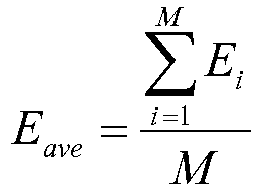
 wherein M is a quantity of IP cores deployed on the heterogeneous multi-core reconfigurable computing platform, Ei is IP core usage of an ith IP core in the M IP cores deployed on the heterogeneous multi-core reconfigurable computing platform, TL is the time length between the current time point and the time point at which reconfiguration is performed on the reconfigurable resource last time,
 determining the execution manner of the target task according to the weighted popularity Cw of the target task and the usage Eave of the reconfigurable resource.
 - The method according to claim 2, wherein the determining the execution manner of the target task according to the weighted popularity Cw of the target task and the usage Eave of the reconfigurable resource comprises:when it is determined that the weighted popularity Cw of the target task is greater than or equal to a product of Eave and k, determining that the execution manner of the target task is the hardware manner, wherein k is a reconfiguration coefficient of the heterogeneous multi-core reconfigurable computing platform, and is used to indicate a reconfiguration overhead of the heterogeneous multi-core reconfigurable computing platform; orwhen it is determined that the weighted popularity Cw of the target task is less than a product of Eave and k, determining that the execution manner of the target task is the software manner.
- The method according to any one of claims 1 to 3, wherein the method further comprises:determining a to-be-executed task; andwhen an IP core for executing the to-be-executed task is not deployed on the heterogeneous multi-core reconfigurable computing platform, determining the to-be-executed task as the to-be-executed target task.
- The method according to any one of claims 1 to 4, wherein the heterogeneous multi-core reconfigurable computing platform comprises multiple reconfigurable resource packages, and when determining that the execution manner of the target task is the hardware manner, the executing the target task according to the determined execution manner comprises:reconfiguring at least one reconfigurable resource package in the multiple reconfigurable resource packages to be the target IP core for executing the target task; andexecuting the target task by using the target IP core.
- The method according to claim 5, wherein the reconfiguring at least one reconfigurable resource package in the multiple reconfigurable resource packages to be the target IP core that is capable of executing the target task comprises:reconfiguring a target reconfigurable resource package in the multiple reconfigurable resource packages to be the target IP core, wherein the target reconfigurable resource package is a reconfigurable resource package with a longest idle time in the multiple reconfigurable resource packages.
- The method according to claim 4, wherein the method further comprises:when an IP core for indicating the to-be-executed task is deployed on the heterogeneous multi-core reconfigurable computing platform, determining that an execution manner of the to-be-executed task is hardware execution.
- An apparatus for task scheduling on a heterogeneous multi-core reconfigurable computing platform, wherein the apparatus comprises:a first determining module, configured to determine an execution manner of a target task according to popularity of the to-be-executed target task and usage of a reconfigurable resource of the heterogeneous multi-core reconfigurable computing platform, wherein the execution manner comprises a hardware manner or a software manner, for the target task, there is no corresponding target intellectual property IP core for executing the target task on the heterogeneous multi-core reconfigurable computing platform, the popularity of the target task is used to indicate central processing unit CPU usage of the target task, and the usage of the reconfigurable resource is used to indicate a usage status of the reconfigurable resource; andan execution module, configured to execute the target task according to the execution manner determined by the first determining module.
- The apparatus according to claim 8, wherein in terms of determining the execution manner of the target task according to the popularity of the target task and the usage of the reconfigurable resource of the heterogeneous multi-core reconfigurable computing platform, the first determining module is specifically configured to:determine weighted popularity Cw of the target task according to the popularity of the target task, wherein Cw = C · S, C is the popularity of the target task, C = N 1·T 1/TL , TL is a time length between a current time point and a time point at which reconfiguration is performed on the reconfigurable resource last time, N 1 is a quantity of times for which the target task is executed within TL in the software manner, T 1 is a time length required for a single execution of the target task in the software manner, S is a hardware speedup ratio of the target task, and the hardware speedup ratio S is used to indicate a ratio between a corresponding execution speed at which the target task is executed in the hardware manner and a corresponding execution speed at which the target task is executed in the software manner;determine the usage Eave of the reconfigurable resource of the heterogeneous multi-core reconfigurable computing platform according to the following formulas:
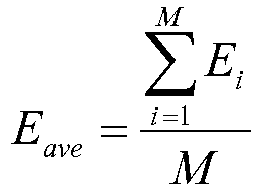
 wherein M is a quantity of IP cores deployed on the heterogeneous multi-core reconfigurable computing platform, Ei is IP core usage of an ith IP core in the M IP cores deployed on the heterogeneous multi-core reconfigurable computing platform, TL is the time length between the current time point and the time point at which reconfiguration is performed on the reconfigurable resource last time,
 determine the execution manner of the target task according to the weighted popularity Cw of the target task and the usage Eave of the reconfigurable resource.
 - The apparatus according to claim 9, wherein in terms of determining the execution manner of the target task according to the weighted popularity Cw of the target task and the usage Eave of the reconfigurable resource, the first determining module is specifically configured to:when it is determined that the weighted popularity Cw of the target task is greater than or equal to a product of Eave and k, determine that the execution manner of the target task is the hardware manner, wherein k is a reconfiguration coefficient of the heterogeneous multi-core reconfigurable computing platform, and is used to indicate a reconfiguration overhead of the heterogeneous multi-core reconfigurable computing platform; orwhen it is determined that the weighted popularity Cw of the target task is less than a product of Eave and k, determine that the execution manner of the target task is the software manner.
- The apparatus according to any one of claims 8 to 10, wherein the apparatus further comprises:a second determining module, configured to determine a to-be-executed task; anda third determining module, configured to: when an IP core for executing the to-be-executed task is not deployed on the heterogeneous multi-core reconfigurable computing platform, determine the to-be-executed task as the to-be-executed target task.
- The apparatus according to any one of claims 8 to 11, wherein the heterogeneous multi-core reconfigurable computing platform comprises multiple reconfigurable resource packages, and in terms of executing the target task according to the determined execution manner, the execution module is specifically configured to:when it is determined that the execution manner of the target task is the hardware manner, reconfigure at least one reconfigurable resource package in the multiple reconfigurable resource packages to be the target IP core for executing the target task; andexecute the target task by using the target IP core.
- The apparatus according to claim 12, wherein in terms of reconfiguring the at least one reconfigurable resource package in the multiple reconfigurable resource packages to be the target IP core that is capable of executing the target task, the execution module is specifically configured to:reconfigure a target reconfigurable resource package in the multiple reconfigurable resource packages to be the target IP core, wherein the target reconfigurable resource package is a reconfigurable resource package with a longest idle time in the multiple reconfigurable resource packages.
- The apparatus according to claim 11, wherein the apparatus further comprises:a fourth determining module, configured to: when an IP core for indicating the to-be-executed task is deployed on the heterogeneous multi-core reconfigurable computing platform, determine that an execution manner of the to-be-executed task is hardware execution.
- An apparatus for task scheduling on a heterogeneous multi-core reconfigurable computing platform, wherein the apparatus comprises:a processor, configured to execute an instruction stored in a storage;the storage, configured to store the instruction and data, and provide the instruction and the data for the processor; anda communications bus, configured to implement connection communication between the processor and the storage; whereinthe processor is specifically configured to:determine an execution manner of a target task according to popularity of the to-be-executed target task and usage of a reconfigurable resource of the heterogeneous multi-core reconfigurable computing platform, wherein the execution manner comprises a hardware manner or a software manner, for the target task, there is no corresponding target intellectual property IP core for executing the target task on the heterogeneous multi-core reconfigurable computing platform, the popularity of the target task is used to indicate central processing unit CPU usage of the target task, and the usage of the reconfigurable resource is used to indicate a usage status of the reconfigurable resource; andexecute the target task according to the determined execution manner.
- The apparatus according to claim 15, wherein the processor is configured to:determine weighted popularity Cw of the target task according to the popularity of the target task, wherein Cw = C · S, C is the popularity of the target task, C = N 1 · T 1/TL , TL is a time length between a current time point and a time point at which reconfiguration is performed on the reconfigurable resource last time, N 1 is a quantity of times for which the target task is executed within TL in the software manner, T 1 is a time length required for a single execution of the target task in the software manner, S is a hardware speedup ratio of the target task, and the hardware speedup ratio S is used to indicate a ratio between a corresponding execution speed at which the target task is executed in the hardware manner and a corresponding execution speed at which the target task is executed in the software manner;determine the usage Eave of the reconfigurable resource of the heterogeneous multi-core reconfigurable computing platform according to the following formulas:

 wherein M is a quantity of IP cores deployed on the heterogeneous multi-core reconfigurable computing platform, Ei is IP core usage of an ith IP core in the M IP cores deployed on the heterogeneous multi-core reconfigurable computing platform, TL is the time length between the current time point and the time point at which reconfiguration is performed on the reconfigurable resource last time,
 determine the execution manner of the target task according to the weighted popularity Cw of the target task and the usage Eave of the reconfigurable resource.
 - The apparatus according to claim 16, wherein the processor is configured to:when it is determined that the weighted popularity Cw of the target task is greater than or equal to a product of Eave and k, determine that the execution manner of the target task is the hardware manner, wherein k is a reconfiguration coefficient of the heterogeneous multi-core reconfigurable computing platform, and is used to indicate a reconfiguration overhead of the heterogeneous multi-core reconfigurable computing platform; orwhen it is determined that the weighted popularity Cw of the target task is less than a product of Eave and k, determine that the execution manner of the target task is the software manner.
- The apparatus according to any one of claims 15 to 17, wherein the processor is configured to:determine a to-be-executed task; andwhen an IP core for executing the to-be-executed task is not deployed on the heterogeneous multi-core reconfigurable computing platform, determine the to-be-executed task as the to-be-executed target task.
- The apparatus according to any one of claims 15 to 18, wherein the processor is configured to:reconfigure at least one reconfigurable resource package in the multiple reconfigurable resource packages to be the target IP core for executing the target task; andexecute the target task by using the target IP core.
- The apparatus according to claim 19, wherein the processor is configured to:reconfigure a target reconfigurable resource package in the multiple reconfigurable resource packages to be the target IP core, wherein the target reconfigurable resource package is a reconfigurable resource package with a longest idle time in the multiple reconfigurable resource packages.
- The apparatus according to claim 18, wherein the processor is configured to:when an IP core for indicating the to-be-executed task is deployed on the heterogeneous multi-core reconfigurable computing platform, determine that an execution manner of the to-be-executed task is hardware execution.
Applications Claiming Priority (2)
| Application Number | Priority Date | Filing Date | Title |
|---|---|---|---|
| CN201510142346.XA CN104778083B (en) | 2015-03-27 | 2015-03-27 | Method and device for task scheduling on heterogeneous multi-core reconfigurable computing platform |
| PCT/CN2015/095249 WO2016155335A1 (en) | 2015-03-27 | 2015-11-23 | Task scheduling method and device on heterogeneous multi-core reconfigurable computing platform |
Publications (2)
| Publication Number | Publication Date |
|---|---|
| EP3190515A1 true EP3190515A1 (en) | 2017-07-12 |
| EP3190515A4 EP3190515A4 (en) | 2018-01-17 |
Family
ID=53619564
Family Applications (1)
| Application Number | Title | Priority Date | Filing Date |
|---|---|---|---|
| EP15887288.7A Withdrawn EP3190515A4 (en) | 2015-03-27 | 2015-11-23 | Task scheduling method and device on heterogeneous multi-core reconfigurable computing platform |
Country Status (4)
| Country | Link |
|---|---|
| US (1) | US10452605B2 (en) |
| EP (1) | EP3190515A4 (en) |
| CN (2) | CN104778083B (en) |
| WO (1) | WO2016155335A1 (en) |
Families Citing this family (39)
| Publication number | Priority date | Publication date | Assignee | Title |
|---|---|---|---|---|
| CN104778083B (en) | 2015-03-27 | 2018-07-03 | 华为技术有限公司 | Method and device for task scheduling on heterogeneous multi-core reconfigurable computing platform |
| US10198294B2 (en) * | 2015-04-17 | 2019-02-05 | Microsoft Licensing Technology, LLC | Handling tenant requests in a system that uses hardware acceleration components |
| US9792154B2 (en) | 2015-04-17 | 2017-10-17 | Microsoft Technology Licensing, Llc | Data processing system having a hardware acceleration plane and a software plane |
| US10216555B2 (en) | 2015-06-26 | 2019-02-26 | Microsoft Technology Licensing, Llc | Partially reconfiguring acceleration components |
| US9891935B2 (en) * | 2015-08-13 | 2018-02-13 | Altera Corporation | Application-based dynamic heterogeneous many-core systems and methods |
| US12135989B2 (en) | 2016-08-11 | 2024-11-05 | Rescale, Inc. | Compute recommendation engine |
| US10387198B2 (en) | 2016-08-11 | 2019-08-20 | Rescale, Inc. | Integrated multi-provider compute platform |
| CN106598761B (en) * | 2016-12-19 | 2020-07-14 | 北京奇虎科技有限公司 | Middleware-based transaction connection establishment method and device |
| CN207517054U (en) | 2017-01-04 | 2018-06-19 | 意法半导体股份有限公司 | Crossfire switchs |
| US11562115B2 (en) | 2017-01-04 | 2023-01-24 | Stmicroelectronics S.R.L. | Configurable accelerator framework including a stream switch having a plurality of unidirectional stream links |
| CN108363615B (en) * | 2017-09-18 | 2019-05-14 | 清华大学 | Task allocation method and system for reconfigurable processing systems |
| CN108052839A (en) * | 2018-01-25 | 2018-05-18 | 知新思明科技(北京)有限公司 | Mimicry task processor |
| US10901806B2 (en) * | 2018-05-01 | 2021-01-26 | International Business Machines Corporation | Internet of things resource optimization |
| CN110968320B (en) * | 2018-09-30 | 2024-11-08 | 上海登临科技有限公司 | Joint compilation method and compilation system for heterogeneous hardware architecture |
| CN111258744B (en) * | 2018-11-30 | 2024-08-06 | 中兴通讯股份有限公司 | Task processing method based on heterogeneous computation and software and hardware frame system |
| CN109582465A (en) * | 2018-12-04 | 2019-04-05 | 中国航空工业集团公司西安航空计算技术研究所 | A kind of multi-core operation system core configuration method |
| CN109862023B (en) * | 2019-02-27 | 2020-08-07 | 中国科学院软件研究所 | An embedded device realizes accelerated computing and high-speed network data transmission method |
| CN111176814B (en) * | 2019-12-29 | 2022-06-17 | 山东英信计算机技术有限公司 | A task execution method and related device |
| CN111190705B (en) * | 2019-12-31 | 2023-08-15 | 支付宝(杭州)信息技术有限公司 | Task processing method and device |
| US11593609B2 (en) | 2020-02-18 | 2023-02-28 | Stmicroelectronics S.R.L. | Vector quantization decoding hardware unit for real-time dynamic decompression for parameters of neural networks |
| EP4120076A4 (en) * | 2020-04-01 | 2023-04-05 | Huawei Technologies Co., Ltd. | METHOD AND APPARATUS FOR SCHEDULING WORK |
| US11531873B2 (en) | 2020-06-23 | 2022-12-20 | Stmicroelectronics S.R.L. | Convolution acceleration with embedded vector decompression |
| CN112905317B (en) * | 2021-02-04 | 2023-12-15 | 西安电子科技大学 | Fast reconfigurable signal processing task scheduling method and system under heterogeneous platform |
| CN113051053B (en) * | 2021-03-24 | 2023-09-08 | 博瀚智能(深圳)有限公司 | Heterogeneous resource scheduling method, heterogeneous resource scheduling device, heterogeneous resource scheduling equipment and computer readable storage medium |
| CN113553031B (en) * | 2021-06-04 | 2023-02-24 | 中国人民解放军战略支援部队信息工程大学 | Software definition variable structure computing architecture and left-right brain integrated resource joint distribution method realized by using same |
| CN114124389B (en) * | 2021-11-09 | 2023-08-11 | 国网山东省电力公司电力科学研究院 | Reconfigurable computing-based FPGA (field programmable Gate array) deployment method and system |
| CN116136788A (en) * | 2021-11-16 | 2023-05-19 | 中移(上海)信息通信科技有限公司 | A control method, device, and communication terminal for collecting card information of the Internet of Things |
| CN114356836B (en) * | 2021-11-29 | 2025-05-30 | 山东领能电子科技有限公司 | RISC-V-based three-dimensional interconnected many-core processor architecture and its working method |
| CN116414589A (en) * | 2021-12-30 | 2023-07-11 | 比亚迪股份有限公司 | Vehicle operating system, debugging system and method, electronic device and storage medium |
| CN114995994B (en) * | 2022-04-24 | 2026-04-21 | 阿里巴巴(中国)有限公司 | Task processing methods and systems |
| WO2023232127A1 (en) * | 2022-06-02 | 2023-12-07 | 华为技术有限公司 | Task scheduling method, apparatus and system, and related device |
| US12619678B2 (en) | 2022-06-23 | 2026-05-05 | Stmicroelectronics S.R.L. | Acceleration of 1X1 convolutions in convolutional neural networks |
| CN115237575A (en) * | 2022-08-10 | 2022-10-25 | 中国工商银行股份有限公司 | Heterogeneous platform real-time task data processing method and device |
| CN115309609B (en) * | 2022-08-30 | 2025-08-19 | 济南浪潮数据技术有限公司 | Method, device and medium for obtaining CPU utilization rate of cloud platform |
| CN119166583B (en) * | 2024-10-08 | 2025-05-02 | 上海矢元电子股份有限公司 | Reconstruction management method and system for distributed FPGA |
| CN119690614B (en) * | 2024-11-29 | 2025-11-07 | 华郅(北京)技术有限公司 | Resource management method and system based on embedded heterogeneous computing scene |
| CN119961018B (en) * | 2024-12-12 | 2025-12-30 | 北京芯驰半导体科技股份有限公司 | Resource management methods and resource management equipment |
| CN119883650A (en) * | 2025-03-26 | 2025-04-25 | 山东浪潮科学研究院有限公司 | Mixed deployment method of heterogeneous multi-core chip application program |
| CN121349636B (en) * | 2025-12-16 | 2026-03-06 | 南京南自华盾数字技术有限公司 | Cloud primary multi-architecture scheduling method and system for heterogeneous nodes |
Family Cites Families (18)
| Publication number | Priority date | Publication date | Assignee | Title |
|---|---|---|---|---|
| US6938256B2 (en) * | 2000-01-18 | 2005-08-30 | Galactic Computing Corporation | System for balance distribution of requests across multiple servers using dynamic metrics |
| US7167916B2 (en) * | 2002-08-30 | 2007-01-23 | Unisys Corporation | Computer OS dispatcher operation with virtual switching queue and IP queues |
| US8639489B2 (en) * | 2003-11-10 | 2014-01-28 | Brooks Automation, Inc. | Methods and systems for controlling a semiconductor fabrication process |
| DE602004006955T2 (en) * | 2003-11-25 | 2008-02-28 | Interuniversitair Micro-Elektronica Centrum | Heterogeneous multi-computer system in the form of a network on chip, as well as methods and operating system for controlling the same |
| GB0519981D0 (en) * | 2005-09-30 | 2005-11-09 | Ignios Ltd | Scheduling in a multicore architecture |
| US20080104601A1 (en) * | 2006-10-26 | 2008-05-01 | Nokia Corporation | Scheduler for multiple software tasks to share reconfigurable hardware |
| CN101630305B (en) * | 2008-07-16 | 2011-05-11 | 中国人民解放军信息工程大学 | Flexible management method for reconfigurable components in high-efficiency computer |
| CN101710292B (en) | 2009-12-21 | 2013-03-27 | 中国人民解放军信息工程大学 | Reconfigurable task processing system, scheduler and task scheduling method |
| CN101763265B (en) * | 2010-01-19 | 2012-10-03 | 湖南大学 | Procedure level software and hardware collaborative design automatized development method |
| CN101833368B (en) * | 2010-04-13 | 2012-03-28 | 杭州电子科技大学 | Method for managing energy of local dynamic reconfigurable system by coordinatively processing software and hardware |
| US8694994B1 (en) * | 2011-09-07 | 2014-04-08 | Amazon Technologies, Inc. | Optimization of packet processing by delaying a processor from entering an idle state |
| CN102360309B (en) * | 2011-09-29 | 2013-12-18 | 中国科学技术大学苏州研究院 | Scheduling system and scheduling execution method of multi-core heterogeneous system on chip |
| CN102508712B (en) * | 2011-09-29 | 2014-01-15 | 中国科学技术大学苏州研究院 | Middleware system and task execution method in heterogeneous multi-core reconfigurable hybrid system |
| CN102629218A (en) | 2012-03-14 | 2012-08-08 | 西安交通大学 | Reconfigurable hardware task fit method based on length to width ratios of tasks |
| CN102662765B (en) * | 2012-04-28 | 2014-09-03 | 中国科学技术大学 | Resource distribution method for running efficiency instructed reconfigurable chip multiprocessor |
| CN102681901B (en) | 2012-05-08 | 2014-04-23 | 西安交通大学 | Segmental reconfigurable hardware task arranging method |
| KR102082859B1 (en) * | 2013-01-07 | 2020-02-28 | 삼성전자주식회사 | System on chip including a plurality of heterogeneous cores and operating method therof |
| CN104778083B (en) * | 2015-03-27 | 2018-07-03 | 华为技术有限公司 | Method and device for task scheduling on heterogeneous multi-core reconfigurable computing platform |
-
2015
- 2015-03-27 CN CN201510142346.XA patent/CN104778083B/en active Active
- 2015-03-27 CN CN201810617444.8A patent/CN109144688B/en active Active
- 2015-11-23 WO PCT/CN2015/095249 patent/WO2016155335A1/en not_active Ceased
- 2015-11-23 EP EP15887288.7A patent/EP3190515A4/en not_active Withdrawn
-
2017
- 2017-06-13 US US15/621,768 patent/US10452605B2/en active Active
Also Published As
| Publication number | Publication date |
|---|---|
| CN109144688B (en) | 2022-09-23 |
| CN104778083A (en) | 2015-07-15 |
| WO2016155335A1 (en) | 2016-10-06 |
| CN104778083B (en) | 2018-07-03 |
| US20170277654A1 (en) | 2017-09-28 |
| CN109144688A (en) | 2019-01-04 |
| EP3190515A4 (en) | 2018-01-17 |
| US10452605B2 (en) | 2019-10-22 |
Similar Documents
| Publication | Publication Date | Title |
|---|---|---|
| US10452605B2 (en) | Method and apparatus for task scheduling on heterogeneous multi-core reconfigurable computing platform | |
| Le et al. | Allox: compute allocation in hybrid clusters | |
| EP3239852B1 (en) | Method and device for task scheduling on heterogeneous multi-core reconfigurable computing platform | |
| CN110704186B (en) | Computing resource allocation method and device based on hybrid distribution architecture and storage medium | |
| EP3761170B1 (en) | Virtual machine creation method and apparatus | |
| US8510749B2 (en) | Framework for scheduling multicore processors | |
| CN111476344B (en) | Computing device, resource allocation method and multipath neural network analyzer | |
| US8671418B2 (en) | Environment modification in a hybrid node computing environment | |
| US20190324819A1 (en) | Distributed-system task assignment method and apparatus | |
| KR101907564B1 (en) | Operating system decoupled heterogeneous computing | |
| CN104778074B (en) | A computing task processing method and device | |
| US8209554B2 (en) | Applying power management on a partition basis in a multipartitioned computer system | |
| US20100262559A1 (en) | Modelling Computer Based Business Process And Simulating Operation | |
| CN109478147B (en) | Adaptive Resource Management in Distributed Computing Systems | |
| EP2223281A1 (en) | Modelling computer based business process for customisation and delivery | |
| US11409574B2 (en) | Instance creation in a computing system | |
| Iserte et al. | Efficient scalable computing through flexible applications and adaptive workloads | |
| US20210389994A1 (en) | Automated performance tuning using workload profiling in a distributed computing environment | |
| WO2013165383A1 (en) | Configurable computer memory | |
| US20230350722A1 (en) | Apparatuses and methods for determining an interdependency between resources of a computing system | |
| US20190205156A1 (en) | Container access method and apparatus | |
| CN111143033A (en) | Operation execution method and device based on scalable operating system | |
| WO2023227187A1 (en) | Software optimization method and device for numa architecture | |
| CN113821157A (en) | Local disk mounting method, device, equipment and storage medium | |
| KR101947221B1 (en) | Method and apparatus for scheduling operating time of virtual cluster |
Legal Events
| Date | Code | Title | Description |
|---|---|---|---|
| STAA | Information on the status of an ep patent application or granted ep patent |
Free format text: STATUS: THE INTERNATIONAL PUBLICATION HAS BEEN MADE |
|
| PUAI | Public reference made under article 153(3) epc to a published international application that has entered the european phase |
Free format text: ORIGINAL CODE: 0009012 |
|
| STAA | Information on the status of an ep patent application or granted ep patent |
Free format text: STATUS: REQUEST FOR EXAMINATION WAS MADE |
|
| 17P | Request for examination filed |
Effective date: 20170403 |
|
| AK | Designated contracting states |
Kind code of ref document: A1 Designated state(s): AL AT BE BG CH CY CZ DE DK EE ES FI FR GB GR HR HU IE IS IT LI LT LU LV MC MK MT NL NO PL PT RO RS SE SI SK SM TR |
|
| AX | Request for extension of the european patent |
Extension state: BA ME |
|
| A4 | Supplementary search report drawn up and despatched |
Effective date: 20171219 |
|
| RIC1 | Information provided on ipc code assigned before grant |
Ipc: G06F 9/48 20060101AFI20171213BHEP Ipc: G06F 15/177 20060101ALI20171213BHEP Ipc: G06F 9/50 20060101ALI20171213BHEP |
|
| DAV | Request for validation of the european patent (deleted) | ||
| DAX | Request for extension of the european patent (deleted) | ||
| RIN1 | Information on inventor provided before grant (corrected) |
Inventor name: ZHANG, JUNNENG Inventor name: CHEN, PENG Inventor name: GUO, QI Inventor name: ZHOU, XUEHAI Inventor name: WANG, CHAO Inventor name: LI, XI |
|
| RIN1 | Information on inventor provided before grant (corrected) |
Inventor name: ZHANG, JUNNENG Inventor name: WANG, CHAO Inventor name: LI, XI Inventor name: ZHOU, XUEHAI Inventor name: GUO, QI Inventor name: CHEN, PENG |
|
| STAA | Information on the status of an ep patent application or granted ep patent |
Free format text: STATUS: EXAMINATION IS IN PROGRESS |
|
| 17Q | First examination report despatched |
Effective date: 20190919 |
|
| GRAP | Despatch of communication of intention to grant a patent |
Free format text: ORIGINAL CODE: EPIDOSNIGR1 |
|
| STAA | Information on the status of an ep patent application or granted ep patent |
Free format text: STATUS: GRANT OF PATENT IS INTENDED |
|
| INTG | Intention to grant announced |
Effective date: 20220426 |
|
| STAA | Information on the status of an ep patent application or granted ep patent |
Free format text: STATUS: THE APPLICATION IS DEEMED TO BE WITHDRAWN |
|
| 18D | Application deemed to be withdrawn |
Effective date: 20220907 |