EP3190141A1 - Polymerization process of polyarylenulfide - Google Patents
Polymerization process of polyarylenulfide Download PDFInfo
- Publication number
- EP3190141A1 EP3190141A1 EP17150883.1A EP17150883A EP3190141A1 EP 3190141 A1 EP3190141 A1 EP 3190141A1 EP 17150883 A EP17150883 A EP 17150883A EP 3190141 A1 EP3190141 A1 EP 3190141A1
- Authority
- EP
- European Patent Office
- Prior art keywords
- polymer
- substituted
- alkyl group
- formula
- disclosure
- Prior art date
- Legal status (The legal status is an assumption and is not a legal conclusion. Google has not performed a legal analysis and makes no representation as to the accuracy of the status listed.)
- Granted
Links
Classifications
-
- C—CHEMISTRY; METALLURGY
- C08—ORGANIC MACROMOLECULAR COMPOUNDS; THEIR PREPARATION OR CHEMICAL WORKING-UP; COMPOSITIONS BASED THEREON
- C08G—MACROMOLECULAR COMPOUNDS OBTAINED OTHERWISE THAN BY REACTIONS ONLY INVOLVING UNSATURATED CARBON-TO-CARBON BONDS
- C08G75/00—Macromolecular compounds obtained by reactions forming a linkage containing sulfur with or without nitrogen, oxygen, or carbon in the main chain of the macromolecule
- C08G75/02—Polythioethers
- C08G75/0204—Polyarylenethioethers
- C08G75/025—Preparatory processes
-
- C—CHEMISTRY; METALLURGY
- C08—ORGANIC MACROMOLECULAR COMPOUNDS; THEIR PREPARATION OR CHEMICAL WORKING-UP; COMPOSITIONS BASED THEREON
- C08G—MACROMOLECULAR COMPOUNDS OBTAINED OTHERWISE THAN BY REACTIONS ONLY INVOLVING UNSATURATED CARBON-TO-CARBON BONDS
- C08G75/00—Macromolecular compounds obtained by reactions forming a linkage containing sulfur with or without nitrogen, oxygen, or carbon in the main chain of the macromolecule
- C08G75/02—Polythioethers
- C08G75/0204—Polyarylenethioethers
Definitions
- the disclosure relates to a polymer, and in particular to a polyarylene sulfide (PAS) or a salt thereof.
- PAS polyarylene sulfide
- Polyarylene sulfide is a material with good physical characteristics such as thermal resistance, chemical resistance, flame resistance, and electrical insulation characteristics.
- polyarylene sulfide (PAS) can be used in computer accessories and auto accessories; as a coating for parts that come into contact with corrosive chemicals; and as industrial fibers having chemical resistance.
- PAS polyarylene sulfide
- PAS polyarylene sulfide
- PAS polyarylene sulfide
- conventional polyarylene sulfides (PAS) with two different repeating units are generally arranged in a random fashion, so that the thermal resistance, chemical resistance, flame resistance, and electrical insulation characteristics of the conventional polyarylene sulfides cannot be enhanced.
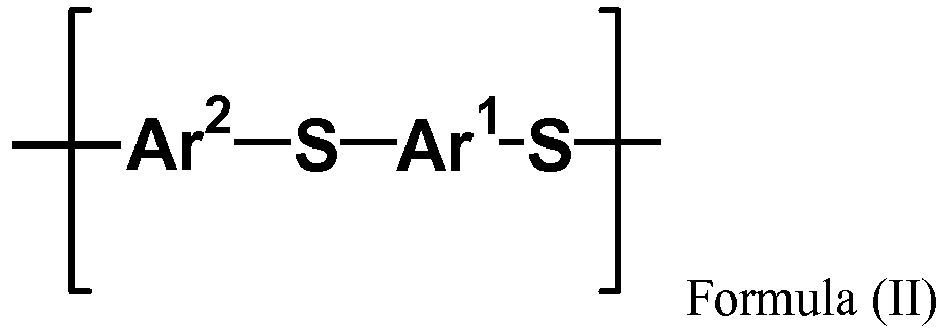
- the disclosure provides a polymer having a repeating unit having a structure represented by Formula (I) or Formula (II): , wherein Ar 1 and Ar 2 can be independently substituted or unsubstituted aryl diradical; Y - can be R 2 SO 3 - or ClO 4 - ; R 1 can be C 1-6 alkyl group; Ar 1 and Ar 2 are different; and, R 2 can be C 1-6 alkyl group, substituted or unsubstituted aromatic ring, or C 1-6 haloalkyl group.
- Ar 1 and Ar 2 can be independently substituted or unsubstituted aryl diradical
- Y - can be R 2 SO 3 - or ClO 4 -
- R 1 can be C 1-6 alkyl group
- Ar 1 and Ar 2 are different
- R 2 can be C 1-6 alkyl group, substituted or unsubstituted aromatic ring, or C 1-6 haloalkyl group.
- Embodiments of the disclosure provide a polymer, such as polyarylene sulfide (PAS) or a salt thereof.
- PAS polyarylene sulfide
- the main chain of the polymer of the disclosure consists of different aryl groups alternately arranged. Therefore, the polymer of the disclosure exhibits relatively high crystallinity and melting point (such as larger than or equal to about 330°C). Moreover, the thermal resistance, chemical resistance, flame resistance, and electrical insulation characteristics of the polymer are improved.
- the polymer of the disclosure can have a repeating unit having a structure represented by Formula (I) or Formula (II): , wherein Ar 1 and Ar 2 can be independently substituted or unsubstituted aryl diradical; Y - can be R 2 SO 3 - or ClO 4 - ; R 1 can be C 1-6 alkyl group; Ar 1 and Ar 2 are different; and R 2 can be C 1-6 alkyl group, substituted or unsubstituted aromatic ring, or C 1-6 haloalkyl group.
- Formula (I) or Formula (II): wherein Ar 1 and Ar 2 can be independently substituted or unsubstituted aryl diradical; Y - can be R 2 SO 3 - or ClO 4 - ; R 1 can be C 1-6 alkyl group; Ar 1 and Ar 2 are different; and R 2 can be C 1-6 alkyl group, substituted or unsubstituted aromatic ring, or C 1-6 haloalkyl group.
- the substituted aryl diradical of the disclosure means that at least one hydrogen atom bonded to carbon atoms of the aryl diradical can be replaced with C 1-6 alkyl group.
- the substituted aromatic ring means that at least one hydrogen atom bonded to carbon atoms of the aromatic ring can be replaced with C 1-6 alkyl group.
- Ar 1 and Ar 2 can be independently substituted or unsubstituted phenylene, biphenylene, naphthylene, thienylene, indolylene, phenanthrenylene, indenylene, anthracenylene, or fluorenylene, wherein the substituted phenylene, substituted biphenylene, substituted naphthylene, substituted thienylene, substituted indolylene, substituted phenanthrenylene, substituted indenylene, substituted anthracenylene, or substituted fluorenylene mean that the substituted aryl diradical of the disclosure means that at least one hydrogen atom bonded to carbon atoms of the aryl diradical can be replaced with C 1-6 alkyl group.
- C 1-6 alkyl group of the disclosure can be a linear or branched C 1-6 alkyl group.
- R 1 can be methyl, ethyl, propyl, isopropyl, n-butyl, t-butyl, sec-butyl, isobutyl, pentyl, or hexyl.
- Ar 1 and Ar 2 can be independently x can be 0, 1, or 2; R 3 can be independently hydrogen, or C 1-6 alkyl group.
- R 3 can be independently hydrogen, methyl, ethyl, propyl, isopropyl, n-butyl, t-butyl, sec-butyl, isobutyl, pentyl, or hexyl.
- the repeating unit having a structure represented by Formula (I) can be and the repeating unit having a structure represented by Formula (II) can be wherein R 1 , R 3 , and Y - have the same definition as above.
- the degree of polymerization of the polymer of the disclosure can be adjusted.
- the polymer of the disclosure can have a number average molecular weight from about 600 to 120,000, or have a number average molecular weight from about 10,000 to 30,000.
- the method for preparing the polymer of the disclosure includes reacting a compound having a structure represented by Formula (III) with acid, obtaining a polymer with a repeating unit having a structure represented by Formula (I): , wherein Ar 1 can be substituted or unsubstituted aryl diradical, such as substituted or unsubstituted phenylene, biphenylene, naphthylene, thienylene, indolylene, phenanthrenylene, indenylene, anthracenylene, or fluorenylene; Ar 3 can be substituted or unsubstituted aryl group, such as substituted or unsubstituted phenyl group, biphenyl group, naphthyl group, thienyl group, indolyl group, phenanthrenyl group, indenyl group, anthracenyl group, or fluorenylene group.
- Ar 1 can be substituted or unsubstituted aryl diradi
- the substituted aryl group means that at least one hydrogen atom bonded to carbon atoms of the aryl group can be replaced with C 1-6 alkyl group.
- Ar 1 and Ar 3 can be derived from different compounds. For example, when Ar 1 is phenylene, Ar 3 is not phenyl group.
- the aforementioned acid can be sulfuric acid, methanesulfonic acid, benzenesulfonic acid, p-toluenesulfonic acid, or trifluoromethanesulfonic acid.
- the acid can react with the compound having a structure represented by Formula (III). In addition, the excessive acid can also serve as the reaction solvent.
- anionic ion (Y - ) of the polymer with a repeating unit having a structure represented by Formula (I) can be further replaced with other anionic ion (such as CH 3 SO 3 - ), obtaining a polymer with other anionic ion.
- the polymer with a repeating unit having a structure represented by Formula (I) can be further reacted with a nucleophile to undergo a dealkylation, obtaining polymer with a repeating unit having a structure represented by Formula (II).
- the nucleophile can be metal halide, metal hydroxide, alcohol, amine (such as secondary amine or tertiary amine), or thiol.
- the nucleophile can be sodium chloride, potassium chloride, aluminum chloride, or 4-methylpyridine.
- inventive concept of the disclosure may be embodied in various forms without being limited to the exemplary embodiments set forth herein.
- Polymer (2) was measured by a differential scanning calorimetry (DSC), and the result shows that Polymer (2) has a melting temperature (Tm) of about 330°C and a recrystallization temperature on cooling (Tcc) of about 251°C.
- Tm melting temperature
- Tcc recrystallization temperature on cooling
- Polymer (2) was analyzed by Fourier-transform infrared (FT-IR) spectroscopy, and the result shows that the strong absorption peaks are 3023, 1593, 1472, 1388, 1090, 1006, 808(cm -1 ).
- FT-IR Fourier-transform infrared
- the polymer of the disclosure (such as polyarylene sulfide (PAS) or a salt thereof) consists of different aryl groups alternately arranged, the polymer of the disclosure exhibits relatively high crystallinity and melting point (such as larger than or equal to about 330°C). Moreover, the thermal resistance, chemical resistance, and flame resistance of the polymer are improved.
Landscapes
- Chemical & Material Sciences (AREA)
- Health & Medical Sciences (AREA)
- Chemical Kinetics & Catalysis (AREA)
- Medicinal Chemistry (AREA)
- Polymers & Plastics (AREA)
- Organic Chemistry (AREA)
- Polymers With Sulfur, Phosphorus Or Metals In The Main Chain (AREA)
Abstract

Description
- The disclosure relates to a polymer, and in particular to a polyarylene sulfide (PAS) or a salt thereof.
- Polyarylene sulfide (PAS) is a material with good physical characteristics such as thermal resistance, chemical resistance, flame resistance, and electrical insulation characteristics. Thus, polyarylene sulfide (PAS) can be used in computer accessories and auto accessories; as a coating for parts that come into contact with corrosive chemicals; and as industrial fibers having chemical resistance.
- One conventional method for producing polyarylene sulfide (PAS) is the halogen-containing process that, in principle, results in a low yield of polyarylene sulfide (PAS) and produces unrecyclable halogen-containing byproducts that can cause environmental pollution. In addition, conventional polyarylene sulfides (PAS) with two different repeating units are generally arranged in a random fashion, so that the thermal resistance, chemical resistance, flame resistance, and electrical insulation characteristics of the conventional polyarylene sulfides cannot be enhanced.
- According to embodiments of the disclosure, the disclosure provides a polymer having a repeating unit having a structure represented by Formula (I) or Formula (II):


- A detailed description is given in the following embodiments with reference to the accompanying drawings.
- Embodiments of the disclosure provide a polymer, such as polyarylene sulfide (PAS) or a salt thereof. According to embodiments of the disclosure, the main chain of the polymer of the disclosure consists of different aryl groups alternately arranged. Therefore, the polymer of the disclosure exhibits relatively high crystallinity and melting point (such as larger than or equal to about 330°C). Moreover, the thermal resistance, chemical resistance, flame resistance, and electrical insulation characteristics of the polymer are improved.
- According to embodiments of the disclosure, the polymer of the disclosure can have a repeating unit having a structure represented by Formula (I) or Formula (II):


- According to embodiments of the disclosure, Ar1 and Ar2 can be independently substituted or unsubstituted phenylene, biphenylene, naphthylene, thienylene, indolylene, phenanthrenylene, indenylene, anthracenylene, or fluorenylene, wherein the substituted phenylene, substituted biphenylene, substituted naphthylene, substituted thienylene, substituted indolylene, substituted phenanthrenylene, substituted indenylene, substituted anthracenylene, or substituted fluorenylene mean that the substituted aryl diradical of the disclosure means that at least one hydrogen atom bonded to carbon atoms of the aryl diradical can be replaced with C1-6 alkyl group.
- According to embodiments of the disclosure, C1-6 alkyl group of the disclosure can be a linear or branched C1-6 alkyl group. For example, R1 can be methyl, ethyl, propyl, isopropyl, n-butyl, t-butyl, sec-butyl, isobutyl, pentyl, or hexyl.
- According to embodiments of the disclosure, Ar1 and Ar2 can be independently

- According to embodiments of the disclosure, the repeating unit having a structure represented by Formula (I) can be


- According to embodiments of the disclosure, the degree of polymerization of the polymer of the disclosure can be adjusted. For example, the polymer of the disclosure can have a number average molecular weight from about 600 to 120,000, or have a number average molecular weight from about 10,000 to 30,000.
- According to embodiments of the disclosure, the method for preparing the polymer of the disclosure includes reacting a compound having a structure represented by Formula (III) with acid, obtaining a polymer with a repeating unit having a structure represented by Formula (I):

- Furthermore, the anionic ion (Y-) of the polymer with a repeating unit having a structure represented by Formula (I) can be further replaced with other anionic ion (such as CH3SO3 -), obtaining a polymer with other anionic ion.
- Moreover, the polymer with a repeating unit having a structure represented by Formula (I) can be further reacted with a nucleophile to undergo a dealkylation, obtaining polymer with a repeating unit having a structure represented by Formula (II). According to embodiments of the disclosure, the nucleophile can be metal halide, metal hydroxide, alcohol, amine (such as secondary amine or tertiary amine), or thiol. For example, the nucleophile can be sodium chloride, potassium chloride, aluminum chloride, or 4-methylpyridine.
- The inventive concept of the disclosure may be embodied in various forms without being limited to the exemplary embodiments set forth herein.
- 0.7g of methyl phenyl sulfoxide and 1g of methyl biphenyl sulfide were added into a reaction bottle under a nitrogen atmosphere, and then cooled to 0°C. Next, 10ml of methanesulfonic acid was added slowly into the reaction bottle, and then stirred for 30min. After raising the temperature back to room temperature, the mixture was stirred for 20hr. Next, the result was poured into 40ml of perchloric acid, and then stirred for 1hr. Next, the mixture was extracted three times using 50ml of dichloromethane and 100ml of water as the extraction solvent, and then the organic phase was collected. After drying, filtering and concentrating the organic phase, Compound (1), with a yield of about 92%, was obtained. The synthesis pathway of the above reaction was as follows:

- Compound (1) was analyzed by nuclear magnetic resonance (NMR) spectroscopy and the result is as follows: 1H NMR (400MHz, ppm, CDCl3): 2.48 (-CH3, s), 3.67 (sulfonium-CH3, s), 7.40-7.94 (aromatic H, 13H, m). Furthermore, Compound (1) was analyzed by liquid chromatography-mass spectrometry (LC-MS) and the result is as follows: m/z=323 (excluding anionic ion CH3SO3 -).
- Next, 1.9g of Compound (1) and 30ml of acetic acid were added into a reaction bottle under a nitrogen atmosphere. After stirring for several minutes, 2.02ml of hydrogen peroxide was added slowly into the reaction bottle. After stirring for 90min, the result was extracted three times using 50ml of dichloromethane and 100ml of water as the extraction solvent, and then the organic phase was collected. After drying, filtering and concentrating the organic phase, Compound (2) (orange), with a yield of about 92%, was obtained. Next, 10ml of 4-methylpyridine and Compound (2) were added into a reaction bottle under a nitrogen atmosphere, and then stirred for 30min. After heating to reflux for 20min, Compound (3) was obtained. The synthesis pathway of the above reaction was as follows:

- Compound (3) was analyzed by nuclear magnetic resonance (NMR) spectroscopy and the result is as follows: 1H NMR (400MHz, ppm, CDCl3): 2.72 (-CH3, s), 7.38-7.63 (aromatic H, 13H, m). Furthermore, Compound (3) was analyzed by liquid chromatography-mass spectrometry (LC-MS) and the result is as follows: m/z=325(M + H+), 347(M + Na+), and 671(2*M + Na+) (M represents molecular weight).
- Next, 1g of Compound (3) was added into a reaction bottle under a nitrogen atmosphere, and then cooled to 0°C. Next, 15ml of trifluoromethanesulfonic acid was added slowly into the reaction bottle, and then stirred for 2min. After raising the temperature back to about 18°C, the result was poured into deionized water at 0°C, and a white precipitate was formed. Next, the white precipitate was collected and washed with deionized water several times until the white precipitate was substantially neutral. After drying the white precipitate by vacuum drying for 6hr, Polymer (1), with a yield of about 100%, was obtained. Next, 1g of Polymer (1) was added into a reaction bottle under a nitrogen atmosphere, and then 10ml of 4-methylpyridine was slowly added into the reaction bottle. After stirring at room temperature for 30min, the reaction bottle was heated to reflux at 150°C. After stirring for 5hr, the reaction bottle was cooled to room temperature, and then the result was poured into 200ml of methanol (containing 10% HCl), and a white precipitate was formed. Next, the white precipitate was collected, obtaining Polymer (2), with a yield of about 98%. The synthesis pathway of the above reaction was as follows:
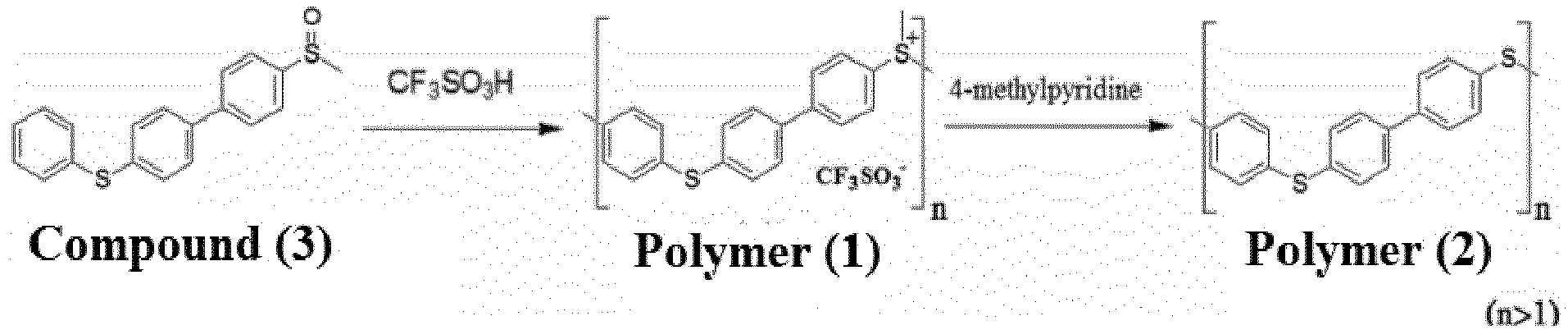
- After measuring, the number average molecular weight of Polymer (1) (or Polymer (2)) was about 17,000 to 19,000.
- Next, the properties of Polymer (2) were measured by a differential scanning calorimetry (DSC), and the result shows that Polymer (2) has a melting temperature (Tm) of about 330°C and a recrystallization temperature on cooling (Tcc) of about 251°C. Next, Polymer (2) was analyzed by Fourier-transform infrared (FT-IR) spectroscopy, and the result shows that the strong absorption peaks are 3023, 1593, 1472, 1388, 1090, 1006, 808(cm-1).
- Accordingly, since the main chain of the polymer of the disclosure (such as polyarylene sulfide (PAS) or a salt thereof) consists of different aryl groups alternately arranged, the polymer of the disclosure exhibits relatively high crystallinity and melting point (such as larger than or equal to about 330°C). Moreover, the thermal resistance, chemical resistance, and flame resistance of the polymer are improved.
- It will be clear that various modifications and variations can be made to the disclosed methods and materials. It is intended that the specification and examples be considered as exemplary only, with the true scope of the disclosure being indicated by the following claims and their equivalents.
Claims (7)
- A polymer, which has a repeating unit having a structure represented by Formula (I) or Formula (II)


- The polymer as claimed in Claim 1, wherein R1 is methyl, ethyl, propyl, isopropyl, n-butyl, t-butyl, sec-butyl, isobutyl, pentyl, or hexyl.
- The polymer as claimed in Claim 1, wherein Ar1 and Ar2 are independently substituted or unsubstituted phenylene, biphenylene, naphthylene, thienylene, indolylene, phenanthrenylene, indenylene, anthracenylene, or fluorenylene.
- The polymer as claimed in Claim 1, wherein Ar1 and Ar2 are independently

- The polymer as claimed in Claim 4, wherein R3 is independently hydrogen, methyl, ethyl, propyl, isopropyl, n-butyl, t-butyl, sec-butyl, isobutyl, pentyl, or hexyl.
- The polymer as claimed in Claim 1, wherein the repeating unit having a structure represented by Formula (I) is

- The polymer as claimed in Claim 1, wherein the repeating unit having a structure represented by Formula (II) is

Applications Claiming Priority (2)
| Application Number | Priority Date | Filing Date | Title |
|---|---|---|---|
| US201662277091P | 2016-01-11 | 2016-01-11 | |
| TW105142916A TWI646129B (en) | 2016-01-11 | 2016-12-23 | Polymer |
Publications (2)
| Publication Number | Publication Date |
|---|---|
| EP3190141A1 true EP3190141A1 (en) | 2017-07-12 |
| EP3190141B1 EP3190141B1 (en) | 2024-07-24 |
Family
ID=57914687
Family Applications (1)
| Application Number | Title | Priority Date | Filing Date |
|---|---|---|---|
| EP17150883.1A Active EP3190141B1 (en) | 2016-01-11 | 2017-01-10 | Polymer |
Country Status (1)
| Country | Link |
|---|---|
| EP (1) | EP3190141B1 (en) |
Cited By (1)
| Publication number | Priority date | Publication date | Assignee | Title |
|---|---|---|---|---|
| EP3438092A1 (en) * | 2017-08-01 | 2019-02-06 | Industrial Technology Research Institute | Method for preparing compound and method for preparing polymer employing the same |
Citations (2)
| Publication number | Priority date | Publication date | Assignee | Title |
|---|---|---|---|---|
| WO2015033938A1 (en) * | 2013-09-03 | 2015-03-12 | Dic株式会社 | Polyarylene sulfide resin, manufacturing method therefor, and molding |
| WO2015033936A1 (en) * | 2013-09-03 | 2015-03-12 | Dic株式会社 | Polyarylene sulfide resin and manufacturing method therefor, poly(arylene sulfonium salt) and manufacturing method therefor, and sulfoxide |
Family Cites Families (1)
| Publication number | Priority date | Publication date | Assignee | Title |
|---|---|---|---|---|
| US3987016A (en) * | 1975-01-16 | 1976-10-19 | The United States Of America As Represented By The Secretary Of The Air Force | Method for the preparation of polyarylene sulfides containing pendant cyano groups by polymerizing m-benzenedithiol, dibromobenzene, and 2,4-dichlorobenzonitrile |
-
2017
- 2017-01-10 EP EP17150883.1A patent/EP3190141B1/en active Active
Patent Citations (4)
| Publication number | Priority date | Publication date | Assignee | Title |
|---|---|---|---|---|
| WO2015033938A1 (en) * | 2013-09-03 | 2015-03-12 | Dic株式会社 | Polyarylene sulfide resin, manufacturing method therefor, and molding |
| WO2015033936A1 (en) * | 2013-09-03 | 2015-03-12 | Dic株式会社 | Polyarylene sulfide resin and manufacturing method therefor, poly(arylene sulfonium salt) and manufacturing method therefor, and sulfoxide |
| EP3034542A1 (en) * | 2013-09-03 | 2016-06-22 | DIC Corporation | Polyarylene sulfide resin, manufacturing method therefor, and molding |
| EP3042924A1 (en) * | 2013-09-03 | 2016-07-13 | DIC Corporation | Polyarylene sulfide resin and manufacturing method therefor, poly(arylene sulfonium salt) and manufacturing method therefor, and sulfoxide |
Non-Patent Citations (4)
| Title |
|---|
| EISHUN TSUCHIDA ET AL: "SYNTHESIS OF HIGH MOLECULAR WEIGHT POLY(PHENYLENE SULFIDE) BY OXIDATIVE POLYMERIZATION VIA POLY(SULFONIUM CATION) FROM METHYL PHENYL SULFOXIDE", MACROMOLECULES, AMERICAN CHEMICAL SOCIETY, US, vol. 26, no. 26, 20 December 1993 (1993-12-20), pages 7144 - 7148, XP000416281, ISSN: 0024-9297, DOI: 10.1021/MA00078A005 * |
| KIMIHISA YAMAMOTO ET AL: "Aryl sulfide bond formation using the sulfoxide-acid system for synthesis of poly(p-phenylene sulfide) via poly(sulfonium cation) as a precursor", JOURNAL OF THE AMERICAN CHEMICAL SOCIETY, vol. 115, no. 13, 1 June 1993 (1993-06-01), pages 5819 - 5820, XP055355371, ISSN: 0002-7863, DOI: 10.1021/ja00066a058 * |
| KIMIHISA YAMAMOTO ET AL: "Synthesis of Poly(sulfonium cation) by Oxidative Polymerization of Aryl Alkyl Sulfides", THE JOURNAL OF ORGANIC CHEMISTRY, vol. 60, no. 2, 1 January 1995 (1995-01-01), pages 452 - 453, XP055355369, ISSN: 0022-3263, DOI: 10.1021/jo00107a027 * |
| TSUCHIDA E ET AL: "SYNTHESIS OF POLY(PHENYLENE SULFIDE) BY O2 OXIDATIVE POLYMERIZATION OF METHYL PHENYL SULFIDE", MACROMOLECULES, AMERICAN CHEMICAL SOCIETY, US, vol. 27, no. 4, 14 February 1994 (1994-02-14), pages 1057 - 1060, XP000427148, ISSN: 0024-9297, DOI: 10.1021/MA00082A027 * |
Cited By (2)
| Publication number | Priority date | Publication date | Assignee | Title |
|---|---|---|---|---|
| EP3438092A1 (en) * | 2017-08-01 | 2019-02-06 | Industrial Technology Research Institute | Method for preparing compound and method for preparing polymer employing the same |
| US10723841B2 (en) | 2017-08-01 | 2020-07-28 | Industrial Technology Research | Method for preparing compound and method for preparing polymer employing the same |
Also Published As
| Publication number | Publication date |
|---|---|
| EP3190141B1 (en) | 2024-07-24 |
Similar Documents
| Publication | Publication Date | Title |
|---|---|---|
| KR920006041B1 (en) | Oligomers containing a plurality of vinylbenzyl ether groups method for their preparation and cured products therefrom | |
| US6441067B1 (en) | Phosphorus-containing compounds and their use in flame retardance | |
| TWI646129B (en) | Polymer | |
| US10287396B2 (en) | Polymer | |
| TW201500347A (en) | Method of producimg biphenyl skeletin-containing epoxy resin | |
| EP3190142B1 (en) | Method for preparing polyarylene sulfide (pas) monomer | |
| EP3190141B1 (en) | Polymer | |
| US9255112B1 (en) | (Dimethylvinylgermoxy)heptasubstituted silsesquioxanes and the method of their synthesis | |
| CN115505099B (en) | Epoxy resin containing carbazole structure, and preparation method and application thereof | |
| EP3438092A1 (en) | Method for preparing compound and method for preparing polymer employing the same | |
| CN115505100B (en) | Epoxy resin based on spirosilafluorene as framework, and preparation method and application thereof | |
| EP3190140B1 (en) | Method for preparing a polymer | |
| JP4209306B2 (en) | Dopant agent for preparing conductive polymer materials | |
| KR20140141496A (en) | Organophosphorus compound, epoxy resin composition, and method for preparing organophosphorus compound | |
| CN106957429B (en) | Process for preparing polymers | |
| JP6730658B2 (en) | Phosphorus-containing polyaniline and method for producing the same | |
| EP4463503B1 (en) | Process for preparing polycarbonate by blanc-type methylation | |
| JP6800920B2 (en) | Method for producing compound and method for producing polymer using it | |
| TWI652254B (en) | Method for preparing compound and method for preparing polymer employing the same | |
| CN101367713B (en) | Method for synthesis of p-[1-(4-hydroxyl phenyl)-1-methyl ethyl] sulfonatocalyx [8]arene | |
| Yang | Synthesis and characterization of Brønsted acidic ionic liquids | |
| CN121794346A (en) | Flame retardant compound, flame retardant resin composition using the same, and flame retardant product | |
| EP0340826A1 (en) | Method of manufacturing conductive heterocyclic polymers, new heterocyclic conductive polymers, new intermediate products for the preparation of the polymers, and synthesis of the intermediate products | |
| TWI408143B (en) | Compounds with asymmetric phosphorus-containing diphenols, derivatives, and one-pot method for preparing thereof | |
| CN121712861A (en) | Flame retardant compound, flame retardant resin composition using the same, and flame retardant product |
Legal Events
| Date | Code | Title | Description |
|---|---|---|---|
| PUAI | Public reference made under article 153(3) epc to a published international application that has entered the european phase |
Free format text: ORIGINAL CODE: 0009012 |
|
| STAA | Information on the status of an ep patent application or granted ep patent |
Free format text: STATUS: THE APPLICATION HAS BEEN PUBLISHED |
|
| AK | Designated contracting states |
Kind code of ref document: A1 Designated state(s): AL AT BE BG CH CY CZ DE DK EE ES FI FR GB GR HR HU IE IS IT LI LT LU LV MC MK MT NL NO PL PT RO RS SE SI SK SM TR |
|
| AX | Request for extension of the european patent |
Extension state: BA ME |
|
| STAA | Information on the status of an ep patent application or granted ep patent |
Free format text: STATUS: REQUEST FOR EXAMINATION WAS MADE |
|
| 17P | Request for examination filed |
Effective date: 20171113 |
|
| RBV | Designated contracting states (corrected) |
Designated state(s): AL AT BE BG CH CY CZ DE DK EE ES FI FR GB GR HR HU IE IS IT LI LT LU LV MC MK MT NL NO PL PT RO RS SE SI SK SM TR |
|
| STAA | Information on the status of an ep patent application or granted ep patent |
Free format text: STATUS: EXAMINATION IS IN PROGRESS |
|
| 17Q | First examination report despatched |
Effective date: 20180321 |
|
| GRAP | Despatch of communication of intention to grant a patent |
Free format text: ORIGINAL CODE: EPIDOSNIGR1 |
|
| STAA | Information on the status of an ep patent application or granted ep patent |
Free format text: STATUS: GRANT OF PATENT IS INTENDED |
|
| INTG | Intention to grant announced |
Effective date: 20240327 |
|
| GRAS | Grant fee paid |
Free format text: ORIGINAL CODE: EPIDOSNIGR3 |
|
| GRAA | (expected) grant |
Free format text: ORIGINAL CODE: 0009210 |
|
| STAA | Information on the status of an ep patent application or granted ep patent |
Free format text: STATUS: THE PATENT HAS BEEN GRANTED |
|
| AK | Designated contracting states |
Kind code of ref document: B1 Designated state(s): AL AT BE BG CH CY CZ DE DK EE ES FI FR GB GR HR HU IE IS IT LI LT LU LV MC MK MT NL NO PL PT RO RS SE SI SK SM TR |
|
| REG | Reference to a national code |
Ref country code: GB Ref legal event code: FG4D |
|
| REG | Reference to a national code |
Ref country code: CH Ref legal event code: EP |
|
| REG | Reference to a national code |
Ref country code: IE Ref legal event code: FG4D Ref country code: DE Ref legal event code: R096 Ref document number: 602017083465 Country of ref document: DE |
|
| REG | Reference to a national code |
Ref country code: LT Ref legal event code: MG9D |
|
| REG | Reference to a national code |
Ref country code: NL Ref legal event code: MP Effective date: 20240724 |
|
| PG25 | Lapsed in a contracting state [announced via postgrant information from national office to epo] |
Ref country code: PT Free format text: LAPSE BECAUSE OF FAILURE TO SUBMIT A TRANSLATION OF THE DESCRIPTION OR TO PAY THE FEE WITHIN THE PRESCRIBED TIME-LIMIT Effective date: 20241125 |
|
| REG | Reference to a national code |
Ref country code: AT Ref legal event code: MK05 Ref document number: 1706283 Country of ref document: AT Kind code of ref document: T Effective date: 20240724 |
|
| PG25 | Lapsed in a contracting state [announced via postgrant information from national office to epo] |
Ref country code: NL Free format text: LAPSE BECAUSE OF FAILURE TO SUBMIT A TRANSLATION OF THE DESCRIPTION OR TO PAY THE FEE WITHIN THE PRESCRIBED TIME-LIMIT Effective date: 20240724 |
|
| PG25 | Lapsed in a contracting state [announced via postgrant information from national office to epo] |
Ref country code: PT Free format text: LAPSE BECAUSE OF FAILURE TO SUBMIT A TRANSLATION OF THE DESCRIPTION OR TO PAY THE FEE WITHIN THE PRESCRIBED TIME-LIMIT Effective date: 20241125 Ref country code: NL Free format text: LAPSE BECAUSE OF FAILURE TO SUBMIT A TRANSLATION OF THE DESCRIPTION OR TO PAY THE FEE WITHIN THE PRESCRIBED TIME-LIMIT Effective date: 20240724 |
|
| PG25 | Lapsed in a contracting state [announced via postgrant information from national office to epo] |
Ref country code: NO Free format text: LAPSE BECAUSE OF FAILURE TO SUBMIT A TRANSLATION OF THE DESCRIPTION OR TO PAY THE FEE WITHIN THE PRESCRIBED TIME-LIMIT Effective date: 20241024 |
|
| PG25 | Lapsed in a contracting state [announced via postgrant information from national office to epo] |
Ref country code: PL Free format text: LAPSE BECAUSE OF FAILURE TO SUBMIT A TRANSLATION OF THE DESCRIPTION OR TO PAY THE FEE WITHIN THE PRESCRIBED TIME-LIMIT Effective date: 20240724 Ref country code: FI Free format text: LAPSE BECAUSE OF FAILURE TO SUBMIT A TRANSLATION OF THE DESCRIPTION OR TO PAY THE FEE WITHIN THE PRESCRIBED TIME-LIMIT Effective date: 20240724 Ref country code: GR Free format text: LAPSE BECAUSE OF FAILURE TO SUBMIT A TRANSLATION OF THE DESCRIPTION OR TO PAY THE FEE WITHIN THE PRESCRIBED TIME-LIMIT Effective date: 20241025 |
|
| PG25 | Lapsed in a contracting state [announced via postgrant information from national office to epo] |
Ref country code: BG Free format text: LAPSE BECAUSE OF FAILURE TO SUBMIT A TRANSLATION OF THE DESCRIPTION OR TO PAY THE FEE WITHIN THE PRESCRIBED TIME-LIMIT Effective date: 20240724 |
|
| PG25 | Lapsed in a contracting state [announced via postgrant information from national office to epo] |
Ref country code: LV Free format text: LAPSE BECAUSE OF FAILURE TO SUBMIT A TRANSLATION OF THE DESCRIPTION OR TO PAY THE FEE WITHIN THE PRESCRIBED TIME-LIMIT Effective date: 20240724 |
|
| PG25 | Lapsed in a contracting state [announced via postgrant information from national office to epo] |
Ref country code: IS Free format text: LAPSE BECAUSE OF FAILURE TO SUBMIT A TRANSLATION OF THE DESCRIPTION OR TO PAY THE FEE WITHIN THE PRESCRIBED TIME-LIMIT Effective date: 20241124 Ref country code: AT Free format text: LAPSE BECAUSE OF FAILURE TO SUBMIT A TRANSLATION OF THE DESCRIPTION OR TO PAY THE FEE WITHIN THE PRESCRIBED TIME-LIMIT Effective date: 20240724 |
|
| PG25 | Lapsed in a contracting state [announced via postgrant information from national office to epo] |
Ref country code: HR Free format text: LAPSE BECAUSE OF FAILURE TO SUBMIT A TRANSLATION OF THE DESCRIPTION OR TO PAY THE FEE WITHIN THE PRESCRIBED TIME-LIMIT Effective date: 20240724 |
|
| PG25 | Lapsed in a contracting state [announced via postgrant information from national office to epo] |
Ref country code: ES Free format text: LAPSE BECAUSE OF FAILURE TO SUBMIT A TRANSLATION OF THE DESCRIPTION OR TO PAY THE FEE WITHIN THE PRESCRIBED TIME-LIMIT Effective date: 20240724 Ref country code: RS Free format text: LAPSE BECAUSE OF FAILURE TO SUBMIT A TRANSLATION OF THE DESCRIPTION OR TO PAY THE FEE WITHIN THE PRESCRIBED TIME-LIMIT Effective date: 20241024 |
|
| PG25 | Lapsed in a contracting state [announced via postgrant information from national office to epo] |
Ref country code: RS Free format text: LAPSE BECAUSE OF FAILURE TO SUBMIT A TRANSLATION OF THE DESCRIPTION OR TO PAY THE FEE WITHIN THE PRESCRIBED TIME-LIMIT Effective date: 20241024 Ref country code: PL Free format text: LAPSE BECAUSE OF FAILURE TO SUBMIT A TRANSLATION OF THE DESCRIPTION OR TO PAY THE FEE WITHIN THE PRESCRIBED TIME-LIMIT Effective date: 20240724 Ref country code: NO Free format text: LAPSE BECAUSE OF FAILURE TO SUBMIT A TRANSLATION OF THE DESCRIPTION OR TO PAY THE FEE WITHIN THE PRESCRIBED TIME-LIMIT Effective date: 20241024 Ref country code: LV Free format text: LAPSE BECAUSE OF FAILURE TO SUBMIT A TRANSLATION OF THE DESCRIPTION OR TO PAY THE FEE WITHIN THE PRESCRIBED TIME-LIMIT Effective date: 20240724 Ref country code: IS Free format text: LAPSE BECAUSE OF FAILURE TO SUBMIT A TRANSLATION OF THE DESCRIPTION OR TO PAY THE FEE WITHIN THE PRESCRIBED TIME-LIMIT Effective date: 20241124 Ref country code: HR Free format text: LAPSE BECAUSE OF FAILURE TO SUBMIT A TRANSLATION OF THE DESCRIPTION OR TO PAY THE FEE WITHIN THE PRESCRIBED TIME-LIMIT Effective date: 20240724 Ref country code: GR Free format text: LAPSE BECAUSE OF FAILURE TO SUBMIT A TRANSLATION OF THE DESCRIPTION OR TO PAY THE FEE WITHIN THE PRESCRIBED TIME-LIMIT Effective date: 20241025 Ref country code: FI Free format text: LAPSE BECAUSE OF FAILURE TO SUBMIT A TRANSLATION OF THE DESCRIPTION OR TO PAY THE FEE WITHIN THE PRESCRIBED TIME-LIMIT Effective date: 20240724 Ref country code: ES Free format text: LAPSE BECAUSE OF FAILURE TO SUBMIT A TRANSLATION OF THE DESCRIPTION OR TO PAY THE FEE WITHIN THE PRESCRIBED TIME-LIMIT Effective date: 20240724 Ref country code: BG Free format text: LAPSE BECAUSE OF FAILURE TO SUBMIT A TRANSLATION OF THE DESCRIPTION OR TO PAY THE FEE WITHIN THE PRESCRIBED TIME-LIMIT Effective date: 20240724 Ref country code: AT Free format text: LAPSE BECAUSE OF FAILURE TO SUBMIT A TRANSLATION OF THE DESCRIPTION OR TO PAY THE FEE WITHIN THE PRESCRIBED TIME-LIMIT Effective date: 20240724 |
|
| PG25 | Lapsed in a contracting state [announced via postgrant information from national office to epo] |
Ref country code: DK Free format text: LAPSE BECAUSE OF FAILURE TO SUBMIT A TRANSLATION OF THE DESCRIPTION OR TO PAY THE FEE WITHIN THE PRESCRIBED TIME-LIMIT Effective date: 20240724 Ref country code: RO Free format text: LAPSE BECAUSE OF FAILURE TO SUBMIT A TRANSLATION OF THE DESCRIPTION OR TO PAY THE FEE WITHIN THE PRESCRIBED TIME-LIMIT Effective date: 20240724 Ref country code: SM Free format text: LAPSE BECAUSE OF FAILURE TO SUBMIT A TRANSLATION OF THE DESCRIPTION OR TO PAY THE FEE WITHIN THE PRESCRIBED TIME-LIMIT Effective date: 20240724 |
|
| PG25 | Lapsed in a contracting state [announced via postgrant information from national office to epo] |
Ref country code: EE Free format text: LAPSE BECAUSE OF FAILURE TO SUBMIT A TRANSLATION OF THE DESCRIPTION OR TO PAY THE FEE WITHIN THE PRESCRIBED TIME-LIMIT Effective date: 20240724 |
|
| PG25 | Lapsed in a contracting state [announced via postgrant information from national office to epo] |
Ref country code: CZ Free format text: LAPSE BECAUSE OF FAILURE TO SUBMIT A TRANSLATION OF THE DESCRIPTION OR TO PAY THE FEE WITHIN THE PRESCRIBED TIME-LIMIT Effective date: 20240724 |
|
| REG | Reference to a national code |
Ref country code: DE Ref legal event code: R097 Ref document number: 602017083465 Country of ref document: DE |
|
| PG25 | Lapsed in a contracting state [announced via postgrant information from national office to epo] |
Ref country code: SK Free format text: LAPSE BECAUSE OF FAILURE TO SUBMIT A TRANSLATION OF THE DESCRIPTION OR TO PAY THE FEE WITHIN THE PRESCRIBED TIME-LIMIT Effective date: 20240724 Ref country code: IT Free format text: LAPSE BECAUSE OF FAILURE TO SUBMIT A TRANSLATION OF THE DESCRIPTION OR TO PAY THE FEE WITHIN THE PRESCRIBED TIME-LIMIT Effective date: 20240724 |
|
| PLBE | No opposition filed within time limit |
Free format text: ORIGINAL CODE: 0009261 |
|
| STAA | Information on the status of an ep patent application or granted ep patent |
Free format text: STATUS: NO OPPOSITION FILED WITHIN TIME LIMIT |
|
| 26N | No opposition filed |
Effective date: 20250425 |
|
| REG | Reference to a national code |
Ref country code: CH Ref legal event code: PL |
|
| PG25 | Lapsed in a contracting state [announced via postgrant information from national office to epo] |
Ref country code: SE Free format text: LAPSE BECAUSE OF FAILURE TO SUBMIT A TRANSLATION OF THE DESCRIPTION OR TO PAY THE FEE WITHIN THE PRESCRIBED TIME-LIMIT Effective date: 20240724 |
|
| PG25 | Lapsed in a contracting state [announced via postgrant information from national office to epo] |
Ref country code: LU Free format text: LAPSE BECAUSE OF NON-PAYMENT OF DUE FEES Effective date: 20250110 Ref country code: MC Free format text: LAPSE BECAUSE OF FAILURE TO SUBMIT A TRANSLATION OF THE DESCRIPTION OR TO PAY THE FEE WITHIN THE PRESCRIBED TIME-LIMIT Effective date: 20240724 |
|
| GBPC | Gb: european patent ceased through non-payment of renewal fee |
Effective date: 20250110 |
|
| PG25 | Lapsed in a contracting state [announced via postgrant information from national office to epo] |
Ref country code: GB Free format text: LAPSE BECAUSE OF NON-PAYMENT OF DUE FEES Effective date: 20250110 Ref country code: BE Free format text: LAPSE BECAUSE OF NON-PAYMENT OF DUE FEES Effective date: 20250131 |
|
| PG25 | Lapsed in a contracting state [announced via postgrant information from national office to epo] |
Ref country code: FR Free format text: LAPSE BECAUSE OF NON-PAYMENT OF DUE FEES Effective date: 20250131 |
|
| PG25 | Lapsed in a contracting state [announced via postgrant information from national office to epo] |
Ref country code: CH Free format text: LAPSE BECAUSE OF NON-PAYMENT OF DUE FEES Effective date: 20250131 |
|
| REG | Reference to a national code |
Ref country code: BE Ref legal event code: MM Effective date: 20250131 |
|
| PG25 | Lapsed in a contracting state [announced via postgrant information from national office to epo] |
Ref country code: IE Free format text: LAPSE BECAUSE OF NON-PAYMENT OF DUE FEES Effective date: 20250110 |
|
| PGFP | Annual fee paid to national office [announced via postgrant information from national office to epo] |
Ref country code: DE Payment date: 20260128 Year of fee payment: 10 |