EP3187486A1 - Novel adamantane derivative compound - Google Patents
Novel adamantane derivative compound Download PDFInfo
- Publication number
- EP3187486A1 EP3187486A1 EP15835660.0A EP15835660A EP3187486A1 EP 3187486 A1 EP3187486 A1 EP 3187486A1 EP 15835660 A EP15835660 A EP 15835660A EP 3187486 A1 EP3187486 A1 EP 3187486A1
- Authority
- EP
- European Patent Office
- Prior art keywords
- adamantan
- carboxylic acid
- amide
- prodrug
- solvate
- Prior art date
- Legal status (The legal status is an assumption and is not a legal conclusion. Google has not performed a legal analysis and makes no representation as to the accuracy of the status listed.)
- Granted
Links
- HSPQGSWBYKREBI-UHFFFAOYSA-N COc(cc(cc1)NC(C2(CC(C3)C4)CC4CC3C2)=O)c1Br Chemical compound COc(cc(cc1)NC(C2(CC(C3)C4)CC4CC3C2)=O)c1Br HSPQGSWBYKREBI-UHFFFAOYSA-N 0.000 description 1
- VUISLTVILMGLCO-UHFFFAOYSA-N [O-][N+](c(ccc(NC(C1(CC(C2)C3)CC3CC2C1)=O)c1)c1Cl)=O Chemical compound [O-][N+](c(ccc(NC(C1(CC(C2)C3)CC3CC2C1)=O)c1)c1Cl)=O VUISLTVILMGLCO-UHFFFAOYSA-N 0.000 description 1
Classifications
-
- C—CHEMISTRY; METALLURGY
- C07—ORGANIC CHEMISTRY
- C07C—ACYCLIC OR CARBOCYCLIC COMPOUNDS
- C07C13/00—Cyclic hydrocarbons containing rings other than, or in addition to, six-membered aromatic rings
- C07C13/28—Polycyclic hydrocarbons or acyclic hydrocarbon derivatives thereof
- C07C13/32—Polycyclic hydrocarbons or acyclic hydrocarbon derivatives thereof with condensed rings
- C07C13/54—Polycyclic hydrocarbons or acyclic hydrocarbon derivatives thereof with condensed rings with three condensed rings
- C07C13/605—Polycyclic hydrocarbons or acyclic hydrocarbon derivatives thereof with condensed rings with three condensed rings with a bridged ring system
- C07C13/615—Polycyclic hydrocarbons or acyclic hydrocarbon derivatives thereof with condensed rings with three condensed rings with a bridged ring system with an adamantane ring
-
- A—HUMAN NECESSITIES
- A61—MEDICAL OR VETERINARY SCIENCE; HYGIENE
- A61K—PREPARATIONS FOR MEDICAL, DENTAL OR TOILETRY PURPOSES
- A61K31/00—Medicinal preparations containing organic active ingredients
- A61K31/16—Amides, e.g. hydroxamic acids
- A61K31/165—Amides, e.g. hydroxamic acids having aromatic rings, e.g. colchicine, atenolol, progabide
- A61K31/166—Amides, e.g. hydroxamic acids having aromatic rings, e.g. colchicine, atenolol, progabide having the carbon of a carboxamide group directly attached to the aromatic ring, e.g. procainamide, procarbazine, metoclopramide, labetalol
-
- A—HUMAN NECESSITIES
- A61—MEDICAL OR VETERINARY SCIENCE; HYGIENE
- A61K—PREPARATIONS FOR MEDICAL, DENTAL OR TOILETRY PURPOSES
- A61K31/00—Medicinal preparations containing organic active ingredients
- A61K31/16—Amides, e.g. hydroxamic acids
- A61K31/165—Amides, e.g. hydroxamic acids having aromatic rings, e.g. colchicine, atenolol, progabide
- A61K31/167—Amides, e.g. hydroxamic acids having aromatic rings, e.g. colchicine, atenolol, progabide having the nitrogen of a carboxamide group directly attached to the aromatic ring, e.g. lidocaine, paracetamol
-
- A—HUMAN NECESSITIES
- A61—MEDICAL OR VETERINARY SCIENCE; HYGIENE
- A61K—PREPARATIONS FOR MEDICAL, DENTAL OR TOILETRY PURPOSES
- A61K8/00—Cosmetics or similar toiletry preparations
- A61K8/18—Cosmetics or similar toiletry preparations characterised by the composition
- A61K8/30—Cosmetics or similar toiletry preparations characterised by the composition containing organic compounds
- A61K8/40—Cosmetics or similar toiletry preparations characterised by the composition containing organic compounds containing nitrogen
- A61K8/42—Amides
-
- A—HUMAN NECESSITIES
- A61—MEDICAL OR VETERINARY SCIENCE; HYGIENE
- A61K—PREPARATIONS FOR MEDICAL, DENTAL OR TOILETRY PURPOSES
- A61K8/00—Cosmetics or similar toiletry preparations
- A61K8/18—Cosmetics or similar toiletry preparations characterised by the composition
- A61K8/30—Cosmetics or similar toiletry preparations characterised by the composition containing organic compounds
- A61K8/49—Cosmetics or similar toiletry preparations characterised by the composition containing organic compounds containing heterocyclic compounds
-
- A—HUMAN NECESSITIES
- A61—MEDICAL OR VETERINARY SCIENCE; HYGIENE
- A61K—PREPARATIONS FOR MEDICAL, DENTAL OR TOILETRY PURPOSES
- A61K8/00—Cosmetics or similar toiletry preparations
- A61K8/18—Cosmetics or similar toiletry preparations characterised by the composition
- A61K8/30—Cosmetics or similar toiletry preparations characterised by the composition containing organic compounds
- A61K8/49—Cosmetics or similar toiletry preparations characterised by the composition containing organic compounds containing heterocyclic compounds
- A61K8/4973—Cosmetics or similar toiletry preparations characterised by the composition containing organic compounds containing heterocyclic compounds with oxygen as the only hetero atom
-
- A—HUMAN NECESSITIES
- A61—MEDICAL OR VETERINARY SCIENCE; HYGIENE
- A61P—SPECIFIC THERAPEUTIC ACTIVITY OF CHEMICAL COMPOUNDS OR MEDICINAL PREPARATIONS
- A61P17/00—Drugs for dermatological disorders
-
- A—HUMAN NECESSITIES
- A61—MEDICAL OR VETERINARY SCIENCE; HYGIENE
- A61P—SPECIFIC THERAPEUTIC ACTIVITY OF CHEMICAL COMPOUNDS OR MEDICINAL PREPARATIONS
- A61P17/00—Drugs for dermatological disorders
- A61P17/08—Antiseborrheics
-
- A—HUMAN NECESSITIES
- A61—MEDICAL OR VETERINARY SCIENCE; HYGIENE
- A61P—SPECIFIC THERAPEUTIC ACTIVITY OF CHEMICAL COMPOUNDS OR MEDICINAL PREPARATIONS
- A61P17/00—Drugs for dermatological disorders
- A61P17/14—Drugs for dermatological disorders for baldness or alopecia
-
- A—HUMAN NECESSITIES
- A61—MEDICAL OR VETERINARY SCIENCE; HYGIENE
- A61P—SPECIFIC THERAPEUTIC ACTIVITY OF CHEMICAL COMPOUNDS OR MEDICINAL PREPARATIONS
- A61P43/00—Drugs for specific purposes, not provided for in groups A61P1/00-A61P41/00
-
- A—HUMAN NECESSITIES
- A61—MEDICAL OR VETERINARY SCIENCE; HYGIENE
- A61Q—SPECIFIC USE OF COSMETICS OR SIMILAR TOILETRY PREPARATIONS
- A61Q19/00—Preparations for care of the skin
- A61Q19/008—Preparations for oily skin
-
- A—HUMAN NECESSITIES
- A61—MEDICAL OR VETERINARY SCIENCE; HYGIENE
- A61Q—SPECIFIC USE OF COSMETICS OR SIMILAR TOILETRY PREPARATIONS
- A61Q7/00—Preparations for affecting hair growth
-
- C—CHEMISTRY; METALLURGY
- C07—ORGANIC CHEMISTRY
- C07C—ACYCLIC OR CARBOCYCLIC COMPOUNDS
- C07C15/00—Cyclic hydrocarbons containing only six-membered aromatic rings as cyclic parts
- C07C15/02—Monocyclic hydrocarbons
- C07C15/04—Benzene
-
- C—CHEMISTRY; METALLURGY
- C07—ORGANIC CHEMISTRY
- C07C—ACYCLIC OR CARBOCYCLIC COMPOUNDS
- C07C231/00—Preparation of carboxylic acid amides
- C07C231/02—Preparation of carboxylic acid amides from carboxylic acids or from esters, anhydrides, or halides thereof by reaction with ammonia or amines
-
- C—CHEMISTRY; METALLURGY
- C07—ORGANIC CHEMISTRY
- C07C—ACYCLIC OR CARBOCYCLIC COMPOUNDS
- C07C233/00—Carboxylic acid amides
- C07C233/57—Carboxylic acid amides having carbon atoms of carboxamide groups bound to carbon atoms of rings other than six-membered aromatic rings
-
- C—CHEMISTRY; METALLURGY
- C07—ORGANIC CHEMISTRY
- C07C—ACYCLIC OR CARBOCYCLIC COMPOUNDS
- C07C233/00—Carboxylic acid amides
- C07C233/57—Carboxylic acid amides having carbon atoms of carboxamide groups bound to carbon atoms of rings other than six-membered aromatic rings
- C07C233/58—Carboxylic acid amides having carbon atoms of carboxamide groups bound to carbon atoms of rings other than six-membered aromatic rings having the nitrogen atoms of the carboxamide groups bound to hydrogen atoms or to carbon atoms of unsubstituted hydrocarbon radicals
-
- C—CHEMISTRY; METALLURGY
- C07—ORGANIC CHEMISTRY
- C07C—ACYCLIC OR CARBOCYCLIC COMPOUNDS
- C07C233/00—Carboxylic acid amides
- C07C233/57—Carboxylic acid amides having carbon atoms of carboxamide groups bound to carbon atoms of rings other than six-membered aromatic rings
- C07C233/59—Carboxylic acid amides having carbon atoms of carboxamide groups bound to carbon atoms of rings other than six-membered aromatic rings having the nitrogen atom of at least one of the carboxamide groups bound to a carbon atom of a hydrocarbon radical substituted by halogen atoms or by nitro or nitroso groups
-
- C—CHEMISTRY; METALLURGY
- C07—ORGANIC CHEMISTRY
- C07C—ACYCLIC OR CARBOCYCLIC COMPOUNDS
- C07C233/00—Carboxylic acid amides
- C07C233/57—Carboxylic acid amides having carbon atoms of carboxamide groups bound to carbon atoms of rings other than six-membered aromatic rings
- C07C233/60—Carboxylic acid amides having carbon atoms of carboxamide groups bound to carbon atoms of rings other than six-membered aromatic rings having the nitrogen atom of at least one of the carboxamide groups bound to a carbon atom of a hydrocarbon radical substituted by singly-bound oxygen atoms
-
- C—CHEMISTRY; METALLURGY
- C07—ORGANIC CHEMISTRY
- C07C—ACYCLIC OR CARBOCYCLIC COMPOUNDS
- C07C233/00—Carboxylic acid amides
- C07C233/57—Carboxylic acid amides having carbon atoms of carboxamide groups bound to carbon atoms of rings other than six-membered aromatic rings
- C07C233/63—Carboxylic acid amides having carbon atoms of carboxamide groups bound to carbon atoms of rings other than six-membered aromatic rings having the nitrogen atom of at least one of the carboxamide groups bound to a carbon atom of a hydrocarbon radical substituted by carboxyl groups
-
- C—CHEMISTRY; METALLURGY
- C07—ORGANIC CHEMISTRY
- C07C—ACYCLIC OR CARBOCYCLIC COMPOUNDS
- C07C265/00—Derivatives of isocyanic acid
- C07C265/12—Derivatives of isocyanic acid having isocyanate groups bound to carbon atoms of six-membered aromatic rings
-
- C—CHEMISTRY; METALLURGY
- C07—ORGANIC CHEMISTRY
- C07D—HETEROCYCLIC COMPOUNDS
- C07D263/00—Heterocyclic compounds containing 1,3-oxazole or hydrogenated 1,3-oxazole rings
- C07D263/52—Heterocyclic compounds containing 1,3-oxazole or hydrogenated 1,3-oxazole rings condensed with carbocyclic rings or ring systems
- C07D263/54—Benzoxazoles; Hydrogenated benzoxazoles
- C07D263/56—Benzoxazoles; Hydrogenated benzoxazoles with only hydrogen atoms, hydrocarbon or substituted hydrocarbon radicals, directly attached in position 2
-
- A—HUMAN NECESSITIES
- A61—MEDICAL OR VETERINARY SCIENCE; HYGIENE
- A61K—PREPARATIONS FOR MEDICAL, DENTAL OR TOILETRY PURPOSES
- A61K31/00—Medicinal preparations containing organic active ingredients
- A61K31/33—Heterocyclic compounds
- A61K31/395—Heterocyclic compounds having nitrogen as a ring hetero atom, e.g. guanethidine or rifamycins
- A61K31/41—Heterocyclic compounds having nitrogen as a ring hetero atom, e.g. guanethidine or rifamycins having five-membered rings with two or more ring hetero atoms, at least one of which being nitrogen, e.g. tetrazole
- A61K31/4164—1,3-Diazoles
- A61K31/4184—1,3-Diazoles condensed with carbocyclic rings, e.g. benzimidazoles
-
- C—CHEMISTRY; METALLURGY
- C07—ORGANIC CHEMISTRY
- C07C—ACYCLIC OR CARBOCYCLIC COMPOUNDS
- C07C2603/00—Systems containing at least three condensed rings
- C07C2603/56—Ring systems containing bridged rings
- C07C2603/58—Ring systems containing bridged rings containing three rings
- C07C2603/70—Ring systems containing bridged rings containing three rings containing only six-membered rings
- C07C2603/74—Adamantanes
Definitions
- the present disclosure relates to a novel adamantane derivative compound and use thereof for inhibiting androgen.
- Human hairs exist in a number of about 100-150 thousands and each hair repeats growth and atrophy through a different cycle. Hairs repeat a three-step cycle including the anagen in which hair growth occurs, the catagen in which hairs, after the completion of the anagen, undergo slow-down in metabolic process while maintaining its shape, and the telogen in which hair papillae shrink and follicles gradually shrink, resulting in push-up of hair roots and reduction of follicles.
- Such a cycle and life of hairs may be varied with various conditions, including nourishment, medical history, heredity, constitution, hormone secretion and aging. In the case of a human, the whole hairs are not present at the same follicle cycle and several thousands of hairs exist in each of the three phases.
- hairs are present in the anagen.
- hairs are present in the anagen and telogen at a ratio of about 9:1.
- the ratio decreases to about 2:1.
- Male pattern alopecia the most common type of alopecia, is caused by activation of hereditary sensitivity to circulating androgen hormone. This may occur both in males (50%) and females (30%), and mainly in the white race. As aging proceeds, in a part of alopecia cases, the width and length between one hair and another hair are gradually changed prematurely, and thus terminals hairs are gradually converted into short and sparse colorless soft hairs. In the case of a man, most alopecia occurs at the crown of the head. In the case of a woman, hairs become sparse in the whole part of scalp.
- minoxidil an external application agent the use of which is approved by FDA in USA based on its effect, is known to be effective for inducing hairs in the telogen to hairs in the anagen and maintaining the induced anagen cycle of hairs continuously, in addition to a vasodilatation function as a potassium channel opener.
- a vasodilatation function as a potassium channel opener.
- a technical problem to be solved by the present disclosure is to provide a novel adamantane derivative compound.
- Another technical problem to be solved by the present disclosure is to provide a compositing having an anti-androgenic effect.
- Still another technical problem to be solved by the present disclosure is to provide a composition having an effect of stimulating hair growth.
- Still another technical problem to be solved by the present disclosure is to provide a composition having an anti-sebum effect.
- Yet another technical problem to be solved by the present disclosure is to provide a method for preparing a novel adamantane derivative compound.
- R 2 may be selected from the group consisting of hydrogen, C 1 -C 3 alkoxy, C 1 -C 3 alkyl and halogen.
- R 1 and R 2 may be linked to each other to form a carbon chain or hetero atom-containing chain selected from the group consisting of 1,3-dioxole, 1,3-thiazole, 1,3-oxazole, pyridyl and cyclobutyl.
- the halogen may be chloride.
- R 1 may be NO 2 or CN
- R 2 may be hydrogen, methyl, methoxy or chloride
- R 3 may be hydrogen, methoxy or chloride.
- R 2 when R 3 is hydrogen and R 2 is halogen, R 2 may be chloride.
- the compound may be one selected from the group consisting of adamantan-1-carboxylic acid-(3-methyl-4-nitrophenyl)amide; adamantan-1-carboxylic acid-(3-methoxy-4-nitrophenyl)amide; adamantan-1-carboxylic acid-(3-chloro-4-nitrophenyl)amide; adamantan-1-carboxylic acid-(2-chloro-4-nitrophenyl)amide; adamantan-1-carboxylic acid-(4-cyano-3-methoxy-phenyl)amide; adamantan-1-carboxylic acid-(4-cyano-2-chloro-phenyl)amide; N-adamantan-1-yl-N-(4-nitro-3-methylphenyl)-acetamide; N-adamantan-1-yl-N-(4-nitro-3-methoxy-phenyl)-acetamide; N-adamantan-1-yl-N
- composition including a compound represented by Chemical Formula 1, an isomer thereof, pharmaceutically acceptable salt thereof, prodrug thereof, hydrate thereof, or a solvate thereof.
- the composition may be a skin application composition.
- the composition may be an anti-androgenic composition.
- the composition may be a composition for stimulating hair growth.
- the composition may be an anti-sebum composition.
- the composition may include the compound represented by Chemical Formula 1, an isomer thereof, pharmaceutically acceptable salt thereof, prodrug thereof, hydrate thereof, or a solvate thereof, in an amount of 0.01 wt%-20 wt% based on the total weight of the composition.
- a method for preparing a compound represented by Chemical Formula 1, an isomer thereof, pharmaceutically acceptable salt thereof, prodrug thereof, hydrate thereof, or a solvate thereof including reacting a compound represented by the following Chemical Formula 2 or 3 with a benzoic acid salt derivative or phenylamine derivative in the presence of a base:
- the novel adamantane derivative compound, an isomer thereof, pharmaceutically acceptable salt thereof, prodrug thereof, hydrate thereof, or a solvate thereof has an effect of inhibiting androgen.
- novel adamantane derivative compound, an isomer thereof, pharmaceutically acceptable salt thereof, prodrug thereof, hydrate thereof, or a solvate thereof has an excellent anti-alopecia effect.
- novel adamantane derivative compound, an isomer thereof, pharmaceutically acceptable salt thereof, prodrug thereof, hydrate thereof, or a solvate thereof has an effect of stimulating hair growth.
- novel adamantane derivative compound, an isomer thereof, pharmaceutically acceptable salt thereof, prodrug thereof, hydrate thereof, or a solvate thereof has an anti-sebum effect.
- the inventors of the present disclosure have conducted intensive studies to find a material having an excellent anti-alopecia effect and effect of stimulating hair growth while showing no side effects. As a result, we have found that adamantane derivatives have an excellent anti-androgenic effect and provide an excellent anti-alopecia effect and effect of stimulating hair growth. The present disclosure is based on this finding.
- the term 'skin' means tissues covering the body surface of an animal, and is used in its broadest concept including not only tissues covering the surface of a face or body but also the scalp and hair.
- the term 'hair' covers hair in the body and hair in the head.
- the term 'hair' also includes not only human hair but also animal hair.
- 'stimulating hair growth' means not only stimulating generation of new hair but also allowing the existing hair to grow in a healthy state, and thus is used in a concept that covers preventing alopecia and stimulating hair growth.
- 'alkyl' means a monovalent saturated aliphatic hydrocarbon chain.
- the hydrocarbon chain may be linear or branched.
- 'alkyl' may have 1-6 carbon atoms ('C 1 -C 6 alkyl').
- 'alkyl' may have 1-5 carbon atoms ('C 1 -C 5 alkyl'), 1-4 carbon atoms ('C 1 -C 4 alkyl'), or 1-3 carbon atoms ('C 1 -C 3 alkyl').
- 'alkyl' may include methyl, ethyl, n-propyl, isopropyl, n-butyl, isobutyl, tert-butyl or t-amyl, but is not limited thereto.
- 'alkoxy' means -OR group, wherein R means the alkyl group as defined above.
- R means the alkyl group as defined above.
- 'alkoxy' may include methoxy, ethoxy, n-propoxy, isopropoxy, n-butoxy, tert-butoxy, sec-butoxy, n-pentoxy or 1,2-dimethylbutoxy, or the like, but is not limited thereto.
- halogen includes fluoro, chloro, bromo or iodo. According to an embodiment, halogen may be chloro (chloride).
- the term 'isomers' particularly includes not only optical isomers (such as essentially pure enantiomers, essentially pure diastereomers or a mixture thereof) but also conformation isomers (i.e., isomers having a different angle in at least one chemical bond), position isomers (particularly, tautomers) or geometric isomers (e.g. cis-trans isomers).
- 'essentially pure' when used with reference to enantiomers or diastereomers, for example, means that a specific compound that may be exemplified by an enantiomer or diastereomer is present in an amount of about 90% or more, preferably about 95% or more, more preferably about 97% or more, or about 98% or more, even more preferably about 99% or more, even much more preferably about 99.5% (w/w).
- 'pharmaceutically acceptable means that use of a general medicinal dosage avoids a significant toxic effect and thus can be accepted or is accepted as appropriate in application to animals, particularly to humans by the government or the corresponding regulation organization, or is listed in the pharmacopeia or regarded as general pharmacopeia.
- 'pharmaceutically acceptable salt means a salt according to an aspect of the present disclosure that is pharmaceutically acceptable and has desired pharmacological activity of the parent compound.
- the salt may include: (1) acid addition salt formed with an inorganic acid, such as hydrochloric acid, hydrobromic acid, sulfuric acid, nitric acid or phosphoric acid, or with an organic acid, such as acetic acid, propionic acid, hexanoic acid, cyclopentanepropionic acid, glycolic acid, pyrubic acid, lactic acid, malonic acid, succinic acid, malic acid, maleic acid, fumaric acid, tartaric acid, citric acid, benzoic acid, 3-(4-hydroxybenzoyl)benzoic acid, cinnamic acid, mandelic acid, methanesulfonic acid, ethanesulfonic acid, 1,2-ethane-disulfonic acid, 2-hydroethanesulfonic acid, benzenesulf
- 'prodrug' means a drug having controlled physical and chemical properties by modifying a compound chemically, and does not show physiological activity in itself but is converted into the original compound in vivo after administration by the action of chemicals or enzymes to realize pharmaceutical effects.
- 'hydrate' means a compound to which water is bound and is used in its broadest concept including an inclusion compound having no chemical binding force between water and a compound.
- 'solvate' means a high-degree compound generated between a molecule or ion of solute and a molecule or ion of solvent.
- R 2 may be selected from the group consisting of hydrogen, C 1 -C 3 alkoxy, C 1 -C 3 alkyl and halogen.
- R 1 and R 2 may be linked to each other to form a carbon chain or hetero atom-containing chain selected from the group consisting of 1,3-dioxole, 1,3-thiazole, 1,3-oxazole, pyridyl and cyclobutyl.
- the halogen may be chloride.
- R 1 may be NO 2 or CN
- R 2 may be hydrogen, methyl, methoxy or chloride
- R 3 may be hydrogen, methoxy or chloride.
- R 2 when R 3 is hydrogen and R 2 is halogen, R 2 may be chloride.
- the compound may be one selected from the group consisting of adamantan-1-carboxylic acid-(3-methyl-4-nitrophenyl)amide; adamantan-1-carboxylic acid-(3-methoxy-4-nitrophenyl)amide; adamantan-1-carboxylic acid-(3-chloro-4-nitrophenyl)amide; adamantan-1-carboxylic acid-(2-chloro-4-nitrophenyl)amide; adamantan-1-carboxylic acid-(4-cyano-3-methoxy-phenyl)amide; adamantan-1-carboxylic acid-(4-cyano-2-chloro-phenyl)amide; N-adamantan-1-yl-N-(4-nitro-3-methylphenyl)-acetamide; N-adamantan-1-yl-N-(4-nitro-3-methoxy-phenyl)-acetamide; N-adamantan-1-yl-N
- composition including a compound represented by Chemical Formula 1, an isomer thereof, pharmaceutically acceptable salt thereof, prodrug thereof, hydrate thereof, or a solvate thereof.
- the composition may be a skin application composition.
- the composition may be an anti-androgenic composition.
- the above-mentioned compound, an isomer thereof, pharmaceutically acceptable salt thereof, prodrug thereof, hydrate thereof, or a solvate thereof shows an excellent anti-androgenic effect, which can be determined by the competitive binding of the compound with DHT (dihydrotestosterone) to an androgen receptor.
- DHT dihydrotestosterone
- a method for enhancing an anti-androgenic effect in a subject including administering an effective amount of a compound represented by the above Chemical Formula 1, an isomer thereof, pharmaceutically acceptable salt thereof, prodrug thereof, hydrate thereof, or a solvate thereof to a subject in need thereof.
- the composition is a composition for stimulating hair growth.
- the composition including the compound, an isomer thereof, pharmaceutically acceptable salt thereof, prodrug thereof, hydrate thereof, or a solvate thereof as an active ingredient inhibits androgen, stimulates proliferation of hair papilla cells of hair follicle cells and hair growth and controls excessive secretion of sebum, and thus has an excellent anti-alopecia effect, pilatory effect and hair growth-stimulating effect.
- alopecia may include male pattern alopecia.
- a method for enhancing an anti-alopecia effect, pilatory effect and hair growth-stimulating effect in a subject including administering an effective amount of a compound represented by the above Chemical Formula 1, an isomer thereof, pharmaceutically acceptable salt thereof, prodrug thereof, hydrate thereof, or a solvate thereof to a subject in need thereof.
- a compound represented by the above Chemical Formula 1 an isomer thereof, pharmaceutically acceptable salt thereof, prodrug thereof, hydrate thereof, or a solvate thereof for use in enhancing an anti-alopecia effect, pilatory effect and hair growth-stimulating effect.
- the composition may be an anti-sebum composition.
- skin troubles such as follicle extension or acne.
- the composition including the compound, an isomer thereof, pharmaceutically acceptable salt thereof, prodrug thereof, hydrate thereof, or a solvate thereof as an active ingredient inhibits androgen and controls secretion of sebum, and improves follicle extension, acne or skin troubles.
- a method for enhancing an anti-sebum effect in a subject including administering an effective amount of a compound represented by the above Chemical Formula 1, an isomer thereof, pharmaceutically acceptable salt thereof, prodrug thereof, hydrate thereof, or a solvate thereof to a subject in need thereof.
- the composition may include a compound represented by the above Chemical Formula 1, an isomer thereof, pharmaceutically acceptable salt thereof, prodrug thereof, hydrate thereof, or a solvate thereof in an amount of 0.01 wt%-20 wt% based on the total weight of the composition.
- the composition may include a compound represented by the above Chemical Formula 1, an isomer thereof, pharmaceutically acceptable salt thereof, prodrug thereof, hydrate thereof, or a solvate thereof in an amount of at least 0.01 wt%, at least 0.1 wt%, at least 1 wt%, at least 2 wt%, at least 3 wt%, at least 4 wt% or at least 5 wt% based on the total weight of the composition.
- the composition may include a compound represented by the above Chemical Formula 1, an isomer thereof, pharmaceutically acceptable salt thereof, prodrug thereof, hydrate thereof, or a solvate thereof in an amount of at most 20 wt%, at most 18 wt%, at most 16 wt%, at most 14 wt%, at most 12 wt%, at most 10 wt%, at most 8 wt%, at most 6 wt% or at most 5 wt% based on the total weight of the composition.
- a compound represented by the above Chemical Formula 1 an isomer thereof, pharmaceutically acceptable salt thereof, prodrug thereof, hydrate thereof, or a solvate thereof in an amount of at most 20 wt%, at most 18 wt%, at most 16 wt%, at most 14 wt%, at most 12 wt%, at most 10 wt%, at most 8 wt%, at most 6 wt% or at most 5 wt% based on the total weight of the composition.
- the composition may include a compound represented by the above Chemical Formula 1, an isomer thereof, pharmaceutically acceptable salt thereof, prodrug thereof, hydrate thereof, or a solvate thereof in an amount of 0.5 wt%- 5 wt% based on the total weight of the composition.
- the above-defined range it is possible to provide a desired effect of the present disclosure and to satisfy both the stability and safety of the composition.
- the above-defined range is suitable when viewed from cost efficiency.
- the adamantane derivative compound, an isomer thereof, pharmaceutically acceptable salt thereof, prodrug thereof, hydrate thereof, or a solvate thereof in an amount less than 0.01 wt% it is not possible to obtain a sufficient anti-androgenic effect.
- Use of the adamantane derivative compound, an isomer thereof, pharmaceutically acceptable salt thereof, prodrug thereof, hydrate thereof, or a solvate thereof in an amount more than 20 wt% is not preferable in terms of cost efficiency.
- a skin application composition including the adamantane derivative compound, an isomer thereof, pharmaceutically acceptable salt thereof, prodrug thereof, hydrate thereof, or a solvate thereof.
- a cosmetic composition including the adamantane derivative compound, an isomer thereof, pharmaceutically acceptable salt thereof, prodrug thereof, hydrate thereof, or a solvate thereof.
- the cosmetic composition may provide an effect of preventing or treating alopecia, hair growth-stimulating effect, hair health-enhancing effect and an anti-sebum effect.
- the cosmetic composition may be provided in any form suitable for local application, such as solution, gel, solid, anhydrous slurry product, oil-in-water emulsion, water-in-oil emulsion, multi-emulsion, suspension, microemulsion, microcapsules, microgranules or ionic (liposome) or non-ionic vesicular dispersion.
- a composition may be obtained by the method generally known in the art.
- the cosmetic composition may further include other conventional ingredients depending on its form, and such conventional ingredients are known to those skilled in the art.
- the cosmetic composition may further include other ingredients known to stimulate hair growth and prevent alopecia, in addition to the adamantane derivative compound, an isomer thereof, pharmaceutically acceptable salt thereof, prodrug thereof, hydrate thereof, or a solvate thereof.
- the type and amount of such ingredients known to stimulate hair growth and prevent alopecia will be apparent to those skilled in the art.
- the cosmetic composition may be provided in at least one form selected from the group consisting of hair shampoo, hair conditioner, hair treatment, hair essence, hair serum, hair lotion, hair cream, scalp hair tonic, scale essence, scalp cream, hair gel, hair spray and hair pack, but is not limited thereto.
- the hair cosmetic composition according to an aspect of the present disclosure may be one to be applied to hair or scalp.
- a pharmaceutical composition including the adamantane derivative compound, an isomer thereof, pharmaceutically acceptable salt thereof, prodrug thereof, hydrate thereof, or a solvate thereof.
- the pharmaceutical composition is effective for preventing or treating alopecia, enhancing hair health, and inhibiting secretion of sebum.
- compositions according to an aspect of the present disclosure may be administered via an oral, parenteral, rectal, local, transdermal, intravenous, intramuscular, intraperitoneal or subcutaneous route, or the like.
- Formulations for oral administration may include tablets, pills, soft and hard capsules, granules, powder, microparticles, liquid, emulsion or pellets, but is not limited thereto.
- Formulations for parenteral administration may include a solution, suspension, milky liquid, gel, injection formulation, drops, suppository, patch or a spray agent, but is not limited thereto.
- Such formulations may be obtained by the conventional method with ease, and optionally use surfactants, excipients, hydrating agents, emulsification accelerating agents, suspending agents, salts or buffers for adjusting osmotic pressure, colorants, fragrance, stabilizing agents, antiseptics, preservatives or other conventional supplements.
- the dosage of active ingredient depends on the age, sex and body weight of a subject to be administered, condition of disease and severity thereof, administration route or the judge of a prescriber.
- the dosage may be determined by those skilled in the art on the basis of the above factors.
- the daily dosage may be 0.1 ⁇ g/kg/day to 5000 mg/kg/day, particularly 50 mg/kg/day to 500 mg/kg/day, but is not limited thereto.
- a method for preparing a compound represented by Chemical Formula 1, an isomer thereof, pharmaceutically acceptable salt thereof, prodrug thereof, hydrate thereof, or a solvate thereof including reacting a compound represented by the following Chemical Formula 2 or 3 with a benzoic acid salt derivative or phenylamine derivative in the presence of a base:
- the benzoic acid derivative or phenylamine derivative includes a benzoic acid salt or phenyl amine in which at least one of R 1 , R 2 and R 3 is substituted, particularly in at least one of 4-position, 3-position and 2-position, wherein R 1 is selected from the group consisting of NO 2 , CN and NH 2 , R 2 is selected from the group consisting of C 1 -C 6 alkoxy, C 1 -C 6 alkyl and halogen, and R 3 is hydrogen or halogen.
- the method according to an aspect of the present disclosure may be carried out by any one process selected from the group consisting of an acid halide process, active ester process and acid anhydride process.
- the method may be carried out by using an acid halide process, particularly by using a base having an oleophilic group.
- the equivalent ratio of the reactant, acid halide, to the base having an oleophilic group is less than 1.1, the target product is obtained in a small amount.
- the ratio of the acid halide to the base is 1.1-1.3.
- the base includes pyridine or trimethylamine. It is preferred to use trimethylamine.
- at least one reaction solvent selected from the group consisting of dichloromethane, acetone, N,N-dimethyl formamide, acetonitrile and tetrahydrofuran may be used. It is preferred to use dichloromethane.
- it is suitable that the reaction temperature is 10-70°C, preferably 10-40°C.
- X is -NHCO-.
- X is -CONH-.
- R 1 , R 2 and R 3 are the same as defined above.
- Example 1 is repeated to obtain 71 mg (yield 42%) of the target product as white solid, except that 3-methoxy-4-nitroaniline is used instead of 3-methyl-4-nitroaniline.
- the NMR results of the product are shown below. It can be seen from the NMR results that the product is adamantan-1-carboxylic acid-(3-methoxy-4-nitrophenyl)-amide.
- Example 1 is repeated to obtain 94 mg (yield 79%) of the target product as yellow solid, except that 3-chloro-4-nitroaniline is used instead of 3-methyl-4-nitroaniline.
- the NMR results of the product are shown below. It can be seen from the NMR results that the product is adamantan-1-carboxylic acid-(3-chloro-4-nitrophenyl)-amide.
- Example 1 is repeated to obtain 101 mg (yield 61%) of the target product as yellow solid, except that 2-chloro-4-nitroaniline is used instead of 3-methyl-4-nitroaniline.
- the NMR results of the product are shown below. It can be seen from the NMR results that the product is adamantan-1-carboxylic acid-(2-chloro-4-nitrophenyl)-amide.
- Example 1 is repeated to obtain 136 mg (yield 71%) of the target product as yellow solid, except that 3-methoxy-4-cyanoaniline is used instead of 3-methyl-4-nitroaniline.
- the NMR results of the product are shown below. It can be seen from the NMR results that the product is adamantan-1-carboxylic acid-(4-cyano-3-methoxy-phenyl)-amide.
- Example 1 is repeated to obtain 121 mg (yield 65%) of the target product as yellow solid, except that 2-chloro-4-cyanoaniline is used instead of 3-methyl-4-nitroaniline.
- the NMR results of the product are shown below. It can be seen from the NMR results that the product is adamantan-1-carboxylic acid-(4-cyano-2-chloro-phenyl)-amide.
- Example 7 is repeated to obtain 161 mg (yield 81%) of the target product, except that 3-methoxy-4-nitrobenzoyl chloride is used instead of 3-methyl-4-nitrobenzoyl chloride.
- the NMR results of the product are shown below. It can be seen from the NMR results that the product is N-adamantan-1-yl-N-(4-nitro-3-methoxy-phenyl)-acetamide.
- Example 7 is repeated to obtain 167 mg (yield 83%) of the target product, except that 3-chloro-4-nitrobenzoyl chloride is used instead of 3-methyl-4-nitrobenzoyl chloride.
- the NMR results of the product are shown below. It can be seen from the NMR results that the product is N-adamantan-1-yl-N-(4-nitro-3-chloro-phenyl)-acetamide.
- Example 7 is repeated to obtain 106 mg (yield 53%) of the target product, except that 2-chloro-4-nitrobenzoyl chloride is used instead of 3-methyl-4-nitrobenzoyl chloride.
- the NMR results of the product are shown below. It can be seen from the NMR results that the product is N-adamantan-1-yl-N-(4-nitro-2-chloro-phenyl)-acetamide.
- Example 11 is repeated to obtain 1.54 g (yield 76%) of the target product as white solid, except that 6-aminobenzothiazole is used instead of 3,4-methylenedioxyaniline.
- the NMR results of the product are shown below. It can be seen from the NMR results that the product is adamantan-1-carboxylic acid benzothiazol-6-ylamide.
- Example 11 is repeated to obtain 1.04 g (yield 56%) of the target product as white solid, except that 3-methoxyaniline is used instead of 3,4-methylenedioxyaniline.
- the NMR results of the product are shown below. It can be seen from the NMR results that the product is adamantan-1-carboxylic acid (3-methoxyphenyl)amide.
- Example 11 is repeated to obtain 0.85 g (yield 44%) of the target product as white solid, except that 4-nitroaniline is used instead of 3,4-methylenedioxyaniline.
- the NMR results of the product are shown below. It can be seen from the NMR results that the product is adamantan-1-carboxylic acid (4-nitrophenyl)amide.
- Example 11 is repeated to obtain 1.25 g (yield 75%) of the target product as white solid, except that aniline is used instead of 3,4-methylenedioxyaniline.
- the NMR results of the product are shown below. It can be seen from the NMR results that the product is adamantan-1-carboxylic acid phenylamide.
- Example 11 is repeated to obtain 1.62 g (yield 79%) of the target product as white solid, except that 3,4-dimethoxyaniline is used instead of 3,4-methylenedioxyaniline.
- the NMR results of the product are shown below. It can be seen from the NMR results that the product is adamantan-1-carboxylic acid (3,4-dimethoxyphenyl)amide.
- Example 11 is repeated to obtain 1.16 g (yield 59%) of the target product as white solid, except that 4-fluoro-3-methoxyaniline is used instead of 3,4-methylenedioxyaniline.
- the NMR results of the product are shown below. It can be seen from the NMR results that the product is adamantan-1-carboxylic acid (4-fluoro-3-methoxyphenyl)amide.
- Example 11 is repeated to obtain 0.47 g (yield 24%) of the target product as brown solid, except that 6-aminobenzoxazole is used instead of 3,4-methylenedioxyaniline.
- the NMR results of the product are shown below. It can be seen from the NMR results that the product is adamantan-1-carboxylic acid benzoxazol-6-ylamide.
- Example 11 is repeated to obtain 1.28 g (yield 54%) of the target product as white solid, except that 4-bromo-3-methoxyaniline is used instead of 3,4-methylenedioxyaniline.
- the NMR results of the product are shown below. It can be seen from the NMR results that the product is adamantan-1-carboxylic acid (4-bromo-3-methoxyphenyl)amide.
- Example 11 is repeated to obtain 0.4 g (yield 20%) of the target product as yellow solid, except that 6-aminoquinoline is used instead of 3,4-methylenedioxyaniline.
- the NMR results of the product are shown below. It can be seen from the NMR results that the product is adamantan-1-carboxylic acid quinolin-6-ylamide.
- 1 H NMR 300 MHz, DMSO-d 6 , ⁇ ): 9.76 (s, 1 H), 9.04 (s, 1 H), 8.83 (m, 1 H), 8.70 (s, 1 H), 8.20-8.18 (m, 2H), 7.86-7.84 (m, 1 H), 2.05 (s, 3H), 1.97 (s, 6H), 1.73 (s, 6H).
- Example 11 is repeated to obtain 1.23 g (yield 55%) of the target product as white solid, except that 3-methoxy-4-methoxycarbonylaniline is used instead of 3,4-methylenedioxyaniline.
- the NMR results of the product are shown below. It can be seen from the NMR results that the product is 4-[(adamantan-1-carbonyl)-amino]-2-methoxybenzoic acid methylester.
- Example 11 is repeated to obtain 1.04 g (yield 56%) of the target product as purple solid, except that 4-methoxyaniline is used instead of 3,4-methylenedioxyaniline.
- the NMR results of the product are shown below. It can be seen from the NMR results that the product is adamantan-1-carboxylic acid (4-methoxyphenyl)amide.
- Example 11 is repeated to obtain 1.09 g (yield 56%) of the target product as white solid, except that 3-nitroaniline is used instead of 3,4-methylenedioxyaniline.
- the NMR results of the product are shown below. It can be seen from the NMR results that the product is adamantan-1-carboxylic acid (3-nitrophenyl)amide.
- Example 11 is repeated to obtain 0.82 g (yield 41%) of the target product as white solid, except that 5,6,7,8-tetrahydronaphthylamine is used instead of 3,4-methylenedioxyaniline.
- the NMR results of the product are shown below. It can be seen from the NMR results that the product is adamantan-1-carboxylic acid (5,6,7,8-tetrahydronaphthalen-2-yl)amide.
- Example 11 is repeated to obtain 1.53 g (yield 90%) of the target product as yellow solid, except that 2-methoxy-4-nitroaniline is used instead of 3,4-methylenedioxyaniline.
- the NMR results of the product are shown below. It can be seen from the NMR results that the product is adamantan-1-carboxylic acid (2-methoxy-4-nitrophenyl)amide.
- competitive steroid binding assay determines whether or not the adamantane derivative according to the present disclosure has an anti-androgenic effect or not. This assay determines whether or not the adamantane derivative according to the present disclosure is bound to androgen receptor (AR) competitively with methyltrienolone, which is an agonist to androgen receptor.
- AR androgen receptor
- Such competitive steroid binding assay is carried out by introducing tritium-labeled methyltrienolone as a ligand for androgen receptor, introducing test samples non-labeled with radio isotope thereto at a different concentration, and checking whether or not the test samples are bound to androgen receptor competitively with the ligand, methyltrienolone. In this manner, the test samples are evaluated for their anti-androgenic effects. Herein, the level of the remaining isotope, tritium, is measured to determine whether or not the test samples are bound to androgen receptor competitively with the ligand, methyltrienolone.
- wild type androgen receptor is obtained by isolating cytoplasm fraction from LNCaP cell line (ATCC ® CRL-1740TM). Then, competitive steroid binding assay is performed by excluding non-specific binding with 1 ⁇ M mibolerone non-labeled with isotope, and treating the androgen receptor with each of 1 nm of isotope-labeled [ 3 H] methyltrienolone, 0.1 ⁇ M-30 ⁇ M of flutamide, the adamantane derivatives according to Examples 1-10, Example 17, Example 19, Example 23 and Example 25, and the compound according to Comparative Example 1. The reaction is carried out at 4°C for 24 hours and the reaction mixture is filtered and washed.
- each of the compounds according to Examples 1-26 shows binding in a similar manner to flutamide known as an excellent antagonist against androgen receptor, and thus similarly inhibits the binding of methyltrienolone to androgen receptor.
- the adamantane derivatives according to the present disclosure are bound to androgen receptor and are more effective for inhibiting androgen activity as compared to flutamide.
- Rat-derived follicle dermal papilla cells cultured in Dulbecco's modified Eagle's media (DMEM) containing 2% of fetal bovine serum are dispensed to a 96-well microtiter plate to 1,000 cells/well.
- DMEM Dulbecco's modified Eagle's media
- minoxidil diluted to a concentration of 10 ⁇ g/ml is added.
- Each of the adamantane derivatives according to Examples 1-10 diluted to a concentration of 10 ⁇ g/ml is added, followed by culturing at 37°C for 48 hours.
- the compounds according to Examples 1-10 provide a higher ratio (%) of growth of dermal papilla cells as compared to minoxidil known to stimulate hair growth as well as the control treated with DMSO solution alone. This suggests that the adamantane derivatives according to the present disclosure stimulate the growth of dermal papilla cells, thereby stimulating hair growth and preventing alopecia.
- each of the adamantane derivatives according to Examples 1-10 is dissolved into a solvent including water/ethanol/1,3-butylene glycol (5/3/2) to a concentration of 1.0 wt%.
- mice 47-53 days after the birth are dehaired on their backs.
- mice whose skins on the back portions are clear are selected and grouped by 8 mice per group.
- Each adamantane derivative having a concentration of 1.0 wt% is applied to each mouse every day in an amount of 150 ⁇ l/day for 21 days. After 21 days, newly grown hair is weighed and the weight is compared with negative control. The results are shown in the following Table 3.
- the test groups to which the adamantane derivatives according to Examples 1-10 are applied show a higher value of hair weight as compared to the group to which the conventional solution (water/ethanol/1,3-butylene glycol) is applied.
- the conventional solution water/ethanol/1,3-butylene glycol
- the following test is carried out to evaluate the adamantane derivatives according to Examples 1-10 for the effect of inhibiting secretion of sebum.
- Twenty male and female subjects suffering from excessive secretion of sebum are selected and allowed to apply nourishing cream including each of Examples 1-10 and nourishing cream of negative control every day at a predetermined site for 4 weeks.
- Sebumeter SM810 (C&K Electronic Co., Germany) is used to determine the average ratio (%) of decrease in sebum after 2 weeks and 4 weeks.
- the results are shown in the following Table 4.
- compositions including the adamantane derivative compound according to an aspect of the present disclosure an isomer thereof, pharmaceutically acceptable salt thereof, prodrug thereof, hydrate thereof or a solvate thereof will be described in detail.
- the composition may be formulated in various forms and the following formulation examples are for illustrative purposes only and not intended to limit the scope of the present disclosure.
- Hair nourishing skin is prepared by using the composition of the following Table 5 according to the conventional method.
- Table 5 Ingredients Amount (wt%) Purified water Balance Glycerin 8.0 Butylene glycol 4.0 Hyaluronic acid extract 5.0 Betaglucan 7.0 Carbomer 0.1 Adamantane derivative compound according to each Example 1.0 Caprylic capric triglyceride 8.0 Squalene 5.0 Cetearyl glucoside 1.5 Sorbitan stearate 0.4 Cetearyl alcohol 1.0 Preservative Qsad Fragrance Qsad Colorant Qsad Triethanolamine 0.1
- Hair lotion is prepared by using the composition of the following Table 6 according to the conventional method.
- Table 6 Ingredients Amount (wt%) Purified water Balance Glycerin 3.0 Butylene glycol 3.0 Liquid paraffin 7.0 Betaglucan 7.0 Carbomer 0.1 Adamantane derivative compound according to each Example 2.0 Caprylic capric triglyceride 3.0 Squalene 5.0 Cetearyl glucoside 1.5 Sorbitan stearate 0.4 Polysorbate 1.2 Preservative Qsad Fragrance Qsad Colorant Qsad Triethanolamine 0.1
- Hair cream is prepared by using the composition of the following Table 7 according to the conventional method.
- Table 7 Ingredients Amount (wt%) Purified water Balance Glycerin 8.0 Butylene glycol 4.0 Liquid paraffin 45.0 Betaglucan 7.0 Carbomer 0.1 Adamantane derivative compound according to each Example 1.5 Caprylic capric triglyceride 3.0 Beeswax 4.0 Cetearyl glucoside 1.5 Sorbitan sesquioleate 0.9 Vaseline 3.0 Preservative Qsad Fragrance Qsad Colorant Qsad Triethanolamine 0.1
- Ointment is prepared by using the composition of the following Table 8 according to the conventional method.
- Table 8 Ingredients Amount (wt%) Purified water Balance Glycerin 8.0 Butylene glycol 4.0 Liquid paraffin 15.0 Betaglucan 7.0 Carbomer 0.1 Adamantane derivative compound according to each Example 0.5 Caprylic capric triglyceride 3.0 Squalene 1.0 Cetearyl glucoside 1.5 Sorbitan stearate 0.4 Stearyl alcohol 1.0 Preservative Qsad Fragrance Qsad Colorant Qsad Beeswax 4.1
Landscapes
- Chemical & Material Sciences (AREA)
- Organic Chemistry (AREA)
- Health & Medical Sciences (AREA)
- Life Sciences & Earth Sciences (AREA)
- Animal Behavior & Ethology (AREA)
- General Health & Medical Sciences (AREA)
- Public Health (AREA)
- Veterinary Medicine (AREA)
- Epidemiology (AREA)
- Medicinal Chemistry (AREA)
- Pharmacology & Pharmacy (AREA)
- Dermatology (AREA)
- Birds (AREA)
- Chemical Kinetics & Catalysis (AREA)
- Nuclear Medicine, Radiotherapy & Molecular Imaging (AREA)
- Engineering & Computer Science (AREA)
- Bioinformatics & Cheminformatics (AREA)
- General Chemical & Material Sciences (AREA)
- Pain & Pain Management (AREA)
- Pharmaceuticals Containing Other Organic And Inorganic Compounds (AREA)
- Acyclic And Carbocyclic Compounds In Medicinal Compositions (AREA)
- Cosmetics (AREA)
- Organic Low-Molecular-Weight Compounds And Preparation Thereof (AREA)
- Quinoline Compounds (AREA)
- Heterocyclic Carbon Compounds Containing A Hetero Ring Having Nitrogen And Oxygen As The Only Ring Hetero Atoms (AREA)
Abstract
Description
- The present disclosure relates to a novel adamantane derivative compound and use thereof for inhibiting androgen.
- As males and females suffering from hereditary or environmental alopecia increase in the modern society that values beauty, various studies have been conducted actively all over the world to develop a method for treating alopecia and stimulating hair growth.
- Human hairs exist in a number of about 100-150 thousands and each hair repeats growth and atrophy through a different cycle. Hairs repeat a three-step cycle including the anagen in which hair growth occurs, the catagen in which hairs, after the completion of the anagen, undergo slow-down in metabolic process while maintaining its shape, and the telogen in which hair papillae shrink and follicles gradually shrink, resulting in push-up of hair roots and reduction of follicles. Such a cycle and life of hairs may be varied with various conditions, including nourishment, medical history, heredity, constitution, hormone secretion and aging. In the case of a human, the whole hairs are not present at the same follicle cycle and several thousands of hairs exist in each of the three phases.
- Meanwhile, most hairs are present in the anagen. Particularly, in the case of a healthy young adult, hairs are present in the anagen and telogen at a ratio of about 9:1. In the case of a patient suffering from alopecia, the ratio decreases to about 2:1.
- Male pattern alopecia, the most common type of alopecia, is caused by activation of hereditary sensitivity to circulating androgen hormone. This may occur both in males (50%) and females (30%), and mainly in the white race. As aging proceeds, in a part of alopecia cases, the width and length between one hair and another hair are gradually changed prematurely, and thus terminals hairs are gradually converted into short and sparse colorless soft hairs. In the case of a man, most alopecia occurs at the crown of the head. In the case of a woman, hairs become sparse in the whole part of scalp.
- Among the existing anti-alopecia treating agents, minoxidil, an external application agent the use of which is approved by FDA in USA based on its effect, is known to be effective for inducing hairs in the telogen to hairs in the anagen and maintaining the induced anagen cycle of hairs continuously, in addition to a vasodilatation function as a potassium channel opener. However, many people regard hair growth caused by minoxidil as insufficient in cosmetic effects. Therefore, three is a need for developing a material inducing hair growth at a higher rate while satisfying a cosmetic effect sufficiently.
-
- Korean Laid-Open Patent No.
10-2011-0064989 (2011. 06. 15 - Korean Patent Publication No.
10-0858224 (2008. 09. 04 - Korean Laid-Open Patent No.
10-2013-0037405 (2013. 04. 16 - A technical problem to be solved by the present disclosure is to provide a novel adamantane derivative compound.
- Another technical problem to be solved by the present disclosure is to provide a compositing having an anti-androgenic effect.
- Still another technical problem to be solved by the present disclosure is to provide a composition having an effect of stimulating hair growth.
- Still another technical problem to be solved by the present disclosure is to provide a composition having an anti-sebum effect.
- Yet another technical problem to be solved by the present disclosure is to provide a method for preparing a novel adamantane derivative compound.
- In one general aspect, there is provided a compound represented by the following Chemical Formula 1, an isomer thereof, pharmaceutically acceptable salt thereof, prodrug thereof, hydrate thereof or a solvate thereof:


- According to an embodiment, R2 may be selected from the group consisting of hydrogen, C1-C3 alkoxy, C1-C3 alkyl and halogen.
- According to another embodiment, R1 and R2 may be linked to each other to form a carbon chain or hetero atom-containing chain selected from the group consisting of 1,3-dioxole, 1,3-thiazole, 1,3-oxazole, pyridyl and cyclobutyl.
- According to still another embodiment, the halogen may be chloride.
- According to still another embodiment, R1 may be NO2 or CN, R2 may be hydrogen, methyl, methoxy or chloride, and R3 may be hydrogen, methoxy or chloride.
- According to still another embodiment, when R3 is hydrogen and R2 is halogen, R2 may be chloride.
- According to yet another embodiment, the compound may be one selected from the group consisting of adamantan-1-carboxylic acid-(3-methyl-4-nitrophenyl)amide; adamantan-1-carboxylic acid-(3-methoxy-4-nitrophenyl)amide; adamantan-1-carboxylic acid-(3-chloro-4-nitrophenyl)amide; adamantan-1-carboxylic acid-(2-chloro-4-nitrophenyl)amide; adamantan-1-carboxylic acid-(4-cyano-3-methoxy-phenyl)amide; adamantan-1-carboxylic acid-(4-cyano-2-chloro-phenyl)amide; N-adamantan-1-yl-N-(4-nitro-3-methylphenyl)-acetamide; N-adamantan-1-yl-N-(4-nitro-3-methoxy-phenyl)-acetamide; N-adamantan-1-yl-N-(4-nitro-3-chloro-phenyl)-acetamide; N-adamantan-1-yl-N-(4-nitro-2-chloro-phenyl)-acetamide; adamantan-1-carboxylic acid benzo[1,3]dioxol-5-ylamide; adamantan-1-carboxylic acid benzothiazol-6-ylamide; adamantan-1-carboxylic acid (3-methoxyphenyl)amide; adamantan-1-carboxylic acid (4-nitrophenyl)amide; adamantan-1-carboxylic acid phenylamide; adamantan-1-carboxylic acid (3,4-dimethoxyphenyl)amide; adamantan-1-carboxylic acid (4-fluoro-3-methoxyphenyl)amide; adamantan-1-carboxylic acid benzoxazol-6-ylamide; adamantan-1-carboxylic acid (4-bromo-3-methoxyphenyl)amide; adamantan-1-carboxylic acid quinolin-6-ylamide; 4-[(adamantan-1-carbonyl)-amino]2-methoxy-benzoic acid methylester; adamantan-1-carboxylic acid (4-methoxyphenyl)amide; adamantan-1-carboxylic acid (3-nitrophenyl)amide; adamantan-1-carboxylic acid (5,6,7,8-tetrahydronaphthalen-2-yl)amide; adamantan-1-carboxylic acid (2-methoxy-4-nitrophenyl)amide; and 4-[(adamantan-1-carbonyl)-amino]-2-methoxybenzoic acid, an isomer thereof, pharmaceutically acceptable salt thereof, prodrug thereof, hydrate thereof, or a solvate thereof.
- In another general aspect, there is provided a composition including a compound represented by Chemical Formula 1, an isomer thereof, pharmaceutically acceptable salt thereof, prodrug thereof, hydrate thereof, or a solvate thereof.
- According to an embodiment, the composition may be a skin application composition.
- According to another embodiment, the composition may be an anti-androgenic composition.
- According to still another embodiment, the composition may be a composition for stimulating hair growth.
- According to still another embodiment, the composition may be an anti-sebum composition.
- According to yet another embodiment, the composition may include the compound represented by Chemical Formula 1, an isomer thereof, pharmaceutically acceptable salt thereof, prodrug thereof, hydrate thereof, or a solvate thereof, in an amount of 0.01 wt%-20 wt% based on the total weight of the composition.
- In still another general aspect, there is provided a method for preparing a compound represented by Chemical Formula 1, an isomer thereof, pharmaceutically acceptable salt thereof, prodrug thereof, hydrate thereof, or a solvate thereof, the method including reacting a compound represented by the following Chemical Formula 2 or 3 with a benzoic acid salt derivative or phenylamine derivative in the presence of a base:


- According to an aspect of the present disclosure, the novel adamantane derivative compound, an isomer thereof, pharmaceutically acceptable salt thereof, prodrug thereof, hydrate thereof, or a solvate thereof has an effect of inhibiting androgen.
- The novel adamantane derivative compound, an isomer thereof, pharmaceutically acceptable salt thereof, prodrug thereof, hydrate thereof, or a solvate thereof has an excellent anti-alopecia effect.
- The novel adamantane derivative compound, an isomer thereof, pharmaceutically acceptable salt thereof, prodrug thereof, hydrate thereof, or a solvate thereof has an effect of stimulating hair growth.
- The novel adamantane derivative compound, an isomer thereof, pharmaceutically acceptable salt thereof, prodrug thereof, hydrate thereof, or a solvate thereof has an anti-sebum effect.
- According to another aspect of the present disclosure, it is possible to provide a novel adamantane derivative compound, an isomer thereof, pharmaceutically acceptable salt thereof, prodrug thereof, hydrate thereof, or a solvate thereof having the above-mentioned effects.
- The inventors of the present disclosure have conducted intensive studies to find a material having an excellent anti-alopecia effect and effect of stimulating hair growth while showing no side effects. As a result, we have found that adamantane derivatives have an excellent anti-androgenic effect and provide an excellent anti-alopecia effect and effect of stimulating hair growth. The present disclosure is based on this finding.
- As used herein, the term 'skin' means tissues covering the body surface of an animal, and is used in its broadest concept including not only tissues covering the surface of a face or body but also the scalp and hair. In addition, the term 'hair' covers hair in the body and hair in the head. The term 'hair' also includes not only human hair but also animal hair. As used herein, 'stimulating hair growth' means not only stimulating generation of new hair but also allowing the existing hair to grow in a healthy state, and thus is used in a concept that covers preventing alopecia and stimulating hair growth.
- As used herein, the term 'alkyl' means a monovalent saturated aliphatic hydrocarbon chain. The hydrocarbon chain may be linear or branched. According to an embodiment, 'alkyl' may have 1-6 carbon atoms ('C1-C6 alkyl'). According to another embodiment, 'alkyl' may have 1-5 carbon atoms ('C1-C5 alkyl'), 1-4 carbon atoms ('C1-C4 alkyl'), or 1-3 carbon atoms ('C1-C3 alkyl'). Particularly, 'alkyl' may include methyl, ethyl, n-propyl, isopropyl, n-butyl, isobutyl, tert-butyl or t-amyl, but is not limited thereto.
- As used herein, the term 'alkoxy' means -OR group, wherein R means the alkyl group as defined above. Particularly, 'alkoxy' may include methoxy, ethoxy, n-propoxy, isopropoxy, n-butoxy, tert-butoxy, sec-butoxy, n-pentoxy or 1,2-dimethylbutoxy, or the like, but is not limited thereto.
- As used herein, the term 'halogen' includes fluoro, chloro, bromo or iodo. According to an embodiment, halogen may be chloro (chloride).
- As used herein, the term 'isomers' particularly includes not only optical isomers (such as essentially pure enantiomers, essentially pure diastereomers or a mixture thereof) but also conformation isomers (i.e., isomers having a different angle in at least one chemical bond), position isomers (particularly, tautomers) or geometric isomers (e.g. cis-trans isomers).
- As used herein, 'essentially pure', when used with reference to enantiomers or diastereomers, for example, means that a specific compound that may be exemplified by an enantiomer or diastereomer is present in an amount of about 90% or more, preferably about 95% or more, more preferably about 97% or more, or about 98% or more, even more preferably about 99% or more, even much more preferably about 99.5% (w/w).
- As used herein, 'pharmaceutically acceptable' means that use of a general medicinal dosage avoids a significant toxic effect and thus can be accepted or is accepted as appropriate in application to animals, particularly to humans by the government or the corresponding regulation organization, or is listed in the pharmacopeia or regarded as general pharmacopeia.
- As used herein, 'pharmaceutically acceptable salt' means a salt according to an aspect of the present disclosure that is pharmaceutically acceptable and has desired pharmacological activity of the parent compound. The salt may include: (1) acid addition salt formed with an inorganic acid, such as hydrochloric acid, hydrobromic acid, sulfuric acid, nitric acid or phosphoric acid, or with an organic acid, such as acetic acid, propionic acid, hexanoic acid, cyclopentanepropionic acid, glycolic acid, pyrubic acid, lactic acid, malonic acid, succinic acid, malic acid, maleic acid, fumaric acid, tartaric acid, citric acid, benzoic acid, 3-(4-hydroxybenzoyl)benzoic acid, cinnamic acid, mandelic acid, methanesulfonic acid, ethanesulfonic acid, 1,2-ethane-disulfonic acid, 2-hydroethanesulfonic acid, benzenesulfonic acid, 4-chlorobenzenesulfonic acid, 2-naphthalenesulfonic acid, 4-toluenesulfonic acid, camphorsulfonic acid, 4-methylbicyclo[2.2.2]-oct-2-ene-1-carboxylic acid, glucoheptonic acid, 3-phenylpropionic acid, trimethylacetic acid, tert-butylacetic acid, laurylsulfuric acid, gluconic acid, glutamic acid, hydroxynaphthoic acid, salicylic acid, stearic acid or muconic acid; or (2) a salt formed upon the substitution of an acidic proton present in the parent compound.
- As used herein, the term 'prodrug' means a drug having controlled physical and chemical properties by modifying a compound chemically, and does not show physiological activity in itself but is converted into the original compound in vivo after administration by the action of chemicals or enzymes to realize pharmaceutical effects.
- As used herein, the term 'hydrate' means a compound to which water is bound and is used in its broadest concept including an inclusion compound having no chemical binding force between water and a compound.
- As used herein, the term 'solvate' means a high-degree compound generated between a molecule or ion of solute and a molecule or ion of solvent.
- In one aspect, there is provided a compound represented by the following Chemical Formula 1, an isomer thereof, pharmaceutically acceptable salt thereof, prodrug thereof, hydrate thereof or a solvate thereof:

- According to an embodiment, R2 may be selected from the group consisting of hydrogen, C1-C3 alkoxy, C1-C3 alkyl and halogen.
- According to another embodiment, R1 and R2 may be linked to each other to form a carbon chain or hetero atom-containing chain selected from the group consisting of 1,3-dioxole, 1,3-thiazole, 1,3-oxazole, pyridyl and cyclobutyl.
- According to still another embodiment, the halogen may be chloride.
- According to still another embodiment, R1 may be NO2 or CN, R2 may be hydrogen, methyl, methoxy or chloride, and R3 may be hydrogen, methoxy or chloride.
- According to still another embodiment, when R3 is hydrogen and R2 is halogen, R2 may be chloride.
- According to yet another embodiment, the compound may be one selected from the group consisting of adamantan-1-carboxylic acid-(3-methyl-4-nitrophenyl)amide; adamantan-1-carboxylic acid-(3-methoxy-4-nitrophenyl)amide; adamantan-1-carboxylic acid-(3-chloro-4-nitrophenyl)amide; adamantan-1-carboxylic acid-(2-chloro-4-nitrophenyl)amide; adamantan-1-carboxylic acid-(4-cyano-3-methoxy-phenyl)amide; adamantan-1-carboxylic acid-(4-cyano-2-chloro-phenyl)amide; N-adamantan-1-yl-N-(4-nitro-3-methylphenyl)-acetamide; N-adamantan-1-yl-N-(4-nitro-3-methoxy-phenyl)-acetamide; N-adamantan-1-yl-N-(4-nitro-3-chloro-phenyl)-acetamide; N-adamantan-1-yl-N-(4-nitro-2-chloro-phenyl)-acetamide; adamantan-1-carboxylic acid benzo[1,3]dioxol-5-ylamide; adamantan-1-carboxylic acid benzothiazol-6-ylamide; adamantan-1-carboxylic acid (3-methoxyphenyl)amide; adamantan-1-carboxylic acid (4-nitrophenyl)amide; adamantan-1-carboxylic acid phenylamide; adamantan-1-carboxylic acid (3,4-dimethoxyphenyl)amide; adamantan-1-carboxylic acid (4-fluoro-3-methoxyphenyl)amide; adamant-1-carboxylic acid benzoxazol-6-ylamide; adamantan-1-carboxylic acid (4-bromo-3-methoxyphenyl)amide; adamantan-1-carboxylic acid quinolin-6-ylamide; 4-[(adamantan-1-carbonyl)-amino]2-methoxy-benzoic acid methylester; adamantan-1-carboxylic acid (4-methoxyphenyl)amide; adamantan-1-carboxylic acid (3-nitrophenyl)amide; adamantan-1-carboxylic acid (5,6,7,8-tetrahydronaphthalen-2-yl)amide; adamantan-1-carboxylic acid )2-methoxy-4-nitrophenyl)amide; and 4-[(adamantan-1-carbonyl)-amino]-2-methoxybenzoic acid, an isomer thereof, pharmaceutically acceptable salt thereof, prodrug thereof, hydrate thereof, or a solvate thereof.
- In another aspect, there is provided a composition including a compound represented by Chemical Formula 1, an isomer thereof, pharmaceutically acceptable salt thereof, prodrug thereof, hydrate thereof, or a solvate thereof.
- According to an embodiment, the composition may be a skin application composition.
- According to another embodiment, the composition may be an anti-androgenic composition. The above-mentioned compound, an isomer thereof, pharmaceutically acceptable salt thereof, prodrug thereof, hydrate thereof, or a solvate thereof shows an excellent anti-androgenic effect, which can be determined by the competitive binding of the compound with DHT (dihydrotestosterone) to an androgen receptor.
- In still another aspect, there is provided a method for enhancing an anti-androgenic effect in a subject, the method including administering an effective amount of a compound represented by the above Chemical Formula 1, an isomer thereof, pharmaceutically acceptable salt thereof, prodrug thereof, hydrate thereof, or a solvate thereof to a subject in need thereof.
- In still another aspect, there is provided use of a compound represented by the above Chemical Formula 1, an isomer thereof, pharmaceutically acceptable salt thereof, prodrug thereof, hydrate thereof, or a solvate thereof in preparing a composition for enhancing an anti-androgenic effect.
- In still another aspect, there is provided a compound represented by the above Chemical Formula 1, an isomer thereof, pharmaceutically acceptable salt thereof, prodrug thereof, hydrate thereof, or a solvate thereof for use in enhancing an anti-androgenic effect.
- According to an embodiment, the composition is a composition for stimulating hair growth. The composition including the compound, an isomer thereof, pharmaceutically acceptable salt thereof, prodrug thereof, hydrate thereof, or a solvate thereof as an active ingredient inhibits androgen, stimulates proliferation of hair papilla cells of hair follicle cells and hair growth and controls excessive secretion of sebum, and thus has an excellent anti-alopecia effect, pilatory effect and hair growth-stimulating effect. Herein, alopecia may include male pattern alopecia.
- In still another aspect, there is provided a method for enhancing an anti-alopecia effect, pilatory effect and hair growth-stimulating effect in a subject, the method including administering an effective amount of a compound represented by the above Chemical Formula 1, an isomer thereof, pharmaceutically acceptable salt thereof, prodrug thereof, hydrate thereof, or a solvate thereof to a subject in need thereof.
- In still another aspect, there is provided use of a compound represented by the above Chemical Formula 1, an isomer thereof, pharmaceutically acceptable salt thereof, prodrug thereof, hydrate thereof, or a solvate thereof in preparing a composition for enhancing an anti-alopecia effect, pilatory effect and hair growth-stimulating effect.
- In still another aspect, there is provided a compound represented by the above Chemical Formula 1, an isomer thereof, pharmaceutically acceptable salt thereof, prodrug thereof, hydrate thereof, or a solvate thereof for use in enhancing an anti-alopecia effect, pilatory effect and hair growth-stimulating effect.
- According to an embodiment, the composition may be an anti-sebum composition. When sebum is secreted excessively from the sebaceous glands or inflammation is generated, skin troubles, such as follicle extension or acne, occur. The composition including the compound, an isomer thereof, pharmaceutically acceptable salt thereof, prodrug thereof, hydrate thereof, or a solvate thereof as an active ingredient inhibits androgen and controls secretion of sebum, and improves follicle extension, acne or skin troubles.
- In still another aspect, there is provided a method for enhancing an anti-sebum effect in a subject, the method including administering an effective amount of a compound represented by the above Chemical Formula 1, an isomer thereof, pharmaceutically acceptable salt thereof, prodrug thereof, hydrate thereof, or a solvate thereof to a subject in need thereof.
- In still another aspect, there is provided use of a compound represented by the above Chemical Formula 1, an isomer thereof, pharmaceutically acceptable salt thereof, prodrug thereof, hydrate thereof, or a solvate thereof in preparing a composition for enhancing an anti-sebum effect.
- In still another aspect, there is provided a compound represented by the above Chemical Formula 1, an isomer thereof, pharmaceutically acceptable salt thereof, prodrug thereof, hydrate thereof, or a solvate thereof for use in enhancing an anti-sebum effect.
- According to an embodiment, the composition may include a compound represented by the above Chemical Formula 1, an isomer thereof, pharmaceutically acceptable salt thereof, prodrug thereof, hydrate thereof, or a solvate thereof in an amount of 0.01 wt%-20 wt% based on the total weight of the composition.
- Particularly, the composition may include a compound represented by the above Chemical Formula 1, an isomer thereof, pharmaceutically acceptable salt thereof, prodrug thereof, hydrate thereof, or a solvate thereof in an amount of at least 0.01 wt%, at least 0.1 wt%, at least 1 wt%, at least 2 wt%, at least 3 wt%, at least 4 wt% or at least 5 wt% based on the total weight of the composition.
- In addition, the composition may include a compound represented by the above Chemical Formula 1, an isomer thereof, pharmaceutically acceptable salt thereof, prodrug thereof, hydrate thereof, or a solvate thereof in an amount of at most 20 wt%, at most 18 wt%, at most 16 wt%, at most 14 wt%, at most 12 wt%, at most 10 wt%, at most 8 wt%, at most 6 wt% or at most 5 wt% based on the total weight of the composition.
- More particularly, the composition may include a compound represented by the above Chemical Formula 1, an isomer thereof, pharmaceutically acceptable salt thereof, prodrug thereof, hydrate thereof, or a solvate thereof in an amount of 0.5 wt%- 5 wt% based on the total weight of the composition.
- Within the above-defined range, it is possible to provide a desired effect of the present disclosure and to satisfy both the stability and safety of the composition. In addition, the above-defined range is suitable when viewed from cost efficiency. Particularly, when using the adamantane derivative compound, an isomer thereof, pharmaceutically acceptable salt thereof, prodrug thereof, hydrate thereof, or a solvate thereof in an amount less than 0.01 wt%, it is not possible to obtain a sufficient anti-androgenic effect. Use of the adamantane derivative compound, an isomer thereof, pharmaceutically acceptable salt thereof, prodrug thereof, hydrate thereof, or a solvate thereof in an amount more than 20 wt% is not preferable in terms of cost efficiency.
- In still another aspect, there is provided a skin application composition including the adamantane derivative compound, an isomer thereof, pharmaceutically acceptable salt thereof, prodrug thereof, hydrate thereof, or a solvate thereof. In still another aspect, there is provided a cosmetic composition including the adamantane derivative compound, an isomer thereof, pharmaceutically acceptable salt thereof, prodrug thereof, hydrate thereof, or a solvate thereof. In still another aspect, the cosmetic composition may provide an effect of preventing or treating alopecia, hair growth-stimulating effect, hair health-enhancing effect and an anti-sebum effect.
- The cosmetic composition may be provided in any form suitable for local application, such as solution, gel, solid, anhydrous slurry product, oil-in-water emulsion, water-in-oil emulsion, multi-emulsion, suspension, microemulsion, microcapsules, microgranules or ionic (liposome) or non-ionic vesicular dispersion. Such a composition may be obtained by the method generally known in the art.
- The cosmetic composition may further include other conventional ingredients depending on its form, and such conventional ingredients are known to those skilled in the art. In addition, the cosmetic composition may further include other ingredients known to stimulate hair growth and prevent alopecia, in addition to the adamantane derivative compound, an isomer thereof, pharmaceutically acceptable salt thereof, prodrug thereof, hydrate thereof, or a solvate thereof. The type and amount of such ingredients known to stimulate hair growth and prevent alopecia will be apparent to those skilled in the art.
- There is no particular limitation in the form of the cosmetic composition and any suitable form may be selected depending on particular use. For example, the cosmetic composition may be provided in at least one form selected from the group consisting of hair shampoo, hair conditioner, hair treatment, hair essence, hair serum, hair lotion, hair cream, scalp hair tonic, scale essence, scalp cream, hair gel, hair spray and hair pack, but is not limited thereto. The hair cosmetic composition according to an aspect of the present disclosure may be one to be applied to hair or scalp.
- In still another aspect, there is provided a pharmaceutical composition including the adamantane derivative compound, an isomer thereof, pharmaceutically acceptable salt thereof, prodrug thereof, hydrate thereof, or a solvate thereof. In still another aspect, the pharmaceutical composition is effective for preventing or treating alopecia, enhancing hair health, and inhibiting secretion of sebum.
- The pharmaceutical composition according to an aspect of the present disclosure may be administered via an oral, parenteral, rectal, local, transdermal, intravenous, intramuscular, intraperitoneal or subcutaneous route, or the like. Formulations for oral administration may include tablets, pills, soft and hard capsules, granules, powder, microparticles, liquid, emulsion or pellets, but is not limited thereto. Formulations for parenteral administration may include a solution, suspension, milky liquid, gel, injection formulation, drops, suppository, patch or a spray agent, but is not limited thereto. Such formulations may be obtained by the conventional method with ease, and optionally use surfactants, excipients, hydrating agents, emulsification accelerating agents, suspending agents, salts or buffers for adjusting osmotic pressure, colorants, fragrance, stabilizing agents, antiseptics, preservatives or other conventional supplements.
- In the pharmaceutical composition according to an aspect of the present disclosure, the dosage of active ingredient depends on the age, sex and body weight of a subject to be administered, condition of disease and severity thereof, administration route or the judge of a prescriber. The dosage may be determined by those skilled in the art on the basis of the above factors. For example, the daily dosage may be 0.1 µg/kg/day to 5000 mg/kg/day, particularly 50 mg/kg/day to 500 mg/kg/day, but is not limited thereto.
- In yet another aspect, there is provided a method for preparing a compound represented by Chemical Formula 1, an isomer thereof, pharmaceutically acceptable salt thereof, prodrug thereof, hydrate thereof, or a solvate thereof, the method including reacting a compound represented by the following Chemical Formula 2 or 3 with a benzoic acid salt derivative or phenylamine derivative in the presence of a base:


- According to an embodiment, the benzoic acid derivative or phenylamine derivative includes a benzoic acid salt or phenyl amine in which at least one of R1, R2 and R3 is substituted, particularly in at least one of 4-position, 3-position and 2-position, wherein R1 is selected from the group consisting of NO2, CN and NH2, R2 is selected from the group consisting of C1-C6 alkoxy, C1-C6 alkyl and halogen, and R3 is hydrogen or halogen.
- According to another embodiment, the method according to an aspect of the present disclosure may be carried out by any one process selected from the group consisting of an acid halide process, active ester process and acid anhydride process. According to another embodiment, the method may be carried out by using an acid halide process, particularly by using a base having an oleophilic group. In this case, when the equivalent ratio of the reactant, acid halide, to the base having an oleophilic group is less than 1.1, the target product is obtained in a small amount. Thus, it is preferred that the ratio of the acid halide to the base is 1.1-1.3.
- According to still another embodiment, the base includes pyridine or trimethylamine. It is preferred to use trimethylamine. According to still another embodiment, at least one reaction solvent selected from the group consisting of dichloromethane, acetone, N,N-dimethyl formamide, acetonitrile and tetrahydrofuran may be used. It is preferred to use dichloromethane. According to yet another embodiment, it is suitable that the reaction temperature is 10-70°C, preferably 10-40°C.
- The method for preparing a compound represented by the above Chemical Formula 1 may be depicted by the following Reaction Scheme 1:
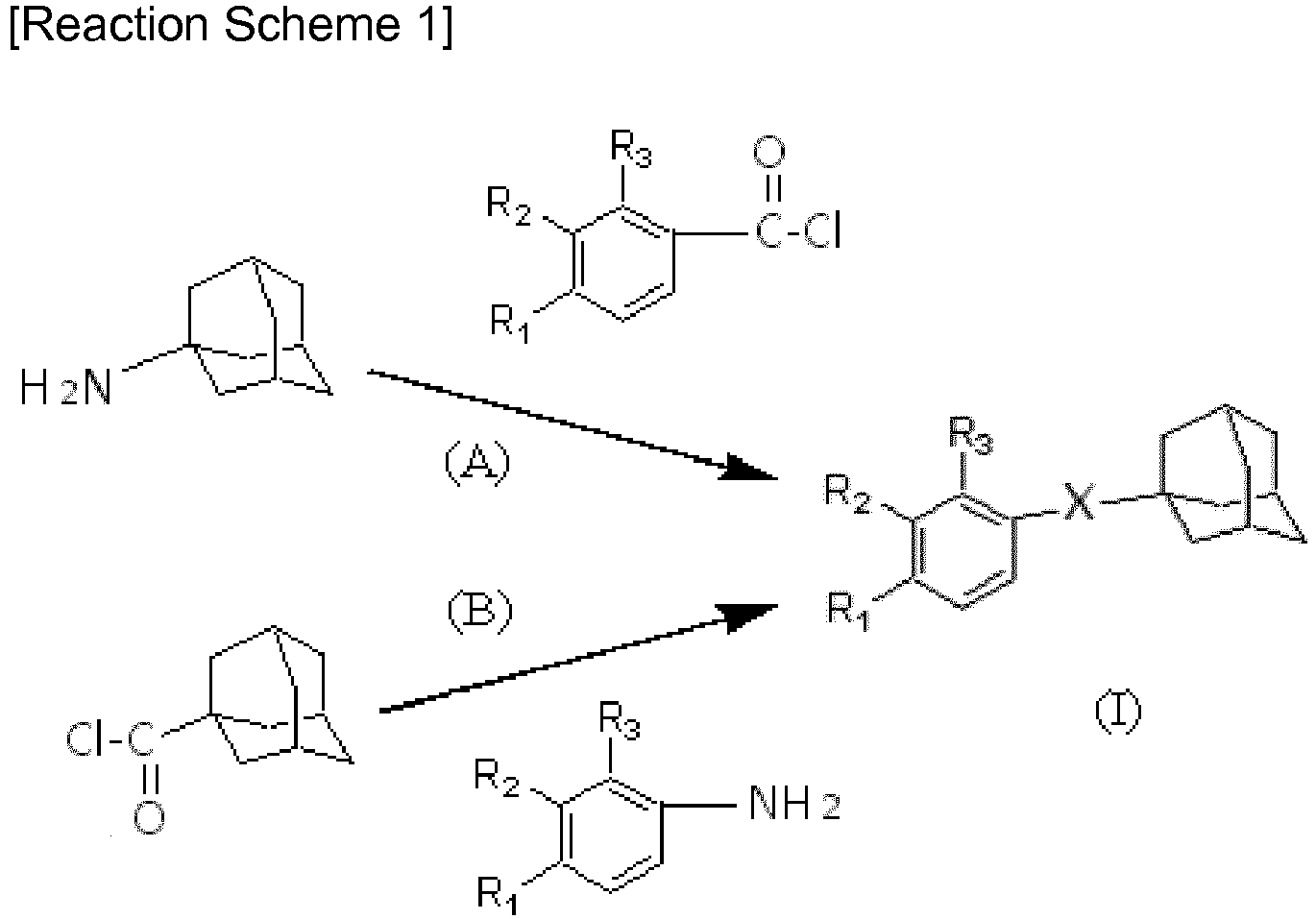
- According to step (A) of Reaction Scheme 1, X is -NHCO-. According to step (B), X is -CONH-. R1, R2 and R3 are the same as defined above.
- Hereinafter, the constitution and effect of the present disclosure will be explained in detail with reference to examples and test examples. The following examples and test examples are for illustrative purposes only and not intended to limit the scope of the present disclosure.
-

- First, 3-methyl-4-nitroaniline (100 mg, 0.65 mmol, 1.1 eq) is dissolved into pyridine (1 ml). Next, adamantane carboxyl chloride (118 mg, 0.59 mmol, 1.0 eq) is added gradually dropwise thereto at 0°C. The reaction mixture is agitated at room temperature for 3 hours. The reaction mixture is introduced to and diluted with ethyl acetate. Then, the reaction mixture is washed with 1N aqueous hydrochloric acid twice. After that, the reaction mixture is washed with saline, dried over dry manganese (100 mg), filtered, concentrated and separated by column chromatography to obtain 164 mg of the target product (yield 84%). The NMR results of the product are shown below. It can be seen from the NMR results that the product is adamantan-1-carboxylic acid-(3-methyl-4-nitrophenyl)-amide.
1H NMR (300MHz, CDCl3, δ): 8.03(d, 1 H, J = 9.0 Hz), 7.62(s, 1 H), 7.51-7.48(m, 2H), 2.62(s, 3H), 2.11 (s, 3H), 1.96-1.81(m, 6H), 1.81-1.71(m, 6H). -
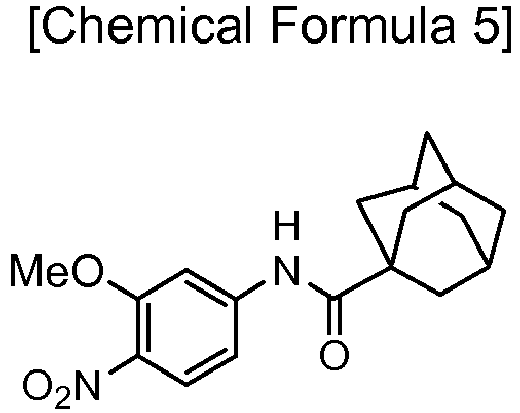
- Example 1 is repeated to obtain 71 mg (yield 42%) of the target product as white solid, except that 3-methoxy-4-nitroaniline is used instead of 3-methyl-4-nitroaniline. The NMR results of the product are shown below. It can be seen from the NMR results that the product is adamantan-1-carboxylic acid-(3-methoxy-4-nitrophenyl)-amide.
1H NMR(300MHz,CDCl3, δ): 7.97(d, 1H, J = 2.1Hz), 7.93(d, 1H, J = 9.0Hz), 7.51 (s, 1 H), 6.76(dd, 1 H, J = 2.1 and J = 9.0 Hz), 3.98(s, 3H), 2.13(s, 3H), 2.04-1.90(m, 6H), 1.83-1.72(m, 6H). -

- Example 1 is repeated to obtain 94 mg (yield 79%) of the target product as yellow solid, except that 3-chloro-4-nitroaniline is used instead of 3-methyl-4-nitroaniline. The NMR results of the product are shown below. It can be seen from the NMR results that the product is adamantan-1-carboxylic acid-(3-chloro-4-nitrophenyl)-amide.
1H NMR (300MHz, CDCl3, δ): 7.97-7.92 (m, 2H), 7.54 (dd, 1 H, J = 2.1 and J =9.0 Hz), 7.52 (s, 1 H), 2.12 (s, 3H), 1.96-1.94 (m, 6H), 1.83-1.71 (m, 6H). -

- Example 1 is repeated to obtain 101 mg (yield 61%) of the target product as yellow solid, except that 2-chloro-4-nitroaniline is used instead of 3-methyl-4-nitroaniline. The NMR results of the product are shown below. It can be seen from the NMR results that the product is adamantan-1-carboxylic acid-(2-chloro-4-nitrophenyl)-amide.
1H NMR (300MHz, CDCl3, δ): 8.72(d, 1 H, J =9.0 Hz), 8.29-8.28 (m, 2H), 8.16 (dd, 1 H, J = 2.7 and J = 9.3 Hz), 2.14 (s, 3H), 2.00-1.90 (m, 6H), 1.84-1.73 (m, 6H). -

- Example 1 is repeated to obtain 136 mg (yield 71%) of the target product as yellow solid, except that 3-methoxy-4-cyanoaniline is used instead of 3-methyl-4-nitroaniline. The NMR results of the product are shown below. It can be seen from the NMR results that the product is adamantan-1-carboxylic acid-(4-cyano-3-methoxy-phenyl)-amide.
1H NMR (300MHz, CDCl3, δ): 7.81 (d, 1 H, J = 1.8Hz), 7.50 (s, 1 H), 7.43 (d, 1 H, J = 8.4Hz), 6.81 (dd, 1 H, J = 1.5 and J = 8.4 Hz), 3.93 (s, 3H), 2.11 (s, 3H), 2.00-1.88 (m, 6H), 1.82-1.71 (m, 6H). -

- Example 1 is repeated to obtain 121 mg (yield 65%) of the target product as yellow solid, except that 2-chloro-4-cyanoaniline is used instead of 3-methyl-4-nitroaniline. The NMR results of the product are shown below. It can be seen from the NMR results that the product is adamantan-1-carboxylic acid-(4-cyano-2-chloro-phenyl)-amide.
1H NMR (300MHz, CDCl3, δ): 8.65 (d, 1 H, J = 8.7Hz), 8.19 (s, 1 H), 7.66 (d, 1 H, J = 1.5Hz), 7.55 (dd, 1 H, J = 1.5 and J = 8.7 Hz), 2.13 (s, 3H), 2.19-1.88 (m, 6H), 1.83-1.72 (m, 6H). -

- Adamantanamine (100 mg, 0.66 mmol, 1.1 eq) is dissolved into pyridine (1 ml). Next, 3-methyl-4-nitrobenzoyl chloride (100 mg, 0.60 mmol, 1.0 eq) is added gradually thereto at 0°C. The reaction mixture is agitated at room temperature for 3 hours. The reaction mixture is introduced to and diluted with ethyl acetate. Then, the reaction mixture is washed with 1N aqueous hydrochloric acid twice. After that, the reaction mixture is washed with saline, dried over dry manganese (100 mg), filtered, concentrated and separated by column chromatography to obtain 153 mg of the target product (yield 81%). The NMR results of the product are shown below. It can be seen from the NMR results that the product is N-adamantan-1-yl-N-(4-nitro-3-methyl-phenyl)-acetamide.
1H NMR (300MHz, CDCl3, δ): 7.96 (d, 1 H, J =8.4 Hz), 7.68 (s, 1 H), 7.18 (d, 1 H, J = 8.4 Hz), 5.79 (s, 1 H), 2.62 (s, 3H), 2.13 (s, 9H), 1.73 (s, 6H). -

- Example 7 is repeated to obtain 161 mg (yield 81%) of the target product, except that 3-methoxy-4-nitrobenzoyl chloride is used instead of 3-methyl-4-nitrobenzoyl chloride. The NMR results of the product are shown below. It can be seen from the NMR results that the product is N-adamantan-1-yl-N-(4-nitro-3-methoxy-phenyl)-acetamide.
1H NMR (DMSO-d6, δ): 7.82 (d, 1 H, J = 8.4 Hz), 7.75 (s, 1 H), 7.18 (dd, 1 H, J = 1.2 and J = 8.1 Hz), 5.83 (s, 1 H), 4.00 (s, 3H), 2.13 (s, 9H), 1.73 (s, 6H). -

- Example 7 is repeated to obtain 167 mg (yield 83%) of the target product, except that 3-chloro-4-nitrobenzoyl chloride is used instead of 3-methyl-4-nitrobenzoyl chloride. The NMR results of the product are shown below. It can be seen from the NMR results that the product is N-adamantan-1-yl-N-(4-nitro-3-chloro-phenyl)-acetamide.
1H NMR (300MHz, CDCl3, δ): 8.24 (d, 1 H, J = 2.1 Hz), 8.13 (dd, 1 H, J = 1.2 and J = 8.7 Hz), 7.71 (d, 1 H, J = 8.7 Hz), 5.70 (s, 1 H), 2.13 (s, 9H), 1.73 (s, 6H). -

- Example 7 is repeated to obtain 106 mg (yield 53%) of the target product, except that 2-chloro-4-nitrobenzoyl chloride is used instead of 3-methyl-4-nitrobenzoyl chloride. The NMR results of the product are shown below. It can be seen from the NMR results that the product is N-adamantan-1-yl-N-(4-nitro-2-chloro-phenyl)-acetamide.
1H NMR (300MHz, CDCl3, δ): 7.87 (d, 1 H, J =2.1 Hz), 7.87 (s, 1 H), 7.70 (dd, 1 H, J =1.2 and J =8.4 Hz), 5.78 (s, 1 H), 2.11 (s, 9H), 1.73 (s, 6H). -

- First, 3,4-methylenedioxyaniline (890 mg, 6.5 mmol) is dissolved into chloroform (50 ml), triethylamine (0.9 ml, 6.5 mmol) is added to the resultant solution and 1-adamantancarboxyl chloride (1.19 g, 5.9 mmol) is added gradually dropwise thereto. The reaction mixture is agitated at room temperature for 2 hours. Then, the reaction mixture is washed with 1N aqueous hydrochloric acid twice. After that, the reaction mixture is washed with saline, dried over dry magnesium sulfate, filtered, concentrated and separated by column chromatography to obtain 770 mg of the target product (yield 40%). The NMR results of the product are shown below. It can be seen from the NMR results that the product is adamantan-1-carboxylic acid benzo[1,3]-dioxol-5-ylamide.
1H NMR (300 MHz, DMSO-d6, δ): 8.19 (s, 1 H), 7.31 (d, 1 H, J = 1.8Hz), 7.06-7.03 (m, 1 H), 6.82-6.80 (m, 1 H), 5.95 (s, 2H), 2.00 (s, 3H), 1.87 (s, 6H), 1.69 (s, 6H). -

- Example 11 is repeated to obtain 1.54 g (yield 76%) of the target product as white solid, except that 6-aminobenzothiazole is used instead of 3,4-methylenedioxyaniline. The NMR results of the product are shown below. It can be seen from the NMR results that the product is adamantan-1-carboxylic acid benzothiazol-6-ylamide.
1H NMR (300 MHz, DMSO-d6, δ): 9.36 (s, 1 H), 9.24 (s, 1 H), 8.55 (d, 1 H, J = 1.8Hz), 8.00-7.97 (m, 1 H), 7.72-7.68 (m, 1 H), 2.03 (s, 3H), 1.94 (s, 6H), 1.71 (s, 6H). -

- Example 11 is repeated to obtain 1.04 g (yield 56%) of the target product as white solid, except that 3-methoxyaniline is used instead of 3,4-methylenedioxyaniline. The NMR results of the product are shown below. It can be seen from the NMR results that the product is adamantan-1-carboxylic acid (3-methoxyphenyl)amide.
1H NMR (300 MHz, DMSO-d6, δ): 9.04 (s, 1H), 7.35-7.13 (m, 3H), 6.61-6.58 (m, 1 H), 3.71 (s, 3H), 2.01 (s, 3H), 1.89 (s, 6H), 1.70 (s, 6H). -

- Example 11 is repeated to obtain 0.85 g (yield 44%) of the target product as white solid, except that 4-nitroaniline is used instead of 3,4-methylenedioxyaniline. The NMR results of the product are shown below. It can be seen from the NMR results that the product is adamantan-1-carboxylic acid (4-nitrophenyl)amide.
1H NMR (300 MHz, DMSO-d6, δ): 9.70 (s, 1H), 8.19 (m, 2H), 7.95 (m, 2H), 2.02 (s, 3H), 1.92 (s, 6H), 1.70 (s, 6H). -

- Example 11 is repeated to obtain 1.25 g (yield 75%) of the target product as white solid, except that aniline is used instead of 3,4-methylenedioxyaniline. The NMR results of the product are shown below. It can be seen from the NMR results that the product is adamantan-1-carboxylic acid phenylamide.
1H NMR (300 MHz, DMSO-d6, δ): 9.08 (s, 1 H), 7.65-7.63 (m, 2H), 7.27 (m, 2H), 7.02 (m, 1 H), 2.01 (s, 3H), 1.90 (s, 6H), 1.70 (s, 6H). -

- Example 11 is repeated to obtain 1.62 g (yield 79%) of the target product as white solid, except that 3,4-dimethoxyaniline is used instead of 3,4-methylenedioxyaniline. The NMR results of the product are shown below. It can be seen from the NMR results that the product is adamantan-1-carboxylic acid (3,4-dimethoxyphenyl)amide.
1H NMR (300 MHz, DMSO-d6, δ): 8.93 (s, 1H), 7.33 (s, 1H), 7.22-7.19 (m, 1 H), 6.86-6.83 (m, 1 H), 3.71 (s, 3H), 2.00 (s, 3H), 1.88 (s, 6H), 1.70 (s, 6H). -

- Example 11 is repeated to obtain 1.16 g (yield 59%) of the target product as white solid, except that 4-fluoro-3-methoxyaniline is used instead of 3,4-methylenedioxyaniline. The NMR results of the product are shown below. It can be seen from the NMR results that the product is adamantan-1-carboxylic acid (4-fluoro-3-methoxyphenyl)amide.
1H NMR (300 MHz, DMSO-d6, δ): 9.13 (s, 1H), 7.56-7.54 (m, 1H), 7.25 (m, 1 H), 7.13-7.07 (m, 1 H), 3.80 (s, 3H), 2.01 (s, 3H), 1.89 (s, 6H), 1.70 (s, 6H). -

- Example 11 is repeated to obtain 0.47 g (yield 24%) of the target product as brown solid, except that 6-aminobenzoxazole is used instead of 3,4-methylenedioxyaniline. The NMR results of the product are shown below. It can be seen from the NMR results that the product is adamantan-1-carboxylic acid benzoxazol-6-ylamide.
1H NMR (300 MHz, DMSO-d6, δ): 9.37 (s, 1H), 8.64 (s, 1H), 8.24 (s, 1H), 7.71-7.68 (m, 1H), 7.59-7.56 (m, 1H), 2.03 (s, 3H), 1.93 (s, 6H), 1.72 (s, 6H). -

- Example 11 is repeated to obtain 1.28 g (yield 54%) of the target product as white solid, except that 4-bromo-3-methoxyaniline is used instead of 3,4-methylenedioxyaniline. The NMR results of the product are shown below. It can be seen from the NMR results that the product is adamantan-1-carboxylic acid (4-bromo-3-methoxyphenyl)amide.
1H NMR (300 MHz, DMSO-d6, δ): 9.22 (s, 1 H), 7.55 (s, 1 H), 7.45 ~ 7.43 (m, 1 H), 7.32 ~ 7.29 (m, 1 H), 3.81 (s, 3H), 2.02 (s, 3H), 1.90 (s, 6H), 1.70 (s, 6H). -

- Example 11 is repeated to obtain 0.4 g (yield 20%) of the target product as yellow solid, except that 6-aminoquinoline is used instead of 3,4-methylenedioxyaniline. The NMR results of the product are shown below. It can be seen from the NMR results that the product is adamantan-1-carboxylic acid quinolin-6-ylamide.
1H NMR (300 MHz, DMSO-d6, δ): 9.76 (s, 1 H), 9.04 (s, 1 H), 8.83 (m, 1 H), 8.70 (s, 1 H), 8.20-8.18 (m, 2H), 7.86-7.84 (m, 1 H), 2.05 (s, 3H), 1.97 (s, 6H), 1.73 (s, 6H). -

- Example 11 is repeated to obtain 1.23 g (yield 55%) of the target product as white solid, except that 3-methoxy-4-methoxycarbonylaniline is used instead of 3,4-methylenedioxyaniline. The NMR results of the product are shown below. It can be seen from the NMR results that the product is 4-[(adamantan-1-carbonyl)-amino]-2-methoxybenzoic acid methylester.
1H NMR (300 MHz, DMSO-d6, δ): 9.36 (s, 1 H), 7.67-7.59 (m, 2H), 7.43-7.40 (m, 1 H), 3.78 (s, 3H), 3.74 (s, 3H), 2.02 (s, 3H), 1.91 (s, 6H), 1.71 (s, 6H). -

- Example 11 is repeated to obtain 1.04 g (yield 56%) of the target product as purple solid, except that 4-methoxyaniline is used instead of 3,4-methylenedioxyaniline. The NMR results of the product are shown below. It can be seen from the NMR results that the product is adamantan-1-carboxylic acid (4-methoxyphenyl)amide.
1H NMR (300 MHz, DMSO-d6, δ): 8.96 (s, 1 H), 7.52-7.51 (m, 2H), 6.85-6.83 (m, 2H), 3.71 (s, 3H), 2.00 (s, 3H), 1.88 (s, 6H), 1.69 (s, 6H). -
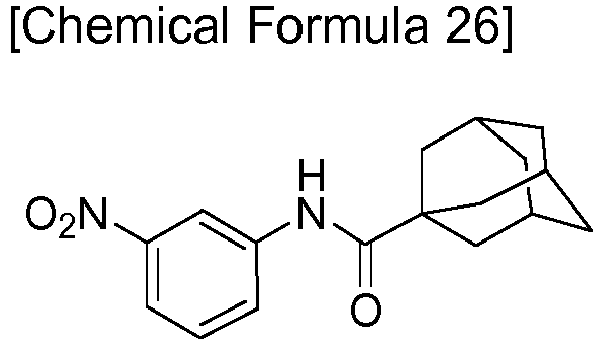
- Example 11 is repeated to obtain 1.09 g (yield 56%) of the target product as white solid, except that 3-nitroaniline is used instead of 3,4-methylenedioxyaniline. The NMR results of the product are shown below. It can be seen from the NMR results that the product is adamantan-1-carboxylic acid (3-nitrophenyl)amide.
1H NMR (300 MHz, DMSO-d6, δ): 9.61 (s, 1 H), 8.68 (s, 1 H), 8.13-8.10 (m, 1H), 7.90-7.87 (m, 1H), 7.61-7.56 (m, 1H), 2.03 (s, 3H), 1.92 (s, 6H), 1.71 (s, 6H). -

- Example 11 is repeated to obtain 0.82 g (yield 41%) of the target product as white solid, except that 5,6,7,8-tetrahydronaphthylamine is used instead of 3,4-methylenedioxyaniline. The NMR results of the product are shown below. It can be seen from the NMR results that the product is adamantan-1-carboxylic acid (5,6,7,8-tetrahydronaphthalen-2-yl)amide.
1H NMR (300 MHz, DMSO-d6, δ): 8.93 (s, 1 H), 7.34-7.31 (m, 2H), 6.95-6.92 (m, 1 H), 2.64 (m, 4H), 2.00 (s, 3H), 1.88 (s, 6H), 1.70 (m, 10H). -

- Example 11 is repeated to obtain 1.53 g (yield 90%) of the target product as yellow solid, except that 2-methoxy-4-nitroaniline is used instead of 3,4-methylenedioxyaniline. The NMR results of the product are shown below. It can be seen from the NMR results that the product is adamantan-1-carboxylic acid (2-methoxy-4-nitrophenyl)amide.
1H NMR (300 MHz, DMSO-d6, δ): 8.60 (s, 1 H), 8.32-7.84 (m, 2H), 4.02 (s, 3H), 2.03 (s, 3H), 1.92 (s, 6H), 1.71 (s, 6H). -

- 4-[(adamantan-1-carbonyl)-amino]-2-methoxybenzoic acid methylester (0.73 g) obtained from Example 22 is dissolved into methyl alcohol (20 ml) and potassium hydroxide (0.5 g) is added thereto, followed by agitation for 12 hours. After the completion of the reaction, the reaction mixture is acidified with diluted hydrochloric acid solution, extracted with dichloromethane, dried and subjected to recrystallization (dichloromethane/hexane) to obtain 0.56 g of the target product (yield 81%). The NMR results of the product are shown below. It can be seen from the NMR results that the product is 4-[(adamantan-1-carbonyl)-amino]-2-methoxybenzoic acid.
1H NMR (300 MHz, DMSO-d6, δ): 12.2 (brs, 1 H), 9.34 (s, 1 H), 7.67-7.38 (m, 3H), 3.79 (s, 3H), 2.02 (s, 3H), 1.91 (s, 6H), 1.70 (s, 6H). - First, 100 g of 1-adamantane carboxylate is dissolved into 800 ml of dichloromethane. Next, 80 g (0.79 mol) of triethylamine is added thereto, followed by reflux for 5 minutes. Then, 154 g (0.66 mol) of 4-cyano-3-trifluoromethylbenzamine is added dropwise thereto, followed by reflux at 40°C for 2 hours. After the completion of the reaction, the reaction mixture is washed with 1000 ml of water and then with 500 ml of 0.1M HCl solution. Then, the resultant product is dried with anhydrous manganese (100 g), filtered, concentrated, crystalized with hexane, and filtered again to obtain 168 g (yield 73%) of the target product as white solid.
TLC (ethyl acetate:hexane = 1:1) Rf = 0.64. 1H NMR (DMSO-d6, δ): 8.29(s, 1H), 8.01 (s, 1H), 7.82(d, 1H), 7.42(d, 1H), 1.66-1.56(m, 6H), 1.40-1.20(m, 9H). - To determine whether the adamantane derivative according to the present disclosure has an anti-androgenic effect or not, competitive steroid binding assay is carried out. This assay determines whether or not the adamantane derivative according to the present disclosure is bound to androgen receptor (AR) competitively with methyltrienolone, which is an agonist to androgen receptor.
- Such competitive steroid binding assay is carried out by introducing tritium-labeled methyltrienolone as a ligand for androgen receptor, introducing test samples non-labeled with radio isotope thereto at a different concentration, and checking whether or not the test samples are bound to androgen receptor competitively with the ligand, methyltrienolone. In this manner, the test samples are evaluated for their anti-androgenic effects. Herein, the level of the remaining isotope, tritium, is measured to determine whether or not the test samples are bound to androgen receptor competitively with the ligand, methyltrienolone.
- Particularly, wild type androgen receptor (AR) is obtained by isolating cytoplasm fraction from LNCaP cell line (ATCC® CRL-1740™). Then, competitive steroid binding assay is performed by excluding non-specific binding with 1 µM mibolerone non-labeled with isotope, and treating the androgen receptor with each of 1 nm of isotope-labeled [3H] methyltrienolone, 0.1 µM-30 µM of flutamide, the adamantane derivatives according to Examples 1-10, Example 17, Example 19, Example 23 and Example 25, and the compound according to Comparative Example 1. The reaction is carried out at 4°C for 24 hours and the reaction mixture is filtered and washed. Then, radio activity is measured in each ligand bound to the receptor. The following Table 1 shows the concentration where about 50% of the binding of methyltrienolone is inhibited in the androgen receptor.
[Table 1] Test samples Concentration where about 50% of binding of methyltrienolone is inhibited in AR (IC50) Mibolerone 2.6 nM flutamide 9.07 µM Example 1 1.2 µM Example 2 0.24 µM Example 3 0.44 µM Example 4 1.4 µM Example 5 2.2 µM Example 6 2.4 µM Example 7 1.9 µM Example 8 0.74 µM Example 9 3.2 µM Example 10 0.92 µM Example 17 14.8 µM Example 19 5.3 µM Example 23 13.5 µM Example 25 1.2 µM Comp. Ex. 1 11.4 uM - As can be seen from the above results, each of the compounds according to Examples 1-26 shows binding in a similar manner to flutamide known as an excellent antagonist against androgen receptor, and thus similarly inhibits the binding of methyltrienolone to androgen receptor. In addition, the adamantane derivatives according to the present disclosure are bound to androgen receptor and are more effective for inhibiting androgen activity as compared to flutamide.
- Rat-derived follicle dermal papilla cells cultured in Dulbecco's modified Eagle's media (DMEM) containing 2% of fetal bovine serum are dispensed to a 96-well microtiter plate to 1,000 cells/well. As positive control, minoxidil diluted to a concentration of 10 µg/ml is added. Each of the adamantane derivatives according to Examples 1-10 diluted to a concentration of 10 µg/ml is added, followed by culturing at 37°C for 48 hours. After culturing, 0.2% 3-[4,5-dimethylthiazol-2-yl]-2,5-diphenyltetrazolium bromide (MTT) solution is added to each well in an amount of 50 µl, followed by culturing at 37°C for 4 hours. Then, the produced formazane is dissolved with dimethyl sulfoxide (DMSO). A microplate reader is used to determine the absorbance of the dissolved formazane at 570 nm. The absorbance is compared with the absorbance of control treated with DMSO solution alone and the ratio (%) of growth of dermal papilla cells is evaluated based on the relative difference. The results are shown in the following Table 2.
[Table 2] Treatment group Ratio (%) of growth of dermal papilla cells DMSO 100 minoxidil 120 Example 1 124 Example 2 124 Example 3 118 Example 4 130 Example 5 145 Example 6 124 Example 7 123 Example 8 125 Example 9 128 Example 10 123 Comp. Ex. 1 114 - As can be seen from the above results, the compounds according to Examples 1-10 provide a higher ratio (%) of growth of dermal papilla cells as compared to minoxidil known to stimulate hair growth as well as the control treated with DMSO solution alone. This suggests that the adamantane derivatives according to the present disclosure stimulate the growth of dermal papilla cells, thereby stimulating hair growth and preventing alopecia.
- To evaluate the adamantane derivatives according to the present disclosure for the effect of stimulating hair growth, each of the adamantane derivatives according to Examples 1-10 is dissolved into a solvent including water/ethanol/1,3-butylene glycol (5/3/2) to a concentration of 1.0 wt%. Next, mice 47-53 days after the birth are dehaired on their backs. Then, mice whose skins on the back portions are clear are selected and grouped by 8 mice per group. Each adamantane derivative having a concentration of 1.0 wt% is applied to each mouse every day in an amount of 150 µl/day for 21 days. After 21 days, newly grown hair is weighed and the weight is compared with negative control. The results are shown in the following Table 3.
[Table 3] Treatment group Hair weight (mg) Negative control 40±18 Comp. Ex. 1 59±12 Example 1 77±11 Example 2 74±9 Example 3 72±6 Example 4 75±10 Example 5 71±14 Example 6 67±12 Example 7 68±8 Example 8 70±14 Example 9 66±12 Example 10 68±8 - As can be seen from the above results, the test groups to which the adamantane derivatives according to Examples 1-10 are applied show a higher value of hair weight as compared to the group to which the conventional solution (water/ethanol/1,3-butylene glycol) is applied. This suggests that application of each of Examples 1-10 stimulates hair growth. In other words, it can be seen that the adamantane derivatives according to the present disclosure stimulate a shift from the telogen to the anagen in hair of mice, and thus stimulates hair growth.
- The following test is carried out to evaluate the adamantane derivatives according to Examples 1-10 for the effect of inhibiting secretion of sebum. Twenty male and female subjects suffering from excessive secretion of sebum are selected and allowed to apply nourishing cream including each of Examples 1-10 and nourishing cream of negative control every day at a predetermined site for 4 weeks. Then, Sebumeter SM810 (C&K Electronic Co., Germany) is used to determine the average ratio (%) of decrease in sebum after 2 weeks and 4 weeks. The results are shown in the following Table 4.
[Table 4] Test material Ratio (%) of decrease in sebum After 2 weeks After 4 weeks Negative control 5 5 Example 1 21.5 35.2 Example 2 19.4 28.8 Example 3 18.1 27.6 Example 4 20.7 29.7 Example 5 18.7 32.8 Example 6 17.4 31.4 Example 7 18.1 29.8 Example 8 19.8 33.7 Example 9 17.1 29.8 Example 10 19.8 31.7 Comp. Ex. 1 16.5 26.2 - As can be seen from the above results, application of cream including each of Examples 1-10 decreases secretion of sebum. It can be seen from the above results that the adamantane derivatives according to the present disclosure are effective for inhibiting excessive secretion of sebum.
- Hereinafter, some formulation examples of the composition including the adamantane derivative compound according to an aspect of the present disclosure, an isomer thereof, pharmaceutically acceptable salt thereof, prodrug thereof, hydrate thereof or a solvate thereof will be described in detail. However, the composition may be formulated in various forms and the following formulation examples are for illustrative purposes only and not intended to limit the scope of the present disclosure.
- Hair nourishing skin is prepared by using the composition of the following Table 5 according to the conventional method.
[Table 5] Ingredients Amount (wt%) Purified water Balance Glycerin 8.0 Butylene glycol 4.0 Hyaluronic acid extract 5.0 Betaglucan 7.0 Carbomer 0.1 Adamantane derivative compound according to each Example 1.0 Caprylic capric triglyceride 8.0 Squalene 5.0 Cetearyl glucoside 1.5 Sorbitan stearate 0.4 Cetearyl alcohol 1.0 Preservative Qsad Fragrance Qsad Colorant Qsad Triethanolamine 0.1 - Hair lotion is prepared by using the composition of the following Table 6 according to the conventional method.
[Table 6] Ingredients Amount (wt%) Purified water Balance Glycerin 3.0 Butylene glycol 3.0 Liquid paraffin 7.0 Betaglucan 7.0 Carbomer 0.1 Adamantane derivative compound according to each Example 2.0 Caprylic capric triglyceride 3.0 Squalene 5.0 Cetearyl glucoside 1.5 Sorbitan stearate 0.4 Polysorbate 1.2 Preservative Qsad Fragrance Qsad Colorant Qsad Triethanolamine 0.1 - Hair cream is prepared by using the composition of the following Table 7 according to the conventional method.
[Table 7] Ingredients Amount (wt%) Purified water Balance Glycerin 8.0 Butylene glycol 4.0 Liquid paraffin 45.0 Betaglucan 7.0 Carbomer 0.1 Adamantane derivative compound according to each Example 1.5 Caprylic capric triglyceride 3.0 Beeswax 4.0 Cetearyl glucoside 1.5 Sorbitan sesquioleate 0.9 Vaseline 3.0 Preservative Qsad Fragrance Qsad Colorant Qsad Triethanolamine 0.1 - Ointment is prepared by using the composition of the following Table 8 according to the conventional method.
[Table 8] Ingredients Amount (wt%) Purified water Balance Glycerin 8.0 Butylene glycol 4.0 Liquid paraffin 15.0 Betaglucan 7.0 Carbomer 0.1 Adamantane derivative compound according to each Example 0.5 Caprylic capric triglyceride 3.0 Squalene 1.0 Cetearyl glucoside 1.5 Sorbitan stearate 0.4 Stearyl alcohol 1.0 Preservative Qsad Fragrance Qsad Colorant Qsad Beeswax 4.1
Claims (14)
- A compound represented by the following Chemical Formula 1, an isomer thereof, pharmaceutically acceptable salt thereof, prodrug thereof, hydrate thereof or a solvate thereof:
 wherein X is -NHCO- or -CONH-,each of R1 and R2 is independently substituted, R1 is selected from the group consisting of hydrogen, halogen, NO2, C1-C6 alkoxy, CN, CO2Me, CO2H and NH2,R2 is selected from the group consisting of hydrogen, C1-C6 alkoxy, C1-C6 alkyl and halogen,
orR1 and R2 are linked to each other to form a cyclic carbon chain optionally containing a hetero atom, wherein the cyclic carbon chain is selected from the group consisting of C2-C18 cycloalkyl; C4-C18 aryl; C2-C18 heterocycloalkyl in which at least one carbon is substituted with at least one hetero atom selected from nitrogen, oxygen and sulfur; and C4-C18 heteroaryl in which at least one carbon is substituted with at least one hetero atom selected from nitrogen, oxygen and sulfur;R3 is selected from the group consisting of hydrogen, C1-C6 alkoxy and halogen. - The compound, isomer thereof, pharmaceutically acceptable salt thereof, prodrug thereof, hydrate thereof or solvate thereof according to claim 1, wherein R2 is selected from the group consisting of hydrogen, C1-C3 alkoxy, C1-C3 alkyl and halogen.
- The compound, isomer thereof, pharmaceutically acceptable salt thereof, prodrug thereof, hydrate thereof or solvate thereof according to claim 1, wherein R1 and R2 are linked to each other to form a carbon chain or hetero atom-containing chain selected from the group consisting of 1,3-dioxole, 1,3-thiazole, 1,3-oxazole, pyridyl and cyclobutyl.
- The compound, isomer thereof, pharmaceutically acceptable salt thereof, prodrug thereof, hydrate thereof or solvate thereof according to claim 1, wherein the halogen is chloride.
- The compound, isomer thereof, pharmaceutically acceptable salt thereof, prodrug thereof, hydrate thereof or solvate thereof according to claim 1, wherein
R1 is NO2 or CN;
R2 is hydrogen, methyl, methoxy or chloride; and
R3 is hydrogen, methoxy or chloride. - The compound, isomer thereof, pharmaceutically acceptable salt thereof, prodrug thereof, hydrate thereof or solvate thereof according to claim 1, wherein when R3 is hydrogen and R2 is halogen, R2 is chloride.
- The compound, isomer thereof, pharmaceutically acceptable salt thereof, prodrug thereof, hydrate thereof or solvate thereof according to claim 1, which is selected from the group consisting of:adamantan-1-carboxylic acid-(3-methyl-4-nitrophenyl)amide;adamantan-1-carboxylic acid-(3-methoxy-4-nitrophenyl)amide;adamantan-1-carboxylic acid-(3-chloro-4-nitrophenyl)amide;adamantan-1-carboxylic acid-(2-chloro-4-nitrophenyl)amide;adamantan-1-carboxylic acid-(4-cyano-3-methoxy-phenyl)amide;adamantan-1-carboxylic acid-(4-cyano-2-chloro-phenyl)amide;N-adamantan-1-yl-N-(4-nitro-3-methyl-phenyl)-acetamide;N-adamantan-1-yl-N-(4-nitro-3-methoxy-phenyl)-acetamide;N-adamantan-1-yl-N-(4-nitro-3-chloro-phenyl)-acetamide;N-adamantan-1-yl-N-(4-nitro-2-chloro-phenyl)-acetamide;adamantan-1-carboxylic acid benzo[1,3]dioxol-5-ylamide;adamantan-1-carboxylic acid benzothiazol-6-ylamide;adamantan-1-carboxylic acid (3-methoxyphenyl)amide;adamantan-1-carboxylic acid (4-nitrophenyl)amide;adamantan-1-carboxylic acid phenylamide;adamantan-1-carboxylic acid (3,4-dimethoxyphenyl)amide;adamantan-1-carboxylic acid (4-fluoro-3-methoxyphenyl)amide;adamantan-1-carboxylic acid benzoxazol-6-ylamide;adamantan-1-carboxylic acid (4-bromo-3-methoxyphenyl)amide;adamantan-1-carboxylic acid quinolin-6-ylamide;4-[(adamantan-1-carbonyl)-amino]2-methoxy-benzoic acid methylester;adamantan-1-carboxylic acid (4-methoxyphenyl)amide;adamantan-1-carboxylic acid (3-nitrophenyl)amide;adamantan-1-carboxylic acid (5,6,7,8-tetrahydronaphthalen-2-yl)amide;adamantan-1-carboxylic acid (2-methoxy-4-nitrophenyl)amide; and4-[(adamantan-1-carbonyl)-amino]-2-methoxybenzoic acid.
- A composition comprising the compound, isomer thereof, pharmaceutically acceptable salt thereof, prodrug thereof, hydrate thereof or solvate thereof as defined in any one of claims 1 to 7.
- The composition according to claim 8, which is a skin application composition.
- The composition according to claim 8, which is an anti-androgenic composition.
- The composition according to claim 8, which is a composition for stimulating hair growth.
- The composition according to claim 8, which is an anti-sebum composition.
- The composition according to claim 8, which comprises the compound, isomer thereof, pharmaceutically acceptable salt thereof, prodrug thereof, hydrate thereof or solvate thereof as defined in any one of claims 1 to 6, in an amount of 0.01 wt%-20 wt% based on the total weight of the composition.
- A method for preparing the compound, isomer thereof, pharmaceutically acceptable salt thereof, prodrug thereof, hydrate thereof or solvate thereof as defined in any one of claims 1 to 7, the method comprising: reacting a compound represented by the following Chemical Formula 2 or 3 with a benzoic acid salt derivative or phenylamine derivative in the presence of a base:


Applications Claiming Priority (3)
| Application Number | Priority Date | Filing Date | Title |
|---|---|---|---|
| KR20140113975 | 2014-08-29 | ||
| KR1020150108849A KR102529578B1 (en) | 2014-08-29 | 2015-07-31 | Novel adamatan derivative compound |
| PCT/KR2015/008816 WO2016032182A1 (en) | 2014-08-29 | 2015-08-24 | Novel adamantane derivative compound |
Publications (3)
| Publication Number | Publication Date |
|---|---|
| EP3187486A1 true EP3187486A1 (en) | 2017-07-05 |
| EP3187486A4 EP3187486A4 (en) | 2018-05-02 |
| EP3187486B1 EP3187486B1 (en) | 2023-10-18 |
Family
ID=55536985
Family Applications (1)
| Application Number | Title | Priority Date | Filing Date |
|---|---|---|---|
| EP15835660.0A Active EP3187486B1 (en) | 2014-08-29 | 2015-08-24 | Novel adamantane derivative compound |
Country Status (6)
| Country | Link |
|---|---|
| US (1) | US10696611B2 (en) |
| EP (1) | EP3187486B1 (en) |
| JP (1) | JP6594957B2 (en) |
| KR (1) | KR102529578B1 (en) |
| CN (1) | CN107207416B (en) |
| TW (1) | TWI676612B (en) |
Families Citing this family (3)
| Publication number | Priority date | Publication date | Assignee | Title |
|---|---|---|---|---|
| US9261794B1 (en) * | 2014-12-09 | 2016-02-16 | Cymer, Llc | Compensation for a disturbance in an optical source |
| KR102635194B1 (en) | 2018-05-14 | 2024-02-13 | (주)아모레퍼시픽 | Diaryl derivative compounds and compositions for skin whitening comprising the same |
| RU2698193C1 (en) * | 2019-02-07 | 2019-08-23 | Федеральное государственное бюджетное образовательное учреждение высшего образования "Волгоградский государственный технический университет" (ВолгГТУ) | Method of producing aromatic amides of 1-adamantane carboxylic acid |
Family Cites Families (20)
| Publication number | Priority date | Publication date | Assignee | Title |
|---|---|---|---|---|
| BE791392A (en) | 1971-11-15 | 1973-05-14 | Scherico Ltd | ARYL- AND ARALCOYLAMIDES SUBSTITUTES |
| GB1439923A (en) | 1972-06-27 | 1976-06-16 | Res Inst For Medicine Chemistr | Preparation of n-fluorinated organic nitrogen compounds |
| US3944675A (en) * | 1973-03-15 | 1976-03-16 | Schering Corporation | Substituted aryl and aralkyl amides in the treatment of parkinsonism |
| WO1999026927A2 (en) * | 1997-11-21 | 1999-06-03 | Nps Pharmaceuticals, Inc. | Metabotropic glutamate receptor antagonists for treating central nervous system diseases |
| SE9704545D0 (en) | 1997-12-05 | 1997-12-05 | Astra Pharma Prod | Novel compounds |
| SE9704544D0 (en) | 1997-12-05 | 1997-12-05 | Astra Pharma Prod | Novel compounds |
| CN1361768A (en) | 1999-06-02 | 2002-07-31 | Nps药物有限公司 | Metabolic glutamate receptor antagonists and their use in the treatment of central nervous system disorders |
| US6348625B1 (en) * | 2000-11-10 | 2002-02-19 | Gloria Long Anderson | Method for preparing some 1-adamantancecarboxamides |
| KR100962452B1 (en) | 2002-09-12 | 2010-06-14 | 스미또모 가가꾸 가부시끼가이샤 | Chemically Amplified Resist Composition |
| EP1615667A2 (en) | 2003-04-11 | 2006-01-18 | Novo Nordisk A/S | Combinations of an 11-beta-hydroxysteroid dehydrogenase type 1 inhibitor and a glucocorticoid receptor agonist |
| JP4939941B2 (en) * | 2003-08-26 | 2012-05-30 | 株式會社アモーレパシフィック | Hydroxamic acid derivative and method for producing the same |
| GB0506133D0 (en) | 2005-03-24 | 2005-05-04 | Sterix Ltd | Compound |
| US7601856B2 (en) | 2006-07-27 | 2009-10-13 | Wyeth | Benzofurans as potassium ion channel modulators |
| WO2009035997A2 (en) | 2007-09-14 | 2009-03-19 | Cara Therapeutics, Inc. | Benzo-fused heterocycles |
| US8383381B2 (en) | 2007-09-27 | 2013-02-26 | Shjonogi & Co., Ltd. | Method for producing hydroxylated adaivjantane using cytochrome P450 |
| EP2310388B1 (en) | 2008-06-17 | 2015-08-05 | Institut Pasteur Korea | Pyridopyrimidine compounds as anti-tubercular agents |
| KR100858224B1 (en) | 2008-06-24 | 2008-09-10 | 동아제약주식회사 | Cosmetic composition for hair having a hair extract containing hair loss prevention and hair growth promoting effect |
| US8642614B2 (en) | 2009-09-23 | 2014-02-04 | The Regents Of The University Of Colorado, A Body Corporate | Toll-like receptor modulators and uses thereof |
| KR20110064989A (en) | 2009-12-09 | 2011-06-15 | 경북대학교 산학협력단 | Hair loss prevention or treatment composition comprising alpha-lipoic acid |
| KR101957843B1 (en) | 2011-10-06 | 2019-03-14 | (주)아모레퍼시픽 | Novel adamatan derivative compound |
-
2015
- 2015-07-31 KR KR1020150108849A patent/KR102529578B1/en active Active
- 2015-08-24 US US15/506,972 patent/US10696611B2/en active Active
- 2015-08-24 EP EP15835660.0A patent/EP3187486B1/en active Active
- 2015-08-24 CN CN201580055458.XA patent/CN107207416B/en not_active Expired - Fee Related
- 2015-08-24 JP JP2017511650A patent/JP6594957B2/en active Active
- 2015-08-28 TW TW104128312A patent/TWI676612B/en not_active IP Right Cessation
Also Published As
| Publication number | Publication date |
|---|---|
| JP6594957B2 (en) | 2019-10-23 |
| US20170283347A1 (en) | 2017-10-05 |
| KR102529578B1 (en) | 2023-05-09 |
| TWI676612B (en) | 2019-11-11 |
| CN107207416B (en) | 2020-02-07 |
| US10696611B2 (en) | 2020-06-30 |
| EP3187486A4 (en) | 2018-05-02 |
| JP2017526683A (en) | 2017-09-14 |
| CN107207416A (en) | 2017-09-26 |
| TW201615617A (en) | 2016-05-01 |
| KR20160026678A (en) | 2016-03-09 |
| EP3187486B1 (en) | 2023-10-18 |
Similar Documents
| Publication | Publication Date | Title |
|---|---|---|
| CA1340445C (en) | Diamino-2,4-pyrimidine 3-oxide derivatives and their use for the prevention and treatment of hair loss | |
| Shen et al. | Synthesis and cardiovascular evaluation of N-substituted 1-aminomethyl-2-naphthols | |
| EP0420707B1 (en) | Compositions to be used to reduce hair-loss and to induce and stimulate its growth, containing derivatives of 2-aminopyrimidine 3-oxide and new compounds derived from 2-aminopyrimidine 3-oxide | |
| EP0519819B1 (en) | Composition for use to reduce hair loss and to induce and stimulate its growth, containing derivatives of 2,4,6-triaminopyrimidin-N-oxide and the new derivatives of 2,4,6-triaminopyrimidin-N-oxide | |
| EP0540629B1 (en) | Use of pyrimidine 3-oxyde derivatives to slow down hair fall and topical compositions implemented | |
| EP0408442B1 (en) | Halogenated pyrimidin-3-oxyde derivatives, their use for the treatment and the prevention of hairloss and for stimulating growth again | |
| FR2662607A1 (en) | COMPOSITION FOR USE IN BRAKING THE FALL OF HAIR AND IN INDUCING AND STIMULATING THEIR GROWTH, CONTAINING ALKYL-2 AMINO-4 (OR DIALKYL-2-4) PYRIMIDINE OXIDE-3 DERIVATIVES. | |
| EP3187486B1 (en) | Novel adamantane derivative compound | |
| EP0916652B1 (en) | N-Aryl 2-hydroxy alkylamides | |
| KR20140050019A (en) | Oxazetidine derivatives, process for preparing them and use thereof in human medicine and in cosmetics | |
| FR2750426A1 (en) | NOVEL BIARYL HETEROCYCLIC COMPOUNDS AND THEIR USE IN HUMAN OR VETERINARY MEDICINE AS WELL AS IN COSMETICS | |
| CA1334850C (en) | Ureylene-2,4,6-pyrimidine-3-oxide derivatives, their preparation and use in cosmetics and dermopharmacy | |
| RU2457826C2 (en) | Preventive or therapeutic preparation against alopecia | |
| KR20130037405A (en) | Novel adamatan derivative compound | |
| US20120021017A1 (en) | N-phenylacetamide derivatives, which inhibit the enzyme soat-1, and pharmaceutical and cosmetic compositions containing them | |
| WO1999008673A1 (en) | Enantiomers of 4-[[(cyanoimino)- [(1,2,2-trimethylpropyl) amino]methyl]amino] benzonitrile | |
| CN1917878A (en) | Method of stimulating hair growth | |
| EP0915857B1 (en) | Compounds of the 3-aryl 2,4 dioxo oxazolidine family and use thereof in cosmetics and pharmaceuticals | |
| FR2677247A1 (en) | COMPOSITION FOR BRAKING THE FALL OF HAIR AND FOR INDUCING AND STIMULATING THEIR GROWTH, BASED ON PYRIDINE-1 OXIDE DERIVATIVES. | |
| KR20140117842A (en) | Novel phenylacetic acid amide derivative compound | |
| CA2285886C (en) | Compounds containing oxadiazolopyrimidines destined to be used for slowing down hair loss and for inducing and stimulating their growth | |
| WO1991019701A1 (en) | Novel 2,4-diamino 1,3,5-triazine derivatives and uses thereof for treating and preventing hair loss | |
| HK1097759A (en) | Method of stimulating hair growth | |
| CA2029601A1 (en) | Internal salts of 2,4-diamino-6-alkoxysulfoxy-pyrimidinium and their use in treatments to prevent hair loss | |
| HK1138204B (en) | Prophylactic or therapeutic agent for alopecia |
Legal Events
| Date | Code | Title | Description |
|---|---|---|---|
| STAA | Information on the status of an ep patent application or granted ep patent |
Free format text: STATUS: THE INTERNATIONAL PUBLICATION HAS BEEN MADE |
|
| PUAI | Public reference made under article 153(3) epc to a published international application that has entered the european phase |
Free format text: ORIGINAL CODE: 0009012 |
|
| STAA | Information on the status of an ep patent application or granted ep patent |
Free format text: STATUS: REQUEST FOR EXAMINATION WAS MADE |
|
| 17P | Request for examination filed |
Effective date: 20170327 |
|
| AK | Designated contracting states |
Kind code of ref document: A1 Designated state(s): AL AT BE BG CH CY CZ DE DK EE ES FI FR GB GR HR HU IE IS IT LI LT LU LV MC MK MT NL NO PL PT RO RS SE SI SK SM TR |
|
| AX | Request for extension of the european patent |
Extension state: BA ME |
|
| DAV | Request for validation of the european patent (deleted) | ||
| DAX | Request for extension of the european patent (deleted) | ||
| A4 | Supplementary search report drawn up and despatched |
Effective date: 20180405 |
|
| RIC1 | Information provided on ipc code assigned before grant |
Ipc: A61K 8/42 20060101ALI20180326BHEP Ipc: C07C 233/59 20060101AFI20180326BHEP Ipc: C07C 233/58 20060101ALI20180326BHEP Ipc: C07C 231/02 20060101ALI20180326BHEP Ipc: C07C 13/615 20060101ALI20180326BHEP Ipc: C07C 15/04 20060101ALI20180326BHEP Ipc: C07C 233/57 20060101ALI20180326BHEP Ipc: C07C 233/60 20060101ALI20180326BHEP Ipc: C07C 265/12 20060101ALI20180326BHEP Ipc: A61K 31/167 20060101ALI20180326BHEP Ipc: C07C 233/63 20060101ALI20180326BHEP Ipc: A61P 17/00 20060101ALI20180326BHEP Ipc: A61P 17/14 20060101ALI20180326BHEP Ipc: A61K 31/166 20060101ALI20180326BHEP Ipc: A61K 8/44 20060101ALI20180326BHEP |
|
| STAA | Information on the status of an ep patent application or granted ep patent |
Free format text: STATUS: EXAMINATION IS IN PROGRESS |
|
| 17Q | First examination report despatched |
Effective date: 20200403 |
|
| REG | Reference to a national code |
Ref country code: DE Ref legal event code: R079 Free format text: PREVIOUS MAIN CLASS: C07C0233590000 Ipc: A61K0008490000 Ref document number: 602015086157 Country of ref document: DE |
|
| RIC1 | Information provided on ipc code assigned before grant |
Ipc: A61P 17/14 20060101ALI20230327BHEP Ipc: A61P 17/00 20060101ALI20230327BHEP Ipc: C07C 231/02 20060101ALI20230327BHEP Ipc: C07C 233/58 20060101ALI20230327BHEP Ipc: C07C 265/12 20060101ALI20230327BHEP Ipc: C07C 233/63 20060101ALI20230327BHEP Ipc: C07C 233/60 20060101ALI20230327BHEP Ipc: C07C 233/59 20060101ALI20230327BHEP Ipc: A61K 31/167 20060101ALI20230327BHEP Ipc: A61K 31/166 20060101ALI20230327BHEP Ipc: A61K 8/42 20060101ALI20230327BHEP Ipc: A61P 43/00 20060101ALI20230327BHEP Ipc: A61Q 19/00 20060101ALI20230327BHEP Ipc: A61Q 7/00 20060101ALI20230327BHEP Ipc: A61P 17/08 20060101ALI20230327BHEP Ipc: A61K 8/49 20060101AFI20230327BHEP |
|
| GRAP | Despatch of communication of intention to grant a patent |
Free format text: ORIGINAL CODE: EPIDOSNIGR1 |
|
| STAA | Information on the status of an ep patent application or granted ep patent |
Free format text: STATUS: GRANT OF PATENT IS INTENDED |
|
| INTG | Intention to grant announced |
Effective date: 20230511 |
|
| P01 | Opt-out of the competence of the unified patent court (upc) registered |
Effective date: 20230704 |
|
| GRAS | Grant fee paid |
Free format text: ORIGINAL CODE: EPIDOSNIGR3 |
|
| GRAA | (expected) grant |
Free format text: ORIGINAL CODE: 0009210 |
|
| STAA | Information on the status of an ep patent application or granted ep patent |
Free format text: STATUS: THE PATENT HAS BEEN GRANTED |
|
| AK | Designated contracting states |
Kind code of ref document: B1 Designated state(s): AL AT BE BG CH CY CZ DE DK EE ES FI FR GB GR HR HU IE IS IT LI LT LU LV MC MK MT NL NO PL PT RO RS SE SI SK SM TR |
|
| REG | Reference to a national code |
Ref country code: GB Ref legal event code: FG4D |
|
| REG | Reference to a national code |
Ref country code: CH Ref legal event code: EP |
|
| REG | Reference to a national code |
Ref country code: IE Ref legal event code: FG4D |
|
| REG | Reference to a national code |
Ref country code: DE Ref legal event code: R096 Ref document number: 602015086157 Country of ref document: DE |
|
| REG | Reference to a national code |
Ref country code: LT Ref legal event code: MG9D |
|
| REG | Reference to a national code |
Ref country code: NL Ref legal event code: MP Effective date: 20231018 |
|
| REG | Reference to a national code |
Ref country code: AT Ref legal event code: MK05 Ref document number: 1621805 Country of ref document: AT Kind code of ref document: T Effective date: 20231018 |
|
| PG25 | Lapsed in a contracting state [announced via postgrant information from national office to epo] |
Ref country code: NL Free format text: LAPSE BECAUSE OF FAILURE TO SUBMIT A TRANSLATION OF THE DESCRIPTION OR TO PAY THE FEE WITHIN THE PRESCRIBED TIME-LIMIT Effective date: 20231018 |
|
| PG25 | Lapsed in a contracting state [announced via postgrant information from national office to epo] |
Ref country code: GR Free format text: LAPSE BECAUSE OF FAILURE TO SUBMIT A TRANSLATION OF THE DESCRIPTION OR TO PAY THE FEE WITHIN THE PRESCRIBED TIME-LIMIT Effective date: 20240119 |
|
| PG25 | Lapsed in a contracting state [announced via postgrant information from national office to epo] |
Ref country code: IS Free format text: LAPSE BECAUSE OF FAILURE TO SUBMIT A TRANSLATION OF THE DESCRIPTION OR TO PAY THE FEE WITHIN THE PRESCRIBED TIME-LIMIT Effective date: 20240218 |
|
| PG25 | Lapsed in a contracting state [announced via postgrant information from national office to epo] |
Ref country code: LT Free format text: LAPSE BECAUSE OF FAILURE TO SUBMIT A TRANSLATION OF THE DESCRIPTION OR TO PAY THE FEE WITHIN THE PRESCRIBED TIME-LIMIT Effective date: 20231018 |
|
| PG25 | Lapsed in a contracting state [announced via postgrant information from national office to epo] |
Ref country code: AT Free format text: LAPSE BECAUSE OF FAILURE TO SUBMIT A TRANSLATION OF THE DESCRIPTION OR TO PAY THE FEE WITHIN THE PRESCRIBED TIME-LIMIT Effective date: 20231018 |
|
| PG25 | Lapsed in a contracting state [announced via postgrant information from national office to epo] |
Ref country code: ES Free format text: LAPSE BECAUSE OF FAILURE TO SUBMIT A TRANSLATION OF THE DESCRIPTION OR TO PAY THE FEE WITHIN THE PRESCRIBED TIME-LIMIT Effective date: 20231018 |
|
| PG25 | Lapsed in a contracting state [announced via postgrant information from national office to epo] |
Ref country code: LT Free format text: LAPSE BECAUSE OF FAILURE TO SUBMIT A TRANSLATION OF THE DESCRIPTION OR TO PAY THE FEE WITHIN THE PRESCRIBED TIME-LIMIT Effective date: 20231018 Ref country code: IS Free format text: LAPSE BECAUSE OF FAILURE TO SUBMIT A TRANSLATION OF THE DESCRIPTION OR TO PAY THE FEE WITHIN THE PRESCRIBED TIME-LIMIT Effective date: 20240218 Ref country code: GR Free format text: LAPSE BECAUSE OF FAILURE TO SUBMIT A TRANSLATION OF THE DESCRIPTION OR TO PAY THE FEE WITHIN THE PRESCRIBED TIME-LIMIT Effective date: 20240119 Ref country code: ES Free format text: LAPSE BECAUSE OF FAILURE TO SUBMIT A TRANSLATION OF THE DESCRIPTION OR TO PAY THE FEE WITHIN THE PRESCRIBED TIME-LIMIT Effective date: 20231018 Ref country code: BG Free format text: LAPSE BECAUSE OF FAILURE TO SUBMIT A TRANSLATION OF THE DESCRIPTION OR TO PAY THE FEE WITHIN THE PRESCRIBED TIME-LIMIT Effective date: 20240118 Ref country code: AT Free format text: LAPSE BECAUSE OF FAILURE TO SUBMIT A TRANSLATION OF THE DESCRIPTION OR TO PAY THE FEE WITHIN THE PRESCRIBED TIME-LIMIT Effective date: 20231018 Ref country code: PT Free format text: LAPSE BECAUSE OF FAILURE TO SUBMIT A TRANSLATION OF THE DESCRIPTION OR TO PAY THE FEE WITHIN THE PRESCRIBED TIME-LIMIT Effective date: 20240219 |
|
| PG25 | Lapsed in a contracting state [announced via postgrant information from national office to epo] |
Ref country code: SE Free format text: LAPSE BECAUSE OF FAILURE TO SUBMIT A TRANSLATION OF THE DESCRIPTION OR TO PAY THE FEE WITHIN THE PRESCRIBED TIME-LIMIT Effective date: 20231018 Ref country code: RS Free format text: LAPSE BECAUSE OF FAILURE TO SUBMIT A TRANSLATION OF THE DESCRIPTION OR TO PAY THE FEE WITHIN THE PRESCRIBED TIME-LIMIT Effective date: 20231018 Ref country code: PL Free format text: LAPSE BECAUSE OF FAILURE TO SUBMIT A TRANSLATION OF THE DESCRIPTION OR TO PAY THE FEE WITHIN THE PRESCRIBED TIME-LIMIT Effective date: 20231018 Ref country code: NO Free format text: LAPSE BECAUSE OF FAILURE TO SUBMIT A TRANSLATION OF THE DESCRIPTION OR TO PAY THE FEE WITHIN THE PRESCRIBED TIME-LIMIT Effective date: 20240118 Ref country code: LV Free format text: LAPSE BECAUSE OF FAILURE TO SUBMIT A TRANSLATION OF THE DESCRIPTION OR TO PAY THE FEE WITHIN THE PRESCRIBED TIME-LIMIT Effective date: 20231018 Ref country code: HR Free format text: LAPSE BECAUSE OF FAILURE TO SUBMIT A TRANSLATION OF THE DESCRIPTION OR TO PAY THE FEE WITHIN THE PRESCRIBED TIME-LIMIT Effective date: 20231018 |
|
| PG25 | Lapsed in a contracting state [announced via postgrant information from national office to epo] |
Ref country code: DK Free format text: LAPSE BECAUSE OF FAILURE TO SUBMIT A TRANSLATION OF THE DESCRIPTION OR TO PAY THE FEE WITHIN THE PRESCRIBED TIME-LIMIT Effective date: 20231018 |
|
| REG | Reference to a national code |
Ref country code: DE Ref legal event code: R097 Ref document number: 602015086157 Country of ref document: DE |
|
| PG25 | Lapsed in a contracting state [announced via postgrant information from national office to epo] |
Ref country code: CZ Free format text: LAPSE BECAUSE OF FAILURE TO SUBMIT A TRANSLATION OF THE DESCRIPTION OR TO PAY THE FEE WITHIN THE PRESCRIBED TIME-LIMIT Effective date: 20231018 |
|
| PG25 | Lapsed in a contracting state [announced via postgrant information from national office to epo] |
Ref country code: SK Free format text: LAPSE BECAUSE OF FAILURE TO SUBMIT A TRANSLATION OF THE DESCRIPTION OR TO PAY THE FEE WITHIN THE PRESCRIBED TIME-LIMIT Effective date: 20231018 |
|
| PG25 | Lapsed in a contracting state [announced via postgrant information from national office to epo] |
Ref country code: SM Free format text: LAPSE BECAUSE OF FAILURE TO SUBMIT A TRANSLATION OF THE DESCRIPTION OR TO PAY THE FEE WITHIN THE PRESCRIBED TIME-LIMIT Effective date: 20231018 Ref country code: SK Free format text: LAPSE BECAUSE OF FAILURE TO SUBMIT A TRANSLATION OF THE DESCRIPTION OR TO PAY THE FEE WITHIN THE PRESCRIBED TIME-LIMIT Effective date: 20231018 Ref country code: RO Free format text: LAPSE BECAUSE OF FAILURE TO SUBMIT A TRANSLATION OF THE DESCRIPTION OR TO PAY THE FEE WITHIN THE PRESCRIBED TIME-LIMIT Effective date: 20231018 Ref country code: IT Free format text: LAPSE BECAUSE OF FAILURE TO SUBMIT A TRANSLATION OF THE DESCRIPTION OR TO PAY THE FEE WITHIN THE PRESCRIBED TIME-LIMIT Effective date: 20231018 Ref country code: EE Free format text: LAPSE BECAUSE OF FAILURE TO SUBMIT A TRANSLATION OF THE DESCRIPTION OR TO PAY THE FEE WITHIN THE PRESCRIBED TIME-LIMIT Effective date: 20231018 Ref country code: DK Free format text: LAPSE BECAUSE OF FAILURE TO SUBMIT A TRANSLATION OF THE DESCRIPTION OR TO PAY THE FEE WITHIN THE PRESCRIBED TIME-LIMIT Effective date: 20231018 Ref country code: CZ Free format text: LAPSE BECAUSE OF FAILURE TO SUBMIT A TRANSLATION OF THE DESCRIPTION OR TO PAY THE FEE WITHIN THE PRESCRIBED TIME-LIMIT Effective date: 20231018 |
|
| PLBE | No opposition filed within time limit |
Free format text: ORIGINAL CODE: 0009261 |
|
| STAA | Information on the status of an ep patent application or granted ep patent |
Free format text: STATUS: NO OPPOSITION FILED WITHIN TIME LIMIT |
|
| 26N | No opposition filed |
Effective date: 20240719 |
|
| PG25 | Lapsed in a contracting state [announced via postgrant information from national office to epo] |
Ref country code: SI Free format text: LAPSE BECAUSE OF FAILURE TO SUBMIT A TRANSLATION OF THE DESCRIPTION OR TO PAY THE FEE WITHIN THE PRESCRIBED TIME-LIMIT Effective date: 20231018 |
|
| PG25 | Lapsed in a contracting state [announced via postgrant information from national office to epo] |
Ref country code: SI Free format text: LAPSE BECAUSE OF FAILURE TO SUBMIT A TRANSLATION OF THE DESCRIPTION OR TO PAY THE FEE WITHIN THE PRESCRIBED TIME-LIMIT Effective date: 20231018 |
|
| REG | Reference to a national code |
Ref country code: DE Ref legal event code: R119 Ref document number: 602015086157 Country of ref document: DE |
|
| REG | Reference to a national code |
Ref country code: CH Ref legal event code: PL |
|
| PG25 | Lapsed in a contracting state [announced via postgrant information from national office to epo] |
Ref country code: LU Free format text: LAPSE BECAUSE OF NON-PAYMENT OF DUE FEES Effective date: 20240824 |
|
| GBPC | Gb: european patent ceased through non-payment of renewal fee |
Effective date: 20240824 |
|
| PG25 | Lapsed in a contracting state [announced via postgrant information from national office to epo] |
Ref country code: CH Free format text: LAPSE BECAUSE OF NON-PAYMENT OF DUE FEES Effective date: 20240831 Ref country code: MC Free format text: LAPSE BECAUSE OF FAILURE TO SUBMIT A TRANSLATION OF THE DESCRIPTION OR TO PAY THE FEE WITHIN THE PRESCRIBED TIME-LIMIT Effective date: 20231018 |
|
| REG | Reference to a national code |
Ref country code: BE Ref legal event code: MM Effective date: 20240831 |
|
| PG25 | Lapsed in a contracting state [announced via postgrant information from national office to epo] |
Ref country code: DE Free format text: LAPSE BECAUSE OF NON-PAYMENT OF DUE FEES Effective date: 20250301 |
|
| PG25 | Lapsed in a contracting state [announced via postgrant information from national office to epo] |
Ref country code: GB Free format text: LAPSE BECAUSE OF NON-PAYMENT OF DUE FEES Effective date: 20240824 |
|
| PG25 | Lapsed in a contracting state [announced via postgrant information from national office to epo] |
Ref country code: BE Free format text: LAPSE BECAUSE OF NON-PAYMENT OF DUE FEES Effective date: 20240831 |
|
| PG25 | Lapsed in a contracting state [announced via postgrant information from national office to epo] |
Ref country code: FR Free format text: LAPSE BECAUSE OF NON-PAYMENT OF DUE FEES Effective date: 20240831 |
|
| PG25 | Lapsed in a contracting state [announced via postgrant information from national office to epo] |
Ref country code: IE Free format text: LAPSE BECAUSE OF NON-PAYMENT OF DUE FEES Effective date: 20240824 |
|
| PG25 | Lapsed in a contracting state [announced via postgrant information from national office to epo] |
Ref country code: FI Free format text: LAPSE BECAUSE OF FAILURE TO SUBMIT A TRANSLATION OF THE DESCRIPTION OR TO PAY THE FEE WITHIN THE PRESCRIBED TIME-LIMIT Effective date: 20231019 |
|
| PG25 | Lapsed in a contracting state [announced via postgrant information from national office to epo] |
Ref country code: CY Free format text: LAPSE BECAUSE OF FAILURE TO SUBMIT A TRANSLATION OF THE DESCRIPTION OR TO PAY THE FEE WITHIN THE PRESCRIBED TIME-LIMIT; INVALID AB INITIO Effective date: 20150824 |
|
| PG25 | Lapsed in a contracting state [announced via postgrant information from national office to epo] |
Ref country code: HU Free format text: LAPSE BECAUSE OF FAILURE TO SUBMIT A TRANSLATION OF THE DESCRIPTION OR TO PAY THE FEE WITHIN THE PRESCRIBED TIME-LIMIT; INVALID AB INITIO Effective date: 20150824 |