EP3187463A1 - Method for preparing y-type molecular sieve having high silica-alumina ratio - Google Patents
Method for preparing y-type molecular sieve having high silica-alumina ratio Download PDFInfo
- Publication number
- EP3187463A1 EP3187463A1 EP14900724.7A EP14900724A EP3187463A1 EP 3187463 A1 EP3187463 A1 EP 3187463A1 EP 14900724 A EP14900724 A EP 14900724A EP 3187463 A1 EP3187463 A1 EP 3187463A1
- Authority
- EP
- European Patent Office
- Prior art keywords
- molecular sieve
- type molecular
- mol
- source
- gel mixture
- Prior art date
- Legal status (The legal status is an assumption and is not a legal conclusion. Google has not performed a legal analysis and makes no representation as to the accuracy of the status listed.)
- Granted
Links
- 239000002808 molecular sieve Substances 0.000 title claims abstract description 69
- URGAHOPLAPQHLN-UHFFFAOYSA-N sodium aluminosilicate Chemical compound [Na+].[Al+3].[O-][Si]([O-])=O.[O-][Si]([O-])=O URGAHOPLAPQHLN-UHFFFAOYSA-N 0.000 title claims abstract description 69
- PNEYBMLMFCGWSK-UHFFFAOYSA-N aluminium oxide Inorganic materials [O-2].[O-2].[O-2].[Al+3].[Al+3] PNEYBMLMFCGWSK-UHFFFAOYSA-N 0.000 title claims abstract description 58
- 238000000034 method Methods 0.000 title claims abstract description 34
- VYPSYNLAJGMNEJ-UHFFFAOYSA-N Silicium dioxide Chemical compound O=[Si]=O VYPSYNLAJGMNEJ-UHFFFAOYSA-N 0.000 claims abstract description 30
- 229910052593 corundum Inorganic materials 0.000 claims abstract description 30
- 229910001845 yogo sapphire Inorganic materials 0.000 claims abstract description 30
- 239000000203 mixture Substances 0.000 claims abstract description 27
- 238000002425 crystallisation Methods 0.000 claims abstract description 23
- 230000008025 crystallization Effects 0.000 claims abstract description 23
- 239000003513 alkali Substances 0.000 claims abstract description 22
- 229910052710 silicon Inorganic materials 0.000 claims abstract description 20
- 239000010703 silicon Substances 0.000 claims abstract description 20
- 230000015572 biosynthetic process Effects 0.000 claims abstract description 17
- 238000003786 synthesis reaction Methods 0.000 claims abstract description 17
- XUIMIQQOPSSXEZ-UHFFFAOYSA-N Silicon Chemical compound [Si] XUIMIQQOPSSXEZ-UHFFFAOYSA-N 0.000 claims abstract description 15
- 229910052782 aluminium Inorganic materials 0.000 claims abstract description 12
- 229910052681 coesite Inorganic materials 0.000 claims abstract description 12
- 229910052906 cristobalite Inorganic materials 0.000 claims abstract description 12
- 239000000377 silicon dioxide Substances 0.000 claims abstract description 12
- 229910052682 stishovite Inorganic materials 0.000 claims abstract description 12
- 229910052905 tridymite Inorganic materials 0.000 claims abstract description 12
- XLYOFNOQVPJJNP-UHFFFAOYSA-N water Chemical compound O XLYOFNOQVPJJNP-UHFFFAOYSA-N 0.000 claims abstract description 12
- XAGFODPZIPBFFR-UHFFFAOYSA-N aluminium Chemical compound [Al] XAGFODPZIPBFFR-UHFFFAOYSA-N 0.000 claims abstract description 9
- 239000008367 deionised water Substances 0.000 claims abstract description 7
- 229910021641 deionized water Inorganic materials 0.000 claims abstract description 7
- 239000003795 chemical substances by application Substances 0.000 claims abstract description 6
- 238000002156 mixing Methods 0.000 claims abstract description 5
- 238000001035 drying Methods 0.000 claims abstract description 4
- 230000032683 aging Effects 0.000 claims abstract description 3
- HEMHJVSKTPXQMS-UHFFFAOYSA-M Sodium hydroxide Chemical group [OH-].[Na+] HEMHJVSKTPXQMS-UHFFFAOYSA-M 0.000 claims description 135
- RMAQACBXLXPBSY-UHFFFAOYSA-N silicic acid Chemical compound O[Si](O)(O)O RMAQACBXLXPBSY-UHFFFAOYSA-N 0.000 claims description 39
- 229910001388 sodium aluminate Inorganic materials 0.000 claims description 39
- ANBBXQWFNXMHLD-UHFFFAOYSA-N aluminum;sodium;oxygen(2-) Chemical compound [O-2].[O-2].[Na+].[Al+3] ANBBXQWFNXMHLD-UHFFFAOYSA-N 0.000 claims description 38
- 150000001875 compounds Chemical class 0.000 claims description 24
- KWYUFKZDYYNOTN-UHFFFAOYSA-M Potassium hydroxide Chemical compound [OH-].[K+] KWYUFKZDYYNOTN-UHFFFAOYSA-M 0.000 claims description 21
- -1 tetraalkylammonium cation Chemical class 0.000 claims description 20
- WGTYBPLFGIVFAS-UHFFFAOYSA-M tetramethylammonium hydroxide Chemical compound [OH-].C[N+](C)(C)C WGTYBPLFGIVFAS-UHFFFAOYSA-M 0.000 claims description 8
- 229910052799 carbon Inorganic materials 0.000 claims description 7
- 125000004432 carbon atom Chemical group C* 0.000 claims description 7
- IJGRMHOSHXDMSA-UHFFFAOYSA-N Atomic nitrogen Chemical compound N#N IJGRMHOSHXDMSA-UHFFFAOYSA-N 0.000 claims description 6
- 125000000217 alkyl group Chemical group 0.000 claims description 6
- 229910001868 water Inorganic materials 0.000 claims description 5
- 230000003068 static effect Effects 0.000 claims description 4
- 239000000126 substance Substances 0.000 claims description 4
- VDZOOKBUILJEDG-UHFFFAOYSA-M tetrabutylammonium hydroxide Chemical compound [OH-].CCCC[N+](CCCC)(CCCC)CCCC VDZOOKBUILJEDG-UHFFFAOYSA-M 0.000 claims description 4
- UQFSVBXCNGCBBW-UHFFFAOYSA-M tetraethylammonium iodide Chemical compound [I-].CC[N+](CC)(CC)CC UQFSVBXCNGCBBW-UHFFFAOYSA-M 0.000 claims description 4
- LPSKDVINWQNWFE-UHFFFAOYSA-M tetrapropylazanium;hydroxide Chemical compound [OH-].CCC[N+](CCC)(CCC)CCC LPSKDVINWQNWFE-UHFFFAOYSA-M 0.000 claims description 4
- BPQQTUXANYXVAA-UHFFFAOYSA-N Orthosilicate Chemical compound [O-][Si]([O-])([O-])[O-] BPQQTUXANYXVAA-UHFFFAOYSA-N 0.000 claims description 3
- 229910052751 metal Inorganic materials 0.000 claims description 3
- 229910052757 nitrogen Inorganic materials 0.000 claims description 3
- 229940073455 tetraethylammonium hydroxide Drugs 0.000 claims description 3
- LRGJRHZIDJQFCL-UHFFFAOYSA-M tetraethylazanium;hydroxide Chemical compound [OH-].CC[N+](CC)(CC)CC LRGJRHZIDJQFCL-UHFFFAOYSA-M 0.000 claims description 3
- 238000005406 washing Methods 0.000 claims description 3
- 150000002500 ions Chemical class 0.000 claims description 2
- HWCKGOZZJDHMNC-UHFFFAOYSA-M tetraethylammonium bromide Chemical compound [Br-].CC[N+](CC)(CC)CC HWCKGOZZJDHMNC-UHFFFAOYSA-M 0.000 claims description 2
- YMBCJWGVCUEGHA-UHFFFAOYSA-M tetraethylammonium chloride Chemical compound [Cl-].CC[N+](CC)(CC)CC YMBCJWGVCUEGHA-UHFFFAOYSA-M 0.000 claims description 2
- 239000012265 solid product Substances 0.000 abstract description 3
- 239000000523 sample Substances 0.000 description 17
- 239000000047 product Substances 0.000 description 8
- 229910021536 Zeolite Inorganic materials 0.000 description 6
- HNPSIPDUKPIQMN-UHFFFAOYSA-N dioxosilane;oxo(oxoalumanyloxy)alumane Chemical compound O=[Si]=O.O=[Al]O[Al]=O HNPSIPDUKPIQMN-UHFFFAOYSA-N 0.000 description 6
- 239000010457 zeolite Substances 0.000 description 6
- 238000005481 NMR spectroscopy Methods 0.000 description 5
- 239000013078 crystal Substances 0.000 description 5
- 230000000694 effects Effects 0.000 description 5
- 238000000655 nuclear magnetic resonance spectrum Methods 0.000 description 5
- KKCBUQHMOMHUOY-UHFFFAOYSA-N Na2O Inorganic materials [O-2].[Na+].[Na+] KKCBUQHMOMHUOY-UHFFFAOYSA-N 0.000 description 4
- 150000001335 aliphatic alkanes Chemical class 0.000 description 4
- 238000004458 analytical method Methods 0.000 description 4
- 238000004400 29Si cross polarisation magic angle spinning Methods 0.000 description 3
- 238000012805 post-processing Methods 0.000 description 3
- 238000000634 powder X-ray diffraction Methods 0.000 description 3
- 238000002360 preparation method Methods 0.000 description 3
- 239000002994 raw material Substances 0.000 description 3
- CBXCPBUEXACCNR-UHFFFAOYSA-N tetraethylammonium Chemical compound CC[N+](CC)(CC)CC CBXCPBUEXACCNR-UHFFFAOYSA-N 0.000 description 3
- 239000003054 catalyst Substances 0.000 description 2
- 238000004523 catalytic cracking Methods 0.000 description 2
- 238000012512 characterization method Methods 0.000 description 2
- 230000000052 comparative effect Effects 0.000 description 2
- 125000001495 ethyl group Chemical group [H]C([H])([H])C([H])([H])* 0.000 description 2
- 238000009472 formulation Methods 0.000 description 2
- 230000000877 morphologic effect Effects 0.000 description 2
- 230000007935 neutral effect Effects 0.000 description 2
- 239000002245 particle Substances 0.000 description 2
- 238000001228 spectrum Methods 0.000 description 2
- 238000004876 x-ray fluorescence Methods 0.000 description 2
- 101150113959 Magix gene Proteins 0.000 description 1
- 238000002441 X-ray diffraction Methods 0.000 description 1
- OBNDGIHQAIXEAO-UHFFFAOYSA-N [O].[Si] Chemical compound [O].[Si] OBNDGIHQAIXEAO-UHFFFAOYSA-N 0.000 description 1
- AZDRQVAHHNSJOQ-UHFFFAOYSA-N alumane Chemical group [AlH3] AZDRQVAHHNSJOQ-UHFFFAOYSA-N 0.000 description 1
- 230000003197 catalytic effect Effects 0.000 description 1
- 238000005119 centrifugation Methods 0.000 description 1
- 238000006243 chemical reaction Methods 0.000 description 1
- 238000002447 crystallographic data Methods 0.000 description 1
- 150000001924 cycloalkanes Chemical class 0.000 description 1
- 229910003460 diamond Inorganic materials 0.000 description 1
- 239000010432 diamond Substances 0.000 description 1
- 238000009826 distribution Methods 0.000 description 1
- 238000005265 energy consumption Methods 0.000 description 1
- 238000010438 heat treatment Methods 0.000 description 1
- 125000004435 hydrogen atom Chemical group [H]* 0.000 description 1
- 238000001027 hydrothermal synthesis Methods 0.000 description 1
- 239000007788 liquid Substances 0.000 description 1
- 239000000463 material Substances 0.000 description 1
- 238000012986 modification Methods 0.000 description 1
- 230000004048 modification Effects 0.000 description 1
- 239000000843 powder Substances 0.000 description 1
- 230000005855 radiation Effects 0.000 description 1
- 238000005096 rolling process Methods 0.000 description 1
- 238000000926 separation method Methods 0.000 description 1
- 239000007787 solid Substances 0.000 description 1
- 238000001179 sorption measurement Methods 0.000 description 1
- 238000003756 stirring Methods 0.000 description 1
- 230000002194 synthesizing effect Effects 0.000 description 1
- 125000005207 tetraalkylammonium group Chemical group 0.000 description 1
Images

Classifications
-
- C—CHEMISTRY; METALLURGY
- C01—INORGANIC CHEMISTRY
- C01B—NON-METALLIC ELEMENTS; COMPOUNDS THEREOF; METALLOIDS OR COMPOUNDS THEREOF NOT COVERED BY SUBCLASS C01C
- C01B39/00—Compounds having molecular sieve and base-exchange properties, e.g. crystalline zeolites; Their preparation; After-treatment, e.g. ion-exchange or dealumination
- C01B39/02—Crystalline aluminosilicate zeolites; Isomorphous compounds thereof; Direct preparation thereof; Preparation thereof starting from a reaction mixture containing a crystalline zeolite of another type, or from preformed reactants; After-treatment thereof
- C01B39/20—Faujasite type, e.g. type X or Y
- C01B39/24—Type Y
-
- C—CHEMISTRY; METALLURGY
- C01—INORGANIC CHEMISTRY
- C01B—NON-METALLIC ELEMENTS; COMPOUNDS THEREOF; METALLOIDS OR COMPOUNDS THEREOF NOT COVERED BY SUBCLASS C01C
- C01B39/00—Compounds having molecular sieve and base-exchange properties, e.g. crystalline zeolites; Their preparation; After-treatment, e.g. ion-exchange or dealumination
- C01B39/02—Crystalline aluminosilicate zeolites; Isomorphous compounds thereof; Direct preparation thereof; Preparation thereof starting from a reaction mixture containing a crystalline zeolite of another type, or from preformed reactants; After-treatment thereof
- C01B39/20—Faujasite type, e.g. type X or Y
- C01B39/205—Faujasite type, e.g. type X or Y using at least one organic template directing agent; Hexagonal faujasite; Intergrowth products of cubic and hexagonal faujasite
-
- C—CHEMISTRY; METALLURGY
- C07—ORGANIC CHEMISTRY
- C07C—ACYCLIC OR CARBOCYCLIC COMPOUNDS
- C07C211/00—Compounds containing amino groups bound to a carbon skeleton
- C07C211/62—Quaternary ammonium compounds
- C07C211/63—Quaternary ammonium compounds having quaternised nitrogen atoms bound to acyclic carbon atoms
-
- C—CHEMISTRY; METALLURGY
- C01—INORGANIC CHEMISTRY
- C01P—INDEXING SCHEME RELATING TO STRUCTURAL AND PHYSICAL ASPECTS OF SOLID INORGANIC COMPOUNDS
- C01P2002/00—Crystal-structural characteristics
- C01P2002/70—Crystal-structural characteristics defined by measured X-ray, neutron or electron diffraction data
- C01P2002/72—Crystal-structural characteristics defined by measured X-ray, neutron or electron diffraction data by d-values or two theta-values, e.g. as X-ray diagram
-
- C—CHEMISTRY; METALLURGY
- C01—INORGANIC CHEMISTRY
- C01P—INDEXING SCHEME RELATING TO STRUCTURAL AND PHYSICAL ASPECTS OF SOLID INORGANIC COMPOUNDS
- C01P2002/00—Crystal-structural characteristics
- C01P2002/80—Crystal-structural characteristics defined by measured data other than those specified in group C01P2002/70
- C01P2002/86—Crystal-structural characteristics defined by measured data other than those specified in group C01P2002/70 by NMR- or ESR-data
-
- C—CHEMISTRY; METALLURGY
- C01—INORGANIC CHEMISTRY
- C01P—INDEXING SCHEME RELATING TO STRUCTURAL AND PHYSICAL ASPECTS OF SOLID INORGANIC COMPOUNDS
- C01P2004/00—Particle morphology
- C01P2004/01—Particle morphology depicted by an image
- C01P2004/03—Particle morphology depicted by an image obtained by SEM
Definitions
- the present application pertains to the field of high-silicon Y type molecular sieve synthesis.
- a Y type molecular sieve has a FAU topological structure and is a molecular sieve having an ultra-cage structure formed by arranging ⁇ cages according to diamond structure.
- the Y type molecular sieve is mainly used as a catalyst and an adsorption and separation agent. Because the high-silicon Y type zeolite catalyst has the advantages of high activity, good stability, and so on, the preparation method thereof has been always a hot spot of studies.
- the high-silicon Y type zeolite used industrially is mainly obtained by a post-processing method, such as chemical dealuminzation, physical dealuminzation, etc., performed on Y type zeolite raw powder.
- a post-processing method such as chemical dealuminzation, physical dealuminzation, etc.
- This method for increasing the silica-to-alumina ratio by dealuminzation post-processing has a complicated procedure, high energy consumption, and high pollution.
- the direct method for hydrothermally/solvothermally synthesizing high-silicon Y type zeolite can avoid complicated procedure of post-processing, save a large amount of human resource and material resource, and reduce the pollution to the environment.
- the hydrothermally/solvothermally synthesized high-silicon Y type zeolite has a complete crystal structure and a uniform chemical distribution, the zeolite has a better catalytic effect.
- a method for preparing a Y type molecular sieve having a high silica-to-alumina ratio By selecting a suitable compound containing a tetraalkyl ammonium cation as a template agent, this method prepares a Y type molecular sieve having a silica-to-alumina ratio in backbone of no less than 6, high crystallinity, high activity, and good stability.
- the method for preparing a Y type molecular sieve is characterized in that a Y type molecular sieve is prepared by using a compound containing a tetraalkylammonium cation as a template agent; the compound containing a tetraalkylammonium cation has a chemical structural formula as represented by formula (1): in formula (1), R 1 , R 2 , R 3 , and R 4 are each independently selected from an alkyl group having a carbon atom number of 1 to 10; X -m represents an m-valent negative ion; and m is any one selected from 1, 2, and 3.
- R 1 , R 2 , R 3 , and R 4 are each independently selected from an alkyl group having a carbon atom number of 1 to 5;
- X -m is at least one selected from the group consisting of OH - , BF 4 - , F - , Cl - , Br - , I - , NO 3 - , H 2 PO 3 - , HPO 3 2- , PO 3 3- , SO 4 2- , and HSO 4 - .
- R 1 , R 2 , R 3 , and R 4 are the same alkyl groups.
- R 1 , R 2 , R 3 , and R 4 are all ethyl groups.
- the alkyl group having a carbon atom number of 1 to 10 is a group formed from any alkane having a carbon atom number of 1 to 10 by losing any one of hydrogen atoms; and the any alkane having a carbon atom number of 1-10 is optionally selected from a linear alkane, a branched alkane, and a cycloalkane.
- the compound containing a tetraalkylammonium cation is at least one selected from the group consisting of tetraethylammonium hydroxide (simply referred to as TEAOH), tetraethylammonium chloride (simply referred to as TEACl), tetraethylammonium bromide (simply referred to as TEABr), tetraethylammonium iodide (simply referred to as TEAI), tetraethylammonium tetrafluoroborate (simply referred to as TEABF 4 ), tetrabutylammonium hydroxide (simply referred to as TBAOH), tetramethylammonium hydroxide (simply referred to as TMAOH), and tetrapropyl ammonium hydroxide (simply referred to as TPAOH).
- TEAOH tetraethylammoni
- the method for preparing a Y type molecular sieve comprises at least the following steps:
- the range of the ratio of SiO 2 /Al 2 O 3 has an upper limit optionally selected from 20, 15, and 12 and a lower limit optionally selected from 6 and 10; the range of the ratio of alkali source/Al 2 O 3 has an upper limit optionally selected from 5, 3.5, and 2.5 and a lower limit optionally selected from 1 and 2.5; the range of the ratio of H 2 O/Al 2 O 3 has an upper limit optionally selected from 400 and 300 and a lower limit optionally selected from 100 and 220; the range of the ratio of compound containing a tetraalkylammonium cation/Al 2 O 3 has an upper limit optionally selected from 6 and 3 and a lower limit optionally selected from 0.1, 1.0, and 1.8.
- the initial gel mixture is aged at a temperature of no more than 50 °C for 1-100 hours and then fed into the high pressure synthesis kettle.
- the silicon source is at least one selected from the group consisting of silica sol, activated silica, and orthosilicate
- the aluminum source is at least one selected from the group consisting of sodium aluminate, activated alumina, and aluminum alkoxide
- the alkali source is sodium hydroxide and/or potassium hydroxide.
- the initial gel mixture is aged at a temperature of 10-50 °C for 8-72 hours and then fed into the high pressure synthesis kettle.
- the crystallization temperature is 80-120 °C and the crystallization time is 3-20 days.
- the crystallization is performed in a static or dynamic state.
- the crystallization process being performed in a static state means that the synthesis kettle charged with the initial gel mixture is left in an oven in the process of crystallization and the mixture in the synthesis kettle is not stirred.
- the crystallization process being performed in a dynamic state means that the synthesis kettle charged with the initial gel mixture is in a non-static state, such as rolling, rotating, etc., in the process of crystallization; or the mixture in the synthesis kettle is stirred in the process of crystallization.
- the method comprises the following steps:
- the compound containing a tetraethylammonium cation is a compound of formula (1), wherein R 1 , R 2 , R 3 , and R 4 are all ethyl groups.
- the present application also provides a Y type molecular sieve having a high silica-to-alumina ratio prepared by the method described above, characterized in that the silica-to-alumina ratio of the Y type molecular sieve is not less than 6.
- the present application also provides a NaY type molecular sieve having a high silica-to-alumina ratio prepared by the method described above, characterized in that the silica-to-alumina ratio of the NaY type molecular sieve is not less than 6.
- the relative crystallinity of the product is calculated based on the sum of XRD peak intensities of crystal planes 111, 331, and 533. By comparing to the crystallinity of sample 1, which is 100%, the relative crystallinities of other samples are obtained.
- the silica-to-alumina ratio of the product is measured by using Magix 2424 X-ray fluorescence analyzer (XRF) of Philips Corporation.
- XRF X-ray fluorescence analyzer
- Infinity plus 400WB solid nuclear magnetic resonance spectrum analyzer of Varian Corporation, U.S. is used in silicon nuclear magnetic resonance ( 29 Si MAS NMR) analysis of the product, with a BBO MAS probe and an operational magnetic field strength of 9.4T.
- a compound containing a tetraalkylammonium cation and an alkali source were dissolved in deionized water, an aluminum source was then added and stirred until a clarified liquid was obtained; then a silicon source was further added, and an initial gel mixture was obtained after homogeneously mixing; this initial gel mixture was stirred at room temperature for 24 hours to produce a homogeneous gel mixture; and this homogeneous gel mixture was transferred to a stainless high pressure synthesis kettle.
- the high pressure synthesis kettle was closed and placed in an oven, and crystallization was performed under an autogenic pressure for a period of time. After the crystallization was complete, the solid product was separated by centrifugation, washed with deionized water to neutral, and then dried in air at 100°C to obtain a sample.
- Samples 1-42 were characterized using X-ray powder diffraction. The results showed that all of samples 1-42 had structural characteristics of a Y type molecular sieve. Taking sample 1 as a typical representative, the XRD diffraction data result thereof was shown in Table 2 and the XRD spectrum was shown in Fig. 1 . X-ray powder diffraction data results of samples 2-42 were all similar to those in Table 2. That is, the positions and shapes of peaks were the same, and relative peak intensities fluctuated in a range of ⁇ 20% according to the change of the synthesis conditions.
- the relative crystallinity of the sample was calculated based on the sum of XRD peak intensities of crystal planes 111, 331, 533. By comparing to the crystallinity of the sample 1, which was 100%, the relative crystallinities of other samples were obtained.
- Table 2 XRD result of sample 1 No.
- Morphological characterization was performed on samples 1-41 using a scanning electron microscope. The results showed that most of them were octahedral crystal grains and had particle sizes in a range of 0.5 ⁇ m to 30 ⁇ m. Taking sample 1 as a typical representative, it had a scanning electron microscope photograph as shown in Fig. 2 and a particle size in a range of 1 ⁇ m to 20 ⁇ m.
- silica-to-alumina ratios of samples 1-42 were measured using an X-ray fluorescence analyzer (XRF), and details of results were shown in the column “XRF (SiO 2 /Al 2 O 3 )" in Table 1.
- XRF X-ray fluorescence analyzer
- Samples 1-42 were measured using silicon nuclear magnetic resonance ( 29 Si MAS NMR) and the silica-to-alumina ratios in backbones were obtained by calculation, the details of results being shown in the column "NMR (SiO 2 /Al 2 O 3 )" in Table 1.
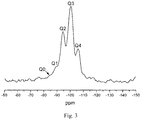
- the results of silicon nuclear magnetic resonance spectra ( 29 Si-NMR) of samples 1-41 were similar, and the 29 Si-NMR of sample 1 as a typical representative was shown in Fig. 3 .
Landscapes
- Chemical & Material Sciences (AREA)
- Organic Chemistry (AREA)
- Life Sciences & Earth Sciences (AREA)
- General Life Sciences & Earth Sciences (AREA)
- Geology (AREA)
- Engineering & Computer Science (AREA)
- Chemical Kinetics & Catalysis (AREA)
- Materials Engineering (AREA)
- Inorganic Chemistry (AREA)
- Silicates, Zeolites, And Molecular Sieves (AREA)
Abstract
Description
- The present application pertains to the field of high-silicon Y type molecular sieve synthesis.
- A Y type molecular sieve has a FAU topological structure and is a molecular sieve having an ultra-cage structure formed by arranging β cages according to diamond structure. At present, the Y type molecular sieve is mainly used as a catalyst and an adsorption and separation agent. Because the high-silicon Y type zeolite catalyst has the advantages of high activity, good stability, and so on, the preparation method thereof has been always a hot spot of studies.
- At present, the high-silicon Y type zeolite used industrially is mainly obtained by a post-processing method, such as chemical dealuminzation, physical dealuminzation, etc., performed on Y type zeolite raw powder. However, this method for increasing the silica-to-alumina ratio by dealuminzation post-processing has a complicated procedure, high energy consumption, and high pollution. The direct method for hydrothermally/solvothermally synthesizing high-silicon Y type zeolite can avoid complicated procedure of post-processing, save a large amount of human resource and material resource, and reduce the pollution to the environment. At the meanwhile, since the hydrothermally/solvothermally synthesized high-silicon Y type zeolite has a complete crystal structure and a uniform chemical distribution, the zeolite has a better catalytic effect.
- According to one aspect of the present application, there is provided a method for preparing a Y type molecular sieve having a high silica-to-alumina ratio. By selecting a suitable compound containing a tetraalkyl ammonium cation as a template agent, this method prepares a Y type molecular sieve having a silica-to-alumina ratio in backbone of no less than 6, high crystallinity, high activity, and good stability.
- The method for preparing a Y type molecular sieve is characterized in that a Y type molecular sieve is prepared by using a compound containing a tetraalkylammonium cation as a template agent;
the compound containing a tetraalkylammonium cation has a chemical structural formula as represented by formula (1):
- Preferably, in said formula (1), R1, R2, R3, and R4 are each independently selected from an alkyl group having a carbon atom number of 1 to 5; X-m is at least one selected from the group consisting of OH-, BF4 -, F-, Cl-, Br-, I-, NO3 -, H2PO3 -, HPO3 2-, PO3 3-, SO4 2-, and HSO4 -.
- Preferably, in said formula (1), R1, R2, R3, and R4 are the same alkyl groups.
- Preferably, in said formula (1), R1, R2, R3, and R4 are all ethyl groups.
- The alkyl group having a carbon atom number of 1 to 10 is a group formed from any alkane having a carbon atom number of 1 to 10 by losing any one of hydrogen atoms; and the any alkane having a carbon atom number of 1-10 is optionally selected from a linear alkane, a branched alkane, and a cycloalkane.
- Preferably, the compound containing a tetraalkylammonium cation is at least one selected from the group consisting of tetraethylammonium hydroxide (simply referred to as TEAOH), tetraethylammonium chloride (simply referred to as TEACl), tetraethylammonium bromide (simply referred to as TEABr), tetraethylammonium iodide (simply referred to as TEAI), tetraethylammonium tetrafluoroborate (simply referred to as TEABF4), tetrabutylammonium hydroxide (simply referred to as TBAOH), tetramethylammonium hydroxide (simply referred to as TMAOH), and tetrapropyl ammonium hydroxide (simply referred to as TPAOH).
- According to one embodiment of the present application, the method for preparing a Y type molecular sieve comprises at least the following steps:
- a) mixing deionized water, a silicon source, an aluminum source, an alkali source, and the compound containing a tetraalkylammonium cation to obtain an initial gel mixture having the following molar ratios:
SiO2/Al2O3 = 6-20;
alkali source/Al2O3 = 1-8, wherein the mole number of the alkali source is based on the mole number of oxides of metal elements in the alkali source;
H2O/Al2O3 = 100-400;
and
compound containing a tetraalkylammonium cation/Al2O3 = 0.1-6, wherein the mole number of the compound containing a tetraalkylammonium cation is based on the mole number of nitrogen element in the compound; and - b) feeding the initial gel mixture obtained in step a) into a high pressure synthesis kettle, closing the kettle, performing crystallization at 70-130 °C for 1-30 days, washing, and drying to obtain the Y type molecular sieve.
- In the initial gel, the mole number of the silicon source is based on the mole number of SiO2; the mole number of the aluminum source is based on Al2O3; the mole number of the alkali source is based on the mole number of oxides of metal elements in the alkali source, for example, if the alkali source is sodium hydroxide, the alkali source/Al2O3 = 1-8 is Na2O/Al2O3 = 1-8; for example, if the alkali source is potassium hydroxide, the alkali source/Al2O3 = 1-8 is K2O/Al2O3 = 1-8; and for example, if the alkali source is sodium hydroxide and potassium hydroxide, the alkali source/Al2O3 = 1-8 is (K2O+Na2O/Al2O3 = 1-8; the mole number of the compound containing a tetraalkylammonium cation is based on the mole number of nitrogen element in the compound.
- Preferably, in the initial gel mixture of step a), the range of the ratio of SiO2/Al2O3 has an upper limit optionally selected from 20, 15, and 12 and a lower limit optionally selected from 6 and 10; the range of the ratio of alkali source/Al2O3 has an upper limit optionally selected from 5, 3.5, and 2.5 and a lower limit optionally selected from 1 and 2.5; the range of the ratio of H2O/Al2O3 has an upper limit optionally selected from 400 and 300 and a lower limit optionally selected from 100 and 220; the range of the ratio of compound containing a tetraalkylammonium cation/Al2O3 has an upper limit optionally selected from 6 and 3 and a lower limit optionally selected from 0.1, 1.0, and 1.8.
- Preferably, in said step b), the initial gel mixture is aged at a temperature of no more than 50 °C for 1-100 hours and then fed into the high pressure synthesis kettle.
- Preferably, in said step a), the silicon source is at least one selected from the group consisting of silica sol, activated silica, and orthosilicate; the aluminum source is at least one selected from the group consisting of sodium aluminate, activated alumina, and aluminum alkoxide; and the alkali source is sodium hydroxide and/or potassium hydroxide.
- Preferably, in said step b), the initial gel mixture is aged at a temperature of 10-50 °C for 8-72 hours and then fed into the high pressure synthesis kettle.
- Preferably, in said step b), the crystallization temperature is 80-120 °C and the crystallization time is 3-20 days.
- Preferably, in said step b), the crystallization is performed in a static or dynamic state.
- In the present application, the crystallization process being performed in a static state means that the synthesis kettle charged with the initial gel mixture is left in an oven in the process of crystallization and the mixture in the synthesis kettle is not stirred.
- In the present application, the crystallization process being performed in a dynamic state means that the synthesis kettle charged with the initial gel mixture is in a non-static state, such as rolling, rotating, etc., in the process of crystallization; or the mixture in the synthesis kettle is stirred in the process of crystallization.
- As a preferable embodiment, the method comprises the following steps:
- a) mixing deionized water, a silicon source, an aluminum source, sodium hydroxide, and a compound containing a tetraethylammonium cation to obtain an initial gel mixture having the following ratios:
SiO2/Al2O3 = 6-20;
Na2O/Al2O3 = 1-8;
H2O/Al2O3 = 100-400;
and
TEA+/Al2O3 = 0.1-6;
and TEA+ represents a tetraethylammonium cation; - b) maintaining the initial gel mixture obtained in step a) at a temperature of no more than 50°C, stirring and aging for 1-100 hours to obtain a homogeneous gel mixture;
- c) feeding the homogeneous gel mixture obtained in step b) into a high pressure synthesis kettle, closing the kettle, heating to 70-130°C, and allowing crystallization to be conducted under an autogenic pressure for 3-30 days; and
- d) after the crystallization is complete, separating the solid product, washing with deionized water to neutral and drying, to obtain a NaY type molecular sieve having a high silica-to-alumina ratio.
- The compound containing a tetraethylammonium cation is a compound of formula (1), wherein R1, R2, R3, and R4 are all ethyl groups.
- The present application also provides a Y type molecular sieve having a high silica-to-alumina ratio prepared by the method described above, characterized in that the silica-to-alumina ratio of the Y type molecular sieve is not less than 6.
- The present application also provides a NaY type molecular sieve having a high silica-to-alumina ratio prepared by the method described above, characterized in that the silica-to-alumina ratio of the NaY type molecular sieve is not less than 6.
- The present application has the following advantageous effects:
- (1) A Y type molecular sieve having a high silica-to-alumina ratio is directly prepared by a hydrothermal process, using a compound containing a tetraalkylammonium cation as a template agent.
- (2) The Y type molecular sieve prepared has a silica-to-alumina ratio of no less than 6, high crystallinity, high activity, and good stability.
-
-
Fig. 1 is X-ray diffraction spectrum of sample 1. -
Fig. 2 is a scanning electron microscope (SEM) photograph of sample 1. -
Fig. 3 is a silicon nuclear magnetic resonance spectrum (29Si-NMR) of sample 1. - The present application will be described in detail below by Examples, but the present application is not limited to these Examples.
- In the present application, the X-ray powder diffraction phase analysis (XRD) of the product is carried out on X'Pert PRO X-ray diffractometer of PANalytical Corporation, Netherlands, using a Cu target, Kα radiation source (λ=0.15418 nm), a voltage of 40 KV, and a current of 40 mA. The relative crystallinity of the product is calculated based on the sum of XRD peak intensities of
crystal planes - In the present application, SU8020 scanning electron microscope of Hitachis is used in SEM morphologic analysis of the product.
- In the present application, the silica-to-alumina ratio of the product is measured by using Magix 2424 X-ray fluorescence analyzer (XRF) of Philips Corporation.
- In the present invention, Infinity plus 400WB solid nuclear magnetic resonance spectrum analyzer of Varian Corporation, U.S., is used in silicon nuclear magnetic resonance (29Si MAS NMR) analysis of the product, with a BBO MAS probe and an operational magnetic field strength of 9.4T. The silica-to-alumina ratio of the product may also be calculated from the result of 29Si MAS NMR, according to the following equation:
NMR SiO2/Al2O3 = 8 * (SQ0 + SQ1 + SQ2 + SQ3 + SQ4)/(SQ1 + 2SQ2 + 3SQ3 + 4SQ4)
wherein Qi represents the difference in the number of aluminum atoms surrounding a silicon-oxygen tetrahedron (SiO4) (i=0, 1, 2, 3, 4), and SQi represents a corresponding peak area of Qi on the silicon nuclear magnetic resonance spectrum. - A compound containing a tetraalkylammonium cation and an alkali source were dissolved in deionized water, an aluminum source was then added and stirred until a clarified liquid was obtained; then a silicon source was further added, and an initial gel mixture was obtained after homogeneously mixing; this initial gel mixture was stirred at room temperature for 24 hours to produce a homogeneous gel mixture; and this homogeneous gel mixture was transferred to a stainless high pressure synthesis kettle.
- The high pressure synthesis kettle was closed and placed in an oven, and crystallization was performed under an autogenic pressure for a period of time. After the crystallization was complete, the solid product was separated by centrifugation, washed with deionized water to neutral, and then dried in air at 100°C to obtain a sample.
- Nos. of the obtained samples, types and molar amounts of respective raw materials, crystallization temperature, and crystallization time, were detailed shown in Table 1.
Table 1 Sample No. Type and amount of compound containing tetraalkylammonium cation Aluminum source and mole number of Al2O3 contained Silicon source and mole number SiO2 contained Alkali source and mole number of Na2O/K2O contained H2O Crystallization temperature (°C) Crystallization time (day) Type of crystal structure Relative crystallinity (%) XRF (SiO2/Al2O3) NMR (SiO2/Al2O3) 1 TEAOH 0.18 mol Sodium aluminate 0.10mol Silica sol 1.2mol NaOH 0.25mol 22mol 110 7 Y type molecular sieve 100 7.2 6.9 2 TEAOH 0.01 mol Sodium aluminate 0.10mol Silica sol 1.2mol NaOH 0.5mol 22mol 110 7 Y type molecular sieve 100 6.5 6.3 3 TEAOH 0.18 mol Sodium aluminate 0.10mol Silica sol 0.6mol NaOH 0.1mol 10mol 110 7 Y type molecular sieve 100 6.2 6.1 4 TEAOH 0.18 mol Sodium aluminate 0.10mol Silica sol 1.0 mol NaOH 0.1mol 22mol 110 7 Y type molecular sieve 100 6.5 6.3 5 TEAOH 0.30 mol Sodium aluminate 0.10mol Silica sol 1.5 mol NaOH 0.25mol 30mol 110 7 Y type molecular sieve 100 6.8 6.6 6 TEAOH 0.60 mol Sodium aluminate 0.10mol Silica sol 2.0 mol NaOH 0.8mol 40mol 110 7 Y type molecular sieve 100 6.8 6.6 7 TEAOH 0.18 mol Sodium aluminate 0.10mol Silica sol 1.2 mol NaOH 0.25mol 22mol 70 30 Y type molecular sieve 85 6.2 6.1 8 TEAOH 0.18 mol Sodium aluminate 0.10mol Silica sol 1.2 mol NaOH 0.25mol 22mol 80 20 Y type molecular sieve 85 6.2 6.1 9 TEAOH 0.18 mol Sodium aluminate 0.10mol Silica sol 1.2 mol NaOH 0.25mol 22mol 90 15 Y type molecular sieve 90 6.4 6.2 10 TEAOH 0.18 mol Sodium aluminate 0.10mol Silica sol 1.2 mol NaOH 0.25mol 22mol 100 10 Y type molecular sieve 100 6.8 6.6 11 TEAOH 0.18 mol Sodium aluminate 0.10mol Silica sol 1.2 mol NaOH 0.25mol 22mol 120 5 Y type molecular sieve 100 7.2 6.9 12 TEAOH 0.18 mol Sodium aluminate 0.10mol Silica sol 1.2mol NaOH 0.25mol 22mol 130 1 Y type molecular sieve 90 6.5 6.2 13 TEAOH 0.18 mol Sodium aluminate 0.10mol Activated silica 1.2 mol NaOH 0.25mol 22mol 110 7 Y type molecular sieve 100 6.8 6.5 14 TEAOH 0.18 mol Sodium aluminate 0.10mol Orthosilicate 1.2mol NaOH 0.25mol 22mol 110 7 Y type molecular sieve 100 6.8 6.5 15 TEAOH 0.18 mol Activated alumina 0.10 mol Silica sol 1.2 mol KOH 0.25mol 22mol 110 7 Y type molecular sieve 100 6.8 6.5 16 TEAOH 0.18 mol Aluminum alkoxide 0.10 mol Silica sol 1.2 mol KOH 0.25mol 22mol 110 7 Y type molecular sieve 100 6.8 6.5 17 TEACl 0.18 mol Sodium aluminate 0.10mol Silica sol 1.2 mol NaOH 0.35mol 22mol 110 7 Y type molecular sieve 100 6.8 6.5 18 TEACl 0.18 mol Sodium aluminate 0.10mol Silica sol 1.2 mol NaOH 0.5mol 22mol 110 7 Y type molecular sieve 100 6.2 6.1 19 TEACl 0.6 mol Sodium aluminate 0.10mol Silica sol 2.0 mol NaOH 0.8mol 22mol 110 7 Y type molecular sieve 100 6.5 6.2 20 TEACl 0.18 mol Sodium aluminate 0.10mol Silica sol 1.2 mol NaOH 0.35mol 22mol 70 30 Y type molecular sieve 80 6.2 6.1 21 TEACl 0.18 mol Sodium aluminate 0.10mol Silica sol 1.2 mol NaOH 0.35mol 22mol 130 1 Y type molecular sieve 95 6.5 6.2 22 TEACl 0.18 mol Sodium aluminate 0.10mol Activated silica 1.2 mol NaOH 0.35mol 22mol 110 7 Y type molecular sieve 100 6.8 6.5 23 TEACl 0.18 mol Activated alumina 0.10 mol Silica sol 1.2 mol KOH 0.1mol+NaOH 0.25mol 22mol 110 7 Y type molecular sieve 100 6.8 6.5 24 TEABr 0.18 mol Sodium aluminate 0.10mol Silica sol 1.2 mol NaOH 0.35mol 22mol 110 7 Y type molecular sieve 100 6.8 6.5 25 TEABr 0.18 mol Sodium aluminate 0.10mol Silica sol 1.2 mol NaOH 0.5mol 22mol 110 7 Y type molecular sieve 100 6.2 6.1 26 TEABr 0.6 mol Sodium aluminate 0.10mol Silica sol 2.0 mol NaOH 0.8mol 22mol 110 7 Y type molecular sieve 100 6.5 6.2 27 TEABr 0.18 mol Sodium aluminate 0.10mol Silica sol 1.2 mol NaOH 0.35mol 22mol 70 30 Y type molecular sieve 80 6.2 6.1 28 TEABr 0.18 mol Sodium aluminate 0.10mol Silica sol 1.2 mol NaOH 0.35mol 22mol 130 1 Y type molecular sieve 95 6.5 6.2 29 TEABr 0.18 mol Sodium aluminate 0.10mol Activated silica 1.2mol NaOH 0.35mol 22mol 110 7 Y type molecular sieve 100 6.8 6.5 30 TEABr 0.18 mol Activated alumina 0.10 mol Silica sol 1.2 mol NaOH 0.35mol 22mol 110 7 Y type molecular sieve 100 6.8 6.5 31 TEAI 0.18 mol Sodium aluminate 0.10mol Silica sol 1.2 mol NaOH 0.35mol 22mol 110 7 Y type molecular sieve 100 6.8 6.5 32 TEABF4 0.18 mol Sodium aluminate 0.10mol Silica sol 1.2 mol NaOH 0.35mol 22mol 110 7 Y type molecular sieve 100 6.8 6.5 33 TEABF4 0.18 mol Sodium aluminate 0.10mol Silica sol 1.2 mol NaOH 0.5mol 22mol 110 7 Y type molecular sieve 100 6.2 6.1 34 TEABF4 0.6 mol Sodium aluminate 0.1mol Silica sol 2.0 mol NaOH 0.8mol 22mol 110 7 Y type molecular sieve 100 6.5 6.2 35 TEABF4 0.18 mol Sodium aluminate 0.10mol Silica sol 1.2 mol NaOH 0.35mol 22mol 70 30 Y type molecular sieve 80 6.2 6.1 36 TEABF4 0.18 mol Sodium aluminate 0.10mol Silica sol 1.2 mol NaOH 0.35mol 22mol 130 1 Y type molecular sieve 95 6.5 6.2 37 TEABF4 0.18 mol Sodium aluminate 0.10mol Activated silica 1.2 mol NaOH 0.35mol 22mol 110 7 Y type molecular sieve 100 6.8 6.5 38 TEABF4 0.18 mol Activated alumina 0.10mol Silica sol 1.2 mol NaOH 0.35mol 22mol 110 7 Y type molecular sieve 100 6.8 6.6 39 TMAOH 0.18 mol Sodium aluminate 0.10mol Silica sol 1.2 mol NaOH 0.35mol 22mol 110 7 Y type molecular sieve 100 6.8 6.5 40 TPAOH 0.18 mol Sodium aluminate 0.10mol Silica sol 1.2 mol NaOH 0.35mol 22mol 110 7 Y type molecular sieve 100 6.7 6.4 41 TBAOH 0.18 mol Sodium aluminate 0.10mol Silica sol 1.2 mol NaOH 0.35mol 22mol 110 7 Y type molecular sieve 100 6.8 6.5 42 - Sodium aluminate 0.10 mol Silica sol 1.2 mol NaOH 0.35mol 22mol 110 7 Y type molecular sieve 70 5.4 5.1 - The synthesis process, raw material formulations, and the analysis process were the same as those of Example 1, except that tetraethylammonium hydroxide was not added in the initial gel, and the obtained sample was denoted by sample 42. As for specific raw material formulations, conditions of crystallization reaction, and analytical results, details can be seen in Table 1.
- Samples 1-42 were characterized using X-ray powder diffraction. The results showed that all of samples 1-42 had structural characteristics of a Y type molecular sieve. Taking sample 1 as a typical representative, the XRD diffraction data result thereof was shown in Table 2 and the XRD spectrum was shown in
Fig. 1 . X-ray powder diffraction data results of samples 2-42 were all similar to those in Table 2. That is, the positions and shapes of peaks were the same, and relative peak intensities fluctuated in a range of ±20% according to the change of the synthesis conditions. - The relative crystallinity of the sample was calculated based on the sum of XRD peak intensities of
crystal planes Table 2: XRD result of sample 1 No. 2θ d(Å) 100×I/I0 1 6.194 14.26957 100 2 10.1407 8.72308 26.18 3 11.8979 7.43842 6.14 4 12.4092 7.13307 0.63 5 15.6745 5.65369 47.47 6 17.6158 5.0348 0.53 7 18.7174 4.74087 15.69 8 20.3974 4.35403 14.99 9 22.8376 3.89404 3.79 10 23.6939 3.7552 34.54 11 25.0653 3.55277 0.62 12 25.8287 3.44948 2.53 13 27.1013 3.29031 16.62 14 27.8352 3.20522 1.27 15 29.7052 3.00755 4.2 16 30.8127 2.90193 8.1 17 31.4627 2.84346 16.22 18 32.5277 2.75274 4.91 19 33.1534 2.70221 2.08 20 34.1594 2.6249 6.63 21 34.7572 2.58111 3.88 22 35.7072 2.51459 0.77 23 36.3146 2.47391 0.41 24 37.2516 2.41381 0.85 25 37.9873 2.36874 3.56 26 39.5125 2.28075 0.19 27 40.6606 2.21896 1.34 28 41.5084 2.17558 2.35 29 42.0199 2.15027 1.27 30 42.8813 2.10905 0.47 31 43.3394 2.08782 2.31 32 44.1624 2.0508 1.81 33 45.9746 1.97409 0.32 - Morphological characterization was performed on samples 1-41 using a scanning electron microscope. The results showed that most of them were octahedral crystal grains and had particle sizes in a range of 0.5µm to 30µm. Taking sample 1 as a typical representative, it had a scanning electron microscope photograph as shown in
Fig. 2 and a particle size in a range of 1µm to 20µm. - The silica-to-alumina ratios of samples 1-42 were measured using an X-ray fluorescence analyzer (XRF), and details of results were shown in the column "XRF (SiO2/Al2O3)" in Table 1.
- Samples 1-42 were measured using silicon nuclear magnetic resonance (29Si MAS NMR) and the silica-to-alumina ratios in backbones were obtained by calculation, the details of results being shown in the column "NMR (SiO2/Al2O3)" in Table 1. The results of silicon nuclear magnetic resonance spectra (29Si-NMR) of samples 1-41 were similar, and the 29Si-NMR of sample 1 as a typical representative was shown in
Fig. 3 . - As seen from the results of above Table 1, all of the Y type molecular sieve samples 1-41 synthesized according to the method of the present disclosure had silica-to-alumina ratios, either silica-to-alumina ratios of the product determined by XRF method or silica-to-alumina ratios in the backbone of the product determined by silicon nuclear magnetic resonance spectrum data, of no less than 6. For sample 42 synthesized in Comparative Example without use of tetraalkylammonium cation, however, both the crystallinity and the silica-to-alumina ratio were lower than those of samples 1-41. According to the study on catalytic cracking process, the Y type molecular sieve having a high crystallinity and a high silica-to-alumina ratio can significantly improve the catalytic cracking in terms of activity and stability.
- Although the present application has been disclosed as above by means of preferred examples, these examples are not intended to limit the claims. Several possible variations and modifications may be made by any person skilled in the art without departing from the concept of the present application. Therefore, the protection scope of the present application should be defined by the claims of the present application.
Claims (9)
- A method for preparing a Y type molecular sieve, characterized in that the Y type molecular sieve is prepared by using a compound containing a tetraalkylammonium cation as a template agent,
the compound containing a tetraalkylammonium cation has a chemical structural formula as represented by formula (1):
- The method according to claim 1, characterized in that in said formula (1), R1, R2, R3, and R4 are each independently selected from an alkyl group having a carbon atom number of 1 to 5; and X-m is at least one selected from the group consisting of OH-, BF4 -, F-, Cl-, Br-, I-, NO3 -, H2PO3 -, HPO3 2-, PO3 3-, SO4 2-, and HSO4 -.
- The method according to claim 1, characterized in that the compound containing a tetraalkylammonium cation is at least one selected from the group consisting of tetraethylammonium hydroxide, tetraethylammonium chloride, tetraethylammonium bromide, tetraethylammonium iodide, tetraethylammoniumtetrafluoroborate, tetrabutyl ammonium hydroxide, tetramethylammonium hydroxide, and tetrapropyl ammonium hydroxide.
- The method according to any one of claims 1 to 3, comprising at least the following steps:a) mixing deionized water, a silicon source, an aluminum source, an alkali source, and the compound containing a tetraalkylammonium cation to obtain an initial gel mixture having the following molar ratios:
SiO2/Al2O3 = 6-20;
alkali source/Al2O3 = 1-8, wherein the mole number of the alkali source is based on the mole number of oxides of metal elements in the alkali source;
H2O/Al2O3 = 100-400;
and
compound containing a tetraalkylammoniumcation/Al2O3 = 0.1-6, wherein the mole number of the compound containing a tetraalkylammoniumcation is based on the mole number of nitrogen element in the compound; andb) after aging the initial gel mixture obtained in step a), feeding the gel mixture into a high pressure synthesis kettle, closing the kettle, performing crystallization at 70-130 °C for 1-30 days, washing, and drying to obtain the Y type molecular sieve. - The method according to claim 4, characterized in that in said step b), the initial gel mixture is aged at a temperature of no more than 50 °C for 1-100 hours and then fed into the high pressure synthesis kettle.
- The method according to claim 4, characterized in that, in said step a), the silicon source is at least one selected from the group consisting of silica sol, activated silica, and orthosilicate; the aluminum source is at least one selected from the group consisting of sodium aluminate, activated alumina, and aluminum alkoxide; and the alkali source is sodium hydroxide and/or potassium hydroxide.
- The method according to claim 4, characterized in that in said step b), the initial gel mixture is aged at a temperature of 10-50 °C for 8-72 hours and then fed into the high pressure synthesis kettle.
- The method according to claim 4, characterized in that in said step b), the crystallization temperature is 80-120 °C and the crystallization time is 3-20 days.
- The method according to claim 4, characterized in that in said step b), the crystallization is performed in a static or dynamic state.
Applications Claiming Priority (2)
| Application Number | Priority Date | Filing Date | Title |
|---|---|---|---|
| CN201410432992.5A CN105439168B (en) | 2014-08-28 | 2014-08-28 | A kind of method for preparing high silica alumina ratio Y type molecular sieve |
| PCT/CN2014/093181 WO2016029591A1 (en) | 2014-08-28 | 2014-12-05 | Method for preparing y-type molecular sieve having high silica-alumina ratio |
Publications (3)
| Publication Number | Publication Date |
|---|---|
| EP3187463A1 true EP3187463A1 (en) | 2017-07-05 |
| EP3187463A4 EP3187463A4 (en) | 2018-03-14 |
| EP3187463B1 EP3187463B1 (en) | 2021-03-10 |
Family
ID=55398707
Family Applications (1)
| Application Number | Title | Priority Date | Filing Date |
|---|---|---|---|
| EP14900724.7A Not-in-force EP3187463B1 (en) | 2014-08-28 | 2014-12-05 | Method for preparing y-type molecular sieve having high silica-alumina ratio |
Country Status (7)
| Country | Link |
|---|---|
| US (1) | US10252917B2 (en) |
| EP (1) | EP3187463B1 (en) |
| JP (1) | JP6383100B2 (en) |
| KR (1) | KR101892951B1 (en) |
| CN (1) | CN105439168B (en) |
| AU (1) | AU2014404762B2 (en) |
| WO (1) | WO2016029591A1 (en) |
Families Citing this family (13)
| Publication number | Priority date | Publication date | Assignee | Title |
|---|---|---|---|---|
| CN111086994B (en) * | 2018-10-23 | 2021-10-08 | 中国石油化工股份有限公司 | A kind of method for synthesizing Y-type molecular sieve containing mesoporous high crystallinity |
| CN111086996B (en) * | 2018-10-23 | 2022-10-21 | 中国石油化工股份有限公司 | Preparation method of Y-type molecular sieve containing mesopores and high crystallinity |
| CN111825105B (en) * | 2019-04-18 | 2022-08-19 | 中国科学院大连化学物理研究所 | Preparation of Y molecular sieve with FAU structure by guide agent method |
| CN111825102B (en) * | 2019-04-18 | 2022-03-22 | 中国科学院大连化学物理研究所 | A kind of dry rubber conversion synthesis method of high silicon Y molecular sieve |
| CN111825103B (en) * | 2019-04-18 | 2022-04-12 | 中国科学院大连化学物理研究所 | A kind of fluorine-containing high silicon Y molecular sieve and preparation method thereof |
| CN113511658A (en) * | 2020-04-10 | 2021-10-19 | 中国石油化工股份有限公司 | NaY molecular sieve synthesis method for improving single-kettle yield |
| JP7694898B2 (en) * | 2020-06-11 | 2025-06-18 | 東ソー株式会社 | Crystalline aluminosilicate and method for producing zeolite using the same |
| CN115676847B (en) * | 2021-07-29 | 2024-04-02 | 中国石油化工股份有限公司 | Aluminum-containing SVR structure molecular sieve and preparation method thereof |
| CN115676849B (en) * | 2021-07-29 | 2024-03-12 | 中国石油化工股份有限公司 | SVR structure silicon zirconium molecular sieve and preparation method thereof |
| CN116022813B (en) * | 2021-10-25 | 2025-09-09 | 中国石油化工股份有限公司 | A Y-type molecular sieve and its synthesis method and application |
| CN113880104B (en) * | 2021-11-11 | 2024-01-26 | 青岛惠城环保科技集团股份有限公司 | Method for preparing NaX molecular sieve with low silicon-aluminum ratio by low-temperature crystallization |
| CN116514138B (en) * | 2023-04-21 | 2025-07-15 | 浙江工业大学 | A high-silicon FAU molecular sieve with a high proportion of exposed acidic sites and its preparation method and application |
| CN120157152A (en) * | 2023-12-14 | 2025-06-17 | 中国科学院大连化学物理研究所 | A molecular sieve SSZ-39 with AEI framework and its preparation method and application |
Family Cites Families (13)
| Publication number | Priority date | Publication date | Assignee | Title |
|---|---|---|---|---|
| US3130007A (en) * | 1961-05-12 | 1964-04-21 | Union Carbide Corp | Crystalline zeolite y |
| GB1145995A (en) * | 1965-04-09 | 1969-03-19 | Peter Spence & Sons Ltd | Improvements in or relating to the preparation of crystalline synthetic zeolites |
| JP3510660B2 (en) * | 1994-02-17 | 2004-03-29 | 触媒化成工業株式会社 | Method for producing faujasite-type zeolite |
| US5716593A (en) * | 1996-07-31 | 1998-02-10 | Chevron U.S.A. Inc. | Preparation of Y-type faujasite using an organic template |
| US7691514B2 (en) * | 2003-11-07 | 2010-04-06 | The Regents Of The University Of California | Polymer-zeolite nanocomposite membranes for proton-exchange-membrane fuel cells |
| JP4680515B2 (en) * | 2004-02-10 | 2011-05-11 | 東ソー株式会社 | Nanocrystalline zeolite particles and production method thereof |
| CN1331748C (en) * | 2004-09-08 | 2007-08-15 | 中国科学院大连化学物理研究所 | Production of Y-shaped molecular sieve |
| CN100390059C (en) * | 2005-10-19 | 2008-05-28 | 中国石油化工股份有限公司 | A kind of synthetic method of faujasite with high silicon-aluminum ratio |
| CN100390060C (en) * | 2005-10-19 | 2008-05-28 | 中国石油化工股份有限公司 | A kind of high silicon faujasite and its preparation method |
| US20070224113A1 (en) * | 2006-03-24 | 2007-09-27 | Willis Richard R | Process for Preparing Nano Size Zeolites |
| FR2909012B1 (en) * | 2006-11-23 | 2009-05-08 | Inst Francais Du Petrole | CATALYST BASED ON HIERARCHISED POROSITY MATERIAL COMPRISING SILICON AND METHOD FOR HYDROCRACKING / HYDROCONVERSION AND HYDROPROCESSING HYDROCARBON LOADS. |
| CN101870478A (en) * | 2009-04-22 | 2010-10-27 | 中国科学院大连化学物理研究所 | A kind of synthetic method of nano Y type molecular sieve |
| CN101549874A (en) * | 2009-05-08 | 2009-10-07 | 中国科学院大连化学物理研究所 | Synthesizing process for improving generation rate of nano Y-shaped molecular sieve |
-
2014
- 2014-08-28 CN CN201410432992.5A patent/CN105439168B/en active Active
- 2014-12-05 JP JP2017511887A patent/JP6383100B2/en not_active Expired - Fee Related
- 2014-12-05 US US15/505,176 patent/US10252917B2/en active Active
- 2014-12-05 AU AU2014404762A patent/AU2014404762B2/en not_active Ceased
- 2014-12-05 EP EP14900724.7A patent/EP3187463B1/en not_active Not-in-force
- 2014-12-05 KR KR1020177006770A patent/KR101892951B1/en not_active Expired - Fee Related
- 2014-12-05 WO PCT/CN2014/093181 patent/WO2016029591A1/en not_active Ceased
Also Published As
| Publication number | Publication date |
|---|---|
| KR101892951B1 (en) | 2018-08-29 |
| US20170260059A1 (en) | 2017-09-14 |
| CN105439168B (en) | 2018-05-25 |
| JP2017525651A (en) | 2017-09-07 |
| JP6383100B2 (en) | 2018-08-29 |
| EP3187463B1 (en) | 2021-03-10 |
| US10252917B2 (en) | 2019-04-09 |
| AU2014404762A1 (en) | 2017-03-16 |
| WO2016029591A1 (en) | 2016-03-03 |
| CN105439168A (en) | 2016-03-30 |
| EP3187463A4 (en) | 2018-03-14 |
| AU2014404762B2 (en) | 2018-05-24 |
| KR20170041883A (en) | 2017-04-17 |
Similar Documents
| Publication | Publication Date | Title |
|---|---|---|
| US10252917B2 (en) | Method for preparing Y type molecular sieve having high silica to alumina ratio | |
| EP3081532B1 (en) | Method for preparing nay molecular sieve of high silica-alumina ratio and product thereof | |
| US9738538B2 (en) | Method for preparing NaY molecular sieve of high silica-alumina ratio and product thereof | |
| CN106032281B (en) | A kind of preparation method and application with mesoporous and micropore modenite | |
| CN107922206A (en) | The manufacture method of AEI type zeolites | |
| CN105460953A (en) | SCM-8 molecular sieve and preparation method therefor | |
| WO2016086361A1 (en) | Method for synthesizing nano-zsm-5 zeolite | |
| CN106587102B (en) | The synthetic method of ZSM-12 type zeolite molecular sieves | |
| CN106608636A (en) | Preparation method for EUO-structured or NES-structured molecular sieve | |
| JP2014043371A (en) | Mse type zeolite and method for producing the same | |
| CN104692413B (en) | A kind of method of NaY molecular sieve for preparing high silica alumina ratio and products thereof | |
| CN105731484A (en) | Synthetic method of meso-microporous SAPO-34 molecular sieve | |
| CN104760971A (en) | Beta molecular sieve alkali-free metal ion synthesis method | |
| CN106145155B (en) | A kind of method, product and application of preparing high silicon-aluminum ratio Y-type molecular sieve | |
| CN109133087A (en) | A kind of synthetic method of Beta molecular sieve | |
| CN109928402A (en) | The catalyst of the preparation method of SAPO-34 molecular sieve, acid catalyst and oxygenate conversion olefine reaction | |
| CN106430237A (en) | A ZSM-5 molecular sieve with long whisker-like special morphology and its preparation and application | |
| EP4421039A1 (en) | Scm-38 molecular sieve, preparation method therefor, and use thereof | |
| CN115806300B (en) | Thin-sheet mordenite molecular sieve, and preparation method and application thereof | |
| CN109939726A (en) | Preparation and application of a catalyst containing heteroatom MTT molecular sieve | |
| CN113526518B (en) | All-silicon molecular sieve with ITH structure and synthesis method thereof | |
| JP4470003B2 (en) | High silica mordenite and its synthesis method | |
| CN110407229A (en) | Method for synthesizing CHA structure molecular sieve and CHA structure molecular sieve | |
| CN114516643A (en) | Mordenite molecular sieve synthesized by using pyridine quaternary ammonium salt as guide, preparation method and application | |
| WO2022104579A1 (en) | Mordenite molecular sieve guided and synthesized by pyridinium quaternary ammonium salt, preparation method therefor and application thereof |
Legal Events
| Date | Code | Title | Description |
|---|---|---|---|
| STAA | Information on the status of an ep patent application or granted ep patent |
Free format text: STATUS: THE INTERNATIONAL PUBLICATION HAS BEEN MADE |
|
| PUAI | Public reference made under article 153(3) epc to a published international application that has entered the european phase |
Free format text: ORIGINAL CODE: 0009012 |
|
| STAA | Information on the status of an ep patent application or granted ep patent |
Free format text: STATUS: REQUEST FOR EXAMINATION WAS MADE |
|
| 17P | Request for examination filed |
Effective date: 20170221 |
|
| AK | Designated contracting states |
Kind code of ref document: A1 Designated state(s): AL AT BE BG CH CY CZ DE DK EE ES FI FR GB GR HR HU IE IS IT LI LT LU LV MC MK MT NL NO PL PT RO RS SE SI SK SM TR |
|
| AX | Request for extension of the european patent |
Extension state: BA ME |
|
| DAX | Request for extension of the european patent (deleted) | ||
| RIC1 | Information provided on ipc code assigned before grant |
Ipc: C01B 39/20 20060101ALI20180131BHEP Ipc: C01B 39/24 20060101AFI20180131BHEP |
|
| A4 | Supplementary search report drawn up and despatched |
Effective date: 20180208 |
|
| STAA | Information on the status of an ep patent application or granted ep patent |
Free format text: STATUS: EXAMINATION IS IN PROGRESS |
|
| 17Q | First examination report despatched |
Effective date: 20200212 |
|
| GRAP | Despatch of communication of intention to grant a patent |
Free format text: ORIGINAL CODE: EPIDOSNIGR1 |
|
| STAA | Information on the status of an ep patent application or granted ep patent |
Free format text: STATUS: GRANT OF PATENT IS INTENDED |
|
| INTG | Intention to grant announced |
Effective date: 20201028 |
|
| GRAS | Grant fee paid |
Free format text: ORIGINAL CODE: EPIDOSNIGR3 |
|
| GRAA | (expected) grant |
Free format text: ORIGINAL CODE: 0009210 |
|
| STAA | Information on the status of an ep patent application or granted ep patent |
Free format text: STATUS: THE PATENT HAS BEEN GRANTED |
|
| AK | Designated contracting states |
Kind code of ref document: B1 Designated state(s): AL AT BE BG CH CY CZ DE DK EE ES FI FR GB GR HR HU IE IS IT LI LT LU LV MC MK MT NL NO PL PT RO RS SE SI SK SM TR |
|
| REG | Reference to a national code |
Ref country code: GB Ref legal event code: FG4D |
|
| REG | Reference to a national code |
Ref country code: AT Ref legal event code: REF Ref document number: 1369647 Country of ref document: AT Kind code of ref document: T Effective date: 20210315 Ref country code: CH Ref legal event code: EP |
|
| REG | Reference to a national code |
Ref country code: DE Ref legal event code: R096 Ref document number: 602014075667 Country of ref document: DE |
|
| REG | Reference to a national code |
Ref country code: IE Ref legal event code: FG4D |
|
| REG | Reference to a national code |
Ref country code: LT Ref legal event code: MG9D |
|
| PG25 | Lapsed in a contracting state [announced via postgrant information from national office to epo] |
Ref country code: NO Free format text: LAPSE BECAUSE OF FAILURE TO SUBMIT A TRANSLATION OF THE DESCRIPTION OR TO PAY THE FEE WITHIN THE PRESCRIBED TIME-LIMIT Effective date: 20210610 Ref country code: BG Free format text: LAPSE BECAUSE OF FAILURE TO SUBMIT A TRANSLATION OF THE DESCRIPTION OR TO PAY THE FEE WITHIN THE PRESCRIBED TIME-LIMIT Effective date: 20210610 Ref country code: LT Free format text: LAPSE BECAUSE OF FAILURE TO SUBMIT A TRANSLATION OF THE DESCRIPTION OR TO PAY THE FEE WITHIN THE PRESCRIBED TIME-LIMIT Effective date: 20210310 Ref country code: FI Free format text: LAPSE BECAUSE OF FAILURE TO SUBMIT A TRANSLATION OF THE DESCRIPTION OR TO PAY THE FEE WITHIN THE PRESCRIBED TIME-LIMIT Effective date: 20210310 Ref country code: HR Free format text: LAPSE BECAUSE OF FAILURE TO SUBMIT A TRANSLATION OF THE DESCRIPTION OR TO PAY THE FEE WITHIN THE PRESCRIBED TIME-LIMIT Effective date: 20210310 Ref country code: GR Free format text: LAPSE BECAUSE OF FAILURE TO SUBMIT A TRANSLATION OF THE DESCRIPTION OR TO PAY THE FEE WITHIN THE PRESCRIBED TIME-LIMIT Effective date: 20210611 |
|
| REG | Reference to a national code |
Ref country code: AT Ref legal event code: MK05 Ref document number: 1369647 Country of ref document: AT Kind code of ref document: T Effective date: 20210310 |
|
| REG | Reference to a national code |
Ref country code: NL Ref legal event code: MP Effective date: 20210310 |
|
| PG25 | Lapsed in a contracting state [announced via postgrant information from national office to epo] |
Ref country code: SE Free format text: LAPSE BECAUSE OF FAILURE TO SUBMIT A TRANSLATION OF THE DESCRIPTION OR TO PAY THE FEE WITHIN THE PRESCRIBED TIME-LIMIT Effective date: 20210310 Ref country code: RS Free format text: LAPSE BECAUSE OF FAILURE TO SUBMIT A TRANSLATION OF THE DESCRIPTION OR TO PAY THE FEE WITHIN THE PRESCRIBED TIME-LIMIT Effective date: 20210310 Ref country code: LV Free format text: LAPSE BECAUSE OF FAILURE TO SUBMIT A TRANSLATION OF THE DESCRIPTION OR TO PAY THE FEE WITHIN THE PRESCRIBED TIME-LIMIT Effective date: 20210310 |
|
| PG25 | Lapsed in a contracting state [announced via postgrant information from national office to epo] |
Ref country code: NL Free format text: LAPSE BECAUSE OF FAILURE TO SUBMIT A TRANSLATION OF THE DESCRIPTION OR TO PAY THE FEE WITHIN THE PRESCRIBED TIME-LIMIT Effective date: 20210310 |
|
| PG25 | Lapsed in a contracting state [announced via postgrant information from national office to epo] |
Ref country code: SM Free format text: LAPSE BECAUSE OF FAILURE TO SUBMIT A TRANSLATION OF THE DESCRIPTION OR TO PAY THE FEE WITHIN THE PRESCRIBED TIME-LIMIT Effective date: 20210310 Ref country code: CZ Free format text: LAPSE BECAUSE OF FAILURE TO SUBMIT A TRANSLATION OF THE DESCRIPTION OR TO PAY THE FEE WITHIN THE PRESCRIBED TIME-LIMIT Effective date: 20210310 Ref country code: EE Free format text: LAPSE BECAUSE OF FAILURE TO SUBMIT A TRANSLATION OF THE DESCRIPTION OR TO PAY THE FEE WITHIN THE PRESCRIBED TIME-LIMIT Effective date: 20210310 Ref country code: AT Free format text: LAPSE BECAUSE OF FAILURE TO SUBMIT A TRANSLATION OF THE DESCRIPTION OR TO PAY THE FEE WITHIN THE PRESCRIBED TIME-LIMIT Effective date: 20210310 |
|
| PG25 | Lapsed in a contracting state [announced via postgrant information from national office to epo] |
Ref country code: PL Free format text: LAPSE BECAUSE OF FAILURE TO SUBMIT A TRANSLATION OF THE DESCRIPTION OR TO PAY THE FEE WITHIN THE PRESCRIBED TIME-LIMIT Effective date: 20210310 Ref country code: PT Free format text: LAPSE BECAUSE OF FAILURE TO SUBMIT A TRANSLATION OF THE DESCRIPTION OR TO PAY THE FEE WITHIN THE PRESCRIBED TIME-LIMIT Effective date: 20210712 Ref country code: SK Free format text: LAPSE BECAUSE OF FAILURE TO SUBMIT A TRANSLATION OF THE DESCRIPTION OR TO PAY THE FEE WITHIN THE PRESCRIBED TIME-LIMIT Effective date: 20210310 Ref country code: RO Free format text: LAPSE BECAUSE OF FAILURE TO SUBMIT A TRANSLATION OF THE DESCRIPTION OR TO PAY THE FEE WITHIN THE PRESCRIBED TIME-LIMIT Effective date: 20210310 Ref country code: IS Free format text: LAPSE BECAUSE OF FAILURE TO SUBMIT A TRANSLATION OF THE DESCRIPTION OR TO PAY THE FEE WITHIN THE PRESCRIBED TIME-LIMIT Effective date: 20210710 |
|
| REG | Reference to a national code |
Ref country code: DE Ref legal event code: R097 Ref document number: 602014075667 Country of ref document: DE |
|
| PLBE | No opposition filed within time limit |
Free format text: ORIGINAL CODE: 0009261 |
|
| STAA | Information on the status of an ep patent application or granted ep patent |
Free format text: STATUS: NO OPPOSITION FILED WITHIN TIME LIMIT |
|
| PG25 | Lapsed in a contracting state [announced via postgrant information from national office to epo] |
Ref country code: DK Free format text: LAPSE BECAUSE OF FAILURE TO SUBMIT A TRANSLATION OF THE DESCRIPTION OR TO PAY THE FEE WITHIN THE PRESCRIBED TIME-LIMIT Effective date: 20210310 Ref country code: ES Free format text: LAPSE BECAUSE OF FAILURE TO SUBMIT A TRANSLATION OF THE DESCRIPTION OR TO PAY THE FEE WITHIN THE PRESCRIBED TIME-LIMIT Effective date: 20210310 Ref country code: AL Free format text: LAPSE BECAUSE OF FAILURE TO SUBMIT A TRANSLATION OF THE DESCRIPTION OR TO PAY THE FEE WITHIN THE PRESCRIBED TIME-LIMIT Effective date: 20210310 |
|
| 26N | No opposition filed |
Effective date: 20211213 |
|
| PG25 | Lapsed in a contracting state [announced via postgrant information from national office to epo] |
Ref country code: SI Free format text: LAPSE BECAUSE OF FAILURE TO SUBMIT A TRANSLATION OF THE DESCRIPTION OR TO PAY THE FEE WITHIN THE PRESCRIBED TIME-LIMIT Effective date: 20210310 |
|
| PG25 | Lapsed in a contracting state [announced via postgrant information from national office to epo] |
Ref country code: IT Free format text: LAPSE BECAUSE OF FAILURE TO SUBMIT A TRANSLATION OF THE DESCRIPTION OR TO PAY THE FEE WITHIN THE PRESCRIBED TIME-LIMIT Effective date: 20210310 |
|
| PG25 | Lapsed in a contracting state [announced via postgrant information from national office to epo] |
Ref country code: IS Free format text: LAPSE BECAUSE OF FAILURE TO SUBMIT A TRANSLATION OF THE DESCRIPTION OR TO PAY THE FEE WITHIN THE PRESCRIBED TIME-LIMIT Effective date: 20210710 |
|
| REG | Reference to a national code |
Ref country code: DE Ref legal event code: R119 Ref document number: 602014075667 Country of ref document: DE |
|
| PG25 | Lapsed in a contracting state [announced via postgrant information from national office to epo] |
Ref country code: MC Free format text: LAPSE BECAUSE OF FAILURE TO SUBMIT A TRANSLATION OF THE DESCRIPTION OR TO PAY THE FEE WITHIN THE PRESCRIBED TIME-LIMIT Effective date: 20210310 |
|
| REG | Reference to a national code |
Ref country code: CH Ref legal event code: PL |
|
| GBPC | Gb: european patent ceased through non-payment of renewal fee |
Effective date: 20211205 |
|
| REG | Reference to a national code |
Ref country code: BE Ref legal event code: MM Effective date: 20211231 |
|
| PG25 | Lapsed in a contracting state [announced via postgrant information from national office to epo] |
Ref country code: LU Free format text: LAPSE BECAUSE OF NON-PAYMENT OF DUE FEES Effective date: 20211205 Ref country code: IE Free format text: LAPSE BECAUSE OF NON-PAYMENT OF DUE FEES Effective date: 20211205 Ref country code: GB Free format text: LAPSE BECAUSE OF NON-PAYMENT OF DUE FEES Effective date: 20211205 Ref country code: DE Free format text: LAPSE BECAUSE OF NON-PAYMENT OF DUE FEES Effective date: 20220701 |
|
| PG25 | Lapsed in a contracting state [announced via postgrant information from national office to epo] |
Ref country code: FR Free format text: LAPSE BECAUSE OF NON-PAYMENT OF DUE FEES Effective date: 20211231 Ref country code: BE Free format text: LAPSE BECAUSE OF NON-PAYMENT OF DUE FEES Effective date: 20211231 |
|
| PG25 | Lapsed in a contracting state [announced via postgrant information from national office to epo] |
Ref country code: LI Free format text: LAPSE BECAUSE OF NON-PAYMENT OF DUE FEES Effective date: 20211231 Ref country code: CH Free format text: LAPSE BECAUSE OF NON-PAYMENT OF DUE FEES Effective date: 20211231 |
|
| PG25 | Lapsed in a contracting state [announced via postgrant information from national office to epo] |
Ref country code: HU Free format text: LAPSE BECAUSE OF FAILURE TO SUBMIT A TRANSLATION OF THE DESCRIPTION OR TO PAY THE FEE WITHIN THE PRESCRIBED TIME-LIMIT; INVALID AB INITIO Effective date: 20141205 |
|
| PG25 | Lapsed in a contracting state [announced via postgrant information from national office to epo] |
Ref country code: CY Free format text: LAPSE BECAUSE OF FAILURE TO SUBMIT A TRANSLATION OF THE DESCRIPTION OR TO PAY THE FEE WITHIN THE PRESCRIBED TIME-LIMIT Effective date: 20210310 |
|
| PG25 | Lapsed in a contracting state [announced via postgrant information from national office to epo] |
Ref country code: MK Free format text: LAPSE BECAUSE OF FAILURE TO SUBMIT A TRANSLATION OF THE DESCRIPTION OR TO PAY THE FEE WITHIN THE PRESCRIBED TIME-LIMIT Effective date: 20210310 |
|
| PG25 | Lapsed in a contracting state [announced via postgrant information from national office to epo] |
Ref country code: TR Free format text: LAPSE BECAUSE OF FAILURE TO SUBMIT A TRANSLATION OF THE DESCRIPTION OR TO PAY THE FEE WITHIN THE PRESCRIBED TIME-LIMIT Effective date: 20210310 |
|
| PG25 | Lapsed in a contracting state [announced via postgrant information from national office to epo] |
Ref country code: MT Free format text: LAPSE BECAUSE OF FAILURE TO SUBMIT A TRANSLATION OF THE DESCRIPTION OR TO PAY THE FEE WITHIN THE PRESCRIBED TIME-LIMIT Effective date: 20210310 |