EP3184112A1 - Synthetic intermediate of 1-(2-deoxy-2-fluoro-4-thio-ss-d-arabinofuranosyl)cytosine - Google Patents
Synthetic intermediate of 1-(2-deoxy-2-fluoro-4-thio-ss-d-arabinofuranosyl)cytosine Download PDFInfo
- Publication number
- EP3184112A1 EP3184112A1 EP17150141.4A EP17150141A EP3184112A1 EP 3184112 A1 EP3184112 A1 EP 3184112A1 EP 17150141 A EP17150141 A EP 17150141A EP 3184112 A1 EP3184112 A1 EP 3184112A1
- Authority
- EP
- European Patent Office
- Prior art keywords
- group
- optionally substituted
- formula
- ddd
- nmr
- Prior art date
- Legal status (The legal status is an assumption and is not a legal conclusion. Google has not performed a legal analysis and makes no representation as to the accuracy of the status listed.)
- Granted
Links
- 0 CSC(C1)C11SC(*)C2(CC2)C1 Chemical compound CSC(C1)C11SC(*)C2(CC2)C1 0.000 description 51
- ANMNJCIDADTPPU-RTKIROINSA-N B[C@@H](COC(c1ccccc1)=O)C([C@@H](C=N)F)OC(c1ccccc1)=O Chemical compound B[C@@H](COC(c1ccccc1)=O)C([C@@H](C=N)F)OC(c1ccccc1)=O ANMNJCIDADTPPU-RTKIROINSA-N 0.000 description 1
- WLIPGSFNHPEIHN-CQLXCSJHSA-N C=CC(CC(C=CN1C(C2F)S[C@H](CO)[C@H]2O)=NC1=O)=C Chemical compound C=CC(CC(C=CN1C(C2F)S[C@H](CO)[C@H]2O)=NC1=O)=C WLIPGSFNHPEIHN-CQLXCSJHSA-N 0.000 description 1
- ISRMGWVEHKLBLS-UHFFFAOYSA-N CC(C(CCO)C1COC=CC1)O Chemical compound CC(C(CCO)C1COC=CC1)O ISRMGWVEHKLBLS-UHFFFAOYSA-N 0.000 description 1
- VASXTGVCXNGRJZ-YVNMAJEFSA-N CC(C(CCO)[C@H]1C=CC=CC1)O Chemical compound CC(C(CCO)[C@H]1C=CC=CC1)O VASXTGVCXNGRJZ-YVNMAJEFSA-N 0.000 description 1
- PXGNQADZRPCNJQ-LMARGRMVSA-N CC1C(c(cc2)ccc2C(OC[C@H](C[C@@H](C=N)F)O)=O)=CC=CC1 Chemical compound CC1C(c(cc2)ccc2C(OC[C@H](C[C@@H](C=N)F)O)=O)=CC=CC1 PXGNQADZRPCNJQ-LMARGRMVSA-N 0.000 description 1
- ULRUFWVRASYVEG-IANNHFEVSA-N COC([C@H]1F)O[C@H](CO)[C@H]1O Chemical compound COC([C@H]1F)O[C@H](CO)[C@H]1O ULRUFWVRASYVEG-IANNHFEVSA-N 0.000 description 1
- WPMAACZRUAFXOA-UHFFFAOYSA-N Cc(cc1)ccc1C(N(Cc1ccccc1)C(CCC1)C1O)=O Chemical compound Cc(cc1)ccc1C(N(Cc1ccccc1)C(CCC1)C1O)=O WPMAACZRUAFXOA-UHFFFAOYSA-N 0.000 description 1
- PGZGUNUNFSWBGH-KSBZDLFUSA-N NC(C=CN1C([C@H]2F)SC(COCc3ccccc3)[C@H]2OCc2ccccc2)=NC1=O Chemical compound NC(C=CN1C([C@H]2F)SC(COCc3ccccc3)[C@H]2OCc2ccccc2)=NC1=O PGZGUNUNFSWBGH-KSBZDLFUSA-N 0.000 description 1
- NIDPJRZOVFIBQB-RQFJETTJSA-N NC(C=CN1C([C@H]2F)S[C@H](CO)[C@H]2O)=NC1=O Chemical compound NC(C=CN1C([C@H]2F)S[C@H](CO)[C@H]2O)=NC1=O NIDPJRZOVFIBQB-RQFJETTJSA-N 0.000 description 1
- FDAYEGGTWHVDIB-RTKIROINSA-N O=C[C@H](C([C@H](COC(c1ccc(C(F)(F)F)cc1)=O)Br)OC(c1ccc(C(F)(F)F)cc1)=O)F Chemical compound O=C[C@H](C([C@H](COC(c1ccc(C(F)(F)F)cc1)=O)Br)OC(c1ccc(C(F)(F)F)cc1)=O)F FDAYEGGTWHVDIB-RTKIROINSA-N 0.000 description 1
- BQTFYOMRNNMENH-MHYDHLEJSA-N OC([C@H]1F)S[C@H](COCc(cc2)ccc2Cl)[C@H]1OCc(cc1)ccc1Cl Chemical compound OC([C@H]1F)S[C@H](COCc(cc2)ccc2Cl)[C@H]1OCc(cc1)ccc1Cl BQTFYOMRNNMENH-MHYDHLEJSA-N 0.000 description 1
- RDIUXLZPXIJEDO-HVFQMFNGSA-N OC1O[C@H](COC(c2ccccc2)=O)C[C@@H]1F Chemical compound OC1O[C@H](COC(c2ccccc2)=O)C[C@@H]1F RDIUXLZPXIJEDO-HVFQMFNGSA-N 0.000 description 1
Classifications
-
- A—HUMAN NECESSITIES
- A61—MEDICAL OR VETERINARY SCIENCE; HYGIENE
- A61K—PREPARATIONS FOR MEDICAL, DENTAL OR TOILETRY PURPOSES
- A61K31/00—Medicinal preparations containing organic active ingredients
- A61K31/70—Carbohydrates; Sugars; Derivatives thereof
- A61K31/7042—Compounds having saccharide radicals and heterocyclic rings
- A61K31/7052—Compounds having saccharide radicals and heterocyclic rings having nitrogen as a ring hetero atom, e.g. nucleosides, nucleotides
- A61K31/706—Compounds having saccharide radicals and heterocyclic rings having nitrogen as a ring hetero atom, e.g. nucleosides, nucleotides containing six-membered rings with nitrogen as a ring hetero atom
- A61K31/7064—Compounds having saccharide radicals and heterocyclic rings having nitrogen as a ring hetero atom, e.g. nucleosides, nucleotides containing six-membered rings with nitrogen as a ring hetero atom containing condensed or non-condensed pyrimidines
- A61K31/7068—Compounds having saccharide radicals and heterocyclic rings having nitrogen as a ring hetero atom, e.g. nucleosides, nucleotides containing six-membered rings with nitrogen as a ring hetero atom containing condensed or non-condensed pyrimidines having oxo groups directly attached to the pyrimidine ring, e.g. cytidine, cytidylic acid
-
- A—HUMAN NECESSITIES
- A61—MEDICAL OR VETERINARY SCIENCE; HYGIENE
- A61P—SPECIFIC THERAPEUTIC ACTIVITY OF CHEMICAL COMPOUNDS OR MEDICINAL PREPARATIONS
- A61P35/00—Antineoplastic agents
-
- C—CHEMISTRY; METALLURGY
- C07—ORGANIC CHEMISTRY
- C07B—GENERAL METHODS OF ORGANIC CHEMISTRY; APPARATUS THEREFOR
- C07B53/00—Asymmetric syntheses
-
- C—CHEMISTRY; METALLURGY
- C07—ORGANIC CHEMISTRY
- C07C—ACYCLIC OR CARBOCYCLIC COMPOUNDS
- C07C249/00—Preparation of compounds containing nitrogen atoms doubly-bound to a carbon skeleton
- C07C249/04—Preparation of compounds containing nitrogen atoms doubly-bound to a carbon skeleton of oximes
-
- C—CHEMISTRY; METALLURGY
- C07—ORGANIC CHEMISTRY
- C07C—ACYCLIC OR CARBOCYCLIC COMPOUNDS
- C07C251/00—Compounds containing nitrogen atoms doubly-bound to a carbon skeleton
- C07C251/32—Oximes
- C07C251/34—Oximes with oxygen atoms of oxyimino groups bound to hydrogen atoms or to carbon atoms of unsubstituted hydrocarbon radicals
- C07C251/36—Oximes with oxygen atoms of oxyimino groups bound to hydrogen atoms or to carbon atoms of unsubstituted hydrocarbon radicals with the carbon atoms of the oxyimino groups bound to hydrogen atoms or to acyclic carbon atoms
- C07C251/38—Oximes with oxygen atoms of oxyimino groups bound to hydrogen atoms or to carbon atoms of unsubstituted hydrocarbon radicals with the carbon atoms of the oxyimino groups bound to hydrogen atoms or to acyclic carbon atoms to carbon atoms of a saturated carbon skeleton
-
- C—CHEMISTRY; METALLURGY
- C07—ORGANIC CHEMISTRY
- C07C—ACYCLIC OR CARBOCYCLIC COMPOUNDS
- C07C251/00—Compounds containing nitrogen atoms doubly-bound to a carbon skeleton
- C07C251/32—Oximes
- C07C251/34—Oximes with oxygen atoms of oxyimino groups bound to hydrogen atoms or to carbon atoms of unsubstituted hydrocarbon radicals
- C07C251/36—Oximes with oxygen atoms of oxyimino groups bound to hydrogen atoms or to carbon atoms of unsubstituted hydrocarbon radicals with the carbon atoms of the oxyimino groups bound to hydrogen atoms or to acyclic carbon atoms
- C07C251/40—Oximes with oxygen atoms of oxyimino groups bound to hydrogen atoms or to carbon atoms of unsubstituted hydrocarbon radicals with the carbon atoms of the oxyimino groups bound to hydrogen atoms or to acyclic carbon atoms to carbon atoms of an unsaturated carbon skeleton
-
- C—CHEMISTRY; METALLURGY
- C07—ORGANIC CHEMISTRY
- C07C—ACYCLIC OR CARBOCYCLIC COMPOUNDS
- C07C303/00—Preparation of esters or amides of sulfuric acids; Preparation of sulfonic acids or of their esters, halides, anhydrides or amides
- C07C303/26—Preparation of esters or amides of sulfuric acids; Preparation of sulfonic acids or of their esters, halides, anhydrides or amides of esters of sulfonic acids
- C07C303/28—Preparation of esters or amides of sulfuric acids; Preparation of sulfonic acids or of their esters, halides, anhydrides or amides of esters of sulfonic acids by reaction of hydroxy compounds with sulfonic acids or derivatives thereof
-
- C—CHEMISTRY; METALLURGY
- C07—ORGANIC CHEMISTRY
- C07C—ACYCLIC OR CARBOCYCLIC COMPOUNDS
- C07C309/00—Sulfonic acids; Halides, esters, or anhydrides thereof
- C07C309/63—Esters of sulfonic acids
- C07C309/64—Esters of sulfonic acids having sulfur atoms of esterified sulfo groups bound to acyclic carbon atoms
- C07C309/65—Esters of sulfonic acids having sulfur atoms of esterified sulfo groups bound to acyclic carbon atoms of a saturated carbon skeleton
- C07C309/66—Methanesulfonates
-
- C—CHEMISTRY; METALLURGY
- C07—ORGANIC CHEMISTRY
- C07C—ACYCLIC OR CARBOCYCLIC COMPOUNDS
- C07C309/00—Sulfonic acids; Halides, esters, or anhydrides thereof
- C07C309/63—Esters of sulfonic acids
- C07C309/72—Esters of sulfonic acids having sulfur atoms of esterified sulfo groups bound to carbon atoms of six-membered aromatic rings of a carbon skeleton
- C07C309/73—Esters of sulfonic acids having sulfur atoms of esterified sulfo groups bound to carbon atoms of six-membered aromatic rings of a carbon skeleton to carbon atoms of non-condensed six-membered aromatic rings
-
- C—CHEMISTRY; METALLURGY
- C07—ORGANIC CHEMISTRY
- C07C—ACYCLIC OR CARBOCYCLIC COMPOUNDS
- C07C45/00—Preparation of compounds having >C = O groups bound only to carbon or hydrogen atoms; Preparation of chelates of such compounds
-
- C—CHEMISTRY; METALLURGY
- C07—ORGANIC CHEMISTRY
- C07C—ACYCLIC OR CARBOCYCLIC COMPOUNDS
- C07C47/00—Compounds having —CHO groups
- C07C47/02—Saturated compounds having —CHO groups bound to acyclic carbon atoms or to hydrogen
- C07C47/19—Saturated compounds having —CHO groups bound to acyclic carbon atoms or to hydrogen containing hydroxy groups
-
- C—CHEMISTRY; METALLURGY
- C07—ORGANIC CHEMISTRY
- C07C—ACYCLIC OR CARBOCYCLIC COMPOUNDS
- C07C47/00—Compounds having —CHO groups
- C07C47/20—Unsaturated compounds having —CHO groups bound to acyclic carbon atoms
- C07C47/277—Unsaturated compounds having —CHO groups bound to acyclic carbon atoms containing ether groups, groups, groups, or groups
-
- C—CHEMISTRY; METALLURGY
- C07—ORGANIC CHEMISTRY
- C07C—ACYCLIC OR CARBOCYCLIC COMPOUNDS
- C07C67/00—Preparation of carboxylic acid esters
- C07C67/28—Preparation of carboxylic acid esters by modifying the hydroxylic moiety of the ester, such modification not being an introduction of an ester group
- C07C67/29—Preparation of carboxylic acid esters by modifying the hydroxylic moiety of the ester, such modification not being an introduction of an ester group by introduction of oxygen-containing functional groups
-
- C—CHEMISTRY; METALLURGY
- C07—ORGANIC CHEMISTRY
- C07C—ACYCLIC OR CARBOCYCLIC COMPOUNDS
- C07C68/00—Preparation of esters of carbonic or haloformic acids
- C07C68/06—Preparation of esters of carbonic or haloformic acids from organic carbonates
-
- C—CHEMISTRY; METALLURGY
- C07—ORGANIC CHEMISTRY
- C07C—ACYCLIC OR CARBOCYCLIC COMPOUNDS
- C07C69/00—Esters of carboxylic acids; Esters of carbonic or haloformic acids
- C07C69/02—Esters of acyclic saturated monocarboxylic acids having the carboxyl group bound to an acyclic carbon atom or to hydrogen
- C07C69/22—Esters of acyclic saturated monocarboxylic acids having the carboxyl group bound to an acyclic carbon atom or to hydrogen having three or more carbon atoms in the acid moiety
- C07C69/28—Esters of acyclic saturated monocarboxylic acids having the carboxyl group bound to an acyclic carbon atom or to hydrogen having three or more carbon atoms in the acid moiety esterified with dihydroxylic compounds
-
- C—CHEMISTRY; METALLURGY
- C07—ORGANIC CHEMISTRY
- C07C—ACYCLIC OR CARBOCYCLIC COMPOUNDS
- C07C69/00—Esters of carboxylic acids; Esters of carbonic or haloformic acids
- C07C69/612—Esters of carboxylic acids having a carboxyl group bound to an acyclic carbon atom and having a six-membered aromatic ring in the acid moiety
- C07C69/618—Esters of carboxylic acids having a carboxyl group bound to an acyclic carbon atom and having a six-membered aromatic ring in the acid moiety having unsaturation outside the six-membered aromatic ring
-
- C—CHEMISTRY; METALLURGY
- C07—ORGANIC CHEMISTRY
- C07C—ACYCLIC OR CARBOCYCLIC COMPOUNDS
- C07C69/00—Esters of carboxylic acids; Esters of carbonic or haloformic acids
- C07C69/76—Esters of carboxylic acids having a carboxyl group bound to a carbon atom of a six-membered aromatic ring
-
- C—CHEMISTRY; METALLURGY
- C07—ORGANIC CHEMISTRY
- C07C—ACYCLIC OR CARBOCYCLIC COMPOUNDS
- C07C69/00—Esters of carboxylic acids; Esters of carbonic or haloformic acids
- C07C69/76—Esters of carboxylic acids having a carboxyl group bound to a carbon atom of a six-membered aromatic ring
- C07C69/78—Benzoic acid esters
-
- C—CHEMISTRY; METALLURGY
- C07—ORGANIC CHEMISTRY
- C07C—ACYCLIC OR CARBOCYCLIC COMPOUNDS
- C07C69/00—Esters of carboxylic acids; Esters of carbonic or haloformic acids
- C07C69/76—Esters of carboxylic acids having a carboxyl group bound to a carbon atom of a six-membered aromatic ring
- C07C69/84—Esters of carboxylic acids having a carboxyl group bound to a carbon atom of a six-membered aromatic ring of monocyclic hydroxy carboxylic acids, the hydroxy groups and the carboxyl groups of which are bound to carbon atoms of a six-membered aromatic ring
- C07C69/92—Esters of carboxylic acids having a carboxyl group bound to a carbon atom of a six-membered aromatic ring of monocyclic hydroxy carboxylic acids, the hydroxy groups and the carboxyl groups of which are bound to carbon atoms of a six-membered aromatic ring with etherified hydroxyl groups
-
- C—CHEMISTRY; METALLURGY
- C07—ORGANIC CHEMISTRY
- C07C—ACYCLIC OR CARBOCYCLIC COMPOUNDS
- C07C69/00—Esters of carboxylic acids; Esters of carbonic or haloformic acids
- C07C69/96—Esters of carbonic or haloformic acids
-
- C—CHEMISTRY; METALLURGY
- C07—ORGANIC CHEMISTRY
- C07D—HETEROCYCLIC COMPOUNDS
- C07D333/00—Heterocyclic compounds containing five-membered rings having one sulfur atom as the only ring hetero atom
- C07D333/02—Heterocyclic compounds containing five-membered rings having one sulfur atom as the only ring hetero atom not condensed with other rings
- C07D333/04—Heterocyclic compounds containing five-membered rings having one sulfur atom as the only ring hetero atom not condensed with other rings not substituted on the ring sulphur atom
- C07D333/26—Heterocyclic compounds containing five-membered rings having one sulfur atom as the only ring hetero atom not condensed with other rings not substituted on the ring sulphur atom with hetero atoms or with carbon atoms having three bonds to hetero atoms with at the most one bond to halogen, e.g. ester or nitrile radicals, directly attached to ring carbon atoms
- C07D333/30—Hetero atoms other than halogen
-
- C—CHEMISTRY; METALLURGY
- C07—ORGANIC CHEMISTRY
- C07D—HETEROCYCLIC COMPOUNDS
- C07D333/00—Heterocyclic compounds containing five-membered rings having one sulfur atom as the only ring hetero atom
- C07D333/02—Heterocyclic compounds containing five-membered rings having one sulfur atom as the only ring hetero atom not condensed with other rings
- C07D333/04—Heterocyclic compounds containing five-membered rings having one sulfur atom as the only ring hetero atom not condensed with other rings not substituted on the ring sulphur atom
- C07D333/26—Heterocyclic compounds containing five-membered rings having one sulfur atom as the only ring hetero atom not condensed with other rings not substituted on the ring sulphur atom with hetero atoms or with carbon atoms having three bonds to hetero atoms with at the most one bond to halogen, e.g. ester or nitrile radicals, directly attached to ring carbon atoms
- C07D333/30—Hetero atoms other than halogen
- C07D333/32—Oxygen atoms
-
- C—CHEMISTRY; METALLURGY
- C07—ORGANIC CHEMISTRY
- C07D—HETEROCYCLIC COMPOUNDS
- C07D409/00—Heterocyclic compounds containing two or more hetero rings, at least one ring having sulfur atoms as the only ring hetero atoms
- C07D409/02—Heterocyclic compounds containing two or more hetero rings, at least one ring having sulfur atoms as the only ring hetero atoms containing two hetero rings
- C07D409/04—Heterocyclic compounds containing two or more hetero rings, at least one ring having sulfur atoms as the only ring hetero atoms containing two hetero rings directly linked by a ring-member-to-ring-member bond
-
- C—CHEMISTRY; METALLURGY
- C07—ORGANIC CHEMISTRY
- C07F—ACYCLIC, CARBOCYCLIC OR HETEROCYCLIC COMPOUNDS CONTAINING ELEMENTS OTHER THAN CARBON, HYDROGEN, HALOGEN, OXYGEN, NITROGEN, SULFUR, SELENIUM OR TELLURIUM
- C07F7/00—Compounds containing elements of Groups 4 or 14 of the Periodic Table
- C07F7/02—Silicon compounds
- C07F7/08—Compounds having one or more C—Si linkages
- C07F7/18—Compounds having one or more C—Si linkages as well as one or more C—O—Si linkages
- C07F7/1804—Compounds having Si-O-C linkages
-
- C—CHEMISTRY; METALLURGY
- C07—ORGANIC CHEMISTRY
- C07F—ACYCLIC, CARBOCYCLIC OR HETEROCYCLIC COMPOUNDS CONTAINING ELEMENTS OTHER THAN CARBON, HYDROGEN, HALOGEN, OXYGEN, NITROGEN, SULFUR, SELENIUM OR TELLURIUM
- C07F7/00—Compounds containing elements of Groups 4 or 14 of the Periodic Table
- C07F7/02—Silicon compounds
- C07F7/08—Compounds having one or more C—Si linkages
- C07F7/18—Compounds having one or more C—Si linkages as well as one or more C—O—Si linkages
- C07F7/1804—Compounds having Si-O-C linkages
- C07F7/1872—Preparation; Treatments not provided for in C07F7/20
- C07F7/188—Preparation; Treatments not provided for in C07F7/20 by reactions involving the formation of Si-O linkages
-
- C—CHEMISTRY; METALLURGY
- C07—ORGANIC CHEMISTRY
- C07H—SUGARS; DERIVATIVES THEREOF; NUCLEOSIDES; NUCLEOTIDES; NUCLEIC ACIDS
- C07H1/00—Processes for the preparation of sugar derivatives
-
- C—CHEMISTRY; METALLURGY
- C07—ORGANIC CHEMISTRY
- C07H—SUGARS; DERIVATIVES THEREOF; NUCLEOSIDES; NUCLEOTIDES; NUCLEIC ACIDS
- C07H13/00—Compounds containing saccharide radicals esterified by carbonic acid or derivatives thereof, or by organic acids, e.g. phosphonic acids
- C07H13/02—Compounds containing saccharide radicals esterified by carbonic acid or derivatives thereof, or by organic acids, e.g. phosphonic acids by carboxylic acids
- C07H13/04—Compounds containing saccharide radicals esterified by carbonic acid or derivatives thereof, or by organic acids, e.g. phosphonic acids by carboxylic acids having the esterifying carboxyl radicals attached to acyclic carbon atoms
-
- C—CHEMISTRY; METALLURGY
- C07—ORGANIC CHEMISTRY
- C07H—SUGARS; DERIVATIVES THEREOF; NUCLEOSIDES; NUCLEOTIDES; NUCLEIC ACIDS
- C07H13/00—Compounds containing saccharide radicals esterified by carbonic acid or derivatives thereof, or by organic acids, e.g. phosphonic acids
- C07H13/02—Compounds containing saccharide radicals esterified by carbonic acid or derivatives thereof, or by organic acids, e.g. phosphonic acids by carboxylic acids
- C07H13/08—Compounds containing saccharide radicals esterified by carbonic acid or derivatives thereof, or by organic acids, e.g. phosphonic acids by carboxylic acids having the esterifying carboxyl radicals directly attached to carbocyclic rings
-
- C—CHEMISTRY; METALLURGY
- C07—ORGANIC CHEMISTRY
- C07H—SUGARS; DERIVATIVES THEREOF; NUCLEOSIDES; NUCLEOTIDES; NUCLEIC ACIDS
- C07H15/00—Compounds containing hydrocarbon or substituted hydrocarbon radicals directly attached to hetero atoms of saccharide radicals
- C07H15/02—Acyclic radicals, not substituted by cyclic structures
- C07H15/04—Acyclic radicals, not substituted by cyclic structures attached to an oxygen atom of the saccharide radical
-
- C—CHEMISTRY; METALLURGY
- C07—ORGANIC CHEMISTRY
- C07H—SUGARS; DERIVATIVES THEREOF; NUCLEOSIDES; NUCLEOTIDES; NUCLEIC ACIDS
- C07H15/00—Compounds containing hydrocarbon or substituted hydrocarbon radicals directly attached to hetero atoms of saccharide radicals
- C07H15/18—Acyclic radicals, substituted by carbocyclic rings
-
- C—CHEMISTRY; METALLURGY
- C07—ORGANIC CHEMISTRY
- C07H—SUGARS; DERIVATIVES THEREOF; NUCLEOSIDES; NUCLEOTIDES; NUCLEIC ACIDS
- C07H15/00—Compounds containing hydrocarbon or substituted hydrocarbon radicals directly attached to hetero atoms of saccharide radicals
- C07H15/20—Carbocyclic rings
- C07H15/203—Monocyclic carbocyclic rings other than cyclohexane rings; Bicyclic carbocyclic ring systems
-
- C—CHEMISTRY; METALLURGY
- C07—ORGANIC CHEMISTRY
- C07H—SUGARS; DERIVATIVES THEREOF; NUCLEOSIDES; NUCLEOTIDES; NUCLEIC ACIDS
- C07H17/00—Compounds containing heterocyclic radicals directly attached to hetero atoms of saccharide radicals
- C07H17/02—Heterocyclic radicals containing only nitrogen as ring hetero atoms
-
- C—CHEMISTRY; METALLURGY
- C07—ORGANIC CHEMISTRY
- C07H—SUGARS; DERIVATIVES THEREOF; NUCLEOSIDES; NUCLEOTIDES; NUCLEIC ACIDS
- C07H19/00—Compounds containing a hetero ring sharing one ring hetero atom with a saccharide radical; Nucleosides; Mononucleotides; Anhydro-derivatives thereof
- C07H19/02—Compounds containing a hetero ring sharing one ring hetero atom with a saccharide radical; Nucleosides; Mononucleotides; Anhydro-derivatives thereof sharing nitrogen
- C07H19/04—Heterocyclic radicals containing only nitrogen atoms as ring hetero atom
- C07H19/06—Pyrimidine radicals
-
- C—CHEMISTRY; METALLURGY
- C07—ORGANIC CHEMISTRY
- C07H—SUGARS; DERIVATIVES THEREOF; NUCLEOSIDES; NUCLEOTIDES; NUCLEIC ACIDS
- C07H19/00—Compounds containing a hetero ring sharing one ring hetero atom with a saccharide radical; Nucleosides; Mononucleotides; Anhydro-derivatives thereof
- C07H19/02—Compounds containing a hetero ring sharing one ring hetero atom with a saccharide radical; Nucleosides; Mononucleotides; Anhydro-derivatives thereof sharing nitrogen
- C07H19/04—Heterocyclic radicals containing only nitrogen atoms as ring hetero atom
- C07H19/06—Pyrimidine radicals
- C07H19/067—Pyrimidine radicals with ribosyl as the saccharide radical
-
- C—CHEMISTRY; METALLURGY
- C07—ORGANIC CHEMISTRY
- C07H—SUGARS; DERIVATIVES THEREOF; NUCLEOSIDES; NUCLEOTIDES; NUCLEIC ACIDS
- C07H19/00—Compounds containing a hetero ring sharing one ring hetero atom with a saccharide radical; Nucleosides; Mononucleotides; Anhydro-derivatives thereof
- C07H19/02—Compounds containing a hetero ring sharing one ring hetero atom with a saccharide radical; Nucleosides; Mononucleotides; Anhydro-derivatives thereof sharing nitrogen
- C07H19/04—Heterocyclic radicals containing only nitrogen atoms as ring hetero atom
- C07H19/06—Pyrimidine radicals
- C07H19/073—Pyrimidine radicals with 2-deoxyribosyl as the saccharide radical
-
- C—CHEMISTRY; METALLURGY
- C07—ORGANIC CHEMISTRY
- C07H—SUGARS; DERIVATIVES THEREOF; NUCLEOSIDES; NUCLEOTIDES; NUCLEIC ACIDS
- C07H23/00—Compounds containing boron, silicon or a metal, e.g. chelates or vitamin B12
-
- C—CHEMISTRY; METALLURGY
- C07—ORGANIC CHEMISTRY
- C07H—SUGARS; DERIVATIVES THEREOF; NUCLEOSIDES; NUCLEOTIDES; NUCLEIC ACIDS
- C07H5/00—Compounds containing saccharide radicals in which the hetero bonds to oxygen have been replaced by the same number of hetero bonds to halogen, nitrogen, sulfur, selenium, or tellurium
- C07H5/02—Compounds containing saccharide radicals in which the hetero bonds to oxygen have been replaced by the same number of hetero bonds to halogen, nitrogen, sulfur, selenium, or tellurium to halogen
-
- C—CHEMISTRY; METALLURGY
- C07—ORGANIC CHEMISTRY
- C07H—SUGARS; DERIVATIVES THEREOF; NUCLEOSIDES; NUCLEOTIDES; NUCLEIC ACIDS
- C07H5/00—Compounds containing saccharide radicals in which the hetero bonds to oxygen have been replaced by the same number of hetero bonds to halogen, nitrogen, sulfur, selenium, or tellurium
- C07H5/08—Compounds containing saccharide radicals in which the hetero bonds to oxygen have been replaced by the same number of hetero bonds to halogen, nitrogen, sulfur, selenium, or tellurium to sulfur, selenium or tellurium
- C07H5/10—Compounds containing saccharide radicals in which the hetero bonds to oxygen have been replaced by the same number of hetero bonds to halogen, nitrogen, sulfur, selenium, or tellurium to sulfur, selenium or tellurium to sulfur
-
- C—CHEMISTRY; METALLURGY
- C07—ORGANIC CHEMISTRY
- C07H—SUGARS; DERIVATIVES THEREOF; NUCLEOSIDES; NUCLEOTIDES; NUCLEIC ACIDS
- C07H7/00—Compounds containing non-saccharide radicals linked to saccharide radicals by a carbon-to-carbon bond
- C07H7/04—Carbocyclic radicals
-
- Y—GENERAL TAGGING OF NEW TECHNOLOGICAL DEVELOPMENTS; GENERAL TAGGING OF CROSS-SECTIONAL TECHNOLOGIES SPANNING OVER SEVERAL SECTIONS OF THE IPC; TECHNICAL SUBJECTS COVERED BY FORMER USPC CROSS-REFERENCE ART COLLECTIONS [XRACs] AND DIGESTS
- Y02—TECHNOLOGIES OR APPLICATIONS FOR MITIGATION OR ADAPTATION AGAINST CLIMATE CHANGE
- Y02P—CLIMATE CHANGE MITIGATION TECHNOLOGIES IN THE PRODUCTION OR PROCESSING OF GOODS
- Y02P20/00—Technologies relating to chemical industry
- Y02P20/50—Improvements relating to the production of bulk chemicals
- Y02P20/55—Design of synthesis routes, e.g. reducing the use of auxiliary or protecting groups
Definitions
- the present invention relates to a compound useful for the production of a thionucleoside useful as a medicament, etc., and a method for producing the same.
- the present invention relates to a compound useful for the production of 1-(2-deoxy-2-fluoro-4-thio- ⁇ -D-arabinofuranosyl)cytosine useful as an antitutmor agent, etc., and a method for producing the same.
- Compound A 1-(2-deoxy-2-fluoro-4-thio- ⁇ -D-arabinofuranosyl)cytosine (hereinafter referred to as "Compound A” at times) has excellent antitumor activity, and that this compound is useful as a tumor therapeutic agent (Patent Literature 1).
- a method for producing Compound A a method using 1,2:5,6-di-O-isopropylidene- ⁇ -D-allofuranose has been known, for example (Patent Literature 1).
- a method using 5-O-benzyl-2,3-O-isopropylidene-L-lyxono-1,4-lactone has also been known (Patent Literature 2).
- Non Patent Literature 1 a method of allowing a ⁇ -halogenoester to react with potassium thioacetate (Non Patent Literature 1), a method of allowing a ⁇ -halogenoketone to react with sodium hydrogen sulfide (Non Patent Literature 2), etc. have been known.
- Non Patent Literature 1 has been problematic in that this method involves a reaction carried out under a cryogenic temperature (-78°C), in that the method uses a reagent that should be handled with care, and in terms of low stereoselectivity.
- the production method described in Non Patent Literature 2 has been problematic in terms of limited structure of a thionucleoside and low reactivity.
- Patent Literature 1 and Patent Literature 2 have also been problematic in that the methods include a large number of steps, in that they require column chromatography, in that they have low yields, in that they use harmful reagents, etc.
- the present inventors have conducted intensive studies directed towards achieving the aforementioned objects. As a result, the inventors have found that a compound represented by a formula [IE] shown below can be obtained in a short time, at a high reaction rate, and with high stereoselectivity, by allowing a compound represented by a formula [ID] shown below to react with a sulfur compound. Further, the inventors have found that a thionucleoside can be industrially produced through a compound represented by a formula [1Aa] from a compound represented by a formula [4Aa].
- a compound represented by a formula [1] shown below is an intermediate useful for the production of Compound A.
- Compound A can be industrially produced from a compound represented by a formula [4] as shown below, through the compound represented by the formula [1], in a short time, at a high reaction rate, and with high stereoselectivity, without using reaction conditions and reagents that are not preferable for industrial production of the compound, thereby completing the present invention.
- R 1 represents a hydrogen atom or a hydroxyl-protecting group
- R 2 represents a hydrogen atom or a hydroxyl-protecting group
- R 1 and R 2 may together form an optionally substituted C 1-3 alkylene group
- R 3C represents a hydrogen atom, a halogen atom, a group represented by the following formula [16]: [Formula 50] -OR 3a [16] (wherein R 3a represents a hydroxyl-protecting group), or an optionally substituted C 1-6 alkyl group
- R 3D represents a hydrogen atom, a halogen atom, a group represented by the following formula [16]: [Formula 51] -OR 3a [16] (wherein R 3a has the same meanings as those described above), or an optionally substituted C 1-6 alkyl group
- R 4 represents a halogen atom, a hydroxyl group, an optional
- the compound of the present invention is useful as an intermediate for producing a thionucleoside, and the production method of the present invention is useful as a method for producing a thionucleoside.
- the compound of the present invention is useful as an intermediate for producing Compound A.
- the production method of the present invention is useful as a method for producing Compound A.
- halogen atom is used herein to mean a fluorine atom, a chlorine atom, a bromine atom or an iodine atom.
- C 1-6 alkyl group is used herein to mean linear or branched C 1-6 alkyl groups, such as methyl, ethyl, propyl, isopropyl, butyl, sec-butyl, isobutyl, tert-butyl, pentyl and hexyl groups.
- C 2-6 alkenyl group is used herein to mean linear or branched C 2-6 alkenyl groups, such as vinyl, allyl, propenyl, isopropenyl, butenyl, isobutenyl, 1,3-butadienyl, pentenyl and hexenyl groups.
- C 2-6 alkynyl group is used herein to mean linear or branched C 2-6 alkynyl groups, such as ethynyl, propynyl, butynyl, pentynyl and hexynyl groups.
- C 3-8 cycloalkyl group is used herein to mean C 3-8 cycloalkyl groups, such as cyclopropyl, cyclobutyl, cyclopentyl and cyclohexyl groups.
- aryl group is used herein to mean a phenyl or naphthyl group, etc.
- ar-C 1-6 alkyl group is used herein to mean ar-C 1-6 alkyl groups, such as benzyl, diphenylmethyl, trityl, phenethyl and naphthylmethyl groups.
- C 1-3 alkylene group is used herein to mean a methylene, ethylene or propylene group, etc.
- C 1-6 alkylidene group is used herein to mean linear or branched C 1-6 alkylidene groups, such as methylidene, ethylidene, propylidene, butylidene, pentylidene and hexylidene.
- C 1-6 alkoxy group is used herein to mean linear or branched C 1-6 alkyloxy groups, such as methoxy, ethoxy, propoxy, isopropoxy, butoxy, isobutoxy, sec-butoxy, tert-butoxy, pentyloxy and hexyloxy groups.
- aryloxy group is used herein to mean a phenoxy or naphthyloxy group, etc.
- C 1-6 alkoxy C 1-6 alkyl group is used herein to mean C 1-6 alkyloxy C 1-6 alkyl groups, such as methoxymethyl and 1-ethoxyethyl groups.
- C 2-6 alkanoyl group is used herein to mean linear or branched C 2-6 alkanoyl groups, such as acetyl, propionyl, valeryl, isovaleryl and pivaloyl groups.
- aroyl group is used herein to mean a benzoyl or naphthoyl group, etc.
- heterocyclic carbonyl group is used herein to mean a nicotinoyl, thenoyl, pyrrolidinocarbonyl or furoyl group, etc.
- ( ⁇ -substituted) aminoacetyl group is used herein to mean ( ⁇ -substituted) aminoacetyl groups having an optionally protected N-terminus, which are derived from amino acids (such as glycine, alanine, valine, leucine, isoleucine, serine, threonine, cysteine, methionine, aspartic acid, glutamic acid, asparagine, glutamine, arginine, lysine, histidine, hydroxylysine, phenylalanine, tyrosine, tryptophan, proline and hydroxyproline).
- amino acids such as glycine, alanine, valine, leucine, isoleucine, serine, threonine, cysteine, methionine, aspartic acid, glutamic acid, asparagine, glutamine, arginine, lysine, histidine, hydroxylysine, phenylalanine,
- acyl group is used herein to mean a formyl group, succinyl group, glutaryl group, maleoyl group, phthaloyl group, C 2-6 alkanoyl group, aroyl group, heterocyclic carbonyl group or ( ⁇ -substituted) aminoacetyl group, etc.
- C 2-6 alkanoyloxy group is used herein to mean linear or branched C 2-6 alkanoyloxy groups, such as acetyloxy and propionyloxy groups.
- aroyloxy group is used herein to mean a benzoyloxy or naphthoyloxy group, etc.
- acyloxy group is used herein to mean a C 2-6 alkanoyloxy group or aroyloxy group.
- C 1-6 alkoxycarbonyl group is used herein to mean linear or branched C 1-6 alkyloxycarbonyl groups, such as methoxycarbonyl, ethoxycarbonyl, isopropoxycarbonyl, tert-butoxycarbonyl and 1,1-dimethylpropoxycarbonyl groups.
- aryloxycarbonyl group is used herein to mean a phenyloxycarbonyl or naphthyloxycarbonyl group, etc.
- ar-C 1-6 alkoxycarbonyl group is used herein to mean ar-C 1-6 alkyloxycarbonyl groups, such as benzyloxycarbonyl, phenethyloxycarbonyl and naphthylmethyloxycarbonyl groups.
- C 1-6 alkoxycarbonyloxy group is used herein to mean linear or branched C 1-6 alkyloxycarbonyloxy groups, such as methoxycarbonyloxy, ethoxycarbonyloxy, isopropoxycarbonyloxy, tert-butoxycarbonyloxy and 1,1 -dimethylpropoxycarbonyloxy groups.
- C 1-6 alkylamino group is used herein to mean linear or branched C 1-6 alkylamino groups, such as methylamino, ethylamino, propylamino, isopropylamino, butylamino, sec-butylamino, tert-butylamino, pentylamino and hexylamino groups.
- di(C 1-6 alkyl)amino group is used herein to mean linear or branched di(C 1-6 alkyl)amino groups, such as dimethylamino, diethylamino, dipropylamino, diisopropylamino, dibutylamino, di(tert-butyl)amino, dipentylamino, dihexylamino, (ethyl)(methyl)amino and (methyl)(propyl)amino groups.
- aroylamino group is used herein to mean amino groups substituted with aroyl groups, such as a benzoylamino group.
- C 1-6 alkylthio group is used herein to mean C 1-6 alkylthio groups, such as methylthio, ethylthio and propylthio groups.
- C 1-6 alkylsulfonyl group is used herein to mean C 1-6 alkylsulfonyl groups, such as methylsulfonyl, ethylsulfonyl and propylsulfonyl groups.
- arylsulfonyl group is used herein to mean a benzenesulfonyl, p-toluenesulfonyl or naphthalenesulfonyl group, etc.
- C 1-6 alkylsulfonyloxy group is used herein to mean C 1-6 alkylsulfonyloxy groups, such as methylsulfonyloxy, ethylsulfonyloxy and propylsulfonyloxy groups.
- arylsulfonyloxy group is used herein to mean a phenylsulfonyloxy or naphthylsulfonyloxy group, etc.
- aromatic ring is used herein to mean a benzene ring or naphthalene ring, etc.
- siloxane group is used herein to mean a disiloxane group or trisiloxane group, etc.
- monocyclic nitrogen-containing heterocyclic group is used herein to mean monocyclic nitrogen-containing heterocyclic groups that contain only a nitrogen atom as a heteroatom forming the ring, such as azetidinyl, pyrrolidinyl, pyrrolinyl, pyrrolyl, piperidyl, tetrahydropyridyl, pyridyl, homopiperidinyl, octahydroazocinyl, imidazolidinyl, imidazolinyl, imidazolyl, pyrazolidinyl, pyrazolinyl, pyrazolyl, piperazinyl, pyrazinyl, pyridazinyl, pyrimidinyl, homopiperazinyl, triazolyl and tetrazolyl groups.
- monocyclic oxygen-containing heterocyclic group is used herein to mean tetrahydrofuranyl, furanyl, tetrahydropyranyl or pyranyl group, etc.
- monocyclic nitrogen-oxygen-containing heterocyclic group is used herein to mean monocyclic nitrogen-oxygen-containing heterocyclic groups containing only a nitrogen atom and an oxygen atom as heteroatoms forming the ring, such as oxazolyl, isooxazolyl, oxadiazolyl and morpholinyl groups.
- monocyclic nitrogen-sulfur-containing heterocyclic group is used herein to mean monocyclic nitrogen-sulfur-containing heterocyclic groups containing only a nitrogen atom and a sulfur atom as heteroatoms forming the ring, such as thiazolyl, isothiazolyl, thiadiazolyl, thiomorpholinyl, 1-oxidothiomorpholinyl and 1,1-dioxidothiomorpholinyl groups.
- monocyclic heterocyclic group is used herein to mean a monocyclic nitrogen-containing heterocyclic group, monocyclic oxygen-containing heterocyclic group, monocyclic sulfur-containing heterocyclic group, monocyclic nitrogen-oxygen-containing heterocyclic group or monocyclic nitrogen-sulfur-containing heterocyclic group, etc.
- bicyclic nitrogen-containing heterocyclic group is used herein to mean bicyclic nitrogen-containing heterocyclic groups containing only a nitrogen atom as a heteroatom forming the ring, such as indolinyl, indolyl, isoindolinyl, isoindolyl, benzimidazolyl, indazolyl, benzotriazolyl, quinolyl, tetrahydroquinolinyl, quinolyl, tetrahydroisoquinolinyl, isoquinolinyl, quinolizinyl, cinnolinyl, phthalazinyl, quinazolinyl, dihydroquinoxalinyl, quinoxalinyl, naphthyridinyl, purinyl, pteridinyl and quinuclidinyl groups.
- bicyclic oxygen-containing heterocyclic group is used herein to mean bicyclic oxygen-containing heterocyclic groups containing only an oxygen atom as a heteroatom forming the ring, such as 2,3-dihydrobenzofuranyl, benzofuranyl, isobenzofuranyl, chromanyl, chromenyl, isochromanyl, 1,3-benzodioxolyl, 1,3-benzodioxanyl and 1,4-benzodioxanyl groups.
- bicyclic sulfur-containing heterocyclic group is used herein to mean bicyclic sulfur-containing heterocyclic groups containing only a sulfur atom as a heteroatom forming the ring, such as 2,3-dihydrobenzothienyl and benzothienyl groups.
- bicyclic nitrogen-oxygen-containing heterocyclic group is used herein to mean bicyclic nitrogen-oxygen-containing heterocyclic groups containing only a nitrogen atom and an oxygen atom as heteroatoms forming the ring, such as benzoxazolyl, benzisooxazolyl, benzoxadiazolyl, benzomorpholinyl, dihydropyranopyridyl, dihydrodioxinopyridyl and dihydropyridoxazinyl groups.
- bicyclic nitrogen-sulfur-containing heterocyclic group is used herein to mean bicyclic nitrogen-sulfur-containing heterocyclic groups containing a nitrogen atom and a sulfur atom as heteroatoms forming the ring, such as benzothiazolyl, benzisothiazolyl and benzothiadiazolyl groups.
- bicyclic heterocyclic group is used herein to mean a bicyclic nitrogen-containing heterocyclic group, bicyclic oxygen-containing heterocyclic group, bicyclic sulfur-containing heterocyclic group, bicyclic nitrogen-oxygen-containing heterocyclic group or bicyclic nitrogen-sulfur-containing heterocyclic group, etc.
- heterocyclic group is used herein to mean a monocyclic heterocyclic group or a bicyclic heterocyclic group.
- heterocyclic oxy group is used herein to mean a group, in which a hydrogen atom (-H) binding to a carbon atom forming the ring of a heterocyclic group is substituted with an oxygen atom (-O).
- heterocyclic thio group is used herein to mean a group, in which a hydrogen atom (-H) binding to a carbon atom forming the ring of a heterocyclic group is substituted with a sulfur atom (-S-).
- sil group is used herein to mean a trimethylsilyl, triethylsilyl, triisopropylsilyl, tributylsilyl, tert-butyldimethylsilyl or tert-butyldiphenylsilyl group, etc.
- silation is used herein to mean substitution of a hydrogen atom of a hydroxyl group, amino group, carboxyl group, amide group or mercapto group with a silyl group.
- N 4 -acylcytosine is used herein to mean cytosines, in which an amino group is protected by an optionally substituted acyl group, such as N 4 -formylcytosine, N 4 -acetylcytosine, N 4 -propionylcytosine, N 4 -pivaloylcytosine, N 4 -benzoylcytosine, N 4 -(4-methylbenzoyl)cytosine, N 4 -(4-bromobenzoyl)cytosine, N 4 -(4-nitrobenzoyl)cytosine and N 4 -(4-methoxybenzoyl)cytosine.
- an optionally substituted acyl group such as N 4 -formylcytosine, N 4 -acetylcytosine, N 4 -propionylcytosine, N 4 -pivaloylcytosine, N 4 -benzoylcytosine, N 4 -(4-
- protected cytosine is used herein to mean cytosines protected by a silyl group, such as N 4 ,O-bis(trimethylsilyl)-4-amino-2-hydroxypyrimidine and N 4 ,O-bis(triethylsilyl)-4-amino-2-hydroxypyrimidine.
- N 4 -acylcytosine is used herein to mean N 4 -acylcytosines protected by a silyl group, such as 2-trimethylsilyloxy-4-acetylaminopyrimidine, N 4 ,O-bis(trimethylsilyl)-4-acetylamino-2-hydroxypyrimidine, 2-triethylsilyloxy-4-acetylaminopyrimidine, N 4 ,O-bis(triethylsilyl)-4-acetylamino-2-hydroxypyrimidine, 2-trimethylsilyloxy-4-benzoylaminopyrimidine and N 4 ,O-bis(trimethylsilyl)-4-benzoylamino-2-hydroxypyrimidine.
- silyl group such as 2-trimethylsilyloxy-4-acetylaminopyrimidine, N 4 ,O-bis(trimethylsilyl)-4-acetylamino-2-hydroxypyrimidine, 2-triethylsilyloxy-4-ace
- nucleic acid base is used herein to mean an optionally substituted adenine, an optionally substituted guanine, an optionally substituted cytosine, an optionally substituted thymine or an optionally substituted uracil.
- protected nucleic acid base is used herein to mean nucleic acid bases, in which an amino group and/or a hydroxyl group are protected by silyl groups.
- leaving group is used herein to mean a halogen atom, a C 1-6 alkylsulfonyloxy group or an arylsulfonyloxy group.
- the C 1-6 alkylsulfonyloxy group and the arylsulfonyloxy group may be optionally substituted with one or more groups selected from Substituent Group A.
- the hydroxyl-protecting group includes all groups that can be generally used as protecting groups for hydroxyl groups.
- Examples of the hydroxyl-protecting group include those described in W. Greene et al., Protective Groups in Organic Synthesis, 4th edition, pp. 16-366, 2007, John Wiley & Sons, INC.
- hydroxyl-protecting group examples include a C 1-6 alkyl group, a C 2-6 alkenyl group, an ar-C 1-6 alkyl group, a C 1-6 alkoxy C 1-6 alkyl group, an acyl group, a C 1-6 alkoxycarbonyl group, a C 1-6 alkylsulfonyl group, an arylsulfonyl group, a tetrahydrofuranyl group, a tetrahydropyranyl group and a silyl group.
- These groups may be optionally substituted with one or more groups selected from Substituent Group A.
- the amino-protecting group includes all groups that can be generally used as protecting groups for amino groups.
- Examples of the amino-protecting group include those described in W. Greene et al., Protective Groups in Organic Synthesis, 4th edition, pp. 696-926,2007, John Wiley & Sons, INC.
- amino-protecting group examples include an ar-C 1-6 alkyl group, a C 1-6 alkoxy C 1-6 alkyl group, an acyl group, a C 1-6 alkoxycarbonyl group, an aryloxycarbonyl group, a C 1-6 alkylsulfonyl group, an arylsulfonyl group and a silyl group. These groups may be optionally substituted with one or more groups selected from Substituent Group A.
- the carboxyl-protecting group includes all groups that can be generally used as protecting groups for carboxyl groups.
- Examples of the carboxyl-protecting group include those described in W. Greene et al., Protective Groups in Organic Synthesis, 4th edition, pp. 533-646, 2007, John Wiley & Sons, INC.
- carboxyl-protecting group examples include a C 1-6 alkyl group, a C 2-6 alkenyl group, an aryl group, an ar-C 1-6 alkyl group, a C 1-6 alkoxy C 1-6 alkyl group and a silyl group. These groups may be optionally substituted with one or more groups selected from Substituent Group A.
- the aliphatic hydrocarbons include pentane, hexane or cyclohexane, etc.
- the halogenated hydrocarbons include methylene chloride, chloroform or 1,2-dichloroethane, etc.
- the alcohols include methanol, ethanol, propanol, 2-propanol, butanol or 2-methyl-2-propanol, etc.
- the ethers include diethyl ether, diisopropyl ether, dioxane, tetrahydrofuran, anisole, ethylene glycol dimethyl ether, diethylene glycol dimethyl ether or diethylene glycol diethyl ether, etc.
- the esters include methyl acetate, ethyl acetate, propyl acetate, isopropyl acetate or butyl acetate, etc.
- the ketones include acetone, 2-butanone or 4-methyl-2-pentanone, etc.
- the nitriles include acetonitrile, etc.
- the amides include N,N-dimethylformamide, N,N-dimethylacetamide or N-methylpyrrolidone, etc.
- the sulfoxides include dimethyl sulfoxide, etc.
- the carboxylic acid includes acetic acid, etc.
- the aromatic hydrocarbons include benzene, chlorobenzene, dichlorobenzene, nitrobenzene, toluene or xylene, etc.
- the ureas include 1,3-dimethyl-2-imidazolidinone, etc.
- the base includes an organic base and an inorganic base.
- the organic base includes triethylamine, pyridine or N-methylimidazole, etc.
- the inorganic base includes sodium hydroxide, potassium hydroxide, sodium carbonate, potassium carbonate, sodium hydrogen carbonate or sodium phosphate, etc.
- the C 1-6 alkyl group, C 2-6 alkenyl group, C 2-6 alkynyl group, aryl group and heterocyclic group, which are represented by R 1A and R 1B , may be optionally substituted with one or more groups selected from Substituent Group A.
- the aryl group represented by R 1C may be optionally substituted with one or more groups selected from Substituent Group A.
- the aryl group which is represented by R 2C , may be optionally substituted with one or more groups selected from Substituent Group A.
- the C 1-6 alkylidene group which is formed together by R 2A and R 2B , may be optionally substituted with one or more groups selected from Substituent Group A.
- the C 1-6 alkylidene group which is formed together by R 3A and R 3B , may be optionally substituted with one or more groups selected from Substituent Group A.
- the C 1-6 alkyl group which is represented by R 3C and R 3D , may be optionally substituted with one or more groups selected from Substituent Group A.
- the C 1-6 alkylthio group, aryloxy group, arylthio group, heterocyclic thio group and aroylamino group, which are represented by R 3E , may be optionally substituted with one or more groups selected from Substituent Group A.
- the aromatic ring which is formed by R 2A , R 2B , R 3A and R 3B together with carbon atoms to which they bind, may be optionally substituted with one or more groups selected from Substituent Group A.
- the benzene ring which is formed by R 2A , R 2B , R 3A and R 3B together with carbon atoms to which they bind, may be optionally substituted with one or more groups selected from Substituent Group A.
- the C 1-6 alkylene group or optionally substituted siloxane group, which is represented by Y 1 may be optionally substituted with one or more groups selected from Substituent Group A.
- the nucleic acid base and the protected nucleic acid base may be optionally substituted with one or more groups selected from Substituent Group A.
- the acyl group and aroyl group which are represented by R 1 and R 2 , may be optionally substituted with one or more groups selected from Substituent Group A.
- the C 1-3 alkylene group which is formed together by R 1 and R 2 , may be optionally substituted with one or more groups selected from Substituent Group A.
- the C 1-3 alkylene group which is formed together by R 1a and R 2a , may be optionally substituted with one or more groups selected from Substituent Group A.
- the benzoyl group which is represented by R 1a , may be optionally substituted with one or more groups selected from Substituent Group A.
- the benzoyl group which is represented by R 2a , may be optionally substituted with one or more groups selected from Substituent Group A.
- the C 1-6 alkylsulfonyloxy group which is represented by R 4 , may be optionally substituted with one or more groups selected from Substituent Group A.
- the arylsulfonyloxy group which is represented by R 4 , may be optionally substituted with one or more groups selected from Substituent Group A
- the C 1-6 alkyl group which is represented by R 7 , may be optionally substituted with one or more groups selected from Substituent Group A.
- the aryl group which is represented by R 7 , may be optionally substituted with one or more groups selected from Substituent Group A.
- the heterocyclic group which is represented by R 7 , may be optionally substituted with one or more groups selected from Substituent Group A.
- the silyl group which is represented by R 7 , may be optionally substituted with one or more groups selected from Substituent Group A.
- the C 1-6 alkyl group which is represented by R 8 , may be optionally substituted with one or more groups selected from Substituent Group A.
- the aryl group which is represented by R 8 , may be optionally substituted with one or more groups selected from Substituent Group A.
- the acyl group which is represented by R 9 , may be optionally substituted with one or more groups selected from Substituent Group A.
- the C 1-6 alkylsulfonyl group which is represented by R 9 , may be optionally substituted with one or more groups selected from Substituent Group A.
- the arylsulfonyl group which is represented by R 9 , may be optionally substituted with one or more groups selected from Substituent Group A.
- the acyl group which is represented by R 10 and R 10a , may be optionally substituted with one or more groups selected from Substituent Group A.
- Preferred examples of the compound represented by the formula [IF] include the following compounds.
- a compound, in which R 1 represents a hydroxyl-protecting group, is preferable.
- a compound, in which R 2 represents a hydroxyl-protecting group, is preferable.
- a compound, in which R 1 and R 2 each represent a hydroxyl-protecting group, is preferable.
- a hydroxyl-protecting group represented by R 1 or R 2 a C 1-6 alkyl group optionally substituted with one or more groups selected from Substituent Group A, an ar-C 1-6 alkyl group optionally substituted with one or more groups selected from Substituent Group A, an acyl group optionally substituted with one or more groups selected from Substituent Group A, a C 1-6 alkoxycarbonyl group optionally substituted with one or more groups selected from Substituent Group A, an ar-C 1-6 alkoxycarbonyl group optionally substituted with one or more groups selected from Substituent Group A, a silyl group optionally substituted with one or more groups selected from Substituent Group A, a cinnamoyl group optionally substituted with one or more groups selected from Substituent Group A, a tetrahydrofuranyl group or a tetrahydropyranyl group is preferable; an ar-C 1-6 alkyl group optional
- Preferable is a compound, in which when R 4 and R 5 together represent a sulfur atom and one of R 3C and R 3D represents a hydrogen atom, the other represents a halogen atom; and more preferable is a compound in which the other represents a fluorine atom.
- R 4 and R 5 together represent a sulfur atom
- one of R 3C and R 3D represents a hydrogen atom
- the other represents a group represented by the following formula [16]: [Formula 67] -OR 3a [16] (wherein R 3a represents a hydroxyl-protecting group), R 2 represents a hydroxyl-protecting group.
- R 5 and R 6 together represent a group represented by the following formula [3]:
- [Formula 68] N-OR 7 [3] (wherein R 7 has the same meanings as those described above)
- one of R 3C and R 3D represents a group represented by the following formula [16]:
- the other represents a hydrogen atom
- R 4 represents an iodine atom, a hydroxyl group, an optionally substituted C 1-6 alkylsulfonyloxy group or an optionally substituted arylsulfonyloxy group
- R 1 represents an optionally substituted acyl group
- R 2 represents an optionally substituted acyl group.
- R 5 and R 6 together represent a group represented by the following formula [3]:
- [Formula 70] N-OR 7 [3] (wherein R 7 has the same meanings as those described above), one of R 3C and R 3D represents a hydrogen atom, the other represents a hydrogen atom, and R 4 represents a hydroxyl group, R 1 represents an optionally substituted aroyl group and R 2 represents an optionally substituted aroyl group.
- R 4 and R 5 together represent a sulfur atom R 6 represents a hydroxyl group.
- Preferred examples of the compound represented by the formula [1] include the following compounds.
- a compound, in which R 1 represents a hydroxyl-protecting group, is preferable.
- a compound, in which R 2 represents a hydroxyl-protecting group, is preferable.
- a compound, in which R 1 and R 2 each represent a hydroxyl-protecting group, is preferable.
- R 1 and R 2 may be identical to or different from each other.
- a hydroxyl-protecting group represented by R 1 or R 2 a C 1-6 alkyl group optionally substituted with one or more groups selected from Substituent Group A, an ar-C 1-6 alkyl group optionally substituted with one or more groups selected from Substituent Group A, an acyl group optionally substituted with one or more groups selected from Substituent Group A, a C 1-6 alkoxycarbonyl group optionally substituted with one or more groups selected from Substituent Group A, an ar-C 1-6 alkoxycarbonyl group optionally substituted with one or more groups selected from Substituent Group A, a silyl group optionally substituted with one or more groups selected from Substituent Group A, a cinnamoyl group optionally substituted with one or more groups selected from Substituent Group A, a tetrahydrofuranyl group or a tetrahydropyranyl group is preferable; an ar-C 1-6 alkyl group optional
- the benzoyl group used as a protecting group is advantageous in that it is easily removed during deprotection, and in that it withstands reaction conditions for the production method of the present invention.
- a compound protected by a benzoyl group, which is obtained by the production method of the present invention has excellent crystallinity, and it is easily purified.
- R 4 represents a halogen atom, a hydroxyl group, an optionally substituted C 1-6 alkylsulfonyloxy group or an optionally substituted arylsulfonyloxy group
- R 5 and R 6 together represent a group represented by the following formula [2]:
- [Formula 72] Y [2] (wherein Y has the same meanings as those described above).
- Preferred examples of the compound represented by the formula [1G] include the following compounds.
- a compound, in which R 1C represents a methyl group and R 1D represents a hydrogen atom, is preferable.
- a compound, in which Y 1 represents an optionally substituted C 1-6 alkylene group, is preferable.
- Preferred examples of the production method of the present invention include the following production methods.
- Preferable is a production method using a compound, in which R 1A and R 1B , which are the same or different, each represent a hydrogen atom, an optionally protected carboxyl group, an optionally substituted C 1-6 alkyl group or an optionally substituted aryl group; more preferable is a production method using a compound, in which R 1A and R 1B , which are the same or different, each represent a hydrogen atom or a C 1-6 alkyl group optionally substituted with one or more groups selected from Substituent Group A; and further preferable is a production method using a compound, in which R 1A and R 1B , which are the same or different, each represent a hydrogen atom, a methyl group or a group represented by the following formula [18]: [Formula 75] -CH 2 OR 1a [18] (wherein R 1a has the same meanings as those described above).
- the ring-closure reaction of the present invention has high reactivity and high stereoselectivity, it provides particularly great effects when at least one of R 1A and R 1B is a substituent.
- R 1A and R 1B represents a hydrogen atom, and the other represents a methyl group or a group represented by the following formula [18]: [Formula 76] -CH 2 OR 1a [18] (wherein R 1a has the same meanings as those described above).
- R 1a represents a C 1-6 alkyl group optionally substituted with one or more groups selected from Substituent Group A, an ar-C 1-6 alkyl group optionally substituted with one or more groups selected from Substituent Group A, an acyl group optionally substituted with one or more groups selected from Substituent Group A, a C 1-6 alkoxycarbonyl group optionally substituted with one or more groups selected from Substituent Group A, an ar-C 1-6 alkoxycarbonyl group optionally substituted with one or more groups selected from Substituent Group A, a silyl group optionally substituted with one or more groups selected from Substituent Group A, a cinnamoyl group optionally substituted with one or more groups selected from Substituent Group A, a tetrahydrofuranyl group or a tetrahydropyranyl group; more preferable is a production method using a compound, in which R 1a represents a C 1-6 alky
- the benzoyl group used as a protecting group is advantageous in that it is easily removed during deprotection, and in that it withstands reaction conditions for the production method of the present invention.
- a compound protected by a benzoyl group, which is obtained by the production method of the present invention has excellent crystallinity, and it is easily purified.
- Preferable is a production method using a compound, in which R 2A and R 2B , which are the same or different, each represent a hydrogen atom, a halogen atom, a cyano group, a group represented by the following formula [15]: [Formula 77] -OR 2a [15] (wherein R 2a has the same meanings as those described above), or an optionally substituted aryl group; more preferable is a production method using a compound in which R 2A and R 2B , which are the same or different, each represent a hydrogen atom, a group represented by the following formula [15]: [Formula 78] -OR 2a [15] (wherein R 2a has the same meanings as those described above), or an optionally substituted aryl group; and further preferable is a production method using a compound, in which R 2A and R 2B , which are the same or different, each represent a hydrogen atom or a group represented by the following formula [15]: [For
- R 2A and R 2B represents a hydrogen atom, and the other represents a group represented by the following formula [15]: [Formula 80] -OR 2a [15] (wherein R 2a has the same meanings as those described above).
- R 2a represents a C 1-6 alkyl group optionally substituted with one or more groups selected from Substituent Group A, an ar-C 1-6 alkyl group optionally substituted with one or more groups selected from Substituent Group A, an acyl group optionally substituted with one or more groups selected from Substituent Group A, a C 1-6 alkoxycarbonyl group optionally substituted with one or more groups selected from Substituent Group A, an ar-C 1-6 alkoxycarbonyl group optionally substituted with one or more groups selected from Substituent Group A, a silyl group optionally substituted with one or more groups selected from Substituent Group A, a cinnamoyl group optionally substituted with one or more groups selected from Substituent Group A, a tetrahydrofuranyl group or a tetrahydropyranyl group; more preferable is a production method using a compound, in which R 2a represents a C 1-6 alky
- the benzoyl group used as a protecting group is advantageous in that it is easily removed during deprotection, and in that it withstands reaction conditions for the production method of the present invention.
- a compound protected by a benzoyl group, which is obtained by the production method of the present invention has excellent crystallinity, and it is easily purified.
- R 1a and R 2a may be identical to or different from each other.
- Preferable is a production method using a compound, in which R 3A and R 3B , which are the same or different, each represent a hydrogen atom, a halogen atom, an optionally protected amino group, a group represented by the following formula [16]: [Formula 81] -OR 3a [16] (wherein R 3a has the same meanings as those described above), an optionally substituted C 1-6 alkyl group, an optionally substituted C 1-6 alkylthio group, an optionally substituted aryloxy group, an optionally substituted arylthio group or an optionally substituted heterocyclic thio group; and more preferable is a production method using a compound, in which R 3A and R 3B , which are the same or different, each represent a hydrogen atom, a halogen atom, a group represented by the following formula [16]: [Formula 82] -OR 3a [16] (wherein R 3a has the same meanings as those described above), or an
- Preferable is a production method using a compound, in which one of R 3A and R 3B represents a hydrogen atom, and the other represents a halogen atom, a group represented by the following formula [16]: [Formula 83] -OR 3a [16] (wherein R 3a has the same meanings as those described above), or an aryloxy group optionally substituted with one or more groups selected from Substituent Group A; and more preferable is a production method using a compound, in which one of R 3A and R 3B represents a hydrogen atom, and the other represents a halogen atom or a group represented by the following formula [16]: [Formula 84] -OR 3a [16] (wherein R 3a has the same meanings as those described above).
- R 2A and R 3A together represent a group represented by the following formula [17]: [Formula 85] -O-Y 1 -O- [17] (wherein Y 1 has the same meanings as those described above), or a bond.
- Y 1 represents an optionally substituted C 1-6 alkylene group.
- Preferable is a production method using a compound, in which R 3 represents a fluorine atom or a chlorine atom; and more preferable is a production method using a compound, in which, R 3 represents a fluorine atom.
- Preferable is a production method using a compound, in which R 4 represents a halogen atom, a hydroxyl group, or an arylsulfonyloxy group optionally substituted with one or more groups selected from Substituent Group A; more preferable is a production method using a compound, in which R 4 represents a chlorine atom, a bromine atom, a hydroxyl group, a 2-nitrobenzenesulfonyloxy group, a 3-nitrobenzenesulfonyloxy group, a 4-nitrobenzenesulfonyloxy group, a 2,4,5-trichlorobenzenesulfonyloxy group or a pentafluorobenzenesulfonyloxy group; and further preferable is a production method using a compound, in which R 4 represents a hydroxyl group, a chlorine atom, a bromine atom or a 2,4,5-trichlorobenzenesulfonyloxy group.
- R 4 represents a halogen atom, a hydroxyl group, an optionally substituted C 1-6 alkylsulfonyloxy group or an optionally substituted arylsulfonyloxy group
- R 5 and R 6 together represent a group represented by the following formula [2]:
- [Formula 86] Y [2] (wherein Y has the same meanings as those described above).
- More preferable is a production method using the aforementioned compound, in which Y represents an oxygen atom.
- Preferable is a production method using a compound, in which when R 4 and R 5 together represent a sulfur atom, R 6 represents a hydroxyl group.
- Preferable is a production method using a compound, in which R 9 represents an optionally substituted acyl group; more preferable is a production method using a compound, in which R 9 represents an acyl group; and further preferable is a production method using a compound, in which R 9 represents an acetyl group.
- Preferable is a production method using a compound, in which X 3 represents a bromine atom.
- nucleic acid base represents adenine optionally substituted with one or more groups selected from Substituent Group A, guanine optionally substituted with one or more groups selected from Substituent Group A, cytosine optionally substituted with one or more groups selected from Substituent Group A, thymine optionally substituted with one or more groups selected from Substituent Group A, or uracil optionally substituted with one or more groups selected from Substituent Group A; and more preferable is a production method using a compound, in which the nucleic acid base represents cytosine optionally substituted with one or more groups selected from Substituent Group A.
- cytosine is N 4 ,O-bis(trimethylsilyl)-4-amino-2-hydroxypyrimidine.
- Preferable is a production method using a compound, in which the protected N 4 -acylcytosine is 2-trimethylsilyloxy-4-acetylaminopyrimidine or N 4 ,O-bis(trimethylsilyl)-4-acetylamino-2-hydroxypyrimidine; and more preferable is a production method using a compound, in which the protected N 4 -acylcytosine is N 4 ,O-bis(trimethylsilyl)-4-acetylamino-2-hydroxypyrimidine.
- Preferable is a production method using a compound, in which R 10a represents a formyl group, an optionally substituted C 2-6 alkanoyl group or an optionally substituted aroyl group; more preferable is a production method using a compound, in which R 10a represents a C 2-6 alkanoyl group; and further preferable is a production method using a compound, in which R 10a represents an acetyl group.
- the method for producing 1-(2-deoxy-2-halogeno-4-thio- ⁇ -D-arabinofuranosyl)cytosine from the compound represented by the formula [9] is preferably the method (3) or (4), and more preferably the method (4).
- the compound represented by the formula [IE] can be produced by allowing the compound represented by the formula [1D] to react with a sulfur compound.
- the solvent used in this reaction is not particularly limited, as long as it does not affect the reaction.
- the solvent include aliphatic hydrocarbons, halogenated hydrocarbons, alcohols, ethers, esters, ketones, nitriles, amides, sulfoxides, aromatic hydrocarbons, ureas and water. These solvents may be used in combination.
- Preferred examples of the solvent include ethers, esters, nitriles, amides and ureas. Among these, amides are more preferable.
- the amount of the solvent used is not particularly limited.
- the solvent may be used at a ratio (v/w) of 1 : 1 to 50 : 1, and preferably at a ratio (v/w) of 1 : 1 to 15 : 1, with respect to the compound represented by the formula [1D].
- Examples of the sulfur compound used in this reaction include hydrogen sulfide and a salt thereof.
- Examples of the salt of hydrogen sulfide include sodium hydrogen sulfide, sodium sulfide, potassium hydrogen sulfide, calcium hydrogen sulfide and magnesium sulfide. Among these, sodium hydrogen sulfide is preferable.
- the sulfur compound may be used at a molar ratio of 0.2 : 1 to 10 : 1, preferably at a molar ratio of 0.5 : 1 to 2.0 : 1, and more preferably at a molar ratio of 0.7 : 1 to 1.5 : 1, with respect to the compound represented by the formula [1D].
- the reaction temperature may be -20°C to 100°C. It is preferably -10°C to 80°C, and more preferably -5°C to 60°C.
- the reaction time may be 5 minutes to 50 hours. It is preferably 5 minutes to 24 hours, and more preferably 5 minutes to 6 hours.
- a sulfur compound is added to a formyl group of the compound represented by the formula [1D], and a nucleophilic substitution reaction then progresses, and the ring is then closed.
- the reaction can be carried out in a short time, with high reactivity and with high stereoselectivity.
- the present invention is not limited to this reaction mechanism.
- the compound represented by the formula [1D] may be produced by subjecting sugars to a ring-opening reaction, or by another method.
- R 1A , R 1B , R 2A , R 2B , R 3A , R 3B , R 4a , R 7 , R 8 , R 9 , X 1 , X 2 and Base have the same meanings as those described above.
- O-methylhydroxylamine and O-benzylhydroxylamine have been known as compounds represented by the formula [5] or salts thereof.
- the compound represented by the formula [1Aa] can be produced by allowing the compound represented by the formula [4Aa] to react with the compound represented by the formula [5] or a salt thereof.
- the solvent used in this reaction is not particularly limited, as long as it does not affect the reaction.
- the solvent include aliphatic hydrocarbons, halogenated hydrocarbons, alcohols, ethers, esters, nitriles, amides, sulfoxides, aromatic hydrocarbons and water. These solvents may be used in combination.
- Preferred examples of the solvent include halogenated hydrocarbons, alcohols, nitriles, aromatic hydrocarbons and water.
- the amount of the solvent used is not particularly limited.
- the solvent may be used at a ratio (v/w) of 1 : 1 to 50 : 1, and preferably at a ratio (v/w) of 1 : 1 to 15 : 1, with respect to the compound represented by the formula [4Aa].
- the compound represented by the formula [5] used in this reaction or a salt thereof may be used at a molar ratio of 0.5 : 1 to 10 : 1, preferably at a molar ratio of 0.8 : 1 to 5.0 : 1, and more preferably at a molar ratio of 1.0 : 1 to 2.0 : 1, with respect to the compound represented by the formula [4Aa].
- Examples of the base include organic bases and inorganic bases. Among others, triethylamine and sodium hydrogen carbonate are preferable.
- the base may be used at a molar ratio of 0.1 : 1 to 10 : 1, preferably at a molar ratio of 0.2 : 1 to 2.0 : 1, and more preferably at a molar ratio of 0.5 : 1 to 1.5 : 1, with respect to the compound represented by the formula [5].
- the reaction temperature may be -10°C to 100°C. It is preferably -5°C to 80°C, and more preferably 0°C to 60°C.
- the reaction time may be 5 minutes to 50 hours. It is preferably 5 minutes to 24 hours, and more preferably 5 minutes to 6 hours.
- the compound represented by the formula [1Ba] can be produced by allowing the compound represented by the formula [1Aa] to react with the compound represented by the formula [6] in the presence of a base.
- the solvent used in this reaction is not particularly limited, as long as it does not affect the reaction.
- the solvent include aliphatic hydrocarbons, halogenated hydrocarbons, ethers, esters, ketones, nitriles, amides, sulfoxides and aromatic hydrocarbons. These solvents may be used in combination.
- Preferred examples of the solvent include esters, nitriles and aromatic hydrocarbons.
- the amount of the solvent used is not particularly limited.
- the solvent may be used at a ratio (v/w) of 1 : 1 to 50 : 1, and preferably at a ratio (v/w) of 1 : 1 to 15 : 1, with respect to the compound represented by the formula [1Aa].
- Examples of the base used in this reaction include organic bases and inorganic bases. Among others, triethylamine and N-methylimidazole are preferable.
- the base may be used at a molar ratio of 0.5 : 1 to 10 : 1, preferably at a molar ratio of 0.8 : 1 to 4.0 : 1, and more preferably at a molar ratio of 1.0 : 1 to 3.0 : 1, with respect to the compound represented by the formula [1Aa].
- the compound represented by the formula [6] used in this reaction may be used at a molar ratio of 0.5 : 1 to 10 : 1, preferably at a molar ratio of 0.8 : 1 to 4.0 : 1, and more preferably at a molar ratio of 1.0 : 1 to 2.0 : 1, with respect to the compound represented by the formula [1Aa].
- the reaction temperature may be -10°C to 100°C. It is preferably -5°C to 80°C, and more preferably 0°C to 60°C.
- the reaction time may be 5 minutes to 50 hours. It is preferably 5 minutes to 24 hours, and more preferably 5 minutes to 6 hours.
- the compound represented by the formula [1Ca] can be produced by allowing the compound represented by the formula [1Ba] to react with a halide of alkaline metal.
- the solvent used in this reaction is not particularly limited, as long as it does not affect the reaction.
- the solvent include aliphatic hydrocarbons, halogenated hydrocarbons, ethers, esters, ketones, nitriles, amides, sulfoxides, aromatic hydrocarbons and ureas. These solvents may be used in combination.
- Preferred examples of the solvent include ethers, esters, nitriles, amides and ureas. Among these, amides and ureas are more preferable.
- the amount of the solvent used is not particularly limited.
- the solvent may be used at a ratio (v/w) of 1 : 1 to 50 : 1, and preferably at a ratio (v/w) of 1 : 1 to 15 : 1, with respect to the compound represented by the formula [1Ba].
- Examples of the halide of alkaline metal used in this reaction include lithium fluoride, sodium fluoride, potassium fluoride, lithium bromide, sodium bromide, potassium bromide, lithium chloride, sodium chloride, potassium chloride, lithium iodide, sodium iodide and potassium iodide. Among these, lithium bromide is preferable.
- the halide of alkaline metal may be used at a molar ratio of 0.5 : 1 to 20 : 1, preferably at a molar ratio of 0.8 : 1 to 8.0 : 1, and more preferably at a molar ratio of 1.0 : 1 to 5.0 : 1, with respect to the compound represented by the formula [1Ba].
- the reaction temperature may be -50°C to 150°C. It is preferably -10°C to 120°C, more preferably 0°C to 100°C, and further preferably 20°C to 80°C.
- the reaction time may be 5 minutes to 50 hours. It is preferably 5 minutes to 24 hours, and more preferably 5 minutes to 6 hours.
- the compound represented by the formula [1Ca] can be produced by allowing the compound represented by the formula [1Aa] to react with a halogenating agent in the presence of a base.
- the solvent used in this reaction is not particularly limited, as long as it does not affect the reaction.
- the solvent include aliphatic hydrocarbons, halogenated hydrocarbons, ethers, esters, ketones, nitriles, amides, sulfoxides, aromatic hydrocarbons, ureas and water. These solvents may be used in combination.
- Preferred examples of the solvent include ethers, esters, nitriles, amides, aromatic hydrocarbons and ureas. Among these, amides are more preferable.
- the amount of the solvent used is not particularly limited.
- the solvent may be used at a ratio (v/w) of 1 : 1 to 50 : 1, and preferably at a ratio (v/w) of 1 : 1 to 15 : 1, with respect to the compound represented by the formula [1Aa].
- chlorinating agent examples include phosphoryl chloride, phosphorus trichloride, phosphorus pentachloride, Vilsmeier reagent (N,N-dimethylformamide-phosphorus pentachloride, N,N-dimethylformamide-phosphorus oxychloride, etc.), Rydon reagent (Ph 3 PCl 2 , triphenylphosphine-carbon tetrachloride), thionyl chloride and sulfuryl chloride.
- sulfuryl chloride is preferable.
- brominating agent examples include phosphorus tribromide, N,N-dimethylformamide-phosphorus tribromide, triphenylphosphine-carbon tetrabromide and triphenylphosphine dibromide.
- the halogenating agent may be used at a molar ratio of 0.1 : 1 to 10 : 1, preferably at a molar ratio of 0.8 : 1 to 5.0 : 1, and more preferably at a molar ratio of 1.0 : 1 to 2.0 : 1, with respect to the compound represented by the formula [1Aa].
- Examples of the base used in this reaction include organic bases and inorganic bases. Among others, triethylamine and pyridine are preferable.
- the base may be used at a molar ratio of 0.5 : 1 to 50 : 1, preferably at a molar ratio of 0.8 : 1 to 20 : 1, and more preferably at a molar ratio of 1.0 : 1 to 10 : 1, with respect to the compound represented by the formula [1Aa].
- Examples of the salt include lithium chloride, lithium bromide, sodium bromide, calcium bromide and pyridine hydrochloride.
- the salt may be used at a molar ratio of 0.5 : 1 to 20 : 1, preferably at a molar ratio of 0.8 : 1 to 5.0 : 1, and more preferably at a molar ratio of 1.0 : 1 to 3.0 : 1, with respect to the compound represented by the formula [1Aa].
- the reaction temperature may be -50°C to 80°C. It is preferably -40°C to 60°C, and more preferably -30°C to 40°C.
- the reaction time may be 5 minutes to 50 hours. It is preferably 5 minutes to 24 hours, and more preferably 5 minutes to 6 hours.
- the compound represented by the formula [1Dd] can be produced by hydrolyzing the compound represented by the formula [1Ca] in the presence of an acid.
- the solvent used in this reaction is not particularly limited, as long as it does not affect the reaction.
- the solvent include aliphatic hydrocarbons, halogenated hydrocarbons, alcohols, ethers, esters, ketones, nitriles, amides, sulfoxides, aromatic hydrocarbons, ureas and water. These solvents may be used in combination.
- Preferred examples of the solvent include ethers, esters, nitriles, amides and water. Among these, ethers and water are more preferable.
- the amount of the solvent used is not particularly limited.
- the solvent may be used at a ratio (v/w) of I : 1 to 50 : 1, and preferably at a ratio (v/w) of 1 : 1 to 15 : 1, with respect to the compound represented by the formula [1Ca].
- Examples of the acid used in this reaction include hydrochloric acid, sulfuric acid, toluenesulfonic acid, acetic acid, glyoxylic acid and phosphoric acid. Among others, glyoxylic acid is preferable.
- the acid may be used at a molar ratio of 0.5 : 1 to 100 : 1, preferably at a molar ratio of 1.0 : 1 to 60 : 1, and more preferably at a molar ratio of 1.5 : 1 to 40 : 1, with respect to the compound represented by the formula [1Ca].
- Examples of the carbonyl compound include: ketones such as acetone and 2-butanone; and aldehydes such as formaldehyde, benzaldehyde, glyoxal and glyoxylic acid. Among these, aldehydes are preferable, and glyoxylic acid is more preferable.
- the carbonyl compound may be used at a molar ratio of 0.5 : 1 to 100 : 1, preferably at a molar ratio of 1.0 : 1 to 60 : 1, and more preferably at a molar ratio of 1.5 : 1 to 40 : 1, with respect to the compound represented by the formula [1Ca].
- the reaction temperature may be -10°C to 120°C. It is preferably 0°C to 100°C, and more preferably 20°C to 80°C.
- the reaction time may be 5 minutes to 50 hours. It is preferably 5 minutes to 24 hours, and more preferably 5 minutes to 6 hours.
- the compound represented by the formula [1Ea] can be produced by allowing the compound represented by the formula [1Dd] to react with a sulfur compound.
- This reaction may be carried out in accordance with the method described in Production Method 1.
- acetyl chloride, benzoyl chloride, benzenesulfonyl chloride and methanesulfonyl chloride have been known as compounds represented by the formula [7].
- acetic anhydride and propionic anhydride have been known as compounds represented by the formula [8].
- the compound represented by the formula [9Aa] can be produced by allowing the compound represented by the formula [1Ea] to react with the compound represented by the formula [7] or the compound represented by the formula [8].
- the solvent used in this reaction is not particularly limited, as long as it does not affect the reaction.
- the solvent include aliphatic hydrocarbons, halogenated hydrocarbons, ethers, esters, ketones, nitriles, amides, sulfoxides and aromatic hydrocarbons. These solvents may be used in combination.
- Preferred examples of the solvent include ethers, esters, nitriles and amides. Among these, ethers, nitriles and amides are more preferable.
- the amount of the solvent used is not particularly limited.
- the solvent may be used at a ratio (v/w) of 1 : 1 to 50 : 1, and preferably at a ratio (v/w) of 1 : 1 to 15 : 1, with respect to the compound represented by the formula [1Ea].
- the compound represented by the formula [7] or the compound represented by the formula [8] may be used in this reaction at a molar ratio of 0.5 : 1 to 50 : 1, preferably at a molar ratio of 0.8 : 1 to 20 : 1, and more preferably at a molar ratio of 1.0 : 1 to 10 : 1, with respect to the compound represented by the formula [1Ea].
- a base it is preferable to add a base to the reaction system.
- the base include organic bases and inorganic bases. Among others, triethylamine is preferable.
- the base may be used at a molar ratio of 0.5 : 1 to 50 : 1, preferably at a molar ratio of 0.8 : 1 to 20 : 1, and more preferably at a molar ratio of 1.0 : 1 to 15 : 1, with respect to the compound represented by the formula [1Ea].
- the reaction temperature may be -10°C to 100°C. It is preferably -5°C to 80°C, and more preferably 0°C to 60°C.
- the reaction time may be 5 minutes to 50 hours. It is preferably 5 minutes to 24 hours, and more preferably 5 minutes to 6 hours.
- the nucleic acid base or the protected nucleic acid base used herein is not particularly limited, as long as it is known to be used in a glycosylation reaction.
- the compound represented by the formula [11Aa] can be produced by allowing the compound represented by the formula [9Aa] to react with a nucleic acid base or a protected nucleic acid base in the presence of an acid.
- the solvent used in this reaction is not particularly limited, as long as it does not affect the reaction.
- the solvent include aliphatic hydrocarbons, halogenated hydrocarbons, ethers, esters, ketones, nitriles, amides, sulfoxides and aromatic hydrocarbons. These solvents may be used in combination.
- Preferred examples of the solvent include aliphatic hydrocarbons, halogenated hydrocarbons, nitriles and aromatic hydrocarbons. Among these, halogenated hydrocarbons and aromatic hydrocarbons are more preferable.
- the amount of the solvent used is not particularly limited.
- the solvent may be used at a ratio (v/w) of 1.0 : 1 to 50 : 1, and preferably at a ratio (v/w) of 1.0 : 1 to 15 : 1, with respect to the compound represented by the formula [9Aa].
- the amount of the acid used is not particularly limited.
- the acid may be used at a molar ratio of 0.0001 : 1 to 10 : 1, and preferably at a molar ratio of 0.001 : 1 to 1.0 : 1, with respect to the compound represented by the formula [9Aa].
- the nucleic acid base or the protected nucleic acid base may be used in this reaction at a molar ratio of 1.0 : 1 to 50 : 1, preferably at a molar ratio of 1.0 : 1 to 10 : 1, and more preferably at a molar ratio of 1.0 : 1 to 5 : 1, with respect to the compound represented by the formula [9Aa].
- the reaction temperature may be 20°C to 150°C, and preferably 20°C to 100°C.
- the reaction time may be 5 minutes to 50 hours. It is preferably 30 minutes to 24 hours, and more preferably 1 hour to 10 hours.
- a thionucleoside can be produced by performing deprotection.
- This method may be carried out according to the method described in Protective Groups in Organic Synthesis, 4th edition, pp. 696-926, 2007, John Wiley & Sons, INC. , etc.
- R 1A , R 1B , R 2A , R 2B , R 3A , R 3B , R 7 , R 8 , R 9 , X 2 and Base have the same meanings as those described above.
- the compound represented by the formula [1De] can be produced by hydrolyzing the compound represented by the formula [1Ba] in the presence of an acid.
- This method may be carried out in accordance with the method described in Production Method 2 (Fourth Step).
- the compound represented by the formula [1Eb] can be produced by allowing the compound represented by the formula [1De] to react with a sulfur compound.
- This reaction may be carried out in accordance with the method described in Production Method 1.
- the compound represented by the formula [9Ab] can be produced by allowing the compound represented by the formula [1Eb] to react with the compound represented by the formula [7] or the compound represented by the formula [8].
- This method may be carried out in accordance with the method described in Production Method 2 (Sixth Step).
- the compound represented by the formula [11Ab] can be produced by allowing the compound represented by the formula [9Ab] to react with a nucleic acid base or a protected nucleic acid base in the presence of an acid.
- This method may be carried out in accordance with the method described in Production Method 2 (Seventh Step).
- R 1a , R 2a , R 3 , R 4a , R 7 , R 8 , R 9 , X 1 and X 2 have the same meanings as those described above.
- O-methylhydroxylamine, O-benzylhydroxylamine and the like have been known as compounds represented by the formula [5] or salts thereof.
- the compound represented by the formula [1a] can be produced by allowing the compound represented by the formula [4] to react with the compound represented by the formula [5] or a salt thereof.
- the solvent used in this reaction is not particularly limited, as long as it does not affect the reaction.
- the solvent include aliphatic hydrocarbons, halogenated hydrocarbons, alcohols, ethers, esters, nitriles, amides, sulfoxides, aromatic hydrocarbons and water. These solvents may be used in combination.
- Preferred examples of the solvent include halogenated hydrocarbons, alcohols, nitriles, aromatic hydrocarbons and water.
- the amount of the solvent used is not particularly limited.
- the solvent may be used at a ratio (v/w) of 1 : 1 to 50 : 1, and preferably at a ratio (v/w) of 1 : 1 to 15 : 1, with respect to the compound represented by the formula [4].
- the compound represented by the formula [5] or a salt thereof may be used in this reaction at a molar ratio of 0.5 : 1 to 10 : 1, preferably at a molar ratio of 0.8 : 1 to 5.0 : 1, and more preferably at a molar ratio of 1.0 : 1 to 2.0 : 1, with respect to the compound represented by the formula [4].
- Examples of the base include organic bases and inorganic bases. Among others, triethylamine and sodium hydrogen carbonate are preferable.
- the base may be used at a molar ratio of 0.1 : 1 to 10 : 1, preferably at a molar ratio of 0.2 : 1 to 2.0 : 1, and more preferably at a molar ratio of 0.5 : 1 to 1.5 : 1, with respect to the salt of the compound represented by the formula [5].
- the reaction temperature may be -10°C to 100°C. It is preferably -5°C to 80°C, and more preferably 0°C to 60°C.
- the reaction time may be 5 minutes to 50 hours. It is preferably 5 minutes to 24 hours, and more preferably 5 minutes to 6 hours.
- the compound represented by the formula [1b] can be produced by allowing the compound represented by the formula [1a] to react with the compound represented by the formula [6] in the presence of a base.
- the solvent used in this reaction is not particularly limited, as long as it does not affect the reaction.
- the solvent include aliphatic hydrocarbons, halogenated hydrocarbons, ethers, esters, ketones, nitriles, amides, sulfoxides and aromatic hydrocarbons. These solvents may be used in combination.
- Preferred examples of the solvent include esters, nitriles and aromatic hydrocarbons.
- the amount of the solvent used is not particularly limited.
- the solvent may be used at a ratio (v/w) of 1 : 1 to 50 : 1, and preferably at a ratio (v/w) of 1 : 1 to 15 : 1, with respect to the compound represented by the formula [1a].
- Examples of the base used in this reaction include organic bases and inorganic bases. Among others, triethylamine and N-methylimidazole are preferable.
- the base may be used at a molar ratio of 0.5 : 1 to 10 : 1, preferably at a molar ratio of 0.8 : 1 to 4.0 : 1, and more preferably at a molar ratio of 1.0 : 1 to 3.0 : 1, with respect to the compound represented by the formula [1a].
- the compound represented by the formula [6] may be used in this reaction at a molar ratio of 0.5 : 1 to 10 : 1, preferably at a molar ratio of 0.8 : 1 to 4.0 : 1, and more preferably at a molar ratio of 1.0 : 1 to 2.0 : 1, with respect to the compound represented by the formula [1a].
- the reaction temperature may be -10°C to 100°C. It is preferably -5°C to 80°C, and more preferably 0°C to 60°C.
- the reaction time may be 5 minutes to 50 hours. It is preferably 5 minutes to 24 hours, and more preferably 5 minutes to 6 hours.
- the compound represented by the formula [1c] can be produced by allowing the compound represented by the formula [1b] to react with a halide of alkaline metal.
- the solvent used in this reaction is not particularly limited, as long as it does not affect the reaction.
- the solvent include aliphatic hydrocarbons, halogenated hydrocarbons, ethers, esters, ketones, nitriles, amides, sulfoxides, aromatic hydrocarbons and ureas. These solvents may be used in combination.
- Preferred examples of the solvent include ethers, esters, nitriles, amides and ureas. Among these, amides and ureas are more preferable.
- the amount of the solvent used is not particularly limited.
- the solvent may be used at a ratio (v/w) of 1 : 1 to 50 : 1, and preferably at a ratio (v/w) of 1 : 1 to 15 : 1, with respect to the compound represented by the formula [1b].
- Examples of the halide of alkaline metal used in this reaction include lithium fluoride, sodium fluoride, potassium fluoride, lithium bromide, sodium bromide, potassium bromide, lithium chloride, sodium chloride, potassium chloride, lithium iodide, sodium iodide and potassium iodide. Among these, lithium bromide is preferable.
- the halide of alkaline metal may be used at a molar ratio of 0.5 : 1 to 20 : 1, preferably at a molar ratio of 0.8 : 1 to 8.0 : 1, and more preferably at a molar ratio of 1.0 : 1 to 5.0 : 1, with respect to the compound represented by the formula [1b].
- the reaction temperature may be -50°C to 150°C. It is preferably -10°C to 120°C, more preferably 0°C to 100°C, and further preferably 20°C to 80°C.
- the reaction time may be 5 minutes to 50 hours. It is preferably 5 minutes to 24 hours, and more preferably 5 minutes to 6 hours.
- the compound represented by the formula [1c] can be produced by allowing the compound represented by the formula [1a] to react with a halogenating agent in the presence of a base.
- the solvent used in this reaction is not particularly limited, as long as it does not affect the reaction.
- the solvent include aliphatic hydrocarbons, halogenated hydrocarbons, ethers, esters, ketones, nitriles, amides, sulfoxides, aromatic hydrocarbons, ureas and water. These solvents may be used in combination.
- Preferred examples of the solvent include ethers, esters, nitriles, amides, aromatic hydrocarbons and ureas. Among these, amides are more preferable.
- the amount of the solvent used is not particularly limited.
- the solvent may be used at a ratio (v/w) of 1 : 1 to 50 : 1, and preferably at a ratio (v/w) of 1 : 1 to 15 : 1, with respect to the compound represented by the formula [1a].
- chlorinating agent examples include phosphoryl chloride, phosphorus trichloride, phosphorus pentachloride, Vilsmeier reagent (N,N-dimethylformamide-phosphorus pentachloride, N,N-dimethylformamide-phosphorus oxychloride, etc.), Rydon reagent (Ph 3 PCl 2 , triphenylphosphine-carbon tetrachloride), thionyl chloride and sulfuryl chloride.
- sulfuryl chloride is preferable.
- brominating agent examples include phosphorus tribromide, N,N-dimethylformamide-phosphorus tribromide, triphenylphosphine-carbon tetrabromide and triphenylphosphine dibromide.
- the halogenating agent may be used at a molar ratio of 0.1 : 1 to 10 : 1, preferably at a molar ratio of 0.8 : 1 to 5.0 : 1, and more preferably at a molar ratio of 1.0 : 1 to 2.0 : 1, with respect to the compound represented by the formula [1a].
- Examples of the base used in this reaction include organic bases and inorganic bases. Among others, triethylamine and pyridine are preferable.
- the base may be used at a molar ratio of 0.5 : 1 to 50 : 1, preferably at a molar ratio of 0.8 : 1 to 20 : 1, and more preferably at a molar ratio of 1.0 : 1 to 10 : 1, with respect to the compound represented by the formula [1a].
- Examples of the salt include lithium chloride, lithium bromide, sodium bromide, calcium bromide and pyridine hydrochloride.
- the salt may be used at a molar ratio of 0.5 : 1 to 20 : 1, preferably at a molar ratio of 0.8 : 1 to 5.0 : 1, and more preferably at a molar ratio of 1.0 : 1 to 3.0 : 1, with respect to the compound represented by the formula [1a].
- the reaction temperature may be -50°C to 80°C. It is preferably -40°C to 60°C, and more preferably -30°C to 40°C.
- the reaction time may be 5 minutes to 50 hours. It is preferably 5 minutes to 24 hours, and more preferably 5 minutes to 6 hours.
- the compound represented by the formula [1d] can be produced by hydrolyzing the compound represented by the formula [1c] in the presence of an acid.
- the solvent used in this reaction is not particularly limited, as long as it does not affect the reaction.
- the solvent include aliphatic hydrocarbons, halogenated hydrocarbons, alcohols, ethers, esters, ketones, nitriles, amides, sulfoxides, aromatic hydrocarbons, ureas and water. These solvents may be used in combination.
- Preferred examples of the solvent include ethers, esters, nitriles, amides and water. Among these, ethers and water are more preferable.
- the amount of the solvent used is not particularly limited.
- the solvent may be used at a ratio (v/w) of 1 : 1 to 50 : 1, and preferably at a ratio (v/w) of 1 : 1 to 15 : 1, with respect to the compound represented by the formula [1c].
- Examples of the acid used in this reaction include hydrochloric acid, sulfuric acid, toluenesulfonic acid, acetic acid, glyoxylic acid and phosphoric acid. Among others, glyoxylic acid is preferable.
- the acid may be used at a molar ratio of 0.5 : 1 to 100 : 1, preferably at a molar ratio of 1.0 : 1 to 60 : 1, and more preferably at a molar ratio of 1.5 : 1 to 40 : 1, with respect to the compound represented by the formula [1c].
- Examples of the carbonyl compound include: ketones such as acetone and 2-butanone; and aldehydes such as formaldehyde, benzaldehyde, glyoxal and glyoxylic acid. Among these, aldehydes are preferable, and glyoxylic acid is more preferable.
- the carbonyl compound may be used at a molar ratio of 0.5 : 1 to 100 : 1, preferably at a molar ratio of 1.0 : 1 to 60 : 1, and more preferably at a molar ratio of 1.5 : 1 to 40 : 1, with respect to the compound represented by the formula [1c].
- the reaction temperature may be -10°C to 120°C. It is preferably 0°C to 100°C, and more preferably 20°C to 80°C.
- the reaction time may be 5 minutes to 50 hours. It is preferably 5 minutes to 24 hours, and more preferably 5 minutes to 6 hours.
- the compound represented by the formula [1e] can be produced by allowing the compound represented by the formula [1d] to react with a sulfur compound.
- the solvent used in this reaction is not particularly limited, as long as it does not affect the reaction.
- the solvent include aliphatic hydrocarbons, halogenated hydrocarbons, alcohols, ethers, esters, ketones, nitriles, amides, sulfoxides, aromatic hydrocarbons, ureas and water. These solvents may be used in combination.
- Preferred examples of the solvent include ethers, esters, nitriles, amides and ureas. Among these, amides are more preferable.
- the amount of the solvent used is not particularly limited.
- the solvent may be used at a ratio (v/w) of 1 : 1 to 50 : 1, and preferably at a ratio (v/w) of 1 : 1 to 15 : 1, with respect to the compound represented by the formula [1d].
- Examples of the sulfur compound used in this reaction include hydrogen sulfide and a salt thereof.
- Examples of the salt of hydrogen sulfide include sodium hydrogen sulfide, sodium sulfide, potassium hydrogen sulfide, calcium hydrogen sulfide and magnesium sulfide. Among these, sodium hydrogen sulfide is preferable.
- the hydrogen sulfide or a salt thereof may be used at a molar ratio of 0.2 : 1 to 10 : 1, preferably at a molar ratio of 0.5 : 1 to 2.0 : 1, and more preferably at a molar ratio of 0.7 : 1 to 1.5 : 1, with respect to the compound represented by the formula [1d].
- the reaction temperature may be -20°C to 100°C. It is preferably -10°C to 80°C, and more preferably -5°C to 60°C.
- the reaction time may be 5 minutes to 50 hours. It is preferably 5 minutes to 24 hours, and more preferably 5 minutes to 6 hours.
- the compound represented by the formula [9] can be produced by allowing the compound represented by the formula [1e] to react with the compound represented by the formula [7] or the compound represented by the formula [8].
- the solvent used in this reaction is not particularly limited, as long as it does not affect the reaction.
- the solvent include aliphatic hydrocarbons, halogenated hydrocarbons, ethers, esters, ketones, nitriles, amides, sulfoxides and aromatic hydrocarbons. These solvents may be used in combination.
- Preferred examples of the solvent include ethers, esters, nitriles and amides. Among these, ethers, nitriles and amides are more preferable.
- the amount of the solvent used is not particularly limited.
- the solvent may be used at a ratio (v/w) of 1 : 1 to 50 : 1, and preferably at a ratio (v/w) of 1 : 1 to 15 : 1, with respect to the compound represented by the formula [1e].
- the compound represented by the formula [7] or the compound represented by the formula [8] may be used in this reaction at a molar ratio of 0.5 : 1 to 50 : 1, preferably at a molar ratio of 0.8 : 1 to 20 : 1, and more preferably at a molar ratio of 1.0 : 1 to 10 : 1, with respect to the compound represented by the formula [1e].
- a base it is preferable to add a base to the reaction system.
- the base include organic bases and inorganic bases. Among others, triethylamine is preferable.
- the base may be used at a molar ratio of 0.5 : 1 to 50 : 1, preferably at a molar ratio of 0.8 : 1 to 20 : 1, and more preferably at a molar ratio of 1.0 : 1 to 15 : 1, with respect to the compound represented by the formula [1e].
- the reaction temperature may be -10°C to 100°C. It is preferably -5°C to 80°C, and more preferably 0°C to 60°C.
- the reaction time may be 5 minutes to 50 hours. It is preferably 5 minutes to 24 hours, and more preferably 5 minutes to 6 hours.
- R 1a , R 2a , R 3 , R 9 and R 10 have the same meanings as those described above.
- Protected cytosine or protected N 4 -acylcytosine can be produced by allowing cytosine or N 4 -acylcytosine to react with a silylating agent in the presence of a catalyst.
- the solvent used in this reaction is not particularly limited, as long as it does not affect the reaction.
- the solvent include aliphatic hydrocarbons, halogenated hydrocarbons, ethers, nitriles and aromatic hydrocarbons. These solvents may be used in combination.
- Preferred examples of the solvent include aliphatic hydrocarbons, halogenated hydrocarbons and aromatic hydrocarbons. Among these, aromatic hydrocarbons are more preferable, and chlorobenzene and toluene are further preferable.
- the amount of the solvent used is not particularly limited.
- the solvent may be used at a ratio (v/w) of 1.0 : 1 to 50 : 1, and preferably at a ratio (v/w) of 1.0 : 1 to 15 : 1, with respect to cytosine or N 4 -acylcytosine.
- silylating agent used in this reaction is 1,1,1,3,3,3-hexamethyldisilazane.
- the amount of the silylating agent used is not particularly limited.
- the silylating agent may be used at a molar ratio of 1.0 : 1 to 50 : 1, and preferably at a molar ratio of 1.0 : 1 to 10 : 1, with respect to the cytosine or N 4 -acylcytosine.
- Examples of the catalyst used in this reaction include ammonium salts such as ammonium hydrogen sulfate.
- the catalyst may be used at a molar ratio of 0.001 : 1 to 1 : 1, and preferably at a molar ratio of 0.01 : 1 to 0.1 : 1, with respect to the cytosine or N 4 -acylcytosine.
- the reaction temperature may be 20°C to 150°C, and preferably 50°C to 150°C.
- the reaction time may be 5 minutes to 50 hours. It is preferably 5 minutes to 10 hours, and more preferably 5 minutes to 6 hours.
- This reaction is preferably carried out in an inert gas (e.g. nitrogen or argon) atmosphere.
- an inert gas e.g. nitrogen or argon
- the protected cytosine or the protected N 4 -acylcytosine is directly used in the subsequent reaction without being subjected to isolation.
- the compound represented by the formula [11] can be produced by allowing the compound represented by the formula [9] to react with the protected cytosine or the protected N 4 -acylcytosine in the presence of an acid.
- the solvent used in this reaction is not particularly limited, as long as it does not affect the reaction.
- the solvent include aliphatic hydrocarbons, halogenated hydrocarbons, ethers, esters, ketones, nitriles, amides, sulfoxides and aromatic hydrocarbons. These solvents may be used in combination.
- Preferred examples of the solvent include aliphatic hydrocarbons, halogenated hydrocarbons, nitriles and aromatic hydrocarbons. Among these, halogenated hydrocarbons and aromatic hydrocarbons are more preferable.
- the amount of the solvent used is not particularly limited.
- the solvent may be used at a ratio (v/w) of 1.0 : 1 to 50 : 1, and preferably at a ratio (v/w) of 1.0 : 1 to 15 : 1, with respect to the compound represented by the formula [9].
- the amount of the acid used is not particularly limited.
- the acid may be used at a molar ratio of 0.0001 : 1 to 10 : 1, and preferably at a molar ratio of 0.001 : 1 to 1.0 : 1, with respect to the compound represented by the formula [9].
- the protected cytosine or the protected N 4 -acylcytosine may be used in this reaction at a molar ratio of 1.0 : 1 to 50 : 1, preferably at a molar ratio of 1.0 : 1 to 10 : 1, and more preferably at a molar ratio of 1.0 : 1 to 5 : 1, with respect to the compound represented by the formula [9].
- the reaction temperature may be 20°C to 150°C, and preferably 20°C to 100°C.
- the reaction time may be 5 minutes to 50 hours. It is preferably 30 minutes to 24 hours, and more preferably 1 hour to 10 hours.
- the compound represented by the formula [14] can be produced by deprotecting the compound represented by the formula [11].
- a preferred example of deprotection is a method using a base.
- the solvent used in this reaction is not particularly limited, as long as it does not affect the reaction.
- the solvent include aliphatic hydrocarbons, halogenated hydrocarbons, alcohols, ethers and water. These solvents may be used in combination.
- Preferred examples of the solvent include alcohols and water. Among these, alcohols are more preferable.
- the amount of the solvent used is not particularly limited.
- the solvent may be used at a ratio (v/w) of 1.0 : 1 to 50 : 1, and preferably at a ratio (v/w) of 1.0 : 1 to 15 : 1, with respect to the compound represented by the formula [11].
- Examples of the base used in this reaction include: inorganic bases such as sodium hydroxide and potassium hydroxide; ammonia; and metal alkoxides such as sodium methoxide and sodium ethoxide.
- Preferred examples of the base include ammonia and metal alkoxides. Among others, ammonia and sodium methoxide are more preferable.
- the amount of the base used is not particularly limited.
- the base may be used at a molar ratio of 0.001 : 1 to 10 : 1, and preferably at a molar ratio of 0.01 : 1 to 1.0 : 1.
- the reaction temperature may be 0°C to 100°C, and preferably 10°C to 70°C.
- the reaction time may be 5 minutes to 7 days, and preferably 1 hour to 24 hours.
- R 1a , R 2a , R 3 , R 9 , R 10a and X 4 have the same meanings as those described above.
- the compound represented by the formula [11a] can be produced by allowing the compound represented by the formula [9] to react with protected cytosine.
- This method may be carried out in accordance with the method described in Method 1 (First Step).
- the compound represented by the formula [11 a] is directly used in the subsequent reaction, without being subjected to isolation.
- acetic anhydride As a compound represented by the formula [13], acetic anhydride has been known, for example.
- the compound represented by the formula [11b] can be produced by allowing the compound represented by the formula [11a] to react with the compound represented by the formula [12] or the compound represented by the formula [13] in the presence or absence of a base and in the presence or absence of a catalyst.
- the solvent used in this reaction is not particularly limited, as long as it does not affect the reaction.
- the solvent include aliphatic hydrocarbons, halogenated hydrocarbons, ethers, esters, ketones, nitriles and aromatic hydrocarbons. These solvents may be used in combination.
- Preferred examples of the solvent include aliphatic hydrocarbons, halogenated hydrocarbons and aromatic hydrocarbons. Among these, halogenated hydrocarbons and aromatic hydrocarbons are more preferable.
- the amount of the solvent used is not particularly limited.
- the solvent may be used at a ratio (v/w) of 1 : 1 to 50 : 1, and preferably at a ratio (v/w) of 1 : 1 to 15 : 1, with respect to the compound represented by the formula [11a].
- Examples of the base include organic bases and inorganic bases, and among these, organic bases are preferable.
- the base may be used at a molar ratio of 0.5 : 1 to 10 : 1, and preferably at a molar ratio of 1.0 : 1 to 5 : 1, with respect to the compound represented by the formula [11a].
- Examples of the catalyst include organic bases. Among others, dimethylaminopyridine is preferable.
- the catalyst may be used at a molar ratio of 0.001 : 1 to 1.0 : 1, and preferably at a molar ratio of 0.01 : 1 to 1.0 : 1, with respect to the compound represented by the formula [11a].
- the compound represented by the formula [12] or the compound represented by the formula [13] may be used at a molar ratio of 1.0 : 1 to 20 : 1, and preferably at a molar ratio of 1.0 : 1 to 10 : 1, with respect to the compound represented by the formula [11a].
- the reaction temperature may be -20°C to 100°C, and preferably -10°C to 80°C.
- the reaction time may be 5 minutes to 50 hours. It is preferably 5 minutes to 24 hours, and more preferably 5 minutes to 6 hours.
- the compound represented by the formula [14] can be produced by deprotecting the compound represented by the formula [11b].
- This method may be carried out in accordance with the method described in Production Method 1 (Second Step).
- R 1a , R 2a , R 3 , R 9 , R 10 and X 3 have the same meanings as those described above.
- the compound represented by the formula [10] can be produced by halogenating the compound represented by the formula [9].
- the solvent used in this reaction is not particularly limited, as long as it does not affect the reaction.
- the solvent include aliphatic hydrocarbons, halogenated hydrocarbons, ethers, esters, carboxylic acids, ketones, nitriles, amides and sulfoxides. These solvents may be used in combination.
- Preferred examples of the solvent include halogenated hydrocarbons, ethers, carboxylic acids and nitriles. Among these, halogenated hydrocarbons are more preferable.
- the amount of the solvent used is not particularly limited.
- the solvent may be used at a ratio (v/w) of 1 : 1 to 100 : 1, and preferably at a ratio (v/w) of 1 : 1 to 10 : 1, with respect to the compound represented by the formula [9].
- Examples of a reagent used in the halogenation include hydrogen halide, a halide of alkaline metal and a halogenating agent.
- Examples of the hydrogen halide include hydrogen chloride, hydrogen bromide and hydrogen iodide. Among these, hydrogen bromide is preferable.
- halide of alkaline metal examples include lithium bromide, sodium bromide, potassium bromide, lithium chloride, sodium chloride, potassium chloride, lithium iodide, sodium iodide and potassium iodide.
- halogenating agent examples include phosphoryl chloride, phosphorus trichloride, phosphorus pentachloride, thionyl chloride, sulfuryl chloride and phosphorus tribromide.
- a preferred reagent is hydrogen halide, and among others, hydrogen bromide is more preferable.
- the reagent may be used at a molar ratio of 1 : 1 to 100 : 1, preferably at a molar ratio of 1 : 1 to 10 : 1, and more preferably at a molar ratio of 1 : 1 to 5 : 1, with respect to the compound represented by the formula [9].
- the reaction temperature may be -30°C to 40°C, and preferably -5°C to 10°C.
- the reaction time may be 5 minutes to 10 hours. It is preferably 5 minutes to 3 hours, and more preferably 5 minutes to 1 hour.
- the compound represented by the formula [11] can be produced by allowing the compound represented by the formula [10] to react with protected cytosine or protected N 4 -acylcytosine.
- This method may be carried out in accordance with the method described in Patent Literature 1 or Method (1) (First Step).
- the compound represented by the formula [14] can be produced by deprotecting the compound represented by the formula [11].
- This method may be carried out in accordance with the method described in Method 1 (Second Step).
- R 1a , R 2a , R 3 , R 9 , R 10a , X 3 and X 4 have the same meanings as those described above.
- the compound represented by the formula [10] can be produced by halogenating the compound represented by the formula [9].
- This method may be carried out in accordance with the method described in Method (3) (First Step).
- the compound represented by the formula [11a] can be produced by allowing the compound represented by the formula [10] to react with protected cytosine.
- This method may be carried out in accordance with the method described in Method (3) (Second Step).
- acetic anhydride is known, for example.
- the compound represented by the formula [11b] can be produced by allowing the compound represented by the formula [11a] to react with the compound represented by the formula [12] or the compound represented by the formula [13].
- This method may be carried out in accordance with the method described in Method (2) (Second Step).
- the compound represented by the formula [14] can be produced by deprotecting the compound represented by the formula [11b].
- This method may be carried out in accordance with the method described in Method (1) (Second Step).
- protecting groups for the hydroxyl group, amino group or carboxyl group can be rearranged, as appropriate.
- the compounds obtained by the above-described production methods can be isolated and purified by common methods such as extraction, crystallization, distillation or column chromatography.
- the compounds obtained by the above-described production methods may be directly used in the subsequent reaction without being isolated.
- a compound having a formyl group which is obtained by the above described production method, may include water adducts and alcohol adducts in some cases.
- the present invention includes all of them.
- the compounds obtained by the above-described production methods may include tautomers and enantiomers in some cases.
- the present invention includes these isomers.
- the present invention includes all of the crystalline forms, salts, hydrates or solvates.
- SNAP KP-Sil Cartridge Biotage Japan Ltd.
- FR-260 Hi-FlashTM Column YAMAZEN
- Wakogel C-200 were used for silica gel column chromatography.
- the mixing ratio used regarding eluent indicates a volume ratio.
- the 1 H-NMR spectra were measured employing Bruker AV400N (Bruker) or Bruker AV300 (Bruker), using tetramethylsilane as an internal standard. The total ⁇ value was indicated with ppm.
- reaction mixture was increased to 0°C, and the reaction mixture was then stirred for 30 minutes. Thereafter, 7.5 mL of methanol was added to the reaction mixture, and the thus obtained mixture was then stirred at room temperature for 30 minutes. Thereafter, a solid was collected by filtration, and it was successively washed with ethyl acetate and hexane.
- 0.1 mL of a 28% sodium methoxide/methanol solution was added to a suspension of 70 mg of 1-(2,3,5-tri-O-benzoyl-4-thio- ⁇ -D-ribofuranosyl)cytosine in 2.0 mL of methanol, and the obtained mixture was then stirred at room temperature for 1 hour and was then left overnight. Thereafter, 0.2 mL of acetic acid was added to the reaction mixture, and the solvent was then distilled away under reduced pressure.
- a sodium hydrogen sulfide x-hydrate was added to a solution of 295 mg of diethyl 2-bromo-2-(3-oxopropyl)malonate in 3 mL of N,N-dimethylformamide at a temperature of 0°C to 10°C, and the obtained mixture was then stirred at the same temperature as described above for 15 minutes, and then at room temperature for 15 minutes. Thereafter, 10 mL of ethyl acetate and 10 mL of water were added to the reaction mixture. The organic layer was fractionated.
- the compound of the present invention is useful as an intermediate for producing a thionucleoside, and the production method of the present invention is useful as a method for producing a thionucleoside.
Landscapes
- Chemical & Material Sciences (AREA)
- Organic Chemistry (AREA)
- Health & Medical Sciences (AREA)
- Life Sciences & Earth Sciences (AREA)
- General Health & Medical Sciences (AREA)
- Molecular Biology (AREA)
- Genetics & Genomics (AREA)
- Biotechnology (AREA)
- Biochemistry (AREA)
- Engineering & Computer Science (AREA)
- Chemical Kinetics & Catalysis (AREA)
- Veterinary Medicine (AREA)
- Public Health (AREA)
- Animal Behavior & Ethology (AREA)
- Pharmacology & Pharmacy (AREA)
- Medicinal Chemistry (AREA)
- Epidemiology (AREA)
- Crystallography & Structural Chemistry (AREA)
- Nuclear Medicine, Radiotherapy & Molecular Imaging (AREA)
- General Chemical & Material Sciences (AREA)
- Pharmaceuticals Containing Other Organic And Inorganic Compounds (AREA)
- Saccharide Compounds (AREA)
- Plural Heterocyclic Compounds (AREA)
- Organic Low-Molecular-Weight Compounds And Preparation Thereof (AREA)
Abstract

Description
- The present invention relates to a compound useful for the production of a thionucleoside useful as a medicament, etc., and a method for producing the same.
- Moreover, the present invention relates to a compound useful for the production of 1-(2-deoxy-2-fluoro-4-thio-β-D-arabinofuranosyl)cytosine useful as an antitutmor agent, etc., and a method for producing the same.
- It has been known that a thionucleoside in which an oxygen atom is replaced with a sulfur atom shows antiviral activity and/or antitumor activity.
- For instance, it has been known that 1-(2-deoxy-2-fluoro-4-thio-β-D-arabinofuranosyl)cytosine (hereinafter referred to as "Compound A" at times) has excellent antitumor activity, and that this compound is useful as a tumor therapeutic agent (Patent Literature 1). As a method for producing Compound A, a method using 1,2:5,6-di-O-isopropylidene-α-D-allofuranose has been known, for example (Patent Literature 1). In addition, a method using 5-O-benzyl-2,3-O-isopropylidene-L-lyxono-1,4-lactone has also been known (Patent Literature 2).
- Moreover, as a method for producing a sulfur-containing 5-membered ring compound, a method of allowing a γ-halogenoester to react with potassium thioacetate (Non Patent Literature 1), a method of allowing a γ-halogenoketone to react with sodium hydrogen sulfide (Non Patent Literature 2), etc. have been known.
-
- Patent Literature 1: International Publication
WO1997/038001 - Patent Literature 2: International Publication
WO 2011/074484 -
- Non Patent Literature 1:Journal of Medicinal Chemistry, 2003, Vol. 46, pp. 389-398
- Non Patent Literature 2:European Journal of Organic Chemistry, 2012, pp. 203-210
- However, the production method described in Non Patent Literature 1 has been problematic in that this method involves a reaction carried out under a cryogenic temperature (-78°C), in that the method uses a reagent that should be handled with care, and in terms of low stereoselectivity. The production method described in Non Patent Literature 2 has been problematic in terms of limited structure of a thionucleoside and low reactivity.
- Moreover, the production methods described in Patent Literature 1 and Patent Literature 2 have also been problematic in that the methods include a large number of steps, in that they require column chromatography, in that they have low yields, in that they use harmful reagents, etc.
- Hence, it has been strongly desired to develop a method for industrially producing a thionucleoside and Compound A, which involves a short-term reaction performed at high reaction rate with high stereoselectivity, and does not require reaction conditions and reagents that are not preferable for industrial production of the compounds.
- It is an object of the present invention to provide novel compounds useful for the production of a thionucleoside, etc., and a method for producing the same.
- It is another object of the present invention to provide novel compounds useful for the production of Compound A that is useful as an antitumor agent, and a method for producing the same.
- The present inventors have conducted intensive studies directed towards achieving the aforementioned objects. As a result, the inventors have found that a compound represented by a formula [IE] shown below can be obtained in a short time, at a high reaction rate, and with high stereoselectivity, by allowing a compound represented by a formula [ID] shown below to react with a sulfur compound. Further, the inventors have found that a thionucleoside can be industrially produced through a compound represented by a formula [1Aa] from a compound represented by a formula [4Aa].
- Moreover, the present inventors have also found that a compound represented by a formula [1] shown below is an intermediate useful for the production of Compound A. Furthermore, the inventors have also found that Compound A can be industrially produced from a compound represented by a formula [4] as shown below, through the compound represented by the formula [1], in a short time, at a high reaction rate, and with high stereoselectivity, without using reaction conditions and reagents that are not preferable for industrial production of the compound, thereby completing the present invention.
- Specifically, according to the present invention, there is provided a production method of a compound represented by the following formula [1E]:

which comprises allowing a compound represented by the following formula [1D]:


- In addition, according to the present invention, there is provided a production method of a thionucleoside derivative represented by the following formula [11Aa]:

which comprises
allowing a compound represented by the following formula [4Aa]:
[Formula 8] H2NOR7 [5]
(wherein R7 represents a hydrogen atom, an optionally substituted C1-6 alkyl group, an optionally substituted aryl group, an optionally substituted heterocyclic group or an optionally substituted silyl group), or a salt thereof, to obtain a compound represented by the following formula [1Aa]:
then subjecting the compound represented by the formula [1Aa] to the following method (1), or (2): - "(1) a method of allowing the compound represented by the formula [1Aa] to react with a halogenating agent in the presence of a base, or
- (2) a method of allowing the compound represented by the formula [1Aa] to react, in the presence of a base, with a compound represented by the following formula [6]:
[Formula 10] R8SO2X1 [6]
(wherein R8 represents an optionally substituted C1-6 alkyl group or an optionally substituted aryl group; and X1 represents a halogen atom), to obtain a compound represented by the following formula [1Ba]:
- Moreover, according to the present invention, there is provided a production method of a thionucleoside derivative represented by the following formula [11Ab]:

which comprises
hydrolyzing a compound represented by the following formula [1Ba]:

then allowing the compound represented by the formula [1De] to react with a sulfur compound to obtain a compound represented by the following formula [1Eb]:
then allowing the compound represented by the formula [1Eb] to react with a compound represented by the following formula [7]:
[Formula 22] R9X2 [7]
(wherein R9 and X2 have the same meanings as those described above), or with a compound represented by the following formula [8]:
[Formula 23] R9-O-R9 [8]
(wherein R9 has the same meanings as those described above), to obtain a compound represented by the following formula [9Ab]:
then deprotecting the resultant reaction product, as necessary. - Furthermore, according to the present invention, there is provided a production method of 1-(2-deoxy-2-halogeno-4-thio-β-D-arabinofuranosyl)cytosine represented by the following formula [14]:

which comprises
allowing a compound represented by the following formula [4]:
[Formula 27] H2NOR7 [5]
(wherein R7 has the same meanings as those described above), or a salt thereof, to obtain a compound represented by the following formula [1a]:

then subjecting the compound represented by the formula [1a] to the following method (1), or (2): - "(1) a method of allowing the compound represented by the formula [1a] to react with a halogenating agent in the presence of a base, or
- (2) a method of allowing the compound represented by the formula [1a] to react, in the presence of a base, with a compound represented by the following formula [6]:
[Formula 29] R8SO2X1 [6]
(wherein R8 represents an optionally substituted C1-6 alkyl group or an optionally substituted aryl group; and X1 represents a halogen atom), to obtain a compound represented by the following formula [1b]:
- "(1) a method of allowing the compound represented by the formula [9] to react with protected cytosine or protected N4-acylcytosine to obtain a compound represented by the following formula [11]:

- (2) a method of allowing the compound represented by the formula [9] to react with protected cytosine to obtain a compound represented by the following formula [11a]:

[Formula 39] R10aX4 [12]
(wherein R10a represents an optionally substituted acyl group; and X4 represents a halogen atom), or with a compound represented by the following formula [13]:
[Formula 40] R10a-O-R10a [13]
(wherein R10a has the same meanings as those described above), to obtain a compound represented by the following formula [11b]:
- (3) a method of halogenating the compound represented by the formula [9] to obtain a compound represented by the following formula [10]:


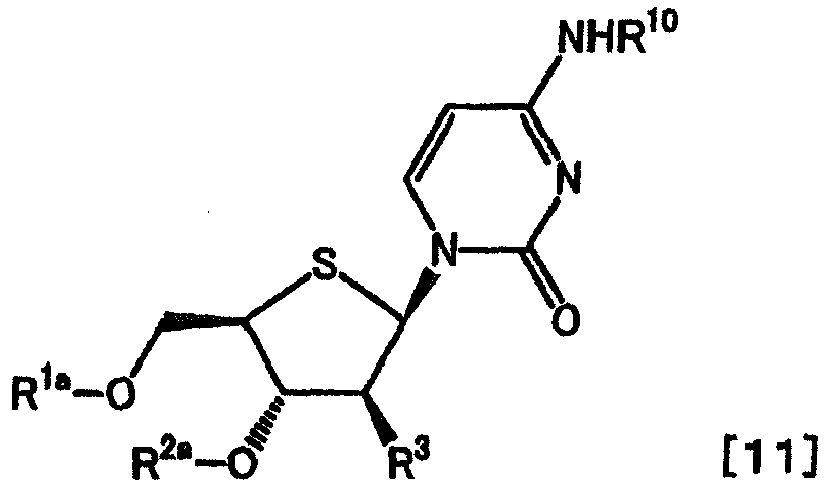
- (4) a method of halogenating the compound represented by the formula [9] to obtain a compound represented by the following formula [10]:


[Formula 46] R10aX4 [12]
(wherein R10a and X4 have the same meanings as those described above), or with a compound represented by the following formula [13]:
[Formula 47] R10a-O-R10a [13]
(wherein R10a has the same meanings as those described above), to obtain a compound represented by the following formula [11b]:
- Further, according to the present invention, there is provided a compound represented by the following formula [IF]:

[Formula 50] -OR3a [16]
(wherein R3a represents a hydroxyl-protecting group), or an optionally substituted C1-6 alkyl group; R3D represents a hydrogen atom, a halogen atom, a group represented by the following formula [16]:
[Formula 51] -OR3a [16]
(wherein R3a has the same meanings as those described above), or an optionally substituted C1-6 alkyl group; R4 represents a halogen atom, a hydroxyl group, an optionally substituted C1-6 alkylsulfonyloxy group or an optionally substituted arylsulfonyloxy group; R5 and R6 together represent a group represented by the following form formula [2]:
[Formula 52] =Y [2]
(wherein Y represents an oxygen atom or a group represented by the following formula [3]:
[Formula 53] =N-OR7 [3]
(wherein R7 has the same meanings as those described above)); or R4 and R5 together represent a sulfur atom; and R6 represents a hydroxyl group, provided that,
when R5 and R6 together represent a group represented by the following formula [2a]:
[Formula 54] =O [2a]
, one of R3C and R3D represents a halogen atom, the other represents a hydrogen atom, and R4 represents a halogen atom, an optionally substituted C1-6 alkylsulfonyloxy group or an optionally substituted arylsulfonyloxy group;
when R4 and R5 together represent a sulfur atom, and one of R3C and R3D represents a hydrogen atom, the other represents a halogen atom, a group represented by the following formula [16]:
[Formula 55] -OR3a [16]
(wherein R3a has the same meanings as those described above), or an optionally substituted C1-6 alkyl group;
when R4 and R5 together represent a sulfur atom, one of R3C and R3D represents a hydrogen atom, and the other represents a group represented by the following formula [16]:
[Formula 56] -OR3a [16]
(wherein R3a represents a hydroxyl-protecting group), R2 represents a hydroxyl-protecting group;
when R5 and R6 together represent a group represented by the following formula [3]:
[Formula 57] =N—OR7 [3]
(wherein R7 has the same meanings as those described above), one of R3C and R3D represents a group represented by the following formula [16]:
[Formula 58] -OR3a [16]
(wherein R3a has the same meanings as those described above), the other represents a hydrogen atom, and R4 represents an iodine atom, a hydroxyl group, an optionally substituted C1-6 alkylsulfonyloxy group or an optionally substituted arylsulfonyloxy group, R1 represents an optionally substituted acyl group, and R2 represents an optionally substituted acyl group; and
when R5 and R6 together represent a group represented by the following formula [3]:
[Formula 59] =N-OR7 [3]
(wherein R7 has the same meanings as those described above), R3C represents a hydrogen atom, R3D represents a hydrogen atom, and R4 represents a hydroxyl group, R1 represents an optionally substituted aroyl group, and R2 represents an optionally substituted aroyl group.) - Still further, according to the present invention, there is provided a compound represented by the following formula [1]:

[Formula 61] =Y [2]
(wherein Y represents an oxygen atom or a group represented by the following formula [3]:
[Formula 62] =N-OR7 [3]
(wherein R7 represents a hydrogen atom, an optionally substituted C1-6 alkyl group, an optionally substituted aryl group, an optionally substituted heterocyclic group or an optionally substituted silyl group)); or R4 and R5 together represent a sulfur atom; and R6 represents a hydroxyl group, provided that,
when R5 and R6 together represent a group represented by the following formula [2a]:
[Formula 63] =O [2a]
, R4 represents a halogen atom, an optionally substituted C1-6 alkylsulfonyloxy group or an optionally substituted arylsulfonyloxy group). - Still further, according to the present invention, there is provided a compound represented by the following formula [1G]:

[Formula 65] -O-Y1-O- [17]
(wherein Y1 represents an optionally substituted C1-6 alkylene group or an optionally substituted siloxane group, and the bond on the left side binds to a carbon atom binding to R2C), or a bond, provided that, when one of R1C and R1D represents a methyl group, the other represents a hydrogen atom, and R2C represents a hydrogen atom, R3E represents an optionally substituted C1-6 alkylthio group, an optionally substituted aryloxy group, an optionally substituted arylthio group or an optionally substituted heterocyclic thio group; or R1C represents a hydrogen atom, R1D represents a hydrogen atom, R2C represents a hydrogen atom, and R3E represents an optionally substituted aroylamino group; or R1C represents a hydrogen atom, R1D represents a hydrogen atom, R2C and R3E together form a benzene ring substituted with a protected hydroxyl group, together with carbon atoms to which they bind; or R1C represents an optionally protected carboxyl group, R1D represents an optionally protected carboxyl group, R2C represents a hydrogen atom, and R3E represents a hydrogen atom). - The compound of the present invention is useful as an intermediate for producing a thionucleoside, and the production method of the present invention is useful as a method for producing a thionucleoside.
- Moreover, the compound of the present invention is useful as an intermediate for producing Compound A. The production method of the present invention is useful as a method for producing Compound A.
- Hereinafter, the present invention will be described in detail.
- In the present invention, individual terms have the following meanings, unless otherwise specified.
- The term "halogen atom" is used herein to mean a fluorine atom, a chlorine atom, a bromine atom or an iodine atom.
- The term "C1-6 alkyl group" is used herein to mean linear or branched C1-6 alkyl groups, such as methyl, ethyl, propyl, isopropyl, butyl, sec-butyl, isobutyl, tert-butyl, pentyl and hexyl groups.
- The term "C2-6 alkenyl group" is used herein to mean linear or branched C2-6 alkenyl groups, such as vinyl, allyl, propenyl, isopropenyl, butenyl, isobutenyl, 1,3-butadienyl, pentenyl and hexenyl groups.
- The term "C2-6 alkynyl group" is used herein to mean linear or branched C2-6 alkynyl groups, such as ethynyl, propynyl, butynyl, pentynyl and hexynyl groups.
- The term "C3-8 cycloalkyl group" is used herein to mean C3-8 cycloalkyl groups, such as cyclopropyl, cyclobutyl, cyclopentyl and cyclohexyl groups.
- The term "aryl group" is used herein to mean a phenyl or naphthyl group, etc.
- The term "ar-C1-6 alkyl group" is used herein to mean ar-C1-6 alkyl groups, such as benzyl, diphenylmethyl, trityl, phenethyl and naphthylmethyl groups.
- The term "C1-3 alkylene group" is used herein to mean a methylene, ethylene or propylene group, etc.
- The term "C1-6 alkylidene group" is used herein to mean linear or branched C1-6 alkylidene groups, such as methylidene, ethylidene, propylidene, butylidene, pentylidene and hexylidene.
- The term "C1-6 alkoxy group" is used herein to mean linear or branched C1-6 alkyloxy groups, such as methoxy, ethoxy, propoxy, isopropoxy, butoxy, isobutoxy, sec-butoxy, tert-butoxy, pentyloxy and hexyloxy groups.
- The term "aryloxy group" is used herein to mean a phenoxy or naphthyloxy group, etc.
- The term "C1-6 alkoxy C1-6 alkyl group" is used herein to mean C1-6 alkyloxy C1-6 alkyl groups, such as methoxymethyl and 1-ethoxyethyl groups.
- The term "C2-6 alkanoyl group" is used herein to mean linear or branched C2-6 alkanoyl groups, such as acetyl, propionyl, valeryl, isovaleryl and pivaloyl groups.
- The term "aroyl group" is used herein to mean a benzoyl or naphthoyl group, etc.
- The term "heterocyclic carbonyl group" is used herein to mean a nicotinoyl, thenoyl, pyrrolidinocarbonyl or furoyl group, etc.
- The term "(α-substituted) aminoacetyl group" is used herein to mean (α-substituted) aminoacetyl groups having an optionally protected N-terminus, which are derived from amino acids (such as glycine, alanine, valine, leucine, isoleucine, serine, threonine, cysteine, methionine, aspartic acid, glutamic acid, asparagine, glutamine, arginine, lysine, histidine, hydroxylysine, phenylalanine, tyrosine, tryptophan, proline and hydroxyproline).
- The term "acyl group" is used herein to mean a formyl group, succinyl group, glutaryl group, maleoyl group, phthaloyl group, C2-6 alkanoyl group, aroyl group, heterocyclic carbonyl group or (α-substituted) aminoacetyl group, etc.
- The term "C2-6 alkanoyloxy group" is used herein to mean linear or branched C2-6 alkanoyloxy groups, such as acetyloxy and propionyloxy groups.
- The term "aroyloxy group" is used herein to mean a benzoyloxy or naphthoyloxy group, etc.
- The term "acyloxy group" is used herein to mean a C2-6 alkanoyloxy group or aroyloxy group.
- The term "C1-6 alkoxycarbonyl group" is used herein to mean linear or branched C1-6 alkyloxycarbonyl groups, such as methoxycarbonyl, ethoxycarbonyl, isopropoxycarbonyl, tert-butoxycarbonyl and 1,1-dimethylpropoxycarbonyl groups.
- The term "aryloxycarbonyl group" is used herein to mean a phenyloxycarbonyl or naphthyloxycarbonyl group, etc.
- The term "ar-C1-6 alkoxycarbonyl group" is used herein to mean ar-C1-6 alkyloxycarbonyl groups, such as benzyloxycarbonyl, phenethyloxycarbonyl and naphthylmethyloxycarbonyl groups.
- The term "C1-6 alkoxycarbonyloxy group" is used herein to mean linear or branched C1-6 alkyloxycarbonyloxy groups, such as methoxycarbonyloxy, ethoxycarbonyloxy, isopropoxycarbonyloxy, tert-butoxycarbonyloxy and 1,1 -dimethylpropoxycarbonyloxy groups.
- The term "C1-6 alkylamino group" is used herein to mean linear or branched C1-6 alkylamino groups, such as methylamino, ethylamino, propylamino, isopropylamino, butylamino, sec-butylamino, tert-butylamino, pentylamino and hexylamino groups.
- The term "di(C1-6 alkyl)amino group" is used herein to mean linear or branched di(C1-6 alkyl)amino groups, such as dimethylamino, diethylamino, dipropylamino, diisopropylamino, dibutylamino, di(tert-butyl)amino, dipentylamino, dihexylamino, (ethyl)(methyl)amino and (methyl)(propyl)amino groups.
- The term "aroylamino group" is used herein to mean amino groups substituted with aroyl groups, such as a benzoylamino group.
- The term "C1-6 alkylthio group" is used herein to mean C1-6 alkylthio groups, such as methylthio, ethylthio and propylthio groups.
- The term "C1-6 alkylsulfonyl group" is used herein to mean C1-6 alkylsulfonyl groups, such as methylsulfonyl, ethylsulfonyl and propylsulfonyl groups.
- The term "arylsulfonyl group" is used herein to mean a benzenesulfonyl, p-toluenesulfonyl or naphthalenesulfonyl group, etc.
- The term "C1-6 alkylsulfonyloxy group" is used herein to mean C1-6 alkylsulfonyloxy groups, such as methylsulfonyloxy, ethylsulfonyloxy and propylsulfonyloxy groups.
- The term "arylsulfonyloxy group" is used herein to mean a phenylsulfonyloxy or naphthylsulfonyloxy group, etc.
- The term "aromatic ring" is used herein to mean a benzene ring or naphthalene ring, etc.
- The term "siloxane group" is used herein to mean a disiloxane group or trisiloxane group, etc.
- The term "monocyclic nitrogen-containing heterocyclic group" is used herein to mean monocyclic nitrogen-containing heterocyclic groups that contain only a nitrogen atom as a heteroatom forming the ring, such as azetidinyl, pyrrolidinyl, pyrrolinyl, pyrrolyl, piperidyl, tetrahydropyridyl, pyridyl, homopiperidinyl, octahydroazocinyl, imidazolidinyl, imidazolinyl, imidazolyl, pyrazolidinyl, pyrazolinyl, pyrazolyl, piperazinyl, pyrazinyl, pyridazinyl, pyrimidinyl, homopiperazinyl, triazolyl and tetrazolyl groups.
- The term "monocyclic oxygen-containing heterocyclic group" is used herein to mean tetrahydrofuranyl, furanyl, tetrahydropyranyl or pyranyl group, etc.
- The term "monocyclic sulfur-containing heterocyclic group" is used herein to mean a thienyl group, etc.
- The term "monocyclic nitrogen-oxygen-containing heterocyclic group" is used herein to mean monocyclic nitrogen-oxygen-containing heterocyclic groups containing only a nitrogen atom and an oxygen atom as heteroatoms forming the ring, such as oxazolyl, isooxazolyl, oxadiazolyl and morpholinyl groups.
- The term "monocyclic nitrogen-sulfur-containing heterocyclic group" is used herein to mean monocyclic nitrogen-sulfur-containing heterocyclic groups containing only a nitrogen atom and a sulfur atom as heteroatoms forming the ring, such as thiazolyl, isothiazolyl, thiadiazolyl, thiomorpholinyl, 1-oxidothiomorpholinyl and 1,1-dioxidothiomorpholinyl groups.
- The term "monocyclic heterocyclic group" is used herein to mean a monocyclic nitrogen-containing heterocyclic group, monocyclic oxygen-containing heterocyclic group, monocyclic sulfur-containing heterocyclic group, monocyclic nitrogen-oxygen-containing heterocyclic group or monocyclic nitrogen-sulfur-containing heterocyclic group, etc.
- The term "bicyclic nitrogen-containing heterocyclic group" is used herein to mean bicyclic nitrogen-containing heterocyclic groups containing only a nitrogen atom as a heteroatom forming the ring, such as indolinyl, indolyl, isoindolinyl, isoindolyl, benzimidazolyl, indazolyl, benzotriazolyl, quinolyl, tetrahydroquinolinyl, quinolyl, tetrahydroisoquinolinyl, isoquinolinyl, quinolizinyl, cinnolinyl, phthalazinyl, quinazolinyl, dihydroquinoxalinyl, quinoxalinyl, naphthyridinyl, purinyl, pteridinyl and quinuclidinyl groups.
- The term "bicyclic oxygen-containing heterocyclic group" is used herein to mean bicyclic oxygen-containing heterocyclic groups containing only an oxygen atom as a heteroatom forming the ring, such as 2,3-dihydrobenzofuranyl, benzofuranyl, isobenzofuranyl, chromanyl, chromenyl, isochromanyl, 1,3-benzodioxolyl, 1,3-benzodioxanyl and 1,4-benzodioxanyl groups.
- The term "bicyclic sulfur-containing heterocyclic group" is used herein to mean bicyclic sulfur-containing heterocyclic groups containing only a sulfur atom as a heteroatom forming the ring, such as 2,3-dihydrobenzothienyl and benzothienyl groups.
- The term "bicyclic nitrogen-oxygen-containing heterocyclic group" is used herein to mean bicyclic nitrogen-oxygen-containing heterocyclic groups containing only a nitrogen atom and an oxygen atom as heteroatoms forming the ring, such as benzoxazolyl, benzisooxazolyl, benzoxadiazolyl, benzomorpholinyl, dihydropyranopyridyl, dihydrodioxinopyridyl and dihydropyridoxazinyl groups.
- The term "bicyclic nitrogen-sulfur-containing heterocyclic group" is used herein to mean bicyclic nitrogen-sulfur-containing heterocyclic groups containing a nitrogen atom and a sulfur atom as heteroatoms forming the ring, such as benzothiazolyl, benzisothiazolyl and benzothiadiazolyl groups.
- The term "bicyclic heterocyclic group" is used herein to mean a bicyclic nitrogen-containing heterocyclic group, bicyclic oxygen-containing heterocyclic group, bicyclic sulfur-containing heterocyclic group, bicyclic nitrogen-oxygen-containing heterocyclic group or bicyclic nitrogen-sulfur-containing heterocyclic group, etc.
- The term "heterocyclic group" is used herein to mean a monocyclic heterocyclic group or a bicyclic heterocyclic group.
- The term "heterocyclic oxy group" is used herein to mean a group, in which a hydrogen atom (-H) binding to a carbon atom forming the ring of a heterocyclic group is substituted with an oxygen atom (-O).
- The term "heterocyclic thio group" is used herein to mean a group, in which a hydrogen atom (-H) binding to a carbon atom forming the ring of a heterocyclic group is substituted with a sulfur atom (-S-).
- The term "silyl group" is used herein to mean a trimethylsilyl, triethylsilyl, triisopropylsilyl, tributylsilyl, tert-butyldimethylsilyl or tert-butyldiphenylsilyl group, etc.
- The term "silylation" is used herein to mean substitution of a hydrogen atom of a hydroxyl group, amino group, carboxyl group, amide group or mercapto group with a silyl group.
- The term "N4-acylcytosine" is used herein to mean cytosines, in which an amino group is protected by an optionally substituted acyl group, such as N4-formylcytosine, N4-acetylcytosine, N4-propionylcytosine, N4-pivaloylcytosine, N4-benzoylcytosine, N4-(4-methylbenzoyl)cytosine, N4-(4-bromobenzoyl)cytosine, N4-(4-nitrobenzoyl)cytosine and N4-(4-methoxybenzoyl)cytosine.
- The term "protected cytosine" is used herein to mean cytosines protected by a silyl group, such as N4,O-bis(trimethylsilyl)-4-amino-2-hydroxypyrimidine and N4,O-bis(triethylsilyl)-4-amino-2-hydroxypyrimidine.
- The term "protected N4-acylcytosine" is used herein to mean N4-acylcytosines protected by a silyl group, such as 2-trimethylsilyloxy-4-acetylaminopyrimidine, N4,O-bis(trimethylsilyl)-4-acetylamino-2-hydroxypyrimidine, 2-triethylsilyloxy-4-acetylaminopyrimidine, N4,O-bis(triethylsilyl)-4-acetylamino-2-hydroxypyrimidine, 2-trimethylsilyloxy-4-benzoylaminopyrimidine and N4,O-bis(trimethylsilyl)-4-benzoylamino-2-hydroxypyrimidine.
- The term "nucleic acid base" is used herein to mean an optionally substituted adenine, an optionally substituted guanine, an optionally substituted cytosine, an optionally substituted thymine or an optionally substituted uracil.
- The term "protected nucleic acid base" is used herein to mean nucleic acid bases, in which an amino group and/or a hydroxyl group are protected by silyl groups.
- The term "leaving group" is used herein to mean a halogen atom, a C1-6 alkylsulfonyloxy group or an arylsulfonyloxy group. The C1-6 alkylsulfonyloxy group and the arylsulfonyloxy group may be optionally substituted with one or more groups selected from Substituent Group A.
- The hydroxyl-protecting group includes all groups that can be generally used as protecting groups for hydroxyl groups. Examples of the hydroxyl-protecting group include those described in W. Greene et al., Protective Groups in Organic Synthesis, 4th edition, pp. 16-366, 2007, John Wiley & Sons, INC.
- Specific examples of the hydroxyl-protecting group include a C1-6 alkyl group, a C2-6 alkenyl group, an ar-C1-6 alkyl group, a C1-6 alkoxy C1-6 alkyl group, an acyl group, a C1-6 alkoxycarbonyl group, a C1-6 alkylsulfonyl group, an arylsulfonyl group, a tetrahydrofuranyl group, a tetrahydropyranyl group and a silyl group. These groups may be optionally substituted with one or more groups selected from Substituent Group A.
- The amino-protecting group includes all groups that can be generally used as protecting groups for amino groups. Examples of the amino-protecting group include those described in W. Greene et al., Protective Groups in Organic Synthesis, 4th edition, pp. 696-926,2007, John Wiley & Sons, INC.
- Specific examples of the amino-protecting group include an ar-C1-6 alkyl group, a C1-6 alkoxy C1-6 alkyl group, an acyl group, a C1-6 alkoxycarbonyl group, an aryloxycarbonyl group, a C1-6 alkylsulfonyl group, an arylsulfonyl group and a silyl group. These groups may be optionally substituted with one or more groups selected from Substituent Group A.
- The carboxyl-protecting group includes all groups that can be generally used as protecting groups for carboxyl groups. Examples of the carboxyl-protecting group include those described in W. Greene et al., Protective Groups in Organic Synthesis, 4th edition, pp. 533-646, 2007, John Wiley & Sons, INC.
- Specific examples of the carboxyl-protecting group include a C1-6 alkyl group, a C2-6 alkenyl group, an aryl group, an ar-C1-6 alkyl group, a C1-6 alkoxy C1-6 alkyl group and a silyl group. These groups may be optionally substituted with one or more groups selected from Substituent Group A.
- Substituent Group A: a halogen atom, a cyano group, a nitro group, an optionally protected amino group, an optionally protected hydroxyl group, an optionally protected carboxyl group, a carbamoyl group optionally substituted with one or more groups selected from Substituent Group B, a sulfamoyl group optionally substituted with one or more groups selected from Substituent Group B, a C1-6 alkyl group optionally substituted with one or more groups selected from Substituent Group B, a C2-6 alkenyl group optionally substituted with one or more groups selected from Substituent Group B, a C2-6 alkynyl group optionally substituted with one or more groups selected from Substituent Group B, a C3-8 cycloalkyl group optionally substituted with one or more groups selected from Substituent Group B, an aryl group optionally substituted with one or more groups selected from Substituent Group B, a C1-6 alkoxy group optionally substituted with one or more groups selected from Substituent Group B, an aryloxy group optionally substituted with one or more groups selected from Substituent Group B, an acyl group optionally substituted with one or more groups selected from Substituent Group B, a C1-6 acyloxy group optionally substituted with one or more groups selected from Substituent Group B, a C1-6 alkoxycarbonyl group optionally substituted with one or more groups selected from Substituent Group B, an aryloxycarbonyl group optionally substituted with one or more groups selected from Substituent Group B, a C1-6 alkoxycarbonyloxy group optionally substituted with one or more groups selected from Substituent Group B, a C1-6 alkylamino group optionally substituted with one or more groups selected from Substituent Group B, a di(C1-6 alkyl)amino group optionally substituted with one or more groups selected from Substituent Group B, a C1-6 alkylthio group optionally substituted with one or more groups selected from Substituent Group B, a C1-6 alkylsulfonyl group optionally substituted with one or more groups selected from Substituent Group B, a C1-6 alkylsulfonyloxy group optionally substituted with one or more groups selected from Substituent Group B, a C1-12 silyl group optionally substituted with one or more groups selected from Substituent Group B, a heterocyclic group optionally substituted with one or more groups selected from Substituent Group B, and an oxo group.
- Substituent Group B: a halogen atom, a cyano group, a nitro group, an optionally protected amino group, an optionally protected hydroxyl group, an optionally protected carboxyl group, a C1-6 alkyl group, aryl group, a C1-6 alkoxy group, a heterocyclic group, and an oxo group.
- The aliphatic hydrocarbons include pentane, hexane or cyclohexane, etc.
- The halogenated hydrocarbons include methylene chloride, chloroform or 1,2-dichloroethane, etc.
- The alcohols include methanol, ethanol, propanol, 2-propanol, butanol or 2-methyl-2-propanol, etc.
- The ethers include diethyl ether, diisopropyl ether, dioxane, tetrahydrofuran, anisole, ethylene glycol dimethyl ether, diethylene glycol dimethyl ether or diethylene glycol diethyl ether, etc.
- The esters include methyl acetate, ethyl acetate, propyl acetate, isopropyl acetate or butyl acetate, etc.
- The ketones include acetone, 2-butanone or 4-methyl-2-pentanone, etc.
- The nitriles include acetonitrile, etc.
- The amides include N,N-dimethylformamide, N,N-dimethylacetamide or N-methylpyrrolidone, etc.
- The sulfoxides include dimethyl sulfoxide, etc.
- The carboxylic acid includes acetic acid, etc.
- The aromatic hydrocarbons include benzene, chlorobenzene, dichlorobenzene, nitrobenzene, toluene or xylene, etc.
- The ureas include 1,3-dimethyl-2-imidazolidinone, etc.
- The base includes an organic base and an inorganic base.
- The organic base includes triethylamine, pyridine or N-methylimidazole, etc.
- The inorganic base includes sodium hydroxide, potassium hydroxide, sodium carbonate, potassium carbonate, sodium hydrogen carbonate or sodium phosphate, etc.
- The C1-6 alkyl group, C2-6 alkenyl group, C2-6 alkynyl group, aryl group and heterocyclic group, which are represented by R1A and R1B, may be optionally substituted with one or more groups selected from Substituent Group A.
- The aryl group represented by R1C may be optionally substituted with one or more groups selected from Substituent Group A.
- The C1-6 alkyl group, C2-6 alkenyl group, C2-6 alkynyl group, C1-6 alkoxy group, C1-6 alkylthio group, aryl group, aryloxy group, arylthio group, heterocyclic group, heterocyclic oxy group and heterocyclic thio group, which are represented by R2A and R2B , may be optionally substituted with one or more groups selected from Substituent Group A.
- The aryl group, which is represented by R2C, may be optionally substituted with one or more groups selected from Substituent Group A.
- The C1-6 alkylidene group, which is formed together by R2A and R2B, may be optionally substituted with one or more groups selected from Substituent Group A.
- The C1-6 alkyl group, C2-6 alkenyl group, C2-6 alkynyl group, C1-6 alkoxy group, C1-6 alkylthio group, aryl group, aryloxy group, arylthio group, heterocyclic group, heterocyclic oxy group and heterocyclic thio group, which are represented by R3A and R3B, may be optionally substituted with one or more groups selected from Substituent Group A.
- The C1-6 alkylidene group, which is formed together by R3A and R3B, may be optionally substituted with one or more groups selected from Substituent Group A.
- The C1-6 alkyl group, which is represented by R3C and R3D, may be optionally substituted with one or more groups selected from Substituent Group A.
- The C1-6 alkylthio group, aryloxy group, arylthio group, heterocyclic thio group and aroylamino group, which are represented by R3E, may be optionally substituted with one or more groups selected from Substituent Group A.
- The aromatic ring, which is formed by R2A, R2B, R3A and R3B together with carbon atoms to which they bind, may be optionally substituted with one or more groups selected from Substituent Group A.
- The benzene ring, which is formed by R2A, R2B, R3A and R3B together with carbon atoms to which they bind, may be optionally substituted with one or more groups selected from Substituent Group A.
- The C1-6 alkylene group or optionally substituted siloxane group, which is represented by Y1, may be optionally substituted with one or more groups selected from Substituent Group A.
- The nucleic acid base and the protected nucleic acid base may be optionally substituted with one or more groups selected from Substituent Group A.
- The acyl group and aroyl group, which are represented by R1 and R2, may be optionally substituted with one or more groups selected from Substituent Group A.
- The C1-3 alkylene group, which is formed together by R1 and R2, may be optionally substituted with one or more groups selected from Substituent Group A.
- The C1-3 alkylene group, which is formed together by R1a and R2a, may be optionally substituted with one or more groups selected from Substituent Group A.
- The benzoyl group, which is represented by R1a, may be optionally substituted with one or more groups selected from Substituent Group A.
- The benzoyl group, which is represented by R2a, may be optionally substituted with one or more groups selected from Substituent Group A.
- The C1-6 alkylsulfonyloxy group, which is represented by R4, may be optionally substituted with one or more groups selected from Substituent Group A.
- The arylsulfonyloxy group, which is represented by R4, may be optionally substituted with one or more groups selected from Substituent Group A
- The C1-6 alkyl group, which is represented by R7, may be optionally substituted with one or more groups selected from Substituent Group A.
- The aryl group, which is represented by R7, may be optionally substituted with one or more groups selected from Substituent Group A.
- The heterocyclic group, which is represented by R7, may be optionally substituted with one or more groups selected from Substituent Group A.
- The silyl group, which is represented by R7, may be optionally substituted with one or more groups selected from Substituent Group A.
- The C1-6 alkyl group, which is represented by R8, may be optionally substituted with one or more groups selected from Substituent Group A.
- The aryl group, which is represented by R8, may be optionally substituted with one or more groups selected from Substituent Group A.
- The acyl group, which is represented by R9, may be optionally substituted with one or more groups selected from Substituent Group A.
- The C1-6 alkylsulfonyl group, which is represented by R9, may be optionally substituted with one or more groups selected from Substituent Group A.
- The arylsulfonyl group, which is represented by R9, may be optionally substituted with one or more groups selected from Substituent Group A.
- The acyl group, which is represented by R10 and R10a, may be optionally substituted with one or more groups selected from Substituent Group A.
- Preferred examples of the compound represented by the formula [IF] include the following compounds.
- A compound, in which R1 represents a hydroxyl-protecting group, is preferable.
- A compound, in which R2 represents a hydroxyl-protecting group, is preferable.
- A compound, in which R1 and R2 each represent a hydroxyl-protecting group, is preferable.
- As such a hydroxyl-protecting group represented by R1 or R2, a C1-6 alkyl group optionally substituted with one or more groups selected from Substituent Group A, an ar-C1-6 alkyl group optionally substituted with one or more groups selected from Substituent Group A, an acyl group optionally substituted with one or more groups selected from Substituent Group A, a C1-6 alkoxycarbonyl group optionally substituted with one or more groups selected from Substituent Group A, an ar-C1-6 alkoxycarbonyl group optionally substituted with one or more groups selected from Substituent Group A, a silyl group optionally substituted with one or more groups selected from Substituent Group A, a cinnamoyl group optionally substituted with one or more groups selected from Substituent Group A, a tetrahydrofuranyl group or a tetrahydropyranyl group is preferable; an ar-C1-6 alkyl group optionally substituted with one or more groups selected from Substituent Group A, an acyl group optionally substituted with one or more groups selected from Substituent Group A, a C1-6 alkoxycarbonyl group optionally substituted with one or more groups selected from Substituent Group A, an ar-C1-6 alkoxycarbonyl group optionally substituted with one or more groups selected from Substituent Group A, a silyl group optionally substituted with one or more groups selected from Substituent Group A, or a cinnamoyl group optionally substituted with one or more groups selected from Substituent Group A is more preferable; a C2-6 alkanoyl group optionally substituted with one or more groups selected from Substituent Group A, or an aroyl group optionally substituted with one or more groups selected from Substituent Group A, is further preferable; an acetyl group, a pivaloyl group, or a benzoyl group optionally substituted with one or more groups selected from Substituent Group A is even further preferable; a benzoyl group optionally substituted with one or more groups selected from Substituent Group A is still further preferable; a benzoyl group, a 4-chlorobenzoyl group, a 2,4-dichlorobenzoyl group, a 4-nitrobenzoyl group, a 4-methoxybenzoyl group, a 4-(trifluoromethyl)benzoyl group, a 4-phenylbenzoyl group, a 3,5-dimethylbenzoyl group or a 4-methylbenzoyl group is particularly preferable; and a benzoyl group is most preferable.
- A compound, in which R3C represents a hydrogen atom or a halogen atom, is preferable; a compound, in which R3C represents a hydrogen atom, a fluorine atom or a chlorine atom, is more preferable; and a compound, in which R3C represents a hydrogen atom or a fluorine atom, is further preferable.
- A compound, in which R3D represents a hydrogen atom or a halogen atom, is preferable; a compound, in which R3D represents a hydrogen atom, a fluorine atom or a chlorine atom, is more preferable; and a compound, in which R3D represents a hydrogen atom or a fluorine atom, is further preferable.
- A compound, in which R4 represents a halogen atom, a hydroxyl group, a C1-6 alkylsulfonyloxy group optionally substituted with one or more groups selected from Substituent Group A, or an arylsulfonyloxy group optionally substituted with one or more groups selected from Substituent Group A, is preferable; a compound, in which R4 represents a chlorine atom, a bromine atom, a hydroxyl group, a methylsulfonyl group, a 2-nitrobenzenesulfonyloxy group, a 3-nitrobenzenesulfonyloxy group, a 4-nitrobenzenesulfonyloxy group, a 2,4,5-trichlorobenzenesulfonyloxy group or a pentafluorobenzenesulfonyloxy group, is more preferable; and a compound, in which R4 represents a hydroxyl group, a chlorine atom, a bromine atom, a methylsulfonyl group or a 2,4,5-trichlorobenzenesulfonyloxy group, is further preferable.
- Preferable is a compound, in which when R5 and R6 together represent a group represented by the following formula [2a]:
[Formula 66] =O [2a]
, one of R3C and R3D represents a halogen atom, and the other represents a hydrogen atom; and more preferable is a compound, in which one of R3C and R3D represents a fluorine atom, and the other represents a hydrogen atom. A compound, in which R4 represents a halogen atom, an optionally substituted C1-6 alkylsulfonyloxy group or an optionally substituted arylsulfonyloxy group, is preferable. - Preferable is a compound, in which when R4 and R5 together represent a sulfur atom and one of R3C and R3D represents a hydrogen atom, the other represents a halogen atom; and more preferable is a compound in which the other represents a fluorine atom.
- Preferable is a compound, in which when R4 and R5 together represent a sulfur atom, one of R3C and R3D represents a hydrogen atom, and the other represents a group represented by the following formula [16]:
[Formula 67] -OR3a [16]
(wherein R3a represents a hydroxyl-protecting group), R2 represents a hydroxyl-protecting group. - Preferable is a compound, in which R5 and R6 together represent a group represented by the following formula [3]:
[Formula 68] =N-OR7 [3]
(wherein R7 has the same meanings as those described above), one of R3C and R3D represents a group represented by the following formula [16]:
[Formula 69] -OR3a [16]
(wherein R3a has the same meanings as those described above), the other represents a hydrogen atom, and R4 represents an iodine atom, a hydroxyl group, an optionally substituted C1-6 alkylsulfonyloxy group or an optionally substituted arylsulfonyloxy group, R1 represents an optionally substituted acyl group and R2 represents an optionally substituted acyl group. - Preferable is a compound, in which when R5 and R6 together represent a group represented by the following formula [3]:
[Formula 70] =N-OR7 [3]
(wherein R7 has the same meanings as those described above), one of R3C and R3D represents a hydrogen atom, the other represents a hydrogen atom, and R4 represents a hydroxyl group, R1 represents an optionally substituted aroyl group and R2 represents an optionally substituted aroyl group. - Preferable is a compound, in which when Y is a group represented by the following formula [3]:
[Formula 71] =N-OR7 [3]
(wherein R7 has the same meanings as those described above), R7 represents a hydrogen atom, an optionally substituted C1-6 alkyl group or an optionally substituted aryl group; more preferable is a compound, in which R7 represents a hydrogen atom, a methyl group, a benzyl group or a phenyl group; and further preferable is a compound in which R7 represents a methyl group or a benzyl group. - Preferable is a compound, in which when R4 and R5 together represent a sulfur atom, R6 represents a hydroxyl group.
- Preferred examples of the compound represented by the formula [1] include the following compounds.
- A compound, in which R1 represents a hydroxyl-protecting group, is preferable.
- A compound, in which R2 represents a hydroxyl-protecting group, is preferable.
- A compound, in which R1 and R2 each represent a hydroxyl-protecting group, is preferable.
- R1 and R2 may be identical to or different from each other.
- As such a hydroxyl-protecting group represented by R1 or R2, a C1-6 alkyl group optionally substituted with one or more groups selected from Substituent Group A, an ar-C1-6 alkyl group optionally substituted with one or more groups selected from Substituent Group A, an acyl group optionally substituted with one or more groups selected from Substituent Group A, a C1-6 alkoxycarbonyl group optionally substituted with one or more groups selected from Substituent Group A, an ar-C1-6 alkoxycarbonyl group optionally substituted with one or more groups selected from Substituent Group A, a silyl group optionally substituted with one or more groups selected from Substituent Group A, a cinnamoyl group optionally substituted with one or more groups selected from Substituent Group A, a tetrahydrofuranyl group or a tetrahydropyranyl group is preferable; an ar-C1-6 alkyl group optionally substituted with one or more groups selected from Substituent Group A, an acyl group optionally substituted with one or more groups selected from Substituent Group A, a C1-6 alkoxycarbonyl group optionally substituted with one or more groups selected from Substituent Group A, an ar-C1-6 alkoxycarbonyl group optionally substituted with one or more groups selected from Substituent Group A, a silyl group optionally substituted with one or more groups selected from Substituent Group A, or a cinnamoyl group optionally substituted with one or more groups selected from Substituent Group A is more preferable; a C2-6 alkanoyl group optionally substituted with one or more groups selected from Substituent Group A, or an aroyl group optionally substituted with one or more groups selected from Substituent Group A, is further preferable; an acetyl group, a pivaloyl group, or a benzoyl group optionally substituted with one or more groups selected from Substituent Group A is even further preferable; a benzoyl group optionally substituted with one or more groups selected from Substituent Group A is still further preferable; a benzoyl group, a 4-chlorobenzoyl group, a 2,4-dichlorobenzoyl group, a 4-nitrobenzoyl group, a 4-methoxybenzoyl group, a 4-(trifluoromethyl)benzoyl group, a 4-phenylbenzoyl group, a 3,5-dimethylbenzoyl group or a 4-methylbenzoyl group is particularly preferable; and a benzoyl group is most preferable.
- The benzoyl group used as a protecting group is advantageous in that it is easily removed during deprotection, and in that it withstands reaction conditions for the production method of the present invention. In addition, a compound protected by a benzoyl group, which is obtained by the production method of the present invention, has excellent crystallinity, and it is easily purified.
- A compound, in which R3 represents a fluorine atom or a chlorine atom, is preferable; and a compound, in which R3 represents a fluorine atom, is more preferable.
- A compound, in which R4 represents a halogen atom, a hydroxyl group or an arylsulfonyloxy group optionally substituted with one or more groups selected from Substituent Group A, is preferable; a compound, in which R4 represents a chlorine atom, a bromine atom, a hydroxyl group, a 2-nitrobenzenesulfonyloxy group, a 3-nitrobenzenesulfonyloxy group, a 4-nitrobenzenesulfonyloxy group, a 2,4,5-trichlorobenzenesulfonyloxy group or a pentafluorobenzenesulfonyloxy group, is more preferable; and a compound, in which R4 represents a hydroxyl group, a chlorine atom, a bromine atom or a 2,4,5-trichlorobenzenesulfonyloxy group, is further preferable.
- Preferable is a compound, in which when R4 represents a halogen atom, a hydroxyl group, an optionally substituted C1-6 alkylsulfonyloxy group or an optionally substituted arylsulfonyloxy group, R5 and R6 together represent a group represented by the following formula [2]:
[Formula 72] =Y [2]
(wherein Y has the same meanings as those described above). - The aforementioned compound, in which Y represents an oxygen atom, is more preferable.
- Preferable is a compound, in which when Y represents a group represented by the following formula [3]:
[Formula 73] =N-OR7 [3]
(wherein R7 has the same meanings as those described above), R7 represents a hydrogen atom, an optionally substituted C1-6 alkyl group or an optionally substituted aryl group; the aforementioned compound, in which R7 represents a hydrogen atom, a methyl group, a benzyl group or a phenyl group, is more preferable; and the aforementioned compound, in which R7 represents a methyl group or a benzyl group, is further preferable. - A compound, in which when R4 and R5 together represent a sulfur atom, R6 represents a hydroxyl group, is preferable.
- Preferred examples of the compound represented by the formula [1G] include the following compounds.
- A compound, in which R1C represents a methyl group and R1D represents a hydrogen atom, is preferable.
- A compound in which R2C and R3E together represent a group represented by the following formula [17]:
[Formula 74] -O-Y1-O- [17]
(wherein Y1 has the same meanings as those described above), or a bond, is preferable. - A compound, in which Y1 represents an optionally substituted C1-6 alkylene group, is preferable.
- Preferred examples of the production method of the present invention include the following production methods.
- Preferable is a production method using a compound, in which R1A and R1B, which are the same or different, each represent a hydrogen atom, an optionally protected carboxyl group, an optionally substituted C1-6 alkyl group or an optionally substituted aryl group; more preferable is a production method using a compound, in which R1A and R1B, which are the same or different, each represent a hydrogen atom or a C1-6 alkyl group optionally substituted with one or more groups selected from Substituent Group A; and further preferable is a production method using a compound, in which R1A and R1B, which are the same or different, each represent a hydrogen atom, a methyl group or a group represented by the following formula [18]:
[Formula 75] -CH2OR1a [18]
(wherein R1a has the same meanings as those described above). - Since the ring-closure reaction of the present invention has high reactivity and high stereoselectivity, it provides particularly great effects when at least one of R1A and R1B is a substituent.
- Particularly preferable is a production method using a compound, in which one of R1A and R1B represents a hydrogen atom, and the other represents a methyl group or a group represented by the following formula [18]:
[Formula 76] -CH2OR1a [18]
(wherein R1a has the same meanings as those described above). - Preferable is a production method using a compound, in which R1a represents a C1-6 alkyl group optionally substituted with one or more groups selected from Substituent Group A, an ar-C1-6 alkyl group optionally substituted with one or more groups selected from Substituent Group A, an acyl group optionally substituted with one or more groups selected from Substituent Group A, a C1-6 alkoxycarbonyl group optionally substituted with one or more groups selected from Substituent Group A, an ar-C1-6 alkoxycarbonyl group optionally substituted with one or more groups selected from Substituent Group A, a silyl group optionally substituted with one or more groups selected from Substituent Group A, a cinnamoyl group optionally substituted with one or more groups selected from Substituent Group A, a tetrahydrofuranyl group or a tetrahydropyranyl group; more preferable is a production method using a compound, in which R1a represents an ar-C1-6 alkyl group optionally substituted with one or more groups selected from Substituent Group A, an acyl group optionally substituted with one or more groups selected from Substituent Group A, a C1-6 alkoxycarbonyl group optionally substituted with one or more groups selected from Substituent Group A, an ar-C1-6 alkoxycarbonyl group optionally substituted with one or more groups selected from Substituent Group A, a silyl group optionally substituted with one or more groups selected from Substituent Group A, or a cinnamoyl group optionally substituted with one or more groups selected from Substituent Group A; further preferable is a production method using a compound, in which R1a represents a C2-6 alkanoyl group optionally substituted with one or more groups selected from Substituent Group A, or an aroyl group optionally substituted with one or more groups selected- from Substituent Group A; further preferable is a production method using a compound, in which R1a represents an acetyl group, a pivaloyl group, or a benzoyl group optionally substituted with one or more groups selected from Substituent Group A; even further preferable is a production method using a compound, in which R1a represents a benzoyl group optionally substituted with one or more groups selected from Substituent Group A; still further preferable is a production method using a compound, in which R1a represents a benzoyl group optionally substituted with one or more groups selected from Substituent Group A; particularly preferable is a production method using a compound, in which R1a represents a benzoyl group, a 4-chlorobenzoyl group, a 2,4-dichlorobenzoyl group, a 4-nitrobenzoyl group, a 4-methoxybenzoyl group, a 4-(trifluoromethyl)benzoyl group, a 4-phenylbenzoyl group, a 3,5-dimethylbenzoyl group or a 4-methylbenzoyl group; and most preferable is a production method using a compound, in which R1a represents a benzoyl group.
- The benzoyl group used as a protecting group is advantageous in that it is easily removed during deprotection, and in that it withstands reaction conditions for the production method of the present invention. In addition, a compound protected by a benzoyl group, which is obtained by the production method of the present invention, has excellent crystallinity, and it is easily purified.
- Preferable is a production method using a compound, in which R2A and R2B, which are the same or different, each represent a hydrogen atom, a halogen atom, a cyano group, a group represented by the following formula [15]:
[Formula 77] -OR2a [15]
(wherein R2a has the same meanings as those described above), or an optionally substituted aryl group; more preferable is a production method using a compound in which R2A and R2B, which are the same or different, each represent a hydrogen atom, a group represented by the following formula [15]:
[Formula 78] -OR2a [15]
(wherein R2a has the same meanings as those described above), or an optionally substituted aryl group; and further preferable is a production method using a compound, in which R2A and R2B, which are the same or different, each represent a hydrogen atom or a group represented by the following formula [15]:
[Formula 79] -OR2a [15]
(wherein R2a has the same meanings as those described above). - Particularly preferable is a production method using a compound, in which one of R2A and R2B represents a hydrogen atom, and the other represents a group represented by the following formula [15]:
[Formula 80] -OR2a [15]
(wherein R2a has the same meanings as those described above). - Preferable is a production method using a compound, in which R2a represents a C1-6 alkyl group optionally substituted with one or more groups selected from Substituent Group A, an ar-C1-6 alkyl group optionally substituted with one or more groups selected from Substituent Group A, an acyl group optionally substituted with one or more groups selected from Substituent Group A, a C1-6 alkoxycarbonyl group optionally substituted with one or more groups selected from Substituent Group A, an ar-C1-6 alkoxycarbonyl group optionally substituted with one or more groups selected from Substituent Group A, a silyl group optionally substituted with one or more groups selected from Substituent Group A, a cinnamoyl group optionally substituted with one or more groups selected from Substituent Group A, a tetrahydrofuranyl group or a tetrahydropyranyl group; more preferable is a production method using a compound, in which R2a represents an ar-C1-6 alkyl group optionally substituted with one or more groups selected from Substituent Group A, an acyl group optionally substituted with one or more groups selected from Substituent Group A, a C1-6 alkoxycarbonyl group optionally substituted with one or more groups selected from Substituent Group A, an ar-C1-6 alkoxycarbonyl group optionally substituted with one or more groups selected from Substituent Group A, a silyl group optionally substituted with one or more groups selected from Substituent Group A, or a cinnamoyl group optionally substituted with one or more groups selected from Substituent Group A; further preferable is a production method using a compound, in which R2a represents a C2-6 alkanoyl group optionally substituted with one or more groups selected from Substituent Group A, or an aroyl group optionally substituted with one or more groups selected from Substituent Group A; further preferable is a production method using a compound, in which R2a represents an acetyl group, a pivaloyl group, or a benzoyl group optionally substituted with one or more groups selected from Substituent Group A; even further preferable is a production method using a compound, in which R2a represents a benzoyl group optionally substituted with one or more groups selected from Substituent Group A; still further preferable is a production method using a compound, in which R2a represents a benzoyl group optionally substituted with one or more groups selected from Substituent Group A; particularly preferable is a production method using a compound, in which R2a represents a benzoyl group, a 4-chlorobenzoyl group, a 2,4-dichlorobenzoyl group, a 4-nitrobenzoyl group, a 4-methoxybenzoyl group, a 4-(trifluoromethyl)benzoyl group, a 4-phenylbenzoyl group, a 3,5-dimethylbenzoyl group or a 4-methylbenzoyl group; and most preferable is a production method using a compound, in which R2a represents a benzoyl group.
- The benzoyl group used as a protecting group is advantageous in that it is easily removed during deprotection, and in that it withstands reaction conditions for the production method of the present invention. In addition, a compound protected by a benzoyl group, which is obtained by the production method of the present invention, has excellent crystallinity, and it is easily purified.
- R1a and R2a may be identical to or different from each other.
- Preferable is a production method using a compound, in which R3A and R3B, which are the same or different, each represent a hydrogen atom, a halogen atom, an optionally protected amino group, a group represented by the following formula [16]:
[Formula 81] -OR3a [16]
(wherein R3a has the same meanings as those described above), an optionally substituted C1-6 alkyl group, an optionally substituted C1-6 alkylthio group, an optionally substituted aryloxy group, an optionally substituted arylthio group or an optionally substituted heterocyclic thio group; and more preferable is a production method using a compound, in which R3A and R3B, which are the same or different, each represent a hydrogen atom, a halogen atom, a group represented by the following formula [16]:
[Formula 82] -OR3a [16]
(wherein R3a has the same meanings as those described above), or an aryloxy group optionally substituted with one or more groups selected from Substituent Group A. - Preferable is a production method using a compound, in which one of R3A and R3B represents a hydrogen atom, and the other represents a halogen atom, a group represented by the following formula [16]:
[Formula 83] -OR3a [16]
(wherein R3a has the same meanings as those described above), or an aryloxy group optionally substituted with one or more groups selected from Substituent Group A; and more preferable is a production method using a compound, in which one of R3A and R3B represents a hydrogen atom, and the other represents a halogen atom or a group represented by the following formula [16]:
[Formula 84] -OR3a [16]
(wherein R3a has the same meanings as those described above). - Preferable is a production method using a compound, in which R2A and R3A together represent a group represented by the following formula [17]:
[Formula 85] -O-Y1-O- [17]
(wherein Y1 has the same meanings as those described above), or a bond. - Preferable is a production method using a compound, in which Y1 represents an optionally substituted C1-6 alkylene group.
- Preferable is a production method using a compound, in which R3 represents a fluorine atom or a chlorine atom; and more preferable is a production method using a compound, in which, R3 represents a fluorine atom.
- Preferable is a production method using a compound, in which R4 represents a halogen atom, a hydroxyl group, or an arylsulfonyloxy group optionally substituted with one or more groups selected from Substituent Group A; more preferable is a production method using a compound, in which R4 represents a chlorine atom, a bromine atom, a hydroxyl group, a 2-nitrobenzenesulfonyloxy group, a 3-nitrobenzenesulfonyloxy group, a 4-nitrobenzenesulfonyloxy group, a 2,4,5-trichlorobenzenesulfonyloxy group or a pentafluorobenzenesulfonyloxy group; and further preferable is a production method using a compound, in which R4 represents a hydroxyl group, a chlorine atom, a bromine atom or a 2,4,5-trichlorobenzenesulfonyloxy group.
- Preferable is a production method using a compound, in which R4 represents a halogen atom, a hydroxyl group, an optionally substituted C1-6 alkylsulfonyloxy group or an optionally substituted arylsulfonyloxy group, and R5 and R6 together represent a group represented by the following formula [2]:
[Formula 86] =Y [2]
(wherein Y has the same meanings as those described above). - More preferable is a production method using the aforementioned compound, in which Y represents an oxygen atom.
- Preferable is a production method using a compound, in which when Y represents a group represented by the following formula [3]:
[Formula 87] =N-OR7 [3]
(wherein R7 has the same meanings as those described above), R7 represents a hydrogen atom, an optionally substituted C1-6 alkyl group or an optionally substituted aryl group; and more preferable is a production method using a compound, in which R7 represents a hydrogen atom, a methyl group, a benzyl group or a phenyl group; and further preferable is a production method using a compound, in which R7 represents a methyl group or a benzyl group. - Preferable is a production method using a compound, in which when R4 and R5 together represent a sulfur atom, R6 represents a hydroxyl group.
- Preferable is a production method using a compound, in which R9 represents an optionally substituted acyl group; more preferable is a production method using a compound, in which R9 represents an acyl group; and further preferable is a production method using a compound, in which R9 represents an acetyl group.
- Preferable is a production method using a compound, in which X3 represents a bromine atom.
- Preferable is a production method using a compound, in which the nucleic acid base represents adenine optionally substituted with one or more groups selected from Substituent Group A, guanine optionally substituted with one or more groups selected from Substituent Group A, cytosine optionally substituted with one or more groups selected from Substituent Group A, thymine optionally substituted with one or more groups selected from Substituent Group A, or uracil optionally substituted with one or more groups selected from Substituent Group A; and more preferable is a production method using a compound, in which the nucleic acid base represents cytosine optionally substituted with one or more groups selected from Substituent Group A.
- Preferable is a production method using a compound, in which the protected cytosine is N4,O-bis(trimethylsilyl)-4-amino-2-hydroxypyrimidine.
- Preferable is a production method using a compound, in which the protected N4-acylcytosine is 2-trimethylsilyloxy-4-acetylaminopyrimidine or N4,O-bis(trimethylsilyl)-4-acetylamino-2-hydroxypyrimidine; and more preferable is a production method using a compound, in which the protected N4-acylcytosine is N4,O-bis(trimethylsilyl)-4-acetylamino-2-hydroxypyrimidine.
- Preferable is a production method using a compound, in which R10a represents a formyl group, an optionally substituted C2-6 alkanoyl group or an optionally substituted aroyl group; more preferable is a production method using a compound, in which R10a represents a C2-6 alkanoyl group; and further preferable is a production method using a compound, in which R10a represents an acetyl group.
- In a step of producing the compound represented by the formula [11b] from the compound represented by the formula [11a], it is preferable to use the compound represented by the formula [13].
- The method for producing 1-(2-deoxy-2-halogeno-4-thio-β-D-arabinofuranosyl)cytosine from the compound represented by the formula [9] is preferably the method (3) or (4), and more preferably the method (4).
- In the case of using the method (3), it is preferable to use protected N4-acylcytosine.
- It is preferable to isolate the compound represented by the formula [11b] as a solid. By isolating the compound, the purity of Compound A is improved.
- Next, the production method of the present invention will be described. Production Method 1

- The compound represented by the formula [IE] can be produced by allowing the compound represented by the formula [1D] to react with a sulfur compound.
- The solvent used in this reaction is not particularly limited, as long as it does not affect the reaction. Examples of the solvent include aliphatic hydrocarbons, halogenated hydrocarbons, alcohols, ethers, esters, ketones, nitriles, amides, sulfoxides, aromatic hydrocarbons, ureas and water. These solvents may be used in combination.
- Preferred examples of the solvent include ethers, esters, nitriles, amides and ureas. Among these, amides are more preferable.
- The amount of the solvent used is not particularly limited. The solvent may be used at a ratio (v/w) of 1 : 1 to 50 : 1, and preferably at a ratio (v/w) of 1 : 1 to 15 : 1, with respect to the compound represented by the formula [1D].
- Examples of the sulfur compound used in this reaction include hydrogen sulfide and a salt thereof.
- Examples of the salt of hydrogen sulfide include sodium hydrogen sulfide, sodium sulfide, potassium hydrogen sulfide, calcium hydrogen sulfide and magnesium sulfide. Among these, sodium hydrogen sulfide is preferable.
- The sulfur compound may be used at a molar ratio of 0.2 : 1 to 10 : 1, preferably at a molar ratio of 0.5 : 1 to 2.0 : 1, and more preferably at a molar ratio of 0.7 : 1 to 1.5 : 1, with respect to the compound represented by the formula [1D].
- The reaction temperature may be -20°C to 100°C. It is preferably -10°C to 80°C, and more preferably -5°C to 60°C.
- The reaction time may be 5 minutes to 50 hours. It is preferably 5 minutes to 24 hours, and more preferably 5 minutes to 6 hours.
- In the present production method, a sulfur compound is added to a formyl group of the compound represented by the formula [1D], and a nucleophilic substitution reaction then progresses, and the ring is then closed. Thus, it can be assumed that the reaction can be carried out in a short time, with high reactivity and with high stereoselectivity. However, the present invention is not limited to this reaction mechanism.
- It is to be noted that the compound represented by the formula [1D] may be produced by subjecting sugars to a ring-opening reaction, or by another method.
-


- For example, ((2R,3R,4S)-3-benzoyloxy-4-fluoro-5-hydroxyoxolan-2-yl)methyl = benzoate has been known as a compound represented by the formula [4Aa].
- For example, O-methylhydroxylamine and O-benzylhydroxylamine have been known as compounds represented by the formula [5] or salts thereof.
- The compound represented by the formula [1Aa] can be produced by allowing the compound represented by the formula [4Aa] to react with the compound represented by the formula [5] or a salt thereof.
- The solvent used in this reaction is not particularly limited, as long as it does not affect the reaction. Examples of the solvent include aliphatic hydrocarbons, halogenated hydrocarbons, alcohols, ethers, esters, nitriles, amides, sulfoxides, aromatic hydrocarbons and water. These solvents may be used in combination.
- Preferred examples of the solvent include halogenated hydrocarbons, alcohols, nitriles, aromatic hydrocarbons and water.
- The amount of the solvent used is not particularly limited. The solvent may be used at a ratio (v/w) of 1 : 1 to 50 : 1, and preferably at a ratio (v/w) of 1 : 1 to 15 : 1, with respect to the compound represented by the formula [4Aa].
- The compound represented by the formula [5] used in this reaction or a salt thereof may be used at a molar ratio of 0.5 : 1 to 10 : 1, preferably at a molar ratio of 0.8 : 1 to 5.0 : 1, and more preferably at a molar ratio of 1.0 : 1 to 2.0 : 1, with respect to the compound represented by the formula [4Aa].
- When a salt of the compound represented by the formula [5] is used, it is preferable to add a base thereto.
- Examples of the base include organic bases and inorganic bases. Among others, triethylamine and sodium hydrogen carbonate are preferable.
- The base may be used at a molar ratio of 0.1 : 1 to 10 : 1, preferably at a molar ratio of 0.2 : 1 to 2.0 : 1, and more preferably at a molar ratio of 0.5 : 1 to 1.5 : 1, with respect to the compound represented by the formula [5].
- The reaction temperature may be -10°C to 100°C. It is preferably -5°C to 80°C, and more preferably 0°C to 60°C.
- The reaction time may be 5 minutes to 50 hours. It is preferably 5 minutes to 24 hours, and more preferably 5 minutes to 6 hours.
- As compounds represented by the formula [6], 4-nitrobenzenesulfonyl chloride, 2,4,5-trichlorobenzenesulfonyl chloride and pentafluorobenzenesulfonyl chloride have been known, for example.
- The compound represented by the formula [1Ba] can be produced by allowing the compound represented by the formula [1Aa] to react with the compound represented by the formula [6] in the presence of a base.
- The solvent used in this reaction is not particularly limited, as long as it does not affect the reaction. Examples of the solvent include aliphatic hydrocarbons, halogenated hydrocarbons, ethers, esters, ketones, nitriles, amides, sulfoxides and aromatic hydrocarbons. These solvents may be used in combination.
- Preferred examples of the solvent include esters, nitriles and aromatic hydrocarbons.
- The amount of the solvent used is not particularly limited. The solvent may be used at a ratio (v/w) of 1 : 1 to 50 : 1, and preferably at a ratio (v/w) of 1 : 1 to 15 : 1, with respect to the compound represented by the formula [1Aa].
- Examples of the base used in this reaction include organic bases and inorganic bases. Among others, triethylamine and N-methylimidazole are preferable.
- The base may be used at a molar ratio of 0.5 : 1 to 10 : 1, preferably at a molar ratio of 0.8 : 1 to 4.0 : 1, and more preferably at a molar ratio of 1.0 : 1 to 3.0 : 1, with respect to the compound represented by the formula [1Aa].
- The compound represented by the formula [6] used in this reaction may be used at a molar ratio of 0.5 : 1 to 10 : 1, preferably at a molar ratio of 0.8 : 1 to 4.0 : 1, and more preferably at a molar ratio of 1.0 : 1 to 2.0 : 1, with respect to the compound represented by the formula [1Aa].
- The reaction temperature may be -10°C to 100°C. It is preferably -5°C to 80°C, and more preferably 0°C to 60°C.
- The reaction time may be 5 minutes to 50 hours. It is preferably 5 minutes to 24 hours, and more preferably 5 minutes to 6 hours.
- The compound represented by the formula [1Ca] can be produced by allowing the compound represented by the formula [1Ba] to react with a halide of alkaline metal.
- The solvent used in this reaction is not particularly limited, as long as it does not affect the reaction. Examples of the solvent include aliphatic hydrocarbons, halogenated hydrocarbons, ethers, esters, ketones, nitriles, amides, sulfoxides, aromatic hydrocarbons and ureas. These solvents may be used in combination.
- Preferred examples of the solvent include ethers, esters, nitriles, amides and ureas. Among these, amides and ureas are more preferable.
- The amount of the solvent used is not particularly limited. The solvent may be used at a ratio (v/w) of 1 : 1 to 50 : 1, and preferably at a ratio (v/w) of 1 : 1 to 15 : 1, with respect to the compound represented by the formula [1Ba].
- Examples of the halide of alkaline metal used in this reaction include lithium fluoride, sodium fluoride, potassium fluoride, lithium bromide, sodium bromide, potassium bromide, lithium chloride, sodium chloride, potassium chloride, lithium iodide, sodium iodide and potassium iodide. Among these, lithium bromide is preferable.
- The halide of alkaline metal may be used at a molar ratio of 0.5 : 1 to 20 : 1, preferably at a molar ratio of 0.8 : 1 to 8.0 : 1, and more preferably at a molar ratio of 1.0 : 1 to 5.0 : 1, with respect to the compound represented by the formula [1Ba].
- The reaction temperature may be -50°C to 150°C. It is preferably -10°C to 120°C, more preferably 0°C to 100°C, and further preferably 20°C to 80°C.
- The reaction time may be 5 minutes to 50 hours. It is preferably 5 minutes to 24 hours, and more preferably 5 minutes to 6 hours.
- The compound represented by the formula [1Ca] can be produced by allowing the compound represented by the formula [1Aa] to react with a halogenating agent in the presence of a base.
- The solvent used in this reaction is not particularly limited, as long as it does not affect the reaction. Examples of the solvent include aliphatic hydrocarbons, halogenated hydrocarbons, ethers, esters, ketones, nitriles, amides, sulfoxides, aromatic hydrocarbons, ureas and water. These solvents may be used in combination.
- Preferred examples of the solvent include ethers, esters, nitriles, amides, aromatic hydrocarbons and ureas. Among these, amides are more preferable.
- The amount of the solvent used is not particularly limited. The solvent may be used at a ratio (v/w) of 1 : 1 to 50 : 1, and preferably at a ratio (v/w) of 1 : 1 to 15 : 1, with respect to the compound represented by the formula [1Aa].
- Examples of the halogenating agent used in this reaction include a chlorinating agent and a brominating agent.
- Examples of the chlorinating agent include phosphoryl chloride, phosphorus trichloride, phosphorus pentachloride, Vilsmeier reagent (N,N-dimethylformamide-phosphorus pentachloride, N,N-dimethylformamide-phosphorus oxychloride, etc.), Rydon reagent (Ph3PCl2, triphenylphosphine-carbon tetrachloride), thionyl chloride and sulfuryl chloride. Among others, sulfuryl chloride is preferable.
- Examples of the brominating agent include phosphorus tribromide, N,N-dimethylformamide-phosphorus tribromide, triphenylphosphine-carbon tetrabromide and triphenylphosphine dibromide.
- The halogenating agent may be used at a molar ratio of 0.1 : 1 to 10 : 1, preferably at a molar ratio of 0.8 : 1 to 5.0 : 1, and more preferably at a molar ratio of 1.0 : 1 to 2.0 : 1, with respect to the compound represented by the formula [1Aa].
- Examples of the base used in this reaction include organic bases and inorganic bases. Among others, triethylamine and pyridine are preferable.
- The base may be used at a molar ratio of 0.5 : 1 to 50 : 1, preferably at a molar ratio of 0.8 : 1 to 20 : 1, and more preferably at a molar ratio of 1.0 : 1 to 10 : 1, with respect to the compound represented by the formula [1Aa].
- In this reaction, it is preferable to add a salt to the reaction system.
- Examples of the salt include lithium chloride, lithium bromide, sodium bromide, calcium bromide and pyridine hydrochloride.
- In this halogenation reaction, in general, an epimeric mixture is obtained. In order to improve the optical purity of the compound of the formula [1Ca], it is preferable to use sulfuryl chloride and lithium chloride in combination.
- The salt may be used at a molar ratio of 0.5 : 1 to 20 : 1, preferably at a molar ratio of 0.8 : 1 to 5.0 : 1, and more preferably at a molar ratio of 1.0 : 1 to 3.0 : 1, with respect to the compound represented by the formula [1Aa].
- The reaction temperature may be -50°C to 80°C. It is preferably -40°C to 60°C, and more preferably -30°C to 40°C.
- The reaction time may be 5 minutes to 50 hours. It is preferably 5 minutes to 24 hours, and more preferably 5 minutes to 6 hours.
- The compound represented by the formula [1Dd] can be produced by hydrolyzing the compound represented by the formula [1Ca] in the presence of an acid.
- The solvent used in this reaction is not particularly limited, as long as it does not affect the reaction. Examples of the solvent include aliphatic hydrocarbons, halogenated hydrocarbons, alcohols, ethers, esters, ketones, nitriles, amides, sulfoxides, aromatic hydrocarbons, ureas and water. These solvents may be used in combination.
- Preferred examples of the solvent include ethers, esters, nitriles, amides and water. Among these, ethers and water are more preferable.
- The amount of the solvent used is not particularly limited. The solvent may be used at a ratio (v/w) of I : 1 to 50 : 1, and preferably at a ratio (v/w) of 1 : 1 to 15 : 1, with respect to the compound represented by the formula [1Ca].
- Examples of the acid used in this reaction include hydrochloric acid, sulfuric acid, toluenesulfonic acid, acetic acid, glyoxylic acid and phosphoric acid. Among others, glyoxylic acid is preferable.
- The acid may be used at a molar ratio of 0.5 : 1 to 100 : 1, preferably at a molar ratio of 1.0 : 1 to 60 : 1, and more preferably at a molar ratio of 1.5 : 1 to 40 : 1, with respect to the compound represented by the formula [1Ca].
- In this reaction, it is preferable to add a carbonyl compound to the reaction system.
- Examples of the carbonyl compound include: ketones such as acetone and 2-butanone; and aldehydes such as formaldehyde, benzaldehyde, glyoxal and glyoxylic acid. Among these, aldehydes are preferable, and glyoxylic acid is more preferable.
- The carbonyl compound may be used at a molar ratio of 0.5 : 1 to 100 : 1, preferably at a molar ratio of 1.0 : 1 to 60 : 1, and more preferably at a molar ratio of 1.5 : 1 to 40 : 1, with respect to the compound represented by the formula [1Ca].
- The reaction temperature may be -10°C to 120°C. It is preferably 0°C to 100°C, and more preferably 20°C to 80°C.
- The reaction time may be 5 minutes to 50 hours. It is preferably 5 minutes to 24 hours, and more preferably 5 minutes to 6 hours.
- The compound represented by the formula [1Ea] can be produced by allowing the compound represented by the formula [1Dd] to react with a sulfur compound.
- This reaction may be carried out in accordance with the method described in Production Method 1.
- For example, acetyl chloride, benzoyl chloride, benzenesulfonyl chloride and methanesulfonyl chloride have been known as compounds represented by the formula [7].
- For example, acetic anhydride and propionic anhydride have been known as compounds represented by the formula [8].
- The compound represented by the formula [9Aa] can be produced by allowing the compound represented by the formula [1Ea] to react with the compound represented by the formula [7] or the compound represented by the formula [8].
- The solvent used in this reaction is not particularly limited, as long as it does not affect the reaction. Examples of the solvent include aliphatic hydrocarbons, halogenated hydrocarbons, ethers, esters, ketones, nitriles, amides, sulfoxides and aromatic hydrocarbons. These solvents may be used in combination.
- Preferred examples of the solvent include ethers, esters, nitriles and amides. Among these, ethers, nitriles and amides are more preferable.
- The amount of the solvent used is not particularly limited. The solvent may be used at a ratio (v/w) of 1 : 1 to 50 : 1, and preferably at a ratio (v/w) of 1 : 1 to 15 : 1, with respect to the compound represented by the formula [1Ea].
- The compound represented by the formula [7] or the compound represented by the formula [8] may be used in this reaction at a molar ratio of 0.5 : 1 to 50 : 1, preferably at a molar ratio of 0.8 : 1 to 20 : 1, and more preferably at a molar ratio of 1.0 : 1 to 10 : 1, with respect to the compound represented by the formula [1Ea].
- In this reaction, it is preferable to add a base to the reaction system. Examples of the base include organic bases and inorganic bases. Among others, triethylamine is preferable.
- The base may be used at a molar ratio of 0.5 : 1 to 50 : 1, preferably at a molar ratio of 0.8 : 1 to 20 : 1, and more preferably at a molar ratio of 1.0 : 1 to 15 : 1, with respect to the compound represented by the formula [1Ea].
- The reaction temperature may be -10°C to 100°C. It is preferably -5°C to 80°C, and more preferably 0°C to 60°C.
- The reaction time may be 5 minutes to 50 hours. It is preferably 5 minutes to 24 hours, and more preferably 5 minutes to 6 hours.
- The nucleic acid base or the protected nucleic acid base used herein is not particularly limited, as long as it is known to be used in a glycosylation reaction.
- The compound represented by the formula [11Aa] can be produced by allowing the compound represented by the formula [9Aa] to react with a nucleic acid base or a protected nucleic acid base in the presence of an acid.
- The solvent used in this reaction is not particularly limited, as long as it does not affect the reaction. Examples of the solvent include aliphatic hydrocarbons, halogenated hydrocarbons, ethers, esters, ketones, nitriles, amides, sulfoxides and aromatic hydrocarbons. These solvents may be used in combination.
- Preferred examples of the solvent include aliphatic hydrocarbons, halogenated hydrocarbons, nitriles and aromatic hydrocarbons. Among these, halogenated hydrocarbons and aromatic hydrocarbons are more preferable.
- The amount of the solvent used is not particularly limited. The solvent may be used at a ratio (v/w) of 1.0 : 1 to 50 : 1, and preferably at a ratio (v/w) of 1.0 : 1 to 15 : 1, with respect to the compound represented by the formula [9Aa].
- Examples of the acid used in this reaction include Lewis acids such as aluminum chloride, aluminum bromide, tin tetrachloride, titanium tetrachloride, titanium(IV) isopropoxide, zinc chloride and trimethylsilyl = trifluoromethanesulfonate.
- Preferred acids include aluminum chloride, tin tetrachloride and trimethylsilyl = trifluoromethanesulfonate, and among these, trimethylsilyl = trifluoromethanesulfonate is more preferable.
- The amount of the acid used is not particularly limited. The acid may be used at a molar ratio of 0.0001 : 1 to 10 : 1, and preferably at a molar ratio of 0.001 : 1 to 1.0 : 1, with respect to the compound represented by the formula [9Aa].
- The nucleic acid base or the protected nucleic acid base may be used in this reaction at a molar ratio of 1.0 : 1 to 50 : 1, preferably at a molar ratio of 1.0 : 1 to 10 : 1, and more preferably at a molar ratio of 1.0 : 1 to 5 : 1, with respect to the compound represented by the formula [9Aa].
- The reaction temperature may be 20°C to 150°C, and preferably 20°C to 100°C.
- The reaction time may be 5 minutes to 50 hours. It is preferably 30 minutes to 24 hours, and more preferably 1 hour to 10 hours.
- When the compound represented by the formula [11Aa] has a protecting group, a thionucleoside can be produced by performing deprotection.
- This method may be carried out according to the method described in Protective Groups in Organic Synthesis, 4th edition, pp. 696-926, 2007, John Wiley & Sons, INC., etc.
-

- The compound represented by the formula [1De] can be produced by hydrolyzing the compound represented by the formula [1Ba] in the presence of an acid.
- This method may be carried out in accordance with the method described in Production Method 2 (Fourth Step).
- The compound represented by the formula [1Eb] can be produced by allowing the compound represented by the formula [1De] to react with a sulfur compound.
- This reaction may be carried out in accordance with the method described in Production Method 1.
- The compound represented by the formula [9Ab] can be produced by allowing the compound represented by the formula [1Eb] to react with the compound represented by the formula [7] or the compound represented by the formula [8].
- This method may be carried out in accordance with the method described in Production Method 2 (Sixth Step).
- The compound represented by the formula [11Ab] can be produced by allowing the compound represented by the formula [9Ab] to react with a nucleic acid base or a protected nucleic acid base in the presence of an acid.
- This method may be carried out in accordance with the method described in Production Method 2 (Seventh Step).
-


- For example, ((2R,3R,4S)-3-benzoyloxy-4-fluoro-5-hydroxyoxolan-2-yl)methyl = benzoate has been known as a compound represented by the formula [4].
- O-methylhydroxylamine, O-benzylhydroxylamine and the like have been known as compounds represented by the formula [5] or salts thereof.
- The compound represented by the formula [1a] can be produced by allowing the compound represented by the formula [4] to react with the compound represented by the formula [5] or a salt thereof.
- The solvent used in this reaction is not particularly limited, as long as it does not affect the reaction. Examples of the solvent include aliphatic hydrocarbons, halogenated hydrocarbons, alcohols, ethers, esters, nitriles, amides, sulfoxides, aromatic hydrocarbons and water. These solvents may be used in combination.
- Preferred examples of the solvent include halogenated hydrocarbons, alcohols, nitriles, aromatic hydrocarbons and water.
- The amount of the solvent used is not particularly limited. The solvent may be used at a ratio (v/w) of 1 : 1 to 50 : 1, and preferably at a ratio (v/w) of 1 : 1 to 15 : 1, with respect to the compound represented by the formula [4].
- The compound represented by the formula [5] or a salt thereof may be used in this reaction at a molar ratio of 0.5 : 1 to 10 : 1, preferably at a molar ratio of 0.8 : 1 to 5.0 : 1, and more preferably at a molar ratio of 1.0 : 1 to 2.0 : 1, with respect to the compound represented by the formula [4].
- When a salt of the compound represented by the formula [5] is used, it is preferable to add a base thereto.
- Examples of the base include organic bases and inorganic bases. Among others, triethylamine and sodium hydrogen carbonate are preferable.
- The base may be used at a molar ratio of 0.1 : 1 to 10 : 1, preferably at a molar ratio of 0.2 : 1 to 2.0 : 1, and more preferably at a molar ratio of 0.5 : 1 to 1.5 : 1, with respect to the salt of the compound represented by the formula [5].
- The reaction temperature may be -10°C to 100°C. It is preferably -5°C to 80°C, and more preferably 0°C to 60°C.
- The reaction time may be 5 minutes to 50 hours. It is preferably 5 minutes to 24 hours, and more preferably 5 minutes to 6 hours.
- As compounds represented by the formula [6], 4-nitrobenzenesulfonyl chloride, 2,4,5-trichlorobenzenesulfonyl chloride and pentafluorobenzenesulfonyl chloride have been known, for example.
- The compound represented by the formula [1b] can be produced by allowing the compound represented by the formula [1a] to react with the compound represented by the formula [6] in the presence of a base.
- The solvent used in this reaction is not particularly limited, as long as it does not affect the reaction. Examples of the solvent include aliphatic hydrocarbons, halogenated hydrocarbons, ethers, esters, ketones, nitriles, amides, sulfoxides and aromatic hydrocarbons. These solvents may be used in combination.
- Preferred examples of the solvent include esters, nitriles and aromatic hydrocarbons.
- The amount of the solvent used is not particularly limited. The solvent may be used at a ratio (v/w) of 1 : 1 to 50 : 1, and preferably at a ratio (v/w) of 1 : 1 to 15 : 1, with respect to the compound represented by the formula [1a].
- Examples of the base used in this reaction include organic bases and inorganic bases. Among others, triethylamine and N-methylimidazole are preferable.
- The base may be used at a molar ratio of 0.5 : 1 to 10 : 1, preferably at a molar ratio of 0.8 : 1 to 4.0 : 1, and more preferably at a molar ratio of 1.0 : 1 to 3.0 : 1, with respect to the compound represented by the formula [1a].
- The compound represented by the formula [6] may be used in this reaction at a molar ratio of 0.5 : 1 to 10 : 1, preferably at a molar ratio of 0.8 : 1 to 4.0 : 1, and more preferably at a molar ratio of 1.0 : 1 to 2.0 : 1, with respect to the compound represented by the formula [1a].
- The reaction temperature may be -10°C to 100°C. It is preferably -5°C to 80°C, and more preferably 0°C to 60°C.
- The reaction time may be 5 minutes to 50 hours. It is preferably 5 minutes to 24 hours, and more preferably 5 minutes to 6 hours.
- The compound represented by the formula [1c] can be produced by allowing the compound represented by the formula [1b] to react with a halide of alkaline metal.
- The solvent used in this reaction is not particularly limited, as long as it does not affect the reaction. Examples of the solvent include aliphatic hydrocarbons, halogenated hydrocarbons, ethers, esters, ketones, nitriles, amides, sulfoxides, aromatic hydrocarbons and ureas. These solvents may be used in combination.
- Preferred examples of the solvent include ethers, esters, nitriles, amides and ureas. Among these, amides and ureas are more preferable.
- The amount of the solvent used is not particularly limited. The solvent may be used at a ratio (v/w) of 1 : 1 to 50 : 1, and preferably at a ratio (v/w) of 1 : 1 to 15 : 1, with respect to the compound represented by the formula [1b].
- Examples of the halide of alkaline metal used in this reaction include lithium fluoride, sodium fluoride, potassium fluoride, lithium bromide, sodium bromide, potassium bromide, lithium chloride, sodium chloride, potassium chloride, lithium iodide, sodium iodide and potassium iodide. Among these, lithium bromide is preferable.
- The halide of alkaline metal may be used at a molar ratio of 0.5 : 1 to 20 : 1, preferably at a molar ratio of 0.8 : 1 to 8.0 : 1, and more preferably at a molar ratio of 1.0 : 1 to 5.0 : 1, with respect to the compound represented by the formula [1b].
- The reaction temperature may be -50°C to 150°C. It is preferably -10°C to 120°C, more preferably 0°C to 100°C, and further preferably 20°C to 80°C.
- The reaction time may be 5 minutes to 50 hours. It is preferably 5 minutes to 24 hours, and more preferably 5 minutes to 6 hours.
- The compound represented by the formula [1c] can be produced by allowing the compound represented by the formula [1a] to react with a halogenating agent in the presence of a base.
- The solvent used in this reaction is not particularly limited, as long as it does not affect the reaction. Examples of the solvent include aliphatic hydrocarbons, halogenated hydrocarbons, ethers, esters, ketones, nitriles, amides, sulfoxides, aromatic hydrocarbons, ureas and water. These solvents may be used in combination.
- Preferred examples of the solvent include ethers, esters, nitriles, amides, aromatic hydrocarbons and ureas. Among these, amides are more preferable.
- The amount of the solvent used is not particularly limited. The solvent may be used at a ratio (v/w) of 1 : 1 to 50 : 1, and preferably at a ratio (v/w) of 1 : 1 to 15 : 1, with respect to the compound represented by the formula [1a].
- Examples of the halogenating agent used in this reaction include a chlorinating agent and a brominating agent.
- Examples of the chlorinating agent include phosphoryl chloride, phosphorus trichloride, phosphorus pentachloride, Vilsmeier reagent (N,N-dimethylformamide-phosphorus pentachloride, N,N-dimethylformamide-phosphorus oxychloride, etc.), Rydon reagent (Ph3PCl2, triphenylphosphine-carbon tetrachloride), thionyl chloride and sulfuryl chloride. Among others, sulfuryl chloride is preferable.
- Examples of the brominating agent include phosphorus tribromide, N,N-dimethylformamide-phosphorus tribromide, triphenylphosphine-carbon tetrabromide and triphenylphosphine dibromide.
- The halogenating agent may be used at a molar ratio of 0.1 : 1 to 10 : 1, preferably at a molar ratio of 0.8 : 1 to 5.0 : 1, and more preferably at a molar ratio of 1.0 : 1 to 2.0 : 1, with respect to the compound represented by the formula [1a].
- Examples of the base used in this reaction include organic bases and inorganic bases. Among others, triethylamine and pyridine are preferable.
- The base may be used at a molar ratio of 0.5 : 1 to 50 : 1, preferably at a molar ratio of 0.8 : 1 to 20 : 1, and more preferably at a molar ratio of 1.0 : 1 to 10 : 1, with respect to the compound represented by the formula [1a].
- In this reaction, it is preferable to add a salt to the reaction system.
- Examples of the salt include lithium chloride, lithium bromide, sodium bromide, calcium bromide and pyridine hydrochloride.
- In this halogenation reaction, in general, an epimeric mixture is obtained. In order to improve the optical purity of the compound of the formula [1c], it is preferable to use sulfuryl chloride and lithium chloride in combination.
- The salt may be used at a molar ratio of 0.5 : 1 to 20 : 1, preferably at a molar ratio of 0.8 : 1 to 5.0 : 1, and more preferably at a molar ratio of 1.0 : 1 to 3.0 : 1, with respect to the compound represented by the formula [1a].
- The reaction temperature may be -50°C to 80°C. It is preferably -40°C to 60°C, and more preferably -30°C to 40°C.
- The reaction time may be 5 minutes to 50 hours. It is preferably 5 minutes to 24 hours, and more preferably 5 minutes to 6 hours.
- The compound represented by the formula [1d] can be produced by hydrolyzing the compound represented by the formula [1c] in the presence of an acid.
- The solvent used in this reaction is not particularly limited, as long as it does not affect the reaction. Examples of the solvent include aliphatic hydrocarbons, halogenated hydrocarbons, alcohols, ethers, esters, ketones, nitriles, amides, sulfoxides, aromatic hydrocarbons, ureas and water. These solvents may be used in combination.
- Preferred examples of the solvent include ethers, esters, nitriles, amides and water. Among these, ethers and water are more preferable.
- The amount of the solvent used is not particularly limited. The solvent may be used at a ratio (v/w) of 1 : 1 to 50 : 1, and preferably at a ratio (v/w) of 1 : 1 to 15 : 1, with respect to the compound represented by the formula [1c].
- Examples of the acid used in this reaction include hydrochloric acid, sulfuric acid, toluenesulfonic acid, acetic acid, glyoxylic acid and phosphoric acid. Among others, glyoxylic acid is preferable.
- The acid may be used at a molar ratio of 0.5 : 1 to 100 : 1, preferably at a molar ratio of 1.0 : 1 to 60 : 1, and more preferably at a molar ratio of 1.5 : 1 to 40 : 1, with respect to the compound represented by the formula [1c].
- In this reaction, it is preferable to add a carbonyl compound to the reaction system.
- Examples of the carbonyl compound include: ketones such as acetone and 2-butanone; and aldehydes such as formaldehyde, benzaldehyde, glyoxal and glyoxylic acid. Among these, aldehydes are preferable, and glyoxylic acid is more preferable.
- The carbonyl compound may be used at a molar ratio of 0.5 : 1 to 100 : 1, preferably at a molar ratio of 1.0 : 1 to 60 : 1, and more preferably at a molar ratio of 1.5 : 1 to 40 : 1, with respect to the compound represented by the formula [1c].
- The reaction temperature may be -10°C to 120°C. It is preferably 0°C to 100°C, and more preferably 20°C to 80°C.
- The reaction time may be 5 minutes to 50 hours. It is preferably 5 minutes to 24 hours, and more preferably 5 minutes to 6 hours.
- The compound represented by the formula [1e] can be produced by allowing the compound represented by the formula [1d] to react with a sulfur compound.
- The solvent used in this reaction is not particularly limited, as long as it does not affect the reaction. Examples of the solvent include aliphatic hydrocarbons, halogenated hydrocarbons, alcohols, ethers, esters, ketones, nitriles, amides, sulfoxides, aromatic hydrocarbons, ureas and water. These solvents may be used in combination.
- Preferred examples of the solvent include ethers, esters, nitriles, amides and ureas. Among these, amides are more preferable.
- The amount of the solvent used is not particularly limited. The solvent may be used at a ratio (v/w) of 1 : 1 to 50 : 1, and preferably at a ratio (v/w) of 1 : 1 to 15 : 1, with respect to the compound represented by the formula [1d].
- Examples of the sulfur compound used in this reaction include hydrogen sulfide and a salt thereof.
- Examples of the salt of hydrogen sulfide include sodium hydrogen sulfide, sodium sulfide, potassium hydrogen sulfide, calcium hydrogen sulfide and magnesium sulfide. Among these, sodium hydrogen sulfide is preferable.
- The hydrogen sulfide or a salt thereof may be used at a molar ratio of 0.2 : 1 to 10 : 1, preferably at a molar ratio of 0.5 : 1 to 2.0 : 1, and more preferably at a molar ratio of 0.7 : 1 to 1.5 : 1, with respect to the compound represented by the formula [1d].
- The reaction temperature may be -20°C to 100°C. It is preferably -10°C to 80°C, and more preferably -5°C to 60°C.
- The reaction time may be 5 minutes to 50 hours. It is preferably 5 minutes to 24 hours, and more preferably 5 minutes to 6 hours.
- As compounds represented by the formula [7], acetyl chloride, benzoyl chloride, benzenesulfonyl chloride and methanesulfonyl chloride have been known, for example.
- As compounds represented by the formula [8], acetic anhydride and propionic anhydride have been known, for example.
- The compound represented by the formula [9] can be produced by allowing the compound represented by the formula [1e] to react with the compound represented by the formula [7] or the compound represented by the formula [8].
- The solvent used in this reaction is not particularly limited, as long as it does not affect the reaction. Examples of the solvent include aliphatic hydrocarbons, halogenated hydrocarbons, ethers, esters, ketones, nitriles, amides, sulfoxides and aromatic hydrocarbons. These solvents may be used in combination.
- Preferred examples of the solvent include ethers, esters, nitriles and amides. Among these, ethers, nitriles and amides are more preferable.
- The amount of the solvent used is not particularly limited. The solvent may be used at a ratio (v/w) of 1 : 1 to 50 : 1, and preferably at a ratio (v/w) of 1 : 1 to 15 : 1, with respect to the compound represented by the formula [1e].
- The compound represented by the formula [7] or the compound represented by the formula [8] may be used in this reaction at a molar ratio of 0.5 : 1 to 50 : 1, preferably at a molar ratio of 0.8 : 1 to 20 : 1, and more preferably at a molar ratio of 1.0 : 1 to 10 : 1, with respect to the compound represented by the formula [1e].
- In this reaction, it is preferable to add a base to the reaction system. Examples of the base include organic bases and inorganic bases. Among others, triethylamine is preferable.
- The base may be used at a molar ratio of 0.5 : 1 to 50 : 1, preferably at a molar ratio of 0.8 : 1 to 20 : 1, and more preferably at a molar ratio of 1.0 : 1 to 15 : 1, with respect to the compound represented by the formula [1e].
- The reaction temperature may be -10°C to 100°C. It is preferably -5°C to 80°C, and more preferably 0°C to 60°C.
- The reaction time may be 5 minutes to 50 hours. It is preferably 5 minutes to 24 hours, and more preferably 5 minutes to 6 hours.
-

- Protected cytosine or protected N4-acylcytosine can be produced by allowing cytosine or N4-acylcytosine to react with a silylating agent in the presence of a catalyst.
- The solvent used in this reaction is not particularly limited, as long as it does not affect the reaction. Examples of the solvent include aliphatic hydrocarbons, halogenated hydrocarbons, ethers, nitriles and aromatic hydrocarbons. These solvents may be used in combination.
- Preferred examples of the solvent include aliphatic hydrocarbons, halogenated hydrocarbons and aromatic hydrocarbons. Among these, aromatic hydrocarbons are more preferable, and chlorobenzene and toluene are further preferable.
- The amount of the solvent used is not particularly limited. The solvent may be used at a ratio (v/w) of 1.0 : 1 to 50 : 1, and preferably at a ratio (v/w) of 1.0 : 1 to 15 : 1, with respect to cytosine or N4-acylcytosine.
- An example of the silylating agent used in this reaction is 1,1,1,3,3,3-hexamethyldisilazane.
- The amount of the silylating agent used is not particularly limited. The silylating agent may be used at a molar ratio of 1.0 : 1 to 50 : 1, and preferably at a molar ratio of 1.0 : 1 to 10 : 1, with respect to the cytosine or N4-acylcytosine.
- Examples of the catalyst used in this reaction include ammonium salts such as ammonium hydrogen sulfate.
- The catalyst may be used at a molar ratio of 0.001 : 1 to 1 : 1, and preferably at a molar ratio of 0.01 : 1 to 0.1 : 1, with respect to the cytosine or N4-acylcytosine.
- The reaction temperature may be 20°C to 150°C, and preferably 50°C to 150°C.
- The reaction time may be 5 minutes to 50 hours. It is preferably 5 minutes to 10 hours, and more preferably 5 minutes to 6 hours.
- This reaction is preferably carried out in an inert gas (e.g. nitrogen or argon) atmosphere.
- Preferably, the protected cytosine or the protected N4-acylcytosine is directly used in the subsequent reaction without being subjected to isolation.
- The compound represented by the formula [11] can be produced by allowing the compound represented by the formula [9] to react with the protected cytosine or the protected N4-acylcytosine in the presence of an acid.
- The solvent used in this reaction is not particularly limited, as long as it does not affect the reaction. Examples of the solvent include aliphatic hydrocarbons, halogenated hydrocarbons, ethers, esters, ketones, nitriles, amides, sulfoxides and aromatic hydrocarbons. These solvents may be used in combination.
- Preferred examples of the solvent include aliphatic hydrocarbons, halogenated hydrocarbons, nitriles and aromatic hydrocarbons. Among these, halogenated hydrocarbons and aromatic hydrocarbons are more preferable.
- The amount of the solvent used is not particularly limited. The solvent may be used at a ratio (v/w) of 1.0 : 1 to 50 : 1, and preferably at a ratio (v/w) of 1.0 : 1 to 15 : 1, with respect to the compound represented by the formula [9].
- Examples of the acid used in this reaction include Lewis acids such as aluminum chloride, aluminum bromide, tin tetrachloride, titanium tetrachloride, titanium(IV) isopropoxide, zinc chloride and trimethylsilyl = trifluoromethanesulfonate.
- Preferred acids include aluminum chloride, tin tetrachloride and trimethylsilyl = trifluoromethanesulfonate, and among these, trimethylsilyl = trifluoromethanesulfonate is more preferable.
- The amount of the acid used is not particularly limited. The acid may be used at a molar ratio of 0.0001 : 1 to 10 : 1, and preferably at a molar ratio of 0.001 : 1 to 1.0 : 1, with respect to the compound represented by the formula [9].
- The protected cytosine or the protected N4-acylcytosine may be used in this reaction at a molar ratio of 1.0 : 1 to 50 : 1, preferably at a molar ratio of 1.0 : 1 to 10 : 1, and more preferably at a molar ratio of 1.0 : 1 to 5 : 1, with respect to the compound represented by the formula [9].
- The reaction temperature may be 20°C to 150°C, and preferably 20°C to 100°C.
- The reaction time may be 5 minutes to 50 hours. It is preferably 30 minutes to 24 hours, and more preferably 1 hour to 10 hours.
- The compound represented by the formula [14] can be produced by deprotecting the compound represented by the formula [11].
- This method may be carried out in accordance with the method described in Patent Literature 1 or Protective Groups in Organic Synthesis, 4th edition, pp. 696-926, 2007, John Wiley & Sons, INC.
- A preferred example of deprotection is a method using a base.
- The solvent used in this reaction is not particularly limited, as long as it does not affect the reaction. Examples of the solvent include aliphatic hydrocarbons, halogenated hydrocarbons, alcohols, ethers and water. These solvents may be used in combination.
- Preferred examples of the solvent include alcohols and water. Among these, alcohols are more preferable.
- The amount of the solvent used is not particularly limited. The solvent may be used at a ratio (v/w) of 1.0 : 1 to 50 : 1, and preferably at a ratio (v/w) of 1.0 : 1 to 15 : 1, with respect to the compound represented by the formula [11].
- Examples of the base used in this reaction include: inorganic bases such as sodium hydroxide and potassium hydroxide; ammonia; and metal alkoxides such as sodium methoxide and sodium ethoxide.
- Preferred examples of the base include ammonia and metal alkoxides. Among others, ammonia and sodium methoxide are more preferable.
- The amount of the base used is not particularly limited. The base may be used at a molar ratio of 0.001 : 1 to 10 : 1, and preferably at a molar ratio of 0.01 : 1 to 1.0 : 1.
- The reaction temperature may be 0°C to 100°C, and preferably 10°C to 70°C.
- The reaction time may be 5 minutes to 7 days, and preferably 1 hour to 24 hours.
-

- The compound represented by the formula [11a] can be produced by allowing the compound represented by the formula [9] to react with protected cytosine.
- This method may be carried out in accordance with the method described in Method 1 (First Step).
- Preferably, the compound represented by the formula [11 a] is directly used in the subsequent reaction, without being subjected to isolation.
- As compounds represented by the formula [12], acetyl chloride, propionyl chloride, pivaloyl chloride and benzoyl chloride have been known, for example.
- As a compound represented by the formula [13], acetic anhydride has been known, for example.
- The compound represented by the formula [11b] can be produced by allowing the compound represented by the formula [11a] to react with the compound represented by the formula [12] or the compound represented by the formula [13] in the presence or absence of a base and in the presence or absence of a catalyst.
- The solvent used in this reaction is not particularly limited, as long as it does not affect the reaction. Examples of the solvent include aliphatic hydrocarbons, halogenated hydrocarbons, ethers, esters, ketones, nitriles and aromatic hydrocarbons. These solvents may be used in combination.
- Preferred examples of the solvent include aliphatic hydrocarbons, halogenated hydrocarbons and aromatic hydrocarbons. Among these, halogenated hydrocarbons and aromatic hydrocarbons are more preferable.
- The amount of the solvent used is not particularly limited. The solvent may be used at a ratio (v/w) of 1 : 1 to 50 : 1, and preferably at a ratio (v/w) of 1 : 1 to 15 : 1, with respect to the compound represented by the formula [11a].
- When the compound represented by the formula [12] is used, it is preferable to add a base thereto.
- Examples of the base include organic bases and inorganic bases, and among these, organic bases are preferable.
- The base may be used at a molar ratio of 0.5 : 1 to 10 : 1, and preferably at a molar ratio of 1.0 : 1 to 5 : 1, with respect to the compound represented by the formula [11a].
- When the compound represented by the formula [13] is used, it is preferable to add a catalyst thereto.
- Examples of the catalyst include organic bases. Among others, dimethylaminopyridine is preferable.
- The catalyst may be used at a molar ratio of 0.001 : 1 to 1.0 : 1, and preferably at a molar ratio of 0.01 : 1 to 1.0 : 1, with respect to the compound represented by the formula [11a].
- The compound represented by the formula [12] or the compound represented by the formula [13] may be used at a molar ratio of 1.0 : 1 to 20 : 1, and preferably at a molar ratio of 1.0 : 1 to 10 : 1, with respect to the compound represented by the formula [11a].
- The reaction temperature may be -20°C to 100°C, and preferably -10°C to 80°C.
- The reaction time may be 5 minutes to 50 hours. It is preferably 5 minutes to 24 hours, and more preferably 5 minutes to 6 hours.
- In this reaction, it is preferable to isolate the compound represented by the formula [11b] as a solid. By isolating the compound represented by the formula [11b], the purity of the compound represented by the formula [14] is improved.
- The compound represented by the formula [14] can be produced by deprotecting the compound represented by the formula [11b].
- This method may be carried out in accordance with the method described in Production Method 1 (Second Step).
-


- The compound represented by the formula [10] can be produced by halogenating the compound represented by the formula [9].
- The solvent used in this reaction is not particularly limited, as long as it does not affect the reaction. Examples of the solvent include aliphatic hydrocarbons, halogenated hydrocarbons, ethers, esters, carboxylic acids, ketones, nitriles, amides and sulfoxides. These solvents may be used in combination.
- Preferred examples of the solvent include halogenated hydrocarbons, ethers, carboxylic acids and nitriles. Among these, halogenated hydrocarbons are more preferable.
- The amount of the solvent used is not particularly limited. The solvent may be used at a ratio (v/w) of 1 : 1 to 100 : 1, and preferably at a ratio (v/w) of 1 : 1 to 10 : 1, with respect to the compound represented by the formula [9].
- Examples of a reagent used in the halogenation include hydrogen halide, a halide of alkaline metal and a halogenating agent.
- Examples of the hydrogen halide include hydrogen chloride, hydrogen bromide and hydrogen iodide. Among these, hydrogen bromide is preferable.
- Examples of the halide of alkaline metal include lithium bromide, sodium bromide, potassium bromide, lithium chloride, sodium chloride, potassium chloride, lithium iodide, sodium iodide and potassium iodide.
- Examples of the halogenating agent used in this reaction include phosphoryl chloride, phosphorus trichloride, phosphorus pentachloride, thionyl chloride, sulfuryl chloride and phosphorus tribromide.
- A preferred reagent is hydrogen halide, and among others, hydrogen bromide is more preferable.
- The reagent may be used at a molar ratio of 1 : 1 to 100 : 1, preferably at a molar ratio of 1 : 1 to 10 : 1, and more preferably at a molar ratio of 1 : 1 to 5 : 1, with respect to the compound represented by the formula [9].
- The reaction temperature may be -30°C to 40°C, and preferably -5°C to 10°C.
- The reaction time may be 5 minutes to 10 hours. It is preferably 5 minutes to 3 hours, and more preferably 5 minutes to 1 hour.
- The compound represented by the formula [11] can be produced by allowing the compound represented by the formula [10] to react with protected cytosine or protected N4-acylcytosine.
- This method may be carried out in accordance with the method described in Patent Literature 1 or Method (1) (First Step).
- The compound represented by the formula [14] can be produced by deprotecting the compound represented by the formula [11].
- This method may be carried out in accordance with the method described in Method 1 (Second Step).
-

- The compound represented by the formula [10] can be produced by halogenating the compound represented by the formula [9].
- This method may be carried out in accordance with the method described in Method (3) (First Step).
- The compound represented by the formula [11a] can be produced by allowing the compound represented by the formula [10] to react with protected cytosine.
- This method may be carried out in accordance with the method described in Method (3) (Second Step).
- As compounds represented by the formula [12], acetyl chloride, propionyl chloride, pivaloyl chloride and benzoyl chloride have been known, for example.
- As a compound represented by the formula [13], acetic anhydride is known, for example.
- The compound represented by the formula [11b] can be produced by allowing the compound represented by the formula [11a] to react with the compound represented by the formula [12] or the compound represented by the formula [13].
- This method may be carried out in accordance with the method described in Method (2) (Second Step).
- The compound represented by the formula [14] can be produced by deprotecting the compound represented by the formula [11b].
- This method may be carried out in accordance with the method described in Method (1) (Second Step).
- In the above-described production methods, protecting groups for the hydroxyl group, amino group or carboxyl group can be rearranged, as appropriate.
- The compounds obtained by the above-described production methods can be isolated and purified by common methods such as extraction, crystallization, distillation or column chromatography. In addition, the compounds obtained by the above-described production methods may be directly used in the subsequent reaction without being isolated.
- A compound having a formyl group, which is obtained by the above described production method, may include water adducts and alcohol adducts in some cases. The present invention includes all of them.
- The compounds obtained by the above-described production methods may include tautomers and enantiomers in some cases. The present invention includes these isomers.
- Moreover, when crystalline polymorphisms, salts, hydrates or solvates are present, the present invention includes all of the crystalline forms, salts, hydrates or solvates.
- Hereinafter, the present invention will be described in the following examples. However, these examples are not intended to limit the scope of the present invention.
- Unless otherwise specified, SNAP KP-Sil Cartridge (Biotage Japan Ltd.), FR-260 Hi-Flash™ Column (YAMAZEN), or Wakogel C-200 were used for silica gel column chromatography.
- The mixing ratio used regarding eluent indicates a volume ratio.
- For instance, the phrase "hexane/ethyl acetate = 90/10 to 50/50" means that an eluent consisting of "hexane : ethyl acetate = 90 : 10" was changed to an eluent consisting of "hexane : ethyl acetate = 50 : 50."
- The 1H-NMR spectra were measured employing Bruker AV400N (Bruker) or Bruker AV300 (Bruker), using tetramethylsilane as an internal standard. The total δ value was indicated with ppm.
- The 19F-NMR spectra were measured employing Bruker AV400N (Bruker), and the total 8 value was indicated with ppm.
- The LC/MS analysis was carried out under the following conditions.
- Measurement apparatus: Waters SQD
- Column: Waters BEHC 18, 1.7 µm, 2.1 x 30 mm
- Solvent: Liquid A: 0.1% formic acid/water
- Liquid B: 0.1% formic acid/acetonitrile
- Gradient cycle: 0.00 min (liquid A/liquid B = 95/5), 2.00 min (liquid A/liquid B = 5/95), 3.00 min (liquid A/liquid B = 5/95), 3.01 min (liquid A/liquid B = 100/0), 3.80 min (liquid A/liquid B = 100/0)
- Flow rate: 0.5 mL/min
- Column temperature: room temperature
- Ionization method: electron spray ionization (ESI) method (in which positive and negative ion peaks are detected)
- Detection wavelength: 254nm
- Individual abbreviations used in the Examples have the following meanings.
- Ac: acetyl
- Bn: benzyl
- Bz: benzoyl
- Cbz: benzyloxycarbonyl
- Et: ethyl
- Me: methyl
- Ms: methylsulfonyl
- Ph: phenyl
- PMB: 4-methoxybenzyl
- iPr: isopropyl
- TBDPS: tert-butyl(diphenyl)silyl
- THP: tetrahydropyranyl
- TIPS: tris(propan-2-yl)silyl
- Tol: (4-methylphenyl)carbonyl
- DMSO-d6: deuterated dimethyl sulfoxide
- RT (min): retention time (min)
-
- (1)


1H-NMR(CDCl3)δ value:- 3.05(0.22H,d,J=5.6Hz),3.11(0.78H,d,J=6.0Hz),3.83(2.34H,s),3.92(0.66H,s),4.35-4.49( m,2H),4.55-4.68(m,1H),5.42-5.54(m,0.78H),5.48-5.67(m,0.78H),5.74(0.22H,ddd,J=28 .0,8.0,1.6Hz),6.06(0.22H,ddd,J=46.4,4.8,1.6Hz),6.84(0.22H,dd,J=11.2,4.8Hz),7.38-7.4 8(4.78H,m),7.54-7.63(2H,m),8.00-8.10(4H,m)
- (2)

1H-NMR(CDCl3)δ value:- 8.20-8.15(2H,m),8.10-8.05(2H,m),8.03-7.96(2H,m),7.92-7.86(2H,m),7.64-7.54(2H,m), 7.48-7.38(4.23H,m),6.82(0.77H,dd,J=11.2,4.4Hz),5.94(0.77H,ddd,J=26.4,6.0,2.4Hz),5 .84(0.77H,ddd,J=46.8,4.4,2.4Hz),5.77(0.23H,ddd,J=23.2,5.6,2.8Hz),5.43(0.23H,ddd,J =6.8,5.6,2.8Hz),5.40(0.77H,ddd,J=7.2,6.0,2.8Hz),5.34(0.23H,ddd,J=46.0,6.8,2.8Hz),4. 76(0.23H,dd,J=12.4,2.8Hz),4.75(0.77H,dd,J=12.4,2.8Hz),4.52(0.77H,dd,J=12.4,7.2Hz ),4.51(0.23H,dd,J=12.4,6.8Hz),3.89(2.31H,s),3.85(0.69H,s)
- 19F-NMR(CDCl3)δ value:
- -204.4--204.7(0.77F,m),-196.4--196.6(0.23F,m)
- (3)


As a result of the measurement of 1H-NMR, it was found that the brown oily product was a mixture of (2S,3S,4R)-1-(benzoyloxy)-2-bromo-4-fluoro-5-(methoxyimino)pentan-3-yl = benzoate and (2R,3S,4R)-1-(benzoyloxy)-2-bromo-4-fluoro-5-(methoxyimino)pentan-3-yl = benzoate (87 : 13), and that the syn-anti ratio of (2S,3S,4R)-1-(benzoyloxy)-2-bromo-4-fluoro-5-(methoxyimino)pentan-3-yl = benzoate was 82 : 18. (2S,3S,4R)-1-(benzoyloxy)-2-bromo-4-fluoro-5-(methoxyimino)pentan-3-yl = benzoate
1H-NMR(CDCl3)δ value:- 8.15-8.00(4H,m),7.65-7.55(2H,m),7.51-7.40(4.82H,m),6.87(0.18H,dd,J=11.2,4.8Hz),6 .07(0.18H,ddd,J=46.8,4.4,3.2Hz),5.94(0.18H,ddd,J=24.4,6.0,3.2Hz),5.82(0.82H,ddd,J =16.4,6.0,2.8Hz),5.52(0.82H,dt,J=46.8,6.0Hz),4.84-4.71(1H,m),4.64-4.55(2H,m),3.89( 2.46H,s),3.85(0.54H,s)
- 19F-NMR(CDCl3)δ value:
- -193.3--193.5(0.82F,m),-203.1--203.4(0.18F,m)
- (4)

The obtained oily product was a mixture of (2S,3S,4S)-1-(benzoyloxy)-2-bromo-4-fluoro-5-oxopentan-3-yl = benzoate and a water adduct thereof. - (5)

1H-NMR(CDCl3)δ value:- 8.08-7.97(4H,m),7.63-7.31(6H,m),6.05(0.61H,ddd,J=12.0,7.2,5.6Hz),5.83(0.39H,ddd,J =12.4,2.8,2.0Hz),5.64(0.39H,ddd,J=9.6,8.4,2.0Hz),5.49(0.61H,m),5.31(0.39H,dt,J=47. 6,2.0Hz),5.20(0.61H,ddd,J=51.2,7.2,4.0Hz),4.67(0.61H,dd,J=11.6,6.8Hz),4.60(0.61H, dd,J=11.6,6.8Hz),4.53-4.47(0.78H,m),4.21(0.39H,tdd,J=8.0,2.8,1.2Hz),3.75(0.61H,td, J=6.8,5.6Hz),3.01(0.61H,d,J=4.8Hz,-OH),2.64(0.39H,d,J=8.4Hz,-OH) 19F-NMR(CDCl3)δ value:
- -183.6-183.9(0.61F,m),-192.3-192.6(0.39F,m)
- 8.08-7.97(4H,m),7.63-7.31(6H,m),6.05(0.61H,ddd,J=12.0,7.2,5.6Hz),5.83(0.39H,ddd,J =12.4,2.8,2.0Hz),5.64(0.39H,ddd,J=9.6,8.4,2.0Hz),5.49(0.61H,m),5.31(0.39H,dt,J=47. 6,2.0Hz),5.20(0.61H,ddd,J=51.2,7.2,4.0Hz),4.67(0.61H,dd,J=11.6,6.8Hz),4.60(0.61H, dd,J=11.6,6.8Hz),4.53-4.47(0.78H,m),4.21(0.39H,tdd,J=8.0,2.8,1.2Hz),3.75(0.61H,td, J=6.8,5.6Hz),3.01(0.61H,d,J=4.8Hz,-OH),2.64(0.39H,d,J=8.4Hz,-OH) 19F-NMR(CDCl3)δ value:
- (6)

- (7)

Separately, in a nitrogen atmosphere, 7.7 g of 1,1,1,3,3,3-hexamethyldisilazane and 15.8 mg of ammonium sulfate were added to a suspension of 3.66 g of acetylcytosine in 15 mL of ethylbenzene, and the obtained mixture was then stirred at a temperature of 110°C to 115°C for 2 hours. Thereafter, the reaction mixture was cooled to room temperature, and the solvent was then distilled away under reduced pressure, so as to obtain 7.5 g of a white solid.
1.25 mL of N-ethylpyrrolidone was added to the obtained white solid, and 15 mL of the above-described methylene chloride solution was then added dropwise to the mixture at a temperature of 70°C to 75°C. The thus obtained mixture was stirred at the same temperature as described above for 1 hour. Thereafter, the reaction mixture was cooled to room temperature, and 75 mL of methylene chloride, 4 mL of water and 5 g of Celite were then added to the mixture, followed by stirring at a temperature of 27°C to 28°C for 2 hours. Thereafter, insoluble matters were removed by filtration, and the residue was then washed with methylene chloride. The filtrate was combined with the wash liquid, and the mixture was then washed with a solution of 2.85 g of dipotassium hydrogen phosphate and 0.38 g of potassium dihydrogen phosphate in 14.3 mL of water. The water layer was extracted with methylene chloride. The organic layer was combined with the extract, and insoluble matters were then removed by filtration. The solvent was replaced with propyl acetate. The precipitated solid was collected by filtration, and was then washed with propyl acetate, so as to obtain 1.53 g of ((2R,3S,4S,5R)-3-(benzoyloxy)-5-(4-acetamido-2-oxo-1,2-dihydropyrimidin-1-yl)-4-fl uorothiolan-2-yl)methyl = 4-benzoate in the form of a white solid. - (8)


- 20 mL of 25% ammonia water was added to a solution of 2.03 g of ((2R,3S,4S,5R)-3-(benzoyloxy)-5-(4-acetamido-2-oxo-1,2-dihydropyrimidin-1-yl)-4-fl uorothiolan-2-yl)methyl = 4-benzoate in 40 mL of methanol, and the obtained mixture was then stirred at room temperature for 12 hours. Thereafter, the solvent was concentrated under reduced pressure, and the precipitated solid was then washed with methanol, so as to obtain 374 mg of (2R,3S,4S,5R)-3-hydroxy-2-hydroxymethyl-5-(4-amino-2-oxo-1,2-dihydropyrimidin-1 -yl)-4-fluorothiolane in the form of a white solid.
- The wash liquid was concentrated under reduced pressure, and the precipitated solid was then dissolved in 150 mL of ethyl acetate. 80 mL of the solvent was distilled away under reduced pressure. The precipitated solid was collected by filtration, and was then washed with ethyl acetate, so as to obtain 491 mg of (2R,3S,4S,SR)-3-hydroxy-2-hydroxymethyl-5-(4-amino-2-oxo-1,2-dihydropyrimidin-1 -yl)-4-fluorothiolane in the form of a white solid.
1H-NMR(DMSO-d6)δ value: - 7.99(1H,d,J=7.9Hz),7.28-7.20(2H,brs),6.46(1H,dd,J=14.5,5.3Hz),5.88(1H,d,J=4.6Hz), 5.77(1H,d,J=7.9Hz),5.25(1H,t,J=5.3Hz),4.92(1H,dt,J=50.9,5.3Hz),4.30-4.19(1H,m),3. 78-3.54(2H,m),3.23(1H,q,J=5.9Hz)
-
- (1)
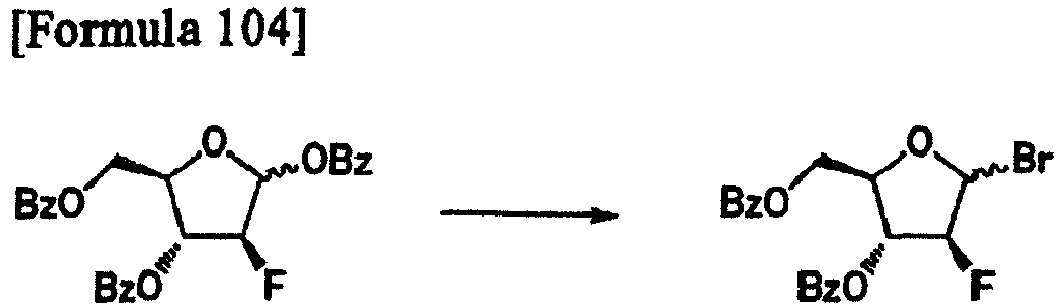
As a result of the measurement of 1H-NMR, it was found that the obtained compounds were all α forms.
1H-NMR(CDCl3)δ value:- 8.11(2H,dd,J=8.0,0.8Hz),8.07(2H,dd,J=8.0,0.8Hz),7.63(1H,tt,J=8.0,0.8Hz),7.56(1H,tt, J=8.0,0.8Hz),7.49(2H,t,J=8.0Hz),7.43(2H,t,J=8.0Hz),6.64(1H,d,J=12.4Hz),5.60(1H,d, J=50.0Hz),5.54(1H,dd,J=22.0,3.0Hz),4.68-4.86(3H,m)
- 19F-NMR(CDCl3)δ value:
- -165.8--166.1(1F,m)
- (2)

The obtained ((2R,3R,4S)-3-(benzoyloxy)-4-fluoro-5-hydroxyoxolan-2-yl)methyl = benzoate was used in the form of a solution for the subsequent reaction, without being isolated. - (3)

- 135 mL of water and 40.2 g of O-methylhydroxylamine hydrochloride were added to a toluene/acetonitrile solution of ((2R,3R,4S)-3-(benzoyloxy)-4-fluoro-5-hydroxyoxolan-2-yl)methyl = benzoate. Subsequently, 58.2 mL of triethylamine was added dropwise to the mixture at a temperature of 25°C to 30°C, and the obtained mixture was then stirred for 6 hours. Thereafter, 150 mL of toluene and 300 mL of a 10% sodium chloride aqueous solution were added to the reaction mixture, and the water layer was then removed. The organic layer was dried over anhydrous sodium sulfate, and the solvent was then distilled away under reduced pressure, so as to obtain 122 g of (2R,3R,4R)-1-(benzoyloxy)-4-fluoro-2-hydroxy-5-(methoxyimino)pentan-3-yl = benzoate in the form of a colorless oily product.
- 1H-NMR was measured. As a result, the syn-anti ratio was found to be 3 : 1. 1H-NMR(CDCl3)δ value:
- 8.10-8.00(4H,m),7.63-7.54(2H,m),7.48-7.38(4.75H,m),6.84(0.25H,dd,J=11.2,4.8Hz),6 .06(0.25H,ddd,J=46.4,4.8,1.6Hz),5.74(0.25H,ddd,J=28.0,8.0,1.6Hz),5.75(0.75H,ddd,J =45.6,6.8,2.4Hz),5.49(0.75H,ddd,J=26.0,8.4,2.4Hz),4.64(0.75H,dd,J=12.0,2.4Hz),4.60 (0.25H,dd,J=11.2,2.4Hz),4.50-4.35(2H,m),3.91(0.75H,s),3.82(2.25H,s),3.11(0.75H,d,J =6.0Hz),3.05(0.25H,d,J=5.6Hz)
- 19F-NMR(CDCl3)δ value:
- -199.9--200.2(0.75F,m),-207.3--207.5(0.25F,m)
-
- (1)

The obtained (2S,3S,4R)-1-(benzoyloxy)-2-chloro-4-fluoro-5-(methoxyimino)pentan-3-yl = benzoate was directly used in the subsequent reaction without being isolated.
A small amount of reaction solution was diluted with deuterated chloroform, and 1H-NMR was then measured. As a result, the syn/anti ratio was found to be 85 : 15.
1H-NMR(CDCl3)δ value:- 3.84(0.45H,s),3.88(2.55H,s),4.54-4.74(3H,m),5.52(0.85H,dt,J=46.4,6.4Hz),5.85(0.85H ,ddd,J=17.2,5.9,3.2Hz),5.88-6.00(0.15H,m),5.95-6.12(0.15H,m),6.88(0.15H,dd,J=11.2, 4.8Hz),7.40-7.53(4.85H,m),7.55-7.66(2H,m),8.01-8.15(4H,m)
- (2)

The obtained oily product was a mixture of (2S,3S,4S)-1-(benzoyloxy)-2-chloro-4-fluoro-5-oxopentan-3-yl = benzoate and a water adduct thereof.
1H-NMR(CDCl3)δ value:- 4.69-4.78(3H,m),5.37(1H,dd,J=46.8,4.0Hz),5.85(1H,dt,J=20.8,3.6Hz),7.39-7.53(4H,m ),7.54-7.66(2H,m),8.01-8.12(4H,m),9.83(1H,d,J=6.4Hz)
- (3)

1H-NMR(CDCl3)δ value:- 3.74(0.55H,q,J=6.8Hz),4.17-4.23(0.45H,m),4.44-4.55(0.90H,m),4.56-4.64(0.55H,m),4 .64-4.72(0.55H,m),5.20(0.55H,ddd,J=51.5,7.6,4.0Hz),5.32(0.45H,dt,J=47.6,2.4Hz),5.4 8(0.55H,t,J=4.4Hz),5.64(0.45H,dd,J=8.411.2,1.6Hz),5.82(0.45H,dt,J=12.8,3.2Hz),6.04 -6.12(0.55H,m),7.28-7.65(6H,m),7.94-8.16(4H,m)
- (4)

- In a nitrogen atmosphere, 39.5 mL of triethylamine and 17.9 mL of acetic anhydride were added dropwise to a solution of 10.3 g of ((2R,3S,4S)-3-(benzoyloxy)-4-fluoro-5-hydroxythiolan-2-yl)methyl = benzoate in 20 mL of ethyl acetate, and the obtained mixture was then stirred at room temperature for 4 hours. Thereafter, 50 mL of ethyl acetate, 20 mL of a 20% sodium chloride aqueous solution and 30 mL of a saturated sodium hydrogen carbonate aqueous solution were added to the reaction mixture, and the water layer was then removed. Thereafter, 30 mL of saturated ammonium chloride water was added to the organic layer, and the water layer was then removed. The organic layer was dried over anhydrous magnesium sulfate, and the solvent was then distilled away under reduced pressure. The obtained residue was purified by silica gel column chromatography (hexane/ethyl acetate = 3/1), so as to obtain 8.35 g of ((2R,3S,4S)-5-(acetyloxy)-3-(benzoyloxy)-4-fluorothiolan-2-yl)methyl = benzoate in the form of a brown oily product.
1H-NMR(CDCl3)δ value: - 2.12(1.29H,s),2.13(1.71H,s),3.74(0.57H,q,J=6.8Hz),4.11(0.43H,q,J=6.8Hz),4.43-4.59( 1.43H,m),4.69(0.57H,dd,J=11.1,6.0Hz),5.31(0.57H,ddd,J=50.8,9.1,4.8Hz),5.39(0.43H, dt,J=47.6,3.2Hz),5.85(0.43H,dt,J=12.0,4.0Hz),6.08(0.57H,dt,J=11.6,8.4Hz),6.18(0.57 H,d,J=4.8Hz),6.24(0.43H,dd,J=13.6,2.0Hz),7.28-7.36(1.14H,m),7.37-7.65(4.86H,m),7. 92-7.98(1.14H,m),8.00-8.09(2.86H,m)
-
- (1)

1H-NMR(CDCl3)δ value:- 2.88(0.31H,s),2.91(0.69H,s),4.33-4.46(2H,m),4.55-4.64(1H,m),5.06(1.38H,s),5.16(0.6 2H,dd,J=6.8,5.5Hz),5.49(0.69H,ddd,J=25.9,7.6,1.6Hz),5.58(0.69H,ddd,J=46.7,6.4,2.4 Hz),5.79(0.31H,dd,J=27.5,7.9Hz),6.10(0.31H,ddd,J=46.7,4.8,2.0Hz),6.90(0.31H,dd,J= 11.2,4.8Hz),7.24(5H,m),7.38-7.53(4.69H,m),7.54-7.64(2H,m),7.99-8.10(4H,m)
- (2)

1H-NMR(CDCl3)δ value:- 4.48-4.75(3H,m),5.07(0.4H,s),5.11(1.6H,s),5.52(0.8H,dt,J=46.8,6.0Hz),5.84(0.8H,ddd, J=16.4,6.0,3.2Hz),5.89-6.00(0.2H,m),6.01-6.18(0.2H,m),6.92(0.2H,dd,J=8.1,3.6Hz),7. 25-7.34(5H,m),7.39-7.51(4.8H,m),7.53-7.64(2H,m),8.00-8.12(4H,m)
- (3)

- In a nitrogen atmosphere, a mixture of 0.610 g of (2S,3S,4R)-3-(benzoyloxy)-5-((benzyloxy)imino)-2-chloro-4-fluoropentyl = benzoate, 3.00 mL of benzaldehyde and 0.300 mL of concentrated sulfuric acid was stirred at room temperature for 1 hour. Thereafter, 5 mL of ethyl acetate, 5 mL of a 20% sodium chloride aqueous solution and 5 mL of a saturated sodium hydrogen carbonate aqueous solution were added to the reaction mixture, and the water layer was then removed. The organic layer was dried over anhydrous magnesium sulfate, and the solvent was then distilled away under reduced pressure. The obtained residue was purified by silica gel column chromatography (hexane/ethyl acetate = 3/1), so as to obtain 0.260 g of a colorless oily product.
- The obtained oily product was a mixture of (2S,3S,4S)-1-(benzoyloxy)-2-chloro-4-fluoro-5-oxopentan-3-yl = benzoate and a water adduct thereof.
1H-NMR(CDCl3)δ value: - 4.69-4.78(3H,m),5.37(1H,dd,J=46.8,4.0Hz),5.85(1H,dt,J=20.8,3.6Hz,7.39-7.53(4H,m), 7.54-7.66(2H,m),8.01-8.12(4H,m),9.83(1H,d,J=6.4Hz)
-
- (1)

1H-NMR(DMSO-d6)δ value:- 5.28-5,12(2H,m),5.01(1H,d,J=4.0Hz),4.31(1H,dd,J=3.6,11.2Hz),4.10-4.02(2H,m),3.34 (3H,s),2.09(3H,s),2.23(3H,s)
- (2)

A mixture of the obtained ((2R,3R,4S)-3-(acetyloxy)-4-fluoro-5-hydroxyoxolan-2-yl)methyl = acetate, 10 mL of methanol, 0.85 g of O-methylhydroxylamine hydrochloride and 0.7 mL of triethylamine was stirred at 25°C for 0.5 hours. Thereafter, ethyl acetate and water were added to the reaction mixture. The organic layer was fractionated, and was then dried over anhydrous sodium sulfate. The solvent was distilled away under reduced pressure. The obtained residue was purified by silica gel column chromatography (hexane/ethyl acetate = 1/1), so as to obtain 0.35 g of (2R,3R,4R)-1-(acetyloxy)-4-fluoro-2-hydroxy-5-(methoxyimino)pentan-3-yl = acetate in the form of a colorless oily product.
1H-NMR(DMSO-d6)δ value:- 7.51(0.75H,dd,J=6.8,7.2Hz),7.02(0.25H,dd,J=4.8,10.4Hz),5.93-5.73(1.25H,m),5.36(0. 75H,ddd,J=2.8,6.8,45.6Hz),5.12(0.25H,ddd,J=1.6,9.2,29.6Hz),4.97(0.75H,ddd,J=2.4,8 .4,26.4Hz),4.05-3.85(3H,m),3.83(0.75H,s),3.80(2.25H,s),2.06(2.25H,s),2.04(0.75H,s), 1.99(3H.m)
- (3)

- A mixture of 0.35 g of the (2R,3R,4R)-1-(acetyloxy)-4-fluoro-2-hydroxy-5-(methoxyimino)pentan-3-yl = acetate, 5 mL of acetonitrile, 0.15 mL of N-methylimidazole and 0.41 g of 2,4,5-trichlorobenzenesulfonyl chloride was stirred at 25°C for 5 hours. Further, 0.10 g of 2,4,5-trichlorobenzenesulfonyl chloride was added to the reaction mixture, and the thus obtained mixture was then left at 25°C for 3 days. Subsequently, 1.0 mL of N-methylimidazole was added to the reaction mixture, and the thus obtained mixture was then left at 25°C for 1 day. Thereafter, ethyl acetate and water were added to the reaction mixture. The organic layer was fractionated, and it was washed with diluted hydrochloric acid twice, and then with a sodium hydrogen carbonate aqueous solution. The resultant was dried over anhydrous magnesium sulfate, and the solvent was then distilled away under reduced pressure. The obtained residue was purified by silica gel column chromatography (hexane/ethyl acetate = 3/1), so as to obtain 0.44 g of a colorless solid. The obtained solid was recrystallized from methanol, so as to obtain 0.29 g of (2R,3R,4R)-1-(acetyloxy)-4-fluoro-5-(methoxyimino)-2-(((2,4,5-trichlorobenzene)sulf onyl)oxy)pentan-3-yl = acetate in the form of a colorless solid.
1H-NMR(DMSO-d6)δ value: - 8.33(1.0H,m),8.23(1.0H,m),7.55(0.75H,dd,J=6.0,7.2Hz),7.05(0.25H,dd,J=4.8,11.2Hz), 5.81(0.25H,ddd,J=2.0,4.8,46.4Hz),5.53(0.25H,ddd,J=2.4,5.2,28.4Hz),5.49-5.33(1.5H, m),5.18-5.11(1H,m),4.35-4.12(2H,m),3.81(3H,m),2.07(3H,m),1.86-1.85(3H,m)
-
- (1)

1H-NMR(CDCl3)δ value:- 3.86(2.16H,s),3.92(0.84H,s),4.57(1H,dd,J=13.2,7.2Hz),4.80(0.72H,dd,J=12.8,2.8Hz),4 .81(0.28H,dd,J=12.8,2.8Hz),5.42(0.72H,ddd,J=45.6,6.4,3.2Hz),5.51-5.60(1H,m),5.83( 0.72H,ddd,J=22.8,5.6,3.2Hz),5.90(0.28H,ddd,J=46.8,4.4,2.4Hz),6.00(0.28H,ddd,J=26. 0,5.6,2.4Hz),6.84(0.28H,dd,J=11.2,4.4Hz),7.38-8.07(10.72Hm) 19F-NMR(CDCl3)δ value:
- 133.79(2F,m),-142.45(1F,m),-157.66(2F,m),-196.43(0.72F,ddd,J=45.6,22.8,6.8Hz),-2 04.90(0.28F,ddd,J=46.8,26.0,11.2Hz)
- 3.86(2.16H,s),3.92(0.84H,s),4.57(1H,dd,J=13.2,7.2Hz),4.80(0.72H,dd,J=12.8,2.8Hz),4 .81(0.28H,dd,J=12.8,2.8Hz),5.42(0.72H,ddd,J=45.6,6.4,3.2Hz),5.51-5.60(1H,m),5.83( 0.72H,ddd,J=22.8,5.6,3.2Hz),5.90(0.28H,ddd,J=46.8,4.4,2.4Hz),6.00(0.28H,ddd,J=26. 0,5.6,2.4Hz),6.84(0.28H,dd,J=11.2,4.4Hz),7.38-8.07(10.72Hm) 19F-NMR(CDCl3)δ value:
- (2)

- In a nitrogen atmosphere, 430 mg of anhydrous lithium bromide was added to a solution of 615 mg of (2R,3R,4R)-3-(benzoyloxy)-4-fluoro-5-(methoxyimino)-2-(((pentafluorobenzene)sulfo nyl)oxy)pentyl = benzoate in 2.2 mL of dimethylimidazolidinone, and the obtained mixture was then stirred at room temperature for 2 hours. Thereafter, 3 mL of water and 3 mL of ethyl acetate were added to the reaction mixture, and the water layer was then removed. The organic layer was dried over anhydrous magnesium sulfate, and the solvent was then distilled away under reduced pressure. The obtained residue was purified by silica gel column chromatography, so as to obtain 379 mg of (2S,3S,4R)-1-(benzoyloxy)-2-bromo-4-fluoro-5-(methoxyimino)pentan-3-yl = benzoate in the form of a colorless oily product.
1H-NMR(CDCl3)δ value: - 3.85(0.51H,s),3.88(2.49H,s),4.52-4.65(2H,m),4.70-4.85(1H,m),5.52(0.83H,ddd,J=46.8 ,6.4,6.4Hz),5.82(0.83H,ddd,J=16.4,6.4,2.8Hz),5.94(0.17H,ddd,J=24.4,6.0,2.8Hz),6.07( 0.17H,ddd,J=47.2,4.4,2.8Hz),6.87(0.17H,dd,J=10.8,4.4Hz),7.41-8.16(10.83H,m) 19F-NMR(CDCl3)δ value:
- 193.45(0.83F,ddd,J=46.8,16.4,6.4Hz),-203.28(0.17F,ddd,J=47.2,24.4,10.8Hz)
-
- (1)

1H-NMR(CDCl3)δ value:- 3.85(2.22H,s),3.91(0.78H,s),4.54(1H,dd,J=12.8,6.4Hz),4.73(0.74H,dd,J=12.8,3.2Hz),4 .75(0.26H,dd,J=12.8,2.8Hz),5.37-5.52(1.74H,m),5.82(0.74H,ddd,J=22.8,5.6,2.8Hz),5. 90(0.26H,brs,J=48.0Hz),6.00(0.26H,ddd,J=26.0,5.6,2.0Hz),6.83(0.26H,dd,J=11.2,4.4H z),7.38-8.11(12.74H,m)
- 19F-NMR(CDCl3)δ value:
- 196.70(0.74F,ddd,J=45.6,22.8,6.8Hz),-204.90(0.26F,ddd,J=48.0,26.0,11.2Hz)
- (2)

- In a nitrogen atmosphere, 291 mg of anhydrous lithium bromide was added to a solution of 421 mg of (2R,3R,4R)-3-(benzoyloxy)-4-fluoro-5-(methoxyimino)-2-(((2,4,5-trichlorobenzene)su lfonyl)oxy)pentyl = benzoate in 1.34 mL of dimethylimidazolidinone, and the obtained mixture was then stirred at 40°C for 4 hours. Thereafter, the reaction mixture was analyzed by high performance liquid chromatography. As a result, the reaction percentage was found to be 98%, and (2S,3S,4R)-1-(benzoyloxy)-2-bromo-4-fluoro-5-(methoxyimino)pentan-3-yl = benzoate was generated.
-
- (1)


- In a nitrogen atmosphere, 0.30 mL of 1-methylimidazole was added dropwise to a solution of 1.0 g of (2R,3R,4R)-1-(benzoyloxy)-4-fluoro-2-hydroxy-5-(methoxyimino)pentan-3-yl = benzoate and 857 mg of 3-nitrobenzenesulfonyl chloride in 5.0 mL of acetonitrile at a temperature of 0°C to 4°C, and the obtained mixture was then stirred at room temperature for 15 hours 30 minutes. Thereafter, 5 mL of a saturated sodium hydrogen carbonate aqueous solution was added to the reaction mixture, and the thus obtained mixture was then stirred at room temperature for 30 minutes. Thereafter, 5.0 mL of ethyl acetate was added to the reaction mixture, and the water layer was then removed. The organic layer was dried over anhydrous magnesium sulfate, and the solvent was then distilled away under reduced pressure. The obtained residue was purified by silica gel column chromatography, so as to obtain 1.59 g of (2R,3R,4R)-3-(benzoyloxy)-4-fluoro-5-(methoxyimino)-2-(((3-nitrobenzene)sulfonyl) oxy)pentyl = benzoate in the form of a colorless oily product.
1H-NMR(CDCl3)δ value: - 3.84(2.01H,s),3.89(0.99H,s),4.50(1H,dd,J=12.8,6.4Hz),4.73-4.80(1H,m),5.33(0.67H,d dd,J=45.6,6.8,3.2Hz),5.39-5.48(1H,m),5.73-5.87(1H,m),5.95(0.33H,ddd,J=26.4,6.0,2. 4Hz),6.80(0.33H,dd,J=11.2,4.4Hz),7.30-8.75(14.67H,m)
- 19F-NMR(CDCl3)δ value:
- -196.64(0.67F,ddd,J=45.6,23.3,6.8Hz),-204.77(0.33F,ddd,J=46.7,26.4,11.2Hz)
- (2)

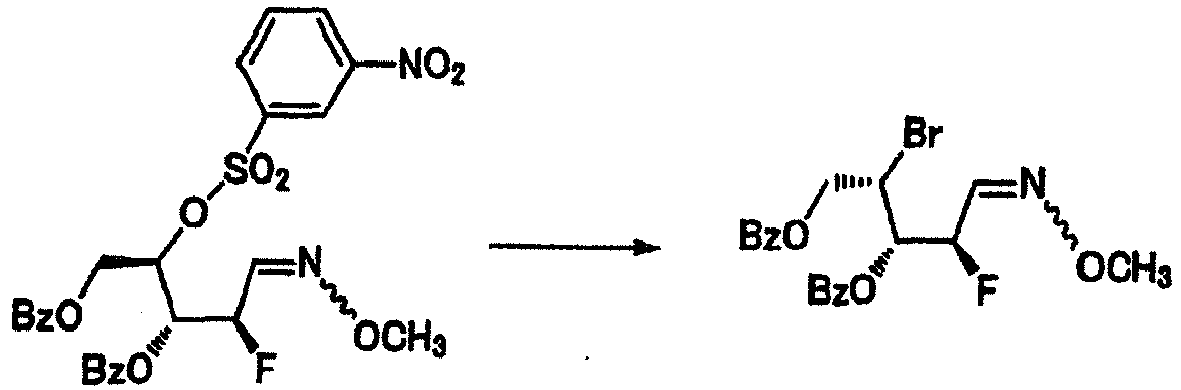
- In a nitrogen atmosphere, 73.6 mg of anhydrous lithium bromide was added to a solution of 103 mg of (2R,3R,4R)-3-(benzoyloxy)-4-fluoro-5-(methoxyimino)-2-(((3-nitrobenzene)sulfonyl) oxy)pentyl = benzoate in 0.34 mL of N,N-dimethylformamide, and the obtained mixture was then stirred at 60°C for 5 hours 30 minute. Thereafter, the reaction mixture was analyzed by high performance liquid chromatography. As a result, the reaction percentage was found to be 98%, and (2S,3S,4R)-1-(benzoyloxy)-2-bromo-4-fluoro-5-(methoxyimino)pentan-3-yl = benzoate was generated.
-
- (1)

1H-NMR(CDCl3)δ value:- 3.83(2.13H,s),3.90(0.87H,s),4.56(1H,dd,J=12.8,6.0Hz),4.84(1H,dd,J=12.8,2.8Hz),5.42 (0.71H,ddd,J=45.6,6.4,3.2Hz),5.39-5.55(1.71H,m),5.87(0.71H,ddd,J=23.6,6.0,2.8Hz), 5.93(0.29H,ddd,J=49.2,4.4,2.4Hz),6.80(0.29H,dd,J=11.2,4.4Hz),7.35-8.15(14.71H,m) 19F-NMR(CDCl3)δ value:
- 197.12(0.71F,ddd,J=45.6,23.6,6.8Hz),-205.10(0.29F,ddd,J=49.2,26.4,11.2Hz)
- 3.83(2.13H,s),3.90(0.87H,s),4.56(1H,dd,J=12.8,6.0Hz),4.84(1H,dd,J=12.8,2.8Hz),5.42 (0.71H,ddd,J=45.6,6.4,3.2Hz),5.39-5.55(1.71H,m),5.87(0.71H,ddd,J=23.6,6.0,2.8Hz), 5.93(0.29H,ddd,J=49.2,4.4,2.4Hz),6.80(0.29H,dd,J=11.2,4.4Hz),7.35-8.15(14.71H,m) 19F-NMR(CDCl3)δ value:
- (2)

- In a nitrogen atmosphere, 875 mg of anhydrous lithium bromide was added to a solution of 1.15 g of (2R,3R,4R)-3-(benzoyloxy)-4-fluoro-5-(methoxyimino)-2-(((2-nitrobenzene)sulfonyl) oxy)pentyl = benzoate in 4 mL of N,N-dimethylformamide, and the obtained mixture was then stirred at 60°C for 3 hours. Thereafter, the reaction mixture was analyzed by high performance liquid chromatography. As a result, the reaction percentage was found to be 98%, and (2S,3S,4R)-1-(benzoyloxy)-2-bromo-4-fluoro-5-(methoxyimino)pentan-3-yl = benzoate was generated.
-
- (1)

1H-NMR(CDCl3)δ value:- 7.98-7.93(4H,m),7.25-7.20(4H,m),5.79(1H,ddd,J=17.2,6.0,6.0Hz),5.25(1H,ddd,J=52.4 ,6.4,4.4Hz),5.07(1H,d,J=4.4Hz),4.72(1H,dd,J=11.6,6.4Hz),4.56(1H,dd,J=11.6,6.4Hz), 4.38-4.34(1H,m),3.48(3H,s),2.43(3H,s)
- 19F-NMR(CDCl3)δ value:
- 206.73(1F,dd,J=52.1,17.5Hz)
- (2)


1H-NMR(CDCl3)δ value:- 7.97-7.93(4H,m),7.24-7.21(4H,m),5.68(1H,dd,J=10.0,3.6Hz),5.47(1H,dd,J=22.0,4.4Hz ),5.16(1H,d,J=49.2Hz),4.74-4.67(2H,m),4.60-4.56(1H,m),2.93(1H,dd,J=3.4,3.4Hz),2.4 2(3H,s),2.40(3H,s)
- 19F-NMR(CDCl3)δ value: -190.09(1F,ddd,J=49.3,22.4,10.4Hz)
- (3)


1H-NMR(CDCl3)δ value:- 7.97-7.89(4H,m),7.39(0.80H,dd,J=6.8,6.8Hz),7.26-7.21(4H,m),6.83(0.20H,dd,J=11.1, 4.7Hz),6.05(0.20H,ddd,J=46.4,4.2,1.5Hz),5.70(0.20H,dd,J=28.2,1.9Hz),5.56(0.80H,dd d,J=45.4,6.9,2.3Hz),5.44(0.80H,ddd,J=26.0,8.4,2.4Hz),4.61(0.80H,dd,J=12.4,3.2Hz),4 .57(0.20H,dd,J=11.1,1.9Hz),4.45-4.34(2H,m),3.91(0.60H,s),3.83(2.40H,s),3.03(0.80H, d,J=5.8Hz),2.98(0.20H,d,J=2.4Hz),2.42-2.41 (6H,m)
- 19F-NMR(CDCl3)δ value:
- 200.06(0.8F,ddd,J=45.2,25.7,6.9Hz),-207.4(0.2F,ddd,J=46.5,28.2,11.1Hz)
- (4)

1H-NMR(CDCl3)δ value:- 8.06(1H,s),7.83(4H,dd,J=45.8,8.2Hz),7.41-7.39(1.18H,m),7.26-7.20(4H,m),6.83(0.82 H,dd,J=11.0,4.6Hz),6.00-5.91(1.41H,m),5.85-5.83(0.41H,m),5.77(0.18H,ddd,22.8,5.9, 3.1Hz),5.46(0.09H,ddd,J=28.5,6.5,2.9Hz),5.41-5.36(0.91H,m),4.72-4.65(1H,m),4.56-4 .51(1H,m),3.90(2.46H,s),3.86(0.54H,s),2.42(6H,s)
- 19F-NMR(CDCl3)δ value:
- 196.58(0.18F,ddd,J=45.6,22.6,6.7Hz),-204.85(0.82F,ddd,J=46.5,26.3,11.0Hz)
- (5)

1H-NMR(CDCl3)δ value:- 8.02-7.88(4H,m),7.47(0.86H,dd,J=6.4,6.4Hz),7.28-7.19(4H,m),6.86(0.14H,dd,J=11.2, 4.8Hz),6.05(0.14H,ddd,J=47.0,4.7,3.0Hz),5.91(0.14H,ddd,J=24.8,5.7,3.1Hz),5.79(0.86 H,ddd,J=17.2,5.7,3.1Hz),5.51(0.86H,ddd,J=46.8,5.2,5.3Hz),4.79-4.70(1.14H,m),4.62-4.54(1.86H,m),3.88(2.58H,m),3.85(0.42H,m),2.43-2.40(6H,m)
19F-NMR(CDCl3)δ value:- 193.52(0.86F,ddd,J=46.7,16.8,6.3Hz),-203.30(0.14F,ddd,J=46.9,24.6,10.8Hz)
- 8.02-7.88(4H,m),7.47(0.86H,dd,J=6.4,6.4Hz),7.28-7.19(4H,m),6.86(0.14H,dd,J=11.2, 4.8Hz),6.05(0.14H,ddd,J=47.0,4.7,3.0Hz),5.91(0.14H,ddd,J=24.8,5.7,3.1Hz),5.79(0.86 H,ddd,J=17.2,5.7,3.1Hz),5.51(0.86H,ddd,J=46.8,5.2,5.3Hz),4.79-4.70(1.14H,m),4.62-4.54(1.86H,m),3.88(2.58H,m),3.85(0.42H,m),2.43-2.40(6H,m)
- (6)

1H-NMR(CDCl3)δ value:- 9.81(1H,d,J=6.0Hz),8.01-7.88(4H,m),7.26-7.18(4H,m),5.80-4.61(5H,m),2.42-2,34(6H, m)
- 19F-NMR(CDCl3)δ value:
- 210.08(1F,ddd,J=47.1,20.8,6.5Hz)
- (7)

1H-NMR(CDCl3)δ value:- 8.01-7.87(4H,m),7.26-7.14(4H,m),6.03-5.97(0.54H,m),5.81(0.46H,dt,J=12.1,4.6Hz),5. 62(0.46H,dd,J=9.6Hz),5.49(0.54H,dd,J=9.6,5.2Hz),5.37(0.23H,m),5.25(0.50H,m),5.12 (0.27H,m),4.68-4.56(1.1H,m),4.48-4.46(0.92H,m),4.19-4.15(0.46H,m),3.74(0.54H,dd, J=12.0,6.8Hz),2.81(0.54H,dd,J=5.8,1.4Hz),2.45-2.37(6.46H,m)
- 19F-NMR(CDCl3)δ value:
- 183.63(0.54F,dd,J=47.4,11.4Hz),-192.74(0.46F,ddd,J=51.2,11.5,5.1Hz)
- (8)

1H-NMR(CDCl3)δ value:- 7,88(4H,dd,J=28.0,8.0Hz),7.16(4H,dd,J=32.0,8.0Hz),6.17(1H,d,J=4.4Hz),6.08-6.01(1 H,m),5.30(1H,ddd,J=50.8,9.6,4.5Hz),4.66(1H,dd,J=11.2,6.0Hz),4.47(1H,dd,J=11.4,6.6 Hz),3.72(1H,dd,J=13.4,6.6Hz),2.42(3H,s),2.36(3H,s),2.12(3H,s) 19F-NMR(CDCl3)δ value: -191.83(1F,dd,J=50.8,11.7Hz)
- (9)

1H-NMR(CDCl3)δ value:- 8.01-7.86(4H,m),7.27-7.20(4H,m),5.82-5.80(0.5H,m),5.77-5.75(0.5H,m),5.73-5.71(1H ,m),5.68-5.67(0.5H,m),5.58-5.56(0.5H,m),4.65-4.60(1H,m),4.57-4.49(1H,m),4.34-4.28 (1 H,m),2.42(3H,s),2.40(3H,s)
- 19F-NMR(CDCl3)δ value: -163.52(1F,dd,J=46.9,14.4Hz)
- (10)

m/z(ESI-positive):540.5[M+H]+
19F-NMR(CDCl3)δ value: -195.82(1F,ddd,J=49.0,23.5,9.2Hz) - (11)

- (2R,3S)4S,5R)-3-hydroxy-2-hydroxymethyl-5-(4-amino-2-oxo-1,2-dihydropyri midin-1-yl)-4-fluorothiolane was obtained in the same manner as that of Example 1(8).
-
- (1)

1H-NMR(CDCl3)δ value:- 8.02-7.96(4H,m),7.45-7.26(4H,m),5.83(1H,ddd,J=17.2,6.0,6.0Hz),5.25(1H,ddd,J=52.0 ,6.4,4.4Hz),5.07(1H,d,J=4.4Hz),4.73(1H,dd,J=11.6,4.0Hz),4.56(1H,dd,J=11.6,6.4Hz), 4.37-4.33(1H,m),3.48(3H,s)
- 19F-NMR(CDCl3)δ value: -191.75(1F,dd,J=50.6,11.9Hz)
- (2)

1H-NMR(CDCl3)δ value:- 8.01-7.97(4H,m),7.45-7.39(4H,m),5.69(1H,d,J=10.0Hz),5.46(1H,dd,J=21.8,4.2Hz),5.1 6(1H,d,J=49.2Hz),4.76-4.59(3H,m),2.92(1H,brs)
- 19F-NMR(CDCl3)δ value: -190.45(1F,ddd,J=49.1,21.9,10.1Hz)
- (3)


1H-NMR(CDCl3)δ value:- 7.98-7.92(4H,m),7.58(0.86H,dd,J=6.0,6.0Hz),7.45-7.39(4H,m),6.82(0.14H,dd,J=11.2, 4.6Hz),6.04(0.14H,ddd,J=46.4,4.6,2.0Hz),5.75(0.14H,dd,J=8.2,2.0Hz),5.55-5.50(1.72 H,m),4.63-4.54(1H,m),4.46-4.35(2H,m),3.91(0.42H,s),3.85(2.58H,s),3.08(0.86H,d,J=6 .6,1.1Hz),2.91(0.25H,d,J=6.0Hz)
- 19F-NMR(CDCl3)δ value:
- 200.31(0.86F,ddd,J=46.5,23.6,5.7Hz),-207.35(0.14F,ddd,J=45.2,29.2,10.4Hz)
- (4)

1H-NMR(CDCl3)δ value:- 7.99(1H,s),7.96-7.89(4H,m),7.65(1H,s),7.44-7.40(4H,m),7.35(1H,m),5.62-5.58(1H,m) ,5.37-5.22(2H,m),4.84-4.79(1H,m),4.68-4.63(1H,m),3.83(3H,s)
- 19F-NMR(CDCl3)δ value: -190.52(1F,ddd,J=47.4,17.4,6.5Hz)
- (5)
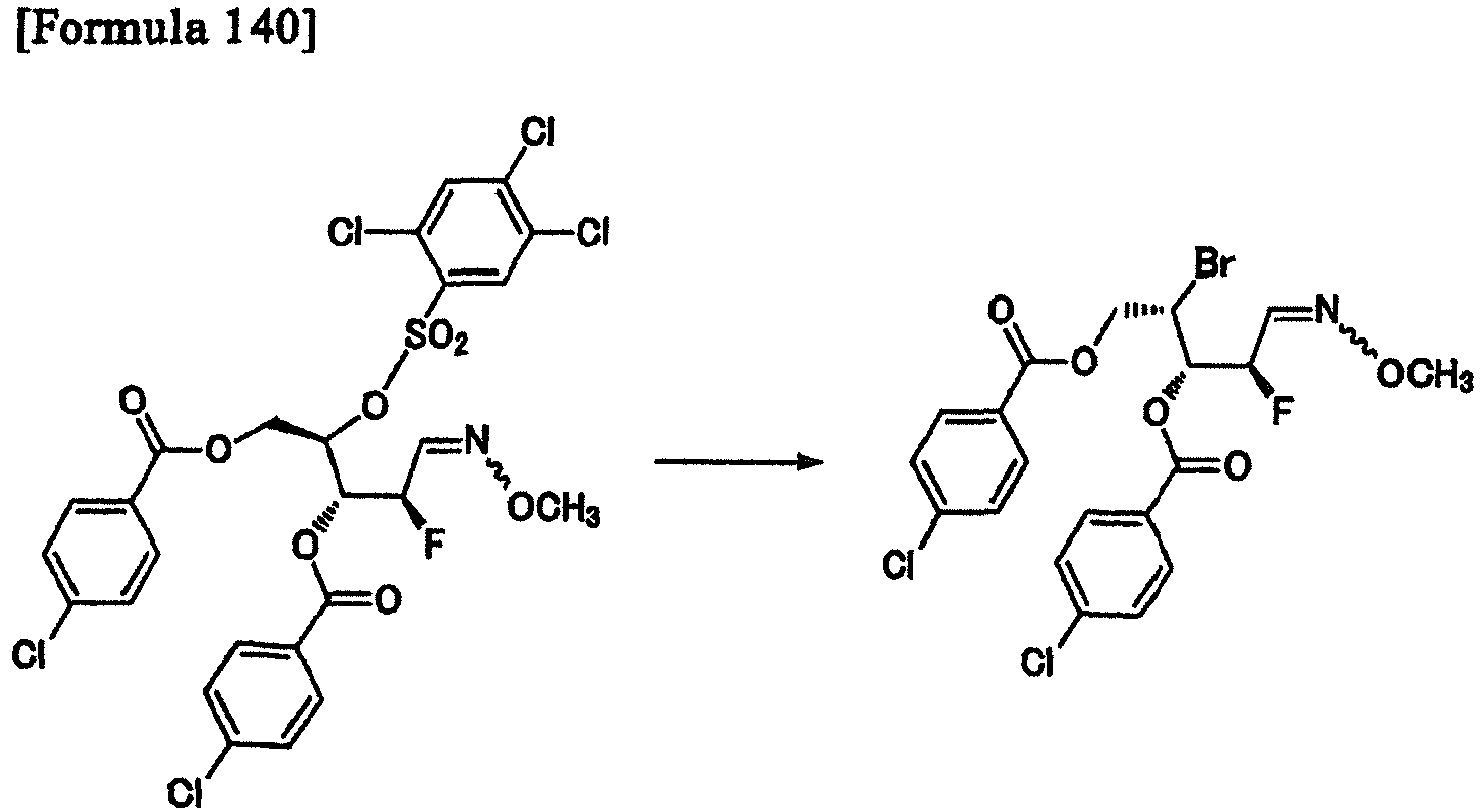
1H-NMR(CDCl3)δ value:- 8.02-7.91(4H,m),7.46-7.40(5H,m),5.87(1H,ddd,J=6.1,6.1,1.7Hz),5.14(1H,ddd,J=46.8, 27.2,11.7Hz),4.65-4.64(2H,m),4.53-4.48(1H,m),3.81(3H,s)
- 19F-NMR(CDCl3)δ value: -171.64(1F,ddd,J=46.6,8.7,5.2Hz)
- (6)

1H-NMR(CDCl3)δ value:- 9.80-9.78(1H,m),8.02-7.90(4H,m),7.48-7.39(4H,m),5.80-4.54(5H,m) 19F-NMR(CDCl3)δ value: -194.14(1F,ddd,J=47.3,18.5,4.4Hz)
- (7)

1H-NMR(CDCl3)δ value:- 8.00-7.90(4H,m),7.44-7.31(4H,m),6.04-6.01(0.56H,m),5.79(0.44H,dt,J=12.6,5.3Hz),5. 68-5.62(0.44H,m),5.48(0.54H,dd,J=8.8,4.4Hz),5.37-5.36(0.22H,m),5.27-5.24(0.50H,m ),5.12-5.11(0.28H,m),4.65-4.59(1.3H,m),4.49-4.47(0.7H,m),4.20-4.15(0.44H,m),2.79( 0.54H,d,J=4.0Hz),2.37(0.54H,d,J=8.0Hz)
- 19F-NMR(CDCl3)δ value:
- -183.81(0.54F,dd,J=46.7,11.8Hz),-192.29(0.46F,ddd,J=51.6,11.8,4.2Hz)
- (8)

1H-NMR(CDCl3)δ value:- 7.96(4H,dd,J=14.0,2.4Hz),7.41(4H,dd,J=18.8,8.4Hz),6.23(1H,dd,J=14.0,2.0Hz),5.82(1 H,ddd,J=12.0,8.0,3.0Hz),5.38(1H,ddd,J=44.8,3.4,2.3Hz),4.55-4.43(2H,m),4.10-4.07(1 H,m),2.12(3H,s)
- 19F-NMR(CDCl3)δ value: -191.76(1F,dd,J=50.8,11.7Hz)
- (9)

1H-NMR(CDCl3)δ value:- 8.01(4H,dd,J=16.8,8.4Hz),7.42(4H,dd,J=10.8,8.4Hz),5.82-5.80(0.5H,m),5.77-5.76(0.5 H,m),5.74-5.73(1H,m),5.69(0.5H,brs),5.58-5.56(0.5H,m),4.65-4.50(1H,m),4.32-4.26(1 H,m)
- 19F-NMR(CDCl3)δ value: -163.51(1F,dd,J=47.2,14.5Hz)
- (10)

m/z(ESI-positive):580.4[M+H]+
19F-NMR(CDCl3)δ value: -196.19(1F,ddd,J=49.1,23.9,8.7Hz) - (11)

- (2R,3S,4S,5R)-3-hydroxy-2-hydroxymethyl-5-(4-amino-2-oxo-1,2-dihydropyri midin-1-yl)-4-fluorothiolane was obtained in the same manner as that of Example 1(8).
-
- (1)

1H-NMR(CDCl3)δ value:- 8.03-7.98(4H,m),6.93-6.88(4H,m),5.45(1H,dd,J=23.2,4.8Hz),5.21-5.03(2H,m),4.71(1 H,dd,J=12.0,3.6Hz),4.60(1H,dd,J=12.0,4.4Hz),4.47-4.50(1H,m),3.87(3H,s),3.85(3H,s) ,3.45(3H,s)
- 19F-NMR(CDCl3)δ value: -190.34(1F,ddd,J=49.3,23.1,10.5Hz)
- (2)

1H-NMR(CDCl3)δ value:- 8.03-7.97(4H,m),6.94-6.88(4H,m),5.68(1H,dd,J=10.4,3.6Hz),5.45(1H,dd,J=22.2,4.2Hz ),5.15(1H,d,J=49.2Hz),4.72-4.55(3H,m),3.34(1H,dd,J=3.4Hz)
- 19F-NMR(CDCl3)δ value: -189.89--190.10(1F,m)
- (3)

1H-NMR(CDCl3)δ value:- 8.04-7.96(4H,m),7.39(0.70H,dd,J=6.0,6.0Hz),6.94-6.89(4H,m),6.83(0.30H,dd,J=11.0, 4.8Hz),6.05(0.30H,ddd,J=46.5,4.8,1.9Hz),5.71-5.62(0.30H,m),5.56(0.70H,ddd,J=45.4, 6.9,2.3Hz),5.42(0.70H,ddd,J=26.0,8.4,2.3Hz),4.62-4.54(1H,m),4.42-4.32(2H,m),3.91( 0.9H,s),3.87-3.85(6H,m),3.83(2.1H,s),3.06(0.7H,d,J=2.4Hz),3.01(0.3H,d,J=2.4Hz) 19F-NMR(CDCl3)δ value:
- 200.11(0.7F,ddd,J=45.2,26.0,6.8Hz),-207.36(0.3F,ddd,J=46.5,28.4,10.9Hz)
- 8.04-7.96(4H,m),7.39(0.70H,dd,J=6.0,6.0Hz),6.94-6.89(4H,m),6.83(0.30H,dd,J=11.0, 4.8Hz),6.05(0.30H,ddd,J=46.5,4.8,1.9Hz),5.71-5.62(0.30H,m),5.56(0.70H,ddd,J=45.4, 6.9,2.3Hz),5.42(0.70H,ddd,J=26.0,8.4,2.3Hz),4.62-4.54(1H,m),4.42-4.32(2H,m),3.91( 0.9H,s),3.87-3.85(6H,m),3.83(2.1H,s),3.06(0.7H,d,J=2.4Hz),3.01(0.3H,d,J=2.4Hz) 19F-NMR(CDCl3)δ value:
- (4)


- 8.07-8.06(1H,s),7.98-7.82(4H,m),7.43-7.39(1.73H,m),6.93-6.88(4H,m),6.82(0.27H,dd, J=11.0,4.5Hz),5.96-5.95(0.27H,m),5.87(0.27H,ddd,22.7,5.3,2.3Hz),5.75(0.73H,ddd,22 .9,5.9,3.1Hz),5.50-5.47(0.36H,m),5.42-5.36(1.36H,m),4.70-4.64(1H,m),4.53-4.48(1H, m),3.90-3.83(9H,m)
- 19F-NMR(CDCl3)δ value:
- 196.63(0.73F,ddd,J=45.6,23.0,6.8Hz),-204.89(0.27F,ddd,J=46.5,26.3,11.0Hz)
- (5)

1H-NMR(CDCl3)δ value:- 8.08-7.94(4H,m),7.46(1H,dd,J=6.5,6.5Hz),6.96-6.89(4H,m),5.77(1H,ddd,J=16.8,6.0,3. 2Hz),5.50(1H,ddd,J=46.8,6.3,6.3Hz),4.75-4.69(1H,m),4.57-4.53(2H,m),3.88-3.84(9H, m)
- 19F-NMR(CDCl3)δ value: -193.50(1F,ddd,J=46.1,16.9,6.2Hz)
- (6)

A mixture of (2S,3S,4S)-2-bromo-4-fluoro-3-((4-methoxyphenyl)carbonyloxy)-5-oxopentyl = 4-methoxybenzoate and a water adduct thereof was obtained in the form of a colorless oily product in the same manner as that of Example 1(4), with the exception that the reaction was carried out at 60°C for 14 hours.
1H-NMR(CDCl3)δ value:- 9.85-9.70(1H,m),8.02-7.91(4H,m),6.94-6.86(4H,m),6.07-4.38(5H,m),3.87-3.84(6H,m) 19F-NMR(CDCl3)δ value: -210.07(1F,ddd,J=47.3,20.9,6.4Hz)
- (7)


1H-NMR(CDCl3)δ value:- 8.02-7.93(4H,m),6.93-6.82(4H,m),6.32-5.97(0.54H,m),5.80(0.46H,dt,J=12.2,4.9Hz),5. 61(0.46H,dt,J=9.7,9.7Hz),5.48(0.54H,dd,J=9.5,5.0Hz),5.36-5.35(0.23H,m),5.25-5.23( 0.50H,m),5.14-5.09(0.27H,m),4.65-4.54(1.3H,m),4.47-4.45(0.7H,m),4.25-4.17(0.46H, m),3.87-3.83(6H,m),3.73(0.54H,d,J=12.3,6.7Hz),2.78(0.54H,d,J=5.3Hz),2.69(0.46H,d, J=8.6Hz)
- 19F-NMR(CDCl3)δ value:
- 183.54(0.54F,dd,J=47.1,11.4Hz),-192.82(0.46F,ddd,J=51.4,11.7,5.1Hz)
- (8)

1H-NMR(CDCl3)δ value:- 7.98(4H,dd,J=9.8,9.8Hz),6.89(4H,dd,J=16.4,8.8Hz),6.22(1H,dd,J=13.6,1.8Hz),5.81(1 H,ddd,J=12.3,8.2,3.0Hz),5.37(1H,ddd,J=45.0,3.5,2.2Hz),4.54-4.40(2H,m),4.15-4.03(1 H,m),3.87(3H,s),3.85(3H,s),2.11(3H,s)
- 19F-NNM(CDCl3)δ value: -191.95(1F,dd,J=50.8,11.7Hz)
- (9)

1H-NMR(CDCl3)δ value:- 8.03(4H,dd,J=20.9,8.9Hz),6.91(4H,dd,J=11.3,8.9Hz),5.81-5.79(0.5H,m),5.76-5.74(0.5 H,m),5.72-5.71(1H,m),5.68(0.5H,brs),5.58-5.56(0.5H,m),4.64-4.47(1H,m),4.33-4.27(1 H,m),3.87(3H,s),3.85(3H,s)
- 19F-NMR(CDCl3)δ value: -163.56(1F,dd,J=47.2,14.8Hz)
- (10)

m/z(ESI-positive):572.5[M+H]+
19F-NMR(CDCl3)δ value: -196.14(1F,ddd,J=49.6,23.7,8.9Hz) - (11)

- (2R,3S,4S,5R)-3-hydroxy-2-hydroxymethyl-5-(4-amino-2-oxo-1,2-dihydropyri midin-1-yl)-4-fluorothiolane was obtained in the same manner as that of Example 1(8).
-
- (1)

1H-NMR(CDCl3)δ value:- 8.21-8.15(4H,m),7.68-7.75(4H,m),5.83(1H,ddd,J=17.2,6.0,6.0Hz),5.28(1H,ddd,J=52.0 ,6.4,4.4Hz),5.09(1H,d,J=4.4Hz),4.78(1H,dd,J=12.0,4.0Hz),4.62(1H,dd,J=12.0,6.4Hz), 4.41-4.3(H,m),3.49(3H,s)
- 19F-NMR(CDCl3)δ value: -63.16(3F,s),-63.23(3F,s),-206.61(1F,dd,J=52.3,16.9Hz)
- (2)

- 8.18(4H,dd,J=7.8,7.8Hz),7.73(4H,dd,J=12.4,4.4Hz),5.72(1H,dd,J=9.8,2.6Hz),5.51(1H, dd,J=21.6,4.0Hz),5.19(1H,d,J=49.2Hz),4.82-4.78(1H,m),4.72-4.64(2H,m),2.85(1H,dd, J=3.2,3.2Hz)
- 19F-NMR(CDCl3)δ value:
- 63.16(3F,s),-63.24(3F,s),-190.66(1F,dddd,J=49.0,21.7,9.6,2.4Hz)
- (3)

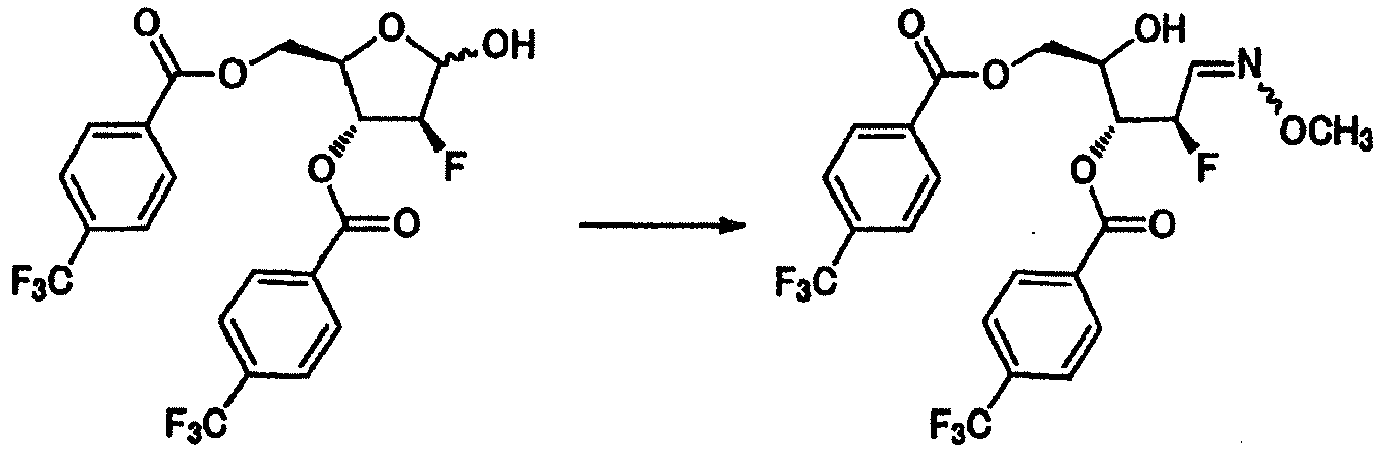
- 8.19-8.11(4H,m),7.74-7.69(4H,m),7.40(0.64H,dd,J=6.4,6.4Hz),6.83(0.36H,dd,J=11.2,4 .4Hz),6.10(0.36H,ddd,J=46.4,4.5,2.0Hz),5.82(0.36H,dd,J=8.1,1.9Hz),5.65(0.32H,dd,J =6.4,2.4Hz),5.57-5.48(0.96H,m),4.67-4.60(1H,m),4.51-4.41(2H,m),3.93(1.08H,s),3.82 (1.92H,s),2.88(0.64H,d,J=5.8Hz),2.83(0.36H,d,J=5.9Hz),
- 19F-NMR(CDCl3)δ value:
- 63.23(3F,s),-63.28(3F,s),-200.2(0.64F,ddd,J=45.2,25.3,7.2Hz),-207.4(0.36F,ddd,J=46. 3,27.5,11.3Hz)
- (4)
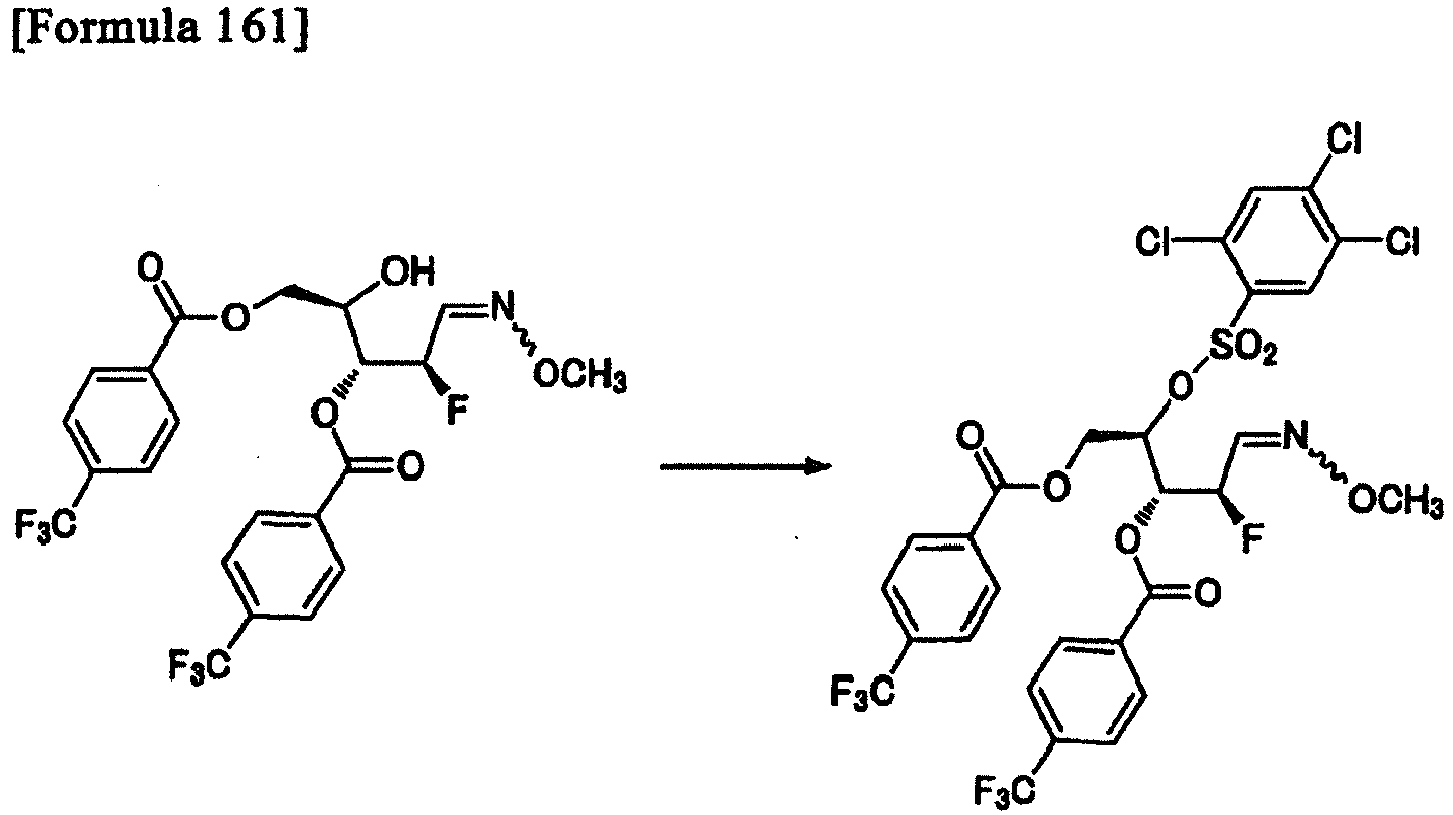
1H-NMR(CDCl3)δ value:- 8.15-8.05(5H,m),7.75-7.70(4H,m),7.50(1H,s),7.41(0.65H,dd,J=6.6,6.6Hz),6.81(0.35H, dd,J=11.3,4.4Hz),6.02(0.35H,ddd,J=25.7,5.9,2.5Hz),5.95-5.93(0.17H,m),5.86-5.78(0.8 2H,m),5.51-5.38(1.65H,m),4.81-4.74(1H,m),4.63-4.57(1H,m),3.92(1.95H,s),3.83(1.05 H,s)
- 19F-NMR(CDCl3)δ value:
- 63.23(3F,s),-63.30(3F,s),-196.6(0.65F,ddd,J=45.6,21.9,6.9Hz),-204.9(0.35F,ddd,J=46. 9,25.9,11.4Hz)
- (5)

- 8.23-8.08(4H,m),7.76-7.66(4H,m),7.49(0.82H,dd,J=6.4,6.4Hz),6.87(0.18H,dd,J=11.2, 4.8Hz),6.07(0.18H,ddd,47.0,4.6,3.3Hz),5.93(0.18H,ddd,23.8,5.7,3.2Hz),5.83(0.82H,dd d,15.6,6.2,3.0Hz),5.53(0.82H,ddd,46.8,6.3,6.3Hz),4.81-4.70(1H,m),4.81-4.74(1H,m),4 .65-4.58(1H,m),3.90(2.46H,s),3.88(0.54H,s)
- 19F-NMR(CDCl3)δ value:
- -63.24(3F,s),-63.27(3F,s),-193.37(0.82F,ddd,J=46.7,15.4,6.4Hz),-202.98(0.18F,ddd,J= 47.1,23.5,10.7Hz)
- (6)

1H-NMR(CDCl3)δ value:- 9.84(1H,d,J=5.6Hz),8.23-8.03(4H,m),7.78-7.57(4H,m),5.89-4.09(5H,m) 19F-NMR(CDCl3)δ value: -63.28(3F,s),-63.36(3F,s),-210.07(1F,ddd,J=47.1,20.1,5.8Hz)
- (7)

1H-NMR(CDCl3)δ value:- 8.18-8.07(4H,m),7.75-7.58(4H,m),6.10-6.06(0.53H,m),5.84(0.47H,dt,13.0,6.0Hz),5.67 (0.47H,dd,J=10.2,7.1Hz),5.49(0.53H,dd,J=8.4,4.1Hz),5.40-5.39(0.23H,m),5.30-5.27(0. 50H,m),5.17-5.14(0.27H,m),5.17-4.65(1.3H,m),4.55-4.53(0.7H,m),4.22(0.47H,m),3.78 (0.53H,dd,J=13.0,6.2Hz),2.91(0.53H,d,J=4.4Hz),2.45(0.47H,d,J=7.0Hz) 19F-NMR(CDCl3)δ value:
- -63.28(3F,s),-63.30(3F,s),-184.00(0.47F,dd,J=47.4,11.9Hz),-192.00(0.53F,ddd,J=51.4,1 1.8,3.7Hz)
- 8.18-8.07(4H,m),7.75-7.58(4H,m),6.10-6.06(0.53H,m),5.84(0.47H,dt,13.0,6.0Hz),5.67 (0.47H,dd,J=10.2,7.1Hz),5.49(0.53H,dd,J=8.4,4.1Hz),5.40-5.39(0.23H,m),5.30-5.27(0. 50H,m),5.17-5.14(0.27H,m),5.17-4.65(1.3H,m),4.55-4.53(0.7H,m),4.22(0.47H,m),3.78 (0.53H,dd,J=13.0,6.2Hz),2.91(0.53H,d,J=4.4Hz),2.45(0.47H,d,J=7.0Hz) 19F-NMR(CDCl3)δ value:
- (8)

- 8.05(4H,dd,J=22.0,8.0Hz),7.62(4H,dd,J=48.2,8.2Hz),6.19(1H,d,J=4.4Hz),6.11-6.04(1 H,m),5.32(1H,ddd,J=50.6,9.1,4.5Hz),4.62(1H,ddd,J=55.6,11.4,6.6Hz),3.78(1H,dd,J=1 3.6,6.8Hz),2.16(3H,s)
- 19F-NMR(CDCl3)δ value: -63.32(3F,s),-63.33(3F,s),-191.78(1F,dd,J=50.6,11,9Hz)
- (9)

1H-NMR(CDCl3)δ value:- 8.19(4H,dd,J=15.8,8.0Hz),7.72(4H,dd,J=9.0,9.0Hz),5.87-5.85(0.5H,m),5.82-5.80(0.5H ,m),5.76(1H,brs),5.71(0.5H,brs),5.61(0.5H,brs),4.68-4.59(2H,m),4.36-4.30(1H,m) 19F-NMR(CDCl3)δ value: -63.20(3F,s),-63.28(3F,s),-163.52(1F,dd,J=46.9,14.4Hz)
- (10)

m/z(ESI-positive):648.5[M+H]+
19F-NMR(CDCl3)δ value: -196.23(1H,ddd,J=49.7,24.5,8.7Hz) - (11)
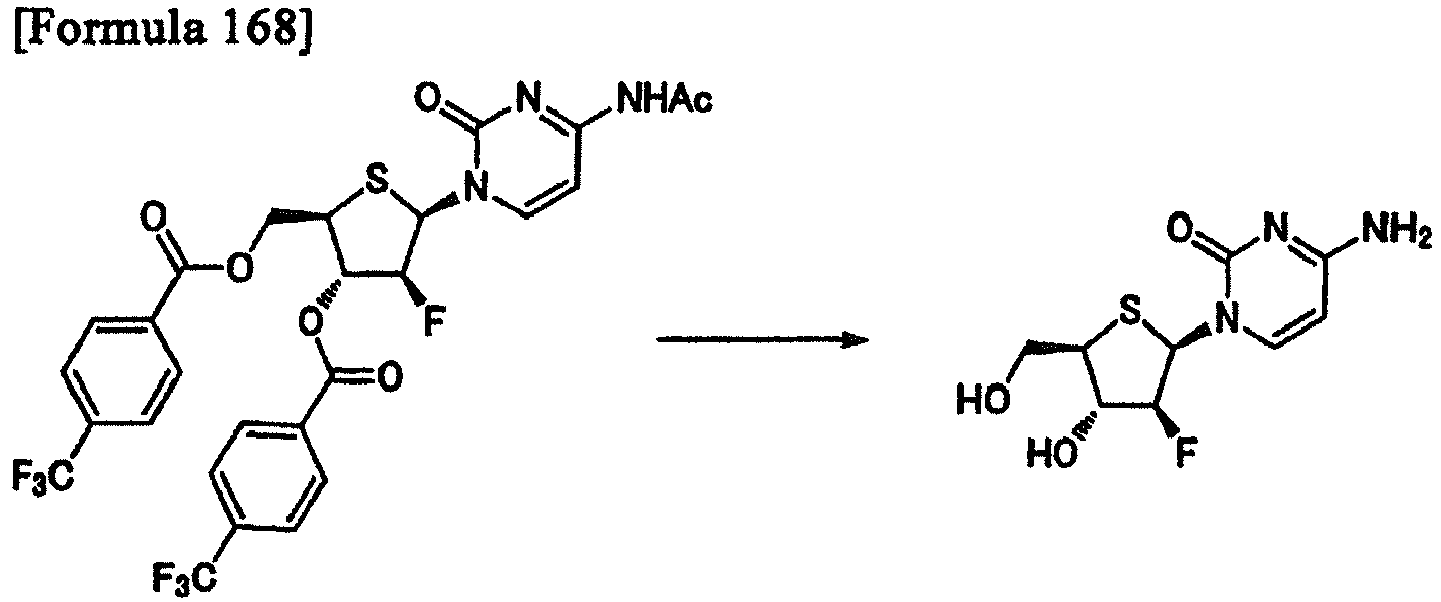
- (2R,3S,4S,5R)-3-hydroxy-2-hydroxymethyl-5-(4-amino-2-oxo-1,2-dihydropyri midin-1-yl)-4-fluorothiolane was obtained in the same manner as that of Example 1(8).
-
- (1)

1H-NMR(CDCl3)δ value:- 7.74(2H,dd,J=16.0,5.6),7.54-7.51(4H,m),7.42-7.36(6H,m),6.47(2H,dd,J=16.0,6.8Hz),5 .63(1H,ddd,J=17.2,6.0,6.0Hz),5.20(1H,ddd,J=52.4,6.4,4.4Hz),5.05(1H,d,J=4.4Hz),4.6 2(1H,dd,J=11.6,4.0Hz),4.40(1H,dd,J=11.6,7.2Hz),4.31-4.24(1H,m),3.52(3H,s) 19F-NMR(CDCl3)δ value: -206.91(1F,dd,J=52.3,16.9Hz)
- (2)

1H-NMR(CDCl3)δ value:- 7.75(2H,dd,J=16.0,8.0Hz),7.54-7.51(4H,m),7.41-7.37(6H,m),6.48(2H,dd,J=16.0,4.4Hz ),5.67(1H,dd,J=10.4,2.8Hz),5.51(1H,dd,J=21.6,4.0Hz),5.32(1H,dd,J=22.2,4.2Hz),5.09 (1H,d,J=49.2Hz),4.65-4.58(2H,m),4.48-4.42(1H,m),3.15(1H,brs)
- 19F-NMR(CDCl3)δ value: -190.06(1F,ddd,J=49.1,22.1,10.3Hz)
- (3)

1H-NMR(CDCl3)δ value:- 7.75(2H,dd,J=19.7,16.1Hz),7.53-7.50(4H,m),7.41-7.37(6.77H,m),6.85(0.23H,dd,J=11. 2,4.8Hz),6.48(2H,dd,J=16.0,14.8Hz),6.01(ddd,J=46.4,4.8,2.0Hz),5.57(ddd,J=28.4,8.0, 2.0Hz),5.53(ddd,J=45.4,6.6,2.4Hz),5.33(ddd,J=26.0,8.1,2.5Hz),4.50-4.40(1H,m),4.32-4.28(2H,m),3.94(0.7H,s),3.02-2.99(1H,m)
- 19F-NMR(CDCl3)δ value:
- -200.15(0.77F,ddd,J=45.6,26.0,7.2Hz),-207.29(0.23F,ddd,J=46.7,28.2,11.3Hz)
- (4)

- 8.17(1H,s),7.78-7.63(3H,m),7.54-7.50(4H,m),7.41-7.36(6.77H,m),6.81(0.23H,dd,J=11 .1,4.4Hz),6.33(1.54H,dd,J=77.6,16.0Hz),6.32(0.46H,dd,J=65.2,16.0Hz),5.89(0.23H,m) ,5.79(0.23H,ddd,19.0,5.5,2.4Hz),5.66(0.77H,ddd,23.6,6.4,3.2Hz),5.37(0.77H,ddd,45.8 ,6.5,3.1Hz),5.29-5.25(1H,m),4.59-4.55(1H,m),4.43-4.38(1H,m),3.94(0.69H,s),3.89(2.3 1H,s)
- 19F-NMR(CDCl3)δ value:
- 197.2(0.77F,ddd,J=45.6,23.4,6.9Hz),-205.2(0.23F,ddd,J=46.7,26.4,11.3Hz)
- (5)


1H-NMR(CDCl3)δ value:- 7.78(2H,dd,J=28.0,16.0Hz),7.57-7.51(4H,m),7.46(0.87H,dd,J=6.5,6.5Hz),7.41-7.37(6 H,m),6.87(0.13H,dd,J=11.0,4.8Hz),6.50(2H,dd,J=29.6,16.0Hz),6.03(0.13H,dd,J=47.2, 4.6,3.3Hz),5.75(0.13H,dd,J=25.1,5.8,3.1Hz),5.65(0.87H,ddd,17.6,5.6,3.6Hz),5.53(0.82 H,ddd,46.8,6.3,6.3Hz),4.66-4.44(3H,m),3.92(3H,s)
- 19F-NMR(CDCl3)δ value: -193.71(1F,ddd,J=46.7,17.3,6.4Hz)
- (6)

1H-NMR(CDCl3)δ value:- 9.86-9.79(1H,m),8.86-7.67(2H,m),7.58-7.26(10H,m),6.53-6.45(2H,m),5.79-4.11(5H,m )
- 19F-NMR(CDCl3)δ value: -210.09-210.34(1F,m)
- (7)

1H-NMR(CDCl3)δ value:- 7.76-7.69(2H,m),7.53-7.46(4H,m),7.41-7.31(6H,m),6.45(0.94H,dd,J=15.8,6.2Hz),6.43 (1.06H,dd,J=22.8,16.0Hz),5.91-5.84(0.53H,m),5.70(0.47H,dt,11.9,4.8Hz),5.59(0.47H, dd,9.8,9.8Hz),5.45(0.53H,dd,J=9.6,4.8Hz),5.30-5.29(0.23H,m),5.19-5.16(0.50H,m),5. 06-5.04(0.27H,m),4.53-4.50(1.3H,m),4.55-4.53(0.7H,m),4.09-4.05(0.47H,m),3.62(0.5 3H,dd,J=12.3,6.7Hz),2.88(0.53H,d,J=5.4Hz),2.52(0.47H,d,J=9.0Hz) 19F-NMR(CDCl3)δ value:
- -183.75(0.48Fdd,J=47.1,11.5Hz),-192.65(0.52Fddd,J=51.2,11.8,4.6Hz)
- (8)


1H-NMR(CDCl3)δ value:- 7.71(2H,dd,J=33.8,16.2Hz),7.49-7.29(10H,m),6.42(2H,dd,J=43.2,16.0Hz),6.15(1H,d,J =4.0Hz),5.23-5.86(1H,m),5.22(1H,ddd,J=50.8,8.9,4.5Hz),4.46(1H,ddd,J=58.4,11.3,6.9 Hz),3.61(1H,dd,J=13.8,7.0Hz),2.18(3H,s)
- 19F-NMR(CDCl3)δ value: -192.04(1F,dd,J=50.5,12.0Hz)
- (9)

1H-NMR(CDCl3)δ value:- 7.83-7.69(2H,m),7.55-7.45(4H,m),7.42-7.31(6H,m),6.51-6.38(2H,m),5.67-5.66(1.5H, m),5.63-5.61(0.5H,m),4.65-4.59(1H,m),4.54-4.38(2H,m),4.23-4.18(1H,m) 19F-NMR(CDCl3)δ value: -163.52(1F,dd,J=49.1,15.0Hz)
- (10)

m/z(ESI-positive):564.5[M+H]+
19F-NMR(CDCl3)δ value: -195.90(1F,ddd,J=49.0,23.5,9.2Hz) - (11)

- (2R,3S,4S,5R)-3-hydroxy-2-hydroxymethyl-5-(4-amino-2-oxo-1,2-dihydropyri midin-1-yl)-4-fluorothiolane was obtained in the same manner as that of Example 1(8).
-
- (1)

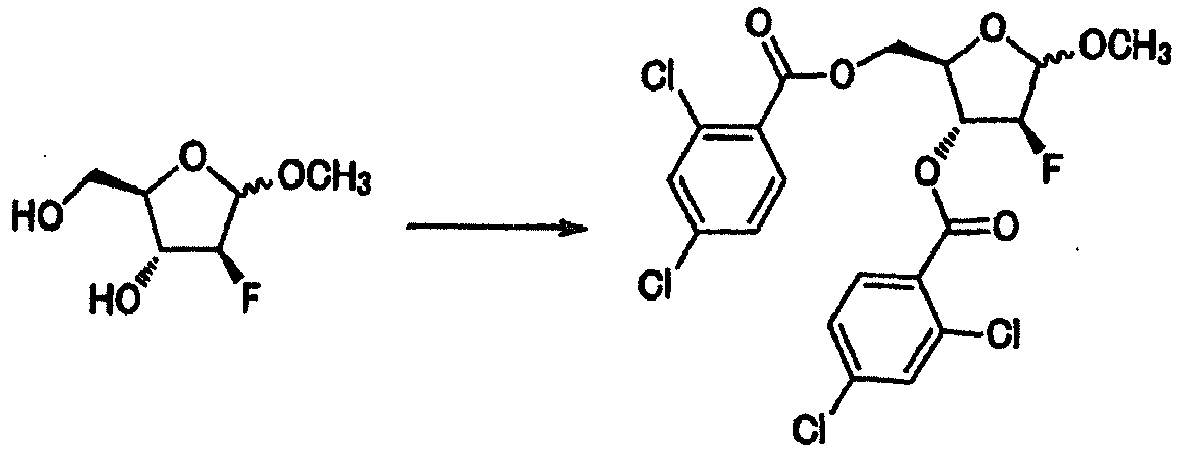
1H-NMR(CDCl3)δ value:- 7.89-7.81(2H,m),7.50-7.47(2H,m),7.34-7.29(2H,m),5.44(1H,dd,J=22.8,4.8Hz),5.20-5. 02(2H,m),4.77(1H,dd,J=12.0,3.6Hz),4.61(1H,dd,J=12.0,3.6Hz),4.49(1H,dd,J=8.4,3.6H z),3.44(3H,s)
- 19F-NMR(CDCl3)δ value: -190.42(1F,ddd,J=48.9,22.0,10.0Hz)
- (2)

1H-NMR(CDCl3)δ value:- 7.87(2H,dd,J=15.6,8.4Hz),7.50(2H,dd,J=11.6,2.0Hz),7.35-7.29(2H,m),5.68(1H,d,J=10 .0Hz),5.46(1H,dd,J=21.2,4.0Hz),5.15(1H,d,J=48.8Hz),4.77-4.67(2H,m),4.62-4.58(1H, m),2.87(1H,brs)
- 19F-NMR(CDCl3)δ value: -190.37(1F,ddd,J=48.9,21.4,10.1Hz)
- (3)

1H-NMR(CDCl3)δ value:- 7.84(2H,dd,J=12.0,8.4Hz),7.50-7.48(2H,m),7.44(0.74H,dd,J=7.4,6.2Hz),7.33-7.30(2H, m),6.87(0.26H,dd,J=11.3,4.4Hz),6.03(ddd,J=46.4,4.4,2.0Hz),5.82(dd,J=8.4,2.0Hz),5.6 3-5.61(0.37H,m),5.54-5.45(1.1H,m),4.60-4.55(1H,m),4.48-4.39(2H,m),3.94(0.8H,s),3. 86(2.2H,m)
- 19F-NMR(CDCl3)δ value:
- -200.08(0.74F,ddd,J=44.8,25.0,7.3Hz),-207.25(0.26F,ddd,J=46.3,28.0,11.5Hz)
- (4)


1H-NMR(CDCl3)δ value:- 8.07(1H,s),7.83-7.75(2H,m),7.51-7.42(3.76H,m),7.35-7.26(2H,m),6.85(0.24H,dd,J=11 .3,4.4Hz),6.00(0.24H,ddd,J=25.8,5.8,2.4Hz),5.93-5.91(0.12H,m)5.84-5.76(0.88H,m),5 .49-5.47(0.38H,m),5.38-5.29(1.14H,m),4.74-4.55(2H,m),3.93(0.72H,s),3.88(2.28H,s) 19F-NMR(CDCl3)δ value:
- -197.30(0.88F,ddd,J=45.6,21.6,7.0Hz),-204.36(0.12F,ddd,J=46.7,25.7,11.4Hz)
- (5)

1H-NMR(CDCl3)δ value:- 7.88(2H,dd,J=16.0,9.6Hz),7.51-7.45(2.77H,m),7.35-7.30(2H,m),6.88(0.23H,dd,J=11.4 ,4.6Hz),6.11-6.09(0.12H,m),5.99-5.94(0.23H,m),5.90-5.88(0.12H,m),5.82(0.77H,ddd, 16.0,5.8,3.4Hz),5.50(0.77H,ddd,46.4,6.2,6.2Hz),4.79-4.70(1H,m),4.60-4.54(2H,m),3.9 3(0.7H,s),3.90(2.3H,s)
- 19F-NMR(CDCl3)δ value:
- -193.48(0.77F,ddd,J=46.7,15.9,6.1Hz),-202.59(0.23F,ddd,J=47.1,24.4,11.2Hz)
- (6)

1H-NMR(CDCl3)δ value:- 9.84(1H,d,J=6.0Hz),7.90-7.82(2H,m),7.50-7.45(2H,m),7.34-7.27(2H,m),5.89-4.05(5H, m)
- 19F-NMR(CDCl3)δ value: -209.92(1F,ddd,J=46.5,20.6,5.7Hz)
- (7)


1H-NMR(CDCl3)δ value:- 7.93-7.78(2H,m),7.50-7.44(2H,m),7.35-7.30(2H,m),6.01-5.95(0.59H,m),5.84(0.41H,dt ,11.6,4.3Hz),5.63(0.41H,dd,J=6.0,6.0Hz),5.49(0.59H,dd,J=7.8,3.8Hz),5.37-5.36(0.21H ,m),5.26-5.23(0.50H,m),5.13-5.10(0.29H,m),4.71-4.58(1.2H,m),4.53-4.43(0.8H,m),4.2 0-4.16(0.41H,m),3.74(0.59H,dd,J=12.2,6.7Hz),2.84(0.59H,dd,J=5.5,1.2Hz),2.56(0.41 H,d,J=9.0Hz)
- 19F-NMR(CDCl3)δ value:
- -183.85(0.41F,dd,J=47.1,11.1Hz),-192.53(0.59F,ddd,J=51.2,11.3,4.9Hz)
- (8)

- ((2R,3S,4S,5R)-5-acetyloxy-3-((2,4-dichlorophenyl)carbonyloxy)-4-fluorothio lan-2-yl)methyl = 2,4-dichlorobenzoate was obtained in the form of a colorless oily product in the same manner as that of Example 10(8).
1H-NMR(CDCl3)δ value: - 7.79(2H,d,J=8.4Hz),7.46(2H,dd,J=22.8,2.0Hz),7.27(2H,ddd,J=30.4,8.4,2.0Hz),6.16(1 H,d,J=4.4Hz),6.03-5.98(1H,m),5.29(1H,ddd,J=50.6,8.8,4.6Hz),4.40(1H,ddd,J=7.06,11. 4,6.4Hz),3.73(1H,dd,J=13.6,6.4Hz),2.15(3H,s)
- 19F-NMR(CDCl3)δ value: -192.62(1F,dd,J=50.6,11.5Hz)
-
- (1)

1H-NMR(DMSO-d6)δ value:- 8.38(4H,d,J=8.6Hz),8.25(2H,d,J=8.9Hz),8.22(2H,d,J=8.9Hz),5.72(1H,td,J=11.5,5.8Hz ),5.52(1H,ddd,J=51.6,6.5,4.4Hz),5.16(1H,d,J=4.3Hz),4.70(1H,d,J=7.9Hz),4.54-4.50(2 H,m),3.35(3H,s)
- (2)

1H-NMR(DMSO-d6)δ value:- 8.39(2H,d,J=5.9Hz),8.36(2H,d,J=5.9Hz),8.21(2H,d,J=5.9Hz),8.19(2H,d,J=5.9Hz),5.53 (1H,d,J=10.9Hz),5.43(1H,dd,J=23.1,5.0Hz),5.18(1H,d,J=49.2Hz),4.67(3H,tdd,J=19.2, 9.9,4.0Hz),3.31(1H,s)
- (3)

1H-NMR(DMSO-d6)δ value:- 8.33(2H,d,J=2.3Hz),8.30(2H,d,J=2.6Hz),8.17(2H,d,J=4.6Hz),8.14(2H,t,J=3.8Hz),7.63( 1H,dd,J=8.3,5.9Hz),6.20(1H,dd,J=22.0,7.1Hz),6.10(1H,d,J=6.6Hz),5.46(1H,dd,J=24.9, 8.4Hz),4.40(2H,dt,J=14.0,4.8Hz),3.86(1H,s),3.71(3H,s)
- (4)

- 8.36(2H,d,J=5.0Hz),8.33(2H,d,J=5.0Hz),8.23(0.75H,s),8.22(0.25H,s),8.18(0.75H,s),8. 15(0.25H,s),8.11-8.06(4H,m),7.71(0.25H,dd,J=8.1,5.8Hz),7.51(0.75H,dd,J=8.9,5.6Hz) ,7.00(0.25H,dd,J=11.6,4.6Hz),6.14(0.25H,dd,J=45.2,4.3Hz),5.75-5.67(1.50H,m),4.85( 1H,dd,J=12.4,3.1Hz),4.68(2H,dt,J=26.4,9.1Hz),3.79(0.75H,s),3.75(2.25H,s)
- (5)

1H-NMR(DMSO-d6)δ value:- 8.39(2H,d,J=8.9Hz),8.34(2H,d,J=8.9Hz),8.20(2H,d,J=8.9Hz),8.13(2H,d,J=8.9Hz),7.78 (0.2H,t,J=6.4Hz),7.64(0.8H,dd,J=7.6,5.0Hz),5.92-5.88(1H,m),5.35(1H,dt,J=46.0,7.3H z),5.15(1H,dt,J=11.3,4.0Hz),4.72(2H,dt,J=20.0,8.8Hz),3.84(0.6H,s),3.63(2.4H,s)
- (6)

- A mixture of (2S,3S,4S)-3-((4-nitrophenyl)carbonyloxy)-2-bromo-4-fluoro-5-oxopentyl = 4-nitrobenzoate and a water adduct thereof was obtained in the form of a colorless oily product in the same manner as that of Example 1(4).
1H-NMR(DMSO-d6)δ value: - 9.67(1H,d,J=8.3Hz),8.38(2H,d,J=6.9Hz),8.34(2H,d,J=8.9Hz),8.21(2H,d,J=8.9Hz),8.12 (2H,d,J=8.9Hz),6.55(1H,dd,J=21.3,6.4Hz),5.61(1H,dd,J=45.4,4.8Hz),4.79(2H,ddd,J=4 2.4,21.1,8.8Hz),4.59-4.40(1H,m)
-
- (1)


1H-NMR(DMSO-d6)δ value:- 8.67(1H,s),8.63(1H,s),8.14(1H,d,J=7.9Hz),8.07-8.00(6H,m),7.69-7.59(5H,m),5.55(1H, dd,J=23.9,4.8Hz),5.38(1H,d,J=18.2Hz),5.28(1H,d,J=20.5Hz),4.76-4.68(3H,m),3.42(3 H,s)
- (2)

1H-NMR(CDCl3)δ value:- 8.63(2H,d,J=7.3Hz),8.10-8.03(2H,m),7.90(6H,m),7.56(4H,m),5.76(1H,d,J=10.9Hz),5. 61(1H,dd,J=22.1,4.3Hz),5.27(1H,d,J=49.2Hz),4.83(2H,dt,J=11.7,4.0Hz),4.72(1H,dd,J =12.9,6.3Hz),3.09(1H,s)
- (3)

1H-NMR(DMSO-d6)δ value:- 8.33(2H,d,J=2.3Hz),8.30(2H,d,J=2.6Hz),8.17(2H,d,J=4.6Hz),8.14(2H,t,J=3.8Hz),7.63( 1H,dd,J=8.3,5.9Hz),6.20(1H,dd,J=22.0,7.1Hz),6.10(1H,d,J=6.6Hz),3.46(1H,dd,J=24.9, 8.4Hz),4.40(2H,dt,J=14.0,4.8Hz),3.86(1H,s),3.71(3H,s)
- (4)

1H-NMR(CDCl3)δ value:- 8.61(1H,s),8.49(1H,s),8.09(0.3H,s),8.08(0.7H,s),8.03-7.83(8H,m),7.65-7.53(4H,m),7.4 7(0.7H,t,J=6.8Hz),7.32(0.3H,s),6.89(0.3H,dd,J=11.1,4.5Hz),6.11(0.7H,ddd,J=26.3,5.7, 2.7Hz),5.92(1H,dq,J=22.9,3.0Hz),5.57(1H,dq,J=16.0,3.1Hz),5.48(1H,dq,J=20.2,3.2Hz ),4.84(1H,ddd,J=12.6,7.9,3.0Hz),4.67(1H,dd,J=12.9,6.3Hz),3.94(0.9H,s),3.86(2.1H,s)
- (5)

1H-NMR(CDCl3)δ value:- 8.67(0.2H,s),8.61(0.8H,s),8.57(0.2H,s),8.11(0.8H,t,J=4.3Hz),8.04(1H,dd,J=8.6,1.7Hz) ,7.92-7.87(7H,m),7.61-7.54(5H,m),6.93(0.2H,dd,J=11.2,4.6Hz),6.04(0.8H,dq,J=21.1,3 .1Hz),5.92(1H,dq,J=16.8,3.0Hz),5.61(1H,dt,J=46.7,6.2Hz),4.88-4.82(1H,m),4.78-4.66 (2H,m),3.89(2.4H,s),3.86(0.6H,s)
- (6)


1H-NMR(CDCl3)δ value:- 9.88(1H,d,J=6.3Hz),8.60(2H,d,J=14.5Hz),8.02(2H,td,J=8.8,1.8Hz),7.92-7.84(5H,m),7. 59-7.51(5H,m),5.95(1H,dt,J=21.4,3.8Hz),5.56(1H,d,J=4.0Hz),5.41(1H,d,J=4.0Hz),4.8 1-4.69(2H,m)
- (7)
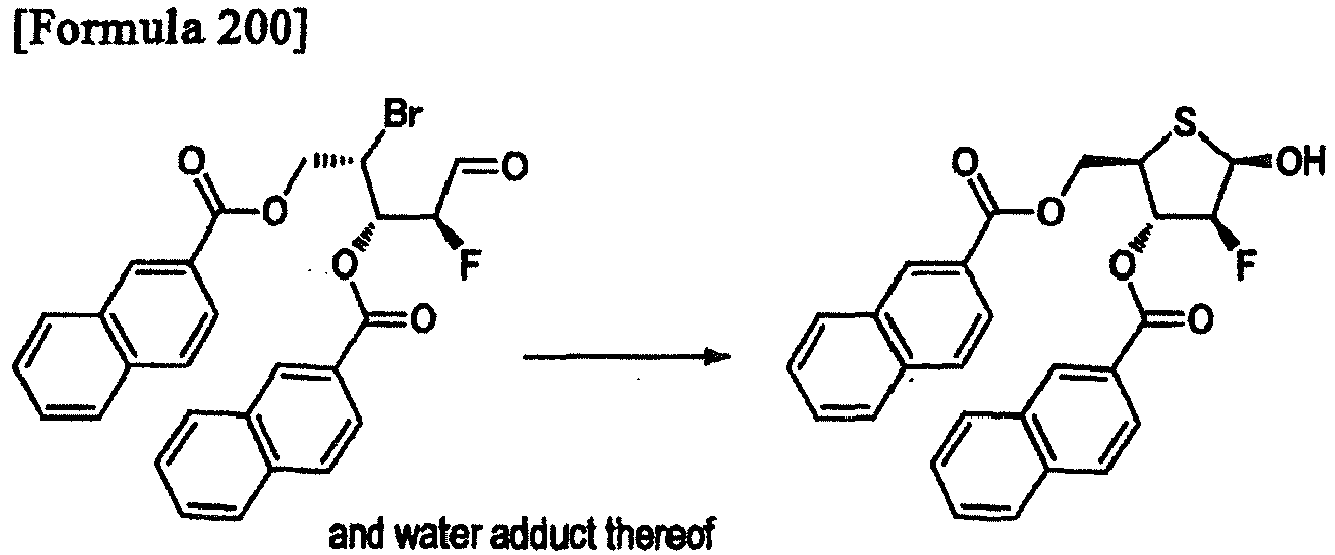
1H-NMR(CDCl3)δ value:- 8.58(1H,d,J=20.8Hz),8.49(1H,d,J=13.5Hz),8.05(0.5H,dd,J=8.6,1.7Hz),7.97(1H,dt,J=8. 3,2.1Hz),7.90-7.82(4H,m),7.71(2H,td,J=13.8,5.9Hz),7.60-7.46(4H,m),7.38(0.5H,t,J=7. 6Hz),6.23-6.14(0.5H,m),5.96-5.91(0.5H,m),5.67(0.5H,d,J=10.6Hz),5.42(0.5H,dt,J=32. 3,3.1Hz),5.32(0.5H,t,J=6.4Hz),5.19(0.5H,dd,J=7.3,4.0Hz),4.75-4.67(1H,m),4.62(1H,d d,J=14.5,6.3Hz),4.34(0.5H,dd,J=7.8,4.1Hz),3.88(0.5H,dd,J=13.4,6.1Hz),3.05(0.5H,s), 2.67(0.5H,s)
- (8)

1H-NMR(CDCl3)δ value:- 8.60(0.35H,s),8.58(0.35H,s),8.53(0.65H,s),8.42(0.65H,s),8.03(0.70H,d,J=8.6Hz),7.94( 1.30H,ddd,J=13.2,8.6,1.7Hz),7.87-7.47(9.35H,m),7.35(0.65H,t,J=6.9Hz),6.19-6.08(2H ,m),5.56-5.28(1H,m),4.75(0.70H,dd,J=11.4,7.1Hz),4.60(1.30H,t,J=8.1Hz),4.24-4.21(0. 35H,m),3.88(0.65H,q,J=6.8Hz),2.16(1.05H,s),2.16(1.95H,s)
- (9)
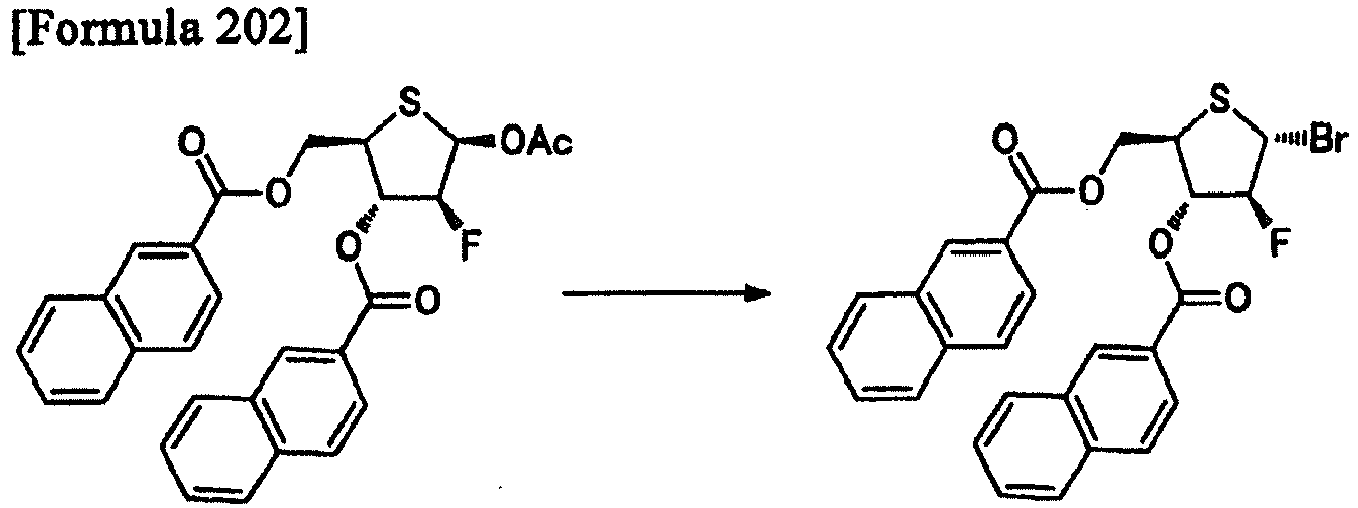
1H-NMR(CDCl3)δ value:- 8.65(2H,d,J=27.6Hz),8.11-7.80(8H,m),7.64-7.47(4H,m),5.96(0.5H,brs),5.91(0.5H,brs) ,5.82(0.5H,brs),5.78(0.5H,brs),5.74(0.5H,brs),5.66(0.5H,brs),4.76-4.62(2H,m),4.48-4. 42(1H,m)
- 19F-NMR(CDCl3)δ value: -163.66(1F,dd,J=48.0,14.5Hz)
- (10)

m/z(ESI-positive):664.6[M+H]+
19F-NMR(CDCl3)δ value: -195.71(1F,ddd,J=49.6,22.7,9.0Hz) - (11)

- (2R,3S,4S,5R)-3-hydroxy-2-hydroxymethyl-5-(4-amino-2-oxo-1,2-dihydropyri midin-1-yl)-4-fluorothiolane was obtained in the same manner as that of Example 1(8).
-
- (1)

1H-NMR(DMSO-d6)δ value:- 8.05(4H,dd,J=8.4,1.8Hz),7.86(2H,d,J=8.6Hz),7.82(2H,d,J=8.6Hz),7.76-7.72(4H,m),7. 50-7.45(6H,m),5.48(1H,dd,J=23.8,5.0Hz),5.34(1H,d,J=9.6Hz),5.24(1H,d,J=28.7Hz),4. 71-4.59(3H,m),3.40(3H,s)
- (2)


1H-NMR(DMSO-d6)δ value:- 8.06(4H,t,J=8.6Hz),7.86(2H,d,J=8.6Hz),7.81(2H,d,J=8.6Hz),7.77-7.72(4H,m),7.52-7.4 5(6H,m),7.07(1H,dd,J=4.0,2,6Hz),5.54(1H,dd,J=10.6,4.3Hz),5.44(1H,dd,J=23.4,4.6Hz ),5.15(1H,d,J=49.9Hz),4.68-4.58(3H,m)
- (3)

1H-NMR(DMSO-d6)δ value:- 8.09-7.98(4H,m),7.88-7.68(8H,m),7.50-7.44(6H,m),7.12(0.3H,dd,J=10.6,4.6Hz),6.06( 1.7H,ddd,J=32.5,14.2,5.6Hz),5.54(2H,tt,J=39.1,7.7Hz),5.15(0.3H,d,J=48.9Hz),4.69-4. 57(0.7H,m),4.41-4.26(2H,m),3.88(0.9H,s),3.75(2.1H,s)
- (4)

1H-NMR(DMSO-d6)δ value:- 8.14(1H,s),8.05(2H,dd,J=19.7,11.1Hz),7.97(1H,s),7.81(8H,m),7.50(8H,m),7.20(0.5H,d d,J=11.2,4.6Hz),6.09(0.5H,dq,J=48.2,3.1Hz),5.86(1H,dt,J=23.1,3.8Hz),5.68(2H,tt,J=2 9.9,9.4Hz),4.70(2H,dt,J=27.4,9.7Hz),3.79(3H,s)
- (5)


1H-NMR(DMSO-d6)δ value:- 8.10-8.01(2H,m),7.95(1H,d,J=8.6Hz),7.88-7.83(3H,m),7.80(1H,d,J=6.6Hz),7.68(5H,m ),7.47(6H,m),6.01-5.93(1H,m),5.46(1H,dt,J=47.4,6.9Hz),5.05(1H,t,J=45.2Hz),4.71(3H ,ddd,J=25.6,14.5,7.8Hz),3.86(3H,s)
- (6)

1H-NMR(DMSO-d6)δ value:- 9.69(1H,d,J=9.9Hz),8.06(2H,m),8.00(2H,d,J=7.3Hz),7.86(2H,dd,J=8.6,2.6Hz),7.77(2H ,dd,J=8.4,4.1Hz),7.70(3H,d,J=12.6Hz),7.53-7.43(7H,m),6.55(1H,dd,J=20.1,5.9Hz),6.0 6(1H,ddd,J=22.1,5.0,3.3Hz),5.82(1H,dq,J=14.9,4.0Hz),5.01-4.95(1H,m),4.77-4.67(1H, m)
- (7)

1H-NMR(DMSO-d6)δ value:- 8.04(2H,dd,J=8.6,2.3Hz),7.87(2H,t,J=8.4Hz),7.79(2H,dd,J=8.6,3.0Hz),7.71-7.67(2H, m),7.63-7.39(10H,m),6.84(1H,dd,J=6.1,1.8Hz),6.09(0.5H,dt,J=14.2,5.9Hz),5.76(0.5H, dd,J=14.5,6.9Hz),5.66(0.5H,dt,J=14.4,5.4Hz),5.39-5.30(1H,m),5.18(0.5H,dt,J=17.2,5. 1Hz),4.48(2H,ddd,J=29.3,15.8,9.3Hz),4.18(0.5H,dd,J=12.9,7.3Hz),3.83(0.5H,dd,J=13. 2,7.3Hz)
- (8)


1H-NMR(CDCl3)δ value:- 8.11(0.5H,d,J=8.6Hz),8.07(2H,d,J=8.6Hz),7.98(1.5H,d,J=8.6Hz),7.67-7.38(14H,m),6. 25(0.25H,t,J=6.9Hz),6.14(1.5H,tt,J=10.7,3.7Hz),5.89(0.25H,td,J=8.5,4.2Hz),5.42(0.25 H,ddd,J=48.0,4.0,2.6Hz),5.33(0.75H,ddd,J=50.7,9.1,4.5Hz),4.69(1H,dd,J=11.4,6.8Hz) ,4.54(1H,dd,J=10.9,6.6Hz),4.15(0.25H,ddd,J=13.2,6.8,2.1Hz),3.79(0.75H,q,J=6.8Hz), 2.17(2.25H,d,J=2.3Hz),2.14(0.75H,s)
- (9)

1H-NMR(CDCl3)δ value:- 8.14(2H,dd,J=21.0,8.4Hz),7.69-7.37(16H,m),5.89-5.70(0.5H,m),5.84-5.82(0.5H,m),5. 78-5.77(0.5H,m),5.75(0.5H,brs),5.71(0.5H,brs),5.62-5.61(0.5H,m),4.70-4.56(2H,m),4. 40-4.34(1H,m)
- 19F-NMR(282.37MHz,CDCl3)δ value: -163.62(1F,dd,J=48.9,14.3Hz)
- (10)
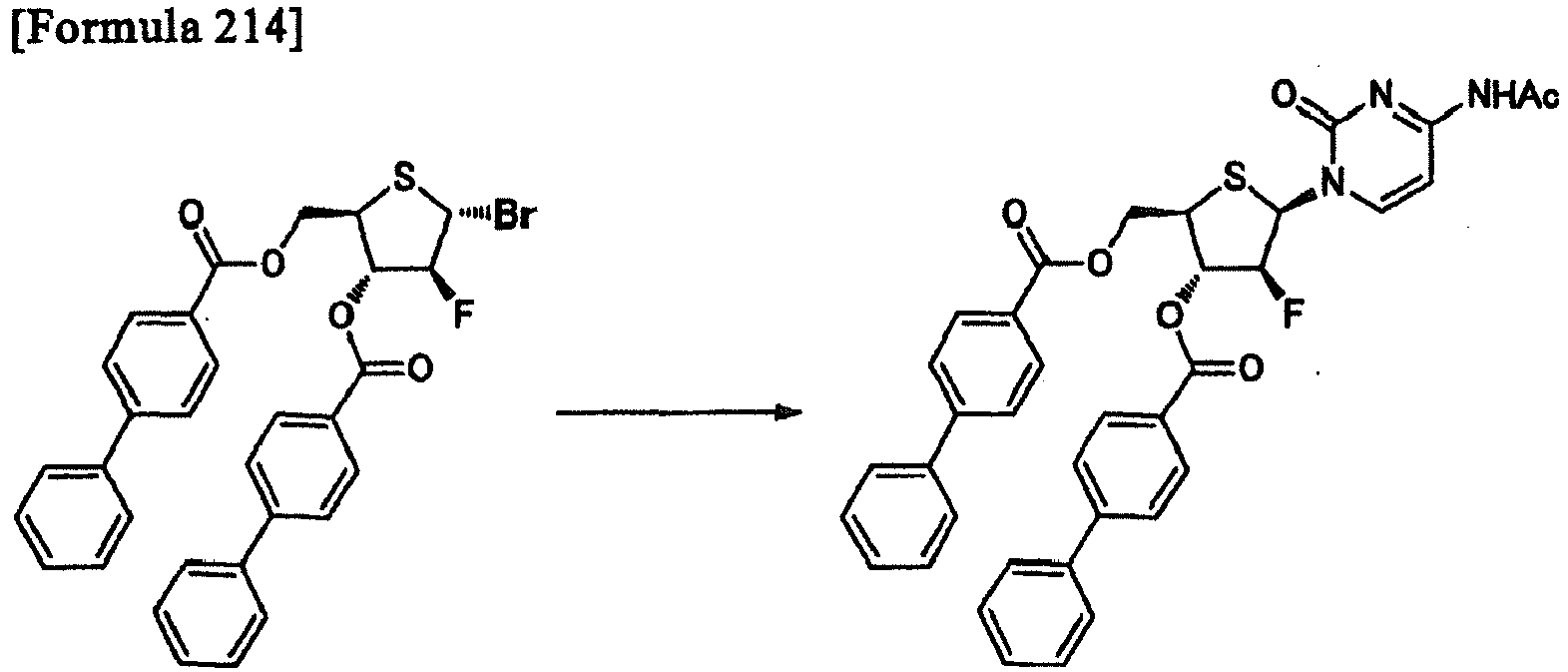
m/z(ESI-positive):612.6[M+H]+
19F-NMR(CDCl3)δ value: -195.70(1F,ddd,J=49.6,22.7,9.0Hz) - (11)


- (2R,3S,4S,5R)-3-hydroxy-2-hydroxymethyl-5-(4-amino-2-oxo-1,2-dihydropyri midin-1-yl)-4-fluorothiolane was obtained in the same manner as that of Example 1(8).
-
- (1)

1H-NMR(CDCl3)δ value:- 5.11-5.04(2H,m),4.80(1H,d,J=47.6Hz),4.42(1H,dd,J=12.0,3.6Hz),4.27(1H,dd,J=12.0,4 .4Hz),4.17(1H,m),3.39(3H,s),1.21(18H,m)
- 19F-NMR(CDCl3)δ value: -190.55(1F,ddd,J=49.5,23.0,10.5Hz)
- (2)


1H-NMR(CDCl3)δ value:- 5.57(1H,dd,J=10.4,4.0Hz),5.11(1H,dd,J=22.0,3.6Hz),4.92(1H,d,J=49.6Hz),4.42-4.35(2 H,m),4.27-4.23(1H,m),2.96(1H,dd,J=11.8,3.2Hz),1.21(9H,s),1.20(9H,s) 19F-NMR(CDCl3)δ value: -190.09(1F,ddd,J=49.8,22.6,11.2,Hz)
- (3)

1H-NMR(CDCl3)δ value:- 7.29(0.73H,dd,J=8.1,6.4Hz),6.75(0.27H,dd,J=11.3,4.6Hz),5.91(0.27H,ddd,J=46.5,4.6, 1.8Hz),5.43(0.73H,ddd,J=45.3,6.4,2.3Hz),5.38(0.27H,ddd,J=28.6,8.7,1.8Hz),4.74(0.73 H,ddd,J=25.7,8.8,2.4Hz),4.27-3.91(3H,m),3.91(0.80H,s),3.88(2.20H,s),2.78(0.73H,d,J =6.4Hz),2.73(0.27H,d,J=6.4Hz),1.23(9H,s),1.22(9H,s)
- 19F-NMR(CDCl3)δ value:
- 201.5(0.7F,ddd,J=43.5,23.8,6.2Hz),-208.1(0.3F,ddd,J=46.5,28.7,11.6Hz)
- (4)

- 8.16(1H,s),7.69(1H,s),7.22(0.67H,dd,J=7.8,6.4Hz),6.64(0.33H,dd,J=11.3,4.4Hz),5.73-5.67(0.33H,m),5.63-5.60(0.33H,m),5.36(0.67H,ddd,J=51.9,6.4,3.6),5.38-5.35(0.34H,m ),5.19-5.53(1H,m),5.13-5.09(0.33H,m),4.44-4.40(1H,m),4.21-4.16(1H,m),3.90(2.01H, s),3.89(0.99H,s),1.19(9H,s),1.17(9H,s)
- 19F-NMR(CDCl3)δ value:
- 199.40(0.71F,ddd,J=48.0,26.2,8.0Hz),-206.33(0.29F,ddd,J=49.9,30.1,12.4Hz)
- (5)

1H-NMR(CDCl3)δ value:- 7.38(0.83H,dd,J=6.5,6.5Hz),6.75(0.17H,dd,J=11.2,4.7),5.85(0.17H,ddd,J=47.4,4.7,3.0 ),5.64(0.17H,m),5.37-5.47(2.25H,m),5.23(0.41H,m),4.57-4.18(2H,m),3.91(2.49H,s),3. 89(0.51H,s),1.27(9H,s),1.23(9H,s)
- 19F-NMR(CDCl3)δ value:
- 194.50(0.84F,ddd,J=46.6,16.6,6.6Hz),-203.81(0.16F,ddd,J=47.3,25.7,11.2Hz)
- (6)

1H-NMR(CDCl3)δ value: 9.72(1H,d,J=6.6Hz),5.58-4.56(5H,m),1.27-1.23(18H,m) 19F-NMR(CDCl3)δ value: -210.77(1F,ddd,J=46.8,20.9,6.5Hz) - (7)

1H-NMR(CDCl3)δ value:- 5.62-5.44(1.5H,m),5.41(0.5H,m),5.16(0.25H,m),5.06-5.03(0.5H,m),4.94-4.90(0.25H,m ),4.38-4.28(1H,m),4.16-4.10(1H,m),3.85(0.5H,dd,J=7.4,7.4),3.42(0.5H,dd,J=13.1,5.7), 2.97(0.5H,brs),2.46(0.5H,brs),1.23-1.21(18H,m)
- 19F-NMR(CDCl3)δ value:
- 184.20(0.54F,ddd,J=47.1,11.1,11.1Hz),-193.48(0.46F,ddd,J=51.8,10.9,5.4Hz)
- (8)

- 14 mg of acetic anhydride was added to a solution of 40 mg of ((2R,3S,4S)-3-(2,2-dimethylpropionyloxy)-4-fluoro-5-hydroxythiolan-2-yl)methyl = trimethylacetate, 0.3 mg of dimethylaminopyridine and 19 mg of 2-picoline in 1.0 mL of tetrahydrofuran at a temperature of 10°C or lower, and the obtained mixture was then stirred at room temperature for 30 minutes. Thereafter, ethyl acetate was added to the reaction mixture, and the thus obtained mixture was successively washed with a saturated sodium chloride aqueous solution, a saturated sodium hydrogen carbonate aqueous solution and a saturated sodium chloride aqueous solution. After that, the organic layer was dried over anhydrous sodium sulfate, and the solvent was then distilled away under reduced pressure. The obtained residue was purified by column chromatography, so as to obtain 44 mg of ((2R,3S,4S)-5-acetyloxy-3-(2,2-dimethylpropionyloxy)-4-fluorothiolan-2-yl)methyl = trimethylacetate in the form of a colorless oily product.
1H-NMR(CDCl3)δ value: - 6.14(0.41H,dd,J=13.8,2.1Hz),6.10(0.59H,d,J=4.5),5.64(0.59H,ddd,J=16.5,9.0,7.7),5.4 3(0.41H,ddd,J=12.2,3.4,3.4),5.18(0.41H,ddd,J=47.4,3.4,2.1),5.10(0.59H,ddd,J=50.8,9. 0,4.5),4.36(0.59H,dd,J=11.5,4.7),4.23(0.41H,dd,J=11.2,7.4),4.12-4.07(1H,m),3.78(0.4 1H,m),3.42(0.59H,ddd,J=7.7,4.7,4.7),2.16(1.77H,s),2.10(1.23H,s),1.25(5.31H,s),1.23( 3.69H,s),1.21(5.31H,s),1.20(3.96H,s)
- 19F-NMR(CDCl3)δ value:
- -187.09(0.44F,ddd,J=50.5,13.9,13.9Hz),-192.57(0.56F,dd,J=50.9,11.8Hz)
-
- (1)

1H-NMR(CDCl3)δ value:- 7.67-7.64(4H,m),7.22-7.17(2H,m),5.46(1H,dd,J=23.8,4.8Hz),5.22-5.03(2H,m),4.70(1 H,dd,J=12.0,4.0Hz),4.62(1H,dd,J=12.0,4.8Hz),4.52-4.49(1H,m),3.46(3H,s),2.36(6H,s) ,2.32(6H,s)
- 19F-NMR(CDCl3)δ value: -190.21(1F,ddd,J=49.1,23.1,10.7Hz)
- (2)


1H-NMR(CDCl3)δ value:- 7.68(2H,s),7.65(2H,s),7.22(1H,s),7.17(1H,s),5.69(1H,dd,J=10.4,3.8Hz),5.46(1H,dd,J= 21.8,3.8Hz),5.16(1H,d,J=49.2Hz),4.71-4.69(3H,m),2.36(6H,s),2.32(6H,s) 19F-NMR(CDCl3)δ value: -190.45(1F,dddd,J=49.3,22.3,10.9,2.4Hz)
- (3)

1H-NMR(CDCl3)δ value:- 7.67(2H,s),7.62(2H,s),7.40(0.80H,dd,J=6.8,6.8Hz),7.23(1H,s),7.20(1H,s),6.84(0.20H, dd,J=11.1,4.6Hz),6.06(0.20H,ddd,J=46.4,4.6,2.0Hz),5.70(0.20H,ddd,J=28.5,8.2,1.9Hz) ,5.57(0.80H,ddd,J=45.2,6.8,2.4Hz),5.43(0.80H,ddd,J=26.0,8.4,2.4Hz),4.60-4.51(1H,m ),4.48-4.34(2H,m),3.92(0.60H,s),3.84(2.40H,s),3.03(0.80H,d,J=6.2Hz),2.98(0.20H,d,J =13.7Hz),2.36(6H,s),2.35(6H,s)
- 19F-NMR(CDCl3)δ value:
- -200.07(0.86F,ddd,J=45.3,26.0,7.0Hz),-207.47(0.14F,ddd,J=46.3,28.4,4.6Hz)
- (4)
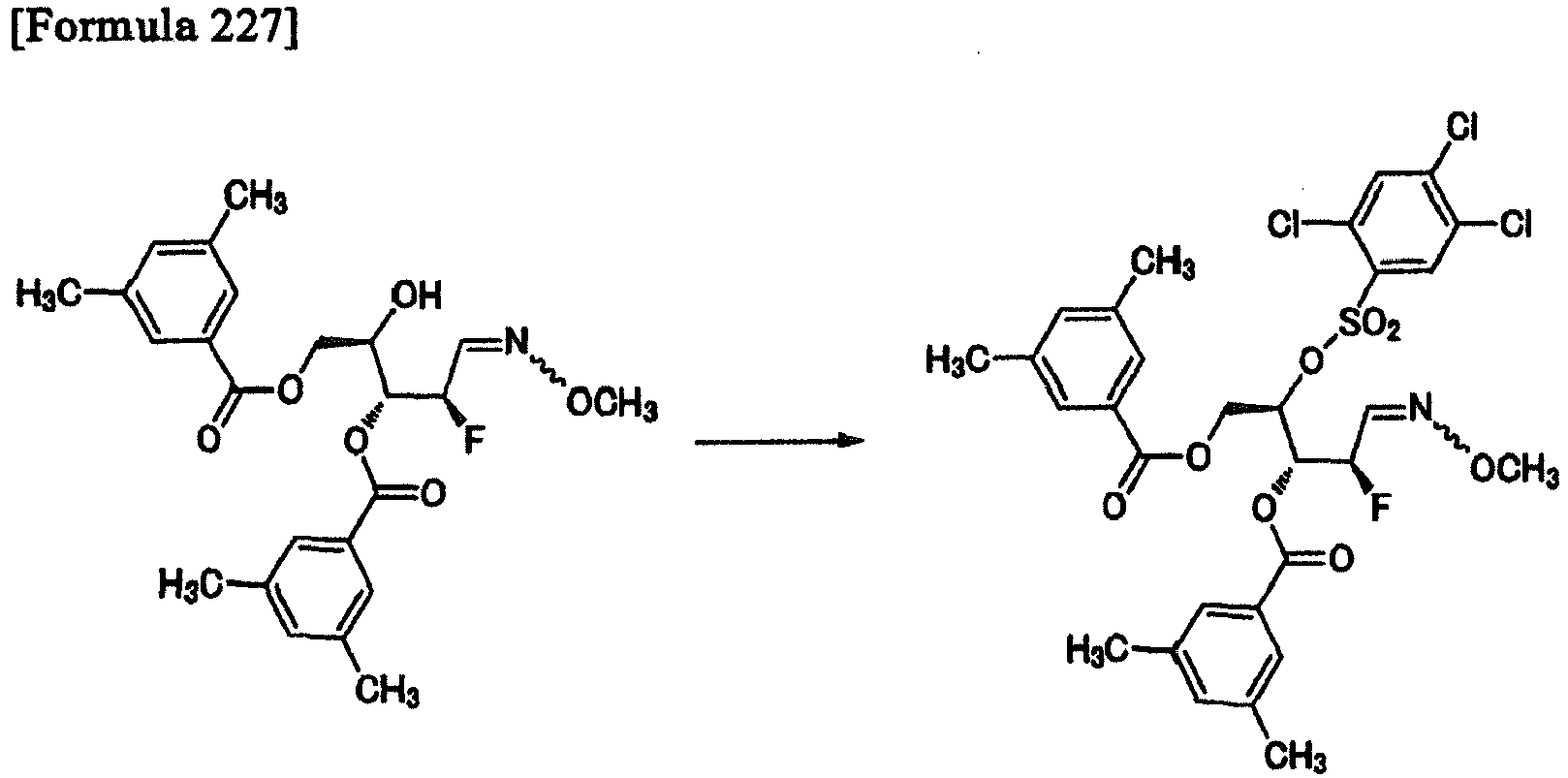
- 8.05(1H,s),7.65(2H,s),7.51(2H,s),7.41(1H,dd,J=6.6,6.6Hz),7.37(1H,s),7.23(1H,s),7.20 (1H,s),5.78(1H,ddd,J=23.2,6.1,3.0Hz),5.52-5.50(0.50H,m),5.44-5.38(1.50H,m),4.67(1 H,dd,J=12.8,2.9Hz),4.53(1H,dd,J=12.9,6.2Hz),3.87(3H,s),2.36(12H,m,) 19F-NMR(CDCl3)δ value: -196.79(1F,ddd,J=45.7,23.3,6.7Hz)
- (5)


1H-NMR(CDCl3)δ value:- 7.72(2H,s),7.65(2H,s),7.48(1H,dd,J=6.4,6.4Hz),7.23(1H,s),7.20(1H,s),5.80-5.75(1H,m ),5.53(1H,ddd,J=46.8,6.4,6.2Hz),4.76-4.69(1H,m),4.63-4.56(2H,m),3.89(3H,s),2.40(6 H,s),2.35(6H,s)
- 19F-NMR(CDCl3)δ value: -193.60(1F,ddd,J=46.7,17.3,6.2Hz)
- (6)

1H-NMR(CDCl3)δ value:- 9.82(1H,d,J=6.3Hz),7.65(2H,s),7.29(2H,s),7.23(1H,s),7.20(1H,s),5.82(1H,ddd,J=21.7, 3.5,3.5Hz),5.41(1H,dd,J=46.9,3.5,Hz),4.61-4.19(3H,m),2.37-2.34(12H,m) 19F-NMR(CDCl3)δ value: -210.09(1F,ddd,J=46.8,21.9,6.7Hz)
- (7)

1H-NMR(CDCl3)δ value:- 7.65(1H,s),7.61(1H,s),7.59(1H,s),7.57(1H,s),7.21(0.50H,s),7.19(0.50H,s),7.17(0.50H,s ),7.12(0.50H,s),6.07-6.00(0.50H,m),5.80(0.50H,ddd,J=12.4,2.5,2.5Hz),5.61(0.50H,ddd ,J=9.3,9.3,6.1Hz),5.48-5.46(0.50H,m),5.37-5.36(0.25H,m),5.26-5.23(0.50H,m),5.14-5. 11(0.25H,m),4.65-4.56(1.25H,m),4.48-4.46(0.75H,m),4.22-4.16(0.50H,m),3.77-3.72(0 .50H,m),2.34-2.33(6H,m),2.32(3H,s),2.25(3H,s)
- 19F-NMR(CDCl3)δ value:
- -183.72(0.50F,ddd,J=47.7,12.0,12.0Hz),-192.40(0.50F,ddd,J=51.2,11.3,3.7Hz)
- (8)


- ((2R,3S,4S)-5-acetyloxy-3-((3,5-dimethylphenyl)carbonyloxy)-4-fluorothiolan -2-yl)methyl = 3,5-dimethylbenzoate was obtained in the form of a yellow oily product in the same manner as that of Example 19(8).
1H-NMR(CDCl3)δ value: - 7.64-7.61(2.9H,m),7.53(1.1H,s),7.45(0.45H,s),7.19(0.55H,s),7.16(0.45H,s),7.08(0.55 H,s),6.23(0.45H,dd,J=13.8,2.3Hz),6.16(0.55H,d,J=4.5Hz),6.05(0.55H,ddd,J=16.2,9.0, 7.3Hz),5.82(0.45H,ddd,J=12.4,4.0,3.8Hz),5.38(0.45H,ddd,J=47.7,3.8,2.3Hz),5.29(0.55 H,ddd,J=50.7,9.0,4.5Hz),4.66-4.62(1H,m),4.54-4.41(1.55H,m),4.13-4.07(0.45H,m),2.3 4-2.31(9H,m),2.23(3H,m)2.17-2.13(3H,m)
- 19F-NMR(CDCl3)δ value:
- -187.11(0.5F,ddd,J=48.1,13.2,13.2Hz),-191.86(0.5F,dd,J=53.8,12.3Hz)
-
- (1)

- 5.11(1H,d,J=10.0Hz),5.03-4.91(2H,m),4.50(1H,dd,J=11.6,7.2Hz),4.33(1H,dd,J=11.6,5. 2Hz),4.31-4.29(1H,m),3.83(3H,s),3.81(3H,s),3.41(3H,s)
- 19F-NMR(CDCl3)δ value: -191.20(1F,ddd,J=49.1,22.2,10.5Hz)
- (2)

1H-NMR(CDCl3)δ value:- 5.59(0.84H,dd,J=10.0,3.6Hz),5.47-5.42(0.16H,m),5.20(0.16H,ddd,J=17.2,4.0,4.0Hz),5 .02(0.84H.d,J=48.8Hz),5.05-4.98(16H,m),4.31-4.15(2H,m),4.36-4.32(1H,m),3.84(3H,s ),3.80(3H,s),3.50(1H,brs)
- 19F-NMR(CDCl3)δ value:
- -191.10(0.88F,ddd,J=48.9,21.1,10.2Hz),-206.53(0.12F,ddd,J=51.2,16.9,6.0Hz)
- (3)

1H-NMR(CDCl3)δ value:- 7.42(0.78H,dd,J=6.8,6.8Hz),6.85(0.22H,dd,J=11.2,4.8Hz),5.91(0.22H,ddd,J=46.4,4.8, 2.0Hz),5.41(0.78H,ddd,J=45.2,6.8,2.8Hz),5.25-5.15(0.22H,m),5.00(0.78H,ddd,J=24.2, 8.2,2.8Hz),4.52-4.19(3H,m),3.89(3H,s),3.83(3H,s),3.81(3H,s),3.08(1H,brs) 19F-NMR(CDCl3)δ value:
- -199.93(0.75F,ddd,J=45.2,24.3,4.9Hz),-207.93(0.25F,ddd,J=46.3,27.1,10.5Hz)
- (4)

- 8.13-8.08(1H,m),7.70-7.68(1H,m),7.39-7.30(0.87H,m),6.83-6.75(0.13H,m),5.80-5.66( 0.24H,m),5.54-5.45(0.13H,m),5.36-5.27(0.76H,m),5.19-5.15(0.50H,m),5.12-5.01(1.37 H,m),4.54-4.42(1.13H,m),4.34-4.26(0.87H,m),3.93-3.73(9H,m) 19F-NMR(CDCl3)δ value:
- -196.34(0.74F,ddd,J=45.3,20.9,6.4Hz),-205.27(0.26F,ddd,J=46.7,25.2,11.1Hz)
- (5)


1H-NMR(CDCl3)δ value:- 7.48-7.41(0.80H,m),6.96-6.83(0.20H,m),5.95(0.12H,ddd,J=47.0,4.8,3.4Hz),5.45-5.09( 1.88H,m),4.56-4.31(3H,m),3.94-3.80(9H,m)
- 19F-NMR(CDCl3)δ value:
- 193.89(0.71F,ddd,J=46.1,16.6,6.0Hz),203.12(0.29F,ddd,J=47.1,24.5,10.9Hz)
- (6)

1H-NMR(CDCl3)δ value:- 9.78(1H,m),5.48-5.18(2H,m),4.57-4.34(3H,m),3.84-3.80(6H,m)
- 19F-NMR(CDCl3)δ value: -210.73(1F,ddd,J=47.3,21.8,6.2Hz)
- (7)

1H-NMR(CDCl3)δ value:- 5.57-5.46(1H,m),5.38-5.35(0.80H,m),5.25-5.23(0.20H,m),5.12-5.09(0.70H,m),4.99-4. 97(0.30H,m),4.71-4.31(1.30H,m),4.23-4.19(0.70H,m),3.84(3H,s),3.81(3H,s),3.77-3.73 (1H,m)
- 19F-NMR(CDCl3)δ value: -185.10(0.43F,d,J=46.7Hz),-192.12(0.57F,dd,J=51.5,12.0Hz)
- (8)

- ((2R,3S,4S)-5-acetyloxy-4-fluoro-3-(methoxycarbonyloxy)thiolan-2-yl)methyl = methylformate was obtained in the form of a colorless oily product in the same manner as that of Example 19(8).
1H-NMR(CDCl3)δ value: - 6.12-6.06(1H,m),5.51(0.60H,ddd,J=15.6,8.8,6.8Hz),5.38-5.31(0.60H,m),5.23-5.19(0.5 0H,m),5.10-5.07(0.30H,m),4.45(0.60H,dd,J=11.2,5.6Hz),4.32-4.20(1.40,m),3.95-3.84( 3.40H,m),3.80-3.79(3H,m),3.54-3.51(0.60H,m),2.17(1.80H,s),2.12(1.20H,s)
- 19F-NMR(CDCl3)δ value:
- -187.31(0.37F,ddd,J=47.8,14.1,14.1Hz),-191.72(0.63F,dd,J=50.5,11.3Hz)
-
- (1)

- (2)

- (3)

- 60 mg of a 28% sodium methoxide/methanol solution was added to a suspension of 800 mg of ((2R,3S,4S,5R)-3-(benzoyloxy)-5-(4-acetamido-2-oxo-1,2-dihydropyrimidin-1-yl)-4-fl uorothiolan-2-yl)methyl = benzoate in 10 mL of methanol at 22°C, and the obtained mixture was then stirred for 5 hours. Thereafter, the reaction mixture was cooled to 5°C, and 140 µL of methanesulfonic acid and 2.4 mL of water were then added thereto, so that a solid was dissolved therein. After that, the solvent was distilled away under reduced pressure, and 12.6 mL of acetone was then added to the obtained residue. The thus obtained mixture was stirred at 20°C for 90 minutes, and then at 5°C for 1 hour. A solid was collected by filtration, so as to obtain 478 mg of (2R,3S,4S,5R)-3-hydroxy-2-hydroxymethyl-5-(4-amino-2-oxo-1,2-dihydropyrimidin-1 -yl)-4-fluorothiolane methanesulfonate in the form of a white solid.
-
- (1)
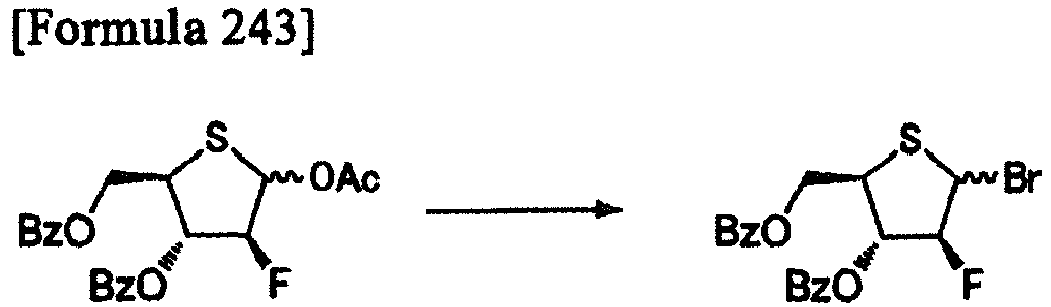
- (2)

- Under a nitrogen gas current, 19.3 g of 1,1,1,3,3,3-hexamethyldisilazane was added to a suspension of 6.6 g of cytosine and 32 mg of ammonium sulfate in 20 mL of toluene, and the obtained mixture was then stirred while heating to reflux, until the reaction mixture became a homogeneous solution. Thereafter, 58 mL of the methylene chloride solution of ((2R,3S,4S)-3-(benzoyloxy)-5-bromo-4-fluorothiolan-2-yl)methyl = benzoate obtained in (1) above was added dropwise to the reaction mixture at 70°C, and the thus obtained mixture was then stirred at 70°C for 10 hours, while methylene chloride was distilled away. Thereafter, the reaction mixture was cooled to room temperature, and 15 mg of 4-dimethylaminopyridine was then added to the mixture. After that, 20 mL of isobutyric anhydride was added to the mixture at 60°C, and the thus obtained mixture was then stirred at a temperature of 70°C to 80°C for 1 hour. Thereafter, the reaction mixture was cooled to room temperature, and 30 mL of methylene chloride and 30 mL of 2 mol/L hydrochloric acid were added to the mixture. The organic layer was fractionated, 6 mL of triethylamine was then added thereto, and methylene chloride was then distilled away. The reaction mixture was cooled to 5°C, and a solid was then collected by filtration, so as to obtain 5.7 g of ((2R,3S,4S,5R)-3-(benzoyloxy)-5-(4-(2-methylpropanamido)-2-oxo-1,2-dihydropyrimi din-1-yl)-4-fluorothiolan-2-yl)methyl = benzoate.
1H-NMR(DMSO-d6)δ value: - 1.07(dd,J=6.8,1.2Hz,6H),2.71(hept,J=6.8Hz,1H),4.07(dd,J=12.0,7.0Hz,1H),4.65(dd,J= 9.9,6.5Hz,1H),4.74(dd,11.3,7.5Hz,1H),5.71(ddd,J=49.4,5.4,5.4Hz,1H),5.99(ddd,J=11. 1,5.4,5.4Hz,1H),6.63(dd,J=13.5,5.4Hz,1H),7.31(d,J=7.6Hz,1H),7.48(dd,J=7.8,7.8Hz,2 H),7.57(dd,J=7.7,7.7Hz,2H),7.66(dd,J=7.5,7.5Hz,1H),7.72(dd,J=7.4,7.4Hz,1H),7.95(d d,J=1.3,8.4Hz,2H),8.01(dd,J=1.3,8.4Hz,2H),8.45(d,J=7.4Hz,1H),10.98(brs,1H)
-

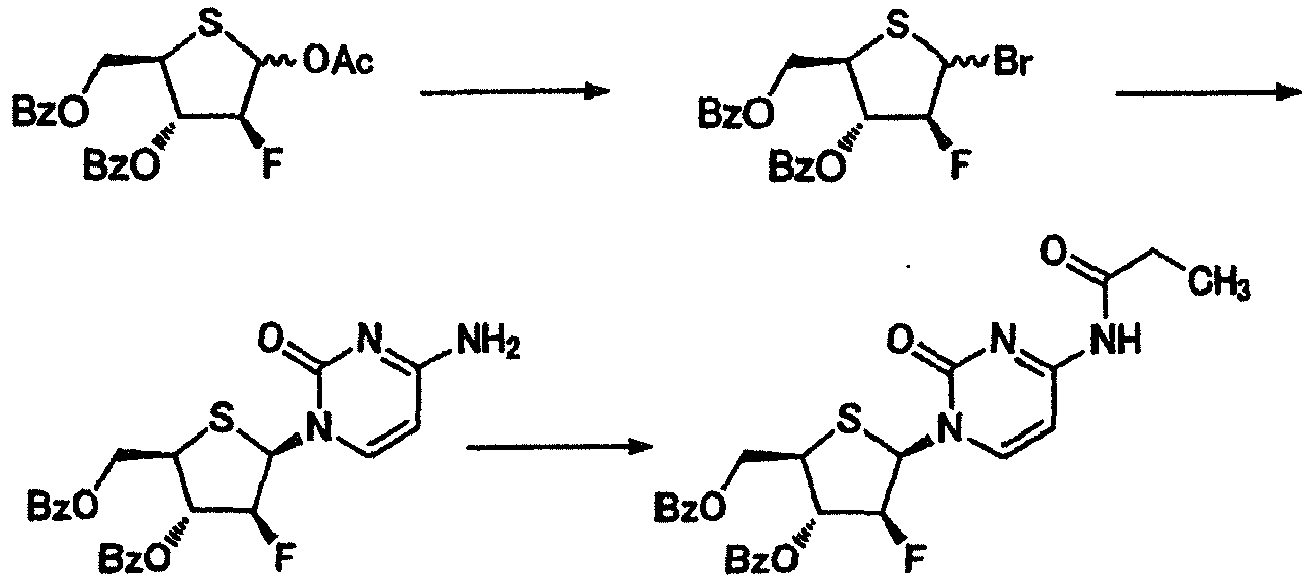
- ((2R,3S,4S,5R)-3-(benzoyloxy)-5-(4-(propanamido)-2-oxo-1,2-dihydropyrimi din-1-yl)-4-fluorothiolan-2-yl)methyl = benzoate was obtained in the same manner as that of Example 23.
1H-NMR(DMSO-d6)δ value: - 1.04(t,J=7.4Hz,3H),2.43(q,J=7.4Hz,2H),4.07(dd,J=11.9,6.7Hz,lH),4.65(dd,J=10.5,6.8 Hz,1H),4.74(dd,11.3,7.4Hz,1H),5.72(ddd,J=49.3,5.5,5.5Hz,1H),5.99(ddd,J=11.1,5.4,5. 4Hz,1H),6.62(dd,J=13.1,5.6Hz,1H),7.30(d,J=7.4Hz,1H),7.48(dd,J=7.8,7.8Hz,2H),7.57 (dd,J=7.8,7.8Hz,2H),7.66(dd,J=7.4,7.4Hz,1H),7.72(dd,J=7.6,7.6Hz,1H),7.95(d,J=7.2H z,2H),8.01(d,J=7.3Hz,2H),8.48(d,J=7.6Hz,1H),10.96(brs,1H)
-

- ((2R,3S,4S,5R)-3-(benzoyloxy)-5-(4-(butanamido)-2-oxo-1,2-dihydropyrimidi n-1-yl)-4-fluorothiolan-2-yl)methyl = benzoate was obtained in the same manner as that of Example 23.
1H-NMR(DMSO-d6)δ value: - 0.89(t,J=7.4Hz,3H),1.58(qt,J=7.4,7.4Hz,2H),2.39(t,J=7.3Hz,2H),4.08(dd,J=11.9,7.0Hz ,1H),4.65(dd,J=10.1,6.7Hz,1H),4.74(dd,111.4,7.4Hz,1H),5.72(ddd,J=49.3,5.5,5.5Hz,1H ),5.99(ddd,J=11.2,5.5,5.5Hz,1H),6.62(dd,J=13.2,5.5Hz,1H),7.31(d,J=7.6Hz,1H),7.48(d d,J=7.8,7.8Hz,2H),7.57(dd,J=7.8,7.8Hz,2H),7.66(dd,J=7.4,7.4Hz,1H),7.72(dd,J=7.5,7. 5Hz,1H),7.95(dd,J=1.3,8.3Hz,2H),8.01(dd,J=1.3,8.4Hz,2H),8.48(d,J=7.7Hz,1H),10.97 (brs,1H)
-
- (1)

As a result of the measurement of 1H-NMR, the anomeric ratio was found to be 1 : 1.
RT(min):1.80.
1H-NMR(CDCl3)δ value:- 7.38-7.25(10H,m),5.11(0.5H,dd,J=6.3,4.3Hz),4.96-4.92(1.5H,m),4.64(2H,ABq,J=21.9, 11.2Hz),4.57(2H,s),4.28-4.11(2H,m),3.62-3.50(2H,m),3.40(3H,s)
- (2)

As a result of the measurement of 1H-NMR, the anomeric ratio was found to be 8/2.
RT(min):1.54.
1H-NMR(CDCl3)δ value:- 7.40-7.25(10H,m),5.48(0.8H,dd,J=9.9,6.6Hz),5.30(0.2H,dq,J=10.4,2.1Hz),4.96(0.2H,d t,J=52.8,4.6Hz),4.95(0.8H,dd,J=50.1,1.3Hz),4.69(0.4H,dd,J=11.2,2.6Hz),4.62(1H,d,5. 3Hz),4.60(0.6H,dd,J=3.3,11.2Hz),4.55(2H,s),4.52-4.43(1H,m),4.38-4.27(0.2H,m),4.07 -3.97(0.8H,m),3.64-3.44(2H,m),2.99(1H,m)
- (3)


1H-NMR was measured. As a result, the syn-anti ratio was found to be 63 : 37.
RT(min):1.66.
1H-NMR(CDCl3)δ value:- 7.51(0.63H,t,J=6.9Hz),7.40-7.20(10H,m),7.01(0.37H,dd,J=11.9,4.6Hz),5.82(0.37H,dd d,J=46.9,4.6,1.3Hz),5.31(0.63H,ddd,J=46.1,6.6,3.3Hz),4.72-4.42(4H,m),3.97(1H,brs), 3.91-3.56(1H,m),3.90(1.11H,s,),3.87(1.89H,s),3.71-3.64(2H,m),2.47(1H,brs)
- (4)

1H-NMR was measured. As a result, the syn-anti ratio was found to be 68 : 32.
RT(min):2.22.
1H-NMR(CDCl3)δ value:- 8.09(0.32H,s),8.09(0.68H,s),7.43(1H,s),7.40(0.68H,t,J=7.7Hz),7.37-7.15(10H,m),6.88 (0.32H,dd,J=11.2,4.6Hz),5.61(0.32H,ddd,J=47.6,4.6,2.4Hz),5.14(0.68H,ddd,J=46.4,6. 6,4.0Hz),4.88-4.75(1H,m),4.72-4.54(2H,m),4.45-4.25(2.32H,m),4.20-4.07(0.68H,ddd, J=22.5,5.3,4.0Hz),3.88(3H,s),3.86-3.75(2H,m)
- (5)

1H-NMR was measured. As a result, the syn-anti ratio was found to be 86 : 14.
RT(min):2.00.
1H-NMR(CDCl3)δ value:- 7.42(0.86H,t,J=6.9Hz),7.33(10H,m),6.90(0.14H,dd,J=11.2,5.3Hz),5.81(0.14H,dq,J=47. 6,2.6Hz),5.32(0.86H,dt,J=46.9,6.6Hz),4.75(1.72H,ABq,40.3,11.2Hz),4.68(0.28H,ABq, 19.8,8.6Hz),4.55(0.28H,ABq,12.6,10.6Hz),4.48(1.72H,s),4.33-4.21(0.14H,m),4.19-4.1 0(1H,m),4.09-3.98(0.86H,m),3.91(2.58H,s),3.90(0.42H,m),3.93-3.83(1H,m),3.83-3.76 (0.14H,m),3.71(0.86H,m)
- (6)

- (7)

As a result of the measurement of 1H-NMR, the anomeric ratio was found to be 57/43.
RT(min):1.66,1.68.
1H-NMR(CDCl3)δ value:- 7.39-7.21(10H,m),6.14(0.57H,d,J=5.9Hz),5.77(0.43H,d,J=7.9Hz),5.51-5.40(0.43H,m), 5.29-5.23(0.57H,m),5.08(0.43H,ddd,J=50.2,4.6,3.3Hz),4.96(0.57H,ddd,J=52.2,7.9,4.0 Hz),4.77-4.57(2H,m),4.54(1.14H,s),4.50(0.86,s),4.42-4.31(0.57H,m),4.17-1.06(0.43H, m),3.88-3.51(2H,m),3.19-3.15(1H,m),3.08(2H,t,J=5.0Hz),2.99(1H,t,J=6.6Hz)
- (8)

As a result of the measurement of 1H-NMR, the α/β ratio was found to be 55/45.
RT(min):1.89.
1H-NMR(CDCl3)δ value:- 7.39-7.22(10H,m),6.05(0.55H,t,J=4.5Hz),6.02(0.45H,dd,J=10.6,3.3Hz),5.20(0.45H,dd d,J=50.1,5.3,3.3Hz),5.14(0.55H,ddd,J=51.0,8.6,4.6Hz),4.80-4.46(4H,m),4.36-4.23(0.5 5H,m),4.21-4.09(0.45H,m),3.81-3.37(3H,m),2.11(1.65H,s),2.06(1.35H,s)
- (9)

0.521 mL of N,O-bistrimethylsilyl acetamide was added to 83 mg of cytosine at room temperature, and the obtained mixture was then stirred in a nitrogen atmosphere at 80°C for 1.5 hours. Thereafter, a dichloromethane solution of 1-bromo-2-deoxy-2-fluoro-3,5-bis-O-benzyl-4-thio-D-arabinofuranoside was added to the reaction mixture, and the solvent was then distilled away. After that, the obtained residue was further stirred at 80°C for 2.5 hours. Thereafter, ethyl acetate and 2 mol/L hydrochloric acid were added to the reaction mixture. The organic layer was fractionated, and it was washed with water and was then dried over anhydrous sodium sulfate. Subsequently, the solvent was distilled away under reduced pressure. The obtained residue was purified by silica gel column chromatography (ethyl acetate /methanol), so as to obtain 61.3 mg of 1-(3,5-bis-O-benzyl-2-deoxy-2-fluoro-4-thio-D-arabinofuranosyl)cytosine in the form of a colorless oily product.
As a result of the measurement of 1H-NMR, the α/β ratio was found to be 31/69.
RT(min):1.30.
1H-NMR(CDCl3)δ value:- 7.99(0.69H,dd,J=7.6,1.7Hz),7.83(0.31H,d,J=7.3Hz),7.40-7.24(10H,m),7.21-7.16(1H,m ),6.68(0.69H,dd,J=18.5,4.6Hz),6.34(0.31H,dd,J=15.9,2.0Hz),6.20-5.80(1H,brs),5.69(0. 31H,d,J=7.3Hz),5.60(0.69H,d,J=7.3Hz),5.15(0.31H,dt,J=47.4,2.5Hz),5.11(0.69H,dt,J= 51.0,4.5Hz),4.61(1.38H,ABq,J=12.6,11.7),4.52(1.24H,brs),4.48(1.38H,ABq,12.9,4.8H z),4.26(1H,m),3.93(0.31H,t,J=5.9Hz),3.70-3.55(2.38H,m),3.53-3.47(0.31H,m)
- (10)

- 0.065 mL of a 1mol/L boron tribromide-dichloromethane solution was added to a solution of 9.6 mg of 1-(3,5-bis-O-benzyl-2-deoxy-2-fluoro-4-thio-D-arabinofuranosyl)cytosine in 1 mL of dichloromethane under cooling on ice. While the temperature was gradually increased to room temperature, the obtained mixture was stirred for 2 hours. Thereafter, hexane was added to the reaction mixture, and a solid was then collected by filtration. The obtained solid was washed with toluene and ethyl acetate, so as to obtain 5.3 mg of 1-(2-deoxy-2-fluoro-4-thio-D-arabinofuranosyl)cytosine in the form of a white solid.
- As a result of the measurement of 1H-NMR, the α/β ratio was found to be 36/64.
RT(min):0.22,0.27.
1H-NMR(DMSO-d6)δ value: - 8.02-7.93(1H,m),7.40-7.15(2H,m),6.46(0.64H,dd,J=14.5,5.3Hz),6.15(0.36H,dd,J=17.2 ,5.9Hz),5.93(0.36H,d,J=4.6Hz),5.84(0.64H,d,J=4.6Hz),5.82-5.71(1H,m),5.26(0.64H,t, J=5.3Hz),5.06(0.36H,dt,J=52.2,5.9Hz),5.03(1H,dd,J=11.2,4.6Hz),4.91(0.64H,dt,J=46. 2,5.3Hz),4.29-4.18(0.64H,m),4.15-4.02(0.36H,m),3.82-3.67(0.36H,m),3.65-3.54(1H,m ),3.51-3.28(1H,m),3.26-3.15(0.64H,m)
-
- (1)


RT(min):1.96.
1H-NMR(CDCl3)δ value:- 8.06(4H,m),7.51(6H,m),5.68(1H,d,J=10.6Hz),5.59-5.48(1H,dd,21.9,4.5Hz),5.20(1H,d, J=49.5Hz),5.06-5.02(1H,m),4.77-4.59(2H,m),4.53(1H,q,4.2Hz),3.94-3.84(1H,m),3.64-3.53(1H,m),1.90-1.40(6H,m)
- (2)

RT(min):0.69.
1H-NMR(CDCl3)δ value:- 5.58-5.50(1H,m),5.03(1H,brs),4.94(1H,dd,44.7,2.7Hz),4.30-4.07(3H,m),3.92-3.52(3H, m),2.33(1H,d,J=9.2Hz),2.14-2.08(1H,m),1.84-1.54(7H,m)
- (3)

As a result of the measurement of 1H-NMR, the anomeric ratio was found to be 8:2.
RT(min):1.92.
1H-NMR(CDCl3)δ value:- 7.25-7.20(4H,m),6.90-6.83(4H,m),5.49(0.8H,d,J=12.6Hz),5.40-5.34(0.2H,m),5.12(0.4 H,d,J=2.0Hz),4.99-4.89(1.6H,m),4.64-4.62(4H,m),4.22-4.15(1H,m),4.12-3.84{2H,m),3 .81(3H,s),3.80(3H,s),3.75-3.63(3H,m),1.89-1.43(6H,m)
- (4)

As a result of the measurement of 1H-NMR, the anomeric ratio was found to be 8:2.
RT(min):1.50.
1H-NMR(CDCl3)δ value:- 7.29-7.17(4H,m),6.92-6.83(4H,m),5.46(0.8H,dd,J=10.2,7.6Hz),5.28(0.2H,ddd,J=11.4, 3.9,1.2Hz),4.94(0.2H,dt,J=52.8,4.8Hz),4.91(0.8H,dd,J=50.4,1.3Hz),4.93-4.87(0.2H,d,J =1.3Hz),4.62-4.39(4.8H,m),4.10-3.91(1H,m),3.81(3H,s),3.81(3H,s),3.77-3.67(0.8H,m) ,3.58-3.43(2.2H,m)
- (5)

1H-NMR was measured. As a result, the syn-anti ratio was found to be 69 : 31.
RT(min):1.58.
1H-NMR(CDCl3)δ value:- 7.47(0.69H,t,J=6.9Hz),7.29-7.21(2H,m),7.18-7.10(2H,m),7.00(0.3H,dd,J=11.2,4.6Hz ),6.87(4H,m),5.80(0.31H,ddd,J=47.1,4.6,2.0Hz),5.35(0.69H,ddd,J=46.2,6.9,3.0Hz),4.5 6-4.34(4H,m),3.95-3.90(1H,m),3.90(0.93H,m),3.86(2.07H,s),3.82-3.78(1H,m),3.81(3H ,s),3.80(3H,s),3.71(0.31H,dd,J=7.8,3.3Hz),3.64-3.56(1.69H,m)
- (6)


1H-NMR was measured. As a result, the syn-anti ratio was found to be 65 : 35.
RT(min):2.15.
1H-NMR(CDCl3)δ value:- 8.08(0.35H,s),8.08(0.65H,s),7.43(1H,s),7.36(0.65H,t,J=6.9Hz),7.18-7.10(4H,m),6.92-6.80(4.35H,m),5.58(0.35H,dq,J=47.6,2.4Hz),5.10(0.65H,dq,J=46.6,3.5Hz),4.85-4.72(1 H,m),4.62-4.46(2H,m),4.40-4.21(2.35H,m),4.08(0.65H,dq,J=23.8,2.9Hz),3.87(1.95H,s ),3.87(1.05H,s),3.81(3.90H,s),3.80(2.10H,s),3.81-3.72(2H,m)
- (7)


1H-NMR was measured. As a result, the syn-anti ratio was found to be 82 : 18.
RT(min):1.92.
1H-NMR(CDCl3)δ value:- 7.40(0.82H,t,J=6.9Hz),7.24(4H,m),6.92-6.83(4.18H,m),5.79(0.18H,ddd,J=50.9,6.0,2.4 Hz),5.29(0.82H,dt,J=46.9,6.6Hz),4.66(1.64H,ABq,J=10.5,24.3Hz),4.58(0.36H,ABq,J= 18.0,10.5Hz),4.48(0.36H,s),4.42(1.64H,ABq,J=12.0,1.3Hz),4.29-4.06(1H,m),3.98(0.8 2H,dq,J=17.3,3.3Hz),3.90(3H,s),3.88-3.70(0.18H,m),3.81(1H,s),3.81(3H,s),3.80(3H,s) ,3.71-3.63(1H,m)
- (8)


RT(min):1.66. - (9)

RT(min):1.58,1.61.
m/z(ESI-positive):409.3 [M+H]+ - (10)

As a result of the measurement of 1H-NMR, the anomeric ratio was found to be 1/1.
RT(min):1.79,1.81.
1H-NMR(CDCl3)δ value:- 7.25-7.18(4H,m),6.90-6.83(4H,m),6.03(0.5H,t,J=3.3Hz),6.01(0.5H,J=13.8,3.3Hz),5.25 (0.5H,ddd,J=50.1,5.1,3.3Hz),5.09(0.5H,ddd,J=51.0,8.4,4.8Hz),4.73-4.46(2H,m),4.46(1 H,s),4.42(1H,ABq,J=12.0,3.3Hz),4.30-4.07(1H,m),3.80(6H,s),3.79-3.55(1.5H,m),3.50-3.31(1.5H,m),2.10(1.5H,s),2.07(1.5H,s)
- (11)
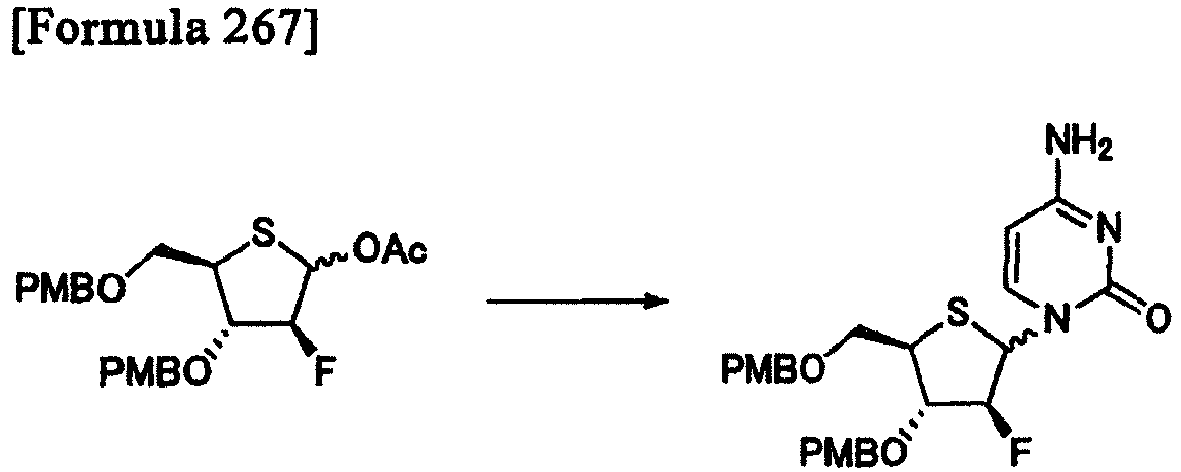
As a result of the measurement of 1H-NMR, the α/β ratio was found to be 53/47.
RT(min):1.30.
1H-NMR(CDCl3)δ value:- 8.04(0.47H,dd,J=7.3,1.3Hz),7.90(0.53H,d,J=7.3Hz),7.25-7.19(3H,m),7.13-7.07(1H,m) ,6.92-6.79(4H,m),6.68(0.47H,dd,J=17.8,4.6Hz),6.36(0.53H,dd,J=15.5,2.3Hz),5.58(0.5 3H,d,J=7.9Hz),5.52(0.47H,d,J=7.3Hz),5.13(0.53H,dt,J=46.9,2.6Hz),5.09(0.47H,dt,J=5 0.2,4.6Hz),4.47-4.36(3H,m),4.28-4.19(1H,m),3.89(1H,q,J=6.8Hz),3.83-3.75(1H,m),3. 82(1.41H,s),3.81(1.59H,s),3.79(3H,s),3.64-3.42(2H,m)
- (12)

- 0.2 mL of trifluoroacetic acid was added to a solution of 8.8 mg of 1-(2-deoxy-2-fluoro-3,5-bis-O-(4-methoxybenzyl)-4-thio-D-arabinofuranosyl)cytosine in 2 mL of dichloromethane, and the obtained mixture was then stirred at room temperature for 1.5 hours. Thereafter, the solvent was distilled away from the reaction mixture under reduced pressure. The obtained residue was purified by silica gel column chromatography (NH column, chloroform/methanol = 90/10 to 60/40), so as to obtain 3.1 mg of 1-(2-deoxy-2-fluoro-4-thio-D-arabinofuranosyl)cytosine in the form of a white solid.
- As a result of the measurement of 1H-NMR, the α/β ratio was found to be 56/44.
RT(min):0.22.
1H-NMR(DMSO-d6)δ value: - 8.02-7.94(1H,m),7.34-7.15(2H,m),6.46(0.44H,dd,J=14.5,5.3Hz),6.15(0.56H,dd,J=17.8 ,5.9Hz),5.92(0.56H,d,J=5.3Hz),5.87(0.44H,d,J=4.6Hz),5.79(0.56H,d,J=7.3Hz),5.77(0. 44H,d,J=7.3Hz),5.24(1H,t,J=5.6Hz),5.06(0.56H,dt,J=52.2,5.9Hz),5.03(1H,dd,J=11.2,4 .6Hz),4.91(0.44H,dt,J=46.2,5.3Hz),4.24(0.44H,dt,J=10.7,5.3Hz),4.09(0.56H,dt,J=2.7,6 .4Hz),3.82-3.67(0.66H,m),3.65-3.54(1H,m),3.51-3.28(1H,m),3.26-3.15(0.44H,m)
-
- (1)

1H-NMR(CDCl3)δ value:- 7.23-7.11(8H,m),5.10(0.5H,dd,J=5.9,4.3Hz),4.93-4.91(1.5H,m),4.66-4.52(4H,m),4.23-4.09(2H,m),3.57-3.48(2H,m),3.40(3H,s),2.35(3H,s),2.34(3H,s)
- (2)

As a result of the measurement of 1H-NMR, the α/β ratio was found to be 22 : 78.
1H-NMR(CDCl3)δ value:- 7.21-7.12(8H,m),5.46(0.78H,dd,J=10.1,7.1Hz),5.28(0.22H,dd,J=10.6,2.1Hz),4.94(0.22 H,dt,J=52.6,4.8Hz),4.92(0.78H,dd,J=50.4,1.0Hz),4.67-4.42(5H,m),4.30(0.22H,dt,J=17 .8,4.8Hz),4.00(0.78H,ddt,J=19.0,3.8,1.0Hz),3.92(0.22H,dd,J=10.6,1.3Hz),3.57-3.42(2 H,m),2.97(0.78H,dd,J=7.1,1.0Hz),2.35(6H,s)
- (3)

1H-NMR was measured. As a result, the syn-anti ratio was found to be 67 : 33.
1H-NMR(CDCl3)δ value:- 7.48(0.67H,t,J=7.1Hz),7.23-7.11(8H,m),7.00(0.33H,dd,J=11.6,4.6Hz),5.81(0.33H,ddd, J=46.2,4.6,1.8Hz),5.28(0.67H,ddd,J=46.2,7.1,3.1Hz),4.58-4.28(4H,m),3.97-3.82(4.33 H,m),3.74-3.60(2.67H,m),2.45(0.33H,d,J=6.9Hz),2.43(0.67H,d,J=6.9Hz),2.35(3H,s),2. 34(3H,s)
- (4)

1H-NMR was measured. As a result, the syn-anti ratio was found to be 66 : 34.
1H-NMR(CDCl3)δ value:- 8.08(0.34H,s),8.07(0.66H,s),7.40(1H,s),7.38(0.66H,t,J=6.9Hz),7.14-7.05(8H,m),6.88( 0.34H,dd,J=11.6,4.6Hz),5.59(0.34H,ddd,J=47.6,4.6,2.6Hz),5.12(0.66H,ddd,J=46.5,6.9, 3.8Hz),4.82(0.66H,td,J=5.3,3.3Hz),4.77(0.34H,td,J=5.6,2.4Hz),4.65-4.49(2H,m),4.40-4.23(2.34H,m),4.10(0.66H,ddd,J=23.7,5.3,3.8Hz),3.87(3H,s),3.85-3.82(2H,m),2.35-2. 33(6H,m)
- (5)

1H-NMR was measured. As a result, the syn-anti ratio was found to be 84 : 16.
1H-NMR(CDCl3)δ value:- 7.40(0.84H,t,J=6.6Hz),7.23-7.11(8H,m),6.89(0.16H,dd,J=11.2,5.0Hz),5.79(0.16H,ddd, J=47.7,5.0,3.0Hz),5.29(0.84H,dt,J=47.2,6.6Hz),4.77-4.43(4H,m),4.28-4.08(1.16H,m), 4.00(0.84H,ddd,J=17.2,6.6,3.3Hz),3.92-3.87(3.16H,m),3.83(0.84H,dd,J=10.2,7.3Hz),3 .77(0.16H,ddd,J=11.2,5.9,2.3Hz),3.69(0.84H,ddd,J=10.2,5.9,2.3Hz),2.35(3H,s),2.34(3 H,s)
- (6)

The obtained oily product was a mixture of (2S,3S,4S)-4-bromo-2-fluoro-3,5-bis((4-methylbenzyl)oxy)pentanal and a water adduct thereof. 1H-NMR(CDCl3)δ value:- 9.76(1H,d,J=6.6Hz),7.23-7.13(8H,m),5.06(1H,dd,J=47.7,3.8Hz),4.66-4.48(4H,m),4.34 (1H,td,J=5.9,4.8Hz),4.22(1H,ddd,J=22.6,4.8,3.8Hz),3.94(1H,dd,J=10.9,5.4Hz),3.76(1 H,ddd,J=10.9,6.4,2.5Hz),2.35(3H,s),2.34(3H,s)
- (7)

As a result of the measurement of 1H-NMR, the α/β ratio was found to be 40 : 60.
1H-NMR(CDCl3)δ value:- 7.23-7.13(8H,m),5.43(0.40H,ddt,J=12.2,8.9,1.3Hz),5.20-5.03(1.30H,m),4.90(0.30H,dd ,J=7.3,4.0Hz),4.72-4.46(4H,m),4.36(0.60H,dd,J=7.4,1.8Hz),4.31(0.40H,dd,J=7.1,4.6H z),3.95(0.40H,t,J=7.9Hz),3.66-3.37(3.20H,m),3.03(0.40H,dd,J=12.2,1.3Hz),2.35(6H,s)
- (8)

As a result of the measurement of 1H-NMR, the α/β ratio was found to be 40 : 60.
1H-NMR(CDCl3)δ value:- 7.21-7.12(8H,m),6.03(0.40H,d,J=4.6Hz),6.02(0.60H,dd,J=16.7,3.2Hz),5.17(0.60H,ddd ,J=50.1,5.4,3.2Hz),5.09(0.40H,ddd,J=50.9,8.6,4.6Hz),4.74-4.41(4H,m),4.26(0.40H,dd d,J=12.6,8.6,4.9Hz),4.12(0.60H,ddd,J=15.4,6.9,5.4),3.74(0.60H,ddd,J=6.9,5.3,1.1Hz), 3.66-3.60(1H,m),3.51-3.34(1.40H,m),2.35(6H,s),2.10(1.80H,s),2.06(1.20H,s)
- (9)

To another reaction vessel, 0.10 g of cytosine and 0.58 mL of N,O-bis(trimethylsilyl)acetamide were added in a nitrogen atmosphere, and the obtained mixture was then stirred at 80°C for 1.5 hours. After cooling in air, the methylene chloride solution containing (3S,4S,5R)-2-bromo-3-fluoro-4-((4-methylbenzyl)oxy)-5-(((4-methylbenzyl)oxy)meth yl)thiolane was added to the reaction mixture, and the obtained mixture was then stirred at 60°C for 2.5 hours. Thereafter, methylene chloride was added to the reaction mixture, and the thus obtained mixture was washed with a saturated sodium hydrogen carbonate aqueous solution, and was then dried over anhydrous magnesium sulfate. After that, the solvent was distilled away under reduced pressure. The obtained residue was purified by silica gel column chromatography (chloroform/methanol=100/0 to 90/10), so as to obtain 72 mg of (3S,4S,5R)-2-(4-amino-2-oxo-1,2-dihydropyrimidin-1-yl)-3-fluoro-4-((4-methylbenzyl )oxy)-5-(((4-methylbenzyl)oxy)methyl)thiolane in the form of a light yellow solid.
As a result of the measurement of 1H-NMR, the α/β ratio was found to be 38 : 62.
1H-NMR(CDCl3)δ value:- 8.08(0.62H,dd,J=7.3,1.7Hz),7.95(0.38H,d,J=7.3Hz),7.23-7.05(8H,m),6.69(0.62H,dd,J =18.0,4.5Hz),6.39(0.38H,dd,J=15.2,2.0Hz),5.56(0.38H,d,J=7.3Hz),5.50(0.62H,d,J=7.3 Hz),5.14(0.38H,dt,J=46.6,2.0Hz),5.11(0.62H,dt,J=50.5,4.5Hz),4.63-4.40(4H,m),4.29-4 .15(1H,m),3.92(0.38H,t,J=7.6Hz),3.65-3.56(2.24H,m),3.49(0.38H,ddd,J=9.2,6.8,2.0Hz ),2.37-2.34(6H,m)
- (10)

- In a nitrogen atmosphere, 3.0 mL of a methylene chloride solution of Imol/L boron trichloride was added to a solution of 70 mg of (3S,4S,5R)-2-(4-amino-2-oxo-1,2-dihydropyrimidin-1-yl)-3-fluoro-4-((4-methylbenzyl )oxy)-5-(((4-methylbenzyl)oxy)methyl)thiolane in 4.6 mL of methylene chloride under cooling on dry ice/acetone, and the obtained mixture was then stirred at the same temperature as described above for 3.5 hours. Thereafter, the temperature of the reaction mixture was increased to 0°C, and the mixture was then stirred for 30 minutes. Thereafter, 3.0 mL of methanol was added to the reaction mixture, and the thus obtained mixture was then stirred at room temperature for 30 minutes. Thereafter, a solid was then collected by filtration, and it was then purified by silica gel column chromatography (chloroform/methanol=100/0 to 60/40), so as to obtain 63 mg of (2R,3S,4S)-5-(4-amino-2-oxo-1,2-dihydropyrimidin-1-yl)-4-fluoro-2-(hydroxymethyl) thiolan-3-ol in the form of a white solid.
- As a result of the measurement of 1H-NMR, the α/β ratio was found to be 24 : 76.
1H-NMR(DMSO-d6)δ value: - 7.99(0.76H,dd,J=7.3,1.3Hz),7.97(0.24H,d,J=7.3Hz),7.31-7.20(2H,br),6.46(0.76H,dd,J =14.5,5.0Hz),6.15(0.24H,dd,J=17.5,5.9Hz),5.95(0.24H,d,J=5.0Hz),5.90(0.76H,d,J=5.0 Hz),5.80(0.24H,d,J=7.3Hz),5.78(0.76H,d,J=7.3Hz),5.26(0.76H,t,J=5.3Hz),5.18-4.82(1 .24H,m),4.29-4.20(0.76H,m),4.14-4.03(0.27H,m),3.80-3.56(2H,m),3.25-3.19(1H,m)
-
- (1)

1H-NMR(CDCl3)δ value:- 7.33-7.20(8H,m),5.10(0.5H,dd,J=6.1,4.5Hz),4.93-4.91(1.5H,m),4.68-4.52(4H,m),4.13-4.07(2H,m),3.59-3.49(2H,m),3.40(3H,s)
- (2)

As a result of the measurement of 1H-NMR, the α/β ratio was found to be 18 : 82.
1H-NMR(CDCl3)δ value:- 7.35-7.29(4H,m),7.25-7.20(4H,m),5.49(0.82H,dd,J=10.2,6.3Hz),5.31(0.18H,ddd,J=10. 2,3.8,2.3Hz),4.95(0.18H,dt,J=52.8,4.6Hz),4.95(0.82H,dd,J=50.2,1.3Hz),4.68-4.48(4H, m),4.43(0.82H,td,J=5.6,4.3Hz),4.26(0.18H,dt,J=17.6,4.6Hz),4.10(0.18H,dt,J=5.0,3.8H z),3.99(0.82H,ddt,J=19.8,4.3,0.9Hz),3.70(0.18H,dd,J=10.2,1.5Hz),3.62-3.48(2H,m),2. 88(0.82H,dd,J=6.6,1.3Hz)
- (3)

1H-NMR was measured. As a result, the syn-anti ratio was found to be 65 : 35.
1H-NMR(CDCl3)δ value:- 7.47(0.65H,t,J=6.9Hz),7.35-7.13(8H,m),6.99(0.35H,dd,J=11.6,4.6Hz),5.80(0.35H,ddd, J=46.9,4.6,1.7Hz),5.28(0.65H,ddd,J=45.9,6.9,3.3Hz),4.62-4.39(4H,m),4.00-3.83(4.35 H,m),3.76-3.56(2.65H,m),2.42(0.35H,d,J=6.6Hz),2.40(0.65H,d,J=6.6Hz)
- (4)

1H-NMR was measured. As a result, the syn-anti ratio was found to be 68 : 32.
1H-NMR(CDCl3)δ value:- 8.08(0.32H,s),8.07(0.68H,s),7.42(1H,s),7.37(0.68H,t,J=6.7Hz),7.33-7.27(4H,m),7.21-7.08(4H,m),6.87(0.32H,dd,J=11.6,4.6Hz),5.58(0.32H,ddd,J=47.6,4.6,3.0Hz),5.12(0.68 H,ddd,J=46.5,6.7,4.2Hz),4.84(0.68H,ddd,J=5.6,4.8,3.0Hz),4.77(0.32H,td,J=5.6,2.3Hz) ,4.68-4.53(2H,m),4.41-4.29(2.16H,m),4.25(0.16H,dd,J=5.6,2.3Hz),4.10(0.68H,td,J=23 .1,4.5Hz),3.88(3H,s),3.86-3.73(2H,m)
- (5)
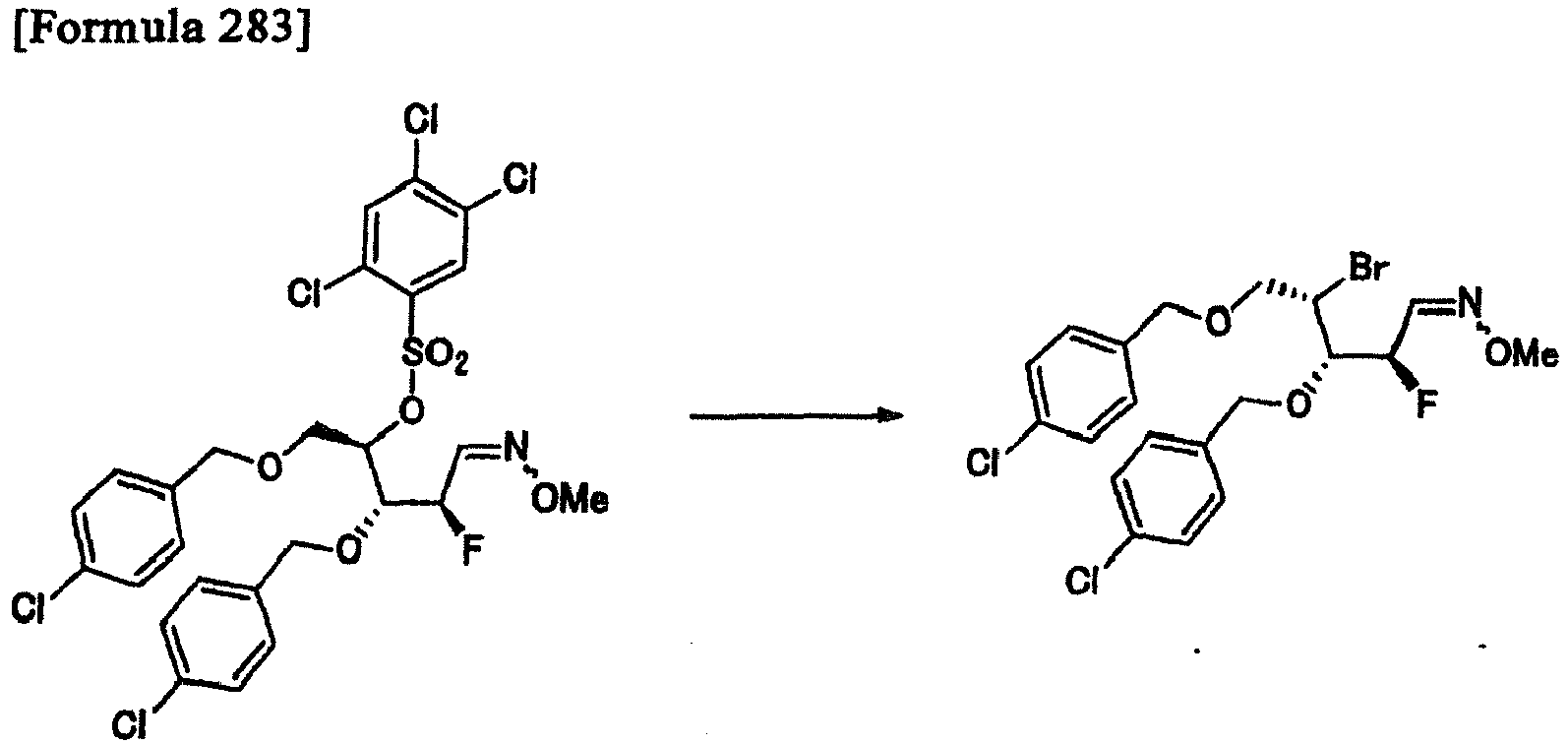
1H-NMR was measured. As a result, the syn-anti ratio was found to be 81 : 19.
1H-NMR(CDCl3)δ value:- 7.42(0.81H,t,J=6.6Hz),7.34-7.21(8H,m),6.89(0.19H,dd,J=11.6,4.8Hz),5.79(0.19H,ddd, J=47.6,4.8,3.0Hz),5.31(0.81H,dt,J=47.2,6.6Hz),4.80-4.39(4H,m),4.30-4.11(1.19H,m), 4.00(0.81H,ddd,J=16.8,6.6,3.3Hz),3.913(2.43H,s),3.905(0.57H,s),3.89-3.77(1.19H,m), 3.70(0.81H,ddd,J=10.2,5.9,2.3Hz)
- (6)

- 9.80(1H,d,J=5.9Hz),7.35-7.15(8H,m),5.13(1H,dd,J=47.6,3.6Hz),4.66-4.44(4H,m),4.37 (1H,dt,J=5.9,5.1Hz),4.22(1H,ddd,J=23.0,5.1,3.6Hz),3.94(1H,dd,J=10.9,5.3Hz),3.78(1 H,ddd,J=10.9,5.9,2.5Hz)
- (7)

As a result of the measurement of 1H-NMR, the α/β ratio was found to be 63 : 37.
1H-NMR(CDCl3)δ value:- 7.42-7.19(8H,m),5.45(0.37H,ddd,J=11.6,9.2,1.2Hz),5.15(0.63H,ddd,J=8.3,3.6,3.0Hz), 5.13(0.37H,dt,J=47.9,1.2Hz),5.01(0.63H,ddd,J=52.2,7.1,4.1Hz),4.72-4.41(4H,m),4.35-4.36(1H,m),3.93(0.37H,t,J=7.8Hz),3.59-3.34(3.26H,m),2.89(0.37H,dd,J=11.6,1.0Hz)
- (8)

As a result of the measurement of 1H-NMR, the α/β ratio was found to be 40 : 60.
1H-NMR(CDCl3)δ value:- 7.33-7.20(8H,m),6.04(0.40H,d,J=4.3Hz),6.02(0.60H,dd,J=16.8,3.0Hz),5.19(0.60H,ddd ,J=50.0,5.4,3.0Hz),5.11(0.40H,ddd,J=50.9,8.3,4.3Hz),4.76-4.41(4H,m),4.24(0.40H,dd d,J=12.2,8.3,6.6Hz),4.12(0.60H,ddd,J=15.4,6.6,5.4),3.75(0.60H,qd,J=6.6,1.0Hz),3.65-3.60(1H,m),3.50(0.60H,dd,J=9.6,6.6Hz),3.47(0.40H,ddd,J=9.7,6.6,1.0Hz),3.37(0.40H, q,J=6.6Hz),2.11(1.8H,s),2.08(1.2H,s)
- (9)


To another reaction vessel, 0.12 g of cytosine and 0.53 mL of N,O-bis(trimethylsilyl)acetamide were added in a nitrogen atmosphere, and the obtained mixture was then stirred at 80°C for 2 hours. After cooling in air, a methylene chloride solution containing (3S,4S,5R)-2-bromo-4-((4-chlorobenzyl)oxy)-5-(((4-chlorobenzyl)oxy)methyl)-3-fluor othiolane was added to the reaction mixture, and the obtained mixture was then stirred 60°C for 2 hours. Thereafter, methylene chloride was added to the reaction mixture, and the thus obtained mixture was washed with a a saturated sodium hydrogen carbonate aqueous solution, and was then dried over anhydrous sodium sulfate. After that, the solvent was distilled away under reduced pressure. The obtained residue was purified by silica gel column chromatography (chloroform/methanol=100/0 to 80/20), so as to obtain 0.18 g of (3S,4S,5R)-2-(4-amino-2-oxo-1,2-dihydropyrimidin-1-yl)-4-((4-chlorobenzyl)oxy)-5-( ((4-chlorobenzyl)oxy)methyl)-3-fluorothiolane in the form of a light yellow solid.
As a result of the measurement of 1H-NMR, the α/β ratio was found to be 36 : 64.
1H-NMR(CDCl3)δ value:- 8.01(0.64H,dd,J=7.6,1.8Hz),7.93(0.36H,d,J=7.6Hz),7.36-7.09(8H,m),6.73(0.64H,dd,J =19.2,4.3Hz),6.38(0.36H,dd,J=15.0,2.3Hz),5.54(0.36H,d,J=7.6Hz),5.53(0.64H,d,J=7.6 Hz),5.20(0.36H,dt,J=47.2,2.3Hz),5.14(0.64H,dt,J=50.5,4.3Hz),4.65-4.41(4H,m),4.28-4 .21(1H,m),3.95-3.89(0.36H,m),3.66-3.60(2.28H,m),3.54-3.48(0.36H,m)
- (10)

- In a nitrogen atmosphere, 6.8 mL of a methylene chloride solution of Imol/L boron trichloride was added to a solution of 0.17 g of (3S,4S,5R)-2-(4-amino-2-oxo-1,2-dihydropyrimidin-1-yl)-4-((4-chlorobenzyl)oxy)-5-( ((4-chlorobenzyl)oxy)methyl)-3-fluorothiolane in 11 mL of methylene chloride under cooling on dry ice/acetone, and the obtained mixture was then stirred at the same temperature as described above for 3.5 hours. Thereafter, the temperature of the reaction mixture was increased to 0°C, and the reaction mixture was then stirred for 30 minutes. Thereafter, 7.5 mL of methanol was added to the reaction mixture, and the thus obtained mixture was then stirred at room temperature for 30 minutes. Thereafter, a solid was collected by filtration, and it was successively washed with ethyl acetate and hexane. The obtained solid was purified by silica gel column chromatography (chloroform/methanol=100/0 to 60/40), so as to obtain 63 mg of (2R,3S,4S)-5-(4-amino-2-oxo-1,2-dihydropyrimidin-1-yl)-4-fluoro-2-(hydroxymethyl) thiolan-3-ol in the form of a white solid.
- As a result of the measurement of 1H-NMR, the α/β ratio was found to be 27 : 73.
1H-NMR(DMSO-d6)δ value: - 7.99(0.73H,dd,J=7.3,1.3Hz),7.97(0.27H,d,J=7.3Hz),7.31-7.20(2H,br),6.46(0.73H,dd,J =14.7,5.3Hz),6.15(0.27H,dd,J=17.5,5.9Hz),5.95(0.27H,d,J=5.3Hz),5.89(0.73H,d,J=5.3 Hz),5.80(0.27H,d,J=7.3Hz),5.78(0.73H,d,J=7.3Hz),5.26(0.73H,t,J=5.3Hz),5.18-4.82(1 .27H,m),4.29-4.20(0.73H,m),4.14-4.03(0.27H,m),3.80-3.54(2H,m),3.25-3.19(1H,m)
-
- (1)

1H-NMR(CDCl3)δ value:- 7.40-7.33(10H,m),5.33-5.22(1H,m),5.14(0.5H,dd,J=5.6,4.3Hz),4.97-4.96(1.5H,m),4.5 3(1H,dd,J=11.2,4.0Hz),4.31(1H,dd,J=11.2,7.6Hz),4.21(1H,ddd,J=7.6,5.1,4.0Hz),3.45( 3H,s)
- (2)

As a result of the measurement of 1H-NMR, the α/β ratio was found to be 20 : 80.
1H-NMR(CDCl3)δ value:- 7.40-7.33(10H,m),5.56(0.80H,dd,J=10.2,4.0Hz),5.42(0.20H,ddd,J=8.6,6.6,3.6Hz),5.23 -5.14(4.20H,m),5.03(0.80H,dd,J=21.3,4.1Hz),5.02(0.80H,dd,J=48.2,1.0Hz),4.96(0.20 H,dt,J=50.9,3.6Hz),4.53-4.43(2H,m),4.34(0.80H,dd,J=12.4,6.8Hz),4.17(0.20H,dd,J=5. 9,4.1Hz),3.34(0.20H,dd,J=8.6,2.0Hz),2.70(0.80H,dd,J=4.0,2.8Hz)
- (3)


1H-NMR was measured. As a result, the syn-anti ratio was found to be 77 : 23.
1H-NMR(CDCl3)δ value:- 7.41-7.33(10.77H,m),6.82(0.23H,dd,J=11.2,4.6Hz),5.89(0.23H,ddd,J=46.2,4.6,2.1Hz), 5.39(0.77H,ddd,J=45.2,6.4,2.8Hz),5.29-5.13(4.23H,m),5.01(0.77H,ddd,J=24.0,8.0,2.9 Hz),4.35-4.09(3H,m),3.89(0.69H,s),3.84(2.31H,s),2.62(0.77H,d,J=5.9Hz),2.60(0.23H, d,J=6.9Hz)
- (4)

1H-NMR was measured. As a result, the syn-anti ratio was found to be 78 : 22.
1H-NMR(CDCl3)δ value:- 8.11(0.22H,s),8.10(0.78H,s),7.51(1H,s),7.43-7.33(10.78H,m),6.78(0.22H,dd,J=11.4,4. 5Hz),5.71(0.22H,ddd,J=46.9,4.5,2.8Hz),5.54(0.22H,ddd,J=25.1,5.8,2.8Hz),5.37(0.78H ,ddd,J=21.5,5.6,4.0Hz),5.31(0.39H,dd,J=6.3,4.0Hz),5.22-5.03(5.17H,m),5.00(0.22H,td ,J=5.8,2.6Hz),4.46-4.39(1H,m),4.36-4.30(1H,m),3.87(0.66H,s),3.85(2.34H,s)
- (5)


1H-NMR was measured. As a result, the syn-anti ratio was found to be 79 : 21.
1H-NMR(CDCl3)δ value:- 7.42-7.34(10.79H,m),6.82(0.21H,dd,J=11.2,4.8Hz),5.94(0.21H,ddd,J=46.9,4.8,3.1Hz), 5.47-5.16(5.79H,m),4.59-4.31 (3H,m),3.89(3H,s)
- (6)
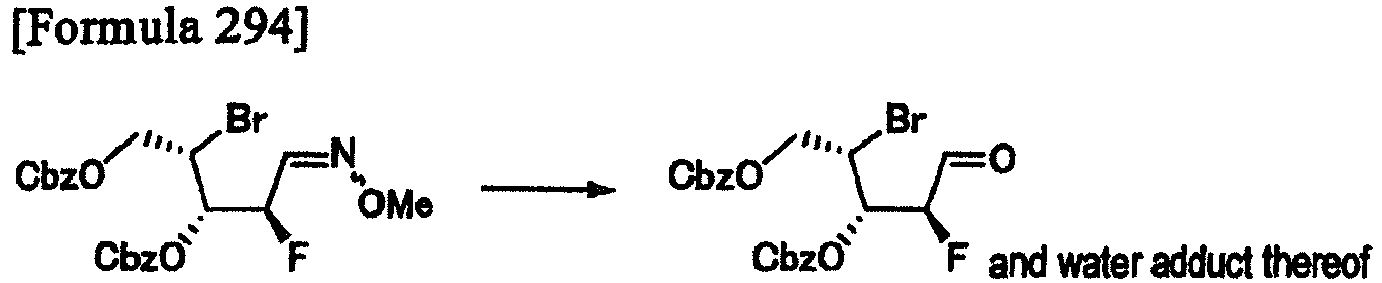
The obtained oily product was a mixture of dibenzyl = ((2R,3S,4S)-2-bromo-4-fluoro-5-oxopentane-1,3-diyl) = dicarbonate and a water adduct thereof.
1H-NMR(CDCl3)δ value:- 9.74(1H,d,J=5.6Hz),7.39-7.31(10H,m),5.38(1H,dt,J=22.0,4.0Hz),5.20-5.13(5H,m),4.6 2-4.31(3H,m)
- (7)

As a result of the measurement of 1H-NMR, the α/β ratio was found to be 36 : 64.
1H-NMR(CDCl3)δ value:- 7.40-7.31(10H,m),5.53-5.45(1H,m),5.40(0.36H,dtd,J=10.2,2.0,1.0Hz),5.34(0.64H,t,J= 4.0Hz),5.27-5.10(4.68H,m),4.95(0.32H,dd,J=7.3,4.0Hz),4.46(0.64H,dd,J=10.6,6.4Hz), 4.37(0.64H,dd,J=10.6,6.4Hz),4.22(0.72H,dd,J=7.3,1.0Hz),4.03-3.97(0.36H,m),3.54(0. 64H,td,J=6.4,5.3Hz)
- (8)
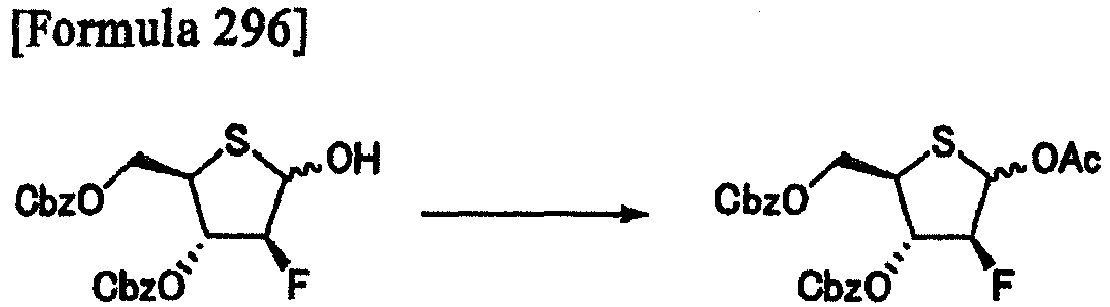
As a result of the measurement of 1H-NMR, the α/β ratio was found to be 40 : 60.
1H-NMR(CDCl3)δ value:- 7.39-7.34(10H,m),6.08(0.60H,dd,J=14.5,1.7Hz),6.05(0.40H,d,J=4.3Hz),5.51(0.40H,dd d,J=11.9,8.8,7.1Hz),5.38-5.03(5.60H,m),4.47(0.40H,dd,J=11.1,5.8Hz),4.34-4.20(1.60 H,m),3.89(0.60H,q,J=6.4Hz),3.51(0.40H,q,J=6.5Hz),2.11(1.20H,s),2.07(1.80H,s)
- (9)

To another reaction vessel, 59 mg of cytosine and 0.36 mL of N,O-bis(trimethylsilyl)acetamide were added in a nitrogen atmosphere, and the obtained mixture was then stirred at 80°C for 1.5 hours. After cooling in air, the methylene chloride solution containing benzyl = ((2R,3S,45)-3-(((benzyloxy)carbonyl)oxy)-5-bromo-4-fluorothiolan-2-yl)methyl = carbonate was added to the reaction mixture, and the obtained mixture was then stirred at 60°C for 3 hours. Thereafter, methylene chloride was added to the reaction mixture, and the thus obtained mixture was successively washed with water and a saturated sodium hydrogen carbonate aqueous solution, and was then dried over anhydrous sodium sulfate. After that, the solvent was distilled away under reduced pressure. The obtained residue was purified by silica gel column chromatography (chloroform/methanol=100/0 to 80/20), so as to obtain 15 mg of benzyl = ((2R,3S,4S)-5-(4-amino-2-oxo-1,2-dihydropyrimidin-1-yl)-3-(((benzyloxy)carbonyl)o xy)-4-fluorothiolan-2-yl)methyl = carbonate in the form of a white solid.
As a result of the measurement of 1H-NMR, the α/β ratio was found to be 24 : 76.
1H-NMR(CDCl3)δ value:- 7.96(0.76H,dd,J=7.3,2.1Hz),7.96(0.24H,d,J=7.3Hz),7.41-7.34(10H,m),6.82(0.76H,dd,J =23.8,4.0Hz),6.35(0.24H,dd,J=15.2,2.3Hz),5.77-5.66(1.24H,m),5.43-5.07(5.76H,m),4. 45-4.30(2H,m),4.08(0.24H,t,J=7.6Hz),3.80(0.76H,t,J=7.6Hz)
- (10)

- 1.0 mL of a 7 mol/L ammonia/methanol solution was added to 15 mg of benzyl = ((2R,3S,4S)-5-(4-amino-2-oxopyrimidin-1(2H)-yl)-3-(((benzyloxy)carbonyl)oxy)-4-fluorothiolan-2-yl)methyl = carbonate, and the obtained mixture was then stirred at room temperature for 1.5 hours. Thereafter, the solvent was distilled away under reduced pressure, and the obtained residue was then purified by silica gel column chromatography (chloroform/methanol=100/0 to 65/35), so as to obtain 6.6 mg of (2R,3S,4S)-5-(4-amino-2-oxo-1,2-dihydropyrimidin-1-yl)-4-fluoro-2-(hydroxymethyl) thiolan-3-ol in the form of a white solid.
- As a result of the measurement of 1H-NMR, the α/β ratio was found to be 26 : 74.
1H-NMR(DMSO-d6)δ value: - 7.99(0.74H,dd,J=7.3,1.3Hz),7.97(0.26H,d,J=7.3Hz),7.29-7.19(2H,br),6.46(0.74H,dd,J =14.5,5.0Hz),6.15(0.26H,dd,J=17.5,5.9Hz),5.94(0.26H,d,J=5.0Hz),5.88(0.74H,d,J=5.0 Hz),5.79(0.26H,d,J=7.3Hz),5.78(0.74H,d,J=7.3Hz),5.26(0.74H,t,J=5.3Hz),5.17-4.82(1 .26H,m),4.29-4.20(0.74H,m),4.14-4.03(0.26H,m),3.79-3.56(2H,m),3.25-3.19(1H,m)
-
- (1)

1H-NMR(CDCl3)δ value:- 7.59-7.51(8H,m),7.41-7.24(12H,m),4.94(1H,d,J=5.3Hz),4.92(1H,ddd,J=52.8,5.9,4.6Hz ),4.32(1H,dt,J=16.5,5.3Hz),4.13-4.07(1H,m),3.38(2H,d,J=5.3Hz),3.29(3H,s),1.06(9H,s ),0.97(9H,s)
- (2)

1H-NMR(CDCl3)δ value:- 7.65-7.24(20H,m),5.37(1H,t,J=9.2Hz),4.76(1H,dd,J=50.2,1.3Hz),4.45(1H,td,J=5.4,2.9 Hz),4.38-4.32(1H,m),3.47-4.43(2H,m),3.15(1H, d,J=8.6z),1.07(9H,s),0.91(9H,s)
- (3)

1H-NMR was measured. As a result, the syn-anti ratio was found to be 4 : 1.
1H-NMR(CDCl3)δ value:- 7.63-7.50(8H,m),7.46-7.28(12.75H,m),6.72(0.25H,dd,J=11.2,4.6Hz),5.73(0.25H,ddd,J =46.6,4.6,2.0Hz),5.10(0.75H,ddd,J=46.1,7.3,4.0Hz),4.10(0.25H,ddd,J=28.1,6.3,1.7Hz) ,3.98-3.77(2.75H,m),3.76(2.25H,s),3.60-3.50(1.75H,m),2.66(0.25H,dd,J=4.0,1.3Hz),2. 55(0.25H,ddd,J=28.1,6.3,1.7Hz),1.01(9H,s),0.97(6.75H,s),0.94(2.25H,s)
- (4)

1H-NMR(CDCl3)δ value:- 8.01(1H,s),7.63-7.56(8H,m),7.46-7.28(13H,m),7.15(1H,t,J=6.9Hz),5.01(1H,dt,J=47.6, 7.3Hz),4.90(1H,t,J=7.3Hz),4.32(1H,ddd,J=13.2,6.6,1.3Hz),4.03(1H,dd,J=11.2,5.9Hz), 3.83(1H,dd,J=11.2,6.6Hz),3.79(3H,s),0.99(9H,s),0.97(9H,s)
- (5)

1H-NMR(CDCl3)δ value:- 7.71-7.53(8H,m),7.46-7.29(12H,m),7.17(0.86H,t,J=7.3Hz),6.57(0.14H,dd,J=10.6,5.3H z),5.75(0.14H,dt,J=47.3,4.6Hz),5.13(0.86H,dt,J=46.9,6.6Hz),4.26-4.19(1H,m),4.08-4. 00(1H,m),3.87-3.78(4.58H,m),3.65(0.42H,s),1.03(9H,s),1.00(9H,s)
- (6)

The obtained oily product was a mixture of (2R,3S,4S)-4-bromo-3,5-bis((tert-butyldiphenylsilyl)oxy)-2-fluoropentanal and a water adduct thereof.
1H-NMR(CACl3)δ value:- 9.59(1H,d,J=7.9Hz),7.66-7.57(8H,m),7.44-7.27(12H,m),4.93(1H,dd,J=46.9,4.0Hz),4.4 2(1H,ddd,J=18.5,4.0,2.6Hz),4.16-4.09(2H,m),3.88(1H,ddd,J=12.9,8.9,2.6Hz),1.03(9H, s),1.01(9H,s)
- (7)

The light yellow oily product was directly used in the subsequent reaction.
1H-NMR(CDCl3)δ value:- 7.74-7.22(20H,m),5.43-5.28(1H,m),4.96(0.5H,d,J=48.2Hz),4.86(0.5H,ddd,J=51.5,5.9, 4.0Hz),4.60-4.53(1H,m),3.93(0.5H,t,J=7.9Hz),3.48-3.32(2H,m),3.26(0.5H,dd,J=9.2,5. 3Hz),1.08(4.5H,s),1.07(4.5H,s),0.92(4.5H,s),0.91(4.5H,s)
- (8)

1H-NMR(CDCl3)δ value:- 7.60-7.48(8H,m),7.44-7.23(12H,m),6.02(0.5H,dd,J=4.6,1.3Hz),5.96(0.5H,dd,J=16.2,3. 0Hz),5.06(0.5H,ddd,J=48.9,5.0,3.0Hz),4.99(0.5H,ddd,J=50.9,8.6,4.6Hz),4.34-4.18(1H, m),3.84-3.77(0.5H,m),3.66-3.60(1H,m),3.41(0.5H,td,J=7.6,3.3Hz),3.31-3.18(1H,m),2. 12(1.5H,s),1.89(1.5H,s),1.03(4.5H,s),0.99(4.5H,s),0.95(9H,s)
- (9)

24 mg of cytosine and 0.2 mL of N,O-bis(trimethylsilyl)acetamide were added to the obtained light brown oily product, and the obtained mixture was then stirred 80°C for 2 hours. Thereafter, ethyl acetate and water were added to the reaction mixture. The organic layer was fractionated, and the solvent was then distilled away under reduced pressure. The obtained residue was purified by silica gel column chromatography (hexane/ethyl acetate = 1/1 to 0/1), so as to obtain 43 mg of ((3S,4S,5R)-4-((tert-butyldiphenylsilyl)oxy)-5-(((tert-butyldiphenylsilyl)oxy)methyl)-3-fluorotetrahydrothiophen-2-yl)cytosine in the form of a colorless oily product.
As a result of the measurement of 1H-NMR, the α/β ratio was found to be 15/85.
1H-NMR(CDCl3+D2O)δ value:- 8.12(0.15H,d,J=7.3Hz),7.69-7.25(20.85H,m),6.89(0.85H,dd,J=23.1,4.0Hz),6.26(0.15H ,dd,J=16.2,2.3Hz),5.71(0.15H,d,J=7.3Hz),5.55(0.85H,d,J=7.3Hz),5.02(0.15H,dt,J=48. 2,2.6Hz),4.85(0.85H,dt,J=51.1,3.3Hz),4.42(0.85H,d,J=7.3Hz),4.30(0.15H,dt,J=11.7,3. 0Hz),3.88(0.15H,t,J=6.6Hz),3.65-3.48(2.7H,m),3.34(0.15H,t,J=9.2Hz),1.07(7.65H,s),0 .99(1.35H,s),0.91(9H,s)
- (10)

- 0.24 mL of 1 mol/L tetrabutyl ammonium fluoride/tetrahydrofuran solution was added to a solution of 43 mg of ((3S,4S,5R)-4-((tert-butyldiphenylsilyl)oxy)-5-(((tert-butyldiphenylsilyl)oxy)methyl)-3-fluorotetrahydrothiophen-2-yl)cytosine in 1.0 mL of tetrahydrofuran. The obtained mixture was stirred at room temperature for 2 hours, and was then left overnight. Thereafter, the solvent was distilled away under reduced pressure, and the obtained residue was then purified by silica gel column chromatography (ethyl acetate /methanol=1/0 to 2/1), so as to obtain 14 mg of 1-(2-deoxy-2-fluoro-4-thio-D-arabinofuranosyl)cytosine in the form of a white solid.
- As a result of the measurement of 1H-NMR, the α/β ratio was found to be 16/84.
1H-NMR(DMSO-d6)δ value: - 8.01-7.96(1H,m),7.30-7.22(2H,br),6.46(0.84H,dd,J=14.5,5.3Hz),6.15(0.16H,dd,J=17.2 ,5.9Hz),5.93(0.16H,d,J=5.3Hz),5.87(0.84H,d,J=4.0Hz),5.80-5.76(1H,m),5.25(0.84H,t, J=5.3Hz),5.17-4.82(1.16H,m),4.29-4.20(0.84H,m),4.15-4.06(0.16H,m),3.80-3.55(2H, m),3.25-3.16(1H,m)
-
- (1)

The colorless oily product was directly used in the subsequent reaction. - (2)

1H-NMR was measured. As a result, the syn-anti ratio was found to be 4 : 1.
1H-NMR(CDCl3)δ value:- 8.05-8.01(4H,m),7.99-7.94(2H,m),7.62-7.35(9.8H,m),6.92(0.2H,d,J=5.9Hz),6.57(0.2H ,dd,J=5.9,2.6Hz),6.16(0.8H,dd,J=6.6,3.3Hz),5.87(0.2H,dd,J=8.9,3.0Hz),5.81(0.8H,dd, J=7.9,3.3Hz),4.68-4.62(1H,m),4.46-4.31(2H,m),4.03(0.6H,s),3.92(2.4H,s),3.24(0.2H,b rs),3.06(0.8H,brs)
- (3)

1H-NMR(CDCl3)δ value:- 8.08-7.96(5H,m),7.91-7.88(2H,m),7.64-7.33(10.75H,m),6.91(0.25H,d,J=5.9Hz),6.55(0 .25H,t,J=5.3Hz),6.06-5.95(1.75H,m),5.55-5.49(0.75H,m),5.48-5.42(0.25H,m),4.91-4.8 4(1H,m),4.69-4.62(1H,m),3.97(0.75H,s),3.85(2.25H,s)
- (4)

1H-NMR(CDCl3)δ value:- 8.12-7.93(6H,m),7.65-7.36(9.87H,m),6.82(0.13H,d,J=5.9Hz),6.53(0.13H,t,J=6.6Hz),6. 14-6.06(0.13mH,m),6.04-5.95(1.74H,m),4.84-4.54(3H,m),3.80(0.39H,s),3.70(2.61H,s)
- (5)

The obtained oily product was a mixture of (2S,3S,4S)-2-bromo-5-oxopentane-1,3,4-triyl = tribenzoate and a water adduct thereof.
1H-NMR(CDCl3)δ value:- 9.73(1H,d,J=9.2Hz),8.13-7.98(6H,m),7.66-7.39(9H,m),6.03(1H,dd,J=7.3,3.3Hz),5.68( 1H,d,J=7.3Hz),4.85-1.74(2H,m),6.03(1H,dd,J=10.6,6.6Hz)
- (6)

The ethyl acetate solution was directly used in the subsequent reaction.
1H-NMR(CDCl3)δ value:- 8.12-7.88(6H,m),7.63-7.29(9H,m),6.03(1H,dd,J=7.9,3.3Hz),5.88(1H,dd,J=4.0,2.0Hz), 5.50(1H,dd,J=4.6,2.0Hz),4.74(1H,dd,J=11.6,6.3Hz),4.61(1H,dd,J=11.9,5.9Hz),4.23(1 H,td,J=7.3,5.5Hz),2.64(1H,d,J=4.6Hz)
- (7)

1H-NMR(CDCl3)δ value:- 8.08-8.02(2H,m),7.98-7.95(2H,m),7.91-7.88(2H,m),7.64-7.58(1H,m),7.55-7.44(4H,m), 7.36-7.29(4H,m),6.06(1H,d,J=2.0Hz),5.99(1H,dd,J=4.0,2.0Hz),5.91(1H,dd,J=8.6,4.0H z),4.73(1H,dd,J=11.2,5.9Hz),4.53(1H,dd,J=11.2,5.9Hz),4.25(1H,dt,J=8.6,5.9Hz),2.12( 3H,s)
- (8)


- 8.14-7.95(6H,m),7.89(1H,d,J=7.3Hz),7.63-7.36(9H,m),6.90(1H,d,J=5.9Hz),5.94-5.89( 2H,m),5.59(1H,d,J=7.9Hz),4.79(1H,dd,J=11.9,5.9Hz),4.66(1H,dd,J=11.6,5.0Hz),4.10-4.05(1H,m)
- (9)
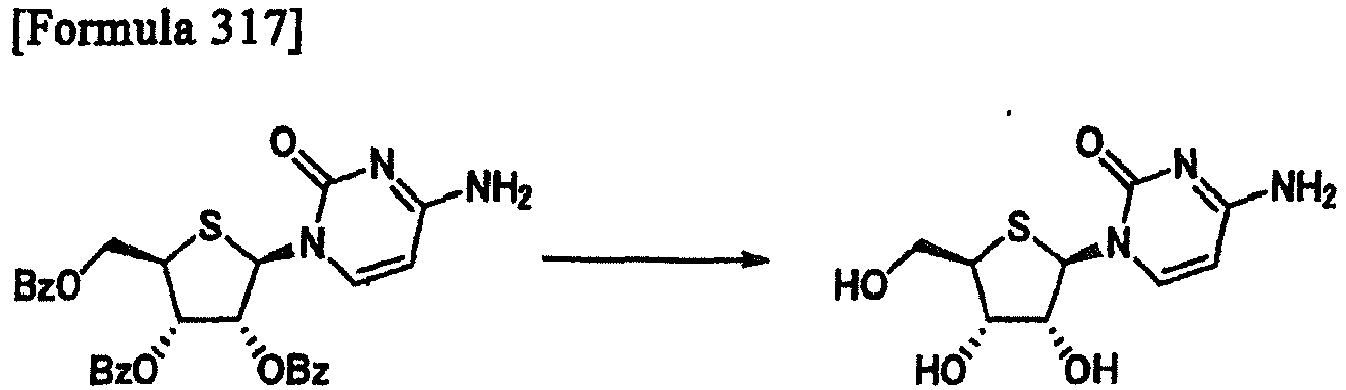
- 0.1 mL of a 28% sodium methoxide/methanol solution was added to a suspension of 70 mg of 1-(2,3,5-tri-O-benzoyl-4-thio-β-D-ribofuranosyl)cytosine in 2.0 mL of methanol, and the obtained mixture was then stirred at room temperature for 1 hour and was then left overnight. Thereafter, 0.2 mL of acetic acid was added to the reaction mixture, and the solvent was then distilled away under reduced pressure. The obtained residue was purified by silica gel column chromatography (ethyl acetate /methanol=1/0 to 2/1), so as to obtain 18 mg of 1-(4-thio-β-D-ribofuranosyl)cytosine in the form of a white solid.
1H-NMR(DMSO-d6)δ value: - 7.97(1H,d,J=7.3Hz),7.14(2H,brd),5.94(1H,d,J=6.6Hz),5.76(1H,d,J=7.3Hz),5.42(1H,br s),5.29(1H,brs),5.14(1H,brs),4.08-3.98(2H,m),3.69-3.51(2H,m),3.20(1H,dd,J=9.2,5.9H z)
-
- (1)

As a result of the measurement of 1H-NMR, the anomeric ratio was found to be 1 : 1.
RT(min):1.73,1.76.
1H-NMR(CDCl3)δ value:- 8.13-7.99(4H,m),7.63-7.51(2H,m),7.49-7.38(4H,m),5.67-5.59(0.5H,m),5.49-5.40(0.5H ,m),5.24(0.5H,dd,J=5.6,2.3Hz),5.20(0.5H,d,J=4.6Hz),4.70-4.45(3H,m),3.43(1.5H,s),3. 37(1.5H,s),2.64-2.50(1H,m),2.36(0.5H,td,J=9.6,4.6Hz),2.21(0.5H,dd,J=14.5,1.3Hz)
- (2)

As a result of the measurement of 1H-NMR, the anomeric ratio was found to be 6:4.
RT(min): 1.41,1.44.
1H-NMR(CDCl3)δ value:- 8.11-7.99(4H,m),7.63-7.51(2H,m),7.51-7.37(4H,m),5.80-5.69(1H,m),5.67-5.60(0.4H, m),5.54-5.48(0.6H,m),4.76-4.47(3H,m),3.11-3.03(0.4H,m),2.86(0.6H,t,J=5.3Hz),2.62-2.48(1H,m),2.45-2.25(1H,m)
- (3)

1H-NMR was measured. As a result, the syn-anti ratio was found to be 64 : 36.
RT(min):1.50.
1H-NMR(CDCl3)δ value:- 8.04(4H,d,J=7.9Hz),7.62-7.54(2H,m),7.51-7.30(4.64H,m),6.85(0.36H,t,J=5.9Hz),5.47-5.37(1H,m),4.61(1H,d,J=3.3Hz),4.57(1H,d,J=3.3Hz),4.44(0.64H,dd,J=5.9,2.6Hz),4.40 (0.36H,dd,J=5.9,2.6Hz),4,29-4.17(1H,m),3.87(1.08,s),3.78(1.92H,s),3.07-2.85(1H,m), 2.82(1H,t,J=5.9Hz)
- (4)

1H-NMR was measured. As a result, the syn-anti ratio was found to be 54 : 46.
RT(min):2.06.
1H-NMR(CDCl3)δ value:- 8.00-8.00(1H,each
- s),7.93(4H,t,J=7.6Hz),7.64-7.54(2H,m),7.50-7.39(5H,m),7.34(0.54H,d,J=4.0Hz),6.80( 0.46H,t,J=5.6Hz),5.56-5.49(1H,m),5.42-5.30(1H,m),4.63(1H,brs),4.61(1H,s),3.86(1.38 H,s),3.77(1.62H,s),2.99-2.91(1H,m),2.90-2.83(0.46H,m),2.82-2.71(0.54H,m)
- (5)
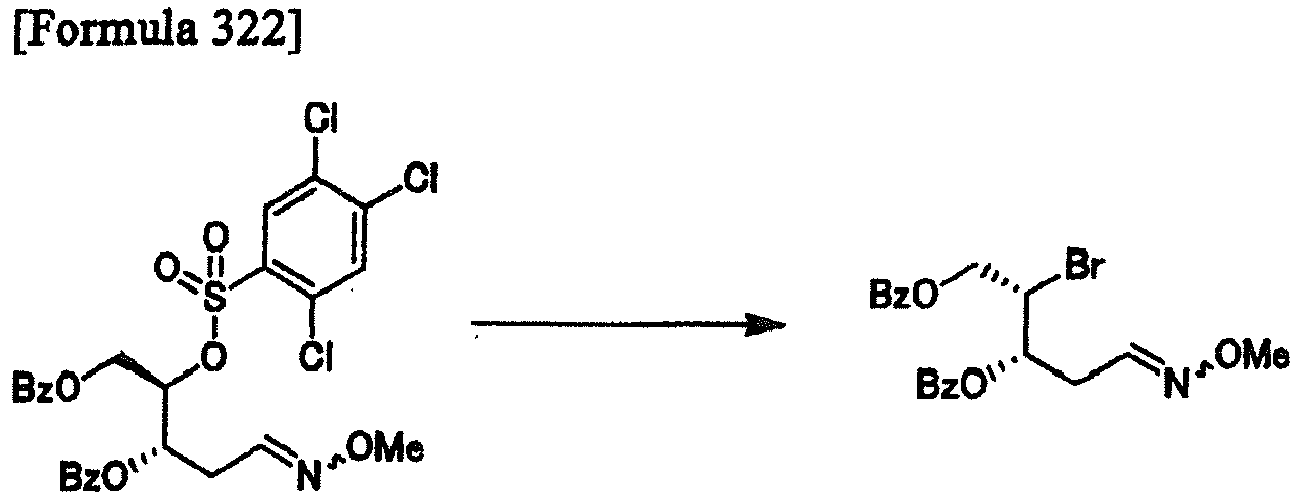
1H-NMR was measured. As a result, the syn-anti ratio was found to be 55 : 45.
RT(min):1.87.
1H-NMR(CDCl3)δ value:- 8.11-8.01(4H,m),7.64-7.54(2H,m),7.51-7.37(4.55H,m),6.78(0.45H,t,J=5.3Hz),5.73-5.6 0(1H,m),4.77-4.67(1H,m),4.64-4.43(2H,m),3.86(1.35H,s),3.75(1.65H,s),3.09-2.87(1H, m),2.84(1H,t,J=6.3)
- (6)

The obtained colorless oily product was a mixture of (2R,3S)-2-bromo-5-oxopentane-1,3-diyl dibenzoate and a water adduct thereof. RT(min):1.71,1.81. - (7)


RT(min):1.56.
m/z(ESI-positive):341.1 [M+H-H2O]+ - (8)

RT(min):1.77.
1H-NMR(DMSO-d6)δ value:- 7.96(4H,dt,J=7.9,1.3Hz),7.71-7.61(2H,m),7.56-7.44(4H,m),6.11(1H,dd,J=5.9,3.3Hz),5 .77-5.69(1H,m),4.55-4.40(2H,m),3.99(1H,qd,J=5.9,1.3Hz),2.76-2.54(2H,m),2.01(3H,s )
- (9)

As a result of the measurement of 1H-NMR, the α/β ratio was found to be 53 : 47.
The obtained brown oily product was separated by high performance liquid chromatography, so as to obtain 13.6 mg of 1-(2-deoxy-3,5-bis-O-benzoyl-4-thio-β-D-ribofuranosyl)cytosine.
Conditions for high performance liquid chromatography- Column: Sunfire prep C18 OBD 10 µm, 19 mm x 150 mm (Waters)
- Mobile phase: 0.1% formic acid - water/0.1% formic acid - acetonitrile (volume ratio: 70/30 to 55/45)
- Flow rate: 17 mL/min
- Detection: UV (254 nm)
- Temperature: room temperature
- Retention time: α form: 7.34 min; β form: 8.50 min
RT(min):1.25.
1H-NMR(CDCl3)δ value:- 8.09-8.02(4H,m),7.95(1H,d,J=7.3Hz),7.63-7.54(2H,m),7.45(4H,d,J=7.9Hz),6.71(1H,t, J=7.3Hz),5.80(1H,d,J=7.3Hz),5.75(1H,q,J=3.7Hz),4.59(2H,d,6.6Hz),4.00(1H,td,6.6,3. 3Hz),2.99-2.13(2H,brs),2.82(1H,dq,13.9,3.5Hz),2.44-2.33(1H,m)
RT(min):1.19.
1H-NMR(CDCl3)δ value:- 8.22(1H,d,J=7.3Hz),8.08(2H,dd,J=7.9,1.3Hz),7.85(2H,dd,J=7.9,1.3Hz),7.62-7.52(2H, m),7.50-7.36(4H,m),6.45(1H,dd,J=7.3,2.0Hz),5.80(1H,d,J=7.3Hz),5.73-5.67(1H,m),4. 56-4.38(2H,m),4.24(1H,dt,J=6.9,2.0Hz),2.95-2.82(1H,m),2.66(1H,dt,J=15.2,2.6Hz)
- (10)


- 1 mL of a 7 mol/L ammonia/methanol solution was added to a solution of 9.6 mg of 1-(2-deoxy-3,5-bis-O-benzoyl-4-thio-β-D-ribofuranosyl)cytosine in 1 mL of methanol, and the obtained mixture was then stirred at room temperature for 3 hours. Thereafter, the solvent was distilled away under reduced pressure, and the obtained residue was then purified by silica gel column chromatography (ethyl acetate /methanol = 95/5 to 30/70), so as to obtain 4.7 mg of 1-(2-deoxy-4-thio-β-D-ribofuranosyl)cytosine in the form of a white solid.
RT(min):0.27.
1H-NMR(DMSO-d6)δ value: - 7.931H,d,J=7.3Hz),7.19(1H,brs),7.12(1H,brs),6.35(1H,dd,J=8.6,6.6Hz),5.78(1H,d,J=7. 3Hz),5.23(1H,d,J=3.3Hz),5.12(1H,t,J=5.3Hz),4.36-4.29(1H,m),3.64-3.22(3H,m),2.28-2.01(2H,m),1.83(1H,s)
-
- (1)

Separately, 0.2 mL of 30% hydrogen bromide/acetic acid was added dropwise to a solution of 238 mg of 1-O-methyl-2,3,5-tri-O-benzoyl-L-lyxose in 1.0 mL of methylene chloride at room temperature, and the obtained mixture was then stirred at room temperature for 2 hours. Thereafter, methylene chloride and water were added to the reaction mixture, and the thus obtained mixture was then stirred for 5 minutes. After that, the water layer was removed. The obtained organic layer was washed with a 10% sodium hydrogen carbonate aqueous solution, and the solvent was then distilled away under reduced pressure. 2.0 mL of acetone and 2.0 mL of water were added to the obtained oily product, and the obtained mixture was then stirred at room temperature for 2 hours. Thereafter, ethyl acetate and water were added to the reaction mixture. The organic layer was fractionated, and the solvent was then distilled away under reduced pressure, so as to obtain a brown oily product.
Brown oily products obtained in the above-described two operations were combined with each other, and the thus combined product was then purified by silica gel column chromatography (hexane/ethyl acetate = 1/0 to 3/1), so as to obtain 462 mg of a colorless oily product containing 2,3,5-tri-O-benzoyl-L-lyxose. - (2)

1H-NMR was measured. As a result, the syn-anti ratio was found to be 4 : 1. 1H-NMR(CDCl3)δ value:- 8.08-7.98(6H,m),7.62-7.32(9.8H,m),6.91(0.2H,d,J=5.9Hz),6.56(0.2H,t,J=6.3Hz),6.06( 0.8H,t,J=6.9Hz),5.83-5.76(1H,m),4.58-4.44(2H,m),4.39-4.35(1H,m),3.88(0.6H,s),3.74 (2.4H,s)
- (3)

1H-NMR(CDCl3)δ value:- 8.10-8.00(6H,m),7.62-7.41(9.8H,m),6.87(0.2H,d,J=5.9Hz),6.47(0.2H,dd,J=5.9,4.6Hz), 6.07-6.03(1H,m),5.95(0.8H,t,J=6.3Hz),5.47(0.8H,dt,J=7.5,3.3Hz),5.39(0.2H,td,J=6.3,3 .3Hz),4.85-4.75(1H,m),4.69-4.60(1H,m),4.39-4.35(1H,m),3.91(0.6H,s),3.77(2.4H,s),3. 05(2.4H,s),3.01(0.6H,s)
- (4)

1H-NMR(CDCl3)δ value:- 9.73(1H,s),8.11-8.04(6H,m),7.66-7.42(9H,m),6.09(1H,t,J=5.3Hz),5.68(1H,d,J=5.9Hz), 5.61-5.56(1H,m),4.81(1H,dd,J=12.6,4.0Hz),4.66(1H,dd,J=12.6,6.6Hz),3.05(3H,s)
- (5)

- 0.11 mL of a 15%-18% sodium hydrogen sulfide aqueous solution was added to a solution of 130 mg of (2S,3S,4R)-2-((methylsulfonyl)oxy)-5-oxopentane-1,3,4-triyl = tribenzoate in 0.5 mL of N,N-dimethylformamide at a temperature of 0°C to 10°C, and the obtained mixture was then stirred at the same temperature as described above for 1 hour. Thereafter, 10 mL of ethyl acetate was added to the reaction mixture, and the thus obtained mixture was then washed with a 10% sodium chloride aqueous solution three times, so as to obtain an ethyl acetate solution of 2,3,5-tri-O-benzoyl-4-thio-D-ribofuranose.
- 0.1 mg of dimethylaminopyridine and 0.025 mL of acetic anhydride were added to the obtained ethyl acetate solution. The obtained mixture was stirred at room temperature for 1 hour, and was then left at room temperature for 4 days. Thereafter, the reaction mixture was washed with water, and the solvent was then distilled away under reduced pressure. The obtained residue was recrystallized from 10 mL of methanol, so as to obtain 28 mg of 1-O-acetyl-2,3,5-tri-O-benzoyl-4-thio-β-D-ribofuranose in the form of a white solid.
1H-NMR(CDCl3)δ value: - 8.06-8.02(2H,m),7.98-7.95(2H,m),7.91-7.88(2H,m),7.64-7.58(1H,m),7.55-7.44(4H,m), 7.36-7.29(4H,m),6.06(1H,d,J=1.3Hz),5.99(1H,dd,J=3.6,1.7Hz),5.91(1H,dd,J=8.6,4.0H z),4.74(1H,dd,J=11.2,5.9Hz),4.53(1H,dd,J=11.2,5.9Hz),4.25(1H,dt,J=8.6,5.9Hz),2.12( 3H,s)
-
- (1)

1H-NMR(CDCl3)δ value:- 6.85-7.30(5H,m),5.40-5.55(1H,m),4.70-4.80(1H,m),4.45-4.55(1H,m),3.15-3.40(2H,m), 1.65-2.60(2H,m),1.35-1.40(3H,m)
- (2)

1H-NMR(CDCl3)δ value:- 6.65-7.40(6H,m),4.90-5.60(1H,m),4.00-4.20(1H,m),3.70-4.00(3H,m),1.50-2.50(3H,m), 1.20-1.30(3H,m)
- (3)


1H-NMR(CDCl3)δ value:- 6.60-7.40(6H,m),4.90-5.40(2H,m),3.80-4.00(3H,m),2.70-3.10(3H,m),1.90-2.40(2H,m), 1.45-1.55(3H,m)
- (4)

1H-NMR(CDCl3)δ value:- 9.71-9.76(1H,m),7.26-7.33(2H,m),7.01-7.04(1H,m),6.88-6.92(2H,m),5.05-5.15(1H,m), 4.67-4.77(1H,m),3.00(1.4H,s),2.83(1.6H,s),2.0-2.4(2H,m),1.48-1.55(3H,m)
- (5)

- 0.53 g of a sodium hydrogen sulfide x-hydrate (Wako Pure Chemical Industries, Ltd.) was added to a solution of 0.62 g of 5-oxo-4-phenoxypentan-2-yl methanesulfonate in 6 mL of N,N-dimethylformamide at a temperature of 0°C to 10°C, and the obtained mixture was then stirred at the same temperature as described above for 1 hour. Thereafter, 30 mL of ethyl acetate and 30 mL of water were added to the reaction mixture, and the water layer was then removed. The organic layer was washed with 30 mL of water, and was then dried over anhydrous magnesium sulfate. After that, the solvent was distilled away under reduced pressure. The obtained residue was purified by silica gel column chromatography (hexane/ethyl acetate = 4/1), so as to obtain 0.34 g of 5-methyl-3-phenoxythiolan-2-ol in the form of a colorless oily product.
1H-NMR(CDCl3)δ value: - 7.25-7.35(2H,m),6.90-7.00(3H,m),5.40-5.55(1H,m),4.90(1H,m),3.75-3.90(1H,m),2.40-2.70(1H,m),1.90-2.20(2H,m),1.42-1.46(3H,m)
-

- 1.83 g of a 15% sodium hydrogen sulfide aqueous solution was added to a solution of 400 mg of 2-chloromethyl-4,6-dibenzyloxybenzaldehyde in 4.5 mL of N,N-dimethylformamide at a temperature of 0°C to 10°C, and the obtained mixture was then stirred at 15°C for 1 hour. Thereafter, 40 mL of ethyl acetate and 20 mL of a 10% sodium chloride aqueous solution were added to the reaction mixture, and the water layer was then removed. The organic layer was washed with a saturated sodium hydrogen carbonate aqueous solution, and 30 mL of hexane was then added thereto. A solid was collected by filtration, so as to obtain 206 mg of 5,7-bis(benzyloxy)-1,3-dihydrobenzothiophen-1-ol in the form of a white solid.
1H-NMR(CDCl3)δ value: - 7.30-7.45(10H,m),6.68(1H,dd,J=2.1,6.9Hz),6.48(1H,d,J=8.4Hz),6.47(1H,d,J=8.4Hz),5 .14(H,d,J=12.3Hz),5.09(1H,d,J=12.3Hz),5.03(2H,s),4.49(1H,dd,J=2.1,14.7Hz),4.02(1 H,d,J=14.7Hz),2.45(1H,d=6.9Hz)
-
- (1)

1H-NMR(CDCl3)δ value:- 7.33-7.28(5H,m),4.68-4.61(1H,m),4.572(1H,s),4.566(1H,s),3.68(1H,dd,J=10.8,4.5Hz), 3.58(1H,dd,J=10.8,4.2Hz),2.57-2.42(2H,m),2.35-2.06(2H,m)
- (2)

1H-NMR(CDCl3)δ value:- 7.35-7.31(5H,m),4.55(2H,s),3.89-3.81(1H,m),3.71-3.58(2H,m),3.49(1H,dd,J=9.3,3.3H z),3.36(1H,dd,J=9.3,7.8Hz),2.92(1H,brs),2.55(1H,brs),1.67-1.41(4H,m)
- (3)

1H-NMR(CDCl3)δ value:- 7.35-7.26(5H,m),4.56(2H,s),3.85-3.79(1H,m),3.72(2H,t,J=5.9Hz),3.49(1H,dd,J=9.3,3. 9Hz),3.38(1H,dd,J=9.3,7.2Hz),2.86(1H,d,J=3.3Hz),1.76-1.45(4H,m),1.15-1.00(21H,m )
- (4)


1H-NMR(CDCl3)δ value:- 7.36-7.26(5H,m),4.92-4.83(1H,m),4.58(1H,d,J=17.6Hz),4.54(1H,d,J=17.6Hz),3.77-3.5 8(4H,m),3.02(3H,s),1.90-1.52(4H,m),1.15-1.00(21H,m)
- (5)

1H-NMR(CDCl3)δ value:- 7.36-7.26(5H,m),4.93-4.84(1H,m),4.58(1H,d,J=12.0Hz),4.53(1H,d,J=12.0Hz),3.74-3.5 7(4H,m),3.02(3H,s),1.84-1.64(4H,m)
- (6)

1H-NMR(CDCl3)δ value:- 9.79(1H,s),7.36-7.26(5H,m),4.89-4.80(1H,m),4.57(1H,d,J=13.3Hz),4.52(1H,d,J=13.5 Hz),3.67-3.57(2H,m),3.01(3H,s),2.79-2.61(2H,m),2.10-1.83(2H,m)
- (7)

- 58 mg of a sodium hydrogen sulfide n-hydrate was added to a solution of 103 mg of 1-benzyloxy-5-oxopentan-2-yl methanesulfonate in 3 mL of N,N-dimethylformamide at room temperature, and the obtained mixture was then stirred at room temperature for 2 hours. Thereafter, the reaction mixture was added to a mixture of 30 mL of ethyl acetate and 20 mL of a saturated sodium hydrogen carbonate aqueous solution. The organic layer was fractionated, and it was washed with 20 mL of a saturated sodium chloride aqueous solution, and was then dried over anhydrous sodium sulfate. The solvent was distilled away under reduced pressure, and the obtained residue was then purified by silica gel column chromatography (ethyl acetate/hexane = 1/3 to 1/2), so as to obtain 49 mg of 5-((benzyloxy)methyl)thiolan-2-ol in the form of a colorless oily product.
- As a result of the measurement of 1H-NMR, the cis/trans ratio was found to be 50 : 50.
- Moreover, 3, 30, 60, 90 and 120 minutes after initiation of the reaction, approximately 20 mg of the reaction mixture was precisely weighed with a precision balance, and the remaining amount of the 1-benzyloxy-5-oxopentan-2-yl methanesulfonate used as a raw material was measured by HPLC. As a result, it was found that the remaining amount of the substance was 53% three minutes after initiation of the reaction, and that the substance was completely consumed from 30 minutes after initiation of the reaction.
1H-NMR(CDCl3)δ value: - 7.38-7.26(5H,m),5.55-5.45(1H,m),4.59(1H,s),4.56(0.5H,d,J=12.0Hz),4.45(0.5H,d,J=1 2.0Hz),3.85-3.57(2H,m),3.42-3.31(1H,m),2.72(0.5H,d,J=6.90Hz),2.29-1.87(4.5H,m)
-
- (1)
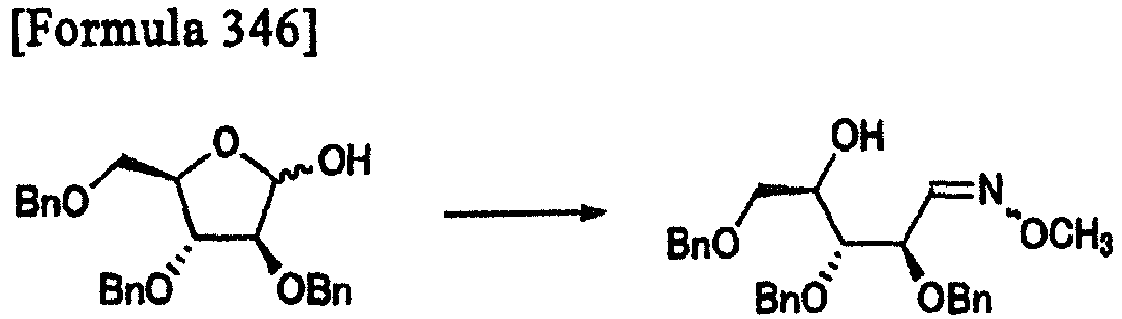
1H-NMR was measured. As a result, the syn-anti ratio was found to be 78 : 22.
1H-NMR(CDCl3)δ value:- 2.60(0.22H,d,J=1.5Hz),2.68(0.78H,d,J=1.5Hz),3.56-3.60(2.22H,m),3.67(0.78H,dd,J=7 .1.3.6Hz),3.79(0.22H,dd,J=7.5,3.0Hz),3.85(0.66H,s),3.86(2.34H,s),3.97-4.04(1H,m),4. 27(0.78H,dd,J=7.8,3.9Hz),4.38-4.65(6H,m),4.93(0.22H,dd,J=6.0,3.0Hz),6.90(0.22H,d, J=6.3Hz),7.23-7.35(15H,m),7.43(0.78H,dd,J=8,1,0.6Hz)
- (2)

1H-NMR was measured. As a result, the syn-anti ratio was found to be 75 : 25.
1H-NMR(CDCl3)δ value:- 2.93(2.25H,s),2.95(0.75H,s),3.80(1H,dd,J=11.4,6.9Hz),3.85(0.75H,s),3.86(2.25H,s),3. 90(1H,dd,J=11.4,2.1Hz),3.98(0.75H,t,J=4.5Hz),4.16(0.75H,ddd,J=7.7,4.5,0.6Hz),4.41-4.62(4.25H,m),4.67(2H,dd,J=20.4,11.1Hz),4.80(0.25H,dd,J=7.5,4.5Hz),4.99(1H,m),6. 81(0.25H,d,J=6.3Hz),7.24-7.37(15.75H,m)
- (3)

1H-NMR(CDCl3)δ value:- 2.97(1H,s),3.76(1H,dd,J=11.4,6.6Hz),3.89(1H,dd,J=11.4,3.0Hz),4.04(1H,dd,J=3.3,0.9 Hz),4.18(1H,dd,J=5.3,3.3Hz),4.47-4.60(4H,m),4.67(2H,dd,J=22.2,11.4Hz),5.97(1H,m) ,7.20-7.25(2H,m),7.27-7.36(13H,m)
- (4)

- 0.06 g of a sodium hydrogen sulfide x-hydrate was added to a solution of 0.10 g of (2R,3S,4S)-1,3,4-tris(benzyloxy)-5-oxopentan-2-yl = methanesulfonate in 2 mL of N,N-dimethylformamide, and the obtained mixture was then stirred at room temperature for 12 hours. Thereafter, 2 mL of water and 5 mL of ethyl acetate were added to the reaction mixture. The organic layer was fractionated, and it was washed with 5 mL of a 10% sodium chloride aqueous solution and was then dried over anhydrous magnesium sulfate. After that, the solvent was distilled away under reduced pressure. The obtained residue was purified by silica gel column chromatography, so as to obtain 0.02 g of (3S,4S,5S)-3,4-bis(benzyloxy)-5-((benzyloxy)methyl)thiolan-2-ol in the form of a colorless oily product.
1H-NMR(CDCl3)δ value: - 3.69(1H,d,J=12.6Hz),3.77-3.82(3H,m),4.19(2H,m),4.51-4.67(6H,m),5.26(1H,d,J=12.6 Hz),7.22-7.37(15H,m)
-
- (1)

1H-NMR(CDCl3)δ value:- 8.11-8.00(6H,m),7.64-7.41(9.75H,m),6.92(0.25H,d,J=5.9Hz),6.55(0.25H,dd,J=5.3,4.0 Hz),6.11(0.25H,dd,J=5.9,4.0Hz),6.08-6.02(1.5H,m),5.53-5.46(1H,m),5.01-4.91(1H,m) ,4.59-4.47(1H,m),3.97(0.75H,s),3.88(2.25H,s),3.17(2.25H,s),3.13(0.75H,s)
- (2)

The obtained oily product was a mixture of (2R,3S,4R)-2-((methylsulfonyl)oxy)-5-oxopentane-1,3,4-triyl = tribenzoate and a water adduct thereof.
1H-NMR(CDCl3)δ value:- 9.74(1H,s),8.20-7.96(6H,m),7.66-7.42(9H,m),6.12(1H,dd,J=7.9,2.6Hz),5.87(1H,d,J=2. 6Hz),5.64-5.58(1H,m),4.96(1H,dd,J=13.2,2.6Hz),4.49(1H,dd,J=13.2,5.3Hz),3.13(3H,s )
- (3)

- 0.27 mL of a 15%-18% sodium hydrogen sulfide aqueous solution was added to a solution of 317 mg of the colorless oily product obtained in Example 39(2) in 1.5 mL of N,N-dimethylformamide at a temperature of 0°C to 10°C, and the obtained mixture was then stirred at the same temperature as described above for 1 hour. Thereafter, 10 mL of ethyl acetate was added to the reaction mixture, and the thus obtained mixture was washed with 10 mL of a 10% sodium chloride aqueous solution three times, to obtain an ethyl acetate solution of 2,3,5-tri-O-benzoyl-4-thio-L-lyxose.
- 0.4 mg of 4-dimethylaminopyridine and 0.061 mL of acetic anhydride were added to the obtained ethyl acetate solution. The obtained mixture was stirred at room temperature for 1 hour, and was then left at room temperature overnight. Thereafter, the reaction mixture was washed with water, and the solvent was then distilled away under reduced pressure. The obtained residue was purified by silica gel column chromatography (hexane/ethyl acetate = 1/0 to 3/1), so as to obtain 107 mg of 1-O-acetyl-2,3,5-tri-O-benzoyl-4-thio-L-lyxose in the form of a colorless oily product. The obtained compound was a single anomer.
1H-NMR(CDCl3)δ value: - 8.05-8.01(2H,m),7.96-7.92(2H,m),7.90-7.87(2H,m),7.64-7.31(9H,m),6.20(1H,d,J=4.0 Hz),6.09(1H,dd,J=5.9,4.0Hz),5.94(1H,t,J=3.6Hz),4.77(1H,dd,J=11.2,7.3Hz),4.61(1H,d d,J=11.2,7.3Hz),4.37(1H,q,J=6.8Hz),2.15(3H,s)
-
- (1)

2400 mL of a 50% sodium hydroxide aqueous solution, 6000 mL of toluene and 72.0 g of tetrabutylammonium chloride were added to 4500 mL of the obtained toluene solution at a temperature of 30°C or lower, and thereafter, 3290 mL of 4-methylbenzoyl chloride was added dropwise to the mixture at a temperature of 15°C or lower over 1 hour. The thus obtained mixture was stirred at 30°C for 3 hours. Thereafter, the water layer was removed, and the organic layer was successively washed with 3000 mL of water and 3000 mL of a 10% sodium chloride aqueous solution, and was then dried over anhydrous sodium sulfate. The solvent was distilled away under reduced pressure, so as to obtain 3.94 kg of ((2R,3S,4S)-3,4-di((4-methylphenyl)carbonyloxy)-5-methoxyoxiran-2-yl)methyl = 4-methylbenzoate in the form of a white solid.
1H-NMR(CDCl3)δ value:- 2.33-2.45(9H,m),3.49(3H,s),4.53-4.57(1H,m),4.60-4.76(1H,m),4.82(1H,dd,J=3.2,12.0 Hz),5.16(1H,s),5.44-5.48(1H,m),5.55(1H,d,J=5.6Hz),7.08-7.26(6H,m),7.86-7.97(6H,m )
- (2)

1H-NMR(CDCl3)δ value:- 2.44(3H,s),2.42(3H,s),2.37(3H,s),4.72-4.92(3H,m),5.59(1H,d,J=4.4Hz),5.92(1H,s),6.1 9(1H,s),7.08-7.30(6H,m),7.82-8.03(6H,m)
- (3)

1H-NMR(CDCl3)δ value:- 2.37-2.45(9H,m),4.73-4.92(3H,m),5.59(1H,d,J=4.4Hz),5.92(1H,s),6.59(1H,s),7.04-7.2 6(6H,m),7.83-8.03(6H,m)
- (4)

1H-NMR was measured. As a result, the syn-anti ratio was found to be 75 : 25.
1H-NMR(CDCl3)δ value:- 2.37-2.43(9H,m),3.40(1H,dJ=8.4Hz),3.79(2.25H,s),4.11(0.75H,s),4.36-4.40(1H,m),4. 53-4.59(1H,m),5.66(0.75H,dd,J=3.2,8.4Hz),5.84(0.25H,dd,J=2.8,8.4Hz),6.17(0.75H,d d,J=3.2,6.0Hz)6.57(0.25H,dd,J=2.8,5.2Hz),6.76(0.25H,d,J=5.2Hz),7.06-7.29(6H,m),7. 45(0.75H,d,J=6.0Hz),7.89-8.03(6H,m)
- (5)
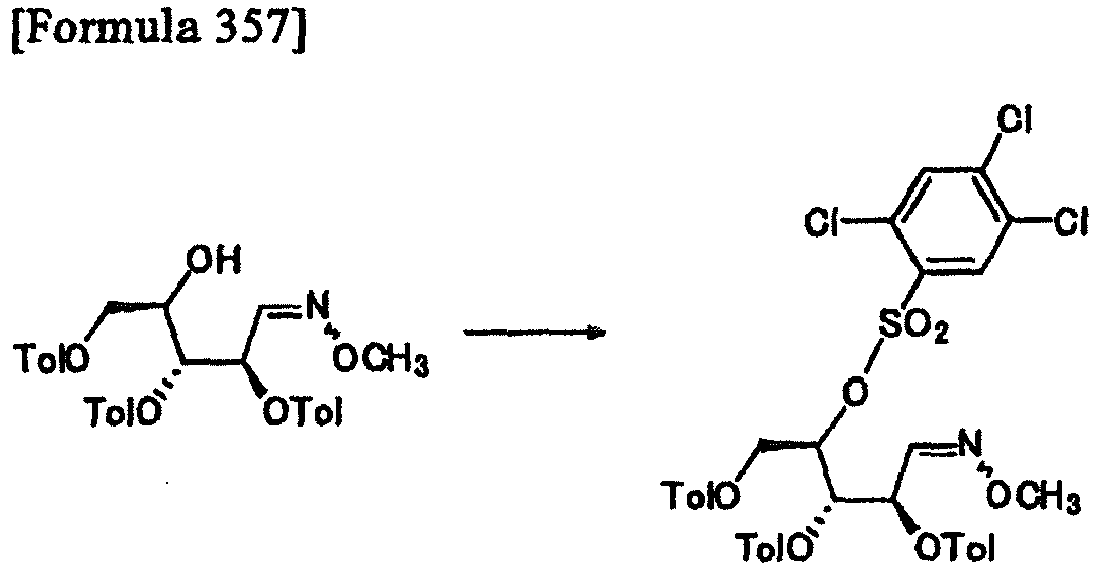
1H-NMR was measured. As a result, the syn-anti ratio was found to be 75 : 25.
1H-NMR(CDCl3)δ value:- 2.37-2.49(9H,m),3.82(2.25H,s),3.96(0.75H,s),4.62-4.80(2H,m),5.35-5.51(1H,m),5.90-6.05(1.75H,m),6.30-6.38(0.25H,m),6.74-6.76(0.25H,m),7.15-7.35(7H,m),7.44-7.49(0. 75H,m),7.75-7.99(7H,m)
- (6)

1H-NMR was measured. As a result, the syn-anti ratio was found to be 79 : 21.
1H-NMR(CDCl3)δ value:- 2.34-2.41(9H,m),3.38(2.37H,s),3.88(0.63H,s),4.44-4.75(3H,m),6.04-6.11(1.79H,m),6. 41-6.44(0.21H,m),6.75(0.21H,d,J=5.6Hz),7.11-7.26(6H,m),7.53(0.79H,d,J=5.2Hz),7.7 8-7.96(6H,m)
- (7)

The obtained oily product was a mixture of (2S,3S,4S)-2-bromo-1,4-di((4-methylphenyl)carbonyloxy)-5-oxopentan-3-yl = 4-methylbenzoate and a water adduct thereof.
1H-NMR(CDCl3)δ value:- 2.34-2.45(9H,m),4.55-4.85(3H,m),5.78-5.80(1H,m),5.95-6.00(1H,m),7.18-7.26(6H,m), 7.89-7.96(6H,m),9.72(1H,s)
- (8)

15.0 g of N,N-dimethyl-4-aminopyridine was added to the obtained ethyl acetate solution, and 180 mL of acetic anhydride was then added thereto dividedly over four times at 0°C. The obtained mixture was left at rest at room temperature for 16 hours. Thereafter, 400 mL of water was added to the reaction mixture, and the water layer was then removed. The organic layer was washed with a sodium hydrogen carbonate aqueous solution four times, and was then dried over anhydrous magnesium sulfate. After that, the solvent was distilled away under reduced pressure. The obtained residue was recrystallized from methanol, so as to obtain 167 g of ((2R,3S,4S)-5-(acetyloxy)-3,4-di((4-methylphenyl)carbonyloxy)thiolan-2-yl)methyl = 4-methylbenzoate in the form of a white solid.
1H-NMR(DMSO-d6)δ value:- 1.99(1.50H,s),2.04(1.50H,s),2.31-2.45(9H,m),3.78-3.87(1H,m),4.46-4.53(1H,m),4.64-4.71(1H,m),5.66-5.73(1H,m),6.08-6.21(1H,m),6.31(0.50H,d,J=4.4Hz),6.40(0.50H,d,J= 4.4Hz),6.96-7.28(6H,m),7.76-7.96(6H,m)
- (9)

- 25 mL of triethylsilane was added to a solution of 25 g of ((2R,3S,4S)-5-(acetyloxy)-3,4-di((4-methylphenyl)carbonyloxy)thiolan-2-yl)methyl = 4-methylbenzoate in 75 mL of trifluoroacetic acid, and the obtained mixture was then stirred at room temperature for 8 hours 30 minutes. Thereafter, the solvent was distilled away under reduced pressure, and the obtained residue was then recrystallized from methanol, so as to obtain 167 g of ((2R,3S,4S)-5-(acetyloxy)-3,4-di((4-methylphenyl)carbonyloxy)thiolan-2-yl)methyl = 4-methylbenzoate in the form of a white solid.
1H-NMR(DMSO-d6)δ value: - 2.31-2.45(9H,m),3.18(1H,dd,J=5.6,16.0Hz),3.52(1H,d,J=4.8,16.0Hz),3.92(1H,ddd,J=4 .8,9.2,10.8Hz),4.57(1H,dd,J=9.2,14.8Hz),4.67(1H,dd,J=10.8,14.8),5.72-5.77(1H,m),5. 85-5.88(1H,m),7.15-7.26(6H,m),7.88-7.96(6H,m)
-
- (1)


1H-NMR(CDCl3)δ value:- 7.37-7.24(10H,m),4.80-4.48(5H,m),4.12(1H,m),3.53-3.42(2H,m),3.44(3H,s),3.38(1H,d ,J=0.6Hz),3.34(1H,d,J=4.2Hz),1.31(3H,s).
- (2)

1H-NMR(CDCl3)δ value:- 7.44-7.22(15H,m),4.82-4.46(6H,m),4.70(1H,s),4.27(1H,q,J=3.9Hz),3.59-3.43(3H,m),3 .46(3H,s),1.34(3H,s).
- (3)

1H-NMR(dmso-d6)δ value:- 7.38-7.24(15H,m),6.56(0.64H,d,J=4.8Hz),5.84(0.36H,d,J=6.9Hz),5.01(0.64H,d,J=4.8H z),4.99(0.36H,d,J=6.9),4.75-4.47(6H,m),4.17(0.36H,m),4.03(0.64H,m),3.79(0.64H,d,J =7.5Hz),3.66(0.36H,d,J=6.0Hz),3.61-3.49(2H,m),1.34(1.92H,s),1.33(1.08H,s).
- (4)
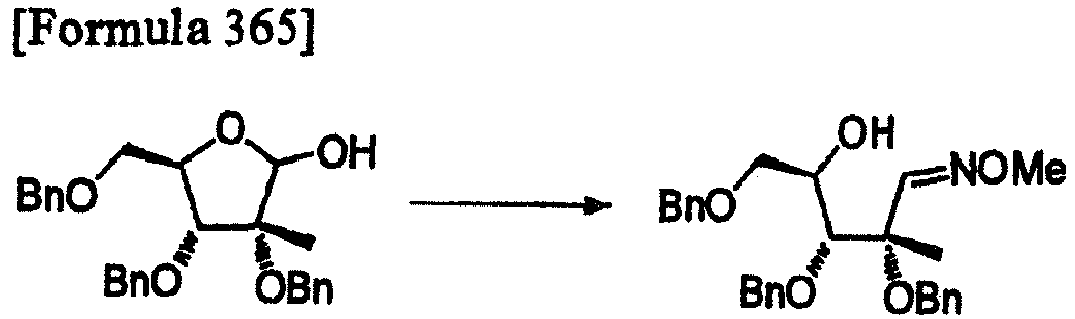
1H-NMR(CDCl3)δ value:- 7.42(s(1H),7.35-18(15H,m),4.64-4.39(6H,m),4.06(1H,m),3.87(3H,s),3.76-3.68(4H,m), 1.58(3H,s).
- (5)

1H-NMR(CDCl3)δ value:- 7.35(1H,s),7.34-7.22(15H,m),5.23(1H,m),4.81-3.39(6H,m),3.96(1H,d,J=1.8Hz),3.89-3 .79(2H,m),3.87(3H,s),2.96(3H,s),1.48(3H,s).
- (6)

1H-NMR(CDCl3)δ value:- 9.51 (1H,s),7.38-7.24(15H,m),5.09(1H,m),4.77-4.43(6H,m),4.09(1H,d,J=4.5Hz),3.96-3 .77(2H,m),2.93(3H,s),1.43(3H,s).
- (7)

- 0.035 g of a sodium hydrogen sulfide x-hydrate was added to an N,N-dimethylformamide solution of 0.12 g of (2R,3R,4R)-1,3,4-tris(benzyloxy)-4-methyl-5-oxopentan-2-yl = methanesulfonate, and the obtained mixture was then stirred at room temperature for 2 hours. Thereafter, water and 5 mL of ethyl acetate were added to the reaction mixture. The organic layer was fractionated, and it was then washed with 5 mL of a saturated sodium chloride aqueous solution. The solvent was distilled away under reduced pressure. The obtained residue was purified by silica gel column chromatography, so as to obtain 0.05 g of (3R,4S,5R)-3,4-bis(benzyloxy)-5-((benzyloxy)methyl)-3-methylthiolan-2-ol in the form of a colorless oily product.
1H-NMR(CDCl3)δ value: - 7.37-7.22(15H,m),5.29(1H,d,J=6.0Hz),4.75-4.37(6H,m),4.02(1H,d,J=6.3Hz),3.94(1H, dd,J=9.3,4.8Hz),3.80(1H,m),3.70(1H,dd,J=9.3,8.1Hz),1.95(1H,d,J=6.3Hz),1.48(3H,s).
-
- (1)

1H-NMR(CDCl3)δ value:- 8.10-8.05(4H,m),7.67-7.40(7H,m),6.17(1H,ddd,12.9Hz,10.8Hz,3.0Hz),5.62(1H,ddd,8. 4Hz,3.0Hz,2.7Hz),4.89(1H,dd,12.6Hz,2.7Hz),4.60(1H,dd,12.6Hz,8.4Hz),3.90(3H,s),3. 06(3H,s)ppm.
- (2)

1H-NMR(CDCl3)δ value:- 8.08-8.02(4H,m),7.64-7.36(6H,m),6.19(1H,ddd,12.9Hz,12.9Hz,2.7Hz),5.70(1H,ddd,8. 7Hz,2.4Hz,2.4Hz),5.30(1H,br),4.93(1H,br),4.92(1H,dd,12.6Hz,2.4Hz),4.59(1H,dd,12. 6Hz,8.7Hz),3.10(1H,br),3.08(3H,s)ppm.
- (3)

- 17 mg of a sodium hydrogen sulfide n-hydrate was added to a solution of 70.5 mg of (3R,4R)-5-benzoyloxy-2,2-difluoro-1,1-dihydroxy-4-(methylsulfonyloxy)pentan-3-yl benzoate in 1 mL of N,N-dimethylformamide, and the obtained mixture was then stirred at room temperature for 5 minutes. Thereafter, ethyl acetate and water were added to the reaction mixture, and the water layer was then removed. The solvent was distilled away under reduced pressure, and the obtained residue was then purified by silica gel column chromatography (hexane/ethyl acetate = 5/1 to 0/1), so as to obtain 26.5 mg of (2R,3R)-2-((benzoyloxy)methyl)-4,4-difluoro-5-hydroxythiolan-3-yl benzoate in the form of a colorless oily product.
1H-NMR(CDCl3)δ value: - 8.04(2H,d,J=7.2Hz),7.90(0.6H,d,J=7.2Hz),7.82(1.4H,d,J=7.2Hz),7.27-7.65(6H,m),5.9 8(1H,m),5.36-5.54,(1H,m),4.62(0.6H,d,J=7.5Hz),4.55(0.7H,dd,J=11.4,8.1Hz),4.44(0.7 H,d,J=11.4,6.1Hz). 4.28(0.7H,ddd,J=8.1Hz,6.1Hz,6.6Hz),2.80-3.15 (1H,br).
-
- (1)

1H-NMR(CDCl3)δ value:- 7.35-7.15(5H,m),3.95(1H,dqb,J=6.9Hz,6.3H),3.70-3.61(1H,m),3.57-3.46(1H,m),2.69( 1H,ddd,J=8.3Hz,8.3Hz,5.1Hz),2.28-2.15(1H,m),2.00-1.80(1H,m),1.04(3H,d,J=6.3Hz).
- (2)

1H-NMR(CDCl3)δ value:- 7.33-7.12(5H,m),4.00-3.89(1H,m),3.76-3.68(1H,m),3.63-3.53(1H,m),2.81-2.78(1H,m), 2.75-2.67(1H,m),2.20-2.08(1H,m),1.99-1.88(1,m),1.15-1.00(24H,m).
- (3)

1H-NMR(CDCl3)δ value:- 7.35-7.15(5H,m),4.90(1H,dq,J=6.3Hz,6.8Hz),3.66-3.58(1H,m),3.46-3.35(1H,m),3.10-3.02(1H,m),2.85(3H,s),2.27-2,14(1H,m),1.94-1.81(1H,m),1.31(3H,d,J=6.3Hz),1.09-0. 95(21H,m).
- (4)

1H-NMR(CDCl3)δ value:- 7.38-7.16(5H,m),4.92(1H,dq,J=7.8Hz,6.3Hz),3.62-3.53(1H,m),3.44-3.34(1H,m),3.05-2.95(1H,m),2.92(3H,s),2.29-2.16(1H,m),1.99-1.85(1H,m),1.28(3H,d,J=6.3Hz).
- (5)

1H-NMR(CDCl3)δ value:- 9.69(1H,m),7.38-7.18(5H,m),4.93-4.85(1H,m),3.50-3.43(1H,m),3.15-3.04(1H,m),2.93-2.80(4H,m),1.31(3H,d,J=4.5Hz).
- (6)

- 240 mg of a sodium hydrogen sulfide n-hydrate was added to a solution of 256 mg of 5-oxo-3-phenylpentan-2-yl methanesulfonate in 3 mL of N,N-dimethylformamide at room temperature, and the obtained mixture was then stirred at room temperature for 2 hours. Thereafter, ethyl acetate and water were added to the reaction mixture. The organic layer was fractionated, and it was washed with a saturated sodium chloride aqueous solution twice and was then dried over anhydrous magnesium sulfate. The solvent was distilled away under reduced pressure, and the obtained residue was then purified by silica gel column chromatography (ethyl acetate/hexane = 1/19 to 1/9), so as to obtain 80 mg of 5-methyl-4-phenylthiolan-2-ol in the form of a colorless oily product.
1H-NMR(CDCl3)δ value: - 7.38-7.17(5H,m),5.82-5.72(0.17H,m),5.63-5.58(0.83H,m),3.99-3.90(0.83H,m),3.82-3. 51(0.83H,m),3.66-3.47(0.34H,m),2.75-2.68(0.17H,m),2.56-2.31(1.83H,m),1.10(0.51H, d,J=6.9Hz),0.84(2.49H,d,J=6.9Hz).
-
- (1)

1H-NMR(CDCl3)δ value:- 4.34-4.27(1H,m),4.03-3.71(4H,m),2.73-2.62(2H,m),1.41(3H,s),1.36(3H,s),1.33(3H,d,J =6.0Hz).
- (2)


1H-NMR(CDCl3)δ value:- 4.29(1H,ddd,J=3.6,5.1,10.2Hz),4.12(1H,br),4.02-3.94(2H,m),3.88(1H,dd,J=10.2,10.2H z),3.67(1H,dd,J=3.6,10.2Hz),1.40-1.03(30H,m).
- (3)

1H-NMR(CDCl3)δ value:- 5.17(1H,dq,J=3.3,6.6Hz),4.35-4.27(2H,m),3.94-3.82(2H,m),3.02(3H,s),1.51(3H,d,J=6. 6Hz),1.47(3H,s),1.37(3H,s),1.17-1.03(21H,m).
- (4)

The obtained oily product contained fluorotris(propan-2-yl)silane. However, the oily product was directly used in the subsequent reaction.
1H-NMR(CDCl3)δ value:- 4.96(1H,dq,J=6.3,6.3Hz),4.32(1H,dt,J=4.5,6.3Hz),4.17-4.11(1H,m),3.90-3.79(2H,m),3 .75(1H,br),3.06(3H,s),1.53(3H,d,J=6.3Hz),1.47(3H,s),1.38(3H,s).
- (5)

The obtained oily product contained fluorotris(propan-2-yl)silane. However, the oily product was directly used in the subsequent reaction.
1H-NMR(CDCl3)δ value:- 9.69(1H,d,J=3.0Hz),4.99(1H,dq,J=5.1,6.6Hz),4.50-4.39(2H,m),3.02(3H,s),1.60(3H,s), 1.50(3H,d,J=6.6Hz),1.42(3H,s).
- (6)

- 0.38 g of a sodium hydrogen sulfide n-hydrate was added to a solution of 0.85 g of (1R)-1-((4S,5R)-5-formyl-2,2-dimethyl-1,3-dioxolane -4-yl)ethyl methanesulfonate (which contained fluorotris(propan-2-yl)silane) in 8 mL of N,N-dimethylformamide at a temperature of 5°C to 10°C, and the obtained mixture was then stirred at room temperature for 1.5 hours. Thereafter, ethyl acetate and water were added to the reaction mixture. The organic layer was fractionated, and it was washed with a saturated sodium chloride aqueous solution twice and was then dried over anhydrous magnesium sulfate. The solvent was distilled away under reduced pressure, and the obtained residue was then purified by silica gel column chromatography (ethyl acetate/hexane = 1/19 to 1/4), so as to obtain 0.11 g of (3aR,6S,6aS)-2,2,6-trimethyltetrahydro-2H-thieno(3,4-d)(1,3)dioxol-4-ol in the form of a white solid.
1H-NMR(CDCl3)δ value: - 5.21(1H,s),4.77-4.70(2H,m),3.82(1H,dq,J=3.3,6.9Hz),1.76(1H,br),1.49(3H,s),1.38(3H, d,J=6.9Hz),1.33(3H,s).
-
- (1)

As a result of the measurement of 1H-NMR, it was found that the obtained oily product was a mixture of isomer A and isomer B, and that the ratio of A: B = 56 : 54.
1H-NMR(CDCl3)δ value:- 7.46-7.23(5H+5H,m,A+B),5.77-5.75(1H,m,A),5.64-5.62(1H,m,B),5.25(1H,t,J=6.9Hz, A),5.04-4.98(1H,m,B),2.98-2.92(1H,m,B),2.90-2.83(1H,m,B),2.59-2.42(1H,m,A),2.36 -2.02(1H+4H,m,A+B),2.21-1.91(1H,m,A),1.86-1.75(1H,m,A).
- (2)

As a result of the measurement of 1H-NMR, it was found that the obtained oily product was a mixture of isomer A and isomer B, and that the ratio of A : B = 60 : 40.
1H-NMR(CDCl3)δ value:- 7.41(1H,t,J=5.9Hz,A),7.38-7.25(5H+5H,m,A+B),6.68(1H,t,J=5.7Hz,A),4.77-4.71(1H, m,A),4.70-4.64(1H,m,B),3.87(3H,s,B),3.81(3H,s,A),2.54-2.25(2H+2H,m,A+B),2.20(1 H,d,J=3.6Hz,A),2.17(1H,d,J=3.6Hz,B),2.06-1.80(2H+2H,m,A+B).
- (3)

As a result of the measurement of 1H-NMR, it was found that the obtained oily product was a mixture of isomer A and isomer B, and that the ratio of A : B = 58 : 42. 1H-NMR(CDCl3)δ value:- 7.41-7.30(6H+5H,m,A+B),6.63(1H,t,J=5.4Hz,B),4.92(1H,t,J=6.8Hz,A),4.84(1H,dd,J= 6.2,8.0Hz,B),3.86(3H,s,B),3.82(3H,s,A),2.53-2.20(4H+4H,m,A+B).
- (4)

1H-NMR(CDCl3)δ value:- 9.78(1H,t,J=0.9Hz),7.41-7.28(5H,m),4.94(1H,dd,J=6.6,7.5Hz),2.66(2H,t,J=6.9Hz),2.3 9(2H,dd,J=6.6,7.4Hz),3.86(3H,s,B),3.82(3H,s,A),2.53-2.20(4H+4H,m,A+B).
- (5)


- 32 mg of anhydrous sodium hydrogen sulfide was added to a solution of 61 mg of 4-chloro-4-phenylbutanal in 1 mL of N,N-dimethylformamide at a temperature of 0°C to 10°C, and the obtained mixture was then stirred at the same temperature as described above for 1 hour. Thereafter, ethyl acetate and water were added to the reaction mixture, and the water layer was then removed. The organic layer was washed with water, and was then dried over anhydrous sodium sulfate. After that, the solvent was distilled away under reduced pressure. The obtained residue was purified by silica gel column chromatography (hexane/ethyl acetate = 85/15 to 60/40), so as to obtain 37 mg of 5-phenylthiolan-2-ol in the form of a colorless oily product.
- As a result of the measurement of 1H-NMR, it was found that the obtained oily product was a mixture of isomer A and isomer B, and that the ratio of A : B = 68 : 32.
1H-NMR(CDCl3)δ value: - 7.45(2H,brd,J=7.8Hz,A),7.39-7.20(3H+5H,m,A+B),5.80(1H,m,B),5.64(1H,t,J=4.2Hz, A),4.80(1H,dd,J=5.0,7.1Hz,B),4.56(1H,dd,J=6.1,10.5Hz,A),2.65-2.00(4H+4H,m,A+B).
-

- 80 mg of a sodium hydrogen sulfide x-hydrate was added to a solution of 295 mg of diethyl 2-bromo-2-(3-oxopropyl)malonate in 3 mL of N,N-dimethylformamide at a temperature of 0°C to 10°C, and the obtained mixture was then stirred at the same temperature as described above for 15 minutes, and then at room temperature for 15 minutes. Thereafter, 10 mL of ethyl acetate and 10 mL of water were added to the reaction mixture. The organic layer was fractionated. The obtained organic layer was successively washed with 10 mL of 1 mol/L hydrochloric acid, 10 mL of a saturated sodium hydrogen carbonate aqueous solution and 10 mL of a saturated sodium chloride aqueous solution, and it was then dried over anhydrous sodium sulfate. The solvent was distilled away under reduced pressure, and the obtained residue was then purified by silica gel column chromatography (ethyl acetate/hexane = 5/1), so as to obtain 29 mg of diethyl 5-hydroxydihydrothiophene-2,2(3H)-dicarboxylate in the form of a colorless oily product.
1H-NMR(CDCl3)δ value: - 1.23-1.31(6H,m),2.30(2H,m),2.58(1H,m),2.67(1H,d,J=6.9Hz),2.77(1H,m),4.15-4.30(4 H,m),5.62(1H,dt,J=6.9Hz,3.3Hz).
-
- (1)

1H-NMR(CDCl3)δ value:- 7.47-7.15(9H,m),4.85-4.50(3H,m),4.27-4.14(1H,m),4.06-3.89(1H,m),2.71-2.50(1H,m), 2.34(3H,s),2.36-2.20(1H,m)
- (2)

As a result of the measurement of 1H-NMR, it was found that the obtained oily product was a mixture of isomer A and isomer B, and that the ratio of A: B = 61 : 39.
1H-NMR(CDCl3)δ value:- 7.40-7.10(9H+9H,m,A+B),5.47(1H,brs,A),5.24(1H,dd,J=5.1,7.8Hz,B),4.90-4.48(2H+2 H,m,A+B),4.25-3.50(3H+3H,m,A+B),2.35(3H,s,A),2.32(3H,s,B),2.22-1.92(2H+2H,m, A+B).
- (3)
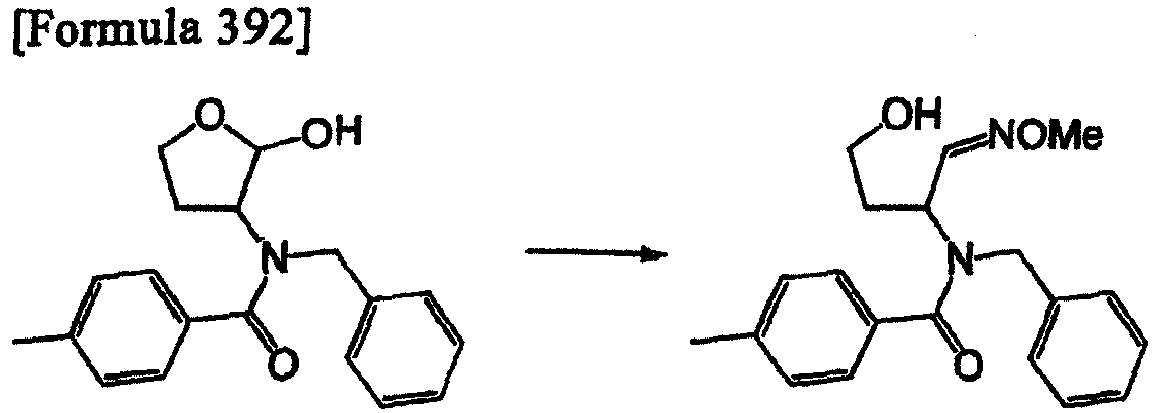
As a result of the measurement of 1H-NMR, it was found that the obtained oily product was a mixture of isomer A and isomer B, and that the ratio of A : B = 80 : 20.
1H-NMR(CDCl3)δ value:- 7.38-7.15(10H+10H,m,A+B),5.14(1H,q,J=7.2Hz,B),4.86(1H,q,J=6.3Hz,A),4.70-4.50(2 H+2H,m,A+B),3.85(3H,s,B),3.79(3H,s,A),3.58(2H+2H,brs,A+B),3.36(3H,s,B),3.35(3 H,s,A),2.22-1.88(2H+2H,m,A+B).
- (4)

As a result of the measurement of 1H-NMR, signals of methanesulfonate were observed at 2.90 ppm and 2.93 ppm. - (5)

As a result of the measurement of 1H-NMR, a signal of aldehyde was observed at 9.42 ppm. - (6)


- 29 mg of anhydrous sodium hydrogen sulfide was added to a solution of 3-(N-benzyl-1-(4-methylphenyl)formamide)-4-oxobutyl methanesulfonate in 3 mL of N,N-dimethylformamide at a temperature of 0°C to 10°C, and the obtained mixture was then stirred at the same temperature as described above for 1 hour. Thereafter, ethyl acetate and water were added to the reaction mixture, and the water layer was then removed. The organic layer was washed with water, and was then dried over anhydrous sodium sulfate. After that, the solvent was distilled away under reduced pressure. The obtained residue was purified by silica gel column chromatography (hexane/ethyl acetate = 70/30 to 50/50), so as to obtain 46 mg of N-benzyl-N-(2-hydroxythiolan-3-yl)-4-methylbenzamide in the form of a colorless oily product.
- As a result of the measurement of 1H-NMR, it was found that the obtained oily product was a mixture of isomer A and isomer B, and that the ratio of A : B = 57 : 43.
1H-NMR(CDCl3)δ value: - 7.40-7.14(9H+9H,m,A+B),5.56(1H,brs,B),5.42(1H,brs,A),4.95-4.80(1H,m,B),4.80-4.5 4(2H+2H,m,A+B),4.16-4.07(1H,m,A),3.10-2.95(1H+1H,m,A+B),2.77-2.64(1H,m,A),2 .36(3H,s,B),2.34(3H,s,A),2.28-2.04(2H+2H,m,A+B).
-
- (1)

1H-NMR(CDCl3)δ value:- 8.36-8.43(1H,m),7.47-7.57(1H,m),7.20-7.32(1H,m),6.99-7.09(1H,m),5.61(0.18H,t,J=5 .1Hz),5.43-5.55(0.73H,m),5.35(0.28H,s),5.16(0.27H,d,J=2.1Hz),5.04(0.39H,s),4.86(0. 15H,d,J=5.7Hz),4.31-4.58(1H,m),4.01-4.28(1H,m),2.49-2.60(0.40H,m),2.37-2.47(0.16 H,m),1.74-2.27(1.02H,m),1.49-1.62(0.42H,m),1.23-1.42(3H,m)
- (2)

1H-NMR(CDCl3)δ value:- 8.37-8.45(1H,m),7.48-7.58(1.76H,m),7.14-7.30(1H,m),6.99-7.10(1H,m),6.76-6.82(0.2 4H,m),5.06-5.19(0.88H,m),4.69-4.79(0.79H,m),3.97-4.12(1H,m),3.82-3.87(3H,m),2.9 1-3.05(0.33H,m),1.76-2.22(2H,m),1.21-1.29(3H,m)
- (3)

1H-NMR(CDCl3)δ value:- 8.39-8.45(1H,m),7.47-7.57(1.8H,m),7.16-7.23(1H,m),7.00-7.07(1H,m),6.89(0.2H,d,J= 7.5Hz),4.95-5.16(1H,m),4.67-4.78(1H,m),3.79-3.91(3H,m),3.07(0.87H,s),3.01-3.04(0. 59H,m),2.97(1.54H,s),2.39-2.51(0.54H,m),2.05-2.35(1.46H,m),1.48-1.55(3H,m)
- (4)

- (5)
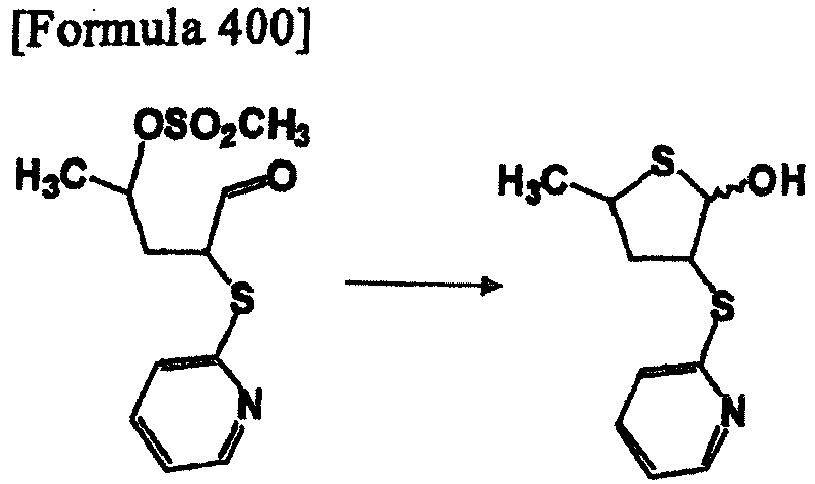
- 0.74 g of sodium hydrogen sulfide (Wako Pure Chemical Industries, Ltd.) was added to a solution of 0.60 mg of 5-oxo-4-(pyridin-2-ylsulfanyl)pentan-2-yl methanesulfonate in 10 mL of N,N-dimethylformamide at a temperature of 0°C to 10°C, and the obtained mixture was then stirred at the same temperature as described above for 1.5 hours. Thereafter, 30 mL of ethyl acetate and 30 mL of a saturated sodium hydrogen carbonate aqueous solution were added to the reaction mixture, and the water layer was then removed. The organic layer was successively washed with 30 mL of water and a saturated sodium chloride aqueous solution, and was then dried over anhydrous magnesium sulfate. After that, the solvent was distilled away under reduced pressure. The obtained residue was purified by column chromatography (hexane/ethyl acetate = 5/1), so as to obtain 120 mg of 5-methyl-3-(pyridin-2-ylsulfanyl)thiolan-2-ol in the form of a light yellow oily product.
1H-NMR(CDCl3)δ value: - 8.33-8.43(1H,m),7.48-7.58(1H,m),7.20-7.34(1H,m),6.99-7.09(1H,m),5.62-5.70(0.37H, m),5.50-5.59(0.63H,m),4.41-4.53(0.36H,m),4.22-4.30(0.24H,m),4.14-4.21(0.20H,m),3 .85-3.94(0.20H,m),3.54-3.80(1H,m),2.45-2.68(0.80H,m),2.33-2.42(0.31H,m),2.22-2.3 0(0.28H,m),1.99-2.11(0.42H,m),1.77-1.88(0.19H,m),1.50(0.97H,d,J=6.8Hz),1.44(0.89 H,d,J=6.4Hz),1.33-1.40(1.14H,m)
- The compound of the present invention is useful as an intermediate for producing a thionucleoside, and the production method of the present invention is useful as a method for producing a thionucleoside.

then hydrolyzing the compound represented by the formula [1Ca] to obtain a compound represented by the following formula [1Dd]:

then allowing the compound represented by the formula [1Dd] to react with a sulfur compound to obtain a compound represented by the following formula [1Ea]:
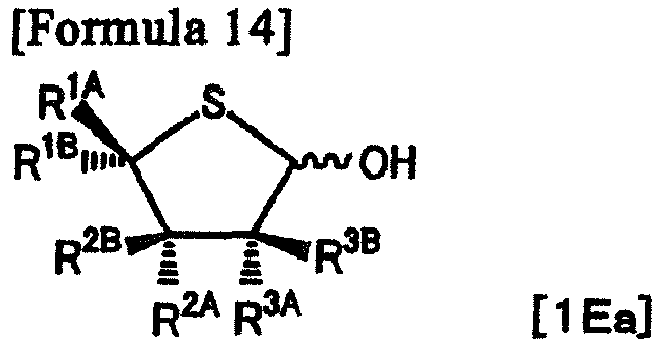
then allowing the compound represented by the formula [1Ea] to react with a compound represented by the following formula [7]:
[Formula 15] R9X2 [7]
(wherein R9 represents an optionally substituted acyl group, an optionally substituted C1-6 alkylsulfonyl group or an optionally substituted arylsulfonyl group; and X2 represents a halogen atom), or with a compound represented by the following formula [8]:
[Formula 16] R9-O-R9 [8]
(wherein R9 has the same meanings as those described above), to obtain a compound represented by the following formula [9Aa]:

then allowing the compound represented by the formula [9Aa] to react with a protected nucleic acid base, and
then deprotecting the resultant reaction product, as necessary.

then hydrolyzing the compound represented by the formula [1c] to obtain a compound represented by the following formula [1d]:

then allowing the compound represented by the formula [1d] to react with a sulfur compound to obtain a compound represented by the following formula [1e]:

then allowing the compound represented by the formula [1e] to react with a compound represented by the following formula [7]:
[Formula 34] R9X2 [7]
(wherein R9 represents an optionally substituted acyl group, an optionally substituted C1-6 alkylsulfonyl group or an optionally substituted arylsulfonyl group; and X2 represents a halogen atom), or with a compound represented by the following formula [8]:
[Formula 35] R9-O-R9 [8]
(wherein R9 has the same meanings as those described above), to obtain a compound represented by the following formula [9]:


then subjecting the compound represented by the formula [9] to any one of the following methods (1) to (4):
Claims (2)
- A compound represented by the following formula [1F]:

-OR3a [16]
(wherein R3a represents a hydroxyl-protecting group), or an optionally substituted C1-6 alkyl group; R3D represents a hydrogen atom, a halogen atom, a group represented by the following formula [16]
-OR3a [16]
(wherein R3a has the same meanings as those described above), or an optionally substituted C1-6 alkyl group; R4 represents a halogen atom, a hydroxyl group, an optionally substituted C1-6 alkylsulfonyloxy group or an optionally substituted arylsulfonyloxy group; R5 and R6 together represent a group represented by the following formula [2]:
=Y [2]
(wherein Y represents an oxygen atom or a group represented by the following formula [3]:
=N-OR7 [3]
(wherein R7 represents a hydrogen atom, an optionally substituted C1-6 alkyl group, an optionally substituted aryl group, an optionally substituted heterocyclic group or an optionally substituted silyl group)); or R4 and R5 together represent a sulfur atom; and R6 represents a hydroxyl group, provided that,
when R5 and R6 together represent a group represented by the following formula [2a]:
=O [2a]
, one of R3C and R3D represents a halogen atom, the other represents a hydrogen atom, and R4 represents a halogen atom, an optionally substituted C1-6 alkylsulfonyloxy group or an optionally substituted arylsulfonyloxy group;
when R4 and R5 together represent a sulfur atom and one of R3C and R3D represents a hydrogen atom, the other represents a halogen atom, a group represented by the following formula [16]:
-OR3a [16]
(wherein R3a represents a hydroxyl-protecting group), or an optionally substituted C1-6 alkyl group;
when R4 and R5 together represent a sulfur atom, one of R3C and R3D represents a hydrogen atom, and the other represents a group represented by the following formula [16]:
-OR3a [16]
(wherein R3a represents a hydroxyl-protecting group), R2 represents a hydroxyl-protecting group;
when R5 and R6 together represent a group represented by the following formula [3]:
=N-OR7 [3]
(wherein R7 has the same meanings as those described above), one of R3C and R3D represents a group represented by the following formula [16]:
-OR3a [16]
(wherein R3a has the same meanings as those described above), the other represents a hydrogen atom, and R4 represents an iodine atom, a hydroxyl group, an optionally substituted C1-6 alkylsulfonyloxy group or an optionally substituted arylsulfonyloxy group, R1 represents an optionally substituted acyl group, and R2 represents an optionally substituted acyl group; and
when R5 and R6 together represent a group represented by the following formula [3]:
=N-OR7 [3]
(wherein R7 has the same meanings as those described above), one of R3C and R3D represents a hydrogen atom, the other represents a hydrogen atom, and R4 represents a hydroxyl group, R1 represents an optionally substituted aroyl group, and R2 represents an optionally substituted aroyl group). - A compound according to Claim 1, wherein:R1 represents a hydroxyl-protecting group;R2 represents a hydroxyl-protecting group; or R1 and R2 may together form an optionally substituted C1-3 alkylene group;R3C represents a hydrogen atom, a halogen atom, an optionally substituted C1-6 alkyl group or a group represented by -OR3a wherein R3a represents a hydroxyl-protecting group;R3D represents a hydrogen atom, a halogen atom, an optionally substituted C1-6 alkyl group or a group represented by -OR3a wherein R3a represents a hydroxyl-protecting group;R4 represents a halogen atom, a hydroxyl group, an optionally substituted C1-6 alkylsulfonyloxy group or an optionally substituted arylsulfonyloxy group;R5 and R6 together represent a group represented by =O or =N-OR7 wherein R7 represents a hydrogen atom, an optionally substituted C1-6 alkyl group, an optionally substituted aryl group, an optionally substituted heterocyclic group or an optionally substituted silyl group;or R4 and R5 together represent a sulfur atom, and R6 represents a hydroxyl group, provided that:(i) when R5 and R6 together represent =O, then one of R3C and R3D represents a halogen atom, the other represents a hydrogen atom, and R4 represents a halogen atom, an optionally substituted C1-6 alkylsulfonyloxy group or an optionally substituted arylsulfonyloxy group;(ii) when R4 and R5 together represent a sulfur atom and one of R3C and R3D represents a hydrogen atom, then the other represents a halogen atom or an optionally substituted C1-6 alkyl group;(iii) when R5 and R6 together represent =N-OR7, one of R3C and R3D represents -OR3a and the other represents a hydrogen atom, and R4 represents an iodine atom, a hydroxyl group, an optionally substituted C1-6 alkylsulfonyloxy group or an optionally substituted arylsulfonyloxy group, then R1 and R2 both represent an optionally substituted acyl group; and(iv) when R5 and R6 together represent =N-OR7, both R3C and R3D represent hydrogen atoms and R4 represents a hydroxyl group, then R1 and R2 both represent an optionally substituted aroyl group.
Applications Claiming Priority (4)
| Application Number | Priority Date | Filing Date | Title |
|---|---|---|---|
| JP2012179380 | 2012-08-13 | ||
| JP2013012693 | 2013-01-25 | ||
| EP13879640.4A EP2883866B1 (en) | 2012-08-13 | 2013-08-13 | INTERMEDIATE FOR SYNTHESIS OF 1-(2-DEOXY-2-FLUORO-4-THIO-beta-D-ARABINOFURANOSYL) CYTOSINE, INTERMEDIATE FOR SYNTHESIS OF THIONUCLEOSIDE, AND METHODS FOR PRODUCING THESE INTERMEDIATES |
| PCT/JP2013/071871 WO2014027658A1 (en) | 2012-08-13 | 2013-08-13 | INTERMEDIATE FOR SYNTHESIS OF 1-(2-DEOXY-2-FLUORO-4-THIO-β-D-ARABINOFURANOSYL) CYTOSINE, INTERMEDIATE FOR SYNTHESIS OF THIONUCLEOSIDE, AND METHODS FOR PRODUCING THESE INTERMEDIATES |
Related Parent Applications (2)
| Application Number | Title | Priority Date | Filing Date |
|---|---|---|---|
| EP13879640.4A Division EP2883866B1 (en) | 2012-08-13 | 2013-08-13 | INTERMEDIATE FOR SYNTHESIS OF 1-(2-DEOXY-2-FLUORO-4-THIO-beta-D-ARABINOFURANOSYL) CYTOSINE, INTERMEDIATE FOR SYNTHESIS OF THIONUCLEOSIDE, AND METHODS FOR PRODUCING THESE INTERMEDIATES |
| EP13879640.4A Division-Into EP2883866B1 (en) | 2012-08-13 | 2013-08-13 | INTERMEDIATE FOR SYNTHESIS OF 1-(2-DEOXY-2-FLUORO-4-THIO-beta-D-ARABINOFURANOSYL) CYTOSINE, INTERMEDIATE FOR SYNTHESIS OF THIONUCLEOSIDE, AND METHODS FOR PRODUCING THESE INTERMEDIATES |
Publications (2)
| Publication Number | Publication Date |
|---|---|
| EP3184112A1 true EP3184112A1 (en) | 2017-06-28 |
| EP3184112B1 EP3184112B1 (en) | 2020-12-23 |
Family
ID=50685606
Family Applications (2)
| Application Number | Title | Priority Date | Filing Date |
|---|---|---|---|
| EP13879640.4A Active EP2883866B1 (en) | 2012-08-13 | 2013-08-13 | INTERMEDIATE FOR SYNTHESIS OF 1-(2-DEOXY-2-FLUORO-4-THIO-beta-D-ARABINOFURANOSYL) CYTOSINE, INTERMEDIATE FOR SYNTHESIS OF THIONUCLEOSIDE, AND METHODS FOR PRODUCING THESE INTERMEDIATES |
| EP17150141.4A Active EP3184112B1 (en) | 2012-08-13 | 2013-08-13 | SYNTHETIC INTERMEDIATE OF 1-(2-DEOXY-2-FLUORO-4-THIO-ß-D-ARABINOFURANOSYL)CYTOSINE |
Family Applications Before (1)
| Application Number | Title | Priority Date | Filing Date |
|---|---|---|---|
| EP13879640.4A Active EP2883866B1 (en) | 2012-08-13 | 2013-08-13 | INTERMEDIATE FOR SYNTHESIS OF 1-(2-DEOXY-2-FLUORO-4-THIO-beta-D-ARABINOFURANOSYL) CYTOSINE, INTERMEDIATE FOR SYNTHESIS OF THIONUCLEOSIDE, AND METHODS FOR PRODUCING THESE INTERMEDIATES |
Country Status (24)
| Country | Link |
|---|---|
| US (4) | US9221865B2 (en) |
| EP (2) | EP2883866B1 (en) |
| JP (2) | JP5970550B2 (en) |
| KR (3) | KR20170001722A (en) |
| CN (2) | CN107011168B (en) |
| AU (1) | AU2013303534B2 (en) |
| BR (1) | BR112015003041B1 (en) |
| CA (1) | CA2880794C (en) |
| CY (1) | CY1121617T1 (en) |
| DK (1) | DK2883866T3 (en) |
| ES (1) | ES2718307T3 (en) |
| HR (1) | HRP20190572T1 (en) |
| HU (1) | HUE044412T2 (en) |
| IL (1) | IL237086B (en) |
| LT (1) | LT2883866T (en) |
| MX (1) | MX2015001935A (en) |
| PL (1) | PL2883866T3 (en) |
| PT (1) | PT2883866T (en) |
| RS (1) | RS58568B1 (en) |
| RU (1) | RU2633355C2 (en) |
| SI (1) | SI2883866T1 (en) |
| SM (1) | SMT201900224T1 (en) |
| TW (1) | TWI603966B (en) |
| WO (1) | WO2014027658A1 (en) |
Families Citing this family (19)
| Publication number | Priority date | Publication date | Assignee | Title |
|---|---|---|---|---|
| SG10201603288XA (en) * | 2012-03-28 | 2016-05-30 | Fujifilm Corp | Salt Of 1-(2-Deoxy-2-Fluoro-4-Thio-beta-D-Arabinofuranosyl)Cytosine |
| KR20170001722A (en) | 2012-08-13 | 2017-01-04 | 후지필름 가부시키가이샤 | Synthesis intermediates of 1- (2-deoxy-2-fluoro-4-thio- 硫 -D-arabinofuranosyl) cytosine, synthetic intermediates of thionucleosides, |
| EP3109245B1 (en) * | 2014-02-18 | 2018-01-03 | FUJIFILM Corporation | Method for producting thiolane skeleton-type glycoconjugate, and thiolane skeleton-type glycoconjugate |
| JP6351107B2 (en) * | 2014-02-18 | 2018-07-04 | 富士フイルム株式会社 | Method for producing thiolane skeleton type sugar compound and thiolane skeleton type sugar compound |
| JP6204223B2 (en) * | 2014-02-19 | 2017-09-27 | 富士フイルム株式会社 | Method for producing thiopyranose compound, etc. |
| JP6245527B2 (en) * | 2014-03-24 | 2017-12-13 | 富士フイルム株式会社 | Method for producing compound having thiolane ring or thiane ring skeleton |
| WO2016047428A1 (en) * | 2014-09-24 | 2016-03-31 | 富士フイルム株式会社 | Cyclic hemiacetal compound production method |
| TWI678373B (en) | 2014-10-31 | 2019-12-01 | 日商富士軟片股份有限公司 | Thionucleoside derivative or its salt and pharmaceutical composition |
| JP6450356B2 (en) | 2016-02-29 | 2019-01-09 | 富士フイルム株式会社 | Liquid pharmaceutical formulation |
| JP6719369B2 (en) * | 2016-05-13 | 2020-07-08 | 富士フイルム株式会社 | Method for producing 2'-fluoro-5-methyl-4'-thioarabinouridine and method including some steps thereof |
| IL265044B2 (en) | 2016-08-31 | 2025-02-01 | Fujifilm Corp | An anti-tumor composition comprising the compounds nab-paclitaxel and 1-(2-deoxy-2-fluoro-4-thio-beta-D-arabinofuranosyl)cytosine, a kit comprising these compounds and uses thereof |
| WO2019001292A1 (en) * | 2017-06-29 | 2019-01-03 | 四川科伦博泰生物医药股份有限公司 | Preparation method of new compound of 4'-thionucleoside and intermediate in the preparation method |
| WO2019146130A1 (en) | 2018-01-29 | 2019-08-01 | 富士フイルム株式会社 | Antitumor agent for biliary cancer and treatment method of biliary cancer |
| WO2019176984A1 (en) | 2018-03-13 | 2019-09-19 | 富士フイルム株式会社 | Antitumor agent, antitumor effect potentiator and antitumor kit |
| WO2019204637A1 (en) * | 2018-04-19 | 2019-10-24 | Southern Research Institute | 4'-thio-nucleotide and -nucleoside prodrugs for the treatment of cancer |
| WO2020031179A1 (en) * | 2018-08-06 | 2020-02-13 | Beetlebung Pharma Ltd. | Methods for synthesis of cannabinoid compounds |
| EP3856754A1 (en) * | 2018-09-25 | 2021-08-04 | The United States of America, as represented by the Secretary, Department of Health and Human Services | 2'-halogenated-4'-thio-2'-deoxy-5-azacytidine analogs and use thereof |
| JPWO2023008511A1 (en) | 2021-07-29 | 2023-02-02 | ||
| CN114380877B (en) * | 2022-01-26 | 2023-03-28 | 和德化学(苏州)有限公司 | Preparation method of 2' -deoxy-2 ' -beta-fluoro-4 ' -azidocytidine |
Citations (3)
| Publication number | Priority date | Publication date | Assignee | Title |
|---|---|---|---|---|
| WO1997038001A1 (en) | 1996-04-09 | 1997-10-16 | Yamasa Corporation | 1-(2-DEOXY-2-FLUORO-4-THIO-β-D-ARABINOFURANOSYL)CYTOSINES |
| CN101058557A (en) * | 2006-04-17 | 2007-10-24 | 中国科学院化学研究所 | Method of preparing polyhydroxy annular nitrone |
| WO2011074484A1 (en) | 2009-12-18 | 2011-06-23 | Libramedicina, Inc. | PROCESS FOR PREPARING SUBSTITUTED 1-O-ACYL-2-DEOXY-2-FLUORO-4-THIO-β-D-ARABINOFURANOSES |
Family Cites Families (47)
| Publication number | Priority date | Publication date | Assignee | Title |
|---|---|---|---|---|
| US3116282A (en) | 1960-04-27 | 1963-12-31 | Upjohn Co | Pyrimidine nucleosides and process |
| US3243425A (en) | 1962-10-29 | 1966-03-29 | Purdue Research Foundation | Novel sulfur-containing compounds |
| JPS53119810A (en) | 1977-03-25 | 1978-10-19 | Mitsubishi Chem Ind Ltd | Preparation of aldehyde chloride |
| US4211773A (en) | 1978-10-02 | 1980-07-08 | Sloan Kettering Institute For Cancer Research | 5-Substituted 1-(2'-Deoxy-2'-substituted-β-D-arabinofuranosyl)pyrimidine nucleosides |
| US4220774A (en) | 1978-10-26 | 1980-09-02 | Omnium Chimique | Vincadifformine synthesis process |
| JPS5692239A (en) | 1979-12-27 | 1981-07-25 | Sagami Chem Res Center | Preparation of 5-oxohexyl compound |
| US4803272A (en) | 1987-02-24 | 1989-02-07 | E. I. Du Pont De Nemours And Company | S-modified adenosyl-1,8-diamino-3-thiooctane derivatives |
| IE74701B1 (en) | 1989-10-04 | 1997-07-30 | Univ Birmingham | Further antiviral pyrimidine nucleosides |
| DE69024225T2 (en) | 1989-10-06 | 1996-06-27 | Cosan Chem Corp | AMINOCARBOXYLATE AS A CORROSION INHIBITOR IN COATING |
| SE9003151D0 (en) | 1990-10-02 | 1990-10-02 | Medivir Ab | NUCLEOSIDE DERIVATIVES |
| JP3138834B2 (en) | 1991-12-26 | 2001-02-26 | 生化学工業株式会社 | Method for producing fucopyranose analog and intermediate compound thereof |
| GB9218810D0 (en) | 1992-09-04 | 1992-10-21 | Univ Birmingham | Antiviral pyrimidine nucleosides |
| US5811408A (en) | 1994-07-12 | 1998-09-22 | Yamasa Corporation | 2'-deoxy-2'-(substituted or unsubstituted)methylidene-4'-thionucleosides |
| JPH0853490A (en) | 1994-08-09 | 1996-02-27 | Yamasa Shoyu Co Ltd | 2'-deoxy-2 ', 2'-dihalogeno-4'-thionucleoside |
| CA2224165A1 (en) | 1996-04-09 | 1997-10-16 | Yamasa Corporation | 9-(2-deoxy-2-fluoro-4-thio-.beta.-d-arabinofuranosyl)purine derivatives |
| JP4202327B2 (en) | 1996-04-09 | 2008-12-24 | ヤマサ醤油株式会社 | 1- (2-Deoxy-2-fluoro-4-thio-β-D-arabinofuranosyl) cytosine |
| HUP9601756A3 (en) | 1996-06-25 | 1999-05-28 | Richter Gedeon Vegyeszet | New anticoagulant glycosides and pharmaceutical compositions containing them |
| JP4087471B2 (en) * | 1997-03-31 | 2008-05-21 | 大日本印刷株式会社 | Measuring chip for surface plasmon resonance biosensor and manufacturing method thereof |
| HUP9702348A3 (en) | 1997-12-04 | 2000-12-28 | Richter Gedeon Vegyeszet | New anticoagulant glycosides and pharmaceutical conew anticoagulant glycosides and pharmaceutical compositions containing them mpositions containing them |
| WO1999043690A1 (en) * | 1998-02-25 | 1999-09-02 | Rational Drug Design Laboratories | L-4'-arabinofuranonucleoside compound and medicine composition comprising the same |
| WO2001066118A1 (en) | 2000-03-08 | 2001-09-13 | Southern Research Institute | 4'-thio-l-xylo furanosyl nucleosides, precursors thereof, preparation and use thereof |
| KR100426030B1 (en) | 2000-07-22 | 2004-04-03 | (주) 한켐 | Chirality conversion method in lactone sugar compounds |
| TWI247609B (en) | 2001-01-23 | 2006-01-21 | Nihon Mediphysics Co Ltd | Agent for diagnosis of tissue proliferation activity or the treatment of proliferative disease |
| GB0114286D0 (en) * | 2001-06-12 | 2001-08-01 | Hoffmann La Roche | Nucleoside Derivatives |
| EP1478322A4 (en) | 2001-06-22 | 2007-08-08 | Pharmasset Ltd | Beta-2'-OR 3'-HALONUCLEOSIDES |
| JP2003172990A (en) | 2001-08-03 | 2003-06-20 | Fuji Photo Film Co Ltd | Silver halide emulsion and silver halide photographic sensitive material |
| RU2322449C2 (en) | 2002-08-09 | 2008-04-20 | Тайсо Фармасьютикал Ко., Лтд. | DERIVATIVES OF ARYL-5-THIO-β-D-GLYCOPYRANOSIDE AND THERAPEUTIC AGENT COMPRISING THEREOF USED IN DIABETES MELLITUS |
| AU2003200960B2 (en) | 2002-09-18 | 2005-01-06 | Mackinnon, Sebastian Mr | System for Ordering, Tracking and Payment of Goods and Services |
| WO2004100891A2 (en) | 2003-05-12 | 2004-11-25 | Purdue Research Foundation | Cytotoxic indeno and isoindoloisoquinolones |
| EP1630157A4 (en) | 2003-05-28 | 2007-05-23 | Japan Tobacco Inc | CaSR ANTAGONIST |
| JPWO2004106352A1 (en) | 2003-05-29 | 2006-07-20 | 大正製薬株式会社 | Method for producing aldohexopyranose intermediate |
| GB0317009D0 (en) | 2003-07-21 | 2003-08-27 | Univ Cardiff | Chemical compounds |
| CA2538252C (en) | 2003-09-18 | 2014-02-25 | Isis Pharmaceuticals, Inc. | 4'-thionucleosides and oligomeric compounds |
| TW200637839A (en) | 2005-01-07 | 2006-11-01 | Taisho Pharmaceutical Co Ltd | 1-thio-d-glucitol derivatives |
| ATE516026T1 (en) | 2005-02-21 | 2011-07-15 | Shionogi & Co | BICYCLIC CARBAMOYLPYRIDONE DERIVATIVE WITH HIV INTEGRASE INHIBITING EFFECT |
| JP2006335737A (en) * | 2005-06-03 | 2006-12-14 | Ihara Nikkei Kagaku Kogyo Kk | METHOD FOR PRODUCING BENZO[c]HETEROCYCLIC 5-MEMBERED RING COMPOUND |
| US7888330B2 (en) | 2005-11-09 | 2011-02-15 | Wayne State University | Phosphoramidate derivatives of FAU |
| US20090069263A1 (en) | 2005-12-16 | 2009-03-12 | Damha Masad J | 4'-thioarabinonucleotide-containing oligonucleotides, compounds and methods for their preparation and uses thereof |
| WO2007130783A2 (en) | 2006-05-03 | 2007-11-15 | Chimerix, Inc. | Metabolically stable alkoxyalkyl esters of antiviral or antiproliferative phosphonates, nucleoside phosphonates and nucleoside phosphates |
| CN101200463B (en) | 2007-12-11 | 2011-06-22 | 复旦大学 | Fully acylated-4-thio-D-ribose and its preparation method |
| US8859589B2 (en) | 2008-03-12 | 2014-10-14 | Southern Research Institute | Use of 4′-thio-2′-deoxynucleosides as anti orthopoxvirus agents |
| CN101880287B (en) * | 2009-05-05 | 2012-07-25 | 上海医药工业研究院 | Intermediate compounds for thiophane nucleoside analogues and preparation method thereof |
| GB201016855D0 (en) | 2010-10-06 | 2010-11-17 | Nucana Biomed Ltd | Chemical compounds |
| SG10201603288XA (en) | 2012-03-28 | 2016-05-30 | Fujifilm Corp | Salt Of 1-(2-Deoxy-2-Fluoro-4-Thio-beta-D-Arabinofuranosyl)Cytosine |
| KR20170001722A (en) | 2012-08-13 | 2017-01-04 | 후지필름 가부시키가이샤 | Synthesis intermediates of 1- (2-deoxy-2-fluoro-4-thio- 硫 -D-arabinofuranosyl) cytosine, synthetic intermediates of thionucleosides, |
| TWI678373B (en) | 2014-10-31 | 2019-12-01 | 日商富士軟片股份有限公司 | Thionucleoside derivative or its salt and pharmaceutical composition |
| CN109553651B (en) | 2015-04-03 | 2021-08-06 | 四川科伦博泰生物医药股份有限公司 | Novel compound of 4'-thionucleoside and its preparation method, pharmaceutical composition and application |
-
2013
- 2013-08-13 KR KR1020167036050A patent/KR20170001722A/en not_active Withdrawn
- 2013-08-13 WO PCT/JP2013/071871 patent/WO2014027658A1/en not_active Ceased
- 2013-08-13 RS RS20190409A patent/RS58568B1/en unknown
- 2013-08-13 KR KR1020167036051A patent/KR102010804B1/en active Active
- 2013-08-13 SI SI201331373T patent/SI2883866T1/en unknown
- 2013-08-13 CN CN201610838593.8A patent/CN107011168B/en active Active
- 2013-08-13 CN CN201380042642.1A patent/CN104540803B/en active Active
- 2013-08-13 TW TW102128967A patent/TWI603966B/en active
- 2013-08-13 JP JP2014530560A patent/JP5970550B2/en active Active
- 2013-08-13 MX MX2015001935A patent/MX2015001935A/en unknown
- 2013-08-13 PL PL13879640T patent/PL2883866T3/en unknown
- 2013-08-13 BR BR112015003041-6A patent/BR112015003041B1/en active IP Right Grant
- 2013-08-13 DK DK13879640.4T patent/DK2883866T3/en active
- 2013-08-13 SM SM20190224T patent/SMT201900224T1/en unknown
- 2013-08-13 EP EP13879640.4A patent/EP2883866B1/en active Active
- 2013-08-13 CA CA2880794A patent/CA2880794C/en active Active
- 2013-08-13 RU RU2015108790A patent/RU2633355C2/en active
- 2013-08-13 HU HUE13879640 patent/HUE044412T2/en unknown
- 2013-08-13 PT PT13879640T patent/PT2883866T/en unknown
- 2013-08-13 LT LTEP13879640.4T patent/LT2883866T/en unknown
- 2013-08-13 HR HRP20190572TT patent/HRP20190572T1/en unknown
- 2013-08-13 AU AU2013303534A patent/AU2013303534B2/en active Active
- 2013-08-13 KR KR1020157003655A patent/KR101770248B1/en active Active
- 2013-08-13 EP EP17150141.4A patent/EP3184112B1/en active Active
- 2013-08-13 ES ES13879640T patent/ES2718307T3/en active Active
-
2015
- 2015-02-04 IL IL237086A patent/IL237086B/en active IP Right Grant
- 2015-02-12 US US14/621,119 patent/US9221865B2/en active Active
- 2015-10-02 US US14/873,966 patent/US9475835B2/en active Active
-
2016
- 2016-07-11 JP JP2016136575A patent/JP6518214B2/en active Active
- 2016-08-24 US US15/246,177 patent/US10093645B2/en active Active
-
2018
- 2018-07-25 US US16/045,047 patent/US10570112B2/en active Active
-
2019
- 2019-05-03 CY CY20191100465T patent/CY1121617T1/en unknown
Patent Citations (3)
| Publication number | Priority date | Publication date | Assignee | Title |
|---|---|---|---|---|
| WO1997038001A1 (en) | 1996-04-09 | 1997-10-16 | Yamasa Corporation | 1-(2-DEOXY-2-FLUORO-4-THIO-β-D-ARABINOFURANOSYL)CYTOSINES |
| CN101058557A (en) * | 2006-04-17 | 2007-10-24 | 中国科学院化学研究所 | Method of preparing polyhydroxy annular nitrone |
| WO2011074484A1 (en) | 2009-12-18 | 2011-06-23 | Libramedicina, Inc. | PROCESS FOR PREPARING SUBSTITUTED 1-O-ACYL-2-DEOXY-2-FLUORO-4-THIO-β-D-ARABINOFURANOSES |
Non-Patent Citations (7)
| Title |
|---|
| "Protective Groups in Organic Synthesis", 2007, JOHN WILEY & SONS, INC., pages: 696 - 926 |
| EUROPEAN JOURNAL OF ORGANIC CHEMISTRY, 2012, pages 203 - 210 |
| FENG ZHENG ET AL: "Synthesis of L- [beta] -3'-Deoxy-3',3'-difluoro-4'-thionucleosides", ORGANIC LETTERS, vol. 8, no. 26, 1 December 2006 (2006-12-01), pages 6083 - 6086, XP055207779, ISSN: 1523-7060, DOI: 10.1021/ol062576k * |
| JOURNAL OF MEDICINAL CHEMISTRY, vol. 46, 2003, pages 389 - 398 |
| W. GREENE ET AL.: "Protective Groups in Organic Synthesis", 2007, JOHN WILEY & SONS, INC, pages: 16 - 366 |
| W. GREENE ET AL.: "Protective Groups in Organic Synthesis", 2007, JOHN WILEY & SONS, INC, pages: 533 - 646 |
| W. GREENE ET AL.: "Protective Groups in Organic Synthesis", 2007, JOHN WILEY & SONS, INC, pages: 696 - 926 |
Also Published As
Similar Documents
| Publication | Publication Date | Title |
|---|---|---|
| EP2883866B1 (en) | INTERMEDIATE FOR SYNTHESIS OF 1-(2-DEOXY-2-FLUORO-4-THIO-beta-D-ARABINOFURANOSYL) CYTOSINE, INTERMEDIATE FOR SYNTHESIS OF THIONUCLEOSIDE, AND METHODS FOR PRODUCING THESE INTERMEDIATES | |
| EP3109245B1 (en) | Method for producting thiolane skeleton-type glycoconjugate, and thiolane skeleton-type glycoconjugate | |
| US20090048203A1 (en) | Substituted adenines and the uses thereof | |
| HK1240571B (en) | Synthetic intermediate of cytosines and synthetic intermediate of thionucleoside | |
| HK1240571A1 (en) | Synthetic intermediate of cytosines and synthetic intermediate of thionucleoside | |
| HK1208436B (en) | INTERMEDIATE FOR SYNTHESIS OF 1-(2-DEOXY-2-FLUORO-4-THIO-β-D-ARABINOFURANOSYL) CYTOSINE, INTERMEDIATE FOR SYNTHESIS OF THIONUCLEOSIDE, AND METHODS FOR PRODUCING THESE INTERMEDIATES |
Legal Events
| Date | Code | Title | Description |
|---|---|---|---|
| PUAI | Public reference made under article 153(3) epc to a published international application that has entered the european phase |
Free format text: ORIGINAL CODE: 0009012 |
|
| STAA | Information on the status of an ep patent application or granted ep patent |
Free format text: STATUS: THE APPLICATION HAS BEEN PUBLISHED |
|
| AC | Divisional application: reference to earlier application |
Ref document number: 2883866 Country of ref document: EP Kind code of ref document: P |
|
| AK | Designated contracting states |
Kind code of ref document: A1 Designated state(s): AL AT BE BG CH CY CZ DE DK EE ES FI FR GB GR HR HU IE IS IT LI LT LU LV MC MK MT NL NO PL PT RO RS SE SI SK SM TR |
|
| STAA | Information on the status of an ep patent application or granted ep patent |
Free format text: STATUS: REQUEST FOR EXAMINATION WAS MADE |
|
| 17P | Request for examination filed |
Effective date: 20171227 |
|
| RBV | Designated contracting states (corrected) |
Designated state(s): AL AT BE BG CH CY CZ DE DK EE ES FI FR GB GR HR HU IE IS IT LI LT LU LV MC MK MT NL NO PL PT RO RS SE SI SK SM TR |
|
| STAA | Information on the status of an ep patent application or granted ep patent |
Free format text: STATUS: EXAMINATION IS IN PROGRESS |
|
| 17Q | First examination report despatched |
Effective date: 20180703 |
|
| REG | Reference to a national code |
Ref country code: DE Ref legal event code: R079 Ref document number: 602013074949 Country of ref document: DE Free format text: PREVIOUS MAIN CLASS: A61K0031706800 Ipc: C07C0251380000 |
|
| GRAP | Despatch of communication of intention to grant a patent |
Free format text: ORIGINAL CODE: EPIDOSNIGR1 |
|
| STAA | Information on the status of an ep patent application or granted ep patent |
Free format text: STATUS: GRANT OF PATENT IS INTENDED |
|
| RIC1 | Information provided on ipc code assigned before grant |
Ipc: C07D 333/32 20060101ALI20200416BHEP Ipc: C07C 69/96 20060101ALI20200416BHEP Ipc: C07C 249/04 20060101ALI20200416BHEP Ipc: C07H 15/203 20060101ALI20200416BHEP Ipc: C07C 69/92 20060101ALI20200416BHEP Ipc: C07H 17/02 20060101ALI20200416BHEP Ipc: C07H 5/10 20060101ALI20200416BHEP Ipc: C07H 19/06 20060101ALI20200416BHEP Ipc: C07C 68/06 20200101ALI20200416BHEP Ipc: C07C 47/277 20060101ALI20200416BHEP Ipc: C07C 45/00 20060101ALI20200416BHEP Ipc: A61K 31/7068 20060101ALI20200416BHEP Ipc: C07H 5/02 20060101ALI20200416BHEP Ipc: C07C 303/28 20060101ALI20200416BHEP Ipc: A61P 35/00 20060101ALI20200416BHEP Ipc: C07C 67/29 20060101ALI20200416BHEP Ipc: C07C 309/73 20060101ALI20200416BHEP Ipc: C07B 53/00 20060101ALI20200416BHEP Ipc: C07C 69/76 20060101ALI20200416BHEP Ipc: C07C 251/38 20060101AFI20200416BHEP |
|
| INTG | Intention to grant announced |
Effective date: 20200514 |
|
| GRAS | Grant fee paid |
Free format text: ORIGINAL CODE: EPIDOSNIGR3 |
|
| RAP1 | Party data changed (applicant data changed or rights of an application transferred) |
Owner name: FUJIFILM CORPORATION |
|
| GRAA | (expected) grant |
Free format text: ORIGINAL CODE: 0009210 |
|
| STAA | Information on the status of an ep patent application or granted ep patent |
Free format text: STATUS: THE PATENT HAS BEEN GRANTED |
|
| AC | Divisional application: reference to earlier application |
Ref document number: 2883866 Country of ref document: EP Kind code of ref document: P |
|
| AK | Designated contracting states |
Kind code of ref document: B1 Designated state(s): AL AT BE BG CH CY CZ DE DK EE ES FI FR GB GR HR HU IE IS IT LI LT LU LV MC MK MT NL NO PL PT RO RS SE SI SK SM TR |
|
| REG | Reference to a national code |
Ref country code: GB Ref legal event code: FG4D |
|
| REG | Reference to a national code |
Ref country code: DE Ref legal event code: R096 Ref document number: 602013074949 Country of ref document: DE |
|
| REG | Reference to a national code |
Ref country code: AT Ref legal event code: REF Ref document number: 1347566 Country of ref document: AT Kind code of ref document: T Effective date: 20210115 |
|
| REG | Reference to a national code |
Ref country code: IE Ref legal event code: FG4D |
|
| RAP4 | Party data changed (patent owner data changed or rights of a patent transferred) |
Owner name: FUJIFILM CORPORATION |
|
| PG25 | Lapsed in a contracting state [announced via postgrant information from national office to epo] |
Ref country code: NO Free format text: LAPSE BECAUSE OF FAILURE TO SUBMIT A TRANSLATION OF THE DESCRIPTION OR TO PAY THE FEE WITHIN THE PRESCRIBED TIME-LIMIT Effective date: 20210323 Ref country code: RS Free format text: LAPSE BECAUSE OF FAILURE TO SUBMIT A TRANSLATION OF THE DESCRIPTION OR TO PAY THE FEE WITHIN THE PRESCRIBED TIME-LIMIT Effective date: 20201223 Ref country code: GR Free format text: LAPSE BECAUSE OF FAILURE TO SUBMIT A TRANSLATION OF THE DESCRIPTION OR TO PAY THE FEE WITHIN THE PRESCRIBED TIME-LIMIT Effective date: 20210324 Ref country code: FI Free format text: LAPSE BECAUSE OF FAILURE TO SUBMIT A TRANSLATION OF THE DESCRIPTION OR TO PAY THE FEE WITHIN THE PRESCRIBED TIME-LIMIT Effective date: 20201223 |
|
| REG | Reference to a national code |
Ref country code: AT Ref legal event code: MK05 Ref document number: 1347566 Country of ref document: AT Kind code of ref document: T Effective date: 20201223 |
|
| REG | Reference to a national code |
Ref country code: NL Ref legal event code: MP Effective date: 20201223 |
|
| PG25 | Lapsed in a contracting state [announced via postgrant information from national office to epo] |
Ref country code: SE Free format text: LAPSE BECAUSE OF FAILURE TO SUBMIT A TRANSLATION OF THE DESCRIPTION OR TO PAY THE FEE WITHIN THE PRESCRIBED TIME-LIMIT Effective date: 20201223 Ref country code: BG Free format text: LAPSE BECAUSE OF FAILURE TO SUBMIT A TRANSLATION OF THE DESCRIPTION OR TO PAY THE FEE WITHIN THE PRESCRIBED TIME-LIMIT Effective date: 20210323 Ref country code: LV Free format text: LAPSE BECAUSE OF FAILURE TO SUBMIT A TRANSLATION OF THE DESCRIPTION OR TO PAY THE FEE WITHIN THE PRESCRIBED TIME-LIMIT Effective date: 20201223 |
|
| PG25 | Lapsed in a contracting state [announced via postgrant information from national office to epo] |
Ref country code: NL Free format text: LAPSE BECAUSE OF FAILURE TO SUBMIT A TRANSLATION OF THE DESCRIPTION OR TO PAY THE FEE WITHIN THE PRESCRIBED TIME-LIMIT Effective date: 20201223 Ref country code: HR Free format text: LAPSE BECAUSE OF FAILURE TO SUBMIT A TRANSLATION OF THE DESCRIPTION OR TO PAY THE FEE WITHIN THE PRESCRIBED TIME-LIMIT Effective date: 20201223 |
|
| REG | Reference to a national code |
Ref country code: LT Ref legal event code: MG9D |
|
| PG25 | Lapsed in a contracting state [announced via postgrant information from national office to epo] |
Ref country code: SK Free format text: LAPSE BECAUSE OF FAILURE TO SUBMIT A TRANSLATION OF THE DESCRIPTION OR TO PAY THE FEE WITHIN THE PRESCRIBED TIME-LIMIT Effective date: 20201223 Ref country code: PT Free format text: LAPSE BECAUSE OF FAILURE TO SUBMIT A TRANSLATION OF THE DESCRIPTION OR TO PAY THE FEE WITHIN THE PRESCRIBED TIME-LIMIT Effective date: 20210423 Ref country code: RO Free format text: LAPSE BECAUSE OF FAILURE TO SUBMIT A TRANSLATION OF THE DESCRIPTION OR TO PAY THE FEE WITHIN THE PRESCRIBED TIME-LIMIT Effective date: 20201223 Ref country code: CZ Free format text: LAPSE BECAUSE OF FAILURE TO SUBMIT A TRANSLATION OF THE DESCRIPTION OR TO PAY THE FEE WITHIN THE PRESCRIBED TIME-LIMIT Effective date: 20201223 Ref country code: EE Free format text: LAPSE BECAUSE OF FAILURE TO SUBMIT A TRANSLATION OF THE DESCRIPTION OR TO PAY THE FEE WITHIN THE PRESCRIBED TIME-LIMIT Effective date: 20201223 Ref country code: SM Free format text: LAPSE BECAUSE OF FAILURE TO SUBMIT A TRANSLATION OF THE DESCRIPTION OR TO PAY THE FEE WITHIN THE PRESCRIBED TIME-LIMIT Effective date: 20201223 Ref country code: LT Free format text: LAPSE BECAUSE OF FAILURE TO SUBMIT A TRANSLATION OF THE DESCRIPTION OR TO PAY THE FEE WITHIN THE PRESCRIBED TIME-LIMIT Effective date: 20201223 |
|
| PG25 | Lapsed in a contracting state [announced via postgrant information from national office to epo] |
Ref country code: AT Free format text: LAPSE BECAUSE OF FAILURE TO SUBMIT A TRANSLATION OF THE DESCRIPTION OR TO PAY THE FEE WITHIN THE PRESCRIBED TIME-LIMIT Effective date: 20201223 Ref country code: PL Free format text: LAPSE BECAUSE OF FAILURE TO SUBMIT A TRANSLATION OF THE DESCRIPTION OR TO PAY THE FEE WITHIN THE PRESCRIBED TIME-LIMIT Effective date: 20201223 |
|
| REG | Reference to a national code |
Ref country code: DE Ref legal event code: R097 Ref document number: 602013074949 Country of ref document: DE |
|
| PG25 | Lapsed in a contracting state [announced via postgrant information from national office to epo] |
Ref country code: IS Free format text: LAPSE BECAUSE OF FAILURE TO SUBMIT A TRANSLATION OF THE DESCRIPTION OR TO PAY THE FEE WITHIN THE PRESCRIBED TIME-LIMIT Effective date: 20210423 |
|
| PG25 | Lapsed in a contracting state [announced via postgrant information from national office to epo] |
Ref country code: IT Free format text: LAPSE BECAUSE OF FAILURE TO SUBMIT A TRANSLATION OF THE DESCRIPTION OR TO PAY THE FEE WITHIN THE PRESCRIBED TIME-LIMIT Effective date: 20201223 Ref country code: AL Free format text: LAPSE BECAUSE OF FAILURE TO SUBMIT A TRANSLATION OF THE DESCRIPTION OR TO PAY THE FEE WITHIN THE PRESCRIBED TIME-LIMIT Effective date: 20201223 |
|
| PLBE | No opposition filed within time limit |
Free format text: ORIGINAL CODE: 0009261 |
|
| STAA | Information on the status of an ep patent application or granted ep patent |
Free format text: STATUS: NO OPPOSITION FILED WITHIN TIME LIMIT |
|
| PG25 | Lapsed in a contracting state [announced via postgrant information from national office to epo] |
Ref country code: DK Free format text: LAPSE BECAUSE OF FAILURE TO SUBMIT A TRANSLATION OF THE DESCRIPTION OR TO PAY THE FEE WITHIN THE PRESCRIBED TIME-LIMIT Effective date: 20201223 |
|
| 26N | No opposition filed |
Effective date: 20210924 |
|
| PG25 | Lapsed in a contracting state [announced via postgrant information from national office to epo] |
Ref country code: ES Free format text: LAPSE BECAUSE OF FAILURE TO SUBMIT A TRANSLATION OF THE DESCRIPTION OR TO PAY THE FEE WITHIN THE PRESCRIBED TIME-LIMIT Effective date: 20201223 |
|
| PG25 | Lapsed in a contracting state [announced via postgrant information from national office to epo] |
Ref country code: SI Free format text: LAPSE BECAUSE OF FAILURE TO SUBMIT A TRANSLATION OF THE DESCRIPTION OR TO PAY THE FEE WITHIN THE PRESCRIBED TIME-LIMIT Effective date: 20201223 |
|
| REG | Reference to a national code |
Ref country code: CH Ref legal event code: PL |
|
| PG25 | Lapsed in a contracting state [announced via postgrant information from national office to epo] |
Ref country code: MC Free format text: LAPSE BECAUSE OF FAILURE TO SUBMIT A TRANSLATION OF THE DESCRIPTION OR TO PAY THE FEE WITHIN THE PRESCRIBED TIME-LIMIT Effective date: 20201223 |
|
| REG | Reference to a national code |
Ref country code: BE Ref legal event code: MM Effective date: 20210831 |
|
| PG25 | Lapsed in a contracting state [announced via postgrant information from national office to epo] |
Ref country code: LI Free format text: LAPSE BECAUSE OF NON-PAYMENT OF DUE FEES Effective date: 20210831 Ref country code: CH Free format text: LAPSE BECAUSE OF NON-PAYMENT OF DUE FEES Effective date: 20210831 |
|
| PG25 | Lapsed in a contracting state [announced via postgrant information from national office to epo] |
Ref country code: IS Free format text: LAPSE BECAUSE OF FAILURE TO SUBMIT A TRANSLATION OF THE DESCRIPTION OR TO PAY THE FEE WITHIN THE PRESCRIBED TIME-LIMIT Effective date: 20210423 Ref country code: LU Free format text: LAPSE BECAUSE OF NON-PAYMENT OF DUE FEES Effective date: 20210813 |
|
| PG25 | Lapsed in a contracting state [announced via postgrant information from national office to epo] |
Ref country code: IE Free format text: LAPSE BECAUSE OF NON-PAYMENT OF DUE FEES Effective date: 20210813 Ref country code: BE Free format text: LAPSE BECAUSE OF NON-PAYMENT OF DUE FEES Effective date: 20210831 |
|
| PG25 | Lapsed in a contracting state [announced via postgrant information from national office to epo] |
Ref country code: HU Free format text: LAPSE BECAUSE OF FAILURE TO SUBMIT A TRANSLATION OF THE DESCRIPTION OR TO PAY THE FEE WITHIN THE PRESCRIBED TIME-LIMIT; INVALID AB INITIO Effective date: 20130813 |
|
| P01 | Opt-out of the competence of the unified patent court (upc) registered |
Effective date: 20230515 |
|
| PG25 | Lapsed in a contracting state [announced via postgrant information from national office to epo] |
Ref country code: CY Free format text: LAPSE BECAUSE OF FAILURE TO SUBMIT A TRANSLATION OF THE DESCRIPTION OR TO PAY THE FEE WITHIN THE PRESCRIBED TIME-LIMIT Effective date: 20201223 |
|
| PG25 | Lapsed in a contracting state [announced via postgrant information from national office to epo] |
Ref country code: MK Free format text: LAPSE BECAUSE OF FAILURE TO SUBMIT A TRANSLATION OF THE DESCRIPTION OR TO PAY THE FEE WITHIN THE PRESCRIBED TIME-LIMIT Effective date: 20201223 |
|
| PG25 | Lapsed in a contracting state [announced via postgrant information from national office to epo] |
Ref country code: TR Free format text: LAPSE BECAUSE OF FAILURE TO SUBMIT A TRANSLATION OF THE DESCRIPTION OR TO PAY THE FEE WITHIN THE PRESCRIBED TIME-LIMIT Effective date: 20201223 |
|
| PG25 | Lapsed in a contracting state [announced via postgrant information from national office to epo] |
Ref country code: MT Free format text: LAPSE BECAUSE OF FAILURE TO SUBMIT A TRANSLATION OF THE DESCRIPTION OR TO PAY THE FEE WITHIN THE PRESCRIBED TIME-LIMIT Effective date: 20201223 |
|
| PGFP | Annual fee paid to national office [announced via postgrant information from national office to epo] |
Ref country code: DE Payment date: 20250702 Year of fee payment: 13 |
|
| PGFP | Annual fee paid to national office [announced via postgrant information from national office to epo] |
Ref country code: GB Payment date: 20250703 Year of fee payment: 13 |
|
| PGFP | Annual fee paid to national office [announced via postgrant information from national office to epo] |
Ref country code: FR Payment date: 20250703 Year of fee payment: 13 |