EP3181640A1 - Polylactic acid compound and stretch-molded bottle molded using same - Google Patents
Polylactic acid compound and stretch-molded bottle molded using same Download PDFInfo
- Publication number
- EP3181640A1 EP3181640A1 EP15832479.8A EP15832479A EP3181640A1 EP 3181640 A1 EP3181640 A1 EP 3181640A1 EP 15832479 A EP15832479 A EP 15832479A EP 3181640 A1 EP3181640 A1 EP 3181640A1
- Authority
- EP
- European Patent Office
- Prior art keywords
- polylactic acid
- bottle
- stretch
- ethylene resin
- molded
- Prior art date
- Legal status (The legal status is an assumption and is not a legal conclusion. Google has not performed a legal analysis and makes no representation as to the accuracy of the status listed.)
- Granted
Links
Images
Classifications
-
- C—CHEMISTRY; METALLURGY
- C08—ORGANIC MACROMOLECULAR COMPOUNDS; THEIR PREPARATION OR CHEMICAL WORKING-UP; COMPOSITIONS BASED THEREON
- C08L—COMPOSITIONS OF MACROMOLECULAR COMPOUNDS
- C08L67/00—Compositions of polyesters obtained by reactions forming a carboxylic ester link in the main chain; Compositions of derivatives of such polymers
- C08L67/04—Polyesters derived from hydroxycarboxylic acids, e.g. lactones
-
- B—PERFORMING OPERATIONS; TRANSPORTING
- B32—LAYERED PRODUCTS
- B32B—LAYERED PRODUCTS, i.e. PRODUCTS BUILT-UP OF STRATA OF FLAT OR NON-FLAT, e.g. CELLULAR OR HONEYCOMB, FORM
- B32B27/00—Layered products comprising a layer of synthetic resin
- B32B27/36—Layered products comprising a layer of synthetic resin comprising polyesters
-
- B—PERFORMING OPERATIONS; TRANSPORTING
- B32—LAYERED PRODUCTS
- B32B—LAYERED PRODUCTS, i.e. PRODUCTS BUILT-UP OF STRATA OF FLAT OR NON-FLAT, e.g. CELLULAR OR HONEYCOMB, FORM
- B32B9/00—Layered products comprising a layer of a particular substance not covered by groups B32B11/00 - B32B29/00
-
- B—PERFORMING OPERATIONS; TRANSPORTING
- B65—CONVEYING; PACKING; STORING; HANDLING THIN OR FILAMENTARY MATERIAL
- B65D—CONTAINERS FOR STORAGE OR TRANSPORT OF ARTICLES OR MATERIALS, e.g. BAGS, BARRELS, BOTTLES, BOXES, CANS, CARTONS, CRATES, DRUMS, JARS, TANKS, HOPPERS, FORWARDING CONTAINERS; ACCESSORIES, CLOSURES, OR FITTINGS THEREFOR; PACKAGING ELEMENTS; PACKAGES
- B65D1/00—Rigid or semi-rigid containers having bodies formed in one piece, e.g. by casting metallic material, by moulding plastics, by blowing vitreous material, by throwing ceramic material, by moulding pulped fibrous material or by deep-drawing operations performed on sheet material
- B65D1/02—Bottles or similar containers with necks or like restricted apertures, designed for pouring contents
-
- B—PERFORMING OPERATIONS; TRANSPORTING
- B65—CONVEYING; PACKING; STORING; HANDLING THIN OR FILAMENTARY MATERIAL
- B65D—CONTAINERS FOR STORAGE OR TRANSPORT OF ARTICLES OR MATERIALS, e.g. BAGS, BARRELS, BOTTLES, BOXES, CANS, CARTONS, CRATES, DRUMS, JARS, TANKS, HOPPERS, FORWARDING CONTAINERS; ACCESSORIES, CLOSURES, OR FITTINGS THEREFOR; PACKAGING ELEMENTS; PACKAGES
- B65D1/00—Rigid or semi-rigid containers having bodies formed in one piece, e.g. by casting metallic material, by moulding plastics, by blowing vitreous material, by throwing ceramic material, by moulding pulped fibrous material or by deep-drawing operations performed on sheet material
- B65D1/02—Bottles or similar containers with necks or like restricted apertures, designed for pouring contents
- B65D1/0207—Bottles or similar containers with necks or like restricted apertures, designed for pouring contents characterised by material, e.g. composition, physical features
- B65D1/0215—Bottles or similar containers with necks or like restricted apertures, designed for pouring contents characterised by material, e.g. composition, physical features multilayered
-
- B—PERFORMING OPERATIONS; TRANSPORTING
- B65—CONVEYING; PACKING; STORING; HANDLING THIN OR FILAMENTARY MATERIAL
- B65D—CONTAINERS FOR STORAGE OR TRANSPORT OF ARTICLES OR MATERIALS, e.g. BAGS, BARRELS, BOTTLES, BOXES, CANS, CARTONS, CRATES, DRUMS, JARS, TANKS, HOPPERS, FORWARDING CONTAINERS; ACCESSORIES, CLOSURES, OR FITTINGS THEREFOR; PACKAGING ELEMENTS; PACKAGES
- B65D23/00—Details of bottles or jars not otherwise provided for
- B65D23/02—Linings or internal coatings
-
- C—CHEMISTRY; METALLURGY
- C08—ORGANIC MACROMOLECULAR COMPOUNDS; THEIR PREPARATION OR CHEMICAL WORKING-UP; COMPOSITIONS BASED THEREON
- C08F—MACROMOLECULAR COMPOUNDS OBTAINED BY REACTIONS ONLY INVOLVING CARBON-TO-CARBON UNSATURATED BONDS
- C08F10/00—Homopolymers and copolymers of unsaturated aliphatic hydrocarbons having only one carbon-to-carbon double bond
- C08F10/02—Ethene
-
- C—CHEMISTRY; METALLURGY
- C08—ORGANIC MACROMOLECULAR COMPOUNDS; THEIR PREPARATION OR CHEMICAL WORKING-UP; COMPOSITIONS BASED THEREON
- C08L—COMPOSITIONS OF MACROMOLECULAR COMPOUNDS
- C08L23/00—Compositions of homopolymers or copolymers of unsaturated aliphatic hydrocarbons having only one carbon-to-carbon double bond; Compositions of derivatives of such polymers
- C08L23/02—Compositions of homopolymers or copolymers of unsaturated aliphatic hydrocarbons having only one carbon-to-carbon double bond; Compositions of derivatives of such polymers not modified by chemical after-treatment
- C08L23/04—Homopolymers or copolymers of ethene
-
- C—CHEMISTRY; METALLURGY
- C08—ORGANIC MACROMOLECULAR COMPOUNDS; THEIR PREPARATION OR CHEMICAL WORKING-UP; COMPOSITIONS BASED THEREON
- C08L—COMPOSITIONS OF MACROMOLECULAR COMPOUNDS
- C08L23/00—Compositions of homopolymers or copolymers of unsaturated aliphatic hydrocarbons having only one carbon-to-carbon double bond; Compositions of derivatives of such polymers
- C08L23/02—Compositions of homopolymers or copolymers of unsaturated aliphatic hydrocarbons having only one carbon-to-carbon double bond; Compositions of derivatives of such polymers not modified by chemical after-treatment
- C08L23/04—Homopolymers or copolymers of ethene
- C08L23/06—Polyethylene
-
- C—CHEMISTRY; METALLURGY
- C08—ORGANIC MACROMOLECULAR COMPOUNDS; THEIR PREPARATION OR CHEMICAL WORKING-UP; COMPOSITIONS BASED THEREON
- C08G—MACROMOLECULAR COMPOUNDS OBTAINED OTHERWISE THAN BY REACTIONS ONLY INVOLVING UNSATURATED CARBON-TO-CARBON BONDS
- C08G2390/00—Containers
-
- C—CHEMISTRY; METALLURGY
- C08—ORGANIC MACROMOLECULAR COMPOUNDS; THEIR PREPARATION OR CHEMICAL WORKING-UP; COMPOSITIONS BASED THEREON
- C08L—COMPOSITIONS OF MACROMOLECULAR COMPOUNDS
- C08L101/00—Compositions of unspecified macromolecular compounds
- C08L101/16—Compositions of unspecified macromolecular compounds the macromolecular compounds being biodegradable
-
- C—CHEMISTRY; METALLURGY
- C08—ORGANIC MACROMOLECULAR COMPOUNDS; THEIR PREPARATION OR CHEMICAL WORKING-UP; COMPOSITIONS BASED THEREON
- C08L—COMPOSITIONS OF MACROMOLECULAR COMPOUNDS
- C08L2201/00—Properties
- C08L2201/06—Biodegradable
-
- C—CHEMISTRY; METALLURGY
- C08—ORGANIC MACROMOLECULAR COMPOUNDS; THEIR PREPARATION OR CHEMICAL WORKING-UP; COMPOSITIONS BASED THEREON
- C08L—COMPOSITIONS OF MACROMOLECULAR COMPOUNDS
- C08L2203/00—Applications
- C08L2203/10—Applications used for bottles
-
- C—CHEMISTRY; METALLURGY
- C08—ORGANIC MACROMOLECULAR COMPOUNDS; THEIR PREPARATION OR CHEMICAL WORKING-UP; COMPOSITIONS BASED THEREON
- C08L—COMPOSITIONS OF MACROMOLECULAR COMPOUNDS
- C08L2207/00—Properties characterising the ingredient of the composition
- C08L2207/06—Properties of polyethylene
- C08L2207/062—HDPE
-
- C—CHEMISTRY; METALLURGY
- C08—ORGANIC MACROMOLECULAR COMPOUNDS; THEIR PREPARATION OR CHEMICAL WORKING-UP; COMPOSITIONS BASED THEREON
- C08L—COMPOSITIONS OF MACROMOLECULAR COMPOUNDS
- C08L2207/00—Properties characterising the ingredient of the composition
- C08L2207/06—Properties of polyethylene
- C08L2207/066—LDPE (radical process)
-
- Y—GENERAL TAGGING OF NEW TECHNOLOGICAL DEVELOPMENTS; GENERAL TAGGING OF CROSS-SECTIONAL TECHNOLOGIES SPANNING OVER SEVERAL SECTIONS OF THE IPC; TECHNICAL SUBJECTS COVERED BY FORMER USPC CROSS-REFERENCE ART COLLECTIONS [XRACs] AND DIGESTS
- Y02—TECHNOLOGIES OR APPLICATIONS FOR MITIGATION OR ADAPTATION AGAINST CLIMATE CHANGE
- Y02W—CLIMATE CHANGE MITIGATION TECHNOLOGIES RELATED TO WASTEWATER TREATMENT OR WASTE MANAGEMENT
- Y02W90/00—Enabling technologies or technologies with a potential or indirect contribution to greenhouse gas [GHG] emissions mitigation
- Y02W90/10—Bio-packaging, e.g. packing containers made from renewable resources or bio-plastics
Definitions
- This invention relates to a polylactic acid composition. More specifically, the invention relates to a polylactic acid composition preferably used in molding a stretch-molded bottle having excellent property in pressure resistance, and a stretch-molded bottle molded using the composition.
- Polylactic acid is a bio-derived resin having biodegradability, and its use in the field of containers, such as bottles, is under consideration from the aspect of environment.
- polylactic acid is weak in alkali resistance as compared with polyester such as polyethylene terephthalate (PET), and has low resistance to environmental stress crack (ESCR) due to internal pressure.
- PET polyethylene terephthalate
- ESCR environmental stress crack
- An object of the present invention is, therefore, to provide a polylactic acid resin composition preferably used in molding a container, improved in properties required of a container such as a bottle, particularly improved in alkali resistance and environmental stress crack resistance.
- Another object of the invention is to provide a stretch-molded bottle molded using the above polylactic acid resin composition and improved in environmental stress crack resistance.
- Still another object of the invention is to provide a stretch-molded bottle preferably used as a bottle for a carbonated beverage.
- the present inventors conducted numerous experiments on the environmental stress crack resistance (ESCR) of bottles molded from polylactic acids. As a result, they have found that the environmental stress crack resistance is improved by selecting an ethylene resin having melt flowability at a certain level in comparison with polylactic acid, incorporating a small amount of the ethylene resin into polylactic acid to obtain a polylactic acid composition, and molding a stretched plastic bottle by use of the polylactic acid composition. Based on this finding, they have accomplished the present invention.
- ESCR environmental stress crack resistance
- polylactic acid composition of the present invention it is preferred that
- the amount of a carbon dioxide gas dissolved is expressed as a CO 2 dissolution volume, and the CO 2 dissolution volume at 15.6°C and 1 atm is defined as 1 GV. That is, a carbon dioxide gas dissolved amount of 3 GV means that CO 2 is dissolved in an amount 3 times as large as the CO 2 dissolution volume at 15.6°C and 1 atm.
- the polylactic acid composition of the present invention uses a small amount of the ethylene resin having a certain level of melt flow characteristics in comparison with the polylactic acid.
- the stretch-molded bottle molded using this polylactic acid composition has excellent properties in alkali resistance, and exhibits excellent environmental stress crack resistance.
- a time elapsing until crack occurrence observed in the bottom was 15 minutes or more, particularly 18 minutes or more.
- the environmental stress crack time of a bottle formed from polylactic acid alone was less than 15 minutes.
- the stretch-molded bottle formed using the polylactic acid composition of the present invention has high ESCR characteristics, and is effectively inhibited from cracking due to internal pressure.
- a bottle particularly formed with a hydrocarbon deposited film on its inner surface and thus improved in water barrier properties and gas barrier properties against oxygen or a carbon dioxide gas is preferably used as a bottle for a carbonated beverage.
- a plant-derived ethylene resin can be used as the ethylene resin used in combination with the polylactic acid, and the biomass degree of 100% or almost 100% can be achieved.
- the advantage of the polylactic acid to the environment is not impaired.
- a bottle having a special appearance with a softy white tone can be obtained, when high density polyethylene having a density of 0.942 g/cm 3 or more is used as the ethylene resin. That is, with such a bottle, the light transmittance of the bottle wall to light with a wavelength of 500 nm is 85% or less.
- the bottle is useful as a container having high light blocking properties and designed to store liquid contents which prone to deteriorate when exposed to light. Since no coloring agent is added, moreover, the bottle has excellentl recyclability.
- such a container for example, a stretch-molded bottle
- a hydrocarbon deposited film is provided on its inner surface, the brown color of the deposited film can be effectively hidden, so that a decline in appearance characteristics ascribed to the hydrocarbon deposited film can be effectively avoided.
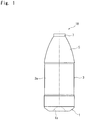
- FIG. 1 is a side view showing an example of the configuration of a stretch-molded bottle molded using the polylactic acid composition of the present invention.
- the polylactic acid composition of the present invention consists mainly of polylactic acid, and has a small amount of an ethylene resin incorporated therein.
- the polylactic acid used in the present invention may be 100% poly-L-lactic acid or 100% poly-D-lactic acid, or may be a melt blend of poly-L-lactic acid and poly-D-lactic acid, or a random copolymer or block copolymer of L-lactic acid and D-lactic acid.
- this polylactic acid may be one having various aliphatic polyhydric alcohols, aliphatic polybasic acids, hydroxycarboxylic acids, lactones, etc. copolymerized therewith.
- polyhydric alcohols examples include ethylene glycol, propylene glycol, butanediol, octanediol, dodecanediol, neopentyl glycol, glycerin, pentaerythritol, sorbitan, and polyethylene glycol.
- polybasic acids examples include succinic acid, adipic acid, sebacic acid, glutaric acid, decanedicarboxylic acid, cyclohexanedicarboxylic acid, and terephthalic acid.
- Carboxylic acid diester may also be used.
- hydroxycarboxylic acids examples include glycolic acid, hydroxypropionic acid, hydroxyvaleric acid, hydroxycaproic acid, and mandelic acid.
- lactones examples include caprolactone, butyrolactone, valerolactone, propiolactone, undecalactone, glycolide, and mandelalide.
- the polylactic acid composition of the present invention is used for a container typified by a bottle, it uses polylactic acid having melt flow characteristics necessary for molding into a container. For example, one having a melt flow rate (MFR, 210°C, load 2.16 kg) in the range of 3 to 10 g/10 min is used.
- MFR melt flow rate
- 210°C load 2.16 kg
- the ethylene resin may be one having a small amount of an olefin other than ethylene, for example, an ⁇ -olefin such as propylene, 1-butene, or 4-methyl-1-pentene, copolymerized therewith.
- an olefin other than ethylene for example, an ⁇ -olefin such as propylene, 1-butene, or 4-methyl-1-pentene, copolymerized therewith.
- the difference in melt flow characteristics between the polylactic acid and the ethylene resin is so great that the dispersion of the ethylene resin in the container wall is poor and, when the container wall is squeezed, delamination may occur.
- the difference in melt flow characteristics between the polylactic acid and the ethylene resin is so great that the dispersion of the ethylene resin in the container wall is poor and, when the container wall is squeezed, delamination may also occur.
- an ethylene resin having such flow characteristic as to satisfy the above RMF value is selected as the ethylene resin used.
- the amount of the ethylene resin used needs to be very small.
- the amount of the ethylene resin used should be set at 0.5 to 5.0 parts by mass, particularly preferably 1.0 to 2.5 parts by mass, based on the total amount, 100 parts by mass, of the polylactic acid and the ethylene resin. If the amount of use is large, delamination may occur when the container wall is squeezed. If the amount of use is too small, the alkali resistance or ESCR characteristics of the container molded, for example, a bottle, will be unsatisfactory.
- high density polyethylene having a density of 0.942 g/cm 3 or more be used as the ethylene resin.
- a bottle molded using such a high density polyethylene has particularly high light blocking properties and, even if a coloring agent is not added to the composition, the bottle exhibits high light blocking properties such that the light permeability of the bottle wall to light with a wavelength of 500 nm is 85% or less, particularly 70% or less. That is, such a high density polyethylene is dense and has a long molecular chain, thus causing a high degree of light scattering.
- high light blocking properties are believed to be imparted. Since the ethylene resin is dense, moreover, the alkali resistance is further improved and, accordingly, the ESCR characteristics are also enhanced.
- the resulting container is semitransparent and, unless a coloring agent is incorporated, it is difficult to obtain high light blocking properties as mentioned above.
- the molded container showing high light blocking properties is useful as a container for storing liquid contents to be deteriorated by light, as described earlier. Its high light blocking properties without the addition of a coloring agent, in particular, lead to excellent recyclability.
- a container, e.g., bottle, having such high light blocking properties can effectively hide the brown color of a hydrocarbon deposited film, when provided on its inner surface, so that it can effectively avoid a decline in the appearance characteristics ascribed to the hydrocarbon deposited film.
- a plant-derived ethylene resin from corn or a sugar cane as the aforementioned ethylene resin.
- the biomass degree of 100% or almost 100% can be achieved. This is very advantageous to the environment.
- compounding agents publicly known per se, for example, plasticizers, heat stabilizers, light stabilizers, antioxidants, ultraviolet absorbers, flame retardants, colorants such as pigments, fillers, mold releasers, antistats, perfumes, foaming agents, antimicrobial and antifungal agents, compatibilizing agents, and crystal nucleating agents, can be incorporated according to the uses of the molded container.
- the above-mentioned polylactic acid composition can be easily prepared by melt-kneading the polylactic acid and the ethylene resin together with various compounding agents to be used if required.
- the above polylactic acid composition of the present invention can improve the properties of the polylactic acid by extrusion or injection molding. Thus, it can be applied to various uses in the form of such a shaped product. Particularly when this composition is applied in molding a container, especially, a stretch-molded bottle excellent in alkali resistance and ESCR characteristics, the advantages of the present invention can be exhibited to the maximum.
- a stretch-molded bottle indicated entirely at 10 is composed of a bottom 1, a barrel 3 rising from the bottom 1, a shoulder 5 curved upwardly from the upper end of the barrel 3 in an upwardly decreasing diameter, and a neck 7 extending upward from the shoulder 5 and configured to be mounted with a lid such as a cap or a plug.
- the stretch-molded bottle 10 can be produced by a method publicly known per se, except for the use of the aforementioned polylactic acid composition.
- the stretch-molded bottle 10 can be produced by molding a preform in the shape of a test tube by injection molding using the polylactic acid composition, and then blow molding the preform with heating to a temperature, which is equal to or higher than the glass transition temperature (Tg), but lower than the melting point, while blowing a fluid such as air or a nitrogen gas into the preform, thereby stretching the preform in monoaxial and biaxial directions to impart the shape of a bottle as shown in Fig. 1 .
- Tg glass transition temperature
- Blow molding is usually performed so that the stretch ratio in the axial direction or in the circumferential direction is a value of the order of 2 to 4. By so doing, oriented crystallization occurs to enhance strength. Further, heat fixing is performed if necessary, whereby heat resistance can be increased. Heat fixing can be performed, for example, by holding the mold temperature during blow molding at a temperature which is equal to or higher than the thermal crystallization temperature, but lower than the melting point, of the polylactic acid (the temperature is, for example, 80 to 100°C).
- the bottle of the present invention which is obtained by the above blow molding (stretch molding), has the aforementioned ethylene resin dispersed in the polylactic acid.
- the bottle is expected to be improved in alkali resistance, which the polylactic acid is poor in, and to be increased in impact resistance to dropping or the like.
- the stretch-molded bottle 10 is improved in ESCR properties.
- it is preferably used as pressure-resistant bottles to be filled with carbonated beverages, for example, sparkling wine (amount of CO 2 dissolved: about 1.5 GV), a weakly carbonated beverage such as Fanta (amount of CO 2 dissolved: 2 to 2.2 GV), beer (amount of CO 2 dissolved: 2.5 to 3 GV), a strongly carbonated beverage such as cola (amount of CO 2 dissolved: 3.5 to 4 GV), and champagne (amount of CO 2 dissolved: about 5 GV).
- carbonated beverages for example, sparkling wine (amount of CO 2 dissolved: about 1.5 GV), a weakly carbonated beverage such as Fanta (amount of CO 2 dissolved: 2 to 2.2 GV), beer (amount of CO 2 dissolved: 2.5 to 3 GV), a strongly carbonated beverage such as cola (amount of CO 2 dissolved: 3.5 to 4 GV), and champagne (amount of CO 2 dissolved: about 5 GV).
- a pressure-resistant bottle to be filled with a carbonated beverage or the like, as mentioned above, is formed with a dome-shaped raised bottom portion 1a at the center of the bottom 1.
- a hydrocarbon deposited (i.e., vapor-deposited) film on the inner surface of the bottle, in order to improve the barrier properties against oxygen or a carbon dioxide gas and water barrier properties.
- the hydrocarbon deposited film is formed by plasma CVD method using a gas of a hydrocarbon compound as a reactant gas. It is sometimes called a diamond-like carbon (DLC) film, and is advantageous in that it can be formed as a film at a lower power output (output, simply) than those of a silicon oxide film. That is, the polylactic acid has a low glass transition temperature (Tg) as compared with a polyester such as PET, and is thus thermally deformed by heat generated during plasma CVD processing for film formation. Hence, it is not suitable for formation thereon of a deposited film of a silicon oxide or the like.
- Tg glass transition temperature
- a hydrocarbon deposited film on the contrary, can be formed at a low power output, and is able to prevent the heat deformation induced by heat generated during plasma CVD processing. Hydrocarbon deposited film can therefore be formed on the inner surface of a bottle made of polylactic acid.
- hydrocarbon compound for use as the reactant gas for plasma CVD at least one of aliphatic unsaturated hydrocarbons or aromatic hydrocarbons, for example, is used.
- Examples of the aliphatic unsaturated hydrocarbons include alkenes such as ethylene, propylene, butene, and pentene; alkynes such as acetylene and methylacetylene; alkadienes such as butadiene and pentadiene; and cycloalkenes such as cyclopentene and cyclohexene.
- the aromatic hydrocarbons can be exemplified by benzene, toluene, xylene, indene, naphthalene, and phenanthrene. Any one of gases of these compounds may be used alone, or two or more of these gases may be mixed and the resulting mixture can be used as the reactant gas.
- the aliphatic unsaturated hydrocarbon is preferred, and ethylene or acetylene, in particular, is most preferred.
- any of various carrier gases can be used as a diluent to adjust the gas concentration of the reactant gas.
- a carrier gas can be exemplified by an inert gas such as an argon gas or a helium gas.
- this hydrocarbon deposited film in order to further enhance the adhesion between the hydrocarbon deposited film and the inner surface of the bottle, thereby reliably exhibiting the barrier properties ascribed to the hydrocarbon deposited film, it is preferred to configure this hydrocarbon deposited film as a multilayer structure including two layers, a lower layer excellent in adhesion to the inner surface of the bottle made of the polylactic acid (i.e., an adhesion layer), and an upper layer formed on the lower layer and showing barrier properties against water and oxygen (i.e., a barrier layer).
- the hydrocarbon deposited film including the layered structure as above is disclosed, for example, in JP-A-2013-193336 proposed by the present applicant.
- the lower layer is a layer having a larger CH 2 content, as observed by FT-IR measurement, than in the upper layer (barrier layer).
- the lower layer is formed by film formation at a relatively low power output, whereas the upper layer is formed by film formation at a relatively high power output.
- the high CH 2 content lower layer (adhesion layer) formed on the inner surface of the bottle has a CH 2 ratio, to the total amount of CH, CH 2 and CH 3 , of 40% or more, particularly 44% or more, but less than 60%, and usually has a thickness of the order of 5 to 15 nm.
- peaks derived from CH, CH 2 , CH 3 , and CH 3 +CH 2 appear in a region of the wavenumbers 3200 to 2600 cm-1 in order of increasing wavenumber.
- the CH 2 ratio to the total amount of CH, CH 2 and CH 3 , calculated from these peaks, is within the above-mentioned range, as described in JP-A-2013-193336 .
- Such a lower layer 3a of the high CH 2 content contains many highly flexible CH 2 bonds and, at the same time, has a loose structure with a small number of molecular branches in the film.
- This lower layer is formed as a film at a low output, with the decomposition of the polylactic acid molecules (particularly, cleavage at the C ⁇ carbon portion) being suppressed.
- such a lower layer is excellent in the adhesion to the surface of the polylactic acid (inner surface of the bottle), and functions as a so-called adhesion layer, thus making it possible to prevent delamination or the like effectively.
- the upper layer formed on the above high CH 2 content lower layer is low in CH 2 content, has a CH 2 ratio, to the total amount of CH, CH 2 and CH 3 , of 35% or less, particularly less than 31%, and usually has a thickness of the order of 15 to 100 nm. That is, as described in JP-A-2013-193336 , this low CH 2 content upper layer is a dense layer formed at a high output and containing many branches as compared with the lower layer.
- the upper layer of such a nature functions as a barrier layer having high barrier properties against water and oxygen.
- the barrier properties against a carbon dioxide gas, oxygen and water can be markedly enhanced by forming the hydrocarbon deposited film on the inner surface of the bottle.
- the hydrocarbon deposited film of the above two-layered structure gives high adhesion between the inner surface of the bottle and the hydrocarbon deposited film, thus ensuring effective prevention of delamination or the like and enabling ESCR properties and gas barrier properties to be shown maximally.
- the bottle is formed from the polylactic acid composition containing high density polyethylene as the Polyethylene resin, this bottle has high light blocking properties even without the other addition of a coloring agent.
- the bottle can also prevent the decline in the appearance characteristics effectively due to the formation of the hydrocarbon deposited film developing a brown color and, because of no colorant added, it is considerated that having excellent another performance in recyclability.
- the stretch-molded bottle of the present invention which is molded using the above polylactic acid composition, is able to use for filling and storing of various contents.
- the bottle having the hydrocarbon deposited film formed thereon has markedly high barrier properties against oxygen and water, and can be applied in storing oily contents, for example, oils susceptible to oxidative degradation, such as Japanese deep frying oil, sesame oil, and rapeseed oil, oil-containing hair washes such as shampoos, water-containing oily fluids such as emulsion type dressings, and aqueous contents such as various juices, soy sauce, and sauces. Because of its excellent ESCR properties, in particular, the bottle is applied most preferably for storing carbonated beverages.
- An ultraviolet-visible near infrared spectrophotometer (model: V-570, manufactured by JASCO Corporation) equipped with an integrating sphere device (model: ISV-470), produced by JASCO Corporation, was used as a measuring device.
- a central part of the side wall of an undeposited stretch-molded bottle was cut out, and measured for the light transmission of the side wall to light with a wavelength of 500 nm, by use of the above measuring device.
- the size of the sample was 15 mm by 30 mm, and light incident direction was from the outer surface of the side bottle wall to inside.
- the light transmission was 100% when all of light passed through the sample, and 0% when none of light passed through the sample.
- the central part of the side wall of the resulting undeposited stretch-molded bottle was squeezed (pressed and allowed to return to the original state) repeatedly, 10 times, with the finger. Then, the degree of peeling of the squeezed part was evaluated visually for evaluation of delamination properties.
- the criteria for evaluation were as follows:
- the resulting undeposited stretch-molded bottle was filled with carbonated water cooled to about 5°C, and sealed with a cap to prepare a filled bottle. On this occasion, the carbon dioxide gas volume was adjusted to 3 GV.
- the filled bottle was maintained at 23°C, whereafter its bottom was immersed in a 0.2 mass% aqueous solution of sodium hydroxide at 23°C.
- the amount of time until cracks occurred in the bottom was measured for the evaluation of ESCR (evaluation of environmental stress crack resistance).
- the criteria for evaluation were as follows:
- poly-L-lactic acid 99 Parts by mass of pellets of the above polylactic acid (poly-L-lactic acid) and 1 part by mass of pellets of the above ethylene resin (high density polyethylene) were dry blended to prepare a polylactic acid composition.
- This polylactic acid composition was charged into a hopper of an injection molding machine, and a bottomed preform for a pressure-resistant bottle was molded by injection molding.
- the resulting preform was subjected to biaxial stretch blow molding at a mold temperature of 85°C to produce a stretch-molded bottle with a volume of 520 ml.
- the bottom shape of the stretch-molded bottle was a bottom shape for champagne as shown in Fig. 1 .
- the resulting stretch-molded bottle was set in a plasma CVD device, and decompress the inside of the bottle and held at a predetermined degree of vacuum for plasma CVD processing
- Acetylene was used as a reactant gas, and a plasma emission was generated by applying a microwave of 2.45 GHz.
- Processing was performed for 10 msec at a gas flow rate of 160 sccm and a trigger output of 650 W. Then, processing was performed for 1.5 seconds at the same gas flow rate and an output power of 400 W to provide a first deposited layer (lower layer) of a high CH 2 content. Further, processing was performed for 1.0 second at the same gas flow rate and an output power of 1,150 W to provide a second deposited layer (upper layer) of a low CH 2 content. In this manner, a deposited stretch-molded bottle was produced.
- the first deposited layer had a high CH 2 ratio, to the total amount of CH, CH 2 and CH 3 , of 53%, while the second deposited layer (upper layer) had a low CH 2 ratio, to the total amount of CH, CH 2 and CH 3 , of 29%.
- the amounts of CH, CH 2 and CH 3 were determined by FT-IR measurement.
- the unit of the gas flow rate, "sccm”, is an abbreviation of "standard cc/min”, and represents a value at 1 atm (atmospheric pressure, 1.013 hPa) at 25°C.
- the formulation of the polylactic acid composition used in the production of the above bottle is shown in Table 1.
- the specifications of the bottle (presence or absence of the deposited film) and the evaluations of the various properties made in connection with the bottle are shown in Table 2.
- Deposited stretch-molded bottles were produced in the same manner as in Experimental Example 1, except that the total amount of the polylactic acid and the ethylene resin was 100 parts by mass, with the amount of the ethylene resin being set as in Table 1. The various properties were evaluated in the same manner as in Experimental Example 1.
- the following low density polyethylene was provided as the ethylene resin:
- a deposited stretch-molded bottle was produced in the same manner as in Experimental Example 1, except that the above low density polyethylene was used instead of the high density polyethylene. Evaluations were made in the same manner as in Experimental Example 1.
- a deposited stretch-molded bottle or an undeposited stretch-molded bottle was produced in the same manner as in Experimental Example 1, except that the deposited film was changed as in Table 2. Evaluations were made in the same manner as in Experimental Example 1. In each case, the trigger output during vapor deposition was not performed.
- Deposited stretch-molded bottles were produced in the same manner as in Experimental Example 1, except that the ethylene resin was not incorporated (that is, only 100 parts by mass of the polylactic acid was used), and the deposited film was changed as in Table 2. Evaluations were made in the same manner as in Experimental Example 1. In each case, the trigger output during vapor deposition was not performed.
- Table 1 Polylactic acid composition
Landscapes
- Chemical & Material Sciences (AREA)
- Engineering & Computer Science (AREA)
- Medicinal Chemistry (AREA)
- Health & Medical Sciences (AREA)
- Polymers & Plastics (AREA)
- Organic Chemistry (AREA)
- Chemical Kinetics & Catalysis (AREA)
- Mechanical Engineering (AREA)
- Ceramic Engineering (AREA)
- Containers Having Bodies Formed In One Piece (AREA)
- Details Of Rigid Or Semi-Rigid Containers (AREA)
- Compositions Of Macromolecular Compounds (AREA)
- Biological Depolymerization Polymers (AREA)
- Laminated Bodies (AREA)
Abstract

APLA represents the melt flow rate of the polylactic acid measured at 210°C and 2.16 kg, and
BPE represents the melt flow rate of the ethylene resin measured at 190°C and 2.16 kg,
in a range of 0.5 to 10 is satisfied. The polylactic acid composition is preferably used in molding a container particularly improved in alkali resistance and environmental stress crack resistance.
Description
- This invention relates to a polylactic acid composition. More specifically, the invention relates to a polylactic acid composition preferably used in molding a stretch-molded bottle having excellent property in pressure resistance, and a stretch-molded bottle molded using the composition.
- Polylactic acid is a bio-derived resin having biodegradability, and its use in the field of containers, such as bottles, is under consideration from the aspect of environment.
- By the way, polylactic acid is weak in alkali resistance as compared with polyester such as polyethylene terephthalate (PET), and has low resistance to environmental stress crack (ESCR) due to internal pressure. These drawbacks hamper its commercialization, particularly, in uses for pressure-resistant bottles to be filled with carbonated beverages.
- To improve the properties of films or containers made of polylactic acid, proposals have been made for resin compositions having polyolefins, such as polyethylenes, blended with polylactic acid (see
Patent Documents 1 to 7). Even bottles formed from these resin compositions are not satisfactory in resistance to environmental stress crack (ESCR) due to internal pressure. -
- Patent Document 1: Japanese Patent No.
5390088 - Patent Document 2:
JP-A-2006-7655 - Patent Document 3:
JP-A-2007-84816 - Patent Document 4:
JP-A-2008-214624 - Patent Document 5:
JP-A-2012-153795 - Patent Document 6:
JP-A-2012-193345 - Patent Document 7:
JP-T-2011-516718 - An object of the present invention is, therefore, to provide a polylactic acid resin composition preferably used in molding a container, improved in properties required of a container such as a bottle, particularly improved in alkali resistance and environmental stress crack resistance.
- Another object of the invention is to provide a stretch-molded bottle molded using the above polylactic acid resin composition and improved in environmental stress crack resistance.
- Still another object of the invention is to provide a stretch-molded bottle preferably used as a bottle for a carbonated beverage.
- The present inventors conducted numerous experiments on the environmental stress crack resistance (ESCR) of bottles molded from polylactic acids. As a result, they have found that the environmental stress crack resistance is improved by selecting an ethylene resin having melt flowability at a certain level in comparison with polylactic acid, incorporating a small amount of the ethylene resin into polylactic acid to obtain a polylactic acid composition, and molding a stretched plastic bottle by use of the polylactic acid composition. Based on this finding, they have accomplished the present invention.
- According to the present invention, there is provided a polylactic acid composition including a polylactic acid and an ethylene resin, wherein the ethylene resin is selected so that a melt flow rate ratio (RMF), defined by the following equation (1):

- APLA represents the melt flow rate of polylactic acid measured at 210°C and 2.16 kg, and
- BPE represents the melt flow rate of the ethylene resin measured at 190°C and 2.16 kg,
- In the polylactic acid composition of the present invention, it is preferred that
- (1) high density polyethylene having a density of 0.942 g/cm3 or more be used as the ethylene resin; and
- (2) the ethylene resin be used in an amount of 0.5 to 5.0 parts by mass based on the total amount, 100 parts by mass, of the polylactic acid and the ethylene resin.
- According to the present invention, there is also provided a stretch-molded bottle formed using the above polylactic acid composition.
- In the stretch-molded bottle, it is preferred that
- (1) the polylactic acid composition used here is free of a coloring agent, and the light permeability of the wall of the bottle to light with a wavelength of 500 nm is 85% or less;
- (2) when the bottle filled with carbonated water having a carbon dioxide gas volume of 3 GV is maintained at 23°C, and the bottom of the bottle is immersed in an aqueous solution of NaOH in a concentration of 0.2 mass% and at the same temperature, a time elapsing until crack occurrence is observed in the bottom is 15 minutes or more;
- (3) a hydrocarbon vapor-deposited (deposited, simply) film is formed on the inner surface of the bottle;
- (4) the hydrocarbon deposited film comprises a lower layer located beside the inner surface of the bottle, and an upper layer located on the lower layer, and the lower layer is a layer in which the amount of CH2 observed by FT-IR measurement is larger than in the upper layer; and
- (5) the bottle is used for a carbonated beverage.
- In the present invention, the amount of a carbon dioxide gas dissolved (carbon dioxide gas dissolved amount, simply) is expressed as a CO2 dissolution volume, and the CO2 dissolution volume at 15.6°C and 1 atm is defined as 1 GV. That is, a carbon dioxide gas dissolved amount of 3 GV means that CO2 is dissolved in an
amount 3 times as large as the CO2 dissolution volume at 15.6°C and 1 atm. - The polylactic acid composition of the present invention uses a small amount of the ethylene resin having a certain level of melt flow characteristics in comparison with the polylactic acid. Thus, the stretch-molded bottle molded using this polylactic acid composition has excellent properties in alkali resistance, and exhibits excellent environmental stress crack resistance. As will be shown in the Examples to be described later, for example, when the bottle filled with carbonated water having a carbon dioxide gas volume of 3 GV was maintained at 23°C, and its bottom was immersed in an aqueous solution of NaOH in a concentration of 0.2 mass% and at the same temperature, a time elapsing until crack occurrence observed in the bottom (this time may hereinafter be referred to as an environmental stress crack time) was 15 minutes or more, particularly 18 minutes or more. On the other hand, the environmental stress crack time of a bottle formed from polylactic acid alone was less than 15 minutes.
- As noted above, the stretch-molded bottle formed using the polylactic acid composition of the present invention has high ESCR characteristics, and is effectively inhibited from cracking due to internal pressure. Hence, such a bottle particularly formed with a hydrocarbon deposited film on its inner surface and thus improved in water barrier properties and gas barrier properties against oxygen or a carbon dioxide gas is preferably used as a bottle for a carbonated beverage.
- In the present invention, moreover, a plant-derived ethylene resin can be used as the ethylene resin used in combination with the polylactic acid, and the biomass degree of 100% or almost 100% can be achieved. In addition, the advantage of the polylactic acid to the environment is not impaired.
- Furthermore, with the polylactic acid composition of the present invention, a bottle having a special appearance with a softy white tone can be obtained, when high density polyethylene having a density of 0.942 g/cm3 or more is used as the ethylene resin. That is, with such a bottle, the light transmittance of the bottle wall to light with a wavelength of 500 nm is 85% or less. The bottle is useful as a container having high light blocking properties and designed to store liquid contents which prone to deteriorate when exposed to light. Since no coloring agent is added, moreover, the bottle has excellentl recyclability. Besides, such a container, for example, a stretch-molded bottle, is advantageous in that when a hydrocarbon deposited film is provided on its inner surface, the brown color of the deposited film can be effectively hidden, so that a decline in appearance characteristics ascribed to the hydrocarbon deposited film can be effectively avoided.
- [
Fig. 1 ] is a side view showing an example of the configuration of a stretch-molded bottle molded using the polylactic acid composition of the present invention. - The polylactic acid composition of the present invention consists mainly of polylactic acid, and has a small amount of an ethylene resin incorporated therein.
- The polylactic acid used in the present invention may be 100% poly-L-lactic acid or 100% poly-D-lactic acid, or may be a melt blend of poly-L-lactic acid and poly-D-lactic acid, or a random copolymer or block copolymer of L-lactic acid and D-lactic acid.
- As long as the biodegradability (enzymatic degradability) or stability of the polylactic acid is not impaired, this polylactic acid may be one having various aliphatic polyhydric alcohols, aliphatic polybasic acids, hydroxycarboxylic acids, lactones, etc. copolymerized therewith.
- Examples of the polyhydric alcohols include ethylene glycol, propylene glycol, butanediol, octanediol, dodecanediol, neopentyl glycol, glycerin, pentaerythritol, sorbitan, and polyethylene glycol.
- Examples of the polybasic acids include succinic acid, adipic acid, sebacic acid, glutaric acid, decanedicarboxylic acid, cyclohexanedicarboxylic acid, and terephthalic acid. Carboxylic acid diester may also be used.
- Examples of the hydroxycarboxylic acids include glycolic acid, hydroxypropionic acid, hydroxyvaleric acid, hydroxycaproic acid, and mandelic acid.
- Examples of the lactones include caprolactone, butyrolactone, valerolactone, propiolactone, undecalactone, glycolide, and mandelalide.
- Since the polylactic acid composition of the present invention is used for a container typified by a bottle, it uses polylactic acid having melt flow characteristics necessary for molding into a container. For example, one having a melt flow rate (MFR, 210°C, load 2.16 kg) in the range of 3 to 10 g/10 min is used.
- In the present invention, low density polyethylene, linear low density polyethylene, or medium-density or high density polyethylene is used as the ethylene resin to be blended with the above polylactic acid. As long as the object of the present invention, the object of improving environmental stress crack resistance (ESCR) is not defeated, the ethylene resin may be one having a small amount of an olefin other than ethylene, for example, an α-olefin such as propylene, 1-butene, or 4-methyl-1-pentene, copolymerized therewith.
- In the present invention, moreover, it is important that the ethylene resin be selected in accordance with the MFR (melt flow rate) of the polylactic acid used so that a melt flow rate ratio (RMF), defined by the following equation (1):

- APLA represents the melt flow rate of the polylactic acid measured at 210°C and 2.16 kg, and
- BPE represents the melt flow rate of the ethylene resin measured at 190°C and 2.16 kg,
- That is, if the RMF value is lower than the above range, the difference in melt flow characteristics between the polylactic acid and the ethylene resin is so great that the dispersion of the ethylene resin in the container wall is poor and, when the container wall is squeezed, delamination may occur. Similarly, if the RMF value is higher than the above range, the difference in melt flow characteristics between the polylactic acid and the ethylene resin is so great that the dispersion of the ethylene resin in the container wall is poor and, when the container wall is squeezed, delamination may also occur.
- Furthermore, with the present invention, an ethylene resin having such flow characteristic as to satisfy the above RMF value is selected as the ethylene resin used. Thus the amount of the ethylene resin used needs to be very small. Concretely, the amount of the ethylene resin used should be set at 0.5 to 5.0 parts by mass, particularly preferably 1.0 to 2.5 parts by mass, based on the total amount, 100 parts by mass, of the polylactic acid and the ethylene resin. If the amount of use is large, delamination may occur when the container wall is squeezed. If the amount of use is too small, the alkali resistance or ESCR characteristics of the container molded, for example, a bottle, will be unsatisfactory.
- In the present invention, it is preferred that high density polyethylene having a density of 0.942 g/cm3 or more be used as the ethylene resin. A bottle molded using such a high density polyethylene has particularly high light blocking properties and, even if a coloring agent is not added to the composition, the bottle exhibits high light blocking properties such that the light permeability of the bottle wall to light with a wavelength of 500 nm is 85% or less, particularly 70% or less. That is, such a high density polyethylene is dense and has a long molecular chain, thus causing a high degree of light scattering. As a result, even without the addition of a coloring agent, high light blocking properties are believed to be imparted. Since the ethylene resin is dense, moreover, the alkali resistance is further improved and, accordingly, the ESCR characteristics are also enhanced.
- If a medium-density or low density polyethylene having a lower density than in the above range is used, for example, the resulting container is semitransparent and, unless a coloring agent is incorporated, it is difficult to obtain high light blocking properties as mentioned above.
- Furthermore, the molded container showing high light blocking properties is useful as a container for storing liquid contents to be deteriorated by light, as described earlier. Its high light blocking properties without the addition of a coloring agent, in particular, lead to excellent recyclability. A container, e.g., bottle, having such high light blocking properties can effectively hide the brown color of a hydrocarbon deposited film, when provided on its inner surface, so that it can effectively avoid a decline in the appearance characteristics ascribed to the hydrocarbon deposited film.
- In the present invention, it is optimal to use a plant-derived ethylene resin from corn or a sugar cane as the aforementioned ethylene resin. By so doing, the biomass degree of 100% or almost 100% can be achieved. This is very advantageous to the environment.
- In the polylactic acid composition of the present invention, compounding agents publicly known per se, for example, plasticizers, heat stabilizers, light stabilizers, antioxidants, ultraviolet absorbers, flame retardants, colorants such as pigments, fillers, mold releasers, antistats, perfumes, foaming agents, antimicrobial and antifungal agents, compatibilizing agents, and crystal nucleating agents, can be incorporated according to the uses of the molded container.
- The above-mentioned polylactic acid composition can be easily prepared by melt-kneading the polylactic acid and the ethylene resin together with various compounding agents to be used if required.
- The above polylactic acid composition of the present invention can improve the properties of the polylactic acid by extrusion or injection molding. Thus, it can be applied to various uses in the form of such a shaped product. Particularly when this composition is applied in molding a container, especially, a stretch-molded bottle excellent in alkali resistance and ESCR characteristics, the advantages of the present invention can be exhibited to the maximum.
- The typical structure of such a stretch-molded bottle is shown in
Fig. 1 . Referring toFig. 1 , a stretch-molded bottle indicated entirely at 10 is composed of abottom 1, abarrel 3 rising from thebottom 1, ashoulder 5 curved upwardly from the upper end of thebarrel 3 in an upwardly decreasing diameter, and aneck 7 extending upward from theshoulder 5 and configured to be mounted with a lid such as a cap or a plug. - The stretch-molded
bottle 10 can be produced by a method publicly known per se, except for the use of the aforementioned polylactic acid composition. - For example, the stretch-molded
bottle 10 can be produced by molding a preform in the shape of a test tube by injection molding using the polylactic acid composition, and then blow molding the preform with heating to a temperature, which is equal to or higher than the glass transition temperature (Tg), but lower than the melting point, while blowing a fluid such as air or a nitrogen gas into the preform, thereby stretching the preform in monoaxial and biaxial directions to impart the shape of a bottle as shown inFig. 1 . - Blow molding is usually performed so that the stretch ratio in the axial direction or in the circumferential direction is a value of the order of 2 to 4. By so doing, oriented crystallization occurs to enhance strength. Further, heat fixing is performed if necessary, whereby heat resistance can be increased. Heat fixing can be performed, for example, by holding the mold temperature during blow molding at a temperature which is equal to or higher than the thermal crystallization temperature, but lower than the melting point, of the polylactic acid (the temperature is, for example, 80 to 100°C).
- The bottle of the present invention, which is obtained by the above blow molding (stretch molding), has the aforementioned ethylene resin dispersed in the polylactic acid. Thus, the bottle is expected to be improved in alkali resistance, which the polylactic acid is poor in, and to be increased in impact resistance to dropping or the like.
- The stretch-molded
bottle 10 is improved in ESCR properties. Thus, it is preferably used as pressure-resistant bottles to be filled with carbonated beverages, for example, sparkling wine (amount of CO2 dissolved: about 1.5 GV), a weakly carbonated beverage such as Fanta (amount of CO2 dissolved: 2 to 2.2 GV), beer (amount of CO2 dissolved: 2.5 to 3 GV), a strongly carbonated beverage such as cola (amount of CO2 dissolved: 3.5 to 4 GV), and champagne (amount of CO2 dissolved: about 5 GV). - A pressure-resistant bottle to be filled with a carbonated beverage or the like, as mentioned above, is formed with a dome-shaped raised bottom portion 1a at the center of the
bottom 1. - In the pressure-resistant bottle as above, moreover, it is preferred to form a hydrocarbon deposited (i.e., vapor-deposited) film on the inner surface of the bottle, in order to improve the barrier properties against oxygen or a carbon dioxide gas and water barrier properties.
- The hydrocarbon deposited film is formed by plasma CVD method using a gas of a hydrocarbon compound as a reactant gas. It is sometimes called a diamond-like carbon (DLC) film, and is advantageous in that it can be formed as a film at a lower power output (output, simply) than those of a silicon oxide film. That is, the polylactic acid has a low glass transition temperature (Tg) as compared with a polyester such as PET, and is thus thermally deformed by heat generated during plasma CVD processing for film formation. Hence, it is not suitable for formation thereon of a deposited film of a silicon oxide or the like. A hydrocarbon deposited film, on the contrary, can be formed at a low power output, and is able to prevent the heat deformation induced by heat generated during plasma CVD processing. Hydrocarbon deposited film can therefore be formed on the inner surface of a bottle made of polylactic acid.
- As the hydrocarbon compound for use as the reactant gas for plasma CVD, at least one of aliphatic unsaturated hydrocarbons or aromatic hydrocarbons, for example, is used.
- Examples of the aliphatic unsaturated hydrocarbons include alkenes such as ethylene, propylene, butene, and pentene; alkynes such as acetylene and methylacetylene; alkadienes such as butadiene and pentadiene; and cycloalkenes such as cyclopentene and cyclohexene. The aromatic hydrocarbons can be exemplified by benzene, toluene, xylene, indene, naphthalene, and phenanthrene. Any one of gases of these compounds may be used alone, or two or more of these gases may be mixed and the resulting mixture can be used as the reactant gas. In the present invention, from the viewpoint of film characteristics, etc., the aliphatic unsaturated hydrocarbon is preferred, and ethylene or acetylene, in particular, is most preferred.
- Along with the above-mentioned reactant gas, any of various carrier gases can be used as a diluent to adjust the gas concentration of the reactant gas. Such a carrier gas can be exemplified by an inert gas such as an argon gas or a helium gas.
- Incidentally, many OH groups are distributed on the inner surface of the bottle made of the polylactic acid, thus presenting the nature that adhesion to the hydrocarbon deposited film is minimal. With the present invention, however, adhesion to the hydrocarbon deposited film is improved, although reasons for this remain unclear. Even if only an upper layer (barrier layer) is provided, without a deposited lower layer (adhesion layer) having excellent adhesion as will be described below, excellent barrier properties are obtained (a comparison between Experimental Examples 9 and 12). By forming a hydrocarbon deposited film on the inner surface of the bottle, therefore, barrier properties against water, oxygen and a carbon dioxide gas can be effectively enhanced. By being able to provide only the barrier layer, moreover, the productivity of the vapor deposition process is increased.
- In the present invention, moreover, in order to further enhance the adhesion between the hydrocarbon deposited film and the inner surface of the bottle, thereby reliably exhibiting the barrier properties ascribed to the hydrocarbon deposited film, it is preferred to configure this hydrocarbon deposited film as a multilayer structure including two layers, a lower layer excellent in adhesion to the inner surface of the bottle made of the polylactic acid (i.e., an adhesion layer), and an upper layer formed on the lower layer and showing barrier properties against water and oxygen (i.e., a barrier layer).
- The hydrocarbon deposited film including the layered structure as above is disclosed, for example, in
JP-A-2013-193336 - Concretely, the high CH2 content lower layer (adhesion layer) formed on the inner surface of the bottle has a CH2 ratio, to the total amount of CH, CH2 and CH3, of 40% or more, particularly 44% or more, but less than 60%, and usually has a thickness of the order of 5 to 15 nm. In the hydrocarbon deposited film using the above hydrocarbon compound as the reactant gas, peaks derived from CH, CH2, CH3, and CH3+CH2 appear in a region of the wavenumbers 3200 to 2600 cm-1 in order of increasing wavenumber. In the lower layer with a high CH2 content, the CH2 ratio to the total amount of CH, CH2 and CH3, calculated from these peaks, is within the above-mentioned range, as described in
JP-A-2013-193336 lower layer 3a of the high CH2 content contains many highly flexible CH2 bonds and, at the same time, has a loose structure with a small number of molecular branches in the film. This lower layer is formed as a film at a low output, with the decomposition of the polylactic acid molecules (particularly, cleavage at the Cα carbon portion) being suppressed. As a result, such a lower layer is excellent in the adhesion to the surface of the polylactic acid (inner surface of the bottle), and functions as a so-called adhesion layer, thus making it possible to prevent delamination or the like effectively. - On the other hand, the upper layer formed on the above high CH2 content lower layer is low in CH2 content, has a CH2 ratio, to the total amount of CH, CH2 and CH3, of 35% or less, particularly less than 31%, and usually has a thickness of the order of 15 to 100 nm. That is, as described in
JP-A-2013-193336 - According to the present invention, as described above, the barrier properties against a carbon dioxide gas, oxygen and water can be markedly enhanced by forming the hydrocarbon deposited film on the inner surface of the bottle. The hydrocarbon deposited film of the above two-layered structure, in particular, gives high adhesion between the inner surface of the bottle and the hydrocarbon deposited film, thus ensuring effective prevention of delamination or the like and enabling ESCR properties and gas barrier properties to be shown maximally.
- If the bottle is formed from the polylactic acid composition containing high density polyethylene as the Polyethylene resin, this bottle has high light blocking properties even without the other addition of a coloring agent. Thus, the bottle can also prevent the decline in the appearance characteristics effectively due to the formation of the hydrocarbon deposited film developing a brown color and, because of no colorant added, it is considerated that having excellent another performance in recyclability.
- The stretch-molded bottle of the present invention, which is molded using the above polylactic acid composition, is able to use for filling and storing of various contents. In particular, the bottle having the hydrocarbon deposited film formed thereon has markedly high barrier properties against oxygen and water, and can be applied in storing oily contents, for example, oils susceptible to oxidative degradation, such as Japanese deep frying oil, sesame oil, and rapeseed oil, oil-containing hair washes such as shampoos, water-containing oily fluids such as emulsion type dressings, and aqueous contents such as various juices, soy sauce, and sauces. Because of its excellent ESCR properties, in particular, the bottle is applied most preferably for storing carbonated beverages.
- The present invention will be explained by Experimental Examples to be presented later. Evaluations of various properties in the Experimental Examples were made as follows:
- An ultraviolet-visible near infrared spectrophotometer (model: V-570, manufactured by JASCO Corporation) equipped with an integrating sphere device (model: ISV-470), produced by JASCO Corporation, was used as a measuring device.
- A central part of the side wall of an undeposited stretch-molded bottle was cut out, and measured for the light transmission of the side wall to light with a wavelength of 500 nm, by use of the above measuring device. The size of the sample was 15 mm by 30 mm, and light incident direction was from the outer surface of the side bottle wall to inside. The light transmission was 100% when all of light passed through the sample, and 0% when none of light passed through the sample.
- The central part of the side wall of the resulting undeposited stretch-molded bottle was squeezed (pressed and allowed to return to the original state) repeatedly, 10 times, with the finger. Then, the degree of peeling of the squeezed part was evaluated visually for evaluation of delamination properties. The criteria for evaluation were as follows:
- ○: No delamination observed.
- △: Slight delamination to an allowable degree.
- ×: Unallowable clear delamination.
- Under the above evaluation criteria, ○ and △ were taken to be within the permissible range.
- The resulting undeposited stretch-molded bottle was filled with carbonated water cooled to about 5°C, and sealed with a cap to prepare a filled bottle. On this occasion, the carbon dioxide gas volume was adjusted to 3 GV.
- Then, the filled bottle was maintained at 23°C, whereafter its bottom was immersed in a 0.2 mass% aqueous solution of sodium hydroxide at 23°C. The amount of time until cracks occurred in the bottom was measured for the evaluation of ESCR (evaluation of environmental stress crack resistance). The criteria for evaluation were as follows:
- ⓞ: 20 Minutes or more until cracking.
- ○: 18 Minutes or more, but less than 20 min, until cracking.
- △: 15 Minutes or more, but less than 18 min, until cracking..
- ×: Less than 15 min until cracking.
- ⓞ, ○ and △ were taken to be within the permissible range.
- Using each of deposited stretch-molded bottles or undeposited stretch-molded bottles shown in Table 1, filled bottles were prepared in the same manner as for the ESCR evaluation. Each of the filled bottles was measured for mass weight A (g). After storage for 30 days in an atmosphere at 37°C and a relative humidity of 30%, each filled bottle was measured again for mass weight B (g). The water permeability (%/day) was calculated from the following equation:

- Based on the water permeability calculated as above, the water barrier properties were evaluated under the following criteria:
- ○: Water permeability of less than 0.06%.
- ×: Water permeability of 0.06% or more.
- Using each of the deposited stretch-molded bottles or undeposited stretch-molded bottles shown in Table 1, filled bottles were prepared in the same manner as for the ESCR evaluation. Each of the filled bottles was measured for gas volume C by Zahm-Nagel method. After storage for 4 weeks in an atmosphere at 23°C and a relative humidity of 50%, each filled bottle was measured again for gas volume D. A gas loss was calculated from the following equation:

- Based on the gas loss calculated above, the carbon dioxide gas barrier properties were evaluated under the following criteria:
- ○: A gas loss of less than 40%.
- ×: A gas loss of 40% or more.
- The following polylactic acid and ethylene resin were provided:
- Polylactic acid (PLA):
- Poly-L-lactic acid
- Optically active isomer (D-lactic acid) content: 1.4 mass%
- MFR: 7 g/10 min (210°C, 2.16 kg) ethylene resin:
- High density polyethylene (HDPE)
- Density: 0.964 g/cm3
- MFR: 4.5 g/10 min (190°C, 2.16 kg)
- RMF: 1.6 (value to the above poly-L-lactic acid)
- High density polyethylene (HDPE)
- MFR: 7 g/10 min (210°C, 2.16 kg) ethylene resin:
- Optically active isomer (D-lactic acid) content: 1.4 mass%
- Poly-L-lactic acid
- 99 Parts by mass of pellets of the above polylactic acid (poly-L-lactic acid) and 1 part by mass of pellets of the above ethylene resin (high density polyethylene) were dry blended to prepare a polylactic acid composition. This polylactic acid composition was charged into a hopper of an injection molding machine, and a bottomed preform for a pressure-resistant bottle was molded by injection molding.
- The resulting preform was subjected to biaxial stretch blow molding at a mold temperature of 85°C to produce a stretch-molded bottle with a volume of 520 ml. The bottom shape of the stretch-molded bottle was a bottom shape for champagne as shown in
Fig. 1 . - The resulting stretch-molded bottle was set in a plasma CVD device, and decompress the inside of the bottle and held at a predetermined degree of vacuum for plasma CVD processing Acetylene was used as a reactant gas, and a plasma emission was generated by applying a microwave of 2.45 GHz. Processing was performed for 10 msec at a gas flow rate of 160 sccm and a trigger output of 650 W. Then, processing was performed for 1.5 seconds at the same gas flow rate and an output power of 400 W to provide a first deposited layer (lower layer) of a high CH2 content. Further, processing was performed for 1.0 second at the same gas flow rate and an output power of 1,150 W to provide a second deposited layer (upper layer) of a low CH2 content. In this manner, a deposited stretch-molded bottle was produced.
- The first deposited layer (lower layer) had a high CH2 ratio, to the total amount of CH, CH2 and CH3, of 53%, while the second deposited layer (upper layer) had a low CH2 ratio, to the total amount of CH, CH2 and CH3, of 29%. The amounts of CH, CH2 and CH3 were determined by FT-IR measurement.
- The unit of the gas flow rate, "sccm", is an abbreviation of "standard cc/min", and represents a value at 1 atm (atmospheric pressure, 1.013 hPa) at 25°C.
- The formulation of the polylactic acid composition used in the production of the above bottle is shown in Table 1. The specifications of the bottle (presence or absence of the deposited film) and the evaluations of the various properties made in connection with the bottle are shown in Table 2.
- Deposited stretch-molded bottles were produced in the same manner as in Experimental Example 1, except that the total amount of the polylactic acid and the ethylene resin was 100 parts by mass, with the amount of the ethylene resin being set as in Table 1. The various properties were evaluated in the same manner as in Experimental Example 1.
- The formulations of the polylactic acid compositions used are shown in Table 1, and the specifications and evaluation results of the resulting bottles are shown in Table 2.
- Deposited stretch-molded bottles were produced in the same manner as in Experimental Example 1, except that the density and MFR of the ethylene resin (high density polyethylene) used for the preparation of the polylactic acid composition were changed as in Table 1. Evaluations were made in the same manner as in Experimental Example 1.
- The formulations of the polylactic acid compositions used are shown in Table 1, and the specifications and evaluation results of the resulting bottles are shown in Table 2.
- The following low density polyethylene was provided as the ethylene resin:
- Low density polyethylene (LDPE):
- Density: 0.916 g/cm3
- MFR: 1.0 g/10 min (190°C, 2.16 kg)
- RMF: 7.0 (value to the poly-L-lactic acid used in Experimental Example 1)
- A deposited stretch-molded bottle was produced in the same manner as in Experimental Example 1, except that the above low density polyethylene was used instead of the high density polyethylene. Evaluations were made in the same manner as in Experimental Example 1.
- The formulation of the polylactic acid composition used are shown in Table 1, and the specifications and evaluation results of the resulting bottle are shown in Table 2.
- A deposited stretch-molded bottle or an undeposited stretch-molded bottle was produced in the same manner as in Experimental Example 1, except that the deposited film was changed as in Table 2. Evaluations were made in the same manner as in Experimental Example 1. In each case, the trigger output during vapor deposition was not performed.
- The formulation of the polylactic acid composition used is shown in Table 1, and the specifications and evaluation results of the resulting bottles are shown in Table 2.
- Deposited stretch-molded bottles were produced in the same manner as in Experimental Example 1, except that the ethylene resin was not incorporated (that is, only 100 parts by mass of the polylactic acid was used), and the deposited film was changed as in Table 2. Evaluations were made in the same manner as in Experimental Example 1. In each case, the trigger output during vapor deposition was not performed.
- The formulation of the polylactic acid composition used is shown in Table 1, and the specifications and evaluation results of the resulting bottles are shown in Table 2.
Table 1 Polylactic acid composition Polylactic acid Ethylene resin Type MFR (g/10 min) Type (parts by mass) Density (g/cm3) MFR (g/10 min) RMF Exp. Ex.1 D-la. 1.4% 7 HDPE (1) 0.964 4.5 1.6 2 D-la. 1.4% 7 HDPE (0.5) 0.964 4.5 1.6 3 D-la. 1.4% 7 HDPE(2.0) 0.964 4.5 1.6 4 D-la. 1.4% 7 HDPE(5.0) 0.964 4.5 1.6 5 D-la. 1.4% 7 HDPE (1) 0.956 14 0.5 6 D-la. 1.4% 7 HDPE (1) 0.959 0.7 10 7 D-la. 1.4% 7 HDPE (1) 0.942 4.5 1.6 8 D-la. 1.4% 7 LDPE (1) 0.916 1.0 7.0 9 D-la. 1.4% 7 HDPE (1) 0.964 4.5 1.6 10 D-la. 1.4% 7 HDPE (1) 0.964 4.5 1.6 11 D-la. 1.4% 7 only PLA - - - 12 D-la. 1.4% 7 only PLA - - - 13 D-la. 1.4% 7 HDPE (1) 0.958 20 0.4 14 D-la. 1.4% 7 HDPE (1) 0.959 0.55 13 D-la. :D-lactic acid Table 2 Deposited film Bottle evaluation First layer (lower layer) Second layer (upper layer) Light permeability (%) Delamination ESCR Water barrier properties Carbon dioxide gas barrier properties Exp. Ex.1 yes yes 70 ○ ⊚ ○ ○ 2 yes yes 85 ○ △ ○ ○ 3 yes yes 45 ○ ⊚ ○ ○ 4 yes yes 25 △ ⊚ ○ ○ 5 yes yes 70 △ ⊚ ○ ○ 6 yes yes 70 △ ⊚ ○ ○ 7 yes yes 77 ○ ⊚ ○ ○ 8 yes yes 75 ○ △ ○ ○ 9 no yes 70 ○ ⊚ ○ ○ 10 no no 70 ○ ⊚ × × 11 no no 98 ○ × × × 12 no yes 97 ○ × × × 13 yes yes 73 × ○ ○ ○ 14 yes yes 72 × ○ ○ ○ -
- 1:
- Bottom
- 3:
- Barrel
- 5:
- Shoulder
- 7:
- Neck
- 10:
- Stretch-molded bottle
Claims (9)
- A polylactic acid composition including a polylactic acid and an ethylene resin, wherein
the ethylene resin is selected so that a melt flow rate ratio (RMF), defined by the following equation (1): APLA represents a melt flow rate of the polylactic acid measured at 210°C and 2.16 kg, andBPE represents a melt flow rate of the ethylene resin measured at 190°C and 2.16 kg,in a range of 0.5 to 10 is satisfied.
 - The polylactic acid composition according to claim 1, wherein
high density polyethylene having a density of 0.942 g/cm3 or more is used as the ethylene resin. - The polylactic acid composition according to claim 1, wherein
the ethylene resin is used in an amount of 0.5 to 5.0 parts by mass based on a total amount, 100 parts by mass, of the polylactic acid and the ethylene resin. - A stretch-molded bottle formed using the polylactic acid composition according to claim 1.
- The stretch-molded bottle according to claim 4, wherein
the polylactic acid composition used is free of a coloring agent, and
light permeability of a wall of the bottle to light with a wavelength of 500 nm is 85% or less. - The stretch-molded bottle according to claim 4, wherein
when the bottle filled with carbonated water having a carbon dioxide gas volume of 3 GV is maintained at 23°C, and a bottom of the bottle is immersed in an aqueous solution of NaOH in a concentration of 0.2% by mass and at 23°C, a time elapsing until crack occurrence is observed in the bottom is 15 minutes or more. - The stretch-molded bottle according to claim 4, wherein
a hydrocarbon deposited film is formed on an inner surface of the bottle. - The stretch-molded bottle according to claim 7, wherein
the hydrocarbon deposited film comprises a lower layer located beside the inner surface of the bottle, and an upper layer located on the lower layer, and
the lower layer is the layer in which an amount of CH2 observed by FT-IR measurement is larger than those of the upper layer. - The stretch-molded bottle according to claim 7, which is used for a carbonated beverage.
Applications Claiming Priority (2)
| Application Number | Priority Date | Filing Date | Title |
|---|---|---|---|
| JP2014164862 | 2014-08-13 | ||
| PCT/JP2015/072348 WO2016024517A1 (en) | 2014-08-13 | 2015-08-06 | Polylactic acid compound and stretch-molded bottle molded using same |
Publications (3)
| Publication Number | Publication Date |
|---|---|
| EP3181640A1 true EP3181640A1 (en) | 2017-06-21 |
| EP3181640A4 EP3181640A4 (en) | 2017-12-27 |
| EP3181640B1 EP3181640B1 (en) | 2019-01-02 |
Family
ID=55304146
Family Applications (1)
| Application Number | Title | Priority Date | Filing Date |
|---|---|---|---|
| EP15832479.8A Active EP3181640B1 (en) | 2014-08-13 | 2015-08-06 | Polylactic acid compound and stretch-molded bottle molded using same |
Country Status (6)
| Country | Link |
|---|---|
| US (1) | US10344161B2 (en) |
| EP (1) | EP3181640B1 (en) |
| JP (1) | JP6658528B2 (en) |
| KR (1) | KR101924475B1 (en) |
| CN (1) | CN106574104B (en) |
| WO (1) | WO2016024517A1 (en) |
Families Citing this family (2)
| Publication number | Priority date | Publication date | Assignee | Title |
|---|---|---|---|---|
| JP7151139B2 (en) * | 2018-04-09 | 2022-10-12 | 東洋製罐グループホールディングス株式会社 | Polylactic acid container and manufacturing method thereof |
| JP7124412B2 (en) * | 2018-04-20 | 2022-08-24 | 東洋製罐グループホールディングス株式会社 | Polylactic acid biaxially stretched heat-set container with transparency, heat resistance and barrier properties |
Family Cites Families (19)
| Publication number | Priority date | Publication date | Assignee | Title |
|---|---|---|---|---|
| JPS5390088A (en) | 1977-01-19 | 1978-08-08 | Toho Kouki Kk | Cutter for pipes *etc* |
| EP1679347B1 (en) * | 2003-10-09 | 2009-02-25 | Unitika Ltd. | Resin composition, molding thereof and process for producing the same |
| JP3655625B1 (en) | 2004-06-28 | 2005-06-02 | まつもと合成株式会社 | Process for producing an aliphatic polyester blown film |
| JP5354848B2 (en) | 2005-08-26 | 2013-11-27 | 三菱樹脂株式会社 | Heat-shrinkable pore-containing film, molded product based on the film, heat-shrinkable label, and container |
| JP2007270076A (en) | 2006-03-31 | 2007-10-18 | Tohcello Co Ltd | Polylactic acid type stretched film, stretched laminated film and its use |
| JP5383011B2 (en) * | 2006-08-17 | 2014-01-08 | 三菱樹脂株式会社 | Heat-shrinkable film, molded article using the heat-shrinkable film, heat-shrinkable label, and container using or fitted with the molded article |
| US8420193B2 (en) | 2007-02-06 | 2013-04-16 | Mitsubishi Plastics, Inc. | Heat-shrinkable film, molded product and heat-shrinkable label employing the film, and container employing the molded product or having the label fitted thereon |
| JP5160257B2 (en) | 2007-02-06 | 2013-03-13 | 三菱樹脂株式会社 | Heat-shrinkable film, molded article using the heat-shrinkable film, heat-shrinkable label, and container using or fitted with the molded article |
| JP5390088B2 (en) | 2007-10-31 | 2014-01-15 | 三菱化学株式会社 | Resin composition and molded article and film comprising the resin composition |
| JP2009173916A (en) * | 2007-12-27 | 2009-08-06 | Sumitomo Chemical Co Ltd | Propylene resin composition and molded article thereof |
| JP2009155516A (en) * | 2007-12-27 | 2009-07-16 | Sumitomo Chemical Co Ltd | Packaging bag |
| US10087316B2 (en) | 2008-04-29 | 2018-10-02 | The Procter & Gamble Company | Polymeric compositions and articles comprising polylactic acid and polyolefin |
| JP2010046852A (en) * | 2008-08-20 | 2010-03-04 | Sumitomo Chemical Co Ltd | Laminated film |
| JP2012153795A (en) | 2011-01-26 | 2012-08-16 | Sumitomo Chemical Co Ltd | Injection molding |
| WO2012117985A1 (en) * | 2011-03-02 | 2012-09-07 | 住友化学株式会社 | Polyethylene-based resin composition for blow molding and blow molded body |
| WO2013108817A1 (en) * | 2012-01-17 | 2013-07-25 | 独立行政法人産業技術総合研究所 | Plant-derived plastic blend and production method therefor |
| JP5794184B2 (en) | 2012-03-21 | 2015-10-14 | 東洋製罐株式会社 | POLYLACTIC ACID FORMED BODY HAVING DEPOSIBLE FILM AND PROCESS FOR PRODUCING THE SAME |
| JP5623479B2 (en) | 2012-08-30 | 2014-11-12 | 三菱樹脂株式会社 | Resin composition, and film and laminate using the same |
| JP2014122287A (en) * | 2012-12-21 | 2014-07-03 | Unitika Ltd | Polylactic acid-based resin composition and molding composed of the same |
-
2015
- 2015-08-06 KR KR1020177006824A patent/KR101924475B1/en active Active
- 2015-08-06 EP EP15832479.8A patent/EP3181640B1/en active Active
- 2015-08-06 CN CN201580043436.1A patent/CN106574104B/en active Active
- 2015-08-06 US US15/502,796 patent/US10344161B2/en active Active
- 2015-08-06 WO PCT/JP2015/072348 patent/WO2016024517A1/en not_active Ceased
- 2015-08-06 JP JP2016542551A patent/JP6658528B2/en active Active
Also Published As
| Publication number | Publication date |
|---|---|
| CN106574104A (en) | 2017-04-19 |
| KR20170041265A (en) | 2017-04-14 |
| US20170233568A1 (en) | 2017-08-17 |
| JP6658528B2 (en) | 2020-03-04 |
| CN106574104B (en) | 2021-06-04 |
| EP3181640A4 (en) | 2017-12-27 |
| WO2016024517A1 (en) | 2016-02-18 |
| EP3181640B1 (en) | 2019-01-02 |
| KR101924475B1 (en) | 2018-12-03 |
| JPWO2016024517A1 (en) | 2017-07-06 |
| US10344161B2 (en) | 2019-07-09 |
Similar Documents
| Publication | Publication Date | Title |
|---|---|---|
| CN104011134B (en) | Plastic packaging for dispensing aerosol products with improved crack resistance and sustainability | |
| AU720102B2 (en) | Zero oxygen permeation plastic bottle for beer and other applications | |
| EP2029456B1 (en) | Plastic pressurized dispenser | |
| US8470421B2 (en) | Biodegradable resin bottle and method of producing the same | |
| EP2979984B1 (en) | Delamination container and method of producing the same | |
| CN105008128A (en) | Oxygen-absorbing multilayer body, oxygen-absorbing container, oxygen-absorbing airtight container, oxygen-absorbing push-through pack, and storage method using same | |
| US20160039577A1 (en) | Closure for a product-retaining container | |
| Fasake et al. | Characteristics of different plastic materials, properties and their role in food packaging | |
| US20220169430A1 (en) | Biodegradable and compostable vessels, such as coffee pods, coated with pecvd coatings or layers | |
| TW201631028A (en) | Oxygen-removing composition without induction period | |
| US20240278954A1 (en) | Fiber-based container | |
| EP3181640B1 (en) | Polylactic acid compound and stretch-molded bottle molded using same | |
| RU2017106299A (en) | SMALL PACKAGING FOR CARBON BEVERAGES WITH IMPROVED PROPERTIES FOR STORAGE | |
| JP4776236B2 (en) | Polylactic acid-based stretched laminated film | |
| US20060198973A1 (en) | Packaging with cycloolefin food/beverage contact layer | |
| EP1728723A1 (en) | Synthetic resin container with high gas barrier performance | |
| EP2029455B1 (en) | Non-round plastic pressurized dispenser | |
| US20110091672A1 (en) | Biodegradable material and container for fluids | |
| CN118043396A (en) | Resin composition, molded article, multilayer structure, thermoformed container, blow-molded container, and vapor-deposited film | |
| JP2019189708A (en) | Polylactic acid-made biaxially stretched heat fixing container having all of transparency, heat resistance and barrier properties | |
| JP2009007039A (en) | Polylactic acid resin container provided with gas barrier property | |
| MX2007008677A (en) | Coextrudible resin and dye compounds for containers of refrigeration-free and high decomposition resistance liquid food. |
Legal Events
| Date | Code | Title | Description |
|---|---|---|---|
| STAA | Information on the status of an ep patent application or granted ep patent |
Free format text: STATUS: THE INTERNATIONAL PUBLICATION HAS BEEN MADE |
|
| PUAI | Public reference made under article 153(3) epc to a published international application that has entered the european phase |
Free format text: ORIGINAL CODE: 0009012 |
|
| STAA | Information on the status of an ep patent application or granted ep patent |
Free format text: STATUS: REQUEST FOR EXAMINATION WAS MADE |
|
| 17P | Request for examination filed |
Effective date: 20170207 |
|
| AK | Designated contracting states |
Kind code of ref document: A1 Designated state(s): AL AT BE BG CH CY CZ DE DK EE ES FI FR GB GR HR HU IE IS IT LI LT LU LV MC MK MT NL NO PL PT RO RS SE SI SK SM TR |
|
| AX | Request for extension of the european patent |
Extension state: BA ME |
|
| DAV | Request for validation of the european patent (deleted) | ||
| DAX | Request for extension of the european patent (deleted) | ||
| A4 | Supplementary search report drawn up and despatched |
Effective date: 20171128 |
|
| RIC1 | Information provided on ipc code assigned before grant |
Ipc: C08L 23/04 20060101ALI20171121BHEP Ipc: B65D 1/02 20060101ALI20171121BHEP Ipc: B32B 27/36 20060101ALI20171121BHEP Ipc: B65D 23/02 20060101ALI20171121BHEP Ipc: C08L 67/04 20060101AFI20171121BHEP Ipc: B32B 9/00 20060101ALI20171121BHEP Ipc: C08L 101/16 20060101ALI20171121BHEP |
|
| GRAP | Despatch of communication of intention to grant a patent |
Free format text: ORIGINAL CODE: EPIDOSNIGR1 |
|
| STAA | Information on the status of an ep patent application or granted ep patent |
Free format text: STATUS: GRANT OF PATENT IS INTENDED |
|
| INTG | Intention to grant announced |
Effective date: 20180720 |
|
| GRAS | Grant fee paid |
Free format text: ORIGINAL CODE: EPIDOSNIGR3 |
|
| GRAA | (expected) grant |
Free format text: ORIGINAL CODE: 0009210 |
|
| STAA | Information on the status of an ep patent application or granted ep patent |
Free format text: STATUS: THE PATENT HAS BEEN GRANTED |
|
| AK | Designated contracting states |
Kind code of ref document: B1 Designated state(s): AL AT BE BG CH CY CZ DE DK EE ES FI FR GB GR HR HU IE IS IT LI LT LU LV MC MK MT NL NO PL PT RO RS SE SI SK SM TR |
|
| REG | Reference to a national code |
Ref country code: GB Ref legal event code: FG4D |
|
| REG | Reference to a national code |
Ref country code: CH Ref legal event code: EP Ref country code: AT Ref legal event code: REF Ref document number: 1084307 Country of ref document: AT Kind code of ref document: T Effective date: 20190115 |
|
| REG | Reference to a national code |
Ref country code: IE Ref legal event code: FG4D |
|
| REG | Reference to a national code |
Ref country code: DE Ref legal event code: R096 Ref document number: 602015022993 Country of ref document: DE |
|
| REG | Reference to a national code |
Ref country code: NL Ref legal event code: MP Effective date: 20190102 |
|
| REG | Reference to a national code |
Ref country code: LT Ref legal event code: MG4D |
|
| REG | Reference to a national code |
Ref country code: AT Ref legal event code: MK05 Ref document number: 1084307 Country of ref document: AT Kind code of ref document: T Effective date: 20190102 |
|
| PG25 | Lapsed in a contracting state [announced via postgrant information from national office to epo] |
Ref country code: NL Free format text: LAPSE BECAUSE OF FAILURE TO SUBMIT A TRANSLATION OF THE DESCRIPTION OR TO PAY THE FEE WITHIN THE PRESCRIBED TIME-LIMIT Effective date: 20190102 |
|
| PG25 | Lapsed in a contracting state [announced via postgrant information from national office to epo] |
Ref country code: ES Free format text: LAPSE BECAUSE OF FAILURE TO SUBMIT A TRANSLATION OF THE DESCRIPTION OR TO PAY THE FEE WITHIN THE PRESCRIBED TIME-LIMIT Effective date: 20190102 Ref country code: SE Free format text: LAPSE BECAUSE OF FAILURE TO SUBMIT A TRANSLATION OF THE DESCRIPTION OR TO PAY THE FEE WITHIN THE PRESCRIBED TIME-LIMIT Effective date: 20190102 Ref country code: PT Free format text: LAPSE BECAUSE OF FAILURE TO SUBMIT A TRANSLATION OF THE DESCRIPTION OR TO PAY THE FEE WITHIN THE PRESCRIBED TIME-LIMIT Effective date: 20190502 Ref country code: NO Free format text: LAPSE BECAUSE OF FAILURE TO SUBMIT A TRANSLATION OF THE DESCRIPTION OR TO PAY THE FEE WITHIN THE PRESCRIBED TIME-LIMIT Effective date: 20190402 Ref country code: FI Free format text: LAPSE BECAUSE OF FAILURE TO SUBMIT A TRANSLATION OF THE DESCRIPTION OR TO PAY THE FEE WITHIN THE PRESCRIBED TIME-LIMIT Effective date: 20190102 Ref country code: LT Free format text: LAPSE BECAUSE OF FAILURE TO SUBMIT A TRANSLATION OF THE DESCRIPTION OR TO PAY THE FEE WITHIN THE PRESCRIBED TIME-LIMIT Effective date: 20190102 Ref country code: PL Free format text: LAPSE BECAUSE OF FAILURE TO SUBMIT A TRANSLATION OF THE DESCRIPTION OR TO PAY THE FEE WITHIN THE PRESCRIBED TIME-LIMIT Effective date: 20190102 |
|
| PG25 | Lapsed in a contracting state [announced via postgrant information from national office to epo] |
Ref country code: GR Free format text: LAPSE BECAUSE OF FAILURE TO SUBMIT A TRANSLATION OF THE DESCRIPTION OR TO PAY THE FEE WITHIN THE PRESCRIBED TIME-LIMIT Effective date: 20190403 Ref country code: BG Free format text: LAPSE BECAUSE OF FAILURE TO SUBMIT A TRANSLATION OF THE DESCRIPTION OR TO PAY THE FEE WITHIN THE PRESCRIBED TIME-LIMIT Effective date: 20190402 Ref country code: HR Free format text: LAPSE BECAUSE OF FAILURE TO SUBMIT A TRANSLATION OF THE DESCRIPTION OR TO PAY THE FEE WITHIN THE PRESCRIBED TIME-LIMIT Effective date: 20190102 Ref country code: RS Free format text: LAPSE BECAUSE OF FAILURE TO SUBMIT A TRANSLATION OF THE DESCRIPTION OR TO PAY THE FEE WITHIN THE PRESCRIBED TIME-LIMIT Effective date: 20190102 Ref country code: LV Free format text: LAPSE BECAUSE OF FAILURE TO SUBMIT A TRANSLATION OF THE DESCRIPTION OR TO PAY THE FEE WITHIN THE PRESCRIBED TIME-LIMIT Effective date: 20190102 Ref country code: IS Free format text: LAPSE BECAUSE OF FAILURE TO SUBMIT A TRANSLATION OF THE DESCRIPTION OR TO PAY THE FEE WITHIN THE PRESCRIBED TIME-LIMIT Effective date: 20190502 |
|
| REG | Reference to a national code |
Ref country code: DE Ref legal event code: R097 Ref document number: 602015022993 Country of ref document: DE |
|
| PG25 | Lapsed in a contracting state [announced via postgrant information from national office to epo] |
Ref country code: SK Free format text: LAPSE BECAUSE OF FAILURE TO SUBMIT A TRANSLATION OF THE DESCRIPTION OR TO PAY THE FEE WITHIN THE PRESCRIBED TIME-LIMIT Effective date: 20190102 Ref country code: CZ Free format text: LAPSE BECAUSE OF FAILURE TO SUBMIT A TRANSLATION OF THE DESCRIPTION OR TO PAY THE FEE WITHIN THE PRESCRIBED TIME-LIMIT Effective date: 20190102 Ref country code: RO Free format text: LAPSE BECAUSE OF FAILURE TO SUBMIT A TRANSLATION OF THE DESCRIPTION OR TO PAY THE FEE WITHIN THE PRESCRIBED TIME-LIMIT Effective date: 20190102 Ref country code: EE Free format text: LAPSE BECAUSE OF FAILURE TO SUBMIT A TRANSLATION OF THE DESCRIPTION OR TO PAY THE FEE WITHIN THE PRESCRIBED TIME-LIMIT Effective date: 20190102 Ref country code: DK Free format text: LAPSE BECAUSE OF FAILURE TO SUBMIT A TRANSLATION OF THE DESCRIPTION OR TO PAY THE FEE WITHIN THE PRESCRIBED TIME-LIMIT Effective date: 20190102 Ref country code: AT Free format text: LAPSE BECAUSE OF FAILURE TO SUBMIT A TRANSLATION OF THE DESCRIPTION OR TO PAY THE FEE WITHIN THE PRESCRIBED TIME-LIMIT Effective date: 20190102 Ref country code: AL Free format text: LAPSE BECAUSE OF FAILURE TO SUBMIT A TRANSLATION OF THE DESCRIPTION OR TO PAY THE FEE WITHIN THE PRESCRIBED TIME-LIMIT Effective date: 20190102 |
|
| PLBE | No opposition filed within time limit |
Free format text: ORIGINAL CODE: 0009261 |
|
| STAA | Information on the status of an ep patent application or granted ep patent |
Free format text: STATUS: NO OPPOSITION FILED WITHIN TIME LIMIT |
|
| PG25 | Lapsed in a contracting state [announced via postgrant information from national office to epo] |
Ref country code: SM Free format text: LAPSE BECAUSE OF FAILURE TO SUBMIT A TRANSLATION OF THE DESCRIPTION OR TO PAY THE FEE WITHIN THE PRESCRIBED TIME-LIMIT Effective date: 20190102 |
|
| 26N | No opposition filed |
Effective date: 20191003 |
|
| PG25 | Lapsed in a contracting state [announced via postgrant information from national office to epo] |
Ref country code: SI Free format text: LAPSE BECAUSE OF FAILURE TO SUBMIT A TRANSLATION OF THE DESCRIPTION OR TO PAY THE FEE WITHIN THE PRESCRIBED TIME-LIMIT Effective date: 20190102 |
|
| PG25 | Lapsed in a contracting state [announced via postgrant information from national office to epo] |
Ref country code: TR Free format text: LAPSE BECAUSE OF FAILURE TO SUBMIT A TRANSLATION OF THE DESCRIPTION OR TO PAY THE FEE WITHIN THE PRESCRIBED TIME-LIMIT Effective date: 20190102 |
|
| PG25 | Lapsed in a contracting state [announced via postgrant information from national office to epo] |
Ref country code: LI Free format text: LAPSE BECAUSE OF NON-PAYMENT OF DUE FEES Effective date: 20190831 Ref country code: MC Free format text: LAPSE BECAUSE OF FAILURE TO SUBMIT A TRANSLATION OF THE DESCRIPTION OR TO PAY THE FEE WITHIN THE PRESCRIBED TIME-LIMIT Effective date: 20190102 Ref country code: CH Free format text: LAPSE BECAUSE OF NON-PAYMENT OF DUE FEES Effective date: 20190831 Ref country code: LU Free format text: LAPSE BECAUSE OF NON-PAYMENT OF DUE FEES Effective date: 20190806 |
|
| REG | Reference to a national code |
Ref country code: BE Ref legal event code: MM Effective date: 20190831 |
|
| PG25 | Lapsed in a contracting state [announced via postgrant information from national office to epo] |
Ref country code: IE Free format text: LAPSE BECAUSE OF NON-PAYMENT OF DUE FEES Effective date: 20190806 |
|
| PG25 | Lapsed in a contracting state [announced via postgrant information from national office to epo] |
Ref country code: BE Free format text: LAPSE BECAUSE OF NON-PAYMENT OF DUE FEES Effective date: 20190831 |
|
| PG25 | Lapsed in a contracting state [announced via postgrant information from national office to epo] |
Ref country code: CY Free format text: LAPSE BECAUSE OF FAILURE TO SUBMIT A TRANSLATION OF THE DESCRIPTION OR TO PAY THE FEE WITHIN THE PRESCRIBED TIME-LIMIT Effective date: 20190102 |
|
| PG25 | Lapsed in a contracting state [announced via postgrant information from national office to epo] |
Ref country code: MT Free format text: LAPSE BECAUSE OF FAILURE TO SUBMIT A TRANSLATION OF THE DESCRIPTION OR TO PAY THE FEE WITHIN THE PRESCRIBED TIME-LIMIT Effective date: 20190102 Ref country code: HU Free format text: LAPSE BECAUSE OF FAILURE TO SUBMIT A TRANSLATION OF THE DESCRIPTION OR TO PAY THE FEE WITHIN THE PRESCRIBED TIME-LIMIT; INVALID AB INITIO Effective date: 20150806 |
|
| PG25 | Lapsed in a contracting state [announced via postgrant information from national office to epo] |
Ref country code: MK Free format text: LAPSE BECAUSE OF FAILURE TO SUBMIT A TRANSLATION OF THE DESCRIPTION OR TO PAY THE FEE WITHIN THE PRESCRIBED TIME-LIMIT Effective date: 20190102 |
|
| PGFP | Annual fee paid to national office [announced via postgrant information from national office to epo] |
Ref country code: GB Payment date: 20240826 Year of fee payment: 10 |
|
| PGFP | Annual fee paid to national office [announced via postgrant information from national office to epo] |
Ref country code: FR Payment date: 20240829 Year of fee payment: 10 |
|
| PGFP | Annual fee paid to national office [announced via postgrant information from national office to epo] |
Ref country code: IT Payment date: 20240827 Year of fee payment: 10 |
|
| PGFP | Annual fee paid to national office [announced via postgrant information from national office to epo] |
Ref country code: DE Payment date: 20250820 Year of fee payment: 11 |
|
| GBPC | Gb: european patent ceased through non-payment of renewal fee |
Effective date: 20250806 |
|
| PG25 | Lapsed in a contracting state [announced via postgrant information from national office to epo] |
Ref country code: GB Free format text: LAPSE BECAUSE OF NON-PAYMENT OF DUE FEES Effective date: 20250806 |
|
| PG25 | Lapsed in a contracting state [announced via postgrant information from national office to epo] |
Ref country code: IT Free format text: LAPSE BECAUSE OF NON-PAYMENT OF DUE FEES Effective date: 20250806 |
|
| PG25 | Lapsed in a contracting state [announced via postgrant information from national office to epo] |
Ref country code: FR Free format text: LAPSE BECAUSE OF NON-PAYMENT OF DUE FEES Effective date: 20250831 |