EP3181618A1 - Polymer functional film, stack or device provided with polymer functional film, and method of producing polymer functional film - Google Patents
Polymer functional film, stack or device provided with polymer functional film, and method of producing polymer functional film Download PDFInfo
- Publication number
- EP3181618A1 EP3181618A1 EP15831347.8A EP15831347A EP3181618A1 EP 3181618 A1 EP3181618 A1 EP 3181618A1 EP 15831347 A EP15831347 A EP 15831347A EP 3181618 A1 EP3181618 A1 EP 3181618A1
- Authority
- EP
- European Patent Office
- Prior art keywords
- group
- resin layer
- ion exchange
- functional polymer
- polymer membrane
- Prior art date
- Legal status (The legal status is an assumption and is not a legal conclusion. Google has not performed a legal analysis and makes no representation as to the accuracy of the status listed.)
- Withdrawn
Links
- 238000000034 method Methods 0.000 title claims abstract description 58
- 229920000642 polymer Polymers 0.000 title claims abstract description 18
- 239000011347 resin Substances 0.000 claims abstract description 174
- 229920005989 resin Polymers 0.000 claims abstract description 174
- 125000000217 alkyl group Chemical group 0.000 claims abstract description 69
- 229920003303 ion-exchange polymer Polymers 0.000 claims abstract description 68
- 238000005342 ion exchange Methods 0.000 claims abstract description 41
- 238000005341 cation exchange Methods 0.000 claims abstract description 35
- 238000005349 anion exchange Methods 0.000 claims abstract description 28
- 125000003647 acryloyl group Chemical group O=C([*])C([H])=C([H])[H] 0.000 claims abstract description 16
- 239000012528 membrane Substances 0.000 claims description 137
- -1 acryloylamino group Chemical group 0.000 claims description 126
- 239000000203 mixture Substances 0.000 claims description 103
- 229920001002 functional polymer Polymers 0.000 claims description 96
- 239000011248 coating agent Substances 0.000 claims description 49
- 238000000576 coating method Methods 0.000 claims description 49
- 125000004432 carbon atom Chemical group C* 0.000 claims description 45
- 125000004435 hydrogen atom Chemical group [H]* 0.000 claims description 40
- 238000006116 polymerization reaction Methods 0.000 claims description 34
- 238000006243 chemical reaction Methods 0.000 claims description 23
- 150000001875 compounds Chemical class 0.000 claims description 23
- 239000003505 polymerization initiator Substances 0.000 claims description 23
- 125000002947 alkylene group Chemical group 0.000 claims description 22
- 239000003431 cross linking reagent Substances 0.000 claims description 18
- 125000005647 linker group Chemical group 0.000 claims description 16
- 239000004745 nonwoven fabric Substances 0.000 claims description 15
- 230000008569 process Effects 0.000 claims description 15
- 125000003118 aryl group Chemical group 0.000 claims description 10
- 125000000732 arylene group Chemical group 0.000 claims description 9
- 229910052736 halogen Inorganic materials 0.000 claims description 9
- 150000001767 cationic compounds Chemical class 0.000 claims description 6
- 150000002892 organic cations Chemical class 0.000 claims description 6
- 150000007933 aliphatic carboxylic acids Chemical class 0.000 claims description 5
- 239000010410 layer Substances 0.000 description 271
- 239000000243 solution Substances 0.000 description 36
- 239000003014 ion exchange membrane Substances 0.000 description 33
- 238000001723 curing Methods 0.000 description 27
- 125000001424 substituent group Chemical group 0.000 description 24
- 150000002500 ions Chemical class 0.000 description 23
- VWDWKYIASSYTQR-UHFFFAOYSA-N sodium nitrate Chemical compound [Na+].[O-][N+]([O-])=O VWDWKYIASSYTQR-UHFFFAOYSA-N 0.000 description 20
- XLYOFNOQVPJJNP-UHFFFAOYSA-N water Substances O XLYOFNOQVPJJNP-UHFFFAOYSA-N 0.000 description 17
- 239000002904 solvent Substances 0.000 description 16
- 229910001868 water Inorganic materials 0.000 description 14
- 238000000909 electrodialysis Methods 0.000 description 13
- FAPWRFPIFSIZLT-UHFFFAOYSA-M Sodium chloride Chemical compound [Na+].[Cl-] FAPWRFPIFSIZLT-UHFFFAOYSA-M 0.000 description 12
- 150000003839 salts Chemical class 0.000 description 11
- QAOWNCQODCNURD-UHFFFAOYSA-N sulfuric acid Substances OS(O)(=O)=O QAOWNCQODCNURD-UHFFFAOYSA-N 0.000 description 9
- TWRXJAOTZQYOKJ-UHFFFAOYSA-L Magnesium chloride Chemical compound [Mg+2].[Cl-].[Cl-] TWRXJAOTZQYOKJ-UHFFFAOYSA-L 0.000 description 8
- 239000002253 acid Substances 0.000 description 8
- 229910052757 nitrogen Inorganic materials 0.000 description 8
- 125000004433 nitrogen atom Chemical group N* 0.000 description 8
- 239000002131 composite material Substances 0.000 description 7
- 238000009296 electrodeionization Methods 0.000 description 7
- 125000000623 heterocyclic group Chemical group 0.000 description 7
- 150000002430 hydrocarbons Chemical group 0.000 description 7
- 125000003010 ionic group Chemical group 0.000 description 7
- 230000035699 permeability Effects 0.000 description 7
- 239000007787 solid Substances 0.000 description 7
- CSCPPACGZOOCGX-UHFFFAOYSA-N Acetone Chemical compound CC(C)=O CSCPPACGZOOCGX-UHFFFAOYSA-N 0.000 description 6
- WEVYAHXRMPXWCK-UHFFFAOYSA-N Acetonitrile Chemical compound CC#N WEVYAHXRMPXWCK-UHFFFAOYSA-N 0.000 description 6
- ZMXDDKWLCZADIW-UHFFFAOYSA-N N,N-Dimethylformamide Chemical compound CN(C)C=O ZMXDDKWLCZADIW-UHFFFAOYSA-N 0.000 description 6
- HEMHJVSKTPXQMS-UHFFFAOYSA-M Sodium hydroxide Chemical compound [OH-].[Na+] HEMHJVSKTPXQMS-UHFFFAOYSA-M 0.000 description 6
- 150000001339 alkali metal compounds Chemical class 0.000 description 6
- 125000003277 amino group Chemical group 0.000 description 6
- 239000007864 aqueous solution Substances 0.000 description 6
- 239000003112 inhibitor Substances 0.000 description 6
- 239000011780 sodium chloride Substances 0.000 description 6
- 0 *c1ccccc1 Chemical compound *c1ccccc1 0.000 description 5
- KFZMGEQAYNKOFK-UHFFFAOYSA-N Isopropanol Chemical compound CC(C)O KFZMGEQAYNKOFK-UHFFFAOYSA-N 0.000 description 5
- 229910052782 aluminium Inorganic materials 0.000 description 5
- XAGFODPZIPBFFR-UHFFFAOYSA-N aluminium Chemical compound [Al] XAGFODPZIPBFFR-UHFFFAOYSA-N 0.000 description 5
- 239000003999 initiator Substances 0.000 description 5
- 238000005259 measurement Methods 0.000 description 5
- QSHDDOUJBYECFT-UHFFFAOYSA-N mercury Chemical compound [Hg] QSHDDOUJBYECFT-UHFFFAOYSA-N 0.000 description 5
- 125000002496 methyl group Chemical group [H]C([H])([H])* 0.000 description 5
- 229910017604 nitric acid Inorganic materials 0.000 description 5
- OZAIFHULBGXAKX-UHFFFAOYSA-N 2-(2-cyanopropan-2-yldiazenyl)-2-methylpropanenitrile Chemical compound N#CC(C)(C)N=NC(C)(C)C#N OZAIFHULBGXAKX-UHFFFAOYSA-N 0.000 description 4
- IAZDPXIOMUYVGZ-UHFFFAOYSA-N Dimethylsulphoxide Chemical compound CS(C)=O IAZDPXIOMUYVGZ-UHFFFAOYSA-N 0.000 description 4
- WMFOQBRAJBCJND-UHFFFAOYSA-M Lithium hydroxide Chemical compound [Li+].[OH-] WMFOQBRAJBCJND-UHFFFAOYSA-M 0.000 description 4
- 239000007832 Na2SO4 Substances 0.000 description 4
- PMZURENOXWZQFD-UHFFFAOYSA-L Sodium Sulfate Chemical compound [Na+].[Na+].[O-]S([O-])(=O)=O PMZURENOXWZQFD-UHFFFAOYSA-L 0.000 description 4
- WYURNTSHIVDZCO-UHFFFAOYSA-N Tetrahydrofuran Chemical compound C1CCOC1 WYURNTSHIVDZCO-UHFFFAOYSA-N 0.000 description 4
- 125000004397 aminosulfonyl group Chemical group NS(=O)(=O)* 0.000 description 4
- 239000003011 anion exchange membrane Substances 0.000 description 4
- 125000003917 carbamoyl group Chemical group [H]N([H])C(*)=O 0.000 description 4
- 125000003178 carboxy group Chemical group [H]OC(*)=O 0.000 description 4
- 230000000052 comparative effect Effects 0.000 description 4
- 239000007789 gas Substances 0.000 description 4
- IIPYXGDZVMZOAP-UHFFFAOYSA-N lithium nitrate Chemical compound [Li+].[O-][N+]([O-])=O IIPYXGDZVMZOAP-UHFFFAOYSA-N 0.000 description 4
- 229910001629 magnesium chloride Inorganic materials 0.000 description 4
- 229910052753 mercury Inorganic materials 0.000 description 4
- 239000000178 monomer Substances 0.000 description 4
- 238000002360 preparation method Methods 0.000 description 4
- 239000012779 reinforcing material Substances 0.000 description 4
- 238000000926 separation method Methods 0.000 description 4
- 229910052938 sodium sulfate Inorganic materials 0.000 description 4
- 239000000126 substance Substances 0.000 description 4
- 238000012719 thermal polymerization Methods 0.000 description 4
- NIXOWILDQLNWCW-UHFFFAOYSA-M Acrylate Chemical compound [O-]C(=O)C=C NIXOWILDQLNWCW-UHFFFAOYSA-M 0.000 description 3
- LFQSCWFLJHTTHZ-UHFFFAOYSA-N Ethanol Chemical compound CCO LFQSCWFLJHTTHZ-UHFFFAOYSA-N 0.000 description 3
- LYCAIKOWRPUZTN-UHFFFAOYSA-N Ethylene glycol Chemical compound OCCO LYCAIKOWRPUZTN-UHFFFAOYSA-N 0.000 description 3
- OKKJLVBELUTLKV-UHFFFAOYSA-N Methanol Chemical compound OC OKKJLVBELUTLKV-UHFFFAOYSA-N 0.000 description 3
- 239000004743 Polypropylene Substances 0.000 description 3
- DNIAPMSPPWPWGF-UHFFFAOYSA-N Propylene glycol Chemical compound CC(O)CO DNIAPMSPPWPWGF-UHFFFAOYSA-N 0.000 description 3
- 150000008365 aromatic ketones Chemical class 0.000 description 3
- 230000005540 biological transmission Effects 0.000 description 3
- 230000015572 biosynthetic process Effects 0.000 description 3
- 150000001732 carboxylic acid derivatives Chemical class 0.000 description 3
- 238000003851 corona treatment Methods 0.000 description 3
- 238000004132 cross linking Methods 0.000 description 3
- 230000003247 decreasing effect Effects 0.000 description 3
- MTHSVFCYNBDYFN-UHFFFAOYSA-N diethylene glycol Chemical compound OCCOCCO MTHSVFCYNBDYFN-UHFFFAOYSA-N 0.000 description 3
- 239000012153 distilled water Substances 0.000 description 3
- 125000001495 ethyl group Chemical group [H]C([H])([H])C([H])([H])* 0.000 description 3
- 239000000835 fiber Substances 0.000 description 3
- 229910052731 fluorine Inorganic materials 0.000 description 3
- 239000003673 groundwater Substances 0.000 description 3
- 238000010438 heat treatment Methods 0.000 description 3
- 239000000463 material Substances 0.000 description 3
- 229920001155 polypropylene Polymers 0.000 description 3
- JUJWROOIHBZHMG-UHFFFAOYSA-O pyridinium Chemical compound C1=CC=[NH+]C=C1 JUJWROOIHBZHMG-UHFFFAOYSA-O 0.000 description 3
- 125000001453 quaternary ammonium group Chemical group 0.000 description 3
- 238000001223 reverse osmosis Methods 0.000 description 3
- 238000004528 spin coating Methods 0.000 description 3
- 125000000020 sulfo group Chemical group O=S(=O)([*])O[H] 0.000 description 3
- 125000000999 tert-butyl group Chemical group [H]C([H])([H])C(*)(C([H])([H])[H])C([H])([H])[H] 0.000 description 3
- 238000004804 winding Methods 0.000 description 3
- CYSGHNMQYZDMIA-UHFFFAOYSA-N 1,3-Dimethyl-2-imidazolidinon Chemical compound CN1CCN(C)C1=O CYSGHNMQYZDMIA-UHFFFAOYSA-N 0.000 description 2
- QIGBRXMKCJKVMJ-UHFFFAOYSA-N 1,4-Benzenediol Natural products OC1=CC=C(O)C=C1 QIGBRXMKCJKVMJ-UHFFFAOYSA-N 0.000 description 2
- ZWEHNKRNPOVVGH-UHFFFAOYSA-N 2-Butanone Chemical compound CCC(C)=O ZWEHNKRNPOVVGH-UHFFFAOYSA-N 0.000 description 2
- YEJRWHAVMIAJKC-UHFFFAOYSA-N 4-Butyrolactone Chemical compound O=C1CCCO1 YEJRWHAVMIAJKC-UHFFFAOYSA-N 0.000 description 2
- HRPVXLWXLXDGHG-UHFFFAOYSA-N Acrylamide Chemical compound NC(=O)C=C HRPVXLWXLXDGHG-UHFFFAOYSA-N 0.000 description 2
- 239000004342 Benzoyl peroxide Substances 0.000 description 2
- OMPJBNCRMGITSC-UHFFFAOYSA-N Benzoylperoxide Chemical compound C=1C=CC=CC=1C(=O)OOC(=O)C1=CC=CC=C1 OMPJBNCRMGITSC-UHFFFAOYSA-N 0.000 description 2
- LRHPLDYGYMQRHN-UHFFFAOYSA-N N-Butanol Chemical compound CCCCO LRHPLDYGYMQRHN-UHFFFAOYSA-N 0.000 description 2
- SECXISVLQFMRJM-UHFFFAOYSA-N N-Methylpyrrolidone Chemical compound CN1CCCC1=O SECXISVLQFMRJM-UHFFFAOYSA-N 0.000 description 2
- ISWSIDIOOBJBQZ-UHFFFAOYSA-N Phenol Chemical compound OC1=CC=CC=C1 ISWSIDIOOBJBQZ-UHFFFAOYSA-N 0.000 description 2
- 239000004952 Polyamide Substances 0.000 description 2
- 239000004698 Polyethylene Substances 0.000 description 2
- 239000004793 Polystyrene Substances 0.000 description 2
- JUJWROOIHBZHMG-UHFFFAOYSA-N Pyridine Chemical compound C1=CC=NC=C1 JUJWROOIHBZHMG-UHFFFAOYSA-N 0.000 description 2
- 125000002252 acyl group Chemical group 0.000 description 2
- 125000004442 acylamino group Chemical group 0.000 description 2
- 125000004423 acyloxy group Chemical group 0.000 description 2
- 239000005456 alcohol based solvent Substances 0.000 description 2
- 229910001413 alkali metal ion Inorganic materials 0.000 description 2
- 125000003342 alkenyl group Chemical group 0.000 description 2
- 125000003545 alkoxy group Chemical group 0.000 description 2
- 125000004453 alkoxycarbonyl group Chemical group 0.000 description 2
- 125000004466 alkoxycarbonylamino group Chemical group 0.000 description 2
- 125000004414 alkyl thio group Chemical group 0.000 description 2
- 125000000304 alkynyl group Chemical group 0.000 description 2
- 125000005162 aryl oxy carbonyl amino group Chemical group 0.000 description 2
- 125000005161 aryl oxy carbonyl group Chemical group 0.000 description 2
- 125000005135 aryl sulfinyl group Chemical group 0.000 description 2
- 125000004657 aryl sulfonyl amino group Chemical group 0.000 description 2
- 125000004391 aryl sulfonyl group Chemical group 0.000 description 2
- 125000005110 aryl thio group Chemical group 0.000 description 2
- 125000004104 aryloxy group Chemical group 0.000 description 2
- KGQLBLGDIQNGSB-UHFFFAOYSA-N benzene-1,4-diol;methoxymethane Chemical compound COC.OC1=CC=C(O)C=C1 KGQLBLGDIQNGSB-UHFFFAOYSA-N 0.000 description 2
- ISAOCJYIOMOJEB-UHFFFAOYSA-N benzoin Chemical class C=1C=CC=CC=1C(O)C(=O)C1=CC=CC=C1 ISAOCJYIOMOJEB-UHFFFAOYSA-N 0.000 description 2
- 235000019400 benzoyl peroxide Nutrition 0.000 description 2
- 125000001951 carbamoylamino group Chemical group C(N)(=O)N* 0.000 description 2
- 229910052799 carbon Inorganic materials 0.000 description 2
- 150000001768 cations Chemical class 0.000 description 2
- 239000003795 chemical substances by application Substances 0.000 description 2
- 229920001577 copolymer Polymers 0.000 description 2
- 238000007766 curtain coating Methods 0.000 description 2
- 125000000753 cycloalkyl group Chemical group 0.000 description 2
- WJTCGQSWYFHTAC-UHFFFAOYSA-N cyclooctane Chemical group C1CCCCCCC1 WJTCGQSWYFHTAC-UHFFFAOYSA-N 0.000 description 2
- 238000005516 engineering process Methods 0.000 description 2
- 238000007765 extrusion coating Methods 0.000 description 2
- 125000001153 fluoro group Chemical group F* 0.000 description 2
- 238000009292 forward osmosis Methods 0.000 description 2
- 239000000446 fuel Substances 0.000 description 2
- 230000004927 fusion Effects 0.000 description 2
- 125000005842 heteroatom Chemical group 0.000 description 2
- GNOIPBMMFNIUFM-UHFFFAOYSA-N hexamethylphosphoric triamide Chemical compound CN(C)P(=O)(N(C)C)N(C)C GNOIPBMMFNIUFM-UHFFFAOYSA-N 0.000 description 2
- 239000003456 ion exchange resin Substances 0.000 description 2
- 230000001678 irradiating effect Effects 0.000 description 2
- 125000001449 isopropyl group Chemical group [H]C([H])([H])C([H])(*)C([H])([H])[H] 0.000 description 2
- 239000007788 liquid Substances 0.000 description 2
- AMXOYNBUYSYVKV-UHFFFAOYSA-M lithium bromide Chemical compound [Li+].[Br-] AMXOYNBUYSYVKV-UHFFFAOYSA-M 0.000 description 2
- KWGKDLIKAYFUFQ-UHFFFAOYSA-M lithium chloride Chemical compound [Li+].[Cl-] KWGKDLIKAYFUFQ-UHFFFAOYSA-M 0.000 description 2
- HSZCZNFXUDYRKD-UHFFFAOYSA-M lithium iodide Chemical compound [Li+].[I-] HSZCZNFXUDYRKD-UHFFFAOYSA-M 0.000 description 2
- 238000004519 manufacturing process Methods 0.000 description 2
- 229910001507 metal halide Inorganic materials 0.000 description 2
- 150000005309 metal halides Chemical class 0.000 description 2
- 125000001624 naphthyl group Chemical group 0.000 description 2
- 125000001820 oxy group Chemical group [*:1]O[*:2] 0.000 description 2
- 125000004430 oxygen atom Chemical group O* 0.000 description 2
- NWVVVBRKAWDGAB-UHFFFAOYSA-N p-methoxyphenol Chemical compound COC1=CC=C(O)C=C1 NWVVVBRKAWDGAB-UHFFFAOYSA-N 0.000 description 2
- 230000036961 partial effect Effects 0.000 description 2
- 150000002978 peroxides Chemical class 0.000 description 2
- 125000001997 phenyl group Chemical group [H]C1=C([H])C([H])=C(*)C([H])=C1[H] 0.000 description 2
- PTMHPRAIXMAOOB-UHFFFAOYSA-N phosphoric acid amide group Chemical group P(N)(O)(O)=O PTMHPRAIXMAOOB-UHFFFAOYSA-N 0.000 description 2
- 238000009832 plasma treatment Methods 0.000 description 2
- 239000002798 polar solvent Substances 0.000 description 2
- 229920002239 polyacrylonitrile Polymers 0.000 description 2
- 229920002647 polyamide Polymers 0.000 description 2
- 229920000573 polyethylene Polymers 0.000 description 2
- 239000005518 polymer electrolyte Substances 0.000 description 2
- 230000000379 polymerizing effect Effects 0.000 description 2
- 229920002223 polystyrene Polymers 0.000 description 2
- 238000001556 precipitation Methods 0.000 description 2
- 230000002441 reversible effect Effects 0.000 description 2
- 229930195734 saturated hydrocarbon Natural products 0.000 description 2
- 125000004469 siloxy group Chemical group [SiH3]O* 0.000 description 2
- 125000003808 silyl group Chemical group [H][Si]([H])([H])[*] 0.000 description 2
- 238000007767 slide coating Methods 0.000 description 2
- 235000011121 sodium hydroxide Nutrition 0.000 description 2
- 229910001220 stainless steel Inorganic materials 0.000 description 2
- 239000010935 stainless steel Substances 0.000 description 2
- HXJUTPCZVOIRIF-UHFFFAOYSA-N sulfolane Chemical compound O=S1(=O)CCCC1 HXJUTPCZVOIRIF-UHFFFAOYSA-N 0.000 description 2
- 229910052717 sulfur Inorganic materials 0.000 description 2
- 125000004434 sulfur atom Chemical group 0.000 description 2
- 239000002344 surface layer Substances 0.000 description 2
- YLQBMQCUIZJEEH-UHFFFAOYSA-N tetrahydrofuran Natural products C=1C=COC=1 YLQBMQCUIZJEEH-UHFFFAOYSA-N 0.000 description 2
- 125000004149 thio group Chemical group *S* 0.000 description 2
- OEIXGLMQZVLOQX-UHFFFAOYSA-N trimethyl-[3-(prop-2-enoylamino)propyl]azanium;chloride Chemical compound [Cl-].C[N+](C)(C)CCCNC(=O)C=C OEIXGLMQZVLOQX-UHFFFAOYSA-N 0.000 description 2
- 238000011144 upstream manufacturing Methods 0.000 description 2
- 239000003021 water soluble solvent Substances 0.000 description 2
- PTPLXVHPKMTVIW-FPLPWBNLSA-N (Z)-hydroxyimino-oxido-phenylazanium Chemical compound O\N=[N+](/[O-])c1ccccc1 PTPLXVHPKMTVIW-FPLPWBNLSA-N 0.000 description 1
- AVQQQNCBBIEMEU-UHFFFAOYSA-N 1,1,3,3-tetramethylurea Chemical compound CN(C)C(=O)N(C)C AVQQQNCBBIEMEU-UHFFFAOYSA-N 0.000 description 1
- MYRTYDVEIRVNKP-UHFFFAOYSA-N 1,2-Divinylbenzene Chemical class C=CC1=CC=CC=C1C=C MYRTYDVEIRVNKP-UHFFFAOYSA-N 0.000 description 1
- RYHBNJHYFVUHQT-UHFFFAOYSA-N 1,4-Dioxane Chemical compound C1COCCO1 RYHBNJHYFVUHQT-UHFFFAOYSA-N 0.000 description 1
- DZSVIVLGBJKQAP-UHFFFAOYSA-N 1-(2-methyl-5-propan-2-ylcyclohex-2-en-1-yl)propan-1-one Chemical compound CCC(=O)C1CC(C(C)C)CC=C1C DZSVIVLGBJKQAP-UHFFFAOYSA-N 0.000 description 1
- SBYHFKPVCBCYGV-UHFFFAOYSA-O 1-azoniabicyclo[2.2.2]octane Chemical compound C1CC2CC[NH+]1CC2 SBYHFKPVCBCYGV-UHFFFAOYSA-O 0.000 description 1
- YQTCQNIPQMJNTI-UHFFFAOYSA-N 2,2-dimethylpropan-1-one Chemical group CC(C)(C)[C]=O YQTCQNIPQMJNTI-UHFFFAOYSA-N 0.000 description 1
- JTXMVXSTHSMVQF-UHFFFAOYSA-N 2-acetyloxyethyl acetate Chemical compound CC(=O)OCCOC(C)=O JTXMVXSTHSMVQF-UHFFFAOYSA-N 0.000 description 1
- 125000004974 2-butenyl group Chemical group C(C=CC)* 0.000 description 1
- NEAQRZUHTPSBBM-UHFFFAOYSA-N 2-hydroxy-3,3-dimethyl-7-nitro-4h-isoquinolin-1-one Chemical compound C1=C([N+]([O-])=O)C=C2C(=O)N(O)C(C)(C)CC2=C1 NEAQRZUHTPSBBM-UHFFFAOYSA-N 0.000 description 1
- ZCSHACFHMFHFKK-UHFFFAOYSA-N 2-methyl-1,3,5-trinitrobenzene;2,4,6-trinitro-1,3,5-triazinane Chemical compound [O-][N+](=O)C1NC([N+]([O-])=O)NC([N+]([O-])=O)N1.CC1=C([N+]([O-])=O)C=C([N+]([O-])=O)C=C1[N+]([O-])=O ZCSHACFHMFHFKK-UHFFFAOYSA-N 0.000 description 1
- RIWRBSMFKVOJMN-UHFFFAOYSA-N 2-methyl-1-phenylpropan-2-ol Chemical compound CC(C)(O)CC1=CC=CC=C1 RIWRBSMFKVOJMN-UHFFFAOYSA-N 0.000 description 1
- 125000005979 2-naphthyloxy group Chemical group 0.000 description 1
- 125000003903 2-propenyl group Chemical group [H]C([*])([H])C([H])=C([H])[H] 0.000 description 1
- 125000001494 2-propynyl group Chemical group [H]C#CC([H])([H])* 0.000 description 1
- 125000000590 4-methylphenyl group Chemical group [H]C1=C([H])C(=C([H])C([H])=C1*)C([H])([H])[H] 0.000 description 1
- IRLPACMLTUPBCL-KQYNXXCUSA-N 5'-adenylyl sulfate Chemical compound C1=NC=2C(N)=NC=NC=2N1[C@@H]1O[C@H](COP(O)(=O)OS(O)(=O)=O)[C@@H](O)[C@H]1O IRLPACMLTUPBCL-KQYNXXCUSA-N 0.000 description 1
- ZCYVEMRRCGMTRW-UHFFFAOYSA-N 7553-56-2 Chemical group [I] ZCYVEMRRCGMTRW-UHFFFAOYSA-N 0.000 description 1
- 239000005711 Benzoic acid Substances 0.000 description 1
- WPYMKLBDIGXBTP-UHFFFAOYSA-N Benzoic acid Natural products OC(=O)C1=CC=CC=C1 WPYMKLBDIGXBTP-UHFFFAOYSA-N 0.000 description 1
- 229930185605 Bisphenol Natural products 0.000 description 1
- CPELXLSAUQHCOX-UHFFFAOYSA-M Bromide Chemical compound [Br-] CPELXLSAUQHCOX-UHFFFAOYSA-M 0.000 description 1
- WKBOTKDWSSQWDR-UHFFFAOYSA-N Bromine atom Chemical group [Br] WKBOTKDWSSQWDR-UHFFFAOYSA-N 0.000 description 1
- NLZUEZXRPGMBCV-UHFFFAOYSA-N Butylhydroxytoluene Chemical compound CC1=CC(C(C)(C)C)=C(O)C(C(C)(C)C)=C1 NLZUEZXRPGMBCV-UHFFFAOYSA-N 0.000 description 1
- AKDZDLIMUSMCBV-UHFFFAOYSA-N CCC(C)C(NCCC[N]1(C)CCCC1)=O Chemical compound CCC(C)C(NCCC[N]1(C)CCCC1)=O AKDZDLIMUSMCBV-UHFFFAOYSA-N 0.000 description 1
- BHPQYMZQTOCNFJ-UHFFFAOYSA-N Calcium cation Chemical compound [Ca+2] BHPQYMZQTOCNFJ-UHFFFAOYSA-N 0.000 description 1
- OKTJSMMVPCPJKN-UHFFFAOYSA-N Carbon Chemical compound [C] OKTJSMMVPCPJKN-UHFFFAOYSA-N 0.000 description 1
- VEXZGXHMUGYJMC-UHFFFAOYSA-M Chloride anion Chemical compound [Cl-] VEXZGXHMUGYJMC-UHFFFAOYSA-M 0.000 description 1
- XDTMQSROBMDMFD-UHFFFAOYSA-N Cyclohexane Chemical compound C1CCCCC1 XDTMQSROBMDMFD-UHFFFAOYSA-N 0.000 description 1
- 229920001174 Diethylhydroxylamine Polymers 0.000 description 1
- KRHYYFGTRYWZRS-UHFFFAOYSA-M Fluoride anion Chemical compound [F-] KRHYYFGTRYWZRS-UHFFFAOYSA-M 0.000 description 1
- YCKRFDGAMUMZLT-UHFFFAOYSA-N Fluorine atom Chemical compound [F] YCKRFDGAMUMZLT-UHFFFAOYSA-N 0.000 description 1
- DGAQECJNVWCQMB-PUAWFVPOSA-M Ilexoside XXIX Chemical compound C[C@@H]1CC[C@@]2(CC[C@@]3(C(=CC[C@H]4[C@]3(CC[C@@H]5[C@@]4(CC[C@@H](C5(C)C)OS(=O)(=O)[O-])C)C)[C@@H]2[C@]1(C)O)C)C(=O)O[C@H]6[C@@H]([C@H]([C@@H]([C@H](O6)CO)O)O)O.[Na+] DGAQECJNVWCQMB-PUAWFVPOSA-M 0.000 description 1
- WHXSMMKQMYFTQS-UHFFFAOYSA-N Lithium Chemical compound [Li] WHXSMMKQMYFTQS-UHFFFAOYSA-N 0.000 description 1
- HBBGRARXTFLTSG-UHFFFAOYSA-N Lithium ion Chemical compound [Li+] HBBGRARXTFLTSG-UHFFFAOYSA-N 0.000 description 1
- JLVVSXFLKOJNIY-UHFFFAOYSA-N Magnesium ion Chemical compound [Mg+2] JLVVSXFLKOJNIY-UHFFFAOYSA-N 0.000 description 1
- CERQOIWHTDAKMF-UHFFFAOYSA-M Methacrylate Chemical compound CC(=C)C([O-])=O CERQOIWHTDAKMF-UHFFFAOYSA-M 0.000 description 1
- YNAVUWVOSKDBBP-UHFFFAOYSA-N Morpholine Chemical group C1COCCN1 YNAVUWVOSKDBBP-UHFFFAOYSA-N 0.000 description 1
- 229910002651 NO3 Inorganic materials 0.000 description 1
- NHNBFGGVMKEFGY-UHFFFAOYSA-N Nitrate Chemical compound [O-][N+]([O-])=O NHNBFGGVMKEFGY-UHFFFAOYSA-N 0.000 description 1
- CBENFWSGALASAD-UHFFFAOYSA-N Ozone Chemical compound [O-][O+]=O CBENFWSGALASAD-UHFFFAOYSA-N 0.000 description 1
- 239000002033 PVDF binder Substances 0.000 description 1
- 244000137852 Petrea volubilis Species 0.000 description 1
- XYFCBTPGUUZFHI-UHFFFAOYSA-N Phosphine Natural products P XYFCBTPGUUZFHI-UHFFFAOYSA-N 0.000 description 1
- NBIIXXVUZAFLBC-UHFFFAOYSA-N Phosphoric acid Chemical group OP(O)(O)=O NBIIXXVUZAFLBC-UHFFFAOYSA-N 0.000 description 1
- NQRYJNQNLNOLGT-UHFFFAOYSA-O Piperidinium(1+) Chemical compound C1CC[NH2+]CC1 NQRYJNQNLNOLGT-UHFFFAOYSA-O 0.000 description 1
- 239000004962 Polyamide-imide Substances 0.000 description 1
- 239000004695 Polyether sulfone Substances 0.000 description 1
- 239000004642 Polyimide Substances 0.000 description 1
- 239000004734 Polyphenylene sulfide Substances 0.000 description 1
- 241000206607 Porphyra umbilicalis Species 0.000 description 1
- ZLMJMSJWJFRBEC-UHFFFAOYSA-N Potassium Chemical compound [K] ZLMJMSJWJFRBEC-UHFFFAOYSA-N 0.000 description 1
- NPYPAHLBTDXSSS-UHFFFAOYSA-N Potassium ion Chemical compound [K+] NPYPAHLBTDXSSS-UHFFFAOYSA-N 0.000 description 1
- RWRDLPDLKQPQOW-UHFFFAOYSA-N Pyrrolidine Chemical group C1CCNC1 RWRDLPDLKQPQOW-UHFFFAOYSA-N 0.000 description 1
- RWRDLPDLKQPQOW-UHFFFAOYSA-O Pyrrolidinium ion Chemical compound C1CC[NH2+]C1 RWRDLPDLKQPQOW-UHFFFAOYSA-O 0.000 description 1
- 239000006087 Silane Coupling Agent Substances 0.000 description 1
- 229910021607 Silver chloride Inorganic materials 0.000 description 1
- FKNQFGJONOIPTF-UHFFFAOYSA-N Sodium cation Chemical compound [Na+] FKNQFGJONOIPTF-UHFFFAOYSA-N 0.000 description 1
- 244000028419 Styrax benzoin Species 0.000 description 1
- 235000000126 Styrax benzoin Nutrition 0.000 description 1
- UCKMPCXJQFINFW-UHFFFAOYSA-N Sulphide Chemical compound [S-2] UCKMPCXJQFINFW-UHFFFAOYSA-N 0.000 description 1
- 235000008411 Sumatra benzointree Nutrition 0.000 description 1
- DHXVGJBLRPWPCS-UHFFFAOYSA-N Tetrahydropyran Chemical compound C1CCOCC1 DHXVGJBLRPWPCS-UHFFFAOYSA-N 0.000 description 1
- MAHXNHGMCSURBE-UHFFFAOYSA-N [4-[2-(dimethylamino)benzoyl]phenyl]-[2-(dimethylamino)phenyl]methanone Chemical compound CN(C)C1=CC=CC=C1C(=O)C1=CC=C(C(=O)C=2C(=CC=CC=2)N(C)C)C=C1 MAHXNHGMCSURBE-UHFFFAOYSA-N 0.000 description 1
- ZZAGLMPBQOKGGT-UHFFFAOYSA-N [4-[4-(4-prop-2-enoyloxybutoxy)benzoyl]oxyphenyl] 4-(4-prop-2-enoyloxybutoxy)benzoate Chemical compound C1=CC(OCCCCOC(=O)C=C)=CC=C1C(=O)OC(C=C1)=CC=C1OC(=O)C1=CC=C(OCCCCOC(=O)C=C)C=C1 ZZAGLMPBQOKGGT-UHFFFAOYSA-N 0.000 description 1
- 238000010521 absorption reaction Methods 0.000 description 1
- 125000000738 acetamido group Chemical group [H]C([H])([H])C(=O)N([H])[*] 0.000 description 1
- 125000002777 acetyl group Chemical group [H]C([H])([H])C(*)=O 0.000 description 1
- 125000003668 acetyloxy group Chemical group [H]C([H])([H])C(=O)O[*] 0.000 description 1
- 238000010306 acid treatment Methods 0.000 description 1
- 239000000654 additive Substances 0.000 description 1
- 239000000853 adhesive Substances 0.000 description 1
- 230000001070 adhesive effect Effects 0.000 description 1
- 238000007754 air knife coating Methods 0.000 description 1
- 125000003282 alkyl amino group Chemical group 0.000 description 1
- 150000001408 amides Chemical class 0.000 description 1
- 150000001412 amines Chemical class 0.000 description 1
- QGZKDVFQNNGYKY-UHFFFAOYSA-O ammonium group Chemical group [NH4+] QGZKDVFQNNGYKY-UHFFFAOYSA-O 0.000 description 1
- ROOXNKNUYICQNP-UHFFFAOYSA-N ammonium peroxydisulfate Substances [NH4+].[NH4+].[O-]S(=O)(=O)OOS([O-])(=O)=O ROOXNKNUYICQNP-UHFFFAOYSA-N 0.000 description 1
- VAZSKTXWXKYQJF-UHFFFAOYSA-N ammonium persulfate Chemical compound [NH4+].[NH4+].[O-]S(=O)OOS([O-])=O VAZSKTXWXKYQJF-UHFFFAOYSA-N 0.000 description 1
- 229910001870 ammonium persulfate Inorganic materials 0.000 description 1
- MHDLAWFYLQAULB-UHFFFAOYSA-N anilinophosphonic acid Chemical compound OP(O)(=O)NC1=CC=CC=C1 MHDLAWFYLQAULB-UHFFFAOYSA-N 0.000 description 1
- 239000003957 anion exchange resin Substances 0.000 description 1
- 150000001450 anions Chemical class 0.000 description 1
- 125000005427 anthranyl group Chemical group 0.000 description 1
- 125000001769 aryl amino group Chemical group 0.000 description 1
- 125000005116 aryl carbamoyl group Chemical group 0.000 description 1
- 125000002785 azepinyl group Chemical group 0.000 description 1
- 239000002585 base Substances 0.000 description 1
- 239000011324 bead Substances 0.000 description 1
- 125000000043 benzamido group Chemical group [H]N([*])C(=O)C1=C([H])C([H])=C([H])C([H])=C1[H] 0.000 description 1
- UWCPYKQBIPYOLX-UHFFFAOYSA-N benzene-1,3,5-tricarbonyl chloride Chemical compound ClC(=O)C1=CC(C(Cl)=O)=CC(C(Cl)=O)=C1 UWCPYKQBIPYOLX-UHFFFAOYSA-N 0.000 description 1
- FDQSRULYDNDXQB-UHFFFAOYSA-N benzene-1,3-dicarbonyl chloride Chemical compound ClC(=O)C1=CC=CC(C(Cl)=O)=C1 FDQSRULYDNDXQB-UHFFFAOYSA-N 0.000 description 1
- 125000003785 benzimidazolyl group Chemical group N1=C(NC2=C1C=CC=C2)* 0.000 description 1
- ZYGHJZDHTFUPRJ-UHFFFAOYSA-N benzo-alpha-pyrone Natural products C1=CC=C2OC(=O)C=CC2=C1 ZYGHJZDHTFUPRJ-UHFFFAOYSA-N 0.000 description 1
- 235000010233 benzoic acid Nutrition 0.000 description 1
- 229960002130 benzoin Drugs 0.000 description 1
- RWCCWEUUXYIKHB-UHFFFAOYSA-N benzophenone Chemical group C=1C=CC=CC=1C(=O)C1=CC=CC=C1 RWCCWEUUXYIKHB-UHFFFAOYSA-N 0.000 description 1
- 125000001164 benzothiazolyl group Chemical group S1C(=NC2=C1C=CC=C2)* 0.000 description 1
- 125000003236 benzoyl group Chemical group [H]C1=C([H])C([H])=C(C([H])=C1[H])C(*)=O 0.000 description 1
- 125000001231 benzoyloxy group Chemical group C(C1=CC=CC=C1)(=O)O* 0.000 description 1
- 239000011230 binding agent Substances 0.000 description 1
- IISBACLAFKSPIT-UHFFFAOYSA-N bisphenol A Chemical compound C=1C=C(O)C=CC=1C(C)(C)C1=CC=C(O)C=C1 IISBACLAFKSPIT-UHFFFAOYSA-N 0.000 description 1
- 229910001424 calcium ion Inorganic materials 0.000 description 1
- 125000000609 carbazolyl group Chemical group C1(=CC=CC=2C3=CC=CC=C3NC12)* 0.000 description 1
- 239000003054 catalyst Substances 0.000 description 1
- 229920002301 cellulose acetate Polymers 0.000 description 1
- 230000008859 change Effects 0.000 description 1
- 150000003841 chloride salts Chemical class 0.000 description 1
- 229910052801 chlorine Inorganic materials 0.000 description 1
- 125000001309 chloro group Chemical group Cl* 0.000 description 1
- RYHUWOIBTVWXFZ-UHFFFAOYSA-N chloromethane;5-(dimethylamino)-2-methylidenepentanamide Chemical compound ClC.CN(C)CCCC(=C)C(N)=O RYHUWOIBTVWXFZ-UHFFFAOYSA-N 0.000 description 1
- 239000000470 constituent Substances 0.000 description 1
- 238000011437 continuous method Methods 0.000 description 1
- 238000001816 cooling Methods 0.000 description 1
- 235000001671 coumarin Nutrition 0.000 description 1
- 125000000332 coumarinyl group Chemical class O1C(=O)C(=CC2=CC=CC=C12)* 0.000 description 1
- 125000004093 cyano group Chemical group *C#N 0.000 description 1
- 125000000113 cyclohexyl group Chemical group [H]C1([H])C([H])([H])C([H])([H])C([H])(*)C([H])([H])C1([H])[H] 0.000 description 1
- 125000001511 cyclopentyl group Chemical group [H]C1([H])C([H])([H])C([H])([H])C([H])(*)C1([H])[H] 0.000 description 1
- 125000001559 cyclopropyl group Chemical group [H]C1([H])C([H])([H])C1([H])* 0.000 description 1
- 238000011161 development Methods 0.000 description 1
- NBAUUSKPFGFBQZ-UHFFFAOYSA-N diethylaminophosphonic acid Chemical compound CCN(CC)P(O)(O)=O NBAUUSKPFGFBQZ-UHFFFAOYSA-N 0.000 description 1
- FVCOIAYSJZGECG-UHFFFAOYSA-N diethylhydroxylamine Chemical compound CCN(O)CC FVCOIAYSJZGECG-UHFFFAOYSA-N 0.000 description 1
- 238000003618 dip coating Methods 0.000 description 1
- SZXQTJUDPRGNJN-UHFFFAOYSA-N dipropylene glycol Chemical compound OCCCOCCCO SZXQTJUDPRGNJN-UHFFFAOYSA-N 0.000 description 1
- 208000028659 discharge Diseases 0.000 description 1
- 238000000295 emission spectrum Methods 0.000 description 1
- 150000002148 esters Chemical class 0.000 description 1
- 239000004210 ether based solvent Substances 0.000 description 1
- 125000003754 ethoxycarbonyl group Chemical group C(=O)(OCC)* 0.000 description 1
- 125000004705 ethylthio group Chemical group C(C)S* 0.000 description 1
- 238000002474 experimental method Methods 0.000 description 1
- KTWOOEGAPBSYNW-UHFFFAOYSA-N ferrocene Chemical compound [Fe+2].C=1C=C[CH-]C=1.C=1C=C[CH-]C=1 KTWOOEGAPBSYNW-UHFFFAOYSA-N 0.000 description 1
- 238000001914 filtration Methods 0.000 description 1
- 239000012530 fluid Substances 0.000 description 1
- 239000011737 fluorine Substances 0.000 description 1
- 125000002485 formyl group Chemical group [H]C(*)=O 0.000 description 1
- 238000010528 free radical solution polymerization reaction Methods 0.000 description 1
- 125000002541 furyl group Chemical group 0.000 description 1
- 235000019382 gum benzoic Nutrition 0.000 description 1
- 125000005843 halogen group Chemical group 0.000 description 1
- 150000002367 halogens Chemical class 0.000 description 1
- 125000001072 heteroaryl group Chemical group 0.000 description 1
- 150000004677 hydrates Chemical class 0.000 description 1
- OAKJQQAXSVQMHS-UHFFFAOYSA-N hydrazine group Chemical group NN OAKJQQAXSVQMHS-UHFFFAOYSA-N 0.000 description 1
- QOSATHPSBFQAML-UHFFFAOYSA-N hydrogen peroxide;hydrate Chemical compound O.OO QOSATHPSBFQAML-UHFFFAOYSA-N 0.000 description 1
- 150000004679 hydroxides Chemical class 0.000 description 1
- 125000002887 hydroxy group Chemical group [H]O* 0.000 description 1
- 125000002883 imidazolyl group Chemical group 0.000 description 1
- 125000001841 imino group Chemical group [H]N=* 0.000 description 1
- 238000005470 impregnation Methods 0.000 description 1
- 125000001041 indolyl group Chemical group 0.000 description 1
- 230000000977 initiatory effect Effects 0.000 description 1
- 229910001411 inorganic cation Inorganic materials 0.000 description 1
- XMBWDFGMSWQBCA-UHFFFAOYSA-M iodide Chemical compound [I-] XMBWDFGMSWQBCA-UHFFFAOYSA-M 0.000 description 1
- 229910052740 iodine Inorganic materials 0.000 description 1
- 230000037427 ion transport Effects 0.000 description 1
- 238000000752 ionisation method Methods 0.000 description 1
- TWBYWOBDOCUKOW-UHFFFAOYSA-N isonicotinic acid Natural products OC(=O)C1=CC=NC=C1 TWBYWOBDOCUKOW-UHFFFAOYSA-N 0.000 description 1
- 125000000555 isopropenyl group Chemical group [H]\C([H])=C(\*)C([H])([H])[H] 0.000 description 1
- 239000005453 ketone based solvent Substances 0.000 description 1
- 238000007759 kiss coating Methods 0.000 description 1
- 229910052744 lithium Inorganic materials 0.000 description 1
- XQHAGELNRSUUGU-UHFFFAOYSA-M lithium chlorate Chemical compound [Li+].[O-]Cl(=O)=O XQHAGELNRSUUGU-UHFFFAOYSA-M 0.000 description 1
- 150000002642 lithium compounds Chemical class 0.000 description 1
- 229910001416 lithium ion Inorganic materials 0.000 description 1
- MHCFAGZWMAWTNR-UHFFFAOYSA-M lithium perchlorate Chemical compound [Li+].[O-]Cl(=O)(=O)=O MHCFAGZWMAWTNR-UHFFFAOYSA-M 0.000 description 1
- 229910001486 lithium perchlorate Inorganic materials 0.000 description 1
- 229910001496 lithium tetrafluoroborate Inorganic materials 0.000 description 1
- ZJZXSOKJEJFHCP-UHFFFAOYSA-M lithium;thiocyanate Chemical compound [Li+].[S-]C#N ZJZXSOKJEJFHCP-UHFFFAOYSA-M 0.000 description 1
- 229910001425 magnesium ion Inorganic materials 0.000 description 1
- 238000002844 melting Methods 0.000 description 1
- 230000008018 melting Effects 0.000 description 1
- 229910052751 metal Inorganic materials 0.000 description 1
- 239000002184 metal Substances 0.000 description 1
- FQPSGWSUVKBHSU-UHFFFAOYSA-N methacrylamide Chemical compound CC(=C)C(N)=O FQPSGWSUVKBHSU-UHFFFAOYSA-N 0.000 description 1
- 125000001160 methoxycarbonyl group Chemical group [H]C([H])([H])OC(*)=O 0.000 description 1
- 125000006626 methoxycarbonylamino group Chemical group 0.000 description 1
- 125000002816 methylsulfanyl group Chemical group [H]C([H])([H])S[*] 0.000 description 1
- 125000004170 methylsulfonyl group Chemical group [H]C([H])([H])S(*)(=O)=O 0.000 description 1
- 239000011259 mixed solution Substances 0.000 description 1
- YNAVUWVOSKDBBP-UHFFFAOYSA-O morpholinium Chemical compound [H+].C1COCCN1 YNAVUWVOSKDBBP-UHFFFAOYSA-O 0.000 description 1
- ZIUHHBKFKCYYJD-UHFFFAOYSA-N n,n'-methylenebisacrylamide Chemical compound C=CC(=O)NCNC(=O)C=C ZIUHHBKFKCYYJD-UHFFFAOYSA-N 0.000 description 1
- 125000004108 n-butyl group Chemical group [H]C([H])([H])C([H])([H])C([H])([H])C([H])([H])* 0.000 description 1
- 125000001280 n-hexyl group Chemical group C(CCCCC)* 0.000 description 1
- 125000004123 n-propyl group Chemical group [H]C([H])([H])C([H])([H])C([H])([H])* 0.000 description 1
- 125000004957 naphthylene group Chemical group 0.000 description 1
- 238000006386 neutralization reaction Methods 0.000 description 1
- 235000001968 nicotinic acid Nutrition 0.000 description 1
- 229960003512 nicotinic acid Drugs 0.000 description 1
- PVNIIMVLHYAWGP-UHFFFAOYSA-N nicotinic acid Natural products OC(=O)C1=CC=CN=C1 PVNIIMVLHYAWGP-UHFFFAOYSA-N 0.000 description 1
- 239000011664 nicotinic acid Substances 0.000 description 1
- 150000002825 nitriles Chemical class 0.000 description 1
- 125000000449 nitro group Chemical group [O-][N+](*)=O 0.000 description 1
- 150000001451 organic peroxides Chemical class 0.000 description 1
- 125000005461 organic phosphorous group Chemical group 0.000 description 1
- 238000013021 overheating Methods 0.000 description 1
- 125000004043 oxo group Chemical group O=* 0.000 description 1
- 125000005702 oxyalkylene group Chemical group 0.000 description 1
- 125000006353 oxyethylene group Chemical group 0.000 description 1
- 125000000843 phenylene group Chemical group C1(=C(C=CC=C1)*)* 0.000 description 1
- 125000003356 phenylsulfanyl group Chemical group [*]SC1=C([H])C([H])=C([H])C([H])=C1[H] 0.000 description 1
- 239000011826 phosphorous-based solvent Substances 0.000 description 1
- 229910000073 phosphorus hydride Inorganic materials 0.000 description 1
- DOIRQSBPFJWKBE-UHFFFAOYSA-N phthalic acid di-n-butyl ester Natural products CCCCOC(=O)C1=CC=CC=C1C(=O)OCCCC DOIRQSBPFJWKBE-UHFFFAOYSA-N 0.000 description 1
- 125000004193 piperazinyl group Chemical group 0.000 description 1
- 125000003386 piperidinyl group Chemical group 0.000 description 1
- 125000005936 piperidyl group Chemical group 0.000 description 1
- 229920002493 poly(chlorotrifluoroethylene) Polymers 0.000 description 1
- 229920002492 poly(sulfone) Polymers 0.000 description 1
- 229920000058 polyacrylate Polymers 0.000 description 1
- 229920002312 polyamide-imide Polymers 0.000 description 1
- 229920000768 polyamine Polymers 0.000 description 1
- 229920000515 polycarbonate Polymers 0.000 description 1
- 239000004417 polycarbonate Substances 0.000 description 1
- 239000005023 polychlorotrifluoroethylene (PCTFE) polymer Substances 0.000 description 1
- 229920000728 polyester Polymers 0.000 description 1
- 229920006393 polyether sulfone Polymers 0.000 description 1
- 229940113115 polyethylene glycol 200 Drugs 0.000 description 1
- 229920001721 polyimide Polymers 0.000 description 1
- 229920000306 polymethylpentene Polymers 0.000 description 1
- 239000011116 polymethylpentene Substances 0.000 description 1
- 229920000098 polyolefin Polymers 0.000 description 1
- 229920000069 polyphenylene sulfide Polymers 0.000 description 1
- 229920012287 polyphenylene sulfone Polymers 0.000 description 1
- 229920001343 polytetrafluoroethylene Polymers 0.000 description 1
- 239000004810 polytetrafluoroethylene Substances 0.000 description 1
- 239000004800 polyvinyl chloride Substances 0.000 description 1
- 229920000915 polyvinyl chloride Polymers 0.000 description 1
- 229920002981 polyvinylidene fluoride Polymers 0.000 description 1
- 239000011148 porous material Substances 0.000 description 1
- 229910052700 potassium Inorganic materials 0.000 description 1
- 239000011591 potassium Substances 0.000 description 1
- 229910001414 potassium ion Inorganic materials 0.000 description 1
- USHAGKDGDHPEEY-UHFFFAOYSA-L potassium persulfate Chemical compound [K+].[K+].[O-]S(=O)(=O)OOS([O-])(=O)=O USHAGKDGDHPEEY-UHFFFAOYSA-L 0.000 description 1
- 239000003755 preservative agent Substances 0.000 description 1
- 230000002335 preservative effect Effects 0.000 description 1
- 238000002203 pretreatment Methods 0.000 description 1
- 230000002265 prevention Effects 0.000 description 1
- FVSKHRXBFJPNKK-UHFFFAOYSA-N propionitrile Chemical compound CCC#N FVSKHRXBFJPNKK-UHFFFAOYSA-N 0.000 description 1
- 238000000746 purification Methods 0.000 description 1
- UMJSCPRVCHMLSP-UHFFFAOYSA-N pyridine Natural products COC1=CC=CN=C1 UMJSCPRVCHMLSP-UHFFFAOYSA-N 0.000 description 1
- 125000004076 pyridyl group Chemical group 0.000 description 1
- 125000005554 pyridyloxy group Chemical group 0.000 description 1
- 125000005030 pyridylthio group Chemical group N1=C(C=CC=C1)S* 0.000 description 1
- 239000010453 quartz Substances 0.000 description 1
- 125000005493 quinolyl group Chemical group 0.000 description 1
- SBYHFKPVCBCYGV-UHFFFAOYSA-N quinuclidine Chemical group C1CC2CCN1CC2 SBYHFKPVCBCYGV-UHFFFAOYSA-N 0.000 description 1
- 238000003847 radiation curing Methods 0.000 description 1
- 239000002265 redox agent Substances 0.000 description 1
- 230000002829 reductive effect Effects 0.000 description 1
- 230000003014 reinforcing effect Effects 0.000 description 1
- 238000011160 research Methods 0.000 description 1
- 238000007763 reverse roll coating Methods 0.000 description 1
- 238000007788 roughening Methods 0.000 description 1
- VYPSYNLAJGMNEJ-UHFFFAOYSA-N silicon dioxide Inorganic materials O=[Si]=O VYPSYNLAJGMNEJ-UHFFFAOYSA-N 0.000 description 1
- HKZLPVFGJNLROG-UHFFFAOYSA-M silver monochloride Chemical compound [Cl-].[Ag+] HKZLPVFGJNLROG-UHFFFAOYSA-M 0.000 description 1
- 238000007764 slot die coating Methods 0.000 description 1
- 239000011734 sodium Substances 0.000 description 1
- 229910052708 sodium Inorganic materials 0.000 description 1
- 229910001415 sodium ion Inorganic materials 0.000 description 1
- 235000010344 sodium nitrate Nutrition 0.000 description 1
- 239000004317 sodium nitrate Substances 0.000 description 1
- 159000000000 sodium salts Chemical class 0.000 description 1
- 238000005507 spraying Methods 0.000 description 1
- 239000012607 strong cation exchange resin Substances 0.000 description 1
- 150000003440 styrenes Chemical class 0.000 description 1
- 238000006467 substitution reaction Methods 0.000 description 1
- 125000000213 sulfino group Chemical group [H]OS(*)=O 0.000 description 1
- 150000003457 sulfones Chemical class 0.000 description 1
- 150000003462 sulfoxides Chemical class 0.000 description 1
- 239000004094 surface-active agent Substances 0.000 description 1
- 238000012360 testing method Methods 0.000 description 1
- CBXCPBUEXACCNR-UHFFFAOYSA-N tetraethylammonium Chemical compound CC[N+](CC)(CC)CC CBXCPBUEXACCNR-UHFFFAOYSA-N 0.000 description 1
- QEMXHQIAXOOASZ-UHFFFAOYSA-N tetramethylammonium Chemical compound C[N+](C)(C)C QEMXHQIAXOOASZ-UHFFFAOYSA-N 0.000 description 1
- 125000001544 thienyl group Chemical group 0.000 description 1
- 125000003396 thiol group Chemical group [H]S* 0.000 description 1
- BRNULMACUQOKMR-UHFFFAOYSA-N thiomorpholine Chemical group C1CSCCN1 BRNULMACUQOKMR-UHFFFAOYSA-N 0.000 description 1
- YRHRIQCWCFGUEQ-UHFFFAOYSA-N thioxanthen-9-one Chemical group C1=CC=C2C(=O)C3=CC=CC=C3SC2=C1 YRHRIQCWCFGUEQ-UHFFFAOYSA-N 0.000 description 1
- 125000002088 tosyl group Chemical group [H]C1=C([H])C(=C([H])C([H])=C1C([H])([H])[H])S(*)(=O)=O 0.000 description 1
- 125000000026 trimethylsilyl group Chemical group [H]C([H])([H])[Si]([*])(C([H])([H])[H])C([H])([H])[H] 0.000 description 1
- WFKWXMTUELFFGS-UHFFFAOYSA-N tungsten Chemical compound [W] WFKWXMTUELFFGS-UHFFFAOYSA-N 0.000 description 1
- 229910052721 tungsten Inorganic materials 0.000 description 1
- 239000010937 tungsten Substances 0.000 description 1
- 229910021642 ultra pure water Inorganic materials 0.000 description 1
- 239000012498 ultrapure water Substances 0.000 description 1
- 229930195735 unsaturated hydrocarbon Natural products 0.000 description 1
- 125000000391 vinyl group Chemical group [H]C([*])=C([H])[H] 0.000 description 1
- 229920002554 vinyl polymer Polymers 0.000 description 1
- 239000002759 woven fabric Substances 0.000 description 1
- 229910052724 xenon Inorganic materials 0.000 description 1
- FHNFHKCVQCLJFQ-UHFFFAOYSA-N xenon atom Chemical compound [Xe] FHNFHKCVQCLJFQ-UHFFFAOYSA-N 0.000 description 1
Classifications
-
- B—PERFORMING OPERATIONS; TRANSPORTING
- B01—PHYSICAL OR CHEMICAL PROCESSES OR APPARATUS IN GENERAL
- B01J—CHEMICAL OR PHYSICAL PROCESSES, e.g. CATALYSIS OR COLLOID CHEMISTRY; THEIR RELEVANT APPARATUS
- B01J39/00—Cation exchange; Use of material as cation exchangers; Treatment of material for improving the cation exchange properties
- B01J39/08—Use of material as cation exchangers; Treatment of material for improving the cation exchange properties
- B01J39/16—Organic material
- B01J39/18—Macromolecular compounds
- B01J39/20—Macromolecular compounds obtained by reactions only involving unsaturated carbon-to-carbon bonds
-
- B—PERFORMING OPERATIONS; TRANSPORTING
- B01—PHYSICAL OR CHEMICAL PROCESSES OR APPARATUS IN GENERAL
- B01D—SEPARATION
- B01D53/00—Separation of gases or vapours; Recovering vapours of volatile solvents from gases; Chemical or biological purification of waste gases, e.g. engine exhaust gases, smoke, fumes, flue gases, aerosols
- B01D53/22—Separation of gases or vapours; Recovering vapours of volatile solvents from gases; Chemical or biological purification of waste gases, e.g. engine exhaust gases, smoke, fumes, flue gases, aerosols by diffusion
- B01D53/228—Separation of gases or vapours; Recovering vapours of volatile solvents from gases; Chemical or biological purification of waste gases, e.g. engine exhaust gases, smoke, fumes, flue gases, aerosols by diffusion characterised by specific membranes
-
- B—PERFORMING OPERATIONS; TRANSPORTING
- B01—PHYSICAL OR CHEMICAL PROCESSES OR APPARATUS IN GENERAL
- B01D—SEPARATION
- B01D61/00—Processes of separation using semi-permeable membranes, e.g. dialysis, osmosis or ultrafiltration; Apparatus, accessories or auxiliary operations specially adapted therefor
- B01D61/02—Reverse osmosis; Hyperfiltration ; Nanofiltration
- B01D61/025—Reverse osmosis; Hyperfiltration
-
- B—PERFORMING OPERATIONS; TRANSPORTING
- B01—PHYSICAL OR CHEMICAL PROCESSES OR APPARATUS IN GENERAL
- B01D—SEPARATION
- B01D61/00—Processes of separation using semi-permeable membranes, e.g. dialysis, osmosis or ultrafiltration; Apparatus, accessories or auxiliary operations specially adapted therefor
- B01D61/42—Electrodialysis; Electro-osmosis ; Electro-ultrafiltration; Membrane capacitive deionization
- B01D61/44—Ion-selective electrodialysis
- B01D61/46—Apparatus therefor
- B01D61/461—Apparatus therefor comprising only a single cell, only one anion or cation exchange membrane or one pair of anion and cation membranes
-
- B—PERFORMING OPERATIONS; TRANSPORTING
- B01—PHYSICAL OR CHEMICAL PROCESSES OR APPARATUS IN GENERAL
- B01D—SEPARATION
- B01D67/00—Processes specially adapted for manufacturing semi-permeable membranes for separation processes or apparatus
- B01D67/0002—Organic membrane manufacture
- B01D67/0006—Organic membrane manufacture by chemical reactions
-
- B—PERFORMING OPERATIONS; TRANSPORTING
- B01—PHYSICAL OR CHEMICAL PROCESSES OR APPARATUS IN GENERAL
- B01D—SEPARATION
- B01D69/00—Semi-permeable membranes for separation processes or apparatus characterised by their form, structure or properties; Manufacturing processes specially adapted therefor
- B01D69/02—Semi-permeable membranes for separation processes or apparatus characterised by their form, structure or properties; Manufacturing processes specially adapted therefor characterised by their properties
-
- B—PERFORMING OPERATIONS; TRANSPORTING
- B01—PHYSICAL OR CHEMICAL PROCESSES OR APPARATUS IN GENERAL
- B01D—SEPARATION
- B01D69/00—Semi-permeable membranes for separation processes or apparatus characterised by their form, structure or properties; Manufacturing processes specially adapted therefor
- B01D69/12—Composite membranes; Ultra-thin membranes
- B01D69/1214—Chemically bonded layers, e.g. cross-linking
-
- B—PERFORMING OPERATIONS; TRANSPORTING
- B01—PHYSICAL OR CHEMICAL PROCESSES OR APPARATUS IN GENERAL
- B01D—SEPARATION
- B01D69/00—Semi-permeable membranes for separation processes or apparatus characterised by their form, structure or properties; Manufacturing processes specially adapted therefor
- B01D69/12—Composite membranes; Ultra-thin membranes
- B01D69/125—In situ manufacturing by polymerisation, polycondensation, cross-linking or chemical reaction
-
- B—PERFORMING OPERATIONS; TRANSPORTING
- B01—PHYSICAL OR CHEMICAL PROCESSES OR APPARATUS IN GENERAL
- B01J—CHEMICAL OR PHYSICAL PROCESSES, e.g. CATALYSIS OR COLLOID CHEMISTRY; THEIR RELEVANT APPARATUS
- B01J41/00—Anion exchange; Use of material as anion exchangers; Treatment of material for improving the anion exchange properties
- B01J41/08—Use of material as anion exchangers; Treatment of material for improving the anion exchange properties
- B01J41/12—Macromolecular compounds
- B01J41/14—Macromolecular compounds obtained by reactions only involving unsaturated carbon-to-carbon bonds
-
- B—PERFORMING OPERATIONS; TRANSPORTING
- B01—PHYSICAL OR CHEMICAL PROCESSES OR APPARATUS IN GENERAL
- B01J—CHEMICAL OR PHYSICAL PROCESSES, e.g. CATALYSIS OR COLLOID CHEMISTRY; THEIR RELEVANT APPARATUS
- B01J47/00—Ion-exchange processes in general; Apparatus therefor
- B01J47/12—Ion-exchange processes in general; Apparatus therefor characterised by the use of ion-exchange material in the form of ribbons, filaments, fibres or sheets, e.g. membranes
-
- C—CHEMISTRY; METALLURGY
- C08—ORGANIC MACROMOLECULAR COMPOUNDS; THEIR PREPARATION OR CHEMICAL WORKING-UP; COMPOSITIONS BASED THEREON
- C08J—WORKING-UP; GENERAL PROCESSES OF COMPOUNDING; AFTER-TREATMENT NOT COVERED BY SUBCLASSES C08B, C08C, C08F, C08G or C08H
- C08J5/00—Manufacture of articles or shaped materials containing macromolecular substances
- C08J5/20—Manufacture of shaped structures of ion-exchange resins
- C08J5/22—Films, membranes or diaphragms
-
- C—CHEMISTRY; METALLURGY
- C08—ORGANIC MACROMOLECULAR COMPOUNDS; THEIR PREPARATION OR CHEMICAL WORKING-UP; COMPOSITIONS BASED THEREON
- C08J—WORKING-UP; GENERAL PROCESSES OF COMPOUNDING; AFTER-TREATMENT NOT COVERED BY SUBCLASSES C08B, C08C, C08F, C08G or C08H
- C08J5/00—Manufacture of articles or shaped materials containing macromolecular substances
- C08J5/20—Manufacture of shaped structures of ion-exchange resins
- C08J5/22—Films, membranes or diaphragms
- C08J5/2206—Films, membranes or diaphragms based on organic and/or inorganic macromolecular compounds
- C08J5/2275—Heterogeneous membranes
-
- B—PERFORMING OPERATIONS; TRANSPORTING
- B01—PHYSICAL OR CHEMICAL PROCESSES OR APPARATUS IN GENERAL
- B01D—SEPARATION
- B01D2323/00—Details relating to membrane preparation
- B01D2323/30—Cross-linking
-
- B—PERFORMING OPERATIONS; TRANSPORTING
- B01—PHYSICAL OR CHEMICAL PROCESSES OR APPARATUS IN GENERAL
- B01D—SEPARATION
- B01D2325/00—Details relating to properties of membranes
- B01D2325/42—Ion-exchange membranes
-
- C—CHEMISTRY; METALLURGY
- C08—ORGANIC MACROMOLECULAR COMPOUNDS; THEIR PREPARATION OR CHEMICAL WORKING-UP; COMPOSITIONS BASED THEREON
- C08J—WORKING-UP; GENERAL PROCESSES OF COMPOUNDING; AFTER-TREATMENT NOT COVERED BY SUBCLASSES C08B, C08C, C08F, C08G or C08H
- C08J2333/00—Characterised by the use of homopolymers or copolymers of compounds having one or more unsaturated aliphatic radicals, each having only one carbon-to-carbon double bond, and only one being terminated by only one carboxyl radical, or of salts, anhydrides, esters, amides, imides, or nitriles thereof; Derivatives of such polymers
- C08J2333/04—Characterised by the use of homopolymers or copolymers of compounds having one or more unsaturated aliphatic radicals, each having only one carbon-to-carbon double bond, and only one being terminated by only one carboxyl radical, or of salts, anhydrides, esters, amides, imides, or nitriles thereof; Derivatives of such polymers esters
- C08J2333/14—Characterised by the use of homopolymers or copolymers of compounds having one or more unsaturated aliphatic radicals, each having only one carbon-to-carbon double bond, and only one being terminated by only one carboxyl radical, or of salts, anhydrides, esters, amides, imides, or nitriles thereof; Derivatives of such polymers esters of esters containing halogen, nitrogen, sulfur, or oxygen atoms in addition to the carboxy oxygen
-
- C—CHEMISTRY; METALLURGY
- C08—ORGANIC MACROMOLECULAR COMPOUNDS; THEIR PREPARATION OR CHEMICAL WORKING-UP; COMPOSITIONS BASED THEREON
- C08J—WORKING-UP; GENERAL PROCESSES OF COMPOUNDING; AFTER-TREATMENT NOT COVERED BY SUBCLASSES C08B, C08C, C08F, C08G or C08H
- C08J2333/00—Characterised by the use of homopolymers or copolymers of compounds having one or more unsaturated aliphatic radicals, each having only one carbon-to-carbon double bond, and only one being terminated by only one carboxyl radical, or of salts, anhydrides, esters, amides, imides, or nitriles thereof; Derivatives of such polymers
- C08J2333/24—Homopolymers or copolymers of amides or imides
Definitions
- the present invention relates to a functional polymer membrane, a stack or a device provided with a functional polymer membrane, and a method of producing a functional polymer membrane.
- an ion exchange membrane As a membrane having various functions as a functional polymer membrane, an ion exchange membrane, a reverse osmosis membrane, a forward osmosis membrane, or a gas separation membrane is known.
- an ion exchange membrane is used for electrodeionization (EDI), continuous electrodeionization (CEDI), electrodialysis (ED), electrodialysis reversal (EDR), and reverse electrodialysis (RED).
- EDI electrodeionization
- CEDI continuous electrodeionization
- ED electrodialysis
- EDR electrodialysis reversal
- RED reverse electrodialysis
- an ion exchange membrane is used for a solid polymer electrolyte fuel cell.
- electrodeionization (EDI) is a water treatment process of removing ions from an aqueous liquid by using an ion exchange membrane for the purpose of ion transport and utilizing a potential.
- Electrodialysis (ED) and electrodialysis reversal (EDR) are electrochemical separation processes of removing ions or the like from water and other fluids.
- a multilayer ion exchange membrane that has a layer with a charge opposite to a charge of an ionic group of an ion exchange membrane on one surface of the ion exchange membrane (for example, see JP2001-49009A ) has been known as a method of selectively transmitting only monovalent ions.
- the multilayer ion exchange membrane has been suggested as an ion permeating amphoteric composite membrane (see JP1987-51297B ( JP-S62-51297B )), a bipolar membrane, or a modified bipolar membrane (see JP1996-231736A ( JP-H08-231736A )).
- JP2001-49009A discloses that a commercially available polystyrene-based strong base anion exchange resin or polystyrene-based strong cation exchange resin is kneaded with a binder resin and pressed by heating and melting using flat press to prepare an ion exchange membrane, and this membrane is coated with a polymer with an opposite charge, thereby producing an ion exchange membrane.
- JP1987-51297B JP-S62-51297B discloses that an ion exchange membrane is produced using a method of immersing a polysulfonic acid porous membrane for reinforcing non-woven fabric in a hydrolchloric acid aqueous solution of polyamine including an amino group and an ammonium group and cross-linking the amino group with a polyvalent acylating agent such as isophthalic acid dichloride or trimesic acid trichloride.
- a polyvalent acylating agent such as isophthalic acid dichloride or trimesic acid trichloride.
- the bipolar membrane or the modified bipolar membrane described in JP1996-231736A ( JP-H08-231736A ) is used to bond an anion exchange membrane to a cation exchange membrane and formed of a styrene derivative and a divinylbenzene derivative.
- an object of the present invention is to provide a high-performance functional polymer membrane in which transmission of polyvalent ions forming sparingly soluble salts such as sulfuric acid ions is suppressed and which selectively removes monovalent ions and represents an ion exchange membrane that prevents an auxiliary layer from being peeled off; a stack or a device provided with a functional polymer membrane; and a method of producing a functional polymer membrane which is capable of efficiently obtaining such a functional polymer membrane in a short time.
- the object of the present invention can be achieved by the following means.
- the numerical ranges shown using “to” indicate ranges including the numerical values described before and after “to” as the lower limits and the upper limits.
- (meth)acrylamide indicates acrylamide or methacrylamide or both of these and “(meth)acrylate” indicates acrylate or methacrylate or both of these.
- a group which has an alkyl group other than a methyl group at the ⁇ -position such as a methacryloyl group, is also referred to as a (meth)acryloyl group in some cases unless otherwise noted.
- each formula in a case where a plurality of groups having the same symbol are present, these may be the same as or different from each other unless otherwise noted. Similarly, in a case where there are repetitions of a plurality of partial structures, these repetitions may be the same as each other or different repetitions may be mixed with each other in a defined range.
- geometric isomers which are substitution patterns of double bonds in each formula may indicate one isomer or may be an E-isomer or a Z-isomer or a mixture of these unless otherwise noted.
- the present invention it is possible to provide a high-performance functional polymer membrane in which transmission of polyvalent ions forming sparingly soluble salts such as sulfuric acid ions is suppressed and which selectively removes monovalent ions and represents an ion exchange membrane that prevents an auxiliary layer from being peeled off; and a stack or a device provided with a functional polymer membrane. Further, according to the method of producing a functional polymer membrane of the present invention, it is possible to efficiently provide such a functional polymer membrane in a short time.
- a functional polymer membrane of the present invention can be used to perform ion exchange, reverse osmosis, forward osmosis, gas separation, or the like.
- preferred embodiments of the present invention will be described based on an example of a case where the functional polymer membrane has functions as an ion exchange membrane.
- the functional polymer membrane (hereinafter, also simply referred to as a "membrane”) of the present invention includes a porous support.
- the porous support may constitute a part of the membrane by allowing a composition for forming a resin layer to be present in pores of the porous support and causing a polymerization curing reaction.
- the porous support serving as a reinforcing material include synthetic woven fabric, non-woven fabric such as synthetic non-woven fabric, a sponge-like film, and a film having fine through holes.
- the composition for forming a resin layer will be also referred to as a "composition for forming a resin layer” and the composition for forming an auxiliary layer will be also referred to as a "composition for forming an auxiliary layer”.
- Examples of materials forming the porous support of the present invention include a porous membrane based on polyethylene, polypropylene, polyacrylonitrile, polyvinyl chloride, polyester, polyamide, and copolymers of these; and a porous film based on polysulfone, polyether sulfone, polyphenylene sulfone, polyphenylene sulfide, polyimide, polyethermide, polyamide, polyamide imide, polyacrylonitrile, polycarbonate, polyacrylate, cellulose acetate, polypropylene, poly(4-methyl-1-pentene), polyvinylidene fluoride, polytetrafluoroethylene, polyhexafluoropropylene, polychlorotrifluoroethylene, and copolymers of these.
- polyolefin is preferable.
- porous supports are manufactured by, for example, Mitsubishi Paper Mills Ltd., Nippon Kodoshi Corporation, Asahi Kasei Corporation, Japan Vilene Company, Ltd., TAPYRUS CO., LTD., and Freudenberg Filtration Technologies.
- the porous support and the reinforcing material are required not to shield a wavelength range of the ultraviolet rays, that is, the porous support and the reinforcing material are required to transmit irradiation of a wavelength used for polymerization and curing.
- the porous reinforcing material can be permeated with the composition for forming a resin layer.
- the porous support has hydrophilicity.
- a typical method such as a corona treatment, a plasma treatment, a fluorine gas treatment, an ozone treatment, a sulfuric acid treatment, or a silane coupling agent treatment can be used.
- non-woven fabric is preferable.
- non-woven fabric non-woven fabric formed of composite fibers of polyethylene and polypropylene is preferable.
- the fiber diameter of the composite fiber is preferably in a range of 0.5 to 15 ⁇ m, more preferably in a range of 1 to 13 ⁇ m, and particularly preferably in a range of 2 to 10 ⁇ m.
- the thickness of the porous support of the present invention is preferably in a range of 20 to 200 ⁇ m, more preferably in a range of 30 to 150 ⁇ m, and particularly preferably in a range of 40 to 120 ⁇ m.
- the thickness of the functional polymer membrane of the present invention is a thickness as a composite including a porous support, and a resin layer and an auxiliary layer which are supported by the porous support.
- the thickness of the functional polymer membrane of the present invention is a thickness of a functional polymer membrane after being stored in a 0.1 M NaCl solution for at least 12 hours as shown in the example.
- the thickness of the functional polymer membrane is preferably less than 250 ⁇ m, more preferably in a range of 10 to 200 ⁇ m, still more preferably in a range of 30 to 200 ⁇ m, and particularly preferably in a range of 40 to 200 ⁇ m. When the thickness is in the above-described range, the electrical resistance of the membrane can be suppressed to be low.
- the functional polymer membrane of the present invention includes a resin layer and an auxiliary layer which are supported by the porous support, in which both of the resin layer and the auxiliary layer contain an ion exchange polymer having one of an anion exchange group and a cation exchange group, and a charge of the ion exchange group of the ion exchange polymer included in the resin layer is opposite to a charge of the ion exchange group of the ion exchange polymer included in the auxiliary layer.
- both of the ion exchange polymers respectively included in the resin layer and the auxiliary layer are polymers having a unit obtained from an acryloyl group which may have an alkyl group at the ⁇ -position.
- an acryloylamino group or acryloyloxy group which may have an alkyl group at the ⁇ -position is preferable and an acryloylamino group which may have an alkyl group at the ⁇ -position is more preferable.
- the resin layer and the auxiliary layer will be sequentially described in detail.
- the resin layer of the present invention contains an ion exchange polymer having one of an anion exchange group or a cation exchange group.
- the ion exchange polymer having an anion exchange group may have any anion exchange group as long as the polymer has a unit obtained from an acryloyl group which may have an alkyl group at the ⁇ -position, and preferred examples thereof include a group, in which a nitrogen atom of a nitrogen-containing heterocycle is cationized, such as pyrrolidinium, piperidinium, morpholinium, or quinuclidinium; a group having a quaternized nitrogen atom; a group substituted with a substituent in which a nitrogen atom of an aromatic heterocycle is alkylated or arylated such as pyridinium; and a group having a quaternized amino group, that is, an onio group.
- an ion exchange polymer having a unit represented by the following Formula (IA) is preferable.
- R A1 represents a hydrogen atom or an alkyl group
- R A2 to R A4 each independently represent an alkyl group or an aryl group.
- two or more of R A2 to R A4 may be bonded to each other to form a ring.
- Z A1 represents -O- or -N(Ra)-.
- Ra represents a hydrogen atom or an alkyl group.
- L A1 represents an alkylene group.
- X A1 represents a halogen ion or an aliphatic or aromatic carboxylic acid ion.
- the alkyl group as R A1 , R A2 to R A4 , and Ra is a linear or branched alkyl group and the number of carbon atoms thereof is preferably in a range of 1 to 10, more preferably in a range of 1 to 6, still more preferably in a range of 1 to 4, particularly preferably 1 or 2, and most preferably 1.
- Examples of the alkyl group include methyl, ethyl, n-propyl, isopropyl, n-butyl, t-butyl, n-hexyl, n-octyl, 2-ethylhexyl, n-decyl, and i-decyl.
- the number of carbon atoms of the aryl group as R A2 to R A4 is preferably in a range of 6 to 16, more preferably in a range of 6 to 12, and still more preferably in a range of 6 to 10, and examples thereof include phenyl and naphthyl.
- the number of carbon atoms of the alkylene group as L A1 is preferably in a range of 1 to 10, more preferably in a range of 2 to 10, still more preferably in a range of 2 to 6, even still more preferably in a range of 2 to 4, particularly preferably 2 or 3, and most preferably 3, and examples thereof include methylene, ethylene, propylene, hexamethylene, octamethylene, and decamethylene.
- halogen ion as X A1 examples include a fluorine ion, a chlorine ion, a bromine ion, and an iodine ion.
- the number of carbon atoms of the aliphatic carboxylic acid ion as X A1 is preferably in a range of 1 to 11, more preferably in a range of 2 to 7, still more preferably in a range of 2 to 5, particularly preferably 2 or 3, and most preferably 2.
- the aliphatic carboxylic acid ion may be any of a carboxylic acid of saturated hydrocarbon and a carboxylic acid of unsaturated hydrocarbon, and a carboxylic acid of saturated hydrocarbon is preferable.
- an aromatic carboxylic acid ion as X A1 an arylcarboxylic acid ion or a heteroarylcarboxylic acid ion is preferable.
- a 5- or 6-membered ring is preferable as the heteroaryl.
- a ring-constituting heteroatom a nitrogen atom, an oxygen atom or a sulfur atom is preferable and a nitrogen atom is more preferable.
- the number of carbon atoms of the aromatic carboxylic acid ion is preferably in a range of 1 to 17, more preferably in a range of 2 to 13, and still more preferably in a range of 3 to 11, and examples thereof include a benzoic acid ion, a naphthalene carboxylic acid ion, a nicotinic acid ion, and an isonicotinic acid ion.
- a 5- or 6-membered single ring or cross-linked ring is preferable, and the number of carbon atoms of the ring is preferably in a range of 4 to 16 and more preferably in a range of 4 to 10.
- Examples thereof include a pyrrolidine ring, a piperazine ring, a piperidine ring, a morpholine ring, a thiomorpholine ring, an indole ring, and a quinuclidine ring.
- Each group as R A1 to R A4 , Ra, and L A1 may include a substituent and examples of such a substituent include substituents selected from the following substituent group ⁇ .
- R A1 represents preferably a hydrogen atom or a methyl group and more preferably a hydrogen atom.
- R A1 to R A4 represent preferably a methyl group or an ethyl group.
- Z A1 represents preferably -N(Ra)- and Ra represents preferably a hydrogen atom.
- X A1 represents preferably a halogen ion.
- the unit represented by Formula (IA) can be obtained from a compound represented by the following Formula (MA).
- R A1 to R A4 , Z A1 , L A1 , and X A1 have the same definitions as those for R A1 to R A4 , Z A1 , L A1 , and X A1 in Formula (IA) and preferable ranges thereof are the same as described above.
- the ion exchange polymer including the anion exchange group of the present invention has a unit obtained from a cross-linking agent in addition to the unit represented by the above-described Formula (IA).
- the cross-linking agent does not have an ionic group.
- the ion exchange polymer has a unit represented by the following Formula (ICL) among units obtained from a cross-linking agent.
- R CL1 represents a hydrogen atom or an alkyl group.
- Z CL1 and Z CL2 each independently represent -O- or -N(Ra)-.
- Ra represents a hydrogen atom or an alkyl group.
- L CL1 represents a p1 + 1 valent linking group having 2 or more carbon atoms.
- p1 represents an integer of 1 or greater.
- R CL1 has the same definition as that for R A1 in Formula (IA) and the preferable ranges thereof are the same as described above.
- Z CL1 and Z CL2 have the same definition as that for Z A1 in Formula (IA) and the preferable ranges thereof are the same as described above.
- Ra has the same definition as that for Ra in Formula (IA) and the preferable ranges thereof are the same as described above.
- p1 represents preferably an integer of 1 to 4, more preferably an integer of 1 to 3, still more preferably 1 or 2, and particularly preferably 1.
- L CL1 represents a p1 + 1 valent linking group, and a p1 + 1 valent hydrocarbon group or a group formed by combining -O-, -S-, or -N(Ra)-, with a valence of p1 + 1, and a hydrocarbon group is preferable.
- Ra represents a hydrogen atom or an alkyl group.
- the number of carbon atoms of the linking group is preferably in a range of 1 to 20 and more preferably in a range of 1 to 10.
- Z CL1 and Z CL2 represent -N(Ra)-
- L CL1 represents a p1 + 1 valent hydrocarbon group.
- the number of carbon atoms of such a hydrocarbon group is preferably in a range of 1 to 10, more preferably in a range of 1 to 6, still more preferably in a range of 1 to 3, and particularly preferably 1 or 2.
- L CL1 represents a divalent hydrocarbon group
- examples thereof include methylene, ethylene, propylene, hexamethylene, octamethylene, and decamethylene.
- Z CL1 and Z CL2 represent -O-, it is preferable that L CL1 represents a group formed by combining -O-, -S- or -N(Ra)-, with a valence of p1 + 1, and a hydrocarbon group.
- L CL1 represents a divalent linking group
- an oxyalkylene group or a polyoxyalkylene group is preferable, and an oxyethylene group, a polyoxyethylene group, an oxypropylene group, and a polyoxypropylene group may be exemplified.
- the linking group as L CL1 may include a substituent. It is preferable that such a substituent is a group selected from substituents other than groups serving as ionic groups, among the following substituent group ⁇ . In the present invention, it is particularly preferable that the linking group as L CL1 is an unsubstituted group.
- the unit represented by Formula (ICL) can be obtained from a compound represented by the following Formula (CL).
- R CL1 , Z CL1 , Z CL2 , L CL1 , and p1 have the same definitions as those for R CL1 , Z CL1 , Z CL2 , L CL1 , and p1 of Formula (ICL) and preferable ranges thereof are the same as described above.
- the ion exchange polymer having a cation exchange group may have any cation exchange group as long as the polymer has a unit obtained from an acryloyl group which may have an alkyl group at the ⁇ -position.
- a sulfo group or a salt thereof, a carboxy group or a salt thereof, and a phosphoric acid group or a salt are preferable and a sulfo group or a salt thereof and a carboxy group or a salt thereof are more preferable.
- an ion exchange polymer having a unit represented by the following Formula (IC) is preferable.
- R C1 represents a hydrogen atom or an alkyl group.
- Z C1 represents -O-, -N(Ra)-, or an alkylene group.
- Ra represents a hydrogen atom or an alkyl group.
- L C1 represents an alkylene group or an arylene group.
- a - represents SO 3 - or COO - .
- X C1 represents a hydrogen atom or an inorganic or organic cation.
- R C1 has the same definition as that for R A1 in Formula (IA) and the preferable ranges thereof are the same as described above.
- Ra as Z C1 has the same definition as that for Ra in Formula (IA) and the preferable ranges thereof are the same as described above.
- the number of carbon atoms of the alkylene group as Z C1 and L C1 is preferably in a range of 2 to 10, more preferably in a range of 2 to 8, and still more preferably in a range of 3 to 8, and examples thereof include ethylene, propylene, 1-methylmethylene, 1,1-dimethylmethylene, butylene, hexamethylene, and octamethylene.
- the number of carbon atoms of the arylene group as L C1 is preferably in a range of 6 to 16, more preferably in a range of 6 to 12, and still more preferably in a range of 6 to 10, and examples thereof include phenylene and naphthylene.
- the number of carbon atoms of the -alkylene group-alkylene group- is preferably in a range of 2 to 10, more preferably in a range of 3 to 8, and still more preferably in a range of 4 to 6, and examples thereof include ethylene, propylene, 1-methylmethylene, 1,1-dimethylmethylene, butylene, pentamethylene, hexamethylene, and octamethylene.
- the alkylene group or the arylene group as L C1 may include a substituent and examples of such a substituent include substituents selected from the following substituent group ⁇ .
- L C1 represents an alkylene group.
- an alkali metal ion is preferable and a lithium ion, a sodium ion, or a potassium ion is more preferable.
- Examples of an organic cation as X C1 include a quaternary ammonium cation and a cation in which a nitrogen atom of an aromatic nitrogen-containing heterocycle is alkylated.
- Examples of the quaternary ammonium cation include a tetramethylammonium cation, a tetraethylammonium cation, and a dimethylbenzylammonium cation and examples of the cation in which a nitrogen atom of an aromatic nitrogen-containing heterocycle is alkylated include a pyridinium cation.
- X C1 represents a hydrogen atom, an alkali metal ion, a quaternary ammonium cation, or a pyridinium cation.
- the unit represented by Formula (IC) can be obtained from a compound represented by the following Formula (MC).
- R C1 , Z C1 , L C1 , A - , and X C1 respectively have the same definitions as those for R C1 , Z C1 , L C1 , A - , and X C1 in Formula (IC) and the preferable ranges thereof are the same as described above.
- the ion exchange polymer including the cation exchange group of the present invention has a unit obtained from a cross-linking agent in addition to the unit represented by the above-described Formula (IC).
- the cross-linking agent does not have an ionic group.
- the ion exchange polymer has a unit represented by the above-described Formula (ICL) among units obtained from a cross-linking agent.
- the substituent group ⁇ is a group of substituents consisting of the following substituents.
- the substituent group ⁇ includes:
- substituents may be substituted with any one or more substituents selected from the above-described substituent group ⁇ . Further, in the present invention, when a plurality of substituents are present at one structural site, these substituents may be linked to each other and form a ring or may be fused with a part or entirety of the structural site and form an aromatic ring or an unsaturated heterocycle.
- the auxiliary layer contains an ion exchange polymer having an ion exchange group with a charge opposite to a charge of an ion exchange group contained in the ion exchange polymer of the resin layer. Therefore, in a case where the ion exchange group contained in the ion exchange polymer of the resin layer is an anion exchange group, the ion exchange group contained in the ion exchange polymer of the auxiliary layer is a cation exchange group. Further, in a case where the ion exchange group contained in the ion exchange polymer of the resin layer is a cation exchange group, the ion exchange group contained in the ion exchange polymer of the auxiliary layer is an anion exchange group.
- ion exchange polymers ion exchange polymers described in the ion exchange polymer contained in the resin layer are used.
- the ion exchange group contained in the ion exchange polymer of the resin layer is an anion exchange group and the ion exchange group contained in the ion exchange polymer of the auxiliary layer is a cation exchange group.
- the auxiliary layer may be provided on any one surface of the resin layer or both surfaces of the resin layer such that the resin layer is interposed therebetween. Further, in a case where the auxiliary layers are provided on both surfaces of the resin layer such that the resin layer is interposed therebetween, the auxiliary layers on both surfaces may be completely the same as or different from each other and the thicknesses thereof may be the same as or different from each other. In the present invention, it is preferable that the auxiliary layers have the same thickness and are the same as each other.
- the thickness of the resin layer is preferably in a range of 100 ⁇ m to 200 ⁇ m, more preferably in a range of 100 ⁇ m to 180 ⁇ m, and particularly preferably in a range of 100 ⁇ m to 160 ⁇ m.
- the thickness of the auxiliary layer is preferably in a range of 0.1 ⁇ m to 60 ⁇ m, more preferably in a range of 0.1 ⁇ m to 30 ⁇ m, and particularly preferably in a range of 0.1 ⁇ m to 10 ⁇ m.
- the thickness of the auxiliary layer is preferably 50% or less, more preferably 20% or less, and still more preferably 10% or less of the thickness of the resin layer.
- the lower limit thereof is not particularly limited, but is typically 0.1% or greater.
- the electrical resistance of the membrane can be suppressed so that power consumption can be reduced through electrodialysis or the like in a case where the functional polymer membrane of the present invention is used for electrodialysis or the like.
- the electrical resistance of the entire membrane in the latter case becomes larger than that of the former case because the charge is opposite to the charge of the ionic group of the surface layer and the electrical resistance is increased to prevent transmission of divalent or higher valent ions. Therefore, it is preferable that an increase in electrical resistance of the membrane due to a decrease in thickness of the membrane is suppressed by setting the thickness of the auxiliary layer of the present invention to be in the above-described range.
- the composition for forming a resin layer or an auxiliary layer of the present invention contains a compound represented by Formula (MA) in a case where the resin layer or the auxiliary layer contains an ion exchange polymer having an anion exchange group and contains a compound represented by Formula (MC) in a case where the resin layer or the auxiliary layer contains an ion exchange polymer having a cation exchange group. It is preferable that the composition for forming a resin layer or an auxiliary layer contains a cross-linking agent. As the cross-linking agent, a cross-linking agent represented by Formula (CL) is preferable.
- the content of the compound represented by Formula (MA) or (MC) is preferably in a range of 20 to 90 parts by mass, more preferably in a range of 30 to 85 parts by mass, and still more preferably in a range of 35 to 80 parts by mass.
- the content of the cross-linking agent is preferably in a range of 5 to 60 parts by mass, more preferably in a range of 10 to 50 parts by mass, and still more preferably in a range of 15 to 45 parts by mass.
- the composition for forming a resin layer or an auxiliary layer of the present invention is polymerized and cured in the coexistence of a polymerization initiator. Accordingly, it is preferable that the composition for forming a resin layer or an auxiliary layer contains a polymerization initiator.
- photopolymerization initiators which are capable of initiating polymerization through irradiation with ultraviolet rays.
- the photopolymerization initiators include aromatic ketones, an acylphosphine compound, an aromatic onium salt compound, an organic peroxide, a thio compound, a hexaarylbiimidazole compound, a ketoxime ester compound, a borate compound, an azinium compound, a metallocene compound, an active ester compound, a compound having a carbon halogen bond, and an alkylamine compound.
- the polymerization initiator is not necessarily limited to a photopolymerization initiator as long as the polymerization initiator is dissolved in each of the above-described components or a solvent used at the time of a reaction.
- a polymerization initiator include an oil-soluble peroxide-based thermal polymerization initiator such as benzoyl peroxide (BPO); an oil-soluble azo-based thermal polymerization initiator such as azobisisobutyronitrile (AIBN); and a water-soluble azo-based thermal polymerization initiator such as an azobiscyanovaleric acid (ACVA).
- a water-soluble peroxide-based thermal polymerization initiator such as ammonium persulfate or potassium persulfate; or hydrogen peroxide water can be used.
- a combination of redox agents such as ferrocene or amines can be used.
- Preferred examples of the aromatic ketones, the acylphosphine oxide compound, and the thio compound include compounds having a benzophenone skeleton or a thioxanthone skeleton described in " RADIATION CURING IN POLYMER SCIENCE AND TECHNOLOGY", pp. 77 to 117 (1993 ).
- More preferred examples thereof include an ⁇ -thiobenzophenone compound described in JP1972-6416B ( JP-S47-6416B ), a benzoin ether compound described in JP1972-3981B ( JP-S47-3981B ), an ⁇ -substituted benzoin compound described in JP1972-22326B ( JP-S47-22326B ), a benzoin derivative described in JP1972-23664B ( JP-S47-23664B ), aroylphosphonic acid ester described in JP1982-30704A ( JP-S57-30704A ), dialkoxybenzophenone described in JP1985-26483B ( JP-S60-26483B ), benzoin ethers described in JP1985-26403B ( JP-S60-26403B ) and JP1987-81345A ( JP-S62-81345A ), ⁇ -aminobenzophenones described in JP1989-34242B
- polymerization initiators described in JP2008-105379A and JP2009-114290A are also preferable. Further, polymerization initiators described in pp. 65 to 148 of "Ultraviolet Curing System” (published by United Engineering Center in 1989 ) written by Kiyoshi Kato may be exemplified.
- a water-soluble polymerization initiator is preferable.
- a polymerization initiator is water-soluble, 0.1% by mass or greater of the polymerization initiator is dissolved in distilled water at 25°C. It is preferable that 1% by mass or greater of the water-soluble polymerization initiator is dissolved in distilled water at 25°C and particularly preferable that 3% by mass or greater of the water-soluble polymerization initiator is dissolved in distilled water at 25°C.
- the content of the polymerization initiator is preferably in a range of 0.1 to 10 parts by mass, more preferably in a range of 0.1 to 5 parts by mass, and still more preferably in a range of 0.3 to 2 parts by mass with respect to 100 parts by mass of the total solid content in the composition for forming a resin layer or an auxiliary layer.
- the composition for forming a resin layer or an auxiliary layer of the present invention includes a polymerization inhibitor.
- a polymerization inhibitor optional polymerization inhibitors can be used and examples thereof include a phenol compound, a hydroquinone compound, an amine compound, and a mercapto compound.
- the phenol compound include hindered phenol (indicating phenol having a t-butyl group at an ortho position and 2,6-di-t-butyl-4-methylphenol is typically exemplified) and bisphenol.
- Specific examples of the hydroquinone compound include monomethyl ether hydroquinone.
- amine compound examples include N-nitroso-N-phenylhydroxylamine and N,N-diethylhydroxylamine.
- these polymerization inhibitors may be used alone or in combination of two or more kinds thereof.
- the content of the polymerization inhibitor is preferably in a range of 0.01 to 5 parts by mass, more preferably in a range of 0.01 to 1 part by mass, and still more preferably in a range of 0.01 to 0.5 parts by mass with respect to 100 parts by mass of the total solid content in the composition for forming a resin layer or an auxiliary layer.
- the composition for forming a resin layer or an auxiliary layer of the present invention may contain a solvent.
- the content of the solvent in the composition for forming a resin layer or an auxiliary layer is preferably in a range of 5% to 40% by mass, more preferably in a range of 10% to 40% by mass, and still more preferably in a range of 20% to 40% by mass with respect to the total content of the composition for forming a resin layer or an auxiliary layer.
- solvent water or a mixed solution of water and a solvent having a solubility of 5% by mass or greater in water is preferably used and solvents which can be freely mixed into water are more preferable. Accordingly, solvents selected from water and water-soluble solvents are preferable.
- the water-soluble solvents include an alcohol-based solvent, an ether-based solvent which is an aprotic polar solvent, an amide-based solvent, a ketone-based solvent, a sulfoxide-based solvent, a sulfone-based solvent, a nitrile-based solvent, and an organic phosphorous-based solvent.
- alcohol-based solvent examples include methanol, ethanol, isopropanol, n-butanol, ethylene glycol, propylene glycol, diethylene glycol, and dipropylene glycol. These may be used alone or in combination of two or more kinds thereof.
- aprotic polar solvent examples include dimethyl sulfoxide, dimethylimidazolidinone, sulfolane, N-methylpyrrolidone, dimethylformamide, acetonitrile, acetone, dioxane, tetramethylurea, hexamethylphosphoramide, hexamethylphosphorotriamide, pyridine, propionitrile, butanone, cyclohexane, tetrahydrofuran, tetrahydropyran, ethylene glycol diacetate, and ⁇ -butyrolactone.
- dimethyl sulfoxide N-methylpyrrolidone, dimethylformamide, dimethylimidazolidinone, sulfolane, acetone or acetonitrile, and tetrahydrofuran are more preferable. These may be used alone or in combination of two or more kinds thereof.
- the composition for forming a resin layer or an auxiliary layer of the present invention may include an alkali metal compound in order to improve the solubility of the compound represented by Formula (CL).
- the alkali metal compound include hydroxide salts, chloride salts, and nitrate of lithium, sodium, and potassium.
- a lithium compound is more preferable and specific examples thereof include lithium hydroxide, lithium chloride, lithium bromide, lithium nitrate, lithium iodide, lithium chlorate, lithium thiocyanate, lithium perchlorate, lithium tetrafluoroborate, lithium hexafluorophosphate, and lithium hexafluoroarsenate.
- the alkali metal compound is used to neutralize a composition solution mixture for forming a resin layer or an auxiliary layer.
- These alkali metal compounds may be hydrates and may be used alone or in combination of two or more kinds thereof.
- the amount of the alkali metal compound to be added to the composition for forming a resin layer or an auxiliary layer is preferably in a range of 0.1 to 20 parts by mass, more preferably in a range of 1 to 20 parts by mass, and still more preferably in a range of 5 to 20 parts by mass with respect to 100 parts by mass of the total solid content in the composition for forming a resin layer or an auxiliary layer.
- composition for forming a resin layer or an auxiliary layer of the present invention may contain a surfactant, a viscosity improver, a surface tension adjustor, and a preservative as necessary.
- the method of producing a functional polymer membrane includes a process of impregnating or coating the porous support with the composition for forming the resin layer to form the resin layer through a polymerization curing reaction; and a process of coating the porous support with the composition for forming the auxiliary layer to form the auxiliary layer through a polymerization curing reaction.
- the resin layer of the present invention can be prepared using a temporary support (peeled off from the membrane after a curing reaction is finished).
- a temporary support peeled off from the membrane after a curing reaction is finished.
- the resin layer is prepared using this porous support without using a temporary support.
- the resin layer can be prepared using a fixed porous support according to a batched type (batched system) or using a moving porous support according to a continuous type (continuous system).
- a temporary support it is not necessary to consider substance permeation and the temporary support is not particularly limited as long as the support include a metal plate such as an aluminum plate and can be fixed for film formation.
- the porous support can be coated or impregnated with the composition for forming a resin layer using various methods such as curtain coating, extrusion coating, air-knife coating, slide coating, nip roll coating, forward roll coating, reverse roll coating, dip coating, kiss coating, rod bar coating, or spray coating.
- a plurality of layers can be coated simultaneously or continuously.
- curtain coating, slide coating, slot die coating, or extrusion coating is preferable.
- a resin layer is produced by using a producing unit that includes means for moving a composition coating unit for forming a resin layer (or an impregnating unit), an irradiation source for polymerizing and curing the composition for forming a resin layer, a film winding unit (or a collecting unit) which collects a formed film, and a porous support from the composition coating unit for forming a resin layer (or an impregnating unit) to the irradiation source and the film winding unit.
- the resin layer of the present invention is produced by performing a process of (i) coating or impregnating a porous support with the composition for forming a resin layer of the present invention and a process of (ii) irradiating the composition for forming a resin layer with light and causing a polymerization curing reaction in the composition through heating as necessary.
- the composition coating unit for forming a resin layer (or an impregnating unit) is provided on the upstream side of the irradiation source and the irradiation source is disposed on the upstream side of the film winding unit.
- the viscosity of the composition for forming a resin layer of the present invention is measured at 35°C and is preferably less than 4,000 mPa ⁇ s, more preferably in a range of 1 to 1,000 mPa ⁇ s, and most preferably in a range of 1 to 500 mPa ⁇ s.
- the viscosity thereof at 35°C is preferably in a range of 1 to 100 mPa ⁇ s.
- a moving porous support can be coated with a coating solution which is the composition for forming a resin layer at a speed of faster than 15 m/min and can be also coated at a speed of faster than 20 m/min.
- the porous support may be subjected to a corona discharge treatment, a glow discharge treatment, a flame treatment, or an ultraviolet irradiation treatment in order to improve wettability and adhesive force of the porous support before the surface of the porous support is coated with the composition for forming a resin layer of the present invention.
- the polymerization and curing of the composition for forming a resin layer of the present invention is started in preferably 60 seconds, more preferably 15 seconds, particularly preferably 5 seconds, and most preferably 3 seconds after the porous support is coated or impregnated with the composition for forming a resin layer.
- the irradiation with light for the polymerization and curing of the composition is carried out for preferably less than 10 seconds, more preferably less than 5 seconds, particularly preferably less than 3 seconds, and most preferably less than 2 seconds.
- the irradiation with light is continuously carried out in a case of the continuous method and the time for the polymerization curing reaction is determined in consideration of the speed at which the composition for forming a resin layer moves through irradiation beams.
- UV light ultraviolet rays
- IR light ultraviolet rays
- Ultraviolet rays are preferable as energy rays. It is preferable that the irradiation wavelength is compatible with an absorption wavelength of an arbitrary photopolymerization initiator included in the composition for forming a resin layer and UV-A (400 to 320 nm), UV-B (320 to 280 nm), and UV-C (280 to 200 nm) may be exemplified.
- UV-A 400 to 320 nm
- UV-B 320 to 280 nm
- UV-C 280 to 200 nm
- UV sources include a mercury arc lamp, a carbon arc lamp, a low-pressure mercury lamp, a medium-pressure mercury lamp, a high-pressure mercury lamp, a swirling flow plasma arc lamp, a metal halide lamp, a xenon lamp, a tungsten lamp, a halogen lamp, a laser light emitting diode, and an ultraviolet light emitting diode.
- a medium-pressure or high-pressure mercury vapor type ultraviolet light emitting lamp is particularly preferable as a UV source.
- additives such as a metal halide may be present.
- a lamp with maximum emission at a wavelength of 200 to 450 nm is particularly suitable.
- the energy output of the irradiation source is preferably in a range of 20 to 1,000 W/cm and more preferably in a range of 40 to 500 W/cm, and the exposure amount may be low or high if a desired exposure amount can be realized.
- the polymerization and curing of the resin layer are adjusted by exposure intensity.
- the exposure amount is measured in the range of UV-A shown by a device using High Energy UV Radiometer (UV Power PuckTM, manufactured by EIT-Instrument Markets) and is preferably at least 40 mJ/cm 2 or greater, more preferably in a range of 100 to 2,000 mJ/cm 2 , and most preferably in a range of 150 to 1,500 mJ/cm 2 .
- the exposure time can be freely selected, but is preferably short and most preferably less than 2 seconds.
- a plurality of light sources may be used in order to obtain the exposure amount which is required.
- the exposure intensities of the plurality of light sources may be the same as or different from each other.
- the auxiliary layer is formed by performing a process of (i') coating one or both surfaces of the above-described prepared resin layer with the composition for forming an auxiliary layer of the present invention and a process of (ii') irradiating the composition for forming an auxiliary layer with light and causing a polymerization curing reaction in the composition through heating as necessary.
- These processes (i') and (ii') are the same as the processes (i) and (ii) in the preparation of a resin layer except the description related to the porous support.
- the surface of the resin layer may be subjected to a roughening treatment using sand paper or the like, a corona treatment, or a plasma treatment, as a pre-treatment of the application of the composition for forming an auxiliary layer.
- the functional polymer membrane of the present invention is mainly intended to be used for ion exchange.
- the functional polymer membrane of the present invention is not limited to ion exchange and can be suitably used for reverse osmosis and gas separation.
- the functional polymer membrane of the present invention is useful as an ion exchange membrane that selectively transmits monovalent ions, can be used for electrodeionization, continuous electrodeionization, electrodialysis, electrodialysis reversal, reverse electrodialysis, or these devices, and can be used for not only general purpose but also medical applications.
- the functional polymer membrane can be used for a solid polymer electrolyte fuel cell.
- the applications of the functional polymer membrane of the present invention are not particularly limited, but the functional polymer membrane can be used for a device and the like in the form described above of a single functional polymer membrane or a stack.
- the term "stack" indicates a module in which an anion exchange membrane and a cation exchange membrane are alternately disposed between a pair of electrodes.
- a functional polymer membrane having the auxiliary layer of the present invention and the resin layer containing an ion exchange polymer that has an anion exchange group is used as the anion exchange membrane and a functional polymer membrane having the auxiliary layer of the present invention and the resin layer containing an ion exchange polymer that has a cation exchange group is used as this cation exchange membrane.
- a coating solution of a composition for forming a resin layer or an auxiliary layer containing an anion exchange group and a coating solution of a composition for forming a resin layer or an auxiliary layer containing a cation exchange group were respectively prepared with the compositions (unit: g) listed in the following Table 1. Further, "-" in Table 1 indicates that the component was not contained. Further, the composition for forming a resin layer or an auxiliary layer was simply described as the "composition" in the following Table 1.
- MEHQ monomethyl ether hydroquinone (manufactured by Sigma-Aldrich Co., LLC.)
- Genorad16 trade name, manufactured by Rahn AG
- Solvent IPA isopropyl alcohol (manufactured by Wako Pure Chemical Industries, Ltd.)
- An aluminum plate was manually coated with a coating solution having the composition A-1 listed in the above-described Table 1 at a speed of approximately 5 m/min using a wire bar (stainless steel rod wound around with a wire having a diameter of 150 ⁇ m at 1 round/3 cm (length direction)) and then non-woven fabric (FO-2223-10, manufactured by Freudenberg, thickness of 100 ⁇ m) was impregnated with the coating solution.
- the extra coating solution was removed using a rod which was not wound around with a wire.
- the temperature of the coating solution at the time of coating was approximately 25°C (room temperature).
- the porous support impregnated with the coating solution was subjected to a polymerization curing reaction using a UV exposure machine (model: LIGHT HAMMER 10, manufactured by Fusion UV System Corporation, D-valve, conveyor speed: 9.5 m/min, 100% strength) and the coating solution was cured, thereby preparing a resin layer.
- the exposure amount in a UV-A region was 1,000 mJ/cm 2 .
- the obtained membrane was removed from the aluminum plate and was stored in a 0.1 M NaCl solution at 25°C for 12 hours, thereby preparing a resin layer having a thickness of 140 ⁇ m which was supported by non-woven fabric.
- a coating solution having the composition B-1 listed in the above-described Table 1 was added dropwise to the resin layer prepared in the above-described manner, the resin layer was uniformly spin-coated with the coating solution at a rotational speed of 2,000 rpm for 30 seconds using a spinner ASC-4000 (trade name, manufactured by ActesKyosan Inc.). The temperature of the coating solution at the time of spin-coating was approximately 25°C (room temperature).
- an auxiliary layer was prepared by causing a polymerization curing reaction in the coating solution having the composition B-1 using a UV exposure machine.
- the obtained ion exchange membrane was stored in a 0.1 M NaCl solution at 25°C for 12 hours, thereby preparing an auxiliary layer having a thickness of 5 ⁇ m on the resin layer which was supported by non-woven fabric.
- Ion exchange membranes were prepared in the same manner as in Example 1 except that the compositions for forming a resin layer or an auxiliary layer or the thicknesses of these layers were changed as listed in the following Table 2.
- Ion exchange membranes were prepared in the same manner as in Example 1 except that the compositions for forming a resin layer or an auxiliary layer or the thicknesses of these layers were changed as listed in the following Table 2, and then the membranes were immersed in a 0.01 M NaOH aqueous solution at 25°C for 30 minutes so that the carboxy group of the cation exchange group in the auxiliary layer was converted into sodium salts (neutralization reaction).
- An aluminum plate was manually coated with a coating solution having the composition A-1 listed in the above-described Table 1 at a speed of approximately 5 m/min using a wire bar (stainless steel rod wound around with a wire having a diameter of 150 ⁇ m at 1 round/3 cm (length direction)) and then non-woven fabric (FO-2223-10, manufactured by Freudenberg, thickness of 100 ⁇ m) was impregnated with the coating solution.
- the extra coating solution was removed using a rod which was not wound around with a wire.
- the temperature of the coating solution at the time of coating was approximately 25°C (room temperature).
- the porous support impregnated with the coating solution was subjected to a polymerization curing reaction using a UV exposure machine (model: LIGHT HAMMER 10, manufactured by Fusion UV System Corporation, D-valve, conveyor speed: 9.5 m/min, 100% strength) and the coating solution was cured, thereby forming a resin layer.
- the exposure amount in a UV-A region was 1,000 mJ/cm 2 .
- the obtained membrane was removed from the aluminum plate to form a resin layer.
- the thickness of the resin layer was measured after the resin layer was stored in a 0.1 M NaCl solution for 12 hours, and the thickness thereof was 147 ⁇ m.
- a coating solution having the composition B-1 listed in the above-described Table 1 was added dropwise to the resin layer prepared in the above-described manner, the resin layer was uniformly spin-coated with the coating solution at a rotational speed of 2,000 rpm for 30 seconds using a spinner ASC-4000 (trade name, manufactured by ActesKyosan Inc.). The temperature of the coating solution at the time of spin-coating was approximately 25°C (room temperature).
- an auxiliary layer having a thickness of 5 ⁇ m was prepared on one surface of the resin layer by causing a polymerization curing reaction in the coating solution having the composition B-1 using a UV exposure machine.
- the coating solution having the composition B-1 listed in the above-described Table 1 was added dropwise to the resin layer on the opposite side to the formed auxiliary layer, the resin layer was uniformly spin-coated with the coating solution at a rotational speed of 2,000 rpm for 30 seconds using a spinner ASC-4000 (trade name, manufactured by ActesKyosan Inc.). The temperature of the coating solution at the time of spin-coating was approximately 25°C (room temperature).
- auxiliary layers were prepared on both surfaces of the resin layer by causing a polymerization curing reaction in the coating solution having the composition B-1 using a UV exposure machine.
- the thickness of the auxiliary layers was measured.
- the thickness of the auxiliary layers provided on both surfaces of the resin layer was 10 ⁇ m in total thickness of both surfaces. In this manner, an ion exchange membrane having auxiliary layers on both surfaces of the resin layer supported by non-woven fabric was prepared.
- the ion exchange capacity was measured using a method described in " Membranology Experimental Methods" written by Masayoki Nakagaki, pp. 193 to 195 (1984 ). Further, the measurement values listed in the following Table 2 were obtained by measuring the anion exchange capacity and the cation exchange capacity with respect to composite films after the surface layers were formed. From these ratios, the ion exchange capacity ratio with the resin layer and the auxiliary layer were calculated.
- Both surfaces of a film immersed in a 0.5 M NaNO 3 aqueous solution for approximately 2 hours were wiped using dry filter paper and the film was interposed between two chambers of a cell (effective film area of 1 cm 2 , a Ag/AgCl reference electrode (manufactured by Metrohm Ltd.) was used as an electrode). Both chambers were respectively filled with 100 mL of NaNO 3 aqueous solutions with the same concentration and allowed to stand in a constant temperature water tank at 25°C until the both chambers reached equilibrium, electrical resistance r 1 was measured using an AC bridge (frequency of 1,000 Hz) after the liquid temperature in the cell reached 25°C.
- AC bridge frequency of 1,000 Hz
- the film was removed so that only the 0.5 M NaNO 3 aqueous solution was left, electrical resistance r 2 between electrodes was measured, and electrical resistance r of the film was acquired using r1- r2. This was set to electrical resistance ER (0.5 M NaNO 3 ).
- the electrical resistance ER (0.5 M Na 2 SO 4 ) and the electrical resistance ER (0.5 M MgCl 2 ) of a film were measured in the same manner as the electrical resistance ER (0.5 M NaNO 3 ) of a film except that the solution used for measurement was changed to Na 2 SO 4 or MgCl 2 .
- the measurement results are listed in the following Table 2. Further, the electrical resistance ER of a film was abbreviated as "ER" in the following Table 2.
- the electrical resistances of the above-described ion exchange membranes before and after the membranes were irradiated with ultrasonic waves for 60 minutes were measured using an ultrasonic cleaner US-4 (manufactured by ASONE Corporation). When a change in electrical resistance of a membrane was small, this means that peeling or partial peeling of an auxiliary layer did not occur.
- the electrical resistance values of the membrane after being irradiated with ultrasonic waves were described in parentheses below the values of electrical resistance ER or the ER ratio of each membrane listed in the following Table 2.
- the ER ratios of the ion exchange membranes of Examples 1 to 10 are 1.7 to 3 times the ER ratio of the electrical resistance of Comparative Example 1 in which the auxiliary layer with an opposite charge was not provided. Further, the ER ratio was 5.0, which was the greatest, in Example 10 in which auxiliary layers were provided on both surfaces of the resin layer. As a result, it was understood that the ion exchange membranes of Examples 1 to 10 have excellent selective permeability of monovalent ions such as nitric acid ions.
- divalent ions have a difference in sulfuric acid ions and magnesium ions, but the ER ratio thereof of Example 4 is 3.5 while the ER ratio thereof of Example 1 is 4.1.
- the selective permeability of monovalent ions of Example 1 is excellent compared to the selective permeability of Example 4.
- the ER ratios were 3.5 to 3.7 and the selective permeability of monovalent ions is approximately the same as the corresponding Examples 1 and 4. Even when the selective permeability of monovalent ions was the same even when the ion exchange resins contained in the resin layer and the auxiliary layer were replaced.
- the permeability of sulfuric acid ions with respect to nitric acid ions was able to be degraded by expressing the selective ER ratio by forming the auxiliary layer.
- calcium ions contained in the ground water permeated into the membrane to precipitate sulfuric acid ions and sparingly soluble salts. Therefore, the possibility of scaling causing clogging was able to be prevented.
- the peeling resistance of the membrane of the present invention is excellent because the adhesiveness is improved through entanglement of polymer chains or the like by a polymerization solution, which is a composition for forming an auxiliary layer, permeating into a resin layer having a cross-linked structure to cause a polymerization curing reaction accompanied by cross-linking.
- the resin layer and the auxiliary layer are formed through photopolymerization rapidly and efficiently. Further, since a monofunctional monomer that forms an ion exchange polymer has a charge in advance, an ionization process after film formation as in the related art is unnecessary.
Landscapes
- Chemical & Material Sciences (AREA)
- Chemical Kinetics & Catalysis (AREA)
- Engineering & Computer Science (AREA)
- Organic Chemistry (AREA)
- Manufacturing & Machinery (AREA)
- Water Supply & Treatment (AREA)
- Health & Medical Sciences (AREA)
- Materials Engineering (AREA)
- Medicinal Chemistry (AREA)
- Polymers & Plastics (AREA)
- Urology & Nephrology (AREA)
- Inorganic Chemistry (AREA)
- Nanotechnology (AREA)
- Analytical Chemistry (AREA)
- General Chemical & Material Sciences (AREA)
- Oil, Petroleum & Natural Gas (AREA)
- Manufacture Of Macromolecular Shaped Articles (AREA)
- Separation Using Semi-Permeable Membranes (AREA)
- Manufacture Of Porous Articles, And Recovery And Treatment Of Waste Products (AREA)
- Addition Polymer Or Copolymer, Post-Treatments, Or Chemical Modifications (AREA)
Abstract
Description
- The present invention relates to a functional polymer membrane, a stack or a device provided with a functional polymer membrane, and a method of producing a functional polymer membrane.
- As a membrane having various functions as a functional polymer membrane, an ion exchange membrane, a reverse osmosis membrane, a forward osmosis membrane, or a gas separation membrane is known.
For example, an ion exchange membrane is used for electrodeionization (EDI), continuous electrodeionization (CEDI), electrodialysis (ED), electrodialysis reversal (EDR), and reverse electrodialysis (RED). Further, recently, an ion exchange membrane is used for a solid polymer electrolyte fuel cell.
Here, electrodeionization (EDI) is a water treatment process of removing ions from an aqueous liquid by using an ion exchange membrane for the purpose of ion transport and utilizing a potential. This water treatment process is different from a water purification technique such as ion exchange of the related art and can be used to produce ultrapure water without using chemicals such as an acid or caustic soda. Electrodialysis (ED) and electrodialysis reversal (EDR) are electrochemical separation processes of removing ions or the like from water and other fluids. - In recent years, since an increase in nitric acid ion concentration of groundwater has been a problem on a global scale, a method of removing nitric acid ions through electrodialysis using an ion exchange membrane has been attracting attention. Prevention of precipitation (scaling) of sparingly soluble salts due to sulfuric acid ions is an essential issue and thus it is important for the membrane to selectively transmit monovalent ions, particularly, nitric acid ions for efficient removal. Therefore, in electrodialysis, development of a technique of selectively transmitting only monovalent ions has been actively promoted (for example, see
JP1995-265863A JP-H07-265863A JP2001-49009A - For example, a multilayer ion exchange membrane that has a layer with a charge opposite to a charge of an ionic group of an ion exchange membrane on one surface of the ion exchange membrane (for example, see
JP2001-49009A
In addition, the multilayer ion exchange membrane has been suggested as an ion permeating amphoteric composite membrane (seeJP1987-51297B JP-S62-51297B JP1996-231736A JP-H08-231736A -
JP2001-49009A JP1987-51297B JP-S62-51297B JP1996-231736A JP-H08-231736A - In regard to the composite ion exchange membranes described in
JP2001-49009A JP1987-51297B JP-S62-51297B JP1996-231736A JP-H08-231736A
In addition, particularly, since polyvalent ions such as sulfuric acid ions cause precipitation of sparingly soluble salts, that is, so-called scaling, the ion exchange membrane needs to be replaced with another membrane in a short period of time, which is disadvantageous in cost. - Accordingly, an object of the present invention is to provide a high-performance functional polymer membrane in which transmission of polyvalent ions forming sparingly soluble salts such as sulfuric acid ions is suppressed and which selectively removes monovalent ions and represents an ion exchange membrane that prevents an auxiliary layer from being peeled off; a stack or a device provided with a functional polymer membrane; and a method of producing a functional polymer membrane which is capable of efficiently obtaining such a functional polymer membrane in a short time.
- As a result of intensive research conducted by the present inventors, it was found that the above-described problems can be solved by using a polymer obtained by polymerizing and curing a monomer having a (meth)acryloyl group such as a (meth)acryloylamide group or a (meth)acryloyloxy group together with a resin layer and an auxiliary layer.
- The object of the present invention can be achieved by the following means.
- <1> A functional polymer membrane comprising: a porous support; and a resin layer and an auxiliary layer which are supported by the porous support, in which both of the resin layer and the auxiliary layer contain an ion exchange polymer having one of an anion exchange group or a cation exchange group, a charge of the ion exchange group of the ion exchange polymer included in the resin layer is opposite to a charge of the ion exchange group of the ion exchange polymer included in the auxiliary layer, and both of the ion exchange polymers respectively included in the resin layer and the auxiliary layer are polymers having a unit obtained from an acryloyl group which may have an alkyl group at an α-position.
- <2> The functional polymer membrane according to <1>, in which the acryloyl group which may have an alkyl group at the α-position is an acryloylamino group or an acryloyloxy group which may have an alkyl group at the α-position.
- <3> The functional polymer membrane according to <1> or <2>, in which the ion exchange polymer which includes the anion exchange group has a unit represented by the following Formula (IA).

In Formula (IA), RA1 represents a hydrogen atom or an alkyl group, RA2 to RA4 each independently represent an alkyl group or an aryl group, and here, two or more of RA2 to RA4 may be bonded to each other to form a ring, ZA1 represents -O- or -N(Ra)-, and here, Ra represents a hydrogen atom or an alkyl group, LA1 represents an alkylene group, and XA1 represents a halogen ion or an aliphatic or aromatic carboxylic acid ion. - <4> The functional polymer membrane according to any one of <1> to <3>, in which the ion exchange polymer which includes the cation exchange group has a unit represented by the following Formula (IC).

In Formula (IC), RC1 represents a hydrogen atom or an alkyl group, ZC1 represents -O-, -N(Ra)-, or an alkylene group, and here, Ra represents a hydrogen atom or an alkyl group, LC1 represents an alkylene group or an arylene group, A- represents SO3 - or COO-, and XC1 represents a hydrogen atom or an inorganic or organic cation. - <5> The functional polymer membrane according to any one of <1> to <4>, in which both of the ion exchange polymers included in the resin layer and the auxiliary layer have a cross-linked structure.
- <6> The functional polymer membrane according to any one of <1> to <5>, in which the ion exchange polymers included in the resin layer and the auxiliary layer have a unit represented by the following Formula (ICL).

In Formula (ICL), RCL1 represents a hydrogen atom or an alkyl group, ZCL1 and ZCL2 each independently represent -O- or -N(Ra)-, and here, Ra represents a hydrogen atom or an alkyl group, LCL1 represents a p1 + 1 valent linking group having 2 or more carbon atoms, and p1 represents an integer of 1 or greater. - <7> The functional polymer membrane according to <6>, in which the linking group as LCL1 of the above-described Formula (ICL) does not have an ion exchange group.
- <8> The functional polymer membrane according to <6> or <7>, in which the linking group as LCL1 of the above-described Formula (ICL) is an alkylene group or an arylene group.
- <9> The functional polymer membrane according to any one of <1> to <8>, in which the ion exchange group included in the ion exchange polymer of the resin layer is an anion exchange group.
- <10> The functional polymer membrane according to any one of <1> to <8>, in which the ion exchange group included in the ion exchange polymer of the resin layer is a cation exchange group.
- <11> The functional polymer membrane according to any one of <1> to <10>, in which the thickness of the auxiliary layer is 50% or less of the thickness of the resin layer.
- <12> The functional polymer membrane according to any one of <1> to <11>, in which the thickness of the auxiliary layer is 20% or less of the thickness of the resin layer.
- <13> The functional polymer membrane according to any one of <1> to <12>, in which the thickness of the auxiliary layer is 10% or less of the thickness of the resin layer.
- <14> The functional polymer membrane according to any one of <1> to <13>, in which the porous support is non-woven fabric.
- <15> The functional polymer membrane according to any one of <1> to <14>, which is an in exchange membrane.
- <16> A stack comprising: the functional polymer membrane according to any one of <1> to <15>.
- <17> A device comprising: the functional polymer membrane according to any one of <1> to <15>.
- <18> A method of producing a functional polymer membrane including a porous support, and a resin layer and an auxiliary layer which are supported by the porous support, in which both of the resin layer and the auxiliary layer contain an ion exchange polymer having one of an anion exchange group or a cation exchange group, a charge of the ion exchange group of the ion exchange polymer included in the resin layer is opposite to a charge of the ion exchange group of the ion exchange polymer included in the auxiliary layer, and both of the ion exchange polymers respectively included in the resin layer and the auxiliary layer are polymers having a unit obtained from an acryloyl group which may have an alkyl group at the α-position, the method comprising: a process of impregnating or coating the porous support with a composition for forming the resin layer to form the resin layer through a polymerization curing reaction; and a process of coating the porous support with a composition for forming the auxiliary layer and forming the auxiliary layer through a polymerization curing reaction.
- <19> The method of producing a functional polymer membrane according to <18>, in which the acryloyl group which may have an alkyl group at the α-position is an acryloylamino group or an acryloyloxy group which may have an alkyl group at the α-position.
- <20> The method of producing a functional polymer membrane according to <18> or <19>, in which the composition for forming the resin layer or the composition for forming the auxiliary layer contains a compound represented by the following Formula (MA).

In Formula (MA), RA1 represents a hydrogen atom or an alkyl group, RA2 to RA4 each independently represent an alkyl group or an aryl group, and here, two or more of RA2 to RA4 may be bonded to each other to form a ring, ZA1 represents -O- or -N(Ra)-, and here, Ra represents a hydrogen atom or an alkyl group, LA1 represents an alkylene group, and XA1 represents a halogen ion or an aliphatic or aromatic carboxylic acid ion. - <21> The method of producing a functional polymer membrane according to any one of <18> to <20>, in which the composition for forming the resin layer or the composition for forming the auxiliary layer contains a compound represented by the following Formula (MC).

In Formula (MC), RC1 represents a hydrogen atom or an alkyl group, ZC1 represents -O-, -N(Ra)-, or an alkylene group, and here, Ra represents a hydrogen atom or an alkyl group, LC1 represents an alkylene group or an arylene group, A- represents SO3 - or COO-, and XC1 represents a hydrogen atom or an inorganic or organic cation. - <22> The method of producing a functional polymer membrane according to any one of <18> to <21>, in which both of the composition for forming the resin layer or the composition for forming an auxiliary layer contain a cross-linking agent.
- <23> The method of producing a functional polymer membrane according to <22>, in which the cross-linking agent is a compound represented by the following Formula (CL).

In Formula (CL), RCL1 represents a hydrogen atom or an alkyl group, ZCL1 and ZCL2 each independently represent -O- or -N(Ra)-, and here, Ra represents a hydrogen atom or an alkyl group, LCL1 represents a p1 + 1 valent linking group having 2 or more carbon atoms, and p1 represents an integer of 1 or greater. - <24> The method of producing a functional polymer membrane according to <23>, in which the linking group as LCL1 of the above-described Formula (CL) does not have an ion exchange group.
- <25> The method of producing a functional polymer membrane according to any one of <18> to <24>, in which the ion exchange group included in the ion exchange polymer of the resin layer is an anion exchange group.
- <26> The method of producing a functional polymer membrane according to any one of <18> to <25>, in which the thickness of the auxiliary layer is 50% or less of the thickness of the resin layer.
- <27> The method of producing a functional polymer membrane according to any one of <18> to <26>, in which the porous support is non-woven fabric.
- <28> The method of producing a functional polymer membrane according to any one of <18> to <27>, in which both of the composition for forming the resin layer and the composition for forming the auxiliary layer contain a polymerization initiator.
- <29> The method of producing a functional polymer membrane according to any one of <18> to <28>, in which the polymerization curing reaction is performed by irradiation with ultraviolet rays.
- In the present specification, the numerical ranges shown using "to" indicate ranges including the numerical values described before and after "to" as the lower limits and the upper limits.
The term "(meth)acryloyl" indicates -C(=O)CH=CH2 or -C(=O)C(CH3)=CH2, or both of these. For example, "(meth)acrylamide" indicates acrylamide or methacrylamide or both of these and "(meth)acrylate" indicates acrylate or methacrylate or both of these.
In the present specification, a group which has an alkyl group other than a methyl group at the α-position, such as a methacryloyl group, is also referred to as a (meth)acryloyl group in some cases unless otherwise noted. - Further, in each formula, in a case where a plurality of groups having the same symbol are present, these may be the same as or different from each other unless otherwise noted. Similarly, in a case where there are repetitions of a plurality of partial structures, these repetitions may be the same as each other or different repetitions may be mixed with each other in a defined range.
- Further, for the convenience of description, geometric isomers which are substitution patterns of double bonds in each formula may indicate one isomer or may be an E-isomer or a Z-isomer or a mixture of these unless otherwise noted.
- According to the present invention, it is possible to provide a high-performance functional polymer membrane in which transmission of polyvalent ions forming sparingly soluble salts such as sulfuric acid ions is suppressed and which selectively removes monovalent ions and represents an ion exchange membrane that prevents an auxiliary layer from being peeled off; and a stack or a device provided with a functional polymer membrane. Further, according to the method of producing a functional polymer membrane of the present invention, it is possible to efficiently provide such a functional polymer membrane in a short time.
- A functional polymer membrane of the present invention can be used to perform ion exchange, reverse osmosis, forward osmosis, gas separation, or the like. Hereinafter, preferred embodiments of the present invention will be described based on an example of a case where the functional polymer membrane has functions as an ion exchange membrane.
- The functional polymer membrane (hereinafter, also simply referred to as a "membrane") of the present invention includes a porous support. The porous support may constitute a part of the membrane by allowing a composition for forming a resin layer to be present in pores of the porous support and causing a polymerization curing reaction. Examples of the porous support serving as a reinforcing material include synthetic woven fabric, non-woven fabric such as synthetic non-woven fabric, a sponge-like film, and a film having fine through holes.
Hereinafter, the composition for forming a resin layer will be also referred to as a "composition for forming a resin layer" and the composition for forming an auxiliary layer will be also referred to as a "composition for forming an auxiliary layer". - Examples of materials forming the porous support of the present invention include a porous membrane based on polyethylene, polypropylene, polyacrylonitrile, polyvinyl chloride, polyester, polyamide, and copolymers of these; and a porous film based on polysulfone, polyether sulfone, polyphenylene sulfone, polyphenylene sulfide, polyimide, polyethermide, polyamide, polyamide imide, polyacrylonitrile, polycarbonate, polyacrylate, cellulose acetate, polypropylene, poly(4-methyl-1-pentene), polyvinylidene fluoride, polytetrafluoroethylene, polyhexafluoropropylene, polychlorotrifluoroethylene, and copolymers of these. Among these, in the present invention, polyolefin is preferable. Commercially available products of porous supports are manufactured by, for example, Mitsubishi Paper Mills Ltd., Nippon Kodoshi Corporation, Asahi Kasei Corporation, Japan Vilene Company, Ltd., TAPYRUS CO., LTD., and Freudenberg Filtration Technologies.
In addition, in a case where the polymerization curing reaction is carried out by irradiation with ultraviolet rays, the porous support and the reinforcing material are required not to shield a wavelength range of the ultraviolet rays, that is, the porous support and the reinforcing material are required to transmit irradiation of a wavelength used for polymerization and curing. - Further, it is preferable that the porous reinforcing material can be permeated with the composition for forming a resin layer.
In addition, it is preferable that the porous support has hydrophilicity. For the purpose of providing hydrophilicity for the porous support, a typical method such as a corona treatment, a plasma treatment, a fluorine gas treatment, an ozone treatment, a sulfuric acid treatment, or a silane coupling agent treatment can be used. - As the porous support of the present invention, non-woven fabric is preferable. Among examples of non-woven fabric, non-woven fabric formed of composite fibers of polyethylene and polypropylene is preferable. Further, the fiber diameter of the composite fiber is preferably in a range of 0.5 to 15 µm, more preferably in a range of 1 to 13 µm, and particularly preferably in a range of 2 to 10 µm.
The thickness of the porous support of the present invention is preferably in a range of 20 to 200 µm, more preferably in a range of 30 to 150 µm, and particularly preferably in a range of 40 to 120 µm. - The thickness of the functional polymer membrane of the present invention is a thickness as a composite including a porous support, and a resin layer and an auxiliary layer which are supported by the porous support.
Specifically, the thickness of the functional polymer membrane of the present invention is a thickness of a functional polymer membrane after being stored in a 0.1 M NaCl solution for at least 12 hours as shown in the example.
In the present invention, the thickness of the functional polymer membrane is preferably less than 250 µm, more preferably in a range of 10 to 200 µm, still more preferably in a range of 30 to 200 µm, and particularly preferably in a range of 40 to 200 µm.
When the thickness is in the above-described range, the electrical resistance of the membrane can be suppressed to be low. - The functional polymer membrane of the present invention includes a resin layer and an auxiliary layer which are supported by the porous support, in which both of the resin layer and the auxiliary layer contain an ion exchange polymer having one of an anion exchange group and a cation exchange group, and a charge of the ion exchange group of the ion exchange polymer included in the resin layer is opposite to a charge of the ion exchange group of the ion exchange polymer included in the auxiliary layer.
In addition, both of the ion exchange polymers respectively included in the resin layer and the auxiliary layer are polymers having a unit obtained from an acryloyl group which may have an alkyl group at the α-position.
Here, as the acryloyl group which may have an alkyl group at the α-position, an acryloylamino group or acryloyloxy group which may have an alkyl group at the α-position is preferable and an acryloylamino group which may have an alkyl group at the α-position is more preferable.
Hereinafter, the resin layer and the auxiliary layer will be sequentially described in detail. - The resin layer of the present invention contains an ion exchange polymer having one of an anion exchange group or a cation exchange group.
- In the present invention, the ion exchange polymer having an anion exchange group may have any anion exchange group as long as the polymer has a unit obtained from an acryloyl group which may have an alkyl group at the α-position, and preferred examples thereof include a group, in which a nitrogen atom of a nitrogen-containing heterocycle is cationized, such as pyrrolidinium, piperidinium, morpholinium, or quinuclidinium; a group having a quaternized nitrogen atom; a group substituted with a substituent in which a nitrogen atom of an aromatic heterocycle is alkylated or arylated such as pyridinium; and a group having a quaternized amino group, that is, an onio group.
Among these, an ion exchange polymer having a unit represented by the following Formula (IA) is preferable.
- In Formula (IA), RA1 represents a hydrogen atom or an alkyl group, and RA2 to RA4 each independently represent an alkyl group or an aryl group. Here, two or more of RA2 to RA4 may be bonded to each other to form a ring. ZA1 represents -O- or -N(Ra)-. Here, Ra represents a hydrogen atom or an alkyl group. LA1 represents an alkylene group. XA1 represents a halogen ion or an aliphatic or aromatic carboxylic acid ion.
- The alkyl group as RA1, RA2 to RA4, and Ra is a linear or branched alkyl group and the number of carbon atoms thereof is preferably in a range of 1 to 10, more preferably in a range of 1 to 6, still more preferably in a range of 1 to 4, particularly preferably 1 or 2, and most preferably 1. Examples of the alkyl group include methyl, ethyl, n-propyl, isopropyl, n-butyl, t-butyl, n-hexyl, n-octyl, 2-ethylhexyl, n-decyl, and i-decyl.
- The number of carbon atoms of the aryl group as RA2 to RA4 is preferably in a range of 6 to 16, more preferably in a range of 6 to 12, and still more preferably in a range of 6 to 10, and examples thereof include phenyl and naphthyl.
The number of carbon atoms of the alkylene group as LA1 is preferably in a range of 1 to 10, more preferably in a range of 2 to 10, still more preferably in a range of 2 to 6, even still more preferably in a range of 2 to 4, particularly preferably 2 or 3, and most preferably 3, and examples thereof include methylene, ethylene, propylene, hexamethylene, octamethylene, and decamethylene. - Examples of the halogen ion as XA1 include a fluorine ion, a chlorine ion, a bromine ion, and an iodine ion.
The number of carbon atoms of the aliphatic carboxylic acid ion as XA1 is preferably in a range of 1 to 11, more preferably in a range of 2 to 7, still more preferably in a range of 2 to 5, particularly preferably 2 or 3, and most preferably 2. - The aliphatic carboxylic acid ion may be any of a carboxylic acid of saturated hydrocarbon and a carboxylic acid of unsaturated hydrocarbon, and a carboxylic acid of saturated hydrocarbon is preferable.
As the aromatic carboxylic acid ion as XA1, an arylcarboxylic acid ion or a heteroarylcarboxylic acid ion is preferable. Here, a 5- or 6-membered ring is preferable as the heteroaryl. As a ring-constituting heteroatom, a nitrogen atom, an oxygen atom or a sulfur atom is preferable and a nitrogen atom is more preferable. The number of carbon atoms of the aromatic carboxylic acid ion is preferably in a range of 1 to 17, more preferably in a range of 2 to 13, and still more preferably in a range of 3 to 11, and examples thereof include a benzoic acid ion, a naphthalene carboxylic acid ion, a nicotinic acid ion, and an isonicotinic acid ion. - As a ring formed by two or more of RA2 to RA4 being bonded to each other, a 5- or 6-membered single ring or cross-linked ring is preferable, and the number of carbon atoms of the ring is preferably in a range of 4 to 16 and more preferably in a range of 4 to 10. Examples thereof include a pyrrolidine ring, a piperazine ring, a piperidine ring, a morpholine ring, a thiomorpholine ring, an indole ring, and a quinuclidine ring.
- Each group as RA1 to RA4, Ra, and LA1 may include a substituent and examples of such a substituent include substituents selected from the following substituent group α.
- RA1 represents preferably a hydrogen atom or a methyl group and more preferably a hydrogen atom. RA1 to RA4 represent preferably a methyl group or an ethyl group. ZA1 represents preferably -N(Ra)- and Ra represents preferably a hydrogen atom. XA1 represents preferably a halogen ion.
- Hereinafter, specific examples of the unit represented by Formula (IA) will be described, but the present invention is not limited thereto.


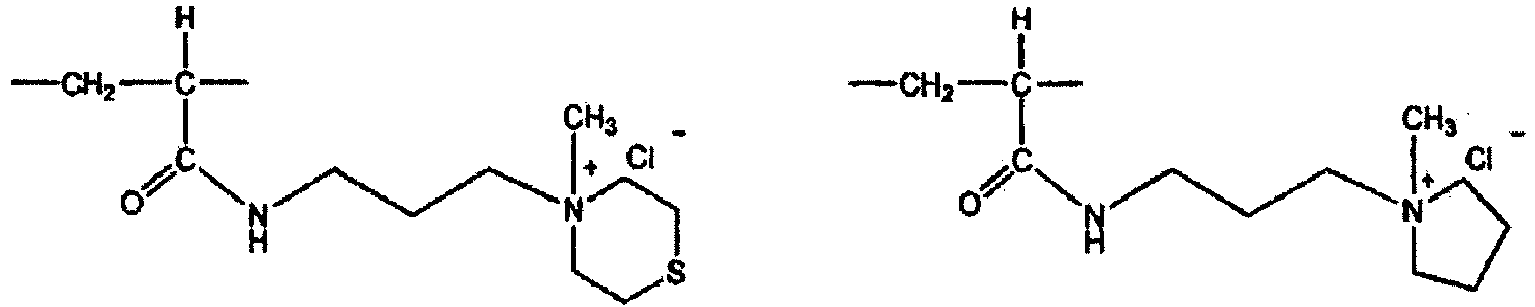


- The unit represented by Formula (IA) can be obtained from a compound represented by the following Formula (MA).
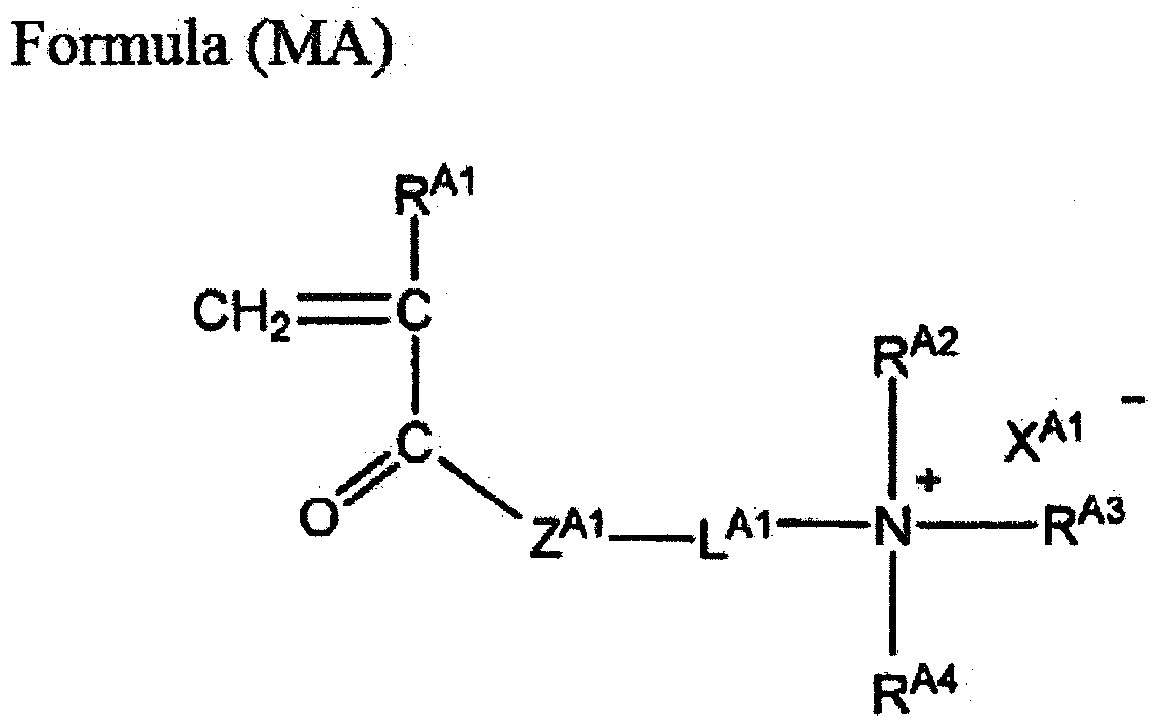
- In Formula (MA), RA1 to RA4, ZA1, LA1, and XA1 have the same definitions as those for RA1 to RA4, ZA1, LA1, and XA1 in Formula (IA) and preferable ranges thereof are the same as described above.
- Hereinafter, specific examples of the compound represented by Formula (MA) will be described, but the present invention is not limited thereto.


- It is preferable that the ion exchange polymer including the anion exchange group of the present invention has a unit obtained from a cross-linking agent in addition to the unit represented by the above-described Formula (IA).
Here, in the present invention, it is preferable that the cross-linking agent does not have an ionic group.
In the present invention, it is preferable that the ion exchange polymer has a unit represented by the following Formula (ICL) among units obtained from a cross-linking agent.
- In Formula (ICL), RCL1 represents a hydrogen atom or an alkyl group. ZCL1 and ZCL2 each independently represent -O- or -N(Ra)-. Here, Ra represents a hydrogen atom or an alkyl group. LCL1 represents a p1 + 1 valent linking group having 2 or more carbon atoms. p1 represents an integer of 1 or greater.
- Here, RCL1 has the same definition as that for RA1 in Formula (IA) and the preferable ranges thereof are the same as described above. ZCL1 and ZCL2 have the same definition as that for ZA1 in Formula (IA) and the preferable ranges thereof are the same as described above. Further, Ra has the same definition as that for Ra in Formula (IA) and the preferable ranges thereof are the same as described above.
- p1 represents preferably an integer of 1 to 4, more preferably an integer of 1 to 3, still more preferably 1 or 2, and particularly preferably 1.
- LCL1 represents a p1 + 1 valent linking group, and a p1 + 1 valent hydrocarbon group or a group formed by combining -O-, -S-, or -N(Ra)-, with a valence of p1 + 1, and a hydrocarbon group is preferable. Here, Ra represents a hydrogen atom or an alkyl group. The number of carbon atoms of the linking group is preferably in a range of 1 to 20 and more preferably in a range of 1 to 10.
In a case where ZCL1 and ZCL2 represent -N(Ra)-, it is preferable that LCL1 represents a p1 + 1 valent hydrocarbon group. The number of carbon atoms of such a hydrocarbon group is preferably in a range of 1 to 10, more preferably in a range of 1 to 6, still more preferably in a range of 1 to 3, and particularly preferably 1 or 2.
In a case where LCL1 represents a divalent hydrocarbon group, examples thereof include methylene, ethylene, propylene, hexamethylene, octamethylene, and decamethylene.
In a case where ZCL1 and ZCL2 represent -O-, it is preferable that LCL1 represents a group formed by combining -O-, -S- or -N(Ra)-, with a valence of p1 + 1, and a hydrocarbon group. Among these, a group formed by combining -O- and a hydrocarbon group is preferable.
In a case where LCL1 represents a divalent linking group, for example, an oxyalkylene group or a polyoxyalkylene group is preferable, and an oxyethylene group, a polyoxyethylene group, an oxypropylene group, and a polyoxypropylene group may be exemplified. - The linking group as LCL1 may include a substituent. It is preferable that such a substituent is a group selected from substituents other than groups serving as ionic groups, among the following substituent group α.
In the present invention, it is particularly preferable that the linking group as LCL1 is an unsubstituted group. - The unit represented by Formula (ICL) can be obtained from a compound represented by the following Formula (CL).

- In Formula (CL), RCL1, ZCL1, ZCL2, LCL1, and p1 have the same definitions as those for RCL1, ZCL1, ZCL2, LCL1, and p1 of Formula (ICL) and preferable ranges thereof are the same as described above.
- Hereinafter, specific examples of the compound represented by Formula (CL) will be described, but the present invention is not limited thereto.


- In the present invention, the ion exchange polymer having a cation exchange group may have any cation exchange group as long as the polymer has a unit obtained from an acryloyl group which may have an alkyl group at the α-position. As an example, a sulfo group or a salt thereof, a carboxy group or a salt thereof, and a phosphoric acid group or a salt are preferable and a sulfo group or a salt thereof and a carboxy group or a salt thereof are more preferable.
- Among these, an ion exchange polymer having a unit represented by the following Formula (IC) is preferable.
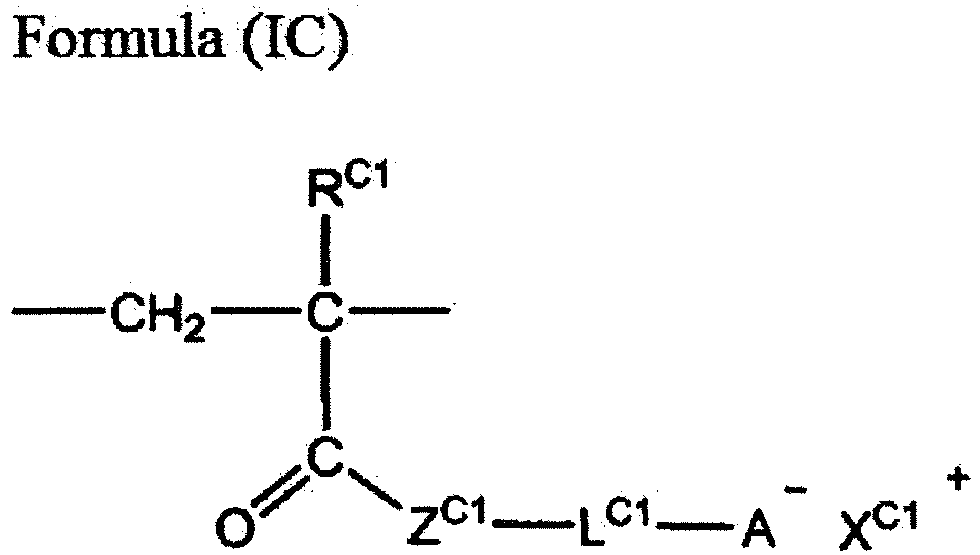
- In Formula (IC), RC1 represents a hydrogen atom or an alkyl group. ZC1 represents -O-, -N(Ra)-, or an alkylene group. Here, Ra represents a hydrogen atom or an alkyl group. LC1 represents an alkylene group or an arylene group. A- represents SO3 - or COO-. XC1 represents a hydrogen atom or an inorganic or organic cation.
- RC1 has the same definition as that for RA1 in Formula (IA) and the preferable ranges thereof are the same as described above.
Ra as ZC1 has the same definition as that for Ra in Formula (IA) and the preferable ranges thereof are the same as described above.
The number of carbon atoms of the alkylene group as ZC1 and LC1 is preferably in a range of 2 to 10, more preferably in a range of 2 to 8, and still more preferably in a range of 3 to 8, and examples thereof include ethylene, propylene, 1-methylmethylene, 1,1-dimethylmethylene, butylene, hexamethylene, and octamethylene.
The number of carbon atoms of the arylene group as LC1 is preferably in a range of 6 to 16, more preferably in a range of 6 to 12, and still more preferably in a range of 6 to 10, and examples thereof include phenylene and naphthylene.
In a case where both of ZC1 and LC1 represent an alkylene group, the number of carbon atoms of the -alkylene group-alkylene group- is preferably in a range of 2 to 10, more preferably in a range of 3 to 8, and still more preferably in a range of 4 to 6, and examples thereof include ethylene, propylene, 1-methylmethylene, 1,1-dimethylmethylene, butylene, pentamethylene, hexamethylene, and octamethylene.
The alkylene group or the arylene group as LC1 may include a substituent and examples of such a substituent include substituents selected from the following substituent group α. - It is preferable that LC1 represents an alkylene group.
- As an inorganic cation as XC1, an alkali metal ion is preferable and a lithium ion, a sodium ion, or a potassium ion is more preferable.
Examples of an organic cation as XC1 include a quaternary ammonium cation and a cation in which a nitrogen atom of an aromatic nitrogen-containing heterocycle is alkylated.
Examples of the quaternary ammonium cation include a tetramethylammonium cation, a tetraethylammonium cation, and a dimethylbenzylammonium cation and examples of the cation in which a nitrogen atom of an aromatic nitrogen-containing heterocycle is alkylated include a pyridinium cation. - It is preferable that XC1 represents a hydrogen atom, an alkali metal ion, a quaternary ammonium cation, or a pyridinium cation.
- The unit represented by Formula (IC) can be obtained from a compound represented by the following Formula (MC).

- In Formula (MC), RC1, ZC1, LC1, A-, and XC1 respectively have the same definitions as those for RC1, ZC1, LC1, A-, and XC1 in Formula (IC) and the preferable ranges thereof are the same as described above.
- Hereinafter, specific examples of the compound represented by Formula (MC) will be described, but the present invention is not limited thereto.


- It is preferable that the ion exchange polymer including the cation exchange group of the present invention has a unit obtained from a cross-linking agent in addition to the unit represented by the above-described Formula (IC).
Here, in the present invention, it is preferable that the cross-linking agent does not have an ionic group.
In the present invention, it is preferable that the ion exchange polymer has a unit represented by the above-described Formula (ICL) among units obtained from a cross-linking agent. - Here, the substituent group α will be described.
The substituent group α is a group of substituents consisting of the following substituents. - The substituent group α includes:
- an alkyl group (the number of carbon atoms of the alkyl group is preferably in a range of 1 to 30, more preferably in a range of 1 to 20, and particularly preferably in a range of 1 to 10, and examples thereof include methyl, ethyl, isopropyl, t-butyl, n-octyl, 2-ethylhexyl, n-decyl, and n-hexadecyl), a cycloalkyl group (the number of carbon atoms of the cycloalkyl group is preferably in a range of 3 to 30, more preferably in a range of 3 to 20, and particularly preferably in a range of 3 to 10, and examples thereof include cyclopropyl, cyclopentyl, and cyclohexyl), an alkenyl group (the number of carbon atoms of the alkenyl group is preferably in a range of 2 to 30, more preferably in a range of 2 to 20, and particularly preferably in a range of 2 to 10, and examples thereof include vinyl, allyl, 2-butenyl, and 3-pentenyl), an alkynyl group (the number of carbon atoms of the alkynyl group is preferably in a range of 2 to 30, more preferably in a range of 2 to 20, and particularly preferably in a range of 2 to 10, and examples thereof include propargyl and 3-pentynyl), an aryl group (the number of carbon atoms of the aryl group is preferably in a range of 6 to 30, more preferably in a range of 6 to 20, and particularly preferably in a range of 6 to 12, and examples thereof include phenyl, p-methylphenyl, naphthyl, and anthranyl), an amino group (such as an amino group, an alkylamino group, or an arylamino group; the number of carbon atoms of the amino group is preferably in a range of 0 to 30, more preferably in a range of 0 to 20, and particularly preferably in a range of 0 to 10 and examples thereof include amino, methylamino, dimethylamino, diethylamino, dibenzylamino, diphenylamino, and ditolylamino), an alkoxy group (the number of carbon atoms of the alkoxy group is preferably in a range of 1 to 30, more preferably in a range of 1 to 20, and particularly preferably in a range of 1 to 10, and examples thereof include methoxy, ethoxy, butoxy, and 2-ethylhexyloxy), an aryloxy group (the number of carbon atoms of the aryloxy group is preferably in a range of 6 to 30, more preferably in a range of 6 to 20, and particularly preferably in a range of 6 to 12, and examples thereof include phenyloxy, 1-naphthyloxy, and 2-naphthyloxy), a heterocyclic oxy group (the number of carbon atoms of the heterocyclic oxy group is preferably in a range of 2 to 30, more preferably in a range of 2 to 20, and particularly preferably in a range of 2 to 12, and examples thereof include pyridyloxy, pyrazyloxy, pyrimidyloxy, and quinolyloxy),
- an acyl group (the number of carbon atoms of the acyl group is preferably in a range of 1 to 30, more preferably in a range of 1 to 20, and particularly preferably in a range of 1 to 12, and examples thereof include acetyl, benzoyl, formyl, and pivaloyl), an alkoxycarbonyl group (the number of carbon atoms of the alkoxycarbonyl group is preferably in a range of 2 to 30, more preferably in a range of 2 to 20, and particularly preferably in a range of 2 to 12, and examples thereof include methoxycarbonyl and ethoxycarbonyl), an aryloxycarbonyl group (the number of carbon atoms of the aryloxycarbonyl group is preferably in a range of 7 to 30, more preferably in a range of 7 to 20, and particularly preferably in a range of 7 to 12, and examples thereof include phenyloxycarbonyl), an acyloxy group (the number of carbon atoms of the acyloxy group is preferably in a range of 2 to 30, more preferably in a range of 2 to 20, and particularly preferably in a range of 2 to 10, and examples thereof include acetoxy and benzoyloxy), an acylamino group (the number of carbon atoms of the acylamino group is preferably in a range of 2 to 30, more preferably in a range of 2 to 20, and particularly preferably in a range of 2 to 10, and examples thereof include acetylamino and benzoylamino),
- an alkoxycarbonylamino group (the number of carbon atoms of the alkoxycarbonylamino group is preferably in a range of 2 to 30, more preferably in a range of 2 to 20, and particularly preferably in a range of 2 to 12, and examples thereof include methoxycarbonylamino), an aryloxycarbonylamino group (the number of carbon atoms of the aryloxycarbonylamino group is preferably in a range of 7 to 30, more preferably in a range of 7 to 20, and particularly preferably in a range of 7 to 12, and examples thereof include phenyloxycarbonylamino), an alkyl or arylsulfonylamino group (the number of carbon atoms of the alkyl or arylsulfonylamino group is preferably in a range of 1 to 30, more preferably in a range of 1 to 20, and particularly preferably in a range of 1 to 12, and examples thereof include methanesulfonylamino and benzenesulfonylamino), a sulfamoyl group (such as a sulfamoyl group, or an alkyl or arylsulfamoyl group, the number of carbon atoms of the sulfamoyl group is preferably in a range of 0 to 30, more preferably in a range of 0 to 20, and particularly preferably in a range of 0 to 12, and examples thereof include sulfamoyl, methylsulfamoyl, dimethylsulfamoyl, and phenylsulfamoyl),
- a carbamoyl group (such as a carbamoyl group or an alkyl or arylcarbamoyl group, the number of carbon atoms of the carbamoyl group is preferably in a range of 1 to 30, more preferably in a range of 1 to 20, and particularly preferably in a range of 1 to 12, and examples thereof include carbamoyl, methylcarbamoyl, diethylcarbamoyl, and phenylcarbamoyl), an alkylthio group (the number of carbon atoms of the alkylthio group is preferably in a range of 1 to 30, more preferably in a range of 1 to 20, and particularly preferably in a range of 1 to 12, and examples thereof include methylthio and ethylthio), an arylthio group (the number of carbon atoms of the arylthio group is preferably in a range of 6 to 30, more preferably in a range of 6 to 20, and particularly preferably in a range of 6 to 12, and examples thereof include phenylthio), a heterocyclic thio group (the number of carbon atoms of the heterocyclic thio group is preferably in a range of 2 to 30, more preferably in a range of 2 to 20, and particularly preferably in a range of 2 to 12, and examples thereof include pyridylthio, 2-benzimidazolylthio, 2-benzoxazolylthio, and 2-benzothiazolylthio),
- an alkyl or arylsulfonyl group (the number of carbon atoms of the alkyl or arylsulfonyl group is preferably in a range of 1 to 30, more preferably in a range of 1 to 20, and particularly preferably in a range of 1 to 12, and examples thereof include mesyl and tosyl), an alkyl or arylsulfinyl group (the number of carbon atoms of the alkyl or arylsulfinyl group is preferably in a range of 1 to 30, more preferably in a range of 1 to 20, and particularly preferably in a range of 1 to 12, and examples thereof include methanesulfinyl and benzenesulfinyl), an ureido group (the number of carbon atoms of the ureido group is preferably in a range of 1 to 30, more preferably in a range of 1 to 20, and particularly preferably in a range of 1 to 12, and examples thereof include ureido, methylureido, and phenylureido), a phosphoric acid amide group (the number of carbon atoms of the phosphoric acid amide group is preferably in a range of 1 to 30, more preferably in a range of 1 to 20, and particularly preferably in a range of 1 to 12, and examples thereof include diethyl phosphoric acid amide and phenyl phosphoric acid amide), a hydroxy group, a mercapto group, a halogen atom (such as a fluorine atom, a chlorine atom, a bromine atom, or an iodine atom, and a fluorine atom is more preferable),
- a cyano group, a sulfo group, a carboxyl group, an oxo group, a nitro group, a hydroxamic acid group, a sulfino group, a hydrazine group, an imino group, a heterocyclic group (the number of carbon atoms of the heterocyclic group is preferably in a range of 1 to 30 and more preferably in a range of 1 to 12, examples of a heteroatom constituting the ring include a nitrogen atom, an oxygen atom, and a sulfur atom, and specific examples thereof include imidazolyl, pyridyl, quinolyl, furyl, thienyl, piperidyl, morpholino, benzoxazolyl, benzimidazolyl, benzothiazolyl, a carbazolyl group, and an azepinyl group), a silyl group (the number of carbon atoms of the silyl group is preferably in a range of 3 to 40, more preferably in a range of 3 to 30, and particularly preferably in a range of 3 to 24, and examples thereof include trimethylsilyl and triphenylsilyl), and a silyloxy group (the number of carbon atoms of the silyloxy group is preferably in a range of 3 to 40, more preferably in a range of 3 to 30, and particularly preferably in a range of 3 to 24, and examples thereof include trimethylsilyloxy and triphenylsilyloxy).
- These substituents may be substituted with any one or more substituents selected from the above-described substituent group α.
Further, in the present invention, when a plurality of substituents are present at one structural site, these substituents may be linked to each other and form a ring or may be fused with a part or entirety of the structural site and form an aromatic ring or an unsaturated heterocycle. - The auxiliary layer contains an ion exchange polymer having an ion exchange group with a charge opposite to a charge of an ion exchange group contained in the ion exchange polymer of the resin layer.
Therefore, in a case where the ion exchange group contained in the ion exchange polymer of the resin layer is an anion exchange group, the ion exchange group contained in the ion exchange polymer of the auxiliary layer is a cation exchange group. Further, in a case where the ion exchange group contained in the ion exchange polymer of the resin layer is a cation exchange group, the ion exchange group contained in the ion exchange polymer of the auxiliary layer is an anion exchange group.
As these ion exchange polymers, ion exchange polymers described in the ion exchange polymer contained in the resin layer are used.
In the present invention, it is preferable that the ion exchange group contained in the ion exchange polymer of the resin layer is an anion exchange group and the ion exchange group contained in the ion exchange polymer of the auxiliary layer is a cation exchange group. - The auxiliary layer may be provided on any one surface of the resin layer or both surfaces of the resin layer such that the resin layer is interposed therebetween.
Further, in a case where the auxiliary layers are provided on both surfaces of the resin layer such that the resin layer is interposed therebetween, the auxiliary layers on both surfaces may be completely the same as or different from each other and the thicknesses thereof may be the same as or different from each other. In the present invention, it is preferable that the auxiliary layers have the same thickness and are the same as each other. - The thickness of the resin layer is preferably in a range of 100 µm to 200 µm, more preferably in a range of 100 µm to 180 µm, and particularly preferably in a range of 100 µm to 160 µm.
Meanwhile, the thickness of the auxiliary layer is preferably in a range of 0.1 µm to 60 µm, more preferably in a range of 0.1 µm to 30 µm, and particularly preferably in a range of 0.1 µm to 10 µm.
Here, in the present invention, the thickness of the auxiliary layer is preferably 50% or less, more preferably 20% or less, and still more preferably 10% or less of the thickness of the resin layer.
In addition, the lower limit thereof is not particularly limited, but is typically 0.1% or greater. - In the present invention, when the thickness of the auxiliary layer is in the above-describe range, the electrical resistance of the membrane can be suppressed so that power consumption can be reduced through electrodialysis or the like in a case where the functional polymer membrane of the present invention is used for electrodialysis or the like.
Between a case where the auxiliary layer having an ionic group with the same charge as an ion exchange group of the resin layer is formed on one surface of the ion exchange membrane and a case where the auxiliary layer having an ionic group with a charge opposite to a charge of an ion exchange group of the resin layer is formed on one surface of the ion exchange membrane, the electrical resistance of the entire membrane in the latter case becomes larger than that of the former case because the charge is opposite to the charge of the ionic group of the surface layer and the electrical resistance is increased to prevent transmission of divalent or higher valent ions.
Therefore, it is preferable that an increase in electrical resistance of the membrane due to a decrease in thickness of the membrane is suppressed by setting the thickness of the auxiliary layer of the present invention to be in the above-described range. - The composition for forming a resin layer or an auxiliary layer of the present invention contains a compound represented by Formula (MA) in a case where the resin layer or the auxiliary layer contains an ion exchange polymer having an anion exchange group and contains a compound represented by Formula (MC) in a case where the resin layer or the auxiliary layer contains an ion exchange polymer having a cation exchange group. It is preferable that the composition for forming a resin layer or an auxiliary layer contains a cross-linking agent. As the cross-linking agent, a cross-linking agent represented by Formula (CL) is preferable.
In a case where the total solid content of the composition for forming a resin layer or an auxiliary layer is set to 100 parts by mass, the content of the compound represented by Formula (MA) or (MC) is preferably in a range of 20 to 90 parts by mass, more preferably in a range of 30 to 85 parts by mass, and still more preferably in a range of 35 to 80 parts by mass.
In a case where the total solid content of the composition for forming a resin layer or an auxiliary layer is set to 100 parts by mass, the content of the cross-linking agent is preferably in a range of 5 to 60 parts by mass, more preferably in a range of 10 to 50 parts by mass, and still more preferably in a range of 15 to 45 parts by mass. - It is preferable that the composition for forming a resin layer or an auxiliary layer of the present invention is polymerized and cured in the coexistence of a polymerization initiator. Accordingly, it is preferable that the composition for forming a resin layer or an auxiliary layer contains a polymerization initiator.
- In the present invention, among polymerization initiators, photopolymerization initiators which are capable of initiating polymerization through irradiation with ultraviolet rays.
Examples of the photopolymerization initiators include aromatic ketones, an acylphosphine compound, an aromatic onium salt compound, an organic peroxide, a thio compound, a hexaarylbiimidazole compound, a ketoxime ester compound, a borate compound, an azinium compound, a metallocene compound, an active ester compound, a compound having a carbon halogen bond, and an alkylamine compound.
The polymerization initiator is not necessarily limited to a photopolymerization initiator as long as the polymerization initiator is dissolved in each of the above-described components or a solvent used at the time of a reaction. Examples of such a polymerization initiator include an oil-soluble peroxide-based thermal polymerization initiator such as benzoyl peroxide (BPO); an oil-soluble azo-based thermal polymerization initiator such as azobisisobutyronitrile (AIBN); and a water-soluble azo-based thermal polymerization initiator such as an azobiscyanovaleric acid (ACVA). Further, the proportion of water in a solvent of solution polymerization is large, a water-soluble peroxide-based thermal polymerization initiator such as ammonium persulfate or potassium persulfate; or hydrogen peroxide water can be used. Further, a combination of redox agents such as ferrocene or amines can be used. - Preferred examples of the aromatic ketones, the acylphosphine oxide compound, and the thio compound include compounds having a benzophenone skeleton or a thioxanthone skeleton described in "RADIATION CURING IN POLYMER SCIENCE AND TECHNOLOGY", pp. 77 to 117 (1993). More preferred examples thereof include an α-thiobenzophenone compound described in
JP1972-6416B JP-S47-6416B JP1972-3981B JP-S47-3981B JP1972-22326B JP-S47-22326B JP1972-23664B JP-S47-23664B JP1982-30704A JP-S57-30704A JP1985-26483B JP-S60-26483B JP1985-26403B JP-S60-26403B JP1987-81345A JP-S62-81345A JP1989-34242B JP-H01-34242B US4318791A , and the specification ofEP0284561A1 , p-di(dimethylaminobenzoyl)benzene described inJP1990-211452A JP-H02-211452A JP1986-194062A JP-S61-194062A JP1990-9597B JP-H02-9597B JP1990-9596B JP-H02-9596B JP1988-61950B JP-S63-61950B JP1984-42864B JP-S59-42864B JP2008-105379A JP2009-114290A - In the present invention, a water-soluble polymerization initiator is preferable.
Here, when a polymerization initiator is water-soluble, 0.1% by mass or greater of the polymerization initiator is dissolved in distilled water at 25°C. It is preferable that 1% by mass or greater of the water-soluble polymerization initiator is dissolved in distilled water at 25°C and particularly preferable that 3% by mass or greater of the water-soluble polymerization initiator is dissolved in distilled water at 25°C. - In the present invention, the content of the polymerization initiator is preferably in a range of 0.1 to 10 parts by mass, more preferably in a range of 0.1 to 5 parts by mass, and still more preferably in a range of 0.3 to 2 parts by mass with respect to 100 parts by mass of the total solid content in the composition for forming a resin layer or an auxiliary layer.
- It is preferable that the composition for forming a resin layer or an auxiliary layer of the present invention includes a polymerization inhibitor.
As the polymerization inhibitor, optional polymerization inhibitors can be used and examples thereof include a phenol compound, a hydroquinone compound, an amine compound, and a mercapto compound.
Specific examples of the phenol compound include hindered phenol (indicating phenol having a t-butyl group at an ortho position and 2,6-di-t-butyl-4-methylphenol is typically exemplified) and bisphenol. Specific examples of the hydroquinone compound include monomethyl ether hydroquinone. Further, specific examples of the amine compound include N-nitroso-N-phenylhydroxylamine and N,N-diethylhydroxylamine.
Moreover, these polymerization inhibitors may be used alone or in combination of two or more kinds thereof.
The content of the polymerization inhibitor is preferably in a range of 0.01 to 5 parts by mass, more preferably in a range of 0.01 to 1 part by mass, and still more preferably in a range of 0.01 to 0.5 parts by mass with respect to 100 parts by mass of the total solid content in the composition for forming a resin layer or an auxiliary layer. - The composition for forming a resin layer or an auxiliary layer of the present invention may contain a solvent. The content of the solvent in the composition for forming a resin layer or an auxiliary layer is preferably in a range of 5% to 40% by mass, more preferably in a range of 10% to 40% by mass, and still more preferably in a range of 20% to 40% by mass with respect to the total content of the composition for forming a resin layer or an auxiliary layer.
When the composition contains a solvent, a curing (polymerization) reaction uniformly and smoothly proceeds. Further, in a case where a porous support is impregnated with the composition for forming a resin layer or an auxiliary layer, this impregnation smoothly proceeds. - As the solvent, water or a mixed solution of water and a solvent having a solubility of 5% by mass or greater in water is preferably used and solvents which can be freely mixed into water are more preferable. Accordingly, solvents selected from water and water-soluble solvents are preferable.
Particularly preferred examples of the water-soluble solvents include an alcohol-based solvent, an ether-based solvent which is an aprotic polar solvent, an amide-based solvent, a ketone-based solvent, a sulfoxide-based solvent, a sulfone-based solvent, a nitrile-based solvent, and an organic phosphorous-based solvent.
Examples of the alcohol-based solvent include methanol, ethanol, isopropanol, n-butanol, ethylene glycol, propylene glycol, diethylene glycol, and dipropylene glycol. These may be used alone or in combination of two or more kinds thereof.
Further, preferred examples of the aprotic polar solvent include dimethyl sulfoxide, dimethylimidazolidinone, sulfolane, N-methylpyrrolidone, dimethylformamide, acetonitrile, acetone, dioxane, tetramethylurea, hexamethylphosphoramide, hexamethylphosphorotriamide, pyridine, propionitrile, butanone, cyclohexane, tetrahydrofuran, tetrahydropyran, ethylene glycol diacetate, and γ-butyrolactone. Among these, dimethyl sulfoxide, N-methylpyrrolidone, dimethylformamide, dimethylimidazolidinone, sulfolane, acetone or acetonitrile, and tetrahydrofuran are more preferable. These may be used alone or in combination of two or more kinds thereof. - The composition for forming a resin layer or an auxiliary layer of the present invention may include an alkali metal compound in order to improve the solubility of the compound represented by Formula (CL). Preferred examples of the alkali metal compound include hydroxide salts, chloride salts, and nitrate of lithium, sodium, and potassium. Among these, a lithium compound is more preferable and specific examples thereof include lithium hydroxide, lithium chloride, lithium bromide, lithium nitrate, lithium iodide, lithium chlorate, lithium thiocyanate, lithium perchlorate, lithium tetrafluoroborate, lithium hexafluorophosphate, and lithium hexafluoroarsenate.
Here, it is also preferable that the alkali metal compound is used to neutralize a composition solution mixture for forming a resin layer or an auxiliary layer.
These alkali metal compounds may be hydrates and may be used alone or in combination of two or more kinds thereof.
The amount of the alkali metal compound to be added to the composition for forming a resin layer or an auxiliary layer is preferably in a range of 0.1 to 20 parts by mass, more preferably in a range of 1 to 20 parts by mass, and still more preferably in a range of 5 to 20 parts by mass with respect to 100 parts by mass of the total solid content in the composition for forming a resin layer or an auxiliary layer. - The composition for forming a resin layer or an auxiliary layer of the present invention may contain a surfactant, a viscosity improver, a surface tension adjustor, and a preservative as necessary.
- Next, the method of producing a functional polymer membrane of the present invention will be described.
The method of producing a functional polymer membrane includes a process of impregnating or coating the porous support with the composition for forming the resin layer to form the resin layer through a polymerization curing reaction; and a process of coating the porous support with the composition for forming the auxiliary layer to form the auxiliary layer through a polymerization curing reaction. - Hereinafter, an example of the method of producing a functional polymer membrane of the present invention will be described in detail.
- The resin layer of the present invention can be prepared using a temporary support (peeled off from the membrane after a curing reaction is finished). In this case, since a porous support which becomes a part of the functional polymer membrane is used in the present invention, it is preferable that the resin layer is prepared using this porous support without using a temporary support.
Further, the resin layer can be prepared using a fixed porous support according to a batched type (batched system) or using a moving porous support according to a continuous type (continuous system).
Moreover, in a case where a temporary support is used, it is not necessary to consider substance permeation and the temporary support is not particularly limited as long as the support include a metal plate such as an aluminum plate and can be fixed for film formation. - The porous support can be coated or impregnated with the composition for forming a resin layer using various methods such as curtain coating, extrusion coating, air-knife coating, slide coating, nip roll coating, forward roll coating, reverse roll coating, dip coating, kiss coating, rod bar coating, or spray coating. A plurality of layers can be coated simultaneously or continuously. For simultaneous multilayer coating, curtain coating, slide coating, slot die coating, or extrusion coating is preferable.
- When a continuous system of a resin layer is used, it is preferable that the moving porous support is continuously coated with the composition for forming a resin layer used in the present invention, film formation is carried out by polymerization and curing, and then formed film is collected. Accordingly, it is preferable that a resin layer is produced by using a producing unit that includes means for moving a composition coating unit for forming a resin layer (or an impregnating unit), an irradiation source for polymerizing and curing the composition for forming a resin layer, a film winding unit (or a collecting unit) which collects a formed film, and a porous support from the composition coating unit for forming a resin layer (or an impregnating unit) to the irradiation source and the film winding unit.
- In the present production example, the resin layer of the present invention is produced by performing a process of (i) coating or impregnating a porous support with the composition for forming a resin layer of the present invention and a process of (ii) irradiating the composition for forming a resin layer with light and causing a polymerization curing reaction in the composition through heating as necessary.
- In the production unit, the composition coating unit for forming a resin layer (or an impregnating unit) is provided on the upstream side of the irradiation source and the irradiation source is disposed on the upstream side of the film winding unit.
At the time of application using a high-speed coating machine, from the viewpoint of having sufficient fluidity, the viscosity of the composition for forming a resin layer of the present invention is measured at 35°C and is preferably less than 4,000 mPa·s, more preferably in a range of 1 to 1,000 mPa·s, and most preferably in a range of 1 to 500 mPa·s. In a case of slid bead coating, the viscosity thereof at 35°C is preferably in a range of 1 to 100 mPa·s. - In the high-speed coating machine, a moving porous support can be coated with a coating solution which is the composition for forming a resin layer at a speed of faster than 15 m/min and can be also coated at a speed of faster than 20 m/min.
- Particularly in a case where a porous support is used to increase the mechanical strength, the porous support may be subjected to a corona discharge treatment, a glow discharge treatment, a flame treatment, or an ultraviolet irradiation treatment in order to improve wettability and adhesive force of the porous support before the surface of the porous support is coated with the composition for forming a resin layer of the present invention.
- The polymerization and curing of the composition for forming a resin layer of the present invention is started in preferably 60 seconds, more preferably 15 seconds, particularly preferably 5 seconds, and most preferably 3 seconds after the porous support is coated or impregnated with the composition for forming a resin layer.
The irradiation with light for the polymerization and curing of the composition is carried out for preferably less than 10 seconds, more preferably less than 5 seconds, particularly preferably less than 3 seconds, and most preferably less than 2 seconds. The irradiation with light is continuously carried out in a case of the continuous method and the time for the polymerization curing reaction is determined in consideration of the speed at which the composition for forming a resin layer moves through irradiation beams. - Since a large amount of heat is generated in a case where ultraviolet rays (UV light) with high intensity are used for the polymerization curing reaction, it is preferable that at least one (preferably the entirety) of a lamp serving as a light source, a porous support, or the formed membrane are cooled with cooling air in order to prevent overheating. In a case where a significant amount of ultraviolet rays (IR light) are applied together with UV beams, UV light is applied using an IR reactive quartz plate as a filter.
- Ultraviolet rays are preferable as energy rays. It is preferable that the irradiation wavelength is compatible with an absorption wavelength of an arbitrary photopolymerization initiator included in the composition for forming a resin layer and UV-A (400 to 320 nm), UV-B (320 to 280 nm), and UV-C (280 to 200 nm) may be exemplified.
- Examples of UV sources include a mercury arc lamp, a carbon arc lamp, a low-pressure mercury lamp, a medium-pressure mercury lamp, a high-pressure mercury lamp, a swirling flow plasma arc lamp, a metal halide lamp, a xenon lamp, a tungsten lamp, a halogen lamp, a laser light emitting diode, and an ultraviolet light emitting diode. A medium-pressure or high-pressure mercury vapor type ultraviolet light emitting lamp is particularly preferable as a UV source. In addition, in order to modify the emission spectrum of a lamp, additives such as a metal halide may be present. A lamp with maximum emission at a wavelength of 200 to 450 nm is particularly suitable.
- The energy output of the irradiation source is preferably in a range of 20 to 1,000 W/cm and more preferably in a range of 40 to 500 W/cm, and the exposure amount may be low or high if a desired exposure amount can be realized. The polymerization and curing of the resin layer are adjusted by exposure intensity. The exposure amount is measured in the range of UV-A shown by a device using High Energy UV Radiometer (UV Power Puck™, manufactured by EIT-Instrument Markets) and is preferably at least 40 mJ/cm2 or greater, more preferably in a range of 100 to 2,000 mJ/cm2, and most preferably in a range of 150 to 1,500 mJ/cm2. The exposure time can be freely selected, but is preferably short and most preferably less than 2 seconds.
- Moreover, in a case where the coating speed is high, a plurality of light sources may be used in order to obtain the exposure amount which is required. In this case, the exposure intensities of the plurality of light sources may be the same as or different from each other.
- The auxiliary layer is formed by performing a process of (i') coating one or both surfaces of the above-described prepared resin layer with the composition for forming an auxiliary layer of the present invention and a process of (ii') irradiating the composition for forming an auxiliary layer with light and causing a polymerization curing reaction in the composition through heating as necessary. These processes (i') and (ii') are the same as the processes (i) and (ii) in the preparation of a resin layer except the description related to the porous support.
Further, in order to improve adhesiveness of the resin layer to the auxiliary layer, the surface of the resin layer may be subjected to a roughening treatment using sand paper or the like, a corona treatment, or a plasma treatment, as a pre-treatment of the application of the composition for forming an auxiliary layer. - The functional polymer membrane of the present invention is mainly intended to be used for ion exchange. However, the functional polymer membrane of the present invention is not limited to ion exchange and can be suitably used for reverse osmosis and gas separation.
As described above, the functional polymer membrane of the present invention is useful as an ion exchange membrane that selectively transmits monovalent ions, can be used for electrodeionization, continuous electrodeionization, electrodialysis, electrodialysis reversal, reverse electrodialysis, or these devices, and can be used for not only general purpose but also medical applications. Recently, the functional polymer membrane can be used for a solid polymer electrolyte fuel cell.
Further, the applications of the functional polymer membrane of the present invention are not particularly limited, but the functional polymer membrane can be used for a device and the like in the form described above of a single functional polymer membrane or a stack.
Here, the term "stack" indicates a module in which an anion exchange membrane and a cation exchange membrane are alternately disposed between a pair of electrodes. In the present invention, a functional polymer membrane having the auxiliary layer of the present invention and the resin layer containing an ion exchange polymer that has an anion exchange group is used as the anion exchange membrane and a functional polymer membrane having the auxiliary layer of the present invention and the resin layer containing an ion exchange polymer that has a cation exchange group is used as this cation exchange membrane. - Hereinafter, the present invention will be described in detail based on examples, but the present invention is not limited thereto. Further, "part" and "%" are on a mass basis unless otherwise noted.
- A coating solution of a composition for forming a resin layer or an auxiliary layer containing an anion exchange group and a coating solution of a composition for forming a resin layer or an auxiliary layer containing a cation exchange group were respectively prepared with the compositions (unit: g) listed in the following Table 1.
Further, "-" in Table 1 indicates that the component was not contained. Further, the composition for forming a resin layer or an auxiliary layer was simply described as the "composition" in the following Table 1.[Table 1] Type of material Name of material Composition A-1 Composition A-2 Composition B-1 Composition B-2 Composition B-3 Composition B-4 Composition B-5 Composition containing anion exchange group Composition containing anion exchange group Composition containing cation exchange group Composition containing cation exchange group Composition containing cation exchange group Composition containing cation exchange group Composition containing cation exchange group Monofunctional monomer DMAPAA-Q 40.00 40.00 - - - - - AMPS - - 42.61 42.61 - - - Carboxyethylacrylate - - - - 44.00 - - 6-Acrylamidohexanoic acid - - - - - 47.80 - 7-Oxo-8-nonenoic acid - - - - - - 45.40 Cross-linking agent MBA 9.90 6.9 16.01 13.01 23 19.6 21.3 SR259 - 3.0 - 3.0 - - - Photopolymerization initiator Darocur 1173 0.70 0.70 0.92 0.92 0.92 0.92 0.92 Polymerization initiator MEHQ 0.02 0.02 - - - - - Genorad16 - - 0.02 0.02 0.02 0.02 0.02 Catalyst LiNO3 20.40 20.40 - - - - - LiOH·H2O - - 8.46 8.46 - - - Solvent Pure water 20.60 20.60 22.90 22.90 22.90 22.90 22.90 IPA 8.40 8.40 9.14 9.14 9.14 9.14 9.14 Total mass 100 100 100 100 100 100 100 [0125] [Description of abbreviations in Table 1] · Monofunctional monomer
DMAPAA-Q: dimethylaminopropylacrylamide methyl chloride quaternary salt (3-acrylamidepropyl trimethylammonium chloride) (manufactured by Kohjin Co., Ltd.)
AMPS (registered trademark): 2-acrylamide-2-methylpropanesulfonic acid (manufactured by Lubrizol Ltd.)
· Cross-linking agent
MBA: methylene bisacrylamide (manufactured by Tokyo Chemical Industry Co., Ltd.)
SR259: polyethylene glycol 200 acrylate (manufactured by Sartomer Company Inc.)
· Polymerization initiator
Darocur (registered trademark) 1173: manufactured by BASF Japan Ltd.
MEHQ: monomethyl ether hydroquinone (manufactured by Sigma-Aldrich Co., LLC.)
Genorad16: trade name, manufactured by Rahn AG
· Solvent
IPA: isopropyl alcohol (manufactured by Wako Pure Chemical Industries, Ltd.)

- An aluminum plate was manually coated with a coating solution having the composition A-1 listed in the above-described Table 1 at a speed of approximately 5 m/min using a wire bar (stainless steel rod wound around with a wire having a diameter of 150 µm at 1 round/3 cm (length direction)) and then non-woven fabric (FO-2223-10, manufactured by Freudenberg, thickness of 100 µm) was impregnated with the coating solution. The extra coating solution was removed using a rod which was not wound around with a wire. The temperature of the coating solution at the time of coating was approximately 25°C (room temperature). The porous support impregnated with the coating solution was subjected to a polymerization curing reaction using a UV exposure machine (model: LIGHT HAMMER 10, manufactured by Fusion UV System Corporation, D-valve, conveyor speed: 9.5 m/min, 100% strength) and the coating solution was cured, thereby preparing a resin layer. The exposure amount in a UV-A region was 1,000 mJ/cm2. The obtained membrane was removed from the aluminum plate and was stored in a 0.1 M NaCl solution at 25°C for 12 hours, thereby preparing a resin layer having a thickness of 140 µm which was supported by non-woven fabric.
- A coating solution having the composition B-1 listed in the above-described Table 1 was added dropwise to the resin layer prepared in the above-described manner, the resin layer was uniformly spin-coated with the coating solution at a rotational speed of 2,000 rpm for 30 seconds using a spinner ASC-4000 (trade name, manufactured by ActesKyosan Inc.). The temperature of the coating solution at the time of spin-coating was approximately 25°C (room temperature). In the same manner as the resin layer, an auxiliary layer was prepared by causing a polymerization curing reaction in the coating solution having the composition B-1 using a UV exposure machine. The obtained ion exchange membrane was stored in a 0.1 M NaCl solution at 25°C for 12 hours, thereby preparing an auxiliary layer having a thickness of 5 µm on the resin layer which was supported by non-woven fabric.
- Ion exchange membranes were prepared in the same manner as in Example 1 except that the compositions for forming a resin layer or an auxiliary layer or the thicknesses of these layers were changed as listed in the following Table 2.
- Ion exchange membranes were prepared in the same manner as in Example 1 except that the compositions for forming a resin layer or an auxiliary layer or the thicknesses of these layers were changed as listed in the following Table 2, and then the membranes were immersed in a 0.01 M NaOH aqueous solution at 25°C for 30 minutes so that the carboxy group of the cation exchange group in the auxiliary layer was converted into sodium salts (neutralization reaction).
- An aluminum plate was manually coated with a coating solution having the composition A-1 listed in the above-described Table 1 at a speed of approximately 5 m/min using a wire bar (stainless steel rod wound around with a wire having a diameter of 150 µm at 1 round/3 cm (length direction)) and then non-woven fabric (FO-2223-10, manufactured by Freudenberg, thickness of 100 µm) was impregnated with the coating solution. The extra coating solution was removed using a rod which was not wound around with a wire. The temperature of the coating solution at the time of coating was approximately 25°C (room temperature). The porous support impregnated with the coating solution was subjected to a polymerization curing reaction using a UV exposure machine (model: LIGHT HAMMER 10, manufactured by Fusion UV System Corporation, D-valve, conveyor speed: 9.5 m/min, 100% strength) and the coating solution was cured, thereby forming a resin layer. The exposure amount in a UV-A region was 1,000 mJ/cm2. The obtained membrane was removed from the aluminum plate to form a resin layer. The thickness of the resin layer was measured after the resin layer was stored in a 0.1 M NaCl solution for 12 hours, and the thickness thereof was 147 µm.
- A coating solution having the composition B-1 listed in the above-described Table 1 was added dropwise to the resin layer prepared in the above-described manner, the resin layer was uniformly spin-coated with the coating solution at a rotational speed of 2,000 rpm for 30 seconds using a spinner ASC-4000 (trade name, manufactured by ActesKyosan Inc.). The temperature of the coating solution at the time of spin-coating was approximately 25°C (room temperature). In the same manner as the resin layer, an auxiliary layer having a thickness of 5 µm was prepared on one surface of the resin layer by causing a polymerization curing reaction in the coating solution having the composition B-1 using a UV exposure machine. Next, similarly, the coating solution having the composition B-1 listed in the above-described Table 1 was added dropwise to the resin layer on the opposite side to the formed auxiliary layer, the resin layer was uniformly spin-coated with the coating solution at a rotational speed of 2,000 rpm for 30 seconds using a spinner ASC-4000 (trade name, manufactured by ActesKyosan Inc.). The temperature of the coating solution at the time of spin-coating was approximately 25°C (room temperature). In the same manner as the resin layer, auxiliary layers were prepared on both surfaces of the resin layer by causing a polymerization curing reaction in the coating solution having the composition B-1 using a UV exposure machine. After the obtained ion exchange membrane was stored in a 0.1 M NaCl solution for 12 hours, the thickness of the auxiliary layers was measured. The thickness of the auxiliary layers provided on both surfaces of the resin layer was 10 µm in total thickness of both surfaces. In this manner, an ion exchange membrane having auxiliary layers on both surfaces of the resin layer supported by non-woven fabric was prepared.
- The following items of the ion exchange membranes prepared in Examples 1 to 10 and Comparative Example 1 were evaluated. The obtained results are collectively listed in the following Table 2.
- When resin layers and auxiliary layers for measurement were provided, a sample with these layers and a sample without these layers were prepared and immersed in 0.1 M NaCl aqueous solution at 25°C for 12 hours. Further, the films were taken out, water on the surfaces was wiped off, and then the thickness of each sample was all measured using a micrometer. The film thickness of provided layers was acquired from a different in film thickness of the sample with the layers and the sample without the layers.
- The ion exchange capacity was measured using a method described in "Membranology Experimental Methods" written by Masayoki Nakagaki, pp. 193 to 195 (1984).
Further, the measurement values listed in the following Table 2 were obtained by measuring the anion exchange capacity and the cation exchange capacity with respect to composite films after the surface layers were formed. From these ratios, the ion exchange capacity ratio with the resin layer and the auxiliary layer were calculated. - Both surfaces of a film immersed in a 0.5 M NaNO3 aqueous solution for approximately 2 hours were wiped using dry filter paper and the film was interposed between two chambers of a cell (effective film area of 1 cm2, a Ag/AgCl reference electrode (manufactured by Metrohm Ltd.) was used as an electrode). Both chambers were respectively filled with 100 mL of NaNO3 aqueous solutions with the same concentration and allowed to stand in a constant temperature water tank at 25°C until the both chambers reached equilibrium, electrical resistance r1 was measured using an AC bridge (frequency of 1,000 Hz) after the liquid temperature in the cell reached 25°C. The film was removed so that only the 0.5 M NaNO3 aqueous solution was left, electrical resistance r2 between electrodes was measured, and electrical resistance r of the film was acquired using r1- r2. This was set to electrical resistance ER (0.5 M NaNO3).
- The electrical resistance ER (0.5 M Na2SO4) and the electrical resistance ER (0.5 M MgCl2) of a film were measured in the same manner as the electrical resistance ER (0.5 M NaNO3) of a film except that the solution used for measurement was changed to Na2SO4 or MgCl2. The measurement results are listed in the following Table 2. Further, the electrical resistance ER of a film was abbreviated as "ER" in the following Table 2.
- The electrical resistances of the above-described ion exchange membranes before and after the membranes were irradiated with ultrasonic waves for 60 minutes were measured using an ultrasonic cleaner US-4 (manufactured by ASONE Corporation). When a change in electrical resistance of a membrane was small, this means that peeling or partial peeling of an auxiliary layer did not occur.
The electrical resistance values of the membrane after being irradiated with ultrasonic waves were described in parentheses below the values of electrical resistance ER or the ER ratio of each membrane listed in the following Table 2.[Table 2] Items Details of items Auxiliary layer on resin layer Same auxiliary layers on both surfaces of resin layer Comparative Example 1 Example 1 Example 2 Example 3 Example 4 Example 5 Example 6 Example 7 Example 8 Example 9 Example 10 Constituent layer Composition for resin layer A-1 A-1 A-1 A-1 B-1 A-2 B-2 A-1 A-1 A-1 A-1 Composition for auxiliary layer B-1 B-1 B-1 A-1 B-2 A-2 B-3 B-4 B-5 B-1 Thickness Film thickness of resin layer [µm] 140 142 141 143 144 143 143 141 138 139 147 Film thickness of auxiliary laver [µm] 5 27 46 6 6 5 6 4 4 10 Total film thickness of layers [µm] 140 147 168 189 150 149 148 147 142 143 157 Performance Anion exchange capacity [meq/g drymem note 1)] 1.5 1.5 1.4 1.5 0.24 1.5 0.25 1.5 1.4 1.5 1.5 Cation exchange capacity [meq/g drymem note 1)] 0.27 0.34 0.88 1.4 0.25 1.3 0.29 0.21 0.22 0.29 Ion exchange capacity ratio Auxiliary layer/resin layer 0% 18% 24% 59% 17% 17% 19% 19% 15% 15% 19% ER(0.5M NaNO3) [Ω·cm2] 2.8 3.4(3.4) 4.8 (4.8) 6.2 (6.2) 3.2 (3.0) 3.8(3.8) 3.4 (3.4) 2.7(2.7) 2.8(3.1) 2.5(2.9) 3.6 (3.6) ER(0.5M Na2SO4) [Ω·cm2] 4.5 13.8 (13.7) 19.1(19.1) 17.0(16.9) 14.0 (14.0) 11.1(11.1) 10.5(13.7) 10.8(13.7) 18.0 (17.9) ER(0.5M MgCl2) [Ω·cm2] 11.3(11.3) 12.0(11.9) ER ratio (NaNO3/Na2SO4) 1.6 4.1 (4.0) 4.0 (4.0) 2.7(2.7) 3.7(3.7) 4.1(4.0) 3.8(3.7) 4.3 (4.3) 5.0 (5.0) ER ratio (NaNO3/MgCl2) 3.5(3.5) 3.5(3.5) Note1) drymem indicates the mass of the entire membrane in a case where the resin layer on which the auxiliary layer was formed was dried.
* The numerical values in the parentheses of the ER and the ER ratio are values after the peeling resistance test was performed (the same membranes for measurement were used). - The ER ratios of the ion exchange membranes of Examples 1 to 10 are 1.7 to 3 times the ER ratio of the electrical resistance of Comparative Example 1 in which the auxiliary layer with an opposite charge was not provided. Further, the ER ratio was 5.0, which was the greatest, in Example 10 in which auxiliary layers were provided on both surfaces of the resin layer.
As a result, it was understood that the ion exchange membranes of Examples 1 to 10 have excellent selective permeability of monovalent ions such as nitric acid ions.
Here, from the comparison of Examples 1 to 3, it was understood that the thickness of the auxiliary layer is increased, the cation exchange capacity is increased, and then the ion exchange capacity ratio (auxiliary layer/resin layer) is increased, and thus the electrical resistance ER (0.5 M, NaNO3) of sodium nitrate is increased. Consequently, the ER ratio is decreased in conversely.
A negative charge of the auxiliary layer electrostatically repels an anion (NO3- or SO4 2-) permeating into the resin layer on the surface. Since SO4 2- having a higher valence is more strongly repelled, the ER is increased and the ER ratio showing selective permeability of monovalent ions is increased (selective ER ratio is expressed). However, it is assumed that repulsive force with respect to monovalent ions as well as divalent ions is increased and thus the ER ratio is decreased when the auxiliary layer becomes thick.
Further from the comparison of Examples 1 and 4, in a case where ion exchange resins contained in the resin layers and the auxiliary layers were replaced, that is, in Example 1 in which an ion exchange polymer having an anion exchange group was used for the resin layer and Example 4 in which an ion exchange polymer having a cation exchange group was used for the resin layer, the ion exchange capacity ratios are 17 to 18%, which are approximately the same. Further, divalent ions have a difference in sulfuric acid ions and magnesium ions, but the ER ratio thereof of Example 4 is 3.5 while the ER ratio thereof of Example 1 is 4.1. The selective permeability of monovalent ions of Example 1 is excellent compared to the selective permeability of Example 4.
In Examples 5 and 6 in which both of diacrylic acid amide and diacrylic acid ester were used for a cross-linking agent, the ER ratios were 3.5 to 3.7 and the selective permeability of monovalent ions is approximately the same as the corresponding Examples 1 and 4. Even when the selective permeability of monovalent ions was the same even when the ion exchange resins contained in the resin layer and the auxiliary layer were replaced.
As described above, the permeability of sulfuric acid ions with respect to nitric acid ions was able to be degraded by expressing the selective ER ratio by forming the auxiliary layer. In this manner, for example, in a case where ground water was subjected to an electrodialysis treatment, calcium ions contained in the ground water permeated into the membrane to precipitate sulfuric acid ions and sparingly soluble salts. Therefore, the possibility of scaling causing clogging was able to be prevented. - In addition, in the ion exchange membranes of Examples 1 to 10, it is understood that film resistance values after irradiation with ultrasonic waves were not almost decreased and the peeling resistance of the auxiliary layers is excellent. Unlike the case where an ion exchange membrane was produced using a method of bonding an anion exchange membrane and a cation exchange membrane to each other and cross-linking the produced membrane with a cross-linking agent such as a polyvalent acylating agent as in the related art, the peeling resistance of the membrane of the present invention is excellent because the adhesiveness is improved through entanglement of polymer chains or the like by a polymerization solution, which is a composition for forming an auxiliary layer, permeating into a resin layer having a cross-linked structure to cause a polymerization curing reaction accompanied by cross-linking.
- In addition, as is evident from the processes of producing ion exchange membranes of the examples of the present invention, the resin layer and the auxiliary layer are formed through photopolymerization rapidly and efficiently. Further, since a monofunctional monomer that forms an ion exchange polymer has a charge in advance, an ionization process after film formation as in the related art is unnecessary.
- The present invention has been described with reference to embodiments, but any detailed description of the invention is not intended to be limited unless otherwise specified.
The appended claims should be broadly interpreted within the range not departing from the spirit and the scope of the invention. - The present application claims priority based on Japanese Patent Application No.
2014-165310 filed on August 14, 2014 2015-009365 filed on January 21, 2015
Claims (29)
- A functional polymer membrane comprising:a porous support; anda resin layer and an auxiliary layer which are supported by the porous support,wherein both of the resin layer and the auxiliary layer contain an ion exchange polymer having one of an anion exchange group or a cation exchange group,a charge of the ion exchange group of the ion exchange polymer included in the resin layer is opposite to a charge of the ion exchange group of the ion exchange polymer included in the auxiliary layer, andboth of the ion exchange polymers respectively included in the resin layer and the auxiliary layer are polymers having a unit obtained from an acryloyl group which may have an alkyl group at an α-position.
- The functional polymer membrane according to claim 1,wherein the acryloyl group which may have an alkyl group at the α-position is an acryloylamino group or an acryloyloxy group which may have an alkyl group at the α-position.
- The functional polymer membrane according to claim 1 or 2,wherein the ion exchange polymer which includes the anion exchange group has a unit represented by the following Formula (IA),

- The functional polymer membrane according to any one of claims 1 to 3,wherein the ion exchange polymer which includes the cation exchange group has a unit represented by the following Formula (IC),

- The functional polymer membrane according to any one of claims 1 to 4,wherein both of the ion exchange polymers included in the resin layer and the auxiliary layer have a cross-linked structure.
- The functional polymer membrane according to any one of claims 1 to 5,wherein the ion exchange polymers included in the resin layer and the auxiliary layer have a unit represented by the following Formula (ICL),

- The functional polymer membrane according to claim 6,wherein the linking group as LCL1 of the above-described Formula (ICL) does not have an ion exchange group.
- The functional polymer membrane according to claim 6 or 7,wherein the linking group as LCL1 of the above-described Formula (ICL) is an alkylene group or an arylene group.
- The functional polymer membrane according to any one of claims 1 to 8,wherein the ion exchange group included in the ion exchange polymer of the resin layer is an anion exchange group.
- The functional polymer membrane according to any one of claims 1 to 8,wherein the ion exchange group included in the ion exchange polymer of the resin layer is a cation exchange group.
- The functional polymer membrane according to any one of claims 1 to 10,wherein the thickness of the auxiliary layer is 50% or less of the thickness of the resin layer.
- The functional polymer membrane according to any one of claims 1 to 11,wherein the thickness of the auxiliary layer is 20% or less of the thickness of the resin layer.
- The functional polymer membrane according to any one of claims 1 to 12,wherein the thickness of the auxiliary layer is 10% or less of the thickness of the resin layer.
- The functional polymer membrane according to any one of claims 1 to 13,wherein the porous support is non-woven fabric.
- The functional polymer membrane according to any one of claims 1 to 14, which is an in exchange membrane.
- A stack comprising:the functional polymer membrane according to any one of claims 1 to 15.
- A device comprising:the functional polymer membrane according to any one of claims 1 to 15.
- A method of producing a functional polymer membrane including a porous support, and a resin layer and an auxiliary layer which are supported by the porous support, in which both of the resin layer and the auxiliary layer contain an ion exchange polymer having one of an anion exchange group or a cation exchange group, a charge of the ion exchange group of the ion exchange polymer included in the resin layer is opposite to a charge of the ion exchange group of the ion exchange polymer included in the auxiliary layer, and both of the ion exchange polymers respectively included in the resin layer and the auxiliary layer are polymers having a unit obtained from an acryloyl group which may have an alkyl group at the α-position, the method comprising:a process of impregnating or coating the porous support with a composition for forming the resin layer and forming the resin layer through a polymerization curing reaction; anda process of coating the porous support with a composition for forming the auxiliary layer to form the auxiliary layer through a polymerization curing reaction.
- The method of producing a functional polymer membrane according to claim 18,wherein the acryloyl group which may have an alkyl group at the α-position is an acryloylamino group or an acryloyloxy group which may have an alkyl group at the α-position.
- The method of producing a functional polymer membrane according to claim 18 or 19,wherein the composition for forming the resin layer or the composition for forming the auxiliary layer contains a compound represented by the following Formula (MA),

- The method of producing a functional polymer membrane according to any one of claims 18 to 20,wherein the composition for forming the resin layer or the composition for forming the auxiliary layer contains a compound represented by the following Formula (MC),

- The method of producing a functional polymer membrane according to any one of claims 18 to 21,wherein both of the composition for forming the resin layer or the composition for forming an auxiliary layer contain a cross-linking agent.
- The method of producing a functional polymer membrane according to claim 22,wherein the cross-linking agent is a compound represented by the following Formula (CL),

- The method of producing a functional polymer membrane according to claim 23,wherein the linking group as LCL1 of the above-described Formula (CL) does not have an ion exchange group.
- The method of producing a functional polymer membrane according to any one of claims 18 to 24,wherein the ion exchange group included in the ion exchange polymer of the resin layer is an anion exchange group.
- The method of producing a functional polymer membrane according to any one of claims 18 to 25,wherein the thickness of the auxiliary layer is 50% or less of the thickness of the resin layer.
- The method of producing a functional polymer membrane according to any one of claims 18 to 26,wherein the porous support is non-woven fabric.
- The method of producing a functional polymer membrane according to any one of claims 18 to 27,wherein both of the composition for forming the resin layer and the composition for forming the auxiliary layer contain a polymerization initiator.
- The method of producing a functional polymer membrane according to any one of claims 18 to 28,wherein the polymerization curing reaction is performed by irradiation with ultraviolet rays.
Applications Claiming Priority (3)
| Application Number | Priority Date | Filing Date | Title |
|---|---|---|---|
| JP2014165310 | 2014-08-14 | ||
| JP2015009365 | 2015-01-21 | ||
| PCT/JP2015/070809 WO2016024465A1 (en) | 2014-08-14 | 2015-07-22 | Polymer functional film, stack or device provided with polymer functional film, and method of producing polymer functional film |
Publications (2)
| Publication Number | Publication Date |
|---|---|
| EP3181618A1 true EP3181618A1 (en) | 2017-06-21 |
| EP3181618A4 EP3181618A4 (en) | 2017-09-13 |
Family
ID=55304094
Family Applications (1)
| Application Number | Title | Priority Date | Filing Date |
|---|---|---|---|
| EP15831347.8A Withdrawn EP3181618A4 (en) | 2014-08-14 | 2015-07-22 | Polymer functional film, stack or device provided with polymer functional film, and method of producing polymer functional film |
Country Status (5)
| Country | Link |
|---|---|
| US (1) | US20170152362A1 (en) |
| EP (1) | EP3181618A4 (en) |
| JP (1) | JPWO2016024465A1 (en) |
| CN (1) | CN106574062A (en) |
| WO (1) | WO2016024465A1 (en) |
Cited By (1)
| Publication number | Priority date | Publication date | Assignee | Title |
|---|---|---|---|---|
| US12410290B2 (en) | 2019-08-16 | 2025-09-09 | Toray Advanced Materials Korea Inc. | Monovalent anion selective ion exchange membrane |
Families Citing this family (5)
| Publication number | Priority date | Publication date | Assignee | Title |
|---|---|---|---|---|
| CN112752789A (en) * | 2018-09-25 | 2021-05-04 | 懿华水处理技术有限责任公司 | Ion exchange membranes by UV initiated polymerization |
| KR102166203B1 (en) * | 2018-10-19 | 2020-10-16 | 한국에너지기술연구원 | Polyvalent ion excluding type ion exchange membrane |
| GB202015546D0 (en) * | 2020-09-30 | 2020-11-11 | Fujifilm Mfg Europe Bv | Membranes |
| CN113019141B (en) * | 2021-04-02 | 2022-08-02 | 哈尔滨工业大学 | Preparation method of monovalent selective cation exchange membrane with charge Janus structure |
| CN117160236A (en) * | 2023-09-20 | 2023-12-05 | 浙江锦华新材料股份有限公司 | Method for preparing hydroxylamine aqueous solution by electrodialysis method |
Family Cites Families (7)
| Publication number | Priority date | Publication date | Assignee | Title |
|---|---|---|---|---|
| JPS57119928A (en) * | 1981-01-19 | 1982-07-26 | Teijin Ltd | Ion-permeable amphoteric composite membrane |
| JPS5984924A (en) * | 1982-11-08 | 1984-05-16 | Asahi Chem Ind Co Ltd | Composite ion exchange membrane |
| JPH07265863A (en) * | 1994-03-30 | 1995-10-17 | Tokuyama Corp | How to remove nitrate ions |
| JP3396104B2 (en) * | 1995-02-27 | 2003-04-14 | 株式会社トクヤマ | Modified bipolar membrane |
| JP2001049009A (en) * | 1999-08-09 | 2001-02-20 | Asahi Glass Co Ltd | Nonuniform multilayer ion exchange membrane and method and apparatus for producing deionized water using the same |
| BRPI0516161A (en) * | 2004-09-30 | 2008-08-26 | Univ Mcmaster | composite material and filtration apparatus |
| US9199203B2 (en) * | 2012-04-19 | 2015-12-01 | Saltworks Technologies, Inc. | Resilient ion exchange membranes prepared by polymerizing ionic surfactant monomers |
-
2015
- 2015-07-22 JP JP2016542530A patent/JPWO2016024465A1/en not_active Withdrawn
- 2015-07-22 EP EP15831347.8A patent/EP3181618A4/en not_active Withdrawn
- 2015-07-22 CN CN201580043411.1A patent/CN106574062A/en active Pending
- 2015-07-22 WO PCT/JP2015/070809 patent/WO2016024465A1/en not_active Ceased
-
2017
- 2017-02-13 US US15/431,246 patent/US20170152362A1/en not_active Abandoned
Cited By (1)
| Publication number | Priority date | Publication date | Assignee | Title |
|---|---|---|---|---|
| US12410290B2 (en) | 2019-08-16 | 2025-09-09 | Toray Advanced Materials Korea Inc. | Monovalent anion selective ion exchange membrane |
Also Published As
| Publication number | Publication date |
|---|---|
| WO2016024465A1 (en) | 2016-02-18 |
| US20170152362A1 (en) | 2017-06-01 |
| JPWO2016024465A1 (en) | 2017-05-25 |
| EP3181618A4 (en) | 2017-09-13 |
| CN106574062A (en) | 2017-04-19 |
Similar Documents
| Publication | Publication Date | Title |
|---|---|---|
| JP6118282B2 (en) | Ion exchange membrane and method for producing the same | |
| EP3040365B1 (en) | Ion exchange film, composition for forming ion exchange film, and production method for ion exchange film | |
| JP6071957B2 (en) | Ion exchange polymer and production method thereof, electrolyte membrane and production method thereof, and composition for producing ion exchange polymer | |
| JP6241941B2 (en) | Curable composition, polymer functional cured product, water-soluble acrylamide compound and method for producing the same | |
| US20170152362A1 (en) | Functional polymer membrane, stack or device provided with functional polymer membrane, and method of producing functional polymer membrane | |
| EP3187516B1 (en) | Curable composition, cured product of functional polymer, stack or device provided with functional polymer film, amide compound and method for producing same | |
| WO2014136697A1 (en) | Functional polymer membrane, manufacturing method therefor, ion exchange membrane and proton conducting membrane equipped with functional polymer membrane, and ion exchange device | |
| JP6130927B2 (en) | ION EXCHANGE MEMBRANE ELECTRODE ASSEMBLY, ITS MANUFACTURING METHOD, AND CAPACITOR DESALTING DEVICE | |
| WO2014050993A1 (en) | Functional polymer membrane, and method for producing same | |
| WO2015030071A1 (en) | Method for producing ion-exchange membrane and ion-exchange membrane obtained thereby | |
| JP6351128B2 (en) | POLYMER FUNCTIONAL MEMBRANE, MANUFACTURING METHOD THEREOF, AND STACK OR DEVICE HAVING POLYMER FUNCTIONAL MEMBRANE | |
| JP5897622B2 (en) | Polymer functional membrane, method for producing the same, and ion exchange device | |
| JP5905371B2 (en) | Polymer functional membrane and method for producing the same | |
| JP6243044B2 (en) | POLYMER FUNCTIONAL MEMBRANE, ELECTROLYTE MEMBRANE, METHOD FOR PRODUCING ELECTROLYTE MEMBRANE, COMPOSITION FOR PRODUCTION OF ION EXCHANGEABLE POLYMER AND METHOD FOR PRODUCING ION EXCHANGEABLE POLYMER | |
| JP5907848B2 (en) | Polymer functional membrane and method for producing the same | |
| JP2016137434A (en) | Polymer functional film, and production method, laminate, and device thereof | |
| JP6163123B2 (en) | Ion exchange polymer, polymer functional membrane, and method for producing polymer functional membrane | |
| JP6118284B2 (en) | Method for producing polymer functional membrane | |
| JP6093729B2 (en) | Styrene polymer functional film and method for producing the same |
Legal Events
| Date | Code | Title | Description |
|---|---|---|---|
| PUAI | Public reference made under article 153(3) epc to a published international application that has entered the european phase |
Free format text: ORIGINAL CODE: 0009012 |
|
| 17P | Request for examination filed |
Effective date: 20170310 |
|
| AK | Designated contracting states |
Kind code of ref document: A1 Designated state(s): AL AT BE BG CH CY CZ DE DK EE ES FI FR GB GR HR HU IE IS IT LI LT LU LV MC MK MT NL NO PL PT RO RS SE SI SK SM TR |
|
| AX | Request for extension of the european patent |
Extension state: BA ME |
|
| A4 | Supplementary search report drawn up and despatched |
Effective date: 20170811 |
|
| RIC1 | Information provided on ipc code assigned before grant |
Ipc: B01D 53/22 20060101ALI20170807BHEP Ipc: B01D 61/46 20060101ALI20170807BHEP Ipc: B01J 47/12 20170101ALI20170807BHEP Ipc: C08J 5/22 20060101AFI20170807BHEP Ipc: B01D 69/12 20060101ALI20170807BHEP Ipc: B01J 41/14 20060101ALI20170807BHEP Ipc: B01J 39/20 20060101ALI20170807BHEP Ipc: B01D 61/02 20060101ALI20170807BHEP |
|
| DAV | Request for validation of the european patent (deleted) | ||
| DAX | Request for extension of the european patent (deleted) | ||
| STAA | Information on the status of an ep patent application or granted ep patent |
Free format text: STATUS: THE APPLICATION IS DEEMED TO BE WITHDRAWN |
|
| 18D | Application deemed to be withdrawn |
Effective date: 20180309 |