EP3179725B1 - Method and apparatus for signaling view scalability in multi-view video coding - Google Patents
Method and apparatus for signaling view scalability in multi-view video coding Download PDFInfo
- Publication number
- EP3179725B1 EP3179725B1 EP17150704.9A EP17150704A EP3179725B1 EP 3179725 B1 EP3179725 B1 EP 3179725B1 EP 17150704 A EP17150704 A EP 17150704A EP 3179725 B1 EP3179725 B1 EP 3179725B1
- Authority
- EP
- European Patent Office
- Prior art keywords
- view
- level
- syntax element
- picture
- abstraction layer
- Prior art date
- Legal status (The legal status is an assumption and is not a legal conclusion. Google has not performed a legal analysis and makes no representation as to the accuracy of the status listed.)
- Active
Links
Images


Classifications
-
- H—ELECTRICITY
- H04—ELECTRIC COMMUNICATION TECHNIQUE
- H04N—PICTORIAL COMMUNICATION, e.g. TELEVISION
- H04N19/00—Methods or arrangements for coding, decoding, compressing or decompressing digital video signals
- H04N19/30—Methods or arrangements for coding, decoding, compressing or decompressing digital video signals using hierarchical techniques, e.g. scalability
-
- H—ELECTRICITY
- H04—ELECTRIC COMMUNICATION TECHNIQUE
- H04N—PICTORIAL COMMUNICATION, e.g. TELEVISION
- H04N13/00—Stereoscopic video systems; Multi-view video systems; Details thereof
-
- H—ELECTRICITY
- H04—ELECTRIC COMMUNICATION TECHNIQUE
- H04N—PICTORIAL COMMUNICATION, e.g. TELEVISION
- H04N19/00—Methods or arrangements for coding, decoding, compressing or decompressing digital video signals
- H04N19/10—Methods or arrangements for coding, decoding, compressing or decompressing digital video signals using adaptive coding
- H04N19/169—Methods or arrangements for coding, decoding, compressing or decompressing digital video signals using adaptive coding characterised by the coding unit, i.e. the structural portion or semantic portion of the video signal being the object or the subject of the adaptive coding
- H04N19/188—Methods or arrangements for coding, decoding, compressing or decompressing digital video signals using adaptive coding characterised by the coding unit, i.e. the structural portion or semantic portion of the video signal being the object or the subject of the adaptive coding the unit being a video data packet, e.g. a network abstraction layer [NAL] unit
-
- H—ELECTRICITY
- H04—ELECTRIC COMMUNICATION TECHNIQUE
- H04N—PICTORIAL COMMUNICATION, e.g. TELEVISION
- H04N19/00—Methods or arrangements for coding, decoding, compressing or decompressing digital video signals
- H04N19/50—Methods or arrangements for coding, decoding, compressing or decompressing digital video signals using predictive coding
- H04N19/597—Methods or arrangements for coding, decoding, compressing or decompressing digital video signals using predictive coding specially adapted for multi-view video sequence encoding
-
- H—ELECTRICITY
- H04—ELECTRIC COMMUNICATION TECHNIQUE
- H04N—PICTORIAL COMMUNICATION, e.g. TELEVISION
- H04N19/00—Methods or arrangements for coding, decoding, compressing or decompressing digital video signals
- H04N19/70—Methods or arrangements for coding, decoding, compressing or decompressing digital video signals characterised by syntax aspects related to video coding, e.g. related to compression standards
Definitions
- the present principles relate generally to video encoding and decoding and, more particularly, to methods and apparatus for signaling view scalability in multi-view video coding.
- a Multi-view Video Coding (MVC) sequence is a set of two or more video sequences that capture the same scene from a different view point
- the Sequence Parameter Set includes syntax elements which can be used to derive information that, in turn, can be used for view scalability. These syntax elements are shown below in TABLE 2.
- an apparatus includes an encoder for encoding at least one picture for at least one view corresponding to multi-view video content in a resultant bitstream.
- the encoder signals at least one of a view direction and a view level to support view scalability for the at least one view using at least one of a message, a field, a flag, and a syntax element.
- the method includes encoding at least one picture for at least one view corresponding to multi-view video content in a resultant bitstream.
- the encoding step includes signaling at least one of a view direction and a view level to support view scalability for the at least one view using at least one of a message, a field, a flag, and a syntax element.
- an apparatus includes a decoder for decoding at least one picture for at least one view corresponding to multi-view video content from a resultant bitstream.
- the decoder determines at least one of a view direction and a view level to support view scalability for the at least one view using at least one of a message, a field, a flag, and a syntax element.
- the method includes decoding at least one picture for at least one view corresponding to multi-view video content from a resultant bitstream.
- the decoding step includes determining at least one of a view direction and a view level to support view scalability for the at least one view using at least one of a message, a field, a flag, and a syntax element.
- the present principles are directed to methods and apparatus for signaling view scalability in Multi-view Video Coding (MVC).
- MVC Multi-view Video Coding
- processor or “controller” should not be construed to refer exclusively to hardware capable of executing software, and may implicitly include, without limitation, digital signal processor (“DSP”) hardware, read-only memory (“ROM”) for storing software, random access memory (“RAM”), and non-volatile storage.
- DSP digital signal processor
- ROM read-only memory
- RAM random access memory
- any switches shown in the figures are conceptual only. Their function may be carried out through the operation of program logic, through dedicated logic, through the interaction of program control and dedicated logic, or even manually, the particular technique being selectable by the implementer as more specifically understood from the context.
- any element expressed as a means for performing a specified function is intended to encompass any way of performing that function including, for example, a) a combination of circuit elements that performs that function or b) software in any form, including, therefore, firmware, microcode or the like, combined with appropriate circuitry for executing that software to perform the function.
- the present principles as defined by such claims reside in the fact that the functionalities provided by the various recited means are combined and brought together in the manner which the claims call for. It is thus regarded that any means that can provide those functionalities are equivalent to those shown herein.
- high level syntax refers to syntax present in the bitstream that resides hierarchically above the macroblock layer.
- high level syntax may refer to, but is not limited to, syntax at the slice header level, Supplemental Enhancement Information (SEI) level, Picture Parameter Set (PPS) level, Sequence Parameter Set (SPS) level and Network Abstraction Layer (NAL) unit header level.
- SEI Supplemental Enhancement Information
- PPS Picture Parameter Set
- SPS Sequence Parameter Set
- NAL Network Abstraction Layer
- I-view refers to a view that may be decoded using prediction from decoded samples within the same view only and does not depend on any other view and, thus, can be independently decoded.
- P view refers to a view that may be decoded using prediction from decoded samples within the same view or inter-view prediction from previously-decoded reference pictures, using only list 0 to place the reference pictures.
- B view refers to a view that may be decoded using prediction from decoded samples within the same view or inter-view prediction from previously-decoded reference pictures, using list 0 and list 1 to place the reference pictures.
- View level indicates the level of view scalability for a particular NAL unit.
- View direction indicates one of 4 directions with the I-view as the center view. The possible directions are left, right, up or down.
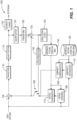
- an exemplary Multi-view Video Coding (MVC) encoder is indicated generally by the reference numeral 100.
- the encoder 100 includes a combiner 105 having an output connected in signal communication with an input of a transformer 110.
- An output of the transformer 110 is connected in signal communication with an input of quantizer 115.
- An output of the quantizer 115 is connected in signal communication with an input of an entropy coder 120 and an input of an inverse quantizer 125.
- An output of the inverse quantizer 125 is connected in signal communication with an input of an inverse transformer 130.
- An output of the inverse transformer 130 is connected in signal communication with a first non-inverting input of a combiner 135.
- An output of the combiner 135 is connected in signal communication with an input of an intra predictor 145 and an input of a deblocking filter 150.
- An output of the deblocking filter 150 is connected in signal communication with an input of a reference picture store 155 (for view i).
- An output of the reference picture store 155 is connected in signal communication with a first input of a motion compensator 175 and a first input of a motion estimator 180.
- An output of the motion estimator 180 is connected in signal communication with a second input of the motion compensator 175
- An output of a reference picture store 160 (for other views) is connected in signal communication with a first input of a disparity estimator 170 and a first input of a disparity compensator 165.
- An output of the disparity estimator 170 is connected in signal communication with a second input of the disparity compensator 165.
- An output of the entropy decoder 120 is available as an output of the encoder 100.
- a non-inverting input of the combiner 105 is available as an input of the encoder 100, and is connected in signal communication with a second input of the disparity estimator 170, and a second input of the motion estimator 180.
- An output of a switch 185 is connected in signal communication with a second non-inverting input of the combiner 135 and with an inverting input of the combiner 105.
- the switch 185 includes a first input connected in signal communication with an output of the motion compensator 175, a second input connected in signal communication with an output of the disparity compensator 165, and a third input connected in signal communication with an output of the intra predictor 145.
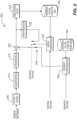
- an exemplary Multi-view Video Coding (MVC) decoder is indicated generally by the reference numeral 200.
- the decoder 200 includes an entropy decoder 205 having an output connected in signal communication with an input of an inverse quantizer 210.
- An output of the inverse quantizer is connected in signal communication with an input of an inverse transformer 215.
- An output of the inverse transformer 215 is connected in signal communication with a first non-inverting input of a combiner 220.
- An output of the combiner 220 is connected in signal communication with an input of a deblocking filter 225 and an input of an intra predictor 230.
- An output of the deblocking filter 225 is connected in signal communication with an input of a reference picture store 240 (for view i).
- An output of the reference picture store 240 is connected in signal communication with a first input of a motion compensator 235.
- An output of a reference picture store 245 (for other views) is connected in signal communication with a first input of a disparity compensator 250.
- An input of the entropy coder 205 is available as an input to the decoder 200, for receiving a residue bitstream.
- a control input of the switch 255 is also available as an input to the decoder 200, for receiving control syntax to control which input is selected by the switch 255.
- a second input of the motion compensator 235 is available as an input of the decoder 200, for receiving motion vectors.
- a second input of the disparity compensator 250 is available as an input to the decoder 200, for receiving disparity vectors.
- An output of a switch 255 is connected in signal communication with a second non-inverting input of the combiner 220.
- a first input of the switch 255 is connected in signal communication with an output of the disparity compensator 250.
- a second input of the switch 255 is connected in signal communication with an output of the motion compensator 235.
- a third input of the switch 255 is connected in signal communication with an output of the intra predictor 230.
- An output of the mode module 260 is connected in signal communication with the switch 255 for controlling which input is selected by the switch 255.
- An output of the deblocking filter 225 is available as an output of the decoder.
- MVC Multi-view Video Coding
- view scalability is signaled and/or indicated using at least one of a message, a field, a flag, and a syntax element.
- view scalability is signaled via a high level syntax element.
- view scalability is supported by signaling view scalability within the Network Abstraction Layer (NAL) unit header.
- NAL Network Abstraction Layer
- MVC Multi-view Video Coding
- the high level syntax to indicate view scalability may be present in one or more other high level syntaxes including, but not limited to, syntaxes in the Sequence Parameter Set (SPS), the Picture Parameter Set (PPS), a Supplemental Enhancement Information (SEI) message, and a slice header.
- SPS Sequence Parameter Set
- PPS Picture Parameter Set
- SEI Supplemental Enhancement Information
- slice header a slice header
- NAL unit header we describe the reuse of existing bits in the NAL unit header to signal the view scalability information.
- the view direction we propose to signal the scalability.
- a suffix NAL unit may be used to describe the NAL units that belong to this view and thus no direction information is required for this view.
- two bits may be used to signal the direction.
- a different number of bits may also be used, while maintaining the present principles.
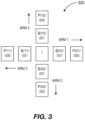
- FIG. 3 An embodiment of view scalability is illustrated in FIG. 3 and using the proposed syntax of TABLE 1.
- a view scalability example to which the present principles may be applied is indicated generally by the reference numeral 300.
- the I-view does not need direction information since it will be coded with syntax compatible with the International Organization for Standardization/International Electrotechnical Commission (ISO/IEC) Moving Picture Experts Group-4 (MPEG-4) Part 10 Advanced Video Coding (AVC) standard/International Telecommunication Union, Telecommunication Sector (ITU-T) H.264 recommendation (hereinafter the "MPEG-4 AVC standard"), and a suffix NAL unit will be used to signal this information.
- ISO/IEC International Organization for Standardization/International Electrotechnical Commission
- MPEG-4 Moving Picture Experts Group-4
- AVC Advanced Video Coding
- ITU-T International Telecommunication Union
- H.264 recommendation hereinafter the "MPEG-4 AVC standard
- a suffix NAL unit will be used to signal this information.
- All the other view directions are indicated using the two bit view_direction syntax element. This is illustrated in the first two bits in FIG. 3 .
- the three other bits in FIG. 3 correspond to the view level information. Using a combination of these five bits, coarse view scalability can be achieved.
- This information also signals dependency information and, thus, can also be used for coarse random access.
- This information also signals dependency information and, thus, can also be used for coarse random access.
- FIG. 4 an exemplary method for encoding multi-view video content and signaling view scalability thereof is indicated generally by the reference numeral 400.
- the method 400 includes a start block 400 that passes control to a function block 405.
- the function block 405 reads an encoder configuration file, and passes control to a function block 415.
- the function block 415 sets view_direction, view level, and view_id to user defined values, and passes control to a function block 420.
- the function block 420 sets the view level, view_id, and view_direction in the Sequence Parameter Set (SPS), Picture Parameter Set (PPS), View Parameter Set (VPS), slice header, and/or NAL unit header, and passes control to a function block 425.
- SPS Sequence Parameter Set
- PPS Picture Parameter Set
- VPS View Parameter Set
- slice header and/or NAL unit header
- the function block 425 lets the number of views be equal to a variable N, variables i (view number index) and j (picture number index) be equal to zero, and passes control to a decision block 430.
- the decision block 430 determines whether or not i is less than N. If so, then control is passed to a function block 435. Otherwise, control is passed to a function block 470.
- the function block 435 determines whether or not j is less than the number of pictures in view i. If so, then control is passed to a function block 440. Otherwise, control is passed to a function block 490.
- the function block 440 starts encoding the current macroblock, and passes control to a function block 445.
- the function block 445 chooses the macroblock mode, and passes control to a function block 450.
- the function block 450 encodes the current macroblock, and passes control to a decision block 455.
- the decision block 455 determines whether or not all macroblocks have been encoded. If so, then control is passed to a function block 460. Otherwise, control is returned to the function block 440.
- the function block 460 increments the variable j, and passes control to a function block 465.
- the function block 465 increments frame_num and Picture Order Count (POC) values, and returns control to the decision block 435.
- POC Picture Order Count
- the decision block 470 determines whether or not to signal the Sequence Parameter Set (SPS), the Picture Parameter Set (PPS), and/or the View Parameter Set (VPS) in-band. If so, the control is passed to a function block 475. Otherwise, control is passed to a function block 480.
- SPS Sequence Parameter Set
- PPS Picture Parameter Set
- VPS View Parameter Set
- the function block 475 writes the Sequence Parameter Set (SPS), the Picture Parameter Set (PPS), and/or the View Parameter Set (VPS) to a file (in-band), and passes control to a function block 485.
- SPS Sequence Parameter Set
- PPS Picture Parameter Set
- VPS View Parameter Set
- the function block 480 writes the Sequence Parameter Set (SPS), the Picture Parameter Set (PPS), and/or the View Parameter Set (VPS) out-of-band, and passes control to the function block 485.
- SPS Sequence Parameter Set
- PPS Picture Parameter Set
- VPN View Parameter Set
- the function block 485 writes the bitstream to a file or streams the bitstream over a network, and passes control to an end block 499.
- the function block 490 increments the variable i, resets the frame_num and Picture Order Count (POC) values, and returns control to the decision block 430.
- POC Picture Order Count
- FIG. 5 an exemplary method for decoding multi-view video content and determining view scalability thereof is indicated generally by the reference numeral 500.
- the method 500 includes a start block 505 that passes control to a function block 510.
- the function block 510 parses the view_id, view_direction, and view level from the Sequence Parameter Set (SPS), the Picture Parameter Set, the View Parameter Set, the slice header, and/or the NAL unit header, and passes control to a function block 515.
- the function block 515 uses view_direction, view level, and view_id to determine if the current picture needs to be decoded (check dependency), and passes control to a decision block 520.
- the decision block 520 determines whether or not the current picture needs decoding. If so, then control is passed to a function block 530. Otherwise, control is passed to a function block 525.
- the function block 525 gets the next picture, and passes control to the function block 530.
- the function block 530 parses the slice header, and passes control to a function block 535.
- the function block 535 parses the macroblock mode, the motion vector, and ref_idx, and passes control to a function block 540.
- the function block 540 decodes the current macroblock, and passes control to a decision block 545.
- the decision block 545 determines whether or not all macroblocks have been decoded. If so, the control is passed to a function block 550. Otherwise, control is returned to the function block 535.
- the function block 550 inserts the current picture in the decoded picture buffer, and passes control to a decision block 555.
- the decision block 555 determines whether or not all pictures have been decoded. If so, then control is passed to an end block 599. Otherwise, control is returned to the function block 530.
- one advantage/feature is an apparatus that includes an encoder for encoding at least one picture for at least one view corresponding to multi-view video content in a resultant bitstream.
- the encoder signals at least one of a view direction and a view level to support view scalability for the at least one view using at least one of a message, a field, a flag, and a syntax element.
- Another advantage/feature is the apparatus having the encoder as described above, wherein the syntax element is a high level syntax element.
- Yet another advantage/feature is the apparatus having the encoder that uses the high level syntax element the as described above, wherein the high level syntax element is included in at least one of a Sequence Parameter Set, a Picture Parameter Set, a Supplemental Enhancement Information message, a slice header, and a Network Abstraction Layer unit header.
- Still another advantage/feature is the apparatus having the encoder as described above, wherein at least one of the view direction and the view level is signaled at least one of in-band and out-of-band.
- Another advantage/feature is the apparatus having the encoder as described above, wherein the view direction and the view level are used as dependency information.
- another advantage/feature is the apparatus having the encoder wherein the view direction and the view level are used as dependency information as described above, wherein the dependency information is for use for a random access of the at least one view by a decoder.
- Another advantage/feature is the apparatus having the encoder as described above, wherein a suffix Network Abstraction Layer unit is used to specify an immediately preceding Network Abstraction Layer unit and wherein the view direction and the view level are signaled in the suffix Network Abstraction Layer unit.
- the teachings of the present principles are implemented as a combination of hardware and software.
- the software may be implemented as an application program tangibly embodied on a program storage unit.
- the application program may be uploaded to, and executed by, a machine comprising any suitable architecture.
- the machine is implemented on a computer platform having hardware such as one or more central processing units (“CPU"), a random access memory (“RAM”), and input/output ("I/O") interfaces.
- CPU central processing units
- RAM random access memory
- I/O input/output
- the computer platform may also include an operating system and microinstruction code.
- the various processes and functions described herein may be either part of the microinstruction code or part of the application program, or any combination thereof, which may be executed by a CPU.
- various other peripheral units may be connected to the computer platform such as an additional data storage unit and a printing unit.
Landscapes
- Engineering & Computer Science (AREA)
- Multimedia (AREA)
- Signal Processing (AREA)
- Compression Or Coding Systems Of Tv Signals (AREA)
- Compression, Expansion, Code Conversion, And Decoders (AREA)
Applications Claiming Priority (4)
| Application Number | Priority Date | Filing Date | Title |
|---|---|---|---|
| US80792806P | 2006-07-20 | 2006-07-20 | |
| US80797406P | 2006-07-21 | 2006-07-21 | |
| PCT/US2007/015788 WO2008010932A2 (en) | 2006-07-20 | 2007-07-10 | Method and apparatus for signaling view scalability in multi-view video coding |
| EP07810333A EP2044777A2 (en) | 2006-07-20 | 2007-07-10 | Method and apparatus for signaling view scalability in multi-view video coding |
Related Parent Applications (1)
| Application Number | Title | Priority Date | Filing Date |
|---|---|---|---|
| EP07810333A Division EP2044777A2 (en) | 2006-07-20 | 2007-07-10 | Method and apparatus for signaling view scalability in multi-view video coding |
Publications (2)
| Publication Number | Publication Date |
|---|---|
| EP3179725A1 EP3179725A1 (en) | 2017-06-14 |
| EP3179725B1 true EP3179725B1 (en) | 2024-05-08 |
Family
ID=38885505
Family Applications (3)
| Application Number | Title | Priority Date | Filing Date |
|---|---|---|---|
| EP07810333A Ceased EP2044777A2 (en) | 2006-07-20 | 2007-07-10 | Method and apparatus for signaling view scalability in multi-view video coding |
| EP13164580.6A Ceased EP2632163A3 (en) | 2006-07-20 | 2007-07-10 | Method and apparatus for signaling view scalability in multi-view video coding |
| EP17150704.9A Active EP3179725B1 (en) | 2006-07-20 | 2007-07-10 | Method and apparatus for signaling view scalability in multi-view video coding |
Family Applications Before (2)
| Application Number | Title | Priority Date | Filing Date |
|---|---|---|---|
| EP07810333A Ceased EP2044777A2 (en) | 2006-07-20 | 2007-07-10 | Method and apparatus for signaling view scalability in multi-view video coding |
| EP13164580.6A Ceased EP2632163A3 (en) | 2006-07-20 | 2007-07-10 | Method and apparatus for signaling view scalability in multi-view video coding |
Country Status (7)
| Country | Link |
|---|---|
| US (1) | US20090147860A1 (OSRAM) |
| EP (3) | EP2044777A2 (OSRAM) |
| JP (6) | JP5135342B2 (OSRAM) |
| KR (1) | KR101353204B1 (OSRAM) |
| CN (1) | CN101518086B (OSRAM) |
| BR (1) | BRPI0714564B1 (OSRAM) |
| WO (1) | WO2008010932A2 (OSRAM) |
Families Citing this family (27)
| Publication number | Priority date | Publication date | Assignee | Title |
|---|---|---|---|---|
| CN101518086B (zh) * | 2006-07-20 | 2013-10-30 | 汤姆森特许公司 | 在多视图视频编码中用信号通知视图可分级性的方法和装置 |
| JP4984184B2 (ja) * | 2009-04-08 | 2012-07-25 | ソニー株式会社 | 再生装置および再生方法 |
| TWI384887B (zh) * | 2009-06-11 | 2013-02-01 | Univ Nat Central | 多視點影像編解碼方法 |
| US8780999B2 (en) * | 2009-06-12 | 2014-07-15 | Qualcomm Incorporated | Assembling multiview video coding sub-BITSTREAMS in MPEG-2 systems |
| US8411746B2 (en) * | 2009-06-12 | 2013-04-02 | Qualcomm Incorporated | Multiview video coding over MPEG-2 systems |
| US9774882B2 (en) | 2009-07-04 | 2017-09-26 | Dolby Laboratories Licensing Corporation | Encoding and decoding architectures for format compatible 3D video delivery |
| US8948241B2 (en) * | 2009-08-07 | 2015-02-03 | Qualcomm Incorporated | Signaling characteristics of an MVC operation point |
| CN102860008B (zh) * | 2010-01-06 | 2016-05-11 | 杜比实验室特许公司 | 用于多层视频系统的复杂度自适应可伸缩解码及流处理 |
| WO2012006299A1 (en) | 2010-07-08 | 2012-01-12 | Dolby Laboratories Licensing Corporation | Systems and methods for multi-layered image and video delivery using reference processing signals |
| US9131033B2 (en) | 2010-07-20 | 2015-09-08 | Qualcomm Incoporated | Providing sequence data sets for streaming video data |
| CN105812827B (zh) * | 2010-07-21 | 2019-04-16 | 杜比实验室特许公司 | 用于多层帧兼容视频传输的解码方法 |
| EP2628298A1 (en) * | 2010-10-12 | 2013-08-21 | Dolby Laboratories Licensing Corporation | Joint layer optimization for a frame-compatible video delivery |
| US9635355B2 (en) * | 2011-07-28 | 2017-04-25 | Qualcomm Incorporated | Multiview video coding |
| US9674525B2 (en) * | 2011-07-28 | 2017-06-06 | Qualcomm Incorporated | Multiview video coding |
| US9258559B2 (en) | 2011-12-20 | 2016-02-09 | Qualcomm Incorporated | Reference picture list construction for multi-view and three-dimensional video coding |
| IN2014DN06209A (OSRAM) * | 2012-01-31 | 2015-10-23 | Sony Corp | |
| US9161004B2 (en) * | 2012-04-25 | 2015-10-13 | Qualcomm Incorporated | Identifying parameter sets in video files |
| CN104620587B (zh) | 2012-07-06 | 2018-04-03 | 三星电子株式会社 | 用于对多层视频进行编码的方法和设备以及用于对多层视频进行解码的方法和设备 |
| MX344952B (es) * | 2012-07-09 | 2017-01-12 | Vid Scale Inc | Arquitectura de codec para codificacion de video de multiples capas. |
| EP2903280A4 (en) * | 2012-09-28 | 2016-05-04 | Sharp Kk | IMAGE DECODING DEVICE |
| KR20140092198A (ko) * | 2013-01-07 | 2014-07-23 | 한국전자통신연구원 | 계층적 비디오 부호화에서의 스케일러빌리티 정보 표현방식 |
| SG10201700399VA (en) | 2013-04-07 | 2017-02-27 | Dolby Int Ab | Signaling change in output layer sets |
| US9591321B2 (en) | 2013-04-07 | 2017-03-07 | Dolby International Ab | Signaling change in output layer sets |
| WO2014166328A1 (en) * | 2013-04-08 | 2014-10-16 | Mediatek Singapore Pte. Ltd. | Method and apparatus for quantization matrix signaling and representation in scalable video coding |
| US9571812B2 (en) * | 2013-04-12 | 2017-02-14 | Disney Enterprises, Inc. | Signaling warp maps using a high efficiency video coding (HEVC) extension for 3D video coding |
| US9602822B2 (en) * | 2013-04-17 | 2017-03-21 | Qualcomm Incorporated | Indication of cross-layer picture type alignment in multi-layer video coding |
| JP2018088617A (ja) * | 2016-11-29 | 2018-06-07 | 株式会社オーディオテクニカ | マイクロホン |
Family Cites Families (11)
| Publication number | Priority date | Publication date | Assignee | Title |
|---|---|---|---|---|
| KR20010056374A (ko) * | 1999-12-15 | 2001-07-04 | 박종섭 | 다중 비디오 디코딩 장치 |
| US6965379B2 (en) * | 2001-05-08 | 2005-11-15 | Koninklijke Philips Electronics N.V. | N-view synthesis from monocular video of certain broadcast and stored mass media content |
| JP4725104B2 (ja) * | 2002-06-20 | 2011-07-13 | ソニー株式会社 | 復号装置及び復号方法 |
| US20040060061A1 (en) * | 2002-09-20 | 2004-03-25 | Imagictv Inc. | Multiple view video feed |
| MY134659A (en) * | 2002-11-06 | 2007-12-31 | Nokia Corp | Picture buffering for prediction references and display |
| US7415069B2 (en) * | 2003-12-09 | 2008-08-19 | Lsi Corporation | Method for activation and deactivation of infrequently changing sequence and picture parameter sets |
| KR100679740B1 (ko) * | 2004-06-25 | 2007-02-07 | 학교법인연세대학교 | 시점 선택이 가능한 다시점 동영상 부호화/복호화 방법 |
| JP4668602B2 (ja) * | 2004-12-24 | 2011-04-13 | 富士フイルム株式会社 | 立体視画像生成装置および方法並びにプログラム |
| KR100943912B1 (ko) * | 2006-01-12 | 2010-03-03 | 엘지전자 주식회사 | 다시점 비디오의 처리 방법 및 장치 |
| BRPI0710048A2 (pt) * | 2006-03-30 | 2011-08-02 | Lg Electronics Inc | método e aparelho para decodificar / codificar um sinal de vìdeo |
| CN101518086B (zh) * | 2006-07-20 | 2013-10-30 | 汤姆森特许公司 | 在多视图视频编码中用信号通知视图可分级性的方法和装置 |
-
2007
- 2007-07-10 CN CN2007800350569A patent/CN101518086B/zh active Active
- 2007-07-10 KR KR1020097001085A patent/KR101353204B1/ko active Active
- 2007-07-10 WO PCT/US2007/015788 patent/WO2008010932A2/en not_active Ceased
- 2007-07-10 EP EP07810333A patent/EP2044777A2/en not_active Ceased
- 2007-07-10 BR BRPI0714564-0A patent/BRPI0714564B1/pt active IP Right Grant
- 2007-07-10 EP EP13164580.6A patent/EP2632163A3/en not_active Ceased
- 2007-07-10 JP JP2009520762A patent/JP5135342B2/ja active Active
- 2007-07-10 EP EP17150704.9A patent/EP3179725B1/en active Active
- 2007-07-10 US US12/309,454 patent/US20090147860A1/en not_active Abandoned
-
2012
- 2012-09-24 JP JP2012209451A patent/JP5319831B2/ja active Active
-
2013
- 2013-07-09 JP JP2013143127A patent/JP5621018B2/ja active Active
-
2014
- 2014-09-18 JP JP2014189575A patent/JP5876554B2/ja active Active
-
2015
- 2015-12-10 JP JP2015240720A patent/JP6422849B2/ja active Active
-
2018
- 2018-07-20 JP JP2018136346A patent/JP6681441B2/ja active Active
Non-Patent Citations (1)
| Title |
|---|
| "Joint Multi-view Video Model (JFVM) 1 [06/08/11]", 20. JVT MEETING; 77. MPEG MEETING; 15-7-2006 - 21-7-2006; KLAGENFURT, AT; (JOINT VIDEO TEAM OF ISO/IEC JTC1/SC29/WG11 AND ITU-T SG.16 ),, no. JVT-T208, 17 August 2006 (2006-08-17), XP030006640 * |
Also Published As
| Publication number | Publication date |
|---|---|
| WO2008010932A3 (en) | 2008-03-13 |
| JP6681441B2 (ja) | 2020-04-15 |
| JP2016076983A (ja) | 2016-05-12 |
| BRPI0714564B1 (pt) | 2020-09-15 |
| WO2008010932A2 (en) | 2008-01-24 |
| JP2018201210A (ja) | 2018-12-20 |
| US20090147860A1 (en) | 2009-06-11 |
| EP3179725A1 (en) | 2017-06-14 |
| JP6422849B2 (ja) | 2018-11-14 |
| BRPI0714564A2 (pt) | 2013-03-12 |
| JP2009545206A (ja) | 2009-12-17 |
| EP2044777A2 (en) | 2009-04-08 |
| JP5621018B2 (ja) | 2014-11-05 |
| KR101353204B1 (ko) | 2014-01-21 |
| JP2013232970A (ja) | 2013-11-14 |
| JP5135342B2 (ja) | 2013-02-06 |
| JP5319831B2 (ja) | 2013-10-16 |
| KR20090040296A (ko) | 2009-04-23 |
| JP2015019413A (ja) | 2015-01-29 |
| EP2632163A2 (en) | 2013-08-28 |
| CN101518086B (zh) | 2013-10-30 |
| JP2013048436A (ja) | 2013-03-07 |
| JP5876554B2 (ja) | 2016-03-02 |
| CN101518086A (zh) | 2009-08-26 |
| EP2632163A3 (en) | 2013-11-27 |
Similar Documents
| Publication | Publication Date | Title |
|---|---|---|
| EP3179725B1 (en) | Method and apparatus for signaling view scalability in multi-view video coding | |
| JP6578421B2 (ja) | マルチビュービデオ符号化の方法および装置 | |
| EP2418852B1 (en) | Methods and apparatus for improved signaling using high level syntax for multi-view video coding and decoding | |
| US20090279612A1 (en) | Methods and apparatus for multi-view video encoding and decoding | |
| US9838694B2 (en) | Methods and apparatus for illumination and color compensation for multi-view video coding | |
| US9883206B2 (en) | Methods and apparatus for the use of slice groups in encoding multi-view video coding (MVC) information | |
| US20100208796A1 (en) | Methods and apparatus for incorporating video usability information (vui) within a multi-view video (mvc) coding system | |
| HK1229105A1 (en) | Methods and apparatus for incorporating video usability information within a multi-view video coding system | |
| HK1226885A1 (en) | Methods and apparatus for incorporating video usability information within a multi-view video coding system |
Legal Events
| Date | Code | Title | Description |
|---|---|---|---|
| PUAI | Public reference made under article 153(3) epc to a published international application that has entered the european phase |
Free format text: ORIGINAL CODE: 0009012 |
|
| STAA | Information on the status of an ep patent application or granted ep patent |
Free format text: STATUS: THE APPLICATION HAS BEEN PUBLISHED |
|
| AC | Divisional application: reference to earlier application |
Ref document number: 2044777 Country of ref document: EP Kind code of ref document: P |
|
| AK | Designated contracting states |
Kind code of ref document: A1 Designated state(s): DE FR GB |
|
| STAA | Information on the status of an ep patent application or granted ep patent |
Free format text: STATUS: REQUEST FOR EXAMINATION WAS MADE |
|
| 17P | Request for examination filed |
Effective date: 20171211 |
|
| RBV | Designated contracting states (corrected) |
Designated state(s): DE FR GB |
|
| STAA | Information on the status of an ep patent application or granted ep patent |
Free format text: STATUS: EXAMINATION IS IN PROGRESS |
|
| 17Q | First examination report despatched |
Effective date: 20181115 |
|
| RAP1 | Party data changed (applicant data changed or rights of an application transferred) |
Owner name: INTERDIGITAL VC HOLDINGS, INC. |
|
| RAP1 | Party data changed (applicant data changed or rights of an application transferred) |
Owner name: INTERDIGITAL VC HOLDINGS, INC. |
|
| GRAP | Despatch of communication of intention to grant a patent |
Free format text: ORIGINAL CODE: EPIDOSNIGR1 |
|
| STAA | Information on the status of an ep patent application or granted ep patent |
Free format text: STATUS: GRANT OF PATENT IS INTENDED |
|
| INTG | Intention to grant announced |
Effective date: 20231204 |
|
| GRAS | Grant fee paid |
Free format text: ORIGINAL CODE: EPIDOSNIGR3 |
|
| GRAA | (expected) grant |
Free format text: ORIGINAL CODE: 0009210 |
|
| STAA | Information on the status of an ep patent application or granted ep patent |
Free format text: STATUS: THE PATENT HAS BEEN GRANTED |
|
| AC | Divisional application: reference to earlier application |
Ref document number: 2044777 Country of ref document: EP Kind code of ref document: P |
|
| AK | Designated contracting states |
Kind code of ref document: B1 Designated state(s): DE FR GB |
|
| P01 | Opt-out of the competence of the unified patent court (upc) registered |
Effective date: 20240403 |
|
| REG | Reference to a national code |
Ref country code: GB Ref legal event code: FG4D |
|
| REG | Reference to a national code |
Ref country code: DE Ref legal event code: R096 Ref document number: 602007061862 Country of ref document: DE |
|
| REG | Reference to a national code |
Ref country code: DE Ref legal event code: R097 Ref document number: 602007061862 Country of ref document: DE |
|
| PLBE | No opposition filed within time limit |
Free format text: ORIGINAL CODE: 0009261 |
|
| STAA | Information on the status of an ep patent application or granted ep patent |
Free format text: STATUS: NO OPPOSITION FILED WITHIN TIME LIMIT |
|
| 26N | No opposition filed |
Effective date: 20250211 |
|
| PGFP | Annual fee paid to national office [announced via postgrant information from national office to epo] |
Ref country code: DE Payment date: 20250728 Year of fee payment: 19 |
|
| PGFP | Annual fee paid to national office [announced via postgrant information from national office to epo] |
Ref country code: GB Payment date: 20250722 Year of fee payment: 19 |
|
| PGFP | Annual fee paid to national office [announced via postgrant information from national office to epo] |
Ref country code: FR Payment date: 20250725 Year of fee payment: 19 |