EP3178826A1 - Heterozyklische an einer hydroxyl-gruppe geschützte selena-monophosphite sowie verfahren zu deren herstellung - Google Patents
Heterozyklische an einer hydroxyl-gruppe geschützte selena-monophosphite sowie verfahren zu deren herstellung Download PDFInfo
- Publication number
- EP3178826A1 EP3178826A1 EP15198145.3A EP15198145A EP3178826A1 EP 3178826 A1 EP3178826 A1 EP 3178826A1 EP 15198145 A EP15198145 A EP 15198145A EP 3178826 A1 EP3178826 A1 EP 3178826A1
- Authority
- EP
- European Patent Office
- Prior art keywords
- alkyl
- aryl
- groups
- substituted
- group
- Prior art date
- Legal status (The legal status is an assumption and is not a legal conclusion. Google has not performed a legal analysis and makes no representation as to the accuracy of the status listed.)
- Withdrawn
Links
- 238000000034 method Methods 0.000 title claims abstract description 21
- 125000000623 heterocyclic group Chemical group 0.000 title claims description 19
- 238000004519 manufacturing process Methods 0.000 title description 3
- 125000002887 hydroxy group Chemical group [H]O* 0.000 title description 2
- -1 heterocyclic hydroxyl-protected selenium monophosphites Chemical class 0.000 claims abstract description 133
- 239000003446 ligand Substances 0.000 claims abstract description 17
- 230000008569 process Effects 0.000 claims abstract description 7
- 238000002360 preparation method Methods 0.000 claims abstract description 3
- 125000000217 alkyl group Chemical group 0.000 claims description 57
- 125000001424 substituent group Chemical group 0.000 claims description 43
- 125000004122 cyclic group Chemical group 0.000 claims description 34
- 150000001875 compounds Chemical class 0.000 claims description 30
- 125000003118 aryl group Chemical group 0.000 claims description 29
- ZAMOUSCENKQFHK-UHFFFAOYSA-N Chlorine atom Chemical compound [Cl] ZAMOUSCENKQFHK-UHFFFAOYSA-N 0.000 claims description 24
- 239000002904 solvent Substances 0.000 claims description 23
- IVLCPXMWJKSENT-UHFFFAOYSA-N OP(O)O.[SeH2] Chemical compound OP(O)O.[SeH2] IVLCPXMWJKSENT-UHFFFAOYSA-N 0.000 claims description 21
- 239000000460 chlorine Substances 0.000 claims description 21
- 229910052801 chlorine Inorganic materials 0.000 claims description 21
- PXGOKWXKJXAPGV-UHFFFAOYSA-N Fluorine Chemical compound FF PXGOKWXKJXAPGV-UHFFFAOYSA-N 0.000 claims description 20
- 125000002252 acyl group Chemical group 0.000 claims description 19
- 125000004453 alkoxycarbonyl group Chemical group 0.000 claims description 19
- ZMANZCXQSJIPKH-UHFFFAOYSA-N Triethylamine Chemical compound CCN(CC)CC ZMANZCXQSJIPKH-UHFFFAOYSA-N 0.000 claims description 18
- YMWUJEATGCHHMB-UHFFFAOYSA-N Dichloromethane Chemical compound ClCCl YMWUJEATGCHHMB-UHFFFAOYSA-N 0.000 claims description 17
- 238000006243 chemical reaction Methods 0.000 claims description 17
- 229910052731 fluorine Inorganic materials 0.000 claims description 17
- 239000011737 fluorine Substances 0.000 claims description 17
- 125000001475 halogen functional group Chemical group 0.000 claims description 14
- OJMIONKXNSYLSR-UHFFFAOYSA-N phosphorous acid Chemical group OP(O)O OJMIONKXNSYLSR-UHFFFAOYSA-N 0.000 claims description 13
- 229910052736 halogen Inorganic materials 0.000 claims description 9
- 125000004400 (C1-C12) alkyl group Chemical group 0.000 claims description 7
- WKBOTKDWSSQWDR-UHFFFAOYSA-N Bromine atom Chemical compound [Br] WKBOTKDWSSQWDR-UHFFFAOYSA-N 0.000 claims description 7
- GDTBXPJZTBHREO-UHFFFAOYSA-N bromine Substances BrBr GDTBXPJZTBHREO-UHFFFAOYSA-N 0.000 claims description 7
- 229910052794 bromium Inorganic materials 0.000 claims description 7
- 125000003178 carboxy group Chemical group [H]OC(*)=O 0.000 claims description 7
- JUJWROOIHBZHMG-UHFFFAOYSA-N Pyridine Chemical compound C1=CC=NC=C1 JUJWROOIHBZHMG-UHFFFAOYSA-N 0.000 claims description 6
- 125000001153 fluoro group Chemical group F* 0.000 claims description 6
- 125000001309 chloro group Chemical group Cl* 0.000 claims description 5
- PNDPGZBMCMUPRI-UHFFFAOYSA-N iodine Chemical compound II PNDPGZBMCMUPRI-UHFFFAOYSA-N 0.000 claims description 4
- 150000003973 alkyl amines Chemical class 0.000 claims description 3
- 150000001412 amines Chemical class 0.000 claims description 3
- 125000005843 halogen group Chemical group 0.000 claims description 3
- 229930195733 hydrocarbon Natural products 0.000 claims description 3
- UMJSCPRVCHMLSP-UHFFFAOYSA-N pyridine Natural products COC1=CC=CN=C1 UMJSCPRVCHMLSP-UHFFFAOYSA-N 0.000 claims description 3
- DJEQZVQFEPKLOY-UHFFFAOYSA-N N,N-dimethylbutylamine Chemical compound CCCCN(C)C DJEQZVQFEPKLOY-UHFFFAOYSA-N 0.000 claims description 2
- 239000000010 aprotic solvent Substances 0.000 claims description 2
- 150000002430 hydrocarbons Chemical class 0.000 claims description 2
- 125000000218 acetic acid group Chemical group C(C)(=O)* 0.000 claims 1
- YXFVVABEGXRONW-UHFFFAOYSA-N Toluene Chemical compound CC1=CC=CC=C1 YXFVVABEGXRONW-UHFFFAOYSA-N 0.000 description 34
- 238000003786 synthesis reaction Methods 0.000 description 18
- 230000015572 biosynthetic process Effects 0.000 description 17
- KWKAKUADMBZCLK-UHFFFAOYSA-N 1-octene Chemical compound CCCCCCC=C KWKAKUADMBZCLK-UHFFFAOYSA-N 0.000 description 12
- 238000007037 hydroformylation reaction Methods 0.000 description 12
- 125000001972 isopentyl group Chemical group [H]C([H])([H])C([H])(C([H])([H])[H])C([H])([H])C([H])([H])* 0.000 description 11
- 125000002496 methyl group Chemical group [H]C([H])([H])* 0.000 description 11
- 125000000999 tert-butyl group Chemical group [H]C([H])([H])C(*)(C([H])([H])[H])C([H])([H])[H] 0.000 description 11
- 239000000047 product Substances 0.000 description 10
- XEKOWRVHYACXOJ-UHFFFAOYSA-N Ethyl acetate Chemical compound CCOC(C)=O XEKOWRVHYACXOJ-UHFFFAOYSA-N 0.000 description 9
- 238000005481 NMR spectroscopy Methods 0.000 description 9
- XRYZUJTVWVXUDI-UHFFFAOYSA-N C(C1=CC=CC=C1)OC1=C(C=C(C=C1C)C)[Se]C1=C(C(=CC(=C1)C)C)O Chemical compound C(C1=CC=CC=C1)OC1=C(C=C(C=C1C)C)[Se]C1=C(C(=CC(=C1)C)C)O XRYZUJTVWVXUDI-UHFFFAOYSA-N 0.000 description 8
- 125000001495 ethyl group Chemical group [H]C([H])([H])C([H])([H])* 0.000 description 8
- BHEPBYXIRTUNPN-UHFFFAOYSA-N hydridophosphorus(.) (triplet) Chemical compound [PH] BHEPBYXIRTUNPN-UHFFFAOYSA-N 0.000 description 8
- 239000000243 solution Substances 0.000 description 8
- 239000011541 reaction mixture Substances 0.000 description 7
- 239000011669 selenium Substances 0.000 description 7
- XKRFYHLGVUSROY-UHFFFAOYSA-N Argon Chemical compound [Ar] XKRFYHLGVUSROY-UHFFFAOYSA-N 0.000 description 6
- WSNMPAVSZJSIMT-UHFFFAOYSA-N COc1c(C)c2COC(=O)c2c(O)c1CC(O)C1(C)CCC(=O)O1 Chemical compound COc1c(C)c2COC(=O)c2c(O)c1CC(O)C1(C)CCC(=O)O1 WSNMPAVSZJSIMT-UHFFFAOYSA-N 0.000 description 6
- 239000012300 argon atmosphere Substances 0.000 description 6
- 239000010948 rhodium Substances 0.000 description 6
- JPJALAQPGMAKDF-UHFFFAOYSA-N selenium dioxide Chemical compound O=[Se]=O JPJALAQPGMAKDF-UHFFFAOYSA-N 0.000 description 6
- 239000007787 solid Substances 0.000 description 6
- 239000000126 substance Substances 0.000 description 6
- 238000005160 1H NMR spectroscopy Methods 0.000 description 5
- 125000001797 benzyl group Chemical group [H]C1=C([H])C([H])=C(C([H])=C1[H])C([H])([H])* 0.000 description 5
- 238000002474 experimental method Methods 0.000 description 5
- 150000002367 halogens Chemical class 0.000 description 5
- 239000000203 mixture Substances 0.000 description 5
- AQSJGOWTSHOLKH-UHFFFAOYSA-N phosphite(3-) Chemical class [O-]P([O-])[O-] AQSJGOWTSHOLKH-UHFFFAOYSA-N 0.000 description 5
- 0 *c(c(*)c1*)c(*)c(*)c1Sc1c(*)c(*)c(*)c(*)c1* Chemical compound *c(c(*)c1*)c(*)c(*)c1Sc1c(*)c(*)c(*)c(*)c1* 0.000 description 4
- DYELRVQRICKFCT-UHFFFAOYSA-N C(C1=CC=CC=C1)OC1=C(C=C(C=C1C)C)[Se]C1=C(C(=CC(=C1)C)C)OCC1=CC=CC=C1 Chemical compound C(C1=CC=CC=C1)OC1=C(C=C(C=C1C)C)[Se]C1=C(C(=CC(=C1)C)C)OCC1=CC=CC=C1 DYELRVQRICKFCT-UHFFFAOYSA-N 0.000 description 4
- 150000001336 alkenes Chemical class 0.000 description 4
- 125000004432 carbon atom Chemical group C* 0.000 description 4
- 239000003054 catalyst Substances 0.000 description 4
- 238000004440 column chromatography Methods 0.000 description 4
- 239000007789 gas Substances 0.000 description 4
- 125000005842 heteroatom Chemical group 0.000 description 4
- 229910052739 hydrogen Inorganic materials 0.000 description 4
- 239000002244 precipitate Substances 0.000 description 4
- 125000006413 ring segment Chemical group 0.000 description 4
- 239000011734 sodium Substances 0.000 description 4
- 125000005869 (methoxyethoxy)methanyl group Chemical group [H]C([H])([H])OC([H])([H])C([H])([H])OC([H])([H])* 0.000 description 3
- 238000001644 13C nuclear magnetic resonance spectroscopy Methods 0.000 description 3
- XDTMQSROBMDMFD-UHFFFAOYSA-N Cyclohexane Chemical compound C1CCCCC1 XDTMQSROBMDMFD-UHFFFAOYSA-N 0.000 description 3
- 239000007818 Grignard reagent Substances 0.000 description 3
- ISWSIDIOOBJBQZ-UHFFFAOYSA-N Phenol Chemical compound OC1=CC=CC=C1 ISWSIDIOOBJBQZ-UHFFFAOYSA-N 0.000 description 3
- 229910052786 argon Inorganic materials 0.000 description 3
- AGEZXYOZHKGVCM-UHFFFAOYSA-N benzyl bromide Chemical compound BrCC1=CC=CC=C1 AGEZXYOZHKGVCM-UHFFFAOYSA-N 0.000 description 3
- 238000006555 catalytic reaction Methods 0.000 description 3
- DQTRYXANLKJLPK-UHFFFAOYSA-N chlorophosphonous acid Chemical class OP(O)Cl DQTRYXANLKJLPK-UHFFFAOYSA-N 0.000 description 3
- 239000012043 crude product Substances 0.000 description 3
- YMWUJEATGCHHMB-DICFDUPASA-N dichloromethane-d2 Chemical compound [2H]C([2H])(Cl)Cl YMWUJEATGCHHMB-DICFDUPASA-N 0.000 description 3
- 238000001914 filtration Methods 0.000 description 3
- 150000004795 grignard reagents Chemical class 0.000 description 3
- 238000004896 high resolution mass spectrometry Methods 0.000 description 3
- 125000004184 methoxymethyl group Chemical group [H]C([H])([H])OC([H])([H])* 0.000 description 3
- TVMXDCGIABBOFY-UHFFFAOYSA-N n-Octanol Natural products CCCCCCCC TVMXDCGIABBOFY-UHFFFAOYSA-N 0.000 description 3
- JRZJOMJEPLMPRA-UHFFFAOYSA-N olefin Natural products CCCCCCCC=C JRZJOMJEPLMPRA-UHFFFAOYSA-N 0.000 description 3
- FAIAAWCVCHQXDN-UHFFFAOYSA-N phosphorus trichloride Chemical compound ClP(Cl)Cl FAIAAWCVCHQXDN-UHFFFAOYSA-N 0.000 description 3
- 238000003756 stirring Methods 0.000 description 3
- ICKWICRCANNIBI-UHFFFAOYSA-N 2,4-di-tert-butylphenol Chemical compound CC(C)(C)C1=CC=C(O)C(C(C)(C)C)=C1 ICKWICRCANNIBI-UHFFFAOYSA-N 0.000 description 2
- RFZQQXVTMUBVNR-UHFFFAOYSA-N 2,4-ditert-butyl-6-(3,5-ditert-butyl-2-hydroxyphenyl)selanylphenol Chemical compound CC(C)(C)C1=CC(C(C)(C)C)=CC([Se]C=2C(=C(C=C(C=2)C(C)(C)C)C(C)(C)C)O)=C1O RFZQQXVTMUBVNR-UHFFFAOYSA-N 0.000 description 2
- RKNWJMHQLOIGIH-UHFFFAOYSA-N 6-chlorobenzo[d][1,3,2]benzodioxaphosphepine Chemical compound C12=CC=CC=C2OP(Cl)OC2=C1C=CC=C2 RKNWJMHQLOIGIH-UHFFFAOYSA-N 0.000 description 2
- VEXZGXHMUGYJMC-UHFFFAOYSA-N Hydrochloric acid Chemical compound Cl VEXZGXHMUGYJMC-UHFFFAOYSA-N 0.000 description 2
- DGAQECJNVWCQMB-PUAWFVPOSA-M Ilexoside XXIX Chemical compound C[C@@H]1CC[C@@]2(CC[C@@]3(C(=CC[C@H]4[C@]3(CC[C@@H]5[C@@]4(CC[C@@H](C5(C)C)OS(=O)(=O)[O-])C)C)[C@@H]2[C@]1(C)O)C)C(=O)O[C@H]6[C@@H]([C@H]([C@@H]([C@H](O6)CO)O)O)O.[Na+] DGAQECJNVWCQMB-PUAWFVPOSA-M 0.000 description 2
- SECXISVLQFMRJM-UHFFFAOYSA-N N-Methylpyrrolidone Chemical compound CN1CCCC1=O SECXISVLQFMRJM-UHFFFAOYSA-N 0.000 description 2
- OFBQJSOFQDEBGM-UHFFFAOYSA-N Pentane Chemical compound CCCCC OFBQJSOFQDEBGM-UHFFFAOYSA-N 0.000 description 2
- CUJRVFIICFDLGR-UHFFFAOYSA-N acetylacetonate Chemical compound CC(=O)[CH-]C(C)=O CUJRVFIICFDLGR-UHFFFAOYSA-N 0.000 description 2
- 239000012018 catalyst precursor Substances 0.000 description 2
- 239000003795 chemical substances by application Substances 0.000 description 2
- NXFTYDNSXOMPSG-UHFFFAOYSA-N chloro-bis(2,4-ditert-butylphenoxy)phosphane Chemical compound CC(C)(C)C1=CC(C(C)(C)C)=CC=C1OP(Cl)OC1=CC=C(C(C)(C)C)C=C1C(C)(C)C NXFTYDNSXOMPSG-UHFFFAOYSA-N 0.000 description 2
- 238000004821 distillation Methods 0.000 description 2
- 239000003480 eluent Substances 0.000 description 2
- RTZKZFJDLAIYFH-UHFFFAOYSA-N ether Substances CCOCC RTZKZFJDLAIYFH-UHFFFAOYSA-N 0.000 description 2
- 150000002170 ethers Chemical class 0.000 description 2
- 238000000605 extraction Methods 0.000 description 2
- 239000001257 hydrogen Substances 0.000 description 2
- 230000006872 improvement Effects 0.000 description 2
- 239000007788 liquid Substances 0.000 description 2
- 125000001624 naphthyl group Chemical group 0.000 description 2
- 125000001997 phenyl group Chemical group [H]C1=C([H])C([H])=C(*)C([H])=C1[H] 0.000 description 2
- 238000001556 precipitation Methods 0.000 description 2
- 238000000425 proton nuclear magnetic resonance spectrum Methods 0.000 description 2
- 238000000746 purification Methods 0.000 description 2
- 230000035484 reaction time Effects 0.000 description 2
- 229910052703 rhodium Inorganic materials 0.000 description 2
- 229910052711 selenium Inorganic materials 0.000 description 2
- 229910052708 sodium Inorganic materials 0.000 description 2
- 238000001228 spectrum Methods 0.000 description 2
- 239000000758 substrate Substances 0.000 description 2
- YXFVVABEGXRONW-JGUCLWPXSA-N toluene-d8 Chemical compound [2H]C1=C([2H])C([2H])=C(C([2H])([2H])[2H])C([2H])=C1[2H] YXFVVABEGXRONW-JGUCLWPXSA-N 0.000 description 2
- FGHOOJSIEHYJFQ-UHFFFAOYSA-N (2,4-ditert-butylphenyl) dihydrogen phosphite Chemical compound CC(C)(C)C1=CC=C(OP(O)O)C(C(C)(C)C)=C1 FGHOOJSIEHYJFQ-UHFFFAOYSA-N 0.000 description 1
- 125000004169 (C1-C6) alkyl group Chemical group 0.000 description 1
- ILPBINAXDRFYPL-HWKANZROSA-N (E)-2-octene Chemical compound CCCCC\C=C\C ILPBINAXDRFYPL-HWKANZROSA-N 0.000 description 1
- YCTDZYMMFQCTEO-FNORWQNLSA-N (E)-3-octene Chemical compound CCCC\C=C\CC YCTDZYMMFQCTEO-FNORWQNLSA-N 0.000 description 1
- POILWHVDKZOXJZ-ONEGZZNKSA-M (E)-4-oxopent-2-en-2-olate Chemical compound C\C([O-])=C/C(C)=O POILWHVDKZOXJZ-ONEGZZNKSA-M 0.000 description 1
- 125000005919 1,2,2-trimethylpropyl group Chemical group 0.000 description 1
- 125000005918 1,2-dimethylbutyl group Chemical group 0.000 description 1
- VYXHVRARDIDEHS-UHFFFAOYSA-N 1,5-cyclooctadiene Chemical compound C1CC=CCCC=C1 VYXHVRARDIDEHS-UHFFFAOYSA-N 0.000 description 1
- 239000004912 1,5-cyclooctadiene Substances 0.000 description 1
- 125000006218 1-ethylbutyl group Chemical group [H]C([H])([H])C([H])([H])C([H])([H])C([H])(*)C([H])([H])C([H])([H])[H] 0.000 description 1
- OVSINNBCLPSKAZ-UHFFFAOYSA-N 155613-52-8 Chemical compound C1=CC2=CC=CC=C2C2=C1OP(Cl)OC1=C2C2=CC=CC=C2C=C1 OVSINNBCLPSKAZ-UHFFFAOYSA-N 0.000 description 1
- YBYIRNPNPLQARY-UHFFFAOYSA-N 1H-indene Natural products C1=CC=C2CC=CC2=C1 YBYIRNPNPLQARY-UHFFFAOYSA-N 0.000 description 1
- GDGDLBOVIAWEAD-UHFFFAOYSA-N 2,4-ditert-butyl-6-(3,5-ditert-butyl-2-hydroxyphenyl)phenol Chemical compound CC(C)(C)C1=CC(C(C)(C)C)=CC(C=2C(=C(C=C(C=2)C(C)(C)C)C(C)(C)C)O)=C1O GDGDLBOVIAWEAD-UHFFFAOYSA-N 0.000 description 1
- KUFFULVDNCHOFZ-UHFFFAOYSA-N 2,4-xylenol Chemical compound CC1=CC=C(O)C(C)=C1 KUFFULVDNCHOFZ-UHFFFAOYSA-N 0.000 description 1
- NROCGZAZNBWWMM-UHFFFAOYSA-N 2-(2-hydroxy-3,5-dimethylphenyl)selanyl-4,6-dimethylphenol Chemical compound CC=1C(=C(C=C(C1)C)[Se]C1=C(C(=CC(=C1)C)C)O)O NROCGZAZNBWWMM-UHFFFAOYSA-N 0.000 description 1
- HIXDQWDOVZUNNA-UHFFFAOYSA-N 2-(3,4-dimethoxyphenyl)-5-hydroxy-7-methoxychromen-4-one Chemical compound C=1C(OC)=CC(O)=C(C(C=2)=O)C=1OC=2C1=CC=C(OC)C(OC)=C1 HIXDQWDOVZUNNA-UHFFFAOYSA-N 0.000 description 1
- 125000004493 2-methylbut-1-yl group Chemical group CC(C*)CC 0.000 description 1
- 125000005916 2-methylpentyl group Chemical group 0.000 description 1
- MSTZSYPCBRMZJP-UHFFFAOYSA-N 2-tert-butyl-6-(3-tert-butyl-2-hydroxy-5-methylphenyl)selanyl-4-methylphenol Chemical compound CC(C)(C)C1=CC(C)=CC([Se]C=2C(=C(C=C(C)C=2)C(C)(C)C)O)=C1O MSTZSYPCBRMZJP-UHFFFAOYSA-N 0.000 description 1
- 125000003542 3-methylbutan-2-yl group Chemical group [H]C([H])([H])C([H])(*)C([H])(C([H])([H])[H])C([H])([H])[H] 0.000 description 1
- 125000005917 3-methylpentyl group Chemical group 0.000 description 1
- MNVMYTVDDOXZLS-UHFFFAOYSA-N 4-methoxyguaiacol Natural products COC1=CC=C(O)C(OC)=C1 MNVMYTVDDOXZLS-UHFFFAOYSA-N 0.000 description 1
- FOVJOVBZBRQQOC-UHFFFAOYSA-N 6-chloro-2,4-dioxa-3-phosphatricyclo[7.3.1.05,13]trideca-1(12),5,7,9(13),10-pentaene Chemical compound ClC1=CC=C2C=CC=C3C2=C1OPO3 FOVJOVBZBRQQOC-UHFFFAOYSA-N 0.000 description 1
- 238000004495 77Se NMR spectroscopy Methods 0.000 description 1
- 239000004215 Carbon black (E152) Substances 0.000 description 1
- UGFAIRIUMAVXCW-UHFFFAOYSA-N Carbon monoxide Chemical compound [O+]#[C-] UGFAIRIUMAVXCW-UHFFFAOYSA-N 0.000 description 1
- VVKNLQOLORCUNS-UHFFFAOYSA-N ClP(O1)Oc2cccc3c2c1ccc3 Chemical compound ClP(O1)Oc2cccc3c2c1ccc3 VVKNLQOLORCUNS-UHFFFAOYSA-N 0.000 description 1
- 238000005033 Fourier transform infrared spectroscopy Methods 0.000 description 1
- 101000801643 Homo sapiens Retinal-specific phospholipid-transporting ATPase ABCA4 Proteins 0.000 description 1
- UFHFLCQGNIYNRP-UHFFFAOYSA-N Hydrogen Chemical compound [H][H] UFHFLCQGNIYNRP-UHFFFAOYSA-N 0.000 description 1
- 238000004566 IR spectroscopy Methods 0.000 description 1
- FYYHWMGAXLPEAU-UHFFFAOYSA-N Magnesium Chemical compound [Mg] FYYHWMGAXLPEAU-UHFFFAOYSA-N 0.000 description 1
- PWHULOQIROXLJO-UHFFFAOYSA-N Manganese Chemical compound [Mn] PWHULOQIROXLJO-UHFFFAOYSA-N 0.000 description 1
- IMNFDUFMRHMDMM-UHFFFAOYSA-N N-Heptane Chemical compound CCCCCCC IMNFDUFMRHMDMM-UHFFFAOYSA-N 0.000 description 1
- 239000005662 Paraffin oil Substances 0.000 description 1
- OAICVXFJPJFONN-UHFFFAOYSA-N Phosphorus Chemical compound [P] OAICVXFJPJFONN-UHFFFAOYSA-N 0.000 description 1
- 102100033617 Retinal-specific phospholipid-transporting ATPase ABCA4 Human genes 0.000 description 1
- 229910006069 SO3H Inorganic materials 0.000 description 1
- BUGBHKTXTAQXES-UHFFFAOYSA-N Selenium Chemical compound [Se] BUGBHKTXTAQXES-UHFFFAOYSA-N 0.000 description 1
- 241000801924 Sena Species 0.000 description 1
- VYPSYNLAJGMNEJ-UHFFFAOYSA-N Silicium dioxide Chemical compound O=[Si]=O VYPSYNLAJGMNEJ-UHFFFAOYSA-N 0.000 description 1
- KEAYESYHFKHZAL-UHFFFAOYSA-N Sodium Chemical compound [Na] KEAYESYHFKHZAL-UHFFFAOYSA-N 0.000 description 1
- 229910021536 Zeolite Inorganic materials 0.000 description 1
- YLEIFZAVNWDOBM-ZTNXSLBXSA-N ac1l9hc7 Chemical compound C([C@H]12)C[C@@H](C([C@@H](O)CC3)(C)C)[C@@]43C[C@@]14CC[C@@]1(C)[C@@]2(C)C[C@@H]2O[C@]3(O)[C@H](O)C(C)(C)O[C@@H]3[C@@H](C)[C@H]12 YLEIFZAVNWDOBM-ZTNXSLBXSA-N 0.000 description 1
- 230000002378 acidificating effect Effects 0.000 description 1
- 125000005073 adamantyl group Chemical group C12(CC3CC(CC(C1)C3)C2)* 0.000 description 1
- 125000003545 alkoxy group Chemical group 0.000 description 1
- 125000002178 anthracenyl group Chemical group C1(=CC=CC2=CC3=CC=CC=C3C=C12)* 0.000 description 1
- QVGXLLKOCUKJST-UHFFFAOYSA-N atomic oxygen Chemical compound [O] QVGXLLKOCUKJST-UHFFFAOYSA-N 0.000 description 1
- IMHDGJOMLMDPJN-UHFFFAOYSA-N biphenyl-2,2'-diol Chemical compound OC1=CC=CC=C1C1=CC=CC=C1O IMHDGJOMLMDPJN-UHFFFAOYSA-N 0.000 description 1
- 238000009835 boiling Methods 0.000 description 1
- CODNYICXDISAEA-UHFFFAOYSA-N bromine monochloride Chemical compound BrCl CODNYICXDISAEA-UHFFFAOYSA-N 0.000 description 1
- 229910002091 carbon monoxide Inorganic materials 0.000 description 1
- 238000001460 carbon-13 nuclear magnetic resonance spectrum Methods 0.000 description 1
- 230000003197 catalytic effect Effects 0.000 description 1
- 238000012512 characterization method Methods 0.000 description 1
- PBAYDYUZOSNJGU-UHFFFAOYSA-N chelidonic acid Natural products OC(=O)C1=CC(=O)C=C(C(O)=O)O1 PBAYDYUZOSNJGU-UHFFFAOYSA-N 0.000 description 1
- 239000007795 chemical reaction product Substances 0.000 description 1
- 239000003153 chemical reaction reagent Substances 0.000 description 1
- 125000002676 chrysenyl group Chemical group C1(=CC=CC=2C3=CC=C4C=CC=CC4=C3C=CC12)* 0.000 description 1
- 239000012230 colorless oil Substances 0.000 description 1
- 125000003336 coronenyl group Chemical group C1(=CC2=CC=C3C=CC4=CC=C5C=CC6=CC=C1C1=C6C5=C4C3=C21)* 0.000 description 1
- 230000008878 coupling Effects 0.000 description 1
- 238000010168 coupling process Methods 0.000 description 1
- 238000005859 coupling reaction Methods 0.000 description 1
- 239000013078 crystal Substances 0.000 description 1
- 125000000753 cycloalkyl group Chemical group 0.000 description 1
- 125000001995 cyclobutyl group Chemical group [H]C1([H])C([H])([H])C([H])(*)C1([H])[H] 0.000 description 1
- 125000000582 cycloheptyl group Chemical group [H]C1([H])C([H])([H])C([H])([H])C([H])([H])C([H])(*)C([H])([H])C1([H])[H] 0.000 description 1
- 125000000113 cyclohexyl group Chemical group [H]C1([H])C([H])([H])C([H])([H])C([H])(*)C([H])([H])C1([H])[H] 0.000 description 1
- 125000000640 cyclooctyl group Chemical group [H]C1([H])C([H])([H])C([H])([H])C([H])([H])C([H])(*)C([H])([H])C([H])([H])C1([H])[H] 0.000 description 1
- 125000001511 cyclopentyl group Chemical group [H]C1([H])C([H])([H])C([H])([H])C([H])(*)C1([H])[H] 0.000 description 1
- 125000001559 cyclopropyl group Chemical group [H]C1([H])C([H])([H])C1([H])* 0.000 description 1
- 125000002704 decyl group Chemical group [H]C([H])([H])C([H])([H])C([H])([H])C([H])([H])C([H])([H])C([H])([H])C([H])([H])C([H])([H])C([H])([H])C([H])([H])* 0.000 description 1
- 239000002274 desiccant Substances 0.000 description 1
- 238000013461 design Methods 0.000 description 1
- 238000011161 development Methods 0.000 description 1
- 125000000532 dioxanyl group Chemical group 0.000 description 1
- HNPSIPDUKPIQMN-UHFFFAOYSA-N dioxosilane;oxo(oxoalumanyloxy)alumane Chemical compound O=[Si]=O.O=[Al]O[Al]=O HNPSIPDUKPIQMN-UHFFFAOYSA-N 0.000 description 1
- YWEUIGNSBFLMFL-UHFFFAOYSA-N diphosphonate Chemical compound O=P(=O)OP(=O)=O YWEUIGNSBFLMFL-UHFFFAOYSA-N 0.000 description 1
- 238000001035 drying Methods 0.000 description 1
- 230000000694 effects Effects 0.000 description 1
- 238000002330 electrospray ionisation mass spectrometry Methods 0.000 description 1
- 238000011156 evaluation Methods 0.000 description 1
- 125000003983 fluorenyl group Chemical group C1(=CC=CC=2C3=CC=CC=C3CC12)* 0.000 description 1
- 125000002485 formyl group Chemical class [H]C(*)=O 0.000 description 1
- 238000004817 gas chromatography Methods 0.000 description 1
- 238000007429 general method Methods 0.000 description 1
- 239000011521 glass Substances 0.000 description 1
- 125000000592 heterocycloalkyl group Chemical group 0.000 description 1
- 238000007172 homogeneous catalysis Methods 0.000 description 1
- 125000004435 hydrogen atom Chemical class [H]* 0.000 description 1
- 125000003454 indenyl group Chemical group C1(C=CC2=CC=CC=C12)* 0.000 description 1
- 238000002329 infrared spectrum Methods 0.000 description 1
- 229910052740 iodine Inorganic materials 0.000 description 1
- 125000000959 isobutyl group Chemical group [H]C([H])([H])C([H])(C([H])([H])[H])C([H])([H])* 0.000 description 1
- 125000004491 isohexyl group Chemical group C(CCC(C)C)* 0.000 description 1
- 125000001449 isopropyl group Chemical group [H]C([H])([H])C([H])(*)C([H])([H])[H] 0.000 description 1
- 239000011777 magnesium Substances 0.000 description 1
- 229910052749 magnesium Inorganic materials 0.000 description 1
- 238000012423 maintenance Methods 0.000 description 1
- 150000002696 manganese Chemical class 0.000 description 1
- 229910052748 manganese Inorganic materials 0.000 description 1
- 239000011572 manganese Substances 0.000 description 1
- 238000004949 mass spectrometry Methods 0.000 description 1
- 238000001819 mass spectrum Methods 0.000 description 1
- 238000005259 measurement Methods 0.000 description 1
- 125000002950 monocyclic group Chemical group 0.000 description 1
- VLKZOEOYAKHREP-UHFFFAOYSA-N n-Hexane Chemical compound CCCCCC VLKZOEOYAKHREP-UHFFFAOYSA-N 0.000 description 1
- 125000004108 n-butyl group Chemical group [H]C([H])([H])C([H])([H])C([H])([H])C([H])([H])* 0.000 description 1
- 125000003136 n-heptyl group Chemical group [H]C([H])([H])C([H])([H])C([H])([H])C([H])([H])C([H])([H])C([H])([H])C([H])([H])* 0.000 description 1
- 125000001280 n-hexyl group Chemical group C(CCCCC)* 0.000 description 1
- 125000000740 n-pentyl group Chemical group [H]C([H])([H])C([H])([H])C([H])([H])C([H])([H])C([H])([H])* 0.000 description 1
- 125000001971 neopentyl group Chemical group [H]C([*])([H])C(C([H])([H])[H])(C([H])([H])[H])C([H])([H])[H] 0.000 description 1
- 125000001400 nonyl group Chemical group [H]C([*])([H])C([H])([H])C([H])([H])C([H])([H])C([H])([H])C([H])([H])C([H])([H])C([H])([H])C([H])([H])[H] 0.000 description 1
- 150000003957 organoselenium compounds Chemical class 0.000 description 1
- 230000003647 oxidation Effects 0.000 description 1
- 238000007254 oxidation reaction Methods 0.000 description 1
- 229910052760 oxygen Inorganic materials 0.000 description 1
- 239000001301 oxygen Substances 0.000 description 1
- 125000003538 pentan-3-yl group Chemical group [H]C([H])([H])C([H])([H])C([H])(*)C([H])([H])C([H])([H])[H] 0.000 description 1
- 239000013500 performance material Substances 0.000 description 1
- 230000000737 periodic effect Effects 0.000 description 1
- 125000001792 phenanthrenyl group Chemical group C1(=CC=CC=2C3=CC=CC=C3C=CC12)* 0.000 description 1
- ORQWTLCYLDRDHK-UHFFFAOYSA-N phenylselanylbenzene Chemical class C=1C=CC=CC=1[Se]C1=CC=CC=C1 ORQWTLCYLDRDHK-UHFFFAOYSA-N 0.000 description 1
- OOZCGWBPTPQVFX-UHFFFAOYSA-N phenylseleninylbenzene Chemical class C=1C=CC=CC=1[Se](=O)C1=CC=CC=C1 OOZCGWBPTPQVFX-UHFFFAOYSA-N 0.000 description 1
- 150000003003 phosphines Chemical class 0.000 description 1
- XRBCRPZXSCBRTK-UHFFFAOYSA-N phosphonous acid Chemical class OPO XRBCRPZXSCBRTK-UHFFFAOYSA-N 0.000 description 1
- 229910052698 phosphorus Inorganic materials 0.000 description 1
- 239000011574 phosphorus Substances 0.000 description 1
- DLYUQMMRRRQYAE-UHFFFAOYSA-N phosphorus pentoxide Inorganic materials O1P(O2)(=O)OP3(=O)OP1(=O)OP2(=O)O3 DLYUQMMRRRQYAE-UHFFFAOYSA-N 0.000 description 1
- 239000011148 porous material Substances 0.000 description 1
- 239000002243 precursor Substances 0.000 description 1
- 125000001436 propyl group Chemical group [H]C([*])([H])C([H])([H])C([H])([H])[H] 0.000 description 1
- 125000001725 pyrenyl group Chemical group 0.000 description 1
- 230000009257 reactivity Effects 0.000 description 1
- 238000010992 reflux Methods 0.000 description 1
- MHOVAHRLVXNVSD-UHFFFAOYSA-N rhodium atom Chemical compound [Rh] MHOVAHRLVXNVSD-UHFFFAOYSA-N 0.000 description 1
- APVDIAOSUXFJNU-UHFFFAOYSA-N rhodium(3+) phosphite Chemical class [Rh+3].[O-]P([O-])[O-] APVDIAOSUXFJNU-UHFFFAOYSA-N 0.000 description 1
- 229920006395 saturated elastomer Polymers 0.000 description 1
- 239000012047 saturated solution Substances 0.000 description 1
- 125000002914 sec-butyl group Chemical group [H]C([H])([H])C([H])([H])C([H])(*)C([H])([H])[H] 0.000 description 1
- 238000002259 selenium-77 nuclear magnetic resonance spectrum Methods 0.000 description 1
- 150000003346 selenoethers Chemical class 0.000 description 1
- 239000000741 silica gel Substances 0.000 description 1
- 229910002027 silica gel Inorganic materials 0.000 description 1
- 229910000104 sodium hydride Inorganic materials 0.000 description 1
- 239000012312 sodium hydride Substances 0.000 description 1
- 239000007858 starting material Substances 0.000 description 1
- 125000000547 substituted alkyl group Chemical group 0.000 description 1
- 125000005346 substituted cycloalkyl group Chemical group 0.000 description 1
- 229910052717 sulfur Inorganic materials 0.000 description 1
- 125000001973 tert-pentyl group Chemical group [H]C([H])([H])C([H])([H])C(*)(C([H])([H])[H])C([H])([H])[H] 0.000 description 1
- 238000012360 testing method Methods 0.000 description 1
- 125000001935 tetracenyl group Chemical group C1(=CC=CC2=CC3=CC4=CC=CC=C4C=C3C=C12)* 0.000 description 1
- 125000003718 tetrahydrofuranyl group Chemical group 0.000 description 1
- 125000001412 tetrahydropyranyl group Chemical group 0.000 description 1
- 125000003507 tetrahydrothiofenyl group Chemical group 0.000 description 1
- 238000001196 time-of-flight mass spectrum Methods 0.000 description 1
- 229910052723 transition metal Inorganic materials 0.000 description 1
- 150000003624 transition metals Chemical class 0.000 description 1
- 239000002699 waste material Substances 0.000 description 1
- 238000004383 yellowing Methods 0.000 description 1
- 239000010457 zeolite Substances 0.000 description 1
Classifications
-
- C—CHEMISTRY; METALLURGY
- C07—ORGANIC CHEMISTRY
- C07F—ACYCLIC, CARBOCYCLIC OR HETEROCYCLIC COMPOUNDS CONTAINING ELEMENTS OTHER THAN CARBON, HYDROGEN, HALOGEN, OXYGEN, NITROGEN, SULFUR, SELENIUM OR TELLURIUM
- C07F9/00—Compounds containing elements of Groups 5 or 15 of the Periodic Table
- C07F9/02—Phosphorus compounds
- C07F9/547—Heterocyclic compounds, e.g. containing phosphorus as a ring hetero atom
- C07F9/655—Heterocyclic compounds, e.g. containing phosphorus as a ring hetero atom having oxygen atoms, with or without sulfur, selenium, or tellurium atoms, as the only ring hetero atoms
- C07F9/65525—Heterocyclic compounds, e.g. containing phosphorus as a ring hetero atom having oxygen atoms, with or without sulfur, selenium, or tellurium atoms, as the only ring hetero atoms the oxygen atom being part of a seven-(or more) membered ring
- C07F9/65527—Heterocyclic compounds, e.g. containing phosphorus as a ring hetero atom having oxygen atoms, with or without sulfur, selenium, or tellurium atoms, as the only ring hetero atoms the oxygen atom being part of a seven-(or more) membered ring condensed with carbocyclic rings or carbocyclic ring systems
-
- C—CHEMISTRY; METALLURGY
- C07—ORGANIC CHEMISTRY
- C07F—ACYCLIC, CARBOCYCLIC OR HETEROCYCLIC COMPOUNDS CONTAINING ELEMENTS OTHER THAN CARBON, HYDROGEN, HALOGEN, OXYGEN, NITROGEN, SULFUR, SELENIUM OR TELLURIUM
- C07F9/00—Compounds containing elements of Groups 5 or 15 of the Periodic Table
- C07F9/02—Phosphorus compounds
- C07F9/547—Heterocyclic compounds, e.g. containing phosphorus as a ring hetero atom
- C07F9/6564—Heterocyclic compounds, e.g. containing phosphorus as a ring hetero atom having phosphorus atoms, with or without nitrogen, oxygen, sulfur, selenium or tellurium atoms, as ring hetero atoms
- C07F9/6571—Heterocyclic compounds, e.g. containing phosphorus as a ring hetero atom having phosphorus atoms, with or without nitrogen, oxygen, sulfur, selenium or tellurium atoms, as ring hetero atoms having phosphorus and oxygen atoms as the only ring hetero atoms
- C07F9/6574—Esters of oxyacids of phosphorus
- C07F9/65742—Esters of oxyacids of phosphorus non-condensed with carbocyclic rings or heterocyclic rings or ring systems
-
- C—CHEMISTRY; METALLURGY
- C07—ORGANIC CHEMISTRY
- C07C—ACYCLIC OR CARBOCYCLIC COMPOUNDS
- C07C391/00—Compounds containing selenium
- C07C391/02—Compounds containing selenium having selenium atoms bound to carbon atoms of six-membered aromatic rings
-
- C—CHEMISTRY; METALLURGY
- C07—ORGANIC CHEMISTRY
- C07F—ACYCLIC, CARBOCYCLIC OR HETEROCYCLIC COMPOUNDS CONTAINING ELEMENTS OTHER THAN CARBON, HYDROGEN, HALOGEN, OXYGEN, NITROGEN, SULFUR, SELENIUM OR TELLURIUM
- C07F9/00—Compounds containing elements of Groups 5 or 15 of the Periodic Table
- C07F9/02—Phosphorus compounds
- C07F9/547—Heterocyclic compounds, e.g. containing phosphorus as a ring hetero atom
- C07F9/655—Heterocyclic compounds, e.g. containing phosphorus as a ring hetero atom having oxygen atoms, with or without sulfur, selenium, or tellurium atoms, as the only ring hetero atoms
- C07F9/65515—Heterocyclic compounds, e.g. containing phosphorus as a ring hetero atom having oxygen atoms, with or without sulfur, selenium, or tellurium atoms, as the only ring hetero atoms the oxygen atom being part of a five-membered ring
- C07F9/65517—Heterocyclic compounds, e.g. containing phosphorus as a ring hetero atom having oxygen atoms, with or without sulfur, selenium, or tellurium atoms, as the only ring hetero atoms the oxygen atom being part of a five-membered ring condensed with carbocyclic rings or carbocyclic ring systems
-
- C—CHEMISTRY; METALLURGY
- C07—ORGANIC CHEMISTRY
- C07F—ACYCLIC, CARBOCYCLIC OR HETEROCYCLIC COMPOUNDS CONTAINING ELEMENTS OTHER THAN CARBON, HYDROGEN, HALOGEN, OXYGEN, NITROGEN, SULFUR, SELENIUM OR TELLURIUM
- C07F9/00—Compounds containing elements of Groups 5 or 15 of the Periodic Table
- C07F9/02—Phosphorus compounds
- C07F9/547—Heterocyclic compounds, e.g. containing phosphorus as a ring hetero atom
- C07F9/655—Heterocyclic compounds, e.g. containing phosphorus as a ring hetero atom having oxygen atoms, with or without sulfur, selenium, or tellurium atoms, as the only ring hetero atoms
- C07F9/6552—Heterocyclic compounds, e.g. containing phosphorus as a ring hetero atom having oxygen atoms, with or without sulfur, selenium, or tellurium atoms, as the only ring hetero atoms the oxygen atom being part of a six-membered ring
- C07F9/65522—Heterocyclic compounds, e.g. containing phosphorus as a ring hetero atom having oxygen atoms, with or without sulfur, selenium, or tellurium atoms, as the only ring hetero atoms the oxygen atom being part of a six-membered ring condensed with carbocyclic rings or carbocyclic ring systems
-
- C—CHEMISTRY; METALLURGY
- C07—ORGANIC CHEMISTRY
- C07F—ACYCLIC, CARBOCYCLIC OR HETEROCYCLIC COMPOUNDS CONTAINING ELEMENTS OTHER THAN CARBON, HYDROGEN, HALOGEN, OXYGEN, NITROGEN, SULFUR, SELENIUM OR TELLURIUM
- C07F9/00—Compounds containing elements of Groups 5 or 15 of the Periodic Table
- C07F9/02—Phosphorus compounds
- C07F9/547—Heterocyclic compounds, e.g. containing phosphorus as a ring hetero atom
- C07F9/6564—Heterocyclic compounds, e.g. containing phosphorus as a ring hetero atom having phosphorus atoms, with or without nitrogen, oxygen, sulfur, selenium or tellurium atoms, as ring hetero atoms
- C07F9/6571—Heterocyclic compounds, e.g. containing phosphorus as a ring hetero atom having phosphorus atoms, with or without nitrogen, oxygen, sulfur, selenium or tellurium atoms, as ring hetero atoms having phosphorus and oxygen atoms as the only ring hetero atoms
- C07F9/6574—Esters of oxyacids of phosphorus
- C07F9/65744—Esters of oxyacids of phosphorus condensed with carbocyclic or heterocyclic rings or ring systems
Definitions
- TK Paine describes a synthesis of 2,2'-selenobis (4,6-di-tert-butylphenol) using selenium dioxide.
- the preparation of 2,2'-selenobis (4,6-di-tert-butylphenol) takes place here in an acidic medium with the addition of concentrated hydrochloric acid.
- Each catalytically active composition has its specific advantages. Depending on the starting material and target product therefore different catalytically active compositions are used.
- Rhodium monophosphite complexes in catalytically active compositions are suitable for the hydroformylation of branched olefins having internal double bonds. Since the 1970s, the use of so-called "bulky phosphites" in the hydroformylation has been described (see, inter alia van Leeuwen et al., Journal of Catalysis, 2013, 298, 198-205 ). These are characterized by a good activity, however, the n / i selectivity for terminally oxidized compounds is low and in need of improvement.
- the object of the invention was to produce a further completely new class of ligands in order to expand the field of available ligands for the respective specific complexes in catalysis. Furthermore, the task of producing ligands for rhodium hydroformylation catalysts.
- the objects are achieved with the heterocyclic Selena phosphites according to claim 1, the method according to claim 7 and the use according to claim 15. Particular embodiments are disclosed in the subclaims and in detail in the description. The objects are also preferably solved with Selena phosphites of structures I and Ia , in particular with -R 1 * selected from structure II , IV , V , VI and VII .
- the invention relates to at least one compound of heterocyclic Selena phosphites, which has a general structure I.
- the heterocyclic selenium phosphite of general structure I as -R 1 * may have an organofunctional phosphite group selected from structures II , III, IV , V , VI and VII , where R 15 , R 16 , R 17 , R 18 , R 19 , R 20 , R 21 , R 22 in structure II , R 10 , R 11 , R 12 , R 13 , R 14 , R 10 * , R 11 * , R 12 * , R 13 * , R 14 * in the structure III , R 23 , R 24 , R 25 , R 26 , R 27 , R 28 , R 29 , R 30 , R 31 and R 32 in Structure IV , R 43 , R 44 , R 45 , R 46 , R 47 , R 48 , R 49 , R 50 , R 51 , R 52 , R 53 and R 54 in Structure V , R 55 , R 56 , R 57 , R 54 in Structure V , R 55
- the heterocyclic selenium phosphite of general structure I may be selected from at least one compound of structure Ia wherein R 2 , R 4 , R 7 and R 9 may each independently be selected from - (C 1 -C 12 ) alkyl, -O- (C 1 -C 12 ) alkyl, - (C 6 -C 20 ) -Aryl, -O- (C 6 -C 20 ) -aryl, -halo, and where the group -R 1 can be selected from - (C 1 -C 12 ) -alkyl, - (C 1 -C 12 ) -alkyl-O- (C 1 -C 12 ) -alkyl, - (C 6 -C 20 ) -aryl, - (C 6 -C 20 ) -aryl-O- (C 1 -C 12 ) -alkyl, - (C 1 -C 12 ) -alkyl, - (C
- -R 1 may each be independently selected in the structures I or Ia from methoxymethyl (-CH 2 OCH 3 (MOM)), -CH 2 OCH 2 C 6 H 5 (BOM), -CH 2 OCH 2 CH 2 OCH 3 (MEM), benzyl, methyl, tert -butyl, iso-pentyl.
- MOM methoxymethyl
- BOM -CH 2 OCH 2 C 6 H 5
- MEM -CH 2 OCH 2 CH 2 OCH 3
- benzyl methyl, tert -butyl, iso-pentyl.
- preferred compounds include heterocyclic selenium phosphites of general structure I or Ia in which -R 1 * may be selected from structures II , III, IV , V , VI and VII where the radicals R 15 R 16 , R 17 , R 18 R 19 , R 20 , R 21 , R 22 in structure II , R 10 , R 11 , R 12 , R 13 , R 14 , R 10 * , R 11 * , R 12 * , R 13 * , R 14 * in structure III, R 23 , R 24 , R 25 , R 26 , R 27 , R 28 , R 29 , R 30 , R 31 and R 32 in structure IV , R 43 , R 44 , R 45 , R 46 , R 47 , R 48 , R 49 , R 50 , R 51 , R 52 , R 53 and R 54 in structure V , R 55 , R 56 , R 57 , R 58 , R 59 and R 60 in structure VII , each for each for
- heterocyclic selenium phosphite of the general structure I or Ia -R 1 * may be selected from the structure III, and the group -R 1 may be selected from - (C 1 -C 12 ) -alkyl, - (C 1 -C 12 ) -alkyl-O- (C 1 -C 12 ) -alkyl, - (C 6 -C 20 ) -aryl, - (C 1 -C 12 ) -alkyl-O- (C 6 -C 20 ) -aryl, - (C 6 -C 20 ) -aryl-O- (C 6 -C 20 ) -aryl, where the alkyl groups are linear, branched or cyclic, where R 2 , R 3 , R 4 , R 5 , R 6 , R 7 , R 8 and R 9 in structure I can each independently be selected from: -H, - (C 1 -C 12 ) -alkyl-
- -R 1 and -R 1 * in the heterocyclic selenium phosphite of general structure I or Ia may be selected from the alternatives with -R 1 * is selected from II , III, IV , V , VI and VII, wherein the radicals in the structures II , III , IV , V , VI and VII are selected from -H, - (C 1 -C 12 ) -Alkyl, -O- (C 1 -C 12 ) -alkyl and with -R 1 is selected from methoxymethyl (-CH 2 OCH 3 (MOM)), -CH 2 OCH 2 C 6 H 5 (BOM), -CH 2 OCH 2 CH 2 OCH 3 (MEM), benzyl, methyl , tert -butyl, iso-pentyl.
- MOM methoxymethyl
- BOM -CH 2 OCH 2 C 6 H 5
- MEM benzyl, methyl , tert -butyl,
- R 2 , R 4 , R 7 and R 9 may each be independently selected from: methyl, ethyl, tert- butyl, iso-pentyl, methoxy, benzyl, halo.
- R 15 , R 16 , R 17 , R 18 , R 19 , R 20 , R 21 , R 22 may each be independently selected from: -H, methyl, ethyl, tert -butyl, iso Pentyl, methoxy, benzyl, halogen.
- R 10 , R 11 , R 12 , R 13 , R 14 , R 10 * , R 11 * , R 12 * , R 13 * , R 14 * may each be independently selected from: -H, methyl- , Ethyl, tert -butyl, iso-pentyl, methoxy, benzyl, halogen.
- R 55 , R 56 , R 57 , R 58 , R 59 and R 60 may each be independently selected from: -H, methyl, ethyl, tert- butyl, iso-pentyl, methoxy, Benzyl, halogen.
- R 2 , R 4 , R 7 and R 9 may each be independently selected from: methyl, ethyl, tert -butyl, iso-pentyl, methoxy, benzyl, -halo, wherein -R 1 may be selected from methoxymethyl (-CH 2 OCH 3 (MOM)), -CH 2 OCH 2 C 6 H 5 (BOM), -CH 2 OCH 2 CH 2 OCH 3 (MEM), benzyl, methyl, tert -butyl, iso-pentyl and -R 1 * may be selected from structure III where R 10 , R 11 , R 12 , R 13 , R 14 , R 10 * , R 11 * , R 12 * , R 3 * , R 14 * each independently may be selected from: -H, methyl, ethyl, tert -butyl, iso-pentyl, methoxy, benzyl, halogen.
- -R 1 may
- R 11 , R 13 , R 14 , R 11 * , R 13 * , R 14 * -H and R 10 , R 12 , R 10 * , R 12 * are preferably selected from methyl, ethyl, tert- butyl , iso-pentyl.
- R 1 * Hal of the formula X with Hal are each independently selected from fluorine, chlorine, bromine, iodine, preferably Hal is chlorine, and -R 1 * can be selected in each case from Structures II , III , IV , V , VI and VII , where the radicals R 15 R 16 , R 17 , R 18 R 19 , R 20 , R 21 , R 22 in structure II , R 10 , R 11 , R 12 , R 13 , R 14 , R 10 * , R 11 * , R 12 * , R 13 * , R 14 * in structure III, R 23 , R 24 , R 25 , R 26 , R 27 , R 28 , R 29 , R 30 , R 31 and R 32 in structure IV , R 43 , R 44 , R 45 , R 46 , R 47 R 48 , R 49 , R 50 , R 51 , R 52 , R 53
- a halophosphite compound R 1 * Hal of the formula X with Hal selected from chlorine, and -R 1 * selected from the structures II , III, IV , V , VI and VII is used , the radicals R 15 , R 16 , R 17 , R 18 , R 19 , R 20 , R 21 , R 22 in structure II, R 10 , R 11 , R 12 , R 13 , R 14 , R 10 * , R 11 * , R 12 * , R 13 * , R 14 * in the structure III, R 23 , R 24 , R 25 , R 26 , R 27 , R 28 , R 29 , R 30 , R 31 and R 32 in Structure IV , R 43 , R 44 , R 45 , R 46 , R 47 , R 48 , R 49 , R 50 , R 51 , R 52 , R 53 and R 54 in Structure V , R 55 , R 56 , R 57 , the radicals R 15 , R 16
- a selenodiaryl of general structure IXa can be used as the selenodiaryl where R 2 , R 4 , R 7 and R 9 may each independently be selected from: - (C 1 -C 12 ) -alkyl, -O- (C 1 -C 12 ) -alkyl, - (C 6 -C 20 ) -aryl, -O- (C 6 -C 20 ) -aryl, -halo, and wherein the group -R 1 may be selected from: - (C 1 -C 12 ) -alkyl, - (C 1 -C 12 ) -alkyl-O- (C 1 -C 12 ) -alkyl, - (C 6 -C 20 ) -aryl, - (C 6 -C 20 ) -aryl-O- (C 1 -C 12 ) -alkyl, - (C 1 -C 12 ) -alkyl, - (C
- the reaction of the compound of structure I can take place in which the halophosphite compound R 1 * Hal is initially charged in a solvent and the selenodiaryl of the structure I or Ia optionally in admixture with a base, preferably an amine, preferably an alkylamine, and optionally added in a solvent.
- a base preferably an amine, preferably an alkylamine, and optionally added in a solvent.
- the reaction may be carried out by charging the selenodiaryl in a solvent and optionally adding the halophosphite compound in a solvent.
- a base in particular an amine or a pyridine base, preferably an alkylamine, such as triethylamine or dimethylaminobutane, more preferably triethylamine.
- the invention further provides a process in which the selenodiaryl of the general structure IX or IXa is reacted with R 1 * Hal of the formula X in a molar ratio of 10: 1 to 1:10, preferably in the ratio of 4: 1 to 1: 4 , more preferably in the ratio of 2.5: 1 to 1: 2.5.
- Hal is preferably chlorine or bromine.
- the (i) reaction is preferably carried out at a temperature of -45 ° C to 80 ° C, especially from -15 to 30 ° C, more preferably from -5 to 5 ° C.
- reaction is preferably carried out in an aprotic solvent, in particular the solvent is selected from organic aromatic, halogenated solvents or hydrocarbons.
- the subject matter of the invention is the use of a heterocyclic selenium phosphite of the structure I or Ia as ligand.
- phenol, aryl, phosphite is used in this application as a generic term and thus also includes substituted structures of said compounds.
- One or more substituents in the aforementioned structures of the selenium phosphites and selenodiarylene preferably include 1 to 10 substituents, especially 1 to 3.
- - (C 1 -C 12 ) -alkyl comprises straight-chain and branched alkyl groups. Preferably, these are unsubstituted straight-chain or branched - (C 1 -C 8 ) -alkyl, and most preferably - (C 1 -C 6 ) alkyl groups.
- Examples of - (C 1 -C 12 ) -alkyl groups are, in particular, methyl, ethyl, propyl, isopropyl, n-butyl, isobutyl, sec-butyl, tert-butyl, n-pentyl, 2-pentyl, 2- Methylbutyl, 3-methylbutyl, 1,2-dimethylpropyl, 1,1-dimethylpropyl, 2,2-dimethylpropyl, 1-ethylpropyl, n-hexyl, 2-hexyl, 2-methylpentyl, 3 Methylpentyl, 4-methylpentyl, 1,1-dimethylbutyl, 1,2-dimethylbutyl, 2,2-dimethylbutyl, 1,3-dimethylbutyl, 2,3-dimethylbutyl, 3,3-dimethylbutyl , 1,1,2-trimethylpropyl, 1,2,2-trimethylpropyl, 1-eth
- Halogen as a substituent on alkyl or aryl includes fluorine, chlorine, bromine and iodine, with chlorine and fluorine being particularly preferred.
- Substituted - (C 1 -C 12 ) alkyl groups and substituted - (C 1 -C 12 ) alkoxy groups in the aforementioned structures of the selenium phosphites and selenodiarylene may have one or more substituents depending on their chain length.
- the substituents are preferably independently selected from - (C 3 -C 12 ) -cycloalkyl, - (C 3 -C 12 ) -heterocycloalkyl, - (C 6 -C 20 ) -aryl, fluorine, chlorine, cyano, formyl, acyl or alkoxycarbonyl. This definition applies to all substituted alkyl or alkoxy groups of the present invention.
- - (C 6 -C 20 ) -aryl and - (C 6 -C 20 ) -aryl (C 6 -C 20 ) -aryl encompasses in the context of the present invention mono- or polycyclic aromatic hydrocarbon radicals. These have 6 to 20 ring atoms, particularly preferably 6 to 14 ring atoms, in particular 6 to 10 ring atoms, on.
- Aryl is preferably - (C 6 -C 10 ) -aryl and - (C 6 -C 10 ) -aryl (C 6 -C 10 ) -aryl.
- Aryl is especially phenyl, naphthyl, indenyl, fluorenyl, anthracenyl, phenanthrenyl, naphthacenyl, chrysenyl, pyrenyl, coronenyl.
- aryl is phenyl, naphthyl and antracenyl.
- the term - (C 3 -C 12 ) -cycloalkyl encompasses mono-, bi- or tricyclic hydrocarbon radicals having 3 to 12, in particular 5 to 12, carbon atoms. These include cyclopropyl, cyclobutyl, cyclopentyl, cyclohexyl, cycloheptyl, cyclooctyl, cyclododecyl, cyclopentadecyl, norbonyl or adamantyl.
- An example of a substituted cycloalkyl would be menthyl.
- - (C 3 -C 12 ) -heterocycloalkyl groups for the purposes of the present invention comprises non-aromatic, saturated or partially unsaturated cycloaliphatic groups having 3 to 12, in particular 5 to 12, carbon atoms.
- the - (C 3 -C 12 ) -heterocycloalkyl groups preferably have 3 to 8, more preferably 5 or 6, ring atoms.
- the ring carbon atoms are replaced by heteroatoms or heteroatom-containing groups.
- - (C 3 -C 12 ) -heterocycloalkyl groups are tetrahydrothiophenyl, tetrahydrofuryl, tetrahydropyranyl and dioxanyl.
- Solvents for extraction and column chromatography were used in the following purities: dichloromethane (99.9%, Walter , Art. No. BIE 073107033), ethyl acetate (99.5%, Walter , Art. No. BIE 003917025) and n- hexane ( 95%, Walter (Baker), Item No. 8669), n- heptane (95%, Walter (Baker), Item No. 8662).
- Other solvents for extraction and column chromatography were of technical grade and were used without further purification unless otherwise stated.
- Filtrations to separate the resulting solids were carried out with a G4 frit (pore size: 10-16 microns).
- IR spectroscopy The IR spectra were recorded using the Nicolet 6700 FT-IR spectrometer from Thermo Electron . The substances were measured by ATR method.
- 13 C NMR spectroscopy The 13 C NMR spectra were recorded on Bruker 's AV 300 (75 MHz) and Fourier 300 (75 MHz) models.
- 77 Se NMR spectroscopy The 77 Se NMR spectra were recorded on the Bruker AV 300 (57 MHz). The spectra were measured 1 H broadband decoupled. The chemical shifts are indicated in ppm.
- the hydroformylation was carried out in a 200 mL autoclave from Premex Reactor AG, Lengau, Switzerland, equipped with pressure maintenance, gas flow measurement, gassing stirrer and pressure pipette.
- the toluene solvent was purified with a Pure Solv MD-7 system and stored under argon.
- the substrate 1-octene or n-octenes used as substrate (EVONIK Industries AG, octene isomer mixture of 1-octene: 3.3%, cis + trans-2-octene: 48.5%, cis + trans-3-octene: 29.2%; cis + trans-octene-4: 16.4%, skeletally isomer octene: 2.6%) was refluxed for several hours over sodium and distilled under argon.
- the reaction was carried out at a constant pressure of 50 or 20 bar (post-pressure regulator from Bronkhorst , NL) for 4 h.
- the autoclave was cooled to room temperature at the end of the reaction time, expanded with stirring and purged with argon.
- Each 1.0 mL of the reaction mixtures were taken immediately after switching off the stirrer, diluted with 5.0 mL of pentane and analyzed by gas chromatography: HP 5890 Series II plus, PONA, 50 mx 0.2 mm x 0.5 microns.
- the resulting fractions are recrystallized from cyclohexane: ethyl acetate 95: 5.
- the solid residue is dissolved at 50 ° C and filtered off insoluble residues on a glass frit. From the saturated solution, the reaction product crystallizes at room temperature overnight. The resulting crystals are washed again with cold cyclohexane.
- the reaction is carried out according to the general procedure in a screw-test tube. To this are added 1.00 g (8.2 mmol, 1.0 equiv.) Dissolved 2,4-dimethylphenol and 0.54 g (4.9 mmol, 0.6 equiv.) Of selenium dioxide in 1 mL of pyridine and heated. The product is obtained as a colorless crystalline solid.
- Chlorophosphites can be prepared by adding phosphorus trichloride in the presence of a base from the corresponding dihydroxy compounds.
- Phosphorous (III) Ligands in Homogeneous Catalysis - Design and Synthesis by Paul CJ Kamer and Piet WNM van Leeuwen, John Wiley and Sons, 2012 ; inter alia p. 94 et seq. and references cited therein.
- IR (ATR): v (cm -1 ) 2957; 2906; 2869; 1492; 1398; 1362; 1302; 1275; 1247; 1209; 1187; 1157; 1125; 1080; 1020; 941; 907; 887; 863; 819; 776; 745; 699; 645; 579; 532; 490; 464.
- Benzyl bromide was then added at 0 ° C., 119 ⁇ L (172 mg, 1.01 mmol, 1.0 eq) and stirred at 0 ° C. for 30 minutes. After a further 16 hours at RT, the solvent was removed under reduced pressure.
- hydroxyl group protected selenium monophosphites are useful as ligands in the hydroformylation.
Landscapes
- Chemical & Material Sciences (AREA)
- Organic Chemistry (AREA)
- Health & Medical Sciences (AREA)
- Life Sciences & Earth Sciences (AREA)
- Biochemistry (AREA)
- General Health & Medical Sciences (AREA)
- Molecular Biology (AREA)
- Organic Low-Molecular-Weight Compounds And Preparation Thereof (AREA)
Abstract
Neue heterozyklische an der Hydroxyl-Gruppe geschützte Selena-Monophosphite, Verfahren zu deren Herstellung als auch deren Verwendung als Ligand.
Description
- T. K. Paine beschreibt eine Synthese von 2,2'-Selenobis(4,6-di-tert-butylphenol) unter Verwendung von Selendioxid. Die Herstellung von 2,2'-Selenobis(4,6-di-tert-butylphenol) erfolgt hier in einem sauren Medium unter Zusatz von konzentrierter Salzsäure. Das Produkt wird mit einer Ausbeute von 25 % erhalten (T. K. Paine et al., "Manganese complexes of mixed O, X, O-donor ligands (X = S or Se): synthesis, characterization and catalytic reactivity", Dalton Trans., 2003, 15, 3136-3144). Hierbei ist besonders nachteilig, dass die Ausbeuten sehr gering und somit verbesserungswürdig sind.
- Eine weitere mehrstufige Syntheseroute unter Verwendung von Grignard-Reagenz offenbart H. M. Lin et al., "A novel and efficient synthesis of selenides", ARKIVOC, 2012, viii, 146-156. Es wird eine Syntheseroute für Selenobiarylether offenbart in der zunächst Brom an das entsprechende Phenol addiert werden muss, um das Produkt dann mit Magnesium zu einem Grignard-Reagenz umzusetzen. Das Grignard-Reagenz kann dann mit dem zugesetzten Selen reagieren, bevor die eigentliche Kupplung zum Biarylether erfolgt:

- Das Produkt konnte in einer guten Ausbeute erzielt werden, jedoch ist diese Syntheseroute sehr aufwendig, was es für einen großtechnischen Einsatz unattraktiv macht. Hierbei sind eine Vielzahl von Syntheseschritten notwendig, die zum Teil nicht unkritisch in ihrer Durchführung sind, insbesondere wenn man an eine Hochskalierung denkt und Massstäbe verwendet, die in der Industrie üblich sind. Weiterhin fallen bei dieser Syntheseroute große Mengen an Abfallprodukten und Lösungsmittel an, die aufwändig entsorgt werden müssen, unter anderem auf Grund des Einsatzes von Brom.
- Eine grosstechnisch wirtschaftliche Syntheseroute zur Herstellung von Selenodiphenolen beschreibt die
EP 15168645.8 US 14/720,063 - Die Reaktionen zwischen Olefinverbindungen, Kohlenmonoxid und Wasserstoff in Gegenwart eines Katalysators zu den um ein C-Atom reicheren Aldehyden ist als Hydroformylierung bzw. Oxidierung bekannt. Als Katalysatoren in diesen Reaktionen werden häufig Verbindungen der Übergangsmetalle der VIII. Gruppe des Periodensystems der Elemente verwendet. Bekannte Liganden sind beispielsweise Verbindungen aus den Klassen der Phosphine, Phosphite und Phosphonite mit jeweils dreiwertigem Phosphor PIII. Eine gute Übersicht über den Stand der Hydroformylierung von Olefinen findet sich in R. Franke, D. Selent, A. Börner, "Applied Hydroformylation", Chem. Rev., 2012, DOI:10.1021/cr3001803.
- Jede katalytisch aktive Zusammensetzung hat ihre spezifischen Vorzüge. Je nach Einsatzstoff und Zielprodukt kommen daher unterschiedliche katalytisch aktive Zusammensetzungen zum Einsatz.
- Rhodium-Monophosphit-Komplexe in katalytisch aktiven Zusammensetzungen sind geeignet für die Hydroformylierung von verzweigten Olefinen mit innenständigen Doppelbindungen. Seit den 1970er Jahren ist die Verwendung von so genannten "bulky phosphites" in der Hydroformylierung beschrieben (siehe u.a. van Leeuwen et al., Journal of Catalysis, 2013, 298, 198-205). Diese zeichnen sich durch eine gute Aktivität aus, jedoch ist die n/i-Selektivität für endständig oxidierte Verbindungen gering und verbesserungswürdig.
- In diesen Hydroformylierungen werden in der Regel Mono- und Bisphosphite eingesetzt, die oftmals aus Biphenol-Bausteinen aufgebaut sind. Die Entwicklung neuer Liganden ist häufig durch die zur Verfügung stehenden Biphenol-, also Ligandenbausteine limitiert. So stellen 2,2'-Selenobiarylether sowie Diphenylselenoxide und Diphenylselenide eine hochinteressante Verbindungsklasse dar. Die 2,2'-Selenobiarylether werden derzeit nur in bestimmten Komplexen, vor allem manganhaltigen, verwendet, sie besitzen aber ein großes Potential für weitere Anwendungen.
- Aufgabe der Erfindung war es, eine weitere gänzlich neue Substanzklasse an Liganden herzustellen, um das Feld der verfügbaren Liganden für die jeweiligen spezifischen Komplexe in der Katalyse zu erweitern. Des Weiteren bestand die Aufgabe Liganden für Rhodium-Hydroformylierungskatalysatoren herzustellen.
- Gelöst werden die Aufgaben mit den heterozyklischen Selena-Phosphiten nach Anspruch 1, dem Verfahren nach Anspruch 7 sowie der Verwendung nach Anspruch 15. Besondere Ausführungsformen sind in den Unteransprüchen sowie detailliert in der Beschreibung offenbart. Gelöst werden die Aufgaben ebenso bevorzugt mit Selena-Phosphiten der Strukturen I und Ia, insbesondere mit -R1* ausgewählt aus Struktur II, IV, V, VI und VII. Dabei sind die Wasserstoff, Alkyl und/oder -O-(C1-C12)-Alkyl substituierten Verbindungen der Strukturen II, IV, V, VI und VII der organofunktionellen Phosphit-Gruppe -R1*, in Kombination mit der Gruppe -R1 die ausgewählt ist aus: -(C1-C12)-Alkyl, -(C1-C12)-Alkyl-O-(C1-C12)-Alkyl, -(C6-C20)-Aryl, -(C1-C12)-Alkyl-O-(C6-C20)-Aryl, -(C6-C20)-Aryl-O-(C6-C20)-Aryl besonders bevorzugte Verbindungen. Gegenstand der Erfindung ist mindestens eine Verbindung von heterozyklische Selena-Phosphiten, welche eine allgemeine Struktur I aufweist

und die Gruppe -R1* einer organofunktionellen Phosphit-Gruppe entspricht. - Entsprechend einer besonders bevorzugten Alternative kann das heterozyklische Selena-Phosphit der allgemeinen Struktur I als -R1* eine organofunktionelle Phosphit-Gruppe ausgewählt aus den Strukturen II, III, IV, V, VI und VII aufweisen,


- Gleichfalls Gegenstand der Erfindung sind Verbindungen des heterozyklischen Selena-Phosphits der allgemeinen Struktur I in der die Gruppe -R1 ausgewählt sein kann aus: -(C1-C12)-Alkyl, -(C1-C12)-Alkyl-O-(C1-C12)-Alkyl, -(C6-C20)-Aryl, -(C6-C20)-Aryl-O-(C1-C12)Alkyl, -(C1-C12)-Alkyl-O-(C6-C20)-Aryl, -(C6-C20)-Aryl-O-(C6-C20)-Aryl, - (C=O)-O-(C1-C12)-Alkyl, wobei die Alkylgruppen linear, verzweigt oder cyclisch sein können, wobei die genannten Alkyl- und Arylgruppen jeweils unabhängig unsubstituiert oder substituiert sein können, wobei substituierte -(C1-C12)-Alkylgruppen und substituierte -(C6-C20)-Arylgruppen mindestens einen Substituenten aufweisen können und der mindestens eine Substituent jeweils unabhängig ausgewählt ist aus -(C3-C12)-Cycloalkyl und/oder -(C6-C20)-Aryl.
- Nach einer bevorzugten Ausführungsvariante kann das heterozyklische Selena-Phosphit der allgemeinen Struktur I ausgewählt sein aus mindestens einer Verbindung der Struktur Ia

wobei die Gruppe -R1 ausgewählt sein kann aus -(C1-C12)-Alkyl, -(C1-C12)-Alkyl-O-(C1-C12)-Alkyl, -(C6-C20)-Aryl, -(C6-C20)-Aryl-O-(C1-C12)-Alkyl, -(C1-C12)-Alkyl-O-(C6-C20)-Aryl, -(C6-C20)-Aryl-O-(C6-C20)-Aryl, und die Gruppe -R1* in Struktur Ia einer organofunktionellen Phosphit-Gruppe entsprechen kann, insbesondere einer der Phosphitgruppen der Strukturen II, III, IV, V, VI oder VII. - Entsprechend einer besonders bevorzugten Ausführungsform kann -R1 jeweils unabhängig voneinander in den Strukturen I oder Ia ausgewählt sein aus Methoxymethyl- (-CH2OCH3 (MOM)), -CH2OCH2C6H5 (BOM), -CH2OCH2CH2OCH3 (MEM), Benzyl-, Methyl-, tert.-Butyl, iso-Pentyl.
- Gleichfalls bevorzugte Verbindungen umfassen heterozyklische Selena-Phosphite der allgemeinen Struktur I oder Ia in denen -R1* ausgewählt sein kann aus den Strukturen II, III, IV, V, VI und VII


- Nach einer weiteren bevorzugten Alternative kann in dem heterozyklischen Selena-Phosphit der allgemeinen Struktur I oder Ia -R1* ausgewählt sein aus der Struktur III, und die Gruppe -R1 kann ausgewählt sein aus -(C1-C12)-Alkyl, -(C1-C12)-Alkyl-O-(C1-C12)-Alkyl, -(C6-C20)-Aryl, -(C1-C12)-Alkyl-O-(C6-C20)-Aryl, -(C6-C20)-Aryl-O-(C6-C20)-Aryl, wobei die Alkylgruppen linear, verzweigt oder cyclisch sind,


- Entsprechend weiteren bevorzugten Alternativen können -R1 und -R1* im heterozyklischen Selena-Phosphit der allgemeinen Struktur I oder Ia ausgewählt sein aus den Alternativen
mit -R1* ist ausgewählt aus II, III, IV, V, VI und VII, wobei die Reste in den Strukturen II, III, IV, V, VI und VII ausgewählt sind aus -H, -(C1-C12)-Alkyl, -O-(C1-C12)-Alkyl und
mit -R1 ist ausgewählt aus Methoxymethyl- (-CH2OCH3 (MOM)), -CH2OCH2C6H5 (BOM), -CH2OCH2CH2OCH3 (MEM), Benzyl-, Methyl-, tert.-Butyl, iso-Pentyl. - In Struktur Ia können R2, R4, R7 und R9 jeweils unabhängig voneinander ausgewählt sein aus: Methyl-, Ethyl-, tert-Butyl-, iso-Pentyl-, Methoxy-, Benzyl-, -Halogen.
- In der Struktur II können R15, R16, R17, R18, R19, R20, R21, R22 jeweils unabhängig ausgewählt sein aus: -H, Methyl-, Ethyl-, tert-Butyl-, iso-Pentyl-, Methoxy-, Benzyl-, Halogen.
- In der Struktur III können R10, R11, R12, R13, R14, R10*, R11*, R12*, R13*, R14* jeweils unabhängig ausgewählt sein aus: -H, Methyl-, Ethyl-, tert-Butyl-, iso-Pentyl-, Methoxy-, Benzyl-, Halogen-.
- In der Struktur VIII können R55, R56, R57, R58, R59 und R60 jeweils unabhängig ausgewählt sein aus: -H, Methyl-, Ethyl-, tert-Butyl-, iso-Pentyl-, Methoxy-, Benzyl-, Halogen-.
- In Struktur Ia können R2, R4, R7 und R9 jeweils unabhängig voneinander ausgewählt sein aus: Methyl-, Ethyl-, tert-Butyl-, iso-Pentyl-, Methoxy-, Benzyl-, -Halogen, wobei -R1 ausgewählt sein kann aus Methoxymethyl- (-CH2OCH3 (MOM)), -CH2OCH2C6H5 (BOM), -CH2OCH2CH2OCH3 (MEM), Benzyl-, Methyl-, tert.-Butyl, iso-Pentyl und -R1* kann ausgewählt sein aus Struktur III wobei R10, R11, R12, R13, R14, R10*, R11*, R12*, R13*, R14* jeweils unabhängig ausgewählt sein können aus: -H, Methyl-, Ethyl-, tert-Butyl-, iso-Pentyl-, Methoxy-, Benzyl-, Halogen-. Bevorzugt sind R11, R13, R14, R11*, R13*, R14* -H und R10, R12, R10*, R12* ausgewählt aus Methyl-, Ethyl-, tert-Butyl-, iso-Pentyl-.
- Gleichfalls Gegenstand der Erfindung ist ein Verfahren zur Herstellung mindestens eines heterozyklischen Selena-Phosphites der allgemeinen Struktur I

wobei die Gruppe -R1 ausgewählt sein kann aus: -(C1-C12)-Alkyl, -(C1-C12)-Alkyl-O-(C1-C12)-Alkyl, -(C6-C20)-Aryl, -(C1-C12)-Alkyl-O-(C6-C20)-Aryl, -(C6-C20)-Aryl-O-(C1-C12)Alkyl, -(C6-C20)-Aryl-O-(C6-C20)-Aryl, -(C=O)-O-(C1-C12)-Alkyl, -acetyl, wobei die Alkylgruppe linear, verzweigt oder cyclisch sein kann, wobei die genannten Alkyl- und Arylgruppen jeweils unabhängig unsubstituiert oder substituiert sein können, wobei substituierte -(C1-C12)-Alkylgruppen und substituierte -(C6-C20)-Arylgruppen mindestens einen Substituenten aufweisen können und der mindestens eine Substituent jeweils unabhängig ausgewählt sein kann aus -(C3-C12)-Cycloalkyl, -(C3-C12)-Heterocycloalkyl, -(C6-C20)-Aryl, Fluor, Chlor, Cyano, Formyl, Acyl oder Alkoxycarbonyl,
und die Gruppe -R1* einer organofunktionellen Phosphit-Gruppe entspricht.
umfassend mindestens den Verfahrensschritt - (i) Umsetzen eines Selenodiaryls der allgemeinen Struktur IX

und Gruppe -R1 ausgewählt sein kann aus: -(C1-C12)-Alkyl, -(C1-C12)-Alkyl-O-(C1-C12)-Alkyl, -(C6-C20)-Aryl, -(C6-C20)-Aryl-O-(C1-C12)Alkyl, -(C1-C12)-Alkyl-O-(C6-C20)-Aryl, -(C6-C20)-Aryl-O-(C6-C20)-Aryl, -(C=O)-O-(C1-C12)-Alkyl, -acetyl, wobei die Alkylgruppe linear, verzweigt oder cyclisch sein kann, wobei die genannten Alkyl- und Arylgruppen jeweils unabhängig unsubstituiert oder substituiert sein können, wobei die jeweilige substituierte -(C1-C12)-Alkylgruppe und substituierte -(C6-C20)-Arylgruppe mindestens einen Substituenten aufweisen kann und der mindestens eine Substituent jeweils unabhängig ausgewählt sein kann aus -(C3-C12)-Cycloalkyl, -(C3-C12)-Heterocycloalkyl, -(C6-C20)-Aryl, Fluor, Chlor, Cyano, Formyl, Acyl oder Alkoxycarbonyl, - (ii) mit mindestens einer Halogenphosphit-Verbindung R1*Hal der Formel X, wobei Hai jeweils unabhängig ausgewählt ist aus Fluor, Chlor, Brom, Jod, bevorzugt ist Hai gleich Chlor, und wobei
-R1* einer organofunktionellen Phosphit-Gruppe entspricht, - (iii) und erhalten mindestens eines heterozyklischen Selena-Phosphits der allgemeinen Struktur I.
- Entsprechend einer bevorzugten Ausführungsform wird in dem Verfahren vorzugsweise als Halogenphosphit-Verbindung R1*Hal der Formel X mit Hal jeweils unabhängig ausgewählt aus Fluor, Chlor, Brom, Jod eingesetzt, bevorzugt ist Hal gleich Chlor, und -R1* kann jeweils ausgewählt sein aus den Strukturen II, III, IV, V, VI und VII,


- Ferner ist es besonders bevorzugt, wenn in dem Verfahren eine Halogenphosphit-Verbindung R1*Hal der Formel X mit Hal ausgewählt aus Chlor, und -R1* ausgewählt aus den Strukturen II, III, IV, V, VI und VII, eingesetzt wird, dabei können die Reste R15, R16, R17, R18, R19, R20, R21, R22 in Struktur II, R10, R11, R12, R13, R14, R10*, R11*, R12*, R13*, R14* in der Struktur III, R23, R24, R25, R26, R27, R28, R29, R30, R31 und R32 in Struktur IV, R43, R44, R45, R46, R47, R48, R49, R50, R51, R52, R53 und R54 in Struktur V, R55, R56, R57, R58, R59 und R60 in Struktur VII, jeweils unabhängig voneinander ausgewählt sein aus: -H, -(C1-C12)-Alkyl, -O-(C1-C12)-Alkyl, -(C6-C20)-Aryl, -O-(C6-C20)-Aryl, -Halogen, wobei die Alkylgruppen linear, verzweigt oder cyclisch sind.
- Nach einer besonders bevorzugten Verfahrensalternative kann als Selenodiaryl ein Selenodiaryl der allgemeinen Struktur IXa eingesetzt werden

- Die Umsetzung der Verbindung der Struktur I kann dabei erfolgen, in dem die Halogenphosphit-Verbindung R1*Hal in einem Lösemittel vorgelegt wird und das Selenodiaryl der Struktur I oder Ia optional im Gemisch mit einer Base, vorzugsweise einem Amin, bevorzugt einem Alkylamin, und optional in einem Lösemittel zugesetzt wird. Alternativ kann die Umsetzung erfolgen indem das Selenodiaryl in einem Lösemittel vorgelegt wird und die Halogenphosphit-Verbindung optional in einem Lösemittel zugesetzt wird.
- Gleichfalls Gegenstand der Erfindung ist ein Verfahren in dem (i) die Umsetzung in Gegenwart einer Base erfolgt, insbesondere eines Amins oder einer Pyridinbase, vorzugsweise eines Alkylamins, wie Triethylamin oder Dimethylaminobutan, besonders bevorzugt Triethylamin.
- Ferner ist Gegenstand der Erfindung ein Verfahren in dem das Selenodiaryl der allgemeinen Struktur IX oder IXa mit R1*Hal der Formel X im molaren Verhältnis von 10 : 1 bis 1 : 10 umgesetzt wird, vorzugsweise im Verhältnis von 4: 1 bis 1 : 4, besonders bevorzugt im Verhältnis von 2,5 : 1 bis 1 : 2,5. Bevorzugt ist Hal Chlor oder Brom.
- Des Weiteren erfolgt die (i) Umsetzung vorzugsweise bei einer Temperatur von -45 °C bis 80 °C, besonders von -15 bis 30°C, besonders bevorzugt von -5 bis 5°C.
- Ferner erfolgt (i) die Umsetzung vorzugsweise in einem aprotischen Lösemittel, insbesondere ist das Lösemittel ausgewählt aus organischen aromatischen, halogenierten Lösemitteln oder Kohlenwasserstoffen.
- Nach einer weiteren Ausführungsvariante ist Gegenstand der Erfindung die Verwendung eines heterozyklischen Selena-Phosphits der Struktur I oder Ia als Ligand.
- Der Begriff Phenol, Aryl, Phosphit wird in dieser Anmeldung als Gattungsbegriff verwendet und umfasst somit auch substituierte Strukturen der genannten Verbindungen.
- Die vorgenannten Definitionen für substituierte -(C1-C12)-Alkylgruppen und substituierte -(C6-C20)-Arylgruppen gelten für alle Gruppen in denen diese Alkyl- oder Arylgruppen enthalten sind, also insbesondere auch für die folgenden Gruppen: -O-(C1-C12)-Alkyl, -(C6-C20)-Aryl, -O-(C6-C20)-Aryl, -OC=0-(C1-C12)-Alkyl, -(C=O)-O-(C1-C12)-Alkyl.
- Ein oder mehrere Substituenten in den vorgenannten Strukturen der Selena-Phosphite und Selenodiarylen umfassen vorzugsweise 1 bis 10 Substituenten, insbesondere 1 bis 3.
- Im Rahmen der Erfindung umfasst der Ausdruck -(C1-C12)-Alkyl geradkettige und verzweigte Alkylgruppen. Vorzugsweise handelt es sich dabei um unsubstituierte geradkettige oder verzweigte -(C1-C8)-Alkyl- und ganz bevorzugt -(C1-C6)-Alkylgruppen. Beispiele für -(C1-C12)-Alkylgruppen sind insbesondere Methyl, Ethyl, Propyl, Isopropyl, n-Butyl, iso-Butyl, sec.-Butyl, tert.-Butyl, n-Pentyl, 2-Pentyl, 2-Methylbutyl-, 3-Methylbutyl-, 1,2-Dimethylpropyl-, 1,1-Dimethylpropyl-, 2,2-Dimethylpropyl-, 1-Ethylpropyl-, n-Hexyl-, 2-Hexyl-, 2-Methylpentyl-, 3-Methylpentyl-, 4-Methylpentyl-, 1,1-Dimethylbutyl-, 1,2-Diemthylbutyl-, 2,2-Dimethylbutyl-, 1,3-Dimethylbutyl-, 2,3-Dimethylbutyl-, 3,3-Dimethylbutyl-, 1,1,2-Trimethylpropyl-, 1,2,2-Trimethylpropyl-, 1-Ethylbutyl-, 1-Ethyl-2-methylpropyl-, n-Heptyl-, 2-Heptyl-, 3-Heptyl-, 2-Ethylpentyl-, 1-Propylbutyl-, n-Octyl-, 2-Ethylhexyl-, 2-Propylheptyl-, Nonyl-, Decyl.
- Halogen als Substituent an Alkyl oder Aryl umfasst Fluor, Chlor, Brom und Jod, wobei Chlor und Fluor besonders bevorzugt sind.
- Alle Erläuterungen zum Ausdruck -(C1-C12)-Alkyl in den vorgenannten erfindungsgemäßen Strukturen der Selena-Phosphite und Selenodiarylen gelten auch für die Alkylgruppen in -O-(C1-C12)-Alkyl, also in -(C1-C12)-Alkoxy.
- Bevorzugt sind unsubstituierte geradkettige oder verzweigte -(C1-C6)-Alkoxygruppen.
- Substituierte -(C1-C12)-Alkylgruppen und substituierte -(C1-C12)-Alkoxygruppen in den vorgenannten Strukturen der Selena-Phosphite und Selenodiarylen können in Abhängigkeit von ihrer Kettenlänge, einen oder mehrere Substituenten aufweisen. Die Substituenten sind vorzugsweise unabhängig voneinander ausgewählt aus -(C3-C12)-Cycloalkyl, -(C3-C12)-Heterocycloalkyl, -(C6-C20)-Aryl, Fluor, Chlor, Cyano, Formyl, Acyl oder Alkoxycarbonyl. Diese Definition gilt für alle substituierten Alkyl- oder Alkyoxygruppen der vorliegenden Erfindung.
- Alle Erläuterungen zum Ausdruck -(C6-C20)-Aryl in den vorgenannten erfindungsgemäßen Strukturen der Selena-Phosphite und Selenodiarylen gelten auch für die Arylgruppen in -O-(C6-C20)-Aryl.
- Bevorzugt sind unsubstituierte -O-(C6-C20)-Gruppen.
- Der Ausdruck -(C6-C20)-Aryl und -(C6-C20)-Aryl-(C6-C20)-Aryl- umfasst im Sinne der vorliegenden Erfindung mono- oder polycyclische aromatische Kohlenwasserstoffreste. Diese weisen 6 bis 20 Ringatome, besonders bevorzugt 6 bis 14 Ringatome, insbesondere 6 bis 10 Ringatome, auf. Aryl steht vorzugsweise für -(C6-C10)-Aryl und -(C6-C10)-Aryl-(C6-C10)-Aryl-. Aryl steht insbesondere für Phenyl, Naphthyl, Indenyl, Fluorenyl, Anthracenyl, Phenanthrenyl, Naphthacenyl, Chrysenyl, Pyrenyl, Coronenyl. Insbesondere steht Aryl für Phenyl, Naphthyl und Antracenyl.
- Der Ausdruck -(C3-C12)-Cycloalkyl umfasst im Sinne der vorliegenden Erfindung mono-, bi- oder tricyclische Kohlenwasserstoffreste mit 3 bis 12, insbesondere 5 bis 12 Kohlenstoffatomen. Dazu zählen Cyclopropyl-, Cyclobutyl-, Cyclopentyl-, Cyclohexyl-, Cycloheptyl-, Cyclooctyl-, Cyclododecyl-, Cyclopentadecyl-, Norbonyl- oder Adamantyl. Ein Beispiel für ein substituiertes Cycloalkyl wäre Menthyl.
- Der Ausdruck -(C3-C12)-Heterocycloalkylgruppen umfasst im Sinne der vorliegenden Erfindung nichtaromatische, gesättigte oder teilweise ungesättigte cycloaliphatische Gruppen mit 3 bis 12, insbesondere 5 bis 12, Kohlenstoffatomen. Die -(C3-C12)-Heterocycloalkylgruppen weisen vorzugsweise 3 bis 8, besonders bevorzugt 5 oder 6, Ringatome auf. In den Heterocycloalkylgruppen sind im Unterschied zu den Cycloalkylgruppen 1, 2, 3 oder 4 der Ringkohlenstoffatome durch Heteroatome oder heteroatomhaltige Gruppen ersetzt. Die Heteroatome oder die heteroatomhaltigen Gruppen sind vorzugsweise ausgewählt aus -O-, -S-, -N-, -N(=O)-, -C(=O)- oder -S(=O)-. Beispiele für -(C3-C12)-Heterocycloalkylgruppen sind Tetrahydrothiophenyl, Tetrahydrofuryl, Tetrahydropyranyl und Dioxanyl.
- Nachfolgend wird die Erfindung näher an Beispielen erläutert, ohne die Erfindung auf die Ausführungsbeispiele zu beschränken.
- Alle Reaktionen mit feuchtigkeits- und/oder sauerstoffempfindlichen Substanzen wurden in ausgeheizten Apparaturen unter Argonatmosphäre durchgeführt. Lösungsmittel zur Extraktion und Säulenchromatographie wurden in folgenden Reinheiten verwendet: Dichlormethan (99.9%, Fa. Walter, Art.-Nr. BIE 073107033) Ethylacetat (99.5%, Fa. Walter, Art.-Nr. BIE 003917025) und n-Hexan (95%, Fa. Walter (Baker), Art.-Nr. 8669),
n-Heptan (95%, Fa. Walter (Baker), Art.-Nr. 8662). Andere Lösungsmittel für Extraktion und Säulenchromatographie waren von technischer Qualität und wurden, sofern nicht anders vermerkt, ohne weitere Reinigung eingesetzt. Trockene Lösungsmittel (abs.) wurden mit einem Pure Solv MD-7 System gereinigt und unter Argonatmosphäre aufbewahrt. Benzylbromid wurde vor dem Gebrauch frisch destilliert (17 mbar/82°C). Deuterierte Lösungsmittel wurden von den angegebenen Trockenmitteln destilliert: Dichlormethan-d2 (Phosphorpentoxid), Toluol-d8 (1. KOH; 2. Natrium). Für die Synthesen wurden Chemikalien der Firmen Sigma Aldrich, Alfa Aesar, Acros Organics, Avantor Performance Materials B.V., Merck KGaA und ABCR GmbH & Co. KG verwendet. Diese wurden, sofern nicht anders vermerkt, ohne weitere Reinigung eingesetzt. - Filtration: Filtrationen zur Abtrennung von entstandenen Feststoffen wurden mit einer G4-Fritte (Porenweite: 10-16 µm) durchgeführt.
- IR-Spektroskopie: Die IR-Spektren wurden mit dem FT-IR-Spektrometer Nicolet 6700 der Firma Thermo Electron aufgenommen. Die Substanzen wurden mittels ATR-Verfahren vermessen.
- 1 H-NMR-Spektroskopie: Die 1H-NMR-Spektren wurden mit dem Modell AV 300 (300 MHz) sowie mit dem Modell Fourier 300 (300 MHz) der Firma Bruker aufgenommen. Die chemischen Verschiebungen sind in Einheiten der δ-Skala angegeben. Die Restprotonensignale der Lösungsmittel (Dichlormethan-d2: δ = 5.32 ppm, Toluol-d8: δ = 7.09; 7.00; 6.98; 2.09 ppm) dienten dabei als Standard.
- 13 C-NMR-Spektroskopie: Die 13C-NMR-Spektren wurden mit den Modellen AV 300 (75 MHz) und Fourier 300 (75 MHz) der Firma Bruker aufgenommen. Als interner Standard diente das Signal des Lösungsmittels (Dichlormethan-d2: δ = 54.0 ppm, Toluol-d8: δ = 137.9; 129.2; 128.3; 125.5; 20.4 ppm) wobei die chemischen Verschiebungen den 1H-breitbandentkoppelten Spektren entnommen wurden.
- 77 Se-NMR-Spektroskopie: Die 77Se-NMR-Spektren wurden mit dem AV 300 (57 MHz) der Firma Bruker aufgenommen. Die Spektren wurden 1H-breitbandentkoppelt vermessen. Die chemischen Verschiebungen sind in ppm angegeben.
- Massenspektrometrie: EI-Massespektren wurden am Gerät Finnigan MAT 95-XP der Firma Thermo Electron sowie ESI-TOF-Massespektren mit dem Modell 6210 Time-of-Flight LC/MS der Firma Agilent aufgenommen.
- Die Hydroformylierung wurde in einem mit Druckkonstanthaltung, Gasflussmessung, Begasungsrührer und Druckpipette ausgestatteten 200 mL-Autoklaven der Fa. Premex Reactor AG, Lengau, Schweiz, durchgeführt. Das als Lösungsmittel verwendete Toluol wurde mit einem Pure Solv MD-7 System gereinigt und unter Argon aufbewahrt. Das als Substrat eingesetzte Substrat 1-Octen oder n-Octene (EVONIK Industries AG, Octenisomerengemisch aus 1-Octen: 3,3 %; cis+trans-2-Octen: 48.5%; cis+trans-3-Octen: 29.2%; cis+trans-Octen-4: 16.4%; gerüstisomere Octene: 2.6%) wurde mehrere Stunden über Natrium am Rückfluss erhitzt und unter Argon destilliert.
- Für die Versuche wurden im Autoklaven unter Argonatmosphäre Lösungen der Katalysatorvorstufe und des Liganden gemischt. Als Katalysatorvorstufe kam [(acac)Rh(COD)] (Umicore, acac=Acetylacetonat-Anion; COD=1,5-Cyclooctadien) zum Einsatz. Für Versuche mit einer Konzentration von 100 ppm-m Rhodium wurden 10 mL einer 4.31 mM Lösung in den Autoklaven gegeben. Anschließend wurde die einem Verhältnis L/Rh = 5:1 (bzw. 1:1) entsprechende Masse des Liganden in 10 mL Toluol gelöst und zugemischt. Durch Zugabe von weiterem Toluol wurde das Anfangsvolumen der Katalysatorlösung auf 41.0 ml eingestellt. In eine druckfeste Pipette wurde eingefüllt: 1-Octen bzw. n-Octene (10.70 g). Der Autoklav wurde bei einem Gesamtgasdruck (Synthesegas: Linde; H2(99.999%): CO(99.997%) = 1:1) von a) 42 bar für einen Enddruck von 50 bar bzw. b) 12 bar für den Enddruck von 20 bar unter Rühren (1500 U/min) auf die jeweils angegebenen Temperaturen aufgeheizt. Nach Erreichen der Reaktionstemperatur wurde der Synthesegasdruck auf a) 48.5 bar für einen Enddruck von 50 bar bzw. b) 19.5 bar für einen Enddruck von 20 bar erhöht und das Edukt mit einem in der Druckpipette eingestellten Überdruck von ca. 3 bar zugepresst. Die Reaktion wurde bei konstantem Druck von jeweils 50 bzw. 20 bar (Nachdruckregler der Fa. Bronkhorst, NL) über 4h geführt. Der Autoklav wurde nach Ablauf der Reaktionszeit auf Zimmertemperatur abgekühlt, unter Rühren entspannt und mit Argon gespült. Jeweils 1.0 mL der Reaktionsmischungen wurden unmittelbar nach Abschalten des Rührers entnommen, mit 5.0 mL Pentan verdünnt und gaschromatographisch analysiert: HP 5890 Series II plus, PONA, 50 m x 0.2 mm x 0.5 µm.
- Einige Abkürzungen: Bn = Benzyl; ber. = berechnet; gef. = gefunden; MOM = Methylmethoxy;
- 8.2 mmol des jeweiligen Phenols werden im entsprechenden Lösungsmittel gelöst (8.2 m). Das Reaktionsgemisch wird erhitzt und 4.9 mmol Selendioxid werden unter Rühren zugegeben. Das Lösungsmittel wird im Vakuum destilliert (Temperatur <70 °C). Eine Fritte wird mit 2,5 cm Kieselgel (unten) und 2,5 cm Zeolith (oben) vorbereitet. Der Destillationsrückstand wird im Laufmittel aufgenommen und auf die Filtrationssäule geben. Mit Cyclohexan:Essigester (95:5) wird das Produkt von der Fritte waschen und in Fraktionen gesammelt. Die Fraktionen die das Produkt enthalten werden zusammengefasst und destillativ vom Laufmittel befreit. Die erhaltenen Fraktionen werden aus Cyclohexan:Essigester 95:5 umkristallisiert. Dazu wird der feste Rückstand bei 50 °C gelöst und unlösliche Rückstände über eine Glasfritte abfiltriert. Aus der gesättigten Lösung kristallisiert das Reaktionsprodukt bei Raumtemperatur über Nacht. Die erhaltenen Kristalle werden nochmal mit kaltem Cyclohexan gewaschen.
- Die Strukturformel zeigt jeweils das bei der Reaktion angefallene Hauptprodukt.
-

- Die Durchführung der Reaktion erfolgt gemäß der allgemeinen Arbeitsvorschrift in einem verschraubbaren Reagenzglas. Hierzu werden 1.00 g (8.2 mmol, 1.0 Äquiv.) 2,4-Dimethylphenol und 0.54 g (4.9 mmol, 0.6 Äquiv.) Selendioxid in 1 mL Pyridin gelöst und erhitzt. Das Produkt wird als farbloser kristalliner Feststoff erhalten.
- 1H-NMR (400 MHz, CDCl3): δ (ppm) = 7.12 (s,2H, 6-H), 6.91 (s, 2H, 4-H), 5.97 (s,2H, OH), 2.23 (s, 6H, 3-CH3) 2.23 (s, 6H, 5-CH3); 13C-NMR (100 MHz), CDCl3): δ (ppm) =151.7 (C-2),133.2 (C-3), 133.1 (C-5), 130.4 (C-4), 124.2 (C-6), 114.9 (C-1), 20.3 (5-CH3), 16.5 (3-CH3); 77Se-NMR (76 MHz, CDCl3): δ (ppm) = 163.36 ppm.
- Die Synthese der Monochlorophosphite wie 6-Chlorodibenzo[d,f][1,3,2]dioxaphosphepin ist dem Fachmann bekannt und erfolgt nach bekannter Weise. Chlorophosphite lassen sich durch Zusatz von Phosphortrichlorit in Gegenwart einer Base aus den entsprechenden Dihydroxyverbindungen herstellen. Für nähere Informationen siehe auch "Phosphorous(III) Ligands in Homogeneous Catalysis - Design and Synthesis" von Paul C.J. Kamer und Piet W.N.M. van Leeuwen; John Wiley and Sons, 2012; unter anderem S. 94 ff. und darin zitierte Literaturstellen.
-

- In einem ausgeheizten, unter Argon-Atmosphäre befindlichen 50 mL Schlenkgefäß wurden 412 mg (2.00 mmol, 2.0 eq) 2,4-Di-tert-Butylphenol und 873 µL (638 mg, 6.30 mmol, 6.3 eq) Triethylamin in 10 mL abs. Toluol vorgelegt und auf 0°C gekühlt. Anschließend wurden 87.5 µL (137 mg, 1.0 mmol, 1.0 eq) Phosphortrichlorid, gelöst in 2.0 mL abs. Toluol, zur gekühlten Lösung zugetropft, wobei ein farbloser Niederschlag gebildet wurde. Es wurde mit 5.0 mL abs. Toluol nachgespült und 24 h bei RT gerührt. Anschließend wurde das Reaktionsgemisch bis zum vollständigen Abtrennen des entstandenen Niederschlages filtriert und der Feststoff mit 10 mL abs. Toluol gewaschen. Das Lösungsmittel wurde unter vermindertem Druck entfernt und das Rohprodukt drei Stunden im Vakuum bei 50°C getrocknet. Es wurden 458 mg (0.962 mmol, 96%, 86%ig) der Titelverbindung 2a als farbloser Feststoff erhalten.
- IR (ATR): v̂ (cm-1) = 2957; 2906; 2869; 1492; 1398; 1362; 1302; 1275; 1247; 1209; 1187; 1157; 1125; 1080; 1020; 941; 907; 887; 863; 819; 776; 745; 699; 645; 579; 532; 490; 464. 1H-NMR (300 MHz, Toluol-d8): δ (ppm) = 7.54-7.40 (m, 4H, Ar-CH); 7.02 (dd, J = 8.5 Hz, J = 2.6 Hz, 2H, Ar-CH); 1.50 (s, 18H, -C(CH3)3); 1.24 (d, J = 0.9 Hz, 18H, -C(CH3)3);
- 13C-NMR (75 MHz, Toluol-d8): δ (ppm)= 149.4; 147.1; 139.8 (d, J = 2.9 Hz); 124.8, 124.3; 119.9 (d, J = 16.2 Hz), 35.16; 34.61; 31.50; 30.41; 31P-NMR (122 MHz, Toluol-d8): δ (ppm) = 161.6 ppm; MS (EI): m/z (%) = 476 (16.1) [C28H42ClO2P]; 461 (100) [C27H39ClO2P]-; 441 (1.69) [C28H42O2P]-; HR-MS (EI): ber. für C28H42ClO2P: 476.25760, gef.: 476.26031; ber. für C28H42 37ClO2P: 478.25760, gef.: 478.25834; C28H42ClO2P (476.26 g/mol).
-

- In einem ausgeheizten, unter Argon-Atmosphäre befindlichen 100 mL Dreihalskolben mit Rückflusskühler, Innenthermometer und Tropftrichter wurden 913 µL (1.43 g, 10.4 mmol, 2.61 eq) Phosphortrichlorid bei RT vorlegt und 3.80 µL N-Methyl-2-pyrrolidinon addiert. Das Reaktionsgemisch wurde auf 60°C Innentemperatur erhitzt. In einem separatem 10 mL Schlenkgefäß wurden 745 mg (4.00 mmol, 1.0 eq) 2,2-Biphenol in 20 mL abs. THF gelöst und innerhalb von 15 Minuten zur siedenden Reaktionslösung addiert. Es wurde mit 2.0 mL abs. THF nachgespült und auf eine Innentemperatur von 73°C erhitzt. Nach einer Reaktionszeit von 90 Minuten wurde die hellbraune Lösung auf RT abgekühlt und das Lösungsmittel unter verminderten Druck entfernt. Die braune Flüssigkeit wurde mit 10 mL abs. THF versetzt und zur Abtrennung des entstandenen Niederschlages filtriert. Das Lösungsmittel wurde erneut unter vermindertem Druck entfernt und das Rohprodukt drei Stunden im Vakuum bei 50°C getrocknet. Es wurden 962 mg (3.85 mmol, 96%, 99%ig) der Titelverbindung X als dunkelbraune Flüssigkeit erhalten.
- IR (ATR): v̂ (cm-1) = 3064; 3027; 2924; 2848; 2435; 1919; 1601; 1565; 1498; 1474; 1432; 1295; 1273; 1244; 1194; 1172; 1116; 1094; 1042; 1010; 942; 904; 855; 760; 738; 708; 614; 597; 579; 530; 514; 486; 470; 451; 428; 1H-NMR (300 MHz, Toluol-d8): δ (ppm) = 7.29-6.83 (m, 8H, Ar-CH); 13C-NMR (75 MHz, Toluol-d8): δ (ppm) = 149.3 (d, J = 5.7 Hz); 137.1; 130.9 (d, J = 3.5 Hz); 130.0 (d, J = 1.6 Hz); 129.3; 126.0 (d, J = 1.2 Hz); 122.0 (d, J = 2.2 Hz); 31P-NMR (122 MHz, Toluol-d8): δ (ppm) = 180.5; C12H8ClO2P (250.00 g/mol).
- Entsprechend obiger Versuchsvorschriften können die folgende Monochlorophosphite der Struktur X gemäss Tabelle 1 hergestellt werden.
Tabelle 1: Monochlorophosphite X 


Chloronaphtho[1,8-de][1,3,2]dioxaphosphinin 2,2'-Bis-(3,5-ditert.-butyl)-phenol-chlorophosphit 4,8-Di-tert-butyl-6-chloro-2,10-dimethoxydibenzo[d,f][1,3,2]dio xaphosphepin 


rac-4-Chlor-dinaphtho[2,1-d:1',2'-f][1,3,2]dioxaphosphepin 4-Chlor-S-dinaphtho[2,1-d:1',2'-f][1,3,2]dioxaphosphepin 2-Chlor-4,4,5,5-tetraphenyl-1,3,2-dioxaphospholan -

- In einem ausgeheizten, unter Argon-Atmosphäre befindlichen 25 mL Schlenkgefäß wurden 40.2 mg (1.01 mmol, 1.0 eq, 60%ig in Paraffinöl) Natriumhydrid in 3.0 mL abs. THF suspendiert und auf 0°C gekühlt. Anschließend wurden 324 mg (1.01 mmol, 1.0 eq) Selenodiphenol, gelöst in 2.0 mL abs. THF, tropfenweise addiert. Die gelbliche Lösung wurde 15 Minuten bei 0°C und zwei Stunden bei RT gerührt. Anschließend wurden bei 0°C, 119 µL (172 mg, 1.01 mmol, 1.0 eq) Benzylbromid addiert und 30 Minuten bei 0°C gerührt. Nach weiteren 16 Stunden bei RT wurde das Lösungsmittel unter vermindertem Druck entfernt. Es wurden 391 mg des Reaktionsgemisches aus 2-((2-(Benzyloxy)-3,5-dimethylphenyl)selanyl)-4,6-dimethylphenol 3a (314 mg, .762 mmol, 76%) und Bis(2-(benzyloxy)-3,5-dimethylphenyl)selan 3b (Bn: Benzyl) (76.6 mg, 0.152 mmol, 15%) in einem Verhältnis von 4.96:1 (bestimmt aus Roh-1H-NMR-Spektrum) erhalten. Das Reaktionsgemisch konnte durch säulenchromatographische Aufreinigung (100% H → 100:1 → 50:1 → 20:1 → 10:1 H/DCM) nicht vollständig aufgetrennt werden. 51.0 mg von 3a konnten rein dargestellt werden (nachstehende analytische Auswertung).
- IR (ATR): v̂ (cm-1) = 3409; 3030; 3011; 2919; 2854; 2730; 1567; 1497; 1467; 1372; 1328; 1284; 1268; 1251; 1231; 1208; 1123; 1078; 1010; 976; 912; 858; 814; 763; 749; 725; 695; 602; 570; 516; 491; 461; 1H-NMR (300 MHz, Toluol-d8): δ (ppm) = 7.62-7.43 (m, 2H, Ar-CH); 7.36-7.29 (m, 1H, Ar-CH); 7.28-7.08 (m, 2H, Ar-CH); 6.86-6.66 (m, 3H, Ar-CH); 6.58 (d, J = 2.1 Hz, 1H, Ar-CH); 4.82 (s, 2H, -OCH2 Ph); 2.27 (s, 3H, -CH3 ); 2.12 (d, J = 2.4 Hz, 3H, -CH3 ); 2.07 (s, 3H, -CH3 ); 1.86 (s, 3H, - CH3 ); 13C-NMR (75 MHz, Toluol-d8): δ (ppm) = 154.2; 153.2; 137.7; 136.0; 135.1; 134.6; 131.3; 131.2; 129.7; 129.0; 128.6; 128.3; 128.2; 128.1; 74.94; 30.30; 20.53; 20.18; 16.93; 16.31; 77Se-NMR (57 MHz, Toluol-d8): δ (ppm) = 207.3; HR-MS (ESI-TOF): ber. für C23H25O2Se ([M+H]+): 413.10155, gef.: 413.10109; ber. für C23H24O2SeNa ([M+Na]+): 435.0835, gef.: 435.08378; C23H24O2Se (412.09 g/mol).
- Analog wurden 3,3',5,5'-Tetra-tert-butylbiphenyl-2,2'-diol, 1c und Bis(3-tert-butyl-5-methyl-2-hydroxyphenyl)selen, 1b mit Benzylbromid zu den Hydroxyl-geschütztes Strukture IX, IXa umgesetzt.
-

- In einem ausgeheizten, unter Argon-Atmosphäre befindlichen 50 mL Schlenkgefäß wurden 547 mg (1.15 mmol, 1.5 eq, 86%ig) Bis(2,4-di-tert-butylphenyl)phosphorchloridit 2a in 10 mL abs. Toluol gelöst und auf 0°C gekühlt. In einem separaten 10 mL Schlenkgefäß wurden 314 mg (0.762 mmol, 1.0 eq, Gemisch mit Verbindung Bis(2-(benzyloxy)-3,5-dimethylphenyl)selan 3b, Verhältnis 3a/3b 4.96:1) 2-((2-(benzyloxy)-3,5-dimethylphenyl)selanyl)-4,6-dimethylphenol 3 und 230 µL (170 mg, 1.68 mmol, 2.2 eq) Triethylamin in 10 mL abs. Toluol gelöst und zum vorgelegten Phosphorchloridit 2a tropfenweise addiert. Hierbei wurde eine Gelbfärbung der Lösung mit gleichzeitiger Niederschlagsbildung beobachtet. Anschließend wurden weitere 5.0 mL abs. Toluol zugegeben und 30 Minuten bei 0°C sowie 16 Stunden bei RT gerührt. Das Reaktionsgemisch wurde zur vollständigen Abtrennung des entstandenen Niederschlages filtriert und der Feststoff mit 10 mL abs. Toluol gewaschen. Das Lösungsmittel wurde unter vermindertem Druck entfernt und das Rohprodukt säulenchromatographisch (100% H → 100:1 → 50:1 → 20:1 H/DCM → 100% DCM) aufgereinigt. Nach dreistündigem Trocknen des Produktes im Vakuum bei 50°C konnten 296 mg (0.347 mmol, 45%) der Titelverbindung 4 als farbloses Öl erhalten werden.
- IR (ATR): v̂ (cm-1) = 2955; 2922; 2864; 1491; 1462; 1399; 1361; 1271; 1246; 1191; 1157; 1125; 1082; 1015; 924; 906; 886; 843; 816; 770; 748; 726; 687; 748; 726; 687; 663; 644; 600; 573; 494; 1H-NMR (300 MHz, Toluol-d8): δ (ppm) = 7.45 (d, J = 2.5 Hz, 2H, Ar-CH); 7.43-7.38 (m, 1H, Ar-CH); 7.34 (dd, J = 8.4 Hz, J = 2.1 Hz, 2H, Ar-CH); 7.26 (d, J = 2.5 Hz, 1H, Ar-CH); 7.09 (dt, J = 2.2 Hz, J = 1.1 Hz, 2H, Ar-CH); 7.03-6.95 (m, 2H, Ar-CH); 6.89-6.81 (m, 3H, Ar-CH); 6.72 (dd, J = 1.3 Hz, J = 0.7 Hz, 1H, Ar-CH); 6.62-6.57 (m, 1H, Ar-CH); 4.63 (s, 2H, -CH2Ph); 2.20 (d, J = 0.9 Hz, 3H, 5-CH3); 1.92 (d, J = 0.7 Hz, 3H, 5-CH3); 1.77-1.75 (m, 3H, 3-CH3);1.74 (d, J = 0.7 Hz, 3H, 3-CH3); 1.29 (s, 18H, -C(CH3)3); 1.00 (s, 18H, -C(CH3)3); 77Se-NMR (57 MHz, Toluol-d8): δ (ppm) = 317.3 ppm (d, J Se-P = 78.6 Hz); 31P-NMR (122 MHz, Toluol-d8): 5 (ppm) = 137.0 (J P-Se = 78.8 Hz); HR-MS (ESI-TOF): ber. für C51H66O4PSe ([M+H]+): 853.38646, gef.: 853.38638; ber. für C51H65O4PSeNa ([M+Na]+): 876.37140, gef.: 876.37119; ber. für C51H65O4PSeK ([M+K]+): 891.34232, gef.: 891.34248; C51H65O4PSe (852.38 g/mol).
-

Tabelle 2: Darstellung der Katalyse-Experimente unter der Verwendung von Organoselenverbindungen. Eintrag Ligand Olefin /LM Verhältnis Rh/ Ligand/Olefin p [bar] T [°C] t [h] S [%] 1 4* n-Octen / Toluol 1:5:2230 (100 ppm Rh) 50 120 4 20.2 Erläuterungen zu Tabelle 1: p = Druck, T = Temperatur, t = Zeit, A = Ausbeute; S = n-Regioselektivität.*erfindungsgemäss - Bei Verwendung des erfindungsgemässen Liganden 4 konnte eine gute Selektivität bei der Hydroformylierung von n-Octenen erreicht werden.
- Somit sind die Hydroxyl-Gruppe geschützte Selena-Monophosphite als Liganden in der Hydroformylierung einsetzbar.
Claims (15)
- Verbindung eines heterozyklischen Selena-Phosphites, welches eine allgemeine Struktur (I) aufweist

wobei die Gruppe -R1 ausgewählt ist aus: -(C1-C12)-Alkyl, -(C1-C12)-Alkyl-O-(C1-C12)-Alkyl, -(C6-C20)-Aryl, -(C1-C12)-Alkyl-O-(C6-C20)-Aryl, -(C6-C20)-Aryl-O-(C1-C12)Alkyl, -(C6-C20)-Aryl-O-(C6-C20)-Aryl, -(C=O)-O-(C1-C12)-Alkyl, -acetyl,
wobei die Alkylgruppen linear, verzweigt oder cyclisch sind, wobei die genannten Alkyl- und Arylgruppen jeweils unabhängig unsubstituiert oder substituiert sind, wobei substituierte -(C1-C12)-Alkylgruppen und substituierte -(C6-C20)-Arylgruppen mindestens einen Substituenten aufweisen und der mindestens eine Substituent jeweils unabhängig ausgewählt ist aus -(C3-C12)-Cycloalkyl, -(C3-C12)-Heterocycloalkyl, -(C6-C20)-Aryl, Fluor, Chlor, Cyano, Formyl, Acyl oder Alkoxycarbonyl,
und die Gruppe -R1* einer organofunktionellen Phosphit-Gruppe entspricht. - Verbindung nach Anspruch 1, dadurch gekennzeichnet, dass im heterozyklischen Selena-Phosphit der allgemeinen Struktur (I) -R1* einer organofunktionellen Phosphit-Gruppe ausgewählt aus den Strukturen (II), (III), (IV), (V), (VI) und (VII) entspricht,


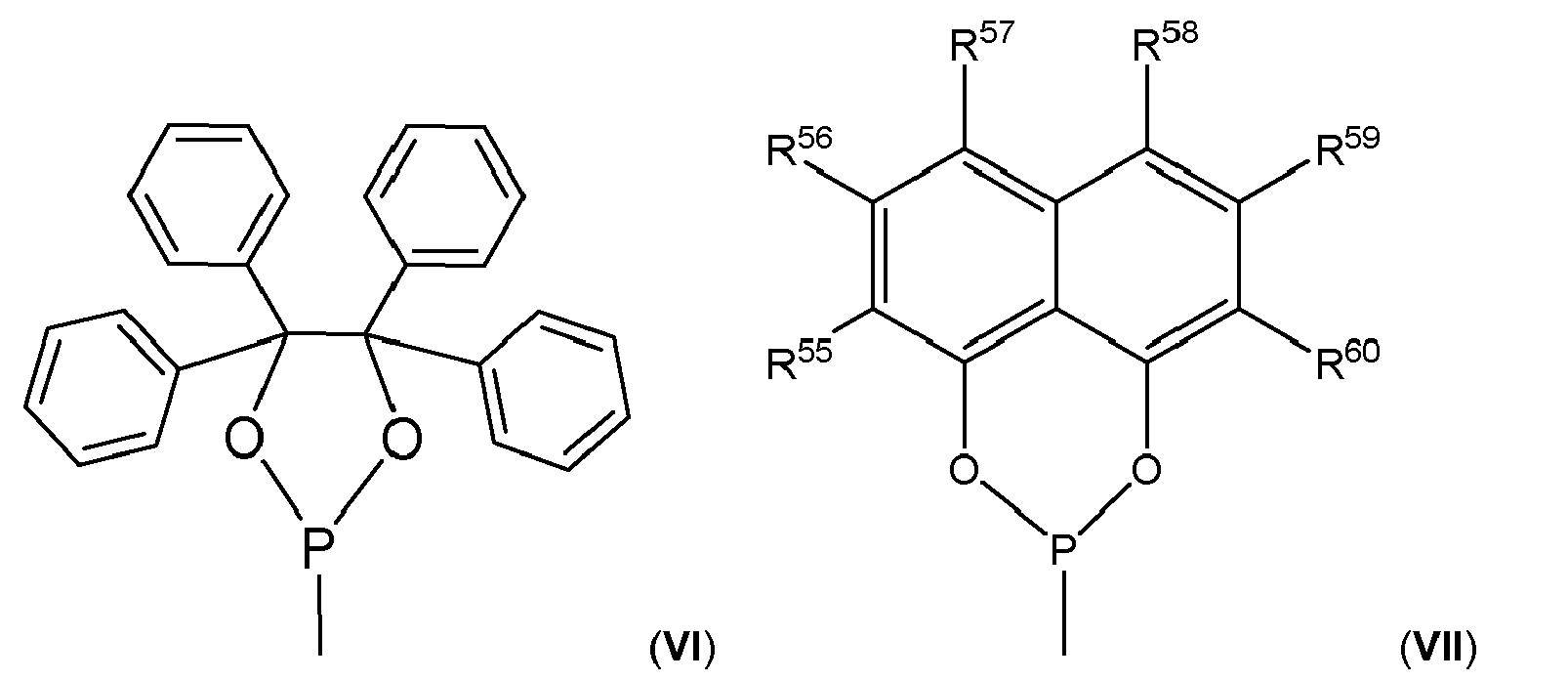
R15, R16, R17, R18, R19, R20, R21, R22-in Struktur (II), R10, R11, R12, R13, R14, R10*, R11*, R12*, R13*, R14* in der Struktur (III), R23, R24, R25, R26, R27, R28, R29, R30, R31 und R32 in Struktur (IV), R43, R44, R45, R46, R47, R48, R49, R50, R51, R52, R53 und R54 in Struktur (V), R55, R56, R57, R58, R59 und R60 in Struktur (VII), jeweils in der jeweiligen Struktur unabhängig voneinander ausgewählt sind aus: -H, -(C1-C12)-Alkyl, -O-(C1-C12)-Alkyl, -(C6-C20)-Aryl, -O-(C6-C20)-Aryl, -Halogen, wobei die Alkylgruppen linear, verzweigt oder cyclisch sind, wobei die Alkyl- und Arylgruppen jeweils unabhängig unsubstituiert oder substituiert sind, wobei die jeweilige substituierte -(C1-C12)-Alkylgruppe und die jeweilige substituierte -(C6-C20)-Arylgruppe mindestens einen Substituenten aufweist und der mindestens eine Substituent jeweils unabhängig ausgewählt ist aus -(C3-C12)-Cycloalkyl, -(C3-C12)-Heterocycloalkyl, -(C6-C20)-Aryl, Fluor, Chlor, Cyano, Formyl, Acyl oder Alkoxycarbonyl. - Verbindung nach Anspruch 1, dadurch gekennzeichnet, dass
die Gruppen -R1 in der Struktur (I) ausgewählt ist aus: -(C1-C12)-Alkyl, -(C1-C12)-Alkyl-O-(C1-C12)-Alkyl, -(C6-C20)-Aryl, -(C6-C20)-Aryl-O-(C1-C12)Alkyl, -(C1-C12)-Alkyl-O-(C6-C20)-Aryl, -(C6-C20)-Aryl-O-(C6-C20)-Aryl, -(C=O)-O-(C1-C12)-Alkyl, wobei die Alkylgruppen linear, verzweigt oder cyclisch sind, wobei die genannten Alkyl- und Arylgruppen jeweils unabhängig unsubstituiert oder substituiert sind, wobei substituierte -(C1-C12)-Alkylgruppen und substituierte -(C6-C20)-Arylgruppen mindestens einen Substituenten aufweisen und der mindestens eine Substituent jeweils unabhängig ausgewählt ist aus -(C3-C12)-Cycloalkyl und/oder -(C6-C20)-Aryl. - Verbindung nach einem der Ansprüche 1 bis 3, dadurch gekennzeichnet, dass das heterozyklische Selena-Phosphit der allgemeinen Struktur (I) ausgewählt ist aus mindestens einer Verbindung der Struktur (la)

wobei die Gruppe -R1 ausgewählt ist aus: -(C1-C12)-Alkyl, -(C1-C12)-Alkyl-O-(C1-C12)-Alkyl, -(C6-C20)-Aryl, -(C1-C12)-Alkyl-O-(C6-C20)-Aryl, -(C6-C20)-Aryl-O-(C1-C12)Alkyl, -(C6-C20)-Aryl-O-(C6-C20)-Aryl, wobei die Alkylgruppen linear, verzweigt oder cyclisch sind, und die Gruppe -R1* in Struktur (Ia) einer organofunktionellen Phosphit-Gruppe entspricht. - Verbindung nach einem der Ansprüche 1 bis 4, dadurch gekennzeichnet, dass das -R1* im heterozyklischen Selena-Phosphit der allgemeinen Struktur (I) oder (Ia) ausgewählt aus den Strukturen (II), (III), (IV), (V), (VI), und (VII) entspricht


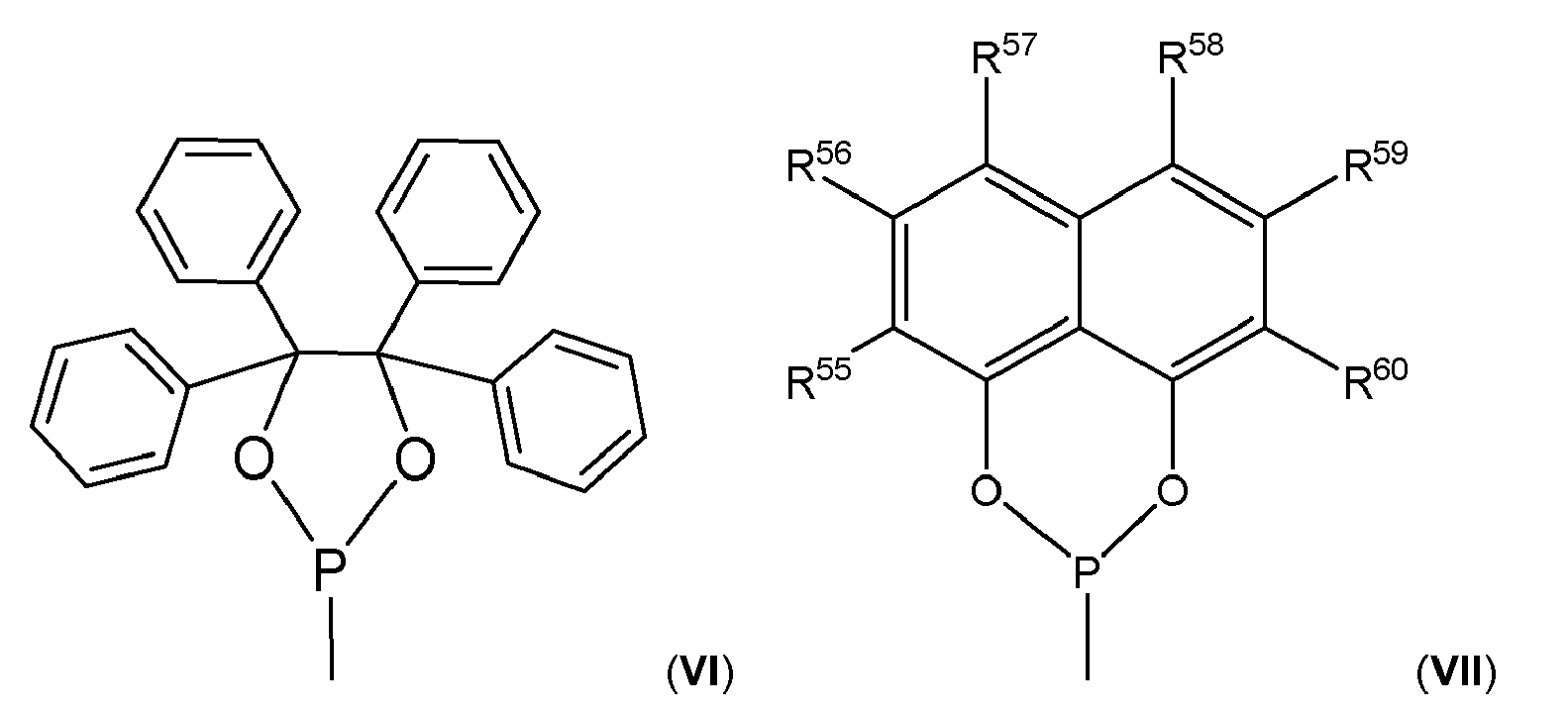
R15, R16, R17, R18, R19, R20, R21, R22 in Struktur (II), R10, R11, R12, R13, R14, R10*, R11*, R12*, R13*, R14* in der Struktur (III),
R23, R24, R25, R26, R27, R26, R29, R30, R31 und R32 in Struktur (IV), R43, R44, R45, R46, R47, R48, R49, R50, R51, R52, R53 und R54 in Struktur (V), R55, R56, R57, R58, R59 und R60 in Struktur (VII), jeweils für jede Struktur unabhängig voneinander ausgewählt sind aus: -H, -(C1-C12)-Alkyl, -O-(C1-C12)-Alkyl, -(C6-C20)-Aryl, -O-(C6-C20)-Aryl, -Halogen wobei die Alkylgruppen linear, verzweigt oder cyclisch sind. - Verbindung nach einem der Ansprüche 1 bis 5, dadurch gekennzeichnet, dass das -R1* im heterozyklischen Selena-Phosphit der allgemeinen Struktur (I) oder (Ia) ausgewählt ist aus Struktur (III),
und die Gruppe -R1 ausgewählt ist aus -(C1-C12)-Alkyl, -(C1-C12)-Alkyl-O-(C1-C12)-Alkyl, -(C6-C20)-Aryl, -(C1-C12)-Alkyl-O-(C6-C20)-Aryl, -(C6-C20)-Aryl-O-(C1-C12)Alkyl, -(C6-C20)-Aryl-O-(C6-C20)-Aryl, wobei die Alkylgruppen linear, verzweigt oder cyclisch sind,


- Verfahren zur Herstellung mindestens eines heterozyklischen Selena-Phosphites der allgemeinen Struktur (I)

wobei die Gruppe -R1 ausgewählt ist aus: -(C1-C12)-Alkyl, -(C1-C12)-Alkyl-O-(C1-C12)-Alkyl, -(C6-C20)-Aryl, -(C1-C12)-Alkyl-O-(C6-C20)-Aryl, -(C6-C20)-Aryl-O-(C1-C12)Alkyl, -(C6-C20)-Aryl-O-(C6-C20)-Aryl, -C=O-O-(C1-C12)-Alkyl, acetyl, wobei die Alkylgruppen linear, verzweigt oder cyclisch sind, wobei die genannten Alkyl- und Arylgruppen jeweils unabhängig unsubstituiert oder substituiert sind, wobei substituierte -(C1-C12)-Alkylgruppen und substituierte -(C6-C20)-Arylgruppen mindestens einen Substituenten aufweisen und der mindestens eine Substituent jeweils unabhängig ausgewählt ist aus -(C3-C12)-Cycloalkyl, -(C3-C12)-Heterocycloalkyl, -(C6-C20)-Aryl, Fluor, Chlor, Cyano, Formyl, Acyl oder Alkoxycarbonyl, und die Gruppe -R1* einer organofunktionellen Phosphit-Gruppe entspricht.
umfassend mindestens den Verfahrensschritt(i) Umsetzen eines Selenodiaryls der allgemeinen Struktur (IX)
und Gruppe -R1 ausgewählt ist aus: -(C1-C12)-Alkyl, -(C1-C12)-Alkyl-O-(C1-C12)-Alkyl, -(C6-C20)-Aryl, -(C1-C12)-Alkyl-O-(C6-C20)-Aryl, -(C6-C20)-Aryl-O-(C1-C12)Alkyl, -(C6-C20)-Aryl-O-(C6-C20)-Aryl, -C=O-O-(C1-C12)-Alkyl, -acetyl, wobei die Alkylgruppen linear, verzweigt oder cyclisch sind, wobei die genannten Alkyl- und Arylgruppen jeweils unabhängig unsubstituiert oder substituiert sind, wobei substituierte -(C1-C12)-Alkylgruppen und substituierte -(C6-C20)-Arylgruppen mindestens einen Substituenten aufweisen und der mindestens eine Substituent jeweils unabhängig ausgewählt ist aus - (C3-C12)-Cycloalkyl, -(C3-C12)-Heterocycloalkyl, -(C6-C20)-Aryl, Fluor, Chlor, Cyano, Formyl, Acyl oder Alkoxycarbonyl,(ii) mit mindestens einer Halogenphosphit-Verbindung R1* Hal der Formel (X), wobei Hai jeweils unabhängig ausgewählt ist aus Fluor, Chlor, Brom, Jod, und wobei -R1* einer organofunktionellen bivalenten Phosphit-Gruppe entspricht,(iii) und erhalten mindestens eines heterozyklischen Selena-Phosphits der allgemeinen Struktur (I). - Verfahren nach Anspruch 7, dadurch gekennzeichnet, dass in den Halogenphosphit-Verbindungen R1* Hal der Formel (X) Hal jeweils unabhängig ausgewählt ist aus Fluor, Chlor, Brom, Jod, und -R1* jeweils ausgewählt ist aus den Strukturen (II), (III), (IV), (V), (VI) und (VII)


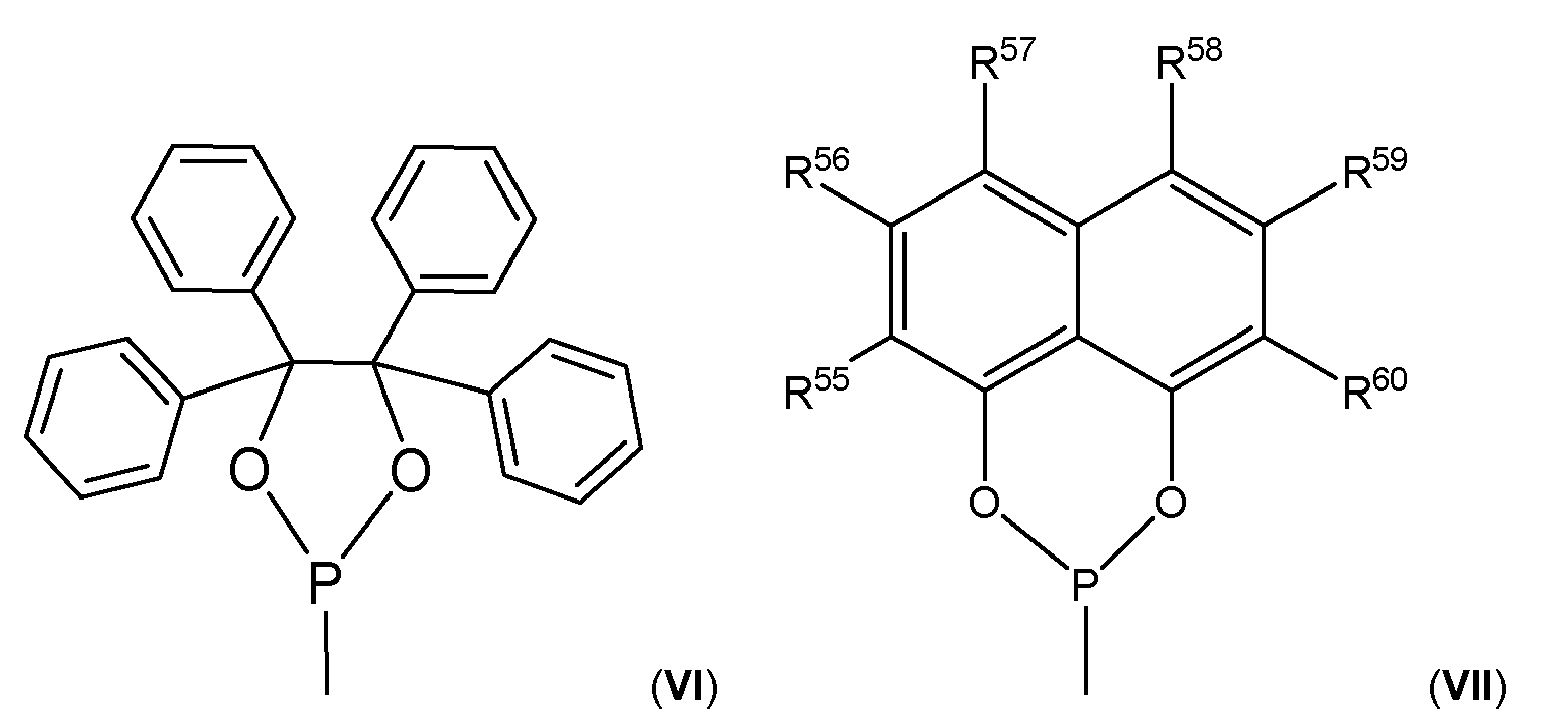
R15, R16, R17, R18, R19, R20, R21, R22 -in Struktur (II), R10, R11, R12, R13, R14, R10*, R11*, R12*, R13*, R14* in der Struktur (III), R23, R24, R25, R26, R27, R26, R29, R30, R31 und R32 in Struktur (IV), R43, R44, R45, R46, R47, R48, R49, R50, R51, R52, R53 und R54 in Struktur (V), R55, R56, R57, R58, R59 und R60 in Struktur (VII),
jeweils unabhängig in der jeweiligen Struktur voneinander ausgewählt sind aus: -H, -(C1-C12)-Alkyl, -O-(C1-C12)-Alkyl, -(C6-C20)-Aryl, -O-(C6-C20)-Aryl, -Halogen, wobei die Alkylgruppen linear, verzweigt oder cyclisch sind, wobei die Alkyl- und Arylgruppen jeweils unabhängig unsubstituiert oder substituiert sind, wobei die jeweilige substituierte -(C1-C12)-Alkylgruppe und die jeweilige substituierte -(C6-C20)-Arylgruppe mindestens einen Substituenten aufweist und der mindestens eine Substituent jeweils unabhängig ausgewählt ist aus -(C3-C12)-Cycloalkyl, -(C3-C12)-Heterocycloalkyl, -(C6-C20)-Aryl, Fluor, Chlor, Cyano, Formyl, Acyl oder Alkoxycarbonyl. - Verfahren nach Anspruch 7 oder 8, dadurch gekennzeichnet, dass in der Halogenphosphit-Verbindung R1* Hal der Formel (X) Hal ausgewählt ist aus Chlor oder Brom, und
-R1* ausgewählt ist aus den Strukturen (II), (III), (IV), (V), (VI) und (VII)


R15, R16, R17, R18, R19, R20, R21, R22-in Struktur (II), R10, R11, R12, R13, R14, R10*, R11*, R12*, R13*, R14* in der Struktur (III), R23, R24, R25, R26, R27, R28, R29, R30, R31 und R32 in Struktur (IV), R43, R44, R45, R46, R47, R48, R49, R50, R51, R52, R53 Und R54 in Struktur (V), R55, R56, R57, R58, R59 und R61 in Struktur (VII), jeweils unabhängig voneinander ausgewählt sind aus: -H, -(C1-C12)-Alkyl, -O-(C1-C12)-Alkyl, -(C6-C20)-Aryl, -O-(C6-C20)-Aryl, -Halogen, wobei die Alkylgruppen linear, verzweigt oder cyclisch sind. - Verfahren nach einem der Ansprüche 7 bis 9, dadurch gekennzeichnet, dass das Selenodiaryl der allgemeinen Struktur (IXa) entspricht

wobei die Gruppe -R1 ausgewählt ist aus: -(C1-C12)-Alkyl, -(C1-C12)-Alkyl-O-(C1-C12)-Alkyl, -(C6-C20)-Aryl, -(C1-C12)-Alkyl-O-(C6-C20)-Aryl, -(C6-C20)-Aryl-O-(C1-C12)Alkyl, -(C6-C20)-Aryl-O-(C6-C20)-Aryl, wobei die Alkylgruppen linear, verzweigt oder cyclisch sind. - Verfahren nach einem der Ansprüche 7 bis 10,
wobei (i) die Umsetzung in Gegenwart einer Base, insbesondere eines Amins oder einer Pyridinbase, vorzugsweise eines Alkylamins, wie Triethylamin oder Dimethylaminobutan, besonders bevorzugt Triethylamin. - Verfahren nach einem der Ansprüche 7 bis 11, dadurch gekennzeichnet,
dass das Selenodiaryl der allgemeinen Struktur (IX) oder (IXa) mit R1* Hal der Formel (X) im molaren Verhältnis von 10 : 1 bis 1 : 10 umgesetzt wird, vorzugsweise im Verhältnis von 4: 1 bis 1 : 4. - Verfahren nach einem der Ansprüche 7 bis 12,
wobei (i) die Umsetzung im Temperaturbereich von -45 bis 80 °C erfolgt, insbesondere von - 15 bis 30°C. - Verfahren nach einem der Ansprüche 7 bis 13,
wobei (i) die Umsetzung in einem aprotischen Lösemittel erfolgt, insbesondere ist das Lösemittel ausgewählt aus organischen aromatischen, halogenierten Lösemitteln oder Kohlenwasserstoffen. - Verwendung eines heterozyklischen Selena-Phosphits nach einem der Ansprüche 1 bis 6 oder erhalten nach einem der Ansprüche 7 bis 14 als Ligand.
Priority Applications (2)
| Application Number | Priority Date | Filing Date | Title |
|---|---|---|---|
| EP15198145.3A EP3178826A1 (de) | 2015-12-07 | 2015-12-07 | Heterozyklische an einer hydroxyl-gruppe geschützte selena-monophosphite sowie verfahren zu deren herstellung |
| US15/370,437 US10100071B2 (en) | 2015-12-07 | 2016-12-06 | Heterocyclic selenamonophosphites protected on a hydroxyl group and processes for preparation thereof |
Applications Claiming Priority (1)
| Application Number | Priority Date | Filing Date | Title |
|---|---|---|---|
| EP15198145.3A EP3178826A1 (de) | 2015-12-07 | 2015-12-07 | Heterozyklische an einer hydroxyl-gruppe geschützte selena-monophosphite sowie verfahren zu deren herstellung |
Publications (1)
| Publication Number | Publication Date |
|---|---|
| EP3178826A1 true EP3178826A1 (de) | 2017-06-14 |
Family
ID=54834680
Family Applications (1)
| Application Number | Title | Priority Date | Filing Date |
|---|---|---|---|
| EP15198145.3A Withdrawn EP3178826A1 (de) | 2015-12-07 | 2015-12-07 | Heterozyklische an einer hydroxyl-gruppe geschützte selena-monophosphite sowie verfahren zu deren herstellung |
Country Status (2)
| Country | Link |
|---|---|
| US (1) | US10100071B2 (de) |
| EP (1) | EP3178826A1 (de) |
Citations (1)
| Publication number | Priority date | Publication date | Assignee | Title |
|---|---|---|---|---|
| US20150336885A1 (en) * | 2014-05-26 | 2015-11-26 | Evonik Degussa Gmbh | Process for preparing 2,2'-selenobiaryl ethers or 4,4'-selenobiaryl ethers using selenium dioxide |
Family Cites Families (4)
| Publication number | Priority date | Publication date | Assignee | Title |
|---|---|---|---|---|
| DE102014209976A1 (de) | 2014-05-26 | 2015-11-26 | Evonik Degussa Gmbh | Verfahren zur Herstellung von 2,2'-Biphenolen unter Verwendung von Selendioxid und halogeniertem Lösungsmittel |
| DE102014209967A1 (de) | 2014-05-26 | 2015-12-17 | Evonik Degussa Gmbh | Verfahren zur Herstellung von 2,2'-Biphenolen unter Verwendung von Selendioxid |
| US9950979B2 (en) | 2014-05-26 | 2018-04-24 | Evonik Degussa Gmbh | Method for producing asymmetrical biphenols using selenium dioxide |
| DE112016001038A5 (de) | 2015-03-05 | 2017-12-14 | Evonik Degussa Gmbh | Geschützte Selenodiphenole sowie Verfahren zu deren Herstellung |
-
2015
- 2015-12-07 EP EP15198145.3A patent/EP3178826A1/de not_active Withdrawn
-
2016
- 2016-12-06 US US15/370,437 patent/US10100071B2/en not_active Expired - Fee Related
Patent Citations (1)
| Publication number | Priority date | Publication date | Assignee | Title |
|---|---|---|---|---|
| US20150336885A1 (en) * | 2014-05-26 | 2015-11-26 | Evonik Degussa Gmbh | Process for preparing 2,2'-selenobiaryl ethers or 4,4'-selenobiaryl ethers using selenium dioxide |
Non-Patent Citations (6)
| Title |
|---|
| H. M. LIN ET AL.: "A novel and efficient synthesis of selenides", ARKIVOC, vol. VIII, 2012, pages 146 - 156 |
| PAUL C.J. KAMER; PIET W.N.M. VAN LEEUWEN: "Phosphorous(III) Ligands in Homogeneous Catalysis - Design and Synthesis", 2012, JOHN WILEY AND SONS, pages: 94 FF |
| R. FRANKE; D. SELENT; A. BÖRNER: "Applied Hydroformylation", CHEM. REV., 2012 |
| SELENT, DETLEF ET AL: "Diastereoisomeric bisphosphite ligands in the hydroformylation of octenes: rhodium catalysis and HP-NMR investigations", CHEMICAL COMMUNICATIONS (CAMBRIDGE, UNITED KINGDOM) , (46), 6203-6205 CODEN: CHCOFS; ISSN: 1359-7345, 31 October 2008 (2008-10-31), pages 6203 - 6205, XP002757869 * |
| T. K. PAINE ET AL.: "Manganese complexes of mixed O, X, O-donor ligands (X = S or Se): synthesis, characterization and catalytic reactivity", DALTON TRANS., vol. 15, 2003, pages 3136 - 3144 |
| VAN LEEUWEN ET AL., JOURNAL OF CATALYSIS, vol. 298, 2013, pages 198 - 205 |
Also Published As
| Publication number | Publication date |
|---|---|
| US20170158723A1 (en) | 2017-06-08 |
| US10100071B2 (en) | 2018-10-16 |
Similar Documents
| Publication | Publication Date | Title |
|---|---|---|
| EP3070093B1 (de) | Neue organophosphorverbindungen auf basis von anthracentriol | |
| EP3145938B1 (de) | Verfahren zur herstellung von monophosphiten | |
| EP3029013B1 (de) | Monophosphite mit Struktureinheit 4,4,5,5-Tetraphenyl-1,3,2-dioxaphospholan als Liganden für Hydroformylierungskatalysatoren | |
| WO2016139245A1 (de) | Geschützte selenodiphenole sowie verfahren zu deren herstellung | |
| EP2207783A1 (de) | Verfahren zur hydroformylierung | |
| EP3178826A1 (de) | Heterozyklische an einer hydroxyl-gruppe geschützte selena-monophosphite sowie verfahren zu deren herstellung | |
| DE102007023514A1 (de) | Stabile Katalysatorvorstufe von Rh-Komplexkatalysatoren | |
| EP3029055B1 (de) | Monophosphite die einen unsymmetrischen Biaryl-Baustein aufweisen | |
| EP3178827A1 (de) | Heterozyklische selena-biphosphite sowie verfahren zu deren herstellung | |
| EP3178828A1 (de) | Heterozyklische selena-phosphite sowie verfahren zu deren herstellung | |
| EP3178825A1 (de) | Heterozyklische selena-phosphite sowie verfahren zu deren herstellung | |
| DE102016211501A1 (de) | Verfahren zur Herstellung heterozyklischer Selena-Phosphite durch Umsetzung von Selenodiaryl | |
| EP3178829A1 (de) | Organodiarylselenoxide sowie verfahren zu deren herstellung | |
| DE102016211500A1 (de) | Verfahren zur Herstellung heterozyklischer Selena-Phosphite | |
| WO2017088987A1 (de) | Geschützte selenodiphenole sowie verfahren zu deren herstellung | |
| EP3088405B1 (de) | Neue monophosphitverbindungen mit einer methylgruppe | |
| DE102016205885A1 (de) | Komplexe von Diphenylseleniden, deren Verwendung und Katalyseverfahren | |
| DE102016211499A1 (de) | Verfahren zur Reduktion von Diphenylselenoxid | |
| DE102013219512A1 (de) | Gemisch aus verschiedenen unsymmetrischen Bisphosphiten und dessen Verwendung als Katalysatorgemisch in der Hydroformylierung | |
| EP3088406A1 (de) | Neue monophosphitverbindungen mit einer ethergruppe | |
| EP3031813B1 (de) | Monophosphite die ein menthol aufweisen | |
| EP3178830A1 (de) | Komplexe von diphenylselenoxiden, deren verwendung und katalyseverfahren | |
| EP3263577A1 (de) | Komplexe von diphenylselenonen, deren verwendung und katalyseverfahren | |
| EP3088407A1 (de) | Neue monophosphitverbindungen mit einer estergruppe | |
| EP3088408A1 (de) | Neue monophosphitverbindungen mit einer sulfonatgruppe |
Legal Events
| Date | Code | Title | Description |
|---|---|---|---|
| PUAI | Public reference made under article 153(3) epc to a published international application that has entered the european phase |
Free format text: ORIGINAL CODE: 0009012 |
|
| AK | Designated contracting states |
Kind code of ref document: A1 Designated state(s): AL AT BE BG CH CY CZ DE DK EE ES FI FR GB GR HR HU IE IS IT LI LT LU LV MC MK MT NL NO PL PT RO RS SE SI SK SM TR |
|
| AX | Request for extension of the european patent |
Extension state: BA ME |
|
| STAA | Information on the status of an ep patent application or granted ep patent |
Free format text: STATUS: THE APPLICATION HAS BEEN WITHDRAWN |
|
| 18W | Application withdrawn |
Effective date: 20170707 |