EP3178442A1 - Implantable prosthesis - Google Patents
Implantable prosthesis Download PDFInfo
- Publication number
- EP3178442A1 EP3178442A1 EP17151075.3A EP17151075A EP3178442A1 EP 3178442 A1 EP3178442 A1 EP 3178442A1 EP 17151075 A EP17151075 A EP 17151075A EP 3178442 A1 EP3178442 A1 EP 3178442A1
- Authority
- EP
- European Patent Office
- Prior art keywords
- biological tissue
- tissue
- prosthetic device
- layer
- sheet
- Prior art date
- Legal status (The legal status is an assumption and is not a legal conclusion. Google has not performed a legal analysis and makes no representation as to the accuracy of the status listed.)
- Withdrawn
Links
Images

Classifications
-
- A—HUMAN NECESSITIES
- A61—MEDICAL OR VETERINARY SCIENCE; HYGIENE
- A61F—FILTERS IMPLANTABLE INTO BLOOD VESSELS; PROSTHESES; DEVICES PROVIDING PATENCY TO, OR PREVENTING COLLAPSING OF, TUBULAR STRUCTURES OF THE BODY, e.g. STENTS; ORTHOPAEDIC, NURSING OR CONTRACEPTIVE DEVICES; FOMENTATION; TREATMENT OR PROTECTION OF EYES OR EARS; BANDAGES, DRESSINGS OR ABSORBENT PADS; FIRST-AID KITS
- A61F2/00—Filters implantable into blood vessels; Prostheses, i.e. artificial substitutes or replacements for parts of the body; Appliances for connecting them with the body; Devices providing patency to, or preventing collapsing of, tubular structures of the body, e.g. stents
- A61F2/0063—Implantable repair or support meshes, e.g. hernia meshes
-
- A—HUMAN NECESSITIES
- A61—MEDICAL OR VETERINARY SCIENCE; HYGIENE
- A61F—FILTERS IMPLANTABLE INTO BLOOD VESSELS; PROSTHESES; DEVICES PROVIDING PATENCY TO, OR PREVENTING COLLAPSING OF, TUBULAR STRUCTURES OF THE BODY, e.g. STENTS; ORTHOPAEDIC, NURSING OR CONTRACEPTIVE DEVICES; FOMENTATION; TREATMENT OR PROTECTION OF EYES OR EARS; BANDAGES, DRESSINGS OR ABSORBENT PADS; FIRST-AID KITS
- A61F2210/00—Particular material properties of prostheses classified in groups A61F2/00 - A61F2/26 or A61F2/82 or A61F9/00 or A61F11/00 or subgroups thereof
- A61F2210/0004—Particular material properties of prostheses classified in groups A61F2/00 - A61F2/26 or A61F2/82 or A61F9/00 or A61F11/00 or subgroups thereof bioabsorbable
-
- A—HUMAN NECESSITIES
- A61—MEDICAL OR VETERINARY SCIENCE; HYGIENE
- A61F—FILTERS IMPLANTABLE INTO BLOOD VESSELS; PROSTHESES; DEVICES PROVIDING PATENCY TO, OR PREVENTING COLLAPSING OF, TUBULAR STRUCTURES OF THE BODY, e.g. STENTS; ORTHOPAEDIC, NURSING OR CONTRACEPTIVE DEVICES; FOMENTATION; TREATMENT OR PROTECTION OF EYES OR EARS; BANDAGES, DRESSINGS OR ABSORBENT PADS; FIRST-AID KITS
- A61F2250/00—Special features of prostheses classified in groups A61F2/00 - A61F2/26 or A61F2/82 or A61F9/00 or A61F11/00 or subgroups thereof
- A61F2250/0014—Special features of prostheses classified in groups A61F2/00 - A61F2/26 or A61F2/82 or A61F9/00 or A61F11/00 or subgroups thereof having different values of a given property or geometrical feature, e.g. mechanical property or material property, at different locations within the same prosthesis
- A61F2250/003—Special features of prostheses classified in groups A61F2/00 - A61F2/26 or A61F2/82 or A61F9/00 or A61F11/00 or subgroups thereof having different values of a given property or geometrical feature, e.g. mechanical property or material property, at different locations within the same prosthesis differing in adsorbability or resorbability, i.e. in adsorption or resorption time
Definitions
- the present invention relates to prosthetic devices, and methods of using such devices for repairing, reconstructing, buttressing, or augmenting a defect or weakness in a wall of a tissue, muscle or organ.
- a porous, knitted, synthetic mesh implant provides strength for reinforcing tissue and closing tissue defects, particularly in the abdominal cavity, while preserving sufficient openings in the material to support native tissue ingrowth.
- the prosthetic mesh may come into direct contact with the sensitive abdominal viscera, potentially leading to postoperative adhesions between the mesh and, for example, abdominal contents, i.e., mesentery, bowel and intestines.
- One known approach employs a composite prosthesis, which combines a porous knitted mesh layer with a barrier material.
- the porous layer supports tissue ingrowth and provides mechanical strength as it bridges the defect while the barrier layer, which may principally be non-load bearing, reduces the potential for intestinal adhesions.
- One such biologic implant is the COLLAMEND [TM] implant available from C.R.Bard, Inc. of Murray Hill, New Jersey.
- the COLLAMEND [TM] material formed of a single layer of acellular, lyophilized, crosslinked porcine dermis, is a fully resorbable implant exhibiting the required strength and durability for soft tissue reinforcement and tissue defect repair.
- a prosthetic device for repairing or augmenting a tissue, muscle or organ defect, comprising: a first portion of biological tissue that is remodelable and configured for tissue ingrowth, said first portion constructed and arranged to cover or plug a defect; and a second portion of biological tissue that is more slowly enzymatically degradable after implantation than the first layer and that is not configured for tissue ingrowth, said second portion having sufficient pullout strength so that said prosthetic device is fixatable through said second portion.
- Another aspect of the invention includes a prosthetic device for repairing or augmenting a tissue, muscle or organ defect, the prosthetic device including a first portion of biological tissue that is rapidly enzymatically degradable after implantation, remodelable, and configured for tissue ingrowth, with the first portion constructed and arranged to cover or plug a defect.
- the prosthetic device also includes a second portion of biological tissue that is slowly enzymatically degradable after implantation and that is not configured for tissue ingrowth, the second portion having sufficient pullout strength so that the prosthetic device is fixatable through the second portion.
- the first portion of biological tissue may not be cross-linked or may be minimally cross-linked.
- the second portion of biological tissue may be cross-linked.
- the second portion of biological tissue may include biological tissue that has been processed with resulting increased pullout strength.
- At least 50% of said first portion of biological tissue may be resorbable in less than twelve weeks after implantation.
- At least 50% of said second portion of biological tissue may be resorbable in no less than fifty-two weeks.
- the first portion of biological tissue may have a thickness of between about 0.3 mm and 0.5 mm.
- the second portion of biological tissue may have a thickness of between about 0.7 mm and 1.4 mm.
- the first and second portions of biological tissue may be acellular, lyophilized, porcine dermis.
- the first portion of biological tissue may have a first surface and a second surface and includes holes extending from said first surface to said second surface that are configured for tissue ingrowth.
- the first portion of biological tissue may include a surface that is textured for tissue ingrowth.
- the first and second portions of biological tissue may be in the form of a patch.
- the patch may include a sheet of said second portion of biological tissue that surrounds at least an aspect of a sheet of said first portion of biological tissue.
- the sheet of said first portion of biological tissue may be positioned against said sheet of said second portion of biological tissue.
- the sheet of said first portion of biological tissue may be positioned either face-to-face, or edge-to-edge, with said sheet of said second portion of biological tissue.
- the sheet of said first portion of biological tissue may be attached to said sheet of said second portion of biological tissue by a resorbable material.
- the second portion of biological tissue may have a ball burst strength at least about twice that of said first portion of biological tissue.
- the second portion of biological tissue may have a ball burst strength of at least about three times that of said first portion of biological tissue.
- the second portion of biological tissue may have a ball burst strength of at least about four times that of said first portion of biological tissue.
- the prosthetic device may be in the form of a plug.
- the first portion of biological tissue may be in the form of a plug and said second portion of biological tissue may be in the form of a patch.
- Another aspect of the invention includes a prosthetic device for repairing or augmenting a tissue, muscle or organ defect, the prosthetic device including a non-crosslinked, or minimally cross-linked, portion of biological tissue that is constructed and arranged to cover or plug a defect.
- the prosthetic device also includes a cross-linked portion of biological tissue having sufficient pullout strength so that the prosthetic device is fixatable through the second portion.
- At least 50% of said non-crosslinked, or minimally cross-linked, portion of biological tissue may be resorbable in less than twelve weeks after implantation.
- At least 50% of said cross-linked portion of biological tissue may be resorbable in no less than fifty-two weeks after implantation.
- the non-crosslinked, or minimally cross-linked, portion of biological tissue may have a thickness of between about 0.3 mm and 0.5 mm.
- the cross-linked portion of biological tissue may have a thickness of between about 0.7 mm and 1.4 mm.
- the non-crosslinked, or minimally cross-linked, portion of biological tissue and said cross-linked portion of biological tissue may be acellular, lyophilized, porcine dermis.
- the non-crosslinked, or minimally cross-linked, portion of biological tissue may have a first surface and a second surface and may include holes extending from said first surface to said second surface that are configured for tissue ingrowth.
- the non-crosslinked, or minimally cross-linked, portion of biological tissue may include a surface that is textured for tissue ingrowth.
- the non-crosslinked, or minimally cross-linked, portion of biological tissue and said cross-linked portion of biological tissue may be in the form of a patch.
- the patch may include a sheet of said cross-linked portion of biological tissue that surrounds at least an aspect of a sheet of said non-crosslinked, or minimally cross-linked, portion of biological tissue.
- the sheet of non-crosslinked, or minimally cross-linked, portion of biological tissue may be positioned against said sheet of cross-linked portion of biological tissue.
- the sheet of non-crosslinked, or minimally cross-linked, portion of biological tissue may be positioned either face-to-face, or edge-to-edge, with said sheet of cross-linked portion of biological tissue.
- the sheet of non-crosslinked, or minimally cross-linked, portion of biological tissue may be attached to said sheet of cross-linked portion of biological tissue by a resorbable material.
- the cross-linked portion of biological tissue may have a ball burst strength at least about twice that of said non-crosslinked, or minimally cross-linked, portion of biological tissue.
- the cross-linked portion of biological tissue may have a ball burst strength of at least about three times that of said non-crosslinked, or minimally cross-linked, portion of biological tissue.
- the cross-linked portion of biological tissue may have a ball burst strength of at least about four times that of said non-crosslinked, or minimally cross-linked, portion of biological tissue.
- the prosthetic device may be in the form of a plug.
- the non-crosslinked, or minimally cross-linked, portion of biological tissue may be in the form of a plug and said cross-linked portion of biological tissue may be in the form of a patch.
- Another aspect of the present invention includes a prosthetic device for repairing or augmenting a tissue, muscle or organ defect, the prosthetic device including a first portion of acellular, lyophilized, porcine dermis, at least 50% of the first portion being resorbable in less than twelve weeks after implantation, the first portion being configured for tissue ingrowth.
- the prosthetic device also includes a second portion of acellular, lyophilized, porcine dermis, at least 50% of the second portion being resorbable in no less than fifty-two weeks after implantation, the second portion not being configured for tissue ingrowth, wherein the second portion is arranged to provide an accessible fixation location for the prosthetic device.
- the first portion may have a thickness of between about 0.3 mm and 0.5 mm.
- the second portion may have a thickness of between about 0.7 mm and 1.4 mm.
- the first portion may have a first surface and a second surface and includes holes extending from said first surface to said second surface that are configured for tissue ingrowth.
- the first portion may include a surface that is textured for tissue ingrowth.
- the first portion and said second portion may be in the form of a patch.
- the patch may include a sheet of said second portion that surrounds at least an aspect of a sheet of said first portion.
- the sheet of said first portion may be positioned against said sheet of said second portion.
- the sheet of said first portion may be positioned either face-to-face, or edge-to-edge, with said sheet of said second portion.
- the sheet of said first portion may be attached to said sheet of said second portion by a resorbable material.
- the second portion may have a ball burst strength at least about twice that of said first portion.
- the second portion may have a ball burst strength of at least about three times that of said first portion.
- the second portion may have a ball burst strength of at least about four times that of said first portion.
- the prosthetic device may be in the form of a plug.
- the first portion may be in the form of a plug and said second portion may be in the form of a patch.
- Another aspect of the present invention includes a prosthetic device for repairing or augmenting a tissue, muscle or organ defect, the prosthetic device having a first portion of biological tissue that is configured for tissue ingrowth, the first portion having a ball burst strength.
- the prosthetic device also includes a second portion of biological tissue, the second portion having a ball burst strength greater than the first portion ball burst strength, wherein the second portion surrounds at least an aspect of the first portion.
- the first portion of biological tissue may not be cross-linked or may be minimally cross-linked.
- the second portion of biological tissue may be cross-linked.
- the second portion of biological tissue may include biological tissue that has been processed with resulting increased ball burst strength.
- At least 50% of said first portion of biological tissue may be resorbable in less than twelve weeks after implantation.
- At least 50% of said second portion of biological tissue may be resorbable in no less than fifty-two weeks.
- the first portion of biological tissue may have a thickness of between about 0.3 mm and 0.5 mm.
- the second portion of biological tissue may have a thickness of between about 0.7 mm and 1.4 mm.
- the first and second portions of biological tissue may be are acellular, lyophilized, porcine dermis.
- the first portion of biological tissue may have a first surface and a second surface and may include holes extending from said first surface to said second surface that are configured for tissue ingrowth.
- the first portion of biological tissue may include a surface that is textured for tissue ingrowth.
- the first and second portions of biological tissue may be in the form of a patch.
- the patch may include a sheet of said second portion of biological tissue that surrounds at least an aspect of a sheet of said first portion of biological tissue.
- the sheet of said first portion of biological tissue may be positioned against said sheet of said second portion of biological tissue.
- the sheet of said first portion of biological tissue may be positioned either face-to-face, or edge-to-edge, with said sheet of said second portion of biological tissue.
- the sheet of said first portion of biological tissue may be attached to said sheet of said second portion of biological tissue by a resorbable material.
- the second portion of biological tissue may have a ball burst strength at least about twice that of said first portion of biological tissue.
- the second portion of biological tissue may have a ball burst strength of at least about three times that of said first portion of biological tissue.
- the second portion of biological tissue may have a ball burst strength of at least about four times that of said first portion of biological tissue.
- the prosthetic device may be in the form of a plug.
- the first portion of biological tissue may be in the form of a plug and said second portion of biological tissue may be in the form of a patch.
- Another aspect of the present invention includes a method of repairing or augmenting a tissue, muscle or organ defect with a prosthetic device, the prosthetic device having a first portion of biological tissue that is rapidly enzymatically degradable after implantation and that is configured for tissue ingrowth and a second portion of biological tissue that is slowly enzymatically degradable after implantation and that is not configured for tissue ingrowth.
- the method involves positioning the prosthetic device so that the first portion covers or plugs a defect and fixating the second portion to secure the first portion in place relative to the defect.
- the repair or augmentation may be an intraperitoneal procedure.
- the fixating may include one or more of suturing, stapling, or adhesively bonding the second portion.
- the positioning step may include plugging the soft tissue defect with the first portion and covering the soft tissue defect with the second portion.
- the tissue defect has an entrance and an exit, and said covering may include covering either, or both, of the entrance or exit with the second portion.
- the tissue defect has an entrance and an exit, and said covering may include covering either the entrance or the exit with the first portion.
- the repair or augmentation may be performed laparoscopically.
- a prosthetic repair patch comprising: a second layer of biologically compatible and resorbable material having a microporous structure that inhibits native tissue ingrowth; and a first layer of biologically compatible and resorbable material attached to the second layer, wherein the first and second layers have different rates of resorption and the first layer includes a plurality of openings to allow native tissue ingrowth and vascularization.
- the first and second layers may be sewn together with a resorbable suture.
- the second layer may have a maximum width and the first layer may have a maximum width, wherein the maximum width of the second layer may be at least about twice the maximum width of the first layer.
- the second layer may have a substantially uniform thickness and the first layer may have a substantially uniform thickness, wherein the thickness of the second layer may be at least about twice the thickness of the first layer.
- the second layer may have a rate of resorption which is at least about ten times longer than the rate of resorption of the first layer.
- the second layer may have a rate of resorption which is at least about twenty times longer than the rate of resorption of the first layer.
- the first and second layers may be made of porcine dermis.
- Only one of the layers may be crosslinked.
- the first layer may have a top surface and a bottom surface and may include at least one opening extending from the top surface to the bottom surface.
- Another aspect of the present invention is an implantable prosthesis comprising: a second layer of crosslinked porcine dermis and a first layer of non-crosslinked porcine dermis, wherein the first layer has a plurality of openings of sufficient size to allow native tissue ingrowth.
- an implantable prosthesis comprising a resorbable layer having a plurality of spaced apart through cuts forming hinged tabs that are foldable out of the plane of the layer to define corresponding through holes in the layer.
- the resorbable layer may be formed of porcine dermis.
- the through cuts may be arcuate.
- aspects of the invention include a prosthetic device for repairing or augmenting a weakened or damaged tissue wall, muscle or organ (i.e., a defect), and a method of repairing or augmenting a weakened or damaged tissue wall, muscle or organ with a prosthetic device.
- Embodiments of the prosthesis may be particularly suited for procedures involving inguinal, femoral, hiatal, ventral, incisional and recurrent hernias, chest or abdominal wall reconstructions and augmentations, and the treatment of other large defects such as those that may occur in obese patients.
- the prosthetic device is not limited to a particular configuration and may, for example, be in the form of a patch, a plug, a patch and plug combination, or other arrangement.
- the prosthetic device may be employed in an open procedure, laparoscopic procedure, hybrid open or laparoscopic procedure, as well as other surgical methodologies and, in connection with abdominal wall procedures, may be performed preperitoneal or intraperitoneal.
- the prosthetic device includes one or more portions or layers of biological tissue, such as human and/or animal tissue, that may be processed for implantation in a human or animal, with acellular, lyophilized, porcine dermis being a particularly suitable material.
- Some aspects, or all, of a prosthetic device may include one or more of the following features: enzymatically degradable, remodelable, crosslinked, and/or configured for tissue ingrowth. Any of the foregoing properties, if provided, may be present uniformly throughout the prosthetic device or, instead, may vary at different locations of the implant. Further, the strength of the prosthetic device may substantially differ amongst disparate regions, with such strength being characterizable, for example, by a ball burst strength.
- the prosthetic device may be loaded, coated, impregnated or otherwise contain an anesthetic, antibiotic, drug or other medicament.
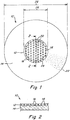
- a prosthesis 10 includes a first portion or layer 12 of biological tissue (e.g., autograft, allograft, xenograft, or combinations of any of the foregoing) that is configured to permit tissue infiltration and vascularization after implantation.
- the first portion or layer may be formed of acellular, lyophilized, porcine dermis having a thickness of between about 0.3 mm and 0.5 mm.
- the first layer or portion may be porous and/or may include a plurality of holes 16 that have been punched, die cut or otherwise formed therethrough to facilitate tissue ingrowth.
- the holes may have a diameter of about 0.060 to 0.094 inches and be spaced apart via a material web 18 between about 0.47 and 0.94 inches. It will be appreciated that the exact size, number, presence or absence, position and spacing of the holes may be varied to achieve the desired performance characteristics. Alternatively, or additionally, a surface of the ingrowth layer may be scraped, scored or otherwise treated to provide a surface texture that facilitates tissue ingrowth. Other biologic materials also are contemplated for the tissue ingrowth portion or layer including, for example, COLLAMEND [TM], ALLOMAX [TM], or ULTRAFOAM [TM] sponge, all of which are available from C.R. Bard, Inc. of Murray Hill, New Jersey.
- tissue infiltratable layer or portion may be cross-linked; for example, porcine dermis may be crosslinked using EDAC (1-ethyl-(3-dimethylaminopropyl)-carbodiimide hydrochloride).
- EDAC 1-ethyl-(3-dimethylaminopropyl)-carbodiimide hydrochloride
- a tissue infiltratable layer 12 may not be crosslinked at all, or may be minimally crosslinked.
- a second portion or layer 14 of the composite prosthesis also may be formed of a biological tissue.
- the second portion or layer may not be configured for tissue ingrowth; that is, the biological tissue may be substantially non-porous, not include any additionally formed openings therethrough, or otherwise not be receptive to tissue infiltration initially upon implantation (however, over time as the second portion is enzymatically attacked it may, ultimately, become susceptible to tissue ingrowth).
- the second portion or layer may be in the form of a barrier that does not stimulate adhesion formation when implanted.
- the barrier may be positioned to isolate the tissue infiltratable first portion or layer from sensitive tissue and organs that it may come into contact with, limiting the incidence of postoperative adhesions with the prosthetic device.
- the second portion or layer may have a thickness ranging from about 0.7 mm to 1.4 mm.
- the second portion or layer may be sufficiently strong to prevent unwanted pullout of anchoring sutures, tacks, or other fixation constructs that may be used in a surgical procedure.
- the second portion or layer may be substantially stronger than the tissue infiltratable portion or layer, and may be characterized by a burst strength that is at least two times, three times, or four times greater than the burst strength of the first portion or layer.
- the second portion or layer may be formed of acellular, lyophilized, cross-linked porcine dermis (such as COLLAMEND [TM]). This particular construction may serve as a barrier as it is not receptive to viscera adhesion.
- the second portion or layer may include one or more through cuts or other openings to reduce the potential for fluid accumulation between the first and second layers.
- Other autogeneous, heterogenous and xenogenic tissues also are contemplated for the barrier layer including, to name a few, human or animal (e.g., bovine, porcine) dermis, pericardium and small intestine submucosa.
- the second portion or layer may be crosslinked, minimally crosslinked, or not crosslinked at all. In certain embodiments, other non-crosslinking approaches may be employed to increase the strength of the second portion or layer.
- the two portions or layers of the prosthesis 10 may be placed separately at the surgical site or may be in united form prior to implantation (for example, as supplied in sterile form by a medical device company). Connection of the two portions or layers preferably is by stitching 20 using resorbable suture material, for example, PDO or polydioxanone. Other mechanisms for connecting the two portions or layers, such as tacking, stapling, gluing and chemical bonding also are within the scope of the invention so long as the rendered prosthesis provides the desired performance characteristics. In certain embodiments, the rate of resorption may vary between the tissue infiltratable layer or portion and the second layer or portion, with the tissue infiltratable layer or portion resorbing more rapidly.
- the tissue infiltratable portion or layer may be resorbable in less than twelve weeks after implantation, while at least 50% of the second portion or layer may be resorbable in no less than fifty-two weeks.
- the second portion or layer may have a rate of resorption at least ten times longer, or twenty times longer, than the rate of resorption of the tissue infiltratable portion or layer.
- Resorbability, or rate or resorption may be assessed in various way as should be apparent to one of skill in the art. Representative approaches include assessing either changes in weight or thickness, as well as by histological observation.
- the two layers or portions may be joined face-to-face.
- the two layers or portions may be joined edge-to-edge, where the adjoining edges are external edges, or may be an external edge adjacent an internal edge (for example, where a second portion or layer circumscribes a first portion or layer).
- the adjacent edges need not be contiguous; they may overlap or an intermediate structure may be provided therebetween.
- an intermediate structure may separate the tissue infiltratable layer or portion and the second layer or portion.
- Other juxtapositions of the two layers or portions also are contemplated.
- the prosthetic device is not limited to a particular configuration.
- Other contemplated arrangements include a plug and a patch/plug combination.
- the tissue infiltratable layer or portion may be in the form of a plug and the second portion or layer in the form of an underlay, overlay or both an underlay and overlay.
- the plug may have a cylindrical, conical, or other three-dimensional shape, while the underlay and/or overlay may have, or may be arranged to have, a substantially planar, convex, concave, or other shape.
- the plug may be minimally crosslinked or not crosslinked at all, while the underlay and/or overlay may be crosslinked.
- Such a plug and patch combination may be surgically placed so that the plug resides in the defect, and the overlay (if provided) extends across an entrance to the defect and the underlay (if provided) extends across an exit to the defect.
- the prosthetic device may be imparted with flexibility as desired; for example, to facilitate handling, to conform to the defect, and/or to reduce detection of the device by the patient post implantation.
- the tissue infiltratable portion or layer 12 is smaller in size than the second portion or layer 14, wherein the periphery of the second portion or layer 22 extends well beyond the outmost edge 24 of the tissue infiltratable portion or layer.
- the smaller tissue infiltratable portion or layer may have a diameter 26 of about one-third to one-half to the diameter 28 of the second portion or layer. Configured this way, the centrally or otherwise located tissue infiltratable portion or layer may be positioned over a tissue gap or hernia defect, providing a matrix for accelerated ingrowth of bridging tissue.
- the second portion or layer would extend sufficiently beyond the margins of the gap, and provide an accessible fixation location to permit secure attachment to surrounding tissue using adhesives or fixation constructs.
- the second portion or layer Once secured at, or over, the repair site, the second portion or layer provides mechanical integrity and strength to the repair.
- a stronger second portion or layer compensates for the tendency of a flimsier tissue infiltratable portion or layer to bunch up, wrinkle or curl (as may occur where the tissue infiltratable portion or layer, alone, is attached directly to tissue surrounding the defect).
- the infiltratable portion or layer, the second portion or layer, and the resorbable sutures or other fixation mechanism will be resorbed by the body, with only native tissue remaining as a permanent repair of the defect.
- the second portion or layer has a maximum width that is at least about twice the maximum width of the tissue infiltratable portion or layer.
- the tissue infiltratable portion or layer and second portion or layer each have a substantially uniform thickness, and the second portion or layer is at least about twice the thickness of the tissue infiltratable portion or layer.
- a representative procedure for forming a dual layer prosthesis, where the tissue infiltratable portion or layer is in the form of a sheet, and the second portion or layer also is in the form of a sheet, and the two sheets are joined face-to-face, according to the present invention will now be described.
- a piece of COLLAMEND [TM] porcine dermis commercially available from C.R. Bard, Inc. of Murray Hill, New Jersey is die cut to form the tissue ingrowth sheet.
- a steel rule die is used to cut a 1.375 inch disk of material, and a plurality of 0.094 inch diameter, spaced, holes are formed, which are spaced apart with a web of 0.47 to 0.60 inches.
- a second piece of COLLAMEND [TM] material is then die cut to a diameter of 3.5 inches. No holes are placed in this layer.
- the smaller ingrowth layer may be placed centrally on the larger layer, or offset, and the layers are stitched together using a commercially available resorbable suture, such as a PROLENE [TM] suture.
- the representative embodiment of a composite implant includes a fenestrated, minimally or non-crosslinked, resorbable ingrowth layer attached to a microporous, resorbable, stronger and/or barrier layer.
- the fully crosslinked stronger and/or barrier layer has a diameter of 3.5 inches and a thickness of 0.039 inch.
- the ingrowth layer has a diameter of 1.375 inches and a thickness of 0.012 inch. It will be appreciated that the materials, degree of crosslinking, mesh diameters, thicknesses, hole size, position and spacing maybe varied in the foregoing example to suit particular needs.
- a prosthetic implant 110 includes an ingrowth layer 112 formed of a porcine dermis material, which may be processed to be acellular and lyophilized or otherwise rendered suitable for implantation in a human or animal.
- Hinged tabs 119 are die cut or otherwise formed through the thickness of the ingrowth layer. The tabs 119 may then be folded or rotated out of the plane of the ingrowth layer forming openings 116 for tissue ingrowth. The tabs may be positioned to protrude into the plane of the tissue defect, providing an additional scaffold for ingrowth in the regions where the margins of the defect are not fully approximated.
- tabs 119 have an arcuate or semi-circular profile.
- openings 116 provided in the ingrowth layer encourage native tissue ingrowth and vascularization while reducing the potential for post-surgical seroma formation. It will be appreciated that the size, configuration, spacing and orientation of the tabs may be varied to meet particular needs.
- This prosthetic, and any of the other devices described herein may additionally be impregnated, coated or otherwise configured with antibiotics, anesthetics, drugs, or other medicament; rendering, for example, a drug eluting prosthetic device.
- Ball burst strength was evaluated at five levels of crosslinking (0mM through 40 mM) of COLLAMEND [TM] material with and without holes. The results represent an average of at least 5 samples.
Landscapes
- Health & Medical Sciences (AREA)
- Cardiology (AREA)
- Oral & Maxillofacial Surgery (AREA)
- Transplantation (AREA)
- Engineering & Computer Science (AREA)
- Biomedical Technology (AREA)
- Heart & Thoracic Surgery (AREA)
- Vascular Medicine (AREA)
- Life Sciences & Earth Sciences (AREA)
- Animal Behavior & Ethology (AREA)
- General Health & Medical Sciences (AREA)
- Public Health (AREA)
- Veterinary Medicine (AREA)
- Prostheses (AREA)
Applications Claiming Priority (2)
| Application Number | Priority Date | Filing Date | Title |
|---|---|---|---|
| US573807P | 2007-12-07 | 2007-12-07 | |
| EP08859873.5A EP2231061B1 (en) | 2007-12-07 | 2008-12-05 | Implantable prosthesis |
Related Parent Applications (1)
| Application Number | Title | Priority Date | Filing Date |
|---|---|---|---|
| EP08859873.5A Division EP2231061B1 (en) | 2007-12-07 | 2008-12-05 | Implantable prosthesis |
Publications (1)
| Publication Number | Publication Date |
|---|---|
| EP3178442A1 true EP3178442A1 (en) | 2017-06-14 |
Family
ID=40755777
Family Applications (2)
| Application Number | Title | Priority Date | Filing Date |
|---|---|---|---|
| EP17151075.3A Withdrawn EP3178442A1 (en) | 2007-12-07 | 2008-12-05 | Implantable prosthesis |
| EP08859873.5A Not-in-force EP2231061B1 (en) | 2007-12-07 | 2008-12-05 | Implantable prosthesis |
Family Applications After (1)
| Application Number | Title | Priority Date | Filing Date |
|---|---|---|---|
| EP08859873.5A Not-in-force EP2231061B1 (en) | 2007-12-07 | 2008-12-05 | Implantable prosthesis |
Country Status (6)
| Country | Link |
|---|---|
| US (1) | US20110015760A1 (enExample) |
| EP (2) | EP3178442A1 (enExample) |
| JP (1) | JP2011505904A (enExample) |
| CA (1) | CA2708100A1 (enExample) |
| ES (1) | ES2622704T3 (enExample) |
| WO (1) | WO2009075786A1 (enExample) |
Families Citing this family (58)
| Publication number | Priority date | Publication date | Assignee | Title |
|---|---|---|---|---|
| US9393093B2 (en) | 2008-02-18 | 2016-07-19 | Covidien Lp | Clip for implant deployment device |
| US8758373B2 (en) | 2008-02-18 | 2014-06-24 | Covidien Lp | Means and method for reversibly connecting a patch to a patch deployment device |
| US9393002B2 (en) | 2008-02-18 | 2016-07-19 | Covidien Lp | Clip for implant deployment device |
| EP2247245B1 (en) | 2008-02-18 | 2017-06-28 | Covidien LP | A device for deploying and attaching a patch to a biological tissue |
| US9398944B2 (en) | 2008-02-18 | 2016-07-26 | Covidien Lp | Lock bar spring and clip for implant deployment device |
| US9833240B2 (en) | 2008-02-18 | 2017-12-05 | Covidien Lp | Lock bar spring and clip for implant deployment device |
| US9301826B2 (en) | 2008-02-18 | 2016-04-05 | Covidien Lp | Lock bar spring and clip for implant deployment device |
| US8317808B2 (en) | 2008-02-18 | 2012-11-27 | Covidien Lp | Device and method for rolling and inserting a prosthetic patch into a body cavity |
| US9034002B2 (en) | 2008-02-18 | 2015-05-19 | Covidien Lp | Lock bar spring and clip for implant deployment device |
| US9044235B2 (en) | 2008-02-18 | 2015-06-02 | Covidien Lp | Magnetic clip for implant deployment device |
| US8808314B2 (en) | 2008-02-18 | 2014-08-19 | Covidien Lp | Device and method for deploying and attaching an implant to a biological tissue |
| EP2337502B1 (en) | 2008-10-20 | 2014-08-06 | Covidien LP | A device for attaching a patch to a biological tissue |
| SG176931A1 (en) * | 2009-07-02 | 2012-01-30 | Lifecell Corp | Device and method for treatment of incision or hernia |
| US10478168B2 (en) * | 2009-07-02 | 2019-11-19 | Lifecell Corporation | Device and method for treatment of incision or hernia |
| AU2010286117B9 (en) | 2009-08-17 | 2014-07-10 | Covidien Lp | Articulating patch deployment device and method of use |
| CA2769666C (en) | 2009-08-17 | 2018-02-13 | Arie Levy | Means and method for reversibly connecting an implant to a deployment device |
| AU2015205818B2 (en) * | 2010-02-19 | 2017-07-13 | Lifecell Corporation | Abdominal wall treatment devices |
| EP2536340B1 (en) * | 2010-02-19 | 2018-10-17 | LifeCell Corporation | Abdominal wall treatment devices |
| US8758800B2 (en) * | 2010-03-24 | 2014-06-24 | Covidien Lp | Therapeutic implant |
| US8758798B2 (en) | 2010-03-24 | 2014-06-24 | Covidien Lp | Therapeutic implant |
| US8758799B2 (en) | 2010-03-24 | 2014-06-24 | Covidien Lp | Therapeutic implant |
| US9901659B2 (en) * | 2010-05-27 | 2018-02-27 | University of Pittsburgh—of the Commonwealth System of Higher Education | Wet-electrospun biodegradable scaffold and uses therefor |
| FR2962646B1 (fr) | 2010-07-16 | 2012-06-22 | Sofradim Production | Prothese avec element radio-opaque |
| US9861590B2 (en) | 2010-10-19 | 2018-01-09 | Covidien Lp | Self-supporting films for delivery of therapeutic agents |
| EP2637707A4 (en) * | 2010-11-09 | 2014-10-01 | Kensey Nash Corp | ADHESIVES AND METHOD OF USE FOR HERNIEREPARATUR |
| FR2972626B1 (fr) | 2011-03-16 | 2014-04-11 | Sofradim Production | Prothese comprenant un tricot tridimensionnel et ajoure |
| FR2977789B1 (fr) | 2011-07-13 | 2013-07-19 | Sofradim Production | Prothese pour hernie ombilicale |
| FR2977790B1 (fr) | 2011-07-13 | 2013-07-19 | Sofradim Production | Prothese pour hernie ombilicale |
| US8579924B2 (en) | 2011-07-26 | 2013-11-12 | Covidien Lp | Implantable devices including a mesh and a pivotable film |
| US9782957B2 (en) | 2011-08-24 | 2017-10-10 | Covidien Lp | Medical device films |
| PT105907A (pt) * | 2011-09-26 | 2013-03-26 | Alrc Tecn E Materiais Cirurgicos Lda Zona Franca Da Madeira | Prótese implantável com anel fechado para reparação de defeitos ou fraquezas da parede abdominal |
| US9005308B2 (en) | 2011-10-25 | 2015-04-14 | Covidien Lp | Implantable film/mesh composite for passage of tissue therebetween |
| US8932621B2 (en) | 2011-10-25 | 2015-01-13 | Covidien Lp | Implantable film/mesh composite |
| US9179994B2 (en) | 2011-10-25 | 2015-11-10 | Covidien Lp | Implantable film/mesh composite |
| EP3622974A1 (en) * | 2011-11-10 | 2020-03-18 | LifeCell Corporation | Method for elimination of space through tissue approximation |
| FR2985170B1 (fr) | 2011-12-29 | 2014-01-24 | Sofradim Production | Prothese pour hernie inguinale |
| US10206769B2 (en) | 2012-03-30 | 2019-02-19 | Covidien Lp | Implantable devices including a film providing folding characteristics |
| US9820837B2 (en) * | 2012-04-10 | 2017-11-21 | Ethicon, Inc. | Single plane tissue repair patch |
| WO2013165942A1 (en) | 2012-05-01 | 2013-11-07 | Brigham And Women's Hospital, Inc. | Suturing device for laparoscopic procedures |
| FR2992662B1 (fr) | 2012-06-28 | 2014-08-08 | Sofradim Production | Tricot avec picots |
| FR2992547B1 (fr) | 2012-06-29 | 2015-04-24 | Sofradim Production | Prothese pour hernie |
| FR2994185B1 (fr) | 2012-08-02 | 2015-07-31 | Sofradim Production | Procede de preparation d’une couche poreuse a base de chitosane |
| FR2995788B1 (fr) | 2012-09-25 | 2014-09-26 | Sofradim Production | Patch hemostatique et procede de preparation |
| FR2995779B1 (fr) | 2012-09-25 | 2015-09-25 | Sofradim Production | Prothese comprenant un treillis et un moyen de consolidation |
| US9526491B2 (en) * | 2013-03-08 | 2016-12-27 | William T. MCCLELLAN | Dermal tabs |
| US10245023B2 (en) * | 2013-10-02 | 2019-04-02 | Michael Amirfarzad Kia | Suture device |
| EP3059255B1 (en) | 2015-02-17 | 2020-05-13 | Sofradim Production | Method for preparing a chitosan-based matrix comprising a fiber reinforcement member |
| CA2980570C (en) * | 2015-03-26 | 2023-08-01 | C.R. Bard, Inc. | Force actuated gripping device for an implantable prosthesis |
| EP3085337B1 (en) | 2015-04-24 | 2022-09-14 | Sofradim Production | Prosthesis for supporting a breast structure |
| EP3106185B1 (en) | 2015-06-19 | 2018-04-25 | Sofradim Production | Synthetic prosthesis comprising a knit and a non porous film and method for forming same |
| EP3195830B1 (en) | 2016-01-25 | 2020-11-18 | Sofradim Production | Prosthesis for hernia repair |
| US10478279B2 (en) | 2016-09-07 | 2019-11-19 | C.R. Bard, Inc. | Implantable prosthetic device |
| EP3312325B1 (en) | 2016-10-21 | 2021-09-22 | Sofradim Production | Method for forming a mesh having a barbed suture attached thereto and the mesh thus obtained |
| EP3398554B1 (en) | 2017-05-02 | 2025-06-25 | Sofradim Production | Prosthesis for inguinal hernia repair |
| KR102955766B1 (ko) | 2018-05-03 | 2026-04-22 | 콜플랜트 리미티드 | 진피 충전제 및 이의 적용 |
| US12064330B2 (en) | 2020-04-28 | 2024-08-20 | Covidien Lp | Implantable prothesis for minimally invasive hernia repair |
| WO2023137481A2 (en) | 2022-01-17 | 2023-07-20 | Embody, Inc. | Compressed implants for soft tissue repair |
| KR102931914B1 (ko) * | 2023-11-02 | 2026-02-26 | 경상국립대학교산학협력단 | 접착제를 이용한 외과수술용 밀봉패드 |
Citations (5)
| Publication number | Priority date | Publication date | Assignee | Title |
|---|---|---|---|---|
| US6319264B1 (en) * | 1998-04-03 | 2001-11-20 | Bionx Implants Oy | Hernia mesh |
| WO2006020922A2 (en) * | 2004-08-13 | 2006-02-23 | Mast Biosurgery Ag | Surgical prosthesis having biodegradable and nonbiodegradable regions |
| US20060173471A1 (en) * | 1995-04-07 | 2006-08-03 | Organogenesis, Inc. | Tissue Repair Fabric |
| US20070166395A1 (en) * | 2004-03-29 | 2007-07-19 | Mcalexander Chad S | Medical graft products with differing regions and methods and systems for producing the same |
| WO2007109062A2 (en) * | 2006-03-15 | 2007-09-27 | C.R. Bard, Inc. | Implants for the treatment of pelvic floor disorders |
Family Cites Families (26)
| Publication number | Priority date | Publication date | Assignee | Title |
|---|---|---|---|---|
| US4475972A (en) * | 1981-10-01 | 1984-10-09 | Ontario Research Foundation | Implantable material |
| US4787900A (en) * | 1982-04-19 | 1988-11-29 | Massachusetts Institute Of Technology | Process for forming multilayer bioreplaceable blood vessel prosthesis |
| US4863475A (en) * | 1984-08-31 | 1989-09-05 | Zimmer, Inc. | Implant and method for production thereof |
| JP3542170B2 (ja) * | 1993-08-06 | 2004-07-14 | 株式会社アムニオテック | 医用材料及びその製造方法 |
| US20050186673A1 (en) * | 1995-02-22 | 2005-08-25 | Ed. Geistlich Soehne Ag Fuer Chemistrie Industrie | Collagen carrier of therapeutic genetic material, and method |
| US5755791A (en) * | 1996-04-05 | 1998-05-26 | Purdue Research Foundation | Perforated submucosal tissue graft constructs |
| EP1082071B1 (en) * | 1998-06-05 | 2009-03-04 | Organogenesis Inc. | Method of preparing a vascular prosthesis |
| US20030225355A1 (en) * | 1998-10-01 | 2003-12-04 | Butler Charles E. | Composite material for wound repair |
| US6977231B1 (en) * | 1999-01-21 | 2005-12-20 | Nipro Corporation | Suturable adhesion-preventing membrane |
| US20020090725A1 (en) * | 2000-11-17 | 2002-07-11 | Simpson David G. | Electroprocessed collagen |
| JP2003525705A (ja) * | 2000-03-09 | 2003-09-02 | シンタコール アーゲー | 組織再構築用の多層コラーゲンマトリックス |
| US6682760B2 (en) * | 2000-04-18 | 2004-01-27 | Colbar R&D Ltd. | Cross-linked collagen matrices and methods for their preparation |
| US6610006B1 (en) * | 2000-07-25 | 2003-08-26 | C. R. Bard, Inc. | Implantable prosthesis |
| US6638312B2 (en) * | 2000-08-04 | 2003-10-28 | Depuy Orthopaedics, Inc. | Reinforced small intestinal submucosa (SIS) |
| US7404819B1 (en) * | 2000-09-14 | 2008-07-29 | C.R. Bard, Inc. | Implantable prosthesis |
| EP1320390A2 (en) * | 2000-09-18 | 2003-06-25 | Organogenesis Inc. | Bioengineered flat sheet graft prosthesis and its use |
| US20050251267A1 (en) * | 2004-05-04 | 2005-11-10 | John Winterbottom | Cell permeable structural implant |
| US20060083767A1 (en) * | 2003-02-27 | 2006-04-20 | Kai Deusch | Surgical prosthesis having biodegradable and nonbiodegradable regions |
| US20050085924A1 (en) * | 2003-10-17 | 2005-04-21 | Darois Roger E. | Tissue infiltratable prosthetic device incorporating an antimicrobial substance |
| US7053051B2 (en) * | 2003-10-28 | 2006-05-30 | Medtronic, Inc. | Methods of preparing crosslinked materials and bioprosthetic devices |
| DE102004022645A1 (de) * | 2004-05-07 | 2005-12-15 | Resorba Wundversorgung Gmbh & Co. Kg | Bioresorbierbares Material auf Kollagen-Basis |
| DE102005017000B4 (de) * | 2005-04-13 | 2007-10-04 | Technische Universität Dresden | Verfahren zur Herstellung eines Gewebetransplantatkonstruktes zur Rekonstruktion eines menschlichen oder tierischen Organs |
| ES2470338T3 (es) * | 2005-11-14 | 2014-06-23 | C.R. Bard, Inc. | Sistema de anclaje de eslinga |
| US7670762B2 (en) * | 2006-01-17 | 2010-03-02 | Brennen Medical, Llc | Biocompatible tissue graft material for implant and method of making |
| US8083755B2 (en) * | 2006-06-22 | 2011-12-27 | Novus Scientific Pte. Ltd. | Mesh implant for use in reconstruction of soft tissue defects |
| US20080255609A1 (en) * | 2007-04-16 | 2008-10-16 | Opie John C | Labeled vascular patch |
-
2008
- 2008-12-05 EP EP17151075.3A patent/EP3178442A1/en not_active Withdrawn
- 2008-12-05 US US12/746,608 patent/US20110015760A1/en not_active Abandoned
- 2008-12-05 EP EP08859873.5A patent/EP2231061B1/en not_active Not-in-force
- 2008-12-05 CA CA2708100A patent/CA2708100A1/en not_active Abandoned
- 2008-12-05 JP JP2010536937A patent/JP2011505904A/ja active Pending
- 2008-12-05 ES ES08859873.5T patent/ES2622704T3/es active Active
- 2008-12-05 WO PCT/US2008/013414 patent/WO2009075786A1/en not_active Ceased
Patent Citations (5)
| Publication number | Priority date | Publication date | Assignee | Title |
|---|---|---|---|---|
| US20060173471A1 (en) * | 1995-04-07 | 2006-08-03 | Organogenesis, Inc. | Tissue Repair Fabric |
| US6319264B1 (en) * | 1998-04-03 | 2001-11-20 | Bionx Implants Oy | Hernia mesh |
| US20070166395A1 (en) * | 2004-03-29 | 2007-07-19 | Mcalexander Chad S | Medical graft products with differing regions and methods and systems for producing the same |
| WO2006020922A2 (en) * | 2004-08-13 | 2006-02-23 | Mast Biosurgery Ag | Surgical prosthesis having biodegradable and nonbiodegradable regions |
| WO2007109062A2 (en) * | 2006-03-15 | 2007-09-27 | C.R. Bard, Inc. | Implants for the treatment of pelvic floor disorders |
Also Published As
| Publication number | Publication date |
|---|---|
| EP2231061A1 (en) | 2010-09-29 |
| US20110015760A1 (en) | 2011-01-20 |
| EP2231061A4 (en) | 2014-04-23 |
| JP2011505904A (ja) | 2011-03-03 |
| WO2009075786A1 (en) | 2009-06-18 |
| ES2622704T3 (es) | 2017-07-07 |
| EP2231061B1 (en) | 2017-01-25 |
| CA2708100A1 (en) | 2009-06-18 |
Similar Documents
| Publication | Publication Date | Title |
|---|---|---|
| EP2231061B1 (en) | Implantable prosthesis | |
| US20220354997A1 (en) | Materials for soft and hard tissue repair | |
| CA2626014C (en) | Medical device with affixation means | |
| US10220114B2 (en) | Tissue repair implant | |
| US7105001B2 (en) | Surgical method and composition utilizing submucosal tissue to prevent incisional hernias | |
| US9668847B2 (en) | Mesh implant for use in reconstruction of soft tissue defects | |
| CA2739279C (en) | Implantable prosthesis | |
| US9750854B2 (en) | Mesh implant for use in reconstruction of soft tissue defects | |
| EP1674048A1 (en) | Mesh implant for use in reconstruction of soft tissue defects | |
| EP1870056B1 (en) | Mesh implant for use in reconstruction of soft tissue defects | |
| US20200268945A1 (en) | Mesh implant for use in breast reconstruction | |
| US20110238091A1 (en) | Hernia Repair With Two-Sided Flexible Prosthesis |
Legal Events
| Date | Code | Title | Description |
|---|---|---|---|
| PUAI | Public reference made under article 153(3) epc to a published international application that has entered the european phase |
Free format text: ORIGINAL CODE: 0009012 |
|
| STAA | Information on the status of an ep patent application or granted ep patent |
Free format text: STATUS: THE APPLICATION HAS BEEN PUBLISHED |
|
| AC | Divisional application: reference to earlier application |
Ref document number: 2231061 Country of ref document: EP Kind code of ref document: P |
|
| AK | Designated contracting states |
Kind code of ref document: A1 Designated state(s): AT BE BG CH CY CZ DE DK EE ES FI FR GB GR HR HU IE IS IT LI LT LU LV MC MT NL NO PL PT RO SE SI SK TR |
|
| STAA | Information on the status of an ep patent application or granted ep patent |
Free format text: STATUS: REQUEST FOR EXAMINATION WAS MADE |
|
| 17P | Request for examination filed |
Effective date: 20171204 |
|
| RBV | Designated contracting states (corrected) |
Designated state(s): AT BE BG CH CY CZ DE DK EE ES FI FR GB GR HR HU IE IS IT LI LT LU LV MC MT NL NO PL PT RO SE SI SK TR |
|
| STAA | Information on the status of an ep patent application or granted ep patent |
Free format text: STATUS: THE APPLICATION IS DEEMED TO BE WITHDRAWN |
|
| 18D | Application deemed to be withdrawn |
Effective date: 20180703 |