EP3177279B1 - Oral composition for delivery of drugs and other substances - Google Patents
Oral composition for delivery of drugs and other substances Download PDFInfo
- Publication number
- EP3177279B1 EP3177279B1 EP15832041.6A EP15832041A EP3177279B1 EP 3177279 B1 EP3177279 B1 EP 3177279B1 EP 15832041 A EP15832041 A EP 15832041A EP 3177279 B1 EP3177279 B1 EP 3177279B1
- Authority
- EP
- European Patent Office
- Prior art keywords
- composition
- general formula
- monoglyceride
- agent
- fatty acid
- Prior art date
- Legal status (The legal status is an assumption and is not a legal conclusion. Google has not performed a legal analysis and makes no representation as to the accuracy of the status listed.)
- Active
Links
Images

Classifications
-
- A—HUMAN NECESSITIES
- A61—MEDICAL OR VETERINARY SCIENCE; HYGIENE
- A61K—PREPARATIONS FOR MEDICAL, DENTAL OR TOILETRY PURPOSES
- A61K47/00—Medicinal preparations characterised by the non-active ingredients used, e.g. carriers or inert additives; Targeting or modifying agents chemically bound to the active ingredient
- A61K47/06—Organic compounds, e.g. natural or synthetic hydrocarbons, polyolefins, mineral oil, petrolatum or ozokerite
- A61K47/24—Organic compounds, e.g. natural or synthetic hydrocarbons, polyolefins, mineral oil, petrolatum or ozokerite containing atoms other than carbon, hydrogen, oxygen, halogen, nitrogen or sulfur, e.g. cyclomethicone or phospholipids
-
- A—HUMAN NECESSITIES
- A61—MEDICAL OR VETERINARY SCIENCE; HYGIENE
- A61K—PREPARATIONS FOR MEDICAL, DENTAL OR TOILETRY PURPOSES
- A61K31/00—Medicinal preparations containing organic active ingredients
- A61K31/12—Ketones
-
- A—HUMAN NECESSITIES
- A61—MEDICAL OR VETERINARY SCIENCE; HYGIENE
- A61K—PREPARATIONS FOR MEDICAL, DENTAL OR TOILETRY PURPOSES
- A61K31/00—Medicinal preparations containing organic active ingredients
- A61K31/66—Phosphorus compounds
- A61K31/661—Phosphorus acids or esters thereof not having P—C bonds, e.g. fosfosal, dichlorvos, malathion or mevinphos
-
- A—HUMAN NECESSITIES
- A61—MEDICAL OR VETERINARY SCIENCE; HYGIENE
- A61K—PREPARATIONS FOR MEDICAL, DENTAL OR TOILETRY PURPOSES
- A61K47/00—Medicinal preparations characterised by the non-active ingredients used, e.g. carriers or inert additives; Targeting or modifying agents chemically bound to the active ingredient
- A61K47/06—Organic compounds, e.g. natural or synthetic hydrocarbons, polyolefins, mineral oil, petrolatum or ozokerite
- A61K47/08—Organic compounds, e.g. natural or synthetic hydrocarbons, polyolefins, mineral oil, petrolatum or ozokerite containing oxygen, e.g. ethers, acetals, ketones, quinones, aldehydes, peroxides
- A61K47/10—Alcohols; Phenols; Salts thereof, e.g. glycerol; Polyethylene glycols [PEG]; Poloxamers; PEG/POE alkyl ethers
-
- A—HUMAN NECESSITIES
- A61—MEDICAL OR VETERINARY SCIENCE; HYGIENE
- A61K—PREPARATIONS FOR MEDICAL, DENTAL OR TOILETRY PURPOSES
- A61K47/00—Medicinal preparations characterised by the non-active ingredients used, e.g. carriers or inert additives; Targeting or modifying agents chemically bound to the active ingredient
- A61K47/06—Organic compounds, e.g. natural or synthetic hydrocarbons, polyolefins, mineral oil, petrolatum or ozokerite
- A61K47/08—Organic compounds, e.g. natural or synthetic hydrocarbons, polyolefins, mineral oil, petrolatum or ozokerite containing oxygen, e.g. ethers, acetals, ketones, quinones, aldehydes, peroxides
- A61K47/12—Carboxylic acids; Salts or anhydrides thereof
-
- A—HUMAN NECESSITIES
- A61—MEDICAL OR VETERINARY SCIENCE; HYGIENE
- A61K—PREPARATIONS FOR MEDICAL, DENTAL OR TOILETRY PURPOSES
- A61K47/00—Medicinal preparations characterised by the non-active ingredients used, e.g. carriers or inert additives; Targeting or modifying agents chemically bound to the active ingredient
- A61K47/06—Organic compounds, e.g. natural or synthetic hydrocarbons, polyolefins, mineral oil, petrolatum or ozokerite
- A61K47/08—Organic compounds, e.g. natural or synthetic hydrocarbons, polyolefins, mineral oil, petrolatum or ozokerite containing oxygen, e.g. ethers, acetals, ketones, quinones, aldehydes, peroxides
- A61K47/14—Esters of carboxylic acids, e.g. fatty acid monoglycerides, medium-chain triglycerides, parabens or PEG fatty acid esters
-
- A—HUMAN NECESSITIES
- A61—MEDICAL OR VETERINARY SCIENCE; HYGIENE
- A61K—PREPARATIONS FOR MEDICAL, DENTAL OR TOILETRY PURPOSES
- A61K9/00—Medicinal preparations characterised by special physical form
- A61K9/0012—Galenical forms characterised by the site of application
- A61K9/0053—Mouth and digestive tract, i.e. intraoral and peroral administration
-
- A—HUMAN NECESSITIES
- A61—MEDICAL OR VETERINARY SCIENCE; HYGIENE
- A61K—PREPARATIONS FOR MEDICAL, DENTAL OR TOILETRY PURPOSES
- A61K9/00—Medicinal preparations characterised by special physical form
- A61K9/14—Particulate form, e.g. powders, Processes for size reducing of pure drugs or the resulting products, Pure drug nanoparticles
- A61K9/16—Agglomerates; Granulates; Microbeadlets ; Microspheres; Pellets; Solid products obtained by spray drying, spray freeze drying, spray congealing,(multiple) emulsion solvent evaporation or extraction
- A61K9/1605—Excipients; Inactive ingredients
- A61K9/1617—Organic compounds, e.g. phospholipids, fats
-
- A—HUMAN NECESSITIES
- A61—MEDICAL OR VETERINARY SCIENCE; HYGIENE
- A61P—SPECIFIC THERAPEUTIC ACTIVITY OF CHEMICAL COMPOUNDS OR MEDICINAL PREPARATIONS
- A61P43/00—Drugs for specific purposes, not provided for in groups A61P1/00-A61P41/00
-
- A—HUMAN NECESSITIES
- A61—MEDICAL OR VETERINARY SCIENCE; HYGIENE
- A61K—PREPARATIONS FOR MEDICAL, DENTAL OR TOILETRY PURPOSES
- A61K9/00—Medicinal preparations characterised by special physical form
- A61K9/0087—Galenical forms not covered by A61K9/02 - A61K9/7023
- A61K9/0095—Drinks; Beverages; Syrups; Compositions for reconstitution thereof, e.g. powders or tablets to be dispersed in a glass of water; Veterinary drenches
Definitions
- the delivery of active agents, such as therapeutics, to the body can be problematic.
- active agents such as therapeutics
- the amount of the agents that reaches the systemic circulation can be much less than the dose administered.
- orally delivered drugs often have poor bioavailability due to a variety of factors (for example, poor solubility in the gut, degradation and the like). Many attempts to circumvent this problem have been attempted.
- the art remains in need of improved compositions for the oral delivery of agents.
- the present disclosure provides a novel composition for superior solublization of active agents and for formulating active agents for oral administration.
- European patent application EP 2 526 971 A1 describes a composition for mucosal delivery of an active drug, wherein the composition comprises a free fatty acid, a monoglyceride and a phosphatidyl choline or phosphatidyl glycerol which requires the presence of two acyl chains.
- compositions for oral delivery of an active drug comprising a non-esterified fatty acid having 14 - 18 carbon atoms, a monoglyceride having 14 - 18 carbon atoms and lysophosphatidyl choline in which the fatty acid moiety has 14 - 18 carbons.
- compositions comprising a carrier and an active agent, wherein the carrier comprises a triglyceride in combination with at least two surfactants, at least one of which is hydrophilic.
- This disclosure teaches no critical preference for the choice of surfactant but rather teaches that selection should be made based on choice of triglyceride; the use of both lysophosphatidyl choline and lysophosphatidyl glycerol is contemplated in certain embodiments amongst other materials.
- the present invention is limited to the scope of the Claims as annexed to this description. However, the present disclosure more generally describes a composition for the solublization of agents. The present disclosure also provides a composition for the oral delivery of agents.
- the present disclosure provides for a composition
- a composition comprising an agent, a lysophosphatidyl compound and at least one of a monoglyceride and a free fatty acid.
- the composition comprises a lysophosphatidyl compound of the formula I and at least one a monoglyceride of the general formula IV, a free fatty acid of the general formula V, or a combination of a monoglyceride of the general formula IV and a free fatty acid of the general formula V.
- the composition comprises a lysophosphatidyl compound of the formula I and at least one of a monoglyceride of the general formula IVA, a free fatty acid of the general formula V, or a combination of a monoglyceride of the general formula IVA and a free fatty acid of the general formula V.
- the composition comprises a lysophosphatidyl compound of the formula I and at least one of a monoglyceride of the general formula IVC, a free fatty acid of the general formula VA, or a combination of a monoglyceride of the general formula IVC and a free fatty acid of the general formula VA.
- the composition comprises a lysophosphatidyl compound of the formula II and at least one a monoglyceride of the general formula IV, a free fatty acid of the general formula V, or a combination of a monoglyceride of the general formula IV and a free fatty acid of the general formula V.
- the composition comprises a lysophosphatidyl compound of the formula II and at least one of a monoglyceride of the general formula IVA., a free fatty acid of the general formula V, or a combination of a monoglyceride of the general formula IVA and a free fatty acid of the general formula V.
- the composition comprises a lysophosphatidyl compound of the formula II and at least one of a monoglyceride of the general formula IVC, a free fatty acid of the general formula VA, or a combination of a monoglyceride of the general formula IVC and a free fatty acid of the general formula VA.
- the composition comprises a lysophosphatidyl compound of the formula III and at least one a monoglyceride of the general formula IV, a free fatty acid of the general formula V, or a combination of a monoglyceride of the general formula IV and a free fatty acid of the general formula V.
- the composition comprises a lysophosphatidyl compound of the formula III and at least one of a monoglyceride of the general formula IVA, a free fatty acid of the general formula V, or a combination of a monoglyceride of the general formula IVA and a free fatty acid of the general formula V.
- the composition comprises a lysophosphatidyl compound of the formula III and at least one of a monoglyceride of the general formula IVC, a free fatty acid of the general formula VA, or a combination of a monoglyceride of the general formula IVC and a free fatty acid of the general formula VA.
- the composition comprises a lysophosphatidyl compound of the formula I, at least one lysophosphatidyl compound of the formula II or III, and at least one a monoglyceride of the general formula IV, a free fatty acid of the general formula V, or a combination of a monoglyceride of the general formula IV and a free fatty acid of the general formula V.
- the composition comprises a lysophosphatidyl compound of the formula I, at least one lysophosphatidyl compound of the formula II or III, and at least one of a monoglyceride of the general formula IVA, a free fatty acid of the general formula V, or a combination of a monoglyceride of the general formula IVA and a free fatty acid of the general formula V.
- the composition comprises a lysophosphatidyl compound of the formula I, at least one lysophosphatidyl compound of the formula II or III, and at least one of a monoglyceride of the general formula IVC, a free fatty acid of the general formula VA, or a combination of a monoglyceride of the general formula IVC and a free fatty acid of the general formula VA.
- the composition comprises a lysophosphatidyl compound of the formula IJ, a monoglyceride of the general formula IVC and a free fatty acid of the general formula VA.
- the composition comprises a lysophosphatidyl compound of the formula IID, a monoglyceride of the general formula IVC and a free fatty acid of the general formula VA.
- the composition comprises a lysophosphatidyl compound of the formula IIIC, a monoglyceride of the general formula IVC and a free fatty acid of the general formula VA.
- the composition is in the form of a eutectic.
- the composition is useful for solubilizing an agent.
- the agent is one that exhibits poor aqueous solubility.
- the agent is one at which the dose strength required for treatment of a subject is not soluble in 100 ml of aqueous solution over a pH range of 1 to 7.
- the agent is one at which the dose strength required for treatment of a subject is not soluble in 250 ml of aqueous solution over a pH range of 1 to 7.
- the agent is a BCS class II or IV agent.
- the compounds is a BCS class III compound.
- the composition further comprises an agent, wherein the agent is solubilized in the composition.
- the composition and the agent form a eutectic.
- the agent is one that exhibits poor aqueous solubility.
- the agent is one at which the dose strength required for treatment of a subject is not soluble in 100 ml of aqueous solution over a pH range of 1 to 7.
- the agent is one at which the dose strength required for treatment of a subject is not soluble in 250 ml of aqueous solution over a pH range of 1 to 7.
- the agent is a BCS class II or IV agent.
- the compounds is a BCS class III compound.
- the composition further comprises an agent and the composition is used for oral delivery of the agent to a subject.
- the composition and the agent form a eutectic.
- the agent is one that exhibits poor aqueous solubility.
- the agent is one at which the dose strength required for treatment of a subject is not soluble in 100 ml of aqueous solution over a pH range of 1 to 7.
- the agent is one at which the dose strength required for treatment of a subject is not soluble in 250 ml of aqueous solution over a pH range of 1 to 7.
- the agent is a BCS class II or IV agent.
- the compounds is a BCS class III compound.
- the present disclosure describes a composition suitable for solubilizing an agent comprising a lysophosphatidyl compound of the general formula I, II or III, a monoglyceride of the formula IV and a free fatty acid of the formula V.
- an agent comprising a lysophosphatidyl compound of the general formula I, II or III, a monoglyceride of the formula IV and a free fatty acid of the formula V.
- the lysophosphatidyl compound has the general formula I: wherein,
- R 1 is a saturated or unsaturated carbon chain.
- R 1 is a saturated carbon chain.
- R 1 is an unsaturated carbon chain; when R 1 is an unsaturated carbon chain, the carbon chain may contain from 1 to 6, from 1 to 4 or from 1 to 3 double or triple bonds.
- R 1 is an unsaturated carbon chain; containing from 1 to 6, from 1 to 4 or from 1 to 3 double bonds.
- Such unsaturated carbon chains may be present in the cis or trans configuration, or a mixture of cis and trans configuration.
- R 1 is a carbon chain up to 5 carbons in length, a carbon chain from 6 to 12 carbons in length, a carbon chain from 13-21 carbons in length and a carbon chain greater than 22 carbons in length.
- Ri is a carbon chain from 13 to 21 carbons in length.
- Such carbon chain regardless of the length, includes both even and odd chain lengths and may be saturated or unsaturated; in one embodiment, the carbon chain is saturated.
- R 1 is a carbon chain of 3, 4, 5, 6, 7, 8, 9, 10, 11, 12, 13, 14, 15, 16, 17, 18, 19, 20, 21, 22, 23, 24, 25, 26, 27, 28, 29 or 30 or more carbons, which are saturated or unsaturated.
- R 1 is a carbon chain of 3, 4, 5, 6, 7, 8, 9, 10, 11, 12, 13, 14, 15, 16, 17, 18, 19, 20 or 21 carbons, which are saturated or unsaturated. In another embodiment, R 1 is a carbon chain of 10, 11, 12, 13, 14, 15, 16, 17, 18, 19, 20 or 21 carbons, which are saturated or unsaturated. In another embodiment, R 1 is a carbon chain of 12, 13, 14, 15 or 16, carbons, which are saturated or unsaturated. in another embodiment, R 1 is a carbon chain of 13 carbons, which is saturated.
- Exemplary lysophosphatidyl compounds may include lauroyl-lysophosphatidyl compounds, myristoyllysophosphatidyl compounds, palmitoyl-lysophosphatidyl compounds, stearoyl-lysophosphatidyl compounds, arachidoyl-lysophosphatidyl compounds, oleoyl-lysophosphatidyl compounds, linoleoyllysophosphatidyl compounds, linolenoyl-lysophosphatidyl compounds and erucoyl lysophosphatidyl compounds.
- R 2 is a substituted alkyl chain. In one embodiment, R 2 is a substituted alkyl chain from 1 to 10 carbons. In one embodiment, R 2 is a substituted alkyl chain, for example a substituted alkyl chain from 1 to 10 carbons, wherein the alkyl chain is substituted by one or more, 1 to 5 or 1 to 2 hydroxy groups, substituted N groups or NH 3 groups. In a particular embodiment, the substituted N group is substituted by 1 to 3 C1-C6 alkyl groups.
- R 2 is -(CH 2 ) 2 -(N)(CH 3 ) 3 , -CH 2 -CH(OH)-CH 2 -CH(OH) or (CH 2 ) 2 -NH 3 .
- R 2 does not contain a N group.
- R 2 is not -(CH 2 ) 2 -(N)(CH 3 ) 3 .
- R 3 is -NH 3 .
- the linker is a non-immunogenic, hydrophilic polymer.
- Representative hydrophilic polymers include, but are not limited to, linear or branched poly(dextran), linear or branched poly(cellulose), linear and branched poly(ethylene glycol), linear and branched poly(alkylene oxide), linear and branched poly(vinyl pyrrolidone), linear and branched poly(vinyl alcohol), linear and branched polyoxazoline, linear and branched poly(acryloylmorpholine), and derivatives thereof.
- the linker is linear poly(ethylene glycol).
- the repeating units of the polymer may vary from 1 to 50, more particularly from 1 to 25, from 1 to 15, from 1 to 8 or from 1-3.
- the linker is a glycerol moiety or a substituted or unsubstituted alkyl chain and the lysophosphatidyl compound has a structure of the general formula IA or IB.
- R 1 and R 2 are as defined above and n is from 1 to 20, 1 to 10 or 1 to 6.
- n is 1 to 6 1 to 4 or 1 to 2 and the alkyl chain is an unsubstituted alkyl chain.
- the lysophosphatidyl compound is a lysophosphatidylglycerol.
- the lysophosphatidylglycerol is 1-myristoyl-2-hydroxy-sn-glycero-3-phospho-(1'- rac -glycerol).
- Representative lysophosphatidylglycerol compounds include those shown below IC to IE, wherein R 1 and n are as defined above.
- R 1 is a saturated carbon chain of 13 carbons in length.
- the lysophosphatidyl compound has the structure IJ:
- the lysophosphatidyl compound is a lysophosphatidylcholine.
- the lysophosphatidylcholine is 1-myristoyl-2-hydroxy-sn-glycero-3-phosphocholine.
- Representative lysophosphatidylcholine compounds include those shown below IF and IH, wherein R 1 and n are as defined above.
- R 1 is a saturated carbon chain of 13 carbons in length and the compound has the structure IK
- the lysophosphatidyl compound has the general formula II: wherein,
- R 11 is a saturated or unsaturated carbon chain.
- R 11 is a saturated carbon chain.
- R 11 is an unsaturated carbon chain; when R 11 is an unsaturated carbon chain, the carbon chain may contain from 1 to 6, from 1 to 4 or from 1 to 3 double or triple bonds.
- R 11 is an unsaturated carbon chain; containing from 1 to 6, from 1 to 4 or from 1 to 3 double bonds.
- Such unsaturated carbon chains may be present in the cis or trans configuration, or a mixture of cis and trans configuration.
- R 11 is a carbon chain up to 5 carbons in length, a carbon chain from 6 to 12 carbons in length, a carbon chain from 13-21 carbons in length and a carbon chain greater than 22 carbons in length.
- R 11 is a carbon chain from 13 to 21 carbons in length.
- Such carbon chain regardless of the length, includes both even and odd chain lengths and may be saturated or unsaturated; in one embodiment, the carbon chain is saturated.
- R 11 is a carbon chain of 3, 4, 5, 6, 7, 8, 9, 10, 11, 12, 13, 14, 15, 16, 17, 18, 19, 20, 21, 22, 23, 24, 25, 26, 27, 28, 29 or 30 or more carbons, which are saturated or unsaturated.
- R 11 is a carbon chain of 3, 4, 5, 6, 7, 8, 9, 10, 11, 12, 13, 14, 15, 16, 17, 18, 19, 20 or 21 carbons, which are saturated or unsaturated. In another embodiment, R 11 is a carbon chain of 10, 11, 12, 13, 14, 15, 16, 17, 18, 19, 20 or 21 carbons, which are saturated or unsaturated. In another embodiment, R 11 is a carbon chain of 12, 13, 14, 15 or 16, carbons, which are saturated or unsaturated. In another embodiment, R 11 is a carbon chain of 14 carbons, which is saturated.
- the linker is a non-immunogenic, hydrophilic polymer.
- Representative hydrophilic polymers include, but are not limited to, linear or branched poly(dextran), linear or branched poly(cellulose), linear and branched poly(ethylene glycol), linear and branched poly(alkylene oxide), linear and branched poly(vinyl pyrrolidone), linear and branched poly(vinyl alcohol), linear and branched polyoxazoline, linear and branched poly(acryloylmorpholine), and derivatives thereof.
- the linker is linear poly(ethylene glycol).
- the repeating units of the polymer may vary from 1 to 50, more particularly from 1 to 25, from 1 to 15, from 1 to 8 or from 1 to 3.
- the linker is an alkyl chain and the lysophosphatidyl compound has a structure of the general formula IIA. wherein R 11 and R 2 are as defined above and n is from 1 to 20, 1 to 10 or 1 to 6.
- n is 1 to 6. 1 to 4 or 1 to 2.
- Compounds of the formula IIA have the advantage that the lysophosphatidyl compounds are not hydrolyzable or are resistant to being hydrolyzed (when compared to compounds of the general formula I) when administered to subjects, including human subjects.
- Representative lysophosphatidyl compounds represented by the general structure IIA include those shown below as IIB and IIC, wherein R 11 and n are as defined above.
- R 11 is a saturated carbon chain of 14 carbons in length and the compound has the structure IID (which forms part of the present invention) or IIE:
- the lysophosphatidyl compound has the general formula III: wherein,
- R 10 is a saturated or unsaturated carbon chain.
- R 10 is a saturated carbon chain.
- R 10 is a an unsaturated carbon chain; when R 10 is an unsaturated carbon chain, the carbon chain may contain from 1 to 6, from 1 to 4 or from 1 to 3 double or triple bonds.
- R 10 is a an unsaturated carbon chain; containing from 1 to 6, from 1 to 4 or from 1 to 3 double bonds.
- Such unsaturated carbon chains may be present in the cis or trans configuration, or a mixture of cis and trans configuration.
- R 10 is a carbon chain up to 5 carbons in length, a carbon chain from 6 to 12 carbons in length, a carbon chain from 13-21 carbons in length and a carbon chain greater than 22 carbons in length.
- R 10 is a carbon chain from 13 to 21 carbons in length.
- Such carbon chain regardless of the length, includes both even and odd chain lengths and may be saturated or unsaturated; in one embodiment, the carbon chain is saturated.
- R 10 is a carbon chain of 3, 4, 5, 6, 7, 8, 9, 10, 11, 12, 13, 14, 15, 16, 17, 18, 19, 20, 21, 22, 23, 24, 25, 26, 27, 28, 29 or 30 or more carbons, which are saturated or unsaturated.
- R 10 is a carbon chain of 3, 4, 5, 6, 7, 8, 9, 10, 11, 12, 13, 14, 15, 16, 17, 18, 19, 20 or 21 carbons, which are saturated or unsaturated. In another embodiment, R 10 is a carbon chain of 10, 11, 12, 13, 14, 15, 16, 17, 18, 19, 20 or 21 carbons, which are saturated or unsaturated. In another embodiment, R 10 is a carbon chain of 12, 13, 14, 15 or 16 carbons, which are saturated or unsaturated. In another embodiment, R 10 is a carbon chain of 14 carbons, which is saturated.
- Representative lysophosphatidyl compounds represented by the general structure III include those shown below IIIA (which forms part of the present invention) and IIIB, wherein R 10 is as defined above.
- R 10 is a saturated carbon chain of 14 carbons in length and the compound has the structure IIIC (which forms part of the present invention) or IIID:
- Monoglycerides are composed of a glycerol molecule wherein the glycerol molecule has formed an ester bond with exactly one fatty acid molecule. Monoglycerides are also referred to as acylglycerol and monoacylglycerol. Monoglycerides for use in the present invention as described in the Claims have the general formula IV: wherein: one of R 4 , R 5 and R 6 is -C(O)-R 7 and the remaining are each independently selected from H or R 8 , wherein R 7 is a saturated or unsaturated carbon chain and R 8 is saturated or unsaturated carbon chain from 1 to 10 carbons in length.
- R 7 is a saturated or unsaturated carbon chain.
- R 7 is a saturated carbon chain.
- R 7 is an unsaturated carbon chain; when. R 7 is an unsaturated carbon chain, the carbon chain may contain from 1 to 6, from 1 to 4 or from 1 to 3 double or triple bonds.
- R 7 is an unsaturated carbon chain; containing from 1 to 6, from 1 to 4 or from 1 to 3 double bonds.
- Such unsaturated carbon chains may be present in the cis or trans configuration, or a mixture of cis and trans configuration.
- R 7 is a carbon chain up to 5 carbons in length, a carbon chain from 6 to 12 carbons in length, a carbon chain from 13-21 carbons in length and a carbon chain greater than 22 carbons in length.
- R 7 is a carbon chain from 13 to 21 carbons in length.
- Such carbon chain regardless of the length, includes both even and odd chain lengths and may be saturated or unsaturated; in one embodiment, the carbon chain is saturated.
- R 7 is a carbon chain of 3, 4, 5, 6, 7, 8, 9, 10, 11, 12, 13, 14, 15, 16, 17, 18, 19, 20, 21, 22, 23, 24, 25, 26, 27, 28, 29 or 30 or more carbons, which are saturated or unsaturated.
- R 7 is a carbon chain of 3, 4, 5, 6, 7, 8, 9, 10, 11, 12, 13, 14, 15, 16, 17, 18, 19, 20 or 21 carbons, which are saturated or unsaturated. In another embodiment, R 7 is a carbon chain of 10, 11, 12, 13, 14, 15, 16, 17, 18, 19, 20 or 21 carbons, which are saturated or unsaturated. In another embodiment, R 7 is a carbon chain of 12, 13, 14, 15 or 16, carbons, which are saturated or unsaturated. In another embodiment, R 7 is a carbon chain of 13 carbons, which is saturated.
- one of R 4 , R 5 and R 6 is -C(O)-R 7 and the remaining are H. In one embodiment, one of R 4 , R 5 and R 6 is -C(O)-R 7 and the remaining are independently H or saturated carbon chain from 1 to 4 or l to 2 carbons in length.
- a monoacylglycerol is either a 1-monoacylglycerol or a 2-monoacylglycerol, depending on the position of the ester bond on the glycerol moiety.
- the monoglyceride is a 1-monoacylglycerol.
- Representative 1-monoacylglycerols and 2-monoacylglycerols are shown below having the general formula IVA and IVB respectively, wherein R 7 is as defined above.
- R 7 is a saturated carbon chain of 13 carbons in length.
- the monoglyceride compound has the structure IVC.
- Non-limiting exemplary monoglyceride compounds for use with the present invention include, but are not limited to, monoglycerides in which the esterified fatty acid is lauric acid, tridecylic acid, myristic acid, pentadecylic acid, palmitic acid, margaric acid, stearic acid, myristoleic acid, palmitoleic acid, sapienic acid, oleic acid, elaidic acid, stearidonic acid, vaccenic acid, linoleic acid, linoelaidic acid, ⁇ -linolenic acid and ⁇ -linolenic acid.
- the esterified fatty acid is lauric acid, tridecylic acid, myristic acid, pentadecylic acid, palmitic acid, margaric acid, stearic acid, myristoleic acid, palmitoleic acid, sapienic acid, oleic acid, elaidic acid, stearidonic acid,
- Free fatty acids for use in the present invention as described in the Claims have the general formula V wherein R 9 is a saturated or unsaturated carbon chain.
- R 9 is a saturated or unsaturated carbon chain.
- R 9 is a saturated carbon chain.
- R 9 is a an unsaturated carbon chain; when R 9 is an unsaturated carbon chain, the carbon chain may contain from 1 to 6, from 1 to 4 or from 1 to 3 double or triple bonds.
- R 9 is a an unsaturated carbon chain; containing from 1 to 6, from 1 to 4 or from 1 to 3 double bonds.
- Such unsaturated carbon chains may be present in the cis or trans configuration, or a mixture of cis and trans configuration.
- R 9 is a carbon chain up to 5 carbons in length, a carbon chain from 6 to 12 carbons in length, a carbon chain from 13-21 carbons in length and a carbon chain greater than 22 carbons in length.
- R 9 is a carbon chain from 13 to 21 carbons in length.
- Such carbon chain regardless of the length, includes both even and odd chain lengths and may be saturated or unsaturated; in one embodiment, the carbon chain is saturated.
- R 9 is a carbon chain of 3, 4, 5, 6, 7, 8, 9, 10, 11, 12, 13, 14, 15, 16, 17, 18, 19, 20, 21, 22, 23, 24, 25, 26, 27, 28, 29 or 30 or more carbons, which are saturated or unsaturated.
- R 9 is a carbon chain of 3, 4, 5, 6, 7, 8, 9, 10, 11, 12, 13, 14, 15, 16, 17, 18, 19, 20 or 21 carbons, which are saturated or unsaturated. In another embodiment, R 9 is a carbon chain of 10, 11, 12, 13, 14, 15, 16, 17, 18, 19, 20 or 21 carbons, which are saturated or unsaturated. In another embodiment, R 9 is a carbon chain of 12, 13, 14, 15 or 16, carbons, which are saturated or unsaturated. In another embodiment, R 9 is a carbon chain of 13 carbons, which is saturated.
- R 9 is a saturated carbon chain of 13 carbons in length.
- the fatty acid compound has the structure VA.
- Non-limiting exemplary free fatty acids for use with the present disclosure include, but are not limited to, lauric acid, tridecylic acid, myristic acid, pentadecylic acid, palmitic acid, margaric acid, stearic acid, myristoleic acid, palmitoleic acid, sapienic acid, oleic acid, elaidic acid, stearidonic acid, vaccenic acid, linoleic acid, linoelaidic acid, ⁇ -linolenic acid and ⁇ -linolenic acid.
- compositions of the present invention are limited to the scope of the Claims as annexed to this description. However, generally described herein, the composition comprises a lysophosphatidyl compound of the formula I and at least one a monoglyceride of the general formula IV, a free fatty acid of the general formula V, or a combination of a monoglyceride of the general formula IV and a free fatty acid of the general formula V.
- the composition comprises a lysophosphatidyl compound of the formula I and at least one of a monoglyceride of the general formula IVA, a free fatty acid of the general formula V, or a combination of a monoglyceride of the general formula IVA and a free fatty acid of the general formula V.
- the composition comprises a lysophosphatidyl compound of the formula I and at least one of a monoglyceride of the general formula IVC, a free fatty acid of the general formula VA, or a combination of a monoglyceride of the general formula IVC and a free fatty acid of the general formula VA.
- the lysophosphatidyl compound of the formula I may be a compound of the formula IC, ID, IE, IJ, IF, IG, IH, IK or a combination of the foregoing. Further, in the foregoing first through third embodiments, the lysophosphatidyl compound of the formula I may be a compound of the formula IC, ID, IE, IJ, IH or a combination of the foregoing. Still further, in the foregoing first through third embodiments, the lysophosphatidyl compound of the formula I may be a compound of the formula IJ.
- the composition comprises, a lysophosphatidyl compound, a monoglyceride and a free fatty acid.
- the alkyl chain of the lysophosphatidyl compound (R 1 ) is of an equal length as the alkyl chains of the free fatty acid (R 9 ) and monoglyceride (one of R 4 , R 5 and R 6 ).
- the composition comprises a lysophosphatidyl compound of the formula II and at least one a monoglyceride of the general formula IV, a free fatty acid of the general formula V, or a combination of a monoglyceride of the general formula IV and a free fatty acid of the general formula V.
- the composition comprises a lysophosphatidyl compound of the formula II and at least one of a monoglyceride of the general formula IVA, a free fatty acid of the general formula V, or a combination of a monoglyceride of the general formula IVA and a free fatty acid of the general formula V.
- the composition comprises a lysophosphatidyl compound of the formula II and at least one of a monoglyceride of the general formula IVC, a free fatty acid of the general formula VA, or a combination of a monoglyceride of the general formula IVC and a free fatty acid of the general formula VA.
- the lysophosphatidyl compound of the formula II may be a compound of the formula IIA. Further, in the foregoing fourth through sixth embodiments, the lysophosphatidyl compound of the formula II may be a compound of the formula IIB, IIC or a combination of the foregoing. Still further, in the foregoing fourth through sixth embodiments, the lysophosphatidyl compound of the formula II may be a compound of the formula IID or IIE. Still further, in the foregoing fourth through sixth embodiments, the lysophosphatidyl compound of the formula II may be a compound of the formula IID. Still further, in the foregoing fourth through sixth embodiments, the lysophosphatidyl compound of the formula II may be a compound of the formula IIE.
- the composition comprises a lysophosphatidyl compound, a monoglyceride and a free fatty acid.
- the alkyl chain of the lysophosphatidyl compound (R 11 ) is of an equal length as the alkyl chains of the free fatty acid (R 9 ) and monoglyceride (one of R 4 , R 5 and R 6 ).
- the composition comprises a lysophosphatidyl compound of the formula III and at least one a monoglyceride of the general formula IV, a free fatty acid of the general formula V, or a combination of a monoglyceride of the general formula IV and a free fatty acid of the general formula V.
- the composition comprises a lysophosphatidyl compound of the formula III and at least one of a monoglyceride of the general formula IVA, a free fatty acid of the general formula V, or a combination of a monoglyceride of the general formula IVA and a free fatty acid of the general formula V.
- the composition comprises a lysophosphatidyl compound of the formula III and at least one of a monoglyceride of the general formula IVC, a free fatty acid of the general formula VA, or a combination of a monoglyceride of the general formula IVC and a free fatty acid of the general formula VA.
- the lysophosphatidyl compound of the formula III may be a compound of the formula IIIA, IIIB or a combination of the foregoing. Further, in the foregoing seventh through ninth embodiments, the lysophosphatidyl compound of the formula III may be a compound of the formula IIIC or IIID. Further, in the foregoing seventh through ninth embodiments, the lysophosphatidyl compound of the formula III may be a compound of the formula IIIC. Further, in the foregoing seventh through ninth embodiments, the lysophosphatidyl compound of the formula III may be a compound of the formula IIID.
- the composition comprises a lysophosphatidyl compound, a monoglyceride and a free fatty acid.
- the alkyl chain of the lysophosphatidyl compound (R 10 ) is of an equal length as the alkyl chains of the free fatty acid (R 9 ) and monoglyceride (one of R 4 , R 5 and R 6 )
- the composition comprises a lysophosphatidyl compound of the formula I, at least one lysophosphatidyl compound of the formula II or III, and at least one a monoglyceride of the general formula IV, a free fatty acid of the general formula V, or a combination of a monoglyceride of the general formula IV and a free fatty acid of the general formula V.
- the composition comprises a lysophosphatidyl compound of the formula I at least one lysophosphatidyl compound of the formula II or III, and at least one of a monoglyceride of the general formula IVA, a free fatty acid of the general formula V, or a combination of a monoglyceride of the general formula IVA and a free fatty acid of the general formula V.
- the composition comprises a lysophosphatidyl compound of the formula I at least one lysophosphatidyl compound of the formula II or III, and at least one of a monoglyceride of the general formula IVC, a free fatty acid of the general formula VA, or a combination of a monoglyceride of the general formula IVC and a free fatty ' acid of the general formula VA.
- the composition may comprise a lysophosphatidyl compound of the formula I and a lysophosphatidyl compound of the formula II, a lysophosphatidyl compound of the formula I and a lysophosphatidyl compound of the formula III or a lysophosphatidyl compound of the formula I and a lysophosphatidyl compound of the formula II and III.
- the lysophosphatidyl compound of the formula I may be: (i) a compound of the formula IA or IB or a combination of the foregoing; (ii) a compound of the formula IC, ID, 1E, IJ, IF, IG, IH, IK or a combination of the foregoing; (iii) a compound of the formula IC, ID, IE, IJ or a combination of the foregoing; (iv) a compound of the formula IF, IG, IH, IK or a combination of the foregoing; or (v) a compound of the formula IJ.
- the lysophosphatidyl compound of the formula II may be: (i) a compound of the formula IIA; (ii) a compound of the formula IIB, IIC or a combination of the foregoing; (iii) a compound of the formula IID or IIE; (iv) a compound of the formula IID; or (v) a compound of the formula IIE
- the lysophosphatidyl compound of the formula III may be: (i) a compound of the formula IIIA, IIIB or a combination of the foregoing; (ii) a compound of the formula IIIC or IIID; (iii) a compound of the formula IIIC; or (iv) a compound of the formula IIID.
- the composition comprises a lysophosphatidyl compound of the formula IJ and a lysophosphatidyl compound of the formula IID, a lysophosphatidyl compound of the formula IJ and a lysophosphatidyl compound of the formula IIIC, or a lysophosphatidyl compound of the formula IJ, a lysophosphatidyl compound of the formula IID and a lysophosphatidyl compound of the formula IIIC.
- the composition comprises, at least one lysophosphatidyl compound in the combinations as described above, a monoglyceride and a free fatty acid.
- the alkyl chain of the lysophosphatidyl compound (R 1 , R 10 or R 11 ) is of an equal length as the alkyl chains of the free fatty acid (R 9 ) and monoglyceride (one of R 4 , R 5 and R 6 ).
- the composition comprises a lysophosphatidyl compound of the formula IJ, a monoglyceride of the general formula IVC and a free fatty acid of the general formula VA.
- the composition comprises a lysophosphatidyl compound of the formula IID, a monoglyceride of the general formula IVC and a free fatty acid of the general formula VA.
- the composition comprises a lysophosphatidyl compound of the formula IIIC, a monoglyceride of the general formula IVC and a free fatty acid of the general formula VA.
- the composition comprises a lysophosphatidyl compound of the formula IJ and at least one lysophosphatidyl compound of the formula IID or IIIC, a monoglyceride of the general formula IVC and a free fatty acid of the general formula VA.
- the composition comprises a lysophosphatidyl compound of the formula IJ and a lysophosphatidyl compound of the formula IID, a monoglyceride of the general formula IVC and a free fatty acid of the general formula VA.
- the composition comprises a lysophosphatidyl compound of the formula IJ and a lysophosphatidyl compound of the formula IIIC, a monoglyceride of the general formula IVC and a free fatty acid of the general formula VA.
- the composition comprises a lysophosphatidyl compound of the formula IJ and a lysophosphatidyl compound of the formula IID and IIIC, a monoglyceride of the general formula IVC and a free fatty acid of the general formula VA.
- the composition may form a eutectic.
- composition of the present disclosure is adapted for solublization of agents.
- the composition further comprises an agent, wherein the agent is solubilized in any one of the compositions of embodiments 1-19 above.
- the composition further comprises an agent, wherein the agent is solubilized in composition of embodiment 13 above.
- the composition further comprises an agent, wherein the agent is solubilized in composition of embodiment 14 above.
- the composition further comprises an agent, wherein the agent is solubilized in composition of embodiment 15 above.
- the composition further comprises an agent, wherein the agent is solubilized in composition of embodiment 16 above.
- the composition further comprises an agent, wherein the agent is solubilized in composition of embodiment 17 above.
- composition further comprises an agent, wherein the agent is solubilized in composition of embodiment 18 above.
- the composition further comprises an agent, wherein the agent is solubilized in composition of embodiment 19 above.
- the agent may be one that exhibits poor aqueous solubility.
- the agent may be one at which the dose strength required for treatment of a subject is not soluble in 100 ml of aqueous solution over a pH range of 1 to 7.
- the agent may be one at which the dose strength required for treatment of a subject is not soluble in 250 ml of aqueous solution over a pH range of 1 to 7.
- the agent may be a BCS class II or IV agent.
- the agent may be a BCS class III compound.
- the composition and the agent may form a eutectic.
- composition of the present disclosure is adapted for oral delivery of agents.
- the composition further comprises an agent, wherein the agent is solubilized in any one of the compositions of embodiments 1-19 above and the composition is used for oral delivery of the agent to a subject.
- the composition further comprises an agent, wherein the agent is solubilized in the compositions of embodiment 13 above and the composition is used for oral delivery of the agent to a subject.
- the composition further comprises an agent, wherein the agent is solubilized in the compositions of embodiment 14 above and the composition is used for oral delivery of the agent to a subject.
- the composition further comprises an agent, wherein the agent is solubilized in the compositions of embodiment 15 above and the composition is used for oral delivery of the agent to a subject.
- the composition further comprises an agent, wherein the agent is solubilized in the compositions of embodiment 16 above and the composition is used for oral delivery of the agent to a subject.
- the composition further comprises an agent, wherein the agent is solubilized in the compositions of embodiment 17 above and the composition is used for oral delivery of the agent to a subject.
- the composition further comprises an agent, wherein the agent is solubilized in the compositions of embodiment 18 above and the composition is used for oral delivery of the agent to a subject.
- the composition further comprises an agent, wherein the agent is solubilized in the compositions of embodiment 19 above and the composition is used for oral delivery of the agent to a subject.
- the agent may be one that exhibits poor aqueous solubility.
- the agent may be one at which the dose strength required for treatment of a subject is not soluble in 100 ml of aqueous solution over a pH range of 1 to 7.
- the agent may be one at which the dose strength required for treatment of a subject is not soluble in 250 ml of aqueous solution over a pH range of 1 to 7.
- the agent may be a BCS class II or IV agent.
- the agent may be a BCS class III compound.
- the composition and the agent may form a eutectic.
- compositions for the oral delivery of agents may be used in combination with ancillary agents that improve the bioavailability of the composition and/or agent.
- the ancillary agent is an inhibitor of a small intestine efflux transporter (i.e., a small intestine efflux inhibitor).
- Representative small intestine efflux transporters include, but are not limited to, transporters of the ABC family such as MDR1 (P-glycoprotein,P-gp, ABCB1), BCRP (ABCG2), and MRP2 (ABCC2).
- the small intestine efflux inhibitor is selected from the group consisting of verapamil, cyclosporin A, cyclosporine D, erythromycin, quinine, fluphenazine, reserpine, progesterone, tamoxifen, mitotane, annamycin, biricodar, elacridar, tariquidar and zosuquidar.
- the ancillary agents may be a part of the composition.
- the ancillary agent may separate from the composition.
- the ancillary agent is administered before a composition of the present disclosure.
- the ancillary agent is administered at the same time or after a composition of the present disclosure.
- the composition may be administered with an ancillary agent.
- the free (non-esterified) fatty acids and the esterified fatty acids of the monoglyceride and lysophosphatidyl components may be saturated or unsaturated. If the free fatty acids of the composition are saturated, sufficient quantities of mono-valent and divalent cations may be optionally added to form fatty acid salts. In one embodiment, the cations are present at a molar concentration of approximately one-half of the molar amount of the fatty acid. Suitable cations include sodium and calcium ions. Furthermore the lysophosphatidyl compounds and monoglyceride compounds of the present disclosure may be present as salts as well.
- the free fatty acid and monoglyceride are present in the composition in a molar ratio of between about 2:1 and 1:2 (including any subrange therebetween, such as 1:1). In one embodiment, the free fatty acid and monoglyceride comprise from about 70 mole to 99 mole percent of the composition, with the lysophosphatidyl compound comprising from about 30 mole percent to 1 mole percent of the composition. The above mole percentages are expressed with regard to the lipid components of the composition.
- the free fatty acid and monoglyceride are present in the composition in a molar ratio of about 2:1 and the lysophosphatidyl compound comprises from about 5 to 20 mole percent.
- the free fatty acid and monoglyceride are present in the composition in a molar ratio of about 2:1 and the lysophosphatidyl compound comprises from about 10 to 18 mole percent.
- the free fatty acid and monoglyceride are of the general formula VA and IVC, respectively, and are present in the composition in a molar ratio of about 2:1 and the lysophosphatidyl compound of the general formula IJ comprises from about 5 to 20 or 10 to 18 mole percent.
- the ratios of the components of the composition are about 1:4:2 lysophosphatidyl compound: monoglyceride: free fatty acid. In another embodiment, the ratios of the components of the composition are about 1:3:3 lysophosphatidyl compound: monoglyceride: free fatty acid. In still another embodiment, the ratios of the components of the composition are about 1:2:4 lysophosphatidyl compound:monoglyceride:free fatty acid. In another embodiment, the ratios of the components of the composition are about 2:4:2 lysophosphatidyl compound: monoglyceride: free fatty acid.
- compositions of the present disclosure may be used to provide oral delivery of any agent.
- the agent is a therapeutic agent.
- Such therapeutic agents may be used to treat and/or prevent a variety of disease or conditions, such as but not limited to, cardiac, allergic, infections or cancer related diseases or conditions.
- the agent is fat soluble. In one embodiment, the agent is one that has a low solubility, a low permeability or a combination of the foregoing. In one embodiment, the agent is a BCS class II, class III or class IV compound.
- Representative BCS class II, class III and IV compounds include, but are not limited to, Acyclovir, Amiloride, Amoxicillin, Atenolol, Atropine, Bisphosphonate, Bidisomide, Captopril, Cefazolin, Cetirizine, Cimetidine, Ciprofloxacin, Cloxacillin, Dicloxacillin, Erythromycin, Famotidine, Amphotericin, Chlorthalidone Chlorothiazide, Colistin, Furosemide, Hydrochlorothiazide, Mebendazole, Methotrexate, and Neomycin.
- the agent is curcumin.
- the agent may be one that exhibits poor aqueous solubility. In one embodiment, the agent may be one at which the dose strength required for treatment of a subject is not soluble in 100 ml of aqueous solution over a pH range of 1 to 7. In one embodiment, the agent may be one at which the dose strength required for treatment of a subject is not soluble in 250 ml of aqueous solution over a pH range of 1 to 7.
- composition and the agent form a eutectic.
- the agent is present in a molar concentration of 1:1 with the lysophosphatidyl compound (1:1 agent: lysophosphatidyl compound). In another embodiment, the agent is present in a molar concentration of less than 1:1 with the lysophosphatidyl compound. In still another embodiment, the agent is present in a molar concentration of 0.8:1 with the lysophosphatidyl compound. In still another embodiment, the agent is present in a molar concentration of 0.5:1 with the lysophosphatidyl compound. In still another embodiment, the agent is present in a molar concentration of 0.1:1 with the lysophosphatidyl compound.
- An exemplary formulation includes a composition where the components are present in a molar ratio 1:4:2:1 lysophosphatidyl compound:monoglyceride:free fatty acid:agent.
- An additional exemplary formulation includes a composition where the components are present in a molar ratio 1:4:2:0.8 lysophosphatidyl compound: monoglyceride: free fatty acid:agent.
- Still an additional exemplary formulation includes a composition where the components are present in a molar ratio 1:4:2:0.5 lysophosphatidyl compound:monoglyceride:free fatty acid:agent.
- the agent is present in a molar concentration of greater than 1:1 with the lysophosphatidyl compound (agent: lysophosphatidyl compound). In still another embodiment, the agent is present in a molar concentration of 2:1 with the lysophosphatidyl compound. In still another embodiment, the agent is present in a molar concentration of 5:1 with the lysophosphatidyl compound. In still another embodiment, the agent is present in a molar concentration of 10:1 with the lysophosphatidyl compound.
- the composition may be any composition described herein.
- the composition is a composition of the first to nineteenth embodiments described above.
- the composition is a composition of the thirteenth to nineteenth embodiments described above.
- the composition is a composition of the thirteenth embodiments described above.
- the composition is a composition of the fourteenth embodiments described above.
- the composition is a composition of the fifteenth embodiments described above.
- the composition is a composition of the sixteenth embodiments described above.
- the composition is a composition of the seventeenth embodiments described above.
- the composition is a composition of the eighteenth embodiments described above.
- nineteenth embodiments described above are described above.
- compositions of the present disclosure may be prepared by a variety of methods as is known in the art.
- the compositions of the present disclosure are prepared by weighing an appropriate amount of the individual components, in powder form, mixing the components together, dissolving the components in an aqueous buffer, sonicating the components and lyophilizing the mixture.
- the lipid components of the mixture are present in a ratio 1:4:2 mole percent lysophosphatidyl compound:monoglyceride:free fatty acid.
- the sonication step occurs for 30 minutes to 5 hours at a temperature from 50 to 70 degrees.
- the resulting lyophilized powder may be administered as a neat powder, in a matrix (for example, an edible wax or the like, or may be mixed with a liquid or food substance.
- a matrix for example, an edible wax or the like
- the composition may be formed into food articles, such as but not limited to, bars, powders, cookies and the like.
- compositions of the present invention as claimed containing lysophosphatidylglycerol were prepare by weighing an appropriate amount of the individual components in powder form (lysophosphatidyl compound of the formula IJ; monoglyceride of the formula IVC; and free fatty acid of the formula VA) along with curcumin and mixing the components together.
- the resulting composition was solubilized in water and sonicated for 60 minutes at 60 degrees.
- the resulting mixture was lyophilized to powder form.
- compositions containing lysophosphatidylcholine (lysophosphatidyl compound of the formula IK; monoglyceride of the formula IVC; and free fatty acid of the formula VA) ( FIGS. 4 and 5 ) were prepared in the same manner.
- the components of the mixture are present in a ratio 1:4:2:0.8 mole percent lysophosphatidyl compound:monoglyceride:free fatty acid:curcumin.
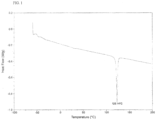
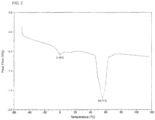
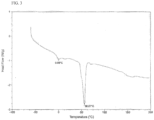
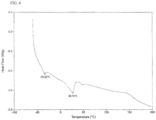
- compositions were subject to differential scanning calorimetry. The results are shown in FIGS. 1-5.
- FIG. 1 shows differential scanning calorimetry of a sample of curcumin, showing a phase transition at 185.12 degrees C.
- FIG. 2 shows differential scanning calorimetry of a lipid mixture comprising lysophosphatidylglycerol (14:0), monoglyceride (14:0) and fatty acid (14:0) (molar ratio 1:4:2) showing a phase transition at 55.71 degrees C.
- FIG. 1 shows differential scanning calorimetry of a sample of curcumin, showing a phase transition at 185.12 degrees C.
- FIG. 2 shows differential scanning calorimetry of a lipid mixture comprising lysophosphatidylglycerol (14:0), monoglyceride (14:0) and fatty acid (14:0) (molar ratio 1:4:2) showing a phase transition at 55.71 degrees C.
- FIG. 1 shows differential scanning calorimetry of a sample of curcumin, showing a phase transition at 185.12 degrees
- FIG. 3 shows differential scanning calorimetry of a mixture of curcumin and a lipid mixture comprising lysophosphatidylglycerol (14:0), monoglyceride (14:0) and fatty acid (14:0) (molar ratio 1:4:2) showing a single phase transition at 56.27 degrees C.
- the single phase transition of the mixture indicates the composition is a eutectic.
- FIG. 4 shows differential scanning calorimetry of a lipid mixture comprising lysophosphatidylcholine (14:0), monoglyceride (14:0) and fatty acid (14:0) (molar ratio 1:4:2) showing a phase transition at 26.74 degrees C.
- FIG. 5 shows differential scanning calorimetry of a mixture of curcumin and a lipid mixture comprising lysophosphatidylcholine (14:0), monoglyceride (14:0) and fatty acid (14:0) (molar ratio 1:4:2).
- the a lysophospatidylcholine containing composition containing curcumin showed phase transitions at 26.35 and 152.86 degrees C, indicating that the composition was not a eutectic.
Landscapes
- Health & Medical Sciences (AREA)
- Chemical & Material Sciences (AREA)
- Life Sciences & Earth Sciences (AREA)
- Medicinal Chemistry (AREA)
- Pharmacology & Pharmacy (AREA)
- Animal Behavior & Ethology (AREA)
- General Health & Medical Sciences (AREA)
- Public Health (AREA)
- Veterinary Medicine (AREA)
- Epidemiology (AREA)
- Engineering & Computer Science (AREA)
- Chemical Kinetics & Catalysis (AREA)
- General Chemical & Material Sciences (AREA)
- Oil, Petroleum & Natural Gas (AREA)
- Bioinformatics & Cheminformatics (AREA)
- Molecular Biology (AREA)
- Biophysics (AREA)
- Nuclear Medicine, Radiotherapy & Molecular Imaging (AREA)
- Organic Chemistry (AREA)
- Physiology (AREA)
- Nutrition Science (AREA)
- Pharmaceuticals Containing Other Organic And Inorganic Compounds (AREA)
- Medicinal Preparation (AREA)
- Acyclic And Carbocyclic Compounds In Medicinal Compositions (AREA)
- Medicines That Contain Protein Lipid Enzymes And Other Medicines (AREA)
Applications Claiming Priority (2)
| Application Number | Priority Date | Filing Date | Title |
|---|---|---|---|
| US201462035393P | 2014-08-09 | 2014-08-09 | |
| PCT/US2015/044501 WO2016025401A1 (en) | 2014-08-09 | 2015-08-10 | Oral composition for delivery of drugs and other substances |
Publications (3)
| Publication Number | Publication Date |
|---|---|
| EP3177279A1 EP3177279A1 (en) | 2017-06-14 |
| EP3177279A4 EP3177279A4 (en) | 2018-04-18 |
| EP3177279B1 true EP3177279B1 (en) | 2025-06-04 |
Family
ID=55304531
Family Applications (1)
| Application Number | Title | Priority Date | Filing Date |
|---|---|---|---|
| EP15832041.6A Active EP3177279B1 (en) | 2014-08-09 | 2015-08-10 | Oral composition for delivery of drugs and other substances |
Country Status (11)
| Country | Link |
|---|---|
| US (3) | US9872908B2 (enExample) |
| EP (1) | EP3177279B1 (enExample) |
| JP (1) | JP6759203B2 (enExample) |
| KR (2) | KR20170033442A (enExample) |
| CN (1) | CN107072967B (enExample) |
| AU (1) | AU2015301952B2 (enExample) |
| CA (1) | CA2956960C (enExample) |
| DK (1) | DK3177279T3 (enExample) |
| ES (1) | ES3033965T3 (enExample) |
| IL (1) | IL250394B (enExample) |
| WO (1) | WO2016025401A1 (enExample) |
Families Citing this family (1)
| Publication number | Priority date | Publication date | Assignee | Title |
|---|---|---|---|---|
| ES3033965T3 (en) * | 2014-08-09 | 2025-08-11 | Avanti Polar Lipids Llc | Oral composition for delivery of drugs and other substances |
Family Cites Families (14)
| Publication number | Priority date | Publication date | Assignee | Title |
|---|---|---|---|---|
| FR2514755A1 (fr) | 1981-10-21 | 1983-04-22 | Rhone Poulenc Chim Base | Procede de preparation de l'anhydride acetique |
| JPS58152812A (ja) * | 1982-02-17 | 1983-09-10 | チバ−ガイギ−・アクチエンゲゼルシヤフト | 水性相中単層脂質顆粒の製造方法 |
| EP0088046B1 (de) * | 1982-02-17 | 1987-12-09 | Ciba-Geigy Ag | Lipide in wässriger Phase |
| EP0102324A3 (de) * | 1982-07-29 | 1984-11-07 | Ciba-Geigy Ag | Lipide und Tenside in wässriger Phase |
| IE59067B1 (en) * | 1985-04-02 | 1993-12-15 | Yesair David W | Composition for delivery of orally administered drugs and other substances |
| US4874795A (en) | 1985-04-02 | 1989-10-17 | Yesair David W | Composition for delivery of orally administered drugs and other substances |
| JPH01274830A (ja) * | 1988-04-28 | 1989-11-02 | Asahi Denka Kogyo Kk | 安全で且つ高度な界面活性を有する脂質組成物 |
| JPH03127731A (ja) * | 1989-10-12 | 1991-05-30 | Yakult Honsha Co Ltd | ビタミンeの可溶化方法およびビタミンe製剤 |
| US7374779B2 (en) | 1999-02-26 | 2008-05-20 | Lipocine, Inc. | Pharmaceutical formulations and systems for improved absorption and multistage release of active agents |
| US6267985B1 (en) * | 1999-06-30 | 2001-07-31 | Lipocine Inc. | Clear oil-containing pharmaceutical compositions |
| US20030235595A1 (en) * | 1999-06-30 | 2003-12-25 | Feng-Jing Chen | Oil-containing, orally administrable pharmaceutical composition for improved delivery of a therapeutic agent |
| CA2662607A1 (en) * | 2006-09-08 | 2008-03-13 | Kaneka Corporation | Composition comprising reduced coenzyme q10 and lysolecithin |
| EP2526971A1 (en) | 2011-05-25 | 2012-11-28 | ArisGen SA | Mucosal delivery of drugs |
| ES3033965T3 (en) * | 2014-08-09 | 2025-08-11 | Avanti Polar Lipids Llc | Oral composition for delivery of drugs and other substances |
-
2015
- 2015-08-10 ES ES15832041T patent/ES3033965T3/es active Active
- 2015-08-10 KR KR1020177006233A patent/KR20170033442A/ko not_active Ceased
- 2015-08-10 JP JP2017527546A patent/JP6759203B2/ja active Active
- 2015-08-10 KR KR1020227016492A patent/KR102507657B1/ko active Active
- 2015-08-10 EP EP15832041.6A patent/EP3177279B1/en active Active
- 2015-08-10 CN CN201580049486.0A patent/CN107072967B/zh active Active
- 2015-08-10 US US14/822,289 patent/US9872908B2/en active Active
- 2015-08-10 DK DK15832041.6T patent/DK3177279T3/da active
- 2015-08-10 CA CA2956960A patent/CA2956960C/en active Active
- 2015-08-10 WO PCT/US2015/044501 patent/WO2016025401A1/en not_active Ceased
- 2015-08-10 AU AU2015301952A patent/AU2015301952B2/en active Active
-
2017
- 2017-02-01 IL IL250394A patent/IL250394B/en active IP Right Grant
- 2017-11-08 US US15/807,389 patent/US10463738B2/en active Active
-
2019
- 2019-10-31 US US16/669,825 patent/US11510985B2/en active Active
Also Published As
| Publication number | Publication date |
|---|---|
| JP2017524036A (ja) | 2017-08-24 |
| US9872908B2 (en) | 2018-01-23 |
| KR102507657B1 (ko) | 2023-03-08 |
| WO2016025401A1 (en) | 2016-02-18 |
| US20160166699A1 (en) | 2016-06-16 |
| DK3177279T3 (da) | 2025-08-18 |
| US20180064813A1 (en) | 2018-03-08 |
| US11510985B2 (en) | 2022-11-29 |
| CA2956960A1 (en) | 2016-02-18 |
| CN107072967A (zh) | 2017-08-18 |
| US20200188518A1 (en) | 2020-06-18 |
| ES3033965T3 (en) | 2025-08-11 |
| AU2015301952B2 (en) | 2020-12-03 |
| AU2015301952A1 (en) | 2017-02-16 |
| KR20170033442A (ko) | 2017-03-24 |
| CN107072967B (zh) | 2021-01-12 |
| JP6759203B2 (ja) | 2020-09-23 |
| US10463738B2 (en) | 2019-11-05 |
| KR20220070551A (ko) | 2022-05-31 |
| EP3177279A4 (en) | 2018-04-18 |
| IL250394B (en) | 2021-05-31 |
| EP3177279A1 (en) | 2017-06-14 |
| IL250394A0 (en) | 2017-03-30 |
| CA2956960C (en) | 2023-10-24 |
Similar Documents
| Publication | Publication Date | Title |
|---|---|---|
| ES2369244T3 (es) | Sistemas estables de nanocápsulas para la administración de moléculas activas. | |
| HUE033611T2 (en) | Pharmaceutical preparations and associated dosing procedures | |
| HUE031951T2 (en) | Aqueous systems for lipid-based drug compounds; preparations, processes and their use | |
| BE1022346A9 (fr) | Compositions liposomales pour une administration mucosale | |
| WO2012095543A1 (es) | Nanocápsulas con cubierta polimérica | |
| US20190105268A1 (en) | Viscoelastic Gel of Liraglutide Adapted for Once-Weekly or Once Bi-Weekly Administration | |
| US20100210518A1 (en) | Peg-lipid conjugates for increasing the solubility of drug compounds | |
| US11510985B2 (en) | Oral composition for delivery of drugs and other substances | |
| KR20140043579A (ko) | 무복계면 디클로페낙나트륨 및 그 제조방법 | |
| US20260000611A1 (en) | Hyaluronic acid derivative pharmaceutical composition and pharmaceutical composition | |
| US12419853B2 (en) | Nanoparticle pharmaceutical delivery system | |
| KR20140043580A (ko) | 무복계면 진세노사이드 및 그 제조방법 | |
| KR20140043575A (ko) | 무복계면 카페시타빈 및 그 제조방법 | |
| KR20140043574A (ko) | 무복계면 코엔자임 큐텐 및 그 제조방법 | |
| KR20140046499A (ko) | 무복계면 암포테리신 및 그 제조방법 | |
| KR20140043250A (ko) | 무복계면 칼슘 및 그 제조방법 | |
| KR20140043251A (ko) | 무복계면 알렌드로네이트 및 그 제조방법 | |
| KR20140043581A (ko) | 무복계면 졸레드로네이트 |
Legal Events
| Date | Code | Title | Description |
|---|---|---|---|
| STAA | Information on the status of an ep patent application or granted ep patent |
Free format text: STATUS: THE INTERNATIONAL PUBLICATION HAS BEEN MADE |
|
| PUAI | Public reference made under article 153(3) epc to a published international application that has entered the european phase |
Free format text: ORIGINAL CODE: 0009012 |
|
| STAA | Information on the status of an ep patent application or granted ep patent |
Free format text: STATUS: REQUEST FOR EXAMINATION WAS MADE |
|
| 17P | Request for examination filed |
Effective date: 20170303 |
|
| AK | Designated contracting states |
Kind code of ref document: A1 Designated state(s): AL AT BE BG CH CY CZ DE DK EE ES FI FR GB GR HR HU IE IS IT LI LT LU LV MC MK MT NL NO PL PT RO RS SE SI SK SM TR |
|
| AX | Request for extension of the european patent |
Extension state: BA ME |
|
| DAV | Request for validation of the european patent (deleted) | ||
| DAX | Request for extension of the european patent (deleted) | ||
| A4 | Supplementary search report drawn up and despatched |
Effective date: 20180316 |
|
| RIC1 | Information provided on ipc code assigned before grant |
Ipc: A61K 31/12 20060101AFI20180312BHEP Ipc: A61K 9/00 20060101ALI20180312BHEP Ipc: A61K 9/16 20060101ALI20180312BHEP |
|
| STAA | Information on the status of an ep patent application or granted ep patent |
Free format text: STATUS: EXAMINATION IS IN PROGRESS |
|
| 17Q | First examination report despatched |
Effective date: 20200720 |
|
| RAP3 | Party data changed (applicant data changed or rights of an application transferred) |
Owner name: AVANTI POLAR LIPIDS, LLC |
|
| P01 | Opt-out of the competence of the unified patent court (upc) registered |
Effective date: 20230322 |
|
| GRAP | Despatch of communication of intention to grant a patent |
Free format text: ORIGINAL CODE: EPIDOSNIGR1 |
|
| STAA | Information on the status of an ep patent application or granted ep patent |
Free format text: STATUS: GRANT OF PATENT IS INTENDED |
|
| RIC1 | Information provided on ipc code assigned before grant |
Ipc: A61P 43/00 20060101ALI20250217BHEP Ipc: A61K 9/00 20060101ALI20250217BHEP Ipc: A61K 9/16 20060101ALI20250217BHEP Ipc: A61K 31/12 20060101AFI20250217BHEP |
|
| INTG | Intention to grant announced |
Effective date: 20250319 |
|
| GRAS | Grant fee paid |
Free format text: ORIGINAL CODE: EPIDOSNIGR3 |
|
| GRAA | (expected) grant |
Free format text: ORIGINAL CODE: 0009210 |
|
| STAA | Information on the status of an ep patent application or granted ep patent |
Free format text: STATUS: THE PATENT HAS BEEN GRANTED |
|
| AK | Designated contracting states |
Kind code of ref document: B1 Designated state(s): AL AT BE BG CH CY CZ DE DK EE ES FI FR GB GR HR HU IE IS IT LI LT LU LV MC MK MT NL NO PL PT RO RS SE SI SK SM TR |
|
| REG | Reference to a national code |
Ref country code: GB Ref legal event code: FG4D |
|
| REG | Reference to a national code |
Ref country code: CH Ref legal event code: EP |
|
| REG | Reference to a national code |
Ref country code: DE Ref legal event code: R096 Ref document number: 602015091775 Country of ref document: DE |
|
| REG | Reference to a national code |
Ref country code: IE Ref legal event code: FG4D |
|
| REG | Reference to a national code |
Ref country code: ES Ref legal event code: FG2A Ref document number: 3033965 Country of ref document: ES Kind code of ref document: T3 Effective date: 20250811 |
|
| REG | Reference to a national code |
Ref country code: DK Ref legal event code: T3 Effective date: 20250806 |
|
| REG | Reference to a national code |
Ref country code: NL Ref legal event code: MP Effective date: 20250604 |
|
| PG25 | Lapsed in a contracting state [announced via postgrant information from national office to epo] |
Ref country code: FI Free format text: LAPSE BECAUSE OF FAILURE TO SUBMIT A TRANSLATION OF THE DESCRIPTION OR TO PAY THE FEE WITHIN THE PRESCRIBED TIME-LIMIT Effective date: 20250604 |
|
| PGFP | Annual fee paid to national office [announced via postgrant information from national office to epo] |
Ref country code: ES Payment date: 20250901 Year of fee payment: 11 |
|
| PGFP | Annual fee paid to national office [announced via postgrant information from national office to epo] |
Ref country code: DE Payment date: 20250724 Year of fee payment: 11 Ref country code: DK Payment date: 20250723 Year of fee payment: 11 |
|
| REG | Reference to a national code |
Ref country code: LT Ref legal event code: MG9D |
|
| PG25 | Lapsed in a contracting state [announced via postgrant information from national office to epo] |
Ref country code: NO Free format text: LAPSE BECAUSE OF FAILURE TO SUBMIT A TRANSLATION OF THE DESCRIPTION OR TO PAY THE FEE WITHIN THE PRESCRIBED TIME-LIMIT Effective date: 20250904 Ref country code: GR Free format text: LAPSE BECAUSE OF FAILURE TO SUBMIT A TRANSLATION OF THE DESCRIPTION OR TO PAY THE FEE WITHIN THE PRESCRIBED TIME-LIMIT Effective date: 20250905 |
|
| PG25 | Lapsed in a contracting state [announced via postgrant information from national office to epo] |
Ref country code: PL Free format text: LAPSE BECAUSE OF FAILURE TO SUBMIT A TRANSLATION OF THE DESCRIPTION OR TO PAY THE FEE WITHIN THE PRESCRIBED TIME-LIMIT Effective date: 20250604 |
|
| PG25 | Lapsed in a contracting state [announced via postgrant information from national office to epo] |
Ref country code: BG Free format text: LAPSE BECAUSE OF FAILURE TO SUBMIT A TRANSLATION OF THE DESCRIPTION OR TO PAY THE FEE WITHIN THE PRESCRIBED TIME-LIMIT Effective date: 20250604 |
|
| PGFP | Annual fee paid to national office [announced via postgrant information from national office to epo] |
Ref country code: GB Payment date: 20250725 Year of fee payment: 11 |
|
| PG25 | Lapsed in a contracting state [announced via postgrant information from national office to epo] |
Ref country code: HR Free format text: LAPSE BECAUSE OF FAILURE TO SUBMIT A TRANSLATION OF THE DESCRIPTION OR TO PAY THE FEE WITHIN THE PRESCRIBED TIME-LIMIT Effective date: 20250604 |
|
| PGFP | Annual fee paid to national office [announced via postgrant information from national office to epo] |
Ref country code: FR Payment date: 20250725 Year of fee payment: 11 |
|
| PG25 | Lapsed in a contracting state [announced via postgrant information from national office to epo] |
Ref country code: RS Free format text: LAPSE BECAUSE OF FAILURE TO SUBMIT A TRANSLATION OF THE DESCRIPTION OR TO PAY THE FEE WITHIN THE PRESCRIBED TIME-LIMIT Effective date: 20250904 |
|
| PG25 | Lapsed in a contracting state [announced via postgrant information from national office to epo] |
Ref country code: LV Free format text: LAPSE BECAUSE OF FAILURE TO SUBMIT A TRANSLATION OF THE DESCRIPTION OR TO PAY THE FEE WITHIN THE PRESCRIBED TIME-LIMIT Effective date: 20250604 |
|
| PG25 | Lapsed in a contracting state [announced via postgrant information from national office to epo] |
Ref country code: NL Free format text: LAPSE BECAUSE OF FAILURE TO SUBMIT A TRANSLATION OF THE DESCRIPTION OR TO PAY THE FEE WITHIN THE PRESCRIBED TIME-LIMIT Effective date: 20250604 |
|
| PG25 | Lapsed in a contracting state [announced via postgrant information from national office to epo] |
Ref country code: PT Free format text: LAPSE BECAUSE OF FAILURE TO SUBMIT A TRANSLATION OF THE DESCRIPTION OR TO PAY THE FEE WITHIN THE PRESCRIBED TIME-LIMIT Effective date: 20251006 |
|
| REG | Reference to a national code |
Ref country code: AT Ref legal event code: MK05 Ref document number: 1799709 Country of ref document: AT Kind code of ref document: T Effective date: 20250604 |
|
| PG25 | Lapsed in a contracting state [announced via postgrant information from national office to epo] |
Ref country code: IS Free format text: LAPSE BECAUSE OF FAILURE TO SUBMIT A TRANSLATION OF THE DESCRIPTION OR TO PAY THE FEE WITHIN THE PRESCRIBED TIME-LIMIT Effective date: 20251004 |
|
| PG25 | Lapsed in a contracting state [announced via postgrant information from national office to epo] |
Ref country code: AT Free format text: LAPSE BECAUSE OF FAILURE TO SUBMIT A TRANSLATION OF THE DESCRIPTION OR TO PAY THE FEE WITHIN THE PRESCRIBED TIME-LIMIT Effective date: 20250604 Ref country code: SM Free format text: LAPSE BECAUSE OF FAILURE TO SUBMIT A TRANSLATION OF THE DESCRIPTION OR TO PAY THE FEE WITHIN THE PRESCRIBED TIME-LIMIT Effective date: 20250604 |
|
| PG25 | Lapsed in a contracting state [announced via postgrant information from national office to epo] |
Ref country code: CZ Free format text: LAPSE BECAUSE OF FAILURE TO SUBMIT A TRANSLATION OF THE DESCRIPTION OR TO PAY THE FEE WITHIN THE PRESCRIBED TIME-LIMIT Effective date: 20250604 |
|
| PG25 | Lapsed in a contracting state [announced via postgrant information from national office to epo] |
Ref country code: EE Free format text: LAPSE BECAUSE OF FAILURE TO SUBMIT A TRANSLATION OF THE DESCRIPTION OR TO PAY THE FEE WITHIN THE PRESCRIBED TIME-LIMIT Effective date: 20250604 |
|
| PG25 | Lapsed in a contracting state [announced via postgrant information from national office to epo] |
Ref country code: RO Free format text: LAPSE BECAUSE OF FAILURE TO SUBMIT A TRANSLATION OF THE DESCRIPTION OR TO PAY THE FEE WITHIN THE PRESCRIBED TIME-LIMIT Effective date: 20250604 Ref country code: SK Free format text: LAPSE BECAUSE OF FAILURE TO SUBMIT A TRANSLATION OF THE DESCRIPTION OR TO PAY THE FEE WITHIN THE PRESCRIBED TIME-LIMIT Effective date: 20250604 |
|
| PG25 | Lapsed in a contracting state [announced via postgrant information from national office to epo] |
Ref country code: IT Free format text: LAPSE BECAUSE OF FAILURE TO SUBMIT A TRANSLATION OF THE DESCRIPTION OR TO PAY THE FEE WITHIN THE PRESCRIBED TIME-LIMIT Effective date: 20250604 |
|
| REG | Reference to a national code |
Ref country code: DE Ref legal event code: R097 Ref document number: 602015091775 Country of ref document: DE |
|
| REG | Reference to a national code |
Ref country code: CH Ref legal event code: H13 Free format text: ST27 STATUS EVENT CODE: U-0-0-H10-H13 (AS PROVIDED BY THE NATIONAL OFFICE) Effective date: 20260324 |
|
| PG25 | Lapsed in a contracting state [announced via postgrant information from national office to epo] |
Ref country code: MC Free format text: LAPSE BECAUSE OF FAILURE TO SUBMIT A TRANSLATION OF THE DESCRIPTION OR TO PAY THE FEE WITHIN THE PRESCRIBED TIME-LIMIT Effective date: 20250604 |
|
| PLBE | No opposition filed within time limit |
Free format text: ORIGINAL CODE: 0009261 |
|
| STAA | Information on the status of an ep patent application or granted ep patent |
Free format text: STATUS: NO OPPOSITION FILED WITHIN TIME LIMIT |
|
| PG25 | Lapsed in a contracting state [announced via postgrant information from national office to epo] |
Ref country code: LU Free format text: LAPSE BECAUSE OF NON-PAYMENT OF DUE FEES Effective date: 20250810 |
|
| REG | Reference to a national code |
Ref country code: CH Ref legal event code: L10 Free format text: ST27 STATUS EVENT CODE: U-0-0-L10-L00 (AS PROVIDED BY THE NATIONAL OFFICE) Effective date: 20260416 |
|
| PG25 | Lapsed in a contracting state [announced via postgrant information from national office to epo] |
Ref country code: CH Free format text: LAPSE BECAUSE OF NON-PAYMENT OF DUE FEES Effective date: 20250831 |
|
| REG | Reference to a national code |
Ref country code: BE Ref legal event code: MM Effective date: 20250831 |
|
| 26N | No opposition filed |
Effective date: 20260305 |
|
| PG25 | Lapsed in a contracting state [announced via postgrant information from national office to epo] |
Ref country code: LT Free format text: LAPSE BECAUSE OF FAILURE TO SUBMIT A TRANSLATION OF THE DESCRIPTION OR TO PAY THE FEE WITHIN THE PRESCRIBED TIME-LIMIT Effective date: 20250604 |
|
| PG25 | Lapsed in a contracting state [announced via postgrant information from national office to epo] |
Ref country code: IE Free format text: LAPSE BECAUSE OF NON-PAYMENT OF DUE FEES Effective date: 20250810 Ref country code: BE Free format text: LAPSE BECAUSE OF NON-PAYMENT OF DUE FEES Effective date: 20250831 |
|
| PG25 | Lapsed in a contracting state [announced via postgrant information from national office to epo] |
Ref country code: SE Free format text: LAPSE BECAUSE OF FAILURE TO SUBMIT A TRANSLATION OF THE DESCRIPTION OR TO PAY THE FEE WITHIN THE PRESCRIBED TIME-LIMIT Effective date: 20250604 |