EP3174543B1 - Sterol-derivate zur behandlung von neurosensorischem hörverlust und entsprechende zusammensetzung - Google Patents
Sterol-derivate zur behandlung von neurosensorischem hörverlust und entsprechende zusammensetzung Download PDFInfo
- Publication number
- EP3174543B1 EP3174543B1 EP15775759.2A EP15775759A EP3174543B1 EP 3174543 B1 EP3174543 B1 EP 3174543B1 EP 15775759 A EP15775759 A EP 15775759A EP 3174543 B1 EP3174543 B1 EP 3174543B1
- Authority
- EP
- European Patent Office
- Prior art keywords
- composition
- use according
- syndrome
- subject
- formula
- Prior art date
- Legal status (The legal status is an assumption and is not a legal conclusion. Google has not performed a legal analysis and makes no representation as to the accuracy of the status listed.)
- Active
Links
Images


Classifications
-
- A—HUMAN NECESSITIES
- A61—MEDICAL OR VETERINARY SCIENCE; HYGIENE
- A61K—PREPARATIONS FOR MEDICAL, DENTAL OR TOILETRY PURPOSES
- A61K31/00—Medicinal preparations containing organic active ingredients
- A61K31/56—Compounds containing cyclopenta[a]hydrophenanthrene ring systems; Derivatives thereof, e.g. steroids
- A61K31/575—Compounds containing cyclopenta[a]hydrophenanthrene ring systems; Derivatives thereof, e.g. steroids substituted in position 17 beta by a chain of three or more carbon atoms, e.g. cholane, cholestane, ergosterol, sitosterol
-
- A—HUMAN NECESSITIES
- A61—MEDICAL OR VETERINARY SCIENCE; HYGIENE
- A61K—PREPARATIONS FOR MEDICAL, DENTAL OR TOILETRY PURPOSES
- A61K31/00—Medicinal preparations containing organic active ingredients
- A61K31/56—Compounds containing cyclopenta[a]hydrophenanthrene ring systems; Derivatives thereof, e.g. steroids
- A61K31/58—Compounds containing cyclopenta[a]hydrophenanthrene ring systems; Derivatives thereof, e.g. steroids containing heterocyclic rings, e.g. danazol, stanozolol, pancuronium or digitogenin
-
- A—HUMAN NECESSITIES
- A61—MEDICAL OR VETERINARY SCIENCE; HYGIENE
- A61P—SPECIFIC THERAPEUTIC ACTIVITY OF CHEMICAL COMPOUNDS OR MEDICINAL PREPARATIONS
- A61P25/00—Drugs for disorders of the nervous system
-
- A—HUMAN NECESSITIES
- A61—MEDICAL OR VETERINARY SCIENCE; HYGIENE
- A61P—SPECIFIC THERAPEUTIC ACTIVITY OF CHEMICAL COMPOUNDS OR MEDICINAL PREPARATIONS
- A61P27/00—Drugs for disorders of the senses
- A61P27/16—Otologicals
-
- A—HUMAN NECESSITIES
- A61—MEDICAL OR VETERINARY SCIENCE; HYGIENE
- A61P—SPECIFIC THERAPEUTIC ACTIVITY OF CHEMICAL COMPOUNDS OR MEDICINAL PREPARATIONS
- A61P43/00—Drugs for specific purposes, not provided for in groups A61P1/00-A61P41/00
Definitions
- the present invention relates to the management of hearing loss. More specifically, the present invention relates to the use of a molecule of formula I or a pharmaceutically acceptable salt thereof; the composition according to the invention is administered to a subject to prevent his hearing loss or restore his hearing.
- Hearing loss is a common affection that affects more than 360 million people worldwide for the World Health Organization (2012). Hearing loss taken into account by the World Health Organization, is a loss greater than 25 dB.
- This pathology has important negative consequences, both economic and emotional, for those affected and for society ( from Graaf et al., Psychosom Med 64, 61-70 ), ( Fellinger et al., Acta Psychiatr Scand 115,243-5 ), ( Fellinger et al., Psychiatry Soc Psychiatric Epidemiol 40, 737-42 ), ( Mohr et al., Policy Anal Brief H Ser 2, 1-4 ). Many factors, such as age (50% of humans over 65, 80% of those over 75 are affected), emotional, physical or emotional trauma or genetic factors may be responsible for dysfunction or loss of hair cells and degeneration of the auditory nerve leading to hearing loss.
- HC hair cells
- SGN spiral ganglion
- a moderate or severe sensorineural hearing loss may be due to at least three types of dysfunction.
- the dysfunction or the partial loss of the HC sensory cells on the other hand, the degeneration of the axons of the spiral ganglion neurons (hereinafter abbreviated as SGN), which transmit to the brain the signal of the HC cells ( auditory neuropathy) and finally, the destructuration of synaptic connections between HC cells and SGN neurons (auditory synaptopathy).
- SGN spiral ganglion neurons
- the signal can be transduced by a cochlear implant, the electrodes of which replace the HC cells; in humans, in such a case, the SGN degenerate, losing their axons pointing to the HC cells, but they do not die.
- the key to maintaining or recovering hearing is therefore axonal regrowth, which enables the connections between SGNs and sound receiving transducers to be reconstructed, whether HC cells or cochlear implant.
- cochlear implants For deafness related to loss of HC cells, cochlear implants alone improve hearing, but their effectiveness is directly impacted by integrity SGNs, which they do not prevent degeneration; axonal regrowth, which reduces the distance between the nerve endings and the electrodes, is an interesting approach to improve the efficiency of cochlear implants ( Shibata et al., Hear Res 281, 56-64 ). For all other forms, there is, so far, no satisfactory palliative or curative solution.
- Neurotrophic factors the only molecules that have shown a beneficial effect on neuronal survival and axonal regrowth, can not be used because of side effects such as weight loss ( Winkler et al., Ann Neurol 41, 82-93 ), uncontrolled cell migration ( Williams, Exp Neurol 113, 31-7 ) and the risk of cancer associated with the abnormal proliferation of Schwann cells ( Eriksdotter Jonhagen et al., Geriatr Disorder Cogn Disord 9, 246-57 ). The use of dexamethasone to treat hearing impairment has been described ( Haynes et al., Laryngoscope, 2007, 117, 3-15 ). Despite intensive research, there is currently no satisfactory solution to the above-mentioned problems and a new approach is therefore needed.
- Novel sterol derivatives have been described, which compounds the neuronal differentiation of pluripotent embryonic tumor cells, the survival of motoneurons in culture and the proliferation and differentiation of adult neuronal progenitors ( from Medina et al. 2009, J Med Chem 52, 7765-77 ) and 2003 -------------------) ( Khalifa et al., Biochem Biophys Res Commun 446, 681-6 ).
- Those skilled in the art can not obviously deduce that these compounds are of interest for pathologies, which, as indicated above, are related to a neuronal connection problem and not to a problem of number of neurons in the treated area. .
- a signal transmitter consisting of at least partially functional hair cells or cochlear implant electrodes.
- the restoration caused by the composition according to the invention is an improvement in the effectiveness of a cochlear implant previously put in place in the treated subject.
- the restoration obtained with the composition according to the invention improves the functionality of the neurons of the spiral ganglion in the subject treated, before practicing, on said subject, at least one therapy for stimulating said neurons or inner and outer hair cells.
- the restoration caused by the composition according to the invention benefits a subject, who requires the establishment of a cochlear implant due to a hearing loss due to trauma or disease. said restoration now retains the functionality of the spiral ganglion neurons prior to implantation of said cochlear implant.
- the composition according to the invention is used to make a subject more likely to benefit later from a therapy aimed at restoring all or part of the inner ear, said therapy being chosen from the group formed.
- a therapy aimed at restoring all or part of the inner ear, said therapy being chosen from the group formed.
- stem cell transplantation regeneration of hair cells by transdifferentiation of supportive cells, gene tranfection or gene blockage in any part of the inner ear.
- composition according to the invention is administered orally, intravenous, intratympanic, intracochlear, on the round or oval window of the intracranial, nasal or tympanic cochlea.
- the composition according to the invention is placed in the inner ear by an electrode impregnated with or brushed with said composition, or by an electrode comprising a cannula loaded with said composition or also by a electrode composed partially of one or more compounds of formula (I).
- the restoration obtained by the composition according to the invention benefits a subject whose trauma has been generated by an ototoxic level of noise, ototoxic agents such as radiation, antibiotics, inflammatory agents, chemotherapy agents, heavy metals or the age of the subject.
- ototoxic agents such as radiation, antibiotics, inflammatory agents, chemotherapy agents, heavy metals or the age of the subject.
- the composition according to the invention allows a restoration which benefits a subject whose hearing loss has been generated by a disease in the group consisting of otitis, Pendred's syndrome, Niemann's Pick, Smith-Lemli-Optiz, Stickler, Alport, Charge, Jervell and Lange-Nielsen, Norrie, Usher, Waardenburg and Perrault, neurofibromatosis type 2 or bronchio-torenal syndrome.
- the present invention also relates to the use of a composition as defined above for maintaining and / or improving the quality of the connections between the SGNs, on the one hand, and the hair cells or the electrodes of an implant. cochlear, on the other hand.
- the figure 1 is a diagram relating to the various diseases of the inner ear leading to the sensorineural hearing loss to which the present invention can remedy, and to the cellular effects relating thereto.
- This figure has three frames: the left frame shows the synaptic connection S of an HC cell with an SGN in the case of a subject without affection of the inner ear.
- the middle frame shows the state of SGN / HC bonds in three cases of dysfunction A, B, C: in dysfunction A, the neuron SGN no longer receives information from its synapse S due to non-functioning of the cell HC (dotted) previously connected to S; in malfunction B, the SGN no longer receives information from its synapse because the latter no longer assumes its liaison role (left column) and the SGN degenerates (right column); in the C dysfunction, the SGN no longer has an operational receiving synapse (left column) and the emission from the HC cell can not feed the SGN which, therefore, degenerates (right column).
- the box on the right shows the result when the DA or DB products are made to act on the elements concerned by the dysfunctions A (loss of HC), B (synaptopathy) and C (neuropathies) and the representations of the right column show the states after treatment and partial recovery of hearing (rectangle D schematizes an electrical stimulation of the SGN).
- the figure 2 is a graph showing the evolution curve over time of the electrically evoked auditory brainstem response (eABR) when the treatment with the composition according to the invention starts two days after the beginning of the induction of ototoxicity by neomycin.
- eABR electrically evoked auditory brainstem response
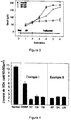
- the figure 3 is a graph showing the time course of the electrically evoked brainstem auditory response (eABR) when treatment with the composition starts sixteen days after the onset of induction of ototoxicity by neomycin.
- eABR electrically evoked brainstem auditory response
- the figure 4 is a bar graph showing the number of spiral ganglion neurons in the experiments related to Figures 1 and 2 compared to what is achieved with an ear that has not been exposed to neomycin (first bar left on the figure 4 ).
- the figure 5 is a series of three cochlear lamella photographs taken at the level of the middle of the modiolus illustrating the quantification of the number of spiral ganglion neurons reported in the figure 4 as well as the axonal regrowth caused by the treatments. In each photograph, the nature of the product used for the treatment (AP, DB and GDNF) was indicated.
- Table 1 summarizes the impact of the molecules used in Examples 1 to 3 on the density of SGN and the electrically evoked auditory brainstem response (eABR).
- connection and “synaptic connection” refer to a functional interaction between the spiral ganglion neurons and the hair cells or electrodes of a cochlear implant for appropriate stimulation of said spiral ganglion neurons.
- stress refers to a cause of loss of functional synaptic connection and / or loss of projections of spiral ganglion neurons.
- Examples 1 to 3 were carried out on guinea pigs (250-500 g). All animals are equipped with a platinum-iridium electrode inserted into the cochlea to mimic a cochlear implant. The experiments were carried out according to the protocol described by Raphael and his collaborators ( Shinohara et al., 2002, Proc. Nati. Acad. Sci. USA, 99, 1657-60 ).
- the animals are anesthetized (10 mg / kg xylazine and 40 mg / kg intramuscular ketamine) and the inner ear is opened post-aurally.
- a pre-filled cannula containing 24 ⁇ l of 10% neomycin sulfate was connected to an osmotic mini-pump (ALZET 2002, DURECT Corp., CA, USA) having a flow rate of 0.5 ⁇ l / hour.
- the cannula enters the cochlea near the round window to reach the tympani scala.
- the cannula was filled either with a solution of 6 ⁇ - [2- ( 1H- imidazol-4-yl) -ethylamino] -cholestane-3 ⁇ , 5 ⁇ -diol (1 ⁇ M), either with a solution of 6 ⁇ - [3- (4-aminobutylamino) propylamino] -cholestane-3 ⁇ , 5 ⁇ -diol (1 ⁇ M), or with GDNF (1 ⁇ g / ml), or with artificial perilymph which serves as control.
- the pump is removed and replaced with a new identical pump pre-filled in a similar way. After two weeks, the pump is removed and the cannula sealed for two more weeks. This technique is described in detail on page 1658 of the Shinohara publication identified above.
- Measurements of electrically evoked auditory brainstem response thresholds are performed using an iridium-platinum electrode (Pt-Ir 90% -10%, 250 ⁇ m diameter) inserted 1.5 mm into the cochlea (scala tympani) through the round window at the time of placement of the pump, a return electrode (Pt-Ir, 125 microns in diameter), placed against the occipital bone, under the neck muscles.
- Pt-Ir iridium-platinum electrode
- the procedure used is the same as in Example 1, with the difference that, following the infusion of neomycin sulfate, the pumps are filled with artificial perilymph for two weeks.
- the pumps are replaced by identical pumps containing either a solution of 6 ⁇ - [2- (1H- imidazol-4-yl) ethylamino] cholestane-3 ⁇ , 5 ⁇ -diol (1 .mu.m), a solution 6 ⁇ - [3- (4-aminobutylamino) propylamino] -cholestane-3 ⁇ , 5 ⁇ -diol (1 ⁇ M), either GDNF (1 ⁇ g / ml) or artificial perilymph, which serves as a control.
- These pumps are replaced after two weeks by identical pumps pre-filled with the same solutions for two additional weeks.
- the animals are deeply anesthetized, intraperitoneally, with sodium pentobarbital (25 mg / kg) and intracardially perfused with saline (37 ° C), which eliminates the blood. then with a solution of cold glutaraldehyde (2.5% in 0.1M phosphate buffer), which tissues.
- the temporal bone is removed and the bulla open to reveal the cochlea.
- a small window is open in the apex of the cochlea and the membrane of the round window in order to gently wash the cochlea with the glutaraldehyde solution.
- the cochlea is then decalcified in an EDTA solution (0.1M in phosphate buffer) to allow slicing.
- the cochlea is dehydrated and included in "plastic JB-4" (Polyscience Inc, Warrington, PA).
- the cochlea is cut into slices 4 ⁇ m thick.
- the middle of the modiolus which is characterized by a lamella, in which we can distinguish six sections of the Rosenthal canal, one lamella out of three is kept for analysis (which avoids counting several times the same neurons of the spiral ganglion).
- the slides are mounted on slides with "Paragon", stained with toluidine blue and prepared for microscopy.
- the six sections of the Rosenthal six-leaf canal are analyzed for each group of animals (Sigma Pro Scan) to count spiral ganglion neurons.
- the criteria for an SGN are a cell diameter between 14 and 20 microns with a core diameter of 7 to 10 microns. The average density of SGN is thus calculated and presented to the figure 4 ; the cuts of the Rosenthal canal are shown in the figure 5 .
Landscapes
- Health & Medical Sciences (AREA)
- Life Sciences & Earth Sciences (AREA)
- Chemical & Material Sciences (AREA)
- Veterinary Medicine (AREA)
- Public Health (AREA)
- Medicinal Chemistry (AREA)
- General Health & Medical Sciences (AREA)
- Animal Behavior & Ethology (AREA)
- Pharmacology & Pharmacy (AREA)
- Epidemiology (AREA)
- General Chemical & Material Sciences (AREA)
- Organic Chemistry (AREA)
- Nuclear Medicine, Radiotherapy & Molecular Imaging (AREA)
- Engineering & Computer Science (AREA)
- Chemical Kinetics & Catalysis (AREA)
- Bioinformatics & Cheminformatics (AREA)
- Biomedical Technology (AREA)
- Neurology (AREA)
- Neurosurgery (AREA)
- Pharmaceuticals Containing Other Organic And Inorganic Compounds (AREA)
- Medicines That Contain Protein Lipid Enzymes And Other Medicines (AREA)
- Steroid Compounds (AREA)
Claims (12)
- Zusammensetzung für die Verwendung zur Verhinderung eines Hörverlustes bei einem Patienten oder zur zumindest teilweisen Wiederherstellung des Hörvermögens eines behandelten Patienten, der vor der Behandlung eine verminderte Hörfunktion aufweist, durch in Kontaktbringen der Zusammensetzung mit mindestens einem Teil der Cochlea des Ohrs, das eine verringerte Hörfunktion hat, wobei die Zusammensetzung dadurch gekennzeichnet ist, dass sie in einem pharmazeutisch verträglichen Vehikel zumindest eine Verbindung der Formel (I) umfasst:

- Zusammensetzung für die Verwendung gemäß Anspruch 1, dadurch gekennzeichnet, dass die von der Zusammensetzung umfasste (n) Verbindung (-en) der Formel (I) definiert ist (sind) durch Z1 = 0, R1 = H; R2 = OH; R3 = NHR6, wobei R6 ist gleich -(CH2)3NH(CH2)4NH(CH2)3NH2 oder -(CH2)2-Imidazol-4yl; T1 = T2 = T3 = H.
- Zusammensetzung für die Verwendung gemäß Anspruch 1, dadurch gekennzeichnet, dass die von der Zusammensetzung umfasste (n) Verbindung (en) der Formel (I) definiert ist (sind) durch Z1 = 0 oder 1; R1 = H; R2 = OH; R3 = -NHR6, wobei R6 ist gleich -(CH2)3NH(CH2)4NH2 oder -(CH2)4NH(CH2)3NH2; T1 = T2 = T3 = H; R4 = H oder OH in Position 22 oder 27.
- Zusammensetzung für die Verwendung gemäß Anspruch 1, dadurch gekennzeichnet, dass die Verbindung der Formel (I) durch Z1 = 0; R1 = Acetyl; R2 = OH; R4 = H; R3 = NH-(CH2)2-Imidazol-4-yl und T1 = T2 = T3 = H definiert ist.
- Zusammensetzung für die Verwendung gemäß einem der Ansprüche 1 bis 4 zur Verbesserung der Übertragung des Hörsignals vom Signalwandler (Flimmerzelle oder Elektrode) zum Gehirn.
- Zusammensetzung für die Verwendung gemäß Anspruch 5 zur Verbesserung der Wirksamkeit eines Cochleaimplantats, das zuvor bei einem behandelten Patienten eingesetzt wurde.
- Zusammensetzung für die Verwendung gemäß Anspruch 5 zur Verbesserung der Funktionalität von Neuronen des Spiralganglions bei einem behandelten Patienten, bevor an diesem mindestens eine Therapie zur Stimulierung der Anzahl und / oder der Funktionalität der internen und externen Neuronen oder Haarzellen durchgeführt wird.
- Zusammensetzung für die Verwendung gemäß Anspruch 5 zur Erhaltung der Funktionalität von Neuronen des Spiralganglions vor der Implantation eines Cochleaimplantats bei einem Patienten, der die Einsetzung des Cochleaimplantats aufgrund eines Hörverlusts durch ein Trauma oder eine Krankheit benötigt.
- Zusammensetzung für die Verwendung gemäß Anspruch 5, um es einem Patienten zu ermöglichen, von einer nachfolgenden Therapie zur Wiederherstellung seines gesamten Innenohrs oder eines Teils davon besser zu profitieren wobei die Therapie aus der Gruppe bestehend aus Stammzelltransplantation, die Haarzellenregenerierung, durch Transdifferenzierung der unterstützenden Zellen, genetische Transfektion und genetische Blockade im gesamten oder einem Teil des Innenohrs, ausgewählt ist.
- Zusammensetzung für die Verwendung gemäß einem der Ansprüche 1 bis 4, dadurch gekennzeichnet, dass die Wiederherstellung einem Patienten zugute kommt, dessen Trauma durch einen ototoxischen Geräuschpegel, ototoxische Mittel, Strahlungen, Antibiotika, entzündungshemmende Mittel, chemotherapeutische Mittel, Schwermetalle oder Alterung des Patienten verursacht wurde.
- Zusammensetzung für die Verwendung gemäß einem der Ansprüche 1 bis 4, dadurch gekennzeichnet, dass die Wiederherstellung einem Patienten zugute kommt, dessen Hörverlust durch eine Krankheit aus der Gruppe bestehend aus Otitis, Pendred Syndrom, Niemann-Pick Syndrom, Smith-Lemli-Opitz Syndrom, Stickler Syndrom, Charge Syndrom, Jervell Syndrom und Lange-Nielsen Syndrom, Norrie Syndrom, Usher Syndrom, Waardenburg Syndrom oder Perrault Syndrom, Neurofibromatose Typ 2 oder bronchio-otorenales Syndrom verursacht wurde.
- Zusammensetzung für die Verwendung gemäß einem der Ansprüche 1 bis 4 zur Erhaltung und/oder Verbesserung der Qualität der Verbindungen zwischen einerseits den Neuronen des Spiralganglions und andererseits den Haarzellen oder den Cochlea-Elektroden.
Applications Claiming Priority (2)
| Application Number | Priority Date | Filing Date | Title |
|---|---|---|---|
| FR1401755A FR3024361B1 (fr) | 2014-07-30 | 2014-07-30 | Utilisation de derives de sterols pour traitement de la perte auditive neurosensorielle et composition correspondante |
| PCT/FR2015/000164 WO2016016518A2 (fr) | 2014-07-30 | 2015-07-28 | Utilisation de dérivés de stérols pour le traitement de la perte auditive neurosensorielle et composition correspondante. |
Publications (2)
| Publication Number | Publication Date |
|---|---|
| EP3174543A2 EP3174543A2 (de) | 2017-06-07 |
| EP3174543B1 true EP3174543B1 (de) | 2019-11-27 |
Family
ID=52130297
Family Applications (1)
| Application Number | Title | Priority Date | Filing Date |
|---|---|---|---|
| EP15775759.2A Active EP3174543B1 (de) | 2014-07-30 | 2015-07-28 | Sterol-derivate zur behandlung von neurosensorischem hörverlust und entsprechende zusammensetzung |
Country Status (9)
| Country | Link |
|---|---|
| US (1) | US10092577B2 (de) |
| EP (1) | EP3174543B1 (de) |
| JP (1) | JP6601882B2 (de) |
| CN (1) | CN106852121B (de) |
| AU (1) | AU2015295184B2 (de) |
| CA (1) | CA2956192C (de) |
| ES (1) | ES2770074T3 (de) |
| FR (1) | FR3024361B1 (de) |
| WO (1) | WO2016016518A2 (de) |
Families Citing this family (5)
| Publication number | Priority date | Publication date | Assignee | Title |
|---|---|---|---|---|
| KR20190024983A (ko) | 2016-06-29 | 2019-03-08 | 오토노미, 인코포레이티드 | 트리글리세라이드 귀 제제 및 이의 용도 |
| WO2020061317A1 (en) * | 2018-09-19 | 2020-03-26 | Modernatx, Inc. | Sterol purification |
| WO2020061332A1 (en) * | 2018-09-19 | 2020-03-26 | Modernatx, Inc. | Sterol analogs and uses thereof |
| BE1027157B9 (fr) | 2019-08-01 | 2020-11-03 | Dendrogenix | Composition de dérivés de stérols pour son utilisationdans le traitement d’une pathologie neuronale liée à une hypoxie et/ou à une hypoglycémie et composition correspondante |
| BE1030026B1 (fr) * | 2022-06-14 | 2023-07-07 | Dendrogenix | Composés dérivés de stérols et composition pharmaceutique les comprenant pour leur utilisation dans la prévention, l’amélioration et/ou le traitement d’une pathologie liée à un déficit mitochondrial |
Family Cites Families (5)
| Publication number | Priority date | Publication date | Assignee | Title |
|---|---|---|---|---|
| US6043221A (en) * | 1997-07-30 | 2000-03-28 | Amgen Inc. | Method for preventing and treating hearing loss using a neuturin protein product |
| FR2838741B1 (fr) * | 2002-04-19 | 2006-01-27 | Inst Nat Sante Rech Med | Derives de sterols, leur procede de preparation et medicaments les comportant |
| US8188149B2 (en) * | 2007-09-17 | 2012-05-29 | Teva Pharmaceutical Industries, Ltd. | Use of R(+)-N-propargy1-1-aminoindan to treat or prevent hearing loss |
| WO2009139924A2 (en) * | 2008-05-14 | 2009-11-19 | Otonomy, Inc. | Controlled release corticosteroid compositions and methods for the treatment of otic disorders |
| KR101467983B1 (ko) * | 2012-10-15 | 2014-12-02 | 경희대학교 산학협력단 | 페길레이션된 디오스게닌 유도체 및 그를 포함하는 난청의 치료 또는 예방용 조성물 |
-
2014
- 2014-07-30 FR FR1401755A patent/FR3024361B1/fr not_active Expired - Fee Related
-
2015
- 2015-07-28 EP EP15775759.2A patent/EP3174543B1/de active Active
- 2015-07-28 CN CN201580041670.0A patent/CN106852121B/zh active Active
- 2015-07-28 ES ES15775759T patent/ES2770074T3/es active Active
- 2015-07-28 CA CA2956192A patent/CA2956192C/fr active Active
- 2015-07-28 US US15/329,190 patent/US10092577B2/en active Active
- 2015-07-28 AU AU2015295184A patent/AU2015295184B2/en active Active
- 2015-07-28 WO PCT/FR2015/000164 patent/WO2016016518A2/fr not_active Ceased
- 2015-07-28 JP JP2017526020A patent/JP6601882B2/ja active Active
Non-Patent Citations (1)
| Title |
|---|
| None * |
Also Published As
| Publication number | Publication date |
|---|---|
| FR3024361B1 (fr) | 2017-11-24 |
| JP2017523240A (ja) | 2017-08-17 |
| JP6601882B2 (ja) | 2019-11-06 |
| ES2770074T3 (es) | 2020-06-30 |
| US10092577B2 (en) | 2018-10-09 |
| AU2015295184B2 (en) | 2019-11-21 |
| US20170209465A1 (en) | 2017-07-27 |
| CA2956192C (fr) | 2021-06-08 |
| CN106852121A (zh) | 2017-06-13 |
| CA2956192A1 (fr) | 2016-02-04 |
| CN106852121B (zh) | 2020-10-20 |
| EP3174543A2 (de) | 2017-06-07 |
| FR3024361A1 (fr) | 2016-02-05 |
| WO2016016518A2 (fr) | 2016-02-04 |
| WO2016016518A3 (fr) | 2016-03-24 |
| AU2015295184A1 (en) | 2017-03-09 |
Similar Documents
| Publication | Publication Date | Title |
|---|---|---|
| CA2956192C (fr) | Utilisation de derives de sterols pour le traitement de la perte auditive neurosensorielle et composition correspondante | |
| McGEE et al. | Streptomycin sulfate and dihydrostreptomycin toxicity: Behavioral and histopathologic studies | |
| CA2959404A1 (en) | Compositions, systems, and methods for generating inner ear hair cells for treatment of hearing loss | |
| EP2203050B1 (de) | Topische verwendung von r(+)-n-propargyl-1-aminoindan zur behandlung oder vorbeugung von gehörverlust | |
| Vink et al. | BDNF-mediated preservation of spiral ganglion cell peripheral processes and axons in comparison to that of their cell bodies | |
| KR20220032936A (ko) | 진저론을 유효성분으로 포함하는 난청 예방 또는 치료용 조성물 | |
| Yu et al. | Pattern of hair cell loss and delayed peripheral neuron degeneration in inner ear by a high-dose intratympanic gentamicin | |
| Chen et al. | The effect of cochlear-implant-mediated electrical stimulation on spiral ganglion cells in congenitally deaf white cats | |
| EP1732567B1 (de) | Verwendung eines phenothiazin-derivats zur prävention und/oder behandlung von gerhörverlust | |
| JP2025525989A (ja) | 感音性難聴の治療のためのngfの鼻腔内投与 | |
| US10441616B2 (en) | Pharmaceutical composition for treating or preventing sensorineural hearing loss, containing cysteinyl leukotriene receptor antagonist and ginkgo leaf extract | |
| Webster et al. | Multipolar spiral ganglion neurons following organ of Corti loss | |
| JP2002503687A (ja) | 内耳の疾患又は機能障害の治療方法 | |
| CN108310386A (zh) | mTOR信号通路抑制剂在制备预防或治疗非遗传性听力障碍药物中的用途 | |
| Tang et al. | Sensorineural hearing loss: potential therapies and gene targets for drug development | |
| TWI858583B (zh) | 組成物於製備用於預防或治療聽力缺損的藥物的用途 | |
| KR20190002366A (ko) | 아보카도 오일을 유효성분으로 포함하는 난청의 예방 또는 치료용 약학적 조성물 | |
| HK40119437A (zh) | 用於预防或治疗听力缺损的方法 | |
| CN112618695B (zh) | 一种大豆肽在制备改善听觉障碍药物中的应用 | |
| Worsøe et al. | Systemic steroid reduces long‐term hearing loss in experimental pneumococcal meningitis | |
| Lewis | Regeneration of Auditory Hair Cells: A Potential Treatment for Hearing Loss on the Horizon | |
| Fransson | Prevention-and intervention therapies in auditory trauma | |
| WO2024164318A1 (zh) | Gch1抑制剂在制备用于预防和治疗听力损伤的药物中的用途 | |
| Ryals | Hair cell regeneration revisited: It's not just for the birds! | |
| Harvey-Pedroso et al. | Morphological Changes Induced by Three Aminoglycosides on the Cochlear Stria Vascularis. |
Legal Events
| Date | Code | Title | Description |
|---|---|---|---|
| STAA | Information on the status of an ep patent application or granted ep patent |
Free format text: STATUS: THE INTERNATIONAL PUBLICATION HAS BEEN MADE |
|
| 17P | Request for examination filed |
Effective date: 20170228 |
|
| AK | Designated contracting states |
Kind code of ref document: A2 Designated state(s): AL AT BE BG CH CY CZ DE DK EE ES FI FR GB GR HR HU IE IS IT LI LT LU LV MC MK MT NL NO PL PT RO RS SE SI SK SM TR |
|
| AX | Request for extension of the european patent |
Extension state: BA ME |
|
| PUAI | Public reference made under article 153(3) epc to a published international application that has entered the european phase |
Free format text: ORIGINAL CODE: 0009012 |
|
| STAA | Information on the status of an ep patent application or granted ep patent |
Free format text: STATUS: REQUEST FOR EXAMINATION WAS MADE |
|
| R17P | Request for examination filed (corrected) |
Effective date: 20170228 |
|
| DAV | Request for validation of the european patent (deleted) | ||
| DAX | Request for extension of the european patent (deleted) | ||
| GRAP | Despatch of communication of intention to grant a patent |
Free format text: ORIGINAL CODE: EPIDOSNIGR1 |
|
| STAA | Information on the status of an ep patent application or granted ep patent |
Free format text: STATUS: GRANT OF PATENT IS INTENDED |
|
| RAP1 | Party data changed (applicant data changed or rights of an application transferred) |
Owner name: DENDROGENIX |
|
| INTG | Intention to grant announced |
Effective date: 20190716 |
|
| GRAS | Grant fee paid |
Free format text: ORIGINAL CODE: EPIDOSNIGR3 |
|
| GRAA | (expected) grant |
Free format text: ORIGINAL CODE: 0009210 |
|
| STAA | Information on the status of an ep patent application or granted ep patent |
Free format text: STATUS: THE PATENT HAS BEEN GRANTED |
|
| AK | Designated contracting states |
Kind code of ref document: B1 Designated state(s): AL AT BE BG CH CY CZ DE DK EE ES FI FR GB GR HR HU IE IS IT LI LT LU LV MC MK MT NL NO PL PT RO RS SE SI SK SM TR |
|
| REG | Reference to a national code |
Ref country code: GB Ref legal event code: FG4D Free format text: NOT ENGLISH |
|
| REG | Reference to a national code |
Ref country code: CH Ref legal event code: EP |
|
| REG | Reference to a national code |
Ref country code: AT Ref legal event code: REF Ref document number: 1205953 Country of ref document: AT Kind code of ref document: T Effective date: 20191215 |
|
| REG | Reference to a national code |
Ref country code: DE Ref legal event code: R096 Ref document number: 602015042570 Country of ref document: DE |
|
| REG | Reference to a national code |
Ref country code: IE Ref legal event code: FG4D Free format text: LANGUAGE OF EP DOCUMENT: FRENCH |
|
| REG | Reference to a national code |
Ref country code: NL Ref legal event code: MP Effective date: 20191127 |
|
| REG | Reference to a national code |
Ref country code: LT Ref legal event code: MG4D |
|
| PG25 | Lapsed in a contracting state [announced via postgrant information from national office to epo] |
Ref country code: NL Free format text: LAPSE BECAUSE OF FAILURE TO SUBMIT A TRANSLATION OF THE DESCRIPTION OR TO PAY THE FEE WITHIN THE PRESCRIBED TIME-LIMIT Effective date: 20191127 Ref country code: LT Free format text: LAPSE BECAUSE OF FAILURE TO SUBMIT A TRANSLATION OF THE DESCRIPTION OR TO PAY THE FEE WITHIN THE PRESCRIBED TIME-LIMIT Effective date: 20191127 Ref country code: GR Free format text: LAPSE BECAUSE OF FAILURE TO SUBMIT A TRANSLATION OF THE DESCRIPTION OR TO PAY THE FEE WITHIN THE PRESCRIBED TIME-LIMIT Effective date: 20200228 Ref country code: NO Free format text: LAPSE BECAUSE OF FAILURE TO SUBMIT A TRANSLATION OF THE DESCRIPTION OR TO PAY THE FEE WITHIN THE PRESCRIBED TIME-LIMIT Effective date: 20200227 Ref country code: FI Free format text: LAPSE BECAUSE OF FAILURE TO SUBMIT A TRANSLATION OF THE DESCRIPTION OR TO PAY THE FEE WITHIN THE PRESCRIBED TIME-LIMIT Effective date: 20191127 Ref country code: BG Free format text: LAPSE BECAUSE OF FAILURE TO SUBMIT A TRANSLATION OF THE DESCRIPTION OR TO PAY THE FEE WITHIN THE PRESCRIBED TIME-LIMIT Effective date: 20200227 Ref country code: LV Free format text: LAPSE BECAUSE OF FAILURE TO SUBMIT A TRANSLATION OF THE DESCRIPTION OR TO PAY THE FEE WITHIN THE PRESCRIBED TIME-LIMIT Effective date: 20191127 Ref country code: SE Free format text: LAPSE BECAUSE OF FAILURE TO SUBMIT A TRANSLATION OF THE DESCRIPTION OR TO PAY THE FEE WITHIN THE PRESCRIBED TIME-LIMIT Effective date: 20191127 |
|
| PG25 | Lapsed in a contracting state [announced via postgrant information from national office to epo] |
Ref country code: HR Free format text: LAPSE BECAUSE OF FAILURE TO SUBMIT A TRANSLATION OF THE DESCRIPTION OR TO PAY THE FEE WITHIN THE PRESCRIBED TIME-LIMIT Effective date: 20191127 Ref country code: IS Free format text: LAPSE BECAUSE OF FAILURE TO SUBMIT A TRANSLATION OF THE DESCRIPTION OR TO PAY THE FEE WITHIN THE PRESCRIBED TIME-LIMIT Effective date: 20200327 Ref country code: RS Free format text: LAPSE BECAUSE OF FAILURE TO SUBMIT A TRANSLATION OF THE DESCRIPTION OR TO PAY THE FEE WITHIN THE PRESCRIBED TIME-LIMIT Effective date: 20191127 |
|
| PG25 | Lapsed in a contracting state [announced via postgrant information from national office to epo] |
Ref country code: AL Free format text: LAPSE BECAUSE OF FAILURE TO SUBMIT A TRANSLATION OF THE DESCRIPTION OR TO PAY THE FEE WITHIN THE PRESCRIBED TIME-LIMIT Effective date: 20191127 |
|
| REG | Reference to a national code |
Ref country code: ES Ref legal event code: FG2A Ref document number: 2770074 Country of ref document: ES Kind code of ref document: T3 Effective date: 20200630 |
|
| PG25 | Lapsed in a contracting state [announced via postgrant information from national office to epo] |
Ref country code: EE Free format text: LAPSE BECAUSE OF FAILURE TO SUBMIT A TRANSLATION OF THE DESCRIPTION OR TO PAY THE FEE WITHIN THE PRESCRIBED TIME-LIMIT Effective date: 20191127 Ref country code: DK Free format text: LAPSE BECAUSE OF FAILURE TO SUBMIT A TRANSLATION OF THE DESCRIPTION OR TO PAY THE FEE WITHIN THE PRESCRIBED TIME-LIMIT Effective date: 20191127 Ref country code: RO Free format text: LAPSE BECAUSE OF FAILURE TO SUBMIT A TRANSLATION OF THE DESCRIPTION OR TO PAY THE FEE WITHIN THE PRESCRIBED TIME-LIMIT Effective date: 20191127 Ref country code: PT Free format text: LAPSE BECAUSE OF FAILURE TO SUBMIT A TRANSLATION OF THE DESCRIPTION OR TO PAY THE FEE WITHIN THE PRESCRIBED TIME-LIMIT Effective date: 20200419 Ref country code: CZ Free format text: LAPSE BECAUSE OF FAILURE TO SUBMIT A TRANSLATION OF THE DESCRIPTION OR TO PAY THE FEE WITHIN THE PRESCRIBED TIME-LIMIT Effective date: 20191127 |
|
| REG | Reference to a national code |
Ref country code: DE Ref legal event code: R097 Ref document number: 602015042570 Country of ref document: DE |
|
| PG25 | Lapsed in a contracting state [announced via postgrant information from national office to epo] |
Ref country code: SM Free format text: LAPSE BECAUSE OF FAILURE TO SUBMIT A TRANSLATION OF THE DESCRIPTION OR TO PAY THE FEE WITHIN THE PRESCRIBED TIME-LIMIT Effective date: 20191127 Ref country code: SK Free format text: LAPSE BECAUSE OF FAILURE TO SUBMIT A TRANSLATION OF THE DESCRIPTION OR TO PAY THE FEE WITHIN THE PRESCRIBED TIME-LIMIT Effective date: 20191127 |
|
| REG | Reference to a national code |
Ref country code: AT Ref legal event code: MK05 Ref document number: 1205953 Country of ref document: AT Kind code of ref document: T Effective date: 20191127 |
|
| PLBE | No opposition filed within time limit |
Free format text: ORIGINAL CODE: 0009261 |
|
| STAA | Information on the status of an ep patent application or granted ep patent |
Free format text: STATUS: NO OPPOSITION FILED WITHIN TIME LIMIT |
|
| 26N | No opposition filed |
Effective date: 20200828 |
|
| PG25 | Lapsed in a contracting state [announced via postgrant information from national office to epo] |
Ref country code: AT Free format text: LAPSE BECAUSE OF FAILURE TO SUBMIT A TRANSLATION OF THE DESCRIPTION OR TO PAY THE FEE WITHIN THE PRESCRIBED TIME-LIMIT Effective date: 20191127 Ref country code: PL Free format text: LAPSE BECAUSE OF FAILURE TO SUBMIT A TRANSLATION OF THE DESCRIPTION OR TO PAY THE FEE WITHIN THE PRESCRIBED TIME-LIMIT Effective date: 20191127 Ref country code: SI Free format text: LAPSE BECAUSE OF FAILURE TO SUBMIT A TRANSLATION OF THE DESCRIPTION OR TO PAY THE FEE WITHIN THE PRESCRIBED TIME-LIMIT Effective date: 20191127 |
|
| PG25 | Lapsed in a contracting state [announced via postgrant information from national office to epo] |
Ref country code: MC Free format text: LAPSE BECAUSE OF FAILURE TO SUBMIT A TRANSLATION OF THE DESCRIPTION OR TO PAY THE FEE WITHIN THE PRESCRIBED TIME-LIMIT Effective date: 20191127 |
|
| REG | Reference to a national code |
Ref country code: CH Ref legal event code: PL |
|
| PG25 | Lapsed in a contracting state [announced via postgrant information from national office to epo] |
Ref country code: CH Free format text: LAPSE BECAUSE OF NON-PAYMENT OF DUE FEES Effective date: 20200731 Ref country code: LI Free format text: LAPSE BECAUSE OF NON-PAYMENT OF DUE FEES Effective date: 20200731 Ref country code: LU Free format text: LAPSE BECAUSE OF NON-PAYMENT OF DUE FEES Effective date: 20200728 |
|
| PG25 | Lapsed in a contracting state [announced via postgrant information from national office to epo] |
Ref country code: IE Free format text: LAPSE BECAUSE OF NON-PAYMENT OF DUE FEES Effective date: 20200728 |
|
| PG25 | Lapsed in a contracting state [announced via postgrant information from national office to epo] |
Ref country code: TR Free format text: LAPSE BECAUSE OF FAILURE TO SUBMIT A TRANSLATION OF THE DESCRIPTION OR TO PAY THE FEE WITHIN THE PRESCRIBED TIME-LIMIT Effective date: 20191127 Ref country code: MT Free format text: LAPSE BECAUSE OF FAILURE TO SUBMIT A TRANSLATION OF THE DESCRIPTION OR TO PAY THE FEE WITHIN THE PRESCRIBED TIME-LIMIT Effective date: 20191127 Ref country code: CY Free format text: LAPSE BECAUSE OF FAILURE TO SUBMIT A TRANSLATION OF THE DESCRIPTION OR TO PAY THE FEE WITHIN THE PRESCRIBED TIME-LIMIT Effective date: 20191127 |
|
| PG25 | Lapsed in a contracting state [announced via postgrant information from national office to epo] |
Ref country code: MK Free format text: LAPSE BECAUSE OF FAILURE TO SUBMIT A TRANSLATION OF THE DESCRIPTION OR TO PAY THE FEE WITHIN THE PRESCRIBED TIME-LIMIT Effective date: 20191127 |
|
| PGFP | Annual fee paid to national office [announced via postgrant information from national office to epo] |
Ref country code: GB Payment date: 20250619 Year of fee payment: 11 |
|
| PGFP | Annual fee paid to national office [announced via postgrant information from national office to epo] |
Ref country code: BE Payment date: 20250619 Year of fee payment: 11 |
|
| PGFP | Annual fee paid to national office [announced via postgrant information from national office to epo] |
Ref country code: FR Payment date: 20250620 Year of fee payment: 11 |
|
| PGFP | Annual fee paid to national office [announced via postgrant information from national office to epo] |
Ref country code: ES Payment date: 20250801 Year of fee payment: 11 |
|
| PGFP | Annual fee paid to national office [announced via postgrant information from national office to epo] |
Ref country code: DE Payment date: 20250620 Year of fee payment: 11 |
|
| PGFP | Annual fee paid to national office [announced via postgrant information from national office to epo] |
Ref country code: IT Payment date: 20250619 Year of fee payment: 11 |