EP3172347B1 - Procede de separation des composants d'un substrat solide comprenant un support a base d'oxyde de terre rare et des particules d'un metal noble, par dissolution selective du support - Google Patents
Procede de separation des composants d'un substrat solide comprenant un support a base d'oxyde de terre rare et des particules d'un metal noble, par dissolution selective du support Download PDFInfo
- Publication number
- EP3172347B1 EP3172347B1 EP15739287.9A EP15739287A EP3172347B1 EP 3172347 B1 EP3172347 B1 EP 3172347B1 EP 15739287 A EP15739287 A EP 15739287A EP 3172347 B1 EP3172347 B1 EP 3172347B1
- Authority
- EP
- European Patent Office
- Prior art keywords
- dissolution
- metal
- oxide
- solution
- acid
- Prior art date
- Legal status (The legal status is an assumption and is not a legal conclusion. Google has not performed a legal analysis and makes no representation as to the accuracy of the status listed.)
- Active
Links
Images


Classifications
-
- C—CHEMISTRY; METALLURGY
- C22—METALLURGY; FERROUS OR NON-FERROUS ALLOYS; TREATMENT OF ALLOYS OR NON-FERROUS METALS
- C22B—PRODUCTION AND REFINING OF METALS; PRETREATMENT OF RAW MATERIALS
- C22B11/00—Obtaining noble metals
- C22B11/04—Obtaining noble metals by wet processes
- C22B11/042—Recovery of noble metals from waste materials
- C22B11/048—Recovery of noble metals from waste materials from spent catalysts
-
- C—CHEMISTRY; METALLURGY
- C22—METALLURGY; FERROUS OR NON-FERROUS ALLOYS; TREATMENT OF ALLOYS OR NON-FERROUS METALS
- C22B—PRODUCTION AND REFINING OF METALS; PRETREATMENT OF RAW MATERIALS
- C22B11/00—Obtaining noble metals
- C22B11/04—Obtaining noble metals by wet processes
- C22B11/042—Recovery of noble metals from waste materials
-
- C—CHEMISTRY; METALLURGY
- C22—METALLURGY; FERROUS OR NON-FERROUS ALLOYS; TREATMENT OF ALLOYS OR NON-FERROUS METALS
- C22B—PRODUCTION AND REFINING OF METALS; PRETREATMENT OF RAW MATERIALS
- C22B59/00—Obtaining rare earth metals
-
- C—CHEMISTRY; METALLURGY
- C22—METALLURGY; FERROUS OR NON-FERROUS ALLOYS; TREATMENT OF ALLOYS OR NON-FERROUS METALS
- C22B—PRODUCTION AND REFINING OF METALS; PRETREATMENT OF RAW MATERIALS
- C22B7/00—Working up raw materials other than ores, e.g. scrap, to produce non-ferrous metals and compounds thereof; Methods of a general interest or applied to the winning of more than two metals
- C22B7/006—Wet processes
-
- Y—GENERAL TAGGING OF NEW TECHNOLOGICAL DEVELOPMENTS; GENERAL TAGGING OF CROSS-SECTIONAL TECHNOLOGIES SPANNING OVER SEVERAL SECTIONS OF THE IPC; TECHNICAL SUBJECTS COVERED BY FORMER USPC CROSS-REFERENCE ART COLLECTIONS [XRACs] AND DIGESTS
- Y02—TECHNOLOGIES OR APPLICATIONS FOR MITIGATION OR ADAPTATION AGAINST CLIMATE CHANGE
- Y02P—CLIMATE CHANGE MITIGATION TECHNOLOGIES IN THE PRODUCTION OR PROCESSING OF GOODS
- Y02P10/00—Technologies related to metal processing
- Y02P10/20—Recycling
Definitions
- the invention relates to a method for separating the components of a solid substrate comprising a rare earth oxide support and particles of a noble metal, by selective dissolution of the support.
- the invention relates to a method for treating a solid substrate comprising a support of at least one oxide selected from the oxides of a first metal selected from rare earths, and the mixed oxides of a first metal selected from rare earths and at least one second metal different from the first metal, said substrate comprising at least one surface on which particles consisting of at least one noble metal are deposited, in order to separate the first metal, the second possible metal and the noble metal constituting the particles, said method comprising a step of selective dissolution of the substrate.
- the process according to the invention can notably find its application in the treatment of substrates comprising possibly doped cerium oxide supports, whatever the field in which these substrates are used.
- the process according to the invention can be applied in particular to the treatment of CeO 2 -based automotive catalyst supports for the separation and recycling of cerium and platinoid metals deposited on these supports.
- the process according to the invention can also be applied to the treatment of substrates comprising cerium oxides, optionally doped, used in other fields, such as, for example, organic catalysis, electronics, optics, electrolytes solid oxide fuel cells, catalysis in the petrochemical industry, for example catalysis of fluidized bed cracking reactions, etc.
- the combination of elements belonging to the rare earth family and elements belonging to the family of noble metals and especially platinoids is widely used in industry, and in particular in the field of catalysis.
- the elements of the rare earth family, in the form of oxides then constitute a support for catalytic particles of noble metals.
- the catalytic converters used in the automotive industry consist of a stainless steel casing incorporating a structured honeycomb ceramic that allows the conversion of exhaust gases to substances inert to the environment.
- This ceramic is often composed of cordierite (2MgO.2Al 2 O 3 .5SiO 2 ) or alumina, generally covered with a mixed oxide based on cerium and zirconium that may contain other doping elements in low concentration (for example : Th, Zr, Si, Y, La, Sc, Al, Ca, Mg, etc.), on which are dispersed fine particles of noble metals generally belonging to the family of platinoids (for example: Rh, Pt, Pd) [1,2]. It should be noted that the support may also be metallic in some cases [3].
- each catalyst can contain from 1 to 15 g of platinoids depending on the size and type of vehicle [4,5].
- the precious metals are then recovered and separated by a conventional hydrometallurgical process using aqua regia.
- the noble metals can be extracted after concentration of the initial solution [3,4,7].
- the processes described above are intended only for the recycling of noble metals and do not allow the recovery and recycling of the rare earths of the support such as cerium.
- each catalytic converter mounted on a vehicle of conventional size contains on average 80 g of cerium oxide [5], and currently, the recycling of the cerium contained in the catalysts used in the automotive industry is not not done.
- Cerium oxide like oxides of other rare earths, nonetheless remains a difficult-to-dissolve refractory material requiring drastic experimental conditions combining the use of concentrated acids and high temperatures.
- the document [9] relates to the catalytic dissolution of ceria (CeO 2 ) under mild conditions. More precisely, this document describes the reductive dissolution of ceria in weakly acid solutions catalyzed by platinum nanoparticles.
- the acid solutions used are mixtures of nitric acid, formic acid and hydrazinium nitrate ([N 2 H 5 ] [NO 3 ]), nitric acid and hydrazinium nitrate ([N 2 H 5 ] [NO 3 ]), or sulfuric acid and formic acid.
- the dissolution rate of the cerium oxide observed in this document is very slow.
- hydrazine which is used in the document [9] for the preparation of hydrazinium nitrate is a compound which has recently been classified as "CMR".
- a need for a method for separating the components of a solid substrate comprising a support in at least one oxide chosen from the oxides of a first metal chosen from rare earths, oxides mixtures of the first metal and at least one second metal different from the first metal, and the mixtures of an oxide of a first metal and at least one oxide of at least one second metal, said support comprising at least one surface on which are deposited particles consisting of at least one noble metal, which allows to separate and recover not only the noble metal constituting the particles, but also the first metal, and the second possible metal.
- a method of treating a solid substrate comprising a support comprising, preferably consisting of, at least one oxide selected from the oxides of a first metal chosen from rare earths, mixed oxides of a first metal chosen from rare earths and at least one second metal different from the first metal, and mixtures of an oxide of a first metal chosen from rare earths and at least one oxide of at least one second metal different from the first metal, said support comprising at least one surface on which particles consisting of at least one noble metal are deposited, in order to separate the first metal, the second metal eventuality, and the noble metal that constitutes the particles, said method comprising a step of selective dissolution of the support, during which the substrate is brought into contact with a dissolution solution comprising at least one mineral acid and at least one reducing agent of the rare earth or rare earths of the support whereby a solution is obtained containing the first metal and the second possible metal (both) in the dissolved state, in which there are suspended the particles formed by the noble metal
- the first metal is selected from cerium, praseodymium, and terbium.
- the second metal is selected from rare earths such as cerium, praseodymium, ytterbium, samarium, terbium, and europium; and zirconium.
- the oxide is chosen from cerium oxide CeO 2 ; mixed oxides of cerium and at least one other rare earth such as mixed oxides of cerium and terbium, and mixed oxides of cerium and zirconium; and mixtures of cerium oxide and at least one oxide of another rare earth such as mixtures of cerium oxide and terbium oxide.
- the noble metal is chosen from platinoids such as platinum, palladium, rhodium, ruthenium, iridium, osmium, and rhenium; gold; and their alloys.
- the dissolution solution is an aqueous solution, especially when the reducing agent is ascorbic acid, or an aqueous-alcoholic solution.
- the concentration of mineral acid is from 0.1 M to 5 M (mol.L -1 ), preferably from 0.1 M to 3 M, for example from 0.5 M to 2 M, and the concentration of reducing agent is 0.1 M at its solubility limit in solution, for example 0.5 M.
- the mineral acid is selected from nitric acid, sulfuric acid, hydrochloric acid and mixtures thereof.
- Sulfuric acid is preferred.
- the dissolution rates increase significantly with the concentration of protons in the medium, namely with the acidity of the solution, and for the same initial concentration.
- a reducing agent such as ascorbic acid.
- the acid concentration of the dissolution solution is generally from 0.1 to 3.0 M (mol.L -1 ), with a presence of 1.0 to 3.0 M, preferably still 2.0 to 3.0 M, for example 3M.
- the acid concentration of the solution solution is generally from 0.1 to 0.5 M (mol.L -1 ), preferably from 0.25 to 0.5 M, for example 0.5M
- the dissolution solution comprises sulfuric acid or nitric acid, and ascorbic acid, more preferably the dissolution solution comprises sulfuric acid and ascorbic acid.
- the contacting of the substrate with the dissolution solution is carried out at a temperature of 10 ° C. to 50 ° C., for example 20 ° C. to 40 ° C., in particular 25 ° C., and at atmospheric pressure.
- the contacting of the substrate with the dissolution solution is carried out for a period of 5 min to 12 h, preferably 15 min to 120 min.
- the oxide may have a specific surface area of 4 m 2 .g -1 to 250 m 2 .g -1 .
- the process according to the invention can indeed be successfully implemented with a very wide range of specific surfaces of the oxide and including with sintered oxides.
- the noble metal particles may represent from 0.5 to 5% by weight of the mass of the solid substrate.
- the substrate and / or the solution of dissolution is subjected to a mechanical action.
- the mechanical action may be selected from one or more of agitation, turbulence, shear, electromechanical action, and ultrasonic action.
- the particles constituted by the noble metal in suspension from the solution containing the first metal and the second possible metal in the dissolved state is separated by a solid-liquid separation technique, such as filtration or centrifugation, the particles constituted by the noble metal in suspension from the solution containing the first metal and the second possible metal in the dissolved state.
- the solid substrate may be a motor vehicle exhaust gas treatment catalyst, a fuel cell element, or an industrial catalyst used in particular in organic synthesis.
- the process according to the invention is characterized in that it comprises a step of selective dissolution of the support, during which the substrate is brought into contact with a specific dissolution solution comprising at least one mineral acid and at least one minus a reducing agent of the rare earth or rare earths (in the case where the second metal is also a rare earth), whereby a solution containing the first metal and the second possible metal in the dissolved state is obtained, in which are in suspension the particles formed by the noble metal.
- the specific dissolution solution used is mainly characterized by the fact that the reducing agent of the rare earth or rare earths of the support is specifically chosen from the natural anti-oxidant molecules chosen from ascorbic acid, catechol, gallic acid, and mixtures thereof.
- the specific dissolution solution used in the process according to the invention uses a specific reducing species which allows the reduction of the first metal, for example Ce (IV), which is in the form of an insoluble oxide. in a soluble ionic form of this first metal, for example Ce (III), in the presence of a mineral acid which provides the necessary acidity for the dissolution of the oxide.
- a specific reducing species which allows the reduction of the first metal, for example Ce (IV), which is in the form of an insoluble oxide.
- a soluble ionic form of this first metal for example Ce (III)
- a mineral acid which provides the necessary acidity for the dissolution of the oxide.
- the specific reducing species and the mineral acid form a true synergistic combination which, in particular, makes it possible to dissolve selectively, quantitatively and advantageously under mild conditions, in particular temperature and humidity. pressure, the oxide support.
- the reducing species is a natural antioxidant molecule, and preferably, the reducing species is ascorbic acid which is a natural, inexpensive molecule with antioxidant properties, compatible with the environment and complies with the REACH Directive (Reach, Annex IV: exemption from the obligation to register pursuant to Article 2 (7) (a)).
- the dissolution of the support during this dissolution step is complete and quantitative, which means that all of the metal oxides which constitute the initial support are dissolved and are found in solution in the form of metal ions of these metals.
- the specific dissolution solutions according to the invention and, again, essentially because of the use in the dissolution solution of the invention of a rare earth or rare earth reducing agent of the support specifically chosen from the natural antioxidant molecules selected from ascorbic acid, catechol, gallic acid, and mixtures thereof, and in particular ascorbic acid, indeed provide a total dissolution of the support, for example in CeO 2 , in a few minutes .
- Total dissolution is not obtained with the dissolution solutions of the document [9] which contain hydrazinium nitrate and / or formic acid as reducing agent, and not a reducing agent chosen from the molecules natural anti-oxidants selected from ascorbic acid, catechol, and gallic acid.
- This dissolution is furthermore selective, which means that the noble metal particles are not dissolved by this dissolution solution and are thus suspended in the solution obtained and can then be easily separated from this solution and then recycled.
- the dissolution step according to the invention generally has the advantage of being carried out under mild conditions, namely at atmospheric pressure and at moderate temperatures such as the temperatures specified above.
- the dissolution step according to the invention also generally has the advantage of being of short duration, for example of the duration indicated above.
- the dissolution rates obtained with the process according to the invention are very fast, and this essentially because of the use in the solution of dissolution of the invention of a reducing agent of the rare earth or the earths rare carrier specifically selected from the natural antioxidant molecules selected from ascorbic acid, catechol, gallic acid, and mixtures thereof.
- dissolution rates are in particular much higher than the dissolution rates obtained with the dissolution solutions of document [9] which contain hydrazinium nitrate and / or formic acid as reducing agent.
- the dissolution of the cerium oxide of the support is the key step which allows the separation and / or the dissolution of the other elements of the substrate.
- Dissolution involves the selective reduction of Ce (IV) O 2 to Ce (III).
- Ce (IV) O 2 to Ce (III) The departure of cerium from the crystalline matrix forming the support involves the weakening of the crystalline lattice and the solubilization of the other elements.
- cerium oxide many other elements, generally in the form of oxides, can be incorporated in different proportions into cerium oxide.
- the dissolution step of the process according to the invention can be successfully applied not only to the supports made of cerium oxide, but also to the supports consisting of other rare earth oxides which can exist under several valences such as praseodymium or terbium.
- these elements can be diluted in the cerium oxide and the support is then constituted by a mixed oxide, such as (Ce, Tb) O 2 or (Ce, Zr) O 2 .
- cerium oxide If the metal diluted in cerium oxide is part of the first list previously defined (praseodymium, terbium), its concentration in the oxide can reach the pure poles.
- a percentage of this element relative to cerium can be considered ranging from 0 to 50%, preferably from more than 0 to 50%.
- cerium oxide is the most industrially interesting case in the sense that in most cases it is the main, preferably predominant, element of the oxide.
- the other elements which could be called in some cases doping elements, are used diluted in the CeO 2 matrix.
- doping elements are used diluted in the CeO 2 matrix.
- cations eg Th, Zr, Si, La, Y, Sc, etc.
- Zr can be used in higher concentration in these same matrices, for example from 0 to 50%, preferably more than 0 to 50% [1,2].
- the process according to the invention is effective, and can be successfully implemented by allowing in particular a quantitative and selective dissolution by many mineral acids, many reducing species, in wide ranges of pH, temperatures, and acid and reducing species concentrations, for a wide range of compositions and specific surfaces of the support oxides and for a wide range of noble metals (for example: platinum, rhodium, palladium, iridium, ruthenium, rhenium, osmium, gold, etc.), or alloys of noble metals.
- noble metals for example: platinum, rhodium, palladium, iridium, ruthenium, rhenium, osmium, gold, etc.
- the process according to the invention makes it possible for the first time to separate and recover not only the noble metal constituting the particles, but also the first metal, and the second possible metal, and this, advantageously, under mild conditions it is that is, especially at moderate temperatures, concentrations and pressures, and in limited times.
- the complete dissolution of the support oxide for example based on cerium, then makes it possible to easily separate, for example by centrifugation or filtration, the particles which are not, for their part , affected by the specific dissolution mixture according to the invention and are therefore in suspension, and then recover and recycle.
- the process according to the invention uses non-toxic compounds, unlike hydrazine, and likewise generates non-toxic and easily degradable or recyclable waste.
- the treatment method of the invention is a method for treating a solid substrate comprising a support in at least one oxide.
- the support may be in the form of a plurality of discrete particles, but is generally in the form of a solid powder or substrate.
- the process according to the invention makes it possible to treat supports having complex shapes with, for example, reliefs, cavities, and the like; such as catalyst supports.
- the support can be porous.
- the support oxide can have a specific surface area of 4 m 2 .g -1 to 250 m 2 .g -1 .
- the oxide of the support has already been described above.
- the particles can all be made of a single noble metal or alloy of noble metals or the particles can comprise several families of particles, the particles of each of these families being constituted by a metal or alloy of different noble metals.
- the noble metal is generally selected from platinoids such as platinum, palladium, rhodium, ruthenium, iridium, rhenium, and osmium; gold; and their alloys.
- the noble metal particles are generally nanoparticles, of a size, for example of a diameter, from 1 to 500 nm, for example from 1 to 100 nm.
- the noble metal particles may represent from 0.5 to 5% by weight of the mass of the solid substrate.
- These particles are generally discretely dispersed on at least one exposed outer surface of the support.
- the dissolution solution is an aqueous solution or an aqueous-alcoholic solution.
- aqueous solution a solution whose solvent is constituted by water.
- hydro-alcoholic solution a solution whose solvent is a mixture of water and an alcohol, usually ethanol, in all proportions.
- the hydro-alcoholic mixture allows the solubilization of certain reducing agents such as gallic acid.
- the solvent is (pure) water.
- the components of the dissolution solution namely the mineral acid and the reducing agent, their concentrations have already been described above as well as the conditions for bringing the substrate into contact with the dissolution solution.
- the particles consisting of the noble metal in suspension from the solution containing the first solid are separated by a solid-liquid separation technique, such as filtration or centrifugation. metal and the second possible metal in the dissolved state.
- the dissolution protocol used in the examples given below is the following: Typically, it consists in dispersing 180 mg of powder of the substrate (for example Pt supported on CeO 2 ) in 50 ml of solution of dissolution ( ⁇ 2 10 -2 M) in an Erlenmeyer flask in the presence of a bar magnet (stirring at 600 rpm).
- Pt nanoparticles were deposited on the surface of a CeO 2 support (15 m 2 .g -1 ).
- the deposition was carried out by in situ reduction of H 2 PtCl 6 sonochemically under an argon atmosphere according to the procedure described in document from Virot, M .; Chave, T.; Horlait, D.; Keyboard, N.; Dacheux, N.; Ravaux, J.; Nikitenko, SI: Catalytic Dissolution of Ceria Under Mild Conditions, J. Mater. Chem.
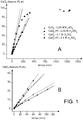
- the supported catalysts thus synthesized were suspended in two solutions consisting of a mixture of 0.5 M ascorbic acid and 0.25 M sulfuric acid and 0.1 M, with stirring.
- the ICP-AES analyzes have made it possible to demonstrate the refractory behavior at the dissolution of the Pt nanoparticles.
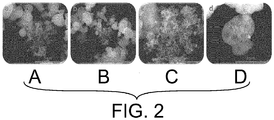
- the SEM analyzes carried out on the solid residues centrifuged after dissolution testify to the quasi-exclusive presence of the particles of Pt after dissolution ( Figure 2 ).
- the process according to the invention can also be applied to substrates comprising supports of mixed oxides of (Ce, Tb) O 2 type .
- the protocol used is the protocol described above.
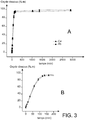
- the Figure 3 (A, B) is used to illustrate the behavior of (Ce 0.8 Tb 0.2 ) O 2 dispersed in a 0.5 M ascorbic acid / 0.4 M sulfuric acid mixture.
- the kinetics of dissolution observed under these conditions confirms the results observed previously. Indeed, 96% of the cerium initially dispersed in solid form can be assayed in solution after 165 minutes stirring at room temperature. It is found that the dissolution is linear, and we also note the presence of a slight inflection of the curve at the approach of the total dissolution of the oxide.
- the dispersion of the mixed oxide in solution has a brown color characteristic of the mixed oxide (Ce 0.8 Tb 0.2 ) O 2 . During the treatment, the solution turns orange and then yellow, before becoming clear confirming the dissolution of the elements Ce and Tb.
- the process according to the invention can also be applied to substrates comprising supports of mixed oxides of (Ce, Zr) O 2 type .
- the protocol used is the protocol described above.
- the protocol used is the protocol described above.
- the protocol used is the protocol described above.
- ascorbic acid makes it possible to obtain clear solutions after dissolution whereas the other molecules can strongly stain the solutions, which can be possibly troublesome.
- gallic acid As regards gallic acid, the solubilization of this molecule has been carried out in a hydroalcoholic mixture, whereas ascorbic acid is solubilized in pure water, which is an additional advantage in favor of the use of ascorbic acid.
- the initial dissolution rates obtained can be compared with the dissolution solutions according to the invention containing, as reducing agent, ascorbic acid (in particular TABLE I, II, and III above) or catechol or gallic acid (TABLE I), with the initial dissolution rates obtained with the solutions not according to the invention of document [9], Table 1 and Table 2, which contain hydrazinium nitrate and / or formic acid as a reducing agent.
- ascorbic acid in particular TABLE I, II, and III above
- catechol or gallic acid TABLE I
Landscapes
- Chemical & Material Sciences (AREA)
- Engineering & Computer Science (AREA)
- Metallurgy (AREA)
- Manufacturing & Machinery (AREA)
- Materials Engineering (AREA)
- Mechanical Engineering (AREA)
- Organic Chemistry (AREA)
- Life Sciences & Earth Sciences (AREA)
- Environmental & Geological Engineering (AREA)
- General Life Sciences & Earth Sciences (AREA)
- Geology (AREA)
- Chemical Kinetics & Catalysis (AREA)
- Catalysts (AREA)
Priority Applications (1)
| Application Number | Priority Date | Filing Date | Title |
|---|---|---|---|
| PL15739287T PL3172347T3 (pl) | 2014-07-21 | 2015-07-20 | Sposób rozdzielania składników stałego substratu zawierającego nośnik na bazie tlenku metali ziem rzadkich i cząstki metalu szlachetnego przez rozpuszczenie selektywne nośnika |
Applications Claiming Priority (2)
| Application Number | Priority Date | Filing Date | Title |
|---|---|---|---|
| FR1457011A FR3023849A1 (fr) | 2014-07-21 | 2014-07-21 | Procede de separation des composants d'un substrat solide comprenant un support a base d'oxyde de terre rare et des particules d'un metal noble, par dissolution selective du support. |
| PCT/EP2015/066578 WO2016012413A1 (fr) | 2014-07-21 | 2015-07-20 | Procede de separation des composants d'un substrat solide comprenant un support a base d'oxyde de terre rare et des particules d'un metal noble, par dissolution selective du support |
Publications (2)
| Publication Number | Publication Date |
|---|---|
| EP3172347A1 EP3172347A1 (fr) | 2017-05-31 |
| EP3172347B1 true EP3172347B1 (fr) | 2018-07-18 |
Family
ID=51830483
Family Applications (1)
| Application Number | Title | Priority Date | Filing Date |
|---|---|---|---|
| EP15739287.9A Active EP3172347B1 (fr) | 2014-07-21 | 2015-07-20 | Procede de separation des composants d'un substrat solide comprenant un support a base d'oxyde de terre rare et des particules d'un metal noble, par dissolution selective du support |
Country Status (5)
| Country | Link |
|---|---|
| EP (1) | EP3172347B1 (pl) |
| ES (1) | ES2689454T3 (pl) |
| FR (1) | FR3023849A1 (pl) |
| PL (1) | PL3172347T3 (pl) |
| WO (1) | WO2016012413A1 (pl) |
Cited By (1)
| Publication number | Priority date | Publication date | Assignee | Title |
|---|---|---|---|---|
| CN109097565A (zh) * | 2018-08-03 | 2018-12-28 | 江西理工大学 | 一种从离子吸附型稀土矿中高效清洁提取稀土的方法 |
Family Cites Families (3)
| Publication number | Priority date | Publication date | Assignee | Title |
|---|---|---|---|---|
| US7067090B2 (en) * | 2002-10-25 | 2006-06-27 | South Dakota School Of Mines And Technology | Recovery of platinum group metals |
| US20070104628A1 (en) * | 2005-11-04 | 2007-05-10 | Sergei Sverchkov | Apparatus and method for recovering rare-earth and noble metals from an article |
| US7935173B1 (en) * | 2010-07-23 | 2011-05-03 | Metals Recovery Technology Inc. | Process for recovery of precious metals |
-
2014
- 2014-07-21 FR FR1457011A patent/FR3023849A1/fr not_active Ceased
-
2015
- 2015-07-20 ES ES15739287.9T patent/ES2689454T3/es active Active
- 2015-07-20 PL PL15739287T patent/PL3172347T3/pl unknown
- 2015-07-20 EP EP15739287.9A patent/EP3172347B1/fr active Active
- 2015-07-20 WO PCT/EP2015/066578 patent/WO2016012413A1/fr not_active Ceased
Non-Patent Citations (1)
| Title |
|---|
| None * |
Cited By (1)
| Publication number | Priority date | Publication date | Assignee | Title |
|---|---|---|---|---|
| CN109097565A (zh) * | 2018-08-03 | 2018-12-28 | 江西理工大学 | 一种从离子吸附型稀土矿中高效清洁提取稀土的方法 |
Also Published As
| Publication number | Publication date |
|---|---|
| WO2016012413A1 (fr) | 2016-01-28 |
| PL3172347T3 (pl) | 2019-03-29 |
| FR3023849A1 (fr) | 2016-01-22 |
| ES2689454T3 (es) | 2018-11-14 |
| EP3172347A1 (fr) | 2017-05-31 |
Similar Documents
| Publication | Publication Date | Title |
|---|---|---|
| Trinh et al. | Eco-threat minimization in HCl leaching of PGMs from spent automobile catalysts by formic acid prereduction | |
| EP3169818B1 (fr) | Procédé de séparation du palladium des autres éléments métalliques présents dans une phase aqueuse nitrique et ses utilisations | |
| US20240344168A1 (en) | Metal recovery apparatus and metal recovery method | |
| EP2500442B1 (de) | Prozess zur Rückgewinnung von Edelmetall aus funktionalisierten edelmetallhaltigen Adsorptionsmaterialien | |
| JP2024068786A (ja) | 触媒の処理方法 | |
| CN119317725A (zh) | 用于从失效的含铂固体残渣中回收铂的方法 | |
| EP3172347B1 (fr) | Procede de separation des composants d'un substrat solide comprenant un support a base d'oxyde de terre rare et des particules d'un metal noble, par dissolution selective du support | |
| WO2011006974A1 (fr) | Procede d'extraction d'au moins un element chimique d'un milieu sel fondu | |
| CN113151693A (zh) | 一种从四(三苯基膦)钯废液中回收钯的方法 | |
| EP0871787A1 (fr) | Procede de traitement par voie electrochimique de substrats catalyseurs contenant des metaux precieux en vue de leur recuperation | |
| EP3310713B1 (fr) | Procédé de stabilisation de mercure métallique | |
| EP3662089B1 (fr) | Procédé de séparation du palladium des autres éléments métalliques présents dans une phase aqueuse nitrique utilisant comme extractants des malonamides particuliers | |
| EP1743044B1 (en) | Method for recovery of palladium | |
| Okada et al. | Solubilization of palladium in molten mixture of sodium borates and sodium carbonate | |
| EP3662090B1 (fr) | Procédé amélioré de récupération du palladium des autres éléments métalliques présents dans une phase aqueuse nitrique utilisant comme extractants des malonamides | |
| TWI623623B (zh) | 回收貴金屬的處理方法 | |
| RU2464088C1 (ru) | Способ регенерации автомобильных катализаторов | |
| KR102923980B1 (ko) | 테일러쿠에트 반응기를 이용한 유가금속의 회수방법 | |
| WO2024177049A1 (ja) | 白金族金属の固液抽出剤 | |
| WO2022251226A2 (en) | Selective separation of hexachloroplatinate(iv) dianions based on exo-binding with cucurbit[6]uril | |
| WO1999066086A1 (fr) | Procede de dissolution du plutonium ou d'un alliage de plutonium et sa conversion en combustible nucleaire | |
| WO2025114223A1 (fr) | Matériau solide utile pour l'extraction du palladium et/ou du rhodium et/ou de l'argent, son procédé de préparation et ses utilisations | |
| Khairol Anwar et al. | A Review: Extraction of Platinum Spent Catalyst Using Palm Oil Leaf As Reducing Agent | |
| Bensaid | FORMATION OF PGM NANOPARTICLES FOR CATALYTIC DEGRADATION OF SELECTED PHARMACEUTICALS | |
| Udawatte | Gold nanoparticle-modified zinc oxide nanoparticles as novel photocatalytic materials |
Legal Events
| Date | Code | Title | Description |
|---|---|---|---|
| PUAI | Public reference made under article 153(3) epc to a published international application that has entered the european phase |
Free format text: ORIGINAL CODE: 0009012 |
|
| 17P | Request for examination filed |
Effective date: 20170123 |
|
| AK | Designated contracting states |
Kind code of ref document: A1 Designated state(s): AL AT BE BG CH CY CZ DE DK EE ES FI FR GB GR HR HU IE IS IT LI LT LU LV MC MK MT NL NO PL PT RO RS SE SI SK SM TR |
|
| AX | Request for extension of the european patent |
Extension state: BA ME |
|
| RIN1 | Information on inventor provided before grant (corrected) |
Inventor name: VIROT, MATTHIEU Inventor name: NIKITENKO, SERGUEI Inventor name: CHAVE, TONY Inventor name: BEAUDOUX, XAVIER Inventor name: LETURCQ, GILLES |
|
| DAV | Request for validation of the european patent (deleted) | ||
| DAX | Request for extension of the european patent (deleted) | ||
| GRAP | Despatch of communication of intention to grant a patent |
Free format text: ORIGINAL CODE: EPIDOSNIGR1 |
|
| INTG | Intention to grant announced |
Effective date: 20180208 |
|
| GRAA | (expected) grant |
Free format text: ORIGINAL CODE: 0009210 |
|
| AK | Designated contracting states |
Kind code of ref document: B1 Designated state(s): AL AT BE BG CH CY CZ DE DK EE ES FI FR GB GR HR HU IE IS IT LI LT LU LV MC MK MT NL NO PL PT RO RS SE SI SK SM TR |
|
| REG | Reference to a national code |
Ref country code: GB Ref legal event code: FG4D Free format text: NOT ENGLISH |
|
| REG | Reference to a national code |
Ref country code: FR Ref legal event code: PLFP Year of fee payment: 4 |
|
| GRAS | Grant fee paid |
Free format text: ORIGINAL CODE: EPIDOSNIGR3 |
|
| REG | Reference to a national code |
Ref country code: CH Ref legal event code: EP |
|
| REG | Reference to a national code |
Ref country code: IE Ref legal event code: FG4D Free format text: LANGUAGE OF EP DOCUMENT: FRENCH |
|
| REG | Reference to a national code |
Ref country code: AT Ref legal event code: REF Ref document number: 1019429 Country of ref document: AT Kind code of ref document: T Effective date: 20180815 |
|
| REG | Reference to a national code |
Ref country code: DE Ref legal event code: R096 Ref document number: 602015013761 Country of ref document: DE |
|
| REG | Reference to a national code |
Ref country code: ES Ref legal event code: FG2A Ref document number: 2689454 Country of ref document: ES Kind code of ref document: T3 Effective date: 20181114 |
|
| REG | Reference to a national code |
Ref country code: NL Ref legal event code: MP Effective date: 20180718 |
|
| REG | Reference to a national code |
Ref country code: LT Ref legal event code: MG4D |
|
| REG | Reference to a national code |
Ref country code: AT Ref legal event code: MK05 Ref document number: 1019429 Country of ref document: AT Kind code of ref document: T Effective date: 20180718 |
|
| PG25 | Lapsed in a contracting state [announced via postgrant information from national office to epo] |
Ref country code: NL Free format text: LAPSE BECAUSE OF FAILURE TO SUBMIT A TRANSLATION OF THE DESCRIPTION OR TO PAY THE FEE WITHIN THE PRESCRIBED TIME-LIMIT Effective date: 20180718 |
|
| PG25 | Lapsed in a contracting state [announced via postgrant information from national office to epo] |
Ref country code: AT Free format text: LAPSE BECAUSE OF FAILURE TO SUBMIT A TRANSLATION OF THE DESCRIPTION OR TO PAY THE FEE WITHIN THE PRESCRIBED TIME-LIMIT Effective date: 20180718 Ref country code: IS Free format text: LAPSE BECAUSE OF FAILURE TO SUBMIT A TRANSLATION OF THE DESCRIPTION OR TO PAY THE FEE WITHIN THE PRESCRIBED TIME-LIMIT Effective date: 20181118 Ref country code: NO Free format text: LAPSE BECAUSE OF FAILURE TO SUBMIT A TRANSLATION OF THE DESCRIPTION OR TO PAY THE FEE WITHIN THE PRESCRIBED TIME-LIMIT Effective date: 20181018 Ref country code: LT Free format text: LAPSE BECAUSE OF FAILURE TO SUBMIT A TRANSLATION OF THE DESCRIPTION OR TO PAY THE FEE WITHIN THE PRESCRIBED TIME-LIMIT Effective date: 20180718 Ref country code: BG Free format text: LAPSE BECAUSE OF FAILURE TO SUBMIT A TRANSLATION OF THE DESCRIPTION OR TO PAY THE FEE WITHIN THE PRESCRIBED TIME-LIMIT Effective date: 20181018 Ref country code: RS Free format text: LAPSE BECAUSE OF FAILURE TO SUBMIT A TRANSLATION OF THE DESCRIPTION OR TO PAY THE FEE WITHIN THE PRESCRIBED TIME-LIMIT Effective date: 20180718 Ref country code: SE Free format text: LAPSE BECAUSE OF FAILURE TO SUBMIT A TRANSLATION OF THE DESCRIPTION OR TO PAY THE FEE WITHIN THE PRESCRIBED TIME-LIMIT Effective date: 20180718 |
|
| PG25 | Lapsed in a contracting state [announced via postgrant information from national office to epo] |
Ref country code: LV Free format text: LAPSE BECAUSE OF FAILURE TO SUBMIT A TRANSLATION OF THE DESCRIPTION OR TO PAY THE FEE WITHIN THE PRESCRIBED TIME-LIMIT Effective date: 20180718 Ref country code: AL Free format text: LAPSE BECAUSE OF FAILURE TO SUBMIT A TRANSLATION OF THE DESCRIPTION OR TO PAY THE FEE WITHIN THE PRESCRIBED TIME-LIMIT Effective date: 20180718 Ref country code: HR Free format text: LAPSE BECAUSE OF FAILURE TO SUBMIT A TRANSLATION OF THE DESCRIPTION OR TO PAY THE FEE WITHIN THE PRESCRIBED TIME-LIMIT Effective date: 20180718 |
|
| REG | Reference to a national code |
Ref country code: CH Ref legal event code: PL |
|
| REG | Reference to a national code |
Ref country code: GR Ref legal event code: EP Ref document number: 20180402937 Country of ref document: GR Effective date: 20190225 |
|
| PG25 | Lapsed in a contracting state [announced via postgrant information from national office to epo] |
Ref country code: LU Free format text: LAPSE BECAUSE OF NON-PAYMENT OF DUE FEES Effective date: 20180720 |
|
| REG | Reference to a national code |
Ref country code: IE Ref legal event code: MM4A |
|
| REG | Reference to a national code |
Ref country code: DE Ref legal event code: R097 Ref document number: 602015013761 Country of ref document: DE |
|
| PG25 | Lapsed in a contracting state [announced via postgrant information from national office to epo] |
Ref country code: IE Free format text: LAPSE BECAUSE OF NON-PAYMENT OF DUE FEES Effective date: 20180720 Ref country code: EE Free format text: LAPSE BECAUSE OF FAILURE TO SUBMIT A TRANSLATION OF THE DESCRIPTION OR TO PAY THE FEE WITHIN THE PRESCRIBED TIME-LIMIT Effective date: 20180718 Ref country code: CH Free format text: LAPSE BECAUSE OF NON-PAYMENT OF DUE FEES Effective date: 20180731 Ref country code: LI Free format text: LAPSE BECAUSE OF NON-PAYMENT OF DUE FEES Effective date: 20180731 Ref country code: MC Free format text: LAPSE BECAUSE OF FAILURE TO SUBMIT A TRANSLATION OF THE DESCRIPTION OR TO PAY THE FEE WITHIN THE PRESCRIBED TIME-LIMIT Effective date: 20180718 Ref country code: RO Free format text: LAPSE BECAUSE OF FAILURE TO SUBMIT A TRANSLATION OF THE DESCRIPTION OR TO PAY THE FEE WITHIN THE PRESCRIBED TIME-LIMIT Effective date: 20180718 Ref country code: CZ Free format text: LAPSE BECAUSE OF FAILURE TO SUBMIT A TRANSLATION OF THE DESCRIPTION OR TO PAY THE FEE WITHIN THE PRESCRIBED TIME-LIMIT Effective date: 20180718 |
|
| PLBE | No opposition filed within time limit |
Free format text: ORIGINAL CODE: 0009261 |
|
| STAA | Information on the status of an ep patent application or granted ep patent |
Free format text: STATUS: NO OPPOSITION FILED WITHIN TIME LIMIT |
|
| PG25 | Lapsed in a contracting state [announced via postgrant information from national office to epo] |
Ref country code: DK Free format text: LAPSE BECAUSE OF FAILURE TO SUBMIT A TRANSLATION OF THE DESCRIPTION OR TO PAY THE FEE WITHIN THE PRESCRIBED TIME-LIMIT Effective date: 20180718 Ref country code: SM Free format text: LAPSE BECAUSE OF FAILURE TO SUBMIT A TRANSLATION OF THE DESCRIPTION OR TO PAY THE FEE WITHIN THE PRESCRIBED TIME-LIMIT Effective date: 20180718 Ref country code: SK Free format text: LAPSE BECAUSE OF FAILURE TO SUBMIT A TRANSLATION OF THE DESCRIPTION OR TO PAY THE FEE WITHIN THE PRESCRIBED TIME-LIMIT Effective date: 20180718 |
|
| 26N | No opposition filed |
Effective date: 20190423 |
|
| PGFP | Annual fee paid to national office [announced via postgrant information from national office to epo] |
Ref country code: PL Payment date: 20190619 Year of fee payment: 5 Ref country code: FI Payment date: 20190620 Year of fee payment: 5 |
|
| PG25 | Lapsed in a contracting state [announced via postgrant information from national office to epo] |
Ref country code: SI Free format text: LAPSE BECAUSE OF FAILURE TO SUBMIT A TRANSLATION OF THE DESCRIPTION OR TO PAY THE FEE WITHIN THE PRESCRIBED TIME-LIMIT Effective date: 20180718 |
|
| PGFP | Annual fee paid to national office [announced via postgrant information from national office to epo] |
Ref country code: GR Payment date: 20190621 Year of fee payment: 5 |
|
| PGFP | Annual fee paid to national office [announced via postgrant information from national office to epo] |
Ref country code: IT Payment date: 20190726 Year of fee payment: 5 Ref country code: ES Payment date: 20190809 Year of fee payment: 5 Ref country code: DE Payment date: 20190711 Year of fee payment: 5 |
|
| PGFP | Annual fee paid to national office [announced via postgrant information from national office to epo] |
Ref country code: BE Payment date: 20190725 Year of fee payment: 5 |
|
| PG25 | Lapsed in a contracting state [announced via postgrant information from national office to epo] |
Ref country code: MT Free format text: LAPSE BECAUSE OF FAILURE TO SUBMIT A TRANSLATION OF THE DESCRIPTION OR TO PAY THE FEE WITHIN THE PRESCRIBED TIME-LIMIT Effective date: 20180718 |
|
| GBPC | Gb: european patent ceased through non-payment of renewal fee |
Effective date: 20190720 |
|
| PG25 | Lapsed in a contracting state [announced via postgrant information from national office to epo] |
Ref country code: TR Free format text: LAPSE BECAUSE OF FAILURE TO SUBMIT A TRANSLATION OF THE DESCRIPTION OR TO PAY THE FEE WITHIN THE PRESCRIBED TIME-LIMIT Effective date: 20180718 |
|
| PG25 | Lapsed in a contracting state [announced via postgrant information from national office to epo] |
Ref country code: GB Free format text: LAPSE BECAUSE OF NON-PAYMENT OF DUE FEES Effective date: 20190720 |
|
| PG25 | Lapsed in a contracting state [announced via postgrant information from national office to epo] |
Ref country code: PT Free format text: LAPSE BECAUSE OF FAILURE TO SUBMIT A TRANSLATION OF THE DESCRIPTION OR TO PAY THE FEE WITHIN THE PRESCRIBED TIME-LIMIT Effective date: 20180718 |
|
| PG25 | Lapsed in a contracting state [announced via postgrant information from national office to epo] |
Ref country code: MK Free format text: LAPSE BECAUSE OF NON-PAYMENT OF DUE FEES Effective date: 20180718 Ref country code: CY Free format text: LAPSE BECAUSE OF FAILURE TO SUBMIT A TRANSLATION OF THE DESCRIPTION OR TO PAY THE FEE WITHIN THE PRESCRIBED TIME-LIMIT Effective date: 20180718 Ref country code: HU Free format text: LAPSE BECAUSE OF FAILURE TO SUBMIT A TRANSLATION OF THE DESCRIPTION OR TO PAY THE FEE WITHIN THE PRESCRIBED TIME-LIMIT; INVALID AB INITIO Effective date: 20150720 |
|
| REG | Reference to a national code |
Ref country code: DE Ref legal event code: R119 Ref document number: 602015013761 Country of ref document: DE |
|
| REG | Reference to a national code |
Ref country code: FI Ref legal event code: MAE |
|
| REG | Reference to a national code |
Ref country code: BE Ref legal event code: MM Effective date: 20200731 |
|
| PG25 | Lapsed in a contracting state [announced via postgrant information from national office to epo] |
Ref country code: GR Free format text: LAPSE BECAUSE OF NON-PAYMENT OF DUE FEES Effective date: 20210210 Ref country code: FI Free format text: LAPSE BECAUSE OF NON-PAYMENT OF DUE FEES Effective date: 20200720 |
|
| PG25 | Lapsed in a contracting state [announced via postgrant information from national office to epo] |
Ref country code: BE Free format text: LAPSE BECAUSE OF NON-PAYMENT OF DUE FEES Effective date: 20200731 Ref country code: DE Free format text: LAPSE BECAUSE OF NON-PAYMENT OF DUE FEES Effective date: 20210202 |
|
| PG25 | Lapsed in a contracting state [announced via postgrant information from national office to epo] |
Ref country code: IT Free format text: LAPSE BECAUSE OF NON-PAYMENT OF DUE FEES Effective date: 20200720 |
|
| REG | Reference to a national code |
Ref country code: ES Ref legal event code: FD2A Effective date: 20211229 |
|
| PG25 | Lapsed in a contracting state [announced via postgrant information from national office to epo] |
Ref country code: ES Free format text: LAPSE BECAUSE OF NON-PAYMENT OF DUE FEES Effective date: 20200721 |
|
| PG25 | Lapsed in a contracting state [announced via postgrant information from national office to epo] |
Ref country code: PL Free format text: LAPSE BECAUSE OF NON-PAYMENT OF DUE FEES Effective date: 20200720 |
|
| PGFP | Annual fee paid to national office [announced via postgrant information from national office to epo] |
Ref country code: FR Payment date: 20250722 Year of fee payment: 11 |