EP3168022A1 - Production method for plate-integrated gasket - Google Patents
Production method for plate-integrated gasket Download PDFInfo
- Publication number
- EP3168022A1 EP3168022A1 EP15819691.5A EP15819691A EP3168022A1 EP 3168022 A1 EP3168022 A1 EP 3168022A1 EP 15819691 A EP15819691 A EP 15819691A EP 3168022 A1 EP3168022 A1 EP 3168022A1
- Authority
- EP
- European Patent Office
- Prior art keywords
- plate
- peripheral edge
- edge portion
- gasket
- cavity
- Prior art date
- Legal status (The legal status is an assumption and is not a legal conclusion. Google has not performed a legal analysis and makes no representation as to the accuracy of the status listed.)
- Withdrawn
Links
- 238000004519 manufacturing process Methods 0.000 title claims abstract description 17
- 230000002093 peripheral effect Effects 0.000 claims abstract description 77
- 238000004382 potting Methods 0.000 claims abstract description 35
- 239000000463 material Substances 0.000 claims abstract description 29
- 239000007788 liquid Substances 0.000 claims abstract description 25
- 239000013013 elastic material Substances 0.000 claims abstract description 12
- 239000002184 metal Substances 0.000 claims description 17
- 238000000034 method Methods 0.000 claims description 6
- 230000015572 biosynthetic process Effects 0.000 abstract 1
- 239000000446 fuel Substances 0.000 description 16
- 238000005520 cutting process Methods 0.000 description 5
- 239000007789 gas Substances 0.000 description 4
- 239000012528 membrane Substances 0.000 description 4
- 238000003825 pressing Methods 0.000 description 4
- 238000002347 injection Methods 0.000 description 3
- 239000007924 injection Substances 0.000 description 3
- 238000007789 sealing Methods 0.000 description 3
- 229920003002 synthetic resin Polymers 0.000 description 3
- 239000000057 synthetic resin Substances 0.000 description 3
- 239000002737 fuel gas Substances 0.000 description 2
- 238000010030 laminating Methods 0.000 description 2
- 230000003647 oxidation Effects 0.000 description 2
- 238000007254 oxidation reaction Methods 0.000 description 2
- 238000005452 bending Methods 0.000 description 1
- 230000006835 compression Effects 0.000 description 1
- 238000007906 compression Methods 0.000 description 1
- 230000007547 defect Effects 0.000 description 1
- 238000009792 diffusion process Methods 0.000 description 1
- 230000000694 effects Effects 0.000 description 1
- 238000003487 electrochemical reaction Methods 0.000 description 1
- 239000003792 electrolyte Substances 0.000 description 1
- 238000007667 floating Methods 0.000 description 1
- 238000000465 moulding Methods 0.000 description 1
- 238000007650 screen-printing Methods 0.000 description 1
- 238000007493 shaping process Methods 0.000 description 1
- 238000009751 slip forming Methods 0.000 description 1
- XLYOFNOQVPJJNP-UHFFFAOYSA-N water Substances O XLYOFNOQVPJJNP-UHFFFAOYSA-N 0.000 description 1
Images


Classifications
-
- B—PERFORMING OPERATIONS; TRANSPORTING
- B29—WORKING OF PLASTICS; WORKING OF SUBSTANCES IN A PLASTIC STATE IN GENERAL
- B29C—SHAPING OR JOINING OF PLASTICS; SHAPING OF MATERIAL IN A PLASTIC STATE, NOT OTHERWISE PROVIDED FOR; AFTER-TREATMENT OF THE SHAPED PRODUCTS, e.g. REPAIRING
- B29C45/00—Injection moulding, i.e. forcing the required volume of moulding material through a nozzle into a closed mould; Apparatus therefor
- B29C45/14—Injection moulding, i.e. forcing the required volume of moulding material through a nozzle into a closed mould; Apparatus therefor incorporating preformed parts or layers, e.g. injection moulding around inserts or for coating articles
- B29C45/14336—Coating a portion of the article, e.g. the edge of the article
-
- B—PERFORMING OPERATIONS; TRANSPORTING
- B29—WORKING OF PLASTICS; WORKING OF SUBSTANCES IN A PLASTIC STATE IN GENERAL
- B29C—SHAPING OR JOINING OF PLASTICS; SHAPING OF MATERIAL IN A PLASTIC STATE, NOT OTHERWISE PROVIDED FOR; AFTER-TREATMENT OF THE SHAPED PRODUCTS, e.g. REPAIRING
- B29C45/00—Injection moulding, i.e. forcing the required volume of moulding material through a nozzle into a closed mould; Apparatus therefor
- B29C45/14—Injection moulding, i.e. forcing the required volume of moulding material through a nozzle into a closed mould; Apparatus therefor incorporating preformed parts or layers, e.g. injection moulding around inserts or for coating articles
- B29C45/14065—Positioning or centering articles in the mould
-
- B—PERFORMING OPERATIONS; TRANSPORTING
- B29—WORKING OF PLASTICS; WORKING OF SUBSTANCES IN A PLASTIC STATE IN GENERAL
- B29C—SHAPING OR JOINING OF PLASTICS; SHAPING OF MATERIAL IN A PLASTIC STATE, NOT OTHERWISE PROVIDED FOR; AFTER-TREATMENT OF THE SHAPED PRODUCTS, e.g. REPAIRING
- B29C33/00—Moulds or cores; Details thereof or accessories therefor
- B29C33/12—Moulds or cores; Details thereof or accessories therefor with incorporated means for positioning inserts, e.g. labels
-
- B—PERFORMING OPERATIONS; TRANSPORTING
- B29—WORKING OF PLASTICS; WORKING OF SUBSTANCES IN A PLASTIC STATE IN GENERAL
- B29C—SHAPING OR JOINING OF PLASTICS; SHAPING OF MATERIAL IN A PLASTIC STATE, NOT OTHERWISE PROVIDED FOR; AFTER-TREATMENT OF THE SHAPED PRODUCTS, e.g. REPAIRING
- B29C39/00—Shaping by casting, i.e. introducing the moulding material into a mould or between confining surfaces without significant moulding pressure; Apparatus therefor
- B29C39/02—Shaping by casting, i.e. introducing the moulding material into a mould or between confining surfaces without significant moulding pressure; Apparatus therefor for making articles of definite length, i.e. discrete articles
- B29C39/10—Shaping by casting, i.e. introducing the moulding material into a mould or between confining surfaces without significant moulding pressure; Apparatus therefor for making articles of definite length, i.e. discrete articles incorporating preformed parts or layers, e.g. casting around inserts or for coating articles
-
- B—PERFORMING OPERATIONS; TRANSPORTING
- B29—WORKING OF PLASTICS; WORKING OF SUBSTANCES IN A PLASTIC STATE IN GENERAL
- B29C—SHAPING OR JOINING OF PLASTICS; SHAPING OF MATERIAL IN A PLASTIC STATE, NOT OTHERWISE PROVIDED FOR; AFTER-TREATMENT OF THE SHAPED PRODUCTS, e.g. REPAIRING
- B29C39/00—Shaping by casting, i.e. introducing the moulding material into a mould or between confining surfaces without significant moulding pressure; Apparatus therefor
- B29C39/22—Component parts, details or accessories; Auxiliary operations
- B29C39/26—Moulds or cores
-
- B—PERFORMING OPERATIONS; TRANSPORTING
- B29—WORKING OF PLASTICS; WORKING OF SUBSTANCES IN A PLASTIC STATE IN GENERAL
- B29C—SHAPING OR JOINING OF PLASTICS; SHAPING OF MATERIAL IN A PLASTIC STATE, NOT OTHERWISE PROVIDED FOR; AFTER-TREATMENT OF THE SHAPED PRODUCTS, e.g. REPAIRING
- B29C45/00—Injection moulding, i.e. forcing the required volume of moulding material through a nozzle into a closed mould; Apparatus therefor
- B29C45/14—Injection moulding, i.e. forcing the required volume of moulding material through a nozzle into a closed mould; Apparatus therefor incorporating preformed parts or layers, e.g. injection moulding around inserts or for coating articles
- B29C45/14336—Coating a portion of the article, e.g. the edge of the article
- B29C45/14418—Sealing means between mould and article
-
- B—PERFORMING OPERATIONS; TRANSPORTING
- B29—WORKING OF PLASTICS; WORKING OF SUBSTANCES IN A PLASTIC STATE IN GENERAL
- B29C—SHAPING OR JOINING OF PLASTICS; SHAPING OF MATERIAL IN A PLASTIC STATE, NOT OTHERWISE PROVIDED FOR; AFTER-TREATMENT OF THE SHAPED PRODUCTS, e.g. REPAIRING
- B29C45/00—Injection moulding, i.e. forcing the required volume of moulding material through a nozzle into a closed mould; Apparatus therefor
- B29C45/14—Injection moulding, i.e. forcing the required volume of moulding material through a nozzle into a closed mould; Apparatus therefor incorporating preformed parts or layers, e.g. injection moulding around inserts or for coating articles
- B29C45/14836—Preventing damage of inserts during injection, e.g. collapse of hollow inserts, breakage
-
- F—MECHANICAL ENGINEERING; LIGHTING; HEATING; WEAPONS; BLASTING
- F16—ENGINEERING ELEMENTS AND UNITS; GENERAL MEASURES FOR PRODUCING AND MAINTAINING EFFECTIVE FUNCTIONING OF MACHINES OR INSTALLATIONS; THERMAL INSULATION IN GENERAL
- F16J—PISTONS; CYLINDERS; SEALINGS
- F16J15/00—Sealings
- F16J15/02—Sealings between relatively-stationary surfaces
- F16J15/06—Sealings between relatively-stationary surfaces with solid packing compressed between sealing surfaces
- F16J15/10—Sealings between relatively-stationary surfaces with solid packing compressed between sealing surfaces with non-metallic packing
-
- H—ELECTRICITY
- H01—ELECTRIC ELEMENTS
- H01M—PROCESSES OR MEANS, e.g. BATTERIES, FOR THE DIRECT CONVERSION OF CHEMICAL ENERGY INTO ELECTRICAL ENERGY
- H01M8/00—Fuel cells; Manufacture thereof
- H01M8/02—Details
-
- H—ELECTRICITY
- H01—ELECTRIC ELEMENTS
- H01M—PROCESSES OR MEANS, e.g. BATTERIES, FOR THE DIRECT CONVERSION OF CHEMICAL ENERGY INTO ELECTRICAL ENERGY
- H01M8/00—Fuel cells; Manufacture thereof
- H01M8/02—Details
- H01M8/0271—Sealing or supporting means around electrodes, matrices or membranes
- H01M8/028—Sealing means characterised by their material
- H01M8/0284—Organic resins; Organic polymers
-
- H—ELECTRICITY
- H01—ELECTRIC ELEMENTS
- H01M—PROCESSES OR MEANS, e.g. BATTERIES, FOR THE DIRECT CONVERSION OF CHEMICAL ENERGY INTO ELECTRICAL ENERGY
- H01M8/00—Fuel cells; Manufacture thereof
- H01M8/02—Details
- H01M8/0271—Sealing or supporting means around electrodes, matrices or membranes
- H01M8/0286—Processes for forming seals
-
- B—PERFORMING OPERATIONS; TRANSPORTING
- B29—WORKING OF PLASTICS; WORKING OF SUBSTANCES IN A PLASTIC STATE IN GENERAL
- B29C—SHAPING OR JOINING OF PLASTICS; SHAPING OF MATERIAL IN A PLASTIC STATE, NOT OTHERWISE PROVIDED FOR; AFTER-TREATMENT OF THE SHAPED PRODUCTS, e.g. REPAIRING
- B29C45/00—Injection moulding, i.e. forcing the required volume of moulding material through a nozzle into a closed mould; Apparatus therefor
- B29C45/14—Injection moulding, i.e. forcing the required volume of moulding material through a nozzle into a closed mould; Apparatus therefor incorporating preformed parts or layers, e.g. injection moulding around inserts or for coating articles
- B29C2045/1486—Details, accessories and auxiliary operations
- B29C2045/14934—Preventing penetration of injected material between insert and adjacent mould wall
-
- B—PERFORMING OPERATIONS; TRANSPORTING
- B29—WORKING OF PLASTICS; WORKING OF SUBSTANCES IN A PLASTIC STATE IN GENERAL
- B29K—INDEXING SCHEME ASSOCIATED WITH SUBCLASSES B29B, B29C OR B29D, RELATING TO MOULDING MATERIALS OR TO MATERIALS FOR MOULDS, REINFORCEMENTS, FILLERS OR PREFORMED PARTS, e.g. INSERTS
- B29K2021/00—Use of unspecified rubbers as moulding material
-
- B—PERFORMING OPERATIONS; TRANSPORTING
- B29—WORKING OF PLASTICS; WORKING OF SUBSTANCES IN A PLASTIC STATE IN GENERAL
- B29K—INDEXING SCHEME ASSOCIATED WITH SUBCLASSES B29B, B29C OR B29D, RELATING TO MOULDING MATERIALS OR TO MATERIALS FOR MOULDS, REINFORCEMENTS, FILLERS OR PREFORMED PARTS, e.g. INSERTS
- B29K2105/00—Condition, form or state of moulded material or of the material to be shaped
- B29K2105/0058—Liquid or visquous
-
- B—PERFORMING OPERATIONS; TRANSPORTING
- B29—WORKING OF PLASTICS; WORKING OF SUBSTANCES IN A PLASTIC STATE IN GENERAL
- B29K—INDEXING SCHEME ASSOCIATED WITH SUBCLASSES B29B, B29C OR B29D, RELATING TO MOULDING MATERIALS OR TO MATERIALS FOR MOULDS, REINFORCEMENTS, FILLERS OR PREFORMED PARTS, e.g. INSERTS
- B29K2905/00—Use of metals, their alloys or their compounds, as mould material
-
- B—PERFORMING OPERATIONS; TRANSPORTING
- B29—WORKING OF PLASTICS; WORKING OF SUBSTANCES IN A PLASTIC STATE IN GENERAL
- B29K—INDEXING SCHEME ASSOCIATED WITH SUBCLASSES B29B, B29C OR B29D, RELATING TO MOULDING MATERIALS OR TO MATERIALS FOR MOULDS, REINFORCEMENTS, FILLERS OR PREFORMED PARTS, e.g. INSERTS
- B29K2995/00—Properties of moulding materials, reinforcements, fillers, preformed parts or moulds
- B29K2995/0037—Other properties
- B29K2995/0046—Elastic
-
- B—PERFORMING OPERATIONS; TRANSPORTING
- B29—WORKING OF PLASTICS; WORKING OF SUBSTANCES IN A PLASTIC STATE IN GENERAL
- B29L—INDEXING SCHEME ASSOCIATED WITH SUBCLASS B29C, RELATING TO PARTICULAR ARTICLES
- B29L2031/00—Other particular articles
- B29L2031/26—Sealing devices, e.g. packaging for pistons or pipe joints
- B29L2031/265—Packings, Gaskets
-
- B—PERFORMING OPERATIONS; TRANSPORTING
- B29—WORKING OF PLASTICS; WORKING OF SUBSTANCES IN A PLASTIC STATE IN GENERAL
- B29L—INDEXING SCHEME ASSOCIATED WITH SUBCLASS B29C, RELATING TO PARTICULAR ARTICLES
- B29L2031/00—Other particular articles
- B29L2031/34—Electrical apparatus, e.g. sparking plugs or parts thereof
- B29L2031/3468—Batteries, accumulators or fuel cells
-
- Y—GENERAL TAGGING OF NEW TECHNOLOGICAL DEVELOPMENTS; GENERAL TAGGING OF CROSS-SECTIONAL TECHNOLOGIES SPANNING OVER SEVERAL SECTIONS OF THE IPC; TECHNICAL SUBJECTS COVERED BY FORMER USPC CROSS-REFERENCE ART COLLECTIONS [XRACs] AND DIGESTS
- Y02—TECHNOLOGIES OR APPLICATIONS FOR MITIGATION OR ADAPTATION AGAINST CLIMATE CHANGE
- Y02E—REDUCTION OF GREENHOUSE GAS [GHG] EMISSIONS, RELATED TO ENERGY GENERATION, TRANSMISSION OR DISTRIBUTION
- Y02E60/00—Enabling technologies; Technologies with a potential or indirect contribution to GHG emissions mitigation
- Y02E60/30—Hydrogen technology
- Y02E60/50—Fuel cells
-
- Y—GENERAL TAGGING OF NEW TECHNOLOGICAL DEVELOPMENTS; GENERAL TAGGING OF CROSS-SECTIONAL TECHNOLOGIES SPANNING OVER SEVERAL SECTIONS OF THE IPC; TECHNICAL SUBJECTS COVERED BY FORMER USPC CROSS-REFERENCE ART COLLECTIONS [XRACs] AND DIGESTS
- Y02—TECHNOLOGIES OR APPLICATIONS FOR MITIGATION OR ADAPTATION AGAINST CLIMATE CHANGE
- Y02P—CLIMATE CHANGE MITIGATION TECHNOLOGIES IN THE PRODUCTION OR PROCESSING OF GOODS
- Y02P70/00—Climate change mitigation technologies in the production process for final industrial or consumer products
- Y02P70/50—Manufacturing or production processes characterised by the final manufactured product
Definitions
- the present invention relates to a method of manufacturing a plate-integrated gasket which is integrally provided with a gasket main body made of a rubber-like elastic material in a peripheral edge portion of a plate such a separator, for example, constructing a fuel battery cell.
- a fuel battery cell is formed by arranging a gas diffusion layer in both sides in a thickness direction of a membrane electrode assembly (MEA) which is provided with a pair of electrode layers in both surfaces of an electrolyte membrane, and laminating a separator thereon, and the fuel battery is constructed as a stack structure by laminating a lot of fuel battery cells.
- MEA membrane electrode assembly
- a gasket for sealing a fuel gas and an oxidation gas is employed in each of the fuel battery cells, and a plate-integrated gasket 100 as shown in Figs. 5 and 6 has been conventionally known as this kind of gasket.
- the plate-integrated gasket 100 shown in Figs. 5 and 6 is integrally provided with a gasket main body 102 made of a rubber-like elastic material (a rubber material or a synthetic resin material having a rubber-like elasticity) in one side in a thickness direction in a peripheral edge portion of a plate 101 such as a metal separator, and the gasket main body 102 has a seal lip 102a which is formed into a chevron protrusion shape.
- a rubber-like elastic material a rubber material or a synthetic resin material having a rubber-like elasticity
- the plate 101 is arranged in such a manner that the peripheral edge portions 101 a and 101b are positioned within a cavity which is a shaping space for a molding liquid rubber material, and is pinched between inner surfaces of the metal mold in an intermediate portion 101c between the peripheral edge portions 101 a and 101b.
- the plate 101 is thin and flexible such as the metal separator for the fuel battery, there is a risk that the liquid rubber material filled into the cavity partly comes around a back side of the peripheral edge portions 101a and 101b of the plate 101, and the gasket main body 102 is formed in a state in which the peripheral edge portions 101a and 101b are bent by an inflow pressure of the liquid rubber material (refer to patent document 1). If the worst comes to the worst, there is generated such a problem that the deformed plate 101 is partly exposed from the gasket main body 102, and there has been a risk that a sealing performance of the gasket main body 102 is deteriorated.
- Patent Document 1 Japanese Unexamined Patent Publication No. 2011-96419
- the present invention is made by taking the above points into consideration, and a technical object of the present invention is to provide a method of manufacturing a plate-integrated gasket which can effectively prevent deformation of a peripheral edge portion of a plate which is positioned within a cavity when a gasket main body is integrally formed in one side in a thickness direction of the peripheral edge portion of the flexible plate.
- a method of manufacturing a plate-integrated gasket according to the present invention is a method of manufacturing a plate-integrated gasket integrally provided with a gasket main body made of a rubber-like elastic material in one side in a thickness direction in a peripheral edge portion of a plate, the method comprising the steps of: forming a lot of potting portions made of a rubber-like elastic material at appropriate intervals in respect of an extending direction of the gasket main body in the one side in the thickness direction in the peripheral edge portion of the plate in such a manner as to be positioned in a forming area of the gasket main body; next pinching a portion constructed by the peripheral edge portion of the plate and the potting portion between inner surfaces of a gasket forming cavity of the metal mold and bringing the other side in the thickness direction of the peripheral edge portion into close contact with the one inner surface of the cavity by positioning and arranging the plate within the metal mold and clamping the mold; and filling a liquid rubber material into the cavity and
- the potting portion made of the rubber-like elastic material and formed in the one side in the thickness direction in the peripheral edge portion of the plate while being positioned in the forming area of the gasket main body is pinched between the inner surfaces of the gasket forming cavity together with the peripheral edge portion of the plate by positioning and arranging the plate within the metal mold and clamping the mold, and the other side in the thickness direction of the peripheral edge portion of the plate is pressed to the one inner surface of the cavity.
- the potting portions do not disconnect the gasket forming cavity. Therefore, the flow of the liquid rubber material is not shut off within the cavity as is different from the case that the potting portions are continuously formed. As a result, it is not necessary to increase an inlet for the liquid rubber into the cavity. Further, the potting portions are integrated with the gasket main body which is formed by curing the liquid rubber material filled in the cavity, and form a part of the gasket main body.
- the other side in the thickness direction of the peripheral edge portion is pressed to the inner surface of the cavity by the potting portions which are formed in the one side in the thickness direction of the peripheral edge portion of the plate. Therefore, it is possible to prevent the peripheral edge portion of the plate from being bent by the inflow pressure of the liquid rubber material which is filled in the cavity and prevent the liquid rubber material from partly coming around the other side in the thickness direction even in the case that the gasket is thin and flexible such as the metal separator of the fuel battery, so that it is possible to improve a quality of the plate-integrated gasket.
- Fig. 4 shows an example of a plate-integrated gasket (a separator integrated gasket in a fuel battery cell) which is manufactured according to the present invention.
- Reference numeral 1 denotes a plate serving as a metal separator which constructs the fuel battery cell
- reference numerals 2 and 3 respectively denote gasket main bodies which are integrally formed in an outer peripheral edge portion 11 of the plate 1, and a peripheral edge portion (hereinafter, refer to as an opening peripheral edge portion) 12 of an opening 1 a which is provided as a gas flow path of the fuel battery cell in the plate 1.
- the outer peripheral edge portion 11 and the opening peripheral edge portion 12 correspond to a peripheral edge portion described in claim 1.
- Each of the gasket main bodies 2 and 3 is made of a rubber-like elastic material (a rubber material or a synthetic resin material having a rubber-like elasticity).
- the gasket main body 2 is constructed by a plate-like base portion 21 which extends along one side 11 a in a thickness direction and an end edge portion 11 b of the outer peripheral edge portion 11 of the plate 1, and a seal lip 22 which protrudes like a chevron from an intermediate portion in its width direction
- the gasket main body 3 is constructed by a plate-like base portion 31 which extends along one side 12a in a thickness direction and an end edge portion 12b of the opening peripheral edge portion 12, and a seal lip 32 which protrudes like a chevron from an intermediate portion in its width direction.
- the plate-integrated gasket having the structure mentioned above is used as a laminated part which constructs a fuel battery cell, and achieves a sealing function against a fuel gas or an oxidation gas which are supplied to the fuel battery cell, and a water which is created by an electrochemical reaction, by the seal lips 22 and 32 in the gasket main bodies 2 and 3 being brought into close contact with the other laminated parts under an appropriate compression state.
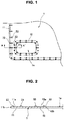
- a lot of potting portions 23 and 33 each of which is made of a rubber-like elastic material are first of all formed in the one sides 11 a and 12a in the thickness direction in the outer peripheral edge portion 11 and the opening peripheral edge portion 12 of the plate 1, respectively.
- two rows of potting portions 23 along the outer peripheral edge portion 11 of the plate 1 among the potting portions 23 and 33 are formed so as to be positioned in the area forming the gasket main body 2 in the separator integrated gasket in Fig. 4 described previously, and two rows of potting portions 33 along the opening peripheral edge portion 12 are formed so as to be positioned in the area forming the gasket main body 3 in the separator integrated gasket in Fig. 4 .
- the potting portions 23 and 33 can be formed in the one sides 11 a and 12a in the thickness direction in the outer peripheral edge portion 11 and the opening peripheral edge portion 12 of the plate 11 by applying a liquid rubber material having a low viscosity in a dotted manner at predetermined intervals, for example, in a semispherical build-up shape according to a silk screen printing method, a dispenser method or a blade method, and curing.
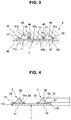
- the metal mold 4 has split molds 41 and 42 which are brought into contact with and separated from each other, and a cavity 43 and a cavity 44 are defined between facing surfaces thereof by groove-like concave portions 41 b and 41c which are formed in an inner surface of the one split mold 41, when the molds are clamped, the cavity 43 being along the outer peripheral edge portion 11 of the plate 1, and the cavity 44 being along the opening peripheral edge portion 12.
- the cavities 43 and 44 are spaced in which the liquid rubber material for forming the gasket main bodies 2 and 3 shown in Fig.
- mold pressing surfaces 41 a and 42a which can pinch a portion 13 between the outer peripheral edge portion 11 and the opening peripheral edge portion 12 in the plate 1 are formed between the cavities 43 and 44.
- the one split mold 41 is provided with injection gates 45 and 46 for filling the liquid rubber material respectively in the cavities 43 and 44.
- the injection gates 45 and 46 are open to positions which do not come into contact with the potting portions 23 and 33 at positions which correspond to the base portions 21 and 31 of the gasket main bodies 2 and 3 shown in Fig. 4 in the inner surfaces of the cavities 43 and 44.
- a portion constructed by the outer peripheral edge portion 11 of the plate 1 and the potting portion 23 in the one side 11 a in the thickness direction is pinched between the inner surfaces of the cavity 43
- a portion constructed by the opening peripheral edge portion 12 of the plate 1 and the potting portion 33 in the one side 12a in the thickness direction is pinched between the inner surfaces of the cavity 44
- a portion 13 between the outer peripheral edge portion 11 and the opening peripheral edge portion 12 is pinched between mold pressing surfaces 41a and 42a of the split molds 41 and 42, by positioning the plate 1 between the split molds 41 and 42 and thereafter clamping the mold 4 (the split molds 41 and 42).
- the other side 11c in the thickness direction of the outer peripheral edge portion 11 of the plate 1 is pressed in a close contact state to a surface in the split mold 42 side among the inner surface of the cavity 43, by the potting portion 23 which comes into contact with the surface in the split mold 41 side among the inner surface of the cavity 43, and the other side 12c in the thickness direction of the opening peripheral edge portion 12 of the plate 1 is pressed in a close contact state to the surface in the split mold 42 side among the inner surface of the cavity 44, by the potting portion 33 which comes into contact with the surface in the split mold 41 side among the inner surface of the cavity 44.
- the liquid rubber material is injected to the cavities 43 and 44 through the injection gates 45 and 46 after the mold clamping.
- the same material as that used for forming the potting portions 23 and 33 is employed for the liquid rubber material.
- the liquid rubber material injected to the cavity 43 is shaped to a whole area within the cavity 43 through portions between the potting portions 23 which are dotted at the predetermined intervals in the extending direction of the cavity 43, and the liquid rubber material injected to the cavity 44 is shaped to a whole area of the cavity 44 through portions between the potting portions 33 which are dotted at the predetermined intervals in the extending direction of the cavity 44.
- the outer peripheral edge portion 11 of the plate 1 positioned within the cavity 43 is pressed in the close contact state to the surface in the split mold 42 side among the inner surface of the cavity 43 by the potting portion 23, and the opening peripheral edge portion 12 of the plate 1 positioned within the cavity 44 is pressed in the close contact state to the surface in the split mold 42 side among the inner surface of the cavity 44 by the potting portion 33 as mentioned above.
- the outer peripheral edge portion 11 and the opening peripheral edge portion 12 of the plate 1 from floating up and being bent by the pressure of the liquid rubber material, and also effectively prevent the liquid rubber material from partly coming around the other sides 11c and 12c in the thickness direction of the outer peripheral edge portion 11 and the opening peripheral edge portion 12 and entering thereinto.
- the gasket main bodies 2 and 3 which are integrated with the plate 1 and are made of the rubber-like elastic material are formed as shown in Fig. 4 .
- the potting portions 23 and 33 made of the same rubber-like elastic material are integrated as parts of the gasket main bodies 2 and 3 as shown by broken lines in Fig. 4 .
- the outer peripheral edge portion 11 and the opening peripheral edge portion 12 of the plate 1 do not float up and are not bent in the process of forming the gasket main bodies 2 and 3 as mentioned above, and such a forming defect that the outer peripheral edge portion 11 and the opening peripheral edge portion 12 are exposed from the gasket main bodies 2 and 3 is not accordingly generated. As a result, it is possible to obtain the plate-integrated gasket having a high quality.
- the potting portions 23 and 33 are preferably arranged at equal intervals (for example, 30 mm or less) in the portions where the outer peripheral edge portion 11 or the opening peripheral edge portion 12 of the plate 1 extends linearly, and are preferably arranged more closely (for example, 20mm or less) in the portions (the corner portions) where the outer peripheral edge portion 11 or the opening peripheral edge portion 12 forms curves. Because the thin and flexible plate 1 tends to generate deformation in the curved portion when the plate 1 is pinched between the mold pressing surfaces 41 a and 42a of the metal mold 4. Therefore, it is possible to effectively suppress the deformation by making the intervals between the potting portions 23 and 33 closer in the curved portions.
- the description is given on the assumption that the potting portions 23 and 33 are formed into the spherical build-up shape, however, the potting portions 23 and 33 may be intermittent with appropriate lengths in a direction (a direction shown by a one-dot chain line in Fig. 1 ) which is along the outer peripheral edge portion 11 and the opening peripheral edge portion 12 of the plate 1. In this case, a hog-backed shape or a chevron cross sectional shape may be thought.
- a membrane electrode assembly of the fuel battery cell or a synthetic resin film provided in an outer periphery of the membrane electrode assembly can be applied as the plate 1, in addition to the metal separator of the fuel battery cell.
Landscapes
- Engineering & Computer Science (AREA)
- Manufacturing & Machinery (AREA)
- Mechanical Engineering (AREA)
- Chemical Kinetics & Catalysis (AREA)
- Sustainable Energy (AREA)
- Chemical & Material Sciences (AREA)
- Life Sciences & Earth Sciences (AREA)
- Electrochemistry (AREA)
- General Chemical & Material Sciences (AREA)
- Sustainable Development (AREA)
- General Engineering & Computer Science (AREA)
- Fuel Cell (AREA)
- Gasket Seals (AREA)
- Moulds For Moulding Plastics Or The Like (AREA)
- Casting Or Compression Moulding Of Plastics Or The Like (AREA)
Abstract
Description
- The present invention relates to a method of manufacturing a plate-integrated gasket which is integrally provided with a gasket main body made of a rubber-like elastic material in a peripheral edge portion of a plate such a separator, for example, constructing a fuel battery cell.
- In a fuel battery, a fuel battery cell is formed by arranging a gas diffusion layer in both sides in a thickness direction of a membrane electrode assembly (MEA) which is provided with a pair of electrode layers in both surfaces of an electrolyte membrane, and laminating a separator thereon, and the fuel battery is constructed as a stack structure by laminating a lot of fuel battery cells. A gasket for sealing a fuel gas and an oxidation gas is employed in each of the fuel battery cells, and a plate-integrated
gasket 100 as shown inFigs. 5 and 6 has been conventionally known as this kind of gasket. - The plate-integrated
gasket 100 shown inFigs. 5 and 6 is integrally provided with a gasketmain body 102 made of a rubber-like elastic material (a rubber material or a synthetic resin material having a rubber-like elasticity) in one side in a thickness direction in a peripheral edge portion of aplate 101 such as a metal separator, and the gasketmain body 102 has aseal lip 102a which is formed into a chevron protrusion shape. - When the gasket
main body 102 is integrally formed respectively on one surfaces ofperipheral edge portions plate 101 by using a metal mold, in manufacturing of this kind of plate-integratedgasket 100, theplate 101 is arranged in such a manner that theperipheral edge portions intermediate portion 101c between theperipheral edge portions plate 101 is thin and flexible such as the metal separator for the fuel battery, there is a risk that the liquid rubber material filled into the cavity partly comes around a back side of theperipheral edge portions plate 101, and the gasketmain body 102 is formed in a state in which theperipheral edge portions deformed plate 101 is partly exposed from the gasketmain body 102, and there has been a risk that a sealing performance of the gasketmain body 102 is deteriorated. - Patent Document 1: Japanese Unexamined Patent Publication No.
2011-96419 - The present invention is made by taking the above points into consideration, and a technical object of the present invention is to provide a method of manufacturing a plate-integrated gasket which can effectively prevent deformation of a peripheral edge portion of a plate which is positioned within a cavity when a gasket main body is integrally formed in one side in a thickness direction of the peripheral edge portion of the flexible plate.
- As a means for effectively solving the technical object mentioned above, a method of manufacturing a plate-integrated gasket according to the present invention is a method of manufacturing a plate-integrated gasket integrally provided with a gasket main body made of a rubber-like elastic material in one side in a thickness direction in a peripheral edge portion of a plate, the method comprising the steps of: forming a lot of potting portions made of a rubber-like elastic material at appropriate intervals in respect of an extending direction of the gasket main body in the one side in the thickness direction in the peripheral edge portion of the plate in such a manner as to be positioned in a forming area of the gasket main body; next pinching a portion constructed by the peripheral edge portion of the plate and the potting portion between inner surfaces of a gasket forming cavity of the metal mold and bringing the other side in the thickness direction of the peripheral edge portion into close contact with the one inner surface of the cavity by positioning and arranging the plate within the metal mold and clamping the mold; and filling a liquid rubber material into the cavity and curing the liquid rubber material.
- In the manufacturing method mentioned above, the potting portion made of the rubber-like elastic material and formed in the one side in the thickness direction in the peripheral edge portion of the plate while being positioned in the forming area of the gasket main body is pinched between the inner surfaces of the gasket forming cavity together with the peripheral edge portion of the plate by positioning and arranging the plate within the metal mold and clamping the mold, and the other side in the thickness direction of the peripheral edge portion of the plate is pressed to the one inner surface of the cavity. As a result, it is possible to effectively prevent the peripheral edge portion of the plate from being bent when the liquid rubber material filled in the cavity is shaped, and also effectively prevent the liquid rubber material from partly coming around and entering into the other side in the thickness direction of the peripheral edge portion of the plate in conjunction with the bending deformation.
- Since a lot of potting portions are formed at the appropriate intervals along the forming area of the gasket main body in the peripheral edge portion of the plate, the potting portions do not disconnect the gasket forming cavity. Therefore, the flow of the liquid rubber material is not shut off within the cavity as is different from the case that the potting portions are continuously formed. As a result, it is not necessary to increase an inlet for the liquid rubber into the cavity. Further, the potting portions are integrated with the gasket main body which is formed by curing the liquid rubber material filled in the cavity, and form a part of the gasket main body.
- According to the method of manufacturing the plate-integrated gasket of the present invention, the other side in the thickness direction of the peripheral edge portion is pressed to the inner surface of the cavity by the potting portions which are formed in the one side in the thickness direction of the peripheral edge portion of the plate. Therefore, it is possible to prevent the peripheral edge portion of the plate from being bent by the inflow pressure of the liquid rubber material which is filled in the cavity and prevent the liquid rubber material from partly coming around the other side in the thickness direction even in the case that the gasket is thin and flexible such as the metal separator of the fuel battery, so that it is possible to improve a quality of the plate-integrated gasket.
-
-
Fig. 1 is a partly plan view showing an example of an arrangement of a potting portion which is formed in a peripheral edge portion of a plate in a preferable embodiment of a method of manufacturing a plate-integrated gasket according to the present invention; -
Fig. 2 is a cross sectional view showing the plate by cutting the plate at a position along a line A-A' inFig. 1 in the preferable embodiment of the method of manufacturing the plate-integrated gasket according to the present invention; -
Fig. 3 is a cross sectional view showing a state in which the plate is positioned and arranged within a metal mold and the mold is clamped, by cutting the plate at a position corresponding toFig. 2 , in the preferable embodiment of the method of manufacturing the plate-integrated gasket according to the present invention; -
Fig. 4 is a cross sectional view showing a formed plate-integrated gasket by cutting the formed plate-integrated gasket at a position corresponding toFig. 2 , in the preferable embodiment of the method of manufacturing the plate-integrated gasket according to the present invention; -
Fig. 5 is a plan view showing a plate-integrated gasket which is manufactured according to the prior art; -
Fig. 6 is a cross sectional view showing the plate-integrated gasket which is manufactured according to the prior art by cutting the plate-integrated gasket at a position along a line A-A' inFig. 5 ; and -
Fig. 7 is a cross sectional view showing a state in which a deformation is generated in a peripheral edge portion of a plate by cutting the plate at the position along the line A-A' inFig. 5 , in the plate-integrated gasket which is manufactured according to the prior art. - A description will be given below of a preferable embodiment obtained by applying a method of manufacturing a plate-integrated gasket according to the present invention to manufacturing of a separator integrated gasket in a fuel battery cell, with reference to the accompanying drawings.
-
Fig. 4 shows an example of a plate-integrated gasket (a separator integrated gasket in a fuel battery cell) which is manufactured according to the present invention. Reference numeral 1 denotes a plate serving as a metal separator which constructs the fuel battery cell, andreference numerals peripheral edge portion 11 of the plate 1, and a peripheral edge portion (hereinafter, refer to as an opening peripheral edge portion) 12 of anopening 1 a which is provided as a gas flow path of the fuel battery cell in the plate 1. The outerperipheral edge portion 11 and the openingperipheral edge portion 12 correspond to a peripheral edge portion described in claim 1. - Each of the gasket
main bodies main body 2 is constructed by a plate-like base portion 21 which extends along oneside 11 a in a thickness direction and anend edge portion 11 b of the outerperipheral edge portion 11 of the plate 1, and aseal lip 22 which protrudes like a chevron from an intermediate portion in its width direction, and the gasketmain body 3 is constructed by a plate-like base portion 31 which extends along oneside 12a in a thickness direction and anend edge portion 12b of the openingperipheral edge portion 12, and aseal lip 32 which protrudes like a chevron from an intermediate portion in its width direction. - The plate-integrated gasket having the structure mentioned above is used as a laminated part which constructs a fuel battery cell, and achieves a sealing function against a fuel gas or an oxidation gas which are supplied to the fuel battery cell, and a water which is created by an electrochemical reaction, by the
seal lips main bodies - Further, in the manufacturing of the plate-integrated gasket, a lot of
potting portions sides peripheral edge portion 11 and the openingperipheral edge portion 12 of the plate 1, respectively. In more detail, two rows ofpotting portions 23 along the outerperipheral edge portion 11 of the plate 1 among thepotting portions main body 2 in the separator integrated gasket inFig. 4 described previously, and two rows ofpotting portions 33 along the openingperipheral edge portion 12 are formed so as to be positioned in the area forming the gasketmain body 3 in the separator integrated gasket inFig. 4 . - The
potting portions sides peripheral edge portion 11 and the openingperipheral edge portion 12 of theplate 11 by applying a liquid rubber material having a low viscosity in a dotted manner at predetermined intervals, for example, in a semispherical build-up shape according to a silk screen printing method, a dispenser method or a blade method, and curing. - Next, the plate 1 on which the
potting portions Fig. 3 . The metal mold 4 has splitmolds cavity 43 and acavity 44 are defined between facing surfaces thereof by groove-likeconcave portions mold 41, when the molds are clamped, thecavity 43 being along the outerperipheral edge portion 11 of the plate 1, and thecavity 44 being along the openingperipheral edge portion 12. Thecavities main bodies Fig. 4 is filled, and are formed into shapes corresponding to the gasketmain bodies mold pressing surfaces portion 13 between the outerperipheral edge portion 11 and the openingperipheral edge portion 12 in the plate 1 are formed between thecavities - The one split
mold 41 is provided withinjection gates cavities injection gates potting portions base portions main bodies Fig. 4 in the inner surfaces of thecavities - Further, a portion constructed by the outer
peripheral edge portion 11 of the plate 1 and thepotting portion 23 in the oneside 11 a in the thickness direction is pinched between the inner surfaces of thecavity 43, a portion constructed by the openingperipheral edge portion 12 of the plate 1 and thepotting portion 33 in the oneside 12a in the thickness direction is pinched between the inner surfaces of thecavity 44, and aportion 13 between the outerperipheral edge portion 11 and the openingperipheral edge portion 12 is pinched between moldpressing surfaces split molds split molds split molds 41 and 42). As a result, theother side 11c in the thickness direction of the outerperipheral edge portion 11 of the plate 1 is pressed in a close contact state to a surface in thesplit mold 42 side among the inner surface of thecavity 43, by thepotting portion 23 which comes into contact with the surface in thesplit mold 41 side among the inner surface of thecavity 43, and theother side 12c in the thickness direction of the openingperipheral edge portion 12 of the plate 1 is pressed in a close contact state to the surface in thesplit mold 42 side among the inner surface of thecavity 44, by thepotting portion 33 which comes into contact with the surface in thesplit mold 41 side among the inner surface of thecavity 44. - The liquid rubber material is injected to the
cavities injection gates potting portions - The liquid rubber material injected to the
cavity 43 is shaped to a whole area within thecavity 43 through portions between thepotting portions 23 which are dotted at the predetermined intervals in the extending direction of thecavity 43, and the liquid rubber material injected to thecavity 44 is shaped to a whole area of thecavity 44 through portions between thepotting portions 33 which are dotted at the predetermined intervals in the extending direction of thecavity 44. - At this time, the outer
peripheral edge portion 11 of the plate 1 positioned within thecavity 43 is pressed in the close contact state to the surface in thesplit mold 42 side among the inner surface of thecavity 43 by thepotting portion 23, and the openingperipheral edge portion 12 of the plate 1 positioned within thecavity 44 is pressed in the close contact state to the surface in thesplit mold 42 side among the inner surface of thecavity 44 by thepotting portion 33 as mentioned above. As a result, it is possible to effectively prevent the outerperipheral edge portion 11 and the openingperipheral edge portion 12 of the plate 1 from floating up and being bent by the pressure of the liquid rubber material, and also effectively prevent the liquid rubber material from partly coming around theother sides peripheral edge portion 11 and the openingperipheral edge portion 12 and entering thereinto. - Further, since the liquid rubber material is bridged and cured within the
cavities main bodies Fig. 4 . At this time, thepotting portions main bodies Fig. 4 . Further, the outerperipheral edge portion 11 and the openingperipheral edge portion 12 of the plate 1 do not float up and are not bent in the process of forming the gasketmain bodies peripheral edge portion 11 and the openingperipheral edge portion 12 are exposed from the gasketmain bodies - The
potting portions peripheral edge portion 11 or the openingperipheral edge portion 12 of the plate 1 extends linearly, and are preferably arranged more closely (for example, 20mm or less) in the portions (the corner portions) where the outerperipheral edge portion 11 or the openingperipheral edge portion 12 forms curves. Because the thin and flexible plate 1 tends to generate deformation in the curved portion when the plate 1 is pinched between themold pressing surfaces potting portions - In the illustrated embodiment, the description is given on the assumption that the
potting portions potting portions Fig. 1 ) which is along the outerperipheral edge portion 11 and the openingperipheral edge portion 12 of the plate 1. In this case, a hog-backed shape or a chevron cross sectional shape may be thought. - Further, a membrane electrode assembly of the fuel battery cell or a synthetic resin film provided in an outer periphery of the membrane electrode assembly can be applied as the plate 1, in addition to the metal separator of the fuel battery cell.
-
- 1
- plate
- 11
- outer peripheral edge portion (peripheral edge portion)
- 12
- opening peripheral edge portion (peripheral edge portion)
- 2, 3
- gasket main body
- 23, 33
- potting portion
- 4
- metal mold
- 41, 42
- split mold
- 41a, 42a
- mold pressing surface
- 43, 44
- cavity
Claims (1)
- A method of manufacturing a plate-integrated gasket integrally provided with a gasket main body made of a rubber-like elastic material in one side in a thickness direction in a peripheral edge portion of a plate, the method comprising the steps of:forming a lot of potting portions made of a rubber-like elastic material at appropriate intervals in respect of an extending direction of said gasket main body in the one side in the thickness direction in the peripheral edge portion of said plate in such a manner as to be positioned in a forming area of said gasket main body;next, pinching a portion constructed by the peripheral edge portion of said plate and said potting portion between inner surfaces of a gasket forming cavity of said metal mold and bringing the other side in the thickness direction of said peripheral edge portion into close contact with the one inner surface of said cavity by positioning and arranging said plate within the metal mold and clamping the mold; andfilling a liquid rubber material into said cavity and curing the liquid rubber material.
Applications Claiming Priority (2)
| Application Number | Priority Date | Filing Date | Title |
|---|---|---|---|
| JP2014142054A JP6383200B2 (en) | 2014-07-10 | 2014-07-10 | Manufacturing method of plate-integrated gasket |
| PCT/JP2015/065838 WO2016006366A1 (en) | 2014-07-10 | 2015-06-02 | Production method for plate-integrated gasket |
Publications (2)
| Publication Number | Publication Date |
|---|---|
| EP3168022A1 true EP3168022A1 (en) | 2017-05-17 |
| EP3168022A4 EP3168022A4 (en) | 2017-07-05 |
Family
ID=55064008
Family Applications (1)
| Application Number | Title | Priority Date | Filing Date |
|---|---|---|---|
| EP15819691.5A Withdrawn EP3168022A4 (en) | 2014-07-10 | 2015-06-02 | Production method for plate-integrated gasket |
Country Status (7)
| Country | Link |
|---|---|
| US (1) | US10363694B2 (en) |
| EP (1) | EP3168022A4 (en) |
| JP (1) | JP6383200B2 (en) |
| KR (1) | KR20170026396A (en) |
| CN (1) | CN106660238B (en) |
| CA (1) | CA2954610A1 (en) |
| WO (1) | WO2016006366A1 (en) |
Families Citing this family (10)
| Publication number | Priority date | Publication date | Assignee | Title |
|---|---|---|---|---|
| JP6383203B2 (en) * | 2014-07-25 | 2018-08-29 | Nok株式会社 | Manufacturing method of plate-integrated gasket |
| KR20190029614A (en) * | 2016-08-02 | 2019-03-20 | 엔오케이 가부시키가이샤 | Gasket |
| CN109642672B (en) * | 2016-10-27 | 2021-03-23 | Nok株式会社 | Gasket and method of making the same |
| DE102018115987A1 (en) * | 2018-07-02 | 2020-01-02 | Elringklinger Ag | Method for producing a sealing element on a gas diffusion layer of an electrochemical unit and assembly from a gas diffusion layer and a sealing element |
| DE102019207338A1 (en) * | 2019-05-20 | 2020-11-26 | PMT Technology GmbH | Process for manufacturing a component |
| US12403637B2 (en) * | 2020-01-16 | 2025-09-02 | Nok Corporation | Molding die for molding an endless-shaped gasket made of an elastic material along a surface of a plate-like base material |
| CN112048248A (en) * | 2020-08-14 | 2020-12-08 | 上海文施绿极科技有限公司 | Adhesive release film and method for producing same |
| EP4369445A4 (en) | 2021-07-09 | 2025-10-01 | Nok Corp | FUEL CELL COMPOSITE FILM AND FUEL CELL COMPOSITE FILM PRODUCTION PROCESS |
| CN116551915A (en) * | 2022-01-27 | 2023-08-08 | 汉达精密电子(昆山)有限公司 | An injection molding method for embedding a carbon fiber plate and its product |
| KR102441890B1 (en) | 2022-03-17 | 2022-09-07 | 남재현 | Metal plate-integrated gasket sheet manufacturing method for power distributor |
Family Cites Families (17)
| Publication number | Priority date | Publication date | Assignee | Title |
|---|---|---|---|---|
| US6368536B1 (en) * | 1997-09-15 | 2002-04-09 | Snap-On Technologies, Inc. | Method of forming tool with dual-material handle |
| JP2000039069A (en) | 1998-07-24 | 2000-02-08 | Nok Corp | Manufacture of sealing device |
| US6306330B1 (en) * | 1999-07-23 | 2001-10-23 | Alena Closure Systems International | Two-step molding of liner components for a closure |
| JP4274508B2 (en) | 2000-03-15 | 2009-06-10 | 本田技研工業株式会社 | Two-wheel four-wheel drive switching device for vehicles |
| JP4481423B2 (en) * | 2000-03-31 | 2010-06-16 | 株式会社東芝 | Polymer electrolyte fuel cell stack |
| US6579485B2 (en) * | 2000-12-15 | 2003-06-17 | Haun Drop Forge Co. Ltd. | Method of injection molding around the surface of an object |
| JP4420166B2 (en) * | 2001-03-02 | 2010-02-24 | Nok株式会社 | Manufacturing method of fuel cell component |
| JP4160328B2 (en) | 2002-07-03 | 2008-10-01 | 本田技研工業株式会社 | Manufacturing method of fuel cell separator |
| JP4394935B2 (en) | 2003-12-05 | 2010-01-06 | Nok株式会社 | Manufacturing method of fuel cell component |
| JP4482413B2 (en) | 2004-09-21 | 2010-06-16 | 本田技研工業株式会社 | Manufacturing method of fuel cell separator |
| JP5177619B2 (en) | 2007-01-18 | 2013-04-03 | Nok株式会社 | Method for manufacturing a gasket-integrated part for a fuel cell |
| JP5099352B2 (en) | 2008-05-23 | 2012-12-19 | Nok株式会社 | Manufacturing method of seal parts |
| JP5435224B2 (en) | 2009-10-28 | 2014-03-05 | Nok株式会社 | Manufacturing method of fuel cell seal structure |
| US9085101B2 (en) | 2010-09-01 | 2015-07-21 | Max Seal, Inc. | Method for manufacturing a gasket with an encapsulated metal band |
| JP5679119B2 (en) * | 2010-09-03 | 2015-03-04 | Nok株式会社 | Method for manufacturing gasket molded product |
| CN202062577U (en) | 2011-04-29 | 2011-12-07 | 珠海市雷鸣达通讯技术发展有限公司 | Novel battery injection molding encapsulation mould |
| JP2014092191A (en) | 2012-11-01 | 2014-05-19 | Nok Corp | Base material integrated type seal and metal mold for manufacturing the same |
-
2014
- 2014-07-10 JP JP2014142054A patent/JP6383200B2/en active Active
-
2015
- 2015-06-02 CN CN201580037409.3A patent/CN106660238B/en active Active
- 2015-06-02 KR KR1020167036797A patent/KR20170026396A/en not_active Withdrawn
- 2015-06-02 US US15/323,064 patent/US10363694B2/en active Active
- 2015-06-02 CA CA2954610A patent/CA2954610A1/en not_active Abandoned
- 2015-06-02 WO PCT/JP2015/065838 patent/WO2016006366A1/en not_active Ceased
- 2015-06-02 EP EP15819691.5A patent/EP3168022A4/en not_active Withdrawn
Also Published As
| Publication number | Publication date |
|---|---|
| US20170120488A1 (en) | 2017-05-04 |
| CA2954610A1 (en) | 2016-01-14 |
| KR20170026396A (en) | 2017-03-08 |
| CN106660238A (en) | 2017-05-10 |
| US10363694B2 (en) | 2019-07-30 |
| CN106660238B (en) | 2019-05-21 |
| JP6383200B2 (en) | 2018-08-29 |
| EP3168022A4 (en) | 2017-07-05 |
| WO2016006366A1 (en) | 2016-01-14 |
| JP2016016619A (en) | 2016-02-01 |
Similar Documents
| Publication | Publication Date | Title |
|---|---|---|
| EP3168022A1 (en) | Production method for plate-integrated gasket | |
| JP4993077B2 (en) | Manufacturing method of seal parts | |
| US8609299B2 (en) | Fuel cell sealing structure and manufacture method | |
| EP2916046A1 (en) | Seal with integral base material and die for manufacturing same | |
| US11088373B2 (en) | Seal for solid polymer electrolyte fuel cell | |
| JP5310976B2 (en) | Fuel cell sealing structure | |
| EP3279990B1 (en) | Separator for fuel cells and method for producing same | |
| EP4147842B1 (en) | Gasket member manufacturing method | |
| CN107206647B (en) | Gasket and method of making the same | |
| US10514099B2 (en) | Method for handling carrier-film-equipped gasket | |
| CN106663821B (en) | Method for manufacturing integrated liner of plate | |
| EP2987599A1 (en) | Method for manufacturing carbon plate-integrated gasket | |
| JP2008146986A (en) | Manufacturing method of seal for fuel cell | |
| JP6013261B2 (en) | Manufacturing method of plate-integrated gasket | |
| JP2008010297A (en) | Gasket integrated with reinforcing frame and manufacturing method thereof |
Legal Events
| Date | Code | Title | Description |
|---|---|---|---|
| PUAI | Public reference made under article 153(3) epc to a published international application that has entered the european phase |
Free format text: ORIGINAL CODE: 0009012 |
|
| 17P | Request for examination filed |
Effective date: 20170104 |
|
| AK | Designated contracting states |
Kind code of ref document: A1 Designated state(s): AL AT BE BG CH CY CZ DE DK EE ES FI FR GB GR HR HU IE IS IT LI LT LU LV MC MK MT NL NO PL PT RO RS SE SI SK SM TR |
|
| AX | Request for extension of the european patent |
Extension state: BA ME |
|
| A4 | Supplementary search report drawn up and despatched |
Effective date: 20170607 |
|
| RIC1 | Information provided on ipc code assigned before grant |
Ipc: B29C 39/26 20060101ALI20170531BHEP Ipc: B29C 33/12 20060101ALI20170531BHEP Ipc: F16J 15/10 20060101ALI20170531BHEP Ipc: H01M 8/02 20160101ALI20170531BHEP Ipc: B29C 39/10 20060101AFI20170531BHEP Ipc: B29C 45/14 20060101ALI20170531BHEP |
|
| DAV | Request for validation of the european patent (deleted) | ||
| DAX | Request for extension of the european patent (deleted) | ||
| 17Q | First examination report despatched |
Effective date: 20180222 |
|
| STAA | Information on the status of an ep patent application or granted ep patent |
Free format text: STATUS: THE APPLICATION HAS BEEN WITHDRAWN |
|
| 18W | Application withdrawn |
Effective date: 20190611 |