EP3162558A1 - Component made of metallic composite material and method for the manufacture of the component by hot forming - Google Patents
Component made of metallic composite material and method for the manufacture of the component by hot forming Download PDFInfo
- Publication number
- EP3162558A1 EP3162558A1 EP15192262.2A EP15192262A EP3162558A1 EP 3162558 A1 EP3162558 A1 EP 3162558A1 EP 15192262 A EP15192262 A EP 15192262A EP 3162558 A1 EP3162558 A1 EP 3162558A1
- Authority
- EP
- European Patent Office
- Prior art keywords
- component
- layer material
- composite material
- core material
- layer
- Prior art date
- Legal status (The legal status is an assumption and is not a legal conclusion. Google has not performed a legal analysis and makes no representation as to the accuracy of the status listed.)
- Withdrawn
Links
Images


Classifications
-
- B—PERFORMING OPERATIONS; TRANSPORTING
- B32—LAYERED PRODUCTS
- B32B—LAYERED PRODUCTS, i.e. PRODUCTS BUILT-UP OF STRATA OF FLAT OR NON-FLAT, e.g. CELLULAR OR HONEYCOMB, FORM
- B32B15/00—Layered products comprising a layer of metal
- B32B15/01—Layered products comprising a layer of metal all layers being exclusively metallic
- B32B15/011—Layered products comprising a layer of metal all layers being exclusively metallic all layers being formed of iron alloys or steels
-
- B—PERFORMING OPERATIONS; TRANSPORTING
- B23—MACHINE TOOLS; METAL-WORKING NOT OTHERWISE PROVIDED FOR
- B23K—SOLDERING OR UNSOLDERING; WELDING; CLADDING OR PLATING BY SOLDERING OR WELDING; CUTTING BY APPLYING HEAT LOCALLY, e.g. FLAME CUTTING; WORKING BY LASER BEAM
- B23K10/00—Welding or cutting by means of a plasma
-
- B—PERFORMING OPERATIONS; TRANSPORTING
- B23—MACHINE TOOLS; METAL-WORKING NOT OTHERWISE PROVIDED FOR
- B23K—SOLDERING OR UNSOLDERING; WELDING; CLADDING OR PLATING BY SOLDERING OR WELDING; CUTTING BY APPLYING HEAT LOCALLY, e.g. FLAME CUTTING; WORKING BY LASER BEAM
- B23K26/00—Working by laser beam, e.g. welding, cutting or boring
-
- B—PERFORMING OPERATIONS; TRANSPORTING
- B23—MACHINE TOOLS; METAL-WORKING NOT OTHERWISE PROVIDED FOR
- B23K—SOLDERING OR UNSOLDERING; WELDING; CLADDING OR PLATING BY SOLDERING OR WELDING; CUTTING BY APPLYING HEAT LOCALLY, e.g. FLAME CUTTING; WORKING BY LASER BEAM
- B23K5/00—Gas flame welding
-
- B—PERFORMING OPERATIONS; TRANSPORTING
- B23—MACHINE TOOLS; METAL-WORKING NOT OTHERWISE PROVIDED FOR
- B23K—SOLDERING OR UNSOLDERING; WELDING; CLADDING OR PLATING BY SOLDERING OR WELDING; CUTTING BY APPLYING HEAT LOCALLY, e.g. FLAME CUTTING; WORKING BY LASER BEAM
- B23K9/00—Arc welding or cutting
-
- B—PERFORMING OPERATIONS; TRANSPORTING
- B32—LAYERED PRODUCTS
- B32B—LAYERED PRODUCTS, i.e. PRODUCTS BUILT-UP OF STRATA OF FLAT OR NON-FLAT, e.g. CELLULAR OR HONEYCOMB, FORM
- B32B1/00—Layered products having a non-planar shape
- B32B1/08—Tubular products
-
- B—PERFORMING OPERATIONS; TRANSPORTING
- B32—LAYERED PRODUCTS
- B32B—LAYERED PRODUCTS, i.e. PRODUCTS BUILT-UP OF STRATA OF FLAT OR NON-FLAT, e.g. CELLULAR OR HONEYCOMB, FORM
- B32B15/00—Layered products comprising a layer of metal
- B32B15/04—Layered products comprising a layer of metal comprising metal as the main or only constituent of a layer, which is next to another layer of the same or of a different material
-
- B—PERFORMING OPERATIONS; TRANSPORTING
- B32—LAYERED PRODUCTS
- B32B—LAYERED PRODUCTS, i.e. PRODUCTS BUILT-UP OF STRATA OF FLAT OR NON-FLAT, e.g. CELLULAR OR HONEYCOMB, FORM
- B32B15/00—Layered products comprising a layer of metal
- B32B15/04—Layered products comprising a layer of metal comprising metal as the main or only constituent of a layer, which is next to another layer of the same or of a different material
- B32B15/043—Layered products comprising a layer of metal comprising metal as the main or only constituent of a layer, which is next to another layer of the same or of a different material of metal
-
- B—PERFORMING OPERATIONS; TRANSPORTING
- B32—LAYERED PRODUCTS
- B32B—LAYERED PRODUCTS, i.e. PRODUCTS BUILT-UP OF STRATA OF FLAT OR NON-FLAT, e.g. CELLULAR OR HONEYCOMB, FORM
- B32B15/00—Layered products comprising a layer of metal
- B32B15/18—Layered products comprising a layer of metal comprising iron or steel
-
- C—CHEMISTRY; METALLURGY
- C21—METALLURGY OF IRON
- C21D—MODIFYING THE PHYSICAL STRUCTURE OF FERROUS METALS; GENERAL DEVICES FOR HEAT TREATMENT OF FERROUS OR NON-FERROUS METALS OR ALLOYS; MAKING METAL MALLEABLE, e.g. BY DECARBURISATION OR TEMPERING
- C21D6/00—Heat treatment of ferrous alloys
- C21D6/001—Heat treatment of ferrous alloys containing Ni
-
- C—CHEMISTRY; METALLURGY
- C21—METALLURGY OF IRON
- C21D—MODIFYING THE PHYSICAL STRUCTURE OF FERROUS METALS; GENERAL DEVICES FOR HEAT TREATMENT OF FERROUS OR NON-FERROUS METALS OR ALLOYS; MAKING METAL MALLEABLE, e.g. BY DECARBURISATION OR TEMPERING
- C21D6/00—Heat treatment of ferrous alloys
- C21D6/002—Heat treatment of ferrous alloys containing Cr
-
- C—CHEMISTRY; METALLURGY
- C21—METALLURGY OF IRON
- C21D—MODIFYING THE PHYSICAL STRUCTURE OF FERROUS METALS; GENERAL DEVICES FOR HEAT TREATMENT OF FERROUS OR NON-FERROUS METALS OR ALLOYS; MAKING METAL MALLEABLE, e.g. BY DECARBURISATION OR TEMPERING
- C21D6/00—Heat treatment of ferrous alloys
- C21D6/004—Heat treatment of ferrous alloys containing Cr and Ni
-
- C—CHEMISTRY; METALLURGY
- C21—METALLURGY OF IRON
- C21D—MODIFYING THE PHYSICAL STRUCTURE OF FERROUS METALS; GENERAL DEVICES FOR HEAT TREATMENT OF FERROUS OR NON-FERROUS METALS OR ALLOYS; MAKING METAL MALLEABLE, e.g. BY DECARBURISATION OR TEMPERING
- C21D6/00—Heat treatment of ferrous alloys
- C21D6/005—Heat treatment of ferrous alloys containing Mn
-
- C—CHEMISTRY; METALLURGY
- C21—METALLURGY OF IRON
- C21D—MODIFYING THE PHYSICAL STRUCTURE OF FERROUS METALS; GENERAL DEVICES FOR HEAT TREATMENT OF FERROUS OR NON-FERROUS METALS OR ALLOYS; MAKING METAL MALLEABLE, e.g. BY DECARBURISATION OR TEMPERING
- C21D6/00—Heat treatment of ferrous alloys
- C21D6/007—Heat treatment of ferrous alloys containing Co
-
- C—CHEMISTRY; METALLURGY
- C21—METALLURGY OF IRON
- C21D—MODIFYING THE PHYSICAL STRUCTURE OF FERROUS METALS; GENERAL DEVICES FOR HEAT TREATMENT OF FERROUS OR NON-FERROUS METALS OR ALLOYS; MAKING METAL MALLEABLE, e.g. BY DECARBURISATION OR TEMPERING
- C21D7/00—Modifying the physical properties of iron or steel by deformation
- C21D7/13—Modifying the physical properties of iron or steel by deformation by hot working
-
- C—CHEMISTRY; METALLURGY
- C21—METALLURGY OF IRON
- C21D—MODIFYING THE PHYSICAL STRUCTURE OF FERROUS METALS; GENERAL DEVICES FOR HEAT TREATMENT OF FERROUS OR NON-FERROUS METALS OR ALLOYS; MAKING METAL MALLEABLE, e.g. BY DECARBURISATION OR TEMPERING
- C21D8/00—Modifying the physical properties of ferrous metals or ferrous alloys by deformation combined with, or followed by, heat treatment
-
- C—CHEMISTRY; METALLURGY
- C21—METALLURGY OF IRON
- C21D—MODIFYING THE PHYSICAL STRUCTURE OF FERROUS METALS; GENERAL DEVICES FOR HEAT TREATMENT OF FERROUS OR NON-FERROUS METALS OR ALLOYS; MAKING METAL MALLEABLE, e.g. BY DECARBURISATION OR TEMPERING
- C21D8/00—Modifying the physical properties of ferrous metals or ferrous alloys by deformation combined with, or followed by, heat treatment
- C21D8/02—Modifying the physical properties of ferrous metals or ferrous alloys by deformation combined with, or followed by, heat treatment during manufacturing of plates or strips
-
- C—CHEMISTRY; METALLURGY
- C21—METALLURGY OF IRON
- C21D—MODIFYING THE PHYSICAL STRUCTURE OF FERROUS METALS; GENERAL DEVICES FOR HEAT TREATMENT OF FERROUS OR NON-FERROUS METALS OR ALLOYS; MAKING METAL MALLEABLE, e.g. BY DECARBURISATION OR TEMPERING
- C21D8/00—Modifying the physical properties of ferrous metals or ferrous alloys by deformation combined with, or followed by, heat treatment
- C21D8/02—Modifying the physical properties of ferrous metals or ferrous alloys by deformation combined with, or followed by, heat treatment during manufacturing of plates or strips
- C21D8/0247—Modifying the physical properties of ferrous metals or ferrous alloys by deformation combined with, or followed by, heat treatment during manufacturing of plates or strips characterised by the heat treatment
-
- C—CHEMISTRY; METALLURGY
- C21—METALLURGY OF IRON
- C21D—MODIFYING THE PHYSICAL STRUCTURE OF FERROUS METALS; GENERAL DEVICES FOR HEAT TREATMENT OF FERROUS OR NON-FERROUS METALS OR ALLOYS; MAKING METAL MALLEABLE, e.g. BY DECARBURISATION OR TEMPERING
- C21D8/00—Modifying the physical properties of ferrous metals or ferrous alloys by deformation combined with, or followed by, heat treatment
- C21D8/02—Modifying the physical properties of ferrous metals or ferrous alloys by deformation combined with, or followed by, heat treatment during manufacturing of plates or strips
- C21D8/04—Modifying the physical properties of ferrous metals or ferrous alloys by deformation combined with, or followed by, heat treatment during manufacturing of plates or strips to produce plates or strips for drawing, e.g. for deep-drawing
-
- C—CHEMISTRY; METALLURGY
- C21—METALLURGY OF IRON
- C21D—MODIFYING THE PHYSICAL STRUCTURE OF FERROUS METALS; GENERAL DEVICES FOR HEAT TREATMENT OF FERROUS OR NON-FERROUS METALS OR ALLOYS; MAKING METAL MALLEABLE, e.g. BY DECARBURISATION OR TEMPERING
- C21D8/00—Modifying the physical properties of ferrous metals or ferrous alloys by deformation combined with, or followed by, heat treatment
- C21D8/02—Modifying the physical properties of ferrous metals or ferrous alloys by deformation combined with, or followed by, heat treatment during manufacturing of plates or strips
- C21D8/04—Modifying the physical properties of ferrous metals or ferrous alloys by deformation combined with, or followed by, heat treatment during manufacturing of plates or strips to produce plates or strips for drawing, e.g. for deep-drawing
- C21D8/0447—Modifying the physical properties of ferrous metals or ferrous alloys by deformation combined with, or followed by, heat treatment during manufacturing of plates or strips to produce plates or strips for drawing, e.g. for deep-drawing characterised by the heat treatment
-
- C—CHEMISTRY; METALLURGY
- C21—METALLURGY OF IRON
- C21D—MODIFYING THE PHYSICAL STRUCTURE OF FERROUS METALS; GENERAL DEVICES FOR HEAT TREATMENT OF FERROUS OR NON-FERROUS METALS OR ALLOYS; MAKING METAL MALLEABLE, e.g. BY DECARBURISATION OR TEMPERING
- C21D8/00—Modifying the physical properties of ferrous metals or ferrous alloys by deformation combined with, or followed by, heat treatment
- C21D8/12—Modifying the physical properties of ferrous metals or ferrous alloys by deformation combined with, or followed by, heat treatment during manufacturing of articles with special electromagnetic properties
- C21D8/1216—Modifying the physical properties of ferrous metals or ferrous alloys by deformation combined with, or followed by, heat treatment during manufacturing of articles with special electromagnetic properties characterised by the working steps
- C21D8/1227—Warm rolling
-
- C—CHEMISTRY; METALLURGY
- C21—METALLURGY OF IRON
- C21D—MODIFYING THE PHYSICAL STRUCTURE OF FERROUS METALS; GENERAL DEVICES FOR HEAT TREATMENT OF FERROUS OR NON-FERROUS METALS OR ALLOYS; MAKING METAL MALLEABLE, e.g. BY DECARBURISATION OR TEMPERING
- C21D9/00—Heat treatment, e.g. annealing, hardening, quenching or tempering, adapted for particular articles; Furnaces therefor
- C21D9/46—Heat treatment, e.g. annealing, hardening, quenching or tempering, adapted for particular articles; Furnaces therefor for sheet metals
-
- C—CHEMISTRY; METALLURGY
- C22—METALLURGY; FERROUS OR NON-FERROUS ALLOYS; TREATMENT OF ALLOYS OR NON-FERROUS METALS
- C22C—ALLOYS
- C22C38/00—Ferrous alloys, e.g. steel alloys
- C22C38/001—Ferrous alloys, e.g. steel alloys containing N
-
- C—CHEMISTRY; METALLURGY
- C22—METALLURGY; FERROUS OR NON-FERROUS ALLOYS; TREATMENT OF ALLOYS OR NON-FERROUS METALS
- C22C—ALLOYS
- C22C38/00—Ferrous alloys, e.g. steel alloys
- C22C38/02—Ferrous alloys, e.g. steel alloys containing silicon
-
- C—CHEMISTRY; METALLURGY
- C22—METALLURGY; FERROUS OR NON-FERROUS ALLOYS; TREATMENT OF ALLOYS OR NON-FERROUS METALS
- C22C—ALLOYS
- C22C38/00—Ferrous alloys, e.g. steel alloys
- C22C38/04—Ferrous alloys, e.g. steel alloys containing manganese
-
- C—CHEMISTRY; METALLURGY
- C22—METALLURGY; FERROUS OR NON-FERROUS ALLOYS; TREATMENT OF ALLOYS OR NON-FERROUS METALS
- C22C—ALLOYS
- C22C38/00—Ferrous alloys, e.g. steel alloys
- C22C38/08—Ferrous alloys, e.g. steel alloys containing nickel
-
- C—CHEMISTRY; METALLURGY
- C22—METALLURGY; FERROUS OR NON-FERROUS ALLOYS; TREATMENT OF ALLOYS OR NON-FERROUS METALS
- C22C—ALLOYS
- C22C38/00—Ferrous alloys, e.g. steel alloys
- C22C38/12—Ferrous alloys, e.g. steel alloys containing tungsten, tantalum, molybdenum, vanadium, or niobium
-
- C—CHEMISTRY; METALLURGY
- C22—METALLURGY; FERROUS OR NON-FERROUS ALLOYS; TREATMENT OF ALLOYS OR NON-FERROUS METALS
- C22C—ALLOYS
- C22C38/00—Ferrous alloys, e.g. steel alloys
- C22C38/16—Ferrous alloys, e.g. steel alloys containing copper
-
- C—CHEMISTRY; METALLURGY
- C22—METALLURGY; FERROUS OR NON-FERROUS ALLOYS; TREATMENT OF ALLOYS OR NON-FERROUS METALS
- C22C—ALLOYS
- C22C38/00—Ferrous alloys, e.g. steel alloys
- C22C38/18—Ferrous alloys, e.g. steel alloys containing chromium
-
- C—CHEMISTRY; METALLURGY
- C22—METALLURGY; FERROUS OR NON-FERROUS ALLOYS; TREATMENT OF ALLOYS OR NON-FERROUS METALS
- C22C—ALLOYS
- C22C38/00—Ferrous alloys, e.g. steel alloys
- C22C38/18—Ferrous alloys, e.g. steel alloys containing chromium
- C22C38/20—Ferrous alloys, e.g. steel alloys containing chromium with copper
-
- C—CHEMISTRY; METALLURGY
- C22—METALLURGY; FERROUS OR NON-FERROUS ALLOYS; TREATMENT OF ALLOYS OR NON-FERROUS METALS
- C22C—ALLOYS
- C22C38/00—Ferrous alloys, e.g. steel alloys
- C22C38/18—Ferrous alloys, e.g. steel alloys containing chromium
- C22C38/22—Ferrous alloys, e.g. steel alloys containing chromium with molybdenum or tungsten
-
- C—CHEMISTRY; METALLURGY
- C22—METALLURGY; FERROUS OR NON-FERROUS ALLOYS; TREATMENT OF ALLOYS OR NON-FERROUS METALS
- C22C—ALLOYS
- C22C38/00—Ferrous alloys, e.g. steel alloys
- C22C38/18—Ferrous alloys, e.g. steel alloys containing chromium
- C22C38/32—Ferrous alloys, e.g. steel alloys containing chromium with boron
-
- C—CHEMISTRY; METALLURGY
- C22—METALLURGY; FERROUS OR NON-FERROUS ALLOYS; TREATMENT OF ALLOYS OR NON-FERROUS METALS
- C22C—ALLOYS
- C22C38/00—Ferrous alloys, e.g. steel alloys
- C22C38/18—Ferrous alloys, e.g. steel alloys containing chromium
- C22C38/38—Ferrous alloys, e.g. steel alloys containing chromium with more than 1.5% by weight of manganese
-
- C—CHEMISTRY; METALLURGY
- C22—METALLURGY; FERROUS OR NON-FERROUS ALLOYS; TREATMENT OF ALLOYS OR NON-FERROUS METALS
- C22C—ALLOYS
- C22C38/00—Ferrous alloys, e.g. steel alloys
- C22C38/18—Ferrous alloys, e.g. steel alloys containing chromium
- C22C38/40—Ferrous alloys, e.g. steel alloys containing chromium with nickel
-
- C—CHEMISTRY; METALLURGY
- C22—METALLURGY; FERROUS OR NON-FERROUS ALLOYS; TREATMENT OF ALLOYS OR NON-FERROUS METALS
- C22C—ALLOYS
- C22C38/00—Ferrous alloys, e.g. steel alloys
- C22C38/18—Ferrous alloys, e.g. steel alloys containing chromium
- C22C38/40—Ferrous alloys, e.g. steel alloys containing chromium with nickel
- C22C38/44—Ferrous alloys, e.g. steel alloys containing chromium with nickel with molybdenum or tungsten
-
- C—CHEMISTRY; METALLURGY
- C23—COATING METALLIC MATERIAL; COATING MATERIAL WITH METALLIC MATERIAL; CHEMICAL SURFACE TREATMENT; DIFFUSION TREATMENT OF METALLIC MATERIAL; COATING BY VACUUM EVAPORATION, BY SPUTTERING, BY ION IMPLANTATION OR BY CHEMICAL VAPOUR DEPOSITION, IN GENERAL; INHIBITING CORROSION OF METALLIC MATERIAL OR INCRUSTATION IN GENERAL
- C23C—COATING METALLIC MATERIAL; COATING MATERIAL WITH METALLIC MATERIAL; SURFACE TREATMENT OF METALLIC MATERIAL BY DIFFUSION INTO THE SURFACE, BY CHEMICAL CONVERSION OR SUBSTITUTION; COATING BY VACUUM EVAPORATION, BY SPUTTERING, BY ION IMPLANTATION OR BY CHEMICAL VAPOUR DEPOSITION, IN GENERAL
- C23C30/00—Coating with metallic material characterised only by the composition of the metallic material, i.e. not characterised by the coating process
-
- C—CHEMISTRY; METALLURGY
- C23—COATING METALLIC MATERIAL; COATING MATERIAL WITH METALLIC MATERIAL; CHEMICAL SURFACE TREATMENT; DIFFUSION TREATMENT OF METALLIC MATERIAL; COATING BY VACUUM EVAPORATION, BY SPUTTERING, BY ION IMPLANTATION OR BY CHEMICAL VAPOUR DEPOSITION, IN GENERAL; INHIBITING CORROSION OF METALLIC MATERIAL OR INCRUSTATION IN GENERAL
- C23C—COATING METALLIC MATERIAL; COATING MATERIAL WITH METALLIC MATERIAL; SURFACE TREATMENT OF METALLIC MATERIAL BY DIFFUSION INTO THE SURFACE, BY CHEMICAL CONVERSION OR SUBSTITUTION; COATING BY VACUUM EVAPORATION, BY SPUTTERING, BY ION IMPLANTATION OR BY CHEMICAL VAPOUR DEPOSITION, IN GENERAL
- C23C30/00—Coating with metallic material characterised only by the composition of the metallic material, i.e. not characterised by the coating process
- C23C30/005—Coating with metallic material characterised only by the composition of the metallic material, i.e. not characterised by the coating process on hard metal substrates
-
- B—PERFORMING OPERATIONS; TRANSPORTING
- B32—LAYERED PRODUCTS
- B32B—LAYERED PRODUCTS, i.e. PRODUCTS BUILT-UP OF STRATA OF FLAT OR NON-FLAT, e.g. CELLULAR OR HONEYCOMB, FORM
- B32B2307/00—Properties of the layers or laminate
- B32B2307/30—Properties of the layers or laminate having particular thermal properties
- B32B2307/306—Resistant to heat
-
- B—PERFORMING OPERATIONS; TRANSPORTING
- B32—LAYERED PRODUCTS
- B32B—LAYERED PRODUCTS, i.e. PRODUCTS BUILT-UP OF STRATA OF FLAT OR NON-FLAT, e.g. CELLULAR OR HONEYCOMB, FORM
- B32B2307/00—Properties of the layers or laminate
- B32B2307/70—Other properties
- B32B2307/714—Inert, i.e. inert to chemical degradation, corrosion
-
- C—CHEMISTRY; METALLURGY
- C21—METALLURGY OF IRON
- C21D—MODIFYING THE PHYSICAL STRUCTURE OF FERROUS METALS; GENERAL DEVICES FOR HEAT TREATMENT OF FERROUS OR NON-FERROUS METALS OR ALLOYS; MAKING METAL MALLEABLE, e.g. BY DECARBURISATION OR TEMPERING
- C21D2211/00—Microstructure comprising significant phases
- C21D2211/001—Austenite
-
- C—CHEMISTRY; METALLURGY
- C21—METALLURGY OF IRON
- C21D—MODIFYING THE PHYSICAL STRUCTURE OF FERROUS METALS; GENERAL DEVICES FOR HEAT TREATMENT OF FERROUS OR NON-FERROUS METALS OR ALLOYS; MAKING METAL MALLEABLE, e.g. BY DECARBURISATION OR TEMPERING
- C21D2251/00—Treating composite or clad material
- C21D2251/02—Clad material
-
- C—CHEMISTRY; METALLURGY
- C22—METALLURGY; FERROUS OR NON-FERROUS ALLOYS; TREATMENT OF ALLOYS OR NON-FERROUS METALS
- C22C—ALLOYS
- C22C38/00—Ferrous alloys, e.g. steel alloys
- C22C38/18—Ferrous alloys, e.g. steel alloys containing chromium
- C22C38/40—Ferrous alloys, e.g. steel alloys containing chromium with nickel
- C22C38/42—Ferrous alloys, e.g. steel alloys containing chromium with nickel with copper
-
- C—CHEMISTRY; METALLURGY
- C22—METALLURGY; FERROUS OR NON-FERROUS ALLOYS; TREATMENT OF ALLOYS OR NON-FERROUS METALS
- C22C—ALLOYS
- C22C38/00—Ferrous alloys, e.g. steel alloys
- C22C38/18—Ferrous alloys, e.g. steel alloys containing chromium
- C22C38/40—Ferrous alloys, e.g. steel alloys containing chromium with nickel
- C22C38/58—Ferrous alloys, e.g. steel alloys containing chromium with nickel with more than 1.5% by weight of manganese
-
- Y—GENERAL TAGGING OF NEW TECHNOLOGICAL DEVELOPMENTS; GENERAL TAGGING OF CROSS-SECTIONAL TECHNOLOGIES SPANNING OVER SEVERAL SECTIONS OF THE IPC; TECHNICAL SUBJECTS COVERED BY FORMER USPC CROSS-REFERENCE ART COLLECTIONS [XRACs] AND DIGESTS
- Y10—TECHNICAL SUBJECTS COVERED BY FORMER USPC
- Y10T—TECHNICAL SUBJECTS COVERED BY FORMER US CLASSIFICATION
- Y10T428/00—Stock material or miscellaneous articles
- Y10T428/12—All metal or with adjacent metals
- Y10T428/12493—Composite; i.e., plural, adjacent, spatially distinct metal components [e.g., layers, joint, etc.]
- Y10T428/12771—Transition metal-base component
- Y10T428/12861—Group VIII or IB metal-base component
- Y10T428/12951—Fe-base component
- Y10T428/12958—Next to Fe-base component
-
- Y—GENERAL TAGGING OF NEW TECHNOLOGICAL DEVELOPMENTS; GENERAL TAGGING OF CROSS-SECTIONAL TECHNOLOGIES SPANNING OVER SEVERAL SECTIONS OF THE IPC; TECHNICAL SUBJECTS COVERED BY FORMER USPC CROSS-REFERENCE ART COLLECTIONS [XRACs] AND DIGESTS
- Y10—TECHNICAL SUBJECTS COVERED BY FORMER USPC
- Y10T—TECHNICAL SUBJECTS COVERED BY FORMER US CLASSIFICATION
- Y10T428/00—Stock material or miscellaneous articles
- Y10T428/12—All metal or with adjacent metals
- Y10T428/12493—Composite; i.e., plural, adjacent, spatially distinct metal components [e.g., layers, joint, etc.]
- Y10T428/12771—Transition metal-base component
- Y10T428/12861—Group VIII or IB metal-base component
- Y10T428/12951—Fe-base component
- Y10T428/12958—Next to Fe-base component
- Y10T428/12965—Both containing 0.01-1.7% carbon [i.e., steel]
-
- Y—GENERAL TAGGING OF NEW TECHNOLOGICAL DEVELOPMENTS; GENERAL TAGGING OF CROSS-SECTIONAL TECHNOLOGIES SPANNING OVER SEVERAL SECTIONS OF THE IPC; TECHNICAL SUBJECTS COVERED BY FORMER USPC CROSS-REFERENCE ART COLLECTIONS [XRACs] AND DIGESTS
- Y10—TECHNICAL SUBJECTS COVERED BY FORMER USPC
- Y10T—TECHNICAL SUBJECTS COVERED BY FORMER US CLASSIFICATION
- Y10T428/00—Stock material or miscellaneous articles
- Y10T428/12—All metal or with adjacent metals
- Y10T428/12493—Composite; i.e., plural, adjacent, spatially distinct metal components [e.g., layers, joint, etc.]
- Y10T428/12771—Transition metal-base component
- Y10T428/12861—Group VIII or IB metal-base component
- Y10T428/12951—Fe-base component
- Y10T428/12972—Containing 0.01-1.7% carbon [i.e., steel]
-
- Y—GENERAL TAGGING OF NEW TECHNOLOGICAL DEVELOPMENTS; GENERAL TAGGING OF CROSS-SECTIONAL TECHNOLOGIES SPANNING OVER SEVERAL SECTIONS OF THE IPC; TECHNICAL SUBJECTS COVERED BY FORMER USPC CROSS-REFERENCE ART COLLECTIONS [XRACs] AND DIGESTS
- Y10—TECHNICAL SUBJECTS COVERED BY FORMER USPC
- Y10T—TECHNICAL SUBJECTS COVERED BY FORMER US CLASSIFICATION
- Y10T428/00—Stock material or miscellaneous articles
- Y10T428/12—All metal or with adjacent metals
- Y10T428/12493—Composite; i.e., plural, adjacent, spatially distinct metal components [e.g., layers, joint, etc.]
- Y10T428/12771—Transition metal-base component
- Y10T428/12861—Group VIII or IB metal-base component
- Y10T428/12951—Fe-base component
- Y10T428/12972—Containing 0.01-1.7% carbon [i.e., steel]
- Y10T428/12979—Containing more than 10% nonferrous elements [e.g., high alloy, stainless]
-
- Y—GENERAL TAGGING OF NEW TECHNOLOGICAL DEVELOPMENTS; GENERAL TAGGING OF CROSS-SECTIONAL TECHNOLOGIES SPANNING OVER SEVERAL SECTIONS OF THE IPC; TECHNICAL SUBJECTS COVERED BY FORMER USPC CROSS-REFERENCE ART COLLECTIONS [XRACs] AND DIGESTS
- Y10—TECHNICAL SUBJECTS COVERED BY FORMER USPC
- Y10T—TECHNICAL SUBJECTS COVERED BY FORMER US CLASSIFICATION
- Y10T428/00—Stock material or miscellaneous articles
- Y10T428/12—All metal or with adjacent metals
- Y10T428/12993—Surface feature [e.g., rough, mirror]
-
- Y—GENERAL TAGGING OF NEW TECHNOLOGICAL DEVELOPMENTS; GENERAL TAGGING OF CROSS-SECTIONAL TECHNOLOGIES SPANNING OVER SEVERAL SECTIONS OF THE IPC; TECHNICAL SUBJECTS COVERED BY FORMER USPC CROSS-REFERENCE ART COLLECTIONS [XRACs] AND DIGESTS
- Y10—TECHNICAL SUBJECTS COVERED BY FORMER USPC
- Y10T—TECHNICAL SUBJECTS COVERED BY FORMER US CLASSIFICATION
- Y10T428/00—Stock material or miscellaneous articles
- Y10T428/24—Structurally defined web or sheet [e.g., overall dimension, etc.]
- Y10T428/24942—Structurally defined web or sheet [e.g., overall dimension, etc.] including components having same physical characteristic in differing degree
-
- Y—GENERAL TAGGING OF NEW TECHNOLOGICAL DEVELOPMENTS; GENERAL TAGGING OF CROSS-SECTIONAL TECHNOLOGIES SPANNING OVER SEVERAL SECTIONS OF THE IPC; TECHNICAL SUBJECTS COVERED BY FORMER USPC CROSS-REFERENCE ART COLLECTIONS [XRACs] AND DIGESTS
- Y10—TECHNICAL SUBJECTS COVERED BY FORMER USPC
- Y10T—TECHNICAL SUBJECTS COVERED BY FORMER US CLASSIFICATION
- Y10T428/00—Stock material or miscellaneous articles
- Y10T428/24—Structurally defined web or sheet [e.g., overall dimension, etc.]
- Y10T428/24942—Structurally defined web or sheet [e.g., overall dimension, etc.] including components having same physical characteristic in differing degree
- Y10T428/2495—Thickness [relative or absolute]
-
- Y—GENERAL TAGGING OF NEW TECHNOLOGICAL DEVELOPMENTS; GENERAL TAGGING OF CROSS-SECTIONAL TECHNOLOGIES SPANNING OVER SEVERAL SECTIONS OF THE IPC; TECHNICAL SUBJECTS COVERED BY FORMER USPC CROSS-REFERENCE ART COLLECTIONS [XRACs] AND DIGESTS
- Y10—TECHNICAL SUBJECTS COVERED BY FORMER USPC
- Y10T—TECHNICAL SUBJECTS COVERED BY FORMER US CLASSIFICATION
- Y10T428/00—Stock material or miscellaneous articles
- Y10T428/24—Structurally defined web or sheet [e.g., overall dimension, etc.]
- Y10T428/24942—Structurally defined web or sheet [e.g., overall dimension, etc.] including components having same physical characteristic in differing degree
- Y10T428/2495—Thickness [relative or absolute]
- Y10T428/24967—Absolute thicknesses specified
-
- Y—GENERAL TAGGING OF NEW TECHNOLOGICAL DEVELOPMENTS; GENERAL TAGGING OF CROSS-SECTIONAL TECHNOLOGIES SPANNING OVER SEVERAL SECTIONS OF THE IPC; TECHNICAL SUBJECTS COVERED BY FORMER USPC CROSS-REFERENCE ART COLLECTIONS [XRACs] AND DIGESTS
- Y10—TECHNICAL SUBJECTS COVERED BY FORMER USPC
- Y10T—TECHNICAL SUBJECTS COVERED BY FORMER US CLASSIFICATION
- Y10T428/00—Stock material or miscellaneous articles
- Y10T428/26—Web or sheet containing structurally defined element or component, the element or component having a specified physical dimension
Definitions
- the present invention relates to a component made of a metallic composite material having high corrosion resistance and scale resistance.
- the invention also relates to a method for the manufacture of the component made of the metallic composite material by hot forming.
- Hot forming has been an important manufacturing method for automotive car body engineering in the last decade.
- Typical parts manufactured out of hardenable steels are a-pillars and b-pillars, door side impact beams or underfloor channels.
- plates or sheets, cut of hot or cold rolled strips are heated up over austenization temperature (Ac1) of the material, e.g. in a roller heat furnace, and then are hold at this temperature to soak over the complete material thickness and are then put into a forming tool.
- Ac1 austenization temperature
- the heated plate or sheet is formed to a complex part and simultaneously cooled down because of the contact to the cold tool surface at the room temperature. Because of a material defined cooling rate, the material gets a martensitic hardened structure.
- M s martensitic start temperature
- multilayer sheets are described in the EP patent application 2050532A1 .
- This patent combines layers of steel sheets where on the one side are layers with a high strength but a low ductility, and on the other side are layers with a low strength but a high ductility. Every layer has a thickness of at most 125 ⁇ m, and the number of layers is at least 5.
- the WO publication 2008138729A1 describes a multi-layer composite part which combines a soft core material with high strength layers, and the surface layers have a good paintability and outer-skin quality.
- JP patent publication 2001219701A and the US patent application 2011227400A1 describe the usage of a three layer steel composite in a disc break wheel for a motor vehicle.
- the WO publication 2009135779A1 describes the usage of a three-layer steel composite for automotive parts, in which the composite material comprises a soft material as a core material and high strength materials for the surface layers.
- the FR patent application 2323492A1 describes a manufacturing method to plate two chromium-nickel steel blocks on carbon steel. The way how to fix the plates by welding and then rolling with multiple pistons is described.
- Another patent application which describes a manufacturing way of a multilayer steel composite is described in the EP patent application 1690606A1 , which method relates to the production of roll cladded hot-rolled strips. Particularly, the different possibilities of eroding surface pretreatment are mentioned to put the different plates together like pickling, etching, brushing, polishing, grinding, sanding, shot peening, grit blasting, milling or planning.
- the WO publication 2008107082A1 describes a method for improving the temperature and corrosion resistance of stainless steel using chemical treatment with an aquesous solution. The method is applied for the non heat-resistant and non scaling-resistance stainelss steels 1.4301 and 1.4016.
- Typical hardenable materials are manganese-boron alloyed steels.
- Hardenable stainless steels are known from the patent WO2010149561A1 .
- the object of the present invention is to eliminate some drawbacks of the prior art and to achieve a component made of a metallic composite material having high corrosion resistance and scale resistance and a method for the manufacture by hot forming.
- the essential features of the invention are enlisted in the appended claims.
- the metallic composite material for a component according to the invention consists of a core material which core material is covered on the outer surface with a layer material.
- the metallic composite material contains as a core material an uncoated hardenable steel on which surface a corrosion resistance and scaling resistance layer is achieved using heat resistant stainless steels as the layer material for the uncoated hardenable steel.
- the mechanical values after a hot forming process for the core material in the metallic composite material according to the invention are preferably so that the yield strength Rp 0,2 is at least 1000 MPa and the tensile strength R m is at least 1500 MPa.
- the chemical composition of the hardenable core material is preferably by mass % up to 0.48 % C, up to 0.4 % N, up to 18 % Cr, up to 8 % Ni, up to 18 % Mn, up to 3.0 % Mo, up to 1.0 % Si, up to 0.65 % Cu, up to 0.005 B, the rest being Fe and inevitable impurities.
- the core material can be based on a 1.4034 martensitic stainless steel having the chemical composition by mass % 0.4 - 0.52 % C, 14.0 - 15.5 % Cr, 0.95 - 1.25 % Mn, the rest being Fe and inevitable impurities.
- the core material can also be based on a 1.4006 martensitic stainless steel having the chemical composition by mass % 0.07 - 0.18 % C, 11.0 - 13.5 % Cr, 0.95 - 1.25 % Mn, the rest being Fe and inevitable impurities.
- One alternative for the core material is a 1.4028 martensitic stainless steel containing by mass % 0.25 - 0.35 % C, 12.0 - 14.0 % Cr.
- the core material can have the chemical composition by mass % 0.220 - 0.245 % C, 0.15 - 0.25 % Si, 1.05 - 1.55 % Mn, 0.002 - 0.004 % B, the rest being Fe and inevitable impurities, this chemical composition representing a 1.5528 carbon steel.
- the layer material according to the invention is a stainless steel which has a critical scaling temperature of resistance in air at least 850°C, and the layer material has high temperature strength of at least 30 MPa for ferritic stainless steels and at least 90 MPa for austenitic stainless steels at the temperature 900 °C.
- the layer material can be an austenitic heat resistant stainless steel containing by mass % Cr ⁇ 18 %, Ni ⁇ 10 %, Mn ⁇ 0.5 % and Si ⁇ 0.4 %.
- the layer material can also be a ferritic heat resistant stainless steel containing by mass % Cr ⁇ 13 %, Mn ⁇ 0.5 %, Si ⁇ 1.0 % and C ⁇ 0.1 %.
- the layer material is in the shape of a hot rolled strip or a hot rolled plate having a thickness at most 55 mm on a slab with a thickness of 220 mm.
- the mutual thickness ratio between the layer material and the core material is at most 50 % of the total thickness.
- the layer material can also be in the shape of a cold rolled strip having a thickness at most 2.5 mm.
- the mutual thickness ratio between the layer material and the core material is at most 3,2 % for a slab with a thickness of 160 mm, and then the total thickness of 5 mm for the layer material on both sides of the slab.
- the thickness of the layer material in the composite material of the invention is dependent on the final use of the material.
- the layer material has a thickness between 0.25 mm and 0.50 mm, preferably between 0.30 mm and 0.35 mm. In this case the mutual ratio of the layer material to the core material is at most 0.4.
- the layer material has a thickness between 0.05 mm and 0.35 mm, preferably between 0.15 mm and 0.20 mm, the mutual ratio of the layer material to the core material being then at most 0.2.
- the mutual ratio of the thermal conductivity between the layer material and the core material is at most 2.
- the layer material is connected on the surfaces of the core material by laser welding.
- electrobrightening is used to have a defined roughness for the layer material.
- the layer material is preconditioned before the hot forming process in the electrolytic solution consisting of a 96 % sulfur acid and 85% orthophosphoric acid, both with the same portion of volume. After electrobrightening the layer material is neutralized and then washed up with water.
- the defined adjusted roughness of the layer material ensures on one side to the outer contact area a high corrosion resistance because of increasing the passivation of the stainless steel material. On the other side with the contact area to the core material, the defined roughness ensures a high adhesion force with the core material. Additionally the passivation of the contact area helps to avoid scaling and increases the adhesion force during the hot rolling process.
- the laser beam weld process is used as a lap joint and with the process variant of keyhole welding is used.
- an edge preparation is not necessary and a filler metal, either.
- An optionally low vacuum atmosphere increases the weld depth, decreases the thermic distortion and improves the seam geometry.
- Package thicknesses (weld depth) of 35 mm can be reached. Further, it is not necessary to preheat the layer material before welding.
- the hot forming process in connection with the method for the manufacture of the composite material of the invention contains the steps first heating to the austenization temperature in a furnace, transferring the composite material from the furnace to the forming tool, hardening and cooling in the forming tool and then cooling down the composite material to the room temperature.
- both hot forming procedures, the direct hot forming as well as the indirect hot-forming are possible to be utilized.
- the indirect procedure there is a forming process of the component and after that the component will be hardened in a separate second step.
- time is advantageously not required for diffusion of the coating with the layer material.
- the invention achieves a new kind of corrosion and scaling protection layer for a hardenable steel during a hot forming process.
- the structure is shown in Fig. 1 .
- the core material 1 is covered on its surfaces with a layer material 2.
- the core material 11 is covered on its surfaces with a nitride hardening surface 12.
- the nitride hardening surface 12 is made of the layer material 13, which is positioned between the core material 11 and the nitride hardening surface 12.
- Fig. 3 shows the composite material of the invention used in a tubular shape.
- the core material 21 is covered on its outer surface and on its inner surface with a layer material 22.
- Fig. 3 also show a laser welder 23, the laser beam 24 and the weld seam 25 achieved with laser welding.
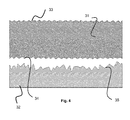
- Fig. 4 illustrates the layer material 31 and the core material 32.
- the defined roughness of the layer material surface 33 is achieved by electrobrightening in order to ensure a high corrosion resistance in wet corrosion areas and to ensure a high paintability with dip coatings.
- the defined roughness of the layer material surface 34 is also achieved by electrobrightening in order to ensure a high adhesion force with the core material 32.
- the reference number 35 shows the undefined, uncoated and not prepared surface of the hardenable core material 32.
- the invention has the solution field in the wet corrosion areas of automotive passenger cars or commercial vehicles.
- the layer material made of stainless steel has a much higher melting point than the hot forming austenization temperature and, therefore, no adhesion is achieved with the ceramic kiln roller of the roller head furnaces. Further, cost-intensive anticorrosion primer, often used for sheets in the automotive industry, is not necessary.
- the layer material made of heat resistant stainless steel in accordance with the invention means high temperature strength and thus also high stiffness of the hardened sheet at temperatures above 250°C.
- the heating of the composite material up to the austenization temperature can be accelerated because no Fe-phases, such as FeAl, are generated on the surface of the layer material.
- the core material is a martensitic stainless material
- the forming tool after heating can be opened at high temperature that increases the clock frequency, i.e. speeds up the production, during the component production. This means cost savings for the manufacturer. Based on the properties of the layer material the usage of conductive or inductive processes is possible in heating.
- the high electrochemical corrosion potential of the layer material in accordance with the invention enables an enduring corrosion protection instead of a zinc coating which only represents a sacrificial anode.
- the high electrochemical corrosion potential is important especially for wet corrosion areas of an automotive car body, such as a passenger car as well as a transporter or other commercial vehicles.
- the layer material of the invention is of austenitic stainless steel
- the austenitic microstructure results in a ductility of the weld seam. This means that the layer material has high weldability with no brittle phases or hardness increase, better fatigue behavior in the weld seam.
- an atmosphere of a shielding gas or an atmosphere of a combination of shielding gases such as nitrogen, argon or helium.
- the shielding gas atmosphere increases the wear resistance of the layer material, which is practical, when the composite material of the invention is used in wearing circumstances, such as agricultural or mining solutions.
Landscapes
- Chemical & Material Sciences (AREA)
- Engineering & Computer Science (AREA)
- Mechanical Engineering (AREA)
- Materials Engineering (AREA)
- Metallurgy (AREA)
- Organic Chemistry (AREA)
- Physics & Mathematics (AREA)
- Crystallography & Structural Chemistry (AREA)
- Thermal Sciences (AREA)
- Plasma & Fusion (AREA)
- Chemical Kinetics & Catalysis (AREA)
- Electromagnetism (AREA)
- Manufacturing & Machinery (AREA)
- Optics & Photonics (AREA)
- Heat Treatment Of Articles (AREA)
- Pressure Welding/Diffusion-Bonding (AREA)
- Laminated Bodies (AREA)
- Heat Treatment Of Sheet Steel (AREA)
- Laser Beam Processing (AREA)
Abstract
Description
- The present invention relates to a component made of a metallic composite material having high corrosion resistance and scale resistance. The invention also relates to a method for the manufacture of the component made of the metallic composite material by hot forming.
- With the focus on the European CO2 emission regulations which aspire to a significant reduction of the CO2 emissions for passenger cars in the year 2020, lightweight efforts become a key question in manufacturing cars. One way to reduce the car body weight without a whole change in the automotive construction is setting in ultra-high strength and therefore thin materials instead of heavy-walled sheets. The passenger safety increase by using such high strength materials simultaneously and they help the automotive manufacturer to fulfill the safety standards. One type of ultra-high strength materials are the so-called hot forming steels.
- Hot forming has been an important manufacturing method for automotive car body engineering in the last decade. The benefits reached from the ability to form very complex parts during the process, having nearly no springback and a high dimensional stability to the point of a high strength in the final hardened component. Typical parts manufactured out of hardenable steels are a-pillars and b-pillars, door side impact beams or underfloor channels.
- In general, plates or sheets, cut of hot or cold rolled strips, are heated up over austenization temperature (Ac1) of the material, e.g. in a roller heat furnace, and then are hold at this temperature to soak over the complete material thickness and are then put into a forming tool. In the forming tool the heated plate or sheet is formed to a complex part and simultaneously cooled down because of the contact to the cold tool surface at the room temperature. Because of a material defined cooling rate, the material gets a martensitic hardened structure. When the part is cooled down under martensitic start temperature (Ms), the tool will be opened, and the part can be retrieved from the tool.
- In spite of the great benefits for the materials to be used in hot forming, there are some disadvantages like scaling or non-corrosion resistance, especially in wet corrosion areas of a passenger car. It has been attempted to decrease such drawbacks. One way for decreasing those drawbacks is special coatings. From the
WO publication 2005021822A1 is known a cathodic corrosion protection with zinc/magnesium, from theWO publication 2011023418A1 is known an active corrosion protection with zinc/nickel, from theEP patent application 1143029A1 is known a corrosion protection with zinc/aluminum, from theEP patent application 1013785A1 is known a scaling protection with aluminum/silicon and in theWO publication 2006040030A1 is described an organic matrix with SiO2-base with aluminum particle. All the coatings have a layer thickness between 8 and 35 µm and are applied with galvanizing, electrolytically, physical vapor deposition (PVD) or spray painting. - One general way to combine properties of different sheets together is to create a multilayered composite of the single sheets. So-called multilayer sheets are described in the
EP patent application 2050532A1 . This patent combines layers of steel sheets where on the one side are layers with a high strength but a low ductility, and on the other side are layers with a low strength but a high ductility. Every layer has a thickness of at most 125 µm, and the number of layers is at least 5. - The
WO publication 2008138729A1 describes a multi-layer composite part which combines a soft core material with high strength layers, and the surface layers have a good paintability and outer-skin quality. - The
JP patent publication 2001219701A US patent application 2011227400A1 describe the usage of a three layer steel composite in a disc break wheel for a motor vehicle. - The
WO publication 2009135779A1 describes the usage of a three-layer steel composite for automotive parts, in which the composite material comprises a soft material as a core material and high strength materials for the surface layers. - The
FR patent application 2323492A1 EP patent application 1690606A1 , which method relates to the production of roll cladded hot-rolled strips. Particularly, the different possibilities of eroding surface pretreatment are mentioned to put the different plates together like pickling, etching, brushing, polishing, grinding, sanding, shot peening, grit blasting, milling or planning. - The
WO publication 2008107082A1 describes a method for improving the temperature and corrosion resistance of stainless steel using chemical treatment with an aquesous solution. The method is applied for the non heat-resistant and non scaling-resistance stainelss steels 1.4301 and 1.4016. - Typical hardenable materials are manganese-boron alloyed steels. Hardenable stainless steels are known from the patent
WO2010149561A1 . - The object of the present invention is to eliminate some drawbacks of the prior art and to achieve a component made of a metallic composite material having high corrosion resistance and scale resistance and a method for the manufacture by hot forming. The essential features of the invention are enlisted in the appended claims.
- The metallic composite material for a component according to the invention consists of a core material which core material is covered on the outer surface with a layer material. The metallic composite material contains as a core material an uncoated hardenable steel on which surface a corrosion resistance and scaling resistance layer is achieved using heat resistant stainless steels as the layer material for the uncoated hardenable steel.
- The mechanical values after a hot forming process for the core material in the metallic composite material according to the invention are preferably so that the yield strength Rp0,2 is at least 1000 MPa and the tensile strength Rm is at least 1500 MPa. The chemical composition of the hardenable core material is preferably by mass % up to 0.48 % C, up to 0.4 % N, up to 18 % Cr, up to 8 % Ni, up to 18 % Mn, up to 3.0 % Mo, up to 1.0 % Si, up to 0.65 % Cu, up to 0.005 B, the rest being Fe and inevitable impurities. The core material can be based on a 1.4034 martensitic stainless steel having the chemical composition by mass % 0.4 - 0.52 % C, 14.0 - 15.5 % Cr, 0.95 - 1.25 % Mn, the rest being Fe and inevitable impurities. The core material can also be based on a 1.4006 martensitic stainless steel having the chemical composition by mass % 0.07 - 0.18 % C, 11.0 - 13.5 % Cr, 0.95 - 1.25 % Mn, the rest being Fe and inevitable impurities. One alternative for the core material is a 1.4028 martensitic stainless steel containing by mass % 0.25 - 0.35 % C, 12.0 - 14.0 % Cr. The core material can have the chemical composition by mass % 0.220 - 0.245 % C, 0.15 - 0.25 % Si, 1.05 - 1.55 % Mn, 0.002 - 0.004 % B, the rest being Fe and inevitable impurities, this chemical composition representing a 1.5528 carbon steel.
- The layer material according to the invention is a stainless steel which has a critical scaling temperature of resistance in air at least 850°C, and the layer material has high temperature strength of at least 30 MPa for ferritic stainless steels and at least 90 MPa for austenitic stainless steels at the temperature 900 °C. The layer material can be an austenitic heat resistant stainless steel containing by mass % Cr ≥ 18 %, Ni ≥ 10 %, Mn ≥ 0.5 % and Si ≥ 0.4 %. The layer material can also be a ferritic heat resistant stainless steel containing by mass % Cr ≥ 13 %, Mn ≥ 0.5 %, Si ≥ 1.0 % and C ≤ 0.1 %.
- The layer material is in the shape of a hot rolled strip or a hot rolled plate having a thickness at most 55 mm on a slab with a thickness of 220 mm. In the case of a hot rolled strip the mutual thickness ratio between the layer material and the core material is at most 50 % of the total thickness. The layer material can also be in the shape of a cold rolled strip having a thickness at most 2.5 mm. In the case of a cold rolled strip the mutual thickness ratio between the layer material and the core material is at most 3,2 % for a slab with a thickness of 160 mm, and then the total thickness of 5 mm for the layer material on both sides of the slab.
- The thickness of the layer material in the composite material of the invention is dependent on the final use of the material. When the material is used in atmosphere where high corrosion resistance is required, the layer material has a thickness between 0.25 mm and 0.50 mm, preferably between 0.30 mm and 0.35 mm. In this case the mutual ratio of the layer material to the core material is at most 0.4. When the material is used in thin-sheet solutions where non-scaling properties are required, the layer material has a thickness between 0.05 mm and 0.35 mm, preferably between 0.15 mm and 0.20 mm, the mutual ratio of the layer material to the core material being then at most 0.2.
- According to the invention the mutual ratio of the thermal conductivity between the layer material and the core material is at most 2. The layer material is connected on the surfaces of the core material by laser welding. According to the invention electrobrightening is used to have a defined roughness for the layer material.
- In the case of electrobrightening the layer material is preconditioned before the hot forming process in the electrolytic solution consisting of a 96 % sulfur acid and 85% orthophosphoric acid, both with the same portion of volume. After electrobrightening the layer material is neutralized and then washed up with water. The defined adjusted roughness of the layer material ensures on one side to the outer contact area a high corrosion resistance because of increasing the passivation of the stainless steel material. On the other side with the contact area to the core material, the defined roughness ensures a high adhesion force with the core material. Additionally the passivation of the contact area helps to avoid scaling and increases the adhesion force during the hot rolling process.
- When using laser welding for fitting the layer material with the core material according to the invention the laser beam weld process is used as a lap joint and with the process variant of keyhole welding is used. In case of laser beam welding an edge preparation is not necessary and a filler metal, either. An optionally low vacuum atmosphere increases the weld depth, decreases the thermic distortion and improves the seam geometry. Package thicknesses (weld depth) of 35 mm can be reached. Further, it is not necessary to preheat the layer material before welding.
- The hot forming process in connection with the method for the manufacture of the composite material of the invention contains the steps first heating to the austenization temperature in a furnace, transferring the composite material from the furnace to the forming tool, hardening and cooling in the forming tool and then cooling down the composite material to the room temperature. In accordance with the invention both hot forming procedures, the direct hot forming as well as the indirect hot-forming, are possible to be utilized. In the indirect procedure there is a forming process of the component and after that the component will be hardened in a separate second step. When alloying the surface of the composite material according to the invention, time is advantageously not required for diffusion of the coating with the layer material.
- According to the invention after a hot forming heat treatment at the austenization temperature of 900 - 975°C at most 5 minutes the surface roughness of the composite material is Ra = 0,05 - 3,00, preferably 2,2 - 2,8 for pickled hot-strip material, and Ra = 0,1 - 0,35 for cold rolled plates, and Rt = 1,5 - 18,0, preferably 14,0 - 17,5 for pickled hot-strip material and Rt = 1,65 - 2,65 for cold rolled plates. Further, there is no formation of iron-base layers, such as FeAl, during the hot forming process when having the layer material and the core material in accordance with the invention, and therefore, it is possible to achieve heating curves at least 50K/s on a conductive or inductive way when the composite material is heated for hot forming. The composite material is retrieved from the hot forming tool during the cool-down process when the martensitic start temperature (Ms) of the layer material is reached. In accordance with the invention it is achieved a homogeneous and closed stainless protection layer on the surface of the composite material without any lifts/break-ups and inequalities.
- The present invention is described in more details referring to the drawings where
-
Fig. 1 illustrates as one preferred embodiment of the invention a cut piece of the composite material schematically from the side view, -
Fig. 2 illustrates as another preferred embodiment of the invention a cut piece of the composite material schematically from the side view, -
Fig. 3 illustrates still another preferred embodiment of the invention schematically seen as a cross-sectional view, and -
Fig. 4 illustrates the surface of the layer material after electrobrightening and the surface of the core material schematically from the side view. - The invention achieves a new kind of corrosion and scaling protection layer for a hardenable steel during a hot forming process. The structure is shown in
Fig. 1 . Thecore material 1 is covered on its surfaces with alayer material 2. - According to the
Fig. 2 thecore material 11 is covered on its surfaces with anitride hardening surface 12. Thenitride hardening surface 12 is made of thelayer material 13, which is positioned between thecore material 11 and thenitride hardening surface 12. -
Fig. 3 shows the composite material of the invention used in a tubular shape. Thecore material 21 is covered on its outer surface and on its inner surface with alayer material 22.Fig. 3 also show alaser welder 23, thelaser beam 24 and theweld seam 25 achieved with laser welding. - On the basis of the non-scaling of the layer material during the hot forming process of the composite material of the invention it is achieved a better paintability for a cathodic dip coating process with a better paint adhesion, resistance against lattice cut and stone chipping influenced corrosion attack as well as a better behavior against cathodic disbanding and a better corrosion resistance. Further, using the composite material and the manufacturing method it is not required to make a post-treatment of the surface with brushing, grinding or polishing to remove unwanted oxides or scale.
-
Fig. 4 illustrates thelayer material 31 and thecore material 32. The defined roughness of thelayer material surface 33 is achieved by electrobrightening in order to ensure a high corrosion resistance in wet corrosion areas and to ensure a high paintability with dip coatings. The defined roughness of thelayer material surface 34 is also achieved by electrobrightening in order to ensure a high adhesion force with thecore material 32. Thereference number 35 shows the undefined, uncoated and not prepared surface of thehardenable core material 32. - The invention has the solution field in the wet corrosion areas of automotive passenger cars or commercial vehicles. The layer material made of stainless steel has a much higher melting point than the hot forming austenization temperature and, therefore, no adhesion is achieved with the ceramic kiln roller of the roller head furnaces. Further, cost-intensive anticorrosion primer, often used for sheets in the automotive industry, is not necessary.
- The layer material made of heat resistant stainless steel in accordance with the invention means high temperature strength and thus also high stiffness of the hardened sheet at temperatures above 250°C. The heating of the composite material up to the austenization temperature can be accelerated because no Fe-phases, such as FeAl, are generated on the surface of the layer material. Further, when the core material is a martensitic stainless material, the forming tool after heating can be opened at high temperature that increases the clock frequency, i.e. speeds up the production, during the component production. This means cost savings for the manufacturer. Based on the properties of the layer material the usage of conductive or inductive processes is possible in heating.
- The high electrochemical corrosion potential of the layer material in accordance with the invention enables an enduring corrosion protection instead of a zinc coating which only represents a sacrificial anode. The high electrochemical corrosion potential is important especially for wet corrosion areas of an automotive car body, such as a passenger car as well as a transporter or other commercial vehicles.
- In case that the layer material of the invention is of austenitic stainless steel, the austenitic microstructure results in a ductility of the weld seam. This means that the layer material has high weldability with no brittle phases or hardness increase, better fatigue behavior in the weld seam.
- In accordance with the method of the invention during the heating process of the composite material it is, if desired, to use an atmosphere of a shielding gas or an atmosphere of a combination of shielding gases, such as nitrogen, argon or helium. The shielding gas atmosphere increases the wear resistance of the layer material, which is practical, when the composite material of the invention is used in wearing circumstances, such as agricultural or mining solutions.
- When nitrogen is used as a shielding gas in connection with the method of the invention, it is, if desired, possible to generate a specific gas nitriding so that as illustrated in
Fig. 2 the top part of the layer material has a nitride hardening surface having high wear resistance.
Claims (18)
- Component made of metallic composite material having high corrosion resistance and scale resistance, characterized in that the metallic composite material contains as a core material (1,11,21,32) an uncoated hardenable steel on which surface a corrosion resistance and scaling resistance layer (2,13,22,31) is achieved using heat resistant stainless steel, and that the yield strength Rp0,2 is at least 1000 MPa and the tensile strength Rm is at least 1500 MPa for the core material (1,11,21,32) and critical scaling temperature of resistance in air for the layer material (2,13,22,31) is at least 850 °C.
- Component according to the claim 1, characterized in that the chemical composition of the core material (1,11,21,32) is by mass % up to 0.48 % C, up to 0.4 % N, up to 18 % Cr, up to 8 % Ni, up to 18 % Mn, up to 3.0 % Mo, up to 1.0 % Si, up to 0.65 % Cu, up to 0.005 B, the rest being Fe and inevitable impurities.
- Component according to the claim 1 or 2, characterized in that the layer material (2,13,22,31) is austenitic heat resistant stainless steel containing by mass % Cr ≥ 18 %, Ni ≥ 10 %, Mn ≥ 0.5 % and Si ≥ 0.4 %.
- Component according to the claim 1 or 2, characterized in that the layer material (2,13,22,31) is ferritic heat resistant stainless steel containing by mass % Cr ≥ 13 %, Mn ≥ 0.5 %, Si ≥ 1.0 % and C ≤ 0.1 %.
- Component according to any of the preceding claims, characterized in that the layer material (2,13,22,31) is in the shape of a hot rolled strip or a hot rolled plate having a thickness at most 55 mm on a slab with a thickness of 220 mm, and the mutual thickness ratio between the layer material (2,13,22,31) and the core material (1,11,21,32) is at most 50 % of the total thickness.
- Component according to any of the preceding claims 1 - 4, characterized in that the layer material (2,13,22,31) in the shape of a cold rolled strip or a hot rolled plate having a thickness at most 2.5 mm, and the mutual thickness ratio between the layer material (2,13,22,31) and the core material (1,11,21,32) is at most 3,2 %.
- Component according to any of the preceding claims, characterized in that the mutual ratio of the thermal conductivity between the layer material (2,13,22,31) and the core material (1,11,21,32) is at most 2.
- Method for the manufacture of a component made of a metallic composite material having high corrosion resistance and scale resistance, characterized in that a core material (1,11,21,32) of uncovered hardenable steel and a layer material (2,13,22,31) of heat resistant stainless steel are welded together in order to have a metallic composite material, the layer material (2,13,22,31) covering outer surfaces of the core material (1,11,21,32), the composite material is further heat treated at the austenization temperature at most 5 minutes, the heat treated composite material is hot formed in a hot forming tool to have a desired shape of a component and the hot formed component is cooled to the room temperature.
- Method according to claim 8, characterized in that welding is carried out by laser welding (23).
- Method according to claim 8, characterized in that welding is carried out by keyhole welding.
- Method according to claim 8 or 9, characterized in that hot forming is carried out in an atmosphere of at least one shielding gas.
- Method according to claim 11, characterized in that using nitrogen as the shielding gas the top part of the component has a nitride hardening surface (12) with high wear resistance.
- Method according to any of the preceding claims 8 - 12, characterized in that the core material (1,11,21,32) for the composite material in the component is made of steel having the chemical composition by mass % up to 0.48 % C, up to 0.4 % N, up to 18 % Cr, up to 8 % Ni, up to 18 % Mn, up to 3.0 % Mo, up to 1.0 % Si, up to 0.65 % Cu, the rest being Fe and inevitable impurities.
- Method according to any of the preceding claims 8 - 13, characterized in that the layer material (2,13,22,31) for the composite material in the component is made of austenitic heat resistant stainless steel containing by mass % Cr ≥ 18 %, Ni ≥ 10 %, Mn ≥ 0.5 % and Si ≥ 0.4 %.
- Method according to any of the preceding claims 8 - 13, characterized in that the layer material (2,13,22,31) for the composite material in the component is made of ferritic heat resistant stainless steel containing by mass % Cr ≥ 13 %, Mn ≥ 0.5 %, Si ≥ 1.0 % and C ≤ 0.1 %.
- Method according to any of the preceding claims 8 - 15, characterized in that the heating curve during the hot formed process of the composite material is at least 50K/s.
- Method according to any of the preceding claims 8 - 16, characterized in that the composite material is retrieved from the hot forming tool during the cool-down process when the martensitic start temperature (Ms) of the layer material is reached.
- Method according to any of the preceding claims 8 - 17, characterized in that the connection of the layer material (2,13,22,31) to the core material (1,11,21,32) is achieved by a preconditioning by electrobrightening with an electrolytic solution consisting of a 96 % sulfur acid and 85% orthophosphoric acid.
Priority Applications (11)
| Application Number | Priority Date | Filing Date | Title |
|---|---|---|---|
| EP15192262.2A EP3162558A1 (en) | 2015-10-30 | 2015-10-30 | Component made of metallic composite material and method for the manufacture of the component by hot forming |
| MX2018005175A MX2018005175A (en) | 2015-10-30 | 2016-10-31 | COMPONENT MADE OF METAL COMPOSITE MATERIAL AND METHOD FOR THE MANUFACTURE OF THE COMPONENT BY HOT MOLDING. |
| CN201680063488.XA CN108349213A (en) | 2015-10-30 | 2016-10-31 | Component made of metallic composite material and method for producing component by thermoforming |
| CA3002491A CA3002491A1 (en) | 2015-10-30 | 2016-10-31 | Component made of metallic composite material and method for the manufacture of the component by hot forming |
| KR1020187014972A KR20180075621A (en) | 2015-10-30 | 2016-10-31 | Component made of metallic composite material and method of manufacturing component by hot forming |
| AU2016345677A AU2016345677A1 (en) | 2015-10-30 | 2016-10-31 | Component made of metallic composite material and method for the manufacture of the component by hot forming |
| JP2018522119A JP2019502555A (en) | 2015-10-30 | 2016-10-31 | Member made of metal composite material and method for manufacturing the member by hot forming |
| US15/769,917 US10974485B2 (en) | 2015-10-30 | 2016-10-31 | Component made of metallic composite material and method for the manufacture of the component by hot forming |
| BR112018008689-4A BR112018008689A2 (en) | 2015-10-30 | 2016-10-31 | component made of metallic composite material and method for hot component fabrication of the component |
| EA201890766A EA201890766A1 (en) | 2015-10-30 | 2016-10-31 | COMPONENT PERFORMED FROM METAL COMPOSITE MATERIAL AND METHOD OF MANUFACTURING THE COMPONENT BY MEANS OF HOT FORMING |
| PCT/EP2016/076220 WO2017072357A1 (en) | 2015-10-30 | 2016-10-31 | Component made of metallic composite material and method for the manufacture of the component by hot forming |
Applications Claiming Priority (1)
| Application Number | Priority Date | Filing Date | Title |
|---|---|---|---|
| EP15192262.2A EP3162558A1 (en) | 2015-10-30 | 2015-10-30 | Component made of metallic composite material and method for the manufacture of the component by hot forming |
Publications (1)
| Publication Number | Publication Date |
|---|---|
| EP3162558A1 true EP3162558A1 (en) | 2017-05-03 |
Family
ID=54770774
Family Applications (1)
| Application Number | Title | Priority Date | Filing Date |
|---|---|---|---|
| EP15192262.2A Withdrawn EP3162558A1 (en) | 2015-10-30 | 2015-10-30 | Component made of metallic composite material and method for the manufacture of the component by hot forming |
Country Status (11)
| Country | Link |
|---|---|
| US (1) | US10974485B2 (en) |
| EP (1) | EP3162558A1 (en) |
| JP (1) | JP2019502555A (en) |
| KR (1) | KR20180075621A (en) |
| CN (1) | CN108349213A (en) |
| AU (1) | AU2016345677A1 (en) |
| BR (1) | BR112018008689A2 (en) |
| CA (1) | CA3002491A1 (en) |
| EA (1) | EA201890766A1 (en) |
| MX (1) | MX2018005175A (en) |
| WO (1) | WO2017072357A1 (en) |
Families Citing this family (4)
| Publication number | Priority date | Publication date | Assignee | Title |
|---|---|---|---|---|
| FR3097791B1 (en) * | 2019-06-28 | 2021-06-18 | Safran Aircraft Engines | HOT CONFORMATION CORE OF A METAL PIECE AND MANUFACTURING, REGENERATION AND CONFORMATION PROCESS |
| WO2021001928A1 (en) * | 2019-07-02 | 2021-01-07 | 住友電気工業株式会社 | Copper-coated steel wire, stranded wire, insulated electric wire and cable |
| CN111559134B (en) * | 2020-04-20 | 2022-04-12 | 哈尔滨工业大学(威海) | A kind of composite board and preparation method thereof |
| CA3226221A1 (en) | 2021-07-08 | 2023-01-12 | Samuel MCALPINE | Systems, methods, and compositions for corrosion resistant stainless steel coatings |
Citations (19)
| Publication number | Priority date | Publication date | Assignee | Title |
|---|---|---|---|---|
| US2874082A (en) * | 1957-04-18 | 1959-02-17 | Allegheny Ludlum Steel | Composite assembly of die steel core and stainless steel coating |
| US3694271A (en) * | 1970-06-30 | 1972-09-26 | Sandvikens Jernverks Ab | Method of producing articles of composite material,and resulting products |
| FR2323492A1 (en) | 1975-09-11 | 1977-04-08 | Kloeckner Werke Ag | Fixing e.g. chromium plates to steel block prior to rolling - by pressing plates pressed by multi-pistons working from centre, and edge welding |
| EP1013785A1 (en) | 1998-12-24 | 2000-06-28 | Sollac | Process for manufacturing of a part from a rolled steel sheet, in particular hot-rolled sheet |
| JP2001219701A (en) | 2000-02-08 | 2001-08-14 | Fuji Seiko Kk | Automotive disc wheels |
| EP1143029A1 (en) | 2000-04-07 | 2001-10-10 | Usinor | Method for manufacturing a body featuring very high mechanical properties, forming by drawing from a rolled steel sheet, in particular hot rolled and coated sheet |
| WO2005021822A1 (en) | 2003-07-29 | 2005-03-10 | Voestalpine Stahl Gmbh | Method for producing a hardened steel part |
| WO2006040030A1 (en) | 2004-10-08 | 2006-04-20 | Volkswagen Aktiengesellschaft | Method for coating metal surfaces |
| EP1690606A1 (en) | 2005-02-11 | 2006-08-16 | ThyssenKrupp Steel AG | Method for manufacturing roll-bonded hot strip for further processing into cold strip and coil made of such hot strip |
| WO2008107082A1 (en) | 2007-03-05 | 2008-09-12 | Poligrat Gmbh | Method for the thermochemical passivation of stainless steel |
| WO2008138729A1 (en) | 2007-05-10 | 2008-11-20 | Thyssenkrupp Steel Ag | Multi-layer composite part made of steel having optimized paint adhesion |
| EP2050532A1 (en) | 2006-07-27 | 2009-04-22 | The University of Tokyo | Multilayer steel and method for producing multilayer steel |
| WO2009135779A1 (en) | 2008-05-07 | 2009-11-12 | Thyssenkrupp Steel Ag | Use of a metal composite material in a vehicle structure |
| WO2010149561A1 (en) | 2009-06-24 | 2010-12-29 | Thyssenkrupp Nirosta Gmbh | Method for producing a hot press cured component, use of a steel product for producing a hot press cured component, and hot press cured component |
| WO2011023418A1 (en) | 2009-08-25 | 2011-03-03 | Thyssenkrupp Steel Europe Ag | Method for producing a steel component provided with a metal coating protecting against corrosion and steel component |
| US20110227400A1 (en) | 2008-09-22 | 2011-09-22 | Thyssenkrupp Steel Europe Ag | Wheel Rim for a Motor Vehicle |
| WO2012146384A1 (en) * | 2011-04-27 | 2012-11-01 | Tata Steel Nederland Technology B.V. | A steel strip composite and a method of making the same |
| DE102014008718B3 (en) * | 2014-06-18 | 2015-02-19 | Thyssenkrupp Ag | Tailored semi-finished product and motor vehicle component |
| EP3328643A1 (en) * | 2015-07-28 | 2018-06-06 | Benteler Automobiltechnik GmbH | Motor vehicle component made of triple-layer laminated steel |
Family Cites Families (12)
| Publication number | Priority date | Publication date | Assignee | Title |
|---|---|---|---|---|
| JPS5714475A (en) * | 1980-06-30 | 1982-01-25 | Nippon Steel Corp | Back shielding method of gas shielded arc welding |
| JPH02182862A (en) * | 1989-01-05 | 1990-07-17 | Kawasaki Steel Corp | Austenitic stainless steel sheet excellent in electropolishing property and austenitic stainless steel-clad metal sheet |
| EP1541713A1 (en) * | 2003-12-11 | 2005-06-15 | Siemens Aktiengesellschaft | Metallic Protective Coating |
| JP4555160B2 (en) * | 2005-06-01 | 2010-09-29 | 株式会社神戸製鋼所 | Steel plate for dissimilar welding with aluminum material and dissimilar material joint |
| JP5530315B2 (en) * | 2010-09-08 | 2014-06-25 | オリンパス株式会社 | Component molding equipment |
| JP2013545890A (en) * | 2010-10-12 | 2013-12-26 | タタ、スティール、アイモイデン、ベスローテン、フェンノートシャップ | Steel blank hot forming method and hot formed parts |
| US11344941B2 (en) * | 2011-07-21 | 2022-05-31 | Kobe Steel, Ltd. | Method of manufacturing hot-press-formed steel member |
| GB2497354B (en) * | 2011-12-07 | 2014-09-24 | Solaris Holdings Ltd | Method of improvement of mechanical properties of products made of metals and alloys |
| DE102011056847B4 (en) * | 2011-12-22 | 2014-04-10 | Thyssenkrupp Rasselstein Gmbh | Steel sheet for use as a packaging steel and process for the production of a packaging steel |
| KR102095071B1 (en) * | 2012-05-08 | 2020-03-31 | 타타 스틸 이즈무이덴 베.뷔. | Automotive chassis part made from high strength formable hot rolled steel sheet |
| JP6377915B2 (en) * | 2014-02-18 | 2018-08-22 | 日新製鋼株式会社 | Plate heat exchanger and manufacturing method thereof |
| CN204196375U (en) * | 2014-08-27 | 2015-03-11 | 中国矿业大学 | A kind of austenitic stainless steel overlay cladding structure |
-
2015
- 2015-10-30 EP EP15192262.2A patent/EP3162558A1/en not_active Withdrawn
-
2016
- 2016-10-31 EA EA201890766A patent/EA201890766A1/en unknown
- 2016-10-31 US US15/769,917 patent/US10974485B2/en not_active Expired - Fee Related
- 2016-10-31 BR BR112018008689-4A patent/BR112018008689A2/en not_active Application Discontinuation
- 2016-10-31 MX MX2018005175A patent/MX2018005175A/en unknown
- 2016-10-31 AU AU2016345677A patent/AU2016345677A1/en not_active Abandoned
- 2016-10-31 WO PCT/EP2016/076220 patent/WO2017072357A1/en not_active Ceased
- 2016-10-31 JP JP2018522119A patent/JP2019502555A/en active Pending
- 2016-10-31 CA CA3002491A patent/CA3002491A1/en not_active Abandoned
- 2016-10-31 KR KR1020187014972A patent/KR20180075621A/en not_active Withdrawn
- 2016-10-31 CN CN201680063488.XA patent/CN108349213A/en active Pending
Patent Citations (19)
| Publication number | Priority date | Publication date | Assignee | Title |
|---|---|---|---|---|
| US2874082A (en) * | 1957-04-18 | 1959-02-17 | Allegheny Ludlum Steel | Composite assembly of die steel core and stainless steel coating |
| US3694271A (en) * | 1970-06-30 | 1972-09-26 | Sandvikens Jernverks Ab | Method of producing articles of composite material,and resulting products |
| FR2323492A1 (en) | 1975-09-11 | 1977-04-08 | Kloeckner Werke Ag | Fixing e.g. chromium plates to steel block prior to rolling - by pressing plates pressed by multi-pistons working from centre, and edge welding |
| EP1013785A1 (en) | 1998-12-24 | 2000-06-28 | Sollac | Process for manufacturing of a part from a rolled steel sheet, in particular hot-rolled sheet |
| JP2001219701A (en) | 2000-02-08 | 2001-08-14 | Fuji Seiko Kk | Automotive disc wheels |
| EP1143029A1 (en) | 2000-04-07 | 2001-10-10 | Usinor | Method for manufacturing a body featuring very high mechanical properties, forming by drawing from a rolled steel sheet, in particular hot rolled and coated sheet |
| WO2005021822A1 (en) | 2003-07-29 | 2005-03-10 | Voestalpine Stahl Gmbh | Method for producing a hardened steel part |
| WO2006040030A1 (en) | 2004-10-08 | 2006-04-20 | Volkswagen Aktiengesellschaft | Method for coating metal surfaces |
| EP1690606A1 (en) | 2005-02-11 | 2006-08-16 | ThyssenKrupp Steel AG | Method for manufacturing roll-bonded hot strip for further processing into cold strip and coil made of such hot strip |
| EP2050532A1 (en) | 2006-07-27 | 2009-04-22 | The University of Tokyo | Multilayer steel and method for producing multilayer steel |
| WO2008107082A1 (en) | 2007-03-05 | 2008-09-12 | Poligrat Gmbh | Method for the thermochemical passivation of stainless steel |
| WO2008138729A1 (en) | 2007-05-10 | 2008-11-20 | Thyssenkrupp Steel Ag | Multi-layer composite part made of steel having optimized paint adhesion |
| WO2009135779A1 (en) | 2008-05-07 | 2009-11-12 | Thyssenkrupp Steel Ag | Use of a metal composite material in a vehicle structure |
| US20110227400A1 (en) | 2008-09-22 | 2011-09-22 | Thyssenkrupp Steel Europe Ag | Wheel Rim for a Motor Vehicle |
| WO2010149561A1 (en) | 2009-06-24 | 2010-12-29 | Thyssenkrupp Nirosta Gmbh | Method for producing a hot press cured component, use of a steel product for producing a hot press cured component, and hot press cured component |
| WO2011023418A1 (en) | 2009-08-25 | 2011-03-03 | Thyssenkrupp Steel Europe Ag | Method for producing a steel component provided with a metal coating protecting against corrosion and steel component |
| WO2012146384A1 (en) * | 2011-04-27 | 2012-11-01 | Tata Steel Nederland Technology B.V. | A steel strip composite and a method of making the same |
| DE102014008718B3 (en) * | 2014-06-18 | 2015-02-19 | Thyssenkrupp Ag | Tailored semi-finished product and motor vehicle component |
| EP3328643A1 (en) * | 2015-07-28 | 2018-06-06 | Benteler Automobiltechnik GmbH | Motor vehicle component made of triple-layer laminated steel |
Also Published As
| Publication number | Publication date |
|---|---|
| AU2016345677A1 (en) | 2018-05-10 |
| EA201890766A1 (en) | 2018-11-30 |
| US20180304583A1 (en) | 2018-10-25 |
| MX2018005175A (en) | 2018-08-15 |
| WO2017072357A1 (en) | 2017-05-04 |
| CN108349213A (en) | 2018-07-31 |
| KR20180075621A (en) | 2018-07-04 |
| JP2019502555A (en) | 2019-01-31 |
| US10974485B2 (en) | 2021-04-13 |
| BR112018008689A2 (en) | 2018-10-30 |
| CA3002491A1 (en) | 2017-05-04 |
Similar Documents
| Publication | Publication Date | Title |
|---|---|---|
| US12454737B2 (en) | Method of forming a hot stamped coated steel product | |
| EP3758886B1 (en) | Method for producing a press-hardened laser welded steel part and press-hardened laser welded steel part | |
| CN101426612B (en) | Method of producing a welded part having very high mechanical properties from a rolled and coated sheet | |
| CA2533633C (en) | Method for producing hardened parts from sheet steel | |
| RU2732711C1 (en) | Method of making parts out of steel with high mechanical strength and high viscosity and parts produced by method thereof | |
| CN110144444B (en) | Steel for press hardening and press hardening parts made from such steel | |
| CN112805395B (en) | Hot-rolled steel sheet and method for producing same | |
| US20160122889A1 (en) | Producing a product from a flexible rolled strip material | |
| CN117062928A (en) | Galvanized steel sheets, components and methods of their manufacture | |
| US20060130940A1 (en) | Method for making structural automotive components and the like | |
| JPWO2019245025A1 (en) | Steel plate, tailored blank, hot press molded product, steel pipe, hollow quenching molded product, and method for manufacturing steel plate | |
| US10974485B2 (en) | Component made of metallic composite material and method for the manufacture of the component by hot forming | |
| CN114466713B (en) | Method for producing a press-hardened steel sheet component with an aluminum-based coating, raw sheet blank and press-hardened steel sheet component produced therefrom | |
| JP2025163170A (en) | Method for manufacturing sheet metal components from flat steel products provided with a corrosion-protective coating - Patents.com | |
| WO2020152887A1 (en) | Steel sheet, tailored blank, hot-press molded article, steel pipe, hollow quenched molded article, and method for producing steel sheet | |
| CN117716059A (en) | Galvanized steel sheet and component, and method for producing same | |
| CN121137457A (en) | Cladding steel plates and components and their manufacturing methods | |
| KR20190117561A (en) | Use of steel and parts to manufacture parts by hot forming | |
| JP7787433B2 (en) | Joined parts and joined steel plates | |
| CN116507752A (en) | Steel material and its manufacturing method |
Legal Events
| Date | Code | Title | Description |
|---|---|---|---|
| PUAI | Public reference made under article 153(3) epc to a published international application that has entered the european phase |
Free format text: ORIGINAL CODE: 0009012 |
|
| STAA | Information on the status of an ep patent application or granted ep patent |
Free format text: STATUS: THE APPLICATION HAS BEEN PUBLISHED |
|
| AK | Designated contracting states |
Kind code of ref document: A1 Designated state(s): AL AT BE BG CH CY CZ DE DK EE ES FI FR GB GR HR HU IE IS IT LI LT LU LV MC MK MT NL NO PL PT RO RS SE SI SK SM TR |
|
| AX | Request for extension of the european patent |
Extension state: BA ME |
|
| STAA | Information on the status of an ep patent application or granted ep patent |
Free format text: STATUS: REQUEST FOR EXAMINATION WAS MADE |
|
| 17P | Request for examination filed |
Effective date: 20171103 |
|
| RBV | Designated contracting states (corrected) |
Designated state(s): AL AT BE BG CH CY CZ DE DK EE ES FI FR GB GR HR HU IE IS IT LI LT LU LV MC MK MT NL NO PL PT RO RS SE SI SK SM TR |
|
| STAA | Information on the status of an ep patent application or granted ep patent |
Free format text: STATUS: EXAMINATION IS IN PROGRESS |
|
| 17Q | First examination report despatched |
Effective date: 20190709 |
|
| STAA | Information on the status of an ep patent application or granted ep patent |
Free format text: STATUS: THE APPLICATION IS DEEMED TO BE WITHDRAWN |
|
| 18D | Application deemed to be withdrawn |
Effective date: 20210714 |