EP3160909B1 - Vorrichtung zur extraktion von schadstoffen durch mehrkanalige rohrförmige membran - Google Patents
Vorrichtung zur extraktion von schadstoffen durch mehrkanalige rohrförmige membran Download PDFInfo
- Publication number
- EP3160909B1 EP3160909B1 EP15731081.4A EP15731081A EP3160909B1 EP 3160909 B1 EP3160909 B1 EP 3160909B1 EP 15731081 A EP15731081 A EP 15731081A EP 3160909 B1 EP3160909 B1 EP 3160909B1
- Authority
- EP
- European Patent Office
- Prior art keywords
- molten salt
- membrane
- fluid
- channel
- extraction
- Prior art date
- Legal status (The legal status is an assumption and is not a legal conclusion. Google has not performed a legal analysis and makes no representation as to the accuracy of the status listed.)
- Not-in-force
Links
Images
Classifications
-
- C—CHEMISTRY; METALLURGY
- C02—TREATMENT OF WATER, WASTE WATER, SEWAGE, OR SLUDGE
- C02F—TREATMENT OF WATER, WASTE WATER, SEWAGE, OR SLUDGE
- C02F1/00—Treatment of water, waste water, or sewage
- C02F1/26—Treatment of water, waste water, or sewage by extraction
-
- B—PERFORMING OPERATIONS; TRANSPORTING
- B01—PHYSICAL OR CHEMICAL PROCESSES OR APPARATUS IN GENERAL
- B01D—SEPARATION
- B01D11/00—Solvent extraction
- B01D11/04—Solvent extraction of solutions which are liquid
- B01D11/0415—Solvent extraction of solutions which are liquid in combination with membranes
-
- B—PERFORMING OPERATIONS; TRANSPORTING
- B01—PHYSICAL OR CHEMICAL PROCESSES OR APPARATUS IN GENERAL
- B01D—SEPARATION
- B01D53/00—Separation of gases or vapours; Recovering vapours of volatile solvents from gases; Chemical or biological purification of waste gases, e.g. engine exhaust gases, smoke, fumes, flue gases, aerosols
- B01D53/14—Separation of gases or vapours; Recovering vapours of volatile solvents from gases; Chemical or biological purification of waste gases, e.g. engine exhaust gases, smoke, fumes, flue gases, aerosols by absorption
- B01D53/1425—Regeneration of liquid absorbents
-
- B—PERFORMING OPERATIONS; TRANSPORTING
- B01—PHYSICAL OR CHEMICAL PROCESSES OR APPARATUS IN GENERAL
- B01D—SEPARATION
- B01D53/00—Separation of gases or vapours; Recovering vapours of volatile solvents from gases; Chemical or biological purification of waste gases, e.g. engine exhaust gases, smoke, fumes, flue gases, aerosols
- B01D53/14—Separation of gases or vapours; Recovering vapours of volatile solvents from gases; Chemical or biological purification of waste gases, e.g. engine exhaust gases, smoke, fumes, flue gases, aerosols by absorption
- B01D53/1493—Selection of liquid materials for use as absorbents
-
- B—PERFORMING OPERATIONS; TRANSPORTING
- B01—PHYSICAL OR CHEMICAL PROCESSES OR APPARATUS IN GENERAL
- B01D—SEPARATION
- B01D53/00—Separation of gases or vapours; Recovering vapours of volatile solvents from gases; Chemical or biological purification of waste gases, e.g. engine exhaust gases, smoke, fumes, flue gases, aerosols
- B01D53/22—Separation of gases or vapours; Recovering vapours of volatile solvents from gases; Chemical or biological purification of waste gases, e.g. engine exhaust gases, smoke, fumes, flue gases, aerosols by diffusion
- B01D53/228—Separation of gases or vapours; Recovering vapours of volatile solvents from gases; Chemical or biological purification of waste gases, e.g. engine exhaust gases, smoke, fumes, flue gases, aerosols by diffusion characterised by specific membranes
-
- B—PERFORMING OPERATIONS; TRANSPORTING
- B01—PHYSICAL OR CHEMICAL PROCESSES OR APPARATUS IN GENERAL
- B01D—SEPARATION
- B01D71/00—Semi-permeable membranes for separation processes or apparatus characterised by the material; Manufacturing processes specially adapted therefor
- B01D71/02—Inorganic material
- B01D71/024—Oxides
- B01D71/025—Aluminium oxide
-
- B—PERFORMING OPERATIONS; TRANSPORTING
- B01—PHYSICAL OR CHEMICAL PROCESSES OR APPARATUS IN GENERAL
- B01D—SEPARATION
- B01D71/00—Semi-permeable membranes for separation processes or apparatus characterised by the material; Manufacturing processes specially adapted therefor
- B01D71/06—Organic material
- B01D71/66—Polymers having sulfur in the main chain, with or without nitrogen, oxygen or carbon only
- B01D71/68—Polysulfones; Polyethersulfones
-
- B—PERFORMING OPERATIONS; TRANSPORTING
- B01—PHYSICAL OR CHEMICAL PROCESSES OR APPARATUS IN GENERAL
- B01D—SEPARATION
- B01D2252/00—Absorbents, i.e. solvents and liquid materials for gas absorption
- B01D2252/20—Organic absorbents
- B01D2252/204—Amines
- B01D2252/20405—Monoamines
-
- B—PERFORMING OPERATIONS; TRANSPORTING
- B01—PHYSICAL OR CHEMICAL PROCESSES OR APPARATUS IN GENERAL
- B01D—SEPARATION
- B01D2252/00—Absorbents, i.e. solvents and liquid materials for gas absorption
- B01D2252/20—Organic absorbents
- B01D2252/204—Amines
- B01D2252/20431—Tertiary amines
-
- B—PERFORMING OPERATIONS; TRANSPORTING
- B01—PHYSICAL OR CHEMICAL PROCESSES OR APPARATUS IN GENERAL
- B01D—SEPARATION
- B01D2252/00—Absorbents, i.e. solvents and liquid materials for gas absorption
- B01D2252/20—Organic absorbents
- B01D2252/204—Amines
- B01D2252/20436—Cyclic amines
-
- B—PERFORMING OPERATIONS; TRANSPORTING
- B01—PHYSICAL OR CHEMICAL PROCESSES OR APPARATUS IN GENERAL
- B01D—SEPARATION
- B01D2325/00—Details relating to properties of membranes
- B01D2325/20—Specific permeability or cut-off range
-
- C—CHEMISTRY; METALLURGY
- C02—TREATMENT OF WATER, WASTE WATER, SEWAGE, OR SLUDGE
- C02F—TREATMENT OF WATER, WASTE WATER, SEWAGE, OR SLUDGE
- C02F1/00—Treatment of water, waste water, or sewage
- C02F1/44—Treatment of water, waste water, or sewage by dialysis, osmosis or reverse osmosis
-
- C—CHEMISTRY; METALLURGY
- C02—TREATMENT OF WATER, WASTE WATER, SEWAGE, OR SLUDGE
- C02F—TREATMENT OF WATER, WASTE WATER, SEWAGE, OR SLUDGE
- C02F2101/00—Nature of the contaminant
- C02F2101/30—Organic compounds
- C02F2101/32—Hydrocarbons, e.g. oil
- C02F2101/322—Volatile compounds, e.g. benzene
Definitions
- the present invention relates to device for extraction of pollutants by multichannel tubular membrane.
- the invention will find an application for the treatment of traces of pollutants in a liquid or gaseous fluid. For example, the removal of small pollutants as volatile organic compounds from an aqueous stream in industrial wastewater treatment or other water treatment applications, or the separation of aromatic compounds form a hydrocarbon feed in petrochemical applications.
- the invention will also find application in the removal of water traces in products of high added value as pharmaceutical, cosmetic or bio-carburant, for example.
- the membranes In the case of pervaporation, the membranes contain organic material to improve the solubilization-diffusion phenomena. These membranes are not necessarily well resistant to temperature and chemical conditions of solutions and the permeate flux is very small.
- Ceramic membranes can be used to overcome these drawbacks. Ceramic membranes are resistant to temperature and also to aggressive chemical environments (concentrated acids or bases).
- Ionic Liquids are inserted into the pores of skin layer of the membranes.
- Ionic liquids are known from several years. Ionic liquids have lower volatility and vapor pressure than organic solvent or aqueous solvent. Ionic liquids could be used at much higher temperatures and much lower pressures than volatile organic solvents. Some ionic liquids are liquid salts at room temperature with preferably a melting point lower or equal to 100 °C.
- ionic liquids in membranes allows specific separation depending on the ionic liquid selected and the size of the pores.
- VOC Volatile Organic Compounds
- these supported ionic liquid membranes are not easily regenerated.
- the regeneration requires high temperature, counter pressure and/or back to front flow.
- These treatments have the drawbacks to damage the ionic liquids, for example, ionic liquids are unhooked from the pores of the membranes.
- the membranes must be refilled by ionic liquids and the solvent used for the regeneration containing therefore the ionic liquids must be treated. This has the disadvantage of loss of time and significant cost increasing.
- US2012247327 discloses a hollow-fiber membrane contactor, the extraction of pollutants from a fluid and regenerating the extractant circulating on one side of the membrane.
- the object of the invention is to provide a membrane separation technology enabling specific separation and improvement in the fabrication and regeneration processes.
- the invention more particularly relates to a device for pollutant's extraction in a fluid according to claim 1.
- the device comprises a tubular multichannel membrane wherein at least one channel enables the fluid to go through and at least one channel is filled with molten salt.
- This extraction channel is dedicated to contain molten salt. The fluid does not run into the extraction channel containing molten salt.
- the present invention has the advantage to separate small pollutants, as VOC, from a fluid, by the diffusion through the porous matrix of the membrane and by the adsorption of pollutant on the molten salt.
- the pollutant diffuses from the fluid channel to the molten salt placed in a parallel channel.
- the regeneration of the membrane and more particularly of the molten salt is facilitated as the molten salt is in a dedicated channel.
- the membrane is in ceramic.
- the membrane resistance at high temperatures improves the manufacture and the regeneration of the device.
- the exterior of the membrane is leak-proof in order to avoid permeation.
- the permeate is adsorbed on molten salt and remains on the channel filled by the molten salt, advantageously at least during the extraction step.
- the channel containing the molten salt is sealed on its extremities in order to keep the molten salt inside.
- the molten salt is well contained in its dedicated channel and even during the regenerating time the molten salt would not leak outside.
- the skin layer of the membrane protects the molten salts from other pollutants contained in the fluid as suspended matter, bacteria, etc.
- the molten salt is going through the channel.
- the direction of molten salt's movement could be similar or contrary to the direction of the fluid running into the fluid channel.
- the molten salt could be continuously regenerated by a specific treatment on the outside of the membrane.
- tubular multichannel membrane with molten salt improves the membrane separation technology allowing specific separation and easy manufacture and regeneration.
- the invention relates to a device for extraction of pollutants in a fluid according to claim 1 comprising at least one multichannel tubular membrane containing at least one fluid channel allowing the fluid to go through a feed inlet to an outlet end characterized in that membrane comprises at least an extraction channel filled with molten salt in order to adsorb said pollutants having to be extracted from the said fluid.
- the membrane is a ceramic membrane.
- the membrane is a mineral, for example TiO 2 - ZrO 2 - Al 2 O 3 , or organic, for example polysulfone.
- the membrane comprises one extraction channel for one fluid channel.
- the membrane is leak-proof on the outside in order to avoid permeation.
- the at least one extraction channel is sealed at its extremities.
- the molten salt is running into the at least one extraction channel.
- molten salt is running forward or reward in the direction of fluid contained in the fluid channel.
- the device comprises a catalyst in the extraction channel, for example metallic oxide, organocatalyst or organometallic catalyst.
- molten salt is ionic liquid.
- the said fluid is a liquid.
- the said fluid is a gas.
- the at least one fluid channel and at least one extraction channel have a diameter size comprised between 0.5 and 50mm diameter.
- the membrane has pores of a size comprises between 1 nm and 8 ⁇ m.
- the invention relates to a system comprising several devices described above.
- the invention relates to a method for extracting of pollutant in a fluid with a device described above characterized in that it comprises:
- the adsorbed pollutant is converted to a less toxic pollutant by catalyst contained in the molten salt.
- a gas is running onto the fluid channel during the extraction step.
- the fluid channel is maintained under partial vacuum during the extraction step.
- the invention relates to a method for extracting of pollutant in a fluid with a device described above characterized in that it comprises:
- the multichannel tubular membrane of the invention is a membrane having several parallel channels.
- the membrane can be an organic membrane or preferably a ceramic membrane.
- the membrane may have several geometric shapes, for example section could be circular, hexagonal, square or triangular.
- the membrane is comprised between a length of some centimeters and several meters, preferably 0.1 and 2 m length preferably 1 and 2 m length. Several membranes may be placed in series or in parallel.
- This membrane has a large surface area allowing good filtration efficiency. It is possible to adapt the hydrodynamic size of the channels depending on the presence of suspended solids in the fluid having to be treated or depending on the viscosity of the fluid that has to be treated.
- the channels may have several geometric shapes, for example section could be circular, hexagonal, square or triangular.
- the hydraulic diameter size of the channels is comprised between 0.5 and 50 mm, preferably 1 and 6 mm. The hydraulic diameter is determined by an equivalent circle.
- tubular has to be understood as a longitudinal shape having several sections for instance circular or hexagonal...
- the device comprises from 1 to 99 membranes.
- the membrane comprises from 2 to 52 channels.
- the membrane has a section corresponding to a diameter between 10 and 55 mm.
- the membrane has a porous matrix.
- the pores have a size from 1 nm to 8 ⁇ m, preferably 1 nm to 10 nm.
- the porous matrix is covered by a skin layer which has smaller porous structure than the porous matrix.
- the skin layer determines the cut off of the membrane.
- Membranes of the invention have cut-offs ranging from nano- to micro-filtration.
- the membrane of the invention is multichannel ceramic membrane named monolithic.
- this kind of membrane is used for filtration in a cross flow configuration.
- wasted water containing suspended matter or organic compounds is pumped throughout a membrane filter with high flow rates, under pressure.
- the membrane allows water and other low molecular weight substances (soaps, salts, and surfactants) to go through the membrane pores and exit the system as permeate.
- Higher molecular weight substances such as oils and solids are retained by the membrane, called retentate and remain in the wasted water feed.
- At least a channel is filled with molten salt.
- the channel comprising the molten salt is called extraction channel.
- the extraction channel does not allow the fluid way through.
- the channel is dedicated to molten salt.
- the fluid having to be treated is going through at least another channel of the membrane. This channel is called the fluid channel.
- the substances having lower molecular weight than the cut off of the membrane go through the membrane's pores and are adsorbed on molten salt due to concentration difference between the extraction channel and the fluid channel.
- One channel is filled by molten salt for one channel letting the fluid go through.
- the membrane is leak-proof on its outside.
- the outside of the membrane is preferably covered by a material preventing the leaking of molecular weight compounds under the cut off of the membrane.
- a coating proof is deposited on the outer surface of the membrane.
- fluoropolymers as PolyVinyliDene Fluoride (PVDF) or Polytetrafluoroethylene (PTFE) may be used.
- PVDF PolyVinyliDene Fluoride
- PTFE Polytetrafluoroethylene
- the membrane of the invention does not allow a transversal filtration or permeation as state of the art membranes allow.
- the membrane of the invention does not enable compounds to exit transversally from the membrane.
- the membrane does not enable compounds to go transversally through the outer surface.
- the outside means the outer surface of the tubular membrane multi-channel.
- the outer surface is defined by the external boundary or surface or circumference of the tubular membrane.
- Leak proof means that the outer surface is fluid proof more specifically gas and liquid proof.
- the extraction channel is sealed at its extremities in order to maintain the molten salt in the extraction channel.
- the extraction channel is open at its extremities and the molten salt runs along the channel from part to part.
- the molten salt can run in the same direction as the fluid or in a different direction.
- the molten salt which enters the membrane is always free of pollutant therefore the extraction rate is always at the maximum with this embodiment.
- the invention combines a multichannel ceramic membrane with molten salt.
- Molten salt is useful to solubilize organic compounds and metals.
- the low vapor tension of molten salt gives the advantage of being an ecofriendly solvent.
- Molten salt has to be understood as including ionic liquids. Single or mixture of molten salt could be used.
- One advantage of the invention is the wide range of molten salt and membrane which can be used to treat the fluid.
- the membrane and the molten salt have to be selected notably depending on the pollutant which has to be extracted and the fluid having to be treated.
- the couple the membrane's cut off / molten salt's viscosity must be determined in order to molten salt does not go through the membrane's pores under the fluid's pressure and temperature.
- a first criterion is the melting temperature of the molten salt:
- a second criterion is the chemical nature of the fluid having to be treated and pollutant having to be adsorbed.
- the molten salt contains a homogeneous or heterogeneous catalyst.
- the catalyst is immobilized in the molten salt by the use of ionic part.
- the titanium dioxide may be used as heterogeneous catalyst.
- This configuration has the advantage that the pollutant which is adsorbed on the molten salt is transformed into degraded compound classically less polluting. For instance, the contaminant NO x is adsorbed and degraded into NO 3 .
- tubular multichannel ceramic membrane used by the invention could be found in the main French providers as Tami, CTI or Pall-Exekia.
- the method of making the device for extraction advantageously comprises a step of leak-proof on the outside of the membrane.
- the fluid channel is connected to a circuit of the fluid having to be treated and the extraction channel is connected to a circuit of molten salt.
- the circuit of fluid brings the said fluid to the inlet of the fluid channel and collects the said fluid treated, also called the retentate, at the outlet of the said fluid channel.
- the circuit of the molten salt brings molten salt to an inlet of the extraction channel and collects molten salt adsorbed with the pollutant to an outlet of the said extraction channel.
- the inlet of the fluid having to be treated and the inlet of the molten salt may be on the same side of the membrane if both are running in the same way, co-current flow, in contrary if both are running in the opposite way, opposite flow or countercurrent flow, the inlet of the fluid having to be treated and the inlet of the molten salt will be on the opposite side.
- an extremity of the channel is closed for example with glue and the channel is filled with the molten salt by its other extremity.
- the filling may be carried out at atmospheric pressure or preferably on a slight overpressure in order to avoid the formation of air in the channel.
- the molten salt and/or the membrane can be heated in order to make the filling easier.
- the other extremity is closed for example with glue.
- One of the advantageous of the present invention is easy recycling step of the device.
- the recycling enable to remove the pollutant adsorbed on the molten salt in order to give back its full efficiency to the molten salt.
- the terms "recycling” and “regenerating” are used equally.
- the recycling process comprises the molten salt heating to desorb the pollutant from the molten salt.
- the temperature increasing is controlled in order to make sure the viscosity remains sufficient to maintain molten salt in the extraction channel.
- the temperature should advantageously be above the boiling point of the pollutant adsorbed on the molten salt.
- the membrane is heated leading to the desorption of pollutant from the molten salt, a gas is running in the fluid channel or said channel is maintained under weak partial vacuum.
- the said channel is connected to a cold trap in order to catch the desorbed pollutant.
- the extraction channel it is possible to open the extraction channel to remove the molten salt and the adsorbed pollutant from the membrane.
- the removal of the molten salt is performed with a solvent running in the said channel.
- the solvent and the molten salt are separated by a rotary evaporator. Then the molten salt is heating to desorb the pollutant.
- the solvent may be used to clean the membrane too.
- the solvent may be the acetone if the membrane is a ceramic membrane.
- solid molten salt at room temperature it is preferably heated up to reach the melting point of the molten salt in order to facilitate the device's recycling.
- this type of salt having still a high viscosity at their melting point it is even possible to reduce the pressure so as to facilitate pollutant's evaporation.
- the molten salt flows in the forward or reverse direction of the fluid to clean up
- the molten salt is recycled in a continuous way.
- the molten salt is sucked out of the membrane before reaching a vacuum chamber equipped with a condenser.
- the pollutant is removed from the molten salt.
- a return pump sends back the molten salt in the membrane.
- the use of the invention's device comprises the circulation of the fluid having to be treated in the fluid channel.
- the pollutants contained in the fluid are transported by diffusion to molten salt contained in the extraction channel where they are adsorbed.
- the circulation pressure is chosen to compensate the pressure drop in the channel.
- the temperature is preferably the one of the fluid.
- fluid channel is under slight overpressure. This configuration enables to confine molten salt in the extraction channel avoiding leaking of molten salt.
- the extraction time is depending on pollutant's concentration having to be eliminated in the fluid.
- the fluid goes several times through the membrane to reduce the residual concentration to a targeted concentration of the pollutant to extract.
- a gas is treated with a device according to the invention.
- the membrane used is a tubular multi-channel ceramic membrane:
- An effluent is treated with a device according to the invention.
- the effluent is an industrial liquid effluent containing a mixture of hydrocarbon.
- the pollutants to be extracted are polyaromatic hydrocarbon (PAH) and BTEX.
- the concentrations of pollutants in the effluent having to be treated are: PAH ⁇ g/L BTEX (5 compounds) ⁇ g/L naphthalene 250 benzene 4880 acenaphthylene 0,61 toluene 4100 acenaphthene 0,95 Ethylbenzene 510 fluorene 2,8 o-Xylene 776 phenanthrene 3,5 m + p-Xylene 1380
- the molten salt selected is an ionic liquid [Bmim][PF 6 ], (butylmethylimidazolium hexafluorophosphate)
- the removal of PAH is between 92% and 98% and the removal of BTEX is above 97% for the maximum value.
- a liquid extraction without a membrane is performed to measure VOC capture potential by Ionic Liquids in an aqueous medium.
- E-Contact time Benzene 0,05% - saturation 83-96% 40 g Li/g VOC 5min - 1h Toluene 0,01% - saturation 70-97% 80 g Li / g VOC 5min - 1h Xylene 0,01% - saturation 97 - 99% 160 g Li / g VOC 5min - 1h Butanone 0,10% 64% - 5min - 1h Chloroform 0,01% - saturation 91 - 95% 18 g Li / g VOC 5min - 1h
- a membrane with 31 channels and a MWCO of 5 kDa For a membrane with 31 channels and a MWCO of 5 kDa is used: one channel on two contains ionic liquids (Total 15 channels). The liquid ionic is [Bmim][PF 6 ], and the total weight is around 150 g (around 10 g/channel).
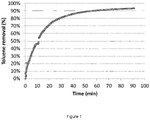
- a model gas containing 1000 PPM of a VOC, i.e toluene, in air is processed through the lumen of the free channels of the membrane. The removal of toluene is determined versus time. It is found that 90% of the removal achieved in 1 hour. The experiment is performed at room temperature.
- the maximum removal kinetics is 2000 ppm/h with 150 g of ionic liquid.
- the miscibility of toluene in the ionic liquid [Bmim][PF 6 ] is 23% at 26°C.
- the invention combines a membrane with the ionic liquid, i.e. im3008b, is able to extract from a continuous flow of gaseous effluent 0,37 mg of hydrogen sulfide per gram of ionic liquid in 2h30 while at the same time, the rate of methane extraction is zero.
- hydrophilic ionic liquids such as [Bmim][BF 4 ] or [Bmim][Br] will allow increasing very significantly the rate of extraction of H 2 S.
- CO 2 very soluble in ionic liquids may be extracted quantitatively by incorporating ionic liquids as [Bmim][NTf 2 ] and [Bmim][PF 6 ] having a high affinity for CO 2 in the device of the invention.
Landscapes
- Chemical & Material Sciences (AREA)
- Chemical Kinetics & Catalysis (AREA)
- Engineering & Computer Science (AREA)
- Analytical Chemistry (AREA)
- Oil, Petroleum & Natural Gas (AREA)
- General Chemical & Material Sciences (AREA)
- Environmental & Geological Engineering (AREA)
- Organic Chemistry (AREA)
- Water Supply & Treatment (AREA)
- Life Sciences & Earth Sciences (AREA)
- Hydrology & Water Resources (AREA)
- Inorganic Chemistry (AREA)
- Separation Using Semi-Permeable Membranes (AREA)
Claims (14)
- Vorrichtung zur Extraktion von Schadstoffen, umfassend mindestens eine mehrkanalige rohrförmige Membran mit mehreren parallelen Kanälen, wobei mindestens einer der mehreren parallelen Kanäle ein Fluidkanal ist, der zulässt, dass das Fluid durch einen Zufuhreinlass zu einem Auslassende hindurchtritt, dadurch gekennzeichnet, dass die mindestens eine mehrkanalige rohrförmige Membran geschmolzenes Salz umfasst, wobei mindestens einer der mehreren parallelen Kanäle, die sich von dem mindestens einen Fluidkanal unterscheiden, ein Extraktionskanal ist, der mit dem geschmolzenen Salz gefüllt ist und der dazu konfiguriert ist, die Schadstoffe zu adsorbieren, die aus dem Fluid extrahiert werden müssen, wobei der mindestens eine Extraktionskanal an seinen Endpunkten versiegelt ist oder die Vorrichtung einen Kreislauf von geschmolzenem Salz umfasst, der mit dem mindestens einen Extraktionskanal verbunden ist, der geschmolzenes Salz umfasst, und der dazu konfiguriert ist, entlang dem mindestens einen Extraktionskanal zu verlaufen, wobei die mindestens eine mehrkanalige rohrförmige Membran eine poröse Matrix aufweist, die zulässt, dass der Schadstoff aus dem mindestens einen Fluidkanal zu dem geschmolzenen Salz diffundiert, das in dem mindestens einen parallelen Extraktionskanal angeordnet ist.
- Vorrichtung nach Anspruch 1, wobei die Membran rohrförmig ist und wobei der Umfang der rohrförmigen Membran auf seiner Außenseite lecksicher ist, um eine Permeation durch den Umfang der rohrförmigen Membran zu vermeiden.
- Vorrichtung nach einem der Ansprüche 1 oder 2, wobei die Beschaffenheit der Membran organisch oder mineralisch ist.
- Vorrichtung nach einem der vorhergehenden Ansprüche, wobei die Membran eine keramische Membran ist.
- Vorrichtung nach einem der vorhergehenden Ansprüche, wobei die Membran einen Extraktionskanal für einen Fluidkanal umfasst.
- Vorrichtung nach einem der vorhergehenden Ansprüche, umfassend einen Katalysator in dem Extraktionskanal.
- Vorrichtung nach einem der vorhergehenden Ansprüche, wobei das geschmolzene Salz eine ionische Flüssigkeit ist.
- Vorrichtung nach einem der vorhergehenden Ansprüche, wobei der mindestens eine Fluidkanal und der mindestens eine Extraktionskanal eine Durchmessergröße aufweisen, die zwischen 0,5 und 50 mm liegt.
- Vorrichtung nach einem der vorhergehenden Ansprüche, wobei die Membran Poren mit einer Größe aufweist, die zwischen 1 nm und 8 µm liegt.
- Vorrichtung nach einem der vorhergehenden Ansprüche, wobei die Membran von 2 bis 52 Kanäle umfasst.
- Vorrichtung nach einem der vorhergehenden Ansprüche, umfassend einen Kreislauf von Fluid, das behandelt werden muss, der mit dem Einlass von mindestens einem Fluidkanal verbunden ist, und wobei der Kreislauf von geschmolzenem Salz mit einem Einlass von mindestens einem Extraktionskanal verbunden ist und wobei der Einlass des mindestens einen Fluidkanals und der Einlass von mindestens einem Extraktionskanal auf derselben Seite oder auf der entgegengesetzten Seite der Membran angeordnet sind und so konfiguriert sind, dass das geschmolzene Salz vorwärts oder rückwärts in der Richtung von Fluid, das in dem Fluidkanal enthalten ist, läuft.
- System, umfassend mehrere Vorrichtungen nach einem der vorhergehenden Ansprüche.
- Verfahren zur Extraktion eines Schadstoffs in einem Fluid mit einer Vorrichtung nach einem der Ansprüche 1 bis 11, dadurch gekennzeichnet, dass es umfasst:- einen ersten Schritt eines Extrahierens, wobei das Fluid, das behandelt werden muss, durch die Membran strömt und der Schadstoff auf dem geschmolzenen Salz adsorbiert wird, und- einen zweiten Schritt eines Rückführens zu der Vorrichtung, wobei der Weg des Fluids gestoppt wird und die Vorrichtung auf den Siedepunkt des Schadstoffs erhitzt wird, um den Schadstoff aus dem geschmolzenen Salz zu desorbieren.
- Verfahren zur Extraktion eines Schadstoffs in einem Fluid mit einer Vorrichtung nach einem der Ansprüche 1 bis 11, dadurch gekennzeichnet, dass es umfasst:- einen ersten Schritt eines Extrahierens, wobei das Fluid, das behandelt werden muss, durch die Membran strömt und der Schadstoff auf dem geschmolzenen Salz, das durch den Extraktionskanal strömt, adsorbiert wird, und- einen zweiten Schritt eines Rückführens, wobei das geschmolzene Salz durch den Extraktionskanal strömt und wobei, sobald es außerhalb der Membran ist, das geschmolzene Salz auf den Siedepunkt der Schadstoffe erhitzt wird, um den Schadstoff aus dem geschmolzenen Salz zu desorbieren, und wobei das geschmolzene Salz dann erneut in die Kanalextraktion eingebracht wird, wobei die Schritte des Extrahierens und des Rückführens gleichzeitig erfolgen.
Applications Claiming Priority (2)
| Application Number | Priority Date | Filing Date | Title |
|---|---|---|---|
| EP14306002.8A EP2960211A1 (de) | 2014-06-25 | 2014-06-25 | Vorrichtung zur Extraktion von Schadstoffen durch mehrkanalige rohrförmige Membran |
| PCT/EP2015/064462 WO2015197797A1 (en) | 2014-06-25 | 2015-06-25 | Device for extraction of pollutants by multichannel tubular membrane |
Publications (2)
| Publication Number | Publication Date |
|---|---|
| EP3160909A1 EP3160909A1 (de) | 2017-05-03 |
| EP3160909B1 true EP3160909B1 (de) | 2022-04-20 |
Family
ID=51062761
Family Applications (2)
| Application Number | Title | Priority Date | Filing Date |
|---|---|---|---|
| EP14306002.8A Withdrawn EP2960211A1 (de) | 2014-06-25 | 2014-06-25 | Vorrichtung zur Extraktion von Schadstoffen durch mehrkanalige rohrförmige Membran |
| EP15731081.4A Not-in-force EP3160909B1 (de) | 2014-06-25 | 2015-06-25 | Vorrichtung zur extraktion von schadstoffen durch mehrkanalige rohrförmige membran |
Family Applications Before (1)
| Application Number | Title | Priority Date | Filing Date |
|---|---|---|---|
| EP14306002.8A Withdrawn EP2960211A1 (de) | 2014-06-25 | 2014-06-25 | Vorrichtung zur Extraktion von Schadstoffen durch mehrkanalige rohrförmige Membran |
Country Status (3)
| Country | Link |
|---|---|
| US (1) | US10137385B2 (de) |
| EP (2) | EP2960211A1 (de) |
| WO (1) | WO2015197797A1 (de) |
Families Citing this family (3)
| Publication number | Priority date | Publication date | Assignee | Title |
|---|---|---|---|---|
| AU2019352834A1 (en) * | 2018-10-05 | 2021-03-11 | Massachusetts Institute Of Technology | Carbon dioxide removal using sequestration materials that include salts in molten form, and related systems and methods |
| US11291950B2 (en) | 2019-11-07 | 2022-04-05 | Massachusetts Institute Of Technology | Treatment of acid gases using molten alkali metal borates and associated methods of separation |
| US11577223B2 (en) | 2019-11-07 | 2023-02-14 | Massachusetts Institute Of Technology | Processes for regenerating sorbents, and associated systems |
Citations (1)
| Publication number | Priority date | Publication date | Assignee | Title |
|---|---|---|---|---|
| US20120247327A1 (en) * | 2010-09-27 | 2012-10-04 | Conocophillips Company | Hollow-fiber membrane contactors |
Family Cites Families (21)
| Publication number | Priority date | Publication date | Assignee | Title |
|---|---|---|---|---|
| US3447286A (en) | 1967-08-02 | 1969-06-03 | Gen Electric | Totally enclosed liquid permselective membrane |
| US4119408A (en) | 1977-06-22 | 1978-10-10 | General Electric Company | Apparatus for maintaining the separation efficiency of immobilized liquid membranes in gas separation |
| US4617029A (en) | 1985-03-01 | 1986-10-14 | Air Products And Chemicals, Inc. | Method for gas separation |
| US4761164A (en) | 1985-03-01 | 1988-08-02 | Air Products And Chemicals, Inc. | Method for gas separation |
| EP0194483B1 (de) | 1985-03-01 | 1989-05-31 | Air Products And Chemicals, Inc. | Verfahren zur Trennung von Gasen |
| US4780114A (en) | 1987-10-14 | 1988-10-25 | Air Products And Chemicals, Inc. | Molten salt hydrate membranes for the separation of gases |
| CA2040798A1 (en) | 1990-05-25 | 1991-11-26 | Dean T. Tsou | Facilitated liquid membranes for olefin/paraffin gas separations and related process |
| US5490884A (en) * | 1994-09-09 | 1996-02-13 | Tastemaker | Method and system for extracting a solute from a fluid using dense gas and a porous membrane |
| US6610546B1 (en) * | 1998-02-26 | 2003-08-26 | Dionex Corporation | Continuous electrolytically regenerated packed suppressor for ion chromatography |
| US6793711B1 (en) | 1999-12-07 | 2004-09-21 | Eltron Research, Inc. | Mixed conducting membrane for carbon dioxide separation and partial oxidation reactions |
| JP4224597B2 (ja) * | 2003-04-16 | 2009-02-18 | 独立行政法人 日本原子力研究開発機構 | 有害有機物を含む排水の浄化方法 |
| US7718047B2 (en) * | 2004-10-19 | 2010-05-18 | The Regents Of The University Of Colorado | Electrochemical high pressure pump |
| CN108425170B (zh) * | 2004-11-09 | 2021-02-26 | 得克萨斯大学体系董事会 | 纳米纤维纱线、带和板的制造和应用 |
| US8110111B1 (en) | 2006-09-29 | 2012-02-07 | U.S. Department Of Energy | Membrane contactor assisted extraction/reaction process employing ionic liquids |
| US8011451B2 (en) * | 2007-10-19 | 2011-09-06 | Shell Oil Company | Ranging methods for developing wellbores in subsurface formations |
| JP5407133B2 (ja) * | 2007-10-24 | 2014-02-05 | 住友電気工業株式会社 | 濾過用分離膜エレメント及び濾過用膜モジュール |
| US8479487B2 (en) * | 2009-08-10 | 2013-07-09 | General Electric Company | Hybrid multichannel porous structure for hydrogen separation |
| EP2537807A4 (de) * | 2010-02-17 | 2014-11-05 | Sumitomo Electric Industries | Trennungsmembranmodul zur verarbeitung von ölhaltigem abwasser, verfahren zur verarbeitung von ölhaltigem abwasser und vorrichtung zur verarbeitung von ölhaltigem abwasser |
| JP5422495B2 (ja) * | 2010-02-23 | 2014-02-19 | 株式会社日立製作所 | 金属回収方法及び透析装置 |
| US8454832B2 (en) | 2010-11-29 | 2013-06-04 | Saudi Arabian Oil Company | Supported ionic liquid membrane system and process for aromatic separation from hydrocarbon feeds |
| JP2014239871A (ja) * | 2013-05-07 | 2014-12-25 | 安東 秀夫 | 生体活動検出方法、生体活動測定装置、生体活動検出信号の転送方法および生体活動情報を利用したサービスの提供方法 |
-
2014
- 2014-06-25 EP EP14306002.8A patent/EP2960211A1/de not_active Withdrawn
-
2015
- 2015-06-25 EP EP15731081.4A patent/EP3160909B1/de not_active Not-in-force
- 2015-06-25 US US15/319,920 patent/US10137385B2/en not_active Expired - Fee Related
- 2015-06-25 WO PCT/EP2015/064462 patent/WO2015197797A1/en not_active Ceased
Patent Citations (1)
| Publication number | Priority date | Publication date | Assignee | Title |
|---|---|---|---|---|
| US20120247327A1 (en) * | 2010-09-27 | 2012-10-04 | Conocophillips Company | Hollow-fiber membrane contactors |
Also Published As
| Publication number | Publication date |
|---|---|
| EP3160909A1 (de) | 2017-05-03 |
| EP2960211A1 (de) | 2015-12-30 |
| US20170128856A1 (en) | 2017-05-11 |
| US10137385B2 (en) | 2018-11-27 |
| WO2015197797A1 (en) | 2015-12-30 |
Similar Documents
| Publication | Publication Date | Title |
|---|---|---|
| Hong et al. | Removal of dyes, sugars, and amino acids from NaCl solutions using multilayer polyelectrolyte nanofiltration membranes | |
| Bey et al. | Removal of As (V) by PVDF hollow fibers membrane contactors using Aliquat-336 as extractant | |
| CN105080361A (zh) | 一种涂覆高分子复合涂层的聚丙烯中空纤维超滤膜 | |
| US10137385B2 (en) | Device for extraction of pollutants by multichannel tubular membrane | |
| CN104168985B (zh) | 用于将芳族化合物与非芳族化合物分离的促进输送膜 | |
| Zahoor | Removal of Pesticides from Water Using Granular Activated Carbon and Ultrafiltration Membrane--A Pilot Plant Study | |
| EP2827970B1 (de) | Verfahren zur beseitigung von quecksilber aus einem flüssigkeitsstrom | |
| Othman et al. | Removal of phenol from wastewater by supported liquid membrane process | |
| KR20140071943A (ko) | 과산화수소 수용액의 정제 방법 및 정제 장치 | |
| JP2538409B2 (ja) | 低圧用逆浸透膜による高濃度溶液の濃縮方法及び装置 | |
| Musbah et al. | Removal of pesticides and desethylatrazine (DEA) by nanofiltration: effects of organic and inorganic solutes on solute rejection | |
| US6660165B1 (en) | Method for regenerating inorganic porous particles, method for purifying water, and continuous water purification device | |
| KR102691996B1 (ko) | 세라믹 분리막을 포함하는 폐수처리 시스템 및 이를 이용한 폐수처리 방법 | |
| CN103657159A (zh) | 用于从液体中除去voc的多个膜 | |
| Trivunac et al. | Pertraction of phenol in hollow-fiber membrane contactors | |
| Ragunath et al. | Carbon nanotube immobilized composite hollow fiber membranes for extraction of volatile organics from air | |
| WO2017103101A1 (fr) | Procede de traitement d'eau, module et installation associes | |
| Dencheva-Zarkova et al. | Flux and separation efficiency in nanofiltration with mixed solvents | |
| Borisov | Novel pervaporation technique using permeate vapor adsorption for removal of chlorinated organics from aqueous media | |
| US7799225B1 (en) | Membrane contactor assisted water extraction system for separating hydrogen peroxide from a working solution, and method thereof | |
| EP2870992B1 (de) | Verfahren zur Reinigung einer Gaspermeationsmembran | |
| Xiao et al. | Separation of sulfoether compounds in garlic oil by integrated membrane technologies | |
| Ariono et al. | The Influence of Operating Parameters on Membrane Performance in Used Lube Oil Processing | |
| Benítez et al. | Use of ultrafiltration and nanofiltration processes for the elimination of three selected emerging contaminants: Amitriptyline hydrochloride, methyl salicylate and 2-phenoxyethanol | |
| EP4482818B1 (de) | Abtrennung von acrylsäure mit hilfe von membrankontaktoren |
Legal Events
| Date | Code | Title | Description |
|---|---|---|---|
| STAA | Information on the status of an ep patent application or granted ep patent |
Free format text: STATUS: THE INTERNATIONAL PUBLICATION HAS BEEN MADE |
|
| PUAI | Public reference made under article 153(3) epc to a published international application that has entered the european phase |
Free format text: ORIGINAL CODE: 0009012 |
|
| STAA | Information on the status of an ep patent application or granted ep patent |
Free format text: STATUS: REQUEST FOR EXAMINATION WAS MADE |
|
| 17P | Request for examination filed |
Effective date: 20161214 |
|
| AK | Designated contracting states |
Kind code of ref document: A1 Designated state(s): AL AT BE BG CH CY CZ DE DK EE ES FI FR GB GR HR HU IE IS IT LI LT LU LV MC MK MT NL NO PL PT RO RS SE SI SK SM TR |
|
| AX | Request for extension of the european patent |
Extension state: BA ME |
|
| DAV | Request for validation of the european patent (deleted) | ||
| DAX | Request for extension of the european patent (deleted) | ||
| STAA | Information on the status of an ep patent application or granted ep patent |
Free format text: STATUS: EXAMINATION IS IN PROGRESS |
|
| 17Q | First examination report despatched |
Effective date: 20180119 |
|
| GRAP | Despatch of communication of intention to grant a patent |
Free format text: ORIGINAL CODE: EPIDOSNIGR1 |
|
| STAA | Information on the status of an ep patent application or granted ep patent |
Free format text: STATUS: GRANT OF PATENT IS INTENDED |
|
| INTG | Intention to grant announced |
Effective date: 20211116 |
|
| RAP3 | Party data changed (applicant data changed or rights of an application transferred) |
Owner name: CNRS CENTRE NATIONAL DE LA RECHERCHE SCIENTIFIQUE Owner name: AIX-MARSEILLE UNIVERSITE |
|
| RIN1 | Information on inventor provided before grant (corrected) |
Inventor name: TESTA, FABRICE Inventor name: MOULIN, PHILIPPE Inventor name: ANGUILLE, STEPHANE |
|
| GRAS | Grant fee paid |
Free format text: ORIGINAL CODE: EPIDOSNIGR3 |
|
| GRAA | (expected) grant |
Free format text: ORIGINAL CODE: 0009210 |
|
| STAA | Information on the status of an ep patent application or granted ep patent |
Free format text: STATUS: THE PATENT HAS BEEN GRANTED |
|
| AK | Designated contracting states |
Kind code of ref document: B1 Designated state(s): AL AT BE BG CH CY CZ DE DK EE ES FI FR GB GR HR HU IE IS IT LI LT LU LV MC MK MT NL NO PL PT RO RS SE SI SK SM TR |
|
| REG | Reference to a national code |
Ref country code: GB Ref legal event code: FG4D |
|
| REG | Reference to a national code |
Ref country code: CH Ref legal event code: EP |
|
| REG | Reference to a national code |
Ref country code: DE Ref legal event code: R096 Ref document number: 602015078343 Country of ref document: DE |
|
| REG | Reference to a national code |
Ref country code: IE Ref legal event code: FG4D |
|
| REG | Reference to a national code |
Ref country code: AT Ref legal event code: REF Ref document number: 1485046 Country of ref document: AT Kind code of ref document: T Effective date: 20220515 |
|
| REG | Reference to a national code |
Ref country code: LT Ref legal event code: MG9D |
|
| REG | Reference to a national code |
Ref country code: NL Ref legal event code: MP Effective date: 20220420 |
|
| REG | Reference to a national code |
Ref country code: AT Ref legal event code: MK05 Ref document number: 1485046 Country of ref document: AT Kind code of ref document: T Effective date: 20220420 |
|
| PG25 | Lapsed in a contracting state [announced via postgrant information from national office to epo] |
Ref country code: NL Free format text: LAPSE BECAUSE OF FAILURE TO SUBMIT A TRANSLATION OF THE DESCRIPTION OR TO PAY THE FEE WITHIN THE PRESCRIBED TIME-LIMIT Effective date: 20220420 |
|
| PG25 | Lapsed in a contracting state [announced via postgrant information from national office to epo] |
Ref country code: SE Free format text: LAPSE BECAUSE OF FAILURE TO SUBMIT A TRANSLATION OF THE DESCRIPTION OR TO PAY THE FEE WITHIN THE PRESCRIBED TIME-LIMIT Effective date: 20220420 Ref country code: PT Free format text: LAPSE BECAUSE OF FAILURE TO SUBMIT A TRANSLATION OF THE DESCRIPTION OR TO PAY THE FEE WITHIN THE PRESCRIBED TIME-LIMIT Effective date: 20220822 Ref country code: NO Free format text: LAPSE BECAUSE OF FAILURE TO SUBMIT A TRANSLATION OF THE DESCRIPTION OR TO PAY THE FEE WITHIN THE PRESCRIBED TIME-LIMIT Effective date: 20220720 Ref country code: LT Free format text: LAPSE BECAUSE OF FAILURE TO SUBMIT A TRANSLATION OF THE DESCRIPTION OR TO PAY THE FEE WITHIN THE PRESCRIBED TIME-LIMIT Effective date: 20220420 Ref country code: HR Free format text: LAPSE BECAUSE OF FAILURE TO SUBMIT A TRANSLATION OF THE DESCRIPTION OR TO PAY THE FEE WITHIN THE PRESCRIBED TIME-LIMIT Effective date: 20220420 Ref country code: GR Free format text: LAPSE BECAUSE OF FAILURE TO SUBMIT A TRANSLATION OF THE DESCRIPTION OR TO PAY THE FEE WITHIN THE PRESCRIBED TIME-LIMIT Effective date: 20220721 Ref country code: FI Free format text: LAPSE BECAUSE OF FAILURE TO SUBMIT A TRANSLATION OF THE DESCRIPTION OR TO PAY THE FEE WITHIN THE PRESCRIBED TIME-LIMIT Effective date: 20220420 Ref country code: ES Free format text: LAPSE BECAUSE OF FAILURE TO SUBMIT A TRANSLATION OF THE DESCRIPTION OR TO PAY THE FEE WITHIN THE PRESCRIBED TIME-LIMIT Effective date: 20220420 Ref country code: BG Free format text: LAPSE BECAUSE OF FAILURE TO SUBMIT A TRANSLATION OF THE DESCRIPTION OR TO PAY THE FEE WITHIN THE PRESCRIBED TIME-LIMIT Effective date: 20220720 Ref country code: AT Free format text: LAPSE BECAUSE OF FAILURE TO SUBMIT A TRANSLATION OF THE DESCRIPTION OR TO PAY THE FEE WITHIN THE PRESCRIBED TIME-LIMIT Effective date: 20220420 |
|
| PG25 | Lapsed in a contracting state [announced via postgrant information from national office to epo] |
Ref country code: RS Free format text: LAPSE BECAUSE OF FAILURE TO SUBMIT A TRANSLATION OF THE DESCRIPTION OR TO PAY THE FEE WITHIN THE PRESCRIBED TIME-LIMIT Effective date: 20220420 Ref country code: PL Free format text: LAPSE BECAUSE OF FAILURE TO SUBMIT A TRANSLATION OF THE DESCRIPTION OR TO PAY THE FEE WITHIN THE PRESCRIBED TIME-LIMIT Effective date: 20220420 Ref country code: LV Free format text: LAPSE BECAUSE OF FAILURE TO SUBMIT A TRANSLATION OF THE DESCRIPTION OR TO PAY THE FEE WITHIN THE PRESCRIBED TIME-LIMIT Effective date: 20220420 Ref country code: IS Free format text: LAPSE BECAUSE OF FAILURE TO SUBMIT A TRANSLATION OF THE DESCRIPTION OR TO PAY THE FEE WITHIN THE PRESCRIBED TIME-LIMIT Effective date: 20220820 |
|
| REG | Reference to a national code |
Ref country code: DE Ref legal event code: R119 Ref document number: 602015078343 Country of ref document: DE |
|
| PG25 | Lapsed in a contracting state [announced via postgrant information from national office to epo] |
Ref country code: SM Free format text: LAPSE BECAUSE OF FAILURE TO SUBMIT A TRANSLATION OF THE DESCRIPTION OR TO PAY THE FEE WITHIN THE PRESCRIBED TIME-LIMIT Effective date: 20220420 Ref country code: SK Free format text: LAPSE BECAUSE OF FAILURE TO SUBMIT A TRANSLATION OF THE DESCRIPTION OR TO PAY THE FEE WITHIN THE PRESCRIBED TIME-LIMIT Effective date: 20220420 Ref country code: RO Free format text: LAPSE BECAUSE OF FAILURE TO SUBMIT A TRANSLATION OF THE DESCRIPTION OR TO PAY THE FEE WITHIN THE PRESCRIBED TIME-LIMIT Effective date: 20220420 Ref country code: MC Free format text: LAPSE BECAUSE OF FAILURE TO SUBMIT A TRANSLATION OF THE DESCRIPTION OR TO PAY THE FEE WITHIN THE PRESCRIBED TIME-LIMIT Effective date: 20220420 Ref country code: EE Free format text: LAPSE BECAUSE OF FAILURE TO SUBMIT A TRANSLATION OF THE DESCRIPTION OR TO PAY THE FEE WITHIN THE PRESCRIBED TIME-LIMIT Effective date: 20220420 Ref country code: DK Free format text: LAPSE BECAUSE OF FAILURE TO SUBMIT A TRANSLATION OF THE DESCRIPTION OR TO PAY THE FEE WITHIN THE PRESCRIBED TIME-LIMIT Effective date: 20220420 Ref country code: CZ Free format text: LAPSE BECAUSE OF FAILURE TO SUBMIT A TRANSLATION OF THE DESCRIPTION OR TO PAY THE FEE WITHIN THE PRESCRIBED TIME-LIMIT Effective date: 20220420 |
|
| REG | Reference to a national code |
Ref country code: CH Ref legal event code: PL |
|
| REG | Reference to a national code |
Ref country code: BE Ref legal event code: MM Effective date: 20220630 |
|
| PLBE | No opposition filed within time limit |
Free format text: ORIGINAL CODE: 0009261 |
|
| STAA | Information on the status of an ep patent application or granted ep patent |
Free format text: STATUS: NO OPPOSITION FILED WITHIN TIME LIMIT |
|
| 26N | No opposition filed |
Effective date: 20230123 |
|
| GBPC | Gb: european patent ceased through non-payment of renewal fee |
Effective date: 20220720 |
|
| PG25 | Lapsed in a contracting state [announced via postgrant information from national office to epo] |
Ref country code: AL Free format text: LAPSE BECAUSE OF FAILURE TO SUBMIT A TRANSLATION OF THE DESCRIPTION OR TO PAY THE FEE WITHIN THE PRESCRIBED TIME-LIMIT Effective date: 20220420 |
|
| PG25 | Lapsed in a contracting state [announced via postgrant information from national office to epo] |
Ref country code: LU Free format text: LAPSE BECAUSE OF NON-PAYMENT OF DUE FEES Effective date: 20220625 Ref country code: LI Free format text: LAPSE BECAUSE OF NON-PAYMENT OF DUE FEES Effective date: 20220630 Ref country code: IE Free format text: LAPSE BECAUSE OF NON-PAYMENT OF DUE FEES Effective date: 20220625 Ref country code: FR Free format text: LAPSE BECAUSE OF NON-PAYMENT OF DUE FEES Effective date: 20220630 Ref country code: CH Free format text: LAPSE BECAUSE OF NON-PAYMENT OF DUE FEES Effective date: 20220630 |
|
| PG25 | Lapsed in a contracting state [announced via postgrant information from national office to epo] |
Ref country code: SI Free format text: LAPSE BECAUSE OF FAILURE TO SUBMIT A TRANSLATION OF THE DESCRIPTION OR TO PAY THE FEE WITHIN THE PRESCRIBED TIME-LIMIT Effective date: 20220420 Ref country code: GB Free format text: LAPSE BECAUSE OF NON-PAYMENT OF DUE FEES Effective date: 20220720 Ref country code: DE Free format text: LAPSE BECAUSE OF NON-PAYMENT OF DUE FEES Effective date: 20230103 Ref country code: BE Free format text: LAPSE BECAUSE OF NON-PAYMENT OF DUE FEES Effective date: 20220630 |
|
| PG25 | Lapsed in a contracting state [announced via postgrant information from national office to epo] |
Ref country code: IT Free format text: LAPSE BECAUSE OF FAILURE TO SUBMIT A TRANSLATION OF THE DESCRIPTION OR TO PAY THE FEE WITHIN THE PRESCRIBED TIME-LIMIT Effective date: 20220420 |
|
| PG25 | Lapsed in a contracting state [announced via postgrant information from national office to epo] |
Ref country code: HU Free format text: LAPSE BECAUSE OF FAILURE TO SUBMIT A TRANSLATION OF THE DESCRIPTION OR TO PAY THE FEE WITHIN THE PRESCRIBED TIME-LIMIT; INVALID AB INITIO Effective date: 20150625 |
|
| PG25 | Lapsed in a contracting state [announced via postgrant information from national office to epo] |
Ref country code: MK Free format text: LAPSE BECAUSE OF FAILURE TO SUBMIT A TRANSLATION OF THE DESCRIPTION OR TO PAY THE FEE WITHIN THE PRESCRIBED TIME-LIMIT Effective date: 20220420 Ref country code: CY Free format text: LAPSE BECAUSE OF FAILURE TO SUBMIT A TRANSLATION OF THE DESCRIPTION OR TO PAY THE FEE WITHIN THE PRESCRIBED TIME-LIMIT Effective date: 20220420 |
|
| PG25 | Lapsed in a contracting state [announced via postgrant information from national office to epo] |
Ref country code: MT Free format text: LAPSE BECAUSE OF FAILURE TO SUBMIT A TRANSLATION OF THE DESCRIPTION OR TO PAY THE FEE WITHIN THE PRESCRIBED TIME-LIMIT Effective date: 20220420 |
|
| PG25 | Lapsed in a contracting state [announced via postgrant information from national office to epo] |
Ref country code: BG Free format text: LAPSE BECAUSE OF FAILURE TO SUBMIT A TRANSLATION OF THE DESCRIPTION OR TO PAY THE FEE WITHIN THE PRESCRIBED TIME-LIMIT Effective date: 20220420 |
|
| PG25 | Lapsed in a contracting state [announced via postgrant information from national office to epo] |
Ref country code: BG Free format text: LAPSE BECAUSE OF FAILURE TO SUBMIT A TRANSLATION OF THE DESCRIPTION OR TO PAY THE FEE WITHIN THE PRESCRIBED TIME-LIMIT Effective date: 20220420 |
|
| PG25 | Lapsed in a contracting state [announced via postgrant information from national office to epo] |
Ref country code: TR Free format text: LAPSE BECAUSE OF FAILURE TO SUBMIT A TRANSLATION OF THE DESCRIPTION OR TO PAY THE FEE WITHIN THE PRESCRIBED TIME-LIMIT Effective date: 20220420 |