EP3159898A1 - Magnetic iron oxide nanopowder and process for producing same - Google Patents
Magnetic iron oxide nanopowder and process for producing same Download PDFInfo
- Publication number
- EP3159898A1 EP3159898A1 EP15808905.2A EP15808905A EP3159898A1 EP 3159898 A1 EP3159898 A1 EP 3159898A1 EP 15808905 A EP15808905 A EP 15808905A EP 3159898 A1 EP3159898 A1 EP 3159898A1
- Authority
- EP
- European Patent Office
- Prior art keywords
- iron oxide
- magnetic
- magnetic powder
- form iron
- crystal structure
- Prior art date
- Legal status (The legal status is an assumption and is not a legal conclusion. Google has not performed a legal analysis and makes no representation as to the accuracy of the status listed.)
- Withdrawn
Links
Images



Classifications
-
- C—CHEMISTRY; METALLURGY
- C01—INORGANIC CHEMISTRY
- C01G—COMPOUNDS CONTAINING METALS NOT COVERED BY SUBCLASSES C01D OR C01F
- C01G49/00—Compounds of iron
- C01G49/02—Oxides; Hydroxides
- C01G49/06—Ferric oxide [Fe2O3]
-
- G—PHYSICS
- G11—INFORMATION STORAGE
- G11B—INFORMATION STORAGE BASED ON RELATIVE MOVEMENT BETWEEN RECORD CARRIER AND TRANSDUCER
- G11B5/00—Recording by magnetisation or demagnetisation of a record carrier; Reproducing by magnetic means; Record carriers therefor
- G11B5/62—Record carriers characterised by the selection of the material
- G11B5/68—Record carriers characterised by the selection of the material comprising one or more layers of magnetisable material homogeneously mixed with a bonding agent
- G11B5/70—Record carriers characterised by the selection of the material comprising one or more layers of magnetisable material homogeneously mixed with a bonding agent on a base layer
- G11B5/706—Record carriers characterised by the selection of the material comprising one or more layers of magnetisable material homogeneously mixed with a bonding agent on a base layer characterised by the composition of the magnetic material
-
- G—PHYSICS
- G11—INFORMATION STORAGE
- G11B—INFORMATION STORAGE BASED ON RELATIVE MOVEMENT BETWEEN RECORD CARRIER AND TRANSDUCER
- G11B5/00—Recording by magnetisation or demagnetisation of a record carrier; Reproducing by magnetic means; Record carriers therefor
- G11B5/62—Record carriers characterised by the selection of the material
- G11B5/68—Record carriers characterised by the selection of the material comprising one or more layers of magnetisable material homogeneously mixed with a bonding agent
- G11B5/70—Record carriers characterised by the selection of the material comprising one or more layers of magnetisable material homogeneously mixed with a bonding agent on a base layer
- G11B5/714—Record carriers characterised by the selection of the material comprising one or more layers of magnetisable material homogeneously mixed with a bonding agent on a base layer characterised by the dimension of the magnetic particles
-
- G—PHYSICS
- G11—INFORMATION STORAGE
- G11B—INFORMATION STORAGE BASED ON RELATIVE MOVEMENT BETWEEN RECORD CARRIER AND TRANSDUCER
- G11B5/00—Recording by magnetisation or demagnetisation of a record carrier; Reproducing by magnetic means; Record carriers therefor
- G11B5/84—Processes or apparatus specially adapted for manufacturing record carriers
-
- H—ELECTRICITY
- H01—ELECTRIC ELEMENTS
- H01F—MAGNETS; INDUCTANCES; TRANSFORMERS; SELECTION OF MATERIALS FOR THEIR MAGNETIC PROPERTIES
- H01F1/00—Magnets or magnetic bodies characterised by the magnetic materials therefor; Selection of materials for their magnetic properties
- H01F1/01—Magnets or magnetic bodies characterised by the magnetic materials therefor; Selection of materials for their magnetic properties of inorganic materials
- H01F1/03—Magnets or magnetic bodies characterised by the magnetic materials therefor; Selection of materials for their magnetic properties of inorganic materials characterised by their coercivity
- H01F1/032—Magnets or magnetic bodies characterised by the magnetic materials therefor; Selection of materials for their magnetic properties of inorganic materials characterised by their coercivity of hard-magnetic materials
- H01F1/10—Magnets or magnetic bodies characterised by the magnetic materials therefor; Selection of materials for their magnetic properties of inorganic materials characterised by their coercivity of hard-magnetic materials non-metallic substances, e.g. ferrites, e.g. [(Ba,Sr)O(Fe2O3)6] ferrites with hexagonal structure
- H01F1/11—Magnets or magnetic bodies characterised by the magnetic materials therefor; Selection of materials for their magnetic properties of inorganic materials characterised by their coercivity of hard-magnetic materials non-metallic substances, e.g. ferrites, e.g. [(Ba,Sr)O(Fe2O3)6] ferrites with hexagonal structure in the form of particles
-
- C—CHEMISTRY; METALLURGY
- C01—INORGANIC CHEMISTRY
- C01P—INDEXING SCHEME RELATING TO STRUCTURAL AND PHYSICAL ASPECTS OF SOLID INORGANIC COMPOUNDS
- C01P2002/00—Crystal-structural characteristics
- C01P2002/70—Crystal-structural characteristics defined by measured X-ray, neutron or electron diffraction data
- C01P2002/72—Crystal-structural characteristics defined by measured X-ray, neutron or electron diffraction data by d-values or two theta-values, e.g. as X-ray diagram
-
- C—CHEMISTRY; METALLURGY
- C01—INORGANIC CHEMISTRY
- C01P—INDEXING SCHEME RELATING TO STRUCTURAL AND PHYSICAL ASPECTS OF SOLID INORGANIC COMPOUNDS
- C01P2002/00—Crystal-structural characteristics
- C01P2002/70—Crystal-structural characteristics defined by measured X-ray, neutron or electron diffraction data
- C01P2002/77—Crystal-structural characteristics defined by measured X-ray, neutron or electron diffraction data by unit-cell parameters, atom positions or structure diagrams
-
- C—CHEMISTRY; METALLURGY
- C01—INORGANIC CHEMISTRY
- C01P—INDEXING SCHEME RELATING TO STRUCTURAL AND PHYSICAL ASPECTS OF SOLID INORGANIC COMPOUNDS
- C01P2002/00—Crystal-structural characteristics
- C01P2002/90—Other crystal-structural characteristics not specified above
-
- C—CHEMISTRY; METALLURGY
- C01—INORGANIC CHEMISTRY
- C01P—INDEXING SCHEME RELATING TO STRUCTURAL AND PHYSICAL ASPECTS OF SOLID INORGANIC COMPOUNDS
- C01P2006/00—Physical properties of inorganic compounds
- C01P2006/42—Magnetic properties
Definitions
- the present invention relates to a novel magnetic iron oxide nanopowder (referred to as " ⁇ -form iron oxide”, “magnetic ⁇ -form iron oxide nanopowder”, and “ ⁇ -Fe 2 O 3 " in some cases in the present invention.), and a method for producing the same.
- ⁇ -form iron oxide magnetic ⁇ -form iron oxide nanopowder
- ⁇ -Fe 2 O 3 magnetic iron oxide nanopowder
- Inventors of the present invention obtains ⁇ -Fe 2 O 3 phase, by a chemical nanoparticle synthesis method using a reverse micelle method and a sol-gel method. It is found that the obtained ⁇ -Fe 2 O 3 phase exhibits a huge coercive force of 20 kOe (1.59 ⁇ 10 6 A/m) at a room temperature, and it is also found that this ⁇ -Fe 2 O 3 phase has an enormous magnetic anisotropy.
- the inventors of the present invention also discloses a magnetic powder having a metal-substituted ⁇ -M x Fe (2-x) O 3 phase as patent document 1, and discloses a magnetic material composed of ⁇ -Ga x Fe 2-x O 3 crystal in which a part of a Fe 3+ ion site of the ⁇ -Fe 2 O 3 crystal is substituted by Ga 3+ ion, as patent document 2.
- the inventors of the present invention obtains a knowledge regarding the magnetic ⁇ -form iron oxide nanopowder as a novel magnetic iron oxide nanopowder having properties such as magnetic polarization and spontaneous electric polarization and properties similar to those of half-metals.
- an object of the present invention is to provide the magnetic ⁇ -form iron oxide nanopowder as a novel magnetic iron oxide nanopowder with physical properties such as magnetic polarization and spontaneous electric polarization and properties similar to those of half-metals, and a method of producing the same.
- magnetic ⁇ -form iron oxide nanopowder is generated when magnetic iron oxide nanopowder having ⁇ -Fe 2 O 3 phase of a single phase is generated by using ⁇ -FeO(OH) (iron oxide hydroxide (III)) nanoparticles as a starting material, and covering the ⁇ -FeO(OH) nanoparticles by silicon oxide, and thereafter applying heat treatment thereto in an oxidizing atmosphere.
- ⁇ -FeO(OH) iron oxide hydroxide (III)
- the inventors of the present invention observe XRD of the generated magnetic ⁇ -form iron oxide nanopowder, and analyze a crystal structure and a property of the magnetic ⁇ -form iron oxide nanopowder by performing a Rietveld analysis and the first-principles calculation.
- a magnetic powder whose composition is Fe 2 O 3 , and whose crystal structure belongs to a monoclinic system.
- a magnetic powder whose composition is Fe 2 O 3 , and whose crystal structure belongs to a simple lattice (P) of a monoclinic system.
- a magnetic powder whose composition is Fe 2 O 3 , and having a Fe coordination site of a pentacoordinated structure in a crystal structure.
- a magnetic powder whose composition is Fe 2 O 3 , and having a magnetic polarization and a spontaneous electric polarization at a room temperature wherein an angle formed by the magnetic polarization with respect to the spontaneous electric polarization takes a value between 0° and 90°.
- a magnetic powder whose composition is Fe 2 O 3 , wherein only circularly polarized excitation of one side of right and left circularly polarized excitations can be enabled in a near infrared region from a visible region.
- a magnetic powder whose composition is Fe 2 O 3 , wherein an energy difference between right and left circularly polarized lights is 0.5 eV or more, and a lower energy value of the right and left circularly polarized energies is 1.5 eV or less.
- the magnetic powder of any one of the first to sixth aspects which is used for producing a composite magnet or a core-shell magnet.
- a method for producing a magnetic powder to obtain magnetic ⁇ -form iron oxide nanopowder by using ⁇ -FeO(OH) (iron oxide hydroxide (III)) nano-particle dispersion, and by covering the ⁇ -FeO(OH) nano-particle with silicon oxide, and thereafter applying heat treatment in an oxidizing atmosphere, and applying centrifugation thereto, and drying and evaporating a supernatant liquid.
- ⁇ -FeO(OH) iron oxide hydroxide (III)
- novel magnetic ⁇ -form iron oxide nanopowder of the present invention is considered to have an electronic structure similar to that of a half-metal, and considered to exhibit a performance as the half-metal.
- FIG. 2 is a conceptual view showing an XRD pattern and a Rietveld analysis of the magnetic ⁇ -form iron oxide nanopowder, in which black dots indicate an actually measured XRD intensity.
- the XRD intensity is calculated as shown by a black solid line, and there is almost no difference from an actually measured value, and it is confirmed that this is Fe 2 O 3 having a monoclinic crystal structure as described later (gray solid line indicates a residual difference between the actually measured value and the calculated value of the XRD intensity.).
- Black bar indicates Bragg peak positions of the magnetic ⁇ -form iron oxide nanopowder.
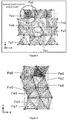
- FIG. 3 shows an a-axis projection view of the crystal structure of the ⁇ -form iron oxide obtained by the abovementioned Rietveld analysis.
- the ⁇ -form iron oxide has a spontaneous electric polarization in the crystal a-axis and c-axis directions, from a result of first-principles calculation performed to the ⁇ -form iron oxide of the present invention.
- the ⁇ -form iron oxide exhibits ferromagnetism at a room temperature from a result of a magnetic measurement using SQUID (superconducting quantum interference device for magnetism detection) of MPMS7 produced by Quantum Design Co., and therefore the ⁇ -form iron oxide has a magnetic polarization, and an angle formed with respect to the spontaneous electric polarization takes a value between 0° and 90°.
- SQUID superconducting quantum interference device for magnetism detection
- a unit cell of the crystal structure of the ⁇ -form iron oxide is composed of sixteen iron atoms and twenty-four oxygen atoms, and they are divided into non-equivalent eight kinds of iron sites (Fe1 to Fe8), and twelve kinds of oxygen sites (O1 to 012).
- FIG. 4 shows Fe1 to Fe3 sites, and Fe5 to Fe6 sites indicated by gray polyhedra, and a Fe4 site indicated by dark gray polyhedra (which is shown by surrounding it by a broken line.), and Fe7 and Fe8 sites indicated by gray polyhedra, in an a-axis projection view of the crystal structure of the ⁇ -form iron oxide according to the present invention.
- FIG. 5 and FIG. 6 show the crystal structure of the ⁇ -form iron oxide of the present invention indicated by a shadow similarly to FIG. 4 , in a b-axis projection view and a c-axis projection view.
- the Fe1 to Fe3 and the Fe5 to Fe6 sites have six coordinated structures, and the Fe site has a pentacoordinated structure, and the Fe7 and Fe8 sites have a tetracoordinated structure.
- FIG. 11 is a crystal structure view of ⁇ -form iron oxide having an orthorhombic crystal (space group Pna2 1 ) as the crystal structure
- FIG. 12 is a crystal structure view of the ⁇ -form iron oxide having a rhombohedral crystal (space group R-3c) as the crystal structure
- FIG. 13 is a crystal structure view of the ⁇ -form iron oxide having a cubic crystal (space group Fd-3m) as the crystal structure.
- FIG. 7 An electronic density of states shown in FIG. 7 , and a band dispersion shown in FIG. 8 , are obtained from the result of the first-principles calculation performed to the ⁇ -form iron oxide (monoclinic crystal structure, space group P1a1) of the present invention.
- FIG. 9 shows the electronic density of states of the ⁇ -form iron oxide (orthorhombic crystal structure, space group Pna2 1 ), and
- FIG. 10 shows the band dispersion thereof.
- the electronic density of states view shown in FIG. 7 and FIG. 9 shows a graph in which the horizontal axis indicates an electronic density of states, and the vertical axis indicates energy.
- the broken line at a position of energy 0 eV indicates a Fermi-level, and there is a valence band mainly composed of an oxygen 2p orbital (O2p) in a part lower than the Fermi level, and there is a conduction band mainly composed of an iron 3d orbital (Fe3d) in an upper part thereof.
- the right side shows ⁇ spin
- the left side shows ⁇ spin in the electronic density of states.
- the spin of the oxygen 2p orbital is indicated by a gray thick solid line
- the spin of the iron 3d orbital is indicated by a black thick solid line
- a total value of the spin of the oxygen 2p orbital and the spin of the iron 3d orbital is indicated by a black thin solid line.
- the band composed of the iron 3d orbital (Fe3d) at a low energy side of the band mainly composed of the ⁇ -form iron oxide, in an ⁇ spin region of the conduction band. Then, it is found that the band is derived from the Fe8 site having the tetracoordinated structure adjacent to the abovementioned Fe4 site having the pentacoordinated structure, and it is considered that the electronic state of the Fe8 site having the tetracoordinated structure, is affected by the Fe4 site having the pentacoordinated structure.
- Fe3d iron 3d orbital
- the band dispersion near the Fermi level shown in FIG. 8 and FIG. 10 are graphs in which the horizontal axis indicates a Brillouin zone, and the vertical axis indicates energy.
- the broken line at a position of the energy 0 eV indicates the Fermi level.
- ⁇ spin' is indicated by a thin solid line
- ⁇ spin is indicated by a thin dot line
- a transition with a smallest energy in a direct transition an electron transition excited by a right circularly polarized light, namely, only the right circularly polarized light is absorbed
- a transition with a smallest energy in a direct transition an electron transition excited by a left circularly polarized light, namely, only the left circularly polarized light is absorbed
- a transition with a smallest energy in a direct transition an electron transition excited by a left circularly polarized light, namely, only the left circularly polarized light is absorbed
- a band gap from the ⁇ spin to the ⁇ spin is 1.0 eV (1240nm) and small, and in contrast, a band gap from the ⁇ spin to the ⁇ spin is 2.1 eV (590 nm) and large, and it is conceivable that the ⁇ -form iron oxide has an electronic structure similar to that of the half-metal. Accordingly, the ⁇ -form iron oxide of the present invention is considered to exhibit a performance as the half-metal.
- an optical isolator performance is exhibited, for example, for a light with a wavelength in the vicinity of 1.24 ⁇ m where a transition probability is great.
- a material having a new property such as a high magnetization and high coercivity and having a property of the half-metal
- a material having a new property such as a high magnetization and high coercivity and having a property of the half-metal
- the ⁇ -form iron oxide shown in FIG. 10 has an electronic structure of a normal charge-transfer form insulator. Then, the band gap from the ⁇ spin to the ⁇ spin is 2.7 eV (460 nm), and the band gap from the ⁇ spin to the ⁇ spin is 2.5 eV (500 nm), and there is almost no difference between them.
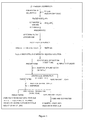
- FIG. 1 is a flowchart of the steps of a method for producing the magnetic iron oxide nanopowder according to the present invention.
- ⁇ -FeO(OH) nanoparticles iron oxide hydroxide (III) having an average particle size of 15 nm or less, and pure water, to thereby prepare a dispersion in which a conversion concentration of iron (Fe) is 0.01 mol/L or more, and 1 mol/L or less.
- 0.5 to 15 mols of a silicon compound per 1 mol of the ⁇ -FeO(OH) nanoparticles is added by dropwise to the dispersion in which the ammonia is added, and the mixture is stirred for 15 hours or more and 30 hours or less, and thereafter is allowed to be cooled to a room temperature.
- the separated precipitate is collected and washed by pure water, and thereafter dried at about 60°C. Further, the dried precipitate is pulverized to obtain a pulverized powder.
- Heat treatment of 900°C or more, less than 1200°C, preferably 950°C or more, and 1150°C or less is applied to the pulverized powder for 0.5 to 10 hours, and preferably 2 to 5 hours in an oxidizing atmosphere, to thereby obtain a heat-treated powder.
- Use of the air is allowed as the oxidizing atmosphere, and use of the air is preferable from a viewpoint of workability and a cost.
- the obtained heat-treated powder is subjected to a deagglomeration treatment, and thereafter is added into a sodium hydroxide aqueous solution (NaOH) as a strong alkaline solution with a liquid temperature of 60°C or more and 70°C or less, and the mixture is stirred for 15 hours or more and 30 hours or less, and preferably 20 hours or more and 26 hours or less so that silicon oxide is removed from the heat-treated powder, to thereby generate an aqueous dispersion of iron oxide magnetic nanoparticles.
- NaOH sodium hydroxide aqueous solution
- the generated aqueous dispersion of the iron oxide nano-magnetic particles is subjected to a centrifugal separation operation (first time), to be separated into the precipitate and a supernatant liquid.
- first time the precipitate
- second time the centrifugal separation operation
- pure water is added to the precipitate (second time) so that the precipitate is dispersed therein, and thereafter the centrifugal separation operation (third time) is performed again.
- the centrifugal separation is repeated twice or more and preferably three times or more. At this time, the number of rotation of the centrifugal separation is preferably set to 5,000 rpm or more and 15,000 rpm or less.
- the supernatant liquid obtained by the final centrifugal separation is dried and evaporated, to thereby obtain the magnetic ⁇ -form iron oxide nanopowder of the present invention.
- the magnetic iron oxide nanopowder with an average particle size of 15 nm or less can be obtained from the precipitate obtained by the final centrifugal separation operation, as the magnetic ⁇ -form iron oxide nanopowder.
- the magnetic ⁇ -form iron oxide nanopowder can be easily synthesized.
- the magnetic ⁇ -form iron oxide nanopowder of the present invention is expected in an industrial application for the purpose of various purposes of use, from a viewpoint of easiness of a synthesis method or a safety and a stability of the material.
- aqueous ammonia solution 19.2 mL was added thereto by dropwise, and the mixture was stirred at 50°C for 30 minutes. Further, tetraethoxysilane (TEOS) 24mL was dropped to the dispersion as a silicon compound, and the mixture was stirred at 50°C for 20 hours, and thereafter allowed to be cooled to a room temperature. When the dispersion was cooled to the room temperature, ammonium sulfate 20g was added thereto, and a precipitate was separated.
- TEOS tetraethoxysilane
- the separated precipitate was collected by centrifugation.
- the collected precipitate was washed by pure water, and transferred to a petri dish and dried in a drier at 60°C, and thereafter pulverized in an agate mortar, to thereby obtain a pulverized powder.
- the pulverized powder was put in a furnace, and a heat treatment was applied thereto in the atmosphere, at 1061°C, for 4 hours.
- the obtained heat-treated powder was deagglomerated in the agate mortar, and thereafter stirred at a liquid temperature of 65°C, for 24 hours in a 5 mols/L sodium hydroxide (NaOH) aqueous solution so that silicon oxide was removed from the heat-treated powder, to thereby obtain a dispersion aqueous solution of Fe 2 O 3 nanoparticles.
- NaOH sodium hydroxide
- the centrifugal separation operation (first time) was performed to the generated dispersion aqueous solution of Fe 2 O 3 nanoparticles at 5,000 rpm (rpm: rotation per minute) for 10 minutes, to thereby separate the precipitate and a supernatant liquid.
- pure water was added to the precipitate (first time) so that the precipitate was dispersed therein, and thereafter the centrifugal separation operation (second time) was performed thereto at 10,000 rpm for 5 minutes, to thereby separate the precipitate and the supernatant liquid.
- FIG. 2 shows data of the obtained magnetic ⁇ -form iron oxide nanopowder, obtained by X-ray diffraction measurement (XRD) and Rietveld analysis.
- FIG. 3 is an a-axis projection view of the crystal structure of the ⁇ -form iron oxide obtained by the result of the Rietveld analysis.
- FIG. 7 shows electronic density of states obtained by the result of a first-principles calculation
- FIG. 8 shows a band dispersion.
Landscapes
- Chemical & Material Sciences (AREA)
- Organic Chemistry (AREA)
- Engineering & Computer Science (AREA)
- Power Engineering (AREA)
- Inorganic Chemistry (AREA)
- Compounds Of Iron (AREA)
- Hard Magnetic Materials (AREA)
- Magnetic Record Carriers (AREA)
- Manufacturing Of Magnetic Record Carriers (AREA)
Abstract
Description
- The present invention relates to a novel magnetic iron oxide nanopowder (referred to as "σ-form iron oxide", "magnetic σ-form iron oxide nanopowder", and "σ-Fe2O3" in some cases in the present invention.), and a method for producing the same.
- Inventors of the present invention obtains ε-Fe2O3 phase, by a chemical nanoparticle synthesis method using a reverse micelle method and a sol-gel method. It is found that the obtained ε-Fe2O3 phase exhibits a huge coercive force of 20 kOe (1.59 × 10⁶ A/m) at a room temperature, and it is also found that this ε-Fe2O3 phase has an enormous magnetic anisotropy.
- The inventors of the present invention also discloses a magnetic powder having a metal-substituted ε-MxFe(2-x)O3 phase as
patent document 1, and discloses a magnetic material composed of ε-GaxFe2-xO3 crystal in which a part of a Fe3+ ion site of the ε-Fe2O3 crystal is substituted by Ga3+ ion, aspatent document 2. -
- Patent document 1: Japanese Patent Laid Open Publication No.
2008-174405 - Patent document 2: Japanese Patent Laid Open Publication No.
2007-269548 - In recent years, the development of a material with physical properties such as magnetic polarization and spontaneous electric polarization and properties similar to those of half-metals, is desired in a market, from a viewpoint of energy-saving recording, and from a viewpoint of a development of high-performance magnets.
- As described above, the inventors of the present invention have studied on a technique of producing magnetic ε-form iron oxide nanopowder (ε-Fe2O3), and disclose it by a variety of presentations and applications (for example, see
patent documents 1 and 2). - Then, after further research to show that the magnetic ε-form iron oxide nanopowder has a shape with a large aspect ratio, the inventors of the present invention obtains a knowledge regarding the magnetic σ-form iron oxide nanopowder as a novel magnetic iron oxide nanopowder having properties such as magnetic polarization and spontaneous electric polarization and properties similar to those of half-metals.
- Under the abovementioned circumstance, the present invention is provided and an object of the present invention is to provide the magnetic σ-form iron oxide nanopowder as a novel magnetic iron oxide nanopowder with physical properties such as magnetic polarization and spontaneous electric polarization and properties similar to those of half-metals, and a method of producing the same.
- In order to solve the above-described problems, strenuous efforts are made by the inventors of the present invention. As a result, it is found that magnetic σ-form iron oxide nanopowder is generated when magnetic iron oxide nanopowder having ε-Fe2O3 phase of a single phase is generated by using β-FeO(OH) (iron oxide hydroxide (III)) nanoparticles as a starting material, and covering the β-FeO(OH) nanoparticles by silicon oxide, and thereafter applying heat treatment thereto in an oxidizing atmosphere.
- Here, the inventors of the present invention observe XRD of the generated magnetic σ-form iron oxide nanopowder, and analyze a crystal structure and a property of the magnetic σ-form iron oxide nanopowder by performing a Rietveld analysis and the first-principles calculation.
- Namely, according to a first aspect of the invention, there is provided a magnetic powder whose composition is Fe2O3, and whose crystal structure belongs to a monoclinic system.
- According to a second aspect of the present invention, there is provided a magnetic powder whose composition is Fe2O3, and whose crystal structure belongs to a simple lattice (P) of a monoclinic system.
- According to a third aspect of the present invention, there is provided a magnetic powder whose composition is Fe2O3, and having a Fe coordination site of a pentacoordinated structure in a crystal structure.
- According to a fourth aspect of the present invention, there is provided a magnetic powder whose composition is Fe2O3, and having a magnetic polarization and a spontaneous electric polarization at a room temperature wherein an angle formed by the magnetic polarization with respect to the spontaneous electric polarization takes a value between 0° and 90°.
- According to a fifth aspect of the present invention, there is provided a magnetic powder whose composition is Fe2O3, wherein only circularly polarized excitation of one side of right and left circularly polarized excitations can be enabled in a near infrared region from a visible region.
- According to a sixth aspect of the present invention, there is provided a magnetic powder whose composition is Fe2O3, wherein an energy difference between right and left circularly polarized lights is 0.5 eV or more, and a lower energy value of the right and left circularly polarized energies is 1.5 eV or less.
- According to a seventh aspect of the present invention, there is provided the magnetic powder of any one of the first to sixth aspects, which is used for producing a composite magnet or a core-shell magnet.
- According to an eighth aspect of the present invention, there is provided a method for producing a magnetic powder, to obtain magnetic σ-form iron oxide nanopowder by using β-FeO(OH) (iron oxide hydroxide (III)) nano-particle dispersion, and by covering the β-FeO(OH) nano-particle with silicon oxide, and thereafter applying heat treatment in an oxidizing atmosphere, and applying centrifugation thereto, and drying and evaporating a supernatant liquid.
- The novel magnetic σ-form iron oxide nanopowder of the present invention is considered to have an electronic structure similar to that of a half-metal, and considered to exhibit a performance as the half-metal.
-
-
FIG. 1 is a flow chart of the steps of a method for producing magnetic σ-form iron oxide nanopowder. -
FIG. 2 is a graph showing an XRD pattern and a Rietveld analysis of the magnetic σ-form iron oxide nanopowder. -
FIG. 3 is an a-axis projection view of a crystal structure of σ-form iron oxide. -
FIG. 4 shows a Fe-site indicated by polyhedra in the a-axis projection view of the crystal structure of the σ-form iron oxide. -
FIG. 5 shows a Fe-site indicated by polyhedra in a b-axis projection view of the crystal structure of the σ-form iron oxide. -
FIG. 6 shows a Fe-site indicated by polyhedra in a c-axis projection view of the crystal structure of the σ-form iron oxide. -
FIG. 7 shows an electronic density of states of the σ-form iron oxide. -
FIG. 8 shows a band dispersion of the σ-form iron oxide. -
FIG. 9 shows an electronic density of states of the ε-form iron oxide. -
FIG. 10 shows a band dispersion of the ε-form iron oxide. -
FIG. 11 is a schematic view showing a coordinated structure of a ε-Fe2O3 phase. -
FIG. 12 is a schematic view showing a coordinated structure of a α-Fe2O3 phase. -
FIG. 13 is a schematic view showing a coordinated structure of a γ-Fe2O3 phase. - Explanation will be given for magnetic σ-form iron oxide nanopowder of the present invention having a new structure.
-
FIG. 2 is a conceptual view showing an XRD pattern and a Rietveld analysis of the magnetic σ-form iron oxide nanopowder, in which black dots indicate an actually measured XRD intensity. When carrying out calculation using the crystal structure of the σ-form iron oxide, the XRD intensity is calculated as shown by a black solid line, and there is almost no difference from an actually measured value, and it is confirmed that this is Fe2O3 having a monoclinic crystal structure as described later (gray solid line indicates a residual difference between the actually measured value and the calculated value of the XRD intensity.). Black bar indicates Bragg peak positions of the magnetic σ-form iron oxide nanopowder. -
FIG. 3 shows an a-axis projection view of the crystal structure of the σ-form iron oxide obtained by the abovementioned Rietveld analysis. - The σ-form iron oxide shown in
FIG. 3 has the crystal structure of a monoclinic system belonging to a simple lattice (P), and a space group of a structure obtained by.the Rietveld analysis is P1a1, lattice constants are a = 5.0995Å, b = 8.7980 Å, c = 9.4910 Å, and β angle = 90.60 °. It is found that the crystal structure has broken inversion symmetry. The σ-form iron oxide has a spontaneous electric polarization in the crystal a-axis and c-axis directions, from a result of first-principles calculation performed to the σ-form iron oxide of the present invention. Further, it is confirmed that the σ-form iron oxide exhibits ferromagnetism at a room temperature from a result of a magnetic measurement using SQUID (superconducting quantum interference device for magnetism detection) of MPMS7 produced by Quantum Design Co., and therefore the σ-form iron oxide has a magnetic polarization, and an angle formed with respect to the spontaneous electric polarization takes a value between 0° and 90°. - A unit cell of the crystal structure of the σ-form iron oxide is composed of sixteen iron atoms and twenty-four oxygen atoms, and they are divided into non-equivalent eight kinds of iron sites (Fe1 to Fe8), and twelve kinds of oxygen sites (O1 to 012).
- Here, in the crystal structure shown in
FIG. 3 , atoms other than an asymmetric unit is indicated by a faint shadow. -
FIG. 4 shows Fe1 to Fe3 sites, and Fe5 to Fe6 sites indicated by gray polyhedra, and a Fe4 site indicated by dark gray polyhedra (which is shown by surrounding it by a broken line.), and Fe7 and Fe8 sites indicated by gray polyhedra, in an a-axis projection view of the crystal structure of the σ-form iron oxide according to the present invention. -
FIG. 5 andFIG. 6 show the crystal structure of the σ-form iron oxide of the present invention indicated by a shadow similarly toFIG. 4 , in a b-axis projection view and a c-axis projection view. - Then, in
FIG. 4 to FIG. 6 , it is conceivable that the Fe1 to Fe3 and the Fe5 to Fe6 sites have six coordinated structures, and the Fe site has a pentacoordinated structure, and the Fe7 and Fe8 sites have a tetracoordinated structure. - It should be noted that, for comparison,
FIG. 11 is a crystal structure view of ε-form iron oxide having an orthorhombic crystal (space group Pna21) as the crystal structure, andFIG. 12 is a crystal structure view of the α-form iron oxide having a rhombohedral crystal (space group R-3c) as the crystal structure, andFIG. 13 is a crystal structure view of the γ-form iron oxide having a cubic crystal (space group Fd-3m) as the crystal structure. - An electronic density of states shown in
FIG. 7 , and a band dispersion shown inFIG. 8 , are obtained from the result of the first-principles calculation performed to the σ-form iron oxide (monoclinic crystal structure, space group P1a1) of the present invention. For comparison,FIG. 9 shows the electronic density of states of the ε-form iron oxide (orthorhombic crystal structure, space group Pna21), andFIG. 10 shows the band dispersion thereof. - The electronic density of states view shown in
FIG. 7 andFIG. 9 shows a graph in which the horizontal axis indicates an electronic density of states, and the vertical axis indicates energy. - The broken line at a position of
energy 0 eV indicates a Fermi-level, and there is a valence band mainly composed of anoxygen 2p orbital (O2p) in a part lower than the Fermi level, and there is a conduction band mainly composed of aniron 3d orbital (Fe3d) in an upper part thereof. Then, the right side shows α spin, and the left side shows β spin in the electronic density of states. - Here, in
FIG. 7 andFIG. 9 , the spin of theoxygen 2p orbital is indicated by a gray thick solid line, and the spin of theiron 3d orbital is indicated by a black thick solid line, and a total value of the spin of theoxygen 2p orbital and the spin of theiron 3d orbital is indicated by a black thin solid line. - Then, it is found that in both of the σ-form iron oxide and the ε-form iron oxide, as described above, there is the band mainly composed of the
oxygen 2p orbital (O2p) in the valence band, and there is the band mainly composed of theiron 3d orbital (Fe3d) in the conduction band. - However, in the σ-form iron oxide shown in
FIG. 7 , there is the band composed of theiron 3d orbital (Fe3d) at a low energy side of the band mainly composed of the σ-form iron oxide, in an α spin region of the conduction band. Then, it is found that the band is derived from the Fe8 site having the tetracoordinated structure adjacent to the abovementioned Fe4 site having the pentacoordinated structure, and it is considered that the electronic state of the Fe8 site having the tetracoordinated structure, is affected by the Fe4 site having the pentacoordinated structure. - On the other hand, in the ε-form iron oxide shown in
FIG. 9 , such a band is not observed. - The band dispersion near the Fermi level shown in
FIG. 8 andFIG. 10 , are graphs in which the horizontal axis indicates a Brillouin zone, and the vertical axis indicates energy. The broken line at a position of theenergy 0 eV indicates the Fermi level. - In the band dispersion, α spin'is indicated by a thin solid line, and β spin is indicated by a thin dot line.
- Then, a transition with a smallest energy in a direct transition (an electron transition excited by a right circularly polarized light, namely, only the right circularly polarized light is absorbed) of the α spin to the conduction band from the α spin of the valence band, is indicated by a solid line arrow, and a transition with a smallest energy in a direct transition (an electron transition excited by a left circularly polarized light, namely, only the left circularly polarized light is absorbed) of the β spin to the conduction band from the β spin of the valence band, is indicated by a broken line arrow.
- In the σ-form iron oxide shown in
FIG. 8 , a band gap from the α spin to the α spin is 1.0 eV (1240nm) and small, and in contrast, a band gap from the β spin to the β spin is 2.1 eV (590 nm) and large, and it is conceivable that the σ-form iron oxide has an electronic structure similar to that of the half-metal. Accordingly, the σ-form iron oxide of the present invention is considered to exhibit a performance as the half-metal. - As a result, it is conceivable that only one of the right and left circularly polarized excitations, is enabled by the σ-form iron oxide of the present invention, in a range from the visible region to the near infrared region. Specifically, it is found that an energy difference between the right and left circularly polarized lights is 0.5 eV or more, and a lower energy value of the right and left circularly polarized energies is 1.5 eV or less.
- Then, for example, it is expected that an optical isolator performance is exhibited, for example, for a light with a wavelength in the vicinity of 1.24 µm where a transition probability is great.
- It is also conceivable that a material having a new property such as a high magnetization and high coercivity and having a property of the half-metal, can be found by combining the σ-form iron oxide which is a pyroelectric magnetic material and having the property of the half-metal, and a magnetic material having a different property like a high magnetization soft magnetic material, thereby producing a composite magnet or a core-shell magnet.
- In contrast, the ε-form iron oxide shown in
FIG. 10 has an electronic structure of a normal charge-transfer form insulator. Then, the band gap from the α spin to the α spin is 2.7 eV (460 nm), and the band gap from the β spin to the β spin is 2.5 eV (500 nm), and there is almost no difference between them. - Here, an example of the method for producing the magnetic iron oxide nanopowder, will be described, with reference to
FIG. 1 , which is a flowchart of the steps of a method for producing the magnetic iron oxide nanopowder according to the present invention. - By mixing β-FeO(OH) nanoparticles (iron oxide hydroxide (III)) having an average particle size of 15 nm or less, and pure water, to thereby prepare a dispersion in which a conversion concentration of iron (Fe) is 0.01 mol/L or more, and 1 mol/L or less.
- 3 to 30 moles of ammonia per 1 mol of the iron oxide hydroxide (III) is added to the dispersion by dropwise of aqueous ammonia, and the mixture is stirred at 0 to 100°C, and preferably at 20 to 60°C.
- Further, 0.5 to 15 mols of a silicon compound per 1 mol of the β-FeO(OH) nanoparticles, is added by dropwise to the dispersion in which the ammonia is added, and the mixture is stirred for 15 hours or more and 30 hours or less, and thereafter is allowed to be cooled to a room temperature.
- 1 to 30 moles of ammonium sulfate per 1 mole of the β-FeO(OH) nanoparticles is added to the cooled dispersion, so that a precipitate is separated.
- The separated precipitate is collected and washed by pure water, and thereafter dried at about 60°C. Further, the dried precipitate is pulverized to obtain a pulverized powder.
- Heat treatment of 900°C or more, less than 1200°C, preferably 950°C or more, and 1150°C or less is applied to the pulverized powder for 0.5 to 10 hours, and preferably 2 to 5 hours in an oxidizing atmosphere, to thereby obtain a heat-treated powder. Use of the air is allowed as the oxidizing atmosphere, and use of the air is preferable from a viewpoint of workability and a cost.
- The obtained heat-treated powder is subjected to a deagglomeration treatment, and thereafter is added into a sodium hydroxide aqueous solution (NaOH) as a strong alkaline solution with a liquid temperature of 60°C or more and 70°C or less, and the mixture is stirred for 15 hours or more and 30 hours or less, and preferably 20 hours or more and 26 hours or less so that silicon oxide is removed from the heat-treated powder, to thereby generate an aqueous dispersion of iron oxide magnetic nanoparticles.
- Subsequently, the generated aqueous dispersion of the iron oxide nano-magnetic particles is subjected to a centrifugal separation operation (first time), to be separated into the precipitate and a supernatant liquid. Then, the precipitate (first time) is collected, and pure water is added thereto so that the precipitate is dispersed therein and thereafter the centrifugal separation operation (second time) is performed again, to thereby collect a precipitate (second time). Further, if desired, pure water is added to the precipitate (second time) so that the precipitate is dispersed therein, and thereafter the centrifugal separation operation (third time) is performed again. Namely, the centrifugal separation is repeated twice or more and preferably three times or more. At this time, the number of rotation of the centrifugal separation is preferably set to 5,000 rpm or more and 15,000 rpm or less.
- Then, the supernatant liquid obtained by the final centrifugal separation is dried and evaporated, to thereby obtain the magnetic σ-form iron oxide nanopowder of the present invention.
- On the other hand, the magnetic iron oxide nanopowder with an average particle size of 15 nm or less can be obtained from the precipitate obtained by the final centrifugal separation operation, as the magnetic ε-form iron oxide nanopowder.
- According to the present invention, the magnetic σ-form iron oxide nanopowder can be easily synthesized.
- In addition, the magnetic σ-form iron oxide nanopowder of the present invention is expected in an industrial application for the purpose of various purposes of use, from a viewpoint of easiness of a synthesis method or a safety and a stability of the material.
- The present invention will be described hereafter, with reference to examples.
- (Procedure 1) Pure water 420mL and a sol 8.0 g of the β-FeO(OH) nanoparticles (iron oxide hydroxide (III)) having an average particle size of 6 nm, were put in 1L Erlenmeyer flask, and the mixture was stirred until it was turned into a homogeneous dispersion.
- 25% aqueous ammonia solution 19.2 mL was added thereto by dropwise, and the mixture was stirred at 50°C for 30 minutes. Further, tetraethoxysilane (TEOS) 24mL was dropped to the dispersion as a silicon compound, and the mixture was stirred at 50°C for 20 hours, and thereafter allowed to be cooled to a room temperature. When the dispersion was cooled to the room temperature, ammonium sulfate 20g was added thereto, and a precipitate was separated.
- The separated precipitate was collected by centrifugation. The collected precipitate was washed by pure water, and transferred to a petri dish and dried in a drier at 60°C, and thereafter pulverized in an agate mortar, to thereby obtain a pulverized powder.
- The pulverized powder was put in a furnace, and a heat treatment was applied thereto in the atmosphere, at 1061°C, for 4 hours. The obtained heat-treated powder was deagglomerated in the agate mortar, and thereafter stirred at a liquid temperature of 65°C, for 24 hours in a 5 mols/L sodium hydroxide (NaOH) aqueous solution so that silicon oxide was removed from the heat-treated powder, to thereby obtain a dispersion aqueous solution of Fe2O3 nanoparticles.
- The centrifugal separation operation (first time) was performed to the generated dispersion aqueous solution of Fe2O3 nanoparticles at 5,000 rpm (rpm: rotation per minute) for 10 minutes, to thereby separate the precipitate and a supernatant liquid. Next, pure water was added to the precipitate (first time) so that the precipitate was dispersed therein, and thereafter the centrifugal separation operation (second time) was performed thereto at 10,000 rpm for 5 minutes, to thereby separate the precipitate and the supernatant liquid. Further, pure water was added to the precipitate (second time) so that the precipitate was dispersed therein, and the centrifugal separation operation (third time) was performed thereto at 14,000 rpm for 60 minutes, to thereby separate the precipitate and the supernatant liquid. Then, the supernatant liquid (third time) was dried and evaporated, to thereby obtain the magnetic σ-form iron oxide nanopowder of the present invention included in the supernatant liquid (third time).
-
FIG. 2 shows data of the obtained magnetic σ-form iron oxide nanopowder, obtained by X-ray diffraction measurement (XRD) and Rietveld analysis. - Further,
FIG. 3 is an a-axis projection view of the crystal structure of the σ-form iron oxide obtained by the result of the Rietveld analysis. - Further,
FIG. 7 shows electronic density of states obtained by the result of a first-principles calculation, andFIG. 8 shows a band dispersion.
Claims (8)
- A magnetic powder whose composition is Fe2O3, and whose crystal structure belongs to a monoclinic system.
- A magnetic powder whose composition is Fe2O3, and whose crystal structure belongs to a simple lattice (P) of a monoclinic system.
- A magnetic powder whose composition is Fe2O3, and having a Fe coordination site of a pentacoordinated structure in a crystal structure.
- A magnetic powder whose composition is Fe2O3, and having a magnetic polarization and a spontaneous electric polarization at a room temperature wherein an angle formed by the magnetic polarization with respect to the spontaneous electric polarization takes a value between 0° and 90°.
- A magnetic powder whose composition is Fe2O3, wherein only circularly polarized excitation of one side of right and left circularly polarized excitations can be enabled in a near infrared region from a visible region.
- A magnetic powder whose composition is Fe2O3, wherein an energy difference between right and left circularly polarized lights is 0.5 eV or more, and a lower energy value of the right and left circularly polarized energies is 1.5 eV or less.
- The magnetic powder according to any one of claims 1 to 6, which is used for producing a composite magnet or a core-shell magnet.
- A method for producing a magnetic powder, to obtain magnetic σ-form iron oxide nanopowder by using β-FeO(OH) (iron oxide hydroxide (III)) nano-particle dispersion, and by covering the β-FeO(OH) nano-particle with silicon oxide, and thereafter applying heat treatment in an oxidizing atmosphere, and applying centrifugation thereto, and drying and evaporating a supernatant liquid.
Applications Claiming Priority (3)
| Application Number | Priority Date | Filing Date | Title |
|---|---|---|---|
| JP2014124948 | 2014-06-18 | ||
| JP2015062084 | 2015-03-25 | ||
| PCT/JP2015/067669 WO2015194650A1 (en) | 2014-06-18 | 2015-06-18 | Magnetic iron oxide nanopowder and process for producing same |
Publications (2)
| Publication Number | Publication Date |
|---|---|
| EP3159898A1 true EP3159898A1 (en) | 2017-04-26 |
| EP3159898A4 EP3159898A4 (en) | 2018-03-14 |
Family
ID=54935624
Family Applications (1)
| Application Number | Title | Priority Date | Filing Date |
|---|---|---|---|
| EP15808905.2A Withdrawn EP3159898A4 (en) | 2014-06-18 | 2015-06-18 | Magnetic iron oxide nanopowder and process for producing same |
Country Status (5)
| Country | Link |
|---|---|
| US (1) | US10099941B2 (en) |
| EP (1) | EP3159898A4 (en) |
| JP (1) | JP6556714B2 (en) |
| CN (1) | CN106463224B (en) |
| WO (2) | WO2015194650A1 (en) |
Families Citing this family (11)
| Publication number | Priority date | Publication date | Assignee | Title |
|---|---|---|---|---|
| WO2019187356A1 (en) * | 2018-03-29 | 2019-10-03 | 国立大学法人東京大学 | Recording method, recording device, reproduction method, reproduction device, and high-speed response element |
| WO2019187333A1 (en) | 2018-03-30 | 2019-10-03 | ソニー株式会社 | Magnetic recording medium |
| CN108538632B (en) * | 2018-04-18 | 2020-01-17 | 中南大学 | A kind of iron oxyhydroxide electrode and its preparation method and application |
| US11790942B2 (en) | 2019-08-20 | 2023-10-17 | International Business Machines Corporation | Process for forming magnetic recording layer for tape media |
| US12014760B2 (en) | 2019-08-20 | 2024-06-18 | International Business Machines Corporation | Process for forming tape media having synergistic magnetic recording layer and underlayer |
| US11152027B2 (en) | 2019-08-20 | 2021-10-19 | International Business Machines Corporation | Tape media having synergistic magnetic recording layer and underlayer |
| US11158340B2 (en) | 2019-08-20 | 2021-10-26 | International Business Machines Corporation | Underlayer formulation for tape media |
| US11158339B2 (en) | 2019-08-20 | 2021-10-26 | International Business Machines Corporation | Magnetic recording layer formulation for tape media |
| US11158337B2 (en) | 2019-08-20 | 2021-10-26 | International Business Machines Corporation | Tape cartridge having tape media having synergistic magnetic recording layer and underlayer |
| US11410697B2 (en) | 2019-08-20 | 2022-08-09 | International Business Machines Corporation | Process for forming underlayer for tape media |
| JP2026085799A (en) * | 2024-11-13 | 2026-05-25 | 株式会社illuminus | Method for producing precursor fine particles, method for producing ε-type ferric oxide fine particles, and precursor fine particles |
Family Cites Families (7)
| Publication number | Priority date | Publication date | Assignee | Title |
|---|---|---|---|---|
| JPH1027705A (en) | 1996-07-10 | 1998-01-27 | Sony Corp | Iron oxide-based magnetic powder and magnetic recording medium using the same |
| JP5013505B2 (en) | 2006-03-31 | 2012-08-29 | 国立大学法人 東京大学 | Magnetic material |
| JP5124825B2 (en) | 2006-09-08 | 2013-01-23 | 国立大学法人 東京大学 | ε Iron oxide based magnetic material |
| JP5142354B2 (en) | 2007-01-16 | 2013-02-13 | 国立大学法人 東京大学 | ε-Fe2O3 crystal manufacturing method |
| JP5460980B2 (en) | 2008-07-09 | 2014-04-02 | 住友化学株式会社 | Process for producing transition metal phosphate |
| CN102089239A (en) * | 2008-07-09 | 2011-06-08 | 住友化学株式会社 | Transition metal phosphate, its preparation method, positive electrode and sodium secondary battery |
| JP5769223B2 (en) * | 2009-10-22 | 2015-08-26 | 戸田工業株式会社 | Ferromagnetic particle powder and production method thereof, anisotropic magnet and bonded magnet |
-
2015
- 2015-06-18 WO PCT/JP2015/067669 patent/WO2015194650A1/en not_active Ceased
- 2015-06-18 CN CN201580031492.3A patent/CN106463224B/en not_active Expired - Fee Related
- 2015-06-18 US US15/318,783 patent/US10099941B2/en not_active Expired - Fee Related
- 2015-06-18 EP EP15808905.2A patent/EP3159898A4/en not_active Withdrawn
- 2015-06-18 WO PCT/JP2015/067664 patent/WO2015194647A1/en not_active Ceased
- 2015-06-18 JP JP2016529530A patent/JP6556714B2/en not_active Expired - Fee Related
Also Published As
| Publication number | Publication date |
|---|---|
| CN106463224B (en) | 2018-11-06 |
| US10099941B2 (en) | 2018-10-16 |
| JPWO2015194650A1 (en) | 2017-04-20 |
| CN106463224A (en) | 2017-02-22 |
| WO2015194647A1 (en) | 2015-12-23 |
| WO2015194650A1 (en) | 2015-12-23 |
| US20170137302A1 (en) | 2017-05-18 |
| JP6556714B2 (en) | 2019-08-07 |
| EP3159898A4 (en) | 2018-03-14 |
Similar Documents
| Publication | Publication Date | Title |
|---|---|---|
| US10099941B2 (en) | Magnetic iron oxide nanopowder and process for producing the same | |
| Ashraf et al. | Magnetic and optical properties of Gd-Tl substituted M-type barium hexaferrites synthesized by co-precipitation technique | |
| Zhou et al. | Hydrothermal synthesis and magnetic properties of multiferroic rare-earth orthoferrites | |
| Abdel-Khalek et al. | Study the oxygen vacancies and Fe oxidation states in CaFeO3-δ perovskite nanomaterial | |
| Dass et al. | Multiple magnetic phases of La 2 CoMnO 6− δ (0<~ δ<~ 0. 0 5) | |
| Rekha et al. | Systematic study on surface and magnetostructural changes in Mn-substituted dysprosium ferrite by hydrothermal method | |
| Drofenik et al. | Hydrothermal synthesis of Ba‐hexaferrite nanoparticles | |
| Esmaili et al. | The effect of Nd and Zr co-substitution on structural, magnetic and photocatalytic properties of Bi1-xNdxFe1-xZrxO3 nanoparticles | |
| Li et al. | Mg-substitution for promoting magnetic and ferroelectric properties of BiFeO3 multiferroic nanoparticles | |
| Shobana et al. | Photocatalytic and magnetic properties of Mg substituted cobalt ferrite | |
| Nguyen et al. | The characterization of nanosized ZnFe2O4 material prepared by coprecipitation | |
| Kumar et al. | Structural, magnetic, and photoluminescence properties of BiFeO3: Er-doped nanoparticles prepared by sol-gel technique | |
| Wu et al. | Crystal structure, morphological, ferromagnetic properties and photocatalytic properties of Mn-doped BiFeO3 nanoparticles | |
| Tien et al. | Effect of Co doping at the Ho–and Fe–sites on the structural, optical and magnetic properties of HoFeO3 nanoparticles synthesized by co–precipitation method | |
| Zhu et al. | Preparation and characterization of Zn1-xNixFe2O4 nanoparticles with spinel structure synthesized by hydrothermal method | |
| Dhak et al. | Hydrothermal synthesis, structural analysis and room-temperature ferromagnetism of Y2O3: Co2+ nanorods | |
| Thongjamroon et al. | Dependence of the magnetic properties of the dilute magnetic semiconductor Zn1− xMnxO nanorods on their Mn doping levels | |
| Iqbal et al. | Mössbauer and magnetic study of Mn, Zr and Cd substituted W-type hexaferrites prepared by co-precipitation | |
| Uskoković et al. | Synthesis of lanthanum-strontium manganites by a hydroxide-precursor co-precipitation method in solution and in reverse micellar microemulsion | |
| Udhayakumar | Mössbauer analysis, structural parameter studies and magnetic properties of LiCoxFe5-xO8 (x= 0, 0.025, 0.05, 0.075, 0.1) nanoparticles | |
| Troyanchuk et al. | Magnetic ordering in Ln 0.7 Sr0. 3Mn0. 85Sb0. 15O3 (Ln= La, Nd, Sm, Eu) | |
| Le Ngoc et al. | Structural, optical and magnetic properties of CoFe2–xEuxO4 nanoparticles prepared by simple co-precipitation route | |
| Smitha et al. | Mössbauer studies and magnetic properties of spinel lead ferrite | |
| Pazhanivelu et al. | Zn interstitial defects induced magnetic nature in Fe ions doped ZnO based DMS | |
| Wang et al. | Structural and magnetic properties of Lu doped SrFe12O19 ferrites |
Legal Events
| Date | Code | Title | Description |
|---|---|---|---|
| STAA | Information on the status of an ep patent application or granted ep patent |
Free format text: STATUS: THE INTERNATIONAL PUBLICATION HAS BEEN MADE |
|
| PUAI | Public reference made under article 153(3) epc to a published international application that has entered the european phase |
Free format text: ORIGINAL CODE: 0009012 |
|
| STAA | Information on the status of an ep patent application or granted ep patent |
Free format text: STATUS: REQUEST FOR EXAMINATION WAS MADE |
|
| 17P | Request for examination filed |
Effective date: 20170113 |
|
| AK | Designated contracting states |
Kind code of ref document: A1 Designated state(s): AL AT BE BG CH CY CZ DE DK EE ES FI FR GB GR HR HU IE IS IT LI LT LU LV MC MK MT NL NO PL PT RO RS SE SI SK SM TR |
|
| AX | Request for extension of the european patent |
Extension state: BA ME |
|
| DAV | Request for validation of the european patent (deleted) | ||
| DAX | Request for extension of the european patent (deleted) | ||
| A4 | Supplementary search report drawn up and despatched |
Effective date: 20180212 |
|
| RIC1 | Information provided on ipc code assigned before grant |
Ipc: H01F 1/11 20060101AFI20180206BHEP Ipc: G11B 5/714 20060101ALI20180206BHEP Ipc: G11B 5/706 20060101ALI20180206BHEP Ipc: C01G 49/06 20060101ALI20180206BHEP Ipc: G11B 5/84 20060101ALI20180206BHEP |
|
| STAA | Information on the status of an ep patent application or granted ep patent |
Free format text: STATUS: EXAMINATION IS IN PROGRESS |
|
| 17Q | First examination report despatched |
Effective date: 20210224 |
|
| STAA | Information on the status of an ep patent application or granted ep patent |
Free format text: STATUS: THE APPLICATION HAS BEEN WITHDRAWN |
|
| 18W | Application withdrawn |
Effective date: 20210810 |