EP3155403B1 - Verfahren zur optimierung einer mischung von bestandteilen durch spektralanalyse - Google Patents
Verfahren zur optimierung einer mischung von bestandteilen durch spektralanalyse Download PDFInfo
- Publication number
- EP3155403B1 EP3155403B1 EP15727664.3A EP15727664A EP3155403B1 EP 3155403 B1 EP3155403 B1 EP 3155403B1 EP 15727664 A EP15727664 A EP 15727664A EP 3155403 B1 EP3155403 B1 EP 3155403B1
- Authority
- EP
- European Patent Office
- Prior art keywords
- spectral
- target product
- spectral data
- component
- components
- Prior art date
- Legal status (The legal status is an assumption and is not a legal conclusion. Google has not performed a legal analysis and makes no representation as to the accuracy of the status listed.)
- Active
Links
Images





Classifications
-
- G—PHYSICS
- G05—CONTROLLING; REGULATING
- G05D—SYSTEMS FOR CONTROLLING OR REGULATING NON-ELECTRIC VARIABLES
- G05D11/00—Control of flow ratio
- G05D11/02—Controlling ratio of two or more flows of fluid or fluent material
- G05D11/13—Controlling ratio of two or more flows of fluid or fluent material characterised by the use of electric means
- G05D11/139—Controlling ratio of two or more flows of fluid or fluent material characterised by the use of electric means by measuring a value related to the quantity of the individual components and sensing at least one property of the mixture
-
- G—PHYSICS
- G01—MEASURING; TESTING
- G01N—INVESTIGATING OR ANALYSING MATERIALS BY DETERMINING THEIR CHEMICAL OR PHYSICAL PROPERTIES
- G01N21/00—Investigating or analysing materials by the use of optical means, i.e. using sub-millimetre waves, infrared, visible or ultraviolet light
- G01N21/17—Systems in which incident light is modified in accordance with the properties of the material investigated
- G01N21/25—Colour; Spectral properties, i.e. comparison of effect of material on the light at two or more different wavelengths or wavelength bands
- G01N21/31—Investigating relative effect of material at wavelengths characteristic of specific elements or molecules, e.g. atomic absorption spectrometry
- G01N21/35—Investigating relative effect of material at wavelengths characteristic of specific elements or molecules, e.g. atomic absorption spectrometry using infrared light
-
- G—PHYSICS
- G01—MEASURING; TESTING
- G01N—INVESTIGATING OR ANALYSING MATERIALS BY DETERMINING THEIR CHEMICAL OR PHYSICAL PROPERTIES
- G01N21/00—Investigating or analysing materials by the use of optical means, i.e. using sub-millimetre waves, infrared, visible or ultraviolet light
- G01N21/17—Systems in which incident light is modified in accordance with the properties of the material investigated
- G01N21/25—Colour; Spectral properties, i.e. comparison of effect of material on the light at two or more different wavelengths or wavelength bands
- G01N21/31—Investigating relative effect of material at wavelengths characteristic of specific elements or molecules, e.g. atomic absorption spectrometry
- G01N21/35—Investigating relative effect of material at wavelengths characteristic of specific elements or molecules, e.g. atomic absorption spectrometry using infrared light
- G01N21/359—Investigating relative effect of material at wavelengths characteristic of specific elements or molecules, e.g. atomic absorption spectrometry using infrared light using near infrared light
-
- G—PHYSICS
- G01—MEASURING; TESTING
- G01N—INVESTIGATING OR ANALYSING MATERIALS BY DETERMINING THEIR CHEMICAL OR PHYSICAL PROPERTIES
- G01N23/00—Investigating or analysing materials by the use of wave or particle radiation, e.g. X-rays or neutrons, not covered by groups G01N3/00 – G01N17/00, G01N21/00 or G01N22/00
- G01N23/22—Investigating or analysing materials by the use of wave or particle radiation, e.g. X-rays or neutrons, not covered by groups G01N3/00 – G01N17/00, G01N21/00 or G01N22/00 by measuring secondary emission from the material
- G01N23/223—Investigating or analysing materials by the use of wave or particle radiation, e.g. X-rays or neutrons, not covered by groups G01N3/00 – G01N17/00, G01N21/00 or G01N22/00 by measuring secondary emission from the material by irradiating the sample with X-rays or gamma-rays and by measuring X-ray fluorescence
-
- G—PHYSICS
- G01—MEASURING; TESTING
- G01N—INVESTIGATING OR ANALYSING MATERIALS BY DETERMINING THEIR CHEMICAL OR PHYSICAL PROPERTIES
- G01N33/00—Investigating or analysing materials by specific methods not covered by groups G01N1/00 - G01N31/00
- G01N33/22—Fuels; Explosives
-
- G—PHYSICS
- G01—MEASURING; TESTING
- G01N—INVESTIGATING OR ANALYSING MATERIALS BY DETERMINING THEIR CHEMICAL OR PHYSICAL PROPERTIES
- G01N33/00—Investigating or analysing materials by specific methods not covered by groups G01N1/00 - G01N31/00
- G01N33/26—Oils; Viscous liquids; Paints; Inks
- G01N33/28—Oils, i.e. hydrocarbon liquids
- G01N33/2829—Mixtures of fuels
-
- G—PHYSICS
- G01—MEASURING; TESTING
- G01N—INVESTIGATING OR ANALYSING MATERIALS BY DETERMINING THEIR CHEMICAL OR PHYSICAL PROPERTIES
- G01N35/00—Automatic analysis not limited to methods or materials provided for in any single one of groups G01N1/00 - G01N33/00; Handling materials therefor
-
- G—PHYSICS
- G05—CONTROLLING; REGULATING
- G05D—SYSTEMS FOR CONTROLLING OR REGULATING NON-ELECTRIC VARIABLES
- G05D11/00—Control of flow ratio
- G05D11/02—Controlling ratio of two or more flows of fluid or fluent material
- G05D11/13—Controlling ratio of two or more flows of fluid or fluent material characterised by the use of electric means
- G05D11/135—Controlling ratio of two or more flows of fluid or fluent material characterised by the use of electric means by sensing at least one property of the mixture
-
- G—PHYSICS
- G01—MEASURING; TESTING
- G01N—INVESTIGATING OR ANALYSING MATERIALS BY DETERMINING THEIR CHEMICAL OR PHYSICAL PROPERTIES
- G01N35/00—Automatic analysis not limited to methods or materials provided for in any single one of groups G01N1/00 - G01N33/00; Handling materials therefor
- G01N2035/00465—Separating and mixing arrangements
-
- G—PHYSICS
- G01—MEASURING; TESTING
- G01N—INVESTIGATING OR ANALYSING MATERIALS BY DETERMINING THEIR CHEMICAL OR PHYSICAL PROPERTIES
- G01N21/00—Investigating or analysing materials by the use of optical means, i.e. using sub-millimetre waves, infrared, visible or ultraviolet light
- G01N21/17—Systems in which incident light is modified in accordance with the properties of the material investigated
- G01N21/25—Colour; Spectral properties, i.e. comparison of effect of material on the light at two or more different wavelengths or wavelength bands
- G01N21/31—Investigating relative effect of material at wavelengths characteristic of specific elements or molecules, e.g. atomic absorption spectrometry
- G01N21/33—Investigating relative effect of material at wavelengths characteristic of specific elements or molecules, e.g. atomic absorption spectrometry using ultraviolet light
-
- G—PHYSICS
- G01—MEASURING; TESTING
- G01N—INVESTIGATING OR ANALYSING MATERIALS BY DETERMINING THEIR CHEMICAL OR PHYSICAL PROPERTIES
- G01N21/00—Investigating or analysing materials by the use of optical means, i.e. using sub-millimetre waves, infrared, visible or ultraviolet light
- G01N21/62—Systems in which the material investigated is excited whereby it emits light or causes a change in wavelength of the incident light
- G01N21/63—Systems in which the material investigated is excited whereby it emits light or causes a change in wavelength of the incident light optically excited
- G01N21/65—Raman scattering
-
- G—PHYSICS
- G01—MEASURING; TESTING
- G01N—INVESTIGATING OR ANALYSING MATERIALS BY DETERMINING THEIR CHEMICAL OR PHYSICAL PROPERTIES
- G01N2201/00—Features of devices classified in G01N21/00
- G01N2201/12—Circuits of general importance; Signal processing
-
- G—PHYSICS
- G01—MEASURING; TESTING
- G01N—INVESTIGATING OR ANALYSING MATERIALS BY DETERMINING THEIR CHEMICAL OR PHYSICAL PROPERTIES
- G01N2223/00—Investigating materials by wave or particle radiation
- G01N2223/30—Accessories, mechanical or electrical features
- G01N2223/304—Accessories, mechanical or electrical features electric circuits, signal processing
-
- G—PHYSICS
- G01—MEASURING; TESTING
- G01N—INVESTIGATING OR ANALYSING MATERIALS BY DETERMINING THEIR CHEMICAL OR PHYSICAL PROPERTIES
- G01N2223/00—Investigating materials by wave or particle radiation
- G01N2223/60—Specific applications or type of materials
- G01N2223/637—Specific applications or type of materials liquid
-
- G—PHYSICS
- G01—MEASURING; TESTING
- G01N—INVESTIGATING OR ANALYSING MATERIALS BY DETERMINING THEIR CHEMICAL OR PHYSICAL PROPERTIES
- G01N24/00—Investigating or analyzing materials by the use of nuclear magnetic resonance, electron paramagnetic resonance or other spin effects
- G01N24/08—Investigating or analyzing materials by the use of nuclear magnetic resonance, electron paramagnetic resonance or other spin effects by using nuclear magnetic resonance
- G01N24/082—Measurement of solid, liquid or gas content
Definitions
- the present invention relates to a method and a device for optimizing a mixture of constituents for obtaining a target product by spectral analysis, preferably by spectral (topological) analysis in the near infrared (“NIR").
- spectral analysis preferably by spectral (topological) analysis in the near infrared (“NIR").
- the present invention relates to the regulation of batch or in-line constituent mixtures, such as, for example, mixtures of petroleum products or the like, wherein said mixtures are in accordance with a set of significant specifications.
- the objective is to obtain a target product having a range of physico-chemical characteristics values defined in advance.
- these characteristics may be its octane number, its cetane number, the cold resistance, the content of polyaromatic compounds, the vapor pressure, etc. ...
- the present invention will apply in particular to the mixture of constituents of target petroleum products (for example fuels) in any suitable place, for example a refinery, a petroleum depot and / or any device using a petroleum product consisting of a mixture of constituents prepared by batch and / or online.
- target petroleum products for example fuels
- a refinery for example a refinery, a petroleum depot and / or any device using a petroleum product consisting of a mixture of constituents prepared by batch and / or online.
- engine fuels can be produced by the so-called batch and / or in-line mixing technique, according to which the different liquid components, as well as any additives, are introduced into a tank and / or a pipe serving as a mixer.
- This introduction of the different constituents can be performed simultaneously or not.
- This mixture of the different constituents can be carried out batchwise and / or continuously.
- the flow of different constituents and / or the concentration of the various constituents are usually controlled and controlled by a computer and the preparation time of a batch of fuel can take several tens of hours.
- the properties of the target product are checked at various times during manufacture and analyzes are carried out for this purpose on samples taken at the outlet of the mixer and / or in the storage enclosure during filling. From the results of these analyzes, the flow rates and / or the concentrations of the constituents of the mixture as well as any additives are adjusted to align the measured values with the set values.
- the present invention proposes to solve by the use of a method and / or a device for optimizing a mixture of constituents for obtaining a target product by spectral analysis, by for example by NMR, Raman, IR, NIR and / or UV / Visible, preferably by spectral (topological) analysis in the near infrared (“NIR").
- NMR near infrared
- the present invention relates to the regulation of mixtures of constituents by batch and / or in line, such as for example mixtures of petroleum products, wherein said mixtures are in accordance with a set of significant specifications.
- the present invention relates to a method M for preparing a target product, for example a target petroleum product, for example a fuel, according to the method of claim 1.
- the spectral data are preferably data measured using the same type of spectral analysis, preferably using the same type of spectrometer; these spectral data may for example be "spectra”.
- the spectral domain characterizing the target product can be determined by any suitable method.
- this domain will be determined by means of the aggregates as described below in the description.
- the fundamental characteristic of the spectral domain is that it defines the fact that the final mixture conforms to a set of significant specifications of the target product; that's what makes it possible to say that the mixture is the spec ("on-spec" in English) according to the jargon used by the skilled person.
- the target product for example a petroleum product
- the target product generally contains a major constituent whose concentration in weight in the target product is the highest.
- at least one of the spectra characterizing one of the minor constituents (i.e., any non-major component) of the target product of the above-mentioned step 2 is a spectrum obtained by analyzing a mixture of said minor constituent with either said major constituent or a representative mixture of the target product.
- the number of constituents "n" of the target product is greater than or equal to 2, for example greater than or equal to 3.
- the spectral data are preferably data measured using the same type of spectral analysis, preferably using the same type of spectrometer; these spectral data may for example be any suitable type of spectral quantities constituting a corresponding spectral data bank.
- These spectral quantities can be any type of signal characterizing the spectra, for example absorbances, transmittances, reflectances, etc .; optical absorbances or densities being the most commonly used signals.
- the derivatives of the absorbances or any other measure resulting from another type of mathematical treatment of said absorbances may also be mentioned as signals.
- a spectral data bank 2bis which characterizes the mixtures of the said constituents and which is used for step 3.
- the spectral range characterizing the target product can be determined by any appropriate method.
- this domain will be determined by means of the aggregates as described below in the description.
- the fundamental characteristic of the spectral domain is that it defines the fact that the final mixture conforms to a set of significant specifications of the target product; this is what makes it possible to say that the mixture is in the spec ("on-spec" in English language) according to the jargon used by those skilled in the art.
- the target product for example a petroleum product
- the target product generally contains a major constituent whose concentration in weight in the target product is the highest.
- at least one of the spectral data banks characterizing one of the minor constituents of the target product of the aforementioned step 2 is a spectral data bank obtained by analysis of a mixture of said minor constituent (that is, any non-major component) with either the said major constituent or a representative mixture of the target product.
- the spectral analysis method used is chosen from, for example, NMR, Raman, IR, NIR and / or UV / Visible, preferably by analysis.
- NMR Near-infrared spectral topology
- the method for preparing a target product by in-line mixing of its constituents also makes it possible to take into account a set of new constraints and thus to optimize said method.
- the method of preparation when preferred to use the constituent "X" among the "n" constituents of the target product mixture, the method of preparation will include an additional step of selecting from said ranges of respective proportions of constituents feeding the mixer, the range of proportion having the highest constituent concentration "X".
- the constraint of using the constituent "X” may be preferred (or not) for various reasons, among which are for example economic reasons and / or reasons for periodic cleaning of the storage container of the constituent "X” and / or reasons for improved management of supply logistics.
- the present invention also relates, in a particular embodiment, to the use of the abovementioned methods / methods for the preparation of a target product comprising a component "X", a use of which favors the use of said constituent "X” among the "n" constituents of the target product mixture, the method of preparation including an additional step of selecting from the respective proportions ranges of the constituents feeding the mixer, the proportion range having the highest "X" component concentration.
- the above-mentioned second step may consist of either a step of replacing the spectrum of the constituent "X” by the spectrum of the constituent "X” in the method M1, or a step of replacing the spectral data bank of the constituent "X” by the spectral data bank of the constituent "X” in the M2 method.
- the spectral analysis method used is chosen from, for example, NMR, Raman, IR, NIR and / or UV / Visible, preferably by analysis.
- NMR Near-infrared spectral topology
- the target product is a fuel.
- the constituents of the fuels we will cite, for example, diesels, oxygenated gas oils, gasolines, oxygenates (for example BOB for "blend stock for oxygenate bending"), esters of fatty acids (for example FAME), vegetable oil esters (e.g. ethyl esters and / or methyl esters), methyl tert-butyl ether (MTBE), methyl tert-amyl ether (TAME), ethyl tert-butyl ether (ETBE), hydrogenated vegetable oils (“HVO”) or partially hydrogenated vegetable oils, ethanol, bioethanols, methanol, etc.
- BOB oxygenated gas oils
- gasolines for example BOB for "blend stock for oxygenate bending
- esters of fatty acids for example FAME
- MTBE methyl tert-butyl ether
- TAME methyl tert-amyl ether
- ETBE ethyl tert-butyl
- These fuels may also contain any kind of optional additives, among which we will mention pro-cetane and / or pro-octane and / or pro-heptane, friction modifiers, detergents, antioxidants, cold-keeping improvers, combustion improvers, anti-corrosion agents and / or their mixtures .
- optional additives among which we will mention pro-cetane and / or pro-octane and / or pro-heptane, friction modifiers, detergents, antioxidants, cold-keeping improvers, combustion improvers, anti-corrosion agents and / or their mixtures .
- the mixture of target product constituents can be done in any suitable place; for example, any industrial complex comprising operations for mixing constituents for the preparation of a target product, for example a refinery, a (petro) chemical complex, a petroleum depot and / or any device using a product. consisting of a mixture of constituents prepared batchwise and / or online.
- the present invention applies more particularly to terminals or any post-refinery mixing plant, preferably a fuel mixture.
- NIR near-infrared
- a computer program is used in step 3 to calculate the respective ranges of proportions of the said constituents necessary for the reconstruction of a spectral data (spectral data and / or spectrum and / or spectral data bank) belonging to the spectral domain of step 1 from spectral data (s) (spectral data and / or spectrum and / or spectral data bank) of step 2.
- spectral data spectral data and / or spectrum and / or spectral data bank
- the characterization of a product according to the present invention may consist in a determination and / or a prediction of any chemical, physical or physicochemical characteristic of said product and its constituents and / or the identification of a type and / or family of constituents.
- the patent EP0742900 of the Applicant constitutes the domain reference in the field of topological spectral analysis.
- a method for determining or predicting a value Px, a property of a material X or a property of a product resulting from a process from said material or the yield of said process method of measuring the absorption D i x of said material at more than one wavelength in the region of 600 to 2600 nm, comparing the signals indicative of these absorptions or their mathematical functions with signals indicative of Dim absorptions at the same wavelengths or their mathematical functions for a certain number of standards S in a bank for which said property or yield P is known, and to choose in the bank at least one and preferably at least 2 standards Sm having the property Pm, said standard Sm having the smallest mean values of the absolute values of the difference at each wavelength i between the signal for the material and the signal for the standard Sm in order to obtain the value Px and to average said properties or yields Pm, when more than one standard Sm is chosen.
- Topological spectral analysis has many advantages over conventional regressive mathematical methods.
- the numerical methods described for modeling the physicochemical properties of substances based on spectral analysis are of a correlative nature and involve regression relationships between the property (s) studied.
- multivariate analyzes are multilinear regression (MLR), principal component regression (PLR), canonical regression, and partial least squares regression (PLS).
- MLR multilinear regression
- PLR principal component regression
- PLS partial least squares regression
- the model can be limited, particularly with a non-linear relationship between spectrum and property. Especially when the limits of available data, the accuracy of the model is reduced. Stability of the model is also a problem, as well as the need when adding new standards, to make laborious revisions to get the new model, especially when adjusting to a new load feeding a process; thus the control of 6 properties on 4 products leaving a distillation unit requires 24 models, each of which must be modified for each modification of the feedstock not included in the calibration.
- topological spectral analysis as such has not really evolved since the patent EP0742900 of the Applicant.
- present invention also brings many improvements to said topological spectral analysis method.
- the characteristics of this method of topological spectral analysis as well as its improvements and advantages will be described in detail in the description which follows, as well as in the examples, figures and claims.
- Other objects and advantages of the present invention will become apparent from the following description relating to to embodiments which are given only as indicative and non-limiting examples.
- the method according to the present invention consists in the preparation of a spectral and / or spectral data bank of the target products and their constituents, preferably a spectral and / or spectral data bank expanded E for a limited number of available standard materials (and therefore representing the target products and / or their constituents).
- NIR near infrared spectroscopy
- NIR spectroscopy has many advantages over other analytical methods, for example, in refineries, petrochemical or chemical sites as well as all areas where the characterization of chemicals, for example hydrocarbons, especially fuels, and it can cover a large number of repetitive applications accurately, quickly and online.
- the NIR region between 800 and 2500 nm contains all the molecular information in the form of combinations and harmonics of polyatomic vibrations.
- a selected type of spectral analysis is carried out on each of the standards (representative of the target product and / or of its constituents) and the spectral bank and / or spectral data bank A is stored therein.
- the spectra for example in digitized or digitized form
- the NIR spectra at several wavelengths (or wavenumbers), for example for a limited number of available standard materials.
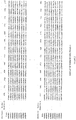
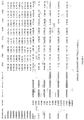
- the figure 1 represents the NIR spectrum of a standard on which the absorbance measured as a function of the wavenumber can be visualized as a spectral quantity. Similar spectra are therefore also established in an identical manner for each standard. In the present example of representation, nine standards have been analyzed. From these spectra, a table is established (the spectral data bank A), an exemplary representation of which is given in FIG. figure 2 for a limited number of wave numbers.
- the spectral quantities can be any type of signal characterizing the spectra, for example absorbances, transmittances, reflectances, etc .; optical absorbances or densities being the most commonly used signals.
- the derivatives of the absorbances or any other measure resulting from another type of mathematical treatment of said absorbances may also be mentioned as signals.
- the limited number of standards available is usually dictated by the customer and / or the end user, who want to use reactive and reliable control methods while limiting the need to have a large quantity of standards beforehand. and having to perform an analysis according to conventional methods.
- a characteristic of the method according to the present invention is that it thus makes it possible to overcome the need dictated by the prior art to have a very large number of standards.
- the present invention makes it possible to characterize a sample product from a number of available standards of less than 100, or even less than 60 or even less than 50. Very convincing results have even been obtained by means of the present invention. invention from less than 40 standards available, or even less than 30 or even less than 20. A minimum of 10 standards available is however preferred even if the present invention has already been used successfully with a minimum of 5 standards available.
- the spectra can be made as a function of wavelengths (and / or ranges of wavelengths). ) and / or as a function of the wave numbers (and / or ranges of wave numbers), because the wave number is represented by the inverse of the wavelength.
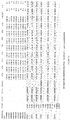
- the use of the second step above makes it possible to obtain an improved spectral data bank A '; an example of an improved spectral databank A 'is shown in FIG. figure 4 .
- FIG. 3 An example representation of the spectral data bank B is illustrated in the figure 3 by a table.
- the last row of the table makes it possible to identify in the data bank B the wavelengths and / or ranges of wavelengths for which the ratio ( ⁇ / (VGSm / 100)) is greater than a predetermined value.
- columns B (the wavelengths and / or wavelength ranges) for which the value of the ratios ( ⁇ / (VGSm / 100)) are identified in Table B) is greater than 2% (preferably greater than 1.5% or even 1%); then, the said columns are eliminated from the data bank A, namely the values of spectral quantities corresponding to the "polluting" wavelengths.
- the corresponding columns i.e. those whose wavelength and / or wavelength range are identical) will then be eliminated from the spectral database A.
- the tables A and B constitute representations which have no real relations between them; it should also be noted that Tables A and B have been truncated to give a visual representation; in fact, the said tables comprise a multitude of columns representing the wavelengths and / or ranges of wavelengths extracted from the corresponding spectrum as detailed further in the description.
- An essential feature of the method according to an embodiment of the present invention is that the establishment of the improved spectral data bank A 'did not need at this stage to refer and / or the least correlation with the chemical and / or physico-chemical properties of the standards. Indeed, this second stage is completely independent.
- a third preferred consecutive step of the method according to the present invention consists in the actual enlargement of the spectral data bank A (or the improved spectral data bank A ').
- This step consists in generating synthetic standards (also called “intergermes"["IG”]) from the available standards and their spectral values. For example, to generate these GIs we can perform combinations of several standards available from the first step above and populating the spectral data bank A (or the improved spectral data bank A ') by means of said combinations. These combinations can be random or oriented as described further in the text. Said combinations can consist of any kind of mathematical treatment applied to the spectral size values of the G standards.
- said combination consists of a barycenter of the spectral quantity values ("VGS") of at least two standards.
- VGS spectral quantity values
- these combinations can be made between two, three or more of the available starting standards, preferably between all available starting standards.
- At least one of the Ri is a negative real (R *).
- the number of intergermes IG is at least greater than 1.5 N , preferably greater than 2 N, more preferably greater than 5 N, or even greater than 10 N.
- An essential feature of the method according to an embodiment of the present invention is that the establishment of the expanded spectral data bank E has not required at this stage to refer and / or the least correlation with the properties chemical and / or physicochemical standards. Indeed, this enlargement step is totally independent.
- a fourth optional and preferred additional step according to the present invention then consists in a further broadening of the spectral data bank A or the expanded spectral data bank E by means of another type of synthetic standard which we will call “extragerms”. ("EG").
- This step is particularly relevant when the target product to be analyzed contains a plurality of chemical compounds.
- This second sequence consists of generating synthetic standards (also called “extragerms"["EG”]) from the available Pole (s) and standards and their spectral size values.
- synthetic standards also called “extragerms”["EG”]
- to generate these EG we can perform combinations of (s) Pole (s) and several available standards from the first step above and populate the spectral data bank A and / or E by means of combinations. These combinations can be random or oriented as described further in the text.
- Said combinations may consist of any kind of mathematical treatment applied to the spectral size values of the G standards and the Pole (s).
- said combination consists of a barycenter of the spectral magnitudes ("VGS") of the selected G standards and the Pole (s).
- these combinations can be made between at least one pole and one, two, three or more of the available starting standards, preferably with all the available starting standards. These combinations will preferably be carried out with all the available poles, preferably with all the poles corresponding to all the chemical compounds constituting the target product.
- the number of Extragerms "EG” is at least greater than NxM, preferably greater than 1.5 NxM, preferably greater than 2 NxM.
- the number of poles is less than 15, for example less than 10.
- the number of poles is less than 0.2 times the number of standards, for example less than 0.1 times the number of standards.
- An essential feature of the method according to an embodiment of the present invention is that the establishment of the expanded spectral data bank EE has not required at this stage to refer and / or the least correlation with the properties chemical and / or physicochemical standards. Indeed, this enlargement step is totally independent.
- An optional and preferred additional fifth step according to the present invention also consists of further broadening of the expanded spectral data bank E and / or EE by means of another type of synthetic standards that we call "Extragerms"("EG'"). This step is again particularly relevant when the target product to be analyzed contains a plurality of chemical compounds.
- It consists in a first sequence to record the spectral data of at least one spectrum corresponding to one (or more) of the chemical compounds of the target product (also called “Pole (s)").
- This second sequence consists in generating synthetic standards (also called “extragerms” ["EG” “]) from the" Pole (s) “and” intergermes “” IG “standards (and optionally” G “seeds). and their values of spectral quantities. For example, to generate these EG 'we can make combinations of (s) Pole (s) and several intergermes “IG” of the third step above (and optionally of "G” germs of the first step) and to populate the spectral data bank E and / or EE using said combinations.
- said combination consists of a barycentre of the spectral magnitudes ("VGS") of the IG intergroups and the Pole (s) (and optionally "G” seeds).
- VGS spectral magnitudes
- these combinations can be made between at least one pole and one, two, three or a greater number of the "IG" of the third step, preferably with all the "IG”; and optionally with at least one of the "G” germs, preferably with all the "G” germs.
- These combinations will preferably be carried out with all the available poles, preferably with all the poles corresponding to all the chemical compounds constituting the target product.
- the number of extragerms " EG '' is at least greater than ZxM, preferably greater than 1.5 ZxM, preferably greater than 2 ZxM.
- the number of seeds G is N and the number of "poles” is equal to "M”.
- the number of extragerms "EG” is at least greater than ZxMxN, preferably greater than 1.5 ZxMxN, preferably greater than 2 ZxMxN.
- the number of poles is less than 15, for example less than 10.
- the number of poles is less than 0.2 times the number of standards, for example less than 0.1 times the number of standards.
- An essential feature of the method according to an embodiment of the present invention is that the establishment of the expanded EEI spectral data bank has not required at this stage to make reference and / or the least correlation with the properties. chemical and / or physicochemical standards. Indeed, this enlargement step is totally independent.
- an additional intermediate step then consists in defining an effective discrimination method making it possible to demonstrate homogeneous subgroups of products which preferentially obey the same types of property linkages. -spectra as a result of a strong analogy of molecular structure.
- Discrimination methods may be based solely on mathematical analysis techniques (for example, factor analyzes and / or principal component analyzes). Although some of these mathematical methods may be useful, the present invention preferably further uses at least one empirical step for performing this type of discrimination, an empirical step based on a visual analysis of the spectra of the aforementioned standards and / or poles; although this is not a preferred embodiment according to the present invention, this visual analysis could also be done on the reconstituted spectra (from their calculated VGS) intergermes and / or extragerms.
- an essential feature of the method for establishing the expanded spectral data bank according to a preferred embodiment of the invention mentioned above is that it was not necessary to make reference and / or the slightest correlation with the chemical and / or physico-chemical properties of the standards. According to one preferred embodiment of the present invention, it is exactly the same for the discrimination step described here.
- the discrimination step then consists in defining, from the spectral data bank (preferably broadened), aggregates (preferably at least two aggregates), n-dimensional representing combinations of said aggregates (preferably planes - or two-dimensional spaces - representing pairs of aggregates), and corresponding spectral boxes.
- these aggregates and / or these spaces with n dimensions representing combinations of said aggregates and / or these spectral boxes define the spectral range of the target product and therefore the fact that the final mixture is conform to a set of significant specifications of the target product.
- the aggregates are thus defined as mathematical functions of the spectral size values of the expanded spectral data bank making it possible to group and / or discriminate and / or separate product families within the expanded spectral data bank.
- the present invention therefore also relates to a method of characterizing a product by topological spectral analysis.
- the characterization of a product according to the present invention may consist of a determination and / or a prediction of any chemical, physical or physico-chemical characteristic of said product.
- the first step has therefore been characterized by the establishment of a spectral data bank, preferably an expanded spectral data bank as described herein. description.
- the graphical representations of the data banks (tables) in the appended figures constitute truncated views because in reality the said databanks comprise a multitude of columns representing the wavelengths and / or ranges of lengths. waveform (or equivalent, the wave numbers or range of wave numbers) extracted from the corresponding spectra.
- the number of wavelengths chosen may be from 2 to 1000, for example from 5 to 200 or from 40 to 80.
- the wavelengths chosen may be at regular intervals such as 1 to 50 nm or every 10 to 50 nm or every 15 to 35 nm or every 1 to 5 nm or all nanometers; or they may be at irregular intervals, for example at intervals of 1 to 200 nm, for example 1 to 100 or 1 to 50, in particular 2 to 50 or 4 to 50 or 10 to 60 nm, which can be chosen or random because of a variation of the shape of the spectral curve at this wavelength, for example, a peak, a valley or a shoulder or chosen with chemical or statistical criteria such as factor analysis .
- the wavelengths can be in the region of 600 to 20000 nm, for example from 625 to 2600 nm, for example from 800 to 2600 nm, in particular from 1500 to 2600 nm or from 2000 to 2550 nm.
- the numbers of waves may be in the region of 16600 to 500, for example from 16000 to 3840 cm -1, for example from 12500 to 3840 cm -1, in particular from 6660 to 3840 or from 5000 to 3900 cm -1; the corresponding frequencies in Hertz can be obtained by multiplying these wavelengths by 3x10 (exp) 10 cm / s.
- the chemical, physical and / or physico-chemical properties of the standards are determined using conventional analysis techniques.
- conventional analysis techniques mention will be made of gas chromatography for chemical compositions.
- the values of the desired properties measured for the said standards (and optionally poles) are added to the spectral data bank; when the spectral data bank is enlarged, the values of the said properties are then calculated for the intergrand synthetic standards (and optionally for the extragerms) from the formulas used to generate these synthetic standards; this calculation is done simply by replacing the values of spectral quantities VGS by the measured values of the said properties of the standards (and optionally of the poles) used in the formulas (and optionally, for the extragerms, by the values already calculated for the intergerms).
- the signals for example the absorptions (or their derivatives) for the unknown sample
- the standards are then compared with signals, for example the absorptions (or their derivatives) at the same wavelength of the standards, and the standards are selected. having the smallest differences. Then, the properties of these selected standards are averaged to determine the property of the unknown sample. A calculated spectrum of the target product is thus reconstructed, to which the characteristic (property) thus calculated corresponds.
- this signal comparison is therefore not performed on the entire spectral data bank but only on the spectral data bank portion representative of the homogeneous subgroup to which the sample belongs. It is by preferably using the aforementioned discrimination method (discriminant aggregates) that this spectral data bank portion is defined.
- the signals for example the absorptions (or their derivatives or any other value of spectral magnitude) for the unknown sample (target product), with the same signals and at the same wavelength of the standards and / or intergermes and / or extragerms and / or poles belonging to the same homogeneous subgroup, and one chooses in the spectral data bank the standards and / or intergerms and / or extragerms and / or poles having the smallest differences.
- the points close to the target product the points "near neighbors”. Then, for example, one can average the properties of these standards and / or intergerms and / or extragerms and / or poles chosen to determine the desired characteristic (property) of the unknown sample.
- the nearest neighbors chosen are those having the smallest average values of the absolute difference at each wavelength i between the spectral magnitude value (represented for example by absorbance or a derivative thereof) Wix for the target product (sample / unknown product) and the corresponding signal Wim for the near neighbor.
- the averages can relate for example to the average value of Wix-Wim (whatever its sign, namely an absolute difference), or (Wix-Wim) exp2.
- the number of close neighbors may be 1, preferably greater than or equal to 2, more preferably greater than or equal to 3.
- the number of close neighbors is less than or equal to 50, for example less than or equal to 20, or even 10.
- a calculated spectrum of the target product is thus reconstructed, to which the characteristic (property) thus calculated corresponds.
- the calculation of the characteristic Z of the target product is done by virtue of the corresponding characteristics Zi of the nearest neighboring points, while giving the characteristics of said neighboring points a weight which is all the greater in the said calculation. they are closer to the target product.
- the method of the invention can be used to determine more than one property P at a time, for example at least 2, in particular from 1 to 30, for example 2 to 10 properties at a time.
- a time for example at least 2, in particular from 1 to 30, for example 2 to 10 properties at a time.
- the Applicant has discovered a particularly effective alternative method.
- This method consists in combining one of the abovementioned target product characterization topological methods with any mathematical model different from the topological methods (preferably a regression model) and making it possible to characterize the target product from the values of VGS spectral quantities. (for the same property).
- This method therefore involves the preliminary constitution of a mathematical model that makes it possible to calculate the properties of the products as a function of the spectral size values (VGS) of the data bank, preferably a regression model (product characterization from the pre-established spectral data bank);
- this spectral data bank can be either the aforementioned data bank A or preferably the data bank A ', E, EE or EEI, or a selection of said banks.
- this databank will be the same as that used for the topological method.
- the characterization of a product according to the present disclosure may therefore consist of a determination and / or a prediction of any chemical, physical or physico-chemical characteristic of said product and / or the identification of a type and / or family of products. .
- the presence of individual chemical compounds within a composition and their concentrations can be determined; we can also determine any kind of property some of which are exemplified below.
- the method for the physico-chemical determination or the prediction can be used for at least one feedstock or a product used in an industrial process of petroleum refining and / or in petrochemical operations or obtained at the same time. help from these.
- the process may be a hydrocarbon conversion or a separation process, preferably a reforming or catalytic cracking or hydrotreating or distillation or mixing process.
- it can be used to determine at least one property of a feedstock and / or the prediction and / or determination of at least one property and / or yield of a product from a number of different processes such as processes for separating petroleum products such as atmospheric distillation, vacuum distillation or separation by distillation, at a pressure above atmospheric pressure, as well as thermal or catalytic conversion , without or with partial or total hydrogenation of a petroleum product, such as catalytic cracking, for example catalytic fluid cracking (FCC), hydrocracking, reforming, isomerization, selective hydrogenation, visbreaking or alkylation.
- processes for separating petroleum products such as atmospheric distillation, vacuum distillation or separation by distillation, at a pressure above atmospheric pressure, as well as thermal or catalytic conversion , without or with partial or total hydrogenation of a petroleum product, such as catalytic cracking, for example catalytic fluid cracking (FCC), hydrocracking, reforming, isomerization, selective hydrogenation, visbreaking or alkylation.
- FCC catalytic fluid crack
- target product constituents for example target petroleum products, for example fuels
- target consisting of a mixture of constituents prepared in batch and / or preferably online.
- the use of the method in mixing operations involving the production and / or determination of at least one property of a mixture of liquid hydrocarbons is of a particular value, this method including or not the determination for each constituent of the mixture of a mixture index for the property considered.
- the mixing indices can be obtained simply by calculation and without the need to prepare physical mixtures of standards other than those contained in the database.
- the mixing indices in the stability domains can be linearly (or nonlinearly) combined to determine from the value of this combination a value for at least one property of the resulting mixture.
- the mixture can be made by mixing at least two compounds among butane, hydrogenated steam cracked petrol, isomerate, reformate, methyl-tert-butyl ether (MTBE) and / or methyl-ter-amyl ether. (TAME) and / or ethyl-tert-butyl ether (ETBE), FCC-derived gasoline, ethanol and / or bio-esters. This process can be repeated by numerically adding the other components separately to the liquid hydrocarbon base to determine a series of mixing indices and then determine from these indices the properties of the multi-component mixture.
- MTBE methyl-tert-butyl ether
- ETBE ethyl-tert-butyl ether
- Examples of properties that can be determined and / or predicted are as follows: for automotive fuels / gasolines, at least one of the search octane number (RON), the Motor octane (MON) and / or their arithmetic mean, with or without additive and / or the content of methyl-t-butyl ether or ether methylisoamyl and / or benzene.
- RON search octane number
- MON Motor octane
- / or their arithmetic mean with or without additive and / or the content of methyl-t-butyl ether or ether methylisoamyl and / or benzene.
- At least one of the cetane number (eg engine measurement), calculated cetane number, cloud point, "point of discharge", filtering ability, distillation curve, density for example at 15 ° C, flash point, viscosity for example at 40 ° C, chemical composition, additive sensitivity and percent sulfur.
- a feedstock or a product of a catalytic cracking process for example an FCC process, at least one of the density, the sulfur percentage, the aniline point, the diesel index, gasoline index, viscosity at 100 ° C, refractive index at 20 ° C and / or 60 ° C, molecular weight, distillation temperature, eg distillation temperature at 50%, the aromatic carbon percentage, the total nitrogen content and the factors characterizing the ability of the feed to cracking, for example KUOP, the crackability factor, the cokability factor, and the yield, for example in gas, gasoline, diesel or residue.
- the yields and / or the properties of the various products obtained by the distillation of cracked products such as RON and / or MON, without anti-knock additive for petrol cutting and viscosity at 100 ° C for the distillation residue.
- At least one of a product or a feedstock of a catalytic reforming process at least one of the density, the distillation temperature and / or the chemical composition (expressed as a percentage) of the hydrocarbons linear saturation, isoparaffins, naphthenes, aromatics and olefins.
- At least one of a product or a feedstock of a gasoline hydrogenation process at least one of the density, the distillation temperature, RON and / or MON, the tension of petrol vapor without anti-knock or lead additive, volatility, chemical composition (expressed as a percentage), linear saturated hydrocarbons, isoparaffins, naphthenes, aromatic substances, for example benzene and mono / di-substituted benzenes, in particular olefins, for example cyclic and non-cyclic olefins, to diolefins, and maleic anhydride number.
Landscapes
- Physics & Mathematics (AREA)
- Chemical & Material Sciences (AREA)
- General Physics & Mathematics (AREA)
- Health & Medical Sciences (AREA)
- Life Sciences & Earth Sciences (AREA)
- Pathology (AREA)
- Immunology (AREA)
- Analytical Chemistry (AREA)
- Biochemistry (AREA)
- General Health & Medical Sciences (AREA)
- Spectroscopy & Molecular Physics (AREA)
- Engineering & Computer Science (AREA)
- Automation & Control Theory (AREA)
- Food Science & Technology (AREA)
- Medicinal Chemistry (AREA)
- Chemical Kinetics & Catalysis (AREA)
- General Chemical & Material Sciences (AREA)
- Oil, Petroleum & Natural Gas (AREA)
- Investigating Or Analysing Materials By Optical Means (AREA)
Claims (11)
- Verfahren zur Herstellung eines Zielprodukts durch chargenweises oder in-line Mischen seiner "n" Bestandteile aus verschiedenen Strömen der Bestandteile mit gesteuerten Konzentrationen und/oder Durchsätzen, mit optionalem Einschluss von Additiven, wobei das Zielprodukt für seinen Vertrieb eine Gesamtheit von Wertebereichen physikochemischer Charakteristiken aufweisen muss, wobei das Verfahren die Schritte umfasst, gemäß denen ein Mischer chargenweise und/oder kontinuierlich mit den Bestandteilen mit gesteuerten Konzentrationen und/oder Durchsätzen gespeist wird, und:1. mindestens ein Spektraldatenwert, der das Zielprodukt charakterisiert und der seinen Spektralbereich definiert, erhalten wird,2. Spektraldaten, die jeweils individuell mindestens zwei - vorzugsweise alle "n" - Bestandteile des Zielprodukts charakterisieren, erhalten werden,3. ein Computerprogramm verwendet wird, das es gestattet, die Bereiche der jeweiligen Anteile der Bestandteile, die für die Rekonstitution des Spektraldatenwerts des Zielprodukts notwendig sind, der zum Spektralbereich des Schritts 1 gehört, aus den Spektraldaten des Schritts 2 zu berechnen, und4. die Bereiche der jeweiligen Anteile der Bestandteile des Schritts 3 verwendet werden, um die Konzentrationen und/oder Durchsätze der Bestandteile zu steuern, mit denen der Mischer gespeist wird, um das Zielprodukt herzustellen.
- Verfahren nach dem vorhergehenden Anspruch, dadurch gekennzeichnet, dass die Spektraldaten mit demselben Typ einer Spektralanalyse gemessen werden, vorzugsweise mit demselben Typ eines Spektrometers.
- Verfahren nach einem der vorhergehenden Ansprüche, dadurch gekennzeichnet, dass die Spektraldaten Spektren und/oder Spektraldatenbanken sind.
- Verfahren nach einem der vorhergehenden Ansprüche, dadurch gekennzeichnet, dass die Spektraldaten von einer Spektralanalyse stammen, ausgewählt aus NMR, Raman, Infrarot (IR), nahem Infrarot (NIR) und/oder sichtbarem UV, vorzugsweise von einer topologischen Spektralanalyse im nahen Infrarot ("NIR").
- Verfahren nach einem der vorhergehenden Ansprüche, wobei das Zielprodukt einen Hauptbestandteil, dessen Gewichtskonzentration in dem Zielprodukt die höchste ist, und mindestens einen Nebenbestandteil umfasst, und dadurch gekennzeichnet, dass die Spektraldaten des Nebenbestandteils durch Analyse einer Mischung des Nebenbestandteils mit entweder dem Hauptbestandteil oder einer für das Zielprodukt repräsentativen Mischung erhalten werden.
- Verfahren nach einem der vorhergehenden Ansprüche, dadurch gekennzeichnet, dass die Anzahl von Bestandteilen "n" des Zielprodukts größer oder gleich 3 ist.
- Verfahren nach einem der vorhergehenden Ansprüche, dadurch gekennzeichnet, dass ein zusätzlicher Schritt, konsekutiv zu dem zweiten Schritt von Anspruch 1, durchgeführt wird, wobei der zusätzliche Schritt daraus besteht, dass aus den Spektraldaten, welche die Bestandteile charakterisieren, (vorzugsweise aus Spektraldatenbanken, welche die Bestandteile charakterisieren) neue Spektraldaten, welche die Mischungen der Bestandteile charakterisieren, (vorzugsweise neue Spektraldatenbanken, welche die Mischungen der Bestandteile charakterisieren) gebildet werden, und anschließend diese neuen Spektraldaten (vorzugsweise diese neuen Spektraldatenbanken) in dem dritten Schritt von Anspruch 1 verwendet werden.
- Verfahren nach einem der vorhergehenden Ansprüche, dadurch gekennzeichnet, dass das Zielprodukt ein Erdölprodukt ist, zum Beispiel ein Treibstoff, zum Beispiel ein Diesel und/oder ein Benzin.
- Verfahren nach einem der vorhergehenden Ansprüche, dadurch gekennzeichnet, dass die Herstellung in einer Raffinerie, einem (petro-) chemischen Komplex, einem Erdöllager und/oder jeder Anlage durchgeführt wird, die ein Produkt verwendet, das aus einer Mischung von Bestandteilen besteht, die chargenweise und/oder in-line hergestellt wird, insbesondere in einer Endeinrichtung oder jeder Anlage zur Post-Raffinerie-Mischung von Treibstoffen.
- Verwendung eines Verfahrens nach einem der vorhergehenden Ansprüche, zur Herstellung eines Zielprodukts, umfassend einen Bestandteil "X", bestehend aus der Bevorzugung der Verwendung des Bestandteils "X" unter den "n" Bestandteilen der Mischung des Zielprodukts, wobei das Herstellungsverfahren einen zusätzlichen Schritt umfasst, der daraus besteht, dass unter den Bereichen der jeweiligen Anteile der Bestandteile, die den Mischer in dem Schritt 3 von Anspruch 1 speisen, der Anteilsbereich mit der höchsten Konzentration des Bestandteils "X" ausgewählt wird.
- Verwendung eines Verfahrens nach einem der Ansprüche 1 bis 9,a. zur Validierung des Ersetzens des Bestandteils "X" durch einen Bestandteil "X'", und/oderb. Vorhersage des potentiellen Nutzungsgrads des Bestandteils "X'" bei der Herstellung eines Zielprodukts, das anfänglich einen Bestandteil "X" umfasst, wobei das Herstellungsverfahren umfasst:a. einen Schritt der Spektralanalyse des Bestandteils "X'", um einen charakterisierenden Spektraldatenwert davon zu bestimmen, zum Beispiel ein Spektrum und/oder eine charakterisierende Spektraldatenbank,b. einen Schritt, der aus einem Schritt des Ersetzens des charakterisierenden Spektraldatenwerts des Bestandteils "X" durch den charakterisierenden Spektraldatenwert des Bestandteils "X'" in dem Verfahren besteht,c. einen Schritt der Validierung des Ersetzens eines Bestandteils "X" durch einen Bestandteil "X'" und/oder der Vorhersage des potentiellen Nutzungsgrads des Bestandteils "X'" aufgrund des dritten Schritts von Anspruch 1, der es ermöglicht, zu verifizieren, dass mindestens ein Bereich jeweiliger Anteile neuer Bestandteile existiert, die zur Rekonstitution eines Spektraldatenwerts der Mischung notwendig sind, der zu dem Spektralbereich des Zielprodukts gehört.
Priority Applications (1)
| Application Number | Priority Date | Filing Date | Title |
|---|---|---|---|
| PL15727664T PL3155403T3 (pl) | 2014-06-13 | 2015-06-09 | Sposób optymalizacji mieszaniny składników za pomocą analizy widmowej |
Applications Claiming Priority (2)
| Application Number | Priority Date | Filing Date | Title |
|---|---|---|---|
| EP14290172 | 2014-06-13 | ||
| PCT/EP2015/062853 WO2015189218A1 (fr) | 2014-06-13 | 2015-06-09 | Procede d'optimisation d'un melange de constituants par analyse spectrale |
Publications (2)
| Publication Number | Publication Date |
|---|---|
| EP3155403A1 EP3155403A1 (de) | 2017-04-19 |
| EP3155403B1 true EP3155403B1 (de) | 2019-06-26 |
Family
ID=50982871
Family Applications (2)
| Application Number | Title | Priority Date | Filing Date |
|---|---|---|---|
| EP15726641.2A Active EP3155402B1 (de) | 2014-06-13 | 2015-06-09 | Verfahren zur vorbereitung einer zertifizierten mischung aus bestandteilen durch spektralanalyse |
| EP15727664.3A Active EP3155403B1 (de) | 2014-06-13 | 2015-06-09 | Verfahren zur optimierung einer mischung von bestandteilen durch spektralanalyse |
Family Applications Before (1)
| Application Number | Title | Priority Date | Filing Date |
|---|---|---|---|
| EP15726641.2A Active EP3155402B1 (de) | 2014-06-13 | 2015-06-09 | Verfahren zur vorbereitung einer zertifizierten mischung aus bestandteilen durch spektralanalyse |
Country Status (5)
| Country | Link |
|---|---|
| US (2) | US10082807B2 (de) |
| EP (2) | EP3155402B1 (de) |
| CA (1) | CA2951973C (de) |
| PL (1) | PL3155403T3 (de) |
| WO (2) | WO2015189220A1 (de) |
Families Citing this family (45)
| Publication number | Priority date | Publication date | Assignee | Title |
|---|---|---|---|---|
| US9709545B2 (en) * | 2015-07-23 | 2017-07-18 | Tesoro Refining & Marketing Company LLC | Methods and apparatuses for spectral qualification of fuel properties |
| US10696906B2 (en) | 2017-09-29 | 2020-06-30 | Marathon Petroleum Company Lp | Tower bottoms coke catching device |
| US12000720B2 (en) | 2018-09-10 | 2024-06-04 | Marathon Petroleum Company Lp | Product inventory monitoring |
| US11119088B2 (en) * | 2019-03-15 | 2021-09-14 | Chevron U.S.A. Inc. | System and method for calculating the research octane number and the motor octane number for a liquid blended fuel |
| US12031676B2 (en) | 2019-03-25 | 2024-07-09 | Marathon Petroleum Company Lp | Insulation securement system and associated methods |
| CN111829978B (zh) * | 2019-04-18 | 2023-08-11 | 中国石油化工股份有限公司 | 一种利用近红外光谱由已有原油调和目标原油的方法 |
| US11391417B2 (en) * | 2019-04-23 | 2022-07-19 | Phillips 66 Company | Pipeline interchange/transmix |
| US11378234B2 (en) * | 2019-04-23 | 2022-07-05 | Phillips 66 Company | Pipeline interchange/transmix |
| US11975316B2 (en) | 2019-05-09 | 2024-05-07 | Marathon Petroleum Company Lp | Methods and reforming systems for re-dispersing platinum on reforming catalyst |
| CA3212045A1 (en) | 2019-05-30 | 2020-11-30 | Marathon Petroleum Company Lp | Methods and systems for minimizing nox and co emissions in natural draft heaters |
| CA3104319C (en) | 2019-12-30 | 2023-01-24 | Marathon Petroleum Company Lp | Methods and systems for spillback control of in-line mixing of hydrocarbon liquids |
| US10990114B1 (en) | 2019-12-30 | 2021-04-27 | Marathon Petroleum Company Lp | Methods and systems for inline mixing of hydrocarbon liquids |
| US11559774B2 (en) | 2019-12-30 | 2023-01-24 | Marathon Petroleum Company Lp | Methods and systems for operating a pump at an efficiency point |
| US11607654B2 (en) | 2019-12-30 | 2023-03-21 | Marathon Petroleum Company Lp | Methods and systems for in-line mixing of hydrocarbon liquids |
| CA3109606C (en) | 2020-02-19 | 2022-12-06 | Marathon Petroleum Company Lp | Low sulfur fuel oil blends for paraffinic resid stability and associated methods |
| US20220101277A1 (en) * | 2020-09-25 | 2022-03-31 | X Development Llc | End to end platform to manage circular economy of waste materials |
| US11898109B2 (en) | 2021-02-25 | 2024-02-13 | Marathon Petroleum Company Lp | Assemblies and methods for enhancing control of hydrotreating and fluid catalytic cracking (FCC) processes using spectroscopic analyzers |
| US11702600B2 (en) | 2021-02-25 | 2023-07-18 | Marathon Petroleum Company Lp | Assemblies and methods for enhancing fluid catalytic cracking (FCC) processes during the FCC process using spectroscopic analyzers |
| US20250012744A1 (en) | 2021-02-25 | 2025-01-09 | Marathon Petroleum Company Lp | Methods and assemblies for enhancing control of refining processes using spectroscopic analyzers |
| US12473500B2 (en) | 2021-02-25 | 2025-11-18 | Marathon Petroleum Company Lp | Assemblies and methods for enhancing control of fluid catalytic cracking (FCC) processes using spectroscopic analyzers |
| US12461022B2 (en) | 2021-02-25 | 2025-11-04 | Marathon Petroleum Company Lp | Methods and assemblies for determining and using standardized spectral responses for calibration of spectroscopic analyzers |
| US11905468B2 (en) | 2021-02-25 | 2024-02-20 | Marathon Petroleum Company Lp | Assemblies and methods for enhancing control of fluid catalytic cracking (FCC) processes using spectroscopic analyzers |
| US11578638B2 (en) | 2021-03-16 | 2023-02-14 | Marathon Petroleum Company Lp | Scalable greenhouse gas capture systems and methods |
| US12012883B2 (en) | 2021-03-16 | 2024-06-18 | Marathon Petroleum Company Lp | Systems and methods for backhaul transportation of liquefied gas and CO2 using liquefied gas carriers |
| US11578836B2 (en) | 2021-03-16 | 2023-02-14 | Marathon Petroleum Company Lp | Scalable greenhouse gas capture systems and methods |
| US11655940B2 (en) | 2021-03-16 | 2023-05-23 | Marathon Petroleum Company Lp | Systems and methods for transporting fuel and carbon dioxide in a dual fluid vessel |
| US12180597B2 (en) | 2021-08-26 | 2024-12-31 | Marathon Petroleum Company Lp | Test station assemblies for monitoring cathodic protection of structures and related methods |
| US12129559B2 (en) | 2021-08-26 | 2024-10-29 | Marathon Petroleum Company Lp | Test station assemblies for monitoring cathodic protection of structures and related methods |
| US12043905B2 (en) | 2021-08-26 | 2024-07-23 | Marathon Petroleum Company Lp | Electrode watering assemblies and methods for maintaining cathodic monitoring of structures |
| US11447877B1 (en) | 2021-08-26 | 2022-09-20 | Marathon Petroleum Company Lp | Assemblies and methods for monitoring cathodic protection of structures |
| US11692141B2 (en) | 2021-10-10 | 2023-07-04 | Marathon Petroleum Company Lp | Methods and systems for enhancing processing of hydrocarbons in a fluid catalytic cracking unit using a renewable additive |
| US11802257B2 (en) | 2022-01-31 | 2023-10-31 | Marathon Petroleum Company Lp | Systems and methods for reducing rendered fats pour point |
| US11686070B1 (en) | 2022-05-04 | 2023-06-27 | Marathon Petroleum Company Lp | Systems, methods, and controllers to enhance heavy equipment warning |
| US12311305B2 (en) | 2022-12-08 | 2025-05-27 | Marathon Petroleum Company Lp | Removable flue gas strainer and associated methods |
| US12012082B1 (en) | 2022-12-30 | 2024-06-18 | Marathon Petroleum Company Lp | Systems and methods for a hydraulic vent interlock |
| US12006014B1 (en) | 2023-02-18 | 2024-06-11 | Marathon Petroleum Company Lp | Exhaust vent hoods for marine vessels and related methods |
| US12043361B1 (en) | 2023-02-18 | 2024-07-23 | Marathon Petroleum Company Lp | Exhaust handling systems for marine vessels and related methods |
| US12306076B2 (en) | 2023-05-12 | 2025-05-20 | Marathon Petroleum Company Lp | Systems, apparatuses, and methods for sample cylinder inspection, pressurization, and sample disposal |
| US12533615B2 (en) | 2023-06-02 | 2026-01-27 | Marathon Petroleum Company Lp | Methods and systems for reducing contaminants in a feed stream |
| US12297965B2 (en) | 2023-08-09 | 2025-05-13 | Marathon Petroleum Company Lp | Systems and methods for mixing hydrogen with natural gas |
| US12597151B2 (en) | 2023-09-18 | 2026-04-07 | Marathon Petroleum Company Lp | Systems and methods to determine vegetation encroachment along a right-of-way |
| US11939210B1 (en) * | 2023-11-10 | 2024-03-26 | Phillips 66 Company | Systems for decreasing excess octane during gasoline blending |
| US12415962B2 (en) | 2023-11-10 | 2025-09-16 | Marathon Petroleum Company Lp | Systems and methods for producing aviation fuel |
| US12599848B2 (en) | 2024-06-03 | 2026-04-14 | Marathon Petroleum Company Lp | Systems, analyzers, controllers, and associated methods to enhance fluid separation for distillation operations |
| CN118942567A (zh) * | 2024-07-09 | 2024-11-12 | 广东辛孚科技有限公司 | 一种分子级在线汽油调和优化方法、系统及电子设备 |
Citations (1)
| Publication number | Priority date | Publication date | Assignee | Title |
|---|---|---|---|---|
| US20090105966A1 (en) * | 2007-10-16 | 2009-04-23 | Brown James M | Estimating detailed compositional information from limited analytical data |
Family Cites Families (17)
| Publication number | Priority date | Publication date | Assignee | Title |
|---|---|---|---|---|
| ES2041801T3 (es) | 1987-08-18 | 1993-12-01 | Bp Oil International Limited | Metodo para la determinacion directa de propiedades fisicas de productos hidrocarbonados. |
| US5349188A (en) * | 1990-04-09 | 1994-09-20 | Ashland Oil, Inc. | Near infrared analysis of piano constituents and octane number of hydrocarbons |
| US5430295A (en) * | 1993-12-16 | 1995-07-04 | Uop And Arco | Process for controlling blending |
| US5684580A (en) * | 1995-05-01 | 1997-11-04 | Ashland Inc. | Hydrocarbon analysis and control by raman spectroscopy |
| EP0801299B1 (de) * | 1996-04-09 | 2004-03-17 | Eutech Engineering Solutions Limited | Prozess-Steuerung |
| FR2845013B1 (fr) | 2002-09-30 | 2004-12-24 | Totalfinaelf France | Procede et dispositif pour la conduite en continu d'un processus de preparation d'un carburant, notamment pour moteur diesel, par melange en ligne de ses constituants |
| US20070050154A1 (en) * | 2005-09-01 | 2007-03-01 | Albahri Tareq A | Method and apparatus for measuring the properties of petroleum fuels by distillation |
| US8322200B2 (en) | 2007-12-21 | 2012-12-04 | Exxonmobil Research And Engineering Company | Method for certifying composition and property variables of manufactured petroleum products |
| EP2128599A1 (de) * | 2008-05-28 | 2009-12-02 | Université de Liège | Analyse von Spektraldaten zur Auswahl eines Eichmodells |
| US8017910B2 (en) * | 2008-10-20 | 2011-09-13 | Nalco Company | Method for predicting hydrocarbon process stream stability using near infrared spectra |
| US8236566B2 (en) * | 2008-11-25 | 2012-08-07 | Phillips 66 Company | Preparation and optimization of oxygenated gasolines |
| US20100305872A1 (en) * | 2009-05-31 | 2010-12-02 | University Of Kuwait | Apparatus and Method for Measuring the Properties of Petroleum Factions and Pure Hydrocarbon Liquids by Light Refraction |
| US8735820B2 (en) | 2010-04-09 | 2014-05-27 | Tesoro Refining And Marketing Company | Direct match spectrographic determination of fuel properties |
| US8999012B2 (en) * | 2011-05-05 | 2015-04-07 | Exxonmobil Research And Engineering Company | Quality certification of oxygenated gasoline |
| KR101287300B1 (ko) * | 2012-04-17 | 2013-07-17 | 에스케이에너지 주식회사 | 안정화된 탄화수소 오일 블렌드의 제조방법 |
| US9568461B2 (en) * | 2012-12-31 | 2017-02-14 | Mastinc | Multi-modal fluid condition sensor platform and system therefor |
| US9709545B2 (en) * | 2015-07-23 | 2017-07-18 | Tesoro Refining & Marketing Company LLC | Methods and apparatuses for spectral qualification of fuel properties |
-
2015
- 2015-06-09 EP EP15726641.2A patent/EP3155402B1/de active Active
- 2015-06-09 WO PCT/EP2015/062856 patent/WO2015189220A1/fr not_active Ceased
- 2015-06-09 US US15/318,623 patent/US10082807B2/en active Active
- 2015-06-09 PL PL15727664T patent/PL3155403T3/pl unknown
- 2015-06-09 WO PCT/EP2015/062853 patent/WO2015189218A1/fr not_active Ceased
- 2015-06-09 US US15/318,626 patent/US10228708B2/en active Active
- 2015-06-09 EP EP15727664.3A patent/EP3155403B1/de active Active
- 2015-06-09 CA CA2951973A patent/CA2951973C/en active Active
Patent Citations (1)
| Publication number | Priority date | Publication date | Assignee | Title |
|---|---|---|---|---|
| US20090105966A1 (en) * | 2007-10-16 | 2009-04-23 | Brown James M | Estimating detailed compositional information from limited analytical data |
Also Published As
| Publication number | Publication date |
|---|---|
| WO2015189220A1 (fr) | 2015-12-17 |
| US20170131728A1 (en) | 2017-05-11 |
| PL3155403T3 (pl) | 2019-11-29 |
| CA2951973A1 (en) | 2015-12-17 |
| US20170248569A1 (en) | 2017-08-31 |
| EP3155402B1 (de) | 2019-11-06 |
| EP3155402A1 (de) | 2017-04-19 |
| US10228708B2 (en) | 2019-03-12 |
| WO2015189218A1 (fr) | 2015-12-17 |
| CA2951973C (en) | 2021-06-15 |
| US10082807B2 (en) | 2018-09-25 |
| EP3155403A1 (de) | 2017-04-19 |
Similar Documents
| Publication | Publication Date | Title |
|---|---|---|
| EP3155403B1 (de) | Verfahren zur optimierung einer mischung von bestandteilen durch spektralanalyse | |
| JP6779882B2 (ja) | 蛍光分光分析による原油およびその留分のキャラクタリゼーション | |
| JP6783770B2 (ja) | フーリエ変換赤外分光(ftir)分析による原油およびその留分のキャラクタリゼーション | |
| EP2992314B1 (de) | Charakterisierungsverfahren eines produkts durch topologische spektralanalyse | |
| EP2992313B1 (de) | Charakterisierungsverfahren eines produkts durch topologische spektralanalyse | |
| FR2774768A1 (fr) | Methode de determination d'au moins une propriete physicochimique d'une coupe petroliere | |
| EP2120047A1 (de) | Verfahren zur Detektierung physikochemischer Eigenschaften einer Erdölprobe ausgehend von zweidimensionaler Gaschromatographie | |
| Insausti et al. | Simultaneous determination of quality parameters in biodiesel/diesel blends using synchronous fluorescence and multivariate analysis | |
| US20200209213A1 (en) | Method for determining the composition and properties of hydrocarbon fractions by spectroscopy or spectrometry | |
| EP3237905B1 (de) | Verfahren zur bestimmung der zusammensetzung von erdölfraktionen aus einem raffinierverfahren zur optimierung von ölraffinerien | |
| Legner et al. | Using compact proton nuclear magnetic resonance at 80 MHz and vibrational spectroscopies and data fusion for research octane number and gasoline additive determination | |
| EP3213051B1 (de) | Verfahren zum bestimmen des ursprungs einer mischung von bestandteilen durch spektralanalyse | |
| EP3019851B1 (de) | Transferverfahren zwischen spektrometern | |
| Sakalli | Determination of Crucial Parameters in Gasoline Blends by Using Infrared Spectroscopy Coupled With Multivariate Calibration Methods | |
| FR2632408A1 (fr) | Procede de determination des proprietes d'un gazole obtenu a partir d'un melange complexe de bases petrolieres ou de constitution d'un produit fini du type gazole ayant des proprietes determinees par analyse spectrophotometrique proche infrarouge des constituants du melange | |
| FR2619624A1 (fr) | Procede de determination des indices d'octane d'un melange complexe de carburants ou de constitution d'un tel melange ayant un indice d'octane determine par analyse spectrophotometrique proche infrarouge des constituants du melange |
Legal Events
| Date | Code | Title | Description |
|---|---|---|---|
| STAA | Information on the status of an ep patent application or granted ep patent |
Free format text: STATUS: THE INTERNATIONAL PUBLICATION HAS BEEN MADE |
|
| PUAI | Public reference made under article 153(3) epc to a published international application that has entered the european phase |
Free format text: ORIGINAL CODE: 0009012 |
|
| STAA | Information on the status of an ep patent application or granted ep patent |
Free format text: STATUS: REQUEST FOR EXAMINATION WAS MADE |
|
| 17P | Request for examination filed |
Effective date: 20161212 |
|
| AK | Designated contracting states |
Kind code of ref document: A1 Designated state(s): AL AT BE BG CH CY CZ DE DK EE ES FI FR GB GR HR HU IE IS IT LI LT LU LV MC MK MT NL NO PL PT RO RS SE SI SK SM TR |
|
| AX | Request for extension of the european patent |
Extension state: BA ME |
|
| DAV | Request for validation of the european patent (deleted) | ||
| DAX | Request for extension of the european patent (deleted) | ||
| STAA | Information on the status of an ep patent application or granted ep patent |
Free format text: STATUS: EXAMINATION IS IN PROGRESS |
|
| 17Q | First examination report despatched |
Effective date: 20180614 |
|
| GRAP | Despatch of communication of intention to grant a patent |
Free format text: ORIGINAL CODE: EPIDOSNIGR1 |
|
| STAA | Information on the status of an ep patent application or granted ep patent |
Free format text: STATUS: GRANT OF PATENT IS INTENDED |
|
| INTG | Intention to grant announced |
Effective date: 20190213 |
|
| RIN1 | Information on inventor provided before grant (corrected) |
Inventor name: SANCHEZ, MIGUEL Inventor name: RIBERO, BERNARD Inventor name: LAMBERT, DIDIER Inventor name: SAINT MARTIN, CLAUDE |
|
| GRAS | Grant fee paid |
Free format text: ORIGINAL CODE: EPIDOSNIGR3 |
|
| GRAA | (expected) grant |
Free format text: ORIGINAL CODE: 0009210 |
|
| STAA | Information on the status of an ep patent application or granted ep patent |
Free format text: STATUS: THE PATENT HAS BEEN GRANTED |
|
| AK | Designated contracting states |
Kind code of ref document: B1 Designated state(s): AL AT BE BG CH CY CZ DE DK EE ES FI FR GB GR HR HU IE IS IT LI LT LU LV MC MK MT NL NO PL PT RO RS SE SI SK SM TR |
|
| REG | Reference to a national code |
Ref country code: GB Ref legal event code: FG4D Free format text: NOT ENGLISH |
|
| REG | Reference to a national code |
Ref country code: CH Ref legal event code: EP |
|
| REG | Reference to a national code |
Ref country code: DE Ref legal event code: R096 Ref document number: 602015032702 Country of ref document: DE |
|
| REG | Reference to a national code |
Ref country code: AT Ref legal event code: REF Ref document number: 1148865 Country of ref document: AT Kind code of ref document: T Effective date: 20190715 |
|
| REG | Reference to a national code |
Ref country code: IE Ref legal event code: FG4D Free format text: LANGUAGE OF EP DOCUMENT: FRENCH |
|
| REG | Reference to a national code |
Ref country code: RO Ref legal event code: EPE |
|
| REG | Reference to a national code |
Ref country code: NL Ref legal event code: MP Effective date: 20190626 |
|
| PG25 | Lapsed in a contracting state [announced via postgrant information from national office to epo] |
Ref country code: NO Free format text: LAPSE BECAUSE OF FAILURE TO SUBMIT A TRANSLATION OF THE DESCRIPTION OR TO PAY THE FEE WITHIN THE PRESCRIBED TIME-LIMIT Effective date: 20190926 Ref country code: AL Free format text: LAPSE BECAUSE OF FAILURE TO SUBMIT A TRANSLATION OF THE DESCRIPTION OR TO PAY THE FEE WITHIN THE PRESCRIBED TIME-LIMIT Effective date: 20190626 Ref country code: FI Free format text: LAPSE BECAUSE OF FAILURE TO SUBMIT A TRANSLATION OF THE DESCRIPTION OR TO PAY THE FEE WITHIN THE PRESCRIBED TIME-LIMIT Effective date: 20190626 Ref country code: SE Free format text: LAPSE BECAUSE OF FAILURE TO SUBMIT A TRANSLATION OF THE DESCRIPTION OR TO PAY THE FEE WITHIN THE PRESCRIBED TIME-LIMIT Effective date: 20190626 Ref country code: HR Free format text: LAPSE BECAUSE OF FAILURE TO SUBMIT A TRANSLATION OF THE DESCRIPTION OR TO PAY THE FEE WITHIN THE PRESCRIBED TIME-LIMIT Effective date: 20190626 Ref country code: LT Free format text: LAPSE BECAUSE OF FAILURE TO SUBMIT A TRANSLATION OF THE DESCRIPTION OR TO PAY THE FEE WITHIN THE PRESCRIBED TIME-LIMIT Effective date: 20190626 |
|
| REG | Reference to a national code |
Ref country code: LT Ref legal event code: MG4D |
|
| PG25 | Lapsed in a contracting state [announced via postgrant information from national office to epo] |
Ref country code: BG Free format text: LAPSE BECAUSE OF FAILURE TO SUBMIT A TRANSLATION OF THE DESCRIPTION OR TO PAY THE FEE WITHIN THE PRESCRIBED TIME-LIMIT Effective date: 20190926 Ref country code: RS Free format text: LAPSE BECAUSE OF FAILURE TO SUBMIT A TRANSLATION OF THE DESCRIPTION OR TO PAY THE FEE WITHIN THE PRESCRIBED TIME-LIMIT Effective date: 20190626 Ref country code: LV Free format text: LAPSE BECAUSE OF FAILURE TO SUBMIT A TRANSLATION OF THE DESCRIPTION OR TO PAY THE FEE WITHIN THE PRESCRIBED TIME-LIMIT Effective date: 20190626 Ref country code: GR Free format text: LAPSE BECAUSE OF FAILURE TO SUBMIT A TRANSLATION OF THE DESCRIPTION OR TO PAY THE FEE WITHIN THE PRESCRIBED TIME-LIMIT Effective date: 20190927 |
|
| REG | Reference to a national code |
Ref country code: AT Ref legal event code: MK05 Ref document number: 1148865 Country of ref document: AT Kind code of ref document: T Effective date: 20190626 |
|
| PG25 | Lapsed in a contracting state [announced via postgrant information from national office to epo] |
Ref country code: CZ Free format text: LAPSE BECAUSE OF FAILURE TO SUBMIT A TRANSLATION OF THE DESCRIPTION OR TO PAY THE FEE WITHIN THE PRESCRIBED TIME-LIMIT Effective date: 20190626 Ref country code: SK Free format text: LAPSE BECAUSE OF FAILURE TO SUBMIT A TRANSLATION OF THE DESCRIPTION OR TO PAY THE FEE WITHIN THE PRESCRIBED TIME-LIMIT Effective date: 20190626 Ref country code: EE Free format text: LAPSE BECAUSE OF FAILURE TO SUBMIT A TRANSLATION OF THE DESCRIPTION OR TO PAY THE FEE WITHIN THE PRESCRIBED TIME-LIMIT Effective date: 20190626 Ref country code: AT Free format text: LAPSE BECAUSE OF FAILURE TO SUBMIT A TRANSLATION OF THE DESCRIPTION OR TO PAY THE FEE WITHIN THE PRESCRIBED TIME-LIMIT Effective date: 20190626 Ref country code: NL Free format text: LAPSE BECAUSE OF FAILURE TO SUBMIT A TRANSLATION OF THE DESCRIPTION OR TO PAY THE FEE WITHIN THE PRESCRIBED TIME-LIMIT Effective date: 20190626 Ref country code: PT Free format text: LAPSE BECAUSE OF FAILURE TO SUBMIT A TRANSLATION OF THE DESCRIPTION OR TO PAY THE FEE WITHIN THE PRESCRIBED TIME-LIMIT Effective date: 20191028 |
|
| PG25 | Lapsed in a contracting state [announced via postgrant information from national office to epo] |
Ref country code: IT Free format text: LAPSE BECAUSE OF FAILURE TO SUBMIT A TRANSLATION OF THE DESCRIPTION OR TO PAY THE FEE WITHIN THE PRESCRIBED TIME-LIMIT Effective date: 20190626 Ref country code: SM Free format text: LAPSE BECAUSE OF FAILURE TO SUBMIT A TRANSLATION OF THE DESCRIPTION OR TO PAY THE FEE WITHIN THE PRESCRIBED TIME-LIMIT Effective date: 20190626 Ref country code: IS Free format text: LAPSE BECAUSE OF FAILURE TO SUBMIT A TRANSLATION OF THE DESCRIPTION OR TO PAY THE FEE WITHIN THE PRESCRIBED TIME-LIMIT Effective date: 20191026 Ref country code: ES Free format text: LAPSE BECAUSE OF FAILURE TO SUBMIT A TRANSLATION OF THE DESCRIPTION OR TO PAY THE FEE WITHIN THE PRESCRIBED TIME-LIMIT Effective date: 20190626 |
|
| PG25 | Lapsed in a contracting state [announced via postgrant information from national office to epo] |
Ref country code: TR Free format text: LAPSE BECAUSE OF FAILURE TO SUBMIT A TRANSLATION OF THE DESCRIPTION OR TO PAY THE FEE WITHIN THE PRESCRIBED TIME-LIMIT Effective date: 20190626 |
|
| PG25 | Lapsed in a contracting state [announced via postgrant information from national office to epo] |
Ref country code: DK Free format text: LAPSE BECAUSE OF FAILURE TO SUBMIT A TRANSLATION OF THE DESCRIPTION OR TO PAY THE FEE WITHIN THE PRESCRIBED TIME-LIMIT Effective date: 20190626 |
|
| PG25 | Lapsed in a contracting state [announced via postgrant information from national office to epo] |
Ref country code: IS Free format text: LAPSE BECAUSE OF FAILURE TO SUBMIT A TRANSLATION OF THE DESCRIPTION OR TO PAY THE FEE WITHIN THE PRESCRIBED TIME-LIMIT Effective date: 20200224 |
|
| REG | Reference to a national code |
Ref country code: DE Ref legal event code: R097 Ref document number: 602015032702 Country of ref document: DE |
|
| PLBE | No opposition filed within time limit |
Free format text: ORIGINAL CODE: 0009261 |
|
| STAA | Information on the status of an ep patent application or granted ep patent |
Free format text: STATUS: NO OPPOSITION FILED WITHIN TIME LIMIT |
|
| PG2D | Information on lapse in contracting state deleted |
Ref country code: IS |
|
| 26N | No opposition filed |
Effective date: 20200603 |
|
| PG25 | Lapsed in a contracting state [announced via postgrant information from national office to epo] |
Ref country code: SI Free format text: LAPSE BECAUSE OF FAILURE TO SUBMIT A TRANSLATION OF THE DESCRIPTION OR TO PAY THE FEE WITHIN THE PRESCRIBED TIME-LIMIT Effective date: 20190626 |
|
| PG25 | Lapsed in a contracting state [announced via postgrant information from national office to epo] |
Ref country code: MC Free format text: LAPSE BECAUSE OF FAILURE TO SUBMIT A TRANSLATION OF THE DESCRIPTION OR TO PAY THE FEE WITHIN THE PRESCRIBED TIME-LIMIT Effective date: 20190626 |
|
| REG | Reference to a national code |
Ref country code: CH Ref legal event code: PL |
|
| PG25 | Lapsed in a contracting state [announced via postgrant information from national office to epo] |
Ref country code: LU Free format text: LAPSE BECAUSE OF NON-PAYMENT OF DUE FEES Effective date: 20200609 |
|
| REG | Reference to a national code |
Ref country code: BE Ref legal event code: MM Effective date: 20200630 |
|
| PG25 | Lapsed in a contracting state [announced via postgrant information from national office to epo] |
Ref country code: LI Free format text: LAPSE BECAUSE OF NON-PAYMENT OF DUE FEES Effective date: 20200630 Ref country code: CH Free format text: LAPSE BECAUSE OF NON-PAYMENT OF DUE FEES Effective date: 20200630 Ref country code: IE Free format text: LAPSE BECAUSE OF NON-PAYMENT OF DUE FEES Effective date: 20200609 |
|
| PG25 | Lapsed in a contracting state [announced via postgrant information from national office to epo] |
Ref country code: BE Free format text: LAPSE BECAUSE OF NON-PAYMENT OF DUE FEES Effective date: 20200630 |
|
| PG25 | Lapsed in a contracting state [announced via postgrant information from national office to epo] |
Ref country code: MT Free format text: LAPSE BECAUSE OF FAILURE TO SUBMIT A TRANSLATION OF THE DESCRIPTION OR TO PAY THE FEE WITHIN THE PRESCRIBED TIME-LIMIT Effective date: 20190626 Ref country code: CY Free format text: LAPSE BECAUSE OF FAILURE TO SUBMIT A TRANSLATION OF THE DESCRIPTION OR TO PAY THE FEE WITHIN THE PRESCRIBED TIME-LIMIT Effective date: 20190626 |
|
| PG25 | Lapsed in a contracting state [announced via postgrant information from national office to epo] |
Ref country code: MK Free format text: LAPSE BECAUSE OF FAILURE TO SUBMIT A TRANSLATION OF THE DESCRIPTION OR TO PAY THE FEE WITHIN THE PRESCRIBED TIME-LIMIT Effective date: 20190626 |
|
| PGFP | Annual fee paid to national office [announced via postgrant information from national office to epo] |
Ref country code: DE Payment date: 20250627 Year of fee payment: 11 Ref country code: PL Payment date: 20250603 Year of fee payment: 11 |
|
| PGFP | Annual fee paid to national office [announced via postgrant information from national office to epo] |
Ref country code: GB Payment date: 20250523 Year of fee payment: 11 |
|
| PGFP | Annual fee paid to national office [announced via postgrant information from national office to epo] |
Ref country code: FR Payment date: 20250523 Year of fee payment: 11 |
|
| PGFP | Annual fee paid to national office [announced via postgrant information from national office to epo] |
Ref country code: RO Payment date: 20250605 Year of fee payment: 11 |