EP3153017A1 - Absorbent article for pet animal - Google Patents
Absorbent article for pet animal Download PDFInfo
- Publication number
- EP3153017A1 EP3153017A1 EP14823082.4A EP14823082A EP3153017A1 EP 3153017 A1 EP3153017 A1 EP 3153017A1 EP 14823082 A EP14823082 A EP 14823082A EP 3153017 A1 EP3153017 A1 EP 3153017A1
- Authority
- EP
- European Patent Office
- Prior art keywords
- region
- absorbent core
- ventral
- longitudinal direction
- pet animal
- Prior art date
- Legal status (The legal status is an assumption and is not a legal conclusion. Google has not performed a legal analysis and makes no representation as to the accuracy of the status listed.)
- Granted
Links
- 0 *C*(*C1)C2C1NC2 Chemical compound *C*(*C1)C2C1NC2 0.000 description 1
Images






Classifications
-
- A—HUMAN NECESSITIES
- A61—MEDICAL OR VETERINARY SCIENCE; HYGIENE
- A61D—VETERINARY INSTRUMENTS, IMPLEMENTS, TOOLS, OR METHODS
- A61D99/00—Subject matter not provided for in other groups of this subclass
-
- A—HUMAN NECESSITIES
- A01—AGRICULTURE; FORESTRY; ANIMAL HUSBANDRY; HUNTING; TRAPPING; FISHING
- A01K—ANIMAL HUSBANDRY; AVICULTURE; APICULTURE; PISCICULTURE; FISHING; REARING OR BREEDING ANIMALS, NOT OTHERWISE PROVIDED FOR; NEW BREEDS OF ANIMALS
- A01K23/00—Manure or urine pouches
-
- A—HUMAN NECESSITIES
- A61—MEDICAL OR VETERINARY SCIENCE; HYGIENE
- A61F—FILTERS IMPLANTABLE INTO BLOOD VESSELS; PROSTHESES; DEVICES PROVIDING PATENCY TO, OR PREVENTING COLLAPSING OF, TUBULAR STRUCTURES OF THE BODY, e.g. STENTS; ORTHOPAEDIC, NURSING OR CONTRACEPTIVE DEVICES; FOMENTATION; TREATMENT OR PROTECTION OF EYES OR EARS; BANDAGES, DRESSINGS OR ABSORBENT PADS; FIRST-AID KITS
- A61F13/00—Bandages or dressings; Absorbent pads
- A61F13/15—Absorbent pads, e.g. sanitary towels, swabs or tampons for external or internal application to the body; Supporting or fastening means therefor; Tampon applicators
- A61F13/45—Absorbent pads, e.g. sanitary towels, swabs or tampons for external or internal application to the body; Supporting or fastening means therefor; Tampon applicators characterised by the shape
- A61F13/49—Absorbent pads, e.g. sanitary towels, swabs or tampons for external or internal application to the body; Supporting or fastening means therefor; Tampon applicators characterised by the shape specially adapted to be worn around the waist, e.g. diapers or nappies
- A61F13/49007—Form-fitting, self-adjusting disposable diapers
- A61F13/49009—Form-fitting, self-adjusting disposable diapers with elastic means
- A61F13/49014—Form-fitting, self-adjusting disposable diapers with elastic means the elastic means is located at the side panels
-
- A—HUMAN NECESSITIES
- A61—MEDICAL OR VETERINARY SCIENCE; HYGIENE
- A61F—FILTERS IMPLANTABLE INTO BLOOD VESSELS; PROSTHESES; DEVICES PROVIDING PATENCY TO, OR PREVENTING COLLAPSING OF, TUBULAR STRUCTURES OF THE BODY, e.g. STENTS; ORTHOPAEDIC, NURSING OR CONTRACEPTIVE DEVICES; FOMENTATION; TREATMENT OR PROTECTION OF EYES OR EARS; BANDAGES, DRESSINGS OR ABSORBENT PADS; FIRST-AID KITS
- A61F13/00—Bandages or dressings; Absorbent pads
- A61F13/15—Absorbent pads, e.g. sanitary towels, swabs or tampons for external or internal application to the body; Supporting or fastening means therefor; Tampon applicators
- A61F13/45—Absorbent pads, e.g. sanitary towels, swabs or tampons for external or internal application to the body; Supporting or fastening means therefor; Tampon applicators characterised by the shape
- A61F13/49—Absorbent pads, e.g. sanitary towels, swabs or tampons for external or internal application to the body; Supporting or fastening means therefor; Tampon applicators characterised by the shape specially adapted to be worn around the waist, e.g. diapers or nappies
- A61F13/49007—Form-fitting, self-adjusting disposable diapers
- A61F13/49009—Form-fitting, self-adjusting disposable diapers with elastic means
- A61F13/49019—Form-fitting, self-adjusting disposable diapers with elastic means the elastic means being placed longitudinally, transversely or diagonally over the article
-
- A—HUMAN NECESSITIES
- A61—MEDICAL OR VETERINARY SCIENCE; HYGIENE
- A61F—FILTERS IMPLANTABLE INTO BLOOD VESSELS; PROSTHESES; DEVICES PROVIDING PATENCY TO, OR PREVENTING COLLAPSING OF, TUBULAR STRUCTURES OF THE BODY, e.g. STENTS; ORTHOPAEDIC, NURSING OR CONTRACEPTIVE DEVICES; FOMENTATION; TREATMENT OR PROTECTION OF EYES OR EARS; BANDAGES, DRESSINGS OR ABSORBENT PADS; FIRST-AID KITS
- A61F13/00—Bandages or dressings; Absorbent pads
- A61F13/15—Absorbent pads, e.g. sanitary towels, swabs or tampons for external or internal application to the body; Supporting or fastening means therefor; Tampon applicators
- A61F13/56—Supporting or fastening means
- A61F13/5622—Supporting or fastening means specially adapted for diapers or the like
- A61F13/5633—Supporting or fastening means specially adapted for diapers or the like open type diaper
- A61F13/5638—Supporting or fastening means specially adapted for diapers or the like open type diaper adjustable open type diapers
-
- A—HUMAN NECESSITIES
- A61—MEDICAL OR VETERINARY SCIENCE; HYGIENE
- A61F—FILTERS IMPLANTABLE INTO BLOOD VESSELS; PROSTHESES; DEVICES PROVIDING PATENCY TO, OR PREVENTING COLLAPSING OF, TUBULAR STRUCTURES OF THE BODY, e.g. STENTS; ORTHOPAEDIC, NURSING OR CONTRACEPTIVE DEVICES; FOMENTATION; TREATMENT OR PROTECTION OF EYES OR EARS; BANDAGES, DRESSINGS OR ABSORBENT PADS; FIRST-AID KITS
- A61F13/00—Bandages or dressings; Absorbent pads
- A61F13/15—Absorbent pads, e.g. sanitary towels, swabs or tampons for external or internal application to the body; Supporting or fastening means therefor; Tampon applicators
- A61F2013/15008—Absorbent pads, e.g. sanitary towels, swabs or tampons for external or internal application to the body; Supporting or fastening means therefor; Tampon applicators characterized by the use
- A61F2013/15186—Absorbent pads, e.g. sanitary towels, swabs or tampons for external or internal application to the body; Supporting or fastening means therefor; Tampon applicators characterized by the use for animals
Definitions
- the present invention relates to absorbent articles of pet animals, for example, dogs.
- absorbent articles for pet animals having a longitudinal direction, a transverse direction being orthogonal thereto, a body-contact surface facing the pet animal's body and a non-body-contact surface lying on the opposite side thereof, and including a ventral region, a dorsal region, an intermediate region defined between the ventral region and the dorsal region, a liquid-permeable interior sheet, a liquid-impermeable exterior sheet and a liquid absorbent core lying between the interior sheet and the exterior sheet.
- Patent Literature 1 discloses an absorbent article having a topsheet as the interior sheet, a backsheet as the exterior sheet and a liquid absorbent core lying between the interior and the exterior sheets.
- the liquid absorbent core has a generally rectangular shape and has a first end lying in the ventral region and a second end lying in the intermediate region wherein the width of the liquid absorbent core is uniform all thereover.
- the width of the absorbent core is uniform all thereover.
- the liquid absorbent core is apt to be indirectly caught by both rear legs of the pet animal when it is tried to pass the first end of the liquid absorbent core between both rear legs of the pet animal to put the absorbent article on the pet animal' s body.
- this known absorbent article has a problem such that a handling to put the article on the pet animal's body is difficult or, at least, it is not easy to pass the liquid absorbent core between the pet's both rear legs.
- An object of the present invention is to provide an absorbent article for pet animal improved so as to restrict the possibility that the liquid absorbent core might be indirectly caught by the rear legs when it is tried to pass the portion between both the rear legs of the pet animal, thereby facilitating the article to be put on the pet animal's body.
- the present invention relates to an absorbent article for pet animal having a longitudinal direction, a transverse direction being orthogonal thereto, a body-contact surface facing pet animal's body and a non-body-contact surface lying on the side opposite thereto and including an absorbent panel having a ventral region, a dorsal region and an intermediate region defined between the ventral region and the dorsal region as viewed in the longitudinal direction wherein the absorbent panel includes a liquid-permeable interior sheet, a liquid-impermeable exterior sheet and a liquid absorbent core lying between these interior and exterior sheets.
- the liquid absorbent core in the present invention is arranged in a limited area extending from a zone of the intermediate region defined adjacent to a slit for formation of an opening into which the pet animal's tail is inserted into the ventral region and has a first end lying in the ventral region and a second end lying in the intermediate region opposed to each other in the longitudinal direction; and a dimension in the transverse direction of the ventral region of the liquid absorbent core gradually narrows from the side of the second end toward the first end.
- a dimension in the transverse direction of the ventral region of the liquid absorbent core gradually decreases from the second end side toward the first end side and consequentially it is possible to restrict a possibility that the liquid absorbent core might be indirectly caught by the rear legs of the pet animal in the course of guiding the liquid absorbent core between the both rear legs of the pet animal so that the absorbent article may be easily put on the body of the pet animal.
- Figs. 1 through 9 illustrate a first embodiment of a diaper 1 according to the present invention.
- Figs. 2 through 6 illustrate a state in which elastic members 29, 49 described hereunder in more details are stretched (i.e., a state under tension).
- the diaper 10 has a longitudinal direction Y, a transverse direction X being orthogonal thereto, a pet animal' s body-contact surface and a non-body-contact surface opposite thereto, a longitudinal center line P bisecting a dimension in the transverse direction X and extending in the longitudinal direction Y and a transverse center line Q bisecting a dimension in the longitudinal direction X and extending in the transverse direction X.
- the diaper 10 includes, a ventral region 11, a dorsal region 12, an intermediate region 13 lying between the ventral region 11 and the dorsal region 12, a topsheet (interior sheet) 15, a backsheet (exterior sheet) 16, an absorbent panel 19 having an absorbent structure 18having an absorbent core 34 disposed between the topsheet 15 and the backsheet 16 so as to extend at least in the intermediate region 13 and fasteners 20 to fasten the ventral region 11 and the dorsal region 12 to each other.
- the ventral region 11 faces the belly of the pet animal
- the dorsal region 12 faces the back of the pet animal
- the intermediate region 11 faces the buttocks of the pet animal.
- the absorbent panel 19 includes the topsheet 15, the backsheet 16 and the absorbent body 18 interleaved between the topsheet 15 and the backsheet 16.
- the absorbent panel 19 includes a first end 24 and a second end 25 opposed to each other in the longitudinal direction Y and both extending in the transverse direction X and both lateral portions 26, 27 opposed to each other in the transverse direction X and extending in the longitudinal direction Y.
- the topsheet 15 may be formed of fibrous nonwoven fabric, a porous plastic film or a laminate thereof.
- the topsheet may be formed of an air-through fibrous nonwoven fabric, a spunbond fibrous nonwoven fabric or a pointbond fibrous nonwoven fabric. These nonwoven fabrics have for example, a mass of about 10 g/m2 40 g/m2.
- the backsheet 16 lies on the exterior surface of the absorbent panel 19 and may be formed of material such as a moisture-permeable plastic film, a fibrous nonwoven fabric or a laminate sheet thereof.
- the backsheet 16 may be formed of a spunbond fibrous nonwoven fabric having a mass per unit area in a range of 8 to 30 g/m2.
- the topsheet 15 and the backsheet 16 extend outward beyond a peripheral edge of the absorbent body 18 and are joined to each other in the respective regions of these two sheets 15, 16 extending outward in this manner with, for example, hot melt adhesive (not shown) distributed on at least one of the opposed surface of these two sheets 15, 16.
- a leakage-barrier sheet 41 may be interposed between these two sheets 15, 16 and the absorbent body 18 may be secured on the leakage-barrier sheet 41.
- the sheets 15, 16 and the leakage-barrier sheet 41 are disposed with a slit 22 for formation of an opening through which the pet animal's tail may be exposed outward. Referring to Figs. 4 through 6 , for example, a dimension in the transverse direction X of the topsheet 15 may be smaller than a dimension in the transverse direction X of the leakage-barrier sheet 41.
- the absorbent structure 18 includes the absorbent core 34 formed, for example, from a mixture of wood fluff pulp and absorbent polymer particles and a liquid-diffusive sheet 35, for example, tissue paper to wrap the absorbent core 34.
- the absorbent structure 18 is arranged in a limited area extending in the longitudinal direction Y from the intermediate region 13 to the ventral region 11, more specifically, extending from a zone of the intermediate region 13 defined adjacent to the slit 22 into the ventral region 11.
- the absorbent core 34 has a first end 38 in the ventral region 11 and a second end 40 in the intermediate region 13 and these ends 38, 40 are opposed to each other in the longitudinal direction Y wherein the absorbent core 34 is divided into a narrow region 36 having the first end 38 and a wide region 37 having the second end 40. In the wide region 37, a dimension in the transverse direction X of the absorbent core 34 is uniform. In the absorbent core 34, a dimension L1 in the transverse direction X measured along the first end 38 is smaller than a dimension L2 in the transverse direction X measured along the second end 40 and, in the narrow region 36, the width thereof gradually shrinks from the side of the second end 40 toward the first end 38.
- a dimension L3 in the longitudinal direction Y of the narrow region 36 of the absorbent core 34 is preferably in a range of about 30 to about 90% of a dimension L4 in the longitudinal direction Y of the absorbent core 34.
- the dimension L1 in the transverse direction X of the core 34 measured along the first end 38 may be, for example, in a range of about 50 to about 80 mm.
- the dimension L1 in the transverse direction X of the core 34 measured along the first end 38 is in a range of about 30 to 70% of the dimension L2 in the transverse direction X measured along the second end 40.
- the term "the first end 38" used herein means the most distal portion on one side of the absorbent core 34.
- the term “the side of the second end 40" used herein means the most distal portion on the other side of the absorbent core 34 including the vicinity thereof.
- the leakage-barrier sheet 41 form of a liquid-impermeable but moisture-permeable plastic film is arranged between the topsheet 15 and the backsheet 16.
- the leakage-barrier sheet 41 is secured by the intermediary of, for example, hot melt adhesive (not shown) distributed to one of the opposed surfaces of the sheets 15, 16.
- the absorbent panel 19 further includes a pair of containment sheets 43, 44 extending in the longitudinal direction Y on the body-contact surface of the topsheet 15.
- the containment sheets 43, 44 are arranged symmetrically about the longitudinal center line P.
- the containment sheets 43, 44 partially define the both lateral portions 26, 27 and include proximal portions 45 secured to the body-contact surface of the topsheet 15, front and rear end portions 46, 47 defined by respective pair of end portions opposed in the longitudinal direction Y and secured to the body-contact surface of the topsheet, and distal portions 48 extending in the longitudinal direction Y and formed by inner side edge portions 50 of the respective containment sheets 43, 44 folded back inward.
- Lateral elastic members 29 extending in the longitudinal direction Y are attached between the containment sheets 43, 44 and the backsheet 16, more specifically, between the containment sheets 43, 44 and the leakage-barrier sheet 41.
- strand- or string-like elastic members having a fineness in a range of about 200 to 1000 dtex may be used.
- the lateral elastic members 29 are contractibly attached under tension in the longitudinal direction Y in in the ventral region 11, the intermediate region 13 and the dorsal region 12.
- the respective distal portions 48 of the containment sheets 43, 44 are disposed with strand- or string-like containment elastic members 49 contractibly attached under tension in the longitudinal direction Y.
- respective zones of the containment sheets 43, 44 in which the absorbent structure 18 is present as viewed in the transverse direction X are disposed with the containment elastic members 49 attached thereto under tension.
- respective zones of the intermediate region 13 defined in the vicinity of the dorsal region 12, in which the absorbent structure 18 is not present as viewed in the transverse direction X, are disposed with the containment elastic members 49 attached in a relaxed state to the containment sheets 43, 44 in a relaxed state to the containment sheets 43, 44, in other words, without a possibility that the containment sheets 43, 44 might be affected by any contractile force. Consequently, as illustrated in Fig.
- the distal portions 48 are pulled off from the body-contact surface of the topsheet 15 under contraction of the containment elastic members 49 in the respective zones in which the absorbent structure 18 is present as viewed in the longitudinal direction Y and whereby the containment sheets 43, 44 form a pair of barriers functioning to prevent body waste from leaking sideways.
- the fastener 20 includes the first fastening element 52 formed of a group of loops for a mechanical fastener extending in the transverse direction X (see Figs. 1 and 2 ) and the second fastening element 53 formed of a group of hooks for the mechanical fastener adapted to be fastened to the first fastening element 52.
- Respective proximal portions 56 of a pair of fastening tabs 55 lie between the containment sheets 43, 44 and the backsheet 16 and these proximal portions 56 are secured, for example, with hot melt adhesive (not shown) distributed to the sheets 43, 44.
- Each of the fastening tabs 55 is preferably formed of sheet material having relatively high stiffness and tensile strength, for example, a plastic film, a fibrous nonwoven fabric, a laminate thereof or a craft paper.
- the second fastening elements 53 are attached to respective distal portions 57 in a pair of the fastening tabs 55 distanced from each other symmetrically about the longitudinal center line P.
- the slit 22 is forced to form an opening into which a tail 6 of the pet animal is inserted and the back of the pet animal 5 is put in contact with the dorsal region 12.
- the narrow region 36 of the absorbent core 34 lies between both rear legs of the pet animal 5.
- the ventral region 11 defines the lower end of the diaper 10 and the second fastening elements 53 lie on both outer sides in the transverse direction X of the ventral region 11.
- the ventral region 11 in which the absorbent core 34 is present may be pinched with fingers to let the first end 24 of the absorbent panel 19 pass between the both rear legs 7 of the pet animal 5.
- the dimension in the transverse direction X of the absorbent core 34 in the ventral region 11 gradually narrows from the side of the second end 40 toward the first end 38, it is possible to restrict a possibility that the first end 38 of the absorbent core 34 might be indirectly caught by the both rear legs 7 in this step, thereby facilitating the diaper 10 to be put on the pet animal 5.
- first fastening element 52 and the second fastening elements 53 may be fastened to each other to define a waist-opening 59 and a pair of rear leg-openings 60 (see Figs. 1 and 7 ).
- the waist-opening 59 is defined by the first end 24 of the ventral region 11 of the absorbent panel 19 and the second end 25 of the dorsal region 12 and the rear leg-openings 60 are defined by the both lateral portions 26, 27.
- fastening tabs 55 are exemplarily illustrated to be attached with, for example, hot melt adhesive distributed to the backsheet 16
- the topsheet so as to extend in the transverse direction beyond the periphery of the backsheet and to attach the fastening tabs to these projecting portions of the topsheet with, for example, hot melt adhesive distributed to these projecting portions of the topsheet.
- the respective proximal portions 45 of the containment sheets 43, 44 are not in overlapping relationship with the absorbent core 34 and the respective front and rear end portions 46, 47 of the containment sheets 43, 44 are also not in overlapping relationship with the absorbent core 34. Consequently, it is possible to restrict a possibility that the stiffness of the absorbent core might decrease the contractile force of the containment elastic members 49. Restricting the undesirable influence of stiffness of the absorbent core 34, it is possible to assure that the containment sheets 43 raise themselves on the absorbent structure 18 under the contractile force of the containment elastic members 49. In this way, it is possible to prevent body fluids such as urine from leaking beyond the both lateral portions 26, 27 of the diaper 10 in the transverse direction X.
- the first end 38 of the absorbent core 34 partially extends outward in the longitudinal direction Y beyond the respective ends of the proximal portions 56 on the side of the dorsal region 12 so that, when the first end 24 of the absorbent panel 19 is passed between the both rear legs 7 of the pet animal 5, the portion to be passed between the both rear legs 7 includes therein the absorbent core 34 having relatively high stiffness. For this reason, shape retention of the absorbent core 34 is sufficiently assured to facilitate the first end 24 to be passed between the both rear legs 7 of the pet animal 5. Additionally, the absorbent core 34 is continuous in the longitudinal direction Y from the ventral region 11 toward the intermediate region 13 and therefore it is easy to pinch the portion in which the high stiffness absorbent core 34 is present.
- Figs. 10 through 16 illustrate the diaper 10 according to a second embodiment.
- a ventral side elastic member 62 extending in the transverse direction X is attached between the absorbent structure 18 and the backsheet 16, more specifically, between the leakage-barrier sheet 41 and the backsheet 16.
- the ventral side elastic member 62 is formed of, for example, an elastomer resin such as polyurethane in a belt-like shape.
- the narrow region 36 of the absorbent core 34 gradually narrows from the first end 38 of the ventral region 11 toward the transverse central line Q and then gradually widens again as being closer to the transverse central line Q.
- the dimension thereof in the transverse direction X is constant as long as the core 34 is free from the contractile force of the elastic members 29, 49, 62.
- the ventral side elastic member 62 has a belt-like shape of a predetermined dimension in the transverse direction X so that the ventral side elastic member 62 may overlap the first end 38 of the absorbent core 34 and a portion 39 of the absorbent core 34 having a dimension in the transverse direction X gradually narrows as the core 34 extends toward the transverse center line Q. Contraction of the ventral side elastic member 62 in the transverse direction X makes it possible to decrease a dimension in the transverse direction X of the first end 38 of the absorbent core 34 so that a dimension in the transverse direction X of the absorbent core 34 in its narrow region 36 may be gradually decreased from the side of the second end 40 toward the first end 38.
- a dimension in the transverse direction X of the absorbent core 34 in the first end 38 may be set to be relatively large. In consequence, the functions and effects as have been described above may be assured without noticeably decreasing the absorbent capacity.
- Contraction in the transverse direction X of the ventral side elastic member 62 decreases a dimension in the transverse direction X of the first end 38 and, in the ventral region 11, makes a central portion 63 in the transverse direction X including the longitudinal center line P project from the both lateral portions 26, 27 toward the side of the body-contact surface or toward the side of the non-body-contact surface.
- the central portion 63 in transverse direction X projects from the both lateral portions 26, 27 toward the side of the body-contact surface.
- the state of the ventral region 11 in which the central portion 63 in the transverse direction X projects from the both lateral portions 26, 27 toward the side of the body-contact surface and the state of the ventral region 11 in which the central portion 63 in the transverse direction X projects from the both lateral portions 26, 27 toward the side of the non-body-contact surface may be converted each other.
- the central portion 63 in the transverse direction X may be pushed with the finger from the side of the body-contact surface toward the side of the non-body-contact surface to convert the state to the state in which the central portion 63 in the transverse direction X projects from the both lateral portions 26, 27 toward the side of the non-body-contact surface.
- the central portion 63 in the transverse direction X of the ventral region 11 may be projected from the both lateral portions 26, 27 toward the side of the body-contact surface to make the distal portions 57 of the pair of fastening tabs 55 hang down under an action of gravity, thereby setting apart the second fastening elements 53 from the skin of the pet animal 5.
- the central portion 63 in the transverse direction X of the ventral region 11 may be projected from the both lateral portions 26, 27 toward the side of the body-contact surface to put a central portion 34e in the transverse direction X of the absorbent core 34 in contact with the belly of the pet animal 5 and to put both lateral portions 34c, 34d in the transverse direction X of the absorbent core in contact with inguinal regions of the pet animal 5.
- the handling of putting the diaper 10 on the body of the pet animal 5 is further smooth.
- An arrangement such that the one end of the containment-elastic member 49 in the ventral region 11 overlaps the ventral side elastic member 62 in the planar view makes it possible to project, in the ventral region 11, the central portion 63 in the transverse direction X from the both lateral portions 26, 27 toward the side of the body-contact surface or the side of the non-body-contact surface under mutual influence of contractile force between the two elastic members 49, 62.
- the central portion 63 in the transverse direction X projecting from the both lateral portions 26, 27 toward the side of the body-contact surface, it is possible to space the second fastening elements 53 from the skin of the pet animal and it is correspondingly made easy to pinch the second fastening elements 53 with the human fingers.
- the arrangement such that, in the ventral region 11, one end of the lateral elastic member 29 overlaps the ventral side elastic member 62 in the planar view makes it possible to project the central portion 63 in the transverse direction X from the both lateral portions 26, 27 toward the side of the body-contact surface or toward the side of the non-body-contact surface.
- the central portion 63 in the transverse direction X projects from the both lateral portions 26, 27 toward the side of the body-contact surface, it is possible to set the second fastening elements 53 apart from the skin of the pet animal and to make it easy to pinch the second fastening elements 53 with the human fingers. In this way, fastening between the first and second fastening elements 52, 53 is simplified.
- ventral side elastic member 62 has been exemplarily described above to have the respective wide regions at the both ends in the transverse direction X and to have the constant width portion between the both ends.
- the present invention is not limited to such an arrangement but the ventral side elastic member may have, for example, a rectangular shape having a constant width in its entirety in the transverse direction X.
- the present invention disclosed above may include at least embodiments as described below. These embodiments may be adopted in isolation or in combination with one another.
Landscapes
- Health & Medical Sciences (AREA)
- Life Sciences & Earth Sciences (AREA)
- Veterinary Medicine (AREA)
- General Health & Medical Sciences (AREA)
- Engineering & Computer Science (AREA)
- Public Health (AREA)
- Animal Behavior & Ethology (AREA)
- Environmental Sciences (AREA)
- Heart & Thoracic Surgery (AREA)
- Vascular Medicine (AREA)
- Biomedical Technology (AREA)
- Epidemiology (AREA)
- Animal Husbandry (AREA)
- Biodiversity & Conservation Biology (AREA)
- Wood Science & Technology (AREA)
- Zoology (AREA)
- Absorbent Articles And Supports Therefor (AREA)
- Housing For Livestock And Birds (AREA)
Abstract
Description
- The present invention relates to absorbent articles of pet animals, for example, dogs.
- Conventionally, absorbent articles for pet animals are known having a longitudinal direction, a transverse direction being orthogonal thereto, a body-contact surface facing the pet animal's body and a non-body-contact surface lying on the opposite side thereof, and including a ventral region, a dorsal region, an intermediate region defined between the ventral region and the dorsal region, a liquid-permeable interior sheet, a liquid-impermeable exterior sheet and a liquid absorbent core lying between the interior sheet and the exterior sheet.
- For example, Patent Literature 1 discloses an absorbent article having a topsheet as the interior sheet, a backsheet as the exterior sheet and a liquid absorbent core lying between the interior and the exterior sheets. In this absorbent article, the liquid absorbent core has a generally rectangular shape and has a first end lying in the ventral region and a second end lying in the intermediate region wherein the width of the liquid absorbent core is uniform all thereover.
- {PTL 1}:
JP 2004-159591 A - In the absorbent article disclosed in PTL 1, the width of the absorbent core is uniform all thereover. In consequence, the liquid absorbent core is apt to be indirectly caught by both rear legs of the pet animal when it is tried to pass the first end of the liquid absorbent core between both rear legs of the pet animal to put the absorbent article on the pet animal' s body. For this reason, this known absorbent article has a problem such that a handling to put the article on the pet animal's body is difficult or, at least, it is not easy to pass the liquid absorbent core between the pet's both rear legs.
- An object of the present invention is to provide an absorbent article for pet animal improved so as to restrict the possibility that the liquid absorbent core might be indirectly caught by the rear legs when it is tried to pass the portion between both the rear legs of the pet animal, thereby facilitating the article to be put on the pet animal's body.
- The present invention relates to an absorbent article for pet animal having a longitudinal direction, a transverse direction being orthogonal thereto, a body-contact surface facing pet animal's body and a non-body-contact surface lying on the side opposite thereto and including an absorbent panel having a ventral region, a dorsal region and an intermediate region defined between the ventral region and the dorsal region as viewed in the longitudinal direction wherein the absorbent panel includes a liquid-permeable interior sheet, a liquid-impermeable exterior sheet and a liquid absorbent core lying between these interior and exterior sheets.
- The liquid absorbent core in the present invention is arranged in a limited area extending from a zone of the intermediate region defined adjacent to a slit for formation of an opening into which the pet animal's tail is inserted into the ventral region and has a first end lying in the ventral region and a second end lying in the intermediate region opposed to each other in the longitudinal direction; and a dimension in the transverse direction of the ventral region of the liquid absorbent core gradually narrows from the side of the second end toward the first end.
- In one or more embodiments of the absorbent article for pet animal according to the present invention, a dimension in the transverse direction of the ventral region of the liquid absorbent core gradually decreases from the second end side toward the first end side and consequentially it is possible to restrict a possibility that the liquid absorbent core might be indirectly caught by the rear legs of the pet animal in the course of guiding the liquid absorbent core between the both rear legs of the pet animal so that the absorbent article may be easily put on the body of the pet animal.
- The drawings illustrate specific embodiments of the present invention including optional and preferred embodiments as well as essential features of the invention.
- {
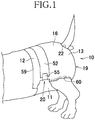
Fig. 1} Fig. 1 is a perspective view illustrating a diaper according to a first embodiment as an example of an absorbent article for pet animals according to the present invention put on a dog's body. - {
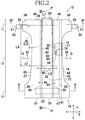
Fig. 2} Fig. 2 is a plan view of the diaper. - {
Fig. 3} Fig. 3 is a schematic sectional view taken along line III-III inFig. 2 . - {
Fig. 4} Fig. 4 is a schematic sectional view taken along line IV-IV inFig. 2 . - {
Fig. 5} Fig. 5 is a schematic sectional view taken along line V-V inFig. 2 . - {
Fig. 6} Fig. 6 is a schematic sectional view taken along line VI-VI inFig. 2 . - {
Fig. 7} Fig. 7 is a schematic sectional view of the diaper having a ventral region and a dorsal region fastened with each other by means of first and second fastening elements. - {
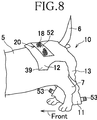
Fig. 8} Fig. 8 is a perspective view illustrating a process of putting the diaper on the body of the pet animal. - {
Fig. 9} Fig. 9 is a perspective view illustrating, frombehind, a process of putting the diaper on the body of the pet animal. - {
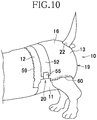
Fig. 10} Fig. 10 is a view similar toFig. 1 , illustrating the diaper according to a second embodiment. - {
Fig. 11} Fig. 11 is a view similar toFig. 2 , illustrating the diaper according to the second embodiment. - {
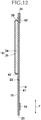
Fig. 12} Fig. 12 is a view similar toFig. 3 , illustrating the diaper according to the second embodiment. - {
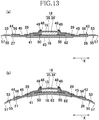
Fig. 13} Fig. 13 (a) is a view similar toFig. 4 , illustrating the diaper according to the second embodiment andFig. 13 (b) is a sectional view illustrating a state in which a central region in a transverse direction of the ventral region protrudes toward the side of a body-contact surface with respect to both side edges under contraction of ventral side elastic members. - {
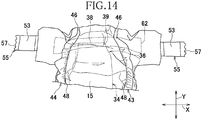
Fig. 14} Fig. 14 is a plan view of a first end portion of an absorbent panel under contractile force of respective elastic members. - {
Fig. 15} Fig. 15 is a perspective view illustrating a state in which the first end portion is gripped with a hand in the course of putting the diaper on the pet animal's body. - {
Fig. 16} Fig. 16 is an explanatory diagram illustrating a relationship between the pet animal and the first end portion with the diaper put on the pet animal's body. - The embodiments described below relate to an absorbent article for pet animals as illustrated in
Figs. 1-16 , including both optional and preferred features as well as those features which are essential features of the present invention. -
Figs. 1 through 9 illustrate a first embodiment of a diaper 1 according to the present invention. In this regard,Figs. 2 through 6 illustrate a state in whichelastic members diaper 10 has a longitudinal direction Y, a transverse direction X being orthogonal thereto, a pet animal' s body-contact surface and a non-body-contact surface opposite thereto, a longitudinal center line P bisecting a dimension in the transverse direction X and extending in the longitudinal direction Y and a transverse center line Q bisecting a dimension in the longitudinal direction X and extending in the transverse direction X. Thediaper 10 includes, aventral region 11, adorsal region 12, anintermediate region 13 lying between theventral region 11 and thedorsal region 12, a topsheet (interior sheet) 15, a backsheet (exterior sheet) 16, anabsorbent panel 19 having an absorbent structure 18having anabsorbent core 34 disposed between thetopsheet 15 and thebacksheet 16 so as to extend at least in theintermediate region 13 andfasteners 20 to fasten theventral region 11 and thedorsal region 12 to each other. With thediaper 10 put on the pet animal such as dog, theventral region 11 faces the belly of the pet animal, thedorsal region 12 faces the back of the pet animal and theintermediate region 11 faces the buttocks of the pet animal. - Referring to
Fig. 2 , theabsorbent panel 19 includes thetopsheet 15, thebacksheet 16 and theabsorbent body 18 interleaved between thetopsheet 15 and thebacksheet 16. Referring toFigs. 2 through 6 , theabsorbent panel 19 includes afirst end 24 and asecond end 25 opposed to each other in the longitudinal direction Y and both extending in the transverse direction X and bothlateral portions - The
topsheet 15 may be formed of fibrous nonwoven fabric, a porous plastic film or a laminate thereof. For example, the topsheet may be formed of an air-through fibrous nonwoven fabric, a spunbond fibrous nonwoven fabric or a pointbond fibrous nonwoven fabric. These nonwoven fabrics have for example, a mass of about 10 g/m2 40 g/m2. - The
backsheet 16 lies on the exterior surface of theabsorbent panel 19 and may be formed of material such as a moisture-permeable plastic film, a fibrous nonwoven fabric or a laminate sheet thereof. For example, thebacksheet 16 may be formed of a spunbond fibrous nonwoven fabric having a mass per unit area in a range of 8 to 30 g/m2. - The
topsheet 15 and thebacksheet 16 extend outward beyond a peripheral edge of theabsorbent body 18 and are joined to each other in the respective regions of these twosheets sheets barrier sheet 41 may be interposed between these twosheets absorbent body 18 may be secured on the leakage-barrier sheet 41. In theintermediate region 13 of theabsorbent panel 19, thesheets barrier sheet 41 are disposed with aslit 22 for formation of an opening through which the pet animal's tail may be exposed outward. Referring toFigs. 4 through 6 , for example, a dimension in the transverse direction X of thetopsheet 15 may be smaller than a dimension in the transverse direction X of the leakage-barrier sheet 41. - Unlike well-known disposable diapers for the human being, in the
ventral region 11 and thedorsal region 12 of thediaper 10, none of elastic members extending in the transverse direction X is arranged. In this way, it is possible to restrict a situation occurring particularly in thedorsal region 12 such that thesheets region 12 and whereby it is possible to restrict contraction in the transverse direction X of afirst fastening element 52 formed from a group of loops of a mechanical fastener as described later. Consequently, it is assured that thefirst fastening element 52 and a pair ofsecond fastening elements 53 are easily fastened to each other. - The
absorbent structure 18 includes theabsorbent core 34 formed, for example, from a mixture of wood fluff pulp and absorbent polymer particles and a liquid-diffusive sheet 35, for example, tissue paper to wrap theabsorbent core 34. Theabsorbent structure 18 is arranged in a limited area extending in the longitudinal direction Y from theintermediate region 13 to theventral region 11, more specifically, extending from a zone of theintermediate region 13 defined adjacent to theslit 22 into theventral region 11. - The
absorbent core 34 has afirst end 38 in theventral region 11 and asecond end 40 in theintermediate region 13 and theseends absorbent core 34 is divided into anarrow region 36 having thefirst end 38 and awide region 37 having thesecond end 40. In thewide region 37, a dimension in the transverse direction X of theabsorbent core 34 is uniform. In theabsorbent core 34, a dimension L1 in the transverse direction X measured along thefirst end 38 is smaller than a dimension L2 in the transverse direction X measured along thesecond end 40 and, in thenarrow region 36, the width thereof gradually shrinks from the side of thesecond end 40 toward thefirst end 38. In a state free from any effect of the contractile strength ofelastic members 29, 49 (described later), a dimension L3 in the longitudinal direction Y of thenarrow region 36 of theabsorbent core 34 is preferably in a range of about 30 to about 90% of a dimension L4 in the longitudinal direction Y of theabsorbent core 34. The dimension L1 in the transverse direction X of thecore 34 measured along thefirst end 38 may be, for example, in a range of about 50 to about 80 mm. The dimension L1 in the transverse direction X of the core 34 measured along thefirst end 38 is in a range of about 30 to 70% of the dimension L2 in the transverse direction X measured along thesecond end 40. The term "thefirst end 38" used herein means the most distal portion on one side of theabsorbent core 34. The term "the side of thesecond end 40" used herein means the most distal portion on the other side of theabsorbent core 34 including the vicinity thereof. - Referring to
Figs. 3 through 6 , the leakage-barrier sheet 41 form of a liquid-impermeable but moisture-permeable plastic film is arranged between thetopsheet 15 and thebacksheet 16. The leakage-barrier sheet 41 is secured by the intermediary of, for example, hot melt adhesive (not shown) distributed to one of the opposed surfaces of thesheets - Referring to
Figs. 2 through 6 , theabsorbent panel 19 further includes a pair ofcontainment sheets topsheet 15. Thecontainment sheets containment sheets lateral portions proximal portions 45 secured to the body-contact surface of thetopsheet 15, front andrear end portions distal portions 48 extending in the longitudinal direction Y and formed by innerside edge portions 50 of therespective containment sheets - Lateral
elastic members 29 extending in the longitudinal direction Y are attached between thecontainment sheets backsheet 16, more specifically, between thecontainment sheets barrier sheet 41. As the lateralelastic members 29, strand- or string-like elastic members having a fineness in a range of about 200 to 1000 dtex may be used. The lateralelastic members 29 are contractibly attached under tension in the longitudinal direction Y in in theventral region 11, theintermediate region 13 and thedorsal region 12. - The respective
distal portions 48 of thecontainment sheets elastic members 49 contractibly attached under tension in the longitudinal direction Y. Referring toFig. 2 , respective zones of thecontainment sheets absorbent structure 18 is present as viewed in the transverse direction X are disposed with the containmentelastic members 49 attached thereto under tension. In contrast, respective zones of theintermediate region 13 defined in the vicinity of thedorsal region 12, in which theabsorbent structure 18 is not present as viewed in the transverse direction X, are disposed with the containmentelastic members 49 attached in a relaxed state to thecontainment sheets containment sheets containment sheets Fig. 7 , with the first andsecond fastening elements ventral region 11 joined to thedorsal region 12, thedistal portions 48 are pulled off from the body-contact surface of thetopsheet 15 under contraction of the containmentelastic members 49 in the respective zones in which theabsorbent structure 18 is present as viewed in the longitudinal direction Y and whereby thecontainment sheets - The
fastener 20 includes thefirst fastening element 52 formed of a group of loops for a mechanical fastener extending in the transverse direction X (seeFigs. 1 and2 ) and thesecond fastening element 53 formed of a group of hooks for the mechanical fastener adapted to be fastened to thefirst fastening element 52. Respectiveproximal portions 56 of a pair offastening tabs 55 lie between thecontainment sheets backsheet 16 and theseproximal portions 56 are secured, for example, with hot melt adhesive (not shown) distributed to thesheets fastening tabs 55 is preferably formed of sheet material having relatively high stiffness and tensile strength, for example, a plastic film, a fibrous nonwoven fabric, a laminate thereof or a craft paper. Thesecond fastening elements 53 are attached to respectivedistal portions 57 in a pair of thefastening tabs 55 distanced from each other symmetrically about the longitudinal center line P. - Referring to
Fig. 8 , in the course of putting thediaper 10 on apet animal 5, first, theslit 22 is forced to form an opening into which atail 6 of the pet animal is inserted and the back of thepet animal 5 is put in contact with thedorsal region 12. In this state, as illustrated inFig. 9 , thenarrow region 36 of theabsorbent core 34 lies between both rear legs of thepet animal 5. In this step, theventral region 11 defines the lower end of thediaper 10 and thesecond fastening elements 53 lie on both outer sides in the transverse direction X of theventral region 11. In this state, theventral region 11 in which theabsorbent core 34 is present may be pinched with fingers to let thefirst end 24 of theabsorbent panel 19 pass between the bothrear legs 7 of thepet animal 5. For the reason that the dimension in the transverse direction X of theabsorbent core 34 in theventral region 11 gradually narrows from the side of thesecond end 40 toward thefirst end 38, it is possible to restrict a possibility that thefirst end 38 of theabsorbent core 34 might be indirectly caught by the bothrear legs 7 in this step, thereby facilitating thediaper 10 to be put on thepet animal 5. - Thereafter, the
first fastening element 52 and thesecond fastening elements 53 may be fastened to each other to define a waist-opening 59 and a pair of rear leg-openings 60 (seeFigs. 1 and7 ). The waist-opening 59 is defined by thefirst end 24 of theventral region 11 of theabsorbent panel 19 and thesecond end 25 of thedorsal region 12 and the rear leg-openings 60 are defined by the bothlateral portions fastening tabs 55 are exemplarily illustrated to be attached with, for example, hot melt adhesive distributed to thebacksheet 16, it is also possible to arrange the topsheet so as to extend in the transverse direction beyond the periphery of the backsheet and to attach the fastening tabs to these projecting portions of the topsheet with, for example, hot melt adhesive distributed to these projecting portions of the topsheet. - According to this
diaper 10, in addition to the functions and the effects as described hereinabove, the respectiveproximal portions 45 of thecontainment sheets absorbent core 34 and the respective front andrear end portions containment sheets absorbent core 34. Consequently, it is possible to restrict a possibility that the stiffness of the absorbent core might decrease the contractile force of the containmentelastic members 49. Restricting the undesirable influence of stiffness of theabsorbent core 34, it is possible to assure that thecontainment sheets 43 raise themselves on theabsorbent structure 18 under the contractile force of the containmentelastic members 49. In this way, it is possible to prevent body fluids such as urine from leaking beyond the bothlateral portions diaper 10 in the transverse direction X. - Furthermore, the
first end 38 of theabsorbent core 34 partially extends outward in the longitudinal direction Y beyond the respective ends of theproximal portions 56 on the side of thedorsal region 12 so that, when thefirst end 24 of theabsorbent panel 19 is passed between the bothrear legs 7 of thepet animal 5, the portion to be passed between the bothrear legs 7 includes therein theabsorbent core 34 having relatively high stiffness. For this reason, shape retention of theabsorbent core 34 is sufficiently assured to facilitate thefirst end 24 to be passed between the bothrear legs 7 of thepet animal 5. Additionally, theabsorbent core 34 is continuous in the longitudinal direction Y from theventral region 11 toward theintermediate region 13 and therefore it is easy to pinch the portion in which the high stiffnessabsorbent core 34 is present. -
Figs. 10 through 16 illustrate thediaper 10 according to a second embodiment. On the side of thefirst end 24 of theventral region 11 in thisdiaper 10, a ventral sideelastic member 62 extending in the transverse direction X is attached between theabsorbent structure 18 and thebacksheet 16, more specifically, between the leakage-barrier sheet 41 and thebacksheet 16. The ventral sideelastic member 62 is formed of, for example, an elastomer resin such as polyurethane in a belt-like shape. - In a state free from contractile force of the
elastic members narrow region 36 of theabsorbent core 34 gradually narrows from thefirst end 38 of theventral region 11 toward the transverse central line Q and then gradually widens again as being closer to the transverse central line Q. In thewide region 37 of theabsorbent core 34, the dimension thereof in the transverse direction X is constant as long as thecore 34 is free from the contractile force of theelastic members - Referring to
Fig. 11 , the ventral sideelastic member 62 has a belt-like shape of a predetermined dimension in the transverse direction X so that the ventral sideelastic member 62 may overlap thefirst end 38 of theabsorbent core 34 and aportion 39 of theabsorbent core 34 having a dimension in the transverse direction X gradually narrows as thecore 34 extends toward the transverse center line Q. Contraction of the ventral sideelastic member 62 in the transverse direction X makes it possible to decrease a dimension in the transverse direction X of thefirst end 38 of theabsorbent core 34 so that a dimension in the transverse direction X of theabsorbent core 34 in itsnarrow region 36 may be gradually decreased from the side of thesecond end 40 toward thefirst end 38. In this way, it is possible to restrict a possibility that theabsorbent core 34 might be indirectly caught by the bothrear legs 7, thereby facilitating thediaper 10 to be put on the body of thepet animal 5. Furthermore, in the state of the ventral sideelastic member 62 being held under tension, a dimension in the transverse direction X of theabsorbent core 34 in thefirst end 38 may be set to be relatively large. In consequence, the functions and effects as have been described above may be assured without noticeably decreasing the absorbent capacity. In addition, it is possible to make the dimension in the transverse direction X of theabsorbent core 34 as the ventral sideelastic member 62 contracts in the transverse direction X, thereby enhancing the stiffness of theabsorbent core 34 at thefirst end 38. In this way, thefirst end 38 of theabsorbent core 34 to be passed between the bothrear legs 7 of thepet animal 5 has the stiffness further enhanced and, for this reason, it is possible to put thediaper 10 on the body of thepet animal 5 further smoothly. - Contraction in the transverse direction X of the ventral side
elastic member 62 decreases a dimension in the transverse direction X of thefirst end 38 and, in theventral region 11, makes acentral portion 63 in the transverse direction X including the longitudinal center line P project from the bothlateral portions Fig. 13 (b) , in response to contraction of the ventral sideelastic member 62 in the transverse direction X, in theventral region 11, thecentral portion 63 in transverse direction X projects from the bothlateral portions - The state of the
ventral region 11 in which thecentral portion 63 in the transverse direction X projects from the bothlateral portions ventral region 11 in which thecentral portion 63 in the transverse direction X projects from the bothlateral portions ventral region 11 in which thecentral portion 63 in the transverse direction X projects from the bothlateral portions central portion 63 in the transverse direction X may be pushed with the finger from the side of the body-contact surface toward the side of the non-body-contact surface to convert the state to the state in which thecentral portion 63 in the transverse direction X projects from the bothlateral portions - Referring to
Fig. 13 (b) andFig. 15 , in the course of putting thediaper 10 on the body of thepet animal 5, thecentral portion 63 in the transverse direction X of theventral region 11 may be projected from the bothlateral portions distal portions 57 of the pair offastening tabs 55 hang down under an action of gravity, thereby setting apart thesecond fastening elements 53 from the skin of thepet animal 5. Whereby it is facilitated to pinch thesecond fastening elements 53 and to simplify handling of fastening the first andsecond fastening elements - Furthermore, in the course of putting the
diaper 10 on the body of thepet animal 5, thecentral portion 63 in the transverse direction X of theventral region 11 may be projected from the bothlateral portions central portion 34e in the transverse direction X of theabsorbent core 34 in contact with the belly of thepet animal 5 and to put bothlateral portions pet animal 5. In this way, the handling of putting thediaper 10 on the body of thepet animal 5 is further smooth. - An arrangement such that the one end of the containment-
elastic member 49 in theventral region 11 overlaps the ventral sideelastic member 62 in the planar view makes it possible to project, in theventral region 11, thecentral portion 63 in the transverse direction X from the bothlateral portions elastic members central portion 63 in the transverse direction X projecting from the bothlateral portions second fastening elements 53 from the skin of the pet animal and it is correspondingly made easy to pinch thesecond fastening elements 53 with the human fingers. - Furthermore, the arrangement such that, in the
ventral region 11, one end of the lateralelastic member 29 overlaps the ventral sideelastic member 62 in the planar view makes it possible to project thecentral portion 63 in the transverse direction X from the bothlateral portions central portion 63 in the transverse direction X projects from the bothlateral portions second fastening elements 53 apart from the skin of the pet animal and to make it easy to pinch thesecond fastening elements 53 with the human fingers. In this way, fastening between the first andsecond fastening elements - According to this
diaper 10, in addition to the functions and effects described hereinbefore, it is possible to restrict a decrease in the contractile force of the containment-elastic members 49 since there is no overlapping relationship between theproximal portions 45 of thecontainment sheet 43 and theabsorbent core 34 and there is no overlapping relationship also between the front andrear ends containment sheet 43 and theabsorbent core 34. - The ventral side
elastic member 62 has been exemplarily described above to have the respective wide regions at the both ends in the transverse direction X and to have the constant width portion between the both ends. However, the present invention is not limited to such an arrangement but the ventral side elastic member may have, for example, a rectangular shape having a constant width in its entirety in the transverse direction X. - The disclosure relating to the present invention as described hereinabove may be arranged as follows:
- The absorbent article for pet animals having a longitudinal direction, a transverse direction being orthogonal thereto, the body-contact surface facing pet animal's body and the non-body-contact surface lying on the side opposite thereto and including the absorbent panel having the ventral region, the dorsal region and the intermediate region defined between the ventral region and the dorsal region as viewed in the longitudinal direction wherein the absorbent panel includes the liquid-permeable interior sheet, the liquid-impermeable exterior sheet and the liquid absorbent core lying between these interior and exterior sheets. The liquid absorbent core is arranged in a limited area extending from a zone of the intermediate region defined adjacent to the slit for formation of an opening into which the pet animal's tail is inserted into the ventral region and has the first end lying in the ventral region and the second end lying in the intermediate region opposed to each other in the longitudinal direction; and the dimension in the transverse direction of the ventral region of the liquid absorbent core gradually narrows from the side of the second end toward the first end.
- The present invention disclosed above may include at least embodiments as described below. These embodiments may be adopted in isolation or in combination with one another.
- (1) The liquid absorbent core is divided into the narrow region having the first end and a wide region having the second end so that the liquid absorbent core may gradually narrow from the side of the second end toward the first end.
- (2) In the liquid absorbent core, a dimension in the longitudinal direction of the narrow region is in a range of 30 to 90% of a dimension in the longitudinal direction of the liquid absorbent core.
- (3) The absorbent article further includes the ventral side elastic member extending in the transverse direction in the ventral region wherein the ventral side elastic member is contractibly attached under tension between the liquid absorbent core and the exterior sheet and overlaps the first end of the liquid absorbent core in a planar view.
- (4) The absorbent article further includes the pair of containment sheets extending in the longitudinal direction on the body-contact surface of the interior sheet wherein the pair of containment sheets have proximal portions secured to the interior sheet or the exterior sheet, the distal portions provided with the containment elastic members extending in the longitudinal direction and adapted to be set apart from the interior sheet under contraction of the containment elastic members and front and rear fixed ends secured to both ends in the longitudinal direction of the interior sheet so that the front and rear ends and the liquid absorbent core are not overlapped each other in a planar view.
- (5) The absorbent article further including the fastener serving to fasten the ventral region and the dorsal region to each other wherein the fastener is disposed with the pair of fastening tabs extending outward in the transverse direction from both lateral portions of the ventral region; the fastening tabs respectively have distal portions secured to the interior sheet or the exterior sheet; and the first end of the liquid absorbent core partially extends outward in the longitudinal direction beyond end edges of the proximal portions lying on the side of the dorsal region.
- (6) The respective ends of the containment elastic members overlap the ventral side elastic member in a planar view.
- (7) The absorbent article further including the lateral elastic members extending in the longitudinal direction from the ventral region to the dorsal region and contractibly attached under tension between the containment sheets and the exterior sheet wherein ends of the lateral elastic members in the ventral region overlap the ventral side elastic member in a planar view. {Reference Signs List}
-
- 10 absorbent article for pet animal (diaper)
- 11 ventral region
- 12 dorsal region
- 13 intermediate region
- 15 topsheet (interior sheet)
- 16 backsheet (exterior sheet)
- 19 absorbent panel
- 20 fastener
- 22 slit for formation of opening
- 24 first end
- 25 second end
- 29 lateral elastic members
- 34 absorbent core
- 35 liquid-diffusive sheet
- 43 containment sheet
- 44 containment sheet
- 45 proximal portions
- 46 front end portion
- 47 rear end portion
- 48 distal portions
- 49 containment elastic members
- 52 first fastening element
- 53 second fastening elements
- 55 fastening tabs
- 62 ventral side elastic member
- L1 dimension in transverse direction of absorbent core's first end
- L2 dimension in transverse direction of absorbent core's second end
- L3 dimension in longitudinal direction of absorbent core's narrower region
- L4 dimension in longitudinal direction of absorbent core
- X transverse direction
- Y longitudinal direction
Claims (8)
- An absorbent article for pet animal having a longitudinal direction, a transverse direction being orthogonal thereto, a body-contact surface facing pet animal's body and a non-body-contact surface lying on the side opposite thereto and including an absorbent panel having a ventral region, a dorsal region and an intermediate region defined between the ventral region and the dorsal region as viewed in the longitudinal direction wherein the absorbent panel includes a liquid-permeable interior sheet, a liquid-impermeable exterior sheet and a liquid absorbent core lying between these interior and exterior sheets, wherein:the liquid absorbent core is arranged in a limited area extending from a zone of the intermediate region defined adj acent to a slit for formation of an opening into which the pet animal's tail is inserted into the ventral region and has a first end lying in the ventral region and a second end lying in the intermediate region opposed to each other in the longitudinal direction; anda dimension in the transverse direction of the ventral region of the liquid absorbent core gradually narrows from the side of the second end toward the first end.
- The absorbent article according to claim 1 wherein the liquid absorbent core is divided into a narrow region having the first end and a wide region having the second end so that the liquid absorbent core may gradually narrow from the side of the second end toward the first end.
- The absorbent article according to claim 2 wherein a dimension in the longitudinal direction of the narrow region is in a range of 30 to 90% of a dimension in the longitudinal direction of the liquid absorbent core.
- The absorbent article according to any one of claims 1 through 3 further including a ventral region elastic member extending in the transverse direction in the ventral region wherein the ventral side elastic member is contractibly attached under tension between the liquid absorbent core and the exterior sheet and overlaps the first end of the liquid absorbent core in a planar view.
- The absorbent article according to any one of claims 1 through 4 further including a pair of containment sheets extending in the longitudinal direction on the body-contact surface of the interior sheet wherein the pair of containment sheets have proximal portions secured to the interior sheet or the exterior sheet, distal portions disposed with containment elastic members extending in the longitudinal direction and adapted to be set apart from the interior sheet under contraction of the containment elastic members and front and rear ends secured to both ends in the longitudinal direction of the interior sheet so that the front and rear ends and the liquid absorbent core are not overlapped each other in a planar view.
- The absorbent article according to any one of claims 1 through 5 further including a fastener serving to fasten the ventral region and the dorsal region to each other wherein:the fastener is disposed with a pair of fastening tabs extending outward in the transverse direction from both lateral portions of the ventral region;the fastening tabs respectively have distal portions fixed to the interior sheet or the exterior sheet; andthe first end of the liquid absorbent core partially extends outward in the longitudinal direction beyond end edges of the proximal portions lying on the side of the dorsal region.
- The absorbent article according to claim 5 wherein respective ends of the containment elastic members overlap the ventral side elastic member in a planar view.
- The absorbent article according to claim 5 further including lateral elastic members extending in the longitudinal direction from the ventral region to the dorsal region and contractibly attached under tension between the containment sheets and the exterior sheet wherein ends of the lateral elastic members in the ventral region overlap the ventral side elastic member in a planar view.
Applications Claiming Priority (2)
| Application Number | Priority Date | Filing Date | Title |
|---|---|---|---|
| JP2014118172A JP5576002B1 (en) | 2014-06-06 | 2014-06-06 | Absorbent articles |
| PCT/JP2014/065951 WO2015005069A1 (en) | 2014-06-06 | 2014-06-16 | Absorbent article for pet animal |
Publications (3)
| Publication Number | Publication Date |
|---|---|
| EP3153017A1 true EP3153017A1 (en) | 2017-04-12 |
| EP3153017A4 EP3153017A4 (en) | 2017-06-21 |
| EP3153017B1 EP3153017B1 (en) | 2018-03-21 |
Family
ID=51579035
Family Applications (1)
| Application Number | Title | Priority Date | Filing Date |
|---|---|---|---|
| EP14823082.4A Active EP3153017B1 (en) | 2014-06-06 | 2014-06-16 | Absorbent article for pet animal |
Country Status (7)
| Country | Link |
|---|---|
| US (1) | US9456886B2 (en) |
| EP (1) | EP3153017B1 (en) |
| JP (1) | JP5576002B1 (en) |
| CN (1) | CN106132194B (en) |
| AU (1) | AU2014288496B2 (en) |
| TW (1) | TWI658785B (en) |
| WO (1) | WO2015005069A1 (en) |
Families Citing this family (17)
| Publication number | Priority date | Publication date | Assignee | Title |
|---|---|---|---|---|
| JP5755630B2 (en) * | 2012-12-13 | 2015-07-29 | ユニ・チャーム株式会社 | Disposable diapers for pets |
| JP5755631B2 (en) * | 2012-12-13 | 2015-07-29 | ユニ・チャーム株式会社 | Disposable diapers for pets |
| JP6084451B2 (en) | 2012-12-13 | 2017-02-22 | ユニ・チャーム株式会社 | Disposable diapers for pets |
| JP5829600B2 (en) | 2012-12-13 | 2015-12-09 | ユニ・チャーム株式会社 | Disposable diapers for pets |
| JP6008729B2 (en) | 2012-12-13 | 2016-10-19 | ユニ・チャーム株式会社 | Disposable diapers for pets |
| JP6084452B2 (en) * | 2012-12-13 | 2017-02-22 | ユニ・チャーム株式会社 | Disposable diapers for pets |
| JP6084450B2 (en) * | 2012-12-13 | 2017-02-22 | ユニ・チャーム株式会社 | Disposable diapers for pets |
| JP5956323B2 (en) | 2012-12-13 | 2016-07-27 | ユニ・チャーム株式会社 | Disposable diapers for pets |
| JP5829599B2 (en) | 2012-12-13 | 2015-12-09 | ユニ・チャーム株式会社 | Disposable diapers for pets |
| JP6084453B2 (en) * | 2012-12-13 | 2017-02-22 | ユニ・チャーム株式会社 | Disposable diapers for pets |
| JP5695793B1 (en) * | 2014-11-14 | 2015-04-08 | ユニ・チャーム株式会社 | Absorbent articles for pets |
| JP5714170B1 (en) * | 2014-11-14 | 2015-05-07 | ユニ・チャーム株式会社 | Absorbent articles for pets |
| CN105393923A (en) * | 2015-10-21 | 2016-03-16 | 芜湖悠派护理用品科技股份有限公司 | Pet paper diaper |
| JP6407126B2 (en) * | 2015-11-02 | 2018-10-17 | ユニ・チャーム株式会社 | Absorbent articles for pets |
| CN114727588B (en) * | 2019-11-25 | 2023-08-22 | 尤妮佳股份有限公司 | Diaper for cat |
| JP7153680B2 (en) * | 2020-03-06 | 2022-10-14 | ユニ・チャーム株式会社 | pet diaper |
| US12550868B2 (en) * | 2021-06-16 | 2026-02-17 | Crazy K Farm Pet And Poultry Products, Llc | Wearable feline waste collector and method of making same |
Family Cites Families (10)
| Publication number | Priority date | Publication date | Assignee | Title |
|---|---|---|---|---|
| JP3625203B2 (en) * | 2002-01-21 | 2005-03-02 | 東亜機工株式会社 | Disposable diapers for pets |
| JP3627808B2 (en) * | 2002-02-25 | 2005-03-09 | 東亜機工株式会社 | Disposable diaper for pet and method for producing disposable diaper for pet |
| JP3884368B2 (en) * | 2002-11-14 | 2007-02-21 | ユニ・チャームペットケア株式会社 | Pet diapers |
| JP4490080B2 (en) * | 2003-11-25 | 2010-06-23 | ユニ・チャームペットケア株式会社 | Male pet diaper |
| JP4445422B2 (en) * | 2005-03-28 | 2010-04-07 | ユニ・チャームペットケア株式会社 | Absorbent articles for animals |
| JP4583301B2 (en) * | 2005-12-22 | 2010-11-17 | ユニ・チャームペットケア株式会社 | Method for producing absorbent article for animals |
| JP2009240278A (en) * | 2008-03-31 | 2009-10-22 | Uni Charm Corp | Diaper for pet |
| JP5813976B2 (en) * | 2011-03-29 | 2015-11-17 | ユニ・チャーム株式会社 | Pet diapers |
| JP5624925B2 (en) * | 2011-03-30 | 2014-11-12 | ユニ・チャーム株式会社 | Absorbent articles for pets |
| JP5624949B2 (en) | 2011-06-14 | 2014-11-12 | ユニ・チャーム株式会社 | Absorbent article for pet and method for producing absorbent article for pet |
-
2014
- 2014-06-06 JP JP2014118172A patent/JP5576002B1/en active Active
- 2014-06-16 EP EP14823082.4A patent/EP3153017B1/en active Active
- 2014-06-16 CN CN201480077424.6A patent/CN106132194B/en active Active
- 2014-06-16 AU AU2014288496A patent/AU2014288496B2/en active Active
- 2014-06-16 US US14/387,815 patent/US9456886B2/en active Active
- 2014-06-16 WO PCT/JP2014/065951 patent/WO2015005069A1/en not_active Ceased
-
2015
- 2015-06-04 TW TW104118135A patent/TWI658785B/en active
Also Published As
| Publication number | Publication date |
|---|---|
| CN106132194B (en) | 2019-07-23 |
| TWI658785B (en) | 2019-05-11 |
| WO2015005069A1 (en) | 2015-01-15 |
| US20150272713A1 (en) | 2015-10-01 |
| CN106132194A (en) | 2016-11-16 |
| AU2014288496B2 (en) | 2019-05-23 |
| AU2014288496A1 (en) | 2016-09-08 |
| TW201616957A (en) | 2016-05-16 |
| EP3153017B1 (en) | 2018-03-21 |
| EP3153017A4 (en) | 2017-06-21 |
| JP5576002B1 (en) | 2014-08-20 |
| US9456886B2 (en) | 2016-10-04 |
| JP2015228858A (en) | 2015-12-21 |
Similar Documents
| Publication | Publication Date | Title |
|---|---|---|
| EP3153017B1 (en) | Absorbent article for pet animal | |
| US9439812B2 (en) | Absorbent article for pet animals | |
| US9351885B2 (en) | Disposable wearing article | |
| EP2410966B1 (en) | Absorbent article | |
| US9867742B2 (en) | Disposable wearing article | |
| AU2014285419B2 (en) | Absorbent article for pet animals and package thereof | |
| US8216206B2 (en) | Disposable absorbent article | |
| JP6436899B2 (en) | Absorbent articles for animals | |
| EP3456188B1 (en) | Absorbent article for pet | |
| AU2012387304A1 (en) | Pants-type wearing article | |
| JP6440471B2 (en) | Deployable wearing articles | |
| EP2856993A1 (en) | Disposable diaper | |
| US20180116178A1 (en) | Absorbent article for pet animals | |
| US9155667B2 (en) | Pants-type wearing article | |
| US7316675B2 (en) | Disposable pants-type wearing article | |
| EP3053562B1 (en) | Disposable pants-type diaper | |
| WO2024070221A1 (en) | Absorbent article for pets | |
| JP7321494B2 (en) | disposable absorbent article | |
| JP2025027183A (en) | Absorbent articles for pets |
Legal Events
| Date | Code | Title | Description |
|---|---|---|---|
| PUAI | Public reference made under article 153(3) epc to a published international application that has entered the european phase |
Free format text: ORIGINAL CODE: 0009012 |
|
| 17P | Request for examination filed |
Effective date: 20160815 |
|
| AK | Designated contracting states |
Kind code of ref document: A1 Designated state(s): AL AT BE BG CH CY CZ DE DK EE ES FI FR GB GR HR HU IE IS IT LI LT LU LV MC MK MT NL NO PL PT RO RS SE SI SK SM TR |
|
| AX | Request for extension of the european patent |
Extension state: BA ME |
|
| A4 | Supplementary search report drawn up and despatched |
Effective date: 20170524 |
|
| RIC1 | Information provided on ipc code assigned before grant |
Ipc: A01K 23/00 20060101AFI20170518BHEP Ipc: A61F 13/15 20060101ALI20170518BHEP Ipc: A61D 99/00 20060101ALI20170518BHEP |
|
| DAX | Request for extension of the european patent (deleted) | ||
| GRAP | Despatch of communication of intention to grant a patent |
Free format text: ORIGINAL CODE: EPIDOSNIGR1 |
|
| INTG | Intention to grant announced |
Effective date: 20171025 |
|
| GRAS | Grant fee paid |
Free format text: ORIGINAL CODE: EPIDOSNIGR3 |
|
| GRAA | (expected) grant |
Free format text: ORIGINAL CODE: 0009210 |
|
| AK | Designated contracting states |
Kind code of ref document: B1 Designated state(s): AL AT BE BG CH CY CZ DE DK EE ES FI FR GB GR HR HU IE IS IT LI LT LU LV MC MK MT NL NO PL PT RO RS SE SI SK SM TR |
|
| REG | Reference to a national code |
Ref country code: GB Ref legal event code: FG4D |
|
| REG | Reference to a national code |
Ref country code: CH Ref legal event code: EP |
|
| REG | Reference to a national code |
Ref country code: AT Ref legal event code: REF Ref document number: 980097 Country of ref document: AT Kind code of ref document: T Effective date: 20180415 |
|
| REG | Reference to a national code |
Ref country code: IE Ref legal event code: FG4D |
|
| REG | Reference to a national code |
Ref country code: DE Ref legal event code: R096 Ref document number: 602014022760 Country of ref document: DE |
|
| REG | Reference to a national code |
Ref country code: FR Ref legal event code: PLFP Year of fee payment: 5 |
|
| REG | Reference to a national code |
Ref country code: NL Ref legal event code: MP Effective date: 20180321 |
|
| PG25 | Lapsed in a contracting state [announced via postgrant information from national office to epo] |
Ref country code: FI Free format text: LAPSE BECAUSE OF FAILURE TO SUBMIT A TRANSLATION OF THE DESCRIPTION OR TO PAY THE FEE WITHIN THE PRESCRIBED TIME-LIMIT Effective date: 20180321 Ref country code: NO Free format text: LAPSE BECAUSE OF FAILURE TO SUBMIT A TRANSLATION OF THE DESCRIPTION OR TO PAY THE FEE WITHIN THE PRESCRIBED TIME-LIMIT Effective date: 20180621 Ref country code: CY Free format text: LAPSE BECAUSE OF FAILURE TO SUBMIT A TRANSLATION OF THE DESCRIPTION OR TO PAY THE FEE WITHIN THE PRESCRIBED TIME-LIMIT Effective date: 20180321 Ref country code: LT Free format text: LAPSE BECAUSE OF FAILURE TO SUBMIT A TRANSLATION OF THE DESCRIPTION OR TO PAY THE FEE WITHIN THE PRESCRIBED TIME-LIMIT Effective date: 20180321 Ref country code: HR Free format text: LAPSE BECAUSE OF FAILURE TO SUBMIT A TRANSLATION OF THE DESCRIPTION OR TO PAY THE FEE WITHIN THE PRESCRIBED TIME-LIMIT Effective date: 20180321 |
|
| REG | Reference to a national code |
Ref country code: LT Ref legal event code: MG4D |
|
| REG | Reference to a national code |
Ref country code: AT Ref legal event code: MK05 Ref document number: 980097 Country of ref document: AT Kind code of ref document: T Effective date: 20180321 |
|
| PG25 | Lapsed in a contracting state [announced via postgrant information from national office to epo] |
Ref country code: BG Free format text: LAPSE BECAUSE OF FAILURE TO SUBMIT A TRANSLATION OF THE DESCRIPTION OR TO PAY THE FEE WITHIN THE PRESCRIBED TIME-LIMIT Effective date: 20180621 Ref country code: GR Free format text: LAPSE BECAUSE OF FAILURE TO SUBMIT A TRANSLATION OF THE DESCRIPTION OR TO PAY THE FEE WITHIN THE PRESCRIBED TIME-LIMIT Effective date: 20180622 Ref country code: SE Free format text: LAPSE BECAUSE OF FAILURE TO SUBMIT A TRANSLATION OF THE DESCRIPTION OR TO PAY THE FEE WITHIN THE PRESCRIBED TIME-LIMIT Effective date: 20180321 Ref country code: LV Free format text: LAPSE BECAUSE OF FAILURE TO SUBMIT A TRANSLATION OF THE DESCRIPTION OR TO PAY THE FEE WITHIN THE PRESCRIBED TIME-LIMIT Effective date: 20180321 Ref country code: RS Free format text: LAPSE BECAUSE OF FAILURE TO SUBMIT A TRANSLATION OF THE DESCRIPTION OR TO PAY THE FEE WITHIN THE PRESCRIBED TIME-LIMIT Effective date: 20180321 |
|
| PG25 | Lapsed in a contracting state [announced via postgrant information from national office to epo] |
Ref country code: RO Free format text: LAPSE BECAUSE OF FAILURE TO SUBMIT A TRANSLATION OF THE DESCRIPTION OR TO PAY THE FEE WITHIN THE PRESCRIBED TIME-LIMIT Effective date: 20180321 Ref country code: EE Free format text: LAPSE BECAUSE OF FAILURE TO SUBMIT A TRANSLATION OF THE DESCRIPTION OR TO PAY THE FEE WITHIN THE PRESCRIBED TIME-LIMIT Effective date: 20180321 Ref country code: IT Free format text: LAPSE BECAUSE OF FAILURE TO SUBMIT A TRANSLATION OF THE DESCRIPTION OR TO PAY THE FEE WITHIN THE PRESCRIBED TIME-LIMIT Effective date: 20180321 Ref country code: ES Free format text: LAPSE BECAUSE OF FAILURE TO SUBMIT A TRANSLATION OF THE DESCRIPTION OR TO PAY THE FEE WITHIN THE PRESCRIBED TIME-LIMIT Effective date: 20180321 Ref country code: AL Free format text: LAPSE BECAUSE OF FAILURE TO SUBMIT A TRANSLATION OF THE DESCRIPTION OR TO PAY THE FEE WITHIN THE PRESCRIBED TIME-LIMIT Effective date: 20180321 Ref country code: PL Free format text: LAPSE BECAUSE OF FAILURE TO SUBMIT A TRANSLATION OF THE DESCRIPTION OR TO PAY THE FEE WITHIN THE PRESCRIBED TIME-LIMIT Effective date: 20180321 Ref country code: NL Free format text: LAPSE BECAUSE OF FAILURE TO SUBMIT A TRANSLATION OF THE DESCRIPTION OR TO PAY THE FEE WITHIN THE PRESCRIBED TIME-LIMIT Effective date: 20180321 |
|
| PG25 | Lapsed in a contracting state [announced via postgrant information from national office to epo] |
Ref country code: SK Free format text: LAPSE BECAUSE OF FAILURE TO SUBMIT A TRANSLATION OF THE DESCRIPTION OR TO PAY THE FEE WITHIN THE PRESCRIBED TIME-LIMIT Effective date: 20180321 Ref country code: CZ Free format text: LAPSE BECAUSE OF FAILURE TO SUBMIT A TRANSLATION OF THE DESCRIPTION OR TO PAY THE FEE WITHIN THE PRESCRIBED TIME-LIMIT Effective date: 20180321 Ref country code: AT Free format text: LAPSE BECAUSE OF FAILURE TO SUBMIT A TRANSLATION OF THE DESCRIPTION OR TO PAY THE FEE WITHIN THE PRESCRIBED TIME-LIMIT Effective date: 20180321 Ref country code: SM Free format text: LAPSE BECAUSE OF FAILURE TO SUBMIT A TRANSLATION OF THE DESCRIPTION OR TO PAY THE FEE WITHIN THE PRESCRIBED TIME-LIMIT Effective date: 20180321 |
|
| PG25 | Lapsed in a contracting state [announced via postgrant information from national office to epo] |
Ref country code: PT Free format text: LAPSE BECAUSE OF FAILURE TO SUBMIT A TRANSLATION OF THE DESCRIPTION OR TO PAY THE FEE WITHIN THE PRESCRIBED TIME-LIMIT Effective date: 20180723 |
|
| REG | Reference to a national code |
Ref country code: DE Ref legal event code: R097 Ref document number: 602014022760 Country of ref document: DE |
|
| PLBE | No opposition filed within time limit |
Free format text: ORIGINAL CODE: 0009261 |
|
| STAA | Information on the status of an ep patent application or granted ep patent |
Free format text: STATUS: NO OPPOSITION FILED WITHIN TIME LIMIT |
|
| PG25 | Lapsed in a contracting state [announced via postgrant information from national office to epo] |
Ref country code: DK Free format text: LAPSE BECAUSE OF FAILURE TO SUBMIT A TRANSLATION OF THE DESCRIPTION OR TO PAY THE FEE WITHIN THE PRESCRIBED TIME-LIMIT Effective date: 20180321 |
|
| REG | Reference to a national code |
Ref country code: CH Ref legal event code: PL |
|
| 26N | No opposition filed |
Effective date: 20190102 |
|
| REG | Reference to a national code |
Ref country code: BE Ref legal event code: MM Effective date: 20180630 |
|
| REG | Reference to a national code |
Ref country code: IE Ref legal event code: MM4A |
|
| PG25 | Lapsed in a contracting state [announced via postgrant information from national office to epo] |
Ref country code: MC Free format text: LAPSE BECAUSE OF FAILURE TO SUBMIT A TRANSLATION OF THE DESCRIPTION OR TO PAY THE FEE WITHIN THE PRESCRIBED TIME-LIMIT Effective date: 20180321 Ref country code: LU Free format text: LAPSE BECAUSE OF NON-PAYMENT OF DUE FEES Effective date: 20180616 |
|
| PG25 | Lapsed in a contracting state [announced via postgrant information from national office to epo] |
Ref country code: IE Free format text: LAPSE BECAUSE OF NON-PAYMENT OF DUE FEES Effective date: 20180616 Ref country code: CH Free format text: LAPSE BECAUSE OF NON-PAYMENT OF DUE FEES Effective date: 20180630 Ref country code: LI Free format text: LAPSE BECAUSE OF NON-PAYMENT OF DUE FEES Effective date: 20180630 |
|
| PG25 | Lapsed in a contracting state [announced via postgrant information from national office to epo] |
Ref country code: BE Free format text: LAPSE BECAUSE OF NON-PAYMENT OF DUE FEES Effective date: 20180630 Ref country code: SI Free format text: LAPSE BECAUSE OF FAILURE TO SUBMIT A TRANSLATION OF THE DESCRIPTION OR TO PAY THE FEE WITHIN THE PRESCRIBED TIME-LIMIT Effective date: 20180321 |
|
| PG25 | Lapsed in a contracting state [announced via postgrant information from national office to epo] |
Ref country code: MT Free format text: LAPSE BECAUSE OF NON-PAYMENT OF DUE FEES Effective date: 20180616 |
|
| PG25 | Lapsed in a contracting state [announced via postgrant information from national office to epo] |
Ref country code: TR Free format text: LAPSE BECAUSE OF FAILURE TO SUBMIT A TRANSLATION OF THE DESCRIPTION OR TO PAY THE FEE WITHIN THE PRESCRIBED TIME-LIMIT Effective date: 20180321 |
|
| PG25 | Lapsed in a contracting state [announced via postgrant information from national office to epo] |
Ref country code: MK Free format text: LAPSE BECAUSE OF NON-PAYMENT OF DUE FEES Effective date: 20180321 Ref country code: HU Free format text: LAPSE BECAUSE OF FAILURE TO SUBMIT A TRANSLATION OF THE DESCRIPTION OR TO PAY THE FEE WITHIN THE PRESCRIBED TIME-LIMIT; INVALID AB INITIO Effective date: 20140616 |
|
| PG25 | Lapsed in a contracting state [announced via postgrant information from national office to epo] |
Ref country code: IS Free format text: LAPSE BECAUSE OF FAILURE TO SUBMIT A TRANSLATION OF THE DESCRIPTION OR TO PAY THE FEE WITHIN THE PRESCRIBED TIME-LIMIT Effective date: 20180721 |
|
| PGFP | Annual fee paid to national office [announced via postgrant information from national office to epo] |
Ref country code: GB Payment date: 20240502 Year of fee payment: 11 |
|
| PGFP | Annual fee paid to national office [announced via postgrant information from national office to epo] |
Ref country code: FR Payment date: 20240509 Year of fee payment: 11 |
|
| GBPC | Gb: european patent ceased through non-payment of renewal fee |
Effective date: 20250616 |
|
| PG25 | Lapsed in a contracting state [announced via postgrant information from national office to epo] |
Ref country code: GB Free format text: LAPSE BECAUSE OF NON-PAYMENT OF DUE FEES Effective date: 20250616 |
|
| PG25 | Lapsed in a contracting state [announced via postgrant information from national office to epo] |
Ref country code: FR Free format text: LAPSE BECAUSE OF NON-PAYMENT OF DUE FEES Effective date: 20250630 |
|
| PGFP | Annual fee paid to national office [announced via postgrant information from national office to epo] |
Ref country code: DE Payment date: 20260430 Year of fee payment: 13 |