EP3149705B1 - Verfahren und vorrichtung zur schätzung eines qualitätsindexes eines 3d-bildes eines stücks verbundstoffmaterial - Google Patents
Verfahren und vorrichtung zur schätzung eines qualitätsindexes eines 3d-bildes eines stücks verbundstoffmaterial Download PDFInfo
- Publication number
- EP3149705B1 EP3149705B1 EP15731646.4A EP15731646A EP3149705B1 EP 3149705 B1 EP3149705 B1 EP 3149705B1 EP 15731646 A EP15731646 A EP 15731646A EP 3149705 B1 EP3149705 B1 EP 3149705B1
- Authority
- EP
- European Patent Office
- Prior art keywords
- image
- histogram
- gaussian
- estimation method
- quality index
- Prior art date
- Legal status (The legal status is an assumption and is not a legal conclusion. Google has not performed a legal analysis and makes no representation as to the accuracy of the status listed.)
- Active
Links
Images

Classifications
-
- G—PHYSICS
- G06—COMPUTING OR CALCULATING; COUNTING
- G06T—IMAGE DATA PROCESSING OR GENERATION, IN GENERAL
- G06T7/00—Image analysis
- G06T7/0002—Inspection of images, e.g. flaw detection
-
- G—PHYSICS
- G06—COMPUTING OR CALCULATING; COUNTING
- G06T—IMAGE DATA PROCESSING OR GENERATION, IN GENERAL
- G06T7/00—Image analysis
- G06T7/0002—Inspection of images, e.g. flaw detection
- G06T7/0004—Industrial image inspection
-
- G—PHYSICS
- G06—COMPUTING OR CALCULATING; COUNTING
- G06T—IMAGE DATA PROCESSING OR GENERATION, IN GENERAL
- G06T2207/00—Indexing scheme for image analysis or image enhancement
- G06T2207/10—Image acquisition modality
- G06T2207/10072—Tomographic images
-
- G—PHYSICS
- G06—COMPUTING OR CALCULATING; COUNTING
- G06T—IMAGE DATA PROCESSING OR GENERATION, IN GENERAL
- G06T2207/00—Indexing scheme for image analysis or image enhancement
- G06T2207/30—Subject of image; Context of image processing
- G06T2207/30108—Industrial image inspection
- G06T2207/30164—Workpiece; Machine component
-
- G—PHYSICS
- G06—COMPUTING OR CALCULATING; COUNTING
- G06T—IMAGE DATA PROCESSING OR GENERATION, IN GENERAL
- G06T2207/00—Indexing scheme for image analysis or image enhancement
- G06T2207/30—Subject of image; Context of image processing
- G06T2207/30168—Image quality inspection
Definitions
- the invention relates to the general field of imaging and more particularly to three-dimensional images (or 3D images) of parts of composite materials (eg parts made of carbon fibers and of a carbon matrix or resin), such as for example images of parts of composite materials obtained by digital tomography.
- parts of composite materials eg parts made of carbon fibers and of a carbon matrix or resin
- Digital tomography is an imaging technique that allows, from a succession of photographs taken of a piece of composite material, to reconstruct a three-dimensional image coded in grayscale of this piece.
- the gray level of a voxel in the 3D image is proportional to the material density of the part in this voxel. This 3D image makes it possible to automatically detect, using appropriate image analysis techniques, any defects affecting the piece of material inspected.
- Document D1 US 2007/019861 relates to a method for generating a background mask from an image coded in intensity value with a noisy background area.
- the method consists in generating a histogram of image intensity value; fitting a model curve to a sub-area of the intensity value histogram; calculating a threshold value in the intensity value histogram from the adjustment parameters of the model curve; and generating the background mask from at least one defined image area belonging to the background noise by adding all the pixels of intensities below the threshold to the background mask when it is connected to the image area by through pixels whose intensities are also below the threshold value.
- the present invention makes it possible in particular to overcome these drawbacks by proposing a method making it possible to automatically and objectively estimate the quality of a 3D image of a part made of composite material.
- the invention also relates to a device for estimating at least one quality index of a three-dimensional image coded in gray levels of a piece of composite material, the estimating device being described in claim 11.
- 3D image No limitation is attached to the origin of the 3D image. It can be a 3D image reconstructed by digital tomography or by any other means.
- the invention proposes a robust, rapid (requiring only a few seconds per image) and repetitive method offering a tool objective for measuring the quality of a grayscale 3D image of a piece of composite material. This method does not require any image, reference bar or any specific tool to be able to estimate the quality indices, which makes it particularly simple to implement.
- the quality of the 3D image is essentially affected by a random noise linked to the image acquisition system and the distribution of which is substantially Gaussian (possibly with prior processing 3D image to eliminate low frequency artifacts present in the image), and on the other hand, that the different phases of a composite material do not have the same density of material and are therefore "visible ”(That is to say separable) in the 3D image (they indeed correspond to different gray levels). It follows from these observations that the gray levels of the 3D image corresponding to the different phases of the composite material (eg resin, strands, fibers, etc.) follow a Gaussian distribution.
- the composite material eg resin, strands, fibers, etc.
- the inventors thus judiciously propose to carry out a deconvolution of the histogram of the 3D image in Gaussians (or in an equivalent manner in Gaussian distributions if the histogram is normalized), then to exploit the parameters characterizing the Gaussians extracted via this deconvolution for derive quality indices from the 3D image.
- the different phases of the composite material should be reflected on the histogram of the 3D image by representations of the diracs type, perfectly separated and positioned at gray levels corresponding respectively to the densities of material associated with the different phases.
- the presence of random Gaussian noise has the effect of transforming these diracs into Gaussian.
- the histogram of the 3D image consists of a mixture (sum) of Gaussians.
- the inventors had the idea of advantageously exploiting the parameters characterizing these Gaussians to derive indices of quality of the 3D image, and in particular their means and / or standard deviations (or in an equivalent manner their variances), and / or again the proportion of each Gaussian within the mixture of Gaussians represented by the histogram of the 3D image. Indeed, the more the Gaussians are isolated and the further apart, the higher the 3D image can be considered to be of good quality. On the contrary, the closer and more overlapping the Gaussians, the more poor the 3D image can be considered.
- the number of Gaussians extracted from the histogram depends on the composite material considered and preferably corresponds to the numbers of distinct phases present in the composite material considered. It is preferably chosen to be 3.
- the Gaussian extraction step (or equivalent Gaussian deconvolution) is carried out for example using an expectation-maximization algorithm (EM for “Expectation-Maximization” in English).
- EM expectation-maximization algorithm
- the composite material being formed from a resin and fibers impregnated with resin, a low contrast on the 3D image between the phases of the composite material can be observed.
- these components can be present in the composite material in very distinct proportions.
- the EM algorithm overcomes the difficulties resulting from these characteristics of composite materials and allows to easily and automatically extract the Gaussians (and their parameters) mixed in the histogram of the 3D image.
- the function f is for example a sigmoid function or a function defined from the hyperbolic tangent function. It is preferably chosen so that the quality index I1 tends towards 1 when the Gaussians are well separated and towards 0 when they are combined or superimposed (separation of the different phases of the material impossible on the 3D image).
- said at least one image quality index comprises an index I2 quantifying an overlap between the Gaussians extracted from the histogram.
- said at least one image quality index comprises, for at least one Gaussian G extracted from the histogram, an index I3 (G) associated with said Gaussian and defined as the ratio between the mean and standard deviation of this Gaussian.
- a signal-to-noise ratio is evaluated on each Gaussian independently of each other.
- the invention thanks to the step of extracting the Gaussians from the histogram of the 3D image, makes it possible to very easily calculate a precise signal-to-noise ratio for each Gaussian extracted which then constitutes a homogeneous zone making it possible to such calculation.
- the Rose criterion known to a person skilled in the art, also asserts that it is possible to distinguish the characteristics of an image with 100% confidence for a signal-to-noise ratio greater than 5.
- the aforementioned indices do not necessarily evolve in a similar fashion as a function of the quality of the 3D image.
- These indices can be advantageously used for example to optimize the acquisition and reconstruction parameters of 3D tomographic images, to compare 3D images from different acquisition systems with one another (eg from several tomographs), to detect faults of the acquisition system (e.g. drifts of the detector or X-ray tube of the tomograph in the production line), etc.
- the invention has an application both in expertise and in production line (eg for quality validation).
- the estimation method further comprises a step of normalizing the histogram, the Gaussians being extracted from the normalized histogram during the extraction step (the Gaussians are then Gaussian distributions with properly speaking).
- This normalization eliminates the size (i.e. number of voxels) of the 3D image considered.
- the quality indices then obtained for different 3D images are easily comparable with each other, including when these images have different sizes.
- the estimation method further comprises a step of normalizing the parameters characterizing the Gaussians, said at least one image quality index being estimated from the standardized parameters characterizing the Gaussians.
- a quality index between 0 and 1 is thus obtained, easily interpretable.
- the different steps of the estimation method are determined by instructions from computer programs.
- the invention also relates to a computer program on an information medium, this program being capable of being implemented in an estimation device or more generally in a computer, this program comprising instructions adapted to the implementation of the steps of an estimation method as described above.
- This program can use any programming language, and be in the form of source code, object code, or intermediate code between source code and object code, such as in a partially compiled form, or in any other desirable form.
- the invention also relates to an information medium readable by a computer, and comprising instructions of a computer program as mentioned above.
- the information medium can be any entity or device capable of storing the program.
- the support may include a storage means, such as a ROM, for example a CD ROM or a microelectronic circuit ROM, or else a magnetic recording means, for example a floppy disc or a disc. hard.
- the information medium can be a transmissible medium such as an electrical or optical signal, which can be routed via an electrical or optical cable, by radio or by other means.
- the program according to the invention can in particular be downloaded from a network of the Internet type.
- the information medium can be an integrated circuit in which the program is incorporated, the circuit being adapted to execute or to be used in the execution of the process in question.
- estimation method and device according to the invention have all or some of the above characteristics in combination.
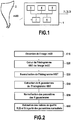
- the figure 1 represents, in its environment, a device 1 for estimating at least one quality index of a three-dimensional im3D image of a part 2 of composite material, in accordance with the invention in a particular embodiment.
- the part considered here is for example an airplane fan blade made of a composite material consisting of carbon fibers impregnated with a carbon matrix (resin).
- the invention applies to any type of composite material with woven, braided fibrous reinforcement or sewn, which find many applications including, but not limited to, in the field of aeronautics and the construction of aircraft parts.
- the 3D image considered can represent either the part 2 in its entirety or only a sample thereof.
- the im3D image is a 3D image coded in gray levels obtained by digital tomography.
- digital tomography is a known digital imaging technique which consists in acquiring, through the emission by an X-ray generator of a beam passing through the room, a succession of "photographs" or radiographs of this room according to different plans of space. These photographs or x-rays, also referred to as intermediate images or projections, are then processed and combined to reconstruct the three-dimensional volume of the room in the form of a 3D image coded in gray levels.
- the gray level of a voxel in the im3D image is proportional to the material density of the part 2 of composite material in this voxel.
- the resin and the carbon fibers constituting the composite material of part 2 do not have the same densities, they thus appear in theory with different gray levels in the im3D image.
- K 2
- a first approach may consist in choosing a sample of reduced size of the 3D image positioned at a location in room 2 where these artefacts have no influence.
- a second approach may consist in detecting a drift in gray levels for the same material and in correcting it, using correction techniques known per se. On the corrected image then obtained, a sample of the part 2 of any size and location can then be selected.
- the im3D image designates the 3D image of part 2 or of a duly selected sample of this part 2 in which the influence of the aforementioned low frequency artifacts can be considered negligible, possibly due to the application of a processing to the 3D image according to one or the other of the approaches proposed previously for example.
- the quality of the im3D image considered is essentially affected by a random noise whose distribution is substantially Gaussian.
- the estimation device 1 is a computer whose hardware architecture notably includes a processor 3, memories 4-6 (eg a read only memory and / or a hard disk 4, a memory RAM 5 and a non-volatile memory 6), and communication means 7.
- These communication means 7 include in particular input / output means (eg mouse, keyboard, screen, etc.) and one or more communication interfaces various (eg USB (Universal Serial Bus) port, network card, etc.) which allow the estimation device 1 to obtain in particular the im3D three-dimensional image.
- the read only memory and / or the hard disk 4 constitutes a recording medium readable by the processor 3 and on which is recorded a computer program in accordance with the invention, comprising instructions for the execution of the steps of a method estimation of at least one quality index of a three-dimensional image according to the invention, the steps of this method being described later with reference to the figure 2 , in a particular embodiment.
- This computer program defines in an equivalent manner functional modules of the estimation device 1 (software modules here), such as a module for obtaining a histogram from a 3D image, a module for extracting Gaussian distributions of this histogram and a module for estimating quality indices from parameters characterizing the extracted Gaussian distributions.
- modules of the estimation device 1 software modules here
- a module for obtaining a histogram from a 3D image a module for extracting Gaussian distributions of this histogram
- a module for estimating quality indices from parameters characterizing the extracted Gaussian distributions are described in more detail with reference to the steps of the estimation process.
- the estimation device 1 estimates a plurality of quality indices I1, I2 and I3 of the three-dimensional image im3D. This image is supplied to it via its communication means 7 (step E10).
- the invention can be applied to only part of the im3D image. All the steps described later are then performed on this part only of the im3D image.
- the estimation device 1 calculates the histogram HIST of the im3D image (step E20).
- the histogram HIST is a graphical representation indicating, for each class of a plurality of gray level classes (represented on the abscissa of the histogram), the number of voxels of the im3D image having gray levels belonging to this class (represented on the ordinate of the histogram). It advantageously makes it possible to synthetically group the information contained in the im3D image without worrying about the spatial organization of the voxels of the image.
- Each grayscale class can include one or more grayscale.
- the number of classes and the number of gray levels per class considered to construct the HIST histogram depend on the DYN dynamics of the im3D image.
- the HIST histogram comprises 2 16 classes each comprising 2 16 gray levels.
- the maximum number of classes is fixed at 2 16 , and the number of gray levels included in each class is calculated automatically taking into account the minimum value and the maximum value gray levels likely to be present in the image.
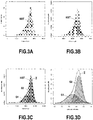
- the figure 3A illustrates, by way of example, the histogram of a 3D tomographic image of a piece of composite material, having a dynamic range of 16 bits.
- the estimation device 1 normalizes to 1 the histogram HIST obtained in step E20 (step E30). This normalization (optional) aims to make the HIST histogram independent of the number of voxels in the im3D image.
- This normalization is carried out by the estimation device 1 by dividing for each class of gray levels, the number of voxels belonging to this class reported by the histogram HIST by the total number of voxels in the 3D image.
- the ordinate of the histogram obtained after normalization thus becomes homogeneous at a probability density.
- the figure 3B illustrates the histogram obtained after normalization of the HIST histogram illustrated in the figure 3A .
- the histogram thus normalized is also designated by HIST.
- this normalization step is optional. It advantageously makes it possible to derive quality indices independent of the size of the 3D image considered (the size of the image being defined by the number of voxels in the image). Such indices offer the possibility of easily comparing 3D images with each other having different sizes. It is understood, however, that if the 3D images considered are of the same sizes, such normalization is not useful.
- the estimation device 1 then extracts from the normalized histogram HIST (or from the non-normalized histogram if necessary if step E30 is not implemented), a plurality of (ie K) Gaussians (step E40 ).
- the invention is in fact based on the assumption that the acquisition noise of the im3D tomographic image is essentially a random Gaussian noise, and that therefore, the gray levels of the different phases of the composite material of the part 2 have a Gaussian distribution.
- the estimation device 1 implements, in the embodiment described here, a Gaussian deconvolution technique based on the expectation-maximization algorithm, also more commonly called EM algorithm (Expectation Maximization) and described in detail in the document by Dempster et al. cited above.
- EM algorithm Exectation Maximization
- the EM algorithm is initially initialized with a so-called initial estimation of the Gaussian parameters.
- This initial estimate corresponds to values of the parameters defined by default or derived from known data supplied for example on the part 2 made of composite material (eg proportion of the two phases in the composite material).
- steps E and M are repeated until verification of a predetermined stopping criterion.
- the likelihood LE thus increases with each iteration.
- the execution of the algorithm EM stops when the values of the estimates of the parameters characterizing the Gaussian K do not evolve little or more between two successive iterations.
- the EM algorithm is a very efficient algorithm for the estimation of parameters of probabilistic models, this algorithm may not always converge towards a global maximum during step M. This situation occurs in particular when 'it is impossible or almost impossible to identify in the histogram the Gaussian K sought. It generally results in very slow convergence and can be detected by comparing the number of iterations of the EM algorithm to a maximum number of iterations authorized (eg 1000, 2000 or even 10000).
- the figure 3C illustrates two Gaussian distributions G1 and G2 extracted from the HIST histogram by application of the EM algorithm.
- the EM algorithm estimates for each Gaussian extracted from the HIST histogram, its mean, its standard deviation and its proportion in the HIST histogram.
- the mean and the proportion of each Gaussian depend on the composite material in which the part 2 is made and can be supplied to the estimation device 1 by a design office for example.
- the standard deviation of each Gaussian depends directly on the acquisition noise of the im3D image and is preferably estimated during the deconvolution of Gaussians, by the EM algorithm in the embodiment described here.
- the estimation device 1 applies to extract the Gaussian K from the histogram the algorithm EM.
- other methods can be used to extract the Gaussians from the histogram and determine their parameters, such as a Monte Carlo method based on Markov chains, a moment method (or "moment matching" in English) , a spectral or graphic method, or even a simulation.
- a normalization of certain parameters of the Gaussians extracted during step E40 is performed by the estimation device 1 so that the support of the extracted gaussians remains between 0 and 1 (step E50).
- the support of a Gaussian is infinite, from a theoretical point of view, more than 99% of the signal of the Gaussian is between its mean and more or less 3 times its standard deviation.
- the 3D figure illustrates the Gaussians G 1 and G 2 and the sum ⁇ of the figure 3C after normalization.
- the abscissa axis now corresponds to a normalized dynamic between 0 and 1.
- the first index I1 estimated by the estimation device 1 is based on the concept of contrast between the phases of the composite material of the part 2.
- the inventors have indeed considered, in order to define this first index, that if all the Gaussians present in the HIST histogram were well separated from each other (in other words, no intersection between the supports of the Gaussians), then distinguish the different components or phases of the composite material of part 2 would be trivial.
- the im3D image could be considered to be of good quality and correspond to a quality index close to 1.
- the index I1 is estimated by the estimation device 1 according to the following sequence of steps.
- the estimation device 1 derives from this factor z i , a quality index I1 (i) for the pair of gaussians (G i , G i + 1 ), using a function f bounded between 0 and 1.
- the function f used to determine the quality index I1 (i) is a sigmoid function.
- the estimation device 1 also estimates during step E60, a second quality index I2 of the image im3D.
- this second quality index the smaller the overlap area of the Gaussians compared to the total area occupied by the Gaussians, the more the Gaussians are well separated, and the quality of the image is good (corresponding to an I2 index close to 1). Conversely, a large overlap surface of the Gaussians suggests a poor quality image to which an index I2 close to 0 must be assigned.
- the estimation device 1 therefore evaluates the area occupied by the Gaussians extracted from the HIST histogram outside the overlap zones existing between these Gaussians.
- the 3D figure illustrates for illustrative purposes the overlap zone R between the Gaussians G 1 and G 2 extracted from the normalized histogram HIST of the figure 3B .
- the indices I1 and I2 are chosen so as to tend towards 1 when the quality of the im3D image is good and conversely towards 0 when the im3D image is of poor quality.
- another convention can be considered as soon as its meaning is known to operators intended to use these quality indices.
- the calculation of a signal-to-noise ratio is possible for each phase of the composite material of part 2.
- the Rose criterion consisting in affirming that an image is of good quality (and more precisely that we can clearly distinguish the characteristics of an image with a confidence rate of 100%) if the signal-to-noise ratio is greater than 5 can then be applied for each of the Gaussians extracted from the histogram HIST.
- indices I1, I2 and I3 although evolving in the same direction due to the conventions adopted (indices I1 and I2 close to 1 when the quality of the 3D image is good or close to 0 in the otherwise), do not evolve identically depending on the parameters of the Gaussians extracted from the histogram.
- the invention provides a method for automatically measuring the quality of a 3D image coded in gray levels, such as a tomographic image, of a piece of composite material.
- quality indices can be used in different ways. This measure, offered in particular via the various quality indices detailed above, has many advantageous characteristics. It is thus repetitive, giving an objective tool to check the quality of an image or compare images between them, precise, robust to noise, fast (a few seconds are necessary only for the processing of an image), standardized and easily interpretable. , does not require a parameter except the number of Gaussians to extract, and does not rely on a reference image.
- the quality indices derived in accordance with the invention can be used in different ways, in expertise as well as in the production line. Thus, for example, they can be used to optimize the acquisition and reconstruction parameters of 3D images, to compare 3D images with one another, or even to detect possible drifts in the 3D image acquisition system in production line (eg detector drifts or X-ray tube of a tomograph, in particular during aging of the tomograph), etc. These applications can be based on one or more quality indices estimated in accordance with the invention.
Landscapes
- Engineering & Computer Science (AREA)
- Quality & Reliability (AREA)
- Computer Vision & Pattern Recognition (AREA)
- Physics & Mathematics (AREA)
- General Physics & Mathematics (AREA)
- Theoretical Computer Science (AREA)
- Image Analysis (AREA)
- Analysing Materials By The Use Of Radiation (AREA)
- Image Processing (AREA)
Claims (11)
- Verfahren zur Schätzung wenigstens eines Qualitätsindexes (I1, I2, I3) eines graustufencodierten dreidimensionalen Bildes (im3D) eines Teils (2) aus Verbundwerkstoff, wobei das Schätzverfahren durch einen Computer durchgeführt wird und umfasst:- einen Schritt zum Erhalten (E20) eines Histogramms (HIST) anhand des Bildes, das für jede Klasse einer Vielzahl von Klassen, die jeweils wenigstens eine Graustufe umfassen, eine Anzahl von Voxeln des Bildes mit einer zu dieser Klasse gehörenden Graustufe darstellt,- einen Schritt zum Extrahieren (E40) einer vorbestimmten Anzahl von Gauß-Funktionen, die in dem Histogramm vorhanden sind, wobei diese vorbestimmte Anzahl einer Anzahl von in dem Verbundwerkstoff vorhandenen unterschiedlichen Phasen entspricht, welche größer als zwei ist,- einen Schritt zum Schätzen (E60) wenigstens eines Qualitätsindexes des Bildes anhand von Parametern, welche die aus dem Histogramm extrahierten Gauß-Funktionen kennzeichnen.
- Schätzverfahren nach Anspruch 1, bei dem der Extraktionsschritt für wenigstens eine Gauß-Funktion die Schätzung wenigstens eines diese Gauß-Funktion kennzeichnenden Parameters umfasst, aus:- einem Mittelwert der Gauß-Funktion,- einer Standardabweichung oder eine Varianz der Gauß-Funktion, und- einem Anteil der Gauß-Funktion in dem Histogramm.
- Schätzverfahren nach Anspruch 1 oder 2, bei dem der wenigstens eine Qualitätsindex des Bildes einen Index I1 aufweist, der dadurch erhalten wird, dass über jedes Paar (Gi,Gi+1) von aus dem Histogramm extrahierten aneinandergrenzenden Gauß-Funktionen ein Qualitätsindex I1 (i) gemittelt wird, der dem Paar (Gi,Gi+1) zugeordnet ist und geschätzt wird nach:
 - mi und mi+1 jeweils die Mittelwerte der Gauß-Funktionen Gi und Gi+1 mit mi < mi+1 bezeichnen,- σi und σi+1 jeweils die Standardabweichungen der Gauß-Funktionen Gi und Gi+1 bezeichnen,- ω eine vorbestimmte Konstante bezeichnet, und- f eine begrenzte Funktion bezeichnet, deren Werte zwischen 0 und 1 liegen.
 - Schätzverfahren nach einem der Ansprüche 1 bis 3, bei dem der wenigstens eine Qualitätsindex des Bildes einen Index I2 umfasst, der eine Überlappung zwischen den aus dem Histogramm extrahierten Gauß-Funktionen quantifiziert.
- Schätzverfahren nach einem der Ansprüche 1 bis 4, bei dem der wenigstens eine Qualitätsindex des Bildes für wenigstens eine aus dem Histogramm extrahierte Gauß-Funktion G einen Index I3(G) umfasst, welcher der Gauß-Funktion zugeordnet und als das Verhältnis zwischen dem Mittelwert und der Standardabweichung dieser Gauß-Funktion definiert ist.
- Schätzverfahren nach einem der Ansprüche 1 bis 5, bei dem der Extraktionsschritt (E30) die Anwendung eines Erwartungs-Maximierungs-Algorithmus (EM) umfasst.
- Schätzverfahren nach einem der Ansprüche 1 bis 6, ferner umfassend einen Schritt zum Normalisieren (E20) des Histogramms, wobei die Gauß-Funktionen während des Extraktionsschritts aus dem normalisierten Histogramm extrahiert werden.
- Schätzverfahren nach einem der Ansprüche 1 bis 7, ferner umfassend einen Schritt zum Normalisieren (E40) der die Gauß-Funktionen kennzeichnenden Parameter, wobei der wenigstens eine Qualitätsindex des Bildes anhand der die normalisierten Gauß-Funktionen kennzeichnenden Parameter geschätzt wird.
- Computerprogramm, umfassend Befehle für die Durchführung der Schritte des Schätzverfahrens nach einem der Ansprüche 1 bis 8, wenn das Programm durch einen Computer ausgeführt wird.
- Durch einen Computer lesbarer Aufzeichnungsträger, auf dem ein Computerprogramm gespeichert ist, das Befehle für die Durchführung der Schritte des Schätzverfahrens nach einem der Ansprüche 1 bis 8 umfasst.
- Vorrichtung zur Schätzung (1) wenigstens eines Qualitätsindexes eines graustufencodierten dreidimensionalen Bildes eines Teils aus Verbundwerkstoff, wobei die Schätzvorrichtung umfasst:- ein Modul zum Erhalten eines Histogramms anhand des Bildes, das für jede Klasse einer Vielzahl von Klassen, die jeweils wenigstens eine Graustufe umfassen, eine Anzahl von Voxeln des Bildes mit einer zu dieser Klasse gehörenden Graustufe darstellt,- ein Modul zum Extrahieren einer vorbestimmten Anzahl von Gauß-Funktionen, die in dem Histogramm vorhanden sind, wobei diese vorbestimmte Anzahl einer Anzahl von in dem Verbundwerkstoff vorhandenen unterschiedlichen Phasen entspricht, welche größer als zwei ist,- ein Modul zum Schätzen wenigstens eines Qualitätsindexes des Bildes anhand von Parametern, welche die aus dem Histogramm extrahierten Gauß-Funktionen kennzeichnen.
Applications Claiming Priority (2)
| Application Number | Priority Date | Filing Date | Title |
|---|---|---|---|
| FR1454731A FR3021441B1 (fr) | 2014-05-26 | 2014-05-26 | Procede et dispositif d'estimation d'un indice de qualite d'une image 3d d'une piece de materiau composite |
| PCT/FR2015/051359 WO2015181477A1 (fr) | 2014-05-26 | 2015-05-22 | Procede et dispositif d'estimation d'un indice de qualite d'une image 3d d'une piece de materiau composite |
Publications (2)
| Publication Number | Publication Date |
|---|---|
| EP3149705A1 EP3149705A1 (de) | 2017-04-05 |
| EP3149705B1 true EP3149705B1 (de) | 2019-12-25 |
Family
ID=51688159
Family Applications (1)
| Application Number | Title | Priority Date | Filing Date |
|---|---|---|---|
| EP15731646.4A Active EP3149705B1 (de) | 2014-05-26 | 2015-05-22 | Verfahren und vorrichtung zur schätzung eines qualitätsindexes eines 3d-bildes eines stücks verbundstoffmaterial |
Country Status (7)
| Country | Link |
|---|---|
| US (1) | US10402678B2 (de) |
| EP (1) | EP3149705B1 (de) |
| JP (1) | JP6596446B2 (de) |
| CN (1) | CN106575435B (de) |
| CA (1) | CA2950055C (de) |
| FR (1) | FR3021441B1 (de) |
| WO (1) | WO2015181477A1 (de) |
Families Citing this family (8)
| Publication number | Priority date | Publication date | Assignee | Title |
|---|---|---|---|---|
| KR102387459B1 (ko) * | 2015-11-20 | 2022-04-15 | 삼성전자주식회사 | 반도체 소자의 패턴 형성 방법 |
| FR3083335B1 (fr) * | 2018-06-28 | 2020-12-11 | Bcom | Procede de generation d'un hologramme numerique, dispositif, systeme de restitution holographique et programme d'ordinateur associes |
| JP6913953B2 (ja) * | 2018-11-07 | 2021-08-04 | 有限会社 ワーコム農業研究所 | 肉質等級の品質基準のデジタル化方法、それによる品質基準を利用した品質評価のデジタル処理方法、それらを利用した自動肉質評価装置、および、それに搭載されるソフトウェア |
| KR102723530B1 (ko) * | 2019-04-02 | 2024-10-29 | 한국전자통신연구원 | 홀로그래픽 디스플레이의 화질 평가 장치 및 화질 측정 방법 |
| US11928806B2 (en) * | 2020-02-14 | 2024-03-12 | Cummins Inc. | Systems and methods for evaluating part density, contamination and defects using computed tomography scanning |
| CN112991362B (zh) * | 2021-03-17 | 2022-11-01 | 合肥高晶光电科技有限公司 | 一种基于混合高斯模型的色选机粘连物料图像分割方法 |
| FR3133473B1 (fr) * | 2022-03-10 | 2024-04-19 | Safran Aircraft Engines | Procédé d’analyse tomographique par reconnaissance automatique de phases |
| US20250285255A1 (en) * | 2024-03-05 | 2025-09-11 | The Boeing Company | Visual systems and statistical methods for non-destructively evaluating component parts |
Family Cites Families (4)
| Publication number | Priority date | Publication date | Assignee | Title |
|---|---|---|---|---|
| DE102005034374B3 (de) * | 2005-07-22 | 2007-03-01 | Siemens Ag | Verfahren zur automatischen Erstellung einer Hintergrundmaske bei Bildern mit verrauschten Hintergrundbereichen, Anwendungen dazu sowie ein Kernspintomographiegerät zur Durchführung der Verfahren und Computersoftwareprodukt |
| CN102183525A (zh) | 2011-01-20 | 2011-09-14 | 单宝华 | 基于ccd阵列摄像技术的桥梁表观状态自动检测装置及其方法 |
| JP6112613B2 (ja) * | 2011-08-19 | 2017-04-12 | 国立大学法人京都大学 | 信号分析装置、信号分析方法及びコンピュータプログラム |
| FR2994481B1 (fr) * | 2012-08-07 | 2014-08-29 | Snecma | Procede de caracterisation d'un objet en materiau composite |
-
2014
- 2014-05-26 FR FR1454731A patent/FR3021441B1/fr active Active
-
2015
- 2015-05-22 WO PCT/FR2015/051359 patent/WO2015181477A1/fr not_active Ceased
- 2015-05-22 EP EP15731646.4A patent/EP3149705B1/de active Active
- 2015-05-22 CA CA2950055A patent/CA2950055C/fr active Active
- 2015-05-22 CN CN201580041115.8A patent/CN106575435B/zh active Active
- 2015-05-22 JP JP2016569677A patent/JP6596446B2/ja active Active
- 2015-05-22 US US15/314,046 patent/US10402678B2/en active Active
Non-Patent Citations (1)
| Title |
|---|
| None * |
Also Published As
| Publication number | Publication date |
|---|---|
| US10402678B2 (en) | 2019-09-03 |
| EP3149705A1 (de) | 2017-04-05 |
| CA2950055C (fr) | 2022-10-18 |
| FR3021441B1 (fr) | 2017-09-29 |
| FR3021441A1 (fr) | 2015-11-27 |
| CA2950055A1 (fr) | 2015-12-03 |
| JP6596446B2 (ja) | 2019-10-23 |
| US20170154235A1 (en) | 2017-06-01 |
| CN106575435A (zh) | 2017-04-19 |
| CN106575435B (zh) | 2020-10-09 |
| JP2017518495A (ja) | 2017-07-06 |
| WO2015181477A1 (fr) | 2015-12-03 |
Similar Documents
| Publication | Publication Date | Title |
|---|---|---|
| CA2950055C (fr) | Procede et dispositif d'estimation d'un indice de qualite d'une image 3d d'une piece de materiau composite | |
| EP3896436B1 (de) | Verfahren zur charakterisierung eines werkstücks | |
| FR3050274A1 (fr) | Procede d'analyse topologique d'une piece composite | |
| Rajan et al. | Aligned datasets improve detection of latent diffusion-generated images | |
| EP3234914A1 (de) | Verfahren zur unterscheidung und identifizierung von objekten einer szene durch 3d-bildgebung | |
| FR2929416A1 (fr) | Procede de determination d'une representation tridimensionnelle d'un objet a partir d'une sequence d'images en coupe, produit programme d'ordinateur, procede d 'analyse d'un objet et systeme d'imagerie correspondants | |
| EP4670118A1 (de) | Verfahren zur zerstörungsfreien prüfung von teilen aus verbundwerkstoff | |
| WO2018042132A1 (fr) | Procede et systeme de controle non destructif realise sur une piece aeronautique | |
| FR2966716A1 (fr) | Methode d'estimation et de correction de la diffusion en mammographie. | |
| EP2726815B1 (de) | Verfahren und vorrichtung zum identifizieren eines materials durch spektralanalyse von elektromagnetischem strahlungsdurchgang durch dieses material | |
| EP2980529A1 (de) | Schätzverfahren des abstands eines objekts zu einem bildgebungssystem | |
| FR3025888A1 (fr) | Methode de correction d'artefacts dans des images obtenues par tomographie | |
| FR3071611A1 (fr) | Procede et dispositif de controle non destructif d'une piece aeronautique | |
| EP4272154B1 (de) | Verfahren zur verarbeitung von volumenbildern durch hauptkomponentenanalyse | |
| EP3411851A1 (de) | Steuerung für zerstörungsfreies prüfen durch korrigieren | |
| EP3262611A1 (de) | Verfahren zur segmentierung des bildes eines objekts, das durch dreidimensionale rekonstruktion wiederhergestellt wurde | |
| FR2927719A1 (fr) | Procede de traitement d'images obtenues par tomosynthese et dispositif associe | |
| FR2929417A1 (fr) | Procede de determination d'une representation tridimensionnelle d'un objet a partir de points, programme d'ordinateur et systeme d'imagerie correspondant | |
| FR3038722B1 (fr) | Procede d’identification d’un materiau | |
| WO2010046573A1 (fr) | Procédé d'estimation de la concentration d'un traceur dans un ensemble de structures tissulaires, support d'information et dispositif correspondants. | |
| FR3162543A1 (fr) | Procédé d’imagerie par tomographie électronique à large champ de vue et résolution améliorée | |
| Sok et al. | The Stellar Mass and Age Distributions of Star-Forming Clumps at $0.5< z< 5$ in JWST CANUCS: Implications for Clump Formation and Destruction | |
| FR3151691A1 (fr) | Procédé de contrôle d’une pièce | |
| Thompson et al. | Sparse View CT Reconstruction with Projection Consistency Constraints | |
| WO2025242758A1 (fr) | Procédé pour améliorer la qualité d'une image bidimensionnelle d'un objet tridimensionnel, et système de traitement de données et dispositif correspondants |
Legal Events
| Date | Code | Title | Description |
|---|---|---|---|
| STAA | Information on the status of an ep patent application or granted ep patent |
Free format text: STATUS: THE INTERNATIONAL PUBLICATION HAS BEEN MADE |
|
| PUAI | Public reference made under article 153(3) epc to a published international application that has entered the european phase |
Free format text: ORIGINAL CODE: 0009012 |
|
| STAA | Information on the status of an ep patent application or granted ep patent |
Free format text: STATUS: REQUEST FOR EXAMINATION WAS MADE |
|
| 17P | Request for examination filed |
Effective date: 20161124 |
|
| AK | Designated contracting states |
Kind code of ref document: A1 Designated state(s): AL AT BE BG CH CY CZ DE DK EE ES FI FR GB GR HR HU IE IS IT LI LT LU LV MC MK MT NL NO PL PT RO RS SE SI SK SM TR |
|
| AX | Request for extension of the european patent |
Extension state: BA ME |
|
| RIN1 | Information on inventor provided before grant (corrected) |
Inventor name: SCHNEIDER, JULIEN Inventor name: TOURAIS, DAVID Inventor name: MORARD, VINCENT Inventor name: PARRA, ESTELLE |
|
| DAV | Request for validation of the european patent (deleted) | ||
| DAX | Request for extension of the european patent (deleted) | ||
| STAA | Information on the status of an ep patent application or granted ep patent |
Free format text: STATUS: EXAMINATION IS IN PROGRESS |
|
| 17Q | First examination report despatched |
Effective date: 20190227 |
|
| GRAP | Despatch of communication of intention to grant a patent |
Free format text: ORIGINAL CODE: EPIDOSNIGR1 |
|
| STAA | Information on the status of an ep patent application or granted ep patent |
Free format text: STATUS: GRANT OF PATENT IS INTENDED |
|
| INTG | Intention to grant announced |
Effective date: 20190729 |
|
| GRAS | Grant fee paid |
Free format text: ORIGINAL CODE: EPIDOSNIGR3 |
|
| GRAA | (expected) grant |
Free format text: ORIGINAL CODE: 0009210 |
|
| STAA | Information on the status of an ep patent application or granted ep patent |
Free format text: STATUS: THE PATENT HAS BEEN GRANTED |
|
| AK | Designated contracting states |
Kind code of ref document: B1 Designated state(s): AL AT BE BG CH CY CZ DE DK EE ES FI FR GB GR HR HU IE IS IT LI LT LU LV MC MK MT NL NO PL PT RO RS SE SI SK SM TR |
|
| REG | Reference to a national code |
Ref country code: GB Ref legal event code: FG4D Free format text: NOT ENGLISH |
|
| REG | Reference to a national code |
Ref country code: CH Ref legal event code: EP |
|
| REG | Reference to a national code |
Ref country code: AT Ref legal event code: REF Ref document number: 1217959 Country of ref document: AT Kind code of ref document: T Effective date: 20200115 |
|
| REG | Reference to a national code |
Ref country code: DE Ref legal event code: R096 Ref document number: 602015044260 Country of ref document: DE |
|
| REG | Reference to a national code |
Ref country code: IE Ref legal event code: FG4D Free format text: LANGUAGE OF EP DOCUMENT: FRENCH |
|
| REG | Reference to a national code |
Ref country code: SE Ref legal event code: TRGR |
|
| REG | Reference to a national code |
Ref country code: NL Ref legal event code: MP Effective date: 20191225 |
|
| PG25 | Lapsed in a contracting state [announced via postgrant information from national office to epo] |
Ref country code: LV Free format text: LAPSE BECAUSE OF FAILURE TO SUBMIT A TRANSLATION OF THE DESCRIPTION OR TO PAY THE FEE WITHIN THE PRESCRIBED TIME-LIMIT Effective date: 20191225 Ref country code: FI Free format text: LAPSE BECAUSE OF FAILURE TO SUBMIT A TRANSLATION OF THE DESCRIPTION OR TO PAY THE FEE WITHIN THE PRESCRIBED TIME-LIMIT Effective date: 20191225 Ref country code: BG Free format text: LAPSE BECAUSE OF FAILURE TO SUBMIT A TRANSLATION OF THE DESCRIPTION OR TO PAY THE FEE WITHIN THE PRESCRIBED TIME-LIMIT Effective date: 20200325 Ref country code: NO Free format text: LAPSE BECAUSE OF FAILURE TO SUBMIT A TRANSLATION OF THE DESCRIPTION OR TO PAY THE FEE WITHIN THE PRESCRIBED TIME-LIMIT Effective date: 20200325 Ref country code: GR Free format text: LAPSE BECAUSE OF FAILURE TO SUBMIT A TRANSLATION OF THE DESCRIPTION OR TO PAY THE FEE WITHIN THE PRESCRIBED TIME-LIMIT Effective date: 20200326 Ref country code: LT Free format text: LAPSE BECAUSE OF FAILURE TO SUBMIT A TRANSLATION OF THE DESCRIPTION OR TO PAY THE FEE WITHIN THE PRESCRIBED TIME-LIMIT Effective date: 20191225 |
|
| REG | Reference to a national code |
Ref country code: LT Ref legal event code: MG4D |
|
| PG25 | Lapsed in a contracting state [announced via postgrant information from national office to epo] |
Ref country code: HR Free format text: LAPSE BECAUSE OF FAILURE TO SUBMIT A TRANSLATION OF THE DESCRIPTION OR TO PAY THE FEE WITHIN THE PRESCRIBED TIME-LIMIT Effective date: 20191225 Ref country code: RS Free format text: LAPSE BECAUSE OF FAILURE TO SUBMIT A TRANSLATION OF THE DESCRIPTION OR TO PAY THE FEE WITHIN THE PRESCRIBED TIME-LIMIT Effective date: 20191225 |
|
| PG25 | Lapsed in a contracting state [announced via postgrant information from national office to epo] |
Ref country code: AL Free format text: LAPSE BECAUSE OF FAILURE TO SUBMIT A TRANSLATION OF THE DESCRIPTION OR TO PAY THE FEE WITHIN THE PRESCRIBED TIME-LIMIT Effective date: 20191225 |
|
| PG25 | Lapsed in a contracting state [announced via postgrant information from national office to epo] |
Ref country code: RO Free format text: LAPSE BECAUSE OF FAILURE TO SUBMIT A TRANSLATION OF THE DESCRIPTION OR TO PAY THE FEE WITHIN THE PRESCRIBED TIME-LIMIT Effective date: 20191225 Ref country code: CZ Free format text: LAPSE BECAUSE OF FAILURE TO SUBMIT A TRANSLATION OF THE DESCRIPTION OR TO PAY THE FEE WITHIN THE PRESCRIBED TIME-LIMIT Effective date: 20191225 Ref country code: EE Free format text: LAPSE BECAUSE OF FAILURE TO SUBMIT A TRANSLATION OF THE DESCRIPTION OR TO PAY THE FEE WITHIN THE PRESCRIBED TIME-LIMIT Effective date: 20191225 Ref country code: PT Free format text: LAPSE BECAUSE OF FAILURE TO SUBMIT A TRANSLATION OF THE DESCRIPTION OR TO PAY THE FEE WITHIN THE PRESCRIBED TIME-LIMIT Effective date: 20200520 Ref country code: NL Free format text: LAPSE BECAUSE OF FAILURE TO SUBMIT A TRANSLATION OF THE DESCRIPTION OR TO PAY THE FEE WITHIN THE PRESCRIBED TIME-LIMIT Effective date: 20191225 |
|
| PG25 | Lapsed in a contracting state [announced via postgrant information from national office to epo] |
Ref country code: SK Free format text: LAPSE BECAUSE OF FAILURE TO SUBMIT A TRANSLATION OF THE DESCRIPTION OR TO PAY THE FEE WITHIN THE PRESCRIBED TIME-LIMIT Effective date: 20191225 Ref country code: SM Free format text: LAPSE BECAUSE OF FAILURE TO SUBMIT A TRANSLATION OF THE DESCRIPTION OR TO PAY THE FEE WITHIN THE PRESCRIBED TIME-LIMIT Effective date: 20191225 Ref country code: IS Free format text: LAPSE BECAUSE OF FAILURE TO SUBMIT A TRANSLATION OF THE DESCRIPTION OR TO PAY THE FEE WITHIN THE PRESCRIBED TIME-LIMIT Effective date: 20200425 |
|
| REG | Reference to a national code |
Ref country code: DE Ref legal event code: R097 Ref document number: 602015044260 Country of ref document: DE |
|
| PG25 | Lapsed in a contracting state [announced via postgrant information from national office to epo] |
Ref country code: ES Free format text: LAPSE BECAUSE OF FAILURE TO SUBMIT A TRANSLATION OF THE DESCRIPTION OR TO PAY THE FEE WITHIN THE PRESCRIBED TIME-LIMIT Effective date: 20191225 Ref country code: DK Free format text: LAPSE BECAUSE OF FAILURE TO SUBMIT A TRANSLATION OF THE DESCRIPTION OR TO PAY THE FEE WITHIN THE PRESCRIBED TIME-LIMIT Effective date: 20191225 |
|
| PLBE | No opposition filed within time limit |
Free format text: ORIGINAL CODE: 0009261 |
|
| STAA | Information on the status of an ep patent application or granted ep patent |
Free format text: STATUS: NO OPPOSITION FILED WITHIN TIME LIMIT |
|
| REG | Reference to a national code |
Ref country code: AT Ref legal event code: MK05 Ref document number: 1217959 Country of ref document: AT Kind code of ref document: T Effective date: 20191225 |
|
| PG25 | Lapsed in a contracting state [announced via postgrant information from national office to epo] |
Ref country code: SI Free format text: LAPSE BECAUSE OF FAILURE TO SUBMIT A TRANSLATION OF THE DESCRIPTION OR TO PAY THE FEE WITHIN THE PRESCRIBED TIME-LIMIT Effective date: 20191225 |
|
| 26N | No opposition filed |
Effective date: 20200928 |
|
| PG25 | Lapsed in a contracting state [announced via postgrant information from national office to epo] |
Ref country code: CH Free format text: LAPSE BECAUSE OF NON-PAYMENT OF DUE FEES Effective date: 20200531 Ref country code: AT Free format text: LAPSE BECAUSE OF FAILURE TO SUBMIT A TRANSLATION OF THE DESCRIPTION OR TO PAY THE FEE WITHIN THE PRESCRIBED TIME-LIMIT Effective date: 20191225 Ref country code: LI Free format text: LAPSE BECAUSE OF NON-PAYMENT OF DUE FEES Effective date: 20200531 Ref country code: MC Free format text: LAPSE BECAUSE OF FAILURE TO SUBMIT A TRANSLATION OF THE DESCRIPTION OR TO PAY THE FEE WITHIN THE PRESCRIBED TIME-LIMIT Effective date: 20191225 |
|
| PG25 | Lapsed in a contracting state [announced via postgrant information from national office to epo] |
Ref country code: PL Free format text: LAPSE BECAUSE OF FAILURE TO SUBMIT A TRANSLATION OF THE DESCRIPTION OR TO PAY THE FEE WITHIN THE PRESCRIBED TIME-LIMIT Effective date: 20191225 |
|
| REG | Reference to a national code |
Ref country code: BE Ref legal event code: MM Effective date: 20200531 |
|
| PG25 | Lapsed in a contracting state [announced via postgrant information from national office to epo] |
Ref country code: LU Free format text: LAPSE BECAUSE OF NON-PAYMENT OF DUE FEES Effective date: 20200522 |
|
| PG25 | Lapsed in a contracting state [announced via postgrant information from national office to epo] |
Ref country code: IE Free format text: LAPSE BECAUSE OF NON-PAYMENT OF DUE FEES Effective date: 20200522 |
|
| PG25 | Lapsed in a contracting state [announced via postgrant information from national office to epo] |
Ref country code: BE Free format text: LAPSE BECAUSE OF NON-PAYMENT OF DUE FEES Effective date: 20200531 |
|
| PG25 | Lapsed in a contracting state [announced via postgrant information from national office to epo] |
Ref country code: TR Free format text: LAPSE BECAUSE OF FAILURE TO SUBMIT A TRANSLATION OF THE DESCRIPTION OR TO PAY THE FEE WITHIN THE PRESCRIBED TIME-LIMIT Effective date: 20191225 Ref country code: MT Free format text: LAPSE BECAUSE OF FAILURE TO SUBMIT A TRANSLATION OF THE DESCRIPTION OR TO PAY THE FEE WITHIN THE PRESCRIBED TIME-LIMIT Effective date: 20191225 Ref country code: CY Free format text: LAPSE BECAUSE OF FAILURE TO SUBMIT A TRANSLATION OF THE DESCRIPTION OR TO PAY THE FEE WITHIN THE PRESCRIBED TIME-LIMIT Effective date: 20191225 |
|
| PG25 | Lapsed in a contracting state [announced via postgrant information from national office to epo] |
Ref country code: MK Free format text: LAPSE BECAUSE OF FAILURE TO SUBMIT A TRANSLATION OF THE DESCRIPTION OR TO PAY THE FEE WITHIN THE PRESCRIBED TIME-LIMIT Effective date: 20191225 |
|
| PGFP | Annual fee paid to national office [announced via postgrant information from national office to epo] |
Ref country code: SE Payment date: 20240418 Year of fee payment: 10 |
|
| PGFP | Annual fee paid to national office [announced via postgrant information from national office to epo] |
Ref country code: DE Payment date: 20250519 Year of fee payment: 11 |
|
| PGFP | Annual fee paid to national office [announced via postgrant information from national office to epo] |
Ref country code: GB Payment date: 20250527 Year of fee payment: 11 |
|
| PGFP | Annual fee paid to national office [announced via postgrant information from national office to epo] |
Ref country code: IT Payment date: 20250530 Year of fee payment: 11 |
|
| PGFP | Annual fee paid to national office [announced via postgrant information from national office to epo] |
Ref country code: FR Payment date: 20250526 Year of fee payment: 11 |
|
| PG25 | Lapsed in a contracting state [announced via postgrant information from national office to epo] |
Ref country code: SE Free format text: LAPSE BECAUSE OF NON-PAYMENT OF DUE FEES Effective date: 20250523 |
|
| REG | Reference to a national code |
Ref country code: SE Ref legal event code: EUG |