EP3144859A2 - Modellübungsverfahren und vorrichtung sowie datenerkennungsverfahren - Google Patents
Modellübungsverfahren und vorrichtung sowie datenerkennungsverfahren Download PDFInfo
- Publication number
- EP3144859A2 EP3144859A2 EP16180282.2A EP16180282A EP3144859A2 EP 3144859 A2 EP3144859 A2 EP 3144859A2 EP 16180282 A EP16180282 A EP 16180282A EP 3144859 A2 EP3144859 A2 EP 3144859A2
- Authority
- EP
- European Patent Office
- Prior art keywords
- model
- teacher
- output data
- data
- student
- Prior art date
- Legal status (The legal status is an assumption and is not a legal conclusion. Google has not performed a legal analysis and makes no representation as to the accuracy of the status listed.)
- Ceased
Links
Images




Classifications
-
- G—PHYSICS
- G06—COMPUTING OR CALCULATING; COUNTING
- G06N—COMPUTING ARRANGEMENTS BASED ON SPECIFIC COMPUTATIONAL MODELS
- G06N3/00—Computing arrangements based on biological models
- G06N3/02—Neural networks
- G06N3/08—Learning methods
- G06N3/096—Transfer learning
-
- G—PHYSICS
- G06—COMPUTING OR CALCULATING; COUNTING
- G06N—COMPUTING ARRANGEMENTS BASED ON SPECIFIC COMPUTATIONAL MODELS
- G06N3/00—Computing arrangements based on biological models
- G06N3/02—Neural networks
- G06N3/04—Architecture, e.g. interconnection topology
- G06N3/045—Combinations of networks
-
- G—PHYSICS
- G06—COMPUTING OR CALCULATING; COUNTING
- G06F—ELECTRIC DIGITAL DATA PROCESSING
- G06F18/00—Pattern recognition
- G06F18/20—Analysing
- G06F18/24—Classification techniques
-
- G—PHYSICS
- G06—COMPUTING OR CALCULATING; COUNTING
- G06N—COMPUTING ARRANGEMENTS BASED ON SPECIFIC COMPUTATIONAL MODELS
- G06N3/00—Computing arrangements based on biological models
- G06N3/02—Neural networks
- G06N3/04—Architecture, e.g. interconnection topology
- G06N3/0464—Convolutional networks [CNN, ConvNet]
-
- G—PHYSICS
- G06—COMPUTING OR CALCULATING; COUNTING
- G06N—COMPUTING ARRANGEMENTS BASED ON SPECIFIC COMPUTATIONAL MODELS
- G06N3/00—Computing arrangements based on biological models
- G06N3/02—Neural networks
- G06N3/04—Architecture, e.g. interconnection topology
- G06N3/0495—Quantised networks; Sparse networks; Compressed networks
-
- G—PHYSICS
- G06—COMPUTING OR CALCULATING; COUNTING
- G06N—COMPUTING ARRANGEMENTS BASED ON SPECIFIC COMPUTATIONAL MODELS
- G06N3/00—Computing arrangements based on biological models
- G06N3/02—Neural networks
- G06N3/08—Learning methods
- G06N3/09—Supervised learning
-
- G—PHYSICS
- G09—EDUCATION; CRYPTOGRAPHY; DISPLAY; ADVERTISING; SEALS
- G09B—EDUCATIONAL OR DEMONSTRATION APPLIANCES; APPLIANCES FOR TEACHING, OR COMMUNICATING WITH, THE BLIND, DEAF OR MUTE; MODELS; PLANETARIA; GLOBES; MAPS; DIAGRAMS
- G09B9/00—Simulators for teaching or training purposes
-
- G—PHYSICS
- G06—COMPUTING OR CALCULATING; COUNTING
- G06N—COMPUTING ARRANGEMENTS BASED ON SPECIFIC COMPUTATIONAL MODELS
- G06N3/00—Computing arrangements based on biological models
- G06N3/02—Neural networks
- G06N3/08—Learning methods
- G06N3/084—Backpropagation, e.g. using gradient descent
Definitions
- Methods and apparatuses consistent with exemplary embodiments disclosed herein relate to a model training method and model trainer, and a data recognizing method.
- the neural network employs an algorithm that simulates a learning capability of a human brain. Through this algorithm, the neural network may generate mapping between the input pattern and output patterns. The capability of generating such mapping may be referred to as a "learning capability" of the neural network. Further, the neural network may have a generalization capability of generating a relatively accurate output with respect to an input pattern to be used for learning, based on a result of learning.
- Exemplary embodiments may address at least the above mentioned problems and/or disadvantages and other disadvantages not described above. Also, the exemplary embodiments are not required to overcome the disadvantages described above, and an exemplary embodiment may not overcome any of the problems described above.
- a model training method comprising: selecting a teacher model from a plurality of teacher models; receiving, at a student model, input data; and training the student model based on output data of the selected teacher model, the output data corresponding to the input data.
- the selecting may include selecting the teacher model from the plurality of teacher models based on accuracies of the plurality of teacher models.
- the model training method may further include outputting data from the plurality of teacher models, and the selecting may include selecting the teacher model from the plurality of teacher models based on a correlation between the output data of the plurality of teacher models, the output data corresponding to the input data.
- the selecting may include selecting another teacher model from the plurality of teacher models in response to determining that a correlation between the output data of the selected teacher model and the output data of the other selected teacher model is less than a threshold.
- the training may further include training the student model based on output data of the student model.
- the selecting and the training may be performed iteratively until the student model satisfies a predetermined condition.
- the training may include training the student model based on a first loss between output data of the student model and first output data of the selected teacher model, the first output data corresponding to the input data, and a second loss between output data of a classifier layer derived from a hidden layer of the student model and second output data of the selected teacher model, and the method may further include: determining the first loss and the second loss using different methods.
- the determining the first loss and the second loss may include determining the first loss and the second loss based on the first output data output from the selected teacher model and second output data output from a different selected teacher model.
- the determining the first loss and the second loss may include determining the first loss and the second loss by applying different weights to the first output data and the second output data.
- the model training method may further include setting an initial weight for the classifier layer to be an initial weight for a teacher model, among the plurality of teacher models, having a size most similar to a size of data input into the classifier layer, and selecting the teacher model having the size most similar to the size of data input into the classifier layer as the selected teacher model.
- the training may include training the student model based on the output data of the selected teacher model and correct answer data corresponding to the input data.
- the plurality of teacher models may have different initial weights, different neural network structures, different hyper parameters, or comprise different ensembles.
- the model training method may further include determining a structure of the student model based on a size of data input into the selected one teacher model.
- a data recognizing method including: receiving target data to be recognized; and recognizing the target data using a trained model, wherein the model is trained according to any one of the model training methods described hereinabove.
- the model may be trained based on output data of a teacher model, the output data corresponding to input data received by the model, the teacher model being selected from a plurality of teacher models.
- the data recognizing method may further include selecting the teacher model based on accuracies of the plurality of teacher models or a correlation between output data of the plurality of teacher models, the output data corresponding to the input data.
- the data recognizing method may further include training the model based on a first loss between output data of the model and first output data of the selected model, the first output data corresponding to the input data received by the model, and a second loss between output data of a classifier layer derived from a hidden layer of the model and second output data of the selected teacher model, and determining the first loss and the second loss using different methods.
- a non-transitory computer-readable recording medium which, when executed, causes a computer to execute a method including the steps of any one of the model training methods and/or the data recognizing methods described hereinabove.
- the steps may comprise: selecting a teacher model from a plurality of teacher models; receiving, at a student model, input data; and training the student model based on output data of the selected teacher model, the output data corresponding to the input data.
- a model training apparatus including: a processor configured to train a student model; and a memory configured to store the trained student model, wherein the processor is configured to select a teacher model from a plurality of teacher models, and train the student model based on output data of the selected teacher model, the output data corresponding to input data received by the student model.
- the processor may be configured to select the teacher model from the plurality of teacher models based on accuracies of the plurality of teacher models or a correlation between output data of the plurality of teacher models, the output data corresponding to the input data.
- the processor may be configured to train the student model based on a first loss between output data of the student model and first output data of the selected teacher model, the first output data corresponding to the input data, and a second loss between output data of a classifier layer derived from a hidden layer of the student model and second output data of the selected teacher model, and the processor may determine the first loss and the second loss using different methods.
- a model trainer comprising: a processor configured to select two teacher models from a plurality of teacher models comprising three or more teacher models, use the selected two teacher models to train a student model, and output the trained student model; and a memory configured to store the trained student model; wherein the processor is configured to select the two teacher models based on accuracies of the two teacher models in relation to a predetermined threshold.
- the processor may be configured to select the two teacher models having accuracies higher than the predetermined threshold in a descending order of accuracy.
- the processor may be further configured to train the student model based on output data of the student model.
- FIG. 1 is a diagram illustrating a teacher model and a student model according to an exemplary embodiment.
- the teacher model 110 and the student model 120 are models that are trained to output a predetermined output with respect to a predetermined input, and may include, for example, neural networks.
- a neural network refers to a recognition model that simulates a computation capability of a biological system using a large number of artificial neurons being connected to each other through edges. It is understood, however, that the teacher model 110 and student model 120 are not limited to neural networks, and may also be implemented in other types of networks and apparatuses.
- the neural network uses artificial neurons configured by simplifying functions of biological neurons, and the artificial neurons may be connected to each other through edges having connection weights.
- the connection weights, parameters of the neural network are predetermined values of the edges, and may also be referred to as connection strengths.
- the neural network may perform a cognitive function or a learning process of a human brain through the artificial neurons.
- the artificial neurons may also be referred to as nodes.
- a neural network may include a plurality of layers.
- the neural network may include an input layer, a hidden layer, and an output layer.
- the input layer may receive an input to be used to perform training and transmit the input to the hidden layer, and the output layer may generate an output of the neural network based on signals received from nodes of the hidden layer.
- the hidden layer may be disposed between the input layer and the output layer.
- the hidden layer may change training data received from the input layer to an easily predictable value. Nodes included in the input layer and the hidden layer may be connected to each other through edges having connection weights, and nodes included in the hidden layer and the output layer may also be connected to each other through edges having connection weights.
- the input layer, the hidden layer, and the output layer may respectively include a plurality of nodes.
- the neural network may include a plurality of hidden layers.
- a neural network including the plurality of hidden layers may be referred to as a deep neural network. Training the deep neural network may be referred to as deep learning.
- Nodes included in the hidden layers may be referred to as hidden nodes.
- the number of hidden layers provided in a deep neural network is not limited to any particular number.
- the neural network may be trained through supervised learning.
- Supervised learning refers to a method of providing input data and output data corresponding thereto to a neural network, and updating connection weights of edges so that the output data corresponding to the input data may be output.
- a model training apparatus may update connection weights of edges among artificial neurons through a delta rule and error back-propagation learning.
- Error back-propagation learning refers to a method of estimating a loss with respect to input data provided through forward computation, and updating connection weights to reduce a loss in a process of propagating the estimated loss in a backward direction from an output layer toward a hidden layer and an input layer. Processing of the neural network may be performed in an order of the input layer, the hidden layer, and the output layer. However, in the error back-propagation learning, the connection weights may be updated in an order of the output layer, the hidden layer, and the input layer.
- training a neural network refers to training parameters of the neural network.
- a trained neural network refers to a neural network to which the trained parameters are applied.
- the teacher model 110 and the student model 120 may be neural networks of different sizes which are configured to recognize the same target. It is understood, however, that the teacher model 1110 and the student model 120 are not required to be different sizes.
- the teacher model 110 is a model that recognizes target data with a relatively high accuracy based on a sufficiently large number of features extracted from target data to be recognized.
- the teacher model 110 may be a neural network of a greater size than the student model 120.
- the teacher model 110 may include a larger number of hidden layers, a larger number of nodes, or a combination thereof, compared to the student model 120.
- the student model 120 may be a neural network of a smaller size than the teacher model 110. Due to the relatively small size, the student model 120 may have a higher recognition rate than the teacher model 110.
- the student model 120 may be trained using the teacher model 110 to provide output data of the teacher model 110 with respect to input data.
- the output data of the teacher model 110 may be a value of logic output from the teacher model 110, a probability value, or an output value of a classifier layer derived from a hidden layer of the teacher model 110. Accordingly, the student model 120 having a higher recognition rate than the teacher model 110 while outputting the same value as that output from the teacher model 110 may be obtained.
- the foregoing process may be referred to as model compression.
- Model compression is a scheme of training the student model 120 based on output data of the teacher model 110, instead of training the student model 120 based on correct answer data corresponding to a true label.
- a plurality of teacher models 110 may be used to train the student model 120.
- At least one teacher model may be selected from the plurality of teacher models 110 and the student model 120 may be trained using the selected at least one teacher model.
- a process of selecting at least one teacher model from the plurality of teacher models 110 and training the student model 120 may be performed iteratively until the student model 120 satisfies a predetermined condition.
- at least one teacher model selected to be used to train the student model 120 may be newly selected each time a training process is performed.
- one or more teacher models may be selected to be used to train the student model 120.
- a process of selecting one or more teacher models from the plurality of teacher models 110 and training the student model 120 is described below with reference to FIGS. 2 , 3 , and 4 .
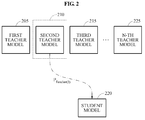
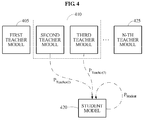
- FIGS. 2 , 3 , and 4 are diagrams illustrating a process of selecting at least one teacher model from a plurality of teacher models and training a student model according to an exemplary embodiment.
- a process of selecting one teacher model from a plurality of teacher models to train a student model 220 is illustrated.
- the process of selecting one teacher model from the plurality of teacher models may be performed by a model training apparatus.
- the model training apparatus is a device configured to train a neural network for data recognition, and may be implemented using a single processor or multiple processors which are specially configured to perform certain functions related to training a neural network for data recognition.
- the model training apparatus may also be implemented using a plurality of modules included in different devices. In this example, the plurality of modules may be connected to each other via a network, for example.
- the plurality of teacher models are pre-trained models to be used to train the student model 220, and may have various structures and various accuracies.
- the plurality of teacher models may include first teacher model through N-th teacher model (e.g., first teacher model 205, second teacher model 210, third teacher model 215, N-th teacher model 225).
- the plurality of teacher models may have different initial weights, have different neural network structures, have different hyper parameters, or include different ensembles, as described in detail below.
- the plurality of teacher models may have different initial weights.
- the initial weights are initial values of connection weights of edges in a neural network.
- the initial weights may greatly affect a learning rate and a convergence rate in error back-propagation neural network training.
- Initial weights to be applied to the plurality of teacher models may be set to be different values using various methods such as, for example, random initialization and pre-training.
- the plurality of teacher models may have different neural network structures.
- the plurality of teacher models may have various neural network structures including different numbers of hidden layers, different numbers of filters, and kernels of different sizes, along with different shapes, sizes and network configurations.
- the plurality of teacher models may include different hyper parameters.
- the hyper parameters may refer to training-associated parameters such as, for example, a learning rate and a momentum.
- the plurality of teacher models may include different ensembles.
- a teacher model may include a single neural network, or an ensemble of a plurality of neural networks.
- the ensemble of the corresponding teacher model may be different from an ensemble of another teacher model.
- the model training apparatus may select one teacher model from the plurality of teacher models based on accuracies of the plurality of teacher models. For example, the model training apparatus may select a teacher model having a highest accuracy from the plurality of teacher models. The model training apparatus may select, at random or according to a predetermined order, one of the teacher models having an accuracy greater than or equal to a threshold.
- the model training apparatus may train the student model 220 using output data of a selected teacher model 210 as a label of the student model 220.
- the model training apparatus may train the student model 220 based on a loss which indicates a difference between output data of the student model 220 and the output data of the selected teacher model 210 with respect to input data.
- the model training apparatus may calculate the loss, and train the student model 220 to reduce the loss based on stochastic gradient descent (SGD).
- SGD stochastic gradient descent
- exemplary embodiments are not limited to reducing the loss based on SGD, and may also use other techniques (e.g., other gradient descent methods) instead of or in combination with SGD.
- the model training apparatus may propagate the loss in a backward direction from an output layer toward a hidden layer and an input layer, and update connection weights to reduce the loss. Error propagation in the backward direction may be referred to as backward pass.
- the model training apparatus may define an objective function to be used to measure optimalities of currently set connection weights, continuously change the connection weights based on a result of the objective function, and iteratively perform training.
- the objective function may be a loss function to be used by a neural network to calculate a loss between actual output data and a value expected to be output, for example, the output data of the selected teacher model 210, with respect to input data.
- the model training apparatus may update the connection weights to reduce a value of the loss function.
- the model training apparatus may calculate the loss, as expressed by Equation 1.
- Loss ⁇ f P Teacher i P Student
- Loss ( ⁇ ) denotes a loss function
- ⁇ denotes a parameter to be learned by the student model 220.
- P Teacher ( i ) denotes output data of a selected i-th teacher model
- P Student denotes output data of the student model 220 with respect to input data
- f denotes a cross entropy, a softmax function, or a Euclidean distance between the output data P Teacher ( i ) of the selected i-th teacher model and the output data P Student of the student model 220.
- FIG. 2 illustrates an example in which a second teacher model 210 is selected from the first teacher model through N-th teacher model, and the student model 220 is trained based on P Teacher ( 2 ) which denotes output data of the selected second teacher model.
- the model training apparatus may train the student model 220 further based on correct answer data T r .
- Equation 2 g denotes a cross entropy, a softmax function, or a Euclidean distance between the correct answer data T r and the output data P Student of the student model 220.
- ⁇ is a constant which denotes a weight applied to the output data P Teacher ( i ) of the selected i-th teacher model, and ⁇ is a constant which denotes a weight applied to the correct answer data T r .
- the model training apparatus may determine effects of the output data P Teacher ( i ) of the selected i-th teacher model and the correct answer data Tr on a process of training the student model 220, by adjusting values of ⁇ and ⁇ . For example, in a case in which the value of ⁇ is set to be greater than the value of ⁇ , the model training apparatus may train the student model 220, focusing more on the output data P Teacher ( i ) of the selected i-th teacher model than the correct answer data T r .
- a process of selecting at least two teacher models from a plurality of teacher models to train a student model 320 is illustrated.
- the process of selecting at least two teacher models from the plurality of teacher models may be performed by a model training apparatus.
- the plurality of teacher models are pre-trained models to be used to train the student model 320, and may have various structures and various accuracies.
- the model training apparatus may select at least two teacher models from the plurality of teacher models based on accuracies of the plurality of teacher models.
- the model training apparatus may select teacher models having accuracies greater than or equal to a threshold from the plurality of teacher models.
- the model training apparatus may arrange the plurality of teacher models based on the accuracies of the plurality of teacher models, and select a predetermined number of teacher models, for example, k teacher models, in a descending order of accuracy or another order.
- the model training apparatus may select at least two teacher models from the plurality of teacher models based on a correlation between output data of the plurality of teacher models with respect to input data.
- the model training apparatus may select at least two teacher models 310, including a second teacher model and a third teacher model, from the plurality of teacher models including a first teacher model 305 through an N-th teacher model 325, when a correlation between output data of the selected at least two teacher models 310 is less than a threshold.
- the model training apparatus may select at least two teacher models 310 from teacher models having accuracies greater than or equal to a first threshold when a correlation between output data of the selected teacher models 310 is less than a second threshold.
- the model training apparatus may select a teacher model having a highest accuracy and a predetermined number of teacher models, for example, k teacher models, from teacher models having accuracies greater than or equal to a threshold, in an ascending order of correlation with output data of the teacher model having the highest accuracy.
- the model training apparatus may receive, from a user, an input which heuristically selects at least two teacher models from the plurality of teacher models.
- FIG. 3 illustrates an example in which a second teacher model and a third teacher model are selected from a first teacher model 305 through an N-th teacher model 325, and the student model 320 is trained based on P Teacher (2) which denotes output data of the selected second teacher model and P Teacher (3) which denotes output data of the selected third teacher model.
- the model training apparatus may train the student model 320 further based on correct answer data T r .
- P Teacher ( j ) denotes output data of a selected j-th teacher model
- 9 denotes a cross entropy, a softmax function, or a Euclidian distance between the output data P Teacher ( j ) of the selected j-th teacher model and output data P Student of the student model 320.
- h denotes a cross entropy, a softmax function, or a Euclidian distance between correct answer data T r and the output data P Student of the student model 320.
- ⁇ is a constant which denotes a weight applied to the output data P Teacher ( j ) of the selected j-th teacher model
- ⁇ is a constant which denotes a weight applied to the correct answer data T r .
- the model training apparatus may determine effects of the output data P Teacher ( i ) of the selected i-th teacher model, the output data P Teacher ( j ) of the selected j-th teacher model, and the correct answer data T r , by adjusting values of ⁇ , ⁇ , and ⁇ .
- the model training apparatus may train the student model 320 to reduce the loss calculated through Equation 3.
- the model training apparatus may calculate a loss based on output data of at least one teacher model 410 selected from a plurality of teacher models including a first teacher model 405 through an Nth teacher model 425 and output data of the student model 420, and train the student model 420 to reduce the loss.
- the student model 420 trained based on the selected at least one teacher model 410 may have a higher accuracy than the selected at least one teacher model 410.
- the model training apparatus may increase a learning rate or the accuracy of the student model 420.
- the model training apparatus may measure the accuracy of the student model 420, and compare the accuracy of the student model 420 to the accuracies of the plurality of teacher models, thereby determining whether the output data of the student model 420 is to be used for training.
- the model training apparatus may determine the output data of the student model 420 to be used for training. In another example, the model training apparatus may determine whether the output data of the student model 420 is to be used for training, by comparing the accuracy of the student model 420 to a statistical value of the accuracies of the plurality of teacher models. The statistical value may be, for example, an average value, or a value of top k% of the accuracies. In addition, depending on designs of various exemplary embodiments, various criteria may be used to determine whether the output data of the student model 420 is to be used for training.
- FIG. 4 illustrates an example in which the student model 420 is trained based on output data P Teacher (2) of a selected second teacher model, output data P Teacher (3) of a selected third teacher model, and output data P Student of the student model 420.
- FIG. 5 is a diagram illustrating a training process using a classifier layer of a student model according to an exemplary embodiment.
- a student model 500 may include an input layer 510, hidden layers 520, an output layer 530, and classifier layers 540.
- the student model 500 may be trained based on input data 550 and output data 560.
- the output data 560 may correspond to data output from at least one teacher model with respect to the input data 550, the at least one teacher model being selected from a plurality of teacher models.
- the at least one teacher model may be selected according to the techniques described above in connection with FIGS. 2 through 4 .
- a model training apparatus may train the student model using the output layer and a classifier layer derived from a hidden layer.
- hidden nodes of a neural network may be classified by predetermined levels.
- the hidden layers 520 may be disposed between the input layer 510 and the output layer 530.
- the hidden layers 520 may be fully connected layers or convolution filters in a convolutional neural network (NCC), or various types of layers or filters classified by predetermined functions or features.
- the hidden layers 520 may include a first hidden layer 520-1, a second hidden layer 520-2, an i-th hidden layer 520-I, through an n-th hidden layer 520-n.
- the classifier layers 540 may be layers derived from the hidden layers 520. Similar to the output layer 530, the classifier layers 540 may provide output data corresponding to a predetermined element by analyzing values received from the hidden layers 520 from which the classifier layers 540 are derived.
- the classifier layers may include a first classifier layer 540-1 through a j-th classifier layer 540-j.
- a process of training the student model 500 using a j-th classifier layer 540-j will be described. However, the descriptions may also be applicable to remaining classifier layers.
- the model training apparatus may train the student model 500 further based on a loss between output data of the j-th classifier layer 540-j and output data 560 of a selected teacher model. Equations 1 through 3 may be used to calculate the loss between the output data of the j-th classifier layer 540-j and the output data 560 of the selected teacher model.
- the calculated loss may be propagated backward to an i-th hidden layer 520-i through back propagation.
- the i-th hidden layer 520-i may update a connection weight based on a loss received from the derived j-th classifier layer 540-j and a loss received from an upper i+1-th hidden layer, add the two losses, and transmit the sum of the two losses to a lower i-1-th hidden layer.
- a loss at the output layer 530 and a loss at the j-th classifier layer 540-j may be calculated using different methods.
- the loss at the output layer 530 will be referred to as a first loss
- the loss at the j-th classifier layer 540-j will be referred to as a second loss.
- output data of a selected teacher model to be used to calculate the first loss may also be referred to as first output data
- output data of a selected teacher model to be used to calculate the second loss may also be referred to as second output data.
- the model training apparatus may calculate the first loss and the second loss using different methods.
- the model training apparatus may set different selected teacher models to output the first output data and the second output data. For example, the model training apparatus may calculate the first loss based on first output data output from a selected first teacher model, and calculate the second loss based on second output data output from a selected third teacher model.
- the model training apparatus may determine different weights to be applied to the first output data and the second output data although the first output data and the second output data are output from the same selected teacher model. For example, in a case in which the first teacher model and the third teacher model are selected, and the first loss and the second loss are to be calculated, the model training apparatus may calculate the first loss and the second loss by setting a greater weight to output data of the first teacher model when calculating the first loss, and setting a greater weight to output data of the third teacher model when calculating the second loss. In addition, the model training apparatus may calculate a loss by setting a greater weight with respect to correct answer data to the output layer 530 and a layer closer to the output layer 530 among the classifier layers 540. It is understood that exemplary embodiments are not limited to the above exemplary techniques, and many different methods of setting weights may be used to calculate the first loss and the second loss.
- the model training apparatus may determine different initial weights to be applied to the output layer 530 and the j-th classifier layer 540-j.
- the model training apparatus may set the initial weight of the j-th classifier layer 540-j to be an initial weight of a teacher model having a size most similar to a size of data input into the j-th classifier layer 540-j, the teacher model being selected from the selected at least one teacher model.
- the model training apparatus may set the initial weight of the output layer 530 to be an initial weight of a teacher model having a size most similar to a size of data input into the output layer 530, the teacher model being selected from the selected at least one teacher model.
- the model training apparatus may set an initial weight of a teacher model having a most similar input size to be the initial weight of the j-th classifier layer 540-j, the teacher model being selected from the selected at least one teacher model.
- the loss at the j-th classifier layer 540-j may be calculated, as expressed by Equation 4.
- Loss j ⁇ ⁇ f j P Student_j P Teacher i + ⁇ g j P Student_j P Teacher l + ⁇ h j P Student_j T r
- Loss j denotes a loss function that calculates the loss at the j-th classifier layer 540-j
- P Teacher ( l ) denotes output data of a selected l -th teacher model
- P Student_j denotes output data of the j-th classifier layer 540-j with respect to the input data 550.
- fj denotes an entropy, a softmax function, or a Euclidian distance between the output data P Student_j of the j-th classifier layer 540-j and the output data P Teacher ( i ) of the selected i-th teacher model
- g j denotes an entropy, a softmax function, or a Euclidian distance between the output data P Student_j of the j-th classifier layer 540-j and the output data P Teacher ( l ) of the selected l -th teacher model
- hj denotes an entropy, a softmax function, or a Euclidian distance between the output data P Student_j of the j-th classifier layer 540-j and the correct answer data T r .
- ⁇ , ⁇ , and ⁇ are constants which denote weights to be applied to the output data P Teacher ( i ) of the selected i-th teacher model, the output data P Teacher ( l ) of the selected l -th teacher model, and the correct answer data T r , respectively.
- a process of training the student model 500 using the output layer 530 and the j-th classifier layer 540-j is described above. However, the foregoing descriptions may be applicable to remaining classifier layers included in the classifier layers 540.
- the model training apparatus may calculate losses at a plurality of classifier layers using different methods. For example, the model training apparatus may calculate the losses at the plurality of classifier layers based on output data of different selected teacher models. Further, the model training apparatus may calculate the losses at the plurality of classifier layers by setting different weights to be applied to output data of selected teacher models. In addition, the model training apparatus may calculate the losses at the plurality of classifier layers by applying different initial weights to the plurality of classifier layers.
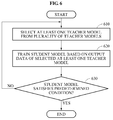
- FIG. 6 is a flowchart illustrating a model training method according to an exemplary embodiment.
- the model training method may be performed by a processor included in a model training apparatus.
- the processor may be specially configured to perform the operations shown in FIG. 6 .
- the model training apparatus selects at least one teacher model from a plurality of teacher models.
- the plurality of teacher models may have different initial weights, may have different neural network structures, may have different hyper parameters, or may include different ensembles.
- the model training apparatus may select at least one teacher model from the plurality of teacher models based on accuracies of the plurality of teacher models. For example, the model training apparatus may select a teacher model having a highest accuracy from the plurality of teacher models, or select teacher models having accuracies greater than or equal to a threshold from the plurality of teacher models. Further, the model training apparatus may arrange the plurality of teacher models based on the accuracies of the plurality of teacher models, and select a predetermined number of teacher models, for example, k teacher models, in a descending order of accuracy or according to another predetermined order.
- the model training apparatus may select at least two teacher models from the plurality of teacher models based on a correlation between output data of the plurality of teacher models with respect to input data. Also, the model training apparatus may select at least two teacher models from the plurality of teacher models when a correction between output data of the selected teacher models is less than a threshold.
- the model training apparatus may receive, from a user, an input which heuristically selects at least one teacher model from the plurality of teacher models. It is understood, however, that exemplary embodiments are not limited to an input which heuristically selects the at least one teacher model, and other types of selection may also be used according to exemplary embodiments.
- the model training apparatus may train a student model based on output data of the selected teacher model with respect to input data.
- the model training apparatus may train the student model based on a loss between output data of the student model and the output data of the selected teacher model with respect to the input data.
- the model training apparatus may train the student model further based on the output data of the student model. In addition, the model training apparatus may train the student model further based on correct answer data corresponding to the input data.
- the model training apparatus may train the student model based on a first loss between the output data of the student model and first output data of the selected at least one teacher model with respect to the input data, and a second loss between output data of a classifier layer derived from a hidden layer of the student model and second output data of the selected at least one teacher model.
- the first loss and the second loss may be determined using different methods.
- the first loss and the second loss may be determined based on first output data and second output data output from different selected teacher models, or determined by applying different weights to the first output data and the second output data.
- An initial weight of the classifier layer may be set to be an initial weight of a teacher model with a size most similar to a size of data input into the classifier layer, the teacher model being selected from the selected at least one teacher model.
- the model training apparatus may determine a structure of the student model based on a size of data input into the selected teacher model.
- the model training apparatus may change the structure of the student model based on a difference between the size of the data input into the selected teacher model and the size of the data input into the student model. For example, when the size of the data input into the selected teacher model corresponds to 64 pixels x 64 pixels, and the size of the data input into the student model corresponds to 32 pixels x 32 pixels, the structure of the student model may be changed so that the student model may have a receptive field (e.g., a particular region of sensory space in which a stimulus will trigger the firing of a neuron)identical or similar to that of the selected teacher model.
- a receptive field e.g., a particular region of sensory space in which a stimulus will trigger the firing of a neuron
- the model training apparatus may change a number of nodes of an input layer, a number of hidden layers, and a number of nodes of the hidden layers included in the student model based on the size of the data input into the selected teacher model.
- the model training apparatus may determine whether the student model satisfies a predetermined condition.
- the model training apparatus may determine whether an accuracy of the student model is greater than or equal to a threshold. When the accuracy of the student model is less than the threshold, the model training apparatus may re-perform operations 610 and 620. Each time operation 610 is re-performed, at least one of the plurality of teacher models may be variably selected based on a predetermined criterion. For example, when operation 610 is re-performed, at least one of the remaining teacher models, excluding a teacher model used to train the student model in previous operation 620, may be selected. Through the foregoing process, over fitting of the student model to a single teacher model may be effectively prevented.
- the model training apparatus may control weights to be applied to the output data of the selected teacher model and the correct answer data based on training progress, for example, an accuracy of the student model. For example, the model training apparatus may set a greater weight for the correct answer data than the output data of the selected teacher model as the student model is trained. Conversely, when the accuracy of the student model is greater than or equal to a threshold, the model training apparatus may terminate training of the student model.
- the model training apparatus may determine whether a training count of the student model satisfies a preset iteration count. When the training count of the student model does not satisfy the preset iteration count, the model training apparatus may re-perform operations 610 and 620. In this example, each time operation 610 is re-performed, at least one of the plurality of teacher modules may be variably selected based on the predetermined criterion. Conversely, when the training count of the student model satisfies the preset iteration count, the model training apparatus may terminate training of the student model.
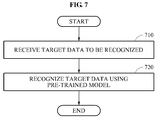
- FIG. 7 is a flowchart illustrating a data recognizing method according to an exemplary embodiment.
- the data recognizing method may be performed by a processor included in a data recognizing apparatus.
- the processor may be specially configured to perform the operations
- the data recognizing apparatus receives target data to be recognized.
- the target data is data to be recognized through a pre-trained model, and may include, for example, image data, video data, speech data, time-series data, sensor data, or various combinations thereof.
- the data recognizing apparatus recognizes the target data using the pre-trained model.
- a model refers to a neural network capable of detecting objects from the target data, or classifying or clustering the objects.
- the model according to exemplary embodiments may also be capable of performing other functions in addition to detecting, classifying, or clustering the objects.
- the model may be trained based on output data of at least one teacher model with respect to input data, the at least one teacher model being selected from a plurality of teacher models. For example, the model may be trained based on a loss between the output data of the selected at least one teacher model and output data of a student model with respect to the input data.
- the at least one teacher model is selected based on accuracies of the plurality of teacher models or a correlation between output data of the plurality of teacher models with respect to the input data.
- the model may be trained based on (i) a first loss between output data of the model and first output data of the selected at least one teacher model with respect to the input data, and (ii) a second loss between output data of a classifier layer derived from a hidden layer of the model and second output data of the selected at least one teacher model.
- the first loss and the second loss may be determined using different methods, although are not limited thereto, and may alternatively be determined using the same method.
- FIGS. 1 through 6 may be applicable to a process of training a model to recognize target data and thus, repeated descriptions thereof will be omitted for conciseness.
- FIG. 8 is a block diagram illustrating a model training apparatus according to an exemplary embodiment.
- a model training apparatus 800 includes a processor 810 and a memory 820.
- the model training apparatus 800 is an apparatus that trains a neural network for data recognition, and may be implemented using a single processor or multiple processors.
- the processor 810 may select at least one teacher model from a plurality of teacher models, and train a student model based on output data of the selected at least one teacher model with respect to input data. For example, the processor 810 may train the student model based on a loss between output data of the student model and the output data of the selected at least one teacher model with respect to the input data.
- the processor 810 may be implemented as many different types of hardware processors, and may be specially configured to perform the above-described functions of selecting at least one teacher model and training a student model, in addition to other types of functions.
- the processor 810 may select at least one teacher model from the plurality of teacher models based on accuracies of the plurality of teacher models or a correlation between output data of the plurality of teacher models with respect to the input data.
- the processor 810 may train the student model based on (i) a first loss between output data of the student model and first output data of the selected at least one teacher model with respect to the input data, and (ii) a second loss between output data of a classifier layer derived from a hidden layer of the student model and second output data of the selected at least one teacher model.
- the first loss and the second loss may be determined using different methods.
- the input data is training data to be used to train the student model, and may include, for example, image data, audio data (e.g., speech data, music data, etc.), or various combinations thereof.
- the memory 820 may store the student model trained by the processor 810.
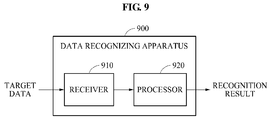
- FIG. 9 is a block diagram illustrating a data recognizing apparatus according to an exemplary embodiment.
- a data recognizing apparatus 900 includes a receiver 910 and a processor 920.
- the data recognizing apparatus 900 is an apparatus capable of recognizing received target data through a pre-trained model, and may be provided in various computing devices and/or systems such as, for example, a smart phone, a tablet computer, a laptop computer, a desktop computer, a television, a wearable device, a security system, and a smart home system.
- the receiver 910 may receive target data to be recognized.
- the processor 920 may recognize the target data using a pre-trained model.
- the model may be trained based on output data of at least one teacher model with respect to input data, the at least one teacher model being selected from a plurality of teacher models. For example, the model may be trained based on a loss between output data of a student model and output data of the selected at least one teacher model with respect to the input data.
- Exemplary embodiments may select at least one teacher model from a plurality of teacher models and train a student model using the selected at least one teacher model, thereby effectively increasing a learning rate and an accuracy of the student model.
- exemplary embodiments may variably select at least one teacher model from a plurality of teacher models based on a predetermined criterion, thereby preventing over fitting of a student model to a predetermined teacher model.
- Exemplary embodiments may also calculate a loss at an output layer of a student model and a loss at a classifier layer of the student model using different methods, thereby effectively updating connection weights in a neural network, even though the student model is a deep neural network.
- the process of training a student model may be iteratively performed by randomly selecting at least one teacher model from a plurality of teacher models until the accuracy of the student model satisfies a predetermined condition(s).
- multiple teacher models may be selected and used to re-train a single student model.
- the units and/or modules described herein may be implemented using hardware components and software components.
- the hardware components may include microphones, amplifiers, band-pass filters, audio to digital convertors, and processing devices.
- a processing device may be implemented using one or more hardware device configured to carry out and/or execute program code by performing arithmetical, logical, and input/output operations.
- the processing device(s) may include a processor, a controller and an arithmetic logic unit, a digital signal processor, a microcomputer, a field programmable array, a programmable logic unit, a microprocessor or any other device capable of responding to and executing instructions in a defined manner.
- the processing device may run an operating system (OS) and one or more software applications that run on the OS.
- OS operating system
- the processing device also may access, store, manipulate, process, and create data in response to execution of the software.
- a processing device may include multiple processing elements and may further include multiple types of processing elements.
- a processing device may include multiple processors or a processor and a controller.
- different processing configurations are possible, such as parallel processors.
- the software implemented in accordance with exemplary embodiments may include a computer program, a piece of code, an instruction, or some combination thereof, to independently or collectively instruct and/or configure the processing device to operate as desired, thereby transforming the processing device into a special purpose processor.
- Software and data may be embodied permanently or temporarily in any type of machine, component, physical or virtual equipment, computer storage medium or device, or may be embodied in a propagated signal wave capable of providing instructions or data to or being interpreted by the processing device.
- the software also may be distributed over network coupled computer systems so that the software is stored and executed in a distributed fashion.
- the software and data may be stored by one or more non-transitory computer readable recording mediums.
- the methods according to the above-described exemplary embodiments may be recorded in non-transitory computer-readable media including program instructions to implement various operations of the above-described exemplary embodiments.
- the media may also include, alone or in combination with the program instructions, data files, data structures, and the like.
- the program instructions recorded on the media may be those specially designed and constructed for the purposes of carrying out the functions of exemplary embodiments, or they may be of the well-known type and available to those having skill in the computer software arts.
- non-transitory computer-readable media examples include magnetic media such as hard disks, floppy disks, and magnetic tape; optical media such as CD-ROM discs, DVDs, and/or Blue-ray discs; magnetooptical media such as optical discs; and hardware devices that are specially configured to store and perform program instructions, such as read-only memory (ROM), random access memory (RAM), flash memory (e.g., USB flash drives, memory cards, memory sticks, etc.), and the like.
- program instructions include both machine code, such as the code produced by a compiler, and files containing higher level code that may be executed by the computer using an interpreter.
- the above-described devices may be configured to act as one or more software modules in order to perform the operations of the above-described exemplary embodiments, or vice versa.
Landscapes
- Engineering & Computer Science (AREA)
- Theoretical Computer Science (AREA)
- Physics & Mathematics (AREA)
- Data Mining & Analysis (AREA)
- General Physics & Mathematics (AREA)
- Artificial Intelligence (AREA)
- Evolutionary Computation (AREA)
- General Engineering & Computer Science (AREA)
- Life Sciences & Earth Sciences (AREA)
- Software Systems (AREA)
- Mathematical Physics (AREA)
- Computing Systems (AREA)
- Biomedical Technology (AREA)
- Health & Medical Sciences (AREA)
- Biophysics (AREA)
- Computational Linguistics (AREA)
- General Health & Medical Sciences (AREA)
- Molecular Biology (AREA)
- Computer Vision & Pattern Recognition (AREA)
- Bioinformatics & Cheminformatics (AREA)
- Bioinformatics & Computational Biology (AREA)
- Evolutionary Biology (AREA)
- Business, Economics & Management (AREA)
- Educational Administration (AREA)
- Educational Technology (AREA)
- Image Analysis (AREA)
- Medical Informatics (AREA)
- Management, Administration, Business Operations System, And Electronic Commerce (AREA)
- Measurement Of The Respiration, Hearing Ability, Form, And Blood Characteristics Of Living Organisms (AREA)
- Electrically Operated Instructional Devices (AREA)
- Rehabilitation Tools (AREA)
Applications Claiming Priority (1)
| Application Number | Priority Date | Filing Date | Title |
|---|---|---|---|
| KR1020150132679A KR102492318B1 (ko) | 2015-09-18 | 2015-09-18 | 모델 학습 방법 및 장치, 및 데이터 인식 방법 |
Publications (2)
| Publication Number | Publication Date |
|---|---|
| EP3144859A2 true EP3144859A2 (de) | 2017-03-22 |
| EP3144859A3 EP3144859A3 (de) | 2017-06-14 |
Family
ID=56507418
Family Applications (1)
| Application Number | Title | Priority Date | Filing Date |
|---|---|---|---|
| EP16180282.2A Ceased EP3144859A3 (de) | 2015-09-18 | 2016-07-20 | Modellübungsverfahren und vorrichtung sowie datenerkennungsverfahren |
Country Status (4)
| Country | Link |
|---|---|
| US (1) | US10410114B2 (de) |
| EP (1) | EP3144859A3 (de) |
| KR (1) | KR102492318B1 (de) |
| CN (1) | CN106548190A (de) |
Cited By (17)
| Publication number | Priority date | Publication date | Assignee | Title |
|---|---|---|---|---|
| WO2017052709A3 (en) * | 2015-07-22 | 2017-05-04 | Qualcomm Incorporated | Transfer learning in neural networks |
| WO2018217635A1 (en) * | 2017-05-20 | 2018-11-29 | Google Llc | Application development platform and software development kits that provide comprehensive machine learning services |
| WO2018217563A1 (en) * | 2017-05-20 | 2018-11-29 | Google Llc | Projection neural networks |
| CN109858614A (zh) * | 2019-01-31 | 2019-06-07 | 北京市商汤科技开发有限公司 | 神经网络训练方法及装置、电子设备和存储介质 |
| EP3518151A1 (de) * | 2018-01-29 | 2019-07-31 | Panasonic Intellectual Property Corporation of America | Datenverarbeitungsverfahren und datenverarbeitungssystem |
| CN110516677A (zh) * | 2019-08-23 | 2019-11-29 | 上海云绅智能科技有限公司 | 一种神经网络识别模型、目标识别方法及系统 |
| WO2020214305A1 (en) * | 2019-04-19 | 2020-10-22 | Microsoft Technology Licensing, Llc | Multi-task machine learning architectures and training procedures |
| CN111931057A (zh) * | 2020-08-18 | 2020-11-13 | 中国科学院深圳先进技术研究院 | 一种自适应输出的序列推荐方法和系统 |
| EP3602316A4 (de) * | 2017-03-24 | 2020-12-30 | D5A1 Llc | Lerntrainer für maschinelles lernsystem |
| US10885277B2 (en) | 2018-08-02 | 2021-01-05 | Google Llc | On-device neural networks for natural language understanding |
| CN112508120A (zh) * | 2020-12-18 | 2021-03-16 | 北京百度网讯科技有限公司 | 学生模型训练方法、装置、设备、介质和程序产品 |
| CN114287007A (zh) * | 2019-06-18 | 2022-04-05 | 摩洛科公司 | 用于提供机器学习服务的方法和系统 |
| WO2022120741A1 (en) * | 2020-12-10 | 2022-06-16 | Baidu.Com Times Technology (Beijing) Co., Ltd. | Training of deployed neural networks |
| GB2602976A (en) * | 2021-01-20 | 2022-07-27 | Toshiba Kk | Speech recognition systems and methods |
| WO2022221045A1 (en) * | 2021-04-15 | 2022-10-20 | Microsoft Technology Licensing, Llc | Performing multiple tasks with continual adaptation |
| US11526680B2 (en) | 2019-02-14 | 2022-12-13 | Google Llc | Pre-trained projection networks for transferable natural language representations |
| US12093675B2 (en) | 2018-05-07 | 2024-09-17 | Google Llc | Application development platform and software development kits that provide comprehensive machine learning services |
Families Citing this family (130)
| Publication number | Priority date | Publication date | Assignee | Title |
|---|---|---|---|---|
| US11062228B2 (en) | 2015-07-06 | 2021-07-13 | Microsoft Technoiogy Licensing, LLC | Transfer learning techniques for disparate label sets |
| WO2018051841A1 (ja) * | 2016-09-16 | 2018-03-22 | 日本電信電話株式会社 | モデル学習装置、その方法、及びプログラム |
| CN109952581A (zh) | 2016-09-28 | 2019-06-28 | D5A1有限责任公司 | 用于机器学习系统的学习教练 |
| JP2018060268A (ja) * | 2016-10-03 | 2018-04-12 | 株式会社日立製作所 | 認識装置および学習システム |
| CN106778867B (zh) * | 2016-12-15 | 2020-07-07 | 北京旷视科技有限公司 | 目标检测方法和装置、神经网络训练方法和装置 |
| US10762891B2 (en) * | 2017-02-10 | 2020-09-01 | Synaptics Incorporated | Binary and multi-class classification systems and methods using connectionist temporal classification |
| US11100932B2 (en) * | 2017-02-10 | 2021-08-24 | Synaptics Incorporated | Robust start-end point detection algorithm using neural network |
| US10762417B2 (en) * | 2017-02-10 | 2020-09-01 | Synaptics Incorporated | Efficient connectionist temporal classification for binary classification |
| US11080600B2 (en) * | 2017-02-10 | 2021-08-03 | Synaptics Incorporated | Recurrent neural network based acoustic event classification using complement rule |
| US11853884B2 (en) * | 2017-02-10 | 2023-12-26 | Synaptics Incorporated | Many or one detection classification systems and methods |
| US11087213B2 (en) * | 2017-02-10 | 2021-08-10 | Synaptics Incorporated | Binary and multi-class classification systems and methods using one spike connectionist temporal classification |
| US10762427B2 (en) * | 2017-03-01 | 2020-09-01 | Synaptics Incorporated | Connectionist temporal classification using segmented labeled sequence data |
| US11514465B2 (en) * | 2017-03-02 | 2022-11-29 | The Nielsen Company (Us), Llc | Methods and apparatus to perform multi-level hierarchical demographic classification |
| CN108230354B (zh) * | 2017-05-18 | 2022-05-10 | 深圳市商汤科技有限公司 | 目标跟踪、网络训练方法、装置、电子设备和存储介质 |
| US11195093B2 (en) | 2017-05-18 | 2021-12-07 | Samsung Electronics Co., Ltd | Apparatus and method for student-teacher transfer learning network using knowledge bridge |
| CN108334934B (zh) * | 2017-06-07 | 2021-04-13 | 赛灵思公司 | 基于剪枝和蒸馏的卷积神经网络压缩方法 |
| US10453444B2 (en) * | 2017-07-27 | 2019-10-22 | Microsoft Technology Licensing, Llc | Intent and slot detection for digital assistants |
| KR102570278B1 (ko) * | 2017-07-31 | 2023-08-24 | 삼성전자주식회사 | 교사 모델로부터 학생 모델을 트레이닝하는데 사용되는 학습 데이터를 생성하는 장치 및 방법 |
| US10885900B2 (en) * | 2017-08-11 | 2021-01-05 | Microsoft Technology Licensing, Llc | Domain adaptation in speech recognition via teacher-student learning |
| US10962979B2 (en) * | 2017-09-30 | 2021-03-30 | Tusimple, Inc. | System and method for multitask processing for autonomous vehicle computation and control |
| CN107808120B (zh) * | 2017-09-30 | 2018-08-31 | 平安科技(深圳)有限公司 | 眼镜定位方法、装置及存储介质 |
| KR102107378B1 (ko) | 2017-10-31 | 2020-05-07 | 삼성에스디에스 주식회사 | 하이퍼파라미터 자동 최적화 방법 및 그 장치 |
| KR102426491B1 (ko) * | 2017-11-07 | 2022-07-28 | 재단법인대구경북과학기술원 | 앙상블 및 미세 조정을 이용한 영상 데이터 처리 장치 및 제어 방법 |
| CN107944375A (zh) * | 2017-11-20 | 2018-04-20 | 北京奇虎科技有限公司 | 基于场景分割的自动驾驶处理方法及装置、计算设备 |
| WO2019096754A1 (en) * | 2017-11-20 | 2019-05-23 | Koninklijke Philips N.V. | Training first and second neural network models |
| CN107832799A (zh) * | 2017-11-20 | 2018-03-23 | 北京奇虎科技有限公司 | 基于摄像头场景的对象识别方法及装置、计算设备 |
| CN107944374A (zh) * | 2017-11-20 | 2018-04-20 | 北京奇虎科技有限公司 | 视频数据中特定对象检测方法及装置、计算设备 |
| CN107944376A (zh) * | 2017-11-20 | 2018-04-20 | 北京奇虎科技有限公司 | 视频数据实时姿态识别方法及装置、计算设备 |
| CN107945188A (zh) * | 2017-11-20 | 2018-04-20 | 北京奇虎科技有限公司 | 基于场景分割的人物装扮方法及装置、计算设备 |
| CN108171716B (zh) * | 2017-12-25 | 2021-11-26 | 北京奇虎科技有限公司 | 基于自适应跟踪框分割的视频人物装扮方法及装置 |
| CN108256646A (zh) * | 2018-01-22 | 2018-07-06 | 百度在线网络技术(北京)有限公司 | 模型生成方法和装置 |
| CN108280513B (zh) * | 2018-01-22 | 2022-08-19 | 百度在线网络技术(北京)有限公司 | 模型生成方法和装置 |
| KR102069774B1 (ko) | 2018-03-27 | 2020-02-11 | 울산대학교 산학협력단 | 영상 처리 장치 및 방법 |
| CN110395257B (zh) * | 2018-04-20 | 2021-04-23 | 北京图森未来科技有限公司 | 一种车道线实例检测方法和装置、自动驾驶车辆 |
| CN108830288A (zh) * | 2018-04-25 | 2018-11-16 | 北京市商汤科技开发有限公司 | 图像处理方法、神经网络的训练方法、装置、设备及介质 |
| CN108647720A (zh) * | 2018-05-10 | 2018-10-12 | 上海扩博智能技术有限公司 | 商品图像的迭代循环识别方法、系统、设备及存储介质 |
| US10699194B2 (en) * | 2018-06-01 | 2020-06-30 | DeepCube LTD. | System and method for mimicking a neural network without access to the original training dataset or the target model |
| KR102199484B1 (ko) * | 2018-06-01 | 2021-01-06 | 아주대학교산학협력단 | 대용량 네트워크를 압축하기 위한 방법 및 장치 |
| US11907854B2 (en) | 2018-06-01 | 2024-02-20 | Nano Dimension Technologies, Ltd. | System and method for mimicking a neural network without access to the original training dataset or the target model |
| KR102096388B1 (ko) | 2018-06-05 | 2020-04-06 | 네이버 주식회사 | 모바일 환경에서 실시간 추론이 가능한 dnn 구성을 위한 최적화 기법 |
| US11416741B2 (en) * | 2018-06-08 | 2022-08-16 | International Business Machines Corporation | Teacher and student learning for constructing mixed-domain model |
| CN110598840B (zh) * | 2018-06-13 | 2023-04-18 | 富士通株式会社 | 知识迁移方法、信息处理设备以及存储介质 |
| KR102501883B1 (ko) * | 2018-07-06 | 2023-02-21 | 에임시스템 주식회사 | 기계 학습 기반의 설비 이상 분류 시스템 및 방법 |
| US11610108B2 (en) * | 2018-07-27 | 2023-03-21 | International Business Machines Corporation | Training of student neural network with switched teacher neural networks |
| US11741355B2 (en) * | 2018-07-27 | 2023-08-29 | International Business Machines Corporation | Training of student neural network with teacher neural networks |
| CN110837761B (zh) * | 2018-08-17 | 2023-04-07 | 北京市商汤科技开发有限公司 | 多模型知识蒸馏方法及装置、电子设备和存储介质 |
| KR20200021301A (ko) | 2018-08-20 | 2020-02-28 | 삼성에스디에스 주식회사 | 하이퍼파라미터 최적화 방법 및 그 장치 |
| US10963748B1 (en) | 2018-08-31 | 2021-03-30 | Snap Inc. | Generative neural network distillation |
| CN109165738B (zh) * | 2018-09-19 | 2021-09-14 | 北京市商汤科技开发有限公司 | 神经网络模型的优化方法及装置、电子设备和存储介质 |
| CN111046891A (zh) * | 2018-10-11 | 2020-04-21 | 杭州海康威视数字技术股份有限公司 | 车牌识别模型的训练方法、车牌识别方法和装置 |
| KR102850048B1 (ko) * | 2018-10-22 | 2025-08-26 | 삼성전자주식회사 | 모델 학습 방법 및 장치, 및 데이터 인식 방법 |
| US11494612B2 (en) | 2018-10-31 | 2022-11-08 | Sony Interactive Entertainment Inc. | Systems and methods for domain adaptation in neural networks using domain classifier |
| US20200134444A1 (en) * | 2018-10-31 | 2020-04-30 | Sony Interactive Entertainment Inc. | Systems and methods for domain adaptation in neural networks |
| US11640519B2 (en) | 2018-10-31 | 2023-05-02 | Sony Interactive Entertainment Inc. | Systems and methods for domain adaptation in neural networks using cross-domain batch normalization |
| US10657447B1 (en) * | 2018-11-29 | 2020-05-19 | SparkCognition, Inc. | Automated model building search space reduction |
| US11775812B2 (en) | 2018-11-30 | 2023-10-03 | Samsung Electronics Co., Ltd. | Multi-task based lifelong learning |
| CN109615989B (zh) * | 2018-12-03 | 2021-10-01 | 合肥凌极西雅电子科技有限公司 | 一种数据挖掘教学装置 |
| CN109754089B (zh) * | 2018-12-04 | 2021-07-20 | 浙江大华技术股份有限公司 | 一种模型训练系统及方法 |
| CN109783824B (zh) * | 2018-12-17 | 2023-04-18 | 北京百度网讯科技有限公司 | 基于翻译模型的翻译方法、装置及存储介质 |
| KR102168541B1 (ko) * | 2018-12-20 | 2020-10-21 | 주식회사 마인즈랩 | 제1 신경망을 이용한 제2 신경망 학습 방법 및 컴퓨터 프로그램 |
| CN109948642B (zh) * | 2019-01-18 | 2023-03-28 | 中山大学 | 基于图像输入的多智能体跨模态深度确定性策略梯度训练方法 |
| US11763154B1 (en) * | 2019-01-30 | 2023-09-19 | Amazon Technologies, Inc. | Machine learning services with pre-trained models |
| KR102037279B1 (ko) * | 2019-02-11 | 2019-11-15 | 주식회사 딥노이드 | 딥러닝 시스템 및 그 최적 학습 모델 결정 방법 |
| CN109886343B (zh) * | 2019-02-26 | 2024-01-05 | 深圳市商汤科技有限公司 | 图像分类方法及装置、设备、存储介质 |
| US12046023B2 (en) * | 2019-03-22 | 2024-07-23 | International Business Machines Corporation | Unification of models having respective target classes with distillation |
| KR102925217B1 (ko) | 2019-03-25 | 2026-02-09 | 삼성전자주식회사 | 화자 식별 뉴럴 네트워크를 구현하는 방법 및 장치 |
| US10614345B1 (en) | 2019-04-12 | 2020-04-07 | Ernst & Young U.S. Llp | Machine learning based extraction of partition objects from electronic documents |
| KR102896235B1 (ko) * | 2019-05-07 | 2025-12-08 | 삼성전자주식회사 | 모델 학습 방법 및 장치 |
| KR102896236B1 (ko) | 2019-05-09 | 2025-12-08 | 삼성전자주식회사 | 모델 학습 방법 및 장치 |
| US11113518B2 (en) | 2019-06-28 | 2021-09-07 | Eygs Llp | Apparatus and methods for extracting data from lineless tables using Delaunay triangulation and excess edge removal |
| KR20220047535A (ko) * | 2019-08-19 | 2022-04-18 | 엘지전자 주식회사 | Ai 기반의 사전 훈련 모델 결정 시스템 및 이를 이용한 제품 생산 라인을 위한 ai 기반의 비전 검사 관리 시스템 |
| US11915465B2 (en) | 2019-08-21 | 2024-02-27 | Eygs Llp | Apparatus and methods for converting lineless tables into lined tables using generative adversarial networks |
| US20210056425A1 (en) * | 2019-08-23 | 2021-02-25 | Samsung Electronics Co., Ltd. | Method and system for hybrid model including machine learning model and rule-based model |
| CN114270371B (zh) * | 2019-08-30 | 2025-12-30 | 三星电子株式会社 | 用于将个性化人工智能模型应用于另一个模型的电子装置 |
| CN114787833A (zh) * | 2019-09-23 | 2022-07-22 | 普雷萨根私人有限公司 | 分散式人工智能(ai)/机器学习训练系统 |
| CN114467146A (zh) * | 2019-09-26 | 2022-05-10 | 株式会社润医 | 用于对部署机构中的人工智能模型进行专业化的训练方法以及用于对人工智能模型进行训练的装置 |
| WO2021059604A1 (ja) * | 2019-09-26 | 2021-04-01 | 富士フイルム株式会社 | 機械学習システムおよび方法、統合サーバ、情報処理装置、プログラムならびに推論モデルの作成方法 |
| KR20210042696A (ko) | 2019-10-10 | 2021-04-20 | 삼성전자주식회사 | 모델 학습 방법 및 장치 |
| WO2021079481A1 (ja) * | 2019-10-24 | 2021-04-29 | 富士通株式会社 | 劣化検出方法、劣化検出プログラムおよび情報処理装置 |
| WO2021079473A1 (ja) * | 2019-10-24 | 2021-04-29 | 富士通株式会社 | 生成方法、生成プログラムおよび情報処理装置 |
| CN110826344B (zh) * | 2019-10-24 | 2022-03-01 | 北京小米智能科技有限公司 | 神经网络模型压缩方法、语料翻译方法及其装置 |
| US11443235B2 (en) * | 2019-11-14 | 2022-09-13 | International Business Machines Corporation | Identifying optimal weights to improve prediction accuracy in machine learning techniques |
| US11922303B2 (en) * | 2019-11-18 | 2024-03-05 | Salesforce, Inc. | Systems and methods for distilled BERT-based training model for text classification |
| US11604984B2 (en) * | 2019-11-18 | 2023-03-14 | Shanghai United Imaging Intelligence Co., Ltd. | Systems and methods for machine learning based modeling |
| US10810709B1 (en) | 2019-11-21 | 2020-10-20 | Eygs Llp | Systems and methods for improving the quality of text documents using artificial intelligence |
| CN111126079B (zh) * | 2019-11-25 | 2023-11-07 | 北京小米智能科技有限公司 | 用于机器翻译的神经网络模型压缩方法、装置及存储介质 |
| CN111159397B (zh) * | 2019-12-04 | 2023-04-18 | 支付宝(杭州)信息技术有限公司 | 文本分类方法和装置、服务器 |
| CN111143552B (zh) * | 2019-12-05 | 2023-06-27 | 支付宝(杭州)信息技术有限公司 | 文本信息的类别预测方法和装置、服务器 |
| KR102720723B1 (ko) * | 2019-12-18 | 2024-10-22 | 엘지전자 주식회사 | 디스플레이 장치 및 이의 제어 방법 |
| WO2021126226A1 (en) * | 2019-12-20 | 2021-06-24 | Google Llc | Systems and method for evaluating and selectively distilling machine-learned models on edge devices |
| US11227122B1 (en) * | 2019-12-31 | 2022-01-18 | Facebook, Inc. | Methods, mediums, and systems for representing a model in a memory of device |
| US11625934B2 (en) | 2020-02-04 | 2023-04-11 | Eygs Llp | Machine learning based end-to-end extraction of tables from electronic documents |
| WO2021182748A1 (ko) * | 2020-03-10 | 2021-09-16 | 삼성전자주식회사 | 전자 장치 및 그 제어 방법 |
| CN111461212B (zh) * | 2020-03-31 | 2023-04-07 | 中国科学院计算技术研究所 | 一种用于点云目标检测模型的压缩方法 |
| KR102191351B1 (ko) | 2020-04-28 | 2020-12-15 | 아주대학교산학협력단 | 지식 증류법 기반 의미론적 영상 분할 방법 |
| CN111582500A (zh) * | 2020-05-07 | 2020-08-25 | 支付宝(杭州)信息技术有限公司 | 一种提高模型训练效果的方法和系统 |
| KR102225579B1 (ko) * | 2020-05-14 | 2021-03-10 | 아주대학교산학협력단 | 학습성능이 향상된 지식 증류법 기반 의미론적 영상 분할 방법 |
| US11430124B2 (en) | 2020-06-24 | 2022-08-30 | Samsung Electronics Co., Ltd. | Visual object instance segmentation using foreground-specialized model imitation |
| US11961003B2 (en) | 2020-07-08 | 2024-04-16 | Nano Dimension Technologies, Ltd. | Training a student neural network to mimic a mentor neural network with inputs that maximize student-to-mentor disagreement |
| US11915122B2 (en) | 2020-07-29 | 2024-02-27 | Micron Technology, Inc. | Gateway for distributing an artificial neural network among multiple processing nodes |
| US11588735B2 (en) | 2020-07-29 | 2023-02-21 | Micron Technology, Inc. | Edge processing of sensor data using a neural network to reduce data traffic on a communication network |
| CN111967941B (zh) * | 2020-08-20 | 2024-01-05 | 中国科学院深圳先进技术研究院 | 一种构建序列推荐模型的方法和序列推荐方法 |
| CN112183577B (zh) | 2020-08-31 | 2025-03-25 | 华为技术有限公司 | 一种半监督学习模型的训练方法、图像处理方法及设备 |
| US20220076136A1 (en) * | 2020-09-09 | 2022-03-10 | Peyman PASSBAN | Method and system for training a neural network model using knowledge distillation |
| US20220092404A1 (en) * | 2020-09-18 | 2022-03-24 | Arm Cloud Technology, Inc. | Neural network selection |
| CN112308130B (zh) * | 2020-10-29 | 2021-10-15 | 成都千嘉科技有限公司 | 一种物联网深度学习网络的部署方法 |
| KR102277810B1 (ko) * | 2020-11-03 | 2021-07-15 | 아주대학교산학협력단 | 지식 증류를 이용한 학생 네트워크 학습용 시스템 및 학습 방법 |
| CN112507209B (zh) * | 2020-11-10 | 2022-07-05 | 中国科学院深圳先进技术研究院 | 一种基于陆地移动距离进行知识蒸馏的序列推荐方法 |
| CN112488209B (zh) * | 2020-11-25 | 2024-02-20 | 南京大学 | 一种基于半监督学习的增量式图片分类方法 |
| DE102020214917A1 (de) * | 2020-11-27 | 2022-06-02 | Robert Bosch Gesellschaft mit beschränkter Haftung | Verfahren zur Bestimmung des Gesundheitszustands eines elektrischen Energiespeichers, Computerprogrammprodukt und maschinenlesbares Speichermedium |
| US12039265B2 (en) * | 2020-12-01 | 2024-07-16 | Rovi Guides, Inc. | Systems and methods to support a new locale in a language model |
| CN112257815B (zh) * | 2020-12-03 | 2025-02-25 | 北京沃东天骏信息技术有限公司 | 模型生成方法、目标检测方法、装置、电子设备及介质 |
| KR102478596B1 (ko) * | 2020-12-24 | 2022-12-16 | 포항공과대학교 산학협력단 | 도메인 적응을 이용한 레이다 기반 탐지 시스템 및 그 방법 |
| US20220292345A1 (en) * | 2021-03-12 | 2022-09-15 | Nec Corporation | Distributionally robust model training |
| CN113255798A (zh) * | 2021-06-02 | 2021-08-13 | 苏州浪潮智能科技有限公司 | 一种分类模型训练方法、装置、设备及介质 |
| CN113449851A (zh) * | 2021-07-15 | 2021-09-28 | 北京字跳网络技术有限公司 | 数据处理方法及设备 |
| CN113609965B (zh) * | 2021-08-03 | 2024-02-13 | 同盾科技有限公司 | 文字识别模型的训练方法及装置、存储介质、电子设备 |
| KR102813454B1 (ko) * | 2021-09-29 | 2025-05-27 | 주식회사 하가 | 지식증류 기반의 학생모델을 이용한 객체를 인식하기 위한 장치 및 이를 위한 방법 |
| US20230123347A1 (en) * | 2021-10-14 | 2023-04-20 | Vinai Artificial Intelligence Application And Research Joint Stock Company | Driver monitor system on edge device |
| US11964209B2 (en) | 2022-03-17 | 2024-04-23 | Sony Interactive Entertainment Inc. | Machine learning based gaming platform messaging risk management using gamer behavior |
| CN114663726B (zh) * | 2022-03-23 | 2025-10-21 | 苏州科达科技股份有限公司 | 目标类别检测模型的训练方法、目标检测方法及电子设备 |
| US20230351243A1 (en) * | 2022-04-27 | 2023-11-02 | Waymo Llc | Unification of specialized machine-learning models for efficient object detection and classification |
| KR102816101B1 (ko) * | 2022-05-06 | 2025-05-30 | 아주대학교산학협력단 | 지식 증류를 활용한 그룹 기반의 학습을 수행하는 전자장치 및 방법 |
| US20240119361A1 (en) * | 2022-09-28 | 2024-04-11 | Nvidia Corporation | Techniques for heterogeneous continual learning with machine learning model architecture progression |
| CN115700845B (zh) * | 2022-11-15 | 2023-08-11 | 智慧眼科技股份有限公司 | 人脸识别模型训练方法、人脸识别方法、装置及相关设备 |
| KR102597288B1 (ko) * | 2022-12-15 | 2023-11-02 | 주식회사 포도 | 라이다 포인트 클라우드 데이터 분류기 경량화를 위한 지식증류 장치 및 방법 |
| KR20240173495A (ko) * | 2023-06-05 | 2024-12-12 | 한양대학교 산학협력단 | 인공지능을 이용한 음성 인식을 수행하기 위한 방법 및 그 장치 |
| CN117274615B (zh) * | 2023-09-21 | 2024-03-22 | 书行科技(北京)有限公司 | 人体动作预测方法及相关产品 |
| CN117132174B (zh) * | 2023-10-26 | 2024-01-30 | 扬宇光电(深圳)有限公司 | 一种应用于工业流水线质量检测的模型训练方法与系统 |
| CN119363999B (zh) * | 2024-08-07 | 2025-11-18 | 中国科学院大学 | 自适应地基于隐表示网络的视频压缩方法 |
Family Cites Families (14)
| Publication number | Priority date | Publication date | Assignee | Title |
|---|---|---|---|---|
| TWI223792B (en) | 2003-04-04 | 2004-11-11 | Penpower Technology Ltd | Speech model training method applied in speech recognition |
| US7499857B2 (en) | 2003-05-15 | 2009-03-03 | Microsoft Corporation | Adaptation of compressed acoustic models |
| EP1839227A4 (de) * | 2004-12-16 | 2009-02-18 | Numerate Inc | Modellierung biologischer effekte von molekülen unter verwendung von molekularen eigenschaftsmodellen |
| US7363225B2 (en) | 2005-06-23 | 2008-04-22 | Microsoft Corporation | Compressing language models with Golomb coding |
| KR20070011051A (ko) | 2005-07-18 | 2007-01-24 | 엘지전자 주식회사 | 엔트로피 코딩/디코딩에서의 확률 상태 변경 방법 |
| JP5229216B2 (ja) | 2007-02-28 | 2013-07-03 | 日本電気株式会社 | 音声認識装置、音声認識方法及び音声認識プログラム |
| US8209178B1 (en) | 2008-01-10 | 2012-06-26 | Google Inc. | Randomized language models |
| WO2010005691A1 (en) | 2008-06-16 | 2010-01-14 | Dolby Laboratories Licensing Corporation | Rate control model adaptation based on slice dependencies for video coding |
| JP2010176327A (ja) | 2009-01-28 | 2010-08-12 | Sony Corp | 学習装置、学習方法、情報処理装置、データ選択方法、データ蓄積方法、データ変換方法、及びプログラム |
| WO2012105231A1 (ja) | 2011-02-03 | 2012-08-09 | 日本電気株式会社 | モデル適応化装置、モデル適応化方法およびモデル適応化用プログラム |
| JP5982265B2 (ja) | 2012-11-16 | 2016-08-31 | 日本電信電話株式会社 | 音声認識装置、音声認識方法、およびプログラム |
| KR20140077423A (ko) | 2012-12-14 | 2014-06-24 | 한국전자통신연구원 | 음성인식기의 언어모델 저장방법 |
| US9406017B2 (en) | 2012-12-24 | 2016-08-02 | Google Inc. | System and method for addressing overfitting in a neural network |
| US9728184B2 (en) | 2013-06-18 | 2017-08-08 | Microsoft Technology Licensing, Llc | Restructuring deep neural network acoustic models |
-
2015
- 2015-09-18 KR KR1020150132679A patent/KR102492318B1/ko active Active
-
2016
- 2016-05-23 US US15/161,906 patent/US10410114B2/en active Active
- 2016-07-20 EP EP16180282.2A patent/EP3144859A3/de not_active Ceased
- 2016-08-23 CN CN201610711793.7A patent/CN106548190A/zh active Pending
Non-Patent Citations (1)
| Title |
|---|
| None |
Cited By (29)
| Publication number | Priority date | Publication date | Assignee | Title |
|---|---|---|---|---|
| US10878320B2 (en) | 2015-07-22 | 2020-12-29 | Qualcomm Incorporated | Transfer learning in neural networks |
| WO2017052709A3 (en) * | 2015-07-22 | 2017-05-04 | Qualcomm Incorporated | Transfer learning in neural networks |
| US11915152B2 (en) | 2017-03-24 | 2024-02-27 | D5Ai Llc | Learning coach for machine learning system |
| EP3602316A4 (de) * | 2017-03-24 | 2020-12-30 | D5A1 Llc | Lerntrainer für maschinelles lernsystem |
| WO2018217635A1 (en) * | 2017-05-20 | 2018-11-29 | Google Llc | Application development platform and software development kits that provide comprehensive machine learning services |
| WO2018217563A1 (en) * | 2017-05-20 | 2018-11-29 | Google Llc | Projection neural networks |
| US11544573B2 (en) | 2017-05-20 | 2023-01-03 | Google Llc | Projection neural networks |
| US11410044B2 (en) | 2017-05-20 | 2022-08-09 | Google Llc | Application development platform and software development kits that provide comprehensive machine learning services |
| US10748066B2 (en) | 2017-05-20 | 2020-08-18 | Google Llc | Projection neural networks |
| EP3518151A1 (de) * | 2018-01-29 | 2019-07-31 | Panasonic Intellectual Property Corporation of America | Datenverarbeitungsverfahren und datenverarbeitungssystem |
| US12093675B2 (en) | 2018-05-07 | 2024-09-17 | Google Llc | Application development platform and software development kits that provide comprehensive machine learning services |
| US11934791B2 (en) | 2018-08-02 | 2024-03-19 | Google Llc | On-device projection neural networks for natural language understanding |
| US10885277B2 (en) | 2018-08-02 | 2021-01-05 | Google Llc | On-device neural networks for natural language understanding |
| US11423233B2 (en) | 2018-08-02 | 2022-08-23 | Google Llc | On-device projection neural networks for natural language understanding |
| CN109858614B (zh) * | 2019-01-31 | 2021-06-25 | 北京市商汤科技开发有限公司 | 神经网络训练方法及装置、电子设备和存储介质 |
| CN109858614A (zh) * | 2019-01-31 | 2019-06-07 | 北京市商汤科技开发有限公司 | 神经网络训练方法及装置、电子设备和存储介质 |
| US11526680B2 (en) | 2019-02-14 | 2022-12-13 | Google Llc | Pre-trained projection networks for transferable natural language representations |
| WO2020214305A1 (en) * | 2019-04-19 | 2020-10-22 | Microsoft Technology Licensing, Llc | Multi-task machine learning architectures and training procedures |
| US12008459B2 (en) | 2019-04-19 | 2024-06-11 | Microsoft Technology Licensing, Llc | Multi-task machine learning architectures and training procedures |
| CN114287007A (zh) * | 2019-06-18 | 2022-04-05 | 摩洛科公司 | 用于提供机器学习服务的方法和系统 |
| CN110516677A (zh) * | 2019-08-23 | 2019-11-29 | 上海云绅智能科技有限公司 | 一种神经网络识别模型、目标识别方法及系统 |
| CN111931057A (zh) * | 2020-08-18 | 2020-11-13 | 中国科学院深圳先进技术研究院 | 一种自适应输出的序列推荐方法和系统 |
| CN111931057B (zh) * | 2020-08-18 | 2024-05-14 | 中国科学院深圳先进技术研究院 | 一种自适应输出的序列推荐方法和系统 |
| WO2022120741A1 (en) * | 2020-12-10 | 2022-06-16 | Baidu.Com Times Technology (Beijing) Co., Ltd. | Training of deployed neural networks |
| CN112508120B (zh) * | 2020-12-18 | 2023-10-10 | 北京百度网讯科技有限公司 | 学生模型训练方法、装置、设备、介质和程序产品 |
| CN112508120A (zh) * | 2020-12-18 | 2021-03-16 | 北京百度网讯科技有限公司 | 学生模型训练方法、装置、设备、介质和程序产品 |
| GB2602976A (en) * | 2021-01-20 | 2022-07-27 | Toshiba Kk | Speech recognition systems and methods |
| GB2602976B (en) * | 2021-01-20 | 2023-08-23 | Toshiba Kk | Speech recognition systems and methods |
| WO2022221045A1 (en) * | 2021-04-15 | 2022-10-20 | Microsoft Technology Licensing, Llc | Performing multiple tasks with continual adaptation |
Also Published As
| Publication number | Publication date |
|---|---|
| KR102492318B1 (ko) | 2023-01-26 |
| KR20170034258A (ko) | 2017-03-28 |
| US10410114B2 (en) | 2019-09-10 |
| US20170083829A1 (en) | 2017-03-23 |
| EP3144859A3 (de) | 2017-06-14 |
| CN106548190A (zh) | 2017-03-29 |
Similar Documents
| Publication | Publication Date | Title |
|---|---|---|
| US10410114B2 (en) | Model training method and apparatus, and data recognizing method | |
| KR102449837B1 (ko) | 신경망 학습 방법 및 장치, 및 인식 방법 및 장치 | |
| KR102239714B1 (ko) | 신경망 학습 방법 및 장치, 데이터 처리 장치 | |
| KR102563752B1 (ko) | 뉴럴 네트워크를 위한 트레이닝 방법, 뉴럴 네트워크를 이용한 인식 방법 및 그 장치들 | |
| US11093780B2 (en) | Device and method to generate image using image learning model | |
| KR102410820B1 (ko) | 뉴럴 네트워크를 이용한 인식 방법 및 장치 및 상기 뉴럴 네트워크를 트레이닝하는 방법 및 장치 | |
| KR102692670B1 (ko) | 음성 인식 방법 및 음성 인식 장치 | |
| KR102824640B1 (ko) | 뉴럴 네트워크에 기초한 인식 장치 및 뉴럴 네트워크의 트레이닝 방법 | |
| KR20200045128A (ko) | 모델 학습 방법 및 장치, 및 데이터 인식 방법 | |
| KR20200022739A (ko) | 데이터 증강에 기초한 인식 모델 트레이닝 방법 및 장치, 이미지 인식 방법 및 장치 | |
| KR101700140B1 (ko) | 스파이킹 뉴럴 연산을 위한 방법들 및 장치 | |
| JP2017134821A (ja) | ニューラルネットワークに基づく認識装置及びニューラルネットワークの学習方法 | |
| KR20200128938A (ko) | 모델 학습 방법 및 장치 | |
| CN110514206A (zh) | 一种基于深度学习的无人机飞行路径预测方法 | |
| KR20160063965A (ko) | 뉴럴 네트워크 구조 확장 방법, 디멘션 리덕션 방법, 및 그 방법을 이용한 장치 | |
| KR20140128384A (ko) | 스파이킹 뉴럴 연산을 위한 방법들 및 장치 | |
| CN112437929A (zh) | 带泄漏尖峰神经网络中的时间编码 | |
| US10984637B2 (en) | Haptic control interface for detecting content features using machine learning to induce haptic effects | |
| KR20220052844A (ko) | 뉴럴 네트워크의 제공 | |
| EP3955166A2 (de) | Training in neuronalen netzen | |
| CN113454648A (zh) | 循环神经网络中的勒让德存储器单元 | |
| WO2021042857A1 (zh) | 图像分割模型的处理方法和处理装置 | |
| KR20180096469A (ko) | 딥 신경망을 이용한 정보 이전 방법 및 그 장치 | |
| CN106997484A (zh) | 一种优化用户信用模型建模过程的方法及装置 | |
| WO2023019391A1 (en) | Method and apparatus for knowledge distillation |
Legal Events
| Date | Code | Title | Description |
|---|---|---|---|
| PUAI | Public reference made under article 153(3) epc to a published international application that has entered the european phase |
Free format text: ORIGINAL CODE: 0009012 |
|
| AK | Designated contracting states |
Kind code of ref document: A2 Designated state(s): AL AT BE BG CH CY CZ DE DK EE ES FI FR GB GR HR HU IE IS IT LI LT LU LV MC MK MT NL NO PL PT RO RS SE SI SK SM TR |
|
| AX | Request for extension of the european patent |
Extension state: BA ME |
|
| PUAL | Search report despatched |
Free format text: ORIGINAL CODE: 0009013 |
|
| AK | Designated contracting states |
Kind code of ref document: A3 Designated state(s): AL AT BE BG CH CY CZ DE DK EE ES FI FR GB GR HR HU IE IS IT LI LT LU LV MC MK MT NL NO PL PT RO RS SE SI SK SM TR |
|
| AX | Request for extension of the european patent |
Extension state: BA ME |
|
| RIC1 | Information provided on ipc code assigned before grant |
Ipc: G06N 3/08 20060101ALN20170508BHEP Ipc: G06N 3/04 20060101AFI20170508BHEP |
|
| 17P | Request for examination filed |
Effective date: 20171214 |
|
| RBV | Designated contracting states (corrected) |
Designated state(s): AL AT BE BG CH CY CZ DE DK EE ES FI FR GB GR HR HU IE IS IT LI LT LU LV MC MK MT NL NO PL PT RO RS SE SI SK SM TR |
|
| 17Q | First examination report despatched |
Effective date: 20181127 |
|
| STAA | Information on the status of an ep patent application or granted ep patent |
Free format text: STATUS: THE APPLICATION HAS BEEN REFUSED |
|
| 18R | Application refused |
Effective date: 20200629 |