EP3144385A1 - Microorganism with improved l-threonine productivity, and method for producing l-threonine by using same - Google Patents
Microorganism with improved l-threonine productivity, and method for producing l-threonine by using same Download PDFInfo
- Publication number
- EP3144385A1 EP3144385A1 EP15837846.3A EP15837846A EP3144385A1 EP 3144385 A1 EP3144385 A1 EP 3144385A1 EP 15837846 A EP15837846 A EP 15837846A EP 3144385 A1 EP3144385 A1 EP 3144385A1
- Authority
- EP
- European Patent Office
- Prior art keywords
- amino acid
- substitution
- rpod
- threonine
- microorganism
- Prior art date
- Legal status (The legal status is an assumption and is not a legal conclusion. Google has not performed a legal analysis and makes no representation as to the accuracy of the status listed.)
- Granted
Links
Classifications
-
- C—CHEMISTRY; METALLURGY
- C12—BIOCHEMISTRY; BEER; SPIRITS; WINE; VINEGAR; MICROBIOLOGY; ENZYMOLOGY; MUTATION OR GENETIC ENGINEERING
- C12N—MICROORGANISMS OR ENZYMES; COMPOSITIONS THEREOF; PROPAGATING, PRESERVING, OR MAINTAINING MICROORGANISMS; MUTATION OR GENETIC ENGINEERING; CULTURE MEDIA
- C12N9/00—Enzymes; Proenzymes; Compositions thereof; Processes for preparing, activating, inhibiting, separating or purifying enzymes
- C12N9/10—Transferases (2.)
- C12N9/12—Transferases (2.) transferring phosphorus containing groups, e.g. kinases (2.7)
- C12N9/1241—Nucleotidyltransferases (2.7.7)
- C12N9/1247—DNA-directed RNA polymerase (2.7.7.6)
-
- C—CHEMISTRY; METALLURGY
- C12—BIOCHEMISTRY; BEER; SPIRITS; WINE; VINEGAR; MICROBIOLOGY; ENZYMOLOGY; MUTATION OR GENETIC ENGINEERING
- C12P—FERMENTATION OR ENZYME-USING PROCESSES TO SYNTHESISE A DESIRED CHEMICAL COMPOUND OR COMPOSITION OR TO SEPARATE OPTICAL ISOMERS FROM A RACEMIC MIXTURE
- C12P13/00—Preparation of nitrogen-containing organic compounds
- C12P13/04—Alpha- or beta- amino acids
- C12P13/08—Lysine; Diaminopimelic acid; Threonine; Valine
-
- C—CHEMISTRY; METALLURGY
- C07—ORGANIC CHEMISTRY
- C07K—PEPTIDES
- C07K14/00—Peptides having more than 20 amino acids; Gastrins; Somatostatins; Melanotropins; Derivatives thereof
- C07K14/195—Peptides having more than 20 amino acids; Gastrins; Somatostatins; Melanotropins; Derivatives thereof from bacteria
- C07K14/24—Peptides having more than 20 amino acids; Gastrins; Somatostatins; Melanotropins; Derivatives thereof from bacteria from Enterobacteriaceae (F), e.g. Citrobacter, Serratia, Proteus, Providencia, Morganella, Yersinia
- C07K14/245—Escherichia (G)
-
- C—CHEMISTRY; METALLURGY
- C12—BIOCHEMISTRY; BEER; SPIRITS; WINE; VINEGAR; MICROBIOLOGY; ENZYMOLOGY; MUTATION OR GENETIC ENGINEERING
- C12N—MICROORGANISMS OR ENZYMES; COMPOSITIONS THEREOF; PROPAGATING, PRESERVING, OR MAINTAINING MICROORGANISMS; MUTATION OR GENETIC ENGINEERING; CULTURE MEDIA
- C12N9/00—Enzymes; Proenzymes; Compositions thereof; Processes for preparing, activating, inhibiting, separating or purifying enzymes
- C12N9/10—Transferases (2.)
- C12N9/12—Transferases (2.) transferring phosphorus containing groups, e.g. kinases (2.7)
-
- C—CHEMISTRY; METALLURGY
- C12—BIOCHEMISTRY; BEER; SPIRITS; WINE; VINEGAR; MICROBIOLOGY; ENZYMOLOGY; MUTATION OR GENETIC ENGINEERING
- C12Y—ENZYMES
- C12Y207/00—Transferases transferring phosphorus-containing groups (2.7)
- C12Y207/07—Nucleotidyltransferases (2.7.7)
- C12Y207/07006—DNA-directed RNA polymerase (2.7.7.6)
Definitions
- the present invention relates to a novel variant RNA polymerase sigma factor 70 ( ⁇ 70 ) polypeptide, a polynucleotide encoding the same, a microorganism containing the polypeptide, and a method for producing L-threonine by using the microorganism.
- useful products such as amino acids can be produced by a fermentation method using microorganism strains developed via artificial mutation or genetic recombination.
- microorganism strains developed via artificial mutation or genetic recombination.
- a representative technology in this regard may be global transcription machinery engineering (gTME), which can regulate the expression of all intracellular genes by causing random mutations on recruiting protein of RNA polymerase .
- RNA polymerase is a macromolecule comprised of five subunits of 2 ⁇ , ⁇ , ⁇ ', and ⁇ , and its holoenzymes are expressed as ⁇ 2 ⁇ ' ⁇ .
- sigma ( ⁇ ) factors which are transcription initiation factors present in prokaryotes, can allow specific binding of RNA polymerase to promoters, and can be distinguished by their molecular weight.
- ⁇ 70 stands for a sigma factor having a molecular weight of 70 kDa ( Gruber TM, Gross CA, Annu Rev Microbiol. 57: 441-66, 2003 ).
- Escherichia coli is known to possess a housekeeping sigma factor ⁇ 70 (RpoD), a nitrogen-limitation sigma factor ⁇ 54 (RpoN), a starvation/stationary phase sigma factor ⁇ 38 (RpoS), a heat shock sigma factor ⁇ 32 (RpoH), a flagellar sigma factor ⁇ 28 (RpoF), an extracytoplasmic/extreme heat stress sigma factor ⁇ 24 (RpoE), a ferric citrate sigma factor ⁇ 19 (FecI), etc.
- the present inventors while endeavoring to develop a microorganism capable of producing L-threonine at an improved concentration without growth retardation of a host cell, developed a novel modified sigma factor 70 polypeptide of RNA polymerase, and also discovered that a bacterial strain having an improved L-threonine-producing capability can be developed by introducing the novel modified sigma factor 70 polypeptide of RNA polymerase into Escherichia sp. having an L-threonine-producing capability.
- An object of the present invention is to provide a modified polypeptide having an activity of RNA polymerase sigma factor 70 of the amino acid sequence of SEQ ID NO: 8 wherein a part of the amino acid is substituted.
- Another object of the present invention is to provide a polynucleotide encoding the polypeptide.
- a further object of the present invention is to provide a transformed microorganism which includes the polypeptide.
- a still further object of the present invention is to provide a method of producing L-threonine comprising culturing the microorganism; and recovering L-threonine from the cultured microorganism or a culture medium thereof.
- the present invention enables confirmation of a novel variant of a polypeptide of an RNA polymerase sigma factor 70 capable of upregulating the L-threonine-producing capability. Additionally, a microorganism capable of expressing the modified polypeptide based on the same has an excellent yield of L-threonine production, and thus the microorganism can provide convenience in production, and reduction in production cost from the industrial point of view.
- the present invention provides a novel modified polypeptide having an activity of RNA polymerase sigma factor 70.
- RNA polymerase sigma factor 70 refers to a protein ⁇ 70 , one of sigma factors and is called sigma factor D(RpoD).
- the protein ⁇ 70 acts as one of transcription initiation factors along with RNA polymerase.
- Sigma factors are involved in the regulation of transcription by interacting with upstream DNA (UP element) on upstream of particular promoters and various transcription factors.
- sigma factor 70 ( ⁇ 70 ) is a major regulator among E . coli sigma factors, which controls most housekeeping genes and core genes, and is known to predominantly act during the exponential phase of E. coli ( Jishage M, et al, J Bacteriol 178(18); 5447-51,1996 ).
- the information on sigma factor 70 protein may be obtained from the known database such as NCBI GenBank, and, for example, it may be a protein with the Accession number NP 417539.
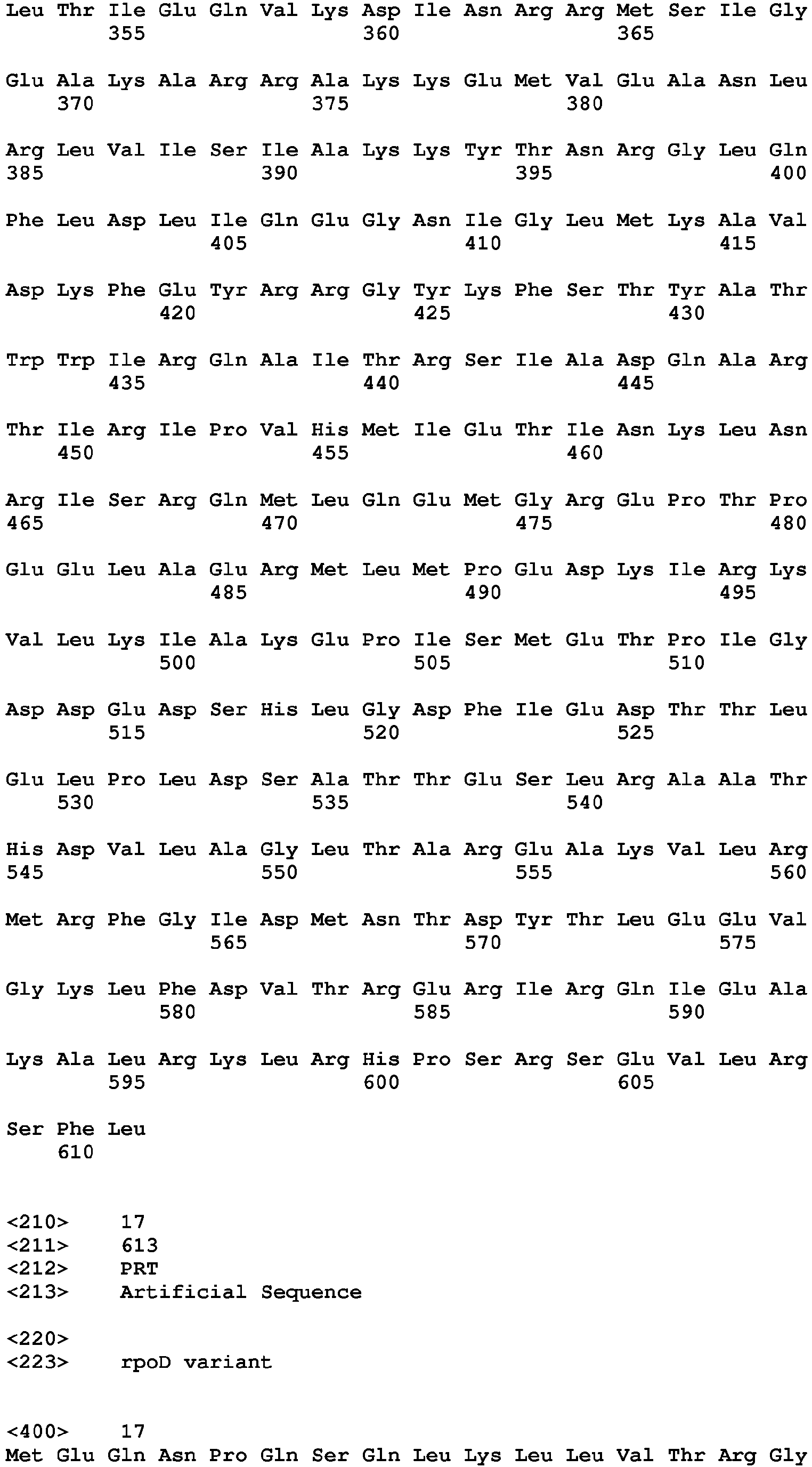
- the ⁇ 70 protein may include an amino acid sequence of SEQ ID NO: 8, but is not limited thereto, as long as the protein has the same activity as that of the ⁇ 70 protein of the present invention.
- modified polypeptide generally refers to a wild-type polypeptide wherein a partial or entire amino acid sequence of the polypeptide is substituted. In the present invention, it refers to a polypeptide having the activity of sigma factor 70 ( ⁇ 70 ) of RNA polymerase with an amino acid sequence partially different from that of the wild-type, prepared by substituting part of the amino acid sequence of the wild-type sigma factor 70 ( ⁇ 70 ), i.e., a sigma factor 70 ( ⁇ 70 )-modified polypeptide contributing to the enhancement of L-threonine-producing capability.
- the modified polypeptide may be a polypeptide having the activity of RNA polymerase sigma factor 70 of the amino acid sequence of SEQ ID NO: 8, wherein at least one amino acid at positions of 440 to 450; 459; 466; 470 to 479; 484; 495 to 499; 509; 527; 565 to 570; 575 to 580; 599; and 612, from the initial methionine as the first amino acid, is substituted with another amino acid.
- the modified polypeptide may be a polypeptide wherein an amino acid in at least one of the 45 positions (positions 440 to 450, 459, 466, 470 to 479, 484, 495 to 499, 509, 527, 565 to 570, 575 to 580, 599, and 612) may be substituted with another amino acid.
- the number of the position may be 1, 2, 3, 4, 5, 6, 7, 8, 9, 10, or more, but may not be limited thereto, as long as it has the activity of RNA polymerase sigma factor 70.
- amino acid at position 440, 446, or 448 among those at positions 440 to 450; the amino acid at position 474 or 477 among those at positions 470 to 479; the amino acid at position 496 or 498 among those at positions 495 to 499; the amino acid at position 567 or 569 among those at positions 565 to 570; and the amino acid at position 576 or 579 among those at positions 575 to 580 may be substituted with another amino acid, but are not limited thereto.
- the amino acid at position 440 may be substituted with proline (T440P); the amino acid at position 446 with proline (Q446P); the amino acid at position 448 with serine (R448S); the amino acid at position 459 with asparagine (T459N); the amino acid at position 466 with serine (I466S); the amino acid at position 474 with valine (M474V); the amino acid at position 477 with glycine (E477G); the amino acid at position 484 with valine (A484V); the amino acid at position 496 with asparagine (K496N); the amino acid at position 498 with arginine (L498R); the amino acid at position 509 with methionine (T509M); the amino acid at position 527 with proline (T527P); the amino acid at position 567 with valine (M567V); the amino acid at position 569 with proline (T569P); the amino acid at position 576 with glycine (N
- the modified polypeptide may be a polypeptide having an amino acid sequence among the SEQ ID NOS: 9 to 37, but may not be limited thereto.
- the modified polypeptide of the present invention may include not only the amino acid sequences of SEQ ID NOS: 9 to 37, but also those having a homology of at least 70% with these sequences, specifically at least 80%, more specifically at least 90%, and even more specifically at least 99%, without limitation, as long as the protein can contribute to the enhancement of L-threonine-producing capability, compared to the wild-type sigma factor 70 ( ⁇ 70 ).
- amino acid sequences having a homology as such, if the amino acid sequence is one which has substantially the same or corresponding biological activity of the modified sigma factor 70 ( ⁇ 70 ), it is obvious that amino acid sequences with a deletion, a modification, a substitution, or an addition in part of the sequences should also be included in the scope of the present invention.
- homology refers to a degree of identity of nucleotides or amino acid residues between two different amino acid sequences or nucleotide sequences of a gene encoding a protein, as aligning them to be maximally matched in a particular region. When there is a sufficiently high homology between them, the expression products of the corresponding gene may have the same or similar activities.
- the homology between sequences may be determined by a technology known in the art, for example, known sequence comparison programs including BLAST (NCBI), CLC Main Workbench (CLC bio), MegAlign (DNASTAR Inc), etc.
- the present invention provides a polynucleotide encoding the modified polypeptide.
- polynucleotide refers to a polymer of nucleotides, in which nucleotide monomers are connected lengthwise in a chain shape by covalent bonds, specifically a DNA or RNA strand. More specifically, in the present invention, it may be a polynucleotide fragment encoding the modified polypeptide.
- the gene encoding the amino acid sequence of RNA polymerase sigma factor 70 is rpoD gene, and may be specifically a gene derived from the genus Escherichia, and more specifically a gene derived from E. coli.
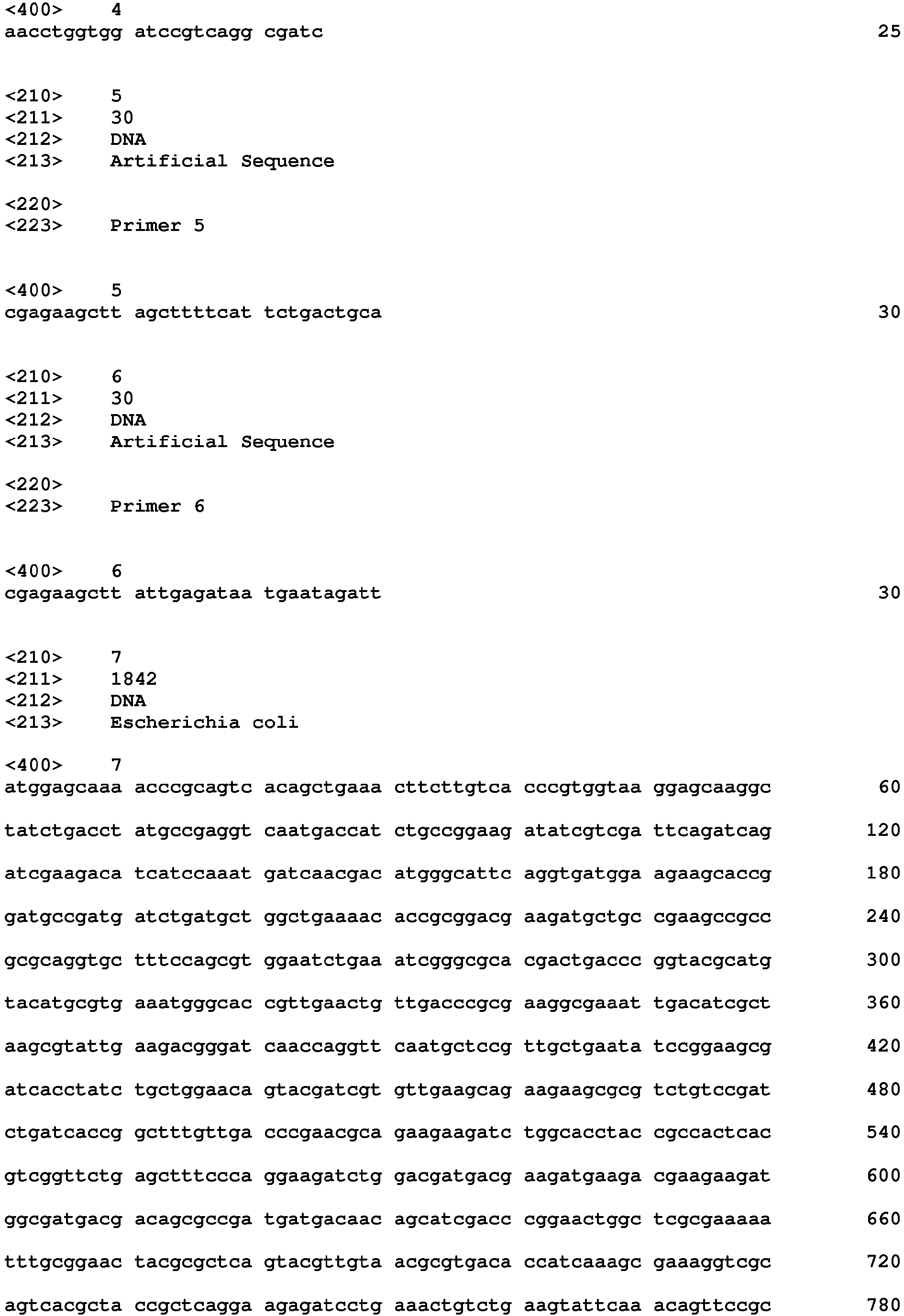
- the polynucleotide encoding the wild-type RNA polymerase sigma factor 70 maybe represented by SEQ ID NO: 7, but is not limited thereto. Additionally, based on the genetic code degeneracy, polynucleotide sequences encoding the same amino acid sequence and variants thereof should also be included in the scope of the present invention.
- polynucleotide sequences encoding the same amino acid sequence and variants thereof should also be included in the scope of the present invention.
- a nucleotide sequence encoding the polypeptide of the amino acid sequence of SEQ ID NO: 8, wherein at least one amino acid is substituted with another amino acid described above, or a variant thereof may be included.
- the positions of the above variations may be the positions of amino acids at 440 to 450; 459; 466; 470 to 479; 484; 495 to 499; 509; 527; 565 to 570; 575 to 580; 599; and 612, from the initial methionine as the first amino acid.
- the positions of the above variations may be a substitution of the amino acid at position 440 with proline (T440P); a substitution of the amino acid at position 446 with proline (Q446P); a substitution of the amino acid at position 448 with serine (R448S); a substitution of the amino acid at position 459 with asparagine (T459N); a substitution of the amino acid at position 466 with serine (I466S); a substitution of the amino acid at position 474 with valine (M474V); a substitution of the amino acid at position 477 with glycine (E477G); a substitution of the amino acid at position 484 with valine (A484V); a substitution of the amino acid at position 496 with asparagine (K496N); a substitution of the amino acid at position 498 with arginine (L498R); a substitution of the amino acid at position 509 with methionine (T509M); a substitution of the amino acid at position 527 with proline (
- nucleotide sequence encoding any amino acid sequence of the amino acid sequences of SEQ ID NOS: 9 to 37, or a variant thereof, may be included.
- the present invention provides a host cell including the polynucleotide encoding the modified polypeptide, a microorganism transformed with a vector including the polynucleotide encoding the modified polypeptide, or a microorganism introduced with the modified polypeptide.
- the introduction may be performed by transformation, but is not limited thereto.
- the microorganisms including the sigma factor 70 ( ⁇ 70 )-modified polypeptide may have enhanced L-threonine-producing capability without growth inhibition of a host cell, compared to the microorganism including the wild-type sigma factor 70 ( ⁇ 70 ) polypeptide, and thus L-threonine can be obtained in high yield from these microorganisms.
- the term "vector” refers to any mediator for cloning and/or transfer of a nucleotide sequence into a host cell.
- the vector may be a replicon to which a different DNA fragment can bind, leading to replication of a combined fragment.
- the term “replicon” refers to any genetic unit (e.g., plasmids, phages, cosmids, chromosomes, and viruses) which can be replicated by self-regulation.
- the vector may include viral- or non-viral mediators for in-vivo, ex-vivo, or in-vitro introduction of a nucleotide into a host cell, and may also include minicircle DNA.
- the vector may include plasmids which do not have any bacterial DNA sequence ( Ehrhardt, A. et al. (2003) HumGene Ther 10: 215-25 ; Yet, N. S. (2002) MoI Ther 5: 731-38 ; Chen, Z. Y. et al. (2004) Gene Ther 11: 856-64 ).
- the vector may include transposons ( Annu Rev Genet. 2003; 37: 3-29 .), or artificial chromosomes.
- pACYC177, pACYC184, pCL1920, pECCG117, pUC19, pBR322, pDZ, pCC1BAC, and pMW118 vectors may be used, but they are not limited thereto.
- transformation refers to introducing a gene into a host cell to be expressed in the host cell, and the transformed gene may not be particularly limited as long as it can be expressed in the host cell, regardless of whether the transformed gene is inserted into the chromosome of the host cell or positioned outside of the chromosome.
- the gene may be introduced into a host cell in the form of an expression cassette, which is a polynucleotide construct including all essential elements for self-expression.
- the expression cassette may include a promoter, which is conventionally operably connected to the gene, a transcription termination signal, a ribosome-binding domain, and a translation termination signal.
- the expression cassette may be a self-replicable expression vector.
- the gene may be one which is introduced into a host cell as a gene itself or in the form of a polynucleotide construct to be connected to a sequence necessary to be expressed in a host cell, but is not limited thereto.
- the term "host cell” or “microorganism” may refer to any cell or microorganism which includes a polynucleotide encoding a modified polypeptide, or which is transformed by a vector including the polynucleotide encoding a modified polypeptide and thus can express the modified polypeptide.
- the host cell or microorganism may be any cell or microorganism capable of producing L-threonine and including the modified sigma factor 70 ( ⁇ 70 ).
- the microorganism may include Escherichia sp., Serratia sp., Erwinia sp., Enterobacteria sp., Salmonella sp., Streptomyces sp., Pseudomona sp., Brevibacterium sp., Corynebacteria sp., etc .; and specifically, a microorganism belonging to Escherichia sp., and more specifically, Escherichia coli, but it is not limited thereto.
- the present invention provides a method of producing L-threonine including culturing the described microorganism in a medium, and recovering L-threonine from the cultured microorganism or the culture medium thereof.
- the term "culturing” refers to growing the microorganism in an appropriately and artificially adjusted environment.
- the culture process may be performed according to the appropriate medium and conditions for culture known in the art.
- the specific culturing process may be performed according to the general knowledge of one of ordinary skill in the art or the conventional method known in the art, and may be appropriately adjusted accordingly.
- the culturing methods are described in detail in [ Chmiel; Bioreatechnik 1. Einbowung indie Biovonstechnik (Gustav Fischer Verlag, Stuttgart, 1991 ), and Storhas; Bioreaktoren und periphere bamboo (Vieweg Verlag, Braunschweig / Wiesbaden, 1994 )].
- the culturing methods may include a batch culture, a continuous culture, and a fed-batch culture, and specifically, may be cultured continuously in a fed batch or repeated fed batch process, but are not limited thereto.
- the culture medium used for cultivation should meet the requirements for each specific strain.
- the carbon source to be contained in the medium may include saccharides and carbohydrates such as glucose, sucrose, lactose, fructose, maltose, starch, and cellulose; oils and fats such as soybean oil, sunflower oil, castor oil, and coconut oil; fatty acids such as palmitic acid, stearic acid, and linoleic acid; alcohols such as glycerol and ethanol; and organic acids such as acetic acid.
- saccharides and carbohydrates such as glucose, sucrose, lactose, fructose, maltose, starch, and cellulose
- oils and fats such as soybean oil, sunflower oil, castor oil, and coconut oil
- fatty acids such as palmitic acid, stearic acid, and linoleic acid
- alcohols such as glycerol and ethanol
- organic acids such as acetic acid.
- Examples of the nitrogen source to be contained in the medium may include peptone, yeast extract, gravy, malt extract, corn steep liquor, and bean flour, urea or inorganic nitrogen sources such as ammonium sulfate, ammonium chloride, ammonium phosphate, ammonium carbonate, and ammonium nitrate. These nitrogen sources may be used alone or in combination, but are not limited thereto.
- Examples of the phosphorous source to be contained in the medium may include potassium dihydrogen phosphate, dipotassium hydrogen phosphate, and corresponding sodium-containing salts, but are not limited thereto.
- the culture media may include metals such as magnesium sulfate and iron sulfate. Additionally, materials essential for growth such as amino acids and vitamins may also be included. Additionally, precursors suitable for the medium may also be used. These materials may be added to the culture in the form of a batch culture or continuous culture, but are not limited thereto.
- the pH of the culture may be adjusted by adding a compound such as ammonium hydroxide, potassium hydroxide, ammonia, phosphoric acid, and sulfuric acid during cultivation in an appropriate manner. Additionally, bubble formation may be prevented during the cultivation using an antifoaming agent such as fatty acid polyglycol ester. Additionally, oxygen gas or an oxygen-containing gas may be added to a culture in order to maintain aerobic conditions in a culture liquid; no air may be added to maintain anaerobic conditions or microaerobic conditions; or nitrogen gas, hydrogen gas, or carbon dioxide may be injected. The cultivation may be performed at 27°C to 37°C, and specifically at 30°C to 35°C. The cultivation may be continued until the desired amount of production of a useful material can be obtained, and specifically for 10 hours to 100 hours. L-Threonine may be exported into a culture medium or may remain contained in the microorganism.
- a compound such as ammonium hydroxide, potassium hydroxide, ammonia, phosphoric acid, and sulfuric acid during
- the method of recovering L-threonine from the microorganism or a culture thereof is widely known in the art.
- methods such as filtration, anion exchange chromatography, crystallization, HPLC, etc. may be used, but are not limited thereto.
- gDNA chromosomal DNA
- PCR polymerase chain reaction
- a PCR reaction to amplify the rpoD gene was performed using primers SEQ ID NO: 1 and SEQ ID NO: 2 by denaturing at 95°C for 30 seconds, annealing at 56°C for 30 seconds, and elongation at 72°C for 2 minutes for 27 cycles.
- the PCR products were digested with Hind III and Eco RI, electrophoresed on a 0.8% agarose gel, and a 2.0 kb DNA fragment ( "rpoD fragment", hereinafter) was obtained therefrom by elution.
- rpoD fragment "rpoD fragment", hereinafter) was obtained therefrom by elution.
- the Copycontrol pCC1BAC vector (EPICENTRE, USA) was digested with Hind III and Eco RI , electrophoresed on a 0.8% agarose gel, and obtained therefrom by elution. The resultant was ligated to the rpoD fragment to construct the pCC1BAC-rpoD plasmid.
- PCR was performed using the gDNA prepared in Example 1 as a template.
- the PCR reaction was performed using primers SEQ ID NO: 1 and SEQ ID NO: 3 by denaturing at 95°C for 30 seconds, annealing at 56°C for 30 seconds, and elongation at 72°C for 1 minute and 30 seconds for 27 cycles as in Example 1.
- the PCR products were digested with Bam HI and Hind III , electrophoresed on a 0.8% agarose gel, and a 1.5 kb DNA fragment was obtained therefrom by elution.
- [Table 2] Primer No. Nucleotide Sequence SEQ ID NO 1 5'-TACTCAAGCTTCGGCTTAAGTGCCGAAGAGC-3' 1 3 5'-GACGGATCCACCAGGTTGCGTA-3' 3
- the Copycontrol pCC1BAC vector was digested with Bam HI and Hind III , electrophoresed on a 0.8% agarose gel, and obtained by elution. The resultant was ligated to the partial rpoD fragment to construct the pCC1BAC- patial rpoD plasmid.
- the inventors In order to introduce a random modification in the conserved regions 2.4, 3, and 4 of the rpoD gene of W3110, the inventors intended to obtain a DNA pool of rpoD fragments, in which random modifications were introduced from the Bam HI restriction site within the gene to the terminus encoding the gene.
- a PCR reaction was performed using the gDNA obtained in Example 1 with a Diversify PCR Random Mutagenesis kit (catalog #: 630703; Clonetech), according to the conditions for mutagenesis reactions 4 in Table III described in the User Manual thereof. Specifically, the PCR was performed using the primers of SEQ ID NO: 2 and SEQ ID NO: 4, by denaturing at 94°C for 30 seconds, annealing at 56°C for 30 seconds, and elongation at 68°C for 30 seconds for 25 cycles. [Table 3] Primer No. Nucleotide Sequence SEQ ID NO 2 5'-AGGGCGAATTCCTGATCCGGCCTACCGATTA-3' 2 4 5'-AACCTGGTGGATCCGTCAGGCGATC-3' 4
- the mutated art rpoD DNA pool in which random nucleotide substitutions were introduced, was obtained as a PCR product, and the PCR product was digested with Bam HI and Eco RI, electrophoresed on a 0.8% agarose gel, and a 0.5 kb DNA fragment ("art rpoD fragment", hereinafter) was obtained therefrom by elution.
- Example 4 Construction of a recombinant vector pCC1BAC-rpoD mutant library including! modified rpoD
- the pCC1BAC-partial rpoD vector constructed in Example 2 was treated with Bam HI and Eco RI , and then treated with alkaline phosphatase (NEB).
- Example 3 the art rpoD fragments obtained in Example 3 were treated with Bam HI and Eco RI , respectively, and ligated to the pCC1BAC-partial rpoD vector, which was already treated with the restriction enzymes, transformed into TransforMax EPI300 Electrocompetent E. coli (EPICENTRE), cultured in an LB plate containing 15 ⁇ g/mL of chloramphenicol, and colonies were selected therefrom. The selected colonies were collected and subjected to a plasmid prep to construct a pCCIBAC-rpoD mutant library.
- EPICENTRE TransforMax EPI300 Electrocompetent E. coli
- Example 5 Introduction of a pCC1BAC-rpoD mutant library into a threonine-producing strain
- the pCCIBAC-rpoD mutant library constructed in Example 4 was introduced into an electrocompetent cell of KCCM10541, which is a threonine-producing strain, by transformation.
- the KCCM10541 (Korean Patent No. 10-0576342 ), the E. coli strain used in this Example, is an E . coli strain derived from the KFCC10718 (Korean Patent No. 10-0058286 ), in which galR gene is inactivated.
- Example 6 Comparison of L-threonine producing capabilities between recombinant microorganisms and confirmation of nucleotide sequences
- E. coli KCCM10541 / pCCIBAC-rpoD and E. coli KCCM10541 / pCC1BAC-rpoD mutant library which were cultured overnight in a solid LB medium in a 33°C incubator, were inoculated into 25 mL of titer medium by a platinum loop, respectively, and cultured in a 33°C incubator while shaking at 200 rpm for 48 hours. The whole procedure was repeated to evaluate the rpoD mutant library, and those clones with improved yield were selected.
- the recombinant E. coli introduced with the pCC1BAC-rpoD mutant library produced L-threonine ranging from 31.9 g/L to 34.2 g/L, thus showing an improved L-threonine-producing capability, compared to its parent strain, i.e., an improvement of 4.8% to 12.6% in L-threonine-producing capability compared to its parent strain.
- Example 7 Construction of a wild-type strain introduced with selected rpoD variants and a wild-type strain with enhanced biosynthesis pathway for threonine production thereto
- Example 6 A few variations among the rpoD variants, which were confirmed with their improved threonine-producing capabilities in Example 6, were subjected to reconfirm their effects based on wild-type strains.
- the wild-type strain W3110 was transformed with the rpoD variations confirmed in Example 6 in the same manner as in Example 5, and was assigned as W3110/pCC1BAC-rpoD m .
- the strain introduced with the rpoD variation was introduced with pACYC184-thrABC vector to provide the strain with a threonine-producing capability.
- the pACYC184-thrABC was constructed as described below.
- PCR was performed using the genomic DNA of an L-threonine-producing E. coli strain KCCM 10541 (Korean Patent No. 10-0576342 ; Chinese Patent No. 100379851C ) derived from E . coli strain KCCM 10718 (Korean Patent No. 10-0058286 ) as a template along with primers of SEQ ID NOS: 5 and 6(Table 6).
- the DNA fragments obtained therefrom were separated/purified, prepared by treating with Hind III followed by purification, and thereby thrABC DNA fragments were prepared.
- the pACYC184 vector was prepared by treating with Hind III followed by purification, and ligated to thereby construct a pACYC184-thrABC vector.
- Example 8 Comparison of L-threonine-producing capabilities between a wild-type strain, a wild-type strain-based recombinant microorganism with rpoD variations, and the strain with enhanced biosynthesis pathway for threonine production thereto
- Example 7 The recombinant microorganisms prepared in Example 7 were cultured in an Erlenmeyer flask using a threonine titer medium, and its improved L-threonine productivity was thereby confirmed.
- Composition Conc. (per 1 L) Glucose 70 g KH 2 PO 4 2 g (NH 4 ) 2 S 4 25 g MgSO 4 ⁇ 7H 2 O 1 g FeSO 4 ⁇ 7H 2 O 5 mg MnSO 4 ⁇ 4H 2 O 5 mg Yeast extract 2 g Calcium carbonate 30 g pH 6.8
- the wild-type strain W3110/pCC1BAC and other strains of W3110/pCC1BAC-rpoD, W3110/pCC1BAC-rpoD m2 , and W3110/pCC1BAC-rpoD m19 did not produce L-threonine at all when they were cultured for 48 hours, whereas the strains introduced with variants showed a decrease in glucose consumption.
- the W3110/pACYC184-thrABC, pCC1BAC strain which is a recombinant strain constructed for producing L-threonine in a wild-type base, produced 1.42 g/L of L-threonine, and the W3110/pACYC184-thrABC, pCC1BAC-rpoD strain produced 1.43 g/L of L-threonine, thus showing a 2.8% yield.
- the W3110/pACYC184-thrABC, pCC1BAC-rpoD m2 strain and the W3110/pACYC184-thrABC, pCC1BAC-rpoD m19 strain which are wild-type-based recombinant strains introduced with the rpoD variations, respectively showed glucose consumption for 48 hours in the amount of 51.2 g/L and 51.0 g/L, and respectively produced threonine in the amount of 1.50 g/L and 1.53 g/L, thus showing 3.0% and 3.1 % yields of threonine. That is, it was confirmed that the introduction of the rpoD variation improved the threonine yield by about 7% to 10%, thereby reconfirming that the rpoD variations selected in the present invention were valid variants.
- Example 9 Examination of L-threonine-producing capability by the combination of selected recombinant rpoD variations
- vectors with combined variations were constructed for several of the most frequently selected variations.
- An rpoD m23 (SEQ ID NO: 31) variation where the variations in amino acid sequences at positions of 440, 579, and 612 were combined, was constructed by combining the rpoD m2 variation and the rpoD m14 variation evaluated above.
- an rpoD m24 (SEQ ID NO: 32) variation which was introduced with the most variations, was constructed by combining the rpoD m16 variation and the rpoD m3 variation.
- the rpoD m24 variation was introduced with both the rpoD m16 variation, which are variations in amino acid sequences at positions of 446, 448, 466, 527, and 567, and the rpoD m3 variation in amino acid sequences at positions of 579 and 612.
- an rpoD m25 (SEQ ID NO: 33) variation was constructed by combining the variation in the amino acid sequence at position 496 of the rpoD m15 and the variations in the amino acid sequence at positions 579 and 612 of rpoD m1 .
- amino acid variations present in mutually different variations were constructed to confirm their effects.
- amino acid variations at the most frequently selected positions of 440, 579, and/or 612 were combined to construct the rpod m26 (SEQ ID NO: 34), where the variations at positions 440 and 579 were combined; and the rpoD m27 (SEQ ID NO: 35), where the variations at positions 440 and 612 were combined.
- combinations of low-frequency variations among the selected variations were constructed to confirm their effects.
- the variation at position 477 of the rpoD m17 , the variation at position 484 of the rpoD m19 , and the variation at position 509 of the rpoD m20 were combined; and to construct the rpoD m29 (SEQ ID NO: 37), the variation at position 599 of the rpod m18 , the variation at position 459 of the rpoD m20 , and the variation at position 576 of rpoD m21 were combined.
Landscapes
- Chemical & Material Sciences (AREA)
- Organic Chemistry (AREA)
- Life Sciences & Earth Sciences (AREA)
- Health & Medical Sciences (AREA)
- Engineering & Computer Science (AREA)
- Zoology (AREA)
- Wood Science & Technology (AREA)
- Genetics & Genomics (AREA)
- Bioinformatics & Cheminformatics (AREA)
- Biochemistry (AREA)
- General Health & Medical Sciences (AREA)
- Molecular Biology (AREA)
- General Engineering & Computer Science (AREA)
- Biotechnology (AREA)
- Microbiology (AREA)
- Medicinal Chemistry (AREA)
- Biomedical Technology (AREA)
- Chemical Kinetics & Catalysis (AREA)
- General Chemical & Material Sciences (AREA)
- Biophysics (AREA)
- Gastroenterology & Hepatology (AREA)
- Proteomics, Peptides & Aminoacids (AREA)
- Preparation Of Compounds By Using Micro-Organisms (AREA)
- Micro-Organisms Or Cultivation Processes Thereof (AREA)
- Physics & Mathematics (AREA)
- Plant Pathology (AREA)
Abstract
Description
- The present invention relates to a novel variant RNA polymerase sigma factor 70 (σ70) polypeptide, a polynucleotide encoding the same, a microorganism containing the polypeptide, and a method for producing L-threonine by using the microorganism.
- Generally, useful products such as amino acids can be produced by a fermentation method using microorganism strains developed via artificial mutation or genetic recombination. In particular, in developing microorganism strains for large-scale production of amino acids, it will be beneficial to discover genetic factors, which are directly/indirectly involved in a higher cascade step of the production, and appropriately utilize them to develop microorganism strains capable of producing higher yields. A representative technology in this regard may be global transcription machinery engineering (gTME), which can regulate the expression of all intracellular genes by causing random mutations on recruiting protein of RNA polymerase .
- RNA polymerase is a macromolecule comprised of five subunits of 2α, β, β', and ω, and its holoenzymes are expressed as α2ββ'ω. Along with these holoenzymes, sigma (σ) factors, which are transcription initiation factors present in prokaryotes, can allow specific binding of RNA polymerase to promoters, and can be distinguished by their molecular weight. For example, σ70 stands for a sigma factor having a molecular weight of 70 kDa (Gruber TM, Gross CA, Annu Rev Microbiol. 57: 441-66, 2003).
- Escherichia coli is known to possess a housekeeping sigma factor σ70 (RpoD), a nitrogen-limitation sigma factor σ54 (RpoN), a starvation/stationary phase sigma factor σ38 (RpoS), a heat shock sigma factor σ32 (RpoH), a flagellar sigma factor σ28 (RpoF), an extracytoplasmic/extreme heat stress sigma factor σ24 (RpoE), a ferric citrate sigma factor σ19 (FecI), etc. These various sigma factors are known to be activated under different environmental conditions, and these characterized sigma factors can bind to the promoters of genes transcribed under specific environmental conditions, and thereby regulate the transcription of the genes. Studies on the increase of productivity of target materials by allowing random mutations on sigma factor 70 have been reported (Metabolic Engineering 9. 2007. 258-267), and there is also a study report on the enhanced tyrosine production using gTME technology in E. coli (
US Patent No. 8735132 ). - The present inventors, while endeavoring to develop a microorganism capable of producing L-threonine at an improved concentration without growth retardation of a host cell, developed a novel modified sigma factor 70 polypeptide of RNA polymerase, and also discovered that a bacterial strain having an improved L-threonine-producing capability can be developed by introducing the novel modified sigma factor 70 polypeptide of RNA polymerase into Escherichia sp. having an L-threonine-producing capability.
- An object of the present invention is to provide a modified polypeptide having an activity of RNA polymerase sigma factor 70 of the amino acid sequence of SEQ ID NO: 8 wherein a part of the amino acid is substituted.
- Another object of the present invention is to provide a polynucleotide encoding the polypeptide.
- A further object of the present invention is to provide a transformed microorganism which includes the polypeptide.
- A still further object of the present invention is to provide a method of producing L-threonine comprising culturing the microorganism; and recovering L-threonine from the cultured microorganism or a culture medium thereof.
- The present invention enables confirmation of a novel variant of a polypeptide of an RNA polymerase sigma factor 70 capable of upregulating the L-threonine-producing capability. Additionally, a microorganism capable of expressing the modified polypeptide based on the same has an excellent yield of L-threonine production, and thus the microorganism can provide convenience in production, and reduction in production cost from the industrial point of view.
- In an aspect of the above objects, the present invention provides a novel modified polypeptide having an activity of RNA polymerase sigma factor 70.
- As used herein, the term "RNA polymerase sigma factor 70" refers to a protein σ70, one of sigma factors and is called sigma factor D(RpoD). The protein σ70 acts as one of transcription initiation factors along with RNA polymerase. Sigma factors are involved in the regulation of transcription by interacting with upstream DNA (UP element) on upstream of particular promoters and various transcription factors. In particular, sigma factor 70 (σ70) is a major regulator among E. coli sigma factors, which controls most housekeeping genes and core genes, and is known to predominantly act during the exponential phase of E. coli (Jishage M, et al, J Bacteriol 178(18); 5447-51,1996). The information on sigma factor 70 protein may be obtained from the known database such as NCBI GenBank, and, for example, it may be a protein with the Accession number NP 417539. Specifically, the σ70 protein may include an amino acid sequence of SEQ ID NO: 8, but is not limited thereto, as long as the protein has the same activity as that of the σ70 protein of the present invention.
- As used herein, the term "modified polypeptide" generally refers to a wild-type polypeptide wherein a partial or entire amino acid sequence of the polypeptide is substituted. In the present invention, it refers to a polypeptide having the activity of sigma factor 70 (σ70) of RNA polymerase with an amino acid sequence partially different from that of the wild-type, prepared by substituting part of the amino acid sequence of the wild-type sigma factor 70 (σ70), i.e., a sigma factor 70 (σ70)-modified polypeptide contributing to the enhancement of L-threonine-producing capability.
- Specifically, the modified polypeptide may be a polypeptide having the activity of RNA polymerase sigma factor 70 of the amino acid sequence of SEQ ID NO: 8, wherein at least one amino acid at positions of 440 to 450; 459; 466; 470 to 479; 484; 495 to 499; 509; 527; 565 to 570; 575 to 580; 599; and 612, from the initial methionine as the first amino acid, is substituted with another amino acid. That is, the modified polypeptide may be a polypeptide wherein an amino acid in at least one of the 45 positions (positions 440 to 450, 459, 466, 470 to 479, 484, 495 to 499, 509, 527, 565 to 570, 575 to 580, 599, and 612) may be substituted with another amino acid. For example, the number of the position may be 1, 2, 3, 4, 5, 6, 7, 8, 9, 10, or more, but may not be limited thereto, as long as it has the activity of RNA polymerase sigma factor 70.
- More specifically, the amino acid at position 440, 446, or 448 among those at positions 440 to 450; the amino acid at position 474 or 477 among those at positions 470 to 479; the amino acid at position 496 or 498 among those at positions 495 to 499; the amino acid at position 567 or 569 among those at positions 565 to 570; and the amino acid at position 576 or 579 among those at positions 575 to 580 may be substituted with another amino acid, but are not limited thereto.
- Further more specifically, the amino acid at position 440 may be substituted with proline (T440P); the amino acid at position 446 with proline (Q446P); the amino acid at position 448 with serine (R448S); the amino acid at position 459 with asparagine (T459N); the amino acid at position 466 with serine (I466S); the amino acid at position 474 with valine (M474V); the amino acid at position 477 with glycine (E477G); the amino acid at position 484 with valine (A484V); the amino acid at position 496 with asparagine (K496N); the amino acid at position 498 with arginine (L498R); the amino acid at position 509 with methionine (T509M); the amino acid at position 527 with proline (T527P); the amino acid at position 567 with valine (M567V); the amino acid at position 569 with proline (T569P); the amino acid at position 576 with glycine (N576G); the amino acid at position 579 with arginine (Q579R), leucine (Q579L), threonine (Q579T), isoleucine (Q579I), glycine (Q579G), alanine (Q579A), proline (Q579P), or serine (Q579S) ; the amino acid at position 599 with cysteine (R599C); or the amino acid at position 612 with glycine (D612G), tyrosine (D612Y), threonine (D612T), asparagine (D612N), phenylalanine (D612F), lysine (D612K), serine (D612S), arginine (D612R), or histidine (D612H), or amino acid deletion with a stop codon (D612*), but may not be limited thereto. When the nucleotide is substituted with a stop codon there may be no amino acid.
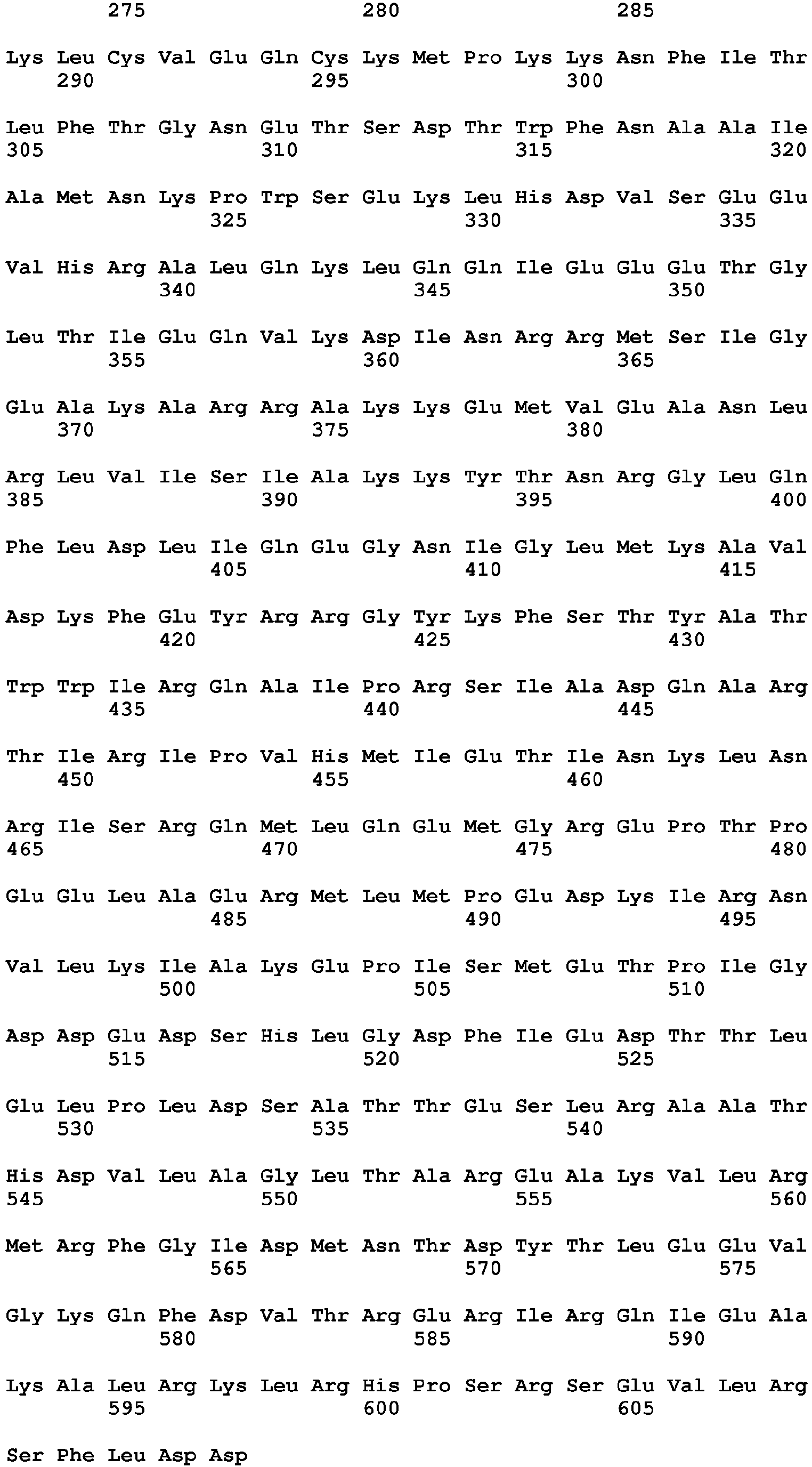
- Even more specifically, the modified polypeptide may be a polypeptide having an amino acid sequence among the SEQ ID NOS: 9 to 37, but may not be limited thereto.
- The modified polypeptide of the present invention may include not only the amino acid sequences of SEQ ID NOS: 9 to 37, but also those having a homology of at least 70% with these sequences, specifically at least 80%, more specifically at least 90%, and even more specifically at least 99%, without limitation, as long as the protein can contribute to the enhancement of L-threonine-producing capability, compared to the wild-type sigma factor 70 (σ70).
- As a sequence having a homology as such, if the amino acid sequence is one which has substantially the same or corresponding biological activity of the modified sigma factor 70 (σ70), it is obvious that amino acid sequences with a deletion, a modification, a substitution, or an addition in part of the sequences should also be included in the scope of the present invention.
- As used herein, the term "homology" refers to a degree of identity of nucleotides or amino acid residues between two different amino acid sequences or nucleotide sequences of a gene encoding a protein, as aligning them to be maximally matched in a particular region. When there is a sufficiently high homology between them, the expression products of the corresponding gene may have the same or similar activities. The homology between sequences may be determined by a technology known in the art, for example, known sequence comparison programs including BLAST (NCBI), CLC Main Workbench (CLC bio), MegAlign (DNASTAR Inc), etc.
- In another aspect, the present invention provides a polynucleotide encoding the modified polypeptide.
- As used herein, the term "polynucleotide" refers to a polymer of nucleotides, in which nucleotide monomers are connected lengthwise in a chain shape by covalent bonds, specifically a DNA or RNA strand. More specifically, in the present invention, it may be a polynucleotide fragment encoding the modified polypeptide.
- In an exemplary embodiment of the present invention, the gene encoding the amino acid sequence of RNA polymerase sigma factor 70 is rpoD gene, and may be specifically a gene derived from the genus Escherichia, and more specifically a gene derived from E. coli. The polynucleotide encoding the wild-type RNA polymerase sigma factor 70 maybe represented by SEQ ID NO: 7, but is not limited thereto. Additionally, based on the genetic code degeneracy, polynucleotide sequences encoding the same amino acid sequence and variants thereof should also be included in the scope of the present invention.
- Additionally, as for the modified polynucleotide of the present invention, based on the genetic code degeneracy, polynucleotide sequences encoding the same amino acid sequence and variants thereof should also be included in the scope of the present invention. Specifically, a nucleotide sequence encoding the polypeptide of the amino acid sequence of SEQ ID NO: 8, wherein at least one amino acid is substituted with another amino acid described above, or a variant thereof, may be included. In particular, the positions of the above variations may be the positions of amino acids at 440 to 450; 459; 466; 470 to 479; 484; 495 to 499; 509; 527; 565 to 570; 575 to 580; 599; and 612, from the initial methionine as the first amino acid.
- More specifically, the positions of the above variations may be a substitution of the amino acid at position 440 with proline (T440P); a substitution of the amino acid at position 446 with proline (Q446P); a substitution of the amino acid at position 448 with serine (R448S); a substitution of the amino acid at position 459 with asparagine (T459N); a substitution of the amino acid at position 466 with serine (I466S); a substitution of the amino acid at position 474 with valine (M474V); a substitution of the amino acid at position 477 with glycine (E477G); a substitution of the amino acid at position 484 with valine (A484V); a substitution of the amino acid at position 496 with asparagine (K496N); a substitution of the amino acid at position 498 with arginine (L498R); a substitution of the amino acid at position 509 with methionine (T509M); a substitution of the amino acid at position 527 with proline (T527P); a substitution of the amino acid at position 567 with valine (M567V); a substitution of the amino acid at position 569 with proline (T569P); a substitution of the amino acid at position 576 with glycine (N576G); a substitution of the amino acid at position 579 with arginine (Q579R), leucine (Q579L), threonine (Q579T), isoleucine (Q579I), glycine (Q579G), alanine (Q579A), proline (Q579P), or serine (Q579S); a substitution of the amino acid at position 599 with cysteine (R599C); or a substitution of the amino acid at position 612 with glycine (D612G), tyrosine (D612Y), threonine (D612T), asparagine (D612N), phenylalanine (D612F), lysine (D612K), serine (D612S), arginine (D612R), or histidine (D612H); or a substitution of nucleotides with a stop codon (D612*), and a nucleotide sequence encoding the amino acid sequence of a modified polypeptide, wherein the amino acid substitution is a combination of at least one kind among the 34 amino acid substitutions described above, or a variant thereof, may be included.
- Even more specifically, a nucleotide sequence encoding any amino acid sequence of the amino acid sequences of SEQ ID NOS: 9 to 37, or a variant thereof, may be included.
- In another aspect, the present invention provides a host cell including the polynucleotide encoding the modified polypeptide, a microorganism transformed with a vector including the polynucleotide encoding the modified polypeptide, or a microorganism introduced with the modified polypeptide. Specifically, the introduction may be performed by transformation, but is not limited thereto.
- Specifically, the microorganisms including the sigma factor 70 (σ70)-modified polypeptide may have enhanced L-threonine-producing capability without growth inhibition of a host cell, compared to the microorganism including the wild-type sigma factor 70 (σ70) polypeptide, and thus L-threonine can be obtained in high yield from these microorganisms.
- As used herein, the term "vector" refers to any mediator for cloning and/or transfer of a nucleotide sequence into a host cell. The vector may be a replicon to which a different DNA fragment can bind, leading to replication of a combined fragment. As used herein, the term "replicon" refers to any genetic unit (e.g., plasmids, phages, cosmids, chromosomes, and viruses) which can be replicated by self-regulation. The vector may include viral- or non-viral mediators for in-vivo, ex-vivo, or in-vitro introduction of a nucleotide into a host cell, and may also include minicircle DNA. For example, the vector may include plasmids which do not have any bacterial DNA sequence (Ehrhardt, A. et al. (2003) HumGene Ther 10: 215-25; Yet, N. S. (2002) MoI Ther 5: 731-38; Chen, Z. Y. et al. (2004) Gene Ther 11: 856-64). Additionally, the vector may include transposons (Annu Rev Genet. 2003; 37: 3-29.), or artificial chromosomes. Specifically, pACYC177, pACYC184, pCL1920, pECCG117, pUC19, pBR322, pDZ, pCC1BAC, and pMW118 vectors may be used, but they are not limited thereto.
- As used herein, the term "transformation" refers to introducing a gene into a host cell to be expressed in the host cell, and the transformed gene may not be particularly limited as long as it can be expressed in the host cell, regardless of whether the transformed gene is inserted into the chromosome of the host cell or positioned outside of the chromosome.
- The gene may be introduced into a host cell in the form of an expression cassette, which is a polynucleotide construct including all essential elements for self-expression. The expression cassette may include a promoter, which is conventionally operably connected to the gene, a transcription termination signal, a ribosome-binding domain, and a translation termination signal. The expression cassette may be a self-replicable expression vector. Additionally, the gene may be one which is introduced into a host cell as a gene itself or in the form of a polynucleotide construct to be connected to a sequence necessary to be expressed in a host cell, but is not limited thereto.
- As used herein, the term "host cell" or "microorganism" may refer to any cell or microorganism which includes a polynucleotide encoding a modified polypeptide, or which is transformed by a vector including the polynucleotide encoding a modified polypeptide and thus can express the modified polypeptide.
- In the present invention, the host cell or microorganism may be any cell or microorganism capable of producing L-threonine and including the modified sigma factor 70 (σ70). Examples of the microorganism may include Escherichia sp., Serratia sp., Erwinia sp., Enterobacteria sp., Salmonella sp., Streptomyces sp., Pseudomona sp., Brevibacterium sp., Corynebacteria sp., etc.; and specifically, a microorganism belonging to Escherichia sp., and more specifically, Escherichia coli, but it is not limited thereto.
- In another aspect, the present invention provides a method of producing L-threonine including culturing the described microorganism in a medium, and recovering L-threonine from the cultured microorganism or the culture medium thereof.
- As used herein, the term "culturing" refers to growing the microorganism in an appropriately and artificially adjusted environment. The culture process may be performed according to the appropriate medium and conditions for culture known in the art. The specific culturing process may be performed according to the general knowledge of one of ordinary skill in the art or the conventional method known in the art, and may be appropriately adjusted accordingly. Specifically, the culturing methods are described in detail in [Chmiel; Bioprozesstechnik 1. Einfuhrung indie Bioverfahrenstechnik (Gustav Fischer Verlag, Stuttgart, 1991), and Storhas; Bioreaktoren und periphere Einrichtungen (Vieweg Verlag, Braunschweig / Wiesbaden, 1994)]. Additionally, the culturing methods may include a batch culture, a continuous culture, and a fed-batch culture, and specifically, may be cultured continuously in a fed batch or repeated fed batch process, but are not limited thereto.
- The culture medium used for cultivation should meet the requirements for each specific strain. Examples of the carbon source to be contained in the medium may include saccharides and carbohydrates such as glucose, sucrose, lactose, fructose, maltose, starch, and cellulose; oils and fats such as soybean oil, sunflower oil, castor oil, and coconut oil; fatty acids such as palmitic acid, stearic acid, and linoleic acid; alcohols such as glycerol and ethanol; and organic acids such as acetic acid. These carbon sources may be used alone or in combination, but are not limited thereto. Examples of the nitrogen source to be contained in the medium may include peptone, yeast extract, gravy, malt extract, corn steep liquor, and bean flour, urea or inorganic nitrogen sources such as ammonium sulfate, ammonium chloride, ammonium phosphate, ammonium carbonate, and ammonium nitrate. These nitrogen sources may be used alone or in combination, but are not limited thereto. Examples of the phosphorous source to be contained in the medium may include potassium dihydrogen phosphate, dipotassium hydrogen phosphate, and corresponding sodium-containing salts, but are not limited thereto. The culture media may include metals such as magnesium sulfate and iron sulfate. Additionally, materials essential for growth such as amino acids and vitamins may also be included. Additionally, precursors suitable for the medium may also be used. These materials may be added to the culture in the form of a batch culture or continuous culture, but are not limited thereto.
- Additionally, the pH of the culture may be adjusted by adding a compound such as ammonium hydroxide, potassium hydroxide, ammonia, phosphoric acid, and sulfuric acid during cultivation in an appropriate manner. Additionally, bubble formation may be prevented during the cultivation using an antifoaming agent such as fatty acid polyglycol ester. Additionally, oxygen gas or an oxygen-containing gas may be added to a culture in order to maintain aerobic conditions in a culture liquid; no air may be added to maintain anaerobic conditions or microaerobic conditions; or nitrogen gas, hydrogen gas, or carbon dioxide may be injected. The cultivation may be performed at 27°C to 37°C, and specifically at 30°C to 35°C. The cultivation may be continued until the desired amount of production of a useful material can be obtained, and specifically for 10 hours to 100 hours. L-Threonine may be exported into a culture medium or may remain contained in the microorganism.
- The method of recovering L-threonine from the microorganism or a culture thereof is widely known in the art. For example, methods such as filtration, anion exchange chromatography, crystallization, HPLC, etc. may be used, but are not limited thereto.
- Hereinafter, the present invention will be described in more detail with reference to the following Examples. However, these Examples are for illustrative purposes only, and the invention is not intended to be limited by these Examples.
- In order to obtain a DNA fragment with a size of about 2.0 kb including the rpoD gene (NCBI Gene ID: 947567, SEQ ID NO: 7), the chromosomal DNA (gDNA) of Escherichia coli wild-type strain W3110 was extracted using Genomic-tip System (Qiagen), and a polymerase chain reaction ("PCR", hereinafter) was performed using the gDNA as a template with a PCR HL premix kit (BIONEER, Korea; the same product was used hereinafter).
- A PCR reaction to amplify the rpoD gene was performed using primers SEQ ID NO: 1 and SEQ ID NO: 2 by denaturing at 95°C for 30 seconds, annealing at 56°C for 30 seconds, and elongation at 72°C for 2 minutes for 27 cycles. The PCR products were digested with HindIII and EcoRI, electrophoresed on a 0.8% agarose gel, and a 2.0 kb DNA fragment ("rpoD fragment", hereinafter) was obtained therefrom by elution.
[Table 1] Primer No. Nucleotide Sequence SEQ ID NO 1 5'-TACTCAAGCTTCGGCTTAAGTGCCGAAGAGC-3' 1 2 5'-AGGGCGAATTCCTGATCCGGCCTACCGATTA-3' 2 - Subsequently, the Copycontrol pCC1BAC vector (EPICENTRE, USA) was digested with HindIII and EcoRI, electrophoresed on a 0.8% agarose gel, and obtained therefrom by elution. The resultant was ligated to the rpoD fragment to construct the pCC1BAC-rpoD plasmid.
- In order to obtain a DNA fragment with a size of about 1.5 kb including the region from the promoter to the BamHI restriction site within the rpoD gene of E. coli W3110, PCR was performed using the gDNA prepared in Example 1 as a template.
- The PCR reaction was performed using primers SEQ ID NO: 1 and SEQ ID NO: 3 by denaturing at 95°C for 30 seconds, annealing at 56°C for 30 seconds, and elongation at 72°C for 1 minute and 30 seconds for 27 cycles as in Example 1. The PCR products were digested with BamHI and HindIII, electrophoresed on a 0.8% agarose gel, and a 1.5 kb DNA fragment was obtained therefrom by elution.
[Table 2] Primer No. Nucleotide Sequence SEQ ID NO 1 5'-TACTCAAGCTTCGGCTTAAGTGCCGAAGAGC-3' 1 3 5'-GACGGATCCACCAGGTTGCGTA-3' 3 - Subsequently, the Copycontrol pCC1BAC vector was digested with BamHI and HindIII, electrophoresed on a 0.8% agarose gel, and obtained by elution. The resultant was ligated to the partial rpoD fragment to construct the pCC1BAC-patial rpoD plasmid.
- In order to introduce a random modification in the conserved regions 2.4, 3, and 4 of the rpoD gene of W3110, the inventors intended to obtain a DNA pool of rpoD fragments, in which random modifications were introduced from the BamHI restriction site within the gene to the terminus encoding the gene.
- To this end, a PCR reaction was performed using the gDNA obtained in Example 1 with a Diversify PCR Random Mutagenesis kit (catalog #: 630703; Clonetech), according to the conditions for mutagenesis reactions 4 in Table III described in the User Manual thereof. Specifically, the PCR was performed using the primers of SEQ ID NO: 2 and SEQ ID NO: 4, by denaturing at 94°C for 30 seconds, annealing at 56°C for 30 seconds, and elongation at 68°C for 30 seconds for 25 cycles.
[Table 3] Primer No. Nucleotide Sequence SEQ ID NO 2 5'-AGGGCGAATTCCTGATCCGGCCTACCGATTA-3' 2 4 5'-AACCTGGTGGATCCGTCAGGCGATC-3' 4 - Subsequently, the mutated art rpoD DNA pool, in which random nucleotide substitutions were introduced, was obtained as a PCR product, and the PCR product was digested with BamHI and EcoRI, electrophoresed on a 0.8% agarose gel, and a 0.5 kb DNA fragment ("art rpoD fragment", hereinafter) was obtained therefrom by elution.
- The pCC1BAC-partial rpoD vector constructed in Example 2 was treated with BamHI and EcoRI, and then treated with alkaline phosphatase (NEB).
- Then, the art rpoD fragments obtained in Example 3 were treated with BamHI and EcoRI, respectively, and ligated to the pCC1BAC-partial rpoD vector, which was already treated with the restriction enzymes, transformed into TransforMax EPI300 Electrocompetent E. coli (EPICENTRE), cultured in an LB plate containing 15 µg/mL of chloramphenicol, and colonies were selected therefrom. The selected colonies were collected and subjected to a plasmid prep to construct a pCCIBAC-rpoD mutant library.
- The pCCIBAC-rpoD mutant library constructed in Example 4 was introduced into an electrocompetent cell of KCCM10541, which is a threonine-producing strain, by transformation.
- In particular, the KCCM10541 (Korean Patent No.
10-0576342 10-0058286 - The recombinant microorganism library constructed in Example 5 was cultured in titer medium shown in Table 4 below, and the improvement in L-threonine production was examined.
[Table 4] Composition Conc. (per 1 L) Glucose 70 g KH2PO4 2g (NH4)2SO4 25 g MgSO4·7H2O 1 g FeSO4·7H2O 5 mg MnSO4·4H2O 5 mg DL-methionine 0.15 g Yeast extract 2 g Calcium carbonate 30 g pH 6.8 - Specifically, E. coli KCCM10541/pCCIBAC-rpoD and E. coli KCCM10541/pCC1BAC-rpoD mutant library, which were cultured overnight in a solid LB medium in a 33°C incubator, were inoculated into 25 mL of titer medium by a platinum loop, respectively, and cultured in a 33°C incubator while shaking at 200 rpm for 48 hours. The whole procedure was repeated to evaluate the rpoD mutant library, and those clones with improved yield were selected.
[Table 5] Strain L-Threonine (g/L) Increase rate of L-threonine Conc. (%) Position of modification SEQ ID NO KCCM 10541 (parent strain) 30.4 - KCCM 10541/pCC1BAC-rpoD 30.4 - 8 KCCM 10541/pCC1BAC-rpoDml 32.8 7.9 579, 612 9 KCCM 10541/pCC1BAC-rpoDm2 33.0 8.6 579, 612 10 KCCM 10541/pCC1BAC-rpoDm3 33.6 10.5 579, 612 11 KCCM 10541/pCC1BAC-rpoDm4 34.0 11.8 579, 612 12 KCCM 10541/pCC1BAC-rpoDm5 33.4 9.9 579, 612 13 KCCM 10541/pCC1BAC-rpoDm6 34.0 11.8 579, 612 14 KCCM 10541/pCC1BAC-rpoDm7 33.5 10.2 579, 612 15 KCCM 10541/pCC1BAC-rpoDm8 32.5 6.9 579, 612 16 KCCM 10541/pCC1BAC-rpoDm9 32.0 5.3 579, 612 17 KCCM 10541/pCC1BAC-rpoDm10 32.0 5.3 579, 612 18 KCCM 10541/pCC1BAC-rpoDm11 32.1 5.6 579, 612 19 KCCM 10541/pCC1BAC-rpoDm12 32.0 5.3 579, 612 20 KCCM 10541/pCC1BAC-rpoDm13 34.0 11.8 579, 612 21 KCCM 10541/pCC1BAC-rpoDm14 34.2 12.6 440 22 KCCM 10541/pCC1BAC-rpoDm15 34.0 11.8 440, 496 23 KCCM 10541/pCC1BAC-rpoDm16 32.4 6.6 446, 448, 466, 527, 567 24 KCCM 10541/pCC1BAC-rpoDm17 32.5 7.1 440, 477, 498 25 KCCM 10541/pCC1BAC-rpoDm18 31.9 4.8 440, 599 26 KCCM 10541/pCC1BAC-rpoDm19 33.8 11.3 440, 484 27 KCCM 10541/pCC1BACrpoDm20 34.0 11.9 459, 474, 509 28 KCCM 10541/pCC1BAC-rpoDm21 31.9 4.8 440, 576 29 KCCM 10541/pCC1BAC-rpoDm22 33.9 11.6 440, 569 30 - The result revealed, as shown in Table 5 above, that the parent strain KCCM 10541 and the control strain KCCM 10541/pCC1BAC-rpoD produced about 30.4 g/L of L-threonine when cultured for 48 hours.
- In contrast, the recombinant E. coli introduced with the pCC1BAC-rpoD mutant library produced L-threonine ranging from 31.9 g/L to 34.2 g/L, thus showing an improved L-threonine-producing capability, compared to its parent strain, i.e., an improvement of 4.8% to 12.6% in L-threonine-producing capability compared to its parent strain.
- Additionally, the position of modification and the substituted amino acid in each modification of modified rpoD gene of E. coli with improved L-threonine-producing capability were examined by sequencing, and the results are shown in Table 5.
- Meanwhile, the recombinant E. coli with the most improvement in L-threonine-producing capability among the transformed E. coli, designated as "KCCM10541/pCC1BAC-rpoDm19", was deposited on August 6, 2014, at the Korean Culture Center of Microorganisms (Accession No: KCCM11560P).
- A few variations among the rpoD variants, which were confirmed with their improved threonine-producing capabilities in Example 6, were subjected to reconfirm their effects based on wild-type strains. The wild-type strain W3110 was transformed with the rpoD variations confirmed in Example 6 in the same manner as in Example 5, and was assigned as W3110/pCC1BAC-rpoDm. The strain introduced with the rpoD variation was introduced with pACYC184-thrABC vector to provide the strain with a threonine-producing capability. The pACYC184-thrABC was constructed as described below.
- PCR was performed using the genomic DNA of an L-threonine-producing E. coli strain KCCM 10541 (Korean Patent No.
10-0576342 100379851C ) derived from E. coli strain KCCM 10718 (Korean Patent No.10-0058286 [Table 6] SEQ ID NO Primer Sequence 5 5'-CGAGAAGCTTAGCTTTTCATTCTGACTGCA-3" 6 5'-CGAGAAGCTTATTGAGATAATGAATAGATT-3' - The recombinant microorganisms prepared in Example 7 were cultured in an Erlenmeyer flask using a threonine titer medium, and its improved L-threonine productivity was thereby confirmed.
[Table 7] Composition Conc. (per 1 L) Glucose 70 g KH2PO4 2 g (NH4)2S4 25 g MgSO4·7H2O 1 g FeSO4·7H2O 5 mg MnSO4·4H2O 5 mg Yeast extract 2 g Calcium carbonate 30 g pH 6.8 - A platinum loop of each of the W3110/pCC1BAC-rpoDm, W3110/pACYC184-thrABC, pCC1BAC, and W3110/pACYC184-thrABC,pCC1BAC-rpoDm strains cultured overnight in a solid LB medium in a 33°C incubator was inoculated a titer medium (25 mL) shown in Table 7, and cultured in a 33°C incubator at the rate of 200 rpm for 48 hours. The results are shown in Table 8 below.
[Table 8] Strain OD Glucose Consumption (g/L) L-Threonine (g/L) Yield (%) W3110/pCC1BAC 15.4 52.2 0 0 W3110/pCC1BAC-rpoD 15.4 52.2 0 0 W3110/pCC1BAC-rpoDm2 15.0 50.6 0 0 W3110/pCC1BAC-rpoDm19 15.5 52.0 0 0 W3110/pACYC184-thrABC, pCC1BAC 13.4 50.1 1.42 2.8 W3110/pACYC184-thrABC, pCCIBAC-rpoD 13.3 50.2 1.43 2.8 W3110/pACYC184-thrABC, pCC1BAC-rpoDm2 12.5 51.2 1.52 3.0 W3110/pACYC184-thrABC, pCC1BAC-rpoDm19 11.2 51.0 1.56 3.1 - As shown in Table 8, the wild-type strain W3110/pCC1BAC and other strains of W3110/pCC1BAC-rpoD, W3110/pCC1BAC-rpoDm2, and W3110/pCC1BAC-rpoDm19 did not produce L-threonine at all when they were cultured for 48 hours, whereas the strains introduced with variants showed a decrease in glucose consumption. The W3110/pACYC184-thrABC, pCC1BAC strain, which is a recombinant strain constructed for producing L-threonine in a wild-type base, produced 1.42 g/L of L-threonine, and the W3110/pACYC184-thrABC, pCC1BAC-rpoD strain produced 1.43 g/L of L-threonine, thus showing a 2.8% yield.
- In contrast, the W3110/pACYC184-thrABC, pCC1BAC-rpoDm2 strain and the W3110/pACYC184-thrABC, pCC1BAC-rpoDm19 strain, which are wild-type-based recombinant strains introduced with the rpoD variations, respectively showed glucose consumption for 48 hours in the amount of 51.2 g/L and 51.0 g/L, and respectively produced threonine in the amount of 1.50 g/L and 1.53 g/L, thus showing 3.0% and 3.1 % yields of threonine. That is, it was confirmed that the introduction of the rpoD variation improved the threonine yield by about 7% to 10%, thereby reconfirming that the rpoD variations selected in the present invention were valid variants.
- In order to examine the changes in threonine-producing capabilities by the combination of the variations included in each different subject among the selected variations, vectors with combined variations were constructed for several of the most frequently selected variations. An rpoDm23 (SEQ ID NO: 31) variation, where the variations in amino acid sequences at positions of 440, 579, and 612 were combined, was constructed by combining the rpoDm2 variation and the rpoDm14 variation evaluated above. Further, an rpoDm24 (SEQ ID NO: 32) variation, which was introduced with the most variations, was constructed by combining the rpoDm16 variation and the rpoDm3 variation. The rpoDm24 variation was introduced with both the rpoDm16 variation, which are variations in amino acid sequences at positions of 446, 448, 466, 527, and 567, and the rpoDm3 variation in amino acid sequences at positions of 579 and 612.Additionally, among the 3 region variations, an rpoDm25 (SEQ ID NO: 33) variation was constructed by combining the variation in the amino acid sequence at position 496 of the rpoDm15 and the variations in the amino acid sequence at positions 579 and 612 of rpoDm1.
- Additionally, combinations of amino acid variations present in mutually different variations were constructed to confirm their effects. For example, the amino acid variations at the most frequently selected positions of 440, 579, and/or 612 were combined to construct the rpodm26 (SEQ ID NO: 34), where the variations at positions 440 and 579 were combined; and the rpoDm27 (SEQ ID NO: 35), where the variations at positions 440 and 612 were combined.
- Additionally, combinations of low-frequency variations among the selected variations were constructed to confirm their effects. For example, to construct the rpoDm28 (SEQ ID NO: 36), the variation at position 477 of the rpoDm17, the variation at position 484 of the rpoDm19, and the variation at position 509 of the rpoDm20 were combined; and to construct the rpoDm29 (SEQ ID NO: 37), the variation at position 599 of the rpodm18, the variation at position 459 of the rpoDm20, and the variation at position 576 of rpoDm21 were combined.
- The thus-prepared vectors introduced with rpoDm23 rpoDm24, rpoDm25, rpoDm26, rpoDm27, rpoDm28, and rpoDm29 variations were introduced into W3110 along with the pACYC184-thrABC vector prepared in Example 7, and titer evaluation was performed using the medium shown in Table 7. The results are shown in Table 9 below.
[Table 9] Strain OD Glucose Consumption (g/L) L-Threonine (g/L) Yield (%) Position of Variation SEQ ID NO W3110/pACYC184-thrABC, pCC1BAC 13.2 50.5 1.40 2.8 W3110/pACYC184-thrABC, pCC1BAC-rpoD 13.1 50.8 1.44 2.8 W3110/pACYC184-thrABC, pCC1BAC-rpoDm23 13.6 52.5 1.61 3.1 440, 579, 612 31 W3110/pACYC184-thrABC, pCC1BAC-rpoDm24 12.0 49.5 1.50 3.0 446, 448, 466, 527, 567, 579, 612 32 W3110/pACYC184-thrABC, pCC1BAC-rpoDm25 12.9 52.5 1.52 2.9 496, 579, 612 33 W3110/pACYC184-thrABC, pCC1BAC-rpoDm26 13.3 51.4 1.52 3.0 440, 579 34 W3110/pACYC184-thrABC, pCC1BAC-rpoDm27 13.9 50.5 1.54 3.0 440, 612 35 W3110/pACYC184-thrABC, pCC1BAC-rpoDm28 12.8 48.5 1.39 2.9 477, 484, 509 36 W3110/pACYC184-thrABC, pCC1BAC-rpoDm29 12.6 50.3 1.49 3.0 459, 576, 599 37 - From the foregoing, a skilled person in the art to which the present invention pertains will be able to understand that the present invention may be embodied in other specific forms without modifying the technical concepts or essential characteristics of the present invention. In this regard, the exemplary embodiments disclosed herein are only for illustrative purposes and should not be construed as limiting the scope of the present invention. On the contrary, the present invention is intended to cover not only the exemplary embodiments but also various alternatives, modifications, equivalents and other embodiments that may be included within the spirit and scope of the present invention as defined by the appended claims.







Claims (11)
- A modified polypeptide having an activity of RNA polymerase sigma factor 70, wherein at least one amino acid at positions of 440 to 450; 459; 466; 470 to 479; 484; 495 to 499; 509; 527; 565 to 570; 575 to 580; 599; and 612 from the methionine as the first amino acid is substituted with another amino acid in the amino acid sequence of SEQ ID NO: 8.
- The modified polypeptide according to the claim 1, wherein at least one amino acid at positions of 440; 446; 448; 459; 466; 474; 477; 484; 496; 498; 509; 527; 567; 569; 576; 579; 599; and 612 is substituted with another amino acid.
- The modified polypeptide according to the claim 1, wherein the substitution is at least one substitution or a combination thereof selected from the group consisting of: a substitution of the amino acid at position 440 with proline; a substitution of the amino acid at position 446 with proline; a substitution of the amino acid at position 448 with serine; a substitution of the amino acid at position 459 with asparagine; a substitution of the amino acid at position 466 with serine; a substitution of the amino acid at position 474 with valine; a substitution of the amino acid at position 477 with glycine; a substitution of the amino acid at position 484 with valine; a substitution of the amino acid at position 496 with asparagine; a substitution of the amino acid at position 498 with arginine; a substitution of the amino acid at position 509 with methionine; a substitution of the amino acid at position 527 with proline; a substitution of the amino acid at position 567 with valine; a substitution of the amino acid at position 569 with proline; a substitution of the amino acid at position 576 with glycine; a substitution of the amino acid at position 579 with arginine, leucine, threonine, isoleucine, glycine, alanine, proline, or serine; a substitution of the amino acid at position 599 with cysteine; and a substitution of the amino acid at position 612 with glycine, tyrosine, threonine, asparagine, phenylalanine, lysine, serine, arginine, histidine, or a stop codon.
- The modified polypeptide according to the claim 1 wherein the modified polypeptide has an amino acid sequence selected from the amino acid sequences of SEQ ID NOS: 9 to 37.
- A polynucleotide encoding the modified polypeptide of claim 1.
- A host cell comprising the polynucleotide of claim 5.
- A microorganism belonging to genus Escherichia having L-threonine-producing capability, which is modified to include a modified polypeptide having an activity of RNA polymerase sigma factor 70, wherein at least one amino acid at positions of 440 to 450; 459; 466; 470 to 479; 484; 495 to 499; 509; 527; 565 to 570; 575 to 580; 599; and 612, from the methionine as the first amino acid is substituted with another amino acid in the amino acid sequence of SEQ ID NO: 8.
- The microorganism according to the claim 7, wherein at least one amino acid at positions of 440; 446; 448; 459; 466; 474; 477; 484; 496; 498; 509; 527; 567; 569; 576; 579; 599; and 612 is substituted with another amino acid.
- The microorganism according to the claim 7, wherein the substitution is at least one substitution or a combination thereof selected from the group consisting of: a substitution of the amino acid at position 440 with proline; a substitution of the amino acid at position 446 with proline; a substitution of the amino acid at position 448 with serine; a substitution of the amino acid at position 459 with asparagine; a substitution of the amino acid at position 466 with serine; a substitution of the amino acid at position 474 with valine; a substitution of the amino acid at position 477 with glycine; a substitution of the amino acid at position 484 with valine; a substitution of the amino acid at position 496 with asparagine; a substitution of the amino acid at position 498 with arginine; a substitution of the amino acid at position 509 with methionine; a substitution of the amino acid at position 527 with proline; a substitution of the amino acid at position 567 with valine; a substitution of the amino acid at position 569 with proline; a substitution of the amino acid at position 576 with glycine; a substitution of the amino acid at position 579 with arginine, leucine, threonine, isoleucine, glycine, alanine, proline, or serine; a substitution of the amino acid at position 599 with cysteine; and a substitution of the amino acid at position 612 with glycine, tyrosine, threonine, asparagine, phenylalanine, lysine, serine, arginine, histidine, or a stop codon.
- The microorganism according to the claim 7, wherein the microorganism is Escherichia coli.
- A method for producing L-threonine comprising culturing the microorganism of any one of claims 7 to 10 in a medium; and recovering L-threonine from the cultured microorganism or a culture medium thereof.
Priority Applications (1)
| Application Number | Priority Date | Filing Date | Title |
|---|---|---|---|
| PL15837846T PL3144385T3 (en) | 2014-09-05 | 2015-09-04 | Microorganism with improved l-threonine productivity, and method for producing l-threonine by using same |
Applications Claiming Priority (2)
| Application Number | Priority Date | Filing Date | Title |
|---|---|---|---|
| KR20140119138 | 2014-09-05 | ||
| PCT/KR2015/009381 WO2016036209A1 (en) | 2014-09-05 | 2015-09-04 | Microorganism with improved l-threonine productivity, and method for producing l-threonine by using same |
Publications (3)
| Publication Number | Publication Date |
|---|---|
| EP3144385A1 true EP3144385A1 (en) | 2017-03-22 |
| EP3144385A4 EP3144385A4 (en) | 2017-12-13 |
| EP3144385B1 EP3144385B1 (en) | 2020-08-12 |
Family
ID=55649833
Family Applications (1)
| Application Number | Title | Priority Date | Filing Date |
|---|---|---|---|
| EP15837846.3A Active EP3144385B1 (en) | 2014-09-05 | 2015-09-04 | Microorganism with improved l-threonine productivity, and method for producing l-threonine by using same |
Country Status (8)
| Country | Link |
|---|---|
| US (2) | US10760108B2 (en) |
| EP (1) | EP3144385B1 (en) |
| KR (1) | KR101865998B1 (en) |
| CN (1) | CN106029879B (en) |
| BR (1) | BR112016015218B1 (en) |
| ES (1) | ES2820583T3 (en) |
| HU (1) | HUE050610T2 (en) |
| PL (1) | PL3144385T3 (en) |
Cited By (1)
| Publication number | Priority date | Publication date | Assignee | Title |
|---|---|---|---|---|
| RU2743745C1 (en) * | 2018-11-29 | 2021-02-25 | СиДжей ЧеилДжеданг Корпорейшн | Embodiment of camp receptor protein and method of producing l-amino acid with application thereof |
Families Citing this family (8)
| Publication number | Priority date | Publication date | Assignee | Title |
|---|---|---|---|---|
| WO2016036209A1 (en) * | 2014-09-05 | 2016-03-10 | 씨제이제일제당 주식회사 | Microorganism with improved l-threonine productivity, and method for producing l-threonine by using same |
| KR102223797B1 (en) | 2018-03-23 | 2021-03-12 | 씨제이제일제당 주식회사 | Granules containing L-amino acids and a preparation method thereof |
| KR101996767B1 (en) * | 2018-11-29 | 2019-07-04 | 씨제이제일제당 (주) | cAMP receptor protein variant and method for producing L-amino acid using the same |
| KR101991207B1 (en) * | 2018-11-29 | 2019-06-19 | 씨제이제일제당 (주) | cAMP receptor protein variant and method for producing L-amino acid using the same |
| KR102233376B1 (en) * | 2019-09-26 | 2021-03-30 | 씨제이제일제당 주식회사 | A modified polypeptide of meso-diaminopimelate dehydrogenase and a method for producing L- threonine using the same |
| KR102527895B1 (en) | 2021-01-11 | 2023-04-28 | 씨제이제일제당 (주) | GlxR protein variant or threonine production method using the same |
| KR20240148987A (en) | 2023-04-03 | 2024-10-14 | 대상 주식회사 | Novel mutants and method for producing L-threonine or L-isoleucine using the same |
| KR20250005560A (en) | 2023-06-30 | 2025-01-16 | 대상 주식회사 | Novel polynucleotide and method for producing L-threonine or L-isoleucine using the same |
Family Cites Families (8)
| Publication number | Priority date | Publication date | Assignee | Title |
|---|---|---|---|---|
| DE10162729A1 (en) * | 2001-12-20 | 2003-07-03 | Degussa | Alleles of the sigA gene from coryneform bacteria |
| KR100608085B1 (en) | 2004-02-05 | 2006-08-02 | 씨제이 주식회사 | L-threonine-producing microorganisms in which tyrR gene is inactivated, a method for producing the same, and a method for producing L-threonine using the microorganism |
| WO2008075855A1 (en) * | 2006-12-20 | 2008-06-26 | Cj Cheiljedang Corporation | Escherichia coli variety producing l-threonine and method for fabricating the same |
| WO2009025761A2 (en) * | 2007-08-17 | 2009-02-26 | Massachusetts Institute Of Technology | Methods for identifying bacterial strains that produce l-tyrosine |
| US20100192985A1 (en) * | 2008-11-11 | 2010-08-05 | Wolfgang Aehle | Compositions and methods comprising serine protease variants |
| JP5846687B2 (en) * | 2009-12-05 | 2016-01-20 | 天野エンザイム株式会社 | Mutant enzyme and its use |
| WO2011140342A1 (en) | 2010-05-07 | 2011-11-10 | Massachusetts Institute Of Technology | Mutations and genetic targets for enhanced l-tyrosine production |
| KR20140102393A (en) * | 2013-02-13 | 2014-08-22 | 씨제이제일제당 (주) | Recombinant microorganisms of escherichia with l-threonine productivity and method of producing l-threonine using the same |
-
2015
- 2015-09-04 PL PL15837846T patent/PL3144385T3/en unknown
- 2015-09-04 CN CN201580006567.2A patent/CN106029879B/en active Active
- 2015-09-04 EP EP15837846.3A patent/EP3144385B1/en active Active
- 2015-09-04 KR KR1020150125440A patent/KR101865998B1/en active Active
- 2015-09-04 ES ES15837846T patent/ES2820583T3/en active Active
- 2015-09-04 HU HUE15837846A patent/HUE050610T2/en unknown
- 2015-09-04 US US15/117,437 patent/US10760108B2/en active Active
- 2015-09-04 BR BR112016015218-2A patent/BR112016015218B1/en active IP Right Grant
-
2019
- 2019-06-20 US US16/447,814 patent/US10968467B2/en active Active
Cited By (1)
| Publication number | Priority date | Publication date | Assignee | Title |
|---|---|---|---|---|
| RU2743745C1 (en) * | 2018-11-29 | 2021-02-25 | СиДжей ЧеилДжеданг Корпорейшн | Embodiment of camp receptor protein and method of producing l-amino acid with application thereof |
Also Published As
| Publication number | Publication date |
|---|---|
| US10760108B2 (en) | 2020-09-01 |
| PL3144385T3 (en) | 2020-12-14 |
| US10968467B2 (en) | 2021-04-06 |
| US20160369310A1 (en) | 2016-12-22 |
| CN106029879B (en) | 2022-01-11 |
| CN106029879A (en) | 2016-10-12 |
| EP3144385B1 (en) | 2020-08-12 |
| US20190309333A1 (en) | 2019-10-10 |
| ES2820583T3 (en) | 2021-04-21 |
| BR112016015218B1 (en) | 2024-02-27 |
| KR20160030053A (en) | 2016-03-16 |
| BR112016015218A2 (en) | 2018-01-23 |
| KR101865998B1 (en) | 2018-06-11 |
| EP3144385A4 (en) | 2017-12-13 |
| HUE050610T2 (en) | 2021-01-28 |
Similar Documents
| Publication | Publication Date | Title |
|---|---|---|
| US10968467B2 (en) | Modified RNA polymerase sigma factor 70 polypeptide | |
| EP3272860B1 (en) | Pyruvate dehydrogenase mutant, microorganism comprising mutant, and method for producing l-amino acid by using microorganism | |
| JP2018529354A (en) | Recombinant microorganism producing L-threonine and method for producing L-threonine using the same | |
| JP7584536B2 (en) | Novel polypeptide and method for producing L-leucine using the same | |
| EP3147351A1 (en) | Microorganism having improved intracellular energy level and method for producing l-amino acid using same | |
| EP3106516B1 (en) | Recombinant microorganism of genus escherichia with l-threonine productivity, and method for producing l-threonine using same | |
| US11312982B2 (en) | Microorganism with improved L-threonine producing capability, and method for producing L-threonine by using the same | |
| KR101768391B1 (en) | A microorganism having enhanced L-lysine productivity and a method of producing L-lysine using the same | |
| CN115552000B (en) | Novel bifunctional PYR operon transcription regulator/uracil phosphoribosyl transferase variants and methods of producing IMP using the same | |
| JP2024503049A (en) | GlxR protein mutant or threonine production method using the same | |
| JP6464260B2 (en) | Microorganism having improved L-lysine production ability and method for producing L-lysine using the same | |
| CN115500080A (en) | Novel bifunctional methylenetetrahydrofolate dehydrogenase/methylenetetrahydrofolate cyclohydrolase variants and methods of producing XMP or GMP using the same | |
| KR101768390B1 (en) | A microorganism having enhanced L-lysine productivity and a method of producing L-lysine using the same | |
| KR101760219B1 (en) | A microorganism having enhanced L-lysine productivity and a method of producing L-lysine using the same | |
| JP7683040B2 (en) | Corynebacterium glutamicum mutant with improved L-lysine production ability and method for producing L-lysine using the same | |
| CN115551999B (en) | Novel adenine phosphoribosyltransferase variants and methods of using them for the production of IMPs | |
| EP4332113A1 (en) | Novel regulator of acetate metabolism a-variant, and method for producing l-branched chain amino acid using same | |
| CN114585732A (en) | Novel isocitrate dehydrogenase kinase/phosphatase variants and methods of using the same to produce L-tryptophan |
Legal Events
| Date | Code | Title | Description |
|---|---|---|---|
| STAA | Information on the status of an ep patent application or granted ep patent |
Free format text: STATUS: THE INTERNATIONAL PUBLICATION HAS BEEN MADE |
|
| PUAI | Public reference made under article 153(3) epc to a published international application that has entered the european phase |
Free format text: ORIGINAL CODE: 0009012 |
|
| STAA | Information on the status of an ep patent application or granted ep patent |
Free format text: STATUS: REQUEST FOR EXAMINATION WAS MADE |
|
| 17P | Request for examination filed |
Effective date: 20161128 |
|
| AK | Designated contracting states |
Kind code of ref document: A1 Designated state(s): AL AT BE BG CH CY CZ DE DK EE ES FI FR GB GR HR HU IE IS IT LI LT LU LV MC MK MT NL NO PL PT RO RS SE SI SK SM TR |
|
| AX | Request for extension of the european patent |
Extension state: BA ME |
|
| A4 | Supplementary search report drawn up and despatched |
Effective date: 20171114 |
|
| DAV | Request for validation of the european patent (deleted) | ||
| DAX | Request for extension of the european patent (deleted) | ||
| RIC1 | Information provided on ipc code assigned before grant |
Ipc: C12N 15/54 20060101ALI20171108BHEP Ipc: C12P 13/08 20060101ALI20171108BHEP Ipc: C07K 14/245 20060101ALI20171108BHEP Ipc: C12N 9/12 20060101AFI20171108BHEP |
|
| GRAP | Despatch of communication of intention to grant a patent |
Free format text: ORIGINAL CODE: EPIDOSNIGR1 |
|
| STAA | Information on the status of an ep patent application or granted ep patent |
Free format text: STATUS: GRANT OF PATENT IS INTENDED |
|
| INTG | Intention to grant announced |
Effective date: 20200317 |
|
| GRAS | Grant fee paid |
Free format text: ORIGINAL CODE: EPIDOSNIGR3 |
|
| GRAA | (expected) grant |
Free format text: ORIGINAL CODE: 0009210 |
|
| STAA | Information on the status of an ep patent application or granted ep patent |
Free format text: STATUS: THE PATENT HAS BEEN GRANTED |
|
| AK | Designated contracting states |
Kind code of ref document: B1 Designated state(s): AL AT BE BG CH CY CZ DE DK EE ES FI FR GB GR HR HU IE IS IT LI LT LU LV MC MK MT NL NO PL PT RO RS SE SI SK SM TR |
|
| REG | Reference to a national code |
Ref country code: CH Ref legal event code: EP |
|
| REG | Reference to a national code |
Ref country code: IE Ref legal event code: FG4D |
|
| REG | Reference to a national code |
Ref country code: DE Ref legal event code: R096 Ref document number: 602015057474 Country of ref document: DE |
|
| REG | Reference to a national code |
Ref country code: AT Ref legal event code: REF Ref document number: 1301580 Country of ref document: AT Kind code of ref document: T Effective date: 20200915 |
|
| REG | Reference to a national code |
Ref country code: NL Ref legal event code: FP |
|
| REG | Reference to a national code |
Ref country code: LT Ref legal event code: MG4D |
|
| REG | Reference to a national code |
Ref country code: HU Ref legal event code: AG4A Ref document number: E050610 Country of ref document: HU |
|
| PG25 | Lapsed in a contracting state [announced via postgrant information from national office to epo] |
Ref country code: BG Free format text: LAPSE BECAUSE OF FAILURE TO SUBMIT A TRANSLATION OF THE DESCRIPTION OR TO PAY THE FEE WITHIN THE PRESCRIBED TIME-LIMIT Effective date: 20201112 Ref country code: HR Free format text: LAPSE BECAUSE OF FAILURE TO SUBMIT A TRANSLATION OF THE DESCRIPTION OR TO PAY THE FEE WITHIN THE PRESCRIBED TIME-LIMIT Effective date: 20200812 Ref country code: SE Free format text: LAPSE BECAUSE OF FAILURE TO SUBMIT A TRANSLATION OF THE DESCRIPTION OR TO PAY THE FEE WITHIN THE PRESCRIBED TIME-LIMIT Effective date: 20200812 Ref country code: LT Free format text: LAPSE BECAUSE OF FAILURE TO SUBMIT A TRANSLATION OF THE DESCRIPTION OR TO PAY THE FEE WITHIN THE PRESCRIBED TIME-LIMIT Effective date: 20200812 Ref country code: FI Free format text: LAPSE BECAUSE OF FAILURE TO SUBMIT A TRANSLATION OF THE DESCRIPTION OR TO PAY THE FEE WITHIN THE PRESCRIBED TIME-LIMIT Effective date: 20200812 Ref country code: GR Free format text: LAPSE BECAUSE OF FAILURE TO SUBMIT A TRANSLATION OF THE DESCRIPTION OR TO PAY THE FEE WITHIN THE PRESCRIBED TIME-LIMIT Effective date: 20201113 Ref country code: NO Free format text: LAPSE BECAUSE OF FAILURE TO SUBMIT A TRANSLATION OF THE DESCRIPTION OR TO PAY THE FEE WITHIN THE PRESCRIBED TIME-LIMIT Effective date: 20201112 |
|
| REG | Reference to a national code |
Ref country code: AT Ref legal event code: MK05 Ref document number: 1301580 Country of ref document: AT Kind code of ref document: T Effective date: 20200812 |
|
| PG25 | Lapsed in a contracting state [announced via postgrant information from national office to epo] |
Ref country code: LV Free format text: LAPSE BECAUSE OF FAILURE TO SUBMIT A TRANSLATION OF THE DESCRIPTION OR TO PAY THE FEE WITHIN THE PRESCRIBED TIME-LIMIT Effective date: 20200812 Ref country code: RS Free format text: LAPSE BECAUSE OF FAILURE TO SUBMIT A TRANSLATION OF THE DESCRIPTION OR TO PAY THE FEE WITHIN THE PRESCRIBED TIME-LIMIT Effective date: 20200812 Ref country code: IS Free format text: LAPSE BECAUSE OF FAILURE TO SUBMIT A TRANSLATION OF THE DESCRIPTION OR TO PAY THE FEE WITHIN THE PRESCRIBED TIME-LIMIT Effective date: 20201212 |
|
| REG | Reference to a national code |
Ref country code: ES Ref legal event code: FG2A Ref document number: 2820583 Country of ref document: ES Kind code of ref document: T3 Effective date: 20210421 |
|
| PG25 | Lapsed in a contracting state [announced via postgrant information from national office to epo] |
Ref country code: DK Free format text: LAPSE BECAUSE OF FAILURE TO SUBMIT A TRANSLATION OF THE DESCRIPTION OR TO PAY THE FEE WITHIN THE PRESCRIBED TIME-LIMIT Effective date: 20200812 Ref country code: CZ Free format text: LAPSE BECAUSE OF FAILURE TO SUBMIT A TRANSLATION OF THE DESCRIPTION OR TO PAY THE FEE WITHIN THE PRESCRIBED TIME-LIMIT Effective date: 20200812 Ref country code: EE Free format text: LAPSE BECAUSE OF FAILURE TO SUBMIT A TRANSLATION OF THE DESCRIPTION OR TO PAY THE FEE WITHIN THE PRESCRIBED TIME-LIMIT Effective date: 20200812 Ref country code: RO Free format text: LAPSE BECAUSE OF FAILURE TO SUBMIT A TRANSLATION OF THE DESCRIPTION OR TO PAY THE FEE WITHIN THE PRESCRIBED TIME-LIMIT Effective date: 20200812 Ref country code: SM Free format text: LAPSE BECAUSE OF FAILURE TO SUBMIT A TRANSLATION OF THE DESCRIPTION OR TO PAY THE FEE WITHIN THE PRESCRIBED TIME-LIMIT Effective date: 20200812 |
|
| REG | Reference to a national code |
Ref country code: CH Ref legal event code: PL |
|
| REG | Reference to a national code |
Ref country code: DE Ref legal event code: R097 Ref document number: 602015057474 Country of ref document: DE |
|
| PG25 | Lapsed in a contracting state [announced via postgrant information from national office to epo] |
Ref country code: AL Free format text: LAPSE BECAUSE OF FAILURE TO SUBMIT A TRANSLATION OF THE DESCRIPTION OR TO PAY THE FEE WITHIN THE PRESCRIBED TIME-LIMIT Effective date: 20200812 Ref country code: AT Free format text: LAPSE BECAUSE OF FAILURE TO SUBMIT A TRANSLATION OF THE DESCRIPTION OR TO PAY THE FEE WITHIN THE PRESCRIBED TIME-LIMIT Effective date: 20200812 Ref country code: MC Free format text: LAPSE BECAUSE OF FAILURE TO SUBMIT A TRANSLATION OF THE DESCRIPTION OR TO PAY THE FEE WITHIN THE PRESCRIBED TIME-LIMIT Effective date: 20200812 |
|
| PLBE | No opposition filed within time limit |
Free format text: ORIGINAL CODE: 0009261 |
|
| STAA | Information on the status of an ep patent application or granted ep patent |
Free format text: STATUS: NO OPPOSITION FILED WITHIN TIME LIMIT |
|
| PG25 | Lapsed in a contracting state [announced via postgrant information from national office to epo] |
Ref country code: LU Free format text: LAPSE BECAUSE OF NON-PAYMENT OF DUE FEES Effective date: 20200904 Ref country code: SK Free format text: LAPSE BECAUSE OF FAILURE TO SUBMIT A TRANSLATION OF THE DESCRIPTION OR TO PAY THE FEE WITHIN THE PRESCRIBED TIME-LIMIT Effective date: 20200812 |
|
| 26N | No opposition filed |
Effective date: 20210514 |
|
| GBPC | Gb: european patent ceased through non-payment of renewal fee |
Effective date: 20201112 |
|
| PG25 | Lapsed in a contracting state [announced via postgrant information from national office to epo] |
Ref country code: SI Free format text: LAPSE BECAUSE OF FAILURE TO SUBMIT A TRANSLATION OF THE DESCRIPTION OR TO PAY THE FEE WITHIN THE PRESCRIBED TIME-LIMIT Effective date: 20200812 Ref country code: IE Free format text: LAPSE BECAUSE OF NON-PAYMENT OF DUE FEES Effective date: 20200904 Ref country code: LI Free format text: LAPSE BECAUSE OF NON-PAYMENT OF DUE FEES Effective date: 20200930 Ref country code: CH Free format text: LAPSE BECAUSE OF NON-PAYMENT OF DUE FEES Effective date: 20200930 |
|
| PG25 | Lapsed in a contracting state [announced via postgrant information from national office to epo] |
Ref country code: GB Free format text: LAPSE BECAUSE OF NON-PAYMENT OF DUE FEES Effective date: 20201112 |
|
| PG25 | Lapsed in a contracting state [announced via postgrant information from national office to epo] |
Ref country code: IS Free format text: LAPSE BECAUSE OF FAILURE TO SUBMIT A TRANSLATION OF THE DESCRIPTION OR TO PAY THE FEE WITHIN THE PRESCRIBED TIME-LIMIT Effective date: 20201212 Ref country code: MT Free format text: LAPSE BECAUSE OF FAILURE TO SUBMIT A TRANSLATION OF THE DESCRIPTION OR TO PAY THE FEE WITHIN THE PRESCRIBED TIME-LIMIT Effective date: 20200812 Ref country code: CY Free format text: LAPSE BECAUSE OF FAILURE TO SUBMIT A TRANSLATION OF THE DESCRIPTION OR TO PAY THE FEE WITHIN THE PRESCRIBED TIME-LIMIT Effective date: 20200812 |
|
| PG25 | Lapsed in a contracting state [announced via postgrant information from national office to epo] |
Ref country code: MK Free format text: LAPSE BECAUSE OF FAILURE TO SUBMIT A TRANSLATION OF THE DESCRIPTION OR TO PAY THE FEE WITHIN THE PRESCRIBED TIME-LIMIT Effective date: 20200812 |
|
| PG25 | Lapsed in a contracting state [announced via postgrant information from national office to epo] |
Ref country code: PT Free format text: LAPSE BECAUSE OF FAILURE TO SUBMIT A TRANSLATION OF THE DESCRIPTION OR TO PAY THE FEE WITHIN THE PRESCRIBED TIME-LIMIT Effective date: 20200812 |
|
| P01 | Opt-out of the competence of the unified patent court (upc) registered |
Effective date: 20230606 |
|
| PGFP | Annual fee paid to national office [announced via postgrant information from national office to epo] |
Ref country code: NL Payment date: 20250520 Year of fee payment: 11 |
|
| PGFP | Annual fee paid to national office [announced via postgrant information from national office to epo] |
Ref country code: PL Payment date: 20250522 Year of fee payment: 11 |
|
| PGFP | Annual fee paid to national office [announced via postgrant information from national office to epo] |
Ref country code: BE Payment date: 20250520 Year of fee payment: 11 Ref country code: IT Payment date: 20250523 Year of fee payment: 11 |
|
| PGFP | Annual fee paid to national office [announced via postgrant information from national office to epo] |
Ref country code: FR Payment date: 20250521 Year of fee payment: 11 |
|
| PGFP | Annual fee paid to national office [announced via postgrant information from national office to epo] |
Ref country code: TR Payment date: 20250523 Year of fee payment: 11 |
|
| PGFP | Annual fee paid to national office [announced via postgrant information from national office to epo] |
Ref country code: DE Payment date: 20250520 Year of fee payment: 11 |
|
| PGFP | Annual fee paid to national office [announced via postgrant information from national office to epo] |
Ref country code: HU Payment date: 20250623 Year of fee payment: 11 |
|
| PGFP | Annual fee paid to national office [announced via postgrant information from national office to epo] |
Ref country code: ES Payment date: 20251008 Year of fee payment: 11 |